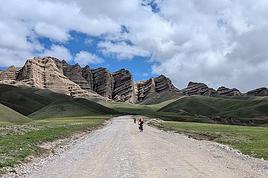
Je prepare actuellement ma demande de visa de transit turkmene. Je souhaiterais visiter Konye Urgench et donc si possible traverser la frontiere a proximite.
Mais j'ai lu que ce secteur est soumis a autorisation. Quelqu'un sait-il s'il est accessible avec un visa de transit?
Je recherche egalement des infos sur ces postes frontieres : horaires d'ouverture, transports, possibilites de change, formalites et probite des douaniers. Est ce que quelqu'un a deja traverse la frontiere a cet endroit ?
Nous venons d etre expulses d Ouzbequistan dans les 72 pour defaut d enregistrement aupres de l Ovir. Voyageant avec notre vehicule, nous sommes alles a l Ovir des notre arrivee dans le pays, reponse pas besoin d enregistrement, on a demande de nous l ecrire, refus. A Tachkent on redemande dans 2 hotels ou nous avons paye le parking, meme reponse. A Boukara la police nous arrete et nous retient 6 heures sans vouloir prendre en compte nos tentatives aupres de l Ovir. Nous avons le choix de payer une amende exhorbitante de 1100 USD par personne ou de quitter le pays.
Donc, tous les visiteurs voyageant sac a dos, par velo ou avec leur vehicule doivent dans les 3 premiers jours se faire enregistrer aupres de l OVIR mais PASSEZ par un HOTEL qui le fera pour vous car en direct l Ovir refuse de le faire. Et si vous restez 3 jours a la meme place, faites vous enregistrer.
bonsoir,
est il possible et sous quelles conditions (financière, de temps, documents necessaires pour un véhicule), d'obtenir un visa à taschkent pour le kazhakstan. Merci
bonjour bonjour tout le monde, voilà je m'apprete à partir en Ouzbekistan pour 20 jours du 7 au 27 mai 2005, mis à part que c la 1ere fois que je pars et que j'ai la trouille, je suis relativement impatient, avec tout ce que j'ai pu lire ici! Mais voilà j'ai un petit soucis, et j'espere que ma requete n'est pas redondante pour les habitués, sinon navré, j'ai fais la connaissance d'une ouzbeque sur internet qui me propose de me loger sur place, et je n'ai pas d'invitation, parce que j'ai demandé le visa touriste. alors que dois je faire pour l'OVIR parce que il est evident que je compte profiter de cette proposition avantageuse. Quelles sont les solutions? merci d'avance :)
Bonjour 🙂
Dans le cadre d'un voyage en Ouzbékistan - Kirghizistan dans 15 jours nous projetons avec mon compagnon de passer de l'Ouzbékistan vers le Kirghizistan par la voie terrestre (les vols ne correspondant pas à nos dates).
Quel itinéraire privilégier ? (Samarcade puis) Taschkent - Bichkek via le Kazakhstan (dans ce cas, me confirmez-vous qu'il ne faut pas de visa de transit pour le Kazakhstan ?) en bus/train, ou l'itinéraire Taschkent - Och via la vallée de Ferghana et Andijan ?
L'idée serait d'effectuer le trajet le plus rapide possible pour des questions de timing.
Dernière chose : auriez-vous une agence à conseiller pour un trip à cheval de 3 - 4 jours et quelle région privilégierez-vous ? Plutôt Kochkor/Naryn lac Song Kul ou plutôt Karakol et les environs du lac Issyk Kul (nous sommes des cavaliers peu expérimentés) ?
Merci déjà pour vos réponses 🙂
Dans le cadre d'un voyage en Ouzbékistan - Kirghizistan dans 15 jours nous projetons avec mon compagnon de passer de l'Ouzbékistan vers le Kirghizistan par la voie terrestre (les vols ne correspondant pas à nos dates).
Quel itinéraire privilégier ? (Samarcade puis) Taschkent - Bichkek via le Kazakhstan (dans ce cas, me confirmez-vous qu'il ne faut pas de visa de transit pour le Kazakhstan ?) en bus/train, ou l'itinéraire Taschkent - Och via la vallée de Ferghana et Andijan ?
L'idée serait d'effectuer le trajet le plus rapide possible pour des questions de timing.
Dernière chose : auriez-vous une agence à conseiller pour un trip à cheval de 3 - 4 jours et quelle région privilégierez-vous ? Plutôt Kochkor/Naryn lac Song Kul ou plutôt Karakol et les environs du lac Issyk Kul (nous sommes des cavaliers peu expérimentés) ?
Merci déjà pour vos réponses 🙂
Bonjour,
Je souhaite partir fin aout début septembre pour un trek au Kirghizistan ou en Ouzbekistan, avec un voyagiste(style Terdav, Nomade Aventure.....).
Lequel des 2 pays me conseillez-vous?
Avec quel voyagiste(bon rapport qualité-prix)?
J'ai une petite préférence pour l'Ouzbekistan, mais le pays est-il aussi sympa que le Kirghizistan pour un trek? si oui, dans quelle région?
En fait, j'aimerais trouvé un voyage combinant Trek et visite de Samarcande, Boukhara, .....
Merci de me faire part de vos expériences et de vos conceils! Toni
Merci de me faire part de vos expériences et de vos conceils! Toni
Assalamou alaïkoum! Ichlar kalay?
Bienvenue à vous sur ce petit carnet de voyage que j'écrirai en plusieurs étapes/messages.
Après moult tergiversations, nous décidons mon compagnon et moi-même en février 2018 de nous lancer sur les routes de la soie, pour un voyage de 19 jours en Ouzbékistan. Passionnés d'histoire, nous étions emballés à l'idée d'aller marcher sur les traces d'Alexandre le Grand, de Gengis Khan, de Tamerlan. Nous avions entendu beaucoup de choses positives sur ce pays, encore assez à l'écart des grands circuits touristiques classiques, et rêvé sur de splendides clichés qui représentaient les immenses médersa du Reghistan de Samarcand. Nous avons choisi de nous adresser à une agence ouzbèke pour la réservation d'une voiture avec chauffeur et des hôtels, histoire de gagner du temps sur place. Par contre, nous avons pu coudre main l'intégralité de notre voyage, choisissant le sens de notre circuit et son déroulement étape par étape.
Notre circuit pas à pas :
Jour 1. Vol Paris CDG/TACHKENT via OURGUENTCH Jour 2. Journée dans les montagnes du Tian Shan à Bildirçoi et sur les bords du lac Tcharvak Jour 3. NUKUS et ses alentours : visite de la nécropole Mizdakhan et de la forteresse en ruine Gyaur Kala. Visite du musée Igor Savitsky. Jour 4. Visite des forteresses du désert Toprak Kala et Ayaz Kala. Après-midi à KHIVA Jour 5, 6. KHIVA en visite libre Jour 7, 8. BOUKHARA en visite libre Jour 9. Les environs de BOUKHARA : le Palais d'été de l'émir, la nécropole Tchor Bakr, la cité sogdienne en ruine de Varakhcha Jour 10. Visite à GIJDUVAN d'un atelier de céramiques. Visite de NOURATA : bassin aux poissons sacrés, mosquée, vestiges de la cité sogdienne. Visite du lac AYDARKUL. Arrivée au camps de yourtes à YANGUIGAZGAN. Promenade en chameau dans le désert. Nuit sous la yourte. Jour 11. MOJRUM et son cyprès bimillénaire. HAYAT dans les montagnes nouratines Jour 12. Randonnée de 5-6 heures dans les montagnes nouratines avec pique-nique sur le col Jour 13, 14. SAMARCANDE en visite libre Jour 15. SAMARCANDE et les environs de SAMARCANDE : URGUT Jour 16. CHAKRIZABZ Jour 17. KOKAND - RICHTAN - FERGANA Jour 18. MARGUILAN Jour 19. Vol TACHKENT/PARIS CDG
Allez, c'est parti pour le récit d'un périple inoubliable, duquel nous sommes rentrés plein d'étoiles dans les yeux, entre le désert du Kyzyl Kum, les montagnes nouratines, la vallée du Ferghana et les grandes villes-musées ! Nous partons de Paris CDG le vendredi 31 août 2018 à 21h30 et arrivons le lendemain à Tachkent, la capitale, à 9h20 heure locale. En été, il faut compter 3h de décalage horaire. Une fois arrivés à l'aéroport, notre premier chauffeur francophone nous attend avec une pancarte. Il se montre tout de suite très accueillant et sympathique. Nous mettons les valises dans la malle et partons en direction des montagnes du Tian Shan pour une journée divisée en deux étapes : une petite ascension à 2200 mètres en télésiège à Bildirçoi pour pouvoir admirer le panorama montagnard et une visite au lac Tcharvak. Le tout se situant à environ 1h30 de Tachkent dans l'arrière-pays.
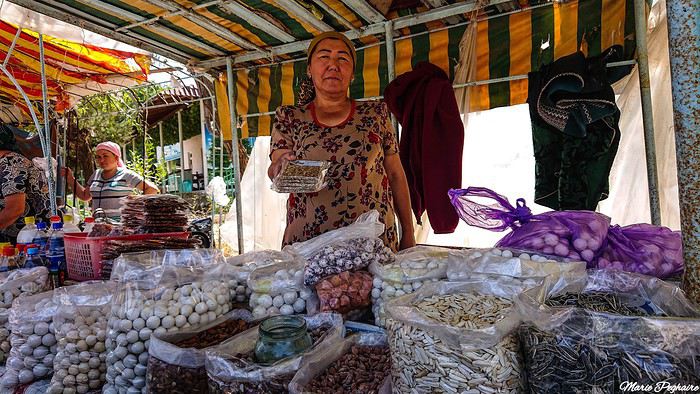
Sur le chemin pour Bildirçoi, nous nous arrêtons une première fois pour savourer les spécialités locales vendues sur un petit marché de bord de route. Une femme nous interpelle et nous invite à venir goûter ses produits, comme il est d'usage de le faire en Ouzbékistan dans les bozor. Elle nous propose toute une gamme d'amandes au sucre, au miel mais aussi des graines, des fruits secs à profusion et des laitages dont le fameux kurut. Le kurut, ce sont des petites billes de fromage séché, natures ou épicées. Pour leur conception, on utilise du lait de chèvre, de mouton ou de vache qui est transformé en yoghourt puis salé et mis à égoutter dans des sacs de toile ou de peau de chèvre. Ensuite, on le roule en billes ou en boules et on le laisse sécher pendant plusieurs semaines au soleil. On mange ce "fromage" ouzbek très salé à l'apéritif en sirotant une bonne bière. Nous sommes gâtés par la gentillesse et le sourire de cette dame avec laquelle nous échangeons nos premiers mots ouzbeks. Et nous repartons avec des sacs remplis de bonnes choses.
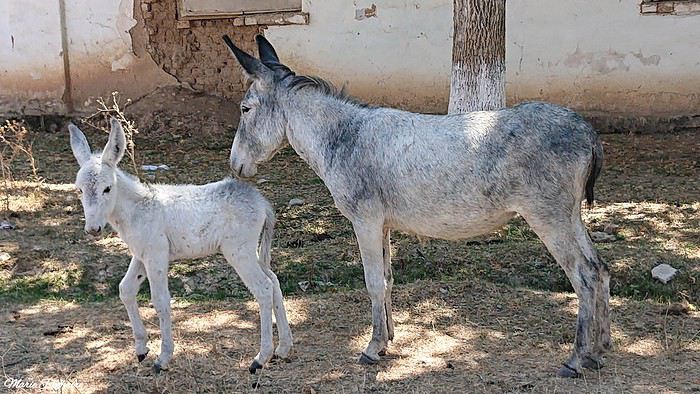
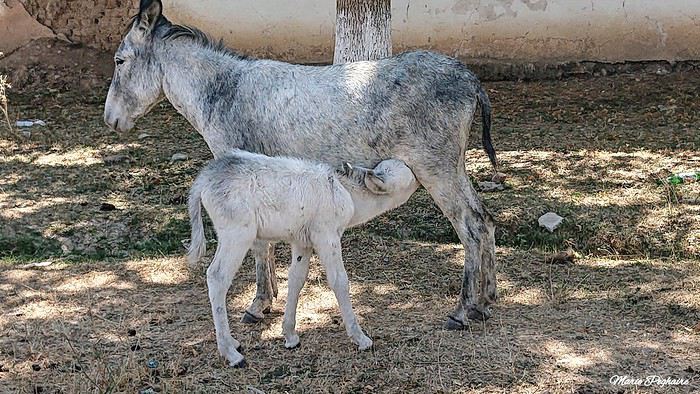
Nous reprenons la route. Sur les bas-côtés, des animaux évoluent en semi-liberté. Ils ont beau vivre librement dans la montagne, et non paître dans des parcs clos, ils ont tous un propriétaire et ils connaissent parfaitement leur territoire. Ici, une ânesse et son petit ânon.
Nous arrivons enfin à la station de Bildirçoi. Nous devrons faire 1h30 de queue avant de pouvoir grimper sur un télésiège très rudimentaire qui nous fera culminer à 2200 mètres d'altitude en survolant des vergers de pommiers et une charmante petite rivière. En effet, nous sommes le samedi 1er septembre, c'est le jour de l'Indépendance en Ouzbékistan. Les Ouzbeks se sont réunis en famille ou entre amis pour profiter une dernière fois des atours de la montagne avant la rentrée officielle du lundi qui suit. Une fois arrivés là-haut, nous profitons d'une vue magnifique sur un horizon montagneux aux belles couleurs.
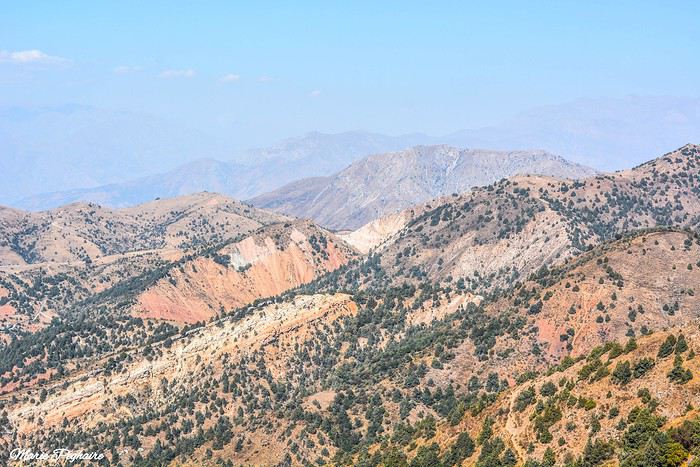
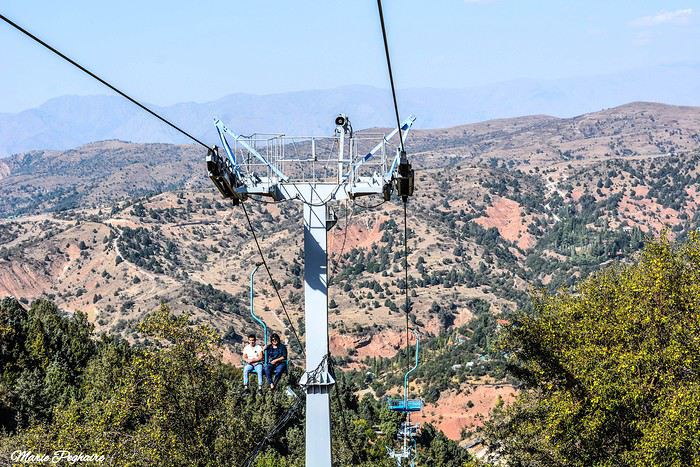
Nous nous engageons ensuite dans la descente qui nous prendra 25 minutes environ. C'est assez abrupt par moment, on a vraiment l'impression de plonger dans le vide. Une fois en bas, nous retrouvons notre ami chauffeur qui nous racontera toutes sortes d'anecdotes sur l'histoire du pays avant de nous amener sur les bords du lac Tcharvak. Nous roulons sur une route correcte jusqu'à une distance d'environ 80 km au nord-est de Tachkent et nous tombons nez-à-nez sur le lac Tcharvak, près de Tchimgan. Ses eaux d'un bleu profond répondant à celui du ciel avec, comme horizon proche, la silhouette des montagnes du Tian Shan en arrière-plan. Nous sommes conquis. Il s'agit d'un lac artificiel construit en 1982 au confluent des hautes vallées du Pskem, du Koksou et du Tchatkal. Aujourd'hui, les Ouzbeks viennent y pratiquer le sport nautique ou le deltaplane sur ses contreforts.
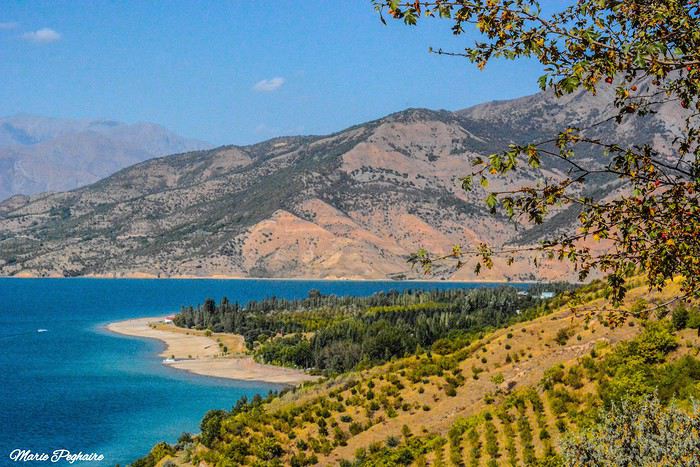
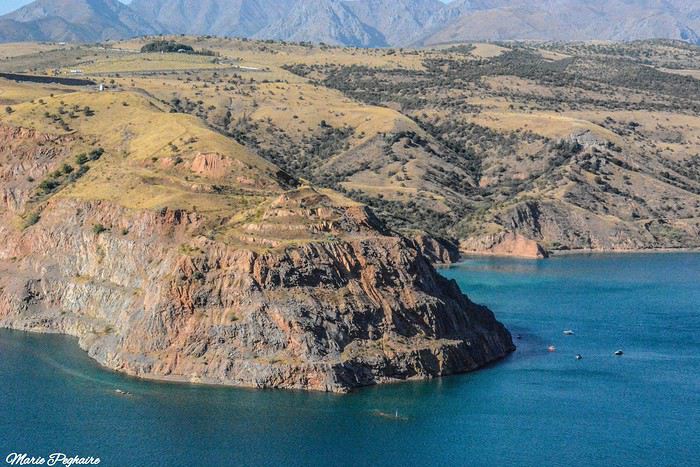
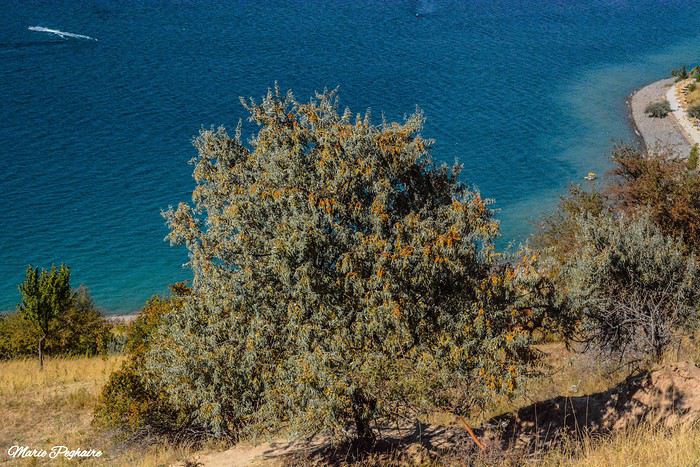
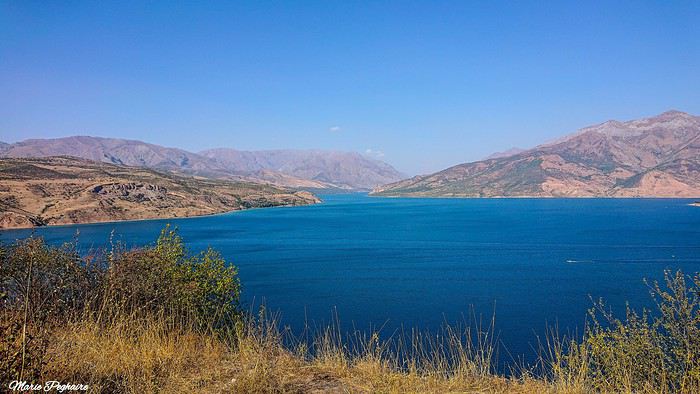
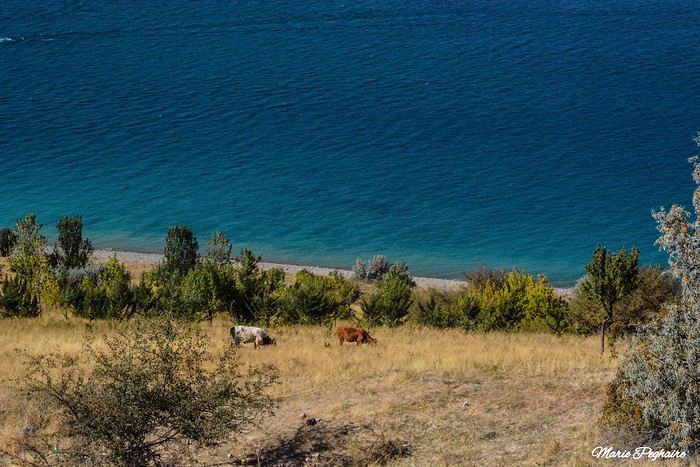
Nous prenons le temps de contempler le panorama du haut de la route. Cet endroit respire le calme, la quiétude et nous laisse une impression d'immensité.
Nous nous arrêtons dans une tchaikhana pour déguster nos premières shashliks de mouton et de boeuf, les brochettes ouzbèkes. Elles nous sont servies avec une salade de tomates (pomidor), de concombres (bodring) et d'oignons (piyoz). Nous buvons le célèbre kok chai ou thé vert mais aussi de la Kompot soit un jus de fruit frais national aux variantes locales. Absolument délicieux. Évidemment, pas de déjeuner sans l'incontournable nôn, le pain ouzbek dont les recettes se déclinent selon les régions. Puis nous repartons en direction de Tachkent où nous passerons la nuit dans un quartier résidentiel de la ville dans un hôtel très correct tenu par des Russes.
Fin de la première journée !
Bienvenue à vous sur ce petit carnet de voyage que j'écrirai en plusieurs étapes/messages.
Après moult tergiversations, nous décidons mon compagnon et moi-même en février 2018 de nous lancer sur les routes de la soie, pour un voyage de 19 jours en Ouzbékistan. Passionnés d'histoire, nous étions emballés à l'idée d'aller marcher sur les traces d'Alexandre le Grand, de Gengis Khan, de Tamerlan. Nous avions entendu beaucoup de choses positives sur ce pays, encore assez à l'écart des grands circuits touristiques classiques, et rêvé sur de splendides clichés qui représentaient les immenses médersa du Reghistan de Samarcand. Nous avons choisi de nous adresser à une agence ouzbèke pour la réservation d'une voiture avec chauffeur et des hôtels, histoire de gagner du temps sur place. Par contre, nous avons pu coudre main l'intégralité de notre voyage, choisissant le sens de notre circuit et son déroulement étape par étape.
Notre circuit pas à pas :
Jour 1. Vol Paris CDG/TACHKENT via OURGUENTCH Jour 2. Journée dans les montagnes du Tian Shan à Bildirçoi et sur les bords du lac Tcharvak Jour 3. NUKUS et ses alentours : visite de la nécropole Mizdakhan et de la forteresse en ruine Gyaur Kala. Visite du musée Igor Savitsky. Jour 4. Visite des forteresses du désert Toprak Kala et Ayaz Kala. Après-midi à KHIVA Jour 5, 6. KHIVA en visite libre Jour 7, 8. BOUKHARA en visite libre Jour 9. Les environs de BOUKHARA : le Palais d'été de l'émir, la nécropole Tchor Bakr, la cité sogdienne en ruine de Varakhcha Jour 10. Visite à GIJDUVAN d'un atelier de céramiques. Visite de NOURATA : bassin aux poissons sacrés, mosquée, vestiges de la cité sogdienne. Visite du lac AYDARKUL. Arrivée au camps de yourtes à YANGUIGAZGAN. Promenade en chameau dans le désert. Nuit sous la yourte. Jour 11. MOJRUM et son cyprès bimillénaire. HAYAT dans les montagnes nouratines Jour 12. Randonnée de 5-6 heures dans les montagnes nouratines avec pique-nique sur le col Jour 13, 14. SAMARCANDE en visite libre Jour 15. SAMARCANDE et les environs de SAMARCANDE : URGUT Jour 16. CHAKRIZABZ Jour 17. KOKAND - RICHTAN - FERGANA Jour 18. MARGUILAN Jour 19. Vol TACHKENT/PARIS CDG
Allez, c'est parti pour le récit d'un périple inoubliable, duquel nous sommes rentrés plein d'étoiles dans les yeux, entre le désert du Kyzyl Kum, les montagnes nouratines, la vallée du Ferghana et les grandes villes-musées ! Nous partons de Paris CDG le vendredi 31 août 2018 à 21h30 et arrivons le lendemain à Tachkent, la capitale, à 9h20 heure locale. En été, il faut compter 3h de décalage horaire. Une fois arrivés à l'aéroport, notre premier chauffeur francophone nous attend avec une pancarte. Il se montre tout de suite très accueillant et sympathique. Nous mettons les valises dans la malle et partons en direction des montagnes du Tian Shan pour une journée divisée en deux étapes : une petite ascension à 2200 mètres en télésiège à Bildirçoi pour pouvoir admirer le panorama montagnard et une visite au lac Tcharvak. Le tout se situant à environ 1h30 de Tachkent dans l'arrière-pays.
Sur le chemin pour Bildirçoi, nous nous arrêtons une première fois pour savourer les spécialités locales vendues sur un petit marché de bord de route. Une femme nous interpelle et nous invite à venir goûter ses produits, comme il est d'usage de le faire en Ouzbékistan dans les bozor. Elle nous propose toute une gamme d'amandes au sucre, au miel mais aussi des graines, des fruits secs à profusion et des laitages dont le fameux kurut. Le kurut, ce sont des petites billes de fromage séché, natures ou épicées. Pour leur conception, on utilise du lait de chèvre, de mouton ou de vache qui est transformé en yoghourt puis salé et mis à égoutter dans des sacs de toile ou de peau de chèvre. Ensuite, on le roule en billes ou en boules et on le laisse sécher pendant plusieurs semaines au soleil. On mange ce "fromage" ouzbek très salé à l'apéritif en sirotant une bonne bière. Nous sommes gâtés par la gentillesse et le sourire de cette dame avec laquelle nous échangeons nos premiers mots ouzbeks. Et nous repartons avec des sacs remplis de bonnes choses.
Nous reprenons la route. Sur les bas-côtés, des animaux évoluent en semi-liberté. Ils ont beau vivre librement dans la montagne, et non paître dans des parcs clos, ils ont tous un propriétaire et ils connaissent parfaitement leur territoire. Ici, une ânesse et son petit ânon.
Nous arrivons enfin à la station de Bildirçoi. Nous devrons faire 1h30 de queue avant de pouvoir grimper sur un télésiège très rudimentaire qui nous fera culminer à 2200 mètres d'altitude en survolant des vergers de pommiers et une charmante petite rivière. En effet, nous sommes le samedi 1er septembre, c'est le jour de l'Indépendance en Ouzbékistan. Les Ouzbeks se sont réunis en famille ou entre amis pour profiter une dernière fois des atours de la montagne avant la rentrée officielle du lundi qui suit. Une fois arrivés là-haut, nous profitons d'une vue magnifique sur un horizon montagneux aux belles couleurs.
Nous nous engageons ensuite dans la descente qui nous prendra 25 minutes environ. C'est assez abrupt par moment, on a vraiment l'impression de plonger dans le vide. Une fois en bas, nous retrouvons notre ami chauffeur qui nous racontera toutes sortes d'anecdotes sur l'histoire du pays avant de nous amener sur les bords du lac Tcharvak. Nous roulons sur une route correcte jusqu'à une distance d'environ 80 km au nord-est de Tachkent et nous tombons nez-à-nez sur le lac Tcharvak, près de Tchimgan. Ses eaux d'un bleu profond répondant à celui du ciel avec, comme horizon proche, la silhouette des montagnes du Tian Shan en arrière-plan. Nous sommes conquis. Il s'agit d'un lac artificiel construit en 1982 au confluent des hautes vallées du Pskem, du Koksou et du Tchatkal. Aujourd'hui, les Ouzbeks viennent y pratiquer le sport nautique ou le deltaplane sur ses contreforts.
Nous prenons le temps de contempler le panorama du haut de la route. Cet endroit respire le calme, la quiétude et nous laisse une impression d'immensité.
Nous nous arrêtons dans une tchaikhana pour déguster nos premières shashliks de mouton et de boeuf, les brochettes ouzbèkes. Elles nous sont servies avec une salade de tomates (pomidor), de concombres (bodring) et d'oignons (piyoz). Nous buvons le célèbre kok chai ou thé vert mais aussi de la Kompot soit un jus de fruit frais national aux variantes locales. Absolument délicieux. Évidemment, pas de déjeuner sans l'incontournable nôn, le pain ouzbek dont les recettes se déclinent selon les régions. Puis nous repartons en direction de Tachkent où nous passerons la nuit dans un quartier résidentiel de la ville dans un hôtel très correct tenu par des Russes.
Fin de la première journée !
From Beijing to Khiva: China, Kyrgyzstan, Tajikistan, Uzbekistan
Chronicle of anecdotes, highlights, and other adventures that marked this eight-week journey in 2018.
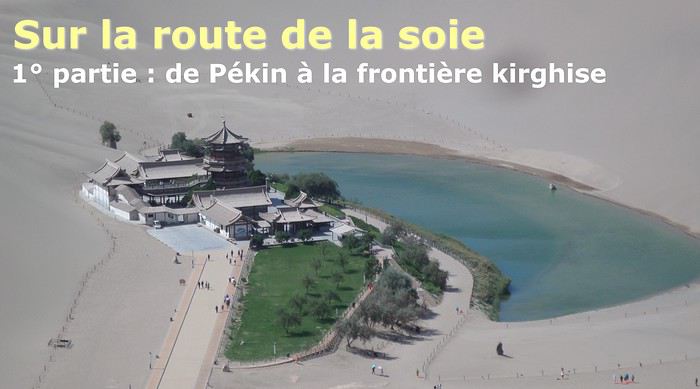
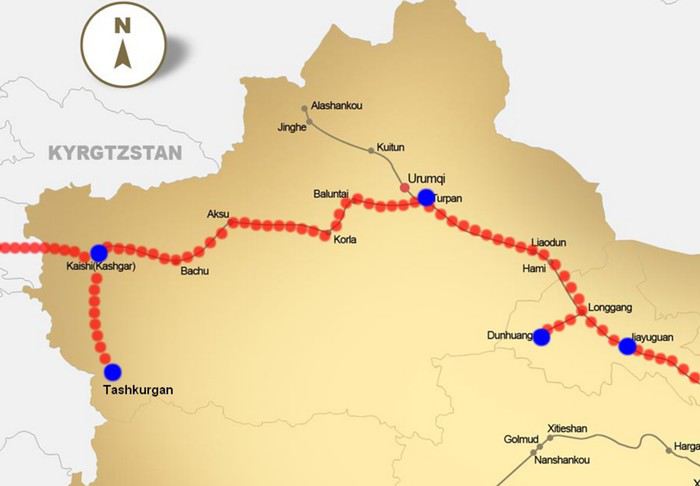
The Chinese Far West More than 30 years after my first trip to eastern China, I finally fulfilled an old dream: traveling solo from Beijing to the far west, discovering Xinjiang, the Uyghur people and the oppression they endure, the oases of Turpan and Kashgar, the Taklamakan Desert, the end of the Great Wall... The route was covered by train.
MENU PART 1: CHINA
1- Beijing (Jiankou) : the authentic Great Wall, without tourists 2- Cycling in Beijing, the best way to get around 3- Beijing : departure for the far west 4- Jiayuguan : getting by without English 5- Jiayuguan : scams and heritage 6- Dunhuang : abundance in the middle of the desert 7- Turpan : the Uyghurs under heavy surveillance 8- Kashgar : love at first sight for the old city 9- Kashgar : China’s recipe for controlling the populace 10- Tashkurgan : what on earth was I thinking going there! Kyrgyz border: a surreal epic Photo album from the 80s, contributions from other travelers (page 2)
1- JIANKOU Finding the authentic Great Wall, without tourists or a guide Friday, August 24, 2018 Thirty years later, I didn’t feel like revisiting the Great Wall at Badaling or any other overcrowded site. I chose to explore it at Jiankou, in its wildest, most authentic, and unrestored section, starting from a lost village deep in a valley—though it wasn’t *that* lost, since it had everything for communication.
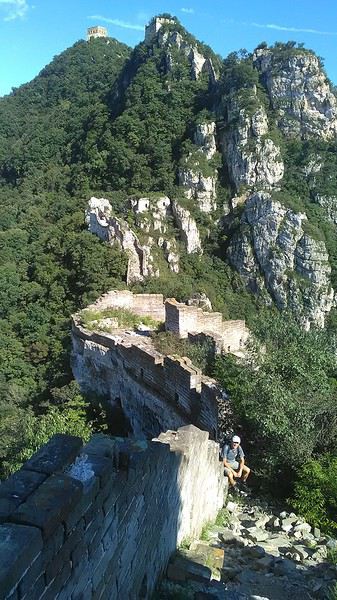
No need to pay for a taxi to get there—by timing it right, you can take the bus for just a few yuan. You have to get off at Xizhazi, the bus terminus. Be careful, there are only two buses a day in each direction. At the Xizhazi bus stop, I met a young couple who’d arrived with zero information about what to expect. We hiked the three of us toward the restored section of Mutianyu.
Still, be cautious With GPS and a topographic map (OpenTopoMap), you can set off without a problem or guide. The trail up to Jiankou is easy and well-marked. The trails down are too. But be careful—once you’re on the Wall, it’s real mountain hiking, with easy but dangerous climbing sections (over sheer drops). Not for amateurs or those afraid of heights! But what a reward. The Wall all to yourself, where it’s at its most daring. Truly mesmerizing.
More photos...
2- BEIJING The best way to get around the capital Sunday, August 26 The best way to explore the city is still by bike. Most are in a bike-share system, but you need to use an app—WeChat, the app that does everything, like monitoring your every move. No way I was installing that.
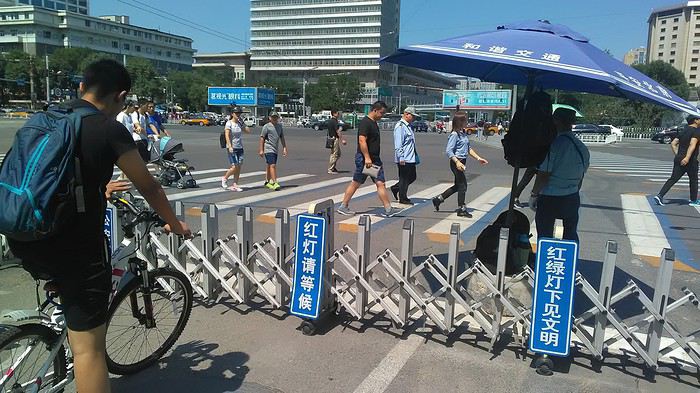
I found one at a rental shop near the hostel. The key is to quickly learn local traffic customs to minimize risks. Bike lanes are wide along the avenues.
But you still have to: - Watch out for anything parked on the bike paths—the most annoying are people napping or talking on the phone in their cars - Keep an eye on everything coming the wrong way—the list is long - The worst is right turns on red, which in Chinese traffic rules seem to have priority Once you get the hang of it, it’s fine. The city is huge but flat, so you can just wing it.
3- BEIJING By train to the far west Sunday, August 26 Beijing West Station is the size and operates like an airport. With your e-ticket from the agency, you first have to pick up your ticket at the special "English" counter, after passing through security. With your ticket in hand, you have to exit and enter through the boarding waiting area—not the platform—after a second security check.
 Then you find the right hall and wait for the sign to finally access the platform. In the end, it works pretty well given the incredible number of passengers to manage. Everywhere in Beijing, I saw that the Chinese have mastered crowd flow management.
Nice surprise: second-class carriages are clean, air-conditioned, and bright. Perfect, since I was in for 20 hours. One uniformed attendant per carriage, mobile meal service—luxury! Small downside: no luggage space. Hauling your suitcase up to the top bunk is quite a workout. I was in the middle, so it wasn’t too bad. The landscape, though, whether rural or urban, is pretty bleak. That should change once we leave the eastern plains.
Of course, I got my first police visit, with a thorough passport check and bag search. I was warned—going to the Chinese far west exposes you to this kind of hassle. But they were polite and respectful.
 The Chinese Far West
4- JIAYUGUAN Getting by without English Monday, August 27 At the gates of two deserts (Gobi and Taklamakan) and at the foot of the Tibetan highlands, the Great Wall ends at Jiayuguan. Here, I found the deeper China I’d somewhat rediscovered during my bike ride, even if now everyone gets around on electric bikes and I’m no longer stared at like an alien.
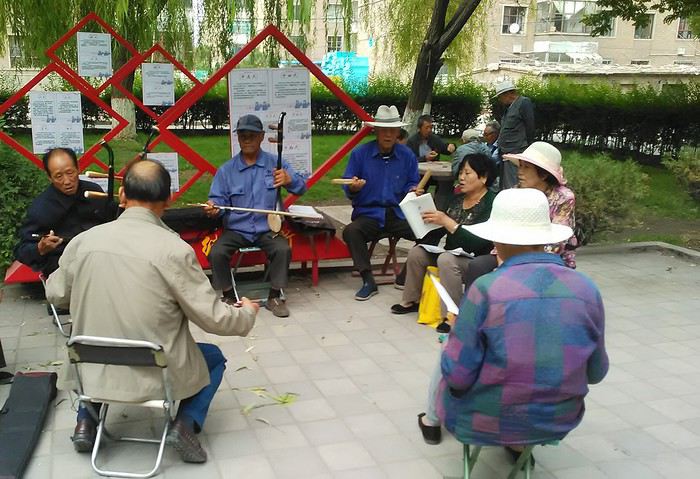
Prices are nothing like Beijing: you can find a full meal for 2 €, and my bike cost 7 € for two days. Plus, few people speak English—neither the owner of the HI hostel where I stayed, nor the ticket sellers at the sites, let alone the servers at the small eateries where I ate. Everything is written in Chinese. So I had to use the little Chinese I know to communicate about essentials. It makes the locals laugh to see a European trying to speak their language, but it earns respect. With Google Translate’s help, I managed.
Rant: With their avenues blocked for construction for kilometers without warning, and new roads not yet on maps, I must’ve taken 15 km of detours. More photos...
5- JIAYUGUAN Scams and heritage Tuesday, August 28 The Great Wall doesn’t exactly end at the fort I visited yesterday but 10 km further, at the entrance to a river gorge at the foot of the mountains. All that’s left is a badly damaged tower (more like a mound of earth) and a section of clay wall, similar to the one I biked yesterday.
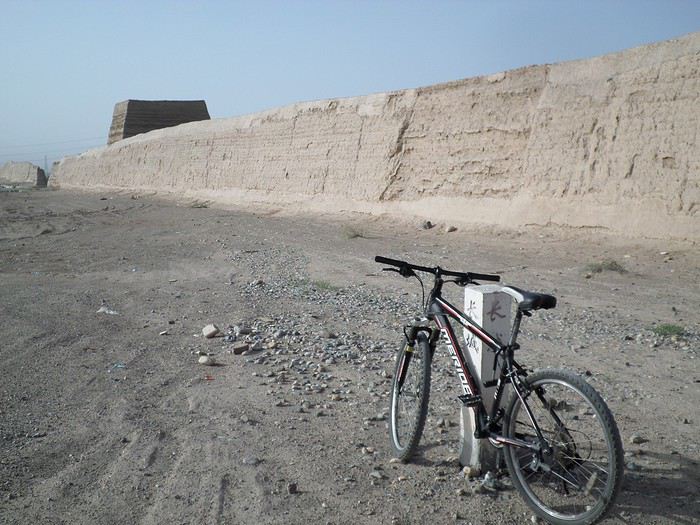
This morning, I hopped on my bike, determined to venture into the desert to see this highly symbolic site. First, you access it via a wide, brand-new road with not a soul in sight. Just before the site, I came across a grand welcome gate, very period-style, but it’s actually the inevitable toll booth.
Behind the gate, the road continues straight to the site, which you can see in the distance—at least 2 km away—the remains of the tower and wall. I had to leave my bike here. Fine. I went to the ticket counter and asked the price: 120 yuan! I couldn’t believe it—over 15 € for a simple mound of earth.
I showed my displeasure to the attendant, who couldn’t care less, and immediately turned back. 120 yuan—that’s the price for a new road, a fancy gate planted 2 km before the site just to force you to take a shuttle, and employees with nothing to do all day... Now I understand why I didn’t meet anyone!
Heritage China is a bit pricey Generally, sites are expensive for the country’s standard of living, but travelers are supposed to have money, so why hold back? I even gave up on the Forbidden City—reservations required days in advance (or on the black market at an impossible price). I prefer to keep the memory of my first visit, when entry must’ve cost a few dozen cents, and there were only a handful of visitors.
This morning, I took a taxi to see remarkable tombs of common people from the 3rd to 6th centuries. They’re small vaulted caves made of painted bricks, depicting scenes of daily life. Very pretty and moving. But even here, though the price was more reasonable, I was left wanting—only one of the 16 tombs is open to visitors, and it’s apparently not the most beautiful.
The authentic China—at least what’s left of it... Wandering the impersonal avenues of the city, you stumble upon a market. There, you still find traditional China—small shops with questionable hygiene, Go players, musicians, and even a dental prosthetist. The last refuge for those untouched by modernity. More photos...
6- DUNHUANG Abundance in the middle of the desert Wednesday, August 29 Well, I thought the landscape would be less bleak as I headed west. Nope. The only distraction in this expanse of dark, clayey sand is the forests of pylons and wind turbines, plus wild camels racing each other.
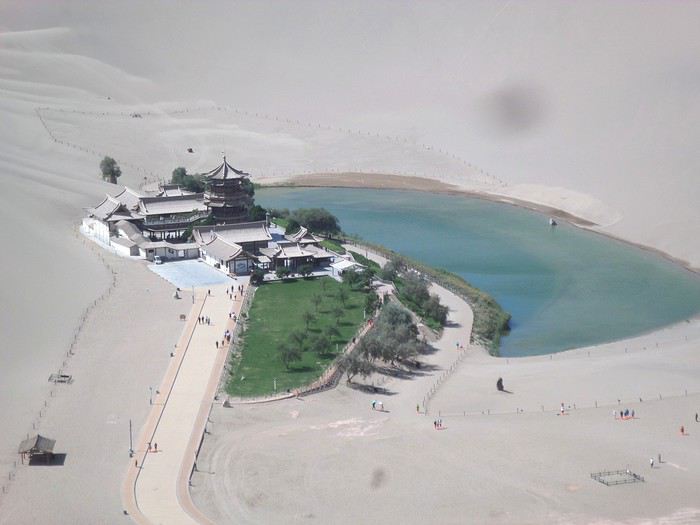 However, Dunhuang, the gateway to the Taklamakan, is by far the most pleasant Chinese city I know. There’s a real city center you can explore on foot. It’s hot but not unbearable, with a light, dry breeze. Much nicer than Beijing. The Han Chinese are still the majority, but the Muslim Uyghurs are more numerous, and the muezzin’s call to prayer echoes around the mosque.
The most surprising thing is the abundance and diversity of fruits and vegetables. You wonder how it all grows here. Well-irrigated, the desert sands are very fertile. Here, raisins have subtle, mysterious flavors, and the lamb really tastes like lamb.
Today, I visited the must-see Mingshashan, a dune complex next to which Pila is a molehill. The Basque Country, but covered in sand... More photos...
7- TURPAN The Uyghurs under heavy surveillance Friday, August 31 Surveillance cameras everywhere in the city, armed police stationed at intersections, in front of public buildings, at the entrance and inside tourist sites, police stations on every corner, patrols on foot or by car, khaki uniforms even for middle schoolers... here, the Han Chinese are in the minority, and you can feel it. Turpan feels like a city under siege.
To enter the youth hostel where I stayed, there’s even a security gate, and the receptionist (a Han, like everyone in tourism) wears a bulletproof vest! Reassuring. Still, you don’t feel particularly threatened here, especially as a European. The troublemakers are the Chinese, not the Uyghurs. Generally, China is a very safe country for visitors.
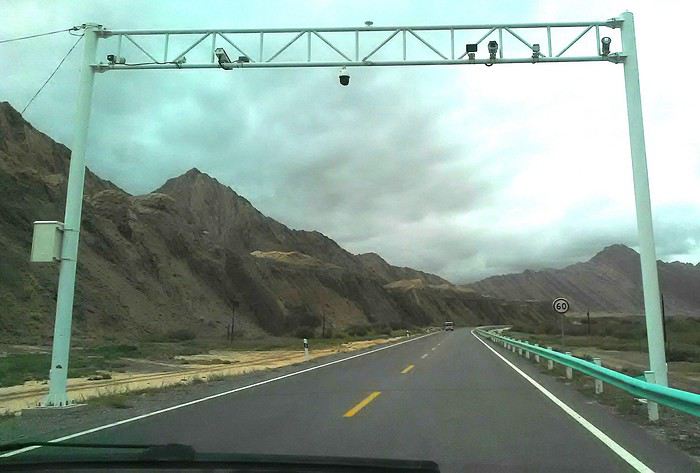
Smile, you’re on camera! I was biking on an avenue when the car in front of me got flashed for driving slowly. I quickly understood why when I got flashed too.
Here, the official time is Beijing time, but it gets dark two hours later. It’ll be even worse in Kashgar. Trickier to manage: everything is displayed in Chinese and Arabic. Nothing in English. Choosing a menu is a shot in the dark. Apart from a few young Chinese, no one here speaks English, and my Chinese doesn’t seem very understandable...
Mogao, the end of the road for the Han Yesterday, near Dunhuang, I went to Mogao, a complex of decorated caves with Buddha sculptures and paintings. Stunning, but so crowded! Luckily, here in Turpan, Chinese tourists barely venture out. So I visited a Silk Road ghost town with only a handful of other visitors and under a howling wind.
The modern Chinese city is swallowing up the old Uyghur neighborhoods—only a museum-like district remains in the center, and pockets of resistance on the outskirts are doomed to disappear soon. More photos...
8- KASHGAR A (relative) love at first sight for the old city Sunday, September 2 After three overnight trains, here I am in the far west of China, nearly 4,000 km from the capital. Despite the omnipresent police and an old city preserved UNESCO-style, Kashgar is my Chinese love at first sight.
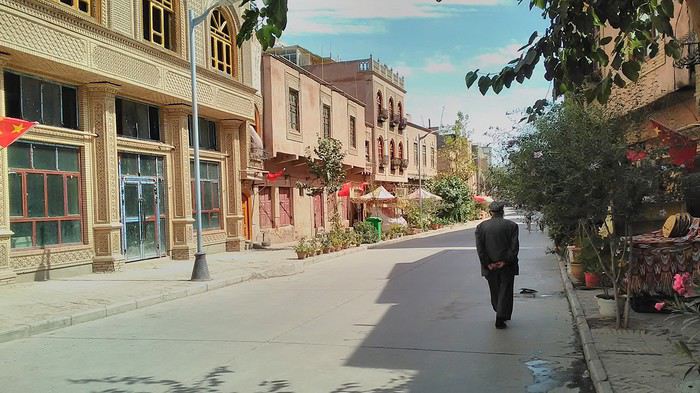
Finally, Chinese... well, sort of, because we’re in Uyghur territory here—a Turkic people with nothing culturally in common with the Han, the eastern Chinese. It started badly yesterday at Turfan station, where after three security gate passes, at least five passport checks, and a bag search, three adorable policewomen confiscated my antibacterial lotion because it had a flammable logo...
Then came the welcoming committee of armed cops at Kashgar station. Once all that was over, they left me alone—except you still have to go through security checks like everyone else to enter the old city, the bazaar, the livestock market... The further west you go, the more the siege mentality is evident. Luckily, the border isn’t far...
Despite the inevitable destruction-reconstruction, the city center has been well preserved. Thankfully, because it’s a very original style, a mix of local and colonial. I love it, even if it’s a bit too artificial, sanitized, and watered-down, and rather empty of residents. On the Silk Road, the city was famous for its great food. And it still is—rarely have I seen such richness and abundance of food! And not just scorpions or snakes. More photos...
9- KASHGAR China’s recipe for controlling the populace Saturday, September 1 Xinjiang, along with Tibet, is a "sensitive" area of rebellion in the eyes of Chinese authorities. As a result, the state has these regions and their populations under total control. Tourists also feel the consequences, even if they’re not at risk of re-education camps.
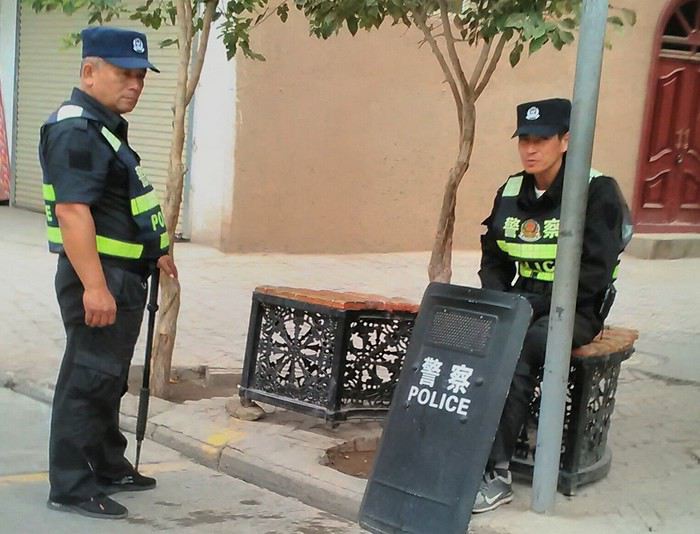 - Putting barbed wire and anti-ramming barriers around sensitive sites (schools, big hotels, government buildings...)
- Installing traffic surveillance gates with cameras and photo flashes (for all vehicles passing, including bikes) throughout the city and even in the countryside
- Posting uniformed guards with tasers, batons, or huge baseball bats every 100 meters
- Training the Han population (ethnic Chinese) in self-defense with sticks, preferably in the morning on the street. Men and women of all ages
- Starting school with the national anthem, doing military exercises, and receiving political indoctrination, all neatly lined up in the courtyard. (The dream school for any teacher)
- Placing a snitch in uniform (a pseudo-guard) in public gathering places, like youth hostels. Mine spends the day loafing around the courtyard
- Putting Chinese flags everywhere on the streets to remind everyone who’s in charge
- Installing security gates at every entrance to areas frequented by tourists (thanks for that) but not just there
- Never photographing cops, or else! I tried, but it’s not easy...
- Putting barbed wire and anti-ramming barriers around sensitive sites (schools, big hotels, government buildings...)
- Installing traffic surveillance gates with cameras and photo flashes (for all vehicles passing, including bikes) throughout the city and even in the countryside
- Posting uniformed guards with tasers, batons, or huge baseball bats every 100 meters
- Training the Han population (ethnic Chinese) in self-defense with sticks, preferably in the morning on the street. Men and women of all ages
- Starting school with the national anthem, doing military exercises, and receiving political indoctrination, all neatly lined up in the courtyard. (The dream school for any teacher)
- Placing a snitch in uniform (a pseudo-guard) in public gathering places, like youth hostels. Mine spends the day loafing around the courtyard
- Putting Chinese flags everywhere on the streets to remind everyone who’s in charge
- Installing security gates at every entrance to areas frequented by tourists (thanks for that) but not just there
- Never photographing cops, or else! I tried, but it’s not easy...
With all that, you can stroll around safely Not much crime! As for the amount the Chinese state spends to maintain such a system, it’s staggering! A third of the Han living in Xinjiang work in security. Today, I wandered freely around old Kashgar, which is quite large after all. More photos...
10- TASHKURGAN What on earth was I thinking going there! Wednesday, September 5 First, there’s the taxi—pretty crappy, with a driver who doesn’t speak a word of English and won’t stop smoking. Over six hours in that... shared with a completely out-of-it American.
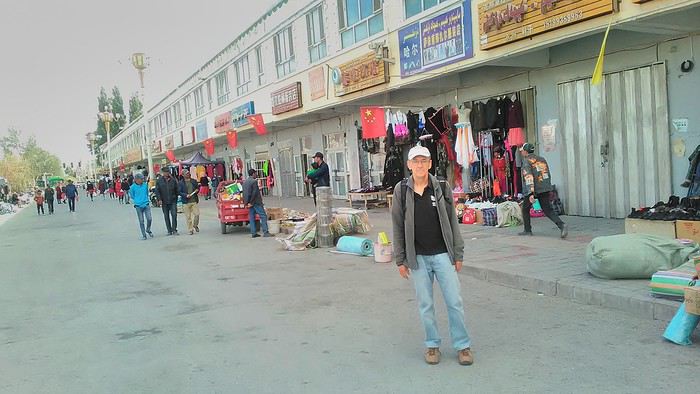
Then there are all the checkpoints along the way. I won’t go on—you know the drill by now.
After that, there’s Tashkurgan—a town with nothing to see, nothing to do. Deserted as soon as night falls. There’s this huge youth hostel and a few lost Chinese tapping away on their smartphones, chain-smoking. This lost American-European crowd, swapping tips on how to enter Pakistan or Tajikistan.
Luckily, there’s the Chinese Pamir Highway, lined with peaks over 7,000m. There’s the feeling of no longer being in China, with a population whose features are Middle Eastern. And these Tajik women with their stunning hairstyles and vibrant costumes. There’s the fact of having reached the westernmost Chinese city, far from crowds and tourist sites. A sort of end of the world. More photos...
11- KYRGYZ BORDER A surreal epic Thursday, September 6 The road from Kashgar to the Kyrgyzstan border is a little over 200 km and passes through beautiful landscapes of colorful, desert-like mountains with acrobatic folds. That’s the bucolic part of the trip.
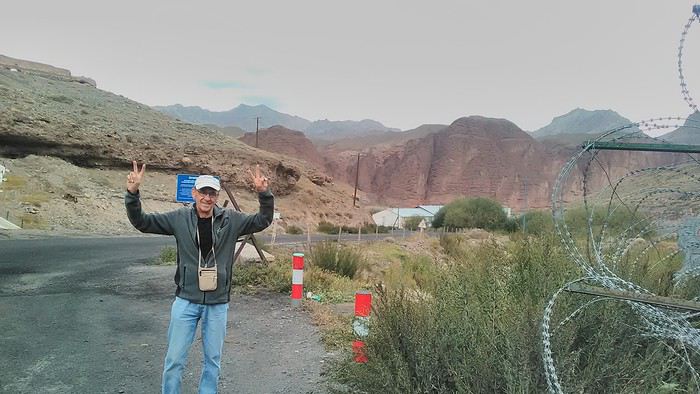 Yesterday, I managed to gather four people to rent a minibus to reach the border more easily: a Spaniard and an Argentine I’d already met in Turpan, and two New Zealanders who responded to the ad left at the hostel.
Absurdity and paranoia of Chinese authorities The highlight was crossing the town of Wuqia, 50 km past Kashgar. After tallying up with my fellow sufferers, we must’ve passed about ten checkpoints with: - Passport checks: 14 times, sometimes by two cops side by side - Bag checks: 4 times - Smartphone checks: 2 times, with deletion of "non-compliant" photos, and registration of your IMEI in the exit log!... Absurd and surreal at the same time, since my camera stayed in my bag, my apps are in French, and my photos have been online for ages...
With all that, we arrived just as the last checkpoint before the no man’s land marking the border between the two countries was on lunch break. And bam! Another 1.5-hour wait, alongside truckers who were much more used to this than we were.
What to think? The cops themselves aren’t fooled. They play the role they’re asked to, but sometimes you can coax a smile out of them—they realize how ridiculous the situation is.
What’s the point? That’s the big question my companions and I were tempted to answer with "to piss people off." To show you your place isn’t here, but with the other tourists, over there in the east, in Shanghai, Xi’an, or Guangzhou.
As for you, a traveler from a democratic country, you really experience this as aggression, humiliation, a violation of your private space. And yet, I’m respected, they speak to me properly. Today, I better understand what a Palestinian or a citizen of an occupied country might feel daily. A unique experience! Thanks, China.
And to top it off, the cherry on the cake! It’s still this glowing button you press to rate your passage after clearing the last obstacle before the exit stamp. I was so surprised it turned off before I could react. The Spaniard, with great humor and irony, had time to vote "excellent." In the end, he wasn’t wrong—you can hardly do better!
PS: I ditched my buddies at the border. They didn’t want to pay for a taxi to continue. So I took a direct taxi to Osh. The first 100 km are fabulous. I couldn’t take many photos, but I’ll be back on Monday to go to Tajikistan.
More photos...
The rest of the Silk Road, Part 2, in these travel journals: Kyrgyzstan, Tajikistan, Uzbekistan.
The Chinese Far West More than 30 years after my first trip to eastern China, I finally fulfilled an old dream: traveling solo from Beijing to the far west, discovering Xinjiang, the Uyghur people and the oppression they endure, the oases of Turpan and Kashgar, the Taklamakan Desert, the end of the Great Wall... The route was covered by train.
MENU PART 1: CHINA
1- Beijing (Jiankou) : the authentic Great Wall, without tourists 2- Cycling in Beijing, the best way to get around 3- Beijing : departure for the far west 4- Jiayuguan : getting by without English 5- Jiayuguan : scams and heritage 6- Dunhuang : abundance in the middle of the desert 7- Turpan : the Uyghurs under heavy surveillance 8- Kashgar : love at first sight for the old city 9- Kashgar : China’s recipe for controlling the populace 10- Tashkurgan : what on earth was I thinking going there! Kyrgyz border: a surreal epic Photo album from the 80s, contributions from other travelers (page 2)
1- JIANKOU Finding the authentic Great Wall, without tourists or a guide Friday, August 24, 2018 Thirty years later, I didn’t feel like revisiting the Great Wall at Badaling or any other overcrowded site. I chose to explore it at Jiankou, in its wildest, most authentic, and unrestored section, starting from a lost village deep in a valley—though it wasn’t *that* lost, since it had everything for communication.
No need to pay for a taxi to get there—by timing it right, you can take the bus for just a few yuan. You have to get off at Xizhazi, the bus terminus. Be careful, there are only two buses a day in each direction. At the Xizhazi bus stop, I met a young couple who’d arrived with zero information about what to expect. We hiked the three of us toward the restored section of Mutianyu.
Still, be cautious With GPS and a topographic map (OpenTopoMap), you can set off without a problem or guide. The trail up to Jiankou is easy and well-marked. The trails down are too. But be careful—once you’re on the Wall, it’s real mountain hiking, with easy but dangerous climbing sections (over sheer drops). Not for amateurs or those afraid of heights! But what a reward. The Wall all to yourself, where it’s at its most daring. Truly mesmerizing.
More photos...
2- BEIJING The best way to get around the capital Sunday, August 26 The best way to explore the city is still by bike. Most are in a bike-share system, but you need to use an app—WeChat, the app that does everything, like monitoring your every move. No way I was installing that.
I found one at a rental shop near the hostel. The key is to quickly learn local traffic customs to minimize risks. Bike lanes are wide along the avenues.
But you still have to: - Watch out for anything parked on the bike paths—the most annoying are people napping or talking on the phone in their cars - Keep an eye on everything coming the wrong way—the list is long - The worst is right turns on red, which in Chinese traffic rules seem to have priority Once you get the hang of it, it’s fine. The city is huge but flat, so you can just wing it.
3- BEIJING By train to the far west Sunday, August 26 Beijing West Station is the size and operates like an airport. With your e-ticket from the agency, you first have to pick up your ticket at the special "English" counter, after passing through security. With your ticket in hand, you have to exit and enter through the boarding waiting area—not the platform—after a second security check.
Then you find the right hall and wait for the sign to finally access the platform. In the end, it works pretty well given the incredible number of passengers to manage. Everywhere in Beijing, I saw that the Chinese have mastered crowd flow management.Nice surprise: second-class carriages are clean, air-conditioned, and bright. Perfect, since I was in for 20 hours. One uniformed attendant per carriage, mobile meal service—luxury! Small downside: no luggage space. Hauling your suitcase up to the top bunk is quite a workout. I was in the middle, so it wasn’t too bad. The landscape, though, whether rural or urban, is pretty bleak. That should change once we leave the eastern plains.
Of course, I got my first police visit, with a thorough passport check and bag search. I was warned—going to the Chinese far west exposes you to this kind of hassle. But they were polite and respectful.
The Chinese Far West4- JIAYUGUAN Getting by without English Monday, August 27 At the gates of two deserts (Gobi and Taklamakan) and at the foot of the Tibetan highlands, the Great Wall ends at Jiayuguan. Here, I found the deeper China I’d somewhat rediscovered during my bike ride, even if now everyone gets around on electric bikes and I’m no longer stared at like an alien.
Prices are nothing like Beijing: you can find a full meal for 2 €, and my bike cost 7 € for two days. Plus, few people speak English—neither the owner of the HI hostel where I stayed, nor the ticket sellers at the sites, let alone the servers at the small eateries where I ate. Everything is written in Chinese. So I had to use the little Chinese I know to communicate about essentials. It makes the locals laugh to see a European trying to speak their language, but it earns respect. With Google Translate’s help, I managed.
Rant: With their avenues blocked for construction for kilometers without warning, and new roads not yet on maps, I must’ve taken 15 km of detours. More photos...
5- JIAYUGUAN Scams and heritage Tuesday, August 28 The Great Wall doesn’t exactly end at the fort I visited yesterday but 10 km further, at the entrance to a river gorge at the foot of the mountains. All that’s left is a badly damaged tower (more like a mound of earth) and a section of clay wall, similar to the one I biked yesterday.
This morning, I hopped on my bike, determined to venture into the desert to see this highly symbolic site. First, you access it via a wide, brand-new road with not a soul in sight. Just before the site, I came across a grand welcome gate, very period-style, but it’s actually the inevitable toll booth.
Behind the gate, the road continues straight to the site, which you can see in the distance—at least 2 km away—the remains of the tower and wall. I had to leave my bike here. Fine. I went to the ticket counter and asked the price: 120 yuan! I couldn’t believe it—over 15 € for a simple mound of earth.
I showed my displeasure to the attendant, who couldn’t care less, and immediately turned back. 120 yuan—that’s the price for a new road, a fancy gate planted 2 km before the site just to force you to take a shuttle, and employees with nothing to do all day... Now I understand why I didn’t meet anyone!
Heritage China is a bit pricey Generally, sites are expensive for the country’s standard of living, but travelers are supposed to have money, so why hold back? I even gave up on the Forbidden City—reservations required days in advance (or on the black market at an impossible price). I prefer to keep the memory of my first visit, when entry must’ve cost a few dozen cents, and there were only a handful of visitors.
This morning, I took a taxi to see remarkable tombs of common people from the 3rd to 6th centuries. They’re small vaulted caves made of painted bricks, depicting scenes of daily life. Very pretty and moving. But even here, though the price was more reasonable, I was left wanting—only one of the 16 tombs is open to visitors, and it’s apparently not the most beautiful.
The authentic China—at least what’s left of it... Wandering the impersonal avenues of the city, you stumble upon a market. There, you still find traditional China—small shops with questionable hygiene, Go players, musicians, and even a dental prosthetist. The last refuge for those untouched by modernity. More photos...
6- DUNHUANG Abundance in the middle of the desert Wednesday, August 29 Well, I thought the landscape would be less bleak as I headed west. Nope. The only distraction in this expanse of dark, clayey sand is the forests of pylons and wind turbines, plus wild camels racing each other.
However, Dunhuang, the gateway to the Taklamakan, is by far the most pleasant Chinese city I know. There’s a real city center you can explore on foot. It’s hot but not unbearable, with a light, dry breeze. Much nicer than Beijing. The Han Chinese are still the majority, but the Muslim Uyghurs are more numerous, and the muezzin’s call to prayer echoes around the mosque.The most surprising thing is the abundance and diversity of fruits and vegetables. You wonder how it all grows here. Well-irrigated, the desert sands are very fertile. Here, raisins have subtle, mysterious flavors, and the lamb really tastes like lamb.
Today, I visited the must-see Mingshashan, a dune complex next to which Pila is a molehill. The Basque Country, but covered in sand... More photos...
7- TURPAN The Uyghurs under heavy surveillance Friday, August 31 Surveillance cameras everywhere in the city, armed police stationed at intersections, in front of public buildings, at the entrance and inside tourist sites, police stations on every corner, patrols on foot or by car, khaki uniforms even for middle schoolers... here, the Han Chinese are in the minority, and you can feel it. Turpan feels like a city under siege.
To enter the youth hostel where I stayed, there’s even a security gate, and the receptionist (a Han, like everyone in tourism) wears a bulletproof vest! Reassuring. Still, you don’t feel particularly threatened here, especially as a European. The troublemakers are the Chinese, not the Uyghurs. Generally, China is a very safe country for visitors.
Smile, you’re on camera! I was biking on an avenue when the car in front of me got flashed for driving slowly. I quickly understood why when I got flashed too.
Here, the official time is Beijing time, but it gets dark two hours later. It’ll be even worse in Kashgar. Trickier to manage: everything is displayed in Chinese and Arabic. Nothing in English. Choosing a menu is a shot in the dark. Apart from a few young Chinese, no one here speaks English, and my Chinese doesn’t seem very understandable...
Mogao, the end of the road for the Han Yesterday, near Dunhuang, I went to Mogao, a complex of decorated caves with Buddha sculptures and paintings. Stunning, but so crowded! Luckily, here in Turpan, Chinese tourists barely venture out. So I visited a Silk Road ghost town with only a handful of other visitors and under a howling wind.
The modern Chinese city is swallowing up the old Uyghur neighborhoods—only a museum-like district remains in the center, and pockets of resistance on the outskirts are doomed to disappear soon. More photos...
8- KASHGAR A (relative) love at first sight for the old city Sunday, September 2 After three overnight trains, here I am in the far west of China, nearly 4,000 km from the capital. Despite the omnipresent police and an old city preserved UNESCO-style, Kashgar is my Chinese love at first sight.
Finally, Chinese... well, sort of, because we’re in Uyghur territory here—a Turkic people with nothing culturally in common with the Han, the eastern Chinese. It started badly yesterday at Turfan station, where after three security gate passes, at least five passport checks, and a bag search, three adorable policewomen confiscated my antibacterial lotion because it had a flammable logo...
Then came the welcoming committee of armed cops at Kashgar station. Once all that was over, they left me alone—except you still have to go through security checks like everyone else to enter the old city, the bazaar, the livestock market... The further west you go, the more the siege mentality is evident. Luckily, the border isn’t far...
Despite the inevitable destruction-reconstruction, the city center has been well preserved. Thankfully, because it’s a very original style, a mix of local and colonial. I love it, even if it’s a bit too artificial, sanitized, and watered-down, and rather empty of residents. On the Silk Road, the city was famous for its great food. And it still is—rarely have I seen such richness and abundance of food! And not just scorpions or snakes. More photos...
9- KASHGAR China’s recipe for controlling the populace Saturday, September 1 Xinjiang, along with Tibet, is a "sensitive" area of rebellion in the eyes of Chinese authorities. As a result, the state has these regions and their populations under total control. Tourists also feel the consequences, even if they’re not at risk of re-education camps.
- Putting barbed wire and anti-ramming barriers around sensitive sites (schools, big hotels, government buildings...)
- Installing traffic surveillance gates with cameras and photo flashes (for all vehicles passing, including bikes) throughout the city and even in the countryside
- Posting uniformed guards with tasers, batons, or huge baseball bats every 100 meters
- Training the Han population (ethnic Chinese) in self-defense with sticks, preferably in the morning on the street. Men and women of all ages
- Starting school with the national anthem, doing military exercises, and receiving political indoctrination, all neatly lined up in the courtyard. (The dream school for any teacher)
- Placing a snitch in uniform (a pseudo-guard) in public gathering places, like youth hostels. Mine spends the day loafing around the courtyard
- Putting Chinese flags everywhere on the streets to remind everyone who’s in charge
- Installing security gates at every entrance to areas frequented by tourists (thanks for that) but not just there
- Never photographing cops, or else! I tried, but it’s not easy...With all that, you can stroll around safely Not much crime! As for the amount the Chinese state spends to maintain such a system, it’s staggering! A third of the Han living in Xinjiang work in security. Today, I wandered freely around old Kashgar, which is quite large after all. More photos...
10- TASHKURGAN What on earth was I thinking going there! Wednesday, September 5 First, there’s the taxi—pretty crappy, with a driver who doesn’t speak a word of English and won’t stop smoking. Over six hours in that... shared with a completely out-of-it American.
Then there are all the checkpoints along the way. I won’t go on—you know the drill by now.
After that, there’s Tashkurgan—a town with nothing to see, nothing to do. Deserted as soon as night falls. There’s this huge youth hostel and a few lost Chinese tapping away on their smartphones, chain-smoking. This lost American-European crowd, swapping tips on how to enter Pakistan or Tajikistan.
Luckily, there’s the Chinese Pamir Highway, lined with peaks over 7,000m. There’s the feeling of no longer being in China, with a population whose features are Middle Eastern. And these Tajik women with their stunning hairstyles and vibrant costumes. There’s the fact of having reached the westernmost Chinese city, far from crowds and tourist sites. A sort of end of the world. More photos...
11- KYRGYZ BORDER A surreal epic Thursday, September 6 The road from Kashgar to the Kyrgyzstan border is a little over 200 km and passes through beautiful landscapes of colorful, desert-like mountains with acrobatic folds. That’s the bucolic part of the trip.
Yesterday, I managed to gather four people to rent a minibus to reach the border more easily: a Spaniard and an Argentine I’d already met in Turpan, and two New Zealanders who responded to the ad left at the hostel.Absurdity and paranoia of Chinese authorities The highlight was crossing the town of Wuqia, 50 km past Kashgar. After tallying up with my fellow sufferers, we must’ve passed about ten checkpoints with: - Passport checks: 14 times, sometimes by two cops side by side - Bag checks: 4 times - Smartphone checks: 2 times, with deletion of "non-compliant" photos, and registration of your IMEI in the exit log!... Absurd and surreal at the same time, since my camera stayed in my bag, my apps are in French, and my photos have been online for ages...
With all that, we arrived just as the last checkpoint before the no man’s land marking the border between the two countries was on lunch break. And bam! Another 1.5-hour wait, alongside truckers who were much more used to this than we were.
What to think? The cops themselves aren’t fooled. They play the role they’re asked to, but sometimes you can coax a smile out of them—they realize how ridiculous the situation is.
What’s the point? That’s the big question my companions and I were tempted to answer with "to piss people off." To show you your place isn’t here, but with the other tourists, over there in the east, in Shanghai, Xi’an, or Guangzhou.
As for you, a traveler from a democratic country, you really experience this as aggression, humiliation, a violation of your private space. And yet, I’m respected, they speak to me properly. Today, I better understand what a Palestinian or a citizen of an occupied country might feel daily. A unique experience! Thanks, China.
And to top it off, the cherry on the cake! It’s still this glowing button you press to rate your passage after clearing the last obstacle before the exit stamp. I was so surprised it turned off before I could react. The Spaniard, with great humor and irony, had time to vote "excellent." In the end, he wasn’t wrong—you can hardly do better!
PS: I ditched my buddies at the border. They didn’t want to pay for a taxi to continue. So I took a direct taxi to Osh. The first 100 km are fabulous. I couldn’t take many photos, but I’ll be back on Monday to go to Tajikistan.
More photos...
The rest of the Silk Road, Part 2, in these travel journals: Kyrgyzstan, Tajikistan, Uzbekistan.
April 5 - Day 1
After as many weeks as I have fingers on my right hand, we're hitting the road again, fully recovered from our pharaonic adventure. Back in France to drop off our daughters (sorry, girls!), this time it's just the two of us, ready to be welcomed by a new destination. They say it offers one of the richest cultural heritages in the world for those willing to put in the effort. It's the land of the ancient Silk Road, where we'll follow a journey steeped in history and discoveries straight out of *One Thousand and One Nights*. A former Soviet bloc region independent only since 1991, we'll be walking in the footsteps of Genghis Khan, Tamerlane, Alexander the Great, Marco Polo...
Another fun fact about this country: it's strictly forbidden to import porn on your phone. True story. The same goes for painkillers! Unless it's about sodomy—though the two don’t seem connected, that’s just how it is. Don’t ask me why! Anyway, I’m getting off track. Here’s the big question: Where do you think we’ve just landed?... To give you a hint, the locals are known for being incredibly welcoming. No sooner said than done—our first taxi driver, proud to transport French travelers, refused to let us pay for the ride. Great vibes for these two weeks ahead. So, any guesses? Uzbekistan!!!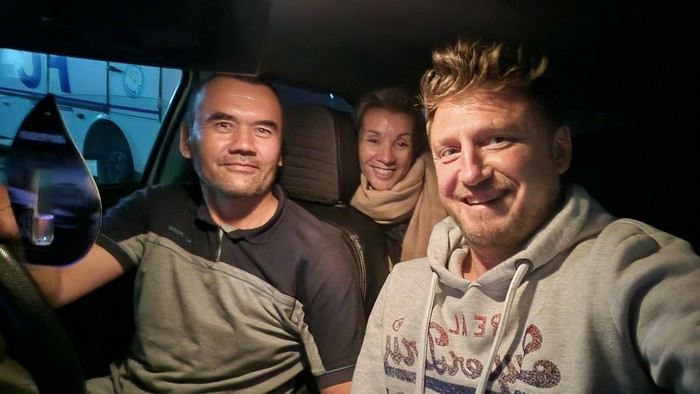
After as many weeks as I have fingers on my right hand, we're hitting the road again, fully recovered from our pharaonic adventure. Back in France to drop off our daughters (sorry, girls!), this time it's just the two of us, ready to be welcomed by a new destination. They say it offers one of the richest cultural heritages in the world for those willing to put in the effort. It's the land of the ancient Silk Road, where we'll follow a journey steeped in history and discoveries straight out of *One Thousand and One Nights*. A former Soviet bloc region independent only since 1991, we'll be walking in the footsteps of Genghis Khan, Tamerlane, Alexander the Great, Marco Polo...
Another fun fact about this country: it's strictly forbidden to import porn on your phone. True story. The same goes for painkillers! Unless it's about sodomy—though the two don’t seem connected, that’s just how it is. Don’t ask me why! Anyway, I’m getting off track. Here’s the big question: Where do you think we’ve just landed?... To give you a hint, the locals are known for being incredibly welcoming. No sooner said than done—our first taxi driver, proud to transport French travelers, refused to let us pay for the ride. Great vibes for these two weeks ahead. So, any guesses? Uzbekistan!!!
Bonjour à tous,
Nous sommes un groupe de 5 personnes et nous prévoyons visiter l'Ouzbékistan en avril 2018. et j'ai quelques questions:
Comme il y a plusieurs tours opérateurs on s'y perd, quelqu'un aurait il des suggestions?
L'option guide chauffeur est elle une bonne idée ? comment se déroule l'organisation? Ce sont ces informations qui nous aideront dans cette planification
Pour les canadiens j'aimerais savoir ou on peut se procurer le visa. Merci à l'avance
L'option guide chauffeur est elle une bonne idée ? comment se déroule l'organisation? Ce sont ces informations qui nous aideront dans cette planification
Pour les canadiens j'aimerais savoir ou on peut se procurer le visa. Merci à l'avance
Nous avons le projet d'aller à Tashkent en passant par la Turquie, l'Iran et le Turkménistan.
Nous sommes preneurs d'infos sur les conditions d'obtention du carnet de passage en douane et des visas (dans quel ordre les demander?).
Merci de nous faire partager vos expériences.
Bonjour,
Je cherche des retours d'expériences de voyages en Ouzbékistan en indépendant avec un enfant. Le mien a 11 ans. Cela fait plusieurs années que je rêve de voir ce pays, sans jamais oser y aller 🤪. Plusieurs fois j'ai renoncé, essentiellement parce que j'avais peur de m'y sentir en insécurité. Je me pose aussi la question, pour ceux qui l'ont fait, de comment vos enfants ont apprécié le voyage dans ce pays ?
Merci d'avance pour les infos !
Je cherche des retours d'expériences de voyages en Ouzbékistan en indépendant avec un enfant. Le mien a 11 ans. Cela fait plusieurs années que je rêve de voir ce pays, sans jamais oser y aller 🤪. Plusieurs fois j'ai renoncé, essentiellement parce que j'avais peur de m'y sentir en insécurité. Je me pose aussi la question, pour ceux qui l'ont fait, de comment vos enfants ont apprécié le voyage dans ce pays ?
Merci d'avance pour les infos !
Quelqu’un pourrait-il me faire partager son expérience et me dire si la route de Samarkand à Boukhara en passant Karchi est intéressante.
Nous pourrions dormir une nuit ou 2 à Chakhrisabz ou Karchi et profiter de visiter les alentours, la vallée de Langar .... puis continuer sur Boukhara.
Merci pour vos infos.
Nicole.
Bonjour à tous les forumeurs :)
Je viens faire appel aux connaissances et aux sentiments des voyageurs ayant parcourus l'Ouzbékistan. Mon compagnon et moi-même réservons un voyage de deux semaines via une agence locale. Je me retrouve à devoir faire des choix car 15 jours ne sont évidemment pas suffisants pour faire tout le pays. Et me voilà hésiter. J'ai demandé à ce que la vallée de Ferghana soit ajoutée à mon programme. Du coup, mon agent a supprimé le périple des citadelles dans le désert. J'aurais donc aimé avoir votre opinion sur ce qu'il y aurait, selon vous, de mieux à faire. J'ai aussi la possibilité de supprimer ma journée à Tashkent, ville moderne qui me tente beaucoup moins que les citadelles et Ferghana. Que me conseilleriez-vous d'enlever ?
Sinon voici le détail de notre voyage : Khiva Boukhara Nourata Yanguigazgan (village de bergers kazakhs) Aydarkul lake Hayat avec un trekking d'une journée et demi dans les montagnes Samarcande Chakhrisabz Samarcande Tashkent Kokand Richtan Ferghana Marguilan Tashkent
Je viens faire appel aux connaissances et aux sentiments des voyageurs ayant parcourus l'Ouzbékistan. Mon compagnon et moi-même réservons un voyage de deux semaines via une agence locale. Je me retrouve à devoir faire des choix car 15 jours ne sont évidemment pas suffisants pour faire tout le pays. Et me voilà hésiter. J'ai demandé à ce que la vallée de Ferghana soit ajoutée à mon programme. Du coup, mon agent a supprimé le périple des citadelles dans le désert. J'aurais donc aimé avoir votre opinion sur ce qu'il y aurait, selon vous, de mieux à faire. J'ai aussi la possibilité de supprimer ma journée à Tashkent, ville moderne qui me tente beaucoup moins que les citadelles et Ferghana. Que me conseilleriez-vous d'enlever ?
Sinon voici le détail de notre voyage : Khiva Boukhara Nourata Yanguigazgan (village de bergers kazakhs) Aydarkul lake Hayat avec un trekking d'une journée et demi dans les montagnes Samarcande Chakhrisabz Samarcande Tashkent Kokand Richtan Ferghana Marguilan Tashkent
Bonjour à tous,
En premier merci pour vos conseils et toutes les infos que j'ai trouvé sur ce forum !! Je suis parti le 7 mars et rentré le 27 mars.
J'ai voyagé avec Rossya avec escale à St Petersbourg. Un peu bizarre cet aéroport, surtout la connexion avec un autre avion. Cela m'a permis de rencontré le premier Ouzbek de mon voyage ! Il vit en France et rentrait quelques jours à Tashkent.
Durant le vol, il m'a expliqué beaucoup de choses sur le pays ! C'était très intéressant, dans l'avion que des hommes de retour de Russie pour travailler. Certains n'hésitent pas à fumer dans les toilettes de l'avion...
Arrivé a Tashkent, passage de la douane assez rapide malgré les bousculades des Ouzbeks pour sortir au plus vite. Puis remplir les deux feuilles de déclaration, je récupère mon sac à dos et mon nouvel ami me fait monter dans la voiture d'un ami et me conduit à l'aéroport pour les vols interne direction Nukus. Je suis dans les temps... super !!!
Arrivé à Nukus, il fait 1° et pas beaucoup de choses à faire dans cette ville. Visite du musée et ballade dans la ville. Nous sommes le 8 mars, assez sympa de voir tous les hommes offrir une rose aux femmes ! Je change 100$à la B&B Jupek Joly 1$=2700sums (varie à 2800sums suivant les endroits pendant le séjour) prix de la chambre 60.000sums. C'est cher mais propre et on mange bien au resto + pdj très bien. Le lendemain départ pour Moynaq, tarif annoncé 80$ un peu partout pour un taxi. La veille j'ai rencontré une Française qui faisait la visite avec un guide nous partageons donc les frais 50€ par personne. Aller-retour dans la journée (route en partie en travaux), il fait toujours aussi froid. Sur place il y a de la neige près des bateaux, paysage désolant et surréaliste... Pas grand chose à faire à Nukus... ville triste, assez Soviétique dans l’aménagement.
Départ en taxi partagé pour Ourgentch, 20.000sums Ourgentch Khiva 2.000sum en taxi partagé. B&B loli opa 25.000sum j'ai de la chance de dormir dans une double pour moi tout seul pour le prix du dortoir, car il avait besoin du dortoir 4 places pour une famille !
Khiva, magnifique cette ville la restauration est très bien réussie et sympa de se ballader dans cette ancienne ville. Dommage du manque de vie, après 17h c'est ville morte a l'intérieur des remparts ! sauf la partie nord où il y a encore quelques habitations. Droits d'entrée 19.000sum =10$ il me semble que cela fluctue suivant les mois peut etre 12$ en saison. Ajouter quelques sums pour monter au minaret 3.000 et négocier pour monter à la terrasse 1.000sum. Le soir sympa de monter sur les remparts accès par la porte nord. Vous dominer la ville c'est magnifique surtout lorsqu'on est seul hors saison !!! De Khiva j'ai visité les forteresses du désert 40$ pour une voiture et la journée. C'est magnifique, impressionant, surtout Ayaq qala !! J'en ai vu quatre au total, vraiment sympa cette ballade !!
Khiva - Boukhara en taxi partagé 60.000sum (prix entre 50.000 et 60.000 suivant les négociations) Route pénible, longue et en travaux... Sarrafon B&B 10$ il me semble, super petit dej, famille accueillante et bons renseignements. J'ai eu la chance de rencontré un européen vivant à Boukhara qui m'a donné beaucoup d'infos sur la ville et ce qu'il fallait voir. Impressionné par la mosquée, j'ai payé 4.000 l'entrée par certain que tout le monde paient ! ville agréable, reposante, calme !!
Ensuite j'ai voulu rejoindre Shakrisabz par Qarshi, 20.000sum puis 5.000sum. Arrivé la-haut, un peu la galère mon taxi ne trouve pas l'hotel B&B et me dépose dans un hotel de luxe 45$ la nuit !! impossible de faire amener au B&B, un gars me propose de venir dormir chez lui dans un village. Puis ensuite me dit tu ne donneras des $$$ demain ! combien ? on verra demain !! Ok je prend un taxi pour Samarkand !!!!!!!!!!!!!!!!
Shakrisabz-Samarkand 20.000sums, j'arrive vers 20h dans une ville plongée dans le noir coupure générale de courant. J'arrive a Antica B&B accueil chaleureux mais on me dit qu'il n'y pas de courant depuis 3 jours ! 20$ dans ces conditions. Je vais chercher un autre hotel et fini au Bahodir B&B. Alors là j'ai envie de dire qu'il faut absolument passer au Bahodir durant votre séjour !!! c'est LA guest house !!! Non pas pour le confort, les lits sont défoncés, ce n'est pas très propre... mais dans la salle à manger se retrouve une dizaine de voyageurs venus du monde entier (canadiens, américains, anglais, polonais, tchèques, francais, suisses, russes, allemands...) de quoi passer des soirées inoubliables autour de sujet les plus incroyables !! A Samarkand, le Registan magnifique, vraiment de beaux monuments, une ville sympathique.
Ensuite avec des Francais nous partons pour Jizzaq pour rejoindre un village et passer quelques jours dans les montagnes. Malheureusement, le temps change subitement de 15° et soleil le samedi, nous nous retrouvons sous la pluie le dimanche, puis bientot sous la neige. Arrivé dans le village impossible de rejoindre l'autre village pour dormir. Obligé de faire demi-tour. La neige ne s'arrête pas de tomber, et presque 20cm sur la route !!! Dans le bus du retour, un Ouzbek nous invite chez lui. Nous descendons du bus au milieu de nul part ! Nous nous retrouvons dans la maison de son frère, puis invité dans le resto type routier du coin, repas, boissons (vodka biensur) tout est offert et surtout ne pas dire merci car on est de la famille donc c'est normal !! vraiment une soirée mémorable et accueil formidable. Nous passons la nuit chez son frère. Le lendemain retour à Samarkand. Mais là commence encore la galère ! il y a 20cm de neiges au minimum, il a fait pas loin de -15° cette nuit. La route est glacée, pas une voiture ne passe... Après quelque temps d'attente, une voiture nous prend "en stop". Seulement 10min plus nous nous retrouvons dans le fossé la voiture sur le flanc ! Heureusement pas de blessé, le temps de sortir la voiture du fossé après l'avoir remise sur les roues. Nous prenons un autre minibus et arrivons en bon état pour Samarkand.
Finalement je choisi de rester là juqu'au vendredi et mon retour à Tashkent. Mardi près d'Urgut, je suis allé voir une partie de Koupkari (pour résumé match avec des hommes sur des chevaux qui ramasse une chèvre décapité, je vous laisse chercher plus d'infos !). C'est super impressionnant de voir ça !! de la folie, dans un terrain type Woodstock Ouzbek ! de la boue, de la boue, de la boue !! Je ne pense pas que ce soit le terrain normal, juste avec toute la neige tombé ces derniers jours... !!
Mercredi : Navrouz ! Super nous allons faire la fête... ah non la ville a annulée toutes les festivités à cause du froid ! Juste devant le registan un regroupement de toutes les associations de la ville font un présentation de la gastronomie locale et organise quelques demonstrations.
Ensuite Tashkent (train 23.000sum il me semble), J'ai dormi chez Gulnara près de Chorsu 20$ la nuit. Pas grand chose à faire à Tashkent... l'opéra sympa pour une soirée 10.000sum, le marché Chorsu, ce que j'ai préféré c'est me perdre dans les rue derrière chorsu. J'ai retrouvé l'ambiance des villes du reste du pays, rien à voir avec le centre de la ville qui est vide, désert.
Mis à part mon sac à dos manquant à Roissy mais livré le lendemain, le retour s'est bien passé.
Au final et pour conclure...
Voyage fantastique, mon premier voyage tout seul. Le contact avec les Ouzbek est formidable, il y a longtemps que je ne m'étais pas senti un dollars sur pattes en voyage. Aucunes allusions au portefeuille lors des rencontres (sauf Sharisabz) mais dans l'ensemble du pays, nous rencontrons des gens vrais, accueillants, sympathique. Des monuments impressionnants, et une histoire du pays très riche !!
J'ai encore un peu dans la tête des tarifs, si vous avez besoin d'infos sur un prochain voyage... sur 3 semaines j'ai dépensé 450€ sur place. Bon voyage et merci pour vos réponses !
En premier merci pour vos conseils et toutes les infos que j'ai trouvé sur ce forum !! Je suis parti le 7 mars et rentré le 27 mars.
J'ai voyagé avec Rossya avec escale à St Petersbourg. Un peu bizarre cet aéroport, surtout la connexion avec un autre avion. Cela m'a permis de rencontré le premier Ouzbek de mon voyage ! Il vit en France et rentrait quelques jours à Tashkent.
Durant le vol, il m'a expliqué beaucoup de choses sur le pays ! C'était très intéressant, dans l'avion que des hommes de retour de Russie pour travailler. Certains n'hésitent pas à fumer dans les toilettes de l'avion...
Arrivé a Tashkent, passage de la douane assez rapide malgré les bousculades des Ouzbeks pour sortir au plus vite. Puis remplir les deux feuilles de déclaration, je récupère mon sac à dos et mon nouvel ami me fait monter dans la voiture d'un ami et me conduit à l'aéroport pour les vols interne direction Nukus. Je suis dans les temps... super !!!
Arrivé à Nukus, il fait 1° et pas beaucoup de choses à faire dans cette ville. Visite du musée et ballade dans la ville. Nous sommes le 8 mars, assez sympa de voir tous les hommes offrir une rose aux femmes ! Je change 100$à la B&B Jupek Joly 1$=2700sums (varie à 2800sums suivant les endroits pendant le séjour) prix de la chambre 60.000sums. C'est cher mais propre et on mange bien au resto + pdj très bien. Le lendemain départ pour Moynaq, tarif annoncé 80$ un peu partout pour un taxi. La veille j'ai rencontré une Française qui faisait la visite avec un guide nous partageons donc les frais 50€ par personne. Aller-retour dans la journée (route en partie en travaux), il fait toujours aussi froid. Sur place il y a de la neige près des bateaux, paysage désolant et surréaliste... Pas grand chose à faire à Nukus... ville triste, assez Soviétique dans l’aménagement.
Départ en taxi partagé pour Ourgentch, 20.000sums Ourgentch Khiva 2.000sum en taxi partagé. B&B loli opa 25.000sum j'ai de la chance de dormir dans une double pour moi tout seul pour le prix du dortoir, car il avait besoin du dortoir 4 places pour une famille !
Khiva, magnifique cette ville la restauration est très bien réussie et sympa de se ballader dans cette ancienne ville. Dommage du manque de vie, après 17h c'est ville morte a l'intérieur des remparts ! sauf la partie nord où il y a encore quelques habitations. Droits d'entrée 19.000sum =10$ il me semble que cela fluctue suivant les mois peut etre 12$ en saison. Ajouter quelques sums pour monter au minaret 3.000 et négocier pour monter à la terrasse 1.000sum. Le soir sympa de monter sur les remparts accès par la porte nord. Vous dominer la ville c'est magnifique surtout lorsqu'on est seul hors saison !!! De Khiva j'ai visité les forteresses du désert 40$ pour une voiture et la journée. C'est magnifique, impressionant, surtout Ayaq qala !! J'en ai vu quatre au total, vraiment sympa cette ballade !!
Khiva - Boukhara en taxi partagé 60.000sum (prix entre 50.000 et 60.000 suivant les négociations) Route pénible, longue et en travaux... Sarrafon B&B 10$ il me semble, super petit dej, famille accueillante et bons renseignements. J'ai eu la chance de rencontré un européen vivant à Boukhara qui m'a donné beaucoup d'infos sur la ville et ce qu'il fallait voir. Impressionné par la mosquée, j'ai payé 4.000 l'entrée par certain que tout le monde paient ! ville agréable, reposante, calme !!
Ensuite j'ai voulu rejoindre Shakrisabz par Qarshi, 20.000sum puis 5.000sum. Arrivé la-haut, un peu la galère mon taxi ne trouve pas l'hotel B&B et me dépose dans un hotel de luxe 45$ la nuit !! impossible de faire amener au B&B, un gars me propose de venir dormir chez lui dans un village. Puis ensuite me dit tu ne donneras des $$$ demain ! combien ? on verra demain !! Ok je prend un taxi pour Samarkand !!!!!!!!!!!!!!!!
Shakrisabz-Samarkand 20.000sums, j'arrive vers 20h dans une ville plongée dans le noir coupure générale de courant. J'arrive a Antica B&B accueil chaleureux mais on me dit qu'il n'y pas de courant depuis 3 jours ! 20$ dans ces conditions. Je vais chercher un autre hotel et fini au Bahodir B&B. Alors là j'ai envie de dire qu'il faut absolument passer au Bahodir durant votre séjour !!! c'est LA guest house !!! Non pas pour le confort, les lits sont défoncés, ce n'est pas très propre... mais dans la salle à manger se retrouve une dizaine de voyageurs venus du monde entier (canadiens, américains, anglais, polonais, tchèques, francais, suisses, russes, allemands...) de quoi passer des soirées inoubliables autour de sujet les plus incroyables !! A Samarkand, le Registan magnifique, vraiment de beaux monuments, une ville sympathique.
Ensuite avec des Francais nous partons pour Jizzaq pour rejoindre un village et passer quelques jours dans les montagnes. Malheureusement, le temps change subitement de 15° et soleil le samedi, nous nous retrouvons sous la pluie le dimanche, puis bientot sous la neige. Arrivé dans le village impossible de rejoindre l'autre village pour dormir. Obligé de faire demi-tour. La neige ne s'arrête pas de tomber, et presque 20cm sur la route !!! Dans le bus du retour, un Ouzbek nous invite chez lui. Nous descendons du bus au milieu de nul part ! Nous nous retrouvons dans la maison de son frère, puis invité dans le resto type routier du coin, repas, boissons (vodka biensur) tout est offert et surtout ne pas dire merci car on est de la famille donc c'est normal !! vraiment une soirée mémorable et accueil formidable. Nous passons la nuit chez son frère. Le lendemain retour à Samarkand. Mais là commence encore la galère ! il y a 20cm de neiges au minimum, il a fait pas loin de -15° cette nuit. La route est glacée, pas une voiture ne passe... Après quelque temps d'attente, une voiture nous prend "en stop". Seulement 10min plus nous nous retrouvons dans le fossé la voiture sur le flanc ! Heureusement pas de blessé, le temps de sortir la voiture du fossé après l'avoir remise sur les roues. Nous prenons un autre minibus et arrivons en bon état pour Samarkand.
Finalement je choisi de rester là juqu'au vendredi et mon retour à Tashkent. Mardi près d'Urgut, je suis allé voir une partie de Koupkari (pour résumé match avec des hommes sur des chevaux qui ramasse une chèvre décapité, je vous laisse chercher plus d'infos !). C'est super impressionnant de voir ça !! de la folie, dans un terrain type Woodstock Ouzbek ! de la boue, de la boue, de la boue !! Je ne pense pas que ce soit le terrain normal, juste avec toute la neige tombé ces derniers jours... !!
Mercredi : Navrouz ! Super nous allons faire la fête... ah non la ville a annulée toutes les festivités à cause du froid ! Juste devant le registan un regroupement de toutes les associations de la ville font un présentation de la gastronomie locale et organise quelques demonstrations.
Ensuite Tashkent (train 23.000sum il me semble), J'ai dormi chez Gulnara près de Chorsu 20$ la nuit. Pas grand chose à faire à Tashkent... l'opéra sympa pour une soirée 10.000sum, le marché Chorsu, ce que j'ai préféré c'est me perdre dans les rue derrière chorsu. J'ai retrouvé l'ambiance des villes du reste du pays, rien à voir avec le centre de la ville qui est vide, désert.
Mis à part mon sac à dos manquant à Roissy mais livré le lendemain, le retour s'est bien passé.
Au final et pour conclure...
Voyage fantastique, mon premier voyage tout seul. Le contact avec les Ouzbek est formidable, il y a longtemps que je ne m'étais pas senti un dollars sur pattes en voyage. Aucunes allusions au portefeuille lors des rencontres (sauf Sharisabz) mais dans l'ensemble du pays, nous rencontrons des gens vrais, accueillants, sympathique. Des monuments impressionnants, et une histoire du pays très riche !!
J'ai encore un peu dans la tête des tarifs, si vous avez besoin d'infos sur un prochain voyage... sur 3 semaines j'ai dépensé 450€ sur place. Bon voyage et merci pour vos réponses !
Bonjour,
Je compte circuler en Ouzbekistan en avril/mai 2010. Je regarde les propositions des TO Atalante et Allibert (niveau assez facile). Quelqu'un a-t-il déjà été là evec un de ces TO? Lequel conseillez vous? Peut-être en connaissez vous d'autres de bonne qualité? Partir en mai, n'est ce pas déjà tard pour éviter les grosses chaleurs?
Merci🤪
Anne
Je compte circuler en Ouzbekistan en avril/mai 2010. Je regarde les propositions des TO Atalante et Allibert (niveau assez facile). Quelqu'un a-t-il déjà été là evec un de ces TO? Lequel conseillez vous? Peut-être en connaissez vous d'autres de bonne qualité? Partir en mai, n'est ce pas déjà tard pour éviter les grosses chaleurs?
Merci🤪
Anne
Bonjour ! Je suis responsable de la commission voyage de mon comité d'entreprise et j'aimerais organiser un voyage en Ouzbékistan en avril 2010. 🙂 Je cherche un bon tour operateur/organisateur fiable et pas hors de prix. Merci pour tous les tuyaux que vous pourriez me donner.