Hi there,
I'm urgently planning a trip to Tunisia in November, backpacker-style (no agency, no guide or taxi, public transport, youth hostels or small hotels, local restaurants). I'm not interested in the beach, and I like to take my time at archaeological sites and museums (twice as long as the average visitor). I'm aiming for about two weeks, give or take.
First, I'm trying to roughly outline a route/schedule so I can book my flight as soon as possible (no desert in the south this time—I went there years ago and want to stay independent).
I’ve sketched out the following itinerary, knowing that apparently, there are quite a few towns without budget-friendly hotels (even on Airbnb), which means I’ll be staying longer where they’re available.
Three questions:
1. Does this seem reasonable overall (time spent in each city)?
2. Should I add other cities, maybe in the northwest?
3. For hotels, in November, is it better to scout options on booking sites first, then book on the spot for cheaper rates (no site commission + possible negotiation)? Also, are hotels not listed online and found randomly on-site much cheaper?
ROUGH ITINERARY (order to be confirmed)
TUNIS 5 days (cheap accommodations: 13 or 19 €)
2 days: Medina, souks, Bardo Museum, Royal Mausoleum of Tourbet El Bey, Zitouna Mosque (exterior)
1 day: Sidi Bou Said
1 day: Carthage
1 day: A-R Dougga (bus to Tebersouk 2h + taxi) – pack a picnic
+ option: hike to Zaghouan (750m+, 10km round trip) – worth it? Doable alone?
KAIROUAN 2 days (very expensive room: 40-50 €!)
Great Mosque, Medina, Three Doors Mosque, medieval cemetery, Sidi Sahbi Mosque...
SOUSSE 3 days (room 15 €)
2 days: Medina, archaeological museum, Port El Kantaoui, the Ribat (fortress), Contemporary Art Museum Dar Am Taïeb, Dar Essid (17th-century traditional house)
1 day: A-R El Jem (60km away)
+ option: 1 day A-R Monastir? Worth it?
+ option: 1 day A-R Mahdia (or 2 days sleeping there)?
OPTIONS
-> Gabes to mix things up? But is it easy to find cheap lodging and get around/visit alone?
-> Other sights or stops to sleep: Sfax, El Kef, others?
-> Kerkenna Islands (easy accommodation?)
Thanks for your thoughts and opinions on these options.
Once I’ve adjusted the duration, I’ll book my tickets for early November!
(By the way, do you think I should arrive and depart from two different airports?)
399 similar discussions in English
Hi everyone!!!
I’m finally getting around to writing about this 20-day trip to southern Italy: we didn’t travel this summer, and luckily, we found beautiful light and dreamy weather there at the end of September.
First, here’s the context of the trip: we’re both "confirmed seniors" but still curious and alert enough to enjoy the itinerary we’d imagined! We wanted a mix of discoveries—culture, cities, and nature—with guaranteed sunshine and the occasional short hike... We’re flying to Naples, round-trip, because the flight times work better for us. We rented a car online, picked it up at the airport (details to come... and it won’t be the highlight of the trip!), and booked our hotels in advance.
A quick overview of the itinerary: leaving Naples on September 15th, early in the morning, we’ll drive straight across the boot of Italy to Bari. After 11 days in Puglia, we’ll head back toward our starting point, taking our time: Matera in Basilicata, Maratea by the sea, and finally Paestum with its incredible temples.
Day 1: Brussels-Naples flight (Brussels Airlines) went smoothly; it landed an hour early, and we were thrilled, thinking we could use that time for a quick visit or two... Everything went well until we left the airport. We took the shuttle to the car rental offices, and at first glance, we realized this wouldn’t be smooth sailing!!! In front of every office (they’re side by side), there were already lines and kids sitting on suitcases—everyone looked exhausted... We resigned ourselves to waiting: nothing moved until tempers flared at the counters, and two people nearly came to blows. Things sped up a little, and after 2 (two...) hours of waiting, we finally got our chariot: a black Fiat Tipo, dirty, with a few dents and scratches that we made sure to note in the contract... but it ran!
Off to Bari, then: no time for sightseeing along the way! From there, we headed straight to our hotel in the countryside near Polignano a Mare.
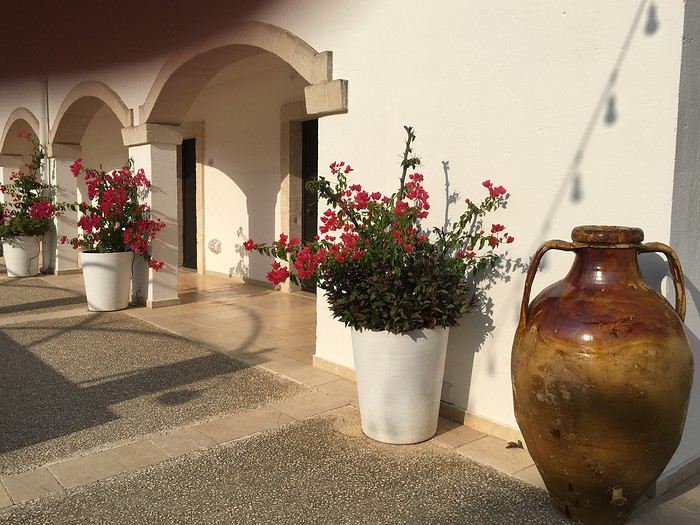
A recurring detail: this happened constantly during our travels. We’d installed our own GPS, fully updated... In recent years, many dirt roads have become drivable, and lots of hotels and hostels have opened in the outskirts of towns. It was extremely rare for our ‘guide’ to recognize the street—let alone the number—we entered. Often, we got by calling the hotel reception: it might seem like a small thing, but it happened so often it became frustrating. In hindsight, it seems like without Google Maps, we’d have been lost!
Anyway, we were beautifully settled, with a terrace overlooking olive groves and the sea in the distance: all was well.
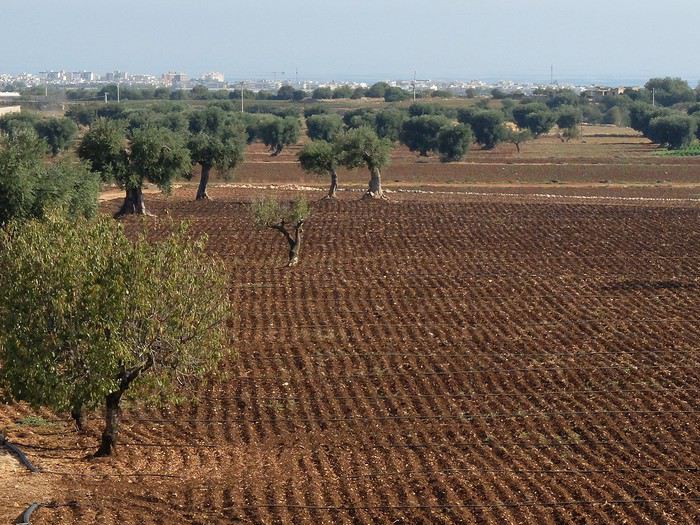
To be continued...
I’m finally getting around to writing about this 20-day trip to southern Italy: we didn’t travel this summer, and luckily, we found beautiful light and dreamy weather there at the end of September.
First, here’s the context of the trip: we’re both "confirmed seniors" but still curious and alert enough to enjoy the itinerary we’d imagined! We wanted a mix of discoveries—culture, cities, and nature—with guaranteed sunshine and the occasional short hike... We’re flying to Naples, round-trip, because the flight times work better for us. We rented a car online, picked it up at the airport (details to come... and it won’t be the highlight of the trip!), and booked our hotels in advance.
A quick overview of the itinerary: leaving Naples on September 15th, early in the morning, we’ll drive straight across the boot of Italy to Bari. After 11 days in Puglia, we’ll head back toward our starting point, taking our time: Matera in Basilicata, Maratea by the sea, and finally Paestum with its incredible temples.
Day 1: Brussels-Naples flight (Brussels Airlines) went smoothly; it landed an hour early, and we were thrilled, thinking we could use that time for a quick visit or two... Everything went well until we left the airport. We took the shuttle to the car rental offices, and at first glance, we realized this wouldn’t be smooth sailing!!! In front of every office (they’re side by side), there were already lines and kids sitting on suitcases—everyone looked exhausted... We resigned ourselves to waiting: nothing moved until tempers flared at the counters, and two people nearly came to blows. Things sped up a little, and after 2 (two...) hours of waiting, we finally got our chariot: a black Fiat Tipo, dirty, with a few dents and scratches that we made sure to note in the contract... but it ran!
Off to Bari, then: no time for sightseeing along the way! From there, we headed straight to our hotel in the countryside near Polignano a Mare.
A recurring detail: this happened constantly during our travels. We’d installed our own GPS, fully updated... In recent years, many dirt roads have become drivable, and lots of hotels and hostels have opened in the outskirts of towns. It was extremely rare for our ‘guide’ to recognize the street—let alone the number—we entered. Often, we got by calling the hotel reception: it might seem like a small thing, but it happened so often it became frustrating. In hindsight, it seems like without Google Maps, we’d have been lost!
Anyway, we were beautifully settled, with a terrace overlooking olive groves and the sea in the distance: all was well.
To be continued...
Hello,
It often happens that we're asked what to visit in Belgium. And the answers usually point to Bruges, Ghent, Antwerp, and Brussels—and rightly so, as these cities are well worth visiting ;). However, Belgium, though small, isn’t just limited to these four cities.
I live in one of them (Brussels), enjoy spending time in the other three, but I’d like to highlight some lesser-known spots that could add to the trip for those who want to see a bit more or something different. Between trips, I like exploring one or two corners of the country where I live.
Hence the idea for a travel journal of walks.
Most of the places I’ll talk about can be visited as a day trip from Brussels, whether by public transport or car.
In chronological order of the topics covered:
- The Gileppe Dam (Liège province) - message 2, page 1 - The Domaine de La Hulpe (Walloon Brabant) - message 3, page 1 - Mechelen (Antwerp province) - message 4, page 1 - The coast - message 5, page 1 - The Westhoek, from De Panne - message 6, page 1 - The Zwin, from Knokke - message 7, page 1 - Lier (between Mechelen and Antwerp) - message 8, page 1 - Mons (Hainaut) - message 9, page 1 - The Florenville region - message 12, page 1 - The East Cantons - message 13, page 1 - Dinant - message 18, page 1 - The Japanese garden in Hasselt - message 24, page 2 - Leuven - message 29, page 2 - Louvain-la-Neuve - message 32, page 2 - Ostend - message 42 (page 3) and message 166 (page 9) - The floralies of Groot-Bijgaarden - message 43, page 3 - Halle Forest - message 44, page 3 - Pralines - message 54, page 3 - Charleroi - message 68, page 4 - Namur - message 92, page 5 - Le Bois du Cazier (Marcinelle) - message 95, page 5 - Couques and gosettes - message 96, page 5 - Liège - message 99, page 5 - Tournai - message 115, page 6 - Oudenaarde - message 121, page 7 - Meise Botanical Garden - message 124, page 7 - Tongeren - message 125, page 7 - Beersel Castle (Flemish Brabant) - message 126, page 7 - Brussels in lockdown (messages 150 and 154, page 8) - Notre-Dame à la Rose Hospital in Lessines (messages 161 and 162, page 9) - Westende (message 167, page 9) I’ll keep updating this list as the journal progresses...
During the 60s and 70s, thousands of travelers hit the road to India. Some were backpackers or hippies, but not all. In this collective anthology featuring around twenty contributors (including GeorgesOz), you’ll also find truth-seekers, a couple who went on their honeymoon to get married in Bengal... and "crazy" folks who set off on VéloSolex bikes...
Worth noting: all contributors donated their royalties to support the Céline Hegron clinic in a poor neighborhood of Varanasi.
Worth noting: all contributors donated their royalties to support the Céline Hegron clinic in a poor neighborhood of Varanasi.
Hi there,
We’re planning to spend a few days in Valencia and the surrounding area. Can you recommend the must-see sights? PS: If you know any great restaurants, we’re all ears!
Thanks in advance
We’re planning to spend a few days in Valencia and the surrounding area. Can you recommend the must-see sights? PS: If you know any great restaurants, we’re all ears!
Thanks in advance
Hello forum,
Did any of you feel the same things we did in China?
We spent a good twenty days there in August. First, we traveled solo around Chengdu, then joined an organized tour for 12 days (Beijing, Pingyao, Xi'an, Guilin, Xingping, Yangshuo, Shanghai, Wuzhen) and extended our stay by 4 extra days to visit Zhangjiajie.
The landscapes were stunning, and we have unforgettable memories... but we were really disappointed by the following points:
- The food: way too spicy. Lacking in flavor, not much taste. I’m speaking "in general" because we did enjoy some good steamed dumplings, smoked pork, and other dumplings... But compared to Thailand, Cambodia, or India, Chinese cuisine didn’t impress us at all.
- The behavior of the Chinese: disrespectful, rushed, agitated. You constantly have to fight—people push, crowd, and overwhelm you... At the entrance to the Terracotta Army (and other sites), it’s a human tidal wave... and I mean that literally. We were carried by the crowd without even touching the ground. It was like a situation where you have one bowl of rice and 20,000 starving people diving for it...
You’re at a ticket counter, and they cut in front of you. You’re in line for boarding, suitcase ready to go on the conveyor belt, and someone shows up out of nowhere to put THEIR suitcase down... even though they have a flight ticket with THEIR seat number and won’t be leaving before you!!!! You’re getting on the bus, and someone shoves past you just so they don’t end up behind you.
It’s like these people only think about themselves. I didn’t see a single person let someone else go first or even ask—it’s as if politeness and respect are completely foreign to them.
It’s honestly exhausting and draining...
- Communication: In every other country we’ve visited, whether in Asia or Europe, we always manage—with English, a few words of Italian, French, or Spanish. In China, I’ll be blunt: if you don’t speak Chinese, you’re screwed. And yet, a pair of kids around ten or twelve years old asked us in English where we were from :)
- Understanding: Here’s the rule. Even if the person you’re talking to speaks a little English and says they understand you... make sure they *really* do, because 9 times out of 10, they don’t. Out of pride or just cluelessness, they’ll give you a big smile and nod, but in reality, they didn’t get what you were saying.
Several times with our group, in the evening at a restaurant, if we hadn’t been helped by someone at another table who spoke a little English, we’d still be there. The classic example: the waiter brings one menu (for 10 people at the table), and we’re all trying to explain that we need 4 or more menus. Five minutes later, he’s still staring at us with that same blank smile...
In 3* or 4* hotels, you go to the front desk for a hot water or AC issue. Three or four staff members just stand there beaming at you. You try to explain with photos or a translator, but in the end, you leave with the problem unresolved.
They don’t speak—they shout... on buses, in hotels...
We were also surprised to find that self-service laundromats were almost nonexistent. We got scammed once at a hotel with an astronomical bill!
As for flights, we flew Air China on the way there and Austrian Airlines on the way back—no comparison. Air China had zero service and food that was "baby food" quality. Austrian Airlines had multiple services, a decent meal, and smiling flight attendants.
I don’t know if any of you had the same experience in this country, but I’m definitely not eager to go back. Whereas if someone offered me India, Thailand, or Vietnam tomorrow, I’d be there in a heartbeat!!!
The title might surprise you, but you’ll understand my point of view.
1/ MEAL STRUCTURE I’m talking about the standard meal, not the one for those who have to budget for financial reasons (generally fewer in northern and central Italy than in France, but more in the south, which makes up 35% of Italy—Eurostat figures), nor for those (mostly women) watching their figure.
The tradition (once the meal of the well-off, widespread among the general population in the 1950s) starts with soup or pasta (or rice, gnocchi, ravioli, lasagna)—this is the *primo piatto*.
Next comes meat or another animal-based product (fish, cured meats, eggs, etc.)—the *secondo piatto*, which can be replaced by cooked vegetables (the only known example in France: eggplant parmesan).
If the meat dish doesn’t already include vegetables, one is served. Salads, whether green or tomato-based, are side dishes, not starters.
The meal ends with dessert—no difference from French habits: cheese, fruit, or sweets.
*Antipasti* (appetizers) are reserved for festive meals or receptions and are served *in addition* to the main courses at the start.
4 practices unknown in France: - If the menu includes pasta and ham, you start with the pasta. - If the menu includes pasta with a meat sauce and fish, you start with the pasta too. - Pasta is never a side dish for meat. - It’s not unusual for Italians to start with pasta in a meat sauce and then have a meat dish—most do this several times a week.
Modern adaptations: - People eat pasta less often (on average 5 times a week, according to recent figures) and soups, which are being replaced by *antipasti*. - The main meal is now mostly dinner, so it’s much heartier, while lunch isn’t usually eaten at home.
2/ THE CUISINE What do we know in France? Pizza, pasta Bolognese, carbonara, arrabbiata, ravioli, and lasagna. Fried scampi, Milanese or Bolognese cutlets, carpaccio, and finally tiramisu.
In short, a few basic dishes, but nothing of the gastronomy—whether regional traditions or high-end restaurants.
2 anecdotes: **Bolognese sauce** In Italy, the most common homemade sauce is a meat-and-tomato-based sauce called *ragù* (pronounced *ragoo*). Every region, even every town and family, as well as every restaurant, has its own recipe. *Ragù alla bolognese* is just one of these countless *ragù*—and no one in France knows the real recipe (I can share it with those interested). The name *bolognese* given abroad to any *ragù* comes from a canned sauce manufacturer who once branded their product that way. Until the early 1960s, it was called *sauce à la viande* (meat sauce).
**Pizza** Before World War II, it was practically unknown north of Rome. Today, Italy is one of the countries where it’s eaten the least (twice as much in France, four times as much in Germany).
We're thinking of visiting Portugal, either in November or next April. We'd rent a camper van for 4 weeks and try to see as much of this beautiful country as possible! Any tips or ideas??
Thanks :)
Hello everyone,
I imagine many of you have been captivated by the Masai Mara park and/or your safari experience with Tony Crocetta/Melting Pot Safari. Still, I’d like to share my perspective. First, I’m an avid traveler, especially in love with Africa, which my partner and I have explored a bit (Zambia, South Africa, Botswana, Kenya, Zimbabwe, Namibia...). That said, I want to express my deep disappointment with both the Masai Mara and Tony Crocetta’s camp, Melting Pot Safari, where we stayed last year.
First, about the park: it’s stunning, no doubt. But what a highly touristy place! I can’t find the words to describe the horror of being among 30 4x4 vehicles lined up in front of a lioness hunt, let alone encircling her right after her kill while her prey is still alive in her jaws... no respect for wildlife. The same goes for surrounding a young leopard playing with its small prey, a moment when I counted over 50 vehicles, most with their engines running... sickening. I turned away, both my gaze and my camera. What a disaster to see this natural wonder of Africa turned into a tourist hotspot.
Yes, I loved this place on Earth, but no, I won’t "promote" it anywhere or to anyone.
Next, I also wanted to share my dissatisfaction with Tony Crocetta’s famous camp, Melting Pot Safari: where to begin? We booked a private vehicle for four with two friends, and I have no complaints about the vehicle itself (though it obviously came at a cost). The windows and the vehicle weren’t very photo-friendly, but let’s move on. The trip between the sisters’ guesthouse (which was fine) and the camp went smoothly, except we arrived a bit too late. Result: "We’ll leave for the safari an hour later today because the driver has to respect his rest hours." Perfect—with park formalities, we only spent about an hour in the park that evening. The safari got off to a great start... During our 12-day stay, we saw some amazing things. Tony wasn’t at the camp—I don’t know what the atmosphere is like when he’s there, but it was rather cold during our trip. Sylvie, his wife, barely looked at us, never asking how our day, night, or game drive went (I think she spoke to us once during the stay, plus the day we arrived, of course). We felt invisible... (if I were mean, I’d say the money had already been deposited into Melting Pot’s bank account.) The evening meals, if I may say so, were a joke: not enough dessert (aside from fruit, but the few elaborate desserts—like 10 for 18 guests) for everyone, barely enough meat or sides. If you were unlucky like us and ended up with a group of 15 people who decided to skip the starter, you’d better hurry to get your main course, or there might not be any left—and no refills... We always ate our fill, but sometimes we had to serve ourselves in advance. Finally, I want to correct something about the quality of the meals: seriously, this buffet was really mediocre and far from the culinary standards I’d read about in my pre-trip research (see their Facebook page). Anyway, let’s move past the food—after all, the avocados were sublime, and we’re not there primarily to eat.
About the tent: the river views were beautiful, and the beds were very comfortable. No running water, individual showers outside the tent, and dry toilets—but it’s Africa, so we weren’t shocked. However, I’m disappointed that for this "modest" price, I wasn’t warned there’d be no soap (and no, I don’t travel with my own soap—and for the price, a little bar in the tent wouldn’t be a luxury). But let’s move on—the hippo views were fantastic. Oh, and to preserve the Masai Mara’s water (which makes sense) and for hygiene reasons, underwear isn’t washed by the camp staff—fair enough. But then what’s that little sign next to the bed? Oh right, for a hefty sum, underwear suddenly becomes "washable"...
Finally, my biggest gripe is about the essential part: the game drives. In France, they sell you a dream with a "photo safari" (what’s the difference, really? A room with a few more electrical outlets?). They promise guides especially suited for photography (not a given, sorry) and vehicles that can get close to animals and go off-road... but here’s the catch: the guides are bound by park laws and hounded by rangers looking to fine rule-breakers. Result: as soon as a white ranger vehicle is spotted, we have to abandon our spot for a wild chase through the grass. Fun once... The next day, we learned that another group’s guide got caught and had to pay $100 for breaking the rules—a sum he casually asked the travelers in his vehicle to cover... because of course, Melting Pot lures tourists with dreams, the poor rangers try to get close, all while breaking park laws... and they break those laws for Crocetta’s company, which, of course, won’t dip into its profits to pay the fines. Basically, it’s "keep the clients happy, but don’t get fined—or the fines are on you or you’ll have to ask the clients directly." Nice boss! Anyway, there were long discussions about this last year, especially among the guests in the fined vehicle. My partner and I found these practices unacceptable, and we were deeply disappointed by this attitude.
I know many people adore this park and/or this company—maybe you were luckier... or maybe you’re less demanding than we are when it comes to respecting rules, nature, and clients. But after traveling through much of southern Africa, I can tell you we personally came back frustrated from this experience and aren’t eager to return... You’ve been warned.
Hi everyone,
Next summer, we (2 adults and a 12-year-old child) have decided to visit Japan.
Admittedly, it’s still early to plan everything, but my wife will soon need to request her vacation time—either in August or July... and we’re hesitating.
I know summer isn’t the ideal time to visit Japan, but we don’t really have a choice... It’s either July or August. On one hand, I’d love to experience the O-Bon festivities from August 14th to 16th, and I’ve drafted an initial itinerary that would let us experience the Gujo Hachiman Bon Odori, possibly visit the Okunoin Cemetery in Koyasan, and be in Kyoto on the 16th for the Gozan Okuribi fires. But on the other hand, I’m worried it’ll be *packed*, especially in Kyoto, and less enjoyable than in July. So, have any of you experienced these celebrations? Are they worth it? Too crowded? Do you know of other celebrations or festivals in July? Thanks for your input!
Hello! 🙂
January 2026 Here we go again for new adventures and the pleasure of sharing them with you here! First of all, I’d like to thank everyone who helped me with the preparations, even with some last-minute improvisations just days before departure. Thanks to Montagnard74, Jojoone1, Songsam, Attila, Dennis2, NadegerFERM, and the authors whose travel journals about Laos inspired me (Montagnard74, Muriel18, Mavietongs...).
In this story, written by Richard and illustrated by me, we’ll tell you about the journey of four friends: Catherine, Richard, Nathalie, and Bruno. A reinvented but overall successful trip, filled with discoveries and surprises, the scents of spices and frangipani flowers, (too) spicy food, sunsets, and... one big mess.
January 2026 Here we go again for new adventures and the pleasure of sharing them with you here! First of all, I’d like to thank everyone who helped me with the preparations, even with some last-minute improvisations just days before departure. Thanks to Montagnard74, Jojoone1, Songsam, Attila, Dennis2, NadegerFERM, and the authors whose travel journals about Laos inspired me (Montagnard74, Muriel18, Mavietongs...).
In this story, written by Richard and illustrated by me, we’ll tell you about the journey of four friends: Catherine, Richard, Nathalie, and Bruno. A reinvented but overall successful trip, filled with discoveries and surprises, the scents of spices and frangipani flowers, (too) spicy food, sunsets, and... one big mess.
Hi there,
I’d planned to go to Benin in 2026, but given the recent events and upcoming elections, I’m thinking I’ll wait to see what happens after the elections.
Has anyone traveled to Benin recently or is planning to go soon?
I’d planned to go to Benin in 2026, but given the recent events and upcoming elections, I’m thinking I’ll wait to see what happens after the elections.
Has anyone traveled to Benin recently or is planning to go soon?
We’re a Canadian couple, both 77, and we’re already planning our vacation for fall 2027.
Timeframe: mid-September to mid-October... dates are flexible, and we might stay even longer.
Initially, I had planned this itinerary:
Athens (3), Naxos (4), Paros (4), Santorini (4), then a flight to Istanbul (7–10 days!!). This would let us maximize our flights and experience another culture.
That’s a lot of ferries, though... I’ve already cut out Milos.
Our second option would be to stay 2 x 15 days on two different islands, but I’d still keep Istanbul as our next destination... or maybe 30 days on one island that offers the chance to take day trips to other islands where the ferry ride is no more than 2 to 2.5 hours. For example, Naxos to Paros only takes 30 minutes. We could return the same evening or stay overnight.
Naxos seems like the best option!!!
For Istanbul, of course we want to do a day cruise on the Bosphorus and see Hagia Sophia. If we stay 6–7 days, what would be the other main attractions? Are there any points of interest we can reach by local bus?
Hi everyone,
It’s been ages since I last dropped by here... maybe simply because, apart from Nepal, I haven’t really had the chance to hit the road lately. 😉
This year, I’d love to spend a few days in Lisbon, probably in late May or early June. But with my budget being what it is, I’m looking for great tips to avoid wasting time once I’m there and risk missing out on hidden gems or unusual culinary specialties and/or quirky activities! I’m hoping to find a room in a local’s home where I can stay in a quiet neighborhood near the center, so I can get around without relying too much on public transport—my walking shoes are my best travel buddies. I’d love all your recommendations, especially for parks, small neighborhood markets, casual eateries for a quick bite, your favorite viewpoints to soak in the scenery (I’m bringing my travel journal to sketch my getaway in watercolors), events around traditional art and crafts, and so on. All your advice will definitely help me travel peacefully and come back with my head full of vibrant memories! Thanks in advance, everyone! Isabelle
Hi,
I’m leaving this Saturday for Northern India from 15/02 to 27/02. I’m planning to visit New Delhi, Agra, Chand Baori, Jaipur, Ranthambore, Bundi, Udaipur, and Jodhpur.
What’s the best way to get around? I was thinking of doing everything by train. Maybe taking the bus for some stretches?
As for renting a car with a driver, it seems expensive, so I’ve pretty much ruled that out. Unless someone’s got space for the same dates?
Thanks for your insights!
What’s the best way to get around? I was thinking of doing everything by train. Maybe taking the bus for some stretches?
As for renting a car with a driver, it seems expensive, so I’ve pretty much ruled that out. Unless someone’s got space for the same dates?
Thanks for your insights!
Hello everyone.
Preamble:
Sooner or later, you’ve got to take the plunge! I thought lockdown would be the perfect time to start this travel journal, but between working from home and gardening, I just didn’t have the time (or the motivation). Plus, long-haul trips weren’t really on the cards back then... But then I stumbled upon my photos and thought, "I’ve got to share my latest adventure in Brazil—you guessed it!"
First, a little flashback: some of you (yes, really, in DMs!) pointed out the big gaps in my travel journals—India in 2019, Vietnam in 2018, so many missed opportunities!
Truth is, for India, I traveled with a private guide and honestly didn’t have much to add to the tons of well-documented journals already out there. Plus, I still haven’t decided if I love or hate India... So, how do you share your feelings when you’re not even sure yourself? As for Vietnam, I had plenty to say—even though the itinerary was pretty classic—but I’ll admit the vibe on this part of the forum at the time kinda put me off for a while... And time flies, and memories fade... Anyway, just wanted to clear that up for my (many or few) readers. *Tudo bem*, let’s get started!!
Hi there,
We’re planning a 15-day family trip in February 2026 (with 3 teens). We’ll be visiting friends who live in Puebla. Initially, I was thinking of the Yucatán, but after reading up on it, I don’t think it’s the right fit for us (too crowded, too touristy). So, we’re leaning toward something like this: - Mexico City: 2 days (Teotihuacán + city) - Puebla: 3 days - Tehuacán: 2 days (to break up the trip—is this a good choice? Is there enough to do for 2 days?) - Oaxaca: 3 days (Hierve el Agua, Monte Albán, city/tours) - Pacific Coast: 4 days (snorkeling, excursions)
Does this seem balanced? We’d like to end on the coast for some relaxation, ocean time, and fun for the kids. I’ve seen lots of excursions offered along the coast but can’t decide where to stay. Puerto Escondido? Huatulco? The beaches seem better for snorkeling in Huatulco, but I’ve read mixed things, and it’s farther away. What do you think?
For transportation, is this doable by bus? I’m struggling to find a decent bus between Tehuacán and Oaxaca (overnight schedules), and I’m not sure how to get around the coast. Also, how do we handle luggage between cities? We usually rent a car.
Finally, I’d love feedback on the Pacific Coast excursions—I get the feeling some are worth it and others aren’t. Is bioluminescence really magical? Are dolphin-watching tours ethical and not too "factory-like"? (We skipped them in Quebec and just watched whales from shore.) Can you see sea turtles up close?
Thanks for your help!
Sunday, October 20, 2019
Glancing at the Bosphorus through the bay window of my room, I absentmindedly scatter my things while quietly settling in. Then I turn around, looking for my passport, my cash, my camera battery, eager to join the buzz of the street below. But for the past few minutes, I’ve felt a presence—something moved on the balcony. Suddenly, I spot a black-and-white furball half-hidden behind a pot, nearby. I approach to introduce myself: "Here, kitty, kitty..." I don’t know how to say "kitty" in Turkish, but the rather rude furball hisses in my face, and its ridiculous little tail doubles in size. Okay. Not friendly. I grab what’s within reach—a cream capsule—and offer it as a peace offering. It lunges at me, swipes the object away with a quick paw, and scratches me in the process.
I’m in Istanbul *
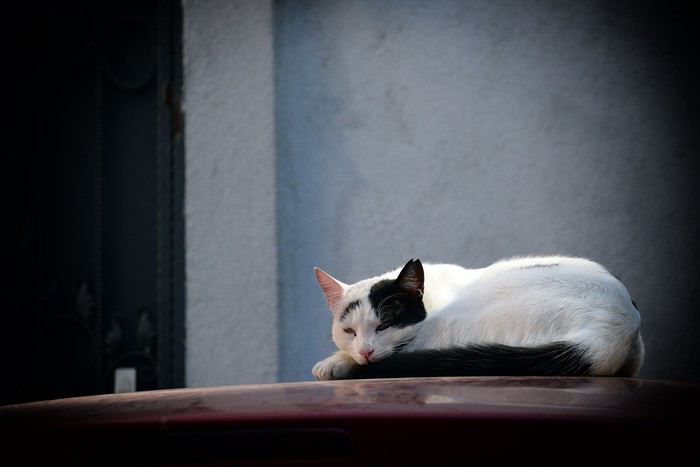
* For the title of my travel journal, I was inspired by the lovely film: "Kedi, Cats and Men" by Ceyda Torum
Glancing at the Bosphorus through the bay window of my room, I absentmindedly scatter my things while quietly settling in. Then I turn around, looking for my passport, my cash, my camera battery, eager to join the buzz of the street below. But for the past few minutes, I’ve felt a presence—something moved on the balcony. Suddenly, I spot a black-and-white furball half-hidden behind a pot, nearby. I approach to introduce myself: "Here, kitty, kitty..." I don’t know how to say "kitty" in Turkish, but the rather rude furball hisses in my face, and its ridiculous little tail doubles in size. Okay. Not friendly. I grab what’s within reach—a cream capsule—and offer it as a peace offering. It lunges at me, swipes the object away with a quick paw, and scratches me in the process.
I’m in Istanbul *
* For the title of my travel journal, I was inspired by the lovely film: "Kedi, Cats and Men" by Ceyda Torum
Byzantium... Constantinople... Istanbul...
Three names that were bound to be synonymous with wonderful promises...
Three names for a single city... and what a city!!!
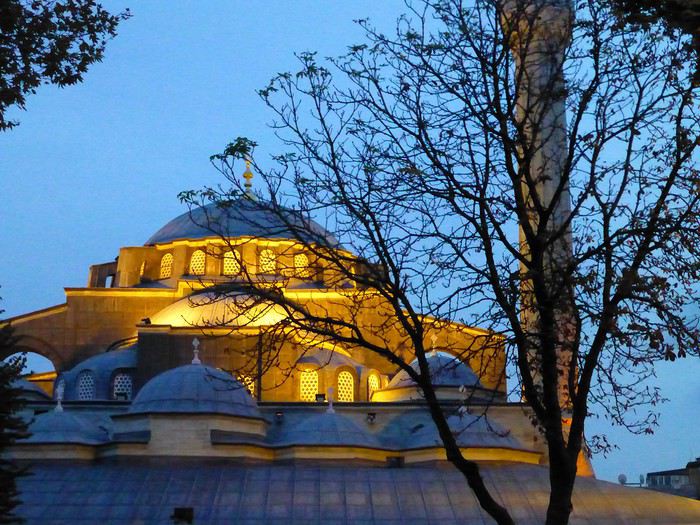
It promised things to see, to admire, a dive into the past, culture, the wonders of the 1001 Nights... AND IT DELIVERED!!! And honestly, 4 days is already great but far from enough!!! For those who might be hesitant (rightfully so) to go to Istanbul given the current climate, I’d say they’re wrong... I felt safer there than in my own city!! I went with my husband and kids and I’d do it again without a second thought!! I’d start by saying that 4 days gives a good overview—we almost did everything on foot (I made enemies in my own family...), noses in the air, 20 km a day... BUT 4 DAYS IS NOT ENOUGH AT ALL!!! That’s settled!
We flew with Turkish Airlines, Lyon to Istanbul direct—very good, nothing to complain about. We rented an apartment via Airbnb in Balat for 5 nights / 400 €—a completely renovated apartment in a typical wooden house in the neighborhood, like a dacha. The owner was super nice and let us have two apartments (since nothing was booked)—one for us parents, one for the teens!!! So, the Balat neighborhood was a deliberate choice on my part—I didn’t want to stay where the tourists were, so we sort of exiled ourselves to the old Orthodox quarter, very much in its own juice, and we loved it!!! But I’m not sure I’d recommend it... wooden houses, many still in ruins, winding cobbled streets, cats, kids playing in the street, cats, the bread vendor in the morning pushing his cart and shouting, cats, old men lined up outside on their chairs drinking coffee (the famous Turkish coffee—don’t stir it... if you like it...!), grandmas in black, dogs, chickens... it felt surreal, timeless, like we’d stepped into 1920s post-war... so opposite from the modern Istanbul waking up. Here, it was a real movie set... So disorienting and timeless that when we gave the address to a taxi driver at 11 PM, he said, "Oh no, I’m not taking you there—every time I go, I get lost..." Well, that’s what it *seemed* like he said. The second driver wasn’t any better... we don’t speak Turkish, but it was pretty clear!! My kids found it very encouraging: "Where are you taking us??? It must be super sketchy... but hey, dying in Istanbul is way more exotic than in Lyon!!" So when the third driver said "OK," we didn’t negotiate at all!! And we said thank you!! He got lost once, twice, grumbling and sighing, asked an old man out for a nighttime stroll, and we found it!!
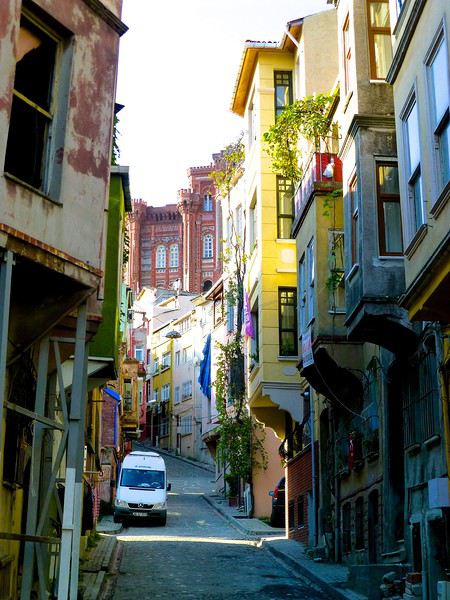
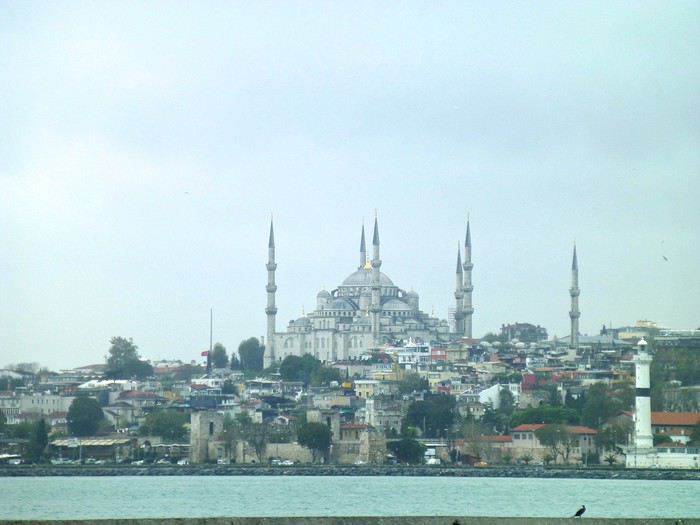
Exploring the neighborhood the next morning while shopping for breakfast, I was really glad I’d made that choice—the area was perfect!! A mix of past and present where Orthodox and Muslims coexist without issue (at least from our Western tourist perspective). A colorful neighborhood between ruins and rebirth, between two centuries. So we wandered the area, got lost... found our way, got lost again... Our host had explained where to buy a bus pass and how it worked, so we did that, but to start, we decided to walk to the center along the Golden Horn. Well, I sold the idea to the whole tribe... they fell for it once, not twice!! We took (still on foot) Atatürk Bridge, crossed the Bosphorus, and wandered through the little streets up to Galata Tower. We had a great view from the bridge, and also from the tower, which I highly recommend. And since it was Friday at noon, we got to hear the call to prayer from all the mosques—total culture shock! The view is magical: mosques, minarets, the Bosphorus, and on the other side, Asia. Instant love for this city!!
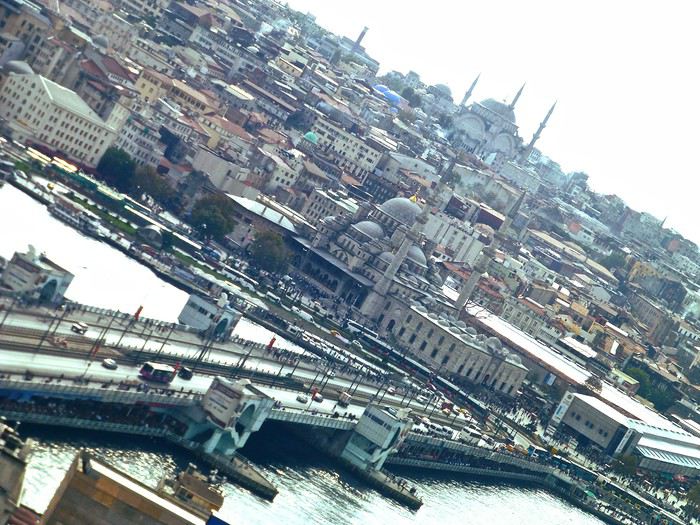
It’s a very lively, touristy neighborhood too. They say it’s the modern side of Istanbul, but it’s kept its soul. We were immediately struck by the cultural and religious contrasts, and it was buzzing in a great atmosphere. Veiled women sitting on terraces with their friends, made-up and in miniskirts—everything seemed to coexist harmoniously. The whole trip, we felt completely safe and never oppressed. We saw a dynamic, free-spirited youth, but maybe that’s just the tourist perspective, and we’re well aware the situation could change... We wandered through the Beyoğlu and Galatasaray districts up to Taksim Square, between churches and mosques, little streets, alleys, covered markets where Zara rubs shoulders with century-old shops. My only regret is not spending two days there—it’ll be an excuse to come back... We devoured three pieces of Turkish delight and kept going, descending this time (BECAUSE ISTANBUL ISN’T FLAT!!) down to the Kabataş ferry terminal on the Bosphorus. I hadn’t planned a cruise, but given the price and the need to rest our feet, we opted for the boat. We took a 1.5-hour cruise and didn’t regret it—it was amazing! The view of the Bosphorus shores, stunning houses, palaces, wooden dachas—vestiges of the bourgeoisie. We passed 200-meter container ships, sailboats, speedboats, and dozens of dolphins—so exotic!!
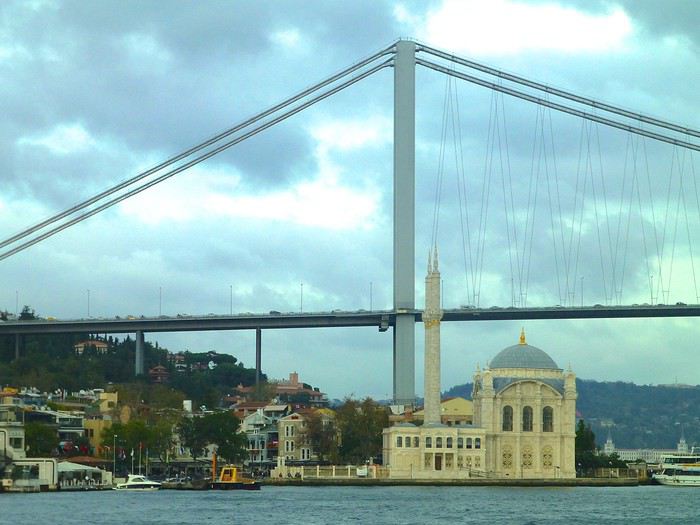
We could’ve made stops (get off, visit, get back on the next boat), but we just let ourselves drift to the sound of seagulls, wondering which way we’d go back... So at the dock, we took a bus... a bit randomly, but we’d decided we needed to cross a bridge—lucky us, we did! We walked to the Spice Bazaar, ate in a little place—something spicy but not too much, with rice... for next to nothing. And on the way back, by sheer luck, I pulled out my guidebook, which mentioned not to miss Rüstem Pasha Mosque, a small mosque on the roof of the bazaar—it’s almost a stroke of luck to find it. We had it all to ourselves, with its beautiful carpet... my big crush. Nothing grandiose, but almost magical, and we were alone—it had the charm of the first time. I love Italian churches... but Istanbul’s mosques really don’t have anything to envy them! After that encounter, I added a bunch more to my itinerary—knowing there are nearly 2,800 mosques in Istanbul, we weren’t going home anytime soon!! And my son said, "I’m gonna end this trip in socks if I have to take off my shoes every time!!!"
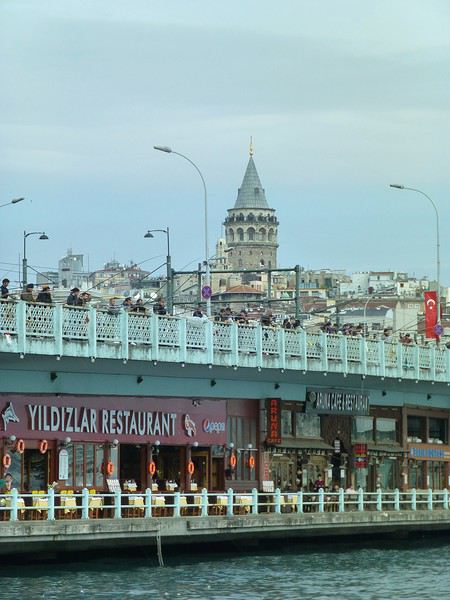
The next day, still wandering blindly in our neighborhood, we went on foot to visit Chora Church (Kariye Museum), a Catholic church that was at the center of a monastery dating back to Roman times, with the first vestiges from the 6th century. It’s now a museum, and the magnificent golden mosaics are really worth the detour—a true little gem, just like the neighborhood, still a bit in its own juice but in full renaissance.
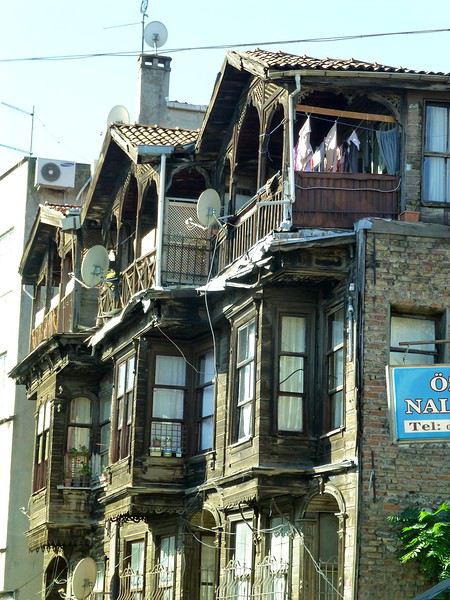
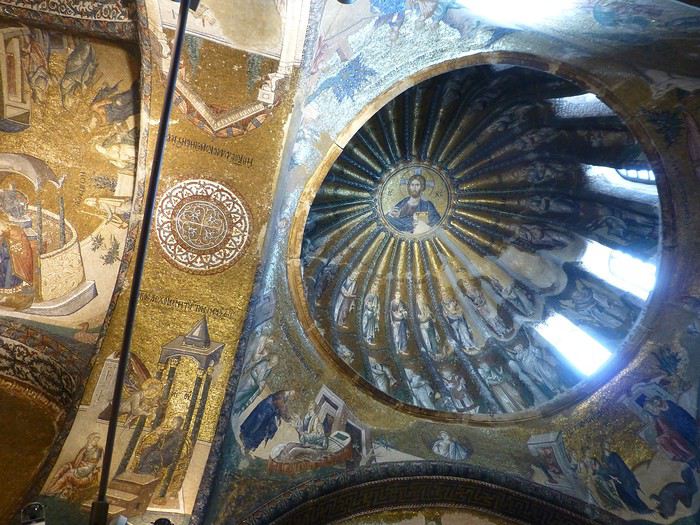
We reached the historic center via the grand boulevards, where shops selling tacky dresses line up one after another... not to mention the dozens of bridal shops (confirming the youth of the population... or that they get married often...). We visited Fatih Mosque, again all to ourselves—very beautiful, completely renovated.
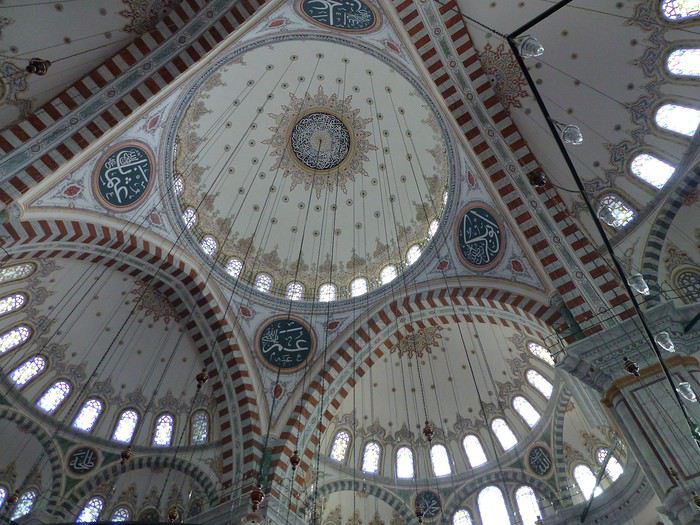
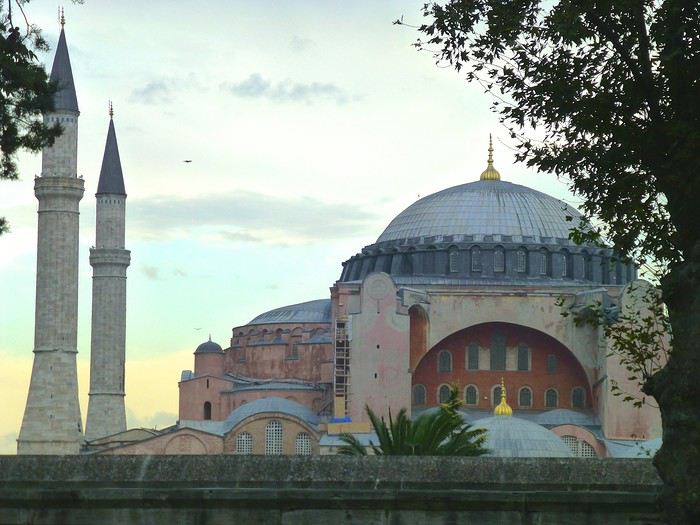
Then Şehzade Mosque, and not far away, Laleli Mosque. My husband would say, "Once you’ve seen one, you’ve seen them all..." That’s one point of view, but I never got tired of them. These are places with such serenity, so bright, white, vast, calm—I could’ve spent the whole day there. Pure architectural and spiritual masterpieces... but other mosques were waiting!! We arrived in the historic center of Sultanahmet, with the tourist buses... but that’s what we’re here for, right?! SO, Hagia Sophia... AYASOFYA... Byzantine jewel. I’ll spare you the history—everyone goes to Istanbul to see it. It’s a must: the star of Istanbul! I recommend the audio guides. From the outside, it’s a bit massive, not very pretty—to be honest, you’re lenient because the old lady isn’t exactly young. She started her journey in the 6th century. The inside is a bit disorienting—you immediately feel all the eras that have succeeded one another. So you’re not quite sure what you’ve come to see—a church, a mosque... it’s a museum!! But all the eras have, despite everything, respected the place, and the whole thing is very impressive and quite harmonious. I was expecting a tourist trap, but not at all—there was almost no one, and we wandered around, letting the place inspire us.
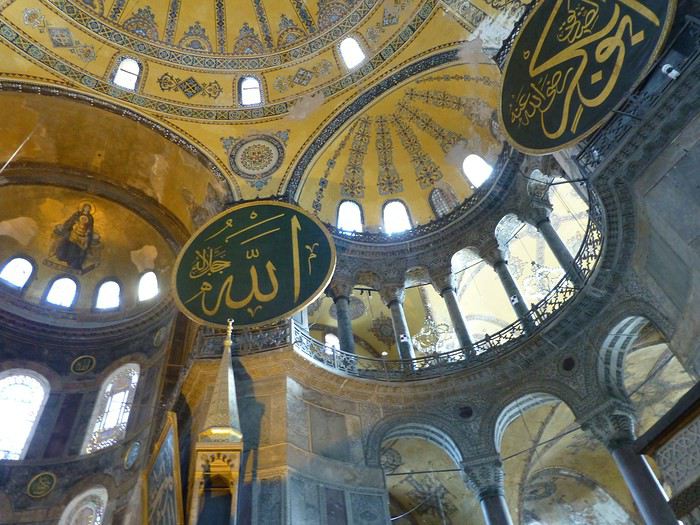
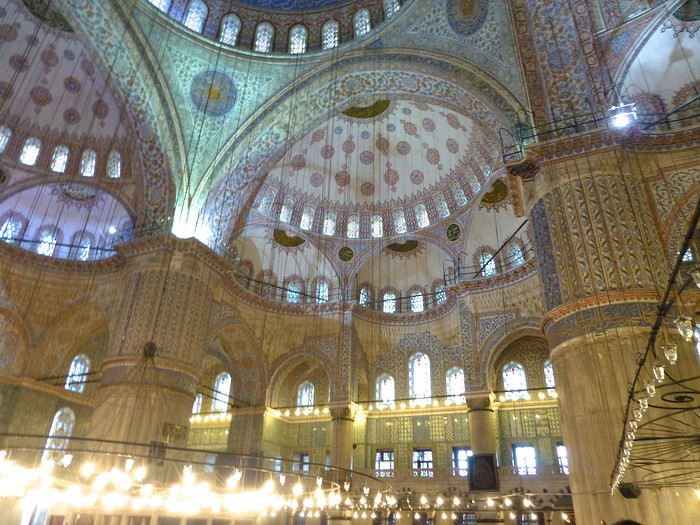
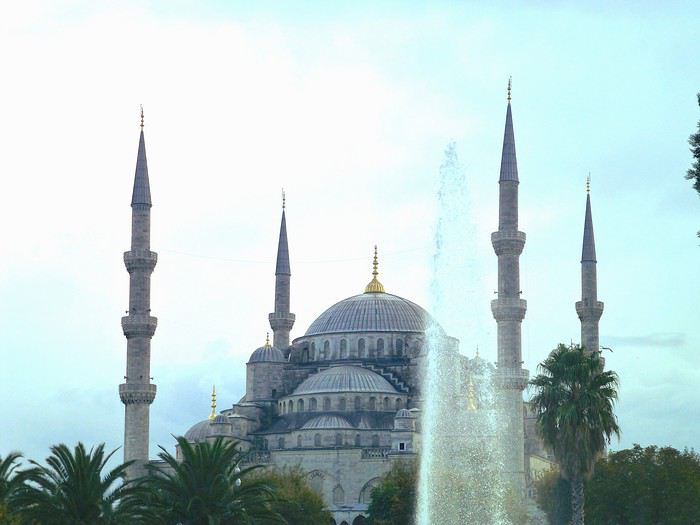
Since we were there, we moved on to the Blue Mosque: Sultan Ahmed Mosque... all the tourists were there... we waited in line, headscarves on, shoes in hand... all those people took away its charm and soul. 21,000 tiles, not so blue after all. It’s very beautiful, but not our favorite... though from the outside, it’s stunning and very photogenic.
But apparently, "Little Hagia Sophia," a bit further away, is really worth it and much less crowded. We didn’t go to the Basilica Cistern either, which tempted me so much, but there were too many people... Sultanahmet is full of ancestral treasures that make Istanbul’s charm and reputation, bearing witness to the past grandeur of this sublime city.
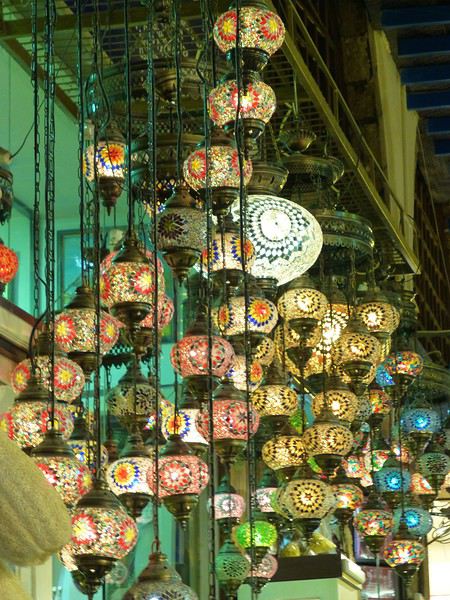
We headed back toward the Grand Bazaar of Istanbul... Aladdin, Scheherazade, sultans, favorites, and the 1001 Nights... it’s magical!! You can happily get lost in a maze of colors and scents, inside and out (less touristy and cheaper!!). Of course, there’s plenty to empty tourists’ wallets, but after doing the Moroccan souks several times—quite oppressive in my opinion—here, no pressure at all. We really felt great, surrounded by polite, kind, and smiling people. We found our happiness in magnets and other souvenirs... my daughter got two scarves, bracelets, and four husbands!!! At noon, it was packed; at 5 PM, no one... BUT personally, I preferred the Spice Market, located just behind Yeni Camii (oh, we didn’t visit that one...), the New Mosque on the Bosphorus. It’s smaller but better quality. We brought back jewelry, spices, bath towels (they don’t take up much space in a suitcase... but they’re so beautiful...). In short, we found what we were looking for... but that’s just our opinion....
Little walks on Galata Bridge with its fishermen, and we ended up eating a real kebab at the foot of the New Mosque—super good (and the spicy one is *really* spicy; the non-spicy one is too!!). We sat on the docks, watching the bustling city!
We took bus 99 back to Balat (because we’re *persona non grata* with the taxis!!)... And what’s great about Istanbul with the Turks is that, of course, they spotted us as loud French people. First, they saved us because we were going the wrong way, then on the bus, we were looking at the stops like: "Do you think we get off at this stop or the next one??" And every time, kind people approached us: "Ohh, you’re French! My brother-in-law works in Besançon—do you know Besançon?" "No..." "It’s nice, but it’s cold... I worked there for 3 years and then came back..." And just like that, every evening we made new friends!! They all have family in France... The first night, one even got off at the same stop as us and walked us back for fear we’d get lost "because tourists get lost in this area... taxis too, by the way!"... Don’t even get me started, my good man!!!
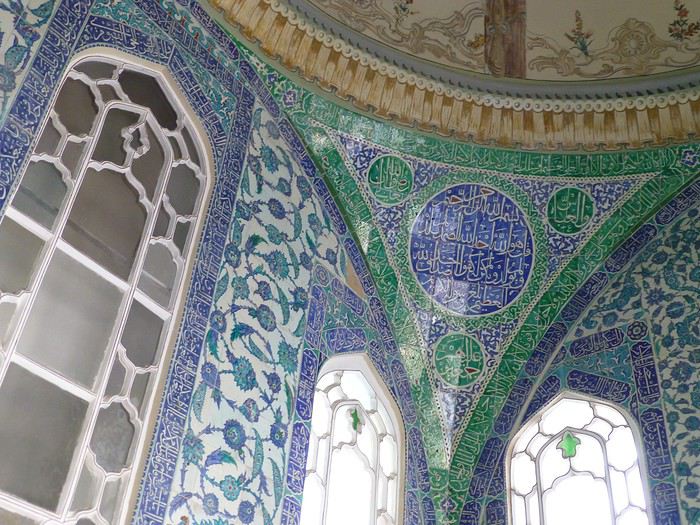
Day 3... After a good Turkish breakfast in our movie-set Balat-Fener, where cats, dogs, and grandpas wander (I love it +++), off we went on bus 99 toward Topkapı Palace... The 1001 Nights palace of the Ottoman sultan from the 15th to the 19th century... and its harem!!!! And we weren’t alone!! But it’s very well organized, and the audio guides are very useful. We all four loved it. We couldn’t help comparing it to the Alhambra in Andalusia... it’s less grandiose but still very beautiful. Very blue, very green, very beautiful! And very big... we spent 4 hours there dreaming of another time...
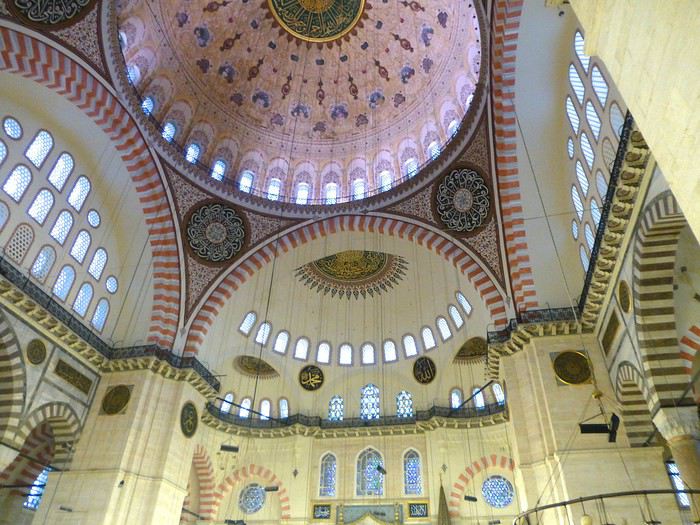
After a good meal on a terrace to rest our feet and digest the Turkish delight... we wandered the streets: headed to the hills to visit Süleymaniye Mosque: the mosque of Sultan Suleiman the Magnificent!! You can’t miss it—perched on its hill, you see it from wherever you are in Istanbul!! We put our shoes in little lockers, put on our headscarves, stopped talking, and sat on the beautiful red carpet, enjoying the ambient tranquility... My daughter thought it was the prettiest. Huge, graceful, luminous, harmonious—a true jewel (of course, if you like mosques and haven’t overdosed!!)
We walked back down quietly through the surrounding little streets, thinking we’d enjoy it more next time...
We stopped by the Spice Bazaar again, just in case we’d forgotten something... And we got back at 6:30 PM to eat pastrami and local cheese in our dollhouse wooden home...
Last day... it’s raining... bummer... We took our bus again, and big day—we took the Marmarail metro to go TO ASIA!!! For teens and adults alike, it’s too fun!!! We’re easily amused! In one metro station, we changed continents... magical! It’s very modern, clean, and there was no one... We didn’t explore the entire Asian side, which deserves much more time than we gave it, but we made do with what we had... We toured Kadıköy—very nice, lively, very commercial. You can feel it waking up, lots of cool little shops. Given the weather, there were very few tourists—a very nice surprise. We had lunch at Ciya, famous for its Turkish specialties—it was delicious.
There’s a magnificent view of the Bosphorus and Sultanahmet—at sunset, it must be magical. We came back by boat to enjoy the view—no more rain, but a good wind in return... between tankers, seagulls, and dolphins!!
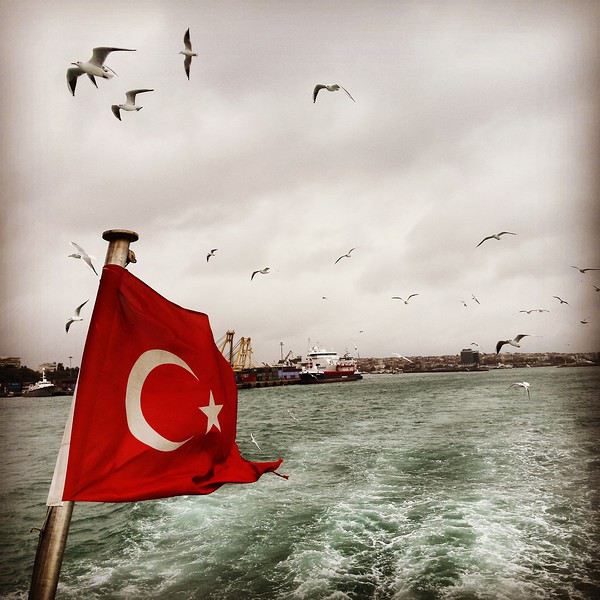
We crossed another beautiful maze of little commercial streets, bustling and full of history, reached the Grand Bazaar again—just in case we’d forgotten something... and because it was raining again... so a little tea in the warmth was always welcome. We bought baklava and Turkish delight from Afiz Mustafa for the grandparents who were looking after the dog... ate one last kebab, and went back to pack, stuffing our bath towels into bags that were too small... Tomorrow, the taxi comes to pick us up at 6 AM... if he finds the address!!!
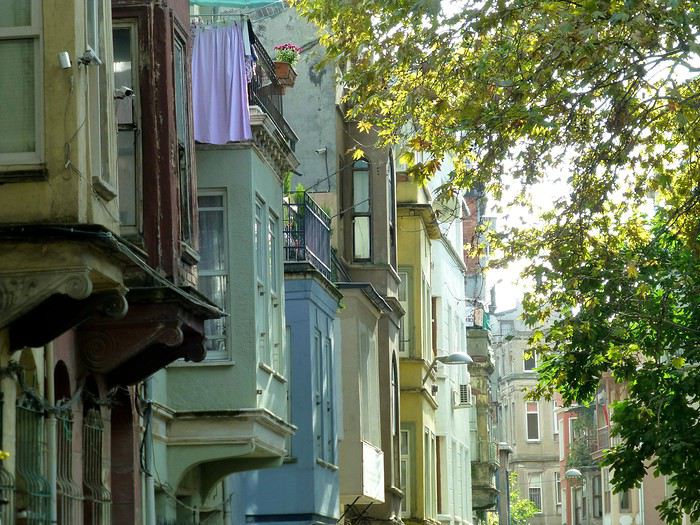
I loved it... Actually, everyone loved Istanbul... I found it such a contrasted city—between modernity and tradition, past and present, so young, dynamic, optimistic, and smiling. Sure, it’s sometimes messy, ugly, not well-maintained, but that’s its charm—so authentic. And long may it last....
It promised things to see, to admire, a dive into the past, culture, the wonders of the 1001 Nights... AND IT DELIVERED!!! And honestly, 4 days is already great but far from enough!!! For those who might be hesitant (rightfully so) to go to Istanbul given the current climate, I’d say they’re wrong... I felt safer there than in my own city!! I went with my husband and kids and I’d do it again without a second thought!! I’d start by saying that 4 days gives a good overview—we almost did everything on foot (I made enemies in my own family...), noses in the air, 20 km a day... BUT 4 DAYS IS NOT ENOUGH AT ALL!!! That’s settled!
We flew with Turkish Airlines, Lyon to Istanbul direct—very good, nothing to complain about. We rented an apartment via Airbnb in Balat for 5 nights / 400 €—a completely renovated apartment in a typical wooden house in the neighborhood, like a dacha. The owner was super nice and let us have two apartments (since nothing was booked)—one for us parents, one for the teens!!! So, the Balat neighborhood was a deliberate choice on my part—I didn’t want to stay where the tourists were, so we sort of exiled ourselves to the old Orthodox quarter, very much in its own juice, and we loved it!!! But I’m not sure I’d recommend it... wooden houses, many still in ruins, winding cobbled streets, cats, kids playing in the street, cats, the bread vendor in the morning pushing his cart and shouting, cats, old men lined up outside on their chairs drinking coffee (the famous Turkish coffee—don’t stir it... if you like it...!), grandmas in black, dogs, chickens... it felt surreal, timeless, like we’d stepped into 1920s post-war... so opposite from the modern Istanbul waking up. Here, it was a real movie set... So disorienting and timeless that when we gave the address to a taxi driver at 11 PM, he said, "Oh no, I’m not taking you there—every time I go, I get lost..." Well, that’s what it *seemed* like he said. The second driver wasn’t any better... we don’t speak Turkish, but it was pretty clear!! My kids found it very encouraging: "Where are you taking us??? It must be super sketchy... but hey, dying in Istanbul is way more exotic than in Lyon!!" So when the third driver said "OK," we didn’t negotiate at all!! And we said thank you!! He got lost once, twice, grumbling and sighing, asked an old man out for a nighttime stroll, and we found it!!
Exploring the neighborhood the next morning while shopping for breakfast, I was really glad I’d made that choice—the area was perfect!! A mix of past and present where Orthodox and Muslims coexist without issue (at least from our Western tourist perspective). A colorful neighborhood between ruins and rebirth, between two centuries. So we wandered the area, got lost... found our way, got lost again... Our host had explained where to buy a bus pass and how it worked, so we did that, but to start, we decided to walk to the center along the Golden Horn. Well, I sold the idea to the whole tribe... they fell for it once, not twice!! We took (still on foot) Atatürk Bridge, crossed the Bosphorus, and wandered through the little streets up to Galata Tower. We had a great view from the bridge, and also from the tower, which I highly recommend. And since it was Friday at noon, we got to hear the call to prayer from all the mosques—total culture shock! The view is magical: mosques, minarets, the Bosphorus, and on the other side, Asia. Instant love for this city!!
It’s a very lively, touristy neighborhood too. They say it’s the modern side of Istanbul, but it’s kept its soul. We were immediately struck by the cultural and religious contrasts, and it was buzzing in a great atmosphere. Veiled women sitting on terraces with their friends, made-up and in miniskirts—everything seemed to coexist harmoniously. The whole trip, we felt completely safe and never oppressed. We saw a dynamic, free-spirited youth, but maybe that’s just the tourist perspective, and we’re well aware the situation could change... We wandered through the Beyoğlu and Galatasaray districts up to Taksim Square, between churches and mosques, little streets, alleys, covered markets where Zara rubs shoulders with century-old shops. My only regret is not spending two days there—it’ll be an excuse to come back... We devoured three pieces of Turkish delight and kept going, descending this time (BECAUSE ISTANBUL ISN’T FLAT!!) down to the Kabataş ferry terminal on the Bosphorus. I hadn’t planned a cruise, but given the price and the need to rest our feet, we opted for the boat. We took a 1.5-hour cruise and didn’t regret it—it was amazing! The view of the Bosphorus shores, stunning houses, palaces, wooden dachas—vestiges of the bourgeoisie. We passed 200-meter container ships, sailboats, speedboats, and dozens of dolphins—so exotic!!
We could’ve made stops (get off, visit, get back on the next boat), but we just let ourselves drift to the sound of seagulls, wondering which way we’d go back... So at the dock, we took a bus... a bit randomly, but we’d decided we needed to cross a bridge—lucky us, we did! We walked to the Spice Bazaar, ate in a little place—something spicy but not too much, with rice... for next to nothing. And on the way back, by sheer luck, I pulled out my guidebook, which mentioned not to miss Rüstem Pasha Mosque, a small mosque on the roof of the bazaar—it’s almost a stroke of luck to find it. We had it all to ourselves, with its beautiful carpet... my big crush. Nothing grandiose, but almost magical, and we were alone—it had the charm of the first time. I love Italian churches... but Istanbul’s mosques really don’t have anything to envy them! After that encounter, I added a bunch more to my itinerary—knowing there are nearly 2,800 mosques in Istanbul, we weren’t going home anytime soon!! And my son said, "I’m gonna end this trip in socks if I have to take off my shoes every time!!!"
The next day, still wandering blindly in our neighborhood, we went on foot to visit Chora Church (Kariye Museum), a Catholic church that was at the center of a monastery dating back to Roman times, with the first vestiges from the 6th century. It’s now a museum, and the magnificent golden mosaics are really worth the detour—a true little gem, just like the neighborhood, still a bit in its own juice but in full renaissance.
We reached the historic center via the grand boulevards, where shops selling tacky dresses line up one after another... not to mention the dozens of bridal shops (confirming the youth of the population... or that they get married often...). We visited Fatih Mosque, again all to ourselves—very beautiful, completely renovated.
Then Şehzade Mosque, and not far away, Laleli Mosque. My husband would say, "Once you’ve seen one, you’ve seen them all..." That’s one point of view, but I never got tired of them. These are places with such serenity, so bright, white, vast, calm—I could’ve spent the whole day there. Pure architectural and spiritual masterpieces... but other mosques were waiting!! We arrived in the historic center of Sultanahmet, with the tourist buses... but that’s what we’re here for, right?! SO, Hagia Sophia... AYASOFYA... Byzantine jewel. I’ll spare you the history—everyone goes to Istanbul to see it. It’s a must: the star of Istanbul! I recommend the audio guides.
From the outside, it’s a bit massive, not very pretty—to be honest, you’re lenient because the old lady isn’t exactly young. She started her journey in the 6th century. The inside is a bit disorienting—you immediately feel all the eras that have succeeded one another. So you’re not quite sure what you’ve come to see—a church, a mosque... it’s a museum!! But all the eras have, despite everything, respected the place, and the whole thing is very impressive and quite harmonious. I was expecting a tourist trap, but not at all—there was almost no one, and we wandered around, letting the place inspire us.Since we were there, we moved on to the Blue Mosque: Sultan Ahmed Mosque... all the tourists were there... we waited in line, headscarves on, shoes in hand... all those people took away its charm and soul. 21,000 tiles, not so blue after all. It’s very beautiful, but not our favorite... though from the outside, it’s stunning and very photogenic.
But apparently, "Little Hagia Sophia," a bit further away, is really worth it and much less crowded. We didn’t go to the Basilica Cistern either, which tempted me so much, but there were too many people... Sultanahmet is full of ancestral treasures that make Istanbul’s charm and reputation, bearing witness to the past grandeur of this sublime city.
We headed back toward the Grand Bazaar of Istanbul... Aladdin, Scheherazade, sultans, favorites, and the 1001 Nights... it’s magical!! You can happily get lost in a maze of colors and scents, inside and out (less touristy and cheaper!!). Of course, there’s plenty to empty tourists’ wallets, but after doing the Moroccan souks several times—quite oppressive in my opinion—here, no pressure at all. We really felt great, surrounded by polite, kind, and smiling people. We found our happiness in magnets and other souvenirs... my daughter got two scarves, bracelets, and four husbands!!! At noon, it was packed; at 5 PM, no one... BUT personally, I preferred the Spice Market, located just behind Yeni Camii (oh, we didn’t visit that one...), the New Mosque on the Bosphorus. It’s smaller but better quality. We brought back jewelry, spices, bath towels (they don’t take up much space in a suitcase... but they’re so beautiful...). In short, we found what we were looking for... but that’s just our opinion....
Little walks on Galata Bridge with its fishermen, and we ended up eating a real kebab at the foot of the New Mosque—super good (and the spicy one is *really* spicy; the non-spicy one is too!!). We sat on the docks, watching the bustling city!
We took bus 99 back to Balat (because we’re *persona non grata* with the taxis!!)... And what’s great about Istanbul with the Turks is that, of course, they spotted us as loud French people. First, they saved us because we were going the wrong way, then on the bus, we were looking at the stops like: "Do you think we get off at this stop or the next one??" And every time, kind people approached us: "Ohh, you’re French! My brother-in-law works in Besançon—do you know Besançon?" "No..." "It’s nice, but it’s cold... I worked there for 3 years and then came back..." And just like that, every evening we made new friends!! They all have family in France... The first night, one even got off at the same stop as us and walked us back for fear we’d get lost "because tourists get lost in this area... taxis too, by the way!"... Don’t even get me started, my good man!!!
Day 3... After a good Turkish breakfast in our movie-set Balat-Fener, where cats, dogs, and grandpas wander (I love it +++), off we went on bus 99 toward Topkapı Palace... The 1001 Nights palace of the Ottoman sultan from the 15th to the 19th century... and its harem!!!! And we weren’t alone!! But it’s very well organized, and the audio guides are very useful. We all four loved it. We couldn’t help comparing it to the Alhambra in Andalusia... it’s less grandiose but still very beautiful. Very blue, very green, very beautiful! And very big... we spent 4 hours there dreaming of another time...
After a good meal on a terrace to rest our feet and digest the Turkish delight... we wandered the streets: headed to the hills to visit Süleymaniye Mosque: the mosque of Sultan Suleiman the Magnificent!! You can’t miss it—perched on its hill, you see it from wherever you are in Istanbul!! We put our shoes in little lockers, put on our headscarves, stopped talking, and sat on the beautiful red carpet, enjoying the ambient tranquility... My daughter thought it was the prettiest. Huge, graceful, luminous, harmonious—a true jewel (of course, if you like mosques and haven’t overdosed!!)
We walked back down quietly through the surrounding little streets, thinking we’d enjoy it more next time...
We stopped by the Spice Bazaar again, just in case we’d forgotten something... And we got back at 6:30 PM to eat pastrami and local cheese in our dollhouse wooden home...
Last day... it’s raining... bummer... We took our bus again, and big day—we took the Marmarail metro to go TO ASIA!!! For teens and adults alike, it’s too fun!!! We’re easily amused! In one metro station, we changed continents... magical! It’s very modern, clean, and there was no one... We didn’t explore the entire Asian side, which deserves much more time than we gave it, but we made do with what we had... We toured Kadıköy—very nice, lively, very commercial. You can feel it waking up, lots of cool little shops. Given the weather, there were very few tourists—a very nice surprise. We had lunch at Ciya, famous for its Turkish specialties—it was delicious.
There’s a magnificent view of the Bosphorus and Sultanahmet—at sunset, it must be magical. We came back by boat to enjoy the view—no more rain, but a good wind in return... between tankers, seagulls, and dolphins!!
We crossed another beautiful maze of little commercial streets, bustling and full of history, reached the Grand Bazaar again—just in case we’d forgotten something... and because it was raining again... so a little tea in the warmth was always welcome. We bought baklava and Turkish delight from Afiz Mustafa for the grandparents who were looking after the dog... ate one last kebab, and went back to pack, stuffing our bath towels into bags that were too small... Tomorrow, the taxi comes to pick us up at 6 AM... if he finds the address!!!
I loved it... Actually, everyone loved Istanbul... I found it such a contrasted city—between modernity and tradition, past and present, so young, dynamic, optimistic, and smiling. Sure, it’s sometimes messy, ugly, not well-maintained, but that’s its charm—so authentic. And long may it last....
For a few years now, it’s become obvious that the typical tourist in Thailand is increasingly "mimile"—I see it every day.
The issue is that Thais know how to adapt and are offering more and more things that appeal to this kind of crowd. That’s why we’re seeing more and more pizzerias and burger joints... Even hotels are proudly displaying up to 5 stars for places that barely deserve 3 by European standards, and this "working-class" crowd is over the moon, totally buying into it!
In short, travelers looking to discover other civilizations and cultures might end up pretty disappointed.
We went to Morocco in April with our children and grandchildren.
We landed in Marrakech around 9 AM and took a bus to our small hotel in the Guéliz district. This was to avoid dealing with taxi drivers who might give our young travelers a very negative impression of Marrakech... The bus drops us off very close to the Hôtel Toulousain, which has always given us the warmest welcome for over 25 years. We settle into our rooms and head to the medina to have lunch first and then wander through the streets of the old city, introducing it to our little group.
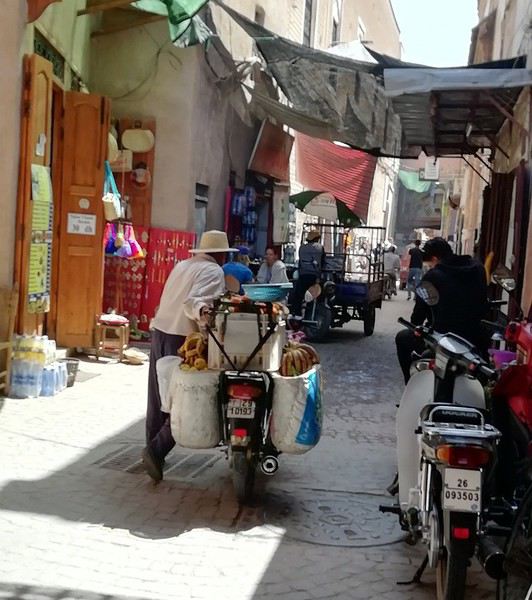
Young and old alike are amazed by the craftsmanship and attention to detail in the work done by the various artisans.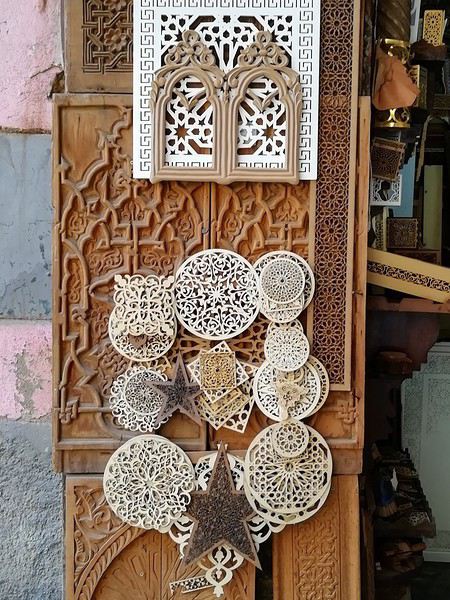
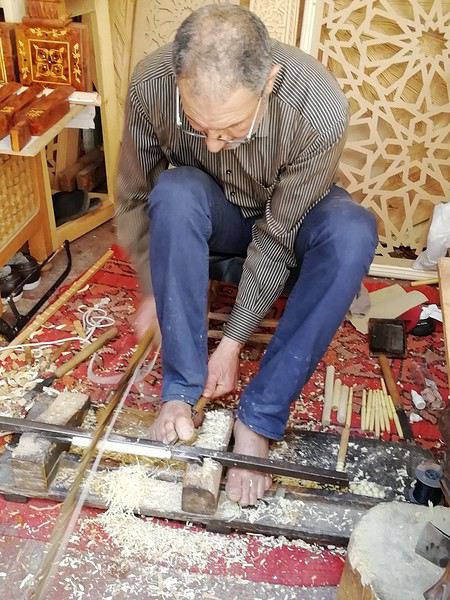
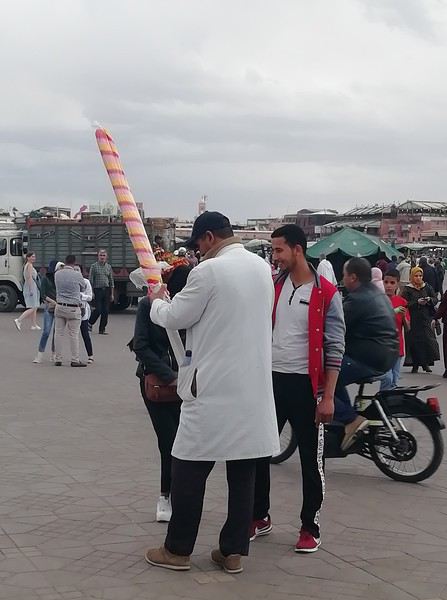
The souks also impress first-time visitors, both with their size and the sheer amount of goods on offer. For those visiting for the first time, it’s a real maze. Colorful chameleons everywhere... Will they survive for long in their cages under the scorching sun?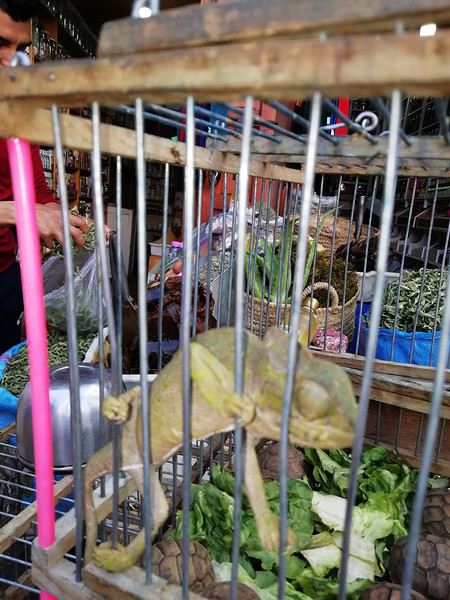 Another surprise for the kids: the lollipop vendor in Jemaa El Fna Square, with giant lollipops that really whet their appetites...
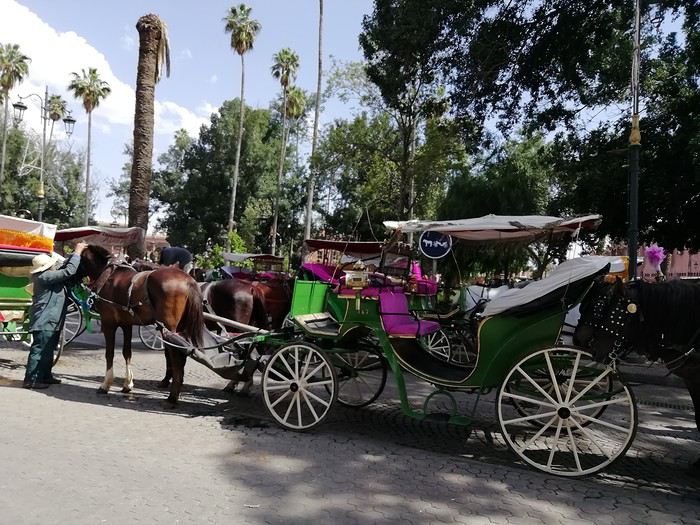
By late afternoon, little legs are tired, and horse-drawn carriages are a welcome way to get back to the hotel.
Young and old alike are amazed by the craftsmanship and attention to detail in the work done by the various artisans.
The souks also impress first-time visitors, both with their size and the sheer amount of goods on offer. For those visiting for the first time, it’s a real maze. Colorful chameleons everywhere... Will they survive for long in their cages under the scorching sun?
Another surprise for the kids: the lollipop vendor in Jemaa El Fna Square, with giant lollipops that really whet their appetites...By late afternoon, little legs are tired, and horse-drawn carriages are a welcome way to get back to the hotel.
This travel journal is our second on VoyageForum, following last year’s where we recounted our four weeks in Vietnam.
The goal remains the same: since some members on this site share tips, experiences, and great deals that help us prepare for our trips, we do the same after returning—both to give back a little and in the hope that our experiences might be useful to others in some way.
Our route was as follows: Bangkok, Siem Reap, Krabi, Suratthani, Koh Phangan, Koh Tao, Chumphon, Bang Saphan, Prachuab Khiri Khan, Sam Roi Yod, Hua Hin, Phetchaburi, Bangkok.
Beyond rediscovering Bangkok, our objectives were the long-held dream of seeing Angkor and exploring southern Thailand, much of which isn’t overly touristy.
A quick big thank-you to Barbot, who took the time to answer several of our questions.
12/07/2013
The cheapest flight we found earlier this year was a Paris-Bangkok route with a layover in Moscow for 1440 €, total for two people. So, this time we tried Aeroflot. Airbus A318 for the first leg, A330 for the second. Nothing particularly annoying to report—the passengers were very calm, the cabin temperature was comfortable, and we had enough legroom. That said, the quality of the meal trays was pretty mediocre, and the flight attendants weren’t exactly comedians.
We’d like to remind everyone that it’s best to exchange as little money as possible at the airport upon arrival, since the rate is about 5% worse than at city banks.
Of course, we made sure to take the airport exit where you can catch official taxis to avoid getting scammed. So, we queued up, a little lady gave us the ticket, and off we went with the driver. Generally, this system works well because these drivers are registered, know their duties, and the risks they face if they break the rules. Except that day, right off the bat, we got the scammer of the day. His first move was to snatch the ticket from my wife’s hands—the one you’re supposed to keep in case of a complaint. My husband saw it, but after a full day of travel, we were a bit out of it, and honestly, there was no reason to be suspicious. But once we started driving, the guy refused to turn on the meter. We insisted more and more firmly, but nothing. So, I used the famous method of opening the door and starting to step out of the car. At 40 km/h, that scares the driver more than the passenger. He finally turned on the meter, but that didn’t calm him down—quite the opposite. For the next half-hour, he ruined the ride by demanding extra fees here and there. Having dealt with several scam attempts last year in Vietnam, this wasn’t exactly new, and we were proud of ourselves for staying pretty zen. Still, this guy was a little scary—he was completely wired and aggressive. Honestly, it was hard not to think he was on something. He’d be perfect for a *Scarface* remake. When we finally arrived at the hotel, he followed us to the entrance. We paid the two tolls (25 and 45 baht), gave him the usual 100 baht extra for the ride, and stayed polite but firm. So, meter: 245 baht + 100 baht + 25 and 45 baht for tolls—we paid the exact amount, no way we were tipping this guy. He left furious, but he was already like that before picking us up... Anyway, avoid Mr. Chartree Chidchen, number 089 826 7308, car E2663!
We were so relieved to finally settle in at Feung Nakorn Balcony hotel in the temple district. 42 € per night, great reception, all the staff is friendly. The AC works fine, the bed seemed hard at first but turned out to be comfortable. The hotel is quiet, away from the nightlife, but at this time of year, many places are less crowded than in high season. Even with a nice fish pond and outdoor breakfast area, it’s a decent hotel, though we felt we could’ve found something better.
After a night on the plane, the first afternoon is always a bit of a slog. We napped for a few hours, and when we woke up—guess what—we were starving. We visited a temple across from the hotel (nothing special) and then decided to take the Chao Phraya Express, the river shuttle that serves many piers along the river. It was a really enjoyable experience. The steel gangway wobbles when you board and disembark, the boat sits low in the water, and sometimes you get splashed. During peak times, you’re packed in like sardines, but most of all, there’s that exotic urban landscape passing by, especially the temple rooftops.
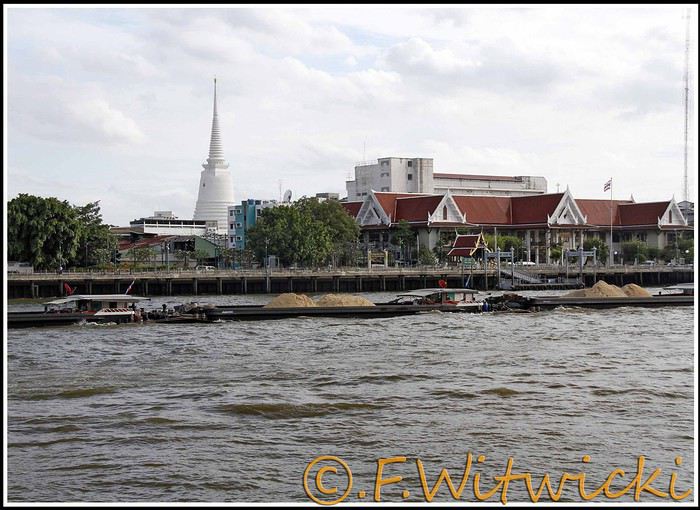
At that exact moment, the boat was packed. We didn’t see a ticket booth at the pier, and we tried in vain to pay the few baht for the ride. The cashier on the boat was too busy, and another employee we called didn’t have time to help us. Oh well, we weren’t going to force the issue. Still, this mode of transport is super practical for avoiding traffic, and at the piers, the lines with station names are clearly marked, with colors matching the flags on the boats. Combined with a map like the *Routard* guide, it’s easy to navigate.
We easily made it to the restaurant *Harmonique*, located near one of these piers. It’s a unanimous favorite on this forum, and let us tell you—it’s well-deserved. What a wonderful experience that evening! We only saw the outdoor gazebo because there was no way we were dining inside. It’s not flashy, so those looking for a luxurious setting should look elsewhere.
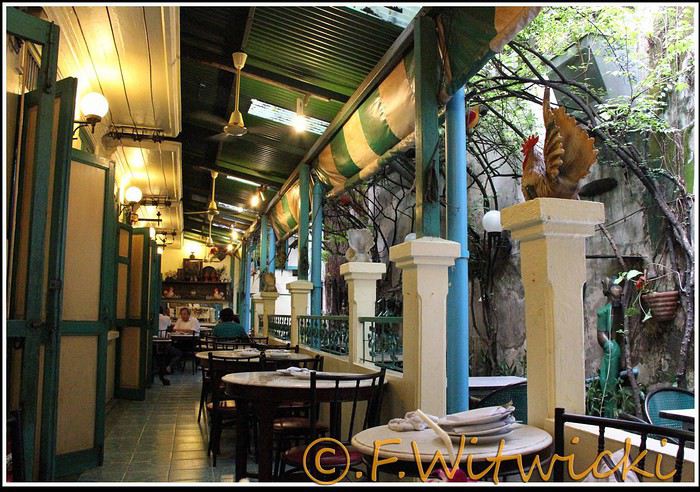
That night, the staff was a bit slow, and we had to track them down several times to move things along. But oh, my friends—what a feast on the plate! Start with the appetizer platter for two at 250 baht, featuring four specialties, each more tempting than the last, followed by their famous crab curry for 200 baht. There’s *so much* crab in there! The dish is so delicious and rich that when you finish, you feel—how to put it—like it was almost *too* good, to the point where you’re almost put off eating for days. And also, oh yes, we *will* be back. Their satay chicken is just as amazing, and it would be a crime not to mention their generous dessert with ice cream, warm banana, and chocolate, plus their *excellent* almond milkshake.
Later, we took a taxi to Kao San Road, mainly to book a Ko Tao-Chumphon trip for 600 baht per person at the Lomprayah counter. In hindsight, we should’ve booked all three of our trips there right away.
Kao San Road is *ultra*-touristy—better for younger crowds, but it’s still worth seeing. There’s rock ‘n’ roll, hippies, and crowds everywhere.
We walked back to the hotel, and when we got a little lost near a canal, a really nice older Thai man spontaneously appeared out of the night to kindly point us in the right direction.
Finally, a real long night of sleep ahead—we cranked up the AC. Sweet, the vacation has begun!
Our route was as follows: Bangkok, Siem Reap, Krabi, Suratthani, Koh Phangan, Koh Tao, Chumphon, Bang Saphan, Prachuab Khiri Khan, Sam Roi Yod, Hua Hin, Phetchaburi, Bangkok.
Beyond rediscovering Bangkok, our objectives were the long-held dream of seeing Angkor and exploring southern Thailand, much of which isn’t overly touristy.
A quick big thank-you to Barbot, who took the time to answer several of our questions.
12/07/2013
The cheapest flight we found earlier this year was a Paris-Bangkok route with a layover in Moscow for 1440 €, total for two people. So, this time we tried Aeroflot. Airbus A318 for the first leg, A330 for the second. Nothing particularly annoying to report—the passengers were very calm, the cabin temperature was comfortable, and we had enough legroom. That said, the quality of the meal trays was pretty mediocre, and the flight attendants weren’t exactly comedians.
We’d like to remind everyone that it’s best to exchange as little money as possible at the airport upon arrival, since the rate is about 5% worse than at city banks.
Of course, we made sure to take the airport exit where you can catch official taxis to avoid getting scammed. So, we queued up, a little lady gave us the ticket, and off we went with the driver. Generally, this system works well because these drivers are registered, know their duties, and the risks they face if they break the rules. Except that day, right off the bat, we got the scammer of the day. His first move was to snatch the ticket from my wife’s hands—the one you’re supposed to keep in case of a complaint. My husband saw it, but after a full day of travel, we were a bit out of it, and honestly, there was no reason to be suspicious. But once we started driving, the guy refused to turn on the meter. We insisted more and more firmly, but nothing. So, I used the famous method of opening the door and starting to step out of the car. At 40 km/h, that scares the driver more than the passenger. He finally turned on the meter, but that didn’t calm him down—quite the opposite. For the next half-hour, he ruined the ride by demanding extra fees here and there. Having dealt with several scam attempts last year in Vietnam, this wasn’t exactly new, and we were proud of ourselves for staying pretty zen. Still, this guy was a little scary—he was completely wired and aggressive. Honestly, it was hard not to think he was on something. He’d be perfect for a *Scarface* remake. When we finally arrived at the hotel, he followed us to the entrance. We paid the two tolls (25 and 45 baht), gave him the usual 100 baht extra for the ride, and stayed polite but firm. So, meter: 245 baht + 100 baht + 25 and 45 baht for tolls—we paid the exact amount, no way we were tipping this guy. He left furious, but he was already like that before picking us up... Anyway, avoid Mr. Chartree Chidchen, number 089 826 7308, car E2663!
We were so relieved to finally settle in at Feung Nakorn Balcony hotel in the temple district. 42 € per night, great reception, all the staff is friendly. The AC works fine, the bed seemed hard at first but turned out to be comfortable. The hotel is quiet, away from the nightlife, but at this time of year, many places are less crowded than in high season. Even with a nice fish pond and outdoor breakfast area, it’s a decent hotel, though we felt we could’ve found something better.
After a night on the plane, the first afternoon is always a bit of a slog. We napped for a few hours, and when we woke up—guess what—we were starving. We visited a temple across from the hotel (nothing special) and then decided to take the Chao Phraya Express, the river shuttle that serves many piers along the river. It was a really enjoyable experience. The steel gangway wobbles when you board and disembark, the boat sits low in the water, and sometimes you get splashed. During peak times, you’re packed in like sardines, but most of all, there’s that exotic urban landscape passing by, especially the temple rooftops.
At that exact moment, the boat was packed. We didn’t see a ticket booth at the pier, and we tried in vain to pay the few baht for the ride. The cashier on the boat was too busy, and another employee we called didn’t have time to help us. Oh well, we weren’t going to force the issue. Still, this mode of transport is super practical for avoiding traffic, and at the piers, the lines with station names are clearly marked, with colors matching the flags on the boats. Combined with a map like the *Routard* guide, it’s easy to navigate.
We easily made it to the restaurant *Harmonique*, located near one of these piers. It’s a unanimous favorite on this forum, and let us tell you—it’s well-deserved. What a wonderful experience that evening! We only saw the outdoor gazebo because there was no way we were dining inside. It’s not flashy, so those looking for a luxurious setting should look elsewhere.
That night, the staff was a bit slow, and we had to track them down several times to move things along. But oh, my friends—what a feast on the plate! Start with the appetizer platter for two at 250 baht, featuring four specialties, each more tempting than the last, followed by their famous crab curry for 200 baht. There’s *so much* crab in there! The dish is so delicious and rich that when you finish, you feel—how to put it—like it was almost *too* good, to the point where you’re almost put off eating for days. And also, oh yes, we *will* be back. Their satay chicken is just as amazing, and it would be a crime not to mention their generous dessert with ice cream, warm banana, and chocolate, plus their *excellent* almond milkshake.
Later, we took a taxi to Kao San Road, mainly to book a Ko Tao-Chumphon trip for 600 baht per person at the Lomprayah counter. In hindsight, we should’ve booked all three of our trips there right away.
Kao San Road is *ultra*-touristy—better for younger crowds, but it’s still worth seeing. There’s rock ‘n’ roll, hippies, and crowds everywhere.
We walked back to the hotel, and when we got a little lost near a canal, a really nice older Thai man spontaneously appeared out of the night to kindly point us in the right direction.
Finally, a real long night of sleep ahead—we cranked up the AC. Sweet, the vacation has begun!
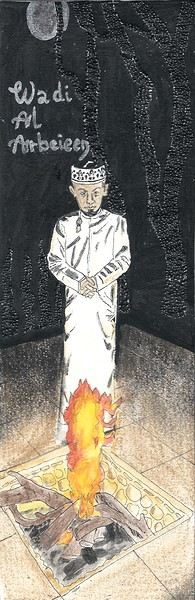
If I close my eyes and think of the Sultanate of Oman, I first smell a light scent of incense, feel the warmth of a sunbeam on my skin, before sand slips through my fingers. I taste the sweetness of a date, a real candy, then the flavor of coffee with a hint of cardamom and rosewater... I hear the desert wind whistling in my ears, the distant call of a muezzin, then the murmur of water. I open my eyes to see smiles, welcoming gestures, a turquoise sea, rocks ranging from ochre to purple, deep wadis where torrents burst forth, orange dunes, white sandy beaches where tiny crabs scurry at full speed. I see incredible oases emerging between arid mountains. I see abandoned villages that I’d dream were full of life, imposing fortresses overlooking valleys, and lively souks where offers are delicate and negotiation is a mutual courtesy.
All that, and so much more.
This is what I tried to capture in my illustrated travel journal, which I’ll fill in here and there with photos. I drew this journal “cold,” after my return (actually, I made it this summer, while our trip was last winter). It’s a pretty special format—I bought it in Japan without really knowing what I’d do with it. Well, it found its purpose! Below is a photo of this accordion-style journal: here, it’s only partially open, because when fully unfolded, it’s 5 meters long!
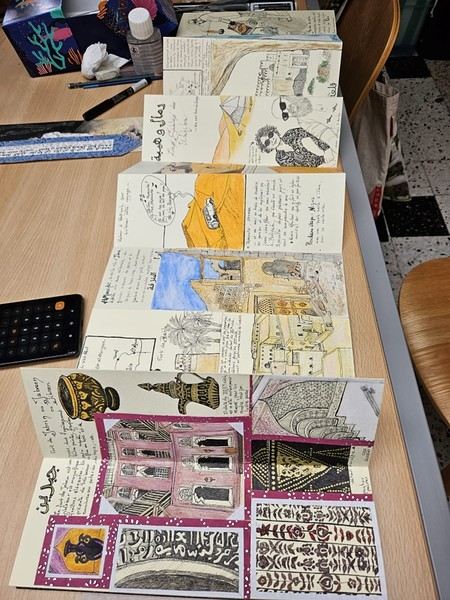
For drawing enthusiasts: The accordion format is both a constraint (each sheet is 9 cm x 27 cm) and a freedom (you can create a fresco). The paper is also a bit special: it doesn’t allow for fine lines, but it takes ink well (liner pen). However, everything has to be done almost in one go (with a very light pencil sketch) because it erases poorly. It absorbs too much water for coloring with markers or watercolors (unless you avoid soaking it), but it works well with oil pastels and their use with a brush and solvent. Since it’s yellowish, it allowed me to create contrasts even with white pastel.
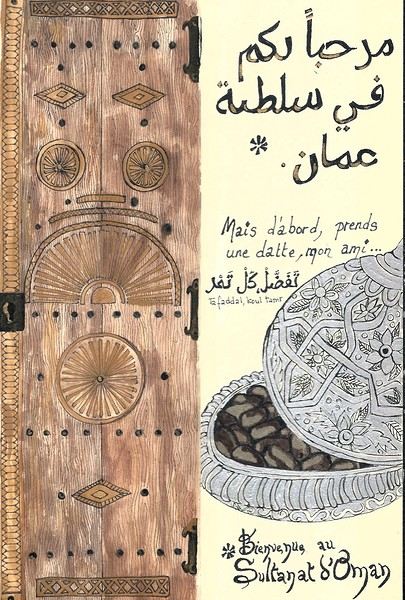 On the right, the "welcome marker"—those dates offered everywhere as a sign of hospitality. On the left, a tribute to those stunning doors worn by time, admired all over the old quarters, including the abandoned ones.
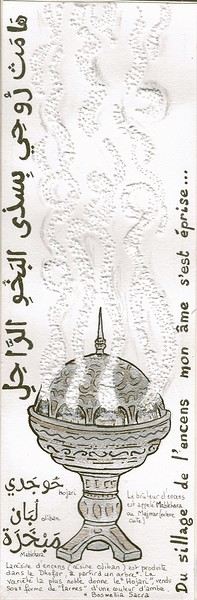
Oman is one of the world’s largest producers of frankincense resin. Incense burners are everywhere, from the simplest clay ones to the most precious handcrafted silver ones...
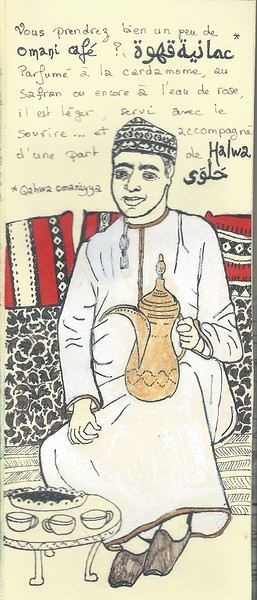 Hospitality will often lead you to accept a small coffee, an "Omani coffee," very light, subtly flavored with cardamom, maybe a touch of saffron, and occasionally rosewater.
Here, I’ve depicted a man in the common everyday attire of Omanis: the dishdasha, mostly white (during the week and daytime; colors are more common in the evening or on Fridays and Saturdays). While you’ll see some men dressed in Western clothes, they’re very few. The white dishdasha is truly the shared attire of all men. The dishdasha, which has no hood, is distinguished by a small pom-pom attached to the collar, the furakha, which is soaked in perfume. And believe me, Omanis go overboard with it! "It smells like the pom-pom" is an expression that’s now part of our shared language, my husband and I.
Another must of men’s attire is the kuma, a small round head covering, usually white with brightly colored patterns. The keffiyeh is also worn (but without the cord called an agal in Arab countries), and it’s mostly worn by those with roots in the desert, from what I understood.
And what about the women, you might ask? Some are veiled, some in full black (but not a burka—more like a chador + abaya), due to the influence of Saudi Arabia and the United Arab Emirates, whereas the traditional outfit used to be a layering of very colorful dresses. Most of the women we saw wore neutral clothing, a plain veil over their hair, but with their faces uncovered. We also saw many saris and colorful veils—don’t forget that 40% of the population consists of Indian, Nepalese, and Bangladeshi immigrants, who work a lot in tourism, hospitality, restaurants, services, and construction.
Just to clarify, as a tourist, there’s no pressure to wear a veil, and never any disapproving looks. Of course, you’ll save the mini shorts, plunging necklines, bare shoulders, and midriffs for the hotel terrace—but I’d say that’s the same for men and women, and with the sun being strong, it’s better for your skin too.
Here’s the introduction! In the next post, I’ll tell you about my itinerary, and we can dive in!
Good evening everyone! 🙂
We’re back from our September 2025 road trip, this time to explore Arizona and New Mexico, and it’s time for me to start my travel journal—especially since everything’s already booked for another trip in September 2026 (to California), and I need to get started on the planning.
I was a little worried this new visit to Uncle Sam’s country might not be as "wow" as the others, but we still discovered some incredible places.
For those who don’t know us, we’re a couple in our seventies who speak very little English, but that didn’t stop us from fully enjoying our stay.
For this 6th road trip in the U.S., we spent 21 nights there, drove 4,160 km by car, and walked nearly 160 km in a loop starting from Phoenix.
We’d been to Arizona before (but not this side) and never to New Mexico. This whole road trip was a huge discovery for us.
In the prices mentioned (some in euros, others in dollars), bank fees and exchange charges are included. The flights, car rental, and parking were all paid for in December 2024 when we booked.
We’d downloaded the MPC (Mobile Passport Control) app, but there wasn’t a dedicated line at Phoenix Airport. Still, we got through quickly with friendly, smiling agents.
I don’t drive at all (I hate it), so the stops were chosen based on activities but also, for some, to limit daily mileage for the sole driver. The kilometers listed in the itinerary are the daily distances.
We traveled from September 9th to 22nd, unfortunately once again without our dear friends Mimi and Maumau.
The itinerary
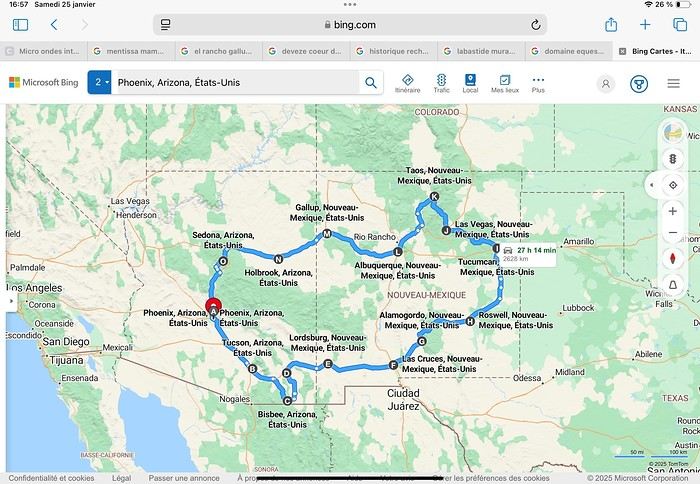
Day 1: Flight Marseille-Paris-Phoenix, then Gold Canyon (133 km) Day 2: Tucson (271 km) Lost Dutchman State Park Day 3: Tucson (155 km) Day 4: Tucson (34 km) Day 5: Bisbee (182 km) Day 6: Lordsburg (345 km) Day 7: Las Cruces (253 km) Day 8: Alamogordo (162 km) Day 9: Roswell (264 km) Day 10: Tucumcari (369 km) Day 11: Las Vegas (281 km) – the one in New Mexico Day 12: Taos (213 km) Day 13: Santa Fe (224 km) Day 14: Albuquerque (123 km) Day 15: Gallup (246 km) Day 16: Holbrook (224 km) Day 17: Flagstaff (179 km) Day 18: Sedona (118 km) Day 19: Sedona (48 km) Day 20: Sedona (41 km) Day 21: Phoenix (256 km) Day 22: Phoenix Airport (35 km)
📊 **Budget**: A little over 7,500 € for both of us, all included. The exchange rate was in our favor (1.17 dollars to 1 €). 📊 **Flights**: Marseille-Paris Charles de Gaulle-Phoenix: 1,787 € for two, with one checked bag each (Air France) 📊 **ESTA**: $42 📊 **America the Beautiful Pass**: $80 📊 **Parking**: 134 € (super eco at Marseille) 📊 **Car rental (Hertz)**: 865 €. Since there were no SUVs left in the reserved category (Nissan Rogue), we got an upgrade (4x4 Ford Explorer). We booked through Air France (15% discount). We’d originally reserved it in December for 1,140 €, but since prices dropped in March, we canceled and rebooked for 865 €. Hertz offers a free Hertz Gold Plus Rewards program, which gives you priority counter service when picking up the car. 📊 **Accommodation**: 2,400 € We stayed in hotels and motels of varying standards (from 60 to 203 € per night, depending on the city), all booked through Booking.com or Hotels.com. Out of 21 nights, only two didn’t include breakfast in the price. Booking.com sometimes offers slightly cheaper rates if you book by phone using the mobile app, and our Genius 3 status on the site also got us some preferential rates. 📊 **Supplementary insurance**: AVA 200 € for medical care if needed 📊 **Cash**: $2,078. We left with 1,000 € exchanged before departure and made two withdrawals of $500. This cash covered: - Evening restaurants and tips - Midday picnics - Gas: $298 for 4,160 km - Museum and private park entries (per person): - Lost Dutchman: $10 - Arizona-Sonora Desert Museum: $28 - Bird Cage Theater: $16 - Tombstone Shootout: $8 - New Mexico Farm & Ranch Museum: $12 - Roswell International UFO Museum: $5 - Billy the Kid Museum: $7 - Rancho de Taos: $22 - West Fork Oak Creek Trail entry: $15 We got a few discounts thanks to our senior age (+65). - Souvenirs and little treats
Like on our previous road trips, we didn’t rent a GPS. We got around using offline GPS apps Here WeGo and Organic Maps, with maps of the states we visited downloaded before we left (on our phones).
❤️❤️❤️ **Highlights** (there are so many!) 📍 Goldfield Ghost Town (even if it’s a reconstruction) 📍 The standing army of Saguaro cacti at Saguaro National Park West 📍 Diving into the cowboy universe of Tombstone 📍 The welcome from Rick and Henry at our guesthouse in Bisbee (Garden at Mile High Ranch) 📍 The tangled rocks of Chiricahua National Monument 📍 The flavored pistachios from Dwayne’s Fresh Jerky and Mac Ginnis Pistachioland 📍 Restaurants: La Posta (Las Cruces), Diner 66 (Albuquerque), and the Haunted Hamburger (Jerome) 📍 The old plazas of New Mexico 📍 The solitude and beauty of the white dunes at White Sands National Park 📍 Stepping back in time at the Billy the Kid Museum (Fort Stanton) 📍 Sections of historic Route 66 and the old motels of Tucumcari, especially at night when all the neon lights are on 📍 Taos Pueblo and diving into Native American culture 📍 After the Rio Grande Bridge, the descent via NM 567 to the very bottom of the Rio Grande Gorge, then the road along the riverbanks to Taos 📍 The tranquility of the Chimayo Sanctuary 📍 Discovering the ingenious native dwellings at Bandelier National Monument and Walnut Canyon National Park 📍 The small towns along the Turquoise Trail 📍 The red rocks of Red Rock Park and the Painted Desert 📍 The extraordinary colors of the petrified trees at Petrified Forest National Park 📍 Sedona, its red rocks, and the reward of the viewpoints at the end of hikes (Devil’s Bridge, The Subway, and West Fork Oak Creek) 📍 The immersion in Mexico when visiting Tlaquepaque 📍 The almost-ghost town of Jerome and its terraced streets 📍 The incredible kindness of Americans, always ready to help and up for a chat ❤️
☹️☹️☹️ **Flops** (there are very few) 📍 Several museums and churches being closed, so we couldn’t visit them 📍 Some museums and visitor centers opening late (10 AM) and closing early (4 PM) 📍 A 64 € phone roaming charge because we got near the Mexican border and picked up their cell tower 📍 The outrageous price ($5.99) for a gallon of gas at the Shell near Phoenix Airport
I hope this helps! Anyway, thanks for reading my long post. Don’t hesitate to reach out, even via PM, if you see I haven’t replied and you’d like more details. Have a great evening, everyone! 🙂
We’re back from our September 2025 road trip, this time to explore Arizona and New Mexico, and it’s time for me to start my travel journal—especially since everything’s already booked for another trip in September 2026 (to California), and I need to get started on the planning.
I was a little worried this new visit to Uncle Sam’s country might not be as "wow" as the others, but we still discovered some incredible places.
For those who don’t know us, we’re a couple in our seventies who speak very little English, but that didn’t stop us from fully enjoying our stay.
For this 6th road trip in the U.S., we spent 21 nights there, drove 4,160 km by car, and walked nearly 160 km in a loop starting from Phoenix.
We’d been to Arizona before (but not this side) and never to New Mexico. This whole road trip was a huge discovery for us.
In the prices mentioned (some in euros, others in dollars), bank fees and exchange charges are included. The flights, car rental, and parking were all paid for in December 2024 when we booked.
We’d downloaded the MPC (Mobile Passport Control) app, but there wasn’t a dedicated line at Phoenix Airport. Still, we got through quickly with friendly, smiling agents.
I don’t drive at all (I hate it), so the stops were chosen based on activities but also, for some, to limit daily mileage for the sole driver. The kilometers listed in the itinerary are the daily distances.
We traveled from September 9th to 22nd, unfortunately once again without our dear friends Mimi and Maumau.
The itinerary
Day 1: Flight Marseille-Paris-Phoenix, then Gold Canyon (133 km) Day 2: Tucson (271 km) Lost Dutchman State Park Day 3: Tucson (155 km) Day 4: Tucson (34 km) Day 5: Bisbee (182 km) Day 6: Lordsburg (345 km) Day 7: Las Cruces (253 km) Day 8: Alamogordo (162 km) Day 9: Roswell (264 km) Day 10: Tucumcari (369 km) Day 11: Las Vegas (281 km) – the one in New Mexico Day 12: Taos (213 km) Day 13: Santa Fe (224 km) Day 14: Albuquerque (123 km) Day 15: Gallup (246 km) Day 16: Holbrook (224 km) Day 17: Flagstaff (179 km) Day 18: Sedona (118 km) Day 19: Sedona (48 km) Day 20: Sedona (41 km) Day 21: Phoenix (256 km) Day 22: Phoenix Airport (35 km)
📊 **Budget**: A little over 7,500 € for both of us, all included. The exchange rate was in our favor (1.17 dollars to 1 €). 📊 **Flights**: Marseille-Paris Charles de Gaulle-Phoenix: 1,787 € for two, with one checked bag each (Air France) 📊 **ESTA**: $42 📊 **America the Beautiful Pass**: $80 📊 **Parking**: 134 € (super eco at Marseille) 📊 **Car rental (Hertz)**: 865 €. Since there were no SUVs left in the reserved category (Nissan Rogue), we got an upgrade (4x4 Ford Explorer). We booked through Air France (15% discount). We’d originally reserved it in December for 1,140 €, but since prices dropped in March, we canceled and rebooked for 865 €. Hertz offers a free Hertz Gold Plus Rewards program, which gives you priority counter service when picking up the car. 📊 **Accommodation**: 2,400 € We stayed in hotels and motels of varying standards (from 60 to 203 € per night, depending on the city), all booked through Booking.com or Hotels.com. Out of 21 nights, only two didn’t include breakfast in the price. Booking.com sometimes offers slightly cheaper rates if you book by phone using the mobile app, and our Genius 3 status on the site also got us some preferential rates. 📊 **Supplementary insurance**: AVA 200 € for medical care if needed 📊 **Cash**: $2,078. We left with 1,000 € exchanged before departure and made two withdrawals of $500. This cash covered: - Evening restaurants and tips - Midday picnics - Gas: $298 for 4,160 km - Museum and private park entries (per person): - Lost Dutchman: $10 - Arizona-Sonora Desert Museum: $28 - Bird Cage Theater: $16 - Tombstone Shootout: $8 - New Mexico Farm & Ranch Museum: $12 - Roswell International UFO Museum: $5 - Billy the Kid Museum: $7 - Rancho de Taos: $22 - West Fork Oak Creek Trail entry: $15 We got a few discounts thanks to our senior age (+65). - Souvenirs and little treats
Like on our previous road trips, we didn’t rent a GPS. We got around using offline GPS apps Here WeGo and Organic Maps, with maps of the states we visited downloaded before we left (on our phones).
❤️❤️❤️ **Highlights** (there are so many!) 📍 Goldfield Ghost Town (even if it’s a reconstruction) 📍 The standing army of Saguaro cacti at Saguaro National Park West 📍 Diving into the cowboy universe of Tombstone 📍 The welcome from Rick and Henry at our guesthouse in Bisbee (Garden at Mile High Ranch) 📍 The tangled rocks of Chiricahua National Monument 📍 The flavored pistachios from Dwayne’s Fresh Jerky and Mac Ginnis Pistachioland 📍 Restaurants: La Posta (Las Cruces), Diner 66 (Albuquerque), and the Haunted Hamburger (Jerome) 📍 The old plazas of New Mexico 📍 The solitude and beauty of the white dunes at White Sands National Park 📍 Stepping back in time at the Billy the Kid Museum (Fort Stanton) 📍 Sections of historic Route 66 and the old motels of Tucumcari, especially at night when all the neon lights are on 📍 Taos Pueblo and diving into Native American culture 📍 After the Rio Grande Bridge, the descent via NM 567 to the very bottom of the Rio Grande Gorge, then the road along the riverbanks to Taos 📍 The tranquility of the Chimayo Sanctuary 📍 Discovering the ingenious native dwellings at Bandelier National Monument and Walnut Canyon National Park 📍 The small towns along the Turquoise Trail 📍 The red rocks of Red Rock Park and the Painted Desert 📍 The extraordinary colors of the petrified trees at Petrified Forest National Park 📍 Sedona, its red rocks, and the reward of the viewpoints at the end of hikes (Devil’s Bridge, The Subway, and West Fork Oak Creek) 📍 The immersion in Mexico when visiting Tlaquepaque 📍 The almost-ghost town of Jerome and its terraced streets 📍 The incredible kindness of Americans, always ready to help and up for a chat ❤️
☹️☹️☹️ **Flops** (there are very few) 📍 Several museums and churches being closed, so we couldn’t visit them 📍 Some museums and visitor centers opening late (10 AM) and closing early (4 PM) 📍 A 64 € phone roaming charge because we got near the Mexican border and picked up their cell tower 📍 The outrageous price ($5.99) for a gallon of gas at the Shell near Phoenix Airport
I hope this helps! Anyway, thanks for reading my long post. Don’t hesitate to reach out, even via PM, if you see I haven’t replied and you’d like more details. Have a great evening, everyone! 🙂
Here’s our third travel journal with photos, following Vietnam in 2012 and Southern Thailand + Angkor in 2013.
Once again, we’d like to thank everyone who brightens up this site with their experiences and tips. Every year, some parts of our itinerary are made easier or richer thanks to your contributions.
We hope our own story will do the same for other travelers.
**10 JULY 2014**
We booked our flight tickets back in September to get a better deal than last year. We were happy with the 1291 € price for two people from Paris—until mid-January, when several airlines started offering promotions we hadn’t expected for our travel dates. Next year, we’ll take the gamble and wait longer, hoping to fly with Qatar Airways, for example. Fate had us flying with Indian Airlines. The Paris-to-Delhi leg was on a brand-new Boeing Dreamliner—obviously fresh off the assembly line. After a quick four-hour layover to stretch our legs, we boarded an Airbus A321 that looked prehistoric for the Delhi-to-Bangkok flight. Honestly, if the outside of the plane had matched the inside, we’d never have made it. Broken screens, shattered armrests—you name it. As for the meal trays, we would’ve devoured them only after a week stranded on a desert island. The cabin crew didn’t win us over either. And we really didn’t appreciate the behavior, attitudes, or stares from most of the people we encountered during our layovers in Delhi. This year’s experience has definitely put us off flying with this airline again—or even setting foot in India ever again. That’s just our personal take, but it’s clear.
Stepping onto Thai soil was an immense relief. After exchanging just a few euros, we took a taxi from the designated spot and had a completely different experience from last year: the driver was normal and efficient. So efficient, in fact, that we arrived at our destination much earlier than expected. A well-deserved tip, and it seemed to make his day.
We dropped our bags at reception and rushed to Harmonique restaurant, just 300 meters away, just in time for the last dinner service. We’d talked about this place at length last year. We’d been looking forward to it for a year, but we only managed to nibble on some spring rolls because what we really wanted was a good night’s sleep. While quite a few customers were still around, four staff members walked through the dining area with two large trash bins from the day’s service. They were clearly pleased with themselves and having a good laugh. It made us chuckle too—seeing something like that done so naturally, when back home, some people would’ve been outraged to witness it in a similar establishment!
A quick word about the Swan Hotel: we’re grateful to those who recommended it on this site and on their blogs. It’s quietly located in the Silom district, just steps from the river. We have fond memories of the giant, ultra-comfortable bed and the well-maintained pool. It was very peaceful, though we were there during a quieter season. At 30 € with breakfast when we booked (and around 20 € without breakfast now), we can’t imagine finding a better-suited hotel in Bangkok.
**11 JULY**
We couldn’t find an open bank and had to withdraw cash from an ATM. Now we know: July 11 is a public holiday in Thailand. It suddenly occurred to us that next year, we’ll keep some baht from our return trip to save time at the airport and avoid little hiccups like this.
We decided not to head straight to Laos and instead spent the day visiting Muang Boran, also known as Ancient City, about 30 km southeast of Bangkok.
There are plenty of ways to get there. We ruled out taxis—too expensive. Besides, we enjoy using local transport; it’s more fun. We took a taxi to Democracy Monument, then found the bus stop about 100 meters from the roundabout, on one of the avenues leading to it. Someone always points you in the right direction. We hopped on bus 511 for a long ride, with two major slowdowns at red lights. The same happened on the way back, as our route crossed busier roads. We told the driver our destination, and he let us know when to get off. No problem—someone already flagged us down 20 meters later to put us in a *songthaew* (a shared taxi-van) that took us straight to the site. The bus and *songthaew* fares were minimal. Already, the people around us were smiling, and we were smiling back.
The entrance fee has gone up: 700 baht. That includes bike rental, a tour minibus, and a boat ride on the river. We still hadn’t fully recovered from the flight, and with the heavy, humid heat, we opted for the electric cart instead—no regrets. Still, 150 baht per hour.
We had an amazing day, beyond our expectations. The park features full-scale or scaled-down replicas of Thailand’s main landmarks, along with countless statues and landscaped gardens. There are also reconstructions of a typical Thai village, a northern Thai village, a farm with animals, and a floating village.
Almost everything we saw was well-made and aesthetically pleasing. The whole place is absolutely worth the trip. We spent six solid hours there without dawdling.
Here’s a very incomplete sample of what we admired:


Visitors will find restrooms, restaurants, and a few shops scattered throughout the site. On the way back, just cross the road using the pedestrian bridge about 250 meters to the left of the exit. Flag down a *songthaew* as it passes.
The whole day flew by between the visit and the commute. We still had time to return to Harmonique to try their famous crab curry. Once you’ve finished it, you think—life isn’t so bad after all.
**10 JULY 2014**
We booked our flight tickets back in September to get a better deal than last year. We were happy with the 1291 € price for two people from Paris—until mid-January, when several airlines started offering promotions we hadn’t expected for our travel dates. Next year, we’ll take the gamble and wait longer, hoping to fly with Qatar Airways, for example. Fate had us flying with Indian Airlines. The Paris-to-Delhi leg was on a brand-new Boeing Dreamliner—obviously fresh off the assembly line. After a quick four-hour layover to stretch our legs, we boarded an Airbus A321 that looked prehistoric for the Delhi-to-Bangkok flight. Honestly, if the outside of the plane had matched the inside, we’d never have made it. Broken screens, shattered armrests—you name it. As for the meal trays, we would’ve devoured them only after a week stranded on a desert island. The cabin crew didn’t win us over either. And we really didn’t appreciate the behavior, attitudes, or stares from most of the people we encountered during our layovers in Delhi. This year’s experience has definitely put us off flying with this airline again—or even setting foot in India ever again. That’s just our personal take, but it’s clear.
Stepping onto Thai soil was an immense relief. After exchanging just a few euros, we took a taxi from the designated spot and had a completely different experience from last year: the driver was normal and efficient. So efficient, in fact, that we arrived at our destination much earlier than expected. A well-deserved tip, and it seemed to make his day.
We dropped our bags at reception and rushed to Harmonique restaurant, just 300 meters away, just in time for the last dinner service. We’d talked about this place at length last year. We’d been looking forward to it for a year, but we only managed to nibble on some spring rolls because what we really wanted was a good night’s sleep. While quite a few customers were still around, four staff members walked through the dining area with two large trash bins from the day’s service. They were clearly pleased with themselves and having a good laugh. It made us chuckle too—seeing something like that done so naturally, when back home, some people would’ve been outraged to witness it in a similar establishment!
A quick word about the Swan Hotel: we’re grateful to those who recommended it on this site and on their blogs. It’s quietly located in the Silom district, just steps from the river. We have fond memories of the giant, ultra-comfortable bed and the well-maintained pool. It was very peaceful, though we were there during a quieter season. At 30 € with breakfast when we booked (and around 20 € without breakfast now), we can’t imagine finding a better-suited hotel in Bangkok.
**11 JULY**
We couldn’t find an open bank and had to withdraw cash from an ATM. Now we know: July 11 is a public holiday in Thailand. It suddenly occurred to us that next year, we’ll keep some baht from our return trip to save time at the airport and avoid little hiccups like this.
We decided not to head straight to Laos and instead spent the day visiting Muang Boran, also known as Ancient City, about 30 km southeast of Bangkok.
There are plenty of ways to get there. We ruled out taxis—too expensive. Besides, we enjoy using local transport; it’s more fun. We took a taxi to Democracy Monument, then found the bus stop about 100 meters from the roundabout, on one of the avenues leading to it. Someone always points you in the right direction. We hopped on bus 511 for a long ride, with two major slowdowns at red lights. The same happened on the way back, as our route crossed busier roads. We told the driver our destination, and he let us know when to get off. No problem—someone already flagged us down 20 meters later to put us in a *songthaew* (a shared taxi-van) that took us straight to the site. The bus and *songthaew* fares were minimal. Already, the people around us were smiling, and we were smiling back.
The entrance fee has gone up: 700 baht. That includes bike rental, a tour minibus, and a boat ride on the river. We still hadn’t fully recovered from the flight, and with the heavy, humid heat, we opted for the electric cart instead—no regrets. Still, 150 baht per hour.
We had an amazing day, beyond our expectations. The park features full-scale or scaled-down replicas of Thailand’s main landmarks, along with countless statues and landscaped gardens. There are also reconstructions of a typical Thai village, a northern Thai village, a farm with animals, and a floating village.
Almost everything we saw was well-made and aesthetically pleasing. The whole place is absolutely worth the trip. We spent six solid hours there without dawdling.
Here’s a very incomplete sample of what we admired:
Visitors will find restrooms, restaurants, and a few shops scattered throughout the site. On the way back, just cross the road using the pedestrian bridge about 250 meters to the left of the exit. Flag down a *songthaew* as it passes.
The whole day flew by between the visit and the commute. We still had time to return to Harmonique to try their famous crab curry. Once you’ve finished it, you think—life isn’t so bad after all.
Hi there!
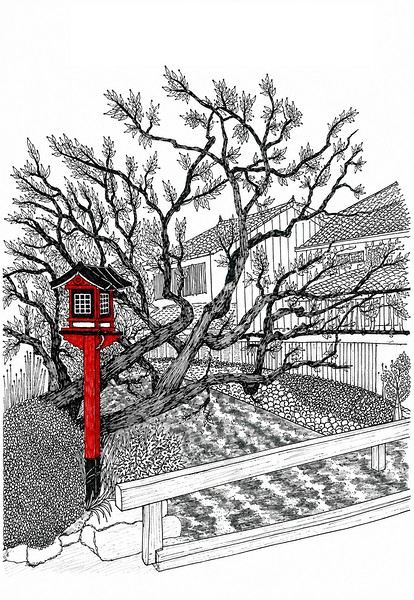 I’m inviting you on a stroll through my drawings—a completely subjective, far from exhaustive, and totally personal take, since it’s based on my own sketches. I put this travel journal together after returning in late 2024, mostly using felt-tip pens and pencils, with a few collages thrown in. I worked from our personal photos.
Let’s start with the shotengai...
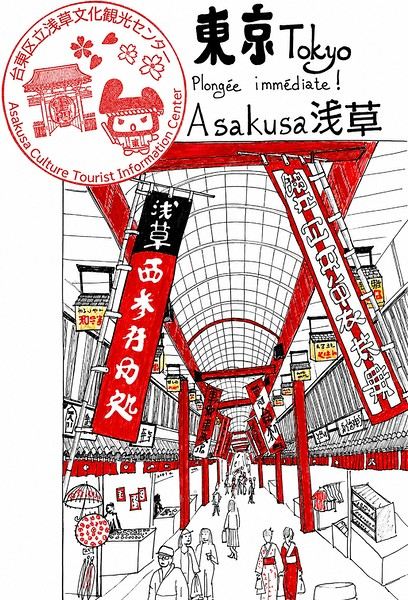
Our first "wow" moment came as we stepped out of the subway in Asakusa, the Tokyo neighborhood where we’d booked our hotel for our first five nights. Exhausted after our long flight, we finally arrived and took an exit that led straight into a shotengai—one of those covered shopping streets that pop up in city centers and flourished between the 1950s and 1980s.
It was an instant aesthetic shock, like a close encounter of the third kind between the modern city, a typical Asian market with its street stalls, the vintage vibe of the arcade, the sheer abundance of goods, and the bustling crowd—a mix of tourists, pilgrims (thanks to nearby Senso-ji Temple), and locals (it’s a very working-class area). In the end, it set the tone for a feeling we’d experience throughout the trip. Wherever we went, shotengai turned out to be fantastic spots for finding little restaurants, shops, or even fresh produce. Some are like real mazes, like in Kyoto, where we spent ages trying to relocate a restaurant we’d loved ;-)
In Kanazawa, the Omicho Market: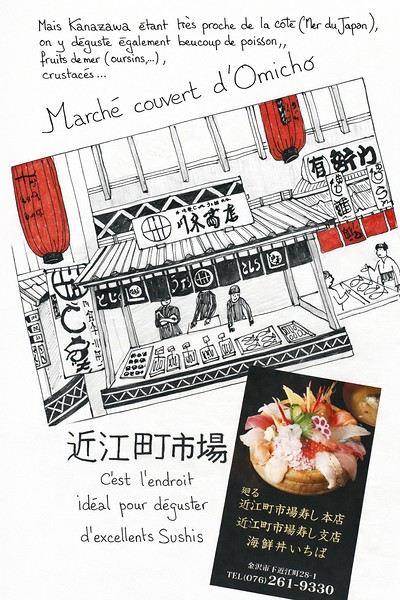 And in Kyoto, Nishiki Market:
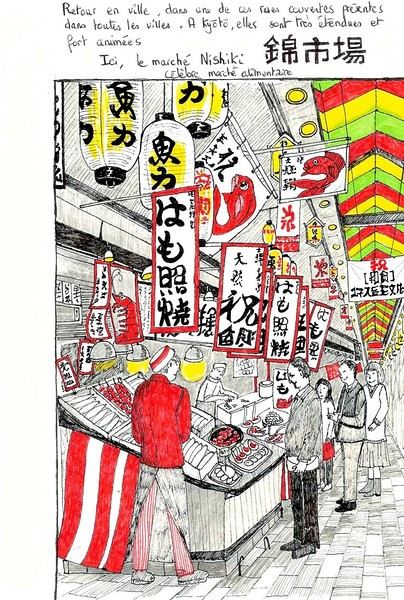
To be continued...
I’m inviting you on a stroll through my drawings—a completely subjective, far from exhaustive, and totally personal take, since it’s based on my own sketches. I put this travel journal together after returning in late 2024, mostly using felt-tip pens and pencils, with a few collages thrown in. I worked from our personal photos.Let’s start with the shotengai...
Our first "wow" moment came as we stepped out of the subway in Asakusa, the Tokyo neighborhood where we’d booked our hotel for our first five nights. Exhausted after our long flight, we finally arrived and took an exit that led straight into a shotengai—one of those covered shopping streets that pop up in city centers and flourished between the 1950s and 1980s.
It was an instant aesthetic shock, like a close encounter of the third kind between the modern city, a typical Asian market with its street stalls, the vintage vibe of the arcade, the sheer abundance of goods, and the bustling crowd—a mix of tourists, pilgrims (thanks to nearby Senso-ji Temple), and locals (it’s a very working-class area). In the end, it set the tone for a feeling we’d experience throughout the trip. Wherever we went, shotengai turned out to be fantastic spots for finding little restaurants, shops, or even fresh produce. Some are like real mazes, like in Kyoto, where we spent ages trying to relocate a restaurant we’d loved ;-)
In Kanazawa, the Omicho Market:
And in Kyoto, Nishiki Market:
To be continued...
I don’t know about you, but I’m a huge fan of markets. No matter where I go, in every country or city I visit, I won’t leave without having seen one. I’m mostly talking about food markets. I love the smells, the colors, and watching people from all walks of life stroll around. It’s like a mirror of a country’s culture, and I love soaking it all in.
Thai markets are particularly appealing to me. In my province, there are so many. Maybe more than elsewhere—I’m not sure—but every day, you can find a "Talat Nat." These are traveling markets that set up in specific places on specific days. They only stay open for a few hours. Some attract more shoppers than others because they have more stalls and a wider variety of products. Sometimes, they’re set up in pretty unusual spots: temples, roadside, even on train tracks...
On top of these, there are also markets in the city that stay open all day.
I’d love for you to share your photos of markets, local product stalls, and why not, let’s talk about gastronomy and cuisine too!
I’ll start with my favorite market—it’s 8 kilometers from my place and happens every Tuesday from 2 PM to 5 PM. I never miss a Tuesday unless there’s a downpour... 😉 It’s located in the countryside, in a village famous for its coffee (ThamSing), and inside the grounds of a slightly unusual temple. It’s easy to get to—over the past 10 years, the roads have been paved, which wasn’t the case before and made the trip a bit risky when it rained...
In the first two photos, you’ll see the temple courtyard on a normal day, without the market.
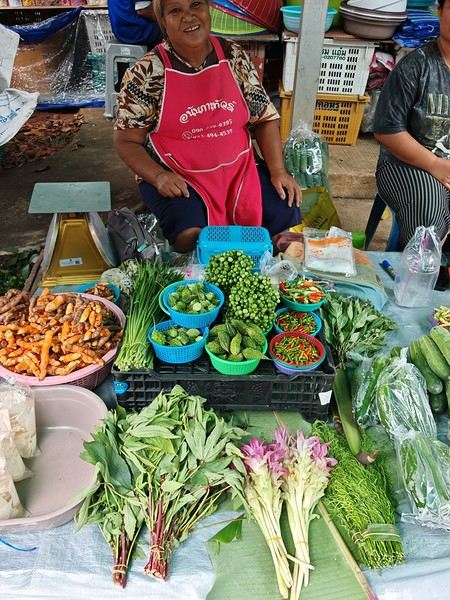
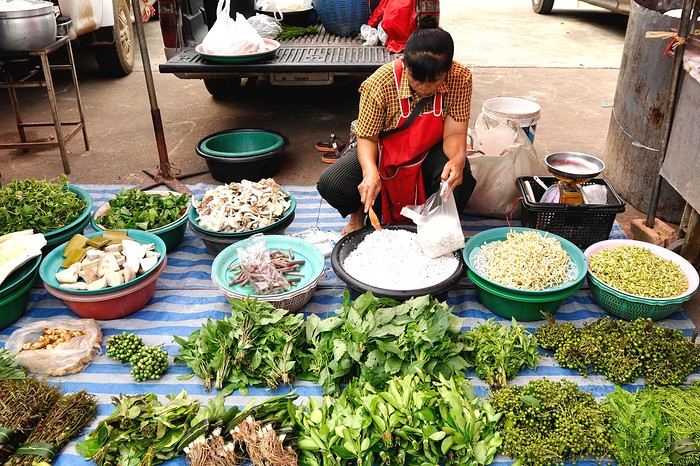
Thai markets are particularly appealing to me. In my province, there are so many. Maybe more than elsewhere—I’m not sure—but every day, you can find a "Talat Nat." These are traveling markets that set up in specific places on specific days. They only stay open for a few hours. Some attract more shoppers than others because they have more stalls and a wider variety of products. Sometimes, they’re set up in pretty unusual spots: temples, roadside, even on train tracks...
On top of these, there are also markets in the city that stay open all day.
I’d love for you to share your photos of markets, local product stalls, and why not, let’s talk about gastronomy and cuisine too!
I’ll start with my favorite market—it’s 8 kilometers from my place and happens every Tuesday from 2 PM to 5 PM. I never miss a Tuesday unless there’s a downpour... 😉 It’s located in the countryside, in a village famous for its coffee (ThamSing), and inside the grounds of a slightly unusual temple. It’s easy to get to—over the past 10 years, the roads have been paved, which wasn’t the case before and made the trip a bit risky when it rained...
In the first two photos, you’ll see the temple courtyard on a normal day, without the market.
We’re excited to share our sixth travel journal with photos from Southeast Asia, this one entirely dedicated to Thailand. As a reminder, our previous travel journals can be accessed directly by clicking on the username "jojoone1" to the left of each post.
For a change, let’s start with the conclusion: our trip left us with an excellent memory. Very often, everything went like clockwork—short wait times, quick problem-solving, and the curious feeling of being pampered. Sometimes, life isn’t so cruel after all.
It’s only fair to admit that day after day, we encountered Thais who were smiling, helpful, kind, funny, and sometimes even touching. There were a few exceptions, but they were just the trees hiding the (tropical) forest. After this year’s experience, we won’t be the ones to tell you that Thailand isn’t the Land of Smiles or that laughter is just for business. We’ve witnessed so many kind behaviors and gestures that we no longer understand how anyone could complain about the people here—except for bad experiences in ultra-touristy spots packed with travelers lacking any finesse. It got to the point where it made us reflect. And we concluded that we probably have funny, friendly faces (?). We also know we’re the first to smile at them, and every day there, we show respect to everyone we meet. In any case, we have fond thoughts for many of the people we crossed paths with. Thanks to them, our trip took on a whole new human dimension.
A quick note about the photos: last year, the VoyageForum team made a change to how photos are uploaded. This gives us the choice between displaying high-definition photos (but losing ownership rights) or non-HD photos (less sharp, but the originals won’t be spread online without compensation or credit). We opted for the second solution, if only as a matter of principle. It does leave us with some regrets, especially since Françoise switched to the Canon EOS 7D Mark II, whose performance is notably better than the 7D.
Our first trip with Emirates was satisfying but left a mixed impression. Sure, it was the first time all four of our flights were on an Airbus A380. The crews were super friendly, and the meal trays were the best on the first two flights. On the return flights, the meals weren’t great and weren’t filling enough. Overall, the crews seemed disorganized and rushed—clearly some new recruits. The Doha-Paris flight, if memory serves, was on an A380-600, and in that configuration, we were packed in like it hadn’t been in years. In conclusion, it’s hard to say at this stage whether Qatar or Emirates comes out on top.
From our perspective, the journey from northern Thailand to Bangkok can be done via two different routes. This year, we took one of them, which allowed us to alternate between well-known destinations and original visits. Note that some of this year’s visits include cities we’ve already been to. So for a more complete view (Bangkok and Chiang Mai, for example), you’ll need to check out our previous travel journals.
We’ve improved our Thai vocabulary with a few more words and hope next year to move from kindergarten to first grade... For those reading us for the first time, we can only advise against visiting this country on an organized tour or looking for a French-speaking guide. The Thais have organized themselves well—they now have proven tourism practices. Maybe a guidebook for culture, a few basic English words, and a little organization are all you need for a great trip.
CHIANG MAI
Chiang Mai and its region are packed with treasures—so much so that one or two visits might not be enough.
At the airport, you go to a counter that provides a taxi ticket. The fare is 150 baht for a regular car and 200 baht for a larger vehicle. When our turn came, a large vehicle showed up, but we were only charged 150 baht. Okay, fine.
The hotels we’d selected three years ago had significantly increased their rates, so we had to find a new base. In the city center, hotels with large pools are overpriced, and despite the wide selection, it was hard to decide. We ended up at a hotel near the airport, the Baan U Sabai Boutique House. The superior room with a balcony can be negotiated for just under 40 €. It’s a beautiful, fairly new complex in traditional teak style, with very well-kept rooms and a long pool. Given the rather stormy weather in early July, it was the first time in Thailand we swam in cool water. It encouraged us to swim rather than just lounge...
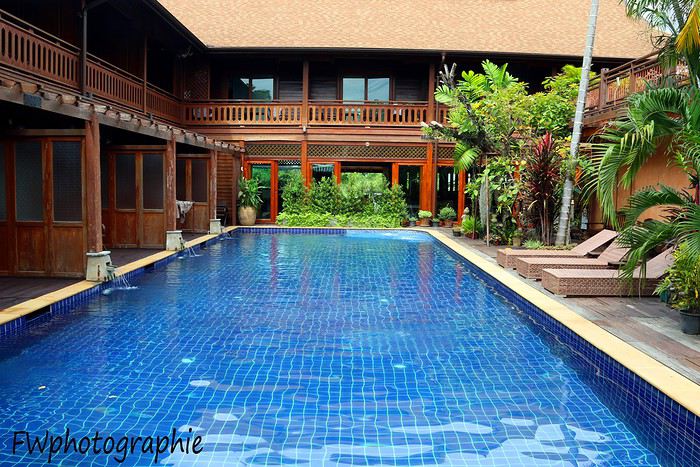
At the end of the hotel street, you come out onto a busy main road where you can hail a songthaew (a kind of shared taxi). It’s easy to be offered a ride to the city center for 2 x 20 baht, but getting a return trip for less than 2 x 40 baht is tough, especially in the evening. Our red songthaew took us straight to Chiang Mai Gate, one of the city’s gates, located southeast of the historic square. We then took Phra Pok Khlao Road for a few dozen meters and chose the first little restaurant that looked nice. Within minutes, we had our dishes and smoothies for a total of 235 baht. Great quality, despite the place looking very touristy. The owner set the tone by handing out smiles left and right.
There’s an amazing spot in Chiang Mai to grab a coffee: Baan Phor Liang Meun. Once you reach Chiang Mai Gate, take Phra Pok Khlao Road for a few meters, then turn onto soi 2 (alley 2). It’s actually the first on the left. After a few dozen meters, you’ll find yourself walking alongside what looks like a Khmer temple.
When you enter, you’re in a vast space—like a temple-garden—where you can eat a small dish or sip a good café crème as if you were in Angkor. The tables are far apart, so you’re as close to birds and squirrels as you are to other customers.
In the small building where the staff works, they provide high-quality mosquito repellent for free—something we’ll now buy regularly at 7/11. They’re small plastic bottles, mostly pink or orange, with Thai writing and "floral fragrance" in English. The scent is actually pleasant. Remember to shake the bottle before opening and pressing, or you’ll end up with cream all over your shorts...
The creator of this space has been sculpting terracotta works since the early 1980s using clay from the Lamphun region—the most consistent clay found in all of Thailand. This café is like visiting an ancient temple, with its abundance of statues, high-reliefs, and bas-reliefs. It’s undeniably a romantic spot for couples—a haven of calm in a very lively city.
Hi everyone, I’ve spent two solid months reading the Lonely Planet and pretty much every post about Thailand here, plus French and English blogs. Now I’d love to get your expert opinions on our itinerary.
We’re heading off in August 2025 with our 7-year-old daughter. We only have a maximum of three weeks off, and I’m keeping an eye on flight prices before booking (1400 € per person really stings 😕).
So here’s what I’ve planned—let me know if you spot any major issues or if I’ve been way too "optimistic."
D1 - Arrival in Bangkok / rest, quick visit, overnight stay D2 - More temple visits, etc. D3 - Morning flight to Chiang Mai D4 - More Chiang Mai sightseeing D5 - Day trip to Chiang Rai (guided tour to book: blue and white temple), return to Chiang Mai late in the evening D6 - More Chiang Mai visits / Elephant Nature Park in the afternoon D7 - Morning flight to Koh Samui, sightseeing D8 to D10 - More Koh Samui visits D11 to D13 - Ferry to Koh Phangan D14 to D15 - Ferry to Koh Tao D16 - Return to Koh Samui, then flight to Bangkok D17 - Day trip to Ayutthaya, return to Bangkok in the evening D18 - Flight back to France :(
I know a lot of you recommend heading straight to Chiang Mai to recover from the international flight, but my partner and I NEVER sleep on planes (personally, I’ve been flying to Taiwan since I was little and have never slept more than an hour on a 14-hour flight...), so it’s essential for us to rest upon arrival . That’s also why I opted for domestic flights instead of the sleeper train—I know we’d lose over 10 hours and wouldn’t be able to rest properly in those conditions. And I’m sure you’ll also say BKK > North > South is too much for three weeks, but I really want to see as much as possible. Given how much the flights will cost, I’m not sure when we’ll be able to come back 🏴☠️.
So, questions: 1. Since we’ll only be in Bangkok for a maximum of two nights and need to easily reach the airport with luggage (and a child), which neighborhood should we prioritize? We’d love to experience the evening vibe of Asian night markets, ideally within walking distance of the hotel or just a few metro stops away. I’ve looked at Chinatown, but the BTS seems far... Should we go for somewhere near BTS Saphan Taksin or BTS Krungthonburi? But is the area lively in the evening with food courts, etc.? We’d also like to treat ourselves to a hotel with a pool.
2. Have we planned too many days in the south? Should I skip Koh Tao and just do Koh Samui + Koh Phangan? My partner and daughter aren’t strong swimmers, so we’re looking for beautiful beaches without too much current. Crowded beaches don’t bother us—we just want stunning turquoise waters without killer waves . Going all the way to Koh Tao and then back to Koh Samui to catch the flight to Bangkok seems too stressful. Is it still possible these days (I haven’t seen any recent posts on this) to head to Koh Samui in August and decide on the spot how many nights to spend in Koh Phangan or Koh Tao based on how we feel, booking hotels as we go? Or is that too risky?
If you have any better suggestions for fitting all this in while reducing internal flights, I’m all ears for your great tips
Hi everyone,
Le Marche? Where’s that?
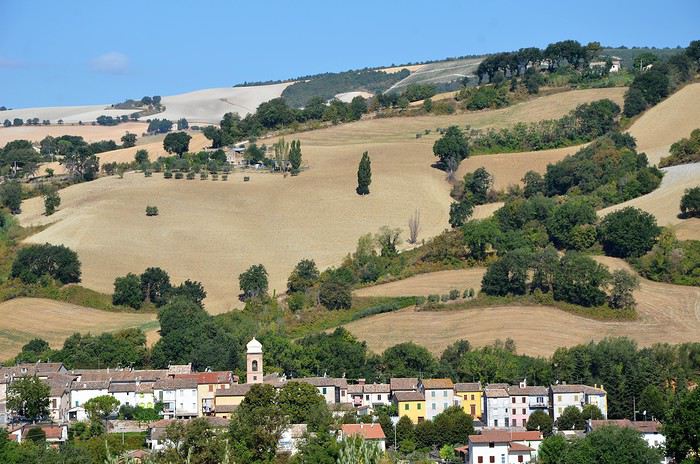 That’s what we hear more than 9 times out of 10... This region is actually little-known, or at least only its Adriatic coastline, just below Rimini, rings a bell.
Yet it’s a beautiful region, bordered to the east by the Adriatic Sea and to the west by the Apennine Mountains, with thousands of hills in between—many topped with charming little villages. A very rural area, quite affordable, starting to showcase its heritage, and not yet overrun by tourists... so what are you waiting for?
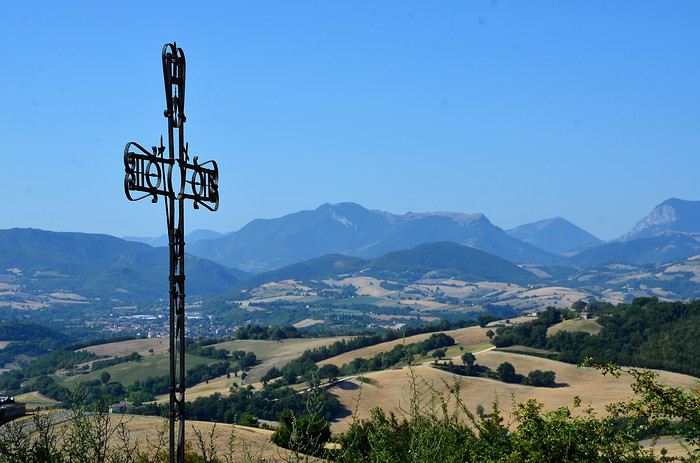
The distances look short, but the roads are long: aside from the fairly fast routes running from the hinterland down to the coast, following the paths of small rivers that rise in the Apennines and flow into the Adriatic, all the other roads—especially the cross-country ones—wind and twist. They reveal stunning landscapes at every turn but also force you to adjust your sense of time. We stayed in two different spots, each about 30 or 40 km from the coast—first in the north of Le Marche, near Fossombrone, at Isola di Fano, and then in the south, at Montalto delle Marche.
Since this region is still a bit "under the radar," I had some trouble finding information while planning the trip... So this travel journal aims to introduce you to the region through photos and share a few tips along the way.
First up, some views of the landscapes!
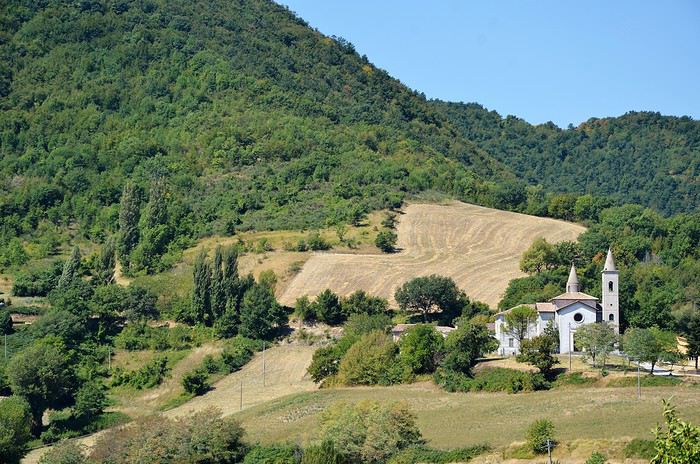
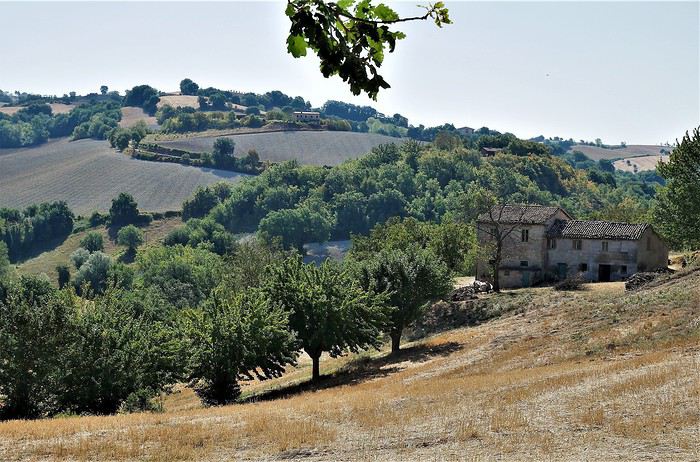
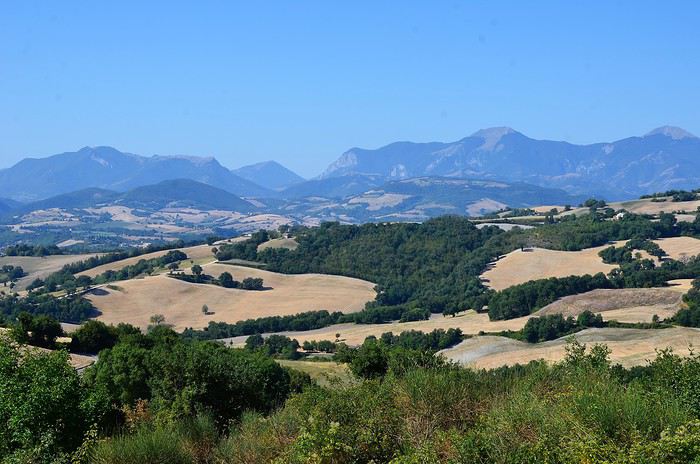
More to come in the next post!
Le Marche? Where’s that?
That’s what we hear more than 9 times out of 10... This region is actually little-known, or at least only its Adriatic coastline, just below Rimini, rings a bell.Yet it’s a beautiful region, bordered to the east by the Adriatic Sea and to the west by the Apennine Mountains, with thousands of hills in between—many topped with charming little villages. A very rural area, quite affordable, starting to showcase its heritage, and not yet overrun by tourists... so what are you waiting for?
The distances look short, but the roads are long: aside from the fairly fast routes running from the hinterland down to the coast, following the paths of small rivers that rise in the Apennines and flow into the Adriatic, all the other roads—especially the cross-country ones—wind and twist. They reveal stunning landscapes at every turn but also force you to adjust your sense of time. We stayed in two different spots, each about 30 or 40 km from the coast—first in the north of Le Marche, near Fossombrone, at Isola di Fano, and then in the south, at Montalto delle Marche.
Since this region is still a bit "under the radar," I had some trouble finding information while planning the trip... So this travel journal aims to introduce you to the region through photos and share a few tips along the way.
First up, some views of the landscapes!
More to come in the next post!