Now that the curtain has fallen on the past year, it’s time to see what’s happening around here.
It seems pretty quiet, but I’ll read more in detail later.
First, I need to tell you all an anecdote.
My eldest little girl, in her third year of law school, was really scared she wouldn’t pass the year.
I told her:
“Trust yourself, you’ve worked so hard, and worst case, if you fail, you’ll just redo the year.”
“But I don’t think I’ll make it—they changed the rules, and if I mess up even one unit, I have to start all over.”
I knew her grades weren’t exactly stellar, and with what I was about to say, I wasn’t taking much of a risk.
“Here’s the deal, sweetheart: if you pass, I promise I’ll take you to India, just the two of us.”
I have to admit, India is a country I’ve talked about so much to all my grandchildren that in their minds, it’s become a magical, mythical place (hmm).
July had barely begun when my phone rang, her name flashing on the screen.
“Mamido, I did it!”
My promise came rushing back—oh no, oh no, oh no!
“Congratulations, sweetheart!”
A little shyly, she said:
“Is the India trip still on?”
And me, replying:
“Of course it is!”
And that’s that—a promise is a promise, or you risk losing that precious trust that keeps hearts warm and at peace.
We’re leaving in February. Only 8 days—yikes, the carbon footprint!
But we can’t miss her tutorials, or she’ll be kicked out.
Personally, that works just fine for me.
Going to India has become a challenge for me. It’s far, it’s exhausting, I sweat, I hate mosquitoes, the spices bother my mouth when I used to love them. There’s noise all the time—at night, the dogs bark nonstop, and we almost get run over. I’ll get lost in the streets because my sense of direction has vanished. I don’t like rice anymore. All that chaos and those cultural differences that once enchanted me now just overwhelm me.
But I promised.
The upside—and it’s a big one—Raman, the same driver I’ve had forever, will be at the airport with a sign with our names. We’ll stop at the same little shop for chai (or tea, plain and simple) with that aroma that intoxicates me, halfway through the trip.
It’ll be a tiny trip—staying with friends, I’ll show her a few places I love: Chidambaram, Mamallapuram, and the clinic where I worked. Then we’ll head back.
My little girl will go home to her parents.
As for me, I’ll leave right away for our Scottish island with Homme for our chilly winter.
How can you love a country so much you want to live there, then suddenly reject it, no longer able to appreciate what once made it special?
That’s the mystery of love, I guess.
Hello everyone,
It’s something we often notice in this forum—and many others—this behavioral shift.
A long-time member, or even a new one, asks a question. They get one or more answers, some brief, some detailed, and then... nothing???
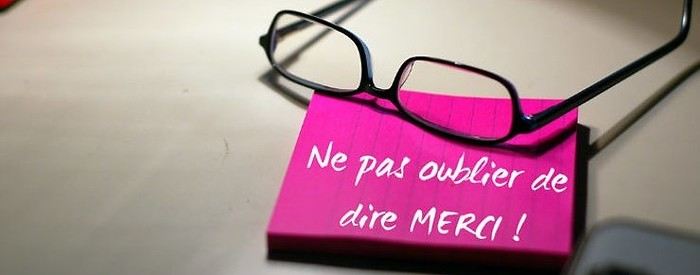
Not even a simple thank you!!!
From what I’ve gathered, if the answers don’t align with what they wanted to hear, it seems natural for the asker to just disappear!! 😕 Unless—(and I fear this is the case)—basic politeness is no longer part of our society????
Please forgive my little rant.
Wishing everyone all the best. Cheers,
Puma2A
...
It’s something we often notice in this forum—and many others—this behavioral shift.
A long-time member, or even a new one, asks a question. They get one or more answers, some brief, some detailed, and then... nothing???
Not even a simple thank you!!!
From what I’ve gathered, if the answers don’t align with what they wanted to hear, it seems natural for the asker to just disappear!! 😕 Unless—(and I fear this is the case)—basic politeness is no longer part of our society????
Please forgive my little rant.
Wishing everyone all the best. Cheers,
Puma2A
...
Who are you? Where are you from? Where are you going?
Like last year at this time, a post about bike travel ideas.
How many of us are preparing a trip planned for this year? Probably a lot.
What’s yours—the one you’ve been dying to do for so long, maybe too long? For us, it’s a modest PARIS-MARATHON by bike, followed by MARATHON-ATHENS on foot in June 2010. And you?
May the passion keep growing before, during, and after! Happy planning and safe travels to everyone.
Like last year at this time, a post about bike travel ideas.
How many of us are preparing a trip planned for this year? Probably a lot.
What’s yours—the one you’ve been dying to do for so long, maybe too long? For us, it’s a modest PARIS-MARATHON by bike, followed by MARATHON-ATHENS on foot in June 2010. And you?
May the passion keep growing before, during, and after! Happy planning and safe travels to everyone.
Je repars demain pour Lima, puis à la maison, mais je n'oublie pas de vous diffuser ce carnet de voyage en attendant le coucher de soleil sur Paracas. 😎
Un super voyage, facile sur le plan logistique (mais bien préparer car il faut anticiper résas vols intérieurs, Machu Picchu+train et périple Amazonie), très varié, souvent époustouflant et fascinant Sans compter la gentillesse, la chaleur et le sens de l'accueil de la grande majorité des péruviens.
Itinéraire 24/10: Genève -> Lima (vol Iberia via Madrid) 25/10:Lima -> Cuzco (vol Star Peru) (visite ville) 26/10: Cuzco (sites Incas autour de Cuzco + suite visite Cuzco) 27/10: Cuzco (excursion Moray et Salineras de Maras + suite visite Cuzco) 28/10: Cuzco -> Aguas Calientes (via Ollantaytambo en collectivos puis train Peru Rail pour Aguas Calientes réservé à l'avance) 29/10: visite Machu Picchu -> Ollantaytambo (entrée Macchu Picchu et montée Huayna Picchu réservés à l'avance) 30/10: Ollantaytambo -> Pisac -> Cuzco (via Pisac pour visite en collectivos) 31/10: Cuzco -> Puerto Maldonado (vol Star Peru) 01/11: Puerto Maldonado 02/11:Puerto Maldonado 03/11: Puerto Maldonado -> Cuzco 04/11: Cuzco -> Puno (avec Wonder Expedition Peru pour visites le long du trajet) 05/11: Puno -> ile Amantani (excursion 2 jours en bateau via l'île Uros et dodo chez l'habitant à Amantani, visite Taquile, retour Puno) 06/11: Ile Amantani -> Puno (visite ile de Taquile, retour à Puno) 07/11: Puno -> Chivay (via compagnie 4M avec 3 ou 4 arrêts : explications, photos) 08/11: Colca Canyon (excursion 2 jours, dodo dans le canyon en contre bas de Cabanaconde à Oasis Paradise) 09/11: Colca Canyon → Arequipa 10/11: Arequipa 11/11: Arequipa -> (le soir, bus de nuit) 12/11: -> Ica (Huacachica) -> Paracas (arrivée le matin à 6h30 à Ica pour aller voir Huacachica : dunes, buggy -> départ à 15h00 pour Paracas) 13/11: Paracas (visites îles Ballestas et Réserve Nationale de Paracas) 14/11: Paracas → Lima → Genève (via Bus+taxi → aéroport Lima +Vol IBERIA pour Genève via Madrid) 15/11: Arrivée à Genève
Hébergements Cuzco : Casona les Pleiades, très bien, parfaitement situé dans le quartier de San Blas en hauteur, accueil et ptit dej charmants, un peu cher 50€/nuit légèrement négociable, ptit dej inclus, transfert aéroport organisé mais à prevoir en plus (20 soles par transfert aéroport) Aguas Calientes: Inca Wonder, très bien pour ce qu'on cherche (dodo, chambre et sdb propres, calme): $40 ptit dej inclus Ollantaytambo: Hospedaje El Tambo, super sympa, 35 soles + ptit dej 10 soles Puerto Maldonado: Yakari Lodge, très bien (voir prix excursions, car forfait), prévoir une prise anti-moustique en plus du 5/5, ça peut servir ! Puno: Tayka hotel, super bien situé (30 m plaza de Armas), pas cher 60 soles ptit dej inclus, chambres et sdb correctes ile Amantani: chez Augustin, Julia et Esther voir excursions car forfait Chivay: Colca Terra, très calme, 50 soles ptit dej inclus, grande chambre et sdb, très propre Canyon de Colca : Oasis paradise (près de Cabanaconde) voir excursion car forfait Arequipa: Samana Wasi, super, 60 soles ptit dej inclus Paracas : Santa Maria impeccable 115 soles mais avec ptit dej inclus ET excursions pour les iles Ballestas OU parc national (entrée 18 soles à payer). J'ai eu le droit aux deux : îles et parc car j'y suis resté 2 nuits.
Transports / Excursions Pour les vols intérieurs Lima->Cuzco et Cuzco -> Puerto Maldonado : Air Peru (réservés sur le net à l'avance) Cuzco -> Ollantatytambo: par collectivos 5 soles Pour le train Ollantaytambo -> Aguas Calientes: Peru Rail (réservé sur le net à l'avance) Ollantaytambo ->Pissac: par collectivos 3 soles Pissac -> Cuzco : par collectivos 2 ou 3 soles Excursion des sites Incas autour de Cuzco: 20 soles (de 8h à 13h) Excursion Moray + Salineras de Mars: 25 soles (de 8h à 15h) Cuzco -> Puno : 45 $ avec Wonder Expedition Peru – 10h au lieu de 8h mais très belles visites avec guide (e.g. Chapelle Sixtine de l'Amérique du Sud), repas et ça passe vite en s'arrêtant de temps en temps. Compter 40 soles en plus pour les entrées des sites. Excursion dans les iles Uros, Amantani et Tequile + dodo et repas : 110 soles + 20 soles pour dernier repas sur Tequile -> 130 soles pour 2 jours. Puno->Chivaï: 35 $ avec 4M, quelques arrêts (paysages grandioses, alpagas, lamas, ..), explications et un ptit truc à grignoter + bouteille d'eau Excursion 2 jours dans le Colca Canyon+nuit à Oasis paradise (piscine naturelle après la marcher appréciée) + retour à Arequipa: 150 soles Arequipa -> Ica en bus de nuit Cruz del Sur en VIP: 35$ taxi du terminal ICA à Huacachica: 8 soles (+ retour idem) Tour de buggy pour 2h avec entrée du site: 49 soles (45+4) Bus ICA -> Paracas avec Cruz del Sur 20 soles Excursion Iles Ballestas et Parc National Paracas: j'en sais rien, car c'était inclus dans mon prix d'hotel pour partie (50 soles, 60?? pour les 2 + 18 soles d'entrée ?) Bus Paracas -> Lima avec Cruz del Sur 60 soles + taxi pour aéroport 20 soles
Restos Hyper variable selon les villes et des endroits et ce qu'on mange Repas raisonnable en moyenne: 30 soles avec une bonne bière Au début, quand je suis arrivé à Cuzco avec l'altitude, je mangeais que des soupes. Pas envie d'autres choses et leurs soupes sont excellentes. A Arequipa, puis à Paracas, je ne pouvais plus me passer des cerviches (poisson cuit au citron avec herbes et relativement relevée)
Avec toutes ces infos, vous pouvez vous adresser auprès des agences de voyage qui fleurissent partout avec des références sérieusess.
Divers Machu Picchu Anti-moustique indispensable pour Agua Caliente et surtout le Machu Picchu De mon point de vue, aucun intérêt de monter à pied, car zone semi tropicale, vous arrivez en nage et montée à pic sans intérêt Se lever à 4h30 pour arriver dans les premiers par le bus, monter à gauche au mirador 50 m après l'entrée pour prendre LA photo qu'on voit partout
Nombreux endroits très touristiques, avec parfois un peu de lourdeur (« pièges à touristes », troupeau), par exemple sur le lac Titicaca, mais l'atmosphere reste calme (touristes non bruyants, assez respectueux) et on apprend toujou😎rs des choses intéressantes sur les coutumes d'antans.
La civilisation Inca est omniprésente et fascinante sur une grande partie du parcours.
Bref, un super voyage très riche en découvertes. En espérant que ce carnet puisse vous avoir aidé à construire votre prochain voyage !
Un super voyage, facile sur le plan logistique (mais bien préparer car il faut anticiper résas vols intérieurs, Machu Picchu+train et périple Amazonie), très varié, souvent époustouflant et fascinant Sans compter la gentillesse, la chaleur et le sens de l'accueil de la grande majorité des péruviens.
Itinéraire 24/10: Genève -> Lima (vol Iberia via Madrid) 25/10:Lima -> Cuzco (vol Star Peru) (visite ville) 26/10: Cuzco (sites Incas autour de Cuzco + suite visite Cuzco) 27/10: Cuzco (excursion Moray et Salineras de Maras + suite visite Cuzco) 28/10: Cuzco -> Aguas Calientes (via Ollantaytambo en collectivos puis train Peru Rail pour Aguas Calientes réservé à l'avance) 29/10: visite Machu Picchu -> Ollantaytambo (entrée Macchu Picchu et montée Huayna Picchu réservés à l'avance) 30/10: Ollantaytambo -> Pisac -> Cuzco (via Pisac pour visite en collectivos) 31/10: Cuzco -> Puerto Maldonado (vol Star Peru) 01/11: Puerto Maldonado 02/11:Puerto Maldonado 03/11: Puerto Maldonado -> Cuzco 04/11: Cuzco -> Puno (avec Wonder Expedition Peru pour visites le long du trajet) 05/11: Puno -> ile Amantani (excursion 2 jours en bateau via l'île Uros et dodo chez l'habitant à Amantani, visite Taquile, retour Puno) 06/11: Ile Amantani -> Puno (visite ile de Taquile, retour à Puno) 07/11: Puno -> Chivay (via compagnie 4M avec 3 ou 4 arrêts : explications, photos) 08/11: Colca Canyon (excursion 2 jours, dodo dans le canyon en contre bas de Cabanaconde à Oasis Paradise) 09/11: Colca Canyon → Arequipa 10/11: Arequipa 11/11: Arequipa -> (le soir, bus de nuit) 12/11: -> Ica (Huacachica) -> Paracas (arrivée le matin à 6h30 à Ica pour aller voir Huacachica : dunes, buggy -> départ à 15h00 pour Paracas) 13/11: Paracas (visites îles Ballestas et Réserve Nationale de Paracas) 14/11: Paracas → Lima → Genève (via Bus+taxi → aéroport Lima +Vol IBERIA pour Genève via Madrid) 15/11: Arrivée à Genève
Hébergements Cuzco : Casona les Pleiades, très bien, parfaitement situé dans le quartier de San Blas en hauteur, accueil et ptit dej charmants, un peu cher 50€/nuit légèrement négociable, ptit dej inclus, transfert aéroport organisé mais à prevoir en plus (20 soles par transfert aéroport) Aguas Calientes: Inca Wonder, très bien pour ce qu'on cherche (dodo, chambre et sdb propres, calme): $40 ptit dej inclus Ollantaytambo: Hospedaje El Tambo, super sympa, 35 soles + ptit dej 10 soles Puerto Maldonado: Yakari Lodge, très bien (voir prix excursions, car forfait), prévoir une prise anti-moustique en plus du 5/5, ça peut servir ! Puno: Tayka hotel, super bien situé (30 m plaza de Armas), pas cher 60 soles ptit dej inclus, chambres et sdb correctes ile Amantani: chez Augustin, Julia et Esther voir excursions car forfait Chivay: Colca Terra, très calme, 50 soles ptit dej inclus, grande chambre et sdb, très propre Canyon de Colca : Oasis paradise (près de Cabanaconde) voir excursion car forfait Arequipa: Samana Wasi, super, 60 soles ptit dej inclus Paracas : Santa Maria impeccable 115 soles mais avec ptit dej inclus ET excursions pour les iles Ballestas OU parc national (entrée 18 soles à payer). J'ai eu le droit aux deux : îles et parc car j'y suis resté 2 nuits.
Transports / Excursions Pour les vols intérieurs Lima->Cuzco et Cuzco -> Puerto Maldonado : Air Peru (réservés sur le net à l'avance) Cuzco -> Ollantatytambo: par collectivos 5 soles Pour le train Ollantaytambo -> Aguas Calientes: Peru Rail (réservé sur le net à l'avance) Ollantaytambo ->Pissac: par collectivos 3 soles Pissac -> Cuzco : par collectivos 2 ou 3 soles Excursion des sites Incas autour de Cuzco: 20 soles (de 8h à 13h) Excursion Moray + Salineras de Mars: 25 soles (de 8h à 15h) Cuzco -> Puno : 45 $ avec Wonder Expedition Peru – 10h au lieu de 8h mais très belles visites avec guide (e.g. Chapelle Sixtine de l'Amérique du Sud), repas et ça passe vite en s'arrêtant de temps en temps. Compter 40 soles en plus pour les entrées des sites. Excursion dans les iles Uros, Amantani et Tequile + dodo et repas : 110 soles + 20 soles pour dernier repas sur Tequile -> 130 soles pour 2 jours. Puno->Chivaï: 35 $ avec 4M, quelques arrêts (paysages grandioses, alpagas, lamas, ..), explications et un ptit truc à grignoter + bouteille d'eau Excursion 2 jours dans le Colca Canyon+nuit à Oasis paradise (piscine naturelle après la marcher appréciée) + retour à Arequipa: 150 soles Arequipa -> Ica en bus de nuit Cruz del Sur en VIP: 35$ taxi du terminal ICA à Huacachica: 8 soles (+ retour idem) Tour de buggy pour 2h avec entrée du site: 49 soles (45+4) Bus ICA -> Paracas avec Cruz del Sur 20 soles Excursion Iles Ballestas et Parc National Paracas: j'en sais rien, car c'était inclus dans mon prix d'hotel pour partie (50 soles, 60?? pour les 2 + 18 soles d'entrée ?) Bus Paracas -> Lima avec Cruz del Sur 60 soles + taxi pour aéroport 20 soles
Restos Hyper variable selon les villes et des endroits et ce qu'on mange Repas raisonnable en moyenne: 30 soles avec une bonne bière Au début, quand je suis arrivé à Cuzco avec l'altitude, je mangeais que des soupes. Pas envie d'autres choses et leurs soupes sont excellentes. A Arequipa, puis à Paracas, je ne pouvais plus me passer des cerviches (poisson cuit au citron avec herbes et relativement relevée)
Avec toutes ces infos, vous pouvez vous adresser auprès des agences de voyage qui fleurissent partout avec des références sérieusess.
Divers Machu Picchu Anti-moustique indispensable pour Agua Caliente et surtout le Machu Picchu De mon point de vue, aucun intérêt de monter à pied, car zone semi tropicale, vous arrivez en nage et montée à pic sans intérêt Se lever à 4h30 pour arriver dans les premiers par le bus, monter à gauche au mirador 50 m après l'entrée pour prendre LA photo qu'on voit partout
Nombreux endroits très touristiques, avec parfois un peu de lourdeur (« pièges à touristes », troupeau), par exemple sur le lac Titicaca, mais l'atmosphere reste calme (touristes non bruyants, assez respectueux) et on apprend toujou😎rs des choses intéressantes sur les coutumes d'antans.
La civilisation Inca est omniprésente et fascinante sur une grande partie du parcours.
Bref, un super voyage très riche en découvertes. En espérant que ce carnet puisse vous avoir aidé à construire votre prochain voyage !
This catchy and somewhat mysterious title comes from several questions I’ve been asking myself.
VF has been back open for a reasonable number of weeks and months now. The number of visitors overall matches past averages, but the number of members online in the last 24 hours seems relatively lower than what we used to see.
Yet, to my surprise, I’m seeing fewer travel journals, way fewer messages, and way fewer questions. I don’t see many new registered users online, and I notice a number of members who are logged in but either aren’t participating or have stopped participating.
Something’s not adding up for me because, in my opinion, VF is still appealing, and I don’t see which other sites could really compete.
Was there a real break between pre- and post-Covid? Does it just take more time for some people to discover the site or learn that it’s active again? Do people now prefer quick consumption on sites like FB or others I’m not familiar with? Where have the site’s old-timers gone, and what are they doing with their time now? What’s really going on here?
VF has been back open for a reasonable number of weeks and months now. The number of visitors overall matches past averages, but the number of members online in the last 24 hours seems relatively lower than what we used to see.
Yet, to my surprise, I’m seeing fewer travel journals, way fewer messages, and way fewer questions. I don’t see many new registered users online, and I notice a number of members who are logged in but either aren’t participating or have stopped participating.
Something’s not adding up for me because, in my opinion, VF is still appealing, and I don’t see which other sites could really compete.
Was there a real break between pre- and post-Covid? Does it just take more time for some people to discover the site or learn that it’s active again? Do people now prefer quick consumption on sites like FB or others I’m not familiar with? Where have the site’s old-timers gone, and what are they doing with their time now? What’s really going on here?
We took this trip from September 12 to October 7, 2022. I didn’t post this travel journal earlier in Voyage Forum because the site wasn’t back up yet (and also because I was short on time).
Then, at the end of 2024, I made a promise to a friend: to publish my travel journal on VF. So here it is!
 We took off from Paris in the late afternoon on September 12 and arrived in Tashkent around 7:15 AM on the 13th.
This trip was the result of long contemplation and preparation (it was originally planned for the year of the lockdown (2020) and was prepared with the help and advice of Nasrullo Jumanov from Turquoise Travel.
Stages and Itinerary
Stage 1: Tashkent - September 13 and 14
Stage 2: Ferghana Valley – September 15 to 17
Stage 3: Nukus and Moynaq - September 18 and 19
Stage 4: Mysterious Khiva - September 20 to 22
Stage 5: Holy Bukhara - September 23 to 26
Stage 6: Asraf - September 27 and 28
Stage 7: Mythical Samarkand - September 29 to October 2
Stage 8: Tersak (via Shakhrisabz and Urgut) – October 3 and 4
Stage 9: Samarkand – October 5 and 6
Stage 10: Tashkent/Istanbul/Paris – October 6 and 7
Stage 1: Tashkent
September 13
At the airport exit, we were greeted by the owner of our B&B (B&B Gulnara).
Today was all about recovery and our first steps in the capital. Our first currency exchange made us feel like sudden millionaires.
Our first stroll down the avenue leading to Chorsu Market introduced us to the fact that 80 to 90% of the cars here are white Chevrolets.
A walk under the arcades facing Chorsu: hardware stores, cabinetmakers, lute makers (one of them gave me a little concert/demo of a few string instruments).
We took off from Paris in the late afternoon on September 12 and arrived in Tashkent around 7:15 AM on the 13th.
This trip was the result of long contemplation and preparation (it was originally planned for the year of the lockdown (2020) and was prepared with the help and advice of Nasrullo Jumanov from Turquoise Travel.
Stages and Itinerary
Stage 1: Tashkent - September 13 and 14
Stage 2: Ferghana Valley – September 15 to 17
Stage 3: Nukus and Moynaq - September 18 and 19
Stage 4: Mysterious Khiva - September 20 to 22
Stage 5: Holy Bukhara - September 23 to 26
Stage 6: Asraf - September 27 and 28
Stage 7: Mythical Samarkand - September 29 to October 2
Stage 8: Tersak (via Shakhrisabz and Urgut) – October 3 and 4
Stage 9: Samarkand – October 5 and 6
Stage 10: Tashkent/Istanbul/Paris – October 6 and 7
Stage 1: Tashkent
September 13
At the airport exit, we were greeted by the owner of our B&B (B&B Gulnara).
Today was all about recovery and our first steps in the capital. Our first currency exchange made us feel like sudden millionaires.
Our first stroll down the avenue leading to Chorsu Market introduced us to the fact that 80 to 90% of the cars here are white Chevrolets.
A walk under the arcades facing Chorsu: hardware stores, cabinetmakers, lute makers (one of them gave me a little concert/demo of a few string instruments).
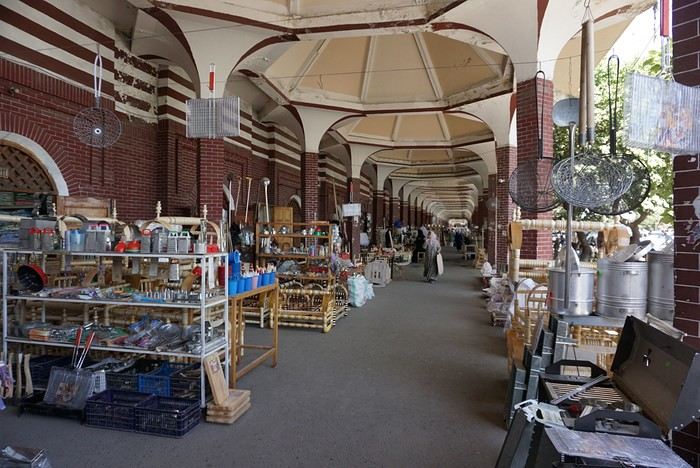
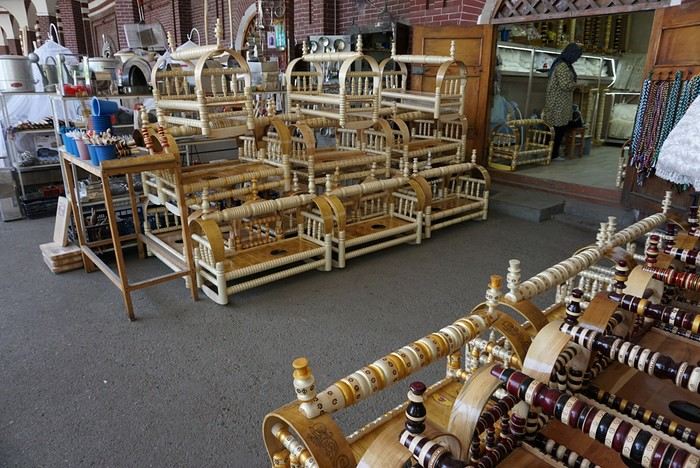
As we entered the market, many vendors called out to us, including this florist who asked where we were from: ‘France? Ah! Macron! PSG!’ He then recited a list of players from the Parisian team as well as past (Platini, Zidane, etc.) and current (Giroud, Griezmann, Mbappé, etc.) French national team players. Since we’re more into rugby (we live near Toulouse), he knew more players than I did!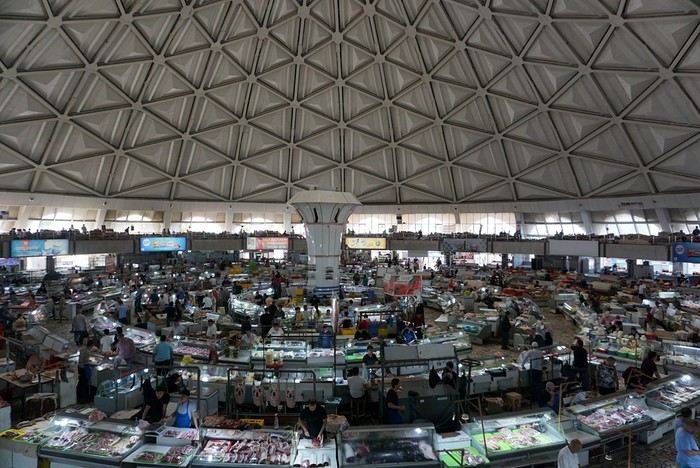
The market sprawls outside around the large circular, multi-story hall. We bought some grapes and bottles of freshly squeezed pomegranate juice for just a few sums. This evening, we had a meet-up with Nasrullo. The reunion was very warm: we’d been exchanging messages for over two years, and I’d been ‘torturing’ him with changes to our itinerary and trip duration. We were finally eager to meet, and honestly, I wasn’t disappointed—in fact, it was the opposite. Nasrullo was very attentive throughout our trip and always made sure, even from a distance (and most often from a distance!), that everything went smoothly. His goal was for us to leave delighted with our trip and, why not, indirectly become ambassadors for this destination. September 14 Breakfast with Nasrullo, then we set off with him by taxi to explore some of the capital’s sites.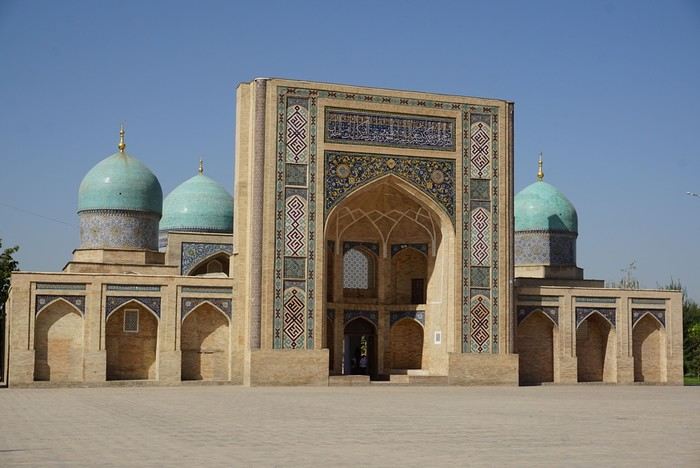
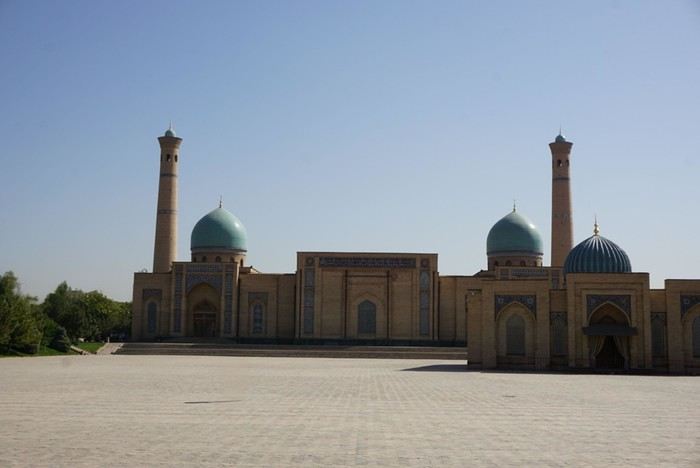
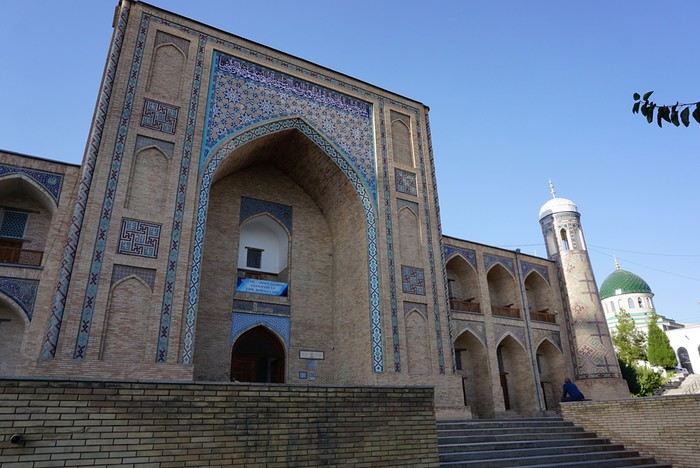
We started by visiting the Khazrati Imam complex, which includes the mausoleum of Kaffal Shashi, the Barak Khan and Muyi Muborak madrasas, and the great Khazrati Imam Mosque with its immense prayer hall.
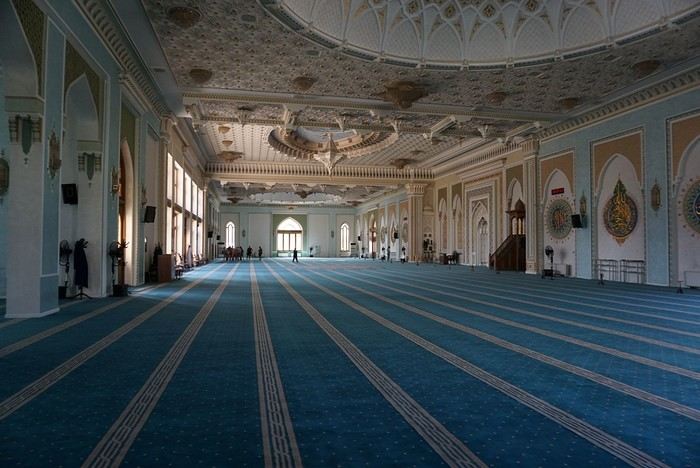
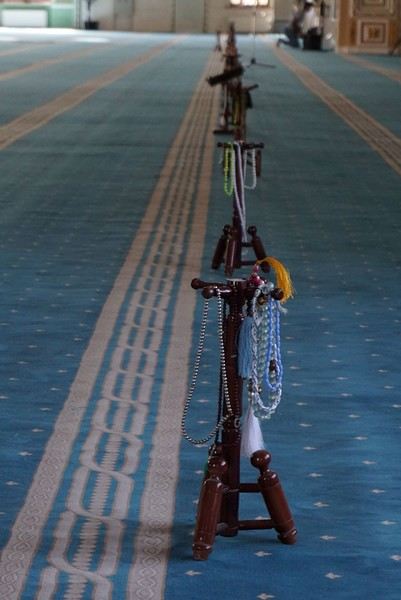
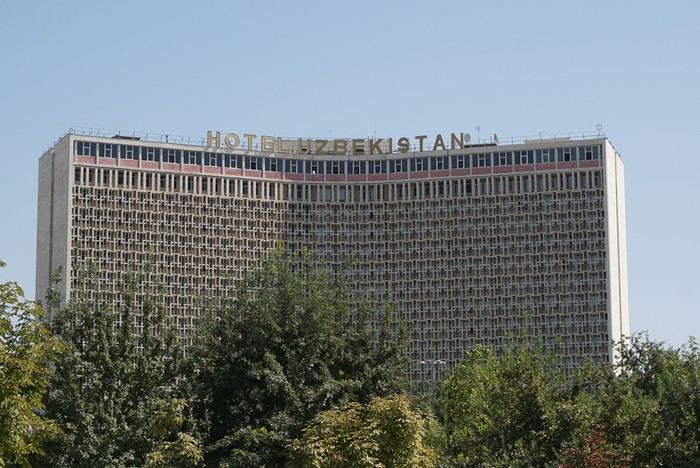
In the Muyi Muborak madrasa, now a museum, you can see the oldest Quran in the world. It was written by three religious scholars, including the secretary of the Prophet Muhammad, on large ‘pages’ made of antelope skin. Next, we explored Soviet-era Tashkent, discovering its parks, canals, and squares: Independence Square with its storks and phoenixes, Amir Temur Square with its large statue and, in the background, the massive Soviet-era hotel that has become one of Tashkent’s iconic buildings. Nasrullo took us through Broadway Boulevard and along what he calls ‘Tashkent’s Montmartre’… Well, it’s far, very far from Montmartre (in every sense of the word!). Then we took the metro to Chorsu station. Rush hour is pretty much the same everywhere in the metro… When we arrived at Chorsu, it was time to say goodbye. Nasrullo had to head back to Samarkand. Before leaving, he recommended some chaikhanas at the end of the galleries facing the market. We ate there for just a few euros (2 or 3 € for two people). After eating, we headed back to our room to cool off (our B&B is about a 10-minute walk away).
Around 4 PM, we set off to visit the Kokeldash Madrasa, which is still active. On the way, we stopped to watch some bread vendors and take a few photos. We were hesitating about buying some for our evening picnic when a young woman approached us. In perfect English, she asked: ‘Are you looking for something? Do you want to buy bread? Which one? How much?’ She then spoke to one of the vendors and negotiated the price. ‘Do you want one?’ And she took two. She paid directly. I took out my wallet to reimburse her, but she refused. It’s on the house! Then the vendor asked where we were from. And off we went again: Macron, PSG, football players… We’ll have to get used to it. The young woman smiled at the questions and comments, barely gave us time to thank her, and left as quickly as she had approached us.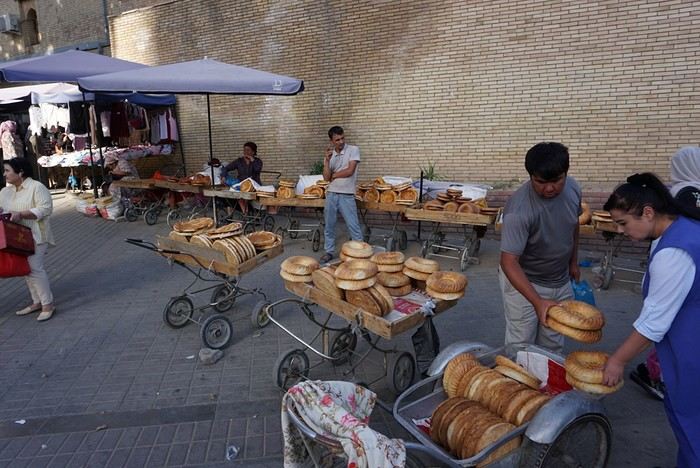
We continued our walk. Visited the madrasa. Then we crossed the boulevard to see the Tashkent Circus. I would’ve loved to go in and visit, but the ticket seller wouldn’t hear of it. We carried on around what should’ve been a park with old-fashioned rides and attractions. All we found was a construction site. Oh well! Back at our hotel, a message from Nasrullo was waiting for us. He had managed to change our train ticket for the next day. Instead of taking the 6:00 AM train, we’d take the 8:00 AM one. And instead of second class, we’d be in first class! Great! This evening, we had a picnic at one of the breakfast tables in the B&B courtyard. Under a shelter, the owner and his family were celebrating a birthday. The owner started by offering us some tea. Then they brought us some fruit (watermelon and melon). Finally, after the song, candles, and cake cutting, they brought us two generous slices of that beautiful birthday cake. Delicious!
We took off from Paris in the late afternoon on September 12 and arrived in Tashkent around 7:15 AM on the 13th.
This trip was the result of long contemplation and preparation (it was originally planned for the year of the lockdown (2020) and was prepared with the help and advice of Nasrullo Jumanov from Turquoise Travel.
Stages and Itinerary
Stage 1: Tashkent - September 13 and 14
Stage 2: Ferghana Valley – September 15 to 17
Stage 3: Nukus and Moynaq - September 18 and 19
Stage 4: Mysterious Khiva - September 20 to 22
Stage 5: Holy Bukhara - September 23 to 26
Stage 6: Asraf - September 27 and 28
Stage 7: Mythical Samarkand - September 29 to October 2
Stage 8: Tersak (via Shakhrisabz and Urgut) – October 3 and 4
Stage 9: Samarkand – October 5 and 6
Stage 10: Tashkent/Istanbul/Paris – October 6 and 7
Stage 1: Tashkent
September 13
At the airport exit, we were greeted by the owner of our B&B (B&B Gulnara).
Today was all about recovery and our first steps in the capital. Our first currency exchange made us feel like sudden millionaires.
Our first stroll down the avenue leading to Chorsu Market introduced us to the fact that 80 to 90% of the cars here are white Chevrolets.
A walk under the arcades facing Chorsu: hardware stores, cabinetmakers, lute makers (one of them gave me a little concert/demo of a few string instruments).As we entered the market, many vendors called out to us, including this florist who asked where we were from: ‘France? Ah! Macron! PSG!’ He then recited a list of players from the Parisian team as well as past (Platini, Zidane, etc.) and current (Giroud, Griezmann, Mbappé, etc.) French national team players. Since we’re more into rugby (we live near Toulouse), he knew more players than I did!
The market sprawls outside around the large circular, multi-story hall. We bought some grapes and bottles of freshly squeezed pomegranate juice for just a few sums. This evening, we had a meet-up with Nasrullo. The reunion was very warm: we’d been exchanging messages for over two years, and I’d been ‘torturing’ him with changes to our itinerary and trip duration. We were finally eager to meet, and honestly, I wasn’t disappointed—in fact, it was the opposite. Nasrullo was very attentive throughout our trip and always made sure, even from a distance (and most often from a distance!), that everything went smoothly. His goal was for us to leave delighted with our trip and, why not, indirectly become ambassadors for this destination. September 14 Breakfast with Nasrullo, then we set off with him by taxi to explore some of the capital’s sites.
We started by visiting the Khazrati Imam complex, which includes the mausoleum of Kaffal Shashi, the Barak Khan and Muyi Muborak madrasas, and the great Khazrati Imam Mosque with its immense prayer hall.
In the Muyi Muborak madrasa, now a museum, you can see the oldest Quran in the world. It was written by three religious scholars, including the secretary of the Prophet Muhammad, on large ‘pages’ made of antelope skin. Next, we explored Soviet-era Tashkent, discovering its parks, canals, and squares: Independence Square with its storks and phoenixes, Amir Temur Square with its large statue and, in the background, the massive Soviet-era hotel that has become one of Tashkent’s iconic buildings. Nasrullo took us through Broadway Boulevard and along what he calls ‘Tashkent’s Montmartre’… Well, it’s far, very far from Montmartre (in every sense of the word!). Then we took the metro to Chorsu station. Rush hour is pretty much the same everywhere in the metro… When we arrived at Chorsu, it was time to say goodbye. Nasrullo had to head back to Samarkand. Before leaving, he recommended some chaikhanas at the end of the galleries facing the market. We ate there for just a few euros (2 or 3 € for two people). After eating, we headed back to our room to cool off (our B&B is about a 10-minute walk away).
Around 4 PM, we set off to visit the Kokeldash Madrasa, which is still active. On the way, we stopped to watch some bread vendors and take a few photos. We were hesitating about buying some for our evening picnic when a young woman approached us. In perfect English, she asked: ‘Are you looking for something? Do you want to buy bread? Which one? How much?’ She then spoke to one of the vendors and negotiated the price. ‘Do you want one?’ And she took two. She paid directly. I took out my wallet to reimburse her, but she refused. It’s on the house! Then the vendor asked where we were from. And off we went again: Macron, PSG, football players… We’ll have to get used to it. The young woman smiled at the questions and comments, barely gave us time to thank her, and left as quickly as she had approached us.
We continued our walk. Visited the madrasa. Then we crossed the boulevard to see the Tashkent Circus. I would’ve loved to go in and visit, but the ticket seller wouldn’t hear of it. We carried on around what should’ve been a park with old-fashioned rides and attractions. All we found was a construction site. Oh well! Back at our hotel, a message from Nasrullo was waiting for us. He had managed to change our train ticket for the next day. Instead of taking the 6:00 AM train, we’d take the 8:00 AM one. And instead of second class, we’d be in first class! Great! This evening, we had a picnic at one of the breakfast tables in the B&B courtyard. Under a shelter, the owner and his family were celebrating a birthday. The owner started by offering us some tea. Then they brought us some fruit (watermelon and melon). Finally, after the song, candles, and cake cutting, they brought us two generous slices of that beautiful birthday cake. Delicious!
Bonsoir
Nous partons pour une croisière d'une semaine avec mon mari. C'est une nouvelle compagnie de croisière 100% française et tout inclus qui s'appelle Croisière de france.
Le premier départ se fait le 25 mai. Quelqu'un connait il cette compagnie? Y a t il des personnes qui partent aussi par ce croisièriste.
Merci a bientôt
Nous partons pour une croisière d'une semaine avec mon mari. C'est une nouvelle compagnie de croisière 100% française et tout inclus qui s'appelle Croisière de france.
Le premier départ se fait le 25 mai. Quelqu'un connait il cette compagnie? Y a t il des personnes qui partent aussi par ce croisièriste.
Merci a bientôt
Bonjour
C'est parti pour ce carnet de voyage , en espérant vous faire découvrir nos coups de coeurs , mais aussi quelques rares déceptions et frustrations sans doute inévitable durant plus d'un mois de voyage Mais tout d'abord , un grand remerciement à tous ceux sur ce forum , qui par leurs conseils et suggestions on permis à ce périple de prendre forme et contribué à son bon déroulement
Nous étions donc 5 , Sandrine et Marc 48 et 54 ans , Antoine, Victor et Tiphaine 21, 19 et 15 ans tous enchanté de partir mais sans doute avec des attentes différentes , que le parcours varié à tenté de satisfaire au mieux
Globalement , on a eu aucune grosse galère , on a perdu personne, pas de malades , pas eu d'accidents , de pannes, on c'est pas trop perdu , le temps à été presque parfait , même les quelques ciels orageux on permis des photos inattendues , notre niveau d'anglais pitoyable , n'a pas été trop handicapant , même si et c'est une petite frustration , il nous a empêché d'échanger avec les américains rencontrés , reste quand même quelques anecdotes que je vous raconterai au jour le jours pour commencer en voilà une qui nous a bien fait rire au bout de quelques jours devant une de mes multiples tentatives a essayer de faire comprendre quelque chose à un autochtone , mon fils Victor m'a dit d'un ton énervé " arrête de mettre ing ou ed à la fin d'un mot français ça ne fait pas un mot anglais ! "
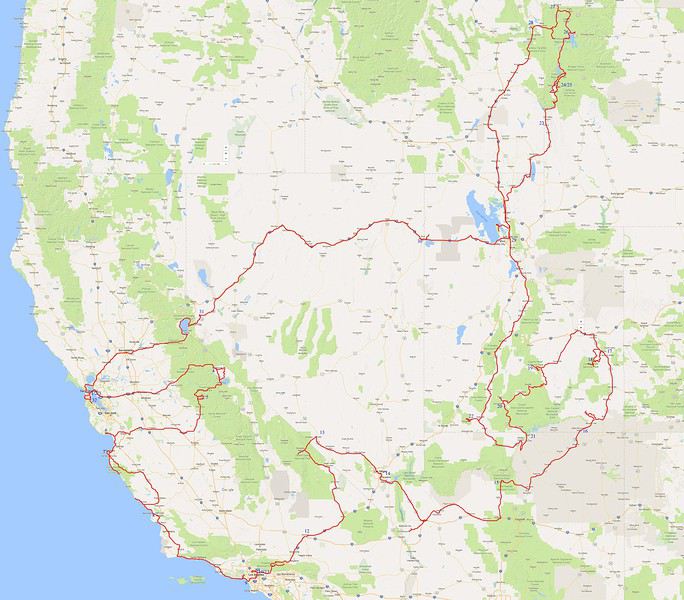
commençons donc par le début la carte du parcours avec les étapes numérotées
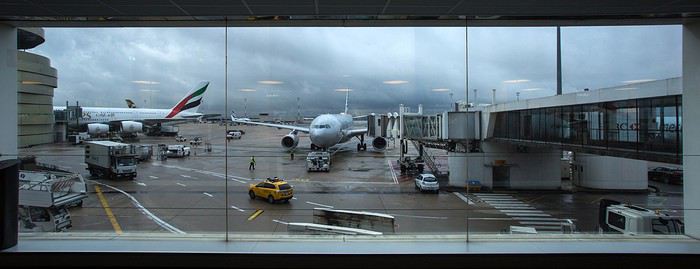
27 juillet 7h du mat , après 2 petites heures de route pour venir de Normandie on a laissé la voiture à un parking à 10km de Roissy , on nous dépose en camionnette à l'aéroport , et on se prépare tous à une très longue journée , mais tout le monde est enthousiaste et impatient , on a pas fait de grand voyage ensemble depuis 2009 avec New York la cote Est et le Québec Pour réduire les frais , j'ai pris un vol avec escale sur air Canada, ce qui nous impose un arrêt de presque 4 heures à Toronto et une arrivé tardive à San Francisco la seule inquiétude est le passage de la douane et l'entrée sur le territoire américain , même si on pense avoir tout fait dans les règles , il y a toujours ce petit doute d'avoir oublié quelques chose et qu'un grain de sable vienne au dernier moment tout annuler
Mais finalement tout ce passa bien , le plus fastidieux ayant été ce passage sur les machines a prise d'empreintes automatique à Toronto , on y a passé trois quart d'heure , avec un peu d'énervement de ne pas réussir à passé les cinq demandes à la suite sans blocage , l'employé présent pour aider les gens étant débordé et ne parlant pas français ne nous pas vraiment aidé , finalement on s'en est sorti en faisant 5 enregistrements différents comme si on voyageaient séparément
Nous voila arrivé à San francisco , il est 21h30 heure local , déjà bien tard pour nous , on sort très vite de l'aéroport , pas le moindre contrôle et nos bagages presque premier sur le tapis roulant , le BART est tout près , on dépense nos 50 premiers dollars , il nous dépose à la station Montgomery en plein centre , il ne nous teste plus qu'à marcher jusqu'à notre hôtel à l'angle de Broadway street et Colombus Avenue , bien un peu désorienté au sortir du métro , on s'engage sur Montgomery street vers le sud dans la mauvaise direction ! ce qui rallongera notre escapade nocturne de 20 bonnes minutes mais malgré la fatigue , tout le monde est de bonne humeur , on apprécie notre balade dans la ville presque déserte , il presque minuit quand on arrive à Europa hôtel , on est à San Francisco !!! Europa Hôtel , si vous cherchez , un petit nid douillet , propre , tranquille , confortable ... n'allez pas là , par contre si vous vous moquez d'avoir les douches et toilettes sur le palier , pas de petit déjeuné , une moquette qui semble dater de la colonisation espagnol , de fenêtres donnant sur la rue qui laisse entendre distinctement tout les bruits du quartier juste en dessous avec ses bars et boites à strip-tease les sirènes hurlantes qui filent sur l'avenue , la musique , les cris ... , c'est l'endroit qu'ils vous faut ! nous on a adoré , on était dans le coeur vivant de San Francisco et cet hôtel à tout pour vous le rappeler à chaque moment
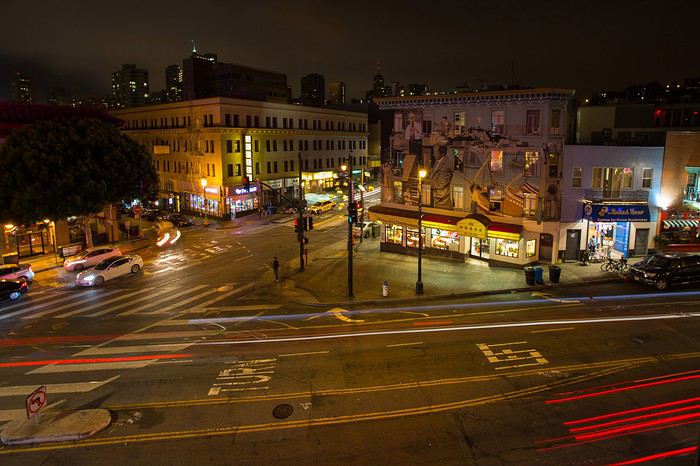
Une fois installé , il est passé minuit , les deux filles ne demande qu'a dormir , mais les deux garçons ont faim ! ( voilà quelque chose qui nous accompagnera tout le voyage ) , comme je ne résiste pas à l'envie d'aller faire un tour , je les accompagne à la recherche de quelque chose à manger a cette heure tardive bien sur les boutiques d'alimentations sont toutes fermés dans le quartier chinois voisin , les fastfoods un peu normaux aussi , on va donc se risquer sur le bizarre , à deux pas de l'hôtel , une devanture étroite mal éclairé qui semble vendre des burgers , on rentre , une sale toute en longueur un bar à droite avec les chaises hautes seul endroit pour s'assoir , les deux garçons essayent maladroitement de commander quelque chose , le serveur à l'air de bien se marrer , après les avoir laisser s'embrouiller une bonne minute , il leur demande s'ils ne veulent pas commander en Français ? on était tombé sur un Marocain ;) pas envie d'un burger à cette heure , j'allais laisser mes deux gars se débrouiller , quand arrive une jeune dame black très légèrement vêtu, affublé d'un collant en résille mettant largement en valeur un derrière impressionnant ! elle c'est assise entre mes deux gars , j'ai vraiment réalisé là qu'on étaient sortie de notre campagne normande et qu'on était bel et bien à San Francisco ! je les ai laissé tranquille profiter du moment et je suis aller me coucher , ça faisait presque 30 heures sans dormir !
suite bientôt , mais je viens de voir que les photos doivent être d'au moins 2000 pixels de large , je viens de passer 1 mois à mettre les miennes au format HD 1620 ou 1920 pixels , je dois donc tout reprendre pour pourvoir vous les montrer ici
C'est parti pour ce carnet de voyage , en espérant vous faire découvrir nos coups de coeurs , mais aussi quelques rares déceptions et frustrations sans doute inévitable durant plus d'un mois de voyage Mais tout d'abord , un grand remerciement à tous ceux sur ce forum , qui par leurs conseils et suggestions on permis à ce périple de prendre forme et contribué à son bon déroulement
Nous étions donc 5 , Sandrine et Marc 48 et 54 ans , Antoine, Victor et Tiphaine 21, 19 et 15 ans tous enchanté de partir mais sans doute avec des attentes différentes , que le parcours varié à tenté de satisfaire au mieux
Globalement , on a eu aucune grosse galère , on a perdu personne, pas de malades , pas eu d'accidents , de pannes, on c'est pas trop perdu , le temps à été presque parfait , même les quelques ciels orageux on permis des photos inattendues , notre niveau d'anglais pitoyable , n'a pas été trop handicapant , même si et c'est une petite frustration , il nous a empêché d'échanger avec les américains rencontrés , reste quand même quelques anecdotes que je vous raconterai au jour le jours pour commencer en voilà une qui nous a bien fait rire au bout de quelques jours devant une de mes multiples tentatives a essayer de faire comprendre quelque chose à un autochtone , mon fils Victor m'a dit d'un ton énervé " arrête de mettre ing ou ed à la fin d'un mot français ça ne fait pas un mot anglais ! "
commençons donc par le début la carte du parcours avec les étapes numérotées
27 juillet 7h du mat , après 2 petites heures de route pour venir de Normandie on a laissé la voiture à un parking à 10km de Roissy , on nous dépose en camionnette à l'aéroport , et on se prépare tous à une très longue journée , mais tout le monde est enthousiaste et impatient , on a pas fait de grand voyage ensemble depuis 2009 avec New York la cote Est et le Québec Pour réduire les frais , j'ai pris un vol avec escale sur air Canada, ce qui nous impose un arrêt de presque 4 heures à Toronto et une arrivé tardive à San Francisco la seule inquiétude est le passage de la douane et l'entrée sur le territoire américain , même si on pense avoir tout fait dans les règles , il y a toujours ce petit doute d'avoir oublié quelques chose et qu'un grain de sable vienne au dernier moment tout annuler
Mais finalement tout ce passa bien , le plus fastidieux ayant été ce passage sur les machines a prise d'empreintes automatique à Toronto , on y a passé trois quart d'heure , avec un peu d'énervement de ne pas réussir à passé les cinq demandes à la suite sans blocage , l'employé présent pour aider les gens étant débordé et ne parlant pas français ne nous pas vraiment aidé , finalement on s'en est sorti en faisant 5 enregistrements différents comme si on voyageaient séparément
Nous voila arrivé à San francisco , il est 21h30 heure local , déjà bien tard pour nous , on sort très vite de l'aéroport , pas le moindre contrôle et nos bagages presque premier sur le tapis roulant , le BART est tout près , on dépense nos 50 premiers dollars , il nous dépose à la station Montgomery en plein centre , il ne nous teste plus qu'à marcher jusqu'à notre hôtel à l'angle de Broadway street et Colombus Avenue , bien un peu désorienté au sortir du métro , on s'engage sur Montgomery street vers le sud dans la mauvaise direction ! ce qui rallongera notre escapade nocturne de 20 bonnes minutes mais malgré la fatigue , tout le monde est de bonne humeur , on apprécie notre balade dans la ville presque déserte , il presque minuit quand on arrive à Europa hôtel , on est à San Francisco !!! Europa Hôtel , si vous cherchez , un petit nid douillet , propre , tranquille , confortable ... n'allez pas là , par contre si vous vous moquez d'avoir les douches et toilettes sur le palier , pas de petit déjeuné , une moquette qui semble dater de la colonisation espagnol , de fenêtres donnant sur la rue qui laisse entendre distinctement tout les bruits du quartier juste en dessous avec ses bars et boites à strip-tease les sirènes hurlantes qui filent sur l'avenue , la musique , les cris ... , c'est l'endroit qu'ils vous faut ! nous on a adoré , on était dans le coeur vivant de San Francisco et cet hôtel à tout pour vous le rappeler à chaque moment
Une fois installé , il est passé minuit , les deux filles ne demande qu'a dormir , mais les deux garçons ont faim ! ( voilà quelque chose qui nous accompagnera tout le voyage ) , comme je ne résiste pas à l'envie d'aller faire un tour , je les accompagne à la recherche de quelque chose à manger a cette heure tardive bien sur les boutiques d'alimentations sont toutes fermés dans le quartier chinois voisin , les fastfoods un peu normaux aussi , on va donc se risquer sur le bizarre , à deux pas de l'hôtel , une devanture étroite mal éclairé qui semble vendre des burgers , on rentre , une sale toute en longueur un bar à droite avec les chaises hautes seul endroit pour s'assoir , les deux garçons essayent maladroitement de commander quelque chose , le serveur à l'air de bien se marrer , après les avoir laisser s'embrouiller une bonne minute , il leur demande s'ils ne veulent pas commander en Français ? on était tombé sur un Marocain ;) pas envie d'un burger à cette heure , j'allais laisser mes deux gars se débrouiller , quand arrive une jeune dame black très légèrement vêtu, affublé d'un collant en résille mettant largement en valeur un derrière impressionnant ! elle c'est assise entre mes deux gars , j'ai vraiment réalisé là qu'on étaient sortie de notre campagne normande et qu'on était bel et bien à San Francisco ! je les ai laissé tranquille profiter du moment et je suis aller me coucher , ça faisait presque 30 heures sans dormir !
suite bientôt , mais je viens de voir que les photos doivent être d'au moins 2000 pixels de large , je viens de passer 1 mois à mettre les miennes au format HD 1620 ou 1920 pixels , je dois donc tout reprendre pour pourvoir vous les montrer ici
Il est 10h 45... Marseille baigne sous le soleil et la température atteint déjà 25 degrés... Notre Jaguar arrive au port et se gare juste devant l'entrée du terminal. Le Fantasia est là, devant nous, immense... Il parait vraiment "plus gros" que tous les Costa que nous connaissons...
Le temps de descendre les valises qui disparaissent emportées par un MSC-man, le "chef des majordomes" se présente, ans un français parfait, et nous convie à le suivre immédiatement à bord. Nous passons, semble-t-il, par le circuit qu'emprunte les passagers qui font escale à Marseille, et nous voici devant la sécurité du bateau, qui nous dit juste bonjour, et regarde rapidement nos passeports, et nous entrons par le pont 5, dans l'Atrium...
Encore un Whaoooo ! 😮 Ca ne ressemble à rien de ce dont nous avons l'habitude chez Costa... C'est plus sobre, moins clinquant, ca ne brille pas de partout, après, je pense que c'est une histoire de goût personnel, je dirai donc juste que ça nous plait beaucoup... Nous nous dirigeons vers la "colonne avant" des ascenseurs, et le majordome nous explique qu'il fauda utiliser les ascenseurs 2 et 3, qui disposent d'un accès prioritaire aux ponts 15, 16 et 18 (il n'y a pas de pont 17, je le rappelle, il parait que le 17 porte malheur... ).
Nous arrivons à la conciergerie, au pont 15, et c'est là seulement qu'est fait le véritable check-in : la responsable nous prend en photo avec une petite webcam (la qualité va pas être terrible, mais ça doit leur suffire...). Enregistrement de carte bancaire, remise de nos cartes MSC-YC (qui ouvrent la cabine, servent de carte d'identité et de paiement, mais aussi de véritable sésame pour toutes les portes d'accès au Yacht Club, et aussi, c'est compliqué mais on a fini par comprendre, de carte de priorité qui fait que l'ascenseur (vide) que nous prenons à n'importe quel étage ne s'arrêtera pas avant l'étage où nous voulons aller, même si quelqu'un l'a appelé... pour les ascenseurs 2 et 3 de la colonne avant. 😛
Nous découvrons alors notre suite, que le chef majordome nous fait visiter, il nous présente Kabil, notre majordome (beaucoup moins francophone... mais très sympathique, ça sera comme sur les autres bateau, un peu d'anglais, et des dessins sur des post-it... Il nous montre le mini-bar, plein à craquer, et rempli une fois par jour, totalement "gratuit"... Il est 11h 15... Le chef majordome nous fait alors visiter le salon du pont 15 (Top Sail Lounge) et le dernier pont, le 18, avec le bar-mini-buffet, le "One Bar", et le pont piscine "One Pool". On ne s'attarde pas, car le soleil tape... Il nous fait alors une visite "complète" du bateau, nous montrant tous les ponts supérieurs 14, 15 (buffets, piscines...) et inférieurs 6 et 7 avec les restaurants, le casino, le téhatre, tous les bars... Whaooo ! on s'y perd, il n'y a pas la géométrie et la symétrie rassurantes des bateaux Costa (notamment de la série FMCSP)... Mme PAP me dit qu'une semaine ne suffira pas pour connaître le bateau... Je lui dis qu'on reviendra... Mais bon, c'est très clair : indépendamment de tout le reste, qu'on n'a pas encore vu, la déco, on adore... Et c'est vrai que les "whaoooo" à chaque nouveau salon, ou détour de couloir, on n'a pOas éprouvé ça depuis longtemps chez Costa... Chaque bateau ayant un air de ressemblance avec tous les autres (depuis l'Atlantica, en tous cas)... Mais il est possible que ce soit aussi le cas chez MSC, et que nous ne ressentions pas, un jour, sur le Spledida, ce que nous éprouvons aujourd'hui... 😉🙂
Il est midi et fait petite faim... Alors une fois n'est pas coutume, on va tester le buffet (pas le YAcht Club, le "général"). Eh bien, agréable surprise : question nourriture, présentation, variété, on ne voit pas de différence avec les buffets Costa (mais c'est vrai qu'on n'y va pas très souvent... et puis il est vrai aussi qu'il n'y a pas grand monde, ça vient d'ouvrir). On se sert un peu (pas trop grosse faim) et ça se laisse manger... On reste là environ 20 minutes, et puis on rentre au Salon du Yacht Club goûter les petits trucs qui sont en permanence à disposition... Mais qui à eux seul semblent justes pour faire un repas entier... On en profite pour boire un peu, puisque ça ne coûte rien...
Retour à la cabine vers 12h 45 : les valises sont là, et Mme PAP se met au déballage...
Alors elle est jolie, certes la suite "royale", avec son salon et sa chambre totalement séparés, avec son immense balcon qui fait tout le coin avant du bateau, donnant à la fois pleine face sur l'avant, et sur le côté, mais elle a trois gros défauts, qui nous ennuient un peu et ternissent un peu le plaisir du reste :
1) la salle de bain est très petite, à peine plus grande que les salles d'eaux classiques, et beaucoup plus petites que les salles de bains de grandes suites Costa. juste une baignoire pas très grande, et sans "bouilonnements", et un seul lavabo, certes en marbre, mais un seul... Pas du tout celle montrée sur les brochures, avec ses deux vasques... On ne peut pas tenir à deux dans cette salle de bains... 😮😕
2) les rangements sont ridiculement petits... Quelques tiroirs, aucun placard, la penderie-dressing "en plein air" devant la salle de bains, et c'est tout... Il faudra toute l'ingéniosité de Mme PAP pour faire tenir le contenu de nos quatres valises (faut bien caser aussi tout le matériel informatique, photo, vidéo... ) 😕😕
3) le site du MSC-YAcht Club affiche n'importe quoi sur sa "visite vidéo 360°" de la suite YC3, qui ne correspond absolument pas à ce qui est présenté... et le plan lui aussi est faux, la chambre ne présente qu'un bureau et non deux comme sur le plan...😕😕
Bref, la cabine est spendide en termes de décoration, elle est certes grande, mais elle ne correspond pas à ce que nous en attendions... Notamment, Madame PAP me montre les 4 gilets de sauvetage (on va en faire enlever deux) qui encombrent le peu de place disponible, et se demande comment quatre personnes pourraient caser leur affaires dans cette cabine... Dans les cabines "normales", n'y a-t-il donc aucun placard, armoire, ou aussi peu ? Il nous semble que mes beaux parents, à qui nous avions pris une cabine standard balcon sur le Fortuna, en 2006 (douche obligatoire à l'exclusion de toute baignoire...) avaient plus de place de rangement...
Nous passons ensuite le temps qui nous sépare de la réunion d'information à 17h 45 pour visiter le bateau plus à fond... On va se perdre deux ou trois fois... On admire beaucoup la petite place italienne, de toute beauté, et aussi le théatre, qui est un vrai théatre avec des sièges de théatre et rien d'autre, pas de tables ou tablettes pour poser des verres... Un théatre, c'est pas fait pour boire... 😇
17h 45 : la réunion d'information : c'est la directrice de croisière qui présente Sarah, hôtesse francophone. Cette directrice de croisière est elle même excellente francophone, il y a longtemps qu'on n'avait pas vu ça... Quant à Sarah, elle fait derrière ça le strict service minimum, pour présenter en quelques mots le "Today qui n'a pas de nom" (c'est vrai, aucun nom à ce journal quotidien qui contient toutes les infos de bord...). Et puis rapidement quelques excursions, une rapide démo pour enfiler un gilet de sauvetage et l'annonce que l'exercice de sauvetage aura lieu... après le départ de Gênes... 😠🙁😠 soit pour nous à quelques heures du débarquement... Pourtant, le "Today" (enfin, le journal qui n'a pas de nom, et c'est pour ça qu'on l'appelera dorénavant le Today, pour faire rapide) disait qu'il fallait venir au théatre avec son gilet... Mais on n'était que quelques idiots disciplinés avec leur gilet à la main qui n'a servi à rien... 😠😕
19h 30 : Nous avons fixé notre horaire de dîner du soir (on peut changer chaque jour si on veut) à 20h 30... Nous allons donc au spectacle du 1er service... Chants d'opéras et opérettes... Trois chanteurs lyriques... Du très beau spectacle... Court (30 minutes) mais beau, tant dans les talents des artistes que dans la mise en scène, les éclairages... On a beaucoup aimé... 😛🙂
20h : retour en cabine pour goûter le Prosecco de bienvenue... Pas de champagne en effet... On aura l'occasion de reparler de ces problèmes de prix, mais disons d'emblée qu'il y a pour le MSC YAcht Club un large choix de boissons *de base* gratuites, mais qque tout ce qui n'est pas gratuit est à son plein tarif sur *tout le bateau* : pas question de tarifs "réduits YC", à part le Johnny Wlaker étiquette rouge ( ), tous les autres whyskies sont au *même* prix sur tout le bateau, le champagne aussi, les liqueurs aussi, etc... Un peu déçus par rapports aux rêves, mais bon, ça, c'est su une fois pour toutes, on fera avec... 🤪
20h 30 : notre majordome, qui a peur qu'on se perde, veut à tout prix nous conduire à l'Etoile... Bon, on le suit... Le maître d'hôtel, bon francophone, nous attribue la table 4. Alors c'est pas le Sofitel d'hier soir, hein... Mais bon, le menu qui nous est apporté est varié et c'est très bon, et très bien présenté... On en reparlera plus en détails... Pour ce qui est des boissons, toutes les eaux et bières sont gratuites. Pour le vin, servi au verre, il y a un blanc, un rouge, un rosé. Nous qui sommes rouges avons trouvé correct le Chianti porposé. Tous les autres vins sont "payants". La carte est bien fournie mais peut-être un peu moins quand même qque la "Costa"...
Le restaurant en lui même est très agréable, et notre table de deux est le long des baies vitrées, là encore nous aurons vu la nuit tomber autour de nous...
Retour en cabine vers 22h 30... Mme PAP a sommeil... Ca tombe bien, j'ai du boulot... Heureusement que j'ai une petite lampe USB qui n'éclaire que mon clavier, car le bureau est dans la chambre...
Allez un dernier petit renseignement, l'internet (ici, connexion Ethernet, mais Wifi dans tout le bateau) a plusieurs tarifs... J'ai pris un 500 minutes (8heures 20) pour 60 euros... Ca fait finalement 7.20 euros de l'heure, on est en dessous des 8.00 de Costa 😉 (sur ce forfait là, car l'heure seule est à 12 euros contre 10 chez Costa). Et là, je n'ai pas de réduction MSC-Club...
Voilà, un peu en crac, les premières impressions...
Le temps de descendre les valises qui disparaissent emportées par un MSC-man, le "chef des majordomes" se présente, ans un français parfait, et nous convie à le suivre immédiatement à bord. Nous passons, semble-t-il, par le circuit qu'emprunte les passagers qui font escale à Marseille, et nous voici devant la sécurité du bateau, qui nous dit juste bonjour, et regarde rapidement nos passeports, et nous entrons par le pont 5, dans l'Atrium...
Encore un Whaoooo ! 😮 Ca ne ressemble à rien de ce dont nous avons l'habitude chez Costa... C'est plus sobre, moins clinquant, ca ne brille pas de partout, après, je pense que c'est une histoire de goût personnel, je dirai donc juste que ça nous plait beaucoup... Nous nous dirigeons vers la "colonne avant" des ascenseurs, et le majordome nous explique qu'il fauda utiliser les ascenseurs 2 et 3, qui disposent d'un accès prioritaire aux ponts 15, 16 et 18 (il n'y a pas de pont 17, je le rappelle, il parait que le 17 porte malheur... ).
Nous arrivons à la conciergerie, au pont 15, et c'est là seulement qu'est fait le véritable check-in : la responsable nous prend en photo avec une petite webcam (la qualité va pas être terrible, mais ça doit leur suffire...). Enregistrement de carte bancaire, remise de nos cartes MSC-YC (qui ouvrent la cabine, servent de carte d'identité et de paiement, mais aussi de véritable sésame pour toutes les portes d'accès au Yacht Club, et aussi, c'est compliqué mais on a fini par comprendre, de carte de priorité qui fait que l'ascenseur (vide) que nous prenons à n'importe quel étage ne s'arrêtera pas avant l'étage où nous voulons aller, même si quelqu'un l'a appelé... pour les ascenseurs 2 et 3 de la colonne avant. 😛
Nous découvrons alors notre suite, que le chef majordome nous fait visiter, il nous présente Kabil, notre majordome (beaucoup moins francophone... mais très sympathique, ça sera comme sur les autres bateau, un peu d'anglais, et des dessins sur des post-it... Il nous montre le mini-bar, plein à craquer, et rempli une fois par jour, totalement "gratuit"... Il est 11h 15... Le chef majordome nous fait alors visiter le salon du pont 15 (Top Sail Lounge) et le dernier pont, le 18, avec le bar-mini-buffet, le "One Bar", et le pont piscine "One Pool". On ne s'attarde pas, car le soleil tape... Il nous fait alors une visite "complète" du bateau, nous montrant tous les ponts supérieurs 14, 15 (buffets, piscines...) et inférieurs 6 et 7 avec les restaurants, le casino, le téhatre, tous les bars... Whaooo ! on s'y perd, il n'y a pas la géométrie et la symétrie rassurantes des bateaux Costa (notamment de la série FMCSP)... Mme PAP me dit qu'une semaine ne suffira pas pour connaître le bateau... Je lui dis qu'on reviendra... Mais bon, c'est très clair : indépendamment de tout le reste, qu'on n'a pas encore vu, la déco, on adore... Et c'est vrai que les "whaoooo" à chaque nouveau salon, ou détour de couloir, on n'a pOas éprouvé ça depuis longtemps chez Costa... Chaque bateau ayant un air de ressemblance avec tous les autres (depuis l'Atlantica, en tous cas)... Mais il est possible que ce soit aussi le cas chez MSC, et que nous ne ressentions pas, un jour, sur le Spledida, ce que nous éprouvons aujourd'hui... 😉🙂
Il est midi et fait petite faim... Alors une fois n'est pas coutume, on va tester le buffet (pas le YAcht Club, le "général"). Eh bien, agréable surprise : question nourriture, présentation, variété, on ne voit pas de différence avec les buffets Costa (mais c'est vrai qu'on n'y va pas très souvent... et puis il est vrai aussi qu'il n'y a pas grand monde, ça vient d'ouvrir). On se sert un peu (pas trop grosse faim) et ça se laisse manger... On reste là environ 20 minutes, et puis on rentre au Salon du Yacht Club goûter les petits trucs qui sont en permanence à disposition... Mais qui à eux seul semblent justes pour faire un repas entier... On en profite pour boire un peu, puisque ça ne coûte rien...
Retour à la cabine vers 12h 45 : les valises sont là, et Mme PAP se met au déballage...
Alors elle est jolie, certes la suite "royale", avec son salon et sa chambre totalement séparés, avec son immense balcon qui fait tout le coin avant du bateau, donnant à la fois pleine face sur l'avant, et sur le côté, mais elle a trois gros défauts, qui nous ennuient un peu et ternissent un peu le plaisir du reste :
1) la salle de bain est très petite, à peine plus grande que les salles d'eaux classiques, et beaucoup plus petites que les salles de bains de grandes suites Costa. juste une baignoire pas très grande, et sans "bouilonnements", et un seul lavabo, certes en marbre, mais un seul... Pas du tout celle montrée sur les brochures, avec ses deux vasques... On ne peut pas tenir à deux dans cette salle de bains... 😮😕
2) les rangements sont ridiculement petits... Quelques tiroirs, aucun placard, la penderie-dressing "en plein air" devant la salle de bains, et c'est tout... Il faudra toute l'ingéniosité de Mme PAP pour faire tenir le contenu de nos quatres valises (faut bien caser aussi tout le matériel informatique, photo, vidéo... ) 😕😕
3) le site du MSC-YAcht Club affiche n'importe quoi sur sa "visite vidéo 360°" de la suite YC3, qui ne correspond absolument pas à ce qui est présenté... et le plan lui aussi est faux, la chambre ne présente qu'un bureau et non deux comme sur le plan...😕😕
Bref, la cabine est spendide en termes de décoration, elle est certes grande, mais elle ne correspond pas à ce que nous en attendions... Notamment, Madame PAP me montre les 4 gilets de sauvetage (on va en faire enlever deux) qui encombrent le peu de place disponible, et se demande comment quatre personnes pourraient caser leur affaires dans cette cabine... Dans les cabines "normales", n'y a-t-il donc aucun placard, armoire, ou aussi peu ? Il nous semble que mes beaux parents, à qui nous avions pris une cabine standard balcon sur le Fortuna, en 2006 (douche obligatoire à l'exclusion de toute baignoire...) avaient plus de place de rangement...
Nous passons ensuite le temps qui nous sépare de la réunion d'information à 17h 45 pour visiter le bateau plus à fond... On va se perdre deux ou trois fois... On admire beaucoup la petite place italienne, de toute beauté, et aussi le théatre, qui est un vrai théatre avec des sièges de théatre et rien d'autre, pas de tables ou tablettes pour poser des verres... Un théatre, c'est pas fait pour boire... 😇
17h 45 : la réunion d'information : c'est la directrice de croisière qui présente Sarah, hôtesse francophone. Cette directrice de croisière est elle même excellente francophone, il y a longtemps qu'on n'avait pas vu ça... Quant à Sarah, elle fait derrière ça le strict service minimum, pour présenter en quelques mots le "Today qui n'a pas de nom" (c'est vrai, aucun nom à ce journal quotidien qui contient toutes les infos de bord...). Et puis rapidement quelques excursions, une rapide démo pour enfiler un gilet de sauvetage et l'annonce que l'exercice de sauvetage aura lieu... après le départ de Gênes... 😠🙁😠 soit pour nous à quelques heures du débarquement... Pourtant, le "Today" (enfin, le journal qui n'a pas de nom, et c'est pour ça qu'on l'appelera dorénavant le Today, pour faire rapide) disait qu'il fallait venir au théatre avec son gilet... Mais on n'était que quelques idiots disciplinés avec leur gilet à la main qui n'a servi à rien... 😠😕
19h 30 : Nous avons fixé notre horaire de dîner du soir (on peut changer chaque jour si on veut) à 20h 30... Nous allons donc au spectacle du 1er service... Chants d'opéras et opérettes... Trois chanteurs lyriques... Du très beau spectacle... Court (30 minutes) mais beau, tant dans les talents des artistes que dans la mise en scène, les éclairages... On a beaucoup aimé... 😛🙂
20h : retour en cabine pour goûter le Prosecco de bienvenue... Pas de champagne en effet... On aura l'occasion de reparler de ces problèmes de prix, mais disons d'emblée qu'il y a pour le MSC YAcht Club un large choix de boissons *de base* gratuites, mais qque tout ce qui n'est pas gratuit est à son plein tarif sur *tout le bateau* : pas question de tarifs "réduits YC", à part le Johnny Wlaker étiquette rouge ( ), tous les autres whyskies sont au *même* prix sur tout le bateau, le champagne aussi, les liqueurs aussi, etc... Un peu déçus par rapports aux rêves, mais bon, ça, c'est su une fois pour toutes, on fera avec... 🤪
20h 30 : notre majordome, qui a peur qu'on se perde, veut à tout prix nous conduire à l'Etoile... Bon, on le suit... Le maître d'hôtel, bon francophone, nous attribue la table 4. Alors c'est pas le Sofitel d'hier soir, hein... Mais bon, le menu qui nous est apporté est varié et c'est très bon, et très bien présenté... On en reparlera plus en détails... Pour ce qui est des boissons, toutes les eaux et bières sont gratuites. Pour le vin, servi au verre, il y a un blanc, un rouge, un rosé. Nous qui sommes rouges avons trouvé correct le Chianti porposé. Tous les autres vins sont "payants". La carte est bien fournie mais peut-être un peu moins quand même qque la "Costa"...
Le restaurant en lui même est très agréable, et notre table de deux est le long des baies vitrées, là encore nous aurons vu la nuit tomber autour de nous...
Retour en cabine vers 22h 30... Mme PAP a sommeil... Ca tombe bien, j'ai du boulot... Heureusement que j'ai une petite lampe USB qui n'éclaire que mon clavier, car le bureau est dans la chambre...
Allez un dernier petit renseignement, l'internet (ici, connexion Ethernet, mais Wifi dans tout le bateau) a plusieurs tarifs... J'ai pris un 500 minutes (8heures 20) pour 60 euros... Ca fait finalement 7.20 euros de l'heure, on est en dessous des 8.00 de Costa 😉 (sur ce forfait là, car l'heure seule est à 12 euros contre 10 chez Costa). Et là, je n'ai pas de réduction MSC-Club...
Voilà, un peu en crac, les premières impressions...
April 11 – Day 1
It was winter, a winter with beautiful weather, A season that only exists in the southwest of America, I remember very well what I told you that morning A month ago... A century ago, an eternity ago... We’ll go... wherever you want, whenever you want...
Well, yeah, back from our adventure in our enchanting American West just a month ago, we’re already taking a bite out of one of its lesser-known competitors. "Flo, if you had to pick just one reason to justify your love for the U.S., what would it be?" The greasy, dripping burgers? No, I don’t think I’m going out on a limb by saying it’d be the wide-open spaces... And that’s exactly what our new quest is taking us to—a land on the other side of the globe where the horizon also seems endless, where silence tastes like salty wind and sand, where freedom is measured in kilometers of desert tracks, where the GPS is mostly there to confirm you’re lost in the middle of nowhere... Add to that magic formula the fact that you’ll see more zebras, giraffes, wildebeest, and elephants than people per square kilometer, and you can imagine us setting foot in Southern Africa for the first time, more precisely at the small airport in Windhoek, capital of... of...? Brush up on your geography, damn it! We’re landing in Namibia!!!
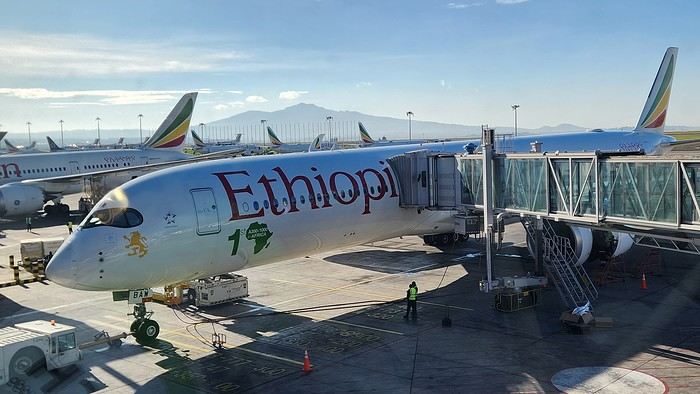
To be honest, Namibian landscapes have been flirting with me for ages. So how did I resist this island of temptation for so long? First, the budget. Let’s just say that for the same amount of effort (and kidneys), the bank lets you choose two other adventures almost anywhere else on the planet. Then there were my girls. Yeah, back then, they were too little to dose up on Malarone, the only malaria remedy at the time... Long story short, ten years later, all the planets have aligned. First, I won the Euromillions! Well, almost... Let’s just say my girls are now old enough... not to take Malarone, but to stop following me on all my adventures! Jackpot! "Flo, how about a little two-person caprice, just the two of us, tackling the Namibian tracks?"
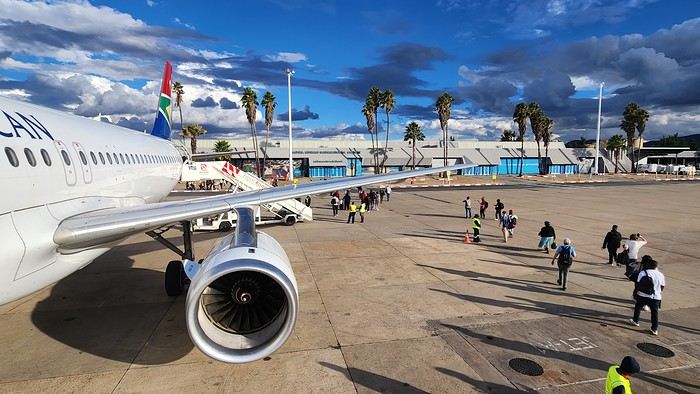
As we landed on the runway, first wow effect: The horizon is immense. It’s flat as can be, incredibly flat... So much flat space! Did I mention it was flat?... Looking into the distance, it feels like your gaze could circle the Earth without hitting a single obstacle—until you end up staring at your own backside. "Oh, what a nice view!" Well, it’s the first time I’ve seen my butt from this angle! Touching moment... Sorry, I’m rambling—must be the exhaustion from the three-flight marathon we just powered through via Ethiopia and South Africa... And yet, no time to philosophize about my anatomy. As usual, we want to rack up our first kilometers to be front and center at dawn tomorrow. After wrapping up the tedious Namibian immigration formalities and meeting the 4x4 that’ll be our companion day and night for the next fifteen days, we’re off! We’re not exactly fresh, but we’re ready to tackle the next five hundred kilometers in night mode, cruise control set due south! Just outside Windhoek, the local wildlife—a jackal—welcomes us with a smile: "Welcome to Namibia!" That’s what it said! Honest... Okay, first endless straight road, first flaming sunset, first corrugated dirt track, first Milky Way with zero light pollution... You get it—it’s definitely the day of firsts... First night camping, too, in the big trunk of our Toyota Fortuner parked by the side of the track... The real adventure, the kind that smells under the arms, can finally begin...
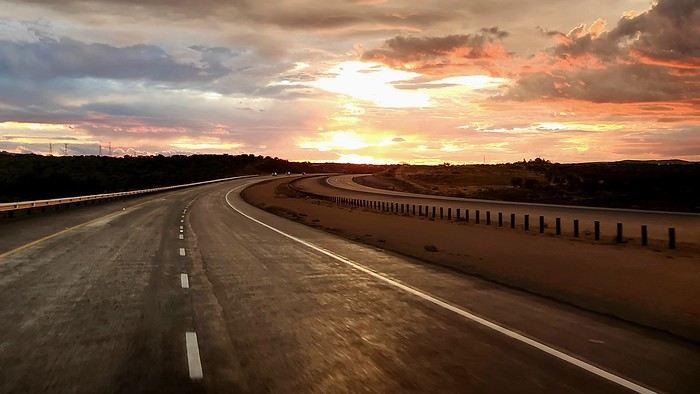
It was winter, a winter with beautiful weather, A season that only exists in the southwest of America, I remember very well what I told you that morning A month ago... A century ago, an eternity ago... We’ll go... wherever you want, whenever you want...
Well, yeah, back from our adventure in our enchanting American West just a month ago, we’re already taking a bite out of one of its lesser-known competitors. "Flo, if you had to pick just one reason to justify your love for the U.S., what would it be?" The greasy, dripping burgers? No, I don’t think I’m going out on a limb by saying it’d be the wide-open spaces... And that’s exactly what our new quest is taking us to—a land on the other side of the globe where the horizon also seems endless, where silence tastes like salty wind and sand, where freedom is measured in kilometers of desert tracks, where the GPS is mostly there to confirm you’re lost in the middle of nowhere... Add to that magic formula the fact that you’ll see more zebras, giraffes, wildebeest, and elephants than people per square kilometer, and you can imagine us setting foot in Southern Africa for the first time, more precisely at the small airport in Windhoek, capital of... of...? Brush up on your geography, damn it! We’re landing in Namibia!!!
To be honest, Namibian landscapes have been flirting with me for ages. So how did I resist this island of temptation for so long? First, the budget. Let’s just say that for the same amount of effort (and kidneys), the bank lets you choose two other adventures almost anywhere else on the planet. Then there were my girls. Yeah, back then, they were too little to dose up on Malarone, the only malaria remedy at the time... Long story short, ten years later, all the planets have aligned. First, I won the Euromillions! Well, almost... Let’s just say my girls are now old enough... not to take Malarone, but to stop following me on all my adventures! Jackpot! "Flo, how about a little two-person caprice, just the two of us, tackling the Namibian tracks?"
As we landed on the runway, first wow effect: The horizon is immense. It’s flat as can be, incredibly flat... So much flat space! Did I mention it was flat?... Looking into the distance, it feels like your gaze could circle the Earth without hitting a single obstacle—until you end up staring at your own backside. "Oh, what a nice view!" Well, it’s the first time I’ve seen my butt from this angle! Touching moment... Sorry, I’m rambling—must be the exhaustion from the three-flight marathon we just powered through via Ethiopia and South Africa... And yet, no time to philosophize about my anatomy. As usual, we want to rack up our first kilometers to be front and center at dawn tomorrow. After wrapping up the tedious Namibian immigration formalities and meeting the 4x4 that’ll be our companion day and night for the next fifteen days, we’re off! We’re not exactly fresh, but we’re ready to tackle the next five hundred kilometers in night mode, cruise control set due south! Just outside Windhoek, the local wildlife—a jackal—welcomes us with a smile: "Welcome to Namibia!" That’s what it said! Honest... Okay, first endless straight road, first flaming sunset, first corrugated dirt track, first Milky Way with zero light pollution... You get it—it’s definitely the day of firsts... First night camping, too, in the big trunk of our Toyota Fortuner parked by the side of the track... The real adventure, the kind that smells under the arms, can finally begin...
Hi there, 🙂
This autumn’s trip should be in Morocco—barring any geopolitical issues between now and then.
After many trips to the south of Fès, I’m giving the north a try.
My plan is roughly to do a road trip loop from Rabat back to Rabat, passing through Asilah, Tangier, Tétouan, Chefchaouen, Akchour, Fès, Meknès, and Volubilis.
That’s a lot of cities. Probably a bit too many for our taste—we usually prefer more isolated spots...
So I’m looking for tips on little backroads, secluded beaches, half-day hikes, and offbeat places.
If you’ve also got recommendations for accommodation... (We’re open to splurging over 100 € if it’s a real favorite.)
Feel free to think outside the box—this is an open-ended plan! !😉
Thanks
This autumn’s trip should be in Morocco—barring any geopolitical issues between now and then.
After many trips to the south of Fès, I’m giving the north a try.
My plan is roughly to do a road trip loop from Rabat back to Rabat, passing through Asilah, Tangier, Tétouan, Chefchaouen, Akchour, Fès, Meknès, and Volubilis.
That’s a lot of cities. Probably a bit too many for our taste—we usually prefer more isolated spots...
So I’m looking for tips on little backroads, secluded beaches, half-day hikes, and offbeat places.
If you’ve also got recommendations for accommodation... (We’re open to splurging over 100 € if it’s a real favorite.)
Feel free to think outside the box—this is an open-ended plan! !😉
Thanks
Good evening everyone! 🙂
We’re back from our September 2025 road trip, this time to explore Arizona and New Mexico, and it’s time for me to start my travel journal—especially since everything’s already booked for another trip in September 2026 (to California), and I need to get started on the planning.
I was a little worried this new visit to Uncle Sam’s country might not be as "wow" as the others, but we still discovered some incredible places.
For those who don’t know us, we’re a couple in our seventies who speak very little English, but that didn’t stop us from fully enjoying our stay.
For this 6th road trip in the U.S., we spent 21 nights there, drove 4,160 km by car, and walked nearly 160 km in a loop starting from Phoenix.
We’d been to Arizona before (but not this side) and never to New Mexico. This whole road trip was a huge discovery for us.
In the prices mentioned (some in euros, others in dollars), bank fees and exchange charges are included. The flights, car rental, and parking were all paid for in December 2024 when we booked.
We’d downloaded the MPC (Mobile Passport Control) app, but there wasn’t a dedicated line at Phoenix Airport. Still, we got through quickly with friendly, smiling agents.
I don’t drive at all (I hate it), so the stops were chosen based on activities but also, for some, to limit daily mileage for the sole driver. The kilometers listed in the itinerary are the daily distances.
We traveled from September 9th to 22nd, unfortunately once again without our dear friends Mimi and Maumau.
The itinerary
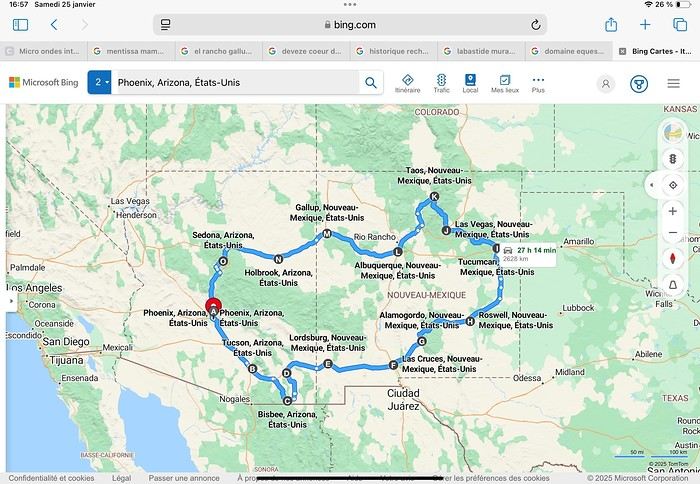
Day 1: Flight Marseille-Paris-Phoenix, then Gold Canyon (133 km) Day 2: Tucson (271 km) Lost Dutchman State Park Day 3: Tucson (155 km) Day 4: Tucson (34 km) Day 5: Bisbee (182 km) Day 6: Lordsburg (345 km) Day 7: Las Cruces (253 km) Day 8: Alamogordo (162 km) Day 9: Roswell (264 km) Day 10: Tucumcari (369 km) Day 11: Las Vegas (281 km) – the one in New Mexico Day 12: Taos (213 km) Day 13: Santa Fe (224 km) Day 14: Albuquerque (123 km) Day 15: Gallup (246 km) Day 16: Holbrook (224 km) Day 17: Flagstaff (179 km) Day 18: Sedona (118 km) Day 19: Sedona (48 km) Day 20: Sedona (41 km) Day 21: Phoenix (256 km) Day 22: Phoenix Airport (35 km)
📊 **Budget**: A little over 7,500 € for both of us, all included. The exchange rate was in our favor (1.17 dollars to 1 €). 📊 **Flights**: Marseille-Paris Charles de Gaulle-Phoenix: 1,787 € for two, with one checked bag each (Air France) 📊 **ESTA**: $42 📊 **America the Beautiful Pass**: $80 📊 **Parking**: 134 € (super eco at Marseille) 📊 **Car rental (Hertz)**: 865 €. Since there were no SUVs left in the reserved category (Nissan Rogue), we got an upgrade (4x4 Ford Explorer). We booked through Air France (15% discount). We’d originally reserved it in December for 1,140 €, but since prices dropped in March, we canceled and rebooked for 865 €. Hertz offers a free Hertz Gold Plus Rewards program, which gives you priority counter service when picking up the car. 📊 **Accommodation**: 2,400 € We stayed in hotels and motels of varying standards (from 60 to 203 € per night, depending on the city), all booked through Booking.com or Hotels.com. Out of 21 nights, only two didn’t include breakfast in the price. Booking.com sometimes offers slightly cheaper rates if you book by phone using the mobile app, and our Genius 3 status on the site also got us some preferential rates. 📊 **Supplementary insurance**: AVA 200 € for medical care if needed 📊 **Cash**: $2,078. We left with 1,000 € exchanged before departure and made two withdrawals of $500. This cash covered: - Evening restaurants and tips - Midday picnics - Gas: $298 for 4,160 km - Museum and private park entries (per person): - Lost Dutchman: $10 - Arizona-Sonora Desert Museum: $28 - Bird Cage Theater: $16 - Tombstone Shootout: $8 - New Mexico Farm & Ranch Museum: $12 - Roswell International UFO Museum: $5 - Billy the Kid Museum: $7 - Rancho de Taos: $22 - West Fork Oak Creek Trail entry: $15 We got a few discounts thanks to our senior age (+65). - Souvenirs and little treats
Like on our previous road trips, we didn’t rent a GPS. We got around using offline GPS apps Here WeGo and Organic Maps, with maps of the states we visited downloaded before we left (on our phones).
❤️❤️❤️ **Highlights** (there are so many!) 📍 Goldfield Ghost Town (even if it’s a reconstruction) 📍 The standing army of Saguaro cacti at Saguaro National Park West 📍 Diving into the cowboy universe of Tombstone 📍 The welcome from Rick and Henry at our guesthouse in Bisbee (Garden at Mile High Ranch) 📍 The tangled rocks of Chiricahua National Monument 📍 The flavored pistachios from Dwayne’s Fresh Jerky and Mac Ginnis Pistachioland 📍 Restaurants: La Posta (Las Cruces), Diner 66 (Albuquerque), and the Haunted Hamburger (Jerome) 📍 The old plazas of New Mexico 📍 The solitude and beauty of the white dunes at White Sands National Park 📍 Stepping back in time at the Billy the Kid Museum (Fort Stanton) 📍 Sections of historic Route 66 and the old motels of Tucumcari, especially at night when all the neon lights are on 📍 Taos Pueblo and diving into Native American culture 📍 After the Rio Grande Bridge, the descent via NM 567 to the very bottom of the Rio Grande Gorge, then the road along the riverbanks to Taos 📍 The tranquility of the Chimayo Sanctuary 📍 Discovering the ingenious native dwellings at Bandelier National Monument and Walnut Canyon National Park 📍 The small towns along the Turquoise Trail 📍 The red rocks of Red Rock Park and the Painted Desert 📍 The extraordinary colors of the petrified trees at Petrified Forest National Park 📍 Sedona, its red rocks, and the reward of the viewpoints at the end of hikes (Devil’s Bridge, The Subway, and West Fork Oak Creek) 📍 The immersion in Mexico when visiting Tlaquepaque 📍 The almost-ghost town of Jerome and its terraced streets 📍 The incredible kindness of Americans, always ready to help and up for a chat ❤️
☹️☹️☹️ **Flops** (there are very few) 📍 Several museums and churches being closed, so we couldn’t visit them 📍 Some museums and visitor centers opening late (10 AM) and closing early (4 PM) 📍 A 64 € phone roaming charge because we got near the Mexican border and picked up their cell tower 📍 The outrageous price ($5.99) for a gallon of gas at the Shell near Phoenix Airport
I hope this helps! Anyway, thanks for reading my long post. Don’t hesitate to reach out, even via PM, if you see I haven’t replied and you’d like more details. Have a great evening, everyone! 🙂
We’re back from our September 2025 road trip, this time to explore Arizona and New Mexico, and it’s time for me to start my travel journal—especially since everything’s already booked for another trip in September 2026 (to California), and I need to get started on the planning.
I was a little worried this new visit to Uncle Sam’s country might not be as "wow" as the others, but we still discovered some incredible places.
For those who don’t know us, we’re a couple in our seventies who speak very little English, but that didn’t stop us from fully enjoying our stay.
For this 6th road trip in the U.S., we spent 21 nights there, drove 4,160 km by car, and walked nearly 160 km in a loop starting from Phoenix.
We’d been to Arizona before (but not this side) and never to New Mexico. This whole road trip was a huge discovery for us.
In the prices mentioned (some in euros, others in dollars), bank fees and exchange charges are included. The flights, car rental, and parking were all paid for in December 2024 when we booked.
We’d downloaded the MPC (Mobile Passport Control) app, but there wasn’t a dedicated line at Phoenix Airport. Still, we got through quickly with friendly, smiling agents.
I don’t drive at all (I hate it), so the stops were chosen based on activities but also, for some, to limit daily mileage for the sole driver. The kilometers listed in the itinerary are the daily distances.
We traveled from September 9th to 22nd, unfortunately once again without our dear friends Mimi and Maumau.
The itinerary
Day 1: Flight Marseille-Paris-Phoenix, then Gold Canyon (133 km) Day 2: Tucson (271 km) Lost Dutchman State Park Day 3: Tucson (155 km) Day 4: Tucson (34 km) Day 5: Bisbee (182 km) Day 6: Lordsburg (345 km) Day 7: Las Cruces (253 km) Day 8: Alamogordo (162 km) Day 9: Roswell (264 km) Day 10: Tucumcari (369 km) Day 11: Las Vegas (281 km) – the one in New Mexico Day 12: Taos (213 km) Day 13: Santa Fe (224 km) Day 14: Albuquerque (123 km) Day 15: Gallup (246 km) Day 16: Holbrook (224 km) Day 17: Flagstaff (179 km) Day 18: Sedona (118 km) Day 19: Sedona (48 km) Day 20: Sedona (41 km) Day 21: Phoenix (256 km) Day 22: Phoenix Airport (35 km)
📊 **Budget**: A little over 7,500 € for both of us, all included. The exchange rate was in our favor (1.17 dollars to 1 €). 📊 **Flights**: Marseille-Paris Charles de Gaulle-Phoenix: 1,787 € for two, with one checked bag each (Air France) 📊 **ESTA**: $42 📊 **America the Beautiful Pass**: $80 📊 **Parking**: 134 € (super eco at Marseille) 📊 **Car rental (Hertz)**: 865 €. Since there were no SUVs left in the reserved category (Nissan Rogue), we got an upgrade (4x4 Ford Explorer). We booked through Air France (15% discount). We’d originally reserved it in December for 1,140 €, but since prices dropped in March, we canceled and rebooked for 865 €. Hertz offers a free Hertz Gold Plus Rewards program, which gives you priority counter service when picking up the car. 📊 **Accommodation**: 2,400 € We stayed in hotels and motels of varying standards (from 60 to 203 € per night, depending on the city), all booked through Booking.com or Hotels.com. Out of 21 nights, only two didn’t include breakfast in the price. Booking.com sometimes offers slightly cheaper rates if you book by phone using the mobile app, and our Genius 3 status on the site also got us some preferential rates. 📊 **Supplementary insurance**: AVA 200 € for medical care if needed 📊 **Cash**: $2,078. We left with 1,000 € exchanged before departure and made two withdrawals of $500. This cash covered: - Evening restaurants and tips - Midday picnics - Gas: $298 for 4,160 km - Museum and private park entries (per person): - Lost Dutchman: $10 - Arizona-Sonora Desert Museum: $28 - Bird Cage Theater: $16 - Tombstone Shootout: $8 - New Mexico Farm & Ranch Museum: $12 - Roswell International UFO Museum: $5 - Billy the Kid Museum: $7 - Rancho de Taos: $22 - West Fork Oak Creek Trail entry: $15 We got a few discounts thanks to our senior age (+65). - Souvenirs and little treats
Like on our previous road trips, we didn’t rent a GPS. We got around using offline GPS apps Here WeGo and Organic Maps, with maps of the states we visited downloaded before we left (on our phones).
❤️❤️❤️ **Highlights** (there are so many!) 📍 Goldfield Ghost Town (even if it’s a reconstruction) 📍 The standing army of Saguaro cacti at Saguaro National Park West 📍 Diving into the cowboy universe of Tombstone 📍 The welcome from Rick and Henry at our guesthouse in Bisbee (Garden at Mile High Ranch) 📍 The tangled rocks of Chiricahua National Monument 📍 The flavored pistachios from Dwayne’s Fresh Jerky and Mac Ginnis Pistachioland 📍 Restaurants: La Posta (Las Cruces), Diner 66 (Albuquerque), and the Haunted Hamburger (Jerome) 📍 The old plazas of New Mexico 📍 The solitude and beauty of the white dunes at White Sands National Park 📍 Stepping back in time at the Billy the Kid Museum (Fort Stanton) 📍 Sections of historic Route 66 and the old motels of Tucumcari, especially at night when all the neon lights are on 📍 Taos Pueblo and diving into Native American culture 📍 After the Rio Grande Bridge, the descent via NM 567 to the very bottom of the Rio Grande Gorge, then the road along the riverbanks to Taos 📍 The tranquility of the Chimayo Sanctuary 📍 Discovering the ingenious native dwellings at Bandelier National Monument and Walnut Canyon National Park 📍 The small towns along the Turquoise Trail 📍 The red rocks of Red Rock Park and the Painted Desert 📍 The extraordinary colors of the petrified trees at Petrified Forest National Park 📍 Sedona, its red rocks, and the reward of the viewpoints at the end of hikes (Devil’s Bridge, The Subway, and West Fork Oak Creek) 📍 The immersion in Mexico when visiting Tlaquepaque 📍 The almost-ghost town of Jerome and its terraced streets 📍 The incredible kindness of Americans, always ready to help and up for a chat ❤️
☹️☹️☹️ **Flops** (there are very few) 📍 Several museums and churches being closed, so we couldn’t visit them 📍 Some museums and visitor centers opening late (10 AM) and closing early (4 PM) 📍 A 64 € phone roaming charge because we got near the Mexican border and picked up their cell tower 📍 The outrageous price ($5.99) for a gallon of gas at the Shell near Phoenix Airport
I hope this helps! Anyway, thanks for reading my long post. Don’t hesitate to reach out, even via PM, if you see I haven’t replied and you’d like more details. Have a great evening, everyone! 🙂
Bonjour à tous,
Je souhaite vous faire partager notre retour d'expérience sur 4 semaines en Mongolie au mois de juillet 2013. Cet avis, qui porte notamment sur l’agence Nomad Planet, se veut le plus objectif possible. Si vous avez des questions, n’hésitez pas, j’essaierai d’y répondre le plus honnêtement possible.
Nous sommes partis avec l'agence Nomad Planet, que nous avions sélectionnée pour différentes raisons : - réactivité des réponses par mail - possibilité de dormir en yourte chez des familles nomades - tarifs relativement compétitifs (par rapport aux agences françaises)
Nous avons opté pour un circuit sur-mesure, avec un chauffeur et un guide anglophone pour notre couple. Le véhicule était un 4*4 Toyota Land Cruiser.
Les premiers bémols ont eu lieu au moment de la préparation du voyage : - l'agence refuse que nous ne partions qu'avec un chauffeur, sans guide. Après tout, pourquoi pas, cela peut être utile d'avoir un interprète et des informations sur le pays… - l'agence a insisté à plusieurs reprises pour que nous réalisions le voyage avec d'autres personnes, pour un prix légèrement inférieur (mais pas tant que ça, ce qui m'a surtout fait penser que leurs marges étaient plus importantes sur de plus grands groupes...)
Budget
2 400 € par personne (hors avion) pour 29 jours en pension complète, avec chauffeur et guide anglophone pour notre couple
Sur l'itinéraire
(+) Itinéraire varié et bien équilibré
(+) Séjours inoubliables chez l'habitant, notamment dans la vallée d'Uush (mais nous n'étions que le 2e groupe de touristes qu'ils recevaient, ceci explique sans doute cela...)
(-) La dernière semaine était de trop : cela ne vaut pas la peine de faire autant de route pour ne passer qu'une journée au lac Khovsgol
(-) Il ne s'agit pas vraiment d'un itinéraire sur-mesure, nous avons passé plusieurs nuits avec d'autres groupes de touristes qui voyageaient avec la même agence. Et du coup, les rencontres avec les Mongols étaient moins faciles.
(-) Les durées indiquées dans le programme étaient parfois un peu fantaisistes. Par exemple, 2-3h de marche étaient en réalité 10 minutes !
(-) Mon ami avait une demande spécifique de pouvoir pêcher en rivière. Des possibilités de pêche avaient été indiquées dans l'itinéraire, mais n'étaient pas réalistes (rivière à plusieurs km du campement par exemple)
Sur la logistique
(+) Voiture 4*4 de bonne qualité et en bon état
(+) Flexibilité de l’agence et de la guide lors de notre arrivée : nos bagages ne sont pas arrivés dans le même avion que nous, nous sommes retournés les chercher plus tard, et pour le 2e bagage, c’est un manager de l’agence qui a été le récupérer pour nous.
(-) Nous avons passé notre première nuit dans une guesthouse à Oulan Bator. Elle était bien située à proximité de la place Sukhbaatar, mais bondée et bruyante. Nous avons donc demandé à en changer pour notre dernière nuit à la fin du voyage, 1 mois plus tard. L’un des managers de l’agence (le frère du patron, nous l’avons appris par la suite), nous a donné son accord. Quelques jours avant la fin du voyage, Munkhe, le patron de Nomad, nous rappelle en nous disant qu’il refuse de changer la guesthouse, qu’il n’y a que lui pour décider d’un tel changement, que l’accord de son frère n’avait pas de valeur. Finalement, nous sommes retournés dans cette guesthouse (pas tellement envie de nous battre pour ça…). Et cette fois-ci, nous nous sommes retrouvés en dortoir et sans petit-déjeuner.
(-) Descriptif du voyage parfois mensonger (selon Munkhe, il s’agit d’un document générique, c’est donc normal que cela ne s’applique pas à chacun des voyages sur mesure…). Par exemple, le descriptif indique le nom d’un hôtel à UB, qu’il y a des douches chez certaines familles nomades, ou que lors des repas, les entrées et desserts ne seront pas toujours possibles (nous n’en n’avons jamais eu). Ce sont certes des détails, mais trompeurs.
(-) Aucune flexibilité sur le déroulement du voyage, ce qui devrait pourtant être l’un des principaux avantages d’un voyage sur mesure. Nous avons ainsi demandé à visiter un musée à UB ou aller voir l’endroit où l’une des familles nomades travaillait (à 10 km de là) , et la guide avait toujours une mauvaise excuse pour refuser (pas le temps, pas assez d’essence…).
(-) Lorsque la guide n’avait pas envie de faire une activité prévue au programme, là encore, elle cherchait des excuses. Par exemple, nous avions une journée à cheval. Nous avons dû parlementer pour la faire, car l’endroit où nous devions aller était trop loin, les chevaux n’étaient pas assez calmes…
(-) La guide disposait d’un peu d’argent pour les menues dépenses. Nous avons cependant dû insister pour qu’elle achète de l’eau minérale (ce qui était prévu au contrat) : elle voulait que nous buvions l’eau des puits ou des rivières. Comme déjà dit plus haut, nous n’avons jamais eu de dessert : nous devions acheter des fruits pour le chauffeur, la guide et nous. En revanche, la caisse de la guide a servi à leur payer confiseries, sodas et cigarettes (pour lesquelles elle demandait des factures non détaillées).
Sur la guide
Comme pour la plupart des agences mongoles, notre guide n’était pas une professionnelle du tourisme, mais une prof d’anglais qui joue la guide pendant ses vacances. C’était plus une facilitatrice qu’une guide (elle nous faisait chauffer l’eau du petit déjeuner, payait les familles…). Bref, elle n’était absolument pas indispensable. Un bon guide de conversation aurait fait tout aussi bien l’affaire.
(+) Sympa et dynamique
(-) Niveau d’anglais très moyen, il était parfois difficile de communiquer
(-) Aucune compétence de guide : ne connaissait pas l’itinéraire (elle devait demander au chauffeur pour savoir où nous étions…), pas de connaissance de l’histoire ou de la culture mongole, ni des monuments/musées visités (heureusement que j’avais le Lonely Planet !). A la question « Arrive-t-on bientôt ? », nous nous amusons à deviner ce qu’elle allait nous répondre au choix parmi : - Oui bientôt - Non, pas tout de suite - Je ne sais pas
(-) Rechigne à faire l’interprète avec les familles. Ils parlaient souvent en mongol entre eux.
(-) Sur les guides « locaux » (cheval…), et malheureusement l’ensemble de la population mongole : pas de notion d’écologie ou de respect de l’environnement. Jettent leurs déchets en pleine nature, les chauffeurs roulent en dehors des traces des véhicules précédents, massacrant les prairies et pâturages.
(-) Passe son temps pendue au téléphone, y compris pendant les repas. Heureusement qu’il y a des zones blanches !
(-) En randonnée, elle marchait toujours loin devant nous. Au point de nous avoir même perdu une fois !
(-) Nous avions une nuit en bivouac, pour laquelle il lui revenait de faire la cuisine. Nous avons mangé… des cup noodles ! (des bolinos asiatiques)
Nous savions bien que nous n’allions pas en Mongolie pour le confort ou la bonne bouffe, mais nous avons tout de même été déçus par les prestations de l’agence. Avec quelques dizaines d’euros supplémentaires sur la durée du séjour, il aurait été possible d’améliorer considérablement les conditions du voyage (achat de fruits et légumes pour changer un peu des pâtes et du riz par exemple). Nous ne savons pas si c’est véritablement lié à l’agence ou à la guide qui détournait l’argent du groupe…
En résumé
Nous ne recommandons pas Nomad Planet, qui facture des prestations élevées pour un service qui ne l’est pas. Il s'agit du voyage le plus cher que nous ayons fait, et l'un des moins satisfaisants. Evidemment, nous n’avons jamais reçu de questionnaire de satisfaction suite à notre voyage…
Je souhaite vous faire partager notre retour d'expérience sur 4 semaines en Mongolie au mois de juillet 2013. Cet avis, qui porte notamment sur l’agence Nomad Planet, se veut le plus objectif possible. Si vous avez des questions, n’hésitez pas, j’essaierai d’y répondre le plus honnêtement possible.
Nous sommes partis avec l'agence Nomad Planet, que nous avions sélectionnée pour différentes raisons : - réactivité des réponses par mail - possibilité de dormir en yourte chez des familles nomades - tarifs relativement compétitifs (par rapport aux agences françaises)
Nous avons opté pour un circuit sur-mesure, avec un chauffeur et un guide anglophone pour notre couple. Le véhicule était un 4*4 Toyota Land Cruiser.
Les premiers bémols ont eu lieu au moment de la préparation du voyage : - l'agence refuse que nous ne partions qu'avec un chauffeur, sans guide. Après tout, pourquoi pas, cela peut être utile d'avoir un interprète et des informations sur le pays… - l'agence a insisté à plusieurs reprises pour que nous réalisions le voyage avec d'autres personnes, pour un prix légèrement inférieur (mais pas tant que ça, ce qui m'a surtout fait penser que leurs marges étaient plus importantes sur de plus grands groupes...)
Budget
2 400 € par personne (hors avion) pour 29 jours en pension complète, avec chauffeur et guide anglophone pour notre couple
Sur l'itinéraire
(+) Itinéraire varié et bien équilibré
(+) Séjours inoubliables chez l'habitant, notamment dans la vallée d'Uush (mais nous n'étions que le 2e groupe de touristes qu'ils recevaient, ceci explique sans doute cela...)
(-) La dernière semaine était de trop : cela ne vaut pas la peine de faire autant de route pour ne passer qu'une journée au lac Khovsgol
(-) Il ne s'agit pas vraiment d'un itinéraire sur-mesure, nous avons passé plusieurs nuits avec d'autres groupes de touristes qui voyageaient avec la même agence. Et du coup, les rencontres avec les Mongols étaient moins faciles.
(-) Les durées indiquées dans le programme étaient parfois un peu fantaisistes. Par exemple, 2-3h de marche étaient en réalité 10 minutes !
(-) Mon ami avait une demande spécifique de pouvoir pêcher en rivière. Des possibilités de pêche avaient été indiquées dans l'itinéraire, mais n'étaient pas réalistes (rivière à plusieurs km du campement par exemple)
Sur la logistique
(+) Voiture 4*4 de bonne qualité et en bon état
(+) Flexibilité de l’agence et de la guide lors de notre arrivée : nos bagages ne sont pas arrivés dans le même avion que nous, nous sommes retournés les chercher plus tard, et pour le 2e bagage, c’est un manager de l’agence qui a été le récupérer pour nous.
(-) Nous avons passé notre première nuit dans une guesthouse à Oulan Bator. Elle était bien située à proximité de la place Sukhbaatar, mais bondée et bruyante. Nous avons donc demandé à en changer pour notre dernière nuit à la fin du voyage, 1 mois plus tard. L’un des managers de l’agence (le frère du patron, nous l’avons appris par la suite), nous a donné son accord. Quelques jours avant la fin du voyage, Munkhe, le patron de Nomad, nous rappelle en nous disant qu’il refuse de changer la guesthouse, qu’il n’y a que lui pour décider d’un tel changement, que l’accord de son frère n’avait pas de valeur. Finalement, nous sommes retournés dans cette guesthouse (pas tellement envie de nous battre pour ça…). Et cette fois-ci, nous nous sommes retrouvés en dortoir et sans petit-déjeuner.
(-) Descriptif du voyage parfois mensonger (selon Munkhe, il s’agit d’un document générique, c’est donc normal que cela ne s’applique pas à chacun des voyages sur mesure…). Par exemple, le descriptif indique le nom d’un hôtel à UB, qu’il y a des douches chez certaines familles nomades, ou que lors des repas, les entrées et desserts ne seront pas toujours possibles (nous n’en n’avons jamais eu). Ce sont certes des détails, mais trompeurs.
(-) Aucune flexibilité sur le déroulement du voyage, ce qui devrait pourtant être l’un des principaux avantages d’un voyage sur mesure. Nous avons ainsi demandé à visiter un musée à UB ou aller voir l’endroit où l’une des familles nomades travaillait (à 10 km de là) , et la guide avait toujours une mauvaise excuse pour refuser (pas le temps, pas assez d’essence…).
(-) Lorsque la guide n’avait pas envie de faire une activité prévue au programme, là encore, elle cherchait des excuses. Par exemple, nous avions une journée à cheval. Nous avons dû parlementer pour la faire, car l’endroit où nous devions aller était trop loin, les chevaux n’étaient pas assez calmes…
(-) La guide disposait d’un peu d’argent pour les menues dépenses. Nous avons cependant dû insister pour qu’elle achète de l’eau minérale (ce qui était prévu au contrat) : elle voulait que nous buvions l’eau des puits ou des rivières. Comme déjà dit plus haut, nous n’avons jamais eu de dessert : nous devions acheter des fruits pour le chauffeur, la guide et nous. En revanche, la caisse de la guide a servi à leur payer confiseries, sodas et cigarettes (pour lesquelles elle demandait des factures non détaillées).
Sur la guide
Comme pour la plupart des agences mongoles, notre guide n’était pas une professionnelle du tourisme, mais une prof d’anglais qui joue la guide pendant ses vacances. C’était plus une facilitatrice qu’une guide (elle nous faisait chauffer l’eau du petit déjeuner, payait les familles…). Bref, elle n’était absolument pas indispensable. Un bon guide de conversation aurait fait tout aussi bien l’affaire.
(+) Sympa et dynamique
(-) Niveau d’anglais très moyen, il était parfois difficile de communiquer
(-) Aucune compétence de guide : ne connaissait pas l’itinéraire (elle devait demander au chauffeur pour savoir où nous étions…), pas de connaissance de l’histoire ou de la culture mongole, ni des monuments/musées visités (heureusement que j’avais le Lonely Planet !). A la question « Arrive-t-on bientôt ? », nous nous amusons à deviner ce qu’elle allait nous répondre au choix parmi : - Oui bientôt - Non, pas tout de suite - Je ne sais pas
(-) Rechigne à faire l’interprète avec les familles. Ils parlaient souvent en mongol entre eux.
(-) Sur les guides « locaux » (cheval…), et malheureusement l’ensemble de la population mongole : pas de notion d’écologie ou de respect de l’environnement. Jettent leurs déchets en pleine nature, les chauffeurs roulent en dehors des traces des véhicules précédents, massacrant les prairies et pâturages.
(-) Passe son temps pendue au téléphone, y compris pendant les repas. Heureusement qu’il y a des zones blanches !
(-) En randonnée, elle marchait toujours loin devant nous. Au point de nous avoir même perdu une fois !
(-) Nous avions une nuit en bivouac, pour laquelle il lui revenait de faire la cuisine. Nous avons mangé… des cup noodles ! (des bolinos asiatiques)
Nous savions bien que nous n’allions pas en Mongolie pour le confort ou la bonne bouffe, mais nous avons tout de même été déçus par les prestations de l’agence. Avec quelques dizaines d’euros supplémentaires sur la durée du séjour, il aurait été possible d’améliorer considérablement les conditions du voyage (achat de fruits et légumes pour changer un peu des pâtes et du riz par exemple). Nous ne savons pas si c’est véritablement lié à l’agence ou à la guide qui détournait l’argent du groupe…
En résumé
Nous ne recommandons pas Nomad Planet, qui facture des prestations élevées pour un service qui ne l’est pas. Il s'agit du voyage le plus cher que nous ayons fait, et l'un des moins satisfaisants. Evidemment, nous n’avons jamais reçu de questionnaire de satisfaction suite à notre voyage…
Hello,
We’ve already traveled to India twice before, but only for two-week stretches (2013, a loop from Mumbai including Hampi, and in 2019, Tamil Nadu). This time, we’re leaving at the end of October for nearly three months of travel—something completely new for us! We’ll arrive in Delhi and depart from Bangalore. Our goal is to explore Northern India and then head down to Kerala, taking a maximum of one flight and prioritizing trains.
Traveling for this long should let us plan longer stops to slow down the pace and fully enjoy our trip...
What are the places you’ve loved with this in mind? I’ve already thought of Gokarna... Do you have any other suggestions, especially in Northern India? Thanks in advance for your tips!
Traveling for this long should let us plan longer stops to slow down the pace and fully enjoy our trip...
What are the places you’ve loved with this in mind? I’ve already thought of Gokarna... Do you have any other suggestions, especially in Northern India? Thanks in advance for your tips!
Hello! 🙂
January 2026 Here we go again for new adventures and the pleasure of sharing them with you here! First of all, I’d like to thank everyone who helped me with the preparations, even with some last-minute improvisations just days before departure. Thanks to Montagnard74, Jojoone1, Songsam, Attila, Dennis2, NadegerFERM, and the authors whose travel journals about Laos inspired me (Montagnard74, Muriel18, Mavietongs...).
In this story, written by Richard and illustrated by me, we’ll tell you about the journey of four friends: Catherine, Richard, Nathalie, and Bruno. A reinvented but overall successful trip, filled with discoveries and surprises, the scents of spices and frangipani flowers, (too) spicy food, sunsets, and... one big mess.
January 2026 Here we go again for new adventures and the pleasure of sharing them with you here! First of all, I’d like to thank everyone who helped me with the preparations, even with some last-minute improvisations just days before departure. Thanks to Montagnard74, Jojoone1, Songsam, Attila, Dennis2, NadegerFERM, and the authors whose travel journals about Laos inspired me (Montagnard74, Muriel18, Mavietongs...).
In this story, written by Richard and illustrated by me, we’ll tell you about the journey of four friends: Catherine, Richard, Nathalie, and Bruno. A reinvented but overall successful trip, filled with discoveries and surprises, the scents of spices and frangipani flowers, (too) spicy food, sunsets, and... one big mess.
Hello everyone!
We're off! After exploring the north, the four friends have now discovered the south. We’re excited to share this new travel journal, dedicated to our little group and our strong friendship, written by Richard and illustrated with Kate’s photos. I’ll chime in from time to time with practical tips.
First of all, a big thank you to everyone on VoyageForum who helped us plan this trip. It would’ve been quite different if we’d just relied on guidebooks.
The itinerary lasted just over 3 weeks: Mahabalipuram, Pondicherry, Thanjavur, the Chettinad region, Madurai, Munnar, Munroe Island, Cochin, and Chennai. We traveled by train, taxi, and private car with a driver, took a domestic flight, and stayed in guesthouses, Airbnb apartments, and hotels. For each of us, including flights, the total budget barely reached 2000 €, and we didn’t hold back—knowing we avoid resorts and love street food and small Indian restaurants.
We're off! After exploring the north, the four friends have now discovered the south. We’re excited to share this new travel journal, dedicated to our little group and our strong friendship, written by Richard and illustrated with Kate’s photos. I’ll chime in from time to time with practical tips.
First of all, a big thank you to everyone on VoyageForum who helped us plan this trip. It would’ve been quite different if we’d just relied on guidebooks.
The itinerary lasted just over 3 weeks: Mahabalipuram, Pondicherry, Thanjavur, the Chettinad region, Madurai, Munnar, Munroe Island, Cochin, and Chennai. We traveled by train, taxi, and private car with a driver, took a domestic flight, and stayed in guesthouses, Airbnb apartments, and hotels. For each of us, including flights, the total budget barely reached 2000 €, and we didn’t hold back—knowing we avoid resorts and love street food and small Indian restaurants.
We did the Langtang trek (hike) from September 10th to 17th, with the first and last days being the trip from Kathmandu and back—so 6 days of actual walking. It’s a fairly well-known trek but certainly not as famous or crowded as those in the Annapurna or Everest regions, which is why we chose it.
In theory, it’s mandatory to have a guide for this trek. In reality, it seems there are ways to bypass the regulations: we met at least two people hiking without a guide—a South Korean, a New Zealander, and possibly also a couple of English women and an American couple, though we’re not sure if they had a guide.
The agency we booked with had told us it was an affordable trek for relatively older people in good shape—which is our case (I’m 72 myself). I have to say upfront that we found it quite challenging, maybe because we didn’t have good weather—it was the end of the monsoon season. To be clear, no matter your fitness level, I’d say doing this trek in the middle of the monsoon season would be suicidal.
Day 1 – Journey from Kathmandu to Syapru Besi
On Monday, September 8th, there had been violent protests in Kathmandu against the government, which had, among other things, blocked access to social media and been accused of nepotism and corruption. There were 19 deaths. The situation was very tense on the day of our departure, Wednesday the 10th. The agency warned us that public transport was very unreliable. So, we decided to take a jeep, at an additional cost of $100 ($160 minus what was already budgeted for the bus).
We left a little before 7 a.m. and it took us a good hour just to reach the outskirts of Kathmandu. Along the way, we saw several houses and vehicles set on fire by protesters.
The road to Syapru Besi is only 120 km, but it’s frankly awful. It’s always narrow, winds through endless mountains, and the shoulders range from bad to confusing to nonexistent. Several sections are just dirt tracks. We didn’t regret opting for the jeep, as we could stop several times at our convenience—if only to let Y (my Thai partner) throw up everything she had. She’d taken her usual motion sickness medication, but the constant turns, accelerations, and braking eventually made her terribly carsick.
In Nuwakot, we stopped for breakfast at a nice little restaurant, Jimbu. It was around 8:30 a.m., and we’d barely covered 60 km. The restaurant has a lovely garden overlooking the Trishuli Ganga, the river flowing down from Syapru Besi. First photo: the river in the bottom right corner, mist and clouds over the mountain on the other side.
An hour later, my second photo: the hills along the Trishuli Ganga. You can see the different crops—lush green rice paddies in the lower right and corn, already yellowed and likely harvested, in the foreground on the left. And of course, the mist and clouds through which you can glimpse the mountain on the other side of the river.
In theory, it’s mandatory to have a guide for this trek. In reality, it seems there are ways to bypass the regulations: we met at least two people hiking without a guide—a South Korean, a New Zealander, and possibly also a couple of English women and an American couple, though we’re not sure if they had a guide.
The agency we booked with had told us it was an affordable trek for relatively older people in good shape—which is our case (I’m 72 myself). I have to say upfront that we found it quite challenging, maybe because we didn’t have good weather—it was the end of the monsoon season. To be clear, no matter your fitness level, I’d say doing this trek in the middle of the monsoon season would be suicidal.
Day 1 – Journey from Kathmandu to Syapru Besi
On Monday, September 8th, there had been violent protests in Kathmandu against the government, which had, among other things, blocked access to social media and been accused of nepotism and corruption. There were 19 deaths. The situation was very tense on the day of our departure, Wednesday the 10th. The agency warned us that public transport was very unreliable. So, we decided to take a jeep, at an additional cost of $100 ($160 minus what was already budgeted for the bus).
We left a little before 7 a.m. and it took us a good hour just to reach the outskirts of Kathmandu. Along the way, we saw several houses and vehicles set on fire by protesters.
The road to Syapru Besi is only 120 km, but it’s frankly awful. It’s always narrow, winds through endless mountains, and the shoulders range from bad to confusing to nonexistent. Several sections are just dirt tracks. We didn’t regret opting for the jeep, as we could stop several times at our convenience—if only to let Y (my Thai partner) throw up everything she had. She’d taken her usual motion sickness medication, but the constant turns, accelerations, and braking eventually made her terribly carsick.
In Nuwakot, we stopped for breakfast at a nice little restaurant, Jimbu. It was around 8:30 a.m., and we’d barely covered 60 km. The restaurant has a lovely garden overlooking the Trishuli Ganga, the river flowing down from Syapru Besi. First photo: the river in the bottom right corner, mist and clouds over the mountain on the other side.
An hour later, my second photo: the hills along the Trishuli Ganga. You can see the different crops—lush green rice paddies in the lower right and corn, already yellowed and likely harvested, in the foreground on the left. And of course, the mist and clouds through which you can glimpse the mountain on the other side of the river.
And we still haven’t seen everything!
Before setting off for new horizons at the end of this year, it’s time for me to share my trip to Cape Verde this summer 2025.
I particularly love these spontaneous trips, and our stay in Cape Verde is one of those because it was only at the beginning of April that we decided on this getaway, which had been catching our eye for a while, given our love for the mountains.
As always—well, when it’s open—I turned to VF, and I want to immediately thank Marie, aka ptitortue, who helped me a lot in planning this trip through her travel journals and our exchanges!
Because Cape Verde is both small and vast! We decided not to rush from one airport to another, to enjoy the places and the people, but also to relax, since the work backlog from being stuck in May (see my previous travel journal 😅) had to be caught up on in June.
So, 4 islands will be our winners from 06/28 to 07/19:
Santiago first for logistical reasons, as round-trip flights from the capital Praia were the cheapest (650 €/person from Lyon via Lisbon with TAP, still!)
São Vicente, because it’s the gateway to the next one but ultimately more than that...
Santo Antão, pretty much the main goal of the trip since Marie (and the photos) had really sold it to me.
And finally, Sal Island, for some rest—a non-negotiable condition for my other half—and we’ll see that I should’ve listened to Marie...
That said, what a chatterbox I am—buckle up, flight attendants at the doors, off we go on new beautiful escapes! (Thanks to Sophie for the easy loan)
Last note for my eager fan club 😏: yes, there will be alcohol—how could there not be in the land of grogue!
It starts here:
https://voyageforum.com/v.f?post=10790234;a=10790234
I particularly love these spontaneous trips, and our stay in Cape Verde is one of those because it was only at the beginning of April that we decided on this getaway, which had been catching our eye for a while, given our love for the mountains.
As always—well, when it’s open—I turned to VF, and I want to immediately thank Marie, aka ptitortue, who helped me a lot in planning this trip through her travel journals and our exchanges!
Because Cape Verde is both small and vast! We decided not to rush from one airport to another, to enjoy the places and the people, but also to relax, since the work backlog from being stuck in May (see my previous travel journal 😅) had to be caught up on in June.
So, 4 islands will be our winners from 06/28 to 07/19:
Santiago first for logistical reasons, as round-trip flights from the capital Praia were the cheapest (650 €/person from Lyon via Lisbon with TAP, still!)
São Vicente, because it’s the gateway to the next one but ultimately more than that...
Santo Antão, pretty much the main goal of the trip since Marie (and the photos) had really sold it to me.
And finally, Sal Island, for some rest—a non-negotiable condition for my other half—and we’ll see that I should’ve listened to Marie...
That said, what a chatterbox I am—buckle up, flight attendants at the doors, off we go on new beautiful escapes! (Thanks to Sophie for the easy loan)
Last note for my eager fan club 😏: yes, there will be alcohol—how could there not be in the land of grogue!
It starts here:
https://voyageforum.com/v.f?post=10790234;a=10790234
hi everyone,
my flight’s all booked (Sept 19–Oct 4), with 1.5 days in Montreal + 1.5 days in Quebec City...
then I’ve got 11 days starting from Quebec City for a road trip—what route do you recommend?
(I’ve seen these stops come up a lot: Parc Omega, Charlevoix, Tadoussac, Bas-Saint-Laurent, Saguenay, Parc de la Gaspésie, Parc Forillon, Mauricie...)
The idea is no more than 2–3 hours of driving per day on average.
I’m traveling solo :-( (if you’re in the area around the same dates, hit me up!)
45 years old, I love sports (so I’m hoping to do hikes, kayaking, and other activities, see whales...discover beautiful landscapes). I’m not sure if there are any events in the area during those dates, but I’d also like to meet some people...
Thanks in advance for your tips!
Hi there,
I'm urgently planning a trip to Tunisia in November, backpacker-style (no agency, no guide or taxi, public transport, youth hostels or small hotels, local restaurants). I'm not interested in the beach, and I like to take my time at archaeological sites and museums (twice as long as the average visitor). I'm aiming for about two weeks, give or take.
First, I'm trying to roughly outline a route/schedule so I can book my flight as soon as possible (no desert in the south this time—I went there years ago and want to stay independent). I’ve sketched out the following itinerary, knowing that apparently, there are quite a few towns without budget-friendly hotels (even on Airbnb), which means I’ll be staying longer where they’re available. Three questions: 1. Does this seem reasonable overall (time spent in each city)? 2. Should I add other cities, maybe in the northwest? 3. For hotels, in November, is it better to scout options on booking sites first, then book on the spot for cheaper rates (no site commission + possible negotiation)? Also, are hotels not listed online and found randomly on-site much cheaper?
ROUGH ITINERARY (order to be confirmed)
TUNIS 5 days (cheap accommodations: 13 or 19 €) 2 days: Medina, souks, Bardo Museum, Royal Mausoleum of Tourbet El Bey, Zitouna Mosque (exterior) 1 day: Sidi Bou Said 1 day: Carthage 1 day: A-R Dougga (bus to Tebersouk 2h + taxi) – pack a picnic + option: hike to Zaghouan (750m+, 10km round trip) – worth it? Doable alone?
KAIROUAN 2 days (very expensive room: 40-50 €!) Great Mosque, Medina, Three Doors Mosque, medieval cemetery, Sidi Sahbi Mosque...
SOUSSE 3 days (room 15 €) 2 days: Medina, archaeological museum, Port El Kantaoui, the Ribat (fortress), Contemporary Art Museum Dar Am Taïeb, Dar Essid (17th-century traditional house) 1 day: A-R El Jem (60km away) + option: 1 day A-R Monastir? Worth it? + option: 1 day A-R Mahdia (or 2 days sleeping there)?
OPTIONS -> Gabes to mix things up? But is it easy to find cheap lodging and get around/visit alone? -> Other sights or stops to sleep: Sfax, El Kef, others? -> Kerkenna Islands (easy accommodation?)
Thanks for your thoughts and opinions on these options. Once I’ve adjusted the duration, I’ll book my tickets for early November! (By the way, do you think I should arrive and depart from two different airports?)
I'm urgently planning a trip to Tunisia in November, backpacker-style (no agency, no guide or taxi, public transport, youth hostels or small hotels, local restaurants). I'm not interested in the beach, and I like to take my time at archaeological sites and museums (twice as long as the average visitor). I'm aiming for about two weeks, give or take.
First, I'm trying to roughly outline a route/schedule so I can book my flight as soon as possible (no desert in the south this time—I went there years ago and want to stay independent). I’ve sketched out the following itinerary, knowing that apparently, there are quite a few towns without budget-friendly hotels (even on Airbnb), which means I’ll be staying longer where they’re available. Three questions: 1. Does this seem reasonable overall (time spent in each city)? 2. Should I add other cities, maybe in the northwest? 3. For hotels, in November, is it better to scout options on booking sites first, then book on the spot for cheaper rates (no site commission + possible negotiation)? Also, are hotels not listed online and found randomly on-site much cheaper?
ROUGH ITINERARY (order to be confirmed)
TUNIS 5 days (cheap accommodations: 13 or 19 €) 2 days: Medina, souks, Bardo Museum, Royal Mausoleum of Tourbet El Bey, Zitouna Mosque (exterior) 1 day: Sidi Bou Said 1 day: Carthage 1 day: A-R Dougga (bus to Tebersouk 2h + taxi) – pack a picnic + option: hike to Zaghouan (750m+, 10km round trip) – worth it? Doable alone?
KAIROUAN 2 days (very expensive room: 40-50 €!) Great Mosque, Medina, Three Doors Mosque, medieval cemetery, Sidi Sahbi Mosque...
SOUSSE 3 days (room 15 €) 2 days: Medina, archaeological museum, Port El Kantaoui, the Ribat (fortress), Contemporary Art Museum Dar Am Taïeb, Dar Essid (17th-century traditional house) 1 day: A-R El Jem (60km away) + option: 1 day A-R Monastir? Worth it? + option: 1 day A-R Mahdia (or 2 days sleeping there)?
OPTIONS -> Gabes to mix things up? But is it easy to find cheap lodging and get around/visit alone? -> Other sights or stops to sleep: Sfax, El Kef, others? -> Kerkenna Islands (easy accommodation?)
Thanks for your thoughts and opinions on these options. Once I’ve adjusted the duration, I’ll book my tickets for early November! (By the way, do you think I should arrive and depart from two different airports?)
Hi everyone,
As promised, here’s my review of the cruise I took from the 5th to the 19th on the MSC Virtuosa.
As you know, I had initially booked a cruise with Mein Schiff departing from Dubai (from Dubai to Cape Town). It was a 22-day cruise. Due to the issues in the Persian Gulf, my cruise was canceled by Mein Schiff.
So, we started looking for a Plan B because we really wanted to go. Especially my wife, who had just had a minor procedure and needed some rest. Since she had already taken time off, she was determined to travel. However, we were looking for an affordable Plan B since we weren’t sure when Mein Schiff or the airline would reimburse us.
While browsing online, I found a 15-day cruise departing from Pointe-à-Pitre (including flights, transfers, the cruise, and drinks) for a price of 1,200 € in a Fantastica balcony cabin. We thought, *Why not?*
I should mention that I’m not usually a big fan of MSC. My last experience with them was post-Covid (I took two cruises, one in 2021 and another in 2022), and it was honestly a disaster. We didn’t want to repeat that, but after talking to Catherine, who told me she was very happy with a short Christmas cruise, we decided to give it a try.
I have to say, I was left speechless. Honestly, the cruise was absolutely perfect. There’s nothing to complain about (or just a few minor details). In terms of service and food, I felt like I was on a premium cruise line. I’d even say MSC has nothing to envy from some of those companies. While premium lines like Holland, Celebrity, and Royal are cutting back on services, I think MSC has made huge improvements. Seriously, I wasn’t expecting this at all. You’ll see what I mean as we chat more.
I won’t do a full review like I usually do because there weren’t many stops: 1. We boarded in Pointe-à-Pitre 2. We stopped in Saint-Martin 3. Then it was a direct crossing to the Azores...
This cruise was really about relaxing, even if it’s not the kind of trip we usually take.
First off, I’m not a big fan of "flight and cruise" packages. I asked if we could leave two days early, but they said it wasn’t possible. We had to take the flight, then the bus, and board the ship directly.
It’s not really my thing, but given the price we paid and since we really wanted to relax, we thought, *Why not?*
Here’s the itinerary:
Boarding in Pointe-à-Pitre Saint-Martin Five days at sea The Azores Four days at sea Hamburg One day at sea Le Havre
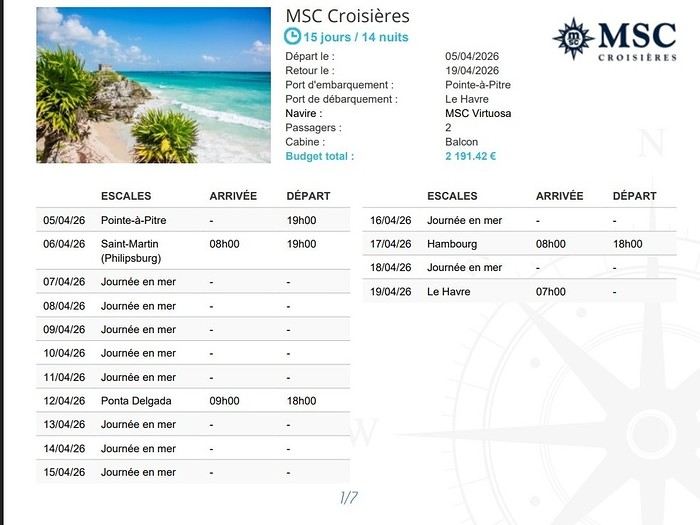
But as I mentioned, it wasn’t about the itinerary. It was really about taking a break and unwinding. Honestly, I came back thrilled.
Departure and boarding details to come
As promised, here’s my review of the cruise I took from the 5th to the 19th on the MSC Virtuosa.
As you know, I had initially booked a cruise with Mein Schiff departing from Dubai (from Dubai to Cape Town). It was a 22-day cruise. Due to the issues in the Persian Gulf, my cruise was canceled by Mein Schiff.
So, we started looking for a Plan B because we really wanted to go. Especially my wife, who had just had a minor procedure and needed some rest. Since she had already taken time off, she was determined to travel. However, we were looking for an affordable Plan B since we weren’t sure when Mein Schiff or the airline would reimburse us.
While browsing online, I found a 15-day cruise departing from Pointe-à-Pitre (including flights, transfers, the cruise, and drinks) for a price of 1,200 € in a Fantastica balcony cabin. We thought, *Why not?*
I should mention that I’m not usually a big fan of MSC. My last experience with them was post-Covid (I took two cruises, one in 2021 and another in 2022), and it was honestly a disaster. We didn’t want to repeat that, but after talking to Catherine, who told me she was very happy with a short Christmas cruise, we decided to give it a try.
I have to say, I was left speechless. Honestly, the cruise was absolutely perfect. There’s nothing to complain about (or just a few minor details). In terms of service and food, I felt like I was on a premium cruise line. I’d even say MSC has nothing to envy from some of those companies. While premium lines like Holland, Celebrity, and Royal are cutting back on services, I think MSC has made huge improvements. Seriously, I wasn’t expecting this at all. You’ll see what I mean as we chat more.
I won’t do a full review like I usually do because there weren’t many stops: 1. We boarded in Pointe-à-Pitre 2. We stopped in Saint-Martin 3. Then it was a direct crossing to the Azores...
This cruise was really about relaxing, even if it’s not the kind of trip we usually take.
First off, I’m not a big fan of "flight and cruise" packages. I asked if we could leave two days early, but they said it wasn’t possible. We had to take the flight, then the bus, and board the ship directly.
It’s not really my thing, but given the price we paid and since we really wanted to relax, we thought, *Why not?*
Here’s the itinerary:
Boarding in Pointe-à-Pitre Saint-Martin Five days at sea The Azores Four days at sea Hamburg One day at sea Le Havre
But as I mentioned, it wasn’t about the itinerary. It was really about taking a break and unwinding. Honestly, I came back thrilled.
Departure and boarding details to come
Hi everyone,
I’m planning a trip to Quebec at the end of June/beginning of July 2026 for 20 days.
We’re a family of 4, with two kids aged 7 and 4 at that time.
I’ve already started drafting our itinerary but I’m open to all suggestions and ideas.
We plan to land in Montreal and stay a few days to recover from the trip.
Here’s my first draft of the itinerary:
-Day 1 to 4: Exploring Montreal:
-Day 5: Sucrerie de la Montagne in Rigaud.
-Day 6/7: Parc Omega (staying in Pods)
-Day 8-10: Saint-Alexis-des-Monts (staying at Pourvoirie du Lac Blanc)
-Day 9/10: Heading toward Lac Saint-Jean: I’m still looking for accommodation halfway to La Tuque. I’ve noticed Pourvoirie du Triton or Domaine Le Bostonnais.
-Day 10/11: Zoo Sauvage de Saint-Félicien: I’m also looking for accommodation near the lake for this stop + visiting Village historique de Val-Jalbert?
-Day 12-13-14: Stop in Sacré-Cœur at Ferme 5 Étoiles. (I also saw the Canopée Lit accommodations in the area—something to consider).
-Day 15-16: Tadoussac: Whale-watching excursion. Should we do it by Zodiac given my kids’ ages?
I’m also looking for accommodation in the area (Hotel Tadoussac is out of budget).
On the way back from Tadoussac to Quebec City, I’m considering an intermediate stop if there’s a spot worth the detour (Malbaie??).
-Day 17-18-19: Exploring Quebec City (Montmorency Falls / Old Town / Wendake).
-Day 20-21: Return to Montreal and flight home.
I’d love recommendations for activities for young kids along this route.
Thanks
Hello everyone! ✌️
I just realized I’ve been registered on VoyageForum since... March 28, 2012 😊. Yet, I’ve barely participated until now.
August 1, 2026, will mark a somewhat special milestone: 5 years on the road.
We left Switzerland on August 1, 2021 with a simple idea: let chance decide our direction. We placed a bottle of wine on a world map, spun it... and it chose our first destination.
A year later, when we arrived in Morocco, we faced a new choice: continue toward Africa or head to Asia. This time, a tarot card game made the decision. Since then, we’ve tried to keep this journey as open to the unexpected as possible.
Today, that adds up to about 120,000 km, 46 countries, and over 1,800 days on the road—mostly by motorcycle, but also by sailboat, train, bus, hitchhiking, or on foot when adventure calls.
Our guiding thread isn’t just the motorcycle, but service exchanges. Instead of simply passing through countries, we try to stop regularly to lend a hand to the people we meet. So far, that’s about 600 days of volunteering.
Over the years, we’ve:
renovated a house in Croatia made earth bricks in the Moroccan desert helped sail a boat through the Greek islands looked after houses, dogs, horses, a camel... and lots of other animals worked at a street art festival in Morocco created videos for local associations and projects worked the grape harvest on the Tibetan plateau been accredited as "media" for the World Nomad Games in Central Asia
Some of the moments that have stuck with us the most include six months in China, a night spent on the Great Wall, the Pamir Highway, the Silk Road, three months in Taiwan, and the incredible encounters in the mountains of Central Asia.
We travel on Falkor, our lucky dragon—a 2014 BMW F800GS that’s been with us since the start and is starting to have some great stories of its own.
While we share our adventure on Instagram, Polarsteps, and YouTube, that’s not why we’re here. The forum’s rules about promotion are clear, and I totally get them. If I’m finally taking the time to write, it’s mostly because after five years on the road, I thought our experience might be useful to other travelers.
Happy to chat about:
preparing for a long motorcycle trip visas and borders the Silk Road and Central Asia riding in China (with or without a motorcycle) volunteering and service exchanges while traveling gear, daily life on the road... or just the unexpected moments that make long-term travel so special
Looking forward to swapping stories and hearing about your adventures too! 😊 Greetings from Thailand, and happy to chat! ✌️
Vincent, Nathalia & Falkor
I just realized I’ve been registered on VoyageForum since... March 28, 2012 😊. Yet, I’ve barely participated until now.
August 1, 2026, will mark a somewhat special milestone: 5 years on the road.
We left Switzerland on August 1, 2021 with a simple idea: let chance decide our direction. We placed a bottle of wine on a world map, spun it... and it chose our first destination.
A year later, when we arrived in Morocco, we faced a new choice: continue toward Africa or head to Asia. This time, a tarot card game made the decision. Since then, we’ve tried to keep this journey as open to the unexpected as possible.
Today, that adds up to about 120,000 km, 46 countries, and over 1,800 days on the road—mostly by motorcycle, but also by sailboat, train, bus, hitchhiking, or on foot when adventure calls.
Our guiding thread isn’t just the motorcycle, but service exchanges. Instead of simply passing through countries, we try to stop regularly to lend a hand to the people we meet. So far, that’s about 600 days of volunteering.
Over the years, we’ve:
renovated a house in Croatia made earth bricks in the Moroccan desert helped sail a boat through the Greek islands looked after houses, dogs, horses, a camel... and lots of other animals worked at a street art festival in Morocco created videos for local associations and projects worked the grape harvest on the Tibetan plateau been accredited as "media" for the World Nomad Games in Central Asia
Some of the moments that have stuck with us the most include six months in China, a night spent on the Great Wall, the Pamir Highway, the Silk Road, three months in Taiwan, and the incredible encounters in the mountains of Central Asia.
We travel on Falkor, our lucky dragon—a 2014 BMW F800GS that’s been with us since the start and is starting to have some great stories of its own.
While we share our adventure on Instagram, Polarsteps, and YouTube, that’s not why we’re here. The forum’s rules about promotion are clear, and I totally get them. If I’m finally taking the time to write, it’s mostly because after five years on the road, I thought our experience might be useful to other travelers.
Happy to chat about:
preparing for a long motorcycle trip visas and borders the Silk Road and Central Asia riding in China (with or without a motorcycle) volunteering and service exchanges while traveling gear, daily life on the road... or just the unexpected moments that make long-term travel so special
Looking forward to swapping stories and hearing about your adventures too! 😊 Greetings from Thailand, and happy to chat! ✌️
Vincent, Nathalia & Falkor
For once, given the destination, the author can’t set aside their religious beliefs, which inevitably shape this kind of journey.
The Trip
Early in the morning at Orly Airport, in the departure lounge for Tel Aviv, a group of about forty young men arrives, all looking identical! The same neatly trimmed beards, the same identical haircuts, the same outfits with a touch of whimsy… The effect of seeing these forty “clones” is striking and raises questions! Why such perfect uniformity among this group of guys? Do they belong to the same family, sports club, cultural association, or religious group? A mystery! At the same time, the waiting area fills up with men who are more expected, given our destination: they wear large felt hats and dress in black suits with white shirts—Hassidim? The ones I’ve glimpsed fleetingly in Paris or New York, who have always been a mystery to me. More discreet-looking women accompany them.
I’m already in Israel without even setting foot there! Plus, I witness the preparations for an improvised show.
The “clones” start a flash mob at seven in the morning in a Paris airport departure lounge! Some pull out musical instruments, others begin singing and dancing. A music with strange, unfamiliar sounds enchants the waiting passengers.
The flight crew finally arrives, cutting through the flash mob, bringing us back to the reality of the moment: waiting to take off soon for this so troubling and mysterious Middle East. We go through passport control, presenting our faces to the scanners that operate the exit gate. The group of “identical” young men gets held up by the system: logically, a scanner let the first one through but blocked the second because of his perfect resemblance to the first. To the machine, the same person shouldn’t be able to cross the border twice? But eventually, the whole group makes it through the glass doors, leaving the Republic behind. My simplistic explanation is left looking ridiculous.
At every new destination, I ask myself countless questions, revealing a certain anxiety tied to the unknown: fear of attacks (one just happened at a bus station in Jerusalem), possible police pressure, unexpected events. Israel isn’t known for being a relaxing destination. In reality, if I did face a serious difficulty in this country, it wasn’t one I had anticipated—and it wasn’t particularly tied to Israel!
I take my seat by the window, which is already occupied by a little girl. Her father, a Hassidic man, politely asks if I’d be willing to give up my seat for his daughter. I tell him I’d be happy to make her happy. Seeing me masked, he asks if I’d like him and his daughter to wear masks too. In response, I take off my mask so as not to impose any constraints on them and wish them a good flight.
It was the first time I’d approached and spoken to a Hassidic man. He didn’t speak the way I might have expected after watching *Rabbi Jacob* with Louis de Funès; he spoke perfectly without an accent, just like you and me! Beware of stereotypes! Throughout the flight, I sneak glances at my strange neighbor: he prayed silently without stopping for a minute. His daughter, as good as gold, never interrupted him. He used several religious accessories during his three-hour continuous prayer: a kippa, a prayer shawl, and a rosary?… I left that plane deeply impressed, me, who has a very distant relationship with my Creator and only prays now and then.
The Trip
Early in the morning at Orly Airport, in the departure lounge for Tel Aviv, a group of about forty young men arrives, all looking identical! The same neatly trimmed beards, the same identical haircuts, the same outfits with a touch of whimsy… The effect of seeing these forty “clones” is striking and raises questions! Why such perfect uniformity among this group of guys? Do they belong to the same family, sports club, cultural association, or religious group? A mystery! At the same time, the waiting area fills up with men who are more expected, given our destination: they wear large felt hats and dress in black suits with white shirts—Hassidim? The ones I’ve glimpsed fleetingly in Paris or New York, who have always been a mystery to me. More discreet-looking women accompany them.
I’m already in Israel without even setting foot there! Plus, I witness the preparations for an improvised show.
The “clones” start a flash mob at seven in the morning in a Paris airport departure lounge! Some pull out musical instruments, others begin singing and dancing. A music with strange, unfamiliar sounds enchants the waiting passengers.
The flight crew finally arrives, cutting through the flash mob, bringing us back to the reality of the moment: waiting to take off soon for this so troubling and mysterious Middle East. We go through passport control, presenting our faces to the scanners that operate the exit gate. The group of “identical” young men gets held up by the system: logically, a scanner let the first one through but blocked the second because of his perfect resemblance to the first. To the machine, the same person shouldn’t be able to cross the border twice? But eventually, the whole group makes it through the glass doors, leaving the Republic behind. My simplistic explanation is left looking ridiculous.
At every new destination, I ask myself countless questions, revealing a certain anxiety tied to the unknown: fear of attacks (one just happened at a bus station in Jerusalem), possible police pressure, unexpected events. Israel isn’t known for being a relaxing destination. In reality, if I did face a serious difficulty in this country, it wasn’t one I had anticipated—and it wasn’t particularly tied to Israel!
I take my seat by the window, which is already occupied by a little girl. Her father, a Hassidic man, politely asks if I’d be willing to give up my seat for his daughter. I tell him I’d be happy to make her happy. Seeing me masked, he asks if I’d like him and his daughter to wear masks too. In response, I take off my mask so as not to impose any constraints on them and wish them a good flight.
It was the first time I’d approached and spoken to a Hassidic man. He didn’t speak the way I might have expected after watching *Rabbi Jacob* with Louis de Funès; he spoke perfectly without an accent, just like you and me! Beware of stereotypes! Throughout the flight, I sneak glances at my strange neighbor: he prayed silently without stopping for a minute. His daughter, as good as gold, never interrupted him. He used several religious accessories during his three-hour continuous prayer: a kippa, a prayer shawl, and a rosary?… I left that plane deeply impressed, me, who has a very distant relationship with my Creator and only prays now and then.
Hi there,
The title might be a bit long, but I hope it’s completely understandable!
When it comes to choosing your next trip, what tips the scales in favor of Eritrea over Ibiza?
Why pick Canada over French Polynesia?
The price? A magazine or TV report, a travel journal, an Instagram ad? Ease of travel? Minimal time difference? The country that has the most in common with all the trip participants? Activities? Relaxation? The desire to push your limits?
A photo?
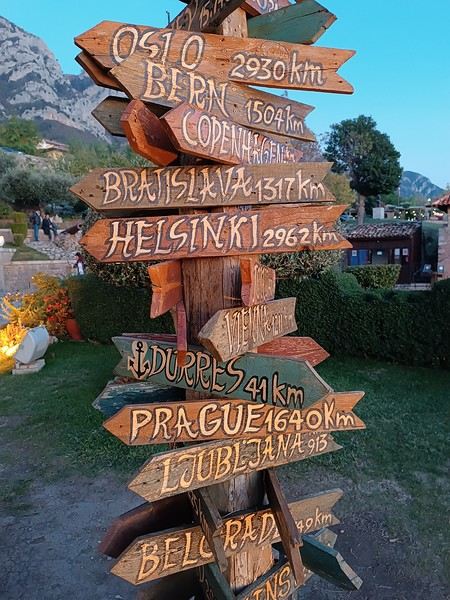
What else, I wonder...
Personally, I often prioritize simple destinations (no administrative hassles), where I’m not at risk (nothing extraordinary like getting kidnapped by Daesh or ending up in a jail cell because the current geopolitics aren’t favorable to my passport, etc.), and where I can drive.
Wide-open natural spaces are more my thing than urban anthills.
Finally, I try not to spend three days on a plane to reach my destination, and I aim for a maximum budget of 3500 € (for 3 weeks) in comfortable conditions—that means charming hotels, good meals, etc.
What about you?🙂
The title might be a bit long, but I hope it’s completely understandable!
When it comes to choosing your next trip, what tips the scales in favor of Eritrea over Ibiza?
Why pick Canada over French Polynesia?
The price? A magazine or TV report, a travel journal, an Instagram ad? Ease of travel? Minimal time difference? The country that has the most in common with all the trip participants? Activities? Relaxation? The desire to push your limits?
A photo?
What else, I wonder...
Personally, I often prioritize simple destinations (no administrative hassles), where I’m not at risk (nothing extraordinary like getting kidnapped by Daesh or ending up in a jail cell because the current geopolitics aren’t favorable to my passport, etc.), and where I can drive.
Wide-open natural spaces are more my thing than urban anthills.
Finally, I try not to spend three days on a plane to reach my destination, and I aim for a maximum budget of 3500 € (for 3 weeks) in comfortable conditions—that means charming hotels, good meals, etc.
What about you?🙂
Bonjour,
J'envisage de faire le tour de l'amérique du sud dans un an, à vélo.
La question du choix de vélo commence à me tarabiscoter le ciboulo. Et au-delà des nombreux sujets de discussions parcourus sur le choix d'un vélo couché ou d'un vélo droit, j'ai quelques questions.
Je me demandais si un vélo couché utilisait d'autres muscles de la jambes ou, plus exactement, si les mollets que me font travailler le vélo droits me seront-ils tout aussi utiles. Dans le cas contraire si les cuisses sont davantage sollicitées sur un vélo couché se pourrait-il que je sois sur un vélo couché moins performant sur la distance, l'endurance ...
Je voulais également savoir s'il était possible de mettre un éclairage avant sur un vélo couché. Et, est ce vraiment pratique ? Peut on suffisamment apercevoir la route éclairée ? Sinon je prendrai un éclairage frontale mais c'est pareil peut-être que les jambes m'empêche de voir.
Enfin, et dans la volée, peut-on mettre un moyeu de dynamo sur l'une des roues. Si oui, j'imagine qu'il se met sur la roue arrière... est ce bien celà ?
Je vous remercie pour vos réponses.
Grégory
J'envisage de faire le tour de l'amérique du sud dans un an, à vélo.
La question du choix de vélo commence à me tarabiscoter le ciboulo. Et au-delà des nombreux sujets de discussions parcourus sur le choix d'un vélo couché ou d'un vélo droit, j'ai quelques questions.
Je me demandais si un vélo couché utilisait d'autres muscles de la jambes ou, plus exactement, si les mollets que me font travailler le vélo droits me seront-ils tout aussi utiles. Dans le cas contraire si les cuisses sont davantage sollicitées sur un vélo couché se pourrait-il que je sois sur un vélo couché moins performant sur la distance, l'endurance ...
Je voulais également savoir s'il était possible de mettre un éclairage avant sur un vélo couché. Et, est ce vraiment pratique ? Peut on suffisamment apercevoir la route éclairée ? Sinon je prendrai un éclairage frontale mais c'est pareil peut-être que les jambes m'empêche de voir.
Enfin, et dans la volée, peut-on mettre un moyeu de dynamo sur l'une des roues. Si oui, j'imagine qu'il se met sur la roue arrière... est ce bien celà ?
Je vous remercie pour vos réponses.
Grégory
Hi there, the Itinérance Festival in Cornimont is coming up fast. Here’s the latest mountain-themed podcast episode talking about the festival.
https://www.resonance-fm.com/podcast/2504%20chronique%20montagne%20festival.MP3
https://www.resonance-fm.com/podcast/2504%20chronique%20montagne%20festival.MP3
Cycling Through Provence's Big Climbs
In the autumn of 2011, Provence was hit by apocalyptic weather—torrential rain and a particularly violent east wind, reaching 130 kilometers per hour, whipping up waves as high as seven meters. It wasn’t the best time to venture outside. Yet, I told myself that after the storm, calm would return. I kept an eye on the weather forecast and noticed that starting November 10th, a favorable window should open for a little 600-kilometer cycling trip across Provence. The weather reports promised a high-pressure system that would keep the bad weather at bay over these highlands. That was all I needed to decide to set off. The planned route would take me through Provence’s biggest climbs: Mont Ventoux, Montagne de Lure, the Verdon Gorge, the Massif des Maures, and Sainte-Baume.
And so, despite my doubts, the call of adventure was stronger. The train pulled away, and once again, a journey began at Part-Dieu station. This time, I headed toward Haute-Provence for a cycling adventure. It would be my first solo bike trip. I was a little nervous—cycling with panniers makes you feel vulnerable to theft. I’d already been robbed while traveling in a group in Peru, and that experience left me deeply shaken. Alone, I hesitated. But no need to panic—I’d read accounts from long-distance cyclists who hadn’t been robbed, even if it does happen sometimes. I was particularly thinking of a young schoolteacher who had taken a sabbatical to cycle around the world. Her students had remarked, "Teacher, you’re not sporty—how will you manage to cycle around the world?" This young woman was full of resourcefulness. In South America, before flying to China, she locked her bike to a post to take care of a natural need. When she returned, the post had been torn out, and her bike—along with all her gear—was gone. It was a shock for many, but not for her. She boarded her flight to the Middle Kingdom, bought the essentials (including a new bike) once there, and continued her journey! Remembering this story, I almost felt ashamed of my cowardice. These were the thoughts running through my mind as the Rhône Valley rolled by toward Orange, the starting point of my Provençal adventure through the big climbs.
Day One: Orange to Sault via Mont Ventoux – 90 km
9:30 AM, I stepped off the train. With all my gear, I had to navigate the underground passage—no easy feat, given that my bike and luggage weighed 35 kilos. At this time of year, I expected some areas to be deserted, so I’d packed enough to bivouac comfortably. Once outside the station, the southern light flooded over me. I understood why people dream of retiring in these sun-drenched regions. As always, after disembarking from public transport, I had to get my bearings and decide which way to go. The sun, still low on the horizon, pointed east. The roar of fighter jet engines helped me locate the Air Base 115. That was all I needed to "reset the gyros."
As soon as I started pedaling, all my apprehensions vanished. The joy of discovery and physical effort took over, and euphoria washed over me. It’s amazing how emotions can shift from one moment to the next based on seemingly minor circumstances.
The weather was splendid—the forecast had predicted continuous showers, but it was completely wrong. I quickly left the city behind. Mont Ventoux loomed mysteriously, its dimensions hard to gauge. It was even more enigmatic with its summit hidden beneath swirling, mottled clouds clinging to the ridges. It reminded me of a great South American volcano. I struggled to imagine that in a few hours, I’d be up there under that blanket of mist.
The countryside was shaking off its autumnal nighttime dampness. The vineyards, interspersed with tall cypress hedges, confirmed I was in the magnificent Côtes du Rhône wine region. The distinctive Dentelles de Montmirail were very much in evidence. The air force base wasn’t far. I passed the runway’s end markers. A Mirage 2000 flew overhead in a tight turn, followed by another roaring into takeoff. It came straight at me before climbing sharply with a thunderous roar. Thirty years spent in that captivating world came rushing back. I recalled countless extraordinary human and technical experiences from my time in the service. But the purpose of this post isn’t to promote the air force—though I might post some articles one day about travels among men at war.
I continued on my way, leaving my past loves behind. As I pedaled, delightful names rolled by: Violès, Vacqueyras, Gigondas, Beaumes-de-Venise—the crème de la crème of the Côtes du Rhône Villages appellation. I let myself be enchanted by the vineyards and the little paths crisscrossing them. I started to doubt my route, though the imposing mass of Mont Ventoux in the distance acted like a giant beacon. At a crossroads, a car appeared. I approached to ask the driver for directions, but she didn’t even look at me and sped off, clearly frightened. I’d almost forgotten what a fearful world we live in, no doubt traumatized by all the horrors we see in the news and on TV.
The kilometers started adding up, but was my day’s goal too ambitious? It had been two months since I’d last ridden my bike. True, my last trip had been good training—the Route des Grandes Alpes—but that was two months ago. I can’t just take my bike out for a day trip; I need that sense of adventure to find the courage to exercise.
Two cyclists overtook me. Intrigued by my load, they struck up a conversation. They were skeptical when I told them I planned to cross Mont Ventoux that day. One of them pointed out a small chapel near the summit where I could bivouac sheltered. That motivated me even more to reach the top on this first stage. The chapel also had a mythical name for me—Sainte-Anne, the name of my parents’ villa. It was already noon, and I’d covered 50 kilometers. Malaucène appeared—the sacred village of Ventoux’s mad cyclists. Surprisingly, I didn’t see any other cyclists today. I remembered this place in June, teeming with aspirants for the king of summits. Before tackling the climb ahead, I needed to refuel. I enjoyed a pleasant gastronomic break at Max’s. At 1 PM, I started the most famous climb in cycling—21 kilometers, which would actually be 23. I knew it would be tough, especially with two handicaps: 50 kilometers already in my legs and 20 kilos of luggage. But I was counting on my tiny chainring, which let me climb trees to tackle the steep ramps.
I set off at a brisk pace along a deserted road. My speed held up for the first few kilometers. I quickly rose above the valley, the horizon widening. I was surprised to see no one on this world-renowned route among cycling enthusiasts. During the climb and descent, I’d only see five cyclists—but I’ll come back to that. I passed a sign explaining that the effort would be roughly equivalent to climbing the Col de la Bonnette. Having done the latter in September, I figured I’d be fine. I crossed paths with my first cyclist—a woman speeding downhill. After 12 kilometers, I hit slopes averaging 12%. I don’t know if the number 12 is cursed, but I got such a "bamboo" hit that I’d never experienced before. I thought I wouldn’t make it to the summit today. I stopped. My thighs burned so much I could barely walk—lactic acid overload. I looked for a relatively flat spot to pitch my tent. It was 3:30 PM, with two hours of daylight left. But I found nothing.
I got back on my bike, intending to stop as soon as I found a good bivouac spot. But nothing came up. However, my strength slowly returned, perhaps because the slope eased, though it remained around 10%. I entered the summit mists. A cyclist overtook me. I was in the zone where I had to pass the summit. Dusk caught me in the final difficulties. The atmosphere was downright austere. In the twilight, a kilometer from the summit, a cyclist was fixing his bike. I asked if he needed help. He made it clear he didn’t understand. So I asked, "Do you need some help?" His answer was clear: "No, thank you." He showed me his new inner tube. Inside, I thought, "Phew!" If I’d had to stop, sweating in the falling night with the cold intensifying, I’d have struggled to get going again. But he managed, and I continued into the twilight fog. I could barely make out the summit’s large antennas in the clouds, like immense ghosts trying to evade sight. The bike delivered sensations worthy of mountain racing. My goal was to quickly find the famous chapel in the descent to take shelter. As I glided down the southern slope, two cyclists without lights crossed my path in the night—probably heading to the station above, its lights visible in the fog.
I scanned the roadside in the dark for the chapel but saw nothing. After a kilometer or two, I lost all hope. I stopped to put on more clothes as the cold became intense. I had no idea where I could stop on these steep slopes to set up camp. Between the swirls of mist, I could intermittently see the Rhône Valley below, dotted with illuminated towns and villages. The sight was striking. What was I doing on this mountain at night? Then the miracle happened—the clouds parted, and from the ridge above me to the east, a beautiful full moon emerged, casting enough light to consider a nighttime descent to Sault, 26 kilometers away.
In this eerie atmosphere between the moon’s pale rays and patches of fog, I began my descent through a hazy, almost unreal world. The Ventoux’s characteristic white scree reflected the moonlight faintly, dimmed by the mist. In places, entire mountainsides were plunged into complete darkness, and I lost all sense of the road’s path. Then, around a tight bend caused by a land shift, the light returned. It seemed extreme compared to the darkness I’d left behind. I could once again clearly see the road’s contours, though not its potholes or gravel patches. Still, I let the slope carry me, and the speed felt significant, though the low light prevented me from reading my speedometer. In these moments, concentration was at its peak—all senses alert, reflexes ready to react to the slightest incident that could lead to a fall.
I was relieved to see Sault’s lights growing closer. In less than an hour, I reached it, considering the final little climb that required one last push. This village, bustling in summer, was deserted at this time of year—almost dead. The first hotel I came across was closed. A quick shadow passed in a small sloping street. Before it disappeared into the darkness at a house corner, I chased after it and asked about accommodation options. Very kindly, I was directed to what was probably the only hotel open in November. I quickly found it, and the reception was open. I entered wearing my black balaclava, bought in the Ayacucho region—the birthplace of Peru’s Shining Path. At this late hour, I saw questioning glances directed at me. I prefaced, "This isn’t a hold-up." Clearly, the owners had a sense of humor—they started smiling. I took off my balaclava and asked for a room. No problem, and from that moment, the pressure eased. I really didn’t feel like going back out to find a spot to pitch my tent in the biting cold.
The stage had been nearly 100 kilometers, and it was the first. It had been two months since I’d touched my bike, and I probably lacked even minimal training, even though my last bike trip had been crossing the French Alps. I really had to dig deep to overcome my weakness on Ventoux’s steep section. I don’t remember ever having to search so deeply for the energy to keep going. I knew the stage I’d set for tomorrow was significant, with the climb up Montagne de Lure’s northern slope—Ventoux’s little sister, whose ascent is reputed to be endless, over 25 kilometers. I hoped this first day wouldn’t leave me too sore to avoid suffering excessively tomorrow.
For now, relaxation—a hot shower did me a world of good, followed by a good meal. I ate a delicious andouillette from Troyes, very fine, with a particularly successful herb seasoning. I loved it, and yet I’m from Lyon and pride myself on knowing a thing or two about andouillette—not just a sausage but a whole category! A bit chauvinistic, I had to admit, though reluctantly, that I found it better than the ones I usually eat in the Lyon region!
Day Two: Sault to Forcalquier via Montagne de Lure – 116 km
This morning, the weather was magnificent—the air clear, still, very fresh, and invigorating, as only the late season can offer on these Provençal highlands. In summer, they’re known for their scorching heat and drought, but often overlooked is how harsh they can be with cold and storms. Authors like Giono or Bosco described them and their inhabitants wonderfully in books like "Les Âmes Fortes."
The miracle of the night had worked. I wasn’t sore anywhere and felt in great shape. I set off well-equipped, but the effort and sun soon made me sweat. It was time to shed some layers—hat and gloves. A gentle warmth replaced the cold, making for excellent cycling conditions. On the road to Trinit, there was no traffic—only the occasional hunters’ cars parked in the distance. These vehicles were recognizable by their large cages, used to transport hunting dogs. Sometimes, the silence was broken by a distant gunshot. The deciduous forests were losing their foliage, taking on that dull brown hue of late autumn, though here and there, a tree or shrub still resisted, displaying vivid yellow or red. The meadows, their grass already scorched by the cold, were damp from the night’s heavy humidity. The low sun highlighted thousands of spider webs that had trapped insects during the warm season.
Behind me, Mont Ventoux dominated these vast spaces. As often, its imposing, stony summit was crowned with a blanket of clouds. What an impressive mountain—it’s always so hard to gauge its dimensions. I struggled to realize that last night I’d been at the summit and descended its immense southern ridge in the dark. I hoped to return one day in favorable conditions—daylight and no clouds—to enjoy the vast panorama from this unique summit.
Leaving the very Provençal village of Trinit, I tackled my first climb of the day—the Col de l’Homme Mort. The road rose moderately for five kilometers in gentle warmth. The view over the region widened, and I felt the sheer joy of pedaling. At a good pace, I overcame this first little challenge. Once at the pass, I couldn’t resist the ritual of photographing my bike in front of the sign, giving the name and altitude—1,213 meters.
The northern slope was austere and still in shadow. The cold bit again. The road was wet and covered with leaves in places. It wasn’t impossible that some treacherous patches of black ice lurked around a bend. I descended toward the Jabron Valley with caution. Suddenly, around a bend in a forest clearing, the freshly snow-covered Alps, gleaming in the sun, leapt into view, blocking the horizon. I thought I recognized the distinctive silhouette of the Écrins’ south face above a multitude of jagged peaks.
This snow and these mountains awakened a flood of memories of great joys, but I also thought of the guide and his client who had just lost their lives on the Grandes Jorasses’ north face, at the top of a route called the Linceul. The name comes from the face’s appearance—a great ice slope bordering the Grandes Jorasses’ north wall. It was first climbed by René Desmaison in 1968. He passed away a few years ago and, in his final wishes, asked that his ashes be scattered in the Dévoluy Massif at the foot of Pic de Bure, not far from here in these immense pre-Alpine folds.
At my feet, the Jabron Valley stretched almost endlessly east toward Sisteron. In the distance, the dark mass of Montagne de Lure’s north face loomed. This mountain shares similarities with Mont Ventoux. It has the same summit scree of bright limestone, the same forests climbing up to the final rocky stretch, and that blanket of clouds adding a secretive, austere touch to the scene.
I turned left past the town of Séderon and headed toward the little Col de la Pigière, which in a few kilometers allowed me to truly plunge into the beautiful Jabron Valley. I passed through several villages with charming local names—Saint-Vincent, Noyer-sur-Jabron. The river offered lovely views of its narrow gorges with clear, cold water. Autumn seemed less advanced here than on the plateau I’d just left. Many trees still wore brilliant colors, some revealing extraordinary hues—mixes of crimson, pink, and bright red.
Arriving in Noyer-sur-Jabron, I took a tiny road on the river’s right bank, leading in a few kilometers to the foot of Montagne de Lure. In the village of Valbelle, I picnicked on leftovers I’d brought from home—an old cheese and a somewhat stale loaf of bread. It was 1:30 PM. I began the long climb of about 25 kilometers. According to a friend who’s a cycling expert in the region, this section is tough. No wonder it’s called Ventoux’s little sister—the Mont Blanc of cyclists. The elevation gain on this side is still 1,200 meters, while Ventoux via Malaucène is nearly 1,600 meters.
I hoped to reach the summit before nightfall and avoid reliving a nighttime descent. The route wound through a vast forest, following the terrain’s folds. There was activity—mushroom hunters were busy searching for the coveted chanterelle. The climb, though never very steep (only one kilometer at 9%), was interminable. Though traffic was practically nonexistent, I was overtaken by a group of Harley bikers—I counted about forty. Perched high on their machines, hands in the air on wildly shaped handlebars, some with their feet nearly in the sky due to the high footpegs, they didn’t even glance my way. What’s this idiot doing, unable to ride a motorcycle and forced to climb these mountains on a bike with big bags! I wasn’t offended—real Harley purists often see other motorcyclists as renegades, so bikes are even lower on the totem pole! But I didn’t want to start a debate about motorcycles. In my youth, when I was a wild motorcyclist (22 accidents on two wheels), clans were divided into Japanese, German, Italian, and British bike owners. The latter, on their vibrating, oil-leaking machines, considered themselves the purest. But let’s not fight—there’s a statute of limitations, and it’s been nearly forty years.
As yesterday, a few kilometers below the summit, I entered the fog, and the light dropped suddenly. What a hostile mountain in these conditions! It heightened the sense of living an incredible experience. The conditions we encounter play a major role in how the adventure imprints on our memory. I realized once again that in France, you can feel like you’re very far away. Finally, after this very long climb, the Pas de Graille sign suddenly appeared out of the grayness. Strange! Below the sign, a kilometer marker indicated this same pass was over three kilometers away. Clearly, the climb continued. In these final kilometers through the scree, I gained another 130 meters of elevation. Finally, the road’s high point was reached—1,720 meters. It was cold and damp. I quickly covered up, added my balaclava under my helmet, and put on warm gloves. As I was about to start the descent, a car stopped at the summit, and one of the passengers was surprised to find a bike there in these chilly, twilight conditions.
A 20-kilometer descent led me to the village of Saint-Étienne-les-Orgues. I hoped to find a place to stay for the night. No such luck! Everything was clearly closed—no chance of finding shelter. Tonight was getting complicated. I already had exactly 100 kilometers in my legs and didn’t feel like pedaling anymore, especially at night. But I had even less desire to sleep outside. What to do to avoid it? The town of Forcalquier was 16 kilometers away—I hoped the road would descend. I set off in that direction. The first third was along a beautiful, lightly trafficked departmental road with a slight downhill—I pedaled hard. But it got tougher. I joined a busier road, and night had fallen. A several-kilometer climb finished the journey. I knew my magnetic lights weren’t very powerful—hence the danger. They were even less so on the climb because the slower I went, the less they illuminated. Cars coming the opposite way often saw me late and blinded me with their high beams. After passing, I was plunged into total darkness for a few seconds while my pupils readjusted to the night. I imagined those coming up behind me saw me with little warning, despite my slightly fluorescent jacket. When the roadside was clear, I always positioned myself to quickly jump off the road. But unfortunately, in this long final climb, a guardrail prevented any escape to the right in case of sudden braking behind me. That was even more anxiety-inducing since I was stuck at a snail’s pace. Time seemed long. I pedaled as hard as I could, on the verge of asphyxiation, trying to escape this dangerous situation as quickly as possible. My only reference point was the vehicles in front of me, letting me know the climb wasn’t over. Then suddenly, the ordeal ended—the road’s high point was reached. The town and its lights emerged from the void, and clarity returned. Phew! I glided down toward this little town bathed in light. On November 11th, I hoped to find an open hotel since I’d clearly exceeded 100 kilometers, and the idea of having to leave town to find a bivouac spot somewhat frightened me.
I arrived in the town center. Activity was low. The first hotel was closed, but I spotted a lit sign for another establishment further on. I headed there, got off my bike, and entered. The welcome was immediately friendly—a big cat came to rub against me. For me, that was a very good sign, and the first impression was confirmed. I still had to go out to eat. I covered the minimum distance. A restaurant advertised "Mom’s Cooking." I expected Provençal specialties, but they were Moroccan. I chose a delicious tagine with lime and olives, followed by almond and honey ice cream. Exhausted after this 116-kilometer stage, I returned to my room. As often after intense efforts, it was hard to fall asleep.
Day Three: Forcalquier to Moustiers-Sainte-Marie – 58 km
On this third day, due to the progress made yesterday, the stage would be short. I’d call it a transition between two mountain ranges. Indeed, the next big climb is the Verdon Gorge. I planned to position myself at its foot this evening in preparation for a tough stage tomorrow. I made a few purchases—bread, bananas, and medicine for stomach burns (the midday sausage wasn’t always kind to me). The weather was still perfect. The route began with a long descent toward the Durance. It’s always nice to start a cycling day with a downhill—it boosts morale and allows for a gentle warm-up.
I quickly reached the town of Oraison. Just at its entrance, I crossed the Durance, which still bore traces of last week’s heavy rains along its sandbanks. Indeed, numerous stumps and trunks were scattered along its vast gravel bed, along with less ecological debris like old tires.
A little south of Oraison, I took the D907, a small road heading due east between scrubland and meadows. There it was—the Provence we imagine. This stable autumn weather, with still air, neither hot nor cold, just a fresh feeling when emerging from a shaded valley or a slight warmth under the sun, was ideal for a cyclist. After about ten kilometers at the bottom of a small valley I quickly passed through, the village of Le Brunet appeared on the right. It clung to the slopes leading to the Valensole Plateau. A few steep kilometers along a tiny winding road, and suddenly a vast panorama unfolded as the climb ended.
What a magnificent plateau! Though known for its wind, luckily today was completely calm. Far to the east, the Verdon’s great cliffs blocked the horizon. This allowed me to contemplate part of tomorrow’s stage. This place is full of mysteries—many UFO and extraterrestrial encounter stories are associated with it. Moreover, for about thirty years, France hid its ground-to-ground nuclear ballistic missiles here, grouped in the 1st GMS (Ballistic Missile Group), under the air force. Naturally, these rockets fueled fantasies, and pacifist groups settled in the region to protest this type of armament. This gives many reasons to shroud this austere, deserted land in mystery.
I took a dirt path leading to the heart of this zone and stopped at the forest’s edge for lunch. The silence was total, the view stretched very far. But nothing strange or bizarre manifested. No Martian came to share my frankly moldy cheese, very peppery sausage, or bruised banana—sniff! I resumed my route, and as often when crossing places with strong character, I tended to slow down to enjoy them longer. The immense lavender fields stretched endlessly, not very fragrant at this season. I arrived at a group of truffle oaks protected by a fence, with large red signs warning "Firearm." Clearly, the war for the black diamond was raging in this region. I remembered a novel where an old farmer made buyers believe nothing grew on his land. Every year, he secretly stole the mushrooms from the unsuspecting owners. Then one day, they discovered the truth, catching this "polite" neighbor trying to hide a basket full of beautiful, large truffles!
In these vast spaces, I felt good—a sense of plenitude. It’s strange that I only conceive of cycling through wandering. I struggle to plan a day trip. And if I do, it’s highly likely I won’t get up. I need that sense of adventure to fully appreciate my physical effort. Maybe one day I should get psychoanalyzed, but at my age, it’s probably too late! Today, I had all the time in the world—the stage was half as long as yesterday’s, with very little elevation gain. Not a sound, an impressive calm, a beautiful landscape—I pedaled in a wonderful place. That’s probably happiness!
I reached the village of Puimoisson on the plateau’s eastern edge—only 12 kilometers left to Moustiers. I took my time, sat at a café terrace in the sun, and leisurely enjoyed a coffee while listening to the village come to life. I was delighted by these melodious southern voices, bursting into great laughter. There are places where, despite the anxieties caused by our debt-ridden, dysfunctional societies, some have decided to take life on the bright side and show a saving insouciance.
The rest of the journey was a simple formality—I let the slope carry me toward the pretty little town of Moustiers-Sainte-Marie, clinging to the cliff and famous for its faïence. Arriving early for once, I went to the tourist office to choose a comfortable hotel. Indeed, the Hôtel des Restanques was very comfortable and admirably well-located. But at this time of year, I’d have to return to the village center for dinner. The very kind receptionist reserved a table for me at La Treille Muscate, a restaurant with a magnificently arranged room on the church square. It was only 3:30 PM—I continued to take my time, showering and relaxing in front of the TV. Then I set off to explore—or rather, re-explore—this village I’d visited several times before. But I’d never climbed to its chapel perched in the middle of the great cliff towering over the houses. A stony, aerial path led there. The first mentions of the Notre-Dame de Beauvoir chapel, known in ancient times as Notre-Dame d’Entre-Roches, date back to the 9th century. It’s one of the rare "respite" chapels found in Provence. These are chapels where stillborn children were brought to be revived for a few moments, just long enough to baptize them. They could then be buried religiously, ensuring the salvation of their souls. I was also very moved by reading some ex-votos, like the one from "A mother for her three children returned from the war."
The place was impressive, especially as night fell. I was alone and watched the shadows fill the great cliffs above me. With an old climber’s reflex, I looked for possible climbing routes among these slabs and cracks. But climbing is probably forbidden here, too close to the houses. Then I descended to stroll through the village, admiring the magnificent, finely crafted faïence patterns found in many shops. Finally, dinnertime arrived, and I joined my restaurant, which had been highly recommended. I was delighted by the foie gras ravioli and the pieds et paquets—the chef’s specialty. I’ll come back with family.
Day Four: Moustiers to Fréjus via the Verdon – 122 km
A hearty breakfast prepared me for the day’s tough efforts. Next to me, four Chinese people chatted animatedly. Of course, I didn’t understand a word—it was a language with strange intonations and sounds. I left the dining room and prepared my bike on the terrace. Seeing the volume of my luggage, my Chinese friends rushed over and asked to take turns having their photo taken in front of this funny setup. All laughing, they took photos in front of what they probably considered a French coolie off on some trading business! When they show these photos to their relatives, they’ll likely be perplexed about what motivates some to travel by bike rather than car. For them, the car is a symbol of success—according to an article I read last year, 14,000 cars are registered in China every day!
This morning, the air was fresh. As yesterday, I started with a long descent, this time leading to the edge of Lac de Sainte-Croix. A strong, biting headwind slowed me down. It wouldn’t last, as it was generated by the gorge’s outlet, which I’d reach in a few kilometers. On this cold morning, the lake’s shores exuded great tranquility. The sun was still hidden behind the Verdon’s mountainous mass. Trees with yellow leaves stood out against the water’s pale blue. The bridge marking the gorge’s beginning at the lake’s edge was an ideal spot to admire this natural splendor. At this early hour, the play of light and shadow on the water and the immense cliffs delivered a grandiose spectacle in beautiful harmony. This first contact with the gorges, which I knew well, amazed me.
Once past the bridge, the wind calmed. A little further on, I began the long climb that would take me to the top of this immense natural gash, which water had taken millions of years to carve. I was in good shape and highly motivated by the splendors to come. First, I reached the village of Aiguines, which offered a magnificent viewpoint over the lake. Then I continued toward the Corniche Sublime, where countless breathtaking panoramas unfolded as I progressed. But the climb was sustained and long, requiring effort—though my small chainring worked miracles. I first passed the Col d’Illoire, already 500 meters above the lake. Seeing all these great cliffs, countless climbing memories came flooding back. The classic routes of the Escalès cliff, over 300 meters high, flashed by. Routes with legendary names—La Demande, Les Écureuils, Luna-Bong, and many others. The one that left me with the best memory was ULA—a crack, vertical or even overhanging, of sheer beauty rising above a 40-meter slab in one go for 280 meters of sustained, beautiful climbing on extraordinary rock. It made me want to return to climb there, to immerse myself in the atmosphere of those past times. But climbing habits have changed—now routes are accessed from above by rappel, and people don’t always bother to do these great climbs in their entirety, focusing instead on shorter but technically much more difficult enterprises.
At almost every bend, I stopped and scanned these great cliffs, searching for memories of past experiences and emotions in these secret rock folds. The road climbed well above the pass, exceeding 1,200 meters. It was cool, especially since I was sweating. Finally reaching the high point of the Corniche Sublime, I couldn’t gain speed on the descent—my gaze was always drawn to this astonishing canyon. Around a bend, two cyclists with funny small-wheeled bikes. Wow! It was a couple of Australians doing a year-long tour of France. We chatted passionately about our two-wheeled experiences for a moment. But time was passing, and if I wanted to reach Fréjus before nightfall, I’d have to pedal seriously.
I stopped at the Pont de l’Artuby, where bungee jumping was in full swing. But I quickly set off again toward Comps. The wind was against me, and it was climbing. I started to doubt whether I’d make it to the coast that evening. At 2 PM, I was in Comps-sur-Artuby. I didn’t stop, knowing that before reaching the coast, I’d have no alternative to bivouacking, and I had 70 kilometers left to cover. Sure, it should be downhill, but a few climbs were on the program. After a descent out of the village, I crossed the Artuby River again on the Canjuers military camp. A several-kilometer climb followed, fortunately not too steep. I took the D19 toward Barjols. From there, despite the late hour, I opted for a tiny road passing through Claviers, a small perched village. Time passed quickly, but the kilometers added up. I regained hope. Fifteen kilometers after this last village, I reached Saint-Paul-en-Forêt via a magnificent forested route. I had plenty of time to observe mushroom hunters. I asked one who clearly had some in a plastic bag. He gave me this hilarious answer with a magnificent southern accent: "I only picked the bad ones." No reply was possible. I moved on with a smile. A little further on, another hunter carried a basket. As soon as he saw me, he quickly hid it—just in case I saw what it contained. Arriving at the village involved a steep climb, and I was close to 100 kilometers. I still had a little over 20 kilometers to go before reaching Fréjus. The race against nightfall had begun. Over there to my right, I saw the sun setting behind Roquebrune-sur-Argens’ distinctive rock. The sea appeared. There it was—I was in Fréjus’ industrial zone. On this Sunday evening, traffic was heavy. Indeed, many had taken advantage of the return of good weather after very heavy storms to go for a walk. After quite a few detours, I arrived at the seaside just as night fell. My odometer showed 122 km for the day. I quickly found a simple hotel, ate just as quickly, and went to bed.
Day Five: Fréjus to Solliès-Pont – 92 km
Once again, the night had done its restorative work, and I prepared to cross the Massif des Maures feeling quite fresh. The weather forecast was still favorable for today, but a deterioration was expected tomorrow. I tended to trust it because the east wind was blowing, and in the region, that’s a sign of rain. For now, in the short term, this wind would be very useful—it would push me generously throughout the day.
I started calmly along the harbor quays, looking at the boats. Then I joined the road to Saint-Aygulf and followed the coast for forty kilometers to Port-Grimaud. All these seaside resorts—Saint-Aygulf, Les Issambres, Sainte-Maxime—reminded me of my youth when we spent all our vacations fishing, whether from shore, underwater, or by boat. Looking at the sea roll by, I knew what the seabeds looked like under that surface hiding them. The marine areas we knew best were now under the parking lots and commercial zones of Saint-Raphaël’s new port. In our youth, these infrastructures didn’t exist, and their construction came at the expense of coastal marine areas. Our wonderful fishing spots were permanently buried. I remember seeing the first big trucks that came to dump their loads of earth and rubble, destroying all those wonderful places—sandbanks, seaweed beds, groups of rocky holes teeming with fish that enchanted our youth. Over forty years later, I can still visualize them in my imagination under those parking lots and stores, with the names we gave them—my brothers and I: le casse-croûte, le casse-pipe, les montagnes, la digue, la grille, la mare à mulets, la petite-plage, le trou, etc.
Let’s not be overwhelmed by nostalgia. I left the coast and took the little road through the Maures to Collobrières. The route led from ridge to ridge following the terrain’s movements. At this time of year, the region was admirable. Due to the heavy storms of recent weeks, water was streaming everywhere. Waterfalls and streams murmured all along the way. I didn’t recognize the Maures, which I knew for their dryness causing apocalyptic fires. Indeed, around a bend, I came across a small rest area where a memorial had been erected for three firefighters who lost their lives here while fighting one of those gigantic fires fanned by the mistral.
This forest holds treasures—first, the cork oak, then the arbutus, chestnut trees, and of course, mushrooms that love this granitic soil:
The cork oak can be found all along the road. It’s the forest’s essential element. You can recognize it by its light bark (before exploitation), which forms large bulges along the trunk. But after exploitation, the trunks are much smoother, less voluminous, and dark in color. The arbutus is a large berry with red skin covered in small protuberances, growing on the arbutus tree. This fruit, common in Mediterranean areas, ripens in November. That means today, there were plenty around me. Its flesh is orange, with the consistency of firm purée, and it crushes softly in the mouth. The taste of this berry is sweet and excellent. I didn’t hold back—I gorged myself on them, which served as my midday meal. Sometimes I had to climb embankments to get them.
The chestnut tree, a true industry of the region, brings wealth to the surrounding villages. They make candied chestnuts, ice cream, and other products derived from chestnut flour. Be careful not to stop just anywhere to pick this fruit, as the tree owners might not agree. They even make this clear with signs and surround their chestnut trees with fences. Mushrooms—saffron milk caps and porcini—are highly prized in the area. I saw a few hunters, but it clearly wasn’t miraculous. Supposedly, there had been too much rain?
There’s no time to get bored along this little road, from which you can sometimes see the sea. I passed the Col de Taillude at over 400 meters. I began the descent to Collobrières, the chestnut capital, whose festival attracts many people. Before entering, about a hundred meters from the first houses, a cyclist—probably an agricultural worker—came toward me. As he passed, he cheerfully called out, "Go on, little guy! It’s almost there!" We both smiled. At the end of November, the village was cold and almost deserted. Dead leaves swept the wet streets of the town. You could feel winter on the way. I continued my route to Pierrefeu-du-Var, on the western edge of the Massif des Maures. So I gave my last pedal strokes in this pretty little massif so characteristic of Provence.
I looked for a hotel in Cuers but without success. I descended toward Toulon and finally found one on the outskirts of Solliès-Pont. It catered to people coming to work in the region, so nothing very bucolic. But if the weather were to deteriorate tomorrow and turn to rain, I could quickly reach Hyères or Toulon station, which was a significant advantage. Indeed, November rains aren’t usually very pleasant on a bike.
Day Six: Solliès-Pont to Cassis via Sainte-Baume – 85 km
This morning, contrary to the weather forecast, the weather was beautiful, and the latest bulletin seemed to contradict yesterday’s. So no escape to Toulon—I resumed my route toward Sainte-Baume. I left the hotel via a tiny road that, through ups and downs, led me via shortcuts to the road to Belgentier. My body had gotten used to intense daily efforts, and I felt in Olympic form. At a good pace, I launched into a long climb with a moderate slope. The road was busy, but fortunately, the side lane for cyclists often made the exercise more pleasant. The villages rolled by—Méounes, La Roquebrussanne. Near the latter, I observed a Tiger combat helicopter in training. It hovered motionless for long periods—perhaps the pilots were training to master their increasingly sophisticated weapon systems, requiring even more learning?
I left the busy road and headed via an almost deserted route toward the village of Mazaugues. The climbs became steeper. A long descent, and there I was in this pretty village. A grocery store, which besides selling a few ingredients also served as a café. I sat near the electric heater—it was cold, and I was sweaty. I watched customers come and go and listened to the shopkeeper tell me about village life. The name Mazaugues comes from "water mass," which is why drought doesn’t usually affect this area. Apparently, you can even find mushrooms here in summer! I had a good time, and as I was leaving, a local cyclist started a conversation and told me about her dreams of long bike trips, currently limited by her situation as a mother of terrible children. She settled for day trips with her club, which was already good in this very hilly region. I told her the story of a man who, at 73, cycled solo around Morocco. So no panic—she still had thirty or forty years to realize her wildest dreams!
I was warned that it would be a tough climb to reach Sainte-Baume’s northern slope. Indeed, over eight kilometers, the average slope was sustained, but the landscape was wonderful. Here too, water was streaming everywhere. I passed one of those famous icehouses that used to supply Marseille with ice throughout the year. This northern slope of Sainte-Baume is very cold, and this characteristic was exploited in previous centuries to produce ice. Large cylindrical structures, well-protected to the north and semi-buried, received large quantities of water in late autumn, which froze during winter and was kept cool for months until the following winter. Ice blocks were cut and delivered by cart to the city. That’s how, in ancient times, ice was available in summer to keep fish fresh in Marseille. Did pastis exist at that time? If not, the ice cubes must have been bored!
Once the climb was over, the long ridge of Sainte-Baume appeared, and I could see its characteristic antennas. Nestled at the foot of the cliffs, the magnificent millennial forest revealed itself with its autumn colors. I stopped at the monastery. I’d been there several times before and had even slept there during a long walking trip. The welcome had been first-rate by the Dominicans, especially the sisters in their long immaculate robes. They radiated a serenity that was very contagious. Don’t hesitate to stop there for the night. I struggled to get back on my way—some places have a special spirit.
I was soon at the end of my journey. I continued along this magnificent mountain to the Col de l’Espigoulier. To the north, another immense wave of white limestone rose—Montagne Sainte-Victoire, a high place in Provence that painter Cézanne made world-famous. Once at the pass, the entire city of Marseille spread out at my feet, the Mediterranean coast revealed itself from the Calanques to La Ciotat, passing by the famous Cap Canaille, Europe’s highest sea cliff. Above me, bathed in sunlight, Bartagne’s northwest face, very popular among climbers, showed all its reliefs. With an old climber’s reflex, I spotted the many climbs I’d done there. I let myself be carried into a steep, winding descent toward the village of Gémenos in a beautiful setting full of cliffs.
A few more kilometers of climbing toward the Col de l’Ange, then toward Roquefort-la-Bédoule. In this last climb, I raced with two cyclists, admittedly not very young. Then, in a six-kilometer descent, I reached Cassis station, the endpoint of my six-day journey through this wild Provençal land between sea and mountain. I experienced great pleasure during these 570 kilometers through these renowned yet wild French massifs. As always, when a beautiful project comes to an end, you feel a bit orphaned by a beautiful dream come true. You have to quickly envision the next one to avoid a vague sense of emptiness taking over. My next adventure is already taking shape in my mind, but that’s another story.
In the autumn of 2011, Provence was hit by apocalyptic weather—torrential rain and a particularly violent east wind, reaching 130 kilometers per hour, whipping up waves as high as seven meters. It wasn’t the best time to venture outside. Yet, I told myself that after the storm, calm would return. I kept an eye on the weather forecast and noticed that starting November 10th, a favorable window should open for a little 600-kilometer cycling trip across Provence. The weather reports promised a high-pressure system that would keep the bad weather at bay over these highlands. That was all I needed to decide to set off. The planned route would take me through Provence’s biggest climbs: Mont Ventoux, Montagne de Lure, the Verdon Gorge, the Massif des Maures, and Sainte-Baume.
And so, despite my doubts, the call of adventure was stronger. The train pulled away, and once again, a journey began at Part-Dieu station. This time, I headed toward Haute-Provence for a cycling adventure. It would be my first solo bike trip. I was a little nervous—cycling with panniers makes you feel vulnerable to theft. I’d already been robbed while traveling in a group in Peru, and that experience left me deeply shaken. Alone, I hesitated. But no need to panic—I’d read accounts from long-distance cyclists who hadn’t been robbed, even if it does happen sometimes. I was particularly thinking of a young schoolteacher who had taken a sabbatical to cycle around the world. Her students had remarked, "Teacher, you’re not sporty—how will you manage to cycle around the world?" This young woman was full of resourcefulness. In South America, before flying to China, she locked her bike to a post to take care of a natural need. When she returned, the post had been torn out, and her bike—along with all her gear—was gone. It was a shock for many, but not for her. She boarded her flight to the Middle Kingdom, bought the essentials (including a new bike) once there, and continued her journey! Remembering this story, I almost felt ashamed of my cowardice. These were the thoughts running through my mind as the Rhône Valley rolled by toward Orange, the starting point of my Provençal adventure through the big climbs.
Day One: Orange to Sault via Mont Ventoux – 90 km
9:30 AM, I stepped off the train. With all my gear, I had to navigate the underground passage—no easy feat, given that my bike and luggage weighed 35 kilos. At this time of year, I expected some areas to be deserted, so I’d packed enough to bivouac comfortably. Once outside the station, the southern light flooded over me. I understood why people dream of retiring in these sun-drenched regions. As always, after disembarking from public transport, I had to get my bearings and decide which way to go. The sun, still low on the horizon, pointed east. The roar of fighter jet engines helped me locate the Air Base 115. That was all I needed to "reset the gyros."
As soon as I started pedaling, all my apprehensions vanished. The joy of discovery and physical effort took over, and euphoria washed over me. It’s amazing how emotions can shift from one moment to the next based on seemingly minor circumstances.
The weather was splendid—the forecast had predicted continuous showers, but it was completely wrong. I quickly left the city behind. Mont Ventoux loomed mysteriously, its dimensions hard to gauge. It was even more enigmatic with its summit hidden beneath swirling, mottled clouds clinging to the ridges. It reminded me of a great South American volcano. I struggled to imagine that in a few hours, I’d be up there under that blanket of mist.
The countryside was shaking off its autumnal nighttime dampness. The vineyards, interspersed with tall cypress hedges, confirmed I was in the magnificent Côtes du Rhône wine region. The distinctive Dentelles de Montmirail were very much in evidence. The air force base wasn’t far. I passed the runway’s end markers. A Mirage 2000 flew overhead in a tight turn, followed by another roaring into takeoff. It came straight at me before climbing sharply with a thunderous roar. Thirty years spent in that captivating world came rushing back. I recalled countless extraordinary human and technical experiences from my time in the service. But the purpose of this post isn’t to promote the air force—though I might post some articles one day about travels among men at war.
I continued on my way, leaving my past loves behind. As I pedaled, delightful names rolled by: Violès, Vacqueyras, Gigondas, Beaumes-de-Venise—the crème de la crème of the Côtes du Rhône Villages appellation. I let myself be enchanted by the vineyards and the little paths crisscrossing them. I started to doubt my route, though the imposing mass of Mont Ventoux in the distance acted like a giant beacon. At a crossroads, a car appeared. I approached to ask the driver for directions, but she didn’t even look at me and sped off, clearly frightened. I’d almost forgotten what a fearful world we live in, no doubt traumatized by all the horrors we see in the news and on TV.
The kilometers started adding up, but was my day’s goal too ambitious? It had been two months since I’d last ridden my bike. True, my last trip had been good training—the Route des Grandes Alpes—but that was two months ago. I can’t just take my bike out for a day trip; I need that sense of adventure to find the courage to exercise.
Two cyclists overtook me. Intrigued by my load, they struck up a conversation. They were skeptical when I told them I planned to cross Mont Ventoux that day. One of them pointed out a small chapel near the summit where I could bivouac sheltered. That motivated me even more to reach the top on this first stage. The chapel also had a mythical name for me—Sainte-Anne, the name of my parents’ villa. It was already noon, and I’d covered 50 kilometers. Malaucène appeared—the sacred village of Ventoux’s mad cyclists. Surprisingly, I didn’t see any other cyclists today. I remembered this place in June, teeming with aspirants for the king of summits. Before tackling the climb ahead, I needed to refuel. I enjoyed a pleasant gastronomic break at Max’s. At 1 PM, I started the most famous climb in cycling—21 kilometers, which would actually be 23. I knew it would be tough, especially with two handicaps: 50 kilometers already in my legs and 20 kilos of luggage. But I was counting on my tiny chainring, which let me climb trees to tackle the steep ramps.
I set off at a brisk pace along a deserted road. My speed held up for the first few kilometers. I quickly rose above the valley, the horizon widening. I was surprised to see no one on this world-renowned route among cycling enthusiasts. During the climb and descent, I’d only see five cyclists—but I’ll come back to that. I passed a sign explaining that the effort would be roughly equivalent to climbing the Col de la Bonnette. Having done the latter in September, I figured I’d be fine. I crossed paths with my first cyclist—a woman speeding downhill. After 12 kilometers, I hit slopes averaging 12%. I don’t know if the number 12 is cursed, but I got such a "bamboo" hit that I’d never experienced before. I thought I wouldn’t make it to the summit today. I stopped. My thighs burned so much I could barely walk—lactic acid overload. I looked for a relatively flat spot to pitch my tent. It was 3:30 PM, with two hours of daylight left. But I found nothing.
I got back on my bike, intending to stop as soon as I found a good bivouac spot. But nothing came up. However, my strength slowly returned, perhaps because the slope eased, though it remained around 10%. I entered the summit mists. A cyclist overtook me. I was in the zone where I had to pass the summit. Dusk caught me in the final difficulties. The atmosphere was downright austere. In the twilight, a kilometer from the summit, a cyclist was fixing his bike. I asked if he needed help. He made it clear he didn’t understand. So I asked, "Do you need some help?" His answer was clear: "No, thank you." He showed me his new inner tube. Inside, I thought, "Phew!" If I’d had to stop, sweating in the falling night with the cold intensifying, I’d have struggled to get going again. But he managed, and I continued into the twilight fog. I could barely make out the summit’s large antennas in the clouds, like immense ghosts trying to evade sight. The bike delivered sensations worthy of mountain racing. My goal was to quickly find the famous chapel in the descent to take shelter. As I glided down the southern slope, two cyclists without lights crossed my path in the night—probably heading to the station above, its lights visible in the fog.
I scanned the roadside in the dark for the chapel but saw nothing. After a kilometer or two, I lost all hope. I stopped to put on more clothes as the cold became intense. I had no idea where I could stop on these steep slopes to set up camp. Between the swirls of mist, I could intermittently see the Rhône Valley below, dotted with illuminated towns and villages. The sight was striking. What was I doing on this mountain at night? Then the miracle happened—the clouds parted, and from the ridge above me to the east, a beautiful full moon emerged, casting enough light to consider a nighttime descent to Sault, 26 kilometers away.
In this eerie atmosphere between the moon’s pale rays and patches of fog, I began my descent through a hazy, almost unreal world. The Ventoux’s characteristic white scree reflected the moonlight faintly, dimmed by the mist. In places, entire mountainsides were plunged into complete darkness, and I lost all sense of the road’s path. Then, around a tight bend caused by a land shift, the light returned. It seemed extreme compared to the darkness I’d left behind. I could once again clearly see the road’s contours, though not its potholes or gravel patches. Still, I let the slope carry me, and the speed felt significant, though the low light prevented me from reading my speedometer. In these moments, concentration was at its peak—all senses alert, reflexes ready to react to the slightest incident that could lead to a fall.
I was relieved to see Sault’s lights growing closer. In less than an hour, I reached it, considering the final little climb that required one last push. This village, bustling in summer, was deserted at this time of year—almost dead. The first hotel I came across was closed. A quick shadow passed in a small sloping street. Before it disappeared into the darkness at a house corner, I chased after it and asked about accommodation options. Very kindly, I was directed to what was probably the only hotel open in November. I quickly found it, and the reception was open. I entered wearing my black balaclava, bought in the Ayacucho region—the birthplace of Peru’s Shining Path. At this late hour, I saw questioning glances directed at me. I prefaced, "This isn’t a hold-up." Clearly, the owners had a sense of humor—they started smiling. I took off my balaclava and asked for a room. No problem, and from that moment, the pressure eased. I really didn’t feel like going back out to find a spot to pitch my tent in the biting cold.
The stage had been nearly 100 kilometers, and it was the first. It had been two months since I’d touched my bike, and I probably lacked even minimal training, even though my last bike trip had been crossing the French Alps. I really had to dig deep to overcome my weakness on Ventoux’s steep section. I don’t remember ever having to search so deeply for the energy to keep going. I knew the stage I’d set for tomorrow was significant, with the climb up Montagne de Lure’s northern slope—Ventoux’s little sister, whose ascent is reputed to be endless, over 25 kilometers. I hoped this first day wouldn’t leave me too sore to avoid suffering excessively tomorrow.
For now, relaxation—a hot shower did me a world of good, followed by a good meal. I ate a delicious andouillette from Troyes, very fine, with a particularly successful herb seasoning. I loved it, and yet I’m from Lyon and pride myself on knowing a thing or two about andouillette—not just a sausage but a whole category! A bit chauvinistic, I had to admit, though reluctantly, that I found it better than the ones I usually eat in the Lyon region!
Day Two: Sault to Forcalquier via Montagne de Lure – 116 km
This morning, the weather was magnificent—the air clear, still, very fresh, and invigorating, as only the late season can offer on these Provençal highlands. In summer, they’re known for their scorching heat and drought, but often overlooked is how harsh they can be with cold and storms. Authors like Giono or Bosco described them and their inhabitants wonderfully in books like "Les Âmes Fortes."
The miracle of the night had worked. I wasn’t sore anywhere and felt in great shape. I set off well-equipped, but the effort and sun soon made me sweat. It was time to shed some layers—hat and gloves. A gentle warmth replaced the cold, making for excellent cycling conditions. On the road to Trinit, there was no traffic—only the occasional hunters’ cars parked in the distance. These vehicles were recognizable by their large cages, used to transport hunting dogs. Sometimes, the silence was broken by a distant gunshot. The deciduous forests were losing their foliage, taking on that dull brown hue of late autumn, though here and there, a tree or shrub still resisted, displaying vivid yellow or red. The meadows, their grass already scorched by the cold, were damp from the night’s heavy humidity. The low sun highlighted thousands of spider webs that had trapped insects during the warm season.
Behind me, Mont Ventoux dominated these vast spaces. As often, its imposing, stony summit was crowned with a blanket of clouds. What an impressive mountain—it’s always so hard to gauge its dimensions. I struggled to realize that last night I’d been at the summit and descended its immense southern ridge in the dark. I hoped to return one day in favorable conditions—daylight and no clouds—to enjoy the vast panorama from this unique summit.
Leaving the very Provençal village of Trinit, I tackled my first climb of the day—the Col de l’Homme Mort. The road rose moderately for five kilometers in gentle warmth. The view over the region widened, and I felt the sheer joy of pedaling. At a good pace, I overcame this first little challenge. Once at the pass, I couldn’t resist the ritual of photographing my bike in front of the sign, giving the name and altitude—1,213 meters.
The northern slope was austere and still in shadow. The cold bit again. The road was wet and covered with leaves in places. It wasn’t impossible that some treacherous patches of black ice lurked around a bend. I descended toward the Jabron Valley with caution. Suddenly, around a bend in a forest clearing, the freshly snow-covered Alps, gleaming in the sun, leapt into view, blocking the horizon. I thought I recognized the distinctive silhouette of the Écrins’ south face above a multitude of jagged peaks.
This snow and these mountains awakened a flood of memories of great joys, but I also thought of the guide and his client who had just lost their lives on the Grandes Jorasses’ north face, at the top of a route called the Linceul. The name comes from the face’s appearance—a great ice slope bordering the Grandes Jorasses’ north wall. It was first climbed by René Desmaison in 1968. He passed away a few years ago and, in his final wishes, asked that his ashes be scattered in the Dévoluy Massif at the foot of Pic de Bure, not far from here in these immense pre-Alpine folds.
At my feet, the Jabron Valley stretched almost endlessly east toward Sisteron. In the distance, the dark mass of Montagne de Lure’s north face loomed. This mountain shares similarities with Mont Ventoux. It has the same summit scree of bright limestone, the same forests climbing up to the final rocky stretch, and that blanket of clouds adding a secretive, austere touch to the scene.
I turned left past the town of Séderon and headed toward the little Col de la Pigière, which in a few kilometers allowed me to truly plunge into the beautiful Jabron Valley. I passed through several villages with charming local names—Saint-Vincent, Noyer-sur-Jabron. The river offered lovely views of its narrow gorges with clear, cold water. Autumn seemed less advanced here than on the plateau I’d just left. Many trees still wore brilliant colors, some revealing extraordinary hues—mixes of crimson, pink, and bright red.
Arriving in Noyer-sur-Jabron, I took a tiny road on the river’s right bank, leading in a few kilometers to the foot of Montagne de Lure. In the village of Valbelle, I picnicked on leftovers I’d brought from home—an old cheese and a somewhat stale loaf of bread. It was 1:30 PM. I began the long climb of about 25 kilometers. According to a friend who’s a cycling expert in the region, this section is tough. No wonder it’s called Ventoux’s little sister—the Mont Blanc of cyclists. The elevation gain on this side is still 1,200 meters, while Ventoux via Malaucène is nearly 1,600 meters.
I hoped to reach the summit before nightfall and avoid reliving a nighttime descent. The route wound through a vast forest, following the terrain’s folds. There was activity—mushroom hunters were busy searching for the coveted chanterelle. The climb, though never very steep (only one kilometer at 9%), was interminable. Though traffic was practically nonexistent, I was overtaken by a group of Harley bikers—I counted about forty. Perched high on their machines, hands in the air on wildly shaped handlebars, some with their feet nearly in the sky due to the high footpegs, they didn’t even glance my way. What’s this idiot doing, unable to ride a motorcycle and forced to climb these mountains on a bike with big bags! I wasn’t offended—real Harley purists often see other motorcyclists as renegades, so bikes are even lower on the totem pole! But I didn’t want to start a debate about motorcycles. In my youth, when I was a wild motorcyclist (22 accidents on two wheels), clans were divided into Japanese, German, Italian, and British bike owners. The latter, on their vibrating, oil-leaking machines, considered themselves the purest. But let’s not fight—there’s a statute of limitations, and it’s been nearly forty years.
As yesterday, a few kilometers below the summit, I entered the fog, and the light dropped suddenly. What a hostile mountain in these conditions! It heightened the sense of living an incredible experience. The conditions we encounter play a major role in how the adventure imprints on our memory. I realized once again that in France, you can feel like you’re very far away. Finally, after this very long climb, the Pas de Graille sign suddenly appeared out of the grayness. Strange! Below the sign, a kilometer marker indicated this same pass was over three kilometers away. Clearly, the climb continued. In these final kilometers through the scree, I gained another 130 meters of elevation. Finally, the road’s high point was reached—1,720 meters. It was cold and damp. I quickly covered up, added my balaclava under my helmet, and put on warm gloves. As I was about to start the descent, a car stopped at the summit, and one of the passengers was surprised to find a bike there in these chilly, twilight conditions.
A 20-kilometer descent led me to the village of Saint-Étienne-les-Orgues. I hoped to find a place to stay for the night. No such luck! Everything was clearly closed—no chance of finding shelter. Tonight was getting complicated. I already had exactly 100 kilometers in my legs and didn’t feel like pedaling anymore, especially at night. But I had even less desire to sleep outside. What to do to avoid it? The town of Forcalquier was 16 kilometers away—I hoped the road would descend. I set off in that direction. The first third was along a beautiful, lightly trafficked departmental road with a slight downhill—I pedaled hard. But it got tougher. I joined a busier road, and night had fallen. A several-kilometer climb finished the journey. I knew my magnetic lights weren’t very powerful—hence the danger. They were even less so on the climb because the slower I went, the less they illuminated. Cars coming the opposite way often saw me late and blinded me with their high beams. After passing, I was plunged into total darkness for a few seconds while my pupils readjusted to the night. I imagined those coming up behind me saw me with little warning, despite my slightly fluorescent jacket. When the roadside was clear, I always positioned myself to quickly jump off the road. But unfortunately, in this long final climb, a guardrail prevented any escape to the right in case of sudden braking behind me. That was even more anxiety-inducing since I was stuck at a snail’s pace. Time seemed long. I pedaled as hard as I could, on the verge of asphyxiation, trying to escape this dangerous situation as quickly as possible. My only reference point was the vehicles in front of me, letting me know the climb wasn’t over. Then suddenly, the ordeal ended—the road’s high point was reached. The town and its lights emerged from the void, and clarity returned. Phew! I glided down toward this little town bathed in light. On November 11th, I hoped to find an open hotel since I’d clearly exceeded 100 kilometers, and the idea of having to leave town to find a bivouac spot somewhat frightened me.
I arrived in the town center. Activity was low. The first hotel was closed, but I spotted a lit sign for another establishment further on. I headed there, got off my bike, and entered. The welcome was immediately friendly—a big cat came to rub against me. For me, that was a very good sign, and the first impression was confirmed. I still had to go out to eat. I covered the minimum distance. A restaurant advertised "Mom’s Cooking." I expected Provençal specialties, but they were Moroccan. I chose a delicious tagine with lime and olives, followed by almond and honey ice cream. Exhausted after this 116-kilometer stage, I returned to my room. As often after intense efforts, it was hard to fall asleep.
Day Three: Forcalquier to Moustiers-Sainte-Marie – 58 km
On this third day, due to the progress made yesterday, the stage would be short. I’d call it a transition between two mountain ranges. Indeed, the next big climb is the Verdon Gorge. I planned to position myself at its foot this evening in preparation for a tough stage tomorrow. I made a few purchases—bread, bananas, and medicine for stomach burns (the midday sausage wasn’t always kind to me). The weather was still perfect. The route began with a long descent toward the Durance. It’s always nice to start a cycling day with a downhill—it boosts morale and allows for a gentle warm-up.
I quickly reached the town of Oraison. Just at its entrance, I crossed the Durance, which still bore traces of last week’s heavy rains along its sandbanks. Indeed, numerous stumps and trunks were scattered along its vast gravel bed, along with less ecological debris like old tires.
A little south of Oraison, I took the D907, a small road heading due east between scrubland and meadows. There it was—the Provence we imagine. This stable autumn weather, with still air, neither hot nor cold, just a fresh feeling when emerging from a shaded valley or a slight warmth under the sun, was ideal for a cyclist. After about ten kilometers at the bottom of a small valley I quickly passed through, the village of Le Brunet appeared on the right. It clung to the slopes leading to the Valensole Plateau. A few steep kilometers along a tiny winding road, and suddenly a vast panorama unfolded as the climb ended.
What a magnificent plateau! Though known for its wind, luckily today was completely calm. Far to the east, the Verdon’s great cliffs blocked the horizon. This allowed me to contemplate part of tomorrow’s stage. This place is full of mysteries—many UFO and extraterrestrial encounter stories are associated with it. Moreover, for about thirty years, France hid its ground-to-ground nuclear ballistic missiles here, grouped in the 1st GMS (Ballistic Missile Group), under the air force. Naturally, these rockets fueled fantasies, and pacifist groups settled in the region to protest this type of armament. This gives many reasons to shroud this austere, deserted land in mystery.
I took a dirt path leading to the heart of this zone and stopped at the forest’s edge for lunch. The silence was total, the view stretched very far. But nothing strange or bizarre manifested. No Martian came to share my frankly moldy cheese, very peppery sausage, or bruised banana—sniff! I resumed my route, and as often when crossing places with strong character, I tended to slow down to enjoy them longer. The immense lavender fields stretched endlessly, not very fragrant at this season. I arrived at a group of truffle oaks protected by a fence, with large red signs warning "Firearm." Clearly, the war for the black diamond was raging in this region. I remembered a novel where an old farmer made buyers believe nothing grew on his land. Every year, he secretly stole the mushrooms from the unsuspecting owners. Then one day, they discovered the truth, catching this "polite" neighbor trying to hide a basket full of beautiful, large truffles!
In these vast spaces, I felt good—a sense of plenitude. It’s strange that I only conceive of cycling through wandering. I struggle to plan a day trip. And if I do, it’s highly likely I won’t get up. I need that sense of adventure to fully appreciate my physical effort. Maybe one day I should get psychoanalyzed, but at my age, it’s probably too late! Today, I had all the time in the world—the stage was half as long as yesterday’s, with very little elevation gain. Not a sound, an impressive calm, a beautiful landscape—I pedaled in a wonderful place. That’s probably happiness!
I reached the village of Puimoisson on the plateau’s eastern edge—only 12 kilometers left to Moustiers. I took my time, sat at a café terrace in the sun, and leisurely enjoyed a coffee while listening to the village come to life. I was delighted by these melodious southern voices, bursting into great laughter. There are places where, despite the anxieties caused by our debt-ridden, dysfunctional societies, some have decided to take life on the bright side and show a saving insouciance.
The rest of the journey was a simple formality—I let the slope carry me toward the pretty little town of Moustiers-Sainte-Marie, clinging to the cliff and famous for its faïence. Arriving early for once, I went to the tourist office to choose a comfortable hotel. Indeed, the Hôtel des Restanques was very comfortable and admirably well-located. But at this time of year, I’d have to return to the village center for dinner. The very kind receptionist reserved a table for me at La Treille Muscate, a restaurant with a magnificently arranged room on the church square. It was only 3:30 PM—I continued to take my time, showering and relaxing in front of the TV. Then I set off to explore—or rather, re-explore—this village I’d visited several times before. But I’d never climbed to its chapel perched in the middle of the great cliff towering over the houses. A stony, aerial path led there. The first mentions of the Notre-Dame de Beauvoir chapel, known in ancient times as Notre-Dame d’Entre-Roches, date back to the 9th century. It’s one of the rare "respite" chapels found in Provence. These are chapels where stillborn children were brought to be revived for a few moments, just long enough to baptize them. They could then be buried religiously, ensuring the salvation of their souls. I was also very moved by reading some ex-votos, like the one from "A mother for her three children returned from the war."
The place was impressive, especially as night fell. I was alone and watched the shadows fill the great cliffs above me. With an old climber’s reflex, I looked for possible climbing routes among these slabs and cracks. But climbing is probably forbidden here, too close to the houses. Then I descended to stroll through the village, admiring the magnificent, finely crafted faïence patterns found in many shops. Finally, dinnertime arrived, and I joined my restaurant, which had been highly recommended. I was delighted by the foie gras ravioli and the pieds et paquets—the chef’s specialty. I’ll come back with family.
Day Four: Moustiers to Fréjus via the Verdon – 122 km
A hearty breakfast prepared me for the day’s tough efforts. Next to me, four Chinese people chatted animatedly. Of course, I didn’t understand a word—it was a language with strange intonations and sounds. I left the dining room and prepared my bike on the terrace. Seeing the volume of my luggage, my Chinese friends rushed over and asked to take turns having their photo taken in front of this funny setup. All laughing, they took photos in front of what they probably considered a French coolie off on some trading business! When they show these photos to their relatives, they’ll likely be perplexed about what motivates some to travel by bike rather than car. For them, the car is a symbol of success—according to an article I read last year, 14,000 cars are registered in China every day!
This morning, the air was fresh. As yesterday, I started with a long descent, this time leading to the edge of Lac de Sainte-Croix. A strong, biting headwind slowed me down. It wouldn’t last, as it was generated by the gorge’s outlet, which I’d reach in a few kilometers. On this cold morning, the lake’s shores exuded great tranquility. The sun was still hidden behind the Verdon’s mountainous mass. Trees with yellow leaves stood out against the water’s pale blue. The bridge marking the gorge’s beginning at the lake’s edge was an ideal spot to admire this natural splendor. At this early hour, the play of light and shadow on the water and the immense cliffs delivered a grandiose spectacle in beautiful harmony. This first contact with the gorges, which I knew well, amazed me.
Once past the bridge, the wind calmed. A little further on, I began the long climb that would take me to the top of this immense natural gash, which water had taken millions of years to carve. I was in good shape and highly motivated by the splendors to come. First, I reached the village of Aiguines, which offered a magnificent viewpoint over the lake. Then I continued toward the Corniche Sublime, where countless breathtaking panoramas unfolded as I progressed. But the climb was sustained and long, requiring effort—though my small chainring worked miracles. I first passed the Col d’Illoire, already 500 meters above the lake. Seeing all these great cliffs, countless climbing memories came flooding back. The classic routes of the Escalès cliff, over 300 meters high, flashed by. Routes with legendary names—La Demande, Les Écureuils, Luna-Bong, and many others. The one that left me with the best memory was ULA—a crack, vertical or even overhanging, of sheer beauty rising above a 40-meter slab in one go for 280 meters of sustained, beautiful climbing on extraordinary rock. It made me want to return to climb there, to immerse myself in the atmosphere of those past times. But climbing habits have changed—now routes are accessed from above by rappel, and people don’t always bother to do these great climbs in their entirety, focusing instead on shorter but technically much more difficult enterprises.
At almost every bend, I stopped and scanned these great cliffs, searching for memories of past experiences and emotions in these secret rock folds. The road climbed well above the pass, exceeding 1,200 meters. It was cool, especially since I was sweating. Finally reaching the high point of the Corniche Sublime, I couldn’t gain speed on the descent—my gaze was always drawn to this astonishing canyon. Around a bend, two cyclists with funny small-wheeled bikes. Wow! It was a couple of Australians doing a year-long tour of France. We chatted passionately about our two-wheeled experiences for a moment. But time was passing, and if I wanted to reach Fréjus before nightfall, I’d have to pedal seriously.
I stopped at the Pont de l’Artuby, where bungee jumping was in full swing. But I quickly set off again toward Comps. The wind was against me, and it was climbing. I started to doubt whether I’d make it to the coast that evening. At 2 PM, I was in Comps-sur-Artuby. I didn’t stop, knowing that before reaching the coast, I’d have no alternative to bivouacking, and I had 70 kilometers left to cover. Sure, it should be downhill, but a few climbs were on the program. After a descent out of the village, I crossed the Artuby River again on the Canjuers military camp. A several-kilometer climb followed, fortunately not too steep. I took the D19 toward Barjols. From there, despite the late hour, I opted for a tiny road passing through Claviers, a small perched village. Time passed quickly, but the kilometers added up. I regained hope. Fifteen kilometers after this last village, I reached Saint-Paul-en-Forêt via a magnificent forested route. I had plenty of time to observe mushroom hunters. I asked one who clearly had some in a plastic bag. He gave me this hilarious answer with a magnificent southern accent: "I only picked the bad ones." No reply was possible. I moved on with a smile. A little further on, another hunter carried a basket. As soon as he saw me, he quickly hid it—just in case I saw what it contained. Arriving at the village involved a steep climb, and I was close to 100 kilometers. I still had a little over 20 kilometers to go before reaching Fréjus. The race against nightfall had begun. Over there to my right, I saw the sun setting behind Roquebrune-sur-Argens’ distinctive rock. The sea appeared. There it was—I was in Fréjus’ industrial zone. On this Sunday evening, traffic was heavy. Indeed, many had taken advantage of the return of good weather after very heavy storms to go for a walk. After quite a few detours, I arrived at the seaside just as night fell. My odometer showed 122 km for the day. I quickly found a simple hotel, ate just as quickly, and went to bed.
Day Five: Fréjus to Solliès-Pont – 92 km
Once again, the night had done its restorative work, and I prepared to cross the Massif des Maures feeling quite fresh. The weather forecast was still favorable for today, but a deterioration was expected tomorrow. I tended to trust it because the east wind was blowing, and in the region, that’s a sign of rain. For now, in the short term, this wind would be very useful—it would push me generously throughout the day.
I started calmly along the harbor quays, looking at the boats. Then I joined the road to Saint-Aygulf and followed the coast for forty kilometers to Port-Grimaud. All these seaside resorts—Saint-Aygulf, Les Issambres, Sainte-Maxime—reminded me of my youth when we spent all our vacations fishing, whether from shore, underwater, or by boat. Looking at the sea roll by, I knew what the seabeds looked like under that surface hiding them. The marine areas we knew best were now under the parking lots and commercial zones of Saint-Raphaël’s new port. In our youth, these infrastructures didn’t exist, and their construction came at the expense of coastal marine areas. Our wonderful fishing spots were permanently buried. I remember seeing the first big trucks that came to dump their loads of earth and rubble, destroying all those wonderful places—sandbanks, seaweed beds, groups of rocky holes teeming with fish that enchanted our youth. Over forty years later, I can still visualize them in my imagination under those parking lots and stores, with the names we gave them—my brothers and I: le casse-croûte, le casse-pipe, les montagnes, la digue, la grille, la mare à mulets, la petite-plage, le trou, etc.
Let’s not be overwhelmed by nostalgia. I left the coast and took the little road through the Maures to Collobrières. The route led from ridge to ridge following the terrain’s movements. At this time of year, the region was admirable. Due to the heavy storms of recent weeks, water was streaming everywhere. Waterfalls and streams murmured all along the way. I didn’t recognize the Maures, which I knew for their dryness causing apocalyptic fires. Indeed, around a bend, I came across a small rest area where a memorial had been erected for three firefighters who lost their lives here while fighting one of those gigantic fires fanned by the mistral.
This forest holds treasures—first, the cork oak, then the arbutus, chestnut trees, and of course, mushrooms that love this granitic soil:
The cork oak can be found all along the road. It’s the forest’s essential element. You can recognize it by its light bark (before exploitation), which forms large bulges along the trunk. But after exploitation, the trunks are much smoother, less voluminous, and dark in color. The arbutus is a large berry with red skin covered in small protuberances, growing on the arbutus tree. This fruit, common in Mediterranean areas, ripens in November. That means today, there were plenty around me. Its flesh is orange, with the consistency of firm purée, and it crushes softly in the mouth. The taste of this berry is sweet and excellent. I didn’t hold back—I gorged myself on them, which served as my midday meal. Sometimes I had to climb embankments to get them.
The chestnut tree, a true industry of the region, brings wealth to the surrounding villages. They make candied chestnuts, ice cream, and other products derived from chestnut flour. Be careful not to stop just anywhere to pick this fruit, as the tree owners might not agree. They even make this clear with signs and surround their chestnut trees with fences. Mushrooms—saffron milk caps and porcini—are highly prized in the area. I saw a few hunters, but it clearly wasn’t miraculous. Supposedly, there had been too much rain?
There’s no time to get bored along this little road, from which you can sometimes see the sea. I passed the Col de Taillude at over 400 meters. I began the descent to Collobrières, the chestnut capital, whose festival attracts many people. Before entering, about a hundred meters from the first houses, a cyclist—probably an agricultural worker—came toward me. As he passed, he cheerfully called out, "Go on, little guy! It’s almost there!" We both smiled. At the end of November, the village was cold and almost deserted. Dead leaves swept the wet streets of the town. You could feel winter on the way. I continued my route to Pierrefeu-du-Var, on the western edge of the Massif des Maures. So I gave my last pedal strokes in this pretty little massif so characteristic of Provence.
I looked for a hotel in Cuers but without success. I descended toward Toulon and finally found one on the outskirts of Solliès-Pont. It catered to people coming to work in the region, so nothing very bucolic. But if the weather were to deteriorate tomorrow and turn to rain, I could quickly reach Hyères or Toulon station, which was a significant advantage. Indeed, November rains aren’t usually very pleasant on a bike.
Day Six: Solliès-Pont to Cassis via Sainte-Baume – 85 km
This morning, contrary to the weather forecast, the weather was beautiful, and the latest bulletin seemed to contradict yesterday’s. So no escape to Toulon—I resumed my route toward Sainte-Baume. I left the hotel via a tiny road that, through ups and downs, led me via shortcuts to the road to Belgentier. My body had gotten used to intense daily efforts, and I felt in Olympic form. At a good pace, I launched into a long climb with a moderate slope. The road was busy, but fortunately, the side lane for cyclists often made the exercise more pleasant. The villages rolled by—Méounes, La Roquebrussanne. Near the latter, I observed a Tiger combat helicopter in training. It hovered motionless for long periods—perhaps the pilots were training to master their increasingly sophisticated weapon systems, requiring even more learning?
I left the busy road and headed via an almost deserted route toward the village of Mazaugues. The climbs became steeper. A long descent, and there I was in this pretty village. A grocery store, which besides selling a few ingredients also served as a café. I sat near the electric heater—it was cold, and I was sweaty. I watched customers come and go and listened to the shopkeeper tell me about village life. The name Mazaugues comes from "water mass," which is why drought doesn’t usually affect this area. Apparently, you can even find mushrooms here in summer! I had a good time, and as I was leaving, a local cyclist started a conversation and told me about her dreams of long bike trips, currently limited by her situation as a mother of terrible children. She settled for day trips with her club, which was already good in this very hilly region. I told her the story of a man who, at 73, cycled solo around Morocco. So no panic—she still had thirty or forty years to realize her wildest dreams!
I was warned that it would be a tough climb to reach Sainte-Baume’s northern slope. Indeed, over eight kilometers, the average slope was sustained, but the landscape was wonderful. Here too, water was streaming everywhere. I passed one of those famous icehouses that used to supply Marseille with ice throughout the year. This northern slope of Sainte-Baume is very cold, and this characteristic was exploited in previous centuries to produce ice. Large cylindrical structures, well-protected to the north and semi-buried, received large quantities of water in late autumn, which froze during winter and was kept cool for months until the following winter. Ice blocks were cut and delivered by cart to the city. That’s how, in ancient times, ice was available in summer to keep fish fresh in Marseille. Did pastis exist at that time? If not, the ice cubes must have been bored!
Once the climb was over, the long ridge of Sainte-Baume appeared, and I could see its characteristic antennas. Nestled at the foot of the cliffs, the magnificent millennial forest revealed itself with its autumn colors. I stopped at the monastery. I’d been there several times before and had even slept there during a long walking trip. The welcome had been first-rate by the Dominicans, especially the sisters in their long immaculate robes. They radiated a serenity that was very contagious. Don’t hesitate to stop there for the night. I struggled to get back on my way—some places have a special spirit.
I was soon at the end of my journey. I continued along this magnificent mountain to the Col de l’Espigoulier. To the north, another immense wave of white limestone rose—Montagne Sainte-Victoire, a high place in Provence that painter Cézanne made world-famous. Once at the pass, the entire city of Marseille spread out at my feet, the Mediterranean coast revealed itself from the Calanques to La Ciotat, passing by the famous Cap Canaille, Europe’s highest sea cliff. Above me, bathed in sunlight, Bartagne’s northwest face, very popular among climbers, showed all its reliefs. With an old climber’s reflex, I spotted the many climbs I’d done there. I let myself be carried into a steep, winding descent toward the village of Gémenos in a beautiful setting full of cliffs.
A few more kilometers of climbing toward the Col de l’Ange, then toward Roquefort-la-Bédoule. In this last climb, I raced with two cyclists, admittedly not very young. Then, in a six-kilometer descent, I reached Cassis station, the endpoint of my six-day journey through this wild Provençal land between sea and mountain. I experienced great pleasure during these 570 kilometers through these renowned yet wild French massifs. As always, when a beautiful project comes to an end, you feel a bit orphaned by a beautiful dream come true. You have to quickly envision the next one to avoid a vague sense of emptiness taking over. My next adventure is already taking shape in my mind, but that’s another story.
Hi everyone, it’s with a little pang in my heart that I’m back here chatting after four long years away.
In May 2025, the village of Cornimont is organizing a travel festival called Itinérance. I’m sharing the two communication documents, knowing that we’re also looking for speakers. We already have quite a few lined up. We’re not just looking for technically polished films with stunning drone footage. We’re looking for people who want to share their passion, whether it’s a trip around their department or a journey around the world.
ITINERANCE PRESS RELEASE – October 2024
Itinérance, the travel festival, from your doorstep to the ends of the Earth First edition, May 8–11, 2025, Polyactivity Center in Cornimont (Vosges)
What could be a more beautiful journey than one that loops right from your doorstep, on foot or by bike, in the spirit of the ancient pilgrims of Saint-Jacques-de-Compostelle?
For this first edition, Itinérance aims to celebrate local travel, in France and nearby regions, while also making room for distant expeditions that require motorized transport.
Talks, photo exhibitions, personal stories, films... will highlight the harmony with nature, the joy of unexpected encounters along the trail or road, the lightness of minimalist logistics, and the discovery of landscapes in all their simplicity and authenticity.
Cornimont is an hour’s bike ride from Remiremont train station via the Voie Verte, in the heart of the Parc Naturel Régional des Ballons des Vosges, in the Hautes-Vosges area. A bus line also connects Remiremont train station to the center of Cornimont.
For more information: itinerance.cornimont@gmail.com Facebook: Itinérance Cornimont
In May 2025, the village of Cornimont is organizing a travel festival called Itinérance. I’m sharing the two communication documents, knowing that we’re also looking for speakers. We already have quite a few lined up. We’re not just looking for technically polished films with stunning drone footage. We’re looking for people who want to share their passion, whether it’s a trip around their department or a journey around the world.
ITINERANCE PRESS RELEASE – October 2024
Itinérance, the travel festival, from your doorstep to the ends of the Earth First edition, May 8–11, 2025, Polyactivity Center in Cornimont (Vosges)
What could be a more beautiful journey than one that loops right from your doorstep, on foot or by bike, in the spirit of the ancient pilgrims of Saint-Jacques-de-Compostelle?
For this first edition, Itinérance aims to celebrate local travel, in France and nearby regions, while also making room for distant expeditions that require motorized transport.
Talks, photo exhibitions, personal stories, films... will highlight the harmony with nature, the joy of unexpected encounters along the trail or road, the lightness of minimalist logistics, and the discovery of landscapes in all their simplicity and authenticity.
Cornimont is an hour’s bike ride from Remiremont train station via the Voie Verte, in the heart of the Parc Naturel Régional des Ballons des Vosges, in the Hautes-Vosges area. A bus line also connects Remiremont train station to the center of Cornimont.
For more information: itinerance.cornimont@gmail.com Facebook: Itinérance Cornimont