Hi there,
Do I need a return ticket? Proof of insurance and a hotel reservation?? I’m French.
Also, is there any control on meds and sleeping pills?? Thanks a bunch!
1,071 similar discussions in English
I’m heading out solo on September 14, 2025, for a month-long road trip in Algeria. Taking the ferry from Almería to Ghazaouet on September 17. Planning to visit Tlemcen, Oran, Tipaza, Algiers, Ghardaïa, Constantine, M’Chouneche, Ouargla, and the Tadrart Desert toward Djanet.
How do I go about booking accommodations? What’s the best way to exchange currency under good conditions? What are the restrictions for traveling alone by car, and is it possible to drive solo all the way to Ghardaïa? I still have a spot available if anyone’s interested.
How do I go about booking accommodations? What’s the best way to exchange currency under good conditions? What are the restrictions for traveling alone by car, and is it possible to drive solo all the way to Ghardaïa? I still have a spot available if anyone’s interested.
Hi there,
For our trip to Chile in November, we rented a car from Europcar for our stop in San Pedro de Atacama. We’ll pick up the car at Calama Airport and return it to the agency in San Pedro. We made the reservation through Rentalcars.
The problem is, I just noticed on the booking that it says in the "what you’ll need when picking up the vehicle" section: "Credit card: The card must have sufficient available funds to cover the excess/deposit (which will be blocked on the card for the duration of the rental)." And then it’s written in red: "Cash payments and debit cards are not accepted."
The thing is, we don’t have a credit card—just debit cards (which, by the way, is the case for most people; we just mistakenly call them "credit cards" when they’re actually "debit cards").
I’ve seen cases where the rental company forced people to purchase additional insurance if they didn’t provide a credit card for the deposit, but that was in European countries, and I haven’t found much info about Chile.
Has anyone else run into this issue with Europcar in Calama?
Do you know if they can refuse to give us the car if we don’t have a credit card for the deposit? Just to note, the rental payment has already been debited, and we’ve opted for the "Full Protection" insurance offered by Rentalcars. If they force us to take extra insurance, will it be something beyond this full protection?
Thanks for any insights...
Booking a flight and accommodation is often the first step in planning a trip abroad. However, thorough preparation isn’t just about these reservations. Administrative formalities, health, safety, and anticipating the unexpected are all aspects worth considering before departure to minimize hassles and fully enjoy your stay.
Researching entry requirements for the country Before any trip abroad, it’s essential to check the entry conditions for the destination. Passport validity, visa requirements, potential health regulations, and permitted length of stay can vary from one country to another. In some places, an international driver’s permit may also be required.
It’s best to handle these administrative formalities as early as possible, as some documents or authorizations may take several weeks or even months to process. Doing these checks ahead of time helps avoid last-minute surprises and lets you approach your trip with greater peace of mind.
Planning for health considerations before traveling Preparing for an international trip also means thinking about health. Depending on the destination, certain vaccinations may be recommended or mandatory. It’s also a good idea to pack your usual medications, assemble a travel first-aid kit, and research the quality of local medical facilities.
Medical costs can add up quickly in some countries, so it’s useful to assess your travel insurance needs and verify your coverage for medical expenses during the trip to ensure you have protection tailored to your stay.
Preparing for the unexpected Taking out travel insurance is one of the recommended steps before departure. Even with careful planning, unexpected events can disrupt a trip: health issues, hospitalization, lost luggage, or trip cancellations. Before purchasing, it’s important to compare travel insurance policies carefully: the coverage offered, reimbursement limits, exclusions, and assistance services. A good travel insurance policy (also called international travel insurance or overseas travel insurance) will cover various types of unforeseen events based on the traveler’s needs.
Thinking about the little details that make travel easier Other simple precautions can also contribute to a successful trip: • Informing your bank of your travel plans; • Bringing multiple payment methods; • Keeping digital copies of important documents; • Saving emergency contacts; • Checking your mobile plan’s international usage. These small checks, combined with the right travel insurance, often help you travel with greater peace of mind.
Conclusion A trip abroad isn’t just about booking transportation and accommodation. Anticipating administrative formalities, health considerations, and potential unexpected events well before departure is a key part of planning. Taking the time to assess your travel insurance needs is part of this preparation and helps you fully enjoy your trip, no matter the destination.
Luko by Allianz Direct is the next-generation online insurance: 100% digital, fast, and transparent. A subsidiary of Europe’s leading insurer, Luko by Allianz Direct simplifies every step—from signing up to claims—to offer straightforward, clear travel insurance without the jargon. Luko by Allianz Direct provides international travel insurance with comprehensive coverage, including repatriation and medical expenses for over 150 countries.
Hi there,
I’m planning a trip to Georgia this summer and I’ve been comparing some airlines. I’m not particularly set on flying with Pegasus (though it’s convenient with direct flights from Lyon to Tbilisi), but right off the bat, Pegasus states this:
As of January 1, 2026, all foreign nationals traveling to Georgia for tourism purposes will be required to present valid travel health insurance. Guests who fail to provide the relevant health insurance will not be accepted on our flights to Georgia. Sincerely, Pegasus Airlines
In other words, if you don’t show proof of travel health insurance, you’ll be denied boarding. Personally, my credit card insurance has always been enough for me, and I’d rather not take out extra coverage... Have any of you run into this issue before? If not, what do you think? Why is Pegasus asking for this proof? Other airlines don’t mention it at all.
Hi there,
I’m heading to Laos next spring, but I have a question about the Thai arrival/departure form. I’ll be flying PAR-BKK, then taking the train to Laos (so exiting Thailand), and later re-entering Thailand by train to catch my return flight. Do I need to fill out two forms in this case?
Thanks for your help! !
I spent 3 weeks in Bali last summer (+ 3 nights on Gili Meno and a day trip to Kawah Ijen in Java). So I wanted to see what ChatGPT could suggest for comparison...
Here’s the prompt I gave:
"You’re a local expert guide for Bali.
- Plan a 20-day itinerary for Bali with a side trip to Gili Meno and a day trip to Kawah Ijen in Java without staying overnight.
- I’m traveling with my wife, and I love visiting historical sites, hiking, relaxing at the beach, snorkeling, and exploring rice terraces...
- For the duration of the stay, I don’t want more than 8 places to sleep, and I’d like to stay at least 2 days at each stop to avoid unpacking too often. Except for the last night, where I’m okay with just one night near the airport.
- I prefer neighborhoods that are walkable and try to avoid typical tourist traps, though I don’t want to miss the must-see spots. So suggest a mix of iconic sites and hidden gems.
- Recommend hotels or guesthouses with a budget of 50 to 100 € per night, including breakfast. Make suggestions in areas popular with travelers, specifying the vibe (I prefer quiet), and consider safety and proximity to attractions.
- For lunch and dinner, suggest two to three restaurants that are well-rated by customers.
- Give me a day-by-day program with details on travel times, visiting times for each point of interest, and recommendations for transportation (taxi, train, bike, etc.). Estimate the total cost of the trip, including accommodations, food, transportation, and activities, and suggest two tips for saving money in each category.
- Don’t make anything up—be realistic about travel times, take into account the opening dates and hours of sites, and give me the entry fees for places to visit.
- Ask me all the questions until you’re 95% sure you understand what’s being asked. Don’t generate your response until you’ve understood."
The AI asked for a few clarifications:
"Great request—I can build you a really optimized and enjoyable itinerary, but to be 95% sure I hit the mark, I need a few key clarifications (this will really influence the pace, areas, and accommodations)."
In the end, it proposed a program very close to what we actually did. I’ll skip its accommodation and restaurant suggestions...
Its proposal:
"Ubud (4 nights) => we did 5 nights Sidemen (2 nights) Amed (3 nights) => we’d planned 2 nights Gili Meno (3 nights) => we did Gili between Sidemen and Amed Munduk (3 nights) => we did 2 nights before Pemuteran Pemuteran (3 nights) with Ijen => we did 4 nights Sanur (2 nights + 1 last night) => we chose Jatiluwih instead of Sanur
It suggested "activities" (and accommodations too):
IN UBUD: - Walk around central Ubud (1–2h) - Campuhan Ridge Walk - Tegalalang Rice Terrace - Tirta Empul - Gunung Kawi - Massage / market / slow café
IN SIDEMEN: - Rice terrace hike (2–3h) - Cooking class
IN AMED: - Snorkeling - Japanese Shipwreck - Beach + relaxation - Volcano sunset
ON GILI: - Snorkeling at Gili Meno Turtle Point, Nest Underwater Statues
IN MUNDUK: - Jungle & waterfall hike - Munduk Waterfall + Melanting Waterfall - Loop: 3–4h (perfect for your level) - Ulun Danu Bratan Temple - Twin Lakes
IN PEMUTERAN - Snorkeling: Menjangan Island
For Kawah Ijen, it detailed the day well: 👍 from Pemuteran = best possible option 12 PM: leave hotel (we left at 10 PM) 1 PM: ferry 3 PM: arrival in Java + transfer 11 PM: start ascent 2 AM–6 AM: volcano Return to Bali around 11 AM–12 PM (we got back at 4 PM) 👍 still very intense, but doable with an agency 💰 ~80–120 €/person all-inclusive
IN SANUR: - Relaxation - Quiet beach - Proximity to airport (30 min)"
BUDGET: "3,000 – 3,900 € for 2 people" (We paid 3,200 €)
In conclusion, it’s not (yet) enough, but it’s (already) pretty impressive!
Hi everyone, we need your advice to avoid being denied boarding at Paris CDG.
We’re planning a one-month trip to China, which matches the 30-day visa on arrival, but with a return ticket from Vietnam. For example, we’d arrive in Chengdu, then travel via Lao Cai to Vietnam, and fly back to Paris CDG from Hanoi 45 days later. Do you think this could be an issue at boarding?
Second option: arrive in Chengdu (*30-day visa duration*), then fly from Kunming to Hanoi 45 days later (Vietnam visa duration), and return to Paris CDG from Hanoi. Thanks for your input!
It all started last December, after another price alert from Gilou for United/Lufthansa flights at 250 € from Paris to San Francisco. Meanwhile, I was planning to spend a week alone with our three kids (Maxime, 14, Rachel, 12, and Timéo, 8) somewhere in France for the February break.
But this time, Gilou really outdid himself—way too tempting! 😮 His great tip worked for both the February and Easter breaks. I know April is the ideal month, especially if you love hiking! But for family reasons, only February would work for us.
Isn’t February a month to avoid for the Southwest? To keep our summer trip budget intact, I was thinking of camping as much as possible. After checking weather sites for temperature histories in key spots (Furnace Creek, Saint George, Page, Sedona), nighttime temps over the past two years ranged from +5 to -2°C. So, it seemed doable...
I started discussing (aka negotiating, even begging) with my better half. The kids caught on fast that there was a chance we’d go, and they were thrilled! She finally gave her consent to make the kids happy 😎. I quickly checked that our ESTAs were still valid, and 48 hours later, I had the tickets in hand 😎😎. But five days later, Laetitia changed her mind—her "Yes" turned back into a "No." No way were we going without her to her favorite country!!
Damn it 🤪! I had to tell her I’d already bought the four tickets (without bringing it up again, of course—a "Yes" is a "Yes," right?). And since the tickets were non-refundable, there was no going back... Apparently, with women, some "Yeses" mean *really* yes, but others mean, "I said yes in principle, but I wasn’t actually on board—and I never thought you’d have the nerve to buy the tickets without telling me!!" I had no idea 🤪!
Us guys? We’re way more straightforward—binary, even monetary... Yes means yes! And no can mean yes too 😏!! Anyway, in a lovely family atmosphere, I opened a thread to start planning and thanked Trois14 and Bluemesa for their help. On Trois14’s advice, I booked 5 nights in motels around St. George-Page at super tempting rates—around $35-40 a night...
On that note, Christmas cost me an arm and a leg... Gotta try to make up for it 😛!
Here’s the theoretical itinerary:
Death Valley (2 days) Valley of Fire The White Dome (hike up and down via Squirrel Canyon) 4 nights in the Kanab-Page area Sedona (2 days) Route 66 Alabama Hills / Trona Pinnacles Drive back to SFO via Highway 1
That’s the plan, at least...
In reality, it turned into a whole different story. I learned that in February, you’ve got to be flexible—*very* flexible sometimes—to dodge the weather. Halfway through, a cold snap made our second week (planned 100% camping) impossible, completely upending the itinerary.
So, a huge thanks to PapJ59, Noyellebis, and especially Caribou44 and Simonic. 🙂 A thousand thanks for your quick responses, availability, and sound advice, which let us have an original and unforgettable second week—Organ Pipe Cactus NM, Yuma, Salvation Mountain, Anza Borrego SP, a palm grove in Joshua Tree, then back to SFO!! Without you, we’d have been miserable on the spot, but instead... 😇
A big shout-out to Thibaut and his famous blog (rightfully praised on VF—it’s one of the few that details Organ Pipe), to travel journal writers for inspiration in general, and to those who helped me prep or during the trip (journals by Pong, Hiacinthe, Zitounet, and Laetitia).
Now, for the story...
Hi everyone,
I’m planning a solo trip for November.
I’ve chosen Thailand because it’s my first solo trip and I wanted a country that’s easy and safe for a woman (though maybe you have other suggestions?), but also because of this time of year when the monsoon is hitting many Asian countries. A lot of people have confirmed that Thailand is a destination where everything is relatively easy for a first solo trip: getting around the country (buses and trains), great food, beautiful beaches, stunning countryside, decent safety, etc...
This trip comes after a major burnout and professional exhaustion 😵💫. I quit my job this week and need to recharge and clear my head before diving back into the professional grind... I’m looking for peaceful landscapes away from mass tourism, combining mountains, countryside, and beaches. I need moments of free wandering, yoga, sightseeing, and maybe some woofing. I love authenticity, contemplation, and beautiful things in simplicity.
Thanks for your route and accommodation ideas 😊!
Armelle
This forum was closed for a long time after COVID, then due to its sale by the previous owner. Since 2022, there have been notable changes for Russia. It became possible to travel to Russia as a tourist again after COVID restrictions ended in summer 2022. But before that, in March 2022, the EU and member countries cut air links with Russia, as well as train lines. They also cut Russian banks off from the Euro-American banking network—meaning cards and wire transfers.
EU-based insurers stopped offering policies for Russia. The Green Card for cars in Russia was also discontinued. Then the EU abolished the simplified visa regime agreement with Russia. All in all, a summary of the current practical aspects would be helpful.
I’ve been traveling to Russia regularly for about twenty years, and after the long COVID break, I resumed in autumn 2022.
Visa
The usual paper visa is much more expensive. On one hand, because the previous regime was scrapped, and on the other, because invitations for multi-entry visas are pricier. A single-entry 30-day visa costs 80 €. The multi-entry one is 240 €. To be sure you’ll get a 12-month multi-entry, it’s best to buy a telex invitation from the MID (Russian Ministry of Foreign Affairs), though there are few resellers. Prices vary depending on the seller.
E-visas are now available for Schengen passport holders. A big simplification for trips up to 16 days within a 60-day validity period. You can apply from 40 days up to 5 days before your desired date. Issued in up to four days. The site is https://evisa.kdmid.ru/ Cost: 50 €. Processed through an Emirati bank (United Arab Emirates).
Medical Insurance
Medical insurance with repatriation is required to get a visa. So you’ll need to buy a policy. This brings up payment methods. If you’re already familiar with Russia and have a Russian bank account, you can pay with your Russian card. Otherwise, you’ll have to buy from a site that accepts payments via a Belarusian bank—which means your bank must work with Belarus—or go through https://goingrus.com/fr/insurance
Transport from the EU
Minibus (marshrutka) from Kirkenes (Norway) to Murmansk. Schedules are coordinated with flights from Oslo, which arrive between 11:00 and 12:00. They wait on the right as you exit the airport. Some are chartered by groups and leave directly, but may have space—ask the driver. Otherwise, two companies run the route, with a stop in town at the corner of the Scandic, where they depart around 14:00 or 15:00. Payment in cash (NOK or RUB) to the driver. Main operator: https://borodinbus.com Bus from Tallinn (Estonia) to St. Petersburg. The border crossing is on the Narva River. The Russian road checkpoint has been closed since January 2024 for construction expected to last 2.5 years, so reopening is possible in summer 2026. In the meantime, it’s a two-bus journey: Tallinn-Narva, then walk across the bridge between the Estonian and Russian checkpoints at Ivangorod, followed by another bus. Several companies: Luxexpress, Ecolines, Baltic Shuttle, Anniston, СКСавто. Bus from Riga to Pskov or St. Petersburg (final destination). Departs from Riga’s bus station (behind the train station) daily between 18:00 and 19:00. Arrives in Pskov between 01:00 and 02:00 (Russian time). Company: СКСавто. There’s another bus around 21:00 with Ecolines, but it’s longer, with a long stop at the border. Bus from Gdańsk to Kaliningrad. Several buses per day. From the PKS bus station, behind Gdańsk’s central station, on the other side of the boulevard. From Kaliningrad, a 1-hour flight to St. Petersburg costs around 5000 RUB.
Basically, unless you’re planning to go to Murmansk and the Kola Peninsula—and possibly from Murmansk, flights to Arkhangelsk, then Nenetsia (Naryan-Mar), etc.—the three main crossing points with airports are Tallinn, Riga, and Gdańsk.
The Gdańsk-Kaliningrad bus is the fastest, and the ticket to St. Petersburg is very reasonable.
The Narva-Ivangorod route is the riskiest in terms of potential queues and crossing time. Holiday periods are especially risky. Last mid-June, I took a 14:00 bus from Tallinn. I’d bought a single-berth compartment on the Grand Express St. Petersburg-Moscow train, leaving at 23:00, with the idea of a good night’s rest before a Moscow-Magadan flight. A 7-hour queue at the border meant I arrived at St. Petersburg’s bus station at 23:00—missed the train, had to book a room, and spent time finding a reasonably priced flight to Moscow the next day for the same airport as my Magadan flight.
The Riga-Pskov route is a bit long but relaxed. If you get off in Pskov, you can still get decent sleep between 02:00 and 12:00. The Oktyabrskaya Hotel is cheap. I’ve also stopped in Izborsk. You ask the driver when boarding in Riga. The stop is on the federal highway—cross the road, and the main inn is 200m away. You can explore the medieval site the next morning before taking a bus to Pskov (30 km).
From Pskov, there are fast regional Lastochka trains—three or four per day—to St. Petersburg, taking 3.5 hours. Very comfortable and affordable. Also, two daily flights with Azimuth to Moscow-Vnukovo from 5000 RUB. A one-hour flight. It’s a section of Pskov’s military airfield, just a few kilometers from the city center.
Money
Cash. The EU issued a nonsensical decree: a ban on importing EU currency (euros, zloty, kroner, forints, etc.) except for personal travel use. This doesn’t make sense because as a citizen of a eurozone country, you *have* to have euros—cash or electronic (card). You can’t travel without them. The stipulation about a limit for personal use is absurd because personal use can mean anything from a hostel bed to a luxury hotel room, plus transport (flight tickets, train tickets in Russia), restaurants, etc. Estonian customs officers ask about this at the border when leaving. They ask in Estonian, then Russian, then English, depending. Since I cross with a French passport, I just say, "Sorry, I don’t understand," no matter what. Then they ask with a questioning look, "Euro?" and I shake my head. I haven’t been searched, but they do ask to glance in your bag. Russians with large suitcases often get checked. Cards and phone apps: if you have a Russian bank account.
Telephony and Internet
Roaming works but is pricey. Okay for calls and SMS, but very expensive for data. In that case, use an e-SIM with your home carrier if your phone supports it. Otherwise, look into prepaid rechargeable SIMs in Russia for data only—like SIM cards for mobile modems.
Russian SIM: Since this year (2025), as of March, it’s mandatory to be registered in the EBS (Unified Biometric System) to buy a SIM card. For a non-resident foreigner, this means first registering for a SNILS at an MFC (Multifunctional Center)—also called "My Documents." The SNILS is the pension center, which doesn’t require residency. After getting your SNILS number and certificate, you register on the public services portal, Gosuslugi. Finally, you register in the EBS system (voice sample—you read numbers—and a biometric facial photo).
Personal Car
The Green Card no longer covers Russia, and neither do EU-based insurers. But third-party liability insurance (OSAGO) is mandatory. Since the closure of the Russian checkpoint at Ivangorod for construction and the Finnish border closure, the routes are from Kirkenes in Norway, the Estonia-Pskov route, and—since the Belarus-Russia joint visa this year—the Belarus route, e.g., Poland-Terespol-Brest or Lithuania-Belarus. No OSAGO sales if you cross via Kirkenes. I didn’t see any at Shumilkino, the Russian checkpoint after Estonia toward Pskov. If you have a Russian card, you can buy online, of course. Otherwise, pay in cash on-site at certain company offices (specific forms aren’t available at all agencies) or online by paying to a third-party account outside Russia—with added fees.
Hi everyone,
I’m a die-hard fan of India, but it’s time I discovered Thailand too to broaden my Asian horizons.
I’m heading there on January 19, 2025, for a 46-day trip (no visa needed as I’m French). I’ve pored over a few guidebooks and travel blogs. Based on what caught my interest, I’ve put together a rough itinerary and list of sights. But since I know absolutely nothing about Thailand, I’m kind of flying blind here.
Since I’m not exactly a spring chicken anymore, I’ve opted for a few bases where I’ll stay several days in the same place. That way, I won’t have to change locations and hotels every day or so, packing and unpacking my suitcase constantly. Instead, I plan to explore the surrounding area each day, within a maximum radius of 50 to 70 km.
So, first question: Is that kind of round-trip distance manageable in a day in Thailand?
In India, renting a car for a day—with a driver—currently costs around 35 to 40 € per day. Knowing that 1,300 to 1,500 THB would be my absolute max, and even then, only if I don’t rent a car every single day.
Which brings me to my second question: Am I being unrealistic?
Otherwise—third question—once I’m settled in the city I’ve chosen as my base, can I get around within that 50–70 km radius using public transport?
I’ve already booked all my hotels—with free cancellation—on booking.com at an average price of 950/1,000 THB per night. Does that put me in a good range for value for money? Or am I dreaming?
Here’s my plan:
BANGKOK (13 days, 14 nights): 1 week for exploring Bangkok – Kanchanaburi/Erawan National Park? – Ayutthaya/Lopburi? – Muang Boran – Samut – Songkram/Amphawa
Bangkok -> Chiang Mai by overnight train in first-class sleeper
CHIANG MAI (6 days/6 nights): Mae Hong Son – Hot springs – Chiang Dao – caves – Lamphun – other places to be decided on the spot based on what’s worth seeing and transport options
Chiang Mai -> Chiang Rai
CHIANG RAI (7 days/8 nights): Fang – Tha Ton – Chiang Saen – Doi Tung – Chiang Khong – Doi Ang Khang, Phu Chi Fah, etc.
Chiang Rai -> Phrae
PHRAE (4 days/5 nights): Lampang and surrounding areas, depending on what’s interesting to see
Phrae -> Loei
LOEI (4 days/5 nights): Phu Kradung – Chiang Khan and surrounding areas, depending on what’s worth seeing
Loei -> Buriram
PHIMAI (Nakhon Ratchasima/Khorat) (5 days/6 nights): Phimai – Prasat Muang Tam – Phanom Rung – Prasat Phanom Wan
Phimai -> Khorat (airport or train station) -> Bangkok (overnight in Bangkok)
Day 46: BANGKOK -> KOCHI
Thanks in advance for your thoughts and advice!
Hi,
I'm about to open an account (payment card) with N26 Black (seems more transparent in its presentation and explanations) or maybe Revolut (but it seems to hide quite a few things).
Has anyone here used either of these two cards (or both) in India?
Thanks for your feedback and experience with this payment method.
Hello. I'm planning a 15- to 18-day trip starting in mid-March 2027. Among my "finalist" destinations: Mauritania.
My plan: prioritize public transport and, when necessary, hire guides for day trips or multi-day excursions, hoping to team up with other travelers I meet along the way to share costs. After doing some research online and on the forum, I’d love to hear your thoughts on these questions: - In Jordan, are there enough solo travelers to make sharing excursions feasible? - I’m planning to organize my excursions on the spot—does that seem doable? - Beyond the Adrar region with Chinguetti, Ouadane, and Terjit, what other stops should I prioritize? The Banc d'Arguin National Park? The Diawling National Park, maybe with an exploration of the border region with Senegal (Bogué, Kaédi, etc.)? - I’ve been hitchhiking more and more on my trips lately (it’s gotten easier with age!), always adapting to local customs and the country’s situation. Do you think that’s possible in Mauritania? - If I could extend my trip by a few days, I might land in Dakar, visit Saint-Louis, and enter Mauritania via the southern border. Or, over 15–18 days, should I prioritize Dakar and Saint-Louis over exploring other Mauritanian regions that might be harder to reach by public transport? What do you think?
That’s about it... And of course, if you have any other advice or comments, I’m all ears. For the record, beyond Mauritania, which really appeals to me, I’m also looking at Guinea/Togo/Benin/Ghana/Senegal. Text
Hey everyone,
I’m planning a road trip through Southeast Asia with my girlfriend starting in mid-January 2026, and I’m torn between two possible itineraries.
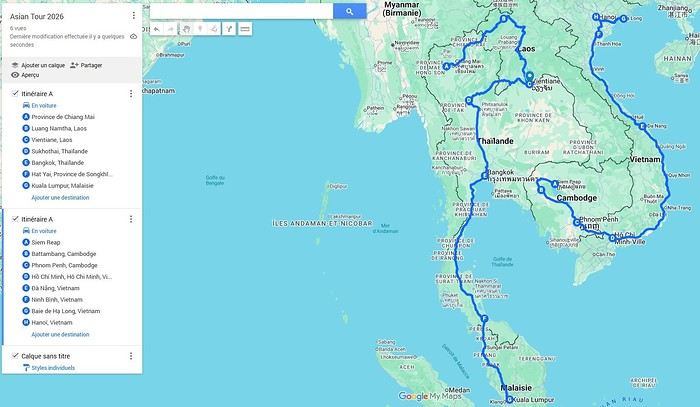
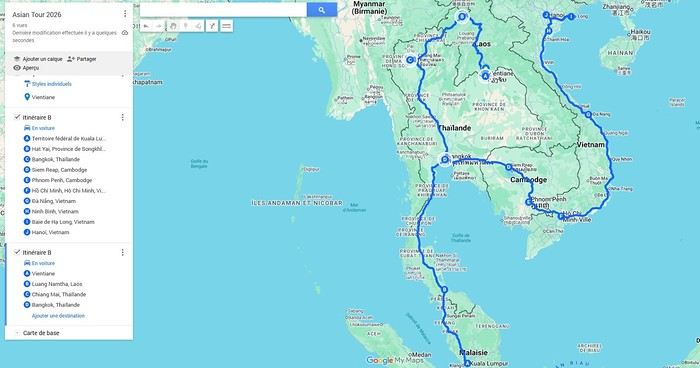
The goal of the trip is to explore the region before catching a flight to Tokyo at the end. The main difference between my two options is the order in which I’d visit Thailand, Malaysia, Cambodia, Vietnam, and Laos.
👉 Itinerary A: Paris > Thailand (Chiang Mai) > Southern Thailand > Malaysia > Flight from Kuala Lumpur to Siem Reap in Cambodia > Cambodia > Southern to Northern Vietnam > Flight to Tokyo
👉 Itinerary B: Paris > Malaysia (Kuala Lumpur) > Southern Thailand and Bangkok > Cambodia > Southern to Northern Vietnam > Flight from Hanoi to Vientiane (Laos) > Laos > Northern Thailand > Flight from Bangkok to Tokyo
Initially, I thought about doing Malaysia > Thailand > Laos > Vietnam > Cambodia, but after looking into it, it’s tricky to get to Tokyo from Cambodia—there’s no direct flight.
My questions: - Which of these itineraries seems the most logical/smooth in terms of transportation? - Which one do you think offers the best overall experience? - Do you have any other route suggestions or visit orders?
Thanks in advance for your feedback! 🙏
I’m planning a road trip through Southeast Asia with my girlfriend starting in mid-January 2026, and I’m torn between two possible itineraries.
The goal of the trip is to explore the region before catching a flight to Tokyo at the end. The main difference between my two options is the order in which I’d visit Thailand, Malaysia, Cambodia, Vietnam, and Laos.
👉 Itinerary A: Paris > Thailand (Chiang Mai) > Southern Thailand > Malaysia > Flight from Kuala Lumpur to Siem Reap in Cambodia > Cambodia > Southern to Northern Vietnam > Flight to Tokyo
👉 Itinerary B: Paris > Malaysia (Kuala Lumpur) > Southern Thailand and Bangkok > Cambodia > Southern to Northern Vietnam > Flight from Hanoi to Vientiane (Laos) > Laos > Northern Thailand > Flight from Bangkok to Tokyo
Initially, I thought about doing Malaysia > Thailand > Laos > Vietnam > Cambodia, but after looking into it, it’s tricky to get to Tokyo from Cambodia—there’s no direct flight.
My questions: - Which of these itineraries seems the most logical/smooth in terms of transportation? - Which one do you think offers the best overall experience? - Do you have any other route suggestions or visit orders?
Thanks in advance for your feedback! 🙏
Hello everyone!
July 5, 2025: Argentina Update
As I do every month, here’s an overview of the situation in Argentina—useful if you’re planning to visit in the coming weeks!
Vibe, economy, general situation, tips for tourists, and more...
Latest news for anyone thinking of visiting Argentina this year:
- Mixed outlook
- Current economic and social situation in Argentina
- Our friend Cristina
- What’s new for tourists?
What’s new? The parallel exchange rate and the official BNA rate are almost the same—just 2% higher for the parallel rate, which won’t really change your trip! Pay as much as possible in cash—discounts are still common at bars, restaurants, and even hotels. Even if it’s not advertised, always ask! You can still withdraw cash via Western Union, as before. Paying with a Visa or other card is still possible, and the CCL rate is even above the parallel rate today, meaning +3% compared to the official rate. However, you won’t get discounts when paying by card.
As always, **do not** withdraw money from ATMs—the fees in Argentina are still outrageous. Also, don’t forget that winter break in Argentina starts today, Friday, July 4, in 10 provinces for two weeks, until Sunday, July 20. On Friday, July 11, it begins in 9 more provinces until Sunday, July 27, and finally, in the last 4 provinces (including Buenos Aires and the city of Buenos Aires—the most populated), it runs from Friday, July 18, until Sunday, August 3. In short: 3 zones, each with two weeks off, stretching over 4 weeks total.
In previous years, I’d have warned you: “Be careful if you’re traveling, as buses, flights, and often accommodations are at high occupancy.” But this year, poorer and middle-class Argentines aren’t traveling because “No hay plata,” and those who can afford it are heading to Brazil, Chile, or even Miami for cheaper parties and shopping—Brazil can be twice as affordable! So, in Argentina, the top destinations for these staggered winter breaks are Bariloche (first place), followed by Ushuaia, San Martín de los Andes, and Villa La Angostura. Mendoza comes in fifth, then El Calafate, and finally Salta and Córdoba. As you can see, wealthy Argentines travel in winter to see snow—it’s chic to be cold and go skiing! Bariloche is the most expensive, while Córdoba is the cheapest. Same services, for example, a flight plus 7 days plus a hotel in the same category: Bariloche is 2.5 to 3 times pricier than Córdoba or even the sierras of Córdoba. Yet, there’s plenty of availability. Most people don’t have the money (and you might say Patagonian winter destinations aren’t exactly middle-class friendly either), but with fewer Brazilians or Chileans taking advantage of “cheap” Argentina, space is freed up. Brazilians alone used to make up 50% of Argentina’s international tourism—so there are suddenly fewer people on flights and in hotels! For these destinations, hoteliers are hoping for (at best) a 70% occupancy rate, though 50% would already make them happy. Why? 1- Lack of foreign tourists, 2- The middle class preferring to visit the old aunt in Posadas (to show family loyalty and spend as little as possible),
3- The wealthy opting for Bariloche, Punta Cana, Búzios, or Miami, which drastically lowers domestic occupancy rates and increases the outflow of USD abroad. +66% of Argentine tourists traveled abroad in the first five months of 2025. Six million Argentines vacationed abroad between January 1 and May 1, 2025.
To read the full article, check it out here: https://www.petitherge.com/2025/07/05-juillet-2025-situation-de-l-argentine.html
Hi everyone!
Let me introduce us quickly—I’m Matteo (21, originally from Paris, but I’ve been living near the Pyrenees and the Alps for the past 3 years), and my girlfriend Justine (21, grew up in the Alps). We’re starting to get really fed up with being cooped up and sitting in chairs (yep, we’re studying physics and geography at the École Normale Supérieure in Lyon). So, we’re taking a gap year to make a slightly crazy project happen: hitting the road, meeting people, and most importantly—climbing, skiing, and exploring the mountains!
We’ve always been into the mountains: •🧗♂️ 6c-7a/b sport climbing, 6b trad •❄️ Skiing and ice climbing (grade 4/5) •🏔️ Alpine climbing in the Alps (Chamonix, Écrins…) and the Pyrenees—I’m training to become a High Mountain Guide
Our project in a nutshell: •Buying a van (or 4x4) converted in British Columbia around September/October 2025. Ideally, we’d go straight to the US to buy the vehicle there (but reselling might be easier if we buy in Canada). •Heading down to the US to climb at legendary spots like Yosemite, Tuolumne (if it’s too hot), Indian Creek, Moab, and Joshua Tree. •Heading back up to the Canadian Rockies around December for skiing, ice climbing, and winter alpine climbing (might be easier to buy skis there). •Selling the vehicle in Canada at the end of the trip (we need to be back in France by early March 2026 because Justine is preparing for the AMM). I’ve already been to the Rockies, but I want to go back in winter for ice climbing. It’ll probably be too cold to sleep in the van, so we’re hoping to find a small cabin, lodge, or chalet (ideally alone or shared to cut costs). Otherwise, we could work for a month or two at a hostel or something to get free accommodation and earn money to rent a place another month just for climbing. •Visa-wise: we’re hoping to get our Working Holiday Visa (WHV) (still waiting for a response) so we can work there during the trip. For the US, we’ll stay as tourists (no work visa—too complicated and expensive). Any feedback on the WHV or differences from a regular work visa would be great. •With our savings (we’re working in mountain huts this summer), we should be able to buy the van. For daily expenses, I’m hoping to tutor online (math and physics). We live pretty simply and resourcefully: we plan to sleep mostly in the van, cook for ourselves, wash in rivers, and make the most of free nature spots. We’re super motivated, pretty well-rounded when it comes to mountain sports, and we’re not afraid to live simply for a year (we’ve got other projects too: biking to Greece with our climbing gear, a trip to Patagonia for alpine climbing).
Questions and advice: Of course, a road trip like this raises a lot of practical questions. This is our first time embarking on an adventure of this scale, so we’d love to hear your experiences and tips. If any of you have done a long van trip in North America or a WHV in Canada, your insights would be incredibly helpful! Here are some of the questions we’ve got: How do we buy (and later sell) a converted van in British Columbia? We’ll probably land in Vancouver. Is it better to look for a vehicle on online classifieds, Facebook groups, or used car dealerships? Are there any pitfalls to avoid when buying? And for selling it a year later, any tips to make it go smoothly (best time to sell, paperwork, etc.)? What budget should we plan for van life in North America and Canada? If you’ve got any info or feedback on the cost of living in a van in Canada/the US, we’d love to hear it. We’re thinking about expenses like gas (a big one, I imagine!), van maintenance, car insurance, possible tolls, campgrounds or paid spots, etc. We’d like to get an idea of a daily or monthly budget so we’re not too tight. In France, we never stay at campgrounds—we prefer being alone or going where we want. Is that possible in the US and Canada? Any tips for saving money (free camping spots, useful apps…) would be great! Visas, borders, and paperwork: We’re hoping to get a WHV for Canada, but in the US, we’ll be on a tourist visa (90 days max with ESTA, I think). Has anyone combined a WHV in Canada with a trip to the US on the same trip? Anything we should know about crossing the border in a van (insurance, customs, how long we’re allowed in the US, etc.)? We want to avoid any administrative hassles, so any advice on this would be super helpful. Route and seasonality for climbing and skiing: We’re thinking of starting climbing in the US around fall 2025 (probably September/October). Is that the right season for Yosemite, Indian Creek, and Moab? Any must-see spots along the way? For winter, we’re aiming for December to March in the Canadian Rockies (Banff, Jasper, Golden…) for skiing and ice climbing. Any tips on ice climbs or major backcountry skiing spots? We’ve got all our climbing, skiing, and alpine gear—should we bring it all or buy some stuff there? Is the “Wilderness Season Pass” for winter in the Rockies worth it? We came across this pass that offers 7 months of unlimited nights in HI mountain hostels in the Rockies. Has anyone here tried it? Are the dorms usually crowded? Working on the road: To fund the trip, we’re planning to work a bit along the way. Any tips for finding work in Canada while traveling (peak seasons at ski resorts, WWOOFing, odd jobs…)? That’s it for our (many) questions 😅! If you’ve done a similar trip—or even just parts of it (van life, climbing tour, winter in Canada…)—we’d love to hear your experiences, or even if you’re in the area and want to share a few days of climbing. All your contacts, advice, and tips will be a huge help.
Thanks in advance! We can’t wait to read your replies and refine our project with your help.
Matteo & Justine
PS: I’m looking for a summer job from August to September, preferably in a mountain hut (extra help, replacements, etc.). If you’ve got any contacts, don’t hesitate! I’ve also posted on another forum about this with my CV and cover letter (DEMANDE dxsdxsdsxdsx - Forum de www.refuges.info).
Hi there,
I feel like a total newbie—I’ve never really thought about this before, beyond repatriation—what happens if I get seriously ill or injured abroad? Thankfully, it’s never happened to me.
But now I’d like to cover my bases.
Do you know of any insurance providers, or where to look and how to choose one, that covers potential hospitalization costs, specifically in Uzbekistan?
I don’t even know if this kind of coverage is tied to a specific destination, in Europe (France?), or if it’s arranged directly in the country... 🤪
Catherine
In early March, full of carefree joy and happy to return to Morocco, we landed in Marrakech under the sun.
We spent just one night in Marrakech at the Hôtel Toulousain, as we did on our previous trip. And we booked our 3 nights for the end of our trip, the second half of March... Ouch! Ouch! Ouch! But we’re not there yet...
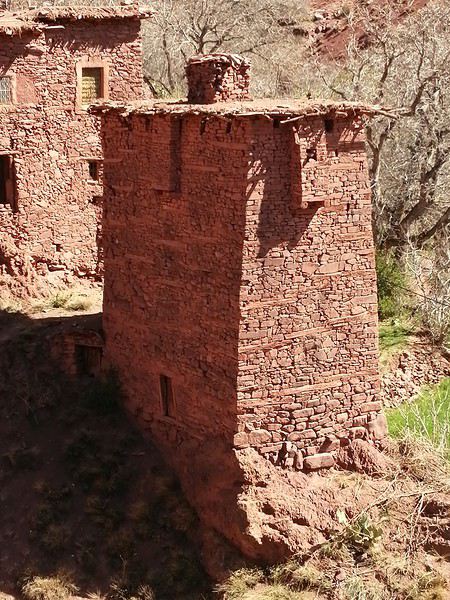
Our first goal is to reach Magdaz, a mountain village in the Tessaout Valley, sometimes called the lost valley. We discovered the village of Magdaz on this forum, and we were charmed by the photos and comments from travelers who came before us. The road is easy—it’s dry, and the tarmac takes us right to the village gates at over 2,000 meters above sea level. We arrive in the afternoon and are left speechless by the beauty of the place. A jewel of Berber architecture! Perfectly restored granaries and kasbahs!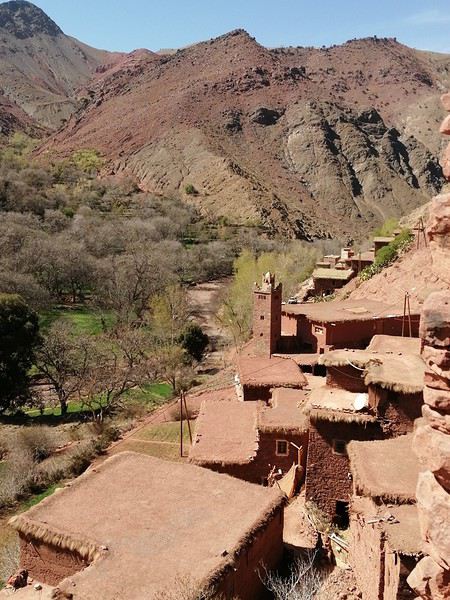
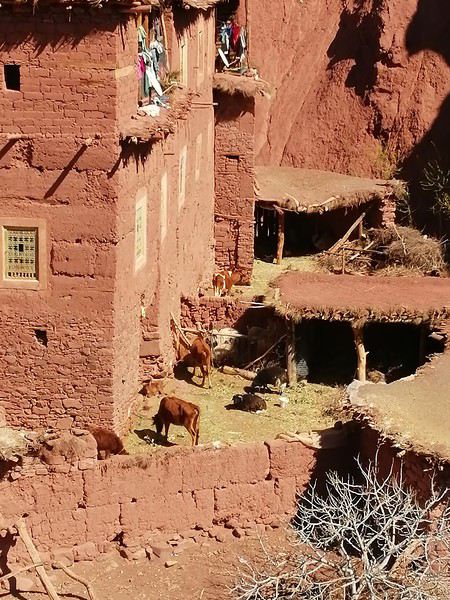
A young man from the village guides us on the visit and opens the doors to the terraces overlooking the village.
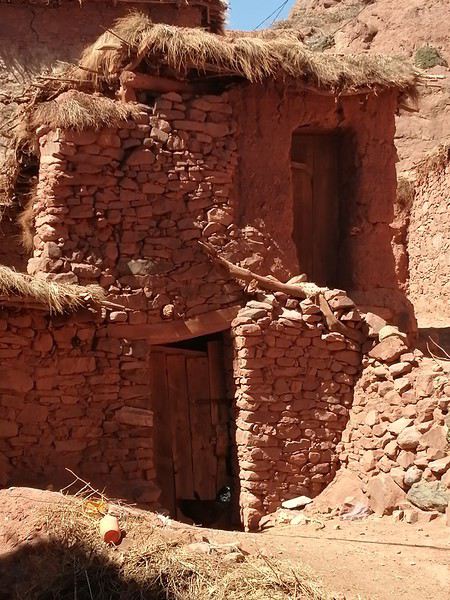 Several magnificent collective granaries have been beautifully restored. The warm colors of the stone capture the light wonderfully. It’s stunning!
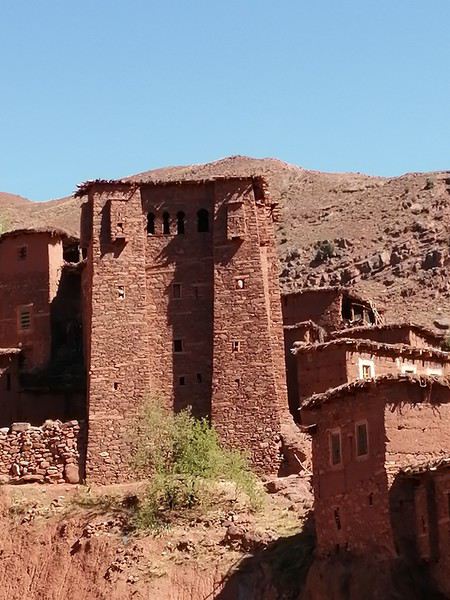
We won’t find anything decent to stay overnight there, so we head back down a bit and settle in at the Assounfou guesthouse. Lovely welcome. The place is in excellent condition and very clean. It’s spacious, but we’re the only ones there. First day full of promise!
Our first goal is to reach Magdaz, a mountain village in the Tessaout Valley, sometimes called the lost valley. We discovered the village of Magdaz on this forum, and we were charmed by the photos and comments from travelers who came before us. The road is easy—it’s dry, and the tarmac takes us right to the village gates at over 2,000 meters above sea level. We arrive in the afternoon and are left speechless by the beauty of the place. A jewel of Berber architecture! Perfectly restored granaries and kasbahs!
A young man from the village guides us on the visit and opens the doors to the terraces overlooking the village.
Several magnificent collective granaries have been beautifully restored. The warm colors of the stone capture the light wonderfully. It’s stunning!
We won’t find anything decent to stay overnight there, so we head back down a bit and settle in at the Assounfou guesthouse. Lovely welcome. The place is in excellent condition and very clean. It’s spacious, but we’re the only ones there. First day full of promise!
Hi there, 😄
my friend and I are leaving in 15 days for Kurdistan, by road, in our little converted van... The only thing we're sure of (well, the only thing we've actually thought about! The adventures will take care of the rest!) is that we're planning to take a month to get there, 15 days on site to visit my sister-in-law who's been living there as a teacher for a year! and 15 days to rush back, because my boyfriend has to go back to work on November 3rd!! After that, the itinerary isn't set yet—I've just bought a map of Europe... and still haven't found one of Kurdistan! or Iraq! I just finished work yesterday... and until now, this trip felt so far away... I didn't imagine much about it... I kept telling myself, "You'll see when you're done working, your brain will be more available!" Well, now my brain is in "gooo go go!" mode 😮 and it's going fast! I've got tons of questions popping up all at once!
- The itinerary... (we're thinking of lingering a bit in Greece on the way there... and taking a more direct route back). I don't think we've fully grasped what it's going to be like to cover at least 5,000 km in such a short time! Bibi's tinkering with the van (a Peugeot Expert that goes anywhere) and I'm the tour guide! - Camping in the van... where? Under what conditions? Areas to avoid? Places not to miss? - The borders... especially the Iraqi one! What are the formalities? Visa or no visa? - The political situation in the countries we'll cross... (with our entourage putting pressure on us—they're right, of course! How many times have we heard, "You're crazy! Oh, you're really going? We've been hearing about this for a year but didn't think it was so soon... and with everything going on right now, isn't it risky? Aren't you afraid of getting kidnapped?" 🤪 To be honest, we don't know much, we've been a bit out of the loop, working hard... and just craving adventure! But I admit, sometimes I get little waves of panic 😕 when I check official websites... then I go back to daydreaming! - Why not Couchsurfing? - Oh crap, the most annoying part... the paperwork, insurance, health stuff, blablabla... - Will the van hold up? 😐 - Should we prepare for the possibility of not making it all the way, and accept that not as a failure but as a different kind of adventure? Well, there you have it—a little peek into the chaos in my brain! 🤪/😎
So if any of this resonates with you... if you feel like sharing ideas, advice, or stories... we're all ears! Well, I am, and I'll pass it on to Bibi, the fearless warrior, wrench in hand, new tires at the ready, changing the oil and fine-tuning the beast! When I ask him what he expects, what he thinks, what his fears are (with me being the eternal scaredy-cat about wild camping in places I can't picture when we arrive at night—apparently a typical female fear, according to my surveys!—and the wonder of waking up to discover our surroundings... we made the right choice!), his desires... he just says, "Well, we'll start the car, go straight ahead, and see what happens. What do you think could go wrong?!" We complement each other well!
😛
Hello,
Thinking this might be useful for VF members who, like me, want to get their French driver’s license translated for a car rental in Japan, here’s the email I received this morning from the consular authorities in Tokyo:
Dear Sir,
You can obtain the translation from the Japan Automobile Federation (JAF). Address: 2-2-17 Shiba, Minato-ku, Tokyo 105-8562 Phone: 81-3-6833-9100 Email: kchosa@jaf.or.jp Website: http://www.jaf.or.jp/e/trans_f.htm (To find their office in Sapporo: http://www.jaf.or.jp/e/list_translation.htm)
Information about driver’s licenses is available on our website: http://www.ambafrance-jp.org/spip.php?article781&var_recherche=driver’s%20license The consular section can no longer provide driver’s license translation services.
Best regards,
Consular Section
So, according to this message, no more mail-in translations through the consular authorities.
Sayonara.
Since Voyage Forum is restarting after a few years of hiatus, I couldn’t find any recent info about my trip between late November 2024 and January 20, 2025, going from DAR ES SALAAM to the Cape Town area via ZAMBIA and BOTSWANA.
I’m really happy the site is back up, but I’ve noticed more and more people planning their trips down to the day, mentioning what they’ve scheduled and asking for technical advice for their 4x4 routes.
That’s not how I travel at all—I prefer to leave a lot to the unexpected, like public transport (and the weather) and the people you meet along the way.
The tips I’m sharing below come from the current situation, the randomness that makes unplanned trips special, and the strong connections you can make when you take your time without knowing what tomorrow will bring.
😏 TANZANIA: I had booked a TAZARA train ticket via WhatsApp before leaving to go from DAR ES SALAAM to MBEYA near the Zambian border. I’d contacted the station manager in Dar at +255 713 413 141, who kindly confirmed my reservation. Unfortunately, the train was out of service for an indefinite period, so I had to take the bus from the new Mwenge bus station on the city’s outskirts (allow extra time to get there—traffic is heavy). There’s no longer a direct train to ZAMBIA. You have to get off at MBEYA, then take a bus to the TUNDUMA border (2 hours to the bus station, then a 2 km taxi ride to the border). Crossing is easy—visa is free, no no-man’s-land, and you arrive directly in NAKONDE, Zambia. Exchange money on the Zambian side, but don’t change with the first person you see—check the rate first. I preferred to stop for the night in IRINGA since I took the bus at 4 PM. I arrived at 2 AM at Georges’ place, who picked me up directly from the bus station (several km from town). I’d booked the accommodation via Booking under Travellers Backpackers and Free City Tours. Georges and his employee were extremely helpful—they organized my bus trip to MBEYA the next day (bought the ticket and dropped me off, no commission). The place is decent, clean, and comfortable (10 € per night). Georges also organizes tours and safaris in the area (+255 679 529 700 direct). In MBEYA, I stayed at Karibuni Center Hotel (a quiet evangelical convent, very friendly and open to everyone, 13 € per night with breakfast). You can eat at a restaurant across the street. The rooms are clean and quiet (contact +255 754 510 174). To head to Lake MALAWI or the tea fields in TUKUYU, it’s best to take a moto-taxi from MBEYA to the Uyole junction. From there, you’ll find minibuses heading south frequently—change buses in TUKUYU (the tea fields are 4-5 km away).
😏 ZAMBIA: In NAKONDE, I highly recommend Izukanji Lodge—very quiet and clean, 2 km from the station (take a moto-taxi). The main building’s rooms are pricier than the annex across the street (where the restaurant and pool are). The rooms are just as clean and quiet but only 10 €, breakfast included. Contact the manager directly on WhatsApp at +260 979 649 452. If it’s full, try Divine Guest House (+260 973 127 816). The train isn’t always on time—if you catch it on the scheduled day, consider yourself lucky. The stationmaster, Mr. Chulu, is lovely. Contact him on WhatsApp at +260 777 550 302 for real-time updates. First-class berths are great (4 per compartment), 15 € one-way to KAPIRI MPOSHI. There always seems to be space. Book two berths if you want extra comfort. No need to bring food—the dining car serves decent meals, and there’s a bar. In KAPIRI MPOSHI, I stayed at Kapiri Council Lodge, 2 km from the train station. It’s okay, but there are often power outages in the evening, which means no water either. You’ll have to wait until 8 PM. Breakfast is very basic. For LUSAKA, there are plenty of buses in the morning from the downtown bus station (2-3 hours). The best companies are Power Tools (yellow buses) or UBZ if you can find it (the best in Zambia—Western comfort). In LUSAKA, use Yango taxis (download the app—it’s like Uber in Zambia, very affordable). I stayed at Natwange (Hostelworld chain), reachable at +260 966 303 816. It’s a beautiful, quiet place 3-4 km from downtown, very shady, with a pool. The rooms are clean and comfortable, and the food is excellent (great salads). The staff is super friendly, as they are everywhere in the country. There’s also a mini-supermarket nearby with everything, including takeout meals. Book your bus ticket to LIVINGSTONE at least the day before (UBZ). The trip is pleasant. In LIVINGSTONE, many backpackers stay at Jolly Boys—it’s a nice place to relax by the pool with a beer at the end of the day, but it’s mostly a party hostel for young people doing rafting or canyoning on the Zambezi (pricier than elsewhere). For those who prefer peace and quiet, I highly recommend Likute Guest House on the same street, right near Jolly Boys. The rooms are decent for 10 €, breakfast included (same price as a dorm at JB). You can order dinner in advance. The staff is friendly. Great value at Da Canton restaurant on the main road (pizza, pasta, meat, salads, etc.). The Livingstone Museum is worth a visit if you have time. At the bottom of Kapondo Street, you can take a shared taxi to Victoria Falls or even to KAZUNGULA at the Botswana border (cheap—the taxi leaves when full). People short on time often compare the views of Victoria Falls from the Zambian side (20 $) and the Zimbabwean side (30 $). Honestly, they’re very different, and it’s worth seeing the falls from Zimbabwe even if it’s pricier (visa required, easy to get at the border—everything is done on foot). Cross the bridge where you can bungee jump. Take your time at the falls—it’s truly stunning. You can visit Zimbabwe for half a day and stay in Zambia (cheaper, since everything in Zimbabwe is paid in dollars). There’s more water on the Zimbabwean side, but the Zambian side is beautiful too.
😏 BOTSWANA: Crossing the border at KAZUNGULA from Zambia is quick and easy (brand-new bridge over the Zambezi). Visa is free. Don’t exchange money at the border. There’s a shopping center 1 km away (Choppies store) with an ATM (no commission). I hitched a ride with tourists to the bank since they had a car. In the shopping center parking lot, you can easily find a shared taxi to KASANE. In the area, you can get around easily by shared taxi (just give the name of your guesthouse, and the drivers will tell you which vehicle to take). The fare is fixed (0.50 €). I stayed at Elephant Trail GH and Backpackers—a great spot where you can stay in a 4-bed dorm for 10 €. There are also huts for two in the garden (clean and comfortable) with a pool. You can order dinner (great food) or cook your own meals. The place is quiet and friendly (they organize safaris with early-morning pickups for Chobe and evening boat trips in the Kwando marshes to see animals). I preferred flying (Air Botswana) with a friend to MAUN (55 €) instead of taking an 8-10 hour bus (tickets can be bought directly at the airport). In MAUN, I stayed at Jayla Homestay with Mapula (+267 71 658 737)—a wonderful, kind woman always ready to help. The homestay is in a beautiful family home 3-4 km from downtown, past the Kwanokeng gas station. It’s easy to get there by shared taxi from the downtown taxi stand near Shoprite. Mapula cooks refined, varied meals on request. She also organizes safaris in the OKAVANGO with morning pickups from the guesthouse (picnic included) at a great price. Her rooms are comfortable and very clean (microwave, coffee/tea, and kettle available). The day trip by canoe in the OKAVANGO marshes is a must. However, we saw very few animals because the rainy season had started (zebras, giraffes, buffaloes, hippos). The atmosphere, serenity, and changing light throughout the day were remarkable. Direct flight from MAUN to CAPE TOWN with Airlink for 280 € on December 24.
😏 SOUTH AFRICA: In Cape Town, I stayed at Sunflower Stop Backpackers in the Green Point neighborhood—very quiet and safe. This hostel is perfect for meeting travelers of all ages. Everything is nearby (supermarkets, bars, restaurants, the sea, the park, tourist areas, the stadium, Sea Point, and the Waterfront). I spent 13 days in Cape Town and always found something to do—this city is so pleasant to live in, welcoming, and packed with sports and cultural activities. Don’t miss the Minstrel Carnival in early January if you’re in the area. Kalk Bay beach (with its colorful beach huts) is worth the detour on the way to SIMON’S TOWN and Boulders Beach. Stop for lunch at Salt in FISH HOEK—the homemade ravioli and fish are amazing. Everything is excellent there. At Boulders Beach, when you arrive at the main beach after the entrance gate, don’t hesitate to wade into the water up to your waist if the tide is high and head straight past the northern end of the beach—the penguins are farther out. Beautiful beach and sunset at Scarborough Beach. I took the 8-day Bazbus pass (134 €) for the Garden Route and stopped in STELLENBOSCH on the last day of my loop back to Cape Town. This lets you extend the trip to 10 days if you stay 2 nights in STELLENBOSCH, since it’s easy and cheap to get back to Cape Town with an Uber. I really liked this Bazbus option—it’s convenient because they drop you off and pick you up directly at your chosen hostel or hotel. I loved HERMANUS, even though I didn’t see any whales. The atmosphere is very British and classy. The coastline is beautiful and rugged. Don’t miss the walk to Mosselberg, which overlooks the entire bay. MOSSEL BAY is more working-class and run-down—nothing particularly interesting, in my opinion. In WILDERNESS, try to stay at Beach House Backpackers Lodge. The sea view is stunning, even from the dorm. In KNYSNA, Thesen Island is overrated—it’s full of soulless new buildings. Prefer Leisure Island, which is just as busy with wealthy owners but nice for walks and swimming. Head to The Heads to wander the coastal trails with incredible views of the bay. Don’t hesitate to explore the heart of the artistic Concordia neighborhood (Rastafarian) to Judah Square on your own. The locals are warm and laid-back. No need to go through a tour operator. Anchorage restaurant is excellent for refined dishes and a great variety of food. In STELLENBOSCH, I stayed at Just a Bed (booked for one person on Booking). Don’t hesitate to contact the owner—she has several rooms in her guesthouse. The place is cozy and charming. The town is pleasant but feels disconnected from the surrounding population. You can walk to the Lanzerac vineyard, but don’t miss Boschendal a few kilometers away on the way to FRANSCHHOEK. People talk a lot about safety in South Africa, but as long as you respect the local norms, everything goes smoothly—the people are really welcoming, no matter their social background.
Hello 😏
Four trips to Russia in our little camper van have allowed us to meet ordinary Russians, those who live far from the Westernized elites of the country's major western cities.
Even with our few words of Russian, we clearly understood what we were so often told: Russia is not just Moscow or St. Petersburg.
This post doesn’t claim to address the sociological realities of this magnificent country. More modestly, it aims to take you on a visual journey to discover the three fundamentals that shape Russian identity: rural life, religion, and patriotism.
VoyageForum allows 20 photos per post, so we’ll stick to this selection. They were taken during our fourth road trip, in April and May 2019.
RURAL LIFE
For this dive into rural Russia, we deliberately left the paved roads to take small dirt tracks and country lanes.
We traveled through the oblasts of Ulyanovsk (Ульяновск), Nizhny Novgorod (Нижний Новгород), and the Republic of Mordovia (Республика Мордовия).
1. We leave the main road to enter the first villages. Very quickly, we find these splendid homes that make up the historical heritage of rural Russia.
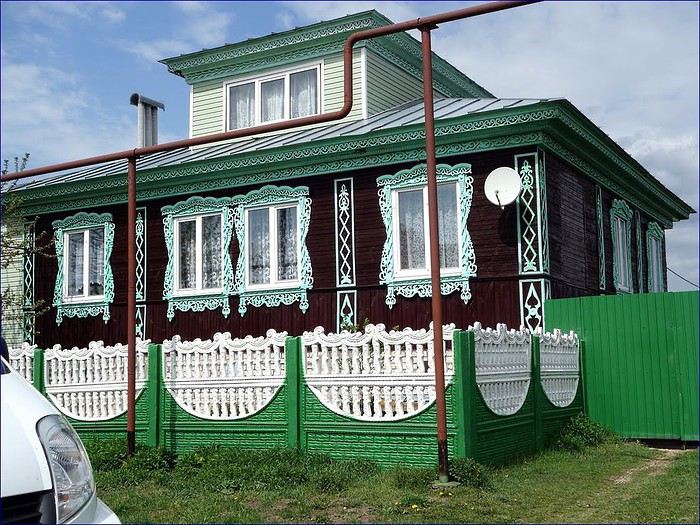
2. A little further on, we enter a village where time seems to have stood still. A single street, izbas on either side, small plots of land behind, a few wells for water...

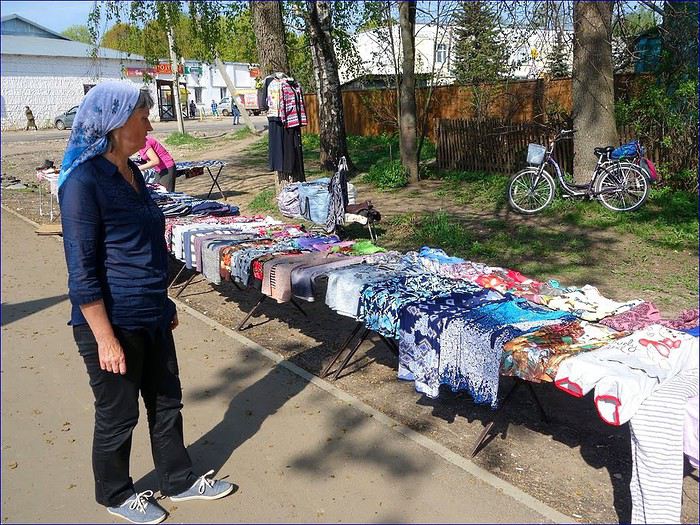
3. Shopping in rural Russia isn’t like GUM! Here, no luxury boutiques—vendors set up right by the roadside!
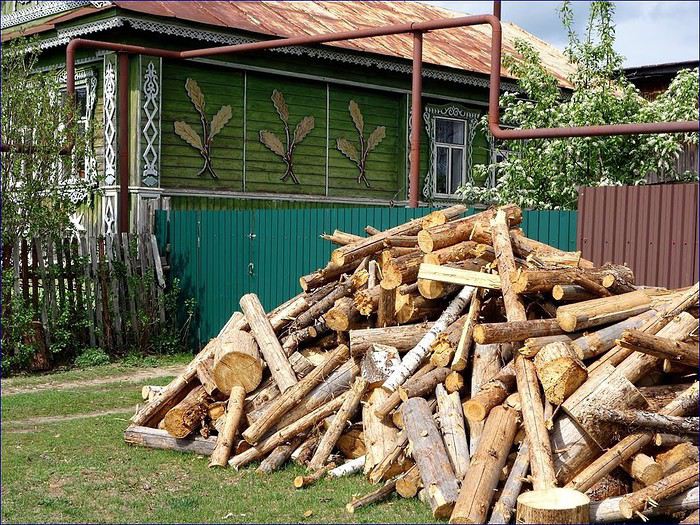
4. In another village, with a few words of Russian, I ask the owner of this house why he’s bringing in firewood in spring. From what I understood, you shouldn’t wait for autumn when everyone needs it and prices go up.
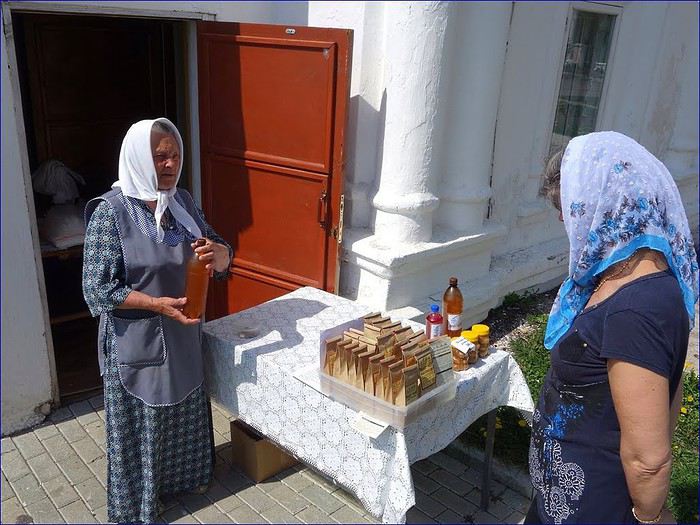
5. In the Nizhny Novgorod Oblast, we stop near a small church that the parishioners show us around. To thank them, Sylvie buys them fruit juice and delicious honey cakes. Generously, the priest gives us permission to sleep in the parking lot!
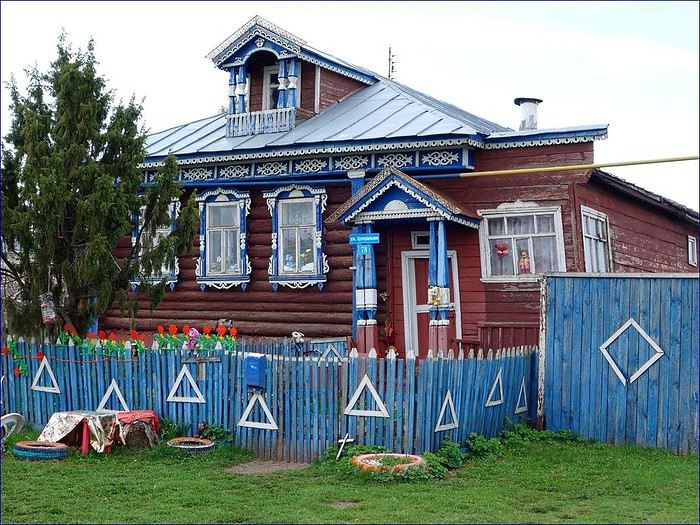
6. The next day, wandering rural roads, we admire this house for a long time, with its traditional wooden figurines behind the windows.
7. We hit the road again toward a small town where, of course, they sell local fish. We know Russians are the biggest consumers of freshwater fish in the world. And here, we’re in the central Volga basin with its dozens of tributaries!

RELIGION
A few years ago, we visited the Makaryevo Monastery. That’s where we learned about the Saint Seraphimo convent for nuns. It was hard to find, on the border of the Republic of Mordovia and the Nizhny Novgorod Oblast.
We discovered a place of pilgrimage, a space for religious expression, authentic, popular, and very Russian—where nuns, believers, and (most importantly) no tourists mix! Just 500 km from Moscow and the Golden Ring, the monastery mainly welcomes groups and families staying in the huge pilgrim house.
We’d only planned a quick visit but ended up staying two full days! Thanks to the staff for letting us park and sleep in the pilgrims’ parking lot.
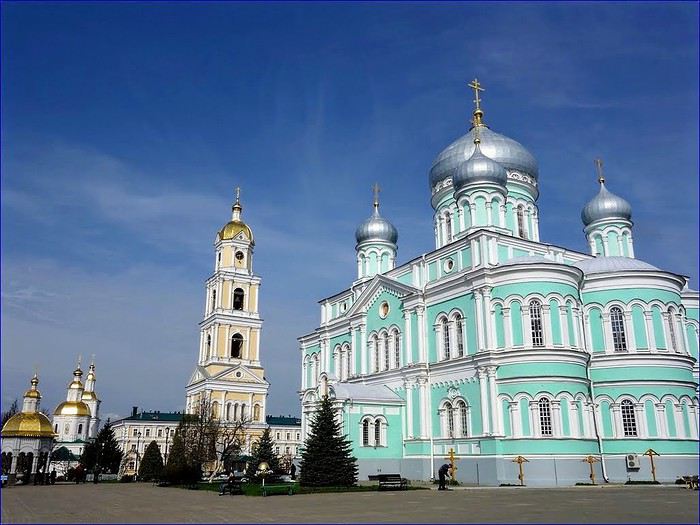
8. The site is much larger than we imagined. Over several hectares, religious buildings, the nuns’ living quarters, visitor accommodations, and schools all coexist...
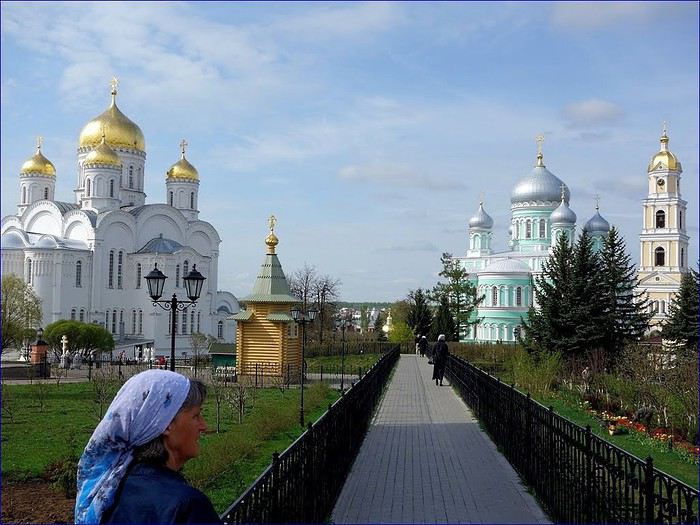
9. For two days, we mixed with kind religious figures and pilgrims—welcoming even to non-Orthodox folks like us!
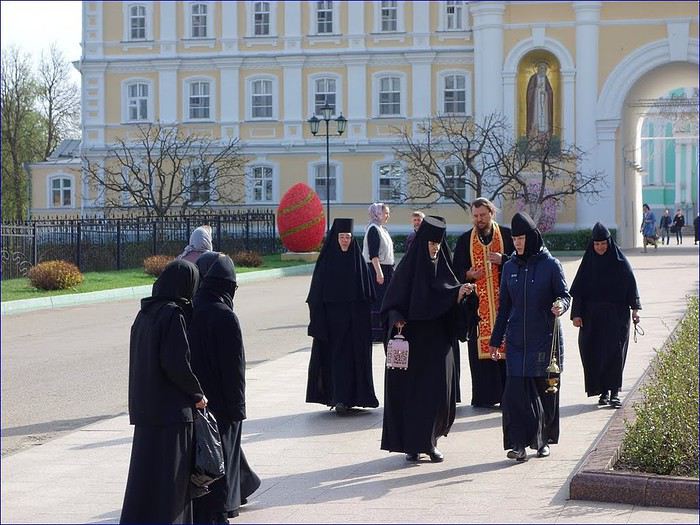
10. But what really stood out was the presence of groups of young people. We were also struck by how young the religious figures we met were.
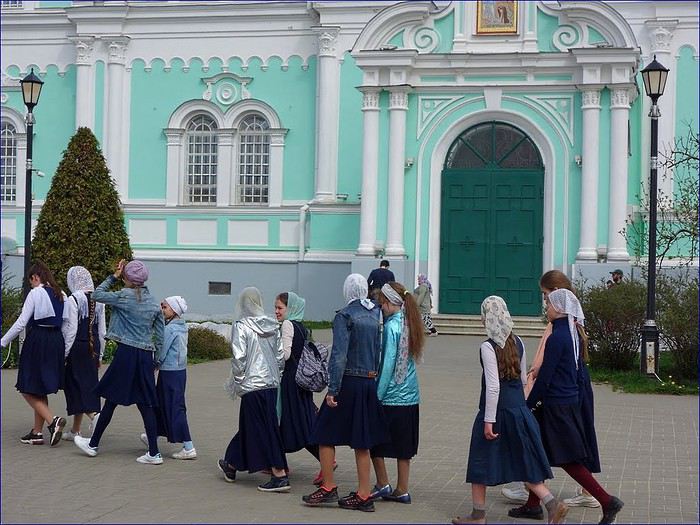
11. The next morning, having slept in the pilgrims’ parking lot, we were the first visitors. It was a special moment to walk the grounds alone.
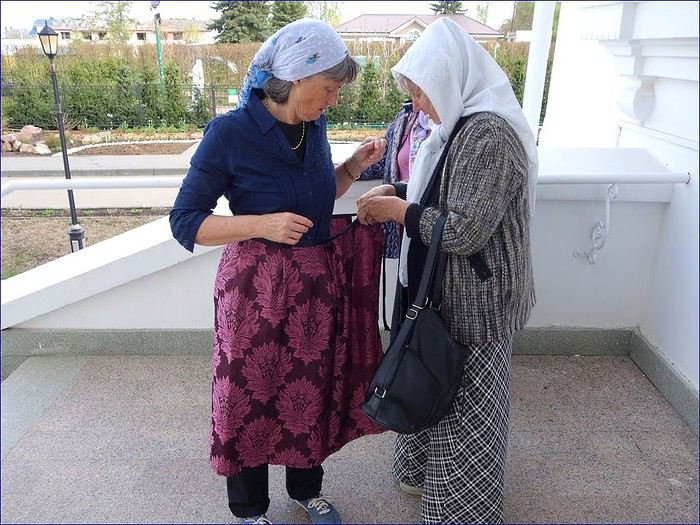
12. That morning was marked by an unlikely event. Sylvie chats with a nun who speaks English. Perhaps touched that we’d driven from France, she offers Sylvie a private tour. She asks two parishioners to dress her and grants her the privilege of seeing the sacred places closed to the public. Me? I got nothing—I was left outside!
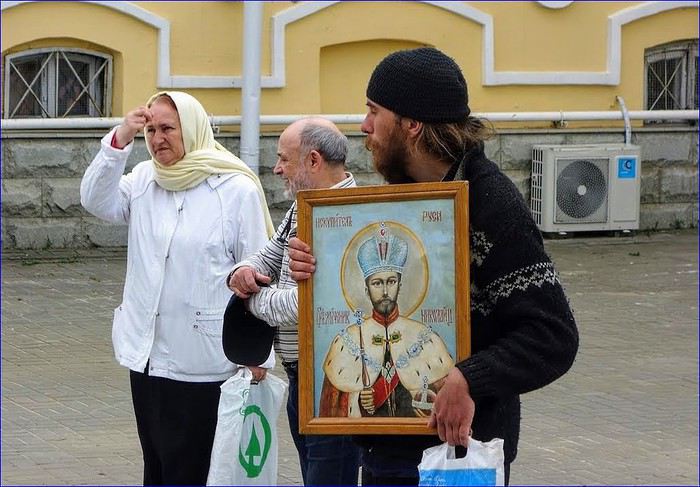
13. I take the chance to observe pilgrims in prayer. I meet a small group of believers gathered around a portrait of Nicholas II, praying for him.
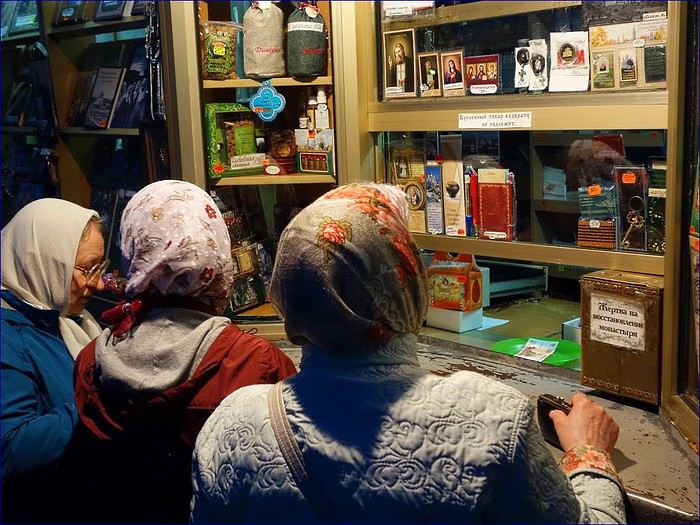
14. In the evening, after dinner, we attend the last service of the day. Until the site closes, we mingle with the *babushkas* buying icons, sacred images, and religious objects blessed by the priest—for just a few rubles.
PATRIOTISM
May 9, 1945, is the day Germany signed its surrender in Berlin. In Russia, it’s celebrated as День Победы—Victory Day. As we know, the Soviet Union paid the heaviest price: nearly 22 million dead. Not a single Russian family was spared.
We wanted to share this special moment, but far from the official ceremonies of the military parade on Red Square. We chose a provincial city, 180 km east of Moscow.
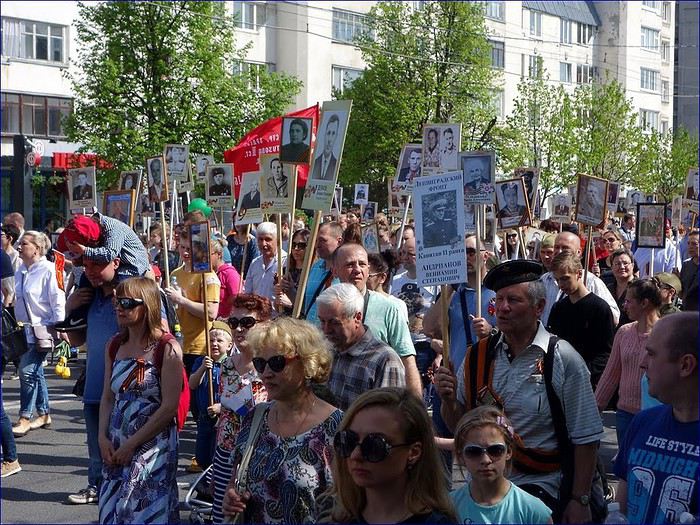
15. By 10 a.m., the crowd starts gathering downtown. Right away, what stands out is the family makeup of the procession.
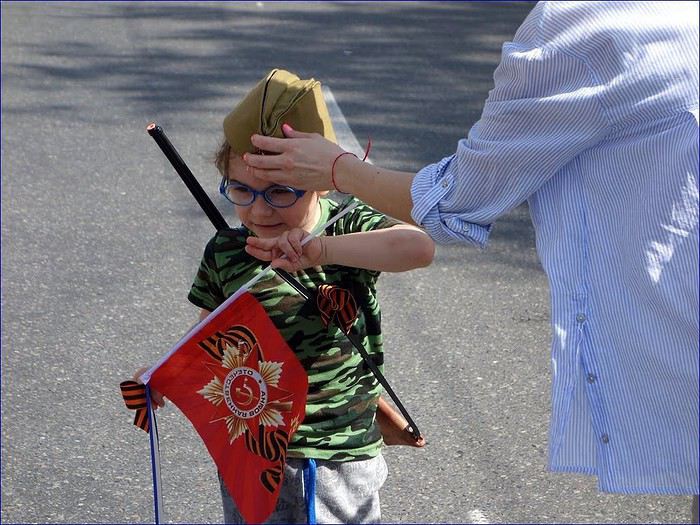
16. We walk among the families, like this mom adjusting her daughter’s cap. The atmosphere is a mix of solemnity and reflection, punctuated by the joyful laughter of children.
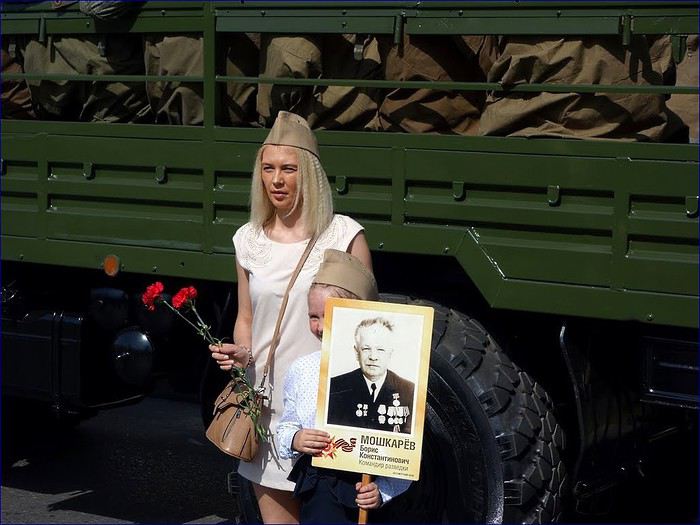
17. This mother and daughter pose behind a portrait of their grandfather.
18. I spend a long time watching how patient and helpful the soldiers are. They lift kids onto the vehicles, make sure they don’t slip, then hand them back to their parents.
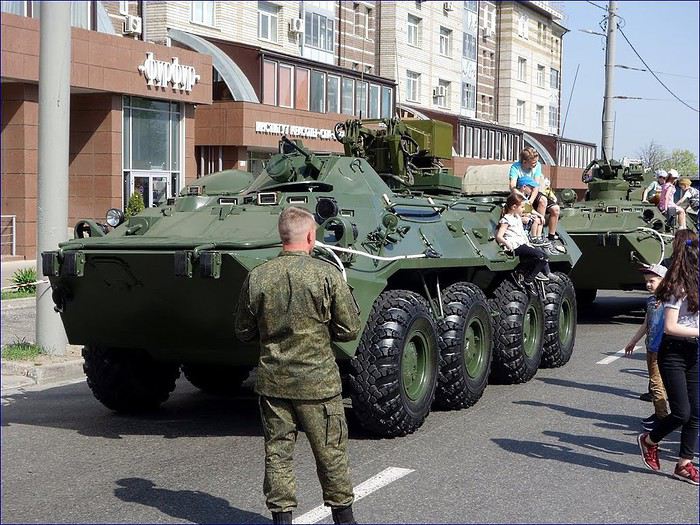
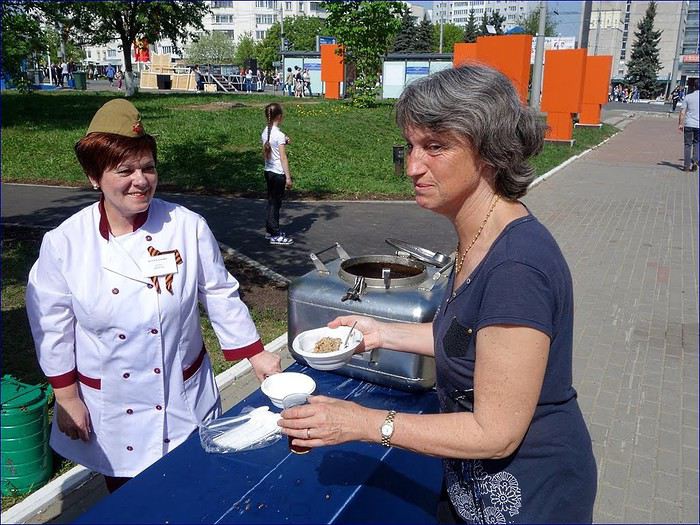
19. Around noon, we’re introduced to a tradition we didn’t know about. On May 9, in some cities, neighborhood committees made up of volunteers offer meals and drinks to participants. So we have lunch with families—parents, kids, and grandparents—all surprised we came from France.
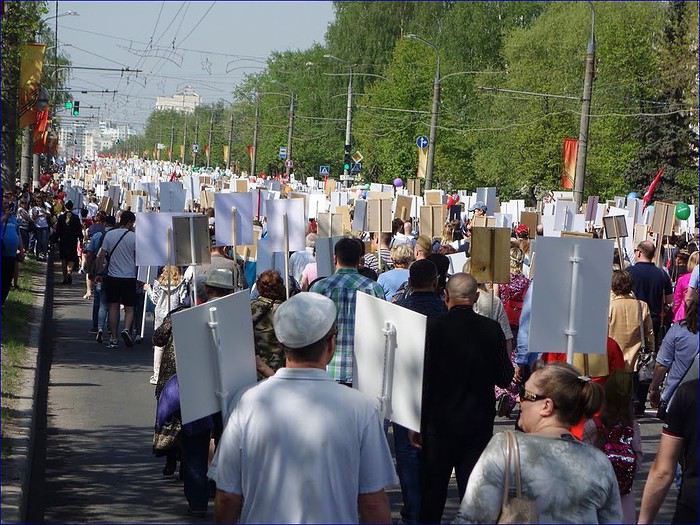
20. By afternoon, the crowd has grown dense, with a procession stretching over 2 km! We stay until the end of the day, impressed by this authentic, popular demonstration of Russians’ attachment to the Motherland.
That’s all 😏
The full story is online here: ETERNAL RUSSIA.
Those who want to discover the world through the eyes of a plumber’s little van can check out Trafic Life.
Best regards,
Sylvie & Bernard
Four trips to Russia in our little camper van have allowed us to meet ordinary Russians, those who live far from the Westernized elites of the country's major western cities.
Even with our few words of Russian, we clearly understood what we were so often told: Russia is not just Moscow or St. Petersburg.
This post doesn’t claim to address the sociological realities of this magnificent country. More modestly, it aims to take you on a visual journey to discover the three fundamentals that shape Russian identity: rural life, religion, and patriotism.
VoyageForum allows 20 photos per post, so we’ll stick to this selection. They were taken during our fourth road trip, in April and May 2019.
RURAL LIFE
For this dive into rural Russia, we deliberately left the paved roads to take small dirt tracks and country lanes.
We traveled through the oblasts of Ulyanovsk (Ульяновск), Nizhny Novgorod (Нижний Новгород), and the Republic of Mordovia (Республика Мордовия).
1. We leave the main road to enter the first villages. Very quickly, we find these splendid homes that make up the historical heritage of rural Russia.
2. A little further on, we enter a village where time seems to have stood still. A single street, izbas on either side, small plots of land behind, a few wells for water...
3. Shopping in rural Russia isn’t like GUM! Here, no luxury boutiques—vendors set up right by the roadside!
4. In another village, with a few words of Russian, I ask the owner of this house why he’s bringing in firewood in spring. From what I understood, you shouldn’t wait for autumn when everyone needs it and prices go up.
5. In the Nizhny Novgorod Oblast, we stop near a small church that the parishioners show us around. To thank them, Sylvie buys them fruit juice and delicious honey cakes. Generously, the priest gives us permission to sleep in the parking lot!
6. The next day, wandering rural roads, we admire this house for a long time, with its traditional wooden figurines behind the windows.
7. We hit the road again toward a small town where, of course, they sell local fish. We know Russians are the biggest consumers of freshwater fish in the world. And here, we’re in the central Volga basin with its dozens of tributaries!
RELIGION
A few years ago, we visited the Makaryevo Monastery. That’s where we learned about the Saint Seraphimo convent for nuns. It was hard to find, on the border of the Republic of Mordovia and the Nizhny Novgorod Oblast.
We discovered a place of pilgrimage, a space for religious expression, authentic, popular, and very Russian—where nuns, believers, and (most importantly) no tourists mix! Just 500 km from Moscow and the Golden Ring, the monastery mainly welcomes groups and families staying in the huge pilgrim house.
We’d only planned a quick visit but ended up staying two full days! Thanks to the staff for letting us park and sleep in the pilgrims’ parking lot.
8. The site is much larger than we imagined. Over several hectares, religious buildings, the nuns’ living quarters, visitor accommodations, and schools all coexist...
9. For two days, we mixed with kind religious figures and pilgrims—welcoming even to non-Orthodox folks like us!
10. But what really stood out was the presence of groups of young people. We were also struck by how young the religious figures we met were.
11. The next morning, having slept in the pilgrims’ parking lot, we were the first visitors. It was a special moment to walk the grounds alone.
12. That morning was marked by an unlikely event. Sylvie chats with a nun who speaks English. Perhaps touched that we’d driven from France, she offers Sylvie a private tour. She asks two parishioners to dress her and grants her the privilege of seeing the sacred places closed to the public. Me? I got nothing—I was left outside!
13. I take the chance to observe pilgrims in prayer. I meet a small group of believers gathered around a portrait of Nicholas II, praying for him.
14. In the evening, after dinner, we attend the last service of the day. Until the site closes, we mingle with the *babushkas* buying icons, sacred images, and religious objects blessed by the priest—for just a few rubles.
PATRIOTISM
May 9, 1945, is the day Germany signed its surrender in Berlin. In Russia, it’s celebrated as День Победы—Victory Day. As we know, the Soviet Union paid the heaviest price: nearly 22 million dead. Not a single Russian family was spared.
We wanted to share this special moment, but far from the official ceremonies of the military parade on Red Square. We chose a provincial city, 180 km east of Moscow.
15. By 10 a.m., the crowd starts gathering downtown. Right away, what stands out is the family makeup of the procession.
16. We walk among the families, like this mom adjusting her daughter’s cap. The atmosphere is a mix of solemnity and reflection, punctuated by the joyful laughter of children.
17. This mother and daughter pose behind a portrait of their grandfather.
18. I spend a long time watching how patient and helpful the soldiers are. They lift kids onto the vehicles, make sure they don’t slip, then hand them back to their parents.
19. Around noon, we’re introduced to a tradition we didn’t know about. On May 9, in some cities, neighborhood committees made up of volunteers offer meals and drinks to participants. So we have lunch with families—parents, kids, and grandparents—all surprised we came from France.
20. By afternoon, the crowd has grown dense, with a procession stretching over 2 km! We stay until the end of the day, impressed by this authentic, popular demonstration of Russians’ attachment to the Motherland.
That’s all 😏
The full story is online here: ETERNAL RUSSIA.
Those who want to discover the world through the eyes of a plumber’s little van can check out Trafic Life.
Best regards,
Sylvie & Bernard
Hi everyone!!!
I’m finally getting around to writing about this 20-day trip to southern Italy: we didn’t travel this summer, and luckily, we found beautiful light and dreamy weather there at the end of September.
First, here’s the context of the trip: we’re both "confirmed seniors" but still curious and alert enough to enjoy the itinerary we’d imagined! We wanted a mix of discoveries—culture, cities, and nature—with guaranteed sunshine and the occasional short hike... We’re flying to Naples, round-trip, because the flight times work better for us. We rented a car online, picked it up at the airport (details to come... and it won’t be the highlight of the trip!), and booked our hotels in advance.
A quick overview of the itinerary: leaving Naples on September 15th, early in the morning, we’ll drive straight across the boot of Italy to Bari. After 11 days in Puglia, we’ll head back toward our starting point, taking our time: Matera in Basilicata, Maratea by the sea, and finally Paestum with its incredible temples.
Day 1: Brussels-Naples flight (Brussels Airlines) went smoothly; it landed an hour early, and we were thrilled, thinking we could use that time for a quick visit or two... Everything went well until we left the airport. We took the shuttle to the car rental offices, and at first glance, we realized this wouldn’t be smooth sailing!!! In front of every office (they’re side by side), there were already lines and kids sitting on suitcases—everyone looked exhausted... We resigned ourselves to waiting: nothing moved until tempers flared at the counters, and two people nearly came to blows. Things sped up a little, and after 2 (two...) hours of waiting, we finally got our chariot: a black Fiat Tipo, dirty, with a few dents and scratches that we made sure to note in the contract... but it ran!
Off to Bari, then: no time for sightseeing along the way! From there, we headed straight to our hotel in the countryside near Polignano a Mare.
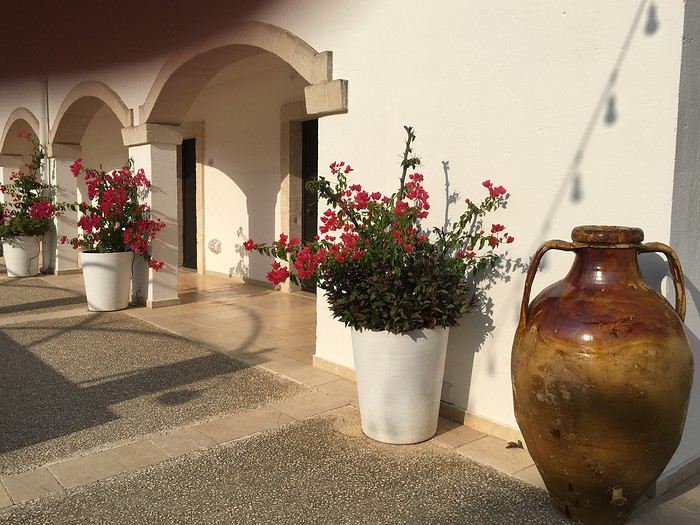
A recurring detail: this happened constantly during our travels. We’d installed our own GPS, fully updated... In recent years, many dirt roads have become drivable, and lots of hotels and hostels have opened in the outskirts of towns. It was extremely rare for our ‘guide’ to recognize the street—let alone the number—we entered. Often, we got by calling the hotel reception: it might seem like a small thing, but it happened so often it became frustrating. In hindsight, it seems like without Google Maps, we’d have been lost!
Anyway, we were beautifully settled, with a terrace overlooking olive groves and the sea in the distance: all was well.
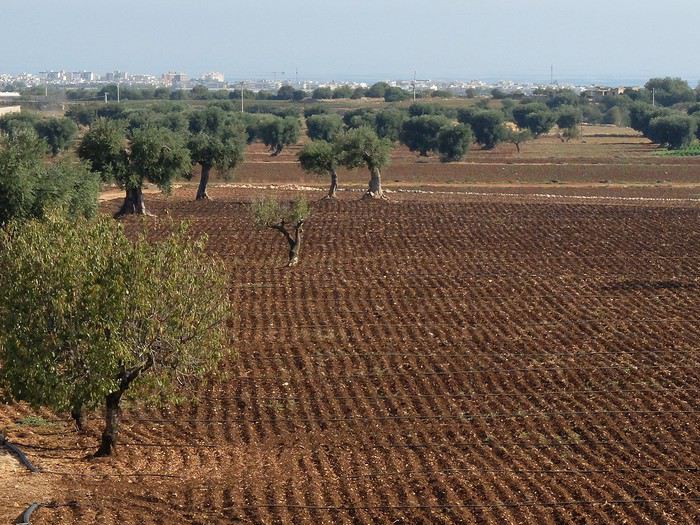
To be continued...
I’m finally getting around to writing about this 20-day trip to southern Italy: we didn’t travel this summer, and luckily, we found beautiful light and dreamy weather there at the end of September.
First, here’s the context of the trip: we’re both "confirmed seniors" but still curious and alert enough to enjoy the itinerary we’d imagined! We wanted a mix of discoveries—culture, cities, and nature—with guaranteed sunshine and the occasional short hike... We’re flying to Naples, round-trip, because the flight times work better for us. We rented a car online, picked it up at the airport (details to come... and it won’t be the highlight of the trip!), and booked our hotels in advance.
A quick overview of the itinerary: leaving Naples on September 15th, early in the morning, we’ll drive straight across the boot of Italy to Bari. After 11 days in Puglia, we’ll head back toward our starting point, taking our time: Matera in Basilicata, Maratea by the sea, and finally Paestum with its incredible temples.
Day 1: Brussels-Naples flight (Brussels Airlines) went smoothly; it landed an hour early, and we were thrilled, thinking we could use that time for a quick visit or two... Everything went well until we left the airport. We took the shuttle to the car rental offices, and at first glance, we realized this wouldn’t be smooth sailing!!! In front of every office (they’re side by side), there were already lines and kids sitting on suitcases—everyone looked exhausted... We resigned ourselves to waiting: nothing moved until tempers flared at the counters, and two people nearly came to blows. Things sped up a little, and after 2 (two...) hours of waiting, we finally got our chariot: a black Fiat Tipo, dirty, with a few dents and scratches that we made sure to note in the contract... but it ran!
Off to Bari, then: no time for sightseeing along the way! From there, we headed straight to our hotel in the countryside near Polignano a Mare.
A recurring detail: this happened constantly during our travels. We’d installed our own GPS, fully updated... In recent years, many dirt roads have become drivable, and lots of hotels and hostels have opened in the outskirts of towns. It was extremely rare for our ‘guide’ to recognize the street—let alone the number—we entered. Often, we got by calling the hotel reception: it might seem like a small thing, but it happened so often it became frustrating. In hindsight, it seems like without Google Maps, we’d have been lost!
Anyway, we were beautifully settled, with a terrace overlooking olive groves and the sea in the distance: all was well.
To be continued...
Hi everyone,
Here’s a recap of our self-drive trip in Tanzania.
Tanzania is a stunning country, but it’s changing fast, which means that any self-drive info you gather in advance might be outdated by the time you travel.
Still, here’s some info for future self-drivers.
The vehicle: After lots of research, thinking, and calculations, we had our 4x4 with roof tents shipped from South Africa through our rental company of two years, Safari4x4Hire. The price for 31 days came to $247.00 per day. That’s cheaper than some Tanzanian rental companies (Shawsafaris: $380.00 per day, total with 18% tax) and just a little more expensive than others (Tanzanian Pionners), but with the guarantee of having a well-maintained and reliable vehicle. You can check out the discussion I started: here
Traffic: The speed limit is 80 km/h on roads and 50 km/h in villages. Watch out—there are lots of police checks at village entrances (speed radar). In villages and towns, also be careful with minibuses, which are everywhere and stop and start without signaling. As for paved roads, most are in good condition, and many tracks are brand new or being renovated (the Chinese are in the area!).
Campsites: It’s very easy to find a spot in Tanzanian campsites (few self-drivers), so no need to book in advance (we were often alone in campsites outside the parks). Inside the parks, it’s easy to book public campsites at the gates. With roof tents, the downside is that sites are usually designed for travelers with ground tents, but we always found space for our vehicle. Another downside is making a fire—it’s nearly impossible to find wood (Tanzanians don’t usually make fires for cooking or ambiance). Campsite prices outside the parks range from $5.00 to $15.00 (price with 18% tax). I’ll list the prices for campsites inside the parks below.
Food: There are very few supermarkets in Tanzania, and prices can be steep if you’re not careful (European brands). For fruits and vegetables, you can easily find roadside vendors. For other groceries, you can shop at supermarkets (Dar es Salaam, Arusha). In Arusha, there’s a brand-new Shoppers Supermarket—clean and well-stocked—and for meat, don’t hesitate to visit the Meat King butcher. It’s also often possible to eat well at campsites with restaurants for around $10.00 (price with 18% tax).
Some other info: 1. At gas stations, you almost always pay in cash, usually in Tanzanian shillings.
2. Park entries, campsites, and Ngorongoro are paid with a card (Visa, etc.) directly at the gates. Exception: Selous, where you need a permit in advance (we didn’t have one when we arrived at the north gate, but we were still able to enter thanks to the kindness of the gate attendant).
3. Watch out—some regions outside the parks have a tax: the Wildlife Management Fee. Payment is a bit unclear: - For Lake Chala, we paid at the gate in cash. - For Lake Natron, you can’t pay at the gate—we had to arrange it with the campsite. - For the area between Tarangire Gate and Lake Burungi (to reach a campsite), you can’t pass the gate without paying in Arusha first.
4. For divers, you can do amazing dives in Pangani with Kasa Divers.
Park entry and campsite prices in July/August 2018:
Saadani National Park:
Park entry per person: $30 + 18% (for 24 hours)
Park entry for vehicle (under 2000 kg): $40 + 18% (for 24 hours)
Night at Public Campsite per person: $30 + 18%
Arusha National Park:
Park entry per person: $45 + 18% (for 24 hours)
Park entry for vehicle (under 2000 kg): $40 + 18% (for 24 hours)
We slept outside the park.
Serengeti National Park:
Park entry per person: $60 + 18% (for 24 hours)
Park entry for vehicle (under 2000 kg): $40 + 18% (for 24 hours)
Night at Public Campsite per person: $30 + 18%
We couldn’t get a night in a Special Campsite.
Ngorongoro Conservation Area:
Park entry per person: $60 + 18% (for 24 hours)
Park entry for vehicle (under 2000 kg): $40 + 18% (for 24 hours)
Night at Public Campsite per person: $30 + 18%
Night at Special Campsite per person: $60 + 18%
Descent into the crater for vehicle: $250 + 18% (you don’t need a guide to go into the crater).
Tarangire National Park:
Park entry per person: $45 + 18% (for 24 hours)
Park entry for vehicle (under 2000 kg): $40 + 18% (for 24 hours)
Night at Public Campsite per person: $30 + 18%
Ruaha National Park:
Park entry per person: $30 + 18% (for 24 hours)
Park entry for vehicle (under 2000 kg): $40 + 18% (for 24 hours)
Night at Public Campsite per person: $30 + 18%
Selous Game Reserve:
Park entry per person: $75 + 18% (for 24 hours)
Park entry for vehicle (under 2000 kg): $50 + 18% (for 24 hours)
Night at public campsite per person: $30 + 18% (You don’t need a guide to visit Selous, but a GPS with the Tracks4Africa map is essential—there are lots of tracks).
Conclusion: We loved the northern parks, but they’re really crowded, especially with safari vehicles (though that does make it easier to spot wildlife—just follow the cars). Still, we preferred the southern parks—they’re wilder, less crowded, and almost no safari vehicles. In the campsites, you can often find yourself alone (just how we like it 😏!). But both north and south have amazing wildlife and friendly people!
If you’re interested in more info about Tanzania, I’d be happy to help.
It's all in the title—I'm 70, and I've been traveling by bike (tent and camp stove) for five years now. Statistically, how many more years do I have left to plan my destinations and see (almost) everything?
Question is half realistic, half humorous.
To keep it simple: how old are you, fellow senior cyclists still on the road? And what are your biggest challenges?
Personally, I'm in good physical shape, though my cruising speed has dropped from 3–4 km/h over the past five years.
But arthritis (hip) is starting to make it tricky to swing my leg over the frame.
During the 60s and 70s, thousands of travelers hit the road to India. Some were backpackers or hippies, but not all. In this collective anthology featuring around twenty contributors (including GeorgesOz), you’ll also find truth-seekers, a couple who went on their honeymoon to get married in Bengal... and "crazy" folks who set off on VéloSolex bikes...
Worth noting: all contributors donated their royalties to support the Céline Hegron clinic in a poor neighborhood of Varanasi.
Worth noting: all contributors donated their royalties to support the Céline Hegron clinic in a poor neighborhood of Varanasi.
Hi there,
Last February, I made a trip using "public transport" from France to southern Senegal via Spain, Morocco, Western Sahara, and Mauritania.
It’s a journey of about 5,000 km, where I took trains (as far as Marrakech), ferries (to cross Gibraltar and then to reach Casamance from Dakar), and mostly buses on the long desert straightaways. I hadn’t planned any stops in advance or booked any hotels, except for the very first train to Spain, which left plenty of room for the unexpected. Why travel by land and sea? In recent years, flight-free travel has been gaining popularity. On social media, posts explaining how to cross Europe by train as quickly as possible go viral. Traveling without flying—and making sure people know about it—has become a great way to earn a badge of eco-responsibility: an essential totem for anyone wanting to prove both their dedication to the ecological cause and the wisdom of slow travel. I haven’t flown in years, and this journey to West Africa could easily be filed under "responsible travel." But it wouldn’t be honest to say that: in reality, it wasn’t really my aversion to flying that motivated this long trek. I see overland travel primarily as a way to experience the world’s geography at a grounded, earthly pace—the pace of the locals. Besides, I’ll be flying back, which disqualifies any claim to being a model of sustainability. So no eco-badge, and no adventurer’s badge either: you won’t find any heroic tales of camel rides in lost lands or mineral train wagons in this account (popular with influencers, the Mauritania iron ore train now attracts tourists from all over the world, turning "the experience" into something you "have to do at least once in your life"). This five-part story, written on the road, has no other ambition than to recount a journey through places and people, and to share the thoughts they inspire in me. As simply and, I hope, as humbly as possible.
I’m posting the episodes here, which you can also find on my blog (with more photos) at the following links:
Episode 1: Spain, from Avignon to Algeciras
Episode 2: Morocco, from Tangier to Tarfaya
Episode 3: Western Sahara, from Tarfaya to Guerguerat
Episode 4: Mauritania, from Guerguerat to Nouakchott
Episode 5: Senegal, from Rosso to Saloulou
To help those who might want to make the same trip, I’ve also put together a summary of the route with recommendations—you can read it at the end of the story and on the blog: From France to Senegal Without Flying: Route and Itinerary Recommendations
Happy reading, and safe travels!
Five years of an unintended break... The closure of VF, COVID... What a joy to rediscover the pleasure of sharing!
I’ve stayed true to my habits: the following account is a collection of practical tips rather than a travel journal...
Madagascar is as big as France and Belgium combined. In three weeks, choices have to be made! It was the Great Tsingy that inspired our trip. We decided to focus on the southwest and the RN7. We skipped the Deep South and the North. Oh well...
OUR ITINERARY IN 3 WEEKS:
Fri 6 June – Direct AF flight to Tana – Flight arrives at 10:30 PM – Tana Sat – Antsirabe Sun – Miandrivazo Mon – Drive to the Masiakampy pier – Descent of the Tsiribihina River by pirogue - Bivouac Tue – Descent of the Tsiribihina River by pirogue - Bivouac Wed – Descent of the Tsiribihina River by pirogue – Bekopaka Thu – Pirogue on the Manambolo River and Small Tsingy of Bemaraha – Bekopaka Fri – Great Tsingy of Bemaraha – Bekopaka Sat – Avenue of the Baobabs – Morondava Sun – Belo sur Mer Mon – Free day – Belo sur Mer Tue – Manja Wed – Andavadoaka Thu – Free day – Andavadoaka Fri – Salary Lagoon – Mangily Sat – Ranohira Sun – Isalo National Park - Ranohira Mon – Anja Reserve - Ambalavao - Fianarantsoa Tue – FCE train canceled – Visit to a Tanala village - Manakara Wed – Pirogue on the Pangalanes Canal – Ranomafana Thu – Ranomafana NP – Ranomafana Fri – Ambositra – Antsirabe Sat 28 June – AF flight to Paris – Flight departs at 11:55 PM
TRIP ORGANIZATION: I prepared my trip using the usual guides (LP and Rough Guide), the internet, and the Freytag & Berndt map (1:1,000,000). I’m old-school—I still love visualizing my route on a paper map, even though in Madagascar, it’s misleading because some National Roads are only national in name!...
The agency: Since we couldn’t deal directly with a driver-guide (we lacked reliable info to take the plunge), we went through an agency to organize the logistics of our trip. We didn’t feel like using bush taxis (not enough time) or driving a 4x4 ourselves (neither the skills nor the boldness). The French agency connected us with a local agency, to whom I sent my detailed itinerary by email. A few exchanges via email and WhatsApp calls allowed us to finalize everything quickly after some adjustments. As you’ve gathered... we multiplied the commissions, which inflated the budget. That said, in the end, we were thrilled with our decision and our choice. Our trip was booked by the end of 2024, and reservations were made immediately. No bad surprises: the bookings in the planned hotels were honored, often with one of the best rooms. On our last day in Tana, before departure, we were lucky enough to meet the director I’d been communicating with, who helped build and validate our circuit. A very warm debriefing.
The driver-guide: The agency assigned us Faly, 33, a driver-guide for over 10 years. He stayed with us from start to finish: he picked us up at the airport on arrival and dropped us off 23 days later. A very experienced driver (which is important here), an open and cultured guide, reliable, punctual, and a great companion. And a provider of good advice throughout the trip. We made the most of the long stretches on dirt roads or highways to listen to him talk about daily life, rituals, wildlife, and flora... No time wasted! With a great playlist in the background, we combined business with pleasure! Faly’s accommodation and meals were included (quite often, hotels offer free lodging and meals to driver-guides who bring clients), as was the fuel. That didn’t stop us from inviting Faly to share a beer or our evening meal sometimes. He didn’t always accept, wanting to let us "enjoy our romantic evenings," as he put it. Present without being intrusive! Faly is fully capable of organizing a tailor-made trip directly. I recommend him without any hesitation—we were delighted with his service. I’ll gladly share his contact details via PM to anyone who asks.
Local guides: It’s the national guide’s prerogative to choose the local guides (mandatory in the parks). Thanks to his experience, Faly always booked us amazing, competent, and interesting local guides.
Hotels: I told the agency I wanted charming, comfortable accommodations, without falling into flashy luxury. We loved all the hotels (except the Hôtel Kanto in Manja). The rooms, mostly bungalows, were always spacious and clean. Unfortunately, I can’t give the prices—I didn’t get the details. Breakfast is always included, usually fresh and hearty. Very often, a small bottle of water is provided in the room.
Tana Hôtel Les 3 Métis Power cuts are common (!) in Tana. Bring a headlamp.
Antsirabe Ecolodge – Les chambres du voyageur Maybe our favorite! A few bungalows, beautifully arranged in a splendid tropical garden. The dog Kodak welcomes us warmly.
Miandrivazo Hôtel Princesse Tsiribihina Magnificent view of the valley.
Bekopaka Hôtel Orchidée du Bemaraha 2 (yes, 2) beautiful pools, a large open common room.
Morondava Hôtel Baobab Café Brand new or at least, according to Faly, just renovated. Very comfortable but without much charm (international style).
Belo sur Mer Ecolodge du Menabe The bungalows, all made of wood, bamboo, and thatch, are set on the beach. Very spacious and fully equipped! Large open-air restaurant by the sea. No hot water from the tap—it’s available in plastic bottles heated by the sun in front of each bungalow. Actually, we never used it... Another very, very beautiful spot.
Manja Hôtel Kanto The only hotel on this leg of the journey, so no choice. The owner knows it and, as a result, doesn’t bother. It’s a real dive! Tiny, dark room, a sordid bathroom with only a trickle of water—we skipped the shower! Clean sheets, though. Obviously, no Wi-Fi. The only place where I didn’t leave a tip. We were well warned about the discomfort of this stop, both by the agency and Faly. We weren’t surprised, and it even became a running joke during the trip. On the other hand, we found a nice little market in town.
Andavadoaka Manga Lodge What bliss! Especially after the horrible Hôtel Kanto. A paradise-like spot, overlooking three beautiful deserted white-sand beaches. Meals are served on the terrace facing the sea. Stunning sunset. We loved spending a day lounging here! We were the only guests and were pampered.
Mangily (Ifaty) Mangily is the "suburb" of Ifaty. Hôtel Vovo Telo A large beachfront bungalow complex. More touristy but pleasant—we spent a lovely evening there with our feet in the sand.
Ranohira Le Relais de la Reine A splendid resort built by a Frenchman, at the foot of the rocks, very well integrated into the environment. Beautiful marked trail starting from the garden.
Fianarantsoa Villa Sylvestre Contrary to what its name suggests, it’s a hotel right in the city center. Quite decent, though.
Manakara Parthenay Club Pretty bungalows in a large garden by the sea, but swimming isn’t safe—the water is too dangerous and rough.
Ranomafana Hôtel Thermal Very spacious rooms.
Meals: Not all our meals were included. It’s really not expensive. 1 meat or fish dish: around 35,000 Ar 1 full menu (starter, main, dessert): around 70,000 Ar 1 large THB beer (65 cl): between 8,000 and 12,000 Ar 1 piña colada: 15,000 Ar 1 flavored rum: 6,000 Ar (sometimes free) 1 glass of baobab juice (!): 5,000 Ar
We always ate very well. Rice is everywhere, served in large quantities. Zebu meat is quite good if not overcooked. Personally, I prefer fish, and I feasted: grouper, captain, crab, small lobsters...
We happily discovered baobab juice (especially in Belo, on the west coast). And of course, flavored rums!
We bought 2 packs of 6 bottles of mineral water at Carrefour (!) (about 5,000 Ar per large bottle) at the start of our trip. That was enough, especially since we often got water in the bungalows.
We had a few picnics included in our trip. Instead of picking up the hotel’s lunchbox, Faly prepared delicious, fresh, and varied picnics for us: tuna pasta salad, fried rice with eggs, grilled vegetables, and avocado...
An exceptional address not to miss: Mad Zébu – Belo sur Tsiribihina A highly reputed restaurant, a favorite of LP and Rough Guide, and rightly so! Gourmet cuisine, refined and elegant. Barely more expensive than elsewhere, and it’s worth it. We stopped there on our way up to Bekopaka and the Tsingy NP. Fully booked! So Faly reserved for our return, three days later. We’re still thanking him! What a treat!
THE BUDGET: Ariary exchange rate: 5,000 Ar = 1 €
Pre-trip expenses: Direct Air France flights: 930 € per person round trip Cost of the circuit with the agency: 2,880 € per person
The visa: Issued on arrival, very quickly. 35 € per person for a stay under 30 days. Super simple. Super fast.
On-site expenses: As soon as we arrived at the airport (it was nearly midnight), Faly advised us to exchange our euros for all our needs. There are few opportunities on our route to find an ATM or an open bank with a good rate. To be more comfortable, he took us to a small office under military protection just outside the airport. I exchanged 1,200 € (I had asked the agency for advice on the amount to bring) at a rate of 4,750 Ar and became a millionaire. Faly recounted all the stacks. That covered all our expenses (meals, drinks, tips) without ever feeling deprived. Personal purchases were made at the end of the trip. Convenient—it served as an adjustment variable. We spent our last million (200 €) on marquetry and vanilla. Tip: We asked for 200,000 Ar in 5,000 Ar bills for tips. That wasn’t too much—I even ran short of small bills in the last two days.
Tips: Madagascar is a poor country where every service deserves a small reward. While not mandatory, it’s customary. But no one ever demanded or expected it openly. On the contrary, I sometimes had to remind a porter to give them my small bill. We never carried our luggage—porters were always present when the car arrived or waiting at our door to watch for our departure. I gave each of them 5,000 Ar. In restaurants, I rounded up to the nearest ten and left the change. Local guides also expect a tip: I gave around 20,000 Ar per day for the two of us. Finally, the national guide also expects a gratuity. I had read online to budget 5 € per day per person. I added more since we were so happy with his services. The tip was given at the end of the trip, in euros, outside the budget.
Total budget all included (excluding personal purchases): 8,690 € Clearly, Madagascar is a country where life isn’t expensive, but travel costs add up quickly due to the need to rent a 4x4 with a driver.
HIGHLIGHTS:
· The dirt roads Yes, I’m listing them among the highlights! We loved those long hours spent driving at 20 km/h on rocky, muddy, white, red, or gray sand tracks... surrounded by tropical vegetation, palm trees, pandanus, mango trees... The experiences were sometimes thrilling: crossing a river on a ferry (just planks of wood fixed on two motorized pirogues side by side) or crossing a river without a ferry, with just a kid running ahead of the 4x4 to show the way; soft sand where the 4x4 easily gets stuck... The tracks are quite narrow, and crossing paths with a bush taxi, a zebu cart, or a herd of goats is always epic. So many beautiful images, so many beautiful photos! Much more beautiful than on asphalt. So yes, we loved those long stretches on dirt roads. For us, it was clearly part of the journey. Faly was particularly careful, and the 4x4 was comfortable. No injuries, no fatigue, even after 7 or 8 hours on rough tracks. The national roads (including the famous RN7) are badly damaged by cyclones, huge trucks, and lack of maintenance. Potholes have turned into ostrich nests, and we didn’t drive much faster than on the dirt roads.
· The landscapes, villages, encounters... We crossed a variety of stunning landscapes: mountains with slopes covered in terraced crops, rice fields from apple green to emerald green, sugarcane fields, then tropical forests, baobab forests (they deserve a special paragraph below), traveler’s tree forests. And then coastlines with white sand dunes against a backdrop of blue hues!... Magical! We also passed through many villages with houses whose architecture varied by region. The Betsileo houses display beautiful decorative brick reliefs. On the west coast, the houses are more precarious, made of bamboo with palm-thatched roofs. In the Highlands region, we found solid houses with pastel plaster. Each region has its own landscape, crops, habitat, and clothing. Zebu carts are often the only means of transport in remote villages. We saw them very frequently. Again, the cart’s decoration depends on the region. And then, we met many villagers coming out of the bush and walking to the next market, carrying their crops on their heads or shoulders. More beautiful photos!
· The descent of the Tsiribihina River We boarded around 9 AM in a long pirogue with Gana, the local guide, and two pirogue men. So, five of us. The pirogue is long but narrow, about 65 cm wide. We sat one behind the other at the front on seats padded with what would become our mattresses during the bivouacs. We only took the bare essentials for two nights. A little goodbye to Faly, whom we’d see again in three days! Don’t forget us! The river is silty—meaning orange, opaque but clean. We glided along silently. Gana showed us the trees, birds, crocodiles (we saw five—apparently, we were lucky). The pirogue men rowed to get us as close as possible to these crocs sunbathing on the roots of big trees. Yeah, right!... as soon as we got too close, *splash*, they disappeared into the water. We marveled at the mini rice fields lining the river. Every tiny plot, no matter how small, is cultivated. Above them, banana fields. And on the water, a whole life of fishermen and villagers living with and from the river. Gana warned us we’d eat on the pirogue because the journey was long. So, I expected chips... But no—fried rice and zebu steak, cooked right in the pirogue!! Incredible! In the middle of the afternoon, we reached a small beach where we disembarked. Gana led us about a hundred meters to a sublime waterfall. We were alone there. We had time to swim. We’d brought our swimsuits and a towel (bought at the Carrefour in Antsirabe on Faly’s wise advice!). This swim in this paradise-like spot remains one of our best memories. We found our pirogue again and set off until our first bivouac. We’d sailed for 7 hours today. The tents were set up on a wide beach, without a single tree. A moment of solitude... Uh, where can we go to the bathroom?... Especially since it was a full moon, so we felt like we were in the spotlight. Anyway... we did as everyone else—walked away, dug a hole, and the others turned their backs. A hearty meal on the beach before a comfortable and silent night. The next day, same program, with slightly different landscapes. The gorges widened, the trees were different. But still many colorful birds. Again, we ate on the pirogue: grilled chicken and vegetables. 9 hours of sailing. A similar bivouac. This time, we got it. On the third day, we finished the descent with 5 hours of sailing. So, 7 hours, 9 hours, 5 hours... doing nothing. It might sound boring... but it wasn’t. Like the dirt roads, these were contemplative moments. It glides, it’s calm, relaxing, and there’s a lot of life on this river, animal and human. Contemplation. Suspended time. On arrival, we disembarked at a sort of joyful, bustling river port. Of course, Faly was already there to pick us up.
· The Tsingy de Bemaraha NP (Small and Great) I have vertigo. During my research, several agencies advised me against visiting the Great Tsingy. "Stick to the Small ones," they said. Grrr, no, not what I wanted—we’ve dreamed of this for years! The agency we chose also warned me but didn’t discourage me. So we started with the Small Tsingy, quite close to Bekopaka, guided by Alisha. This forest of sharp limestone rocks is impressive. No vertigo issues here. The day was completed with a short pirogue ride on the Manambolo River and a visit to two caves with pretty formations. The next day, Faly and Alisha drove us to the Great Tsingy (a good hour on a terrible track). Arriving at the park entrance, Alisha equipped us with harnesses, carabiners, and gave us some safety instructions. Faly was also equipped. Wait? He’s coming with us? I quickly understood he was there for me—if I got stuck, he could go back with me, and Philippe could continue with Alisha. A wise precaution that delighted and reassured me. In the end, it was unnecessary since the famous bridge crossing was fully secured by the harness and carabiners. 18 meters on planks, one by one, it didn’t sway too much—I walked looking straight ahead, not a glance down. I even managed to smile in the middle of the crossing—I have a photo to prove it! I was overjoyed! The circuit in the Great Tsingy is a loop, so we didn’t have to cross the bridge again. We climbed to viewpoints offering breathtaking panoramic views. It’s extraordinary, unique, incredible. All this to say that if you have vertigo, don’t hesitate! It’s doable! It’s completely safe and really worth pushing your limits a bit! For those who’ve done treetop adventure courses, it’s similar. Also, no need to be a great athlete—just a bit of agility to climb a few ladders and high steps. Don’t censor yourself! I even had a small regret—the loop was a bit short (about 2 hours). I would’ve liked to continue or even redo it, with less apprehension. Tip: Do the Small Tsingy before the Great ones, or not at all. And if you can only do one, do the Great ones without hesitation.
· Canoeing in the Belo mangrove The Belo sur Mer ecolodge lends small individual canoes for free to go to the mangrove. We left at high tide, paddled for about twenty minutes to reach a fairly sparse forest where we could easily venture in. Very shallow water, crystal clear—we could see the roots of all these trees, schools of tiny fish... It was quite surprising. Until then, I only knew impenetrable, tangled mangroves. Here, nothing like that—we walked through an aquatic forest. We loved this adventure so much we left a bit late. The tide had gone out, and we had to carry our canoes for the last few meters... Of course, the staff came to help (probably laughing silently!). The lodge owners gave all the necessary explanations and lent a waterproof bag for the phone (because yes, it’s worth taking photos!). A very useful precaution—the canoes are small, low in the water, and paddling quickly soaks you. Again, this isn’t just for Tony Estanguet! It didn’t cause us any problems, not even sore muscles the next day. A great experience. It’ll take about 2 hours.
· Isalo NP Big surprise when we saw this huge rocky massif appear on the RN7! A massif of colored sandstone, carved with crevasses giving it a ruined look. Le Relais de la Reine is a little gem cleverly nestled in the heart of these rocks. A small marked trail starts from the garden. We picked up the description at reception and set off. Without a guide, alone following the markers, it took us 2 hours to complete this magnificent little trail, giving us a first glimpse of the massif before the hike the next day. And we enjoyed being completely alone for this walk. It’s free, easy, and well-signposted. Don’t miss it. In the evening, Faly took us to the so-called Isalo Window site—a hole in a wall through which we could see the sunset. We met all the tourists in the area here. We weren’t blown away by the show... The next day, we left early to reach the start of the hike. We met Zozoly at the guides’ office in the small town of Ranohira. During this hike, we climbed through the rocks to a viewpoint offering stunning 360° views of the massif. Then we reached a site called the "natural pool," breathtakingly beautiful, especially since we were alone again. A sort of oasis, a cascading waterfall, palm trees and tree ferns, fine sand, all nestled at the bottom of a small canyon. Paradise-like. We resisted swimming, but it was really tempting. A long walk on the plateaus then led us to a well-equipped picnic site where a local team prepared grills. Concrete tables were tiered in a spacious, shady clearing where a whole family of ring-tailed lemurs frolicked. They knew the tourists’ habits and tried to snatch food. Playful and not very shy, they amused us with their antics! We had to resist not luring them with a piece of banana!! Thousands of photos!! After the meal, we set off again with Zozoly for another landscape. This time, we were by a small river at the bottom of a canyon with high walls covered in vegetation. The trail was narrow and slippery, on a ledge of the wall. We progressed carefully. No danger, though. We first reached the Blue Pool, which only turns blue in photos (surprise!), then the Black Pool fed by a shower of waterfalls. Two magnificent spots that showed us a completely different aspect of the massif.
· Anja Reserve This ficus forest is home to many groups of lemurs. Used to humans, whom they don’t fear, they move around us, ignoring us completely. It’s almost annoying... The best place on our trip to see lemurs.
· The FCE train To the great regret of Manakara’s inhabitants, the FCE train hasn’t reached here for over a year and a half. As a result, there are far fewer tourists—the train was part of the experience. We drove there and didn’t regret coming to this port on the east coast.
· Visit to a Tanala village This visit wasn’t part of our program—it was added by the agency to compensate for the train not running. Which was the case. Not big fans of this kind of visit, where we feel like we’re at a zoo, voyeuristic, lacking authenticity, we followed the local guide with some skepticism and exchanged dubious looks. And yet... the guide’s explanations about village life and the warm, smiling welcome from the villagers charmed us and dispelled all our concerns. We learned a lot, met smiling families, and were able to enter these beautiful bamboo houses. A very pleasant surprise, rich in lessons.
· The Pangalanes Canal Arriving in Manakara, we crossed a bridge overlooking the Pangalanes Canal. A cry of surprise: the water is turquoise! We took a short pirogue ride with a team of three pirogue men and Joël, a local guide who explained the drama caused by the train’s halt. We stopped in a fishing village where Joël bought fish for the barbecue. We ended up on a beach where the team prepared the meal while we went to watch the fishermen return on the nearby beach. We admired the fishermen’s dexterity in untangling their nets, sorting their fish, cleaning their gear. On our return, we found a small table set up on the beach, in the shade of palm trees and casuarinas. Lobsters, captain fish, grilled vegetables, sautéed potatoes. A real feast (included in the trip cost).
· Ranomafana NP A 4-5 hour hike (some climbing) in a dense secondary forest to look for lemurs. As usual, we were accompanied by a local guide who, while waiting to find our furry friends, gave us lots of info on the vegetation, birds, and Tanala ethnic rituals. In the forest, we met 4 or 5 trackers, armed with radios to alert guides of their findings. In the end, we saw several lemurs of different types. Quite far, quite high... A nice complement to our lemur encounters in Isalo. Here, it rains 200 days a year. We started the hike in thick fog, but the forest’s density protected us from the humidity. Be careful—it can be a bit frustrating to see the lemurs so far away, so high. Nothing like the Anja Reserve or Isalo NP. Here, what’s fun is the hunt.
· The baobabs We were captivated by these kings of the forest, noble, imposing, majestic. We spotted them from very far away, towering over the rest of the vegetation. Alone, in small groups, or in forests, our trip allowed us to see hundreds of them! Mainly on the west coast. All different—bald, hairy, shaggy, short and stout, tall and thin, like Laurel and Hardy. Philippe took to naming them. Respectfully!
OUR FAVORITES: · The variety of landscapes. · The Tsingy NP.
OUR DISAPPOINTMENTS: · The Avenue of the Baobabs, very overrated and the only place where we saw crowds. We saw many other "forests" of baobabs that were much more impressive. · It’s hard to approach the population calmly as swarms of children run up as soon as we arrive, asking for sweets. Without any aggression, their smiles and laughter quickly made us forget this small inconvenience. We never gave out candy, clothes, or money. We left pens at a school and clothes with Faly.
IF WE WERE TO DO IT AGAIN: · Same period, same duration, same pace, same itinerary, but if we were to do it again today, I’d go through Faly directly! · Maybe we should’ve stayed in Ambalavao instead of Fianarantsoa. · Plan a longer loop in the Great Tsingy—it felt a bit too short.
MISCELLANEOUS: The welcome: ‘Samala Vazaha,’ there are many, many kids, sometimes overwhelming, never aggressive. We were impressed by the villagers’ smiles and good humor, towards us or even among themselves—laughter was everywhere. Safety: No problems. Out of (excessive?) caution, we spread all our money across several bags that we padlocked whenever we left the hotel. Bribes: We were stopped several times on the road by police or gendarmes. They checked our papers, sometimes our passports. Faly was perfectly in order. No discussion, no bribes, a cordial greeting from the officers. However, several times we found ourselves at small "tolls" on the tracks for villagers who had leveled the road or filled a hole, or for the young guy who ran through the river to show the way... Faly complied without discussion: every service deserves a small bill. Language: French is still widely spoken. Credit card: Unused. Cash: You need it! The climate at this time: Ideal—blue skies, sunshine, and mild temperatures (20-25°C) throughout our trip. Temperatures started to drop by our departure—winter was setting in. Clothing: T-shirt or polo and a vest sometimes in the evening, sandals on our feet, hiking shoes for all the hikes. Tip: We left a bag in the car (completely safe) with things we didn’t need daily and dirty laundry. The two bags to take out at each stop were much lighter. Before leaving, we left several polos and T-shirts with Faly, which, once washed, will make a few people happy. Tourist crowds at this time: Low—we were sometimes the only guests at the hotel. Faly explained that at the Isalo picnic site, in high season, you have to queue for a table, whereas we had our pick. Photos: Lots! Too many! That’s the problem with digital—we take so many! Health issues: Nothing serious, just the usual mild traveler’s diarrhea. Mosquitoes: They’re voracious. We took anti-malaria treatment. I’m still not sure if it was the right thing to do... I’m always very skeptical about such precautions. Internet: Free Wi-Fi at the lodges’ reception (except at Hôtel Kanto!), sometimes (rarely) in the bungalows. Phone: We didn’t try to get a local SIM card—the evening Wi-Fi was enough for us to make calls and send messages via WhatsApp. Make sure to turn off mobile data and switch to airplane mode (I activated it a bit late—received calls, spam ones at that, were charged...). Electricity: French plugs. Personal purchases: Beautiful wooden objects (sculptures and marquetry) or zebu horn items in Ambositra. 1 kg of vanilla (400,000 Ar – 80 € per kg) in Tana.
IN CONCLUSION: A trip of contemplation. A pause for admiration, as our local guide in Isalo NP said. Nothing else to do but walk, look, and enjoy. Here, there are no old stones, no museums—it’s a trip where nature reigns supreme. And what nature!
Reading an excerpt from "The Art of Boring People by Telling Your Travel Stories" by Matthias Debureaux first made me smile, then got me thinking… Are we "travel-bores" with our travel stories?
"Annoying is the one who, like Ulysses, had a wonderful trip. Because for every silver-tongued storyteller with marvelous tales, how many bores and nuisances… The traveler, drunk on grand images and magical encounters, has only one thing on their mind: pelting us with anecdotes, life lessons, and ideals. They’ll paint the most beautiful and distant Edens… the traveler has an endless pharmacy of stories. But nothing is designed to immunize us against travel tales. We should impose a quarantine on returning travelers. At least a dozen hours in a sobering cell. What’s the point? Months, years later, they’ll never miss an opportunity to reminisce. The evocation of their odyssey is a perpetual fireplace fire."
A provocative text, sure, but isn’t the person telling their travel story doing it mostly for themselves? Just to relive the joy of their trip? At friendly gatherings or with family, we sometimes have to endure the enthusiast… without necessarily sharing their passion for the destination!
The advantage of writing—and also of exchanges on sites like VF—is that only those who want to read a story do so… with the option to skip it anytime!
So, what do you think, authors and fans of travel stories published online?
Jean
P.S.: "The Art of Boring People by Telling Your Travel Stories" by Matthias Debureaux, Éditions Cavatines, 2005 Excerpts read in "The Taste of Travel" Éditions Mercure de France, 2008
P.S.: As a little wink… I still invite you to check out my latest travel story about a trip to the Aeolian Islands… see the story and photos by following this link: http://voyageforum.com/v.f?post=4409520;page=unread#unread
I hope I didn’t "bore" you too much with this story 😉