Results for "Pérou+hébergement"
About 47,936 results.
More options
Many results are in French, the community’s main language. English translations are added over time.
Search results
Racket culturel en Inde
juste un mot sur la politique de l'Inde concernant le droit d'entree dans les musees ;
depuis environ 4 ans, il faut savoir que les "etrangers" sont tenus de payer parfois jusqu'a 50 fois plus cher que les locaux pour le billet d'entree dans certains musees (la grande majorite)...
quand un indien obtiendra un billet pour 2 ou 5 roupies, on vous demandera selon les sites de 50 a 300 roupies(comme au musee du Prince de Galles a Mumbay) voire plus de 900 roupies pour penetrer le Taj-Mahal...
vous devrez de plus essuyer l'attitude goguenarde de certains guichetiers tres conscients de l'enormitee des sommes qui nous sont demandees, voire la rudesse des gardiens qui n'hesitent pas a vous arreter pour vous controller....
savoir aussi que les appareils photos et cameras, cette fois ci la loi est la meme pour tous, sont habituellement taxes, voire interdit d'entree dans certains cas(mais vous ne pouvez pas les garder sur vous, des vestiaires payants(...) vous attendent).
C'EST UN VERITABLE RACKET D'ETAT qui s'appuit sur une logique xenophobe; quand a l'argent ainsi recolte, son devenir reste completement flou...il est notoire qu'une partie importante de la recette du Taj-Mahal disparait dans la nebuleuse du systeme du back-shish et de la corruption sans que cela profite a l'entretien du batiment, dans un etat de degradation certain encore accentue par les restauration malhabiles et bon-marche. Des monuments et oeuvres d'arts, souvent dans des conditions pitoyables qui serrent le coeur...
un etudiant en histoire de l'art ou toute personne qui s'interesse a l'art et la museographie doit donc s'attendre a debourser entre 20 et 100(rare) francs plusieurs fois par jours (monuments et musees...) de plus, nombres de musees appliquent cette loi trop heureux de l'opportunite d'un back-shish juteux, sans pour autant offrir aux visiteurs un avoir culturel a la hauteur du prix demande.
le prix d'une entree au musee du Louvre et au Musee "prince de galles" de Mumbay est a peu pres la meme....pourtant a l'interieur, la difference est grande ! le musee de Mumbay possede dans les quelques salles obscures qui le constituent, des collections de qualite tres inegale...
nous sommes victime d'une loi raciste, profondement arbitraire et injuste :
C'EST INACEPTABLE ...REFUSEZ D'ENTRER DANS LES MUSEES ET SITES HISTORIQUES INDIENS QUI PARTICIPENT A CE RACKET !( et avant, faites savoir au guichet la raison de votre refus) salut voyageurs,
C'EST UN VERITABLE RACKET D'ETAT qui s'appuit sur une logique xenophobe; quand a l'argent ainsi recolte, son devenir reste completement flou...il est notoire qu'une partie importante de la recette du Taj-Mahal disparait dans la nebuleuse du systeme du back-shish et de la corruption sans que cela profite a l'entretien du batiment, dans un etat de degradation certain encore accentue par les restauration malhabiles et bon-marche. Des monuments et oeuvres d'arts, souvent dans des conditions pitoyables qui serrent le coeur...
un etudiant en histoire de l'art ou toute personne qui s'interesse a l'art et la museographie doit donc s'attendre a debourser entre 20 et 100(rare) francs plusieurs fois par jours (monuments et musees...) de plus, nombres de musees appliquent cette loi trop heureux de l'opportunite d'un back-shish juteux, sans pour autant offrir aux visiteurs un avoir culturel a la hauteur du prix demande.
le prix d'une entree au musee du Louvre et au Musee "prince de galles" de Mumbay est a peu pres la meme....pourtant a l'interieur, la difference est grande ! le musee de Mumbay possede dans les quelques salles obscures qui le constituent, des collections de qualite tres inegale...
nous sommes victime d'une loi raciste, profondement arbitraire et injuste :
C'EST INACEPTABLE ...REFUSEZ D'ENTRER DANS LES MUSEES ET SITES HISTORIQUES INDIENS QUI PARTICIPENT A CE RACKET !( et avant, faites savoir au guichet la raison de votre refus) salut voyageurs,
Orphelinat au Népal cherche volontaires
bonjour a tous, j'avais precedement laiseer une anoce concernant le volontariat au nepal pour un orphelinat, les personnes qui s'occupent de cet endroit sont des volontaires nepalais et ont besoin de volontaires pour enseigner l'anglais a ces enfants, il n'est pas necessaie d'avoir un diplome superieur pour pouvoir enseigner, il s'agit d'un anglais basique et surtout de les faire communiquer en anglais et les aider a s'ouvrir a parler car bien souvent ils ont une petite idee de l'anglais mais il faut deja avt tout leur apprendre a s'exterioriser, la mise en confiance est primordiale avant d'obtenir des resultats c'est donc a des volontaires disponible sur au moins un mois a qui je m'adresse, ils sont 60 enfants de 3 a 13 ans, je les cotoient tus les jours et je dois dire qu'en deux mois ils ont enormement changes, je suis la premiere volntaire qu'ils aient vu et j'aimerais que d'autres puissent venir pour ne pas laisser de vide s'installer, pour eux votre visite est un grand bonheur, alors pro ou moins pro on s'en tape, l'important pour le moment c'est d'engager une conversation et des liens affectifs, le reste suivra en bonne intelligence, les gosses font beaucoup de progres par amour, ils sont genereux.voila j'espere qu'un de vous projette de venir au nepal bientot moi j'y serai jusqu'au mois d'avril, contactez moi et je vous dnnerai de plus amples informations sur l'endroit et les projets prevu pour cet orphelinat, merci .
Pourquoi vous voulez faire de l'humanitaire?
Voila, c'est une question qui me travaille, non pas que j'ai qlque chose à reprocher à tout ça, bien au contraire. Mais tout le monde (presque ...) à un moment ou un autre semble avoir envie d'aider son prochain, de preference à l'etranger, avec toutes les convictions et motivations que cela implique. Qu'est ce c'est pour vous l'humanitaire, comment vous voyez ça, pour ceux qui l'ont vécu, pour ceux qui souhaitent le vivre ... allez, faisons tourner le moulin.
Travailler sur un bateau de croisière
Bonjour, Je recherche des infos ou contacts pour travailler sur un bateau de croisiere. Merci de me raconter vos experiences parce que je n'arrive pas tres bien a m'imaginer la vie a bord! Elodie
Costa Rica: The dry season isn't what it used to be!
Introduction:
For years, I’ve heard about Costa Rica, which seems like a country "made for me"—nature, not cities.
I almost went in 2019, but a family issue made me cancel.
Initially, I wanted to spend at least three weeks there, planning to go in our summer despite it being the rainy season. Then I realized what I wanted to do could fit into two weeks, so I ended up going in February.
Plus, January’s weather was so awful that some sunshine should do me good.
I found a flight at a decent price, but with two downsides.
The first is that it leaves from Paris CDG, and the second is that it’s with Air France—a airline I’d sworn off after my misadventures with them back in 2008. We’ll see how it goes!
My first trip to Iceland, over 50 years ago.
My first trip to Iceland, in 1974.
Yes, you might be surprised: my first trip to Iceland dates back to July 1974. It’s been a little over 50 years since I first set foot on Icelandic soil. I was 23 years old. At the time, I was a geography student. I had just earned my bachelor’s degree and was finishing my master’s (what we’d now call a "master’s 2") in physical geography, with two specialties: glaciology and volcanology. In both fields, professors showed us slides of Iceland—glaciers and volcanoes—and in tutorials, we worked on maps and documents related to the physical geography of Iceland. So there you have it: ice and fire, in Icelandic « ís og eldur », I learned that year that it was Iceland’s national motto, and that’s what drew me there for my first big trip.
Iceland in 1974 was very different from today. It wasn’t a common destination. There were practically no tourists or tourist infrastructure. Some sites now famous and overcrowded were only accessible after hours of hiking on rough, unmarked trails. GPS didn’t exist, but I had managed to get local 1:100,000 maps that were pretty well done. I took my time to circle the entire island, camping in the wild. Most of my meager budget went toward the flight ticket and renting a Volkswagen "Beetle."
There were no paved roads in the country except in central Reykjavík and the main street of Akureyri. What’s now called Route 1 was everywhere dirt and gravel, pretty bumpy in places. According to my maps, this road didn’t allow for a full loop around Iceland: a section of about a hundred kilometers was missing on the south coast. But when I arrived in that area, I learned at a gas station that the last missing section had just been completed, finally allowing a full loop without backtracking. It was the section crossing the vast Skeiðarársandur, southwest of Vatnajökull. The new road was just a bulldozer track through this black ash desert. We crossed the multiple channels of the sandur on long single-lane wooden bridges. On these long pilings, the road was made of roughly nailed thick planks that made an awful racket when the car drove over them.
A nasty surprise: the cost of living. The difference with France seemed huge—everything was two to three times more expensive than back home. Prices were way beyond my tiny budget, and I wondered how I’d manage to get by.
The Icelanders back then were very different from today. From the start, I felt like a real outsider, ostracized, even outright rejected. Several times, when I asked for permission to pitch my small tent near a farm, the door would slam shut as soon as I asked (in English). Without a word… *Bam!*
So I struggled to feed myself, lacking money. I mostly bought loaves of sliced bread and corn flakes (unknown in France at the time), which I ate with cold, sugary milk. It was the cheapest and most filling thing I could find.
In Reykjavík, my only luxury was daring to enter a snack bar. There, I’d treat myself to a coffee or tea, having quickly learned that after paying for a cup once, you could go back to the counter and have it refilled as much as you wanted. I dreaded being asked if I wanted something to eat because I couldn’t afford it. Luckily, no one asked. So, alone in my corner, I’d pull out my loaf of sliced bread from my backpack and make sandwiches with the contents of the two plastic bottles on every table—one red, one yellow: ketchup and sweet mustard. I avoided the sideways glances from other customers. I’d eat my sandwiches and leave, both full and warmed up.
One time, near Selfoss, I saw a truck stop by the road and pick up two large aluminum cans left at the end of a farm track. A little further down the road, two more similar cans. I realized these cans were there to be collected by… well, I didn’t know who. No one in sight for miles. So, I’ll admit it: I stopped and opened one of those large cans, which contained a dairy product—a kind of very dense, compact white cheese (I later learned it was skyr). I scooped a nice layer from the top, smoothed the surface with my spoon, and carefully closed the can again. Yes, I know it wasn’t right, but that was over fifty years ago, and I can admit it now since the statute of limitations has surely passed, right? Another time, I boiled a piece of dried fish, hard as wood, for a long time on my camping stove—fish I’d taken from huge outdoor drying racks by the side of the road. On the road heading north from Reykjavík, the Akranes underwater tunnel didn’t exist yet. To get to Borgarnes and Snæfellsnes, you had to go around Hvalfjörður. Following the shore of this long fjord, I stumbled upon a whaling station in full operation. Intrigued by the plumes of steam and the sounds of machinery from the road, I stopped, and surprisingly, no one stopped me from entering the vast platform where workers were butchering a large whale. I’ll never forget the acrid smell of those huge piles of meat and bones, fat and guts, the screams of saws and winches, the steam from the boilers… A monstrous, hallucinatory sight that would shape a major interest for the rest of my life: whales.
At the end of my journey, I spent three days in the Westman Islands. The famous eruption of the Eldfell volcano had happened just months earlier, in 1973, and was barely over. Visiting Heimaey was one of the goals of my trip to Iceland, given my volcanology studies. Part of the fishing port was filled in by lava flows, and the entrance channel was reduced to just a few meters wide. Most of the village was covered by a layer of black, hot ash eight to ten meters thick. I walked on the roofs of houses—every now and then, a chimney or skylight would stick out. In the rain, this hot ash released intense steam; you couldn’t see twenty meters ahead. It felt like being in a giant outdoor sauna. The entire population had been evacuated during the eruption, but some residents were starting to return. Bulldozers and excavators were gradually clearing this gigantic mass of ash, street by street, layer by layer, avoiding demolishing the buried houses. A constant stream of trucks dumped these millions of tons of ash into the sea from a cliff. To finish clearing the houses, it was done with shovels and wheelbarrows, and this task was left to the homeowners. One day, I had the chance to lend a hand (or rather, a shovel) to a couple finishing clearing their house. They offered to let me pitch my tent near their place, on a thick layer of warm ash (I’d never experienced such comfort through my sleeping mat), and I’ll never forget that they gave me a big bowl of delicious soup they’d just made. The best meal I had during that trip. The next day, climbing the volcano, which was still smoking and spewing furiously, I nearly suffocated from sulfur dioxide and almost melted the soles of my shoes. So it was during this initiatory trip, 50 years ago, that my addiction to Iceland was born. The following year in Paris, by sheer chance—and perhaps helped by the magic of my amazing Kodachrome slides—I met a young woman who would become my wife. Very quickly, she became as hooked as I was on "the island of the world’s creation" (as I called it back then), and later, it was often her who’d say, "So… how about going back to Iceland this year?" We went back many times, in every season, summer and winter, and in every region of the country. And every time, when the plane starts its descent toward Keflavík Airport, we look at each other like kids invited to a birthday party, discovering the cake buffet… "Here we are… we’re back!"
Our travel conditions changed a lot afterward. With a better budget but still traveling independently, renting well-equipped 4x4s that let us go almost anywhere, at our own pace, including the highlands of the country’s interior. But always taking our time, dedicating each trip to fully exploring one region rather than rushing through kilometers. And leaving time for beautiful hikes or simply doing nothing—sitting at a viewpoint and just watching, observing the wild nature, in contemplative mode… Always staying with locals in the countryside, preferably on real farms with animals, thanks to an association of farmers offering accommodations. We speak fluent English and have learned a few common Icelandic phrases and expressions over time. With a bit of experience, we developed our little techniques for starting interesting conversations with Icelanders… who, thankfully, are no longer as distant as they were in 1974! We even made friends there.
We particularly loved the rugged, wild Iceland—not necessarily the desolate highlands of the interior, but rather the isolated regions where a few very old families still cling to their land and roots. With a soft spot for the Snæfellsnes Peninsula and especially the Westfjords, the "Vestfirðir," as the Icelanders call them. But we also love the Northeast, and even the far Northeast, so remote and where almost no one goes. Over time, we’ve done a lot of reading. We’ve learned a great deal about Iceland—its painful history, its tormented geography, its economy, its incredible medieval literature (the Sagas), and some quirks of its culture. And we greatly appreciate its contemporary authors, whose books fill several shelves in our library.
In 2008, on a return trip to Iceland, we went to the Westman Islands, to Heimaey. I hadn’t been back since my first trip in 1974, right after the Eldfell eruption. It was a pilgrimage for me, so many years later! An emotional moment seeing the huge frozen lava flow again. On the trails now set up to explore this vast chaos, people have put up signs indicating the names of the streets buried under the lava and the nature of the crushed buildings fifteen meters below. Plaques mark the locations of public buildings—here was the school, down there was the hospital… The part of the town that was under ash has been cleared, but not entirely—two streets were left partially buried, probably to show tourists. The volcano is still hot at the top. We climbed it, but this time I didn’t melt my soles.
We often talk about Iceland. We still call it "the island of the world’s creation" and tell our traveler friends how much this country fascinated and enchanted us. Those who’ve never been find it a bit odd, but everyone who’s been there understands.
You may have noticed I’m talking about it in the past tense… Indeed, I’ll admit that for several years now, we haven’t been back to Iceland, and I don’t think we’ll return. What we see on social media and in the news puts us off a bit. Mass tourism has arrived, and many developments have been made—not always for the best. Now, with two and a half million visitors a year, Iceland welcomes nearly six times its population. Tourism has become a key source of income for Icelanders. Good for them, maybe, but we don’t like it at all. We’re a bit wild, perhaps. And besides… the world is vast… We loved Iceland passionately, but we’ve always been inveterate travelers in general. So over the past fifty years, we’ve certainly explored all of Iceland’s regions, but also in the North Atlantic—the beautiful Norway, the stunning Lofoten Islands, the Shetland archipelago, the rugged and grand Faroe Islands, and then further north in the Arctic—the icy Greenland, Svalbard at the edge of the world, and even the Sjuøyane, the last islands before the North Pole, with small groups of enthusiasts and scientists on expedition ships. And many other regions of the world, but always with a taste for slightly offbeat places, both in terms of landscapes and nature and ways of life. Central Asia, the Azores, Peru, Bolivia, the Andes, Chile, Argentina, the vast Patagonia, Tierra del Fuego… and other little secret gems we won’t reveal. Not even on Voyage Forum.
But everywhere—yes, I mean everywhere—wherever you are, wherever you go, there’s always a moment when you think of Iceland…
Chris 51 - November 2025.
Yes, you might be surprised: my first trip to Iceland dates back to July 1974. It’s been a little over 50 years since I first set foot on Icelandic soil. I was 23 years old. At the time, I was a geography student. I had just earned my bachelor’s degree and was finishing my master’s (what we’d now call a "master’s 2") in physical geography, with two specialties: glaciology and volcanology. In both fields, professors showed us slides of Iceland—glaciers and volcanoes—and in tutorials, we worked on maps and documents related to the physical geography of Iceland. So there you have it: ice and fire, in Icelandic « ís og eldur », I learned that year that it was Iceland’s national motto, and that’s what drew me there for my first big trip.
Iceland in 1974 was very different from today. It wasn’t a common destination. There were practically no tourists or tourist infrastructure. Some sites now famous and overcrowded were only accessible after hours of hiking on rough, unmarked trails. GPS didn’t exist, but I had managed to get local 1:100,000 maps that were pretty well done. I took my time to circle the entire island, camping in the wild. Most of my meager budget went toward the flight ticket and renting a Volkswagen "Beetle."
There were no paved roads in the country except in central Reykjavík and the main street of Akureyri. What’s now called Route 1 was everywhere dirt and gravel, pretty bumpy in places. According to my maps, this road didn’t allow for a full loop around Iceland: a section of about a hundred kilometers was missing on the south coast. But when I arrived in that area, I learned at a gas station that the last missing section had just been completed, finally allowing a full loop without backtracking. It was the section crossing the vast Skeiðarársandur, southwest of Vatnajökull. The new road was just a bulldozer track through this black ash desert. We crossed the multiple channels of the sandur on long single-lane wooden bridges. On these long pilings, the road was made of roughly nailed thick planks that made an awful racket when the car drove over them.
A nasty surprise: the cost of living. The difference with France seemed huge—everything was two to three times more expensive than back home. Prices were way beyond my tiny budget, and I wondered how I’d manage to get by.
The Icelanders back then were very different from today. From the start, I felt like a real outsider, ostracized, even outright rejected. Several times, when I asked for permission to pitch my small tent near a farm, the door would slam shut as soon as I asked (in English). Without a word… *Bam!*
So I struggled to feed myself, lacking money. I mostly bought loaves of sliced bread and corn flakes (unknown in France at the time), which I ate with cold, sugary milk. It was the cheapest and most filling thing I could find.
In Reykjavík, my only luxury was daring to enter a snack bar. There, I’d treat myself to a coffee or tea, having quickly learned that after paying for a cup once, you could go back to the counter and have it refilled as much as you wanted. I dreaded being asked if I wanted something to eat because I couldn’t afford it. Luckily, no one asked. So, alone in my corner, I’d pull out my loaf of sliced bread from my backpack and make sandwiches with the contents of the two plastic bottles on every table—one red, one yellow: ketchup and sweet mustard. I avoided the sideways glances from other customers. I’d eat my sandwiches and leave, both full and warmed up.
One time, near Selfoss, I saw a truck stop by the road and pick up two large aluminum cans left at the end of a farm track. A little further down the road, two more similar cans. I realized these cans were there to be collected by… well, I didn’t know who. No one in sight for miles. So, I’ll admit it: I stopped and opened one of those large cans, which contained a dairy product—a kind of very dense, compact white cheese (I later learned it was skyr). I scooped a nice layer from the top, smoothed the surface with my spoon, and carefully closed the can again. Yes, I know it wasn’t right, but that was over fifty years ago, and I can admit it now since the statute of limitations has surely passed, right? Another time, I boiled a piece of dried fish, hard as wood, for a long time on my camping stove—fish I’d taken from huge outdoor drying racks by the side of the road. On the road heading north from Reykjavík, the Akranes underwater tunnel didn’t exist yet. To get to Borgarnes and Snæfellsnes, you had to go around Hvalfjörður. Following the shore of this long fjord, I stumbled upon a whaling station in full operation. Intrigued by the plumes of steam and the sounds of machinery from the road, I stopped, and surprisingly, no one stopped me from entering the vast platform where workers were butchering a large whale. I’ll never forget the acrid smell of those huge piles of meat and bones, fat and guts, the screams of saws and winches, the steam from the boilers… A monstrous, hallucinatory sight that would shape a major interest for the rest of my life: whales.
At the end of my journey, I spent three days in the Westman Islands. The famous eruption of the Eldfell volcano had happened just months earlier, in 1973, and was barely over. Visiting Heimaey was one of the goals of my trip to Iceland, given my volcanology studies. Part of the fishing port was filled in by lava flows, and the entrance channel was reduced to just a few meters wide. Most of the village was covered by a layer of black, hot ash eight to ten meters thick. I walked on the roofs of houses—every now and then, a chimney or skylight would stick out. In the rain, this hot ash released intense steam; you couldn’t see twenty meters ahead. It felt like being in a giant outdoor sauna. The entire population had been evacuated during the eruption, but some residents were starting to return. Bulldozers and excavators were gradually clearing this gigantic mass of ash, street by street, layer by layer, avoiding demolishing the buried houses. A constant stream of trucks dumped these millions of tons of ash into the sea from a cliff. To finish clearing the houses, it was done with shovels and wheelbarrows, and this task was left to the homeowners. One day, I had the chance to lend a hand (or rather, a shovel) to a couple finishing clearing their house. They offered to let me pitch my tent near their place, on a thick layer of warm ash (I’d never experienced such comfort through my sleeping mat), and I’ll never forget that they gave me a big bowl of delicious soup they’d just made. The best meal I had during that trip. The next day, climbing the volcano, which was still smoking and spewing furiously, I nearly suffocated from sulfur dioxide and almost melted the soles of my shoes. So it was during this initiatory trip, 50 years ago, that my addiction to Iceland was born. The following year in Paris, by sheer chance—and perhaps helped by the magic of my amazing Kodachrome slides—I met a young woman who would become my wife. Very quickly, she became as hooked as I was on "the island of the world’s creation" (as I called it back then), and later, it was often her who’d say, "So… how about going back to Iceland this year?" We went back many times, in every season, summer and winter, and in every region of the country. And every time, when the plane starts its descent toward Keflavík Airport, we look at each other like kids invited to a birthday party, discovering the cake buffet… "Here we are… we’re back!"
Our travel conditions changed a lot afterward. With a better budget but still traveling independently, renting well-equipped 4x4s that let us go almost anywhere, at our own pace, including the highlands of the country’s interior. But always taking our time, dedicating each trip to fully exploring one region rather than rushing through kilometers. And leaving time for beautiful hikes or simply doing nothing—sitting at a viewpoint and just watching, observing the wild nature, in contemplative mode… Always staying with locals in the countryside, preferably on real farms with animals, thanks to an association of farmers offering accommodations. We speak fluent English and have learned a few common Icelandic phrases and expressions over time. With a bit of experience, we developed our little techniques for starting interesting conversations with Icelanders… who, thankfully, are no longer as distant as they were in 1974! We even made friends there.
We particularly loved the rugged, wild Iceland—not necessarily the desolate highlands of the interior, but rather the isolated regions where a few very old families still cling to their land and roots. With a soft spot for the Snæfellsnes Peninsula and especially the Westfjords, the "Vestfirðir," as the Icelanders call them. But we also love the Northeast, and even the far Northeast, so remote and where almost no one goes. Over time, we’ve done a lot of reading. We’ve learned a great deal about Iceland—its painful history, its tormented geography, its economy, its incredible medieval literature (the Sagas), and some quirks of its culture. And we greatly appreciate its contemporary authors, whose books fill several shelves in our library.
In 2008, on a return trip to Iceland, we went to the Westman Islands, to Heimaey. I hadn’t been back since my first trip in 1974, right after the Eldfell eruption. It was a pilgrimage for me, so many years later! An emotional moment seeing the huge frozen lava flow again. On the trails now set up to explore this vast chaos, people have put up signs indicating the names of the streets buried under the lava and the nature of the crushed buildings fifteen meters below. Plaques mark the locations of public buildings—here was the school, down there was the hospital… The part of the town that was under ash has been cleared, but not entirely—two streets were left partially buried, probably to show tourists. The volcano is still hot at the top. We climbed it, but this time I didn’t melt my soles.
We often talk about Iceland. We still call it "the island of the world’s creation" and tell our traveler friends how much this country fascinated and enchanted us. Those who’ve never been find it a bit odd, but everyone who’s been there understands.
You may have noticed I’m talking about it in the past tense… Indeed, I’ll admit that for several years now, we haven’t been back to Iceland, and I don’t think we’ll return. What we see on social media and in the news puts us off a bit. Mass tourism has arrived, and many developments have been made—not always for the best. Now, with two and a half million visitors a year, Iceland welcomes nearly six times its population. Tourism has become a key source of income for Icelanders. Good for them, maybe, but we don’t like it at all. We’re a bit wild, perhaps. And besides… the world is vast… We loved Iceland passionately, but we’ve always been inveterate travelers in general. So over the past fifty years, we’ve certainly explored all of Iceland’s regions, but also in the North Atlantic—the beautiful Norway, the stunning Lofoten Islands, the Shetland archipelago, the rugged and grand Faroe Islands, and then further north in the Arctic—the icy Greenland, Svalbard at the edge of the world, and even the Sjuøyane, the last islands before the North Pole, with small groups of enthusiasts and scientists on expedition ships. And many other regions of the world, but always with a taste for slightly offbeat places, both in terms of landscapes and nature and ways of life. Central Asia, the Azores, Peru, Bolivia, the Andes, Chile, Argentina, the vast Patagonia, Tierra del Fuego… and other little secret gems we won’t reveal. Not even on Voyage Forum.
But everywhere—yes, I mean everywhere—wherever you are, wherever you go, there’s always a moment when you think of Iceland…
Chris 51 - November 2025.
Recap of 17 days between São Paulo, Rio de Janeiro, and Iguaçu/Puerto Iguazu
I’ll repost here the comments I gave in reply to Camidav – see their post https://voyageforum.com/forum/partir-10-jours-bresil-en-autonomie-d10702249/.
As we’ve said several times, 10 days is short for Brazil! But it’s still enough for a “little introduction.” My very recent experience (April 2025) with a 2½-week itinerary might give you some ideas. To start, here’s the route:
- - Saturday, March 29: departure from Lisbon and arrival in São Paulo with LATAM
- - 2 nights in São Paulo
- - Monday, March 31: bus from São Paulo to Paraty
- - Monday 31, Tuesday 1st, and Wednesday, April 2: 3 nights in Paraty
- - Thursday, April 3: bus from Paraty to Angra dos Reis, then ferry > Ilha Grande
- - Thursday 3, Friday 4, and Saturday, April 5: 3 nights in Abraão, on Ilha Grande
- - Sunday, April 6: speedboat > Conceição de Jacareí, then bus > Rio de Janeiro
- - Sunday 6, Monday 7, Tuesday 8, and Wednesday, April 9: 4 nights in Rio
- - Thursday, April 10: flight with LATAM from Rio to Foz do Iguaçu
- - Thursday, April 10: one night in Foz do Iguaçu
- - Friday, April 11: visit to Iguaçu Falls on the Brazilian side, then crossing the border to Puerto Iguazu
- - Friday 11 and Saturday, April 12: 2 nights in Puerto Iguazu
- - Saturday, April 12: visit to the falls on the Argentine side
- - Sunday, April 13: return to Brazil, LATAM flight > São Paulo
- - Sunday 13 and Monday, April 14: 2 nights in São Paulo
- - Tuesday, April 15: flight from São Paulo > Lisbon with LATAM, arriving Wednesday the 16th.
So, it’s clear I’m writing this now from Puerto Iguazu (Argentina), and the end of the trip is near: back to São Paulo and then the flight to Lisbon. I’ll of course share more about all this in the following messages.
Sao Tomé, the forgotten island
Hey there, it's me again—back with my usual travel journal share for our loved ones, from our 15-day trip in October 2019.
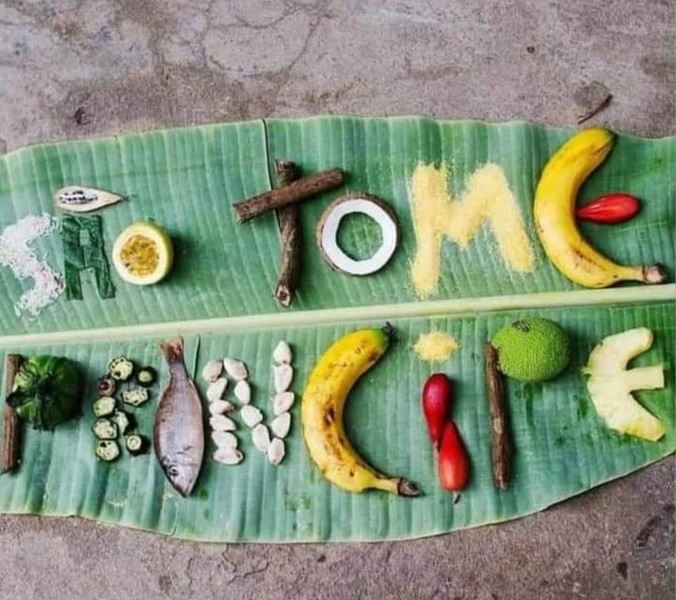
"Ah, here it is at last—that sweet scent of elsewhere so dear to Cricri and Lulu’s noses, that mix of apprehension and desire when facing the unknown.
We’re really diving into the unknown this time, taking you to the island of SAO TOMÉ... also known as the island: *‘Wait, what did you say?’* 😄. Because apparently, no one’s heard of Sao Tomé—except our Portuguese friends.
It’s an archipelago of three islands smack in the middle of the world, right on the equator, off the coast of Gabon.
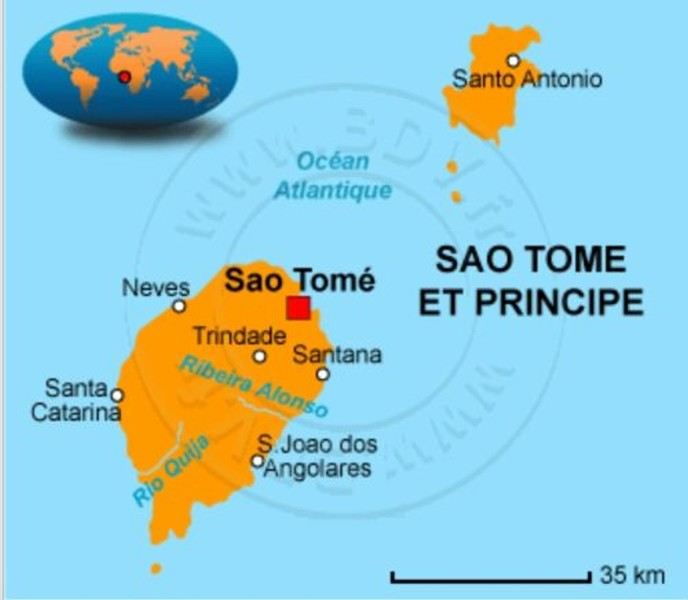
No, these aren’t the sun-soaked, Polynesian lagoon islands. Here, *‘it rains, it pours...’* pretty much all the time, it seems.
There’s not much to *‘see’* in the traditional tourist sense—EXCEPT for stunning landscapes, lush vegetation, a few beaches with golden or black sand, colonial buildings still in their original state, a single main road, and plenty of *‘tracks’* that are more or less drivable. All this surrounded by an African population that speaks Portuguese and is known for its warm welcome.
Well, that should be enough for our happiness—and hopefully yours too! 😊
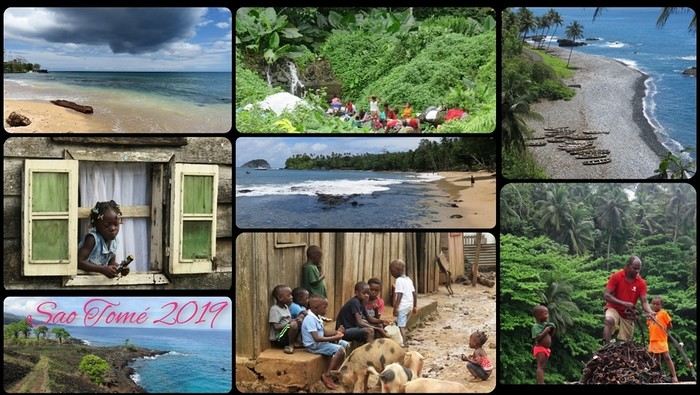
Ready for landing?
"Ah, here it is at last—that sweet scent of elsewhere so dear to Cricri and Lulu’s noses, that mix of apprehension and desire when facing the unknown.
We’re really diving into the unknown this time, taking you to the island of SAO TOMÉ... also known as the island: *‘Wait, what did you say?’* 😄. Because apparently, no one’s heard of Sao Tomé—except our Portuguese friends.
It’s an archipelago of three islands smack in the middle of the world, right on the equator, off the coast of Gabon.
No, these aren’t the sun-soaked, Polynesian lagoon islands. Here, *‘it rains, it pours...’* pretty much all the time, it seems.
There’s not much to *‘see’* in the traditional tourist sense—EXCEPT for stunning landscapes, lush vegetation, a few beaches with golden or black sand, colonial buildings still in their original state, a single main road, and plenty of *‘tracks’* that are more or less drivable. All this surrounded by an African population that speaks Portuguese and is known for its warm welcome.
Well, that should be enough for our happiness—and hopefully yours too! 😊
Ready for landing?
Travel: A Right for All? Reflections on Global Freedoms and Inequalities
Hello fellow travel enthusiasts! 🌍
As a traveler and blogger, I’ve often been struck by the huge inequalities tied to freedom of movement. While some cross borders with ease, others face major obstacles due to their nationality, background, or the restrictive policies of certain countries.
On the occasion of International Human Rights Day, I wrote an article reflecting on this issue: 📖 Travelers' Rights: A Reflection on Freedom of Movement and Global Inequalities
In this article, I cover topics like:
Inequalities between passports ("strong" vs. "weak" passports). The specific challenges faced by travelers from marginalized communities. How to take action to promote more inclusive and equitable travel.
I’d love to hear your thoughts! 😊 Have you ever experienced these inequalities while traveling? How do you think we could raise more awareness about this issue? Feel free to share your experiences or ask questions in this thread. I can’t wait to discuss this with you!
Travel is also about building bridges between cultures. So let’s make sure it becomes a reality for everyone. ✈️🌎 Thanks for reading, and I look forward to exchanging ideas with you!
On the occasion of International Human Rights Day, I wrote an article reflecting on this issue: 📖 Travelers' Rights: A Reflection on Freedom of Movement and Global Inequalities
In this article, I cover topics like:
Inequalities between passports ("strong" vs. "weak" passports). The specific challenges faced by travelers from marginalized communities. How to take action to promote more inclusive and equitable travel.
I’d love to hear your thoughts! 😊 Have you ever experienced these inequalities while traveling? How do you think we could raise more awareness about this issue? Feel free to share your experiences or ask questions in this thread. I can’t wait to discuss this with you!
Travel is also about building bridges between cultures. So let’s make sure it becomes a reality for everyone. ✈️🌎 Thanks for reading, and I look forward to exchanging ideas with you!
Transsibérien et suite (Japon-Asie)
Bonjour
Pour août 21, nous souhaiterions partir pour 6 mois; d'abord avec le Transsiberien et ensuite le Japon (1 mois si correct du Nord au Sud) et enfin terminer par Asie du SE , type Indonésie
Pour le Transsiberien, quelles sont vos recommandations pour les arrêts d'étapes (que voir et durées ) , comment acheter les billets directement (par internet ?) et prix; autres infos ?
On pensait aussi faire en suivant le Japon du Nord au Sud ; quel meilleur moyen de transport: train? ou voiture louée, ou les deux (train + voiture pour étages) ; pareil , quels sont vos "incontournables"
On pensait terminer par l'Indonésie (on a déjà fait Bali ); autres conseils de pays dans la région
Après retour en avion (on peut pas tout se faire ecolo !)
Merci pour vos infos
Bruno
Enjoy Jordan: 3 semaines inoubliables
Je vais me lancer dans un énième carnet sur cette fabuleuse destination. Je ne prétends pas égaler le style humoristique de certaines ou certains (ils se reconnaîtront !). Je vais juste essayer de vous faire vivre ou revivre quelques-uns de nos beaux souvenirs en ces temps où l'on ne sait plus vraiment quand nous pourrons refaire nos bagages et pour quelle destination.
Allez c'est parti, embarquement immédiat !
Mi-octobre 2019, mon épouse et moi sommes revenus d'un beau voyage de 3 semaines en Jordanie et 3,5 jours à Jérusalem.
Mais pourquoi 3 semaines dans un aussi petit pays où la plupart des touristes en 'font le tour' en 8/10 jours ?
Parce que... C'est la meilleure réponse... Surtout parce que nous le pouvons (pas de vacances en juillet/août) et que nous aimons prendre notre temps, visiter des sites moins connus, faire des activités parfois surprenante à nos âges.
Nous avons parcouru la Jordanie de Madaba et des rives de la Mer Morte à Jerash en passant par les châteaux du désert, de Jerash à Dana en passant par Kerak, de Dana au sublime Wadi Rum en passant par la merveilleuse Petra. Pour terminer, je vous proposerai de flâner dans la vieille ville d'Aman. Et au bout du bout, je pourrai éventuellement vous raconter nos derniers jours de ce périple passés à Jérusalem.
Etape 1 : Madaba
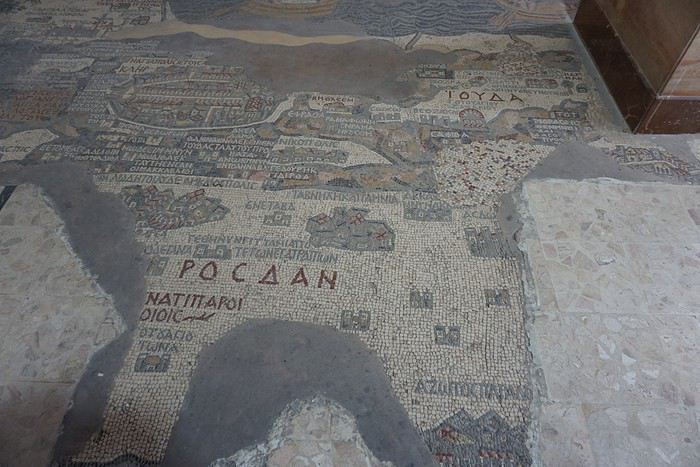
L’objectif de cette étape était de visiter tranquillement la ville et de voir les nombreuses mosaïques sur ses différents sites. Mais aussi de passer une journée au bord de la Mer Morte (objectif : repos dans un cadre sympa), de visiter quelques sites, villes ou villages tout autour et d’aller tenter le canyoning dans le wadi Mujib, nous qui n’avons jamais fait de canyoning ! Etape 2 : Jerash
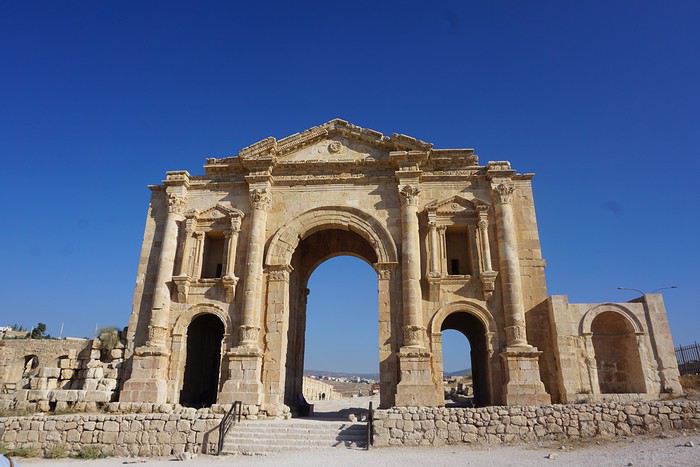
Etape à 100% culturelle avec au programme les châteaux du désert (petit détour pour relier Madaba à Jerash), les sites romains de Jerash, Um Qais et Pella, mais aussi le château médiéval d’Ajlun. Etape 3 : Kerak par la route du roi.
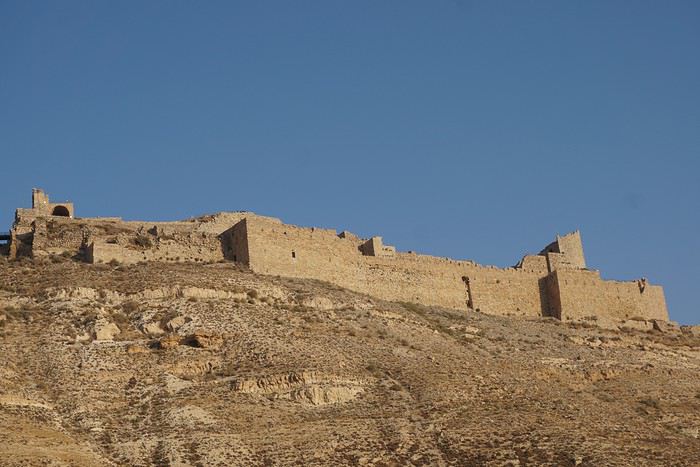
Nous ne passerons qu’une nuit à Kerak. Une demi-journée pour visiter le château, c’est très largement suffisant (même pour nous !) et donc cela va nous laisser du temps pour aller se balader dans des wadis faciles d’accès. Etape 4 : Dana
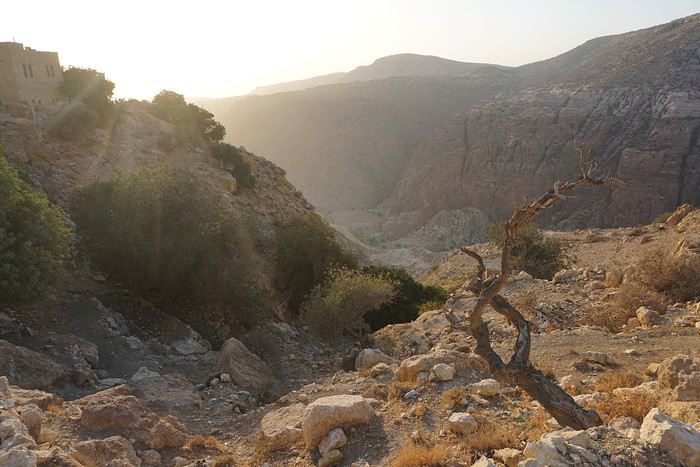
Ici aussi nous ne passerons qu’une nuit alors qu’au départ j’envisageai de passer plusieurs jours dans la réserve. Cela a été a priori un bon choix car si les randonnées y sont probablement très belles, Justine aurait eu beaucoup de mal compte-tenu du dénivelé. Et puis derrière, il y a Pétra et le trek dans le Wadi Rum. Il fallait donc se garder un peu d’énergie. Etape 5 : Pétra
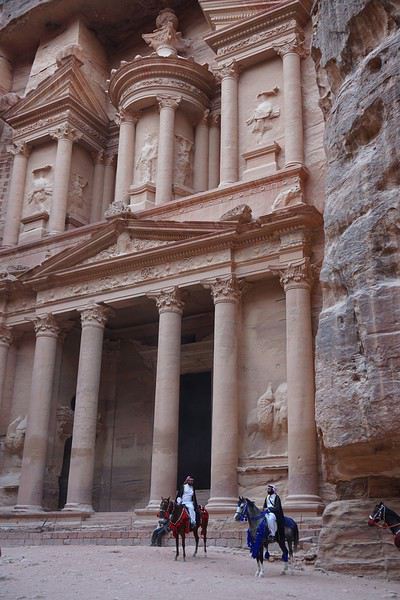
Que dire de cette étape ? Mon projet est de visiter le site en 4 journées complètes sans savoir si on pourra y rentrer 4 jours avec un Jordan Pass de 3 jours à Pétra. Si pas possible, on improvisera ! Etape 6 : Wadi Rum
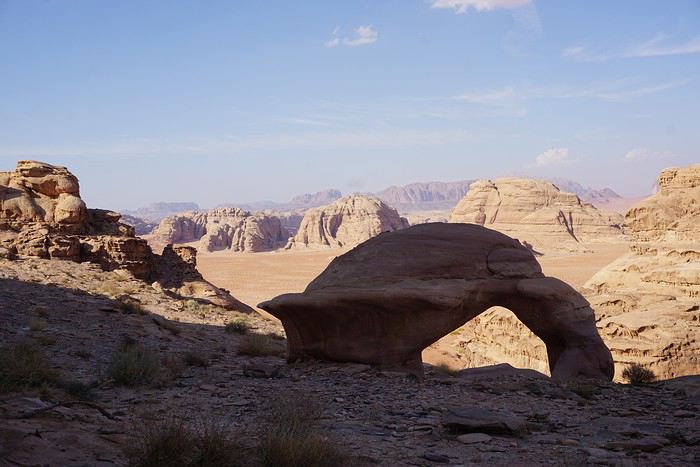
Nous allons y fêter notre anniversaire de mariage. Un trek de 3 jours, des camps itinérants et les nuits à la belle étoile. Et le jour de note anniversaire, le survol du désert au lever du soleil en montgolfière… projet sympa non ? Mais chut, c'est une surprise pour mon épouse ! Etape 7 : Amman
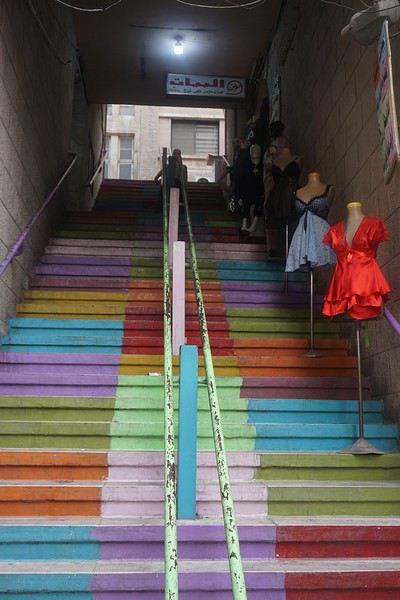
Dernière étape en Jordanie avant de traverser la frontière et terminer notre voyage à Jérusalem Etape 8 : Jérusalem
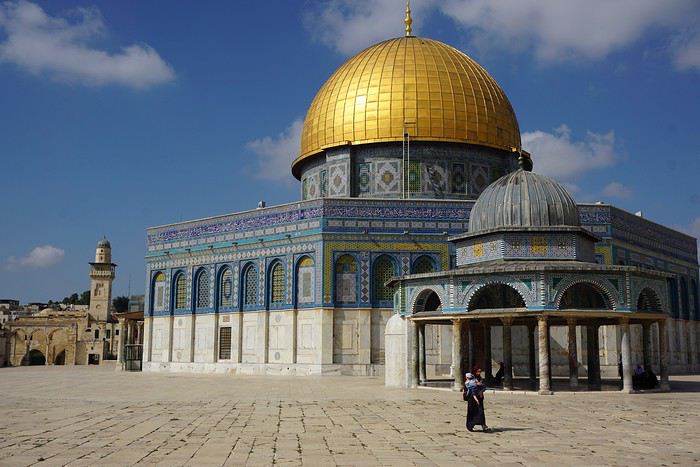
On ne présente plus cette destination : la vieille ville avec ses souks et les 4 quartiers (arabe, juif, chrétien et arménien), le Mont des Oliviers, le Mur des Lamentations, l’Esplanade des Mosquées. Mais aussi le mémorial de la Shoah.
L’objectif de cette étape était de visiter tranquillement la ville et de voir les nombreuses mosaïques sur ses différents sites. Mais aussi de passer une journée au bord de la Mer Morte (objectif : repos dans un cadre sympa), de visiter quelques sites, villes ou villages tout autour et d’aller tenter le canyoning dans le wadi Mujib, nous qui n’avons jamais fait de canyoning ! Etape 2 : Jerash
Etape à 100% culturelle avec au programme les châteaux du désert (petit détour pour relier Madaba à Jerash), les sites romains de Jerash, Um Qais et Pella, mais aussi le château médiéval d’Ajlun. Etape 3 : Kerak par la route du roi.
Nous ne passerons qu’une nuit à Kerak. Une demi-journée pour visiter le château, c’est très largement suffisant (même pour nous !) et donc cela va nous laisser du temps pour aller se balader dans des wadis faciles d’accès. Etape 4 : Dana
Ici aussi nous ne passerons qu’une nuit alors qu’au départ j’envisageai de passer plusieurs jours dans la réserve. Cela a été a priori un bon choix car si les randonnées y sont probablement très belles, Justine aurait eu beaucoup de mal compte-tenu du dénivelé. Et puis derrière, il y a Pétra et le trek dans le Wadi Rum. Il fallait donc se garder un peu d’énergie. Etape 5 : Pétra
Que dire de cette étape ? Mon projet est de visiter le site en 4 journées complètes sans savoir si on pourra y rentrer 4 jours avec un Jordan Pass de 3 jours à Pétra. Si pas possible, on improvisera ! Etape 6 : Wadi Rum
Nous allons y fêter notre anniversaire de mariage. Un trek de 3 jours, des camps itinérants et les nuits à la belle étoile. Et le jour de note anniversaire, le survol du désert au lever du soleil en montgolfière… projet sympa non ? Mais chut, c'est une surprise pour mon épouse ! Etape 7 : Amman
Dernière étape en Jordanie avant de traverser la frontière et terminer notre voyage à Jérusalem Etape 8 : Jérusalem
On ne présente plus cette destination : la vieille ville avec ses souks et les 4 quartiers (arabe, juif, chrétien et arménien), le Mont des Oliviers, le Mur des Lamentations, l’Esplanade des Mosquées. Mais aussi le mémorial de la Shoah.
Toadstool hoodoos
Bonjour,
Je suis revenues des States le dimanche, le mercredi, Trump annonçait la fermeture des frontières aux Européens. J'ai eu une profonde respiration en entendant la nouvelle!!!
Je ne raconterai pas tout mon voyage... J'aime autant le chemin qui conduit aux sites que les sites eux-mêmes.
J'ai eu un vrai coup de cœur pour pleins de sites dont j'ai profité dans le south west, mais ce qui m'a surtout marqué, c'est le fait que souvent, sur les carnets, on a parfois l'impression (à tort d'ailleurs) qu'un site c'est juste une succession de choses importantes à voir dont il faut faire la liste et puis c'est tout.
Je vais donc vous faire découvrir toadstool à ma façon, j'aimerais vous faire découvrir les différentes étapes de ma découverte de ce park gratuit..
Voici tout d'abord ce qu'on découvre de la route: des montagnes chocolatées. Le parking placé devant à notre arrivée ne comporte qu'une voiture noire en fin de matinée.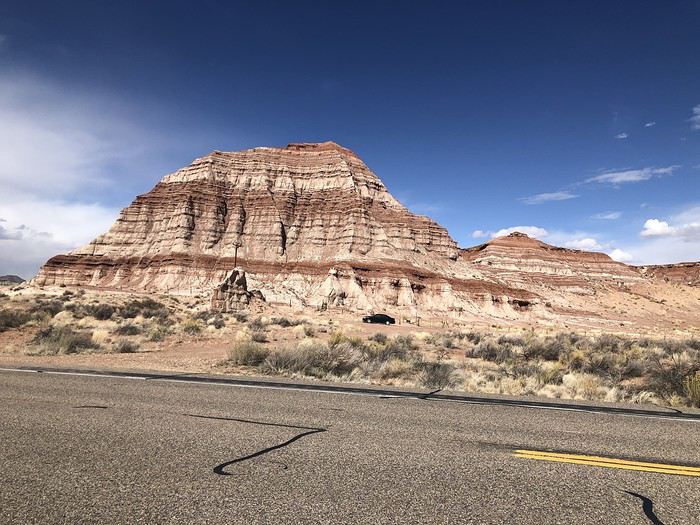
Puis sur le parking, ou se trouve la voiture noire, on voit le panneau qui vous rassure sur le nom du park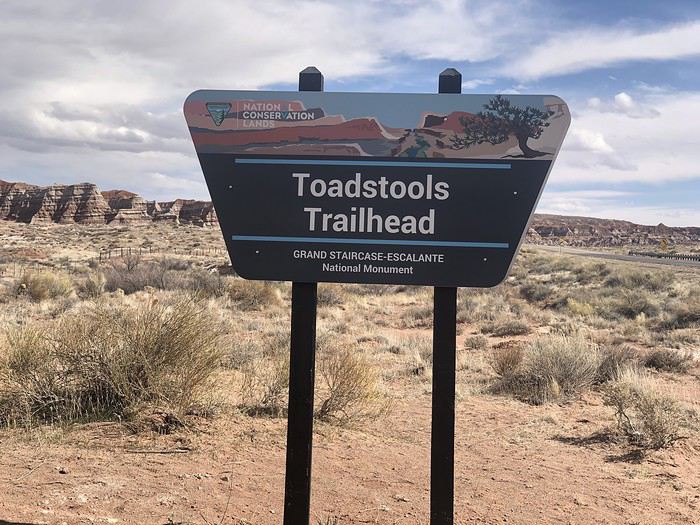
Il y a aussi un panneau qui vous informe sur ce qu'est un toadstool, c'est à-dire un champignon vénéneux, mais si vous allez sur place vous le verrez. Vous aurez toutes les infos sur la formation des toadstools, et aussi sur le fait que le chemin allé simple fait 0,8 miles et aller retour fait 1,6 miles. Je n'ai pas très bien compris l'intérêt de la distance aller simple et me suis demandée s'il y avait des gens qui comptaient rester la-bas définitivement??? 🤪
Ce panneau vous informe aussi du fait qu'en été il peut y faire terriblement chaud, et qu'il vaut mieux vous munir de litres d'eau, d'un chapeau..... A notre arrivée début mars, la température extérieure est de 15°C, le soleil éclaire juste ce qu'il faut, une petite bouteille d'eau pour chacun de nous est amplement suffisante, et de chapeau que nenni!
08 miles aller simple....Mais en fait, vous marcherez beaucoup plus que ça, car une fois sur le site il y aura tellement de coins qui vous attireront que vous y passerez facilement plus de 2 heures si vous vous donnez la peine d'aller découvrir les recoins qui sont derrière le site principal. Et surtout si vous vous donnez la peine de farfouiller un peu. C'est un vrai jeu de chasse au trésor auquel nous nous sommes livrés.
Donc une fois que nous avons complété le registre inséré dans une boite métallique noire qui permet aux rangers de savoir qui chercher s'il vous prenait l'envie d'y rester définitivement, et qu'ensuite nous avons franchi la barrière en barbelés qui laisse entrer les humains qui peuvent se faufiler, mais pas les bovins et les ovins qui ne pourraient pas tordre leur abdomen pour suivre le grillage, vous découvrez de plus près les massifs chocolatés.
Puis vous découvrez que vous avez le choix de marcher dans des washs (ce sont des lits de rivière à sec)
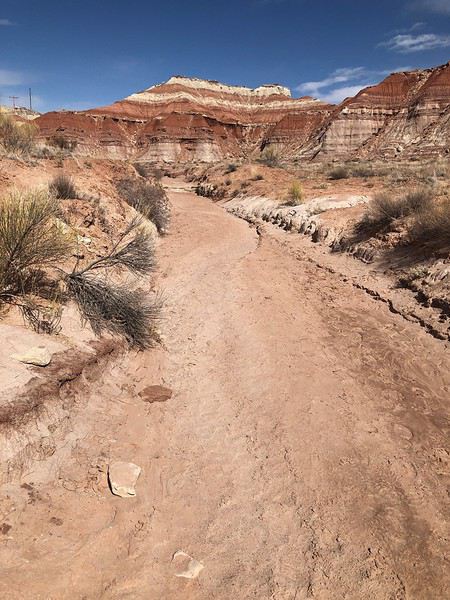
Les massifs chocolatés sont parfois ornés de chantilly, et parfois, le sentier semble sortir du wash pour venir s'incruster entre les mamelons. C'est ce que montre le petit poteau planté sur la droite. C'est une sorte de cairn civilisé, quoi.
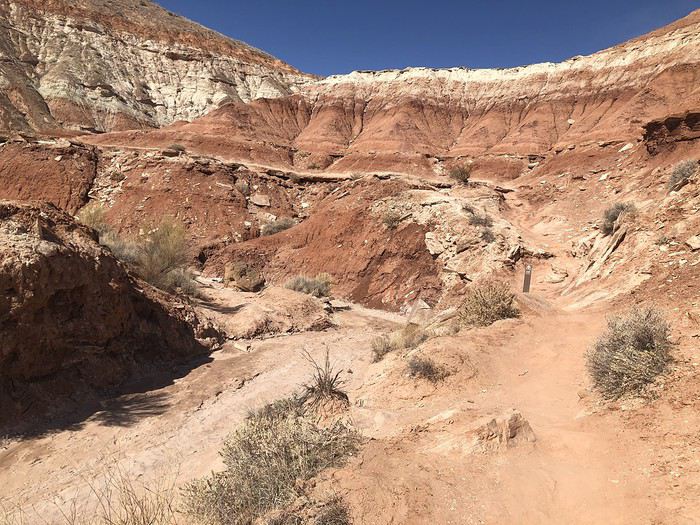
Le sentier peut parfois devenir un peu étroit, et si vous n'êtes pas à l'aise, il vaut mieux retourner dans le wash.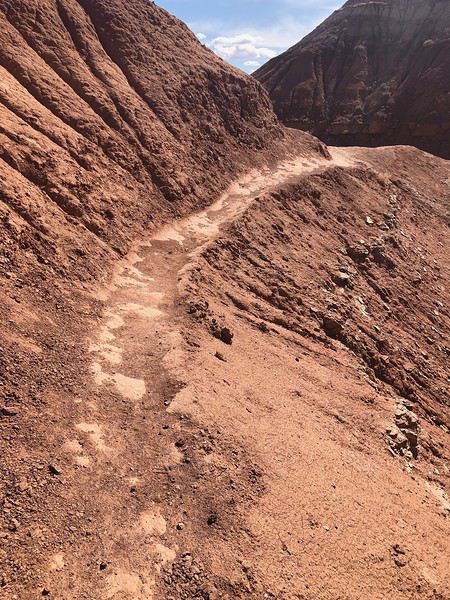
Parfois, c'est carrément acrobatique. Je me suis bien aidée de mes bâtons de marche.
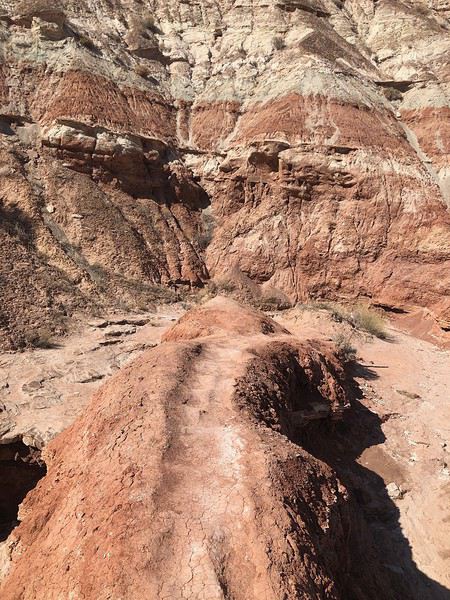
Parfois ce poteau soi disant indicateur m'a laissé perplexe. Tout droit semble-t-il dire... oui mais où est le tout droit en question?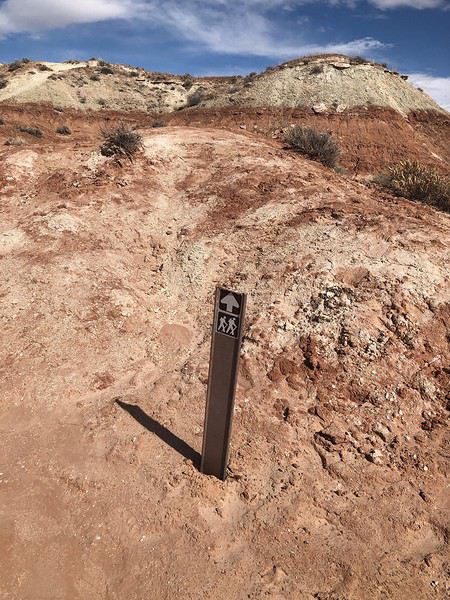
Inutile de dire que s'il a plu les jours qui précèdent votre passage, ou s'il a neigé, alors c'est une vraie pataugeoire dans laquelle vous évoluez. De simples sandales comme j'ai vu des gens en porter, ou même les chaussures de randonnée peuvent conduire à des chutes rocambolesques, ou causer des blessures sérieuses... Nous avons eu la chance en fin d'hiver d'être à une période sèche.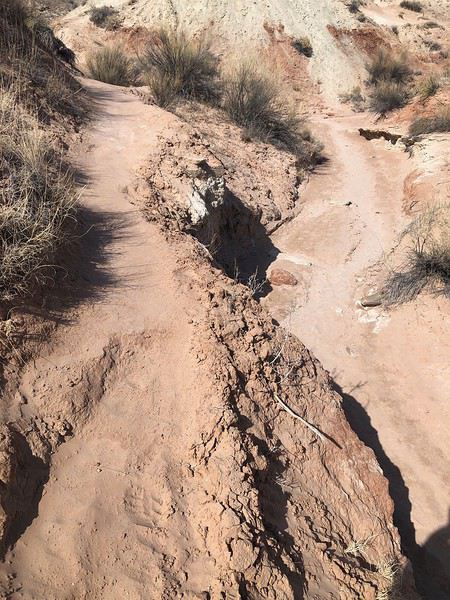
Et puis, il arrive que vous vous trouviez devant une ouverture comme celle là. Et à ce moment précis, plus aucun poteau, sinon ce ne serait pas marrant. Vous sauriez où aller, ce qui n'est manifestement pas le but. Alors, vous suivez votre instinct. Plutôt à droite? Plutôt à gauche? non? au centre alors?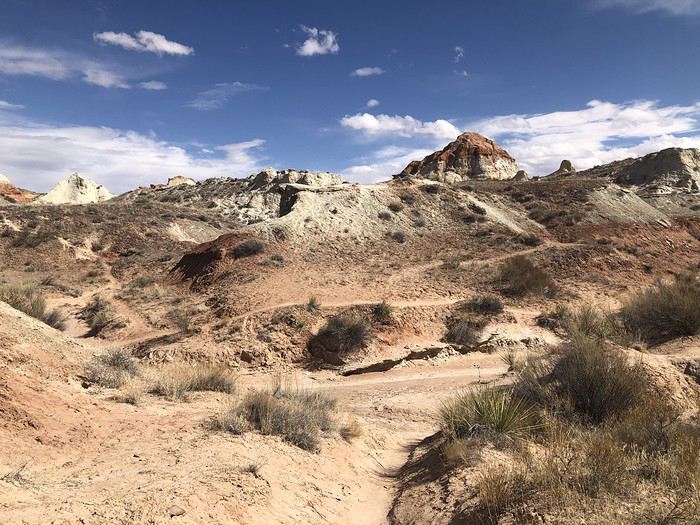
Et bien j'n'en sais rien. J'ai pris une direction au hasard, (ça fonctionne parfois) et j'ai atterri en face de ça.
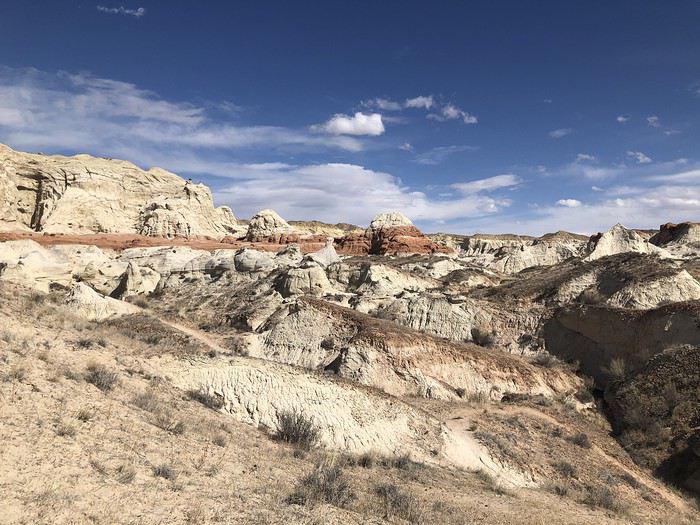
Sur ma gauche se trouvait le fameux chameau qui est sur toutes les photos de photographes professionnels, d'ailleurs sur place, il y en avait un qui ne s'intéressait qu'à ce mastodonte. C'est comme s'il était hermétique à toute la magie du reste.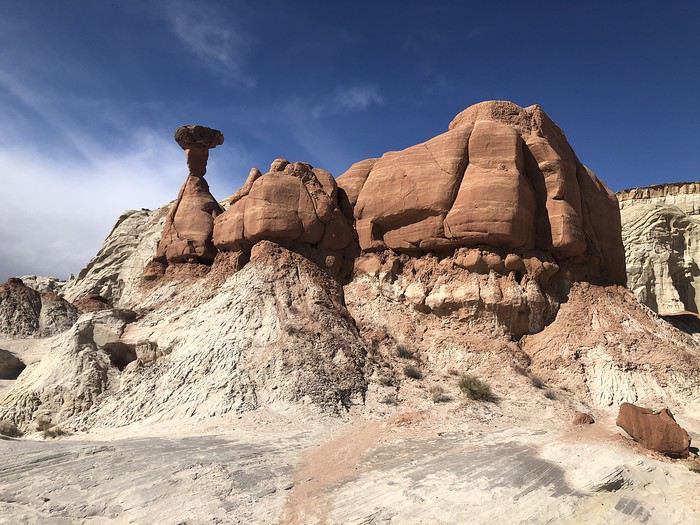
D'ailleurs, il s'est plein à mon mari du mauvais balisage des pistes qui lui avait fait perdre du temps. Il n'est resté qu'autour du chameau, le prenant sous toutes ses coutures, avec différents éclairages. Bon, comme ça, c'est un truc de vrai photographe et que je n'en suis pas, vous n'aurez donc pas la super photo avec le super éclairage qui fait rêver. Au lieu de ça, je suis partie sur la droite par rapport au chameau à la recherche d'un spot de hoodoos blancs, dont j'avais découvert l'existence sur un carnet. J'ai trouvé que ce mélange de blanc et de rouge était très beau.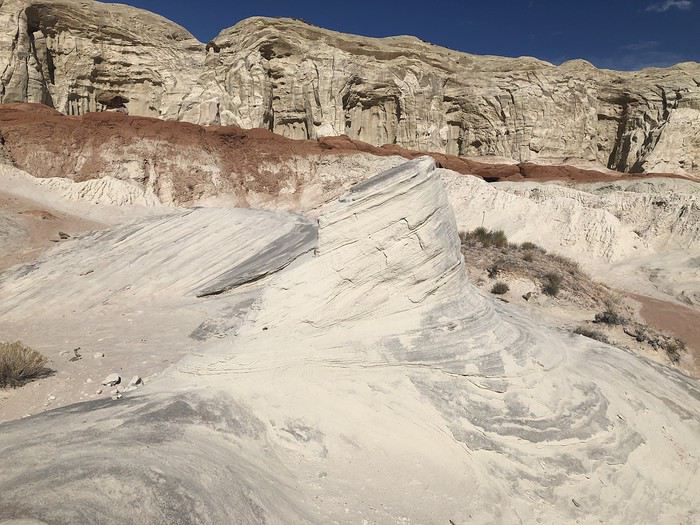
Vraiment très photogénique.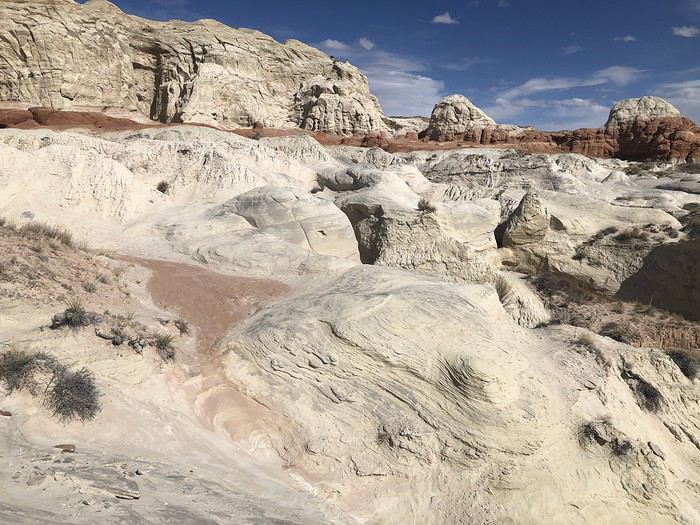
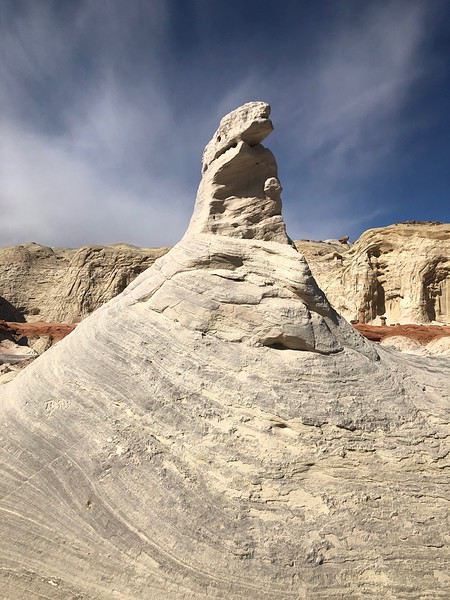
J'ai fait la connaissance du sphinx dont on a coupé le nez
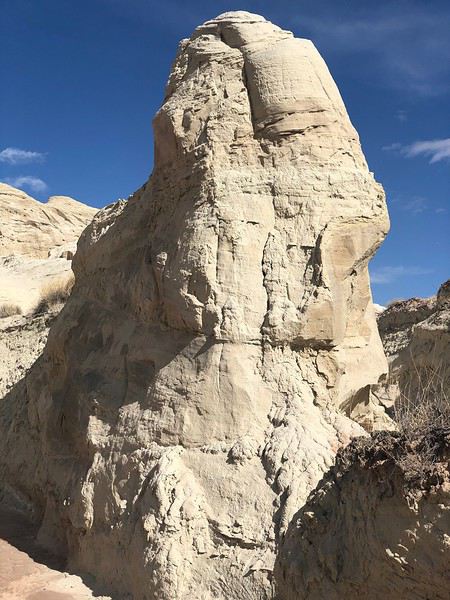
Puis j'ai continué à me diriger vers les massifs blancs qui sont sur la droite, curieuse de tout voir.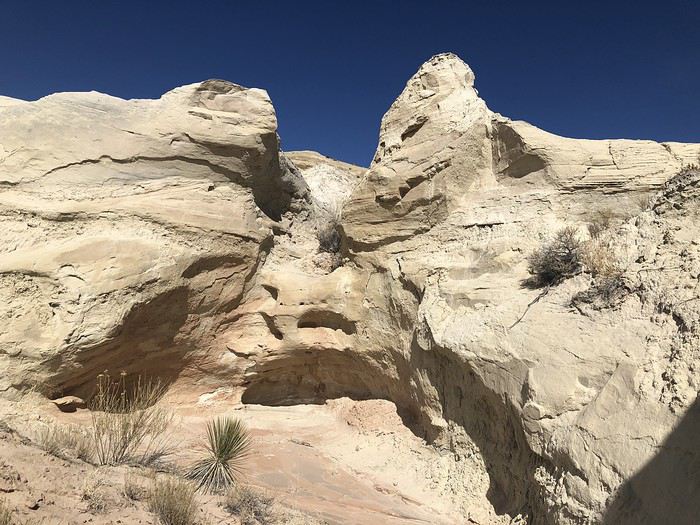
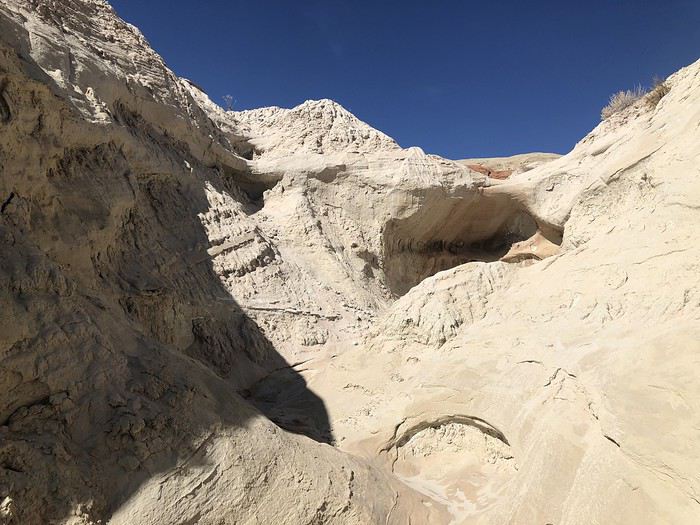
Je me suis retrouvée devant une paroi verticale que j'ai dû escalader, pour finalement, me retrouvée au milieu d'une alcove sans issue (enfin pour moi qui ne suis nullement cascadeuse). J'ai donc redescendu ma paroi verticale, et suis retournée sur mes pas.
En revenant, je me suis retrouvée face à ce joli E.T. de Spielberg.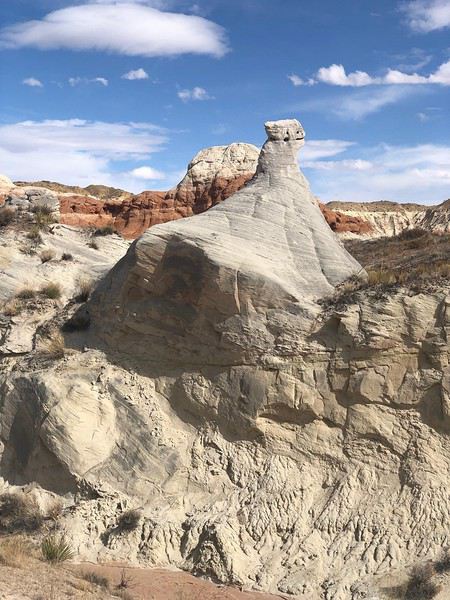
Puis après avoir laissé le chameau toujours sur ma gauche, je me suis retrouvée devant cette cour en rouge et blanc, avec quelques champignons qui émergeaient. Le tout entouré d'une paroi de colonnes blanches. C'est du plus bel effet.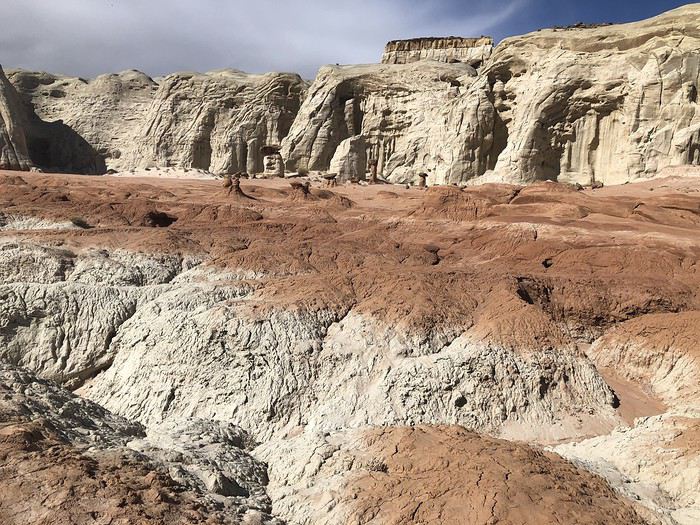
Le chameau au loin dans son environnement en rouge et blanc, a, je trouve, beaucoup plus d'assurance, surtout sous un ciel nuageux.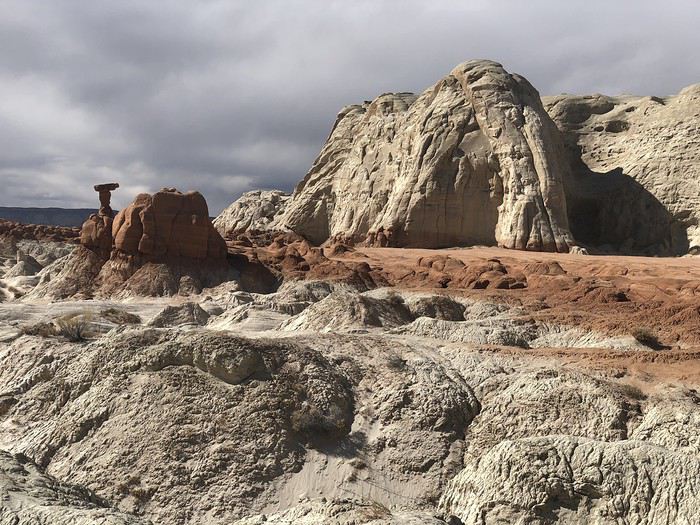
Il est une star parmi les autres, et ce personnage de Star wars ne me démentira pas.
Je suis revenues des States le dimanche, le mercredi, Trump annonçait la fermeture des frontières aux Européens. J'ai eu une profonde respiration en entendant la nouvelle!!!
Je ne raconterai pas tout mon voyage... J'aime autant le chemin qui conduit aux sites que les sites eux-mêmes.
J'ai eu un vrai coup de cœur pour pleins de sites dont j'ai profité dans le south west, mais ce qui m'a surtout marqué, c'est le fait que souvent, sur les carnets, on a parfois l'impression (à tort d'ailleurs) qu'un site c'est juste une succession de choses importantes à voir dont il faut faire la liste et puis c'est tout.
Je vais donc vous faire découvrir toadstool à ma façon, j'aimerais vous faire découvrir les différentes étapes de ma découverte de ce park gratuit..
Voici tout d'abord ce qu'on découvre de la route: des montagnes chocolatées. Le parking placé devant à notre arrivée ne comporte qu'une voiture noire en fin de matinée.
Puis sur le parking, ou se trouve la voiture noire, on voit le panneau qui vous rassure sur le nom du park
Il y a aussi un panneau qui vous informe sur ce qu'est un toadstool, c'est à-dire un champignon vénéneux, mais si vous allez sur place vous le verrez. Vous aurez toutes les infos sur la formation des toadstools, et aussi sur le fait que le chemin allé simple fait 0,8 miles et aller retour fait 1,6 miles. Je n'ai pas très bien compris l'intérêt de la distance aller simple et me suis demandée s'il y avait des gens qui comptaient rester la-bas définitivement??? 🤪
Ce panneau vous informe aussi du fait qu'en été il peut y faire terriblement chaud, et qu'il vaut mieux vous munir de litres d'eau, d'un chapeau..... A notre arrivée début mars, la température extérieure est de 15°C, le soleil éclaire juste ce qu'il faut, une petite bouteille d'eau pour chacun de nous est amplement suffisante, et de chapeau que nenni!
08 miles aller simple....Mais en fait, vous marcherez beaucoup plus que ça, car une fois sur le site il y aura tellement de coins qui vous attireront que vous y passerez facilement plus de 2 heures si vous vous donnez la peine d'aller découvrir les recoins qui sont derrière le site principal. Et surtout si vous vous donnez la peine de farfouiller un peu. C'est un vrai jeu de chasse au trésor auquel nous nous sommes livrés.
Donc une fois que nous avons complété le registre inséré dans une boite métallique noire qui permet aux rangers de savoir qui chercher s'il vous prenait l'envie d'y rester définitivement, et qu'ensuite nous avons franchi la barrière en barbelés qui laisse entrer les humains qui peuvent se faufiler, mais pas les bovins et les ovins qui ne pourraient pas tordre leur abdomen pour suivre le grillage, vous découvrez de plus près les massifs chocolatés.
Puis vous découvrez que vous avez le choix de marcher dans des washs (ce sont des lits de rivière à sec)
Les massifs chocolatés sont parfois ornés de chantilly, et parfois, le sentier semble sortir du wash pour venir s'incruster entre les mamelons. C'est ce que montre le petit poteau planté sur la droite. C'est une sorte de cairn civilisé, quoi.
Le sentier peut parfois devenir un peu étroit, et si vous n'êtes pas à l'aise, il vaut mieux retourner dans le wash.
Parfois, c'est carrément acrobatique. Je me suis bien aidée de mes bâtons de marche.
Parfois ce poteau soi disant indicateur m'a laissé perplexe. Tout droit semble-t-il dire... oui mais où est le tout droit en question?
Inutile de dire que s'il a plu les jours qui précèdent votre passage, ou s'il a neigé, alors c'est une vraie pataugeoire dans laquelle vous évoluez. De simples sandales comme j'ai vu des gens en porter, ou même les chaussures de randonnée peuvent conduire à des chutes rocambolesques, ou causer des blessures sérieuses... Nous avons eu la chance en fin d'hiver d'être à une période sèche.
Et puis, il arrive que vous vous trouviez devant une ouverture comme celle là. Et à ce moment précis, plus aucun poteau, sinon ce ne serait pas marrant. Vous sauriez où aller, ce qui n'est manifestement pas le but. Alors, vous suivez votre instinct. Plutôt à droite? Plutôt à gauche? non? au centre alors?
Et bien j'n'en sais rien. J'ai pris une direction au hasard, (ça fonctionne parfois) et j'ai atterri en face de ça.
Sur ma gauche se trouvait le fameux chameau qui est sur toutes les photos de photographes professionnels, d'ailleurs sur place, il y en avait un qui ne s'intéressait qu'à ce mastodonte. C'est comme s'il était hermétique à toute la magie du reste.
D'ailleurs, il s'est plein à mon mari du mauvais balisage des pistes qui lui avait fait perdre du temps. Il n'est resté qu'autour du chameau, le prenant sous toutes ses coutures, avec différents éclairages. Bon, comme ça, c'est un truc de vrai photographe et que je n'en suis pas, vous n'aurez donc pas la super photo avec le super éclairage qui fait rêver. Au lieu de ça, je suis partie sur la droite par rapport au chameau à la recherche d'un spot de hoodoos blancs, dont j'avais découvert l'existence sur un carnet. J'ai trouvé que ce mélange de blanc et de rouge était très beau.
Vraiment très photogénique.
J'ai fait la connaissance du sphinx dont on a coupé le nez
Puis j'ai continué à me diriger vers les massifs blancs qui sont sur la droite, curieuse de tout voir.
Je me suis retrouvée devant une paroi verticale que j'ai dû escalader, pour finalement, me retrouvée au milieu d'une alcove sans issue (enfin pour moi qui ne suis nullement cascadeuse). J'ai donc redescendu ma paroi verticale, et suis retournée sur mes pas.
En revenant, je me suis retrouvée face à ce joli E.T. de Spielberg.
Puis après avoir laissé le chameau toujours sur ma gauche, je me suis retrouvée devant cette cour en rouge et blanc, avec quelques champignons qui émergeaient. Le tout entouré d'une paroi de colonnes blanches. C'est du plus bel effet.
Le chameau au loin dans son environnement en rouge et blanc, a, je trouve, beaucoup plus d'assurance, surtout sous un ciel nuageux.
Il est une star parmi les autres, et ce personnage de Star wars ne me démentira pas.
Oman, le pays des Mille moins Une Merveilles
Bonjour à tous,
Petit clin d'oeil au carnet d'Isabelle (Rouquine 38) quant au choix du titre 😉.
Pourquoi "mille moins une"? Tout simplement parce qu'en 10 jours, on en voit moins qu'en 14 et qu'en berline on en voit (un peu) moins qu'en 4x4. Exit donc le Dhofar et le Jebel Akhdar. Pour ce qui est des 999 autres merveilles, c'est pas faute de ne pas vous avoir prévenus: il va y avoir des redites!
C'est parti.... Muriel
Petit clin d'oeil au carnet d'Isabelle (Rouquine 38) quant au choix du titre 😉.
Pourquoi "mille moins une"? Tout simplement parce qu'en 10 jours, on en voit moins qu'en 14 et qu'en berline on en voit (un peu) moins qu'en 4x4. Exit donc le Dhofar et le Jebel Akhdar. Pour ce qui est des 999 autres merveilles, c'est pas faute de ne pas vous avoir prévenus: il va y avoir des redites!
C'est parti.... Muriel
Discussion autour du concours du mois de mars 2020: Seul(e) au monde ou la solitude
Bonjour 😉
C'est ici - et uniquement ici - qu'on discute à propos de la thématique du mois : Seul(e) au monde - concours photo du mois de Mars 2020
C'est ici - et uniquement ici - qu'on discute à propos de la thématique du mois : Seul(e) au monde - concours photo du mois de Mars 2020
Uganda: 20 days discovering authenticity
Preamble:
For summer 2019, the idea was to return to Africa. We had already been to Namibia in 2017 (+ a few days in Botswana and the end of the trip at Victoria Falls), which we loved, and a trip to Asia in 2018 (Borneo, Perhentian, and Singapore), a nature-focused trip but a bit disappointing due to environmental destruction. The desire to return to Africa was very strong. We wanted a change of scenery, nature, discoveries, to step out of our little comfort zone (a bit, anyway!) and experience travel differently. In short, we dreamed of authenticity, and we weren’t disappointed.
We traveled as a family of four with our daughters, aged 19 and 17. When the urge for Africa hit, Uganda quickly stood out, especially for the chance to see rare animals, particularly the famous mountain gorillas. When I looked into the budget, I was quickly disheartened. It’s really expensive. Too expensive… Then, after reading a few trip reports on "VoyageForum" (thanks Muriel J!), I decided to ask a local agency for a quote. The first contact was very friendly and responsive, and the initial offer for two weeks fit our budget :). A few images gathered from the internet (especially Sipi Falls) finally convinced us all. I asked for an adapted offer with a few more sites to extend the trip to three weeks and cover a fairly complete visit to the country (which, of course, increased the budget! To stay within an acceptable range, we prioritized activities over accommodations and regularly chose the cheapest options, with 2-3 nice lodges in between). It’s booked! We were in October 2018, and the first thing to do was reserve permits to see the gorillas and chimpanzees. Then, the agency took care of all the bookings except for the international flights, which we booked with Ethiopian Airlines. A few months of waiting to look forward to… and a little worry too! Two events didn’t reassure us: the kidnapping of an American tourist by four men at the DRC border and the Ebola outbreak in Congo, with confirmed cases in Uganda by mid-June…
Here we are in July, and departure is approaching. The suitcases are packed (warm clothes, long, short, dark, light, practical, sun, rain, hiking/trekking shoes, flip-flops—clothes for every situation! Don’t forget: headlamp (essential!), binoculars, cameras), and we’re ready.
One day before departure, our agency Mpolampola, through its manager Paul, informs us that he won’t be the one taking care of us during the trip but another guide named Moses. He has a big problem with a vehicle and can’t do otherwise. For us, as long as everything is okay, no worries, especially since I had read glowing reviews about Moses, who turned out to be a very pleasant guide, cautious (most important) on the road, clear about all the activities, and an expert on birds, his specialty. We briefly met Paul in the middle of the trip, who is also very friendly. In short, we 100% recommend this agency. Flights to Entebbe went smoothly; we arrived around 10:30 AM, filled out health forms (Ebola information signs everywhere), visas, baggage claim, and met Moses, who took us directly to the vehicle. It was in pretty good condition with huge tires (we’d understand why later!), but it had quite a few miles (400,000 on the odometer!). Just missing a seatbelt… Okay, it’s Africa!
Now, here’s our day-by-day itinerary, which I’ll summarize briefly with ratings for each activity: ****TOPISSIME (Amazing) ***Very good **Good *Meh
Day 1) Departure from the airport at 11:45 AM for some currency exchange. Stop along the way at the equator for a meal and souvenir photo! Arrival at Lake Mburo Park *** around 5:00 PM. Even before entering the park, we saw lots of antelopes, zebras, elks, etc.—it’s magnificent. On the way, we had already encountered many goats and cows, and we were impressed by their enormous horns. We enjoyed a nice game drive until about 7:00 PM, when we reached our lodge, one of the nicest of the trip, Eagle’s Nest ****, with a magnificent view, a tent with a nice bathroom/shower, and a very good meal.
Day 2) Departure at 7:00 AM for a game drive; we encountered many animals again, especially antelopes, zebras, and birds. There are no giraffes, lions, or cheetahs in this park. We didn’t get lucky enough to see a leopard… :-) Then, we continued to Lake Bunyonyi ***, where the road and views are very beautiful, but we were shocked to see locals (mostly women and children) breaking stones by hand on the mountainside in very precarious safety conditions. There are regularly dramatic accidents because, over time, entire sections detach and cause landslides. These stones are then used for road construction… Another world… This was the only place we saw this. Lake Bunyonyi is a nice stop (but less exotic in our opinion since we have many lakes back home too!). We took a boat to our accommodation, Byoona Amagara ***, which has a lot of charm. We stayed in huts called "geodomes," completely open to nature, so it was very cool at night. To reach the toilets located below, you had to be brave! The meal consisted of lake shrimp—good but a bit bland.
Day 3) After a good breakfast, departure at 9:00 AM to visit three islands. We took several nice walks with beautiful views of the lake and islands. A local meal was served on the last island. At 1:00 PM, we met Moses for the rest of the program and headed to Ruhija in Bwindi Forest****. The landscapes are breathtaking. After two hours of driving and many photo stops, we arrived at our accommodation near the trekking starting point, Ruhija Gorilla Friends Resort **. We stayed in a room instead of the initially planned tents, which was just as well because there was a lot of wind during the night. We still had time for an activity and decided to meet the Bwata pygmies despite the bad reviews in the guide… The first part of the visit was quite nice, with a visit to a school where the children gave us a very joyful welcome. We had a great time listening to them sing and dance! Then we met the Bwata pygmies who live on the edge of the forest. When Bwindi Forest was declared a national park, they had to leave their habitat because their activities weren’t compatible with nature and wildlife protection. We left on a somewhat sad note… The visit ended with a local doctor explaining different medicinal plants, and we watched the making of local beer from sorghum. Good meal. We had butterflies in our stomachs—tomorrow was a big day! I admit I was a bit stressed, not entirely confident in my physical abilities…
Day 4) After a short night due to excitement, breakfast, and departure at 7:30 AM. First, it started calmly with singing and dancing. Then, a 15-minute briefing and group assignments. No one asked if we had any physical problems or anything (when booking, I had inquired a bit, and they told me groups were assigned based on physical abilities). We were assigned to the Mukiza group. At first, I was pretty happy—it was a fairly large group with babies :). The ranger explained that for now, they didn’t know where the gorillas were… the trackers couldn’t find them… Oh… (that’s not a good sign!!!) We set off at a good pace, first on a reasonably sloped path. We were accompanied by a family of four Italians and five porters (four for us!). After an hour, the ranger stopped us and informed us they still couldn’t find them—they had fought with another group the day before and scattered throughout the forest, so they were very far away, and we needed to move faster… Hmm… we picked up the pace (we weren’t going slowly before!!!) and walked for another good hour—down, up, down again, up again, we kept going, but always more or less on paths. Then another stop. A 10-minute break waiting for news. The news wasn’t very precise, it seemed! The ranger decided to cut through the forest—machetes were used to clear the path. We descended unimaginable slopes, then climbed back up. Our stick kept getting stuck; luckily, our porter helped us, held our hands, and the terrain was vertical! An hour later, another stop: we heard gorilla cries (yay!!!). False hope—we waited again for news from the trackers, who informed our ranger that it was a non-habituated family, so we couldn’t see them. Cold shower—we had to go all the way back up and return to the starting point to maybe see another group. But time was running out… We arrived around 1:30 PM; all the other groups had already left long ago. Our guide was worried because we still had a long drive ahead. We quickly ate a banana, and off we went for another trek (I was exhausted!). Luckily, this group was close—about 45 minutes of steep descent (I was already thinking about the climb back and considering being adopted by a gorilla ). The forest was sublime, with magnificent tree ferns—the place was truly splendid. Finally, we were there. The porters stayed behind, we grabbed our cameras, and followed the ranger. The progress wasn’t easy, but suddenly, a female was in front of us, curled up in a little ball, eating—so cute. The emotion overwhelmed us. But she moved away—it’s hard to observe them; they move constantly, and the terrain is very steep and uneven. We saw a female descending from a tree with a baby on her back—too adorable. Then, here was the silverback, enormous, incredible, yet so calm and peaceful. He ate quietly and gave us a nice demonstration of nostril exploration! We could observe them for a good hour, but photographing them wasn’t easy because they kept moving, and we could barely stand! Toward the end, a large male (black back) suddenly stood up and decided to pass right where I was! I ended up in the bushes, and the male passed in front of me just a few centimeters away (he stepped on one of my daughters’ feet!) followed by the whole family. Just an exceptional moment. It was time to leave; we had to climb back up. I dreaded it because, I admit, I was exhausted. We finished the hike after 4:00 PM, exhausted but happy. The ranger gave us diplomas, and we didn’t linger because we still had a long drive—we needed to reach Ishasha before nightfall. Our guide was a bit stressed. If we were to do it again, we’d spend an extra night in Bwindi. However, it seems finishing so late is exceptional—it never happens, according to our guide! The road between Bwindi and Ishasha is sublime, with extraordinary landscapes, and despite the late hour, we regularly asked our guide to stop for photos. We arrived at Enjojo *** Lodge around 6:00 PM. The huts are located quite far from the reception and the bathrooms, a bit far from the huts, but otherwise, it was very nice.
Day 5) Departure at 8:00 AM after a good breakfast with the hope of seeing tree-climbing lions (no luck!). Overall, there weren’t many animals, and we arrived around 12:45 PM at our next stop, Parkview Safari Lodge ****, with a magnificent view, a beautiful family bungalow, and a good meal. We enjoyed a short relaxation by the lovely pool. At 4:00 PM, we left to see Kyambura Gorge *** and hike there. Unfortunately, this activity is no longer available, so we walked around the area—it was very beautiful. Back at the hotel, a little rest after the previous day wasn’t a bad idea! Reading, swimming, meals, and dances made the end of the day enjoyable.
Day 6) Departure at 6:30 AM—one of our daughters was sick (stomachache, cold sweats…). Safari in Queen Elizabeth ** (Kaseny Plains)—a bit disappointing. Stop by the salt lake with a nice view. A small market, but we weren’t thrilled by the crafts (overall, apart from some beautiful baskets/plates, there wasn’t much, and the wooden objects were, in our opinion, much less pretty than in Namibia). Then we took the crater road (27 km long) **** with magnificent landscapes. However, you absolutely must close the windows because it’s infested with tsetse flies. At noon, we arrived at Mweya, where we stayed in basic rooms, but the restaurant was well-placed with a beautiful view of the Kazinga Channel. At 2:00 PM, we enjoyed a magnificent cruise **** on the channel. Elephants, antelopes, crocodiles, hippos (including adorable babies), buffaloes, all kinds of birds. Wow!!! Two hours of pure bliss. Quiet end of the day playing cards with a view of the channel and elephants.
Day 7) Departure at 6:00 AM—still sick, we weren’t sure if it was due to the preventive treatment (Malarone) or something else… Another game drive in Queen Elizabeth (Kaseny Plains) and breakfast by the salt lake. Overall, we were a bit disappointed by this park. Then we took the road to Crater Lakes***, again with very beautiful landscapes. A hike of about an hour and a half allowed us to discover these beautiful crater lakes (the water mainly comes from the Rwenzoris). We crossed pretty villages and had nice encounters. End of the day at Tinka’s Home ****, with a family. We loved this place—very welcoming, where we took a cooking class with our hosts. A really great time. After the meal, we enjoyed African stories and dances. Really awesome.
Day 8) Departure at 7:30 AM for another highly anticipated discovery—the chimpanzees in Kibale Forest ****. We went to the meeting point and were split into groups of six, each with a guide. We saw three different groups, and for the last group, we followed a chimpanzee (slightly more comfortable running in the forest than we were!) that led us to the group. Their cries are very impressive, and we could observe them well, even though they were often high up in the trees. We were lucky enough to see two on the ground, very close to us. It was magnificent. End of the encounter and return to the starting point—it was noon. We went back to Tinka’s Home for the meal (delicious!). At 2:00 PM, we hiked in Bigodi Swamp ***, a marsh surrounded by beautiful vegetation, especially huge papyrus, and inhabited by many birds and monkeys. We saw, among others, black-and-white colobus monkeys, red colobus monkeys, and vervet monkeys. We also visited a basket-weaving workshop where we bought two beautiful baskets. Then a short stop in Fort Portal, where we stayed for two nights at Ruwenzori View Guesthouse ***, a nice place with a family room and very good communal meals.
Day 9) Departure at 8:00 AM for a hike in the Rwenzori****—it was a bit chaotic today. First, we had to exchange shillings because we wouldn’t have another chance in the following days. At the bank, employees went to get the bills by motorcycle from other buildings—it was quite surreal! And it took time! Then there was a misunderstanding between the organizer and me… I really wanted to see the region where chameleons are found in the Rwenzori—this region is south of the mountain range, and we were in the north! Anyway, the program included an ascent in the northern part with a positive elevation gain of over 1,500 meters… Talking to the guide scheduled for this hike (Noah), we explained that we really wanted to discover the vegetation and these famous chameleons, not necessarily achieve a physical feat… (we’d had enough!). The decision was made to go south, which meant quite a bit of driving. The hike was really enjoyable, with magnificent vegetation by the river. We saw three of the four chameleon species present, including the famous three-horned chameleon. The region is superb. We ended with a drink at Ruboni Camp, which has a magnificent view of the region (ideally, we should have stayed there). Two hours of driving to finish, and a good meal :).
Day 10) Departure at 8:00 AM—we had a long drive to Ziwa Rhino Ranch****. We passed through Hoima, had lunch in Masindi, and arrived in time for the rhino tracking walk. We could approach them closely on foot—it was impressive. We saw eight. Since we were staying on-site in the guesthouse **, we received precise safety instructions for moving between the rooms and the restaurant. And we quickly understood why!
Day 11) Departure at 6:00 AM for breakfast—surprise, in front of our room, several large rhinos were sleeping (we had also heard a lot of animal noises during the night—rhinos but also what seemed to be predators). So we had to take a detour to reach the restaurant! Second surprise—next to the restaurant, just three meters away at most, two mothers and their baby were also sleeping! Memorable! Then we had an appointment for the shoebill trek and canoe ride **** (package with the previous day’s walk). So there we were, in our boots, splashing through 30 cm of water in search of the shoebill (I really wanted to see one :))! It was really fun, and luck was on our side—a shoebill had just landed in the distance! We approached as best we could and observed it from afar. What a strange bird! There are very few left, and Uganda is one of the countries where the chances of seeing one are quite good. The tour continued with a canoe cruise where we saw a herd of cows (the famous ones with enormous horns) being swum as a dowry to the father of the future bride! A funny spectacle. This stop wasn’t the most anticipated, but we all thought it was really worth the detour. Road to Murchison Falls Park, and arrival around noon at Red Chili Rest Camp **, where we stayed for two nights (family banda). Good meal. Then a cruise to Murchison Falls*** where we disembarked and continued on foot. It was pretty. Back to Red Chili.
Day 12) This morning, early departure for a cruise in search of the shoebill*** (booked in case we didn’t see one at Ziwa). The landscapes were pretty, but there weren’t many birds in the end. We spotted the chosen one from afar after the first 10 minutes—so the suspense didn’t last long :-) It was a nice activity but quite long—5 hours. In the afternoon, safari in Murchison Park****—this park is sublime, the landscapes fabulous. Really one of our favorite parts of the trip. Lots of animals and even a leopard spotted with binoculars because it was far away! Night at Red Chili.
Day 13) Departure for the first morning ferry—it was drizzling, the sky was threatening at first, so the landscape was spectacular! Beautiful contrasts. In the middle of the morning, we were lucky to observe a whole group of lions, first from afar, then with a little patience, the whole group approached until they passed beside and in front of our vehicle. What emotion and excitement! We could then observe large groups of giraffes. They were magnificent. The morning was incredible. Then we headed to our lodge, Fort Murchison ****, and on the way, we saw a whole group of elephants—the view was magnificent. We had a very good meal and enjoyed the pool a bit. We also met Paul, the organizer of our trip. Very nice :). In the late afternoon, off for a short safari in the park. We slept in very well-equipped tents.
Day 14) Today, we had a long drive to Kidepo Park. It was raining, which didn’t help our guide—according to him, the tracks near Kidepo turn to mud with rain and become difficult to navigate. We saw, among other things, a bus in a bad situation in the ditch. Some sections were really tricky, and we were glad to have a driver. The end of the trip—the landscape was spectacular and original, and we saw some traditional villages. We arrived at Kidepo quite late. Short safari in the park before reaching the accommodation. We booked two simple bandas in the park camp**. It was clean but didn’t hold up well in the rain . The restaurant was very nice, though.
Day 15) The day was dedicated to discovering Kidepo Park **** where the landscapes were again superb. First encounter with a lioness resting on a rock. We saw other lions later and observed them for a long time. There were almost no other tourists in the park. Our daughter wasn’t feeling well, and by the time we arrived at the lodge, she had a temperature of 39.5°C (103.1°F)… A nap was necessary. In the late afternoon, we returned to the spot where we had seen the lions that morning, and they were still there—they weren’t happy because rain was threatening! It was a great photo opportunity. Then came the downpour, and our driver urged us to return quickly because the tracks were becoming impassable. Indeed, a jeep was in the ditch… The return was eventful, and several times we slid without being able to do anything… Wow, what a day!
Day 16) No safari this morning because of impassable tracks—the road to Kotido*** was longer than expected as we had to take a detour. The landscapes along the way were surprising. We finally arrived around 1:00 PM at the accommodation and left at 3:00 PM to visit the largest manyatta in East Africa with two translators. It was incredible—a very beautiful experience. The manyatta is immense and has 28,000 inhabitants. Night at Karamojaarts guesthouse*—very average meal.
Day 17) Departure for Moroto****—on the way, we saw many bird species. Moroto doesn’t look like other Ugandan cities. Life there seems very pleasant. We arrived at Kara-Tunga and had a bite to eat. At 4:00 PM, we left to visit a Karamojong village. We enjoyed beautiful dances and watched communal games—it was fun and so authentic. Then we headed to a kraal (where shepherds and herds are) to set up our camp. Moses had to get used to the idea of sleeping in the tribe in a tent! It was incredible to find ourselves in this universe. The place was beautiful, and we had a great time with the Karamojong. Some had never seen white people… had never been in a car… Their culture is incredible. During the evening, around the fire, to our guide’s dismay (a bird enthusiast), they grilled hornbills! On our side, we ate a meal prepared by Kara-Tunga for our sensitive stomachs! Night in a tent.
Day 18) Dawn wake-up in the fog—the atmosphere was quite strange. Our daughter was attacked by a cow—fortunately, more fear than harm, but she ended up with a lot of thorns in her buttocks and thighs ! Then we left for the Mount Elgon region, specifically Sipi Falls****. Lacam Lodge****, perched on the edge of the cliff with a direct view of one of the falls, was just magnificent. The view and landscapes were fabulous. Big favorite. We had dinner and then went for a hike to visit the three falls in the region, partly in the rain. The landscapes were breathtaking! Sunset at Lacam Lodge with the sun setting over the waterfall. We couldn’t get enough and stayed to admire until nightfall!
Day 19) Visit to coffee plantations*** where we were given all the useful explanations to understand the culture and the incredible work required for this product, which is ultimately not very glorified. The visit was very interesting, and we drank very good coffee with the owners. Last photos at Lacam Lodge, and then departure for Jinja, where we arrived in the middle of the afternoon. We took a small cruise to see the source of the Nile*. Very touristy and not at all to our taste… Then a meal at Jinja Base Camp** where we enjoyed guacamole. Our guide Moses left us because another group was waiting for him!
Day 20) Road to Kampala***, the market, the Gaddafi Mosque. Short but interesting visit. Last meal in Entebbe by Lake Victoria, where we almost felt like we were by the sea. Transfer to the airport and return to Switzerland…
Epilogue: All four of us were enchanted by this trip, which will undoubtedly remain one of the most beautiful we’ve ever taken. Talking about it gives me chills and brings tears to my eyes. It was simply a magnificent experience. However, I wouldn’t recommend this trip to everyone because you often have to overlook small inconveniences like toilets (the worst of my life) and certain comfort details that, for us, remain details but could be important to others.
Our favorites: - The gorilla trek - The cruise on Kazinga Channel - The Fort Portal region - The Rwenzori Mountains - The chimpanzee trek - Murchison Falls - Kidepo - Spending time with the Karamojong tribe - The Sipi Falls region - The accommodations: Eagle’s Nest, Byonna Amagara, Parkview Lodge, Tinka’s Home, Rwenzori Guesthouse, Fort Murchison, Night in the kraal, and Lacam Lodge
What we liked less: - Queen Elizabeth Park - Jinja - The accommodations: Ziwa Rhino Ranch, Karamojaarts Guesthouse
I’ll try to post some photos later. If you have any questions about a future trip, I’d be happy to answer them.
For summer 2019, the idea was to return to Africa. We had already been to Namibia in 2017 (+ a few days in Botswana and the end of the trip at Victoria Falls), which we loved, and a trip to Asia in 2018 (Borneo, Perhentian, and Singapore), a nature-focused trip but a bit disappointing due to environmental destruction. The desire to return to Africa was very strong. We wanted a change of scenery, nature, discoveries, to step out of our little comfort zone (a bit, anyway!) and experience travel differently. In short, we dreamed of authenticity, and we weren’t disappointed.
We traveled as a family of four with our daughters, aged 19 and 17. When the urge for Africa hit, Uganda quickly stood out, especially for the chance to see rare animals, particularly the famous mountain gorillas. When I looked into the budget, I was quickly disheartened. It’s really expensive. Too expensive… Then, after reading a few trip reports on "VoyageForum" (thanks Muriel J!), I decided to ask a local agency for a quote. The first contact was very friendly and responsive, and the initial offer for two weeks fit our budget :). A few images gathered from the internet (especially Sipi Falls) finally convinced us all. I asked for an adapted offer with a few more sites to extend the trip to three weeks and cover a fairly complete visit to the country (which, of course, increased the budget! To stay within an acceptable range, we prioritized activities over accommodations and regularly chose the cheapest options, with 2-3 nice lodges in between). It’s booked! We were in October 2018, and the first thing to do was reserve permits to see the gorillas and chimpanzees. Then, the agency took care of all the bookings except for the international flights, which we booked with Ethiopian Airlines. A few months of waiting to look forward to… and a little worry too! Two events didn’t reassure us: the kidnapping of an American tourist by four men at the DRC border and the Ebola outbreak in Congo, with confirmed cases in Uganda by mid-June…
Here we are in July, and departure is approaching. The suitcases are packed (warm clothes, long, short, dark, light, practical, sun, rain, hiking/trekking shoes, flip-flops—clothes for every situation! Don’t forget: headlamp (essential!), binoculars, cameras), and we’re ready.
One day before departure, our agency Mpolampola, through its manager Paul, informs us that he won’t be the one taking care of us during the trip but another guide named Moses. He has a big problem with a vehicle and can’t do otherwise. For us, as long as everything is okay, no worries, especially since I had read glowing reviews about Moses, who turned out to be a very pleasant guide, cautious (most important) on the road, clear about all the activities, and an expert on birds, his specialty. We briefly met Paul in the middle of the trip, who is also very friendly. In short, we 100% recommend this agency. Flights to Entebbe went smoothly; we arrived around 10:30 AM, filled out health forms (Ebola information signs everywhere), visas, baggage claim, and met Moses, who took us directly to the vehicle. It was in pretty good condition with huge tires (we’d understand why later!), but it had quite a few miles (400,000 on the odometer!). Just missing a seatbelt… Okay, it’s Africa!
Now, here’s our day-by-day itinerary, which I’ll summarize briefly with ratings for each activity: ****TOPISSIME (Amazing) ***Very good **Good *Meh
Day 1) Departure from the airport at 11:45 AM for some currency exchange. Stop along the way at the equator for a meal and souvenir photo! Arrival at Lake Mburo Park *** around 5:00 PM. Even before entering the park, we saw lots of antelopes, zebras, elks, etc.—it’s magnificent. On the way, we had already encountered many goats and cows, and we were impressed by their enormous horns. We enjoyed a nice game drive until about 7:00 PM, when we reached our lodge, one of the nicest of the trip, Eagle’s Nest ****, with a magnificent view, a tent with a nice bathroom/shower, and a very good meal.
Day 2) Departure at 7:00 AM for a game drive; we encountered many animals again, especially antelopes, zebras, and birds. There are no giraffes, lions, or cheetahs in this park. We didn’t get lucky enough to see a leopard… :-) Then, we continued to Lake Bunyonyi ***, where the road and views are very beautiful, but we were shocked to see locals (mostly women and children) breaking stones by hand on the mountainside in very precarious safety conditions. There are regularly dramatic accidents because, over time, entire sections detach and cause landslides. These stones are then used for road construction… Another world… This was the only place we saw this. Lake Bunyonyi is a nice stop (but less exotic in our opinion since we have many lakes back home too!). We took a boat to our accommodation, Byoona Amagara ***, which has a lot of charm. We stayed in huts called "geodomes," completely open to nature, so it was very cool at night. To reach the toilets located below, you had to be brave! The meal consisted of lake shrimp—good but a bit bland.
Day 3) After a good breakfast, departure at 9:00 AM to visit three islands. We took several nice walks with beautiful views of the lake and islands. A local meal was served on the last island. At 1:00 PM, we met Moses for the rest of the program and headed to Ruhija in Bwindi Forest****. The landscapes are breathtaking. After two hours of driving and many photo stops, we arrived at our accommodation near the trekking starting point, Ruhija Gorilla Friends Resort **. We stayed in a room instead of the initially planned tents, which was just as well because there was a lot of wind during the night. We still had time for an activity and decided to meet the Bwata pygmies despite the bad reviews in the guide… The first part of the visit was quite nice, with a visit to a school where the children gave us a very joyful welcome. We had a great time listening to them sing and dance! Then we met the Bwata pygmies who live on the edge of the forest. When Bwindi Forest was declared a national park, they had to leave their habitat because their activities weren’t compatible with nature and wildlife protection. We left on a somewhat sad note… The visit ended with a local doctor explaining different medicinal plants, and we watched the making of local beer from sorghum. Good meal. We had butterflies in our stomachs—tomorrow was a big day! I admit I was a bit stressed, not entirely confident in my physical abilities…
Day 4) After a short night due to excitement, breakfast, and departure at 7:30 AM. First, it started calmly with singing and dancing. Then, a 15-minute briefing and group assignments. No one asked if we had any physical problems or anything (when booking, I had inquired a bit, and they told me groups were assigned based on physical abilities). We were assigned to the Mukiza group. At first, I was pretty happy—it was a fairly large group with babies :). The ranger explained that for now, they didn’t know where the gorillas were… the trackers couldn’t find them… Oh… (that’s not a good sign!!!) We set off at a good pace, first on a reasonably sloped path. We were accompanied by a family of four Italians and five porters (four for us!). After an hour, the ranger stopped us and informed us they still couldn’t find them—they had fought with another group the day before and scattered throughout the forest, so they were very far away, and we needed to move faster… Hmm… we picked up the pace (we weren’t going slowly before!!!) and walked for another good hour—down, up, down again, up again, we kept going, but always more or less on paths. Then another stop. A 10-minute break waiting for news. The news wasn’t very precise, it seemed! The ranger decided to cut through the forest—machetes were used to clear the path. We descended unimaginable slopes, then climbed back up. Our stick kept getting stuck; luckily, our porter helped us, held our hands, and the terrain was vertical! An hour later, another stop: we heard gorilla cries (yay!!!). False hope—we waited again for news from the trackers, who informed our ranger that it was a non-habituated family, so we couldn’t see them. Cold shower—we had to go all the way back up and return to the starting point to maybe see another group. But time was running out… We arrived around 1:30 PM; all the other groups had already left long ago. Our guide was worried because we still had a long drive ahead. We quickly ate a banana, and off we went for another trek (I was exhausted!). Luckily, this group was close—about 45 minutes of steep descent (I was already thinking about the climb back and considering being adopted by a gorilla ). The forest was sublime, with magnificent tree ferns—the place was truly splendid. Finally, we were there. The porters stayed behind, we grabbed our cameras, and followed the ranger. The progress wasn’t easy, but suddenly, a female was in front of us, curled up in a little ball, eating—so cute. The emotion overwhelmed us. But she moved away—it’s hard to observe them; they move constantly, and the terrain is very steep and uneven. We saw a female descending from a tree with a baby on her back—too adorable. Then, here was the silverback, enormous, incredible, yet so calm and peaceful. He ate quietly and gave us a nice demonstration of nostril exploration! We could observe them for a good hour, but photographing them wasn’t easy because they kept moving, and we could barely stand! Toward the end, a large male (black back) suddenly stood up and decided to pass right where I was! I ended up in the bushes, and the male passed in front of me just a few centimeters away (he stepped on one of my daughters’ feet!) followed by the whole family. Just an exceptional moment. It was time to leave; we had to climb back up. I dreaded it because, I admit, I was exhausted. We finished the hike after 4:00 PM, exhausted but happy. The ranger gave us diplomas, and we didn’t linger because we still had a long drive—we needed to reach Ishasha before nightfall. Our guide was a bit stressed. If we were to do it again, we’d spend an extra night in Bwindi. However, it seems finishing so late is exceptional—it never happens, according to our guide! The road between Bwindi and Ishasha is sublime, with extraordinary landscapes, and despite the late hour, we regularly asked our guide to stop for photos. We arrived at Enjojo *** Lodge around 6:00 PM. The huts are located quite far from the reception and the bathrooms, a bit far from the huts, but otherwise, it was very nice.
Day 5) Departure at 8:00 AM after a good breakfast with the hope of seeing tree-climbing lions (no luck!). Overall, there weren’t many animals, and we arrived around 12:45 PM at our next stop, Parkview Safari Lodge ****, with a magnificent view, a beautiful family bungalow, and a good meal. We enjoyed a short relaxation by the lovely pool. At 4:00 PM, we left to see Kyambura Gorge *** and hike there. Unfortunately, this activity is no longer available, so we walked around the area—it was very beautiful. Back at the hotel, a little rest after the previous day wasn’t a bad idea! Reading, swimming, meals, and dances made the end of the day enjoyable.
Day 6) Departure at 6:30 AM—one of our daughters was sick (stomachache, cold sweats…). Safari in Queen Elizabeth ** (Kaseny Plains)—a bit disappointing. Stop by the salt lake with a nice view. A small market, but we weren’t thrilled by the crafts (overall, apart from some beautiful baskets/plates, there wasn’t much, and the wooden objects were, in our opinion, much less pretty than in Namibia). Then we took the crater road (27 km long) **** with magnificent landscapes. However, you absolutely must close the windows because it’s infested with tsetse flies. At noon, we arrived at Mweya, where we stayed in basic rooms, but the restaurant was well-placed with a beautiful view of the Kazinga Channel. At 2:00 PM, we enjoyed a magnificent cruise **** on the channel. Elephants, antelopes, crocodiles, hippos (including adorable babies), buffaloes, all kinds of birds. Wow!!! Two hours of pure bliss. Quiet end of the day playing cards with a view of the channel and elephants.
Day 7) Departure at 6:00 AM—still sick, we weren’t sure if it was due to the preventive treatment (Malarone) or something else… Another game drive in Queen Elizabeth (Kaseny Plains) and breakfast by the salt lake. Overall, we were a bit disappointed by this park. Then we took the road to Crater Lakes***, again with very beautiful landscapes. A hike of about an hour and a half allowed us to discover these beautiful crater lakes (the water mainly comes from the Rwenzoris). We crossed pretty villages and had nice encounters. End of the day at Tinka’s Home ****, with a family. We loved this place—very welcoming, where we took a cooking class with our hosts. A really great time. After the meal, we enjoyed African stories and dances. Really awesome.
Day 8) Departure at 7:30 AM for another highly anticipated discovery—the chimpanzees in Kibale Forest ****. We went to the meeting point and were split into groups of six, each with a guide. We saw three different groups, and for the last group, we followed a chimpanzee (slightly more comfortable running in the forest than we were!) that led us to the group. Their cries are very impressive, and we could observe them well, even though they were often high up in the trees. We were lucky enough to see two on the ground, very close to us. It was magnificent. End of the encounter and return to the starting point—it was noon. We went back to Tinka’s Home for the meal (delicious!). At 2:00 PM, we hiked in Bigodi Swamp ***, a marsh surrounded by beautiful vegetation, especially huge papyrus, and inhabited by many birds and monkeys. We saw, among others, black-and-white colobus monkeys, red colobus monkeys, and vervet monkeys. We also visited a basket-weaving workshop where we bought two beautiful baskets. Then a short stop in Fort Portal, where we stayed for two nights at Ruwenzori View Guesthouse ***, a nice place with a family room and very good communal meals.
Day 9) Departure at 8:00 AM for a hike in the Rwenzori****—it was a bit chaotic today. First, we had to exchange shillings because we wouldn’t have another chance in the following days. At the bank, employees went to get the bills by motorcycle from other buildings—it was quite surreal! And it took time! Then there was a misunderstanding between the organizer and me… I really wanted to see the region where chameleons are found in the Rwenzori—this region is south of the mountain range, and we were in the north! Anyway, the program included an ascent in the northern part with a positive elevation gain of over 1,500 meters… Talking to the guide scheduled for this hike (Noah), we explained that we really wanted to discover the vegetation and these famous chameleons, not necessarily achieve a physical feat… (we’d had enough!). The decision was made to go south, which meant quite a bit of driving. The hike was really enjoyable, with magnificent vegetation by the river. We saw three of the four chameleon species present, including the famous three-horned chameleon. The region is superb. We ended with a drink at Ruboni Camp, which has a magnificent view of the region (ideally, we should have stayed there). Two hours of driving to finish, and a good meal :).
Day 10) Departure at 8:00 AM—we had a long drive to Ziwa Rhino Ranch****. We passed through Hoima, had lunch in Masindi, and arrived in time for the rhino tracking walk. We could approach them closely on foot—it was impressive. We saw eight. Since we were staying on-site in the guesthouse **, we received precise safety instructions for moving between the rooms and the restaurant. And we quickly understood why!
Day 11) Departure at 6:00 AM for breakfast—surprise, in front of our room, several large rhinos were sleeping (we had also heard a lot of animal noises during the night—rhinos but also what seemed to be predators). So we had to take a detour to reach the restaurant! Second surprise—next to the restaurant, just three meters away at most, two mothers and their baby were also sleeping! Memorable! Then we had an appointment for the shoebill trek and canoe ride **** (package with the previous day’s walk). So there we were, in our boots, splashing through 30 cm of water in search of the shoebill (I really wanted to see one :))! It was really fun, and luck was on our side—a shoebill had just landed in the distance! We approached as best we could and observed it from afar. What a strange bird! There are very few left, and Uganda is one of the countries where the chances of seeing one are quite good. The tour continued with a canoe cruise where we saw a herd of cows (the famous ones with enormous horns) being swum as a dowry to the father of the future bride! A funny spectacle. This stop wasn’t the most anticipated, but we all thought it was really worth the detour. Road to Murchison Falls Park, and arrival around noon at Red Chili Rest Camp **, where we stayed for two nights (family banda). Good meal. Then a cruise to Murchison Falls*** where we disembarked and continued on foot. It was pretty. Back to Red Chili.
Day 12) This morning, early departure for a cruise in search of the shoebill*** (booked in case we didn’t see one at Ziwa). The landscapes were pretty, but there weren’t many birds in the end. We spotted the chosen one from afar after the first 10 minutes—so the suspense didn’t last long :-) It was a nice activity but quite long—5 hours. In the afternoon, safari in Murchison Park****—this park is sublime, the landscapes fabulous. Really one of our favorite parts of the trip. Lots of animals and even a leopard spotted with binoculars because it was far away! Night at Red Chili.
Day 13) Departure for the first morning ferry—it was drizzling, the sky was threatening at first, so the landscape was spectacular! Beautiful contrasts. In the middle of the morning, we were lucky to observe a whole group of lions, first from afar, then with a little patience, the whole group approached until they passed beside and in front of our vehicle. What emotion and excitement! We could then observe large groups of giraffes. They were magnificent. The morning was incredible. Then we headed to our lodge, Fort Murchison ****, and on the way, we saw a whole group of elephants—the view was magnificent. We had a very good meal and enjoyed the pool a bit. We also met Paul, the organizer of our trip. Very nice :). In the late afternoon, off for a short safari in the park. We slept in very well-equipped tents.
Day 14) Today, we had a long drive to Kidepo Park. It was raining, which didn’t help our guide—according to him, the tracks near Kidepo turn to mud with rain and become difficult to navigate. We saw, among other things, a bus in a bad situation in the ditch. Some sections were really tricky, and we were glad to have a driver. The end of the trip—the landscape was spectacular and original, and we saw some traditional villages. We arrived at Kidepo quite late. Short safari in the park before reaching the accommodation. We booked two simple bandas in the park camp**. It was clean but didn’t hold up well in the rain . The restaurant was very nice, though.
Day 15) The day was dedicated to discovering Kidepo Park **** where the landscapes were again superb. First encounter with a lioness resting on a rock. We saw other lions later and observed them for a long time. There were almost no other tourists in the park. Our daughter wasn’t feeling well, and by the time we arrived at the lodge, she had a temperature of 39.5°C (103.1°F)… A nap was necessary. In the late afternoon, we returned to the spot where we had seen the lions that morning, and they were still there—they weren’t happy because rain was threatening! It was a great photo opportunity. Then came the downpour, and our driver urged us to return quickly because the tracks were becoming impassable. Indeed, a jeep was in the ditch… The return was eventful, and several times we slid without being able to do anything… Wow, what a day!
Day 16) No safari this morning because of impassable tracks—the road to Kotido*** was longer than expected as we had to take a detour. The landscapes along the way were surprising. We finally arrived around 1:00 PM at the accommodation and left at 3:00 PM to visit the largest manyatta in East Africa with two translators. It was incredible—a very beautiful experience. The manyatta is immense and has 28,000 inhabitants. Night at Karamojaarts guesthouse*—very average meal.
Day 17) Departure for Moroto****—on the way, we saw many bird species. Moroto doesn’t look like other Ugandan cities. Life there seems very pleasant. We arrived at Kara-Tunga and had a bite to eat. At 4:00 PM, we left to visit a Karamojong village. We enjoyed beautiful dances and watched communal games—it was fun and so authentic. Then we headed to a kraal (where shepherds and herds are) to set up our camp. Moses had to get used to the idea of sleeping in the tribe in a tent! It was incredible to find ourselves in this universe. The place was beautiful, and we had a great time with the Karamojong. Some had never seen white people… had never been in a car… Their culture is incredible. During the evening, around the fire, to our guide’s dismay (a bird enthusiast), they grilled hornbills! On our side, we ate a meal prepared by Kara-Tunga for our sensitive stomachs! Night in a tent.
Day 18) Dawn wake-up in the fog—the atmosphere was quite strange. Our daughter was attacked by a cow—fortunately, more fear than harm, but she ended up with a lot of thorns in her buttocks and thighs ! Then we left for the Mount Elgon region, specifically Sipi Falls****. Lacam Lodge****, perched on the edge of the cliff with a direct view of one of the falls, was just magnificent. The view and landscapes were fabulous. Big favorite. We had dinner and then went for a hike to visit the three falls in the region, partly in the rain. The landscapes were breathtaking! Sunset at Lacam Lodge with the sun setting over the waterfall. We couldn’t get enough and stayed to admire until nightfall!
Day 19) Visit to coffee plantations*** where we were given all the useful explanations to understand the culture and the incredible work required for this product, which is ultimately not very glorified. The visit was very interesting, and we drank very good coffee with the owners. Last photos at Lacam Lodge, and then departure for Jinja, where we arrived in the middle of the afternoon. We took a small cruise to see the source of the Nile*. Very touristy and not at all to our taste… Then a meal at Jinja Base Camp** where we enjoyed guacamole. Our guide Moses left us because another group was waiting for him!
Day 20) Road to Kampala***, the market, the Gaddafi Mosque. Short but interesting visit. Last meal in Entebbe by Lake Victoria, where we almost felt like we were by the sea. Transfer to the airport and return to Switzerland…
Epilogue: All four of us were enchanted by this trip, which will undoubtedly remain one of the most beautiful we’ve ever taken. Talking about it gives me chills and brings tears to my eyes. It was simply a magnificent experience. However, I wouldn’t recommend this trip to everyone because you often have to overlook small inconveniences like toilets (the worst of my life) and certain comfort details that, for us, remain details but could be important to others.
Our favorites: - The gorilla trek - The cruise on Kazinga Channel - The Fort Portal region - The Rwenzori Mountains - The chimpanzee trek - Murchison Falls - Kidepo - Spending time with the Karamojong tribe - The Sipi Falls region - The accommodations: Eagle’s Nest, Byonna Amagara, Parkview Lodge, Tinka’s Home, Rwenzori Guesthouse, Fort Murchison, Night in the kraal, and Lacam Lodge
What we liked less: - Queen Elizabeth Park - Jinja - The accommodations: Ziwa Rhino Ranch, Karamojaarts Guesthouse
I’ll try to post some photos later. If you have any questions about a future trip, I’d be happy to answer them.
Prix des hôtels dans le sud de l'Inde
Bonjour,
Je prépare mon Xème voyage, (pour janvier/février/mars dans le sud de l'Inde) et comme d'habitude, je cherche entre autre les hotels sur Tripadvisor. Et là depuis 1 mois et demi que je regarde, je suis confrontée pour la 1ère fois à une flambée des prix inimaginable qui m'inquiète un peu. Genre une nuit à 300 ou 400 euros au lieu 25 en temps normal. Je n'ai jamais vu ça sur aucune destination !
La 1ère fois, je me suis dit que c'était un bug du site, mais je vois que cela persiste ! Et même dans les terres, pas seulement en bord de mer.
Est ce que je dois m'inquiéter ? Je ne voudrais pas réserver dans des bouibouis : seuls hotels qui restent abordables dans beaucoup de villes.
Faut-il vraiment réserver pour cette période ?
Merci de votre aide !
Acceptation du risque en voyage
Risque et voyage
Chacun d’entre nous dans ses choix de voyages prend en considération le facteur risque sous toutes ses formes. Chacun a sa propre tolérance au risque en voyage. Pour certains il faut tout planifier pour essayer de faire disparaître toute surprise en espérant minimiser le risque. Pour d’autres le risque et le côté aventureux d’un voyage sont des moteurs qui les font partir.
Il me semble que deux mondes se côtoient, sans vraiment se comprendre. Cette remarque me vient en lisant les réponses à certaines demandes de renseignement, tout particulièrement lorsqu’il s’agit de voyage à vélo. Je pense à un post récent d’une amie qui demandait des renseignements sur un pays à la frontière de l’Europe et de l’Asie. Pour ma part il m’est aussi arrivé d’être traité d’inconscient, voire une fois d’assassin en faisant part de mon vécu ou en donnant des conseils.
Et que dire de ce camarade qui, il y a deux ou trois ans a traversé le Soudan à vélo en solitaire. Il relate son expérience en parlant d’une population très accueillante, et il n’a jamais eu le moindre problème, alors que l'on nous parle sans arrêt de guerre.
Y-at-il d’un côté des fous et des inconscients et de l’autre des gens raisonnables ? Certes on va me répondre qu’un otage cela coûte très cher à récupérer, ou qu’un blessé à sauver dans les Grandes Jorasses cela coûte aussi cher, et il met en danger la vie des sauveteurs.
D’ailleurs, il y a sans doute une corrélation entre acceptation du risque en voyage et alpinisme. Les deux personnes dont je parle au-dessus ont été des alpinistes de haut niveau, pour ma part cela a aussi été l’activité que j’ai le plus pratiquée. J’ai constaté que dans les voyages à vélo « un peu engagés » la proportion d’alpinistes était loin d’être négligeable. Et malheureusement, toutes les personnes, ou presque, qui ont pratiqué l’alpinisme difficile ont perdu plusieurs de leurs amis dans cette pratique. Cela donnerait-il une vision décalée dans l’appréciation des risques et des responsabilités du fait de l’acceptation d’une certaine fatalité ?
Et vous, comment vivez-vous l’idée du risque en voyage, et considérez-vous que certains s’engagent trop ? Luc
Chacun d’entre nous dans ses choix de voyages prend en considération le facteur risque sous toutes ses formes. Chacun a sa propre tolérance au risque en voyage. Pour certains il faut tout planifier pour essayer de faire disparaître toute surprise en espérant minimiser le risque. Pour d’autres le risque et le côté aventureux d’un voyage sont des moteurs qui les font partir.
Il me semble que deux mondes se côtoient, sans vraiment se comprendre. Cette remarque me vient en lisant les réponses à certaines demandes de renseignement, tout particulièrement lorsqu’il s’agit de voyage à vélo. Je pense à un post récent d’une amie qui demandait des renseignements sur un pays à la frontière de l’Europe et de l’Asie. Pour ma part il m’est aussi arrivé d’être traité d’inconscient, voire une fois d’assassin en faisant part de mon vécu ou en donnant des conseils.
Et que dire de ce camarade qui, il y a deux ou trois ans a traversé le Soudan à vélo en solitaire. Il relate son expérience en parlant d’une population très accueillante, et il n’a jamais eu le moindre problème, alors que l'on nous parle sans arrêt de guerre.
Y-at-il d’un côté des fous et des inconscients et de l’autre des gens raisonnables ? Certes on va me répondre qu’un otage cela coûte très cher à récupérer, ou qu’un blessé à sauver dans les Grandes Jorasses cela coûte aussi cher, et il met en danger la vie des sauveteurs.
D’ailleurs, il y a sans doute une corrélation entre acceptation du risque en voyage et alpinisme. Les deux personnes dont je parle au-dessus ont été des alpinistes de haut niveau, pour ma part cela a aussi été l’activité que j’ai le plus pratiquée. J’ai constaté que dans les voyages à vélo « un peu engagés » la proportion d’alpinistes était loin d’être négligeable. Et malheureusement, toutes les personnes, ou presque, qui ont pratiqué l’alpinisme difficile ont perdu plusieurs de leurs amis dans cette pratique. Cela donnerait-il une vision décalée dans l’appréciation des risques et des responsabilités du fait de l’acceptation d’une certaine fatalité ?
Et vous, comment vivez-vous l’idée du risque en voyage, et considérez-vous que certains s’engagent trop ? Luc
États-Unis: vols multi-destinations
Bonsoir à tous,
Je prévois un voyage en Louisiane en octobre/novembre 19. Il semble qu'il n'y ait pas de ligne directe depuis la France. Aussi, peut-être pourrais-je profiter d'un petit séjour à New York par exemple à l'aller mais pas au retour.
Aussi, je fais appel à vos expériences concernant les vols multi destinations (villes d'arrivée et de départ différentes).
L'idée serait :
1 - Vol aller France / New York pour petit séjour, puis un vol New York / Nouvelles Orléans (compagnies à conseiller ?) et vol retour Nouvelles Orleans / France (avec correspondance). ou 2 - Vol aller-retour France / New York (séjour à New York) puis vol aller-retour New York / Nouvelle Orléans.
Je remercie par avance les voyageurs qui pourront me faire part de leurs expériences.
Dominique
Aussi, je fais appel à vos expériences concernant les vols multi destinations (villes d'arrivée et de départ différentes).
L'idée serait :
1 - Vol aller France / New York pour petit séjour, puis un vol New York / Nouvelles Orléans (compagnies à conseiller ?) et vol retour Nouvelles Orleans / France (avec correspondance). ou 2 - Vol aller-retour France / New York (séjour à New York) puis vol aller-retour New York / Nouvelle Orléans.
Je remercie par avance les voyageurs qui pourront me faire part de leurs expériences.
Dominique
Tu vas encore aux États-Unis, t'en as pas marre?
Que répondez vous à vos proches quand ils vous posent cette question qu'on a tous dû avoir...
" Tu vas encore aux Etats Unis, t'en as pas marre ?" 😄
Lachez vous !
Pourquoi je n'ai pas aimé la Californie
Bonjour à tous,
Nous l'avons rêvé et préparé pendant des mois ce voyage, peaufiné et fignolé. De San Franciso nous sommes descendus par la côte en la suivant au plus près jusqu'au sud de Los Angeles (Oceanside précisément). Puis nous avons bifurqué vers Borrego Springs Desert et continué vers Yucca Valley, Trona Pinnacle, Death Valley. Nous avons ensuite commencé à remonter vers Sequoïa NP en passant par Isabella Lake pour terminer par Yosemite NP et retour à San Franciso trois semaines plus tard.
Nous avons eu beaucoup de déceptions, les unes après les autres qui s'empilent jusqu'à faire beaucoup, puis trop. Alors pourquoi ne pas en parler, mieux vaut partir en connaissance de cause, un voyageur averti en vaut deux, non ?
Nous arrivons à San Francisco au début de septembre, il y a beaucoup de touristes, alors qu'en cette arrière saison je l'imaginais plus tranquille. Sur les piers entre la foule et les commerces de "made in china, bangladesh, haïti, etc...", on étouffe, les restaurants sont saturés de monde et hors de prix bien qu'ils ne proposent que de la cuisine grasse et lourde, indigeste rien qu'à la voir.
Notre solution est de découvrir la ville tôt le matin avant qu'elle ne soit envahie par la cohue. Et à cette heure il est agréable de déambuler librement et sereinement. Les câbles cars sont libres alors que dans la journée les files d'attente s'étalent sur des dizaines de mètres de longueur.
Nous sommes dans un hôtel proche du Fisherman's Warf, très bien, je suis amusée par le petit carton déposé dans la chambre où l'on nous invite aimablement pour raison "écologique" à décliner le ménage de notre chambre. Pour encourager ce geste environnemental, l'hôtel offre un bon d'achat de 10 $ au bar ou à la brasserie de l'hôtel. Sans complexe aucun pour une chambre qui coûte entre 220 et 400 €uros la nuit il vous est fait généreusement cadeau de 10 $ si vous renoncez au confort du ménage quotidien sauf le dernier jour bien entendu. Là où il y a de la gène il n'y a pas de plaisir. Nous trouverons la même démarche dans un autre hôtel.
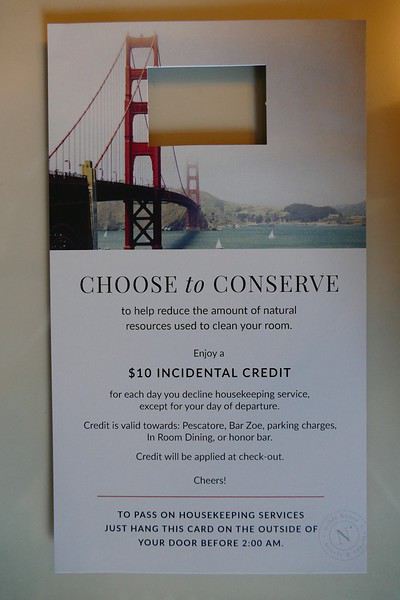
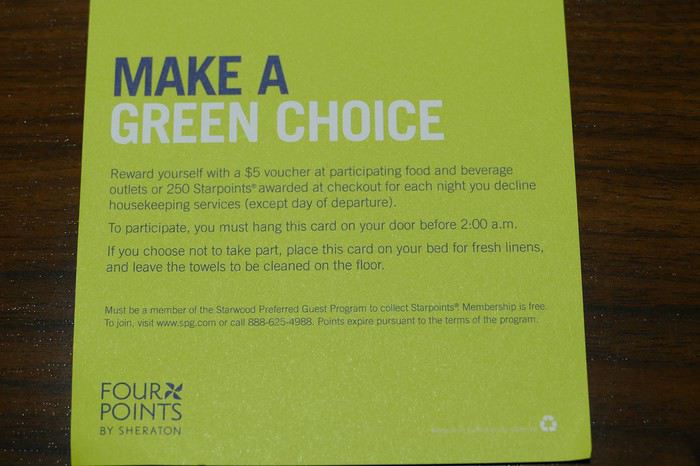
Les parkings bien en évidence pour les touristes sur le front de mer sont à 10 $ de l'heure mais si vous faîtes 100 mètres de plus dans les "petites" rues vous ne payez plus que 3.25 $ de l'heure et après 19h le prix chute à moins d'un dollar.
J'ai apprécié aussi de commander une salade à 9 $ parce que je mange peu le midi et la retrouver sur la facture à 14 $ (avant les taxes) . Bon, on ne dit rien, on est en vacances et c'était bon, mais c'est une pratique pénible et récurrente.
Nous avons aussi expérimenté les missions ou musées qui communiquent sur la gratuité de la visite. Ils sont tenus par des bénévoles qui dès l'entrée vous expliquent lourdement à quel point ils sont intéressés par votre porte monnaie. L'accueil est toujours très chaleureux et souriant. L'au revoir dépends de votre générosité.
Au sud de San Francisco dans le brouillard nous imaginons que les paysages doivent être beaux mais nous ne pouvons que le supposer. Et oui cela peut arriver... Dès que nous nous éloignons de la mer le soleil brille, mais sur l'eau stagne un épais nuage tel un gros duvet qui masque tout le paysage.
Cette année ce n'était pas de chance la route n° 1 était coupée. Notre voyage était prévu avant et nous n'avions pas envie de tout annuler. Finalement nous avons trouvé que c'était plutôt un avantage car la portion de route restée ouverte était déserte et nous avions le loisir de nous arrêter facilement où nous voulions.
Sur la route n°1 nous avons vu de jolis points, de belles vues mais rien d'extraordinaire, souvent nous nous sommes dit que cela ressemblait à la Bretagne, sauf qu'ici il n'y a ni crêpes, ni cidre et que les fruits de mer ou le poisson ils ne savent que les faire frire avec de la pate bien lourde et bien grasse. La prochaine fois c'est sûr nous irons en Bretagne !
Lors de nos précédents voyages aux Etats unis nous avons toujours mangé correctement, et nous avions même trouvé que la (mauvaise) réputation culinaire du pays était exagérée. Mais cette année dans cet Etat cela nous paraît plus difficile qu'ailleurs de se nourrir. Le midi pas de problème nous sommes au régime pique-nique, salades. Mais le soir nous aimons aller au restaurant. Et sur cette côte le choix est plus que limité. Il n'y a pas d'autre alternative que, burgers pas bons, ou fish and chips extra gras. Je suis pourtant, avant de partir, allée sélectionner les meilleurs adresses sur Tripad... Et sauf 2 ou 3 exceptions (sur 3 semaines) le plus souvent ce n'était pas bon et toujours très cher.
Ce soir nous avons droit à la plus grosse escroquerie de notre voyage pour la chambre d'hôtel. J'avais réservé une chambre de 28 m² avec un grand lit et un coin repas avec vue mer. Nous avons eu une petite chambre, sur la rue, un petit lit, et à la place d'un lavabo un lave main minuscule, pour 215 €uros la nuit. Aucun moyen de discuter, l'hôtelier était arrogant, je voulais être remboursée pour aller ailleurs (nous avions payé en cash 5 minutes plus tôt), il s'en est moqué. Le seul recours aurait été d'aller chercher un avocat, et c'était sa force. Il aurait fallu demander à voir la chambre avant, on n'est jamais assez méfiant. A mon retour j'ai voulu m'occuper de son cas, mais l'annonce n'existe plus elle a été modifiée.
Après avoir traverser un bon nombre de réserves indiennes sur une très belle route nous arrivons dans le désert de Borrego Spring en début d'après midi. Le Visitor Center est fermé. il nous renvoi vers un magasin du centre où il faut s'adresser dans ce cas. Mais celui ci est aussi fermé, il ferme à 15 h (Et l'on raille la France pour ses horaires ???). Avec les infos dont nous disposons nous partons en direction de Borrego Palm Canyon. Mais là aussi tout est fermé, l'accès est interdit.
Tout cela nous a pris du temps, l'heure tourne, nous décidons de partir vers Fonts point. Cette fois nous avons un peu plus de chance et nous sommes récompensés, le spectacle est grandiose.
A noter que nous sommes dans un superbe hôtel, très bien, où nous avons passé une très belle soirée. Ils ont seulement essayé de nous facturer des taxes supplémentaires à notre arrivée. Cela s'est arrangé aimablement, mon bon de réservation était très précis sur ce que j'avais à payer.
L'hôtel de Beatty nous a réservé une autre surprise. Nous devions payer à notre arrivée, mais, non, le réceptionniste nous dit que c'est déjà réglé, bizarre. A mon retour effectivement je contrôle et constate que 87 €uros ont été prélevés sur mon compte 3 jours avant notre arrivée, alors que nous devions payer 80 USD. Encore une fois ce n'est pas correct.
Le Sequoïa NP est saturé de visiteurs et de voitures, il est très difficile de pouvoir se garer quelque part. Seuls les parkings pour personnes handicapées, grands et nombreux sont déserts. Quand nous arrivons à stationner c'est pour voir des arbres enfermés dans des cages, c'est du moins ainsi que je les perçois. Avec des touristes qui font les singes devant pour se prendre en photosssss, il y a vraiment de bons clichés à faire, le ridicule n'a pas de limite. A noter que le Giant Forest Museum ferme à 16h30, encore un bon horaire de fermeture pour un tel site.
Ce matin sur la route entre Death Valley et Sequoïa NP (avec une étape à Kernville) nous avons fait une halte sur le Trail of the 100 Giants (à proximité de Johnsondale). C'est là que nous avons le mieux apprécié les Sequoïas. Nous étions seuls dans la forêts en tête à tête avec tous ces géants debout ou couchés, mais en liberté, eux et nous. La dimension des arbres et de la forêt dans cet espace bien plus nature que le NP a été un bien meilleur moment.
Le bouquet final nous l'avons eu au Yosemite NP.
Nous arrivons par Glacier West et nous pouvons monter jusque Summit Meadows, Glacier Point est ouvert. Mais... La route est barrée ; le parking de Glaicier Point est complet, il faut compter 30 à 90 minutes d'attentes avant de pouvoir commencer à monter. Nous sommes le mercredi 20 septembre, que cela doit-il être le weekend ? ou en été ?
Mais ce n'est pas fini...
Nous décidons de visiter Yosemite Valley et c'est réellement... L'enfer tant il y a du monde partout, les parkings sont bondés, il est impossible de s'arrêter. Une horreur.
Allez encore un épisode....
Nous arrivons pour la nuit à Groveland bien dégoutés mais pour ne pas se faire avoir le lendemain nous prévoyons de partir tôt. Nous devons traverser le parc par la Tioga Road pour rejoindre Mammoth Lakes.
Nous découvrons une nouvelle démarche malvenue ce soir à notre hôtel prépayé depuis plusieurs mois. Il nous est demandé de payer 150 $ supplémentaires (pas une empreinte de carte, un paiement), sinon pas de chambre. Il nous est promis de nous les rendre le lendemain, sans plus de garantie.
5h45 le lendemain nous démarrons. Au premier panneau quelques centaines de mètres après l'hôtel, nous pouvons lire "Tioga Pass Closed". Nous n'y croyons pas, pourquoi ? Nous continuons et nous ne sommes pas les seuls, jusqu'à une barrière qui bloque les deux sens de circulation, montant et descendant. plusieurs voitures attendent déjà de chaque coté. Nous attendons... Nous patientons... Aucune information.... Au bout de deux heures on nous dit que c'est à cause de la neige!!!! Et il est impossible de nous dire quand la route sera ré-ouverte, dans une heure, deux heures, demain ? Aucune information.
Il est bien tombé une averse de pluie pendant la nuit, si cela a fait de la neige en altitude, ce ne doit pas être plus d'un ou deux centimètres, et encore je doute qu'à cette saison elle ait tenu sur le revêtement. C'est d'un ridicule ! Avec un gros 4x4 GMC YUKON XL il en faut plus pour ne pas passer.
Et il ne l'ont pas ouverte leur satanée barrière, nous avons fini par faire demi tour pour essayer de passer par la route 108 plus au nord. Notre hôtel nous attends ce soir à Mammoth Lakes et nous voulons passer. Mais non, elle est fermée aussi ! Ce n'est pas de la sécurité, c'est du burlesque !
Si bien qu'au lieu de traverser le Yosemite NP, de voir June lake, Mono Lake, Bodie et de redescendre tranquillement par la 108, nous avons manqué une des plus belles parties de notre voyage et perdu une nuit d'hôtel. Et très honnêtement nous n'avons pas apprécié du tout cette ridicule plaisanterie.
C'était la fin de notre périple, nous avons terminé ce voyage déçus et dégoûtés. Fatigués de se faire plumer ou rouler à tous les coins de rue. Nous avons si souvent mal manger tout en payant des prix si exagérément élevés que nous avons fini par pique-niquer le soir aussi à plusieurs reprises.
Nous avons beaucoup voyagé et je sais que le tourisme nourrit beaucoup de monde, qu'il faut être clément et se plier au jeu. Mais ici cela dépasse les bornes.
C'est du pur tourisme de masse, au plus haut point. J'ai perçu cet état comme une grosse machination où l'on vend tout et n'importe quoi, souvent presque rien, pour très cher.
Nous avons aussi eu de bons moment et vu de très belles choses, de beaux sites et, nous ramenons de beaux souvenirs, heureusement. Mais nous avons eu tellement de déconvenues que cela a jeté un voile terne et donné un goût amer à ce voyage.
Nous l'avons rêvé et préparé pendant des mois ce voyage, peaufiné et fignolé. De San Franciso nous sommes descendus par la côte en la suivant au plus près jusqu'au sud de Los Angeles (Oceanside précisément). Puis nous avons bifurqué vers Borrego Springs Desert et continué vers Yucca Valley, Trona Pinnacle, Death Valley. Nous avons ensuite commencé à remonter vers Sequoïa NP en passant par Isabella Lake pour terminer par Yosemite NP et retour à San Franciso trois semaines plus tard.
Nous avons eu beaucoup de déceptions, les unes après les autres qui s'empilent jusqu'à faire beaucoup, puis trop. Alors pourquoi ne pas en parler, mieux vaut partir en connaissance de cause, un voyageur averti en vaut deux, non ?
Nous arrivons à San Francisco au début de septembre, il y a beaucoup de touristes, alors qu'en cette arrière saison je l'imaginais plus tranquille. Sur les piers entre la foule et les commerces de "made in china, bangladesh, haïti, etc...", on étouffe, les restaurants sont saturés de monde et hors de prix bien qu'ils ne proposent que de la cuisine grasse et lourde, indigeste rien qu'à la voir.
Notre solution est de découvrir la ville tôt le matin avant qu'elle ne soit envahie par la cohue. Et à cette heure il est agréable de déambuler librement et sereinement. Les câbles cars sont libres alors que dans la journée les files d'attente s'étalent sur des dizaines de mètres de longueur.
Nous sommes dans un hôtel proche du Fisherman's Warf, très bien, je suis amusée par le petit carton déposé dans la chambre où l'on nous invite aimablement pour raison "écologique" à décliner le ménage de notre chambre. Pour encourager ce geste environnemental, l'hôtel offre un bon d'achat de 10 $ au bar ou à la brasserie de l'hôtel. Sans complexe aucun pour une chambre qui coûte entre 220 et 400 €uros la nuit il vous est fait généreusement cadeau de 10 $ si vous renoncez au confort du ménage quotidien sauf le dernier jour bien entendu. Là où il y a de la gène il n'y a pas de plaisir. Nous trouverons la même démarche dans un autre hôtel.
Les parkings bien en évidence pour les touristes sur le front de mer sont à 10 $ de l'heure mais si vous faîtes 100 mètres de plus dans les "petites" rues vous ne payez plus que 3.25 $ de l'heure et après 19h le prix chute à moins d'un dollar.
J'ai apprécié aussi de commander une salade à 9 $ parce que je mange peu le midi et la retrouver sur la facture à 14 $ (avant les taxes) . Bon, on ne dit rien, on est en vacances et c'était bon, mais c'est une pratique pénible et récurrente.
Nous avons aussi expérimenté les missions ou musées qui communiquent sur la gratuité de la visite. Ils sont tenus par des bénévoles qui dès l'entrée vous expliquent lourdement à quel point ils sont intéressés par votre porte monnaie. L'accueil est toujours très chaleureux et souriant. L'au revoir dépends de votre générosité.
Au sud de San Francisco dans le brouillard nous imaginons que les paysages doivent être beaux mais nous ne pouvons que le supposer. Et oui cela peut arriver... Dès que nous nous éloignons de la mer le soleil brille, mais sur l'eau stagne un épais nuage tel un gros duvet qui masque tout le paysage.
Cette année ce n'était pas de chance la route n° 1 était coupée. Notre voyage était prévu avant et nous n'avions pas envie de tout annuler. Finalement nous avons trouvé que c'était plutôt un avantage car la portion de route restée ouverte était déserte et nous avions le loisir de nous arrêter facilement où nous voulions.
Sur la route n°1 nous avons vu de jolis points, de belles vues mais rien d'extraordinaire, souvent nous nous sommes dit que cela ressemblait à la Bretagne, sauf qu'ici il n'y a ni crêpes, ni cidre et que les fruits de mer ou le poisson ils ne savent que les faire frire avec de la pate bien lourde et bien grasse. La prochaine fois c'est sûr nous irons en Bretagne !
Lors de nos précédents voyages aux Etats unis nous avons toujours mangé correctement, et nous avions même trouvé que la (mauvaise) réputation culinaire du pays était exagérée. Mais cette année dans cet Etat cela nous paraît plus difficile qu'ailleurs de se nourrir. Le midi pas de problème nous sommes au régime pique-nique, salades. Mais le soir nous aimons aller au restaurant. Et sur cette côte le choix est plus que limité. Il n'y a pas d'autre alternative que, burgers pas bons, ou fish and chips extra gras. Je suis pourtant, avant de partir, allée sélectionner les meilleurs adresses sur Tripad... Et sauf 2 ou 3 exceptions (sur 3 semaines) le plus souvent ce n'était pas bon et toujours très cher.
Ce soir nous avons droit à la plus grosse escroquerie de notre voyage pour la chambre d'hôtel. J'avais réservé une chambre de 28 m² avec un grand lit et un coin repas avec vue mer. Nous avons eu une petite chambre, sur la rue, un petit lit, et à la place d'un lavabo un lave main minuscule, pour 215 €uros la nuit. Aucun moyen de discuter, l'hôtelier était arrogant, je voulais être remboursée pour aller ailleurs (nous avions payé en cash 5 minutes plus tôt), il s'en est moqué. Le seul recours aurait été d'aller chercher un avocat, et c'était sa force. Il aurait fallu demander à voir la chambre avant, on n'est jamais assez méfiant. A mon retour j'ai voulu m'occuper de son cas, mais l'annonce n'existe plus elle a été modifiée.
Après avoir traverser un bon nombre de réserves indiennes sur une très belle route nous arrivons dans le désert de Borrego Spring en début d'après midi. Le Visitor Center est fermé. il nous renvoi vers un magasin du centre où il faut s'adresser dans ce cas. Mais celui ci est aussi fermé, il ferme à 15 h (Et l'on raille la France pour ses horaires ???). Avec les infos dont nous disposons nous partons en direction de Borrego Palm Canyon. Mais là aussi tout est fermé, l'accès est interdit.
Tout cela nous a pris du temps, l'heure tourne, nous décidons de partir vers Fonts point. Cette fois nous avons un peu plus de chance et nous sommes récompensés, le spectacle est grandiose.
A noter que nous sommes dans un superbe hôtel, très bien, où nous avons passé une très belle soirée. Ils ont seulement essayé de nous facturer des taxes supplémentaires à notre arrivée. Cela s'est arrangé aimablement, mon bon de réservation était très précis sur ce que j'avais à payer.
L'hôtel de Beatty nous a réservé une autre surprise. Nous devions payer à notre arrivée, mais, non, le réceptionniste nous dit que c'est déjà réglé, bizarre. A mon retour effectivement je contrôle et constate que 87 €uros ont été prélevés sur mon compte 3 jours avant notre arrivée, alors que nous devions payer 80 USD. Encore une fois ce n'est pas correct.
Le Sequoïa NP est saturé de visiteurs et de voitures, il est très difficile de pouvoir se garer quelque part. Seuls les parkings pour personnes handicapées, grands et nombreux sont déserts. Quand nous arrivons à stationner c'est pour voir des arbres enfermés dans des cages, c'est du moins ainsi que je les perçois. Avec des touristes qui font les singes devant pour se prendre en photosssss, il y a vraiment de bons clichés à faire, le ridicule n'a pas de limite. A noter que le Giant Forest Museum ferme à 16h30, encore un bon horaire de fermeture pour un tel site.
Ce matin sur la route entre Death Valley et Sequoïa NP (avec une étape à Kernville) nous avons fait une halte sur le Trail of the 100 Giants (à proximité de Johnsondale). C'est là que nous avons le mieux apprécié les Sequoïas. Nous étions seuls dans la forêts en tête à tête avec tous ces géants debout ou couchés, mais en liberté, eux et nous. La dimension des arbres et de la forêt dans cet espace bien plus nature que le NP a été un bien meilleur moment.
Le bouquet final nous l'avons eu au Yosemite NP.
Nous arrivons par Glacier West et nous pouvons monter jusque Summit Meadows, Glacier Point est ouvert. Mais... La route est barrée ; le parking de Glaicier Point est complet, il faut compter 30 à 90 minutes d'attentes avant de pouvoir commencer à monter. Nous sommes le mercredi 20 septembre, que cela doit-il être le weekend ? ou en été ?
Mais ce n'est pas fini...
Nous décidons de visiter Yosemite Valley et c'est réellement... L'enfer tant il y a du monde partout, les parkings sont bondés, il est impossible de s'arrêter. Une horreur.
Allez encore un épisode....
Nous arrivons pour la nuit à Groveland bien dégoutés mais pour ne pas se faire avoir le lendemain nous prévoyons de partir tôt. Nous devons traverser le parc par la Tioga Road pour rejoindre Mammoth Lakes.
Nous découvrons une nouvelle démarche malvenue ce soir à notre hôtel prépayé depuis plusieurs mois. Il nous est demandé de payer 150 $ supplémentaires (pas une empreinte de carte, un paiement), sinon pas de chambre. Il nous est promis de nous les rendre le lendemain, sans plus de garantie.
5h45 le lendemain nous démarrons. Au premier panneau quelques centaines de mètres après l'hôtel, nous pouvons lire "Tioga Pass Closed". Nous n'y croyons pas, pourquoi ? Nous continuons et nous ne sommes pas les seuls, jusqu'à une barrière qui bloque les deux sens de circulation, montant et descendant. plusieurs voitures attendent déjà de chaque coté. Nous attendons... Nous patientons... Aucune information.... Au bout de deux heures on nous dit que c'est à cause de la neige!!!! Et il est impossible de nous dire quand la route sera ré-ouverte, dans une heure, deux heures, demain ? Aucune information.
Il est bien tombé une averse de pluie pendant la nuit, si cela a fait de la neige en altitude, ce ne doit pas être plus d'un ou deux centimètres, et encore je doute qu'à cette saison elle ait tenu sur le revêtement. C'est d'un ridicule ! Avec un gros 4x4 GMC YUKON XL il en faut plus pour ne pas passer.
Et il ne l'ont pas ouverte leur satanée barrière, nous avons fini par faire demi tour pour essayer de passer par la route 108 plus au nord. Notre hôtel nous attends ce soir à Mammoth Lakes et nous voulons passer. Mais non, elle est fermée aussi ! Ce n'est pas de la sécurité, c'est du burlesque !
Si bien qu'au lieu de traverser le Yosemite NP, de voir June lake, Mono Lake, Bodie et de redescendre tranquillement par la 108, nous avons manqué une des plus belles parties de notre voyage et perdu une nuit d'hôtel. Et très honnêtement nous n'avons pas apprécié du tout cette ridicule plaisanterie.
C'était la fin de notre périple, nous avons terminé ce voyage déçus et dégoûtés. Fatigués de se faire plumer ou rouler à tous les coins de rue. Nous avons si souvent mal manger tout en payant des prix si exagérément élevés que nous avons fini par pique-niquer le soir aussi à plusieurs reprises.
Nous avons beaucoup voyagé et je sais que le tourisme nourrit beaucoup de monde, qu'il faut être clément et se plier au jeu. Mais ici cela dépasse les bornes.
C'est du pur tourisme de masse, au plus haut point. J'ai perçu cet état comme une grosse machination où l'on vend tout et n'importe quoi, souvent presque rien, pour très cher.
Nous avons aussi eu de bons moment et vu de très belles choses, de beaux sites et, nous ramenons de beaux souvenirs, heureusement. Mais nous avons eu tellement de déconvenues que cela a jeté un voile terne et donné un goût amer à ce voyage.