Results for "Bénin"
About 7,558 results.
More options
Many results are in French, the community’s main language. English translations are added over time.
Search results
Bons plans à Oulan Bator en Mongolie
bonjour,
je compte partir fin mars- début avril dans le cadre d'un association pour aider au fonctionnement d'un orphelinat à Oulan Bator (mongolie) pour 15 jours
après avoir visité le site du ministère des affaires étrangères, je me suis fait un peu peur (tuberculose, hépatite B, brucellose, fièver aphteuse...)
j'ai deux interrogations avant de me décider : quelqu'un pourrait il me renseigner sur les points suivants :
* tourisme à Oulan Bator : quel intérêt pour cette ville - je compte rester 4 à 5 jours de +, que faire dans les proches environs ?
* conditions sanitaires : celà craint-il vraiment ? pour ceux qui y sont restés quelles impressions générales ?
Je remercie d'avance tous ceux qui pourront m'éclairer sur le sujet - bons rêves et bonnes chevauchées lointaines à tous
ps : j'ai aussi la possibilité de travailler le même temps dans une ferme coopérativeau Népal(Pokhara ou Chitwan) - est-ce mieux de prendre ce choix (plus sûr ?!)
pollux
je compte partir fin mars- début avril dans le cadre d'un association pour aider au fonctionnement d'un orphelinat à Oulan Bator (mongolie) pour 15 jours
après avoir visité le site du ministère des affaires étrangères, je me suis fait un peu peur (tuberculose, hépatite B, brucellose, fièver aphteuse...)
j'ai deux interrogations avant de me décider : quelqu'un pourrait il me renseigner sur les points suivants :
* tourisme à Oulan Bator : quel intérêt pour cette ville - je compte rester 4 à 5 jours de +, que faire dans les proches environs ?
* conditions sanitaires : celà craint-il vraiment ? pour ceux qui y sont restés quelles impressions générales ?
Je remercie d'avance tous ceux qui pourront m'éclairer sur le sujet - bons rêves et bonnes chevauchées lointaines à tous
ps : j'ai aussi la possibilité de travailler le même temps dans une ferme coopérativeau Népal(Pokhara ou Chitwan) - est-ce mieux de prendre ce choix (plus sûr ?!)
pollux
Megacom SIM card, how does it work?
Hi there,
I’ve never bought a SIM card abroad or even used prepaid cards in France...
So I’m wondering how it all works?
You buy a SIM card and pop it into your phone. Okay, so far so good... 😏
But after that?
I can’t find the price of prepaid cards or how they work with MegaCom.
If someone could give me a step-by-step guide... 😊
Thanks! 🙂
I’ve never bought a SIM card abroad or even used prepaid cards in France...
So I’m wondering how it all works?
You buy a SIM card and pop it into your phone. Okay, so far so good... 😏
But after that?
I can’t find the price of prepaid cards or how they work with MegaCom.
If someone could give me a step-by-step guide... 😊
Thanks! 🙂
Africa: A Heartfelt Love for a Continent
“When the Whites came to Africa, we had the land and they had the Bible. They taught us to pray with our eyes closed: when we opened them, the Whites had the land and we had the Bible.” Jomo Kenyatta (p.7)
The Maggi cube, an unchallenged hegemony, and so much more
“The hopeless continent,” headlined The Economist, a British magazine, in July 2000 about Africa. Eleven years later, the same magazine headlined “Africa rising” instead. Images of Africa in the prosperous North constantly oscillate between apocalyptic scenarios and enthusiastic projections. A key issue with such images lies in the generalization they entail. If you look at the continent, considerable contrasts emerge depending on space and time. It’s no surprise that a region of the world encompassing such diverse ecological zones, maintaining such varied ties with other continents, comprising nearly fifty nation-states in sub-Saharan Africa alone, and characterized by a great diversity of languages, belief systems, and historical paths, doesn’t share a single destiny.
And yet, for many people outside Africa, as well as for many Africans, the continent constitutes a single entity, defined by criteria such as skin color, a colonial past, poverty, and the art of survival. Until now, these perspectives were generally accompanied by the idea that Africa had to—or should have—followed a single path together, sometimes called development, sometimes modernization, sometimes liberation, then a market economy. None of these paths delivered on their promises.
The two writers Alain Mabanckou and Abdourahman Waberi—one from Congo, the other raised in Djibouti, both long settled in France and now professors at renowned North American universities (Los Angeles, Washington)—have had enough of pessimistic scenarios: “We are aware that Africa is in the world and the world is in Africa. The same goes for all other continents, as our destinies are inextricably linked for better or worse. We refuse to see Africa as a reservoir of misfortunes or a continent cursed by atavistic misfortune and characterized by ethnic conflicts. [...] It’s this passionate flame we wanted to capture in a book [...] a kind of stroll through African cultures, without any demands, each letter of the alphabet leading us to a notion, a practice, a concept, a moment in history, literature, painting, politics, economics, cuisine, etc.” (p.10-11). Africa, they write, is on the verge of “imposing a signature, a style, a way of being in the world and in relation to the rest of the world.” (p.11) To put words to the continent’s diversity and dynamism, the two authors created a “rambling ABC,” a kind of portrait—or more precisely, a mythography—that lets you see and feel the pulse of a vast continent whose cultural power is unfolding before our eyes. Once marginalized or even mocked, the voice and importance of the Continent in global affairs are now undeniable” (p.11), containing over a hundred entries, mostly concise, written in a relaxed and casual style. The optimistic, even exuberant tone is set from the brief introduction. The duo of authors wants to “sing a love song to the cultures of our continent, to its inhabitants past and present, to its exceptional resources and its spectacular globalization despite a certain pollution that still clouds our skies due to the unmatched duration of dictatorships in some of our regions.” (p.12) In doing so, they don’t want to be too distracted by today’s Afewerki-Biya-Bongo-Déby & Co. ...
Of course, you’ll find tributes to great precursors like Frantz Fanon (“[...] it was a love story and admiration that wasn’t dimmed by the four decades separating his birth from ours. Let’s add that we were born while the native of Fort-de-France had left the world’s stage four years earlier, in the prime of life” p.141), Mongo Beti (“You must read and reread Mongo Beti, a genius who used his fame to support often just causes in Africa, like defending oppressed groups. His place is already in History. His oppressors, like the dictators Ahmadou Ahidjo and Paul Biya, can’t compete in the same category” p.64), the Malian Amadou Hampâté Bâ
(“Posterity remembers him mainly as an tireless defender of African cultures. His plea for the collection and preservation of traditional African knowledge remains a major event for all men and women of good will. One day in 1960, at the UNESCO podium, the native of Bandiagara sounded the alarm: ‘[...] Since we’ve admitted that the humanity of each people is the heritage of all humanity, if African traditions aren’t collected in time and written down, they’ll one day be missing from the universal archives of humanity.’” p.51),
Kwame Nkrumah, “one of the founders of Pan-Africanism, father of Ghana’s independence” (p.239), as well as the historian Cheikh Anta Diop, the writer, poet, and politician Aimé Césaire, and the economist and thinker Samir Amin, but also very warm tributes to certain contemporary African intellectuals like Souleymane Bachir Diagne and Achille Mbembe
(“A few years ago, in dominant economic circles, a rumor often resurfaced, usually disguised as a cold and scientifically proven analysis: Africa is useless. It’s a burden for the rest of the human community. With its 2% share in world trade, it would disappear from stock market radars without anyone noticing. So? Maybe it’ll be pulled up by other continents. Wanting to surpass itself is a crazy bet for Africans, they concluded. Arrogant or clueless, President Nicolas Sarkozy declared before an audience of students and teachers at Cheikh Anta Diop University in Dakar: ‘The African man hasn’t entered history enough [...] He only knows the eternal repetition of time marked by the endless repetition of the same gestures and words.’ That was in 2007. For decades, armed only with reason, an intellectual often steps up to debunk prejudices, lazy readings, and dishonest frameworks used as false fronts by those who, like Nicolas Sarkozy or former journalist Stephen Smith, out of ignorance, contempt, or condescension, distort African reality. This intellectual is none other than the historian and political scientist Achille Mbembe. This heir of Frantz Fanon, Amílcar Cabral, Jean-Marc Ela, and Fabien Eboussi-Boulaga was born in 1957 in Cameroon, in the Bassa region. Marked early by the upheavals of a fratricidal war, Achille Mbembe became the guardian of the memory of martyrs. After brilliant studies in Paris, he went on to teach at the best American universities, but the call of the Continent was stronger than anything else. In Dakar, he once directed CODESRIA (Council for the Development of Social Science Research in Africa) before joining the University of the Witwatersrand in Johannesburg, South Africa. Even though the author of *Critique of Black Reason* (Éditions La Découverte, 2015) spends a few months at Duke University in North Carolina, his observation post remains South Africa. From Johannesburg, Achille Mbembe scrutinizes Africa and the whole world. A lucid observer with an elegant and generous pen, Achille Mbembe knows how to blend big and small history: ‘I was born one day in July, as the month was drawing to a close. It was 1957, in that part of Africa recently named ‘Cameroon,’ a memory of the wonder that seized Portuguese sailors in the 15th century when, sailing up the river near Douala, they couldn’t help but note the presence of a multitude of crustaceans, and named it *Rio dos Camarões*, meaning ‘River of Shrimp.’ I grew up in the shadow of this nameless land, since, in a way, the name it bears is only the product of someone else’s astonishment: a lexical mistake, if you will.’ From this mistake or wound, he made leaven, a springboard to compose a rich work, recognized worldwide. To denounce barriers and barbarians too. But that’s not enough. Among his peers in circles of thought and action, Achille Mbembe passionately and consistently defends human dignity and the beauty of the world. In doing so, he fulfills the mission Frantz Fanon entrusted to him.” (p.227-229),
as well as entries dedicated to lesser-known artists and intellectuals, like the French journalist and activist Rokhaya Diallo, daughter of Senegalese and Gambian parents, or the Ethiopian filmmaker Haile Gerima, who has long lived in the United States. Other names from politics, sports, music, art, and literature: Kofi Annan, p.36; Barack Obama, p.243; Thomas Sankara, p.277; Ousmane Sow, p.285; Yambo Ouologuem, p.250; Léopold Sédar Senghor, p.282; Muhammad Ali, p.30; Nuruddin Farah, p.146; Salif Keita, p.203; Ahmadou Kourouma, p.206; Ngũgĩ wa Thiong’o, p.236; Winnie Mandela, p.224; Kylian Mbappé, p.226 ...
The authors, who resolutely commit to a “mythography” (p.11) of Africa, also pay special attention to local social movements, cultural events, and aspects of daily life. *Y’en a marre*, “which also meant ‘we’re fed up with sitting on our hands’” (p.320-321), emerged about a decade ago in Senegal as a citizen movement of peaceful resistance and symbolizes, the authors emphasize, the fact that African youth are increasingly fed up “with the political circus deployed in Africa since independence, as our parents would say, ‘since the White man left’...” (p.321). A full entry is dedicated to the Maggi bouillon cube, which has flooded African markets for about forty years and enjoys immense popularity (“It’s everywhere in Africa, from Dakar to Djibouti, and from Tangier to Cape Town. It’s in every pot, every stew. Little hands put it in every sauce, every local or adapted dish. An unchallenged hegemony! You’ll find it in diasporas too. The culinary strolls in Paris, in the [...] neighborhood” p.90). Critics blame it not only for impoverishing the aromatic diversity of local dishes but also for being harmful to health. And yet, “he poorest Africans, those who eat only once a day, a few spoonfuls of white beans and a ball of *foufou*, for example, are the most fervent users of the magic cube.” (p.92-93)
For *fonio*, “the new trendy cereal. [...] From the millet family, fonio is probably the oldest cereal cultivated in West Africa, and mainly in its sub-Saharan part, for millennia. [...] Easy to grow, water-efficient, fonio grows everywhere except on clay soils. Long neglected because it was considered the poor man’s crop, fonio is now a source of pride for the farmers who cultivate it and cherish it like the apple of their eye” (p.156-157), the authors immediately offer a detailed recipe, letting the reader know that “e can’t resist sharing this fonio with chicken recipe from Mali with you:
Ingredients: 1 chicken 3 large ripe red tomatoes 4 tbsp tomato paste 4 large onions 1 garlic clove 1/2 cup oil 2 Maggi cubes or salt 2 large carrots 1 turnip 1 large cabbage 2 large potatoes 1 celery stalk 1 packet pre-cooked fonio 4 okra (or okra powder) salt, pepper
Preparation: 1. Prepare the sauce: wash and cut the chicken. Peel the onions, garlic, and vegetables. 2. In a pot, fry the chicken pieces. 3. Dice the onions, tomatoes, carrots, and turnip very small and add them to the pot. 4. Add the tomato paste, salt, and pepper. 5. Simmer for 15 min, then add 2 L of water and the cooked chicken pieces. 6. Simmer for 30 min, then add the crushed garlic and celery, plus the cabbage cut into 4 and the potatoes cut in half. 7. Prepare the fonio: cover it with warm water, let it rest for 15 min, and cook it over low heat. 8. In a small pot, boil the okra and crush them. 9. Mix the crushed okra with the cooked fonio, then salt. Serve hot.” (p.158-159)
The comedy *Black Mic Mac*, released in French theaters in 1986 and addressing France’s increasingly restrictive immigration policy at the time, also gets an entry, as do *Tintin in the Congo*, the popular comic, and *Jip’s Café* (“[...] a little Africa in the heart of Paris, with passersby stopping to admire the ‘ambianceurs’ on the dance floor or attend the cultural events offered by the place” (p.194), an African establishment in Paris that Alain Mabanckou already immortalized in one of his novels.
The duo of authors also tackles thorny subjects like jihadism (p.119), the Rwandan genocide (p.272), the CFA franc (p.82), and dictatorship (p.110). While the two strike the right tone here, many entries leave a slightly bitter taste. Two examples: why doesn’t the text on Barack Obama mention the great disappointment of many people in Africa, who expected more from the African policy of the first U.S. president with African roots than just occasional warm words? Why do the comments on Winnie Mandela gloss over the fact that she was a highly controversial icon of the anti-apartheid movement due to her involvement in kidnappings, acts of torture, and murders of alleged apartheid collaborators? Instead, there’s a compassion that brings tears to the eyes: “She was often reduced to a secondary role, the wife of a great man” or “When victory came, she didn’t taste its fruits. Divorced, isolated. She would never be a ‘first lady’ in an evening gown, posing before a bed of chrysanthemums. They’d keep her far from the circles of power” (p.224-225). At this point, I would’ve liked the authors to take a slightly more critical stance...
That said, these “weaknesses” (if you can call them that) shouldn’t overshadow the book as a whole. It remains an informative, sometimes very entertaining, and often even original work in its own way.
Book information (the original French and the German translation):
Alain Mabanckou/Abdourahman Waberi. Dictionnaire enjoué des cultures africaines. Fayard, 2019. Alain Mabanckou/Abdourahman Waberi. Der Puls Afrikas. Eine Liebeserklärung von A bis Z. Reclam, 2022.
Hery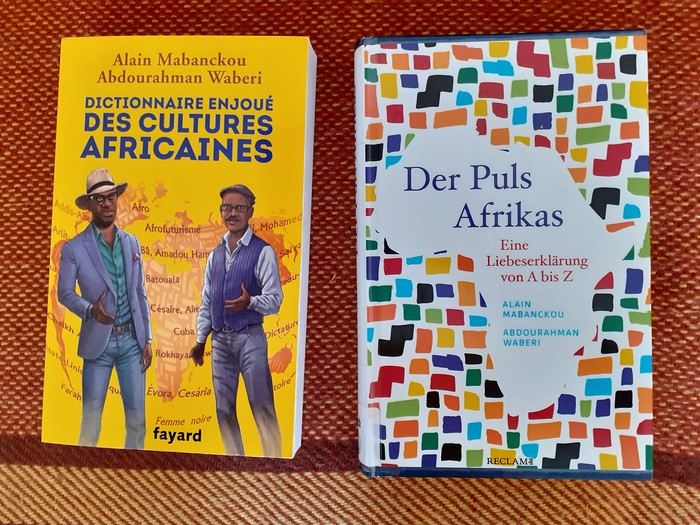
The Maggi cube, an unchallenged hegemony, and so much more
“The hopeless continent,” headlined The Economist, a British magazine, in July 2000 about Africa. Eleven years later, the same magazine headlined “Africa rising” instead. Images of Africa in the prosperous North constantly oscillate between apocalyptic scenarios and enthusiastic projections. A key issue with such images lies in the generalization they entail. If you look at the continent, considerable contrasts emerge depending on space and time. It’s no surprise that a region of the world encompassing such diverse ecological zones, maintaining such varied ties with other continents, comprising nearly fifty nation-states in sub-Saharan Africa alone, and characterized by a great diversity of languages, belief systems, and historical paths, doesn’t share a single destiny.
And yet, for many people outside Africa, as well as for many Africans, the continent constitutes a single entity, defined by criteria such as skin color, a colonial past, poverty, and the art of survival. Until now, these perspectives were generally accompanied by the idea that Africa had to—or should have—followed a single path together, sometimes called development, sometimes modernization, sometimes liberation, then a market economy. None of these paths delivered on their promises.
The two writers Alain Mabanckou and Abdourahman Waberi—one from Congo, the other raised in Djibouti, both long settled in France and now professors at renowned North American universities (Los Angeles, Washington)—have had enough of pessimistic scenarios: “We are aware that Africa is in the world and the world is in Africa. The same goes for all other continents, as our destinies are inextricably linked for better or worse. We refuse to see Africa as a reservoir of misfortunes or a continent cursed by atavistic misfortune and characterized by ethnic conflicts. [...] It’s this passionate flame we wanted to capture in a book [...] a kind of stroll through African cultures, without any demands, each letter of the alphabet leading us to a notion, a practice, a concept, a moment in history, literature, painting, politics, economics, cuisine, etc.” (p.10-11). Africa, they write, is on the verge of “imposing a signature, a style, a way of being in the world and in relation to the rest of the world.” (p.11) To put words to the continent’s diversity and dynamism, the two authors created a “rambling ABC,” a kind of portrait—or more precisely, a mythography—that lets you see and feel the pulse of a vast continent whose cultural power is unfolding before our eyes. Once marginalized or even mocked, the voice and importance of the Continent in global affairs are now undeniable” (p.11), containing over a hundred entries, mostly concise, written in a relaxed and casual style. The optimistic, even exuberant tone is set from the brief introduction. The duo of authors wants to “sing a love song to the cultures of our continent, to its inhabitants past and present, to its exceptional resources and its spectacular globalization despite a certain pollution that still clouds our skies due to the unmatched duration of dictatorships in some of our regions.” (p.12) In doing so, they don’t want to be too distracted by today’s Afewerki-Biya-Bongo-Déby & Co. ...
Of course, you’ll find tributes to great precursors like Frantz Fanon (“[...] it was a love story and admiration that wasn’t dimmed by the four decades separating his birth from ours. Let’s add that we were born while the native of Fort-de-France had left the world’s stage four years earlier, in the prime of life” p.141), Mongo Beti (“You must read and reread Mongo Beti, a genius who used his fame to support often just causes in Africa, like defending oppressed groups. His place is already in History. His oppressors, like the dictators Ahmadou Ahidjo and Paul Biya, can’t compete in the same category” p.64), the Malian Amadou Hampâté Bâ
(“Posterity remembers him mainly as an tireless defender of African cultures. His plea for the collection and preservation of traditional African knowledge remains a major event for all men and women of good will. One day in 1960, at the UNESCO podium, the native of Bandiagara sounded the alarm: ‘[...] Since we’ve admitted that the humanity of each people is the heritage of all humanity, if African traditions aren’t collected in time and written down, they’ll one day be missing from the universal archives of humanity.’” p.51),
Kwame Nkrumah, “one of the founders of Pan-Africanism, father of Ghana’s independence” (p.239), as well as the historian Cheikh Anta Diop, the writer, poet, and politician Aimé Césaire, and the economist and thinker Samir Amin, but also very warm tributes to certain contemporary African intellectuals like Souleymane Bachir Diagne and Achille Mbembe
(“A few years ago, in dominant economic circles, a rumor often resurfaced, usually disguised as a cold and scientifically proven analysis: Africa is useless. It’s a burden for the rest of the human community. With its 2% share in world trade, it would disappear from stock market radars without anyone noticing. So? Maybe it’ll be pulled up by other continents. Wanting to surpass itself is a crazy bet for Africans, they concluded. Arrogant or clueless, President Nicolas Sarkozy declared before an audience of students and teachers at Cheikh Anta Diop University in Dakar: ‘The African man hasn’t entered history enough [...] He only knows the eternal repetition of time marked by the endless repetition of the same gestures and words.’ That was in 2007. For decades, armed only with reason, an intellectual often steps up to debunk prejudices, lazy readings, and dishonest frameworks used as false fronts by those who, like Nicolas Sarkozy or former journalist Stephen Smith, out of ignorance, contempt, or condescension, distort African reality. This intellectual is none other than the historian and political scientist Achille Mbembe. This heir of Frantz Fanon, Amílcar Cabral, Jean-Marc Ela, and Fabien Eboussi-Boulaga was born in 1957 in Cameroon, in the Bassa region. Marked early by the upheavals of a fratricidal war, Achille Mbembe became the guardian of the memory of martyrs. After brilliant studies in Paris, he went on to teach at the best American universities, but the call of the Continent was stronger than anything else. In Dakar, he once directed CODESRIA (Council for the Development of Social Science Research in Africa) before joining the University of the Witwatersrand in Johannesburg, South Africa. Even though the author of *Critique of Black Reason* (Éditions La Découverte, 2015) spends a few months at Duke University in North Carolina, his observation post remains South Africa. From Johannesburg, Achille Mbembe scrutinizes Africa and the whole world. A lucid observer with an elegant and generous pen, Achille Mbembe knows how to blend big and small history: ‘I was born one day in July, as the month was drawing to a close. It was 1957, in that part of Africa recently named ‘Cameroon,’ a memory of the wonder that seized Portuguese sailors in the 15th century when, sailing up the river near Douala, they couldn’t help but note the presence of a multitude of crustaceans, and named it *Rio dos Camarões*, meaning ‘River of Shrimp.’ I grew up in the shadow of this nameless land, since, in a way, the name it bears is only the product of someone else’s astonishment: a lexical mistake, if you will.’ From this mistake or wound, he made leaven, a springboard to compose a rich work, recognized worldwide. To denounce barriers and barbarians too. But that’s not enough. Among his peers in circles of thought and action, Achille Mbembe passionately and consistently defends human dignity and the beauty of the world. In doing so, he fulfills the mission Frantz Fanon entrusted to him.” (p.227-229),
as well as entries dedicated to lesser-known artists and intellectuals, like the French journalist and activist Rokhaya Diallo, daughter of Senegalese and Gambian parents, or the Ethiopian filmmaker Haile Gerima, who has long lived in the United States. Other names from politics, sports, music, art, and literature: Kofi Annan, p.36; Barack Obama, p.243; Thomas Sankara, p.277; Ousmane Sow, p.285; Yambo Ouologuem, p.250; Léopold Sédar Senghor, p.282; Muhammad Ali, p.30; Nuruddin Farah, p.146; Salif Keita, p.203; Ahmadou Kourouma, p.206; Ngũgĩ wa Thiong’o, p.236; Winnie Mandela, p.224; Kylian Mbappé, p.226 ...
The authors, who resolutely commit to a “mythography” (p.11) of Africa, also pay special attention to local social movements, cultural events, and aspects of daily life. *Y’en a marre*, “which also meant ‘we’re fed up with sitting on our hands’” (p.320-321), emerged about a decade ago in Senegal as a citizen movement of peaceful resistance and symbolizes, the authors emphasize, the fact that African youth are increasingly fed up “with the political circus deployed in Africa since independence, as our parents would say, ‘since the White man left’...” (p.321). A full entry is dedicated to the Maggi bouillon cube, which has flooded African markets for about forty years and enjoys immense popularity (“It’s everywhere in Africa, from Dakar to Djibouti, and from Tangier to Cape Town. It’s in every pot, every stew. Little hands put it in every sauce, every local or adapted dish. An unchallenged hegemony! You’ll find it in diasporas too. The culinary strolls in Paris, in the [...] neighborhood” p.90). Critics blame it not only for impoverishing the aromatic diversity of local dishes but also for being harmful to health. And yet, “he poorest Africans, those who eat only once a day, a few spoonfuls of white beans and a ball of *foufou*, for example, are the most fervent users of the magic cube.” (p.92-93)
For *fonio*, “the new trendy cereal. [...] From the millet family, fonio is probably the oldest cereal cultivated in West Africa, and mainly in its sub-Saharan part, for millennia. [...] Easy to grow, water-efficient, fonio grows everywhere except on clay soils. Long neglected because it was considered the poor man’s crop, fonio is now a source of pride for the farmers who cultivate it and cherish it like the apple of their eye” (p.156-157), the authors immediately offer a detailed recipe, letting the reader know that “e can’t resist sharing this fonio with chicken recipe from Mali with you:
Ingredients: 1 chicken 3 large ripe red tomatoes 4 tbsp tomato paste 4 large onions 1 garlic clove 1/2 cup oil 2 Maggi cubes or salt 2 large carrots 1 turnip 1 large cabbage 2 large potatoes 1 celery stalk 1 packet pre-cooked fonio 4 okra (or okra powder) salt, pepper
Preparation: 1. Prepare the sauce: wash and cut the chicken. Peel the onions, garlic, and vegetables. 2. In a pot, fry the chicken pieces. 3. Dice the onions, tomatoes, carrots, and turnip very small and add them to the pot. 4. Add the tomato paste, salt, and pepper. 5. Simmer for 15 min, then add 2 L of water and the cooked chicken pieces. 6. Simmer for 30 min, then add the crushed garlic and celery, plus the cabbage cut into 4 and the potatoes cut in half. 7. Prepare the fonio: cover it with warm water, let it rest for 15 min, and cook it over low heat. 8. In a small pot, boil the okra and crush them. 9. Mix the crushed okra with the cooked fonio, then salt. Serve hot.” (p.158-159)
The comedy *Black Mic Mac*, released in French theaters in 1986 and addressing France’s increasingly restrictive immigration policy at the time, also gets an entry, as do *Tintin in the Congo*, the popular comic, and *Jip’s Café* (“[...] a little Africa in the heart of Paris, with passersby stopping to admire the ‘ambianceurs’ on the dance floor or attend the cultural events offered by the place” (p.194), an African establishment in Paris that Alain Mabanckou already immortalized in one of his novels.
The duo of authors also tackles thorny subjects like jihadism (p.119), the Rwandan genocide (p.272), the CFA franc (p.82), and dictatorship (p.110). While the two strike the right tone here, many entries leave a slightly bitter taste. Two examples: why doesn’t the text on Barack Obama mention the great disappointment of many people in Africa, who expected more from the African policy of the first U.S. president with African roots than just occasional warm words? Why do the comments on Winnie Mandela gloss over the fact that she was a highly controversial icon of the anti-apartheid movement due to her involvement in kidnappings, acts of torture, and murders of alleged apartheid collaborators? Instead, there’s a compassion that brings tears to the eyes: “She was often reduced to a secondary role, the wife of a great man” or “When victory came, she didn’t taste its fruits. Divorced, isolated. She would never be a ‘first lady’ in an evening gown, posing before a bed of chrysanthemums. They’d keep her far from the circles of power” (p.224-225). At this point, I would’ve liked the authors to take a slightly more critical stance...
That said, these “weaknesses” (if you can call them that) shouldn’t overshadow the book as a whole. It remains an informative, sometimes very entertaining, and often even original work in its own way.
Book information (the original French and the German translation):
Alain Mabanckou/Abdourahman Waberi. Dictionnaire enjoué des cultures africaines. Fayard, 2019. Alain Mabanckou/Abdourahman Waberi. Der Puls Afrikas. Eine Liebeserklärung von A bis Z. Reclam, 2022.
Hery
In the land... of Senegambia
Hey fellow travelers!
So, a new year has begun. It’s time to reconnect with the VF buddies and wish you all my best for 2026—a year I hope is obviously full of travel, since, as I just made up: "If travel’s good, everything’s good" 😄.
To celebrate, I’m inviting you into my new "travel journal," the one from our latest trip in November 2025, a little two-week adventure.
This time, we headed to The Gambia, a tiny country tucked right in the middle of Senegal, before making our way to Casamance.
The Gambia is English-speaking, Senegal is French-speaking, but the locals? They couldn’t care less—because in this part of the world, they mostly speak Wolof, Fula, Jola, or Mandinka. Hence the title: Senegambia 😉.
As usual, I’m sharing the live updates I sent to friends and family—super casual, of course.
I know this isn’t the kind of destination that draws crowds, but if you love adventure, laughter, and emotion, it might just be your thing 😊.
Hugs 😘
So, a new year has begun. It’s time to reconnect with the VF buddies and wish you all my best for 2026—a year I hope is obviously full of travel, since, as I just made up: "If travel’s good, everything’s good" 😄.
To celebrate, I’m inviting you into my new "travel journal," the one from our latest trip in November 2025, a little two-week adventure.
This time, we headed to The Gambia, a tiny country tucked right in the middle of Senegal, before making our way to Casamance.
The Gambia is English-speaking, Senegal is French-speaking, but the locals? They couldn’t care less—because in this part of the world, they mostly speak Wolof, Fula, Jola, or Mandinka. Hence the title: Senegambia 😉.
As usual, I’m sharing the live updates I sent to friends and family—super casual, of course.
I know this isn’t the kind of destination that draws crowds, but if you love adventure, laughter, and emotion, it might just be your thing 😊.
Hugs 😘
What are the criteria that make you choose one destination over another?
Hi there,
The title might be a bit long, but I hope it’s completely understandable!
When it comes to choosing your next trip, what tips the scales in favor of Eritrea over Ibiza?
Why pick Canada over French Polynesia?
The price? A magazine or TV report, a travel journal, an Instagram ad? Ease of travel? Minimal time difference? The country that has the most in common with all the trip participants? Activities? Relaxation? The desire to push your limits?
A photo?
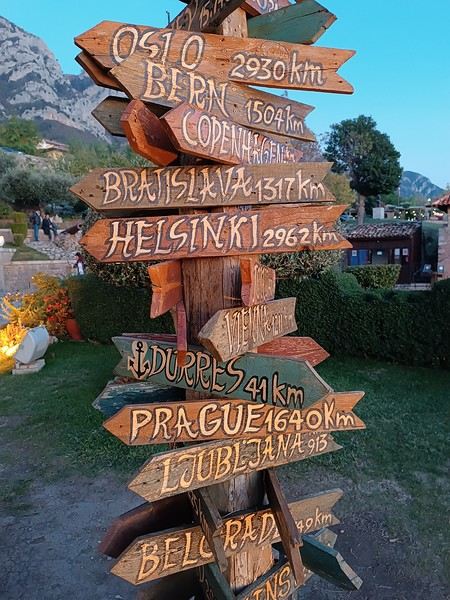
What else, I wonder...
Personally, I often prioritize simple destinations (no administrative hassles), where I’m not at risk (nothing extraordinary like getting kidnapped by Daesh or ending up in a jail cell because the current geopolitics aren’t favorable to my passport, etc.), and where I can drive.
Wide-open natural spaces are more my thing than urban anthills.
Finally, I try not to spend three days on a plane to reach my destination, and I aim for a maximum budget of 3500 € (for 3 weeks) in comfortable conditions—that means charming hotels, good meals, etc.
What about you?🙂
The title might be a bit long, but I hope it’s completely understandable!
When it comes to choosing your next trip, what tips the scales in favor of Eritrea over Ibiza?
Why pick Canada over French Polynesia?
The price? A magazine or TV report, a travel journal, an Instagram ad? Ease of travel? Minimal time difference? The country that has the most in common with all the trip participants? Activities? Relaxation? The desire to push your limits?
A photo?
What else, I wonder...
Personally, I often prioritize simple destinations (no administrative hassles), where I’m not at risk (nothing extraordinary like getting kidnapped by Daesh or ending up in a jail cell because the current geopolitics aren’t favorable to my passport, etc.), and where I can drive.
Wide-open natural spaces are more my thing than urban anthills.
Finally, I try not to spend three days on a plane to reach my destination, and I aim for a maximum budget of 3500 € (for 3 weeks) in comfortable conditions—that means charming hotels, good meals, etc.
What about you?🙂
Sao Tomé, the forgotten island
Hey there, it's me again—back with my usual travel journal share for our loved ones, from our 15-day trip in October 2019.
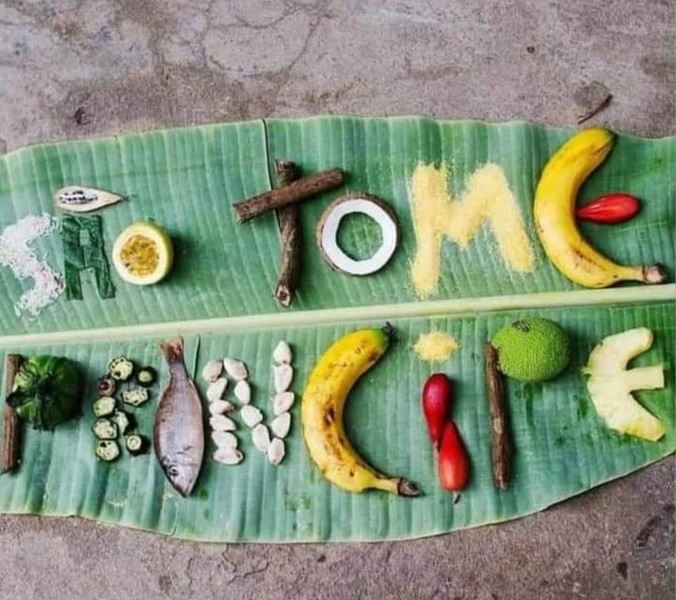
"Ah, here it is at last—that sweet scent of elsewhere so dear to Cricri and Lulu’s noses, that mix of apprehension and desire when facing the unknown.
We’re really diving into the unknown this time, taking you to the island of SAO TOMÉ... also known as the island: *‘Wait, what did you say?’* 😄. Because apparently, no one’s heard of Sao Tomé—except our Portuguese friends.
It’s an archipelago of three islands smack in the middle of the world, right on the equator, off the coast of Gabon.
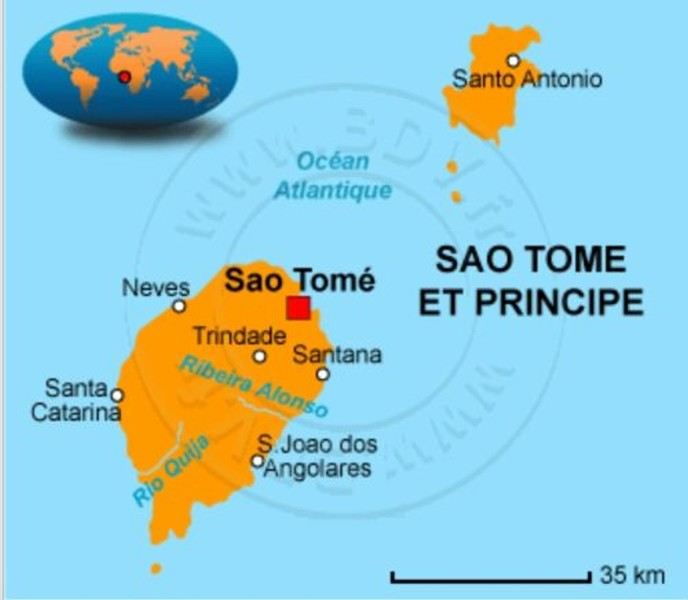
No, these aren’t the sun-soaked, Polynesian lagoon islands. Here, *‘it rains, it pours...’* pretty much all the time, it seems.
There’s not much to *‘see’* in the traditional tourist sense—EXCEPT for stunning landscapes, lush vegetation, a few beaches with golden or black sand, colonial buildings still in their original state, a single main road, and plenty of *‘tracks’* that are more or less drivable. All this surrounded by an African population that speaks Portuguese and is known for its warm welcome.
Well, that should be enough for our happiness—and hopefully yours too! 😊
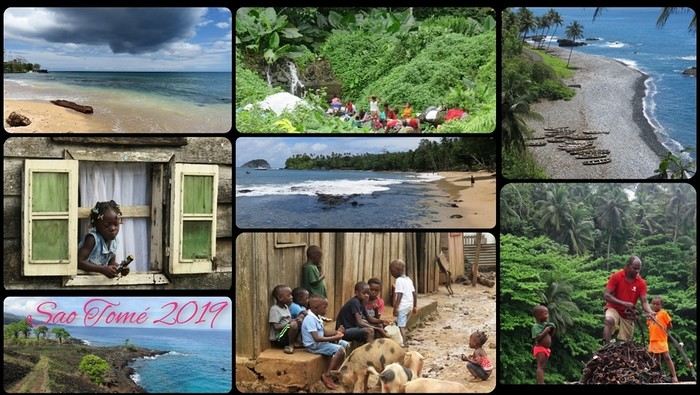
Ready for landing?
"Ah, here it is at last—that sweet scent of elsewhere so dear to Cricri and Lulu’s noses, that mix of apprehension and desire when facing the unknown.
We’re really diving into the unknown this time, taking you to the island of SAO TOMÉ... also known as the island: *‘Wait, what did you say?’* 😄. Because apparently, no one’s heard of Sao Tomé—except our Portuguese friends.
It’s an archipelago of three islands smack in the middle of the world, right on the equator, off the coast of Gabon.
No, these aren’t the sun-soaked, Polynesian lagoon islands. Here, *‘it rains, it pours...’* pretty much all the time, it seems.
There’s not much to *‘see’* in the traditional tourist sense—EXCEPT for stunning landscapes, lush vegetation, a few beaches with golden or black sand, colonial buildings still in their original state, a single main road, and plenty of *‘tracks’* that are more or less drivable. All this surrounded by an African population that speaks Portuguese and is known for its warm welcome.
Well, that should be enough for our happiness—and hopefully yours too! 😊
Ready for landing?
Tips for a 9-day itinerary in southern Morocco
Hi there!
As mentioned in a previous post, we're heading to Morocco in April for 9 days instead of the originally planned 7.
Here's the itinerary I've mapped out to ideally have a complete trip, but I think it might be too ambitious. What do you think? Here's the itinerary (click)
For those who can't open the link: Marrakech (the afternoon of our arrival + 1 day, we’ve already been there without the kids, the goal is not to stay too long) – night Aït Ben Haddou Ouarzazate Skoura – night Oasis de Fint Dadès Gorges Tinghir – night Merzouga – night Zagora – night M’hamid – ideally a night in the desert Agdz Marrakech – night (itinerary via Telouet)
What do you think of this plan? Will it feel too rushed, or is it manageable? Since we don’t know the places, it’s hard to tell if we’ll want to stop everywhere along the way or if there’s enough time to spend at each spot. I’ve included some night-stop assumptions (1 or 2 nights).
We’d love to hear your thoughts! We’re traveling with my wife, a 13-year-old teen, and a 10-year-old. We’ll have our own rental car.
Thanks! !
As mentioned in a previous post, we're heading to Morocco in April for 9 days instead of the originally planned 7.
Here's the itinerary I've mapped out to ideally have a complete trip, but I think it might be too ambitious. What do you think? Here's the itinerary (click)
For those who can't open the link: Marrakech (the afternoon of our arrival + 1 day, we’ve already been there without the kids, the goal is not to stay too long) – night Aït Ben Haddou Ouarzazate Skoura – night Oasis de Fint Dadès Gorges Tinghir – night Merzouga – night Zagora – night M’hamid – ideally a night in the desert Agdz Marrakech – night (itinerary via Telouet)
What do you think of this plan? Will it feel too rushed, or is it manageable? Since we don’t know the places, it’s hard to tell if we’ll want to stop everywhere along the way or if there’s enough time to spend at each spot. I’ve included some night-stop assumptions (1 or 2 nights).
We’d love to hear your thoughts! We’re traveling with my wife, a 13-year-old teen, and a 10-year-old. We’ll have our own rental car.
Thanks! !
A lovely wander at the mercy of the wind in this amazing Rajasthan
Hey there, forum friends 😉
Some of you have mentioned missing the activity on this Indian "page," so let’s try to liven things up a bit—with joy and good vibes (mandatory with me 😜). Plus, it’ll make Jojoone happy 😊.
As big lovers of India—we’ve been six times—my co-traveler husband and I decided to explore Rajasthan this time around. The reason we waited so long to come here? We were dreading the tourist crowds in this state. But thanks to the timing (late March to early April 2024, which is starting to get pretty hot) and Aleph’s great tips, we were *very* far from mass tourism.
We spent three weeks getting around on our own for transport: mostly taxis and trains.
And I’ll admit, we had a rather "Arabian Nights" experience, far from the "real" India (Marien, if you’re reading this 😉). So this travel journal makes no claims other than to share what we saw, experienced, and felt—with all our ignorance about this country (which I’m fully aware of).
But fair warning: I go overboard with emojis, and this journal is super casual because it’s the one I share, almost in "live" mode, with our loved ones.
So, if you’re here, consider yourself almost part of the family 😄.
See you soon and....
Some of you have mentioned missing the activity on this Indian "page," so let’s try to liven things up a bit—with joy and good vibes (mandatory with me 😜). Plus, it’ll make Jojoone happy 😊.
As big lovers of India—we’ve been six times—my co-traveler husband and I decided to explore Rajasthan this time around. The reason we waited so long to come here? We were dreading the tourist crowds in this state. But thanks to the timing (late March to early April 2024, which is starting to get pretty hot) and Aleph’s great tips, we were *very* far from mass tourism.
We spent three weeks getting around on our own for transport: mostly taxis and trains.
And I’ll admit, we had a rather "Arabian Nights" experience, far from the "real" India (Marien, if you’re reading this 😉). So this travel journal makes no claims other than to share what we saw, experienced, and felt—with all our ignorance about this country (which I’m fully aware of).
But fair warning: I go overboard with emojis, and this journal is super casual because it’s the one I share, almost in "live" mode, with our loved ones.
So, if you’re here, consider yourself almost part of the family 😄.
See you soon and....
Resuming discussions and returning to Madagascar
Oh, the good news—the site is back up after such a long closure. I think many of us were really missing it, though some have moved on to other forums like Routard.
Hopefully, activity will pick up little by little. Travel habits have probably changed post-Covid, and some regulars won’t be coming back for all sorts of reasons.
But for the rest of us, the forum is here for travel journals and pre-trip questions. Anyway…
Back to the main point: my last trip to Madagascar was a while ago now—about a year—on the High Plateaus during the austral winter. It was really chilly, and to be honest, my feelings were mixed between the joy of returning to Madagascar and the sadness of seeing the state of the country. The infrastructure is crumbling, and the population is sinking into poverty at unprecedented levels. The country’s closure likely had immeasurable consequences, compounded by destructive cyclones. Even secondary cities have seen large numbers of rural people arriving in search of work, while some rural areas barely allow survival. I’ve never felt such despair over the situation in 20 years.
From Tana to Fianar, it was nothing but heartbreaking observations. Probably made worse by the drizzle and cold typical of that season in the region.
In a few weeks, I’m planning to return to the High Plateaus and also Sainte Marie. On that note, a few questions: has anyone stayed at Samaria Cosy Lodge, and what did you think of it? On Île aux Nattes, which hotel would you recommend for a few peaceful days, ideally on the coast best suited for snorkeling?
Thanks in advance
Back to the main point: my last trip to Madagascar was a while ago now—about a year—on the High Plateaus during the austral winter. It was really chilly, and to be honest, my feelings were mixed between the joy of returning to Madagascar and the sadness of seeing the state of the country. The infrastructure is crumbling, and the population is sinking into poverty at unprecedented levels. The country’s closure likely had immeasurable consequences, compounded by destructive cyclones. Even secondary cities have seen large numbers of rural people arriving in search of work, while some rural areas barely allow survival. I’ve never felt such despair over the situation in 20 years.
From Tana to Fianar, it was nothing but heartbreaking observations. Probably made worse by the drizzle and cold typical of that season in the region.
In a few weeks, I’m planning to return to the High Plateaus and also Sainte Marie. On that note, a few questions: has anyone stayed at Samaria Cosy Lodge, and what did you think of it? On Île aux Nattes, which hotel would you recommend for a few peaceful days, ideally on the coast best suited for snorkeling?
Thanks in advance
Identité de genre et orientations sexuelles en voyage
Bonjour à toutes et à tous!
J'aimerais bien avoir votre opinion sur la façon dont les questions du genre et de l'orientation sexuelle sont perçues dans les différentes régions du monde que vous avez visitées.
En Occident, ces questions sont débattues et les différences de mieux en mieux acceptées, même s'il y a encore beaucoup de chemin à faire. Mais comment ça se passe ailleurs ? En Afrique par exemple, ou en Asie ?
Si je pose ma question sur ce forum c'est parce que j'aimerais avoir des avis de première main. Par exemple, qui d'entre vous a parlé à des hijras (Inde) ou à des Katoï (Thaïlande) de leurs conditions de vie? Savez-vous comment elles/ils sont vu.e.s par leurs compatriotes? Sont-elles/ils admis.e.s ou rejeté.e.s?
Une autre de mes questions tourne autour des touristes occidentales/aux LGBT. Y a-t-il des pays ou des régions où on peut en toute tranquillité afficher ses préférences? Par exemple, est-ce que deux lesbiennes peuvent marcher main dans la main dans le centre de Marrakech ou est-ce qu'il y a des bars LGBT en Chine?
Si vous êtes vous-même concerné.e.s par ces questions, pouvez-vous raconter des anecdotes et bien entendu donner des conseils sur où aller et où ne pas aller?
Merci d'avance 😎
PS:Pourquoi n'a-t-on le choix qu'entre deux sexes dans le formulaire d'inscription du site ?
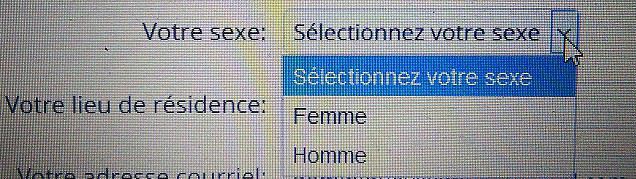
PS:Pourquoi n'a-t-on le choix qu'entre deux sexes dans le formulaire d'inscription du site ?
Seul l'exotisme fait l'effet du voyage
J en ai connus qui ne supporteraient pas, ou plus, de prendre des vacances ou de voyager hors de leur pays, en Belgique en Suisse ou en France. Ou en Europe.
je ne suis pas de ceux là. Il me faut un cadre qui m eloigne de tout ce que je connais visuellement parlant. Des paysages radicalement differents, une tout autre restauration, des visages et un langage qui appartiennent a un "ailleurs". D autres coutumes une autre monnaie une autre musique. Sinon mon esprit ne ressent pas l apaisement la distraction et je ne sens pas les bienfaits de ce repos 1 fois dans une annee. Oh on arrive a s en passer mais il manque quelque chose. Les bienfaits de l exotisme, des alizees, des tropiques, un autre gout de vin ou de whisky.
nous voila drogués du voyage et en ce moment a la fois libres et en prison.
Chorizo ou pas dans la paëlla?
Tout fout le camp...
Chorizo ou pas ? Un illustre chef espagnol ravive le «paellagate»
(Mais moi j'en ai toujours mis... 😛 )
Hébergement ou bivouac sur l'EuroVelo 6 Mulhouse-Nevers
Cette année, avec l'acquisition d'un nouveau vélo et pas trop l'envie de prendre l'avion, j'ai envie de découvrir la Franche-Comté-Bourgogne à vélo, destination que j'ai souvent traversé en voiture mais que j'aimerais découvrir plus. Ca serait mon 1er voyage en vélo. Je serais seule a priori et j'envisage de partir fin août/début septembre. Je partirais de Strasbourg (en train ou à vélo). Je suis allée sur le site francevelotourisme qui explique vraiment bien chaque étape. J'irais à mon rythme et comme j'ai l'habitude en voyage, me poser quand j'aime un endroit.
Je m'interrogeais sur où dormir. Je n'ai pas forcément envie d'aller dans un hôtel. Je ne veux pas prévoir trop à l'avance un hébergement car je ne sais pas combien de kilomètres je vais faire, si je vais m'arrêter pour profiter d'un endroit...
Pour l'instant, je n'ai aucun matériel de camping. Alors voilà, est-ce qu'il est facile de trouver une chambre d'hôte où tout logement un peu à l'improviste sur ce tronçon ? Est-ce que le camping serait plus facile ? Et est-ce que bivouaquer serait une bonne idée et faisable ?
La solution avec tente me demanderait un investissement de départ (tente et bon matelas !) . Toutefois, l'idée de bivouaquer me séduit bien, car pas besoin de trop réfléchir où dormir ou réserver. Et me réveiller en pleine nature, ça serait top !
Avez-vous de conseils ? Avez-vous déjà fait ce parcours ? Avez-vous de bonnes adresses ?
Mon voyage pour le Cameroun en voiture depuis la Suisse (en 4x4)
Bonjour,
j'aimerais me rendre au Cameroun dans un mois en voiture si les frontière sont ouverte bien sur. est ce faisable niveau sécurité? Si oui quelle route faut-il emprunter? Il y a t'il des personnes intéresser pour faire la route avec moi? je partirai depuis la Suisse.
Merci d'avance pour vos réponses Happi
Merci d'avance pour vos réponses Happi
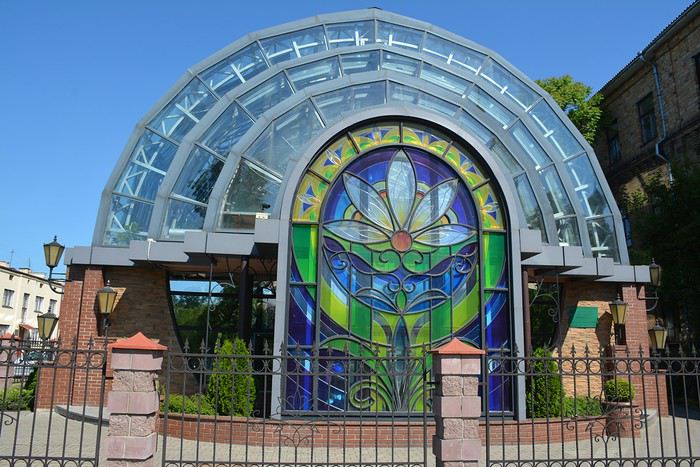
Mais où donc est ce truc là? (5)
Bonjour
Où se trouve cette serre ?
En premier chercher le pays et ensuite la ville
Françoise
L'importance des voyages pour vous
Bonjour
Nous sommes bien sûr tous des voyageurs et c'est ce qui nous rassemble ici.
Mais nous avons tous une vision différente du voyage et n'y accordons pas la même importance.
Quelle place accordez vous au voyage dans votre vie ?
Est ce un loisir comme un autre ? Une passion ? Un vrai besoin ? Pouvez vous vous en passer facilement ?
Nous sommes bien sûr tous des voyageurs et c'est ce qui nous rassemble ici.
Mais nous avons tous une vision différente du voyage et n'y accordons pas la même importance.
Quelle place accordez vous au voyage dans votre vie ?
Est ce un loisir comme un autre ? Une passion ? Un vrai besoin ? Pouvez vous vous en passer facilement ?
Carnet de Sierra Leone janvier 2020
Voici mes premieres infos d'un voyage que je viens de commencer depuis le 7 janvier
Contexte 72 ans au compteur avec des ossatures redressées par les chirurgiens Je pars seule avec les infos de Choucarde, Newyorp et Gabieri que je remercie au passage + la lecture du guide Bradt en anglais Mon itinéraire a été etabli en fonction de mes goûts : plutot la campagne que la ville, la visite des marches , tout ce que se rapporte à la nature puisque naturaliste de formation Et hebergement : matelas dur et salle de bain perso donc un certain confort
Billet achete Paris Bruxelles Freetown par Brussels Airlines : rien à dire Mais a Paris comme a Bruxelles j'ai du fournir le texte du " visa on arrival'' paru le 6 septembre....prévoyante le texte était archivé dans la tablette, Personne ne connaissait le texte et on m'a remercié. ...apparemment la première dans ce cas
Arrivee a Lungi l'aeroport de Freetown Le visa a été etabli sans pb pour 80 dollars ATM et bureau de change : un euro= 10300SL leones et découverte de la liasse de billets a trimbaler ....des cm d'épaisseur. ..des paquets de 5000 SLLeones Logement au Aiport Lodge: resa depuis la France avec booking.com mais payé directement au manager via ma banque sans frais ( Compte en GB ...avant le Brexit) Solution pour éviter d'arriver la nuit dans une ville inconnue . Differents moyens pour rallier Freetown distant d'une quarantaine de km via un estuaire Je choisis sur les conseils du manager de la lodge de prendre un vehicule qui m'emmenera directement au centre de Freetown( 50 dollars + 5000 SL Leones pour le prix d' une personne en ferry non VIP) duree totale presque 3 h dont 50 minutes de ferry et beaucoup d'embouteillage depuis le warf Kissay
Hebergement à Freetown au Sierra Leone International hotel au 27 Rawdon street ( Prix single 200 0000 SL leones ) Pas de moustiquaire pas de wifi la clim en soirée, mais Correct pas le vrai grand luxe Le quartier est celui d'un marché géant de rue ou les vehicules avancent cm par cm , Beaucoup de bruit par haut parleur le jour mais calme des 19h. Foule dense. J'ai pris le petit dej et les repas au J Royal Bakery de l'autre cote de la rue a 50m en montant.En étage. Une cuisinière aux petits oignons pour me cuire des légumes
Telephone : directement au magasin Africell Carte sim gratis et data 4G ( qui fonctionne uniquement a Freetown mais ailleurs c'est lent lent ou impossible ) Telephone en France : 2990 SL leones la minute ...on achete du crédit
Change : je n'aime pas changer au noir en ville....et une curiosite à la Banque Zenith dans meme rue il a été impossible de changer des euros , on appelle un gars qui change au noir dans la rue et la transaction s'effectue dans un recoin de la banque, a l'écart sous l'oeil d'un employe de la banque en gilet orange. ..je n'etais pas la seule dans ce cas Taux 1euro= 10700 SL leones mais pas de document qui prouve d'opération
Petite course en richshaw appele ici keke 2000 SL leones Musee national : 40000 SLLeones: des vieilleries coloniales, rien de spectaculaire Le musee est a proximite du Coton tree un kapokier tricentenaire au milieu de la circulation. Encore majestueux et en saidon sèche la seve est économisée et les branches superieures sont defeuillees National railway 50000SL leones assez loin et bien faire comprendre au richshaw le nom sinon il se perd ....et on a droit a une visite des quartiers les uns apres les autres...et la note s'allonge Discussion interessante avec les gardiens de ce musee sur les couts de la vie locale
Depart pour Kambia a Shell jonction Vers 6h du matin pas de lumière sauf les loupiotes des lampes electriques, c'est glauque et les possibilites de depart nombreuses. Indispensable de se faire accompagner pour etre cornake utilement On a choisit pour moi le mieux: une voiture de 5 personnes et j'ai paye les 2 places de devant pour poser mon opulente personne soit 90000 SL Leones Duree du voyage 2h30 et 3 secteurs d'autoroute a l'africaine payante Les chinois ( ils sont quasiment partout en Afrique) activent pelleteuses , nivelleuses et bulldozers pour compléter au nord cette autoroute. Cette voie de Freetown a Kambia se prolonge jusqu'a Conakry ...Les chinois ont planifié une transafricaine depuis Djibouti et cela fait sans doute parti de leurs projets. La configuration geographique de cet estuaire en ferait un port en eau profonde le 2 eme de l'Afrique de l'Ouest
Kambia: hebergement a l'Africana Village dans un jardin sous les eucalyptus et les euphorbes géantes : .250000 SL Leones en suite dans un bungalow Avec petit dej succint compris. Electricite par générateur de 19h a 7 h du matin Pas de wi fi et la 4G inerte. J'ai paye le mot de passe 10000 SL leones la demi heure a l'Alfat internet cafe Tres bon accueil des proprios Olive et Ibraim secondés par Salaam J'ai diner la le soir mais j'ai achete mes bouteilles d'eau a la succursale de Total appelée Bonjour; vente de toutes boissons tres fraîches et même des pommes ( 6000 Slleones l'unite) Il m'a ete conseille de toujours etre accompagnée par quelqu'un pour favoriser le contact en creole appele le krio et pour demander la permission de prendre des photos rarement refusée. Ce quelqu'un a ete un chauffeur de moto Abdoula Donc taxi moto pour les villages a Massama ou on fabrique des nattes A Mambolo a 1h de moto il n'y a plus qu'un potier Et market day a Bamoi très très anime , recommande vue la foule de faire attention a ces affaires Il faut donc payer la course et rajouter a la louche l'equivalent de un dollar l'heure et arrondir
Pour l'instant accueil ++++ et on se met souvent en 4 pour me satisfaire. Je paie les efforts par des pourboires quand on me porte ma valise par exemple ou j'en donne aussi a la cuisiniere si le plat convient a ma demande
Il est tard je jouis a Makeni d'une confortable wifi au M J Hotel la où etait passe Beckham Je continuerais un autre jour si la wi fi se presente aussi bien
Carassou
Contexte 72 ans au compteur avec des ossatures redressées par les chirurgiens Je pars seule avec les infos de Choucarde, Newyorp et Gabieri que je remercie au passage + la lecture du guide Bradt en anglais Mon itinéraire a été etabli en fonction de mes goûts : plutot la campagne que la ville, la visite des marches , tout ce que se rapporte à la nature puisque naturaliste de formation Et hebergement : matelas dur et salle de bain perso donc un certain confort
Billet achete Paris Bruxelles Freetown par Brussels Airlines : rien à dire Mais a Paris comme a Bruxelles j'ai du fournir le texte du " visa on arrival'' paru le 6 septembre....prévoyante le texte était archivé dans la tablette, Personne ne connaissait le texte et on m'a remercié. ...apparemment la première dans ce cas
Arrivee a Lungi l'aeroport de Freetown Le visa a été etabli sans pb pour 80 dollars ATM et bureau de change : un euro= 10300SL leones et découverte de la liasse de billets a trimbaler ....des cm d'épaisseur. ..des paquets de 5000 SLLeones Logement au Aiport Lodge: resa depuis la France avec booking.com mais payé directement au manager via ma banque sans frais ( Compte en GB ...avant le Brexit) Solution pour éviter d'arriver la nuit dans une ville inconnue . Differents moyens pour rallier Freetown distant d'une quarantaine de km via un estuaire Je choisis sur les conseils du manager de la lodge de prendre un vehicule qui m'emmenera directement au centre de Freetown( 50 dollars + 5000 SL Leones pour le prix d' une personne en ferry non VIP) duree totale presque 3 h dont 50 minutes de ferry et beaucoup d'embouteillage depuis le warf Kissay
Hebergement à Freetown au Sierra Leone International hotel au 27 Rawdon street ( Prix single 200 0000 SL leones ) Pas de moustiquaire pas de wifi la clim en soirée, mais Correct pas le vrai grand luxe Le quartier est celui d'un marché géant de rue ou les vehicules avancent cm par cm , Beaucoup de bruit par haut parleur le jour mais calme des 19h. Foule dense. J'ai pris le petit dej et les repas au J Royal Bakery de l'autre cote de la rue a 50m en montant.En étage. Une cuisinière aux petits oignons pour me cuire des légumes
Telephone : directement au magasin Africell Carte sim gratis et data 4G ( qui fonctionne uniquement a Freetown mais ailleurs c'est lent lent ou impossible ) Telephone en France : 2990 SL leones la minute ...on achete du crédit
Change : je n'aime pas changer au noir en ville....et une curiosite à la Banque Zenith dans meme rue il a été impossible de changer des euros , on appelle un gars qui change au noir dans la rue et la transaction s'effectue dans un recoin de la banque, a l'écart sous l'oeil d'un employe de la banque en gilet orange. ..je n'etais pas la seule dans ce cas Taux 1euro= 10700 SL leones mais pas de document qui prouve d'opération
Petite course en richshaw appele ici keke 2000 SL leones Musee national : 40000 SLLeones: des vieilleries coloniales, rien de spectaculaire Le musee est a proximite du Coton tree un kapokier tricentenaire au milieu de la circulation. Encore majestueux et en saidon sèche la seve est économisée et les branches superieures sont defeuillees National railway 50000SL leones assez loin et bien faire comprendre au richshaw le nom sinon il se perd ....et on a droit a une visite des quartiers les uns apres les autres...et la note s'allonge Discussion interessante avec les gardiens de ce musee sur les couts de la vie locale
Depart pour Kambia a Shell jonction Vers 6h du matin pas de lumière sauf les loupiotes des lampes electriques, c'est glauque et les possibilites de depart nombreuses. Indispensable de se faire accompagner pour etre cornake utilement On a choisit pour moi le mieux: une voiture de 5 personnes et j'ai paye les 2 places de devant pour poser mon opulente personne soit 90000 SL Leones Duree du voyage 2h30 et 3 secteurs d'autoroute a l'africaine payante Les chinois ( ils sont quasiment partout en Afrique) activent pelleteuses , nivelleuses et bulldozers pour compléter au nord cette autoroute. Cette voie de Freetown a Kambia se prolonge jusqu'a Conakry ...Les chinois ont planifié une transafricaine depuis Djibouti et cela fait sans doute parti de leurs projets. La configuration geographique de cet estuaire en ferait un port en eau profonde le 2 eme de l'Afrique de l'Ouest
Kambia: hebergement a l'Africana Village dans un jardin sous les eucalyptus et les euphorbes géantes : .250000 SL Leones en suite dans un bungalow Avec petit dej succint compris. Electricite par générateur de 19h a 7 h du matin Pas de wi fi et la 4G inerte. J'ai paye le mot de passe 10000 SL leones la demi heure a l'Alfat internet cafe Tres bon accueil des proprios Olive et Ibraim secondés par Salaam J'ai diner la le soir mais j'ai achete mes bouteilles d'eau a la succursale de Total appelée Bonjour; vente de toutes boissons tres fraîches et même des pommes ( 6000 Slleones l'unite) Il m'a ete conseille de toujours etre accompagnée par quelqu'un pour favoriser le contact en creole appele le krio et pour demander la permission de prendre des photos rarement refusée. Ce quelqu'un a ete un chauffeur de moto Abdoula Donc taxi moto pour les villages a Massama ou on fabrique des nattes A Mambolo a 1h de moto il n'y a plus qu'un potier Et market day a Bamoi très très anime , recommande vue la foule de faire attention a ces affaires Il faut donc payer la course et rajouter a la louche l'equivalent de un dollar l'heure et arrondir
Pour l'instant accueil ++++ et on se met souvent en 4 pour me satisfaire. Je paie les efforts par des pourboires quand on me porte ma valise par exemple ou j'en donne aussi a la cuisiniere si le plat convient a ma demande
Il est tard je jouis a Makeni d'une confortable wifi au M J Hotel la où etait passe Beckham Je continuerais un autre jour si la wi fi se presente aussi bien
Carassou
Quel vélo choisir pour l'EV6 jusqu'en Roumanie?
Bonjour à tous,
Je me suis lancée avec une amie, le défi d'aller jusqu'à Costanta en Roumanie, via l'EV6. Nous partions au alentour du 14 juillet 2020 depuis Mulhouse.
Nous sommes toutes les deux extrêmement novices en vélo, j'y passe quand même des heures à chercher des informations. Concernant les aspects techniques du vélo, je crois avoir déjà assimilés le vocabulaire (houhou on commence déjà quelque part!)
Idéalement, il nous faudrait un vélo qui puisse tenir la route jusque la Roumanie (soit environ 3500km). J'ai un budget d'environ 400-500€ (je suis en service civique et mon salaire n'est pas franchement mirobolant!) avec des améliorations possible (mon papa et les ateliers participatifs vont être mes amis!). J'ai noté que des améliorations nécessaires type freins, pneus doivent être envisagés.
Est-ce qu'un RIVERSIDE 900 (Décathlon) ferait l'affaire pour commencer : https://www.decathlon.fr/p/velo-tout-chemin-riverside-900/_/R-p-300794?mc=8405264&c=GRIS ou bien j'ai trouvé ça mais je sais pas ce que ça vaut : https://www.probikeshop.fr/vtc-serious-cedar-hybrid-noir/161648.html?gclid=CjwKCAiAx_DwBRAfEiwA3vwZYtO6DO9jEFsySzGMfuU3yjrecy7X-n-Zb4XZDp_cciyxKctwtDigWhoCtAgQAvD_BwE&gshop=FR&ef_id=CjwKCAiAx_DwBRAfEiwA3vwZYtO6DO9jEFsySzGMfuU3yjrecy7X-n-Zb4XZDp_cciyxKctwtDigWhoCtAgQAvD_BwE:G:s
Si quelqu'un pouvait m'aider/conseiller ce serait super chouette ! Je vous remercie grandement :-)
MERCI ! Belle journée du Pays basque... :-)
Je me suis lancée avec une amie, le défi d'aller jusqu'à Costanta en Roumanie, via l'EV6. Nous partions au alentour du 14 juillet 2020 depuis Mulhouse.
Nous sommes toutes les deux extrêmement novices en vélo, j'y passe quand même des heures à chercher des informations. Concernant les aspects techniques du vélo, je crois avoir déjà assimilés le vocabulaire (houhou on commence déjà quelque part!)
Idéalement, il nous faudrait un vélo qui puisse tenir la route jusque la Roumanie (soit environ 3500km). J'ai un budget d'environ 400-500€ (je suis en service civique et mon salaire n'est pas franchement mirobolant!) avec des améliorations possible (mon papa et les ateliers participatifs vont être mes amis!). J'ai noté que des améliorations nécessaires type freins, pneus doivent être envisagés.
Est-ce qu'un RIVERSIDE 900 (Décathlon) ferait l'affaire pour commencer : https://www.decathlon.fr/p/velo-tout-chemin-riverside-900/_/R-p-300794?mc=8405264&c=GRIS ou bien j'ai trouvé ça mais je sais pas ce que ça vaut : https://www.probikeshop.fr/vtc-serious-cedar-hybrid-noir/161648.html?gclid=CjwKCAiAx_DwBRAfEiwA3vwZYtO6DO9jEFsySzGMfuU3yjrecy7X-n-Zb4XZDp_cciyxKctwtDigWhoCtAgQAvD_BwE&gshop=FR&ef_id=CjwKCAiAx_DwBRAfEiwA3vwZYtO6DO9jEFsySzGMfuU3yjrecy7X-n-Zb4XZDp_cciyxKctwtDigWhoCtAgQAvD_BwE:G:s
Si quelqu'un pouvait m'aider/conseiller ce serait super chouette ! Je vous remercie grandement :-)
MERCI ! Belle journée du Pays basque... :-)
Discussion du concours photo du mois de janvier 2020: Allons à la pêche!
Voici le lieu idéal et recommandé pour parler de photo, de pêche, de photos de pêche !
🙂
🙂
Santé, vaccins et paludisme à Sumatra
Bonjour,
nous sommes 2 amies de 68 ans à partir fin janvier Sumatra et ce pour au moins 1 mois. Habituées au voyages "aventure" à petit et moyen budget, nous nous posons qq questions à propos des moustiquesNousouhaitons rencontrer les hommes fleurs sur l'île de Siberut et aller bien sur à Ketambe (orangs outans etc). j'ai lu beaucoup de posts sur ce site mais personnes ne parlent des précautions à prendre pour éviter le paludisme. pas du tout envie de prendre pendant des semaines des médicaments qui ont bcp de contre indications.
merci pour vos retours. Dolma