Results for "Tanzanie"
About 4,074 results.
More options
Many results are in French, the community’s main language. English translations are added over time.
Search results
S'il y a un prochain voyage, comment utiliser ses finances?
bonjour les gens qui voyagent
supposons qu on repart à l etranger en 2021 ou 2022. Comment utiliser vos finances ? Vous mettez tout l argent économisé dans un gros voyage genre luxe ou vous ne changez rien ou vous avez trop crainte et ne partirez plus ? je suis curieux de savoir
supposons qu on repart à l etranger en 2021 ou 2022. Comment utiliser vos finances ? Vous mettez tout l argent économisé dans un gros voyage genre luxe ou vous ne changez rien ou vous avez trop crainte et ne partirez plus ? je suis curieux de savoir
Wild Camping in Southern Africa
Hey everyone,
I’m sharing a slightly unusual travel journal with three goals. To make it work, this discussion should stay in the travel journal section so we can find it easily and keep adding info to existing posts.
This journal is meant to help "newbies" discover these magical places.
We go to Southern Africa not just for the animals, but also for that soft light, the atmosphere, and those incredible wild campsites where you feel so at home... I’d love for you all to share your favorite spots here—those we miss so much.
The last goal is figuring out how to photograph them. Honestly, I’m not happy with my photos because they don’t capture the feeling I get when I’m there or that unique atmosphere.
I’ll start with one of the first spots that, for me, is one of the most beautiful in Southern Africa: Passarge Valley 2 in the Central Kalahari. There, you’re alone—completely alone. The next campsite is over 25 km away, and that’s a half-day of 4x4 driving. In front of you, there’s nothing but the CKGR plains with herds of springboks... absolutely stunning 😎

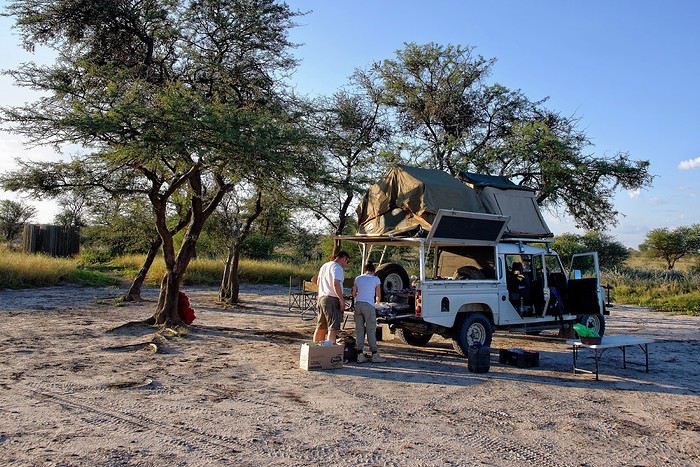
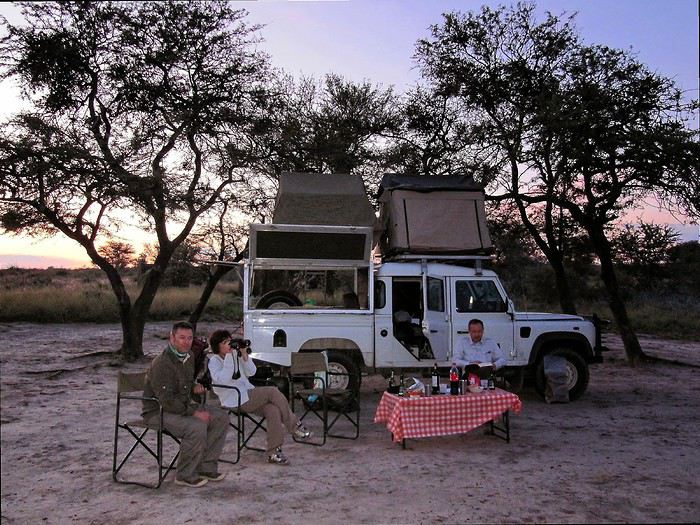
I’m sharing a slightly unusual travel journal with three goals. To make it work, this discussion should stay in the travel journal section so we can find it easily and keep adding info to existing posts.
This journal is meant to help "newbies" discover these magical places.
We go to Southern Africa not just for the animals, but also for that soft light, the atmosphere, and those incredible wild campsites where you feel so at home... I’d love for you all to share your favorite spots here—those we miss so much.
The last goal is figuring out how to photograph them. Honestly, I’m not happy with my photos because they don’t capture the feeling I get when I’m there or that unique atmosphere.
I’ll start with one of the first spots that, for me, is one of the most beautiful in Southern Africa: Passarge Valley 2 in the Central Kalahari. There, you’re alone—completely alone. The next campsite is over 25 km away, and that’s a half-day of 4x4 driving. In front of you, there’s nothing but the CKGR plains with herds of springboks... absolutely stunning 😎
La crise de l’aviation va faire exploser le prix des billets d'avion?
La crise de l’aviation va faire
exploser le prix des billets
les pistes explorées
pour convaincre les voyageurs sont diverses.
Mais il est déjà certain qu’elles vont
renchérir le prix des billets d’avion.
Certaines compagnies à bas prix ont déjà
fait faillite, et la pression sur les voyages low
● Prendre l’avion sera plus cher, et surtout
plus compliqué. Les compagnies cherchent
la parade.
Les mois qui viennent seront très compliquéspour l’aviation civile. Car il s’agit avant tout de regagner la confiance des usagers, tout en répondant aux nouvelles normes de sécurité sanitaire. Diminution des sièges en cabine, obligation de porter le masque, contrôle des températures est particulièrement forte. Certains prédisent carrément le retour à des prix que l’on connaissait avant les années 90. Et pour cette année, il faudrait s’attendre à une augmentation moyenne de près de 50%
Les mois qui viennent seront très compliquéspour l’aviation civile. Car il s’agit avant tout de regagner la confiance des usagers, tout en répondant aux nouvelles normes de sécurité sanitaire. Diminution des sièges en cabine, obligation de porter le masque, contrôle des températures est particulièrement forte. Certains prédisent carrément le retour à des prix que l’on connaissait avant les années 90. Et pour cette année, il faudrait s’attendre à une augmentation moyenne de près de 50%
Kenya February 2020: From Tsavo to Samburu via Meru National Park
Good evening everyone,
I hope you're all doing well despite this very unusual time…
Here’s a new travel journal to get you back on the Kenyan trails.
It was a really great idea to buy those flight tickets to Nairobi back in December. When Benoit suggested this new safari in February, I hesitated a little (very little): it was the season with particularly high temperatures, and the short rainy season in November/December had been very heavy, raising concerns about the state of the tracks… Given the current situation, no regrets, of course… We quickly organized the safari with our usual guide, and we booked the accommodations ourselves directly. (If we’d waited just a few more weeks, we might’ve regretted it…)
For once, we were able to leave from the airport near where we live (Lorient - Lann Bihoué), which is really convenient: no driving, no parking… We left home at 2 PM on Tuesday, February 18th, and arrived in Nairobi at 6 AM the next morning—perfect. (With a layover in CDG, of course 😉) Upon arrival, after a forehead temperature check by airport staff, we got our visas very quickly (forms filled out before departure). The customs agents congratulated us on our passports full of Kenyan stamps… but we still had to pay the 40 € for the visa.
All that was left was to collect our luggage, and we’d be ready to leave the airport shortly after landing. But there was a small issue: the baggage conveyor belt was broken… Eventually, the suitcases and bags were brought out by hand… Hakuna Matata, as they say here—no problem, as long as they’re all there. Benoit sent a message to Félix, our guide, to come meet us in the airport parking lot. After catching up with our respective families, we set off toward the Mombasa road, heading to Voi.
Traffic in Nairobi is still as heavy as ever, and the pollution is very noticeable (cars, but also cement factories…). The current lockdown has changed things. On social media, Mount Kenya and Kilimanjaro seem visible from Nairobi now!…
The first stop on this safari was a place we hadn’t visited before: the LUMO Community Wildlife Conservancy lumoconservancy.com/. It’s a small reserve located west of Tsavo West and near the Taita Hills. The reserve is managed by the local community, and entry fees are lower than in Tsavo’s national parks. We had initially planned to spend three days in Tsavo East, but since the accommodation wasn’t available for that long, we ended up choosing this option, which turned out to be a great discovery. Since the reserve is small, I think it’s hard to spend more than two days there. The advantage is that, since it’s not a national park, activities like walks or night safaris can be offered.
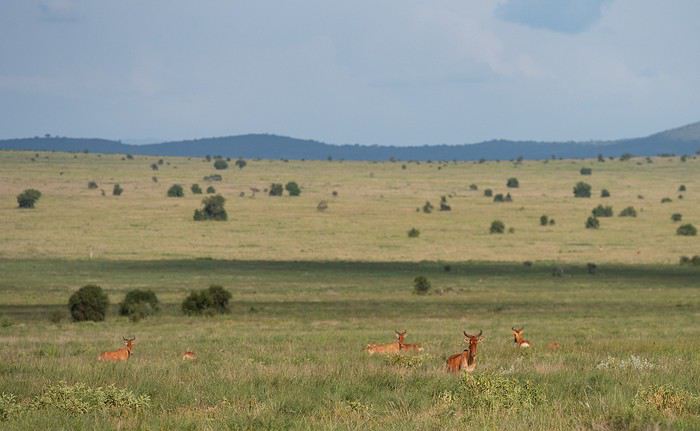
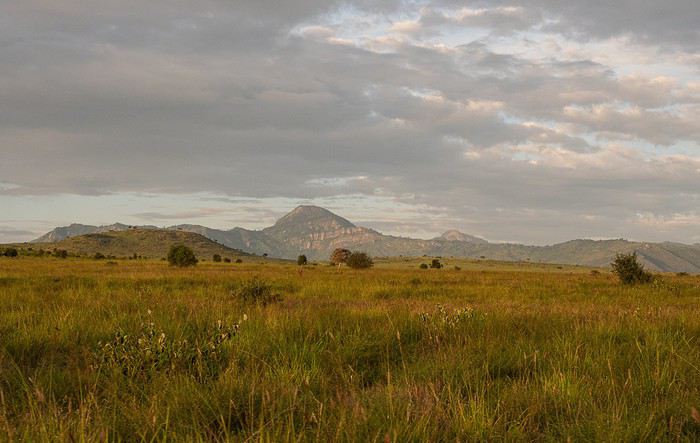
Alright, here are a few images to set the mood.
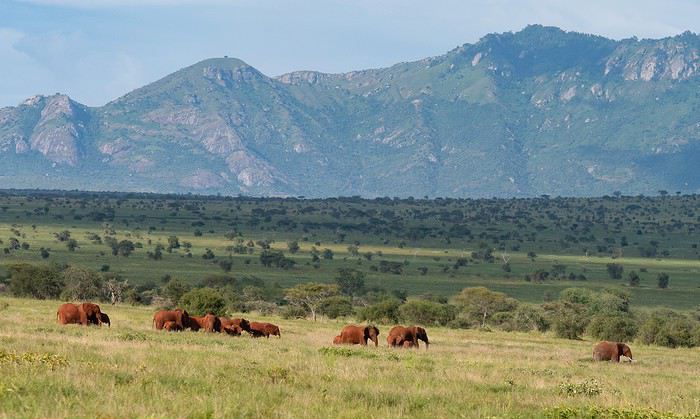
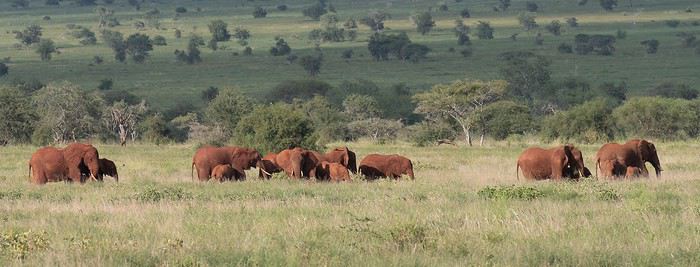
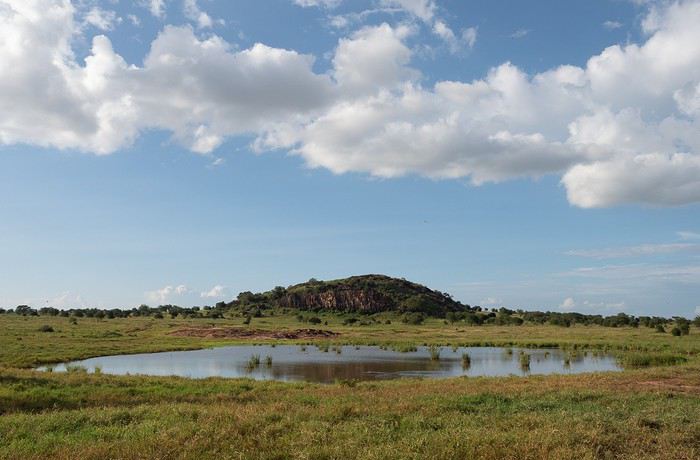
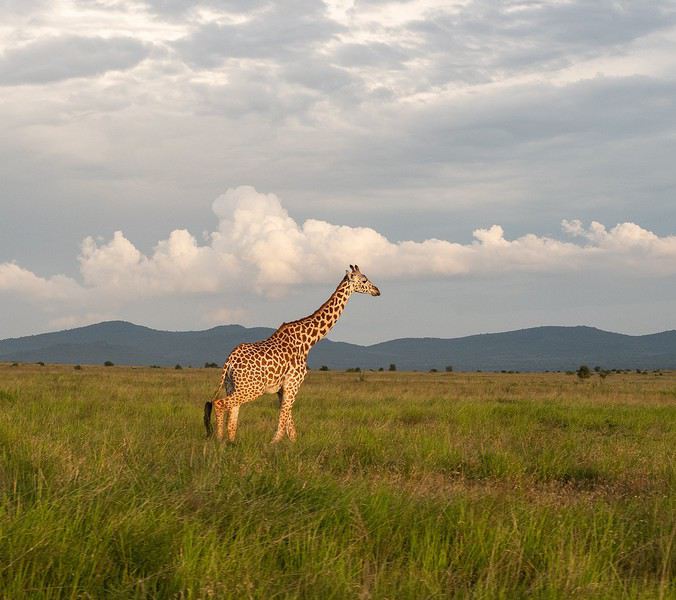
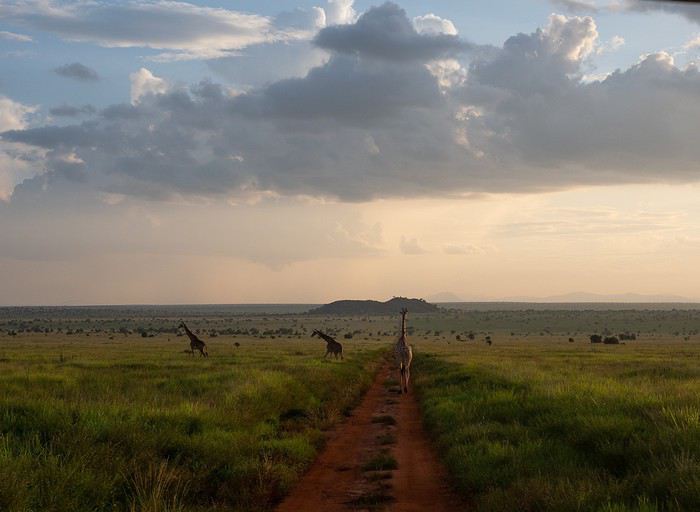
Elephants, but also hartebeests and lots of giraffes in a light we really liked.
It was a really great idea to buy those flight tickets to Nairobi back in December. When Benoit suggested this new safari in February, I hesitated a little (very little): it was the season with particularly high temperatures, and the short rainy season in November/December had been very heavy, raising concerns about the state of the tracks… Given the current situation, no regrets, of course… We quickly organized the safari with our usual guide, and we booked the accommodations ourselves directly. (If we’d waited just a few more weeks, we might’ve regretted it…)
For once, we were able to leave from the airport near where we live (Lorient - Lann Bihoué), which is really convenient: no driving, no parking… We left home at 2 PM on Tuesday, February 18th, and arrived in Nairobi at 6 AM the next morning—perfect. (With a layover in CDG, of course 😉) Upon arrival, after a forehead temperature check by airport staff, we got our visas very quickly (forms filled out before departure). The customs agents congratulated us on our passports full of Kenyan stamps… but we still had to pay the 40 € for the visa.
All that was left was to collect our luggage, and we’d be ready to leave the airport shortly after landing. But there was a small issue: the baggage conveyor belt was broken… Eventually, the suitcases and bags were brought out by hand… Hakuna Matata, as they say here—no problem, as long as they’re all there. Benoit sent a message to Félix, our guide, to come meet us in the airport parking lot. After catching up with our respective families, we set off toward the Mombasa road, heading to Voi.
Traffic in Nairobi is still as heavy as ever, and the pollution is very noticeable (cars, but also cement factories…). The current lockdown has changed things. On social media, Mount Kenya and Kilimanjaro seem visible from Nairobi now!…
The first stop on this safari was a place we hadn’t visited before: the LUMO Community Wildlife Conservancy lumoconservancy.com/. It’s a small reserve located west of Tsavo West and near the Taita Hills. The reserve is managed by the local community, and entry fees are lower than in Tsavo’s national parks. We had initially planned to spend three days in Tsavo East, but since the accommodation wasn’t available for that long, we ended up choosing this option, which turned out to be a great discovery. Since the reserve is small, I think it’s hard to spend more than two days there. The advantage is that, since it’s not a national park, activities like walks or night safaris can be offered.
Alright, here are a few images to set the mood.
Elephants, but also hartebeests and lots of giraffes in a light we really liked.
Itinéraire en self-drive Rwanda - Ouganda
Bonjour,
Je prépare un voyage au Rwanda/Ouganda en 2021, certainement en self drive pour la partie rwandaise et avec un chauffeur pour la partie ougandaise. Je prévois de 15 à 17 nuits sur place.
J'aime les animaux bien sur mais encore plus les paysages et la vie quotidienne. Je voudrais néanmoins voir les gorilles et les lions arboricoles. Le bec en sabot et les rhinos aussi mais cela me semble compliqué.
J'ai demandé à deux agences des itinéraires, j'ai estimé via google nombre d'heures à passer sur la route.
Agence 1 : (15 nuits) - 31.5 h de route
Kigali - Forêt de Nyungwe - Lac Kivu ( trail) - Parc des Volcans- Forêt de Bwindi - Ishasha - Queen Elizabeth Nord - Hoima - Murchisson Falls - Entebbe
Agence 2 : (16 nuits) - 27 h de route
Entebbe - Forêt de Kibale - Queen Elisabeth Nord -Forêt de Bwindi - Forêt de Mgahinga - Lac Kivu (trail) - Forêt de Nyungwe - Kigali.
Le premier itinéraire me permet de voir le plus de choses mais ressemble à un marathon Le second un peu moins, mais peut être trop de forêts : redondant ?
J'ai essayé de simplifier :
Mon projet : - 21 h de route
Kigali (1 nuit) - Forêt de Nyungwe (3 nuits) - Lac Kivu (3 ou 4 nuits) (trail) - Forêt de Bwindi (3 nuits) - Ishasha ( 2 nuits) - Kigali (2 nuits)
J'ai plusieurs questions :
- Kibale et Mgahinga apportent ils un plus (surtout en terme de paysage) à Nyungwe et Bwindi ou j'ai raison de privilégier ces 2 parcs en y restant un peu plus longtemps ?
- Ishasha (2 nuits) se suffit il à lui même ou il est préférable d'aller passer aussi deux jours dans le nord du parc Queen Elizabeth me permettant en plus de faire du bateau sur le canal de Kazinga ?
- Je peux rajouter une étape le long de mon dernier itinéraire (Butare, parc des volcans, lacs jumeaux du nord du Rwanda ... ou autre) ?
- Question que j'ai déjà posé sur un autre fil, La meilleure période : Janvier ou Juillet ?
Rien n'est figé, n'hésitez pas à me proposer un meilleur itinéraire.
Grand merci d'avance à vous. Bonne journée Franck
Je prépare un voyage au Rwanda/Ouganda en 2021, certainement en self drive pour la partie rwandaise et avec un chauffeur pour la partie ougandaise. Je prévois de 15 à 17 nuits sur place.
J'aime les animaux bien sur mais encore plus les paysages et la vie quotidienne. Je voudrais néanmoins voir les gorilles et les lions arboricoles. Le bec en sabot et les rhinos aussi mais cela me semble compliqué.
J'ai demandé à deux agences des itinéraires, j'ai estimé via google nombre d'heures à passer sur la route.
Agence 1 : (15 nuits) - 31.5 h de route
Kigali - Forêt de Nyungwe - Lac Kivu ( trail) - Parc des Volcans- Forêt de Bwindi - Ishasha - Queen Elizabeth Nord - Hoima - Murchisson Falls - Entebbe
Agence 2 : (16 nuits) - 27 h de route
Entebbe - Forêt de Kibale - Queen Elisabeth Nord -Forêt de Bwindi - Forêt de Mgahinga - Lac Kivu (trail) - Forêt de Nyungwe - Kigali.
Le premier itinéraire me permet de voir le plus de choses mais ressemble à un marathon Le second un peu moins, mais peut être trop de forêts : redondant ?
J'ai essayé de simplifier :
Mon projet : - 21 h de route
Kigali (1 nuit) - Forêt de Nyungwe (3 nuits) - Lac Kivu (3 ou 4 nuits) (trail) - Forêt de Bwindi (3 nuits) - Ishasha ( 2 nuits) - Kigali (2 nuits)
J'ai plusieurs questions :
- Kibale et Mgahinga apportent ils un plus (surtout en terme de paysage) à Nyungwe et Bwindi ou j'ai raison de privilégier ces 2 parcs en y restant un peu plus longtemps ?
- Ishasha (2 nuits) se suffit il à lui même ou il est préférable d'aller passer aussi deux jours dans le nord du parc Queen Elizabeth me permettant en plus de faire du bateau sur le canal de Kazinga ?
- Je peux rajouter une étape le long de mon dernier itinéraire (Butare, parc des volcans, lacs jumeaux du nord du Rwanda ... ou autre) ?
- Question que j'ai déjà posé sur un autre fil, La meilleure période : Janvier ou Juillet ?
Rien n'est figé, n'hésitez pas à me proposer un meilleur itinéraire.
Grand merci d'avance à vous. Bonne journée Franck
Adventures of a Bygone Era: The Philippines in 1984
After several discussions on VF about travel journals from the Philippines, I decided to write this curiosity: a trip report from a journey made in 1984, when traveling to the Philippines was still an adventure.
A curiosity because writing a travel journal about a trip 35 years later isn’t common, but also (mostly?) because exploring the Philippines at that time had little in common with traveling there today.
Obviously, I’ve forgotten a number of facts, most of the details, but with the help of a few notes from that time and a stack of slides (yes, there was life before digital 😊), many memories came back and added to the highlights I’d never forgotten. The scanned slides aren’t always great quality, but there are still quite a few to brighten up this chatter. Back then, we didn’t snap photos like we do now—film was too expensive—so I don’t have pictures of every place we visited... too bad, comparing some of those spots to how they look today would’ve been interesting.
Why "Adventures"? Why call it "Adventures" in the Philippines in 1984, a word so often used for a simple exotic trip? - Because the lack of information (no *Guide du Routard*, no *Lonely Planet*, no *Michelin Guide*, nothing, and obviously no internet) gave this trip what’s at the heart of adventure: the unknown. - Because the political situation made the stay sometimes dangerous. - Because transportation conditions were always epic, often perilous. - Because the question of where we’d spend the night came up almost every evening. - And for... quite a few other reasons.
That said, we weren’t exactly explorers!
Why the Philippines? First of all, why go to the Philippines in 1984—a country not exactly set up for tourism and about which we knew very little? How could we get an idea of the beauty of the Philippines and its points of interest when we had no guides or photos?
The idea came to us from Thailand a year earlier, during our first long-haul trip. After touring the north of the country, we met a Frenchman living in Phuket, where there were only a few tourists in Patong, with just a few small hotels and guesthouses. Kata and Karon had no buildings or roads, Rawai only had three palm-thatched bungalows, including ours, and the other islands were unknown to tourists. There was plenty to discover, and we wanted to return to this beautiful country... but the Frenchman made us dream about the Philippines—a country to explore, with wild landscapes.
Long evenings of discussion over multiple Sprite-Mekong cocktails (what memories of those headaches!) finally convinced us we had to go to the Philippines.
Episode 0: Before Departure The decision was made: we’d go to the Philippines in May 1984. Our friends and family were surprised when we announced we were going on vacation to the Philippines (a bit like saying today we were going paddleboarding in the Kerguelen Islands 🤪).
These days, preparing for each of our trips takes long evenings of research, planning, and noting down good addresses... etc. But for the Philippines in 1984, preparation was quick: we had very little information about the country, we were leaving almost at random, and the discovery would only be more exciting.
We still had a few bits of info gathered here and there: the rice terraces in northern Luzon, volcanoes, Negros where we were supposed to visit an acquaintance, Cebu and its marine life (we ended up going elsewhere), and absolutely avoid Mindanao, which was practically at war with the regime. That was about it, but it was already a great itinerary.
Nothing was organized in advance; we’d see day by day. We had no idea about travel times or even the existence of transportation options. The main (and sometimes only) way to connect two islands was by overloaded, rusty ferry. Only the big cities had airports.
Let’s Go: Episode 1: Paris to Manila My travel journals always start after arriving at the airport—the Europe-to-“Other Continent” trip isn’t interesting—but the flight to the Philippines was already an adventure, so I’ll make an exception.
This was the era when only a few Asian airlines were on par with Western ones: Thai, Singapore Airlines, and Philippine Airlines. They had beautiful, brand-new planes, and to attract customers (almost exclusively “businessmen”) from the usual airlines (Air France, Lufthansa, British Airways), there was opulence on board: unlimited champagne, all sorts of cocktails... Compared to today’s long-haul flights, there was still one small difference: no personal screens, just one screen at the front of the cabin with one mandatory movie. And I don’t know why, but we only got James Bond films, both ways... that must’ve been the trend at the time.
The tourism boom to Southeast Asia hadn’t started yet, and the “Asian Tigers” weren’t a thing, so there weren’t many business trips. That meant long-haul flights made stops everywhere to fill the planes. Our Philippine Airlines Boeing 747 left London, picked us up in Paris, then stopped in Frankfurt to take on a few Germans. I don’t know why we then made a stop in Dubai—a totally exotic place at the time. There was nothing to do there... things have changed a lot since. It was a small town lost in the desert. The airport was tiny, with just one or two buildings and a supermarket. During the stopover, everyone had to get off the plane and walk to the supermarket. Photo and electronic equipment were dirt cheap—I guess that was the only reason for the stop. Maybe it was their first commercial move. Emirates didn’t exist yet, as I checked online, but anyway, the idea that such a remote place could have its own airline was unthinkable.
Online, I found this photo of Dubai Airport in 1980. Anyone who’s transited through today’s massive airport with its rows of A380s will appreciate it: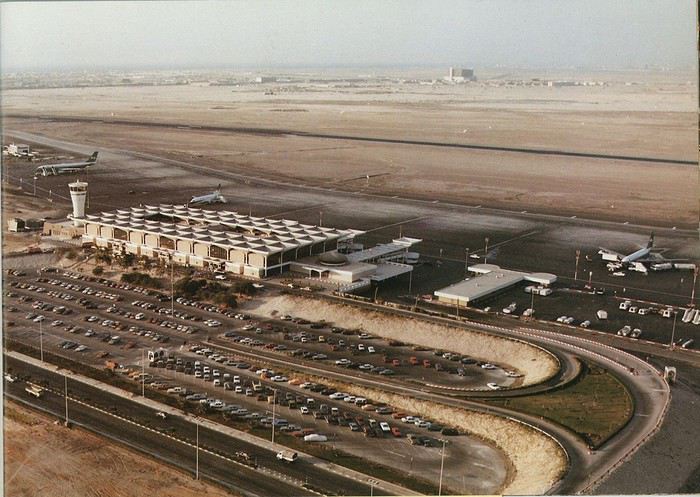
Next stop: New Delhi to drop off some Europeans and pick up a few Indians, and finally, the terminus: Manila. I don’t remember how long the trip took with its five stops—an unimaginable journey today. Despite all those stops to fill the plane, there was still enough space to stretch out on the four center seats of the 747, something that never happens these days despite all the flights in every direction.
So here we are, finally at Manila Airport around midnight.
Episode 1: Manila and Baguio To start, a quick note on the political and economic situation in the Philippines in 1984, which had consequences for us as tourists, as we’d soon realize upon arrival.
After several centuries of Spanish colonization, the Philippines became American at the start of the 20th century, then independent. In 1966, Marcos took power, and little by little, his regime sank into corruption and mismanagement, becoming a dictatorship with martial law, all for the benefit of his family and friends, who enriched themselves endlessly. The peak was the assassination of opposition leader Benigno Aquino in August 1983, which triggered harshly repressed protests. So we arrived a few months later in a very poor country, with omnipresent corruption and an extremely tense political situation, as we’d soon see for ourselves. Major protests took place in the main cities during our trip—I’ll come back to that. Two years later, Marcos fled to Hawaii after being forced out of power following rigged elections. This historical context explains a lot of the situations we found ourselves in over the following weeks.
Arriving in the middle of the night isn’t very cheerful. Manila was already a huge city with many slums, where you could find a few business hotels like the Hilton or Intercontinental—way out of our budget—and plenty of run-down hotels. Luckily, two Indians we’d chatted with on the plane offered to take us to their usual hotel. They came to Manila twice a year for business. We accepted their offer, relieved not to have to look for a place to stay in the middle of the night, figuring the address must be good since they came back every time... we were wrong 🙁
We left the airport and immediately got a taste of the local vibe when we got into the taxi: the police asked for our passports. We thought: what’s more normal than police in a dictatorship?
But that wasn’t it at all. Our two Indian friends explained that the police were noting our names along with the taxi number and time. Crime in Manila was so bad that the taxi driver would be held responsible if anything happened to us... welcome to the Philippines 😎 😎
Historically, the Philippines was a very violent country, where everything was settled with guns or machetes. Previous governments had banned carrying weapons, but Marcos later allowed the free sale and carrying of guns, and disputes were settled with pistols again (or worse, as we’d discover later). Since he’d released most of the criminals from prison to form a paramilitary militia at his service (I’ll talk about our encounter with these “heroes” later), it was pretty dangerous to go into many parts of Manila, where these “tonton macoutes” ruled.
We arrived at our hotel without incident... and then things started badly. The room was infested with big cockroaches—exactly what I hate most in those kinds of countries. No way to find another hotel at that hour. After the long flight, the urge to take a shower was so strong that we squeezed into the bathroom as best we could. After that, I don’t remember—I guess we must’ve fallen asleep exhausted under the sheets in the heat... air conditioning wasn’t widespread yet.
The next day, we just wanted to leave that dump as soon as possible. So we decided to head north right away, stopping in Baguio, and we’d visit Manila a bit on the way back.
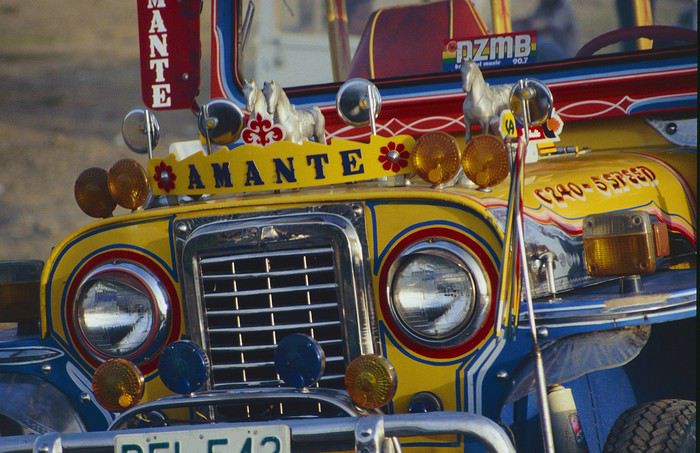
When we stepped outside, we discovered a pretty run-down neighborhood with potholed streets. But we also discovered the jeepneys. They were everywhere, flooding the streets.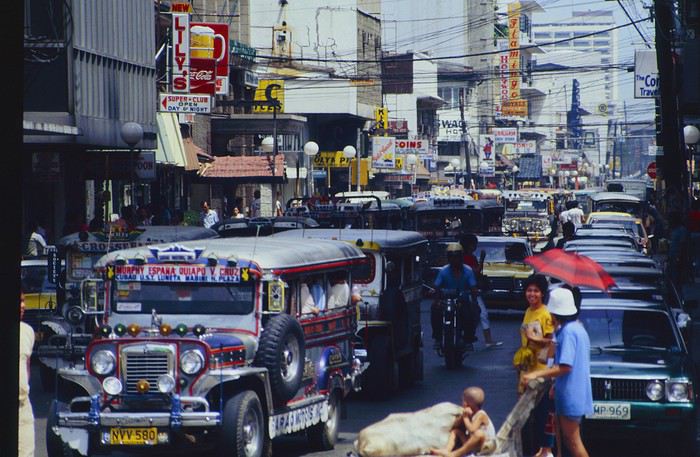
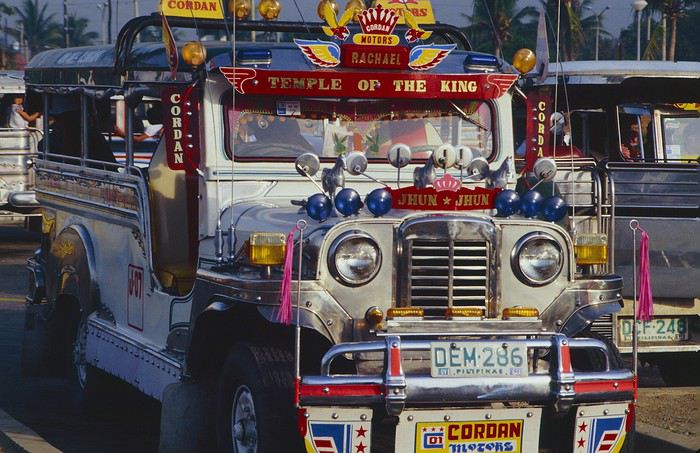
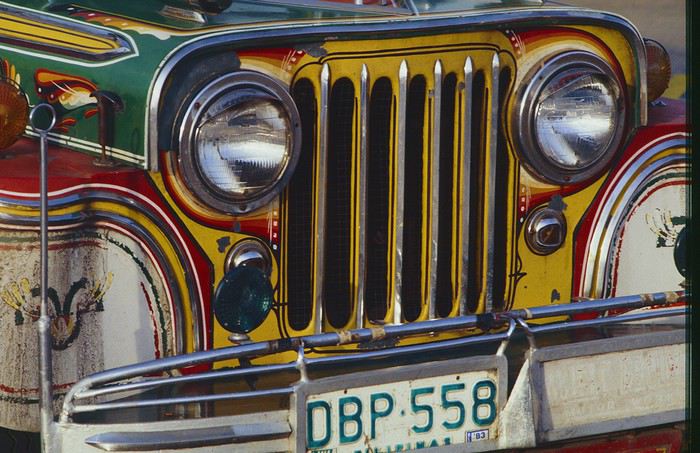
They had crazy sound systems, each one blasting louder than the last. The interiors were kitschy but fun. There weren’t many private cars—almost all transportation was by jeepney, with buses reserved for intercity trips.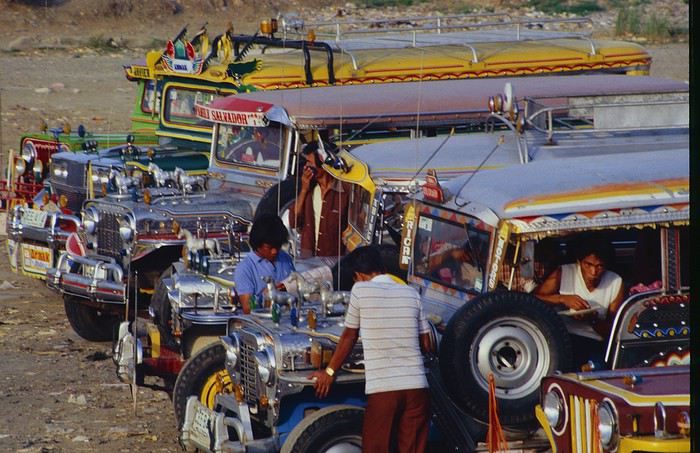
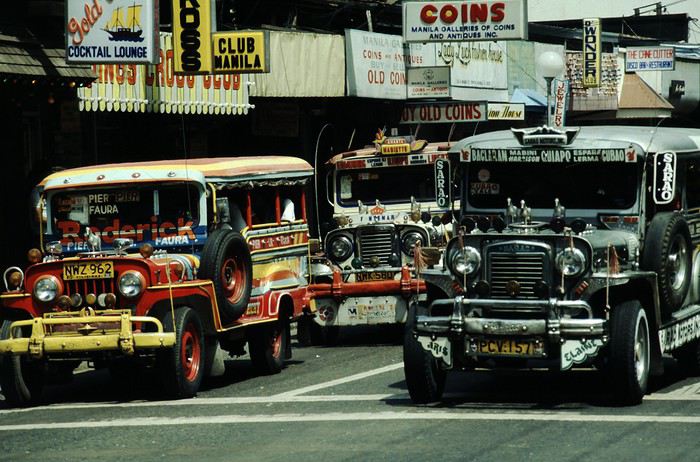
Before heading to the bus terminal for the north, somewhere on the outskirts of the city, we needed to exchange some money. I don’t remember how we ended up in a policeman’s jeep who offered his services: - Exchange money on the black market at a better rate than the banks. - Take us wherever we wanted, in this case, the bus terminal.
We accepted both offers (we’d still checked the official exchange rate from dollars to pesos). So we found ourselves in his jeep. After exchanging money, we left in his vehicle and stopped for gas. Without turning off the engine, he calmly smoked a cigarette while filling up. Since we were in a jeep with no doors or roof, we were ready to jump out if things went south, our travel bag in hand.
But we weren’t done with surprises yet. Once we left the small streets, we ended up in a neighborhood with wide avenues and not much traffic, which didn’t justify his incredible behavior. At every intersection, he made the sign of the cross, closed his eyes, and crossed without looking. I was more stunned than terrified! It wasn’t until we got out of the car later that I told Anne-Marie what had happened. I’d seen everything because the cop had put me in the front seat. Luckily, A-Marie hadn’t noticed anything from the back. Crossing Manila by trusting God rather than the rules of the road was ultimately effective. We were lucky—the trip was off to a good start. 🙂 🙂
We then passed through a neighborhood where slums stretched on for a while, and we left our policeman—friendly but a bit crazy—with relief.
A few hours by bus later, here we are in Baguio, cool in the mountains. My memories of Baguio are pretty fuzzy. I remember a small town. After some research while writing this journal, I found that the population was 120,000 in 1980. Given the population density in each home, that confirms my memory of a smallish town. Outside the “official” district with the president’s summer residence and government buildings, there were two or three paved streets with nice houses. The rest was very dirty and very poor, with lots of slums and dirt roads.
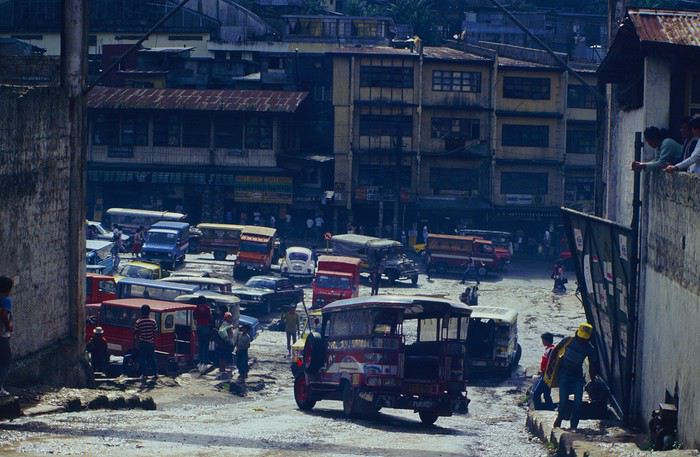
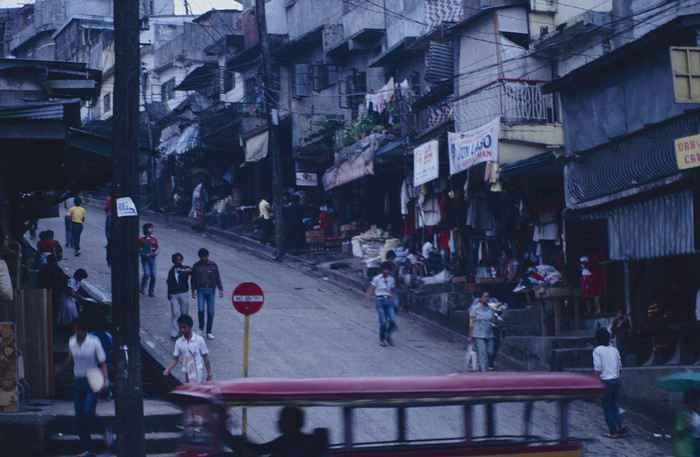
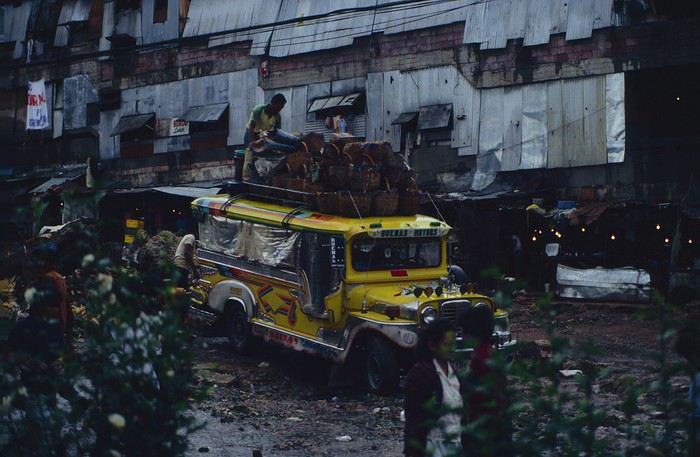
People we met on the street invited us to stay with them. These days, we wouldn’t just show up at strangers’ houses, which we should’ve done in Baguio—it would’ve saved us from an unimaginable and dangerous situation... which I won’t say anything about... !😊
The simple wooden house was on stilts at the edge of a hill with a view of the mountains. Since it was the start of the rainy season in a city that gets a lot of rain, we saw a lot of water. Our outings in town happened between downpours.
View from our lodging: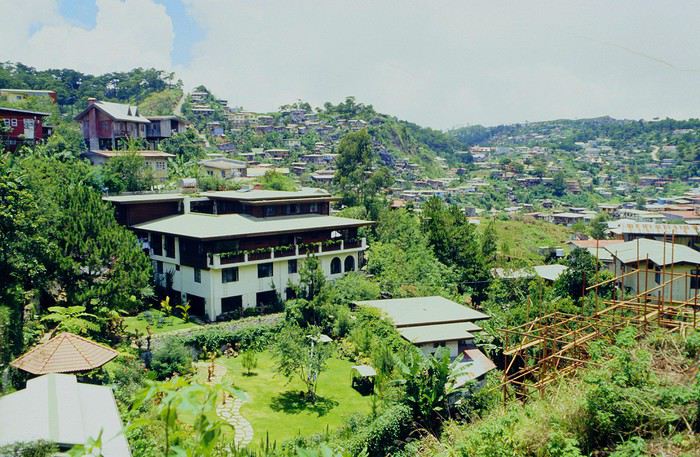
Episode 2: Baguio to Bontoc Aside from the situation briefly mentioned above, it was on the next leg to Bontoc that the adventure really began: an endless and dangerous road, a bus from another era, breathtaking landscapes, and surprising people.
We didn’t know the distance or how long it would take to get to Bontoc. When we arrived after about ten hours, we learned that Baguio to Bontoc was 140 km.
We got on a bus with wooden seats and settled in, two to a seat meant for two. As the bus filled up, passengers squeezed in three or four per seat, with chickens and baskets full of all sorts of things in the aisle. A little embarrassed, we didn’t know if we should squeeze in three on our seat. The seats were super tight (luckily, Filipinos are small), and I didn’t know where to put my legs given my height. I don’t remember if we stayed alone on our bench or if we ended up sharing with others.
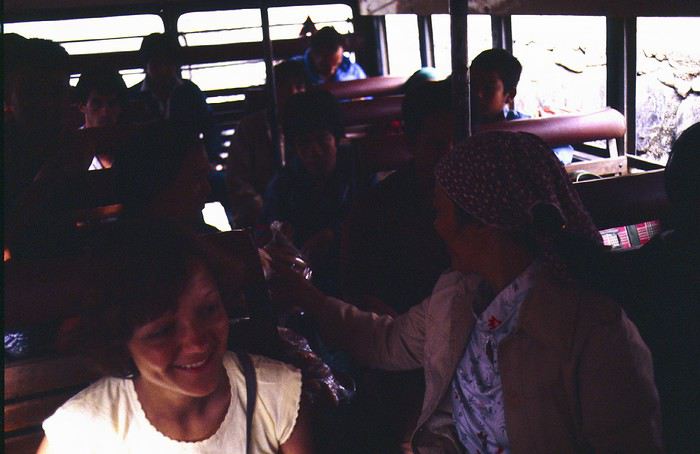
The “road” was a dirt track (or rather, a mud track) with endless turns. We held on as best we could to our slippery wooden seats—it was shaking in every direction. The woman behind us was carsick and throwing up... gross... but what were we doing there? Then we plunged into the Sierra Madre... just the name is dreamy!
Rice terraces started to appear: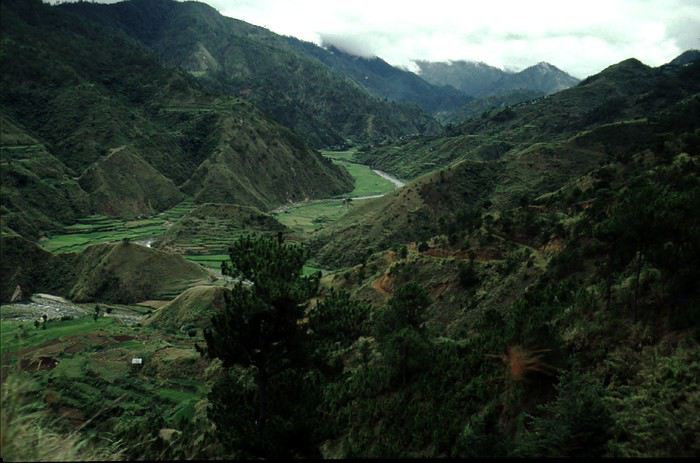
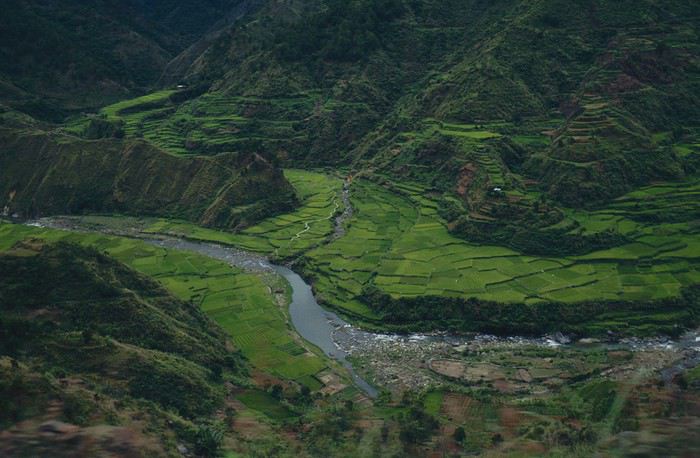
they took up more and more space along cliffs where we weren’t always reassured,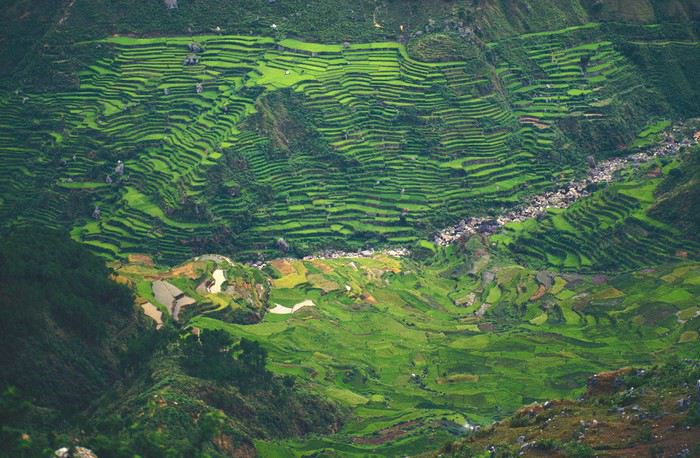
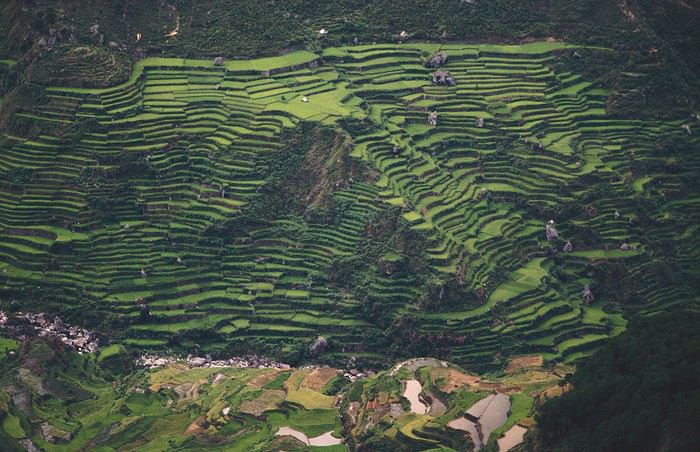
with lots of waterfalls (all that water had to go somewhere).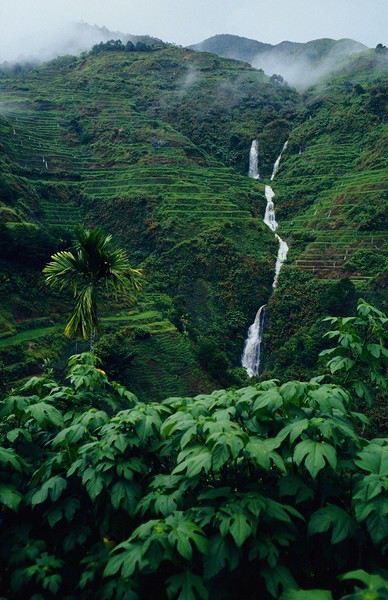
A few miserable villages stretched along the track, most often just a few houses balancing between the road and the drop. The bus stopped in every village—people got on or off and settled inside or on the roof. Street vendors offered their products to the bus passengers—a common sight in Asia, even today.
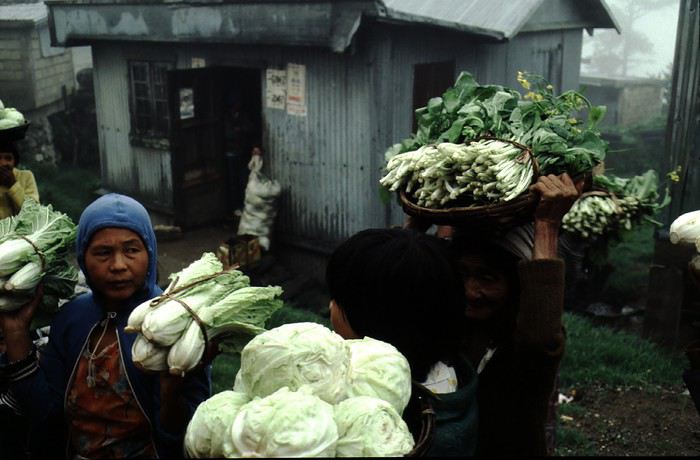
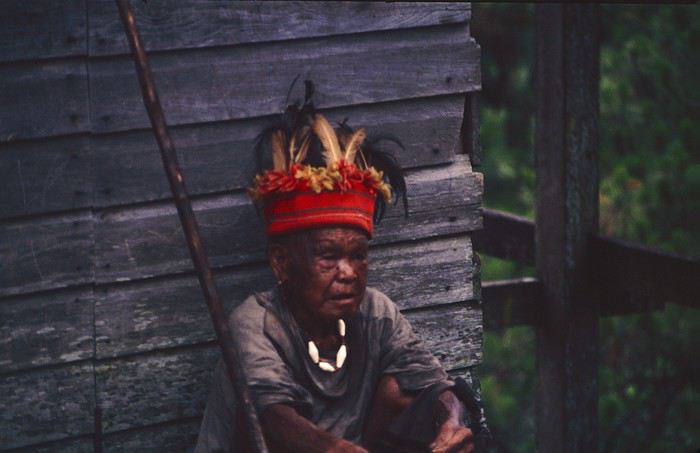
We were in another world—villagers were in loincloths, others had spears. The atmosphere was strange... but all good, we wanted exoticism, and we got it: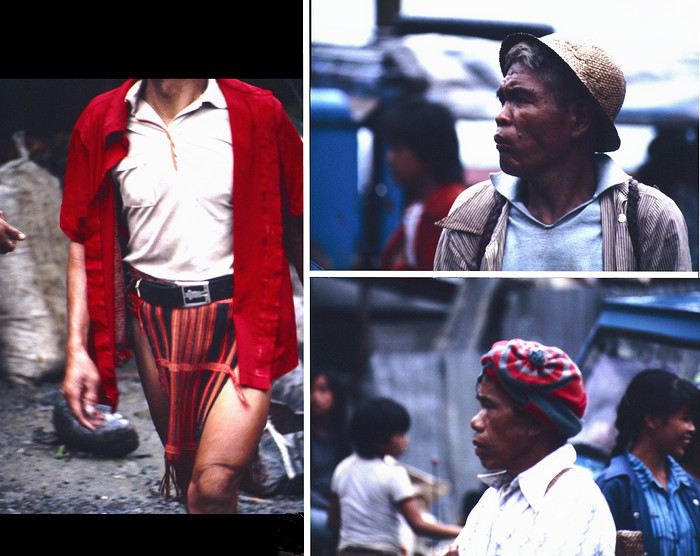
This so-called traditional outfit was everyday wear—it wasn’t for tourists since there weren’t any.
A curiosity because writing a travel journal about a trip 35 years later isn’t common, but also (mostly?) because exploring the Philippines at that time had little in common with traveling there today.
Obviously, I’ve forgotten a number of facts, most of the details, but with the help of a few notes from that time and a stack of slides (yes, there was life before digital 😊), many memories came back and added to the highlights I’d never forgotten. The scanned slides aren’t always great quality, but there are still quite a few to brighten up this chatter. Back then, we didn’t snap photos like we do now—film was too expensive—so I don’t have pictures of every place we visited... too bad, comparing some of those spots to how they look today would’ve been interesting.
Why "Adventures"? Why call it "Adventures" in the Philippines in 1984, a word so often used for a simple exotic trip? - Because the lack of information (no *Guide du Routard*, no *Lonely Planet*, no *Michelin Guide*, nothing, and obviously no internet) gave this trip what’s at the heart of adventure: the unknown. - Because the political situation made the stay sometimes dangerous. - Because transportation conditions were always epic, often perilous. - Because the question of where we’d spend the night came up almost every evening. - And for... quite a few other reasons.
That said, we weren’t exactly explorers!
Why the Philippines? First of all, why go to the Philippines in 1984—a country not exactly set up for tourism and about which we knew very little? How could we get an idea of the beauty of the Philippines and its points of interest when we had no guides or photos?
The idea came to us from Thailand a year earlier, during our first long-haul trip. After touring the north of the country, we met a Frenchman living in Phuket, where there were only a few tourists in Patong, with just a few small hotels and guesthouses. Kata and Karon had no buildings or roads, Rawai only had three palm-thatched bungalows, including ours, and the other islands were unknown to tourists. There was plenty to discover, and we wanted to return to this beautiful country... but the Frenchman made us dream about the Philippines—a country to explore, with wild landscapes.
Long evenings of discussion over multiple Sprite-Mekong cocktails (what memories of those headaches!) finally convinced us we had to go to the Philippines.
Episode 0: Before Departure The decision was made: we’d go to the Philippines in May 1984. Our friends and family were surprised when we announced we were going on vacation to the Philippines (a bit like saying today we were going paddleboarding in the Kerguelen Islands 🤪).
These days, preparing for each of our trips takes long evenings of research, planning, and noting down good addresses... etc. But for the Philippines in 1984, preparation was quick: we had very little information about the country, we were leaving almost at random, and the discovery would only be more exciting.
We still had a few bits of info gathered here and there: the rice terraces in northern Luzon, volcanoes, Negros where we were supposed to visit an acquaintance, Cebu and its marine life (we ended up going elsewhere), and absolutely avoid Mindanao, which was practically at war with the regime. That was about it, but it was already a great itinerary.
Nothing was organized in advance; we’d see day by day. We had no idea about travel times or even the existence of transportation options. The main (and sometimes only) way to connect two islands was by overloaded, rusty ferry. Only the big cities had airports.
Let’s Go: Episode 1: Paris to Manila My travel journals always start after arriving at the airport—the Europe-to-“Other Continent” trip isn’t interesting—but the flight to the Philippines was already an adventure, so I’ll make an exception.
This was the era when only a few Asian airlines were on par with Western ones: Thai, Singapore Airlines, and Philippine Airlines. They had beautiful, brand-new planes, and to attract customers (almost exclusively “businessmen”) from the usual airlines (Air France, Lufthansa, British Airways), there was opulence on board: unlimited champagne, all sorts of cocktails... Compared to today’s long-haul flights, there was still one small difference: no personal screens, just one screen at the front of the cabin with one mandatory movie. And I don’t know why, but we only got James Bond films, both ways... that must’ve been the trend at the time.
The tourism boom to Southeast Asia hadn’t started yet, and the “Asian Tigers” weren’t a thing, so there weren’t many business trips. That meant long-haul flights made stops everywhere to fill the planes. Our Philippine Airlines Boeing 747 left London, picked us up in Paris, then stopped in Frankfurt to take on a few Germans. I don’t know why we then made a stop in Dubai—a totally exotic place at the time. There was nothing to do there... things have changed a lot since. It was a small town lost in the desert. The airport was tiny, with just one or two buildings and a supermarket. During the stopover, everyone had to get off the plane and walk to the supermarket. Photo and electronic equipment were dirt cheap—I guess that was the only reason for the stop. Maybe it was their first commercial move. Emirates didn’t exist yet, as I checked online, but anyway, the idea that such a remote place could have its own airline was unthinkable.
Online, I found this photo of Dubai Airport in 1980. Anyone who’s transited through today’s massive airport with its rows of A380s will appreciate it:
Next stop: New Delhi to drop off some Europeans and pick up a few Indians, and finally, the terminus: Manila. I don’t remember how long the trip took with its five stops—an unimaginable journey today. Despite all those stops to fill the plane, there was still enough space to stretch out on the four center seats of the 747, something that never happens these days despite all the flights in every direction.
So here we are, finally at Manila Airport around midnight.
Episode 1: Manila and Baguio To start, a quick note on the political and economic situation in the Philippines in 1984, which had consequences for us as tourists, as we’d soon realize upon arrival.
After several centuries of Spanish colonization, the Philippines became American at the start of the 20th century, then independent. In 1966, Marcos took power, and little by little, his regime sank into corruption and mismanagement, becoming a dictatorship with martial law, all for the benefit of his family and friends, who enriched themselves endlessly. The peak was the assassination of opposition leader Benigno Aquino in August 1983, which triggered harshly repressed protests. So we arrived a few months later in a very poor country, with omnipresent corruption and an extremely tense political situation, as we’d soon see for ourselves. Major protests took place in the main cities during our trip—I’ll come back to that. Two years later, Marcos fled to Hawaii after being forced out of power following rigged elections. This historical context explains a lot of the situations we found ourselves in over the following weeks.
Arriving in the middle of the night isn’t very cheerful. Manila was already a huge city with many slums, where you could find a few business hotels like the Hilton or Intercontinental—way out of our budget—and plenty of run-down hotels. Luckily, two Indians we’d chatted with on the plane offered to take us to their usual hotel. They came to Manila twice a year for business. We accepted their offer, relieved not to have to look for a place to stay in the middle of the night, figuring the address must be good since they came back every time... we were wrong 🙁
We left the airport and immediately got a taste of the local vibe when we got into the taxi: the police asked for our passports. We thought: what’s more normal than police in a dictatorship?
But that wasn’t it at all. Our two Indian friends explained that the police were noting our names along with the taxi number and time. Crime in Manila was so bad that the taxi driver would be held responsible if anything happened to us... welcome to the Philippines 😎 😎
Historically, the Philippines was a very violent country, where everything was settled with guns or machetes. Previous governments had banned carrying weapons, but Marcos later allowed the free sale and carrying of guns, and disputes were settled with pistols again (or worse, as we’d discover later). Since he’d released most of the criminals from prison to form a paramilitary militia at his service (I’ll talk about our encounter with these “heroes” later), it was pretty dangerous to go into many parts of Manila, where these “tonton macoutes” ruled.
We arrived at our hotel without incident... and then things started badly. The room was infested with big cockroaches—exactly what I hate most in those kinds of countries. No way to find another hotel at that hour. After the long flight, the urge to take a shower was so strong that we squeezed into the bathroom as best we could. After that, I don’t remember—I guess we must’ve fallen asleep exhausted under the sheets in the heat... air conditioning wasn’t widespread yet.
The next day, we just wanted to leave that dump as soon as possible. So we decided to head north right away, stopping in Baguio, and we’d visit Manila a bit on the way back.
When we stepped outside, we discovered a pretty run-down neighborhood with potholed streets. But we also discovered the jeepneys. They were everywhere, flooding the streets.
They had crazy sound systems, each one blasting louder than the last. The interiors were kitschy but fun. There weren’t many private cars—almost all transportation was by jeepney, with buses reserved for intercity trips.
Before heading to the bus terminal for the north, somewhere on the outskirts of the city, we needed to exchange some money. I don’t remember how we ended up in a policeman’s jeep who offered his services: - Exchange money on the black market at a better rate than the banks. - Take us wherever we wanted, in this case, the bus terminal.
We accepted both offers (we’d still checked the official exchange rate from dollars to pesos). So we found ourselves in his jeep. After exchanging money, we left in his vehicle and stopped for gas. Without turning off the engine, he calmly smoked a cigarette while filling up. Since we were in a jeep with no doors or roof, we were ready to jump out if things went south, our travel bag in hand.
But we weren’t done with surprises yet. Once we left the small streets, we ended up in a neighborhood with wide avenues and not much traffic, which didn’t justify his incredible behavior. At every intersection, he made the sign of the cross, closed his eyes, and crossed without looking. I was more stunned than terrified! It wasn’t until we got out of the car later that I told Anne-Marie what had happened. I’d seen everything because the cop had put me in the front seat. Luckily, A-Marie hadn’t noticed anything from the back. Crossing Manila by trusting God rather than the rules of the road was ultimately effective. We were lucky—the trip was off to a good start. 🙂 🙂
We then passed through a neighborhood where slums stretched on for a while, and we left our policeman—friendly but a bit crazy—with relief.
A few hours by bus later, here we are in Baguio, cool in the mountains. My memories of Baguio are pretty fuzzy. I remember a small town. After some research while writing this journal, I found that the population was 120,000 in 1980. Given the population density in each home, that confirms my memory of a smallish town. Outside the “official” district with the president’s summer residence and government buildings, there were two or three paved streets with nice houses. The rest was very dirty and very poor, with lots of slums and dirt roads.
People we met on the street invited us to stay with them. These days, we wouldn’t just show up at strangers’ houses, which we should’ve done in Baguio—it would’ve saved us from an unimaginable and dangerous situation... which I won’t say anything about... !😊
The simple wooden house was on stilts at the edge of a hill with a view of the mountains. Since it was the start of the rainy season in a city that gets a lot of rain, we saw a lot of water. Our outings in town happened between downpours.
View from our lodging:
Episode 2: Baguio to Bontoc Aside from the situation briefly mentioned above, it was on the next leg to Bontoc that the adventure really began: an endless and dangerous road, a bus from another era, breathtaking landscapes, and surprising people.
We didn’t know the distance or how long it would take to get to Bontoc. When we arrived after about ten hours, we learned that Baguio to Bontoc was 140 km.
We got on a bus with wooden seats and settled in, two to a seat meant for two. As the bus filled up, passengers squeezed in three or four per seat, with chickens and baskets full of all sorts of things in the aisle. A little embarrassed, we didn’t know if we should squeeze in three on our seat. The seats were super tight (luckily, Filipinos are small), and I didn’t know where to put my legs given my height. I don’t remember if we stayed alone on our bench or if we ended up sharing with others.
The “road” was a dirt track (or rather, a mud track) with endless turns. We held on as best we could to our slippery wooden seats—it was shaking in every direction. The woman behind us was carsick and throwing up... gross... but what were we doing there? Then we plunged into the Sierra Madre... just the name is dreamy!
Rice terraces started to appear:
they took up more and more space along cliffs where we weren’t always reassured,
with lots of waterfalls (all that water had to go somewhere).
A few miserable villages stretched along the track, most often just a few houses balancing between the road and the drop. The bus stopped in every village—people got on or off and settled inside or on the roof. Street vendors offered their products to the bus passengers—a common sight in Asia, even today.
We were in another world—villagers were in loincloths, others had spears. The atmosphere was strange... but all good, we wanted exoticism, and we got it:
This so-called traditional outfit was everyday wear—it wasn’t for tourists since there weren’t any.
Carnet de voyage de 15 jours en Ouganda en février 2020
Bonsoir à tous,
Nous voilà de retour en France après 15 jours passés en Ouganda (février 2020), en selfdrive (sans chauffeur pour les non-bilingues 🤪), sans guide, et sans réservation. Je vous fais part de mon retour d’expérience, d’une forme de compte rendu de voyage, mais surtout d’information que j’aurais aimé trouver AVANT de partir, et que je trouve manquante sur les différents forums de discussion que j’ai arpentés durant mon départ.
Si ça peut aider certain, avec plaisir 🙂
Je vais donc commencer par aborder des aspects pratiques:
ARGENT: À l’aéroport, vous trouverez des bureaux de change (ouvert à 23h lors de notre arrivée, je pense que ça fonctionne h24). Ils prennent les euros ! J’avais changé des euros en dollars, pour les changer à nouveau en shilling ougandais, 2 conversions, 2 fois les frais… Attention: en Ouganda, on n’accepte pas les dollars américains « ancien », que les nouveaux. Ça c’est indiqué dans des guides, mais je me suis fait avoir.
Les cartes Mastercard fonctionnent aussi bien que Visa contrairement à ce que j’ai pu lire. Toutefois, en dehors des parcs nationaux, des villes de Fort Portal / Jinja / Kampala / Entebbe, et d’établissement hôtelier un peu huppé, ça va être difficile de s’en servir. Prévoyez du liquide, anticipez les étapes pour retirer de l’argent, augmentez votre cashflow bancaire avant de partir (montant maximum de retrait par semaine de votre CB).
Il est possible de payer en dollars l’hébergement, certains restaurants, le loueur de voitures. Mais il vaut mieux payer en shilling, ne serait-ce que les petits achats type souvenir ou fruit et légume en bord de route.
VOITURE: Il faut clairement dénoncer la compagnie Alpha Rent A Car. Ce sont les seuls populaires en France, en raison d’un encart publicitaire dans le Petit Futé il y a plusieurs années maintenant. Les témoignages de problème sont nombreux, et nous avons croisé des français sur place qui n’ont eu que des problèmes. Un pépin sur une voiture, ça peut arriver. Mais perdre une roue comme je l’ai lu sur ce forum, ou avoir un véhicule avec le volant à gauche (au lieu d’à droite en Ouganda) comme je l’ai vu sur place, c’est inacceptable.
De plus, il y a beaucoup d’autres compagnies de location de voiture. Je les ai toutes contactées: aucune ne demande des frais de réservation. Seul Alpha Rent en exige (et encore, pas tout le temps, allez comprendre). En vrac, vous trouverez: Rent a Car Uganda Auto Rental Uganda Holiday Car Rentals Selfdrive In Uganda Rent Cars Uganda Your Drive Uganda 4x4 car rentals road trips in east africa Uganda Car Rental Alpha Rent a Car Car Rental Uganda Uganda Self Drive Roadtrip Africa Pour un Landcruiser avec tente sur le toit, les prix varient entre 68$/jours et 140$/jours. Nous avons fait le choix de la compagnie Uganda Car Rental à 90$/jours.
Attention: les loueurs de voitures s’échangent les véhicules entre eux (notre voiture était logotée d’une autre compagnie), et le personnel change souvent. Échangez avec eux, mettez-les à l’épreuve de leur réactivité, soyez exigeant et précis sur vos attentes, faites vous confirmer plusieurs fois les choses.
Attention n°2: alors que nous n’avions rien demandé d’autre que la tente sur le toit et chaise et table de camping, nous avons eu plein d’options en plus (frigo, plein de matos pratique, mais demandé au départ). Bonne nouvelle ? Oui, car nous étions que 2. Mais pas de coffre par conséquent, nos bagages sur les sièges arrière…. Faites attention si vous êtes plus de 2 dans la voiture, à bien le préciser. Histoire que vos enfants (ou amis) puissent avoir une petite place à l’arrière.
CONDUITE: Bien que de plus en plus de routes soient goudronnées, il reste encore beaucoup de routes de terre, qui se transforment en route de boue quand il pleut (et il pleut souvent, même si pas longtemps). Un 4x4 est indispensable. On peut toujours faire autrement (la preuve, les Ougandais ont des voitures classiques, surchargées, pneus lisses…), mais c’est une question de sécurité, et surtout de ne pas gérer des emmerdes en vacance.
Par expérience de conduite, j’ai exigé: un landrover, 2 roues de secours, des pneus 4x4 (et pas des pneus route comme ils font souvent), du matériel de traction (sangle minimum), un compresseur, câbles pour batterie, boite manuelle (pas indispensable), diesel (plus puissant), double réservoir (pas indispensable, mais pratique).
Attention: pour les novices, conduire un 4x4 ça s’apprend. Il faut savoir quand passer en 4 roues motrices (c’est déjà trop tard si vous êtes déjà enlisé), savoir utiliser les vitesses courtes, savoir quand utiliser le différentiel et son blocage… Rien de compliquer, mais un landcruiser en 2 roues motrices, c’est juste une grosse voiture surélevée qui peine à monter un trottoir. Renseignez-vous avant de partir, ça sera plus simple.
Les petites motos (bodas) ne sont pas vraiment un problème. Il ne faut pas trop se préoccuper d’eux, ils se glissent dans la circulation et gèrent très bien leur affaire. Le plus dangereux reste les autres voitures et camions, qui peuvent mordre votre côté de la route sous prétexte d’un dépassement ou d’un obstacle. Il faut gérer ça. La circulation peut être très dense en ville, mais rien d’alarmant non plus. Prendre son mal en patience, s’imposer et faire pareil que les autres, ça reste le meilleur conseil. Une habitude de conduite en heure de pointe dans à Marseille est suffisante pour survivre au chaos ougandais 😆.
NAVIGATION ET TEMPS DE TRAJET: Il n’y a AUCUN panneau de signalisation en Ouganda. Aucune ville indiquée, aucun lodge ou camping fléché. Un vague panneau une fois sur place si vous avez de la chance. Oubliez les cartes papier, aucune n’est à jour (ou en tout cas je n’en ai pas trouvé). Oubliez les maps.me, les cartes ne sont pas assez récentes non plus, on s’est retrouvé en rade entre Entebbe et Kampala dès le premier jour. Oubliez Garmin, la voiture était proposée avec un GPS Garmin, la carte n’était pas à jour (peut-être que la version était ancienne, je ne sais pas).
La très bonne nouvelle, c’est que Google Maps fonctionne très bien. On peut télécharger la carte pour une navigation hors ligne (il faut le faire un plusieurs fois sur iPhone, on ne peut pas télécharger la carte en entier d’un seul coup). Les temps de trajet sont fiables (hors circulation dans Kampala), avec une bonne prise en considération du terrain. Une bonne surprise.
Les temps de trajet sont longs. Très long. Rien d’insurmontable, mais il faut aimer se faire secouer durant des heures. Moi j’adore cette conduite, mais ça peut gâcher les vacances si ce n’est pas votre cas. Quelques exemples de temps de trajet:
Entebbe => Mburo Lake: 5h00, 224km Mburo => Bunyonyi Lake: 5h30, 272km
Encore une fois, Google Maps est assez précis, vous pouvez vous fier aux estimations en rajoutant un peu de marge (météo, pause déjeuner, etc…)
=> CONCLUSION CONDUITE: Pas besoin d’être un pilote du Paris - Dakar pour s’en sortir en Ouganda. Mais il faut aimer la conduite sur piste, et le prendre comme une aventure avec son lot d’imprévu. Nous avons eu un incident sur une route boueuse après une grosse pluie entre Bwindi NP et Queen Elisabeth NP, avec 3 poids lourds enlisés et des voitures tentant leur chance au milieu. Nous sommes restés coincés 1h30. Pour moi c’était une super anecdote, j’ai pu faire de super photo, parler avec des personnes… Pour d’autres, ça peut être vécu comme un enfer, une galère qui gâche les vacances, une angoisse… prenez un chauffeur 😉
CORRUPTION: Les barrages de police sont nombreux, mais globalement ils n’arrêtent pas les touristes. 50km/h en ville, 80km/h sur les routes. Les occasions de faire un excès de vitesse sont rares, donc pas de problème de ce côté-là. Attention, tous les villages ne sont pas clairement délimités à 50km/h, avec un policier qui contrôle pourtant… c’est le seul cas d’excès de vitesse délicat.
Il y a un barrage de police toujours au même endroit, où il y a de la corruption. Voici les données GPS: https://goo.gl/maps/hiENjY9UfC86EZLA6 Ce barrage est indiqué sur différentes applications communautaires, et nous ne sommes pas passés au travers.
Connaissant le barrage, j’ai particulièrement fait attention à ma vitesse. Le policier m’arrête, prétend à un excès de vitesse à 62km/h au lieu de 50km/h. La démarche officiel est de suivre le policier jusqu’à une banque, et de payer devant lui une contravention officielle. Il propose tout de suite si on pense à une autre solution… je vous laisse deviner pourquoi.
Nous avons négocié l’amende de 200 000 shilling (50 euros) à 100 000 (25 euros). À ce prix-là, je n’ai pas cherché plus loin. Nous avons croisé des Belges qui ont négocié à 50 000 shilling 2 jours plus tôt. Une technique qui semble bien fonctionner est de faire semblant de ne pas parler anglais. Le policier s’agace, ne pouvant pas proposer sa transaction corrompue, et vous laisse partir. Bref, à chacun sa technique, au pire ça ne vous coutera pas bien cher, et ça n’est arrivé qu’une seule fois.
SÉCURITÉ: Si on parle de la population, il n’y a rien à craindre en Ouganda. Les gens sont peaceful comme ils le disent eux-mêmes. On vous regarde un peu de travers quand vous arrivez dans un village, mais parce que vous êtes la curiosité de la journée (ou de la semaine). On viendra souvent vous parler, juste pour savoir qui vous êtes, ce que vous faites, d’où vous venez, et puis c’est tout. Les rares fois où nous avons entendu « give me money », un simple « non » a suffi à terminer la discussion. Même dans les villages les plus isolé, on ne vous pousse pas à la consommation, on ne vient pas vous embêter, c’est très agréable. Libre à vous d’en profiter pour échanger ou non avec des locaux. C’était un objectif de voyage pour nous, chacun ses priorités. Nous n’avons jamais assisté à une dispute, à un mouvement de foule, à une bagarre (ça doit bien sûr arriver, je ne dis pas non plus le contraire).
Nous n’avons pas fait le Nord Est du pays, où il semblerait que la population à la frontière du Kenya ait une culture proche des Mazaïs. Ils ont la réputation d’être plus hostiles, d’être armés (mais les Américains aussi, ça n’empêche pas le tourisme), mais nous avons eu des discours contradictoires. À découvrir lors d’un prochain voyage.
10 000 shillings ougandais représentent à peu près 2,50 euros. Les billets les plus courants sont de 10 000, 20 000 et 50 000. Autant vous dire que pour payer un plein d’essence, vous allez sortir de grosse liasse de billets. Là aussi, aucun problème de sécurité. Je me balade toujours avec caméra et appareil photo autour du coup, plus téléphone. Je n’ai jamais eu de problème non plus.
Si on parle d’animaux, il y a une volonté de tout sécuriser dans les parcs… enfin, de mettre des personnes armées pour vous protéger. Les dangers existent (les hippos font des morts, c’est connu), mais ce qui est en réalité une prestation de service pour que le touriste se sente en sécurité peut tourner en paranoïa chez ce même touriste. Si vous dormez avec une tente sur le toit, il n’y a rien à craindre. Et même au sol dans un camping, il n’y a pas grand-chose à craindre. Les singes sont des pics assiettes, donc on ne laisse pas sa voiture ouverte, pas de nourriture dehors, etc…
MALADIES: Je ne suis pas médecin, je vais juste livrer mon expérience. En annonçant notre souhait de voyage en Ouganda, les craintes de notre entourage étaient nombreuses. Je suppose que nous ne sommes pas les seuls.
PALUDISME (malaria): très peu de moustiques à cette période de l’année, le pays est en altitude. Aucune piqûre à déplorer en 15 jours, ni pour ma femme ni pour moi. Les 2 seules zones à moustiques sont à Queen Elisabeth et aux Murchison Falls, au bord de l’eau. Mais on est très loin de la Camargue, on a vu 2 ou 3 moustiques nous tourner autour durant le diner. Les moustiques vecteurs du paludisme piquent que la nuit. Donc au coucher du soleil, on met de la crème, on met des vêtements préalablement imbibés de produit, on dort sous une moustiquaire. Pour ce qui est de la malarone, je vous laisse voir. Moi je ne l’ai pas toléré et ai stoppé au bout de 5 jours (Pr Raoult, si tu nous lis…). Sur une quinzaine de touristes interrogés (touriste européen ou américain, mais pas français), mon expérience me montre que très peu de gens prennent la malarone qui est décrit comme un poison. Je vous laisse voir.
EBOLA: il y a une crise en RDC, à 10km à vol d’oiseau des zones touristiques de l’Est ougandais. Beaucoup d’inquiétude là dessus, mais rien à signaler une fois sur place. Précision de l’OMS: Ebola est contagieux au contact de sécession humaine (vomis, selles, urine, salive, sperme, sang…), uniquement quand la maladie est déclarée (donc quand le patient à 40 de fièvre ne tient plus debout, et est en train de se vider…). Ebola n’est pas contagieux durant la période d’incubation. Bref, je ne minimise pas la dangerosité de cette maladie dramatique, mais sauf voyage humanitaire, la probabilité est plus que faible dans un trip touristique classique.
RAGE: valable dans tous les pays du monde, si vous ne voulez pas de problème, ne touchez pas les animaux. Même le joli petit chat du camping, ou l’adorable chien de l’hôtel. À vous de mesurer derrière votre inquiétude sur le sujet.
BILHARZIOSE: parasite qu’on attrape en se baignant en eau douce. Aucun problème pour l’océan ou les piscines (si correctement entretenu, mais en général ça se voit). Si vous ne voulez pas prendre de risque, ne vous baignez pas dans les lacs et rivières. A priori, le lac Bunyonyi est une curiosité scientifique non expliquée, car absence de bilharziose. Nous n’avons pas eu envie de nous baigner, et je ne sais pas si j’aurais pris le risque dans le cas contraire. À vous de voir.
INTOXICATION: comme dans tous les pays de ce type, ne buvez pas l’eau du robinet. Après, à chacun son inquiétude par rapport à une bonne diarrhée. Nous nous sommes lavé les dents à l’eau du robinet, nous avons mangé local en achetant dans les petits villages, et tout s’est très bien passé. Si vous êtes inquiet, il y a des soupes lyophilisées dans les supermarchés d’Entebbe et Kampala, mais c’est dommage 😄.
NOURITURE: Enfin un pays d’Afrique où l’on trouve à manger partout (le voyage précédent était la Namibie, c’était plus compliqué). Avocat, choux, tomate, courgette, concombre, courge, manioc, banane, mangue, ananas, papaye, jack fruit…. sont en abondance en bord de route. Ainsi que les chapatis (sorte de galette de pain, comme en Inde). Les prix sont dérisoires (en centimes d’euros). Pour nous, cela suffisait pour petit déjeuner et déjeuner. Pour le diner, les restaurants des lodges et campings proposent entré / plat / dessert pour 10$ par personne. C’était dans notre budget et une solution de confort.
Attention: on ne trouve plus rien à acheter autour du parc de Murchison Falls. Il faut impérativement faire le plein avant.
Pour l’eau, il est difficile de trouver de grosses bouteilles de 5 litres en dehors de Entebbe, Kampala et Fort Portal. Mais pas de problème pour trouver des bouteilles de 1 ou 2 litres. Anticipez également, sinon vous n’allez boire que du Coca ou du Pepsi.
STATION-SERVICE: Ce n’est pas un problème, on en trouve globalement partout, diesel ou essence. Le prix pour le Diesel est à moins d’1 euro le litre… ça va vite quand même, notre voiture fait du 15l au 100km avec un double réservoir de 150 litres… N’attendez pas la réserve, mais pas de problème particulier.
PARCS NATIONAUX: Comme souvent en Afrique, les parcs sont chers, les tarifs calqués sur le Kenya voisin, alors que les prestations ne sont pas comparables (pas du tout même). C’est le jeu, mais il devient frustrant de payer pour tout assez rapidement. Comptez 90$ pour 2 personnes + voitures à Queen Elisabeth et Murchison Falls (40$ par personne plus environ 10$ la voiture). Les gorilles sont très chers, et ça va encore augmenter (dixit un guide croisé sur place). À Bwindi, la simple randonnée de 10km aller / retour pour aller voir une cascade coute 70$ par personne pour une durée entre 1 et 3 heures de marche selon niveau.
HERBERGEMENT: On va parler de ce qu’on connait uniquement. Il est possible, avec une tente sur le toit, de dormir dans les lodges qui accepteront facilement de vous laisser sur le parking, et de vous ouvrir les sanitaires et le restaurant. Environ 10$ par personne par nuit.
Les nuits sont bruyantes: entre les insectes, les oiseaux, la fête de vendredi à dimanche dans les villages, les gardes pour votre sécurité qui déambulent, prévoyez les boules quies en fonction de la légèreté de votre sommeil.
Le camping sauvage n’est absolument pas interdit contrairement à ce que j’ai pu lire à de nombreuses reprisent. Il faut néanmoins prendre le temps de demander l’autorisation, ou prendre le risque de se faire déloger en pleine nuit. Et accepter le bruit de la population: les Ougandais se couchent tard et se lèvent tôt. Il est bien sûr déconseillé par les tours opérateurs qui préfèrent vous vendre un hébergement.
Les lodges peuvent être abordables ou assez cher, en ayant un confort sonore pas meilleur qu’une tente… quitte à ne pas bien dormir, autant que ça ne coute pas cher, c’est mon point de vue.
CLIMAT: La seule information que je possède est pour ma période de voyage. La saison des pluies commence en février, décembre janvier et février sont donc une période sèche. On aura toutefois eu des passages pluvieux 5 jours sur 12 sur place. Nous avons eu chaud, parfois même une chaleur humide (à Bwindi et Murchison Falls), qui ne redescend pas la nuit. Bonnet et veste sont restés dans les valises, pantalons et t-shirts manche longue supportable certains soirs.
Ne vous fatiguez pas à demander la météo sur place, nous n’avons jamais eu une autre réponse que: weather is unpredictable.
NOTRE PARCOURS: Maintenant que j’ai fait un préambule très long, je vous parle un peu du voyage !
Arrivée à Entebbe un samedi soir, 22h30 heure local. Nous avons adopté une stratégie de prendre un hôtel confortable à Entebbe, avec une personne venu nous chercher. Le chauffeur est à l’heure, on attend 40 minutes un autre couple de touriste, l’occasion de laisser nos bagages à ce dernier et d’aller acheter à manger juste à côté, de changer de l’argent dans l’aeroport, et d’acheter une carte SIM pour téléphone et data internet, sécurité supplémentaire.
Je précise à ce stade qu’en dehors de cet hôtel du premier soir et de la location de voiture, les 2 sans aucune confirmation par paiement, nous n’avons rien réservé. Un vague trajet idéal, mais rien de définitif, aucune réservation. C’est notre façon de voyager. Nous n’avons jamais été confronté à des établissements complets. Et nous avions fait la même chose sans problème au mois d’août en Namibie, là où beaucoup prétendent que c’est impossible (également pour Etosha).
Dimanche matin, j’avais donné RDV au loueur de voitures à l’hôtel en début de matinée. De quoi faire le check-in au calme, de charger les bagages, de prendre nos marques. Je n’avais pas exclu d’être déçu par le véhicule et de le refuser. Encore une fois, les agences de locations sont nombreuses, je ne connais pas l’étendue du parc automobile ougandais, mais je refuse de me mettre en danger pour un véhicule vétuste et mal entretenu. Fin de matinée, on quitte l’hôtel avec la voiture qui se révèle parfaite, on fait le point, un stop dans un Mall pour faire acheter de l’eau, et d’autres choses qui ne se révèleront pas très utiles (des pattes et du riz, quelques fruits plus cher et moins bon que sur la route, des bières alors que tous les campings en proposent à bon prix, du produit vaisselle et une éponge - qu’il y avait dans la voiture, mais que nous n’avions pas vu). On prend la route pour le lac Mburo. Nous arrivons suffisamment tôt pour ne pas entrer dans le parc (camping en dehors), mais profiter des environs, faire quelques photos, nous installer confortablement.
Mieux que des mots, des images. Je ne fais pas la promotion de ma vidéo de souvenir de voyage familial, je partage une expérience, point (j’anticipe certaines mauvaises langues sur ce forum comme partout). Si ça vous intéresse, faites-vous plaisir.
Le parcours a donc été Mburo, Bunyonyi, Bundi, Queen Elizabeth, Fort Portal, Murchison Falls, Jinja, Kamapala. Rien de prévu, aucune réservation, on restait plus longtemps si c’était bien, moins longtemps si ça ne nous plaisait pas.
FIN DE SÉJOUR: Héritage familial, je suis stressé de louper un avion. Surtout au retour, il faut rendre la voiture, faire le check out, repackager les valises, arriver en avance, passer les diverses sécurités, et surtout se rendre à l’aéroport…
Bref, on s’est offert un autre luxe: départ vendredi soir 22h00, on a rendu la voiture à Kamapala la veille au soir. 1 journée de moins de location qui paye sans problème la nuit d’hôtel à la capital. Pas grand-chose à visiter à Kampala de mon point de vue, tout en reconnaissant qu’il pleuvait ce vendredi-là et que nous avons profiter de la piscine de l’hôtel toute la journée avant de rentrer et reprendre le travail…
Du coup le transfère vers l’aéroport est géré par l’hôtel qui a l’habitude des horaires et des temps de trajet. Un vendredi soir, il prévoyait 3h au lieu d’1h… Finalement nous aurons mis 1h45. Nous ne regrettons pas cette option, même si j’aurais aimé me promener un peu dans Kampala avec un Boda.
CONCLUSION: La conclusion sera subjective, et n'a donc pas vocation à mettre en garde ou à encourager. Nous avons ADORE l'Ouganda. Parce que nous avions déjà fait des pays plus facile et propice pour voir des animaux (Afrique du Sud, Namibie...) Parce que j'adore conduire, et que me mettre dans une situation délicate n'est pas un problème (sans aller chercher l'extrême non plus) Parce que l'Ouganda est encore un pays mal organisé pour le tourisme, avec ses incohérences et parfois ses excès. Parce qu'on peut y voyager sans avoir tout planifié, et qu'il y a toujours un bout de terrain sur lequel on peut dormir. Parce que rencontrer des gens et comprendre un peu leur culture est un sujet qui nous intéresse.
Je ne conseillerai pas forcément l'Ouganda comme première destination africaine. Ni comme première destination en selfdrive. Il y a plus facile, plus "efficace", plus varié (mais du coup plus grand), plus carrossable... mais de fait, moins authentique.
Nous voilà de retour en France après 15 jours passés en Ouganda (février 2020), en selfdrive (sans chauffeur pour les non-bilingues 🤪), sans guide, et sans réservation. Je vous fais part de mon retour d’expérience, d’une forme de compte rendu de voyage, mais surtout d’information que j’aurais aimé trouver AVANT de partir, et que je trouve manquante sur les différents forums de discussion que j’ai arpentés durant mon départ.
Si ça peut aider certain, avec plaisir 🙂
Je vais donc commencer par aborder des aspects pratiques:
ARGENT: À l’aéroport, vous trouverez des bureaux de change (ouvert à 23h lors de notre arrivée, je pense que ça fonctionne h24). Ils prennent les euros ! J’avais changé des euros en dollars, pour les changer à nouveau en shilling ougandais, 2 conversions, 2 fois les frais… Attention: en Ouganda, on n’accepte pas les dollars américains « ancien », que les nouveaux. Ça c’est indiqué dans des guides, mais je me suis fait avoir.
Les cartes Mastercard fonctionnent aussi bien que Visa contrairement à ce que j’ai pu lire. Toutefois, en dehors des parcs nationaux, des villes de Fort Portal / Jinja / Kampala / Entebbe, et d’établissement hôtelier un peu huppé, ça va être difficile de s’en servir. Prévoyez du liquide, anticipez les étapes pour retirer de l’argent, augmentez votre cashflow bancaire avant de partir (montant maximum de retrait par semaine de votre CB).
Il est possible de payer en dollars l’hébergement, certains restaurants, le loueur de voitures. Mais il vaut mieux payer en shilling, ne serait-ce que les petits achats type souvenir ou fruit et légume en bord de route.
VOITURE: Il faut clairement dénoncer la compagnie Alpha Rent A Car. Ce sont les seuls populaires en France, en raison d’un encart publicitaire dans le Petit Futé il y a plusieurs années maintenant. Les témoignages de problème sont nombreux, et nous avons croisé des français sur place qui n’ont eu que des problèmes. Un pépin sur une voiture, ça peut arriver. Mais perdre une roue comme je l’ai lu sur ce forum, ou avoir un véhicule avec le volant à gauche (au lieu d’à droite en Ouganda) comme je l’ai vu sur place, c’est inacceptable.
De plus, il y a beaucoup d’autres compagnies de location de voiture. Je les ai toutes contactées: aucune ne demande des frais de réservation. Seul Alpha Rent en exige (et encore, pas tout le temps, allez comprendre). En vrac, vous trouverez: Rent a Car Uganda Auto Rental Uganda Holiday Car Rentals Selfdrive In Uganda Rent Cars Uganda Your Drive Uganda 4x4 car rentals road trips in east africa Uganda Car Rental Alpha Rent a Car Car Rental Uganda Uganda Self Drive Roadtrip Africa Pour un Landcruiser avec tente sur le toit, les prix varient entre 68$/jours et 140$/jours. Nous avons fait le choix de la compagnie Uganda Car Rental à 90$/jours.
Attention: les loueurs de voitures s’échangent les véhicules entre eux (notre voiture était logotée d’une autre compagnie), et le personnel change souvent. Échangez avec eux, mettez-les à l’épreuve de leur réactivité, soyez exigeant et précis sur vos attentes, faites vous confirmer plusieurs fois les choses.
Attention n°2: alors que nous n’avions rien demandé d’autre que la tente sur le toit et chaise et table de camping, nous avons eu plein d’options en plus (frigo, plein de matos pratique, mais demandé au départ). Bonne nouvelle ? Oui, car nous étions que 2. Mais pas de coffre par conséquent, nos bagages sur les sièges arrière…. Faites attention si vous êtes plus de 2 dans la voiture, à bien le préciser. Histoire que vos enfants (ou amis) puissent avoir une petite place à l’arrière.
CONDUITE: Bien que de plus en plus de routes soient goudronnées, il reste encore beaucoup de routes de terre, qui se transforment en route de boue quand il pleut (et il pleut souvent, même si pas longtemps). Un 4x4 est indispensable. On peut toujours faire autrement (la preuve, les Ougandais ont des voitures classiques, surchargées, pneus lisses…), mais c’est une question de sécurité, et surtout de ne pas gérer des emmerdes en vacance.
Par expérience de conduite, j’ai exigé: un landrover, 2 roues de secours, des pneus 4x4 (et pas des pneus route comme ils font souvent), du matériel de traction (sangle minimum), un compresseur, câbles pour batterie, boite manuelle (pas indispensable), diesel (plus puissant), double réservoir (pas indispensable, mais pratique).
Attention: pour les novices, conduire un 4x4 ça s’apprend. Il faut savoir quand passer en 4 roues motrices (c’est déjà trop tard si vous êtes déjà enlisé), savoir utiliser les vitesses courtes, savoir quand utiliser le différentiel et son blocage… Rien de compliquer, mais un landcruiser en 2 roues motrices, c’est juste une grosse voiture surélevée qui peine à monter un trottoir. Renseignez-vous avant de partir, ça sera plus simple.
Les petites motos (bodas) ne sont pas vraiment un problème. Il ne faut pas trop se préoccuper d’eux, ils se glissent dans la circulation et gèrent très bien leur affaire. Le plus dangereux reste les autres voitures et camions, qui peuvent mordre votre côté de la route sous prétexte d’un dépassement ou d’un obstacle. Il faut gérer ça. La circulation peut être très dense en ville, mais rien d’alarmant non plus. Prendre son mal en patience, s’imposer et faire pareil que les autres, ça reste le meilleur conseil. Une habitude de conduite en heure de pointe dans à Marseille est suffisante pour survivre au chaos ougandais 😆.
NAVIGATION ET TEMPS DE TRAJET: Il n’y a AUCUN panneau de signalisation en Ouganda. Aucune ville indiquée, aucun lodge ou camping fléché. Un vague panneau une fois sur place si vous avez de la chance. Oubliez les cartes papier, aucune n’est à jour (ou en tout cas je n’en ai pas trouvé). Oubliez les maps.me, les cartes ne sont pas assez récentes non plus, on s’est retrouvé en rade entre Entebbe et Kampala dès le premier jour. Oubliez Garmin, la voiture était proposée avec un GPS Garmin, la carte n’était pas à jour (peut-être que la version était ancienne, je ne sais pas).
La très bonne nouvelle, c’est que Google Maps fonctionne très bien. On peut télécharger la carte pour une navigation hors ligne (il faut le faire un plusieurs fois sur iPhone, on ne peut pas télécharger la carte en entier d’un seul coup). Les temps de trajet sont fiables (hors circulation dans Kampala), avec une bonne prise en considération du terrain. Une bonne surprise.
Les temps de trajet sont longs. Très long. Rien d’insurmontable, mais il faut aimer se faire secouer durant des heures. Moi j’adore cette conduite, mais ça peut gâcher les vacances si ce n’est pas votre cas. Quelques exemples de temps de trajet:
Entebbe => Mburo Lake: 5h00, 224km Mburo => Bunyonyi Lake: 5h30, 272km
Encore une fois, Google Maps est assez précis, vous pouvez vous fier aux estimations en rajoutant un peu de marge (météo, pause déjeuner, etc…)
=> CONCLUSION CONDUITE: Pas besoin d’être un pilote du Paris - Dakar pour s’en sortir en Ouganda. Mais il faut aimer la conduite sur piste, et le prendre comme une aventure avec son lot d’imprévu. Nous avons eu un incident sur une route boueuse après une grosse pluie entre Bwindi NP et Queen Elisabeth NP, avec 3 poids lourds enlisés et des voitures tentant leur chance au milieu. Nous sommes restés coincés 1h30. Pour moi c’était une super anecdote, j’ai pu faire de super photo, parler avec des personnes… Pour d’autres, ça peut être vécu comme un enfer, une galère qui gâche les vacances, une angoisse… prenez un chauffeur 😉
CORRUPTION: Les barrages de police sont nombreux, mais globalement ils n’arrêtent pas les touristes. 50km/h en ville, 80km/h sur les routes. Les occasions de faire un excès de vitesse sont rares, donc pas de problème de ce côté-là. Attention, tous les villages ne sont pas clairement délimités à 50km/h, avec un policier qui contrôle pourtant… c’est le seul cas d’excès de vitesse délicat.
Il y a un barrage de police toujours au même endroit, où il y a de la corruption. Voici les données GPS: https://goo.gl/maps/hiENjY9UfC86EZLA6 Ce barrage est indiqué sur différentes applications communautaires, et nous ne sommes pas passés au travers.
Connaissant le barrage, j’ai particulièrement fait attention à ma vitesse. Le policier m’arrête, prétend à un excès de vitesse à 62km/h au lieu de 50km/h. La démarche officiel est de suivre le policier jusqu’à une banque, et de payer devant lui une contravention officielle. Il propose tout de suite si on pense à une autre solution… je vous laisse deviner pourquoi.
Nous avons négocié l’amende de 200 000 shilling (50 euros) à 100 000 (25 euros). À ce prix-là, je n’ai pas cherché plus loin. Nous avons croisé des Belges qui ont négocié à 50 000 shilling 2 jours plus tôt. Une technique qui semble bien fonctionner est de faire semblant de ne pas parler anglais. Le policier s’agace, ne pouvant pas proposer sa transaction corrompue, et vous laisse partir. Bref, à chacun sa technique, au pire ça ne vous coutera pas bien cher, et ça n’est arrivé qu’une seule fois.
SÉCURITÉ: Si on parle de la population, il n’y a rien à craindre en Ouganda. Les gens sont peaceful comme ils le disent eux-mêmes. On vous regarde un peu de travers quand vous arrivez dans un village, mais parce que vous êtes la curiosité de la journée (ou de la semaine). On viendra souvent vous parler, juste pour savoir qui vous êtes, ce que vous faites, d’où vous venez, et puis c’est tout. Les rares fois où nous avons entendu « give me money », un simple « non » a suffi à terminer la discussion. Même dans les villages les plus isolé, on ne vous pousse pas à la consommation, on ne vient pas vous embêter, c’est très agréable. Libre à vous d’en profiter pour échanger ou non avec des locaux. C’était un objectif de voyage pour nous, chacun ses priorités. Nous n’avons jamais assisté à une dispute, à un mouvement de foule, à une bagarre (ça doit bien sûr arriver, je ne dis pas non plus le contraire).
Nous n’avons pas fait le Nord Est du pays, où il semblerait que la population à la frontière du Kenya ait une culture proche des Mazaïs. Ils ont la réputation d’être plus hostiles, d’être armés (mais les Américains aussi, ça n’empêche pas le tourisme), mais nous avons eu des discours contradictoires. À découvrir lors d’un prochain voyage.
10 000 shillings ougandais représentent à peu près 2,50 euros. Les billets les plus courants sont de 10 000, 20 000 et 50 000. Autant vous dire que pour payer un plein d’essence, vous allez sortir de grosse liasse de billets. Là aussi, aucun problème de sécurité. Je me balade toujours avec caméra et appareil photo autour du coup, plus téléphone. Je n’ai jamais eu de problème non plus.
Si on parle d’animaux, il y a une volonté de tout sécuriser dans les parcs… enfin, de mettre des personnes armées pour vous protéger. Les dangers existent (les hippos font des morts, c’est connu), mais ce qui est en réalité une prestation de service pour que le touriste se sente en sécurité peut tourner en paranoïa chez ce même touriste. Si vous dormez avec une tente sur le toit, il n’y a rien à craindre. Et même au sol dans un camping, il n’y a pas grand-chose à craindre. Les singes sont des pics assiettes, donc on ne laisse pas sa voiture ouverte, pas de nourriture dehors, etc…
MALADIES: Je ne suis pas médecin, je vais juste livrer mon expérience. En annonçant notre souhait de voyage en Ouganda, les craintes de notre entourage étaient nombreuses. Je suppose que nous ne sommes pas les seuls.
PALUDISME (malaria): très peu de moustiques à cette période de l’année, le pays est en altitude. Aucune piqûre à déplorer en 15 jours, ni pour ma femme ni pour moi. Les 2 seules zones à moustiques sont à Queen Elisabeth et aux Murchison Falls, au bord de l’eau. Mais on est très loin de la Camargue, on a vu 2 ou 3 moustiques nous tourner autour durant le diner. Les moustiques vecteurs du paludisme piquent que la nuit. Donc au coucher du soleil, on met de la crème, on met des vêtements préalablement imbibés de produit, on dort sous une moustiquaire. Pour ce qui est de la malarone, je vous laisse voir. Moi je ne l’ai pas toléré et ai stoppé au bout de 5 jours (Pr Raoult, si tu nous lis…). Sur une quinzaine de touristes interrogés (touriste européen ou américain, mais pas français), mon expérience me montre que très peu de gens prennent la malarone qui est décrit comme un poison. Je vous laisse voir.
EBOLA: il y a une crise en RDC, à 10km à vol d’oiseau des zones touristiques de l’Est ougandais. Beaucoup d’inquiétude là dessus, mais rien à signaler une fois sur place. Précision de l’OMS: Ebola est contagieux au contact de sécession humaine (vomis, selles, urine, salive, sperme, sang…), uniquement quand la maladie est déclarée (donc quand le patient à 40 de fièvre ne tient plus debout, et est en train de se vider…). Ebola n’est pas contagieux durant la période d’incubation. Bref, je ne minimise pas la dangerosité de cette maladie dramatique, mais sauf voyage humanitaire, la probabilité est plus que faible dans un trip touristique classique.
RAGE: valable dans tous les pays du monde, si vous ne voulez pas de problème, ne touchez pas les animaux. Même le joli petit chat du camping, ou l’adorable chien de l’hôtel. À vous de mesurer derrière votre inquiétude sur le sujet.
BILHARZIOSE: parasite qu’on attrape en se baignant en eau douce. Aucun problème pour l’océan ou les piscines (si correctement entretenu, mais en général ça se voit). Si vous ne voulez pas prendre de risque, ne vous baignez pas dans les lacs et rivières. A priori, le lac Bunyonyi est une curiosité scientifique non expliquée, car absence de bilharziose. Nous n’avons pas eu envie de nous baigner, et je ne sais pas si j’aurais pris le risque dans le cas contraire. À vous de voir.
INTOXICATION: comme dans tous les pays de ce type, ne buvez pas l’eau du robinet. Après, à chacun son inquiétude par rapport à une bonne diarrhée. Nous nous sommes lavé les dents à l’eau du robinet, nous avons mangé local en achetant dans les petits villages, et tout s’est très bien passé. Si vous êtes inquiet, il y a des soupes lyophilisées dans les supermarchés d’Entebbe et Kampala, mais c’est dommage 😄.
NOURITURE: Enfin un pays d’Afrique où l’on trouve à manger partout (le voyage précédent était la Namibie, c’était plus compliqué). Avocat, choux, tomate, courgette, concombre, courge, manioc, banane, mangue, ananas, papaye, jack fruit…. sont en abondance en bord de route. Ainsi que les chapatis (sorte de galette de pain, comme en Inde). Les prix sont dérisoires (en centimes d’euros). Pour nous, cela suffisait pour petit déjeuner et déjeuner. Pour le diner, les restaurants des lodges et campings proposent entré / plat / dessert pour 10$ par personne. C’était dans notre budget et une solution de confort.
Attention: on ne trouve plus rien à acheter autour du parc de Murchison Falls. Il faut impérativement faire le plein avant.
Pour l’eau, il est difficile de trouver de grosses bouteilles de 5 litres en dehors de Entebbe, Kampala et Fort Portal. Mais pas de problème pour trouver des bouteilles de 1 ou 2 litres. Anticipez également, sinon vous n’allez boire que du Coca ou du Pepsi.
STATION-SERVICE: Ce n’est pas un problème, on en trouve globalement partout, diesel ou essence. Le prix pour le Diesel est à moins d’1 euro le litre… ça va vite quand même, notre voiture fait du 15l au 100km avec un double réservoir de 150 litres… N’attendez pas la réserve, mais pas de problème particulier.
PARCS NATIONAUX: Comme souvent en Afrique, les parcs sont chers, les tarifs calqués sur le Kenya voisin, alors que les prestations ne sont pas comparables (pas du tout même). C’est le jeu, mais il devient frustrant de payer pour tout assez rapidement. Comptez 90$ pour 2 personnes + voitures à Queen Elisabeth et Murchison Falls (40$ par personne plus environ 10$ la voiture). Les gorilles sont très chers, et ça va encore augmenter (dixit un guide croisé sur place). À Bwindi, la simple randonnée de 10km aller / retour pour aller voir une cascade coute 70$ par personne pour une durée entre 1 et 3 heures de marche selon niveau.
HERBERGEMENT: On va parler de ce qu’on connait uniquement. Il est possible, avec une tente sur le toit, de dormir dans les lodges qui accepteront facilement de vous laisser sur le parking, et de vous ouvrir les sanitaires et le restaurant. Environ 10$ par personne par nuit.
Les nuits sont bruyantes: entre les insectes, les oiseaux, la fête de vendredi à dimanche dans les villages, les gardes pour votre sécurité qui déambulent, prévoyez les boules quies en fonction de la légèreté de votre sommeil.
Le camping sauvage n’est absolument pas interdit contrairement à ce que j’ai pu lire à de nombreuses reprisent. Il faut néanmoins prendre le temps de demander l’autorisation, ou prendre le risque de se faire déloger en pleine nuit. Et accepter le bruit de la population: les Ougandais se couchent tard et se lèvent tôt. Il est bien sûr déconseillé par les tours opérateurs qui préfèrent vous vendre un hébergement.
Les lodges peuvent être abordables ou assez cher, en ayant un confort sonore pas meilleur qu’une tente… quitte à ne pas bien dormir, autant que ça ne coute pas cher, c’est mon point de vue.
CLIMAT: La seule information que je possède est pour ma période de voyage. La saison des pluies commence en février, décembre janvier et février sont donc une période sèche. On aura toutefois eu des passages pluvieux 5 jours sur 12 sur place. Nous avons eu chaud, parfois même une chaleur humide (à Bwindi et Murchison Falls), qui ne redescend pas la nuit. Bonnet et veste sont restés dans les valises, pantalons et t-shirts manche longue supportable certains soirs.
Ne vous fatiguez pas à demander la météo sur place, nous n’avons jamais eu une autre réponse que: weather is unpredictable.
NOTRE PARCOURS: Maintenant que j’ai fait un préambule très long, je vous parle un peu du voyage !
Arrivée à Entebbe un samedi soir, 22h30 heure local. Nous avons adopté une stratégie de prendre un hôtel confortable à Entebbe, avec une personne venu nous chercher. Le chauffeur est à l’heure, on attend 40 minutes un autre couple de touriste, l’occasion de laisser nos bagages à ce dernier et d’aller acheter à manger juste à côté, de changer de l’argent dans l’aeroport, et d’acheter une carte SIM pour téléphone et data internet, sécurité supplémentaire.
Je précise à ce stade qu’en dehors de cet hôtel du premier soir et de la location de voiture, les 2 sans aucune confirmation par paiement, nous n’avons rien réservé. Un vague trajet idéal, mais rien de définitif, aucune réservation. C’est notre façon de voyager. Nous n’avons jamais été confronté à des établissements complets. Et nous avions fait la même chose sans problème au mois d’août en Namibie, là où beaucoup prétendent que c’est impossible (également pour Etosha).
Dimanche matin, j’avais donné RDV au loueur de voitures à l’hôtel en début de matinée. De quoi faire le check-in au calme, de charger les bagages, de prendre nos marques. Je n’avais pas exclu d’être déçu par le véhicule et de le refuser. Encore une fois, les agences de locations sont nombreuses, je ne connais pas l’étendue du parc automobile ougandais, mais je refuse de me mettre en danger pour un véhicule vétuste et mal entretenu. Fin de matinée, on quitte l’hôtel avec la voiture qui se révèle parfaite, on fait le point, un stop dans un Mall pour faire acheter de l’eau, et d’autres choses qui ne se révèleront pas très utiles (des pattes et du riz, quelques fruits plus cher et moins bon que sur la route, des bières alors que tous les campings en proposent à bon prix, du produit vaisselle et une éponge - qu’il y avait dans la voiture, mais que nous n’avions pas vu). On prend la route pour le lac Mburo. Nous arrivons suffisamment tôt pour ne pas entrer dans le parc (camping en dehors), mais profiter des environs, faire quelques photos, nous installer confortablement.
Mieux que des mots, des images. Je ne fais pas la promotion de ma vidéo de souvenir de voyage familial, je partage une expérience, point (j’anticipe certaines mauvaises langues sur ce forum comme partout). Si ça vous intéresse, faites-vous plaisir.
Le parcours a donc été Mburo, Bunyonyi, Bundi, Queen Elizabeth, Fort Portal, Murchison Falls, Jinja, Kamapala. Rien de prévu, aucune réservation, on restait plus longtemps si c’était bien, moins longtemps si ça ne nous plaisait pas.
FIN DE SÉJOUR: Héritage familial, je suis stressé de louper un avion. Surtout au retour, il faut rendre la voiture, faire le check out, repackager les valises, arriver en avance, passer les diverses sécurités, et surtout se rendre à l’aéroport…
Bref, on s’est offert un autre luxe: départ vendredi soir 22h00, on a rendu la voiture à Kamapala la veille au soir. 1 journée de moins de location qui paye sans problème la nuit d’hôtel à la capital. Pas grand-chose à visiter à Kampala de mon point de vue, tout en reconnaissant qu’il pleuvait ce vendredi-là et que nous avons profiter de la piscine de l’hôtel toute la journée avant de rentrer et reprendre le travail…
Du coup le transfère vers l’aéroport est géré par l’hôtel qui a l’habitude des horaires et des temps de trajet. Un vendredi soir, il prévoyait 3h au lieu d’1h… Finalement nous aurons mis 1h45. Nous ne regrettons pas cette option, même si j’aurais aimé me promener un peu dans Kampala avec un Boda.
CONCLUSION: La conclusion sera subjective, et n'a donc pas vocation à mettre en garde ou à encourager. Nous avons ADORE l'Ouganda. Parce que nous avions déjà fait des pays plus facile et propice pour voir des animaux (Afrique du Sud, Namibie...) Parce que j'adore conduire, et que me mettre dans une situation délicate n'est pas un problème (sans aller chercher l'extrême non plus) Parce que l'Ouganda est encore un pays mal organisé pour le tourisme, avec ses incohérences et parfois ses excès. Parce qu'on peut y voyager sans avoir tout planifié, et qu'il y a toujours un bout de terrain sur lequel on peut dormir. Parce que rencontrer des gens et comprendre un peu leur culture est un sujet qui nous intéresse.
Je ne conseillerai pas forcément l'Ouganda comme première destination africaine. Ni comme première destination en selfdrive. Il y a plus facile, plus "efficace", plus varié (mais du coup plus grand), plus carrossable... mais de fait, moins authentique.
Mais où qu'il est ce truc là (4)
Happiness Settles in the Heart of the Maasai Mara
(October 2018).
This account of a short stay in Kenya was originally meant for our friends and family, but to pass the time—for both us and you—and to add some content to the increasingly quiet columns of Voyage Forum during these weeks of confinement, when travelers can only journey in their minds, we decided to share the 25 pages of my ramblings, illustrated with Yolande’s photos, from an extraordinary stay in the Maasai Mara National Reserve. We waited until the two previous discussions on this same topic, filled with stunning photos and started by Régis and then Claire—sometimes in agreement, sometimes differing but always full of insights—had quieted down a bit before jumping in. Well, we’ll give it a try.
Let’s clarify: one of us claims to be a beginner photographer, and the other is just an unrepentant dreamer and modest writer. We often pursued our passions separately—Yolande with her mentor and me with an incomparable tracker—so sometimes the photos don’t quite match the text, or vice versa.
We hope you enjoy reading this lengthy post, which is longer than usual in VF’s sections (except, of course, for Mr. Voyajou). A thousand apologies for straying off the beaten path.
Alright, here we go!
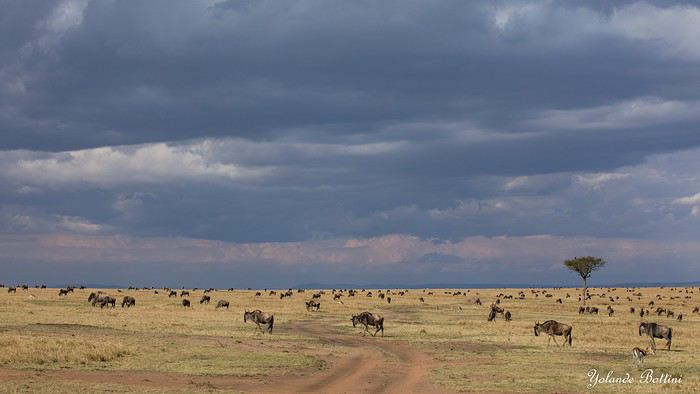
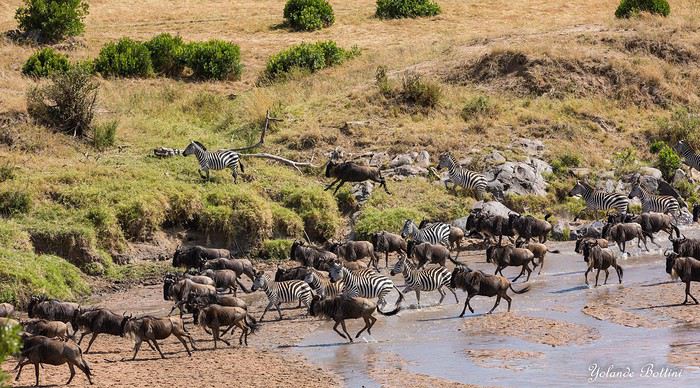
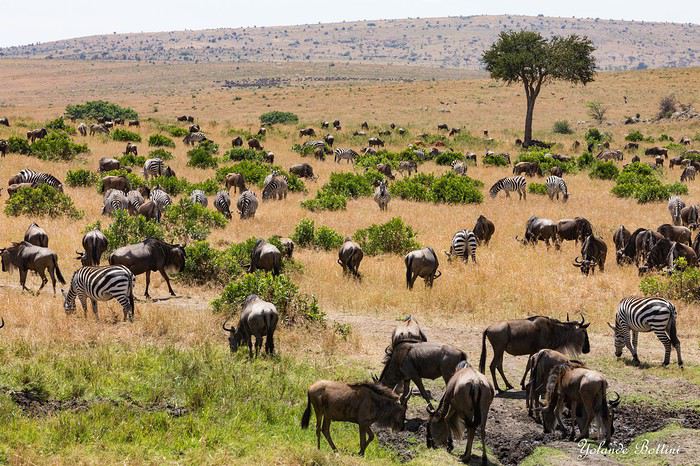
This account of a short stay in Kenya was originally meant for our friends and family, but to pass the time—for both us and you—and to add some content to the increasingly quiet columns of Voyage Forum during these weeks of confinement, when travelers can only journey in their minds, we decided to share the 25 pages of my ramblings, illustrated with Yolande’s photos, from an extraordinary stay in the Maasai Mara National Reserve. We waited until the two previous discussions on this same topic, filled with stunning photos and started by Régis and then Claire—sometimes in agreement, sometimes differing but always full of insights—had quieted down a bit before jumping in. Well, we’ll give it a try.
Let’s clarify: one of us claims to be a beginner photographer, and the other is just an unrepentant dreamer and modest writer. We often pursued our passions separately—Yolande with her mentor and me with an incomparable tracker—so sometimes the photos don’t quite match the text, or vice versa.
We hope you enjoy reading this lengthy post, which is longer than usual in VF’s sections (except, of course, for Mr. Voyajou). A thousand apologies for straying off the beaten path.
Alright, here we go!
Du nord au sud de l'archipel philippin avec un détour par Singapour
Bonjour,
Ce carnet qu'en principe je n'aurais pas du faire, il m'a été soufflé par certains membres de VF et en ces temps troublés de Covid-19, nous en avons justement du temps, quoi que pour certains pour une fois ils croulent sous le travail (il se reconnaîtra 😇)
Je vais vous conter (un bien grand mot pour moi, vu que je ne suis pas très à l'aise avec les mots) ce périple vous amènera à Banaue et ses magnifiques rizière en terrasses, au sud sur l'île de Siargao et au centre à sur l'île de Panglao
Il n'y aura pas d'animaux pétrifiés, de rochers à perte de vue et de champignons hallucinogènes (elle se reconnaitra)
Il a commencé par un vol à destination de Manilles via Doha,
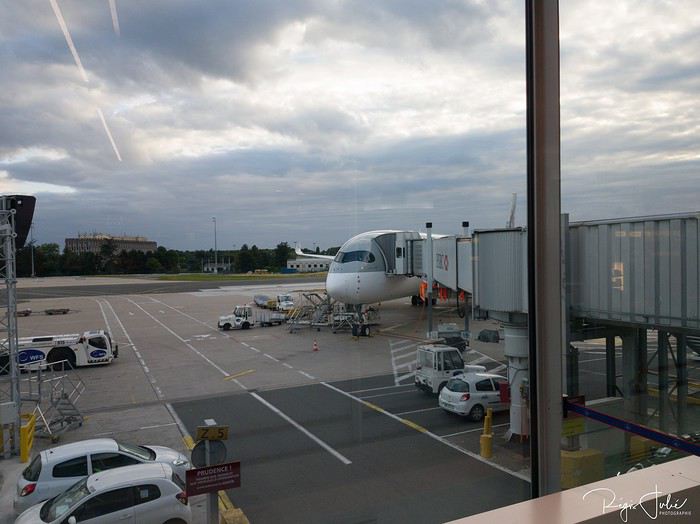
Une photo qui aurait eu sa place sur sans problème sur passenger shaming, ils nous a fait une très grande prestation jusqu'à Doha
On se retrouve bientôt à Manille 🙂
Ce carnet qu'en principe je n'aurais pas du faire, il m'a été soufflé par certains membres de VF et en ces temps troublés de Covid-19, nous en avons justement du temps, quoi que pour certains pour une fois ils croulent sous le travail (il se reconnaîtra 😇)
Je vais vous conter (un bien grand mot pour moi, vu que je ne suis pas très à l'aise avec les mots) ce périple vous amènera à Banaue et ses magnifiques rizière en terrasses, au sud sur l'île de Siargao et au centre à sur l'île de Panglao
Il n'y aura pas d'animaux pétrifiés, de rochers à perte de vue et de champignons hallucinogènes (elle se reconnaitra)
Il a commencé par un vol à destination de Manilles via Doha,
Une photo qui aurait eu sa place sur sans problème sur passenger shaming, ils nous a fait une très grande prestation jusqu'à Doha
On se retrouve bientôt à Manille 🙂
On part en vadrouille dans l'ouest américain! Oui, encore...
En ces temps difficiles qui nous obligent à trouver des occupations, je vous soumets ici un carnet que j'avais rédigé il y a quelques années et que je n'ai jamais publié ici... Bonne lecture (pour ceux que ça intéresse...)...
24 juillet - Itinéraire d’une famille gâtée
Envie de t’évader ? Envie de rêver ? Envie de t’amuser ? Oui ? Alors tu as frappé à la bonne adresse... Plus précisément à l’adresse de celui qui a attrapé un virus… En l’occurrence, moi… Et ce virus, pas question de m’en débarrasser en me bourrant d’antibiotiques. Non seulement, les antibiotiques, ce n’est pas automatique, mais ce virus-là, j’en prends grand soin. Je l’entretiens, même… Ce virus, c’est l’étasunite ! Je l’ai contracté le jour où j’ai posé mes arpions chez l’oncle Sam pour la première fois, il y a une décennie de cela. Tout ça ne me rajeunit pas mais depuis ce fameux jour, lui et moi, nous ne nous sommes plus jamais quittés. Un proverbe dit à ce sujet que si tu vas aux Etats-Unis une fois, tu y reviendras un jour… Ben moi, depuis, j’y suis même retourné deux autres fois ! Et figure-toi que si tu lis ces quelques lignes, c’est que je m’apprête à y retourner pour une quatrième vadrouille !... Pour cette fois-ci, je vais accomplir un de mes rêves ! Me faire la route 66 sur mon Harley avec une belle brune accrochée à ma taille... Manque de bol, ma femme est blonde, je n'ai pas le permis moto et nous avons deux louloutes de quatre et sept ans… Va donc falloir que je revoie mes plans...
Bon, si tu es un lecteur assidu de nos précédentes vadrouilles, nous n’avons plus de secret pour toi, si bien que tu sais déjà que nous sommes quatre, juste un an de plus par rapport à la dernière fois… Il y a bien évidemment Sandrine, ma femme alias le portefeuille ; Sasha, notre petite globetrotteuse de quatre ans ; et Anna notre routarde de sept ans et plus toutes ses dents... Ah, et je m’oubliais ! Moi, Franck, la trentaine bien tassée, alias le conducteur, le tour opérateur, le narrateur, le cuisinier, le… Oui, je sais, moi aussi, j’aimerais bien déléguer… Ah, mais j’oublie encore quelqu’un !… Toi… Mais bon, sauf le respect que je te dois, tu ne seras une nouvelle fois que le spectateur du film que nous allons tourner et interpréter… D’ailleurs, quel en sera le titre ?... Et bien après réflexion, on a le choix entre « Voyage entre geysers et déserts », ou alors « Sous le soleil de Beverly Hills »… Pour ce coup-là, en espérant ne pas les vexer, on décide de poser un lapin à Brandon et Brenda… Car oui, c’est décidé, cette nouvelle édition sera composée d'indiens, de geysers, de trappeurs, de pionniers, de bisons, de chercheurs d'or, de hors-la-loi, de ranchs et de cowboys ! A nous les grands espaces… et les gros hamburgers !!! A nous l’ouest américain et ses films qui donnent tant envie : Délivrance, la colline a des yeux, Shining, The Descent, ...
Mais un voyage comme celui-là, ça se prépare un ‘tiot peu. Premièrement, il faut du blé, du flouze, du fric, du pognon, des pépettes, de la caillasse… Ben oui, ça coûte cher tout ça, donc à moins de faire comme le PSG et te faire subventionner par un investisseur qatari, il va falloir que tu en mettes de côté. Deuxièmement, il faut un minimum de travail de préparation. Et je commencerai mon histoire par un retour dans le passé, un bond dans le temps pour revenir pile poil au moment où Sandrine a enfin craqué sous mes coups de butoir et m’a donné son ô combien précieuse approbation… « Allez, ok, c’est bon, fais-toi plaisir ! » Sans avoir réellement conscience de la portée de ces quelques mots, elle venait de me signer un contrat de travail d’un an ! Car moi, ni une, ni deux, j'ai employé toute une équipe de lutins pour m'aider à préparer mon itinéraire. Lecture de carnets de voyage, questions sur des forums, épluchage de guides, visionnage de films, essorage d’internet, … Au final, je dois dire que je suis plus que satisfait de leur boulot ! Ce qui me permet non pas de faire un bilan puisqu'heureusement, le voyage n'est pas commencé, mais plutôt un petit compte-rendu chiffré de ce qui nous attend. Huit états à traverser ou à effleurer, plus de cinq mille kilomètres à parcourir, vingt jours pleins sur place, deux hôtels, quatorze campings différents, huit heures de décalage... Mes trois blondes vont-elles le supporter ? Optimiste que je suis, je mise sur un grand « Oui » ! D��ailleurs, pour les préparer, j’ai mis en place un programme intensif trois mois avant le départ : Marche autour de notre immense propriété, westerns tous les soirs, Coca et hamburgers à volonté à tous les repas !... Et oui, qui ménage sa monture voyage plus souvent !
Avant de tailler la route, je profite de cette intro pour publier une petite annonce à destination des cambrioleurs amateurs de textes de voyage : passez votre route, ma maison est équipée d’une alarme biométrique avec double varifocale et matrice de commutation. De plus, j’ai loué à un pote du neuf trois son gros pitbull pour l’occasion. Sans compter que pendant nos vacances, ma maison va être occupée par mes parents qui sont tous les deux experts en arts martiaux !... D’ailleurs, pourquoi je te raconte ces bobards alors que tu ne connais même pas mon adresse… C'est le 25, avenue des canaris à Triffouillis-sur-Retourne... Euh, merci de ne pas m’envoyer de carte postale à l'adresse ci-dessus... c'est une fausse !
Bon, chut, ça y est, c’est l’heure de l’évaluation… On va savoir si toute la famille est prête pour le grand départ : « Sandrine, donne-moi les huit états dans lesquels nous allons poser les pieds... - Colorado, Wyoming, Nebraska, Dakota du sud, Montana, Idaho, Utah et... euh... mince, oh, je l’ai sur le bout de la langue… Ah oui, l’Arizona !!!… - Mouais… C’était moins une… Encore un peu et tu n’partais pas avec nous ! Et toi, Anna, cite-moi les quatre présidents sculptés sur le Mont Rushmore ? - Abram Licol, Tomasse Washington, George Jeffessonne et Theodore Rousevelle... - Ok, on va dire que c’est bon… Et toi, Sasha, dans quel pays allons-nous cet été ? - Les Jétajuniiiiis de l’Amérique de Mickey ! » Ok, c’est bon, elles sont fin prêtes ! Attention, départ imminent !
24 juillet - Itinéraire d’une famille gâtée
Envie de t’évader ? Envie de rêver ? Envie de t’amuser ? Oui ? Alors tu as frappé à la bonne adresse... Plus précisément à l’adresse de celui qui a attrapé un virus… En l’occurrence, moi… Et ce virus, pas question de m’en débarrasser en me bourrant d’antibiotiques. Non seulement, les antibiotiques, ce n’est pas automatique, mais ce virus-là, j’en prends grand soin. Je l’entretiens, même… Ce virus, c’est l’étasunite ! Je l’ai contracté le jour où j’ai posé mes arpions chez l’oncle Sam pour la première fois, il y a une décennie de cela. Tout ça ne me rajeunit pas mais depuis ce fameux jour, lui et moi, nous ne nous sommes plus jamais quittés. Un proverbe dit à ce sujet que si tu vas aux Etats-Unis une fois, tu y reviendras un jour… Ben moi, depuis, j’y suis même retourné deux autres fois ! Et figure-toi que si tu lis ces quelques lignes, c’est que je m’apprête à y retourner pour une quatrième vadrouille !... Pour cette fois-ci, je vais accomplir un de mes rêves ! Me faire la route 66 sur mon Harley avec une belle brune accrochée à ma taille... Manque de bol, ma femme est blonde, je n'ai pas le permis moto et nous avons deux louloutes de quatre et sept ans… Va donc falloir que je revoie mes plans...
Bon, si tu es un lecteur assidu de nos précédentes vadrouilles, nous n’avons plus de secret pour toi, si bien que tu sais déjà que nous sommes quatre, juste un an de plus par rapport à la dernière fois… Il y a bien évidemment Sandrine, ma femme alias le portefeuille ; Sasha, notre petite globetrotteuse de quatre ans ; et Anna notre routarde de sept ans et plus toutes ses dents... Ah, et je m’oubliais ! Moi, Franck, la trentaine bien tassée, alias le conducteur, le tour opérateur, le narrateur, le cuisinier, le… Oui, je sais, moi aussi, j’aimerais bien déléguer… Ah, mais j’oublie encore quelqu’un !… Toi… Mais bon, sauf le respect que je te dois, tu ne seras une nouvelle fois que le spectateur du film que nous allons tourner et interpréter… D’ailleurs, quel en sera le titre ?... Et bien après réflexion, on a le choix entre « Voyage entre geysers et déserts », ou alors « Sous le soleil de Beverly Hills »… Pour ce coup-là, en espérant ne pas les vexer, on décide de poser un lapin à Brandon et Brenda… Car oui, c’est décidé, cette nouvelle édition sera composée d'indiens, de geysers, de trappeurs, de pionniers, de bisons, de chercheurs d'or, de hors-la-loi, de ranchs et de cowboys ! A nous les grands espaces… et les gros hamburgers !!! A nous l’ouest américain et ses films qui donnent tant envie : Délivrance, la colline a des yeux, Shining, The Descent, ...
Mais un voyage comme celui-là, ça se prépare un ‘tiot peu. Premièrement, il faut du blé, du flouze, du fric, du pognon, des pépettes, de la caillasse… Ben oui, ça coûte cher tout ça, donc à moins de faire comme le PSG et te faire subventionner par un investisseur qatari, il va falloir que tu en mettes de côté. Deuxièmement, il faut un minimum de travail de préparation. Et je commencerai mon histoire par un retour dans le passé, un bond dans le temps pour revenir pile poil au moment où Sandrine a enfin craqué sous mes coups de butoir et m’a donné son ô combien précieuse approbation… « Allez, ok, c’est bon, fais-toi plaisir ! » Sans avoir réellement conscience de la portée de ces quelques mots, elle venait de me signer un contrat de travail d’un an ! Car moi, ni une, ni deux, j'ai employé toute une équipe de lutins pour m'aider à préparer mon itinéraire. Lecture de carnets de voyage, questions sur des forums, épluchage de guides, visionnage de films, essorage d’internet, … Au final, je dois dire que je suis plus que satisfait de leur boulot ! Ce qui me permet non pas de faire un bilan puisqu'heureusement, le voyage n'est pas commencé, mais plutôt un petit compte-rendu chiffré de ce qui nous attend. Huit états à traverser ou à effleurer, plus de cinq mille kilomètres à parcourir, vingt jours pleins sur place, deux hôtels, quatorze campings différents, huit heures de décalage... Mes trois blondes vont-elles le supporter ? Optimiste que je suis, je mise sur un grand « Oui » ! D��ailleurs, pour les préparer, j’ai mis en place un programme intensif trois mois avant le départ : Marche autour de notre immense propriété, westerns tous les soirs, Coca et hamburgers à volonté à tous les repas !... Et oui, qui ménage sa monture voyage plus souvent !
Avant de tailler la route, je profite de cette intro pour publier une petite annonce à destination des cambrioleurs amateurs de textes de voyage : passez votre route, ma maison est équipée d’une alarme biométrique avec double varifocale et matrice de commutation. De plus, j’ai loué à un pote du neuf trois son gros pitbull pour l’occasion. Sans compter que pendant nos vacances, ma maison va être occupée par mes parents qui sont tous les deux experts en arts martiaux !... D’ailleurs, pourquoi je te raconte ces bobards alors que tu ne connais même pas mon adresse… C'est le 25, avenue des canaris à Triffouillis-sur-Retourne... Euh, merci de ne pas m’envoyer de carte postale à l'adresse ci-dessus... c'est une fausse !
Bon, chut, ça y est, c’est l’heure de l’évaluation… On va savoir si toute la famille est prête pour le grand départ : « Sandrine, donne-moi les huit états dans lesquels nous allons poser les pieds... - Colorado, Wyoming, Nebraska, Dakota du sud, Montana, Idaho, Utah et... euh... mince, oh, je l’ai sur le bout de la langue… Ah oui, l’Arizona !!!… - Mouais… C’était moins une… Encore un peu et tu n’partais pas avec nous ! Et toi, Anna, cite-moi les quatre présidents sculptés sur le Mont Rushmore ? - Abram Licol, Tomasse Washington, George Jeffessonne et Theodore Rousevelle... - Ok, on va dire que c’est bon… Et toi, Sasha, dans quel pays allons-nous cet été ? - Les Jétajuniiiiis de l’Amérique de Mickey ! » Ok, c’est bon, elles sont fin prêtes ! Attention, départ imminent !
Le camping-car en Namibie c'est bien
bonjour,
juste un petit post et retour d'expérience sur la possibilité de voyager en camping car en Namibie. Lors de la préparation de notre voyage je n'avais rien trouvé de satisfaisant sur ce forum. Dire donc: oui c'est possible ! Et avec des enfants cela est même souhaitable. Parcourir la Namibie cela implique de rouler, souvent longtemps, plus longtemps que prévu vu l'état des routes, la beauté des paysages et la recherche des animaux sauvages. L'espace a disposition dans le camping car est alors le bienvenu. Par ailleurs la hauteur, le nombre de fenêtres sont des atouts bien appréciés lors de la visite du parc Etosha mais aussi en d'autres circonstances. Reste les inconvénients : la poussière qui s'infiltre dans le véhicule ( prévoir de grands sacs poubelles pour enfermer vos affaires) et oblige a un ménage complet a chaque étape(problème que rencontrent aussi les 4x4) et les vibrations qui vous font parfois croire que le véhicule va se fendre en deux... Nous avons vécu deux crevaisons et un ensablement. J'en profite pour signaler que nous avons reçu alors l'aide précieuse d'un sud africain voyageant avec son propre véhicule et connaissant le terrain qui a su nous sortir de là. Les autres touristes équipés de 4x4 flambant neuf étaient bien en peine pour nous aider, s'agaçant plutôt que nous obstruions le passage, les retardant sur leurs parcours et programme bien huilé... Certes les 4x4 roulent plus vite...Mais a quoi bon...
juste un petit post et retour d'expérience sur la possibilité de voyager en camping car en Namibie. Lors de la préparation de notre voyage je n'avais rien trouvé de satisfaisant sur ce forum. Dire donc: oui c'est possible ! Et avec des enfants cela est même souhaitable. Parcourir la Namibie cela implique de rouler, souvent longtemps, plus longtemps que prévu vu l'état des routes, la beauté des paysages et la recherche des animaux sauvages. L'espace a disposition dans le camping car est alors le bienvenu. Par ailleurs la hauteur, le nombre de fenêtres sont des atouts bien appréciés lors de la visite du parc Etosha mais aussi en d'autres circonstances. Reste les inconvénients : la poussière qui s'infiltre dans le véhicule ( prévoir de grands sacs poubelles pour enfermer vos affaires) et oblige a un ménage complet a chaque étape(problème que rencontrent aussi les 4x4) et les vibrations qui vous font parfois croire que le véhicule va se fendre en deux... Nous avons vécu deux crevaisons et un ensablement. J'en profite pour signaler que nous avons reçu alors l'aide précieuse d'un sud africain voyageant avec son propre véhicule et connaissant le terrain qui a su nous sortir de là. Les autres touristes équipés de 4x4 flambant neuf étaient bien en peine pour nous aider, s'agaçant plutôt que nous obstruions le passage, les retardant sur leurs parcours et programme bien huilé... Certes les 4x4 roulent plus vite...Mais a quoi bon...
Voyager sans connaître la destination? Nous voilà inscrits...
Nous sommes à un mois de notre départ et nous ne connaissons pas la destination puisque c'est un voyage mystère que nous avons réservé par l'agence CAP MYSTERE....
Nous avons donc rempli un questionnaire assez détaillé sur notre type de voyage, nos envies , nos budget...
C'est donc un voyage lointain avec une destination au soleil alliant la faune et la flore et hors des sentiers battus.
Nous allons bientôt recevoir le premier indice.
Nous sommes méga surexcités et en ce qui me concerne (moins mon conjoint plus sage) , je ne cesse de chercher les vols possibles avec les éléments que j'ai....
Arghhhh c'est horriblement dure d'attendre.
Nous avons donc rempli un questionnaire assez détaillé sur notre type de voyage, nos envies , nos budget...
C'est donc un voyage lointain avec une destination au soleil alliant la faune et la flore et hors des sentiers battus.
Nous allons bientôt recevoir le premier indice.
Nous sommes méga surexcités et en ce qui me concerne (moins mon conjoint plus sage) , je ne cesse de chercher les vols possibles avec les éléments que j'ai....
Arghhhh c'est horriblement dure d'attendre.
In the Land of Mountain Gorillas: The Story of an "Epic" Trip
Passionate about travel, animals (furry, feathered, scaly), and my partner’s love for photography, it was in 2014, after encountering orangutans in Gunung Leuser National Park in Sumatra, that I felt the urge to see other great apes in their natural habitat and in the wild. For my 40th birthday, I dreamed of only one thing... seeing gorillas. I still had four years to wait and four years to save up.
At the time, I had only heard of the Virunga Mountains, particularly the part in Rwanda. To be honest, Uganda had never really struck me as a destination I’d ever set foot in, and the DRC, for security reasons, didn’t particularly appeal to me.
But then, one day, I heard that Rwanda was going to increase the price of gorilla permits to USD 1,500 per person. Ouch... that seemed way overpriced, especially since we were going as a couple and I really wanted to see them twice. $6,000 for two days... Okay, it’s for my 40th birthday, but still...
At the end of 2017, I started looking more closely into our trip planned for December 2018. A stroke of luck in my schedule meant my former English teacher sent me a link to an article she’d written for her travel agency about her encounter with gorillas in Uganda. Hmm, Uganda? It was the first time I’d read about the country. Why not?
I scoured various forums in French and English and re-discovered voyageforum.com. And most importantly, I came across Ticapi’s travel journal, which I devoured in one evening, and a few months later, Muriel18’s, whose release I eagerly awaited. Wow!!! Not only can you see gorillas in Uganda, but also chimpanzees and the shoebill, not to mention the savannah and the chance to go on more classic safaris.
All that’s left is to convince my better half that Uganda is a safe country...
Usually, and now more than ever, we prefer independent travel and self-drive trips in particular. But given the proximity to the DRC border, the potentially impassable roads after rain, and rental cars that aren’t always in the best condition, we hired a guide for two weeks in December 2018. The months passed, and the excitement grew.
Three weeks before departure, I fell ill after a work trip to Asia. Darn! This time, I didn’t waste any time—I quickly saw a doctor and got rid of that virus. That was the plan! Flu or malaria? (I’d been to the Amazon six months earlier.) The doctor didn’t know; the cough only appeared a few days later. We did blood tests two days in a row to rule out malaria. So it was the flu or... pneumonia :-( ...?
The X-rays spoke for themselves—it was pneumonia, and it was already quite advanced. No big deal, I still had two weeks to recover! I religiously took my antibiotics, downed loads of vitamin C, but nothing worked—the antibiotics didn’t seem to be doing anything. I was coughing so hard I thought my lungs would come up, I was short of breath, exhausted. I’d dreamed of this trip for so long... it seemed unthinkable not to go. Five days before departure, my doctor hospitalized me—the pneumonia had worsened, and my blood oxygen levels were dangerously low. I was in tears but still in denial about what was happening to me. Besides, I’d still taken my anti-malarial, because I was determined to leave.
I spent the first day in the emergency room on oxygen 24/7. The germ causing my pneumonia was unknown to the infectious disease and pulmonary specialists. They tried a combination of antibiotics. No big deal, in four days, I’d be leaving. I harassed the doctor, who must have thought I was crazy, to find out when I could be discharged—"because, you see, doctor, I have a flight to Uganda on Saturday." On Thursday, the doctor was firm: I’d still be hospitalized on Saturday... deep down, I knew it but didn’t want to admit it. My partner handled canceling the flights, contacted our travel insurance (thankfully we had some), and I wrote to our guide (who, in the meantime, had become our tour operator) who could hardly believe it. And neither could I! We told ourselves it was just postponed and that we’d take this long-awaited trip at the end of 2019!
March 2019, the tour operator reached out to us: "Didn’t you say you wanted to go to Uganda this year? You’d better hurry and book the gorilla permits before they run out."
Oh yes, we wanted to see the gorillas. But we hesitated about rebooking. I still hoped to do this trip as a self-drive. The thing is, this year, we managed to take three weeks off, and we also wanted to spend a week in Rwanda. My partner still didn’t feel comfortable driving there. Yet, he’s driven all over the world. I respected his feelings, especially since he’s the only one who drives.
Anyway, we went back and forth but neither of us really said what we were thinking: "What if we used someone else to organize our trip?" In the end, we went with him again, made a first deposit for four gorilla permits (two days each) (not the best idea we’ve ever had), and looked into adding Rwanda to our itinerary. We’d have a guide/driver for the whole trip with mid-range accommodations.
After several back-and-forths, the itinerary was supposed to look something like this. To be honest, I got fed up after a while.
Day 1: Arrival in Kigali in the evening Day 2: Transfer from Kigali to Akagera NP Day 3: Safari in Akagera NP Day 4: Akagera NP and night in Nyagatare Day 5: Transfer from Nyagatare to Nyungwe Forest Day 6: Nyungwe Day 7: Nyungwe Day 8: Transfer from Nyungwe to Lake Kivu, Rubavu/Gisenyi Day 9: Transfer from Rubavu/Gisenyi to Kisoro/Uganda via the Cyanika border Day 10: Gorilla tracking in Mgahinga NP Day 11: Golden Monkey tracking in Mgahinga NP, night at Lake Mutanda Day 12: Gorilla tracking in Bwindi, Ruhija (later changed to Rushaga) Day 13: Queen Elizabeth NP, Ishasha sector in the morning and Kazinga Channel in the afternoon Day 14: No clear answer on activities for that day. After three attempts, I gave up. I shouldn’t have... Day 15: Chimpanzee tracking in Kyambura Gorge, night at Lake Nkuruba Day 16: Lake Nkuruba, morning activities around the lake and Bigodi Swamps in the afternoon Day 17: Transfer from Lake Nkuruba to Murchison Falls Day 18: Murchison Falls Day 19: Murchison Falls Day 20: Transfer from Murchison Falls via Ziwa Rhino Sanctuary, night in Entebbe Day 21: Entebbe – Mabamba Swamps Day 22: Mabamba Swamps in the morning, Botanical Garden in Entebbe in the afternoon, and transfer to the airport for the overnight return flight.
In April, he asked us for a substantial deposit for the accommodations and some park activities, as one of his colleagues was doing the same tour in May and it would be good if he could secure the already-made reservations by paying the bill.
A week before departure, just like in 2018, we paid the remaining balance of the agreed amount. Three days later, since I hadn’t heard from him (the TO is based in Germany), I sent him a message to confirm he’d received the payment.
My partner joked, "And that’s when he tells us he closed the account we sent the money to." I forced a laugh... and even more so when the TO asked me which account I’d sent the balance to... "Uh, the same one as before." And then he told me he’d closed that account and maybe should’ve mentioned it earlier... uh, you think?! And of course, he needed the money sent again quickly. "Well, buddy, you’ll have to wait until I get it back!!!
It was already late, and my bank had been closed for hours. The next morning, first thing, I called my bank and explained the situation.
"Unfortunately, we can’t do anything for you; you’ll have to wait for the money to be returned." "But how long will that take?" "A few days or weeks, depending on the banks, and you should expect transfer fees."
Brilliant! :-(
After nearly 10 years of traveling almost exclusively without traditional travel agencies, had we just been scammed? I went back to the forums to reread posts about this TO from other travelers. They were all positive; no one mentioned a scam.
The next day, I searched online for the contact details of his bank in Germany. I wrote to the generic email address in English, explaining that I’d made a transfer without knowing that this gentleman had closed his bank account. The employee replied in impeccable English that the bank only responded to emails written in German. Grrr! I used a well-known translator since my German is, let’s say, rusty, and resent my email in German. The same agent replied in German that unfortunately, they couldn’t do anything for me—that if the account had been closed, an automatic rule would return the money to the sender... period, end of story!
Well, our money is lost somewhere in the "cloud," or so we hope! Wait and see!
No news from our TO, and we didn’t reach out either—we were too annoyed by the whole situation.
At the time, I had only heard of the Virunga Mountains, particularly the part in Rwanda. To be honest, Uganda had never really struck me as a destination I’d ever set foot in, and the DRC, for security reasons, didn’t particularly appeal to me.
But then, one day, I heard that Rwanda was going to increase the price of gorilla permits to USD 1,500 per person. Ouch... that seemed way overpriced, especially since we were going as a couple and I really wanted to see them twice. $6,000 for two days... Okay, it’s for my 40th birthday, but still...
At the end of 2017, I started looking more closely into our trip planned for December 2018. A stroke of luck in my schedule meant my former English teacher sent me a link to an article she’d written for her travel agency about her encounter with gorillas in Uganda. Hmm, Uganda? It was the first time I’d read about the country. Why not?
I scoured various forums in French and English and re-discovered voyageforum.com. And most importantly, I came across Ticapi’s travel journal, which I devoured in one evening, and a few months later, Muriel18’s, whose release I eagerly awaited. Wow!!! Not only can you see gorillas in Uganda, but also chimpanzees and the shoebill, not to mention the savannah and the chance to go on more classic safaris.
All that’s left is to convince my better half that Uganda is a safe country...
Usually, and now more than ever, we prefer independent travel and self-drive trips in particular. But given the proximity to the DRC border, the potentially impassable roads after rain, and rental cars that aren’t always in the best condition, we hired a guide for two weeks in December 2018. The months passed, and the excitement grew.
Three weeks before departure, I fell ill after a work trip to Asia. Darn! This time, I didn’t waste any time—I quickly saw a doctor and got rid of that virus. That was the plan! Flu or malaria? (I’d been to the Amazon six months earlier.) The doctor didn’t know; the cough only appeared a few days later. We did blood tests two days in a row to rule out malaria. So it was the flu or... pneumonia :-( ...?
The X-rays spoke for themselves—it was pneumonia, and it was already quite advanced. No big deal, I still had two weeks to recover! I religiously took my antibiotics, downed loads of vitamin C, but nothing worked—the antibiotics didn’t seem to be doing anything. I was coughing so hard I thought my lungs would come up, I was short of breath, exhausted. I’d dreamed of this trip for so long... it seemed unthinkable not to go. Five days before departure, my doctor hospitalized me—the pneumonia had worsened, and my blood oxygen levels were dangerously low. I was in tears but still in denial about what was happening to me. Besides, I’d still taken my anti-malarial, because I was determined to leave.
I spent the first day in the emergency room on oxygen 24/7. The germ causing my pneumonia was unknown to the infectious disease and pulmonary specialists. They tried a combination of antibiotics. No big deal, in four days, I’d be leaving. I harassed the doctor, who must have thought I was crazy, to find out when I could be discharged—"because, you see, doctor, I have a flight to Uganda on Saturday." On Thursday, the doctor was firm: I’d still be hospitalized on Saturday... deep down, I knew it but didn’t want to admit it. My partner handled canceling the flights, contacted our travel insurance (thankfully we had some), and I wrote to our guide (who, in the meantime, had become our tour operator) who could hardly believe it. And neither could I! We told ourselves it was just postponed and that we’d take this long-awaited trip at the end of 2019!
March 2019, the tour operator reached out to us: "Didn’t you say you wanted to go to Uganda this year? You’d better hurry and book the gorilla permits before they run out."
Oh yes, we wanted to see the gorillas. But we hesitated about rebooking. I still hoped to do this trip as a self-drive. The thing is, this year, we managed to take three weeks off, and we also wanted to spend a week in Rwanda. My partner still didn’t feel comfortable driving there. Yet, he’s driven all over the world. I respected his feelings, especially since he’s the only one who drives.
Anyway, we went back and forth but neither of us really said what we were thinking: "What if we used someone else to organize our trip?" In the end, we went with him again, made a first deposit for four gorilla permits (two days each) (not the best idea we’ve ever had), and looked into adding Rwanda to our itinerary. We’d have a guide/driver for the whole trip with mid-range accommodations.
After several back-and-forths, the itinerary was supposed to look something like this. To be honest, I got fed up after a while.
Day 1: Arrival in Kigali in the evening Day 2: Transfer from Kigali to Akagera NP Day 3: Safari in Akagera NP Day 4: Akagera NP and night in Nyagatare Day 5: Transfer from Nyagatare to Nyungwe Forest Day 6: Nyungwe Day 7: Nyungwe Day 8: Transfer from Nyungwe to Lake Kivu, Rubavu/Gisenyi Day 9: Transfer from Rubavu/Gisenyi to Kisoro/Uganda via the Cyanika border Day 10: Gorilla tracking in Mgahinga NP Day 11: Golden Monkey tracking in Mgahinga NP, night at Lake Mutanda Day 12: Gorilla tracking in Bwindi, Ruhija (later changed to Rushaga) Day 13: Queen Elizabeth NP, Ishasha sector in the morning and Kazinga Channel in the afternoon Day 14: No clear answer on activities for that day. After three attempts, I gave up. I shouldn’t have... Day 15: Chimpanzee tracking in Kyambura Gorge, night at Lake Nkuruba Day 16: Lake Nkuruba, morning activities around the lake and Bigodi Swamps in the afternoon Day 17: Transfer from Lake Nkuruba to Murchison Falls Day 18: Murchison Falls Day 19: Murchison Falls Day 20: Transfer from Murchison Falls via Ziwa Rhino Sanctuary, night in Entebbe Day 21: Entebbe – Mabamba Swamps Day 22: Mabamba Swamps in the morning, Botanical Garden in Entebbe in the afternoon, and transfer to the airport for the overnight return flight.
In April, he asked us for a substantial deposit for the accommodations and some park activities, as one of his colleagues was doing the same tour in May and it would be good if he could secure the already-made reservations by paying the bill.
A week before departure, just like in 2018, we paid the remaining balance of the agreed amount. Three days later, since I hadn’t heard from him (the TO is based in Germany), I sent him a message to confirm he’d received the payment.
My partner joked, "And that’s when he tells us he closed the account we sent the money to." I forced a laugh... and even more so when the TO asked me which account I’d sent the balance to... "Uh, the same one as before." And then he told me he’d closed that account and maybe should’ve mentioned it earlier... uh, you think?! And of course, he needed the money sent again quickly. "Well, buddy, you’ll have to wait until I get it back!!!
It was already late, and my bank had been closed for hours. The next morning, first thing, I called my bank and explained the situation.
"Unfortunately, we can’t do anything for you; you’ll have to wait for the money to be returned." "But how long will that take?" "A few days or weeks, depending on the banks, and you should expect transfer fees."
Brilliant! :-(
After nearly 10 years of traveling almost exclusively without traditional travel agencies, had we just been scammed? I went back to the forums to reread posts about this TO from other travelers. They were all positive; no one mentioned a scam.
The next day, I searched online for the contact details of his bank in Germany. I wrote to the generic email address in English, explaining that I’d made a transfer without knowing that this gentleman had closed his bank account. The employee replied in impeccable English that the bank only responded to emails written in German. Grrr! I used a well-known translator since my German is, let’s say, rusty, and resent my email in German. The same agent replied in German that unfortunately, they couldn’t do anything for me—that if the account had been closed, an automatic rule would return the money to the sender... period, end of story!
Well, our money is lost somewhere in the "cloud," or so we hope! Wait and see!
No news from our TO, and we didn’t reach out either—we were too annoyed by the whole situation.
Circuits organisés par des agences traditionnelles en Namibie
Bonjour
Je désire partir en Namibie en septembre ou octobre 2020
Hélas je ne suis pas arrivée a convaincre d'ami(e)s pour de m'accompagner dans ce voyage 😕
Je me tourne donc vers des circuits organisés par des agences traditionnelles notamment
nouvelles frontières qui propose un circuit très complet " Pays Himba, dunes et réserves de Namibie" a un tarif raisonnable car surtout en camp
Quelqu'un a t il fait ce circuit récemment et qu'en pensez vous ?
Merci pour vos futurs réponses
Uganda: 20 days discovering authenticity
Preamble:
For summer 2019, the idea was to return to Africa. We had already been to Namibia in 2017 (+ a few days in Botswana and the end of the trip at Victoria Falls), which we loved, and a trip to Asia in 2018 (Borneo, Perhentian, and Singapore), a nature-focused trip but a bit disappointing due to environmental destruction. The desire to return to Africa was very strong. We wanted a change of scenery, nature, discoveries, to step out of our little comfort zone (a bit, anyway!) and experience travel differently. In short, we dreamed of authenticity, and we weren’t disappointed.
We traveled as a family of four with our daughters, aged 19 and 17. When the urge for Africa hit, Uganda quickly stood out, especially for the chance to see rare animals, particularly the famous mountain gorillas. When I looked into the budget, I was quickly disheartened. It’s really expensive. Too expensive… Then, after reading a few trip reports on "VoyageForum" (thanks Muriel J!), I decided to ask a local agency for a quote. The first contact was very friendly and responsive, and the initial offer for two weeks fit our budget :). A few images gathered from the internet (especially Sipi Falls) finally convinced us all. I asked for an adapted offer with a few more sites to extend the trip to three weeks and cover a fairly complete visit to the country (which, of course, increased the budget! To stay within an acceptable range, we prioritized activities over accommodations and regularly chose the cheapest options, with 2-3 nice lodges in between). It’s booked! We were in October 2018, and the first thing to do was reserve permits to see the gorillas and chimpanzees. Then, the agency took care of all the bookings except for the international flights, which we booked with Ethiopian Airlines. A few months of waiting to look forward to… and a little worry too! Two events didn’t reassure us: the kidnapping of an American tourist by four men at the DRC border and the Ebola outbreak in Congo, with confirmed cases in Uganda by mid-June…
Here we are in July, and departure is approaching. The suitcases are packed (warm clothes, long, short, dark, light, practical, sun, rain, hiking/trekking shoes, flip-flops—clothes for every situation! Don’t forget: headlamp (essential!), binoculars, cameras), and we’re ready.
One day before departure, our agency Mpolampola, through its manager Paul, informs us that he won’t be the one taking care of us during the trip but another guide named Moses. He has a big problem with a vehicle and can’t do otherwise. For us, as long as everything is okay, no worries, especially since I had read glowing reviews about Moses, who turned out to be a very pleasant guide, cautious (most important) on the road, clear about all the activities, and an expert on birds, his specialty. We briefly met Paul in the middle of the trip, who is also very friendly. In short, we 100% recommend this agency. Flights to Entebbe went smoothly; we arrived around 10:30 AM, filled out health forms (Ebola information signs everywhere), visas, baggage claim, and met Moses, who took us directly to the vehicle. It was in pretty good condition with huge tires (we’d understand why later!), but it had quite a few miles (400,000 on the odometer!). Just missing a seatbelt… Okay, it’s Africa!
Now, here’s our day-by-day itinerary, which I’ll summarize briefly with ratings for each activity: ****TOPISSIME (Amazing) ***Very good **Good *Meh
Day 1) Departure from the airport at 11:45 AM for some currency exchange. Stop along the way at the equator for a meal and souvenir photo! Arrival at Lake Mburo Park *** around 5:00 PM. Even before entering the park, we saw lots of antelopes, zebras, elks, etc.—it’s magnificent. On the way, we had already encountered many goats and cows, and we were impressed by their enormous horns. We enjoyed a nice game drive until about 7:00 PM, when we reached our lodge, one of the nicest of the trip, Eagle’s Nest ****, with a magnificent view, a tent with a nice bathroom/shower, and a very good meal.
Day 2) Departure at 7:00 AM for a game drive; we encountered many animals again, especially antelopes, zebras, and birds. There are no giraffes, lions, or cheetahs in this park. We didn’t get lucky enough to see a leopard… :-) Then, we continued to Lake Bunyonyi ***, where the road and views are very beautiful, but we were shocked to see locals (mostly women and children) breaking stones by hand on the mountainside in very precarious safety conditions. There are regularly dramatic accidents because, over time, entire sections detach and cause landslides. These stones are then used for road construction… Another world… This was the only place we saw this. Lake Bunyonyi is a nice stop (but less exotic in our opinion since we have many lakes back home too!). We took a boat to our accommodation, Byoona Amagara ***, which has a lot of charm. We stayed in huts called "geodomes," completely open to nature, so it was very cool at night. To reach the toilets located below, you had to be brave! The meal consisted of lake shrimp—good but a bit bland.
Day 3) After a good breakfast, departure at 9:00 AM to visit three islands. We took several nice walks with beautiful views of the lake and islands. A local meal was served on the last island. At 1:00 PM, we met Moses for the rest of the program and headed to Ruhija in Bwindi Forest****. The landscapes are breathtaking. After two hours of driving and many photo stops, we arrived at our accommodation near the trekking starting point, Ruhija Gorilla Friends Resort **. We stayed in a room instead of the initially planned tents, which was just as well because there was a lot of wind during the night. We still had time for an activity and decided to meet the Bwata pygmies despite the bad reviews in the guide… The first part of the visit was quite nice, with a visit to a school where the children gave us a very joyful welcome. We had a great time listening to them sing and dance! Then we met the Bwata pygmies who live on the edge of the forest. When Bwindi Forest was declared a national park, they had to leave their habitat because their activities weren’t compatible with nature and wildlife protection. We left on a somewhat sad note… The visit ended with a local doctor explaining different medicinal plants, and we watched the making of local beer from sorghum. Good meal. We had butterflies in our stomachs—tomorrow was a big day! I admit I was a bit stressed, not entirely confident in my physical abilities…
Day 4) After a short night due to excitement, breakfast, and departure at 7:30 AM. First, it started calmly with singing and dancing. Then, a 15-minute briefing and group assignments. No one asked if we had any physical problems or anything (when booking, I had inquired a bit, and they told me groups were assigned based on physical abilities). We were assigned to the Mukiza group. At first, I was pretty happy—it was a fairly large group with babies :). The ranger explained that for now, they didn’t know where the gorillas were… the trackers couldn’t find them… Oh… (that’s not a good sign!!!) We set off at a good pace, first on a reasonably sloped path. We were accompanied by a family of four Italians and five porters (four for us!). After an hour, the ranger stopped us and informed us they still couldn’t find them—they had fought with another group the day before and scattered throughout the forest, so they were very far away, and we needed to move faster… Hmm… we picked up the pace (we weren’t going slowly before!!!) and walked for another good hour—down, up, down again, up again, we kept going, but always more or less on paths. Then another stop. A 10-minute break waiting for news. The news wasn’t very precise, it seemed! The ranger decided to cut through the forest—machetes were used to clear the path. We descended unimaginable slopes, then climbed back up. Our stick kept getting stuck; luckily, our porter helped us, held our hands, and the terrain was vertical! An hour later, another stop: we heard gorilla cries (yay!!!). False hope—we waited again for news from the trackers, who informed our ranger that it was a non-habituated family, so we couldn’t see them. Cold shower—we had to go all the way back up and return to the starting point to maybe see another group. But time was running out… We arrived around 1:30 PM; all the other groups had already left long ago. Our guide was worried because we still had a long drive ahead. We quickly ate a banana, and off we went for another trek (I was exhausted!). Luckily, this group was close—about 45 minutes of steep descent (I was already thinking about the climb back and considering being adopted by a gorilla ). The forest was sublime, with magnificent tree ferns—the place was truly splendid. Finally, we were there. The porters stayed behind, we grabbed our cameras, and followed the ranger. The progress wasn’t easy, but suddenly, a female was in front of us, curled up in a little ball, eating—so cute. The emotion overwhelmed us. But she moved away—it’s hard to observe them; they move constantly, and the terrain is very steep and uneven. We saw a female descending from a tree with a baby on her back—too adorable. Then, here was the silverback, enormous, incredible, yet so calm and peaceful. He ate quietly and gave us a nice demonstration of nostril exploration! We could observe them for a good hour, but photographing them wasn’t easy because they kept moving, and we could barely stand! Toward the end, a large male (black back) suddenly stood up and decided to pass right where I was! I ended up in the bushes, and the male passed in front of me just a few centimeters away (he stepped on one of my daughters’ feet!) followed by the whole family. Just an exceptional moment. It was time to leave; we had to climb back up. I dreaded it because, I admit, I was exhausted. We finished the hike after 4:00 PM, exhausted but happy. The ranger gave us diplomas, and we didn’t linger because we still had a long drive—we needed to reach Ishasha before nightfall. Our guide was a bit stressed. If we were to do it again, we’d spend an extra night in Bwindi. However, it seems finishing so late is exceptional—it never happens, according to our guide! The road between Bwindi and Ishasha is sublime, with extraordinary landscapes, and despite the late hour, we regularly asked our guide to stop for photos. We arrived at Enjojo *** Lodge around 6:00 PM. The huts are located quite far from the reception and the bathrooms, a bit far from the huts, but otherwise, it was very nice.
Day 5) Departure at 8:00 AM after a good breakfast with the hope of seeing tree-climbing lions (no luck!). Overall, there weren’t many animals, and we arrived around 12:45 PM at our next stop, Parkview Safari Lodge ****, with a magnificent view, a beautiful family bungalow, and a good meal. We enjoyed a short relaxation by the lovely pool. At 4:00 PM, we left to see Kyambura Gorge *** and hike there. Unfortunately, this activity is no longer available, so we walked around the area—it was very beautiful. Back at the hotel, a little rest after the previous day wasn’t a bad idea! Reading, swimming, meals, and dances made the end of the day enjoyable.
Day 6) Departure at 6:30 AM—one of our daughters was sick (stomachache, cold sweats…). Safari in Queen Elizabeth ** (Kaseny Plains)—a bit disappointing. Stop by the salt lake with a nice view. A small market, but we weren’t thrilled by the crafts (overall, apart from some beautiful baskets/plates, there wasn’t much, and the wooden objects were, in our opinion, much less pretty than in Namibia). Then we took the crater road (27 km long) **** with magnificent landscapes. However, you absolutely must close the windows because it’s infested with tsetse flies. At noon, we arrived at Mweya, where we stayed in basic rooms, but the restaurant was well-placed with a beautiful view of the Kazinga Channel. At 2:00 PM, we enjoyed a magnificent cruise **** on the channel. Elephants, antelopes, crocodiles, hippos (including adorable babies), buffaloes, all kinds of birds. Wow!!! Two hours of pure bliss. Quiet end of the day playing cards with a view of the channel and elephants.
Day 7) Departure at 6:00 AM—still sick, we weren’t sure if it was due to the preventive treatment (Malarone) or something else… Another game drive in Queen Elizabeth (Kaseny Plains) and breakfast by the salt lake. Overall, we were a bit disappointed by this park. Then we took the road to Crater Lakes***, again with very beautiful landscapes. A hike of about an hour and a half allowed us to discover these beautiful crater lakes (the water mainly comes from the Rwenzoris). We crossed pretty villages and had nice encounters. End of the day at Tinka’s Home ****, with a family. We loved this place—very welcoming, where we took a cooking class with our hosts. A really great time. After the meal, we enjoyed African stories and dances. Really awesome.
Day 8) Departure at 7:30 AM for another highly anticipated discovery—the chimpanzees in Kibale Forest ****. We went to the meeting point and were split into groups of six, each with a guide. We saw three different groups, and for the last group, we followed a chimpanzee (slightly more comfortable running in the forest than we were!) that led us to the group. Their cries are very impressive, and we could observe them well, even though they were often high up in the trees. We were lucky enough to see two on the ground, very close to us. It was magnificent. End of the encounter and return to the starting point—it was noon. We went back to Tinka’s Home for the meal (delicious!). At 2:00 PM, we hiked in Bigodi Swamp ***, a marsh surrounded by beautiful vegetation, especially huge papyrus, and inhabited by many birds and monkeys. We saw, among others, black-and-white colobus monkeys, red colobus monkeys, and vervet monkeys. We also visited a basket-weaving workshop where we bought two beautiful baskets. Then a short stop in Fort Portal, where we stayed for two nights at Ruwenzori View Guesthouse ***, a nice place with a family room and very good communal meals.
Day 9) Departure at 8:00 AM for a hike in the Rwenzori****—it was a bit chaotic today. First, we had to exchange shillings because we wouldn’t have another chance in the following days. At the bank, employees went to get the bills by motorcycle from other buildings—it was quite surreal! And it took time! Then there was a misunderstanding between the organizer and me… I really wanted to see the region where chameleons are found in the Rwenzori—this region is south of the mountain range, and we were in the north! Anyway, the program included an ascent in the northern part with a positive elevation gain of over 1,500 meters… Talking to the guide scheduled for this hike (Noah), we explained that we really wanted to discover the vegetation and these famous chameleons, not necessarily achieve a physical feat… (we’d had enough!). The decision was made to go south, which meant quite a bit of driving. The hike was really enjoyable, with magnificent vegetation by the river. We saw three of the four chameleon species present, including the famous three-horned chameleon. The region is superb. We ended with a drink at Ruboni Camp, which has a magnificent view of the region (ideally, we should have stayed there). Two hours of driving to finish, and a good meal :).
Day 10) Departure at 8:00 AM—we had a long drive to Ziwa Rhino Ranch****. We passed through Hoima, had lunch in Masindi, and arrived in time for the rhino tracking walk. We could approach them closely on foot—it was impressive. We saw eight. Since we were staying on-site in the guesthouse **, we received precise safety instructions for moving between the rooms and the restaurant. And we quickly understood why!
Day 11) Departure at 6:00 AM for breakfast—surprise, in front of our room, several large rhinos were sleeping (we had also heard a lot of animal noises during the night—rhinos but also what seemed to be predators). So we had to take a detour to reach the restaurant! Second surprise—next to the restaurant, just three meters away at most, two mothers and their baby were also sleeping! Memorable! Then we had an appointment for the shoebill trek and canoe ride **** (package with the previous day’s walk). So there we were, in our boots, splashing through 30 cm of water in search of the shoebill (I really wanted to see one :))! It was really fun, and luck was on our side—a shoebill had just landed in the distance! We approached as best we could and observed it from afar. What a strange bird! There are very few left, and Uganda is one of the countries where the chances of seeing one are quite good. The tour continued with a canoe cruise where we saw a herd of cows (the famous ones with enormous horns) being swum as a dowry to the father of the future bride! A funny spectacle. This stop wasn’t the most anticipated, but we all thought it was really worth the detour. Road to Murchison Falls Park, and arrival around noon at Red Chili Rest Camp **, where we stayed for two nights (family banda). Good meal. Then a cruise to Murchison Falls*** where we disembarked and continued on foot. It was pretty. Back to Red Chili.
Day 12) This morning, early departure for a cruise in search of the shoebill*** (booked in case we didn’t see one at Ziwa). The landscapes were pretty, but there weren’t many birds in the end. We spotted the chosen one from afar after the first 10 minutes—so the suspense didn’t last long :-) It was a nice activity but quite long—5 hours. In the afternoon, safari in Murchison Park****—this park is sublime, the landscapes fabulous. Really one of our favorite parts of the trip. Lots of animals and even a leopard spotted with binoculars because it was far away! Night at Red Chili.
Day 13) Departure for the first morning ferry—it was drizzling, the sky was threatening at first, so the landscape was spectacular! Beautiful contrasts. In the middle of the morning, we were lucky to observe a whole group of lions, first from afar, then with a little patience, the whole group approached until they passed beside and in front of our vehicle. What emotion and excitement! We could then observe large groups of giraffes. They were magnificent. The morning was incredible. Then we headed to our lodge, Fort Murchison ****, and on the way, we saw a whole group of elephants—the view was magnificent. We had a very good meal and enjoyed the pool a bit. We also met Paul, the organizer of our trip. Very nice :). In the late afternoon, off for a short safari in the park. We slept in very well-equipped tents.
Day 14) Today, we had a long drive to Kidepo Park. It was raining, which didn’t help our guide—according to him, the tracks near Kidepo turn to mud with rain and become difficult to navigate. We saw, among other things, a bus in a bad situation in the ditch. Some sections were really tricky, and we were glad to have a driver. The end of the trip—the landscape was spectacular and original, and we saw some traditional villages. We arrived at Kidepo quite late. Short safari in the park before reaching the accommodation. We booked two simple bandas in the park camp**. It was clean but didn’t hold up well in the rain . The restaurant was very nice, though.
Day 15) The day was dedicated to discovering Kidepo Park **** where the landscapes were again superb. First encounter with a lioness resting on a rock. We saw other lions later and observed them for a long time. There were almost no other tourists in the park. Our daughter wasn’t feeling well, and by the time we arrived at the lodge, she had a temperature of 39.5°C (103.1°F)… A nap was necessary. In the late afternoon, we returned to the spot where we had seen the lions that morning, and they were still there—they weren’t happy because rain was threatening! It was a great photo opportunity. Then came the downpour, and our driver urged us to return quickly because the tracks were becoming impassable. Indeed, a jeep was in the ditch… The return was eventful, and several times we slid without being able to do anything… Wow, what a day!
Day 16) No safari this morning because of impassable tracks—the road to Kotido*** was longer than expected as we had to take a detour. The landscapes along the way were surprising. We finally arrived around 1:00 PM at the accommodation and left at 3:00 PM to visit the largest manyatta in East Africa with two translators. It was incredible—a very beautiful experience. The manyatta is immense and has 28,000 inhabitants. Night at Karamojaarts guesthouse*—very average meal.
Day 17) Departure for Moroto****—on the way, we saw many bird species. Moroto doesn’t look like other Ugandan cities. Life there seems very pleasant. We arrived at Kara-Tunga and had a bite to eat. At 4:00 PM, we left to visit a Karamojong village. We enjoyed beautiful dances and watched communal games—it was fun and so authentic. Then we headed to a kraal (where shepherds and herds are) to set up our camp. Moses had to get used to the idea of sleeping in the tribe in a tent! It was incredible to find ourselves in this universe. The place was beautiful, and we had a great time with the Karamojong. Some had never seen white people… had never been in a car… Their culture is incredible. During the evening, around the fire, to our guide’s dismay (a bird enthusiast), they grilled hornbills! On our side, we ate a meal prepared by Kara-Tunga for our sensitive stomachs! Night in a tent.
Day 18) Dawn wake-up in the fog—the atmosphere was quite strange. Our daughter was attacked by a cow—fortunately, more fear than harm, but she ended up with a lot of thorns in her buttocks and thighs ! Then we left for the Mount Elgon region, specifically Sipi Falls****. Lacam Lodge****, perched on the edge of the cliff with a direct view of one of the falls, was just magnificent. The view and landscapes were fabulous. Big favorite. We had dinner and then went for a hike to visit the three falls in the region, partly in the rain. The landscapes were breathtaking! Sunset at Lacam Lodge with the sun setting over the waterfall. We couldn’t get enough and stayed to admire until nightfall!
Day 19) Visit to coffee plantations*** where we were given all the useful explanations to understand the culture and the incredible work required for this product, which is ultimately not very glorified. The visit was very interesting, and we drank very good coffee with the owners. Last photos at Lacam Lodge, and then departure for Jinja, where we arrived in the middle of the afternoon. We took a small cruise to see the source of the Nile*. Very touristy and not at all to our taste… Then a meal at Jinja Base Camp** where we enjoyed guacamole. Our guide Moses left us because another group was waiting for him!
Day 20) Road to Kampala***, the market, the Gaddafi Mosque. Short but interesting visit. Last meal in Entebbe by Lake Victoria, where we almost felt like we were by the sea. Transfer to the airport and return to Switzerland…
Epilogue: All four of us were enchanted by this trip, which will undoubtedly remain one of the most beautiful we’ve ever taken. Talking about it gives me chills and brings tears to my eyes. It was simply a magnificent experience. However, I wouldn’t recommend this trip to everyone because you often have to overlook small inconveniences like toilets (the worst of my life) and certain comfort details that, for us, remain details but could be important to others.
Our favorites: - The gorilla trek - The cruise on Kazinga Channel - The Fort Portal region - The Rwenzori Mountains - The chimpanzee trek - Murchison Falls - Kidepo - Spending time with the Karamojong tribe - The Sipi Falls region - The accommodations: Eagle’s Nest, Byonna Amagara, Parkview Lodge, Tinka’s Home, Rwenzori Guesthouse, Fort Murchison, Night in the kraal, and Lacam Lodge
What we liked less: - Queen Elizabeth Park - Jinja - The accommodations: Ziwa Rhino Ranch, Karamojaarts Guesthouse
I’ll try to post some photos later. If you have any questions about a future trip, I’d be happy to answer them.
For summer 2019, the idea was to return to Africa. We had already been to Namibia in 2017 (+ a few days in Botswana and the end of the trip at Victoria Falls), which we loved, and a trip to Asia in 2018 (Borneo, Perhentian, and Singapore), a nature-focused trip but a bit disappointing due to environmental destruction. The desire to return to Africa was very strong. We wanted a change of scenery, nature, discoveries, to step out of our little comfort zone (a bit, anyway!) and experience travel differently. In short, we dreamed of authenticity, and we weren’t disappointed.
We traveled as a family of four with our daughters, aged 19 and 17. When the urge for Africa hit, Uganda quickly stood out, especially for the chance to see rare animals, particularly the famous mountain gorillas. When I looked into the budget, I was quickly disheartened. It’s really expensive. Too expensive… Then, after reading a few trip reports on "VoyageForum" (thanks Muriel J!), I decided to ask a local agency for a quote. The first contact was very friendly and responsive, and the initial offer for two weeks fit our budget :). A few images gathered from the internet (especially Sipi Falls) finally convinced us all. I asked for an adapted offer with a few more sites to extend the trip to three weeks and cover a fairly complete visit to the country (which, of course, increased the budget! To stay within an acceptable range, we prioritized activities over accommodations and regularly chose the cheapest options, with 2-3 nice lodges in between). It’s booked! We were in October 2018, and the first thing to do was reserve permits to see the gorillas and chimpanzees. Then, the agency took care of all the bookings except for the international flights, which we booked with Ethiopian Airlines. A few months of waiting to look forward to… and a little worry too! Two events didn’t reassure us: the kidnapping of an American tourist by four men at the DRC border and the Ebola outbreak in Congo, with confirmed cases in Uganda by mid-June…
Here we are in July, and departure is approaching. The suitcases are packed (warm clothes, long, short, dark, light, practical, sun, rain, hiking/trekking shoes, flip-flops—clothes for every situation! Don’t forget: headlamp (essential!), binoculars, cameras), and we’re ready.
One day before departure, our agency Mpolampola, through its manager Paul, informs us that he won’t be the one taking care of us during the trip but another guide named Moses. He has a big problem with a vehicle and can’t do otherwise. For us, as long as everything is okay, no worries, especially since I had read glowing reviews about Moses, who turned out to be a very pleasant guide, cautious (most important) on the road, clear about all the activities, and an expert on birds, his specialty. We briefly met Paul in the middle of the trip, who is also very friendly. In short, we 100% recommend this agency. Flights to Entebbe went smoothly; we arrived around 10:30 AM, filled out health forms (Ebola information signs everywhere), visas, baggage claim, and met Moses, who took us directly to the vehicle. It was in pretty good condition with huge tires (we’d understand why later!), but it had quite a few miles (400,000 on the odometer!). Just missing a seatbelt… Okay, it’s Africa!
Now, here’s our day-by-day itinerary, which I’ll summarize briefly with ratings for each activity: ****TOPISSIME (Amazing) ***Very good **Good *Meh
Day 1) Departure from the airport at 11:45 AM for some currency exchange. Stop along the way at the equator for a meal and souvenir photo! Arrival at Lake Mburo Park *** around 5:00 PM. Even before entering the park, we saw lots of antelopes, zebras, elks, etc.—it’s magnificent. On the way, we had already encountered many goats and cows, and we were impressed by their enormous horns. We enjoyed a nice game drive until about 7:00 PM, when we reached our lodge, one of the nicest of the trip, Eagle’s Nest ****, with a magnificent view, a tent with a nice bathroom/shower, and a very good meal.
Day 2) Departure at 7:00 AM for a game drive; we encountered many animals again, especially antelopes, zebras, and birds. There are no giraffes, lions, or cheetahs in this park. We didn’t get lucky enough to see a leopard… :-) Then, we continued to Lake Bunyonyi ***, where the road and views are very beautiful, but we were shocked to see locals (mostly women and children) breaking stones by hand on the mountainside in very precarious safety conditions. There are regularly dramatic accidents because, over time, entire sections detach and cause landslides. These stones are then used for road construction… Another world… This was the only place we saw this. Lake Bunyonyi is a nice stop (but less exotic in our opinion since we have many lakes back home too!). We took a boat to our accommodation, Byoona Amagara ***, which has a lot of charm. We stayed in huts called "geodomes," completely open to nature, so it was very cool at night. To reach the toilets located below, you had to be brave! The meal consisted of lake shrimp—good but a bit bland.
Day 3) After a good breakfast, departure at 9:00 AM to visit three islands. We took several nice walks with beautiful views of the lake and islands. A local meal was served on the last island. At 1:00 PM, we met Moses for the rest of the program and headed to Ruhija in Bwindi Forest****. The landscapes are breathtaking. After two hours of driving and many photo stops, we arrived at our accommodation near the trekking starting point, Ruhija Gorilla Friends Resort **. We stayed in a room instead of the initially planned tents, which was just as well because there was a lot of wind during the night. We still had time for an activity and decided to meet the Bwata pygmies despite the bad reviews in the guide… The first part of the visit was quite nice, with a visit to a school where the children gave us a very joyful welcome. We had a great time listening to them sing and dance! Then we met the Bwata pygmies who live on the edge of the forest. When Bwindi Forest was declared a national park, they had to leave their habitat because their activities weren’t compatible with nature and wildlife protection. We left on a somewhat sad note… The visit ended with a local doctor explaining different medicinal plants, and we watched the making of local beer from sorghum. Good meal. We had butterflies in our stomachs—tomorrow was a big day! I admit I was a bit stressed, not entirely confident in my physical abilities…
Day 4) After a short night due to excitement, breakfast, and departure at 7:30 AM. First, it started calmly with singing and dancing. Then, a 15-minute briefing and group assignments. No one asked if we had any physical problems or anything (when booking, I had inquired a bit, and they told me groups were assigned based on physical abilities). We were assigned to the Mukiza group. At first, I was pretty happy—it was a fairly large group with babies :). The ranger explained that for now, they didn’t know where the gorillas were… the trackers couldn’t find them… Oh… (that’s not a good sign!!!) We set off at a good pace, first on a reasonably sloped path. We were accompanied by a family of four Italians and five porters (four for us!). After an hour, the ranger stopped us and informed us they still couldn’t find them—they had fought with another group the day before and scattered throughout the forest, so they were very far away, and we needed to move faster… Hmm… we picked up the pace (we weren’t going slowly before!!!) and walked for another good hour—down, up, down again, up again, we kept going, but always more or less on paths. Then another stop. A 10-minute break waiting for news. The news wasn’t very precise, it seemed! The ranger decided to cut through the forest—machetes were used to clear the path. We descended unimaginable slopes, then climbed back up. Our stick kept getting stuck; luckily, our porter helped us, held our hands, and the terrain was vertical! An hour later, another stop: we heard gorilla cries (yay!!!). False hope—we waited again for news from the trackers, who informed our ranger that it was a non-habituated family, so we couldn’t see them. Cold shower—we had to go all the way back up and return to the starting point to maybe see another group. But time was running out… We arrived around 1:30 PM; all the other groups had already left long ago. Our guide was worried because we still had a long drive ahead. We quickly ate a banana, and off we went for another trek (I was exhausted!). Luckily, this group was close—about 45 minutes of steep descent (I was already thinking about the climb back and considering being adopted by a gorilla ). The forest was sublime, with magnificent tree ferns—the place was truly splendid. Finally, we were there. The porters stayed behind, we grabbed our cameras, and followed the ranger. The progress wasn’t easy, but suddenly, a female was in front of us, curled up in a little ball, eating—so cute. The emotion overwhelmed us. But she moved away—it’s hard to observe them; they move constantly, and the terrain is very steep and uneven. We saw a female descending from a tree with a baby on her back—too adorable. Then, here was the silverback, enormous, incredible, yet so calm and peaceful. He ate quietly and gave us a nice demonstration of nostril exploration! We could observe them for a good hour, but photographing them wasn’t easy because they kept moving, and we could barely stand! Toward the end, a large male (black back) suddenly stood up and decided to pass right where I was! I ended up in the bushes, and the male passed in front of me just a few centimeters away (he stepped on one of my daughters’ feet!) followed by the whole family. Just an exceptional moment. It was time to leave; we had to climb back up. I dreaded it because, I admit, I was exhausted. We finished the hike after 4:00 PM, exhausted but happy. The ranger gave us diplomas, and we didn’t linger because we still had a long drive—we needed to reach Ishasha before nightfall. Our guide was a bit stressed. If we were to do it again, we’d spend an extra night in Bwindi. However, it seems finishing so late is exceptional—it never happens, according to our guide! The road between Bwindi and Ishasha is sublime, with extraordinary landscapes, and despite the late hour, we regularly asked our guide to stop for photos. We arrived at Enjojo *** Lodge around 6:00 PM. The huts are located quite far from the reception and the bathrooms, a bit far from the huts, but otherwise, it was very nice.
Day 5) Departure at 8:00 AM after a good breakfast with the hope of seeing tree-climbing lions (no luck!). Overall, there weren’t many animals, and we arrived around 12:45 PM at our next stop, Parkview Safari Lodge ****, with a magnificent view, a beautiful family bungalow, and a good meal. We enjoyed a short relaxation by the lovely pool. At 4:00 PM, we left to see Kyambura Gorge *** and hike there. Unfortunately, this activity is no longer available, so we walked around the area—it was very beautiful. Back at the hotel, a little rest after the previous day wasn’t a bad idea! Reading, swimming, meals, and dances made the end of the day enjoyable.
Day 6) Departure at 6:30 AM—one of our daughters was sick (stomachache, cold sweats…). Safari in Queen Elizabeth ** (Kaseny Plains)—a bit disappointing. Stop by the salt lake with a nice view. A small market, but we weren’t thrilled by the crafts (overall, apart from some beautiful baskets/plates, there wasn’t much, and the wooden objects were, in our opinion, much less pretty than in Namibia). Then we took the crater road (27 km long) **** with magnificent landscapes. However, you absolutely must close the windows because it’s infested with tsetse flies. At noon, we arrived at Mweya, where we stayed in basic rooms, but the restaurant was well-placed with a beautiful view of the Kazinga Channel. At 2:00 PM, we enjoyed a magnificent cruise **** on the channel. Elephants, antelopes, crocodiles, hippos (including adorable babies), buffaloes, all kinds of birds. Wow!!! Two hours of pure bliss. Quiet end of the day playing cards with a view of the channel and elephants.
Day 7) Departure at 6:00 AM—still sick, we weren’t sure if it was due to the preventive treatment (Malarone) or something else… Another game drive in Queen Elizabeth (Kaseny Plains) and breakfast by the salt lake. Overall, we were a bit disappointed by this park. Then we took the road to Crater Lakes***, again with very beautiful landscapes. A hike of about an hour and a half allowed us to discover these beautiful crater lakes (the water mainly comes from the Rwenzoris). We crossed pretty villages and had nice encounters. End of the day at Tinka’s Home ****, with a family. We loved this place—very welcoming, where we took a cooking class with our hosts. A really great time. After the meal, we enjoyed African stories and dances. Really awesome.
Day 8) Departure at 7:30 AM for another highly anticipated discovery—the chimpanzees in Kibale Forest ****. We went to the meeting point and were split into groups of six, each with a guide. We saw three different groups, and for the last group, we followed a chimpanzee (slightly more comfortable running in the forest than we were!) that led us to the group. Their cries are very impressive, and we could observe them well, even though they were often high up in the trees. We were lucky enough to see two on the ground, very close to us. It was magnificent. End of the encounter and return to the starting point—it was noon. We went back to Tinka’s Home for the meal (delicious!). At 2:00 PM, we hiked in Bigodi Swamp ***, a marsh surrounded by beautiful vegetation, especially huge papyrus, and inhabited by many birds and monkeys. We saw, among others, black-and-white colobus monkeys, red colobus monkeys, and vervet monkeys. We also visited a basket-weaving workshop where we bought two beautiful baskets. Then a short stop in Fort Portal, where we stayed for two nights at Ruwenzori View Guesthouse ***, a nice place with a family room and very good communal meals.
Day 9) Departure at 8:00 AM for a hike in the Rwenzori****—it was a bit chaotic today. First, we had to exchange shillings because we wouldn’t have another chance in the following days. At the bank, employees went to get the bills by motorcycle from other buildings—it was quite surreal! And it took time! Then there was a misunderstanding between the organizer and me… I really wanted to see the region where chameleons are found in the Rwenzori—this region is south of the mountain range, and we were in the north! Anyway, the program included an ascent in the northern part with a positive elevation gain of over 1,500 meters… Talking to the guide scheduled for this hike (Noah), we explained that we really wanted to discover the vegetation and these famous chameleons, not necessarily achieve a physical feat… (we’d had enough!). The decision was made to go south, which meant quite a bit of driving. The hike was really enjoyable, with magnificent vegetation by the river. We saw three of the four chameleon species present, including the famous three-horned chameleon. The region is superb. We ended with a drink at Ruboni Camp, which has a magnificent view of the region (ideally, we should have stayed there). Two hours of driving to finish, and a good meal :).
Day 10) Departure at 8:00 AM—we had a long drive to Ziwa Rhino Ranch****. We passed through Hoima, had lunch in Masindi, and arrived in time for the rhino tracking walk. We could approach them closely on foot—it was impressive. We saw eight. Since we were staying on-site in the guesthouse **, we received precise safety instructions for moving between the rooms and the restaurant. And we quickly understood why!
Day 11) Departure at 6:00 AM for breakfast—surprise, in front of our room, several large rhinos were sleeping (we had also heard a lot of animal noises during the night—rhinos but also what seemed to be predators). So we had to take a detour to reach the restaurant! Second surprise—next to the restaurant, just three meters away at most, two mothers and their baby were also sleeping! Memorable! Then we had an appointment for the shoebill trek and canoe ride **** (package with the previous day’s walk). So there we were, in our boots, splashing through 30 cm of water in search of the shoebill (I really wanted to see one :))! It was really fun, and luck was on our side—a shoebill had just landed in the distance! We approached as best we could and observed it from afar. What a strange bird! There are very few left, and Uganda is one of the countries where the chances of seeing one are quite good. The tour continued with a canoe cruise where we saw a herd of cows (the famous ones with enormous horns) being swum as a dowry to the father of the future bride! A funny spectacle. This stop wasn’t the most anticipated, but we all thought it was really worth the detour. Road to Murchison Falls Park, and arrival around noon at Red Chili Rest Camp **, where we stayed for two nights (family banda). Good meal. Then a cruise to Murchison Falls*** where we disembarked and continued on foot. It was pretty. Back to Red Chili.
Day 12) This morning, early departure for a cruise in search of the shoebill*** (booked in case we didn’t see one at Ziwa). The landscapes were pretty, but there weren’t many birds in the end. We spotted the chosen one from afar after the first 10 minutes—so the suspense didn’t last long :-) It was a nice activity but quite long—5 hours. In the afternoon, safari in Murchison Park****—this park is sublime, the landscapes fabulous. Really one of our favorite parts of the trip. Lots of animals and even a leopard spotted with binoculars because it was far away! Night at Red Chili.
Day 13) Departure for the first morning ferry—it was drizzling, the sky was threatening at first, so the landscape was spectacular! Beautiful contrasts. In the middle of the morning, we were lucky to observe a whole group of lions, first from afar, then with a little patience, the whole group approached until they passed beside and in front of our vehicle. What emotion and excitement! We could then observe large groups of giraffes. They were magnificent. The morning was incredible. Then we headed to our lodge, Fort Murchison ****, and on the way, we saw a whole group of elephants—the view was magnificent. We had a very good meal and enjoyed the pool a bit. We also met Paul, the organizer of our trip. Very nice :). In the late afternoon, off for a short safari in the park. We slept in very well-equipped tents.
Day 14) Today, we had a long drive to Kidepo Park. It was raining, which didn’t help our guide—according to him, the tracks near Kidepo turn to mud with rain and become difficult to navigate. We saw, among other things, a bus in a bad situation in the ditch. Some sections were really tricky, and we were glad to have a driver. The end of the trip—the landscape was spectacular and original, and we saw some traditional villages. We arrived at Kidepo quite late. Short safari in the park before reaching the accommodation. We booked two simple bandas in the park camp**. It was clean but didn’t hold up well in the rain . The restaurant was very nice, though.
Day 15) The day was dedicated to discovering Kidepo Park **** where the landscapes were again superb. First encounter with a lioness resting on a rock. We saw other lions later and observed them for a long time. There were almost no other tourists in the park. Our daughter wasn’t feeling well, and by the time we arrived at the lodge, she had a temperature of 39.5°C (103.1°F)… A nap was necessary. In the late afternoon, we returned to the spot where we had seen the lions that morning, and they were still there—they weren’t happy because rain was threatening! It was a great photo opportunity. Then came the downpour, and our driver urged us to return quickly because the tracks were becoming impassable. Indeed, a jeep was in the ditch… The return was eventful, and several times we slid without being able to do anything… Wow, what a day!
Day 16) No safari this morning because of impassable tracks—the road to Kotido*** was longer than expected as we had to take a detour. The landscapes along the way were surprising. We finally arrived around 1:00 PM at the accommodation and left at 3:00 PM to visit the largest manyatta in East Africa with two translators. It was incredible—a very beautiful experience. The manyatta is immense and has 28,000 inhabitants. Night at Karamojaarts guesthouse*—very average meal.
Day 17) Departure for Moroto****—on the way, we saw many bird species. Moroto doesn’t look like other Ugandan cities. Life there seems very pleasant. We arrived at Kara-Tunga and had a bite to eat. At 4:00 PM, we left to visit a Karamojong village. We enjoyed beautiful dances and watched communal games—it was fun and so authentic. Then we headed to a kraal (where shepherds and herds are) to set up our camp. Moses had to get used to the idea of sleeping in the tribe in a tent! It was incredible to find ourselves in this universe. The place was beautiful, and we had a great time with the Karamojong. Some had never seen white people… had never been in a car… Their culture is incredible. During the evening, around the fire, to our guide’s dismay (a bird enthusiast), they grilled hornbills! On our side, we ate a meal prepared by Kara-Tunga for our sensitive stomachs! Night in a tent.
Day 18) Dawn wake-up in the fog—the atmosphere was quite strange. Our daughter was attacked by a cow—fortunately, more fear than harm, but she ended up with a lot of thorns in her buttocks and thighs ! Then we left for the Mount Elgon region, specifically Sipi Falls****. Lacam Lodge****, perched on the edge of the cliff with a direct view of one of the falls, was just magnificent. The view and landscapes were fabulous. Big favorite. We had dinner and then went for a hike to visit the three falls in the region, partly in the rain. The landscapes were breathtaking! Sunset at Lacam Lodge with the sun setting over the waterfall. We couldn’t get enough and stayed to admire until nightfall!
Day 19) Visit to coffee plantations*** where we were given all the useful explanations to understand the culture and the incredible work required for this product, which is ultimately not very glorified. The visit was very interesting, and we drank very good coffee with the owners. Last photos at Lacam Lodge, and then departure for Jinja, where we arrived in the middle of the afternoon. We took a small cruise to see the source of the Nile*. Very touristy and not at all to our taste… Then a meal at Jinja Base Camp** where we enjoyed guacamole. Our guide Moses left us because another group was waiting for him!
Day 20) Road to Kampala***, the market, the Gaddafi Mosque. Short but interesting visit. Last meal in Entebbe by Lake Victoria, where we almost felt like we were by the sea. Transfer to the airport and return to Switzerland…
Epilogue: All four of us were enchanted by this trip, which will undoubtedly remain one of the most beautiful we’ve ever taken. Talking about it gives me chills and brings tears to my eyes. It was simply a magnificent experience. However, I wouldn’t recommend this trip to everyone because you often have to overlook small inconveniences like toilets (the worst of my life) and certain comfort details that, for us, remain details but could be important to others.
Our favorites: - The gorilla trek - The cruise on Kazinga Channel - The Fort Portal region - The Rwenzori Mountains - The chimpanzee trek - Murchison Falls - Kidepo - Spending time with the Karamojong tribe - The Sipi Falls region - The accommodations: Eagle’s Nest, Byonna Amagara, Parkview Lodge, Tinka’s Home, Rwenzori Guesthouse, Fort Murchison, Night in the kraal, and Lacam Lodge
What we liked less: - Queen Elizabeth Park - Jinja - The accommodations: Ziwa Rhino Ranch, Karamojaarts Guesthouse
I’ll try to post some photos later. If you have any questions about a future trip, I’d be happy to answer them.
Périple en Asie du Sud-est
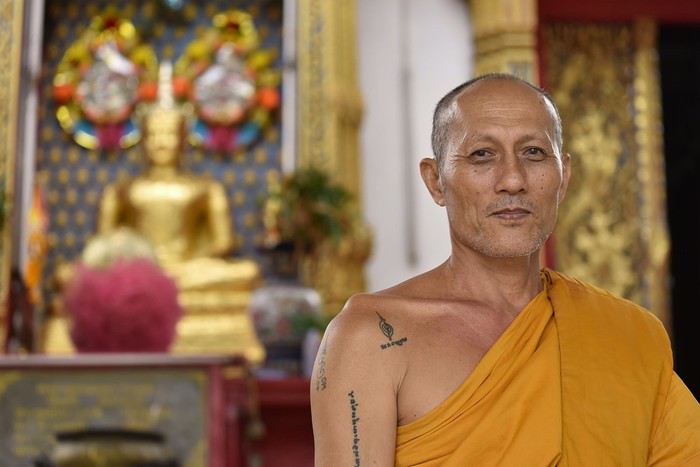
Bonjour à tous,
J'avoue avoir pas mal tergiversé avant de me décider à publier ce carnet. Car l'Asie du Sud-Est, à commencer par la Thaïlande, est une zone sur laquelle beaucoup de carnets ont déjà été publiés, notamment par des voyageurs qui sont devenus de vrais spécialistes du secteur.
Et puis finalement, ce voyage en famille fut un tel régal qu'il me semble normal de faire un retour sur VF. J'y prends régulièrement des infos pour préparer mes voyages (merci notamment à Anne alias Xeta pour son carnet et ses infos pratiques), alors ce carnet sera un juste retour des choses.
Tout aurait dû bien commencer pour ce voyage car, contrairement à nos avions pour l'Indonésie en 2015 et pour le Nicaragua en 2017, qui avaient tous les deux été annulés au dernier moment alors que nous étions quelques centaines à poireauter en salle d'embarquement, notre avion pour Bangkok a bien décollé, lui, en temps et en heure. Mais sans nous quand même !
En effet, quelques jours plus tôt, le brevet des collèges que passait notre fils aîné avait été décalé de quelques jours par le ministre pour cause de... canicule ! Les école maternelles n'ont pas été fermées mais les collèges qui accueillaient le brevet, si ! Allez comprendre. Toujours est-il que notre avion s'est trouvé à décoller quelques minutes seulement après la fin de la dernière épreuve du brevet, nous étions donc un poil trop courts pour l'attraper. Nous avons ainsi dû décaler notre vol de 24 heures. Nous attendons d'ailleurs toujours le remboursement partiel auquel nous avons droit mais peu importe, c'est une autre histoire...
Si je cite cette anecdote qui n'a apparemment rien à voir avec la Thaïlande, c'est parce qu'une fois arrivés à Bangkok, le monsieur à l'accueil de notre hôtel nous annonce qu'il a annulé par erreur les 3 nuitées que nous y avions réservées. J'avais pourtant envoyé 2 mails de confirmation de notre réservation en précisant que nous manquerions juste la première nuit et j'avais reçu une réponse positive, mais il a fait la boulette quand même ! Bref, après le coup de l'avion, quand ça veut pas, ben ça veut pas 🤪
Nous prenons donc la nouvelle avec le sourire (quoi de plus normal dans ce pays !), alors que notre interlocuteur de l'hôtel, lui, n'esquisse pas le moindre rictus. Il paraît que quand on va au pays du sourire, il y en a toujours un qui fait exception à la règle. Pour nous, ce sera donc celui-là ! Mais ce n'est pas bien grave, tous les autres rattraperont le coup après lui, au fil de notre séjour...
Enfin bon, après une demi-journée perdue bêtement pour chercher un autre hôtel, puis pour le rejoindre au milieu de l'intense circulation de Bangkok, notre voyage peut enfin commencer. Sauf que c'est l'heure de manger puis de se coucher. Le voyage commencera donc enfin demain.
BANGKOK
Selon le dernier classement des villes les plus visitées du monde, Bangkok se situe à... la première place ! Devant Londres (2e) et Paris (3e), excusez du peu. Et si certains quartiers ne sont pas spécialement sexy, certains sites en revanche constituent de pures merveilles et justifient un tel classement.
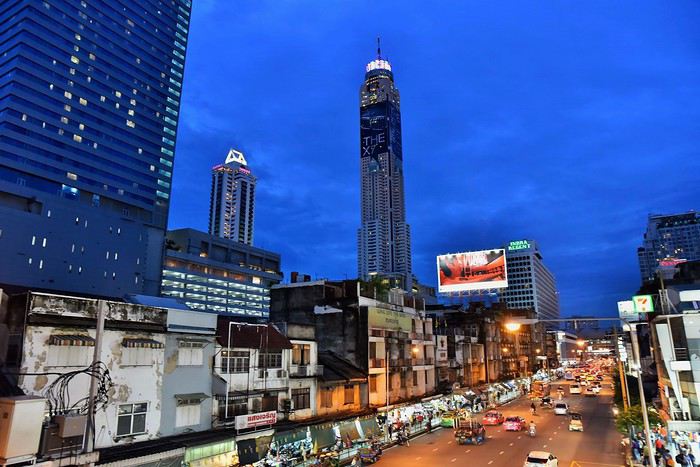
Après tous les problèmes que nous avons rencontrés d'emblée dans ce voyage, il ne nous reste plus qu'un jour pour visiter Bangkok, au lieu de deux et demi comme initialement prévu, sachant que nous y reviendrons une demi-journée au milieu du séjour.
Nous allons donc manquer de temps pour visiter la ville mais bon il faut faire avec et nous allons essayer de voir le maximum de choses pour cette première journée que nous n'avons pas volée !
Nous commençons donc par traverser, rapidement hélas, le marché aux fleurs.
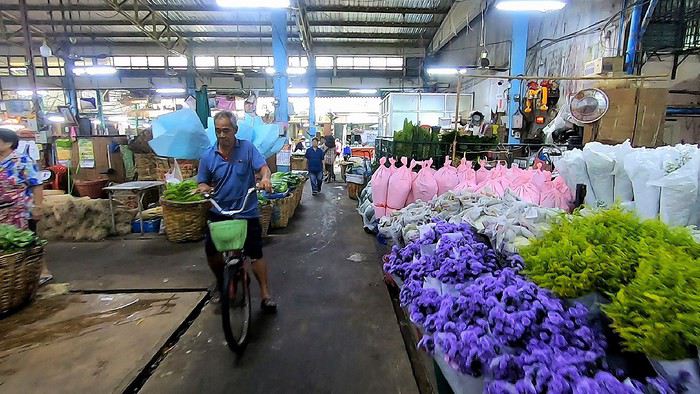
Il paraît qu'il est ouvert 24 heures sur 24. En tout cas lors de notre venue, il n'y a pas foule mais l'endroit, où il y a également pas mal de fruits et légumes, est vraiment agréable.
Nous enchaînons par l'un des fameux temples de Bangkok : le Wat Pho.
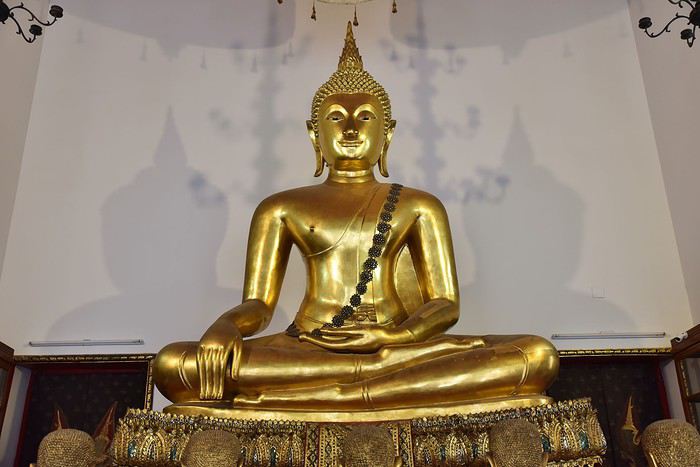
Son architecture nous dépayse totalement et je dois dire qu'avec le stress énorme que nous a causé pendant une semaine le report de notre départ, ce lieu sacré nous fait un bien fou. C'est pour vivre ce genre de moments que nous aimons tant voyager.
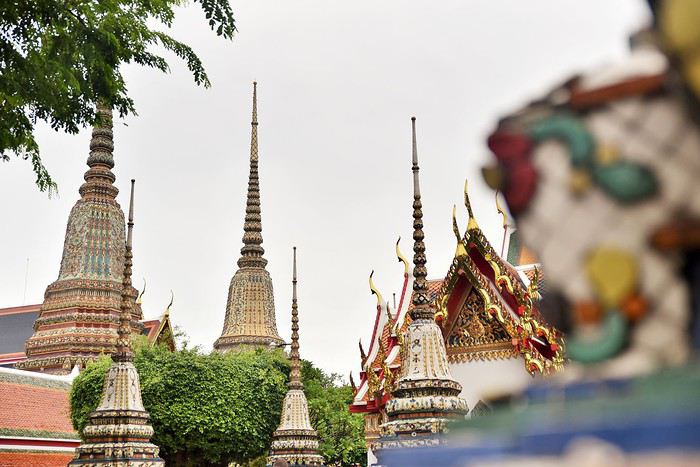
Alors bien sûr, le temps n'est pas très beau (pas étonnant, on est en juillet mais ça au moins, c'était prévu), contrairement au site !
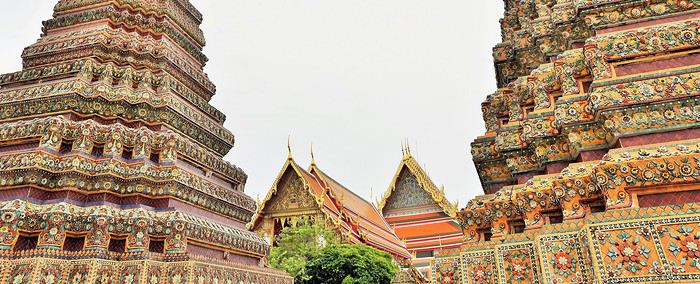
Là, ça y est, notre voyage est enfin bel et bien lancé.
A l'intérieur de ces bâtiments multicolores, les bouddhas sont omniprésents et rivalisent de sérénité.
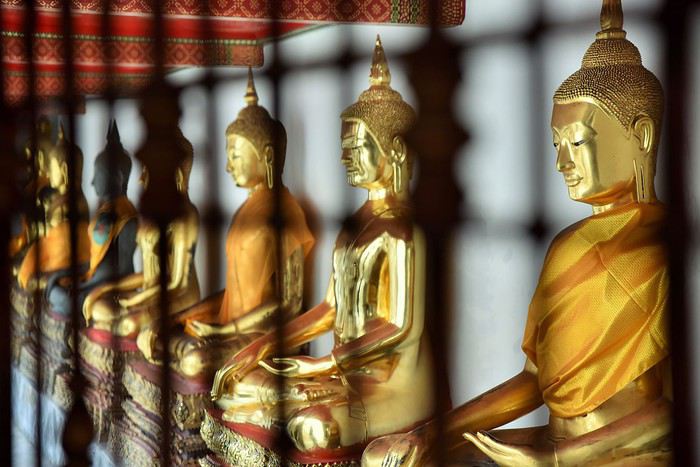
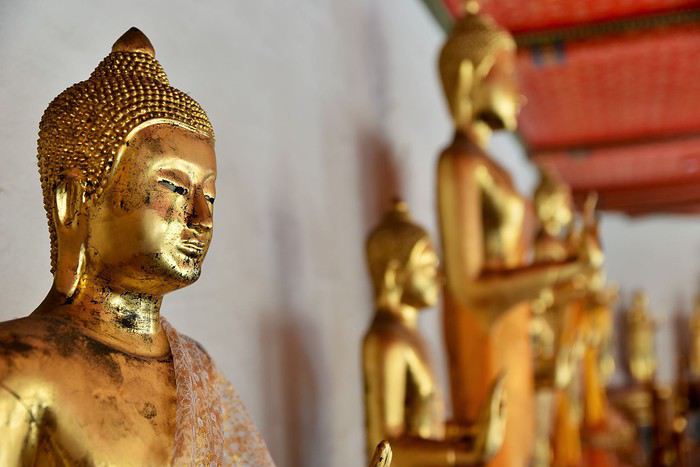
Le plus grand et le plus impressionnant d'entre eux, c'est Bouddha couché, représenté sur son lit de mort juste avant d'atteindre le Parinirvāṇa (la fin de l'existence physique pour qui a atteint l'éveil).
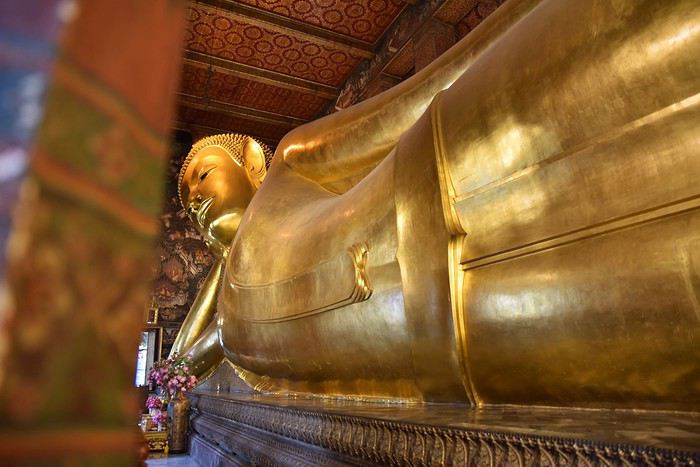
Ce magnifique bouddha est entièrement recouvert de feuilles d'or. Il nous impressionne.
La salle qui l'accueille, bien que très grande, semble trop exiguë pour cette statue qui en impose : 46 mètres de long sur 15 de haut.
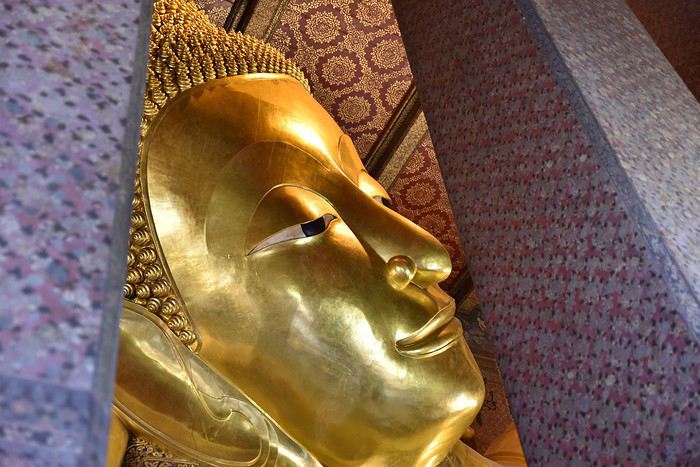
Et que dire de ses pieds, qui sont au moins aussi beaux que tout le reste : incrustés de nacre, ils représentent les 108 actions qui ont permis à Bouddha d'atteindre la perfection.
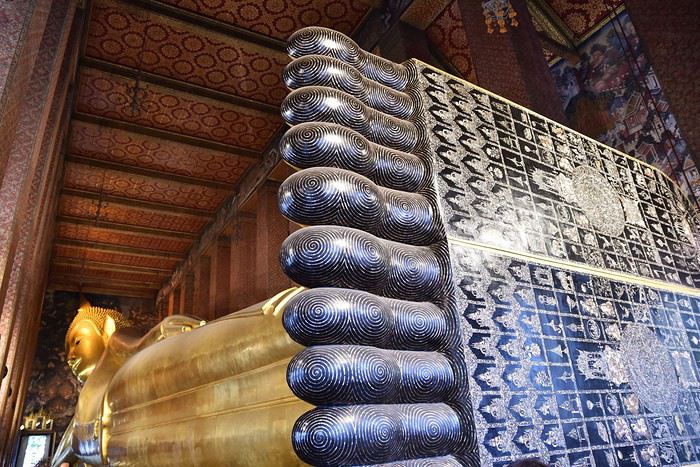
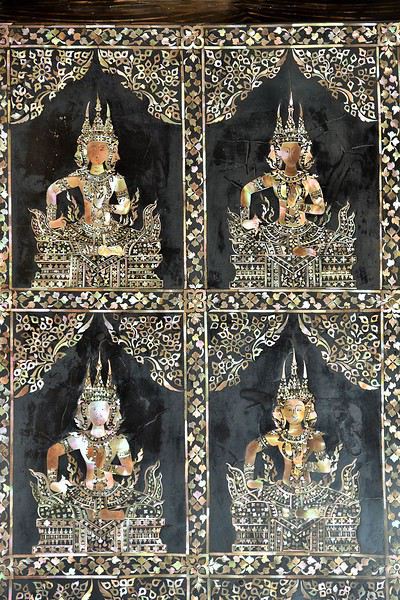
Ci-dessus : la plante du pied de Bouddha
Un peu plus loin se trouve le sanctuaire principal : l'Ubosot. A l'intérieur, on retrouve Bouddha, mais assis cette fois. C'est en dessous de cette statue toute en or et en cristal que sont conservées les cendres du célèbre roi Rama Ier (1737-1809).
A noter enfin que dans l'enceinte du Wat Pho, on trouve également une école de médecine et de massages traditionnels, qui fut créée pour assurer la transmission des savoirs ancestraux.
Aujourd'hui, elle assure la formation des étudiants venus du monde entier. Les visiteurs peuvent d'ailleurs se faire masser dans les règles de l'art, même si l'attente peut parfois être un peu longue...
Bon, finalement, il commence bien ce voyage en Thaïlande. Nous enchaînons avec un autre temple, le Wat Arun.
Contrairement au Wat Pho qui est très coloré, la Wat Arun apparaît plutôt blanc de loin. Mais de près, on constate que c'est une infinité de petites mosaïques colorées qui constituent ce gigantesque ensemble.
Une partie seulement des escaliers du prang central (72 mètres de haut) est ouverte au public, ce qui est suffisant pour avoir une jolie vue sur Bangkok quand le temps s'y prête... ce qui n'était pas le cas le jour de notre visite !
Si les deux temples que nous avons visités nous ont impressionnés, que dire de celui que nous allons voir dans la foulée : le Wat Phra Kaeo. Mais je posterai la suite dans un prochain message, ayant déjà presque atteint mon quota de photos...
Three-week itinerary in Kenya in January
Hello,
We’re planning a three-week trip to Kenya in January 2020 and wanted to share our itinerary. Maybe some of you have feedback or suggestions.
Our goals: we’re not big safari fans (though we do want to do 3 days of it), and that’s not why we’re going to Kenya. We’re huge nature lovers, into sports, hiking, meeting locals, agriculture, and food. We’d also like a few days of pure relaxation on the beach before heading back to Europe.
Here’s our rough itinerary:
Nairobi – arrive in the evening, overnight stay Travel to Mt. Kenya, start trekking Mt. Kenya Mt. Kenya Mt. Kenya Transfer to Meru? How? Rent a car? Guide (for the next three days?)? Meru safari Meru safari Samburu-Buffalo safari Transfer to Nakuru Nakuru – agriculture and people, members of the international Slow Food association Nakuru, Slow Food Nakuru, Slow Food Kichama, coffee plantations Hells Gate – walking or biking safari (Nairobi) Train to Mombasa, beach time and swimming Mombasa and surrounding area Mombasa and surrounding area Mombasa and surrounding area Mombasa and surrounding area Mombasa and surrounding area Train back to Nairobi
Thanks in advance for your thoughts!
We’re planning a three-week trip to Kenya in January 2020 and wanted to share our itinerary. Maybe some of you have feedback or suggestions.
Our goals: we’re not big safari fans (though we do want to do 3 days of it), and that’s not why we’re going to Kenya. We’re huge nature lovers, into sports, hiking, meeting locals, agriculture, and food. We’d also like a few days of pure relaxation on the beach before heading back to Europe.
Here’s our rough itinerary:
Nairobi – arrive in the evening, overnight stay Travel to Mt. Kenya, start trekking Mt. Kenya Mt. Kenya Mt. Kenya Transfer to Meru? How? Rent a car? Guide (for the next three days?)? Meru safari Meru safari Samburu-Buffalo safari Transfer to Nakuru Nakuru – agriculture and people, members of the international Slow Food association Nakuru, Slow Food Nakuru, Slow Food Kichama, coffee plantations Hells Gate – walking or biking safari (Nairobi) Train to Mombasa, beach time and swimming Mombasa and surrounding area Mombasa and surrounding area Mombasa and surrounding area Mombasa and surrounding area Mombasa and surrounding area Train back to Nairobi
Thanks in advance for your thoughts!
Retour d'un mois au Vietnam, des montagnes du nord au delta du Mekong
Après 2 premiers carnets de voyage publiés sur VF consacrés à des régions indonésiennes peu touristiques
"La traversée des Célèbes (Sulawesi) en photos"
ou même pas du tout touristique
"Les Moluques: splendeurs (et galères) d'un archipel inconnu des touristes
voici un nouveau récit abondamment illustré sur un voyage au Vietnam.
Même si de nombreux beaux carnets ont déjà été publiés sur le Vietnam, j’espère que ce voyage en images rappellera de bons souvenirs aux uns, fournira des renseignements utiles aux autres pour leur prochain voyage ou plus simplement vous fera passer un bon moment en parcourant ce magnifique pays.
Avant de partir, quelques rapides infos sur le contexte (certaines rubriques seront détaillées plus loin au fil du récit, par ex la météo à cette période) :
- voyage réalisé de mi-septembre à mi-octobre 2019 - onzième voyage en Asie du Sud Est- en couple comme chaque fois, c'est bp plus simple - déplacement en bus, taxi, minibus (limousine) et avion (1 fois) réservés sur place 1 ou 2 jours avant, et en voiture particulière la 1ere semaine - logements : du basique chez l'habitant à un très bel hôtel à Ho Chi Minh, avec une préférence pour les petits hôtels de charme - bp de temps passé sur les forums et les guides avant le départ pour recenser les lieux qui nous intéressent, puis parcours modifié au jour le jour en fc de la météo, des envies, de la fatigue, des rencontres, etc .. Avant le départ, on a une superbe liste de lieux "à voir absolument", et sur place on s'aperçoit que ce magnifique programme est bien trop ambitieux. On supprime alors tel ou tels endroits pour ne pas transformer le voyage en une épuisante course de vitesse. - on aime bien prendre notre temps, s’arrêter qqs jours si un lieu nous plait, sauter des visites "incontournables" si ça nous barbe (fatigue, chaleur, overdose de visites, ...). - à la suite de très bons conseils de forumeurs qui se reconnaitront (un grand merci a eux), on a fait une entorse à notre façon de voyager (aucune réservation avant le départ, excepté l’hôtel le jour de l'arrivée) en réservant 8 jours avec une agence locale pour parcourir les montagnes du nord avec chauffeur et guide francophone. Partir avec une agence était en effet la meilleure solution pour découvrir cette région dépourvue de bus en de nombreux endroits, et le guide est bien utile pour ne pas se perdre en randonnée.
Allez, on y va 🙂
Nos étapes : - Extrême nord (Ha Giang - Meo Vac) vers les ethnies montagnardes et rizières - Baie de Lan Ha "la jumelle de la baie d'Halong" - Hanoi - Tam Coc, "la baie d'Halong terrestre" - Hue - Hoi An - Delta du Mekong - Ho Chi Minh
Episode 1 : A la rencontre des ethnies des montagnes du nord
Pour nous qui voyageons seuls d'habitude, nous apprécions d'être attendu à l'aéroport d'Hanoi à 6h30 par Vinh notre guide Vinh et Near notre chauffeur, direction le nord. Aux 11h de vol, on ajoute donc 5-6h de voiture pour Bac Ha, dont la moité environ sur une belle autoroute déserte.
Bac Ha est une petite ville au milieu des montagnes, avec seulement qqs petits hotels de milieu de gamme et des guesthouse, ce qui fait qu'on y rencontre qqs touristes, mais sans excès. 2h après notre arrivée à Bac Ha, nous voila parti pour une 1ère randonnée au milieu des rizières qui dominent la ville.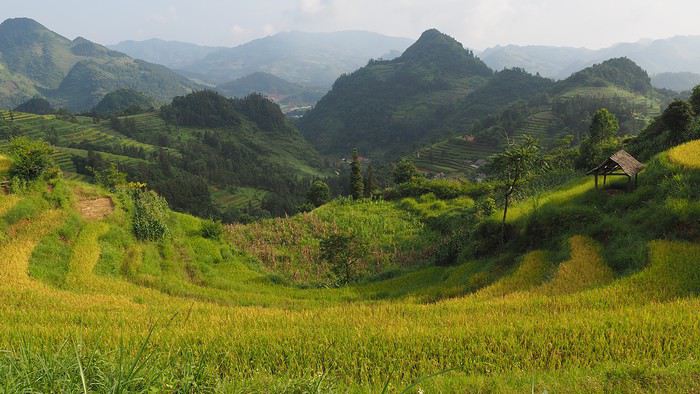
Ce ne sont pas les plus belles de la région, mais on passe un très agréable moment à se dégourdir les jambes après le voyage dans un tel environnement.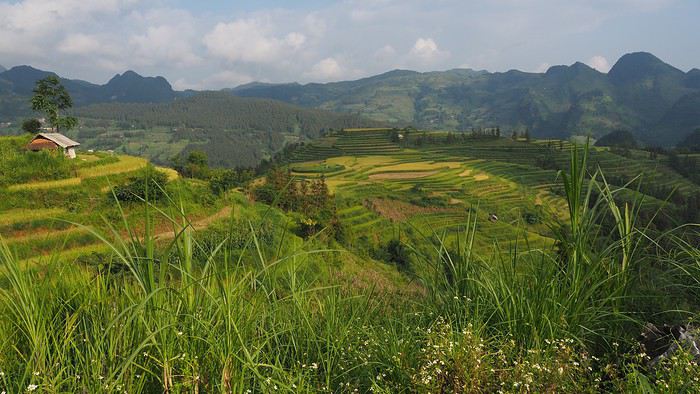 Comme convenu avec l'agence, 2 à 3h de marche entre villages et rizières seront chaque jour au programme : nous découvriront des villages, rencontreront des habitants de plusieurs ethnies au hasard des chemins, et marcherons tout simplement dans de magnifiques paysages de rizières.
Ethnie Hmong bariolé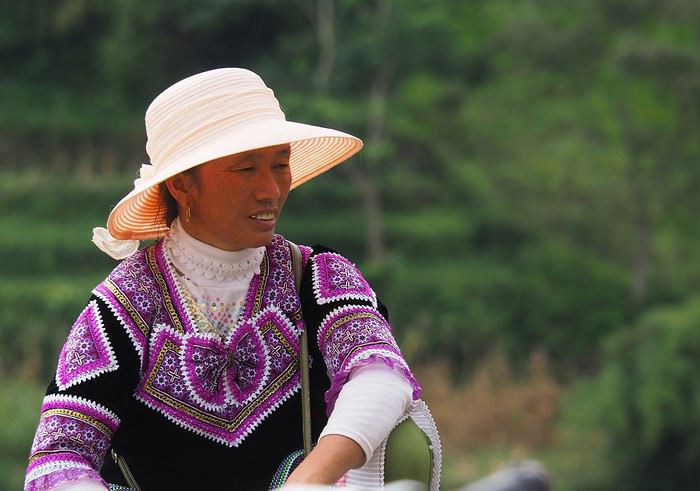
La région de Bac Ha est majoritairement habitée par de Hmong, ici Hmong à fleurs : (par la suite, si des erreurs se sont malheureusement glissées sur les noms d'ethnies, je ne me vexerai pas si les spécialistes rectifient 😉)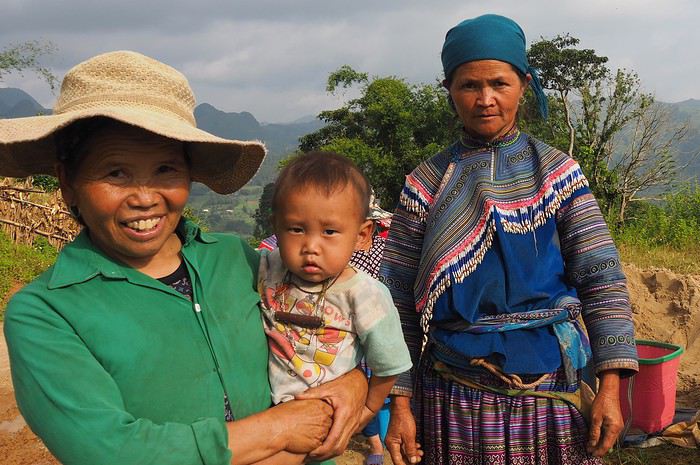
La récolte va bientôt commencer, les rizières commencent à passer du vert vif au jaune, nous les verrons jaune d'or dès le lendemain. Partout des paysans sont au travail : par l'intermédiaire de Vinh, nous échangeront à plusieurs reprises, eux qui sont aussi curieux sur nous que nous sur eux.
Le lendemain direction le marché de Can Cau a 45 min de Bac Ha (18km) sur une route zigzaguant dans un beau paysage de montagne (ce sera le régime de la semaine a venir).
67 ans de présence française ont laissé ces beaux souvenirs le long des routes :
Notre parcours a été étudié avec l'agence pour être sur les marchés de Can Cau le samedi, de Bac Ha le dimanche et de Lun Phin le mercredi suivant Le marché de Can Cau est situé en pleine nature, à flan de montagne.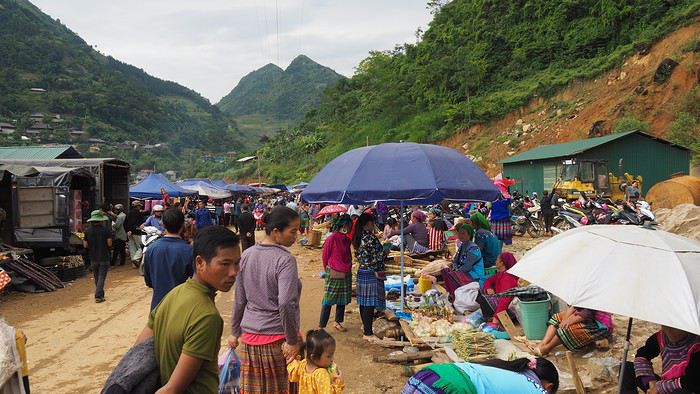
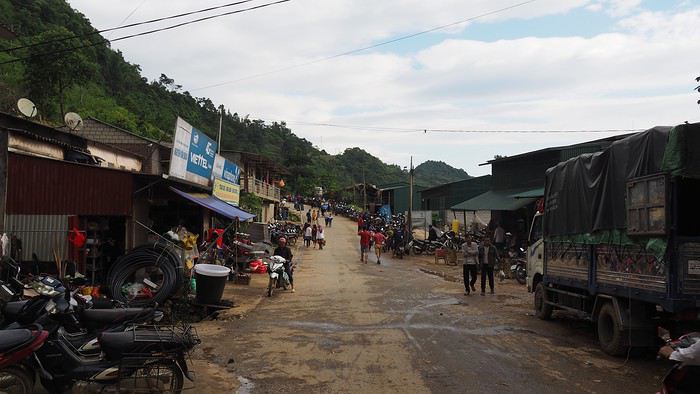
Hmong des alentours viennent y vendre ou acheter toutes sortes de produits, vêtements, nourritures, animaux vivants, oiseaux, etc ... :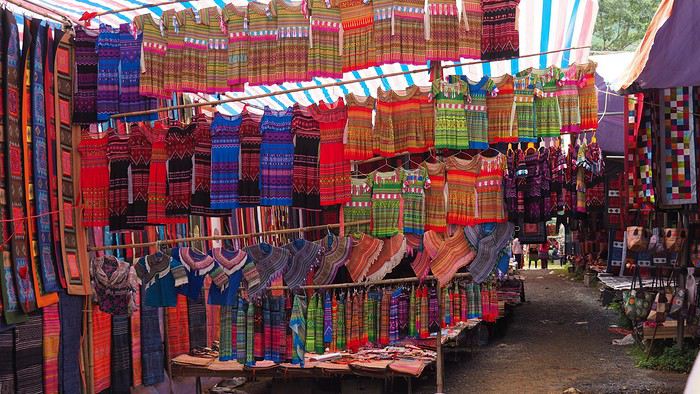
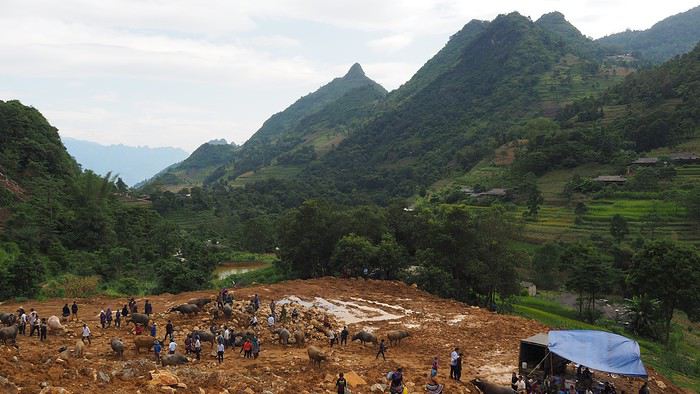
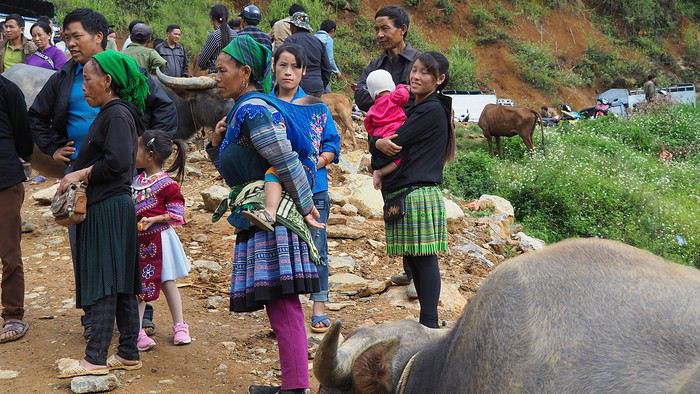
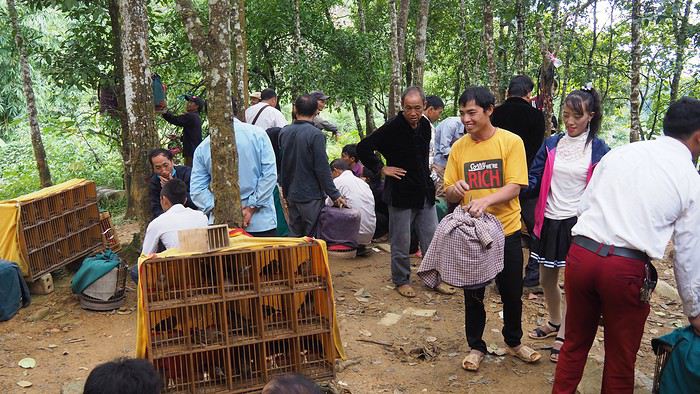
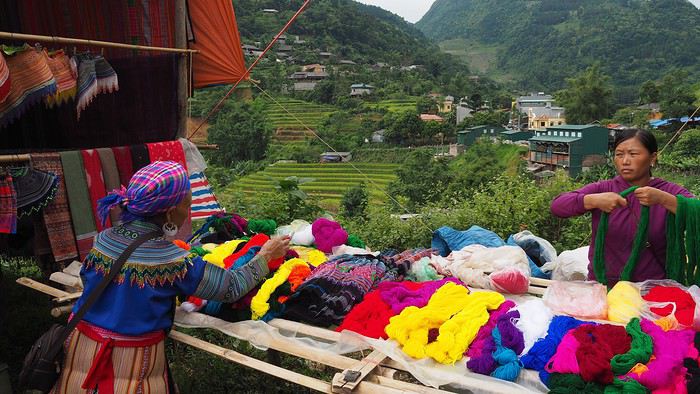 Hmong à fleurs(dessus et dessous)
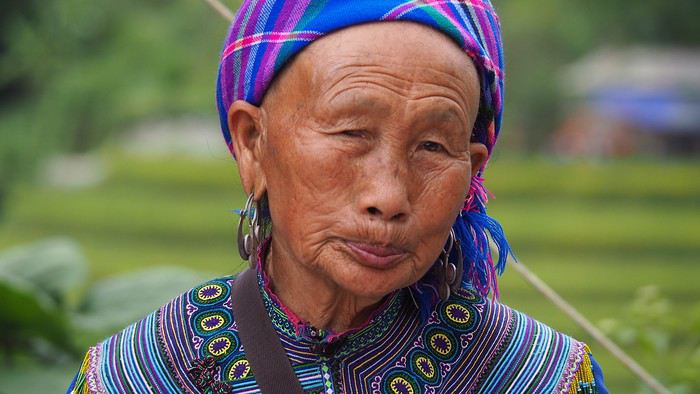
Certains repartent avec des vêtements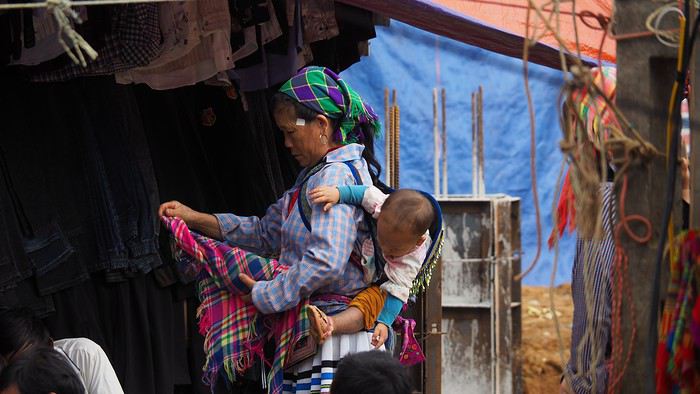
d'autres avec un porc ou une chèvre (pour l'achat de buffle la mobylette n'est pas conseillée)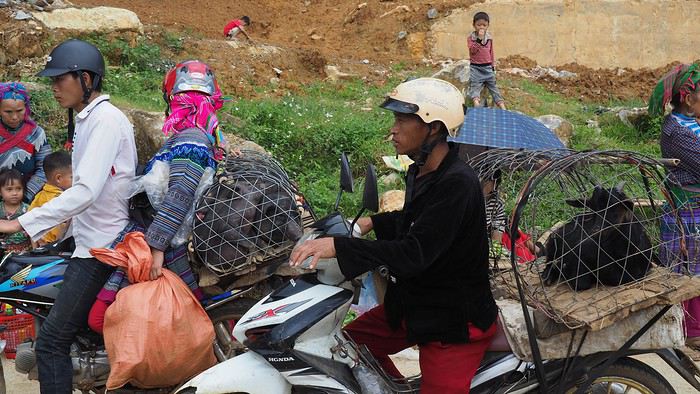
On est les seuls touristes. Le jour du marché est aussi l'occasion pour tous les villageois des alentours de se retrouver autour d'un thang cô (viande et intestins de bœuf dans un bouillon de sang, épices et herbes aromatiques) accompagné d’alcool de riz ou plus surprenant de Red Bull (!!) ... on n'arrête pas le progrès. On n'a pas gouté ce thang cô , le petit déjeuner n'étant pas loin .... excuse minable 😊
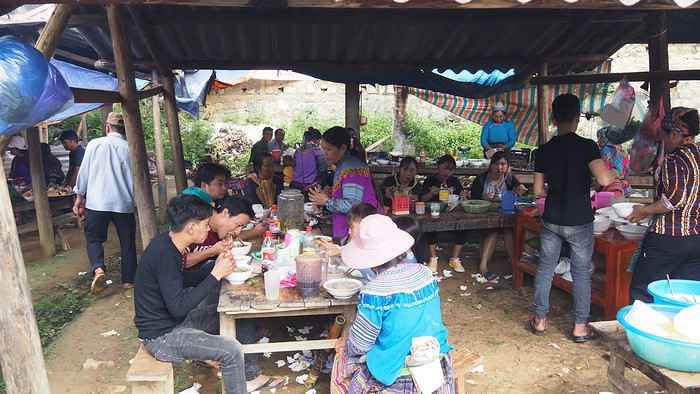
Red Bull et pipe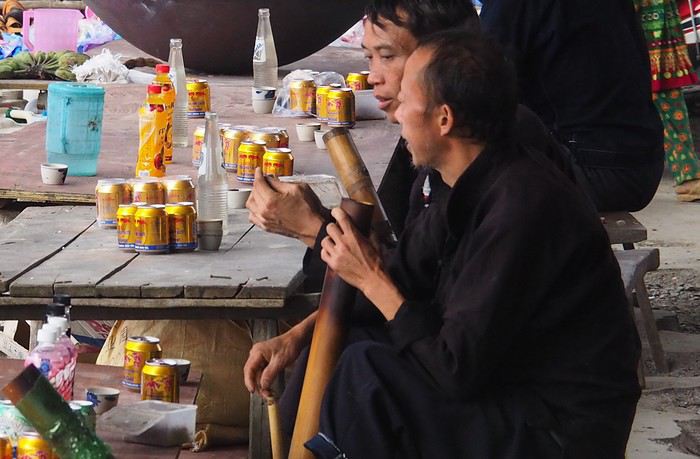
La suite très bientôt
Même si de nombreux beaux carnets ont déjà été publiés sur le Vietnam, j’espère que ce voyage en images rappellera de bons souvenirs aux uns, fournira des renseignements utiles aux autres pour leur prochain voyage ou plus simplement vous fera passer un bon moment en parcourant ce magnifique pays.
Avant de partir, quelques rapides infos sur le contexte (certaines rubriques seront détaillées plus loin au fil du récit, par ex la météo à cette période) :
- voyage réalisé de mi-septembre à mi-octobre 2019 - onzième voyage en Asie du Sud Est- en couple comme chaque fois, c'est bp plus simple - déplacement en bus, taxi, minibus (limousine) et avion (1 fois) réservés sur place 1 ou 2 jours avant, et en voiture particulière la 1ere semaine - logements : du basique chez l'habitant à un très bel hôtel à Ho Chi Minh, avec une préférence pour les petits hôtels de charme - bp de temps passé sur les forums et les guides avant le départ pour recenser les lieux qui nous intéressent, puis parcours modifié au jour le jour en fc de la météo, des envies, de la fatigue, des rencontres, etc .. Avant le départ, on a une superbe liste de lieux "à voir absolument", et sur place on s'aperçoit que ce magnifique programme est bien trop ambitieux. On supprime alors tel ou tels endroits pour ne pas transformer le voyage en une épuisante course de vitesse. - on aime bien prendre notre temps, s’arrêter qqs jours si un lieu nous plait, sauter des visites "incontournables" si ça nous barbe (fatigue, chaleur, overdose de visites, ...). - à la suite de très bons conseils de forumeurs qui se reconnaitront (un grand merci a eux), on a fait une entorse à notre façon de voyager (aucune réservation avant le départ, excepté l’hôtel le jour de l'arrivée) en réservant 8 jours avec une agence locale pour parcourir les montagnes du nord avec chauffeur et guide francophone. Partir avec une agence était en effet la meilleure solution pour découvrir cette région dépourvue de bus en de nombreux endroits, et le guide est bien utile pour ne pas se perdre en randonnée.
Allez, on y va 🙂
Nos étapes : - Extrême nord (Ha Giang - Meo Vac) vers les ethnies montagnardes et rizières - Baie de Lan Ha "la jumelle de la baie d'Halong" - Hanoi - Tam Coc, "la baie d'Halong terrestre" - Hue - Hoi An - Delta du Mekong - Ho Chi Minh
Episode 1 : A la rencontre des ethnies des montagnes du nord
Pour nous qui voyageons seuls d'habitude, nous apprécions d'être attendu à l'aéroport d'Hanoi à 6h30 par Vinh notre guide Vinh et Near notre chauffeur, direction le nord. Aux 11h de vol, on ajoute donc 5-6h de voiture pour Bac Ha, dont la moité environ sur une belle autoroute déserte.
Bac Ha est une petite ville au milieu des montagnes, avec seulement qqs petits hotels de milieu de gamme et des guesthouse, ce qui fait qu'on y rencontre qqs touristes, mais sans excès. 2h après notre arrivée à Bac Ha, nous voila parti pour une 1ère randonnée au milieu des rizières qui dominent la ville.
Ce ne sont pas les plus belles de la région, mais on passe un très agréable moment à se dégourdir les jambes après le voyage dans un tel environnement.
Comme convenu avec l'agence, 2 à 3h de marche entre villages et rizières seront chaque jour au programme : nous découvriront des villages, rencontreront des habitants de plusieurs ethnies au hasard des chemins, et marcherons tout simplement dans de magnifiques paysages de rizières.Ethnie Hmong bariolé
La région de Bac Ha est majoritairement habitée par de Hmong, ici Hmong à fleurs : (par la suite, si des erreurs se sont malheureusement glissées sur les noms d'ethnies, je ne me vexerai pas si les spécialistes rectifient 😉)
La récolte va bientôt commencer, les rizières commencent à passer du vert vif au jaune, nous les verrons jaune d'or dès le lendemain. Partout des paysans sont au travail : par l'intermédiaire de Vinh, nous échangeront à plusieurs reprises, eux qui sont aussi curieux sur nous que nous sur eux.
Le lendemain direction le marché de Can Cau a 45 min de Bac Ha (18km) sur une route zigzaguant dans un beau paysage de montagne (ce sera le régime de la semaine a venir).
67 ans de présence française ont laissé ces beaux souvenirs le long des routes :
Notre parcours a été étudié avec l'agence pour être sur les marchés de Can Cau le samedi, de Bac Ha le dimanche et de Lun Phin le mercredi suivant Le marché de Can Cau est situé en pleine nature, à flan de montagne.
Hmong des alentours viennent y vendre ou acheter toutes sortes de produits, vêtements, nourritures, animaux vivants, oiseaux, etc ... :
Hmong à fleurs(dessus et dessous)
Certains repartent avec des vêtements
d'autres avec un porc ou une chèvre (pour l'achat de buffle la mobylette n'est pas conseillée)
On est les seuls touristes. Le jour du marché est aussi l'occasion pour tous les villageois des alentours de se retrouver autour d'un thang cô (viande et intestins de bœuf dans un bouillon de sang, épices et herbes aromatiques) accompagné d’alcool de riz ou plus surprenant de Red Bull (!!) ... on n'arrête pas le progrès. On n'a pas gouté ce thang cô , le petit déjeuner n'étant pas loin .... excuse minable 😊
Red Bull et pipe
La suite très bientôt
In the Land of the Tswana (Botswana)
We’ve been back for a month now, so it’s high time I posted the story of our adventures! 😉 I’d also like to thank everyone who shared their own experiences on this forum (or elsewhere) and gave us tips—it really helped us plan our trip.
14/09/2019: Johannesburg - Vryburg After months of waiting and reading other travelers’ journals, it’s finally our turn! We arrived in Johannesburg from Nantes and Paris in the morning. We looked for the Bushlore rep—we’d rented our 4x4 from them—but there was no sign with our name! « Bushlore? She’s a woman, I saw her a few minutes ago, » someone told us. A minute later, the Bushlore employee showed up: a man! 🤪 He sped onto the highway, and just 30 minutes later, we arrived at the rental place. It’s a big operation with good organization and lots of vehicles—pretty reassuring. Our 4x4 was there, a classic Toyota Hilux fully equipped for safari: rooftop tent, dual diesel tanks, 60-liter water reserve, two batteries, two spare tires, all the camping gear, plus everything needed for *désensablement* (getting unstuck from sand). Speaking of which, is it "désensablage" or "désensablement"? Best to just avoid getting stuck in the first place! 😏 Good news… or not: the vehicle was brand new, with barely 100 kilometers on the odometer. On one hand, we figured we wouldn’t have mechanical issues or a fridge breakdown, but on the other, we knew it wouldn’t be easy to return it without a single scratch. Either way, it was our first time renting a 4x4, and we were impressed.
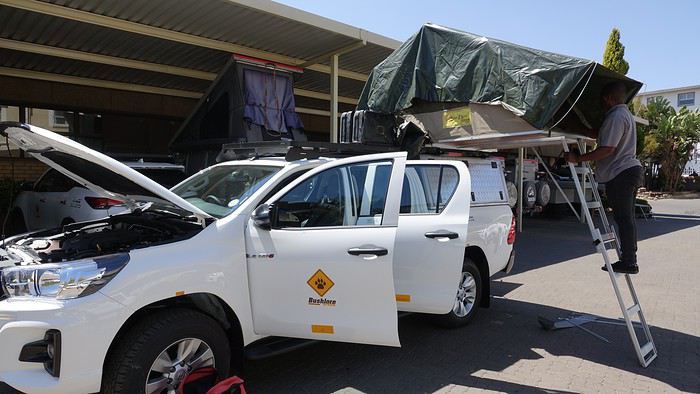
We set off toward Kgalagadi Transfrontier Park—it’s not exactly around the corner! In 1994 (when Mandela had just become President) and 2007, during our two previous trips to South Africa, we loved this park, so we couldn’t imagine going to Botswana without returning. The road was pretty monotonous, with not much to see except a few ostriches.
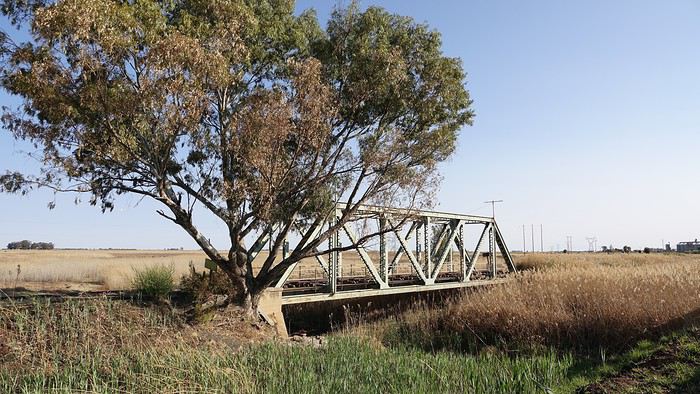
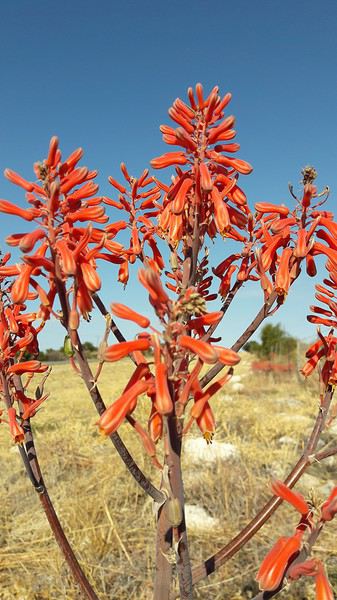
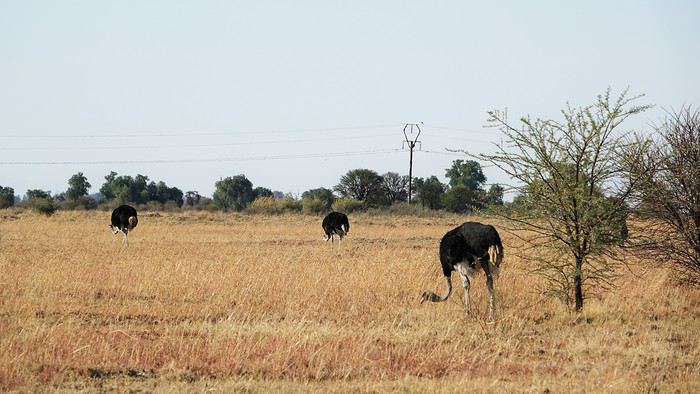
We stopped for the night in Vryburg at the Kameelboom Lodge campsite. It was a bit noisy since it’s close to the road, and the facilities weren’t great, but it was fine for one night.
14/09/2019: Johannesburg - Vryburg After months of waiting and reading other travelers’ journals, it’s finally our turn! We arrived in Johannesburg from Nantes and Paris in the morning. We looked for the Bushlore rep—we’d rented our 4x4 from them—but there was no sign with our name! « Bushlore? She’s a woman, I saw her a few minutes ago, » someone told us. A minute later, the Bushlore employee showed up: a man! 🤪 He sped onto the highway, and just 30 minutes later, we arrived at the rental place. It’s a big operation with good organization and lots of vehicles—pretty reassuring. Our 4x4 was there, a classic Toyota Hilux fully equipped for safari: rooftop tent, dual diesel tanks, 60-liter water reserve, two batteries, two spare tires, all the camping gear, plus everything needed for *désensablement* (getting unstuck from sand). Speaking of which, is it "désensablage" or "désensablement"? Best to just avoid getting stuck in the first place! 😏 Good news… or not: the vehicle was brand new, with barely 100 kilometers on the odometer. On one hand, we figured we wouldn’t have mechanical issues or a fridge breakdown, but on the other, we knew it wouldn’t be easy to return it without a single scratch. Either way, it was our first time renting a 4x4, and we were impressed.
We set off toward Kgalagadi Transfrontier Park—it’s not exactly around the corner! In 1994 (when Mandela had just become President) and 2007, during our two previous trips to South Africa, we loved this park, so we couldn’t imagine going to Botswana without returning. The road was pretty monotonous, with not much to see except a few ostriches.
We stopped for the night in Vryburg at the Kameelboom Lodge campsite. It was a bit noisy since it’s close to the road, and the facilities weren’t great, but it was fine for one night.