Results for "Maurice+déplacer"
About 9,323 results.
More options
Many results are in French, the community’s main language. English translations are added over time.
Search results
Itinéraire pour le Québec et l'Ontario
Bonjour,
Je commence à me projeter sur un voyage potentiel au Québec et Ontario pour l'été 2019. Période à priori Juillet. Voilà en premier jet, grâce aux excellents conseils et carnets trouvés ici, ce que j'ai noté. Qu'en pensez vous ? A savoir, nous sommes une famille de 4 dont 2 enfants qui auront 8 et 6 ans. La voiture ne nous fait pas trop peur, vu les distances je sais qu'on va en avaler. Les enfants marchent mais pas 5h, et idéalement s'il y a quelque chose au bout lol Le but du voyage est d'essayer de les sensibilisés aux différents paysages qu'offre le Canada, une expérience nature en somme . (Nous avons fait la Martinique en février cette année)
1 Vol vers Toronto (nuit toronto)
J2 Toronto ( nuit toronto ou niagara falls ?)
J3 Niagara falls nuit toronto
J4 route vers kingston/gananoque , croisière milles iles Gananoque boat line (10H30, 12H30, 13H30, 15H30, 16H30) (nuit kingston/gananoque)
J5 Ottawa (nuit Ottawa)
J6 Ottawa relève de la garde (10h) puis direction parc oméga nuit sur place
J7 Montreal (nuit montreal)
J8 Montreal (nuit Montreal )
J9 Route Quebec (nuit quebec)
J10 Québec (nuit Québec)
J11 Quebec puis départ baie saint paul en passant chutes montmorency et mont saint anne (nuit baie saint paul? )
J12 Baie saint paul, baignade, (les eboulements, cap aux oies ..) ile aux coudres ? Traversier (nuit Tadoussac)
J13 Tadoussac (croisiere baleines à 9h 2h en mer) (nuit Rimouski ou proche à voir en fonction traversier escoumins trois pistolles)
J14 Parc du BIC (nuit parc du bic ou proche)
J15 parc du bic et Rimouski, avec phare et sous marin (nuit comme veille)
J16 Canyon porte de l'enfer puis route vers baie des chaleurs (nuit escuminac ?)
J17 Bioparc Bonaventure (1H30) puis Rivière bonaventure , descente en canot (cime aventure 2H de descente famille à partir de 14H) route et nuit Percé
J18 croisière a l'ile bonaventure, chutes de la rivière aux emeraudes sur la route vers parc forillon (nuit à cap des rosiers)
J19 Parc du forillon J20 Parc du Forillon et Route vers parc de la gaspesie (sainte anne des monts )
J21 Exploramer et Parc de la gaspesie (randonnée)
J22 Parc de la gaspésie puis route vers riviere du loup (ou autre pour couper la route du retour vers Montreal)
J23 Retour Montreal vol en soirée
Itinéraire somme toute assez classique . Que pensez vous des durées sur places ? Je sais qu'il serait bon de rester 2 jour a Percé en cas de mauvais temps pour l'ile bonaventure, je pense qu'on pourra essayer de jongler avec Le parc forillon si jamais . 2j parc du bic ? pareil pour forillon? Trop ? Sachant qu'on fera quelques rando mais pas énormément non plus avec le enfants .. parc du bic j'ai vu qu'il y avait pas mal d'animation pour les petits . Ca reste un premier jet. Merci pour ceux qui prendront le temps de me lire et me répondre ;)
Je commence à me projeter sur un voyage potentiel au Québec et Ontario pour l'été 2019. Période à priori Juillet. Voilà en premier jet, grâce aux excellents conseils et carnets trouvés ici, ce que j'ai noté. Qu'en pensez vous ? A savoir, nous sommes une famille de 4 dont 2 enfants qui auront 8 et 6 ans. La voiture ne nous fait pas trop peur, vu les distances je sais qu'on va en avaler. Les enfants marchent mais pas 5h, et idéalement s'il y a quelque chose au bout lol Le but du voyage est d'essayer de les sensibilisés aux différents paysages qu'offre le Canada, une expérience nature en somme . (Nous avons fait la Martinique en février cette année)
1 Vol vers Toronto (nuit toronto)
J2 Toronto ( nuit toronto ou niagara falls ?)
J3 Niagara falls nuit toronto
J4 route vers kingston/gananoque , croisière milles iles Gananoque boat line (10H30, 12H30, 13H30, 15H30, 16H30) (nuit kingston/gananoque)
J5 Ottawa (nuit Ottawa)
J6 Ottawa relève de la garde (10h) puis direction parc oméga nuit sur place
J7 Montreal (nuit montreal)
J8 Montreal (nuit Montreal )
J9 Route Quebec (nuit quebec)
J10 Québec (nuit Québec)
J11 Quebec puis départ baie saint paul en passant chutes montmorency et mont saint anne (nuit baie saint paul? )
J12 Baie saint paul, baignade, (les eboulements, cap aux oies ..) ile aux coudres ? Traversier (nuit Tadoussac)
J13 Tadoussac (croisiere baleines à 9h 2h en mer) (nuit Rimouski ou proche à voir en fonction traversier escoumins trois pistolles)
J14 Parc du BIC (nuit parc du bic ou proche)
J15 parc du bic et Rimouski, avec phare et sous marin (nuit comme veille)
J16 Canyon porte de l'enfer puis route vers baie des chaleurs (nuit escuminac ?)
J17 Bioparc Bonaventure (1H30) puis Rivière bonaventure , descente en canot (cime aventure 2H de descente famille à partir de 14H) route et nuit Percé
J18 croisière a l'ile bonaventure, chutes de la rivière aux emeraudes sur la route vers parc forillon (nuit à cap des rosiers)
J19 Parc du forillon J20 Parc du Forillon et Route vers parc de la gaspesie (sainte anne des monts )
J21 Exploramer et Parc de la gaspesie (randonnée)
J22 Parc de la gaspésie puis route vers riviere du loup (ou autre pour couper la route du retour vers Montreal)
J23 Retour Montreal vol en soirée
Itinéraire somme toute assez classique . Que pensez vous des durées sur places ? Je sais qu'il serait bon de rester 2 jour a Percé en cas de mauvais temps pour l'ile bonaventure, je pense qu'on pourra essayer de jongler avec Le parc forillon si jamais . 2j parc du bic ? pareil pour forillon? Trop ? Sachant qu'on fera quelques rando mais pas énormément non plus avec le enfants .. parc du bic j'ai vu qu'il y avait pas mal d'animation pour les petits . Ca reste un premier jet. Merci pour ceux qui prendront le temps de me lire et me répondre ;)
Off on a winter adventure in the American West!
Day 1 – February 14
We all have two lives. And the second one kicks off the day you realize you only have one, with the determination to spend the time you have left on what truly adds sparkle to your life, Kevin! I like to elegantly introduce a trip with a philosophical quote. First, it gives you the illusion that I’m some kind of deep thinker, and second, it lets me fill up the first few lines of my blank page when I don’t know how to tell you I’m diving back into what really lights up my life: another adventure beyond the horizon! And nearly every other year, like a toxic relationship, my horizon tends to take shape in Uncle Sam’s backyard. And this, despite his cousin Donald calling the shots. Speaking of which, it was partly that impulsive guy who pushed us to be just as impulsive and snag our four flight tickets at a ridiculously low price—a direct result of foreign tourism taking a hit from BetaMax’s repeated antics... Four tickets? Who are the other lucky ones? In this case, our lucky ones are actually lucky ladies: My Flo, always up for exploring the world with me on foot, camelback, or scooter, is obviously in on the fun. The other two seats went to our daughters, Sasha and Luna, both thrilled to be part of this new American adventure...
But what’s the American West like in February?... A gamble. Let’s call it Russian roulette since we’re not landing during peak weather season. That’s why we encouraged our transportation and accommodation to get cozy and produce a little camper van, so we can stay ultra-flexible in the face of any weather tantrums. We’ll be roaming in Kara the van with the motto "Follow the sun!" Bad weather? We bolt. Snow? We speed up. Sunny? We act like it was the plan all along and soak it up.
"Okay, but why keep coming back to the same corner of the globe? After ten American adventures, you must be tired of seeing the same things, right?" But I’m not crazy, you know!... The American West is like making love to your gorgeous wife over and over, always enjoying it just as much. And contrary to what you might think, the American West isn’t just the Grand Canyon, Monument Valley, Las Vegas, and Bryce Canyon. Proof is, after ten trips to the U.S., my retinas are still untouched by three-quarters of the places I scribbled on a napkin for this adventure... Oh, and add to that my wife, who I’ve easily converted to my religion, and boom... relapse is even easier! Because yes, we’ve landed in Los Angeles after a sunny flight over Greenland, still under Danish flag for now. And we’re already heading east through the XXL traffic of L.A.’s eight-lane highways, eager to dive into our first discoveries. But first, night is taking over the sky, and second, we’ve been officially awake for 24 hours, so I suggest wrapping up this intro. I’ll tell you more tomorrow morning. Sound good?

We all have two lives. And the second one kicks off the day you realize you only have one, with the determination to spend the time you have left on what truly adds sparkle to your life, Kevin! I like to elegantly introduce a trip with a philosophical quote. First, it gives you the illusion that I’m some kind of deep thinker, and second, it lets me fill up the first few lines of my blank page when I don’t know how to tell you I’m diving back into what really lights up my life: another adventure beyond the horizon! And nearly every other year, like a toxic relationship, my horizon tends to take shape in Uncle Sam’s backyard. And this, despite his cousin Donald calling the shots. Speaking of which, it was partly that impulsive guy who pushed us to be just as impulsive and snag our four flight tickets at a ridiculously low price—a direct result of foreign tourism taking a hit from BetaMax’s repeated antics... Four tickets? Who are the other lucky ones? In this case, our lucky ones are actually lucky ladies: My Flo, always up for exploring the world with me on foot, camelback, or scooter, is obviously in on the fun. The other two seats went to our daughters, Sasha and Luna, both thrilled to be part of this new American adventure...
But what’s the American West like in February?... A gamble. Let’s call it Russian roulette since we’re not landing during peak weather season. That’s why we encouraged our transportation and accommodation to get cozy and produce a little camper van, so we can stay ultra-flexible in the face of any weather tantrums. We’ll be roaming in Kara the van with the motto "Follow the sun!" Bad weather? We bolt. Snow? We speed up. Sunny? We act like it was the plan all along and soak it up.
"Okay, but why keep coming back to the same corner of the globe? After ten American adventures, you must be tired of seeing the same things, right?" But I’m not crazy, you know!... The American West is like making love to your gorgeous wife over and over, always enjoying it just as much. And contrary to what you might think, the American West isn’t just the Grand Canyon, Monument Valley, Las Vegas, and Bryce Canyon. Proof is, after ten trips to the U.S., my retinas are still untouched by three-quarters of the places I scribbled on a napkin for this adventure... Oh, and add to that my wife, who I’ve easily converted to my religion, and boom... relapse is even easier! Because yes, we’ve landed in Los Angeles after a sunny flight over Greenland, still under Danish flag for now. And we’re already heading east through the XXL traffic of L.A.’s eight-lane highways, eager to dive into our first discoveries. But first, night is taking over the sky, and second, we’ve been officially awake for 24 hours, so I suggest wrapping up this intro. I’ll tell you more tomorrow morning. Sound good?
Back in Tunisia (live account)
Hi there,
On this forum, I shared my first trip to Tunisia from mid-February to early March (https://voyageforum.com/forum/impressions-tunisiennes-en-direct-d11460662/), a stay I enjoyed so much that six weeks later, I’m back in Tunisia for a full 15 days (I return on April 27).
This time, I landed in Monastir on a direct flight from Nice, again with Tunisair. We left about ten minutes late, and the flight lasted around 1 hour 30 minutes. A meal was served on board (cucumber salad with Edam-like cheese, carrots, and two small portions of dishes I couldn’t identify—semolina with peppers, olives, and parsley, two small rolls, a square of processed cheese, and a chocolate cake). It’s worth noting because it’s not common on flights this short.
In February, France and Tunisia were in the same time zone, but now Tunisia is one hour behind. This time difference and the flight duration work perfectly for a short 15-day trip since it takes me a few days to adjust to jet lag.
Luckily, I’d asked my hotel about the taxi fare from the airport because the drivers (there were several around me) didn’t hesitate to quote outrageous prices. The actual fare is 20 dinars, but one asked for 120 dinars. I refused, and another offered 60 dinars. I replied, "That’s too expensive—I’ll take the metro!" (Having tried the Tunis metro, I had no desire to repeat the experience in Monastir with a suitcase!). I started walking toward the metro, and one of the drivers caught up with me, saying, "20 dinars is fine!" I’ll skip the details, but the negotiation took a little while. When I arrived at the hotel, I told the receptionist someone had asked for 120 dinars. He put his hands to his head and said, "They’re awful!" He remembered our phone call two days earlier when I’d booked (he’s the one who told me I could take the metro).
The Mezri Hotel isn’t expensive. I got a sea-view room for 75 dinars (22 €). (I’d booked a balcony room for 90 dinars but wouldn’t have had time to enjoy it.) It’s well-located but noisy because there’s no double glazing. The receptionist is a very kind older gentleman. He called a friend whose wife is from Tozeur to find out if I should take a bus or a *louage* tomorrow and what time.
I arrived at the hotel around 7:00 PM and had time to stroll along the corniche to the ribat. Despite some run-down buildings, the seaside seemed livelier and cheerier than Sousse’s.
Monastir is the hometown of former president Bourguiba. I passed his mausoleum by taxi. There are Tunisian flags along the avenue by the sea because every year on April 6—the anniversary of Habib Bourguiba’s death—the president of the Republic visits the Bourguiba Mausoleum in Monastir to pay respects.
The taxi driver mentioned other Tunisian presidents. He complained about rising prices and insecurity, blaming President Kaïs Saïed (I’d already heard that security was better under Ben Ali).
At the end of my stay, I’ll take time to explore Monastir, but tomorrow morning, I’m off to Tozeur—a long bus ride awaits me.
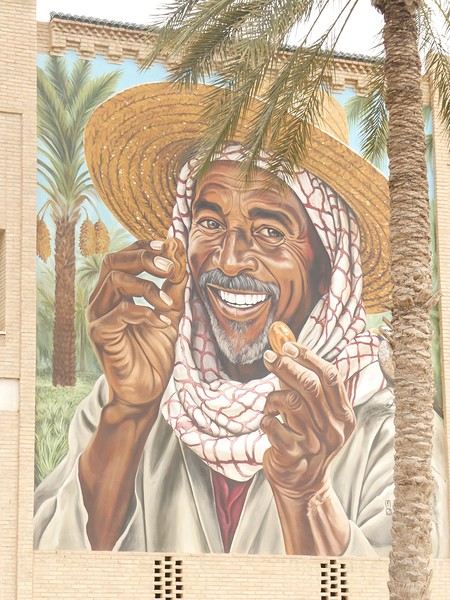

TO BE CONTINUED....
On this forum, I shared my first trip to Tunisia from mid-February to early March (https://voyageforum.com/forum/impressions-tunisiennes-en-direct-d11460662/), a stay I enjoyed so much that six weeks later, I’m back in Tunisia for a full 15 days (I return on April 27).
This time, I landed in Monastir on a direct flight from Nice, again with Tunisair. We left about ten minutes late, and the flight lasted around 1 hour 30 minutes. A meal was served on board (cucumber salad with Edam-like cheese, carrots, and two small portions of dishes I couldn’t identify—semolina with peppers, olives, and parsley, two small rolls, a square of processed cheese, and a chocolate cake). It’s worth noting because it’s not common on flights this short.
In February, France and Tunisia were in the same time zone, but now Tunisia is one hour behind. This time difference and the flight duration work perfectly for a short 15-day trip since it takes me a few days to adjust to jet lag.
Luckily, I’d asked my hotel about the taxi fare from the airport because the drivers (there were several around me) didn’t hesitate to quote outrageous prices. The actual fare is 20 dinars, but one asked for 120 dinars. I refused, and another offered 60 dinars. I replied, "That’s too expensive—I’ll take the metro!" (Having tried the Tunis metro, I had no desire to repeat the experience in Monastir with a suitcase!). I started walking toward the metro, and one of the drivers caught up with me, saying, "20 dinars is fine!" I’ll skip the details, but the negotiation took a little while. When I arrived at the hotel, I told the receptionist someone had asked for 120 dinars. He put his hands to his head and said, "They’re awful!" He remembered our phone call two days earlier when I’d booked (he’s the one who told me I could take the metro).
The Mezri Hotel isn’t expensive. I got a sea-view room for 75 dinars (22 €). (I’d booked a balcony room for 90 dinars but wouldn’t have had time to enjoy it.) It’s well-located but noisy because there’s no double glazing. The receptionist is a very kind older gentleman. He called a friend whose wife is from Tozeur to find out if I should take a bus or a *louage* tomorrow and what time.
I arrived at the hotel around 7:00 PM and had time to stroll along the corniche to the ribat. Despite some run-down buildings, the seaside seemed livelier and cheerier than Sousse’s.
Monastir is the hometown of former president Bourguiba. I passed his mausoleum by taxi. There are Tunisian flags along the avenue by the sea because every year on April 6—the anniversary of Habib Bourguiba’s death—the president of the Republic visits the Bourguiba Mausoleum in Monastir to pay respects.
The taxi driver mentioned other Tunisian presidents. He complained about rising prices and insecurity, blaming President Kaïs Saïed (I’d already heard that security was better under Ben Ali).
At the end of my stay, I’ll take time to explore Monastir, but tomorrow morning, I’m off to Tozeur—a long bus ride awaits me.
TO BE CONTINUED....
The Foam of Days
Now that the curtain has fallen on the past year, it’s time to see what’s happening around here.
It seems pretty quiet, but I’ll read more in detail later.
First, I need to tell you all an anecdote.
My eldest little girl, in her third year of law school, was really scared she wouldn’t pass the year. I told her: “Trust yourself, you’ve worked so hard, and worst case, if you fail, you’ll just redo the year.” “But I don’t think I’ll make it—they changed the rules, and if I mess up even one unit, I have to start all over.” I knew her grades weren’t exactly stellar, and with what I was about to say, I wasn’t taking much of a risk. “Here’s the deal, sweetheart: if you pass, I promise I’ll take you to India, just the two of us.” I have to admit, India is a country I’ve talked about so much to all my grandchildren that in their minds, it’s become a magical, mythical place (hmm).
July had barely begun when my phone rang, her name flashing on the screen. “Mamido, I did it!” My promise came rushing back—oh no, oh no, oh no! “Congratulations, sweetheart!” A little shyly, she said: “Is the India trip still on?”
And me, replying: “Of course it is!”
And that’s that—a promise is a promise, or you risk losing that precious trust that keeps hearts warm and at peace.
We’re leaving in February. Only 8 days—yikes, the carbon footprint! But we can’t miss her tutorials, or she’ll be kicked out. Personally, that works just fine for me.
Going to India has become a challenge for me. It’s far, it’s exhausting, I sweat, I hate mosquitoes, the spices bother my mouth when I used to love them. There’s noise all the time—at night, the dogs bark nonstop, and we almost get run over. I’ll get lost in the streets because my sense of direction has vanished. I don’t like rice anymore. All that chaos and those cultural differences that once enchanted me now just overwhelm me. But I promised.
The upside—and it’s a big one—Raman, the same driver I’ve had forever, will be at the airport with a sign with our names. We’ll stop at the same little shop for chai (or tea, plain and simple) with that aroma that intoxicates me, halfway through the trip.
It’ll be a tiny trip—staying with friends, I’ll show her a few places I love: Chidambaram, Mamallapuram, and the clinic where I worked. Then we’ll head back. My little girl will go home to her parents.
As for me, I’ll leave right away for our Scottish island with Homme for our chilly winter.
How can you love a country so much you want to live there, then suddenly reject it, no longer able to appreciate what once made it special? That’s the mystery of love, I guess.
First, I need to tell you all an anecdote.
My eldest little girl, in her third year of law school, was really scared she wouldn’t pass the year. I told her: “Trust yourself, you’ve worked so hard, and worst case, if you fail, you’ll just redo the year.” “But I don’t think I’ll make it—they changed the rules, and if I mess up even one unit, I have to start all over.” I knew her grades weren’t exactly stellar, and with what I was about to say, I wasn’t taking much of a risk. “Here’s the deal, sweetheart: if you pass, I promise I’ll take you to India, just the two of us.” I have to admit, India is a country I’ve talked about so much to all my grandchildren that in their minds, it’s become a magical, mythical place (hmm).
July had barely begun when my phone rang, her name flashing on the screen. “Mamido, I did it!” My promise came rushing back—oh no, oh no, oh no! “Congratulations, sweetheart!” A little shyly, she said: “Is the India trip still on?”
And me, replying: “Of course it is!”
And that’s that—a promise is a promise, or you risk losing that precious trust that keeps hearts warm and at peace.
We’re leaving in February. Only 8 days—yikes, the carbon footprint! But we can’t miss her tutorials, or she’ll be kicked out. Personally, that works just fine for me.
Going to India has become a challenge for me. It’s far, it’s exhausting, I sweat, I hate mosquitoes, the spices bother my mouth when I used to love them. There’s noise all the time—at night, the dogs bark nonstop, and we almost get run over. I’ll get lost in the streets because my sense of direction has vanished. I don’t like rice anymore. All that chaos and those cultural differences that once enchanted me now just overwhelm me. But I promised.
The upside—and it’s a big one—Raman, the same driver I’ve had forever, will be at the airport with a sign with our names. We’ll stop at the same little shop for chai (or tea, plain and simple) with that aroma that intoxicates me, halfway through the trip.
It’ll be a tiny trip—staying with friends, I’ll show her a few places I love: Chidambaram, Mamallapuram, and the clinic where I worked. Then we’ll head back. My little girl will go home to her parents.
As for me, I’ll leave right away for our Scottish island with Homme for our chilly winter.
How can you love a country so much you want to live there, then suddenly reject it, no longer able to appreciate what once made it special? That’s the mystery of love, I guess.
Bright red and a headache
Hello 🙂
I should be serving a warming drink to the participants in the discussion about gardens and parks that provide us with beautiful photos, I could mention the delicious buttery scent wafting from bakeries in the thread about returning to France, but my heart, its powerful pulse that nourishes my entire being, is elsewhere.
Dasht-e Lut, Yazd, Esfahan, Bam, Kerman, Qeshm, Hormuz—a melody, a prayer at the heart of desire.
A dream, an unattainable fantasy? No. Not anymore. A very serious Italian travel agency is organizing this trip for 6 people this winter. I’m signed up, I’m going, I’m living. Maybe.
"But you’re completely crazy!!!!"
I know... I know that every civilization, every society has a vital need to create scapegoats to define and justify itself, pathetically. And Iran is one of them, top of the list. I laugh or sigh, and it doesn’t bother me.
But that unchanging red, deep red and garnet, so beautiful in itself, in all the Western chancelleries repeats, whispers, shouts: don’t go, don’t go, don’t go, you’re putting yourself in danger and we can’t do anything for you. You’ll be turned into mere bargaining chips, into arguments for endless negotiations. Fear must be instilled, its power absolutely preserved, no concessions made to the enemy. The information (how many French hostages, real or fake, compared to the number of travelers?) is always lacking.
Traveling becomes a merciless confrontation between desire, the vital pulse, and anxiety, its ghosts.
Catherine
I should be serving a warming drink to the participants in the discussion about gardens and parks that provide us with beautiful photos, I could mention the delicious buttery scent wafting from bakeries in the thread about returning to France, but my heart, its powerful pulse that nourishes my entire being, is elsewhere.
Dasht-e Lut, Yazd, Esfahan, Bam, Kerman, Qeshm, Hormuz—a melody, a prayer at the heart of desire.
A dream, an unattainable fantasy? No. Not anymore. A very serious Italian travel agency is organizing this trip for 6 people this winter. I’m signed up, I’m going, I’m living. Maybe.
"But you’re completely crazy!!!!"
I know... I know that every civilization, every society has a vital need to create scapegoats to define and justify itself, pathetically. And Iran is one of them, top of the list. I laugh or sigh, and it doesn’t bother me.
But that unchanging red, deep red and garnet, so beautiful in itself, in all the Western chancelleries repeats, whispers, shouts: don’t go, don’t go, don’t go, you’re putting yourself in danger and we can’t do anything for you. You’ll be turned into mere bargaining chips, into arguments for endless negotiations. Fear must be instilled, its power absolutely preserved, no concessions made to the enemy. The information (how many French hostages, real or fake, compared to the number of travelers?) is always lacking.
Traveling becomes a merciless confrontation between desire, the vital pulse, and anxiety, its ghosts.
Catherine
Croatia, Montenegro – two victims of overtourism?
Mid-June, two Auvergnats on the starting blocks—off we go to the former Yugoslavia!
We’d already explored some nooks and crannies of northern Croatia back in 2019, so we’re keeping the momentum going by planning a trip to the south of the country and then Montenegro.
On the way back, we’ll drift into Bosnia-Herzegovina just to mix things up a bit!
We’re a little unsure about what to expect in terms of tourist crowds.
Dubrovnik has a reputation for being the hardest-hit city by overtourism, and Kotor and the whole Dalmatian coast aren’t exactly empty...
Luckily, most European countries haven’t started school holidays yet, and some measures seem to have been put in place to limit the flow (like restrictions on the number of cruise ships allowed to dock at the same time).
Maybe we’ll manage to escape the promised hell?
For now, we’re slamming the doors of the Scirocco and heading off to our first stop: northern Italy!
On the way back, we’ll drift into Bosnia-Herzegovina just to mix things up a bit!
We’re a little unsure about what to expect in terms of tourist crowds.
Dubrovnik has a reputation for being the hardest-hit city by overtourism, and Kotor and the whole Dalmatian coast aren’t exactly empty...
Luckily, most European countries haven’t started school holidays yet, and some measures seem to have been put in place to limit the flow (like restrictions on the number of cruise ships allowed to dock at the same time).
Maybe we’ll manage to escape the promised hell?
For now, we’re slamming the doors of the Scirocco and heading off to our first stop: northern Italy!
Australia 2025: Discovering the 5th Continent
Hi everyone.
Because that’s also what sparks the desire in every traveler (well, at least for me) to set foot on Australian soil: discovering a new continent.
Right now, I’ve got some time on my hands—those who follow me know that. A nasty muscle tear (which really doesn’t want to heal) is keeping me grounded for another week, so I’ve decided to open a new travel journal, recounting my recent trip from December 14, 2024, to January 12, 2025, in Australia.
The origins of this trip started last May in Crete, an island I chose for a 10-day break. It’s really lovely, by the way, but that’s not the point… It’s around this time every year that we decide on our next winter destination, and Argentina was at the top of the list—Sydney wasn’t even on the radar… I’d been looking at flights to Buenos Aires for a while, and the prices were shocking… But by the pool one lazy afternoon, scrolling on my iPhone, a promo from Geneva to Sydney caught my eye. The deal ticked two boxes on my traveler’s bucket list: a flight to Australia and a flight with Singapore Airlines, often ranked as the world’s best airline. A quick chat with the missus (well, of course!) and the decision was made: off to the land of kangaroos! Now, once you add luggage and Economy Plus, it still comes to 1600 € per person, but that’s a reasonable price. Either way, we already know what we’re in for—Australia is a budget commitment!

Thanks to 123rf for the image loan 😛
Right now, I’ve got some time on my hands—those who follow me know that. A nasty muscle tear (which really doesn’t want to heal) is keeping me grounded for another week, so I’ve decided to open a new travel journal, recounting my recent trip from December 14, 2024, to January 12, 2025, in Australia.
The origins of this trip started last May in Crete, an island I chose for a 10-day break. It’s really lovely, by the way, but that’s not the point… It’s around this time every year that we decide on our next winter destination, and Argentina was at the top of the list—Sydney wasn’t even on the radar… I’d been looking at flights to Buenos Aires for a while, and the prices were shocking… But by the pool one lazy afternoon, scrolling on my iPhone, a promo from Geneva to Sydney caught my eye. The deal ticked two boxes on my traveler’s bucket list: a flight to Australia and a flight with Singapore Airlines, often ranked as the world’s best airline. A quick chat with the missus (well, of course!) and the decision was made: off to the land of kangaroos! Now, once you add luggage and Economy Plus, it still comes to 1600 € per person, but that’s a reasonable price. Either way, we already know what we’re in for—Australia is a budget commitment!
Thanks to 123rf for the image loan 😛
Avez-vous changé votre rapport aux voyages à cause du Covid?
Bonsoir à tous,
Etant en train de réfléchir à d'éventuels futurs voyages, je me heurte bien sûr à la situation de la crise sanitaire.
Cela a-t-il affecté votre façon de voyager et prévoir vos voyages ?
Là par ex, je regarde les destinations où le masque n'est pas obligatoire à l'extérieur, où il n'y a pas (trop) de risque de quarantaine, etc.
Mais aussi les conditions d'annulations/report selon les pays.
Je vois qu'Airbnb ne remboursera pas les voyageurs en cas de confinement ou quarantaine. C'est donc la course aux logement flexibles, il y en a peu... pour l'avion cela dépend de la compagnie.
Mon prochain voyage prévu et payé, c'est avec Wizz Air pour la Pologne. Pas de remboursement (sauf si vol annulé bien sûr) mais les prix étant faibles, je prends le risque ! L'hébergement est annulable également.
Ces paramètres influent sur le choix des futurs destinations.
Et vous, comment procédez-vous ?
Etant en train de réfléchir à d'éventuels futurs voyages, je me heurte bien sûr à la situation de la crise sanitaire.
Cela a-t-il affecté votre façon de voyager et prévoir vos voyages ?
Là par ex, je regarde les destinations où le masque n'est pas obligatoire à l'extérieur, où il n'y a pas (trop) de risque de quarantaine, etc.
Mais aussi les conditions d'annulations/report selon les pays.
Je vois qu'Airbnb ne remboursera pas les voyageurs en cas de confinement ou quarantaine. C'est donc la course aux logement flexibles, il y en a peu... pour l'avion cela dépend de la compagnie.
Mon prochain voyage prévu et payé, c'est avec Wizz Air pour la Pologne. Pas de remboursement (sauf si vol annulé bien sûr) mais les prix étant faibles, je prends le risque ! L'hébergement est annulable également.
Ces paramètres influent sur le choix des futurs destinations.
Et vous, comment procédez-vous ?
Adventures of a Bygone Era: The Philippines in 1984
After several discussions on VF about travel journals from the Philippines, I decided to write this curiosity: a trip report from a journey made in 1984, when traveling to the Philippines was still an adventure.
A curiosity because writing a travel journal about a trip 35 years later isn’t common, but also (mostly?) because exploring the Philippines at that time had little in common with traveling there today.
Obviously, I’ve forgotten a number of facts, most of the details, but with the help of a few notes from that time and a stack of slides (yes, there was life before digital 😊), many memories came back and added to the highlights I’d never forgotten. The scanned slides aren’t always great quality, but there are still quite a few to brighten up this chatter. Back then, we didn’t snap photos like we do now—film was too expensive—so I don’t have pictures of every place we visited... too bad, comparing some of those spots to how they look today would’ve been interesting.
Why "Adventures"? Why call it "Adventures" in the Philippines in 1984, a word so often used for a simple exotic trip? - Because the lack of information (no *Guide du Routard*, no *Lonely Planet*, no *Michelin Guide*, nothing, and obviously no internet) gave this trip what’s at the heart of adventure: the unknown. - Because the political situation made the stay sometimes dangerous. - Because transportation conditions were always epic, often perilous. - Because the question of where we’d spend the night came up almost every evening. - And for... quite a few other reasons.
That said, we weren’t exactly explorers!
Why the Philippines? First of all, why go to the Philippines in 1984—a country not exactly set up for tourism and about which we knew very little? How could we get an idea of the beauty of the Philippines and its points of interest when we had no guides or photos?
The idea came to us from Thailand a year earlier, during our first long-haul trip. After touring the north of the country, we met a Frenchman living in Phuket, where there were only a few tourists in Patong, with just a few small hotels and guesthouses. Kata and Karon had no buildings or roads, Rawai only had three palm-thatched bungalows, including ours, and the other islands were unknown to tourists. There was plenty to discover, and we wanted to return to this beautiful country... but the Frenchman made us dream about the Philippines—a country to explore, with wild landscapes.
Long evenings of discussion over multiple Sprite-Mekong cocktails (what memories of those headaches!) finally convinced us we had to go to the Philippines.
Episode 0: Before Departure The decision was made: we’d go to the Philippines in May 1984. Our friends and family were surprised when we announced we were going on vacation to the Philippines (a bit like saying today we were going paddleboarding in the Kerguelen Islands 🤪).
These days, preparing for each of our trips takes long evenings of research, planning, and noting down good addresses... etc. But for the Philippines in 1984, preparation was quick: we had very little information about the country, we were leaving almost at random, and the discovery would only be more exciting.
We still had a few bits of info gathered here and there: the rice terraces in northern Luzon, volcanoes, Negros where we were supposed to visit an acquaintance, Cebu and its marine life (we ended up going elsewhere), and absolutely avoid Mindanao, which was practically at war with the regime. That was about it, but it was already a great itinerary.
Nothing was organized in advance; we’d see day by day. We had no idea about travel times or even the existence of transportation options. The main (and sometimes only) way to connect two islands was by overloaded, rusty ferry. Only the big cities had airports.
Let’s Go: Episode 1: Paris to Manila My travel journals always start after arriving at the airport—the Europe-to-“Other Continent” trip isn’t interesting—but the flight to the Philippines was already an adventure, so I’ll make an exception.
This was the era when only a few Asian airlines were on par with Western ones: Thai, Singapore Airlines, and Philippine Airlines. They had beautiful, brand-new planes, and to attract customers (almost exclusively “businessmen”) from the usual airlines (Air France, Lufthansa, British Airways), there was opulence on board: unlimited champagne, all sorts of cocktails... Compared to today’s long-haul flights, there was still one small difference: no personal screens, just one screen at the front of the cabin with one mandatory movie. And I don’t know why, but we only got James Bond films, both ways... that must’ve been the trend at the time.
The tourism boom to Southeast Asia hadn’t started yet, and the “Asian Tigers” weren’t a thing, so there weren’t many business trips. That meant long-haul flights made stops everywhere to fill the planes. Our Philippine Airlines Boeing 747 left London, picked us up in Paris, then stopped in Frankfurt to take on a few Germans. I don’t know why we then made a stop in Dubai—a totally exotic place at the time. There was nothing to do there... things have changed a lot since. It was a small town lost in the desert. The airport was tiny, with just one or two buildings and a supermarket. During the stopover, everyone had to get off the plane and walk to the supermarket. Photo and electronic equipment were dirt cheap—I guess that was the only reason for the stop. Maybe it was their first commercial move. Emirates didn’t exist yet, as I checked online, but anyway, the idea that such a remote place could have its own airline was unthinkable.
Online, I found this photo of Dubai Airport in 1980. Anyone who’s transited through today’s massive airport with its rows of A380s will appreciate it: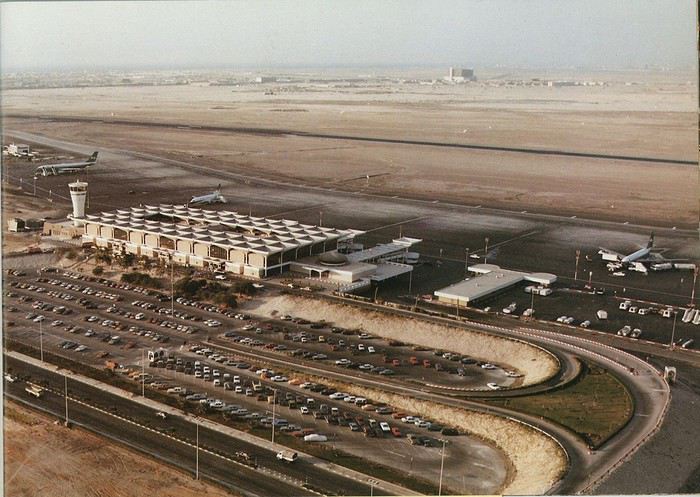
Next stop: New Delhi to drop off some Europeans and pick up a few Indians, and finally, the terminus: Manila. I don’t remember how long the trip took with its five stops—an unimaginable journey today. Despite all those stops to fill the plane, there was still enough space to stretch out on the four center seats of the 747, something that never happens these days despite all the flights in every direction.
So here we are, finally at Manila Airport around midnight.
Episode 1: Manila and Baguio To start, a quick note on the political and economic situation in the Philippines in 1984, which had consequences for us as tourists, as we’d soon realize upon arrival.
After several centuries of Spanish colonization, the Philippines became American at the start of the 20th century, then independent. In 1966, Marcos took power, and little by little, his regime sank into corruption and mismanagement, becoming a dictatorship with martial law, all for the benefit of his family and friends, who enriched themselves endlessly. The peak was the assassination of opposition leader Benigno Aquino in August 1983, which triggered harshly repressed protests. So we arrived a few months later in a very poor country, with omnipresent corruption and an extremely tense political situation, as we’d soon see for ourselves. Major protests took place in the main cities during our trip—I’ll come back to that. Two years later, Marcos fled to Hawaii after being forced out of power following rigged elections. This historical context explains a lot of the situations we found ourselves in over the following weeks.
Arriving in the middle of the night isn’t very cheerful. Manila was already a huge city with many slums, where you could find a few business hotels like the Hilton or Intercontinental—way out of our budget—and plenty of run-down hotels. Luckily, two Indians we’d chatted with on the plane offered to take us to their usual hotel. They came to Manila twice a year for business. We accepted their offer, relieved not to have to look for a place to stay in the middle of the night, figuring the address must be good since they came back every time... we were wrong 🙁
We left the airport and immediately got a taste of the local vibe when we got into the taxi: the police asked for our passports. We thought: what’s more normal than police in a dictatorship?
But that wasn’t it at all. Our two Indian friends explained that the police were noting our names along with the taxi number and time. Crime in Manila was so bad that the taxi driver would be held responsible if anything happened to us... welcome to the Philippines 😎 😎
Historically, the Philippines was a very violent country, where everything was settled with guns or machetes. Previous governments had banned carrying weapons, but Marcos later allowed the free sale and carrying of guns, and disputes were settled with pistols again (or worse, as we’d discover later). Since he’d released most of the criminals from prison to form a paramilitary militia at his service (I’ll talk about our encounter with these “heroes” later), it was pretty dangerous to go into many parts of Manila, where these “tonton macoutes” ruled.
We arrived at our hotel without incident... and then things started badly. The room was infested with big cockroaches—exactly what I hate most in those kinds of countries. No way to find another hotel at that hour. After the long flight, the urge to take a shower was so strong that we squeezed into the bathroom as best we could. After that, I don’t remember—I guess we must’ve fallen asleep exhausted under the sheets in the heat... air conditioning wasn’t widespread yet.
The next day, we just wanted to leave that dump as soon as possible. So we decided to head north right away, stopping in Baguio, and we’d visit Manila a bit on the way back.
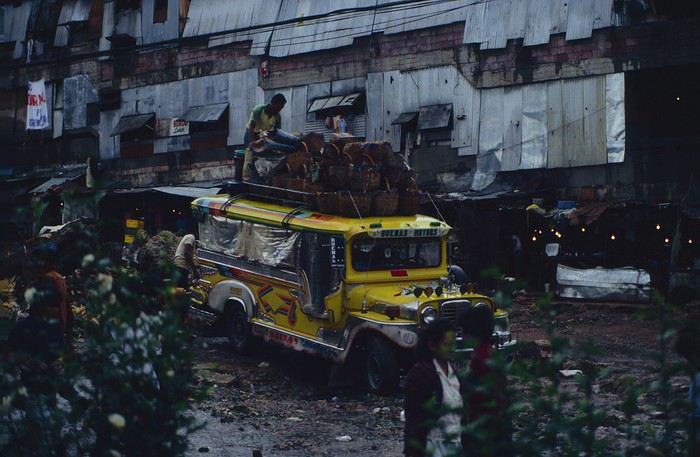
When we stepped outside, we discovered a pretty run-down neighborhood with potholed streets. But we also discovered the jeepneys. They were everywhere, flooding the streets.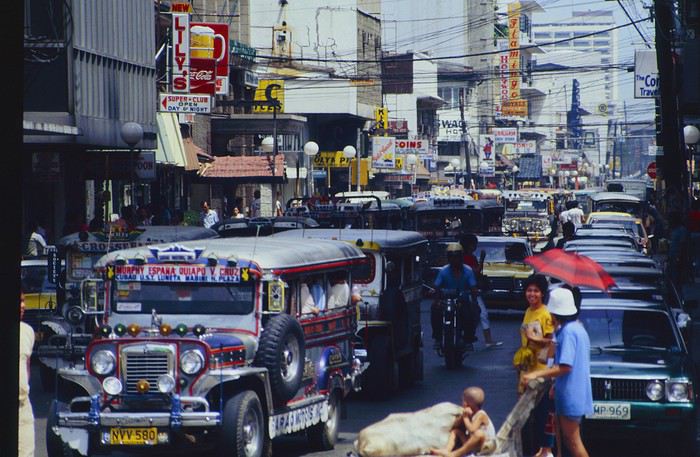
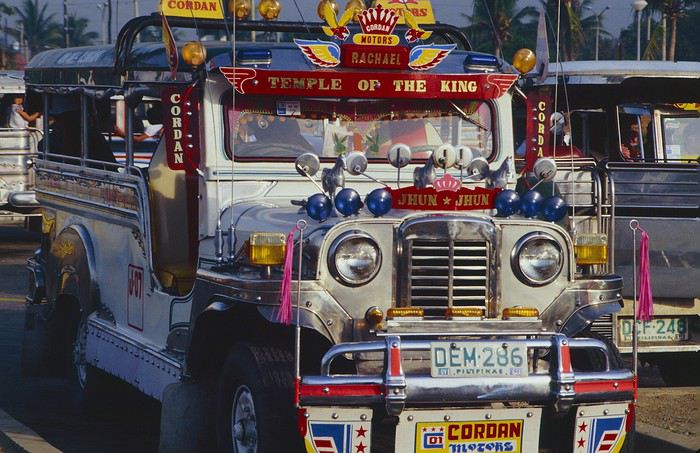
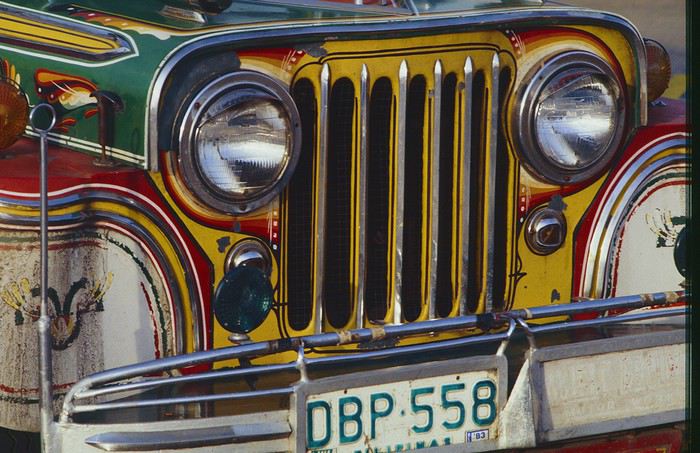
They had crazy sound systems, each one blasting louder than the last. The interiors were kitschy but fun. There weren’t many private cars—almost all transportation was by jeepney, with buses reserved for intercity trips.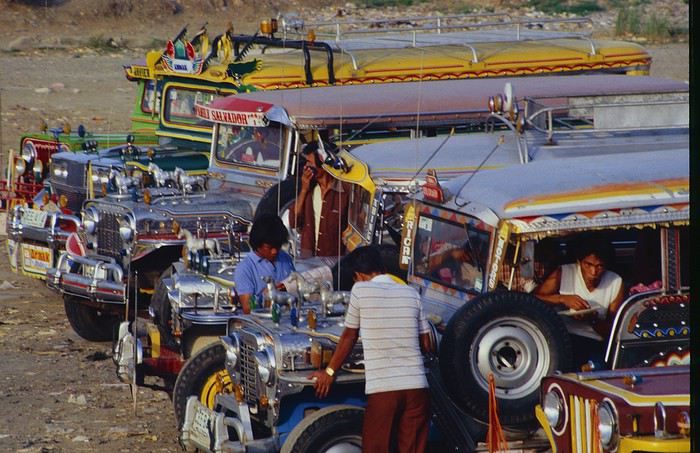
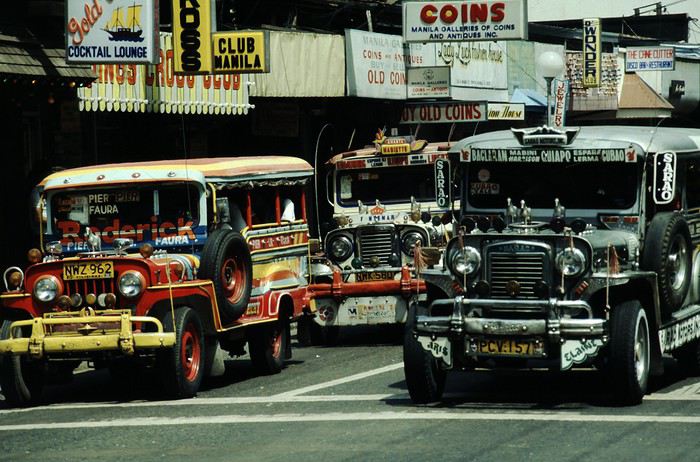
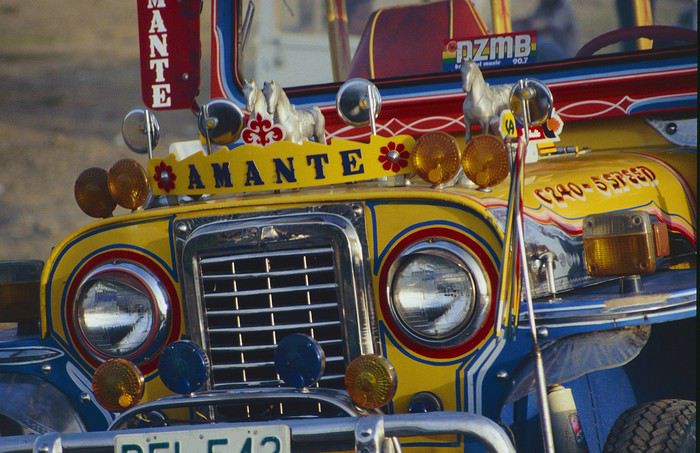
Before heading to the bus terminal for the north, somewhere on the outskirts of the city, we needed to exchange some money. I don’t remember how we ended up in a policeman’s jeep who offered his services: - Exchange money on the black market at a better rate than the banks. - Take us wherever we wanted, in this case, the bus terminal.
We accepted both offers (we’d still checked the official exchange rate from dollars to pesos). So we found ourselves in his jeep. After exchanging money, we left in his vehicle and stopped for gas. Without turning off the engine, he calmly smoked a cigarette while filling up. Since we were in a jeep with no doors or roof, we were ready to jump out if things went south, our travel bag in hand.
But we weren’t done with surprises yet. Once we left the small streets, we ended up in a neighborhood with wide avenues and not much traffic, which didn’t justify his incredible behavior. At every intersection, he made the sign of the cross, closed his eyes, and crossed without looking. I was more stunned than terrified! It wasn’t until we got out of the car later that I told Anne-Marie what had happened. I’d seen everything because the cop had put me in the front seat. Luckily, A-Marie hadn’t noticed anything from the back. Crossing Manila by trusting God rather than the rules of the road was ultimately effective. We were lucky—the trip was off to a good start. 🙂 🙂
We then passed through a neighborhood where slums stretched on for a while, and we left our policeman—friendly but a bit crazy—with relief.
A few hours by bus later, here we are in Baguio, cool in the mountains. My memories of Baguio are pretty fuzzy. I remember a small town. After some research while writing this journal, I found that the population was 120,000 in 1980. Given the population density in each home, that confirms my memory of a smallish town. Outside the “official” district with the president’s summer residence and government buildings, there were two or three paved streets with nice houses. The rest was very dirty and very poor, with lots of slums and dirt roads.
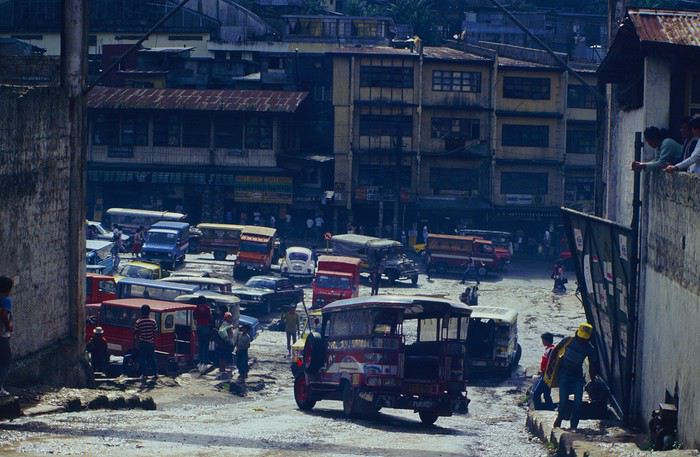
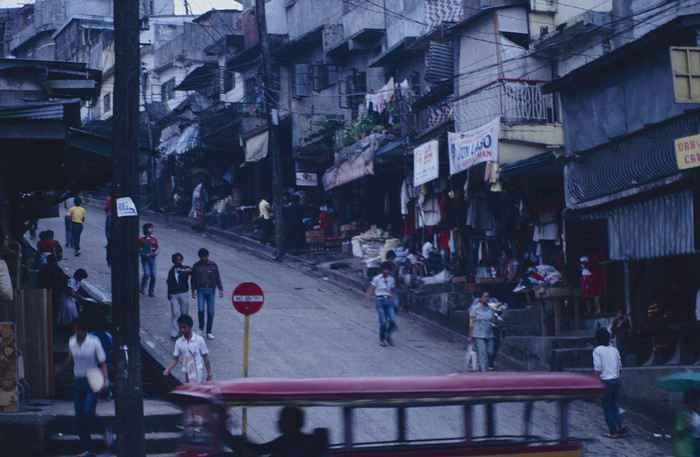
People we met on the street invited us to stay with them. These days, we wouldn’t just show up at strangers’ houses, which we should’ve done in Baguio—it would’ve saved us from an unimaginable and dangerous situation... which I won’t say anything about... !😊
The simple wooden house was on stilts at the edge of a hill with a view of the mountains. Since it was the start of the rainy season in a city that gets a lot of rain, we saw a lot of water. Our outings in town happened between downpours.
View from our lodging: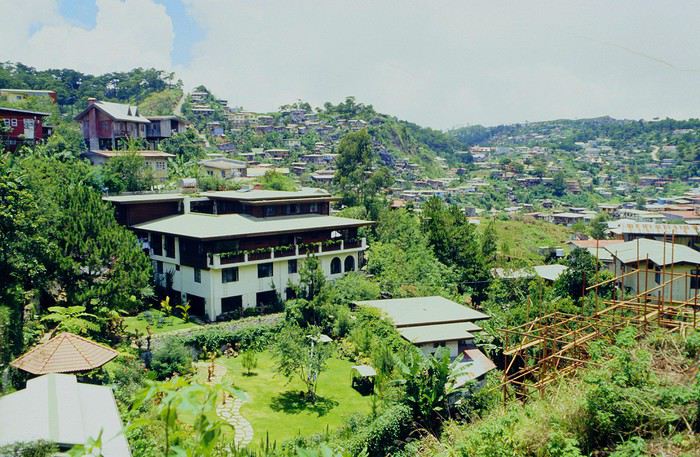
Episode 2: Baguio to Bontoc Aside from the situation briefly mentioned above, it was on the next leg to Bontoc that the adventure really began: an endless and dangerous road, a bus from another era, breathtaking landscapes, and surprising people.
We didn’t know the distance or how long it would take to get to Bontoc. When we arrived after about ten hours, we learned that Baguio to Bontoc was 140 km.
We got on a bus with wooden seats and settled in, two to a seat meant for two. As the bus filled up, passengers squeezed in three or four per seat, with chickens and baskets full of all sorts of things in the aisle. A little embarrassed, we didn’t know if we should squeeze in three on our seat. The seats were super tight (luckily, Filipinos are small), and I didn’t know where to put my legs given my height. I don’t remember if we stayed alone on our bench or if we ended up sharing with others.
The “road” was a dirt track (or rather, a mud track) with endless turns. We held on as best we could to our slippery wooden seats—it was shaking in every direction. The woman behind us was carsick and throwing up... gross... but what were we doing there? Then we plunged into the Sierra Madre... just the name is dreamy!
Rice terraces started to appear: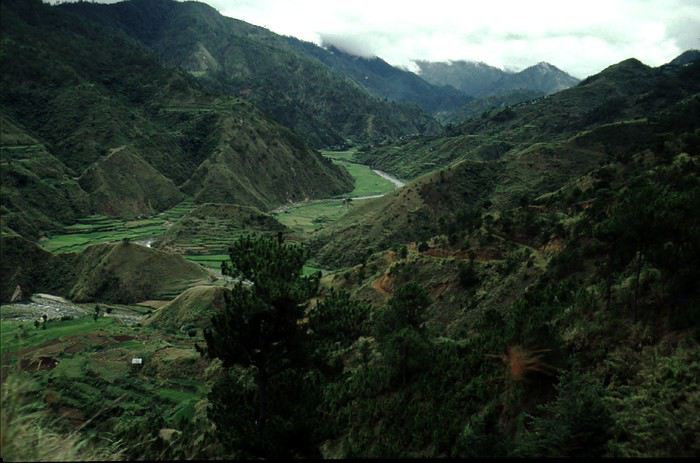
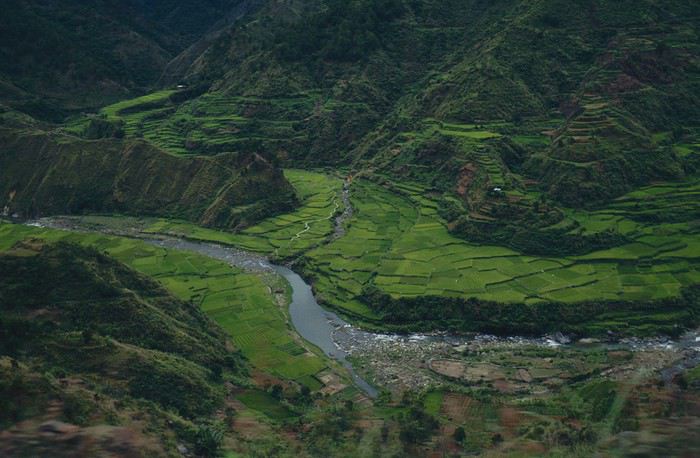
they took up more and more space along cliffs where we weren’t always reassured,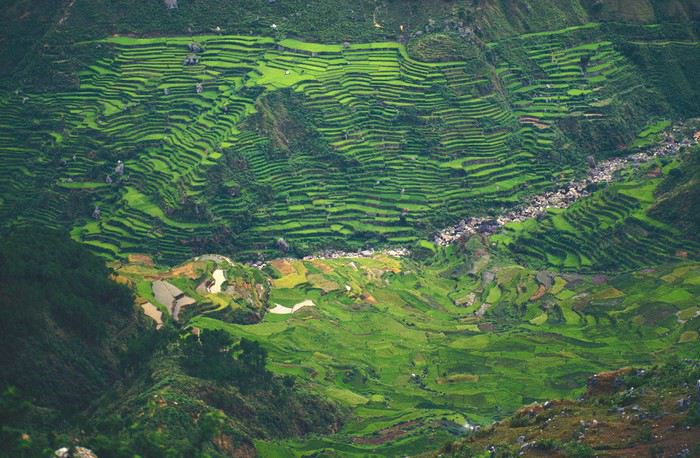
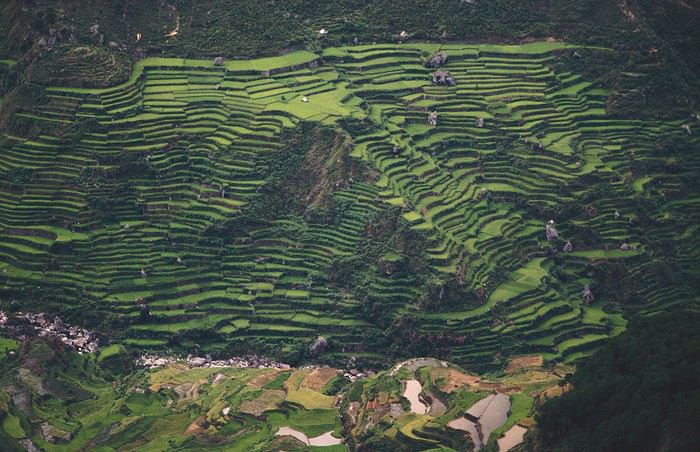
with lots of waterfalls (all that water had to go somewhere).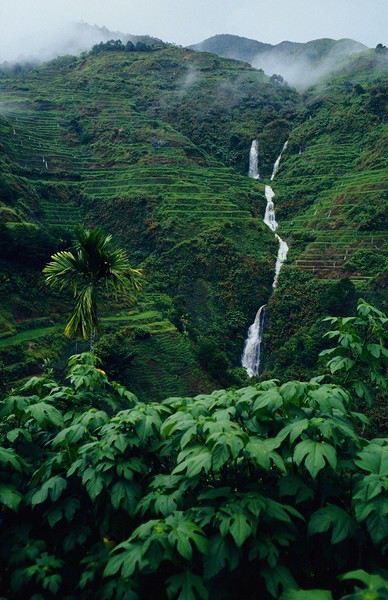
A few miserable villages stretched along the track, most often just a few houses balancing between the road and the drop. The bus stopped in every village—people got on or off and settled inside or on the roof. Street vendors offered their products to the bus passengers—a common sight in Asia, even today.
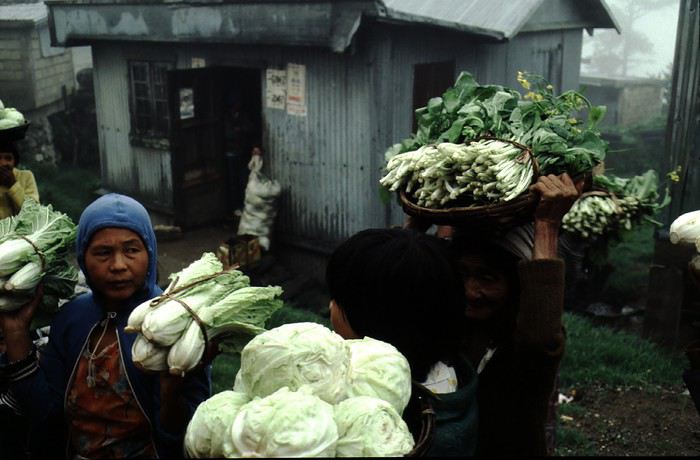
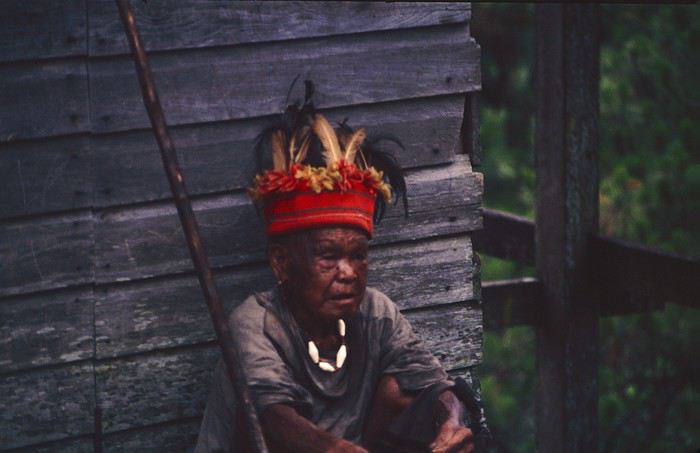
We were in another world—villagers were in loincloths, others had spears. The atmosphere was strange... but all good, we wanted exoticism, and we got it: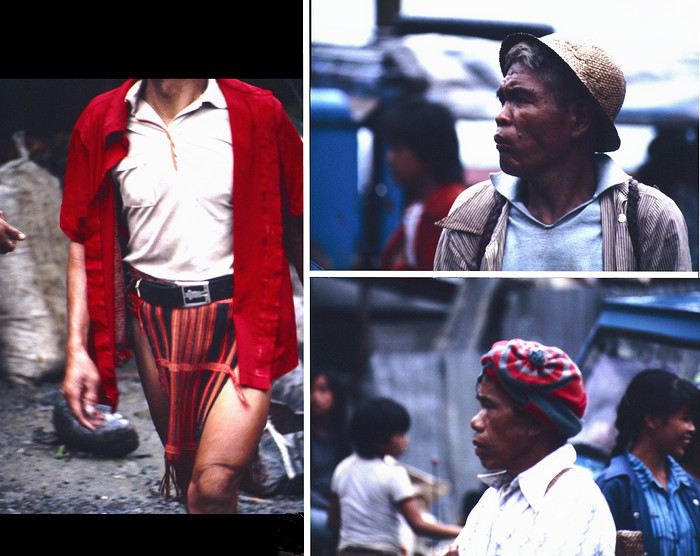
This so-called traditional outfit was everyday wear—it wasn’t for tourists since there weren’t any.
A curiosity because writing a travel journal about a trip 35 years later isn’t common, but also (mostly?) because exploring the Philippines at that time had little in common with traveling there today.
Obviously, I’ve forgotten a number of facts, most of the details, but with the help of a few notes from that time and a stack of slides (yes, there was life before digital 😊), many memories came back and added to the highlights I’d never forgotten. The scanned slides aren’t always great quality, but there are still quite a few to brighten up this chatter. Back then, we didn’t snap photos like we do now—film was too expensive—so I don’t have pictures of every place we visited... too bad, comparing some of those spots to how they look today would’ve been interesting.
Why "Adventures"? Why call it "Adventures" in the Philippines in 1984, a word so often used for a simple exotic trip? - Because the lack of information (no *Guide du Routard*, no *Lonely Planet*, no *Michelin Guide*, nothing, and obviously no internet) gave this trip what’s at the heart of adventure: the unknown. - Because the political situation made the stay sometimes dangerous. - Because transportation conditions were always epic, often perilous. - Because the question of where we’d spend the night came up almost every evening. - And for... quite a few other reasons.
That said, we weren’t exactly explorers!
Why the Philippines? First of all, why go to the Philippines in 1984—a country not exactly set up for tourism and about which we knew very little? How could we get an idea of the beauty of the Philippines and its points of interest when we had no guides or photos?
The idea came to us from Thailand a year earlier, during our first long-haul trip. After touring the north of the country, we met a Frenchman living in Phuket, where there were only a few tourists in Patong, with just a few small hotels and guesthouses. Kata and Karon had no buildings or roads, Rawai only had three palm-thatched bungalows, including ours, and the other islands were unknown to tourists. There was plenty to discover, and we wanted to return to this beautiful country... but the Frenchman made us dream about the Philippines—a country to explore, with wild landscapes.
Long evenings of discussion over multiple Sprite-Mekong cocktails (what memories of those headaches!) finally convinced us we had to go to the Philippines.
Episode 0: Before Departure The decision was made: we’d go to the Philippines in May 1984. Our friends and family were surprised when we announced we were going on vacation to the Philippines (a bit like saying today we were going paddleboarding in the Kerguelen Islands 🤪).
These days, preparing for each of our trips takes long evenings of research, planning, and noting down good addresses... etc. But for the Philippines in 1984, preparation was quick: we had very little information about the country, we were leaving almost at random, and the discovery would only be more exciting.
We still had a few bits of info gathered here and there: the rice terraces in northern Luzon, volcanoes, Negros where we were supposed to visit an acquaintance, Cebu and its marine life (we ended up going elsewhere), and absolutely avoid Mindanao, which was practically at war with the regime. That was about it, but it was already a great itinerary.
Nothing was organized in advance; we’d see day by day. We had no idea about travel times or even the existence of transportation options. The main (and sometimes only) way to connect two islands was by overloaded, rusty ferry. Only the big cities had airports.
Let’s Go: Episode 1: Paris to Manila My travel journals always start after arriving at the airport—the Europe-to-“Other Continent” trip isn’t interesting—but the flight to the Philippines was already an adventure, so I’ll make an exception.
This was the era when only a few Asian airlines were on par with Western ones: Thai, Singapore Airlines, and Philippine Airlines. They had beautiful, brand-new planes, and to attract customers (almost exclusively “businessmen”) from the usual airlines (Air France, Lufthansa, British Airways), there was opulence on board: unlimited champagne, all sorts of cocktails... Compared to today’s long-haul flights, there was still one small difference: no personal screens, just one screen at the front of the cabin with one mandatory movie. And I don’t know why, but we only got James Bond films, both ways... that must’ve been the trend at the time.
The tourism boom to Southeast Asia hadn’t started yet, and the “Asian Tigers” weren’t a thing, so there weren’t many business trips. That meant long-haul flights made stops everywhere to fill the planes. Our Philippine Airlines Boeing 747 left London, picked us up in Paris, then stopped in Frankfurt to take on a few Germans. I don’t know why we then made a stop in Dubai—a totally exotic place at the time. There was nothing to do there... things have changed a lot since. It was a small town lost in the desert. The airport was tiny, with just one or two buildings and a supermarket. During the stopover, everyone had to get off the plane and walk to the supermarket. Photo and electronic equipment were dirt cheap—I guess that was the only reason for the stop. Maybe it was their first commercial move. Emirates didn’t exist yet, as I checked online, but anyway, the idea that such a remote place could have its own airline was unthinkable.
Online, I found this photo of Dubai Airport in 1980. Anyone who’s transited through today’s massive airport with its rows of A380s will appreciate it:
Next stop: New Delhi to drop off some Europeans and pick up a few Indians, and finally, the terminus: Manila. I don’t remember how long the trip took with its five stops—an unimaginable journey today. Despite all those stops to fill the plane, there was still enough space to stretch out on the four center seats of the 747, something that never happens these days despite all the flights in every direction.
So here we are, finally at Manila Airport around midnight.
Episode 1: Manila and Baguio To start, a quick note on the political and economic situation in the Philippines in 1984, which had consequences for us as tourists, as we’d soon realize upon arrival.
After several centuries of Spanish colonization, the Philippines became American at the start of the 20th century, then independent. In 1966, Marcos took power, and little by little, his regime sank into corruption and mismanagement, becoming a dictatorship with martial law, all for the benefit of his family and friends, who enriched themselves endlessly. The peak was the assassination of opposition leader Benigno Aquino in August 1983, which triggered harshly repressed protests. So we arrived a few months later in a very poor country, with omnipresent corruption and an extremely tense political situation, as we’d soon see for ourselves. Major protests took place in the main cities during our trip—I’ll come back to that. Two years later, Marcos fled to Hawaii after being forced out of power following rigged elections. This historical context explains a lot of the situations we found ourselves in over the following weeks.
Arriving in the middle of the night isn’t very cheerful. Manila was already a huge city with many slums, where you could find a few business hotels like the Hilton or Intercontinental—way out of our budget—and plenty of run-down hotels. Luckily, two Indians we’d chatted with on the plane offered to take us to their usual hotel. They came to Manila twice a year for business. We accepted their offer, relieved not to have to look for a place to stay in the middle of the night, figuring the address must be good since they came back every time... we were wrong 🙁
We left the airport and immediately got a taste of the local vibe when we got into the taxi: the police asked for our passports. We thought: what’s more normal than police in a dictatorship?
But that wasn’t it at all. Our two Indian friends explained that the police were noting our names along with the taxi number and time. Crime in Manila was so bad that the taxi driver would be held responsible if anything happened to us... welcome to the Philippines 😎 😎
Historically, the Philippines was a very violent country, where everything was settled with guns or machetes. Previous governments had banned carrying weapons, but Marcos later allowed the free sale and carrying of guns, and disputes were settled with pistols again (or worse, as we’d discover later). Since he’d released most of the criminals from prison to form a paramilitary militia at his service (I’ll talk about our encounter with these “heroes” later), it was pretty dangerous to go into many parts of Manila, where these “tonton macoutes” ruled.
We arrived at our hotel without incident... and then things started badly. The room was infested with big cockroaches—exactly what I hate most in those kinds of countries. No way to find another hotel at that hour. After the long flight, the urge to take a shower was so strong that we squeezed into the bathroom as best we could. After that, I don’t remember—I guess we must’ve fallen asleep exhausted under the sheets in the heat... air conditioning wasn’t widespread yet.
The next day, we just wanted to leave that dump as soon as possible. So we decided to head north right away, stopping in Baguio, and we’d visit Manila a bit on the way back.
When we stepped outside, we discovered a pretty run-down neighborhood with potholed streets. But we also discovered the jeepneys. They were everywhere, flooding the streets.
They had crazy sound systems, each one blasting louder than the last. The interiors were kitschy but fun. There weren’t many private cars—almost all transportation was by jeepney, with buses reserved for intercity trips.
Before heading to the bus terminal for the north, somewhere on the outskirts of the city, we needed to exchange some money. I don’t remember how we ended up in a policeman’s jeep who offered his services: - Exchange money on the black market at a better rate than the banks. - Take us wherever we wanted, in this case, the bus terminal.
We accepted both offers (we’d still checked the official exchange rate from dollars to pesos). So we found ourselves in his jeep. After exchanging money, we left in his vehicle and stopped for gas. Without turning off the engine, he calmly smoked a cigarette while filling up. Since we were in a jeep with no doors or roof, we were ready to jump out if things went south, our travel bag in hand.
But we weren’t done with surprises yet. Once we left the small streets, we ended up in a neighborhood with wide avenues and not much traffic, which didn’t justify his incredible behavior. At every intersection, he made the sign of the cross, closed his eyes, and crossed without looking. I was more stunned than terrified! It wasn’t until we got out of the car later that I told Anne-Marie what had happened. I’d seen everything because the cop had put me in the front seat. Luckily, A-Marie hadn’t noticed anything from the back. Crossing Manila by trusting God rather than the rules of the road was ultimately effective. We were lucky—the trip was off to a good start. 🙂 🙂
We then passed through a neighborhood where slums stretched on for a while, and we left our policeman—friendly but a bit crazy—with relief.
A few hours by bus later, here we are in Baguio, cool in the mountains. My memories of Baguio are pretty fuzzy. I remember a small town. After some research while writing this journal, I found that the population was 120,000 in 1980. Given the population density in each home, that confirms my memory of a smallish town. Outside the “official” district with the president’s summer residence and government buildings, there were two or three paved streets with nice houses. The rest was very dirty and very poor, with lots of slums and dirt roads.
People we met on the street invited us to stay with them. These days, we wouldn’t just show up at strangers’ houses, which we should’ve done in Baguio—it would’ve saved us from an unimaginable and dangerous situation... which I won’t say anything about... !😊
The simple wooden house was on stilts at the edge of a hill with a view of the mountains. Since it was the start of the rainy season in a city that gets a lot of rain, we saw a lot of water. Our outings in town happened between downpours.
View from our lodging:
Episode 2: Baguio to Bontoc Aside from the situation briefly mentioned above, it was on the next leg to Bontoc that the adventure really began: an endless and dangerous road, a bus from another era, breathtaking landscapes, and surprising people.
We didn’t know the distance or how long it would take to get to Bontoc. When we arrived after about ten hours, we learned that Baguio to Bontoc was 140 km.
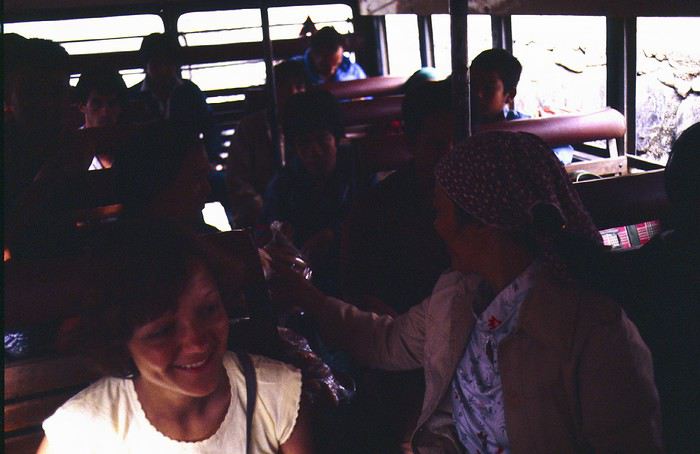
We got on a bus with wooden seats and settled in, two to a seat meant for two. As the bus filled up, passengers squeezed in three or four per seat, with chickens and baskets full of all sorts of things in the aisle. A little embarrassed, we didn’t know if we should squeeze in three on our seat. The seats were super tight (luckily, Filipinos are small), and I didn’t know where to put my legs given my height. I don’t remember if we stayed alone on our bench or if we ended up sharing with others.
The “road” was a dirt track (or rather, a mud track) with endless turns. We held on as best we could to our slippery wooden seats—it was shaking in every direction. The woman behind us was carsick and throwing up... gross... but what were we doing there? Then we plunged into the Sierra Madre... just the name is dreamy!
Rice terraces started to appear:
they took up more and more space along cliffs where we weren’t always reassured,
with lots of waterfalls (all that water had to go somewhere).
A few miserable villages stretched along the track, most often just a few houses balancing between the road and the drop. The bus stopped in every village—people got on or off and settled inside or on the roof. Street vendors offered their products to the bus passengers—a common sight in Asia, even today.
We were in another world—villagers were in loincloths, others had spears. The atmosphere was strange... but all good, we wanted exoticism, and we got it:
This so-called traditional outfit was everyday wear—it wasn’t for tourists since there weren’t any.
Easyjet me rend perplexe...
Bonjour,
J'ai plusieurs vols prévus avec Easyjet.
Un était pour le 6 Avril retour le 20 Avril prochains.
Easyjet sur son application dit que le premier est annulé. Le retour est toujours prévu (?). Pour moi, s'il n'y a pas d'aller, il n'y aura pas de retour..
Easyjet écrit que je peux choisir un nouveau vol ou "demander un bon".
Je pensais pouvoir être remboursé au moins pour ce premier voyage que je ne ferai pas.
Je commence à douter de ce qui va se passer le 6 Avril quant au remboursement...
Ai je un recours quelconque pour retrouver mes sous de la part d'une compagnie qui a payé 45 Mio d'euros de dividendes fin mars à son fondateur, sans parler des autres actionnaires ?
La somme, si non remboursée, ne me ruinerait pas mais, comme dit plus haut, il y a plusieurs dossiers et j'en ai aussi chez Air France dont je n'ai aucune nouvelle depuis plus de quinze jours...
Merci de vos points de vue et éventuels tuyaux.
J'ai plusieurs vols prévus avec Easyjet.
Un était pour le 6 Avril retour le 20 Avril prochains.
Easyjet sur son application dit que le premier est annulé. Le retour est toujours prévu (?). Pour moi, s'il n'y a pas d'aller, il n'y aura pas de retour..
Easyjet écrit que je peux choisir un nouveau vol ou "demander un bon".
Je pensais pouvoir être remboursé au moins pour ce premier voyage que je ne ferai pas.
Je commence à douter de ce qui va se passer le 6 Avril quant au remboursement...
Ai je un recours quelconque pour retrouver mes sous de la part d'une compagnie qui a payé 45 Mio d'euros de dividendes fin mars à son fondateur, sans parler des autres actionnaires ?
La somme, si non remboursée, ne me ruinerait pas mais, comme dit plus haut, il y a plusieurs dossiers et j'en ai aussi chez Air France dont je n'ai aucune nouvelle depuis plus de quinze jours...
Merci de vos points de vue et éventuels tuyaux.
Découverte à vélo de Madagascar en septembre
Bonjour,
Mon ami et moi avons comme projet de voyager à Madagascar 3 semaines en Septembre. Nous souhaiterions découvrir cette île et ses habitants à vélo. ((rêve d'enfance)). Nous avons 25 ans et sommes tout deux des randonneurs aguerris et des cyclises réguliers mais nous n'avons jamais préparé un voyage de la sorte. Nous avons commencé à regarder différents trajets/topo sur wikiloc et rando trek mais je trouve toujours qu'avoir un retour de vécu est plus instructif. Pourriez vous me donner des conseils sur des itinéraires entre 10-15j ? Nous avions dans l'idée de partir depuis les montagnes vers l'océan, bivouaquer ou dormir si cela est possible chez l'habitant tout en évitant les sentiers touristiques.
Merci d'avance pour vos conseils.
Mon ami et moi avons comme projet de voyager à Madagascar 3 semaines en Septembre. Nous souhaiterions découvrir cette île et ses habitants à vélo. ((rêve d'enfance)). Nous avons 25 ans et sommes tout deux des randonneurs aguerris et des cyclises réguliers mais nous n'avons jamais préparé un voyage de la sorte. Nous avons commencé à regarder différents trajets/topo sur wikiloc et rando trek mais je trouve toujours qu'avoir un retour de vécu est plus instructif. Pourriez vous me donner des conseils sur des itinéraires entre 10-15j ? Nous avions dans l'idée de partir depuis les montagnes vers l'océan, bivouaquer ou dormir si cela est possible chez l'habitant tout en évitant les sentiers touristiques.
Merci d'avance pour vos conseils.
A breath of fresh air!
Vrrrrrm, vrmmmm! (phone on vibrate)
"Hi Mamido, it's Clémence." Clémence, 5 years old, is a giggly, cheerful little girl and the queen of mischief.
"Mom says we're coming to your place until the holidays because we're on vacation tonight."
"Yes, I know. She asked me—do you know why?" "Because of the croronavirus." "And do you know what that is?"
"Oh yeah, at school Théo told me it's like a louse that doesn't itch, that doesn't get in your head but in your lungs, that it's all round with red bumps like raspberries, and that it makes old people die."
"Your friend knows a lot of things."
"His dad showed him a microscope picture, and you—are you old?" "What do you think?" "Well, yeah, but only a little because you always leave on your motorcycle to travel. Are you going traveling?"
"No, because you're coming with your brother and sister."
"Can we go to the little bridge to look for frog eggs? You remember, there were some last year, and we'll make them grow and put the baby frogs in the washhouse, and we'll also make boats to put in the stream so they can go to the sea." "That's a great idea." "And you'll make me the model in print letters so I can write which country my boat is going to." "Where do you want your boat to go?" "To the land of pandas—is it far?" "Oh yes, very far." "Then we have to make the boat strong so it doesn't sink." "Promise, we'll have so much fun." "Mom says in some countries they wear masks. Do you still have the chicken, rabbit, and pig masks in the attic? Can we wear them like that?"
"You know, here there are only trees, birds, and fields—we'll do whatever we want."
"Mom's calling me."
Click, she hangs up, and I laugh.
"Hi Mamido, it's Clémence." Clémence, 5 years old, is a giggly, cheerful little girl and the queen of mischief.
"Mom says we're coming to your place until the holidays because we're on vacation tonight."
"Yes, I know. She asked me—do you know why?" "Because of the croronavirus." "And do you know what that is?"
"Oh yeah, at school Théo told me it's like a louse that doesn't itch, that doesn't get in your head but in your lungs, that it's all round with red bumps like raspberries, and that it makes old people die."
"Your friend knows a lot of things."
"His dad showed him a microscope picture, and you—are you old?" "What do you think?" "Well, yeah, but only a little because you always leave on your motorcycle to travel. Are you going traveling?"
"No, because you're coming with your brother and sister."
"Can we go to the little bridge to look for frog eggs? You remember, there were some last year, and we'll make them grow and put the baby frogs in the washhouse, and we'll also make boats to put in the stream so they can go to the sea." "That's a great idea." "And you'll make me the model in print letters so I can write which country my boat is going to." "Where do you want your boat to go?" "To the land of pandas—is it far?" "Oh yes, very far." "Then we have to make the boat strong so it doesn't sink." "Promise, we'll have so much fun." "Mom says in some countries they wear masks. Do you still have the chicken, rabbit, and pig masks in the attic? Can we wear them like that?"
"You know, here there are only trees, birds, and fields—we'll do whatever we want."
"Mom's calling me."
Click, she hangs up, and I laugh.
Voyager sans connaître la destination? Nous voilà inscrits...
Nous sommes à un mois de notre départ et nous ne connaissons pas la destination puisque c'est un voyage mystère que nous avons réservé par l'agence CAP MYSTERE....
Nous avons donc rempli un questionnaire assez détaillé sur notre type de voyage, nos envies , nos budget...
C'est donc un voyage lointain avec une destination au soleil alliant la faune et la flore et hors des sentiers battus.
Nous allons bientôt recevoir le premier indice.
Nous sommes méga surexcités et en ce qui me concerne (moins mon conjoint plus sage) , je ne cesse de chercher les vols possibles avec les éléments que j'ai....
Arghhhh c'est horriblement dure d'attendre.
Nous avons donc rempli un questionnaire assez détaillé sur notre type de voyage, nos envies , nos budget...
C'est donc un voyage lointain avec une destination au soleil alliant la faune et la flore et hors des sentiers battus.
Nous allons bientôt recevoir le premier indice.
Nous sommes méga surexcités et en ce qui me concerne (moins mon conjoint plus sage) , je ne cesse de chercher les vols possibles avec les éléments que j'ai....
Arghhhh c'est horriblement dure d'attendre.
L'accueil pour un routard Noir en Afrique du Sud
Bonjour,
Je compte me rendre en Afrique du Sud dans quelques semaines. Etant noir moi-même, je me pose beaucoup de questions quant à "l'accueil" du pays.
Ayant déja un peu voyagé sur les 3 continents (Afrique - Asie -Amerique), j'ai bien entendu déja été confronté à des situations plus ou moins confortables, et mon humeur du moment n'est pas vraiment à la prise de tête en voyageant.
En d'autres termes, pourrait-on me refuser une chambre en auberge de jeunesse, en prétextant une raison bidon ? N'aurais-je pas plus de difficultés en sortant de Cap Town ?
Bien conscient que 40 années d'arpatheid ne se désintègrent comme ça pas dans la nature, je redoute quand même un peu ce trip.
Ya-t'il des noirs sur ce forum qui se sont déja rendus en Afrique du Sud ?
Cordialement.
Je compte me rendre en Afrique du Sud dans quelques semaines. Etant noir moi-même, je me pose beaucoup de questions quant à "l'accueil" du pays.
Ayant déja un peu voyagé sur les 3 continents (Afrique - Asie -Amerique), j'ai bien entendu déja été confronté à des situations plus ou moins confortables, et mon humeur du moment n'est pas vraiment à la prise de tête en voyageant.
En d'autres termes, pourrait-on me refuser une chambre en auberge de jeunesse, en prétextant une raison bidon ? N'aurais-je pas plus de difficultés en sortant de Cap Town ?
Bien conscient que 40 années d'arpatheid ne se désintègrent comme ça pas dans la nature, je redoute quand même un peu ce trip.
Ya-t'il des noirs sur ce forum qui se sont déja rendus en Afrique du Sud ?
Cordialement.
Discussions du concours "Les édifices religieux dans le monde"
C'est ici que l'on discute dans la bonne humeur et le respect de l'autre du concours du mois de novembre.😏
C'est aussi ici que l'on partage des photos en "OFF du concours" avant d'avoir trouver "la" bonne photo pour le concours.
Retour au concours de novembre:
voyageforum.com/...5795;live=1;#9805795
Between Réunion and Nosy Bé
Saturday, September 28, 2019
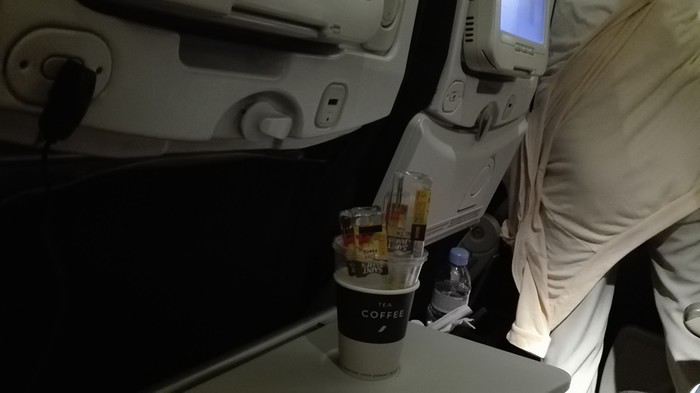
On the Orly-Saint-Denis flight, under the pretext that Air France had paired their delicious chicken with mushrooms meal with a little bottle of rum, Dom noticed that some passengers hadn’t even opened theirs. So he bribed a flight attendant to bring him the abandoned mini bottles! Needless to say, the guy slept like a baby!
Sunday, September 29, 2019 Saint-Pierre
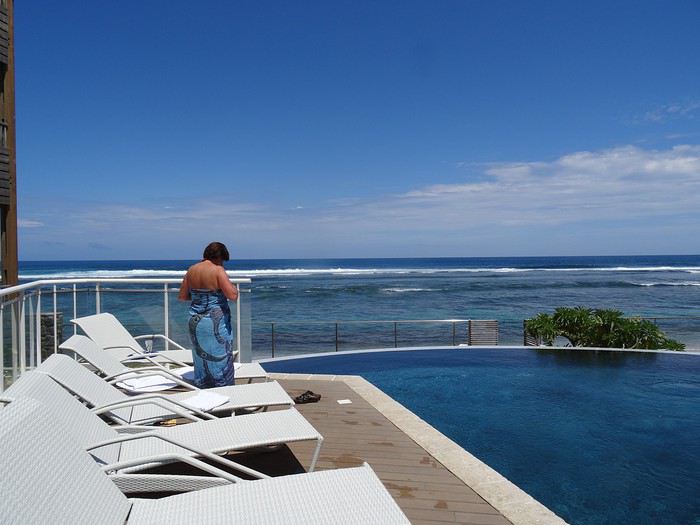
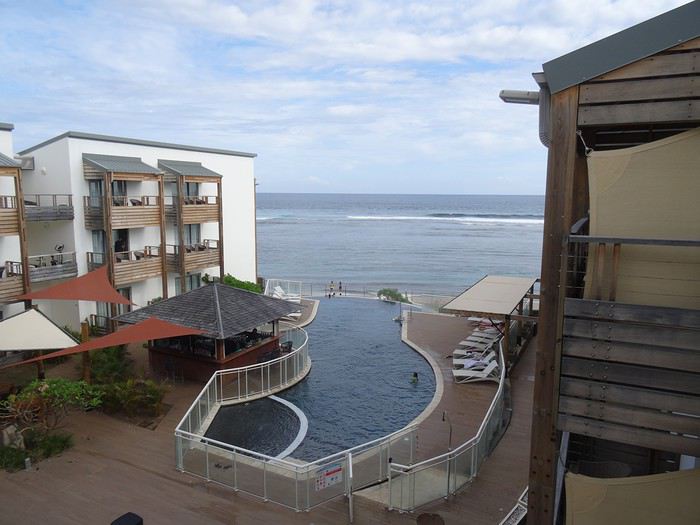
A flawless journey (well, except for a minor distraction in the massive Hertz queue that led me to cut in front of a few young couples, who weren’t too happy about it—though I joked with the agent about it: *"It happens!"*). We ended up at Hôtel Le Battant des Lames in Saint-Pierre, a gorgeous combo of an infinity pool and the Indian Ocean. We rushed straight into the pool—after over ten hours of sitting on a plane, it felt *amazing*!
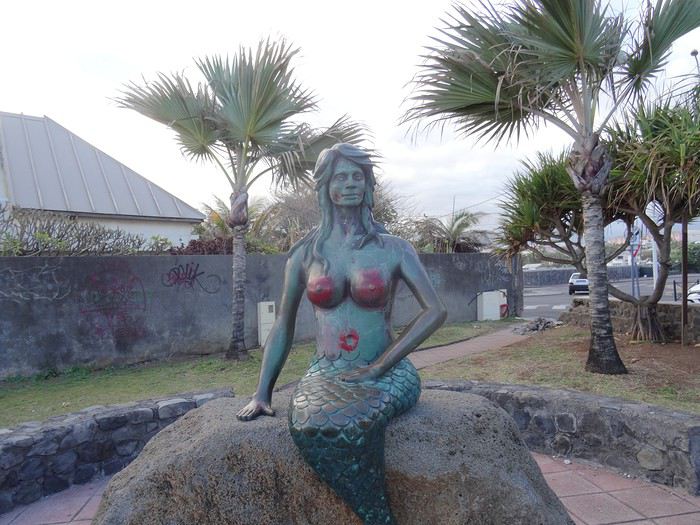
We didn’t waste any time—you know Dom—exploring the city on foot. It’s lovely: the seaside is well-developed, it’s tropical, but with the budget of a wealthy country.
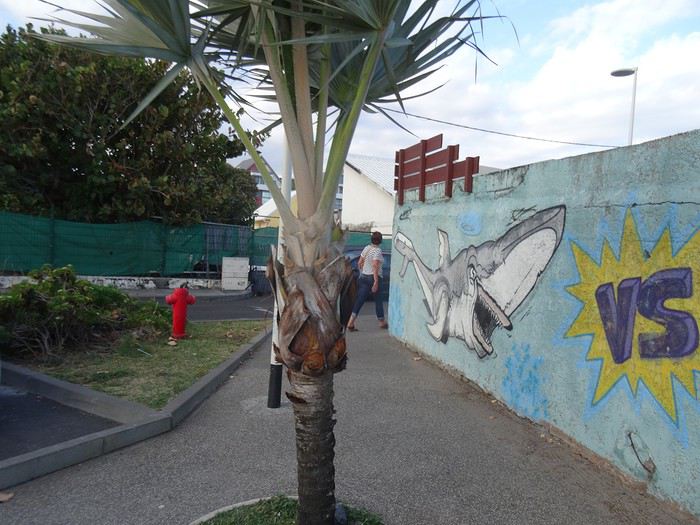
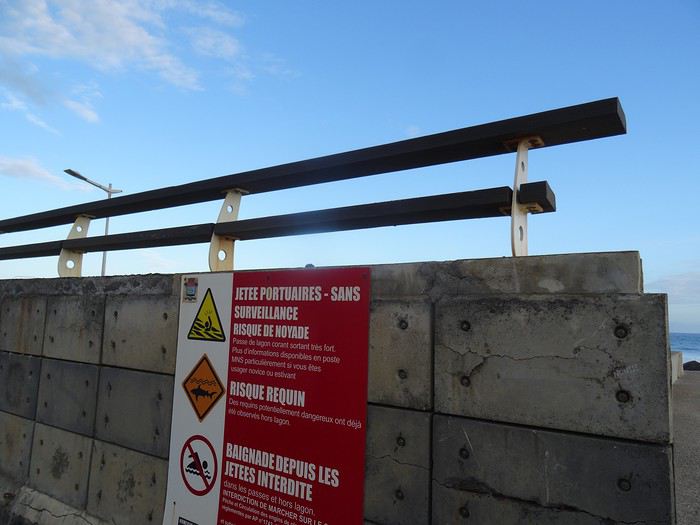
Réunion is also famous for its killer sharks…
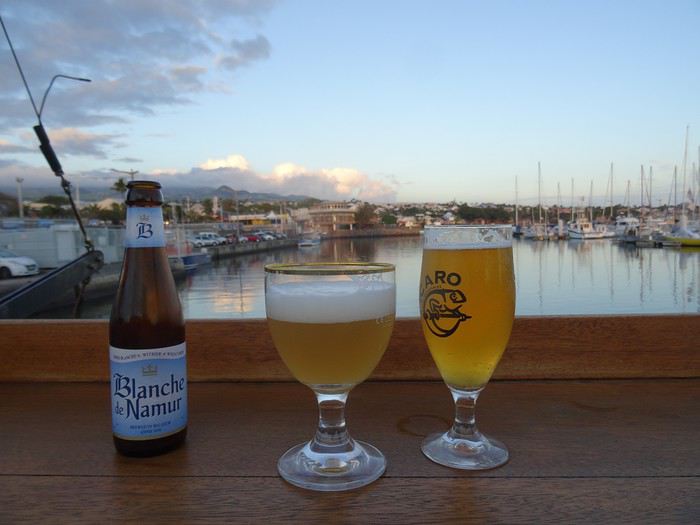
A Creole music group was playing at a seaside bar, so we settled in.
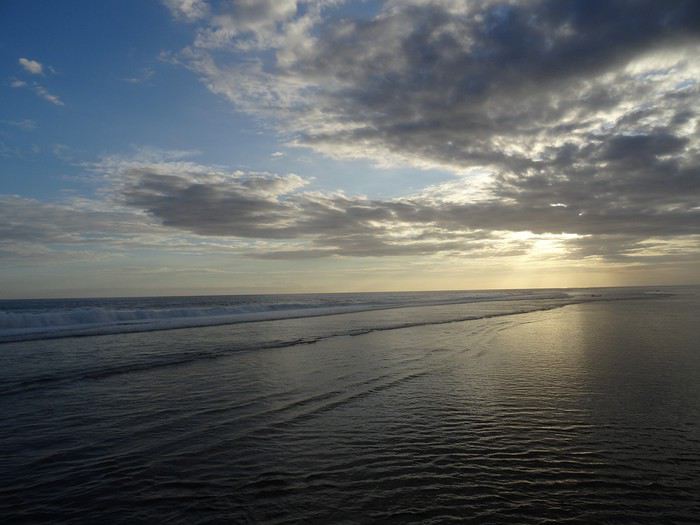
Night fell, and with it, swarms of insects suddenly invaded the city!
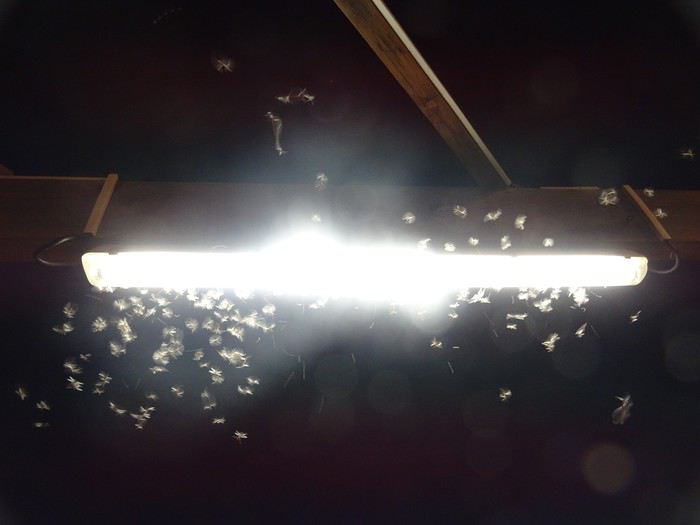
One of the few signs of the tropics here! Insects, geckos, and cockroaches...

Monday, September 30, 2019
Saint-Pierre
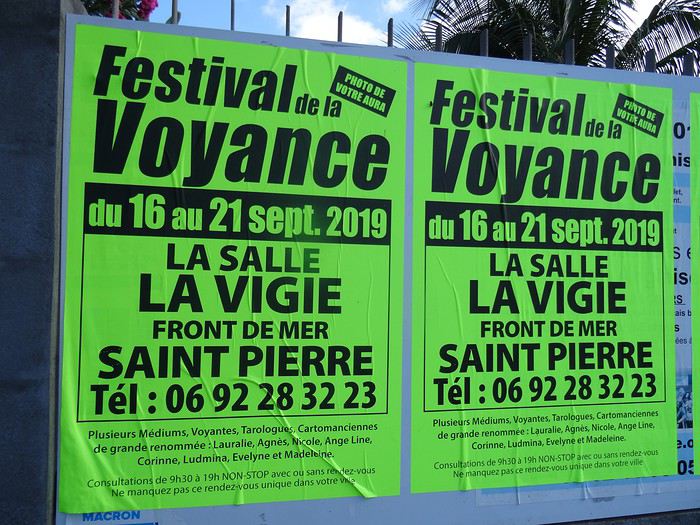
We were disappointed, of course! We could’ve gotten a photo of our *aura* and missed the chance by just a week! In tears, we decided to tackle the island’s most famous site.
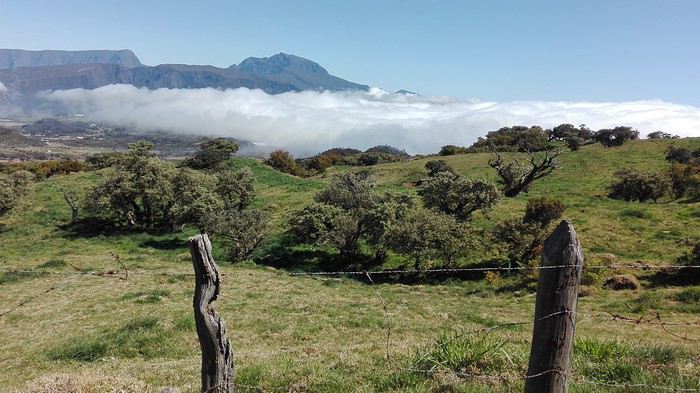
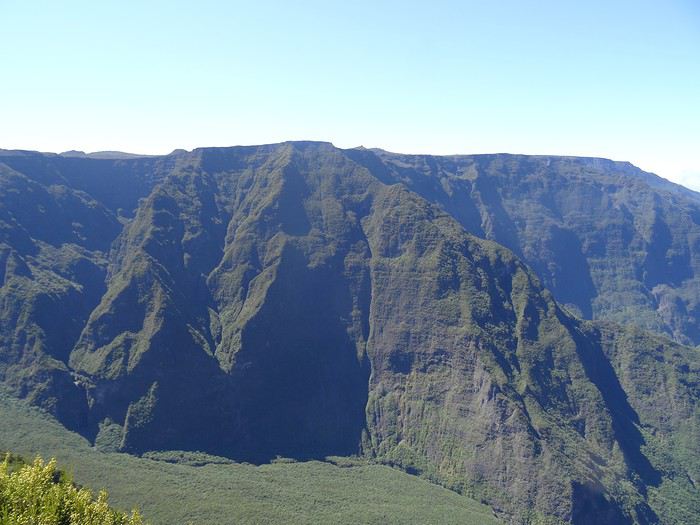
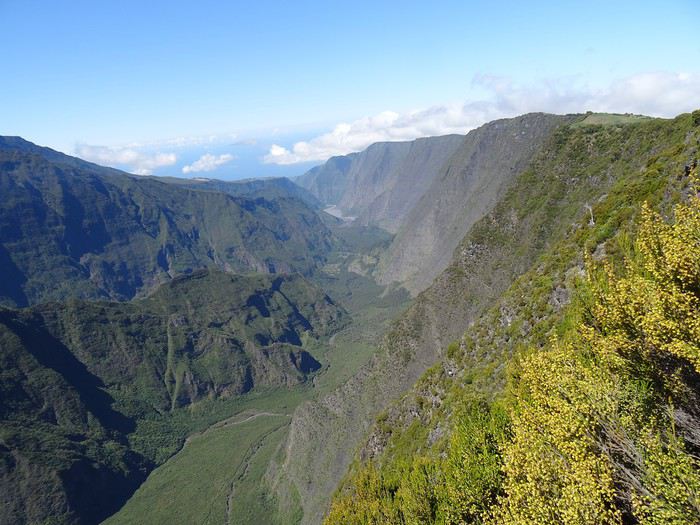
Excursion to Piton de la Fournaise. The plan was to head to one of the nearby parking lots and take a relaxed stroll. But it quickly turned into… something else.
First, I realized the built-in GPS operates on a pretty basic algorithm—like the earliest models. If there’s a bumpy road that even the toughest Mitsubishi 4x4 struggles with, a path through a junkyard, or any shortcut to save a few meters, it’ll proudly suggest it. So instead of taking the main road—the royal route to the famous volcano—we ended up on charming little mountain roads…
On the Orly-Saint-Denis flight, under the pretext that Air France had paired their delicious chicken with mushrooms meal with a little bottle of rum, Dom noticed that some passengers hadn’t even opened theirs. So he bribed a flight attendant to bring him the abandoned mini bottles! Needless to say, the guy slept like a baby!
Sunday, September 29, 2019 Saint-Pierre
A flawless journey (well, except for a minor distraction in the massive Hertz queue that led me to cut in front of a few young couples, who weren’t too happy about it—though I joked with the agent about it: *"It happens!"*). We ended up at Hôtel Le Battant des Lames in Saint-Pierre, a gorgeous combo of an infinity pool and the Indian Ocean. We rushed straight into the pool—after over ten hours of sitting on a plane, it felt *amazing*!
We didn’t waste any time—you know Dom—exploring the city on foot. It’s lovely: the seaside is well-developed, it’s tropical, but with the budget of a wealthy country.
Réunion is also famous for its killer sharks…
A Creole music group was playing at a seaside bar, so we settled in.
Night fell, and with it, swarms of insects suddenly invaded the city!
One of the few signs of the tropics here! Insects, geckos, and cockroaches...
Monday, September 30, 2019
Saint-Pierre
We were disappointed, of course! We could’ve gotten a photo of our *aura* and missed the chance by just a week! In tears, we decided to tackle the island’s most famous site.
Excursion to Piton de la Fournaise. The plan was to head to one of the nearby parking lots and take a relaxed stroll. But it quickly turned into… something else.
First, I realized the built-in GPS operates on a pretty basic algorithm—like the earliest models. If there’s a bumpy road that even the toughest Mitsubishi 4x4 struggles with, a path through a junkyard, or any shortcut to save a few meters, it’ll proudly suggest it. So instead of taking the main road—the royal route to the famous volcano—we ended up on charming little mountain roads…
Un train de nuit Vienne-Bruxelles dès janvier 2020
La société de chemins de fer autrichienne ÖBB prévoit de mettre en service un train de nuit entre Bruxelles et Vienne dès le mois de janvier.
'ÖBB a posté samedi sur Twitter une photo de l'Atomium, sans donner davantage de détails sur la fréquence, l'itinéraire précis et les tarifs de cette nouvelle ligne.
https://www.lalibre.be/economie/entreprises-startup/un-train-de-nuit-entre-bruxelles-et-vienne-des-janvier-5d998c0dd8ad5841fc4f1075
La concurrence sera rude : Lauda Air propose un Vienne-Charleroi en1h50 de vol (de jour) à partir de 9,99 €.
La concurrence sera rude : Lauda Air propose un Vienne-Charleroi en1h50 de vol (de jour) à partir de 9,99 €.
Coup de gueule au sujet de la Turquie
En 1997, lors de mon dernier "road trip" en Turquie, j'ai quitté un peuple attachant, souriant, honnête, libre, toujours prêt à vous aider. J'y suis retourné ce mois d'août après deux semaines à avoir sillonné la Grèce du Nord en famille. J'ai été profondément choqué par le changement que j'ai pu observer et vivre. Lors de mes 5 précédents voyages en 1985, 1989, 1991, 1996 et 1997, à avoir sillonné la Turquie d'est en ouest, et du Nord au Sud, je n'avais jamais vu de femmes vêtues intégralement de noir et intégralement voilées. Après avoir traversé la frontière Gréco-Turque, à la première grande ville traversée, j'ai pu voir de nombreuses femmes intégralement voilées de noir. N'ayant pas prévu de me rendre à Istanbul, je n'avais pas téléchargé la carte de Turquie dans mon GPS. Avec l'absence de panneaux clairs, à environ 2 ou 3 Km de Sultanahmet, j'ai demandé à un groupe de jeunes la direction à suivre pour rejoindre Sultanahmet. " Luetfen, could you please tell me the way to Sultanahmet ?". Il regarde ma plaque d'immatriculation et me répond "Yok" = "non". Cette première expérience d'antipathie a l'égard de nous, perçus comme occidentaux ou mécréants, ou les deux, je pourrais malheureusement la revivre régulièrement durant nos 3 jours passés à Istanbul. Quasiment toutes les femmes Turques d'Istanbul sont désormais voilées, inversement proportionnel à il y a 22ans. Plus moyen de boire une Efes Pilsen ou un vin Turc dans les restaurants où j'ai mangé, il n'y a plus de boissons alcoolisées proposées à la carte !
Je suis profondément triste pour ce peuple qui sombre dans l'obscurantisme de l'Akape et du fondamentalisme islamiste. Ce peuple si attachant, si aimable que j'ai quitté il y a 22 ans est devenu arrogant, fondamentaliste, antipathique. Dommage pour eux ... Il y a 20 fois moins d'occidentaux qu'auparavant à Istanbul ... Je comprends désormais pourquoi ...
Norway: Nomadic holidays between fjords and northern islands
Hi everyone,
Well, the time to head back has come, so it’s time to share the 3 weeks we spent in Norway this year 🙂
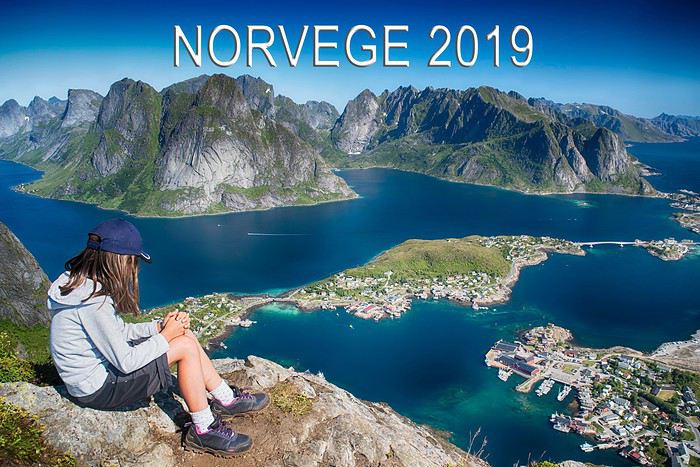
Right, here are a few details before we dive in!
Who: My husband, me, and our daughter, who turned 8 during the trip
When: From July 5 to 28, 2019—three full weeks there
What: A one-way trip from Oslo to Tromsø, with fjords, the Lofoten Islands, and so much more on the itinerary! Since you have to make choices—and because the country is huge—we decided to skip the south around Stavanger (we thought the hikes there might be too tough for us). We also chose not to go all the way to Bergen. Our goal was to spend time in the northern islands.
The route to Bodø:
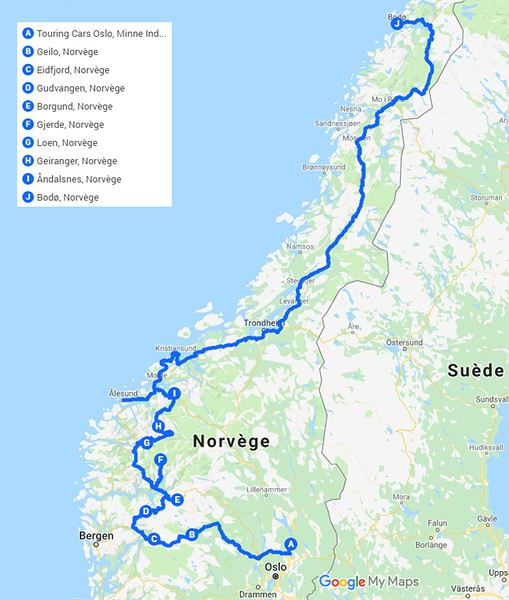
The route from Lofoten to Tromsø
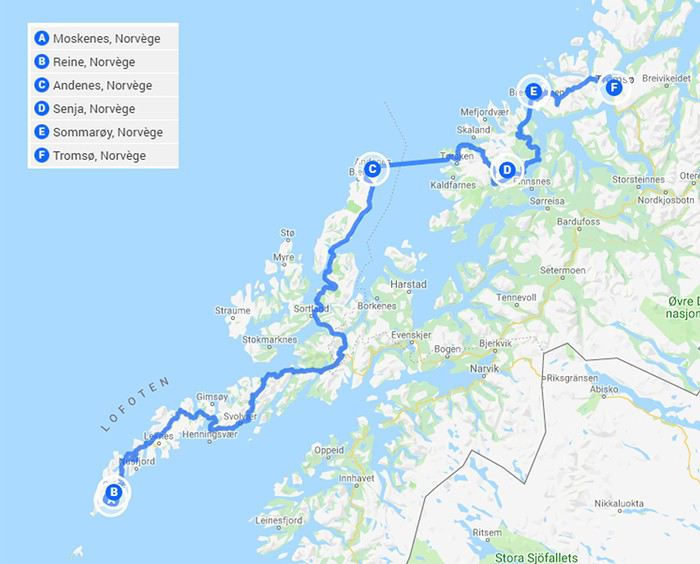
How: By camper van. Even though it’s not exactly budget-friendly, it’s really the ideal way to explore this country—especially for wild camping and adapting your route based on the weather and your mood. I’d recommend it 200%. It was our first time, and we loved it. Being able to wait out a downpour in warmth or shower after a long hike was super practical!! That said, we did have a few hiccups. The auxiliary battery (which powers the back) died, so we had to find a garage to replace it. And the biggest issue: on a narrow road, I smashed the mirror while passing another camper van 🏴☠️
Budget: Oh boy, that’s a big topic! To be honest, I didn’t tally it all up… because I didn’t want to! Everything is more expensive there, obviously. At the supermarket, for example. So I didn’t keep track—this was a vacation, we weren’t there to count every cent, even if we’re not exactly rolling in money! Ferries are pretty pricey, especially with a camper van, but there’s not much choice. Lots of toll roads too. Basically, when you go there, be prepared to open your wallet!!!
The weather: We weren’t sure what to expect before leaving—or rather, we were expecting bad weather. We were pleasantly surprised: we had almost nothing but great weather, with just a bit of rain toward the end. So the hiking trails weren’t muddy (at all?). Otherwise, it would’ve been a real pain and super slippery! Temperature-wise, we were lucky. It hovered between 15 and 21°C. Sounds chilly, but honestly, with the sun, it warms up nicely, and it was enough to wear shorts and a T-shirt almost the whole time—something I didn’t expect before we left. That said, the water temperature is freezing. The Arctic Ocean lives up to its name!! We could barely keep our feet in the water, even though those turquoise beaches were so tempting!!!
A few tips for preparation:
For wild camping: Use Park4Night—the app is amazing for finding spots and sharing our discoveries. We never would’ve dared to venture down some of those roads or trails without it.
For hikes: It’s not always easy to find hikes in the fjords that are manageable in terms of elevation, difficulty, and time. We still found some through blogs and tourist office websites. But we mostly focused on hikes in the Lofoten Islands, thanks to sites like rando-lofoten, 68north, and outt. Unsurprisingly, the level is pretty challenging. But by sticking to the “easy” ones, we managed just fine without being super trained, and we saw some incredible views!
Alright, no more waiting—let’s go! Follow me!
For those who want the "moving version," check out the video here, on page 3: https://voyageforum.com/v.f?post=9817074;live=1;#9817074
Well, the time to head back has come, so it’s time to share the 3 weeks we spent in Norway this year 🙂
Right, here are a few details before we dive in!
Who: My husband, me, and our daughter, who turned 8 during the trip
When: From July 5 to 28, 2019—three full weeks there
What: A one-way trip from Oslo to Tromsø, with fjords, the Lofoten Islands, and so much more on the itinerary! Since you have to make choices—and because the country is huge—we decided to skip the south around Stavanger (we thought the hikes there might be too tough for us). We also chose not to go all the way to Bergen. Our goal was to spend time in the northern islands.
The route to Bodø:
The route from Lofoten to Tromsø
How: By camper van. Even though it’s not exactly budget-friendly, it’s really the ideal way to explore this country—especially for wild camping and adapting your route based on the weather and your mood. I’d recommend it 200%. It was our first time, and we loved it. Being able to wait out a downpour in warmth or shower after a long hike was super practical!! That said, we did have a few hiccups. The auxiliary battery (which powers the back) died, so we had to find a garage to replace it. And the biggest issue: on a narrow road, I smashed the mirror while passing another camper van 🏴☠️
Budget: Oh boy, that’s a big topic! To be honest, I didn’t tally it all up… because I didn’t want to! Everything is more expensive there, obviously. At the supermarket, for example. So I didn’t keep track—this was a vacation, we weren’t there to count every cent, even if we’re not exactly rolling in money! Ferries are pretty pricey, especially with a camper van, but there’s not much choice. Lots of toll roads too. Basically, when you go there, be prepared to open your wallet!!!
The weather: We weren’t sure what to expect before leaving—or rather, we were expecting bad weather. We were pleasantly surprised: we had almost nothing but great weather, with just a bit of rain toward the end. So the hiking trails weren’t muddy (at all?). Otherwise, it would’ve been a real pain and super slippery! Temperature-wise, we were lucky. It hovered between 15 and 21°C. Sounds chilly, but honestly, with the sun, it warms up nicely, and it was enough to wear shorts and a T-shirt almost the whole time—something I didn’t expect before we left. That said, the water temperature is freezing. The Arctic Ocean lives up to its name!! We could barely keep our feet in the water, even though those turquoise beaches were so tempting!!!
A few tips for preparation:
For wild camping: Use Park4Night—the app is amazing for finding spots and sharing our discoveries. We never would’ve dared to venture down some of those roads or trails without it.
For hikes: It’s not always easy to find hikes in the fjords that are manageable in terms of elevation, difficulty, and time. We still found some through blogs and tourist office websites. But we mostly focused on hikes in the Lofoten Islands, thanks to sites like rando-lofoten, 68north, and outt. Unsurprisingly, the level is pretty challenging. But by sticking to the “easy” ones, we managed just fine without being super trained, and we saw some incredible views!
Alright, no more waiting—let’s go! Follow me!
For those who want the "moving version," check out the video here, on page 3: https://voyageforum.com/v.f?post=9817074;live=1;#9817074
Yellow Rocks 2019
Et oui, surprise ! D’habitude, vous me trouvez dans la rubrique des carnets USA avec tous mes carnets Red rocks mais cette fois, nous innovons. Depuis le dernier carnet au printemps 2016, nous sommes allées 2 fois en Norvège (Stavanger au sud-ouest) et les Lofoten (un régal pour les randonneurs), puis l’Europe avec Irlande et Irlande du nord et Portugal (Algarve). Et cette année : la Chine… Et oui, il y aura des yellow rocks…
Comment nous est venue l’idée ? Mon père y était allé il y a 3 ans avec ma tante en voyage organisé. Il pensait y retourner mais en faisant organiser le voyage par une agence locale avec guide et chauffeur. Ce n’était qu’un projet… En octobre, une amie à nous qui rêvait d’aller en Chine me contacte et je la mets en relation avec lui. Quelques heures plus tard voilà que les 3 protagonistes ont décidé de partir ensemble. Et finalement, pourquoi pas nous ? Ce genre de voyage n’est pas du tout dans nos habitudes mais pourquoi pas… Chacun de nous émet ses envies. Nous ferons des classiques mais rajoutons quelques sites prometteurs.
Mise en œuvre :
Première étape : elle consiste à trouver une agence locale de confiance. En discutant, nous avons déjà quelques idées, et en cherchant sur internet, on trouve plusieurs agences auxquelles nous demandons des devis avec hôtellerie niveau 4* (bon ce ne sont pas les 4* de chez nous bien sûr mais cela nous assure une qualité suffisante et certains seront une belle surprise).Un devis retient notre attention par son tarif nettement moins élevé. Le contact est bon avec Tan, le patron de l’agence qui parle bien français et répond très vite à toutes nos questions. L’idée c’est : guides francophones et chauffeurs pour chaque région pour nous 5, hôtellerie, restauration (petit déj et midi) et visite des sites que nous souhaitons + transports intérieurs en TGV et avion : bref tout inclus dans le budget sauf le repas du soir libre. Sur le site, il y a des commentaires clients mais qui datent. Nous lui demandons donc de parler avec un client français ayant utilisé ses services récemment. Il nous donne des coordonnées et la personne contactée nous rassure. Au retour, nous sommes ravis d’avoir choisi cette agence dont les tarifs vraiment moins chers que tous les autres devis nous auraient presque fait douter, et nous pouvons la recommander (en MP) sans hésiter !. Une belle mention aussi à tous nos guides qui font également partie de la réussite de ce voyage. Nous aurons eu aussi le plaisir de rencontrer Tan qui nous a reçu royalement dans un excellent restaurant et avec lequel nous avons passé un très bon et joyeux moment.
Seconde étape : billets d’avion. Facile et pas cher. Nice- Pékin retour Shanghaï Nice pour 430 € avec une seule escale à Paris (Air France à l’aller et China Eastern au retour). Trouvés fin novembre avec 1 bagage en soute et 1 bagage cabine par personne inclus.
Troisième étape : les visas. Là, c’est moins simple surtout que mon mari est italien, résident italien ce qui l’oblige à prendre une agence ou se rendre à Florence pendant que nous nous occupions des 4 autres à Marseille. Beaucoup de documents demandés… Bref, le truc pas marrant. Et je trouve la solution en lisant un blog. Il existe à Shanghaï une agence qui propose un visa de groupe qui est délivré à un groupe composé d’au moins deux membres (pas plus de 80 ans). Le Visa est appliqué sur une attestation pour tout le groupe, et non pas sur le passeport individuel. Tous les membres du groupe doivent voyager ensemble pour l’entrée et la sortie de la Chine. (si problème type rapatriement médical, il faut les contacter pour changer les documents). Beaucoup moins de justificatifs demandés qu’à l’ambassade : Photocopie du passeport qui doit être valable au moins six mois au-delà de de la demande du Visa Copie des réservations billets d’avion. Copie des réservations hôtelières Une photo d’identité couleur (et un numéro de contact d’urgence demandé pour les 2 personnes les moins jeunes de notre petit groupe de 5) Il est conseillé de transmettre la demande du Visa au moins 20 jours avant la date de départ prévue. Il faut alors 3 jours ouvrables pour émission + 3 jours ouvrables pour l'expédition par courrier international. Même si la procédure est présentée longtemps à l’avance, le Visa ne sera pas consigné avant un délai de quinze jours minimum. Le visa de groupe doit être utilisé dans les 15 jours suivant la date d’émission, valable 30 jours à compter de la date d’entrée.
Bref, j’ai envoyé les documents début avril pour être sûre que tout allait bien. Il nous manquait une réservation d’hôtel que Tan a transmis rapidement (il en a profité pour s’assurer du sérieux de cette agence). Ils ont traité la demande le 6 mai et nous l’avons reçu par Fedex le 9 mai pour un départ le 18 mai. (la date d’entrée maximum sur le territoire était le 20 mai et le visa avait une durée moins longue que celui pris au consulat car nous devions quitter le pays le 4 juin maximum (notre voyage de 2 semaines nous faisait partir le 1er juin). Mais il nous a coûté également moins cher : 99€ par personne. Et tout s’est fait direct et uniquement par internet (documents scannés pdf, jpeg…).Bref la forme est un document A4 en 2 exemplaires qu’on doit toujours garder sur soi et ne pas plier ou froisser. (prévoir pochette cartonnée) Facile, moins cher et efficace ! Et voilà il n’y a plus qu’à attendre le départ !
19/05
Si à Nice tout va bien, autant dire qu’à Paris, c’est la folie. Il y a une queue incroyable et la seule solution qui nous reste est de doubler tout le monde. Nous nous faisons huer (avec raison) et c’est plutôt stressant mais sans cela, nous ne serions jamais partis, même avec le décalage d’une heure de départ de l’avion.
Nous voilà à Pékin vers 6h du matin. Je regarde pour changer de l’argent mais les bureaux de change ne proposent pas un taux intéressant. Finalement, nous changerons à notre arrivée à l’hôtel en fin d’après-midi (pas trop tard car ensuite le change ferme). Nous avons le droit de changer 300 € par personne au même taux qu’à la banque mais avec beaucoup de facilité (A la banque, d’après mes infos, cela peut prendre de 5mn jusqu’à 1h avec pas mal de documents à remplir). La seule contrainte de l’hôtel c’est qu’ils n’acceptent que les billets absolument parfaits : non froissés, tachés ou abimés. Quelques billets m’ont été refusés pour un détail presque ridicule… Mais bon tout va bien.
Bref à 6h nous retrouvons notre première guide. Elle s’appelle Yan et tout de suite nous nous sentons parfaitement à l’aise. Elle sera notre coup de cœur des guides même si nous les avons tous aimés ! Notre amie Marie commence à tester son chinois et pour elle, c’est un vrai supplément d’âme au voyage de pouvoir communiquer plus ou moins bien selon les accents et la rapidité de la conversation.
Evidemment, aujourd’hui ce sera une journée avec des classiques vu qu’il s’agit d’une première pour 3 d’entre nous. Le temps est plutôt gris avec un peu de pollution qui gêne légèrement mon mari. Rien de dramatique. Nous visitons la Place Tiananmen, (mausolée de Mao où l’on remarque une queue importante pour la visite que nous ne ferons pas, le Grand Théâtre National…) Et bien sûr visite de la Cité Interdite (24 empereurs de 2 dynasties tout de même…). Un bon resto en ville : ce sera notre première (mais pas la dernière) table ronde avec une grande vitre centrale ronde aussi, plus petite et tournante qui permet de faire passer les plats posés dessus. Nous pouvons ainsi goûter de tout. C’est très bon, varié, mais finalement un peu gras. Nous nous en rendrons compte avec les repas suivants.
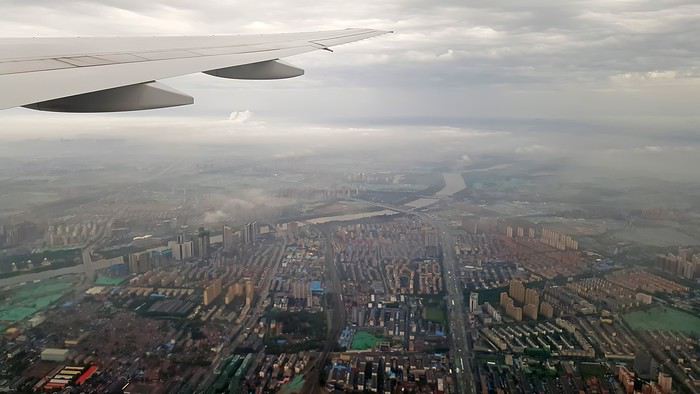
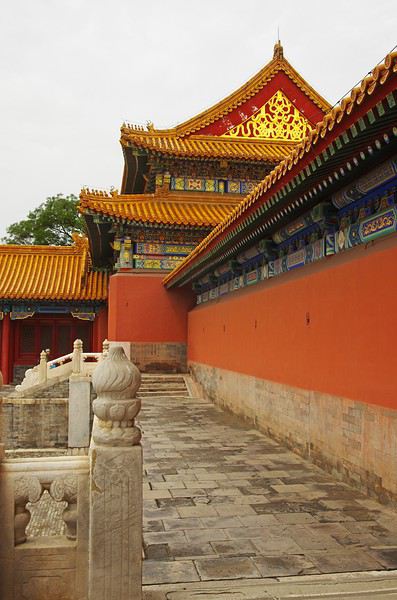
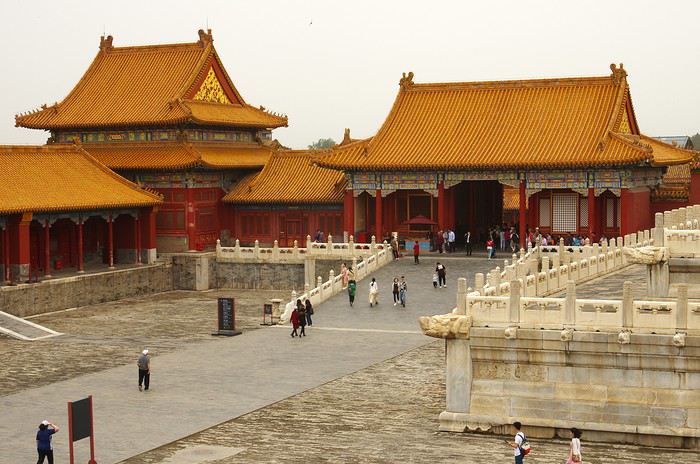
La foule : oui bien sûr, mais finalement les gens sont plutôt regroupés et on arrive donc même sur les sites très fréquentés à avoir des moments plus « calmes ». Finalement, c’est gérable… Autres idées reçues : nous avons trouvé les sites globalement très propres et les guides nous ont confirmé que beaucoup d’efforts ont été effectués ces dernières années pour cela, et pas seulement dans les grandes villes. Oui il y a encore quelques chinois qui crachent mais c’est devenu plutôt rare.
Par ailleurs nous avons beaucoup apprécié la gentillesse des gens à notre égard, des regards des sourires, de petits gestes, l’aide si besoin. Les européens sont très attirants et nous sommes régulièrement sollicités pour quelques photos ou selfies avec eux (au moins les plus blonds d’entre nous). A noter que la reine de notre petit groupe fut Marie originaire de l’Ile Maurice et dont la couleur de peau attirait les gens comme un aimant, mais toujours avec des sourires et l’envie de faire connaissance. Sa volonté de communiquer en chinois aidait beaucoup à son succès. Bref une star J
Visite ensuite du Temple du Ciel avec sa rotonde recouverte d’un triple toit de tuiles bleues. Coup de cœur pour les tuiles jaunes de la Cité Interdite puis les bleues du Temple du Ciel… De plus, le temps se met au beau et ça, on aime !
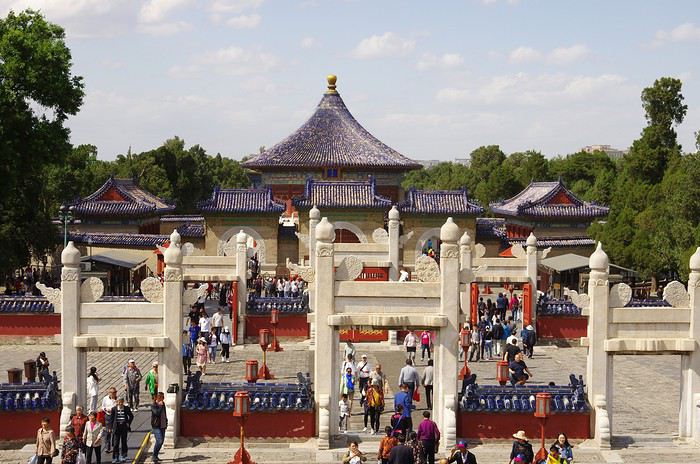
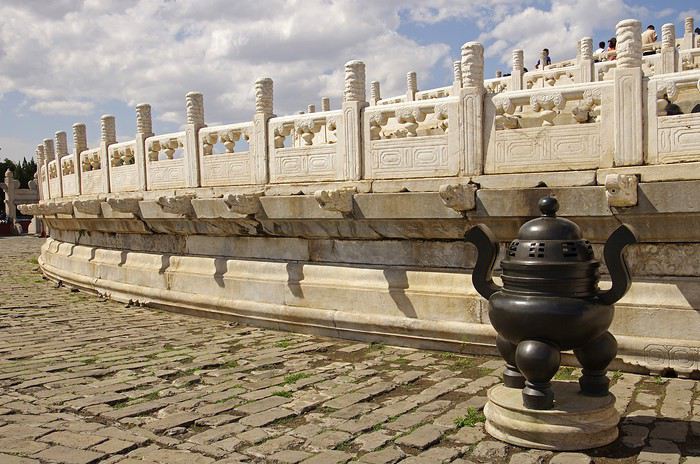
Comment nous est venue l’idée ? Mon père y était allé il y a 3 ans avec ma tante en voyage organisé. Il pensait y retourner mais en faisant organiser le voyage par une agence locale avec guide et chauffeur. Ce n’était qu’un projet… En octobre, une amie à nous qui rêvait d’aller en Chine me contacte et je la mets en relation avec lui. Quelques heures plus tard voilà que les 3 protagonistes ont décidé de partir ensemble. Et finalement, pourquoi pas nous ? Ce genre de voyage n’est pas du tout dans nos habitudes mais pourquoi pas… Chacun de nous émet ses envies. Nous ferons des classiques mais rajoutons quelques sites prometteurs.
Mise en œuvre :
Première étape : elle consiste à trouver une agence locale de confiance. En discutant, nous avons déjà quelques idées, et en cherchant sur internet, on trouve plusieurs agences auxquelles nous demandons des devis avec hôtellerie niveau 4* (bon ce ne sont pas les 4* de chez nous bien sûr mais cela nous assure une qualité suffisante et certains seront une belle surprise).Un devis retient notre attention par son tarif nettement moins élevé. Le contact est bon avec Tan, le patron de l’agence qui parle bien français et répond très vite à toutes nos questions. L’idée c’est : guides francophones et chauffeurs pour chaque région pour nous 5, hôtellerie, restauration (petit déj et midi) et visite des sites que nous souhaitons + transports intérieurs en TGV et avion : bref tout inclus dans le budget sauf le repas du soir libre. Sur le site, il y a des commentaires clients mais qui datent. Nous lui demandons donc de parler avec un client français ayant utilisé ses services récemment. Il nous donne des coordonnées et la personne contactée nous rassure. Au retour, nous sommes ravis d’avoir choisi cette agence dont les tarifs vraiment moins chers que tous les autres devis nous auraient presque fait douter, et nous pouvons la recommander (en MP) sans hésiter !. Une belle mention aussi à tous nos guides qui font également partie de la réussite de ce voyage. Nous aurons eu aussi le plaisir de rencontrer Tan qui nous a reçu royalement dans un excellent restaurant et avec lequel nous avons passé un très bon et joyeux moment.
Seconde étape : billets d’avion. Facile et pas cher. Nice- Pékin retour Shanghaï Nice pour 430 € avec une seule escale à Paris (Air France à l’aller et China Eastern au retour). Trouvés fin novembre avec 1 bagage en soute et 1 bagage cabine par personne inclus.
Troisième étape : les visas. Là, c’est moins simple surtout que mon mari est italien, résident italien ce qui l’oblige à prendre une agence ou se rendre à Florence pendant que nous nous occupions des 4 autres à Marseille. Beaucoup de documents demandés… Bref, le truc pas marrant. Et je trouve la solution en lisant un blog. Il existe à Shanghaï une agence qui propose un visa de groupe qui est délivré à un groupe composé d’au moins deux membres (pas plus de 80 ans). Le Visa est appliqué sur une attestation pour tout le groupe, et non pas sur le passeport individuel. Tous les membres du groupe doivent voyager ensemble pour l’entrée et la sortie de la Chine. (si problème type rapatriement médical, il faut les contacter pour changer les documents). Beaucoup moins de justificatifs demandés qu’à l’ambassade : Photocopie du passeport qui doit être valable au moins six mois au-delà de de la demande du Visa Copie des réservations billets d’avion. Copie des réservations hôtelières Une photo d’identité couleur (et un numéro de contact d’urgence demandé pour les 2 personnes les moins jeunes de notre petit groupe de 5) Il est conseillé de transmettre la demande du Visa au moins 20 jours avant la date de départ prévue. Il faut alors 3 jours ouvrables pour émission + 3 jours ouvrables pour l'expédition par courrier international. Même si la procédure est présentée longtemps à l’avance, le Visa ne sera pas consigné avant un délai de quinze jours minimum. Le visa de groupe doit être utilisé dans les 15 jours suivant la date d’émission, valable 30 jours à compter de la date d’entrée.
Bref, j’ai envoyé les documents début avril pour être sûre que tout allait bien. Il nous manquait une réservation d’hôtel que Tan a transmis rapidement (il en a profité pour s’assurer du sérieux de cette agence). Ils ont traité la demande le 6 mai et nous l’avons reçu par Fedex le 9 mai pour un départ le 18 mai. (la date d’entrée maximum sur le territoire était le 20 mai et le visa avait une durée moins longue que celui pris au consulat car nous devions quitter le pays le 4 juin maximum (notre voyage de 2 semaines nous faisait partir le 1er juin). Mais il nous a coûté également moins cher : 99€ par personne. Et tout s’est fait direct et uniquement par internet (documents scannés pdf, jpeg…).Bref la forme est un document A4 en 2 exemplaires qu’on doit toujours garder sur soi et ne pas plier ou froisser. (prévoir pochette cartonnée) Facile, moins cher et efficace ! Et voilà il n’y a plus qu’à attendre le départ !
19/05
Si à Nice tout va bien, autant dire qu’à Paris, c’est la folie. Il y a une queue incroyable et la seule solution qui nous reste est de doubler tout le monde. Nous nous faisons huer (avec raison) et c’est plutôt stressant mais sans cela, nous ne serions jamais partis, même avec le décalage d’une heure de départ de l’avion.
Nous voilà à Pékin vers 6h du matin. Je regarde pour changer de l’argent mais les bureaux de change ne proposent pas un taux intéressant. Finalement, nous changerons à notre arrivée à l’hôtel en fin d’après-midi (pas trop tard car ensuite le change ferme). Nous avons le droit de changer 300 € par personne au même taux qu’à la banque mais avec beaucoup de facilité (A la banque, d’après mes infos, cela peut prendre de 5mn jusqu’à 1h avec pas mal de documents à remplir). La seule contrainte de l’hôtel c’est qu’ils n’acceptent que les billets absolument parfaits : non froissés, tachés ou abimés. Quelques billets m’ont été refusés pour un détail presque ridicule… Mais bon tout va bien.
Bref à 6h nous retrouvons notre première guide. Elle s’appelle Yan et tout de suite nous nous sentons parfaitement à l’aise. Elle sera notre coup de cœur des guides même si nous les avons tous aimés ! Notre amie Marie commence à tester son chinois et pour elle, c’est un vrai supplément d’âme au voyage de pouvoir communiquer plus ou moins bien selon les accents et la rapidité de la conversation.
Evidemment, aujourd’hui ce sera une journée avec des classiques vu qu’il s’agit d’une première pour 3 d’entre nous. Le temps est plutôt gris avec un peu de pollution qui gêne légèrement mon mari. Rien de dramatique. Nous visitons la Place Tiananmen, (mausolée de Mao où l’on remarque une queue importante pour la visite que nous ne ferons pas, le Grand Théâtre National…) Et bien sûr visite de la Cité Interdite (24 empereurs de 2 dynasties tout de même…). Un bon resto en ville : ce sera notre première (mais pas la dernière) table ronde avec une grande vitre centrale ronde aussi, plus petite et tournante qui permet de faire passer les plats posés dessus. Nous pouvons ainsi goûter de tout. C’est très bon, varié, mais finalement un peu gras. Nous nous en rendrons compte avec les repas suivants.
La foule : oui bien sûr, mais finalement les gens sont plutôt regroupés et on arrive donc même sur les sites très fréquentés à avoir des moments plus « calmes ». Finalement, c’est gérable… Autres idées reçues : nous avons trouvé les sites globalement très propres et les guides nous ont confirmé que beaucoup d’efforts ont été effectués ces dernières années pour cela, et pas seulement dans les grandes villes. Oui il y a encore quelques chinois qui crachent mais c’est devenu plutôt rare.
Par ailleurs nous avons beaucoup apprécié la gentillesse des gens à notre égard, des regards des sourires, de petits gestes, l’aide si besoin. Les européens sont très attirants et nous sommes régulièrement sollicités pour quelques photos ou selfies avec eux (au moins les plus blonds d’entre nous). A noter que la reine de notre petit groupe fut Marie originaire de l’Ile Maurice et dont la couleur de peau attirait les gens comme un aimant, mais toujours avec des sourires et l’envie de faire connaissance. Sa volonté de communiquer en chinois aidait beaucoup à son succès. Bref une star J
Visite ensuite du Temple du Ciel avec sa rotonde recouverte d’un triple toit de tuiles bleues. Coup de cœur pour les tuiles jaunes de la Cité Interdite puis les bleues du Temple du Ciel… De plus, le temps se met au beau et ça, on aime !