Results for "Chine+sécurité"
About 48,503 results.
More options
Many results are in French, the community’s main language. English translations are added over time.
Search results
Sécurité au Ladakh pour voyage en solo (août)
Bonjour,
j'ai très envie d'aller au ladakh pour 4 semaines environ en aout, mais je me demande si c'est une région facile pour un voyageur seul: j'ai pu lire qu'il pouvait être dangeureux d'être seul ou en petit groupe en montagne.
D'autrepart, il semble difficile et incertain d'arriver à Leh depuis NewDelhi, je me trompe?
J'ai déjà voyagé seul en Bolivie, Pérou et Maroc, mais j'ai l'impression que le Ladakh est un pays où le voyage est plus dur... fausse impression?
Si quelqu'un peut me donner un avis ou conseil, il sera le bienvenu, car j'hésite encore à me lancer dans cette aventure.
Guillaume
j'ai très envie d'aller au ladakh pour 4 semaines environ en aout, mais je me demande si c'est une région facile pour un voyageur seul: j'ai pu lire qu'il pouvait être dangeureux d'être seul ou en petit groupe en montagne.
D'autrepart, il semble difficile et incertain d'arriver à Leh depuis NewDelhi, je me trompe?
J'ai déjà voyagé seul en Bolivie, Pérou et Maroc, mais j'ai l'impression que le Ladakh est un pays où le voyage est plus dur... fausse impression?
Si quelqu'un peut me donner un avis ou conseil, il sera le bienvenu, car j'hésite encore à me lancer dans cette aventure.
Guillaume
En train de Pékin à Pingyao
Bonjour à vous tous,
En octobre je compte aller de Pékin à Pingyao en train grande vitesse. Je voulais savoir si l'on doit arriver à la gare longtemps avant l'heure du départ du train.
Une fois à Taiyuan, quel est le moyen le plus simple pour rejoindre Pingyao Merci
En octobre je compte aller de Pékin à Pingyao en train grande vitesse. Je voulais savoir si l'on doit arriver à la gare longtemps avant l'heure du départ du train.
Une fois à Taiyuan, quel est le moyen le plus simple pour rejoindre Pingyao Merci
Voyage jusqu'à Xi'an (Chine) par la Pologne, Bielorussie, Russie et le Kazakhstan
je pars avec un pote au mois d'aout, et nous avons trouvé un renault traffic diesel que nous pensons vendre au kazakstan. et continuer en moto pour aller en chine, car il semble impossible d'aller en chine avec (taxe importante! à - qu'il existe un moyen de passer à travers)!
Nous prevoyons 4 à 5 semaines maxi pour atteindre notre but, et c'est notre premier long voyage.... on en est aux preparations (et c'est tres existant!) et notre budget est tres tres limitée... (-1000€/personne hors cout du vehicule!). nous dormirons ds le vehicule (puis ds un une tant pour la chine) pour faire des economie...
Je connais le Xinjiang et particulierement Urumqi et Xi'an ou j'y ai des amis... qui devraient s'occuper d'obtenir nos permis de conduire...
Par contre la russie semble la partie la plus risquée au niveau de la securitée...
J'ai besoins de vos avis et conseils pour ce voyage, comment economisée? cout de l'essence ds les pays? y a t'il des taxes pour traverser un des pays cité (hormis la chine, je ne pense pas)? la securitée? qu'elles impressions vous ont laissée ses pays? serait-il faisable de revendre la camionnette et racheter un moto au kazakhstan? et si oui qu'elle est le tarif en vigueur pour ces véhiciles? les meilleurs circuits....? un permis international semble suffir (sauf chine)est il possible d'avoir confirmation?etc....
En faite j'ai deja trouvé la reponse de certaine questions, j'ai juste besoin de confirmation, ça rasure hé hé!! on prevois un detour pourr voire la mer d'aral
merci pour vos conseils et sentiments
Ol:ve

En faite j'ai deja trouvé la reponse de certaine questions, j'ai juste besoin de confirmation, ça rasure hé hé!! on prevois un detour pourr voire la mer d'aral
merci pour vos conseils et sentiments
Ol:ve
What budget should you plan for 2 weeks of travel in China?
Hi there,
We just got back from a 2-week trip to China as a couple, and before we left, the budget was the hardest thing to picture concretely. We found plenty of info on visas, apps, transport, and itineraries, but way fewer detailed breakdowns of what you *actually* spend on the ground.
So, we took the time to share our real budget for 14 days. In our case, we spent around 1,800 € per person, with a big chunk of that going toward round-trip flights at about 600 € per person. We were also pretty surprised by how affordable China can be once you’re there—transport is often cheap, and a lot of everyday expenses stay reasonable.
The trickiest part, in the end, was figuring out how to pay while you’re there, since it’s not always obvious if you’re not prepared. But once everything’s set up and you get the hang of it, it’s really smooth.
If this can help other travelers get a better idea before they go, we’ve broken it all down here:
https://aventures-sans-mesaventure.com/budget-2-semaines-de-voyage-en-chine/
Happy travels and enjoy your adventure! Hélia
Happy travels and enjoy your adventure! Hélia
WeChat QR Code
Hello,
I hope you don't mind me reaching out. I’m currently in my final year of my master’s program. As part of an international workshop, I’ll be heading to Wuhan, China, soon.
To adapt to local requirements, I’m trying to activate my WeChat account, but it requires QR code verification. Would it be possible for someone to help me by scanning this QR code to validate my account?
Thank you in advance for your help and understanding.
Best regards,
I hope you don't mind me reaching out. I’m currently in my final year of my master’s program. As part of an international workshop, I’ll be heading to Wuhan, China, soon.
To adapt to local requirements, I’m trying to activate my WeChat account, but it requires QR code verification. Would it be possible for someone to help me by scanning this QR code to validate my account?
Thank you in advance for your help and understanding.
Best regards,
Feedback on a 15-day China itinerary
Hi everyone,
I’ve traveled a lot outside Europe before Covid, usually organizing my trips myself. In recent years, I’ve focused on Europe, which I’d neglected before. Now, I’d like to get back to long-haul trips and fill in some gaps on my world map.
At the moment, I’m considering a route in China—I’ve only been to Hong Kong (which isn’t really China)—for late April/early May 2026. Here’s a first draft:
D1: Departure D2: Arrive in Beijing in the morning – hutongs – night in Beijing D3: Forbidden City – Temple of Heaven – night in Beijing D4: Great Wall – night in Beijing D5: Summer Palace – (Ming Tombs?) – night in Beijing D6: Train to Datong – Yungang Grottoes – night in Datong D7: Train to Pingyao – visit – night in Pingyao D8: Train to Xi’an – Wild Goose Pagoda – night in Xi’an D9: Terracotta Army – Xi’an city walls – night in Xi’an D10: Flight to Zhangjiajie (or the night before) – Tianzi Mountain – night in Wulingyuan D11: National park – night in Wulingyuan D12: National park – night in Wulingyuan D13: Train to Chongqing – night in Chongqing D14: Explore Chongqing – night in Chongqing D15: Return flight
I know it’s tight, but what do you think? For the Great Wall section, what do you recommend? Jinshanling seems like the best option, or Simatai, but it’s far. For the budget, I’m planning on 2,500 € per person. Thanks for your feedback! Phil
I’ve traveled a lot outside Europe before Covid, usually organizing my trips myself. In recent years, I’ve focused on Europe, which I’d neglected before. Now, I’d like to get back to long-haul trips and fill in some gaps on my world map.
At the moment, I’m considering a route in China—I’ve only been to Hong Kong (which isn’t really China)—for late April/early May 2026. Here’s a first draft:
D1: Departure D2: Arrive in Beijing in the morning – hutongs – night in Beijing D3: Forbidden City – Temple of Heaven – night in Beijing D4: Great Wall – night in Beijing D5: Summer Palace – (Ming Tombs?) – night in Beijing D6: Train to Datong – Yungang Grottoes – night in Datong D7: Train to Pingyao – visit – night in Pingyao D8: Train to Xi’an – Wild Goose Pagoda – night in Xi’an D9: Terracotta Army – Xi’an city walls – night in Xi’an D10: Flight to Zhangjiajie (or the night before) – Tianzi Mountain – night in Wulingyuan D11: National park – night in Wulingyuan D12: National park – night in Wulingyuan D13: Train to Chongqing – night in Chongqing D14: Explore Chongqing – night in Chongqing D15: Return flight
I know it’s tight, but what do you think? For the Great Wall section, what do you recommend? Jinshanling seems like the best option, or Simatai, but it’s far. For the budget, I’m planning on 2,500 € per person. Thanks for your feedback! Phil
Travel Journal - 28 Days in China in August 2025
Hi everyone! I’m sharing a modest travel journal from my trip to China in August 2025.
There wasn’t much room for improvisation on this trip—everything was planned in advance. Since August is peak season, I decided to book train tickets early, and once that was set, I reserved all the accommodations too. I got everything on Trip.com.
I bought the flight tickets back in March from Hainan Airlines. They were super expensive, but with these travel dates, I couldn’t exactly dream of a bargain!
I picked up e-SIMs valid for a month from Free just before departure: 10 € for the e-SIM + 19.90 € for a one-month plan with 35 GB of data abroad.
No need for a VPN with these e-SIMs, but D. still got one—a multi-device plan for 5 € with a discount from Let’s VPN, valid for a month. It was for evenings at the hotel on Wi-Fi to avoid burning through the 35 GB with video.
I downloaded Alipay, WeChat, Amap (Baidu Maps), and Trip.com. We also have Google Translate and Maps.me—absolute must-haves.
We’re ready to go!
I’ve been waiting for this day for nearly 15 years!! I travel a lot, but this one—this is MY TRIP 🙂 It’s been postponed so many times: because I wanted to do it with the right person, because I have a Turkish stamp in my passport and heard they don’t issue visas with that, because of COVID... and then China introduced a 30-day visa exemption, and that was the green light! Ugh, they forced us to take our vacation in August this year—far from ideal—but no more delays. Saturday, August 2, 2025: it’s finally the big day!
Days 1 and 2: We got dropped off at Charles de Gaulle at 9:30 AM. I supposedly checked in online, but only for the first flight and without getting the boarding pass... Might as well scrap online check-in in that case. So, we spent over an hour in line at the counter to get them. We didn’t have any checked luggage—just our backpacks as carry-ons—so this was a step we’d never had to deal with before, but whatever, it’s done. No wait at passport control, 5 minutes through security, a quick walk around the terminal, 10 minutes in the boarding area, and it was already time to board. Departure around 12:45 PM, arrival in Chongqing at 4:50 AM. We had a few hours of layover before our next flight. Went through immigration, connecting flight control, and security. Pro tip: check your next flight’s boarding gate right after immigration. We never saw it displayed again anywhere in the terminal.
The Free e-SIMs work—phew!
Took off at 9:30 AM, arrived in Guangzhou (Canton) at 11:20 AM in the rain. I love how Chongqing is translated as "Tchoung King" on the screens in the plane—very French!
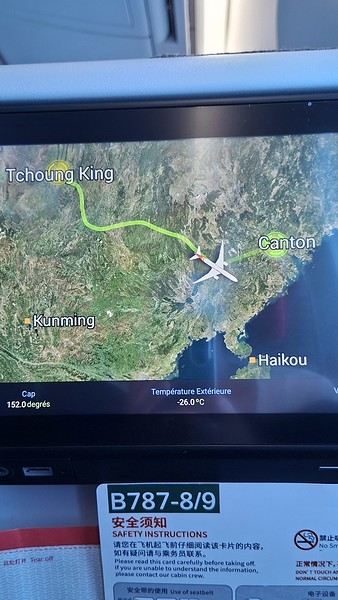
During my first two trips to China, we paid for everything in cash, but this time, we’re going all-in on Alipay and WeChat. I still brought the leftover change from previous trips—it might come in handy. At the metro station, they showed us a QR code to buy tickets via WeChat. There were probably machines and even a ticket counter, but we didn’t see them, and buying via WeChat was pretty simple. 8 yuan to Changshu Lu, which is 22 stops. So far, so good. Then, we had to find the hotel, which wasn’t on Google Maps, Maps.me, or Amap... Easy 😎! We found it without too much hassle, though. Dropped off our stuff and went out to eat. 55 yuan for two claypots with fish/eel, rice, cabbage, and purple eggplant. When we left, it was pouring. We grabbed our umbrellas and set off to explore the neighborhood: Enning Road (we’ll come back later to check out a specific spot), Shangxiajiu (the pedestrian shopping street), Baohua Road... The area is pretty diverse—one street to the next, it’s like stepping into a different world.

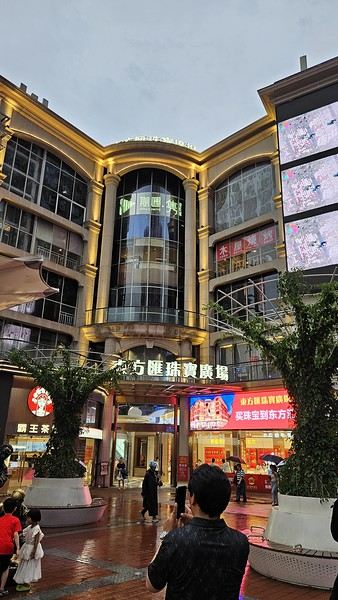
There weren’t many people around, probably because of the rain. We grabbed a quick street food dinner and went to bed—we were exhausted. We struggled to stay awake until 11 PM to adjust to the time change as quickly as possible. There’s a 6-hour time difference.
There wasn’t much room for improvisation on this trip—everything was planned in advance. Since August is peak season, I decided to book train tickets early, and once that was set, I reserved all the accommodations too. I got everything on Trip.com.
I bought the flight tickets back in March from Hainan Airlines. They were super expensive, but with these travel dates, I couldn’t exactly dream of a bargain!
I picked up e-SIMs valid for a month from Free just before departure: 10 € for the e-SIM + 19.90 € for a one-month plan with 35 GB of data abroad.
No need for a VPN with these e-SIMs, but D. still got one—a multi-device plan for 5 € with a discount from Let’s VPN, valid for a month. It was for evenings at the hotel on Wi-Fi to avoid burning through the 35 GB with video.
I downloaded Alipay, WeChat, Amap (Baidu Maps), and Trip.com. We also have Google Translate and Maps.me—absolute must-haves.
We’re ready to go!
I’ve been waiting for this day for nearly 15 years!! I travel a lot, but this one—this is MY TRIP 🙂 It’s been postponed so many times: because I wanted to do it with the right person, because I have a Turkish stamp in my passport and heard they don’t issue visas with that, because of COVID... and then China introduced a 30-day visa exemption, and that was the green light! Ugh, they forced us to take our vacation in August this year—far from ideal—but no more delays. Saturday, August 2, 2025: it’s finally the big day!
Days 1 and 2: We got dropped off at Charles de Gaulle at 9:30 AM. I supposedly checked in online, but only for the first flight and without getting the boarding pass... Might as well scrap online check-in in that case. So, we spent over an hour in line at the counter to get them. We didn’t have any checked luggage—just our backpacks as carry-ons—so this was a step we’d never had to deal with before, but whatever, it’s done. No wait at passport control, 5 minutes through security, a quick walk around the terminal, 10 minutes in the boarding area, and it was already time to board. Departure around 12:45 PM, arrival in Chongqing at 4:50 AM. We had a few hours of layover before our next flight. Went through immigration, connecting flight control, and security. Pro tip: check your next flight’s boarding gate right after immigration. We never saw it displayed again anywhere in the terminal.
The Free e-SIMs work—phew!
Took off at 9:30 AM, arrived in Guangzhou (Canton) at 11:20 AM in the rain. I love how Chongqing is translated as "Tchoung King" on the screens in the plane—very French!
During my first two trips to China, we paid for everything in cash, but this time, we’re going all-in on Alipay and WeChat. I still brought the leftover change from previous trips—it might come in handy. At the metro station, they showed us a QR code to buy tickets via WeChat. There were probably machines and even a ticket counter, but we didn’t see them, and buying via WeChat was pretty simple. 8 yuan to Changshu Lu, which is 22 stops. So far, so good. Then, we had to find the hotel, which wasn’t on Google Maps, Maps.me, or Amap... Easy 😎! We found it without too much hassle, though. Dropped off our stuff and went out to eat. 55 yuan for two claypots with fish/eel, rice, cabbage, and purple eggplant. When we left, it was pouring. We grabbed our umbrellas and set off to explore the neighborhood: Enning Road (we’ll come back later to check out a specific spot), Shangxiajiu (the pedestrian shopping street), Baohua Road... The area is pretty diverse—one street to the next, it’s like stepping into a different world.
There weren’t many people around, probably because of the rain. We grabbed a quick street food dinner and went to bed—we were exhausted. We struggled to stay awake until 11 PM to adjust to the time change as quickly as possible. There’s a 6-hour time difference.
Carrying liquids in cabin with AirChina
Hi there,
Since I can’t reach AirChina by phone, I’m posting here to see if anyone has encountered a similar situation and can shed some light.
I’m flying on Sunday for a CDG-Beijing-Canton flight with AirChina, then Canton-Bangkok with Spring Airlines.
I’m a bit worried about my luggage. I’m only traveling with a backpack, a carry-on bag.
I’m not entirely clear on the rules about carrying liquids in the cabin, and I’m hesitant to bring a small toiletry kit (small perfume, cream, deodorant stick—all under 100ml, in a ziplock bag, with a total volume of 350ml).
From what I understand, liquids are allowed but only in checked baggage for domestic flights. On the other hand, it’s stated that they’re permitted in cabin if they meet the 100ml rule and are packed in a ziplock. It’s a bit contradictory, and the airline isn’t responding.
Since my connection is tight and I’m not familiar with Beijing Airport, I’m afraid of breaking the rules, getting held up during security checks, and having to throw away my things.
If anyone can clarify this for me, I’d really appreciate it! !
Since I can’t reach AirChina by phone, I’m posting here to see if anyone has encountered a similar situation and can shed some light.
I’m flying on Sunday for a CDG-Beijing-Canton flight with AirChina, then Canton-Bangkok with Spring Airlines.
I’m a bit worried about my luggage. I’m only traveling with a backpack, a carry-on bag.
I’m not entirely clear on the rules about carrying liquids in the cabin, and I’m hesitant to bring a small toiletry kit (small perfume, cream, deodorant stick—all under 100ml, in a ziplock bag, with a total volume of 350ml).
From what I understand, liquids are allowed but only in checked baggage for domestic flights. On the other hand, it’s stated that they’re permitted in cabin if they meet the 100ml rule and are packed in a ziplock. It’s a bit contradictory, and the airline isn’t responding.
Since my connection is tight and I’m not familiar with Beijing Airport, I’m afraid of breaking the rules, getting held up during security checks, and having to throw away my things.
If anyone can clarify this for me, I’d really appreciate it! !
China, a forgotten destination?
There’s a similar discussion about India, by the way...
I really, really want to go back to China, but since the country is evolving at lightning speed, I’m wondering. I went there nearly 20 years ago. It was already undergoing a lot of changes, slowly but surely, but I still have wonderful memories of the country, which I found so endearing at the time. I visited Beijing, Sichuan, Guangxi, Hainan, and also Tibet by train, then Xinjiang. Now, we’re mainly considering Gansu and Hunan.
It was still possible to get 60-day visas back then, which isn’t the case anymore since they’re now limited to 30 days. But at the same time, the country seems more accessible. Many hotels are open to foreign tourists, sophisticated transport options have developed everywhere, and it’s possible to visit for up to 15 days without a visa... Tourists can easily travel by train or plane, but to reach places "off the beaten path," it seems you need to rent a vehicle with a driver. There used to be plenty of day-trip group tours, but that doesn’t seem to be the case anymore.
It’s hard to find info on whether certain routes are feasible for independent travel.
From what I’ve gathered here and there, "high tech" has taken over the entire country, the countryside has given way to imposing buildings, cities are increasingly industrialized and polluted—basically, the country has become dehumanized... In short, are there still beautiful places left—dare I say preserved—to see?
Add to this the bad reputation, not always justified, that China suffers from. It seems like the country is being boycotted by travel agencies, as if it’s not "politically correct" to visit. Maybe I’m exaggerating, but I’ve noticed this with French agencies like Nomade, Allibert, etc., which used to offer a wide range of itineraries everywhere, especially in Yunnan. Now, they’ve limited themselves to the classics: Beijing, Xi’an, Shanghai, water towns, or Tibet. Yunnan, Gansu, Qinghai, and many other Chinese provinces are no longer on the menu. Maybe it’s due to COVID...
The destination isn’t exactly a hit on forums either...
So, is it still worth going in 2025? I’d love to hear from those who’ve been there recently. Looking forward to exchanging thoughts on this fascinating destination (from my point of view, of course).
Anne-Claire
I really, really want to go back to China, but since the country is evolving at lightning speed, I’m wondering. I went there nearly 20 years ago. It was already undergoing a lot of changes, slowly but surely, but I still have wonderful memories of the country, which I found so endearing at the time. I visited Beijing, Sichuan, Guangxi, Hainan, and also Tibet by train, then Xinjiang. Now, we’re mainly considering Gansu and Hunan.
It was still possible to get 60-day visas back then, which isn’t the case anymore since they’re now limited to 30 days. But at the same time, the country seems more accessible. Many hotels are open to foreign tourists, sophisticated transport options have developed everywhere, and it’s possible to visit for up to 15 days without a visa... Tourists can easily travel by train or plane, but to reach places "off the beaten path," it seems you need to rent a vehicle with a driver. There used to be plenty of day-trip group tours, but that doesn’t seem to be the case anymore.
It’s hard to find info on whether certain routes are feasible for independent travel.
From what I’ve gathered here and there, "high tech" has taken over the entire country, the countryside has given way to imposing buildings, cities are increasingly industrialized and polluted—basically, the country has become dehumanized... In short, are there still beautiful places left—dare I say preserved—to see?
Add to this the bad reputation, not always justified, that China suffers from. It seems like the country is being boycotted by travel agencies, as if it’s not "politically correct" to visit. Maybe I’m exaggerating, but I’ve noticed this with French agencies like Nomade, Allibert, etc., which used to offer a wide range of itineraries everywhere, especially in Yunnan. Now, they’ve limited themselves to the classics: Beijing, Xi’an, Shanghai, water towns, or Tibet. Yunnan, Gansu, Qinghai, and many other Chinese provinces are no longer on the menu. Maybe it’s due to COVID...
The destination isn’t exactly a hit on forums either...
So, is it still worth going in 2025? I’d love to hear from those who’ve been there recently. Looking forward to exchanging thoughts on this fascinating destination (from my point of view, of course).
Anne-Claire
Rejoindre la Chine en passant par le Kazakhstan en camping-car
Bonjour, j'aimerai savoir si des personnes sont parties en camping-car en passant par le KAZAKHSTAN pour rejoindre la Chine (je ne veux pas passer par l'IRAN etc) , la Thailande Cambodge Vietnam, Singapour après avoir traversé l'Europe avec des haltes tout au long du voyage . Pouvez-vous me faire part de votre expérience, si c'est réalisable etc. surtout pour la partie sortie de l'Europe ver le KAZAKSTAN etc.. je prévois ce voyage sur au minimum 1 an en Asie pour pouvoir bien en profiter et au total 2 voir 3 ans voir plus.. suivant où le vent nous mènera mon mari et moi..😉 . (ce projet est pour dans quelques années.)
Merci de me faire part de votre expérience si vous le voulez bien, aussi bien pour les trajets (état des routes, facilité pour trouver son itinéraire) la nourriture , l'accueil, les règles concernant le stationnement des camping-cars etc... Au plaisir de vous lire. Cordialement
On the Silk Road: Chronicles of a Sixty-Something Traveling Completely Independently
From Beijing to Khiva: China, Kyrgyzstan, Tajikistan, Uzbekistan
Chronicle of anecdotes, highlights, and other adventures that marked this eight-week journey in 2018.
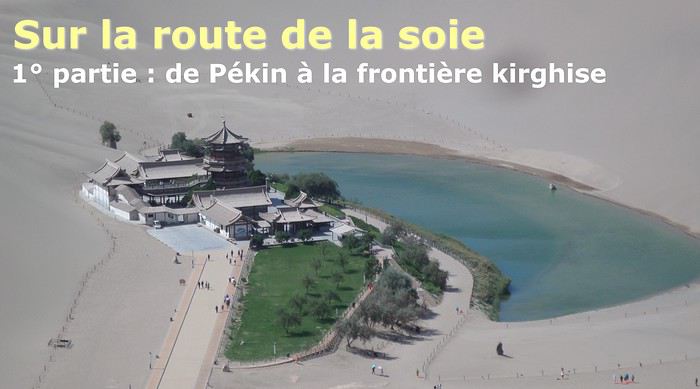
The Chinese Far West More than 30 years after my first trip to eastern China, I finally fulfilled an old dream: traveling solo from Beijing to the far west, discovering Xinjiang, the Uyghur people and the oppression they endure, the oases of Turpan and Kashgar, the Taklamakan Desert, the end of the Great Wall... The route was covered by train.
MENU PART 1: CHINA
1- Beijing (Jiankou) : the authentic Great Wall, without tourists 2- Cycling in Beijing, the best way to get around 3- Beijing : departure for the far west 4- Jiayuguan : getting by without English 5- Jiayuguan : scams and heritage 6- Dunhuang : abundance in the middle of the desert 7- Turpan : the Uyghurs under heavy surveillance 8- Kashgar : love at first sight for the old city 9- Kashgar : China’s recipe for controlling the populace 10- Tashkurgan : what on earth was I thinking going there! Kyrgyz border: a surreal epic Photo album from the 80s, contributions from other travelers (page 2)
1- JIANKOU Finding the authentic Great Wall, without tourists or a guide Friday, August 24, 2018 Thirty years later, I didn’t feel like revisiting the Great Wall at Badaling or any other overcrowded site. I chose to explore it at Jiankou, in its wildest, most authentic, and unrestored section, starting from a lost village deep in a valley—though it wasn’t *that* lost, since it had everything for communication.
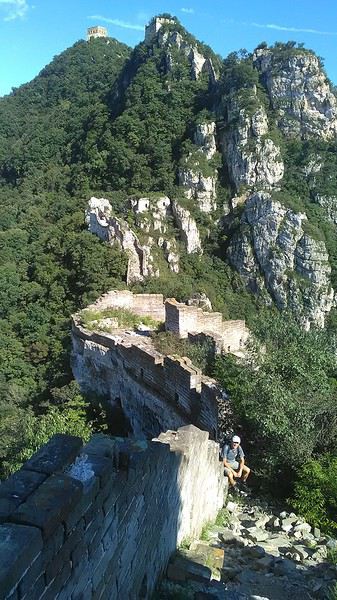
No need to pay for a taxi to get there—by timing it right, you can take the bus for just a few yuan. You have to get off at Xizhazi, the bus terminus. Be careful, there are only two buses a day in each direction. At the Xizhazi bus stop, I met a young couple who’d arrived with zero information about what to expect. We hiked the three of us toward the restored section of Mutianyu.
Still, be cautious With GPS and a topographic map (OpenTopoMap), you can set off without a problem or guide. The trail up to Jiankou is easy and well-marked. The trails down are too. But be careful—once you’re on the Wall, it’s real mountain hiking, with easy but dangerous climbing sections (over sheer drops). Not for amateurs or those afraid of heights! But what a reward. The Wall all to yourself, where it’s at its most daring. Truly mesmerizing.
More photos...
2- BEIJING The best way to get around the capital Sunday, August 26 The best way to explore the city is still by bike. Most are in a bike-share system, but you need to use an app—WeChat, the app that does everything, like monitoring your every move. No way I was installing that.
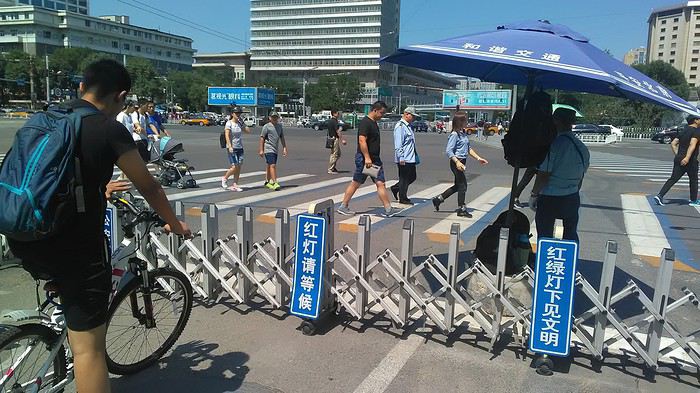
I found one at a rental shop near the hostel. The key is to quickly learn local traffic customs to minimize risks. Bike lanes are wide along the avenues.
But you still have to: - Watch out for anything parked on the bike paths—the most annoying are people napping or talking on the phone in their cars - Keep an eye on everything coming the wrong way—the list is long - The worst is right turns on red, which in Chinese traffic rules seem to have priority Once you get the hang of it, it’s fine. The city is huge but flat, so you can just wing it.
3- BEIJING By train to the far west Sunday, August 26 Beijing West Station is the size and operates like an airport. With your e-ticket from the agency, you first have to pick up your ticket at the special "English" counter, after passing through security. With your ticket in hand, you have to exit and enter through the boarding waiting area—not the platform—after a second security check.
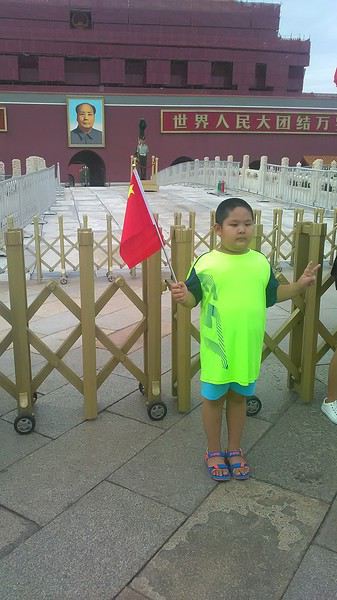 Then you find the right hall and wait for the sign to finally access the platform. In the end, it works pretty well given the incredible number of passengers to manage. Everywhere in Beijing, I saw that the Chinese have mastered crowd flow management.
Nice surprise: second-class carriages are clean, air-conditioned, and bright. Perfect, since I was in for 20 hours. One uniformed attendant per carriage, mobile meal service—luxury! Small downside: no luggage space. Hauling your suitcase up to the top bunk is quite a workout. I was in the middle, so it wasn’t too bad. The landscape, though, whether rural or urban, is pretty bleak. That should change once we leave the eastern plains.
Of course, I got my first police visit, with a thorough passport check and bag search. I was warned—going to the Chinese far west exposes you to this kind of hassle. But they were polite and respectful.
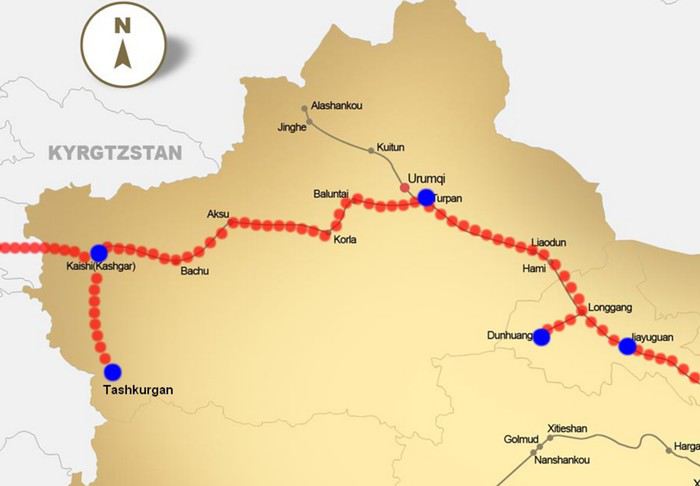 The Chinese Far West
4- JIAYUGUAN Getting by without English Monday, August 27 At the gates of two deserts (Gobi and Taklamakan) and at the foot of the Tibetan highlands, the Great Wall ends at Jiayuguan. Here, I found the deeper China I’d somewhat rediscovered during my bike ride, even if now everyone gets around on electric bikes and I’m no longer stared at like an alien.
Prices are nothing like Beijing: you can find a full meal for 2 €, and my bike cost 7 € for two days. Plus, few people speak English—neither the owner of the HI hostel where I stayed, nor the ticket sellers at the sites, let alone the servers at the small eateries where I ate. Everything is written in Chinese. So I had to use the little Chinese I know to communicate about essentials. It makes the locals laugh to see a European trying to speak their language, but it earns respect. With Google Translate’s help, I managed.
Rant: With their avenues blocked for construction for kilometers without warning, and new roads not yet on maps, I must’ve taken 15 km of detours. More photos...
5- JIAYUGUAN Scams and heritage Tuesday, August 28 The Great Wall doesn’t exactly end at the fort I visited yesterday but 10 km further, at the entrance to a river gorge at the foot of the mountains. All that’s left is a badly damaged tower (more like a mound of earth) and a section of clay wall, similar to the one I biked yesterday.
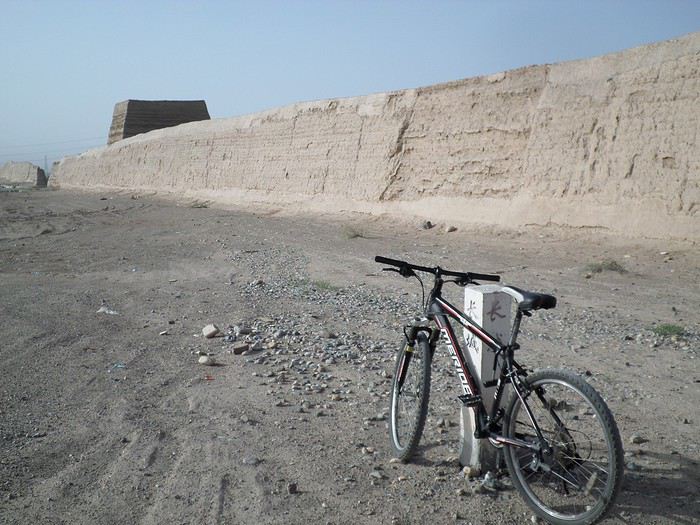
This morning, I hopped on my bike, determined to venture into the desert to see this highly symbolic site. First, you access it via a wide, brand-new road with not a soul in sight. Just before the site, I came across a grand welcome gate, very period-style, but it’s actually the inevitable toll booth.
Behind the gate, the road continues straight to the site, which you can see in the distance—at least 2 km away—the remains of the tower and wall. I had to leave my bike here. Fine. I went to the ticket counter and asked the price: 120 yuan! I couldn’t believe it—over 15 € for a simple mound of earth.
I showed my displeasure to the attendant, who couldn’t care less, and immediately turned back. 120 yuan—that’s the price for a new road, a fancy gate planted 2 km before the site just to force you to take a shuttle, and employees with nothing to do all day... Now I understand why I didn’t meet anyone!
Heritage China is a bit pricey Generally, sites are expensive for the country’s standard of living, but travelers are supposed to have money, so why hold back? I even gave up on the Forbidden City—reservations required days in advance (or on the black market at an impossible price). I prefer to keep the memory of my first visit, when entry must’ve cost a few dozen cents, and there were only a handful of visitors.
This morning, I took a taxi to see remarkable tombs of common people from the 3rd to 6th centuries. They’re small vaulted caves made of painted bricks, depicting scenes of daily life. Very pretty and moving. But even here, though the price was more reasonable, I was left wanting—only one of the 16 tombs is open to visitors, and it’s apparently not the most beautiful.
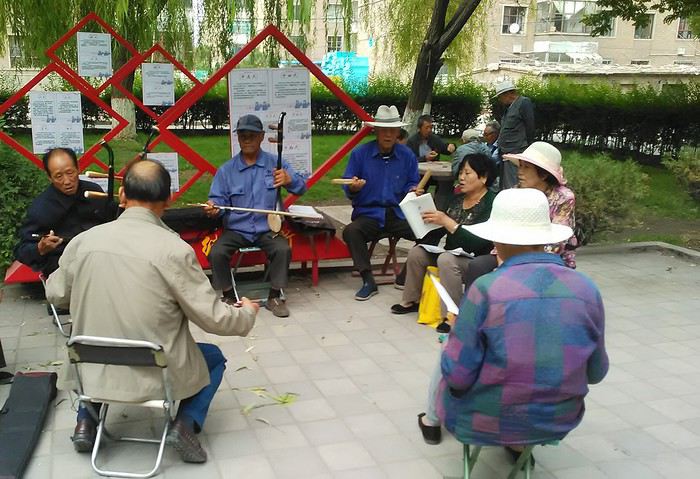
The authentic China—at least what’s left of it... Wandering the impersonal avenues of the city, you stumble upon a market. There, you still find traditional China—small shops with questionable hygiene, Go players, musicians, and even a dental prosthetist. The last refuge for those untouched by modernity. More photos...
6- DUNHUANG Abundance in the middle of the desert Wednesday, August 29 Well, I thought the landscape would be less bleak as I headed west. Nope. The only distraction in this expanse of dark, clayey sand is the forests of pylons and wind turbines, plus wild camels racing each other.
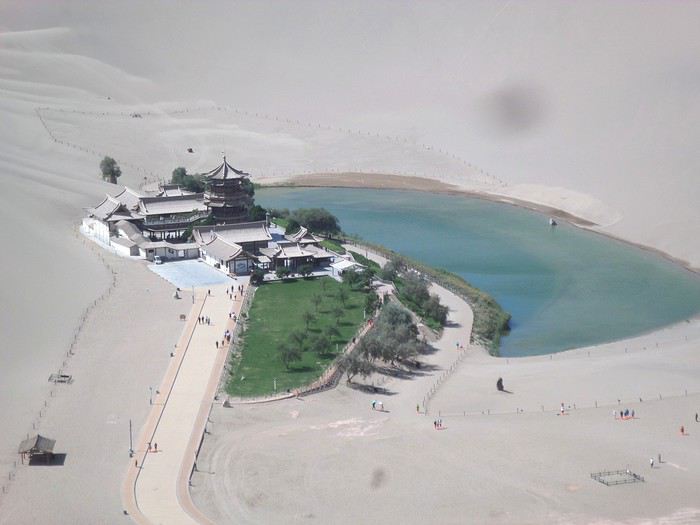 However, Dunhuang, the gateway to the Taklamakan, is by far the most pleasant Chinese city I know. There’s a real city center you can explore on foot. It’s hot but not unbearable, with a light, dry breeze. Much nicer than Beijing. The Han Chinese are still the majority, but the Muslim Uyghurs are more numerous, and the muezzin’s call to prayer echoes around the mosque.
The most surprising thing is the abundance and diversity of fruits and vegetables. You wonder how it all grows here. Well-irrigated, the desert sands are very fertile. Here, raisins have subtle, mysterious flavors, and the lamb really tastes like lamb.
Today, I visited the must-see Mingshashan, a dune complex next to which Pila is a molehill. The Basque Country, but covered in sand... More photos...
7- TURPAN The Uyghurs under heavy surveillance Friday, August 31 Surveillance cameras everywhere in the city, armed police stationed at intersections, in front of public buildings, at the entrance and inside tourist sites, police stations on every corner, patrols on foot or by car, khaki uniforms even for middle schoolers... here, the Han Chinese are in the minority, and you can feel it. Turpan feels like a city under siege.
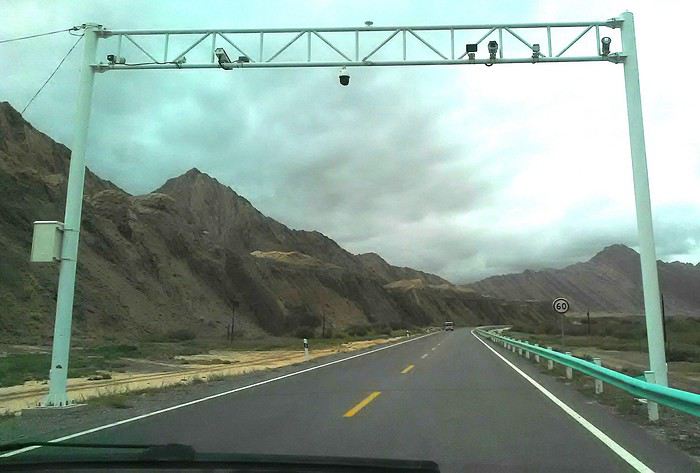
To enter the youth hostel where I stayed, there’s even a security gate, and the receptionist (a Han, like everyone in tourism) wears a bulletproof vest! Reassuring. Still, you don’t feel particularly threatened here, especially as a European. The troublemakers are the Chinese, not the Uyghurs. Generally, China is a very safe country for visitors.
Smile, you’re on camera! I was biking on an avenue when the car in front of me got flashed for driving slowly. I quickly understood why when I got flashed too.
Here, the official time is Beijing time, but it gets dark two hours later. It’ll be even worse in Kashgar. Trickier to manage: everything is displayed in Chinese and Arabic. Nothing in English. Choosing a menu is a shot in the dark. Apart from a few young Chinese, no one here speaks English, and my Chinese doesn’t seem very understandable...
Mogao, the end of the road for the Han Yesterday, near Dunhuang, I went to Mogao, a complex of decorated caves with Buddha sculptures and paintings. Stunning, but so crowded! Luckily, here in Turpan, Chinese tourists barely venture out. So I visited a Silk Road ghost town with only a handful of other visitors and under a howling wind.
The modern Chinese city is swallowing up the old Uyghur neighborhoods—only a museum-like district remains in the center, and pockets of resistance on the outskirts are doomed to disappear soon. More photos...
8- KASHGAR A (relative) love at first sight for the old city Sunday, September 2 After three overnight trains, here I am in the far west of China, nearly 4,000 km from the capital. Despite the omnipresent police and an old city preserved UNESCO-style, Kashgar is my Chinese love at first sight.
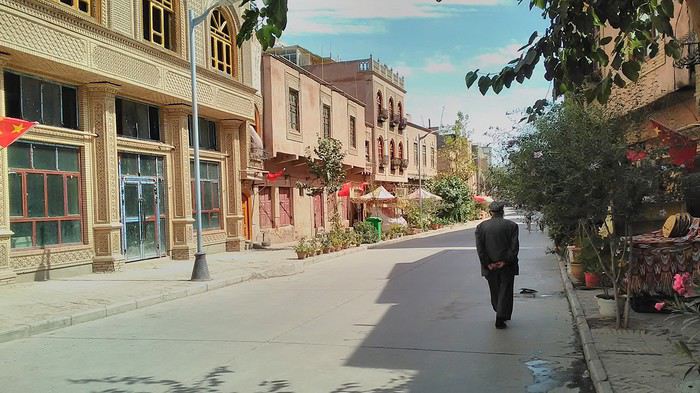
Finally, Chinese... well, sort of, because we’re in Uyghur territory here—a Turkic people with nothing culturally in common with the Han, the eastern Chinese. It started badly yesterday at Turfan station, where after three security gate passes, at least five passport checks, and a bag search, three adorable policewomen confiscated my antibacterial lotion because it had a flammable logo...
Then came the welcoming committee of armed cops at Kashgar station. Once all that was over, they left me alone—except you still have to go through security checks like everyone else to enter the old city, the bazaar, the livestock market... The further west you go, the more the siege mentality is evident. Luckily, the border isn’t far...
Despite the inevitable destruction-reconstruction, the city center has been well preserved. Thankfully, because it’s a very original style, a mix of local and colonial. I love it, even if it’s a bit too artificial, sanitized, and watered-down, and rather empty of residents. On the Silk Road, the city was famous for its great food. And it still is—rarely have I seen such richness and abundance of food! And not just scorpions or snakes. More photos...
9- KASHGAR China’s recipe for controlling the populace Saturday, September 1 Xinjiang, along with Tibet, is a "sensitive" area of rebellion in the eyes of Chinese authorities. As a result, the state has these regions and their populations under total control. Tourists also feel the consequences, even if they’re not at risk of re-education camps.
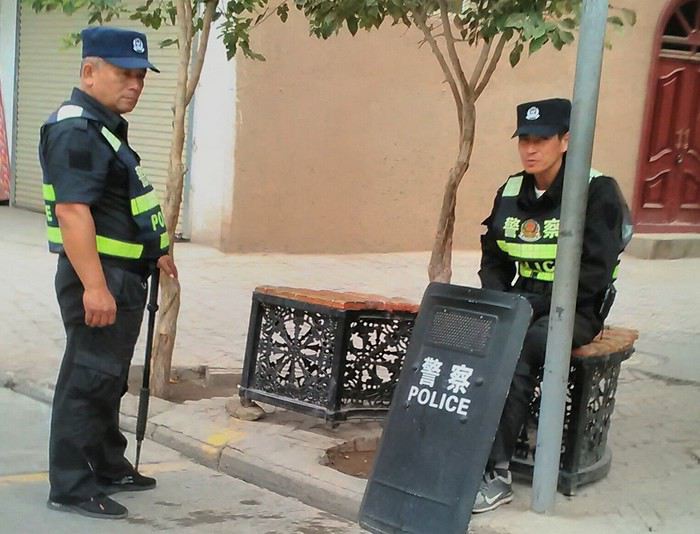 - Putting barbed wire and anti-ramming barriers around sensitive sites (schools, big hotels, government buildings...)
- Installing traffic surveillance gates with cameras and photo flashes (for all vehicles passing, including bikes) throughout the city and even in the countryside
- Posting uniformed guards with tasers, batons, or huge baseball bats every 100 meters
- Training the Han population (ethnic Chinese) in self-defense with sticks, preferably in the morning on the street. Men and women of all ages
- Starting school with the national anthem, doing military exercises, and receiving political indoctrination, all neatly lined up in the courtyard. (The dream school for any teacher)
- Placing a snitch in uniform (a pseudo-guard) in public gathering places, like youth hostels. Mine spends the day loafing around the courtyard
- Putting Chinese flags everywhere on the streets to remind everyone who’s in charge
- Installing security gates at every entrance to areas frequented by tourists (thanks for that) but not just there
- Never photographing cops, or else! I tried, but it’s not easy...
- Putting barbed wire and anti-ramming barriers around sensitive sites (schools, big hotels, government buildings...)
- Installing traffic surveillance gates with cameras and photo flashes (for all vehicles passing, including bikes) throughout the city and even in the countryside
- Posting uniformed guards with tasers, batons, or huge baseball bats every 100 meters
- Training the Han population (ethnic Chinese) in self-defense with sticks, preferably in the morning on the street. Men and women of all ages
- Starting school with the national anthem, doing military exercises, and receiving political indoctrination, all neatly lined up in the courtyard. (The dream school for any teacher)
- Placing a snitch in uniform (a pseudo-guard) in public gathering places, like youth hostels. Mine spends the day loafing around the courtyard
- Putting Chinese flags everywhere on the streets to remind everyone who’s in charge
- Installing security gates at every entrance to areas frequented by tourists (thanks for that) but not just there
- Never photographing cops, or else! I tried, but it’s not easy...
With all that, you can stroll around safely Not much crime! As for the amount the Chinese state spends to maintain such a system, it’s staggering! A third of the Han living in Xinjiang work in security. Today, I wandered freely around old Kashgar, which is quite large after all. More photos...
10- TASHKURGAN What on earth was I thinking going there! Wednesday, September 5 First, there’s the taxi—pretty crappy, with a driver who doesn’t speak a word of English and won’t stop smoking. Over six hours in that... shared with a completely out-of-it American.
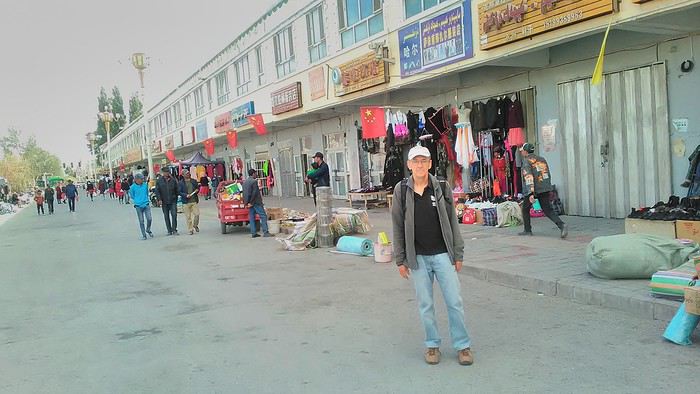
Then there are all the checkpoints along the way. I won’t go on—you know the drill by now.
After that, there’s Tashkurgan—a town with nothing to see, nothing to do. Deserted as soon as night falls. There’s this huge youth hostel and a few lost Chinese tapping away on their smartphones, chain-smoking. This lost American-European crowd, swapping tips on how to enter Pakistan or Tajikistan.
Luckily, there’s the Chinese Pamir Highway, lined with peaks over 7,000m. There’s the feeling of no longer being in China, with a population whose features are Middle Eastern. And these Tajik women with their stunning hairstyles and vibrant costumes. There’s the fact of having reached the westernmost Chinese city, far from crowds and tourist sites. A sort of end of the world. More photos...
11- KYRGYZ BORDER A surreal epic Thursday, September 6 The road from Kashgar to the Kyrgyzstan border is a little over 200 km and passes through beautiful landscapes of colorful, desert-like mountains with acrobatic folds. That’s the bucolic part of the trip.
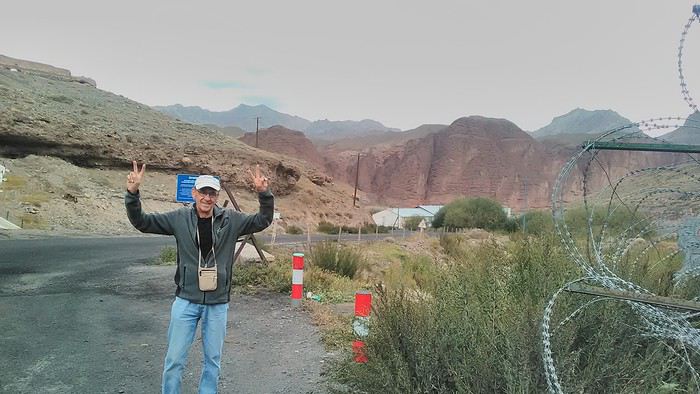 Yesterday, I managed to gather four people to rent a minibus to reach the border more easily: a Spaniard and an Argentine I’d already met in Turpan, and two New Zealanders who responded to the ad left at the hostel.
Absurdity and paranoia of Chinese authorities The highlight was crossing the town of Wuqia, 50 km past Kashgar. After tallying up with my fellow sufferers, we must’ve passed about ten checkpoints with: - Passport checks: 14 times, sometimes by two cops side by side - Bag checks: 4 times - Smartphone checks: 2 times, with deletion of "non-compliant" photos, and registration of your IMEI in the exit log!... Absurd and surreal at the same time, since my camera stayed in my bag, my apps are in French, and my photos have been online for ages...
With all that, we arrived just as the last checkpoint before the no man’s land marking the border between the two countries was on lunch break. And bam! Another 1.5-hour wait, alongside truckers who were much more used to this than we were.
What to think? The cops themselves aren’t fooled. They play the role they’re asked to, but sometimes you can coax a smile out of them—they realize how ridiculous the situation is.
What’s the point? That’s the big question my companions and I were tempted to answer with "to piss people off." To show you your place isn’t here, but with the other tourists, over there in the east, in Shanghai, Xi’an, or Guangzhou.
As for you, a traveler from a democratic country, you really experience this as aggression, humiliation, a violation of your private space. And yet, I’m respected, they speak to me properly. Today, I better understand what a Palestinian or a citizen of an occupied country might feel daily. A unique experience! Thanks, China.
And to top it off, the cherry on the cake! It’s still this glowing button you press to rate your passage after clearing the last obstacle before the exit stamp. I was so surprised it turned off before I could react. The Spaniard, with great humor and irony, had time to vote "excellent." In the end, he wasn’t wrong—you can hardly do better!
PS: I ditched my buddies at the border. They didn’t want to pay for a taxi to continue. So I took a direct taxi to Osh. The first 100 km are fabulous. I couldn’t take many photos, but I’ll be back on Monday to go to Tajikistan.
More photos...
The rest of the Silk Road, Part 2, in these travel journals: Kyrgyzstan, Tajikistan, Uzbekistan.
The Chinese Far West More than 30 years after my first trip to eastern China, I finally fulfilled an old dream: traveling solo from Beijing to the far west, discovering Xinjiang, the Uyghur people and the oppression they endure, the oases of Turpan and Kashgar, the Taklamakan Desert, the end of the Great Wall... The route was covered by train.
MENU PART 1: CHINA
1- Beijing (Jiankou) : the authentic Great Wall, without tourists 2- Cycling in Beijing, the best way to get around 3- Beijing : departure for the far west 4- Jiayuguan : getting by without English 5- Jiayuguan : scams and heritage 6- Dunhuang : abundance in the middle of the desert 7- Turpan : the Uyghurs under heavy surveillance 8- Kashgar : love at first sight for the old city 9- Kashgar : China’s recipe for controlling the populace 10- Tashkurgan : what on earth was I thinking going there! Kyrgyz border: a surreal epic Photo album from the 80s, contributions from other travelers (page 2)
1- JIANKOU Finding the authentic Great Wall, without tourists or a guide Friday, August 24, 2018 Thirty years later, I didn’t feel like revisiting the Great Wall at Badaling or any other overcrowded site. I chose to explore it at Jiankou, in its wildest, most authentic, and unrestored section, starting from a lost village deep in a valley—though it wasn’t *that* lost, since it had everything for communication.
No need to pay for a taxi to get there—by timing it right, you can take the bus for just a few yuan. You have to get off at Xizhazi, the bus terminus. Be careful, there are only two buses a day in each direction. At the Xizhazi bus stop, I met a young couple who’d arrived with zero information about what to expect. We hiked the three of us toward the restored section of Mutianyu.
Still, be cautious With GPS and a topographic map (OpenTopoMap), you can set off without a problem or guide. The trail up to Jiankou is easy and well-marked. The trails down are too. But be careful—once you’re on the Wall, it’s real mountain hiking, with easy but dangerous climbing sections (over sheer drops). Not for amateurs or those afraid of heights! But what a reward. The Wall all to yourself, where it’s at its most daring. Truly mesmerizing.
More photos...
2- BEIJING The best way to get around the capital Sunday, August 26 The best way to explore the city is still by bike. Most are in a bike-share system, but you need to use an app—WeChat, the app that does everything, like monitoring your every move. No way I was installing that.
I found one at a rental shop near the hostel. The key is to quickly learn local traffic customs to minimize risks. Bike lanes are wide along the avenues.
But you still have to: - Watch out for anything parked on the bike paths—the most annoying are people napping or talking on the phone in their cars - Keep an eye on everything coming the wrong way—the list is long - The worst is right turns on red, which in Chinese traffic rules seem to have priority Once you get the hang of it, it’s fine. The city is huge but flat, so you can just wing it.
3- BEIJING By train to the far west Sunday, August 26 Beijing West Station is the size and operates like an airport. With your e-ticket from the agency, you first have to pick up your ticket at the special "English" counter, after passing through security. With your ticket in hand, you have to exit and enter through the boarding waiting area—not the platform—after a second security check.
Then you find the right hall and wait for the sign to finally access the platform. In the end, it works pretty well given the incredible number of passengers to manage. Everywhere in Beijing, I saw that the Chinese have mastered crowd flow management.Nice surprise: second-class carriages are clean, air-conditioned, and bright. Perfect, since I was in for 20 hours. One uniformed attendant per carriage, mobile meal service—luxury! Small downside: no luggage space. Hauling your suitcase up to the top bunk is quite a workout. I was in the middle, so it wasn’t too bad. The landscape, though, whether rural or urban, is pretty bleak. That should change once we leave the eastern plains.
Of course, I got my first police visit, with a thorough passport check and bag search. I was warned—going to the Chinese far west exposes you to this kind of hassle. But they were polite and respectful.
The Chinese Far West4- JIAYUGUAN Getting by without English Monday, August 27 At the gates of two deserts (Gobi and Taklamakan) and at the foot of the Tibetan highlands, the Great Wall ends at Jiayuguan. Here, I found the deeper China I’d somewhat rediscovered during my bike ride, even if now everyone gets around on electric bikes and I’m no longer stared at like an alien.
Prices are nothing like Beijing: you can find a full meal for 2 €, and my bike cost 7 € for two days. Plus, few people speak English—neither the owner of the HI hostel where I stayed, nor the ticket sellers at the sites, let alone the servers at the small eateries where I ate. Everything is written in Chinese. So I had to use the little Chinese I know to communicate about essentials. It makes the locals laugh to see a European trying to speak their language, but it earns respect. With Google Translate’s help, I managed.
Rant: With their avenues blocked for construction for kilometers without warning, and new roads not yet on maps, I must’ve taken 15 km of detours. More photos...
5- JIAYUGUAN Scams and heritage Tuesday, August 28 The Great Wall doesn’t exactly end at the fort I visited yesterday but 10 km further, at the entrance to a river gorge at the foot of the mountains. All that’s left is a badly damaged tower (more like a mound of earth) and a section of clay wall, similar to the one I biked yesterday.
This morning, I hopped on my bike, determined to venture into the desert to see this highly symbolic site. First, you access it via a wide, brand-new road with not a soul in sight. Just before the site, I came across a grand welcome gate, very period-style, but it’s actually the inevitable toll booth.
Behind the gate, the road continues straight to the site, which you can see in the distance—at least 2 km away—the remains of the tower and wall. I had to leave my bike here. Fine. I went to the ticket counter and asked the price: 120 yuan! I couldn’t believe it—over 15 € for a simple mound of earth.
I showed my displeasure to the attendant, who couldn’t care less, and immediately turned back. 120 yuan—that’s the price for a new road, a fancy gate planted 2 km before the site just to force you to take a shuttle, and employees with nothing to do all day... Now I understand why I didn’t meet anyone!
Heritage China is a bit pricey Generally, sites are expensive for the country’s standard of living, but travelers are supposed to have money, so why hold back? I even gave up on the Forbidden City—reservations required days in advance (or on the black market at an impossible price). I prefer to keep the memory of my first visit, when entry must’ve cost a few dozen cents, and there were only a handful of visitors.
This morning, I took a taxi to see remarkable tombs of common people from the 3rd to 6th centuries. They’re small vaulted caves made of painted bricks, depicting scenes of daily life. Very pretty and moving. But even here, though the price was more reasonable, I was left wanting—only one of the 16 tombs is open to visitors, and it’s apparently not the most beautiful.
The authentic China—at least what’s left of it... Wandering the impersonal avenues of the city, you stumble upon a market. There, you still find traditional China—small shops with questionable hygiene, Go players, musicians, and even a dental prosthetist. The last refuge for those untouched by modernity. More photos...
6- DUNHUANG Abundance in the middle of the desert Wednesday, August 29 Well, I thought the landscape would be less bleak as I headed west. Nope. The only distraction in this expanse of dark, clayey sand is the forests of pylons and wind turbines, plus wild camels racing each other.
However, Dunhuang, the gateway to the Taklamakan, is by far the most pleasant Chinese city I know. There’s a real city center you can explore on foot. It’s hot but not unbearable, with a light, dry breeze. Much nicer than Beijing. The Han Chinese are still the majority, but the Muslim Uyghurs are more numerous, and the muezzin’s call to prayer echoes around the mosque.The most surprising thing is the abundance and diversity of fruits and vegetables. You wonder how it all grows here. Well-irrigated, the desert sands are very fertile. Here, raisins have subtle, mysterious flavors, and the lamb really tastes like lamb.
Today, I visited the must-see Mingshashan, a dune complex next to which Pila is a molehill. The Basque Country, but covered in sand... More photos...
7- TURPAN The Uyghurs under heavy surveillance Friday, August 31 Surveillance cameras everywhere in the city, armed police stationed at intersections, in front of public buildings, at the entrance and inside tourist sites, police stations on every corner, patrols on foot or by car, khaki uniforms even for middle schoolers... here, the Han Chinese are in the minority, and you can feel it. Turpan feels like a city under siege.
To enter the youth hostel where I stayed, there’s even a security gate, and the receptionist (a Han, like everyone in tourism) wears a bulletproof vest! Reassuring. Still, you don’t feel particularly threatened here, especially as a European. The troublemakers are the Chinese, not the Uyghurs. Generally, China is a very safe country for visitors.
Smile, you’re on camera! I was biking on an avenue when the car in front of me got flashed for driving slowly. I quickly understood why when I got flashed too.
Here, the official time is Beijing time, but it gets dark two hours later. It’ll be even worse in Kashgar. Trickier to manage: everything is displayed in Chinese and Arabic. Nothing in English. Choosing a menu is a shot in the dark. Apart from a few young Chinese, no one here speaks English, and my Chinese doesn’t seem very understandable...
Mogao, the end of the road for the Han Yesterday, near Dunhuang, I went to Mogao, a complex of decorated caves with Buddha sculptures and paintings. Stunning, but so crowded! Luckily, here in Turpan, Chinese tourists barely venture out. So I visited a Silk Road ghost town with only a handful of other visitors and under a howling wind.
The modern Chinese city is swallowing up the old Uyghur neighborhoods—only a museum-like district remains in the center, and pockets of resistance on the outskirts are doomed to disappear soon. More photos...
8- KASHGAR A (relative) love at first sight for the old city Sunday, September 2 After three overnight trains, here I am in the far west of China, nearly 4,000 km from the capital. Despite the omnipresent police and an old city preserved UNESCO-style, Kashgar is my Chinese love at first sight.
Finally, Chinese... well, sort of, because we’re in Uyghur territory here—a Turkic people with nothing culturally in common with the Han, the eastern Chinese. It started badly yesterday at Turfan station, where after three security gate passes, at least five passport checks, and a bag search, three adorable policewomen confiscated my antibacterial lotion because it had a flammable logo...
Then came the welcoming committee of armed cops at Kashgar station. Once all that was over, they left me alone—except you still have to go through security checks like everyone else to enter the old city, the bazaar, the livestock market... The further west you go, the more the siege mentality is evident. Luckily, the border isn’t far...
Despite the inevitable destruction-reconstruction, the city center has been well preserved. Thankfully, because it’s a very original style, a mix of local and colonial. I love it, even if it’s a bit too artificial, sanitized, and watered-down, and rather empty of residents. On the Silk Road, the city was famous for its great food. And it still is—rarely have I seen such richness and abundance of food! And not just scorpions or snakes. More photos...
9- KASHGAR China’s recipe for controlling the populace Saturday, September 1 Xinjiang, along with Tibet, is a "sensitive" area of rebellion in the eyes of Chinese authorities. As a result, the state has these regions and their populations under total control. Tourists also feel the consequences, even if they’re not at risk of re-education camps.
- Putting barbed wire and anti-ramming barriers around sensitive sites (schools, big hotels, government buildings...)
- Installing traffic surveillance gates with cameras and photo flashes (for all vehicles passing, including bikes) throughout the city and even in the countryside
- Posting uniformed guards with tasers, batons, or huge baseball bats every 100 meters
- Training the Han population (ethnic Chinese) in self-defense with sticks, preferably in the morning on the street. Men and women of all ages
- Starting school with the national anthem, doing military exercises, and receiving political indoctrination, all neatly lined up in the courtyard. (The dream school for any teacher)
- Placing a snitch in uniform (a pseudo-guard) in public gathering places, like youth hostels. Mine spends the day loafing around the courtyard
- Putting Chinese flags everywhere on the streets to remind everyone who’s in charge
- Installing security gates at every entrance to areas frequented by tourists (thanks for that) but not just there
- Never photographing cops, or else! I tried, but it’s not easy...With all that, you can stroll around safely Not much crime! As for the amount the Chinese state spends to maintain such a system, it’s staggering! A third of the Han living in Xinjiang work in security. Today, I wandered freely around old Kashgar, which is quite large after all. More photos...
10- TASHKURGAN What on earth was I thinking going there! Wednesday, September 5 First, there’s the taxi—pretty crappy, with a driver who doesn’t speak a word of English and won’t stop smoking. Over six hours in that... shared with a completely out-of-it American.
Then there are all the checkpoints along the way. I won’t go on—you know the drill by now.
After that, there’s Tashkurgan—a town with nothing to see, nothing to do. Deserted as soon as night falls. There’s this huge youth hostel and a few lost Chinese tapping away on their smartphones, chain-smoking. This lost American-European crowd, swapping tips on how to enter Pakistan or Tajikistan.
Luckily, there’s the Chinese Pamir Highway, lined with peaks over 7,000m. There’s the feeling of no longer being in China, with a population whose features are Middle Eastern. And these Tajik women with their stunning hairstyles and vibrant costumes. There’s the fact of having reached the westernmost Chinese city, far from crowds and tourist sites. A sort of end of the world. More photos...
11- KYRGYZ BORDER A surreal epic Thursday, September 6 The road from Kashgar to the Kyrgyzstan border is a little over 200 km and passes through beautiful landscapes of colorful, desert-like mountains with acrobatic folds. That’s the bucolic part of the trip.
Yesterday, I managed to gather four people to rent a minibus to reach the border more easily: a Spaniard and an Argentine I’d already met in Turpan, and two New Zealanders who responded to the ad left at the hostel.Absurdity and paranoia of Chinese authorities The highlight was crossing the town of Wuqia, 50 km past Kashgar. After tallying up with my fellow sufferers, we must’ve passed about ten checkpoints with: - Passport checks: 14 times, sometimes by two cops side by side - Bag checks: 4 times - Smartphone checks: 2 times, with deletion of "non-compliant" photos, and registration of your IMEI in the exit log!... Absurd and surreal at the same time, since my camera stayed in my bag, my apps are in French, and my photos have been online for ages...
With all that, we arrived just as the last checkpoint before the no man’s land marking the border between the two countries was on lunch break. And bam! Another 1.5-hour wait, alongside truckers who were much more used to this than we were.
What to think? The cops themselves aren’t fooled. They play the role they’re asked to, but sometimes you can coax a smile out of them—they realize how ridiculous the situation is.
What’s the point? That’s the big question my companions and I were tempted to answer with "to piss people off." To show you your place isn’t here, but with the other tourists, over there in the east, in Shanghai, Xi’an, or Guangzhou.
As for you, a traveler from a democratic country, you really experience this as aggression, humiliation, a violation of your private space. And yet, I’m respected, they speak to me properly. Today, I better understand what a Palestinian or a citizen of an occupied country might feel daily. A unique experience! Thanks, China.
And to top it off, the cherry on the cake! It’s still this glowing button you press to rate your passage after clearing the last obstacle before the exit stamp. I was so surprised it turned off before I could react. The Spaniard, with great humor and irony, had time to vote "excellent." In the end, he wasn’t wrong—you can hardly do better!
PS: I ditched my buddies at the border. They didn’t want to pay for a taxi to continue. So I took a direct taxi to Osh. The first 100 km are fabulous. I couldn’t take many photos, but I’ll be back on Monday to go to Tajikistan.
More photos...
The rest of the Silk Road, Part 2, in these travel journals: Kyrgyzstan, Tajikistan, Uzbekistan.
Air France suspend ses vols vers la Chine
Air France suspend des aujourd’hui ses vols a destination de la Chine Communiste en raison de la situation sanitaire en cours.
Des vols spéciaux seront cependant organises pour rapatrier ses salaries et clients. La compagnie avait deja suspendu ses vols vers Wuhan
La France a actuellement envoyé, semble t il aux frais du contribuable, deux appareils dont un de l’armée pour rapatrier les francais expatries souhaitant fuir la situation sanitaire dans le pays communiste.
https://www.lefigaro.fr/sciences/2020/01/30/01008-20200130LIVWWW00001-en-direct-chine-Wuhan-coronavirus-epidemie-contagion-virus-rapatriement.php
De nombreuses autres compagnies (British Airways, Lufthansa, Swiss, Air Canada) ont egalement annonce avoir suspendu leurs vols a destination de la Chine communiste en raison de la situation sanitaire actuelle.
PS: la photo d’illustration sur le site internet du magazine Le Point est assez amusante... https://www.lepoint.fr/monde/coronavirus-air-france-suspend-ses-vols-vers-la-chine-30-01-2020-2360528_24.php
Des vols spéciaux seront cependant organises pour rapatrier ses salaries et clients. La compagnie avait deja suspendu ses vols vers Wuhan
La France a actuellement envoyé, semble t il aux frais du contribuable, deux appareils dont un de l’armée pour rapatrier les francais expatries souhaitant fuir la situation sanitaire dans le pays communiste.
https://www.lefigaro.fr/sciences/2020/01/30/01008-20200130LIVWWW00001-en-direct-chine-Wuhan-coronavirus-epidemie-contagion-virus-rapatriement.php
De nombreuses autres compagnies (British Airways, Lufthansa, Swiss, Air Canada) ont egalement annonce avoir suspendu leurs vols a destination de la Chine communiste en raison de la situation sanitaire actuelle.
PS: la photo d’illustration sur le site internet du magazine Le Point est assez amusante... https://www.lepoint.fr/monde/coronavirus-air-france-suspend-ses-vols-vers-la-chine-30-01-2020-2360528_24.php
Quel bateau de nuit entre Japon et Corée du Sud et Chine?
Bonjour,
Nous faisons un trip/voyage Asie fin avril (on est 2 en couple, avec un sac à dos)
JAPON > CORÉE DU SUD > CHINE.
Sur env 3 semaines.
Nous voulons passer d'un pays à l'autre en bateau, de préférence un ferry, de nuit. On a l'impression que le bateau de nuit entre FUKUOKA et BUSAN n'était plus ? Idem pour celui entre SAKAIMINATO et DONGHAE ?
De même, pour quitter la CORÉE vers la CHINE, depuis INCHEON ou PYEONGTAEK, il semblerait que des lignes de ferry n'existent plus ?
Quelqu'un a circulé récemment sur ces lignes ? Des infos ? Merci par avance pour vos réponses et commentaires.
De même, pour quitter la CORÉE vers la CHINE, depuis INCHEON ou PYEONGTAEK, il semblerait que des lignes de ferry n'existent plus ?
Quelqu'un a circulé récemment sur ces lignes ? Des infos ? Merci par avance pour vos réponses et commentaires.
Visa pour la Chine (Chengdu) depuis la Guadeloupe
Bonjour
Comment faire pour obtenir un visa touristique pour la Chine (Chengdu) pour une famille de 3 personnes qui vit en Guadeloupe?
Faut il impérativement aller à Paris pour déposer les empreintes?
Merci pour votre retour
Cordialement
Comment faire pour obtenir un visa touristique pour la Chine (Chengdu) pour une famille de 3 personnes qui vit en Guadeloupe?
Faut il impérativement aller à Paris pour déposer les empreintes?
Merci pour votre retour
Cordialement
Transports aux environs de Xian
bonjour, j'ai l'intention de me rendre prochainement à Xian afin de visiter outre l'armée de terre cuite, les divers tombeaux impériaux (quinling, maoling, zhaoling, etc). ainsi que le temple de famen. Pour des raisons de timing et notamment pour arriver à la première heure à l'armée de terre cuite avant l'arrivée de la foule, j'envisage d'utiliser le taxi plutot que le bus. Mais j'ai cru comprendre qu'il y avait pénurie de taxi à Xian et qu'il était difficile d'en reserver. Quelqu'un peut il m'éclairer? Merci
Vol Paris-Bangkok avec escale à Chengdu sur Air China
Bonjour à tous!
Le 2 janvier prochain je m'envole pour Bangkok sur Air China avec escale à Chengdu. Je sais que cette compagnie est loin d'être la meilleure, j'ai réservé en connaissance de cause.
Mais j'ai lu que lors de l'escale à Chengdu, il n'y a pas de "Suivi de bagages" et donc qu'il faut récupérer son bagage enregistrer pour le réenregistrer avant le deuxième vol. C'est la première fois que j'entends parler de ça. Je précise que Air China est la compagnie qui gère mon vol de Paris à Bangkok, donc logiquement les bagages suivent de bout en bout.
Des retours d'expériences récents?
Escale de 2 heures à Hong Kong avec Cathay Pacific
Bonjour,
En février, Je prévois de faire une escale de 2h a Hong Kong puis direction Bangkok. Pensez vous que ce delai de 2h est suffisant sachant que je serai avec 2 enfants en bas âge.
Merci
En février, Je prévois de faire une escale de 2h a Hong Kong puis direction Bangkok. Pensez vous que ce delai de 2h est suffisant sachant que je serai avec 2 enfants en bas âge.
Merci
Exemption de visa 144 heures en Chine pour croisiéristes
Apparemment, l'exemption de visa peut tourner au cauchemar...
https://www.20min.ch/ro/news/faits_divers/story/Leur-croisiere-de-r-ve-vire-au-cauchemar-17230855
https://www.20min.ch/ro/news/faits_divers/story/Leur-croisiere-de-r-ve-vire-au-cauchemar-17230855
Visa de transit 144 heures refusé à l'aéroport de Pékin
Bonjour amis voyageurs,
je voudrais vous raconter, à toute fin utile, le refus du visa de transit à Pekin. En effet, dans le cadre d'un voyage personnel à destination de l'Indonésie, je souhaitais profiter d'un arrêt à Pekin pour effectuer un transit au sein de la ville de Pekin(durée < 144h).
Les conditions étaient réunies et les documents imprimés: billet pour la prochaine destination avec une marge en terme de timing, réservation d'un hôtel à Pekin payée, attestation d'assurance. D'ailleurs, l'agent d'escale à Paris avait bien vérifié que j'étais éligible lors de l'enregistrement
le refus n'a pas été motivé mais les 3 différents agents des douanes chinoises avec qui j"ai échangé (à différents moments) ne se sont attardés que sur mon passport (valable jusqu'en 2024 , avec plusieurs pages vierges) outre mon identité, ils se sont attardés sur les différents tampons des pays visités avec la même conclusion: vous devez partir.
mon passport ne comprend pas de pays posant problème à mon sens (j'ai d'ailleurs effectué un voyage aux Etats-unis cette année, sans aucun problème).
je ne sais pas si cela arrive fréquemment avec les ressortissants français mais j'ai pensé utile de vous le signaler. En provenance de Paris, j'étais le seul dans ce cas mais d'autres personnes ont subi le même refus: 1 voyageur seul (Russophone certainement d'une république du caucase), 2 hommes (un jeune et certainement son père, provenance identique), un jeune couple .
j'ai du annuler mon voyage car hormis un retour à Paris dans les 8h suivants mon arrivée à Pekin, les solutions proposés par Air china ne convenait pas pour me permettre de poursuivre mon voyage.
n'hésitez pas à signaler vos expériences similaires.
je voudrais vous raconter, à toute fin utile, le refus du visa de transit à Pekin. En effet, dans le cadre d'un voyage personnel à destination de l'Indonésie, je souhaitais profiter d'un arrêt à Pekin pour effectuer un transit au sein de la ville de Pekin(durée < 144h).
Les conditions étaient réunies et les documents imprimés: billet pour la prochaine destination avec une marge en terme de timing, réservation d'un hôtel à Pekin payée, attestation d'assurance. D'ailleurs, l'agent d'escale à Paris avait bien vérifié que j'étais éligible lors de l'enregistrement
le refus n'a pas été motivé mais les 3 différents agents des douanes chinoises avec qui j"ai échangé (à différents moments) ne se sont attardés que sur mon passport (valable jusqu'en 2024 , avec plusieurs pages vierges) outre mon identité, ils se sont attardés sur les différents tampons des pays visités avec la même conclusion: vous devez partir.
mon passport ne comprend pas de pays posant problème à mon sens (j'ai d'ailleurs effectué un voyage aux Etats-unis cette année, sans aucun problème).
je ne sais pas si cela arrive fréquemment avec les ressortissants français mais j'ai pensé utile de vous le signaler. En provenance de Paris, j'étais le seul dans ce cas mais d'autres personnes ont subi le même refus: 1 voyageur seul (Russophone certainement d'une république du caucase), 2 hommes (un jeune et certainement son père, provenance identique), un jeune couple .
j'ai du annuler mon voyage car hormis un retour à Paris dans les 8h suivants mon arrivée à Pekin, les solutions proposés par Air china ne convenait pas pour me permettre de poursuivre mon voyage.
n'hésitez pas à signaler vos expériences similaires.
Batteries au lithium sur Air China
Pour info voici les dernières instructions AIR CHINA 04/07/2019 concernant les batteries
Règle absolu :
interdit de les transporter en bagage en soute. Elles sont détectées à l'enregistrement
Remarque
J'ai une batterie dans mon smartphone et dans ma tablette et deux batteries indépendantes inferieures chacune à 160Wh. je n'ai jamais eu de problème sur les lignes internationales ou intérieures chinoises avec. Mais je sortais systématiquement de mon sac à dos mes batteries indépendantes ( qui restaient protégées dans une petit sacoche) et les mettais avec mon smartphone et ma tablette dans un bac plastique pour contrôle.
Batterie au lithium portable
Il peut être utilisé comme bagage à main pour transporter un appareil électronique portable personnel tel qu'un ordinateur portable, un téléphone portable, un appareil photo ou similaire avec une pile au lithium de moins de 100 Wh et une batterie de rechange pour embarquer dans l'avion. Batterie au lithium restreinte
Avec l'approbation de la compagnie aérienne, il est possible de transporter du matériel électronique contenant plus de 100Wh mais pas plus de 160Wh de batterie au lithium. Chaque passager ne peut pas transporter plus de deux piles au lithium de ce type et ne peut pas être vérifié. Batterie au lithium interdite
Il est interdit de porter ou de transporter de grandes piles au lithium ou des équipements électroniques dépassant 160Wh. Mesures de protection des piles au lithium
La batterie de secours doit être protégée individuellement contre les courts-circuits (insérez l'emballage d'origine ou isolez les électrodes, par exemple, appliquez du ruban adhésif sur l'électrode exposée, ou placez chaque batterie dans un sac plastique ou un étui de protection séparé). Conséquences graves du port d'une batterie au lithium en violation de la réglementation
Le fait de transporter une batterie au lithium en violation des réglementations mettra en danger la sécurité des passagers et des personnes. Ceux qui ont des conséquences graves recevront également des sanctions légales.
Puissance mobile (trésor de charge): Il s'agit d'une batterie au lithium de rechange, que vous ne pouvez emporter avec vous que lorsque vous prenez le vol. Pour l'énergie mobile 100WH-160WH (trésor de chargement), elle peut être transportée après avoir été approuvée par le transporteur et il est interdit de l'utiliser pour charger des appareils électroniques en vol; Pour une alimentation mobile (avec chargement) avec un interrupteur de démarrage, assurez-vous qu'il est toujours éteint pendant le vol. Il est interdit de transporter ou de vérifier l’énergie mobile (trésor de charge) dépassant 160WH.