Results for "Manille+|+55+>+191"
4677 results found.
Prix billet avion Philippines English translation pending
bonjour,
je pars aux philippines en janvier /fevrier pour 6 semaines.
Ma question est : faut il acheter le billet d'avion maintenant (635 a 750 euros ) ou bien attendre le dernier moment pour acheter, j'ai lu cependant qu'en janvier beaucoup de philippins revenaient aux pays passer les fetes de fin d'annee, donc vols souvent complets et tarifs plus chers ? alors ...
sinon si l'on peut me conseiller un itineraire a travers les phils pour un sejour de 6 semaines et 1500 euros de budget (avions compris) je suis ouvert a toutes les suggestions car il faut bien avouer que les philippines ne sont pas une terre de predilections pour nous autres les francais ! il y a tres peu de guide en francais traitant de ce pays, il y a bien le lonely planet mais en anglais donc bof... quand au petit fute bof bof...
les Philippines en 10 jours English translation pending
Bonjour a tous,
je compte partir dans 3 semaines aux philippines, je commence à peine à me documenter.
Est ce que quelqu'un aurais quelques conseils de base au niveau des destinations ? Je partirais 10 jours.
But du voyage un peu mixte, visites et culture locale /Backpacking et plage + plongée.
Je suis preneur de toutes les généralités et conseils et reviendrai vers ceux qui connaissent pour des questions plus précises.
Merci
Chris
je compte partir dans 3 semaines aux philippines, je commence à peine à me documenter.
Est ce que quelqu'un aurais quelques conseils de base au niveau des destinations ? Je partirais 10 jours.
But du voyage un peu mixte, visites et culture locale /Backpacking et plage + plongée.
Je suis preneur de toutes les généralités et conseils et reviendrai vers ceux qui connaissent pour des questions plus précises.
Merci
Chris
Visa extension request on-site in the Philippines
Hello everyone,
My partner and I would like to travel to the Philippines at the end of August for a 4-month stay. We can’t apply for a tourist visa in advance because (from what I understand) we’d need to provide proof of hotel reservations for the entire stay. But planning a 4-month trip so far ahead isn’t something we want to do.
So my question is about extensions once we’re there:
After the initial 29-day extension request, we’d like to apply for another 2-month extension. Do you know if the same supporting documents are required for this one (pre-booked hotel, 2000 € in the bank account per month requested)?
Or can we go ahead without risk and request the extension without these documents?
Thank you so much for reading, and for this forum existing. Take care,
Boris
My partner and I would like to travel to the Philippines at the end of August for a 4-month stay. We can’t apply for a tourist visa in advance because (from what I understand) we’d need to provide proof of hotel reservations for the entire stay. But planning a 4-month trip so far ahead isn’t something we want to do.
So my question is about extensions once we’re there:
After the initial 29-day extension request, we’d like to apply for another 2-month extension. Do you know if the same supporting documents are required for this one (pre-booked hotel, 2000 € in the bank account per month requested)?
Or can we go ahead without risk and request the extension without these documents?
Thank you so much for reading, and for this forum existing. Take care,
Boris
Accommodation in the Philippines
Hi there,
While our next trip is still just an idea, I wanted to check out what accommodations are available in the Philippines. I’m a bit put off by what I found—I think it’s really expensive and it’s not exactly dreamy! We’re not into staying in dorms with shared bathrooms anymore, but in Asia and South America, we’ve always found charming little places for around 30 € a night. Is that impossible in the Philippines? Are there other sites besides Booking to look at? Thanks for your tips!
While our next trip is still just an idea, I wanted to check out what accommodations are available in the Philippines. I’m a bit put off by what I found—I think it’s really expensive and it’s not exactly dreamy! We’re not into staying in dorms with shared bathrooms anymore, but in Asia and South America, we’ve always found charming little places for around 30 € a night. Is that impossible in the Philippines? Are there other sites besides Booking to look at? Thanks for your tips!
First and last name swapped on my flight ticket
Hi,
I swapped my first and last name when I made my reservation. I’d like to know if this could cause any issues for boarding or not? I have a layover in Istanbul on my way to Dubai.
Could you please point me in the right direction?
Thanks in advance
I swapped my first and last name when I made my reservation. I’d like to know if this could cause any issues for boarding or not? I have a layover in Istanbul on my way to Dubai.
Could you please point me in the right direction?
Thanks in advance
Philippines - Indonesia - Sumatra - Moluccas Islands Trip December 2024
Hi there!
Looking to head off by the end of this year, no later than between December 10th and 15th, for the Philippines.
Any recommendations for regions like the Batanes Islands and Mindanao, away from mass tourism and off the beaten path?
Plan: Beaches, snorkeling, diving, hiking, and visiting the most interesting sites depending on each person’s preferences (I’m not really into old stones but more about nature, jungle, flora, and fauna).
When? Between December 10th and 15th, but no later than December 15th–17th.
Where? Northern Philippines, starting with a few days of beach and relaxation to recharge after the bad weather and winter in France. Then, off to trek in northern Luzon with its stunning rice terraces, followed by the Batanes Islands, which are the epitome of off-the-beaten-path destinations. After that, we’d head down to the Balicas Islands, where you can swim with turtles and where tourism is minimal due to very limited hotel infrastructure (accommodation is in tents by the sea). Next up: the island of Mindanao.
Depending on time and everyone’s interests, we could continue to Sumatra and then the Moluccas Islands, which, unlike the rest of Indonesia, are much less affected by the monsoon.
With whom?
Someone who’s already traveled and hiked beyond just their imagination and dreams . Independent and resourceful (I’m looking for a travel partner, not a tourist to guide). Good-humored and adaptable. Loving adventure and eager to explore off the beaten path.
I’ve traveled a lot and I’m a fan of the unexpected (go where the wind takes you).
If you see yourself in these few lines, it would be a great pleasure to share this new adventure with you for a few days or weeks.... This is just a rough plan I’m proposing, and it can be adjusted based on everyone’s preferences.
Plan: Beaches, snorkeling, diving, hiking, and visiting the most interesting sites depending on each person’s preferences (I’m not really into old stones but more about nature, jungle, flora, and fauna).
When? Between December 10th and 15th, but no later than December 15th–17th.
Where? Northern Philippines, starting with a few days of beach and relaxation to recharge after the bad weather and winter in France. Then, off to trek in northern Luzon with its stunning rice terraces, followed by the Batanes Islands, which are the epitome of off-the-beaten-path destinations. After that, we’d head down to the Balicas Islands, where you can swim with turtles and where tourism is minimal due to very limited hotel infrastructure (accommodation is in tents by the sea). Next up: the island of Mindanao.
Depending on time and everyone’s interests, we could continue to Sumatra and then the Moluccas Islands, which, unlike the rest of Indonesia, are much less affected by the monsoon.
With whom?
Someone who’s already traveled and hiked beyond just their imagination and dreams . Independent and resourceful (I’m looking for a travel partner, not a tourist to guide). Good-humored and adaptable. Loving adventure and eager to explore off the beaten path.
I’ve traveled a lot and I’m a fan of the unexpected (go where the wind takes you).
If you see yourself in these few lines, it would be a great pleasure to share this new adventure with you for a few days or weeks.... This is just a rough plan I’m proposing, and it can be adjusted based on everyone’s preferences.
L'aéroport de Bantayan terminé d'ici la fin de l'année (Philippines) English translation pending
L'aéroport de Mactan-Cebu (MCIAA) a déclaré que la construction en cours de l'aéroport de l'île de Bantayan, devrait être achevée d'ici la fin de cette année.
A confirmer avec quelqu’un sur place.
A confirmer avec quelqu’un sur place.
Coût de la vie aux Philippines en 2020 English translation pending
Salut à toutes et tous,
enfin un frenchy qui donne des chiffres "réalistes"... ça change de tous ces foreigners qui te disent que tu peux vivre pour moins de 200$/mois sous les cocotiers ! 😉
https://m.youtube.com/watch?fbclid=IwAR3S9qW-bvomF5hMKJO_pZyGBtsggKJgB1IneoxAWgqqdpxFV8cH8FOqGaM&v=5dDJZfOw0E4
enfin un frenchy qui donne des chiffres "réalistes"... ça change de tous ces foreigners qui te disent que tu peux vivre pour moins de 200$/mois sous les cocotiers ! 😉
https://m.youtube.com/watch?fbclid=IwAR3S9qW-bvomF5hMKJO_pZyGBtsggKJgB1IneoxAWgqqdpxFV8cH8FOqGaM&v=5dDJZfOw0E4
Visa et passage de frontière Malaisie-Thaïlande English translation pending
Bonjour,
Nous sommes une équipe de 7, à repartir en thailande, vers koh Lipe, cette fois ci.
nous connaissons déjà cette ïle.
de Paris, nous aimerons passer par la Malaisie pour aller archipel Tarutao.
ma question : faut-il un visa pour Langawi ?
Comment se passe le passage Malaisie Thaîlande au niveau administratif ?
Je vous remercie par avance de vos réponses.
Claudine
Compagnies aériennes pour les Philippines et réouverture des frontières English translation pending
Bonjour .
Ou en sont les informations des Philippines pour la réouverture de leurs frontières , quand sera t il possible de France venir à Cebu ? Pensez vous qu'il sera possible d'y aller en fin d'année ?
Si vous avez quelques précisions je vous en remercie par avance .
Séjour d'un an ou plus aux Philippines English translation pending
Salut
Je vis déjà en Asie depuis quelques années et j'aimerai bien tenter de m'installer au Philippines
j'avais envisagé le Vietnam mais à partir de juillet les visas touristiques ne depassent pas 1 mois, 3 mois auparavant.
Existe t il des visas touristiques longue durée ou renouvelable facilement sur place , ou des visas dit retraités ? Quelles sont les conditions financieres ?
Ce projet est aujourd hui programmé en 2021, covid oblige.
Je vis déjà en Asie depuis quelques années et j'aimerai bien tenter de m'installer au Philippines
j'avais envisagé le Vietnam mais à partir de juillet les visas touristiques ne depassent pas 1 mois, 3 mois auparavant.
Existe t il des visas touristiques longue durée ou renouvelable facilement sur place , ou des visas dit retraités ? Quelles sont les conditions financieres ?
Ce projet est aujourd hui programmé en 2021, covid oblige.
Adventures of a Bygone Era: The Philippines in 1984
After several discussions on VF about travel journals from the Philippines, I decided to write this curiosity: a trip report from a journey made in 1984, when traveling to the Philippines was still an adventure.
A curiosity because writing a travel journal about a trip 35 years later isn’t common, but also (mostly?) because exploring the Philippines at that time had little in common with traveling there today.
Obviously, I’ve forgotten a number of facts, most of the details, but with the help of a few notes from that time and a stack of slides (yes, there was life before digital 😊), many memories came back and added to the highlights I’d never forgotten. The scanned slides aren’t always great quality, but there are still quite a few to brighten up this chatter. Back then, we didn’t snap photos like we do now—film was too expensive—so I don’t have pictures of every place we visited... too bad, comparing some of those spots to how they look today would’ve been interesting.
Why "Adventures"? Why call it "Adventures" in the Philippines in 1984, a word so often used for a simple exotic trip? - Because the lack of information (no *Guide du Routard*, no *Lonely Planet*, no *Michelin Guide*, nothing, and obviously no internet) gave this trip what’s at the heart of adventure: the unknown. - Because the political situation made the stay sometimes dangerous. - Because transportation conditions were always epic, often perilous. - Because the question of where we’d spend the night came up almost every evening. - And for... quite a few other reasons.
That said, we weren’t exactly explorers!
Why the Philippines? First of all, why go to the Philippines in 1984—a country not exactly set up for tourism and about which we knew very little? How could we get an idea of the beauty of the Philippines and its points of interest when we had no guides or photos?
The idea came to us from Thailand a year earlier, during our first long-haul trip. After touring the north of the country, we met a Frenchman living in Phuket, where there were only a few tourists in Patong, with just a few small hotels and guesthouses. Kata and Karon had no buildings or roads, Rawai only had three palm-thatched bungalows, including ours, and the other islands were unknown to tourists. There was plenty to discover, and we wanted to return to this beautiful country... but the Frenchman made us dream about the Philippines—a country to explore, with wild landscapes.
Long evenings of discussion over multiple Sprite-Mekong cocktails (what memories of those headaches!) finally convinced us we had to go to the Philippines.
Episode 0: Before Departure The decision was made: we’d go to the Philippines in May 1984. Our friends and family were surprised when we announced we were going on vacation to the Philippines (a bit like saying today we were going paddleboarding in the Kerguelen Islands 🤪).
These days, preparing for each of our trips takes long evenings of research, planning, and noting down good addresses... etc. But for the Philippines in 1984, preparation was quick: we had very little information about the country, we were leaving almost at random, and the discovery would only be more exciting.
We still had a few bits of info gathered here and there: the rice terraces in northern Luzon, volcanoes, Negros where we were supposed to visit an acquaintance, Cebu and its marine life (we ended up going elsewhere), and absolutely avoid Mindanao, which was practically at war with the regime. That was about it, but it was already a great itinerary.
Nothing was organized in advance; we’d see day by day. We had no idea about travel times or even the existence of transportation options. The main (and sometimes only) way to connect two islands was by overloaded, rusty ferry. Only the big cities had airports.
Let’s Go: Episode 1: Paris to Manila My travel journals always start after arriving at the airport—the Europe-to-“Other Continent” trip isn’t interesting—but the flight to the Philippines was already an adventure, so I’ll make an exception.
This was the era when only a few Asian airlines were on par with Western ones: Thai, Singapore Airlines, and Philippine Airlines. They had beautiful, brand-new planes, and to attract customers (almost exclusively “businessmen”) from the usual airlines (Air France, Lufthansa, British Airways), there was opulence on board: unlimited champagne, all sorts of cocktails... Compared to today’s long-haul flights, there was still one small difference: no personal screens, just one screen at the front of the cabin with one mandatory movie. And I don’t know why, but we only got James Bond films, both ways... that must’ve been the trend at the time.
The tourism boom to Southeast Asia hadn’t started yet, and the “Asian Tigers” weren’t a thing, so there weren’t many business trips. That meant long-haul flights made stops everywhere to fill the planes. Our Philippine Airlines Boeing 747 left London, picked us up in Paris, then stopped in Frankfurt to take on a few Germans. I don’t know why we then made a stop in Dubai—a totally exotic place at the time. There was nothing to do there... things have changed a lot since. It was a small town lost in the desert. The airport was tiny, with just one or two buildings and a supermarket. During the stopover, everyone had to get off the plane and walk to the supermarket. Photo and electronic equipment were dirt cheap—I guess that was the only reason for the stop. Maybe it was their first commercial move. Emirates didn’t exist yet, as I checked online, but anyway, the idea that such a remote place could have its own airline was unthinkable.
Online, I found this photo of Dubai Airport in 1980. Anyone who’s transited through today’s massive airport with its rows of A380s will appreciate it: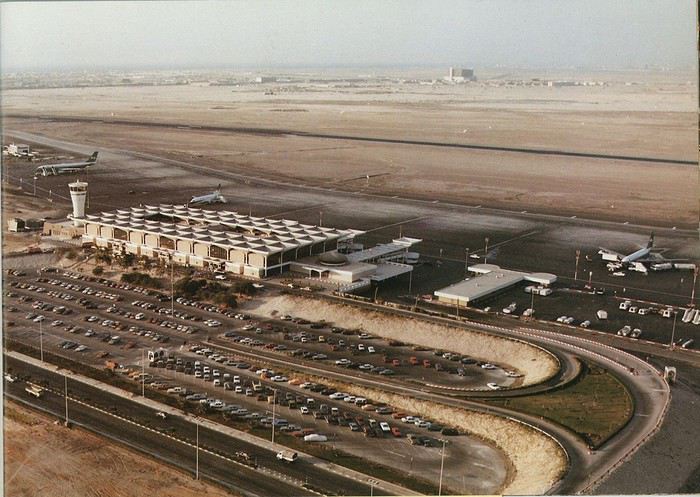
Next stop: New Delhi to drop off some Europeans and pick up a few Indians, and finally, the terminus: Manila. I don’t remember how long the trip took with its five stops—an unimaginable journey today. Despite all those stops to fill the plane, there was still enough space to stretch out on the four center seats of the 747, something that never happens these days despite all the flights in every direction.
So here we are, finally at Manila Airport around midnight.
Episode 1: Manila and Baguio To start, a quick note on the political and economic situation in the Philippines in 1984, which had consequences for us as tourists, as we’d soon realize upon arrival.
After several centuries of Spanish colonization, the Philippines became American at the start of the 20th century, then independent. In 1966, Marcos took power, and little by little, his regime sank into corruption and mismanagement, becoming a dictatorship with martial law, all for the benefit of his family and friends, who enriched themselves endlessly. The peak was the assassination of opposition leader Benigno Aquino in August 1983, which triggered harshly repressed protests. So we arrived a few months later in a very poor country, with omnipresent corruption and an extremely tense political situation, as we’d soon see for ourselves. Major protests took place in the main cities during our trip—I’ll come back to that. Two years later, Marcos fled to Hawaii after being forced out of power following rigged elections. This historical context explains a lot of the situations we found ourselves in over the following weeks.
Arriving in the middle of the night isn’t very cheerful. Manila was already a huge city with many slums, where you could find a few business hotels like the Hilton or Intercontinental—way out of our budget—and plenty of run-down hotels. Luckily, two Indians we’d chatted with on the plane offered to take us to their usual hotel. They came to Manila twice a year for business. We accepted their offer, relieved not to have to look for a place to stay in the middle of the night, figuring the address must be good since they came back every time... we were wrong 🙁
We left the airport and immediately got a taste of the local vibe when we got into the taxi: the police asked for our passports. We thought: what’s more normal than police in a dictatorship?
But that wasn’t it at all. Our two Indian friends explained that the police were noting our names along with the taxi number and time. Crime in Manila was so bad that the taxi driver would be held responsible if anything happened to us... welcome to the Philippines 😎 😎
Historically, the Philippines was a very violent country, where everything was settled with guns or machetes. Previous governments had banned carrying weapons, but Marcos later allowed the free sale and carrying of guns, and disputes were settled with pistols again (or worse, as we’d discover later). Since he’d released most of the criminals from prison to form a paramilitary militia at his service (I’ll talk about our encounter with these “heroes” later), it was pretty dangerous to go into many parts of Manila, where these “tonton macoutes” ruled.
We arrived at our hotel without incident... and then things started badly. The room was infested with big cockroaches—exactly what I hate most in those kinds of countries. No way to find another hotel at that hour. After the long flight, the urge to take a shower was so strong that we squeezed into the bathroom as best we could. After that, I don’t remember—I guess we must’ve fallen asleep exhausted under the sheets in the heat... air conditioning wasn’t widespread yet.
The next day, we just wanted to leave that dump as soon as possible. So we decided to head north right away, stopping in Baguio, and we’d visit Manila a bit on the way back.
When we stepped outside, we discovered a pretty run-down neighborhood with potholed streets. But we also discovered the jeepneys. They were everywhere, flooding the streets.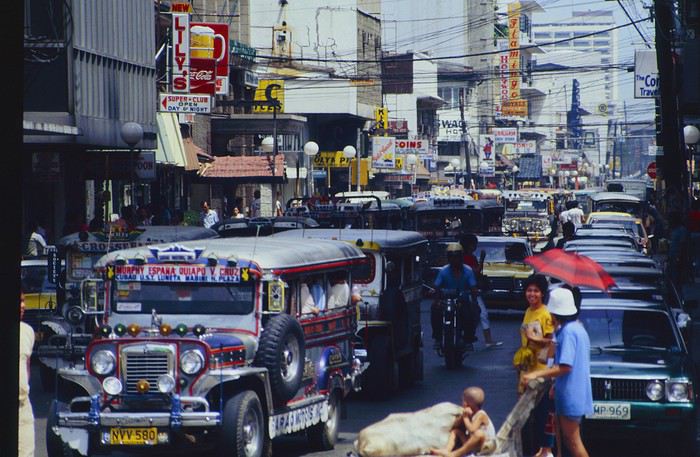
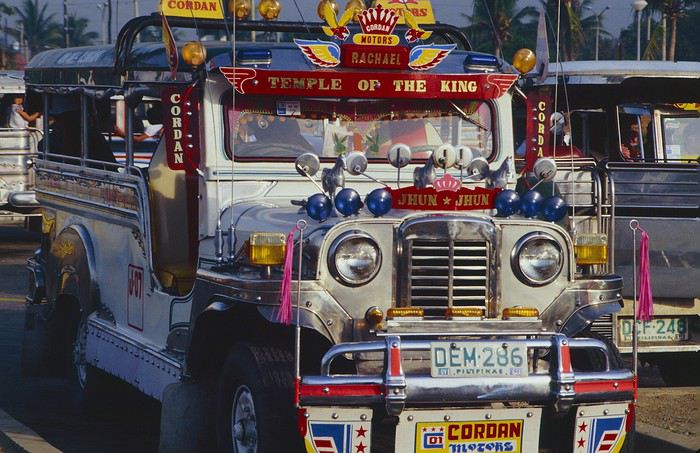
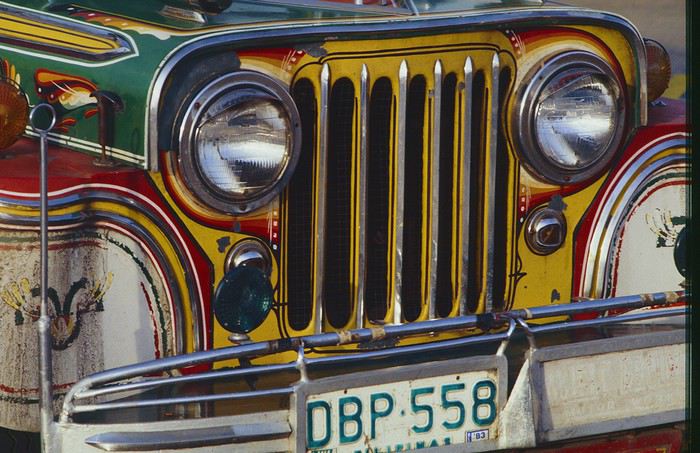
They had crazy sound systems, each one blasting louder than the last. The interiors were kitschy but fun. There weren’t many private cars—almost all transportation was by jeepney, with buses reserved for intercity trips.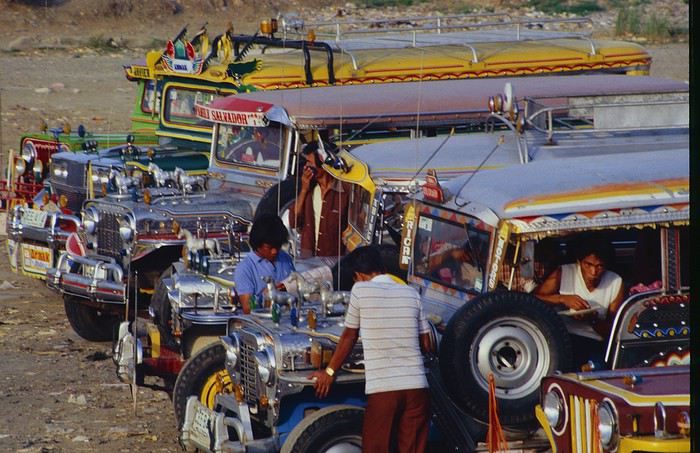
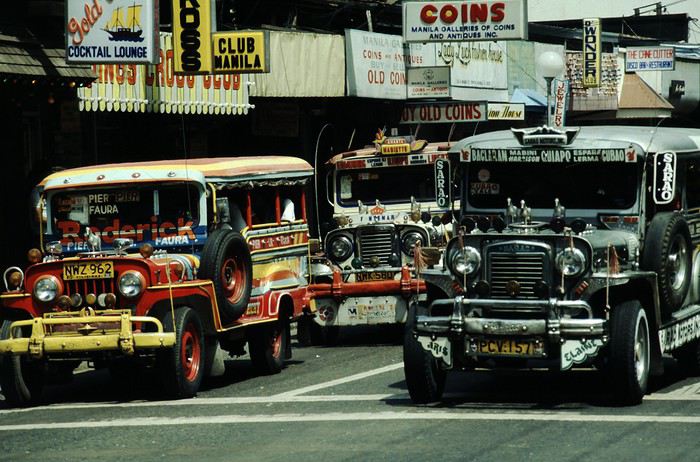
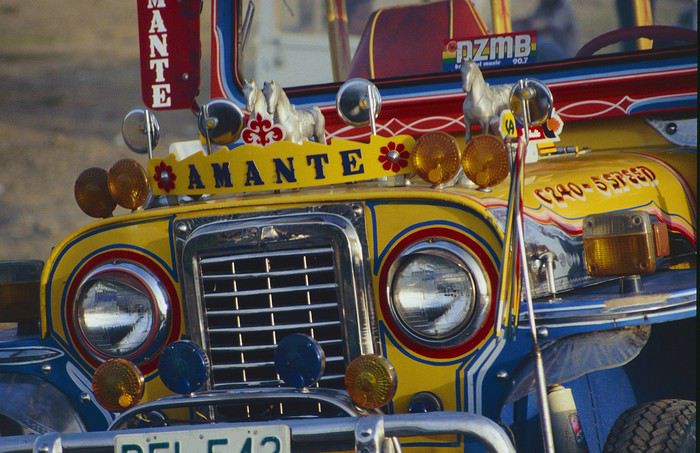
Before heading to the bus terminal for the north, somewhere on the outskirts of the city, we needed to exchange some money. I don’t remember how we ended up in a policeman’s jeep who offered his services: - Exchange money on the black market at a better rate than the banks. - Take us wherever we wanted, in this case, the bus terminal.
We accepted both offers (we’d still checked the official exchange rate from dollars to pesos). So we found ourselves in his jeep. After exchanging money, we left in his vehicle and stopped for gas. Without turning off the engine, he calmly smoked a cigarette while filling up. Since we were in a jeep with no doors or roof, we were ready to jump out if things went south, our travel bag in hand.
But we weren’t done with surprises yet. Once we left the small streets, we ended up in a neighborhood with wide avenues and not much traffic, which didn’t justify his incredible behavior. At every intersection, he made the sign of the cross, closed his eyes, and crossed without looking. I was more stunned than terrified! It wasn’t until we got out of the car later that I told Anne-Marie what had happened. I’d seen everything because the cop had put me in the front seat. Luckily, A-Marie hadn’t noticed anything from the back. Crossing Manila by trusting God rather than the rules of the road was ultimately effective. We were lucky—the trip was off to a good start. 🙂 🙂
We then passed through a neighborhood where slums stretched on for a while, and we left our policeman—friendly but a bit crazy—with relief.
A few hours by bus later, here we are in Baguio, cool in the mountains. My memories of Baguio are pretty fuzzy. I remember a small town. After some research while writing this journal, I found that the population was 120,000 in 1980. Given the population density in each home, that confirms my memory of a smallish town. Outside the “official” district with the president’s summer residence and government buildings, there were two or three paved streets with nice houses. The rest was very dirty and very poor, with lots of slums and dirt roads.
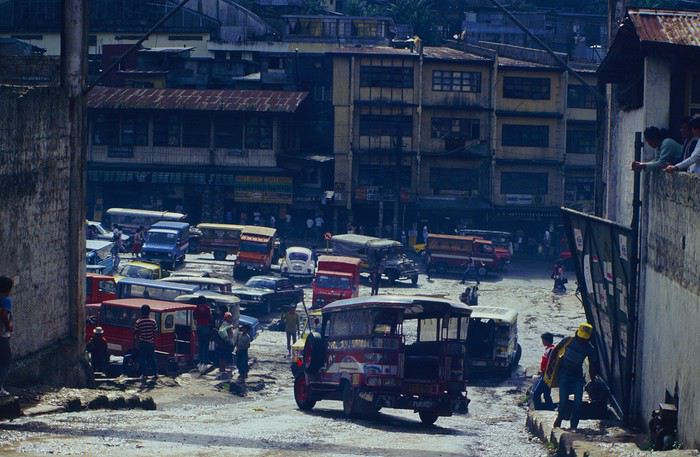
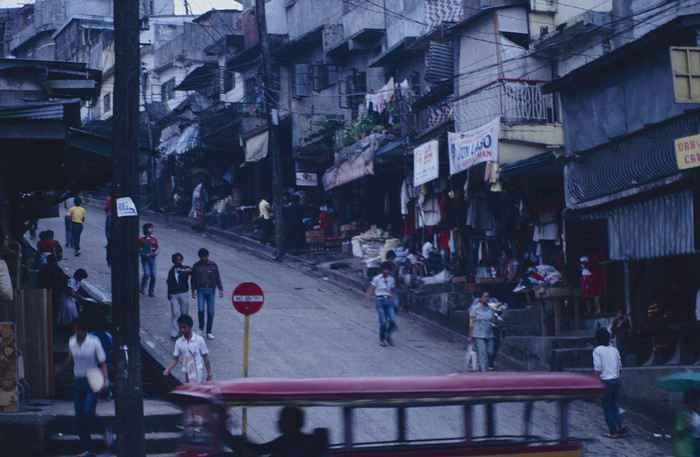
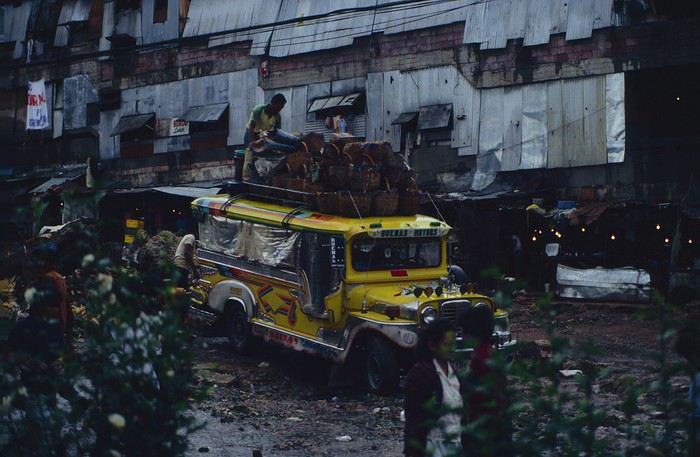
People we met on the street invited us to stay with them. These days, we wouldn’t just show up at strangers’ houses, which we should’ve done in Baguio—it would’ve saved us from an unimaginable and dangerous situation... which I won’t say anything about... !😊
The simple wooden house was on stilts at the edge of a hill with a view of the mountains. Since it was the start of the rainy season in a city that gets a lot of rain, we saw a lot of water. Our outings in town happened between downpours.
View from our lodging: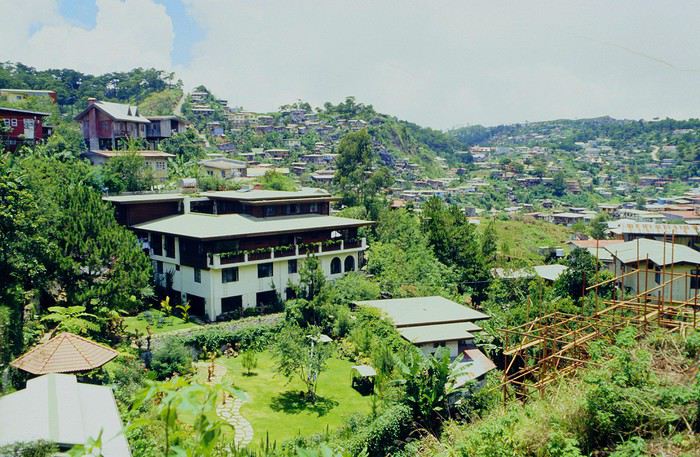
Episode 2: Baguio to Bontoc Aside from the situation briefly mentioned above, it was on the next leg to Bontoc that the adventure really began: an endless and dangerous road, a bus from another era, breathtaking landscapes, and surprising people.
We didn’t know the distance or how long it would take to get to Bontoc. When we arrived after about ten hours, we learned that Baguio to Bontoc was 140 km.
We got on a bus with wooden seats and settled in, two to a seat meant for two. As the bus filled up, passengers squeezed in three or four per seat, with chickens and baskets full of all sorts of things in the aisle. A little embarrassed, we didn’t know if we should squeeze in three on our seat. The seats were super tight (luckily, Filipinos are small), and I didn’t know where to put my legs given my height. I don’t remember if we stayed alone on our bench or if we ended up sharing with others.
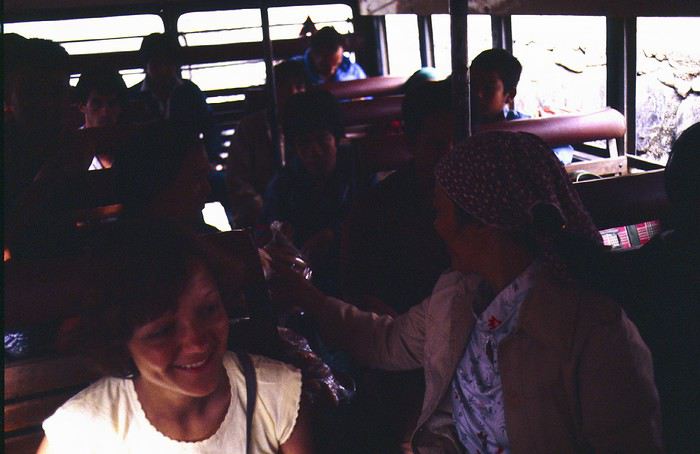
The “road” was a dirt track (or rather, a mud track) with endless turns. We held on as best we could to our slippery wooden seats—it was shaking in every direction. The woman behind us was carsick and throwing up... gross... but what were we doing there? Then we plunged into the Sierra Madre... just the name is dreamy!
Rice terraces started to appear: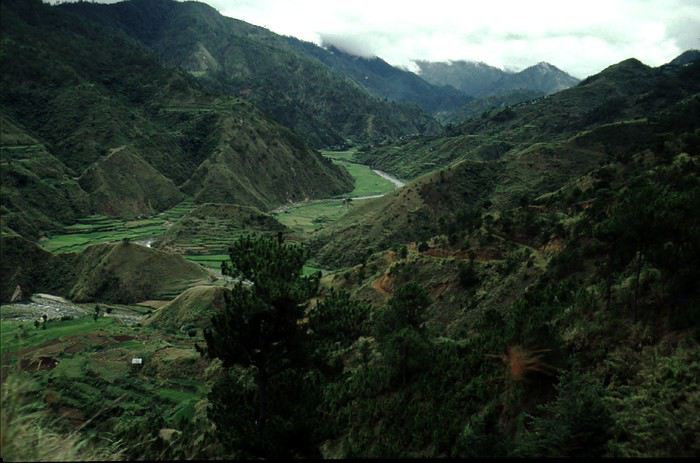
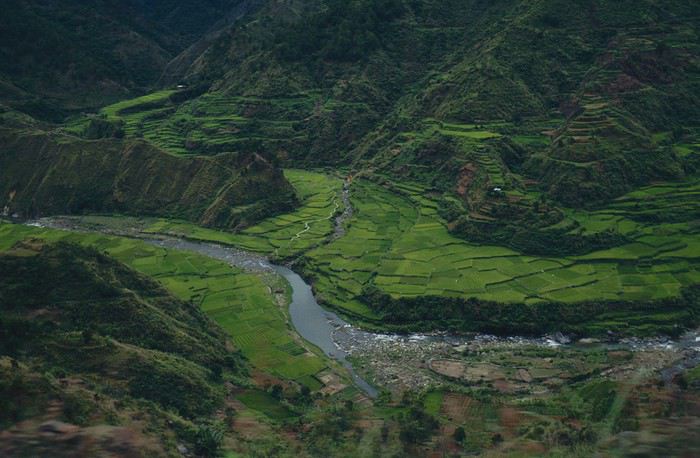
they took up more and more space along cliffs where we weren’t always reassured,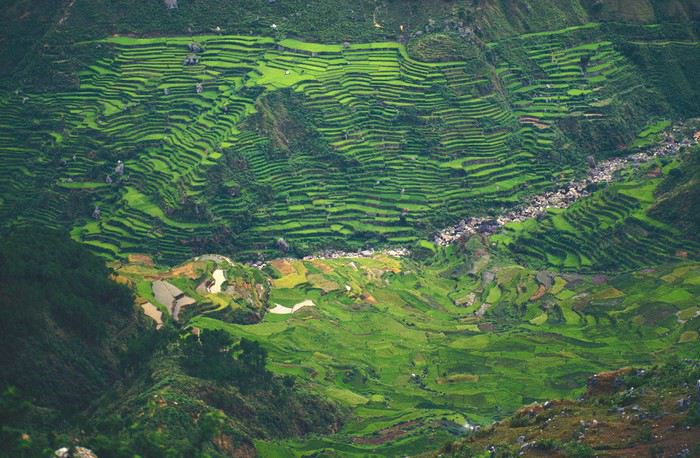
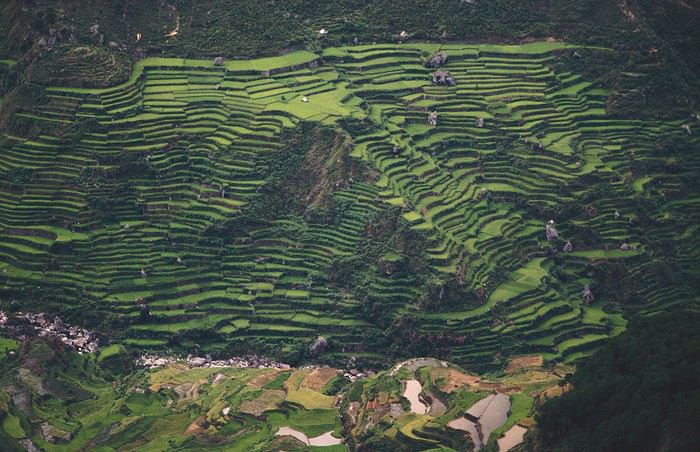
with lots of waterfalls (all that water had to go somewhere).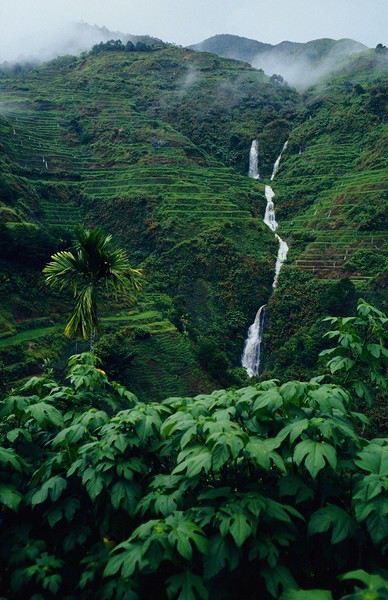
A few miserable villages stretched along the track, most often just a few houses balancing between the road and the drop. The bus stopped in every village—people got on or off and settled inside or on the roof. Street vendors offered their products to the bus passengers—a common sight in Asia, even today.
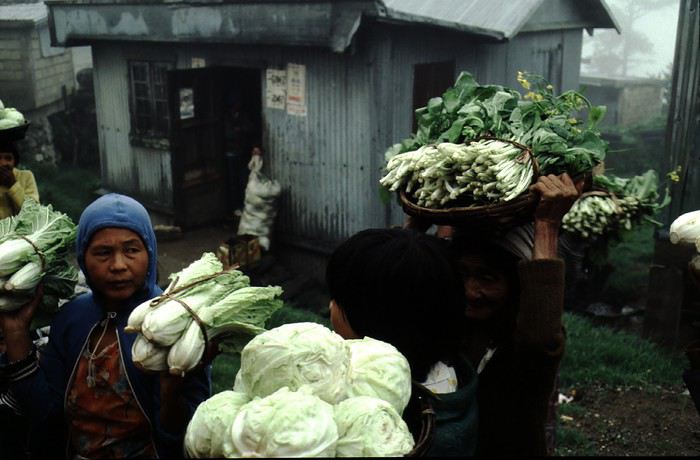
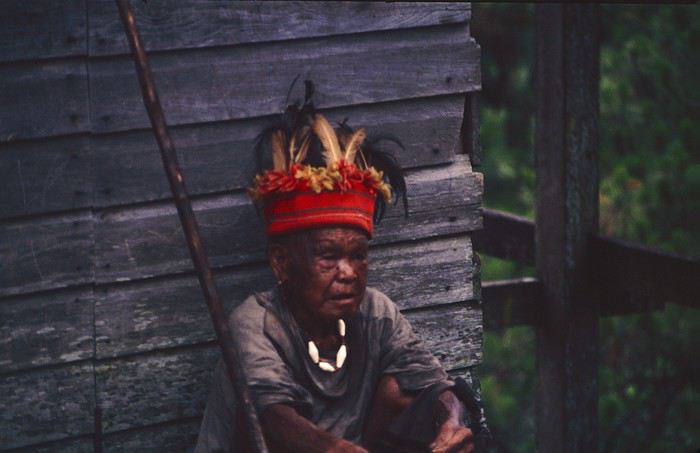
We were in another world—villagers were in loincloths, others had spears. The atmosphere was strange... but all good, we wanted exoticism, and we got it: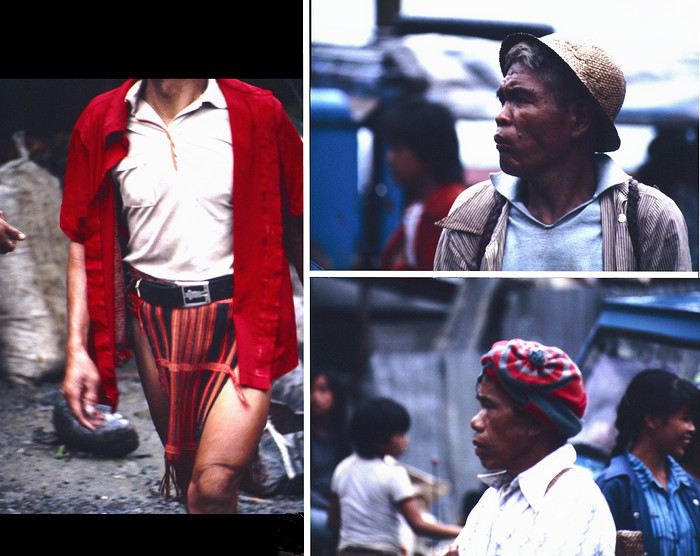
This so-called traditional outfit was everyday wear—it wasn’t for tourists since there weren’t any.
A curiosity because writing a travel journal about a trip 35 years later isn’t common, but also (mostly?) because exploring the Philippines at that time had little in common with traveling there today.
Obviously, I’ve forgotten a number of facts, most of the details, but with the help of a few notes from that time and a stack of slides (yes, there was life before digital 😊), many memories came back and added to the highlights I’d never forgotten. The scanned slides aren’t always great quality, but there are still quite a few to brighten up this chatter. Back then, we didn’t snap photos like we do now—film was too expensive—so I don’t have pictures of every place we visited... too bad, comparing some of those spots to how they look today would’ve been interesting.
Why "Adventures"? Why call it "Adventures" in the Philippines in 1984, a word so often used for a simple exotic trip? - Because the lack of information (no *Guide du Routard*, no *Lonely Planet*, no *Michelin Guide*, nothing, and obviously no internet) gave this trip what’s at the heart of adventure: the unknown. - Because the political situation made the stay sometimes dangerous. - Because transportation conditions were always epic, often perilous. - Because the question of where we’d spend the night came up almost every evening. - And for... quite a few other reasons.
That said, we weren’t exactly explorers!
Why the Philippines? First of all, why go to the Philippines in 1984—a country not exactly set up for tourism and about which we knew very little? How could we get an idea of the beauty of the Philippines and its points of interest when we had no guides or photos?
The idea came to us from Thailand a year earlier, during our first long-haul trip. After touring the north of the country, we met a Frenchman living in Phuket, where there were only a few tourists in Patong, with just a few small hotels and guesthouses. Kata and Karon had no buildings or roads, Rawai only had three palm-thatched bungalows, including ours, and the other islands were unknown to tourists. There was plenty to discover, and we wanted to return to this beautiful country... but the Frenchman made us dream about the Philippines—a country to explore, with wild landscapes.
Long evenings of discussion over multiple Sprite-Mekong cocktails (what memories of those headaches!) finally convinced us we had to go to the Philippines.
Episode 0: Before Departure The decision was made: we’d go to the Philippines in May 1984. Our friends and family were surprised when we announced we were going on vacation to the Philippines (a bit like saying today we were going paddleboarding in the Kerguelen Islands 🤪).
These days, preparing for each of our trips takes long evenings of research, planning, and noting down good addresses... etc. But for the Philippines in 1984, preparation was quick: we had very little information about the country, we were leaving almost at random, and the discovery would only be more exciting.
We still had a few bits of info gathered here and there: the rice terraces in northern Luzon, volcanoes, Negros where we were supposed to visit an acquaintance, Cebu and its marine life (we ended up going elsewhere), and absolutely avoid Mindanao, which was practically at war with the regime. That was about it, but it was already a great itinerary.
Nothing was organized in advance; we’d see day by day. We had no idea about travel times or even the existence of transportation options. The main (and sometimes only) way to connect two islands was by overloaded, rusty ferry. Only the big cities had airports.
Let’s Go: Episode 1: Paris to Manila My travel journals always start after arriving at the airport—the Europe-to-“Other Continent” trip isn’t interesting—but the flight to the Philippines was already an adventure, so I’ll make an exception.
This was the era when only a few Asian airlines were on par with Western ones: Thai, Singapore Airlines, and Philippine Airlines. They had beautiful, brand-new planes, and to attract customers (almost exclusively “businessmen”) from the usual airlines (Air France, Lufthansa, British Airways), there was opulence on board: unlimited champagne, all sorts of cocktails... Compared to today’s long-haul flights, there was still one small difference: no personal screens, just one screen at the front of the cabin with one mandatory movie. And I don’t know why, but we only got James Bond films, both ways... that must’ve been the trend at the time.
The tourism boom to Southeast Asia hadn’t started yet, and the “Asian Tigers” weren’t a thing, so there weren’t many business trips. That meant long-haul flights made stops everywhere to fill the planes. Our Philippine Airlines Boeing 747 left London, picked us up in Paris, then stopped in Frankfurt to take on a few Germans. I don’t know why we then made a stop in Dubai—a totally exotic place at the time. There was nothing to do there... things have changed a lot since. It was a small town lost in the desert. The airport was tiny, with just one or two buildings and a supermarket. During the stopover, everyone had to get off the plane and walk to the supermarket. Photo and electronic equipment were dirt cheap—I guess that was the only reason for the stop. Maybe it was their first commercial move. Emirates didn’t exist yet, as I checked online, but anyway, the idea that such a remote place could have its own airline was unthinkable.
Online, I found this photo of Dubai Airport in 1980. Anyone who’s transited through today’s massive airport with its rows of A380s will appreciate it:
Next stop: New Delhi to drop off some Europeans and pick up a few Indians, and finally, the terminus: Manila. I don’t remember how long the trip took with its five stops—an unimaginable journey today. Despite all those stops to fill the plane, there was still enough space to stretch out on the four center seats of the 747, something that never happens these days despite all the flights in every direction.
So here we are, finally at Manila Airport around midnight.
Episode 1: Manila and Baguio To start, a quick note on the political and economic situation in the Philippines in 1984, which had consequences for us as tourists, as we’d soon realize upon arrival.
After several centuries of Spanish colonization, the Philippines became American at the start of the 20th century, then independent. In 1966, Marcos took power, and little by little, his regime sank into corruption and mismanagement, becoming a dictatorship with martial law, all for the benefit of his family and friends, who enriched themselves endlessly. The peak was the assassination of opposition leader Benigno Aquino in August 1983, which triggered harshly repressed protests. So we arrived a few months later in a very poor country, with omnipresent corruption and an extremely tense political situation, as we’d soon see for ourselves. Major protests took place in the main cities during our trip—I’ll come back to that. Two years later, Marcos fled to Hawaii after being forced out of power following rigged elections. This historical context explains a lot of the situations we found ourselves in over the following weeks.
Arriving in the middle of the night isn’t very cheerful. Manila was already a huge city with many slums, where you could find a few business hotels like the Hilton or Intercontinental—way out of our budget—and plenty of run-down hotels. Luckily, two Indians we’d chatted with on the plane offered to take us to their usual hotel. They came to Manila twice a year for business. We accepted their offer, relieved not to have to look for a place to stay in the middle of the night, figuring the address must be good since they came back every time... we were wrong 🙁
We left the airport and immediately got a taste of the local vibe when we got into the taxi: the police asked for our passports. We thought: what’s more normal than police in a dictatorship?
But that wasn’t it at all. Our two Indian friends explained that the police were noting our names along with the taxi number and time. Crime in Manila was so bad that the taxi driver would be held responsible if anything happened to us... welcome to the Philippines 😎 😎
Historically, the Philippines was a very violent country, where everything was settled with guns or machetes. Previous governments had banned carrying weapons, but Marcos later allowed the free sale and carrying of guns, and disputes were settled with pistols again (or worse, as we’d discover later). Since he’d released most of the criminals from prison to form a paramilitary militia at his service (I’ll talk about our encounter with these “heroes” later), it was pretty dangerous to go into many parts of Manila, where these “tonton macoutes” ruled.
We arrived at our hotel without incident... and then things started badly. The room was infested with big cockroaches—exactly what I hate most in those kinds of countries. No way to find another hotel at that hour. After the long flight, the urge to take a shower was so strong that we squeezed into the bathroom as best we could. After that, I don’t remember—I guess we must’ve fallen asleep exhausted under the sheets in the heat... air conditioning wasn’t widespread yet.
The next day, we just wanted to leave that dump as soon as possible. So we decided to head north right away, stopping in Baguio, and we’d visit Manila a bit on the way back.
When we stepped outside, we discovered a pretty run-down neighborhood with potholed streets. But we also discovered the jeepneys. They were everywhere, flooding the streets.
They had crazy sound systems, each one blasting louder than the last. The interiors were kitschy but fun. There weren’t many private cars—almost all transportation was by jeepney, with buses reserved for intercity trips.
Before heading to the bus terminal for the north, somewhere on the outskirts of the city, we needed to exchange some money. I don’t remember how we ended up in a policeman’s jeep who offered his services: - Exchange money on the black market at a better rate than the banks. - Take us wherever we wanted, in this case, the bus terminal.
We accepted both offers (we’d still checked the official exchange rate from dollars to pesos). So we found ourselves in his jeep. After exchanging money, we left in his vehicle and stopped for gas. Without turning off the engine, he calmly smoked a cigarette while filling up. Since we were in a jeep with no doors or roof, we were ready to jump out if things went south, our travel bag in hand.
But we weren’t done with surprises yet. Once we left the small streets, we ended up in a neighborhood with wide avenues and not much traffic, which didn’t justify his incredible behavior. At every intersection, he made the sign of the cross, closed his eyes, and crossed without looking. I was more stunned than terrified! It wasn’t until we got out of the car later that I told Anne-Marie what had happened. I’d seen everything because the cop had put me in the front seat. Luckily, A-Marie hadn’t noticed anything from the back. Crossing Manila by trusting God rather than the rules of the road was ultimately effective. We were lucky—the trip was off to a good start. 🙂 🙂
We then passed through a neighborhood where slums stretched on for a while, and we left our policeman—friendly but a bit crazy—with relief.
A few hours by bus later, here we are in Baguio, cool in the mountains. My memories of Baguio are pretty fuzzy. I remember a small town. After some research while writing this journal, I found that the population was 120,000 in 1980. Given the population density in each home, that confirms my memory of a smallish town. Outside the “official” district with the president’s summer residence and government buildings, there were two or three paved streets with nice houses. The rest was very dirty and very poor, with lots of slums and dirt roads.
People we met on the street invited us to stay with them. These days, we wouldn’t just show up at strangers’ houses, which we should’ve done in Baguio—it would’ve saved us from an unimaginable and dangerous situation... which I won’t say anything about... !😊
The simple wooden house was on stilts at the edge of a hill with a view of the mountains. Since it was the start of the rainy season in a city that gets a lot of rain, we saw a lot of water. Our outings in town happened between downpours.
View from our lodging:
Episode 2: Baguio to Bontoc Aside from the situation briefly mentioned above, it was on the next leg to Bontoc that the adventure really began: an endless and dangerous road, a bus from another era, breathtaking landscapes, and surprising people.
We didn’t know the distance or how long it would take to get to Bontoc. When we arrived after about ten hours, we learned that Baguio to Bontoc was 140 km.
We got on a bus with wooden seats and settled in, two to a seat meant for two. As the bus filled up, passengers squeezed in three or four per seat, with chickens and baskets full of all sorts of things in the aisle. A little embarrassed, we didn’t know if we should squeeze in three on our seat. The seats were super tight (luckily, Filipinos are small), and I didn’t know where to put my legs given my height. I don’t remember if we stayed alone on our bench or if we ended up sharing with others.
The “road” was a dirt track (or rather, a mud track) with endless turns. We held on as best we could to our slippery wooden seats—it was shaking in every direction. The woman behind us was carsick and throwing up... gross... but what were we doing there? Then we plunged into the Sierra Madre... just the name is dreamy!
Rice terraces started to appear:
they took up more and more space along cliffs where we weren’t always reassured,
with lots of waterfalls (all that water had to go somewhere).
A few miserable villages stretched along the track, most often just a few houses balancing between the road and the drop. The bus stopped in every village—people got on or off and settled inside or on the roof. Street vendors offered their products to the bus passengers—a common sight in Asia, even today.
We were in another world—villagers were in loincloths, others had spears. The atmosphere was strange... but all good, we wanted exoticism, and we got it:
This so-called traditional outfit was everyday wear—it wasn’t for tourists since there weren’t any.
Bagages cabines (sac à dos) avec Philippines Airlines English translation pending
Bonjour
J'embarque avec philippine Airlines dans quelques jours et je viens de m'apercevoir qu'il est écrit UN bagage cabine de 7kilo max. Mais savez vous s'il est possible de passer avec 2 bagages cabines faisant 7kg en tout (pour ma part 2 sac à dos) ?
Merci pour vos réponses car je n'arrive pas à contacter directement la compagnie par mail.
Et bon voyage !
Voyager seule aux Philippines, dangereux ou non, etc English translation pending
Bonjour,
Je souhaiterai partir seule aux phillipines cet été, Je voulais donc savoir si certain(e) s d'entre vous étaient déjà parties seule, si c'etait dangereux ou non, etc. Je sais que ce n'est pas la meilleire saison, mais j'ai eu des echos positifs malgré tout.. Bref je suis preneuse de toute information si quelqu'in est déjà parti là bas !
Merci !
Je souhaiterai partir seule aux phillipines cet été, Je voulais donc savoir si certain(e) s d'entre vous étaient déjà parties seule, si c'etait dangereux ou non, etc. Je sais que ce n'est pas la meilleire saison, mais j'ai eu des echos positifs malgré tout.. Bref je suis preneuse de toute information si quelqu'in est déjà parti là bas !
Merci !
"Web check-in" chez Cebu Pacific English translation pending
Bonjour,
est-ce un problème d'arriver au comptoir d'enregistrement d'un vol domestique Cebu Pacific sans avoir eu le temps ou l'opportunité de faire son web check-in, sachant que j'ai déjà des sièges numérotés réservés ?
Merci
est-ce un problème d'arriver au comptoir d'enregistrement d'un vol domestique Cebu Pacific sans avoir eu le temps ou l'opportunité de faire son web check-in, sachant que j'ai déjà des sièges numérotés réservés ?
Merci
Éruption volcanique aux Philippines et transport aérien vers l'archipel English translation pending
J ai une réservation pour le philippines départ de France le 26/01/2020 pour 1 mois sur place.
Est une bonne idée d'attendre pour annuler ou y a t-il une chance pour que les vols soient possibles d'ici le 26.
Si quelqu'un aux philippines a des news je suis preneur
Bateau (ferry) Mindoro - Coron (Philippines) English translation pending
Bonjour,
Est-ce que quelqu'un peut me dire s'il y a des bateaux (Ferry) qui vont de Mindoro à Coron en mars ?
Merci
Est-ce que quelqu'un peut me dire s'il y a des bateaux (Ferry) qui vont de Mindoro à Coron en mars ?
Merci
Itinéraire trois semaines et snorkeling aux Philippines English translation pending
Bonjour,
Nous partons chaque année en Asie pour le travail et nous avons décidé de partir 3 semaines en vacances mi fevrier decouvrir les philippines et c 'est là que la galère commence dans le choix de l 'itinéraire après avoir lu moults blogs....
Nous voulons decouvrir le pays mais de facon tranquille, nous voulons limiter les grands trajets sur route et aussi sur mer(j 'ai le mal de mer).Nous sommes aussi fan de snorkeling.
J'avais pensé aller sur bohol pour decouvrir les terres et aller sur balicasag pour le snorkel et voir les dauphins le reve de ma fille.Tout le monde parle d'Apo pour les tortues;j'étais très tentée mais beaucoup de monde parle qu'il y a aussi pas mal de serpents et nous sommes tous des phobiques donc très refroidis.Y a t il des lieux de snorkel sympa ou voir des tortues sans grande probabilité de tomber sur ces sales bestioles!!!!
J'ai lu aussi que le snorkel n 'était pas excellent aux philippines du fait des courants et de la clarté de l'eau, qu'en pensez vous?Nous avons fait sulawesi l'année derniere et nous avons été enchantés par le snorkel.
Après 1 semaine bohol je pensais 1 semaine Siquijor et après 1 semaine Negros ?ou Cebu(Pescador, Badian, Moalboal)?
Derniere interrogation pour ce soir:aller à Coron ou pas sur 3ou 4 jours avant d 'aller ds les Visayas:peur du manque de temps et surtout budget ca à l'air tres cher:hebergement et island hopping(pas très emballée par l'usine à touristes).Nous avons déjà fait le sud de la Thailande, le Vietnam et L'Indonésie:est ce que les paysages sont un cran dessus et si oui quelle est la meilleure excursion à faire de facon tranquille.
Pour Bohol quel est le meilleur point de chute pour silloner l'ile en moto?
Merci d 'avance pour votre aide
Croisière tour monde MSC 2021 English translation pending
Bonjour
Nous avons réservé une croisière tour du monde en...2021. Je reconnais qu.il y a encore plusieurs mois avant le départ mais j.aimerais échanger avec d.autres croisiéristes faisant le même voyage (navire Poesia et trajet passant par Panama).
Compagnie aérienne fiable pour les Philippines? English translation pending
Bonjour. J'ai trouvé cette compagnie qui vend des vols d'avion à rabais: asaptickets Canada. Leurs prix sont incroyables, peut-être trop. Quelqu'un a déjà fait affaire avec eux? J'ai un peu peur à une arnaque, j'ai rempli une demande d'information pour les Phillipines sur intenet, et je recevais un téléphone de leur part 2 minutes plus tard. Trop rapide et trrop beau pour être vrai?
Merci.
Quoi visiter pour un premier séjour de 2 ou 3 semaines aux Philippines? English translation pending
Bonjour,
Partageant mes voyages précédents en Indonésie avec le Viet Nam et la Malaisie, j'aimerai partager mon prochain voyage avec les Philippines. Quelle destination à privilégiée pour un séjour de 2 ou 3 semaines Je ne suis pas difficile pour le choix des visites, j'aime les bords de mer et un peu de snorkling, j'aime aussi visiter les villages pour connaitre un peu la vraie vie de ces populations. J'aime aussi les parcs animaliers, ainsi que les anciens sites pour connaitre l'histoire de ce pays. Je ne suis pas attiré par les centres touristiques surpeuplés de touristes qui ne pensent qu'à faire la fête (exemple Kuta ou Pattaya) J'aime la tranquillité et faire de bonnes promenades pour visiter cascades et criques pittoresques de bord de mer.
Merci par avance pour les infos que je pourrai recevoir et étudier pour mon prochain voyage en Mai et Juin 2020. Pour l'instant je suis sur le départ de mon voyage en Indonésie et Viet Nam pour le nouvel an chinois du 25 janvier 2020.
A bientôt de vous lire,
Jean Pierre,
Partageant mes voyages précédents en Indonésie avec le Viet Nam et la Malaisie, j'aimerai partager mon prochain voyage avec les Philippines. Quelle destination à privilégiée pour un séjour de 2 ou 3 semaines Je ne suis pas difficile pour le choix des visites, j'aime les bords de mer et un peu de snorkling, j'aime aussi visiter les villages pour connaitre un peu la vraie vie de ces populations. J'aime aussi les parcs animaliers, ainsi que les anciens sites pour connaitre l'histoire de ce pays. Je ne suis pas attiré par les centres touristiques surpeuplés de touristes qui ne pensent qu'à faire la fête (exemple Kuta ou Pattaya) J'aime la tranquillité et faire de bonnes promenades pour visiter cascades et criques pittoresques de bord de mer.
Merci par avance pour les infos que je pourrai recevoir et étudier pour mon prochain voyage en Mai et Juin 2020. Pour l'instant je suis sur le départ de mon voyage en Indonésie et Viet Nam pour le nouvel an chinois du 25 janvier 2020.
A bientôt de vous lire,
Jean Pierre,
Correspondance de 2 heures 30 minutes à Hong Kong English translation pending
Bonjour,
Je vais certainement avoir une surprise à l'aéroport de Hong Kong concernant les transferts de bagages mais si quelqu’un pouvait me renseigner avant, ça serait sympa.
En effet, je vais de Hanoi (Vietnam) --> Hong Kong avec Hong Kong Airlines puis Hong Kong --> Addis Abeba--> N'Djamene avec Ethiopian Airlines.
Je dois récupérer mes bagages à Hong Kong puis m'enregistrer à nouveau sur une durée de 2h et 30 minutes. Ma question se pose, est-ce que le temps est suffisant pour me permettre de faire tout ça? ensuite, est-ce que je dois passer par l'immigration?
Merci à l’âme charitable qui aurait eu un cas similaire et qui pourrait me renseigner.
Je vais certainement avoir une surprise à l'aéroport de Hong Kong concernant les transferts de bagages mais si quelqu’un pouvait me renseigner avant, ça serait sympa.
En effet, je vais de Hanoi (Vietnam) --> Hong Kong avec Hong Kong Airlines puis Hong Kong --> Addis Abeba--> N'Djamene avec Ethiopian Airlines.
Je dois récupérer mes bagages à Hong Kong puis m'enregistrer à nouveau sur une durée de 2h et 30 minutes. Ma question se pose, est-ce que le temps est suffisant pour me permettre de faire tout ça? ensuite, est-ce que je dois passer par l'immigration?
Merci à l’âme charitable qui aurait eu un cas similaire et qui pourrait me renseigner.
Combiner les Visayas et Palawan ou les rizières de Banaue avec Palawan English translation pending
Bonjour !
Je prépare actuellement un voyage aux Philippines, pour le mois de mars prochain. Je dispose de 12 jours sur place, et sais pertinemment qu'il est impossible de visiter les Visayas, Palawan et les rizières Banaue avec un séjour si court. Néanmoins, je me demandais si avec un peu d'organisation il serait possible d'essayer de combiner un peu de Visayas et Palawan ou combiner les rizières de Banaue avec Palawan. a/ ma 1ère option: visiter une partie définie de Palawan (Coron / Bacuit bay / Port Barton... mais pas la rivière souterraine) et consacrer qq jours sur Bohol pour les Chocolate Hills, le Tarsier Conservation Area, voire une ile (Panglao ou Siquijor)
b/ ma 2e option (peut être la plus envisageable?) le meme parcours sur Palawan + 2/3 jours dans la région des rizières de Banaue/Batad .
Merci d'avance pour vos avis éclairés.
Cdlt
Je prépare actuellement un voyage aux Philippines, pour le mois de mars prochain. Je dispose de 12 jours sur place, et sais pertinemment qu'il est impossible de visiter les Visayas, Palawan et les rizières Banaue avec un séjour si court. Néanmoins, je me demandais si avec un peu d'organisation il serait possible d'essayer de combiner un peu de Visayas et Palawan ou combiner les rizières de Banaue avec Palawan. a/ ma 1ère option: visiter une partie définie de Palawan (Coron / Bacuit bay / Port Barton... mais pas la rivière souterraine) et consacrer qq jours sur Bohol pour les Chocolate Hills, le Tarsier Conservation Area, voire une ile (Panglao ou Siquijor)
b/ ma 2e option (peut être la plus envisageable?) le meme parcours sur Palawan + 2/3 jours dans la région des rizières de Banaue/Batad .
Merci d'avance pour vos avis éclairés.
Cdlt
Rapporter des coquillages trouvés sur la plage à Krabi dans sa valise English translation pending
Salut à tous
J’aimerai savoir s’il est possible de ramener quelques coquillages (une dizaine) trouvés sur la plage à Krabi en France?
Je ne veut pas avoir d’ennuis pour un si petit nombre et cherche à savoir comment faire...
Merci d’avance
Merci d’avance
Budget et change pour un jeune en échange universitaire aux Philippines English translation pending
Bonjour,
Mon fils de 17 ans part début novembre pour 5 mois aux Philippines. Il fréquentera l'Université de Dumaguate et sera logé en famille d'accueil à Valencia. Il y sera logé, nourri, blanchi. Ses seules dépenses seront donc de l'argent de poche (lunch sur le pouce à midi, sorties, visites le we...). Je compte lui commander une "carte de crédit prépayée". Je voulais savoir comment gérer ce budget : - quel montant prévoir en gros ? - combien lui coûteront les retraits avec une telle carte ? On trouve des automates facilement ? - pour ses premières dépenses sur place, vaut-il mieux acheter des pesos en Belgique ou changer des Euros sur place ?
Si vous avez des conseils recommandations, je suis preneuse, notamment pour son arrivée (il est encore jeune et c'est son premier voyage seul...).
Claire
Mon fils de 17 ans part début novembre pour 5 mois aux Philippines. Il fréquentera l'Université de Dumaguate et sera logé en famille d'accueil à Valencia. Il y sera logé, nourri, blanchi. Ses seules dépenses seront donc de l'argent de poche (lunch sur le pouce à midi, sorties, visites le we...). Je compte lui commander une "carte de crédit prépayée". Je voulais savoir comment gérer ce budget : - quel montant prévoir en gros ? - combien lui coûteront les retraits avec une telle carte ? On trouve des automates facilement ? - pour ses premières dépenses sur place, vaut-il mieux acheter des pesos en Belgique ou changer des Euros sur place ?
Si vous avez des conseils recommandations, je suis preneuse, notamment pour son arrivée (il est encore jeune et c'est son premier voyage seul...).
Claire
Vol bon rapport qualité-prix Montréal-Thaïlande en mars English translation pending
BJr
des amis installés à Montreal projettent de venir nous voir en Thailande en mars 2020
L'agence a Montreal leur propose un vol economique Montreal Shanghai (AIrCanada) + Shanghai à Singapore (Singapore ) + SIngapore Kuala (Jetstar) + Singapore Bangkok (Malaysian) !!!
Les quebecquois du forum pourraient ils me dire ce qu'ils utilisent comme vol bon rapport qualité / prix pour aller en Thailande ( et en revenir parfois aussi ) sachant que l'ideal serait d'arriver a ChiangMai - et de repartir de Bangkok ((j'ai vu QATAR Montreal Doha ChiangMai et AIrChina Montreal Pekin Chiangai ? )
via Shanghai ? HongKong ( low-cost direct Hongkong ChiangMai ?) via le Japon ? la Corée ? ou Singapore ?
merci
Les quebecquois du forum pourraient ils me dire ce qu'ils utilisent comme vol bon rapport qualité / prix pour aller en Thailande ( et en revenir parfois aussi ) sachant que l'ideal serait d'arriver a ChiangMai - et de repartir de Bangkok ((j'ai vu QATAR Montreal Doha ChiangMai et AIrChina Montreal Pekin Chiangai ? )
via Shanghai ? HongKong ( low-cost direct Hongkong ChiangMai ?) via le Japon ? la Corée ? ou Singapore ?
merci
Quelle île et recommandation d'hébergement pour une semaine solo aux Philippines English translation pending
Bonjour à tous,
J'aimerais profiter d'un voyage à Taïwan pour passer 7-8 jrs aux Philippines vers le 9 septembre. Je vais passer mon temps à randonner à Taïwan donc pour les Philippines, j'aimerais que ce soit "beach all day every day", de sable fin blanc et eau limpide de préférence 😎
Je veux absolument dormir dans un hôtel les pieds dans l'eau, je ne tiens pas à faire de la route où traverser le village pour me retrouver sur la plage, je tiens à y être dès le réveil.
Pourriez-vous m'aiguiller sur quelle page/île jeter mon dévolu, ça m'aidera à localiser mes recherches sur booking/agoda/airBB. Ça ne me dérange pas de "perdre" 2 jours à transiter, c'est aussi le charme du voyage... Et si vous avez carrément des noms d'hôtel à me recommander, ce serait vraiment super car la seule adresse "pieds dans l'eau" sûre que j'avais était à San Vincente (Palawan, il me semble ?) mais rien de dispo à cet endroit pour mes dates 😕 Merci d'avances pour vos lumières !
J'aimerais profiter d'un voyage à Taïwan pour passer 7-8 jrs aux Philippines vers le 9 septembre. Je vais passer mon temps à randonner à Taïwan donc pour les Philippines, j'aimerais que ce soit "beach all day every day", de sable fin blanc et eau limpide de préférence 😎
Je veux absolument dormir dans un hôtel les pieds dans l'eau, je ne tiens pas à faire de la route où traverser le village pour me retrouver sur la plage, je tiens à y être dès le réveil.
Pourriez-vous m'aiguiller sur quelle page/île jeter mon dévolu, ça m'aidera à localiser mes recherches sur booking/agoda/airBB. Ça ne me dérange pas de "perdre" 2 jours à transiter, c'est aussi le charme du voyage... Et si vous avez carrément des noms d'hôtel à me recommander, ce serait vraiment super car la seule adresse "pieds dans l'eau" sûre que j'avais était à San Vincente (Palawan, il me semble ?) mais rien de dispo à cet endroit pour mes dates 😕 Merci d'avances pour vos lumières !
Circuit voyage de noces au Visayas: ferry et location de scooter English translation pending
Bonjour à tous,
Tout d'abord un immense merci pour ce forum qui m'aide énormément!
Nous sommes en train de construire notre voyage de noces pour les Visayas.
Nous allons tout gérer seuls et parfois je ne suis pas sure que l'on soit bien dan la réalité du terrain vu que l'on ne connait pas du tout!
Nous partirions du 22/02/19 au 5/02/19 (environ les vols ne sont pas finalisés encore) pour s'attarder sur Siquijor en 1er avec location de scooter et visite de l'île en solo ( cambugaway falls, arbre centenaire...) avec une journée à Apo, puis 2 jours à Pamilacan et enfin le reste du séjour sur Bohol (chocolate hills, sanctuaire des tarsiers, kayak nocturne pour découvrir les lucioles...).
L'idée étant d'arriver au plus près
- alors déjà est-ce plus simple d'arriver à Cebu et de prendre un ferry pour Larena (je crois que pour Siquijor ça n'est pas possible si??) ou d'arriver à Tagbilaran et de prendre aussi un ferry? Quels sont vos conseils sur ce point? Comment réserver le ferry en avance ( j'ai essayé oceanjet mais le site ne semble pas fonctionner...)?
- pour aller de Siquijor à Pamilacan, existe-t-il des navettes?
- comment aller de Pamilacan à Bohol?
- est-il facile de louer un scooter une fois sur place? Enfin ce circuit vous paraît-il réalisable? intéressant?
Merci d'avance pour vos réponses!
Choisir entre l'Indonésie, les Philippines et le Sri Lanka English translation pending
Bonjour à tous. Étant en préparation pour mon prochain séjour d'un mois en janvier prochain, 3 destinations m'attirent, mais j'hésite dans mon choix. Pour ceux qui ont fait les 3 destinations, quel sont les avantages et différences? Ce que je recherche c'est 1-le cout sur place (pension oblige),2- la sécurité 3- la gentillesse des gens et la richesse culturelle.
Je voyage sac à dos, en louant scooter ou transport en commun, et ne recherche pas le party mais bien la tranquilité et le quotidien des gens, de belles plages et paysages grandioses.
Voici ou j'en suis dans mes réflections: Indonésie et Phillipines= trop grand pour un mois (donc encore plus indécis sur l'itinéraire) Le Sri Lanka me rebute pour une seule raison , l'hygiène (mes craintes sont-elles fondées?). Par contre il semble facile de s'y déplacer et d'en faire le tour en un mois. Bref, après avoir consulter différents forum et m'etre procurer les guides de chaque destination mentionnée, le ressenti de personne y ayant séjourné ou qui y vivent m'éclairerais peut-etre. Merci de partager vos expériences.
Recherche itinéraire 15 jours aux Philippines English translation pending
Bonjour,
Je sollicite votre aide 🙂 Voila mon Mari et moi souhaitons partir 15 jours au Philippines en avril 2020. Nous ne savons pas trop comment repartir le séjour.. Nous aimerons faire Palawan (El Nido / Coron / Malcapuya/ boracay) mais nous aimerions beaucoup nager avec les requins baleines, et aller à Siquijor le problème c’est que en 2 semaines je ne suis pas sur que Cebu puisse entrer dans l’itinéraire.. qu’en pensez vous? Sinon concernant les transferts (voitures bateaux) location de scooter avez vous des conseils ? En vous remerciant par avance :)
Je sollicite votre aide 🙂 Voila mon Mari et moi souhaitons partir 15 jours au Philippines en avril 2020. Nous ne savons pas trop comment repartir le séjour.. Nous aimerons faire Palawan (El Nido / Coron / Malcapuya/ boracay) mais nous aimerions beaucoup nager avec les requins baleines, et aller à Siquijor le problème c’est que en 2 semaines je ne suis pas sur que Cebu puisse entrer dans l’itinéraire.. qu’en pensez vous? Sinon concernant les transferts (voitures bateaux) location de scooter avez vous des conseils ? En vous remerciant par avance :)