Results for "Grande-Motte+|+127"
234481 results found.
Sugar overload in the American West
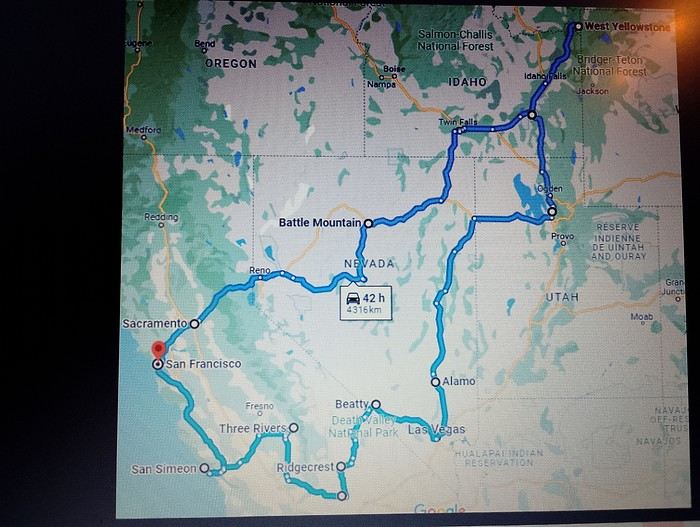
After a first trip with her teens to the West during Easter 2019 and then to New York at All Saints' Day that same year, Cécile has only one idea in 2022: to go back!!!! So, we’re planning a loop from SF to SF, passing through the sequoias, LV, Death Valley, and Yellowstone.
Off we go, full of joy and good spirits, heading to San Francisco. To make the flight more comfortable, I’d booked a seat with extra legroom.
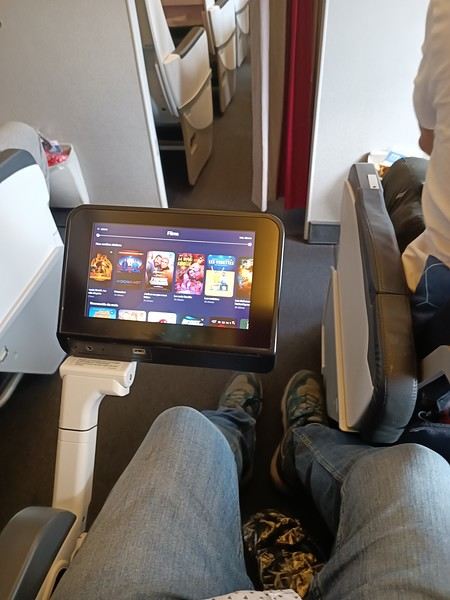
Really nice!
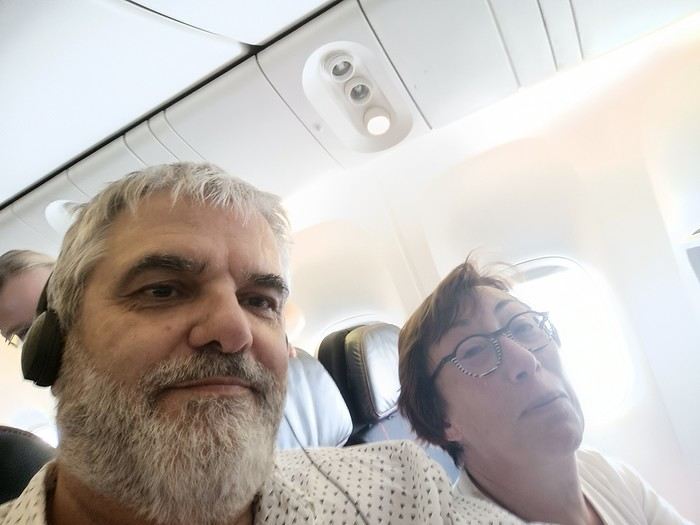
Anyway, everything went smoothly until we arrived—1h30 of waiting at customs!!!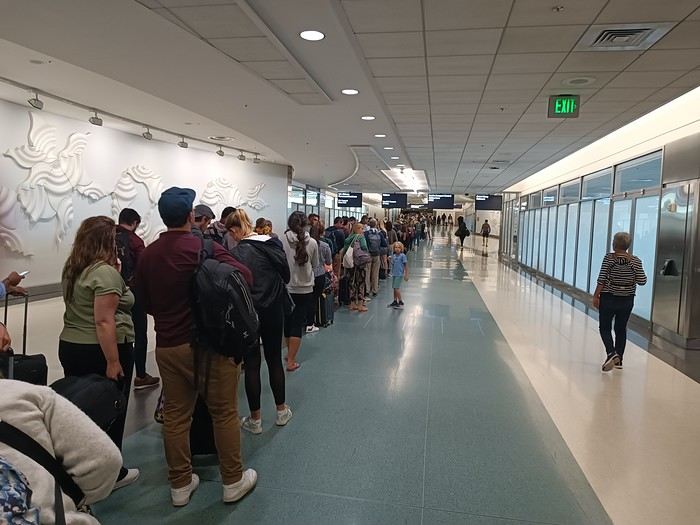
But no matter, around 11 PM, we took the shuttle to a hotel, tired but happy
Off we go, full of joy and good spirits, heading to San Francisco. To make the flight more comfortable, I’d booked a seat with extra legroom.
Really nice!
Anyway, everything went smoothly until we arrived—1h30 of waiting at customs!!!
But no matter, around 11 PM, we took the shuttle to a hotel, tired but happy
Northern Chile, Andean impressions.
Alright, this year, we're heading back to South America!
The initial plan was to retrace the route we imagined in the summer of 2020: a trip to northern Argentina starting from Córdoba.
Unfortunately, the flight to Córdoba no longer exists, and airfares to Javier Milei’s country are both outrageously priced and involve multiple layovers.
So, I tweaked Google Flights every which way and finally found a flight within my budget—departing from Clermont-Ferrand!
Not to Argentina, though...
Our transatlantic flight will cross the snow-capped Andes, landing in Santiago, Chile, with a return from Lima!
In between, two domestic flights and a big road trip loop starting from the coastal city of Arica to explore the treasures of northern Chile.
Our mode of transport: a pseudo 4x4 that won’t take us through sand dunes or devilish tracks but will let us tackle the entire secondary network, including unpaved main roads, while still being insured.
Is the suitcase packed with all-season clothes?
Are the driver’s license and passport ready?
Bank cards and a few euros too?
Off we go for just over 3 weeks of southern wanderings!
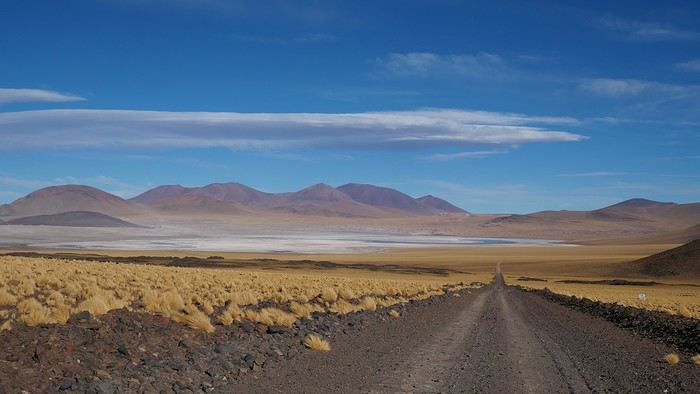
--/--
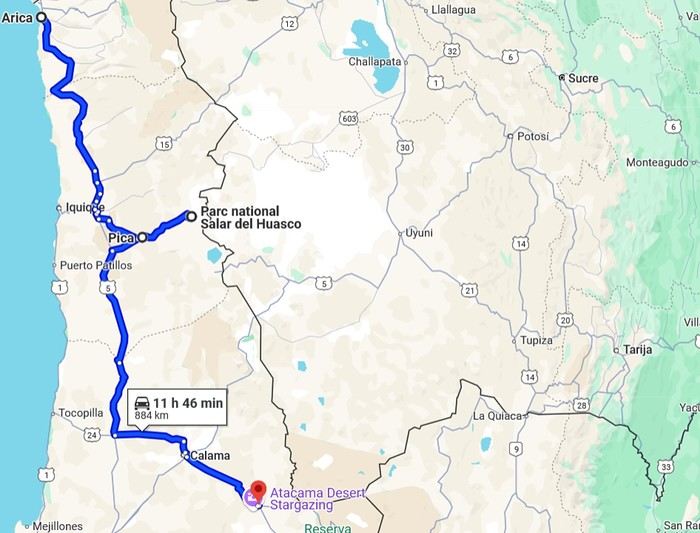
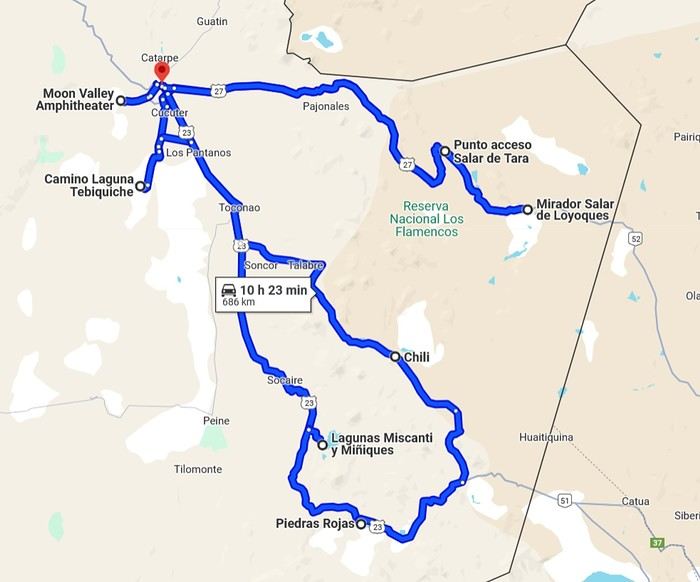
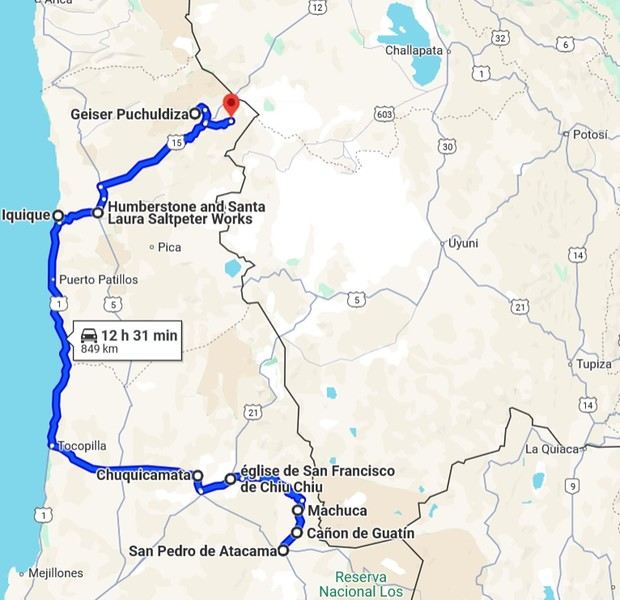
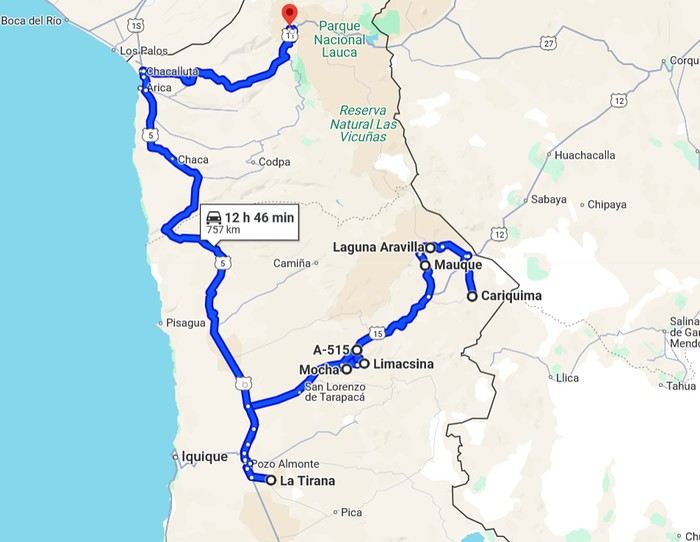
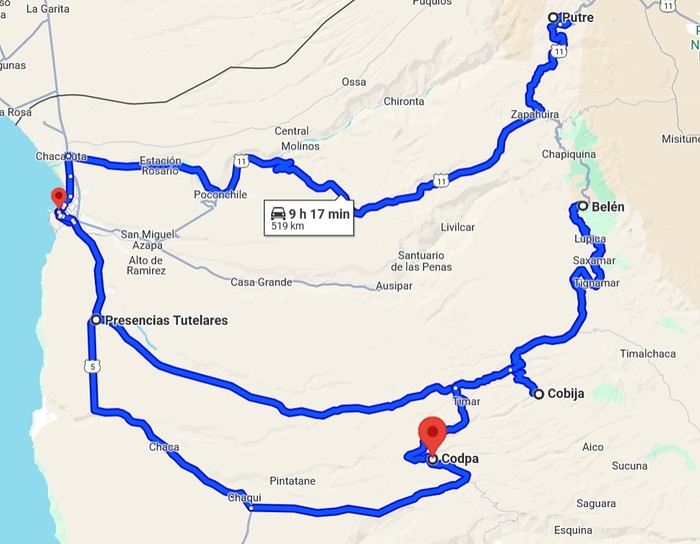
To keep all my esteemed readers on track, here are a few maps outlining the Arica-Arica loop!
1- From Arica to San Pedro de Atacama via Pica and the Salar de Huasco
 2- Around San Pedro
3- From San Pedro to Cariquima
4- From Cariquima to Putre
5 - From Putre to Arica
Gas stations in this part of Chile are located in Arica, Iquique, Pozo Almonte, Pica, Calama, and San Pedro de Atacama.
The initial plan was to retrace the route we imagined in the summer of 2020: a trip to northern Argentina starting from Córdoba.
Unfortunately, the flight to Córdoba no longer exists, and airfares to Javier Milei’s country are both outrageously priced and involve multiple layovers.
So, I tweaked Google Flights every which way and finally found a flight within my budget—departing from Clermont-Ferrand!
Not to Argentina, though...
Our transatlantic flight will cross the snow-capped Andes, landing in Santiago, Chile, with a return from Lima!
In between, two domestic flights and a big road trip loop starting from the coastal city of Arica to explore the treasures of northern Chile.
Our mode of transport: a pseudo 4x4 that won’t take us through sand dunes or devilish tracks but will let us tackle the entire secondary network, including unpaved main roads, while still being insured.
Is the suitcase packed with all-season clothes?
Are the driver’s license and passport ready?
Bank cards and a few euros too?
Off we go for just over 3 weeks of southern wanderings!
--/--
To keep all my esteemed readers on track, here are a few maps outlining the Arica-Arica loop!
1- From Arica to San Pedro de Atacama via Pica and the Salar de Huasco
2- Around San Pedro3- From San Pedro to Cariquima
4- From Cariquima to Putre
5 - From Putre to Arica
Gas stations in this part of Chile are located in Arica, Iquique, Pozo Almonte, Pica, Calama, and San Pedro de Atacama.
The 4000 Islands (Southern Laos)
PAKSE AND THE BOLAVENS PLATEAU
Bolavens (or "Bolovens" – "the region of the Lavens," an old tribe).
PAKSE
A sleepy town, but packed with backpackers in transit between Laos and Cambodia. The streets are numbered, but since there are no signs, you just have to figure it out (rumor has it the signs have been planned for years; luckily, the center isn’t big). Tons of small hotels, including the well-known Sabaidy 2 on Street 20, a big bazaar catering to all budgets, from dark dorms with shared bathrooms to real rooms with terraces or balconies. Since it’s so popular, booking ahead is recommended. My favorite: the Sala Champa, pricier but with two large terraces, one with a bar, and especially a terrace restaurant I consider the best in Pakse (try the divine steamed fish with lemongrass + Lao Gold beer, a rare delight; ask for room 100, with a big terrace). More upscale, the lovely Résidence Sisouk, run by the very classy and French-speaking Mme Sisouk, from the wealthy Lao Sisouk family, the country’s top coffee producer and one of those francophone families you encounter here and there around the world, where class and culture reign – and perfect French. Delicious pastries and, of course, extraordinary coffee tastings. Similar prices at the Pakse Hotel, run by French owners and famous for its rooftop bar-restaurant (great view!).
Tons of restaurants besides those at Sala Champa and Pakse Hotel: from Dao Lin and Sabaidee at the corner of Street 20 and 13, to a decent Indian place (Hassan) and a nice, cheap spot, the Lao Restaurant & Bar, where you can enjoy Lao cuisine for just a few kips, both also on Street 20. You can feast on grilled fish at the countless riverside stalls along the Mekong.
Pakse is home to the famous Yves, a Belgian married to a Lao woman, Noy, who opened the travel agency Miss Noy. He’ll go out of his way to help tourists; he’s incredible, the real tourism office for the region, with maps, endless advice, and every weekday at 6 PM, a full-blown lecture on the Bolavens and the 4000 Islands. A bunch of young travelers listen intently to his explanations about the whole area (he hands out a well-made photocopied map). He also rents bikes and has an internet café with computers that, miraculously, work perfectly. He’s so popular that in high season, you need to book a motorbike 2-3 days in advance (but if he’s out – and he has 40 – he’ll find one for you).
THE BOLAVENS PLATEAU
Plateaus just aren’t my thing – flat-lands! There are some relatively high peaks in the middle, but they’re only accessible by trekking. You can do a small loop from Pakse-Tad Lo-Thateng-Pakson-Pakse, or a big one from Tad Lo to Sekong, then head south to join the Paksong-Pakse road. Starting in the north, the Phu Xam waterfalls are okay (interesting local minority village-museum to the right of the parking lot, and a terrace restaurant above the small falls). Well, they’re on the way, so you might as well see them! After that, a boring road leads to the Tad Lo waterfalls, with tons of small hotels. I chose the big blue house by the river at the right corner of the bridge, the Sipaseth GH, with cute little bungalows in the garden, 4 rooms with balconies overlooking the river, and great food on the terrace facing the falls. **Avoid at all costs**: the Saisee GH, once nice with its little stilt houses by the falls, but now a monument to filth, indifference, and rudeness (confirmed by several people, unanimous on the issue). Luckily, the lovely Tad Lo Lodge, with its bungalows by the falls and gourmet restaurant right above them – not cheap at all – finally built small houses in the woods on the other side for $25.
The next morning, I’d had enough of plateaus, so I took a small loop heading south from Tad Lo to Thateng, and there, a wonder 5 km south of town: the Sinouk Resort. It’s like stepping into *Gone with the Wind* or the Chevalier de Leyritz’s Martinique. In the middle of the Sisouk family’s 34-hectare coffee plantation, a huge garden with three large colonial-style houses: one by the river and pond with a suite + 3 luxury rooms + a small, cozy one for $40 (that’s where I stayed), one with 4 superior rooms for $60, and a very large one overlooking everything with 6 luxury rooms ($60) + 2 huge suites for $90. Of course, it’s all decorated with antique furniture, local knick-knacks, and antiques; there’s a pool, a beautiful restaurant with two terraces, one overlooking a large pond and one by its edge. The food and service are impeccable, and the coffee: from espresso with whipped cream to green tea or wild honey cappuccino… too bad it keeps you up, or you’d sip it all evening (and morning, and afternoon, and in between). In short, a dream!
Back to Pakse via Paksong (what a dump!) and the Tad Fane waterfalls, those are spectacular – twin sisters plunging 200 meters. You can hike down to swim at the bottom (1-hour jungle trek round trip). Across the way, the nice Tad Fane Resort (small houses and a big terrace-restaurant facing the falls).
I think I missed the Katamkok waterfalls, but I don’t believe it – all these falls can’t compare to Ban Gioc Falls in northern Vietnam!!!
CHAMPASAK AND THE 4000 ISLANDS
CHAMPASAK
Even sleepier than Pakse! To avoid the ferry, cross the new Mekong bridge in Pakse, and after about 10 km, turn left at the big "Phaphinoy" sign (the first village in town). When you arrive, turn at the "River Resort" sign. A sumptuous resort on the Mekong, developed with American capital – pure luxury (they even have their own rice field and vegetable garden for the restaurant). Continuing on, you’ll come across the very pleasant Anouxa GH, where I had dinner and stayed. Small bungalows facing the river, garden rooms, and two large wooden houses with huge family rooms + a big terrace on the Mekong, and the food is great! They rent bikes and motorbikes. Further to the right, the pricey Inthira Hotel, which I found uninteresting since it’s on the road instead of by the Mekong. There’s also a Folie Lodge on Don Daeng Island, which I didn’t visit (the word "Folie" is justified: crazy prices, up to $200 and more).
A few nice wats and, of course, Wat Phou, Laos’ most important archaeological site, 10 km south of Champassak in the plains and on the mountainside (the stairs are a killer!). Watch out for the scorching heat, and it closes at 4:30 PM. It’s not Angkor Wat, but it’s still worth the detour. Plan for 2 hours. Entry is 50,000 kips + 5,000 to park your motorbike.
KHIET NGON
To continue south to the 4000 Islands, you have to take the "ferry" (actually fun little things – two canoes joined by a platform; better not mess up when loading your motorbike!). Once on the other side, turn left, and you’ll hit National Road 13 (Pakse-Siphandone, the 4000 Islands), the most boring road I’ve ever been on, like Phnom Penh-Siem Reap – flat and nothing to see. BUT there’s a real gem worth checking out: Kiet Ngon. At Km 48, take the laterite road toward Attapeu (big sign: "Attapeu 155 km") and eat red dust for 8 km (toll: 20,000 kips), then turn right (signposted) onto a good track. You enter the beautiful Xe Pian National Park, where you can still find wild elephants, leopards, and tigers. You arrive at the entrance of the small village of Ban Khiet Ngon. On your right, a small concrete building with 4 decent, cheap rooms (60,000 kips), facing an old wooden house that serves as the tourism office and its "elephant parking" garden. This village is where you can go on an elephant ride (20,000 kips) to the top of Phou Asa, one of the most unusual places I’ve ever seen. You climb through the jungle and emerge onto a flat slate summit, completely bare – it really feels like the Moon! In the distance, an astonishing site built to commemorate a victory by Lao nationalists over Siamese invaders in the 19th century (so the site isn’t 1,000 years old, as the locals claim). A vast archaeological site with an enclosure 180 m by 50 m, marked by 2-meter-high walls and columns made of slate stacked without mortar. At the back, a ruined temple and a tower. Beautiful views of the whole region. Popular with tourists arriving by minibus from Pakse. The elephant rides in a line aren’t my thing, so they tell you it’s forbidden to ride a motorbike, but I did it anyway without any issues – except for the unhappy looks from the mahouts (turn right at the village entrance, sign for "Phou Asa").
If you’ve got the funds, follow the signs for "Kingfisher Lodge" and arrive at Laos’ first ecolodge, developed by a Lao-Italian family. Lovely stilt houses (750,000 kips with breakfast) and 2 bungalows with just fans (250,000 kips). A small two-story wooden building with a restaurant and a terrace by a pond – the bonus: in the evening, wild elephants and buffalo come to drink with you. Booking ahead is recommended since it’s popular with groups from Pakse.
Paper guides also mention the more remote village of Ban Papho, deep in the jungle. There used to be elephant rides, but they’ve stopped. However, there are great treks in the national park (check with the Green Discovery agency in Pakse, which specializes in treks all over Laos).
THE 4000 ISLANDS
You continue on the mind-numbing Road 13 from Pakse and arrive at a brand-new bridge leading to Don Khong Island, where there’s nothing to see except two wats, so if you skip it, you’re not missing much. Next, the Nakasang sign, a small port with mini-ferries crossing the Mekong to Don Det Island. A celebrity, that one – one of those trashy spots for young people who think you can only have fun if you’re wasted on alcohol and drugs. A small street along the river, lined with guesthouses, restaurants, and bars – total chaos! Plus, there’s nothing to see on the island. So, take a tuk-tuk from the jetty, cross the dump, and arrive in a little paradise: Don Khone Island. I planned to stay 2 days but had to be dragged away after 6. A small main village with a dirt road, tons of guesthouses and great restaurants, and lots of beautiful things to see.
For lodging on Don Khone, it’s usually wooden bungalows with river-view terraces. Options range from the elegant and pricey Sala Done Hotel to Somphamit, Pan’s, Pakha GH, and many others. I found my haven away from everything: the little Phonvilay, 3 small bamboo buildings with 2 simple rooms each, terraces above a branch of the Mekong, and a big plus – a small path just to the right that goes down the riverbank, so 3-4 nice swims a day. All for 60,000 kips. To get there, turn right at the end of the bridge until you reach the wat, then take the small path to the river on the right of the wat’s wall.
For food, you’re spoiled for choice. I had all my dinners at the Cordon Bleu of the Fleur du Mékong. I don’t know how she does it, but even the simplest dishes have something extra. She’s famous for her curry (more like a mild stew) of duck or chicken with potatoes and sweet potatoes – a hearty treat. Go for the chicken; Asian ducks are all skin and bones. Her grilled fish is divine!
The island has quite a history: the Mekong upstream is over a kilometer wide (it’s said to reach 14 km during high water) and "falls" onto a rocky barrier. It splits into countless small branches, flowing wherever there’s a crack – hence the 4000 Islands and the impressive rapids. The French discovered this while trying to navigate the Mekong from Saigon to Luang Prabang and China – and bam, impassable! So they built a narrow-gauge railway starting from the south of the island, bypassing the rapids, and ending at the north of Don Det Island. You can see two rusted locomotives, discovered in the jungle in 1990 by a French explorer: one in the southern extension of the bridge and the other in Ban Hang Khone village at the southern tip of the island, both with large English signs and fascinating old photos explaining the whole history of the railway, abandoned when Road 13 was built along the 4000 Islands (the rails were removed, and the railway track is now an excellent trail).
Somphamit Rapids (Li Phi)
Locals call them Li Phi, meaning "the abyss of evil spirits" (the "phi" that Lao people still believe in), because they think the falls and rapids trap spirits, to the point that no one would ever swim there. It’s very dramatic. Entry fee: 35,000 kips. Small beach and a big restaurant with a terrace and thatched-roof tables.
Khon Pa Sai Rapids
A completely different kind, just as spectacular, and less crowded. Turn left at the bridge exit and go to the northern end of the island (Ban Khon Nua village), then continue south until you see a big yellow sign "Khon Pa Sai Waterfalls" pointing to a small path on the left. You arrive at a small suspension bridge with a corner restaurant and terrace where the food is great (I had most of my lunches there). Cross the bridge and follow the path to a spectacular site of falls and rapids. In the middle, you’ll see unique structures – gigantic fish traps over 10 meters long. During high water, each trap can catch up to 500 kg of fish (yes, five hundred) per day.
Ban Hang Khone
This is the "French port" at the southern tip of the island, where the Mekong, after its rapids, spreads out for kilometers – a real inland sea. This is where you can see the famous Irrawaddy dolphins in the morning or late afternoon (boat excursions). To get there, take the trail that was the old railway track, or continue south on the path past the Khon Pa Sai falls (but not by motorbike – the bridge is out). A huge concrete terrace, part of the old port facilities, with a magnificent panoramic view of the Mekong stretching into the distance. Just before, a small path leads to a big beach (with restaurants).
If you go back to Road 13 (or take a pirogue from Don Khone), further south are the Pha Peng Falls, Asia’s highest river falls (15 m). I didn’t go, but they’re said to be spectacular.
Bolavens (or "Bolovens" – "the region of the Lavens," an old tribe).
PAKSE
A sleepy town, but packed with backpackers in transit between Laos and Cambodia. The streets are numbered, but since there are no signs, you just have to figure it out (rumor has it the signs have been planned for years; luckily, the center isn’t big). Tons of small hotels, including the well-known Sabaidy 2 on Street 20, a big bazaar catering to all budgets, from dark dorms with shared bathrooms to real rooms with terraces or balconies. Since it’s so popular, booking ahead is recommended. My favorite: the Sala Champa, pricier but with two large terraces, one with a bar, and especially a terrace restaurant I consider the best in Pakse (try the divine steamed fish with lemongrass + Lao Gold beer, a rare delight; ask for room 100, with a big terrace). More upscale, the lovely Résidence Sisouk, run by the very classy and French-speaking Mme Sisouk, from the wealthy Lao Sisouk family, the country’s top coffee producer and one of those francophone families you encounter here and there around the world, where class and culture reign – and perfect French. Delicious pastries and, of course, extraordinary coffee tastings. Similar prices at the Pakse Hotel, run by French owners and famous for its rooftop bar-restaurant (great view!).
Tons of restaurants besides those at Sala Champa and Pakse Hotel: from Dao Lin and Sabaidee at the corner of Street 20 and 13, to a decent Indian place (Hassan) and a nice, cheap spot, the Lao Restaurant & Bar, where you can enjoy Lao cuisine for just a few kips, both also on Street 20. You can feast on grilled fish at the countless riverside stalls along the Mekong.
Pakse is home to the famous Yves, a Belgian married to a Lao woman, Noy, who opened the travel agency Miss Noy. He’ll go out of his way to help tourists; he’s incredible, the real tourism office for the region, with maps, endless advice, and every weekday at 6 PM, a full-blown lecture on the Bolavens and the 4000 Islands. A bunch of young travelers listen intently to his explanations about the whole area (he hands out a well-made photocopied map). He also rents bikes and has an internet café with computers that, miraculously, work perfectly. He’s so popular that in high season, you need to book a motorbike 2-3 days in advance (but if he’s out – and he has 40 – he’ll find one for you).
THE BOLAVENS PLATEAU
Plateaus just aren’t my thing – flat-lands! There are some relatively high peaks in the middle, but they’re only accessible by trekking. You can do a small loop from Pakse-Tad Lo-Thateng-Pakson-Pakse, or a big one from Tad Lo to Sekong, then head south to join the Paksong-Pakse road. Starting in the north, the Phu Xam waterfalls are okay (interesting local minority village-museum to the right of the parking lot, and a terrace restaurant above the small falls). Well, they’re on the way, so you might as well see them! After that, a boring road leads to the Tad Lo waterfalls, with tons of small hotels. I chose the big blue house by the river at the right corner of the bridge, the Sipaseth GH, with cute little bungalows in the garden, 4 rooms with balconies overlooking the river, and great food on the terrace facing the falls. **Avoid at all costs**: the Saisee GH, once nice with its little stilt houses by the falls, but now a monument to filth, indifference, and rudeness (confirmed by several people, unanimous on the issue). Luckily, the lovely Tad Lo Lodge, with its bungalows by the falls and gourmet restaurant right above them – not cheap at all – finally built small houses in the woods on the other side for $25.
The next morning, I’d had enough of plateaus, so I took a small loop heading south from Tad Lo to Thateng, and there, a wonder 5 km south of town: the Sinouk Resort. It’s like stepping into *Gone with the Wind* or the Chevalier de Leyritz’s Martinique. In the middle of the Sisouk family’s 34-hectare coffee plantation, a huge garden with three large colonial-style houses: one by the river and pond with a suite + 3 luxury rooms + a small, cozy one for $40 (that’s where I stayed), one with 4 superior rooms for $60, and a very large one overlooking everything with 6 luxury rooms ($60) + 2 huge suites for $90. Of course, it’s all decorated with antique furniture, local knick-knacks, and antiques; there’s a pool, a beautiful restaurant with two terraces, one overlooking a large pond and one by its edge. The food and service are impeccable, and the coffee: from espresso with whipped cream to green tea or wild honey cappuccino… too bad it keeps you up, or you’d sip it all evening (and morning, and afternoon, and in between). In short, a dream!
Back to Pakse via Paksong (what a dump!) and the Tad Fane waterfalls, those are spectacular – twin sisters plunging 200 meters. You can hike down to swim at the bottom (1-hour jungle trek round trip). Across the way, the nice Tad Fane Resort (small houses and a big terrace-restaurant facing the falls).
I think I missed the Katamkok waterfalls, but I don’t believe it – all these falls can’t compare to Ban Gioc Falls in northern Vietnam!!!
CHAMPASAK AND THE 4000 ISLANDS
CHAMPASAK
Even sleepier than Pakse! To avoid the ferry, cross the new Mekong bridge in Pakse, and after about 10 km, turn left at the big "Phaphinoy" sign (the first village in town). When you arrive, turn at the "River Resort" sign. A sumptuous resort on the Mekong, developed with American capital – pure luxury (they even have their own rice field and vegetable garden for the restaurant). Continuing on, you’ll come across the very pleasant Anouxa GH, where I had dinner and stayed. Small bungalows facing the river, garden rooms, and two large wooden houses with huge family rooms + a big terrace on the Mekong, and the food is great! They rent bikes and motorbikes. Further to the right, the pricey Inthira Hotel, which I found uninteresting since it’s on the road instead of by the Mekong. There’s also a Folie Lodge on Don Daeng Island, which I didn’t visit (the word "Folie" is justified: crazy prices, up to $200 and more).
A few nice wats and, of course, Wat Phou, Laos’ most important archaeological site, 10 km south of Champassak in the plains and on the mountainside (the stairs are a killer!). Watch out for the scorching heat, and it closes at 4:30 PM. It’s not Angkor Wat, but it’s still worth the detour. Plan for 2 hours. Entry is 50,000 kips + 5,000 to park your motorbike.
KHIET NGON
To continue south to the 4000 Islands, you have to take the "ferry" (actually fun little things – two canoes joined by a platform; better not mess up when loading your motorbike!). Once on the other side, turn left, and you’ll hit National Road 13 (Pakse-Siphandone, the 4000 Islands), the most boring road I’ve ever been on, like Phnom Penh-Siem Reap – flat and nothing to see. BUT there’s a real gem worth checking out: Kiet Ngon. At Km 48, take the laterite road toward Attapeu (big sign: "Attapeu 155 km") and eat red dust for 8 km (toll: 20,000 kips), then turn right (signposted) onto a good track. You enter the beautiful Xe Pian National Park, where you can still find wild elephants, leopards, and tigers. You arrive at the entrance of the small village of Ban Khiet Ngon. On your right, a small concrete building with 4 decent, cheap rooms (60,000 kips), facing an old wooden house that serves as the tourism office and its "elephant parking" garden. This village is where you can go on an elephant ride (20,000 kips) to the top of Phou Asa, one of the most unusual places I’ve ever seen. You climb through the jungle and emerge onto a flat slate summit, completely bare – it really feels like the Moon! In the distance, an astonishing site built to commemorate a victory by Lao nationalists over Siamese invaders in the 19th century (so the site isn’t 1,000 years old, as the locals claim). A vast archaeological site with an enclosure 180 m by 50 m, marked by 2-meter-high walls and columns made of slate stacked without mortar. At the back, a ruined temple and a tower. Beautiful views of the whole region. Popular with tourists arriving by minibus from Pakse. The elephant rides in a line aren’t my thing, so they tell you it’s forbidden to ride a motorbike, but I did it anyway without any issues – except for the unhappy looks from the mahouts (turn right at the village entrance, sign for "Phou Asa").
If you’ve got the funds, follow the signs for "Kingfisher Lodge" and arrive at Laos’ first ecolodge, developed by a Lao-Italian family. Lovely stilt houses (750,000 kips with breakfast) and 2 bungalows with just fans (250,000 kips). A small two-story wooden building with a restaurant and a terrace by a pond – the bonus: in the evening, wild elephants and buffalo come to drink with you. Booking ahead is recommended since it’s popular with groups from Pakse.
Paper guides also mention the more remote village of Ban Papho, deep in the jungle. There used to be elephant rides, but they’ve stopped. However, there are great treks in the national park (check with the Green Discovery agency in Pakse, which specializes in treks all over Laos).
THE 4000 ISLANDS
You continue on the mind-numbing Road 13 from Pakse and arrive at a brand-new bridge leading to Don Khong Island, where there’s nothing to see except two wats, so if you skip it, you’re not missing much. Next, the Nakasang sign, a small port with mini-ferries crossing the Mekong to Don Det Island. A celebrity, that one – one of those trashy spots for young people who think you can only have fun if you’re wasted on alcohol and drugs. A small street along the river, lined with guesthouses, restaurants, and bars – total chaos! Plus, there’s nothing to see on the island. So, take a tuk-tuk from the jetty, cross the dump, and arrive in a little paradise: Don Khone Island. I planned to stay 2 days but had to be dragged away after 6. A small main village with a dirt road, tons of guesthouses and great restaurants, and lots of beautiful things to see.
For lodging on Don Khone, it’s usually wooden bungalows with river-view terraces. Options range from the elegant and pricey Sala Done Hotel to Somphamit, Pan’s, Pakha GH, and many others. I found my haven away from everything: the little Phonvilay, 3 small bamboo buildings with 2 simple rooms each, terraces above a branch of the Mekong, and a big plus – a small path just to the right that goes down the riverbank, so 3-4 nice swims a day. All for 60,000 kips. To get there, turn right at the end of the bridge until you reach the wat, then take the small path to the river on the right of the wat’s wall.
For food, you’re spoiled for choice. I had all my dinners at the Cordon Bleu of the Fleur du Mékong. I don’t know how she does it, but even the simplest dishes have something extra. She’s famous for her curry (more like a mild stew) of duck or chicken with potatoes and sweet potatoes – a hearty treat. Go for the chicken; Asian ducks are all skin and bones. Her grilled fish is divine!
The island has quite a history: the Mekong upstream is over a kilometer wide (it’s said to reach 14 km during high water) and "falls" onto a rocky barrier. It splits into countless small branches, flowing wherever there’s a crack – hence the 4000 Islands and the impressive rapids. The French discovered this while trying to navigate the Mekong from Saigon to Luang Prabang and China – and bam, impassable! So they built a narrow-gauge railway starting from the south of the island, bypassing the rapids, and ending at the north of Don Det Island. You can see two rusted locomotives, discovered in the jungle in 1990 by a French explorer: one in the southern extension of the bridge and the other in Ban Hang Khone village at the southern tip of the island, both with large English signs and fascinating old photos explaining the whole history of the railway, abandoned when Road 13 was built along the 4000 Islands (the rails were removed, and the railway track is now an excellent trail).
Somphamit Rapids (Li Phi)
Locals call them Li Phi, meaning "the abyss of evil spirits" (the "phi" that Lao people still believe in), because they think the falls and rapids trap spirits, to the point that no one would ever swim there. It’s very dramatic. Entry fee: 35,000 kips. Small beach and a big restaurant with a terrace and thatched-roof tables.
Khon Pa Sai Rapids
A completely different kind, just as spectacular, and less crowded. Turn left at the bridge exit and go to the northern end of the island (Ban Khon Nua village), then continue south until you see a big yellow sign "Khon Pa Sai Waterfalls" pointing to a small path on the left. You arrive at a small suspension bridge with a corner restaurant and terrace where the food is great (I had most of my lunches there). Cross the bridge and follow the path to a spectacular site of falls and rapids. In the middle, you’ll see unique structures – gigantic fish traps over 10 meters long. During high water, each trap can catch up to 500 kg of fish (yes, five hundred) per day.
Ban Hang Khone
This is the "French port" at the southern tip of the island, where the Mekong, after its rapids, spreads out for kilometers – a real inland sea. This is where you can see the famous Irrawaddy dolphins in the morning or late afternoon (boat excursions). To get there, take the trail that was the old railway track, or continue south on the path past the Khon Pa Sai falls (but not by motorbike – the bridge is out). A huge concrete terrace, part of the old port facilities, with a magnificent panoramic view of the Mekong stretching into the distance. Just before, a small path leads to a big beach (with restaurants).
If you go back to Road 13 (or take a pirogue from Don Khone), further south are the Pha Peng Falls, Asia’s highest river falls (15 m). I didn’t go, but they’re said to be spectacular.
Kyushu between Fukuoka and Nagasaki in autumn 2024 (Japan)
Fellow travelers,
Don’t they say "never two without three"? It seems so. Here I am again on the forum to share—and let’s be honest, indulge a bit of selfish pleasure—by recounting the story of this third installment in the Land of the Rising Sun.
Where? It’s all in the title. On the island of Kyushu in southern Japan, more precisely in the northwest between Fukuoka and Nagasaki. I hope to take you along with me for 19 nights and 18 full days this autumn of 2024. On the itinerary: gastronomy, crafts, festivals, waterfalls, encounters, and leisurely strolls in all simplicity.
A last-minute flight booked just 7 days before departure, and the route evolved regularly based on whims and accommodation availability, eventually settling on this:
- 5 nights in Fukuoka: Fukuoka city, Ukiha, Itoshima, Dazaifu, Yanagawa - 4 nights in Hasami, Nagasaki Prefecture: Okawachiyama, Arita, Takeo, Kashima, Yobuko, Karatsu, Kabeshima - 6 nights in Nagasaki: Ureshino, Higashi-Sonogi, Nagasaki city, Unzen, Sotome - 4 nights in Fukuoka: Karatsu, Fukuoka city
Most of the trip was done by car for practical reasons—easier access to certain places and freedom of movement—but also for the sheer joy of it. Despite slow traffic at times, driving in rural Japan is a delight.
If the program interests you, see you soon for the start of the journey.
Don’t they say "never two without three"? It seems so. Here I am again on the forum to share—and let’s be honest, indulge a bit of selfish pleasure—by recounting the story of this third installment in the Land of the Rising Sun.
Where? It’s all in the title. On the island of Kyushu in southern Japan, more precisely in the northwest between Fukuoka and Nagasaki. I hope to take you along with me for 19 nights and 18 full days this autumn of 2024. On the itinerary: gastronomy, crafts, festivals, waterfalls, encounters, and leisurely strolls in all simplicity.
A last-minute flight booked just 7 days before departure, and the route evolved regularly based on whims and accommodation availability, eventually settling on this:
- 5 nights in Fukuoka: Fukuoka city, Ukiha, Itoshima, Dazaifu, Yanagawa - 4 nights in Hasami, Nagasaki Prefecture: Okawachiyama, Arita, Takeo, Kashima, Yobuko, Karatsu, Kabeshima - 6 nights in Nagasaki: Ureshino, Higashi-Sonogi, Nagasaki city, Unzen, Sotome - 4 nights in Fukuoka: Karatsu, Fukuoka city
Most of the trip was done by car for practical reasons—easier access to certain places and freedom of movement—but also for the sheer joy of it. Despite slow traffic at times, driving in rural Japan is a delight.
If the program interests you, see you soon for the start of the journey.
Review of my visit to Angkor
SIEM REAP
You can now rent scooters just about everywhere in Siem Reap, but at rip-off prices—$15–18 a day instead of $5–10 like everywhere else in Indochina. The best options are tuk-tuks or, even better, electric bikes ($12, but with a 50 km range, so they won’t let you go to Banteay Srei or the River of a Thousand Lingas in the Kulen Massif, which are too far). **WARNING:** Wear a helmet, or they *will* catch you. Scooters are banned from going from SR to the stunning temple of Koh Ker in the northeast and continuing to Battambang; no idea why!
My favorite little hotel in Siem Reap? The Neth Socheata, tucked in an alley off Thnou St near the market—lovely rooms, and the owner speaks great English. Then there’s the Ivy Guesthouse with its little garden, but it’s “always full,” according to the owner. For something upscale but still affordable, a fantastic spot is the Pavillon Indochine, tucked away on a quiet side street on the way to the airport—elegant, with incredible attention to decor, a terrace restaurant, garden, pool, etc. Everything you’d want for $70 including breakfast. I also spotted a hostel for backpackers, the Angkor Thom Hostel, with small 6-bed dorms for $4 with a fan or $6 with AC (18 Wat Bo St).
Food-wise, it’s all amazing! Pub Street has turned into a noise nightmare, with speakers blasting what’s supposed to be music but is just *boom, boom, boom, boom, boom*—run away, even though the pizzas at the Italian place Il Forno are really good. The famous and excellent Tigre de Papier has changed its name to Paper Tiger and is still just as good (lunch only, though, because across the street there’s a huge bar blasting *boom boom boom*, so you won’t be able to hear each other during dinner). On the other hand, the Italian-Cambodian El Toro on Pub Street is perfect, with fantastic pizzas and divine lasagna (go to the first-floor dining room—there’s a big bar across the street blasting *boom boom boom*, but at least you can still talk). Due to the lack of customers during COVID, all the French restaurants—Barrio (three times alas!), Les Deux Sœurs, Le Bel Air, and Le Mozart—have closed. The only one left is L’Olivier, which is pricey. I also discovered a great Moroccan restaurant (though run by a Sudanese man and his French wife), Le Tajine, on Strung Thmei St, 09 68 89 78 27. **WARNING:** For tagines and couscous, you need to order at least in the morning; wine and beer are fine. To get there, turn at the corner of the Cineplex behind the big market at the start of Sivatha Boulevard.
I finally went to the Khmer dance show. Beautiful dancers and dances, but **EAT BEFORE OR AFTER**—the meal is so awful that most Westerners leave it on their plates.
THE ANGKOR TEMPLES Use the excellent *Routard Cambodia* guide. Just a few tips: - Start with the pre-Angkorian Roluos group, 15 km before Siem Reap on the road to PP—it’s the “ancestor” of the temples.
- To avoid the big crowds at Angkor Wat, Bayon, and Ta Prohm, go between noon and 2 PM when everyone’s having lunch. - Speaking of lunch, the crowds flock to the hundred or so mediocre food stalls on the left side of Angkor Wat. Instead, head to Angkor Thom after the stunning Pre Rup temples, all the way to the small Sras Srang basin. Along the basin, there are several restaurants with terraces offering first-floor views of the water, and no crowds. Afterward, cross to the other side of the basin—you’ll end up in the countryside with charming villages where locals seem to live as they did during the temples’ golden age (at its peak, the population was estimated at 600,000–800,000, making it the largest city in the world. The theory for the abandonment is water shortages caused by overpopulation).
- I climbed Phnom Bakheng for the famous sunset, but the crowd was so ridiculous that instead of seeing the temple at sunset, you just see the heads and shoulders around you.
- There are tons of small temples that most people skip, and they’re missing out. My favorites: Thommanon, Neak Pean, Ta Som, and especially Pre Rup, an amazing brick complex with 14 towers.
**Big disappointment:** You can no longer climb to the first floor of Bayon, where you used to stand magically among the giant head statues. So, admire the beautiful bas-reliefs on the outside, but there’s no point going inside—you’ll just see a dark, square corridor with nothing interesting.
ANGKOR FURTHER AFIELD The wonderful Banteay Srei temple. A gem! I couldn’t find the bas-relief stolen by Malraux in the 1920s (fun fact: what he was doing in Indochina—stealing a bas-relief to sell for a fortune in France to cover his massive gambling debts on the stock market, where he ruined his very wealthy American wife—was an open secret. But the French authorities in Saigon, who hated him for his leftist views, decided to let him do it and catch him red-handed, which worked perfectly. He avoided jail only because all the leftist intellectuals in Saint-Germain, Sartre, Beauvoir, and co. cried scandal—though the real scandal was the looting).
30 km of excellent paved road further north, a great spot: the Kulen Massif and the River of a Thousand Lingas (at one point, you’ll come to a T-junction—turn left). Along the road at the foot of the massif, on your right, there’s a great restaurant, Bourey Sovann (where the food is excellent). The trail to the river starts just before it on the left. **Warning:** There are two sites for the River of a Thousand Lingas. One is accessible via a private road, so there’s a $20 toll, and you need to arrive before 11 AM because the road is narrow and traffic flows downhill after that. You’ll end up in a site full of shops, snack stalls, and two good restaurants, including one by a beautiful waterfall. However, the thousand lingas aren’t as spectacular there.
Banteay Srei + the River of a Thousand Lingas makes for a fantastic day. **WARNING:** You used to be able to go to the river and waterfall by scooter or tuk-tuk, but it’s now forbidden. So **go by taxi**—otherwise, you’ll be hiking 12 km round trip up a steep trail.
If you leave Siem Reap early, you can even add Beng Mealea temple on the way back, making a triangular route: SR-BS-Khulen-BM-SR (or the reverse).
If you have time, visit Banteay Samré temple, 10 km west of the Angkor Thom complex. A lovely site with very few visitors.
I’ve never been to the famous Preah Khan on a hill overlooking Thailand. There’s a big dispute between the two countries—the Thais insist the temple belongs to them because the entrance is in their country. There have been serious clashes in the recent past, and landmines are still abundant off the marked paths. They even claim the entire Siem Reap province is theirs and should be returned, arguing it was Thai in the past. It takes two days (6–7 hours each way), with an overnight stay in the nearby village (small hotels and one luxury option with a garden and pool, but it’s expensive).
TONLE SAP People talk about “floating villages,” but that’s a big mistake—these are actually villages of astonishing stilt houses, 4 meters high or more, due to the lake’s major floods. The most famous is Chong Khneas, which I skipped because it’s packed with tourists. Instead, I really liked Kampong Phluk, which is much quieter. To get there, continue on the road past the Roluos group until you reach a parking lot with pirogues lined up. They’ll take you down the river, stop at this amazing village for a walk, and then take you to the Tonle Sap, a true inland sea. At one point, you’ll pass through a flooded forest that you can explore by small boat. At the junction of the river and the Tonle Sap, and on the lake itself, there are floating restaurants where the food is great. Note that in the dry season, you can reach the village by scooter.
BACK TO PHNOM PENH AND ON TO SOUTHERN VIETNAM Since I’d planned at least 15 days in the Mekong Delta between Chau Doc and Saigon, I skipped Battambang, etc. With no desire to endure the dusty road from SR to PP again, I simply loaded my bike onto a bus with the great company Rith Monty (book at their office in SR on the small square at the start of Sivatha Boulevard—$10 for the bike and $6 for me), also known as Paramount. Their buses stop on 136 St right in the middle of PP. I’ll also mention the excellent Giant Ibis, with big modern buses that always leave on time—unlike the others.
I spent the night in PP, and the next morning took the fast boat from PP to Chau Doc with Hang Chau Tourist (buying the ticket the day before is recommended—$25—either at your hotel or the port, and they’ll pick you up at your hotel by tuk-tuk to take you to the port). Departure from PP at noon, arrival in Chau Doc around 4 PM. The boat is great—comfortable and fast. A crew member takes your passports for Cambodian exit formalities, and you handle Vietnamese immigration yourself—it all takes 15–20 minutes. The route isn’t on the Mekong but on the Bassac River to the border, then a wide north-south canal to Chau Doc (the arrival is really nice). In the Chau Doc-PP direction, the boat leaves Chau Doc at 7:30 AM.
My favorite little hotel in Siem Reap? The Neth Socheata, tucked in an alley off Thnou St near the market—lovely rooms, and the owner speaks great English. Then there’s the Ivy Guesthouse with its little garden, but it’s “always full,” according to the owner. For something upscale but still affordable, a fantastic spot is the Pavillon Indochine, tucked away on a quiet side street on the way to the airport—elegant, with incredible attention to decor, a terrace restaurant, garden, pool, etc. Everything you’d want for $70 including breakfast. I also spotted a hostel for backpackers, the Angkor Thom Hostel, with small 6-bed dorms for $4 with a fan or $6 with AC (18 Wat Bo St).
Food-wise, it’s all amazing! Pub Street has turned into a noise nightmare, with speakers blasting what’s supposed to be music but is just *boom, boom, boom, boom, boom*—run away, even though the pizzas at the Italian place Il Forno are really good. The famous and excellent Tigre de Papier has changed its name to Paper Tiger and is still just as good (lunch only, though, because across the street there’s a huge bar blasting *boom boom boom*, so you won’t be able to hear each other during dinner). On the other hand, the Italian-Cambodian El Toro on Pub Street is perfect, with fantastic pizzas and divine lasagna (go to the first-floor dining room—there’s a big bar across the street blasting *boom boom boom*, but at least you can still talk). Due to the lack of customers during COVID, all the French restaurants—Barrio (three times alas!), Les Deux Sœurs, Le Bel Air, and Le Mozart—have closed. The only one left is L’Olivier, which is pricey. I also discovered a great Moroccan restaurant (though run by a Sudanese man and his French wife), Le Tajine, on Strung Thmei St, 09 68 89 78 27. **WARNING:** For tagines and couscous, you need to order at least in the morning; wine and beer are fine. To get there, turn at the corner of the Cineplex behind the big market at the start of Sivatha Boulevard.
I finally went to the Khmer dance show. Beautiful dancers and dances, but **EAT BEFORE OR AFTER**—the meal is so awful that most Westerners leave it on their plates.
THE ANGKOR TEMPLES Use the excellent *Routard Cambodia* guide. Just a few tips: - Start with the pre-Angkorian Roluos group, 15 km before Siem Reap on the road to PP—it’s the “ancestor” of the temples.
- To avoid the big crowds at Angkor Wat, Bayon, and Ta Prohm, go between noon and 2 PM when everyone’s having lunch. - Speaking of lunch, the crowds flock to the hundred or so mediocre food stalls on the left side of Angkor Wat. Instead, head to Angkor Thom after the stunning Pre Rup temples, all the way to the small Sras Srang basin. Along the basin, there are several restaurants with terraces offering first-floor views of the water, and no crowds. Afterward, cross to the other side of the basin—you’ll end up in the countryside with charming villages where locals seem to live as they did during the temples’ golden age (at its peak, the population was estimated at 600,000–800,000, making it the largest city in the world. The theory for the abandonment is water shortages caused by overpopulation).
- I climbed Phnom Bakheng for the famous sunset, but the crowd was so ridiculous that instead of seeing the temple at sunset, you just see the heads and shoulders around you.
- There are tons of small temples that most people skip, and they’re missing out. My favorites: Thommanon, Neak Pean, Ta Som, and especially Pre Rup, an amazing brick complex with 14 towers.
**Big disappointment:** You can no longer climb to the first floor of Bayon, where you used to stand magically among the giant head statues. So, admire the beautiful bas-reliefs on the outside, but there’s no point going inside—you’ll just see a dark, square corridor with nothing interesting.
ANGKOR FURTHER AFIELD The wonderful Banteay Srei temple. A gem! I couldn’t find the bas-relief stolen by Malraux in the 1920s (fun fact: what he was doing in Indochina—stealing a bas-relief to sell for a fortune in France to cover his massive gambling debts on the stock market, where he ruined his very wealthy American wife—was an open secret. But the French authorities in Saigon, who hated him for his leftist views, decided to let him do it and catch him red-handed, which worked perfectly. He avoided jail only because all the leftist intellectuals in Saint-Germain, Sartre, Beauvoir, and co. cried scandal—though the real scandal was the looting).
30 km of excellent paved road further north, a great spot: the Kulen Massif and the River of a Thousand Lingas (at one point, you’ll come to a T-junction—turn left). Along the road at the foot of the massif, on your right, there’s a great restaurant, Bourey Sovann (where the food is excellent). The trail to the river starts just before it on the left. **Warning:** There are two sites for the River of a Thousand Lingas. One is accessible via a private road, so there’s a $20 toll, and you need to arrive before 11 AM because the road is narrow and traffic flows downhill after that. You’ll end up in a site full of shops, snack stalls, and two good restaurants, including one by a beautiful waterfall. However, the thousand lingas aren’t as spectacular there.
Banteay Srei + the River of a Thousand Lingas makes for a fantastic day. **WARNING:** You used to be able to go to the river and waterfall by scooter or tuk-tuk, but it’s now forbidden. So **go by taxi**—otherwise, you’ll be hiking 12 km round trip up a steep trail.
If you leave Siem Reap early, you can even add Beng Mealea temple on the way back, making a triangular route: SR-BS-Khulen-BM-SR (or the reverse).
If you have time, visit Banteay Samré temple, 10 km west of the Angkor Thom complex. A lovely site with very few visitors.
I’ve never been to the famous Preah Khan on a hill overlooking Thailand. There’s a big dispute between the two countries—the Thais insist the temple belongs to them because the entrance is in their country. There have been serious clashes in the recent past, and landmines are still abundant off the marked paths. They even claim the entire Siem Reap province is theirs and should be returned, arguing it was Thai in the past. It takes two days (6–7 hours each way), with an overnight stay in the nearby village (small hotels and one luxury option with a garden and pool, but it’s expensive).
TONLE SAP People talk about “floating villages,” but that’s a big mistake—these are actually villages of astonishing stilt houses, 4 meters high or more, due to the lake’s major floods. The most famous is Chong Khneas, which I skipped because it’s packed with tourists. Instead, I really liked Kampong Phluk, which is much quieter. To get there, continue on the road past the Roluos group until you reach a parking lot with pirogues lined up. They’ll take you down the river, stop at this amazing village for a walk, and then take you to the Tonle Sap, a true inland sea. At one point, you’ll pass through a flooded forest that you can explore by small boat. At the junction of the river and the Tonle Sap, and on the lake itself, there are floating restaurants where the food is great. Note that in the dry season, you can reach the village by scooter.
BACK TO PHNOM PENH AND ON TO SOUTHERN VIETNAM Since I’d planned at least 15 days in the Mekong Delta between Chau Doc and Saigon, I skipped Battambang, etc. With no desire to endure the dusty road from SR to PP again, I simply loaded my bike onto a bus with the great company Rith Monty (book at their office in SR on the small square at the start of Sivatha Boulevard—$10 for the bike and $6 for me), also known as Paramount. Their buses stop on 136 St right in the middle of PP. I’ll also mention the excellent Giant Ibis, with big modern buses that always leave on time—unlike the others.
I spent the night in PP, and the next morning took the fast boat from PP to Chau Doc with Hang Chau Tourist (buying the ticket the day before is recommended—$25—either at your hotel or the port, and they’ll pick you up at your hotel by tuk-tuk to take you to the port). Departure from PP at noon, arrival in Chau Doc around 4 PM. The boat is great—comfortable and fast. A crew member takes your passports for Cambodian exit formalities, and you handle Vietnamese immigration yourself—it all takes 15–20 minutes. The route isn’t on the Mekong but on the Bassac River to the border, then a wide north-south canal to Chau Doc (the arrival is really nice). In the Chau Doc-PP direction, the boat leaves Chau Doc at 7:30 AM.
Halong Bay
What we commonly call "Halong Bay" is actually made up of three bays. From south to north:
- The small Lan Ha Bay, south and east of Cat Ba Island, inaccessible to large cruise junks because the channels aren’t deep enough for big boats—so it’s more intimate and, above all, cleaner;
- Halong Bay itself, north of Cat Ba, also very beautiful but crowded with tourists since it can accommodate large boats (up to 35 cabins), making it very dirty due to many Asian tourists—except for the Japanese—who throw everything into the water: cigarette butts, bags, empty cans, etc.; - The large Bai Tu Long Bay, north of Halong Bay, characterized by larger islands with beautiful beaches and fewer tourists since it ideally takes 3 days to explore all three bays. PRIORITIZE LAN HA BAY FOR 2 DAYS AND BAI TU LONG BAY FOR THREE. Some travelers want to visit the bay in just one day. Strongly discouraged ! In fact, you need to allow 7 to 8 hours for the round trip between Hanoi and the bay; adding boarding time, you’ll only spend a few hours on a boat and barely scratch the surface of the bay. Plus, one of the most magical moments of the cruise is waking up in the morning surrounded by limestone karsts. Two days/1 night on a junk is the minimum to enjoy the enchanting landscapes. AVOID cheap junks! There’s no secret: cheap = limited comfort, laughable food, and service that’s barely acceptable. Never forget this is a unique site in the world, so it’s worth visiting under the best conditions. Don’t confuse Halong Bay with the "terrestrial Halong Bay" in Ninh Binh (Tam Coc). The first is 110 km north of Hanoi, the second 100 km south, right in the Red River Delta. Both are magnificent, and it’s now possible to take a direct bus from one to the other. To visit the bays, you have two options: - Travel to Cat Ba Island or Halong City on your own and book a junk on-site. We don’t recommend this, as there are many issues—especially overcharging for foreign tourists in ground transport and shortened cruises, not to mention you don’t speak Vietnamese. You’ll end up paying at least the same price as through a Hanoi agency, likely more, since you’re at high risk of being ripped off. - Book an organized tour in Hanoi with a good agency. Given the complexity of traveling from Hanoi to Halong and renting a junk on-site, this is by far the easiest option, with countless possibilities—from private junks (more expensive but with huge advantages) to luxury, superior, and standard group junks. Benefits: with a good agency, you’ll have a hassle-free cruise with no scams, and everything is included in the price: round-trip transfers from your hotel to the boat, guide, junk, all meals, site entries, kayaking, etc.
When it comes to choosing a junk, there are also two options: A private junk is by far the best for many reasons: - You’re the only passengers on board - Smaller than group junks, a private junk can navigate channels inaccessible to large boats and stop at small beaches also off-limits to big vessels - Private junks can anchor wherever the captain chooses, so in a quiet little bay, whereas all large junks are required to spend the night in the same big bay by local police order - Better service and food Of course, these advantages come at a cost—but after all, Halong is a once-in-a-lifetime trip! For luxury private junks, I recommend Bhaya Cruises and Indochina Junks. For superior, one of the best is Oriental Sun (2 cabins/2 bathrooms), owned by the excellent agency Oriental Bridge Travel. Also excellent are the two Dai Duong junks—the 02 with 2 cabins and the 03 with 3.
Group junks range from Deluxe to Superior. Choose a medium-sized junk (8-12 cabins). Among the Deluxe, Bhaya Cruises and Indochina Junks are flawless. For Budget, the superior Swan, Cozy Boutique, and Ocean 7 are great.
Warning: While group junks can be booked once in Hanoi (except during peak season), private junks must be reserved well in advance, especially in high season.
To make your choice and booking easier, the best is to contact Oriental Bridge Travel, which, unlike other agencies that offer every junk imaginable (from the best to the worst), has carefully selected 2 or 3 in each category. Check their website and, in the menu, click all the "Halong" links from "Luxury Private Junks" to "Superior Group Junks."
TRANSPORT TO HALONG BAY
Cruise prices include round-trip transfers between Hanoi and Cat Ba City or Hon Gai. If you want to go to Halong on your own, there are three departure ports for cruises: Cat Ba Island (especially for Lan Ha Bay), Halong City/Bai Chay port (Lan Ha, Halong, and Bai Tu Long), and Cai Rong, which serves only Bai Tu Long Bay. From Hanoi: To Cat Ba, take the Hanoi-Haiphong bus and the Haiphong-Cat Ba speedboat (3-hour journey). This is the fastest option since the boat arrives directly in Cat Ba City. Buy a combined ticket for Hanoi-Haiphong + Haiphong-Cat Ba speedboat. For Halong City, there are frequent direct buses. From other cities: Direct buses from Haiphong or Cat Ba City to Ninh Binh and Sapa. WHERE TO STAY IN CAT BA? If you spend a night in Cat Ba (not essential), there are more and more hotels. Here are the ones I liked among those I’ve visited: 2-star: Cat Ba Dream Impeccable, with a large terrace overlooking Cat Ba Bay, and unbeatable prices: $15-20 for a single/double/twin, $30 for a large triple. The owner is a great cook. 3-star: Hung Long Harbour Brand new and spotless, overlooking Cat Ba Bay. Ask for rooms with a balcony (the suites have very large terraces). Great value for the quality! Single/double: Standard 65 $, Deluxe 80 $, Suite 100 $, extra person: 30 $ There are also several bungalow hotels on the beach: on Monkey Island (3 km from Cat Ba City), the Cat Ba Monkey Island Resort; another on a different island 5 km south of Cat Ba City, the Cat Ba Ocean Beach Resort; and a third, the Cat Ba Beach Resort. In the mountains inside the island, you can stay at the Cat Ba Suoi Goi Resort and the Cat Ba Whisper Bungalows. RESTAURANTS In Cat Ba City, I’ve tried quite a few restaurants—more bad than good. Two excellent floating restaurants in Cat Beo, especially the one on the left. WHAT TO DO? Beyond cruises, there are some interesting sites to visit on the island: · Visit the Cannon Fort: No one goes there, and everyone’s wrong! It’s not far, just behind Cat Ba City on Nui Ngoc Road, the street leading to Cat Beo. You climb to 177 m altitude at the top of a hill with a superb panoramic view of Halong and Lan An Bays. In 1942, the French installed an artillery fort with three 137 mm cannons controlling the passages in the bay; two remain, along with the casemates. It later became an anti-aircraft post during the Vietnam War. Unfortunately, the last time I went, the road was blocked. Still worth a try—great views from the climb. Entry: 50,000 dong, and it’s worth it! · The national park: It covers three-quarters of the island. You can simply stroll or go trekking, especially the 15 km to Viet Hai village. No animals in sight. Just before the park entrance, visit the Viet Hospital, a series of caves remarkably set up as a hospital during the Vietnam War (there was even a natural pool and a cinema room). · The beaches (Cat Cô): The three beautiful beaches in coves at the southern end of Cat Ba City’s esplanade are taken—the first by a children’s water park and the other two by a huge hotel complex.
- The small Lan Ha Bay, south and east of Cat Ba Island, inaccessible to large cruise junks because the channels aren’t deep enough for big boats—so it’s more intimate and, above all, cleaner;
- Halong Bay itself, north of Cat Ba, also very beautiful but crowded with tourists since it can accommodate large boats (up to 35 cabins), making it very dirty due to many Asian tourists—except for the Japanese—who throw everything into the water: cigarette butts, bags, empty cans, etc.; - The large Bai Tu Long Bay, north of Halong Bay, characterized by larger islands with beautiful beaches and fewer tourists since it ideally takes 3 days to explore all three bays. PRIORITIZE LAN HA BAY FOR 2 DAYS AND BAI TU LONG BAY FOR THREE. Some travelers want to visit the bay in just one day. Strongly discouraged ! In fact, you need to allow 7 to 8 hours for the round trip between Hanoi and the bay; adding boarding time, you’ll only spend a few hours on a boat and barely scratch the surface of the bay. Plus, one of the most magical moments of the cruise is waking up in the morning surrounded by limestone karsts. Two days/1 night on a junk is the minimum to enjoy the enchanting landscapes. AVOID cheap junks! There’s no secret: cheap = limited comfort, laughable food, and service that’s barely acceptable. Never forget this is a unique site in the world, so it’s worth visiting under the best conditions. Don’t confuse Halong Bay with the "terrestrial Halong Bay" in Ninh Binh (Tam Coc). The first is 110 km north of Hanoi, the second 100 km south, right in the Red River Delta. Both are magnificent, and it’s now possible to take a direct bus from one to the other. To visit the bays, you have two options: - Travel to Cat Ba Island or Halong City on your own and book a junk on-site. We don’t recommend this, as there are many issues—especially overcharging for foreign tourists in ground transport and shortened cruises, not to mention you don’t speak Vietnamese. You’ll end up paying at least the same price as through a Hanoi agency, likely more, since you’re at high risk of being ripped off. - Book an organized tour in Hanoi with a good agency. Given the complexity of traveling from Hanoi to Halong and renting a junk on-site, this is by far the easiest option, with countless possibilities—from private junks (more expensive but with huge advantages) to luxury, superior, and standard group junks. Benefits: with a good agency, you’ll have a hassle-free cruise with no scams, and everything is included in the price: round-trip transfers from your hotel to the boat, guide, junk, all meals, site entries, kayaking, etc.
When it comes to choosing a junk, there are also two options: A private junk is by far the best for many reasons: - You’re the only passengers on board - Smaller than group junks, a private junk can navigate channels inaccessible to large boats and stop at small beaches also off-limits to big vessels - Private junks can anchor wherever the captain chooses, so in a quiet little bay, whereas all large junks are required to spend the night in the same big bay by local police order - Better service and food Of course, these advantages come at a cost—but after all, Halong is a once-in-a-lifetime trip! For luxury private junks, I recommend Bhaya Cruises and Indochina Junks. For superior, one of the best is Oriental Sun (2 cabins/2 bathrooms), owned by the excellent agency Oriental Bridge Travel. Also excellent are the two Dai Duong junks—the 02 with 2 cabins and the 03 with 3.
Group junks range from Deluxe to Superior. Choose a medium-sized junk (8-12 cabins). Among the Deluxe, Bhaya Cruises and Indochina Junks are flawless. For Budget, the superior Swan, Cozy Boutique, and Ocean 7 are great.
Warning: While group junks can be booked once in Hanoi (except during peak season), private junks must be reserved well in advance, especially in high season.
To make your choice and booking easier, the best is to contact Oriental Bridge Travel, which, unlike other agencies that offer every junk imaginable (from the best to the worst), has carefully selected 2 or 3 in each category. Check their website and, in the menu, click all the "Halong" links from "Luxury Private Junks" to "Superior Group Junks."
TRANSPORT TO HALONG BAY
Cruise prices include round-trip transfers between Hanoi and Cat Ba City or Hon Gai. If you want to go to Halong on your own, there are three departure ports for cruises: Cat Ba Island (especially for Lan Ha Bay), Halong City/Bai Chay port (Lan Ha, Halong, and Bai Tu Long), and Cai Rong, which serves only Bai Tu Long Bay. From Hanoi: To Cat Ba, take the Hanoi-Haiphong bus and the Haiphong-Cat Ba speedboat (3-hour journey). This is the fastest option since the boat arrives directly in Cat Ba City. Buy a combined ticket for Hanoi-Haiphong + Haiphong-Cat Ba speedboat. For Halong City, there are frequent direct buses. From other cities: Direct buses from Haiphong or Cat Ba City to Ninh Binh and Sapa. WHERE TO STAY IN CAT BA? If you spend a night in Cat Ba (not essential), there are more and more hotels. Here are the ones I liked among those I’ve visited: 2-star: Cat Ba Dream Impeccable, with a large terrace overlooking Cat Ba Bay, and unbeatable prices: $15-20 for a single/double/twin, $30 for a large triple. The owner is a great cook. 3-star: Hung Long Harbour Brand new and spotless, overlooking Cat Ba Bay. Ask for rooms with a balcony (the suites have very large terraces). Great value for the quality! Single/double: Standard 65 $, Deluxe 80 $, Suite 100 $, extra person: 30 $ There are also several bungalow hotels on the beach: on Monkey Island (3 km from Cat Ba City), the Cat Ba Monkey Island Resort; another on a different island 5 km south of Cat Ba City, the Cat Ba Ocean Beach Resort; and a third, the Cat Ba Beach Resort. In the mountains inside the island, you can stay at the Cat Ba Suoi Goi Resort and the Cat Ba Whisper Bungalows. RESTAURANTS In Cat Ba City, I’ve tried quite a few restaurants—more bad than good. Two excellent floating restaurants in Cat Beo, especially the one on the left. WHAT TO DO? Beyond cruises, there are some interesting sites to visit on the island: · Visit the Cannon Fort: No one goes there, and everyone’s wrong! It’s not far, just behind Cat Ba City on Nui Ngoc Road, the street leading to Cat Beo. You climb to 177 m altitude at the top of a hill with a superb panoramic view of Halong and Lan An Bays. In 1942, the French installed an artillery fort with three 137 mm cannons controlling the passages in the bay; two remain, along with the casemates. It later became an anti-aircraft post during the Vietnam War. Unfortunately, the last time I went, the road was blocked. Still worth a try—great views from the climb. Entry: 50,000 dong, and it’s worth it! · The national park: It covers three-quarters of the island. You can simply stroll or go trekking, especially the 15 km to Viet Hai village. No animals in sight. Just before the park entrance, visit the Viet Hospital, a series of caves remarkably set up as a hospital during the Vietnam War (there was even a natural pool and a cinema room). · The beaches (Cat Cô): The three beautiful beaches in coves at the southern end of Cat Ba City’s esplanade are taken—the first by a children’s water park and the other two by a huge hotel complex.
Romania with the wind in my face
Hi there,
In spring 2023, I headed to Romania by motorcycle. I’ve been going there for over 20 years—by car, bike, and plane—and I’ve really fallen for this country. I feel so at home there. The big difference this time? I had all the time in the world, no constraints at all.
I left the Paris region (IDF) and headed for the Sundgau, avoiding the motorways. I know a little hotel tucked away in the countryside there. The next day, I followed the Swiss border on a small road along the Lucelle River, which acts as the frontier. Around a bend, you cross to the other side and then back into France—kind of fun.

I crossed Switzerland via the motorway—I know the route well, so no sightseeing. I arrived in Austria, which I also know pretty well, and took the Arlberg Pass. It was deserted, everything was closed, and there was still snow.

The weather wasn’t great—it was raining—so I stopped for the night at a remote inn. Perfect for drying off! I set off in the rain the next morning and kept going. Gradually, the rain stopped. I took a detour through the Trentino-Alto Adige region and the Sella Pass. Up there, it was rain, snow, and a bit of black ice in a tunnel (wind + rain + sub-zero temps = skating rink).

I arrived in Burgenland to see the famous giant glass-and-metal grape cluster, the largest in Europe. The region is hilly, full of tiny roads, and covered in vineyards.

Burgenland

Then into Slovenia.

I stopped for the night at a winegrower’s B&B perched on a ridge straddling the Croatian border. The welcome was fantastic—I spent the evening with the owners and their friends who arrived later. The white wine was amazing! The next day, I hit the road again.

I headed for Vukovar, on the Danube, a symbol of resistance during the Balkan War. I found a really comfortable B&B by the river and stayed for two nights to explore. What a strange monument!

I visited the water tower, which you can go inside—it’s riddled with bullet holes. There’s an exhibition inside. I also checked out a museum of equipment used during the Balkan War. Since it’s in a barracks, it’s guarded. I asked if I could bring my motorcycle in, and a Croatian officer came to meet me and gave me permission, along with a sticker to put on the bike. I met some fellow bikers from Marseille riding beautiful vintage bikes.

I left Vukovar following the Danube toward Serbia. The rain caught up with me. The roads were busy, with construction causing mud everywhere and crazy truck drivers. At one point, I cut through the construction zone! I stopped for coffee in a village—it had a *Deliverance* vibe. Total silence when I walked in, and the owner gave me a suspicious look. Finally, the Romanian border... and the sun came out! The Romanian customs officer asked if I had anything to declare. "Yes—just happy to be back in Romania!" I stopped for the night at a *cabana* (mountain hut) lost in the forest. Chaos ensued—a tourist! So they rushed to get supplies, quench my thirst, give me a room, and then the owner took charge: țuică (plum brandy), omelette, beers... Everyone bent over backwards to make me happy.
I love these Romanian roads!


I passed through Băile Herculane, which isn’t as beautiful as it once was—everything’s run-down. What are they waiting for to restore this *Mittel Europa*-style spa town that’s still active?
I stopped at the birthplace of Constantin Brâncuși.

Keep your eyes peeled on the roads!

Via the Jiu Valley, I arrived in Craiova to visit my in-laws. A few days of laughs and outings. I picked up my wife at the airport.
My favorite brand

We took a trip to Horezu, a village famous for its beautiful ceramics.


After those few days together, I dropped my wife off at the airport, and the next day, I set off for Dobrogea, a region split in two after the war with Bulgaria. The road was dull—flat as far as the eye could see—but the sun was out. I followed a military convoy of about fifty vehicles, with orders not to overtake. I stopped by the roadside for some homemade *ciorbă* (sour soup). That evening, I stopped in Călărași. The next day, I crossed the Danube by ferry. There are two ferries—one goes to Bulgaria, the other stays in Romania.

A priest on board came over to bless the motorcycle, the rider, and the ferry. I arrived on the other side with some traffic. Dobrogea

It’s like that all the way to the Bulgarian border—no restaurants, hotels, or gas stations, just old collective farms. And it’s the same in Bulgaria! I stopped at Adamclisi, site of a major battle in Moesia (now Dobrogea) in 101–102 BC, one of Trajan’s most important Dacian Wars.

An oasis in the agricultural steppe.

I arrived at the Bulgarian border.

A customs officer—built like a weightlifter, shaved head, thick neck, and as square as a truck—saw me take this photo and came over to ask me to delete it. I did... but I didn’t empty the trash! The weather turned stormy. I arrived in Balchik, a resort town where the last queen of Romania, Maria, used to vacation.
The Black Sea and the Bulgarian coast

The weather wasn’t great, so I headed back to Romania to follow the coastline. Constanța and its casino

Then came the seaside resorts—just as ugly as each other: Neptun, Mangalia, Eforie Nord, Eforie Sud. I stopped at a B&B near the Danube Delta, in some random village. The welcome was nice. The next day, I headed for Dunavățu de Jos, the last stretch of tarmac in Romania. After that, it’s the Danube Delta. The area is flat and sandy, with typical houses featuring reed roofs.

Now, I’m following the Ukrainian border. I passed the last active quarantine station in Europe. I came across a funeral procession—it’s customary to honk as you pass. If you’re on foot, you cross yourself. When I arrived in Galați, it was raining. I boarded the ferry in a downpour. On board, we were packed in like sardines. As soon as the ramp hit land, the drivers rushed out, revving their engines and honking. I let them go and exited calmly. I continued toward the Székely Land. These are Hungarians who, back in the day, were border guards for the king. They’ve kept their own script (it looks like runes), their flag, and their independence streak. For them, Romania is Hungarian, despite the Treaty of Sèvres in 1920. There are still clashes between Romanians and Székely Hungarians now and then. Since I speak a bit of Romanian, I used it—logical, since it’s the language there—and it put everyone in a good mood! Székely flag

I passed through Bicaz Chei, arriving via one of my favorite kinds of roads. During a break, a bear came to check me out from a distance.

Bicaz Chei

I arrived at the "Heart of Jesus" monument, built by public subscription to thank God for sparing the village from severe flooding.

Now, I’m heading west—next stop, Transylvania, with the in-laws. On the road

Roma house

Bozorka—a Hungarian specialty... 450 grams of meat!
I made it back to France without any issues, already thinking about my next trip. Actually, I just got back from one!
I left the Paris region (IDF) and headed for the Sundgau, avoiding the motorways. I know a little hotel tucked away in the countryside there. The next day, I followed the Swiss border on a small road along the Lucelle River, which acts as the frontier. Around a bend, you cross to the other side and then back into France—kind of fun.
I crossed Switzerland via the motorway—I know the route well, so no sightseeing. I arrived in Austria, which I also know pretty well, and took the Arlberg Pass. It was deserted, everything was closed, and there was still snow.
The weather wasn’t great—it was raining—so I stopped for the night at a remote inn. Perfect for drying off! I set off in the rain the next morning and kept going. Gradually, the rain stopped. I took a detour through the Trentino-Alto Adige region and the Sella Pass. Up there, it was rain, snow, and a bit of black ice in a tunnel (wind + rain + sub-zero temps = skating rink).
I arrived in Burgenland to see the famous giant glass-and-metal grape cluster, the largest in Europe. The region is hilly, full of tiny roads, and covered in vineyards.
Burgenland
Then into Slovenia.
I stopped for the night at a winegrower’s B&B perched on a ridge straddling the Croatian border. The welcome was fantastic—I spent the evening with the owners and their friends who arrived later. The white wine was amazing! The next day, I hit the road again.
I headed for Vukovar, on the Danube, a symbol of resistance during the Balkan War. I found a really comfortable B&B by the river and stayed for two nights to explore. What a strange monument!
I visited the water tower, which you can go inside—it’s riddled with bullet holes. There’s an exhibition inside. I also checked out a museum of equipment used during the Balkan War. Since it’s in a barracks, it’s guarded. I asked if I could bring my motorcycle in, and a Croatian officer came to meet me and gave me permission, along with a sticker to put on the bike. I met some fellow bikers from Marseille riding beautiful vintage bikes.
I left Vukovar following the Danube toward Serbia. The rain caught up with me. The roads were busy, with construction causing mud everywhere and crazy truck drivers. At one point, I cut through the construction zone! I stopped for coffee in a village—it had a *Deliverance* vibe. Total silence when I walked in, and the owner gave me a suspicious look. Finally, the Romanian border... and the sun came out! The Romanian customs officer asked if I had anything to declare. "Yes—just happy to be back in Romania!" I stopped for the night at a *cabana* (mountain hut) lost in the forest. Chaos ensued—a tourist! So they rushed to get supplies, quench my thirst, give me a room, and then the owner took charge: țuică (plum brandy), omelette, beers... Everyone bent over backwards to make me happy.
I love these Romanian roads!
I passed through Băile Herculane, which isn’t as beautiful as it once was—everything’s run-down. What are they waiting for to restore this *Mittel Europa*-style spa town that’s still active?
I stopped at the birthplace of Constantin Brâncuși.
Keep your eyes peeled on the roads!
Via the Jiu Valley, I arrived in Craiova to visit my in-laws. A few days of laughs and outings. I picked up my wife at the airport.
My favorite brand
We took a trip to Horezu, a village famous for its beautiful ceramics.
After those few days together, I dropped my wife off at the airport, and the next day, I set off for Dobrogea, a region split in two after the war with Bulgaria. The road was dull—flat as far as the eye could see—but the sun was out. I followed a military convoy of about fifty vehicles, with orders not to overtake. I stopped by the roadside for some homemade *ciorbă* (sour soup). That evening, I stopped in Călărași. The next day, I crossed the Danube by ferry. There are two ferries—one goes to Bulgaria, the other stays in Romania.
A priest on board came over to bless the motorcycle, the rider, and the ferry. I arrived on the other side with some traffic. Dobrogea
It’s like that all the way to the Bulgarian border—no restaurants, hotels, or gas stations, just old collective farms. And it’s the same in Bulgaria! I stopped at Adamclisi, site of a major battle in Moesia (now Dobrogea) in 101–102 BC, one of Trajan’s most important Dacian Wars.
An oasis in the agricultural steppe.
I arrived at the Bulgarian border.
A customs officer—built like a weightlifter, shaved head, thick neck, and as square as a truck—saw me take this photo and came over to ask me to delete it. I did... but I didn’t empty the trash! The weather turned stormy. I arrived in Balchik, a resort town where the last queen of Romania, Maria, used to vacation.
The Black Sea and the Bulgarian coast
The weather wasn’t great, so I headed back to Romania to follow the coastline. Constanța and its casino
Then came the seaside resorts—just as ugly as each other: Neptun, Mangalia, Eforie Nord, Eforie Sud. I stopped at a B&B near the Danube Delta, in some random village. The welcome was nice. The next day, I headed for Dunavățu de Jos, the last stretch of tarmac in Romania. After that, it’s the Danube Delta. The area is flat and sandy, with typical houses featuring reed roofs.
Now, I’m following the Ukrainian border. I passed the last active quarantine station in Europe. I came across a funeral procession—it’s customary to honk as you pass. If you’re on foot, you cross yourself. When I arrived in Galați, it was raining. I boarded the ferry in a downpour. On board, we were packed in like sardines. As soon as the ramp hit land, the drivers rushed out, revving their engines and honking. I let them go and exited calmly. I continued toward the Székely Land. These are Hungarians who, back in the day, were border guards for the king. They’ve kept their own script (it looks like runes), their flag, and their independence streak. For them, Romania is Hungarian, despite the Treaty of Sèvres in 1920. There are still clashes between Romanians and Székely Hungarians now and then. Since I speak a bit of Romanian, I used it—logical, since it’s the language there—and it put everyone in a good mood! Székely flag
I passed through Bicaz Chei, arriving via one of my favorite kinds of roads. During a break, a bear came to check me out from a distance.
Bicaz Chei
I arrived at the "Heart of Jesus" monument, built by public subscription to thank God for sparing the village from severe flooding.
Now, I’m heading west—next stop, Transylvania, with the in-laws. On the road
Roma house
Bozorka—a Hungarian specialty... 450 grams of meat!
I made it back to France without any issues, already thinking about my next trip. Actually, I just got back from one!
MSC Lirica Cruise in April 2025 with stops in Kotor, Mykonos, Santorini, and Ancona
Hello everyone,
So happy to be back on this Forum!
We’re heading off on another cruise—our 7th—after a 5-year break...
We’ll be leaving from Venice on April 26th with stops in Kotor, Mykonos, Santorini, and Ancona.
Could you help me plan the stops by sharing tips, tricks, and advice?
For those who already know me, you know we prefer not to take the cruise line’s excursions but instead organize everything ourselves.
Thanks in advance to everyone, and looking forward to chatting with you all!
Our trip recap: searching for primates in Uganda
Hi everyone,
As I mentioned a few days ago in the comments on ArXplorateur’s post (https://voyageforum.com/forum/deux-semaines-en-ouganda-en-solo-en-transports-d10553168/) —which was the first to reopen the forum’s Africa section—I wanted to share our feedback on our three weeks in Uganda. We recently traveled between late August and mid-September with the Mpolampola agency, which many of you know, run by Paul. I’m editing a one-hour film about this trip, which I’ll be uploading soon to our travel-focused YouTube channel: https://www.youtube.com/@lolodetoul54
It’s almost finished and ready to be uploaded.
We planned an ambitious itinerary (maybe *too* ambitious?).
Here’s the breakdown of our packed schedule:
D0 Saturday 24/08: Departure from Paris to Uganda via Kigali with Rwandair D1 Sunday 25/08: Arrival in Entebbe Sunday morning. Departure for Lake Mburo National Park. Night at Rwakobo Lodge D2 Monday 26/08: Lake Mburo National Park. Walking safari and boat tour of the lake. Night at Rwakobo Lodge D3 Tuesday 27/08: Departure for Lake Bunyonyi. Night at Birdnest Overseas D4 Wednesday 28/08: Boat and walking tour of the lake, then drive to Lake Mutanda Lodge D5 Thursday 29/08: Hike to see the golden monkeys, then departure for Nkuringo Bwindi Gorilla Lodge D6 Friday 30/08: Hike to see the gorillas. Night again at Nkuringo Bwindi Gorilla Lodge D7 Saturday 31/08: Drive to Queen Elizabeth National Park. Night at Twin Lakes Safari Lodge D8 Sunday 01/09: Vehicle safari and boat tour on the Kazinga Channel. Night at Twin Lakes Safari Lodge D9 Monday 02/09: Drive to Kibale Forest and walk around Crater Lake. Night at Isunga Lodge D10 Tuesday 03/09: Chimpanzee trek in Kibale Forest and walk in Bigodi Swamp. Night at Isunga Lodge D11 Wednesday 04/09: On the road to Murchison Falls National Park. Walking tour with rhinos at Ziwa Rhino Sanctuary. Night at Murchison River Lodge D12 Thursday 05/09: Vehicle safari in Murchison Falls National Park and boat ride to the falls. Night at Murchison River Lodge D13 Friday 06/09: Drive to Chobe Lodge by the Nile D14 Saturday 07/09: Long road trip to Kidepo Valley National Park. Night at Adere Lodge D15 & D16: Safari in Kidepo Valley National Park. Nights at Adere Lodge D17 Tuesday 10/09: Very long drive to Sipi Falls (Mount Elgon). Night at Lacam Lodge D18 Wednesday 11/09: Visit to the falls, then drive to Jinja (source of the Nile). Night at Haven Lodge D19 Thursday 12/09: Drive to Kampala. Night at Latitude 0. D20 Friday 13/09: Discovering shoebills in Mabamba Swamp. Evening flight back to France via Kigali, Rwanda.
That’s the teaser done! I’ll be back with more details soon. Looking forward to sharing! Loïc
As I mentioned a few days ago in the comments on ArXplorateur’s post (https://voyageforum.com/forum/deux-semaines-en-ouganda-en-solo-en-transports-d10553168/) —which was the first to reopen the forum’s Africa section—I wanted to share our feedback on our three weeks in Uganda. We recently traveled between late August and mid-September with the Mpolampola agency, which many of you know, run by Paul. I’m editing a one-hour film about this trip, which I’ll be uploading soon to our travel-focused YouTube channel: https://www.youtube.com/@lolodetoul54
It’s almost finished and ready to be uploaded.
We planned an ambitious itinerary (maybe *too* ambitious?).
Here’s the breakdown of our packed schedule:
D0 Saturday 24/08: Departure from Paris to Uganda via Kigali with Rwandair D1 Sunday 25/08: Arrival in Entebbe Sunday morning. Departure for Lake Mburo National Park. Night at Rwakobo Lodge D2 Monday 26/08: Lake Mburo National Park. Walking safari and boat tour of the lake. Night at Rwakobo Lodge D3 Tuesday 27/08: Departure for Lake Bunyonyi. Night at Birdnest Overseas D4 Wednesday 28/08: Boat and walking tour of the lake, then drive to Lake Mutanda Lodge D5 Thursday 29/08: Hike to see the golden monkeys, then departure for Nkuringo Bwindi Gorilla Lodge D6 Friday 30/08: Hike to see the gorillas. Night again at Nkuringo Bwindi Gorilla Lodge D7 Saturday 31/08: Drive to Queen Elizabeth National Park. Night at Twin Lakes Safari Lodge D8 Sunday 01/09: Vehicle safari and boat tour on the Kazinga Channel. Night at Twin Lakes Safari Lodge D9 Monday 02/09: Drive to Kibale Forest and walk around Crater Lake. Night at Isunga Lodge D10 Tuesday 03/09: Chimpanzee trek in Kibale Forest and walk in Bigodi Swamp. Night at Isunga Lodge D11 Wednesday 04/09: On the road to Murchison Falls National Park. Walking tour with rhinos at Ziwa Rhino Sanctuary. Night at Murchison River Lodge D12 Thursday 05/09: Vehicle safari in Murchison Falls National Park and boat ride to the falls. Night at Murchison River Lodge D13 Friday 06/09: Drive to Chobe Lodge by the Nile D14 Saturday 07/09: Long road trip to Kidepo Valley National Park. Night at Adere Lodge D15 & D16: Safari in Kidepo Valley National Park. Nights at Adere Lodge D17 Tuesday 10/09: Very long drive to Sipi Falls (Mount Elgon). Night at Lacam Lodge D18 Wednesday 11/09: Visit to the falls, then drive to Jinja (source of the Nile). Night at Haven Lodge D19 Thursday 12/09: Drive to Kampala. Night at Latitude 0. D20 Friday 13/09: Discovering shoebills in Mabamba Swamp. Evening flight back to France via Kigali, Rwanda.
That’s the teaser done! I’ll be back with more details soon. Looking forward to sharing! Loïc
From Costa Rica to Suriname, a travel report
Hi everyone, I’m restarting my travel reports with my 2023 trip that took me from Costa Rica to Suriname over a month and a half.
First stop: Costa Rica. I arrived in late September in San José, a city I know well and never linger in. As soon as I got off the early-morning flight, I headed to the domestic airport—just a 5-minute walk away—to catch a 45-minute flight to Puerto Limón on the Caribbean coast. The 40-minute flight in a small Cessna was fun, especially since we landed on a tiny airstrip right by the sea—it felt like landing on the beach, which immediately set the mood. Plus, I wasn’t keen on enduring the 4–5-hour bus ride to Cahuita, especially since large sections of the road were under renovation. In Cahuita (where I’ve been going every year since 2015), I stayed at Kenaki Lodge on Playa Grande. It’s a great lodge, about a 45-minute walk from Cahuita’s center, but you’re just 50 meters from the beach and usually have it all to yourself. The lodge is run by Béa, a Frenchwoman, and depending on the season, you can help release baby turtles on the beach. The room was 55 €, very spacious, and you can use the outdoor kitchen. I’d recommend it for anyone looking for peace and quiet and a private beach.
After 5 days there, I flew to Cartagena but didn’t stay overnight. Instead, I headed straight to Rincón del Mar, a 3-hour bus ride from CTG. I’d mostly heard about it from a friend who lives there and runs El Ché, a beachfront restaurant. Rincón del Mar is a tiny seaside village, very peaceful, with a pretty nice beach. There are lots of small hotels and restaurants, and it’s a spot that’s likely to grow quickly in the coming years. Note: there’s no ATM there, so you’ll need to withdraw cash in San Onofre, about 30 minutes away by moto-taxi. The round trip costs around 25,000 COP. That’s also where you catch the bus to Cartagena. For accommodations, rooms were roughly 70,000–90,000 COP, with a so-so value for the price. As for things to do, I’d recommend the tour that takes you to watch the sunset in front of Bird Island, followed by a swim in a lagoon with bioluminescent plankton. The excursion (if I remember correctly) cost around 90,000 COP.
After a week in Rincón del Mar, I headed back to Cartagena and decided to fly to Yopal to visit the Río Meta. In Yopal, you’ll need to go to the bus terminal (10 minutes by taxi from the airport). From there, I took a bus to Orocué (50,000 COP) for about a 4-hour trip—it felt endless because the road was in terrible condition. Orocué is a tiny town on the banks of the Río Meta, but it has all the essentials (hotels, restaurants, ATMs). It’s lovely to stroll along the river at sunset. There are a few small bars, the area is very natural, the sunsets are stunning, and when there are distant storms, it’s just breathtaking. For lodging, I stayed at Hotel Brisas de San Miguel. It wasn’t bad—fan-cooled room for 70,000 COP. There were quite a few mosquitoes. I spent 3 days in Orocué. If you want to swim, head to the bridge (the only one), Cano San Miguel, and on the right, there’s a swimming spot. With the heat, it’s a great way to cool off.
From Orocué, I took a fast *lancha* (boat) up the Río Meta to Puerto Carreño, in the Vichada department at the far end of Colombia. This brings you to the majestic Orinoco River, right across from Venezuela. The boat ride is long—10 hours—and costs about 60 €. We left around 6 AM, with a few stops for bathroom breaks and meals along the way. But you *must* book your spot 1–2 days in advance. To do that, go to the small square above the dock—there’s a "navigation office" there. The trip was long but enjoyable. I never get tired of river journeys.
I was happy to finally arrive in Puerto Carreño, a small border town with Venezuela. No surprise that half the population was Venezuelan. In Puerto Carreño, I stayed at Hotel Delfines del Orinoco. The room was 80,000 COP, decent, with A/C, and the best part was the pool. I spent 2 nights there. One thing you *must* do—morning and evening—is hike to the top of Cerro de la Bandera (the *cerros* are huge rock formations typical of the Orinoco region, and there are many in the area). From the summit, you get amazing 360° views of the savanna and jungle. Sunrise is especially incredible. The trail is well-marked—from downtown Puerto Carreño, it takes about 20 minutes.
Next, I spent 3 nights at Rancho Barú. About an hour by boat from Puerto Carreño, you get off at Casuarito, and someone from the lodge picks you up by motorcycle for a 30-minute ride. The ranch is in the middle of the savanna, with a river/rapids beach just a 5-minute walk away. You can also fish—bites come quickly. For the lodge, one night (room or hammock) with shared bathrooms, three meals included, one excursion, plus the round-trip motorcycle ride costs 245,000 COP. An extra night without an excursion is around 100,000 COP, but you need to let the lodge know in advance so they can prepare enough food—there’s absolutely nothing for miles around.
After those 3 great days at the ranch, I took a canoe to cross into Venezuela, since Casuarito is right across from Puerto Ayacucho. The crossing costs 10,000 COP, but I got shaken down by Venezuelan immigration, who invented a violation and made me pay $40 USD. Puerto Ayacucho didn’t inspire me much. The city felt sketchy, with many hotels closed. Dealing with currency exchange was the hardest part—you *must* bring cash (USD or Colombian pesos), know the exchange rate, and find someone with enough money to exchange with you. It took me at least 2 hours. I stayed in a decent hotel downtown for $20 USD a night, but I’ll admit that going out at night—even in Puerto Ayacucho—felt pretty dodgy. All the buildings have bars on the windows, and there weren’t many people outside. I didn’t linger and found my plans to continue south too complicated. The next day, I took a bus across the country to the Brazilian border at Santa Elena de Uairén. The trip took a day and a night, with countless military checkpoints where they made everyone get off, unload all the luggage, etc. Not exactly a fun ride.
Photos: - 2 sunrises near the Orocué dock - Storm over the savanna at Rancho Barú - View of the savanna and Orinoco near Casuarito - Photo taken during the Río Meta boat trip
First stop: Costa Rica. I arrived in late September in San José, a city I know well and never linger in. As soon as I got off the early-morning flight, I headed to the domestic airport—just a 5-minute walk away—to catch a 45-minute flight to Puerto Limón on the Caribbean coast. The 40-minute flight in a small Cessna was fun, especially since we landed on a tiny airstrip right by the sea—it felt like landing on the beach, which immediately set the mood. Plus, I wasn’t keen on enduring the 4–5-hour bus ride to Cahuita, especially since large sections of the road were under renovation. In Cahuita (where I’ve been going every year since 2015), I stayed at Kenaki Lodge on Playa Grande. It’s a great lodge, about a 45-minute walk from Cahuita’s center, but you’re just 50 meters from the beach and usually have it all to yourself. The lodge is run by Béa, a Frenchwoman, and depending on the season, you can help release baby turtles on the beach. The room was 55 €, very spacious, and you can use the outdoor kitchen. I’d recommend it for anyone looking for peace and quiet and a private beach.
After 5 days there, I flew to Cartagena but didn’t stay overnight. Instead, I headed straight to Rincón del Mar, a 3-hour bus ride from CTG. I’d mostly heard about it from a friend who lives there and runs El Ché, a beachfront restaurant. Rincón del Mar is a tiny seaside village, very peaceful, with a pretty nice beach. There are lots of small hotels and restaurants, and it’s a spot that’s likely to grow quickly in the coming years. Note: there’s no ATM there, so you’ll need to withdraw cash in San Onofre, about 30 minutes away by moto-taxi. The round trip costs around 25,000 COP. That’s also where you catch the bus to Cartagena. For accommodations, rooms were roughly 70,000–90,000 COP, with a so-so value for the price. As for things to do, I’d recommend the tour that takes you to watch the sunset in front of Bird Island, followed by a swim in a lagoon with bioluminescent plankton. The excursion (if I remember correctly) cost around 90,000 COP.
After a week in Rincón del Mar, I headed back to Cartagena and decided to fly to Yopal to visit the Río Meta. In Yopal, you’ll need to go to the bus terminal (10 minutes by taxi from the airport). From there, I took a bus to Orocué (50,000 COP) for about a 4-hour trip—it felt endless because the road was in terrible condition. Orocué is a tiny town on the banks of the Río Meta, but it has all the essentials (hotels, restaurants, ATMs). It’s lovely to stroll along the river at sunset. There are a few small bars, the area is very natural, the sunsets are stunning, and when there are distant storms, it’s just breathtaking. For lodging, I stayed at Hotel Brisas de San Miguel. It wasn’t bad—fan-cooled room for 70,000 COP. There were quite a few mosquitoes. I spent 3 days in Orocué. If you want to swim, head to the bridge (the only one), Cano San Miguel, and on the right, there’s a swimming spot. With the heat, it’s a great way to cool off.
From Orocué, I took a fast *lancha* (boat) up the Río Meta to Puerto Carreño, in the Vichada department at the far end of Colombia. This brings you to the majestic Orinoco River, right across from Venezuela. The boat ride is long—10 hours—and costs about 60 €. We left around 6 AM, with a few stops for bathroom breaks and meals along the way. But you *must* book your spot 1–2 days in advance. To do that, go to the small square above the dock—there’s a "navigation office" there. The trip was long but enjoyable. I never get tired of river journeys.
I was happy to finally arrive in Puerto Carreño, a small border town with Venezuela. No surprise that half the population was Venezuelan. In Puerto Carreño, I stayed at Hotel Delfines del Orinoco. The room was 80,000 COP, decent, with A/C, and the best part was the pool. I spent 2 nights there. One thing you *must* do—morning and evening—is hike to the top of Cerro de la Bandera (the *cerros* are huge rock formations typical of the Orinoco region, and there are many in the area). From the summit, you get amazing 360° views of the savanna and jungle. Sunrise is especially incredible. The trail is well-marked—from downtown Puerto Carreño, it takes about 20 minutes.
Next, I spent 3 nights at Rancho Barú. About an hour by boat from Puerto Carreño, you get off at Casuarito, and someone from the lodge picks you up by motorcycle for a 30-minute ride. The ranch is in the middle of the savanna, with a river/rapids beach just a 5-minute walk away. You can also fish—bites come quickly. For the lodge, one night (room or hammock) with shared bathrooms, three meals included, one excursion, plus the round-trip motorcycle ride costs 245,000 COP. An extra night without an excursion is around 100,000 COP, but you need to let the lodge know in advance so they can prepare enough food—there’s absolutely nothing for miles around.
After those 3 great days at the ranch, I took a canoe to cross into Venezuela, since Casuarito is right across from Puerto Ayacucho. The crossing costs 10,000 COP, but I got shaken down by Venezuelan immigration, who invented a violation and made me pay $40 USD. Puerto Ayacucho didn’t inspire me much. The city felt sketchy, with many hotels closed. Dealing with currency exchange was the hardest part—you *must* bring cash (USD or Colombian pesos), know the exchange rate, and find someone with enough money to exchange with you. It took me at least 2 hours. I stayed in a decent hotel downtown for $20 USD a night, but I’ll admit that going out at night—even in Puerto Ayacucho—felt pretty dodgy. All the buildings have bars on the windows, and there weren’t many people outside. I didn’t linger and found my plans to continue south too complicated. The next day, I took a bus across the country to the Brazilian border at Santa Elena de Uairén. The trip took a day and a night, with countless military checkpoints where they made everyone get off, unload all the luggage, etc. Not exactly a fun ride.
Photos: - 2 sunrises near the Orocué dock - Storm over the savanna at Rancho Barú - View of the savanna and Orinoco near Casuarito - Photo taken during the Río Meta boat trip
Resuming discussions and returning to Madagascar
Oh, the good news—the site is back up after such a long closure. I think many of us were really missing it, though some have moved on to other forums like Routard.
Hopefully, activity will pick up little by little. Travel habits have probably changed post-Covid, and some regulars won’t be coming back for all sorts of reasons.
But for the rest of us, the forum is here for travel journals and pre-trip questions. Anyway…
Back to the main point: my last trip to Madagascar was a while ago now—about a year—on the High Plateaus during the austral winter. It was really chilly, and to be honest, my feelings were mixed between the joy of returning to Madagascar and the sadness of seeing the state of the country. The infrastructure is crumbling, and the population is sinking into poverty at unprecedented levels. The country’s closure likely had immeasurable consequences, compounded by destructive cyclones. Even secondary cities have seen large numbers of rural people arriving in search of work, while some rural areas barely allow survival. I’ve never felt such despair over the situation in 20 years.
From Tana to Fianar, it was nothing but heartbreaking observations. Probably made worse by the drizzle and cold typical of that season in the region.
In a few weeks, I’m planning to return to the High Plateaus and also Sainte Marie. On that note, a few questions: has anyone stayed at Samaria Cosy Lodge, and what did you think of it? On Île aux Nattes, which hotel would you recommend for a few peaceful days, ideally on the coast best suited for snorkeling?
Thanks in advance
Back to the main point: my last trip to Madagascar was a while ago now—about a year—on the High Plateaus during the austral winter. It was really chilly, and to be honest, my feelings were mixed between the joy of returning to Madagascar and the sadness of seeing the state of the country. The infrastructure is crumbling, and the population is sinking into poverty at unprecedented levels. The country’s closure likely had immeasurable consequences, compounded by destructive cyclones. Even secondary cities have seen large numbers of rural people arriving in search of work, while some rural areas barely allow survival. I’ve never felt such despair over the situation in 20 years.
From Tana to Fianar, it was nothing but heartbreaking observations. Probably made worse by the drizzle and cold typical of that season in the region.
In a few weeks, I’m planning to return to the High Plateaus and also Sainte Marie. On that note, a few questions: has anyone stayed at Samaria Cosy Lodge, and what did you think of it? On Île aux Nattes, which hotel would you recommend for a few peaceful days, ideally on the coast best suited for snorkeling?
Thanks in advance
Retour d'une croisière Ponant sur les côtes bretonnes English translation pending
Bonjour à tous,
Bienvenue à tous si vous souhaitez embarquer une seconde fois cette saison* pour cette magnifique croisière sur les côtes françaises. Elle nous a conduit sur quelques-unes des très belles îles de la Bretagne et fait découvrir des paysages remarquables.
*CR de PapiJP35
Samedi 29 août 2020, embarquement
Nous sommes depuis deux jours à Saint-Malo, et après qu’il ait plu toute la nuit, le ciel de ce matin est bas, lourd et noir. Nous nous y étions mentalement préparés. J’avais choisi cette semaine en prenant garde d’éviter celle des grandes marées (souvent propice au mauvais temps), mais la météo nous annonce tout de même une semaine catastrophique. Notre première préoccupation est d’aller vérifier que le bateau est bien arrivé. Rituel tellement plaisant, qui gonfle le cœur de joie. Nous marchons le long du port de plaisance sous ce lourd ciel breton, et oui, le Jacques Cartier est bien amarré au pied des remparts. La balade est très plaisante, le bateau est beau et parait imposant dans ce petit port à taille humaine, la ville est belle…. Et je monte sur mon petit nuage de bonheur pour ne plus en redescendre avant une semaine.
Pour la durée de la croisière Ponant nous a proposé de laisser la voiture sur un parking qui se situe à 2.7 km du port, le prix est de 3.30€ par jour et des navettes sont mises en place pour transférer les passagers jusqu’au bateau.
Nous avons cependant préféré laisser notre voiture au parking Qpark juste devant la porte d’entrée principale de la vieille ville parce que c’est un parking couvert, nous avons payé 55€ pour la semaine et nous sommes à 5 minutes à pieds du bateau (600m). Très bien, s’il ne pleut pas.
Après une très belle averse en début d’après-midi qui a vidé les rues de la ville en quelques minutes, nous embarquons à 16 h sous le soleil. Des tentes sont installées sur le port en guise de terminal de croisière, et dès notre arrivée nous sommes accueillis avec beaucoup de gentillesse et de prévenance.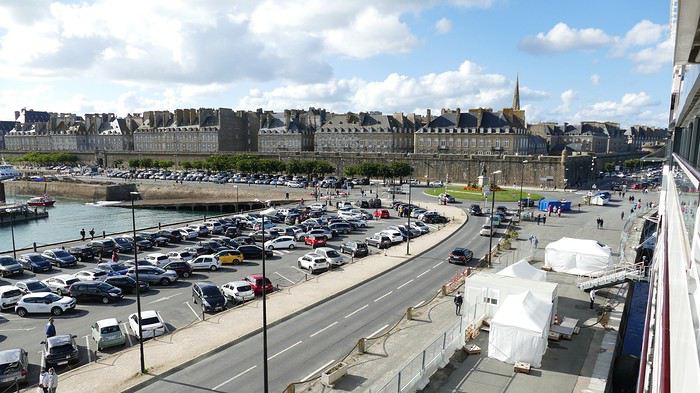 En dépit des mesures covid, nous arrivons à notre cabine en 20 minutes et nos bagages nous ont déjà précédés. Nous avons à ce moment le grand plaisir de découvrir que nous avons été surclassés au pont 4. Nous devons ce cadeau au Directeur des Départements Hôteliers de PONANT. En effet ce Monsieur était avec nous sur le LYRIAL en Corse, en télé travail 😉. Souvent mon mari a discuté avec lui et à la fin de la croisière il a dit qu’il nous réservait une surprise pour notre Croisière en Bretagne. Nous n’y pensions plus, et nous avons été contents et très touchés de cette généreuse surprise.
La différence entre les cabines du pont 3 et celles du pont 4 se porte au niveau du balcon. Au pont 3, la partie au-dessous de l’appui en bois est pleine et l’on ne voit pas la mer. Au pont 4 cette partie sous l’appui en bois est en verre et cela donne plus de lumière et une jolie vue lorsque l’on est assis.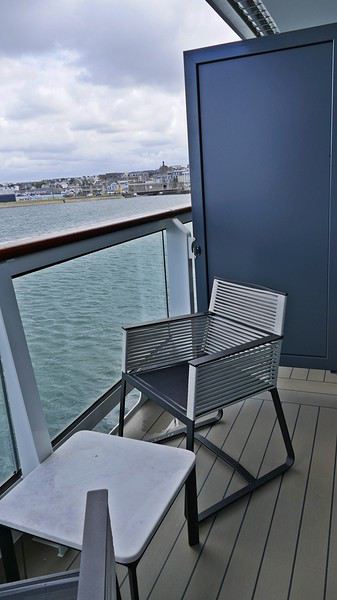 Le bateau est tout neuf, dans des tons très harmonieux, reposants, et clairs. La décoration est épurée dans des matières naturelles aux tons doux et confortables.
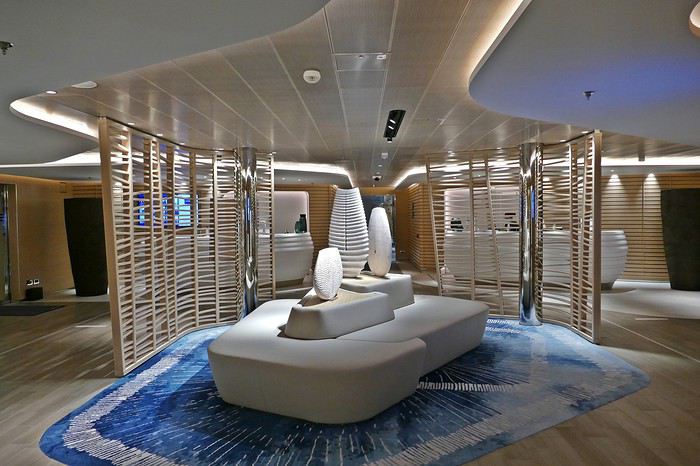 Très beau et original le plafond miroir du grand salon.
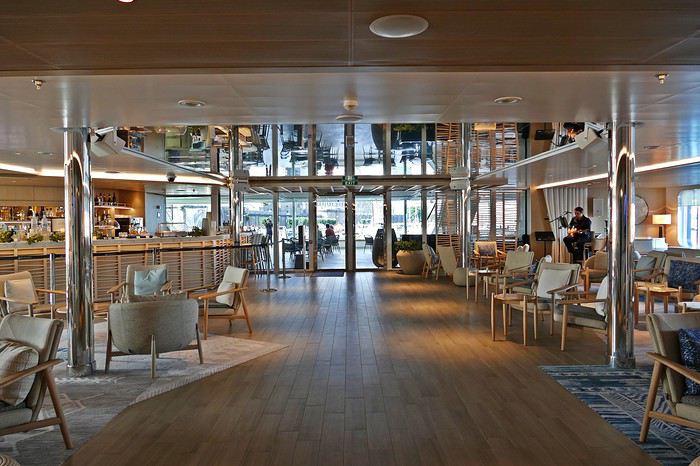 Et très lumineux le salon panoramique avec de larges baies vitrées qui permettent une vue très dégagée.
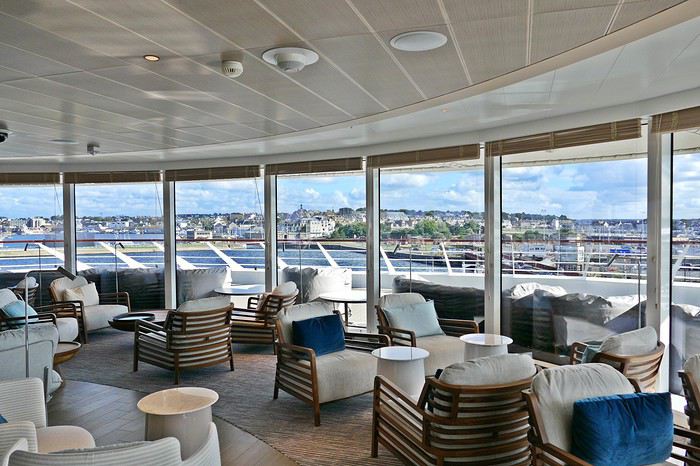 En juillet nous avions sur le LYRIAL des produits Hermès en petits flacons individuels, cette fois ce sont des produits Clarins en distributeurs, les marques françaises sont très présentes, dans tous les domaines, partout sur le bateau, y compris à table et dans la boutique.
Cette fois, nous sommes 68 passagers à embarquer sur cette croisière pour 107 membres d’équipage. Des naturalistes nous avons appris que la compagnie espérait 70 passagers par croisière pour être satisfaite de ces croisières dans les conditions hors normes et exceptionnelles de cet été 2020. Ils nous ont dit aussi que si cet objectif était atteint cette destination pourrait être reconduite l’année prochaine. Cette version est bien différente de ce que peuvent écrire certains journalistes et me semble plus cohérente. Qui a pu croire que des bateaux feraient le plein un été comme celui-ci ? Ces bateaux-là, eux, ne sont pas restés vides et à quai.
Ce programme sur les côtes françaises a été monté en trois mois, entre les contacts à prendre et les autorisations à obtenir, quand il faut deux ans habituellement pour établir un nouvel itinéraire. Ce qui est plutôt une belle prouesse.
*CR de PapiJP35
Samedi 29 août 2020, embarquement
Nous sommes depuis deux jours à Saint-Malo, et après qu’il ait plu toute la nuit, le ciel de ce matin est bas, lourd et noir. Nous nous y étions mentalement préparés. J’avais choisi cette semaine en prenant garde d’éviter celle des grandes marées (souvent propice au mauvais temps), mais la météo nous annonce tout de même une semaine catastrophique. Notre première préoccupation est d’aller vérifier que le bateau est bien arrivé. Rituel tellement plaisant, qui gonfle le cœur de joie.
Nous marchons le long du port de plaisance sous ce lourd ciel breton, et oui, le Jacques Cartier est bien amarré au pied des remparts. La balade est très plaisante, le bateau est beau et parait imposant dans ce petit port à taille humaine, la ville est belle…. Et je monte sur mon petit nuage de bonheur pour ne plus en redescendre avant une semaine.Pour la durée de la croisière Ponant nous a proposé de laisser la voiture sur un parking qui se situe à 2.7 km du port, le prix est de 3.30€ par jour et des navettes sont mises en place pour transférer les passagers jusqu’au bateau.
Nous avons cependant préféré laisser notre voiture au parking Qpark juste devant la porte d’entrée principale de la vieille ville parce que c’est un parking couvert, nous avons payé 55€ pour la semaine et nous sommes à 5 minutes à pieds du bateau (600m). Très bien, s’il ne pleut pas.
Après une très belle averse en début d’après-midi qui a vidé les rues de la ville en quelques minutes, nous embarquons à 16 h sous le soleil. Des tentes sont installées sur le port en guise de terminal de croisière, et dès notre arrivée nous sommes accueillis avec beaucoup de gentillesse et de prévenance.
En dépit des mesures covid, nous arrivons à notre cabine en 20 minutes et nos bagages nous ont déjà précédés. Nous avons à ce moment le grand plaisir de découvrir que nous avons été surclassés au pont 4. Nous devons ce cadeau au Directeur des Départements Hôteliers de PONANT. En effet ce Monsieur était avec nous sur le LYRIAL en Corse, en télé travail 😉. Souvent mon mari a discuté avec lui et à la fin de la croisière il a dit qu’il nous réservait une surprise pour notre Croisière en Bretagne. Nous n’y pensions plus, et nous avons été contents et très touchés de cette généreuse surprise.La différence entre les cabines du pont 3 et celles du pont 4 se porte au niveau du balcon. Au pont 3, la partie au-dessous de l’appui en bois est pleine et l’on ne voit pas la mer. Au pont 4 cette partie sous l’appui en bois est en verre et cela donne plus de lumière et une jolie vue lorsque l’on est assis.
Le bateau est tout neuf, dans des tons très harmonieux, reposants, et clairs. La décoration est épurée dans des matières naturelles aux tons doux et confortables.
Très beau et original le plafond miroir du grand salon.
Et très lumineux le salon panoramique avec de larges baies vitrées qui permettent une vue très dégagée.
En juillet nous avions sur le LYRIAL des produits Hermès en petits flacons individuels, cette fois ce sont des produits Clarins en distributeurs, les marques françaises sont très présentes, dans tous les domaines, partout sur le bateau, y compris à table et dans la boutique.Cette fois, nous sommes 68 passagers à embarquer sur cette croisière pour 107 membres d’équipage. Des naturalistes nous avons appris que la compagnie espérait 70 passagers par croisière pour être satisfaite de ces croisières dans les conditions hors normes et exceptionnelles de cet été 2020. Ils nous ont dit aussi que si cet objectif était atteint cette destination pourrait être reconduite l’année prochaine. Cette version est bien différente de ce que peuvent écrire certains journalistes et me semble plus cohérente. Qui a pu croire que des bateaux feraient le plein un été comme celui-ci ? Ces bateaux-là, eux, ne sont pas restés vides et à quai.
Ce programme sur les côtes françaises a été monté en trois mois, entre les contacts à prendre et les autorisations à obtenir, quand il faut deux ans habituellement pour établir un nouvel itinéraire. Ce qui est plutôt une belle prouesse.
Flânerie le long de la rivière Luangwa English translation pending
Bonjour à toutes et tous,
En avril dernier, à la suite de Régis puis de Claire, nous avions partagé sur ce forum notre pérégrination atypique au Kenya dans la réserve du Masaï-Mara. A l'issue de ce récit, nous avions imaginé repartir soit en randonnée sur les plus hautes terres d'Ethiopie (une dizaine de jours dans les montagnes du Simien lors d'un long séjour en 2009), soit de suivre le cours tranquille de la rivière Luangwa, dans sa partie sud (deux semaines à cheval sur octobre et novembre 2019). Dans le but d'animer les colonnes désertées de Voyage Forum en raison d'une sournoise pandémie, nous avons choisi l'Afrique Australe, précisant que ce texte, destiné à notre entourage ne correspond pas tout à fait à l'esprit "Carnets de Voyages" du site, vous nous en excuserez. Comme la précédente, cette escapade est l'une des rares que nous ayons réalisée avec une agence : y prendrait-on goût ou vieillirait-on ? Pour agrémenter ses longues pages d'écriture (une trentaine pour la partie South Luangwa N P et une dizaine pour la visite de Mosi-oa-Tunya et alentours), Yolande a sélectionné les photos les plus représentatives de cette vadrouille zambienne, dont cette magnifique panthère, rencontrée dès notre entrée dans le sanctuaire.
En route pour le rêve, seule frontière encore ouverte. Bien amicalement. Jety 34.
Impossible de joindre la photo (au secours !), ci-joint le message de VF (??????)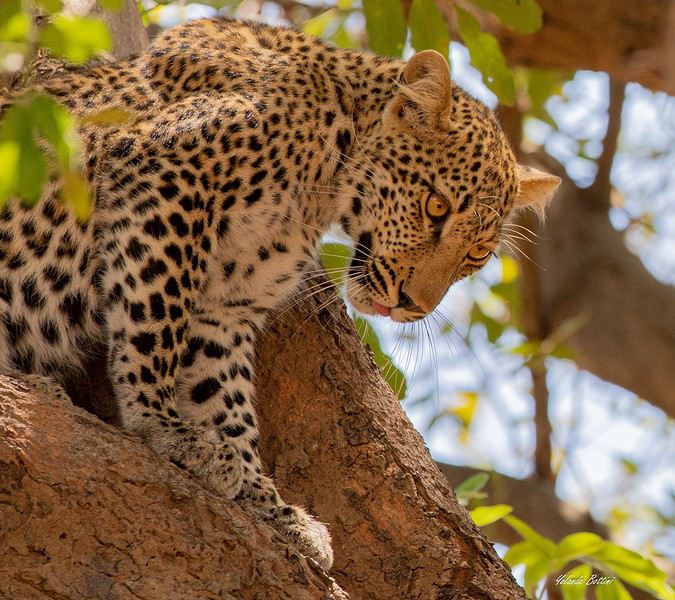
En avril dernier, à la suite de Régis puis de Claire, nous avions partagé sur ce forum notre pérégrination atypique au Kenya dans la réserve du Masaï-Mara. A l'issue de ce récit, nous avions imaginé repartir soit en randonnée sur les plus hautes terres d'Ethiopie (une dizaine de jours dans les montagnes du Simien lors d'un long séjour en 2009), soit de suivre le cours tranquille de la rivière Luangwa, dans sa partie sud (deux semaines à cheval sur octobre et novembre 2019). Dans le but d'animer les colonnes désertées de Voyage Forum en raison d'une sournoise pandémie, nous avons choisi l'Afrique Australe, précisant que ce texte, destiné à notre entourage ne correspond pas tout à fait à l'esprit "Carnets de Voyages" du site, vous nous en excuserez. Comme la précédente, cette escapade est l'une des rares que nous ayons réalisée avec une agence : y prendrait-on goût ou vieillirait-on ? Pour agrémenter ses longues pages d'écriture (une trentaine pour la partie South Luangwa N P et une dizaine pour la visite de Mosi-oa-Tunya et alentours), Yolande a sélectionné les photos les plus représentatives de cette vadrouille zambienne, dont cette magnifique panthère, rencontrée dès notre entrée dans le sanctuaire.
En route pour le rêve, seule frontière encore ouverte. Bien amicalement. Jety 34.
Impossible de joindre la photo (au secours !), ci-joint le message de VF (??????)
Petites randonnées en Corse juin 2020 English translation pending
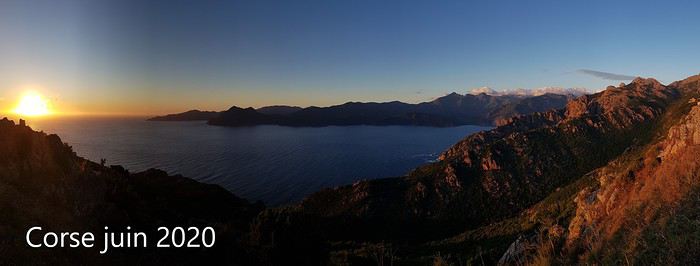 Bonjour à tous,
Encore un p'tit carnet sur la Corse, où nous sommes allés mi-juin dans des conditions qui ne se reproduiront sans doute jamais : météo parfaite et pas un chat!
Pour une fois, je ne donne pas beaucoup de détails pratiques (mais tout de même les traces wikiloc) très faciles à trouver en quelques clics.
Le but premier du voyage était d'apporter quelques affaires à notre fille Marion mais sevrés de voyages depuis l'irruption d'un certain virus nous en avons profité pour randonner un peu.
Le récit en images est là : clic!
Bonne lecture! Marie
Texte seul :
Corse Juin 2020 Petite virée en Corse, où vit désormais notre fille Marion. Voyage reporté 2 fois en raison de la Covid 19…
Finalement nous partons en fourgon car nous avons pas mal de fourbi en plus des chiens. Mi-juin, la limitation des 100 km est enfin levée et après avoir une traversée très tranquille au départ de Toulon, nous débarquons de bonne heure à Ajaccio : au programme, bricolage et randonnées !
Les chiens nous accompagnent, Corsica Ferries propose des cabines « spéciales chiens » sans moquette. Plein de chiens sur ce bateau, tous très pacifiques…Malheureusement le pont supérieur où un espace leur serait réservé est fermé. Environ 14h de voyage (en comptant les temps d’embarquement/débarquement), les vessies ont tenu le choc ! Tous les passagers sont masqués et ravis de retrouver un peu de liberté !
DI 14/06/20 Arrivée en Corse L’air est doux, le ciel est pur (gros orage et grosses inondations quelques jours avant notre arrivée), la météo s’annonce idéale pour la semaine à venir. Je craignais la chaleur en Juin, mais finalement nous n’aurons jamais plus de 24°C en bord de mer, supportable donc… Retrouvailles et bricolage, puis nous faisons une petite balade vespérale vers l’anse de Minaccia. Pas la foule pour un dimanche…
LU 15/06/20 Lac de Melo Marion et Yoan se sont libérés pour nous accompagner et leur aide sera indispensable pour pousser/hisser/tirer les chiens (30 et 40 kg) qui eurent bien du mal à franchir 2 ressauts équipés d’échelles verticales (le 1er se franchit facilement par la droite et le 2ème par la gauche, c’est plus scabreux). Tout est très vert, très fleuri, on se régale. On bulle un long moment près du lac (les chiens plus tout jeunes sont crevés tellement ils ont été crispés par ce franchissement) tandis que les jeunes grimpent plus haut dans la montagne. Nous redescendons en rive droite de la cascade (sans échelle !) Jolie balade, pour moi un peu gâchée par la peine qu’ont eue mes chiens chéris… https://fr.wikiloc.com/itineraires-randonnee/lac-de-melo-15-juin-51095645
MA 16/06/20 Bergeries des Pozzi Départ avec Marion de la station de Val D’Eze : on longe d’abord un tire-fesse (pas glop) puis la balade devient magnifique ! Quelques vaches et chevaux nous accueillent en haut de la grimpette. Vue sur le village de Bastelica et au fond sur la baie d’Ajaccio. On longe une très jolie crête et au bout de celle-ci on découvre d’un coup le vallon et ses pozzines. On adore ce type de paysage, les chiens aussi ! On passe ensuite à proximité de la bergerie avant de traverser une grande forêt de hêtres tortueux sillonnée de quelques ruisseaux : parfait pour les chiens ! On a adoré cette balade ! https://fr.wikiloc.com/itineraires-randonnee/pozzis-depuis-val-d-ese-pozzi-5002592
Marion rentre sur Ajaccio (elle travaille demain) tandis que nous allons au départ de la rando prévue demain, au-dessus de Soccia.
ME 17/06/20 Lac de Creno Nous avons dormi sur le parking (désert) en dessous du petit resto situé au départ de cette randonnée. Itoo a encore trouvé quelques forces pour jouer avec le p’tit chien du coin. Nous partons de bonne heure (fraicheur, belle lumière, personne) sur un joli sentier fleuri. C’est tellement vert qu’on se croirait en Ecosse ! Nous voici au seul lac boisé de Corse, certains pins sont énormes ! Très belle vue sur les montagnes qui cernent le lac de Melo où nous étions avant-hier. On monte ensuite vers la Chapelle San’t Eliseu dans un sous-bois profondément labouré par les sangliers (le mieux est de monter par la crête qui commence juste derrière la maison forestière, il n’y a pas vraiment de sentier…ou nous ne l’avons pas trouvé) Vue à 360° magnifiée par les nuages ! Nous descendons ensuite par une crête si joliment fleurie qu’on se croirait dans un jardin. Le sentier est assez mal tracé, il faut être attentif. https://fr.wikiloc.com/itineraires-randonnee/lac-de-creno-et-chapelle-sant-eliseu-17-juin-56206520
Déjeuner au resto du parking, quasi désert : les locaux se lamentent, nous compatissons mais jubilons intérieurement d’avoir les chemins de randonnée presque pour nous tous seuls. Autre avantage, service rapide et très aimable : nous qui n’allons que très rarement au restaurant en vacances car nous n’aimons pas attendre des plombes le bon vouloir d’un service débordé allons changer nos habitudes. Au moins pendant qq jours !
Gorges de Spelunca Nous reprenons la route vers les Gorges de Spelunca, qui m’ont un peu déçue. La route d’approche par l’est est très belle mais les gorges m’ont semblé assez banales. Nous longeons la rivière (que l’on voit finalement assez peu du fait de la végétation) en aller-retour jusqu’au vieux pont. Peu de possibilité de baignade pour les chiens… https://fr.wikiloc.com/itineraires-randonnee/gorges-de-spelunca-56206499
Fin de journée au départ de la rando du lendemain, près des calanques de Piana et du Capo Rosso.
JE 18/06/20 Capo Rosso On démarre de bonne heure car je crains la chaleur au niveau de la mer. Belle vue vers la côte et ses tours génoises. On aperçoit le parking. Plus on descend, plus il fait chaud et plus je pense à la remontée…je m’inquiète pour les chiens qui tirent déjà la langue. Arrivés à cette jolie cabane en pierre, nous abandonnons Fred qui monte en vitesse jusqu’à la tour et faisons tranquillement demi-tour : retour facile finalement. https://fr.wikiloc.com/itineraires-randonnee/capu-rossu-en-boucle-41682629
Calanches de Piana On enchaîne avec une petite balade dans les Calanches de Piana, sur le Chemin du Château Fort : la lumière est dure et blanche, il est midi… https://fr.wikiloc.com/itineraires-randonnee/piana-18-juin-56206514 Pause resto sur la plage de Busaglia, où nous sommes encore une fois les seuls clients : service attentionné, les chiens ont eu chacun une gamelle d’eau !
Vallée du Fango On décide ensuite de pousser jusqu’à la vallée du Fango, pour les rafraichir un peu. Très joli coin, qui doit être habituellement bondé à en juger par les panneaux d’interdiction de stationner et la taille des parkings : on a vu en tout 4 personnes ! Après cette baignade les chiens sont définitivement épuisés par ces quelques jours de rando ! https://fr.wikiloc.com/itineraires-randonnee/vallee-du-fango-56206546 Demain, croisière… Retour vers Porto et nuit près de la plage de Gradelle.
VE 19/06/20 Scandola Départ de Porto à 10h, le bateau de Via Mare est plein à 10%, c’est cool ! (pour nous…) J’avais d’abord contacté le Passe Partout qui nous avait gentiment conseillé de prendre un bateau plus grand pour le confort des chiens car il y a un peu de houle : sympa ! (Marion et Yoan ont fait le tour avec eux qq jours plus tard et ça leur a bien plu) Il fonce vers la réserve de Scandola, puis navigue pendant quelques dizaines de minutes en rasant les roches volcaniques : 2 nids de balbuzards ( ?) vides, très peu d’oiseaux. Mais de jolies couleurs et des commentaires intéressants. Petite pause au retour au village de Girolata (pas d’accès routier) avec une petite baignade pour les chiens -à bonne distance des vaches ! Tour sympa et reposant ! Retour sur Porto en milieu de journée puis sur Ajaccio.
SA 20/06/20 Pointe de la Parata Nous reprenons le ferry ce soir. Petite balade de l’Anse de Minaccia jusqu’à la pointe de la Parata, personne sur cette rando non plus (on est à 20 mn d’Ajaccio un samedi !) https://fr.wikiloc.com/itineraires-randonnee/la-parata-20-juin-56206489 Parking immense quasi vide. Quelques personnes tout de même près de la pointe, il faut dire que la vue sur les îles Sanguinaires est magnifique ! Bon déjeuner à la brasserie de la pointe (à nous 4 on double l’effectif des clients !) Appareillage vers 20h00, alors que le soleil descend sur l’horizon… Quel plaisir de naviguer de nuit et d’arriver frais et dispo le lendemain matin !
Une dizaine de jours dans le Gard English translation pending
Bonjour,
Breton, je vais me baser une dizaine de jours à Connaux dans le Gard à la mi septembre avec quelques amis.
Nous serons 6.
Nous sommes assez éclectiques et indépendants : 4 en voiture et 2 à moto, 4 assez agiles et 2 contemplatifs qui le sont fort peu.
Nous ne détestons pas faire des choses ensemble dans la journée, bien loin de là quand c’est possible, mais notre grand plaisir est en toutes hypothèses de partager nos soirées.
Je pense à priori que nous devrions pouvoir rayonner chaque jour dans un rayon maximum d’une centaine de km, en sachant bien sûr que l’objectif n’est pas de cumuler ces km.
Evidemment, j’ai consulté la documentation touristique accessible par internet et je dois recevoir bientôt un peu de complément par courrier : je me sens donc « armé » pour les « fondamentaux ».
Mais je suis à la recherche de projets plus originaux, plus insolites, éventuellement plus relationnels car je suis convaincu que le sel des voyages ce sont les rencontres.
Toute suggestion serait très bienvenue.
A charge de revanche… ;-)
Breton, je vais me baser une dizaine de jours à Connaux dans le Gard à la mi septembre avec quelques amis.
Nous serons 6.
Nous sommes assez éclectiques et indépendants : 4 en voiture et 2 à moto, 4 assez agiles et 2 contemplatifs qui le sont fort peu.
Nous ne détestons pas faire des choses ensemble dans la journée, bien loin de là quand c’est possible, mais notre grand plaisir est en toutes hypothèses de partager nos soirées.
Je pense à priori que nous devrions pouvoir rayonner chaque jour dans un rayon maximum d’une centaine de km, en sachant bien sûr que l’objectif n’est pas de cumuler ces km.
Evidemment, j’ai consulté la documentation touristique accessible par internet et je dois recevoir bientôt un peu de complément par courrier : je me sens donc « armé » pour les « fondamentaux ».
Mais je suis à la recherche de projets plus originaux, plus insolites, éventuellement plus relationnels car je suis convaincu que le sel des voyages ce sont les rencontres.
Toute suggestion serait très bienvenue.
A charge de revanche… ;-)
L'aéroport de Bantayan terminé d'ici la fin de l'année (Philippines) English translation pending
L'aéroport de Mactan-Cebu (MCIAA) a déclaré que la construction en cours de l'aéroport de l'île de Bantayan, devrait être achevée d'ici la fin de cette année.
A confirmer avec quelqu’un sur place.
A confirmer avec quelqu’un sur place.
Disparition de France Ô English translation pending
J'ai réalisé aujourd'hui que la chaine France O allait s'arrêter.
J'en suis extrêmement triste et en colère contre les gens qui ont pris cette décision.
C'était la seule chaîne de France Télévision que j'aimais regarder, la seule qui montrait une culture riche dans ce pays de nos jours (la musique, la littérature).
Il parait qu'on ne va rien perdre et qu'elle va enrichir les autres chaines du service public.
Je pense au contraire que ses sujets seront dilués à dose homéopatique et qu'il ne sera plus possible de s'en imprégner.
Électrifier son vélo English translation pending
Bonjour à toutes et tous .
Quelques problèmes liés à l'arthrose (a 67 ans, cela arrive ??..🙂 ), et souhaitant continuer à randonner (France uniquement), j'envisage d'électrifier mon vélo.
Aprés avoir pris quelques renseignements, je me dirigerais vers une remorque car mon vélo ainsi équipé ne pourrait plus être sur le porte vélo (grosse batterie de cadre, ou 2 batteries , une sur vélo et une en réserve dans la remorque) et j'envisage de ne garder qu'une voiture.
En bref, quels sont vos retours si vous avez fait ce choix.
Vous en remerciant, au plaisir de vous lire
JeanMarc
Qantas va proposer des "rotations touristiques au dessus de l'Antarctique" English translation pending
Bonjour
Plus de voyageurs en international alors Qantas décollera en novembre pour des rotations touristique au dessus de l’Antarctique pour 12h 13 h de vols premier prix 730 euros en éco pour un siège au dessus de l'aile 🙁 4875 euros pour les meilleures places en affaire . vol en B787 dreamliner . avis aux amateurs lol
source air journal
Mich74
Douze jours en Slovénie en famille et Venise en bonus (été 2020) English translation pending
Hello les voyageurs et voyageuses 🙂
Je me suis longtemps demandé si j'aurais la chance d'avoir matière à rédiger un carnet de voyage cette année. Finalement, les astres se seront bien alignés pour nous offrir une jolie découverte pas très loin de chez nous 😎
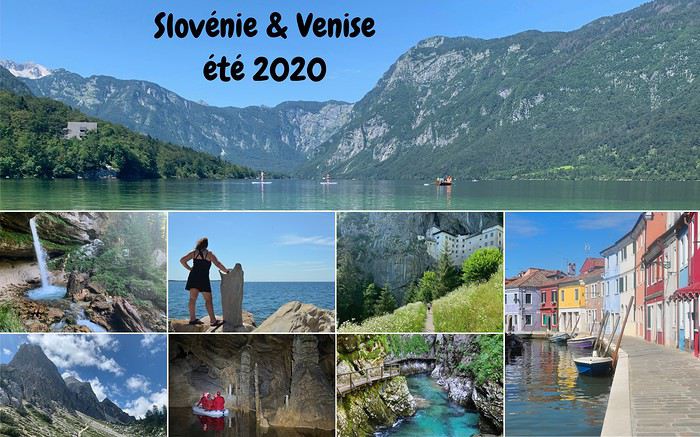
Au départ, nous devions passer 3 semaines en Géorgie, un voyage tant attendu car nous avions dû l'annuler une première fois en 2016. Mais un petit virus à couronne a décidé d'y mettre son grain de sel .... Fin mai, Georgian Airways ayant annulé nos vols et l'espoir étant mince à ce moment-là de pouvoir voyager hors zone UE, on a cherché une alternative (si possible sans prendre d'avion).
Grâce au très beau carnet de Joleeeene (je vous invite à le lire ici) et après vérification de la liste des pays qui autorisaient l'entrée des belges, on a opté pour la Slovénie. Pour organiser le séjour, vu le déai assez court, je me suis référée à l'excellent blog de Florent, un expat qui vit là-bas : https://slovenie-secrete.fr/ et au Lonely Planet qui au finla m'a très peu servi.
Le stress est resté jusque même après la dernière minute, la Slovénie ayant opté pour une liste restrictive de pays autorisés sans quarantaine (dont la Belgique ne faisait pas partie 😕) 2 jours après que nous ayons tout réservé et bien sûr payé 😎 Mais il faut parfois croire en sa bonne étoile, et le 4 juillet, 1er jour théorique de notre séjour, les autorités slovènes ajoutaient la Belgique sur leur liste de pays autorisés sans quarantaine 😇😇
Je vous emmène donc dans un pays où on peut aller crapahuter sous terre, randonner en montagne, lézarder en bord de mer, se rafraichir dans les lacs, découvrir des châteaux et de charmantes petites villes, passer sous les chutes d'eau, déambuler dans des gorges .... le tout sur une superficie plus petite que la Belgique.
Les découvertes du voyage (complètées au fur et à mesure de la rédaction)
3 - 6 juillet - un weekend sur les lacs en France avant le départ - c'est par ici 7 juillet - 1ere découverte des montagnes slovènes, le sommet du Visevnik - c'est par ici 8 juillet (partie 1) - les gorges de Pokljuka - c'est par ici 8 juillet (partie 2) - les gorges de Vintgar - c'est par ici xxx
Notre 3 TOP pour la partie Slovénie 🙂🙂
to be completed
Pascale
Je me suis longtemps demandé si j'aurais la chance d'avoir matière à rédiger un carnet de voyage cette année. Finalement, les astres se seront bien alignés pour nous offrir une jolie découverte pas très loin de chez nous 😎
Au départ, nous devions passer 3 semaines en Géorgie, un voyage tant attendu car nous avions dû l'annuler une première fois en 2016. Mais un petit virus à couronne a décidé d'y mettre son grain de sel .... Fin mai, Georgian Airways ayant annulé nos vols et l'espoir étant mince à ce moment-là de pouvoir voyager hors zone UE, on a cherché une alternative (si possible sans prendre d'avion).
Grâce au très beau carnet de Joleeeene (je vous invite à le lire ici) et après vérification de la liste des pays qui autorisaient l'entrée des belges, on a opté pour la Slovénie. Pour organiser le séjour, vu le déai assez court, je me suis référée à l'excellent blog de Florent, un expat qui vit là-bas : https://slovenie-secrete.fr/ et au Lonely Planet qui au finla m'a très peu servi.
Le stress est resté jusque même après la dernière minute, la Slovénie ayant opté pour une liste restrictive de pays autorisés sans quarantaine (dont la Belgique ne faisait pas partie 😕) 2 jours après que nous ayons tout réservé et bien sûr payé 😎 Mais il faut parfois croire en sa bonne étoile, et le 4 juillet, 1er jour théorique de notre séjour, les autorités slovènes ajoutaient la Belgique sur leur liste de pays autorisés sans quarantaine 😇😇
Je vous emmène donc dans un pays où on peut aller crapahuter sous terre, randonner en montagne, lézarder en bord de mer, se rafraichir dans les lacs, découvrir des châteaux et de charmantes petites villes, passer sous les chutes d'eau, déambuler dans des gorges .... le tout sur une superficie plus petite que la Belgique.
Les découvertes du voyage (complètées au fur et à mesure de la rédaction)
3 - 6 juillet - un weekend sur les lacs en France avant le départ - c'est par ici 7 juillet - 1ere découverte des montagnes slovènes, le sommet du Visevnik - c'est par ici 8 juillet (partie 1) - les gorges de Pokljuka - c'est par ici 8 juillet (partie 2) - les gorges de Vintgar - c'est par ici xxx
Notre 3 TOP pour la partie Slovénie 🙂🙂
to be completed
Pascale
Crossing the Alps and Mont Ventoux by Bike
Hey Cyclists! So, here we go—departure this Thursday from Giromagny (90), still in bikepacking mode, but this time with my wife’s bike lol.
12 years later, back in the Alps for a crossing all the way to Barcelonnette. From there, I’ll head toward Vaucluse and face Mont Ventoux for the first time 🚴♂️. Until then, the Alps will most likely leave their mark 😅🚵♂️🚴♂️. I’m a bit nervous about the Col de la Colombière—if all goes well, I should leave a wreath there lol! The return after Mont Ventoux should be less traumatic (or maybe not).
A few photos below.
If you’re on my route, it’d be great to chat! ;) I’m also planning to film the ride (as usual), my impressions, etc.
Good luck with your preparations to everyone working on a project, and safe travels to those already on the road! ;) Gilles
12 years later, back in the Alps for a crossing all the way to Barcelonnette. From there, I’ll head toward Vaucluse and face Mont Ventoux for the first time 🚴♂️. Until then, the Alps will most likely leave their mark 😅🚵♂️🚴♂️. I’m a bit nervous about the Col de la Colombière—if all goes well, I should leave a wreath there lol! The return after Mont Ventoux should be less traumatic (or maybe not).
A few photos below.
If you’re on my route, it’d be great to chat! ;) I’m also planning to film the ride (as usual), my impressions, etc.
Good luck with your preparations to everyone working on a project, and safe travels to those already on the road! ;) Gilles
Retour d’itinérance vélo de Tarbes à l’océan le long de l‘Adour et du Gave English translation pending
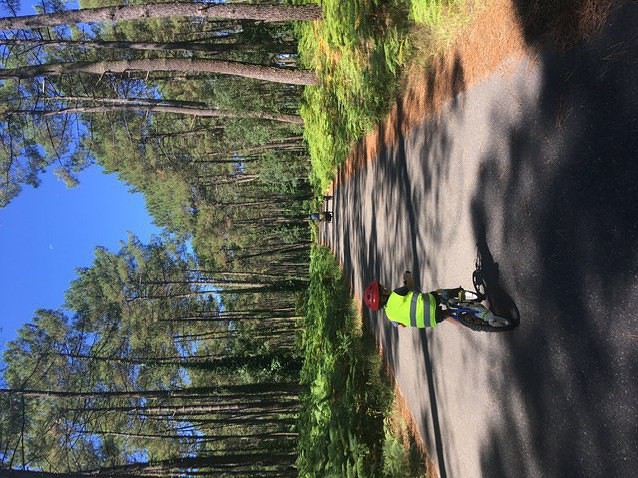
Bonjour,
Je mets ce post car je n’avais pas trouvé trop d infos sur le net sur ce circuit. Nous rentrons de 2 semaines d itinérance en vélo avec : - une première partie en famille (5&7ans) de Tarbes jusqu à seignosse: nous avons suivi à peu près les sentiers de l adour jusqu à saint sever, puis voie cyclable de la Chalosse jusqu à Dax, pour finir par couper direction Soustons puis seignosse (plage!). Nous étions en mix bivouac/camping avec carriole et follow me
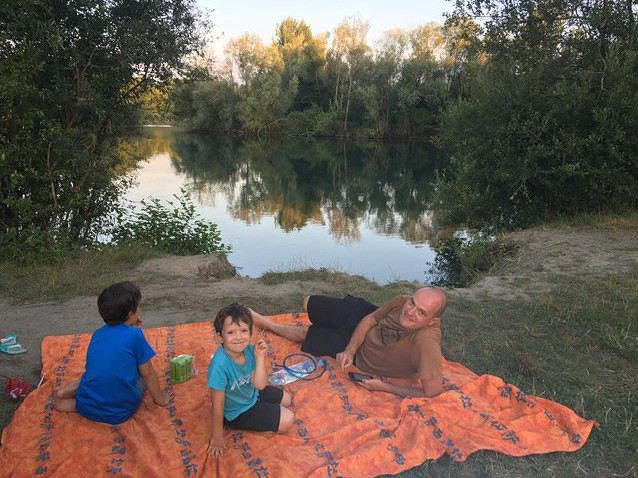
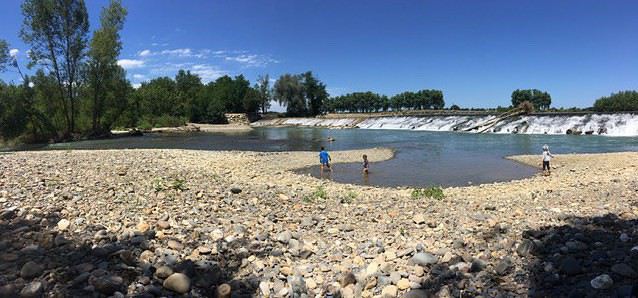
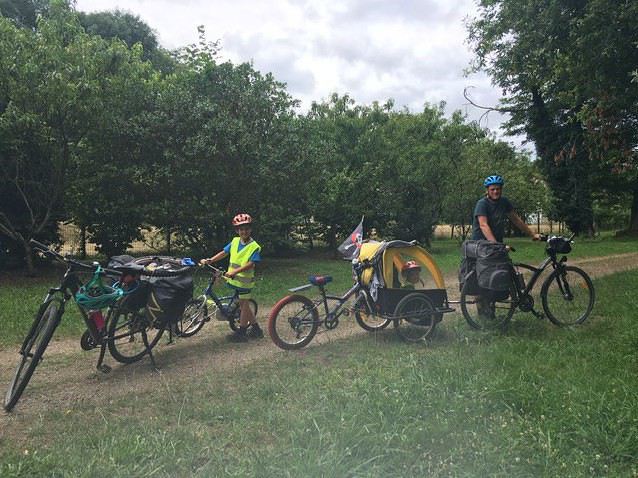
- une deuxième partie de Seignosse à Tarbes où nous avons suivi le gave cette fois-ci. Nous nous sommes délestés à Saint Vincent de Tyrosse des enfants et de beaucoup de matos pr un retour rapide à 2 (a l hôtel) par peyrehorade, Orthez, Pau, Lourdes, Tarbes. D Orthez à Lourdes, nous avons suivi la Véloroute du Piémont v81 qui est très chouette.
Ça fait une boucle d environ 400km quasi plat, ce qui est parfait pour nos gambettes ! Si vous voulez des infos, n hésitez pas à poser vos questions ou à m envoyer un mp.
Bonne balade/voyage à vous !
La meilleure façon d'marcher, c'est de mettre un pied d'vant l'autre... English translation pending
Je déteste toujours autant marcher et pourtant, je recommence.
Comme un sentiment d’urgence pour n’entendre que les battements de mon cœur si secoué de peine qu’il ne me fallait plus entendre ni compréhension, ni compassion de quiconque.
Être seule, vraiment seule.
La terre est vivante, douée de mémoire et je ne voulais que cette mémoire. Je ne voulais m’encombrer de rien.
Homme sceptique un peu goguenard : « Fais-le mais je me souviens bien de ta dernière expédition ! » C’était il y a dix ans ou plus, je ne me souviens plus. « C’est facile, y’en a eu qu’une ! » Des pieds en plomb, les mollets noués, l’estomac creux, les aisselles malodorantes, les bras griffés mais j’avais vécu l’intense sentiment d’avancer malgré toute ma paresse et mon inexpérience. « Où veux-tu aller ? » « Au Mont-Beuvray » « 50 km en voiture, 100 aller-retour, ça va je pourrais aisément te récupérer, tu prévois combien de jours ? » Il rit.
« Chais pas, 10 km par jour, pas plus, et comme j’y vais au pif, je ne saurais pas ce que j’ai parcouru, je m’arrêterai quand j’en aurais marre, je verrai bien ».
La veille du départ, Fils aîné au téléphone, moqueur : « Maman, t’es toujours aussi dingue. Tu ne marches jamais, t’as même pas de bonnes godasses, tu f’rais mieux d’aller chez xxx, là, tu te ressourcerais. Un jour, il t’arrivera des bricoles avec tes idées huluberlues.../... » « Ehh, je ne monte qu’au Mont-Beuvray, tu parles d’une expédition ! » « Ouais mais t’as vu ton âge ? » « Merci mon grand. Tu sais, il y a tellement de gens qui marchent pour de bon, des centaines de kilomètres sur toute la terre. Marcher pour le plaisir, marcher pour aller chercher de l’eau au puits, marcher en compétition, marcher pour aller à l’école, pour tous ceux là, je vais faire une balade, une promenade de santé, ça n’a rien d’une aventure ou d’un exploit, j’vais mettre un pas d’vant l’autre et recommencer, c’est tout. »
Et le 13 juin, j’ai pris le sentier forestier derrière la maison.
Le sac à dos, celui dont je me sers pour le goûter des petits, est rempli avec un kway, un morceau de bâche. J’ai coupé celle qui traînait par terre recouvrant la moto pour la protéger des chiures d’hirondelles, un pull, la gourde, un gant de toilette, un savon, ma brosse à dents, un sac de cacahuètes bien grasses et bien salées, des bananes sèches bien trop sucrées, cinq pommes et mon opinel. Il a une forme bizarre ce sac, comme un ballon accroché à mon dos. Il pèse 2,8 kg. Et dans les poches de mon pantalon en toile, à droite mes clopes et mon briquet, à gauche le-pied-de-biche-à-tiques. J’me demande à quoi il me servira si j’ai une tique dans le dos ou sur la nuque ! J’ai rajouté ma carte d’identité, 40 euros, et concession pour Homme, mon téléphone. Il veut me géolocaliser. C’est qu’il m’aime Homme, à lui tout seul un océan dans lequel je nage avec tant de bonheur. Mais là, pas de nage papillon, des pas.
Et quand le téléphone n’aura plus de batteries ? On verra bien. Je dis toujours -on verra bien - .
Dans le Morvan, les fées laissent leurs empreintes surnaturelles et comme je n’ai aucune carte, je ne sais pas les lire et n’ai pas envie d’apprendre, je vais leur faire confiance. Le soleil se lève à l’est et se couche à l’ouest, je dois aller à l’ouest, je suivrai sa course.
Et le 13 juin, j’ai serré les paupières pour repousser l’aube naissante. Je n’avais plus du tout envie de partir, plus du tout envie de marcher. Mais quand la brûlure salée a piqué derrière les paupières comme tous ces derniers jours, je n’ai pas reculé. J’ai lu un jour que les mauvais souvenirs et les chagrins ont de longues ombres et si on passe notre vie dedans on ne verrait plus jamais le soleil.
Ce 13 juin, le soleil était là alors, j’ai pris le sentier derrière la maison.
J’m’en vais vous raiconter l’ histôère
.../...
Comme un sentiment d’urgence pour n’entendre que les battements de mon cœur si secoué de peine qu’il ne me fallait plus entendre ni compréhension, ni compassion de quiconque.
Être seule, vraiment seule.
La terre est vivante, douée de mémoire et je ne voulais que cette mémoire. Je ne voulais m’encombrer de rien.
Homme sceptique un peu goguenard : « Fais-le mais je me souviens bien de ta dernière expédition ! » C’était il y a dix ans ou plus, je ne me souviens plus. « C’est facile, y’en a eu qu’une ! » Des pieds en plomb, les mollets noués, l’estomac creux, les aisselles malodorantes, les bras griffés mais j’avais vécu l’intense sentiment d’avancer malgré toute ma paresse et mon inexpérience. « Où veux-tu aller ? » « Au Mont-Beuvray » « 50 km en voiture, 100 aller-retour, ça va je pourrais aisément te récupérer, tu prévois combien de jours ? » Il rit.
« Chais pas, 10 km par jour, pas plus, et comme j’y vais au pif, je ne saurais pas ce que j’ai parcouru, je m’arrêterai quand j’en aurais marre, je verrai bien ».
La veille du départ, Fils aîné au téléphone, moqueur : « Maman, t’es toujours aussi dingue. Tu ne marches jamais, t’as même pas de bonnes godasses, tu f’rais mieux d’aller chez xxx, là, tu te ressourcerais. Un jour, il t’arrivera des bricoles avec tes idées huluberlues.../... » « Ehh, je ne monte qu’au Mont-Beuvray, tu parles d’une expédition ! » « Ouais mais t’as vu ton âge ? » « Merci mon grand. Tu sais, il y a tellement de gens qui marchent pour de bon, des centaines de kilomètres sur toute la terre. Marcher pour le plaisir, marcher pour aller chercher de l’eau au puits, marcher en compétition, marcher pour aller à l’école, pour tous ceux là, je vais faire une balade, une promenade de santé, ça n’a rien d’une aventure ou d’un exploit, j’vais mettre un pas d’vant l’autre et recommencer, c’est tout. »
Et le 13 juin, j’ai pris le sentier forestier derrière la maison.
Le sac à dos, celui dont je me sers pour le goûter des petits, est rempli avec un kway, un morceau de bâche. J’ai coupé celle qui traînait par terre recouvrant la moto pour la protéger des chiures d’hirondelles, un pull, la gourde, un gant de toilette, un savon, ma brosse à dents, un sac de cacahuètes bien grasses et bien salées, des bananes sèches bien trop sucrées, cinq pommes et mon opinel. Il a une forme bizarre ce sac, comme un ballon accroché à mon dos. Il pèse 2,8 kg. Et dans les poches de mon pantalon en toile, à droite mes clopes et mon briquet, à gauche le-pied-de-biche-à-tiques. J’me demande à quoi il me servira si j’ai une tique dans le dos ou sur la nuque ! J’ai rajouté ma carte d’identité, 40 euros, et concession pour Homme, mon téléphone. Il veut me géolocaliser. C’est qu’il m’aime Homme, à lui tout seul un océan dans lequel je nage avec tant de bonheur. Mais là, pas de nage papillon, des pas.
Et quand le téléphone n’aura plus de batteries ? On verra bien. Je dis toujours -on verra bien - .
Dans le Morvan, les fées laissent leurs empreintes surnaturelles et comme je n’ai aucune carte, je ne sais pas les lire et n’ai pas envie d’apprendre, je vais leur faire confiance. Le soleil se lève à l’est et se couche à l’ouest, je dois aller à l’ouest, je suivrai sa course.
Et le 13 juin, j’ai serré les paupières pour repousser l’aube naissante. Je n’avais plus du tout envie de partir, plus du tout envie de marcher. Mais quand la brûlure salée a piqué derrière les paupières comme tous ces derniers jours, je n’ai pas reculé. J’ai lu un jour que les mauvais souvenirs et les chagrins ont de longues ombres et si on passe notre vie dedans on ne verrait plus jamais le soleil.
Ce 13 juin, le soleil était là alors, j’ai pris le sentier derrière la maison.
J’m’en vais vous raiconter l’ histôère
.../...
Avis sur rando itinérante dans les Hautes-Pyrénées English translation pending
bonsoir
je prévois une randonnée itinérante dans les Hautes Pyrénées pendant 2 semaines fin juillet début août, avec mes jeunes garçons. Le Massif de Néouvielle et de Gavarnie semblent s'imposer à moi pour l'instant, mais je redoute la forte affluence. Nous allons bivouaquer, alors autant en profiter et trouver des coins tranquilles. (Si je plante la tente sur une autoroute de randonneurs, le dépaysement ne sera pas vraiment assuré !)
Est-ce possible en cette saison, ou illusoire, dans ces deux zones ? ou bien faut-il se rendre dans d'autres zones des Pyrénées moins fréquentées ? Pour faire plaisir à mes enfants, mon cahier des charges est le suivant : voir des glaciers (!), des marmottes, des ours (bon là, faut pas exagérer !), si possible des Isards, des sommets pointus (!), aller en Espagne, voir des lacs et des cascades. Et pas trop de monde, vous l'aurez compris.
auriez-vous des avis ? (je prévois environ 8 kms par jour)
merci !
Le GR34 pour une randonnée de 7 jours English translation pending
Nous avons l'intention (mon mari et moi) de faire bientôt une randonnée de 7 jours sur le GR 34. Nous sommes à la recherche de quelques conseils pour choisir les étapes les plus agréables entre Mont-Saint Michel et Saint-Nazaire. Aucun problème pour alterner voiture et randonnée.
Avez- vous des indications et des suggestions?
Merci d'ores et déjà!
La SNCF aime-t-elle le vélo? English translation pending
Bonjour à tous
Cyclo de fraîche date, j'ai pour ambition d'amener mon vélo de Paris à Nice fin août et de démarrer mon voyage là-bas. Je pensais qu'il serait assez simple de trouver une place dans un train (quitte à payer un supplément). Comme j'étais naïf !! Je découvre qu'il n'y a absolument rien. L'alternative serait de démonter mon vélo et de le mettre dans une housse, sauf que la SNCF ne prête pas de housse. Or, sachant que je repartirai de Nice à vélo, je n'ai aucune intention de me trimballer une housse.
Bref, quelle solution voyez-vous ? Enchaîner les TER et mettre 2 jours pour aller de Paris à Nice ? Prendre l'avion, et tant pis pour la planète ?
Je suis à l'écoute de vos idées, mais vraiment je tombe de haut.
Merci !
Cyclo de fraîche date, j'ai pour ambition d'amener mon vélo de Paris à Nice fin août et de démarrer mon voyage là-bas. Je pensais qu'il serait assez simple de trouver une place dans un train (quitte à payer un supplément). Comme j'étais naïf !! Je découvre qu'il n'y a absolument rien. L'alternative serait de démonter mon vélo et de le mettre dans une housse, sauf que la SNCF ne prête pas de housse. Or, sachant que je repartirai de Nice à vélo, je n'ai aucune intention de me trimballer une housse.
Bref, quelle solution voyez-vous ? Enchaîner les TER et mettre 2 jours pour aller de Paris à Nice ? Prendre l'avion, et tant pis pour la planète ?
Je suis à l'écoute de vos idées, mais vraiment je tombe de haut.
Merci !
Deux semaines en famille en Gaspésie cet été English translation pending
Bonjour !
Nous sommes en train de remplacer notre été sur la cote d'azur + crête :-( par deux semaines en Gaspésie :-)
Nous sommes une famille avec deux filles de 5 et 7 ans.
Nous aimons le plein air et la nature essentiellement.
Nous pensions aller camper une semaine au parc Forillon et une autre semaine a Cime aventure.
C'est notre première fois en Gaspésie.
Est-ce que notre séjour divisé entre ces deux parcs est une bonne idée ?
Nous conseillez vous d'autres campings/parcs nationaux plutôt ?
Que nous conseillez vous de visiter en route (depuis Montréal) et une fois sur place, dans notre 2 semaines svp ?
Merci d'avance !!
Merci d'avance !!
Concours photo de juin 2020: "Multicolore" English translation pending
Bonjour,
J'ai le privilège d'organiser le concours photos du moi de juin 2010. J'ai longuement hésité, beaucoup de sujets ont été déjà proposés et faire preuve d’originalité devient de plus en plus compliqué. Il fallait choisir, j'ai choisi : « Multicolore » : « Qui présente des couleurs variées » d 'après la définition. Je n'impose pas le nombre minimum de couleurs présentes, sachant que des photos avec seulement 2 couleurs pourront faire partie du thème, à partir du moment où elles sont en harmonie et que ça « éclate ». En effet, je voudrais que quand on ouvrira une photo, il y ait l'effet : « WHOUAAAAA, les couleurs... « Il faudra malgré tout garder à l'idée la notion de voyage.
Je pense que le thème laisse une grande ouverture.
On pourra présenter une multitude de sujets :
Pourquoi pas des animaux multicolores ?
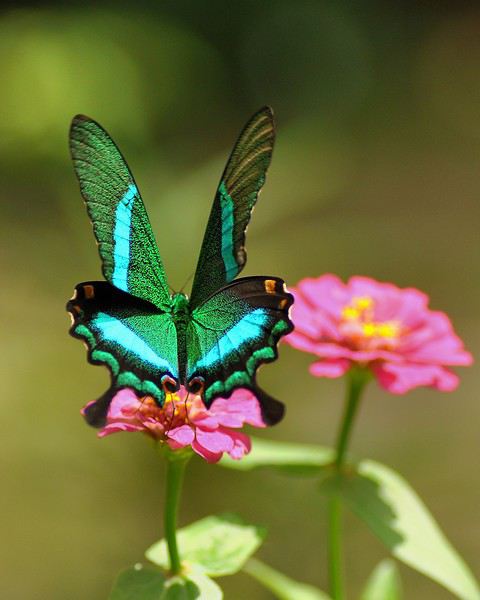
Des bâtiments multicolores ?
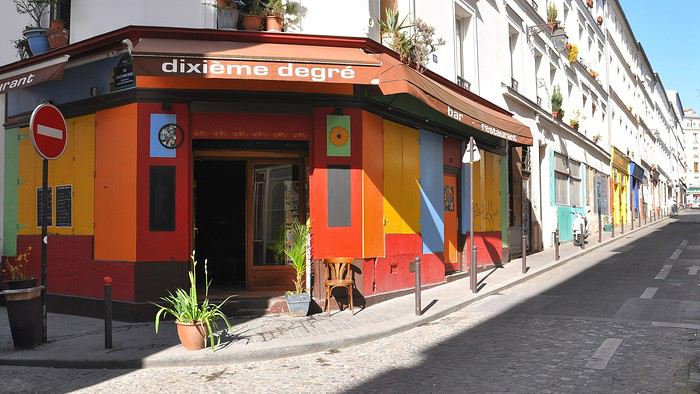
Des personnages ?
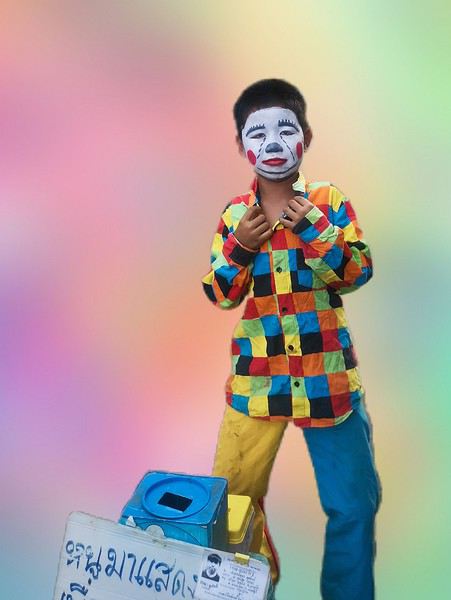
Des objets ?
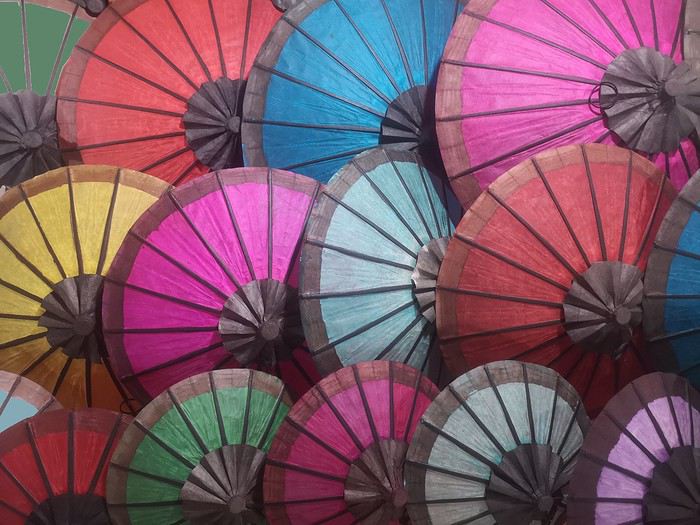
Des scènes de vie ?
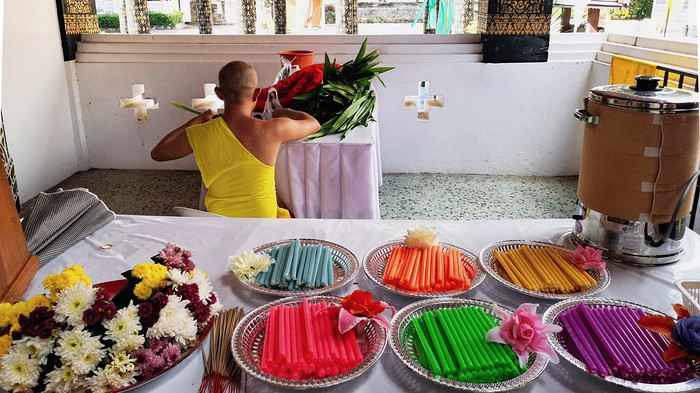
Et bien d'autres...
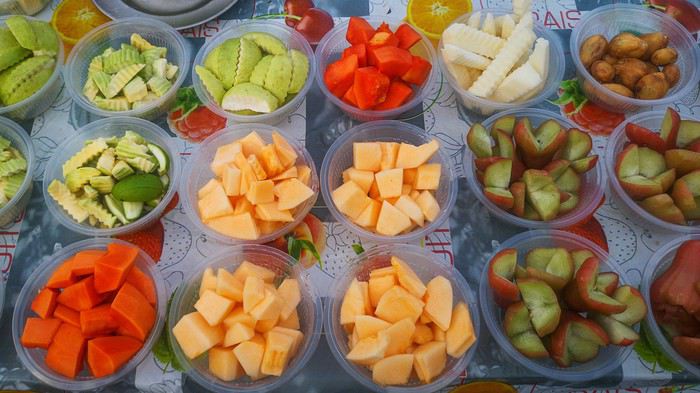
Participation : Chaque participant(e) peut proposer jusqu'à 3 photos, et ce jusqu'au mardi 23/06 à 24h00, heure de Paris. Chaque photo sera présentée dans un seul message, en indiquant son numéro (1, 2 ou 3). Pensez à ajouter une petite explication, commentaire, localisation, date de prise de vue.
Vote : Chaque membre VF peut voter pour les 3 photos qu'il ou elle juge les meilleures selon ses propres critères et en tenant compte du thème.
Les votes se feront du mercredi 24/06 au dimanche 28/06 à 24h00, heure de Paris. Les photos choisies seront citées dans l'ordre de préférence : - la 1re photo : 3 points - la 2e : 2 points - la 3e : 1 point
Un seul et unique vote pour 3 photos est accepté par membre.
Conclusion : Le vainqueur est l'auteur de la photo ayant reçu le plus de points. Les résultats seront publiés le 29/06. En cas d'égalité, le nombre de premières places prévaudra. Le vainqueur aura l'honneur d'organiser le concours du mois de juillet.
La discussion est ici : https://voyageforum.com/discussion/discussions-sujet-concours-photo-juin-2020-multicolore-d10297778/
Philippe
J'ai le privilège d'organiser le concours photos du moi de juin 2010. J'ai longuement hésité, beaucoup de sujets ont été déjà proposés et faire preuve d’originalité devient de plus en plus compliqué. Il fallait choisir, j'ai choisi : « Multicolore » : « Qui présente des couleurs variées » d 'après la définition. Je n'impose pas le nombre minimum de couleurs présentes, sachant que des photos avec seulement 2 couleurs pourront faire partie du thème, à partir du moment où elles sont en harmonie et que ça « éclate ». En effet, je voudrais que quand on ouvrira une photo, il y ait l'effet : « WHOUAAAAA, les couleurs... « Il faudra malgré tout garder à l'idée la notion de voyage.
Je pense que le thème laisse une grande ouverture.
On pourra présenter une multitude de sujets :
Pourquoi pas des animaux multicolores ?
Des bâtiments multicolores ?
Des personnages ?
Des objets ?
Des scènes de vie ?
Et bien d'autres...
Participation : Chaque participant(e) peut proposer jusqu'à 3 photos, et ce jusqu'au mardi 23/06 à 24h00, heure de Paris. Chaque photo sera présentée dans un seul message, en indiquant son numéro (1, 2 ou 3). Pensez à ajouter une petite explication, commentaire, localisation, date de prise de vue.
Vote : Chaque membre VF peut voter pour les 3 photos qu'il ou elle juge les meilleures selon ses propres critères et en tenant compte du thème.
Les votes se feront du mercredi 24/06 au dimanche 28/06 à 24h00, heure de Paris. Les photos choisies seront citées dans l'ordre de préférence : - la 1re photo : 3 points - la 2e : 2 points - la 3e : 1 point
Un seul et unique vote pour 3 photos est accepté par membre.
Conclusion : Le vainqueur est l'auteur de la photo ayant reçu le plus de points. Les résultats seront publiés le 29/06. En cas d'égalité, le nombre de premières places prévaudra. Le vainqueur aura l'honneur d'organiser le concours du mois de juillet.
La discussion est ici : https://voyageforum.com/discussion/discussions-sujet-concours-photo-juin-2020-multicolore-d10297778/
Philippe
La prière dans le monde! English translation pending
La nuit tombe d’un coup et je suis sans cesse étonnée de passer ainsi du clair au noir.
Après cette journée fatigante, je rentre à la maison et jette mes sandales dans un coin.
Dans son petit bassin de bronze, la fleur de lotus est déjà refermée.
Tout est silencieux mais j’entends le léger murmure incantatoire de Tiago.
Il prie.
Assis devant son petit autel, les volutes odorantes des bâtonnets d’encens s’enroulent autour de ses cheveux noirs. Son dos dur et sombre luit et la lueur de la flamme dans la coupelle de ghee danse sur ses épaules.
La grande image de Shiva fixée au mur se décolle dans un angle, pliant les pointes du trident.
Le dieu garde ses yeux mi-clos sur la création du monde et les cycles de l’univers.
Dans sa longue chevelure, au sommet de sa tête s’enroule un serpent.
Un dieu coloré bienveillant dans cette représentation, l’une de ses quatre mains ouverte sur le genou.
Tiago a posé son offrande, une noix de coco est une guirlande de fleurs jaune dont je ne retiens jamais le nom.
Immobile.
Il prie.
__
J’ai vu des gens agenouillés, des gens couchés face contre terre, assis en tailleur, assis mains jointes. J’ai vu des gens danser, j’ai vu des processions colorées, j’ai entendu des mélopées hypnotiques, j’ai écouté des cymbales, des trompettes, de grandes orgues, des chants liturgiques, des psaumes, le fanbai, des chants grégoriens et des gospels, des chants diphoniques qui remuent le ventre.
J’ai vu des flèches perçant les nuages, des coupoles dorées, des dômes de pierre, des cathédrales, des temples, des autels flamboyant de dorures, des allées de chevaux de pierre, des temples de feu et des chapelles de pierre blotties sous les ombrages, de bois ensevelies sous la neige, des cryptes froides et silencieuses, des maisons d’adoration sans effigie, des monastères accrochés à la montagne , des cloîtres dans la ville.
j’ai vu des costumes de cérémonies multicolores, des tenues de fourrure, des saris de fêtes soyeux, des chapeaux rouge étranges, des plumets et des têtes rasées. J’ai vu des hommes tirer des chars la peau du dos distendue par des crochets, j’ai été subjuguée par des mandala de sable, tout est éphémère.
Partout où mes pas ont foulé d’autres terres, j’ai vu des croyants réunis, rassemblés, unis, bruyants, silencieux, exaltés, recueillis.
J’ai touché des chapelets de buis, d’ivoire, en corail, en noyaux, les perles égrenant le nom divin, les mantras, les prières, tenu des croix de roseaux, de feuilles de maïs, porté des couronnes de fleurs, tenu des moulins de prière. J’ai regardé des dieux vêtus d’oripeaux décolorés, vêtus d’habits précieux, nus ceints d’un pagne, l’arbre à souhaits aux rubans multicolores agités par les tourbillons de neige.
J’ai respiré l’odeur de l’encens, j’ai respiré l’odeur de la cire fondue, j’ai respiré le parfum des fleurs fraîches et l’odeur surette des offrandes pourrissantes.
J’ai fermé les yeux, souvent, pour mieux entendre, pour mieux comprendre.
Et je sais, qu’aujourd’hui, je ne sais rien de cette ferveur puissante qui soulève et porte et emporte les peuples du monde. Je sais aussi que le tremblement de mes jambes et les yeux qui picotent devant la ferveur de Tiago, ce soir là, il y a des lustres, huit peut-être, c’est tellement loin, fut ce qui s’approchait le plus d’une prière. Ou, peut-être étais-je secrètement amoureuse...
Ainsi, je crois que beaucoup ont vécu ces instants étranges de communion, d’observation respectueuse, que beaucoup connaissent les rites et rituels, les byzantins, coptes, maronites, et tant d’autres, des rites de passage et des rites d’intercessions appelant la pluie, la fécondité . Ces rites qui rythment la vie dans tous ces pays que je n’aurais plus le temps de connaître.
Comment se vit la prière en Afrique, chez les aborigènes d’Australie, à Madagascar, à Cuba, en Chine, au Japon, en Indonésie ou ailleurs ?. Comment se vit-elle, la prière, aujourd’hui où partout des moments religieux forts s’annoncent ? Monothéiste, animiste, shintoïsme, bouddhisme, syncrétisme religieux, l’aspect religieux est toujours présents dans mes voyages, l’est-il pour vous aussi ?
Z’avez lu jusqu’au bout ? Bravo, vous avez gagné une image pieuse ou non. Pour ce faire, aller dans la rubrique -jeux voyages – sur le fil -défilés et processions -, il y en a des magnifiques.
J’ai vu des gens agenouillés, des gens couchés face contre terre, assis en tailleur, assis mains jointes. J’ai vu des gens danser, j’ai vu des processions colorées, j’ai entendu des mélopées hypnotiques, j’ai écouté des cymbales, des trompettes, de grandes orgues, des chants liturgiques, des psaumes, le fanbai, des chants grégoriens et des gospels, des chants diphoniques qui remuent le ventre.
J’ai vu des flèches perçant les nuages, des coupoles dorées, des dômes de pierre, des cathédrales, des temples, des autels flamboyant de dorures, des allées de chevaux de pierre, des temples de feu et des chapelles de pierre blotties sous les ombrages, de bois ensevelies sous la neige, des cryptes froides et silencieuses, des maisons d’adoration sans effigie, des monastères accrochés à la montagne , des cloîtres dans la ville.
j’ai vu des costumes de cérémonies multicolores, des tenues de fourrure, des saris de fêtes soyeux, des chapeaux rouge étranges, des plumets et des têtes rasées. J’ai vu des hommes tirer des chars la peau du dos distendue par des crochets, j’ai été subjuguée par des mandala de sable, tout est éphémère.
Partout où mes pas ont foulé d’autres terres, j’ai vu des croyants réunis, rassemblés, unis, bruyants, silencieux, exaltés, recueillis.
J’ai touché des chapelets de buis, d’ivoire, en corail, en noyaux, les perles égrenant le nom divin, les mantras, les prières, tenu des croix de roseaux, de feuilles de maïs, porté des couronnes de fleurs, tenu des moulins de prière. J’ai regardé des dieux vêtus d’oripeaux décolorés, vêtus d’habits précieux, nus ceints d’un pagne, l’arbre à souhaits aux rubans multicolores agités par les tourbillons de neige.
J’ai respiré l’odeur de l’encens, j’ai respiré l’odeur de la cire fondue, j’ai respiré le parfum des fleurs fraîches et l’odeur surette des offrandes pourrissantes.
J’ai fermé les yeux, souvent, pour mieux entendre, pour mieux comprendre.
Et je sais, qu’aujourd’hui, je ne sais rien de cette ferveur puissante qui soulève et porte et emporte les peuples du monde. Je sais aussi que le tremblement de mes jambes et les yeux qui picotent devant la ferveur de Tiago, ce soir là, il y a des lustres, huit peut-être, c’est tellement loin, fut ce qui s’approchait le plus d’une prière. Ou, peut-être étais-je secrètement amoureuse...
Ainsi, je crois que beaucoup ont vécu ces instants étranges de communion, d’observation respectueuse, que beaucoup connaissent les rites et rituels, les byzantins, coptes, maronites, et tant d’autres, des rites de passage et des rites d’intercessions appelant la pluie, la fécondité . Ces rites qui rythment la vie dans tous ces pays que je n’aurais plus le temps de connaître.
Comment se vit la prière en Afrique, chez les aborigènes d’Australie, à Madagascar, à Cuba, en Chine, au Japon, en Indonésie ou ailleurs ?. Comment se vit-elle, la prière, aujourd’hui où partout des moments religieux forts s’annoncent ? Monothéiste, animiste, shintoïsme, bouddhisme, syncrétisme religieux, l’aspect religieux est toujours présents dans mes voyages, l’est-il pour vous aussi ?
Z’avez lu jusqu’au bout ? Bravo, vous avez gagné une image pieuse ou non. Pour ce faire, aller dans la rubrique -jeux voyages – sur le fil -défilés et processions -, il y en a des magnifiques.
La Zambie en été, parcours et distances English translation pending
Bonjour,
dans mon cerveau, l'Afrique Australe me relance (j'espère que ce n'est pas grave !) et du coup je me dis que la Zambie pourrait être une destination à connaitre au vu des quelques carnets parcourus.
J'en suis aux balbutiements. et donc je voudrais voir d'abord dans les grandes lignes si le parcours est jouable dans mon timing, car j'ai lu que les distances sont importantes en Zambie et je ne voudrais pas construire un trip trop chronophage en km par rapport au temps passé dans les parcs.
Bien entendu c'est en 4*4 avec tentes que je veux faire ce parcours. J'ai visité la Namibie (3 semaines) de cette façon en étant le chauffeur. Je n'ai pas une très grande expérience de 4*4 (l'autre fois c'était à Oman, deux semaines), mais je ne pense pas non plus être un lapin de 3 semaines. Au Botswana, j'avais un chauffeur, donc ça compte pas, même si j'ai bien observé sa façon de faire.
A mon avis l'arrivée à Lusaka semble un bon compromis (je suis allé à Victoria Falls côté Zimbawe, donc cela me permet de ne pas caler forcément Livingstone).
Les parcs que j'ai envie de voir sont Kafue, North Luangwa, South Luangwa et Lower Zambezi. Sur le dernier c'est qu'il me semble être sur la route entre Lusaka et South Luangwa, mais ce n'est pas celui qui est prioritaire. Il y a peut être d'autres lieux à conseiller ...
A la louche j'ai compté 3 jours par parc (c'est une moyenne car peut êrte certains méritent plus et d'autres moins), ce qui fait 12 jours en parc et comme je veux partir 3 semaines cela reste 9 jours pour caler les vols Europe/Afrique et les trajets entre parcs.
D'où la première question : C'est jouable ?
Deuxième question : Le loueur de voiture.
J'ai vu Hemingway basé sur Livingstone. J'imagine qu'ils acheminent des véhicules sur Lusaka
J'ai lu aussi que Bushlore pouvait d'AFS faire un transfert jusqu'en Zambie dans des prix corrects.
Y-a-t-il d'autres possibilités ?
Troisième question: Quand commencer le gros du boulot (réservations) ?
Merci à tous a+
Merci à tous a+