Results for "Bagan+|+55+>+185"
4483 results found.
Trip to Thailand and Laos
Hello! 🙂
January 2026 Here we go again for new adventures and the pleasure of sharing them with you here! First of all, I’d like to thank everyone who helped me with the preparations, even with some last-minute improvisations just days before departure. Thanks to Montagnard74, Jojoone1, Songsam, Attila, Dennis2, NadegerFERM, and the authors whose travel journals about Laos inspired me (Montagnard74, Muriel18, Mavietongs...).
In this story, written by Richard and illustrated by me, we’ll tell you about the journey of four friends: Catherine, Richard, Nathalie, and Bruno. A reinvented but overall successful trip, filled with discoveries and surprises, the scents of spices and frangipani flowers, (too) spicy food, sunsets, and... one big mess.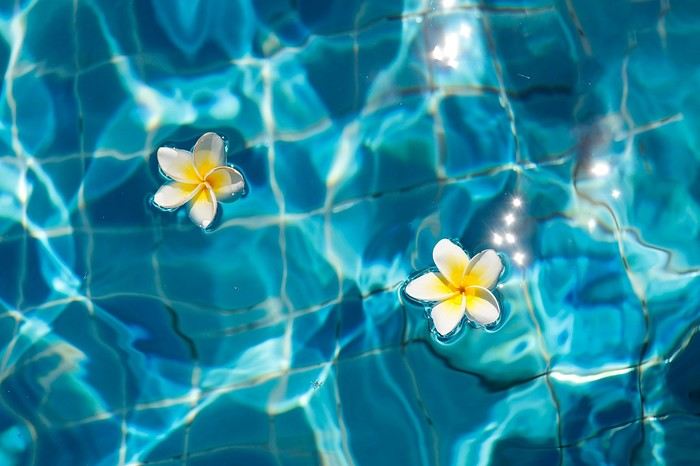
January 2026 Here we go again for new adventures and the pleasure of sharing them with you here! First of all, I’d like to thank everyone who helped me with the preparations, even with some last-minute improvisations just days before departure. Thanks to Montagnard74, Jojoone1, Songsam, Attila, Dennis2, NadegerFERM, and the authors whose travel journals about Laos inspired me (Montagnard74, Muriel18, Mavietongs...).
In this story, written by Richard and illustrated by me, we’ll tell you about the journey of four friends: Catherine, Richard, Nathalie, and Bruno. A reinvented but overall successful trip, filled with discoveries and surprises, the scents of spices and frangipani flowers, (too) spicy food, sunsets, and... one big mess.
Which neighborhood to choose for staying in Bangkok?
Hi,
I’m heading to Thailand for the first time in early 2026 and I’m really struggling to pick a neighborhood to stay in Bangkok. Apart from being close to public transport (metro, skytrain, BRT), I’m torn between several areas. I don’t mind using public transport or walking long distances, but if every trip takes 45 minutes or an hour, it’ll quickly become a hassle given our relatively short time there.
We’ll be in Bangkok twice during our trip: first for a “short” 2-night stopover (arriving from France in the mid-afternoon, then leaving the day after next for southern Thailand by plane), and then again for 3 nights before flying back to France (arriving at the airport in the late afternoon, 3 nights there, then departing for France in the late morning).
I’ve seen so many different recommendations that I’m having a hard time deciding. I’ve read that staying near the river is great for sightseeing, and that taking the boat to get around is really pleasant. But I’m worried about being a bit isolated for evening outings (eating at a cheap little restaurant, having a drink—nothing too wild!).
Chinatown is tempting for the food—it looks amazing—and it doesn’t seem too far from the main sights with public transport. But I’ve read that it’s very noisy because it’s super touristy and there’s constant truck traffic. My friend isn’t thrilled about it, especially since another neighborhood interests her because she has a great discount at a hotel near Victory Monument/Phaya Thai (the Pullman hotel). Even though it’s close to public transport, I’ve seen that it’s mostly a shopping district? And even with transport, isn’t it a long trip to visit places like the Grand Palace?
We also had a plan to stay at an ibis near BTS Nana station in the Sukhumvit area, but again, I get the feeling it’s mostly a shopping district?
Anyway, I’d love to hear your thoughts because I’m really torn!
It’s also true that I haven’t really planned our Bangkok stays yet. I’d like to do the “classic” tourist sights like the Grand Palace and eat really well! Someone told me that the big shopping malls also have amazing food 🙂
Thanks for your input!
We’ll be in Bangkok twice during our trip: first for a “short” 2-night stopover (arriving from France in the mid-afternoon, then leaving the day after next for southern Thailand by plane), and then again for 3 nights before flying back to France (arriving at the airport in the late afternoon, 3 nights there, then departing for France in the late morning).
I’ve seen so many different recommendations that I’m having a hard time deciding. I’ve read that staying near the river is great for sightseeing, and that taking the boat to get around is really pleasant. But I’m worried about being a bit isolated for evening outings (eating at a cheap little restaurant, having a drink—nothing too wild!).
Chinatown is tempting for the food—it looks amazing—and it doesn’t seem too far from the main sights with public transport. But I’ve read that it’s very noisy because it’s super touristy and there’s constant truck traffic. My friend isn’t thrilled about it, especially since another neighborhood interests her because she has a great discount at a hotel near Victory Monument/Phaya Thai (the Pullman hotel). Even though it’s close to public transport, I’ve seen that it’s mostly a shopping district? And even with transport, isn’t it a long trip to visit places like the Grand Palace?
We also had a plan to stay at an ibis near BTS Nana station in the Sukhumvit area, but again, I get the feeling it’s mostly a shopping district?
Anyway, I’d love to hear your thoughts because I’m really torn!
It’s also true that I haven’t really planned our Bangkok stays yet. I’d like to do the “classic” tourist sights like the Grand Palace and eat really well! Someone told me that the big shopping malls also have amazing food 🙂
Thanks for your input!
30 days, 3 provinces in this China that fascinates me...
We’ve just returned from a 30-day trip to China, 20 years after our last visit to this vast country.
What a transformation! So many new highways, high-speed trains, clean public restrooms, very comfortable and affordable hotels, and queues before boarding public transport… Has China really changed this much?
Language Technology has helped overcome—on a very small scale, of course—the language barrier thanks to translation apps on our phones. Unfortunately, very few Chinese people speak English, even in international hotels, which we find baffling, even frustrating, but that’s just how it is, and it’s up to us to adapt. It’s a shame, too, because no one makes an effort to communicate any other way than through their phone, which wasn’t the case when we were there 20 years ago. In restaurants, hotels, and some shops, they’ll show you a voice translation—usually in English—on a phone, and all you have to do is respond.
Payments We never withdrew cash in China. It’s possible to do so, but we never looked for an ATM. On the other hand, we tried to exchange 100 € as soon as we arrived in Xi’an, and it was a real ordeal. We had to do it at a specific bank, The Bank of China, and the administrative process took… an hour! So, no cash. Like everyone else, we used Alipay, one of the most popular online payment systems, and it’s super easy to use. WeChat also works well but is a bit more complicated to set up. It’s so convenient and used absolutely everywhere, even for purchases of 5 yuan, which is roughly the equivalent of about 55 euro cents. 10 yuan equals 1.22 €.
Phone As for the internet, I had installed a VPN before leaving—Let’s VPN—but it was completely useless since we had subscribed to an international plan with our carrier before the trip, which gave us 35 GB of data. No need to ask hotels for Wi-Fi; we only used roaming. It worked perfectly, no matter where we were. So, no VPN or SIM card for us.
TWO ESSENTIAL TOOLS FOR TRAVELING: your passport and your phone Traveling to China is much simpler than you might think. And let’s add that the Chinese, despite the language barrier, are very open and always ready to help.
The itinerary After carefully planning our route and considering the length of our stay (I had initially thought about applying for a visa longer than 30 days to stay for 6 weeks in China), we decided to take advantage of the recent option to stay for 30 days. Of course, we had to make some choices. I booked a one-way ticket from Paris to Xi’an and a return from Kunming to Paris once the itinerary was set: 9 days in northern Gansu 4 days in Hunan, specifically the well-known Zhangjiajie 15 days in Yunnan
Organization, transport, hotels This wasn’t a "backpacker" trip, as the hotels we booked were generally comfortable. I had arranged a car with a driver for the Yunnan portion through the Ciel Yunnan agency. Excellent choice—it allowed us to optimize our route. For the Gansu and Hunan portions, after much deliberation, we decided against hiring a driver. All our travel was by train and taxi. Taxis are available near train stations, airports, and some hotels in big cities. We also used "Didi," the Chinese equivalent of Uber. The app is available through Alipay. Getting around China by train is extremely easy. You just need to book your tickets on a travel site. I used trip.com and travelchina. Since we weren’t traveling during peak season, it was easy to get the tickets we wanted. You can buy train tickets up to 15 days before departure. You can book earlier, but there’s no guarantee you’ll get the time you want, especially during tourist seasons (usually the first week of October or May). Once at the station, you only need to show your passport, and you’ll need it again when leaving the station. Taxis are easy to find and not expensive. For day trips, we usually went through the hotel. Like everyone else, I had checked the prices of online tour agencies beforehand, and they were all overpriced. It’s better to wait until the last minute or, if possible, contact the hotel and ask them. I did this twice. We took domestic flights three times: Xi’an to Dunhuang Lanzhou to Changsha Changsha to Lijiang It’s best to buy flights shortly before departure, as prices are quite low then. There’s no point in booking months in advance. Often, flights only appear 2 months before departure. All hotel reservations were made on trip.com, except for three booked on Booking. Almost all exceeded our expectations in terms of comfort. Rooms were usually spacious, and new technology even makes its way into the rooms with "smart" toilets and automatic curtains… All for a very reasonable price.
The "attractions" That’s the term used on travel sites like trip.com for visits and activities, and it fits perfectly! Don’t expect to move freely around a natural tourist site. Cars aren’t allowed. The process is more or less the same everywhere: you arrive at the visitor center, pay the entrance fee, then, with your ticket or passport (always keep them on you!), you board a bus that takes you to the various viewpoints. The duration of the "tour" is usually indicated. It might seem confusing or even unnatural, but no one can avoid it unless you go to very remote, non-touristy places. Generally, the further west you go, the less this type of visit exists. The upside is that these places are better preserved since access is only by electric shuttle. On the downside, you sometimes have to deal with noisy tourist groups, their guides’ loudspeakers, and their non-stop chatter. But if you move a little further away, you’ll often find yourself alone.
Highlights of this trip:🙂 A 2-day escape to the Badan Jaran Desert—absolutely stunning. The colorful mountains near Zhangye. The Buddhist caves in Gansu. The breathtaking Hani and Yi rice terraces in Yuanyang. The architecture of the old towns, even if they sometimes feel a bit overdone. The warm welcome from the locals.
A little disappointed by: Zhangjiajie, despite its beauty. It was way too crowded, even though we were there in the off-season. And that’s nothing compared to the Stone Forest near Kunming… I also struggled with the food after a while. 😕
A few photos to come…
Language Technology has helped overcome—on a very small scale, of course—the language barrier thanks to translation apps on our phones. Unfortunately, very few Chinese people speak English, even in international hotels, which we find baffling, even frustrating, but that’s just how it is, and it’s up to us to adapt. It’s a shame, too, because no one makes an effort to communicate any other way than through their phone, which wasn’t the case when we were there 20 years ago. In restaurants, hotels, and some shops, they’ll show you a voice translation—usually in English—on a phone, and all you have to do is respond.
Payments We never withdrew cash in China. It’s possible to do so, but we never looked for an ATM. On the other hand, we tried to exchange 100 € as soon as we arrived in Xi’an, and it was a real ordeal. We had to do it at a specific bank, The Bank of China, and the administrative process took… an hour! So, no cash. Like everyone else, we used Alipay, one of the most popular online payment systems, and it’s super easy to use. WeChat also works well but is a bit more complicated to set up. It’s so convenient and used absolutely everywhere, even for purchases of 5 yuan, which is roughly the equivalent of about 55 euro cents. 10 yuan equals 1.22 €.
Phone As for the internet, I had installed a VPN before leaving—Let’s VPN—but it was completely useless since we had subscribed to an international plan with our carrier before the trip, which gave us 35 GB of data. No need to ask hotels for Wi-Fi; we only used roaming. It worked perfectly, no matter where we were. So, no VPN or SIM card for us.
TWO ESSENTIAL TOOLS FOR TRAVELING: your passport and your phone Traveling to China is much simpler than you might think. And let’s add that the Chinese, despite the language barrier, are very open and always ready to help.
The itinerary After carefully planning our route and considering the length of our stay (I had initially thought about applying for a visa longer than 30 days to stay for 6 weeks in China), we decided to take advantage of the recent option to stay for 30 days. Of course, we had to make some choices. I booked a one-way ticket from Paris to Xi’an and a return from Kunming to Paris once the itinerary was set: 9 days in northern Gansu 4 days in Hunan, specifically the well-known Zhangjiajie 15 days in Yunnan
Organization, transport, hotels This wasn’t a "backpacker" trip, as the hotels we booked were generally comfortable. I had arranged a car with a driver for the Yunnan portion through the Ciel Yunnan agency. Excellent choice—it allowed us to optimize our route. For the Gansu and Hunan portions, after much deliberation, we decided against hiring a driver. All our travel was by train and taxi. Taxis are available near train stations, airports, and some hotels in big cities. We also used "Didi," the Chinese equivalent of Uber. The app is available through Alipay. Getting around China by train is extremely easy. You just need to book your tickets on a travel site. I used trip.com and travelchina. Since we weren’t traveling during peak season, it was easy to get the tickets we wanted. You can buy train tickets up to 15 days before departure. You can book earlier, but there’s no guarantee you’ll get the time you want, especially during tourist seasons (usually the first week of October or May). Once at the station, you only need to show your passport, and you’ll need it again when leaving the station. Taxis are easy to find and not expensive. For day trips, we usually went through the hotel. Like everyone else, I had checked the prices of online tour agencies beforehand, and they were all overpriced. It’s better to wait until the last minute or, if possible, contact the hotel and ask them. I did this twice. We took domestic flights three times: Xi’an to Dunhuang Lanzhou to Changsha Changsha to Lijiang It’s best to buy flights shortly before departure, as prices are quite low then. There’s no point in booking months in advance. Often, flights only appear 2 months before departure. All hotel reservations were made on trip.com, except for three booked on Booking. Almost all exceeded our expectations in terms of comfort. Rooms were usually spacious, and new technology even makes its way into the rooms with "smart" toilets and automatic curtains… All for a very reasonable price.
The "attractions" That’s the term used on travel sites like trip.com for visits and activities, and it fits perfectly! Don’t expect to move freely around a natural tourist site. Cars aren’t allowed. The process is more or less the same everywhere: you arrive at the visitor center, pay the entrance fee, then, with your ticket or passport (always keep them on you!), you board a bus that takes you to the various viewpoints. The duration of the "tour" is usually indicated. It might seem confusing or even unnatural, but no one can avoid it unless you go to very remote, non-touristy places. Generally, the further west you go, the less this type of visit exists. The upside is that these places are better preserved since access is only by electric shuttle. On the downside, you sometimes have to deal with noisy tourist groups, their guides’ loudspeakers, and their non-stop chatter. But if you move a little further away, you’ll often find yourself alone.
Highlights of this trip:🙂 A 2-day escape to the Badan Jaran Desert—absolutely stunning. The colorful mountains near Zhangye. The Buddhist caves in Gansu. The breathtaking Hani and Yi rice terraces in Yuanyang. The architecture of the old towns, even if they sometimes feel a bit overdone. The warm welcome from the locals.
A little disappointed by: Zhangjiajie, despite its beauty. It was way too crowded, even though we were there in the off-season. And that’s nothing compared to the Stone Forest near Kunming… I also struggled with the food after a while. 😕
A few photos to come…
Trip Report: Silk Road Journey in China
Hi everyone,
This trip report covers a journey along the Silk Road in China (see detailed description below) undertaken in October 2025. The goal isn’t to recount the trip but to provide information that might help those who want to take a similar journey. Much of the information is valid for any trip to China.
Who we are: a retired couple, aged 63 and 65 (age gives discounts on entry to various sites and museums in China, which is why I won’t list prices here—I don’t know them, but you can easily find them online). We’re used to traveling independently. We speak English, which is the only foreign language spoken in China, though by very few people. I speak and read a little Chinese, which helped, but you can easily get by without it (without any English at all, I think it would be more difficult).
Period: We arrived just after "Golden Week," when all of China is on vacation, and after the summer, when schools are out, so we encountered very few tourists (99.99% of whom were Chinese). Our experience with booking visits in advance (which we didn’t need to do) isn’t representative for those who want to travel in the summer! The October-November period was perfect for our trip—it wasn’t too hot or too cold (one day of snow on the Tibetan Plateau), though it was only a few degrees on the Tibetan part, with altitudes between 2,000 and 3,000 meters. The trees were beautifully colored.
General remarks: Everyone we dealt with was very kind and perfectly honest. If you order a meal without really understanding what to do and the person modifies your order, trust them—the result is what you need. If a taxi driver signals that they’ll wait for you to finish your visit and pick you up afterward, trust them. It means there aren’t many taxis where you are, and it’ll be more convenient. For prices at street vendors, we always found the right ballpark, and sometimes they even added a little extra to please us. A taxi driver treated us to lunch, and an employee drove us back to the hotel after a visit because there were no taxis. If you struggle to buy a ticket online because there’s no counter, someone will come to help. People even spontaneously ask if everything’s okay and if you need anything.
Everywhere we went was very clean, including restrooms (trains, stations, hotels, museums, tourist sites) and streets. The old stereotypes about this no longer apply.
The trip can be challenging for those who have difficulty walking. The distances to cover on foot in stations, to access sites, and within the sites themselves can sometimes be really long.
We used the Lonely Planet guide in English (published at the end of August 2025) a little for preparation, but mostly relied on the internet.
Before leaving: No visa is needed for French citizens for stays under 30 days. You get a stamp on your passport upon arrival and departure, and the formalities themselves are very quick in both directions (excluding any potential queues). Just a photo and fingerprints upon arrival, and welcome to China’s facial recognition system.
Money: All your payments (see below) will go through your Visa card—there will be hundreds, including many payments of 20 cents to a few euros. So, you need an international option that allows unlimited card transactions. Since cash is rarely needed, the allowed number of ATM withdrawals can be low. We made 3 withdrawals totaling 800 € for a month and could have managed with just 2. The exchange rate charged on our Visa card was 12 € for 100 RMB (yuan).
Install the following apps on your smartphone before leaving (otherwise, you’ll only have access to the Chinese versions, if available): - Alipay, which is used to pay everywhere in China (details below). You need to link it to your credit card, then provide proof of identity by uploading a passport photo and completing a facial recognition session. Alipay gives access to Didi (China’s Uber), public transport (metro/bus), and can also translate phrases. - WeChat (Weixin in Chinese, pronounced *weishin*), which is also used for payments but also replaces WhatsApp. Unfortunately, to activate your account, you need someone who already has WeChat to sponsor you (preferably a Chinese person). We asked someone at our first accommodations to do this—no problem. By sharing your WeChat number with accommodations, they can send you messages that are automatically translated, and you can communicate with people thanks to the translation (translation to French is very poor; it’s much better in English, but unfortunately, WeChat detects your phone’s language). Alipay and WeChat are accepted almost everywhere, but some places only accept WeChat. - Amap, the international version of Baidu Maps, which replaces Google Maps (not at all up-to-date in China). The English names of hotels often have little to do with the Chinese names except for a phonetic resemblance. To find them on Amap, it’s best to copy the Chinese name found on your Trip reservation under "show address in Chinese." - A VPN. We had CyberGhost, which didn’t work, but according to other travelers, NordVPN and Windscribe do. Without a VPN, you can’t access Google services, on WhatsApp you can send and receive text but not photos, and you can’t send or receive emails on Gmail addresses. We managed without a VPN by using Firefox as a browser and Bing as a search engine. - Trip, for booking trains and accommodations, and buying some tickets. It’s the equivalent of Booking for accommodations, but Booking has very few listings in China, while Trip has hundreds in every city. Most hotels and trains are exchangeable and refundable until the day before, with no or minimal fees.
You don’t need contactless (NFC) payment on your phone. Either you scan a barcode and enter the amount to pay, or you display a barcode, and they scan it with a scanner, and the amount is deducted directly.
Upon arrival: - Buy a Chinese SIM card: 100 RMB for 300 GB of data and several hours of talk time (we didn’t use it). Set the Chinese number as a reference on Alipay, WeChat, and Amap. - Find someone to sponsor you on WeChat.
Transportation: - **Plane**: China Eastern, Paris-Canton then Canton-Urumqi on the way out, and Xian-Canton then Canton-Paris on the way back. International flights were smooth, but the schedules for the two domestic flights were changed. It was fine on the way out because we had some leeway, but on the way back, we were notified the morning of that our flight was canceled and replaced with one that didn’t allow for the connection. We called and changed to an earlier flight (I think we were lucky to find available seats). - **Train**: Most long distances were covered by high-speed trains (called D or G in China) at 240 or 300 km/h. Second class is perfect—just as comfortable and clean as our TGVs. The only advantage of first class is the wider seats for larger people, but the downside is that seats are often booked in advance and thus less available. You can book trains long in advance on Trip, but they only go on sale in China 15 days before departure, so that’s when you’ll know if you have a ticket. Initially, we booked first class, but there were no seats available on the day, so we ended up booking everything in second class, which was perfect. There’s no paper ticket—if you’ve bought one, you go to the station, show your passport, and enter. You do the same to access the platform 15 minutes before the train, and that’s it. Our train was canceled twice, but no problem—we went to the ticket counter, got a refund, and were offered a replacement. It didn’t delay us by more than an hour (maybe it would be harder in peak season). For prices, check Trip.com, but it’s significantly cheaper than in France. - **Bus**: We took the bus between Xining and Tongren, Tongren to Xiahe, and Hezuo to Lanzhou—about 3 hours each time for 200 km, 6 € per person, and departures were right on time. - **Taxi**: For trips between the station and hotel, or hotel and visits. If you take a Didi via the Alipay app, you activate your location, enter your destination, and it offers several taxis. You accept, and you get the car’s license plate and its real-time position on the map. When you get in, the driver often asks for the last four digits of your phone number to confirm. Otherwise, you go to the taxi stand outside the station. The price per kilometer is around 20 cents, so for a 30 km trip from the station to the hotel, you’ll pay about 6 €. We never tried to save more by taking local buses, but since the metro in Xian costs 25 cents per trip, it’s probably in the same ballpark. Amap provides public transport routes like Google Maps. - **Driver**: We hired a taxi/driver for the day several times for sightseeing. Prices ranged from 350 to 1,000 RMB (the most expensive was arranged through the Sofitel Xining concierge) for trips ranging from a few hours to a full day, sometimes covering over 300 km (see the detailed trip description).
Accommodations: All booked in advance on Trip, but several were changed during the trip. Off-season, there were no issues. We mostly stayed in upscale places, but in China, that means 50 to 60 € per night in the most central or convenient neighborhood. Note: Almost all hotels have a 5/5 rating on Trip, but it seems the Chinese avoid giving lower ratings to be polite. So, you have to read the comments to realize that in France, we might have given a 2 or 3!
Food: At the table, you’re served hot water or a hot infusion, presumably made with purified water. We never got sick from drinking it, but don’t drink tap water. Purified or mineral water is easy to find.
In restaurants, you can manage by pointing to the dish you want from another diner, on the wall where there are photos, or on the menu with pictures. The food in the region isn’t often spicy, and people usually ask or signal before adding the red spicy sauce, so you should be able to handle it if you don’t like chili at all.
The "fake old quarters" in several cities are great places to find all kinds of restaurants (see detailed trip below).
Like Google Maps, Amap can show you nearby restaurants.
Shopping: For dried fruits, buy them in Turfan—you won’t find the same variety and quality even in Xian. Generally, if you like something, buy it. If you wait, you might not find it outside the region where you are.
In Xian, there’s a "Tea City" where you can find all kinds of tea (from cheap to very expensive).
The trip in more detail: I won’t dwell on the beauty or interest of the sites here since that’s a matter of personal taste. However, I will do so for lesser-known places to give an idea to those who might be interested.
For many sites, there are shuttles (sometimes not included in the ticket price but costing around 1 €) that take you to the interesting spots. We always took them—it saves you from walking past countless shops or along uninteresting paths.
- **Urumqi**: We spent only one night there, arriving in the middle of the afternoon and leaving the next morning. We stayed at the Dana Hotel in the bazaar. Given the size of the city, it’s a good option because I don’t think there are many other interesting places. The bazaar is brand new and not at all "typical" (Turfan’s bazaar is infinitely more interesting), but the dining area is very nice.
- **Turfan**: Stayed at the New Dap Hostel, which was great. The neighborhood is nice, not far from the city, and easy to find food. The museum is closed until 2026 (Amap provides museum hours and closures). We took a day trip (for the two of us) with a driver to the Bezeklik Caves, Flaming Mountains, the abandoned city of Gaochang, the Tuyuk Village Museum, and the Emin Minaret for 500 RMB from 9 AM to 8 PM (arranged by the hostel). The landscape during the excursion was quite fabulous. We also visited the Karez Museum and the abandoned city of Jiaohe on our own the next day. At this time of year, the sun sets around 6 PM, and there’s often haze after 5 PM, so for Jiaohe, for example, which takes about 3 hours to visit, it’s best to be there by 1 or 2 PM at the latest.
The Dahua Market area is perfect for dried fruits (including the famous grapes), and you can eat there among locals in their traditional costumes. Next to it, there are buildings full of shops selling made-in-China items—it kept us busy for a good half-day, if not more.
- **Dunhuang**: Stayed in a guesthouse near the dunes—the city center isn’t far but seems quite artificial. Visited the dunes, with a ticket valid for 3 days. Lots of Chinese tourists—very typical and interesting from an ethnological perspective 😊. We got up early one morning to climb the highest dune, just beyond the one everyone goes to. It’s a bit long and tiring, but the view is worth it. Visited the Mogao Caves, buying the ticket on-site (no chance in season without booking in advance). We met two other French people and got a French-speaking guide (by pretending not to understand English). It was really worth it—a group of 4 instead of 20, and they took their time (2 hours) for the visit. We took a day trip to the Yulin Caves (2.5 hours by road and 160 km one way) with a driver for 350 RMB. We liked it a lot, but if the Mogao Caves are enough for you, it’s not very different.
- **Jiayuguan**: Stayed in a city-center hotel. Visited the Wei and Jin tombs (actually just one)—that’s where we were told the taxi should wait to take us back to the city. We went down into a crypt with lots of decorated bricks from the 3rd century. We really liked it, but it’s not as spectacular as the fort if you’re not a fan. Visited the Jiayuguan Fort and, with the same ticket, climbed a small section of the Great Wall 10 km away. Plan at least 3 good hours for all this—there’s plenty to see.
- **Zhangye**: Stayed at The Silk Road Travelers Hostel, rustic but very nice and organizes excursions. Visited the Danxia (colored mountains)—just as spectacular as the photos. You can easily spend 3 hours there, so plan to finish before sunset to avoid the haze (you can always stay longer for the sunset if the weather’s nice). The next day, visited the Mati Si Temple in the cliff. The 10,000 Buddha Caves are under renovation, but the setting and the main temple are well worth the visit (the paths through the cliff tunnels must be hellish in peak season). You can probably organize these two excursions yourself by asking any taxi driver. Also visited the Giant Buddha Temple in the city center—really worth it.
- **Xining**: Stayed in a city-center hotel. Visited the Tibetan Medicine Museum to see the world’s largest thangka (1 km long), made over 40 years by renowned artists. It’s absolutely magnificent, on par with the virtuosity (but over 1 km) of the thangkas painted by famous artists in Xiahe (see below). Hired a female taxi driver for the day to visit Kumbum Monastery (Ta’er Si in Chinese) and the Danxia area in Guide, 50 km beyond the monastery. It’s less spectacular than Zhangye’s Danxia, but we really liked it (including the journey’s landscape). The next day, visited the old Ming-era Qutan Monastery—no visitors, with beautiful murals (half under renovation). Accessible by train to Haidong or Ledu, then a taxi. Xining’s mosque is of no interest, but there’s a pedestrian street with food stalls nearby that’s very nice.
- **Tongren**: Stayed near the main monastery. Visited Longwu Monastery (several hours), with lots of nice shops along the street leading to it. Then visited Wutun Monastery, which is less lively but beautiful and close to thangka workshops. You can go in and watch the painters at work. For a thangka made by a renowned artist, count about a year of work for 1 m² and around 10,000 €.
- **Xiahe**: Stayed in a city-center hotel. Visited Labrang Monastery—very nice but not as much as Tongren’s because many halls were closed. I think it’s better to go in season and take an English-guided tour (but it’s still worth the trip, even off-season).
- **Langmusi**: Took a taxi, but you can also take a bus (though very early in the morning and longer). Particularly beautiful for us because we woke up to bright sunshine and 5 cm of snow everywhere. Visited the two temples (really nice) and did the classic hike in the gorges starting at the Fairy Cave. For those interested, we continued along the canyon path, and after the meadow where marmots are clearly visible in summer, we climbed toward a pass on the left at 3,800 meters. The view of Langmusi and, above all, the vast grasslands and distant mountains was fabulous (3 hours round trip from the temple). You could probably reach the 4,000-meter summit by continuing up the valley instead of turning left, but according to guides, it’s better to count 7 hours round trip (no technical difficulty). You can leave Langmusi by bus, but off-season, you first have to take a taxi to a stop outside the city and wait for the bus. We didn’t try and took a taxi to Hezuo instead.
Note on this region: A high-speed train is under construction from Xining to Langmusi and beyond (never seen such an impressive construction site!). When it’s operational (in one or two years, I think), access to the area will be revolutionized, and perhaps some of the charm will be lost.
- **Hezuo**: Stopped on the way from Langmusi to Lanzhou. Visited the Milarepa Pagoda, entirely destroyed during the Cultural Revolution and since rebuilt. We liked it since we were passing through, but it doesn’t necessarily justify a long detour.
- **Lanzhou**: Reached by one of the many buses from Hezuo. Stayed in the "fake old quarter," which is extremely pleasant, especially in the evening with restaurants, groups of Chinese women dancing to loud music, etc. Visited Bingling Si with a driver, 120 km away—the landscape and site are absolutely magnificent, with no one around at our time of year. Visited the Gansu Museum (where the famous Flying Horse is, but it’s a replica). We bought the ticket on entry, but in season, you probably need to book in advance.
- **Yinchuan**: Stayed in the city center. A city we discovered by chance in the Lonely Planet—worth it if you have time. On the way, we stopped for a few hours in Zhongwei, where there’s an incredible Taoist temple (I’ll let you be surprised). Visited the Western Xia tombs—we took the short option, which visits Tomb 3. We think the others are similar but less impressive. The surrounding landscape and site are quite spectacular. Visited the film sets (really fun if you like Chinese movies), the short but interesting Ningxia Museum, and finally the modern art museum. The architecture is avant-garde, and there are some beautiful works (we like it, but it’s far from the center—hire a driver who waits, or you might have to wait for an employee to offer a ride back).
- **Tianshui**: Stayed in the suburbs, but you should find a hotel near the "fake old quarter" between the Fu Xi Temples and the Taoist temple—it’s a very nice area, and the two temples (especially the Taoist one) are within walking distance. Visited the Maijishan Caves—the ticket includes the shuttle to get there. Took a taxi from Lanzhou for about 10 € in 45 minutes. We found these caves fabulous.
- **Xi’an**: Stayed 500 meters from the Bell Tower at Hantang Inn—very convenient. We’d been before, so we didn’t revisit the Terracotta Army. The calligraphy district is worth it, as is the Muslim Quarter, though it’s very touristy. The area indicated on the Lonely Planet’s walking tour near the old fruit and vegetable market isn’t very interesting. To buy tea, you can go to the Northwest International Tea City, with dozens of shops. We chose one at random, tasted, and bought various teas. There’s everything from cheap to extremely expensive, but you can find reasonable prices even in seemingly luxurious shops. Along the street north of this area, there are large stores with tons of Chinese goods selling dishes, wedding items, etc. We spent hours there. In the city center, there are only malls with more or less international brands.
- **Longmen Grottoes**: Visited as a round trip by high-speed train from Xian—1 hour 15 minutes to Longmen’s high-speed train station, and the site entrance is 15 minutes by taxi.
We didn’t go to Mount Hua Shan, but there’s a high-speed train station nearby, and there were people on the train who were clearly going there. So, you can probably do this excursion in a day from Xian as well.
Conclusion: We hope this report makes you want to go or helps you if you’re already planning to. If you have questions that you can’t find the answer to by searching properly online and we can answer, don’t hesitate.
This trip report covers a journey along the Silk Road in China (see detailed description below) undertaken in October 2025. The goal isn’t to recount the trip but to provide information that might help those who want to take a similar journey. Much of the information is valid for any trip to China.
Who we are: a retired couple, aged 63 and 65 (age gives discounts on entry to various sites and museums in China, which is why I won’t list prices here—I don’t know them, but you can easily find them online). We’re used to traveling independently. We speak English, which is the only foreign language spoken in China, though by very few people. I speak and read a little Chinese, which helped, but you can easily get by without it (without any English at all, I think it would be more difficult).
Period: We arrived just after "Golden Week," when all of China is on vacation, and after the summer, when schools are out, so we encountered very few tourists (99.99% of whom were Chinese). Our experience with booking visits in advance (which we didn’t need to do) isn’t representative for those who want to travel in the summer! The October-November period was perfect for our trip—it wasn’t too hot or too cold (one day of snow on the Tibetan Plateau), though it was only a few degrees on the Tibetan part, with altitudes between 2,000 and 3,000 meters. The trees were beautifully colored.
General remarks: Everyone we dealt with was very kind and perfectly honest. If you order a meal without really understanding what to do and the person modifies your order, trust them—the result is what you need. If a taxi driver signals that they’ll wait for you to finish your visit and pick you up afterward, trust them. It means there aren’t many taxis where you are, and it’ll be more convenient. For prices at street vendors, we always found the right ballpark, and sometimes they even added a little extra to please us. A taxi driver treated us to lunch, and an employee drove us back to the hotel after a visit because there were no taxis. If you struggle to buy a ticket online because there’s no counter, someone will come to help. People even spontaneously ask if everything’s okay and if you need anything.
Everywhere we went was very clean, including restrooms (trains, stations, hotels, museums, tourist sites) and streets. The old stereotypes about this no longer apply.
The trip can be challenging for those who have difficulty walking. The distances to cover on foot in stations, to access sites, and within the sites themselves can sometimes be really long.
We used the Lonely Planet guide in English (published at the end of August 2025) a little for preparation, but mostly relied on the internet.
Before leaving: No visa is needed for French citizens for stays under 30 days. You get a stamp on your passport upon arrival and departure, and the formalities themselves are very quick in both directions (excluding any potential queues). Just a photo and fingerprints upon arrival, and welcome to China’s facial recognition system.
Money: All your payments (see below) will go through your Visa card—there will be hundreds, including many payments of 20 cents to a few euros. So, you need an international option that allows unlimited card transactions. Since cash is rarely needed, the allowed number of ATM withdrawals can be low. We made 3 withdrawals totaling 800 € for a month and could have managed with just 2. The exchange rate charged on our Visa card was 12 € for 100 RMB (yuan).
Install the following apps on your smartphone before leaving (otherwise, you’ll only have access to the Chinese versions, if available): - Alipay, which is used to pay everywhere in China (details below). You need to link it to your credit card, then provide proof of identity by uploading a passport photo and completing a facial recognition session. Alipay gives access to Didi (China’s Uber), public transport (metro/bus), and can also translate phrases. - WeChat (Weixin in Chinese, pronounced *weishin*), which is also used for payments but also replaces WhatsApp. Unfortunately, to activate your account, you need someone who already has WeChat to sponsor you (preferably a Chinese person). We asked someone at our first accommodations to do this—no problem. By sharing your WeChat number with accommodations, they can send you messages that are automatically translated, and you can communicate with people thanks to the translation (translation to French is very poor; it’s much better in English, but unfortunately, WeChat detects your phone’s language). Alipay and WeChat are accepted almost everywhere, but some places only accept WeChat. - Amap, the international version of Baidu Maps, which replaces Google Maps (not at all up-to-date in China). The English names of hotels often have little to do with the Chinese names except for a phonetic resemblance. To find them on Amap, it’s best to copy the Chinese name found on your Trip reservation under "show address in Chinese." - A VPN. We had CyberGhost, which didn’t work, but according to other travelers, NordVPN and Windscribe do. Without a VPN, you can’t access Google services, on WhatsApp you can send and receive text but not photos, and you can’t send or receive emails on Gmail addresses. We managed without a VPN by using Firefox as a browser and Bing as a search engine. - Trip, for booking trains and accommodations, and buying some tickets. It’s the equivalent of Booking for accommodations, but Booking has very few listings in China, while Trip has hundreds in every city. Most hotels and trains are exchangeable and refundable until the day before, with no or minimal fees.
You don’t need contactless (NFC) payment on your phone. Either you scan a barcode and enter the amount to pay, or you display a barcode, and they scan it with a scanner, and the amount is deducted directly.
Upon arrival: - Buy a Chinese SIM card: 100 RMB for 300 GB of data and several hours of talk time (we didn’t use it). Set the Chinese number as a reference on Alipay, WeChat, and Amap. - Find someone to sponsor you on WeChat.
Transportation: - **Plane**: China Eastern, Paris-Canton then Canton-Urumqi on the way out, and Xian-Canton then Canton-Paris on the way back. International flights were smooth, but the schedules for the two domestic flights were changed. It was fine on the way out because we had some leeway, but on the way back, we were notified the morning of that our flight was canceled and replaced with one that didn’t allow for the connection. We called and changed to an earlier flight (I think we were lucky to find available seats). - **Train**: Most long distances were covered by high-speed trains (called D or G in China) at 240 or 300 km/h. Second class is perfect—just as comfortable and clean as our TGVs. The only advantage of first class is the wider seats for larger people, but the downside is that seats are often booked in advance and thus less available. You can book trains long in advance on Trip, but they only go on sale in China 15 days before departure, so that’s when you’ll know if you have a ticket. Initially, we booked first class, but there were no seats available on the day, so we ended up booking everything in second class, which was perfect. There’s no paper ticket—if you’ve bought one, you go to the station, show your passport, and enter. You do the same to access the platform 15 minutes before the train, and that’s it. Our train was canceled twice, but no problem—we went to the ticket counter, got a refund, and were offered a replacement. It didn’t delay us by more than an hour (maybe it would be harder in peak season). For prices, check Trip.com, but it’s significantly cheaper than in France. - **Bus**: We took the bus between Xining and Tongren, Tongren to Xiahe, and Hezuo to Lanzhou—about 3 hours each time for 200 km, 6 € per person, and departures were right on time. - **Taxi**: For trips between the station and hotel, or hotel and visits. If you take a Didi via the Alipay app, you activate your location, enter your destination, and it offers several taxis. You accept, and you get the car’s license plate and its real-time position on the map. When you get in, the driver often asks for the last four digits of your phone number to confirm. Otherwise, you go to the taxi stand outside the station. The price per kilometer is around 20 cents, so for a 30 km trip from the station to the hotel, you’ll pay about 6 €. We never tried to save more by taking local buses, but since the metro in Xian costs 25 cents per trip, it’s probably in the same ballpark. Amap provides public transport routes like Google Maps. - **Driver**: We hired a taxi/driver for the day several times for sightseeing. Prices ranged from 350 to 1,000 RMB (the most expensive was arranged through the Sofitel Xining concierge) for trips ranging from a few hours to a full day, sometimes covering over 300 km (see the detailed trip description).
Accommodations: All booked in advance on Trip, but several were changed during the trip. Off-season, there were no issues. We mostly stayed in upscale places, but in China, that means 50 to 60 € per night in the most central or convenient neighborhood. Note: Almost all hotels have a 5/5 rating on Trip, but it seems the Chinese avoid giving lower ratings to be polite. So, you have to read the comments to realize that in France, we might have given a 2 or 3!
Food: At the table, you’re served hot water or a hot infusion, presumably made with purified water. We never got sick from drinking it, but don’t drink tap water. Purified or mineral water is easy to find.
In restaurants, you can manage by pointing to the dish you want from another diner, on the wall where there are photos, or on the menu with pictures. The food in the region isn’t often spicy, and people usually ask or signal before adding the red spicy sauce, so you should be able to handle it if you don’t like chili at all.
The "fake old quarters" in several cities are great places to find all kinds of restaurants (see detailed trip below).
Like Google Maps, Amap can show you nearby restaurants.
Shopping: For dried fruits, buy them in Turfan—you won’t find the same variety and quality even in Xian. Generally, if you like something, buy it. If you wait, you might not find it outside the region where you are.
In Xian, there’s a "Tea City" where you can find all kinds of tea (from cheap to very expensive).
The trip in more detail: I won’t dwell on the beauty or interest of the sites here since that’s a matter of personal taste. However, I will do so for lesser-known places to give an idea to those who might be interested.
For many sites, there are shuttles (sometimes not included in the ticket price but costing around 1 €) that take you to the interesting spots. We always took them—it saves you from walking past countless shops or along uninteresting paths.
- **Urumqi**: We spent only one night there, arriving in the middle of the afternoon and leaving the next morning. We stayed at the Dana Hotel in the bazaar. Given the size of the city, it’s a good option because I don’t think there are many other interesting places. The bazaar is brand new and not at all "typical" (Turfan’s bazaar is infinitely more interesting), but the dining area is very nice.
- **Turfan**: Stayed at the New Dap Hostel, which was great. The neighborhood is nice, not far from the city, and easy to find food. The museum is closed until 2026 (Amap provides museum hours and closures). We took a day trip (for the two of us) with a driver to the Bezeklik Caves, Flaming Mountains, the abandoned city of Gaochang, the Tuyuk Village Museum, and the Emin Minaret for 500 RMB from 9 AM to 8 PM (arranged by the hostel). The landscape during the excursion was quite fabulous. We also visited the Karez Museum and the abandoned city of Jiaohe on our own the next day. At this time of year, the sun sets around 6 PM, and there’s often haze after 5 PM, so for Jiaohe, for example, which takes about 3 hours to visit, it’s best to be there by 1 or 2 PM at the latest.
The Dahua Market area is perfect for dried fruits (including the famous grapes), and you can eat there among locals in their traditional costumes. Next to it, there are buildings full of shops selling made-in-China items—it kept us busy for a good half-day, if not more.
- **Dunhuang**: Stayed in a guesthouse near the dunes—the city center isn’t far but seems quite artificial. Visited the dunes, with a ticket valid for 3 days. Lots of Chinese tourists—very typical and interesting from an ethnological perspective 😊. We got up early one morning to climb the highest dune, just beyond the one everyone goes to. It’s a bit long and tiring, but the view is worth it. Visited the Mogao Caves, buying the ticket on-site (no chance in season without booking in advance). We met two other French people and got a French-speaking guide (by pretending not to understand English). It was really worth it—a group of 4 instead of 20, and they took their time (2 hours) for the visit. We took a day trip to the Yulin Caves (2.5 hours by road and 160 km one way) with a driver for 350 RMB. We liked it a lot, but if the Mogao Caves are enough for you, it’s not very different.
- **Jiayuguan**: Stayed in a city-center hotel. Visited the Wei and Jin tombs (actually just one)—that’s where we were told the taxi should wait to take us back to the city. We went down into a crypt with lots of decorated bricks from the 3rd century. We really liked it, but it’s not as spectacular as the fort if you’re not a fan. Visited the Jiayuguan Fort and, with the same ticket, climbed a small section of the Great Wall 10 km away. Plan at least 3 good hours for all this—there’s plenty to see.
- **Zhangye**: Stayed at The Silk Road Travelers Hostel, rustic but very nice and organizes excursions. Visited the Danxia (colored mountains)—just as spectacular as the photos. You can easily spend 3 hours there, so plan to finish before sunset to avoid the haze (you can always stay longer for the sunset if the weather’s nice). The next day, visited the Mati Si Temple in the cliff. The 10,000 Buddha Caves are under renovation, but the setting and the main temple are well worth the visit (the paths through the cliff tunnels must be hellish in peak season). You can probably organize these two excursions yourself by asking any taxi driver. Also visited the Giant Buddha Temple in the city center—really worth it.
- **Xining**: Stayed in a city-center hotel. Visited the Tibetan Medicine Museum to see the world’s largest thangka (1 km long), made over 40 years by renowned artists. It’s absolutely magnificent, on par with the virtuosity (but over 1 km) of the thangkas painted by famous artists in Xiahe (see below). Hired a female taxi driver for the day to visit Kumbum Monastery (Ta’er Si in Chinese) and the Danxia area in Guide, 50 km beyond the monastery. It’s less spectacular than Zhangye’s Danxia, but we really liked it (including the journey’s landscape). The next day, visited the old Ming-era Qutan Monastery—no visitors, with beautiful murals (half under renovation). Accessible by train to Haidong or Ledu, then a taxi. Xining’s mosque is of no interest, but there’s a pedestrian street with food stalls nearby that’s very nice.
- **Tongren**: Stayed near the main monastery. Visited Longwu Monastery (several hours), with lots of nice shops along the street leading to it. Then visited Wutun Monastery, which is less lively but beautiful and close to thangka workshops. You can go in and watch the painters at work. For a thangka made by a renowned artist, count about a year of work for 1 m² and around 10,000 €.
- **Xiahe**: Stayed in a city-center hotel. Visited Labrang Monastery—very nice but not as much as Tongren’s because many halls were closed. I think it’s better to go in season and take an English-guided tour (but it’s still worth the trip, even off-season).
- **Langmusi**: Took a taxi, but you can also take a bus (though very early in the morning and longer). Particularly beautiful for us because we woke up to bright sunshine and 5 cm of snow everywhere. Visited the two temples (really nice) and did the classic hike in the gorges starting at the Fairy Cave. For those interested, we continued along the canyon path, and after the meadow where marmots are clearly visible in summer, we climbed toward a pass on the left at 3,800 meters. The view of Langmusi and, above all, the vast grasslands and distant mountains was fabulous (3 hours round trip from the temple). You could probably reach the 4,000-meter summit by continuing up the valley instead of turning left, but according to guides, it’s better to count 7 hours round trip (no technical difficulty). You can leave Langmusi by bus, but off-season, you first have to take a taxi to a stop outside the city and wait for the bus. We didn’t try and took a taxi to Hezuo instead.
Note on this region: A high-speed train is under construction from Xining to Langmusi and beyond (never seen such an impressive construction site!). When it’s operational (in one or two years, I think), access to the area will be revolutionized, and perhaps some of the charm will be lost.
- **Hezuo**: Stopped on the way from Langmusi to Lanzhou. Visited the Milarepa Pagoda, entirely destroyed during the Cultural Revolution and since rebuilt. We liked it since we were passing through, but it doesn’t necessarily justify a long detour.
- **Lanzhou**: Reached by one of the many buses from Hezuo. Stayed in the "fake old quarter," which is extremely pleasant, especially in the evening with restaurants, groups of Chinese women dancing to loud music, etc. Visited Bingling Si with a driver, 120 km away—the landscape and site are absolutely magnificent, with no one around at our time of year. Visited the Gansu Museum (where the famous Flying Horse is, but it’s a replica). We bought the ticket on entry, but in season, you probably need to book in advance.
- **Yinchuan**: Stayed in the city center. A city we discovered by chance in the Lonely Planet—worth it if you have time. On the way, we stopped for a few hours in Zhongwei, where there’s an incredible Taoist temple (I’ll let you be surprised). Visited the Western Xia tombs—we took the short option, which visits Tomb 3. We think the others are similar but less impressive. The surrounding landscape and site are quite spectacular. Visited the film sets (really fun if you like Chinese movies), the short but interesting Ningxia Museum, and finally the modern art museum. The architecture is avant-garde, and there are some beautiful works (we like it, but it’s far from the center—hire a driver who waits, or you might have to wait for an employee to offer a ride back).
- **Tianshui**: Stayed in the suburbs, but you should find a hotel near the "fake old quarter" between the Fu Xi Temples and the Taoist temple—it’s a very nice area, and the two temples (especially the Taoist one) are within walking distance. Visited the Maijishan Caves—the ticket includes the shuttle to get there. Took a taxi from Lanzhou for about 10 € in 45 minutes. We found these caves fabulous.
- **Xi’an**: Stayed 500 meters from the Bell Tower at Hantang Inn—very convenient. We’d been before, so we didn’t revisit the Terracotta Army. The calligraphy district is worth it, as is the Muslim Quarter, though it’s very touristy. The area indicated on the Lonely Planet’s walking tour near the old fruit and vegetable market isn’t very interesting. To buy tea, you can go to the Northwest International Tea City, with dozens of shops. We chose one at random, tasted, and bought various teas. There’s everything from cheap to extremely expensive, but you can find reasonable prices even in seemingly luxurious shops. Along the street north of this area, there are large stores with tons of Chinese goods selling dishes, wedding items, etc. We spent hours there. In the city center, there are only malls with more or less international brands.
- **Longmen Grottoes**: Visited as a round trip by high-speed train from Xian—1 hour 15 minutes to Longmen’s high-speed train station, and the site entrance is 15 minutes by taxi.
We didn’t go to Mount Hua Shan, but there’s a high-speed train station nearby, and there were people on the train who were clearly going there. So, you can probably do this excursion in a day from Xian as well.
Conclusion: We hope this report makes you want to go or helps you if you’re already planning to. If you have questions that you can’t find the answer to by searching properly online and we can answer, don’t hesitate.
Travel Journal - 28 Days in China in August 2025
Hi everyone! I’m sharing a modest travel journal from my trip to China in August 2025.
There wasn’t much room for improvisation on this trip—everything was planned in advance. Since August is peak season, I decided to book train tickets early, and once that was set, I reserved all the accommodations too. I got everything on Trip.com.
I bought the flight tickets back in March from Hainan Airlines. They were super expensive, but with these travel dates, I couldn’t exactly dream of a bargain!
I picked up e-SIMs valid for a month from Free just before departure: 10 € for the e-SIM + 19.90 € for a one-month plan with 35 GB of data abroad.
No need for a VPN with these e-SIMs, but D. still got one—a multi-device plan for 5 € with a discount from Let’s VPN, valid for a month. It was for evenings at the hotel on Wi-Fi to avoid burning through the 35 GB with video.
I downloaded Alipay, WeChat, Amap (Baidu Maps), and Trip.com. We also have Google Translate and Maps.me—absolute must-haves.
We’re ready to go!
I’ve been waiting for this day for nearly 15 years!! I travel a lot, but this one—this is MY TRIP 🙂 It’s been postponed so many times: because I wanted to do it with the right person, because I have a Turkish stamp in my passport and heard they don’t issue visas with that, because of COVID... and then China introduced a 30-day visa exemption, and that was the green light! Ugh, they forced us to take our vacation in August this year—far from ideal—but no more delays. Saturday, August 2, 2025: it’s finally the big day!
Days 1 and 2: We got dropped off at Charles de Gaulle at 9:30 AM. I supposedly checked in online, but only for the first flight and without getting the boarding pass... Might as well scrap online check-in in that case. So, we spent over an hour in line at the counter to get them. We didn’t have any checked luggage—just our backpacks as carry-ons—so this was a step we’d never had to deal with before, but whatever, it’s done. No wait at passport control, 5 minutes through security, a quick walk around the terminal, 10 minutes in the boarding area, and it was already time to board. Departure around 12:45 PM, arrival in Chongqing at 4:50 AM. We had a few hours of layover before our next flight. Went through immigration, connecting flight control, and security. Pro tip: check your next flight’s boarding gate right after immigration. We never saw it displayed again anywhere in the terminal.
The Free e-SIMs work—phew!
Took off at 9:30 AM, arrived in Guangzhou (Canton) at 11:20 AM in the rain. I love how Chongqing is translated as "Tchoung King" on the screens in the plane—very French!
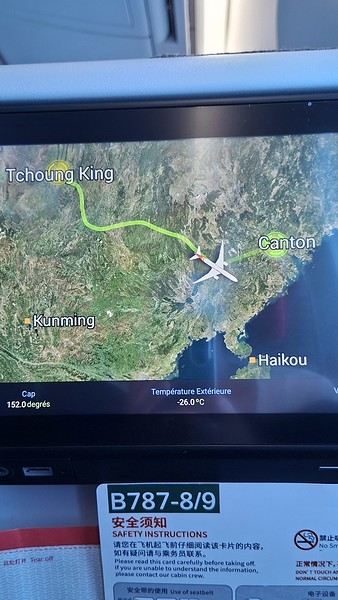
During my first two trips to China, we paid for everything in cash, but this time, we’re going all-in on Alipay and WeChat. I still brought the leftover change from previous trips—it might come in handy. At the metro station, they showed us a QR code to buy tickets via WeChat. There were probably machines and even a ticket counter, but we didn’t see them, and buying via WeChat was pretty simple. 8 yuan to Changshu Lu, which is 22 stops. So far, so good. Then, we had to find the hotel, which wasn’t on Google Maps, Maps.me, or Amap... Easy 😎! We found it without too much hassle, though. Dropped off our stuff and went out to eat. 55 yuan for two claypots with fish/eel, rice, cabbage, and purple eggplant. When we left, it was pouring. We grabbed our umbrellas and set off to explore the neighborhood: Enning Road (we’ll come back later to check out a specific spot), Shangxiajiu (the pedestrian shopping street), Baohua Road... The area is pretty diverse—one street to the next, it’s like stepping into a different world.

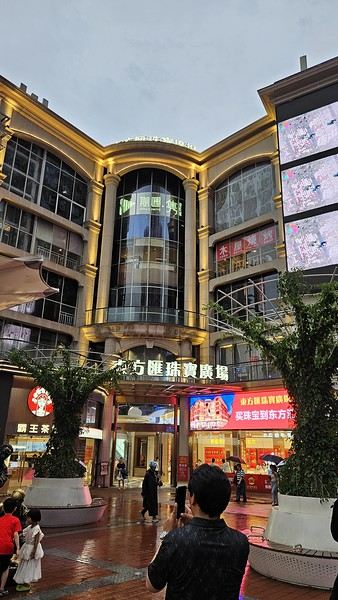
There weren’t many people around, probably because of the rain. We grabbed a quick street food dinner and went to bed—we were exhausted. We struggled to stay awake until 11 PM to adjust to the time change as quickly as possible. There’s a 6-hour time difference.
There wasn’t much room for improvisation on this trip—everything was planned in advance. Since August is peak season, I decided to book train tickets early, and once that was set, I reserved all the accommodations too. I got everything on Trip.com.
I bought the flight tickets back in March from Hainan Airlines. They were super expensive, but with these travel dates, I couldn’t exactly dream of a bargain!
I picked up e-SIMs valid for a month from Free just before departure: 10 € for the e-SIM + 19.90 € for a one-month plan with 35 GB of data abroad.
No need for a VPN with these e-SIMs, but D. still got one—a multi-device plan for 5 € with a discount from Let’s VPN, valid for a month. It was for evenings at the hotel on Wi-Fi to avoid burning through the 35 GB with video.
I downloaded Alipay, WeChat, Amap (Baidu Maps), and Trip.com. We also have Google Translate and Maps.me—absolute must-haves.
We’re ready to go!
I’ve been waiting for this day for nearly 15 years!! I travel a lot, but this one—this is MY TRIP 🙂 It’s been postponed so many times: because I wanted to do it with the right person, because I have a Turkish stamp in my passport and heard they don’t issue visas with that, because of COVID... and then China introduced a 30-day visa exemption, and that was the green light! Ugh, they forced us to take our vacation in August this year—far from ideal—but no more delays. Saturday, August 2, 2025: it’s finally the big day!
Days 1 and 2: We got dropped off at Charles de Gaulle at 9:30 AM. I supposedly checked in online, but only for the first flight and without getting the boarding pass... Might as well scrap online check-in in that case. So, we spent over an hour in line at the counter to get them. We didn’t have any checked luggage—just our backpacks as carry-ons—so this was a step we’d never had to deal with before, but whatever, it’s done. No wait at passport control, 5 minutes through security, a quick walk around the terminal, 10 minutes in the boarding area, and it was already time to board. Departure around 12:45 PM, arrival in Chongqing at 4:50 AM. We had a few hours of layover before our next flight. Went through immigration, connecting flight control, and security. Pro tip: check your next flight’s boarding gate right after immigration. We never saw it displayed again anywhere in the terminal.
The Free e-SIMs work—phew!
Took off at 9:30 AM, arrived in Guangzhou (Canton) at 11:20 AM in the rain. I love how Chongqing is translated as "Tchoung King" on the screens in the plane—very French!
During my first two trips to China, we paid for everything in cash, but this time, we’re going all-in on Alipay and WeChat. I still brought the leftover change from previous trips—it might come in handy. At the metro station, they showed us a QR code to buy tickets via WeChat. There were probably machines and even a ticket counter, but we didn’t see them, and buying via WeChat was pretty simple. 8 yuan to Changshu Lu, which is 22 stops. So far, so good. Then, we had to find the hotel, which wasn’t on Google Maps, Maps.me, or Amap... Easy 😎! We found it without too much hassle, though. Dropped off our stuff and went out to eat. 55 yuan for two claypots with fish/eel, rice, cabbage, and purple eggplant. When we left, it was pouring. We grabbed our umbrellas and set off to explore the neighborhood: Enning Road (we’ll come back later to check out a specific spot), Shangxiajiu (the pedestrian shopping street), Baohua Road... The area is pretty diverse—one street to the next, it’s like stepping into a different world.
There weren’t many people around, probably because of the rain. We grabbed a quick street food dinner and went to bed—we were exhausted. We struggled to stay awake until 11 PM to adjust to the time change as quickly as possible. There’s a 6-hour time difference.
3 weeks in Bali in 2025
We’ve read it all about Bali: mass tourism, non-stop parties, ferry disasters, the kingdom of “Instagrammers,” pollution, “Bali belly”... But luckily, this island isn’t just about Kuta’s beaches and the Lempuyang Temple.
Sure, it’s not as exotic or off-the-beaten-path as other Indonesian islands (the Moluccas, Timor, Flores...), but we spent 3 weeks there and loved it!
Our (planned) itinerary in 7 stops: - Ubud (4 nights) - Sidemen (2 nights) - Gili Meno (3 nights) - Amed (2 nights) - Pemuteran (4 nights) - Munduk (2 nights) - Jatiluwih (2 nights)
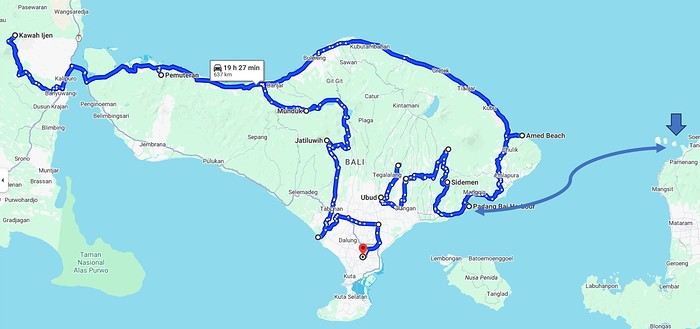
We booked our accommodations in advance, and for the rest (drivers, activities...), we took it day by day with help from the homestays (making sure to contact them a few days ahead via WhatsApp).
In the end, it’s an “easy” destination, very affordable, and one that’s managed to keep a certain authenticity.
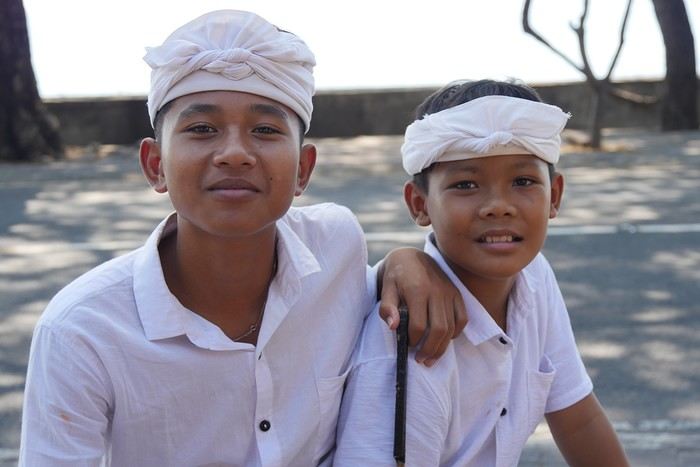
Sure, it’s not as exotic or off-the-beaten-path as other Indonesian islands (the Moluccas, Timor, Flores...), but we spent 3 weeks there and loved it!
Our (planned) itinerary in 7 stops: - Ubud (4 nights) - Sidemen (2 nights) - Gili Meno (3 nights) - Amed (2 nights) - Pemuteran (4 nights) - Munduk (2 nights) - Jatiluwih (2 nights)
We booked our accommodations in advance, and for the rest (drivers, activities...), we took it day by day with help from the homestays (making sure to contact them a few days ahead via WhatsApp).
In the end, it’s an “easy” destination, very affordable, and one that’s managed to keep a certain authenticity.
Warm January in Kerala (and a bit of Karnataka)
Hi everyone,
We're back in India for the 7th time (for the other trips, check here:
https://www.unendroitoualler.fr/asie/) ... But this time, no more exploring or trekking! With age, we're just spending a quiet month in southern India, a country we particularly love...
Our journey starts in Kovalam, then Monroe Island, Varkala, Kochi, Kannur, Udupi, and finally, as in recent years, Gokarna.
No problem getting around—there’s the train all along the coast...
Night in Trivandrum
Prepaid taxi to the « Safire Residency », where we stayed last year. This hotel is still just as nice and welcoming (980 INR). Then, dinner at the restaurant « Ariya Niwas » where we enjoyed those delicious dosas again! (We missed them!)
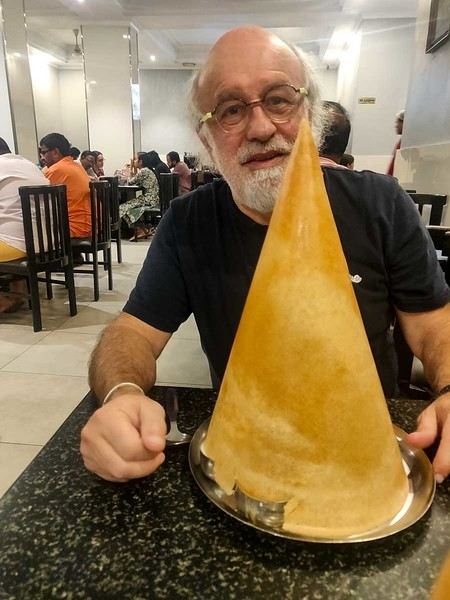
Night in Trivandrum
Prepaid taxi to the « Safire Residency », where we stayed last year. This hotel is still just as nice and welcoming (980 INR). Then, dinner at the restaurant « Ariya Niwas » where we enjoyed those delicious dosas again! (We missed them!)
So where are they and what are they doing?
This catchy and somewhat mysterious title comes from several questions I’ve been asking myself.
VF has been back open for a reasonable number of weeks and months now. The number of visitors overall matches past averages, but the number of members online in the last 24 hours seems relatively lower than what we used to see.
Yet, to my surprise, I’m seeing fewer travel journals, way fewer messages, and way fewer questions. I don’t see many new registered users online, and I notice a number of members who are logged in but either aren’t participating or have stopped participating.
Something’s not adding up for me because, in my opinion, VF is still appealing, and I don’t see which other sites could really compete.
Was there a real break between pre- and post-Covid? Does it just take more time for some people to discover the site or learn that it’s active again? Do people now prefer quick consumption on sites like FB or others I’m not familiar with? Where have the site’s old-timers gone, and what are they doing with their time now? What’s really going on here?
VF has been back open for a reasonable number of weeks and months now. The number of visitors overall matches past averages, but the number of members online in the last 24 hours seems relatively lower than what we used to see.
Yet, to my surprise, I’m seeing fewer travel journals, way fewer messages, and way fewer questions. I don’t see many new registered users online, and I notice a number of members who are logged in but either aren’t participating or have stopped participating.
Something’s not adding up for me because, in my opinion, VF is still appealing, and I don’t see which other sites could really compete.
Was there a real break between pre- and post-Covid? Does it just take more time for some people to discover the site or learn that it’s active again? Do people now prefer quick consumption on sites like FB or others I’m not familiar with? Where have the site’s old-timers gone, and what are they doing with their time now? What’s really going on here?
To the Top West End
In this time of general travel-journal scarcity, I’m stepping up to tell you about a far-too-short getaway to the Top West End, a local term for the very northern part of Western Australia, right on the border ( ;) ) with the Northern Territory.
As usual, I didn’t manage to keep it short, but this time I’ve got photos to go with it!
August 2020. Since the opportunities to explore the world are extremely limited right now, all we (R&X) can do is explore our own island! Well, just a part of it, because with the state borders still closed, we’re stuck in Western Australia (WA).
Luckily, we’re pretty fortunate because this state is huge: over 2.5 million km² (that’s more than four times the size of France or 1.5 times Quebec). What’s more, stretching over 20 degrees of latitude between the Antarctic Ocean and the Timor Sea, you’ll find climates ranging from Mediterranean to arid to tropical. That’s actually why we decided to head as far north as possible. Sick of the endless rainy winter in Perth, bring on the heat of the Kimberley... way up Nooorth!
Friday. At the airport, the main terminal was closed (not enough flights), so we ended up in the annex (where flights to the various mines usually depart from). There was no crowd at the gate, and in this huge, single departure lounge, empty seats were plentiful. Only three flights were listed on the screens for the rest of the morning: the first to Coondewanna (?), the second to Darwin, and ours to Kununurra (code KNX).
A cool breeze swept through the half-open corridors along the runways. At the top of the walkway leading to the Fokker 100 (the Airbuses and Boeings are now parked!), a flight attendant greeted us with a basket full of sanitary masks. We were actually the only masked passengers (the staff weren’t wearing them either). With zero Covid-19 cases in WA at the time, the only rule was to maintain social distancing—something pretty hard to do on a full plane!
It was also my first time wearing a mask—it felt weird, pretty uncomfortable, and after a while, painful behind the ears. I really feel for those who have to wear one all day, every day. The flight lasted three long hours, but luckily, I had a good book. From the window, I watched an endless expanse of salt lakes in all shapes and sizes—round, elongated, gray, white, sometimes blue and green—and an infinity of winding, capricious meanders, along with long straight lines that led nowhere. The last half-hour got more interesting as rocky, swollen formations and long, sloping plateaus appeared. Against the vast ochre landscape, green patches became more frequent.
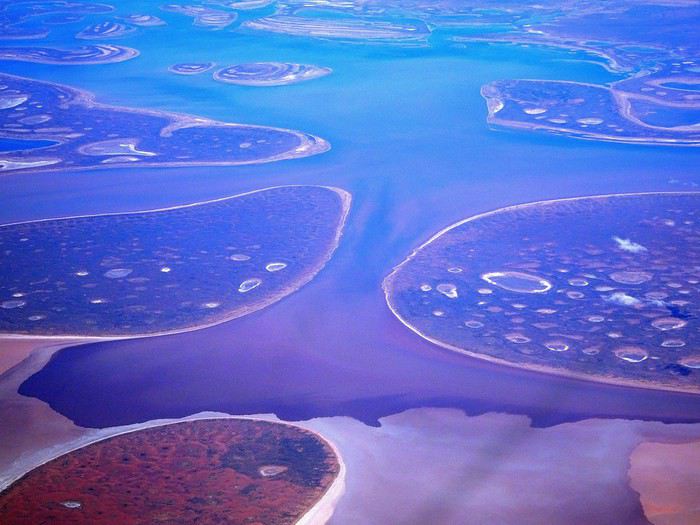
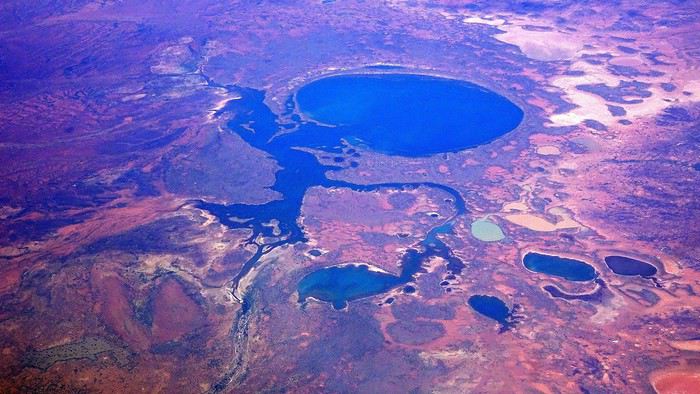
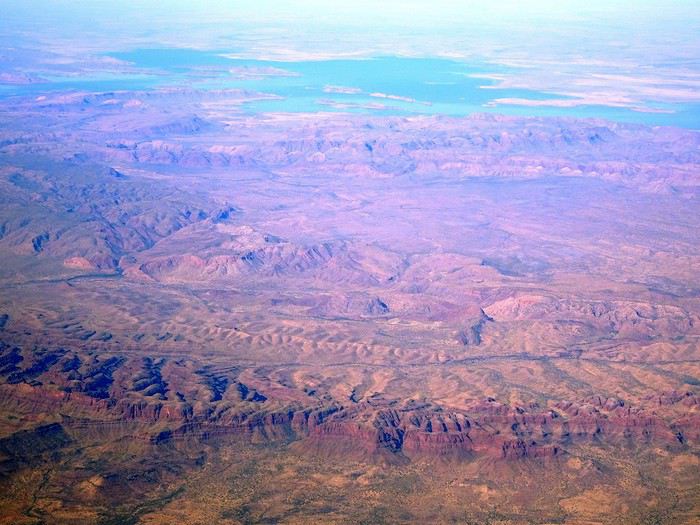
Just before landing, rows of green fields briefly appeared, along with an surprisingly wide river—but we were already rolling down the tarmac. A few hangars, a myriad of small, stationary planes, and a tiny terminal topped with a sign: “Welcome to Kununurra.”
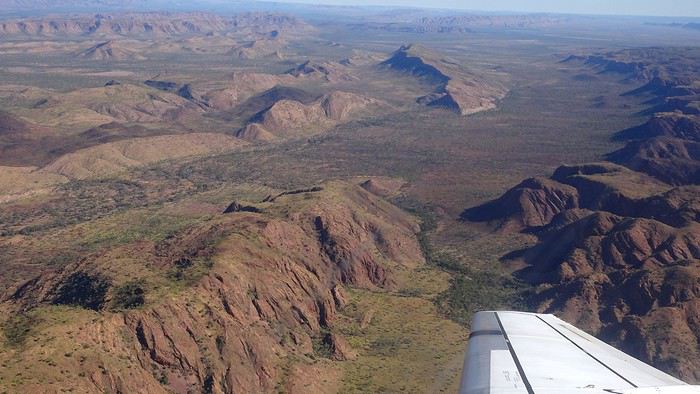
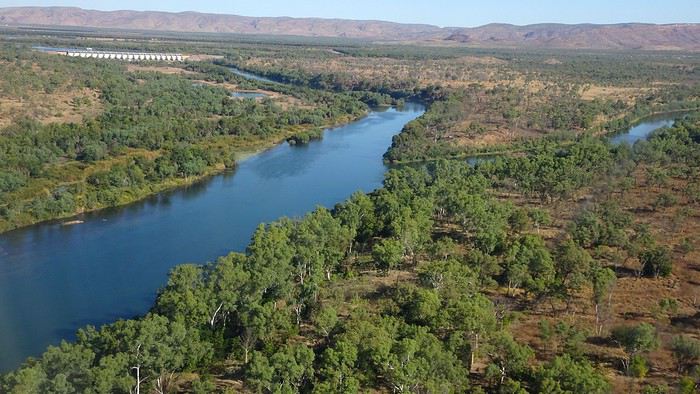
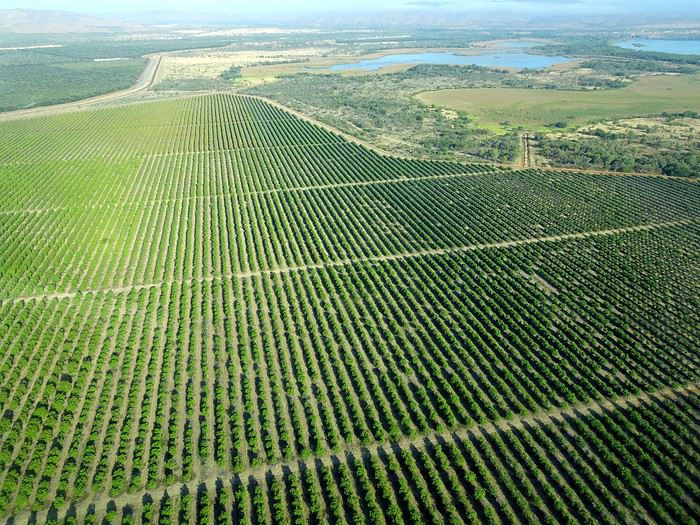
We wanted heat, and here it was—34°C the moment we stepped off the plane! We felt alive again and totally ridiculous in our jeans and sweaters. We quickly grabbed our suitcase and picked up the 4x4 we’d rented—more out of necessity, since only that type of vehicle can access the national parks we planned to visit.
Just four kilometers separated us from Kununurra, a town of 5,000 people founded in 1961 during the construction of the Lake Argyle Dam and the development of the Ord River Irrigation Area Scheme (more on that later). On the horizon, mountain ranges (a bit of an exaggeration, since we know Mt. Meharry, WA’s highest ‘mountain,’ doesn’t even reach 1,250 meters!) and closer to the road, a few irrigation canals cutting through stretches of bush, then a huge park overlooking a small lake lined with reeds.
A row of baobabs (yes, there are baobabs in Australia too!), a series of motels with immaculate lawns, a gas station, and there’s the main street leading to the town center—that is, the parking lots of the two supermarkets, the bottleshop, the pub, the Town Hall, the municipal pool, and the Tourist Office (already closed!), and at the next roundabout, another park, the Presbyterian church, and a few other shops. In short, two or three green blocks that you can explore in no time.
One road leads to the small industrial area and one of the town’s three or four campgrounds, while another heads toward the residential neighborhoods, which look just like the typical suburbs you find in any Australian city—except with tropical vegetation. We stocked up at Coles, an identical copy of the one near our place, and—surprise—the prices were practically the same.
We checked into one of the motels. The receptionist listed the town’s three or four restaurants, insisting that it’s always better to book a table. She recommended the Pump House, a bit outside town on the lake’s edge. “Best spot to watch the sunset, but hurry up.” she told us. It was only 5:00 PM!
When we got there half an hour later, the place was packed, and the sun had already disappeared behind a row of trees! Sure enough, we’d see a few days later that the sunset can be a stunning spectacle—if you wait a bit for the sky (especially if it’s cloudy) to blaze and reflect in the lake’s calm waters. A little disappointed, we headed back into town, where we easily found the other lively spot in town: the pub (nothing like an old English pub). Above the long L-shaped bar, several giant screens (thankfully muted) were broadcasting live footy, rugby league, etc. In one corner, players circled the pool table, while in another, customers were digging into plates of the day’s special. Instead of rooms, there were various patios where groups of friends and coworkers (easily recognizable by the fluoro vests they were still wearing) were gathered. We found a table under a mango tree—unfortunately, a little too close to the guitarist strumming his entire Country Music repertoire, complete with Keith Urban-style tremolos. Guaranteed culture shock!
Since it’s the custom here, we called the Country Club to book a table before the kitchen closed! The CC is the town’s—and even the region’s—fancy spot. Dark decor, modern furniture, dim lighting, and the air conditioning blasting. The twenty or so customers had taken refuge on the vast terrace, lit by torches. The view of the tall eucalyptus trees, illuminated by spotlights shifting from red to blue, was breathtaking.
The menu was minimal, but the grilled salmon was excellent, and the Pavlova (the meringue dessert Kiwis and Aussies have been arguing over since 1906) with melon and watermelon was absolutely divine.
It wasn’t even 9:00 PM, and we were already in bed. Had we already adopted the Top West End’s chicken schedule?!
To be continued... Journal dedicated to Attila
As usual, I didn’t manage to keep it short, but this time I’ve got photos to go with it!
August 2020. Since the opportunities to explore the world are extremely limited right now, all we (R&X) can do is explore our own island! Well, just a part of it, because with the state borders still closed, we’re stuck in Western Australia (WA).
Luckily, we’re pretty fortunate because this state is huge: over 2.5 million km² (that’s more than four times the size of France or 1.5 times Quebec). What’s more, stretching over 20 degrees of latitude between the Antarctic Ocean and the Timor Sea, you’ll find climates ranging from Mediterranean to arid to tropical. That’s actually why we decided to head as far north as possible. Sick of the endless rainy winter in Perth, bring on the heat of the Kimberley... way up Nooorth!
Friday. At the airport, the main terminal was closed (not enough flights), so we ended up in the annex (where flights to the various mines usually depart from). There was no crowd at the gate, and in this huge, single departure lounge, empty seats were plentiful. Only three flights were listed on the screens for the rest of the morning: the first to Coondewanna (?), the second to Darwin, and ours to Kununurra (code KNX).
A cool breeze swept through the half-open corridors along the runways. At the top of the walkway leading to the Fokker 100 (the Airbuses and Boeings are now parked!), a flight attendant greeted us with a basket full of sanitary masks. We were actually the only masked passengers (the staff weren’t wearing them either). With zero Covid-19 cases in WA at the time, the only rule was to maintain social distancing—something pretty hard to do on a full plane!
It was also my first time wearing a mask—it felt weird, pretty uncomfortable, and after a while, painful behind the ears. I really feel for those who have to wear one all day, every day. The flight lasted three long hours, but luckily, I had a good book. From the window, I watched an endless expanse of salt lakes in all shapes and sizes—round, elongated, gray, white, sometimes blue and green—and an infinity of winding, capricious meanders, along with long straight lines that led nowhere. The last half-hour got more interesting as rocky, swollen formations and long, sloping plateaus appeared. Against the vast ochre landscape, green patches became more frequent.
Just before landing, rows of green fields briefly appeared, along with an surprisingly wide river—but we were already rolling down the tarmac. A few hangars, a myriad of small, stationary planes, and a tiny terminal topped with a sign: “Welcome to Kununurra.”
We wanted heat, and here it was—34°C the moment we stepped off the plane! We felt alive again and totally ridiculous in our jeans and sweaters. We quickly grabbed our suitcase and picked up the 4x4 we’d rented—more out of necessity, since only that type of vehicle can access the national parks we planned to visit.
Just four kilometers separated us from Kununurra, a town of 5,000 people founded in 1961 during the construction of the Lake Argyle Dam and the development of the Ord River Irrigation Area Scheme (more on that later). On the horizon, mountain ranges (a bit of an exaggeration, since we know Mt. Meharry, WA’s highest ‘mountain,’ doesn’t even reach 1,250 meters!) and closer to the road, a few irrigation canals cutting through stretches of bush, then a huge park overlooking a small lake lined with reeds.
A row of baobabs (yes, there are baobabs in Australia too!), a series of motels with immaculate lawns, a gas station, and there’s the main street leading to the town center—that is, the parking lots of the two supermarkets, the bottleshop, the pub, the Town Hall, the municipal pool, and the Tourist Office (already closed!), and at the next roundabout, another park, the Presbyterian church, and a few other shops. In short, two or three green blocks that you can explore in no time.
One road leads to the small industrial area and one of the town’s three or four campgrounds, while another heads toward the residential neighborhoods, which look just like the typical suburbs you find in any Australian city—except with tropical vegetation. We stocked up at Coles, an identical copy of the one near our place, and—surprise—the prices were practically the same.
We checked into one of the motels. The receptionist listed the town’s three or four restaurants, insisting that it’s always better to book a table. She recommended the Pump House, a bit outside town on the lake’s edge. “Best spot to watch the sunset, but hurry up.” she told us. It was only 5:00 PM!
When we got there half an hour later, the place was packed, and the sun had already disappeared behind a row of trees! Sure enough, we’d see a few days later that the sunset can be a stunning spectacle—if you wait a bit for the sky (especially if it’s cloudy) to blaze and reflect in the lake’s calm waters. A little disappointed, we headed back into town, where we easily found the other lively spot in town: the pub (nothing like an old English pub). Above the long L-shaped bar, several giant screens (thankfully muted) were broadcasting live footy, rugby league, etc. In one corner, players circled the pool table, while in another, customers were digging into plates of the day’s special. Instead of rooms, there were various patios where groups of friends and coworkers (easily recognizable by the fluoro vests they were still wearing) were gathered. We found a table under a mango tree—unfortunately, a little too close to the guitarist strumming his entire Country Music repertoire, complete with Keith Urban-style tremolos. Guaranteed culture shock!
Since it’s the custom here, we called the Country Club to book a table before the kitchen closed! The CC is the town’s—and even the region’s—fancy spot. Dark decor, modern furniture, dim lighting, and the air conditioning blasting. The twenty or so customers had taken refuge on the vast terrace, lit by torches. The view of the tall eucalyptus trees, illuminated by spotlights shifting from red to blue, was breathtaking.
The menu was minimal, but the grilled salmon was excellent, and the Pavlova (the meringue dessert Kiwis and Aussies have been arguing over since 1906) with melon and watermelon was absolutely divine.
It wasn’t even 9:00 PM, and we were already in bed. Had we already adopted the Top West End’s chicken schedule?!
To be continued... Journal dedicated to Attila
Coût de la vie aux Philippines en 2020 English translation pending
Salut à toutes et tous,
enfin un frenchy qui donne des chiffres "réalistes"... ça change de tous ces foreigners qui te disent que tu peux vivre pour moins de 200$/mois sous les cocotiers ! 😉
https://m.youtube.com/watch?fbclid=IwAR3S9qW-bvomF5hMKJO_pZyGBtsggKJgB1IneoxAWgqqdpxFV8cH8FOqGaM&v=5dDJZfOw0E4
enfin un frenchy qui donne des chiffres "réalistes"... ça change de tous ces foreigners qui te disent que tu peux vivre pour moins de 200$/mois sous les cocotiers ! 😉
https://m.youtube.com/watch?fbclid=IwAR3S9qW-bvomF5hMKJO_pZyGBtsggKJgB1IneoxAWgqqdpxFV8cH8FOqGaM&v=5dDJZfOw0E4
Les mythes touristiques English translation pending
Les Mythes Touristiques
Dans un carnet que je suis en train d'écrire sur un voyage récent au Mexique, nous sommes arrivés à une petite discussion sur les fameux groupes de musiciens Mexicains, les mariachis. Il existe un mythe selon lequel « mariachi » serait une déformation du mot Français « mariage », et que cela viendrait des fêtes tenues par les Français lors de leurs quelques années d’occupation du Mexique, dans les années 1860 et quelques. Je cite l’un des intervenants sur mon poste Mexicain :
« Les français organisaient de grandes fêtes aux mariages et avaient l'habitude d'inviter des musiciens…. Mariachi serait une déformation du mot mariage ..? »
Ce mythe a été réfuté car il a été prouvé que le terme « mariachi » était d’usage longtemps avant la peu glorieuse « Intervention » de la France au Mexique (c’était sous Napoléon III).
Plusieurs mythes semblables circulent. Certains semblent être propagés à l’intention des touristes, pour leur donner l’illusion de « mieux comprendre le pays », pour donner une profondeur supplémentaire à leurs voyages, pour alimenter leurs conversations avec les amis quand ils sont de retour. Car tout cela gonfle l’égo et donne envie de faire d’autres voyages, ça alimente le tourisme. D’où revenus, tiens donc, pour qui ?
Mais d’autres mythes existent qui ne sont peut-être pas créés à but lucratif.
Vous connaissez sans aucun doute de tels mythes et je vous propose de les partager. Et de donner les raisons pour lesquelles ces mythes existent.
Dans un carnet que je suis en train d'écrire sur un voyage récent au Mexique, nous sommes arrivés à une petite discussion sur les fameux groupes de musiciens Mexicains, les mariachis. Il existe un mythe selon lequel « mariachi » serait une déformation du mot Français « mariage », et que cela viendrait des fêtes tenues par les Français lors de leurs quelques années d’occupation du Mexique, dans les années 1860 et quelques. Je cite l’un des intervenants sur mon poste Mexicain :
« Les français organisaient de grandes fêtes aux mariages et avaient l'habitude d'inviter des musiciens…. Mariachi serait une déformation du mot mariage ..? »
Ce mythe a été réfuté car il a été prouvé que le terme « mariachi » était d’usage longtemps avant la peu glorieuse « Intervention » de la France au Mexique (c’était sous Napoléon III).
Plusieurs mythes semblables circulent. Certains semblent être propagés à l’intention des touristes, pour leur donner l’illusion de « mieux comprendre le pays », pour donner une profondeur supplémentaire à leurs voyages, pour alimenter leurs conversations avec les amis quand ils sont de retour. Car tout cela gonfle l’égo et donne envie de faire d’autres voyages, ça alimente le tourisme. D’où revenus, tiens donc, pour qui ?
Mais d’autres mythes existent qui ne sont peut-être pas créés à but lucratif.
Vous connaissez sans aucun doute de tels mythes et je vous propose de les partager. Et de donner les raisons pour lesquelles ces mythes existent.
Mais où qu'il est ce truc là? (3) English translation pending
Bonjour!
Je reprends donc la main en ouvrant un nouveau sujet.
Où est-ce?
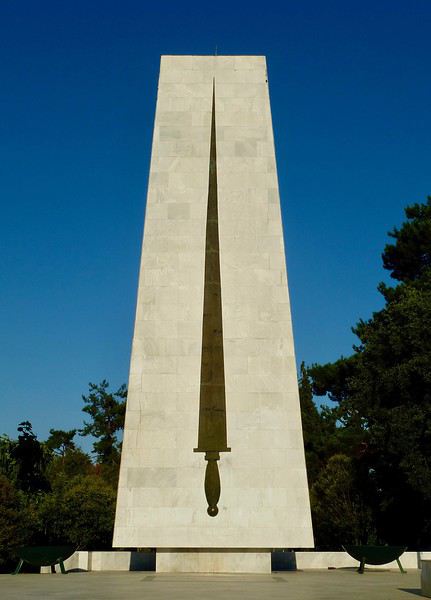
Un indice? Je n'ai pas (encore?) fait de carnet sur ce pays....
À vous de jouer!
Je reprends donc la main en ouvrant un nouveau sujet.
Où est-ce?
Un indice? Je n'ai pas (encore?) fait de carnet sur ce pays....
À vous de jouer!
Qui est à Bangkok en ce moment pour témoigner? English translation pending
Qui est à Bangkok en ce moment pour témoigner un peu de l’ambiance sur place et notamment là où habituellement il y a beaucoup de monde et d’animations comme kao san road ou sukhumvit ?
Je suis actuellement à KohNgai et il n’y a pratiquement personne, c’est à la fois agréable et inquiétant sans parler de la perte économique pour ceux qui vivent du tourisme.
En théorie.... je rejoins Bangkok le 26 mars pour repartir à Paris avec la Qatar mais d’ici là....qui sait ?.?
Prolonger son séjour en Thaïlande à Hua Hin English translation pending
Bonsoir
Peut être cela a été discuté auparavant alors je m'en excuse d'avance , j'aurais besoin de renseignements au cas ou je prolongerais mon séjour pour moi ça été plus au moins flou surtout concernant le billet d'avion retour
Je pars le 10 Mars en Thailande précisément a Hua Hin avec la compagnie Lufthansa et le retour est prévu le 07 Avril soit 28 jours . Si j'ai bien compris en lisant quelques articles pour prolonger il faut que je me rende dans un bureau d'immigration , prix 1900baths pour 30 jours supplémentaires , le bureau d'immigration de Hua Hin c'est faisable je pense ? Faut s'y prendre à l'avance , je pense que je serais faire mais si vous avez des suggestions et des infos complémentaires n'hésitez pas.
Mais là oui ça coince c'est pour mon vol retour faut il que je prenne un autre billet d'avion ? Ou on peut retarder son vol je suppose en payant et quel cout en contactant la compagnie ? Si vous pouvez m'aider , je suis pas trop expérimenté dans ce domaine il y a peine 1 an que je prends des vols long courrier
J'attends vos réponses avec impatience Merci
Peut être cela a été discuté auparavant alors je m'en excuse d'avance , j'aurais besoin de renseignements au cas ou je prolongerais mon séjour pour moi ça été plus au moins flou surtout concernant le billet d'avion retour
Je pars le 10 Mars en Thailande précisément a Hua Hin avec la compagnie Lufthansa et le retour est prévu le 07 Avril soit 28 jours . Si j'ai bien compris en lisant quelques articles pour prolonger il faut que je me rende dans un bureau d'immigration , prix 1900baths pour 30 jours supplémentaires , le bureau d'immigration de Hua Hin c'est faisable je pense ? Faut s'y prendre à l'avance , je pense que je serais faire mais si vous avez des suggestions et des infos complémentaires n'hésitez pas.
Mais là oui ça coince c'est pour mon vol retour faut il que je prenne un autre billet d'avion ? Ou on peut retarder son vol je suppose en payant et quel cout en contactant la compagnie ? Si vous pouvez m'aider , je suis pas trop expérimenté dans ce domaine il y a peine 1 an que je prends des vols long courrier
J'attends vos réponses avec impatience Merci
Sulawesi centrale: Luwuk et les iles Banggai English translation pending
Bonjour à tous,
J’ai envie de partager avec vous cette magnifique région que j’ai découverte en Indonésie, sur l’île de Sulawesi, la région de Luwuk Banggai dans l’est de la Sulawesi Centrale. C’est une région à découvrir, encore peu touchée par le tourisme et pourtant splendide, avec un accueil chaleureux et attentionné des indonésiens.
J’ai découvert Luwuk et sa région par hasard en 2019 car c’était la région dont était originaire la famille avec laquelle je vivais à Makassar à l’époque.
La richesse de ce lieu est impressionnante : des chutes d’eau à la couleur turquoise, des randonnées en forêts, de la pêche en pirogue de nuit au ciel étoilé, de la plongée dans des fonds marins intouchés, des minorités ethniques de rendez-vous en terre inconnue, bref, tout y est.
Bonne lecture !
Partie I : Région de Luwuk
Episode 1 : Dormir chez l’habitant dans le village de Tangkiang
La ville de Luwuk est souvent une option choisie par les voyageurs pour aller rapidement vers les iles Toggians. La ville est accessible par avion de Makassar, Menado et Palu et permet de rejoindre Ampana en 4h de voiture, point de départ pour les iles Toggians.
Mais Luwuk et sa région valent le temps que l’on s’y arrête ! Ma première étape fut le village de Tangkiang, à 40mn en moto de Luwuk.
Tangkiang est un village traditionnel de pêcheurs et de cultivateurs, au bord de la mer, hors des sentiers battus. Les villageois sont très accueillants et étaient ravis d’avoir un bule (dit « boulet » pour dire « touriste » 😉 ) découvrant leur quotidien.
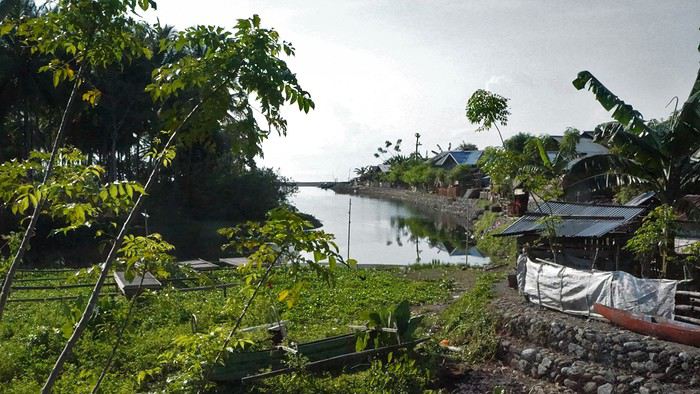
L’entrée du village, entre rivière et mer
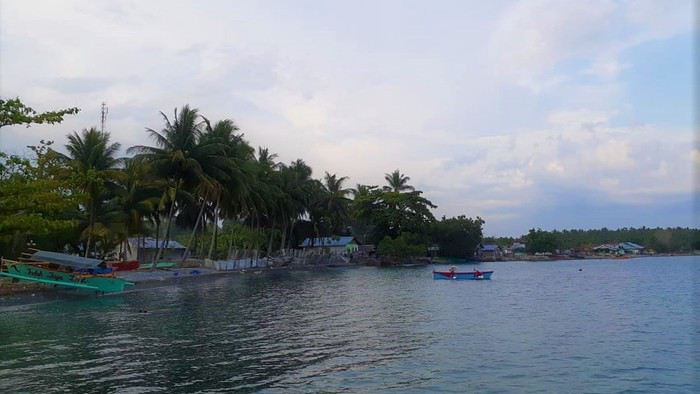 Le bord de mer

Le foot et le volley-ball
Je dormais chez l’habitant, l’occasion de partager la vie d’une famille. J’avais une chambre confortable et ils étaient aux petits soins pour me préparer de délicieux plats. Mes plats préférés restant le poisson frais et le tempé, à base de soja - Un délice !
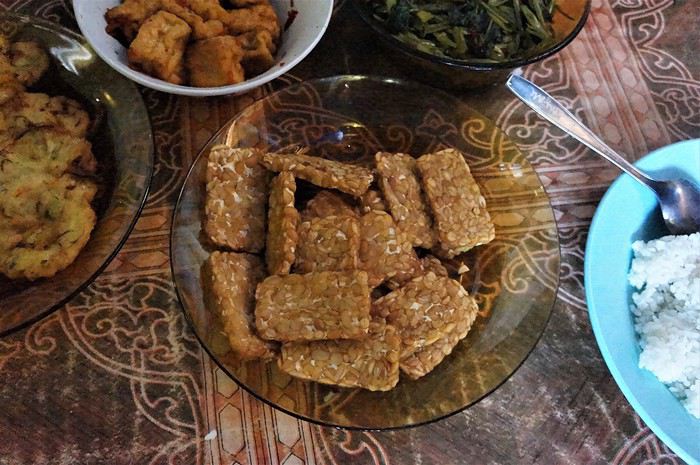
Le tempé, du tofu, beignets de crevettes et kangkung (ou liseron d’eau)
J’allais aussi me baigner dans la rivière du village bien rafraichissante au moment le plus chaud de la journée.
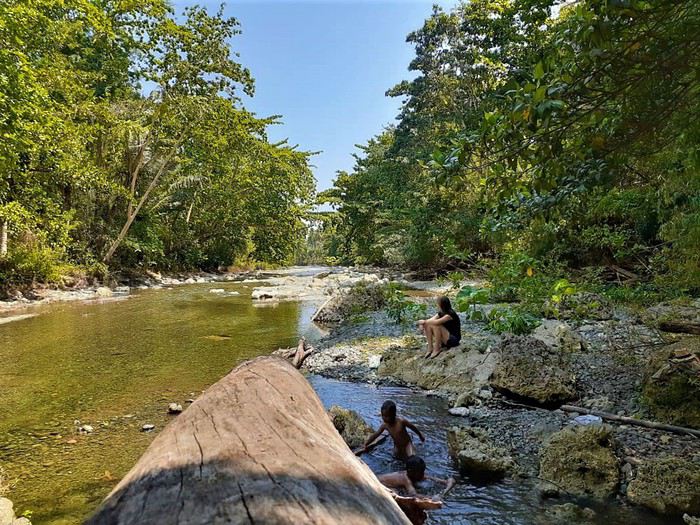
A l’eau ! La douche dans la rivière 😎
J’ai découvert la pêche au fil. Ils utilisent des pirogues et des « rompong », des plates-formes en bambou au milieu de la mer pour attirer les poissons. Je suis allée pêcher le poulpe de nuit, en utilisant des petites lumières que l’on mettait dans l’eau pour attirer les poulpes. Fantastique.
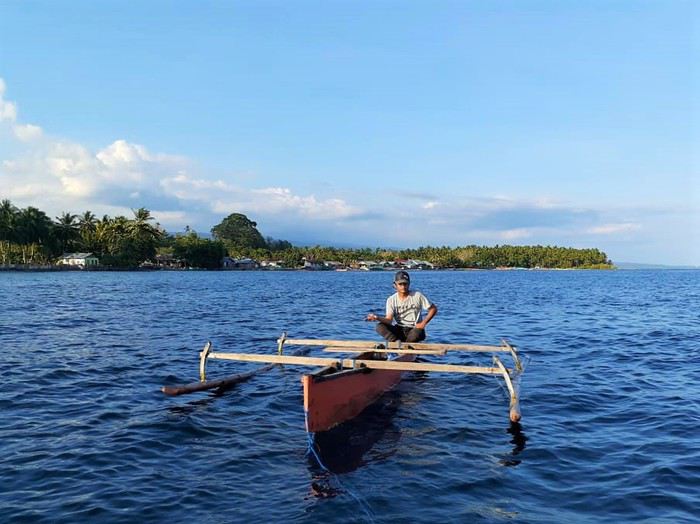 La pêche au fil
Je me suis également baladée dans les collines avoisinantes, qui donnent une très belle vue sur la mer. J’ai adoré récolter le piment, très relaxant, au milieu de la montagne, au calme. J’ai également appris à faire de l’huile de noix de coco avec la coopérative agricole du village.
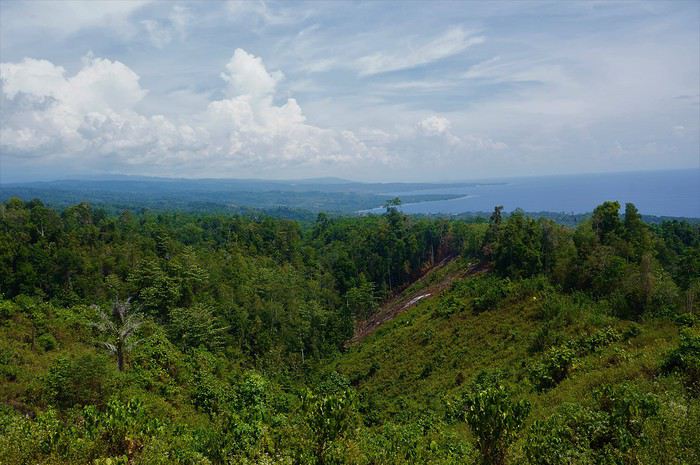
Vue des hauteurs de Tangkiang
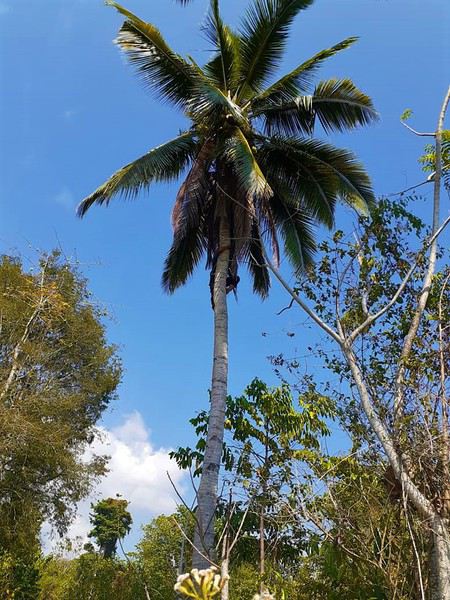
L’escalade du cocotier
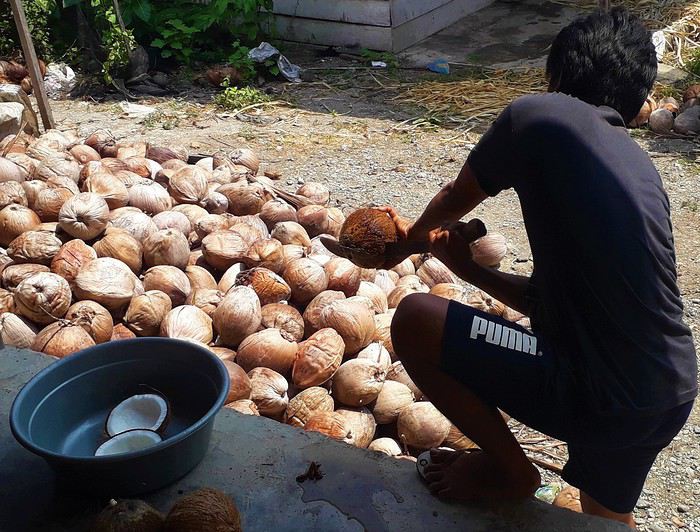 La préparation de l’huile de noix de coco
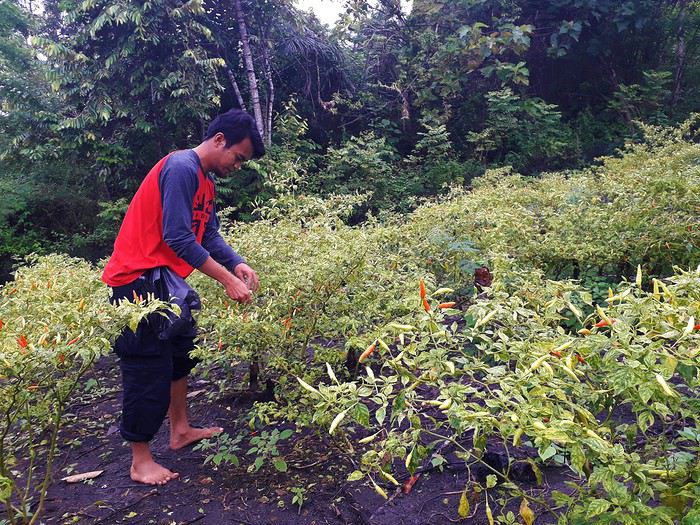
La récolte du piment
Entre Luwuk et Tangkiang, il y a d’autres villages, dont celui de Nambo, où une tisseuse locale vend de très beaux tissus avec l’emblème local, l’oiseau maléo.
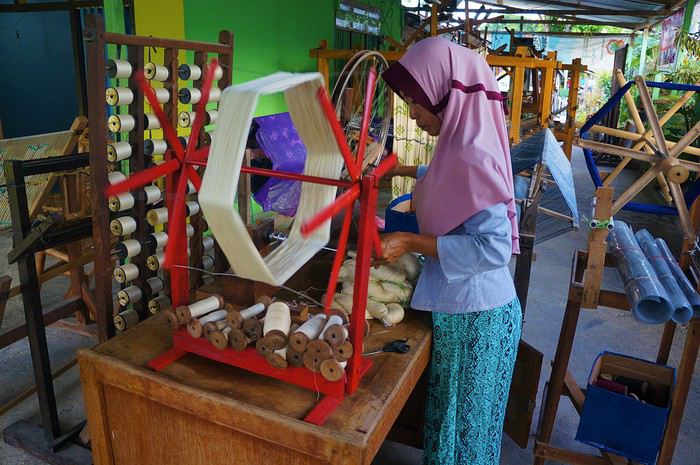 La tisseuse du village de Nambo
INFOS PRATIQUES
Pour accéder à Tangkiang, le plus simple est qu’on vienne vous chercher en moto ou en voiture en fonction de vos besoins à Luwuk.
Kahar, qui est le responsable de la coopérative de noix de coco et de piment et qui se débrouille en anglais, pourra vous accueillir et organiser votre séjour au village. Il m’a donné son accord pour partager ses coordonnées et serait ravi d’aider des « bule » à visiter la région. Son mail est donc abd.kahar024@gmail.com et son numéro Whats App est le +62 853-9424-8801.
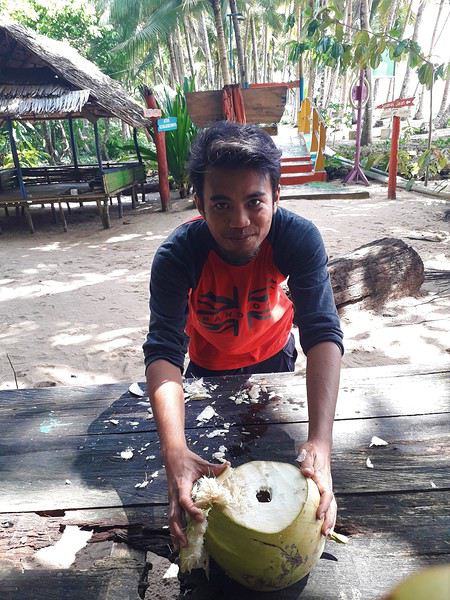
Voici Kahar
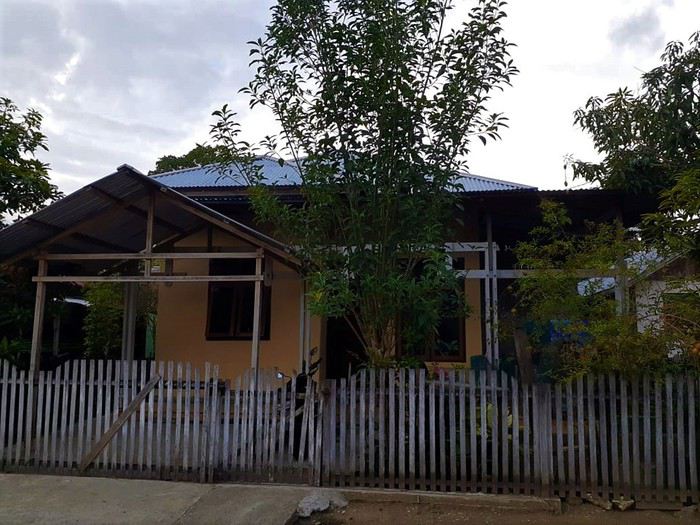
Une des maisons dont les habitants sont prêts à accueillir les touristes
Il faut savoir que les indonésiens de cette région ne sont pas habitués aux touristes. Ils n’osent pas toujours parler d’argent. Personnellement, j’ai décidé de leur donner 150 000 RP par nuit incluant la nourriture.
La suite au prochain épisode 🙂
J’ai envie de partager avec vous cette magnifique région que j’ai découverte en Indonésie, sur l’île de Sulawesi, la région de Luwuk Banggai dans l’est de la Sulawesi Centrale. C’est une région à découvrir, encore peu touchée par le tourisme et pourtant splendide, avec un accueil chaleureux et attentionné des indonésiens.
J’ai découvert Luwuk et sa région par hasard en 2019 car c’était la région dont était originaire la famille avec laquelle je vivais à Makassar à l’époque.
La richesse de ce lieu est impressionnante : des chutes d’eau à la couleur turquoise, des randonnées en forêts, de la pêche en pirogue de nuit au ciel étoilé, de la plongée dans des fonds marins intouchés, des minorités ethniques de rendez-vous en terre inconnue, bref, tout y est.
Bonne lecture !
Partie I : Région de Luwuk
Episode 1 : Dormir chez l’habitant dans le village de Tangkiang
La ville de Luwuk est souvent une option choisie par les voyageurs pour aller rapidement vers les iles Toggians. La ville est accessible par avion de Makassar, Menado et Palu et permet de rejoindre Ampana en 4h de voiture, point de départ pour les iles Toggians.
Mais Luwuk et sa région valent le temps que l’on s’y arrête ! Ma première étape fut le village de Tangkiang, à 40mn en moto de Luwuk.
Tangkiang est un village traditionnel de pêcheurs et de cultivateurs, au bord de la mer, hors des sentiers battus. Les villageois sont très accueillants et étaient ravis d’avoir un bule (dit « boulet » pour dire « touriste » 😉 ) découvrant leur quotidien.
L’entrée du village, entre rivière et mer
Le bord de merLe foot et le volley-ball
Je dormais chez l’habitant, l’occasion de partager la vie d’une famille. J’avais une chambre confortable et ils étaient aux petits soins pour me préparer de délicieux plats. Mes plats préférés restant le poisson frais et le tempé, à base de soja - Un délice !
Le tempé, du tofu, beignets de crevettes et kangkung (ou liseron d’eau)
J’allais aussi me baigner dans la rivière du village bien rafraichissante au moment le plus chaud de la journée.
A l’eau !
La douche dans la rivière 😎J’ai découvert la pêche au fil. Ils utilisent des pirogues et des « rompong », des plates-formes en bambou au milieu de la mer pour attirer les poissons. Je suis allée pêcher le poulpe de nuit, en utilisant des petites lumières que l’on mettait dans l’eau pour attirer les poulpes. Fantastique.
La pêche au filJe me suis également baladée dans les collines avoisinantes, qui donnent une très belle vue sur la mer. J’ai adoré récolter le piment, très relaxant, au milieu de la montagne, au calme. J’ai également appris à faire de l’huile de noix de coco avec la coopérative agricole du village.
Vue des hauteurs de Tangkiang
L’escalade du cocotier
La préparation de l’huile de noix de cocoLa récolte du piment
Entre Luwuk et Tangkiang, il y a d’autres villages, dont celui de Nambo, où une tisseuse locale vend de très beaux tissus avec l’emblème local, l’oiseau maléo.
La tisseuse du village de NamboINFOS PRATIQUES
Pour accéder à Tangkiang, le plus simple est qu’on vienne vous chercher en moto ou en voiture en fonction de vos besoins à Luwuk.
Kahar, qui est le responsable de la coopérative de noix de coco et de piment et qui se débrouille en anglais, pourra vous accueillir et organiser votre séjour au village. Il m’a donné son accord pour partager ses coordonnées et serait ravi d’aider des « bule » à visiter la région. Son mail est donc abd.kahar024@gmail.com et son numéro Whats App est le +62 853-9424-8801.
Voici Kahar
Une des maisons dont les habitants sont prêts à accueillir les touristes
Il faut savoir que les indonésiens de cette région ne sont pas habitués aux touristes. Ils n’osent pas toujours parler d’argent. Personnellement, j’ai décidé de leur donner 150 000 RP par nuit incluant la nourriture.
La suite au prochain épisode 🙂
Savannakhet English translation pending
Hello,
Petit compte-rendu d'un week-end prolongé au Laos. Un peu d'indulgence, c'est mon premier!
Contexte
Autorisation de séjour expirant le 20 décembre, direction Savannakhet pour une demande de visa non-o multiples entrées valide une année.
Contrainte
Etre de retour à la maison dans la province de Loei le 24 décembre pour fêter Noël en famille.
C'est parti
Départ en voiture le jeudi 19 en fin d'après-midi, mon beau-fils au volant.
Ex-chauffeur pro de mini-vans, amateur de stimulants déconseillés par les médecins et la loi, il a deux passions: rouler sur la voie de droite le plus longtemps possible avant la collision frontale et communiquer en morse via des appels de phares avec les bêtes hurlantes à 10 roues qu'on entrevoit à chaque dépassement.
Direction Mukdahan à 400km de chez nous.
Quelques frayeures, trois arrêts ptt/7 11 et 5 heures plus tard on s'arrète au Pc hotel de Mukdahan. On a remonté le temps (ou on a battu les prévisions horaires de gmap, c'est selon).
La réceptionniste katoy couchée par terre derrière le guichet est bien occupée à chasser les moustiques avec sa raquette électrique mais trouve le temps de nous tendre la clé d'une chambre à 450b. qui fera très bien l'affaire.
Mon driver familial retourne demain matin à la maison. Je poursuivrai sans lui.
https://youtu.be/_8n5jgnEMVU
Petit compte-rendu d'un week-end prolongé au Laos. Un peu d'indulgence, c'est mon premier!
Contexte
Autorisation de séjour expirant le 20 décembre, direction Savannakhet pour une demande de visa non-o multiples entrées valide une année.
Contrainte
Etre de retour à la maison dans la province de Loei le 24 décembre pour fêter Noël en famille.
C'est parti
Départ en voiture le jeudi 19 en fin d'après-midi, mon beau-fils au volant.
Ex-chauffeur pro de mini-vans, amateur de stimulants déconseillés par les médecins et la loi, il a deux passions: rouler sur la voie de droite le plus longtemps possible avant la collision frontale et communiquer en morse via des appels de phares avec les bêtes hurlantes à 10 roues qu'on entrevoit à chaque dépassement.
Direction Mukdahan à 400km de chez nous.
Quelques frayeures, trois arrêts ptt/7 11 et 5 heures plus tard on s'arrète au Pc hotel de Mukdahan. On a remonté le temps (ou on a battu les prévisions horaires de gmap, c'est selon).
La réceptionniste katoy couchée par terre derrière le guichet est bien occupée à chasser les moustiques avec sa raquette électrique mais trouve le temps de nous tendre la clé d'une chambre à 450b. qui fera très bien l'affaire.
Mon driver familial retourne demain matin à la maison. Je poursuivrai sans lui.
https://youtu.be/_8n5jgnEMVU
Un "Esta" bientôt nécessaire pour se rendre au Royaume-Uni? English translation pending
Visiblement, les autorités britanniques auraient dans l'idée de mettre en place un système d'Esta identique à celui existant pour les USA pour tous les voyageurs actuellement dispensés de visa (y compris donc les ressortissants de l'U.E.) souhaitant se rendre dans le pays une fois le Brexit effectif (s'il le devient un jour...).
Lire la suite...
Carnet de Namibie (ou voyage au pays d’Hilux) English translation pending
Et oui, encore un ! 😉
(Le sous-titre vient uniquement de l’impression de n’avoir jamais vu autant de ce type de véhicule, l’impression qu’il n’y avait quasiment que ça.)
_
Ce voyage sera un « one-way » de 30 jours (15 août – 14 septembre), début à Windhoek (capitale de la Namibie) et fin à Victoria Falls (Zimbabwe), en Toyota Hilux avec tente sur le toit (loueur Asco Car Hire) et réservations (campings, hôtels et voiture) faites par Tourmaline ; les réservations ont été faites pratiquement 18 mois à l’avance, certains campings (Etosha par exemple) semblant être très demandés. La période a été choisie pour y être en hiver et avec encore assez d’eau aux chutes Victoria.
Nous (67 et 47 ans) avons l’habitude, aux USA, de dormir dans la voiture ; sur le toit, ce sera une première. Le matériel de couchage est fourni (couettes, drap, oreillers) mais nous apportons quand même nos duvets (on aurait pu s’en passer). La plupart des nuits seront en camping (mais pas sauvage) et une fois par semaine (environ) une nuit d’hôtel ou assimilé.
Comme nous serons en hiver, j’ai donné à Isabelle la fourchette de température (de 0 à 28°C) que nous devrions avoir à supporter, pour le choix des vêtements ; la réalité sera un peu différente mais n’anticipons pas.
_
Pour notre parcours, un bon dessin valant mieux qu’un long discours, voici la carte de notre projet :
_
 _
J00 – jeudi 15 août 2019
Départ pour la Namibie ; le vol principal a été choisi sur Air Namibia pour des raisons d'horaire (arrivée vers 6h30) et il nous faut donc rallier Francfort ; Air France nous propose des vols aller aux horaires convenables mais, pratiquement un an avant le départ, change complètement ses horaires d'où un départ très matinal de Brest à 6h vers Roissy puis Francfort pour un décollage final vers 20h10.
_
J00 – jeudi 15 août 2019
Départ pour la Namibie ; le vol principal a été choisi sur Air Namibia pour des raisons d'horaire (arrivée vers 6h30) et il nous faut donc rallier Francfort ; Air France nous propose des vols aller aux horaires convenables mais, pratiquement un an avant le départ, change complètement ses horaires d'où un départ très matinal de Brest à 6h vers Roissy puis Francfort pour un décollage final vers 20h10.
J01 – vendredi 16 août 2019 => Windhoek Finalement, tout se passe assez bien malgré les attentes un peu longues et nous atterrissons à Windhoek à 6h10 ; sortie de l’avion (on descend sur le tarmac), il fait encore nuit et frais. Passage de l’immigration assez rapide malgré le nombre de voyageurs, récupération des bagages et nous trouvons le chauffeur de chez Asco qui nous attend (enfin, pas que nous). On quitte l’aéroport à 7h10 soit 1 h après l’atterrissage ; il fait jour et, sur le trajet, nous découvrons nos premiers animaux « exotiques ». Arrivés chez Asco, nous faisons la connaissance de Benoît, notre interlocuteur français envoyé par Tourmaline ; les divers échanges et signatures de documents sont facilités par sa présence. Ensuite, découverte du véhicule, de la tente et toutes les explications qui vont avec (et il y en a !) ; j’espère que nous n’oublierons rien. Benoît demande à l’employé d’Asco de nous donner, en plus du matériel de camping, un escabeau 2 marches et il faut bien avouer que ce fût très pratique ; plus besoin de grimper sur le pneu (au risque de tomber) pour manipuler la fermeture-éclair de la tente. Je serai le seul conducteur (ce qui ne dérange pas trop Isabelle) car négociation impossible bien que nous venions de prendre le package d’assurances max. _ Le véhicule est donc un Hilux double cabine (pour notre confort), mais le modèle Raider avec snorkel (dont nous n’aurons pas besoin), 2,8l de cylindrée, boite auto et une vraie fonction 4x4 (long et court avec blocage de différentiel) et très belle garde au sol ; 6 pneus neufs à gros crampons équipent notre superbe destrier qui a environ 130 000 km et quelques « accrocs », ce qui n’est pas plus mal ; la peinture est noire, mais ça ne durera pas. La partie arrière, totalement fermée par de la tôle épaisse, est équipée de 2 énormes tiroirs de rangement sur glissières, d’une caisse plastique contenant le matériel de cuisine et d’un vrai frigo, lui aussi sur glissières ; ce frigo est branché sur une seconde batterie et, comme nous roulions tous les jours, nous n’avons jamais eu besoin de l’arrêter, même la nuit. _ Trois heures plus tard, nous quittons Asco pour le centre commercial Spar pour faire le plein de nourriture pour les jours suivants ; les essuie-glaces se mettent en route à chaque appui sur les clignotants, tout étant quasiment inversé avec la conduite à gauche. Comme aide à la conduite, nous utiliserons Maps.me sur le téléphone en mode avion (testé juste quelques jours auparavant) ; tous les trajets (format kml) sont chargés ainsi qu’environ 300 points GPS et une version de sauvegarde sur tablette au cas où. C’est donc une première pour nous avec cette application et je pense, après utilisation quotidienne pendant 1 mois, que l’on peut lui décerner une note de 8/10. Nous faisons nos courses dans la grande surface mais sommes déçus par certains rayons, notamment les fruits et légumes (nous trouverons nettement mieux le lendemain). _ En sortant, nous essayons d’acheter des pulas (monnaie du Botswana, pays limitrophe), mais impossible ; un bureau de change n’en a pas et la banque nationale de Windhoek ne traite qu’avec ceux qui ont un compte. Comment ferons-nous à la frontière puisque le Botswana refuse dorénavant tout paiement avec une autre monnaie que la sienne, y compris la carte bleue (information récente fournie par Tourmaline et que nous verrons affichée au poste frontière) ? Quelques dernières courses (vin, apéro…) et nous rejoignons notre havre pour la nuit, la pension Londiningi où nous avons retenu le repas du soir et la nuit ; cette pension est tenue par Nathalie, une française. Pour l’instant, Maps.me marche très bien. Un rafraîchissement puis nous sortons nos bagages de la voiture ; il va falloir vider nos 2 gros sacs de voyage et répartir les contenus (les duvets pour la tente, les polaires pour les nuits fraîches, …). Test de l’adaptateur électrique : impossible de brancher nos prises françaises dedans ; Nathalie et un des occupants nous montreront qu’il suffisait de casser 2 petits ergots. _ L’heure du dîner arrive et, avec un apéritif bien mérité, nous discutons avec nos proches voisins qui, eux, ont fini leur voyage ; ils ont donc des infos toutes fraîches. Assez rapidement, nous nous rendons compte que nous avons des « points communs » et pour cause, il s’agit de Rouquine38, membre de VF et de son mari. Retour à la chambre pour une nuit bien méritée. _ Notre carrosse pour un mois
_
Notre carrosse pour un mois
_

_

_
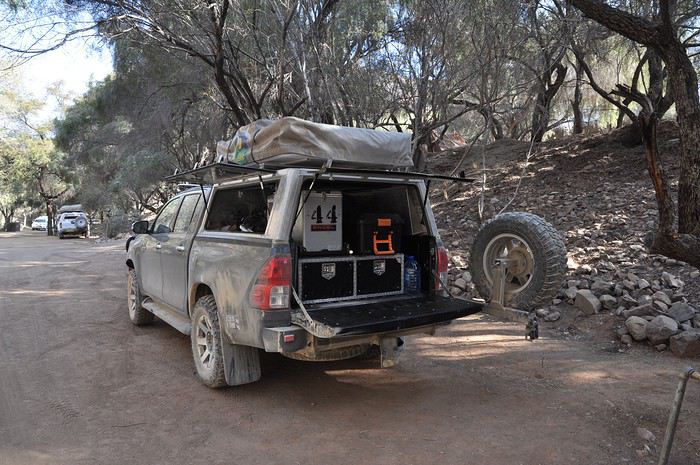
_
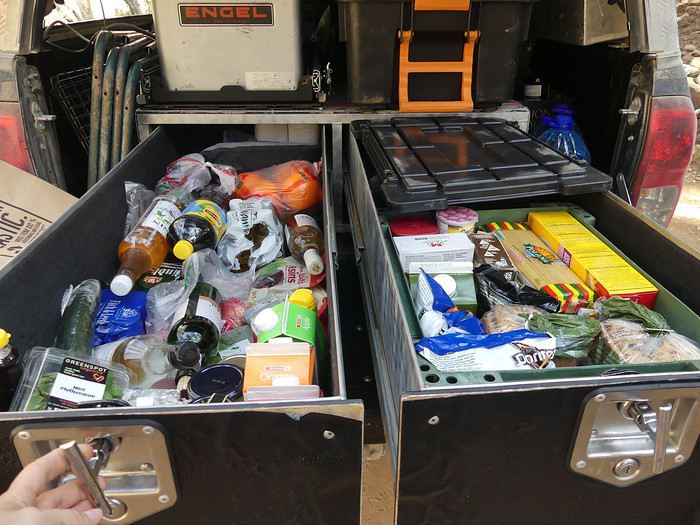 Les 2 énormes tiroirs
_
Les 2 énormes tiroirs
_
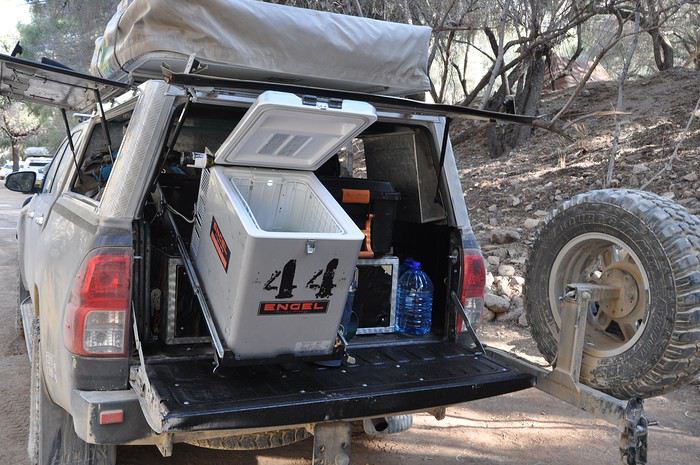 Le frigo de 44 litres en position ouvert
-

_
J00 – jeudi 15 août 2019
Départ pour la Namibie ; le vol principal a été choisi sur Air Namibia pour des raisons d'horaire (arrivée vers 6h30) et il nous faut donc rallier Francfort ; Air France nous propose des vols aller aux horaires convenables mais, pratiquement un an avant le départ, change complètement ses horaires d'où un départ très matinal de Brest à 6h vers Roissy puis Francfort pour un décollage final vers 20h10.J01 – vendredi 16 août 2019 => Windhoek Finalement, tout se passe assez bien malgré les attentes un peu longues et nous atterrissons à Windhoek à 6h10 ; sortie de l’avion (on descend sur le tarmac), il fait encore nuit et frais. Passage de l’immigration assez rapide malgré le nombre de voyageurs, récupération des bagages et nous trouvons le chauffeur de chez Asco qui nous attend (enfin, pas que nous). On quitte l’aéroport à 7h10 soit 1 h après l’atterrissage ; il fait jour et, sur le trajet, nous découvrons nos premiers animaux « exotiques ». Arrivés chez Asco, nous faisons la connaissance de Benoît, notre interlocuteur français envoyé par Tourmaline ; les divers échanges et signatures de documents sont facilités par sa présence. Ensuite, découverte du véhicule, de la tente et toutes les explications qui vont avec (et il y en a !) ; j’espère que nous n’oublierons rien. Benoît demande à l’employé d’Asco de nous donner, en plus du matériel de camping, un escabeau 2 marches et il faut bien avouer que ce fût très pratique ; plus besoin de grimper sur le pneu (au risque de tomber) pour manipuler la fermeture-éclair de la tente. Je serai le seul conducteur (ce qui ne dérange pas trop Isabelle) car négociation impossible bien que nous venions de prendre le package d’assurances max. _ Le véhicule est donc un Hilux double cabine (pour notre confort), mais le modèle Raider avec snorkel (dont nous n’aurons pas besoin), 2,8l de cylindrée, boite auto et une vraie fonction 4x4 (long et court avec blocage de différentiel) et très belle garde au sol ; 6 pneus neufs à gros crampons équipent notre superbe destrier qui a environ 130 000 km et quelques « accrocs », ce qui n’est pas plus mal ; la peinture est noire, mais ça ne durera pas. La partie arrière, totalement fermée par de la tôle épaisse, est équipée de 2 énormes tiroirs de rangement sur glissières, d’une caisse plastique contenant le matériel de cuisine et d’un vrai frigo, lui aussi sur glissières ; ce frigo est branché sur une seconde batterie et, comme nous roulions tous les jours, nous n’avons jamais eu besoin de l’arrêter, même la nuit. _ Trois heures plus tard, nous quittons Asco pour le centre commercial Spar pour faire le plein de nourriture pour les jours suivants ; les essuie-glaces se mettent en route à chaque appui sur les clignotants, tout étant quasiment inversé avec la conduite à gauche. Comme aide à la conduite, nous utiliserons Maps.me sur le téléphone en mode avion (testé juste quelques jours auparavant) ; tous les trajets (format kml) sont chargés ainsi qu’environ 300 points GPS et une version de sauvegarde sur tablette au cas où. C’est donc une première pour nous avec cette application et je pense, après utilisation quotidienne pendant 1 mois, que l’on peut lui décerner une note de 8/10. Nous faisons nos courses dans la grande surface mais sommes déçus par certains rayons, notamment les fruits et légumes (nous trouverons nettement mieux le lendemain). _ En sortant, nous essayons d’acheter des pulas (monnaie du Botswana, pays limitrophe), mais impossible ; un bureau de change n’en a pas et la banque nationale de Windhoek ne traite qu’avec ceux qui ont un compte. Comment ferons-nous à la frontière puisque le Botswana refuse dorénavant tout paiement avec une autre monnaie que la sienne, y compris la carte bleue (information récente fournie par Tourmaline et que nous verrons affichée au poste frontière) ? Quelques dernières courses (vin, apéro…) et nous rejoignons notre havre pour la nuit, la pension Londiningi où nous avons retenu le repas du soir et la nuit ; cette pension est tenue par Nathalie, une française. Pour l’instant, Maps.me marche très bien. Un rafraîchissement puis nous sortons nos bagages de la voiture ; il va falloir vider nos 2 gros sacs de voyage et répartir les contenus (les duvets pour la tente, les polaires pour les nuits fraîches, …). Test de l’adaptateur électrique : impossible de brancher nos prises françaises dedans ; Nathalie et un des occupants nous montreront qu’il suffisait de casser 2 petits ergots. _ L’heure du dîner arrive et, avec un apéritif bien mérité, nous discutons avec nos proches voisins qui, eux, ont fini leur voyage ; ils ont donc des infos toutes fraîches. Assez rapidement, nous nous rendons compte que nous avons des « points communs » et pour cause, il s’agit de Rouquine38, membre de VF et de son mari. Retour à la chambre pour une nuit bien méritée. _
Notre carrosse pour un mois
__
_
_
Les 2 énormes tiroirs
_
Le frigo de 44 litres en position ouvert-
Phra Kreuang: Thai protective amulets
S🙂wasdee!
Kicking off the thread with an informative article about Phra Kreuang, protective amulets (according to local belief) that Thai people of all kinds wear around their necks:
https://www.objetsdevasion.com/guides/objet-bouddhiste/amulette-bouddha/les-amulettes-bouddhiques-thailandaises.html
You can find them all over the Kingdom: in temples, at markets, in specialty shops, and even in mail-order flyers at Seven/Eleven.
Also, heads up for those in Paris—from October 11th to 20th, there’s a collective exhibition featuring Thai artists: https://phenixwebtv.com/2019/07/23/facets-of-thailand-une-exposition-collective-de-cinq-artistes-de-la-scene-contemporaine-thailandaise/?fbclid=IwAR28PCY1t48M2DiwVlnc5uZvT20FnsxNLMppOb8d1pSfOjiw_sW_htV2CnI
@ ++, for the *sanouk* debrief from our last trip to the Land of the Free, as it’s so beautifully nicknamed.
Sânouk3😎
Kicking off the thread with an informative article about Phra Kreuang, protective amulets (according to local belief) that Thai people of all kinds wear around their necks:
https://www.objetsdevasion.com/guides/objet-bouddhiste/amulette-bouddha/les-amulettes-bouddhiques-thailandaises.html
You can find them all over the Kingdom: in temples, at markets, in specialty shops, and even in mail-order flyers at Seven/Eleven.
Also, heads up for those in Paris—from October 11th to 20th, there’s a collective exhibition featuring Thai artists: https://phenixwebtv.com/2019/07/23/facets-of-thailand-une-exposition-collective-de-cinq-artistes-de-la-scene-contemporaine-thailandaise/?fbclid=IwAR28PCY1t48M2DiwVlnc5uZvT20FnsxNLMppOb8d1pSfOjiw_sW_htV2CnI
@ ++, for the *sanouk* debrief from our last trip to the Land of the Free, as it’s so beautifully nicknamed.
Sânouk3😎
Voyage d'un mois en Thaïlande: 2/3 en Issan et 1/3 plage English translation pending
Bonjour,
Nous partons à 2 en Thaïlande en janvier 2020 pour un mois, et j'envisage de partager mon séjour en : 2/3 en Issan et 1/3 de plage. Et j'aurai besoin de vos conseils et avis. Nous sommes allés souvent en Thaïlande, mais jamais en janvier....
-En arrivant à Bangkok de France, j'ai déjà réservé un vol Bangkok/ Loeï afin de rejoindre Chiang Khan le même jour. Je compte rester 5 nuits à Chiang Khan, est ce que c'est correct ou est ce que ce n'est pas trop long ? Y-a-t-il des balades aux alentours( à pied ou en scooter)
-Par la suite je prévois de rejoindre Nong Khaï( que je connais déjà) par la route en longeant le Mékong. Est ce que le transport est facile entre Chiang Khan et Nong Khaï? Bus ? Mini van ? Combien de temps de transport en moyenne ?Est ce que ça vaut le coup de faire une halte d'une nuit quelque part entre ces 2 villes ?
-De Nong Khaï, je veux aller et loger à Bueng Khan pour être assez proche du Wat Phu Tuk. Même question que précédemment...Est ce que les moyens de transport sont faciles et fréquents entre ces 2 villes et combien de temps.. ? Pour rejoindre le site du Wat Phu Tuk je suppose qu'il faut passer par une agence ou un guide ? Doit-on prendre obligatoirement un taxi ?
-De Bueng Khan je prévois de rejoindre Udon Thani en bus ou mini van, Est ce faisable ? J'ai lu qu'il fallait environ 3heures... ? A Udon Thani, est ce que le lac aux lotus rouges vaut le déplacement ? Car j'ai vu qu'il n'est pas tout près.
-D'Udon Thani je voulais aller directement vers Krabi par avion, mais il n'y a que le vol vers Phuket qui arrive à 19h. Donc je dois obligatoirement dormir à Phuket. Quel endroit est le mieux pour passer une nuit afin de rejoindre facilement Ko Lanta par le ferry ? J'ai vu qu'il avait plusieurs compagnies, donc quel ferry est le mieux ? Ou bien vaut-il mieux rejoindre Krabi plutôt que Kho Lanta? Ou rester quelques jours sur Phuket... ?
J'ai lu pas mal d'avis mais je suis encore très indécis pour ces destinations plages de Phuket, Krabi, Kho Lanta et quel serait le meilleur «circuit» sur 10 jours, en arrivant par l'aéroport de Phuket et en repartant de Krabi en sachant que je ne veux pas speeder?
J'avais l'habitude de voyager en Thaïlande en juillet, et pour ceux qui connaissent, ma plage préférée pour juillet , était Thong Nai Pan Noï à Kho Phangan, mais c'est la première fois que je voyage en janvier et donc je ne connais pas du tout Phuket ou Krabi. Est ce qu'il est intéressant de rester quelques jours sur Phuket et si oui, quelle plage.... ? Hors Patong ou Kata... et surtout pas pour faire la fête mais un endroit cool( j'ai compris que janvier était la haute saison.....). J'ai entendu parler de Railey ? Freedom beach ? ou d'autres?
Et pour Kho Lanta et Krabi quel est votre plage préférée....?( qui ressemblerait à Tong Naï Pan Noï...!lol).
Beaucoup de questions... mais si vous pouvez me répondre à quelque unes.. ! Merci pour votre aide Guy
-En arrivant à Bangkok de France, j'ai déjà réservé un vol Bangkok/ Loeï afin de rejoindre Chiang Khan le même jour. Je compte rester 5 nuits à Chiang Khan, est ce que c'est correct ou est ce que ce n'est pas trop long ? Y-a-t-il des balades aux alentours( à pied ou en scooter)
-Par la suite je prévois de rejoindre Nong Khaï( que je connais déjà) par la route en longeant le Mékong. Est ce que le transport est facile entre Chiang Khan et Nong Khaï? Bus ? Mini van ? Combien de temps de transport en moyenne ?Est ce que ça vaut le coup de faire une halte d'une nuit quelque part entre ces 2 villes ?
-De Nong Khaï, je veux aller et loger à Bueng Khan pour être assez proche du Wat Phu Tuk. Même question que précédemment...Est ce que les moyens de transport sont faciles et fréquents entre ces 2 villes et combien de temps.. ? Pour rejoindre le site du Wat Phu Tuk je suppose qu'il faut passer par une agence ou un guide ? Doit-on prendre obligatoirement un taxi ?
-De Bueng Khan je prévois de rejoindre Udon Thani en bus ou mini van, Est ce faisable ? J'ai lu qu'il fallait environ 3heures... ? A Udon Thani, est ce que le lac aux lotus rouges vaut le déplacement ? Car j'ai vu qu'il n'est pas tout près.
-D'Udon Thani je voulais aller directement vers Krabi par avion, mais il n'y a que le vol vers Phuket qui arrive à 19h. Donc je dois obligatoirement dormir à Phuket. Quel endroit est le mieux pour passer une nuit afin de rejoindre facilement Ko Lanta par le ferry ? J'ai vu qu'il avait plusieurs compagnies, donc quel ferry est le mieux ? Ou bien vaut-il mieux rejoindre Krabi plutôt que Kho Lanta? Ou rester quelques jours sur Phuket... ?
J'ai lu pas mal d'avis mais je suis encore très indécis pour ces destinations plages de Phuket, Krabi, Kho Lanta et quel serait le meilleur «circuit» sur 10 jours, en arrivant par l'aéroport de Phuket et en repartant de Krabi en sachant que je ne veux pas speeder?
J'avais l'habitude de voyager en Thaïlande en juillet, et pour ceux qui connaissent, ma plage préférée pour juillet , était Thong Nai Pan Noï à Kho Phangan, mais c'est la première fois que je voyage en janvier et donc je ne connais pas du tout Phuket ou Krabi. Est ce qu'il est intéressant de rester quelques jours sur Phuket et si oui, quelle plage.... ? Hors Patong ou Kata... et surtout pas pour faire la fête mais un endroit cool( j'ai compris que janvier était la haute saison.....). J'ai entendu parler de Railey ? Freedom beach ? ou d'autres?
Et pour Kho Lanta et Krabi quel est votre plage préférée....?( qui ressemblerait à Tong Naï Pan Noï...!lol).
Beaucoup de questions... mais si vous pouvez me répondre à quelque unes.. ! Merci pour votre aide Guy
Quel calculateur d'itinéraire utilisez-vous? (à vélo) English translation pending
Bonjour, pour la partie GPS j'utilise osmand+ qui est vraiment génial, mais pour la partie planification je n'ai encore rien trouvé de tel.
J'utilise majoritairement Strava mais c'est quand-même assez limité.
J'ai essayé BRouter, Kurviger et Openrunner, rien qui ne m'emballe trop.
En gros je cherche un calculateur assez simple d'utilisation, mais qui permet de vraiment paramétrer le type de route/chemin qu'on souhaite ou non emprunter.
Qu'utilisez-vous pour planifier vos itinéraires ? Merci
Qu'utilisez-vous pour planifier vos itinéraires ? Merci
Choix d'une prochaine randonnée au Népal English translation pending
Bonjour a tous,
Mon copain et moi prévoyons notre prochain trek au Népal en novembre ( Nous avons déjà fait le tour des Annapurnas, Everset BC avec les lacs de Gokyos et Hélambu; le tout sans guide ni porteur). Pour le prochain nous avons pensé au haut Dolpo mais je vois que les bonnes périodes sont septembre octobre; est il possible de tenter novembre quand même? Avez vous des idées pour le choix d'un autre trek si le haut dolpo n'est pas possible? je commence a me renseigner sur le Manaslu vallée de la Tsum ou le tour du Kangchenjunga; connaissez vous ces treks? merci d'avance pour vos retour.
Quid des guides pour le Manaslu ou la vallée du Nar Phu au Népal English translation pending
Bonjour
J envisage un voyage a pied Manaslu NAR Phu ou autre trek dans ce coin du Népal pour le mois e novembre . nous avons 28 jours sur place .
Quelqu un saurait il me renseigner s il faut vraiment un guide ou porteur pour ces destinations là et qu en est il si nous tentons sans ...
Avez vous un joli tour sinon a proposer tutoyant de beaux sommets entre 4000 et 5000m HORS GOSAIKUND ET LANGTANG j y suis allé y a 10 ans .
Merci de vos attentions
Philippe
Taïwan sans voiture en août English translation pending
Bonsoir tout le monde,
Je jette une bouteille à la mer en espérant que de gentils membres m'aiguilleront.
Voilà je n'ai pas encore organisé mes vacances mais mon époux souhaiterait éventuellement partir en Taïwan.
Du coup j'ai qq questions:
Comment est le temps ? Peut-on découvrir l'île sans voiture ? (Nous n'avons pas le permis...enfin si je l'ai mais étant phobique autant dire que je ne l'ai pas ) Combien de temps pour avoir un premier aperçu de l'île Coût de la vie
En vous remerciant pat avance pour votre aide précieuse.
Bon week-end à vous :)😉
Je jette une bouteille à la mer en espérant que de gentils membres m'aiguilleront.
Voilà je n'ai pas encore organisé mes vacances mais mon époux souhaiterait éventuellement partir en Taïwan.
Du coup j'ai qq questions:
Comment est le temps ? Peut-on découvrir l'île sans voiture ? (Nous n'avons pas le permis...enfin si je l'ai mais étant phobique autant dire que je ne l'ai pas ) Combien de temps pour avoir un premier aperçu de l'île Coût de la vie
En vous remerciant pat avance pour votre aide précieuse.
Bon week-end à vous :)😉
Johnny Clegg le "zoulou blanc" qui s'en souvient? English translation pending
Tour du Manaslu: tarif? English translation pending
Bonjour
Avec mon compagnon nous allons partir pour le Népal dans deux semaines. Nous avons pris le même guide que son frère pour faire le tour des Annapurnas l'année dernière.
Il nous propose 1850 USD par personne... en regardant sur d'autres sites de trekeurs, je remarque que ce tarif est celui payé pour deux personnes en moyenne... soit moins de 1000€ par personne.
Est-ce que nous sommes en train de nous faire arnaquer? Si on peut parler d'arnaque (nous ne partons pas avec une agence afin de verser la totalité de l'argent au guide et aux sherpas). Il faut savoir que nous serons que deux personnes.
Quel est votre avis? Avez-vous des guides à nous conseiller?
Merci d'avance,
Vanessa
Avec mon compagnon nous allons partir pour le Népal dans deux semaines. Nous avons pris le même guide que son frère pour faire le tour des Annapurnas l'année dernière.
Il nous propose 1850 USD par personne... en regardant sur d'autres sites de trekeurs, je remarque que ce tarif est celui payé pour deux personnes en moyenne... soit moins de 1000€ par personne.
Est-ce que nous sommes en train de nous faire arnaquer? Si on peut parler d'arnaque (nous ne partons pas avec une agence afin de verser la totalité de l'argent au guide et aux sherpas). Il faut savoir que nous serons que deux personnes.
Quel est votre avis? Avez-vous des guides à nous conseiller?
Merci d'avance,
Vanessa
Découverte de la Thaïlande du Sud en famille, de Bangkok à Koh Tao English translation pending
Bonjour à tous chers forumeurs
je me décide à écrire ce post après vous avoir beaucoup lu mais comme toujours, on cherche LA réponse à sa petite question particulière, je me lance donc!
Nous partons en famille (2 filles 9 et 13 ans) du 5 au 21 aout 2019 pour découvrir la thailande, plutôt sud en cette saison de mousson.
Notre profil de voyageurs: plutôt axé nature et découverte, loin des grands hôtels et du bling bling, mais pas franchement roots pour autant, le simple nous définira bien.
La vie sous -marine nous époustoufle (plongée pour le père et masque/tuba pour les autres) , mais la nature bien verte aussi ( ça c'est pour la mère, yogi à ses heures...).
Notre parcours est déjà plus ou moins établi, avec qqs petites interrogations en route, et certains doutes qui arrivent en lisant vos posts.
voilà notre projet:
arrivée Bangkok, découverte de la ville, canaux, puis une journée sur Ayutthaya, ça c bon.
train de nuit jusqu'à surat thani pour aller découvrir Kaoh sok, 2 nuits et lac de chiew larn. déjà première interrogation sur les agences avec qui partir: j'ai découverte le site de Mathilde, http://www.khaosok.asia/, mais j'avoue que je m'interroge sur les tarifs, environ 32 000 BHT pour 4 pour 2 jours 1 nuit alors que les sites des hôtels vendent les prestations autour de 15000 BHT. Je sais que pour ce tarif c'est du sur mesure, la question est juste: les toursstandards sont-ils si bondés et surfaits que ça ou cela vaut qd même le coup? (je ne parle pas du logement, je vais le réserver par moi même).
ensuite ça se corse: nous voulons aller sur Koh tao et au passage, faire un stop à koh samui pour faire une excursion dans le parc maritime d'Ang tong. a nouveau, je lis que les bateaux sont blindés, limite à ne pas valoir le coup, quel compromis peut-on trouver avec une agence plus petite pour que ça soit qd même une belle journée? nous avions envisager d'aller sur koh phaluai, et excursion privée avec un pêcheur, mais du coup, 1 jour pour y aller, 1 jour pour en partir, nous n'avons pas prévu assez de temps à priori, sauf à rogner sur la suite.
ensuite, plan initial, Koh tao, en visant les hôtels cote est (genre tanote bay ou chalok bay) pour être plus tranquille et profiter de qqs plongées pour monsieur et snorkelling pour mesdames. L'attrait eau cristalline et poissons est très fort. Gros hic qd je lis vos posts: plus blindée que Phuket à la haute saison dit philippe (http://www.phil-a-phuket.com/, en passant merci pour ce fabuleux blog bien renseigné!) j'ai peur! " Murder island" dis un autre, au secours! du coup, la question est: est ce un si mauvais choix cette ile, le risque est réel? Je ne doute pas de la beauté des fonds, mais est ce que je vais pouvoir en profiter en masque tuba sans voir plus de palmes que de poissons? nos filles sont vraiment motivées par les photos (et nous aussi!) mais on nous montre bien ce qu'on veut... des retours d'expérience de plongeurs (et non plongeurs) contents de leur séjour et ou?
J'ai bien vu à nouveau sur le post de philippe que Chumphon serait une option (http://www.phil-a-phuket.com/chumphon.html), pour le bateau et tour des iles, mais pas forcement pour les poissons.
voilà, ensuite retour bateau jusqu'à Chumphon, train de nuit pour Bangkok, 1 jour pour flâner et retour maison.
Merci à tous de vos commentaires avisés, et propositions autres, vos retours d'experience. Seule la première nuit à kaho sok est bookée , on peut donc ajuster notre programme, sachant que la jungle, la mer et les poissons doivent y trouver leur place! belle journée Audrey
arrivée Bangkok, découverte de la ville, canaux, puis une journée sur Ayutthaya, ça c bon.
train de nuit jusqu'à surat thani pour aller découvrir Kaoh sok, 2 nuits et lac de chiew larn. déjà première interrogation sur les agences avec qui partir: j'ai découverte le site de Mathilde, http://www.khaosok.asia/, mais j'avoue que je m'interroge sur les tarifs, environ 32 000 BHT pour 4 pour 2 jours 1 nuit alors que les sites des hôtels vendent les prestations autour de 15000 BHT. Je sais que pour ce tarif c'est du sur mesure, la question est juste: les toursstandards sont-ils si bondés et surfaits que ça ou cela vaut qd même le coup? (je ne parle pas du logement, je vais le réserver par moi même).
ensuite ça se corse: nous voulons aller sur Koh tao et au passage, faire un stop à koh samui pour faire une excursion dans le parc maritime d'Ang tong. a nouveau, je lis que les bateaux sont blindés, limite à ne pas valoir le coup, quel compromis peut-on trouver avec une agence plus petite pour que ça soit qd même une belle journée? nous avions envisager d'aller sur koh phaluai, et excursion privée avec un pêcheur, mais du coup, 1 jour pour y aller, 1 jour pour en partir, nous n'avons pas prévu assez de temps à priori, sauf à rogner sur la suite.
ensuite, plan initial, Koh tao, en visant les hôtels cote est (genre tanote bay ou chalok bay) pour être plus tranquille et profiter de qqs plongées pour monsieur et snorkelling pour mesdames. L'attrait eau cristalline et poissons est très fort. Gros hic qd je lis vos posts: plus blindée que Phuket à la haute saison dit philippe (http://www.phil-a-phuket.com/, en passant merci pour ce fabuleux blog bien renseigné!) j'ai peur! " Murder island" dis un autre, au secours! du coup, la question est: est ce un si mauvais choix cette ile, le risque est réel? Je ne doute pas de la beauté des fonds, mais est ce que je vais pouvoir en profiter en masque tuba sans voir plus de palmes que de poissons? nos filles sont vraiment motivées par les photos (et nous aussi!) mais on nous montre bien ce qu'on veut... des retours d'expérience de plongeurs (et non plongeurs) contents de leur séjour et ou?
J'ai bien vu à nouveau sur le post de philippe que Chumphon serait une option (http://www.phil-a-phuket.com/chumphon.html), pour le bateau et tour des iles, mais pas forcement pour les poissons.
voilà, ensuite retour bateau jusqu'à Chumphon, train de nuit pour Bangkok, 1 jour pour flâner et retour maison.
Merci à tous de vos commentaires avisés, et propositions autres, vos retours d'experience. Seule la première nuit à kaho sok est bookée , on peut donc ajuster notre programme, sachant que la jungle, la mer et les poissons doivent y trouver leur place! belle journée Audrey
Mauvaise blague à l'aéroport de Fort Lauderdale English translation pending
Je crois qu'à l'avenir elle va s'abstenir de faire de l'humour.
https://www.lapresse.ca/actualites/201902/14/01-5214775-blague-de-bombe-a-laeroport-une-quebecoise-arretee-en-floride.php
https://www.lapresse.ca/actualites/201902/14/01-5214775-blague-de-bombe-a-laeroport-une-quebecoise-arretee-en-floride.php
Conduire à moto en Asie sans permis English translation pending
Bien le bonjour voyageurs intrépide, j'ai récemment fait à moto SANS permis, NI assurance beaucoup de pays d'Asie en l'espace de 10 mois, pour un total de plus de 30.000km et je viens casser les idées reçu et les peurs de trop de personnes, je passerai donc en détail la Thailande, le Laos, le Vietnam, le Cambodge, la Birmanie et l'Inde.
Mais avant je vais vous donner le choix, je ne veut pas être tenu responsable de ce qui peut vous arriver, si vous décidez de partir à moto dans ces pays là, sans permis, soyez conscient des risques que vous prenez :
Possibilité d'y laisser la vie évidement, si accident avec un local, payez très cher les réparation, ou même prison.
Si vous voyager en bus vous éviterez ces potentiels danger.
Pas besoin de lire la suite si vous décidez de finalement prendre le bus, profitez bien de votre voyage 🙂 !
Pour ceux qui veulent absolument louer une moto voilà tout les renseignements pour ce qui est de l'Asie, tenez compte que ça ne tient uniquement que d'expérience personnel. J'ai louer une moto dans chaque pays, j'ai eu quelques accidents, je suis tombé seul à cause de l'état de la route sauf pour un accident qui impliqué une voiture dont j'étais totalement responsable et qui s'est très bien fini. Je n'ai eu aucun problème grave, les locaux font attention en traversant, ceux qui conduisent sont certes barjo mais en cas de pépin ils sauront réagir avec une telle rapidité et efficacité que vous pourriez fermer les yeux, cela m'a bien aider en Thaïlande puisque je n'avais que très peu d'expérience en moto. Les détails :
THAÏLANDE : moto à partir de 3-4€par jour, vous pourrez négocier lorsque vous louer pour un mois comme partout. De préférence louer à Chiang Mai plutôt qu'à Bangkok Route : excellente malgré quelques surprise sur des voies rapides, toujours êtres aux aguets Circulation : Mieux qu'ailleurs, méfier vous tout de même des pick up blanc bien propre, souvent plus riche et plus pressé. Police : Plusieurs barrages, si vous vous faites attrapez c'est 500bath (12,5€) d'amende, en gardant le papier vous êtes immunisé pendant 7jours. Ça vaut le coup de louer une moto? : Les paysages ne sont pas aussi beau que dans d'autres pays, Mae Hong Son tour est à faire. La moto est surtout intéressante pour voir du hors sentier battu dans ce pays là, qui manque d'authenticité en terrain battu.
LAOS : Moto a partir de 6-7€par jour, le Laos est un peu plus cher que les autres pays. Route : Beaucoup sont en terre, prenez un casque avec visière (toujours enfait si possible), la route est assez dangereuse Circulation : Moins dangereuse qu'ailleurs, méfiez vous des camions qui double dans votre voie, vous obligeant à rouler sur le côté, quand il y en a un. Et ne roulez pas sur le liquide qui sort des camions, glissade assuré. Ça vaut le coup de louer une moto? Définitivement ! Le Laos est plus un pays qui s'explore que se visite, le sentier touristique au Laos n'est absolument pas représentatif du pays, lorsque vous sortirez des villes touristiques vous comprendrez. Ajoutez à ça les boucle de Thakkek, Pakse et la route pour aller à Luang Prabrang depuis l'Est... Police : Très peu de policier, si quelqu'un essaie de vous arrêtez en voyant que vous êtes caucasien, et qu'il ne se met pas directement devant vous, vous pouvez continuer votre route l'air de rien, je pense qu'il n'y a pas vraiment d'amende mais certains policier se poste en sortie de grande ville et essaye de vous soutirer 100.000 (10euro).
VIETNAM : moto a partir de 4-5€par jour, le pays étant très grand il existe des loueurs qui font revenir les moto en bateau depuis le nord jusqu'au sud ou inversement pour 50$ environ. Route : Très bonne Circulation : Très dangereuse, les Vietnamien ont pour habitude de s'engager sans regarder, de même pour tourner, soyez juste vigilant et rouler de préférence au milieu. Le klaxon sera votre meilleur ami Police : Presque personne arrête les touristes, certains policiers véreux posté en sortie de ville essaieront de vous soutirer de l'argent avec le solide argument qu'il peuvent immobiliser votre moto, j'en ai rencontré qu'un en 2 mois. Évitez les grandes routes en sortie de ville ou faites comme si vous ne l'avez pas vu. Ça vaut le coup ? Définitivement aussi, le tour à Ha giang, l'infinité de paysage ou de scènes que vous pouvez voir partout sur le route, les gens.. Incroyable
CAMBODGE : moto a partir de 3€par jour Route : très terreuse, vos habits en seront souvent couvert Circulation : assez bonne, après le Vietnam ça fait beaucoup de bien ! Police : Très peu de policier, quasiment personne vous arrête, si on vous arrête ils se contenteront aisément de 10$. Ca vaut le coup ? Je dirais moyen, avec la moto vous pourrez toujours voir les locaux, des endroits improbable mais si vous voulez vous reposez un peu de la moto je vous conseillerez dans ce pays là.
BIRMANIE : moto dans les 4-5€par jour, les gens disent que vous ne pouvez pas louer en Birmanie, et c'est vrai quand on parle d'agence mais la beauté de l'Asie c'est qyue tout est possible, rendez vous donc dans un loueur local et vous trouverez votre bonheur, en revanche vous ne pourrez rentrer à Yango sous peine d'amende. Route : Assez bonne, certaines routes sont très longues et ne possèdent pas de station, prévoyez le plein dans ce cas là Circulation : Très bonne, les gens sont calmes et très gentil, enfin on reste en Asie tout de même Police : Je ne me suis jamais fait arrété sauf en entrant dans une nouvelle province où vous n'avez qu'à sortir le passeport Ca vaut le coup? : Pas plus que ça, le pays en lui même est déjà hors des sentiers battus, il y a certes de belles routes mais au même titre que le Cambodge, c'est pas aussi intéressants que les autres pays
INDE : 6-7€ par jour pour une 500cc Enfield, pas tout les loueurs accepteront si vous n'avez pas le permis mais ça reste assez facile, aller à Karol Bagh si vous êtes à Delhi. Route : Très dangereuse, j'ai fait les routes les plus dangereuses du monde dans le Nord, faire très attention, l'avantage c'est que les Indiens sont un minimum conscient du danger et ne vont pas trop vite sur ces routes Circulation : Très dangereux ! Les Indiens sont très pressés et dangereux, faites attentions au virage, certains double pendant, ayez l'oeil partout. Police : Je me suis fait arrété 2 fois, les 2 fois on m'a laisser partir sans rien, soyez gentil et dites que vous aimez l'Inde et ça passera. Ca vaut le coup? : Définitivement ! Les paysages dans le Nord sont spectaculaire et la vie Indienne hors sentiers battus est incroyable
Astuces : -Conduisez à la local même si ça signifie ne laissez passer personne, condurie à la française pourrait les surprendres - Pour éviter la police, ne les regardez pas et tracer, si vous ovus faites arreter prétendez ne pas parler Anglais - N'hésitez pas à prendre les petites routes, vous allez vivres des moments inoubliables - Les policiers les plus tenaces peuvent être acheté avec 10$, ayez de préférence un porte monnaie avec seuelment 10$ dedans pour pas qu'il puisse demander plus - Soyez ouvert et acceptez les invitations des locaux, ce sera les meilleurs expérriences de votre vie - Les frontière sont très durs à passer en moto, si vous y arrivez faites un post s'il vous plait ! - Les garages sont partout, pas cher et souvent indiqué par des pneus à l'entrée mais demander le prix avant la réparation
Si vous voulez avoir un aperçu de ce que j'ai pu voir sur les routes d'Asie cette année, voilà mon instagram : The_Wild_Trip, pour toutes questions vous pouvez m'envoyez un message dessus aussi. En vous souhaitant le meilleurs des voyages !
Pour ceux qui veulent absolument louer une moto voilà tout les renseignements pour ce qui est de l'Asie, tenez compte que ça ne tient uniquement que d'expérience personnel. J'ai louer une moto dans chaque pays, j'ai eu quelques accidents, je suis tombé seul à cause de l'état de la route sauf pour un accident qui impliqué une voiture dont j'étais totalement responsable et qui s'est très bien fini. Je n'ai eu aucun problème grave, les locaux font attention en traversant, ceux qui conduisent sont certes barjo mais en cas de pépin ils sauront réagir avec une telle rapidité et efficacité que vous pourriez fermer les yeux, cela m'a bien aider en Thaïlande puisque je n'avais que très peu d'expérience en moto. Les détails :
THAÏLANDE : moto à partir de 3-4€par jour, vous pourrez négocier lorsque vous louer pour un mois comme partout. De préférence louer à Chiang Mai plutôt qu'à Bangkok Route : excellente malgré quelques surprise sur des voies rapides, toujours êtres aux aguets Circulation : Mieux qu'ailleurs, méfier vous tout de même des pick up blanc bien propre, souvent plus riche et plus pressé. Police : Plusieurs barrages, si vous vous faites attrapez c'est 500bath (12,5€) d'amende, en gardant le papier vous êtes immunisé pendant 7jours. Ça vaut le coup de louer une moto? : Les paysages ne sont pas aussi beau que dans d'autres pays, Mae Hong Son tour est à faire. La moto est surtout intéressante pour voir du hors sentier battu dans ce pays là, qui manque d'authenticité en terrain battu.
LAOS : Moto a partir de 6-7€par jour, le Laos est un peu plus cher que les autres pays. Route : Beaucoup sont en terre, prenez un casque avec visière (toujours enfait si possible), la route est assez dangereuse Circulation : Moins dangereuse qu'ailleurs, méfiez vous des camions qui double dans votre voie, vous obligeant à rouler sur le côté, quand il y en a un. Et ne roulez pas sur le liquide qui sort des camions, glissade assuré. Ça vaut le coup de louer une moto? Définitivement ! Le Laos est plus un pays qui s'explore que se visite, le sentier touristique au Laos n'est absolument pas représentatif du pays, lorsque vous sortirez des villes touristiques vous comprendrez. Ajoutez à ça les boucle de Thakkek, Pakse et la route pour aller à Luang Prabrang depuis l'Est... Police : Très peu de policier, si quelqu'un essaie de vous arrêtez en voyant que vous êtes caucasien, et qu'il ne se met pas directement devant vous, vous pouvez continuer votre route l'air de rien, je pense qu'il n'y a pas vraiment d'amende mais certains policier se poste en sortie de grande ville et essaye de vous soutirer 100.000 (10euro).
VIETNAM : moto a partir de 4-5€par jour, le pays étant très grand il existe des loueurs qui font revenir les moto en bateau depuis le nord jusqu'au sud ou inversement pour 50$ environ. Route : Très bonne Circulation : Très dangereuse, les Vietnamien ont pour habitude de s'engager sans regarder, de même pour tourner, soyez juste vigilant et rouler de préférence au milieu. Le klaxon sera votre meilleur ami Police : Presque personne arrête les touristes, certains policiers véreux posté en sortie de ville essaieront de vous soutirer de l'argent avec le solide argument qu'il peuvent immobiliser votre moto, j'en ai rencontré qu'un en 2 mois. Évitez les grandes routes en sortie de ville ou faites comme si vous ne l'avez pas vu. Ça vaut le coup ? Définitivement aussi, le tour à Ha giang, l'infinité de paysage ou de scènes que vous pouvez voir partout sur le route, les gens.. Incroyable
CAMBODGE : moto a partir de 3€par jour Route : très terreuse, vos habits en seront souvent couvert Circulation : assez bonne, après le Vietnam ça fait beaucoup de bien ! Police : Très peu de policier, quasiment personne vous arrête, si on vous arrête ils se contenteront aisément de 10$. Ca vaut le coup ? Je dirais moyen, avec la moto vous pourrez toujours voir les locaux, des endroits improbable mais si vous voulez vous reposez un peu de la moto je vous conseillerez dans ce pays là.
BIRMANIE : moto dans les 4-5€par jour, les gens disent que vous ne pouvez pas louer en Birmanie, et c'est vrai quand on parle d'agence mais la beauté de l'Asie c'est qyue tout est possible, rendez vous donc dans un loueur local et vous trouverez votre bonheur, en revanche vous ne pourrez rentrer à Yango sous peine d'amende. Route : Assez bonne, certaines routes sont très longues et ne possèdent pas de station, prévoyez le plein dans ce cas là Circulation : Très bonne, les gens sont calmes et très gentil, enfin on reste en Asie tout de même Police : Je ne me suis jamais fait arrété sauf en entrant dans une nouvelle province où vous n'avez qu'à sortir le passeport Ca vaut le coup? : Pas plus que ça, le pays en lui même est déjà hors des sentiers battus, il y a certes de belles routes mais au même titre que le Cambodge, c'est pas aussi intéressants que les autres pays
INDE : 6-7€ par jour pour une 500cc Enfield, pas tout les loueurs accepteront si vous n'avez pas le permis mais ça reste assez facile, aller à Karol Bagh si vous êtes à Delhi. Route : Très dangereuse, j'ai fait les routes les plus dangereuses du monde dans le Nord, faire très attention, l'avantage c'est que les Indiens sont un minimum conscient du danger et ne vont pas trop vite sur ces routes Circulation : Très dangereux ! Les Indiens sont très pressés et dangereux, faites attentions au virage, certains double pendant, ayez l'oeil partout. Police : Je me suis fait arrété 2 fois, les 2 fois on m'a laisser partir sans rien, soyez gentil et dites que vous aimez l'Inde et ça passera. Ca vaut le coup? : Définitivement ! Les paysages dans le Nord sont spectaculaire et la vie Indienne hors sentiers battus est incroyable
Astuces : -Conduisez à la local même si ça signifie ne laissez passer personne, condurie à la française pourrait les surprendres - Pour éviter la police, ne les regardez pas et tracer, si vous ovus faites arreter prétendez ne pas parler Anglais - N'hésitez pas à prendre les petites routes, vous allez vivres des moments inoubliables - Les policiers les plus tenaces peuvent être acheté avec 10$, ayez de préférence un porte monnaie avec seuelment 10$ dedans pour pas qu'il puisse demander plus - Soyez ouvert et acceptez les invitations des locaux, ce sera les meilleurs expérriences de votre vie - Les frontière sont très durs à passer en moto, si vous y arrivez faites un post s'il vous plait ! - Les garages sont partout, pas cher et souvent indiqué par des pneus à l'entrée mais demander le prix avant la réparation
Si vous voulez avoir un aperçu de ce que j'ai pu voir sur les routes d'Asie cette année, voilà mon instagram : The_Wild_Trip, pour toutes questions vous pouvez m'envoyez un message dessus aussi. En vous souhaitant le meilleurs des voyages !
Visa O de 3 mois au consulat thaïlandais English translation pending
Hello tous, j'ai fait demande d'un visa O non migrant ayant thai child la bas sur place, on me l'a delivrer ce matin par courrier, validité 3 mois + 1 mois renouvelable.
Ce que je ne comprends pas c'est que lors de la constitution des pièces pour déposer demande j'ai fourni le billet d'avion aller retour indiquant les dates du voyages au 25.12.18 jusqu'au 20.03.19.
Et le consulat fait partir mon visa du 07.12.18 au 06.03.19 ce qui me gratte plus de deux semaines sur mon droit...
J'ai déposé demande le 06.12.18 ce qui expliquerait la prise en compte de départ... Est-il possible de changer auprès d'eux la période de dates pour qu'elles concordent à celles du voyage ?
Quelqu'un a déjà été exposer à ce cas de figure ?
Merci pour votre aide
Ce que je ne comprends pas c'est que lors de la constitution des pièces pour déposer demande j'ai fourni le billet d'avion aller retour indiquant les dates du voyages au 25.12.18 jusqu'au 20.03.19.
Et le consulat fait partir mon visa du 07.12.18 au 06.03.19 ce qui me gratte plus de deux semaines sur mon droit...
J'ai déposé demande le 06.12.18 ce qui expliquerait la prise en compte de départ... Est-il possible de changer auprès d'eux la période de dates pour qu'elles concordent à celles du voyage ?
Quelqu'un a déjà été exposer à ce cas de figure ?
Merci pour votre aide