Results for "Beaune+|+127"
20398 results found.
Bénin quand tu nous tiens English translation pending
Un air chaud et sec pénètre dans l’avion, 7 heures du matin, 27 degrés, et les militaires étaient bien au rendez-vous, devant l’avion avec leurs mitraillettes. Douane passée, une 404 pick-up m’attend, direction « la gerbe d’or », un bon petit restaurant, pour un petit déjeuner à la française, le dernier avant 15 jours.
Départ sur Cove, village de 70 000 habitants à coté de la ville de Bohicon. Pas un vent, il fait chaud, 32 degrés, ma gorge est dessécher, je tousse, la pollution est désagréable, le bruit omniprésent, des véhicules épaves, ceci est la description de toutes ces grandes agglomérations africaines ! ! Sorti de Cotonou, la 404 roule à tombeau ouvert : 50km/h, ainsi une durée de 6 heures est prévue pour les 270 km, mais rappelons-nous que nous sommes en Afrique !
Nous croisons des sortes de voitures chargées comme des 40t, la population me salue lors de mes passages dans les villages, la terre est rouge, les pleines désertiques sont d’une beauté indescriptible, un panorama de plusieurs km, avec de temps en temps un dieu de la brousse : un baobab.
Bohicon, ville d’assez grande importance, ne m’attire pas donc je prends la piste qui va jusqu'à Cove. Il reste 70km mais c’est km qui compte, enfin l’Afrique comme tout le monde imagine, la poussière orangée sur ma figure, j’ai le sentiment être un aventurier, sale, les cheveux pailles mais la civilisation me rattrape après un virage, la maison du préfet, une maison immense en construction, et quelques mètres plus loin Cove.
C’est jour de marché, klaxon, bouchon, marchand sur le bord de la route sont de rigueur les jours de marché, les senteurs de fruits et légumes sur ces étalages colorés, des stand de tissus, vendu au mètre pour ainsi se faire de magnifiques vêtements par des doigts de fée de la couturière !
Loin des touristes, Cove a su garder le charme des villes africaines, les tournois de dames, awalé, des débats et discutions rythme le quotidien, le sourire des gens nous rassurent, leur sympathie, hospitalité me fais enlever tout stress de l’inconnu. Ici les gens prennent le temps de vivre et surtout de vivre avec le peu qu’ils possèdent. Cette solidarité entre eux m’impressionnera toujours.
Je loge chez le directeur de l’école, son école a été réhabilité par une association « nos amis du bénin », il dispose de l’eau courante, la seule du quartier, et de l’électricité.
Les enfants sont heureux de voir un blanc dans leur village, ils me disent bonsoir, même s’il est 6 heures du matin, de jouer au foot, de se balader, cela me donne tous les jours le sourire, je m’efforce d’écouter leurs histoires car le français, même s’il est enseigné à l’école, reste relativement peu parlé. La rencontre de jeunes, aidant les maçons à rénover leur école ou travaillant dans les champs pour financer leurs études, me donne une bien belle leçon d’humanité.
Les jours se succèdent et ne se ressemblent pas, chaque jour est une découverte différente, des rencontres avec les vénérations des habitants : les pythons, le temple des morts, le pèlerinage de Dhassa, dans l’une des plus grande cathédrale d’Afrique, la danse des revenants, la danse des masques, je m’aperçois que le Bénin est bien le berceau du voudisme. Les enfants y sont conviés dés leur plus jeune age.
Lors d’un détours dans un quartier, j’aperçois une famille de 6 enfants en train de préparer le repas du soir, c’est des poulets, les parents, las de leur journée au champs, laissent les enfants faire le pénible travaille pour un européen mais tout à fait naturel pour eux. Ils égorgent le poulet, récupèrent le sang pour ensuite un faire un bon petit jus, le poulet, même sans tête, se débat, court de partout, une fois totalement mort, ils le trempent dans de l’eau chaude pour mieux le déplumer.
Je suis juste a 5 000km de chez moi et pourtant on se croirait sur une autre planete!
Je suis juste a 5 000km de chez moi et pourtant on se croirait sur une autre planete!
Contacts et bons plans pour la Sicile English translation pending
Hello,
L'envie de visiter la Sicile me démange depuis qque temps. J'ai décidé d'y aller en octobre. Est-ce que qqu'un aurait des adresses à me conseiller (logements, visites etc...) ??? Enfin dites-moi tout sur la Sicile 🙂
Merci
FeeBleue😉
L'envie de visiter la Sicile me démange depuis qque temps. J'ai décidé d'y aller en octobre. Est-ce que qqu'un aurait des adresses à me conseiller (logements, visites etc...) ??? Enfin dites-moi tout sur la Sicile 🙂
Merci
FeeBleue😉
Tous vos bons plans sur l'Asie Sud Est! English translation pending
Salut,
En octobre, je pars avec 3 amis en Asie du sud-est...
On pense à Bangkok comme point de départ, pour un mois minimum...??
Pourriez-vous nous indiquer les endroits à ne surtout pas manquer en Thailande, en Birmanie, au Laos, au Cambodge, au Vietnam et en Malaisie...?
Je sais que je pourrais trouver ça facilement sur le site du routard, de lonely planet ou d'abm, mais je préfèrerais recevoir les conseils de bourlingueuses et de bourlingueurs...
Merci...
En octobre, je pars avec 3 amis en Asie du sud-est...
On pense à Bangkok comme point de départ, pour un mois minimum...??
Pourriez-vous nous indiquer les endroits à ne surtout pas manquer en Thailande, en Birmanie, au Laos, au Cambodge, au Vietnam et en Malaisie...?
Je sais que je pourrais trouver ça facilement sur le site du routard, de lonely planet ou d'abm, mais je préfèrerais recevoir les conseils de bourlingueuses et de bourlingueurs...
Merci...
Excursions au Panama English translation pending
Bonjour à tous!!
Je prépare mon voyage au Panama et je pars seule avec ma mère .. nous avons respectivement 19 et 37 ans!! Donc nous sommes 2 jeunes femmes pleines de vie!! Ayant peur de nous ennuyer à notre hotel, nous allons descendre au Royal Decameron Costa blanca, nous voulons prévoir plusieurs excursions durant notre séjour. Nous nous sommes seulement décidé à aller voir les indiens Emberas. J'aimerais savoir si il y a d'autres excursions ds la jungle ou autre que vous avez fait et à ne pas manquer ! Car nous n, arrivons pas à nous décidé... Nous n'avons pas peur de grand chose alors n'hésité pas à tout nous proposer. En passant si il y en aurais entre vous qui aurais des photos du Decameron à part celle d'internet car on ne voit pas grand chose ce serait sympa merci xxxx
Je prépare mon voyage au Panama et je pars seule avec ma mère .. nous avons respectivement 19 et 37 ans!! Donc nous sommes 2 jeunes femmes pleines de vie!! Ayant peur de nous ennuyer à notre hotel, nous allons descendre au Royal Decameron Costa blanca, nous voulons prévoir plusieurs excursions durant notre séjour. Nous nous sommes seulement décidé à aller voir les indiens Emberas. J'aimerais savoir si il y a d'autres excursions ds la jungle ou autre que vous avez fait et à ne pas manquer ! Car nous n, arrivons pas à nous décidé... Nous n'avons pas peur de grand chose alors n'hésité pas à tout nous proposer. En passant si il y en aurais entre vous qui aurais des photos du Decameron à part celle d'internet car on ne voit pas grand chose ce serait sympa merci xxxx
À ne pas manquer en Allemagne English translation pending
Je viens de découvrir ce forum et comme nous partons (couple, début de la cinquantaine, Iles de la Madeleine, Québec, Canada) pour l'Allemagne dans un mois, je suis très intéressé de lire des récits de gens qui ont visité ce pays.
Arrivée à Frankfort, je prends une voiture pour 3 semaines. Possibilité d'un court séjour à Prague et peut-être une pointe vers l'Autriche, si c'est réaliste en terme de temps.
En Allemagne, y-a t'il des régions à éviter, et d'autres à ne pas manquer ?
Notre destination étonne les gens à qui nous en parlons et je ne trouve pas grand chose sur le forum sur l'Allemagne. A moins que je ne cherche pas bien.
Nous cherchons des hôtels ou auberges à prix moyen, et la propreté est plus importante que la beauté.
Nous aimons beaucoup visiter les villes en marchant. A première vue, la Bavière semble une région très intéressante. Comme le temps de séjour sera court, nous profiterons des conseils reçus pour choisir les endroits les plus intéressants.
Linel
Arrivée à Frankfort, je prends une voiture pour 3 semaines. Possibilité d'un court séjour à Prague et peut-être une pointe vers l'Autriche, si c'est réaliste en terme de temps.
En Allemagne, y-a t'il des régions à éviter, et d'autres à ne pas manquer ?
Notre destination étonne les gens à qui nous en parlons et je ne trouve pas grand chose sur le forum sur l'Allemagne. A moins que je ne cherche pas bien.
Nous cherchons des hôtels ou auberges à prix moyen, et la propreté est plus importante que la beauté.
Nous aimons beaucoup visiter les villes en marchant. A première vue, la Bavière semble une région très intéressante. Comme le temps de séjour sera court, nous profiterons des conseils reçus pour choisir les endroits les plus intéressants.
Linel
«L'Himalaya bouddhiste» (livre) English translation pending
Bonjour,
Une suggestion de livre pour ceux qui s'intéressent au Tibet et à sa culture: Himalaya bouddhiste de Matthieu Ricard, Olivier Föllmi et Danielle Föllmi. Il s'agit d'un magnifique et immense livre de photos superbes et de textes sur le bouddhisme tibétain. Je vous le recommande fortement!
Texte à l'arrière du livre:
«Himalaya bouddhiste invite à un voyage à la fois extérieur et intérieur. La beauté des paysages majestueux, des visages - maîtres spirituels ou humbles bergers -, des lieux et édifices sacrés, est naturellement reliée au regard intérieur qui révèle l'essence du bouddhisme et l'âme de l'Himalaya.
Olivier et Danielle Föllmi ont partagé la vie des villageois et des nomades pendant plus de vingt-cinq ans, souvent dans l'isolement des hivers rigoureux. Matthieu Ricard vit depuis trente ans aux côtés de remarquables maîtres spirituels. L'intimité et la complicité des photographes avec les peuples de l'Himalaya transparaissent de façon unique dans leurs images. Les perspectives complémentaires du photographe-voyageur et du moine-photographe offrent une harmonieuse mosaïque de la richesse inégalable de la civilisation du Toit du Monde.
Leur présentation est magnifiée par les contributions d'éminents spécialistes et par les réflexions des plus grandes personnalités politiques et spirituelles de l'Himalaya bouddhiste. Chacun des vingt et un auteurs s'est impliqué dans la compréhension du monde himalayen. Cette somme de connaissances réunies fait de cet ouvrage la référence de l'Himalaya bouddhiste au XXIe siècle.
Le livre comporte quatre sections: Naissance, Vie, Mort et Renaissance, qui reflètent non seulement le cycle de nos existences, mais aussi l'histoire de l'Himalaya. »
Bonne lecture! 🙂
François
Une suggestion de livre pour ceux qui s'intéressent au Tibet et à sa culture: Himalaya bouddhiste de Matthieu Ricard, Olivier Föllmi et Danielle Föllmi. Il s'agit d'un magnifique et immense livre de photos superbes et de textes sur le bouddhisme tibétain. Je vous le recommande fortement!
Texte à l'arrière du livre:
«Himalaya bouddhiste invite à un voyage à la fois extérieur et intérieur. La beauté des paysages majestueux, des visages - maîtres spirituels ou humbles bergers -, des lieux et édifices sacrés, est naturellement reliée au regard intérieur qui révèle l'essence du bouddhisme et l'âme de l'Himalaya.
Olivier et Danielle Föllmi ont partagé la vie des villageois et des nomades pendant plus de vingt-cinq ans, souvent dans l'isolement des hivers rigoureux. Matthieu Ricard vit depuis trente ans aux côtés de remarquables maîtres spirituels. L'intimité et la complicité des photographes avec les peuples de l'Himalaya transparaissent de façon unique dans leurs images. Les perspectives complémentaires du photographe-voyageur et du moine-photographe offrent une harmonieuse mosaïque de la richesse inégalable de la civilisation du Toit du Monde.
Leur présentation est magnifiée par les contributions d'éminents spécialistes et par les réflexions des plus grandes personnalités politiques et spirituelles de l'Himalaya bouddhiste. Chacun des vingt et un auteurs s'est impliqué dans la compréhension du monde himalayen. Cette somme de connaissances réunies fait de cet ouvrage la référence de l'Himalaya bouddhiste au XXIe siècle.
Le livre comporte quatre sections: Naissance, Vie, Mort et Renaissance, qui reflètent non seulement le cycle de nos existences, mais aussi l'histoire de l'Himalaya. »
Bonne lecture! 🙂
François
Où aller dans le sud de l'Espagne? English translation pending
bonjour,
voilà je vais partir dans le sud de l'Espagne mais j'aimerais reçevoir les choses qui vous à le plus marqué, les endroits paradisiaques, ls belles plages, les lieux ou l'on peut s'amuser et les endroits à visiter.Que pensez vous de Bénidorm, marbella, malaga etc...tous vos conseils seront les biens venus.merci.@+
Climat pour croisière en Egypte au mois d'août? English translation pending
il me serait agréable de bénéficier de l'expérience de ceux qui ont visité l'Egypte au mois d'aout(croisière nil départ de Louxor).Ma crainte repose sur les conditions climatiques:j'ai deux enfants et on me décrit ce pays comme un enfer à cette période(chaleur à la limite du supportable).Tout avis me sera précieux
L'île Maurice... y'a pas que la plage! English translation pending
Voici mes "impressions"de l'île Maurice, si vous désirez voir des photos, allez à l'adresse suivante http://www.mysterra.org/reportage/ile-maurice.html (plus de 900 photos de Maurice vous attendent!).--
Maurice est un paradis! Ce leitmotiv revient sans cesse depuis que Mark Twain se permit d’écrire: “Dieu s’est inspiré de Maurice pour créer le Jardin d’Eden”. Je l’admets, ce n’est pas qu’un cliché! Bercé par le vent, mon hamac entame un langoureux va-et-vient, j’observe les nombreux oiseaux multicolores qui s’ébattent dans les filaos. J’entends la mer, le bruit indolent des vagues qui se brisent au loin sur la barrière de corail et s'écroulent, anéanties, dans le lagon pour achever leur course sur le sable fin d’une plage idyllique. Une immense quiétude m’envahit...
Convaincu par la beauté des plages mauriciennes et de ses lagons aux bienfaits relaxants, il est temps de découvrir l’envers de ce décor paradisiaque: les terres, les gens, la vie réelle, sans les artifices proposés par les hôtels luxueux. Pour cela, il me faut quitter les zones touristiques où le légendaire accueil mauricien empreint d’une extrême gentillesse est guidé par l’appât du gain, dénaturé, voire agressif... rien que de bien normal face aux richesses qui s’exposent sans vergogne!
Dès lors, j’éviterai les régions de Flic en Flac, du Morne Brabant, de Belle Mare et du Nord-Ouest (Trou-aux-Biches, Grand Baie, Péreybère) et rejoindrai les terres et les petits villages oubliés du tourisme aux doux noms si chantant: Mamzelle Jeanne, Bois Mangue, Bois des Amourettes, Petit Gamin, Grande Rosalie, Petite Julie, Poudre d'Or, Sans Souci, Pomponette, Bel Ombre, Beau Champ, Bon Air...
Petits coins si différents et dépaysants, merveilleux villages aux cachets étonnants, amalgame de cultures et de traditions, nature rebelle aux charmes envoûtants, montagnes magiques étrangement sculptées, falaises qui surplombent une mer déchaînée si inhabituelle dans cette île au lagon omniprésent, plage sauvage et déserte à laisser rêveur les âmes romantiques. L’île est déconcertante. Je roule à gauche, la signalisation est en anglais mais tout le monde me parle en français. Dans une rue, un marchand ambulant vend des beignets et des dholl puri (sorte de crêpes), une senteur de curry parfume l’air, des femmes en sari aux couleurs chatoyantes flânent, des bâtons d’encens brûlent dans un petit temple de Shiva, je m’imagine en Inde... Puis soudain, l’appel du muezzin me sort brusquement de mes songes, une mosquée, des femmes voilées, des petites échoppes encombrées, tout évoque l’Orient. Plus loin, une épicerie déborde de marchandises, me voici “chez le Chinois” où le commerce bat son plein! Au fond d’une allée, des palissades de tôles ondulées cachent aux regards de modestes cases d’où proviennent un séga tonitruant. Une rangée de bougainvillées et des flamboyants à la florescence majestueuse ajoutent une touche de gaieté dans ce quartier créole un peu triste. Quel dépaysement d’observer dans un même village autant de cultures et de traditions si différentes!
Toutes ces communautés vivent ensemble et acceptent leurs différences sans trop de heurts. A l’égard de l’étranger que je suis, les Mauriciens font preuve de la même tolérance. Ils sont d’un contact facile et engagent souvent le dialogue pour me parler de leur vie, des coutumes de Maurice, mais aussi pour me connaître. S’ensuit un bombardement de questions, d’où viens-tu? que fais-tu comme travail? es-tu marié? Il y a une curiosité naturelle chez le Mauricien, une envie de découvrir l’autre. Maintes fois j’ai eu l’occasion de m’entretenir avec eux et chaque fois leur disponibilité et leur gentillesse m’ont surpris. Que ce soit pour m’indiquer un chemin, me conseiller de visiter un lieu, m'inviter à un mariage, me faire découvrir leur culture, m’aider spontanément à pousser ma voiture qui ne voulait plus démarrer ou simplement pour échanger quelques mots. Pourquoi font-ils cela? Pour rien! Juste pour le plaisir de discuter un bref instant. C’est dans ces moment-là que je me suis rendu compte à quel point, nous, occidentaux pressés et soucieux de productivité, avons perdu le sens de la gratuité et du partage. Fiers de leur île, les gens me demandent souvent si j’aime l’île Maurice et sont ravis de constater que je m’intéresse à leur pays et à leurs traditions. Ici, je réapprends à m’ouvrir aux autres, j’ai l’impression fort agréable que je suis le bienvenu! A Maurice l’hospitalité n’est pas un vain mot.
Au gré de mes pérégrinations, l’évidence m’a sauté aux yeux: le rapide développement économique de l’île, si envié de ses proches voisins africains, n’a pas supprimé les inégalités. Pour de nombreux Mauriciens la vie est dure. Tous les moyens sont bons pour survivre, on cultive un petit lopin de terre, on élève quelques poules et des chèvres, on fait pousser quelques arbres fruitiers, on pêche... Compte tenu des petits salaires, il est pratiquement impossible d’habiter seul. C’est certainement en partie pour cela que les Mauriciens ont développé un sens profond de la famille, tous les membres s’aident fidèlement et apportent les deniers nécessaires au bon fonctionnement de la vie familiale. Soudé, le clan se réunit le dimanche pour faire la fête sur une plage publique. Oncles, tantes, cousins, cousines, amis... chacun est le bienvenu et tout le monde se regroupe dans la bonne humeur, savourant le moment présent sans se préoccuper du lendemain qui ne sera peut-être pas rose. En dépit des épreuves par lesquelles ils ont passé, je n’entends pas une plainte, seul l’enthousiasme prédomine et un goût profond pour la vie. Un agriculteur, chanteur de séga à ses heures perdues, m’a dit dans un créole mélodieux: “Ena cass, péna cass, pas faire nan-nyé! L’importance profite la vie, dansé, chanté, bien manzé, boire et amizé quand nou tou ensemble! (Riche ou pauvre, cela n’a pas d’importance, l’essentiel est de profiter de la vie, de danser, de chanter, de bien manger, de boire et de s’amuser quand on est tous ensemble). Une belle leçon de vie!
Mais, si il y a un endroit où l’on ne rigole pas c’est sur la route! Bien que le Mauricien soit d’une nature plutôt calme et courtoise, ces qualités s’effacent subitement lorsqu’il se retrouve sur le bitume. Tel un pilote de Formule 1, la route lui appartient: il klaxonne à qui mieux mieux, coupe les virages, ne respecte pas les priorités, pulvérise allègrement les limitations de vitesse, dépasse sans visibilité, se rabat à l’ultime moment et, bien entendu, fait une queue de poisson! Comme le disait très justement un chauffeur de taxi: à Maurice on ne roule pas à gauche... ni à droite... mais au milieu! Ces perpétuels dangers ne semblent pas particulièrement affecter les Mauriciens, je n’ai que rarement observé un conducteur insulter ou menacer d’un geste rageur le fautif. Le côté “zen”, typiquement mauricien, reprend le dessus et c’est tant mieux ainsi!
Pour calmer mes émotions rien de mieux que de se prélasser dans le magnifique jardin botanique de Pamplemousse, tranquillité garantie. Je redoute en général les attractions touristiques, mais cette fois, il convient d’admettre que j’ai été agréablement surpris. Je découvre derrière un splendide portail en fer forgé un véritable “musée du végétal”, d’une richesse incomparable. A travers les allées de palmiers qui m’emmènent jusqu’au bassin des lotus, puis des nénuphars géants, je me laisse envahir par un agréable sentiment de sérénité. Au détour des chemins, je découvre des arbres séculaires jusqu’à présent totalement inconnus. Les sens en éveil, j’aperçois de jolies libellules, écoute les ébats aquatiques d’un héron cendré, hume une effluve de cannelle, touche l’écorce rugueuse d'un acajou et goûte à la saveur sucrée et si rafraîchissante d’une mangue-pomme. Flâner à travers cette oasis de verdure serait un bonheur parfait si les nombreux visiteurs respectaient ces lieux et n’y abandonnaient pas les vestiges de leur pique-nique aux quatre coins du jardin...
Il est temps de quitter cet éden tropical et de rejoindre ma belle plage délaissée depuis quelques jours. C’est dans mon hamac face à la mer, tel un vrai touriste, que je pourrai repenser aux magnifiques trésors dont regorge Maurice... non je ne pense pas à son littoral idyllique envahi d’hôtels luxueux mais bien à ses terres qui abritent une population modeste mais si riche en spontanéité et en gentillesse!
Maurice est un paradis! Ce leitmotiv revient sans cesse depuis que Mark Twain se permit d’écrire: “Dieu s’est inspiré de Maurice pour créer le Jardin d’Eden”. Je l’admets, ce n’est pas qu’un cliché! Bercé par le vent, mon hamac entame un langoureux va-et-vient, j’observe les nombreux oiseaux multicolores qui s’ébattent dans les filaos. J’entends la mer, le bruit indolent des vagues qui se brisent au loin sur la barrière de corail et s'écroulent, anéanties, dans le lagon pour achever leur course sur le sable fin d’une plage idyllique. Une immense quiétude m’envahit...
Convaincu par la beauté des plages mauriciennes et de ses lagons aux bienfaits relaxants, il est temps de découvrir l’envers de ce décor paradisiaque: les terres, les gens, la vie réelle, sans les artifices proposés par les hôtels luxueux. Pour cela, il me faut quitter les zones touristiques où le légendaire accueil mauricien empreint d’une extrême gentillesse est guidé par l’appât du gain, dénaturé, voire agressif... rien que de bien normal face aux richesses qui s’exposent sans vergogne!
Dès lors, j’éviterai les régions de Flic en Flac, du Morne Brabant, de Belle Mare et du Nord-Ouest (Trou-aux-Biches, Grand Baie, Péreybère) et rejoindrai les terres et les petits villages oubliés du tourisme aux doux noms si chantant: Mamzelle Jeanne, Bois Mangue, Bois des Amourettes, Petit Gamin, Grande Rosalie, Petite Julie, Poudre d'Or, Sans Souci, Pomponette, Bel Ombre, Beau Champ, Bon Air...
Petits coins si différents et dépaysants, merveilleux villages aux cachets étonnants, amalgame de cultures et de traditions, nature rebelle aux charmes envoûtants, montagnes magiques étrangement sculptées, falaises qui surplombent une mer déchaînée si inhabituelle dans cette île au lagon omniprésent, plage sauvage et déserte à laisser rêveur les âmes romantiques. L’île est déconcertante. Je roule à gauche, la signalisation est en anglais mais tout le monde me parle en français. Dans une rue, un marchand ambulant vend des beignets et des dholl puri (sorte de crêpes), une senteur de curry parfume l’air, des femmes en sari aux couleurs chatoyantes flânent, des bâtons d’encens brûlent dans un petit temple de Shiva, je m’imagine en Inde... Puis soudain, l’appel du muezzin me sort brusquement de mes songes, une mosquée, des femmes voilées, des petites échoppes encombrées, tout évoque l’Orient. Plus loin, une épicerie déborde de marchandises, me voici “chez le Chinois” où le commerce bat son plein! Au fond d’une allée, des palissades de tôles ondulées cachent aux regards de modestes cases d’où proviennent un séga tonitruant. Une rangée de bougainvillées et des flamboyants à la florescence majestueuse ajoutent une touche de gaieté dans ce quartier créole un peu triste. Quel dépaysement d’observer dans un même village autant de cultures et de traditions si différentes!
Toutes ces communautés vivent ensemble et acceptent leurs différences sans trop de heurts. A l’égard de l’étranger que je suis, les Mauriciens font preuve de la même tolérance. Ils sont d’un contact facile et engagent souvent le dialogue pour me parler de leur vie, des coutumes de Maurice, mais aussi pour me connaître. S’ensuit un bombardement de questions, d’où viens-tu? que fais-tu comme travail? es-tu marié? Il y a une curiosité naturelle chez le Mauricien, une envie de découvrir l’autre. Maintes fois j’ai eu l’occasion de m’entretenir avec eux et chaque fois leur disponibilité et leur gentillesse m’ont surpris. Que ce soit pour m’indiquer un chemin, me conseiller de visiter un lieu, m'inviter à un mariage, me faire découvrir leur culture, m’aider spontanément à pousser ma voiture qui ne voulait plus démarrer ou simplement pour échanger quelques mots. Pourquoi font-ils cela? Pour rien! Juste pour le plaisir de discuter un bref instant. C’est dans ces moment-là que je me suis rendu compte à quel point, nous, occidentaux pressés et soucieux de productivité, avons perdu le sens de la gratuité et du partage. Fiers de leur île, les gens me demandent souvent si j’aime l’île Maurice et sont ravis de constater que je m’intéresse à leur pays et à leurs traditions. Ici, je réapprends à m’ouvrir aux autres, j’ai l’impression fort agréable que je suis le bienvenu! A Maurice l’hospitalité n’est pas un vain mot.
Au gré de mes pérégrinations, l’évidence m’a sauté aux yeux: le rapide développement économique de l’île, si envié de ses proches voisins africains, n’a pas supprimé les inégalités. Pour de nombreux Mauriciens la vie est dure. Tous les moyens sont bons pour survivre, on cultive un petit lopin de terre, on élève quelques poules et des chèvres, on fait pousser quelques arbres fruitiers, on pêche... Compte tenu des petits salaires, il est pratiquement impossible d’habiter seul. C’est certainement en partie pour cela que les Mauriciens ont développé un sens profond de la famille, tous les membres s’aident fidèlement et apportent les deniers nécessaires au bon fonctionnement de la vie familiale. Soudé, le clan se réunit le dimanche pour faire la fête sur une plage publique. Oncles, tantes, cousins, cousines, amis... chacun est le bienvenu et tout le monde se regroupe dans la bonne humeur, savourant le moment présent sans se préoccuper du lendemain qui ne sera peut-être pas rose. En dépit des épreuves par lesquelles ils ont passé, je n’entends pas une plainte, seul l’enthousiasme prédomine et un goût profond pour la vie. Un agriculteur, chanteur de séga à ses heures perdues, m’a dit dans un créole mélodieux: “Ena cass, péna cass, pas faire nan-nyé! L’importance profite la vie, dansé, chanté, bien manzé, boire et amizé quand nou tou ensemble! (Riche ou pauvre, cela n’a pas d’importance, l’essentiel est de profiter de la vie, de danser, de chanter, de bien manger, de boire et de s’amuser quand on est tous ensemble). Une belle leçon de vie!
Mais, si il y a un endroit où l’on ne rigole pas c’est sur la route! Bien que le Mauricien soit d’une nature plutôt calme et courtoise, ces qualités s’effacent subitement lorsqu’il se retrouve sur le bitume. Tel un pilote de Formule 1, la route lui appartient: il klaxonne à qui mieux mieux, coupe les virages, ne respecte pas les priorités, pulvérise allègrement les limitations de vitesse, dépasse sans visibilité, se rabat à l’ultime moment et, bien entendu, fait une queue de poisson! Comme le disait très justement un chauffeur de taxi: à Maurice on ne roule pas à gauche... ni à droite... mais au milieu! Ces perpétuels dangers ne semblent pas particulièrement affecter les Mauriciens, je n’ai que rarement observé un conducteur insulter ou menacer d’un geste rageur le fautif. Le côté “zen”, typiquement mauricien, reprend le dessus et c’est tant mieux ainsi!
Pour calmer mes émotions rien de mieux que de se prélasser dans le magnifique jardin botanique de Pamplemousse, tranquillité garantie. Je redoute en général les attractions touristiques, mais cette fois, il convient d’admettre que j’ai été agréablement surpris. Je découvre derrière un splendide portail en fer forgé un véritable “musée du végétal”, d’une richesse incomparable. A travers les allées de palmiers qui m’emmènent jusqu’au bassin des lotus, puis des nénuphars géants, je me laisse envahir par un agréable sentiment de sérénité. Au détour des chemins, je découvre des arbres séculaires jusqu’à présent totalement inconnus. Les sens en éveil, j’aperçois de jolies libellules, écoute les ébats aquatiques d’un héron cendré, hume une effluve de cannelle, touche l’écorce rugueuse d'un acajou et goûte à la saveur sucrée et si rafraîchissante d’une mangue-pomme. Flâner à travers cette oasis de verdure serait un bonheur parfait si les nombreux visiteurs respectaient ces lieux et n’y abandonnaient pas les vestiges de leur pique-nique aux quatre coins du jardin...
Il est temps de quitter cet éden tropical et de rejoindre ma belle plage délaissée depuis quelques jours. C’est dans mon hamac face à la mer, tel un vrai touriste, que je pourrai repenser aux magnifiques trésors dont regorge Maurice... non je ne pense pas à son littoral idyllique envahi d’hôtels luxueux mais bien à ses terres qui abritent une population modeste mais si riche en spontanéité et en gentillesse!
Votre avis sur l'Hôtel Coral Canoa Beach *** en République Dominicaine? English translation pending
Bonjour à tous!
Je suis en attente d'une confirmation de réservation de séjour du 7 au 23 avril 2003 à l'Hôtel Coral Canoa Beach *** en République Dominicaine?
Je souhaiterais l'avis de personnes y ayant séjourné svp (conseil et avis sur le site, les activités sportives, le logement, la nourriture, les excursions...)
Merci d'avance.
Je suis en attente d'une confirmation de réservation de séjour du 7 au 23 avril 2003 à l'Hôtel Coral Canoa Beach *** en République Dominicaine?
Je souhaiterais l'avis de personnes y ayant séjourné svp (conseil et avis sur le site, les activités sportives, le logement, la nourriture, les excursions...)
Merci d'avance.
Vos suggestions pour 4 ou 5 semaines au Mexique/Guatemala English translation pending
Salut,
Je pars au Méxique puis Guatemala en Juillet/août 2003 pour une durée de 4 ou 5 semaines. Si des personnes veulent se joindre à mon périple opu simplement me donner des renseignements...n'hésitez pas. Je n'ai pas d'itinéraire précis. Je pars dans le seul but de connaître une culture que j'adore et de découvrir des sites et paysages qui me font rêver depuis tout petit... J'attends vos messages.
Je pars au Méxique puis Guatemala en Juillet/août 2003 pour une durée de 4 ou 5 semaines. Si des personnes veulent se joindre à mon périple opu simplement me donner des renseignements...n'hésitez pas. Je n'ai pas d'itinéraire précis. Je pars dans le seul but de connaître une culture que j'adore et de découvrir des sites et paysages qui me font rêver depuis tout petit... J'attends vos messages.
Vos impressions sur le Yémen English translation pending
Pourriez-vous me parler un peu du Yemen...Les faits marquants quand on y débarque pour la première fois, la bouffe, les gens...et surtout les incidents qui peuvent nous arriver.
Merci
Fatima
Merci
Fatima
Coût de la vie, logement, transports à Madagascar? English translation pending
je recherche des infos recentes sur madagascar et plus particulierement des infos sur la vie courante:transports, hotel, restau, etc....que ce sois sur les prix, les diponibilites, l'acceuil ect...........😉
Hôtel Dominican Bay English translation pending
Hello à tous, nous partons en Rép-Domnicaine début Février au DOMINICAN BAY.😎Si certains connaissent, merci de me donner vos impressions. Si nous pouvons faire plaisir, de quoi les Dominicains ont-ils besoin ?. Pour la monnaie, USD ou PESO ?. Pour la carte VISA no soucis ?????. Merci à tous..............
Itinéraire en Ecosse? English translation pending
Vla, je projette ptet bin d'aller en Ecosse ces prochains jours (dc très bientot) et la, j'ai pas vraiment d'itinéraire...j'aimerais bien flaner un peu par-ci par-là et la découverte, d'abord Edimbourg, avez-vous des suggestions, endroits sympas puis après, pensez-vous que les autres villes écossaises en vaut le détour? (je sais que oui, mais je pose qd meme la question!) Après, j'aimerais me perdre un peu entre les collines du Highlands et ptet aussi vers l'ile Skye ainsi que (si mon médiocre budget me le permet) aller vers la région d'Orkney. Avez-vous des iles en particulier à me conseiller...j'cherche pas le truc monstre connu mais simplement la beauté et les merveilles de ce pays....y'a'til un bon moyen pour voyager a travers le pays? train, bus, ..? pi ah oui: Vu mon super-budget, si vous avez des recommendations pour des auberges de jeunesse, backpackers, ce serait vraiment le bienvenu! Si aussi vous avez des infos, anecdotes, bref... n'hésitez pas.... Merci d'avance! et bonne appétit car moi, j'ai faim! tcho!
Suggestions de films - puisque l'on ne peut pas voyager tout le temps... English translation pending
Voici quelques films qui permettent de voyager un peu alors que le budget se fait trop restreint
Baraka de R. Fricke, un incontournable
Kundun de scorsese, pour les amateurs du Tibet
Little Buddha de Bertoluci, conseillé par un boudhiste (Pettit Boudha)
Ulysse's Gaze de Theopoulos, pour ceux qui aiment les voyages intiatiques (Le Regard d'Ulysse)
A River Run's Throught it de Redford, pour les paysages et la simplicité (La Rivière du 6ème Jour)
3 Seasons de Bui, encore pour la beauté de la simplicité, mais version vietnamiène cette fois (Trois saisons)
la liste pourrait encore être longue, mais je dois vous laisser un peu de place pour me faire une suite...
Baraka de R. Fricke, un incontournable
Kundun de scorsese, pour les amateurs du Tibet
Little Buddha de Bertoluci, conseillé par un boudhiste (Pettit Boudha)
Ulysse's Gaze de Theopoulos, pour ceux qui aiment les voyages intiatiques (Le Regard d'Ulysse)
A River Run's Throught it de Redford, pour les paysages et la simplicité (La Rivière du 6ème Jour)
3 Seasons de Bui, encore pour la beauté de la simplicité, mais version vietnamiène cette fois (Trois saisons)
la liste pourrait encore être longue, mais je dois vous laisser un peu de place pour me faire une suite...
A Few Days in Turkmenistan from Uzbekistan
The latest travel journal about Turkmenistan dates back to 2019. Here’s a quick update on this vast desert country, which is now a bit easier to visit than before.
This is my first travel journal. If you have any questions, don’t hesitate to ask. The country is slowly opening up, but it’s still possible to visit sites where you’ll be completely alone. In five days, I saw two Hongkongers, a few Germans, and a Chilean at the crater, ten Chinese people in a capital bazaar, and that’s it!
It’s possible to visit Turkmenistan from Uzbekistan. The easiest and most economical way is to take a taxi to the border from Bukhara. The trip takes a little over an hour.
Crossing the border takes quite a while because many Turkmen bring back items bought in Uzbekistan to resell in Turkmenistan. For example, diapers, baby products, or beauty products. It took me over 2.5 hours to cross the border. To visit Turkmenistan, it’s mandatory to have a guide and go through a travel agency. British agencies often offer three-, five-, or seven-day trips for over 1,500 or 2,000 €. But if your budget is more limited, you can contact a few Turkmen agencies directly by email, and they’ll make you an offer between 700 and 1,300 € for three to seven days. I took a five-day trip from Turkmenabat in the northeast of the country to Dashoguz in the north. The goal was to visit the main UNESCO-listed sites, including Merv, and archaeological sites like Nisa or Gonur Tepe.
Your guide will also be your driver. They’ll pick you up at the border. The formalities are very long because customs officers have to stamp multiple documents, and obtaining the visa you previously requested from your travel agency requires several checks. But the process goes relatively smoothly, even if each step takes a while.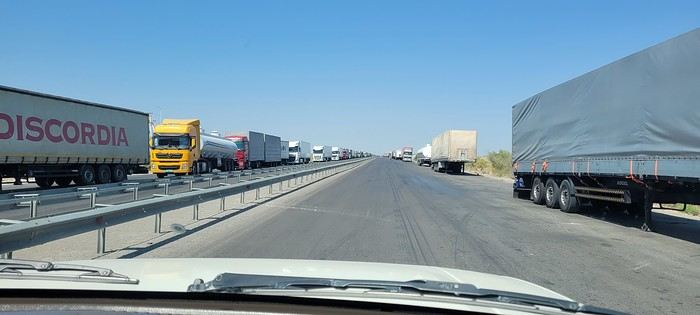
Once on the other side, the first surprise is the brand-new highway all the way to Turkmenabat. A very long line of trucks stretches for several kilometers on the Turkmen side to cross the border into Uzbekistan. According to my guide, Turkmen trucks transport gas and cotton (though not this season, since the harvest is in September), but they mainly fill up their tanks because fuel is much cheaper in Turkmenistan. A full tank for a car costs about 3 €, which is unbeatable.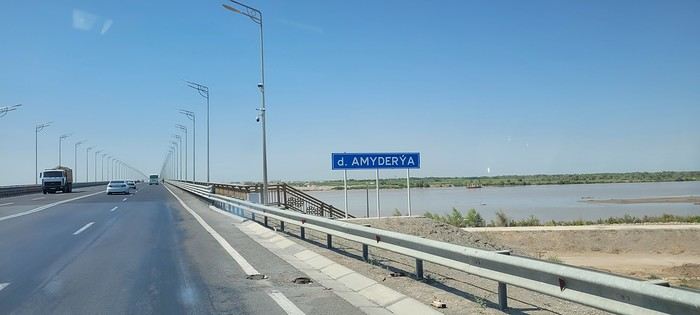
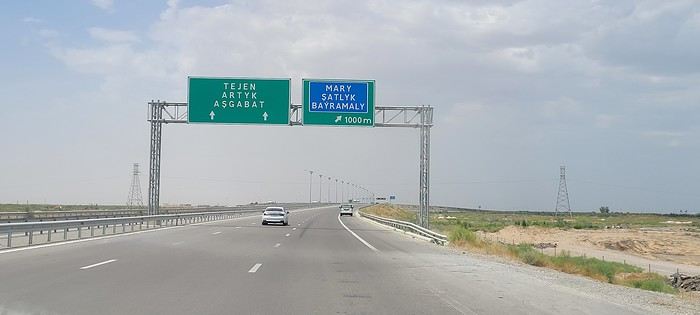
From the Farap border post, the goal is to reach the city of Mary, which is home to the UNESCO-listed site of Merv in its suburbs, about thirty kilometers away. This city is known as a foundation by Alexander the Great in the 4th century BC under the name Alexandria of Margiana. Several fortresses are visible.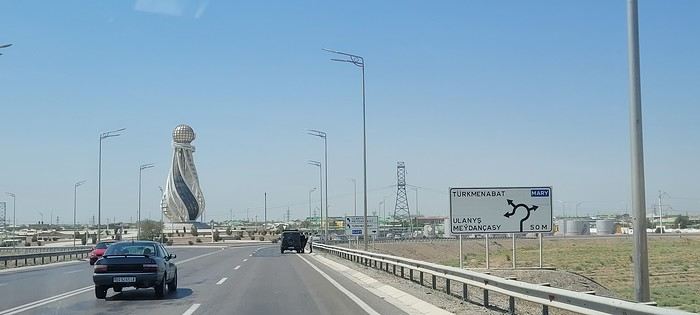
After more than three hours on the road, we have lunch at a Turkish restaurant called Aladdin. Several quotes from the president are visible along the highway, but the road is in good condition, and we move along easily. This will be by far the best road in the country—things will get much worse later.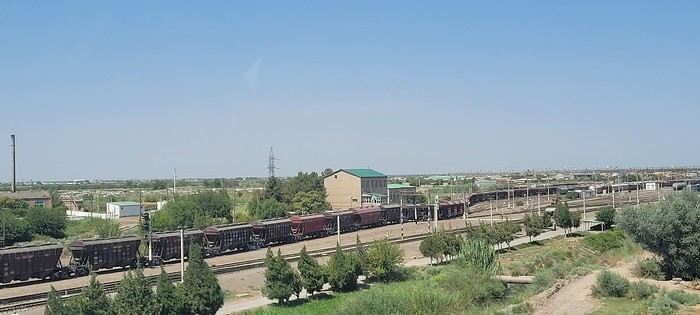
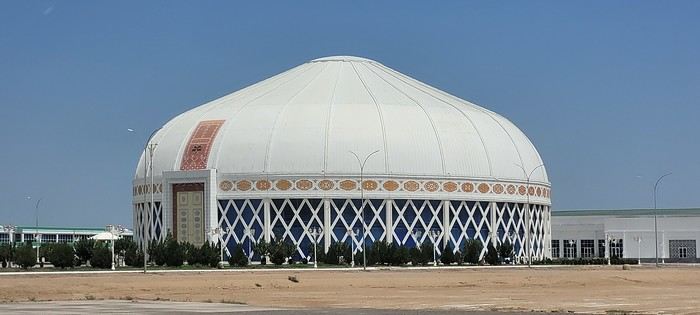
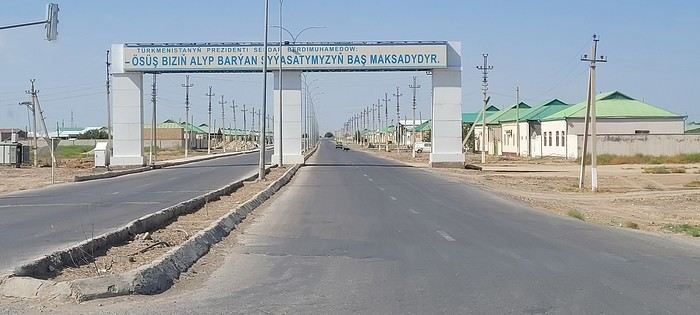
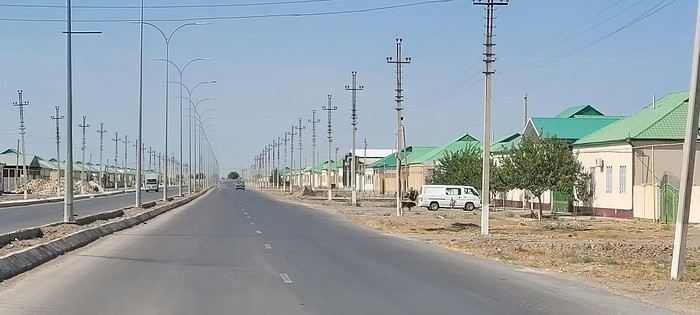 Roundabouts are particularly interesting because they feature emblems of Turkmen culture, like the dog, a carpet, the Ahal Teke horse, or Muslim symbols, even though the presence of Islamic artifacts is quite limited.
This is my first travel journal. If you have any questions, don’t hesitate to ask. The country is slowly opening up, but it’s still possible to visit sites where you’ll be completely alone. In five days, I saw two Hongkongers, a few Germans, and a Chilean at the crater, ten Chinese people in a capital bazaar, and that’s it!
It’s possible to visit Turkmenistan from Uzbekistan. The easiest and most economical way is to take a taxi to the border from Bukhara. The trip takes a little over an hour.
Crossing the border takes quite a while because many Turkmen bring back items bought in Uzbekistan to resell in Turkmenistan. For example, diapers, baby products, or beauty products. It took me over 2.5 hours to cross the border. To visit Turkmenistan, it’s mandatory to have a guide and go through a travel agency. British agencies often offer three-, five-, or seven-day trips for over 1,500 or 2,000 €. But if your budget is more limited, you can contact a few Turkmen agencies directly by email, and they’ll make you an offer between 700 and 1,300 € for three to seven days. I took a five-day trip from Turkmenabat in the northeast of the country to Dashoguz in the north. The goal was to visit the main UNESCO-listed sites, including Merv, and archaeological sites like Nisa or Gonur Tepe.
Your guide will also be your driver. They’ll pick you up at the border. The formalities are very long because customs officers have to stamp multiple documents, and obtaining the visa you previously requested from your travel agency requires several checks. But the process goes relatively smoothly, even if each step takes a while.
Once on the other side, the first surprise is the brand-new highway all the way to Turkmenabat. A very long line of trucks stretches for several kilometers on the Turkmen side to cross the border into Uzbekistan. According to my guide, Turkmen trucks transport gas and cotton (though not this season, since the harvest is in September), but they mainly fill up their tanks because fuel is much cheaper in Turkmenistan. A full tank for a car costs about 3 €, which is unbeatable.
From the Farap border post, the goal is to reach the city of Mary, which is home to the UNESCO-listed site of Merv in its suburbs, about thirty kilometers away. This city is known as a foundation by Alexander the Great in the 4th century BC under the name Alexandria of Margiana. Several fortresses are visible.
After more than three hours on the road, we have lunch at a Turkish restaurant called Aladdin. Several quotes from the president are visible along the highway, but the road is in good condition, and we move along easily. This will be by far the best road in the country—things will get much worse later.
Roundabouts are particularly interesting because they feature emblems of Turkmen culture, like the dog, a carpet, the Ahal Teke horse, or Muslim symbols, even though the presence of Islamic artifacts is quite limited.
Staying in Ella or Haputale?
Hi,
I’m looking for recent opinions on where to stay: Ella or Haputale.
Doesn’t Haputale also have the added advantage of the train?
Thanks for your input!
Draw Me Your Japan...
Hi there!
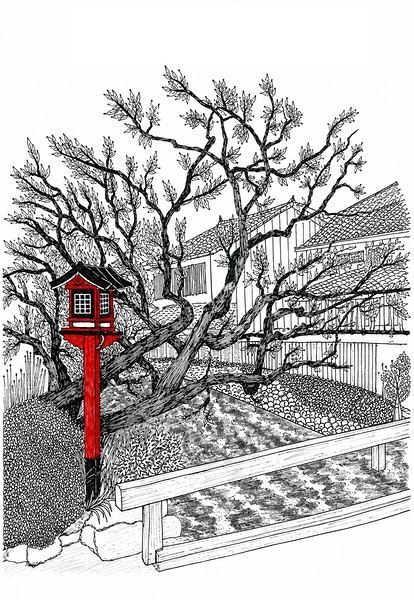 I’m inviting you on a stroll through my drawings—a completely subjective, far from exhaustive, and totally personal take, since it’s based on my own sketches. I put this travel journal together after returning in late 2024, mostly using felt-tip pens and pencils, with a few collages thrown in. I worked from our personal photos.
Let’s start with the shotengai...
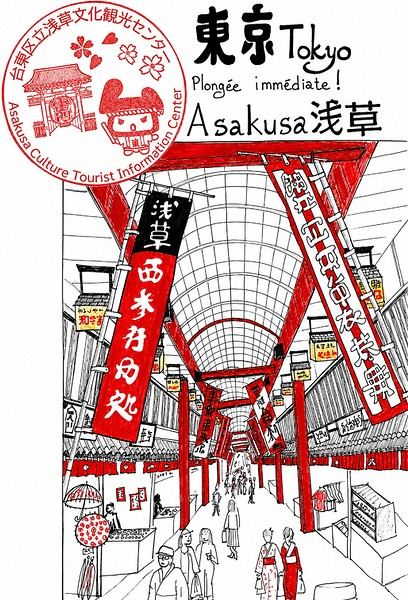
Our first "wow" moment came as we stepped out of the subway in Asakusa, the Tokyo neighborhood where we’d booked our hotel for our first five nights. Exhausted after our long flight, we finally arrived and took an exit that led straight into a shotengai—one of those covered shopping streets that pop up in city centers and flourished between the 1950s and 1980s.
It was an instant aesthetic shock, like a close encounter of the third kind between the modern city, a typical Asian market with its street stalls, the vintage vibe of the arcade, the sheer abundance of goods, and the bustling crowd—a mix of tourists, pilgrims (thanks to nearby Senso-ji Temple), and locals (it’s a very working-class area). In the end, it set the tone for a feeling we’d experience throughout the trip. Wherever we went, shotengai turned out to be fantastic spots for finding little restaurants, shops, or even fresh produce. Some are like real mazes, like in Kyoto, where we spent ages trying to relocate a restaurant we’d loved ;-)
In Kanazawa, the Omicho Market: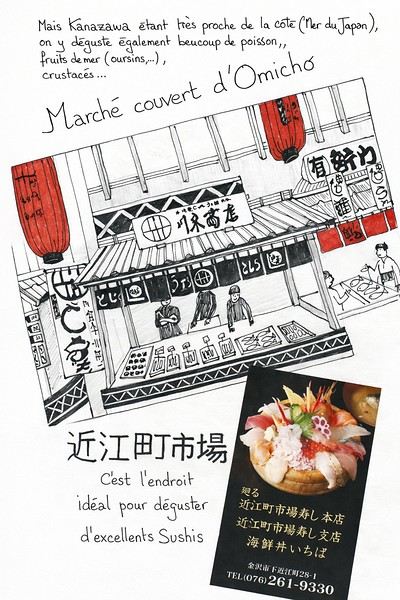 And in Kyoto, Nishiki Market:
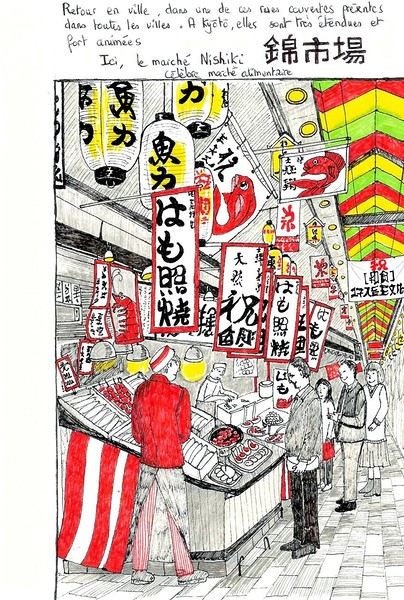
To be continued...
I’m inviting you on a stroll through my drawings—a completely subjective, far from exhaustive, and totally personal take, since it’s based on my own sketches. I put this travel journal together after returning in late 2024, mostly using felt-tip pens and pencils, with a few collages thrown in. I worked from our personal photos.Let’s start with the shotengai...
Our first "wow" moment came as we stepped out of the subway in Asakusa, the Tokyo neighborhood where we’d booked our hotel for our first five nights. Exhausted after our long flight, we finally arrived and took an exit that led straight into a shotengai—one of those covered shopping streets that pop up in city centers and flourished between the 1950s and 1980s.
It was an instant aesthetic shock, like a close encounter of the third kind between the modern city, a typical Asian market with its street stalls, the vintage vibe of the arcade, the sheer abundance of goods, and the bustling crowd—a mix of tourists, pilgrims (thanks to nearby Senso-ji Temple), and locals (it’s a very working-class area). In the end, it set the tone for a feeling we’d experience throughout the trip. Wherever we went, shotengai turned out to be fantastic spots for finding little restaurants, shops, or even fresh produce. Some are like real mazes, like in Kyoto, where we spent ages trying to relocate a restaurant we’d loved ;-)
In Kanazawa, the Omicho Market:
And in Kyoto, Nishiki Market:
To be continued...
Second trip to Curaçao Island
Returning to Curaçao is a bit like reopening a book whose pages still smell of sun and salt.
As soon as the plane descends toward the island, the familiar colors reappear: the dazzling turquoise of the sea, the pastel facades of Willemstad, and that unique light that seems to soften everything.
For this second trip, we no longer arrive as hesitant explorers, but as confirmed lovers of this warm island.
We already know that the warm wind will welcome us as soon as we step out of the airport, that the beaches will once again offer their infinite shades of blue, and that each day will have that unhurried pace that makes you forget the rest of the world.
Yet, despite this sense of déjà vu, Curaçao always manages to surprise. A new cove to discover, a different sunset, a smile shared with a local...
The island has that rare talent for reinventing itself without ever betraying what makes it so endearing.
This second trip isn’t a repetition, then, but a reunion: a chance to rediscover Curaçao with more attentive, more connected, and perhaps even more amazed eyes.
I invite you to keep reading this travel journal and watch the videos that will help you learn a little more about the island’s different attractions.
Just click on the video image to start watching.
To go to a specific post, here are the appropriate links:
Exploring Willemstad’s colorful neighborhoods The Most Beautiful Beaches in Curaçao Hike at Boka Sint Michiel | Flamingos & panoramic views Climbing Christoffel Mountain Den Dunki & Flamingos of Jan Thiel Must-see spots in Curaçao Snorkeling at Playa Kenepa Chiki: Turquoise Water & Tropical Fish Snorkeling at Porto Mari: One of Curaçao’s Best Spots Snorkeling at Mambo Beach, the Perfect Spot Snorkeling at Daaibooi Beach, a diverse marine world
As soon as the plane descends toward the island, the familiar colors reappear: the dazzling turquoise of the sea, the pastel facades of Willemstad, and that unique light that seems to soften everything.
For this second trip, we no longer arrive as hesitant explorers, but as confirmed lovers of this warm island.
We already know that the warm wind will welcome us as soon as we step out of the airport, that the beaches will once again offer their infinite shades of blue, and that each day will have that unhurried pace that makes you forget the rest of the world.
Yet, despite this sense of déjà vu, Curaçao always manages to surprise. A new cove to discover, a different sunset, a smile shared with a local...
The island has that rare talent for reinventing itself without ever betraying what makes it so endearing.
This second trip isn’t a repetition, then, but a reunion: a chance to rediscover Curaçao with more attentive, more connected, and perhaps even more amazed eyes.
I invite you to keep reading this travel journal and watch the videos that will help you learn a little more about the island’s different attractions.
Just click on the video image to start watching.
To go to a specific post, here are the appropriate links:
Exploring Willemstad’s colorful neighborhoods The Most Beautiful Beaches in Curaçao Hike at Boka Sint Michiel | Flamingos & panoramic views Climbing Christoffel Mountain Den Dunki & Flamingos of Jan Thiel Must-see spots in Curaçao Snorkeling at Playa Kenepa Chiki: Turquoise Water & Tropical Fish Snorkeling at Porto Mari: One of Curaçao’s Best Spots Snorkeling at Mambo Beach, the Perfect Spot Snorkeling at Daaibooi Beach, a diverse marine world
June 2026 Theme Thread: Such a Beautiful Landscape
This is where we chat.
Templestay in South Korea
Hi,
While researching South Korea, I came across the term "templestay," which refers to a Korean program that lets you stay in a traditional temple to discover Buddhism and Korean culture by living like the temple residents and doing activities like making lanterns. A templestay isn’t just for foreign tourists—on the booking site, I saw that some temples are more geared toward foreigners, with English-speaking monks.
I was wondering if it’s still worth it, especially in temples where the monks don’t speak English?
While researching South Korea, I came across the term "templestay," which refers to a Korean program that lets you stay in a traditional temple to discover Buddhism and Korean culture by living like the temple residents and doing activities like making lanterns. A templestay isn’t just for foreign tourists—on the booking site, I saw that some temples are more geared toward foreigners, with English-speaking monks.
I was wondering if it’s still worth it, especially in temples where the monks don’t speak English?
A little plea for São Nicolau
Easily accessible from Sal or São Vicente, São Nicolau is the forgotten island of the Barlavento group. With two large villages, volcanoes, jagged peaks, lush valleys, and vast rocky expanses, it has nothing to envy its big sister Santo Antão. It’s slipped under travelers’ radar a bit (in January, there were probably fewer than a hundred European tourists on the whole island), and that’s just fine! Accommodations aren’t overrun by groups like in Santo Antão, and connecting with locals is even easier. But don’t come to São Nicolau for wild nightlife—it’s incredibly peaceful here, and on Sundays, it’s total silence!
A little favorite of mine: Pensão Jardim in Ribeira Brava, the capital; Residencial Palice in Queimadas; and especially Pousada d’Anna in Estância de Brás, where the raging sea crashes against the black lava spurs.
Weather-wise, it was chilly this year but perfect for hiking. If you’re up high (like Monte Gordo), dress warmly or wait for spring! Fog gusts can ground you completely. Trails are generally less marked than in Santo Antão; if you’re wary of apps, you can find a 1:50,000 map at the small travel agency in Tarrafal.
Those who enjoy sharing experiences with other travelers over a Strela or two in the evening might feel a bit frustrated on São Nicolau, but the island’s beauty, the resilience of its farmers in extreme conditions, and the kindness of its people make it a fantastic stop for any visitor to Cape Verde!
A little favorite of mine: Pensão Jardim in Ribeira Brava, the capital; Residencial Palice in Queimadas; and especially Pousada d’Anna in Estância de Brás, where the raging sea crashes against the black lava spurs.
Weather-wise, it was chilly this year but perfect for hiking. If you’re up high (like Monte Gordo), dress warmly or wait for spring! Fog gusts can ground you completely. Trails are generally less marked than in Santo Antão; if you’re wary of apps, you can find a 1:50,000 map at the small travel agency in Tarrafal.
Those who enjoy sharing experiences with other travelers over a Strela or two in the evening might feel a bit frustrated on São Nicolau, but the island’s beauty, the resilience of its farmers in extreme conditions, and the kindness of its people make it a fantastic stop for any visitor to Cape Verde!
Havana, Cuba / January 2026
I got into music with the will
To light up many hearths like Che could do,
To circulate ideas, to advance utopia
Alternating barricades, sharp thought, and poetry.
Mc Solaar, Guérilla
Subscribing without a fight to the slightest line of my itinerary sometimes feels like an illusion. Because there are countries where, despite the fever and enthusiasm, despite the triumphant revolution, certain elements block my path. And if I had planned, for F. and me, a beautiful ascent up Tabouret Hill (Loma del Taburete, 453m), it was without accounting for vegetation as dense as it was thorny, which barred our way after just a few quarters of an hour of walking. Exhausted, I had to face the facts: we wouldn’t go any further. I needed to come up with some kind of Plan B.
But what is this country, an unwitting laboratory of the worst that white civilization has done during its reign? What is this magnificent place—yet another—entrusted to the care of oblivion, just 150 km from the land of freedom? According to Donald Trump, a country supporting terrorism; according to the locals, the vast battlefield of 20th-century ideologies; according to the average tourist, a hot country, a beautiful country, a country where the last illusions of a lost paradise are dying.
On the other side of Havana Bay, we love that statue of Christ blessing the city. There’s something gentle, soothing, in that patriarchal gesture. You’d almost be tempted to forget that at the dawn of the 16th century, those who claimed to represent the Church had no scruples about eradicating the Ciboney and Taíno populations. Worse, you’ll find magnificent this cathedral dedicated to the Virgin Mary, right in the heart of the old city. Under the guise of a civilizing necessity, Havana became, like so many other places, the gilded seat of European pretensions, at the expense of local populations doomed to extermination, then enslaved populations—more or less indigenous—who, you can imagine, didn’t often set foot in this holy place.
Lost in my thoughts, I try to push through this tangled vegetation. Nature reclaims its rights; nature abhors a vacuum. Yes, the well-trodden path of revolution couldn’t stay free of weeds! The road is buried. We give up and turn back, until that fork I’d noted before leaving, which would let us reach the top of the hill by skirting its northern slope.
So the white man arrives, settles, and gets rid of everything that bothers him. He has two unstoppable forces at his disposal: gunpowder and the spiritual certainty of being on the side of an all-powerful god. While the first gives him an unmatched material advantage over his new enemy, the second lets him use the first without feeling too guilty. That’s the magic of this supreme Church: it condemns all forms of pleasure—calling them impurity—while promoting plunder and crime under the cover of evangelization.
Walking through the city, you find a bit of Algiers, except that here, the decay is almost irreversible. You feel the splendor of the past, a disconcerting image of all vanity, from an era when men knew how to build beauty—especially if they didn’t have to share it. We’ll debate the benefits of colonialism for a long time, while glossing over the fact that those benefits often stopped at the city limits, limits all too obvious to the indigenous people. Havana isn’t just one or a few buildings; it’s an impressive collection of works of art built one after another, in what I think was a spirit of healthy competition. Yes, you find Algiers in this exuberance. As if these distant cities were the receptacle of everything that was best in the lands of origin. Atlantes and lintels, golds, blues, ogives, and monumental windows—exceptional architecture in an exceptional place.
Some streets are clean, swept with care; others are not, scattered here and there with potholes filled with water. A rather persistent smell of urine invades us regularly. We move on. And we look up: Havana is visited with your nose in the air. Because the beauty is truly up there, on those magnificent balconies and terracotta arches. Also because it’s not impossible that a piece of that balcony might suddenly detach, hurling our ends into an overseas tragedy we’d rather avoid. On the ground, here and there, rubble. Inexorably, this city is returning to dust.
My Plan B turns out to be no more successful than the first attempt. After a cheerful progression of a few hundred meters, same outcome, same struggle—the vegetation opposes any revolution: impossible to go around the hill! Once again, we have to turn back. We’ll try Plan C. I reassure myself by convincing myself to stay in the logic of this country: Cuba has been searching for itself for five centuries.
Coffee, tobacco, and sugarcane—the green gold of the colonies—so that money could flow and Europe could enjoy itself. Cuba’s history isn’t original. In reality, all the hot lands at these latitudes suffer the same fate: to serve the white man. While waiting for the awakening of consciences, UN Resolution 1514 and more or less affirmed revolutionary desires. Except that—and this reflection is just my own—if the awakening of consciences and the revolutionary will don’t play into what Resolution 1514 hides, there’s a good chance the said state will become a pariah. Those who don’t follow the American doctrine risk a lot; those who decide to follow Moscow risk everything. Independence was only the barely discreet instrument of American views. Patrice Lumumba will gladly enlighten us on the subject.
Turning back is good. Setting up Plan C is better. I won’t deviate from my goal: we will reach the top of Tabouret, whatever the cost! Near a small country road, I hesitate to change the program. Time is ticking—is it really reasonable to attempt the ascent? Then a tricycle taxi appears, a kind of tuk-tuk powered by an electric moped. I take it as a sign from fate, and we board for the starting point of Plan C.
In Cuba, even before Resolution 1514, independence was assured by a pawn of the United States, Fulgencio Batista. There’s no need to go over the whole history here; we’ll just remember that if you know how to give without counting to your former masters, you can enjoy a facade of freedom. Fidel Castro, on the other hand, didn’t know how to give. It never even occurred to him. That’s why the United States harbors such terrible hatred for this rebellious state, opposed to capitalist values and political prostitution. From there to slowly killing its people for nearly seventy years, one can legitimately cry injustice. But there are other priorities. Oh yes! Greenland...
Do Cubans eat their fill? Does seeing overweight people mean opulence? Food grows, no doubt about it. The soil is fertile, the climate favorable. No, what shocks here is the absolute precarity, the feeling of a people living in survival mode, and the decay of both goods and hope. Where to go? What’s the point? The stubbornness of the United States in wanting to impose its views on the Cuban government is felt much more by an overwhelmed people than by those few elites—caricatures of communism—who instill their vision of happiness with a crowbar. The embargo imposed in 1960; the false-flag attacks—American planes flying the colors of the Cuban revolution during the Bay of Pigs invasion in 1961—the exasperation of placing Cuba on the list of countries supporting terrorism. More recently, Donald Trump decided to heavily tax countries supplying Cuba with fuel. The last time I saw such long lines near gas stations was during my first trip to Romania... in 1991. It’s not for me to judge whether Raúl and his clique are playing fair by thumbing their noses at the West. I don’t hold the ins and outs of this war of egos that keeps the world’s great powers awake. I only caught a glimpse of the poverty of an island in 2026, while we in Europe are buried under an avalanche of the useless and superficial.
At the start of the San Juan baths, we find the trailhead. It climbs steeply. But the weather is relatively mild, thanks to a cold wave hitting higher up in the United States. Dallas is under snow; we’re walking in 16°C, a stroke of luck. We climb over rocks, under fairly decent vegetation, sometimes low but passable. And we succeed in the ascent in an hour. Up there, the top of the hill is somewhat maintained, at a minimum, but maintained, as if to honor Che through an awful monument erected in his glory—a stubborn specimen from those years when good taste was inversely proportional to the delusional ideas of those being honored. Birds of prey (raptors?) circle overhead; the monument is dying, crumbling, falling into ruin. *Hasta siempre*—forever—will be for the words. Nature, erosion, life itself will have the last word over all revolutions.
Back at the foot of the hill, just before a memorable swim, we talk with a family living there in miserable shacks whose stability wasn’t unlike that of the Leaning Tower of Pisa. The grandmother holds an animal, a rodent, by its feet. The grandfather has just killed it; she’s plucking its fur. A few steps away, water boils in a pot. She plunges the beast into the container. Tonight, the family will eat ragondin stew. Further on, another shack where, in a disorder rivaling the filth, a mother breastfeeds while sitting on the edge of a bed. Then, on the way down, we’ll meet a middle-aged man carrying a large jerrycan of water on his shoulder. Are these people happy here, far from the cities and their stakes? Is it too much to ask that they at least have access to electricity, running water, and decent, safe housing?
Outside the old city, Havana reveals wide avenues serving imposing institutions here and there. But whether in the colorful alleys of the old town or on the majestic and austere Plaza de la Revolución, the same feeling moves me: sadness. Seeing that only chaos has come from ideas crushes me. We praise, we sing the revolution—above all, we impose it in people’s minds as a necessity, when it’s nothing of the sort. Revolution is just the fruit of a few tortured minds who, once in power, do nothing better than all those before them. Enjoy power. Impose their views. It’s just a matter of color. Fidel saw red and knew how to persuade—or silence forever—his many detractors. The West sees everything in white, through the prism of human rights, and also knows how to persuade and silence its slightest detractors forever.
Paradoxically, Cuba survives largely thanks to tourism, a key element—let’s not be afraid to say it—of capitalism. And when a few players pick up the crumbs from transactions, the lion’s share and the foreign currency go to the government. So we won’t go to Varadero, the high place of relaxation overrun by Canadians. Instead, we’ll limit ourselves to crossing the ocean 30 minutes from the capital, at Santa María del Mar, to get an idea of cheaper tourism and to splash around for a few minutes in turquoise water invaded by sargassum. At the heart of the tourist season, we’ll meet few people. Like Havana, and according to its inhabitants, the high season is rather dead. But we won’t have come for nothing: we particularly love this return where, feverish, the taxi driver pushes his Moskvitch 2140 to the max on the highway, singing karaoke versions of hits at the top of his lungs from an onboard DVD player. East/West, the culture clash with a hint of Latino.
It’s time to leave this country of resourcefulness where extremes are very present. We’re leaving a 5-star hotel in front of yet another crumbling building. We’ve known restaurants at 40,000 pesos while in the street people eat for 400. We’ve seen those countless cars from another era and another culture—Pontiac, Lada, Chevrolet, Moskvitch—being overtaken by gleaming Mercedes and other Porsche Cayennes, the prerogative—if it still needed to be demonstrated—of the newly rich in search of recognition. Boarding the plane, we also understand that we’re not just traveling with tourists: there’s undoubtedly a rich and prosperous diaspora, just as there are relatively wealthy Cubans—well, wealthy enough to travel comfortably in the front of the aircraft. Meanwhile, on all the country’s roads, other Cubans try hitchhiking, their wives and children perched on a suitcase by the roadside. The father holds out his arm and holds a few bills in his hand like a card game. Where are they going? Who will pick them up?
Behind me, the gold of the Capitol. I’m told this gold comes from Russia. Like Marx and Lenin’s smoky theories? Like Stalin’s subtle and delicate paternalism? Let’s bet that, like the other buildings crumbling around it, the Capitol will also collapse one day, to avenge the Indians who perished from the diseases and guns of the whites, to avenge the Africans who obliterated their lives so Europeans could enjoy themselves, finally, to avenge all this abandoned people, left to the arbitrariness of democratic or non-democratic elections.
A sign in the street: We understand history. This is the revolution! We understand history. That’s the revolution.
No comment.
Subscribing without a fight to the slightest line of my itinerary sometimes feels like an illusion. Because there are countries where, despite the fever and enthusiasm, despite the triumphant revolution, certain elements block my path. And if I had planned, for F. and me, a beautiful ascent up Tabouret Hill (Loma del Taburete, 453m), it was without accounting for vegetation as dense as it was thorny, which barred our way after just a few quarters of an hour of walking. Exhausted, I had to face the facts: we wouldn’t go any further. I needed to come up with some kind of Plan B.
But what is this country, an unwitting laboratory of the worst that white civilization has done during its reign? What is this magnificent place—yet another—entrusted to the care of oblivion, just 150 km from the land of freedom? According to Donald Trump, a country supporting terrorism; according to the locals, the vast battlefield of 20th-century ideologies; according to the average tourist, a hot country, a beautiful country, a country where the last illusions of a lost paradise are dying.
On the other side of Havana Bay, we love that statue of Christ blessing the city. There’s something gentle, soothing, in that patriarchal gesture. You’d almost be tempted to forget that at the dawn of the 16th century, those who claimed to represent the Church had no scruples about eradicating the Ciboney and Taíno populations. Worse, you’ll find magnificent this cathedral dedicated to the Virgin Mary, right in the heart of the old city. Under the guise of a civilizing necessity, Havana became, like so many other places, the gilded seat of European pretensions, at the expense of local populations doomed to extermination, then enslaved populations—more or less indigenous—who, you can imagine, didn’t often set foot in this holy place.
Lost in my thoughts, I try to push through this tangled vegetation. Nature reclaims its rights; nature abhors a vacuum. Yes, the well-trodden path of revolution couldn’t stay free of weeds! The road is buried. We give up and turn back, until that fork I’d noted before leaving, which would let us reach the top of the hill by skirting its northern slope.
So the white man arrives, settles, and gets rid of everything that bothers him. He has two unstoppable forces at his disposal: gunpowder and the spiritual certainty of being on the side of an all-powerful god. While the first gives him an unmatched material advantage over his new enemy, the second lets him use the first without feeling too guilty. That’s the magic of this supreme Church: it condemns all forms of pleasure—calling them impurity—while promoting plunder and crime under the cover of evangelization.
Walking through the city, you find a bit of Algiers, except that here, the decay is almost irreversible. You feel the splendor of the past, a disconcerting image of all vanity, from an era when men knew how to build beauty—especially if they didn’t have to share it. We’ll debate the benefits of colonialism for a long time, while glossing over the fact that those benefits often stopped at the city limits, limits all too obvious to the indigenous people. Havana isn’t just one or a few buildings; it’s an impressive collection of works of art built one after another, in what I think was a spirit of healthy competition. Yes, you find Algiers in this exuberance. As if these distant cities were the receptacle of everything that was best in the lands of origin. Atlantes and lintels, golds, blues, ogives, and monumental windows—exceptional architecture in an exceptional place.
Some streets are clean, swept with care; others are not, scattered here and there with potholes filled with water. A rather persistent smell of urine invades us regularly. We move on. And we look up: Havana is visited with your nose in the air. Because the beauty is truly up there, on those magnificent balconies and terracotta arches. Also because it’s not impossible that a piece of that balcony might suddenly detach, hurling our ends into an overseas tragedy we’d rather avoid. On the ground, here and there, rubble. Inexorably, this city is returning to dust.
My Plan B turns out to be no more successful than the first attempt. After a cheerful progression of a few hundred meters, same outcome, same struggle—the vegetation opposes any revolution: impossible to go around the hill! Once again, we have to turn back. We’ll try Plan C. I reassure myself by convincing myself to stay in the logic of this country: Cuba has been searching for itself for five centuries.
Coffee, tobacco, and sugarcane—the green gold of the colonies—so that money could flow and Europe could enjoy itself. Cuba’s history isn’t original. In reality, all the hot lands at these latitudes suffer the same fate: to serve the white man. While waiting for the awakening of consciences, UN Resolution 1514 and more or less affirmed revolutionary desires. Except that—and this reflection is just my own—if the awakening of consciences and the revolutionary will don’t play into what Resolution 1514 hides, there’s a good chance the said state will become a pariah. Those who don’t follow the American doctrine risk a lot; those who decide to follow Moscow risk everything. Independence was only the barely discreet instrument of American views. Patrice Lumumba will gladly enlighten us on the subject.
Turning back is good. Setting up Plan C is better. I won’t deviate from my goal: we will reach the top of Tabouret, whatever the cost! Near a small country road, I hesitate to change the program. Time is ticking—is it really reasonable to attempt the ascent? Then a tricycle taxi appears, a kind of tuk-tuk powered by an electric moped. I take it as a sign from fate, and we board for the starting point of Plan C.
In Cuba, even before Resolution 1514, independence was assured by a pawn of the United States, Fulgencio Batista. There’s no need to go over the whole history here; we’ll just remember that if you know how to give without counting to your former masters, you can enjoy a facade of freedom. Fidel Castro, on the other hand, didn’t know how to give. It never even occurred to him. That’s why the United States harbors such terrible hatred for this rebellious state, opposed to capitalist values and political prostitution. From there to slowly killing its people for nearly seventy years, one can legitimately cry injustice. But there are other priorities. Oh yes! Greenland...
Do Cubans eat their fill? Does seeing overweight people mean opulence? Food grows, no doubt about it. The soil is fertile, the climate favorable. No, what shocks here is the absolute precarity, the feeling of a people living in survival mode, and the decay of both goods and hope. Where to go? What’s the point? The stubbornness of the United States in wanting to impose its views on the Cuban government is felt much more by an overwhelmed people than by those few elites—caricatures of communism—who instill their vision of happiness with a crowbar. The embargo imposed in 1960; the false-flag attacks—American planes flying the colors of the Cuban revolution during the Bay of Pigs invasion in 1961—the exasperation of placing Cuba on the list of countries supporting terrorism. More recently, Donald Trump decided to heavily tax countries supplying Cuba with fuel. The last time I saw such long lines near gas stations was during my first trip to Romania... in 1991. It’s not for me to judge whether Raúl and his clique are playing fair by thumbing their noses at the West. I don’t hold the ins and outs of this war of egos that keeps the world’s great powers awake. I only caught a glimpse of the poverty of an island in 2026, while we in Europe are buried under an avalanche of the useless and superficial.
At the start of the San Juan baths, we find the trailhead. It climbs steeply. But the weather is relatively mild, thanks to a cold wave hitting higher up in the United States. Dallas is under snow; we’re walking in 16°C, a stroke of luck. We climb over rocks, under fairly decent vegetation, sometimes low but passable. And we succeed in the ascent in an hour. Up there, the top of the hill is somewhat maintained, at a minimum, but maintained, as if to honor Che through an awful monument erected in his glory—a stubborn specimen from those years when good taste was inversely proportional to the delusional ideas of those being honored. Birds of prey (raptors?) circle overhead; the monument is dying, crumbling, falling into ruin. *Hasta siempre*—forever—will be for the words. Nature, erosion, life itself will have the last word over all revolutions.
Back at the foot of the hill, just before a memorable swim, we talk with a family living there in miserable shacks whose stability wasn’t unlike that of the Leaning Tower of Pisa. The grandmother holds an animal, a rodent, by its feet. The grandfather has just killed it; she’s plucking its fur. A few steps away, water boils in a pot. She plunges the beast into the container. Tonight, the family will eat ragondin stew. Further on, another shack where, in a disorder rivaling the filth, a mother breastfeeds while sitting on the edge of a bed. Then, on the way down, we’ll meet a middle-aged man carrying a large jerrycan of water on his shoulder. Are these people happy here, far from the cities and their stakes? Is it too much to ask that they at least have access to electricity, running water, and decent, safe housing?
Outside the old city, Havana reveals wide avenues serving imposing institutions here and there. But whether in the colorful alleys of the old town or on the majestic and austere Plaza de la Revolución, the same feeling moves me: sadness. Seeing that only chaos has come from ideas crushes me. We praise, we sing the revolution—above all, we impose it in people’s minds as a necessity, when it’s nothing of the sort. Revolution is just the fruit of a few tortured minds who, once in power, do nothing better than all those before them. Enjoy power. Impose their views. It’s just a matter of color. Fidel saw red and knew how to persuade—or silence forever—his many detractors. The West sees everything in white, through the prism of human rights, and also knows how to persuade and silence its slightest detractors forever.
Paradoxically, Cuba survives largely thanks to tourism, a key element—let’s not be afraid to say it—of capitalism. And when a few players pick up the crumbs from transactions, the lion’s share and the foreign currency go to the government. So we won’t go to Varadero, the high place of relaxation overrun by Canadians. Instead, we’ll limit ourselves to crossing the ocean 30 minutes from the capital, at Santa María del Mar, to get an idea of cheaper tourism and to splash around for a few minutes in turquoise water invaded by sargassum. At the heart of the tourist season, we’ll meet few people. Like Havana, and according to its inhabitants, the high season is rather dead. But we won’t have come for nothing: we particularly love this return where, feverish, the taxi driver pushes his Moskvitch 2140 to the max on the highway, singing karaoke versions of hits at the top of his lungs from an onboard DVD player. East/West, the culture clash with a hint of Latino.
It’s time to leave this country of resourcefulness where extremes are very present. We’re leaving a 5-star hotel in front of yet another crumbling building. We’ve known restaurants at 40,000 pesos while in the street people eat for 400. We’ve seen those countless cars from another era and another culture—Pontiac, Lada, Chevrolet, Moskvitch—being overtaken by gleaming Mercedes and other Porsche Cayennes, the prerogative—if it still needed to be demonstrated—of the newly rich in search of recognition. Boarding the plane, we also understand that we’re not just traveling with tourists: there’s undoubtedly a rich and prosperous diaspora, just as there are relatively wealthy Cubans—well, wealthy enough to travel comfortably in the front of the aircraft. Meanwhile, on all the country’s roads, other Cubans try hitchhiking, their wives and children perched on a suitcase by the roadside. The father holds out his arm and holds a few bills in his hand like a card game. Where are they going? Who will pick them up?
Behind me, the gold of the Capitol. I’m told this gold comes from Russia. Like Marx and Lenin’s smoky theories? Like Stalin’s subtle and delicate paternalism? Let’s bet that, like the other buildings crumbling around it, the Capitol will also collapse one day, to avenge the Indians who perished from the diseases and guns of the whites, to avenge the Africans who obliterated their lives so Europeans could enjoy themselves, finally, to avenge all this abandoned people, left to the arbitrariness of democratic or non-democratic elections.
A sign in the street: We understand history. This is the revolution! We understand history. That’s the revolution.
No comment.
Condition of the Passa Pais cycle path
I'm planning a 3-day weekend with my wife on this cycle path. The articles about this route are old, so if anyone has traveled it recently and can give me an update on its condition, that'd be great. We're riding 1994 ROCKRIDER 340 mountain bikes but with 1.5-inch tires suited for road touring—will that work, or should I switch back to MTB tires? Thanks for your replies!
A bit disappointed with the forum's revival—there isn’t much activity or shared travel stories anymore.
A bit disappointed with the forum's revival—there isn’t much activity or shared travel stories anymore.
Hesitating between Crete or Menorca
Hi! We’d like to go away for 10 days around May 15th, either to Menorca or Crete—we don’t know either place. We love hiking, unspoiled nature, good food, swimming, and, if possible, avoiding crowds. We enjoy getting off the beaten track. Menorca seems ideal because it’s not far by plane from Lyon, but if Crete is really wilder and more beautiful in terms of landscapes, we can add an extra hour of flight time. Can you help us out? Thanks!
Thailand via Kuala Lumpur
Here’s my account of our trip to Thailand with my partner from November 22 to December 5, 2025.
First off, I’d like to wish all Voyageforum.com users a very happy 2026, full of happiness and amazing discoveries on your travels!
It’s thanks to the tips I gathered on this site that I planned the trip.
We traveled with Malaysia Airlines (the flight price was great, but no movies in French, not even subtitled) because we wanted to explore Kuala Lumpur and visit southern Thailand.
Our departure from Roissy was delayed because the plane had to go through the robotic de-icing trucks—pretty impressive!
After a 12-hour flight, we arrived at the beautiful Kuala Lumpur airport around 7 AM.
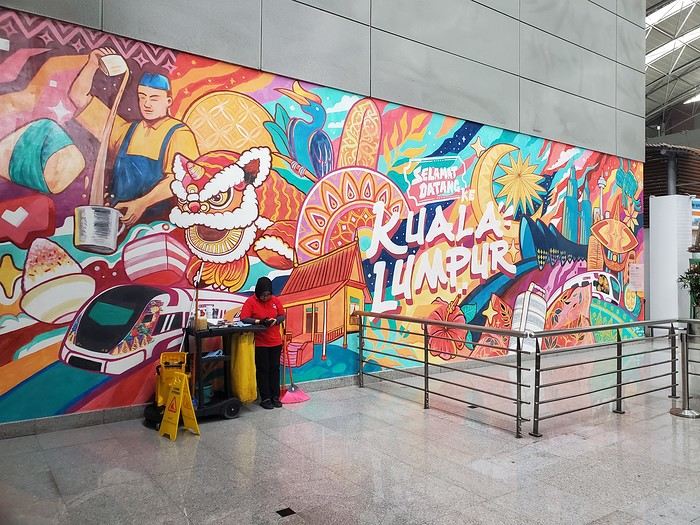
Don’t forget to fill out the immigration form requested by Malaysia 3 days before arrival. We left without any issues and took the Klia Ekspress train to KL Sentral station (30 minutes, 10 €). We’d booked accommodation in a tower near the station and had to communicate with the landlord to get the keys. But while we thought there’d be Wi-Fi at the station, there wasn’t—we asked the tourism office, and they said there wasn’t any. We didn’t want to buy a local SIM card since we were leaving the next day. Eventually, we went to a Starbucks to get online, but just as we decided to head to our place, a torrential downpour hit, and we couldn’t find a sidewalk to reach our destination. We went back to the station, took the elevated metro, and finally made it to our landlord and the room on the 45th floor.
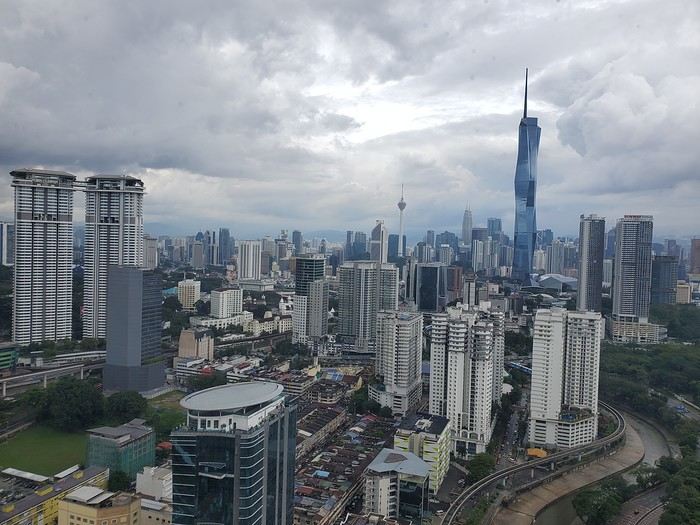
Don’t forget to fill out the immigration form requested by Malaysia 3 days before arrival. We left without any issues and took the Klia Ekspress train to KL Sentral station (30 minutes, 10 €). We’d booked accommodation in a tower near the station and had to communicate with the landlord to get the keys. But while we thought there’d be Wi-Fi at the station, there wasn’t—we asked the tourism office, and they said there wasn’t any. We didn’t want to buy a local SIM card since we were leaving the next day. Eventually, we went to a Starbucks to get online, but just as we decided to head to our place, a torrential downpour hit, and we couldn’t find a sidewalk to reach our destination. We went back to the station, took the elevated metro, and finally made it to our landlord and the room on the 45th floor.
EBC trek early April: should we book lodges in advance?
Hi everyone,
We’re a group of 5 heading to the Everest Base Camp trek in early April. We won’t have a porter or guide—we’re used to hiking independently and have already done the Langtang trek and the Annapurna Circuit (back in 2003!).
I’d love to know if it’s necessary to book lodges in advance or if we’ll easily find availability during this busy season. Also, will we find lodges all along the route between the main stopover villages, or only in those villages? I remember there were plenty everywhere on the Annapurna Circuit. We want to stay as flexible as possible.
Thanks for your feedback!
We’re a group of 5 heading to the Everest Base Camp trek in early April. We won’t have a porter or guide—we’re used to hiking independently and have already done the Langtang trek and the Annapurna Circuit (back in 2003!).
I’d love to know if it’s necessary to book lodges in advance or if we’ll easily find availability during this busy season. Also, will we find lodges all along the route between the main stopover villages, or only in those villages? I remember there were plenty everywhere on the Annapurna Circuit. We want to stay as flexible as possible.
Thanks for your feedback!
Martine from DD in Arizona and New Mexico
Good evening everyone! 🙂
We’re back from our September 2025 road trip, this time to explore Arizona and New Mexico, and it’s time for me to start my travel journal—especially since everything’s already booked for another trip in September 2026 (to California), and I need to get started on the planning.
I was a little worried this new visit to Uncle Sam’s country might not be as "wow" as the others, but we still discovered some incredible places.
For those who don’t know us, we’re a couple in our seventies who speak very little English, but that didn’t stop us from fully enjoying our stay.
For this 6th road trip in the U.S., we spent 21 nights there, drove 4,160 km by car, and walked nearly 160 km in a loop starting from Phoenix.
We’d been to Arizona before (but not this side) and never to New Mexico. This whole road trip was a huge discovery for us.
In the prices mentioned (some in euros, others in dollars), bank fees and exchange charges are included. The flights, car rental, and parking were all paid for in December 2024 when we booked.
We’d downloaded the MPC (Mobile Passport Control) app, but there wasn’t a dedicated line at Phoenix Airport. Still, we got through quickly with friendly, smiling agents.
I don’t drive at all (I hate it), so the stops were chosen based on activities but also, for some, to limit daily mileage for the sole driver. The kilometers listed in the itinerary are the daily distances.
We traveled from September 9th to 22nd, unfortunately once again without our dear friends Mimi and Maumau.
The itinerary
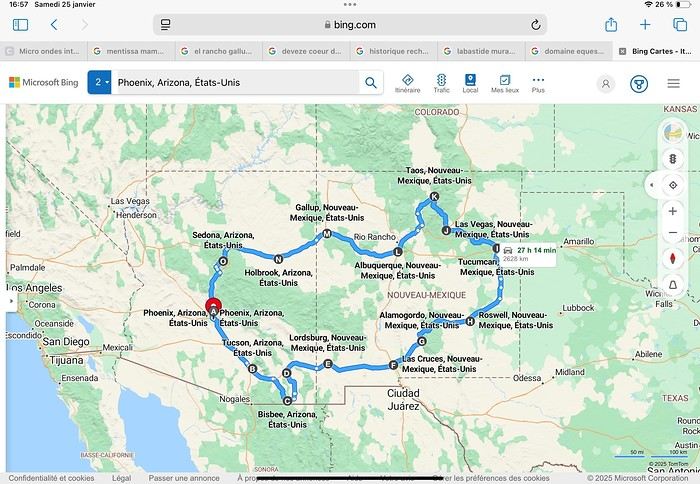
Day 1: Flight Marseille-Paris-Phoenix, then Gold Canyon (133 km) Day 2: Tucson (271 km) Lost Dutchman State Park Day 3: Tucson (155 km) Day 4: Tucson (34 km) Day 5: Bisbee (182 km) Day 6: Lordsburg (345 km) Day 7: Las Cruces (253 km) Day 8: Alamogordo (162 km) Day 9: Roswell (264 km) Day 10: Tucumcari (369 km) Day 11: Las Vegas (281 km) – the one in New Mexico Day 12: Taos (213 km) Day 13: Santa Fe (224 km) Day 14: Albuquerque (123 km) Day 15: Gallup (246 km) Day 16: Holbrook (224 km) Day 17: Flagstaff (179 km) Day 18: Sedona (118 km) Day 19: Sedona (48 km) Day 20: Sedona (41 km) Day 21: Phoenix (256 km) Day 22: Phoenix Airport (35 km)
📊 **Budget**: A little over 7,500 € for both of us, all included. The exchange rate was in our favor (1.17 dollars to 1 €). 📊 **Flights**: Marseille-Paris Charles de Gaulle-Phoenix: 1,787 € for two, with one checked bag each (Air France) 📊 **ESTA**: $42 📊 **America the Beautiful Pass**: $80 📊 **Parking**: 134 € (super eco at Marseille) 📊 **Car rental (Hertz)**: 865 €. Since there were no SUVs left in the reserved category (Nissan Rogue), we got an upgrade (4x4 Ford Explorer). We booked through Air France (15% discount). We’d originally reserved it in December for 1,140 €, but since prices dropped in March, we canceled and rebooked for 865 €. Hertz offers a free Hertz Gold Plus Rewards program, which gives you priority counter service when picking up the car. 📊 **Accommodation**: 2,400 € We stayed in hotels and motels of varying standards (from 60 to 203 € per night, depending on the city), all booked through Booking.com or Hotels.com. Out of 21 nights, only two didn’t include breakfast in the price. Booking.com sometimes offers slightly cheaper rates if you book by phone using the mobile app, and our Genius 3 status on the site also got us some preferential rates. 📊 **Supplementary insurance**: AVA 200 € for medical care if needed 📊 **Cash**: $2,078. We left with 1,000 € exchanged before departure and made two withdrawals of $500. This cash covered: - Evening restaurants and tips - Midday picnics - Gas: $298 for 4,160 km - Museum and private park entries (per person): - Lost Dutchman: $10 - Arizona-Sonora Desert Museum: $28 - Bird Cage Theater: $16 - Tombstone Shootout: $8 - New Mexico Farm & Ranch Museum: $12 - Roswell International UFO Museum: $5 - Billy the Kid Museum: $7 - Rancho de Taos: $22 - West Fork Oak Creek Trail entry: $15 We got a few discounts thanks to our senior age (+65). - Souvenirs and little treats
Like on our previous road trips, we didn’t rent a GPS. We got around using offline GPS apps Here WeGo and Organic Maps, with maps of the states we visited downloaded before we left (on our phones).
❤️❤️❤️ **Highlights** (there are so many!) 📍 Goldfield Ghost Town (even if it’s a reconstruction) 📍 The standing army of Saguaro cacti at Saguaro National Park West 📍 Diving into the cowboy universe of Tombstone 📍 The welcome from Rick and Henry at our guesthouse in Bisbee (Garden at Mile High Ranch) 📍 The tangled rocks of Chiricahua National Monument 📍 The flavored pistachios from Dwayne’s Fresh Jerky and Mac Ginnis Pistachioland 📍 Restaurants: La Posta (Las Cruces), Diner 66 (Albuquerque), and the Haunted Hamburger (Jerome) 📍 The old plazas of New Mexico 📍 The solitude and beauty of the white dunes at White Sands National Park 📍 Stepping back in time at the Billy the Kid Museum (Fort Stanton) 📍 Sections of historic Route 66 and the old motels of Tucumcari, especially at night when all the neon lights are on 📍 Taos Pueblo and diving into Native American culture 📍 After the Rio Grande Bridge, the descent via NM 567 to the very bottom of the Rio Grande Gorge, then the road along the riverbanks to Taos 📍 The tranquility of the Chimayo Sanctuary 📍 Discovering the ingenious native dwellings at Bandelier National Monument and Walnut Canyon National Park 📍 The small towns along the Turquoise Trail 📍 The red rocks of Red Rock Park and the Painted Desert 📍 The extraordinary colors of the petrified trees at Petrified Forest National Park 📍 Sedona, its red rocks, and the reward of the viewpoints at the end of hikes (Devil’s Bridge, The Subway, and West Fork Oak Creek) 📍 The immersion in Mexico when visiting Tlaquepaque 📍 The almost-ghost town of Jerome and its terraced streets 📍 The incredible kindness of Americans, always ready to help and up for a chat ❤️
☹️☹️☹️ **Flops** (there are very few) 📍 Several museums and churches being closed, so we couldn’t visit them 📍 Some museums and visitor centers opening late (10 AM) and closing early (4 PM) 📍 A 64 € phone roaming charge because we got near the Mexican border and picked up their cell tower 📍 The outrageous price ($5.99) for a gallon of gas at the Shell near Phoenix Airport
I hope this helps! Anyway, thanks for reading my long post. Don’t hesitate to reach out, even via PM, if you see I haven’t replied and you’d like more details. Have a great evening, everyone! 🙂
We’re back from our September 2025 road trip, this time to explore Arizona and New Mexico, and it’s time for me to start my travel journal—especially since everything’s already booked for another trip in September 2026 (to California), and I need to get started on the planning.
I was a little worried this new visit to Uncle Sam’s country might not be as "wow" as the others, but we still discovered some incredible places.
For those who don’t know us, we’re a couple in our seventies who speak very little English, but that didn’t stop us from fully enjoying our stay.
For this 6th road trip in the U.S., we spent 21 nights there, drove 4,160 km by car, and walked nearly 160 km in a loop starting from Phoenix.
We’d been to Arizona before (but not this side) and never to New Mexico. This whole road trip was a huge discovery for us.
In the prices mentioned (some in euros, others in dollars), bank fees and exchange charges are included. The flights, car rental, and parking were all paid for in December 2024 when we booked.
We’d downloaded the MPC (Mobile Passport Control) app, but there wasn’t a dedicated line at Phoenix Airport. Still, we got through quickly with friendly, smiling agents.
I don’t drive at all (I hate it), so the stops were chosen based on activities but also, for some, to limit daily mileage for the sole driver. The kilometers listed in the itinerary are the daily distances.
We traveled from September 9th to 22nd, unfortunately once again without our dear friends Mimi and Maumau.
The itinerary
Day 1: Flight Marseille-Paris-Phoenix, then Gold Canyon (133 km) Day 2: Tucson (271 km) Lost Dutchman State Park Day 3: Tucson (155 km) Day 4: Tucson (34 km) Day 5: Bisbee (182 km) Day 6: Lordsburg (345 km) Day 7: Las Cruces (253 km) Day 8: Alamogordo (162 km) Day 9: Roswell (264 km) Day 10: Tucumcari (369 km) Day 11: Las Vegas (281 km) – the one in New Mexico Day 12: Taos (213 km) Day 13: Santa Fe (224 km) Day 14: Albuquerque (123 km) Day 15: Gallup (246 km) Day 16: Holbrook (224 km) Day 17: Flagstaff (179 km) Day 18: Sedona (118 km) Day 19: Sedona (48 km) Day 20: Sedona (41 km) Day 21: Phoenix (256 km) Day 22: Phoenix Airport (35 km)
📊 **Budget**: A little over 7,500 € for both of us, all included. The exchange rate was in our favor (1.17 dollars to 1 €). 📊 **Flights**: Marseille-Paris Charles de Gaulle-Phoenix: 1,787 € for two, with one checked bag each (Air France) 📊 **ESTA**: $42 📊 **America the Beautiful Pass**: $80 📊 **Parking**: 134 € (super eco at Marseille) 📊 **Car rental (Hertz)**: 865 €. Since there were no SUVs left in the reserved category (Nissan Rogue), we got an upgrade (4x4 Ford Explorer). We booked through Air France (15% discount). We’d originally reserved it in December for 1,140 €, but since prices dropped in March, we canceled and rebooked for 865 €. Hertz offers a free Hertz Gold Plus Rewards program, which gives you priority counter service when picking up the car. 📊 **Accommodation**: 2,400 € We stayed in hotels and motels of varying standards (from 60 to 203 € per night, depending on the city), all booked through Booking.com or Hotels.com. Out of 21 nights, only two didn’t include breakfast in the price. Booking.com sometimes offers slightly cheaper rates if you book by phone using the mobile app, and our Genius 3 status on the site also got us some preferential rates. 📊 **Supplementary insurance**: AVA 200 € for medical care if needed 📊 **Cash**: $2,078. We left with 1,000 € exchanged before departure and made two withdrawals of $500. This cash covered: - Evening restaurants and tips - Midday picnics - Gas: $298 for 4,160 km - Museum and private park entries (per person): - Lost Dutchman: $10 - Arizona-Sonora Desert Museum: $28 - Bird Cage Theater: $16 - Tombstone Shootout: $8 - New Mexico Farm & Ranch Museum: $12 - Roswell International UFO Museum: $5 - Billy the Kid Museum: $7 - Rancho de Taos: $22 - West Fork Oak Creek Trail entry: $15 We got a few discounts thanks to our senior age (+65). - Souvenirs and little treats
Like on our previous road trips, we didn’t rent a GPS. We got around using offline GPS apps Here WeGo and Organic Maps, with maps of the states we visited downloaded before we left (on our phones).
❤️❤️❤️ **Highlights** (there are so many!) 📍 Goldfield Ghost Town (even if it’s a reconstruction) 📍 The standing army of Saguaro cacti at Saguaro National Park West 📍 Diving into the cowboy universe of Tombstone 📍 The welcome from Rick and Henry at our guesthouse in Bisbee (Garden at Mile High Ranch) 📍 The tangled rocks of Chiricahua National Monument 📍 The flavored pistachios from Dwayne’s Fresh Jerky and Mac Ginnis Pistachioland 📍 Restaurants: La Posta (Las Cruces), Diner 66 (Albuquerque), and the Haunted Hamburger (Jerome) 📍 The old plazas of New Mexico 📍 The solitude and beauty of the white dunes at White Sands National Park 📍 Stepping back in time at the Billy the Kid Museum (Fort Stanton) 📍 Sections of historic Route 66 and the old motels of Tucumcari, especially at night when all the neon lights are on 📍 Taos Pueblo and diving into Native American culture 📍 After the Rio Grande Bridge, the descent via NM 567 to the very bottom of the Rio Grande Gorge, then the road along the riverbanks to Taos 📍 The tranquility of the Chimayo Sanctuary 📍 Discovering the ingenious native dwellings at Bandelier National Monument and Walnut Canyon National Park 📍 The small towns along the Turquoise Trail 📍 The red rocks of Red Rock Park and the Painted Desert 📍 The extraordinary colors of the petrified trees at Petrified Forest National Park 📍 Sedona, its red rocks, and the reward of the viewpoints at the end of hikes (Devil’s Bridge, The Subway, and West Fork Oak Creek) 📍 The immersion in Mexico when visiting Tlaquepaque 📍 The almost-ghost town of Jerome and its terraced streets 📍 The incredible kindness of Americans, always ready to help and up for a chat ❤️
☹️☹️☹️ **Flops** (there are very few) 📍 Several museums and churches being closed, so we couldn’t visit them 📍 Some museums and visitor centers opening late (10 AM) and closing early (4 PM) 📍 A 64 € phone roaming charge because we got near the Mexican border and picked up their cell tower 📍 The outrageous price ($5.99) for a gallon of gas at the Shell near Phoenix Airport
I hope this helps! Anyway, thanks for reading my long post. Don’t hesitate to reach out, even via PM, if you see I haven’t replied and you’d like more details. Have a great evening, everyone! 🙂
Your suggestions for a 3-week Scandinavia itinerary
Hi there, my partner and I are planning a 3-week trip to Scandinavia next June (2026). We’d love to validate our itinerary and get any relevant tips on what to see—or avoid, etc.
Day 1 and 2: Departure from Montreal and arrival in Copenhagen Days 2, 3, 4: Stay in Copenhagen Day 5: Train from Copenhagen to Stockholm Days 5, 6, 7: Stay in Stockholm Day 8: Flight from Stockholm to Oslo Days 8, 9, 10: Stay in Oslo Day 11: Train from Oslo to Bergen (Bergen Line) Days 11, 12: Stay in Bergen Days 13 to 18: 6-night cruise with Hurtigruten or Havila Day 19: Stay in Kirkenes Day 20: Flight from Kirkenes to Oslo Days 20, 21: Stay in Oslo Day 22: Return to Montreal from Oslo.
Thanks so much.
Day 1 and 2: Departure from Montreal and arrival in Copenhagen Days 2, 3, 4: Stay in Copenhagen Day 5: Train from Copenhagen to Stockholm Days 5, 6, 7: Stay in Stockholm Day 8: Flight from Stockholm to Oslo Days 8, 9, 10: Stay in Oslo Day 11: Train from Oslo to Bergen (Bergen Line) Days 11, 12: Stay in Bergen Days 13 to 18: 6-night cruise with Hurtigruten or Havila Day 19: Stay in Kirkenes Day 20: Flight from Kirkenes to Oslo Days 20, 21: Stay in Oslo Day 22: Return to Montreal from Oslo.
Thanks so much.