Results for "Almaty+|+55+>+180"
661 results found.
Votre avis sur le Kazakhstan, l'Ouzbékistan et le Kirghizstan en Asie Centrale English translation pending
je me rends à séoul en juin et héiste encore sur la route à suivre, transmongolien jusqu'à pékin ou asie centrale.
j'aimerai connaître les opinions de chacun sur le kazakhstan, l'ouzbékistan et le kyrgyzstan. les visas sont-ils facilement obtenables (j'en doute un peu surtout pour le kazakhstan)? une personne seule avec son sac à dos est-elle en mesure d'éviter les ennuis divers (hôtels hors de prix, racket douanier et policier, arnaques diverses...) dans ces pays encore peu stables politiquement?
je parle à peu près russe mais craint vraiment l'asie centrale, peu accueuillante pour le touriste un peu aventurier ne croulant pas sous les dollars.
je sais aussi que le passage du kyrgyzstan en chine est compliqué (où plutôt cher, car officiellement interdit).
quels sont donc vos opinions sur ces trois pays?
sinon, je me contenterai de la mongolie, probablement plus aimable au premier abord.
merci d'avance pour vos réponses.
j'aimerai connaître les opinions de chacun sur le kazakhstan, l'ouzbékistan et le kyrgyzstan. les visas sont-ils facilement obtenables (j'en doute un peu surtout pour le kazakhstan)? une personne seule avec son sac à dos est-elle en mesure d'éviter les ennuis divers (hôtels hors de prix, racket douanier et policier, arnaques diverses...) dans ces pays encore peu stables politiquement?
je parle à peu près russe mais craint vraiment l'asie centrale, peu accueuillante pour le touriste un peu aventurier ne croulant pas sous les dollars.
je sais aussi que le passage du kyrgyzstan en chine est compliqué (où plutôt cher, car officiellement interdit).
quels sont donc vos opinions sur ces trois pays?
sinon, je me contenterai de la mongolie, probablement plus aimable au premier abord.
merci d'avance pour vos réponses.
Vol Paris-Urumqi en Chine English translation pending
Je suis à la recherche d'un vol Paris Urumqi (Chine).
Faut il prendre un AR via Pekin, ou prendre un vol Paris Pekin et trouver un vol intérieur là-bas Pekin Urumqi ?
Est ce que ce l'on peut gagner en prix n'est pas perdu par le risque encouru de louper un vol ? QQ connait il les fréquences des vols Pekin Urumqi ?
Merci ce de vos réponses.
QQ connaît il le voyagiste Terminal A, quels commentaires ?
Al
Est ce que ce l'on peut gagner en prix n'est pas perdu par le risque encouru de louper un vol ? QQ connait il les fréquences des vols Pekin Urumqi ?
Merci ce de vos réponses.
QQ connaît il le voyagiste Terminal A, quels commentaires ?
Al
Cols de Torugart et d'Irketcham English translation pending
Bonjour,
Je cherche à savoir si l'on peut passer de Kashgar au Kirghizstan par les cols de Torugart et d'Irketcham en mai. Les nouvelles sont confuses et je suis preneur de vos infos les plus fraîches.
Quelqu'un sai-til si oùpeut-on obtenir un visa Kirghiz ? Kashgar ? Pékin ?
Merci
Les trains en Chine English translation pending
j'aimerais visiter kashgar pendant mon voyage en chine. comme c'est un peu paume la bas tout au fond et que les guides parlent seulement d'acces en avion et en bus, je commence a me demander si c'est possible d'y aller en train. depuis urumqi ca serait parfait puisque le chemin de fer va en tout cas jusque la bas.
quelqu'un qui connait la region pourrait-il m'eclairer? ou sinon, si vous avez l'adresse d'un site avec des cartes de la chine precises avec les trace des trains (pas trop locaux si possible, il devrait quand meme y avoir une liaison directe non?)
merci beaucoup
quelqu'un qui connait la region pourrait-il m'eclairer? ou sinon, si vous avez l'adresse d'un site avec des cartes de la chine precises avec les trace des trains (pas trop locaux si possible, il devrait quand meme y avoir une liaison directe non?)
merci beaucoup
Donne infos Ouzbékistan English translation pending
Bonjour,
Je reviens d'Ouzbekistan . J' y ai passe deux mois pour le tourange d'un film. J'ai bien sillone le pays alors si vous comptez y aller, je peux vous donner des infos et vous conseiller des endroits qui ne sont pas vraiment mentionnes dans les guides de voyage et qui pourtant meritent grandement le detour.
Je reviens d'Ouzbekistan . J' y ai passe deux mois pour le tourange d'un film. J'ai bien sillone le pays alors si vous comptez y aller, je peux vous donner des infos et vous conseiller des endroits qui ne sont pas vraiment mentionnes dans les guides de voyage et qui pourtant meritent grandement le detour.
Asie centrale cet été: itinéraire, visas,... English translation pending
salut a tous, je suis tout nouveau sur le site et cherche l avis de quelqu un d experimente pour etablir un circuit valable et intelligent en asie centrale...je m aprete a y passer plusieurs mois durant l ete et cherche donc a profiter pleinement de la region tout en evitant les grosses chaleur....les problemes de visas se posent aussi...je suis pour l heure en turquie et accueille volontiers tous les conseils avises que vous pourrez me donner...
je peux aussi renseigner qui veut sur l inde et tte la distance entre istanbul et kathmandu ainsi que sur la plupart des pays de l afrique de l est...
merci a tous!!
je peux aussi renseigner qui veut sur l inde et tte la distance entre istanbul et kathmandu ainsi que sur la plupart des pays de l afrique de l est...
merci a tous!!
Frontiere Kazakhstan - Ouzbekistan English translation pending
Hello,
J'aimerais savoir si il existe une possibilite de passage entre Aqtau au Kazakhstan et l'Ouzbekistan sans devoir contourner la mer d'Aral et devoir aller jusqu'a Tachkent...
J'ai un bus WV et avec ce vehicule, j'ai prevu passer par la Turquie, la Georgie, l'Azerbaijan, a Baku prendre le ferry pour Aqtau au Kazakhstan car pour le Turkmenistan la douanne demande entre 100$ et 250$ (400$ selon un Hollandais croise en Iran et qui est passe par la...). Ensuite, depuis Aqtau il y a une voie chemin de fer pour Khiva, et une piste caravanniere, mais je ne sais pas si on peut passer?
J'ai deja le visa Ouzbek et En plus c'est tout nouveau, le Kazakhstan ne demande plus de lettre d'invitation et le visa est facile a obtenir.
merci
J'aimerais savoir si il existe une possibilite de passage entre Aqtau au Kazakhstan et l'Ouzbekistan sans devoir contourner la mer d'Aral et devoir aller jusqu'a Tachkent...
J'ai un bus WV et avec ce vehicule, j'ai prevu passer par la Turquie, la Georgie, l'Azerbaijan, a Baku prendre le ferry pour Aqtau au Kazakhstan car pour le Turkmenistan la douanne demande entre 100$ et 250$ (400$ selon un Hollandais croise en Iran et qui est passe par la...). Ensuite, depuis Aqtau il y a une voie chemin de fer pour Khiva, et une piste caravanniere, mais je ne sais pas si on peut passer?
J'ai deja le visa Ouzbek et En plus c'est tout nouveau, le Kazakhstan ne demande plus de lettre d'invitation et le visa est facile a obtenir.
merci
Train Moscou-Bishkek (Kirghizistan) English translation pending
Bonjour,
Quelqu'un aurait-il dernièrement fait cet itinéraire? Est-ce vrai que de faux-vrais officiels essaient d'extorquer de l'argent aux étrangers (lu dans Lonely Planet -Central Asia)? Bref, je serais intéressée à lire toute expérience sur le sujet.
Merci!
Sylvie
Quelqu'un aurait-il dernièrement fait cet itinéraire? Est-ce vrai que de faux-vrais officiels essaient d'extorquer de l'argent aux étrangers (lu dans Lonely Planet -Central Asia)? Bref, je serais intéressée à lire toute expérience sur le sujet.
Merci!
Sylvie
Lettre d'invitation pour le Turkménistan et l'Ouzbékistan English translation pending
Salut a tous, pour une fois je viens a vous pour des renseignements:
Je recherche une lettre d'invitation pour le Turkmenistan et l'Ouzbekistan. Ou un moyen de ne pas perdre trop de temps dans les demarches administratives. En sachant que je ferai mon visa pour le Turkmenistan a Machhad en Iran (car a Istanbul il m'ont demande 10 jours d'attente et 250 dollars).
Merci d'avance...
Sécurité en Ouzbékistan English translation pending
J'envisage de faire un voyage en Ouzbekistan, mais je m'interroge sur la sécurité.
Y a t-il un risque pour les individuels ?
Combien de temps faut-il pour visiter le pays ?
Y a t-il d'autres choses à voir et qui valent le coup dans les pays voisins ?
Toute info sera la bienvenue (transport, logements, guides, etc ...)
Y a t-il un risque pour les individuels ?
Combien de temps faut-il pour visiter le pays ?
Y a t-il d'autres choses à voir et qui valent le coup dans les pays voisins ?
Toute info sera la bienvenue (transport, logements, guides, etc ...)
Visa et budget pour l'Ouzbékistan English translation pending
salut à tous,
je pars en ouzbékistan et je n'ai pas la moindre idéé actu du budget que je dois réserver (je pars du 27 février au 06 mars), je souhaiterai aussi savoir si j'ai esoin d'un visa etquel serait son prix, ainsi que le visa de transit car j'ai une escale à moscou...je sais que nombre d'entre vous sont pas mal baroufeurs, et certains d'entre vous pourraient me conseiller sur le prix d'un hotel qui ait un bon rapport qualité prix...merci à vous, José (e-mail: josep181@aol.com)
je pars en ouzbékistan et je n'ai pas la moindre idéé actu du budget que je dois réserver (je pars du 27 février au 06 mars), je souhaiterai aussi savoir si j'ai esoin d'un visa etquel serait son prix, ainsi que le visa de transit car j'ai une escale à moscou...je sais que nombre d'entre vous sont pas mal baroufeurs, et certains d'entre vous pourraient me conseiller sur le prix d'un hotel qui ait un bon rapport qualité prix...merci à vous, José (e-mail: josep181@aol.com)
Anecdotes et conseils pour le Transsibérien English translation pending
Bonjour à tous.
Après pas mal de temps d'inactivité sur ce Forum, je reviens avec quelques surprises... Mais, chuuuutttt!! Je n'en dis pas plus pour le moment.
En attendant, je vais prendre le Transsibérien jusqu'à Vladivostok en septembre. Je voudrais savoir si certains d'entre vous l'ont déjà pris (par leurs propres moyens, pas par des agences à but lucratif), et si oui, voici les questions que je leur pose: Comment gérer les étapes? Peut-on s'arêter dans une ville et prendre le train suivant? Avez vous des anecdotes ou des récits à me raconter, des conseils à me donner?
Je vous raconterai ce voyage à mon retour dans ce topic. Merci d'avance de vos réponses.
Après pas mal de temps d'inactivité sur ce Forum, je reviens avec quelques surprises... Mais, chuuuutttt!! Je n'en dis pas plus pour le moment.
En attendant, je vais prendre le Transsibérien jusqu'à Vladivostok en septembre. Je voudrais savoir si certains d'entre vous l'ont déjà pris (par leurs propres moyens, pas par des agences à but lucratif), et si oui, voici les questions que je leur pose: Comment gérer les étapes? Peut-on s'arêter dans une ville et prendre le train suivant? Avez vous des anecdotes ou des récits à me raconter, des conseils à me donner?
Je vous raconterai ce voyage à mon retour dans ce topic. Merci d'avance de vos réponses.
Itinerary for Major Asian Capitals
Hi there,
We’re thinking of spending 3 weeks in Asia this fall to visit some of the major capitals on this vast continent. We’d like to get a (very rough) sense of just how fast Asia is moving compared to what we see in the West (we’re from Quebec). For now, our very preliminary list includes Tokyo, Hong Kong, and Singapore. There are obviously plenty of other options—Seoul, Shanghai, etc.
What do you think? Thanks in advance!
We’re thinking of spending 3 weeks in Asia this fall to visit some of the major capitals on this vast continent. We’d like to get a (very rough) sense of just how fast Asia is moving compared to what we see in the West (we’re from Quebec). For now, our very preliminary list includes Tokyo, Hong Kong, and Singapore. There are obviously plenty of other options—Seoul, Shanghai, etc.
What do you think? Thanks in advance!
So where are they and what are they doing?
This catchy and somewhat mysterious title comes from several questions I’ve been asking myself.
VF has been back open for a reasonable number of weeks and months now. The number of visitors overall matches past averages, but the number of members online in the last 24 hours seems relatively lower than what we used to see.
Yet, to my surprise, I’m seeing fewer travel journals, way fewer messages, and way fewer questions. I don’t see many new registered users online, and I notice a number of members who are logged in but either aren’t participating or have stopped participating.
Something’s not adding up for me because, in my opinion, VF is still appealing, and I don’t see which other sites could really compete.
Was there a real break between pre- and post-Covid? Does it just take more time for some people to discover the site or learn that it’s active again? Do people now prefer quick consumption on sites like FB or others I’m not familiar with? Where have the site’s old-timers gone, and what are they doing with their time now? What’s really going on here?
VF has been back open for a reasonable number of weeks and months now. The number of visitors overall matches past averages, but the number of members online in the last 24 hours seems relatively lower than what we used to see.
Yet, to my surprise, I’m seeing fewer travel journals, way fewer messages, and way fewer questions. I don’t see many new registered users online, and I notice a number of members who are logged in but either aren’t participating or have stopped participating.
Something’s not adding up for me because, in my opinion, VF is still appealing, and I don’t see which other sites could really compete.
Was there a real break between pre- and post-Covid? Does it just take more time for some people to discover the site or learn that it’s active again? Do people now prefer quick consumption on sites like FB or others I’m not familiar with? Where have the site’s old-timers gone, and what are they doing with their time now? What’s really going on here?
Voyage au long cours à vélo: remplacement des pièces et consommables? English translation pending
Bonjour,
Lorsque les conditions seront favorables, je projette un voyage au long cours à vélo. Hypothétiquement, l'idée de départ est un voyage d'environ 12 000 km, j'irais bien de France jusqu'en Mongolie. Je me pose la question du remplacement de certaines pièces et consommables. Je veux bien partir avec des patins de frein, des câbles, des rayons... Mais comment remplacer chaine/cassette, pneus... si l'on est dans des zones où l'on ne trouve pas un tel matériel. Peut-être trouve-t-on tout ce que l'on veut partout ?
Merci !
🙂
Lorsque les conditions seront favorables, je projette un voyage au long cours à vélo. Hypothétiquement, l'idée de départ est un voyage d'environ 12 000 km, j'irais bien de France jusqu'en Mongolie. Je me pose la question du remplacement de certaines pièces et consommables. Je veux bien partir avec des patins de frein, des câbles, des rayons... Mais comment remplacer chaine/cassette, pneus... si l'on est dans des zones où l'on ne trouve pas un tel matériel. Peut-être trouve-t-on tout ce que l'on veut partout ?
Merci !
🙂
On the Silk Road: Chronicles of a Sixty-Something Traveling Completely Independently
From Beijing to Khiva: China, Kyrgyzstan, Tajikistan, Uzbekistan
Chronicle of anecdotes, highlights, and other adventures that marked this eight-week journey in 2018.
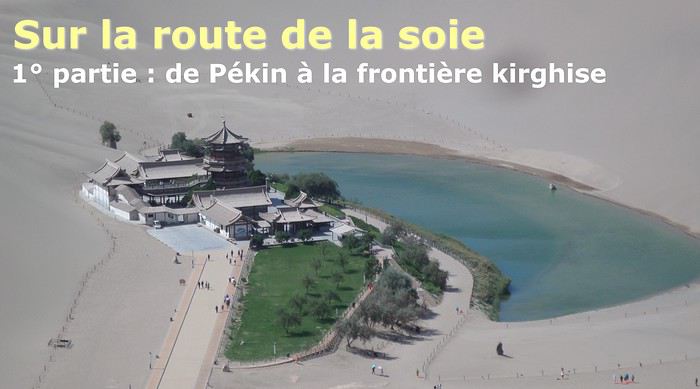
The Chinese Far West More than 30 years after my first trip to eastern China, I finally fulfilled an old dream: traveling solo from Beijing to the far west, discovering Xinjiang, the Uyghur people and the oppression they endure, the oases of Turpan and Kashgar, the Taklamakan Desert, the end of the Great Wall... The route was covered by train.
MENU PART 1: CHINA
1- Beijing (Jiankou) : the authentic Great Wall, without tourists 2- Cycling in Beijing, the best way to get around 3- Beijing : departure for the far west 4- Jiayuguan : getting by without English 5- Jiayuguan : scams and heritage 6- Dunhuang : abundance in the middle of the desert 7- Turpan : the Uyghurs under heavy surveillance 8- Kashgar : love at first sight for the old city 9- Kashgar : China’s recipe for controlling the populace 10- Tashkurgan : what on earth was I thinking going there! Kyrgyz border: a surreal epic Photo album from the 80s, contributions from other travelers (page 2)
1- JIANKOU Finding the authentic Great Wall, without tourists or a guide Friday, August 24, 2018 Thirty years later, I didn’t feel like revisiting the Great Wall at Badaling or any other overcrowded site. I chose to explore it at Jiankou, in its wildest, most authentic, and unrestored section, starting from a lost village deep in a valley—though it wasn’t *that* lost, since it had everything for communication.
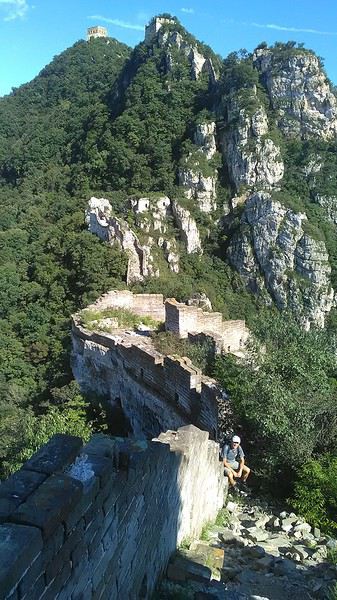
No need to pay for a taxi to get there—by timing it right, you can take the bus for just a few yuan. You have to get off at Xizhazi, the bus terminus. Be careful, there are only two buses a day in each direction. At the Xizhazi bus stop, I met a young couple who’d arrived with zero information about what to expect. We hiked the three of us toward the restored section of Mutianyu.
Still, be cautious With GPS and a topographic map (OpenTopoMap), you can set off without a problem or guide. The trail up to Jiankou is easy and well-marked. The trails down are too. But be careful—once you’re on the Wall, it’s real mountain hiking, with easy but dangerous climbing sections (over sheer drops). Not for amateurs or those afraid of heights! But what a reward. The Wall all to yourself, where it’s at its most daring. Truly mesmerizing.
More photos...
2- BEIJING The best way to get around the capital Sunday, August 26 The best way to explore the city is still by bike. Most are in a bike-share system, but you need to use an app—WeChat, the app that does everything, like monitoring your every move. No way I was installing that.
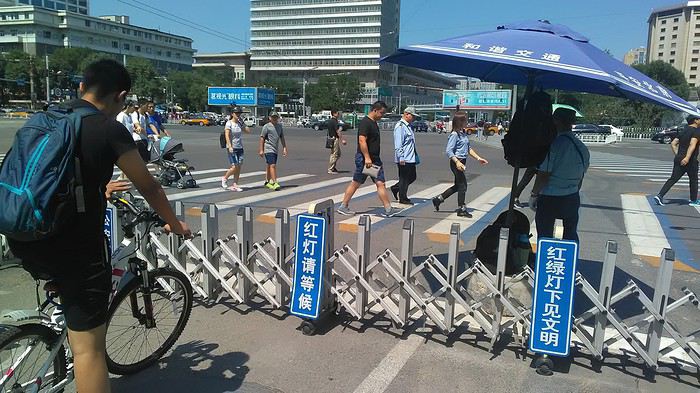
I found one at a rental shop near the hostel. The key is to quickly learn local traffic customs to minimize risks. Bike lanes are wide along the avenues.
But you still have to: - Watch out for anything parked on the bike paths—the most annoying are people napping or talking on the phone in their cars - Keep an eye on everything coming the wrong way—the list is long - The worst is right turns on red, which in Chinese traffic rules seem to have priority Once you get the hang of it, it’s fine. The city is huge but flat, so you can just wing it.
3- BEIJING By train to the far west Sunday, August 26 Beijing West Station is the size and operates like an airport. With your e-ticket from the agency, you first have to pick up your ticket at the special "English" counter, after passing through security. With your ticket in hand, you have to exit and enter through the boarding waiting area—not the platform—after a second security check.
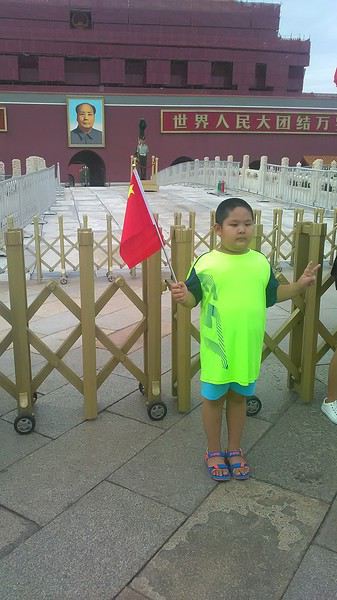 Then you find the right hall and wait for the sign to finally access the platform. In the end, it works pretty well given the incredible number of passengers to manage. Everywhere in Beijing, I saw that the Chinese have mastered crowd flow management.
Nice surprise: second-class carriages are clean, air-conditioned, and bright. Perfect, since I was in for 20 hours. One uniformed attendant per carriage, mobile meal service—luxury! Small downside: no luggage space. Hauling your suitcase up to the top bunk is quite a workout. I was in the middle, so it wasn’t too bad. The landscape, though, whether rural or urban, is pretty bleak. That should change once we leave the eastern plains.
Of course, I got my first police visit, with a thorough passport check and bag search. I was warned—going to the Chinese far west exposes you to this kind of hassle. But they were polite and respectful.
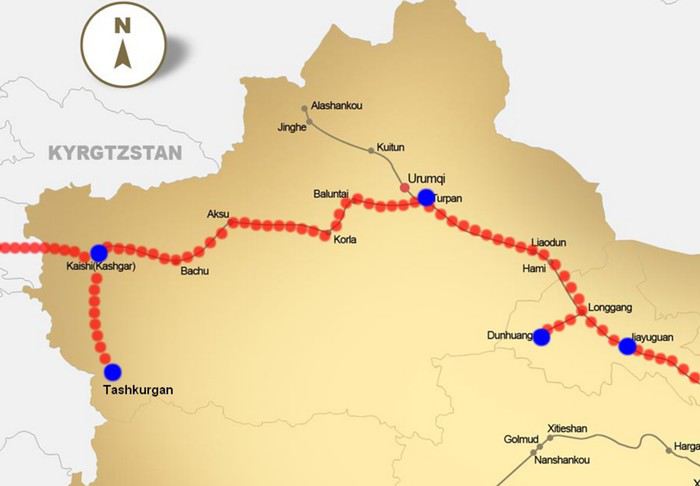 The Chinese Far West
4- JIAYUGUAN Getting by without English Monday, August 27 At the gates of two deserts (Gobi and Taklamakan) and at the foot of the Tibetan highlands, the Great Wall ends at Jiayuguan. Here, I found the deeper China I’d somewhat rediscovered during my bike ride, even if now everyone gets around on electric bikes and I’m no longer stared at like an alien.
Prices are nothing like Beijing: you can find a full meal for 2 €, and my bike cost 7 € for two days. Plus, few people speak English—neither the owner of the HI hostel where I stayed, nor the ticket sellers at the sites, let alone the servers at the small eateries where I ate. Everything is written in Chinese. So I had to use the little Chinese I know to communicate about essentials. It makes the locals laugh to see a European trying to speak their language, but it earns respect. With Google Translate’s help, I managed.
Rant: With their avenues blocked for construction for kilometers without warning, and new roads not yet on maps, I must’ve taken 15 km of detours. More photos...
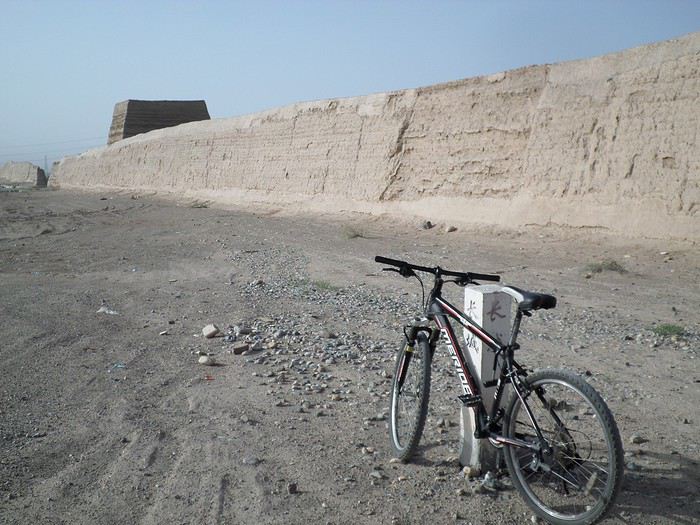
5- JIAYUGUAN Scams and heritage Tuesday, August 28 The Great Wall doesn’t exactly end at the fort I visited yesterday but 10 km further, at the entrance to a river gorge at the foot of the mountains. All that’s left is a badly damaged tower (more like a mound of earth) and a section of clay wall, similar to the one I biked yesterday.
This morning, I hopped on my bike, determined to venture into the desert to see this highly symbolic site. First, you access it via a wide, brand-new road with not a soul in sight. Just before the site, I came across a grand welcome gate, very period-style, but it’s actually the inevitable toll booth.
Behind the gate, the road continues straight to the site, which you can see in the distance—at least 2 km away—the remains of the tower and wall. I had to leave my bike here. Fine. I went to the ticket counter and asked the price: 120 yuan! I couldn’t believe it—over 15 € for a simple mound of earth.
I showed my displeasure to the attendant, who couldn’t care less, and immediately turned back. 120 yuan—that’s the price for a new road, a fancy gate planted 2 km before the site just to force you to take a shuttle, and employees with nothing to do all day... Now I understand why I didn’t meet anyone!
Heritage China is a bit pricey Generally, sites are expensive for the country’s standard of living, but travelers are supposed to have money, so why hold back? I even gave up on the Forbidden City—reservations required days in advance (or on the black market at an impossible price). I prefer to keep the memory of my first visit, when entry must’ve cost a few dozen cents, and there were only a handful of visitors.
This morning, I took a taxi to see remarkable tombs of common people from the 3rd to 6th centuries. They’re small vaulted caves made of painted bricks, depicting scenes of daily life. Very pretty and moving. But even here, though the price was more reasonable, I was left wanting—only one of the 16 tombs is open to visitors, and it’s apparently not the most beautiful.
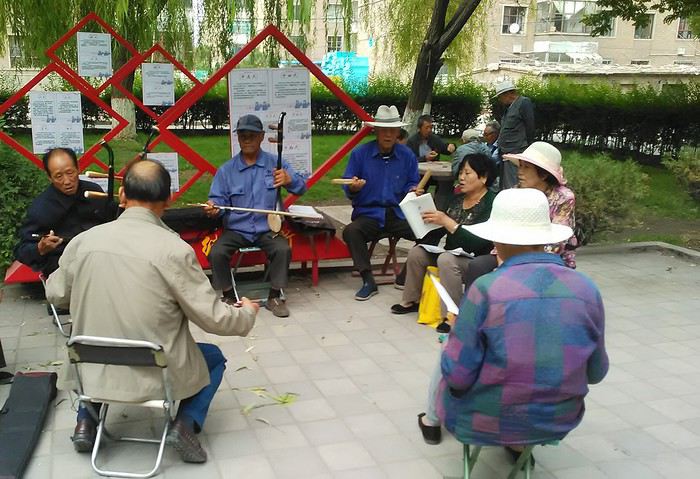
The authentic China—at least what’s left of it... Wandering the impersonal avenues of the city, you stumble upon a market. There, you still find traditional China—small shops with questionable hygiene, Go players, musicians, and even a dental prosthetist. The last refuge for those untouched by modernity. More photos...
6- DUNHUANG Abundance in the middle of the desert Wednesday, August 29 Well, I thought the landscape would be less bleak as I headed west. Nope. The only distraction in this expanse of dark, clayey sand is the forests of pylons and wind turbines, plus wild camels racing each other.
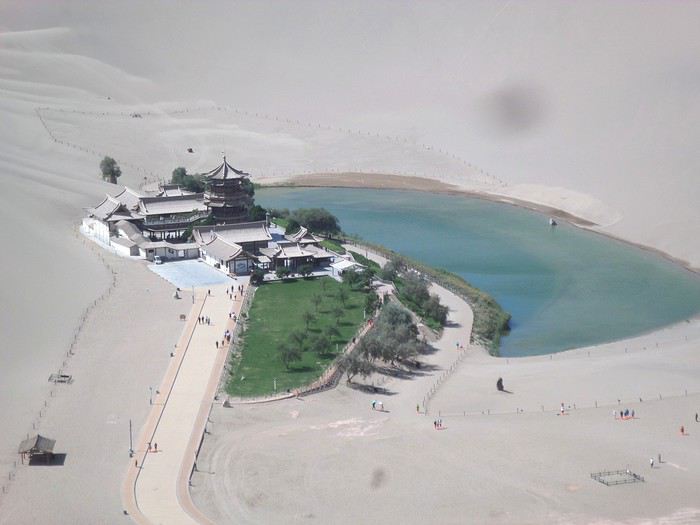 However, Dunhuang, the gateway to the Taklamakan, is by far the most pleasant Chinese city I know. There’s a real city center you can explore on foot. It’s hot but not unbearable, with a light, dry breeze. Much nicer than Beijing. The Han Chinese are still the majority, but the Muslim Uyghurs are more numerous, and the muezzin’s call to prayer echoes around the mosque.
The most surprising thing is the abundance and diversity of fruits and vegetables. You wonder how it all grows here. Well-irrigated, the desert sands are very fertile. Here, raisins have subtle, mysterious flavors, and the lamb really tastes like lamb.
Today, I visited the must-see Mingshashan, a dune complex next to which Pila is a molehill. The Basque Country, but covered in sand... More photos...
7- TURPAN The Uyghurs under heavy surveillance Friday, August 31 Surveillance cameras everywhere in the city, armed police stationed at intersections, in front of public buildings, at the entrance and inside tourist sites, police stations on every corner, patrols on foot or by car, khaki uniforms even for middle schoolers... here, the Han Chinese are in the minority, and you can feel it. Turpan feels like a city under siege.
To enter the youth hostel where I stayed, there’s even a security gate, and the receptionist (a Han, like everyone in tourism) wears a bulletproof vest! Reassuring. Still, you don’t feel particularly threatened here, especially as a European. The troublemakers are the Chinese, not the Uyghurs. Generally, China is a very safe country for visitors.
Smile, you’re on camera! I was biking on an avenue when the car in front of me got flashed for driving slowly. I quickly understood why when I got flashed too.
Here, the official time is Beijing time, but it gets dark two hours later. It’ll be even worse in Kashgar. Trickier to manage: everything is displayed in Chinese and Arabic. Nothing in English. Choosing a menu is a shot in the dark. Apart from a few young Chinese, no one here speaks English, and my Chinese doesn’t seem very understandable...
Mogao, the end of the road for the Han Yesterday, near Dunhuang, I went to Mogao, a complex of decorated caves with Buddha sculptures and paintings. Stunning, but so crowded! Luckily, here in Turpan, Chinese tourists barely venture out. So I visited a Silk Road ghost town with only a handful of other visitors and under a howling wind.
The modern Chinese city is swallowing up the old Uyghur neighborhoods—only a museum-like district remains in the center, and pockets of resistance on the outskirts are doomed to disappear soon. More photos...
8- KASHGAR A (relative) love at first sight for the old city Sunday, September 2 After three overnight trains, here I am in the far west of China, nearly 4,000 km from the capital. Despite the omnipresent police and an old city preserved UNESCO-style, Kashgar is my Chinese love at first sight.
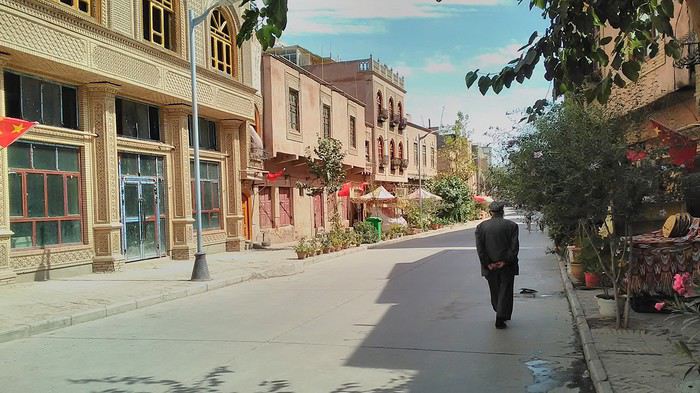
Finally, Chinese... well, sort of, because we’re in Uyghur territory here—a Turkic people with nothing culturally in common with the Han, the eastern Chinese. It started badly yesterday at Turfan station, where after three security gate passes, at least five passport checks, and a bag search, three adorable policewomen confiscated my antibacterial lotion because it had a flammable logo...
Then came the welcoming committee of armed cops at Kashgar station. Once all that was over, they left me alone—except you still have to go through security checks like everyone else to enter the old city, the bazaar, the livestock market... The further west you go, the more the siege mentality is evident. Luckily, the border isn’t far...
Despite the inevitable destruction-reconstruction, the city center has been well preserved. Thankfully, because it’s a very original style, a mix of local and colonial. I love it, even if it’s a bit too artificial, sanitized, and watered-down, and rather empty of residents. On the Silk Road, the city was famous for its great food. And it still is—rarely have I seen such richness and abundance of food! And not just scorpions or snakes. More photos...
9- KASHGAR China’s recipe for controlling the populace Saturday, September 1 Xinjiang, along with Tibet, is a "sensitive" area of rebellion in the eyes of Chinese authorities. As a result, the state has these regions and their populations under total control. Tourists also feel the consequences, even if they’re not at risk of re-education camps.
 - Putting barbed wire and anti-ramming barriers around sensitive sites (schools, big hotels, government buildings...)
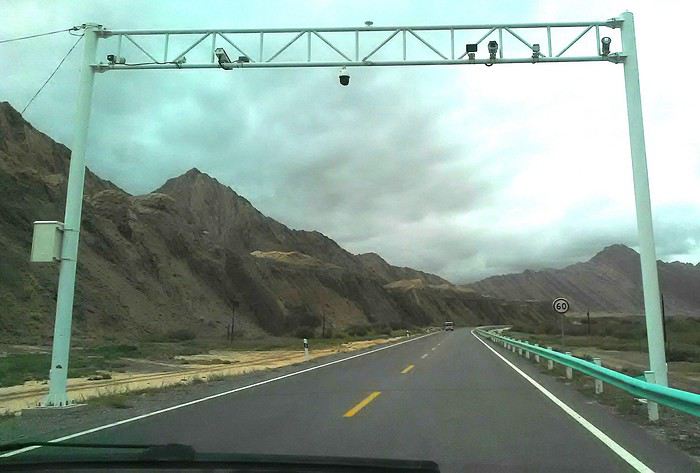
- Installing traffic surveillance gates with cameras and photo flashes (for all vehicles passing, including bikes) throughout the city and even in the countryside
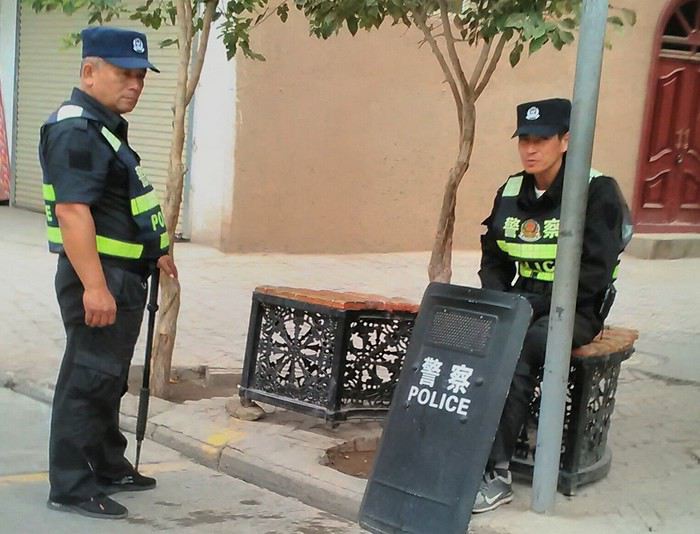
- Posting uniformed guards with tasers, batons, or huge baseball bats every 100 meters
- Training the Han population (ethnic Chinese) in self-defense with sticks, preferably in the morning on the street. Men and women of all ages
- Starting school with the national anthem, doing military exercises, and receiving political indoctrination, all neatly lined up in the courtyard. (The dream school for any teacher)
- Placing a snitch in uniform (a pseudo-guard) in public gathering places, like youth hostels. Mine spends the day loafing around the courtyard
- Putting Chinese flags everywhere on the streets to remind everyone who’s in charge
- Installing security gates at every entrance to areas frequented by tourists (thanks for that) but not just there
- Never photographing cops, or else! I tried, but it’s not easy...
- Putting barbed wire and anti-ramming barriers around sensitive sites (schools, big hotels, government buildings...)
- Installing traffic surveillance gates with cameras and photo flashes (for all vehicles passing, including bikes) throughout the city and even in the countryside
- Posting uniformed guards with tasers, batons, or huge baseball bats every 100 meters
- Training the Han population (ethnic Chinese) in self-defense with sticks, preferably in the morning on the street. Men and women of all ages
- Starting school with the national anthem, doing military exercises, and receiving political indoctrination, all neatly lined up in the courtyard. (The dream school for any teacher)
- Placing a snitch in uniform (a pseudo-guard) in public gathering places, like youth hostels. Mine spends the day loafing around the courtyard
- Putting Chinese flags everywhere on the streets to remind everyone who’s in charge
- Installing security gates at every entrance to areas frequented by tourists (thanks for that) but not just there
- Never photographing cops, or else! I tried, but it’s not easy...
With all that, you can stroll around safely Not much crime! As for the amount the Chinese state spends to maintain such a system, it’s staggering! A third of the Han living in Xinjiang work in security. Today, I wandered freely around old Kashgar, which is quite large after all. More photos...
10- TASHKURGAN What on earth was I thinking going there! Wednesday, September 5 First, there’s the taxi—pretty crappy, with a driver who doesn’t speak a word of English and won’t stop smoking. Over six hours in that... shared with a completely out-of-it American.
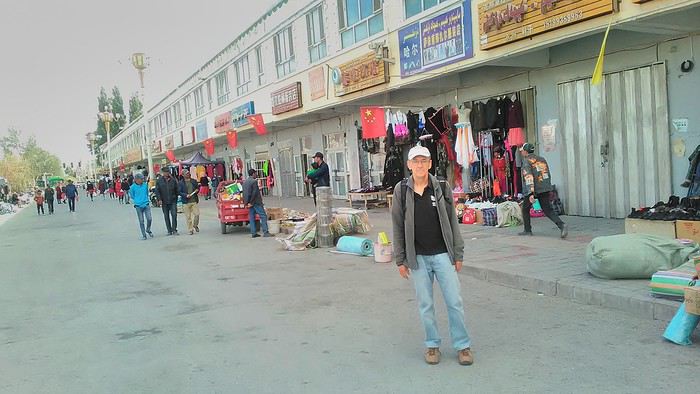
Then there are all the checkpoints along the way. I won’t go on—you know the drill by now.
After that, there’s Tashkurgan—a town with nothing to see, nothing to do. Deserted as soon as night falls. There’s this huge youth hostel and a few lost Chinese tapping away on their smartphones, chain-smoking. This lost American-European crowd, swapping tips on how to enter Pakistan or Tajikistan.
Luckily, there’s the Chinese Pamir Highway, lined with peaks over 7,000m. There’s the feeling of no longer being in China, with a population whose features are Middle Eastern. And these Tajik women with their stunning hairstyles and vibrant costumes. There’s the fact of having reached the westernmost Chinese city, far from crowds and tourist sites. A sort of end of the world. More photos...
11- KYRGYZ BORDER A surreal epic Thursday, September 6 The road from Kashgar to the Kyrgyzstan border is a little over 200 km and passes through beautiful landscapes of colorful, desert-like mountains with acrobatic folds. That’s the bucolic part of the trip.
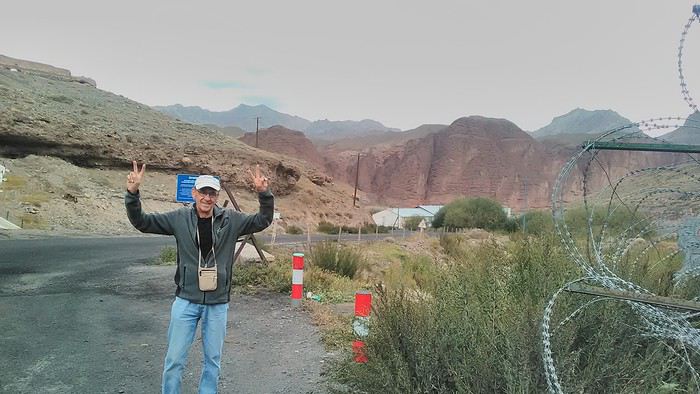 Yesterday, I managed to gather four people to rent a minibus to reach the border more easily: a Spaniard and an Argentine I’d already met in Turpan, and two New Zealanders who responded to the ad left at the hostel.
Absurdity and paranoia of Chinese authorities The highlight was crossing the town of Wuqia, 50 km past Kashgar. After tallying up with my fellow sufferers, we must’ve passed about ten checkpoints with: - Passport checks: 14 times, sometimes by two cops side by side - Bag checks: 4 times - Smartphone checks: 2 times, with deletion of "non-compliant" photos, and registration of your IMEI in the exit log!... Absurd and surreal at the same time, since my camera stayed in my bag, my apps are in French, and my photos have been online for ages...
With all that, we arrived just as the last checkpoint before the no man’s land marking the border between the two countries was on lunch break. And bam! Another 1.5-hour wait, alongside truckers who were much more used to this than we were.
What to think? The cops themselves aren’t fooled. They play the role they’re asked to, but sometimes you can coax a smile out of them—they realize how ridiculous the situation is.
What’s the point? That’s the big question my companions and I were tempted to answer with "to piss people off." To show you your place isn’t here, but with the other tourists, over there in the east, in Shanghai, Xi’an, or Guangzhou.
As for you, a traveler from a democratic country, you really experience this as aggression, humiliation, a violation of your private space. And yet, I’m respected, they speak to me properly. Today, I better understand what a Palestinian or a citizen of an occupied country might feel daily. A unique experience! Thanks, China.
And to top it off, the cherry on the cake! It’s still this glowing button you press to rate your passage after clearing the last obstacle before the exit stamp. I was so surprised it turned off before I could react. The Spaniard, with great humor and irony, had time to vote "excellent." In the end, he wasn’t wrong—you can hardly do better!
PS: I ditched my buddies at the border. They didn’t want to pay for a taxi to continue. So I took a direct taxi to Osh. The first 100 km are fabulous. I couldn’t take many photos, but I’ll be back on Monday to go to Tajikistan.
More photos...
The rest of the Silk Road, Part 2, in these travel journals: Kyrgyzstan, Tajikistan, Uzbekistan.
The Chinese Far West More than 30 years after my first trip to eastern China, I finally fulfilled an old dream: traveling solo from Beijing to the far west, discovering Xinjiang, the Uyghur people and the oppression they endure, the oases of Turpan and Kashgar, the Taklamakan Desert, the end of the Great Wall... The route was covered by train.
MENU PART 1: CHINA
1- Beijing (Jiankou) : the authentic Great Wall, without tourists 2- Cycling in Beijing, the best way to get around 3- Beijing : departure for the far west 4- Jiayuguan : getting by without English 5- Jiayuguan : scams and heritage 6- Dunhuang : abundance in the middle of the desert 7- Turpan : the Uyghurs under heavy surveillance 8- Kashgar : love at first sight for the old city 9- Kashgar : China’s recipe for controlling the populace 10- Tashkurgan : what on earth was I thinking going there! Kyrgyz border: a surreal epic Photo album from the 80s, contributions from other travelers (page 2)
1- JIANKOU Finding the authentic Great Wall, without tourists or a guide Friday, August 24, 2018 Thirty years later, I didn’t feel like revisiting the Great Wall at Badaling or any other overcrowded site. I chose to explore it at Jiankou, in its wildest, most authentic, and unrestored section, starting from a lost village deep in a valley—though it wasn’t *that* lost, since it had everything for communication.
No need to pay for a taxi to get there—by timing it right, you can take the bus for just a few yuan. You have to get off at Xizhazi, the bus terminus. Be careful, there are only two buses a day in each direction. At the Xizhazi bus stop, I met a young couple who’d arrived with zero information about what to expect. We hiked the three of us toward the restored section of Mutianyu.
Still, be cautious With GPS and a topographic map (OpenTopoMap), you can set off without a problem or guide. The trail up to Jiankou is easy and well-marked. The trails down are too. But be careful—once you’re on the Wall, it’s real mountain hiking, with easy but dangerous climbing sections (over sheer drops). Not for amateurs or those afraid of heights! But what a reward. The Wall all to yourself, where it’s at its most daring. Truly mesmerizing.
More photos...
2- BEIJING The best way to get around the capital Sunday, August 26 The best way to explore the city is still by bike. Most are in a bike-share system, but you need to use an app—WeChat, the app that does everything, like monitoring your every move. No way I was installing that.
I found one at a rental shop near the hostel. The key is to quickly learn local traffic customs to minimize risks. Bike lanes are wide along the avenues.
But you still have to: - Watch out for anything parked on the bike paths—the most annoying are people napping or talking on the phone in their cars - Keep an eye on everything coming the wrong way—the list is long - The worst is right turns on red, which in Chinese traffic rules seem to have priority Once you get the hang of it, it’s fine. The city is huge but flat, so you can just wing it.
3- BEIJING By train to the far west Sunday, August 26 Beijing West Station is the size and operates like an airport. With your e-ticket from the agency, you first have to pick up your ticket at the special "English" counter, after passing through security. With your ticket in hand, you have to exit and enter through the boarding waiting area—not the platform—after a second security check.
Then you find the right hall and wait for the sign to finally access the platform. In the end, it works pretty well given the incredible number of passengers to manage. Everywhere in Beijing, I saw that the Chinese have mastered crowd flow management.Nice surprise: second-class carriages are clean, air-conditioned, and bright. Perfect, since I was in for 20 hours. One uniformed attendant per carriage, mobile meal service—luxury! Small downside: no luggage space. Hauling your suitcase up to the top bunk is quite a workout. I was in the middle, so it wasn’t too bad. The landscape, though, whether rural or urban, is pretty bleak. That should change once we leave the eastern plains.
Of course, I got my first police visit, with a thorough passport check and bag search. I was warned—going to the Chinese far west exposes you to this kind of hassle. But they were polite and respectful.
The Chinese Far West4- JIAYUGUAN Getting by without English Monday, August 27 At the gates of two deserts (Gobi and Taklamakan) and at the foot of the Tibetan highlands, the Great Wall ends at Jiayuguan. Here, I found the deeper China I’d somewhat rediscovered during my bike ride, even if now everyone gets around on electric bikes and I’m no longer stared at like an alien.
Prices are nothing like Beijing: you can find a full meal for 2 €, and my bike cost 7 € for two days. Plus, few people speak English—neither the owner of the HI hostel where I stayed, nor the ticket sellers at the sites, let alone the servers at the small eateries where I ate. Everything is written in Chinese. So I had to use the little Chinese I know to communicate about essentials. It makes the locals laugh to see a European trying to speak their language, but it earns respect. With Google Translate’s help, I managed.
Rant: With their avenues blocked for construction for kilometers without warning, and new roads not yet on maps, I must’ve taken 15 km of detours. More photos...
5- JIAYUGUAN Scams and heritage Tuesday, August 28 The Great Wall doesn’t exactly end at the fort I visited yesterday but 10 km further, at the entrance to a river gorge at the foot of the mountains. All that’s left is a badly damaged tower (more like a mound of earth) and a section of clay wall, similar to the one I biked yesterday.
This morning, I hopped on my bike, determined to venture into the desert to see this highly symbolic site. First, you access it via a wide, brand-new road with not a soul in sight. Just before the site, I came across a grand welcome gate, very period-style, but it’s actually the inevitable toll booth.
Behind the gate, the road continues straight to the site, which you can see in the distance—at least 2 km away—the remains of the tower and wall. I had to leave my bike here. Fine. I went to the ticket counter and asked the price: 120 yuan! I couldn’t believe it—over 15 € for a simple mound of earth.
I showed my displeasure to the attendant, who couldn’t care less, and immediately turned back. 120 yuan—that’s the price for a new road, a fancy gate planted 2 km before the site just to force you to take a shuttle, and employees with nothing to do all day... Now I understand why I didn’t meet anyone!
Heritage China is a bit pricey Generally, sites are expensive for the country’s standard of living, but travelers are supposed to have money, so why hold back? I even gave up on the Forbidden City—reservations required days in advance (or on the black market at an impossible price). I prefer to keep the memory of my first visit, when entry must’ve cost a few dozen cents, and there were only a handful of visitors.
This morning, I took a taxi to see remarkable tombs of common people from the 3rd to 6th centuries. They’re small vaulted caves made of painted bricks, depicting scenes of daily life. Very pretty and moving. But even here, though the price was more reasonable, I was left wanting—only one of the 16 tombs is open to visitors, and it’s apparently not the most beautiful.
The authentic China—at least what’s left of it... Wandering the impersonal avenues of the city, you stumble upon a market. There, you still find traditional China—small shops with questionable hygiene, Go players, musicians, and even a dental prosthetist. The last refuge for those untouched by modernity. More photos...
6- DUNHUANG Abundance in the middle of the desert Wednesday, August 29 Well, I thought the landscape would be less bleak as I headed west. Nope. The only distraction in this expanse of dark, clayey sand is the forests of pylons and wind turbines, plus wild camels racing each other.
However, Dunhuang, the gateway to the Taklamakan, is by far the most pleasant Chinese city I know. There’s a real city center you can explore on foot. It’s hot but not unbearable, with a light, dry breeze. Much nicer than Beijing. The Han Chinese are still the majority, but the Muslim Uyghurs are more numerous, and the muezzin’s call to prayer echoes around the mosque.The most surprising thing is the abundance and diversity of fruits and vegetables. You wonder how it all grows here. Well-irrigated, the desert sands are very fertile. Here, raisins have subtle, mysterious flavors, and the lamb really tastes like lamb.
Today, I visited the must-see Mingshashan, a dune complex next to which Pila is a molehill. The Basque Country, but covered in sand... More photos...
7- TURPAN The Uyghurs under heavy surveillance Friday, August 31 Surveillance cameras everywhere in the city, armed police stationed at intersections, in front of public buildings, at the entrance and inside tourist sites, police stations on every corner, patrols on foot or by car, khaki uniforms even for middle schoolers... here, the Han Chinese are in the minority, and you can feel it. Turpan feels like a city under siege.
To enter the youth hostel where I stayed, there’s even a security gate, and the receptionist (a Han, like everyone in tourism) wears a bulletproof vest! Reassuring. Still, you don’t feel particularly threatened here, especially as a European. The troublemakers are the Chinese, not the Uyghurs. Generally, China is a very safe country for visitors.
Smile, you’re on camera! I was biking on an avenue when the car in front of me got flashed for driving slowly. I quickly understood why when I got flashed too.
Here, the official time is Beijing time, but it gets dark two hours later. It’ll be even worse in Kashgar. Trickier to manage: everything is displayed in Chinese and Arabic. Nothing in English. Choosing a menu is a shot in the dark. Apart from a few young Chinese, no one here speaks English, and my Chinese doesn’t seem very understandable...
Mogao, the end of the road for the Han Yesterday, near Dunhuang, I went to Mogao, a complex of decorated caves with Buddha sculptures and paintings. Stunning, but so crowded! Luckily, here in Turpan, Chinese tourists barely venture out. So I visited a Silk Road ghost town with only a handful of other visitors and under a howling wind.
The modern Chinese city is swallowing up the old Uyghur neighborhoods—only a museum-like district remains in the center, and pockets of resistance on the outskirts are doomed to disappear soon. More photos...
8- KASHGAR A (relative) love at first sight for the old city Sunday, September 2 After three overnight trains, here I am in the far west of China, nearly 4,000 km from the capital. Despite the omnipresent police and an old city preserved UNESCO-style, Kashgar is my Chinese love at first sight.
Finally, Chinese... well, sort of, because we’re in Uyghur territory here—a Turkic people with nothing culturally in common with the Han, the eastern Chinese. It started badly yesterday at Turfan station, where after three security gate passes, at least five passport checks, and a bag search, three adorable policewomen confiscated my antibacterial lotion because it had a flammable logo...
Then came the welcoming committee of armed cops at Kashgar station. Once all that was over, they left me alone—except you still have to go through security checks like everyone else to enter the old city, the bazaar, the livestock market... The further west you go, the more the siege mentality is evident. Luckily, the border isn’t far...
Despite the inevitable destruction-reconstruction, the city center has been well preserved. Thankfully, because it’s a very original style, a mix of local and colonial. I love it, even if it’s a bit too artificial, sanitized, and watered-down, and rather empty of residents. On the Silk Road, the city was famous for its great food. And it still is—rarely have I seen such richness and abundance of food! And not just scorpions or snakes. More photos...
9- KASHGAR China’s recipe for controlling the populace Saturday, September 1 Xinjiang, along with Tibet, is a "sensitive" area of rebellion in the eyes of Chinese authorities. As a result, the state has these regions and their populations under total control. Tourists also feel the consequences, even if they’re not at risk of re-education camps.
- Putting barbed wire and anti-ramming barriers around sensitive sites (schools, big hotels, government buildings...)
- Installing traffic surveillance gates with cameras and photo flashes (for all vehicles passing, including bikes) throughout the city and even in the countryside
- Posting uniformed guards with tasers, batons, or huge baseball bats every 100 meters
- Training the Han population (ethnic Chinese) in self-defense with sticks, preferably in the morning on the street. Men and women of all ages
- Starting school with the national anthem, doing military exercises, and receiving political indoctrination, all neatly lined up in the courtyard. (The dream school for any teacher)
- Placing a snitch in uniform (a pseudo-guard) in public gathering places, like youth hostels. Mine spends the day loafing around the courtyard
- Putting Chinese flags everywhere on the streets to remind everyone who’s in charge
- Installing security gates at every entrance to areas frequented by tourists (thanks for that) but not just there
- Never photographing cops, or else! I tried, but it’s not easy...With all that, you can stroll around safely Not much crime! As for the amount the Chinese state spends to maintain such a system, it’s staggering! A third of the Han living in Xinjiang work in security. Today, I wandered freely around old Kashgar, which is quite large after all. More photos...
10- TASHKURGAN What on earth was I thinking going there! Wednesday, September 5 First, there’s the taxi—pretty crappy, with a driver who doesn’t speak a word of English and won’t stop smoking. Over six hours in that... shared with a completely out-of-it American.
Then there are all the checkpoints along the way. I won’t go on—you know the drill by now.
After that, there’s Tashkurgan—a town with nothing to see, nothing to do. Deserted as soon as night falls. There’s this huge youth hostel and a few lost Chinese tapping away on their smartphones, chain-smoking. This lost American-European crowd, swapping tips on how to enter Pakistan or Tajikistan.
Luckily, there’s the Chinese Pamir Highway, lined with peaks over 7,000m. There’s the feeling of no longer being in China, with a population whose features are Middle Eastern. And these Tajik women with their stunning hairstyles and vibrant costumes. There’s the fact of having reached the westernmost Chinese city, far from crowds and tourist sites. A sort of end of the world. More photos...
11- KYRGYZ BORDER A surreal epic Thursday, September 6 The road from Kashgar to the Kyrgyzstan border is a little over 200 km and passes through beautiful landscapes of colorful, desert-like mountains with acrobatic folds. That’s the bucolic part of the trip.
Yesterday, I managed to gather four people to rent a minibus to reach the border more easily: a Spaniard and an Argentine I’d already met in Turpan, and two New Zealanders who responded to the ad left at the hostel.Absurdity and paranoia of Chinese authorities The highlight was crossing the town of Wuqia, 50 km past Kashgar. After tallying up with my fellow sufferers, we must’ve passed about ten checkpoints with: - Passport checks: 14 times, sometimes by two cops side by side - Bag checks: 4 times - Smartphone checks: 2 times, with deletion of "non-compliant" photos, and registration of your IMEI in the exit log!... Absurd and surreal at the same time, since my camera stayed in my bag, my apps are in French, and my photos have been online for ages...
With all that, we arrived just as the last checkpoint before the no man’s land marking the border between the two countries was on lunch break. And bam! Another 1.5-hour wait, alongside truckers who were much more used to this than we were.
What to think? The cops themselves aren’t fooled. They play the role they’re asked to, but sometimes you can coax a smile out of them—they realize how ridiculous the situation is.
What’s the point? That’s the big question my companions and I were tempted to answer with "to piss people off." To show you your place isn’t here, but with the other tourists, over there in the east, in Shanghai, Xi’an, or Guangzhou.
As for you, a traveler from a democratic country, you really experience this as aggression, humiliation, a violation of your private space. And yet, I’m respected, they speak to me properly. Today, I better understand what a Palestinian or a citizen of an occupied country might feel daily. A unique experience! Thanks, China.
And to top it off, the cherry on the cake! It’s still this glowing button you press to rate your passage after clearing the last obstacle before the exit stamp. I was so surprised it turned off before I could react. The Spaniard, with great humor and irony, had time to vote "excellent." In the end, he wasn’t wrong—you can hardly do better!
PS: I ditched my buddies at the border. They didn’t want to pay for a taxi to continue. So I took a direct taxi to Osh. The first 100 km are fabulous. I couldn’t take many photos, but I’ll be back on Monday to go to Tajikistan.
More photos...
The rest of the Silk Road, Part 2, in these travel journals: Kyrgyzstan, Tajikistan, Uzbekistan.
Conseils pour l'achat d'une Voyageuse English translation pending
Bonjour à tous,
Je suis un petit nouveau ici et je vous demande de bien vouloir me pardonner pour mon ignorance. 🙂 Ma compagne et moi sommes cyclistes depuis maintenant 2 ans (seul moyen de transport) et nous aimerions étendre ceci à nos voyages. En conséquence, j'aimerais m'équiper avec un nouveau vélo, sachant que ce dernier deviendrait mon unique vélo, pour la ville (90% du temps, boulot, etc.) et les voyages (les 10% restant).
Je commence à savoir un peu ce que je veux en terme de type de vélo, cintre, poste de pilotage, etc. et mon choix s'est porté sur deux modèles qui me semblent plutôt bons et que l'on m'a conseillés. Les voici :
Le VSF Fahrradmanufaktur TX-Randonneur (https://www.cyclable.com/13534-randonneuse-vsf-tx-randonneur.html) Le Genesis Tour de Fer 30 (https://www.cyclable.com/15553-velo-de-randonnee-genesis-tour-de-fer-30.html)
Seulement, à partir de là pas moyen pour moi de vraiment les départager. Et c'est pour cela que j'aurais besoin de conseil de personnes qui connaissent les composants et besoins de mes deux types d'utilisation mieux que moi 🙂. Sachant qu'au niveau prix je peux acheter les deux sans soucis. mais je ne pourrai pas monter plus haut. Du coup ce n'est qu'à moitié une considération pour moi (si ce n'est que j'ai aussi des sacoches à acheter ^^).
Pour les principales différences les voici :
Cadre/fourche : Ici c'est visiblement du CrMo pour les deux. Le VSF est Double-butted et le Genesis heat-treated mais je ne sais pas du tout ce qui est mieux et à quoi cela correspond. Transmission : Le VSF est en Shimano 105, là où le Genesis est en Tiagra, donc léger avantage au VSF mais vu m'on utilisation, à mon avis je ne verrai pas la différence. Au niveau plateaux/pignons, c'est pareil (3x10, avec du 30/39/50 à l'avant et du 11/32 à l'arrière) La principale différence repose en fait sur les freins. Le VSF est en V-Brake Shimano, là où le Genesis est en Disques Mecaniques TRP Spyre-C. Concrètement j'avais plutôt un préférence pour les disques, mais déjà ce n'est pas de l'hydrolique, et surtout, je me suis demandé si je verrais vraiment la différence. Beaucoup de gens ont l'air de dire que les V-brakes suffisent amplement. Il y a aussi les considérations de facilité et de cout d’entretien à prendre en compte. Pour les V-brake je sais, mais je n'ai jamais eu de disques. Je ne me rends pas compte à quel point il faut les régler régulièrement ou non. Pour ce qui est de l'histoire du risque pour les jantes avec les V-brakes, n'étant pas non plus un sportif de haut niveau, je ne suis pas sur de pouvoir m'en rendre vraiment compte. Je me questionnais aussi quant à la facilité de changer un pneu avec les disques. J'imagine que c'est pareil ? Enfin, je me dis que les V-brakes, même si ils freinent moins fort, sont plus facilement remplaçables un peu n'importe où dans le monde si jamais j'ai un problème. Pour les disques je ne me rends pas compte. Du coup si vous avez un avis je suis preneur. Sinon, pour ce qui est des accessoires, à part le phare, les deux seront identiques (j'ai trouvé à me faire changer les portes bagages du Genesis pour ceux du VSF pour le même prix). Pour le phare, celui du Genesis est meilleur c'est sur, mais encore une fois, je ne me rends pas compte de la différence. Enfin, pour les jantes et pneus surtout, j'ai besoin de vos conseils car j'y connais rien. Dernière choses, deux petits avantages pour le VSF aussi pour moi : Il est plus léger de 1,5 kg, et son poste de pilotage est équipé de freins supplémentaires type VTT sur la barre centrale du cintre, ce qui à l'air assez pratique en ville pour les freinages rapides.
Après je sais que Genesis a une très bonne réputation, et je n'ai jamais entendu parlé de VSF (quelqu'un connait ?). Mais je ne sais pas si cela témoigne un vrai gain en qualité pour le Genesis. A noter aussi que le VSF est fabriqué en Allemagne, là où le Genesis est fait à Taiwan, ce qui est nettement moins bon question bilan carbone ^^.
Voilà, si jamais vous avez un tout petit peu de temps à me consacrer, je vous en serai très reconnaissant 🙂.
En vous souhaitant à tous une excellente journée !
Je suis un petit nouveau ici et je vous demande de bien vouloir me pardonner pour mon ignorance. 🙂 Ma compagne et moi sommes cyclistes depuis maintenant 2 ans (seul moyen de transport) et nous aimerions étendre ceci à nos voyages. En conséquence, j'aimerais m'équiper avec un nouveau vélo, sachant que ce dernier deviendrait mon unique vélo, pour la ville (90% du temps, boulot, etc.) et les voyages (les 10% restant).
Je commence à savoir un peu ce que je veux en terme de type de vélo, cintre, poste de pilotage, etc. et mon choix s'est porté sur deux modèles qui me semblent plutôt bons et que l'on m'a conseillés. Les voici :
Le VSF Fahrradmanufaktur TX-Randonneur (https://www.cyclable.com/13534-randonneuse-vsf-tx-randonneur.html) Le Genesis Tour de Fer 30 (https://www.cyclable.com/15553-velo-de-randonnee-genesis-tour-de-fer-30.html)
Seulement, à partir de là pas moyen pour moi de vraiment les départager. Et c'est pour cela que j'aurais besoin de conseil de personnes qui connaissent les composants et besoins de mes deux types d'utilisation mieux que moi 🙂. Sachant qu'au niveau prix je peux acheter les deux sans soucis. mais je ne pourrai pas monter plus haut. Du coup ce n'est qu'à moitié une considération pour moi (si ce n'est que j'ai aussi des sacoches à acheter ^^).
Pour les principales différences les voici :
Cadre/fourche : Ici c'est visiblement du CrMo pour les deux. Le VSF est Double-butted et le Genesis heat-treated mais je ne sais pas du tout ce qui est mieux et à quoi cela correspond. Transmission : Le VSF est en Shimano 105, là où le Genesis est en Tiagra, donc léger avantage au VSF mais vu m'on utilisation, à mon avis je ne verrai pas la différence. Au niveau plateaux/pignons, c'est pareil (3x10, avec du 30/39/50 à l'avant et du 11/32 à l'arrière) La principale différence repose en fait sur les freins. Le VSF est en V-Brake Shimano, là où le Genesis est en Disques Mecaniques TRP Spyre-C. Concrètement j'avais plutôt un préférence pour les disques, mais déjà ce n'est pas de l'hydrolique, et surtout, je me suis demandé si je verrais vraiment la différence. Beaucoup de gens ont l'air de dire que les V-brakes suffisent amplement. Il y a aussi les considérations de facilité et de cout d’entretien à prendre en compte. Pour les V-brake je sais, mais je n'ai jamais eu de disques. Je ne me rends pas compte à quel point il faut les régler régulièrement ou non. Pour ce qui est de l'histoire du risque pour les jantes avec les V-brakes, n'étant pas non plus un sportif de haut niveau, je ne suis pas sur de pouvoir m'en rendre vraiment compte. Je me questionnais aussi quant à la facilité de changer un pneu avec les disques. J'imagine que c'est pareil ? Enfin, je me dis que les V-brakes, même si ils freinent moins fort, sont plus facilement remplaçables un peu n'importe où dans le monde si jamais j'ai un problème. Pour les disques je ne me rends pas compte. Du coup si vous avez un avis je suis preneur. Sinon, pour ce qui est des accessoires, à part le phare, les deux seront identiques (j'ai trouvé à me faire changer les portes bagages du Genesis pour ceux du VSF pour le même prix). Pour le phare, celui du Genesis est meilleur c'est sur, mais encore une fois, je ne me rends pas compte de la différence. Enfin, pour les jantes et pneus surtout, j'ai besoin de vos conseils car j'y connais rien. Dernière choses, deux petits avantages pour le VSF aussi pour moi : Il est plus léger de 1,5 kg, et son poste de pilotage est équipé de freins supplémentaires type VTT sur la barre centrale du cintre, ce qui à l'air assez pratique en ville pour les freinages rapides.
Après je sais que Genesis a une très bonne réputation, et je n'ai jamais entendu parlé de VSF (quelqu'un connait ?). Mais je ne sais pas si cela témoigne un vrai gain en qualité pour le Genesis. A noter aussi que le VSF est fabriqué en Allemagne, là où le Genesis est fait à Taiwan, ce qui est nettement moins bon question bilan carbone ^^.
Voilà, si jamais vous avez un tout petit peu de temps à me consacrer, je vous en serai très reconnaissant 🙂.
En vous souhaitant à tous une excellente journée !
Two weeks with a friend in southern Kazakhstan
Hello everyone!
I’m back from two weeks in southern Kazakhstan. I went with a friend, and we organized everything ourselves. We came back enchanted by this trip: stunning landscapes, lots of animals seen in the parks, and above all, top-notch hospitality and welcome... All of this makes me really want to go back and explore the other countries in the region. In the meantime, I’m sharing the story of these two weeks of travel... Don’t hesitate if you have any questions. And if you want more practical info and/or see more photos, you can check out my blog: https://smilingaroundtheworld.com/category/kazakhstan/
Day 1: First Kazakh steps in Shymkent
So here we are in Kazakhstan for two weeks. We had an excellent flight with Air Astana, which instantly made it into my top 3 best airlines! From the airport, the service was top-notch, with very friendly staff who went out of their way to ensure we both got vegetarian meals (my order hadn’t been taken into account when booking the tickets online). The flight to Nur-Sultan (the new name for the capital, formerly Astana, renamed last month in honor of the resigning president) was three-quarters empty, and we each got to stretch out over three seats. We were given an incredible travel kit, including a reversible sleep mask with phosphorescent writing: “Do not disturb” or “Wake me for meals.” Awesome! As for the lighting in the plane, I think the interior cycled through every color to simulate evening, early night, pitch-black night, and then dawn. It was even a bit surreal—those lights and everyone’s glowing masks ^^ The flight was a bit early and too short for us to sleep well, but it was still pleasant :-)
Upon arriving in Nur-Sultan, the atmosphere was a bit colder. There was staff everywhere, and we were under heavy surveillance. A camera even filmed us as we entered the terminal. We got our passports stamped and settled in to wait for our second flight. We eventually realized we were waiting in the wrong place... We were still in the international terminal, while our next flight was domestic. We finally found the right spot—saved! We started our trip in Shymkent, in the south of the country. We dropped our bags at the City Hostel, a super modern youth hostel offering double rooms. The decor is industrial-style, with very high ceilings—we loved it. When we arrived, it was too early for check-in, so we just left our luggage and went for a walk around the neighborhood. There was quite a bit of traffic, and the avenues were very wide. Despite that, there was also a lot of greenery and green spaces, which lightened things up a bit.
We had lunch (pizza + smoothie) on the top floor of a shopping mall, then headed to the pre-Russian quarter, a much quieter area with its little streets and individual houses.
Back at the hostel, after checking in, we treated ourselves to a two-hour nap—it felt great! In the late afternoon, we set out to find the Salman Bazaar. It wasn’t easy to organize—we realized Shymkent isn’t a very touristy destination—but we eventually managed with the help of the hostel receptionist, who called us a taxi. This bazaar is huge and has everything you could need for daily life: clothes, food, household products, toys... We did some shopping for dinner, then took another taxi to Independence Park, inaugurated in 2011 for the 20th anniversary of Kazakhstan’s independence. We really liked this park—it’s very wooded, and the late afternoon light was, as always, beautiful and pleasant... In the center, a large monument resembles the center of a yurt.
We then walked back to the hostel via Independence Square and several parks. We wanted to grab a drink along the way but didn’t find anything inspiring—oh well. We had dinner at the hostel and went straight to bed. Tomorrow, we’re getting up early... We’re heading out for two days to explore Aksou-Jabagly National Park. This park is famous for its landscapes at this time of year—it should be in full bloom, especially with tulips. We’ll see!
Days 2 & 3: Canyon, tulips, and wildlife in Aksou-Jabagly Park
Located two hours from Shymkent, Aksou-Jabagly Park is reputed to be one of the most beautiful in the region. We took a taxi from Shymkent, and upon arrival, we were warmly welcomed by Ruslan and his mother. They live at the entrance to the reserve, at the foot of the mountains, in a house surrounded by poplars. The setting is exceptional, and we immediately fell in love with the place. For our first day, we set off to explore the Aksou Canyon. Ruslan arranged a 4x4 with a driver and a ranger. The ranger speaks a few words of English, and with Coralie’s few words of Russian, we should manage! After a “viewpoint” stop, the road turns into a dirt track. It’s rained a lot lately, and the track is sometimes very muddy—at one point, we even had to cross a river. Four-wheel drive was definitely needed! The ranger pointed out some marmots by the side of the path—they were adorable.
We finally arrived at “Inspector’s House No. 1,” which overlooks the canyon. The view is magnificent, with high cliffs, wildflowers, conifers, and the Aksou River winding far below. While the driver chatted with the inspector, we descended to the bottom of the canyon with the ranger. The tulips I’d been hoping for were there—I was so happy! There were red, yellow, and even bicolor ones...
At the bottom of the canyon, we took a little break by the river. “Aksou” means “white waters” in Kazakh—the water does indeed have a very special color, a blue that’s both very light and very intense, like some South American lagoons. It bubbles around the rocks. The climb back up was easier than we feared. Once at the top, we continued along the canyon. The perspective changed as we progressed, and we never got tired of the view... Eagles circled above us.
After about 2 km, the driver picked us up, and we continued to a small kiosk at the foot of the mountains, where we had a picnic. Ruslan’s mother had prepared vegetarian “lunch boxes”—it was delicious and felt good to eat. However, it had gotten noticeably colder, so we put our jackets and scarves back on! After the meal, the driver walked off with a bucket—we figured he was going mushroom picking with Inspector No. 2, who had a house nearby.
We enjoyed the spot a bit longer while the driver gathered mushrooms, and then we headed back toward Ruslan’s place. Or so we thought... The return trip turned out to be quite long—the park wasn’t as deserted as it seemed, and the driver stopped every five minutes to chat with people we passed. At one point, we ran into Inspector No. 2 on horseback—it looked like there was a problem with a car further ahead... The driver and ranger bolted out of the car, headed toward the other vehicle, and we heard raised voices... When they came back, we tried to figure out what had happened, but no luck. We stopped again at Inspector No. 1’s house (are you following?), and they made us get out, telling us Inspector No. 2 needed the car for a few minutes... They left us stranded with Inspector No. 1, who went home, leaving us in the garden :-D We kept busy with the puppies, and I even took a little nap in the sun... Three-quarters of an hour later, we finally left—we didn’t fully understand what happened and never found out!
We got back (almost) without stopping to Ruslan’s house. Our room was ready, and we settled in quickly before dinner. It was already 6:30 PM, even though we were supposed to be back by 4 PM. Mushroom picking really slows things down ^^ Ruslan’s mother had prepared a delicious meal: vegetable soup, raw vegetable salad, and a mushroom, carrot, and potato stew. We loved it!
We spent the rest of the evening planning the rest of our trip while sipping tea. At one point, Ruslan and his mother signaled that there were wild boars right across from us—we could see them clearly! There were three adults and three piglets. We also took a little walk in the garden, watched the sunset, I did some blogging, and Coralie read... A lovely evening, and an equally lovely ten-hour night! The next morning, after a good breakfast, we set off on foot into the park. The trail starts right next to Ruslan’s house—so convenient! Today, we were with another ranger, two Germans (brother and sister), and their English-speaking guide (who didn’t guide much). We walked on a dirt road—there were even more tulips than yesterday, and the snow-capped mountains in the distance were stunning. After 5 km, we reached a small cabin, then continued another kilometer to Kishy Kaindy, a viewpoint overlooking the Jabagly River waterfalls (Jabagly means “year-old foal”). It was spectacular! We stayed a good while admiring this natural wonder. Like yesterday, the ranger didn’t rush us at all—it was really nice. We also saw eagles and an ibex perched on a ridge.
We had a picnic at the cabin before heading back the same way we came. This time, the snow-capped peaks were facing us—so beautiful! We picked up our bags and said goodbye to Ruslan’s mother. She was really happy today because her granddaughter was there. She told us she was a “babushka”—I understood that! Ruslan then drove us to Turar Ryskulov, where we took a shared taxi back to Shymkent.
In Shymkent, we struggled a bit with our Airbnb. We waited half an hour for the person who was supposed to let us in, then discovered the Wi-Fi wasn’t working—but we had a lot of bookings to make that evening. The lady finally lent us a Kazakh SIM card with data, which Coralie put in her phone in “hotspot” mode so I could get some internet too. All of that took nearly two hours. Phew! We then rushed to do some shopping at the supermarket. On the way back, some lights caught my eye—it was a pedestrian street all decorated with a funfair next to it. It was very lively, and we spent a good while strolling and people-watching! The rest of our evening was studious, between preparing dinner and booking our next stops.
Day 4: Turkestan, Yasawi Mausoleum, and Sauran ruins
This morning, after one last stroll in Shymkent, we headed to Turkestan. When we arrived at the bus station, we were told the next bus was in nearly three hours, but there were minibuses leaving when full. The system was well-oiled, and in just fifteen minutes, our minibus was ready to go. We each had a seat (and one for our luggage since there’s no trunk!), and the minibus was quite new—nothing like Madagascar ;-)
The trip went well despite a few driving scares—the driver was going a bit fast for my liking! Along the road, the fields were full of poppies—so pretty. When we arrived, we headed straight to the Edem hotel, where we wouldn’t be staying (we had a train to Almaty at midnight) but where we wanted to leave our luggage for the day. They agreed easily—great! Once we’d dropped off our bags and suitcases, we started our visits.
We began with the architectural gem and largest pilgrimage site in Kazakhstan: the mausoleum of Khodja Ahmad Yasawi, a great Sufi sage. Yasawi’s original tomb was already a pilgrimage site when Tamerlane ordered the construction of a larger mausoleum in 1390. It’s decorated with white and blue tiles and has a turquoise dome (currently under renovation). The main facade, unfinished at Tamerlane’s death, was left in earth with visible scaffolding. Impressive! The site is UNESCO-listed. Inside, the main hall displays a large cauldron, and other small rooms showcase plates, ancient coins, belts... Yasawi’s tomb is visible via two adjacent corridors.
We then strolled through the park, which includes many other mausoleums and tombs. We visited the old baths, the Friday Mosque, and then the history museum. The underground mosque, where Yasawi’s cell is located (where he retreated at the end of his life), was unfortunately closed for renovations.
We then went back to the Edem hotel to have them call us a taxi, and we set off to visit the ancient fortress of Sauran. This Silk Road city, once prosperous, is now reduced to ruins, with thousands of poppies blooming between them. High walls once surrounded a bustling and pleasant city. Many foundations remain visible. The place is vast, quiet, almost deserted, and imbued with a certain melancholy... The deep red poppies swayed in the wind, between the remnants of this city, reminding us how fleeting things are.
Back in Turkestan, we had dinner at the Edem hotel’s restaurant (we had to thank them somehow ;-)) and then rushed to the station to catch our train... 18 hours of travel awaited us to Almaty!
Day 5: From Turkestan to Almaty, 18 hours by train across the Kazakh steppe
We traveled from Turkestan to Almaty by train. We booked our tickets the day before departure, and only six seats were left: three in second class, not together at all, and three in first class, also not together but in the same carriage. We opted for first class! It was more expensive, but for such a long trip, a little comfort wouldn’t hurt... We wondered if we’d manage to switch cabins to be together, but it resolved itself: when we boarded, the conductor/carriage chief immediately noticed we weren’t together. He literally kicked a young man out of his berth so we could travel in the same cabin. We felt bad for the young man, even though he seemed to take it well... we thanked him with dried fruit (and I can confirm he took it well—the next day, he came to chat with us). In any case, we were really happy to have our own little cabin for this long journey, especially since we were the only foreigners and the only women in the carriage.
Eighteen hours by train might seem long, but these long trips while traveling aren’t wasted time—they’re the breathing space of the journey. They’re the essential moments for digesting what we’ve already experienced and preparing for future discoveries. They’re also privileged moments for reflection. Traveling slowly, to the rhythm of the train, means falling asleep in Turkestan’s outskirts, lulled by the train’s rocking and creaking, and waking up in the steppe. It’s feeling the train slow down and stop, stepping onto the platform for a moment, and watching the women sell food to passengers. It’s taking the time to write, read, think. It’s chatting with our neighbors and, despite the language barrier, managing to communicate a little. It’s picnicking at the little table in our cabin, with the landscape rolling by outside, and listening to music. It’s feeling privileged, imagining ourselves on the Orient Express or the Trans-Siberian. Reminding ourselves that one day, one day for real, we’ll take that Trans-Siberian. And smiling, thinking that in the meantime, in a few months, there’ll be the Trans-Canadian...
Days 6 & 7: Almaty, the “little apple”
The former capital of Kazakhstan, Almaty is known as the most Western and lively city in the country. At first, we had a bit of trouble identifying the city center—it’s more spread out and less dense than what we’re used to in Europe—but once we got our bearings, we really enjoyed strolling along the wide avenues lined with cafés and in the few pedestrian streets. The city’s emblem is the apple, which you’ll find in various forms around the city, from benches to statues to fountains. The original apple, from which all the apples we know today descend, is said to come from the mountains of Kazakhstan.
For nature, Almaty is a pretty green city. It has large parks, like Panfilov Park, which houses the Zenkov Cathedral. Some streets are also very tree-lined, so much so that they almost look like gardens. Often, high mountains peek out from behind the streets...
For shopping, traditional boutiques sit alongside big international brands. We really liked the Green Bazaar, a large market that sells everything. The food section was great, with stalls of pickled vegetables, dried fruits, and beautifully stacked fresh fruits... A feast for the eyes and lots of temptations for me!
For culture, Almaty has several museums. We visited two: the Fine Arts Museum and the National Museum. Both are housed in very Soviet-looking buildings on the outside, but the Fine Arts Museum turned out to be quite modern inside, with a pleasant museography. The National Museum, on the other hand, has stayed true to its roots ^^ Just walking through it was an experience in itself. And we did quite a bit of shopping there... The hall is a giant shop with lots of handicrafts—we treated ourselves.
The Arasan Baths are a must in Almaty. They’re said to be among the most beautiful baths in Central Asia... Architecturally, I didn’t find them amazing (nothing like Budapest’s, for example), but wow, did it feel good to relax there after a day of sightseeing! I happily moved between the sauna, hammam, and Russian sauna, with a preference for the latter—less dry than a traditional sauna and less humid than the hammam. You can buy bundles of leaves to slap yourself (or get slapped) with to boost circulation. The prices are very affordable too... On a weekday evening, we paid 1,800 tenge, or 4.5 euros, for an hour. Note that they add 20 minutes for changing, so you really get a full hour in the baths.
For restaurants, we didn’t try many because we preferred to limit our food budget by cooking ourselves. However, we did try and highly recommend Daredzhani, a great Georgian restaurant where we feasted. We didn’t know Georgian cuisine before, but we really liked it—vegetables cooked in various ways, cheese-filled breads, potato and/or egg-filled breads, and very thin fruit pastes made from grapes. We actually ate there twice because it was so good! We also loved Coffee Delia, where you can enjoy delicious pastries in a very cozy setting.
Besides being a pleasant place to live, Almaty is also a great base for exploring the surrounding area, and we were happy to stay eight days to discover more of the region!
Days 7, 8 & 9: Getting green around Almaty: Kok Tobe, Shymbulak, Medeo, and Big Almaty Lake
During our stay in Almaty, we used a rather unusual means of transport several times: the cable car! Here, it’s called a "gondola," and it allowed us to gain some altitude and breathe in the fresh mountain air surrounding Almaty ;-)
First cable car ride: Kok Tobe. The cable car starts in the city center and takes you to the top of a hill overlooking Almaty. At the top, it’s fairground vibes with an upside-down house, a Ferris wheel, rides, and the inevitable eagle trainer... There’s even a little corner dedicated to the Beatles, complete with music and a statue!
Second ride: Shymbulak. This time, you take a bus to Medeo, then three cable cars to the top of the mountain, at 3,200 meters altitude. Shymbulak is the largest ski resort in Central Asia. We went there to hike, but there was still snow and skiers, so we settled for admiring the view... With the blue sky and sun we had, it was gorgeous! We then treated ourselves to tea on the terrace—chalet vibes... At Paul’s, we weren’t completely out of place ;-)
Before taking the bus back, we stopped by Medeo, where there’s a large ice rink. With 10,000 m², it can host a thousand skaters in winter! This season, it’s closed; part of it is used as a go-kart track, and the other as a landing strip for paragliders.
Located an hour’s drive from the city center, Big Almaty Lake reveals itself at the last moment, around a bend, nestled in a setting of mountains and greenery. With the recent cold snap, it’s frozen, and the edges are snowy—a beautiful winter atmosphere! The ice was starting to melt, though—we could hear the water moving underneath, and when Coralie tried to walk on the ice, it collapsed under her feet. Unfortunately, it’s impossible to walk around it—a ranger keeps an eye out and blocks the adventurous (including us ;-)).
Days 10 & 11: Excursions around Almaty: Charyn Canyon, Issyk, and Turgen
Almaty’s tourism office is very active and organizes outings on weekends and holidays. We went to Charyn Canyon and then to Issyk and Turgen. A great way to discover the Almaty area at a modest cost (the outing costs about 6,000 tenge, or 15 euros per person).
Formed over millennia by erosion and wind, Charyn Canyon is reminiscent of the Colorado and the Grand Canyon. The most touristy part we visited is called the Valley of Castles, referring to the rock formations that resemble towers. We first walked along the ridge, where there are many viewpoints, then descended into the canyon. A three-kilometer walk leads to the banks of the Charyn River. The place seems to be a favorite relaxation spot for Kazakh families, who picnic, play ball, sunbathe... There’s also a hotel, bungalows, yurts, and a restaurant. Issyk is famous for its burial mounds and its Golden Man—maybe even a Golden Woman—found there. A small museum displays some artifacts. A little further on is Issyk Lake, once dried up but now reappearing... Whether naturally or not isn’t very clear!
As for Turgen, it’s a natural park known for its gorges and waterfalls. We didn’t have time to explore it in detail, but the bus drove through some beautiful landscapes, and we still walked to Bear Waterfall. It’s not incredible, but it’s still a nice little hike.
Besides the practical side of these organized excursions from Almaty, we appreciated being able to do an activity that Kazakhs do on weekends. During the Issyk/Turgen excursion, we really hit it off with Karina, a young student dragged there on vacation by her mother. She’s currently studying computer science at the best university in Astana and hopes to go to Europe eventually... A brilliant young woman, and a chance for us to chat in English ;-)
Days 12 & 13: The spectacular landscapes of Altyn-Emel Park
The last stop on our Kazakhstan trip was Altyn-Emel Park. This park is quite hard to access, so we opted for a car with a driver for two days—pure luxury!
Our driver’s name is Andrei. We met him at 7 AM outside our apartment on Wednesday morning. He doesn’t speak English, but a young man from the agency we booked through was also there, and we went over the itinerary together before leaving with Andrei.
Our first stop was Tamgaly Tas, two hours from Almaty. It’s a site where you can see 16th-century petroglyphs depicting Buddha. The place is also known for climbing—there were lots of young people harnessed up and/or climbing. It’s right in the middle of the Kazakh countryside, and we had a bit of trouble finding it!
Even with the language barrier, Andrei turned out to be very friendly. He suggested photo stops from time to time, didn’t rush us, and pointed out animals he saw... We even backed up on the road to see and help a tortoise cross!
It took another two and a half hours to reach Bashi, the “gateway” village to Altyn-Emel Park. After a quick stop at the rangers’, we arrived at the hotel. Our guidebook mentioned modest guesthouses, but things are changing... The hotel is large, brand new, and still being expanded. It reminded me of some Chinese hotels in Laos.
We had a quick lunch with Andrei—he explained that he’s a truck driver normally, delivering clothes and fabrics between Kazakhstan, Afghanistan, and Russia. He also showed us photos of his wife and son and told us he’s recently become a grandfather! We then headed to the park, grabbing a ranger on the way. Like in Aksou-Jabagly, he was dressed in full military gear. We first headed toward the Katutau Mountains. The rocks are reddish, sculpted by wind and erosion—the place reminded us a bit of Charyn Canyon. We had some “free time” to explore—we didn’t need to be told twice... Meanwhile, Andrei and the ranger chatted nonstop—it looked like they’d hit it off!
We got back in the car and continued along the track to the Aktau Mountains. Change of scenery! The mountains weren’t red anymore but white... Or so they appeared from afar. When we got closer, we realized they were actually multicolored, striped with yellow, pink, and ochre veins... It was magnificent, even more so with the late afternoon light. We had time to explore on our own again, and we walked with delight in this almost dreamlike landscape. We thought we’d made the right choice coming here ;-) We made one last stop before heading back to see a 700-year-old willow. It’s in an oasis where other tourists were camping—very tempting... I got the coordinates of their guide for next time ;-) The way back was in beautiful light, between sunset and a distant storm. Nature even treated us to a gorgeous sunset!
It was past 8 PM when we got back to the hotel, but our dinner was still waiting for us. We ate with Andrei, chatted a bit with a Polish woman who spoke both Russian and French (we put her to work chatting with Andrei ;-)), and then had a quiet evening with Wi-Fi, a shower, and reading in our room.
The next day, after breakfast, we met up with the same ranger and headed toward the singing dunes. These dunes are supposed to make a sound when you slide down their slopes. I was more than skeptical, but okay! When we arrived, we discovered a beautiful landscape—the main dune is gigantic, and when we reached the top, the view was extraordinary: it was the first time I’d seen a dune in the desert, snow-capped mountains, and a river all in one glance! A group of Chinese tourists was ahead of us on the dune, but they turned back quickly, and we were alone. After studying the terrain, I chose a slope that seemed good, and I started sliding down on my bottom... Quickly, I heard and felt a strong vibration, which turned into a hum. The dune really sings! It’s completely crazy... We did several tests—the most effective was sliding down side by side. But it works as long as there aren’t too many tourists doing it and the dune has time to rebuild between slides... There are about thirty singing dunes in the world. This phenomenon, already described by Marco Polo, comes from the synchronous movement of sand grains, which must be very round and covered with a varnish called “desert glaze”...
Covered in sand but delighted, we headed back to Bashi. The ranger stopped at a small spring so we could wash up, but it was almost dry. Along the way, we also saw the “Oshaktas,” a place where Genghis Khan’s expedition is said to have camped in 1219 during his conquest of Central Asia. The stones were apparently used to support the cauldron where food was prepared. A little further on, the ranger made us stop: there were antelopes!!! We saw one up close and a herd further away.
When we got back to the hotel, I took a quick shower to get rid of the sand—I felt like I had it everywhere! We had a quick lunch and then hit the road back to Almaty. Andrei drove very well, had a nice playlist, and I let myself be lulled while watching the landscape roll by outside...
For our last night in Kazakhstan, we booked a yurt in the hills above Almaty, not far from Medeo. For one night, we pretended to be nomads... The bed was a bit hard, and the air was a bit chilly, but we loved it! And the welcome was kind, the meal very good—only downside: the horse milk and camel milk, still warm... I almost threw up. Well, it was an experience, and all of this beautifully concluded our Kazakh stay!
I’m back from two weeks in southern Kazakhstan. I went with a friend, and we organized everything ourselves. We came back enchanted by this trip: stunning landscapes, lots of animals seen in the parks, and above all, top-notch hospitality and welcome... All of this makes me really want to go back and explore the other countries in the region. In the meantime, I’m sharing the story of these two weeks of travel... Don’t hesitate if you have any questions. And if you want more practical info and/or see more photos, you can check out my blog: https://smilingaroundtheworld.com/category/kazakhstan/
Day 1: First Kazakh steps in Shymkent
So here we are in Kazakhstan for two weeks. We had an excellent flight with Air Astana, which instantly made it into my top 3 best airlines! From the airport, the service was top-notch, with very friendly staff who went out of their way to ensure we both got vegetarian meals (my order hadn’t been taken into account when booking the tickets online). The flight to Nur-Sultan (the new name for the capital, formerly Astana, renamed last month in honor of the resigning president) was three-quarters empty, and we each got to stretch out over three seats. We were given an incredible travel kit, including a reversible sleep mask with phosphorescent writing: “Do not disturb” or “Wake me for meals.” Awesome! As for the lighting in the plane, I think the interior cycled through every color to simulate evening, early night, pitch-black night, and then dawn. It was even a bit surreal—those lights and everyone’s glowing masks ^^ The flight was a bit early and too short for us to sleep well, but it was still pleasant :-)
Upon arriving in Nur-Sultan, the atmosphere was a bit colder. There was staff everywhere, and we were under heavy surveillance. A camera even filmed us as we entered the terminal. We got our passports stamped and settled in to wait for our second flight. We eventually realized we were waiting in the wrong place... We were still in the international terminal, while our next flight was domestic. We finally found the right spot—saved! We started our trip in Shymkent, in the south of the country. We dropped our bags at the City Hostel, a super modern youth hostel offering double rooms. The decor is industrial-style, with very high ceilings—we loved it. When we arrived, it was too early for check-in, so we just left our luggage and went for a walk around the neighborhood. There was quite a bit of traffic, and the avenues were very wide. Despite that, there was also a lot of greenery and green spaces, which lightened things up a bit.
We had lunch (pizza + smoothie) on the top floor of a shopping mall, then headed to the pre-Russian quarter, a much quieter area with its little streets and individual houses.
Back at the hostel, after checking in, we treated ourselves to a two-hour nap—it felt great! In the late afternoon, we set out to find the Salman Bazaar. It wasn’t easy to organize—we realized Shymkent isn’t a very touristy destination—but we eventually managed with the help of the hostel receptionist, who called us a taxi. This bazaar is huge and has everything you could need for daily life: clothes, food, household products, toys... We did some shopping for dinner, then took another taxi to Independence Park, inaugurated in 2011 for the 20th anniversary of Kazakhstan’s independence. We really liked this park—it’s very wooded, and the late afternoon light was, as always, beautiful and pleasant... In the center, a large monument resembles the center of a yurt.
We then walked back to the hostel via Independence Square and several parks. We wanted to grab a drink along the way but didn’t find anything inspiring—oh well. We had dinner at the hostel and went straight to bed. Tomorrow, we’re getting up early... We’re heading out for two days to explore Aksou-Jabagly National Park. This park is famous for its landscapes at this time of year—it should be in full bloom, especially with tulips. We’ll see!
Days 2 & 3: Canyon, tulips, and wildlife in Aksou-Jabagly Park
Located two hours from Shymkent, Aksou-Jabagly Park is reputed to be one of the most beautiful in the region. We took a taxi from Shymkent, and upon arrival, we were warmly welcomed by Ruslan and his mother. They live at the entrance to the reserve, at the foot of the mountains, in a house surrounded by poplars. The setting is exceptional, and we immediately fell in love with the place. For our first day, we set off to explore the Aksou Canyon. Ruslan arranged a 4x4 with a driver and a ranger. The ranger speaks a few words of English, and with Coralie’s few words of Russian, we should manage! After a “viewpoint” stop, the road turns into a dirt track. It’s rained a lot lately, and the track is sometimes very muddy—at one point, we even had to cross a river. Four-wheel drive was definitely needed! The ranger pointed out some marmots by the side of the path—they were adorable.
We finally arrived at “Inspector’s House No. 1,” which overlooks the canyon. The view is magnificent, with high cliffs, wildflowers, conifers, and the Aksou River winding far below. While the driver chatted with the inspector, we descended to the bottom of the canyon with the ranger. The tulips I’d been hoping for were there—I was so happy! There were red, yellow, and even bicolor ones...
At the bottom of the canyon, we took a little break by the river. “Aksou” means “white waters” in Kazakh—the water does indeed have a very special color, a blue that’s both very light and very intense, like some South American lagoons. It bubbles around the rocks. The climb back up was easier than we feared. Once at the top, we continued along the canyon. The perspective changed as we progressed, and we never got tired of the view... Eagles circled above us.
After about 2 km, the driver picked us up, and we continued to a small kiosk at the foot of the mountains, where we had a picnic. Ruslan’s mother had prepared vegetarian “lunch boxes”—it was delicious and felt good to eat. However, it had gotten noticeably colder, so we put our jackets and scarves back on! After the meal, the driver walked off with a bucket—we figured he was going mushroom picking with Inspector No. 2, who had a house nearby.
We enjoyed the spot a bit longer while the driver gathered mushrooms, and then we headed back toward Ruslan’s place. Or so we thought... The return trip turned out to be quite long—the park wasn’t as deserted as it seemed, and the driver stopped every five minutes to chat with people we passed. At one point, we ran into Inspector No. 2 on horseback—it looked like there was a problem with a car further ahead... The driver and ranger bolted out of the car, headed toward the other vehicle, and we heard raised voices... When they came back, we tried to figure out what had happened, but no luck. We stopped again at Inspector No. 1’s house (are you following?), and they made us get out, telling us Inspector No. 2 needed the car for a few minutes... They left us stranded with Inspector No. 1, who went home, leaving us in the garden :-D We kept busy with the puppies, and I even took a little nap in the sun... Three-quarters of an hour later, we finally left—we didn’t fully understand what happened and never found out!
We got back (almost) without stopping to Ruslan’s house. Our room was ready, and we settled in quickly before dinner. It was already 6:30 PM, even though we were supposed to be back by 4 PM. Mushroom picking really slows things down ^^ Ruslan’s mother had prepared a delicious meal: vegetable soup, raw vegetable salad, and a mushroom, carrot, and potato stew. We loved it!
We spent the rest of the evening planning the rest of our trip while sipping tea. At one point, Ruslan and his mother signaled that there were wild boars right across from us—we could see them clearly! There were three adults and three piglets. We also took a little walk in the garden, watched the sunset, I did some blogging, and Coralie read... A lovely evening, and an equally lovely ten-hour night! The next morning, after a good breakfast, we set off on foot into the park. The trail starts right next to Ruslan’s house—so convenient! Today, we were with another ranger, two Germans (brother and sister), and their English-speaking guide (who didn’t guide much). We walked on a dirt road—there were even more tulips than yesterday, and the snow-capped mountains in the distance were stunning. After 5 km, we reached a small cabin, then continued another kilometer to Kishy Kaindy, a viewpoint overlooking the Jabagly River waterfalls (Jabagly means “year-old foal”). It was spectacular! We stayed a good while admiring this natural wonder. Like yesterday, the ranger didn’t rush us at all—it was really nice. We also saw eagles and an ibex perched on a ridge.
We had a picnic at the cabin before heading back the same way we came. This time, the snow-capped peaks were facing us—so beautiful! We picked up our bags and said goodbye to Ruslan’s mother. She was really happy today because her granddaughter was there. She told us she was a “babushka”—I understood that! Ruslan then drove us to Turar Ryskulov, where we took a shared taxi back to Shymkent.
In Shymkent, we struggled a bit with our Airbnb. We waited half an hour for the person who was supposed to let us in, then discovered the Wi-Fi wasn’t working—but we had a lot of bookings to make that evening. The lady finally lent us a Kazakh SIM card with data, which Coralie put in her phone in “hotspot” mode so I could get some internet too. All of that took nearly two hours. Phew! We then rushed to do some shopping at the supermarket. On the way back, some lights caught my eye—it was a pedestrian street all decorated with a funfair next to it. It was very lively, and we spent a good while strolling and people-watching! The rest of our evening was studious, between preparing dinner and booking our next stops.
Day 4: Turkestan, Yasawi Mausoleum, and Sauran ruins
This morning, after one last stroll in Shymkent, we headed to Turkestan. When we arrived at the bus station, we were told the next bus was in nearly three hours, but there were minibuses leaving when full. The system was well-oiled, and in just fifteen minutes, our minibus was ready to go. We each had a seat (and one for our luggage since there’s no trunk!), and the minibus was quite new—nothing like Madagascar ;-)
The trip went well despite a few driving scares—the driver was going a bit fast for my liking! Along the road, the fields were full of poppies—so pretty. When we arrived, we headed straight to the Edem hotel, where we wouldn’t be staying (we had a train to Almaty at midnight) but where we wanted to leave our luggage for the day. They agreed easily—great! Once we’d dropped off our bags and suitcases, we started our visits.
We began with the architectural gem and largest pilgrimage site in Kazakhstan: the mausoleum of Khodja Ahmad Yasawi, a great Sufi sage. Yasawi’s original tomb was already a pilgrimage site when Tamerlane ordered the construction of a larger mausoleum in 1390. It’s decorated with white and blue tiles and has a turquoise dome (currently under renovation). The main facade, unfinished at Tamerlane’s death, was left in earth with visible scaffolding. Impressive! The site is UNESCO-listed. Inside, the main hall displays a large cauldron, and other small rooms showcase plates, ancient coins, belts... Yasawi’s tomb is visible via two adjacent corridors.
We then strolled through the park, which includes many other mausoleums and tombs. We visited the old baths, the Friday Mosque, and then the history museum. The underground mosque, where Yasawi’s cell is located (where he retreated at the end of his life), was unfortunately closed for renovations.
We then went back to the Edem hotel to have them call us a taxi, and we set off to visit the ancient fortress of Sauran. This Silk Road city, once prosperous, is now reduced to ruins, with thousands of poppies blooming between them. High walls once surrounded a bustling and pleasant city. Many foundations remain visible. The place is vast, quiet, almost deserted, and imbued with a certain melancholy... The deep red poppies swayed in the wind, between the remnants of this city, reminding us how fleeting things are.
Back in Turkestan, we had dinner at the Edem hotel’s restaurant (we had to thank them somehow ;-)) and then rushed to the station to catch our train... 18 hours of travel awaited us to Almaty!
Day 5: From Turkestan to Almaty, 18 hours by train across the Kazakh steppe
We traveled from Turkestan to Almaty by train. We booked our tickets the day before departure, and only six seats were left: three in second class, not together at all, and three in first class, also not together but in the same carriage. We opted for first class! It was more expensive, but for such a long trip, a little comfort wouldn’t hurt... We wondered if we’d manage to switch cabins to be together, but it resolved itself: when we boarded, the conductor/carriage chief immediately noticed we weren’t together. He literally kicked a young man out of his berth so we could travel in the same cabin. We felt bad for the young man, even though he seemed to take it well... we thanked him with dried fruit (and I can confirm he took it well—the next day, he came to chat with us). In any case, we were really happy to have our own little cabin for this long journey, especially since we were the only foreigners and the only women in the carriage.
Eighteen hours by train might seem long, but these long trips while traveling aren’t wasted time—they’re the breathing space of the journey. They’re the essential moments for digesting what we’ve already experienced and preparing for future discoveries. They’re also privileged moments for reflection. Traveling slowly, to the rhythm of the train, means falling asleep in Turkestan’s outskirts, lulled by the train’s rocking and creaking, and waking up in the steppe. It’s feeling the train slow down and stop, stepping onto the platform for a moment, and watching the women sell food to passengers. It’s taking the time to write, read, think. It’s chatting with our neighbors and, despite the language barrier, managing to communicate a little. It’s picnicking at the little table in our cabin, with the landscape rolling by outside, and listening to music. It’s feeling privileged, imagining ourselves on the Orient Express or the Trans-Siberian. Reminding ourselves that one day, one day for real, we’ll take that Trans-Siberian. And smiling, thinking that in the meantime, in a few months, there’ll be the Trans-Canadian...
Days 6 & 7: Almaty, the “little apple”
The former capital of Kazakhstan, Almaty is known as the most Western and lively city in the country. At first, we had a bit of trouble identifying the city center—it’s more spread out and less dense than what we’re used to in Europe—but once we got our bearings, we really enjoyed strolling along the wide avenues lined with cafés and in the few pedestrian streets. The city’s emblem is the apple, which you’ll find in various forms around the city, from benches to statues to fountains. The original apple, from which all the apples we know today descend, is said to come from the mountains of Kazakhstan.
For nature, Almaty is a pretty green city. It has large parks, like Panfilov Park, which houses the Zenkov Cathedral. Some streets are also very tree-lined, so much so that they almost look like gardens. Often, high mountains peek out from behind the streets...
For shopping, traditional boutiques sit alongside big international brands. We really liked the Green Bazaar, a large market that sells everything. The food section was great, with stalls of pickled vegetables, dried fruits, and beautifully stacked fresh fruits... A feast for the eyes and lots of temptations for me!
For culture, Almaty has several museums. We visited two: the Fine Arts Museum and the National Museum. Both are housed in very Soviet-looking buildings on the outside, but the Fine Arts Museum turned out to be quite modern inside, with a pleasant museography. The National Museum, on the other hand, has stayed true to its roots ^^ Just walking through it was an experience in itself. And we did quite a bit of shopping there... The hall is a giant shop with lots of handicrafts—we treated ourselves.
The Arasan Baths are a must in Almaty. They’re said to be among the most beautiful baths in Central Asia... Architecturally, I didn’t find them amazing (nothing like Budapest’s, for example), but wow, did it feel good to relax there after a day of sightseeing! I happily moved between the sauna, hammam, and Russian sauna, with a preference for the latter—less dry than a traditional sauna and less humid than the hammam. You can buy bundles of leaves to slap yourself (or get slapped) with to boost circulation. The prices are very affordable too... On a weekday evening, we paid 1,800 tenge, or 4.5 euros, for an hour. Note that they add 20 minutes for changing, so you really get a full hour in the baths.
For restaurants, we didn’t try many because we preferred to limit our food budget by cooking ourselves. However, we did try and highly recommend Daredzhani, a great Georgian restaurant where we feasted. We didn’t know Georgian cuisine before, but we really liked it—vegetables cooked in various ways, cheese-filled breads, potato and/or egg-filled breads, and very thin fruit pastes made from grapes. We actually ate there twice because it was so good! We also loved Coffee Delia, where you can enjoy delicious pastries in a very cozy setting.
Besides being a pleasant place to live, Almaty is also a great base for exploring the surrounding area, and we were happy to stay eight days to discover more of the region!
Days 7, 8 & 9: Getting green around Almaty: Kok Tobe, Shymbulak, Medeo, and Big Almaty Lake
During our stay in Almaty, we used a rather unusual means of transport several times: the cable car! Here, it’s called a "gondola," and it allowed us to gain some altitude and breathe in the fresh mountain air surrounding Almaty ;-)
First cable car ride: Kok Tobe. The cable car starts in the city center and takes you to the top of a hill overlooking Almaty. At the top, it’s fairground vibes with an upside-down house, a Ferris wheel, rides, and the inevitable eagle trainer... There’s even a little corner dedicated to the Beatles, complete with music and a statue!
Second ride: Shymbulak. This time, you take a bus to Medeo, then three cable cars to the top of the mountain, at 3,200 meters altitude. Shymbulak is the largest ski resort in Central Asia. We went there to hike, but there was still snow and skiers, so we settled for admiring the view... With the blue sky and sun we had, it was gorgeous! We then treated ourselves to tea on the terrace—chalet vibes... At Paul’s, we weren’t completely out of place ;-)
Before taking the bus back, we stopped by Medeo, where there’s a large ice rink. With 10,000 m², it can host a thousand skaters in winter! This season, it’s closed; part of it is used as a go-kart track, and the other as a landing strip for paragliders.
Located an hour’s drive from the city center, Big Almaty Lake reveals itself at the last moment, around a bend, nestled in a setting of mountains and greenery. With the recent cold snap, it’s frozen, and the edges are snowy—a beautiful winter atmosphere! The ice was starting to melt, though—we could hear the water moving underneath, and when Coralie tried to walk on the ice, it collapsed under her feet. Unfortunately, it’s impossible to walk around it—a ranger keeps an eye out and blocks the adventurous (including us ;-)).
Days 10 & 11: Excursions around Almaty: Charyn Canyon, Issyk, and Turgen
Almaty’s tourism office is very active and organizes outings on weekends and holidays. We went to Charyn Canyon and then to Issyk and Turgen. A great way to discover the Almaty area at a modest cost (the outing costs about 6,000 tenge, or 15 euros per person).
Formed over millennia by erosion and wind, Charyn Canyon is reminiscent of the Colorado and the Grand Canyon. The most touristy part we visited is called the Valley of Castles, referring to the rock formations that resemble towers. We first walked along the ridge, where there are many viewpoints, then descended into the canyon. A three-kilometer walk leads to the banks of the Charyn River. The place seems to be a favorite relaxation spot for Kazakh families, who picnic, play ball, sunbathe... There’s also a hotel, bungalows, yurts, and a restaurant. Issyk is famous for its burial mounds and its Golden Man—maybe even a Golden Woman—found there. A small museum displays some artifacts. A little further on is Issyk Lake, once dried up but now reappearing... Whether naturally or not isn’t very clear!
As for Turgen, it’s a natural park known for its gorges and waterfalls. We didn’t have time to explore it in detail, but the bus drove through some beautiful landscapes, and we still walked to Bear Waterfall. It’s not incredible, but it’s still a nice little hike.
Besides the practical side of these organized excursions from Almaty, we appreciated being able to do an activity that Kazakhs do on weekends. During the Issyk/Turgen excursion, we really hit it off with Karina, a young student dragged there on vacation by her mother. She’s currently studying computer science at the best university in Astana and hopes to go to Europe eventually... A brilliant young woman, and a chance for us to chat in English ;-)
Days 12 & 13: The spectacular landscapes of Altyn-Emel Park
The last stop on our Kazakhstan trip was Altyn-Emel Park. This park is quite hard to access, so we opted for a car with a driver for two days—pure luxury!
Our driver’s name is Andrei. We met him at 7 AM outside our apartment on Wednesday morning. He doesn’t speak English, but a young man from the agency we booked through was also there, and we went over the itinerary together before leaving with Andrei.
Our first stop was Tamgaly Tas, two hours from Almaty. It’s a site where you can see 16th-century petroglyphs depicting Buddha. The place is also known for climbing—there were lots of young people harnessed up and/or climbing. It’s right in the middle of the Kazakh countryside, and we had a bit of trouble finding it!
Even with the language barrier, Andrei turned out to be very friendly. He suggested photo stops from time to time, didn’t rush us, and pointed out animals he saw... We even backed up on the road to see and help a tortoise cross!
It took another two and a half hours to reach Bashi, the “gateway” village to Altyn-Emel Park. After a quick stop at the rangers’, we arrived at the hotel. Our guidebook mentioned modest guesthouses, but things are changing... The hotel is large, brand new, and still being expanded. It reminded me of some Chinese hotels in Laos.
We had a quick lunch with Andrei—he explained that he’s a truck driver normally, delivering clothes and fabrics between Kazakhstan, Afghanistan, and Russia. He also showed us photos of his wife and son and told us he’s recently become a grandfather! We then headed to the park, grabbing a ranger on the way. Like in Aksou-Jabagly, he was dressed in full military gear. We first headed toward the Katutau Mountains. The rocks are reddish, sculpted by wind and erosion—the place reminded us a bit of Charyn Canyon. We had some “free time” to explore—we didn’t need to be told twice... Meanwhile, Andrei and the ranger chatted nonstop—it looked like they’d hit it off!
We got back in the car and continued along the track to the Aktau Mountains. Change of scenery! The mountains weren’t red anymore but white... Or so they appeared from afar. When we got closer, we realized they were actually multicolored, striped with yellow, pink, and ochre veins... It was magnificent, even more so with the late afternoon light. We had time to explore on our own again, and we walked with delight in this almost dreamlike landscape. We thought we’d made the right choice coming here ;-) We made one last stop before heading back to see a 700-year-old willow. It’s in an oasis where other tourists were camping—very tempting... I got the coordinates of their guide for next time ;-) The way back was in beautiful light, between sunset and a distant storm. Nature even treated us to a gorgeous sunset!
It was past 8 PM when we got back to the hotel, but our dinner was still waiting for us. We ate with Andrei, chatted a bit with a Polish woman who spoke both Russian and French (we put her to work chatting with Andrei ;-)), and then had a quiet evening with Wi-Fi, a shower, and reading in our room.
The next day, after breakfast, we met up with the same ranger and headed toward the singing dunes. These dunes are supposed to make a sound when you slide down their slopes. I was more than skeptical, but okay! When we arrived, we discovered a beautiful landscape—the main dune is gigantic, and when we reached the top, the view was extraordinary: it was the first time I’d seen a dune in the desert, snow-capped mountains, and a river all in one glance! A group of Chinese tourists was ahead of us on the dune, but they turned back quickly, and we were alone. After studying the terrain, I chose a slope that seemed good, and I started sliding down on my bottom... Quickly, I heard and felt a strong vibration, which turned into a hum. The dune really sings! It’s completely crazy... We did several tests—the most effective was sliding down side by side. But it works as long as there aren’t too many tourists doing it and the dune has time to rebuild between slides... There are about thirty singing dunes in the world. This phenomenon, already described by Marco Polo, comes from the synchronous movement of sand grains, which must be very round and covered with a varnish called “desert glaze”...
Covered in sand but delighted, we headed back to Bashi. The ranger stopped at a small spring so we could wash up, but it was almost dry. Along the way, we also saw the “Oshaktas,” a place where Genghis Khan’s expedition is said to have camped in 1219 during his conquest of Central Asia. The stones were apparently used to support the cauldron where food was prepared. A little further on, the ranger made us stop: there were antelopes!!! We saw one up close and a herd further away.
When we got back to the hotel, I took a quick shower to get rid of the sand—I felt like I had it everywhere! We had a quick lunch and then hit the road back to Almaty. Andrei drove very well, had a nice playlist, and I let myself be lulled while watching the landscape roll by outside...
For our last night in Kazakhstan, we booked a yurt in the hills above Almaty, not far from Medeo. For one night, we pretended to be nomads... The bed was a bit hard, and the air was a bit chilly, but we loved it! And the welcome was kind, the meal very good—only downside: the horse milk and camel milk, still warm... I almost threw up. Well, it was an experience, and all of this beautifully concluded our Kazakh stay!
La Russie sans parler le russe... English translation pending
Bonjour,
je prépare un voyage en Russie, Moscou et St Petersbourg avec un trajet en train Safran entre ces 2 villes. J'envigeage peut-être une escape de Carélie depuis Spb, peut-on louer raisonablement une voiture pour cette région ? Ni mon épouse ni moi ne parlons le russe...Est-ce possible de s'y retrouver dans ces 2 villes, pour les visites et dans les gares pour prendre le train ? L'anglais est-il un peu parlé dans les hôtels ?
A l'avance merci pour vos réponses.
Bons Voyages
je prépare un voyage en Russie, Moscou et St Petersbourg avec un trajet en train Safran entre ces 2 villes. J'envigeage peut-être une escape de Carélie depuis Spb, peut-on louer raisonablement une voiture pour cette région ? Ni mon épouse ni moi ne parlons le russe...Est-ce possible de s'y retrouver dans ces 2 villes, pour les visites et dans les gares pour prendre le train ? L'anglais est-il un peu parlé dans les hôtels ?
A l'avance merci pour vos réponses.
Bons Voyages
Louer une voiture en Russie English translation pending
J'aimerai louer une voiture en Russie, c'est possible de conduire avec le permis français ? Et si vous avez des conseils, je suis preneur. Merci.
Visa de transit pour le Turkménistan English translation pending
Bonjour
Nous sommes à Bishkek et nous sortons de l'ambassade turkmène. Nous avons demandé un visa de transit pour traverser avec notre véhicule du 10 au 14 septembre. Or on nous annonce que comme ce sont les jeux asiatiques à partir du 17 septembre aucun visa de transit ne sera accordé au delà du 30 août. Par contre les demandes de visa touristique sont possibles. Ca c'est la réponse à Bishkek.
On va donc essayer à Doushanbe voire Tashkent. Si quelqu'un a une solution ou une expérience à nous communiquer nous sommes preneurs.
Merci infiniment.
Isabelle
10 jours dans le Pamir tadjik English translation pending
Je réfléchis à passer 10 jours au Tadjikistan fin septembre. 10 jours c’est pas bien long, et je rêve de faire un tour dans le Pamir, voire dans le Wakhan. Bref, pensez-vous qu’en 10 jours il soit possible de faire un tour genre Dushanbe – Roushan – Karakul – Mughrab – Khorog – Roushan – Dushanbe en prenant des transports locaux, ou c’est irréaliste ?
Retour de voyage au Kirghizistan et dans le sud du Kazakhstan English translation pending
Retour de voyage du Kirghizistan et du Kazakhstan, septembre et octobre 2016
Bonjour à tous, voici mon retour de voyage de ces deux pays que je n’ai pas fait en entier faute de temps mais cela devrait vous donner des infos récentes.
Kirghizistan.
Arrivé à Osh le 22 septembre en pleine nuit. Formalités e bagages assez longues pour un si petit aéroport. Dans la mesure du possible essayez d’arranger votre transport de l’aéroport à votre hébergement. Pour l’hébergement, fuyez la Osh Guesthouse. Elle est peut etre assez bien située mais ca n’en vaut pas la peine. J’ai eu l’impression que les gens ne réinvestissent pas un som dans leur business. Hostel qui se situe ni plus ni moins dans un hlm tout pourri. J’ai passez quelques heures la bas pour dormir un peu. Le dortoir c’est du n’importe quoi. Ce n’est même pas qu’il n’y a pas de porte, il n’y a pas de mur !! le dortoir est ouvert aux quatre vents, un simple rideau transparent pour le séparer du couloir, aucune intimité, tout le bruit en dobly suround et impossible alors de se débarrasser des moustiques. Préférez et de loin le Biy Ordo. Ok, il est situé à peine en périphérie mais ca en vaut la peine. Le gérant est très bien. L’établissement est de très bonne qualité, fonctionnel, pas plus cher que les autres hostels. C’est propre, neuf. Y ‘a un arrêt de bus juste à la sortie de l’hostel pour rejoindre le bazar en moins de dix minutes. Il y a quelques magasins en face et un restaurant à moins de cinq minutes à pieds sur la route principale. Petit dejeuner inclus en plus. Ils vous arrangent le transport à Bishkek en transport privé à partager. Comptez 1200 soms en voiture 4 places pour 10/11 heures de voyages. Demandez Ernes en chauffeur. Très sympa, bonne conduite, il nous a déposé la ou on voulait en plus sans rien demander et nous a offert du melon.
Je suis parti le 22 pour Sary-Mogul en marshroutka pour à peu prêt 300 soms. Comptez 4h30 à 5 heures de route. Beaux paysages. A Sary-Mogul, vous avez le choix entre 3 guesthouses qui sont à peu près du même genre (lits durs, couvertures jamais lavées..) La Lenin Peak guesthouse est un peu excentrée, preferez celle du CBT et demandez à parler à Abdish, le responsable, il parle anglais et vous organise tout. Le 23 j’ai pris une rando en direction du pic Lenine à 7134 m. C’est une randonnée assez facile mais si vous êtes tout seul comme moi, vous devrez payer le transport tout seul et éventuellement un guide. J’ai pris un guide tout simplement car on est loin de tout et si jamais il arrivait un quelconque accident cela pourrait être très ennuyeux vu la distance vous séparant de Sary-Mogul. Le déplacement depuis Osh en vaut la peine vu les paysages qu’on traverse et qui nous attendent sur place. Sur Osh, je suis resté une grosse journée pour visiter la ville, la colline Suleyman-Too, la place avec la statue de Lenine où vous verrez des mariages dans le parc à coté. Le marché est sympa, il y a du choix. Vous pourrez acheter les fameux chapeaux kirghizes, les ak-kalpaks pour 2 euros. Comme dans toutes les villes vous trouverez des rues Lenine, des statues, des affiches célébrant la victoire lors de la seconde guerre mondiale.
Je repars autour de 9h de Osh avec un chauffeur privé pour Bishkek (environs 10 heures de route). Il y a plusieurs possibilités. Selon votre nombre de personnes, votre porte-monnaie et le degré de confort. J’ai pris une voiture avec 4 places (nous étions que 3 finalement). Le cout était de 1200 som (16 euros). Pas cher payé vu la distance. La route est très intéressante, beaucoup de paysages différents. On longe au début la frontière ouzbèke. On passe des cols. A faire en tout cas. A Bishkek, je me suis arrêté à l’hostel Apple situé à la gare de bus. Idéalement situé, il donne directement sur la gare. Pas forcément bruyant en plus. Le staff était très sympa, les chambres sont biens et ce n’est pas cher. Je me suis renseigné si les camps de yourtes étaient toujours au lac Song-Kul. Comme nous étions déjà en fin de saison il vaut mieux vérifier plusieurs fois. En effet, fin septembre pratiquement il y avait encore des yourtes et très peu de touristes.
Je m’organise donc pour partir le lendemain avec un bus pour Kotchkor en attendant gentiment qu’il se remplisse. Le cout du trajet était de 200 soms. A Kotchkor je suis allé au CBT local pour organiser mon séjour. N’ayant pas énormément de temps il fallait que je prenne un véhicule avec chauffeur qui restera lui aussi dormir au lac. Parlant russe, cela me facilite beaucoup la tache et est très utile pour communiquer avec les gens. Ainsi, étant absolument tout seul dans la yourte j’ai pu partager quelques moments sympas avec la propriétaire. Les paysages sur la route pour monter au lac et au lac sont très beaux, je ne regrette pas mon séjour express. Le soir il faut par contre très froid !!! Le thermomètre passe en dessous de zéro dehors et les toilettes sont bel et bien à l’extérieur à 70 mètres. La yourte est chauffée certes mais quand il n’y a plus de combustible, ca redevient vite très froid. Il y a aussi de l’électricité (de la lumière) dans la yourte. Il faut convenir d’une heure où l’électricité sera coupée. Pour ce qui est de la literie, disons qu’elle est constituée de matelas et couettes certainement rarement lavés vu l’emplacement. Mais avec le froid qu’il fait, on est content de les avoir pour soi tout seul…En gros j’ai dormi habillé, dans mon sac de couchage, et avec 4-5 couettes. Les repas sont convenables par contre apportez votre propre pain, il est vite dure.
Le lendemain je repars pour Kotchkor avec mon chauffeur puis de la bas, direction via la partie nord du lac Issyk-kul pour Karakol (environs 6-7 heures au total encore depuis le lac Song-Kul). Arrivée à Karakol en fin d’après-midi, je me suis rendu à l’hostel où je comptais rester mais il était déjà complet. C’est pas plus mal, il était excentré. J’ai trouvé le Neofit, hotel dans une grande maison de type russe et détenue par un russe. Parfait, juste à coté du musée et en plein centre. Mieux vaut chercher un hébergement situé au centre ville de Karakol sinon c’est au moins 15-20 minutes de marche parfois pour rejoindre le centre ville. Ne restant que deux jours, je vais donc faire deux sorties à la journée.
Je pars le lendemain pour Jeti-Oghuz avec ses formations montagneuses de couleur rouge. Départ à nouveau en taxi. Toujours tout seul. La ballade est sympa, le long de la rivière. Pour le retour j’ai décidé d’attendre à l’entrée du parc si un taxi se présentait sinon demander à la première voiture redescendant de me prendre. J’ai pu partager un taxi cette fois-ci avec un couple francophone. Beaucoup de Français rencontrés, d’après les locaux, il y a à peu près 50% de Français parmi les touristes au Kirghizistan.
Le deuxième jour c’est Altyn Arashan avec ses 15 km. 5h de marche d’après le Lonely Planet , 4h d’après le patron de mon hôtel. J’ai pu le faire en 3h de temps. La ballade est très belle. On est tout seul presque tout le temps. On croise quelques personnes, des touristes ayant campé la haut et qui redescendent. La route est parfois vraiment impraticable mais j’ai vu quelques rares véhicules s’y aventurer. La dernière partie de la randonnée est un peu plus dure, ça monte bien. Puis on arrive au sommet avec la vue sur la vallée et les hébergements en contrebas. Je m’y suis dirigé afin de voir si je pouvais négocier éventuellement le retour avec un camion de touristes. Oui, j’ai oublié de préciser que j’ai eu quelques soucis gastriques l’avant-veille du à un resto à proximité de mon hôtel, pourtant bien sous tout rapport. Arrivé à un hostel-resto, j’ai pu manger sur place et j’ai demandé finalement au patron de me redescendre moyennant finance car il allait en ville également. Il m’a proposé de faire les thermes, que j’ai accepté sans problème. Il donne la cléf et après on est tout seul dans le bain. Les bains se situent près de la rivière et ce n’est qu’une cabane. Ca fait du bien en tout cas. Et forcément après on a encore moins envie de revenir à pieds. Le retour en jeep (32 ans d’âge le véhicule quand même) était assez chaotique, le Lonely Planet disait vrai sur cette route. J’ai passé une heure et quart crispé afin de ne pas sauter au plafond. En tout cas cela m’a économisé du temps c’est sur.
Je prends un bus de nuit pour Bishkek. Arrivé super tôt je pars donc me coucher. Il fait mauvais sur la capitale. Je pars visiter la ville avec ses monuments, la maison natale de Frunze, révolutionnaire de 1917, la statue de Lenine, le parc, un musée d’art avec une exposition intéressante sur les textiles. Jai fait un tour au grand marché afin de trouver mon instrument de musique, le komuz, instrument à trois cordes. Prix40 euros pour avoir quelque chose qui ne soit pas un instrument juste décoratif et avec lequel on peut jouer.
Pour le dernier jour au Kirghizistan, j’ai décidé de tenter l’excursion (de nouveau tout seul) à Ala-Artcha au sud de la ville, en montagne. Le temps n’était pas génial mais il pouvait y avoir une accalmie et rester en ville ne me tentait vraiment pas. Très brumeux au début, mais ca se dégageait de temps en temps puis entièrement. Quel ne fut pas ma surprise de voir les montagnes autour de moi. J’avais opté pour la randonnée en direction de la cascade. J’ai donc pu voir les paysages, la cascade, un écureuil pas farouche… Sur le retour, presque arrivé au taxi, le temps se couvrait à nouveau et il commençait à pleuvoir. Arrivé à l’hostel, le temps de changer ses affaires, de prendre une douche et d’attendre le départ du bus pour Chymkent au Kazakhstan le soir, pratique, toujours à deux pas de l’hostel.
Départ donc en bus de nuit pour le Kazakhstan ; pas besoin de visa pour les Français si on reste moins de 15 jours. Formalités douanières sous la pluie…. Arrivée en pleine nuit à Chymkent. La gare de bus est assez loin du centre ville. Un taxi m’amène à l’hostel Shymcity, je vous conseille. Une Canadienne francophone tient l’établissement. C’est propre, très grand, très bien situé !! Je jour même je pars pour Turkestan pour visiter le point d’intérêt principal à savoir le mausolée de Khola Ahmed Yasawi en compagnie d’un canadien. Très bel ensemble architectural, à voir absolument. La ville en elle-même ne mérite pas à mon sens que l’on s’y arrête pour passer la nuit mais le déplacement vaut le détour.
Voyage en train de nuit pour Almaty depuis Chymkent. Je suis resté 5 jours sur Almaty en rayonnant depuis la ville pour visiter la région. Premier jour, visite de la ville et des principaux monuments, musées…A voir, le musée des instruments de musque. Deuxième jour, je pars sur le massif montagneux trans-illi Alatou au sud d’Almaty, où l’on trouve la station de ski de Shymbulak. Prendre le bus en ville, cela coute quasi rien. A l’arrivée, une autre navette vous emmène au niveau de la station de ski à 2260m d’altitude. Vous pourrez alors si les télésièges sont ouverts aller au sommet (ce que je n’ai pas pu faire). Sinon, faites en sorte de passer par tous les restaurants et bars et prenez la route qui est sur leur droite et qui part dans les montagnes. Vous pourrez alors faire une ballade très sympa et peu fréquentée. Vous passerez des chalets, un lieu où l’on rend hommage aux alpinistes morts.
Troisième jours, ballade au grand lac d’Almaty qui se situe également dans le sud de la ville. On peut y accéder par bus également puis il faudra prendre un transport privé à partager pour arriver au lac même. Les plus courageux pourront continuer jusqu’à une ancienne station météo. Le lac est très beau mais son accès est réglementé. On ne peut pas s’approcher de la rive, des gardes frontières sont présents. Cependant, la vue qu’on a depuis le parking et en redescendant est très belle. Attention, pour le retour, soit vous vous êtes donnés rdv avec votre chauffeur, soit il faudra redescendre à pied ou tentez le stop pour arriver à la station de bus voir si votre chauffeur qui vous a pris en stop vous rapproche d’Almaty.
Dernier jour, départ pour le canyon de Charyn. Il se trouve à 200km d’Almaty. Il est long de 80km. Cependant juste une petite partie est visitable facilement. Pour y accéder soit prenez un bus pour l’est et demander à sortir au croisement où il vous restera plusieurs km (sur du plat) à faire avant d’atteindre le canyon en lui-même. Sinon, prenez le bus touristique (vous pouvez acheter les places soit par votre hôtel soit au bureau d’informations touristiques). On vous indiquera les détails de la sortie. Vous n’êtes pas obligé de faire la ballade avec tout le groupe. Soyez juste au rdv pour le retour. Le canyon présente de très belles formations. Vous arriverez ensuite à la rivière elle-même. Ici vous trouverez des possibilités d’hébergement, un resto-bar. Les couleurs de la rivière qui coupent avec les montagnes arides sont splendides. De là vous ne pourrez plus vraiment continuer. En remontant la rivière sur votre droite quand vous êtes face à la rivière vous pourrez continuer un peu mais je ne suis pas aller bien loin. Une autre possibilité pour donner plus de sensation à votre parcours, vous pourrez apercevoir une pente depuis le bar où il est possible de monter. Vous aurez une très belle vue. Continuer donc sur votre lancée. Vous apercevrez le chemin que vous avez emprunté sur votre gauche mais avec des vues différentes sur la vallée. Faites tout de même attention à ne pas trop vous approchez du bord. Vous pourrez voir de petits rongeurs couinant sur les pentes environnantes. Peu à peu vous arriverez en dehors du canyon, vous verrez d’autres passages du canyon et enfin au loin votre parking où vous pourrez reprendre votre transport ou rentrer à pieds jusqu’au croisement avec la route principale.
Le soir même en pleine nuit je reprenais mon avion pour rentrer en France via Frankfort.
Arrivé à Osh le 22 septembre en pleine nuit. Formalités e bagages assez longues pour un si petit aéroport. Dans la mesure du possible essayez d’arranger votre transport de l’aéroport à votre hébergement. Pour l’hébergement, fuyez la Osh Guesthouse. Elle est peut etre assez bien située mais ca n’en vaut pas la peine. J’ai eu l’impression que les gens ne réinvestissent pas un som dans leur business. Hostel qui se situe ni plus ni moins dans un hlm tout pourri. J’ai passez quelques heures la bas pour dormir un peu. Le dortoir c’est du n’importe quoi. Ce n’est même pas qu’il n’y a pas de porte, il n’y a pas de mur !! le dortoir est ouvert aux quatre vents, un simple rideau transparent pour le séparer du couloir, aucune intimité, tout le bruit en dobly suround et impossible alors de se débarrasser des moustiques. Préférez et de loin le Biy Ordo. Ok, il est situé à peine en périphérie mais ca en vaut la peine. Le gérant est très bien. L’établissement est de très bonne qualité, fonctionnel, pas plus cher que les autres hostels. C’est propre, neuf. Y ‘a un arrêt de bus juste à la sortie de l’hostel pour rejoindre le bazar en moins de dix minutes. Il y a quelques magasins en face et un restaurant à moins de cinq minutes à pieds sur la route principale. Petit dejeuner inclus en plus. Ils vous arrangent le transport à Bishkek en transport privé à partager. Comptez 1200 soms en voiture 4 places pour 10/11 heures de voyages. Demandez Ernes en chauffeur. Très sympa, bonne conduite, il nous a déposé la ou on voulait en plus sans rien demander et nous a offert du melon.
Je suis parti le 22 pour Sary-Mogul en marshroutka pour à peu prêt 300 soms. Comptez 4h30 à 5 heures de route. Beaux paysages. A Sary-Mogul, vous avez le choix entre 3 guesthouses qui sont à peu près du même genre (lits durs, couvertures jamais lavées..) La Lenin Peak guesthouse est un peu excentrée, preferez celle du CBT et demandez à parler à Abdish, le responsable, il parle anglais et vous organise tout. Le 23 j’ai pris une rando en direction du pic Lenine à 7134 m. C’est une randonnée assez facile mais si vous êtes tout seul comme moi, vous devrez payer le transport tout seul et éventuellement un guide. J’ai pris un guide tout simplement car on est loin de tout et si jamais il arrivait un quelconque accident cela pourrait être très ennuyeux vu la distance vous séparant de Sary-Mogul. Le déplacement depuis Osh en vaut la peine vu les paysages qu’on traverse et qui nous attendent sur place. Sur Osh, je suis resté une grosse journée pour visiter la ville, la colline Suleyman-Too, la place avec la statue de Lenine où vous verrez des mariages dans le parc à coté. Le marché est sympa, il y a du choix. Vous pourrez acheter les fameux chapeaux kirghizes, les ak-kalpaks pour 2 euros. Comme dans toutes les villes vous trouverez des rues Lenine, des statues, des affiches célébrant la victoire lors de la seconde guerre mondiale.
Je repars autour de 9h de Osh avec un chauffeur privé pour Bishkek (environs 10 heures de route). Il y a plusieurs possibilités. Selon votre nombre de personnes, votre porte-monnaie et le degré de confort. J’ai pris une voiture avec 4 places (nous étions que 3 finalement). Le cout était de 1200 som (16 euros). Pas cher payé vu la distance. La route est très intéressante, beaucoup de paysages différents. On longe au début la frontière ouzbèke. On passe des cols. A faire en tout cas. A Bishkek, je me suis arrêté à l’hostel Apple situé à la gare de bus. Idéalement situé, il donne directement sur la gare. Pas forcément bruyant en plus. Le staff était très sympa, les chambres sont biens et ce n’est pas cher. Je me suis renseigné si les camps de yourtes étaient toujours au lac Song-Kul. Comme nous étions déjà en fin de saison il vaut mieux vérifier plusieurs fois. En effet, fin septembre pratiquement il y avait encore des yourtes et très peu de touristes.
Je m’organise donc pour partir le lendemain avec un bus pour Kotchkor en attendant gentiment qu’il se remplisse. Le cout du trajet était de 200 soms. A Kotchkor je suis allé au CBT local pour organiser mon séjour. N’ayant pas énormément de temps il fallait que je prenne un véhicule avec chauffeur qui restera lui aussi dormir au lac. Parlant russe, cela me facilite beaucoup la tache et est très utile pour communiquer avec les gens. Ainsi, étant absolument tout seul dans la yourte j’ai pu partager quelques moments sympas avec la propriétaire. Les paysages sur la route pour monter au lac et au lac sont très beaux, je ne regrette pas mon séjour express. Le soir il faut par contre très froid !!! Le thermomètre passe en dessous de zéro dehors et les toilettes sont bel et bien à l’extérieur à 70 mètres. La yourte est chauffée certes mais quand il n’y a plus de combustible, ca redevient vite très froid. Il y a aussi de l’électricité (de la lumière) dans la yourte. Il faut convenir d’une heure où l’électricité sera coupée. Pour ce qui est de la literie, disons qu’elle est constituée de matelas et couettes certainement rarement lavés vu l’emplacement. Mais avec le froid qu’il fait, on est content de les avoir pour soi tout seul…En gros j’ai dormi habillé, dans mon sac de couchage, et avec 4-5 couettes. Les repas sont convenables par contre apportez votre propre pain, il est vite dure.
Le lendemain je repars pour Kotchkor avec mon chauffeur puis de la bas, direction via la partie nord du lac Issyk-kul pour Karakol (environs 6-7 heures au total encore depuis le lac Song-Kul). Arrivée à Karakol en fin d’après-midi, je me suis rendu à l’hostel où je comptais rester mais il était déjà complet. C’est pas plus mal, il était excentré. J’ai trouvé le Neofit, hotel dans une grande maison de type russe et détenue par un russe. Parfait, juste à coté du musée et en plein centre. Mieux vaut chercher un hébergement situé au centre ville de Karakol sinon c’est au moins 15-20 minutes de marche parfois pour rejoindre le centre ville. Ne restant que deux jours, je vais donc faire deux sorties à la journée.
Je pars le lendemain pour Jeti-Oghuz avec ses formations montagneuses de couleur rouge. Départ à nouveau en taxi. Toujours tout seul. La ballade est sympa, le long de la rivière. Pour le retour j’ai décidé d’attendre à l’entrée du parc si un taxi se présentait sinon demander à la première voiture redescendant de me prendre. J’ai pu partager un taxi cette fois-ci avec un couple francophone. Beaucoup de Français rencontrés, d’après les locaux, il y a à peu près 50% de Français parmi les touristes au Kirghizistan.
Le deuxième jour c’est Altyn Arashan avec ses 15 km. 5h de marche d’après le Lonely Planet , 4h d’après le patron de mon hôtel. J’ai pu le faire en 3h de temps. La ballade est très belle. On est tout seul presque tout le temps. On croise quelques personnes, des touristes ayant campé la haut et qui redescendent. La route est parfois vraiment impraticable mais j’ai vu quelques rares véhicules s’y aventurer. La dernière partie de la randonnée est un peu plus dure, ça monte bien. Puis on arrive au sommet avec la vue sur la vallée et les hébergements en contrebas. Je m’y suis dirigé afin de voir si je pouvais négocier éventuellement le retour avec un camion de touristes. Oui, j’ai oublié de préciser que j’ai eu quelques soucis gastriques l’avant-veille du à un resto à proximité de mon hôtel, pourtant bien sous tout rapport. Arrivé à un hostel-resto, j’ai pu manger sur place et j’ai demandé finalement au patron de me redescendre moyennant finance car il allait en ville également. Il m’a proposé de faire les thermes, que j’ai accepté sans problème. Il donne la cléf et après on est tout seul dans le bain. Les bains se situent près de la rivière et ce n’est qu’une cabane. Ca fait du bien en tout cas. Et forcément après on a encore moins envie de revenir à pieds. Le retour en jeep (32 ans d’âge le véhicule quand même) était assez chaotique, le Lonely Planet disait vrai sur cette route. J’ai passé une heure et quart crispé afin de ne pas sauter au plafond. En tout cas cela m’a économisé du temps c’est sur.
Je prends un bus de nuit pour Bishkek. Arrivé super tôt je pars donc me coucher. Il fait mauvais sur la capitale. Je pars visiter la ville avec ses monuments, la maison natale de Frunze, révolutionnaire de 1917, la statue de Lenine, le parc, un musée d’art avec une exposition intéressante sur les textiles. Jai fait un tour au grand marché afin de trouver mon instrument de musique, le komuz, instrument à trois cordes. Prix40 euros pour avoir quelque chose qui ne soit pas un instrument juste décoratif et avec lequel on peut jouer.
Pour le dernier jour au Kirghizistan, j’ai décidé de tenter l’excursion (de nouveau tout seul) à Ala-Artcha au sud de la ville, en montagne. Le temps n’était pas génial mais il pouvait y avoir une accalmie et rester en ville ne me tentait vraiment pas. Très brumeux au début, mais ca se dégageait de temps en temps puis entièrement. Quel ne fut pas ma surprise de voir les montagnes autour de moi. J’avais opté pour la randonnée en direction de la cascade. J’ai donc pu voir les paysages, la cascade, un écureuil pas farouche… Sur le retour, presque arrivé au taxi, le temps se couvrait à nouveau et il commençait à pleuvoir. Arrivé à l’hostel, le temps de changer ses affaires, de prendre une douche et d’attendre le départ du bus pour Chymkent au Kazakhstan le soir, pratique, toujours à deux pas de l’hostel.
Départ donc en bus de nuit pour le Kazakhstan ; pas besoin de visa pour les Français si on reste moins de 15 jours. Formalités douanières sous la pluie…. Arrivée en pleine nuit à Chymkent. La gare de bus est assez loin du centre ville. Un taxi m’amène à l’hostel Shymcity, je vous conseille. Une Canadienne francophone tient l’établissement. C’est propre, très grand, très bien situé !! Je jour même je pars pour Turkestan pour visiter le point d’intérêt principal à savoir le mausolée de Khola Ahmed Yasawi en compagnie d’un canadien. Très bel ensemble architectural, à voir absolument. La ville en elle-même ne mérite pas à mon sens que l’on s’y arrête pour passer la nuit mais le déplacement vaut le détour.
Voyage en train de nuit pour Almaty depuis Chymkent. Je suis resté 5 jours sur Almaty en rayonnant depuis la ville pour visiter la région. Premier jour, visite de la ville et des principaux monuments, musées…A voir, le musée des instruments de musque. Deuxième jour, je pars sur le massif montagneux trans-illi Alatou au sud d’Almaty, où l’on trouve la station de ski de Shymbulak. Prendre le bus en ville, cela coute quasi rien. A l’arrivée, une autre navette vous emmène au niveau de la station de ski à 2260m d’altitude. Vous pourrez alors si les télésièges sont ouverts aller au sommet (ce que je n’ai pas pu faire). Sinon, faites en sorte de passer par tous les restaurants et bars et prenez la route qui est sur leur droite et qui part dans les montagnes. Vous pourrez alors faire une ballade très sympa et peu fréquentée. Vous passerez des chalets, un lieu où l’on rend hommage aux alpinistes morts.
Troisième jours, ballade au grand lac d’Almaty qui se situe également dans le sud de la ville. On peut y accéder par bus également puis il faudra prendre un transport privé à partager pour arriver au lac même. Les plus courageux pourront continuer jusqu’à une ancienne station météo. Le lac est très beau mais son accès est réglementé. On ne peut pas s’approcher de la rive, des gardes frontières sont présents. Cependant, la vue qu’on a depuis le parking et en redescendant est très belle. Attention, pour le retour, soit vous vous êtes donnés rdv avec votre chauffeur, soit il faudra redescendre à pied ou tentez le stop pour arriver à la station de bus voir si votre chauffeur qui vous a pris en stop vous rapproche d’Almaty.
Dernier jour, départ pour le canyon de Charyn. Il se trouve à 200km d’Almaty. Il est long de 80km. Cependant juste une petite partie est visitable facilement. Pour y accéder soit prenez un bus pour l’est et demander à sortir au croisement où il vous restera plusieurs km (sur du plat) à faire avant d’atteindre le canyon en lui-même. Sinon, prenez le bus touristique (vous pouvez acheter les places soit par votre hôtel soit au bureau d’informations touristiques). On vous indiquera les détails de la sortie. Vous n’êtes pas obligé de faire la ballade avec tout le groupe. Soyez juste au rdv pour le retour. Le canyon présente de très belles formations. Vous arriverez ensuite à la rivière elle-même. Ici vous trouverez des possibilités d’hébergement, un resto-bar. Les couleurs de la rivière qui coupent avec les montagnes arides sont splendides. De là vous ne pourrez plus vraiment continuer. En remontant la rivière sur votre droite quand vous êtes face à la rivière vous pourrez continuer un peu mais je ne suis pas aller bien loin. Une autre possibilité pour donner plus de sensation à votre parcours, vous pourrez apercevoir une pente depuis le bar où il est possible de monter. Vous aurez une très belle vue. Continuer donc sur votre lancée. Vous apercevrez le chemin que vous avez emprunté sur votre gauche mais avec des vues différentes sur la vallée. Faites tout de même attention à ne pas trop vous approchez du bord. Vous pourrez voir de petits rongeurs couinant sur les pentes environnantes. Peu à peu vous arriverez en dehors du canyon, vous verrez d’autres passages du canyon et enfin au loin votre parking où vous pourrez reprendre votre transport ou rentrer à pieds jusqu’au croisement avec la route principale.
Le soir même en pleine nuit je reprenais mon avion pour rentrer en France via Frankfort.
Ouzbékistan: enregistrement dans les hôtels et OVIR English translation pending
Bonjour à tous!
Je pars d'ici quelques mois en Ouzbékistan, et en recherchant des infos sur les visas (que j'ai finalement trouvées), j'ai découvert l’existence de l'OVIR...
- Des infos qui commencent à dater sur le forum, expliquent qu'il faut s'enregistrer toutes les nuit à partir de la 3ème (et on peut en sauter une durant le séjour, mais pas beaucoup plus), sinon quand on sort on peut se faire embêter si on a pas les petits papiers (ou pas, selon les douaniers??) - J'ai donc regardé sur le site de l'ambassade de france en ouzbékistan ( http://www.ambafrance-uz.org/Attention-au-respect-des-regles-d ) mais ça date encore plus (2011! c'est actuel au moins...) - Et le site de l'ambassade d'ouzbékistan en france (https://ouzbekistan.fr/recommandations-aux-voyageurs/) et pour eux "Pour tout séjour supérieur à 72 heures, il faut se faire enregistrer auprès de l’OVIR, organisme dépendant du Ministère de l’intérieur de l’Ouzbékistan." et ça, je ne sais pas de quand ça date... Quand j'ai appelé pour poser des questions au sujet des visas, il n'a pas su me repondre. - Mais mon petit futé 2014-2015 dit que l'enregistrement a l'ovir n'est plus une nécessité, que c'est tjs mieux de garder les petits papiers au cas ou, mais que même ça c'est plus obligatoire pour les séjours de moins de 3 nuits au même endroit...
Donc, concrètement, comment ça se passe sur place?
Si on dort une des 3 premières nuits dans un hôtel, et qu'on demande à se faire enregistrer, ça suffit, ou faut vraiment toutes les nuits?? Sachant qu'on hésite fortement à prendre une tente, et donc à dormir ailleurs qu'en hôtels, et donc on ne pourrait pas s'enregistrer... Et sachant aussi qu'on arriverait par voie terrestre par le Turkménistan, et qu'on repartirait de même par le Kazakhstan ou Kirghizistan (c'est peut être plus ou moins embêtant qu'en avion??)
Voilà, et merci à ceux qui pourraient m'aider!
Marine
Je pars d'ici quelques mois en Ouzbékistan, et en recherchant des infos sur les visas (que j'ai finalement trouvées), j'ai découvert l’existence de l'OVIR...
- Des infos qui commencent à dater sur le forum, expliquent qu'il faut s'enregistrer toutes les nuit à partir de la 3ème (et on peut en sauter une durant le séjour, mais pas beaucoup plus), sinon quand on sort on peut se faire embêter si on a pas les petits papiers (ou pas, selon les douaniers??) - J'ai donc regardé sur le site de l'ambassade de france en ouzbékistan ( http://www.ambafrance-uz.org/Attention-au-respect-des-regles-d ) mais ça date encore plus (2011! c'est actuel au moins...) - Et le site de l'ambassade d'ouzbékistan en france (https://ouzbekistan.fr/recommandations-aux-voyageurs/) et pour eux "Pour tout séjour supérieur à 72 heures, il faut se faire enregistrer auprès de l’OVIR, organisme dépendant du Ministère de l’intérieur de l’Ouzbékistan." et ça, je ne sais pas de quand ça date... Quand j'ai appelé pour poser des questions au sujet des visas, il n'a pas su me repondre. - Mais mon petit futé 2014-2015 dit que l'enregistrement a l'ovir n'est plus une nécessité, que c'est tjs mieux de garder les petits papiers au cas ou, mais que même ça c'est plus obligatoire pour les séjours de moins de 3 nuits au même endroit...
Donc, concrètement, comment ça se passe sur place?
Si on dort une des 3 premières nuits dans un hôtel, et qu'on demande à se faire enregistrer, ça suffit, ou faut vraiment toutes les nuits?? Sachant qu'on hésite fortement à prendre une tente, et donc à dormir ailleurs qu'en hôtels, et donc on ne pourrait pas s'enregistrer... Et sachant aussi qu'on arriverait par voie terrestre par le Turkménistan, et qu'on repartirait de même par le Kazakhstan ou Kirghizistan (c'est peut être plus ou moins embêtant qu'en avion??)
Voilà, et merci à ceux qui pourraient m'aider!
Marine
Itinéraire Kirghisistan - Ouzbékistan English translation pending
Bonjour
Nous prévoyons un voyage de 1 mois avec un départ à Bishkek (Kirgh.) et une fin de voyage à Tashkent (Ouzb.). Nous arrivons à Bishkek mi Septembre.
Nous prevoyons de passer environ 10 jours au Kirgh. En sachant que nous traverserons la frontière des deux pays via Dostyk (Och), auriez vous des idées de parcours pour le Kirgisistan?
Je pensais faire ce parcours : Bishkek -> Karakol ->Tamga - Bokonbaevo -> Kochkor -> Och.
Nous souhaitons faire 1-2 trek en cheval : des idées? il va surement faire froid à cette période, peut être y a t'il des treks plus adaptés?
Merci! Benjamin
Nous prévoyons un voyage de 1 mois avec un départ à Bishkek (Kirgh.) et une fin de voyage à Tashkent (Ouzb.). Nous arrivons à Bishkek mi Septembre.
Nous prevoyons de passer environ 10 jours au Kirgh. En sachant que nous traverserons la frontière des deux pays via Dostyk (Och), auriez vous des idées de parcours pour le Kirgisistan?
Je pensais faire ce parcours : Bishkek -> Karakol ->Tamga - Bokonbaevo -> Kochkor -> Och.
Nous souhaitons faire 1-2 trek en cheval : des idées? il va surement faire froid à cette période, peut être y a t'il des treks plus adaptés?
Merci! Benjamin
Levée de l'obligation de visa pour la Biélorussie English translation pending
Bonsoir
Voire les details dans les articles , il sera possible dici fevrier (si tout va bien) de visiter la bielorussie pendant 5 jours maximum en venant de laeroport de Minsk (MSQ) par avion
le service de presse de la presidence vient den faire lannonce , et le decret devrait etre signe le 9 fevrier
http://belarusfeed.com/breaking-belarus-cancels-visas-for-80-states/
http://eng.belta.by/president/view/belarus-introduces-five-day-visa-free-regime-for-citizens-of-80-countries-97763-2017/
Il y a des conditions a remplir , notamment une assurance valide , voir ce lien pour plus dinfos
http://uae.mfa.gov.by/en/consular_issues/visas/insurance/
Plus de details seront certainement disponible bientot
Bye
Voire les details dans les articles , il sera possible dici fevrier (si tout va bien) de visiter la bielorussie pendant 5 jours maximum en venant de laeroport de Minsk (MSQ) par avion
le service de presse de la presidence vient den faire lannonce , et le decret devrait etre signe le 9 fevrier
http://belarusfeed.com/breaking-belarus-cancels-visas-for-80-states/
http://eng.belta.by/president/view/belarus-introduces-five-day-visa-free-regime-for-citizens-of-80-countries-97763-2017/
Il y a des conditions a remplir , notamment une assurance valide , voir ce lien pour plus dinfos
http://uae.mfa.gov.by/en/consular_issues/visas/insurance/
Plus de details seront certainement disponible bientot
Bye
Retour d'expérience au Tadjikistan août 2016 English translation pending
Bonjour à Tous !
Je reviens d'un voyage de 15 jours au Tadjikistan. Etant donné que ce pays est peu décrit sur ce forum je vais apporter ma petite contribution.
Voici les lieux que j'ai visités. Dushanbe - Khudjand - Pendjikent - Iskanderkul - Pamir ( Kalai Khum, Khorog, Ishkachim, Lyangar, Bulunkul, M41 )
1 - Le Visa : j'ai utilisé leur nouveau site internet pour obtenir un Electronic Visa. Aucun problème. Pour 70 dollars j'ai obtenu mon visa + Gbao en quelques heures depuis la maison juste en envoyant une copie de mon passport. Je recommande fortement cette option.
2 - L'argent : je tiens à prévenir que cet aspect ma posé problème. Plusieurs banques ont fait faillite, donc leurs DAB ne marchent plus. Par ailleurs étant détenteur de cartes Mastercard il fut très difficile de retirer de l'argent car presque l'ensemble des DAB n'acceptent que les cartes VISA à Dushanbe et ailleurs. J'ai finalement trouvé un seul lieu ou il est possible grace à sa carte bleu de recevoir du liquide en se rendant au guichet ( Siège de la Banque KazComBank derrière l'hotel Poythaxt à Dushanbe )
3 - Transport : Comme beaucoup de personne voyageant au Tadjikistan j'ai opté pour la solution 4x4 avec chauffeur. Pour vous donner un ordre d'idée pour 10 jours de service et 2600 Km parcourus j'ai dépensé 1500 $. J'ai été entièrement satisfait de mon chauffeur. Il fait partie de l'association des chauffeurs du Pamir Safar. Si quelqu'un veut les contacts je peux vous les transmettre.
4 - Sécurité : Ayant longuement hésité à me rendre dans le Pamir, écoutant les stéréotypes habituels, je ne regrette absolument pas mon choix. A aucun moment je n'ai ressenti une quelconque insécurité. La région est stable et paisible. L'ensemble des habitants m'ont clairement confirmés que cette partie de l'Afghanistan ne représentait pas une menace pour eux.
Voila un bref survol de mon voyage. Si vous avez des questions plus spécifiques n'hésitez pas à m'écrire j'essayerai d'y répondre.
Bonne Journée
Je reviens d'un voyage de 15 jours au Tadjikistan. Etant donné que ce pays est peu décrit sur ce forum je vais apporter ma petite contribution.
Voici les lieux que j'ai visités. Dushanbe - Khudjand - Pendjikent - Iskanderkul - Pamir ( Kalai Khum, Khorog, Ishkachim, Lyangar, Bulunkul, M41 )
1 - Le Visa : j'ai utilisé leur nouveau site internet pour obtenir un Electronic Visa. Aucun problème. Pour 70 dollars j'ai obtenu mon visa + Gbao en quelques heures depuis la maison juste en envoyant une copie de mon passport. Je recommande fortement cette option.
2 - L'argent : je tiens à prévenir que cet aspect ma posé problème. Plusieurs banques ont fait faillite, donc leurs DAB ne marchent plus. Par ailleurs étant détenteur de cartes Mastercard il fut très difficile de retirer de l'argent car presque l'ensemble des DAB n'acceptent que les cartes VISA à Dushanbe et ailleurs. J'ai finalement trouvé un seul lieu ou il est possible grace à sa carte bleu de recevoir du liquide en se rendant au guichet ( Siège de la Banque KazComBank derrière l'hotel Poythaxt à Dushanbe )
3 - Transport : Comme beaucoup de personne voyageant au Tadjikistan j'ai opté pour la solution 4x4 avec chauffeur. Pour vous donner un ordre d'idée pour 10 jours de service et 2600 Km parcourus j'ai dépensé 1500 $. J'ai été entièrement satisfait de mon chauffeur. Il fait partie de l'association des chauffeurs du Pamir Safar. Si quelqu'un veut les contacts je peux vous les transmettre.
4 - Sécurité : Ayant longuement hésité à me rendre dans le Pamir, écoutant les stéréotypes habituels, je ne regrette absolument pas mon choix. A aucun moment je n'ai ressenti une quelconque insécurité. La région est stable et paisible. L'ensemble des habitants m'ont clairement confirmés que cette partie de l'Afghanistan ne représentait pas une menace pour eux.
Voila un bref survol de mon voyage. Si vous avez des questions plus spécifiques n'hésitez pas à m'écrire j'essayerai d'y répondre.
Bonne Journée
Astana, la Dubaï des Steppes en fourgon English translation pending
Bonjour 😏
Seule nouvelle capitale du XXI ème siècle, surgie au milieu de nulle part, entourée de centaines et de centaines de km de steppes, Astana nous a étonné.
En partage, un petit album commenté de notre séjour début avril 2016. Quatre journées résumées en une vingtaine de photos.
Ne vous offusquez pas de voir un bout de notre petit fourgon de plombier sur les clichés, c'est justement lui le fil conducteur de nos balades 😏
Le compte-rendu intégral du Road Trip SIBÉRIE-KAZAKHSTAN est partagé dans ces carnets en ligne, le récit étant à droite des photos, sur "i" :
photos.google.com/...Tm1ya1FGcEI4T0F6eGx3
1. L'arrivée en fourgon après des heures de routes défoncées dans les steppes donne le sentiment de changer de planète.

2. La modernité de la capitale se résume en une date : 1999, année du début des travaux de construction.

3. On se gare facilement face à la Mosquée Nur.

4. Nous la visitons en prenant soin de ne pas déranger des fidèles.

5. Puis, promenade dans la ville. Début avril, la neige est souvent présente. La nuit, les températures sont négatives.

6. Sylvie minuscule devant la façade de l’opéra flambant neuf.

7. Nous continuons vers Bayterek, devenu le monument emblématique d'Astana.

8. Comme tous les Kazakhs qui visitent la capitale, nous prenons l’ascenseur pour une vue saisissante sur le gigantisme des constructions.

9. Ensuite, visite de la toute nouvelle mosquée Sultan Hazrat.

10. Mais Astana, c'est aussi 40 % de Chrétiens Orthodoxes, ainsi qu'en témoigne leur superbe Cathédrale.

11. La visite de nuit nous a impressionné. Khan Shatyr se pare d'abord d'une teinte claire.

12. Puis elle devient progressivement plus soutenue.

13. Nous roulons ensuite vers le mosquée Nur savamment éclairée.

14. Un peu plus tard, nous découvrons l'habillage étonnant des tours de bureaux et d'habitations.

15. Bayterek prend aussi des teintes différentes. Ici, en vert.

16. Puis en rouge écarlate !

17. Les autres édifices ne sont pas en reste avec un jeu de lumière évolutif.

18. Des formes géométriques qui se dessinent par séquences successives.

19. Sultan Hazrat clôt cette balade magique.

20. Nous resterons un long moment à admirer la pureté de son architecture blanche sur fond noir.

Précisions pour ceux qui visitent le Kazakhstan avec leur propre véhicule.
1. En 2016, pour un séjour sans visa, pas d'enregistrement. La Migration Police d'Astana a refusé de nous enregistrer, et aucun souci pour sortir à Petropavlov.
2. Pour le véhicule, confirmation que le document d'importation temporaire établi en entrant par la Russie couvre les 2 pays.
3. Nous ne faisons pas de pub, mais MAPS.ME totalement gratuit nous a bluffé par la précision de la cartographie et du guidage dans une métropole pourtant nouvelle.
Cordialement Sylvie & Bernard
Seule nouvelle capitale du XXI ème siècle, surgie au milieu de nulle part, entourée de centaines et de centaines de km de steppes, Astana nous a étonné.
En partage, un petit album commenté de notre séjour début avril 2016. Quatre journées résumées en une vingtaine de photos.
Ne vous offusquez pas de voir un bout de notre petit fourgon de plombier sur les clichés, c'est justement lui le fil conducteur de nos balades 😏
Le compte-rendu intégral du Road Trip SIBÉRIE-KAZAKHSTAN est partagé dans ces carnets en ligne, le récit étant à droite des photos, sur "i" :
photos.google.com/...Tm1ya1FGcEI4T0F6eGx3
1. L'arrivée en fourgon après des heures de routes défoncées dans les steppes donne le sentiment de changer de planète.
2. La modernité de la capitale se résume en une date : 1999, année du début des travaux de construction.
3. On se gare facilement face à la Mosquée Nur.
4. Nous la visitons en prenant soin de ne pas déranger des fidèles.
5. Puis, promenade dans la ville. Début avril, la neige est souvent présente. La nuit, les températures sont négatives.
6. Sylvie minuscule devant la façade de l’opéra flambant neuf.
7. Nous continuons vers Bayterek, devenu le monument emblématique d'Astana.
8. Comme tous les Kazakhs qui visitent la capitale, nous prenons l’ascenseur pour une vue saisissante sur le gigantisme des constructions.
9. Ensuite, visite de la toute nouvelle mosquée Sultan Hazrat.
10. Mais Astana, c'est aussi 40 % de Chrétiens Orthodoxes, ainsi qu'en témoigne leur superbe Cathédrale.
11. La visite de nuit nous a impressionné. Khan Shatyr se pare d'abord d'une teinte claire.
12. Puis elle devient progressivement plus soutenue.
13. Nous roulons ensuite vers le mosquée Nur savamment éclairée.
14. Un peu plus tard, nous découvrons l'habillage étonnant des tours de bureaux et d'habitations.
15. Bayterek prend aussi des teintes différentes. Ici, en vert.
16. Puis en rouge écarlate !
17. Les autres édifices ne sont pas en reste avec un jeu de lumière évolutif.
18. Des formes géométriques qui se dessinent par séquences successives.
19. Sultan Hazrat clôt cette balade magique.
20. Nous resterons un long moment à admirer la pureté de son architecture blanche sur fond noir.
Précisions pour ceux qui visitent le Kazakhstan avec leur propre véhicule.
1. En 2016, pour un séjour sans visa, pas d'enregistrement. La Migration Police d'Astana a refusé de nous enregistrer, et aucun souci pour sortir à Petropavlov.
2. Pour le véhicule, confirmation que le document d'importation temporaire établi en entrant par la Russie couvre les 2 pays.
3. Nous ne faisons pas de pub, mais MAPS.ME totalement gratuit nous a bluffé par la précision de la cartographie et du guidage dans une métropole pourtant nouvelle.
Cordialement Sylvie & Bernard
Quel pays choisir entre Australie et Amérique Centrale? English translation pending
Bonjour à tous les voyageurs. Je suis un lycéen de 17 ans ayant la chance de pouvoir partir un an dans le pays de mon choix. Je dois donc établir une liste des 5 pays dans lesquels je préférerais vivre, et mon choix est pour l'instant orienté sur l'Amérique du sud pour sa culture, plus précisément l'Uruguay ou peut être l'Argentine. Seulement je ne connais pas très bien chaques pays et malgré une longue documentation je n'ai pas trouvé de personnes jugeant les pays sur les mêmes critères que moi, à savoir que comme je serais logé, nourrit et au lycée le coût de la vie n'est pas ce qui déterminera ma décision. J'en viens donc à vous demander : quel serait selon vous les pays avec une culture riche et intéressante ? Où il fait bon-vivre (et assez chaud) ? Quels sont les pays qui bougent le plus ?
Je parle ici d'Amérique du sud mais je suis ouvert à toutes propositions ( les échanges avec la Chine, le Paraguay, la Nouvelle-Zelande sont impossibles)
IMPORTANT: Je ne peux pas choisir la destination à l'intérieur du pays, je sais simplement que je serais dans une famille relativement aisée.
En attente d'une réponse.
Léo
Russie à vélo: témoignages récents English translation pending
Salut
Le consulat vient de me refuser mon visa alors que j'avais un dossier en ordre ( invit, itinéraire etc...) itinéraire : Kharkiv (Ukraine) Samara Tcheliabinsk Omsk apparemment "pour ma sécurité" sans préciser pourquoi. Je ne suis pas sur que ce soit simplement parce que je viens d'Ukraine. Apparemment ils pensent que c'est dangereux de faire du vélo en Russie. Est ce que quelqu'un y est allé récemment? Avez vous des conseils à me donner??
Merci
Le consulat vient de me refuser mon visa alors que j'avais un dossier en ordre ( invit, itinéraire etc...) itinéraire : Kharkiv (Ukraine) Samara Tcheliabinsk Omsk apparemment "pour ma sécurité" sans préciser pourquoi. Je ne suis pas sur que ce soit simplement parce que je viens d'Ukraine. Apparemment ils pensent que c'est dangereux de faire du vélo en Russie. Est ce que quelqu'un y est allé récemment? Avez vous des conseils à me donner??
Merci