Results for "Istanbul+|+38+>+233"
7639 results found.
Caucase: frontières Azerbaïdjan, Georgie, Arménie? English translation pending
Je souhaiterais savoir à quels endroits se trouvent les frontières internationales entre ces différents pays et comment se passent les formalités aux postes frontières.
Quels sont les endroits à ne pas rater dans ces 3 pays?
Qui a déjà pris le bateau istambul- Bat'umi?🙂
Quels sont les endroits à ne pas rater dans ces 3 pays?
Qui a déjà pris le bateau istambul- Bat'umi?🙂
Voyage Club Bodrum Village English translation pending
Bonjour à tous!
Nous sommes une famille avec trois jeunes enfants de 6 à 2 ans et nous préparons nos vacances d'été.
Après une dures selection d'hotel nous avons repéré le voyage club bodrum village. Avant de réserver nous aimerions avoir quelques impressions de personnes y ayant déja séjournés.
En vous remerciant d'avance.
Peg
Nous sommes une famille avec trois jeunes enfants de 6 à 2 ans et nous préparons nos vacances d'été.
Après une dures selection d'hotel nous avons repéré le voyage club bodrum village. Avant de réserver nous aimerions avoir quelques impressions de personnes y ayant déja séjournés.
En vous remerciant d'avance.
Peg
Visas pour le Moyen orient? English translation pending
Bonjour à tous et à chacun ...
je me prépare (d'ici mi-février)à partir pour ...1 an ...L'idée: rejoindre le Népal en partant de france, via la grèce, Turquie, Iran, Pakistan, Inde ...en prenant le temps, en bus, trains..Quelle est la meilleure tactique à propos des visas ? est-il necessaire de tous les prendre avant de partir ?faut-il vraiment des résas d'hotel pour le pakistan ? qu'en est-il d'actions visas .com, notament pour l'Iran ?quelle est la démarche auprès de key2 ...Puis-je me lancer et espérer avoir mes visas au fur et à mesure du pays précédent ?merci d'avance and happy journey of life (and vice versa) à chacun dans tous les cas...
je me prépare (d'ici mi-février)à partir pour ...1 an ...L'idée: rejoindre le Népal en partant de france, via la grèce, Turquie, Iran, Pakistan, Inde ...en prenant le temps, en bus, trains..Quelle est la meilleure tactique à propos des visas ? est-il necessaire de tous les prendre avant de partir ?faut-il vraiment des résas d'hotel pour le pakistan ? qu'en est-il d'actions visas .com, notament pour l'Iran ?quelle est la démarche auprès de key2 ...Puis-je me lancer et espérer avoir mes visas au fur et à mesure du pays précédent ?merci d'avance and happy journey of life (and vice versa) à chacun dans tous les cas...
Turquie - Antalya ou Tunisie - Djerba en janvier? English translation pending
Bonjour, je pense faire un petit voyage le 10 janvier en Turquie Antalya ou la Tunisie Djerba. Est-ce que quelqun peut me conseiller quel voyage sera le mieux, au niveau température, gens, beauté du pays etc......
Merci d'avance
Marja
Merci d'avance
Marja
Nostalgie indochinoise- Vietnam et Cambodge - 1 English translation pending
Paris-Saïgon (Ho Chi Minh-Ville)
Sous l'immense verrière de l'aéroport Charles de Gaulle, à Roissy, une énorme explosion retentit, faisant trembler sols et vitres... Un bagage abandonné vient d'être proprement pulvérisé par les services de sécurité. Incident ordinaire en ces lieux sensibles où le moindre sac oublié par son propriétaire n'a qu'une très courte durée de vie.
Nous meublons l'attente du vol Air-France pour Saïgon en allant déjeuner à la Brasserie Flo du terminal F. Agréable manière de passer les quelques heures en savourant une choucroute bien française, avant l'aventure indochinoise que nous avons choisie en cet automne de l'an 2000.
Déception lorsqu'on nous délivre nos cartes d'embarquement : rangée de sièges n° 43 ! Tout à l'arrière du gros Boeing 777-200... Les passagers sont comprimés dans l'énorme zinc comme sardines en boîte. Une jeune femme très enceinte est assise près de nous, sans égard particulier pour son état : c'est la zone de l'avion la plus exposée aux turbulences. Et turbulences il y a, tout au long de l'interminable vol sans escale jusqu'à Singapour. Nous traversons des tempêtes qui brassent le Jumbo-jet comme un fétu de paille. Le personnel de bord ne brille pas par sa courtoisie. Le steward daigne nous servir, du haut de sa grandeur, quelques plateaux-repas sans le moindre sourire. Il faut insister longuement pour obtenir un verre d'eau. "Vous devriez louer un avion privé" nous dit ce malappris à qui nous marquons notre mécontentement d'être si mal accueillis.
Courte escale à Singapour, dans l'aéroport éclaboussant de luxe, le plus beau d'Asie, où nous dégustons un succulent café dans la zone-transit. Au lever du soleil, voici la terre indochinoise noyée sous les flots du Mékong qui ont envahi la plaine qui miroite comme un lac immense. Comprimés pendant des heures dans l'espace étriqué de la classe Canigou, les passagers posent enfin le pied sur la terre ferme. Derrière le guichet d'accueil, les préposés à la vérification des passeports et visas ont tous une mine sévère et peu engageante... Ils scrutent attentivement chaque étranger et tamponnent comme à regret les documents dont il ne faudra se séparer à aucun prix : cette demande de visa qu'il a fallu remplir pour l'obtenir, et qu'il faudra présenter à nouveau au moment du retour en France...
Un taxi nous dépose à l'hôtel Saïgon-Prince, établissement touristique de belle allure sur le boulevard Nguyen-Hue, quartier des affaires de cette ville cosmopolite que tous les français continuent de nommer Saïgon, malgré le vilain nom "Ho-Chi-Minh-Ville" de la réunification... L'arrivée sur le sol vietnamien n'est pas dépaysant : il règne dans ce pays une atmosphère de France d'autrefois qui a laissé une profonde empreinte sur ses habitants. Dans le hall imposant du palace, on remarque surtout des clients japonais.
Confortable et silencieuse, la vaste chambre donne sur une cour intérieure, à l'écart des bruits de la circulation très dense sur le boulevard.
L'Agence Vietnam-Tourist nous a été fermement recommandée pour organiser notre séjour. C'est un organisme d'état (le pays est sous le régime "communiste-libéral") et son directeur francophone établit un plan de visites selon nos désirs, qui suivent de près ses conseils appuyés. Cette ville active, grouillante et surpeuplée est consacrée en premier lieu aux affaires et au commerce tout azimut. Malgré trente années de guerre meurtrière, le Vietnam se relève du cauchemar à une vitesse vertigineuse, grâce au courage et au dynamisme exceptionnel de la population. A maintes reprises, nous allons voir des preuves tangibles de la grande force de vie qui s'exprime à travers le pays.
Parfum de cuisine française, au "Bistro Augustin", le patron est vietnamien, mais il a séjourné en Bretagne de longues années. A nous le filet de porc à la moutarde, le bar grillé et la crème brûlée ! Tout est délicieux, servi par une mignonne jeune fille au fin minois de porcelaine. C'est sûr : on va revenir souvent chez Augustin pour d'autres agapes.
On marche avec plaisir sur les larges trottoirs des avenues dont certaines portent l'ancien nom colonial avec la nouvelle dénomination. L'ex-rue Catinat a été rebaptisée Dong Khol. Seules trois rues gardent encore leur nom d'origine: rue Pasteur, rue Calmette et rue Yersin. A noter que ce sont trois scientifiques-bienfaiteurs de l'humanité ayant inventé des vaccins contre des maladies redoutables.
Les monuments officiels de Saïgon sont des vestiges intacts construits par les français entre 1900 et 1908. L'Hôtel de Ville, pâtisserie de stuc rose et blanc, colonnettes et frises rococo, ferme la perspective de l'avenue Nguyen-Hue. Il faut braver le joyeux désordre des innombrables engins à deux roues qui sillonnent en rangs serrés les grandes artères. Le directeur de l'agence nous a donné ce conseil : "Vous traversez, sans courir ni vous arrêter, les conducteurs vous évitent et vous ne risquez rien !"... Facile à dire, mais il faut garder tout son sang-froid pour se lancer dans ce magma en mouvement perpétuel environné de vapeurs d'essence.
Nous pouvons témoigner de l'efficacité de la méthode, puisque nous reviendrons sains et saufs d'un audacieux périple de 30 jours. Autre recommandation : se méfier des nombreux pickpockets qui sévissent autour de l'hôtel. Et pas plus tard que ce premier soir, quand nous allons à pied au restaurant, de l'autre côté de l'avenue, mon compagnon est abordé et serré de près par deux gus, dans l'intention manifeste de lui piquer sa sacoche. Mais l'homme a déjà été piégé, à Istanbul, par de semblables individus, et il repousse l'assaut en gueulant si fort que les gars s'enfuient sans insister ! Que dit-on ? "Seul le fou tombe deux fois dans le même piège..."
Demain, destination : le delta du Mékong, le fleuve jaune dont nous avons aperçu de l'avion les méandres débordant sur la campagne inondée...
Sous l'immense verrière de l'aéroport Charles de Gaulle, à Roissy, une énorme explosion retentit, faisant trembler sols et vitres... Un bagage abandonné vient d'être proprement pulvérisé par les services de sécurité. Incident ordinaire en ces lieux sensibles où le moindre sac oublié par son propriétaire n'a qu'une très courte durée de vie.
Nous meublons l'attente du vol Air-France pour Saïgon en allant déjeuner à la Brasserie Flo du terminal F. Agréable manière de passer les quelques heures en savourant une choucroute bien française, avant l'aventure indochinoise que nous avons choisie en cet automne de l'an 2000.
Déception lorsqu'on nous délivre nos cartes d'embarquement : rangée de sièges n° 43 ! Tout à l'arrière du gros Boeing 777-200... Les passagers sont comprimés dans l'énorme zinc comme sardines en boîte. Une jeune femme très enceinte est assise près de nous, sans égard particulier pour son état : c'est la zone de l'avion la plus exposée aux turbulences. Et turbulences il y a, tout au long de l'interminable vol sans escale jusqu'à Singapour. Nous traversons des tempêtes qui brassent le Jumbo-jet comme un fétu de paille. Le personnel de bord ne brille pas par sa courtoisie. Le steward daigne nous servir, du haut de sa grandeur, quelques plateaux-repas sans le moindre sourire. Il faut insister longuement pour obtenir un verre d'eau. "Vous devriez louer un avion privé" nous dit ce malappris à qui nous marquons notre mécontentement d'être si mal accueillis.
Courte escale à Singapour, dans l'aéroport éclaboussant de luxe, le plus beau d'Asie, où nous dégustons un succulent café dans la zone-transit. Au lever du soleil, voici la terre indochinoise noyée sous les flots du Mékong qui ont envahi la plaine qui miroite comme un lac immense. Comprimés pendant des heures dans l'espace étriqué de la classe Canigou, les passagers posent enfin le pied sur la terre ferme. Derrière le guichet d'accueil, les préposés à la vérification des passeports et visas ont tous une mine sévère et peu engageante... Ils scrutent attentivement chaque étranger et tamponnent comme à regret les documents dont il ne faudra se séparer à aucun prix : cette demande de visa qu'il a fallu remplir pour l'obtenir, et qu'il faudra présenter à nouveau au moment du retour en France...
Un taxi nous dépose à l'hôtel Saïgon-Prince, établissement touristique de belle allure sur le boulevard Nguyen-Hue, quartier des affaires de cette ville cosmopolite que tous les français continuent de nommer Saïgon, malgré le vilain nom "Ho-Chi-Minh-Ville" de la réunification... L'arrivée sur le sol vietnamien n'est pas dépaysant : il règne dans ce pays une atmosphère de France d'autrefois qui a laissé une profonde empreinte sur ses habitants. Dans le hall imposant du palace, on remarque surtout des clients japonais.
Confortable et silencieuse, la vaste chambre donne sur une cour intérieure, à l'écart des bruits de la circulation très dense sur le boulevard.
L'Agence Vietnam-Tourist nous a été fermement recommandée pour organiser notre séjour. C'est un organisme d'état (le pays est sous le régime "communiste-libéral") et son directeur francophone établit un plan de visites selon nos désirs, qui suivent de près ses conseils appuyés. Cette ville active, grouillante et surpeuplée est consacrée en premier lieu aux affaires et au commerce tout azimut. Malgré trente années de guerre meurtrière, le Vietnam se relève du cauchemar à une vitesse vertigineuse, grâce au courage et au dynamisme exceptionnel de la population. A maintes reprises, nous allons voir des preuves tangibles de la grande force de vie qui s'exprime à travers le pays.
Parfum de cuisine française, au "Bistro Augustin", le patron est vietnamien, mais il a séjourné en Bretagne de longues années. A nous le filet de porc à la moutarde, le bar grillé et la crème brûlée ! Tout est délicieux, servi par une mignonne jeune fille au fin minois de porcelaine. C'est sûr : on va revenir souvent chez Augustin pour d'autres agapes.
On marche avec plaisir sur les larges trottoirs des avenues dont certaines portent l'ancien nom colonial avec la nouvelle dénomination. L'ex-rue Catinat a été rebaptisée Dong Khol. Seules trois rues gardent encore leur nom d'origine: rue Pasteur, rue Calmette et rue Yersin. A noter que ce sont trois scientifiques-bienfaiteurs de l'humanité ayant inventé des vaccins contre des maladies redoutables.
Les monuments officiels de Saïgon sont des vestiges intacts construits par les français entre 1900 et 1908. L'Hôtel de Ville, pâtisserie de stuc rose et blanc, colonnettes et frises rococo, ferme la perspective de l'avenue Nguyen-Hue. Il faut braver le joyeux désordre des innombrables engins à deux roues qui sillonnent en rangs serrés les grandes artères. Le directeur de l'agence nous a donné ce conseil : "Vous traversez, sans courir ni vous arrêter, les conducteurs vous évitent et vous ne risquez rien !"... Facile à dire, mais il faut garder tout son sang-froid pour se lancer dans ce magma en mouvement perpétuel environné de vapeurs d'essence.
Nous pouvons témoigner de l'efficacité de la méthode, puisque nous reviendrons sains et saufs d'un audacieux périple de 30 jours. Autre recommandation : se méfier des nombreux pickpockets qui sévissent autour de l'hôtel. Et pas plus tard que ce premier soir, quand nous allons à pied au restaurant, de l'autre côté de l'avenue, mon compagnon est abordé et serré de près par deux gus, dans l'intention manifeste de lui piquer sa sacoche. Mais l'homme a déjà été piégé, à Istanbul, par de semblables individus, et il repousse l'assaut en gueulant si fort que les gars s'enfuient sans insister ! Que dit-on ? "Seul le fou tombe deux fois dans le même piège..."
Demain, destination : le delta du Mékong, le fleuve jaune dont nous avons aperçu de l'avion les méandres débordant sur la campagne inondée...
Trajet pour rejoindre le Népal au départ de France en camping car English translation pending
Salut à tous
Un p'tit voyage au Népal ça vous dits... non, je plaisante. J'ai dans la tête depuis très, très, très longtemps une idée de voyage au Népal que j'aimerais concrétiser dans quelques temps. Je souhaiterais partir 6 mois, voir plus (le temps n'est pas un vétitable pb) d'Angoulême en Charente direction Katmandou. J'aimerais connaître quel est le "meilleur" trajet, le moins risqué, pas forcément le plus court mais peut être le plus facile en terme de conduite car il y a de forte chance pour que je parte en camping-car (combiné). Autre info: partir seul est-il dangereux dans les pays du Moyen-Orient et de l'Asie, si tel est le cas, je suis ouvert à toutes propositions si vous adhérez à la 1ère phrase de ce texte.
A bientôt,
Un p'tit voyage au Népal ça vous dits... non, je plaisante. J'ai dans la tête depuis très, très, très longtemps une idée de voyage au Népal que j'aimerais concrétiser dans quelques temps. Je souhaiterais partir 6 mois, voir plus (le temps n'est pas un vétitable pb) d'Angoulême en Charente direction Katmandou. J'aimerais connaître quel est le "meilleur" trajet, le moins risqué, pas forcément le plus court mais peut être le plus facile en terme de conduite car il y a de forte chance pour que je parte en camping-car (combiné). Autre info: partir seul est-il dangereux dans les pays du Moyen-Orient et de l'Asie, si tel est le cas, je suis ouvert à toutes propositions si vous adhérez à la 1ère phrase de ce texte.
A bientôt,
Bons plans pour la Croatie à vélo English translation pending
Bonjour,
Je prépare un voyage en vélo en croatie avec mon ami, nous ommes aux débuts de nos recherches.
Auriez-vous des bons plans, des lieux incontournables, insolites, typiques...à nous indiquer?
Avez-vous déjà tenté l'aventure en vélo? Le relief est-il difficile ? Comment vous êtes vous organisé pour dormir et les bagages?
Merci
Je prépare un voyage en vélo en croatie avec mon ami, nous ommes aux débuts de nos recherches.
Auriez-vous des bons plans, des lieux incontournables, insolites, typiques...à nous indiquer?
Avez-vous déjà tenté l'aventure en vélo? Le relief est-il difficile ? Comment vous êtes vous organisé pour dormir et les bagages?
Merci
Aéroflot: Uzbekistan Airways English translation pending
bonjour,
benji, étudiant a Limoges, part 2 semaines et demi en Uzbeku=istan avec un collègue
qui connait la quamité (légendaire de ) aerofkot, car le Moscouw Taskent sur aéroflot, ca promet...
et on devrait en outre faire un Tahskent Nukus (aral) sur Uzbekistan airways... cho les marrons?
bon, j'attands signe de survivants amateurs... a moins qu'ils soient tous morts????
benji
benji, étudiant a Limoges, part 2 semaines et demi en Uzbeku=istan avec un collègue
qui connait la quamité (légendaire de ) aerofkot, car le Moscouw Taskent sur aéroflot, ca promet...
et on devrait en outre faire un Tahskent Nukus (aral) sur Uzbekistan airways... cho les marrons?
bon, j'attands signe de survivants amateurs... a moins qu'ils soient tous morts????
benji
Inde: Himachal Pradesh vers Rajasthan English translation pending
Salut à tous,
Je compte partir en Inde les 3 dernières semaines de juin. J'aimerais savoir si mon circuit est possible et raisonnable.
Arrivée à Delhi, départ pour les montagnes: Shimla, Kullu, Manali, Dharamsala, puis direction Varanasi et retour Delhi pour visiter le rajasthan en passant par Agra pour voir le Taj mahal.
Ca me semble trop pour 3 semaines à cause des transports. Qu'en pensez-vous?
Est-il vraiment possible de visiter l'himachal pradesh à pieds et en bus? Les agences et mon guide ne parlent que de treks ou de location de jeep! Et dans cette région, que faut-il prévoir comme vêtements, chaussures? Peut-on s'habiller sur place?
Sinon, je travaille dans l'artisanat et est-ce-que qqun sait s'il est possible de ramener des meubles...par container.
Merci à tous pour vos réponses!
Je compte partir en Inde les 3 dernières semaines de juin. J'aimerais savoir si mon circuit est possible et raisonnable.
Arrivée à Delhi, départ pour les montagnes: Shimla, Kullu, Manali, Dharamsala, puis direction Varanasi et retour Delhi pour visiter le rajasthan en passant par Agra pour voir le Taj mahal.
Ca me semble trop pour 3 semaines à cause des transports. Qu'en pensez-vous?
Est-il vraiment possible de visiter l'himachal pradesh à pieds et en bus? Les agences et mon guide ne parlent que de treks ou de location de jeep! Et dans cette région, que faut-il prévoir comme vêtements, chaussures? Peut-on s'habiller sur place?
Sinon, je travaille dans l'artisanat et est-ce-que qqun sait s'il est possible de ramener des meubles...par container.
Merci à tous pour vos réponses!
Europe de l'Est en 3 ou 4 semaines English translation pending
Je compte partir en voiture au départ de Perpignan vers la Suisse (Lausanne, Neufchâtel, Berne, Lucerne Zurich) puis l'Autriche (Vienne) jusqu'à Prague en Rép. Tchèque, puis Slovaquie, Hongrie, Slovénie avec peut-être un petit crochet sur la Croatie puis l'Italie (Milan, Turin...?).
Alors, suis-je tout-à-fait inconsciente ou est-ce bien réalisable en 3-4 semaines ?!?
Sachant que je pars avec ma fille de 19 ans, ce qui veut dire que nous sommes 2 filles et que je redoute les routes sinueuses ou longeant le vide...
A moins que ce soit facile et pas cher en train vu que c'est un moyen de transport que j'utilise énormément...
Pour se faire comprendre, l'anglais suffit ou il vaut mieux avoir des notions d'allemand ou autre ?
Pour manger et dormir, connaissez-vous des astuces, des lieux ? On parle beaucoup de chambre chez l'habitant (les zimmers) Est-ce vraiment le mieux, et le moins cher bien sûr rapport qualité prix ?
Est-il préférable de tout organiser et réserver maintenant ou ça peut se faire au fur et à mesure vu que c'est en juin et y a-t-il des papiers à prévoir ou vaccins ou autre ?
Pour payer, la carte bleue visa est-elle suffisante pour tous ces pays et quelle est la monnaie de ceux qui ne sont pas à l'euro ?
J'ai vraiment besoin de conseils, alors merci beaucoup si vous pouvez m'aider !
à bientôt
Voyager seule au Moyen-Orient English translation pending
Coucou 🙂!
L'an prochain, si tout va bien, je pars au Moyen-Orient et plus precisement au Liban. Parce que je serai sur place une année, je compte bien découvrir les pays limitrophes du Liban (ou plus loin si j'ai le temps).Cependant; on me déconseille de partir seule en Jordanie ou en Syrie car il n'est pas dans les habitudes de laisser une femme voyager sans "escorte" et qu'au pire on pourrait me prendre pour une prostituée ! Est-ce bien réel? Est-ce qu'il est vraiment préférable que je sois accompagnée? Et quand est-il pour l'Iran (pays que je souhaite vraiment visiter) ? Le Liban est t-il, lui aussi, un pays "déconseillé" pour une femme seule?
Sur ce; bon chat et bon voyage à tous!
Snounit.
L'an prochain, si tout va bien, je pars au Moyen-Orient et plus precisement au Liban. Parce que je serai sur place une année, je compte bien découvrir les pays limitrophes du Liban (ou plus loin si j'ai le temps).Cependant; on me déconseille de partir seule en Jordanie ou en Syrie car il n'est pas dans les habitudes de laisser une femme voyager sans "escorte" et qu'au pire on pourrait me prendre pour une prostituée ! Est-ce bien réel? Est-ce qu'il est vraiment préférable que je sois accompagnée? Et quand est-il pour l'Iran (pays que je souhaite vraiment visiter) ? Le Liban est t-il, lui aussi, un pays "déconseillé" pour une femme seule?
Sur ce; bon chat et bon voyage à tous!
Snounit.
Sécurité en Turquie English translation pending
😠 bonjours je dois partir en turquie au mois de décembre, je m'interroge par rapport aux derniers évenements, est ce que la situation n'est pas trop risquée, a vue des attentats ?
merci de nos conseils
merci de nos conseils
Présence d'un guide obligatoire en Syrie? English translation pending
Bonjour à tous,
Un gros souci : nous projettons un voyage en Syrie avec un groupe d'amis (printemps 2004) et l'on nous apprend que le gouvernement syrien impose depuis peu la présence d'un guide. L'un d'entre vous a-t-il entendu parler de cela ?? Le visa collectif pourrait-il y être pour quelque chose ? (auquel cas le visa individuel permettrait de déroger à la règle ???)
A défaut de réponse, savez-vous à qui il faut s'adresser pour obtenir une info fiable (nous ne sommes pas vraiment amateur des mauvaises surprises à l'arrivée, quand il est trop tard pour rebrousser chemin).
Merci !
🏴☠️
Un gros souci : nous projettons un voyage en Syrie avec un groupe d'amis (printemps 2004) et l'on nous apprend que le gouvernement syrien impose depuis peu la présence d'un guide. L'un d'entre vous a-t-il entendu parler de cela ?? Le visa collectif pourrait-il y être pour quelque chose ? (auquel cas le visa individuel permettrait de déroger à la règle ???)
A défaut de réponse, savez-vous à qui il faut s'adresser pour obtenir une info fiable (nous ne sommes pas vraiment amateur des mauvaises surprises à l'arrivée, quand il est trop tard pour rebrousser chemin).
Merci !
🏴☠️
Hébergement à Hong Kong? English translation pending
Bonjour! J'aimerai partir à Hong Kong pour février 2004. Je vais probablement partir seule (sauf si un ou une coéquipière se présente à moi!). Je n'ai pas peur d'y aller sachant que cette destination a pour réputation d'être l'un des endroits sur Terre les plus sûrs du Monde.
Je sais déjà où trouver un billet d'avion pas trop cher et les lieux à visiter.
Le problème est que je ne sais pas où me loger sachant que les hotels sont hors de prix et que les hotels abordables (chunking mansion) sont les plus craignos. Il y a les chambres en auberge de jeunesse mais je ne sais pas du tout ce que ça peut valoir; faut-il avoir peur de laisser sa valise dans une auberge de jeunesse, je veux dire faut-il avoir peur de se faire piquer des affaires? De plus, j'aimerai voir un maximum de Hong Kong. QUE FAIRE? AIDEZ MOI!!!!
J'aimerai avoir des informations pratiques sur Hong Kong et sur le logement?Je remercie d'avance les personnes qui répondront à mes questions.
@bientôt. Clairetje
Je sais déjà où trouver un billet d'avion pas trop cher et les lieux à visiter.
Le problème est que je ne sais pas où me loger sachant que les hotels sont hors de prix et que les hotels abordables (chunking mansion) sont les plus craignos. Il y a les chambres en auberge de jeunesse mais je ne sais pas du tout ce que ça peut valoir; faut-il avoir peur de laisser sa valise dans une auberge de jeunesse, je veux dire faut-il avoir peur de se faire piquer des affaires? De plus, j'aimerai voir un maximum de Hong Kong. QUE FAIRE? AIDEZ MOI!!!!
J'aimerai avoir des informations pratiques sur Hong Kong et sur le logement?Je remercie d'avance les personnes qui répondront à mes questions.
@bientôt. Clairetje
Vos coups de coeur en Turquie? English translation pending
Y a t’il encore des coins peace en Turquie, pas trop touristiques, ou l’on peut passer des heures à discuter de la vie avec les gens du pays autour d'un verre de thé ? Y'a t'il autre chose que de gros complexes touristiques sur la côte méditerranée (bungalows, guest houses) ?
Se rendre en Syrie au départ de France English translation pending
Bonjour, je cherche par ceux qui l' ont vécu des infos pratiques en particulier sur la Syrie pour 1 voyage -Avril /Mai-en voiture depuis la region lyonnaise via l ' ex Yougoslavie, la Grece .l ' Est de la Turquie, la Syrie, puis continuation sur le Liban et -ou- Israel puis retour par la Turquie, Grece ...avec une partie en ferry depuis la Grece ou la Yougo sur l Italie, ou alors directement en ferry depuis Haifa(Israel ) sur Patras. En particulier : pbs aux frontieres (temps d attente, bakchiches..), possibilitees de campement en Syrie, "pieges" eventuels....etc .
Merci davance . Hans
Merci davance . Hans
Bons plans pour la Turquie English translation pending
Bonjour,
Au mois de septembre je m'envolerai pour la Turquie, et je recherche des informations concernant ce pays, quoi faire, quoi ne pas faire.
Au mois de septembre je m'envolerai pour la Turquie, et je recherche des informations concernant ce pays, quoi faire, quoi ne pas faire.
Communauté de voyageurs! English translation pending
Celà va faire plus d'un mois que je suis sur ce forum, et à vrai dire j'en ai retiré beaucoup de bien, puisque celà me permet chaque jour de rester en contact avec des voyageurs qui partagent la même passion que moi, et puis j'ai fait de belles rencontres, n'est ca pas K, P, et N 😉( elles se reconnaitront ).
Mais, car il y a toujours un mais😕 j'ai parfois été surpris par la façon de répondre de certains " voyageurs "😠, il est vrai que parfois au hasard des connections j'envoie un message privé à tel ou tel, et les réponses reçues, ou non reçues, me laissent parfois pantois sur cette fameuse " communauté des voyageurs ".....😮
Il est vrai que certains d'entre nous ont découverts des endroits vraiment surprenants, et d'une façon telle que l'on ne peut que rester admiratif, mais est ce une raison pour " snober " l'autre voyageur tout à sa passion de découvrir un endroit à côté de chez lui et à la portée de tous....
Voyager c'est partager, et qu'importe le flacon, pourvu que l'on est l'ivresse du voyage😉, et toutes les expériences sont à saluer, alors si communauté i l y a, il faudrait parfois faire preuve d'humilité et savoir s'ouvrir aux envies des autres......quelles qu'elles soient !
Bonne route à tous !
Bonne route à tous !
Megacom SIM card, how does it work?
Hi there,
I’ve never bought a SIM card abroad or even used prepaid cards in France...
So I’m wondering how it all works?
You buy a SIM card and pop it into your phone. Okay, so far so good... 😏
But after that?
I can’t find the price of prepaid cards or how they work with MegaCom.
If someone could give me a step-by-step guide... 😊
Thanks! 🙂
I’ve never bought a SIM card abroad or even used prepaid cards in France...
So I’m wondering how it all works?
You buy a SIM card and pop it into your phone. Okay, so far so good... 😏
But after that?
I can’t find the price of prepaid cards or how they work with MegaCom.
If someone could give me a step-by-step guide... 😊
Thanks! 🙂
Qatar Airways: cancellation and incomplete rescheduling
So, even before starting my explanation, I’d like to introduce myself since this is my first post on the forum :) I’m Jérôme, a huge Asia enthusiast, and I’m currently in the process of moving to Japan with my family in 2028.
Now, onto the topic :)
We’re a family of four traveling together to Seoul, with two separate bookings.
Our original itinerary was: Madrid → Doha → Seoul (March 23–24)
The issue is that our entire outbound flight was canceled, and the airline simply rescheduled the Madrid → Doha leg. Now we’re left with an incomplete journey, with no solution to reach our final destination (Seoul).
Since then:
- Can’t modify flights online (technical error every time) - Can’t get help via chat or WhatsApp - Phone support is unreachable, and the usual French number isn’t working right now
We don’t want a refund. We just want to be rerouted to Seoul, as our original ticket promised.
We’re flexible:
- On dates (we can leave on March 21 or 22 instead of the 23rd) - On the itinerary (different layovers if needed)
Have any of you dealt with this before? Do you know how to unlock a booking in this case or get a rerouting? We’re considering going straight to the airport to resolve it at the Qatar Airways counter....
Thanks so much for your help! 😊
Now, onto the topic :)
We’re a family of four traveling together to Seoul, with two separate bookings.
Our original itinerary was: Madrid → Doha → Seoul (March 23–24)
The issue is that our entire outbound flight was canceled, and the airline simply rescheduled the Madrid → Doha leg. Now we’re left with an incomplete journey, with no solution to reach our final destination (Seoul).
Since then:
- Can’t modify flights online (technical error every time) - Can’t get help via chat or WhatsApp - Phone support is unreachable, and the usual French number isn’t working right now
We don’t want a refund. We just want to be rerouted to Seoul, as our original ticket promised.
We’re flexible:
- On dates (we can leave on March 21 or 22 instead of the 23rd) - On the itinerary (different layovers if needed)
Have any of you dealt with this before? Do you know how to unlock a booking in this case or get a rerouting? We’re considering going straight to the airport to resolve it at the Qatar Airways counter....
Thanks so much for your help! 😊
Itinerary for Major Asian Capitals
Hi there,
We’re thinking of spending 3 weeks in Asia this fall to visit some of the major capitals on this vast continent. We’d like to get a (very rough) sense of just how fast Asia is moving compared to what we see in the West (we’re from Quebec). For now, our very preliminary list includes Tokyo, Hong Kong, and Singapore. There are obviously plenty of other options—Seoul, Shanghai, etc.
What do you think? Thanks in advance!
We’re thinking of spending 3 weeks in Asia this fall to visit some of the major capitals on this vast continent. We’d like to get a (very rough) sense of just how fast Asia is moving compared to what we see in the West (we’re from Quebec). For now, our very preliminary list includes Tokyo, Hong Kong, and Singapore. There are obviously plenty of other options—Seoul, Shanghai, etc.
What do you think? Thanks in advance!
Which airline for Seoul?
Hi there,
When I run searches on Skyscanner, I see that only Lufthansa has flights to Seoul with just one stop. Air France doesn’t show up, even though I thought the French airline served Seoul? I can’t even log into the Air France website—it keeps glitching.
When I run searches on Skyscanner, I see that only Lufthansa has flights to Seoul with just one stop. Air France doesn’t show up, even though I thought the French airline served Seoul? I can’t even log into the Air France website—it keeps glitching.
Bright red and a headache
Hello 🙂
I should be serving a warming drink to the participants in the discussion about gardens and parks that provide us with beautiful photos, I could mention the delicious buttery scent wafting from bakeries in the thread about returning to France, but my heart, its powerful pulse that nourishes my entire being, is elsewhere.
Dasht-e Lut, Yazd, Esfahan, Bam, Kerman, Qeshm, Hormuz—a melody, a prayer at the heart of desire.
A dream, an unattainable fantasy? No. Not anymore. A very serious Italian travel agency is organizing this trip for 6 people this winter. I’m signed up, I’m going, I’m living. Maybe.
"But you’re completely crazy!!!!"
I know... I know that every civilization, every society has a vital need to create scapegoats to define and justify itself, pathetically. And Iran is one of them, top of the list. I laugh or sigh, and it doesn’t bother me.
But that unchanging red, deep red and garnet, so beautiful in itself, in all the Western chancelleries repeats, whispers, shouts: don’t go, don’t go, don’t go, you’re putting yourself in danger and we can’t do anything for you. You’ll be turned into mere bargaining chips, into arguments for endless negotiations. Fear must be instilled, its power absolutely preserved, no concessions made to the enemy. The information (how many French hostages, real or fake, compared to the number of travelers?) is always lacking.
Traveling becomes a merciless confrontation between desire, the vital pulse, and anxiety, its ghosts.
Catherine
I should be serving a warming drink to the participants in the discussion about gardens and parks that provide us with beautiful photos, I could mention the delicious buttery scent wafting from bakeries in the thread about returning to France, but my heart, its powerful pulse that nourishes my entire being, is elsewhere.
Dasht-e Lut, Yazd, Esfahan, Bam, Kerman, Qeshm, Hormuz—a melody, a prayer at the heart of desire.
A dream, an unattainable fantasy? No. Not anymore. A very serious Italian travel agency is organizing this trip for 6 people this winter. I’m signed up, I’m going, I’m living. Maybe.
"But you’re completely crazy!!!!"
I know... I know that every civilization, every society has a vital need to create scapegoats to define and justify itself, pathetically. And Iran is one of them, top of the list. I laugh or sigh, and it doesn’t bother me.
But that unchanging red, deep red and garnet, so beautiful in itself, in all the Western chancelleries repeats, whispers, shouts: don’t go, don’t go, don’t go, you’re putting yourself in danger and we can’t do anything for you. You’ll be turned into mere bargaining chips, into arguments for endless negotiations. Fear must be instilled, its power absolutely preserved, no concessions made to the enemy. The information (how many French hostages, real or fake, compared to the number of travelers?) is always lacking.
Traveling becomes a merciless confrontation between desire, the vital pulse, and anxiety, its ghosts.
Catherine
Very short layover at Doha Airport
Hi there
I completely forgot the transit procedure at Doha Airport and I’m a bit worried because I only have 1h30 to change planes, since my first flight was rescheduled. My flights: Barcelona/Doha: arrival at 6:15 AM Doha/Bangkok: departure at 7:50 AM
We only have carry-on luggage. Will they be checked again? Do we have to go through security again? Are the connections smooth and well signposted? Finally, is it common in this situation to ask a flight attendant for help?
Thanks! 🙂
I completely forgot the transit procedure at Doha Airport and I’m a bit worried because I only have 1h30 to change planes, since my first flight was rescheduled. My flights: Barcelona/Doha: arrival at 6:15 AM Doha/Bangkok: departure at 7:50 AM
We only have carry-on luggage. Will they be checked again? Do we have to go through security again? Are the connections smooth and well signposted? Finally, is it common in this situation to ask a flight attendant for help?
Thanks! 🙂
Connection time in Abu Dhabi
Hi,
I’m planning a trip to Australia—Paris to Melbourne.
I’m flying with Etihad and have a 1-hour connection in Abu Dhabi.
Does that seem doable to you?
Thanks for your feedback and experiences!
Mauritian Ti' Punch
The recipe for the cocktail: endless beaches, a dazzling palette of colors, some breathtaking hikes, and excellent cuisine...
For the tasting, follow along in the pages of this travel journal! 😉
Don’t forget your hiking shoes, a swimsuit, sunscreen, but also a sweater, your driver’s license, and your credit card...
Just over 11 hours of flight, and we’ll be setting foot on Mauritian soil!
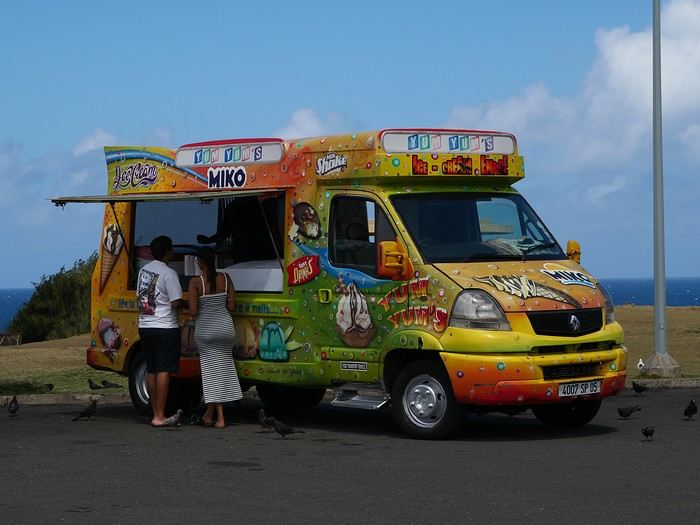
For the tasting, follow along in the pages of this travel journal! 😉
Don’t forget your hiking shoes, a swimsuit, sunscreen, but also a sweater, your driver’s license, and your credit card...
Just over 11 hours of flight, and we’ll be setting foot on Mauritian soil!
Hitchhiking in the 70s-80s
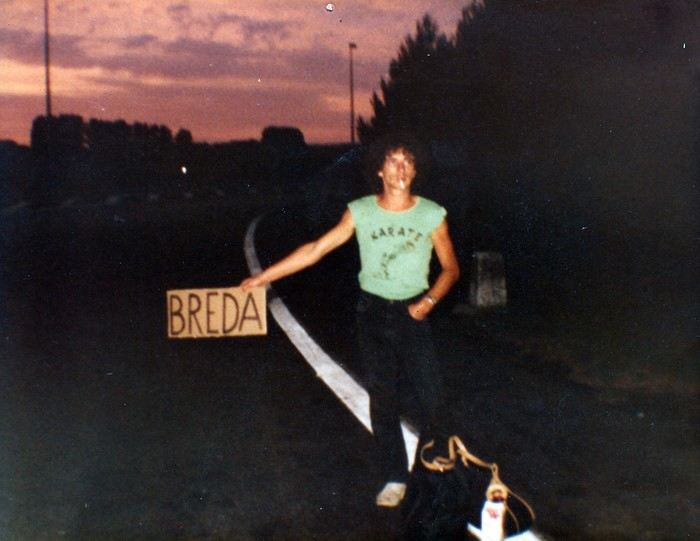
“Hey, your Marker... - My Marker? - The one you used to make hitchhiking signs.”
The marker in question is sitting proudly on the kitchen table. Marielle found it at the bottom of a moving box.
I’ve been meaning to tell the long story of my love affair with hitchhiking for years. Here we go.
To be honest, I’m not quite sure when it started. My earliest memory goes back to a fair with a bike race in my maternal grandparents’ village. I was with my cousin, my little sister, and three girl cousins. There were six of us, ages ranging from six or seven to thirteen or fourteen. Our parents stayed at the fair, and we’d had enough. So we decided to walk home. Only it was four kilometers away. So we hitchhiked. A guy driving an old car picked us all up and dropped us off at the farm. He probably found it amusing to see us thumbing a ride by the side of the road, but maybe it also worried him a bit. With everything you read in the papers...
Around fifteen or sixteen, I started hitchhiking regularly, alone or with a friend, to go to the nearby town. But it was especially when I started boarding school in Orléans that it became more regular. The first year, I’d leave Monday morning and come back Saturday noon by bus. It was an old, uncomfortable bus where we froze in winter. To make matters worse, I often got motion sickness if, as was too often the case, I ended up sitting in the back. In the spring, a high school friend suggested I hitchhike back. It meant a slight detour, but the advantage was taking only national roads.
So that’s how, from the end of tenth grade to twelfth grade, I’d thumb a ride every Saturday on the Pont de Bourgogne. Drivers were used to seeing young people hitchhiking, and it worked pretty well. Our biggest fear? Soldiers! At that time, military service was still mandatory, and on weekends, it wasn’t rare to see them competing with us. They’d keep their uniforms on to go home. That gave people confidence—with everything you read in the papers—and they’d rarely wait more than five minutes. We, with our long hair, were definitely less popular. From time to time, three big red-faced guys in a van coming back from a construction site would flip us off, yelling things like “go get a haircut, you bums!” Those were the good old days.
We still had a good laugh, though. Patrice, the friend I’d hitchhike back from school with on Saturdays, is a musician—I’d later discover he’s an excellent composer. A die-hard Beatles fan, he knows their repertoire by heart and spends his time singing at the top of his lungs while we thumb a ride. One Saturday late morning, we’d been waiting for a while at the exit of Châteauneuf-sur-Loire when a little lady came up to him and asked if he could please sing a little quieter: a baby was sleeping in the house. He put on the most sorry face: “Oh, sorry ma’am, we didn’t realize.” No sooner had the lady gone back inside than he started again. Luckily, a car stopped just then, sparing me the embarrassment of seeing the lady come back out.
Saturday was also the day when the cigarette pack was dangerously low. So before leaving, we’d go buy some “Parisiennes,” the “P4s” as we called them back then. They were slightly thinner cigarettes with a mix of tobacco scraps. Sometimes they tasted like light tobacco, sometimes like dark. Not great, but by the end of the week, our pocket money was gone. They were sold in small packs of four, hence the name P4. We’d only pay 20 centimes. On Saturdays, it was rare for the two of us to manage to scrape together 1.50 F to buy a whole pack of Gauloises...
The last twenty kilometers, I’d usually do alone, Patrice having reached his destination. From time to time, luck would smile on me: an acquaintance would just happen to pass by and stop. One January Saturday, at the exit of Gien, I ran into another guy from Argenton whom I knew a little. That day, the weather was nice, but the temperature was well below zero. It was around noon, and it was the off-peak hour. We were shivering, stamping our feet by the side of the road, when a Citroën “Tube” arrived: it was his father’s boss’s, a mason. They were both sitting in the front, but since they were obese, they had us climb onto the open back. Even though we huddled against the cab to shelter from the wind, the twenty kilometers felt very long, especially since we were only going sixty kilometers an hour. Our hands and cheeks were blue when we finally arrived.
The year I took my baccalaureate, a friend with a 2CV would take me Monday mornings with one or two others we’d pick up in nearby villages. We’d share the gas costs, but it was still cheaper than the bus. And in winter, the bus was my nightmare. You had to get up at five to catch it at six. Not enough sleep, and outside it was freezing or raining—or both. The 2CV was luxury. Plus, Philippe would pick me up at home. On the other hand, since I didn’t have class Saturday mornings—well, I did, but we only had PE the first two hours and nothing after—I’d skip class and slip out right after breakfast to thumb a ride at the Pont de Bourgogne.
Those three high school years were formative in this optional subject that was hitchhiking. Little by little, I learned the rules of the game. First, you shouldn’t walk along the road while thumbing. Cars go too fast and can’t stop easily. Accepting a ride that’s too short is also a no-go. The guy who offers to take you a little way but drops you off at some vague crossroads in the middle of nowhere? No thanks. You need to get dropped off in a town. If it’s a fairly big city, you often have to cross it from one end to the other, but it’s better. At the exit, you have to choose your spot well. Actually, you have to put yourself in the driver’s shoes: they need to see you early enough, not be going too fast, and be able to stop easily without risking an accident. So when leaving a city, it’s better not to go too far. It’s wiser to find a spot where cars go slowly and can stop easily. And preferably near a café. The café is for when you still have a few coins for a coffee and need to warm up. From time to time, you’d run into someone nice who’d make a detour to drop you off at a better spot to start again. Finally, if possible, avoid hitchhiking on Sundays. Cars are packed with whole families who, most of the time, aren’t going far. And then there’s the little worry of those people who rarely leave home: with everything you read in the papers...
During those high school years, it was only short trips, rarely exceeding a hundred kilometers. Later, I aimed bigger, and things were a bit different. In 1973-74, I crossed part of France for the first time on two or three occasions, coming back from the German border or returning to Bordeaux, where we lived briefly. Since there weren’t many highways back then, we took national roads. It was during these trips that I realized it was better to leave in the evening. As I said earlier, Sunday is to be avoided, but on weekdays, there’s another problem: if you leave in the morning, you only make short hops. First, it often takes longer to get going because drivers are people going to work nearby. Which brings us back to those who drop you off in a bad spot, far from everything. There, you have to know how to refuse. You thank the driver for stopping—oh, if only everyone could be like you—while explaining why you’d rather stay put. People don’t take offense, by the way. Those who pick up hitchhikers often hitchhiked themselves when they were in the military or before they had a car. In the late afternoon, you’d often run into salespeople or truckers, in other words, people who drive a lot. At that time, salespeople no longer had appointments and were more relaxed. They wanted to talk about something other than the merits of their products. On the radio, it was time for *Les Grosses Têtes*. You’d also quite often run into small business owners, professionals, or even hippies. The conversations were pleasant and often enriching. A little later in the evening, truckers would take over. They’d already driven a few hundred kilometers, and the depot or customs was still far away. So they’d gladly take a hitchhiker to stay awake at the wheel and chat. The radio with Max Ménier’s show *Les routiers sont sympas*, you’d eventually get tired of it. So a hitchhiker was a change. Others, who’d hit the road at midnight to be at their destination by morning, were nice and offered to let you lie down on the bunk while they drove. When you’d been hitchhiking since six in the evening, freezing in the wind between two vehicles, you weren’t unhappy to take a little nap.
Speaking of Max Ménier, he’d often make announcements for hitchhikers. One evening, I called him. It was getting late, and I still had quite a way to go. No luck: the show had ended for good the day before!
In short, it’s better not to rush, sleep in, and leave after lunch, or better yet, in the late afternoon. Obviously, I’m talking about when you have several hundred kilometers to cover. That’s when you have to play it pro.
First thing, especially at night, but it also applies in the middle of summer when the light is blinding: dress to be seen from far away. I’ll admit I have an advantage over most other hitchhikers: I’m small and don’t scare people. To balance that out, racist drivers often take me for an Arab and are less likely to pick me up, but overall, the balance tips in my favor. Back to the need to be seen: at night, I wear light-colored clothes. In headlights, you can see me from far away.
Second thing: travel light. Forget the big backpack with a frame. Drivers don’t always have room in the trunk or on the back seat, especially if it’s rained and the ground is wet. Plus, it forces them to get out of the car. If they’re nice enough to pick up a hitchhiker, you shouldn’t ask for too much either.
Third thing: bring a cardboard sign and a big marker—like the ones in the photo at the start of this post—to write the name of your destination. In the early 80s, I ran a tourist house in the Cher, but I lived in the Netherlands. In the off-season, it was only open on weekends. On Fridays, I’d leave Holland and return on Mondays. 1200 km round trip. On the way there, in Paris, I’d stand at Porte de la Chapelle. At that spot, the road is very wide, and drivers could stop easily. Obviously, on the sign, I didn’t write Eindhoven, which not everyone knows, and even less Amsterdam because of its seedy reputation. In that case, you’d expect to see a police car stop and two officers in kepis ask for your papers. So as a first destination, I’d write Compiègne. We were well out of Paris, and since it wasn’t too far, a trucker or salesperson was less reluctant to stop. Once past Compiègne, I’d take out my Lille sign. Once in Belgium, it wasn’t really necessary to use a sign anymore, since everyone was going in the same direction. Usually, the guy who picked me up at Porte de la Chapelle would say he wasn’t going far but could take me a little way. Before that, I’d still ask if there was a gas station on the highway where he could drop me off before exiting. While talking, the guy would realize he wasn’t dealing with a dangerous criminal. He’d pretend to check his watch, think for a moment, then say that actually, he was going to Belgium and could take me to the border or a little beyond. To leave Paris on the way back, I’d take the train to Melun, where it was easier to hitchhike than at Porte d’Italie.
Over all those years, I think I was pretty lucky. Or maybe philosophical enough not to imagine a car would stop after a few minutes. An hour’s wait was average. Sure, I sometimes waited three, four, or five hours. Most often at odd hours and in terrible weather. When it doesn’t work, it doesn’t work. But there’s always a moment when things pick up. Sure, when you’re soaked in freezing rain in the early morning after a sleepless night, you’re less philosophical than when I’m writing these lines comfortably at my computer, but it still holds true.
Earlier, I mentioned clothing and the importance of being well-rested before leaving. When you’ve eaten well and just gotten out of the shower, shaved, you’re in a better mood. And somehow, drivers sense it. Or at least, that’s the impression I’ve always had. It’s better to look in shape than disgusted at standing there, half-heartedly thumbing a ride. In short, when I’d start to get fed up with waiting, I’d go into the first café I saw for a coffee. Coming back out, I’d be refreshed, and most of the time, a car would stop within minutes. I’ve often said that when I stood by the side of the road thumbing a ride, I felt a bit like a gambler in front of a slot machine. It was a matter of giving luck a chance. And well, it worked out pretty well.
Then, there are countries where hitchhiking works really well and others where it’s harder. In the 70s-80s, it worked best in Germany and England. In the late afternoon, it wasn’t rare to be invited for tea. Well, that was in England. Tea meant being offered room and board. In Germany, they’d offer you coffee. Once there, they’d first show you the guest room and point out the bathroom before sitting you down in front of a big plate of cold cuts. In the evening, they’d go out in town, and the next morning, they’d usually drop you off at a good spot for hitchhiking. On the other hand, in Mediterranean and Scandinavian countries, you’d better be patient. In Spain or Italy, it’s better to take the train, which was dirt cheap back then. However, if you’re a couple traveling light, it’s already easier in most countries.
In 1982, I went on a trip around Turkey with my girlfriend. We only had two small bags, which was plenty. It was November-December, and we wore our warm, bulky clothes. Leaving Eindhoven at nine in the morning, we arrived in Graz, near the Yugoslav border, at eleven at night. 1300 km in a day! In just four or five vehicles. One to the German border, about fifty kilometers from Eindhoven, the second to Hagen in the Ruhr, the third to Salzburg, and the last to Graz at the Yugoslav border. Record broken. During the night crossing of Yugoslavia, we ran into a trucker close to retirement who lent us the truck’s bunk. So we arrived fresh and rested near Skopje the next morning. We continued to Thessaloniki in northern Greece before taking the train to Istanbul. In Turkey, we traveled a good part of the country by hitchhiking too. With truckers in old, overloaded, slow trucks that climbed hills at fifteen kilometers an hour, but also in cars where five or six people were already crammed in. And every time, we were invited for tea. Once, we were even picked up by a big shot in his Mercedes with a chauffeur. Until then, the average speed was around fifty kilometers an hour. There, we were going two hundred. On a national road, not a nice European highway.
I’ve also hitchhiked in Nepal, from Lumbini, Buddha’s birthplace, to a village on the way to Pokhara. It must have been midday. No bus until the next day. I gave it a try. A small truck overloaded with rice sacks, with two or three young people already perched on top, stopped. I rode on the roof of the cab. At fifty kilometers an hour when it was going well, with a breathtaking view. Coming back from India, I also crossed part of Iran by hitchhiking, from Tehran to the Turkish border. I did this trip with an Austrian I met at the hotel who, like me, had to watch his pennies. We gave it a shot. There was almost no traffic, but to our great surprise, the first car that passed in the area would always stop. They’d just ask for a modest contribution for gas, and it cost next to nothing.
Sometimes, you get scared too. After leaving Turkey in early December 82, we spent about two weeks in the southern Peloponnese harvesting olives. A few days before Christmas, we hitchhiked back to Holland. A girl picked us up in her little Fiat 500. We were driving on a mountain road, and that morning there was a bit of black ice. After crossing a pass, we saw the old Ford Taunus ahead of us at fifty meters start to skid. The driver let out a “heeee!” while grabbing my knees. I reflexively grabbed the wheel. Finally, the Taunus got back on track. And we didn’t swerve. But those few seconds felt very long.
In January 77, while I’d been living in Germany for a few months, I decided to spend a few days in Italy. By hitchhiking, of course. I left in the early afternoon, and by ten at night, I wasn’t far from Frankfurt. I saw a big Mercedes stop. The four or five young people crammed inside were listening to Schlager at full volume. Beer cans littered the floor. They didn’t have a precise destination, and as long as they were going south, that was fine with me. They’d finished their military service that very day and had clearly already celebrated their discharge. The driver was going 160, zigzagging dangerously from one side of the highway to the other. I should have realized he wasn’t entirely sober either. Luckily, there was almost no traffic. Finally, I managed to get dropped off at a gas station just before Frankfurt, relieved. I hope their trip didn’t end tragically.
Another time, coming back from Holland with my wife, we were picked up early in the morning near Senlis by two guys from Lille. They were going to work near Tours and could drop us off at Porte d’Italie. Apparently, they were coworkers but barely knew each other. The driver offered us a beer—at six in the morning, sure!—before opening another can for himself. He was clearly having trouble staying in the right lane. We politely declined, the passenger too. Everyone was tense. Luckily, it was rush hour on the ring road, and we were going slowly. When we got out of the car, the passenger said goodbye with the look of a guy being offered the condemned man’s rum and cigarette.
Finally, there are the annoying remarks from drivers who are either gay when you’re alone or turned on by the sight of your girlfriend when you’re a couple. In those cases, I’d get in the back so the guy wouldn’t feel too confident. And if the conversation got a little too suggestive, we’d deflect until we got dropped off.
And luckily, there are the times, not so rare after all, when you run into really nice people who invite you to eat and sleep at their place and drive you to a good spot the next morning. In Germany and England, that was common. And then there are the big strokes of luck, like during our trip to Turkey when we crossed most of Germany in one car, or that other time when some Germans drove me from the exit of Geneva all the way to the Costa Brava.
Going back to “with everything you read in the papers” and its variant “with everything you see on TV”—and now on the internet—it’s always left me perplexed. Personally, I’ve never heard of hitchhikers assaulting drivers, even if it may have happened. On the other hand, what was most common were hitchhikers being assaulted, especially girls. Anyway, even armed, it seems a bit stupid to assault the driver—wouldn’t that risk causing an accident?
Finally, since that time, I’ve occasionally wanted to hitchhike somewhere far away in France. Most often, too busy with work, it never happened, but the nostalgia hasn’t completely disappeared.
* * *
Other Hitchhikers
And then one day, I... settled down to become a driver myself. Ten years had passed, and you saw fewer and fewer hitchhikers. Or maybe I saw fewer because I had a regular job and wasn’t traveling the same way. And then I understood a few things.
Several times, I was tempted to pick up a hitchhiker, but they didn’t meet the required conditions. They were walking along the road instead of staying at the exit of the previous town. Hard to stop without risking an accident. Or the guy looked really scruffy. Or he was sulking, if not both. Then you think of that famous “with everything you read in the papers.” Not that I was scared, but unfortunately, the few hitchhikers I did pick up later were rarely interesting.
A few years ago, we picked up a young guy at the exit of a small town in Sologne. Not an easy spot for hitchhiking. Bad luck, he was a pretentious little jerk. He was barely 20 or 25 and talked like a bitter old man. He was a waiter in a restaurant. According to him, it was lucky he was there, otherwise the boss would have closed up shop long ago. You’d think he had thirty or forty years of professional experience behind him. As we approached Blois, he started ranting about Arabs, blaming them for all evils. And he laid it on thick. That morning, we were going to a teenager’s funeral who had just committed suicide, so he really got on our nerves, Mr. Know-It-All. Out of anger, I dropped him off next to a shopping center a few kilometers from downtown. Not nice, but it felt good.
Some time ago, we were driving around the Limousin on a Sunday to try out the used Twingo we’d just bought. We picked up a guy in his forties. A German who spoke French well. He started talking about the environment. He was a green Khmer. He got worked up all by himself with his pseudo-eco rant and, after a few kilometers, was almost yelling at us. As we were about to leave the main road for a small one, I dropped him off at a crossroads in the middle of nowhere. Normally, I would have made a little detour to take him to a better spot, but this time, I didn’t feel like doing the... eco-warrior a favor.
On the other hand, I’ve still done my good deed a few times. One June morning, coming back from Orléans, I saw a man in his sixties hitchhiking. The poor guy had had a rough time. He was from Montpellier and was coming back from Caen, where he’d been promised a job. Once there, they bluntly told him the position was already taken, and he had to go back. Except he didn’t have enough money left for the train. He’d spent the night hitchhiking without success. I could only take him as far as Lamotte-Beuvron, where I dropped him off near the fire station. Apparently, there was some vague shelter there or something, but it only opened a few hours later. In the meantime, he settled on the grass in a corner to sleep a little. While he was doing that, I quickly went to the train station to check the price of a ticket to Montpellier. It was within my means. Since he was sound asleep, I slipped the train ticket and 100 francs into his pocket. I couldn’t imagine him continuing to hitchhike all the way to Montpellier. And I bet he didn’t even have a piece of cardboard and a marker!
When we go to Brazil, we usually rent a small car. One day, we were coming back from Paracuru to Fortaleza when we saw a whole family hitchhiking. Two adults and two or three small children. Here near the equator, the sun sets very quickly, and it would soon be night. There was little traffic, and trucks wouldn’t stop because there was no room in the cab. As for the rich people driving big 4x4s, they wouldn’t stoop to picking up the lower classes. The only hope for this kind of family was usually a farmer or artisan who’d let them ride in the back of his pickup. Obviously, they were a bit surprised to see us. Everyone crammed in as best they could in the back of our little car. When we dropped them off, we got a whole string of “Deus lhes abençõe”—God bless you.
Still in Brazil, we were on the road from Barreirinhas to São Luís do Maranhão. About 150 km of deserted road with an isolated mud house here and there. A young woman flagged us down. She was very pregnant and had to get to the clinic twenty or thirty kilometers away to give birth. Someone was supposed to drive her, but the first signs of labor started earlier than expected, and the driver was unavailable. Even driving fast, we weren’t feeling great: it would be just our luck if she gave birth in the car!
Today, we’re in the age of smartphones and carpooling apps. Safety. With everything you see on TV... Three or four years ago, we signed up on a platform. Our first, and only, “client” was a little jerk who didn’t say a word the whole trip. No hello, no goodbye, and certainly no thank you. The next day, we found his Ray-Bans in the car. We didn’t run after him to give them back. Ha!
Draft itinerary for Greece
Hi everyone,
I’m planning my first trip to Greece from October 29th to November 23rd and I’d love to hear your thoughts and suggestions on the itinerary I’m considering. For a first visit, I’ll definitely cover the traditional tourist route, but I’m also open to off-the-beaten-path ideas. I’m curious and interested in history, archaeological sites, and the islands—more for culture than beaches, anyway, especially in November!
Here’s the plan: 3–4 days in Athens, 2 days in Nafplio: visiting Epidaurus and Mycenae, Stop in Olympia on the way to Delphi via Patras by bus? To avoid backtracking to Athens; 2 days in Delphi, including the site and Mount Parnassus, Explore the Ionian coast and a few islands? A few days in Corfu, 3 days in Meteora, 2–3 days in Thessaloniki, Direct flight from Thessaloniki to Heraklion, Crete, 3–4 days in Crete, November 22nd–23rd: overnight ferry back to Athens to catch my return flight to Montreal.
You’ve probably guessed I’m traveling solo. It might seem a bit scattered right now—I’ve started reading up on Greece, and there are must-see spots. What feels unclear are the 4–5 days between Delphi and Corfu. Also, mid-November in the islands might not be ideal if the weather’s bad.
Is Corfu worth it? Maybe there are other options—like a few days in Albania? Just throwing the idea out there.
Thanks for your input! I’d love to hear about your experiences to help enrich my upcoming trip.
Here’s the plan: 3–4 days in Athens, 2 days in Nafplio: visiting Epidaurus and Mycenae, Stop in Olympia on the way to Delphi via Patras by bus? To avoid backtracking to Athens; 2 days in Delphi, including the site and Mount Parnassus, Explore the Ionian coast and a few islands? A few days in Corfu, 3 days in Meteora, 2–3 days in Thessaloniki, Direct flight from Thessaloniki to Heraklion, Crete, 3–4 days in Crete, November 22nd–23rd: overnight ferry back to Athens to catch my return flight to Montreal.
You’ve probably guessed I’m traveling solo. It might seem a bit scattered right now—I’ve started reading up on Greece, and there are must-see spots. What feels unclear are the 4–5 days between Delphi and Corfu. Also, mid-November in the islands might not be ideal if the weather’s bad.
Is Corfu worth it? Maybe there are other options—like a few days in Albania? Just throwing the idea out there.
Thanks for your input! I’d love to hear about your experiences to help enrich my upcoming trip.
3 weeks in Kazakhstan and Kyrgyzstan, preliminary travel questions
Hi there, 🙂
I’m thinking of taking a trip to these two countries in 2026 (late spring to early summer).
I’d arrive in Almaty and leave from Bishkek, and I’d be driving myself.
I plan to spend 1 week in Kazakhstan and 2 in Kyrgyzstan. The itinerary isn’t set yet.
My preliminary questions are about formalities, hassle levels, and the car.
From what I understand, no visa is needed, the passport must be valid for 6 months after entry, and there’s no longer a requirement to register with the authorities at each stop. In short, once you’re in, no administrative headaches.
Except for permits needed to drive in certain regions?
---/---
About crossing between the two countries:
- On foot - In a rental car
Quick? Easy?
---/---
Are both countries safe? (Meaning you don’t have to stay on guard all the time.) Are the cops corrupt? (A little, a lot, passionately, not at all?)
---/---
Is it better to rent a car for both countries or rent a vehicle in each country?
A 4x4 or something else?
Is accommodation plentiful enough that I can skip a rooftop tent, or is it better to rent a 4x4 with one?
I’ll definitely have more questions later...😉
Thanks for your answers !
I’m thinking of taking a trip to these two countries in 2026 (late spring to early summer).
I’d arrive in Almaty and leave from Bishkek, and I’d be driving myself.
I plan to spend 1 week in Kazakhstan and 2 in Kyrgyzstan. The itinerary isn’t set yet.
My preliminary questions are about formalities, hassle levels, and the car.
From what I understand, no visa is needed, the passport must be valid for 6 months after entry, and there’s no longer a requirement to register with the authorities at each stop. In short, once you’re in, no administrative headaches.
Except for permits needed to drive in certain regions?
---/---
About crossing between the two countries:
- On foot - In a rental car
Quick? Easy?
---/---
Are both countries safe? (Meaning you don’t have to stay on guard all the time.) Are the cops corrupt? (A little, a lot, passionately, not at all?)
---/---
Is it better to rent a car for both countries or rent a vehicle in each country?
A 4x4 or something else?
Is accommodation plentiful enough that I can skip a rooftop tent, or is it better to rent a 4x4 with one?
I’ll definitely have more questions later...😉
Thanks for your answers !
Uzbek notes
The Afrosiyob races through a premature twilight, lashed by a blizzard of thick snow. In the endless gray, a monumental industrial complex occasionally emerges, ghostly. Here and there, in the middle of nowhere, a human silhouette appears (a soldier?), standing motionless by the tracks. On the screen mounted in the middle of the ceiling, a dashing Bollywood cat in vibrant colors writhes in all directions, throwing smoldering glances at a dancer on the verge of fainting. A server moves down the central aisle, offering crepes for sale—ones I suspect are stuffed with ground beef. I’m in Central Asia, in Uzbekistan, somewhere between Bukhara and Samarkand.
I chose the title "notes"—scattered thoughts, rough drafts. I’m not sure what I’ll write, but one thing’s certain: this won’t be a linear travel journal.
And a photo... there must be a photo, so here:
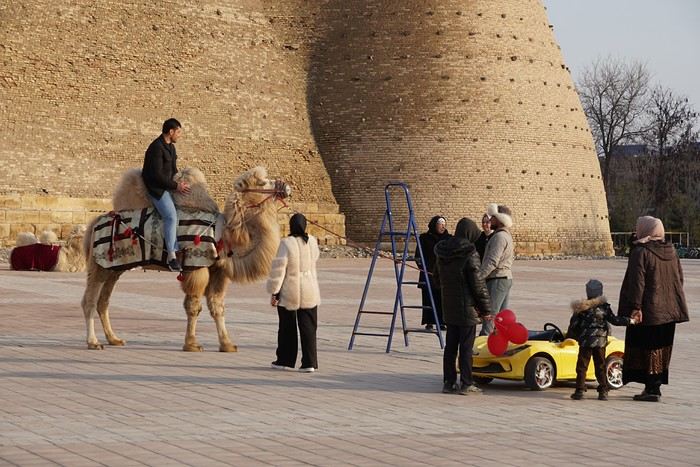
Local tourists between a Bactrian camel and an electric car, in front of ancient walls—it’ll do.
I chose the title "notes"—scattered thoughts, rough drafts. I’m not sure what I’ll write, but one thing’s certain: this won’t be a linear travel journal.
And a photo... there must be a photo, so here:
Local tourists between a Bactrian camel and an electric car, in front of ancient walls—it’ll do.