Results for "Bormes+|+127"
6204 results found.
Mauritanie 20 ans déjà English translation pending
DEJA 20 ANS !
En Avril 1984, nous découvrions la Mauritanie. 37 % de la population était nomade. Les seuls véhicules, de marque Peugeot essentiellement, se cantonnaient dans les quelques très grosses villes dont Atar ne faisait pas partie. Nous avons connu la piste d’atterrissage de Nouadhibou ( ! ), le train minéralier qui nous acheminait à Choum à travers 460 kilomètres de désert, l’ambiance « bourgade » d’Atar où ne circulaient que les charrettes à âne.
A l’époque, nous aurions presque pu partir d’Atar-même en selle sur nos chameaux car les passes (et non pas encore les pistes) qui menaient sur les plateaux de l’Adrar étaient encore des voies caravanières ! Ah ! Nous pouvons nous réjouir d’avoir connu l’Authentique que tellement de touristes croient saisir aujourd’hui… C’était l’époque où Atar, donc, ne connaissait ni bitume, ni voiture, ni téléphone (qui fonctionnait à peine à Nouakchott !), ni vol international… Nous arrivions presque d’une autre planète et étions fortement conscients de la réserve que nous devions avoir dans nos comportements de chaque instant. C’est ainsi que nous avons eu des exigences qui soulèveraient aujourd’hui des mutineries, et qui n’étaient pourtant que l’indispensable recette du « passage sans pollution ». Pas un seul d’entre nous ne portait de lunettes de soleil ou une montre. PAS UN SEUL. Le chech était de rigueur, ainsi que les vêtements de brousse du pays que nous portions non pas comme cache-misère, mais cache-richesse, par-dessus nos vêtements européens. Nous faisions vraiment le maximum pour ne pas choquer, à tel point que l’année où arrivèrent les premiers touristes, nous furent pris ( et filmés ! ) pour des bergers nomades ! Mais ces attentions avaient un prix : nos intendances étaient extrêmement spartiates avec des menus répétitifs et souvent à l’opposé de nos envies ! Les bagages transportés devaient rester discrets (enfournés dans des sacs de jute) et « tolérables » puisque les chameliers nous accompagnant les manipulaient ; de nombreux articles n’ont donc jamais vu la bosse de nos chameaux, à commencer par le plus insignifiant des matelas de randonneur… Nous nous sommes « autorisé » l’usage des « vaches à eau » après avoir vu certains nomades connaître, voire utiliser les tonnelets de 50 litres. Mais notre baptême méhariste avait été une longue descente aux enfers abreuvée avec l’unique eau des guerbas en peau de chèvre lors de la 7ème année consécutive de grande sécheresse : autant dire que la « bouillie » des guerbas calmait bien des appétits…
En 2004, après le passage de plusieurs années de Progrès que nous ne pouvons refuser (il faut lui reconnaître certains avantages), beaucoup de choses ont changé évidemment. Le progrès, c’est le début de la fin, on en reçoit tout ou rien, sans tri possible.
L’automobile a pénétré la brousse au fur et à mesure que des pistes s’aménageaient (et ce n’est pas fini), les moyens de communication de toutes sortes ont littéralement explosé et imbibé partie du pays. L’enseignement touche de plus en plus d’enfants, la santé et la possibilité de l’influencer est une notion qui évolue dans les esprits. Avec l’arrivée de quelques facilités matérielles pour la population (qui existent mais ne sont pas forcément accessibles pour des raisons de coût), la vie mauritanienne s’est un peu décolorée en cachant son bronzage saharien derrière du goudron, des Toyota, des lunettes de soleil, des auberges, des enseignes ronflantes de commerce en tout genre… en échangeant la sandale des sables (qui a pourtant une bonne raison d’exister) contre les chaussures de marche, le « Tassoufra » des grands nomades contre le sac-à dos des guides ( ! ) pour Tour Operator, la guerba contre la gourde isotherme…
Tout cela a coûté son prix car tout se paie : augmentation du prix du pain, du riz, de la farine, apparition de la délinquance, dévaluation de l’Ouguya, disparition presque totale à ce jour des vrais nomades, ceux qui furent parmi les meilleurs éleveurs de camélidés de la planète. « Hier », Louis Chardon suppliait les hommes français qui nous accompagnaient de se mettre accroupis pour uriner, comme les Mauritaniens, et de ne pas offrir nos cigarettes d’importation à ces bergers qui ne connaissaient encore que leur pipe (souvent un simple os creux de chèvre) et leur tabac en poudre.
Aujourd’hui, nous passerions sans doute pour des illuminés en tenant un tel discours, de toute façon obsolète. Car nous sommes en 2004. Vingt années sont passées sur nos premières empreintes dans les dunes roses et blanches de l’Ouarane. Notre amour pour ce désert d’il y a 20 ans nous conduit peut-être aux portes du fanatisme quand nous évoquons, tels des « vieux schnocks », cette grande époque. Il faut nous pardonner ces élans et comprendre que nous sommes à jamais en manque d’un trésor perdu.
Nous savons que des choses sont encore inchangées, certaines pour l’éternité peut-être, d’autres… allez savoir. Mais lorsque nous observons l’évolution de la Mauritanie au cours de ces 20 dernières années, nous avons souvent l’impression que le Progrès a raté sa cible, qu’il n’a pas changé ce qui avait besoin de l’être pour le bien de l’humanité. Car l’idée, puis la certitude (apportées par la télévision d’abord, puis par les Touristes) qu’ « on » peut vivre autrement ont fait leur chemin. Nous pouvons nous incliner alors devant l’esprit brillant d’Albert Einstein, décédé en 1955, mais qui avait toutefois eu le temps d’écrire :
« Cette explosion de la matière est la plus faible des trois explosions auxquelles l’humanité sera nécessairement confrontée. Avec les progrès de la médecine, l’humanité va bientôt assister à l’explosion de la vie qui apportera plus de bouleversements que celle de la matière. Mais l’explosion la plus lourde de conséquences pour l’humanité sera celle de l’information. D’ici peu, par toutes sortes de techniques, les plus pauvres, les plus malheureux auront connaissance de ce que l’humanité est capable de faire et des moyens qui pourraient les sortir de la misère, de leur détresse. Partout sur la planète et pour la première fois de son histoire, l’homme saura l’absurdité de sa souffrance et donc souffrira de savoir qu’il souffre. L’humanité se trouvera ainsi acculée, sans dérobade possible, à de nouveaux partages. »
Croyez, toutes et tous, à mes meilleurs sentiments.
Lysiane Pradines.
Vous pourrez retrouver ce texte, avec d'autres infos, dans la circulaire d'avril 2004 qui est dans le site Internet de l'association Liberté par les Chamelles, dont Lysiane est la présidente : http://libertechamelles.free.fr
En Avril 1984, nous découvrions la Mauritanie. 37 % de la population était nomade. Les seuls véhicules, de marque Peugeot essentiellement, se cantonnaient dans les quelques très grosses villes dont Atar ne faisait pas partie. Nous avons connu la piste d’atterrissage de Nouadhibou ( ! ), le train minéralier qui nous acheminait à Choum à travers 460 kilomètres de désert, l’ambiance « bourgade » d’Atar où ne circulaient que les charrettes à âne.
A l’époque, nous aurions presque pu partir d’Atar-même en selle sur nos chameaux car les passes (et non pas encore les pistes) qui menaient sur les plateaux de l’Adrar étaient encore des voies caravanières ! Ah ! Nous pouvons nous réjouir d’avoir connu l’Authentique que tellement de touristes croient saisir aujourd’hui… C’était l’époque où Atar, donc, ne connaissait ni bitume, ni voiture, ni téléphone (qui fonctionnait à peine à Nouakchott !), ni vol international… Nous arrivions presque d’une autre planète et étions fortement conscients de la réserve que nous devions avoir dans nos comportements de chaque instant. C’est ainsi que nous avons eu des exigences qui soulèveraient aujourd’hui des mutineries, et qui n’étaient pourtant que l’indispensable recette du « passage sans pollution ». Pas un seul d’entre nous ne portait de lunettes de soleil ou une montre. PAS UN SEUL. Le chech était de rigueur, ainsi que les vêtements de brousse du pays que nous portions non pas comme cache-misère, mais cache-richesse, par-dessus nos vêtements européens. Nous faisions vraiment le maximum pour ne pas choquer, à tel point que l’année où arrivèrent les premiers touristes, nous furent pris ( et filmés ! ) pour des bergers nomades ! Mais ces attentions avaient un prix : nos intendances étaient extrêmement spartiates avec des menus répétitifs et souvent à l’opposé de nos envies ! Les bagages transportés devaient rester discrets (enfournés dans des sacs de jute) et « tolérables » puisque les chameliers nous accompagnant les manipulaient ; de nombreux articles n’ont donc jamais vu la bosse de nos chameaux, à commencer par le plus insignifiant des matelas de randonneur… Nous nous sommes « autorisé » l’usage des « vaches à eau » après avoir vu certains nomades connaître, voire utiliser les tonnelets de 50 litres. Mais notre baptême méhariste avait été une longue descente aux enfers abreuvée avec l’unique eau des guerbas en peau de chèvre lors de la 7ème année consécutive de grande sécheresse : autant dire que la « bouillie » des guerbas calmait bien des appétits…
En 2004, après le passage de plusieurs années de Progrès que nous ne pouvons refuser (il faut lui reconnaître certains avantages), beaucoup de choses ont changé évidemment. Le progrès, c’est le début de la fin, on en reçoit tout ou rien, sans tri possible.
L’automobile a pénétré la brousse au fur et à mesure que des pistes s’aménageaient (et ce n’est pas fini), les moyens de communication de toutes sortes ont littéralement explosé et imbibé partie du pays. L’enseignement touche de plus en plus d’enfants, la santé et la possibilité de l’influencer est une notion qui évolue dans les esprits. Avec l’arrivée de quelques facilités matérielles pour la population (qui existent mais ne sont pas forcément accessibles pour des raisons de coût), la vie mauritanienne s’est un peu décolorée en cachant son bronzage saharien derrière du goudron, des Toyota, des lunettes de soleil, des auberges, des enseignes ronflantes de commerce en tout genre… en échangeant la sandale des sables (qui a pourtant une bonne raison d’exister) contre les chaussures de marche, le « Tassoufra » des grands nomades contre le sac-à dos des guides ( ! ) pour Tour Operator, la guerba contre la gourde isotherme…
Tout cela a coûté son prix car tout se paie : augmentation du prix du pain, du riz, de la farine, apparition de la délinquance, dévaluation de l’Ouguya, disparition presque totale à ce jour des vrais nomades, ceux qui furent parmi les meilleurs éleveurs de camélidés de la planète. « Hier », Louis Chardon suppliait les hommes français qui nous accompagnaient de se mettre accroupis pour uriner, comme les Mauritaniens, et de ne pas offrir nos cigarettes d’importation à ces bergers qui ne connaissaient encore que leur pipe (souvent un simple os creux de chèvre) et leur tabac en poudre.
Aujourd’hui, nous passerions sans doute pour des illuminés en tenant un tel discours, de toute façon obsolète. Car nous sommes en 2004. Vingt années sont passées sur nos premières empreintes dans les dunes roses et blanches de l’Ouarane. Notre amour pour ce désert d’il y a 20 ans nous conduit peut-être aux portes du fanatisme quand nous évoquons, tels des « vieux schnocks », cette grande époque. Il faut nous pardonner ces élans et comprendre que nous sommes à jamais en manque d’un trésor perdu.
Nous savons que des choses sont encore inchangées, certaines pour l’éternité peut-être, d’autres… allez savoir. Mais lorsque nous observons l’évolution de la Mauritanie au cours de ces 20 dernières années, nous avons souvent l’impression que le Progrès a raté sa cible, qu’il n’a pas changé ce qui avait besoin de l’être pour le bien de l’humanité. Car l’idée, puis la certitude (apportées par la télévision d’abord, puis par les Touristes) qu’ « on » peut vivre autrement ont fait leur chemin. Nous pouvons nous incliner alors devant l’esprit brillant d’Albert Einstein, décédé en 1955, mais qui avait toutefois eu le temps d’écrire :
« Cette explosion de la matière est la plus faible des trois explosions auxquelles l’humanité sera nécessairement confrontée. Avec les progrès de la médecine, l’humanité va bientôt assister à l’explosion de la vie qui apportera plus de bouleversements que celle de la matière. Mais l’explosion la plus lourde de conséquences pour l’humanité sera celle de l’information. D’ici peu, par toutes sortes de techniques, les plus pauvres, les plus malheureux auront connaissance de ce que l’humanité est capable de faire et des moyens qui pourraient les sortir de la misère, de leur détresse. Partout sur la planète et pour la première fois de son histoire, l’homme saura l’absurdité de sa souffrance et donc souffrira de savoir qu’il souffre. L’humanité se trouvera ainsi acculée, sans dérobade possible, à de nouveaux partages. »
Croyez, toutes et tous, à mes meilleurs sentiments.
Lysiane Pradines.
Vous pourrez retrouver ce texte, avec d'autres infos, dans la circulaire d'avril 2004 qui est dans le site Internet de l'association Liberté par les Chamelles, dont Lysiane est la présidente : http://libertechamelles.free.fr
Russie-Alaska par cargo? English translation pending
Je suis en train de preparer un tour du monde et je souhaiterais passer de la russie à l'alaska avec une voiture.
Savez vous s'il existe de tel cargos? Ou puis je trouver des renseignements precis?
Est il plus facile de passer par le japon, puis ensuite l'alaska? beaucoup de questions auxquelleq je n'ai pas de réponse
🤪
Merci
Souvenirs English translation pending
Bonjour à tous!!😉
Je demarre une nouvelle discussion:je voudrais savoir quelle a été la chose, la personne, qui vous a vraiment marqué pendant vos voyages.
Ce souvenir peut être positif ou négatif!!
Partagez vos meilleurs ou pires moments passés à l'étranger!!
On attend avec impatience vos récits!!!
Bisous et à bientôt!!
Je demarre une nouvelle discussion:je voudrais savoir quelle a été la chose, la personne, qui vous a vraiment marqué pendant vos voyages.
Ce souvenir peut être positif ou négatif!!
Partagez vos meilleurs ou pires moments passés à l'étranger!!
On attend avec impatience vos récits!!!
Bisous et à bientôt!!
Inde: louer une voiture à Madras English translation pending
😏Bonjour à tous!
Je pars dans le Tamil Nadu du 15 août au 30 septembre et j'aimerai savoir s'il est facile de louer une voiture à Madras (ou ailleurs), et si oui, à quel prix? Sinon, est-il facile de se déplacer autrement, bus, train...?
Je pars en solo alors si vous êtes dans le coin durant cette pèriode. ps: c'est mon premier voyage en Inde et j'ai un peu peur.
Bizou à tous.
Je pars dans le Tamil Nadu du 15 août au 30 septembre et j'aimerai savoir s'il est facile de louer une voiture à Madras (ou ailleurs), et si oui, à quel prix? Sinon, est-il facile de se déplacer autrement, bus, train...?
Je pars en solo alors si vous êtes dans le coin durant cette pèriode. ps: c'est mon premier voyage en Inde et j'ai un peu peur.
Bizou à tous.
A M E R I C A English translation pending
Je pensais que la population américaine comptait environ 270 millions de personnes, or, à ma grande surprise, je découvre sur ce site qu'il n'y a qu'un américain, son nom commence par B.
Je me demande ce que cela vous ferez d'aller sur un site de voyage US et y découvrir des messages comme : "je boycotte les voyages en France, je ne mettrai jamais le pied sur le sol français et même y rester une heure me pose un problème de conscience .... les français ce n'est que des .... " vous seriez (à juste titre) outrés. Mais bon, vous réduisez des centaines de millions de personnes à la politique impérialiste d'un gouvernement, et au manque de véritable information d'une certain portion de la population.
Brèf, je vais soigneusement éviter de rentrer dans le débat "débarquement des américains, Gaugaulle, le colonialisme français" etc. qui ont en partie été évoqués par ailleurs. De toute manière si pour un certains nombre de français les américains sont bêtes et envahissant, les allemands carrés, les italiens des "bouffons" etc., les français ouverts et conciliants existent en bon nombre, et les rencontrer est un plaisir non négligeable.
Je me demande ce que cela vous ferez d'aller sur un site de voyage US et y découvrir des messages comme : "je boycotte les voyages en France, je ne mettrai jamais le pied sur le sol français et même y rester une heure me pose un problème de conscience .... les français ce n'est que des .... " vous seriez (à juste titre) outrés. Mais bon, vous réduisez des centaines de millions de personnes à la politique impérialiste d'un gouvernement, et au manque de véritable information d'une certain portion de la population.
Brèf, je vais soigneusement éviter de rentrer dans le débat "débarquement des américains, Gaugaulle, le colonialisme français" etc. qui ont en partie été évoqués par ailleurs. De toute manière si pour un certains nombre de français les américains sont bêtes et envahissant, les allemands carrés, les italiens des "bouffons" etc., les français ouverts et conciliants existent en bon nombre, et les rencontrer est un plaisir non négligeable.
La Pirogue Ile Maurice English translation pending
Bonjour à tous!
J'envisage de partir à l'Ile Maurice à l'hôtel La Pirogue situé à Flic en Flac.
Qqn connait ou a entendu des infos à ce sujet? Merci d'avance. 😉 😛
J'envisage de partir à l'Ile Maurice à l'hôtel La Pirogue situé à Flic en Flac.
Qqn connait ou a entendu des infos à ce sujet? Merci d'avance. 😉 😛
Pourquoi? English translation pending
Pourquoi, aux quatre coins du monde, y compris en Amerique, la religion, mobilise-t-elle les foules?
Pourquoi, en Europe comme aux états unis, règnent désormais, au nom du peuple, les minorités et les oligarchies?
Pourquoi, de l'ex-bloc soviétique au monde arabo-musulman en passant par l'Afrique ou l'Asie, se multiplient les régimes issus des urnes qui exaltent le fanatisme, la répression, la guerre?
Les Survivants English translation pending
😄 Message personnel à tous ceux nés avant le 3éme millénaire. Les autres ne pourront pas comprendre ! 😄
L'enfance des années 50, 60, voire 70.
En regardant en arriére, c'est dur de croire qu'on ait réussi à survivre si longtemps. Lorsque nous étions enfants, nous nous promenions en voiture sans ceinture de sécurité ou d'airbags pour nous protéger. Nos chambres étaient peintes de couleurs vibrantes au plomb et nos maisons étaient isolées à l'amiante. Il n'y avait pas de couvercles de sécurité sur les bouteilles de médicaments et de produits toxiques ni de serrures sécuritaires sur les armoires. Et lorsque nous partions faire un tour de vélo, on le faisait sans casque.
On allait seul en ville chercher le pain, le lait dans un broc en aluminium à peine fermé et on le buvait comme cela. On buvait même de l'eau directement des tuyaux d'arrosage. Quelle horreur !
On se faisait des petites voitures(caisse à savon) avec des vieux patins à roulettes et des planches en bois pleines d'échardes et on se laissait aller dans les descentes, sur le trottoir bordant la nationale, pour s'apercevoir trop tard qu'on avait oublié de mettre des freins. Aprés être rentrés dans les buissons ou les clôtures à quelques reprises, on solutionait le probléme. On quittait seul la maison tot le matin pour aller à pied à l'école et on revenait souvent au moment où les lampadaires des rues s'allumaient. Imaginez donc, pas de téléphones portables, personne ne pouvait nous joindre de la journée.
On mangeait des gâteaux secs, du pain et du beurre et nous n'étions pas obéses........., il faut dire que nous jouions presque toujours à l'extérieur. On buvait souvent à quete ou cinq dans la même bouteille et il n'y a jamais eu de décés à cause de cela.
On jouait à des jeux dangereux et souvent, on se faisait mal. On grimpait dans les arbres, on enjambait les murs des voisins. Parfois, il y avait des chutes, avec des coupures et des os cassés mais personne n'était blamé. C'était l'apprentissage de la vie. Parfois, on se battait entre nous, on avait des bleus mais on apprenait à passer par-dessus. On n'avait pas de Nintendo 64, de Playstation 2 ou de X Box, sans compter les jeux video ou même les 99 canaux de la télévision, les magnetoscopes, les ordinateurs personnels, etc, etc .....
Mais nous avions des amis et si nous voulions les voir, tout ce qu'on avait à faire, c'était de sortir et se rendre chez eux, sonner et entrer pour pouvoir leur parler. Imaginez ça, sans même demander la permission à nos parents !!!
Comment faisait- on tout ça, sans gardien, dans ce monde cruel ? On inventait des jeux, avec des bâtons et des balles de tennis, on mangeait toutes sortes de choses mais contrairement à ce qu'on nous disait, rarement quelqu'un perdait un oeil ou était infecté d'un virus. Certains écoliers n'étaient pas aussi futés que les autres. Parfois, ils manquaient leur année et devaient redoubler. Les classes et les examens n'étaient pas ajustés pour compenser ces différences qu'elle qu'en soit la raison.
Nos actions étaient les nôtres. Nous en supportions personnellement les conséquences. Personne pour nous cacher. L'idée de se faire protéger par nos parents si nous commettions une infraction était impensable. D'ailleurs, nos parents étaient du coté de l'autorité, c'est t'y pas effrayant ?
Mais cette génération a produit les meilleurs preneurs de risque, solutionneurs et inventeurs. Les derniéres 50 années ont été une explosion d'innovations et d'idées nouvelles. On avait la liberté, la responsabilité de nos succés, ainsi que celle de nos défaites.
Le plus important, c'est qu'on a appris à vivre avec tout ça. Et on a eu la chance de grandir avant que les avocats et les gouvernements se mettent à réglementer nos vies.......pour notre bien "
L'enfance des années 50, 60, voire 70.
En regardant en arriére, c'est dur de croire qu'on ait réussi à survivre si longtemps. Lorsque nous étions enfants, nous nous promenions en voiture sans ceinture de sécurité ou d'airbags pour nous protéger. Nos chambres étaient peintes de couleurs vibrantes au plomb et nos maisons étaient isolées à l'amiante. Il n'y avait pas de couvercles de sécurité sur les bouteilles de médicaments et de produits toxiques ni de serrures sécuritaires sur les armoires. Et lorsque nous partions faire un tour de vélo, on le faisait sans casque.
On allait seul en ville chercher le pain, le lait dans un broc en aluminium à peine fermé et on le buvait comme cela. On buvait même de l'eau directement des tuyaux d'arrosage. Quelle horreur !
On se faisait des petites voitures(caisse à savon) avec des vieux patins à roulettes et des planches en bois pleines d'échardes et on se laissait aller dans les descentes, sur le trottoir bordant la nationale, pour s'apercevoir trop tard qu'on avait oublié de mettre des freins. Aprés être rentrés dans les buissons ou les clôtures à quelques reprises, on solutionait le probléme. On quittait seul la maison tot le matin pour aller à pied à l'école et on revenait souvent au moment où les lampadaires des rues s'allumaient. Imaginez donc, pas de téléphones portables, personne ne pouvait nous joindre de la journée.
On mangeait des gâteaux secs, du pain et du beurre et nous n'étions pas obéses........., il faut dire que nous jouions presque toujours à l'extérieur. On buvait souvent à quete ou cinq dans la même bouteille et il n'y a jamais eu de décés à cause de cela.
On jouait à des jeux dangereux et souvent, on se faisait mal. On grimpait dans les arbres, on enjambait les murs des voisins. Parfois, il y avait des chutes, avec des coupures et des os cassés mais personne n'était blamé. C'était l'apprentissage de la vie. Parfois, on se battait entre nous, on avait des bleus mais on apprenait à passer par-dessus. On n'avait pas de Nintendo 64, de Playstation 2 ou de X Box, sans compter les jeux video ou même les 99 canaux de la télévision, les magnetoscopes, les ordinateurs personnels, etc, etc .....
Mais nous avions des amis et si nous voulions les voir, tout ce qu'on avait à faire, c'était de sortir et se rendre chez eux, sonner et entrer pour pouvoir leur parler. Imaginez ça, sans même demander la permission à nos parents !!!
Comment faisait- on tout ça, sans gardien, dans ce monde cruel ? On inventait des jeux, avec des bâtons et des balles de tennis, on mangeait toutes sortes de choses mais contrairement à ce qu'on nous disait, rarement quelqu'un perdait un oeil ou était infecté d'un virus. Certains écoliers n'étaient pas aussi futés que les autres. Parfois, ils manquaient leur année et devaient redoubler. Les classes et les examens n'étaient pas ajustés pour compenser ces différences qu'elle qu'en soit la raison.
Nos actions étaient les nôtres. Nous en supportions personnellement les conséquences. Personne pour nous cacher. L'idée de se faire protéger par nos parents si nous commettions une infraction était impensable. D'ailleurs, nos parents étaient du coté de l'autorité, c'est t'y pas effrayant ?
Mais cette génération a produit les meilleurs preneurs de risque, solutionneurs et inventeurs. Les derniéres 50 années ont été une explosion d'innovations et d'idées nouvelles. On avait la liberté, la responsabilité de nos succés, ainsi que celle de nos défaites.
Le plus important, c'est qu'on a appris à vivre avec tout ça. Et on a eu la chance de grandir avant que les avocats et les gouvernements se mettent à réglementer nos vies.......pour notre bien "
Neige à Paris, ou de l'autre côté du miroir English translation pending
Ce titre n'a pas pour vocation à plagier Bergmann.
Il est trois heures du mat. J'écris brut de fonderie, sans recopie, directement, suite à ce qui vient de se passer.
Ce soir, il a neigé de folie à Paris. Ce genre d'évènements est suffisamment rares pour fédérer comme par magie tous les noctambules. Je rentrais du judo, via un bar où j'ai discuté avec d'anciens copains de promo (la fanfare de Centrale Lyon), en vélo, sous la neige. Il neigeait des cordes (ça se dit???), et la remontée de la butte jusqu'à chez moi fut des plus rudes. C'est transformé en demi bonhomme de neige (par l'avant) que je suis parvenu dans la cour de mon immeuble où j'ai garé mon vieux vélo. J'étais dans un état d'esprit euphorique, de ces états d'esprit quand on sort d'une séance d'entrainement de judo super éprouvante, et aussi de ces états d'esprits de quand il neige à Paris. La combinaison des deux fut explosive. J'ai décidé, encore couvert de sueur et de neige, de ne pas monter chez moi tout de suite, mais de continuer encore cent cinquante mètres jusqu'à l'esplanade du Sacré Coeur (une belle course, surtout par l'arête est, à faire en hivernale quand c'est en bonnes conditions). C'était magnifique, je n'avais jamais vu Paris comme ça, la Butte Montmartre encore moins, et j'ai hâte de voir ça demain au lever du jour (gloups, c'est dans pas longtemps, en fait, je crois que je dormirai). La baston générale n'a pas tardé à avoir lieu. Les boules de neige fusaient de toute part, les équipes se faisaient au gré des configurations spatiales des regroupements. Les voitures, surtout les taxis, et les parapluis étaient visés prioritairement. C'était très rigolo. Après largement plus d'une heure de batailles acharnées, j'ai entendu des polonais crier en trinquant "Senslivego Nowego Roku" (Bonne Année). J'ai répété en coeur, et j'ai été aussitôt invité à trinquer avec eux. C'était du champagne, et ils fétaient réellement la nouvelle année. Peut être étaient-ils un peu décalés. Ce fut fantastique. Nous avons commencé à parler en polonais. Puis un peu en anglais aussi (mon polonais est quand même très limité). Et finalement, je les ai invités chez moi (cent cinquante mètre - retour) à boire un peu de Zubrowka qu'il me restait. Ils ne se sont pas fait prier. Ils étaient 4. Trois femmes polonaises, et un ardéchois. Tous des chanteurs. Lui, parlait anglais avec elles. Il était l'organisateur d'un festival de chant et de musique traditionnelle polonaise dans son village en Ardèche. Je ne sais vraiment pas ce qu'ils foutaient sous cette pluie de boules de neiges à Paris, à Montmartre, mais ils étaient là. On a bu chez moi moultes toasts, et on a beaucoup parlé, dans toutes les langues étrangères que je connaissais, c'était super sympa. Je crois qu'ils ont été enchanté de cette rencontre, et moi, je me projetais en voyage, et je m'imaginais à leur place, dans une capitale européenne difficile, où les gens savent surtout klaxonner et s'engueuler d'une voiture à une autre, ne connaissant personne, et tombant par un hasard extraordinaire sur quelqu'un qui baragouine tant bien que mal ma langue, et qui m'invite chez lui boire un coup. Je me dis maintenant que le voyage commence définitivement à la porte de chez soi, il commence avec la rencontre de l'autre, des autres. Ce soir, j'ai voyagé même dans mon propre appart. J'étais dans le même état d'esprit de rencontre et d'ouverture aux autres que lorsque je voyage. Ce fut fantastique. Merci la vie, tout simplement.
Ils viennent juste de partir, il est trois heures, et si je fais des fautes de frappe, c'est que ma bouteille n'était pas si vide que ça.
Merci de votre attention et de votre patience (j'écris un peu trop dans cette rubrique, en ce moment, je sais). Je vous laisse, je vais cuver. Ciao. Do widzenia.
Loopkin
Il est trois heures du mat. J'écris brut de fonderie, sans recopie, directement, suite à ce qui vient de se passer.
Ce soir, il a neigé de folie à Paris. Ce genre d'évènements est suffisamment rares pour fédérer comme par magie tous les noctambules. Je rentrais du judo, via un bar où j'ai discuté avec d'anciens copains de promo (la fanfare de Centrale Lyon), en vélo, sous la neige. Il neigeait des cordes (ça se dit???), et la remontée de la butte jusqu'à chez moi fut des plus rudes. C'est transformé en demi bonhomme de neige (par l'avant) que je suis parvenu dans la cour de mon immeuble où j'ai garé mon vieux vélo. J'étais dans un état d'esprit euphorique, de ces états d'esprit quand on sort d'une séance d'entrainement de judo super éprouvante, et aussi de ces états d'esprits de quand il neige à Paris. La combinaison des deux fut explosive. J'ai décidé, encore couvert de sueur et de neige, de ne pas monter chez moi tout de suite, mais de continuer encore cent cinquante mètres jusqu'à l'esplanade du Sacré Coeur (une belle course, surtout par l'arête est, à faire en hivernale quand c'est en bonnes conditions). C'était magnifique, je n'avais jamais vu Paris comme ça, la Butte Montmartre encore moins, et j'ai hâte de voir ça demain au lever du jour (gloups, c'est dans pas longtemps, en fait, je crois que je dormirai). La baston générale n'a pas tardé à avoir lieu. Les boules de neige fusaient de toute part, les équipes se faisaient au gré des configurations spatiales des regroupements. Les voitures, surtout les taxis, et les parapluis étaient visés prioritairement. C'était très rigolo. Après largement plus d'une heure de batailles acharnées, j'ai entendu des polonais crier en trinquant "Senslivego Nowego Roku" (Bonne Année). J'ai répété en coeur, et j'ai été aussitôt invité à trinquer avec eux. C'était du champagne, et ils fétaient réellement la nouvelle année. Peut être étaient-ils un peu décalés. Ce fut fantastique. Nous avons commencé à parler en polonais. Puis un peu en anglais aussi (mon polonais est quand même très limité). Et finalement, je les ai invités chez moi (cent cinquante mètre - retour) à boire un peu de Zubrowka qu'il me restait. Ils ne se sont pas fait prier. Ils étaient 4. Trois femmes polonaises, et un ardéchois. Tous des chanteurs. Lui, parlait anglais avec elles. Il était l'organisateur d'un festival de chant et de musique traditionnelle polonaise dans son village en Ardèche. Je ne sais vraiment pas ce qu'ils foutaient sous cette pluie de boules de neiges à Paris, à Montmartre, mais ils étaient là. On a bu chez moi moultes toasts, et on a beaucoup parlé, dans toutes les langues étrangères que je connaissais, c'était super sympa. Je crois qu'ils ont été enchanté de cette rencontre, et moi, je me projetais en voyage, et je m'imaginais à leur place, dans une capitale européenne difficile, où les gens savent surtout klaxonner et s'engueuler d'une voiture à une autre, ne connaissant personne, et tombant par un hasard extraordinaire sur quelqu'un qui baragouine tant bien que mal ma langue, et qui m'invite chez lui boire un coup. Je me dis maintenant que le voyage commence définitivement à la porte de chez soi, il commence avec la rencontre de l'autre, des autres. Ce soir, j'ai voyagé même dans mon propre appart. J'étais dans le même état d'esprit de rencontre et d'ouverture aux autres que lorsque je voyage. Ce fut fantastique. Merci la vie, tout simplement.
Ils viennent juste de partir, il est trois heures, et si je fais des fautes de frappe, c'est que ma bouteille n'était pas si vide que ça.
Merci de votre attention et de votre patience (j'écris un peu trop dans cette rubrique, en ce moment, je sais). Je vous laisse, je vais cuver. Ciao. Do widzenia.
Loopkin
Le choc... English translation pending
Ce matin je lis les messages de Ouais, Inextremis et Quinoa puis je tombe sur...Cancun et leurs questions terriblement existentielles....!!!
La rencontre de deux mondes qui ne se croiseront jamais...!
A tel point que je me demande si Voyageforum ne devrait pas songer à scinder le forum dans son ensemble en 2 entités bien distinctes...????
Certaines lectures me font bcp de bien....D, autres me font hurler...
Bonne journée quand même,
Memphré
La rencontre de deux mondes qui ne se croiseront jamais...!
A tel point que je me demande si Voyageforum ne devrait pas songer à scinder le forum dans son ensemble en 2 entités bien distinctes...????
Certaines lectures me font bcp de bien....D, autres me font hurler...
Bonne journée quand même,
Memphré
Qui peut m'aider à vendre des ponchos pour humanitaire? English translation pending
Bonjour a tous !!🙂
Bon la j’en appel a tous ceux qui veulent faire un peu d’humanitaire…en restant chez eux…😊 .je m’occupe en France de l’association « karing for kids » dont l’objectif est d’apporter des ressources médicales dans des endroit reculés via la création de cliniques …. Le Népal est pour le moment l’objet de toutes nos préoccupations……L’association « mère » est dirigée au Népal par Gyanendra Guale, membre de l’organisation mondiale de la santé et responsable de l’UNESCO pour le pays …son action est relayée a travers le monde par un groupe d’alpinistes et himalayistes, dont Scott MacLennan, président de la fondation Anatoly Boukreev, Daniel Mazur, ou moi même ….
Le constat est aujourd’hui évident, malgré la bonne volonté de chacun, la clinique de la province de Rasawa Fermera après seulement 4 ans d’existence faute de moyens financier pour assurer un service correct…si personne ne se mobilise. evidemment...🤪
J’en appel donc a la bonne volonté de chacun pour m’aider dans ce sens…..je propose actuellement a la vente au profit de la clinique des ponchos (tjrs bien utile ds une voiture ou ds le fond du sac) au prix dérisoire de 3 Euros …. Avec 3 Euros on soigne un enfant pendant 1 an …. (50% des mères ont perdus au moins un enfant….😠)
Je me suis donc dis que si quelques bonnes âmes se faisaient l’éco de ceci est m’aidaient a en vendre quelques uns (juste 10, 20, 50 chacun ???…) …..alors peut être à beaucoup, les choses pourraient vite changer pour quelques milliers d’enfants…
Merci d’avance pour eux …🙂😉
Bon la j’en appel a tous ceux qui veulent faire un peu d’humanitaire…en restant chez eux…😊 .je m’occupe en France de l’association « karing for kids » dont l’objectif est d’apporter des ressources médicales dans des endroit reculés via la création de cliniques …. Le Népal est pour le moment l’objet de toutes nos préoccupations……L’association « mère » est dirigée au Népal par Gyanendra Guale, membre de l’organisation mondiale de la santé et responsable de l’UNESCO pour le pays …son action est relayée a travers le monde par un groupe d’alpinistes et himalayistes, dont Scott MacLennan, président de la fondation Anatoly Boukreev, Daniel Mazur, ou moi même ….
Le constat est aujourd’hui évident, malgré la bonne volonté de chacun, la clinique de la province de Rasawa Fermera après seulement 4 ans d’existence faute de moyens financier pour assurer un service correct…si personne ne se mobilise. evidemment...🤪
J’en appel donc a la bonne volonté de chacun pour m’aider dans ce sens…..je propose actuellement a la vente au profit de la clinique des ponchos (tjrs bien utile ds une voiture ou ds le fond du sac) au prix dérisoire de 3 Euros …. Avec 3 Euros on soigne un enfant pendant 1 an …. (50% des mères ont perdus au moins un enfant….😠)
Je me suis donc dis que si quelques bonnes âmes se faisaient l’éco de ceci est m’aidaient a en vendre quelques uns (juste 10, 20, 50 chacun ???…) …..alors peut être à beaucoup, les choses pourraient vite changer pour quelques milliers d’enfants…
Merci d’avance pour eux …🙂😉
Revue technique mercedes 508 D (1985) English translation pending
Salut à tous
Pour la remise en état de mon fourgon mercedes 508 D de 1985 je recherche une revue technique (particuliérement les shémas électriques)
Naturellement tous les conseils sur ce genre de véhicule m'interessent
merci d'avance à tous les voyageurs 🙂
Pour la remise en état de mon fourgon mercedes 508 D de 1985 je recherche une revue technique (particuliérement les shémas électriques)
Naturellement tous les conseils sur ce genre de véhicule m'interessent
merci d'avance à tous les voyageurs 🙂
Pour ou contre le bent (vélo couché) English translation pending
Salut tout le monde! J'envisage dans un proche futur (tout est relatif) un tour du monde en vélo, sur plusieurs années. D'abord décidé pour le bent (ou vélo couché), je me suis ensuite redirigé vers le simple et robuste VTT, qui est surtout beaucoup moins cher... et puis là, je recommence à me poser des questions... Le bent est un vélo qui m'attire par son coté différent, mais en même temps, j'ai peur qu'il soit source de galère, par ce caractère différent justement (vol, regard des autres, mais aussi trouver les pièces de rechange, etc). Et puis je me pose aussi des questions sur la tenue de route et l'équilibre que l'on peut avoir sur tous les terrain (piste défoncée, route mouillée et glissante, pente ou montée très raides, verglas, etc...)
Enfin, je ne sais vers quel produit ni quel marque me diriger... j'ai aussi vu qu'il existait des tricycles... pourquoi pas, mais l'encombrement sur la route doit être beaucoup plus important, en revanche, on gagne encore en aérodynamisme... Encore une chose : Guidon en haut, ou en bas?
Bon, voila, j'espère que vous serez nombreux à me donner vos impressions, ou à me faire part de vos expérience vécues. Que ce soit positif ou négatif, n'hesitez pas, que je puisse peser le pour et le contre...
Voila, c'est tout. Bonne route à tous. Bastoche.
Enfin, je ne sais vers quel produit ni quel marque me diriger... j'ai aussi vu qu'il existait des tricycles... pourquoi pas, mais l'encombrement sur la route doit être beaucoup plus important, en revanche, on gagne encore en aérodynamisme... Encore une chose : Guidon en haut, ou en bas?
Bon, voila, j'espère que vous serez nombreux à me donner vos impressions, ou à me faire part de vos expérience vécues. Que ce soit positif ou négatif, n'hesitez pas, que je puisse peser le pour et le contre...
Voila, c'est tout. Bonne route à tous. Bastoche.
Club hôtel Pine bay à Kusadasi en Turquie English translation pending
Bonjour,
quelqu'un est-il déjà allé au Clubhôtel Pine bay à kusadasi en Turquie et si oui, puis-je avoir votre avis?
merci😎
quelqu'un est-il déjà allé au Clubhôtel Pine bay à kusadasi en Turquie et si oui, puis-je avoir votre avis?
merci😎
Aménager une camionnette en camping-car English translation pending
Je recherche des conseils, adresses, liens, sites ... pour aménager une camionette en camping-car
Merci d'avance.
Merci d'avance.
Afrique du Sud ou Kenya? English translation pending
😉 Afrique du Sud ou Kentya ?
Bonjour : nous comptons partir en Afrique entre septembre et juin 04. Nous hésitons entre Afrique du Sud ou le Kenya. Friants de safaris et de grands espaces nature. Que nous conseiller ? Vos expériences et arguments sont les bienvenus ?
Le Kenya (je l'ai fait 2 x enfant ... Donc ça remonte loin, cela a bien du changer) et AS jamais.
MERCI BEAUCOUP ... VOS CONSEILS SONT LES BIENVENUS ... D'autant que c'est notre voyage de Noces
Bonjour : nous comptons partir en Afrique entre septembre et juin 04. Nous hésitons entre Afrique du Sud ou le Kenya. Friants de safaris et de grands espaces nature. Que nous conseiller ? Vos expériences et arguments sont les bienvenus ?
Le Kenya (je l'ai fait 2 x enfant ... Donc ça remonte loin, cela a bien du changer) et AS jamais.
MERCI BEAUCOUP ... VOS CONSEILS SONT LES BIENVENUS ... D'autant que c'est notre voyage de Noces
Kyrgyzstan: Practical Information 2026
Recent information about this country is scarce, so I’m starting this post in addition to my travel journal to help fill the gap.
- Which airline from Europe?
Turkish Airlines seems like an excellent option. The price is very reasonable (just over 500 €), the layover isn’t too long, the in-flight comfort is decent (great movie selection), and the planes are modern. Plus, the price automatically includes 30 kilos of luggage, which is perfect for campers.
The downside: the outrageous prices at Istanbul Airport.
- Bishkek Airport
The airport is under full reconstruction. It’s chaotic. There are SIM card vendors upon arrival, but no currency exchange or ATMs in the baggage claim area. You’ll find those in the departures section, which means you have to exit and re-enter under the current setup.
Personally, I pre-booked a VTC with my hotel for the transfer to the city. (Prices vary depending on the hotel’s standard—1200 soms for mine.)
There are taxis and a bus available.
- Entry Requirements
No visa is required for French citizens for stays of up to 30 days.
- Currency
The currency is the som, and the conversion is easy—just divide by 100...
You can get soms by exchanging euros (dollars are useless) or by withdrawing from an ATM. Some ATMs charge fees. Those from Mbank and Optimabank are fee-free.
The maximum withdrawal is usually 20,000 soms.
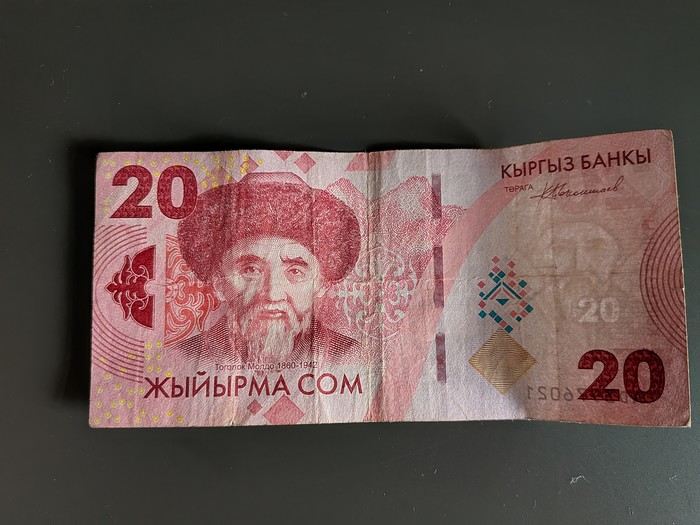
Bills come in 5000, 1000, 500, 200, 100, 50, and 20 soms.
Coins: 10, 5, 3, and 1 som.
- Paying
Card payments are accepted in supermarkets like Globus, some restaurants, gas stations of major chains (Bishkek Petroleum, Partner Neft, Red Petroleum), some hotels, national park entrances, tolls, etc.
But it doesn’t always work.
So always carry cash with you!
If the card works, great—otherwise, it’s back to the old days of wads of bills.
- Cost of Living
It’s really cheap (gas, affordable restaurants even at a decent standard, hotels, souvenirs, fruits, vegetables, water, bread...). For example, a lagman costs only 3.20 €, fixing a flat tire is 3.5 €, a full hour-long wash for a filthy 4x4 is 6 €, washing a big bag of laundry is 3 €, and a liter of 95-octane gas is 0.86 €...
On the pricier side: guesthouses and meals in guesthouses. The value for money is poor. I paid 40 € for a mediocre room with a very basic shared bathroom, while a double with AC, private bathroom, and fridge in a non-touristy hotel cost 20 €... Meals in guesthouses are the worst I’ve eaten and often the most expensive. Plus, they’re very light—don’t expect to fill up after a long day of hiking!
Car rentals are also quite expensive (70 $ per day for a RAV4 in my case).
In short, for two people, excluding accommodation and car rental, we spent an average of 45 € per day (groceries, restaurants, guesthouse dinners, souvenirs, paid activities, gas).
The trip cost us 2200 € per person all-inclusive for 3 weeks on the ground. Roughly 1/4 for the flight, 1/4 for the car, 1/4 for accommodation, and 1/4 for everything else.
- Getting Around
I’ve met cyclists, motorcyclists, people renting cars, those who drove their own vehicles from Europe, and others using public transport and taxis.
Personally, I chose to rent a car.
If you’re not planning long hikes or multi-day horse treks, it’s a great option for exploring the country.
Each car rental company has its own list of forbidden tracks. Make sure your planned route is allowed! Don’t think about ignoring this—vehicles are equipped with GPS trackers...
An international driver’s permit is required.
Police and speed cameras are everywhere, so it’s best to respect the signs (daytime running lights, seatbelts, 40-60 km/h in populated areas, 90 km/h on roads, zero tolerance for alcohol).
Locals have a unique driving style, and it can be dangerous on main roads (they overtake recklessly...). Like in Greece, South Africa, or Malta, a two-lane road is treated as a three-lane one. You pull over to let others pass or to let oncoming traffic overtake.
Without a car (at least a pseudo-4x4), you won’t be able to go everywhere. This country is a nature destination, but nature isn’t always accessible by public transport.
If a spot is near a road, great—the bus will get you almost to the door. Otherwise, you’ll need to hire an agency or take a taxi.
Cyclists will face steep climbs and dust. I’d advise avoiding main roads as much as possible—traffic isn’t on your side...
Motorcyclists will also eat a lot of dust and should research gas stations along their route (this advice also applies to vehicles running on 95-octane).
There’s a 95-octane pump in Kazarman and Gulcha.
Bikes and motorcycles have an advantage over cars, even 4x4s, as they can access some very remote tracks that other vehicles can’t (hikers and horses can obviously take them too!).
Be careful: some areas require a permit (border zones). Research this well in advance—the formalities don’t take an hour or even a day!
Be warned: Google Maps is completely unreliable (it shows roads that don’t exist, routes you through difficult tracks instead of paved roads, etc.). It’s essential to download Maps.me in advance. This app is much more reliable for this country, works offline, and is handy for hiking navigation.
A reminder: horseback riding is like cycling... If you’re not used to it or naturally padded in the right places, your backside will suffer in no time!
Think carefully before embarking on a multi-day trek!
Finally, this country is a kingdom of construction... The Chinese have taken over the market to improve truck circulation and are paving everywhere. (Good news: the Kazarman-Osh section via the tunnel is finally open in summer, even if the road isn’t quite finished.)
- Eating
I had prejudices about Kyrgyz food.
I was both wrong and right.
Supermarkets don’t offer much that’s appealing for picnics. It’s cheap, filling food, full of junk, and not gourmet. If you follow Yuka, I think you’ll be on a diet the whole trip. Bringing some pâté, sausages, or freeze-dried meals for certain nights is a good idea...
Guesthouse dinners consist of the eternal cucumber-tomato salad, a soup, and a light noodle or rice dish where you’ll be searching for the meat... Usually tough and unidentifiable. Beef? The bread is stale, and there’s no dessert or fruit.
Breakfasts always revolve around eggs or porridge... The homemade jam is usually good.
Tea is the number one drink, followed by kompot (a fruit-based drink), Coke, and Fanta.
If you want real coffee, bring your own—it’s very rare.
On the other hand, you eat well in restaurants. Lagman (homemade noodles, vegetables, spices, and usually beef), crispy eggplant, kuurdak (a kind of lamb stew with potatoes), kebabs, plov (pilaf rice with onions, carrots, and meat), and rainbow trout... For dessert? Nada!
And alcohol?
It’s available in all Globus stores: beer, wine, spirits, and you can consume your purchases in some guesthouses (depending on the owner’s religious tolerance). It’s also available in some restaurants (Bishkek, Karakol, Osh...).
The deadly specialty?
White fermented milk balls called kurut. If you think a raw-milk camembert is strong, steer clear! This is more like an old, dry, spicy goat cheese.
- Accommodation
In remote areas, it’s better to check availability on Booking a few days in advance rather than showing up last minute with high hopes.
Booking and Airbnb only offer a small portion of what’s available.
Not necessarily guesthouses, but mostly accommodations aimed at locals (business or leisure travel).
These places are generally more comfortable. There’s even some upscale options.
So it’s necessary to scour Google Maps or Yandex Maps... These accommodations are usually found on Instagram, and WhatsApp is handy for booking!
Prices are a bit of a lottery. So is the comfort. From 20 to 80 € for a double, usually with a private bathroom. (Average around 40 €). These rates are for mid-range options.
Otherwise, this country is a paradise for wild camping. In a camper van, rooftop tent, or ground tent... There are beautiful spots everywhere!
- Climate
I thought it would be quite cool/cold at altitude.
I packed too many warm clothes...
If you’re not doing high-altitude treks or sleeping in a tent, there’s no need to overload yourself with winter gear.
A good fleece, a windproof rain jacket, and technical base layers will be enough.
It only got really cold in the evenings at Song Kul Lake and Tash Rabat, and the yurts are equipped with thick blankets and a stove.
Elsewhere, temperatures ranged from 15 to 30 °C.
In short, I used the AC more than the heater! (It’s hard to drive with the windows open unless you want to be covered in dust in no time...)
- Communication
I bought an eSIM before the trip with a data plan for Kyrgyzstan (Beeline network). Perfect for communicating via WhatsApp right after landing, but this network isn’t the best in Kyrgyzstan.
We then got a physical SIM card with an unlimited one-month plan (less than 4 € including the SIM) at a Mega store downtown. This network is much better, and you get coverage in all cities and most villages. Usually in the mountain passes too.
To make yourself understood, it’s essential to download Google Translate with French, Kyrgyz, Russian, and English options.
Very useful for translating menus, signs, and communicating with locals.
Hosts and other tourism professionals will even pull out their phones to communicate with non-Russian speakers.
The police too...
- Religion
There’s a noticeable difference between the north and the southwest of the country.
In the north, it’s a bit like Albania. People are Muslim by culture but not really by religion.
In the southwest, radical Islam is growing. Mosques are more numerous and imposing. Men are more bearded, women more veiled.
For travelers, religion isn’t an issue except for the near-total absence of pork.
There’s Russian sausage, but reading the ingredient list, it’s more like a one-way ticket to cancer than an Auvergne dry sausage...
You can find the detailed account of the trip here.
- Which airline from Europe?
Turkish Airlines seems like an excellent option. The price is very reasonable (just over 500 €), the layover isn’t too long, the in-flight comfort is decent (great movie selection), and the planes are modern. Plus, the price automatically includes 30 kilos of luggage, which is perfect for campers.
The downside: the outrageous prices at Istanbul Airport.
- Bishkek Airport
The airport is under full reconstruction. It’s chaotic. There are SIM card vendors upon arrival, but no currency exchange or ATMs in the baggage claim area. You’ll find those in the departures section, which means you have to exit and re-enter under the current setup.
Personally, I pre-booked a VTC with my hotel for the transfer to the city. (Prices vary depending on the hotel’s standard—1200 soms for mine.)
There are taxis and a bus available.
- Entry Requirements
No visa is required for French citizens for stays of up to 30 days.
- Currency
The currency is the som, and the conversion is easy—just divide by 100...
You can get soms by exchanging euros (dollars are useless) or by withdrawing from an ATM. Some ATMs charge fees. Those from Mbank and Optimabank are fee-free.
The maximum withdrawal is usually 20,000 soms.
Bills come in 5000, 1000, 500, 200, 100, 50, and 20 soms.
Coins: 10, 5, 3, and 1 som.
- Paying
Card payments are accepted in supermarkets like Globus, some restaurants, gas stations of major chains (Bishkek Petroleum, Partner Neft, Red Petroleum), some hotels, national park entrances, tolls, etc.
But it doesn’t always work.
So always carry cash with you!
If the card works, great—otherwise, it’s back to the old days of wads of bills.
- Cost of Living
It’s really cheap (gas, affordable restaurants even at a decent standard, hotels, souvenirs, fruits, vegetables, water, bread...). For example, a lagman costs only 3.20 €, fixing a flat tire is 3.5 €, a full hour-long wash for a filthy 4x4 is 6 €, washing a big bag of laundry is 3 €, and a liter of 95-octane gas is 0.86 €...
On the pricier side: guesthouses and meals in guesthouses. The value for money is poor. I paid 40 € for a mediocre room with a very basic shared bathroom, while a double with AC, private bathroom, and fridge in a non-touristy hotel cost 20 €... Meals in guesthouses are the worst I’ve eaten and often the most expensive. Plus, they’re very light—don’t expect to fill up after a long day of hiking!
Car rentals are also quite expensive (70 $ per day for a RAV4 in my case).
In short, for two people, excluding accommodation and car rental, we spent an average of 45 € per day (groceries, restaurants, guesthouse dinners, souvenirs, paid activities, gas).
The trip cost us 2200 € per person all-inclusive for 3 weeks on the ground. Roughly 1/4 for the flight, 1/4 for the car, 1/4 for accommodation, and 1/4 for everything else.
- Getting Around
I’ve met cyclists, motorcyclists, people renting cars, those who drove their own vehicles from Europe, and others using public transport and taxis.
Personally, I chose to rent a car.
If you’re not planning long hikes or multi-day horse treks, it’s a great option for exploring the country.
Each car rental company has its own list of forbidden tracks. Make sure your planned route is allowed! Don’t think about ignoring this—vehicles are equipped with GPS trackers...
An international driver’s permit is required.
Police and speed cameras are everywhere, so it’s best to respect the signs (daytime running lights, seatbelts, 40-60 km/h in populated areas, 90 km/h on roads, zero tolerance for alcohol).
Locals have a unique driving style, and it can be dangerous on main roads (they overtake recklessly...). Like in Greece, South Africa, or Malta, a two-lane road is treated as a three-lane one. You pull over to let others pass or to let oncoming traffic overtake.
Without a car (at least a pseudo-4x4), you won’t be able to go everywhere. This country is a nature destination, but nature isn’t always accessible by public transport.
If a spot is near a road, great—the bus will get you almost to the door. Otherwise, you’ll need to hire an agency or take a taxi.
Cyclists will face steep climbs and dust. I’d advise avoiding main roads as much as possible—traffic isn’t on your side...
Motorcyclists will also eat a lot of dust and should research gas stations along their route (this advice also applies to vehicles running on 95-octane).
There’s a 95-octane pump in Kazarman and Gulcha.
Bikes and motorcycles have an advantage over cars, even 4x4s, as they can access some very remote tracks that other vehicles can’t (hikers and horses can obviously take them too!).
Be careful: some areas require a permit (border zones). Research this well in advance—the formalities don’t take an hour or even a day!
Be warned: Google Maps is completely unreliable (it shows roads that don’t exist, routes you through difficult tracks instead of paved roads, etc.). It’s essential to download Maps.me in advance. This app is much more reliable for this country, works offline, and is handy for hiking navigation.
A reminder: horseback riding is like cycling... If you’re not used to it or naturally padded in the right places, your backside will suffer in no time!
Think carefully before embarking on a multi-day trek!
Finally, this country is a kingdom of construction... The Chinese have taken over the market to improve truck circulation and are paving everywhere. (Good news: the Kazarman-Osh section via the tunnel is finally open in summer, even if the road isn’t quite finished.)
- Eating
I had prejudices about Kyrgyz food.
I was both wrong and right.
Supermarkets don’t offer much that’s appealing for picnics. It’s cheap, filling food, full of junk, and not gourmet. If you follow Yuka, I think you’ll be on a diet the whole trip. Bringing some pâté, sausages, or freeze-dried meals for certain nights is a good idea...
Guesthouse dinners consist of the eternal cucumber-tomato salad, a soup, and a light noodle or rice dish where you’ll be searching for the meat... Usually tough and unidentifiable. Beef? The bread is stale, and there’s no dessert or fruit.
Breakfasts always revolve around eggs or porridge... The homemade jam is usually good.
Tea is the number one drink, followed by kompot (a fruit-based drink), Coke, and Fanta.
If you want real coffee, bring your own—it’s very rare.
On the other hand, you eat well in restaurants. Lagman (homemade noodles, vegetables, spices, and usually beef), crispy eggplant, kuurdak (a kind of lamb stew with potatoes), kebabs, plov (pilaf rice with onions, carrots, and meat), and rainbow trout... For dessert? Nada!
And alcohol?
It’s available in all Globus stores: beer, wine, spirits, and you can consume your purchases in some guesthouses (depending on the owner’s religious tolerance). It’s also available in some restaurants (Bishkek, Karakol, Osh...).
The deadly specialty?
White fermented milk balls called kurut. If you think a raw-milk camembert is strong, steer clear! This is more like an old, dry, spicy goat cheese.
- Accommodation
In remote areas, it’s better to check availability on Booking a few days in advance rather than showing up last minute with high hopes.
Booking and Airbnb only offer a small portion of what’s available.
Not necessarily guesthouses, but mostly accommodations aimed at locals (business or leisure travel).
These places are generally more comfortable. There’s even some upscale options.
So it’s necessary to scour Google Maps or Yandex Maps... These accommodations are usually found on Instagram, and WhatsApp is handy for booking!
Prices are a bit of a lottery. So is the comfort. From 20 to 80 € for a double, usually with a private bathroom. (Average around 40 €). These rates are for mid-range options.
Otherwise, this country is a paradise for wild camping. In a camper van, rooftop tent, or ground tent... There are beautiful spots everywhere!
- Climate
I thought it would be quite cool/cold at altitude.
I packed too many warm clothes...
If you’re not doing high-altitude treks or sleeping in a tent, there’s no need to overload yourself with winter gear.
A good fleece, a windproof rain jacket, and technical base layers will be enough.
It only got really cold in the evenings at Song Kul Lake and Tash Rabat, and the yurts are equipped with thick blankets and a stove.
Elsewhere, temperatures ranged from 15 to 30 °C.
In short, I used the AC more than the heater! (It’s hard to drive with the windows open unless you want to be covered in dust in no time...)
- Communication
I bought an eSIM before the trip with a data plan for Kyrgyzstan (Beeline network). Perfect for communicating via WhatsApp right after landing, but this network isn’t the best in Kyrgyzstan.
We then got a physical SIM card with an unlimited one-month plan (less than 4 € including the SIM) at a Mega store downtown. This network is much better, and you get coverage in all cities and most villages. Usually in the mountain passes too.
To make yourself understood, it’s essential to download Google Translate with French, Kyrgyz, Russian, and English options.
Very useful for translating menus, signs, and communicating with locals.
Hosts and other tourism professionals will even pull out their phones to communicate with non-Russian speakers.
The police too...
- Religion
There’s a noticeable difference between the north and the southwest of the country.
In the north, it’s a bit like Albania. People are Muslim by culture but not really by religion.
In the southwest, radical Islam is growing. Mosques are more numerous and imposing. Men are more bearded, women more veiled.
For travelers, religion isn’t an issue except for the near-total absence of pork.
There’s Russian sausage, but reading the ingredient list, it’s more like a one-way ticket to cancer than an Auvergne dry sausage...
You can find the detailed account of the trip here.
Breathtaking Kyrgyzstan!
This trip had been on my mind for about fifteen years.
But the discomfort of overnight stays, the difficulty of communication, and the prices of the few car rental options kept making me postpone the project.
And then, everything suddenly fell into place—I told myself, it’s time!
The preparations took longer than usual; the destination is still far from mainstream.
A bit of Kazakhstan? Not in the end.
The south or not the south? Yes, in the end.
Pre-book or go with the flow? Only two stops were a leap into the unknown.
To help me find the ideal route, I made great use of this forum (thanks to everyone for patiently answering my questions!), pored over travel journals and blogs (Christian, Jeff), zoomed in on Google Maps and Yandex, and bought the guide published by OunTravela about this destination (the guide has been updated since).
---/---
You’ve got your passport, international driver’s license, bank cards, and euros?
Off we go to Lyon—just one night left before our early morning flight.
Tomorrow night, we’ll be sleeping in Bishkek! (Steak for my partner’s mischievous nephews...)
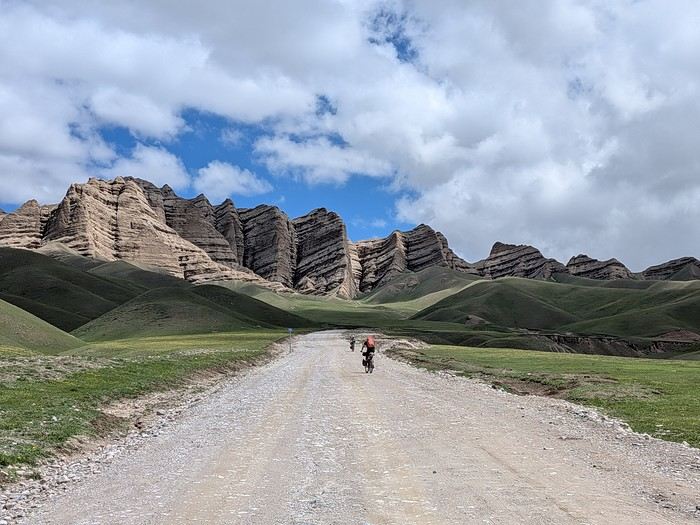
You’ll find here a post with some practical information.
And here, the version of the travel journal without comments.
---/---
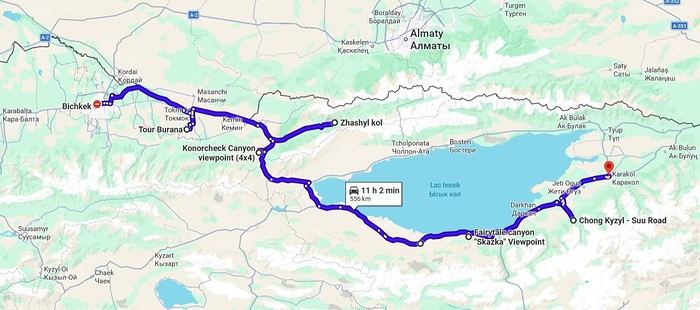
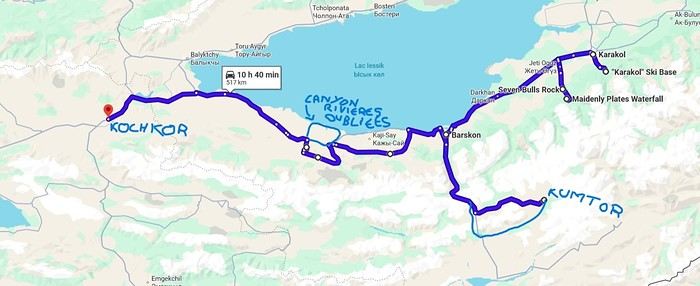
As a supplement, the route track. Not necessarily ultra-accurate since Google has serious gaps for this destination...
From Bishkek to Karakol:
From Karakol to Kochkor:
From Kochkor to Baetov:
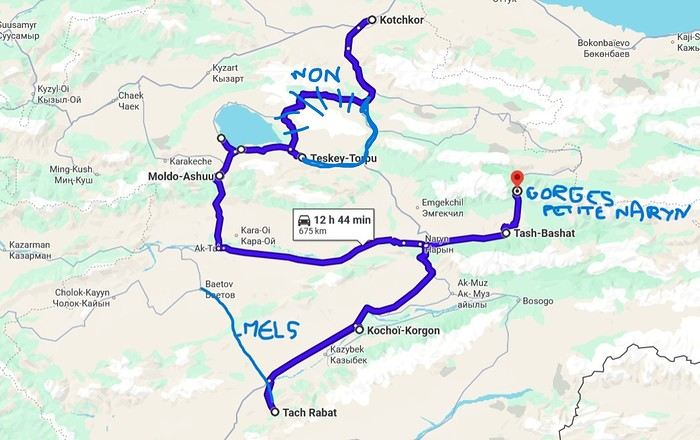
From Baetov to Kara-Köl:
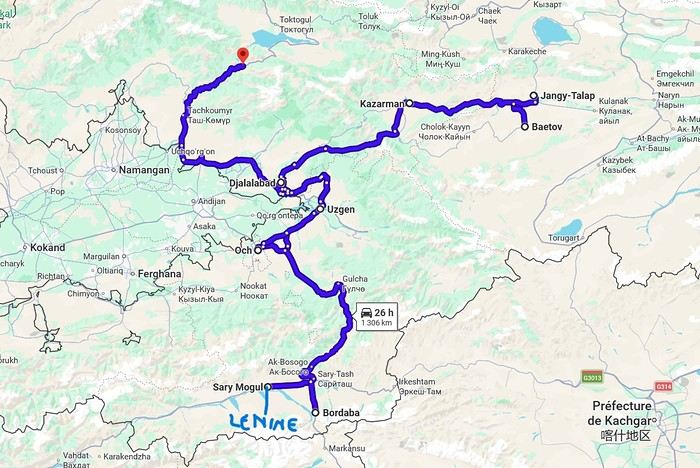
From Kara-Köl to Bishkek:
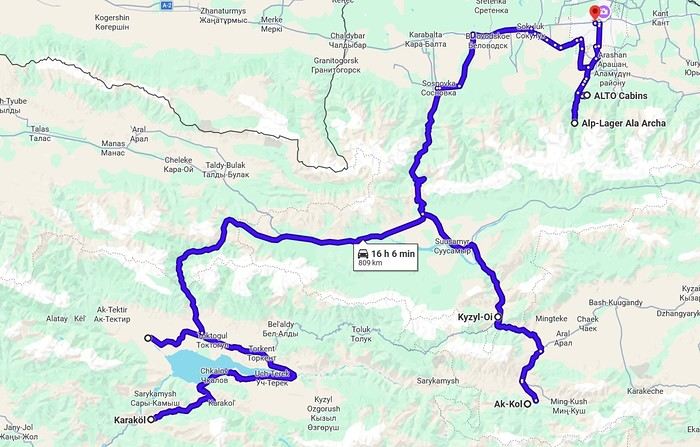

But the discomfort of overnight stays, the difficulty of communication, and the prices of the few car rental options kept making me postpone the project.
And then, everything suddenly fell into place—I told myself, it’s time!
The preparations took longer than usual; the destination is still far from mainstream.
A bit of Kazakhstan? Not in the end.
The south or not the south? Yes, in the end.
Pre-book or go with the flow? Only two stops were a leap into the unknown.
To help me find the ideal route, I made great use of this forum (thanks to everyone for patiently answering my questions!), pored over travel journals and blogs (Christian, Jeff), zoomed in on Google Maps and Yandex, and bought the guide published by OunTravela about this destination (the guide has been updated since).
---/---
You’ve got your passport, international driver’s license, bank cards, and euros?
Off we go to Lyon—just one night left before our early morning flight.
Tomorrow night, we’ll be sleeping in Bishkek! (Steak for my partner’s mischievous nephews...)
You’ll find here a post with some practical information.
And here, the version of the travel journal without comments.
---/---
As a supplement, the route track. Not necessarily ultra-accurate since Google has serious gaps for this destination...
From Bishkek to Karakol:
From Karakol to Kochkor:
From Kochkor to Baetov:
From Baetov to Kara-Köl:
From Kara-Köl to Bishkek:
16 days with family in La Gomera (Canary Islands)
Preamble: Why La Gomera?
When we started looking for a summer destination a few months ago, our first criterion was to avoid extreme heat and heatwaves. We had already been to Norway two years ago and are considering going back in the future for other occasions. So, we had some fun asking ChatGPT which destinations enjoyed a mild climate during the summer without going too far. Among the list provided by the AI were the Canary Islands... The idea of a place we wouldn’t have thought of first, both not too far away and exotic enough, appealed to us: “Hmm, why not?”
This destination had never really attracted me, though Magali was a bit more interested. Five years earlier, COVID had caused a short break in my professional activity, and I had planned a trip because the flight price was attractive, and I was looking for a destination different from what usually appeals to me, more than out of deep interest. From a distance and with a social judgment I acknowledge (it’s not great, but it’s not completely wrong), I had the image of a destination for party-goers enjoying the sun without the slightest interest in local culture, with concrete coastlines and denatured landscapes—everything I detest the most. Still, I had done some quick research on the different islands and spotted Lanzarote for its beautiful volcanic landscapes, hiking trails, beaches, and the impression of a good balance between activity and fewer crowds than Tenerife or Gran Canaria. Then I dropped the idea of going, without ever reconsidering traveling to the Canaries...
Until now! Because we started researching the different islands of the archipelago to see which ones might appeal to us the most. It was La Gomera, the third smallest island of the archipelago, more praised for its hiking trails and preserved nature than for its beaches, away from mass tourism (fifty times fewer tourists than Tenerife) but still a bit more developed than its wild neighbor El Hierro, that caught our attention. Contrary to what might be suggested later, I’m not at all addicted to AI, but I use it from time to time to synthesize quick research or simply for experimentation. Since ChatGPT had started anticipating my tastes lately as if it had become my buddy (often successfully, sometimes off the mark), I asked which Canary Island would suit me best for a trip with my family. The tool answered first with... La Gomera. So, I tested it and teased it a bit to see if this suggestion was well-founded, as the method sometimes makes it contradict itself. But no luck: “You’d appreciate the wild nature of El Hierro, but with family, you’ll find little activity for the kids. You won’t like the touristy vibe of the big islands like Tenerife, Gran Canaria, Lanzarote, and Fuerteventura. You could consider La Palma, but it’s really La Gomera that will suit you best, based on your interests and the criteria given.” So, we dug deeper into our research and were convinced without a shadow of a doubt that this island was the one waiting for us.
Without knowing it, we had Canarians in our circle who revealed their origins when they heard about our travel plans. One from Tenerife insisted we’d be better off choosing Tenerife (obviously...) because it also has preserved spots and that La Gomera, “you can explore it in two or three days, you’ll get bored quickly...” The other, a colleague from Gran Canaria who had never visited La Gomera, still recommended it without hesitation because it turned out her parents had just gone there on vacation: they loved it and had encountered few tourists. She also tended to think this destination was usually the subject of short stays, but according to what her parents told her, taking your time there was also a great idea. However, in our research, the idea that La Gomera is an island you can explore in three or four days max kept coming up. So, we considered combining its visit with La Palma or El Hierro, the other two that caught our eye. But hopping between islands by ferry represents a significant budget for non-Canarians, even more so for a family of four. Then, scrutinizing Google Maps, it seemed obvious that two weeks were too short to discover two islands as they deserve, and that there seemed to be plenty to see in La Gomera, given its very unique culture. After all, we read that some people spend several months a year there, others never even leave... Finally, these landscapes and this atmosphere, which seemed to us a mix of Europe, North Africa, and Latin America, tempted us. So, it would be two weeks in La Gomera, deal!
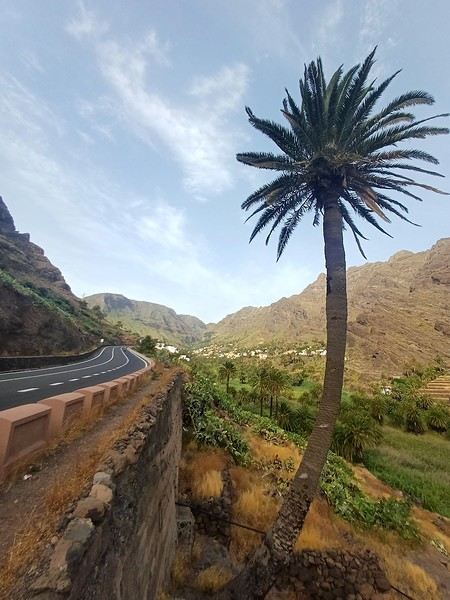
La Gomera is therefore the second... well, the third smallest island of the Canaries since La Graciosa was recently recognized as a fully inhabited island. It has the shape of a rough circle about 20 to 25 kilometers in diameter and has just over 20,000 inhabitants, half of them in its capital, San Sebastián de la Gomera, the only real town. Like its Canarian sisters, La Gomera is a volcanic formation that rose about 10 million years ago. The island is very mountainous and rugged, covered with red and black rocky landscapes. Geological activity has shaped, between the sprawling massifs that end in steep cliffs in the ocean, six coastal valleys with tropical vegetation that have favored human settlement. They divide the island like slices of a cake; from the north clockwise: the agricultural Vallehermoso, the rustic Agulo, the green, humid, and fertile Hermigua, the sunny capital San Sebastián de la Gomera, the southern and isolated Alajeró-Santiago, and the seaside Valle Gran Rey. They constitute the six municipalities (more like cantons to our French understanding) of the territory.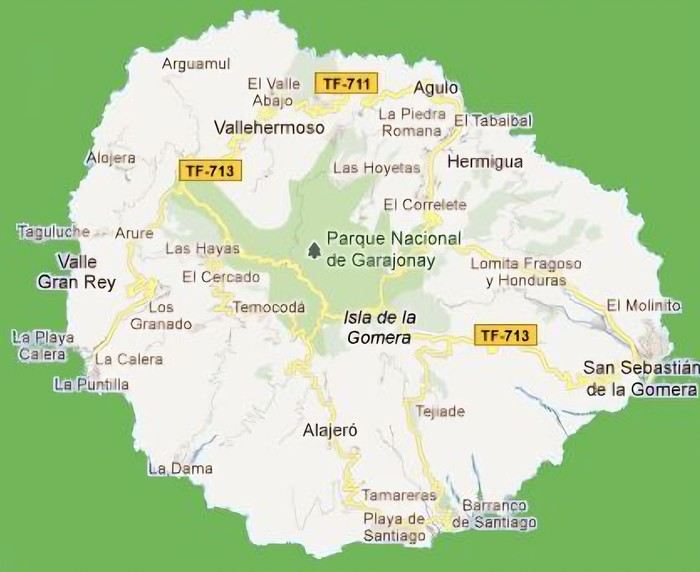 The large solidified magma massifs that shape the heart of the island have created a large depression more protected from the sun at its center, allowing the growth of a vast laurel forest, today grouped within the Garajonay National Park, La Gomera’s green lung, which has earned it the status of a World Biosphere Reserve. Its completely European appearance contrasts sharply with the rocky and tropical landscapes of the rest of the island. Thus, the climate varies greatly from one point to another on the island: in summer, you can quickly go from a dry and sunny valley at 35°C to a humid forest area at altitude at 18°C.
La Gomera was populated late. As with the rest of the Canaries, human presence is thought to have begun about 2,000 years ago. Groups of animist Berbers, probably fleeing persecution, gradually populated the archipelago, especially the western islands and La Gomera, becoming its small aboriginal population: the Guanches (or later Gomeros). The animist and pastoral civilization of the Guanches thrived until the Spanish takeover in the 15th century, which, after a short period of harmony and mixing with the indigenous people, suddenly ended in bloodshed... La Gomera later became the “Columbus Island” after Christopher Columbus’s stopover, increasing the blending of populations. In the 20th century, many Gomeros emigrated to Cuba and other Latin American countries in search of a better life, bringing back a mix of cultures and traits quite palpable in today’s Gomeran culture. It is, however, in La Gomera that the vestiges of Guanche culture seem to have left the most traces, in the language, gastronomy, social practices... Moreover, most Gomeros, especially in remote villages, have a particular identifiable type and proudly claim their ancestral roots, even making La Gomera a bit exotic in the eyes of other Canarians.
Perhaps that’s why it has never really wanted to develop its tourist infrastructure too much. If we set aside the tourists who visit for the day by bus or boat from Tenerife on a marked itinerary (and whom we ultimately rarely encounter), La Gomera has remained a hidden gem, a destination focused on nature discovery that attracts hikers, nature-loving divers, and scientists for its fauna and flora, and to a lesser extent, beachgoers who don’t seek overly developed coastlines. Tourist activity is therefore limited. Roughly speaking, you’ll find a majority of Spaniards, including a substantial number of residents from other Canary Islands, many Germans who have a particular fondness for La Gomera and spend long stays there or own second homes, to the point that the German cultural footprint is clearly noticeable in some places (it’s said to be Angela Merkel’s favorite holiday spot), and still quite a few French. The presence of other nationalities seemed negligible to us. Most travelers come mainly for hiking, but it’s also a prime spot for whale watching. Additionally, the seaside resorts of La Gomera—San Sebastián, Santiago, and especially Valle Gran Rey—are well-known destinations for hippies, especially German ones, ranging from chic boho hippies to old-school hippies who’ve been there for decades, quite similar to those you’d meet in India in Goa, Rishikesh, or Paharganj. Thus, practices like naturism, vegetarianism, and local organic production are quite well established in some areas.
Some practical info: - The round-trip flight from Paris to Tenerife cost us 365 € per person (outbound with Transavia, return with EasyJet), including checked luggage and three seats reserved side by side. - We chose two bases to explore the island: one week in Valle Gran Rey, reputed to be the most pleasant of the three seaside resorts, and one week in Hermigua, more mountainous and close to the natural park. We booked two houses with balconies and views: the first at 120 € per night, the second at 99 €. - The round-trip ferry between Tenerife and La Gomera cost us 270 € with the company Baleària Canarias, including discounts for children aged 4 and 12, but I don’t have the exact details. It was a bit cheaper than with the other company, Fred Olsen. - Finally, we rented a car through the agency Cicar for 360 € for 16 days, which comes to 22.50 € per day. - Apart from that, we didn’t plan anything and decided the day before or even the morning of what we wanted to do. We didn’t invest in any paper guide on the Canaries, as information on La Gomera was scarce, but we used the very comprehensive site La Gomera Travel, a travel guide published by the Canary Islands Tourism Council, a real goldmine of almost exhaustive information on the island.
Alright, off we go for 16 days of adventure discovering La Gomera!
And we start the trip with music!
We start the trip with music!
When we started looking for a summer destination a few months ago, our first criterion was to avoid extreme heat and heatwaves. We had already been to Norway two years ago and are considering going back in the future for other occasions. So, we had some fun asking ChatGPT which destinations enjoyed a mild climate during the summer without going too far. Among the list provided by the AI were the Canary Islands... The idea of a place we wouldn’t have thought of first, both not too far away and exotic enough, appealed to us: “Hmm, why not?”
This destination had never really attracted me, though Magali was a bit more interested. Five years earlier, COVID had caused a short break in my professional activity, and I had planned a trip because the flight price was attractive, and I was looking for a destination different from what usually appeals to me, more than out of deep interest. From a distance and with a social judgment I acknowledge (it’s not great, but it’s not completely wrong), I had the image of a destination for party-goers enjoying the sun without the slightest interest in local culture, with concrete coastlines and denatured landscapes—everything I detest the most. Still, I had done some quick research on the different islands and spotted Lanzarote for its beautiful volcanic landscapes, hiking trails, beaches, and the impression of a good balance between activity and fewer crowds than Tenerife or Gran Canaria. Then I dropped the idea of going, without ever reconsidering traveling to the Canaries...
Until now! Because we started researching the different islands of the archipelago to see which ones might appeal to us the most. It was La Gomera, the third smallest island of the archipelago, more praised for its hiking trails and preserved nature than for its beaches, away from mass tourism (fifty times fewer tourists than Tenerife) but still a bit more developed than its wild neighbor El Hierro, that caught our attention. Contrary to what might be suggested later, I’m not at all addicted to AI, but I use it from time to time to synthesize quick research or simply for experimentation. Since ChatGPT had started anticipating my tastes lately as if it had become my buddy (often successfully, sometimes off the mark), I asked which Canary Island would suit me best for a trip with my family. The tool answered first with... La Gomera. So, I tested it and teased it a bit to see if this suggestion was well-founded, as the method sometimes makes it contradict itself. But no luck: “You’d appreciate the wild nature of El Hierro, but with family, you’ll find little activity for the kids. You won’t like the touristy vibe of the big islands like Tenerife, Gran Canaria, Lanzarote, and Fuerteventura. You could consider La Palma, but it’s really La Gomera that will suit you best, based on your interests and the criteria given.” So, we dug deeper into our research and were convinced without a shadow of a doubt that this island was the one waiting for us.
Without knowing it, we had Canarians in our circle who revealed their origins when they heard about our travel plans. One from Tenerife insisted we’d be better off choosing Tenerife (obviously...) because it also has preserved spots and that La Gomera, “you can explore it in two or three days, you’ll get bored quickly...” The other, a colleague from Gran Canaria who had never visited La Gomera, still recommended it without hesitation because it turned out her parents had just gone there on vacation: they loved it and had encountered few tourists. She also tended to think this destination was usually the subject of short stays, but according to what her parents told her, taking your time there was also a great idea. However, in our research, the idea that La Gomera is an island you can explore in three or four days max kept coming up. So, we considered combining its visit with La Palma or El Hierro, the other two that caught our eye. But hopping between islands by ferry represents a significant budget for non-Canarians, even more so for a family of four. Then, scrutinizing Google Maps, it seemed obvious that two weeks were too short to discover two islands as they deserve, and that there seemed to be plenty to see in La Gomera, given its very unique culture. After all, we read that some people spend several months a year there, others never even leave... Finally, these landscapes and this atmosphere, which seemed to us a mix of Europe, North Africa, and Latin America, tempted us. So, it would be two weeks in La Gomera, deal!
La Gomera is therefore the second... well, the third smallest island of the Canaries since La Graciosa was recently recognized as a fully inhabited island. It has the shape of a rough circle about 20 to 25 kilometers in diameter and has just over 20,000 inhabitants, half of them in its capital, San Sebastián de la Gomera, the only real town. Like its Canarian sisters, La Gomera is a volcanic formation that rose about 10 million years ago. The island is very mountainous and rugged, covered with red and black rocky landscapes. Geological activity has shaped, between the sprawling massifs that end in steep cliffs in the ocean, six coastal valleys with tropical vegetation that have favored human settlement. They divide the island like slices of a cake; from the north clockwise: the agricultural Vallehermoso, the rustic Agulo, the green, humid, and fertile Hermigua, the sunny capital San Sebastián de la Gomera, the southern and isolated Alajeró-Santiago, and the seaside Valle Gran Rey. They constitute the six municipalities (more like cantons to our French understanding) of the territory.
The large solidified magma massifs that shape the heart of the island have created a large depression more protected from the sun at its center, allowing the growth of a vast laurel forest, today grouped within the Garajonay National Park, La Gomera’s green lung, which has earned it the status of a World Biosphere Reserve. Its completely European appearance contrasts sharply with the rocky and tropical landscapes of the rest of the island. Thus, the climate varies greatly from one point to another on the island: in summer, you can quickly go from a dry and sunny valley at 35°C to a humid forest area at altitude at 18°C.La Gomera was populated late. As with the rest of the Canaries, human presence is thought to have begun about 2,000 years ago. Groups of animist Berbers, probably fleeing persecution, gradually populated the archipelago, especially the western islands and La Gomera, becoming its small aboriginal population: the Guanches (or later Gomeros). The animist and pastoral civilization of the Guanches thrived until the Spanish takeover in the 15th century, which, after a short period of harmony and mixing with the indigenous people, suddenly ended in bloodshed... La Gomera later became the “Columbus Island” after Christopher Columbus’s stopover, increasing the blending of populations. In the 20th century, many Gomeros emigrated to Cuba and other Latin American countries in search of a better life, bringing back a mix of cultures and traits quite palpable in today’s Gomeran culture. It is, however, in La Gomera that the vestiges of Guanche culture seem to have left the most traces, in the language, gastronomy, social practices... Moreover, most Gomeros, especially in remote villages, have a particular identifiable type and proudly claim their ancestral roots, even making La Gomera a bit exotic in the eyes of other Canarians.
Perhaps that’s why it has never really wanted to develop its tourist infrastructure too much. If we set aside the tourists who visit for the day by bus or boat from Tenerife on a marked itinerary (and whom we ultimately rarely encounter), La Gomera has remained a hidden gem, a destination focused on nature discovery that attracts hikers, nature-loving divers, and scientists for its fauna and flora, and to a lesser extent, beachgoers who don’t seek overly developed coastlines. Tourist activity is therefore limited. Roughly speaking, you’ll find a majority of Spaniards, including a substantial number of residents from other Canary Islands, many Germans who have a particular fondness for La Gomera and spend long stays there or own second homes, to the point that the German cultural footprint is clearly noticeable in some places (it’s said to be Angela Merkel’s favorite holiday spot), and still quite a few French. The presence of other nationalities seemed negligible to us. Most travelers come mainly for hiking, but it’s also a prime spot for whale watching. Additionally, the seaside resorts of La Gomera—San Sebastián, Santiago, and especially Valle Gran Rey—are well-known destinations for hippies, especially German ones, ranging from chic boho hippies to old-school hippies who’ve been there for decades, quite similar to those you’d meet in India in Goa, Rishikesh, or Paharganj. Thus, practices like naturism, vegetarianism, and local organic production are quite well established in some areas.
Some practical info: - The round-trip flight from Paris to Tenerife cost us 365 € per person (outbound with Transavia, return with EasyJet), including checked luggage and three seats reserved side by side. - We chose two bases to explore the island: one week in Valle Gran Rey, reputed to be the most pleasant of the three seaside resorts, and one week in Hermigua, more mountainous and close to the natural park. We booked two houses with balconies and views: the first at 120 € per night, the second at 99 €. - The round-trip ferry between Tenerife and La Gomera cost us 270 € with the company Baleària Canarias, including discounts for children aged 4 and 12, but I don’t have the exact details. It was a bit cheaper than with the other company, Fred Olsen. - Finally, we rented a car through the agency Cicar for 360 € for 16 days, which comes to 22.50 € per day. - Apart from that, we didn’t plan anything and decided the day before or even the morning of what we wanted to do. We didn’t invest in any paper guide on the Canaries, as information on La Gomera was scarce, but we used the very comprehensive site La Gomera Travel, a travel guide published by the Canary Islands Tourism Council, a real goldmine of almost exhaustive information on the island.
Alright, off we go for 16 days of adventure discovering La Gomera!
And we start the trip with music!
We start the trip with music!
Off on an adventure in Namibia!
April 11 – Day 1
It was winter, a winter with beautiful weather, A season that only exists in the southwest of America, I remember very well what I told you that morning A month ago... A century ago, an eternity ago... We’ll go... wherever you want, whenever you want...
Well, yeah, back from our adventure in our enchanting American West just a month ago, we’re already taking a bite out of one of its lesser-known competitors. "Flo, if you had to pick just one reason to justify your love for the U.S., what would it be?" The greasy, dripping burgers? No, I don’t think I’m going out on a limb by saying it’d be the wide-open spaces... And that’s exactly what our new quest is taking us to—a land on the other side of the globe where the horizon also seems endless, where silence tastes like salty wind and sand, where freedom is measured in kilometers of desert tracks, where the GPS is mostly there to confirm you’re lost in the middle of nowhere... Add to that magic formula the fact that you’ll see more zebras, giraffes, wildebeest, and elephants than people per square kilometer, and you can imagine us setting foot in Southern Africa for the first time, more precisely at the small airport in Windhoek, capital of... of...? Brush up on your geography, damn it! We’re landing in Namibia!!!
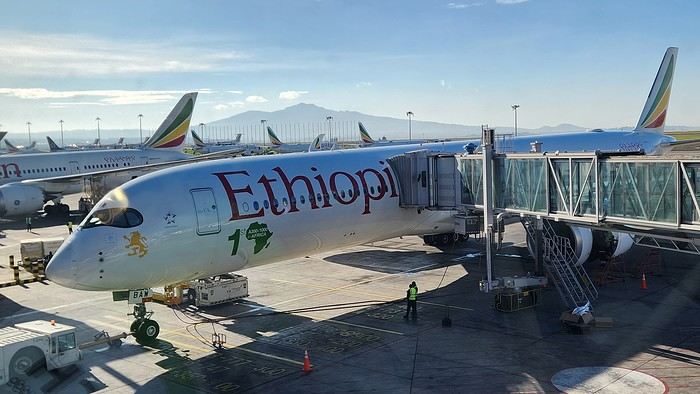
To be honest, Namibian landscapes have been flirting with me for ages. So how did I resist this island of temptation for so long? First, the budget. Let’s just say that for the same amount of effort (and kidneys), the bank lets you choose two other adventures almost anywhere else on the planet. Then there were my girls. Yeah, back then, they were too little to dose up on Malarone, the only malaria remedy at the time... Long story short, ten years later, all the planets have aligned. First, I won the Euromillions! Well, almost... Let’s just say my girls are now old enough... not to take Malarone, but to stop following me on all my adventures! Jackpot! "Flo, how about a little two-person caprice, just the two of us, tackling the Namibian tracks?"
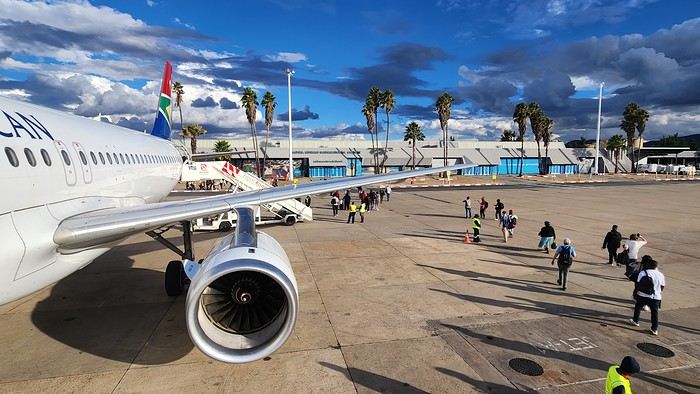
As we landed on the runway, first wow effect: The horizon is immense. It’s flat as can be, incredibly flat... So much flat space! Did I mention it was flat?... Looking into the distance, it feels like your gaze could circle the Earth without hitting a single obstacle—until you end up staring at your own backside. "Oh, what a nice view!" Well, it’s the first time I’ve seen my butt from this angle! Touching moment... Sorry, I’m rambling—must be the exhaustion from the three-flight marathon we just powered through via Ethiopia and South Africa... And yet, no time to philosophize about my anatomy. As usual, we want to rack up our first kilometers to be front and center at dawn tomorrow. After wrapping up the tedious Namibian immigration formalities and meeting the 4x4 that’ll be our companion day and night for the next fifteen days, we’re off! We’re not exactly fresh, but we’re ready to tackle the next five hundred kilometers in night mode, cruise control set due south! Just outside Windhoek, the local wildlife—a jackal—welcomes us with a smile: "Welcome to Namibia!" That’s what it said! Honest... Okay, first endless straight road, first flaming sunset, first corrugated dirt track, first Milky Way with zero light pollution... You get it—it’s definitely the day of firsts... First night camping, too, in the big trunk of our Toyota Fortuner parked by the side of the track... The real adventure, the kind that smells under the arms, can finally begin...
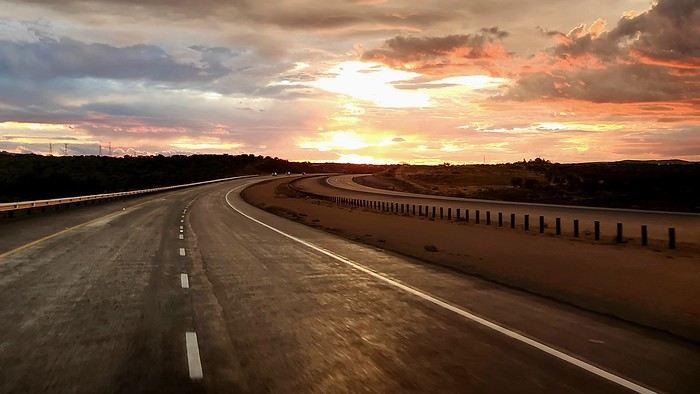
It was winter, a winter with beautiful weather, A season that only exists in the southwest of America, I remember very well what I told you that morning A month ago... A century ago, an eternity ago... We’ll go... wherever you want, whenever you want...
Well, yeah, back from our adventure in our enchanting American West just a month ago, we’re already taking a bite out of one of its lesser-known competitors. "Flo, if you had to pick just one reason to justify your love for the U.S., what would it be?" The greasy, dripping burgers? No, I don’t think I’m going out on a limb by saying it’d be the wide-open spaces... And that’s exactly what our new quest is taking us to—a land on the other side of the globe where the horizon also seems endless, where silence tastes like salty wind and sand, where freedom is measured in kilometers of desert tracks, where the GPS is mostly there to confirm you’re lost in the middle of nowhere... Add to that magic formula the fact that you’ll see more zebras, giraffes, wildebeest, and elephants than people per square kilometer, and you can imagine us setting foot in Southern Africa for the first time, more precisely at the small airport in Windhoek, capital of... of...? Brush up on your geography, damn it! We’re landing in Namibia!!!
To be honest, Namibian landscapes have been flirting with me for ages. So how did I resist this island of temptation for so long? First, the budget. Let’s just say that for the same amount of effort (and kidneys), the bank lets you choose two other adventures almost anywhere else on the planet. Then there were my girls. Yeah, back then, they were too little to dose up on Malarone, the only malaria remedy at the time... Long story short, ten years later, all the planets have aligned. First, I won the Euromillions! Well, almost... Let’s just say my girls are now old enough... not to take Malarone, but to stop following me on all my adventures! Jackpot! "Flo, how about a little two-person caprice, just the two of us, tackling the Namibian tracks?"
As we landed on the runway, first wow effect: The horizon is immense. It’s flat as can be, incredibly flat... So much flat space! Did I mention it was flat?... Looking into the distance, it feels like your gaze could circle the Earth without hitting a single obstacle—until you end up staring at your own backside. "Oh, what a nice view!" Well, it’s the first time I’ve seen my butt from this angle! Touching moment... Sorry, I’m rambling—must be the exhaustion from the three-flight marathon we just powered through via Ethiopia and South Africa... And yet, no time to philosophize about my anatomy. As usual, we want to rack up our first kilometers to be front and center at dawn tomorrow. After wrapping up the tedious Namibian immigration formalities and meeting the 4x4 that’ll be our companion day and night for the next fifteen days, we’re off! We’re not exactly fresh, but we’re ready to tackle the next five hundred kilometers in night mode, cruise control set due south! Just outside Windhoek, the local wildlife—a jackal—welcomes us with a smile: "Welcome to Namibia!" That’s what it said! Honest... Okay, first endless straight road, first flaming sunset, first corrugated dirt track, first Milky Way with zero light pollution... You get it—it’s definitely the day of firsts... First night camping, too, in the big trunk of our Toyota Fortuner parked by the side of the track... The real adventure, the kind that smells under the arms, can finally begin...
Off on an adventure in Uzbekistan!
April 5 - Day 1
After as many weeks as I have fingers on my right hand, we're hitting the road again, fully recovered from our pharaonic adventure. Back in France to drop off our daughters (sorry, girls!), this time it's just the two of us, ready to be welcomed by a new destination. They say it offers one of the richest cultural heritages in the world for those willing to put in the effort. It's the land of the ancient Silk Road, where we'll follow a journey steeped in history and discoveries straight out of *One Thousand and One Nights*. A former Soviet bloc region independent only since 1991, we'll be walking in the footsteps of Genghis Khan, Tamerlane, Alexander the Great, Marco Polo...
Another fun fact about this country: it's strictly forbidden to import porn on your phone. True story. The same goes for painkillers! Unless it's about sodomy—though the two don’t seem connected, that’s just how it is. Don’t ask me why! Anyway, I’m getting off track. Here’s the big question: Where do you think we’ve just landed?... To give you a hint, the locals are known for being incredibly welcoming. No sooner said than done—our first taxi driver, proud to transport French travelers, refused to let us pay for the ride. Great vibes for these two weeks ahead. So, any guesses? Uzbekistan!!!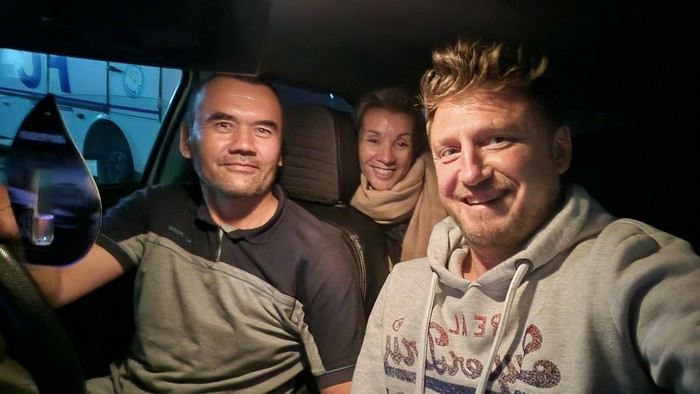
After as many weeks as I have fingers on my right hand, we're hitting the road again, fully recovered from our pharaonic adventure. Back in France to drop off our daughters (sorry, girls!), this time it's just the two of us, ready to be welcomed by a new destination. They say it offers one of the richest cultural heritages in the world for those willing to put in the effort. It's the land of the ancient Silk Road, where we'll follow a journey steeped in history and discoveries straight out of *One Thousand and One Nights*. A former Soviet bloc region independent only since 1991, we'll be walking in the footsteps of Genghis Khan, Tamerlane, Alexander the Great, Marco Polo...
Another fun fact about this country: it's strictly forbidden to import porn on your phone. True story. The same goes for painkillers! Unless it's about sodomy—though the two don’t seem connected, that’s just how it is. Don’t ask me why! Anyway, I’m getting off track. Here’s the big question: Where do you think we’ve just landed?... To give you a hint, the locals are known for being incredibly welcoming. No sooner said than done—our first taxi driver, proud to transport French travelers, refused to let us pay for the ride. Great vibes for these two weeks ahead. So, any guesses? Uzbekistan!!!
The 2026 Southwest USA Road Trip
Hi everyone, we're back from a DIY USA road trip we organized from July 31, 2026, to August 26, 2026.
The destination: The Southwest USA, including Texas, Arizona, and New Mexico. Roughly 7,000 kilometers covered.
The car: A Chevrolet Equinox for two, rented through BSP Auto and Avis. Inside, we had 2 suitcases, a travel bag, two carry-on bags, a Walmart cooler, photo gear, and water bottles (a 40-pack).
The route: Dallas DFW, Fort Worth, Houston, Austin, San Antonio, Alpine, El Paso, Tucson, Sedona, Albuquerque, Amarillo, and back to Dallas to finish with a departure from DFW.
The travelers: Two seniors well advanced in years (73 and 75) but still active (nothing too physically demanding—to stay alive and fund our trips), fully independent physically, though a bit less so mentally. Big USA fans, a country where anything is possible. More walkers than hikers, preferring 3-star hotels over roadside motels, Italian restaurants over US food, frequent stops for photos, museums over nothing, naps over forced marches. Not too whiny, just enough to stay French in the land of the "great Satan," as they say. Not great with languages—street English (but handy), and my Spanish is non-existent except for: "Hola! Una cerveza por favor!" That’s about it. My wife understands everything but refuses to speak.
The cost of the road trip: Around 12,000 €, including AF flights, the car, gas, gifts, visits, and everything else. Well managed, since we’d budgeted 13,500 € initially.
The positive side: A delight, with those endless open roads. Museums to discover. The realization of the Hispanic presence and its important history in this part of America. Lovely locals. Tourists who were more or less friendly. A terrible Texan accent that was hard to understand. Gas stations that were like real stores, with prepared food, alcohol sold in Arizona and New Mexico, and employees who were always up for a laugh!
The negative side: The heat throughout the trip... 43°C in Dallas at the end. Impossible to walk the streets. Lots of homeless people in downtown Dallas. Hotel breakfasts that were always the same. You get used to it.
So, it was positive overall, but the concept is starting to wear us out. We might rethink the DIY road trip model for next time. If the man upstairs grants us more time.
Next up, we’ll wait for the first batch of sorted photos to go through the wringer.
See you soon.
The destination: The Southwest USA, including Texas, Arizona, and New Mexico. Roughly 7,000 kilometers covered.
The car: A Chevrolet Equinox for two, rented through BSP Auto and Avis. Inside, we had 2 suitcases, a travel bag, two carry-on bags, a Walmart cooler, photo gear, and water bottles (a 40-pack).
The route: Dallas DFW, Fort Worth, Houston, Austin, San Antonio, Alpine, El Paso, Tucson, Sedona, Albuquerque, Amarillo, and back to Dallas to finish with a departure from DFW.
The travelers: Two seniors well advanced in years (73 and 75) but still active (nothing too physically demanding—to stay alive and fund our trips), fully independent physically, though a bit less so mentally. Big USA fans, a country where anything is possible. More walkers than hikers, preferring 3-star hotels over roadside motels, Italian restaurants over US food, frequent stops for photos, museums over nothing, naps over forced marches. Not too whiny, just enough to stay French in the land of the "great Satan," as they say. Not great with languages—street English (but handy), and my Spanish is non-existent except for: "Hola! Una cerveza por favor!" That’s about it. My wife understands everything but refuses to speak.
The cost of the road trip: Around 12,000 €, including AF flights, the car, gas, gifts, visits, and everything else. Well managed, since we’d budgeted 13,500 € initially.
The positive side: A delight, with those endless open roads. Museums to discover. The realization of the Hispanic presence and its important history in this part of America. Lovely locals. Tourists who were more or less friendly. A terrible Texan accent that was hard to understand. Gas stations that were like real stores, with prepared food, alcohol sold in Arizona and New Mexico, and employees who were always up for a laugh!
The negative side: The heat throughout the trip... 43°C in Dallas at the end. Impossible to walk the streets. Lots of homeless people in downtown Dallas. Hotel breakfasts that were always the same. You get used to it.
So, it was positive overall, but the concept is starting to wear us out. We might rethink the DIY road trip model for next time. If the man upstairs grants us more time.
Next up, we’ll wait for the first batch of sorted photos to go through the wringer.
See you soon.
Travel Journal - 28 Days in China in August 2026
Hi everyone,
I’m sharing a little recap of this new 4-week trip to China—nothing fancy, just my experience.
We’re taking advantage of the extended visa exemption to return to China for the 4th time. I loved last summer’s trip so much that I’m a bit worried about being disappointed this year. Plus, I’ve had a few hiccups before this departure: my WeChat account got blocked, and I couldn’t recover it (luckily, Alipay still works fine); I couldn’t verify my 12306 account for weeks; Trip.com failed to book our second train; and I’ve got an injury that’ll slow me down during the trip... Ugh, I hate starting a trip with these kinds of issues. Then, oh surprise! Just before leaving, my 12306 account got verified! Super easy to use from that point on—I could book a few train tickets without fees.
We’re sticking with Free’s e-SIMs, which work great in China.
August 2–3
Anyway, on the morning of August 2nd, we took the RER to CDG. As usual, we couldn’t check in online. It’s always a bit frustrating, especially since we didn’t have any checked luggage. We flew with Air China. We arrived at the check-in counter at 9:50 AM, 2 hours and 40 minutes before the flight. The line for our check-in stretched 300 meters across the airport in both directions. What a joke!! We spent 1 hour and 45 minutes in that line just to reach the counter and get our boarding passes. By then, it was 11:35 AM, and boarding had already started at 11:20 AM. The screens showed a 25-minute walk to our gate—on the other side of the airport, of course—plus we had to go through passport control and security... Long story short, the plane didn’t leave without us 🙂 We boarded among the last passengers, and we took off at 12:30 PM. We’d flown Air China four times before, but this time, it felt *really* low-cost. The check-in chaos, the cramped seats (12 seats per row), no music by artists known outside China, mediocre food, and a boarding area at Beijing Airport with only 10 seats—worthy of Ryanair or EasyJet. And yet, the price was sky-high. Again, D.’s vacation requests were denied outside of July and August, so we’re traveling from August 2nd to 30th. We couldn’t have picked a worse time for inflated prices, and with the situation in Iran, we got hit with a 390 € fuel surcharge. I’ve never paid so much for flights—I felt like I’d bought business class, but nope, far from it!!
We landed in Beijing around 4:15 AM. It was 28°C with thick fog. We drove and drove and drove for 20 minutes, as usual in Beijing. Then we went through a first check, a second check, a third check, and waited for our connecting flight at 6:40 AM. A small Airbus A320, but way more space than in the Boeing 777 from the first flight. We landed in Kunming, Yunnan, around 10:15 AM in the rain.
We headed to the subway. You can’t pay at the machines with Alipay here either, so we set up the transport QR code directly in Alipay to scan at the subway gates. The process is a bit long the first time if you haven’t entered your info before, but once it’s done, it’s *so* much easier! We took Line 6 to the terminus for 6 yuan each.
We’d booked a hotel nearby, on the 16th floor. It’s actually studios on different floors of a huge residential building. The view’s pretty nice from here. We settled in quickly—back to those wooden beds, or rather, mattresses as hard as wood, which we *hadn’t* missed... Then we went out for our first bowl of noodles of the trip and wandered through the shopping streets of the old town.
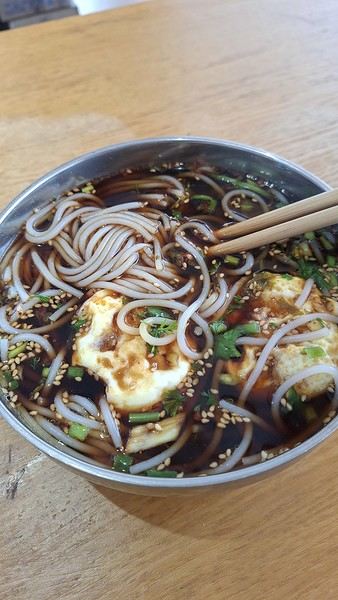
It was crowded, and the weather was cool—around 19–20°C. We tried a local specialty: milk skin, thick, dried, then grilled with rose jam. Yeah... we won’t be having that again. The taste and texture of the milk skin... no thanks.
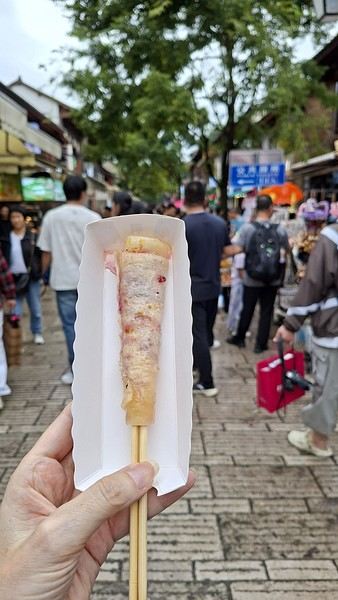
We saw a lot of wild mushroom hotpot too. It’s on our list for later. We also passed through the Jinma and Biji gates, where I played with reflections in puddles. I *love* doing that 🙂
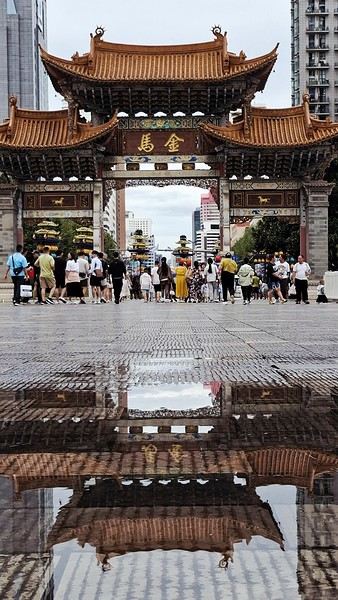
At the end of the day, we headed to a temple advertised as open 24/7 on Amap. Of course, when we got there, it was closed. We’ll go back tomorrow. That was the first of many disappointments with Amap this trip—I hadn’t had that issue on previous visits.
We were exhausted after that sleepless flight. Night was falling, and we decided to grab a quick bite without much appetite. We shared a delicious vegetable fried rice for 12 yuan—we even left half of it. The portions are *huge*.
After a couple of small purchases, we headed back at 9 PM, wiped out, after walking 17 km between the airports and these first steps in Kunming. I expected to see quite a few Western travelers here, but we didn’t spot a single one. Instead, we met lots of curious Chinese people, many of them super friendly and helpful—almost *too* eager, like when they’d run to serve us as fast as possible. It’s a bit much, but it’s great to be back!
I’m sharing a little recap of this new 4-week trip to China—nothing fancy, just my experience.
We’re taking advantage of the extended visa exemption to return to China for the 4th time. I loved last summer’s trip so much that I’m a bit worried about being disappointed this year. Plus, I’ve had a few hiccups before this departure: my WeChat account got blocked, and I couldn’t recover it (luckily, Alipay still works fine); I couldn’t verify my 12306 account for weeks; Trip.com failed to book our second train; and I’ve got an injury that’ll slow me down during the trip... Ugh, I hate starting a trip with these kinds of issues. Then, oh surprise! Just before leaving, my 12306 account got verified! Super easy to use from that point on—I could book a few train tickets without fees.
We’re sticking with Free’s e-SIMs, which work great in China.
August 2–3
Anyway, on the morning of August 2nd, we took the RER to CDG. As usual, we couldn’t check in online. It’s always a bit frustrating, especially since we didn’t have any checked luggage. We flew with Air China. We arrived at the check-in counter at 9:50 AM, 2 hours and 40 minutes before the flight. The line for our check-in stretched 300 meters across the airport in both directions. What a joke!! We spent 1 hour and 45 minutes in that line just to reach the counter and get our boarding passes. By then, it was 11:35 AM, and boarding had already started at 11:20 AM. The screens showed a 25-minute walk to our gate—on the other side of the airport, of course—plus we had to go through passport control and security... Long story short, the plane didn’t leave without us 🙂 We boarded among the last passengers, and we took off at 12:30 PM. We’d flown Air China four times before, but this time, it felt *really* low-cost. The check-in chaos, the cramped seats (12 seats per row), no music by artists known outside China, mediocre food, and a boarding area at Beijing Airport with only 10 seats—worthy of Ryanair or EasyJet. And yet, the price was sky-high. Again, D.’s vacation requests were denied outside of July and August, so we’re traveling from August 2nd to 30th. We couldn’t have picked a worse time for inflated prices, and with the situation in Iran, we got hit with a 390 € fuel surcharge. I’ve never paid so much for flights—I felt like I’d bought business class, but nope, far from it!!
We landed in Beijing around 4:15 AM. It was 28°C with thick fog. We drove and drove and drove for 20 minutes, as usual in Beijing. Then we went through a first check, a second check, a third check, and waited for our connecting flight at 6:40 AM. A small Airbus A320, but way more space than in the Boeing 777 from the first flight. We landed in Kunming, Yunnan, around 10:15 AM in the rain.
We headed to the subway. You can’t pay at the machines with Alipay here either, so we set up the transport QR code directly in Alipay to scan at the subway gates. The process is a bit long the first time if you haven’t entered your info before, but once it’s done, it’s *so* much easier! We took Line 6 to the terminus for 6 yuan each.
We’d booked a hotel nearby, on the 16th floor. It’s actually studios on different floors of a huge residential building. The view’s pretty nice from here. We settled in quickly—back to those wooden beds, or rather, mattresses as hard as wood, which we *hadn’t* missed... Then we went out for our first bowl of noodles of the trip and wandered through the shopping streets of the old town.
It was crowded, and the weather was cool—around 19–20°C. We tried a local specialty: milk skin, thick, dried, then grilled with rose jam. Yeah... we won’t be having that again. The taste and texture of the milk skin... no thanks.
We saw a lot of wild mushroom hotpot too. It’s on our list for later. We also passed through the Jinma and Biji gates, where I played with reflections in puddles. I *love* doing that 🙂
At the end of the day, we headed to a temple advertised as open 24/7 on Amap. Of course, when we got there, it was closed. We’ll go back tomorrow. That was the first of many disappointments with Amap this trip—I hadn’t had that issue on previous visits.
We were exhausted after that sleepless flight. Night was falling, and we decided to grab a quick bite without much appetite. We shared a delicious vegetable fried rice for 12 yuan—we even left half of it. The portions are *huge*.
After a couple of small purchases, we headed back at 9 PM, wiped out, after walking 17 km between the airports and these first steps in Kunming. I expected to see quite a few Western travelers here, but we didn’t spot a single one. Instead, we met lots of curious Chinese people, many of them super friendly and helpful—almost *too* eager, like when they’d run to serve us as fast as possible. It’s a bit much, but it’s great to be back!
Off to explore Lithuania!
December 13 - Day 1
"How about a Christmas market this year, huh? A little romantic weekend getaway... - Yes! That’d be cool! Strasbourg? Colmar? - Feels a bit déjà vu, doesn’t it? Plus, slim chance of snow there... And I’d love something a bit more exotic with a touch of originality..."
"Okay, Google, give me the list of the five most beautiful Christmas markets in Europe. - In fifth place, the Christmas market in Vilnius, the capital of Lithuania. - Save your breath! Lithuania, here we come!"
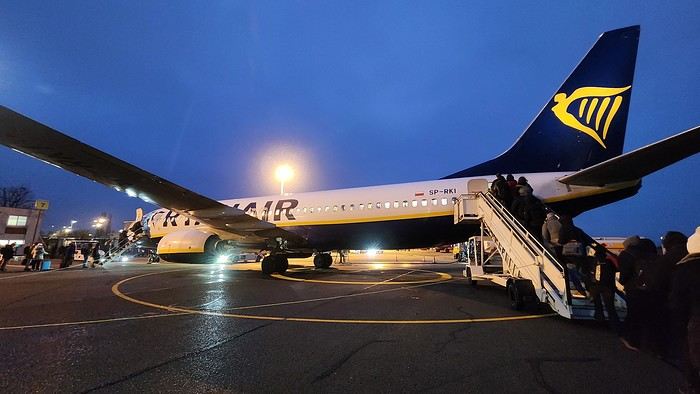
We wanted cold, and cold is exactly what we got the moment we set foot in this new, unknown land. As for landscapes, forests and lakes stretch as far as the eye can see across this vast plain, its vegetation scorched by the frost of a winter that’s clearly already well underway here.
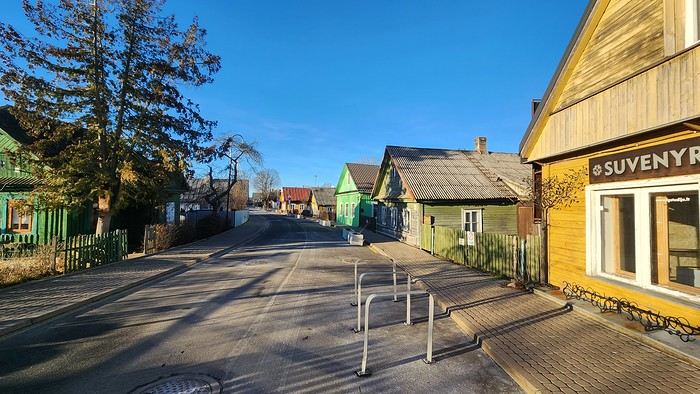
Lakes, in fact, set the scene for our first visit to Trakai Castle, whose brick-red towers and walls rise proudly against the azure sky of our first day. Lakes, because this castle was built on an island and is only accessible on foot via a series of walkways spanning half-frozen lake offshoots. I couldn’t have picked a better spot to build my castle! Translation: We’re totally sold! Proof is we spend two hours hiking around the area, alternating between forests, reeds, and cozy houses tastefully decorated for Christmas.
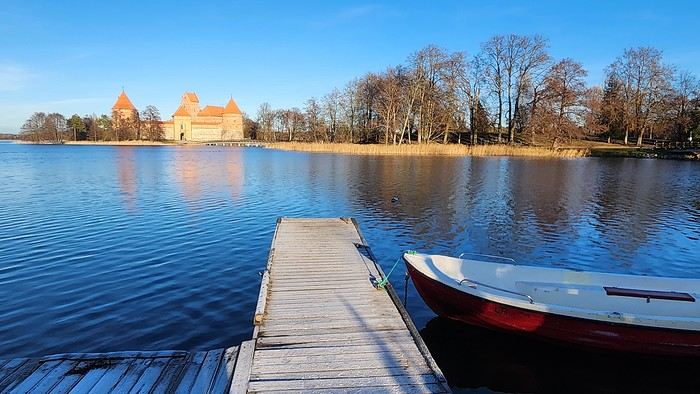
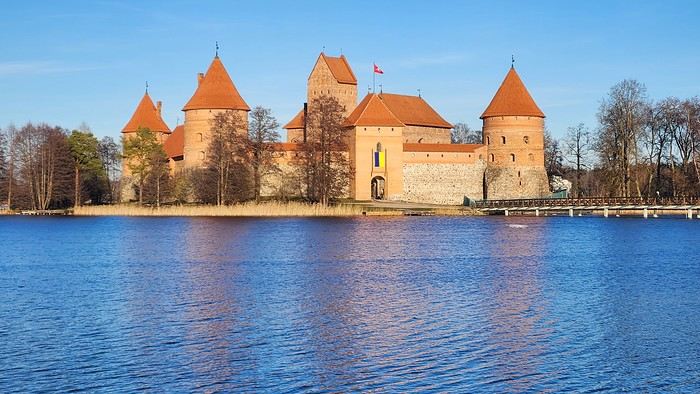
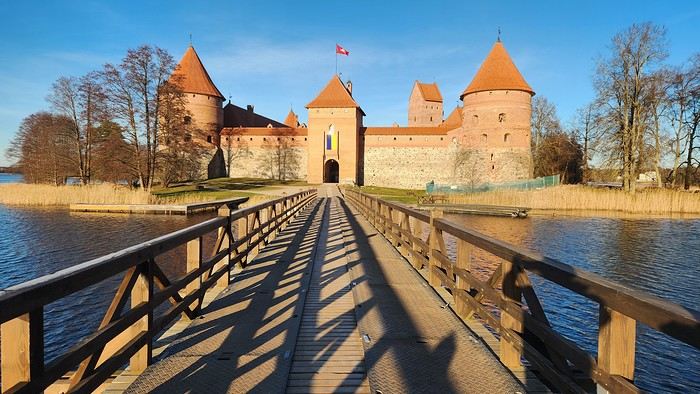
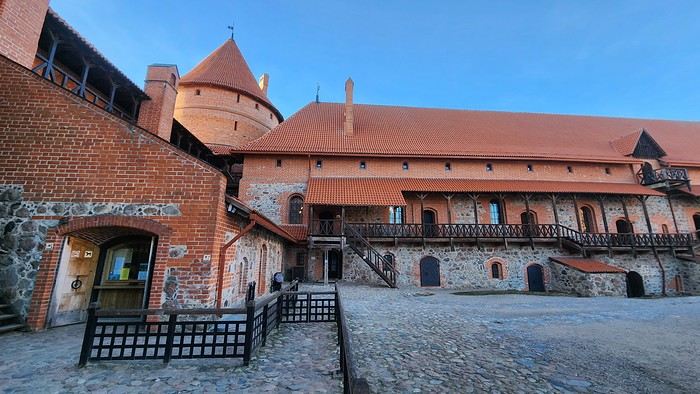
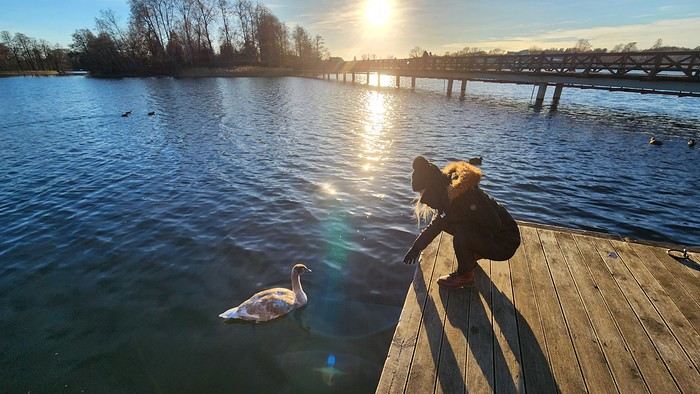
"How about a Christmas market this year, huh? A little romantic weekend getaway... - Yes! That’d be cool! Strasbourg? Colmar? - Feels a bit déjà vu, doesn’t it? Plus, slim chance of snow there... And I’d love something a bit more exotic with a touch of originality..."
"Okay, Google, give me the list of the five most beautiful Christmas markets in Europe. - In fifth place, the Christmas market in Vilnius, the capital of Lithuania. - Save your breath! Lithuania, here we come!"
We wanted cold, and cold is exactly what we got the moment we set foot in this new, unknown land. As for landscapes, forests and lakes stretch as far as the eye can see across this vast plain, its vegetation scorched by the frost of a winter that’s clearly already well underway here.
Lakes, in fact, set the scene for our first visit to Trakai Castle, whose brick-red towers and walls rise proudly against the azure sky of our first day. Lakes, because this castle was built on an island and is only accessible on foot via a series of walkways spanning half-frozen lake offshoots. I couldn’t have picked a better spot to build my castle! Translation: We’re totally sold! Proof is we spend two hours hiking around the area, alternating between forests, reeds, and cozy houses tastefully decorated for Christmas.