Results for "Dallas+|+3+>+99"
1652 results found.
Adaptateur aux Etats-Unis? English translation pending
Je pars aux USA bientôt. Comme le courant est à 220 volts chez nous et à 120 aux Etats-Unis, faut-il prévoir un adaptateur par exemple pour recharger un portable ou les accus de l'appareil photo???
Voyage sport aux Etats-Unis English translation pending
salut a tous,
je suis nouveau sur le forum, j'adore les voyages et je travail dans la branche, donc je pense que j'interviendrai souvans sur ce site 🤪😉🙂😎
🤪😉🙂😎
Etant fan de hockey et de basket je projet d'allé 4 jours aux usa cet hiver pour assisté a un match de nhl et un de nba, donc une ville qui a 2 equipe.
Comme ca sera mon premier voyage aux states j'aimerai savoir quel ville vous semble la mieux etant donné que j'aimerai visté un peu.
New york Los angeles Boston Chicago Denver Miami.. et toute autre ville ayant une equipe de nhl et de nba exepté Toronto car j'y suis deja allé.
merci
je suis nouveau sur le forum, j'adore les voyages et je travail dans la branche, donc je pense que j'interviendrai souvans sur ce site
🤪😉🙂😎Etant fan de hockey et de basket je projet d'allé 4 jours aux usa cet hiver pour assisté a un match de nhl et un de nba, donc une ville qui a 2 equipe.
Comme ca sera mon premier voyage aux states j'aimerai savoir quel ville vous semble la mieux etant donné que j'aimerai visté un peu.
New york Los angeles Boston Chicago Denver Miami.. et toute autre ville ayant une equipe de nhl et de nba exepté Toronto car j'y suis deja allé.
merci
Location de voiture aux Etats-Unis English translation pending
A force de chercher, je crois bien que j'ai trouvé un site qui semble offrir les mêmes prestations que autoescape et qui soit moins cher pour les USA. Quelqu'un a t'il un avis là dessus ?
ex : chevrolet cavalier 167€ carbooker et 201 € autoescape Oldsmobile alero 185€ carbooker et 226€ autoescape chrysler sebrinb 310€ carbooker et 361€ autoescape
http://www.carbookers.com
ex : chevrolet cavalier 167€ carbooker et 201 € autoescape Oldsmobile alero 185€ carbooker et 226€ autoescape chrysler sebrinb 310€ carbooker et 361€ autoescape
http://www.carbookers.com
Montréal --> Mexique English translation pending
Salut à tous...
Aujourd'hui j'ai une colle... le premier qui répond bien gagne... toute mon estime😉
Après mon voyage au Nicaragua cette année je prévois de repartir avec ma fiancée dans MAX 2 ans (environs 4 mois). Oui je sais c'est pas urgent mais on réfléchi pas mal car elle est pas 100% partante au départ... mais l'est devenue à force de discussion 😛 Elle comprend que je veux vraiment partir et est prête à franchir le pas. je suis donc super heureux!
La colle arrive ne vous inquiétez pas...
En + du Guatémala, du Nica, du Mexique et peut-être le Costa (en tout cas on repartirais de là si on descend) j'ai envie de pousser une pointe à Montreal et ses alentours... envie de voir ce pays et pour autant que de traverser l'atlantique (je hais l'avion) autant y aller 😛
Le probl��me se pointe... si si... réfléchissez et vous le verrez déjà venir...😎
La question est : Comment passez de Montreal à Mexico ? (ou un autre coin qui serait plus sur la côte caraïbe ou même Pacifique car elle veut du soleil et un bel hotel bord de plage au moins 2 semaines pour après me suivre dans + d'aventure... --> déjà ici si qqun a des idées pas cher sans même que ce soit Cancun qui est fort cher)
Le hic, toujours le même, le fric...
j'ai trouvé des trucs sur le greyhound pour traverser les states mais ça à l'air moyennement cher mais LONG! Je regarde pour Montreal- Mexico mais on froles les 1600$ canadiens (+1050€) pour 2. Je pense à un Montreal-Dallas en avion et rejoindre le Mexique de là... mais comment?????
Pour le reste on opterait pour un mix de transports locaux et Truc genre ticabus (déjà esayé pour Nica-costa) pour traverser le Salvador qui me botte pas trop et me stress un peu...
voilà, le problème est posé... à vos neurones... Prêts???? PARTEZ!😎
Aujourd'hui j'ai une colle... le premier qui répond bien gagne... toute mon estime😉
Après mon voyage au Nicaragua cette année je prévois de repartir avec ma fiancée dans MAX 2 ans (environs 4 mois). Oui je sais c'est pas urgent mais on réfléchi pas mal car elle est pas 100% partante au départ... mais l'est devenue à force de discussion 😛 Elle comprend que je veux vraiment partir et est prête à franchir le pas. je suis donc super heureux!
La colle arrive ne vous inquiétez pas...
En + du Guatémala, du Nica, du Mexique et peut-être le Costa (en tout cas on repartirais de là si on descend) j'ai envie de pousser une pointe à Montreal et ses alentours... envie de voir ce pays et pour autant que de traverser l'atlantique (je hais l'avion) autant y aller 😛
Le probl��me se pointe... si si... réfléchissez et vous le verrez déjà venir...😎
La question est : Comment passez de Montreal à Mexico ? (ou un autre coin qui serait plus sur la côte caraïbe ou même Pacifique car elle veut du soleil et un bel hotel bord de plage au moins 2 semaines pour après me suivre dans + d'aventure... --> déjà ici si qqun a des idées pas cher sans même que ce soit Cancun qui est fort cher)
Le hic, toujours le même, le fric...
j'ai trouvé des trucs sur le greyhound pour traverser les states mais ça à l'air moyennement cher mais LONG! Je regarde pour Montreal- Mexico mais on froles les 1600$ canadiens (+1050€) pour 2. Je pense à un Montreal-Dallas en avion et rejoindre le Mexique de là... mais comment?????
Pour le reste on opterait pour un mix de transports locaux et Truc genre ticabus (déjà esayé pour Nica-costa) pour traverser le Salvador qui me botte pas trop et me stress un peu...
voilà, le problème est posé... à vos neurones... Prêts???? PARTEZ!😎
Tour du monde avec billet prime Flying blue: bon courage! English translation pending
Bonjour,
Je suis en train de préparer un "tour du monde" express pour mon voyage de noce -Paris, New-York, Los Angeles-Honolulu-Seoul-Hanoi-Bangkok-Paris. Chose qui est possible normalement chez Air France/ et leur programme de fidélisation Flying Blue. L'un de mes deux billets est un "prime" et la partie clé pris en charge par Korean Air Line est ingérable (quota nul à l'année!). En conclusion: commercialement impossible et mensonger. Si quelqu'un a des infos, je suis preneur (autre possibilité de trajet que par la corée...) Merci. Olivier / Rollinguru
Je suis en train de préparer un "tour du monde" express pour mon voyage de noce -Paris, New-York, Los Angeles-Honolulu-Seoul-Hanoi-Bangkok-Paris. Chose qui est possible normalement chez Air France/ et leur programme de fidélisation Flying Blue. L'un de mes deux billets est un "prime" et la partie clé pris en charge par Korean Air Line est ingérable (quota nul à l'année!). En conclusion: commercialement impossible et mensonger. Si quelqu'un a des infos, je suis preneur (autre possibilité de trajet que par la corée...) Merci. Olivier / Rollinguru
Grand voyage aux USA, plein de questions... English translation pending
Bonjour a tous,
Je veux partir aux etats unis faire un grand tour, si possible... Mon point de depart serai miami, a partir de mi-avril environ.
De la, je voudrais aller en lousianne et visiter la floride, puis remonter jusqu'a New York. Ensuite je voudrais faire les grand parks, et le colorado, la californie, mais je ne sais pas encore dans quel ordre.
C'est pas facile de se decider, je voudrais partir en avril, et deja les avions commencent a se remplir... Va falloir vite se decider. J'ai pas mal d'economie en poche, mais comment estimer ce genre de voyage ? pas simple, et les transport la bas me semble chers...
Y'en a t'il parmis vous qui on des tuyaux, des idees d'itineraires ? Je voudrais aussi savoir combien reviens en moyenne un moins au USA, a quel prix on trouve des hotel bon marché, etc...
Si il y a des gens motivé par ce genre d'experience, je recherche aussi des compagnons de voyage.. Rencontres possible sur paris. J'ai 25 ans pour ceux kil veulent savoir. Ca me fait kan meme un peu peur de partir seul faire ce grand trip...
Je veux partir aux etats unis faire un grand tour, si possible... Mon point de depart serai miami, a partir de mi-avril environ.
De la, je voudrais aller en lousianne et visiter la floride, puis remonter jusqu'a New York. Ensuite je voudrais faire les grand parks, et le colorado, la californie, mais je ne sais pas encore dans quel ordre.
C'est pas facile de se decider, je voudrais partir en avril, et deja les avions commencent a se remplir... Va falloir vite se decider. J'ai pas mal d'economie en poche, mais comment estimer ce genre de voyage ? pas simple, et les transport la bas me semble chers...
Y'en a t'il parmis vous qui on des tuyaux, des idees d'itineraires ? Je voudrais aussi savoir combien reviens en moyenne un moins au USA, a quel prix on trouve des hotel bon marché, etc...
Si il y a des gens motivé par ce genre d'experience, je recherche aussi des compagnons de voyage.. Rencontres possible sur paris. J'ai 25 ans pour ceux kil veulent savoir. Ca me fait kan meme un peu peur de partir seul faire ce grand trip...
Los angeles / las vegas English translation pending
Bonjour à tous,
Aurai besoin des rens. sur Los angeles /Las Vegas / Gd canyon.
(ex Motels - Locations de voitures...)
Mci
🙂
Aurai besoin des rens. sur Los angeles /Las Vegas / Gd canyon.
(ex Motels - Locations de voitures...)
Mci
🙂
Le grand Canyon en individuel? English translation pending
Bonjour à tous ! Quelqu'un peut-il nous dire q'il a déjà été voir le Grand Canyon par ses propres moyens ? Est-ce réalisable ? Je pense que l'aéroport de base serait Phoenix ? Merci pour tous les conseils que vous pourriez nous donner. Nous comptons y faire un peu de VTT.
Montréal/Mexique en autobus? English translation pending
Bonjour!
Est-ce qu'il existe des compagnies d'autobus qui font le trajet Montréal/Mexique?
Si oui, combien ça coûte?
Merci d'avance!
Kate
Est-ce qu'il existe des compagnies d'autobus qui font le trajet Montréal/Mexique?
Si oui, combien ça coûte?
Merci d'avance!
Kate
La 4eme dimension sur la muraille de chine! English translation pending
🙂Salut a tous !
Il m'est arrive une aventure assez surrealiste hier lorsque je participais a une excursion de la Zhaolong Youth Hostel sur la grande muraille de chine. J'etais tranquillement avec des collegues ajiesques en train de contempler de magnifiques paysages lorsque tout a coup je me suis vu transporte dans l'autre dimension chere aux freres Bogdanov. Un haut-parleur innoportun s'est mis a passer de la musique dont les paroles furent: Helene, je m'appelle Helene, je suis une fille comme les autres....😮
VERIDIQUE. La musique de l'inoubliable serie Helene et les garcons etait diffusee sur la grande muraille de chine, d'ou une certaine stupeur ! L' experience heureusement ne dura qu'une minute environ et je pus alors revenir a la realite !
Gare aux voyageurs errant sur la grande muraille de chine, vous pourriez vivre ce type d'experience traumatisante egalement!🤪
A bon entendeur, a la prochaine!😉
DOM
Il m'est arrive une aventure assez surrealiste hier lorsque je participais a une excursion de la Zhaolong Youth Hostel sur la grande muraille de chine. J'etais tranquillement avec des collegues ajiesques en train de contempler de magnifiques paysages lorsque tout a coup je me suis vu transporte dans l'autre dimension chere aux freres Bogdanov. Un haut-parleur innoportun s'est mis a passer de la musique dont les paroles furent: Helene, je m'appelle Helene, je suis une fille comme les autres....😮
VERIDIQUE. La musique de l'inoubliable serie Helene et les garcons etait diffusee sur la grande muraille de chine, d'ou une certaine stupeur ! L' experience heureusement ne dura qu'une minute environ et je pus alors revenir a la realite !
Gare aux voyageurs errant sur la grande muraille de chine, vous pourriez vivre ce type d'experience traumatisante egalement!🤪
A bon entendeur, a la prochaine!😉
DOM
Votre avis sur itinéraire pour l'ouest des Etats-Unis? English translation pending
bonjour
nous partons visiter en juillet les parcs nationaux: j' ai qq questions à poser :
arrivée à SF, retour de LA 24 jours de voyage
SF(2 j)-yosemite-death valley-vegas-brice- zion-grand canyon- LA( 4 j)
voilà cet itinéraire estil correct ? je ne voudrait pas faire de trop longues distances par jour ( 1 enfant)
combien de jours est il necessaire pour visiter chaque parc ? peut on en voir d'autres et lesquels
nous pensons camper ds les parcs : lesquels faut il choisir ? piscine ??? (vu la chaleur) et à quel prix ?
pour SF et LA connaissez vous des hotels corrects et abordables ?
nous pensions rester 4 jours à hermosa beach pres de LA ?????? avez vous des adresses ?
Enfin, nous n'avons aucune idee du budget de nourriture par jour, et le prix des restaus ..
avez vous un ordre d'idee pour 3 personnes, 3 semaines et demi dans l 'ouest visites comprises ( hors avions et loc voiture )
magnifique voyage n'estce pas ?
merci infinement toutes infos seront bienvenue ....😏
nathalie
nous partons visiter en juillet les parcs nationaux: j' ai qq questions à poser :
arrivée à SF, retour de LA 24 jours de voyage
SF(2 j)-yosemite-death valley-vegas-brice- zion-grand canyon- LA( 4 j)
voilà cet itinéraire estil correct ? je ne voudrait pas faire de trop longues distances par jour ( 1 enfant)
combien de jours est il necessaire pour visiter chaque parc ? peut on en voir d'autres et lesquels
nous pensons camper ds les parcs : lesquels faut il choisir ? piscine ??? (vu la chaleur) et à quel prix ?
pour SF et LA connaissez vous des hotels corrects et abordables ?
nous pensions rester 4 jours à hermosa beach pres de LA ?????? avez vous des adresses ?
Enfin, nous n'avons aucune idee du budget de nourriture par jour, et le prix des restaus ..
avez vous un ordre d'idee pour 3 personnes, 3 semaines et demi dans l 'ouest visites comprises ( hors avions et loc voiture )
magnifique voyage n'estce pas ?
merci infinement toutes infos seront bienvenue ....😏
nathalie
Voyagistes pour tour du monde English translation pending
bonjour a tous je pars en janvier pour un tour du monde commencant en afrique, puis asie puis oceanie et enfin amerique du sud!
connaissez vous des voyagistes sur paris autres que connaisseurs du voyage ou voyageurs du monde.
ou se trouve l agence de opneworld dans notre belle capitale, impossible de la trouver!
merci!
connaissez vous des voyagistes sur paris autres que connaisseurs du voyage ou voyageurs du monde.
ou se trouve l agence de opneworld dans notre belle capitale, impossible de la trouver!
merci!
Montréal en janvier: que mettre dans la valise (Québec)? English translation pending
je pars une semaine a montreal en janvier prochain, que dois je mettre dans ma valise ?
est il possible d'emmener mes patins a glace ou cela pose un pb a l'aeroport ?
merci de vos reponses😉
merci de vos reponses😉
Africa: A Heartfelt Love for a Continent
“When the Whites came to Africa, we had the land and they had the Bible. They taught us to pray with our eyes closed: when we opened them, the Whites had the land and we had the Bible.” Jomo Kenyatta (p.7)
The Maggi cube, an unchallenged hegemony, and so much more
“The hopeless continent,” headlined The Economist, a British magazine, in July 2000 about Africa. Eleven years later, the same magazine headlined “Africa rising” instead. Images of Africa in the prosperous North constantly oscillate between apocalyptic scenarios and enthusiastic projections. A key issue with such images lies in the generalization they entail. If you look at the continent, considerable contrasts emerge depending on space and time. It’s no surprise that a region of the world encompassing such diverse ecological zones, maintaining such varied ties with other continents, comprising nearly fifty nation-states in sub-Saharan Africa alone, and characterized by a great diversity of languages, belief systems, and historical paths, doesn’t share a single destiny.
And yet, for many people outside Africa, as well as for many Africans, the continent constitutes a single entity, defined by criteria such as skin color, a colonial past, poverty, and the art of survival. Until now, these perspectives were generally accompanied by the idea that Africa had to—or should have—followed a single path together, sometimes called development, sometimes modernization, sometimes liberation, then a market economy. None of these paths delivered on their promises.
The two writers Alain Mabanckou and Abdourahman Waberi—one from Congo, the other raised in Djibouti, both long settled in France and now professors at renowned North American universities (Los Angeles, Washington)—have had enough of pessimistic scenarios: “We are aware that Africa is in the world and the world is in Africa. The same goes for all other continents, as our destinies are inextricably linked for better or worse. We refuse to see Africa as a reservoir of misfortunes or a continent cursed by atavistic misfortune and characterized by ethnic conflicts. [...] It’s this passionate flame we wanted to capture in a book [...] a kind of stroll through African cultures, without any demands, each letter of the alphabet leading us to a notion, a practice, a concept, a moment in history, literature, painting, politics, economics, cuisine, etc.” (p.10-11). Africa, they write, is on the verge of “imposing a signature, a style, a way of being in the world and in relation to the rest of the world.” (p.11) To put words to the continent’s diversity and dynamism, the two authors created a “rambling ABC,” a kind of portrait—or more precisely, a mythography—that lets you see and feel the pulse of a vast continent whose cultural power is unfolding before our eyes. Once marginalized or even mocked, the voice and importance of the Continent in global affairs are now undeniable” (p.11), containing over a hundred entries, mostly concise, written in a relaxed and casual style. The optimistic, even exuberant tone is set from the brief introduction. The duo of authors wants to “sing a love song to the cultures of our continent, to its inhabitants past and present, to its exceptional resources and its spectacular globalization despite a certain pollution that still clouds our skies due to the unmatched duration of dictatorships in some of our regions.” (p.12) In doing so, they don’t want to be too distracted by today’s Afewerki-Biya-Bongo-Déby & Co. ...
Of course, you’ll find tributes to great precursors like Frantz Fanon (“[...] it was a love story and admiration that wasn’t dimmed by the four decades separating his birth from ours. Let’s add that we were born while the native of Fort-de-France had left the world’s stage four years earlier, in the prime of life” p.141), Mongo Beti (“You must read and reread Mongo Beti, a genius who used his fame to support often just causes in Africa, like defending oppressed groups. His place is already in History. His oppressors, like the dictators Ahmadou Ahidjo and Paul Biya, can’t compete in the same category” p.64), the Malian Amadou Hampâté Bâ
(“Posterity remembers him mainly as an tireless defender of African cultures. His plea for the collection and preservation of traditional African knowledge remains a major event for all men and women of good will. One day in 1960, at the UNESCO podium, the native of Bandiagara sounded the alarm: ‘[...] Since we’ve admitted that the humanity of each people is the heritage of all humanity, if African traditions aren’t collected in time and written down, they’ll one day be missing from the universal archives of humanity.’” p.51),
Kwame Nkrumah, “one of the founders of Pan-Africanism, father of Ghana’s independence” (p.239), as well as the historian Cheikh Anta Diop, the writer, poet, and politician Aimé Césaire, and the economist and thinker Samir Amin, but also very warm tributes to certain contemporary African intellectuals like Souleymane Bachir Diagne and Achille Mbembe
(“A few years ago, in dominant economic circles, a rumor often resurfaced, usually disguised as a cold and scientifically proven analysis: Africa is useless. It’s a burden for the rest of the human community. With its 2% share in world trade, it would disappear from stock market radars without anyone noticing. So? Maybe it’ll be pulled up by other continents. Wanting to surpass itself is a crazy bet for Africans, they concluded. Arrogant or clueless, President Nicolas Sarkozy declared before an audience of students and teachers at Cheikh Anta Diop University in Dakar: ‘The African man hasn’t entered history enough [...] He only knows the eternal repetition of time marked by the endless repetition of the same gestures and words.’ That was in 2007. For decades, armed only with reason, an intellectual often steps up to debunk prejudices, lazy readings, and dishonest frameworks used as false fronts by those who, like Nicolas Sarkozy or former journalist Stephen Smith, out of ignorance, contempt, or condescension, distort African reality. This intellectual is none other than the historian and political scientist Achille Mbembe. This heir of Frantz Fanon, Amílcar Cabral, Jean-Marc Ela, and Fabien Eboussi-Boulaga was born in 1957 in Cameroon, in the Bassa region. Marked early by the upheavals of a fratricidal war, Achille Mbembe became the guardian of the memory of martyrs. After brilliant studies in Paris, he went on to teach at the best American universities, but the call of the Continent was stronger than anything else. In Dakar, he once directed CODESRIA (Council for the Development of Social Science Research in Africa) before joining the University of the Witwatersrand in Johannesburg, South Africa. Even though the author of *Critique of Black Reason* (Éditions La Découverte, 2015) spends a few months at Duke University in North Carolina, his observation post remains South Africa. From Johannesburg, Achille Mbembe scrutinizes Africa and the whole world. A lucid observer with an elegant and generous pen, Achille Mbembe knows how to blend big and small history: ‘I was born one day in July, as the month was drawing to a close. It was 1957, in that part of Africa recently named ‘Cameroon,’ a memory of the wonder that seized Portuguese sailors in the 15th century when, sailing up the river near Douala, they couldn’t help but note the presence of a multitude of crustaceans, and named it *Rio dos Camarões*, meaning ‘River of Shrimp.’ I grew up in the shadow of this nameless land, since, in a way, the name it bears is only the product of someone else’s astonishment: a lexical mistake, if you will.’ From this mistake or wound, he made leaven, a springboard to compose a rich work, recognized worldwide. To denounce barriers and barbarians too. But that’s not enough. Among his peers in circles of thought and action, Achille Mbembe passionately and consistently defends human dignity and the beauty of the world. In doing so, he fulfills the mission Frantz Fanon entrusted to him.” (p.227-229),
as well as entries dedicated to lesser-known artists and intellectuals, like the French journalist and activist Rokhaya Diallo, daughter of Senegalese and Gambian parents, or the Ethiopian filmmaker Haile Gerima, who has long lived in the United States. Other names from politics, sports, music, art, and literature: Kofi Annan, p.36; Barack Obama, p.243; Thomas Sankara, p.277; Ousmane Sow, p.285; Yambo Ouologuem, p.250; Léopold Sédar Senghor, p.282; Muhammad Ali, p.30; Nuruddin Farah, p.146; Salif Keita, p.203; Ahmadou Kourouma, p.206; Ngũgĩ wa Thiong’o, p.236; Winnie Mandela, p.224; Kylian Mbappé, p.226 ...
The authors, who resolutely commit to a “mythography” (p.11) of Africa, also pay special attention to local social movements, cultural events, and aspects of daily life. *Y’en a marre*, “which also meant ‘we’re fed up with sitting on our hands’” (p.320-321), emerged about a decade ago in Senegal as a citizen movement of peaceful resistance and symbolizes, the authors emphasize, the fact that African youth are increasingly fed up “with the political circus deployed in Africa since independence, as our parents would say, ‘since the White man left’...” (p.321). A full entry is dedicated to the Maggi bouillon cube, which has flooded African markets for about forty years and enjoys immense popularity (“It’s everywhere in Africa, from Dakar to Djibouti, and from Tangier to Cape Town. It’s in every pot, every stew. Little hands put it in every sauce, every local or adapted dish. An unchallenged hegemony! You’ll find it in diasporas too. The culinary strolls in Paris, in the [...] neighborhood” p.90). Critics blame it not only for impoverishing the aromatic diversity of local dishes but also for being harmful to health. And yet, “he poorest Africans, those who eat only once a day, a few spoonfuls of white beans and a ball of *foufou*, for example, are the most fervent users of the magic cube.” (p.92-93)
For *fonio*, “the new trendy cereal. [...] From the millet family, fonio is probably the oldest cereal cultivated in West Africa, and mainly in its sub-Saharan part, for millennia. [...] Easy to grow, water-efficient, fonio grows everywhere except on clay soils. Long neglected because it was considered the poor man’s crop, fonio is now a source of pride for the farmers who cultivate it and cherish it like the apple of their eye” (p.156-157), the authors immediately offer a detailed recipe, letting the reader know that “e can’t resist sharing this fonio with chicken recipe from Mali with you:
Ingredients: 1 chicken 3 large ripe red tomatoes 4 tbsp tomato paste 4 large onions 1 garlic clove 1/2 cup oil 2 Maggi cubes or salt 2 large carrots 1 turnip 1 large cabbage 2 large potatoes 1 celery stalk 1 packet pre-cooked fonio 4 okra (or okra powder) salt, pepper
Preparation: 1. Prepare the sauce: wash and cut the chicken. Peel the onions, garlic, and vegetables. 2. In a pot, fry the chicken pieces. 3. Dice the onions, tomatoes, carrots, and turnip very small and add them to the pot. 4. Add the tomato paste, salt, and pepper. 5. Simmer for 15 min, then add 2 L of water and the cooked chicken pieces. 6. Simmer for 30 min, then add the crushed garlic and celery, plus the cabbage cut into 4 and the potatoes cut in half. 7. Prepare the fonio: cover it with warm water, let it rest for 15 min, and cook it over low heat. 8. In a small pot, boil the okra and crush them. 9. Mix the crushed okra with the cooked fonio, then salt. Serve hot.” (p.158-159)
The comedy *Black Mic Mac*, released in French theaters in 1986 and addressing France’s increasingly restrictive immigration policy at the time, also gets an entry, as do *Tintin in the Congo*, the popular comic, and *Jip’s Café* (“[...] a little Africa in the heart of Paris, with passersby stopping to admire the ‘ambianceurs’ on the dance floor or attend the cultural events offered by the place” (p.194), an African establishment in Paris that Alain Mabanckou already immortalized in one of his novels.
The duo of authors also tackles thorny subjects like jihadism (p.119), the Rwandan genocide (p.272), the CFA franc (p.82), and dictatorship (p.110). While the two strike the right tone here, many entries leave a slightly bitter taste. Two examples: why doesn’t the text on Barack Obama mention the great disappointment of many people in Africa, who expected more from the African policy of the first U.S. president with African roots than just occasional warm words? Why do the comments on Winnie Mandela gloss over the fact that she was a highly controversial icon of the anti-apartheid movement due to her involvement in kidnappings, acts of torture, and murders of alleged apartheid collaborators? Instead, there’s a compassion that brings tears to the eyes: “She was often reduced to a secondary role, the wife of a great man” or “When victory came, she didn’t taste its fruits. Divorced, isolated. She would never be a ‘first lady’ in an evening gown, posing before a bed of chrysanthemums. They’d keep her far from the circles of power” (p.224-225). At this point, I would’ve liked the authors to take a slightly more critical stance...
That said, these “weaknesses” (if you can call them that) shouldn’t overshadow the book as a whole. It remains an informative, sometimes very entertaining, and often even original work in its own way.
Book information (the original French and the German translation):
Alain Mabanckou/Abdourahman Waberi. Dictionnaire enjoué des cultures africaines. Fayard, 2019. Alain Mabanckou/Abdourahman Waberi. Der Puls Afrikas. Eine Liebeserklärung von A bis Z. Reclam, 2022.
Hery
The Maggi cube, an unchallenged hegemony, and so much more
“The hopeless continent,” headlined The Economist, a British magazine, in July 2000 about Africa. Eleven years later, the same magazine headlined “Africa rising” instead. Images of Africa in the prosperous North constantly oscillate between apocalyptic scenarios and enthusiastic projections. A key issue with such images lies in the generalization they entail. If you look at the continent, considerable contrasts emerge depending on space and time. It’s no surprise that a region of the world encompassing such diverse ecological zones, maintaining such varied ties with other continents, comprising nearly fifty nation-states in sub-Saharan Africa alone, and characterized by a great diversity of languages, belief systems, and historical paths, doesn’t share a single destiny.
And yet, for many people outside Africa, as well as for many Africans, the continent constitutes a single entity, defined by criteria such as skin color, a colonial past, poverty, and the art of survival. Until now, these perspectives were generally accompanied by the idea that Africa had to—or should have—followed a single path together, sometimes called development, sometimes modernization, sometimes liberation, then a market economy. None of these paths delivered on their promises.
The two writers Alain Mabanckou and Abdourahman Waberi—one from Congo, the other raised in Djibouti, both long settled in France and now professors at renowned North American universities (Los Angeles, Washington)—have had enough of pessimistic scenarios: “We are aware that Africa is in the world and the world is in Africa. The same goes for all other continents, as our destinies are inextricably linked for better or worse. We refuse to see Africa as a reservoir of misfortunes or a continent cursed by atavistic misfortune and characterized by ethnic conflicts. [...] It’s this passionate flame we wanted to capture in a book [...] a kind of stroll through African cultures, without any demands, each letter of the alphabet leading us to a notion, a practice, a concept, a moment in history, literature, painting, politics, economics, cuisine, etc.” (p.10-11). Africa, they write, is on the verge of “imposing a signature, a style, a way of being in the world and in relation to the rest of the world.” (p.11) To put words to the continent’s diversity and dynamism, the two authors created a “rambling ABC,” a kind of portrait—or more precisely, a mythography—that lets you see and feel the pulse of a vast continent whose cultural power is unfolding before our eyes. Once marginalized or even mocked, the voice and importance of the Continent in global affairs are now undeniable” (p.11), containing over a hundred entries, mostly concise, written in a relaxed and casual style. The optimistic, even exuberant tone is set from the brief introduction. The duo of authors wants to “sing a love song to the cultures of our continent, to its inhabitants past and present, to its exceptional resources and its spectacular globalization despite a certain pollution that still clouds our skies due to the unmatched duration of dictatorships in some of our regions.” (p.12) In doing so, they don’t want to be too distracted by today’s Afewerki-Biya-Bongo-Déby & Co. ...
Of course, you’ll find tributes to great precursors like Frantz Fanon (“[...] it was a love story and admiration that wasn’t dimmed by the four decades separating his birth from ours. Let’s add that we were born while the native of Fort-de-France had left the world’s stage four years earlier, in the prime of life” p.141), Mongo Beti (“You must read and reread Mongo Beti, a genius who used his fame to support often just causes in Africa, like defending oppressed groups. His place is already in History. His oppressors, like the dictators Ahmadou Ahidjo and Paul Biya, can’t compete in the same category” p.64), the Malian Amadou Hampâté Bâ
(“Posterity remembers him mainly as an tireless defender of African cultures. His plea for the collection and preservation of traditional African knowledge remains a major event for all men and women of good will. One day in 1960, at the UNESCO podium, the native of Bandiagara sounded the alarm: ‘[...] Since we’ve admitted that the humanity of each people is the heritage of all humanity, if African traditions aren’t collected in time and written down, they’ll one day be missing from the universal archives of humanity.’” p.51),
Kwame Nkrumah, “one of the founders of Pan-Africanism, father of Ghana’s independence” (p.239), as well as the historian Cheikh Anta Diop, the writer, poet, and politician Aimé Césaire, and the economist and thinker Samir Amin, but also very warm tributes to certain contemporary African intellectuals like Souleymane Bachir Diagne and Achille Mbembe
(“A few years ago, in dominant economic circles, a rumor often resurfaced, usually disguised as a cold and scientifically proven analysis: Africa is useless. It’s a burden for the rest of the human community. With its 2% share in world trade, it would disappear from stock market radars without anyone noticing. So? Maybe it’ll be pulled up by other continents. Wanting to surpass itself is a crazy bet for Africans, they concluded. Arrogant or clueless, President Nicolas Sarkozy declared before an audience of students and teachers at Cheikh Anta Diop University in Dakar: ‘The African man hasn’t entered history enough [...] He only knows the eternal repetition of time marked by the endless repetition of the same gestures and words.’ That was in 2007. For decades, armed only with reason, an intellectual often steps up to debunk prejudices, lazy readings, and dishonest frameworks used as false fronts by those who, like Nicolas Sarkozy or former journalist Stephen Smith, out of ignorance, contempt, or condescension, distort African reality. This intellectual is none other than the historian and political scientist Achille Mbembe. This heir of Frantz Fanon, Amílcar Cabral, Jean-Marc Ela, and Fabien Eboussi-Boulaga was born in 1957 in Cameroon, in the Bassa region. Marked early by the upheavals of a fratricidal war, Achille Mbembe became the guardian of the memory of martyrs. After brilliant studies in Paris, he went on to teach at the best American universities, but the call of the Continent was stronger than anything else. In Dakar, he once directed CODESRIA (Council for the Development of Social Science Research in Africa) before joining the University of the Witwatersrand in Johannesburg, South Africa. Even though the author of *Critique of Black Reason* (Éditions La Découverte, 2015) spends a few months at Duke University in North Carolina, his observation post remains South Africa. From Johannesburg, Achille Mbembe scrutinizes Africa and the whole world. A lucid observer with an elegant and generous pen, Achille Mbembe knows how to blend big and small history: ‘I was born one day in July, as the month was drawing to a close. It was 1957, in that part of Africa recently named ‘Cameroon,’ a memory of the wonder that seized Portuguese sailors in the 15th century when, sailing up the river near Douala, they couldn’t help but note the presence of a multitude of crustaceans, and named it *Rio dos Camarões*, meaning ‘River of Shrimp.’ I grew up in the shadow of this nameless land, since, in a way, the name it bears is only the product of someone else’s astonishment: a lexical mistake, if you will.’ From this mistake or wound, he made leaven, a springboard to compose a rich work, recognized worldwide. To denounce barriers and barbarians too. But that’s not enough. Among his peers in circles of thought and action, Achille Mbembe passionately and consistently defends human dignity and the beauty of the world. In doing so, he fulfills the mission Frantz Fanon entrusted to him.” (p.227-229),
as well as entries dedicated to lesser-known artists and intellectuals, like the French journalist and activist Rokhaya Diallo, daughter of Senegalese and Gambian parents, or the Ethiopian filmmaker Haile Gerima, who has long lived in the United States. Other names from politics, sports, music, art, and literature: Kofi Annan, p.36; Barack Obama, p.243; Thomas Sankara, p.277; Ousmane Sow, p.285; Yambo Ouologuem, p.250; Léopold Sédar Senghor, p.282; Muhammad Ali, p.30; Nuruddin Farah, p.146; Salif Keita, p.203; Ahmadou Kourouma, p.206; Ngũgĩ wa Thiong’o, p.236; Winnie Mandela, p.224; Kylian Mbappé, p.226 ...
The authors, who resolutely commit to a “mythography” (p.11) of Africa, also pay special attention to local social movements, cultural events, and aspects of daily life. *Y’en a marre*, “which also meant ‘we’re fed up with sitting on our hands’” (p.320-321), emerged about a decade ago in Senegal as a citizen movement of peaceful resistance and symbolizes, the authors emphasize, the fact that African youth are increasingly fed up “with the political circus deployed in Africa since independence, as our parents would say, ‘since the White man left’...” (p.321). A full entry is dedicated to the Maggi bouillon cube, which has flooded African markets for about forty years and enjoys immense popularity (“It’s everywhere in Africa, from Dakar to Djibouti, and from Tangier to Cape Town. It’s in every pot, every stew. Little hands put it in every sauce, every local or adapted dish. An unchallenged hegemony! You’ll find it in diasporas too. The culinary strolls in Paris, in the [...] neighborhood” p.90). Critics blame it not only for impoverishing the aromatic diversity of local dishes but also for being harmful to health. And yet, “he poorest Africans, those who eat only once a day, a few spoonfuls of white beans and a ball of *foufou*, for example, are the most fervent users of the magic cube.” (p.92-93)
For *fonio*, “the new trendy cereal. [...] From the millet family, fonio is probably the oldest cereal cultivated in West Africa, and mainly in its sub-Saharan part, for millennia. [...] Easy to grow, water-efficient, fonio grows everywhere except on clay soils. Long neglected because it was considered the poor man’s crop, fonio is now a source of pride for the farmers who cultivate it and cherish it like the apple of their eye” (p.156-157), the authors immediately offer a detailed recipe, letting the reader know that “e can’t resist sharing this fonio with chicken recipe from Mali with you:
Ingredients: 1 chicken 3 large ripe red tomatoes 4 tbsp tomato paste 4 large onions 1 garlic clove 1/2 cup oil 2 Maggi cubes or salt 2 large carrots 1 turnip 1 large cabbage 2 large potatoes 1 celery stalk 1 packet pre-cooked fonio 4 okra (or okra powder) salt, pepper
Preparation: 1. Prepare the sauce: wash and cut the chicken. Peel the onions, garlic, and vegetables. 2. In a pot, fry the chicken pieces. 3. Dice the onions, tomatoes, carrots, and turnip very small and add them to the pot. 4. Add the tomato paste, salt, and pepper. 5. Simmer for 15 min, then add 2 L of water and the cooked chicken pieces. 6. Simmer for 30 min, then add the crushed garlic and celery, plus the cabbage cut into 4 and the potatoes cut in half. 7. Prepare the fonio: cover it with warm water, let it rest for 15 min, and cook it over low heat. 8. In a small pot, boil the okra and crush them. 9. Mix the crushed okra with the cooked fonio, then salt. Serve hot.” (p.158-159)
The comedy *Black Mic Mac*, released in French theaters in 1986 and addressing France’s increasingly restrictive immigration policy at the time, also gets an entry, as do *Tintin in the Congo*, the popular comic, and *Jip’s Café* (“[...] a little Africa in the heart of Paris, with passersby stopping to admire the ‘ambianceurs’ on the dance floor or attend the cultural events offered by the place” (p.194), an African establishment in Paris that Alain Mabanckou already immortalized in one of his novels.
The duo of authors also tackles thorny subjects like jihadism (p.119), the Rwandan genocide (p.272), the CFA franc (p.82), and dictatorship (p.110). While the two strike the right tone here, many entries leave a slightly bitter taste. Two examples: why doesn’t the text on Barack Obama mention the great disappointment of many people in Africa, who expected more from the African policy of the first U.S. president with African roots than just occasional warm words? Why do the comments on Winnie Mandela gloss over the fact that she was a highly controversial icon of the anti-apartheid movement due to her involvement in kidnappings, acts of torture, and murders of alleged apartheid collaborators? Instead, there’s a compassion that brings tears to the eyes: “She was often reduced to a secondary role, the wife of a great man” or “When victory came, she didn’t taste its fruits. Divorced, isolated. She would never be a ‘first lady’ in an evening gown, posing before a bed of chrysanthemums. They’d keep her far from the circles of power” (p.224-225). At this point, I would’ve liked the authors to take a slightly more critical stance...
That said, these “weaknesses” (if you can call them that) shouldn’t overshadow the book as a whole. It remains an informative, sometimes very entertaining, and often even original work in its own way.
Book information (the original French and the German translation):
Alain Mabanckou/Abdourahman Waberi. Dictionnaire enjoué des cultures africaines. Fayard, 2019. Alain Mabanckou/Abdourahman Waberi. Der Puls Afrikas. Eine Liebeserklärung von A bis Z. Reclam, 2022.
Hery
Havana, Cuba / January 2026
I got into music with the will
To light up many hearths like Che could do,
To circulate ideas, to advance utopia
Alternating barricades, sharp thought, and poetry.
Mc Solaar, Guérilla
Subscribing without a fight to the slightest line of my itinerary sometimes feels like an illusion. Because there are countries where, despite the fever and enthusiasm, despite the triumphant revolution, certain elements block my path. And if I had planned, for F. and me, a beautiful ascent up Tabouret Hill (Loma del Taburete, 453m), it was without accounting for vegetation as dense as it was thorny, which barred our way after just a few quarters of an hour of walking. Exhausted, I had to face the facts: we wouldn’t go any further. I needed to come up with some kind of Plan B.
But what is this country, an unwitting laboratory of the worst that white civilization has done during its reign? What is this magnificent place—yet another—entrusted to the care of oblivion, just 150 km from the land of freedom? According to Donald Trump, a country supporting terrorism; according to the locals, the vast battlefield of 20th-century ideologies; according to the average tourist, a hot country, a beautiful country, a country where the last illusions of a lost paradise are dying.
On the other side of Havana Bay, we love that statue of Christ blessing the city. There’s something gentle, soothing, in that patriarchal gesture. You’d almost be tempted to forget that at the dawn of the 16th century, those who claimed to represent the Church had no scruples about eradicating the Ciboney and Taíno populations. Worse, you’ll find magnificent this cathedral dedicated to the Virgin Mary, right in the heart of the old city. Under the guise of a civilizing necessity, Havana became, like so many other places, the gilded seat of European pretensions, at the expense of local populations doomed to extermination, then enslaved populations—more or less indigenous—who, you can imagine, didn’t often set foot in this holy place.
Lost in my thoughts, I try to push through this tangled vegetation. Nature reclaims its rights; nature abhors a vacuum. Yes, the well-trodden path of revolution couldn’t stay free of weeds! The road is buried. We give up and turn back, until that fork I’d noted before leaving, which would let us reach the top of the hill by skirting its northern slope.
So the white man arrives, settles, and gets rid of everything that bothers him. He has two unstoppable forces at his disposal: gunpowder and the spiritual certainty of being on the side of an all-powerful god. While the first gives him an unmatched material advantage over his new enemy, the second lets him use the first without feeling too guilty. That’s the magic of this supreme Church: it condemns all forms of pleasure—calling them impurity—while promoting plunder and crime under the cover of evangelization.
Walking through the city, you find a bit of Algiers, except that here, the decay is almost irreversible. You feel the splendor of the past, a disconcerting image of all vanity, from an era when men knew how to build beauty—especially if they didn’t have to share it. We’ll debate the benefits of colonialism for a long time, while glossing over the fact that those benefits often stopped at the city limits, limits all too obvious to the indigenous people. Havana isn’t just one or a few buildings; it’s an impressive collection of works of art built one after another, in what I think was a spirit of healthy competition. Yes, you find Algiers in this exuberance. As if these distant cities were the receptacle of everything that was best in the lands of origin. Atlantes and lintels, golds, blues, ogives, and monumental windows—exceptional architecture in an exceptional place.
Some streets are clean, swept with care; others are not, scattered here and there with potholes filled with water. A rather persistent smell of urine invades us regularly. We move on. And we look up: Havana is visited with your nose in the air. Because the beauty is truly up there, on those magnificent balconies and terracotta arches. Also because it’s not impossible that a piece of that balcony might suddenly detach, hurling our ends into an overseas tragedy we’d rather avoid. On the ground, here and there, rubble. Inexorably, this city is returning to dust.
My Plan B turns out to be no more successful than the first attempt. After a cheerful progression of a few hundred meters, same outcome, same struggle—the vegetation opposes any revolution: impossible to go around the hill! Once again, we have to turn back. We’ll try Plan C. I reassure myself by convincing myself to stay in the logic of this country: Cuba has been searching for itself for five centuries.
Coffee, tobacco, and sugarcane—the green gold of the colonies—so that money could flow and Europe could enjoy itself. Cuba’s history isn’t original. In reality, all the hot lands at these latitudes suffer the same fate: to serve the white man. While waiting for the awakening of consciences, UN Resolution 1514 and more or less affirmed revolutionary desires. Except that—and this reflection is just my own—if the awakening of consciences and the revolutionary will don’t play into what Resolution 1514 hides, there’s a good chance the said state will become a pariah. Those who don’t follow the American doctrine risk a lot; those who decide to follow Moscow risk everything. Independence was only the barely discreet instrument of American views. Patrice Lumumba will gladly enlighten us on the subject.
Turning back is good. Setting up Plan C is better. I won’t deviate from my goal: we will reach the top of Tabouret, whatever the cost! Near a small country road, I hesitate to change the program. Time is ticking—is it really reasonable to attempt the ascent? Then a tricycle taxi appears, a kind of tuk-tuk powered by an electric moped. I take it as a sign from fate, and we board for the starting point of Plan C.
In Cuba, even before Resolution 1514, independence was assured by a pawn of the United States, Fulgencio Batista. There’s no need to go over the whole history here; we’ll just remember that if you know how to give without counting to your former masters, you can enjoy a facade of freedom. Fidel Castro, on the other hand, didn’t know how to give. It never even occurred to him. That’s why the United States harbors such terrible hatred for this rebellious state, opposed to capitalist values and political prostitution. From there to slowly killing its people for nearly seventy years, one can legitimately cry injustice. But there are other priorities. Oh yes! Greenland...
Do Cubans eat their fill? Does seeing overweight people mean opulence? Food grows, no doubt about it. The soil is fertile, the climate favorable. No, what shocks here is the absolute precarity, the feeling of a people living in survival mode, and the decay of both goods and hope. Where to go? What’s the point? The stubbornness of the United States in wanting to impose its views on the Cuban government is felt much more by an overwhelmed people than by those few elites—caricatures of communism—who instill their vision of happiness with a crowbar. The embargo imposed in 1960; the false-flag attacks—American planes flying the colors of the Cuban revolution during the Bay of Pigs invasion in 1961—the exasperation of placing Cuba on the list of countries supporting terrorism. More recently, Donald Trump decided to heavily tax countries supplying Cuba with fuel. The last time I saw such long lines near gas stations was during my first trip to Romania... in 1991. It’s not for me to judge whether Raúl and his clique are playing fair by thumbing their noses at the West. I don’t hold the ins and outs of this war of egos that keeps the world’s great powers awake. I only caught a glimpse of the poverty of an island in 2026, while we in Europe are buried under an avalanche of the useless and superficial.
At the start of the San Juan baths, we find the trailhead. It climbs steeply. But the weather is relatively mild, thanks to a cold wave hitting higher up in the United States. Dallas is under snow; we’re walking in 16°C, a stroke of luck. We climb over rocks, under fairly decent vegetation, sometimes low but passable. And we succeed in the ascent in an hour. Up there, the top of the hill is somewhat maintained, at a minimum, but maintained, as if to honor Che through an awful monument erected in his glory—a stubborn specimen from those years when good taste was inversely proportional to the delusional ideas of those being honored. Birds of prey (raptors?) circle overhead; the monument is dying, crumbling, falling into ruin. *Hasta siempre*—forever—will be for the words. Nature, erosion, life itself will have the last word over all revolutions.
Back at the foot of the hill, just before a memorable swim, we talk with a family living there in miserable shacks whose stability wasn’t unlike that of the Leaning Tower of Pisa. The grandmother holds an animal, a rodent, by its feet. The grandfather has just killed it; she’s plucking its fur. A few steps away, water boils in a pot. She plunges the beast into the container. Tonight, the family will eat ragondin stew. Further on, another shack where, in a disorder rivaling the filth, a mother breastfeeds while sitting on the edge of a bed. Then, on the way down, we’ll meet a middle-aged man carrying a large jerrycan of water on his shoulder. Are these people happy here, far from the cities and their stakes? Is it too much to ask that they at least have access to electricity, running water, and decent, safe housing?
Outside the old city, Havana reveals wide avenues serving imposing institutions here and there. But whether in the colorful alleys of the old town or on the majestic and austere Plaza de la Revolución, the same feeling moves me: sadness. Seeing that only chaos has come from ideas crushes me. We praise, we sing the revolution—above all, we impose it in people’s minds as a necessity, when it’s nothing of the sort. Revolution is just the fruit of a few tortured minds who, once in power, do nothing better than all those before them. Enjoy power. Impose their views. It’s just a matter of color. Fidel saw red and knew how to persuade—or silence forever—his many detractors. The West sees everything in white, through the prism of human rights, and also knows how to persuade and silence its slightest detractors forever.
Paradoxically, Cuba survives largely thanks to tourism, a key element—let’s not be afraid to say it—of capitalism. And when a few players pick up the crumbs from transactions, the lion’s share and the foreign currency go to the government. So we won’t go to Varadero, the high place of relaxation overrun by Canadians. Instead, we’ll limit ourselves to crossing the ocean 30 minutes from the capital, at Santa María del Mar, to get an idea of cheaper tourism and to splash around for a few minutes in turquoise water invaded by sargassum. At the heart of the tourist season, we’ll meet few people. Like Havana, and according to its inhabitants, the high season is rather dead. But we won’t have come for nothing: we particularly love this return where, feverish, the taxi driver pushes his Moskvitch 2140 to the max on the highway, singing karaoke versions of hits at the top of his lungs from an onboard DVD player. East/West, the culture clash with a hint of Latino.
It’s time to leave this country of resourcefulness where extremes are very present. We’re leaving a 5-star hotel in front of yet another crumbling building. We’ve known restaurants at 40,000 pesos while in the street people eat for 400. We’ve seen those countless cars from another era and another culture—Pontiac, Lada, Chevrolet, Moskvitch—being overtaken by gleaming Mercedes and other Porsche Cayennes, the prerogative—if it still needed to be demonstrated—of the newly rich in search of recognition. Boarding the plane, we also understand that we’re not just traveling with tourists: there’s undoubtedly a rich and prosperous diaspora, just as there are relatively wealthy Cubans—well, wealthy enough to travel comfortably in the front of the aircraft. Meanwhile, on all the country’s roads, other Cubans try hitchhiking, their wives and children perched on a suitcase by the roadside. The father holds out his arm and holds a few bills in his hand like a card game. Where are they going? Who will pick them up?
Behind me, the gold of the Capitol. I’m told this gold comes from Russia. Like Marx and Lenin’s smoky theories? Like Stalin’s subtle and delicate paternalism? Let’s bet that, like the other buildings crumbling around it, the Capitol will also collapse one day, to avenge the Indians who perished from the diseases and guns of the whites, to avenge the Africans who obliterated their lives so Europeans could enjoy themselves, finally, to avenge all this abandoned people, left to the arbitrariness of democratic or non-democratic elections.
A sign in the street: We understand history. This is the revolution! We understand history. That’s the revolution.
No comment.
Subscribing without a fight to the slightest line of my itinerary sometimes feels like an illusion. Because there are countries where, despite the fever and enthusiasm, despite the triumphant revolution, certain elements block my path. And if I had planned, for F. and me, a beautiful ascent up Tabouret Hill (Loma del Taburete, 453m), it was without accounting for vegetation as dense as it was thorny, which barred our way after just a few quarters of an hour of walking. Exhausted, I had to face the facts: we wouldn’t go any further. I needed to come up with some kind of Plan B.
But what is this country, an unwitting laboratory of the worst that white civilization has done during its reign? What is this magnificent place—yet another—entrusted to the care of oblivion, just 150 km from the land of freedom? According to Donald Trump, a country supporting terrorism; according to the locals, the vast battlefield of 20th-century ideologies; according to the average tourist, a hot country, a beautiful country, a country where the last illusions of a lost paradise are dying.
On the other side of Havana Bay, we love that statue of Christ blessing the city. There’s something gentle, soothing, in that patriarchal gesture. You’d almost be tempted to forget that at the dawn of the 16th century, those who claimed to represent the Church had no scruples about eradicating the Ciboney and Taíno populations. Worse, you’ll find magnificent this cathedral dedicated to the Virgin Mary, right in the heart of the old city. Under the guise of a civilizing necessity, Havana became, like so many other places, the gilded seat of European pretensions, at the expense of local populations doomed to extermination, then enslaved populations—more or less indigenous—who, you can imagine, didn’t often set foot in this holy place.
Lost in my thoughts, I try to push through this tangled vegetation. Nature reclaims its rights; nature abhors a vacuum. Yes, the well-trodden path of revolution couldn’t stay free of weeds! The road is buried. We give up and turn back, until that fork I’d noted before leaving, which would let us reach the top of the hill by skirting its northern slope.
So the white man arrives, settles, and gets rid of everything that bothers him. He has two unstoppable forces at his disposal: gunpowder and the spiritual certainty of being on the side of an all-powerful god. While the first gives him an unmatched material advantage over his new enemy, the second lets him use the first without feeling too guilty. That’s the magic of this supreme Church: it condemns all forms of pleasure—calling them impurity—while promoting plunder and crime under the cover of evangelization.
Walking through the city, you find a bit of Algiers, except that here, the decay is almost irreversible. You feel the splendor of the past, a disconcerting image of all vanity, from an era when men knew how to build beauty—especially if they didn’t have to share it. We’ll debate the benefits of colonialism for a long time, while glossing over the fact that those benefits often stopped at the city limits, limits all too obvious to the indigenous people. Havana isn’t just one or a few buildings; it’s an impressive collection of works of art built one after another, in what I think was a spirit of healthy competition. Yes, you find Algiers in this exuberance. As if these distant cities were the receptacle of everything that was best in the lands of origin. Atlantes and lintels, golds, blues, ogives, and monumental windows—exceptional architecture in an exceptional place.
Some streets are clean, swept with care; others are not, scattered here and there with potholes filled with water. A rather persistent smell of urine invades us regularly. We move on. And we look up: Havana is visited with your nose in the air. Because the beauty is truly up there, on those magnificent balconies and terracotta arches. Also because it’s not impossible that a piece of that balcony might suddenly detach, hurling our ends into an overseas tragedy we’d rather avoid. On the ground, here and there, rubble. Inexorably, this city is returning to dust.
My Plan B turns out to be no more successful than the first attempt. After a cheerful progression of a few hundred meters, same outcome, same struggle—the vegetation opposes any revolution: impossible to go around the hill! Once again, we have to turn back. We’ll try Plan C. I reassure myself by convincing myself to stay in the logic of this country: Cuba has been searching for itself for five centuries.
Coffee, tobacco, and sugarcane—the green gold of the colonies—so that money could flow and Europe could enjoy itself. Cuba’s history isn’t original. In reality, all the hot lands at these latitudes suffer the same fate: to serve the white man. While waiting for the awakening of consciences, UN Resolution 1514 and more or less affirmed revolutionary desires. Except that—and this reflection is just my own—if the awakening of consciences and the revolutionary will don’t play into what Resolution 1514 hides, there’s a good chance the said state will become a pariah. Those who don’t follow the American doctrine risk a lot; those who decide to follow Moscow risk everything. Independence was only the barely discreet instrument of American views. Patrice Lumumba will gladly enlighten us on the subject.
Turning back is good. Setting up Plan C is better. I won’t deviate from my goal: we will reach the top of Tabouret, whatever the cost! Near a small country road, I hesitate to change the program. Time is ticking—is it really reasonable to attempt the ascent? Then a tricycle taxi appears, a kind of tuk-tuk powered by an electric moped. I take it as a sign from fate, and we board for the starting point of Plan C.
In Cuba, even before Resolution 1514, independence was assured by a pawn of the United States, Fulgencio Batista. There’s no need to go over the whole history here; we’ll just remember that if you know how to give without counting to your former masters, you can enjoy a facade of freedom. Fidel Castro, on the other hand, didn’t know how to give. It never even occurred to him. That’s why the United States harbors such terrible hatred for this rebellious state, opposed to capitalist values and political prostitution. From there to slowly killing its people for nearly seventy years, one can legitimately cry injustice. But there are other priorities. Oh yes! Greenland...
Do Cubans eat their fill? Does seeing overweight people mean opulence? Food grows, no doubt about it. The soil is fertile, the climate favorable. No, what shocks here is the absolute precarity, the feeling of a people living in survival mode, and the decay of both goods and hope. Where to go? What’s the point? The stubbornness of the United States in wanting to impose its views on the Cuban government is felt much more by an overwhelmed people than by those few elites—caricatures of communism—who instill their vision of happiness with a crowbar. The embargo imposed in 1960; the false-flag attacks—American planes flying the colors of the Cuban revolution during the Bay of Pigs invasion in 1961—the exasperation of placing Cuba on the list of countries supporting terrorism. More recently, Donald Trump decided to heavily tax countries supplying Cuba with fuel. The last time I saw such long lines near gas stations was during my first trip to Romania... in 1991. It’s not for me to judge whether Raúl and his clique are playing fair by thumbing their noses at the West. I don’t hold the ins and outs of this war of egos that keeps the world’s great powers awake. I only caught a glimpse of the poverty of an island in 2026, while we in Europe are buried under an avalanche of the useless and superficial.
At the start of the San Juan baths, we find the trailhead. It climbs steeply. But the weather is relatively mild, thanks to a cold wave hitting higher up in the United States. Dallas is under snow; we’re walking in 16°C, a stroke of luck. We climb over rocks, under fairly decent vegetation, sometimes low but passable. And we succeed in the ascent in an hour. Up there, the top of the hill is somewhat maintained, at a minimum, but maintained, as if to honor Che through an awful monument erected in his glory—a stubborn specimen from those years when good taste was inversely proportional to the delusional ideas of those being honored. Birds of prey (raptors?) circle overhead; the monument is dying, crumbling, falling into ruin. *Hasta siempre*—forever—will be for the words. Nature, erosion, life itself will have the last word over all revolutions.
Back at the foot of the hill, just before a memorable swim, we talk with a family living there in miserable shacks whose stability wasn’t unlike that of the Leaning Tower of Pisa. The grandmother holds an animal, a rodent, by its feet. The grandfather has just killed it; she’s plucking its fur. A few steps away, water boils in a pot. She plunges the beast into the container. Tonight, the family will eat ragondin stew. Further on, another shack where, in a disorder rivaling the filth, a mother breastfeeds while sitting on the edge of a bed. Then, on the way down, we’ll meet a middle-aged man carrying a large jerrycan of water on his shoulder. Are these people happy here, far from the cities and their stakes? Is it too much to ask that they at least have access to electricity, running water, and decent, safe housing?
Outside the old city, Havana reveals wide avenues serving imposing institutions here and there. But whether in the colorful alleys of the old town or on the majestic and austere Plaza de la Revolución, the same feeling moves me: sadness. Seeing that only chaos has come from ideas crushes me. We praise, we sing the revolution—above all, we impose it in people’s minds as a necessity, when it’s nothing of the sort. Revolution is just the fruit of a few tortured minds who, once in power, do nothing better than all those before them. Enjoy power. Impose their views. It’s just a matter of color. Fidel saw red and knew how to persuade—or silence forever—his many detractors. The West sees everything in white, through the prism of human rights, and also knows how to persuade and silence its slightest detractors forever.
Paradoxically, Cuba survives largely thanks to tourism, a key element—let’s not be afraid to say it—of capitalism. And when a few players pick up the crumbs from transactions, the lion’s share and the foreign currency go to the government. So we won’t go to Varadero, the high place of relaxation overrun by Canadians. Instead, we’ll limit ourselves to crossing the ocean 30 minutes from the capital, at Santa María del Mar, to get an idea of cheaper tourism and to splash around for a few minutes in turquoise water invaded by sargassum. At the heart of the tourist season, we’ll meet few people. Like Havana, and according to its inhabitants, the high season is rather dead. But we won’t have come for nothing: we particularly love this return where, feverish, the taxi driver pushes his Moskvitch 2140 to the max on the highway, singing karaoke versions of hits at the top of his lungs from an onboard DVD player. East/West, the culture clash with a hint of Latino.
It’s time to leave this country of resourcefulness where extremes are very present. We’re leaving a 5-star hotel in front of yet another crumbling building. We’ve known restaurants at 40,000 pesos while in the street people eat for 400. We’ve seen those countless cars from another era and another culture—Pontiac, Lada, Chevrolet, Moskvitch—being overtaken by gleaming Mercedes and other Porsche Cayennes, the prerogative—if it still needed to be demonstrated—of the newly rich in search of recognition. Boarding the plane, we also understand that we’re not just traveling with tourists: there’s undoubtedly a rich and prosperous diaspora, just as there are relatively wealthy Cubans—well, wealthy enough to travel comfortably in the front of the aircraft. Meanwhile, on all the country’s roads, other Cubans try hitchhiking, their wives and children perched on a suitcase by the roadside. The father holds out his arm and holds a few bills in his hand like a card game. Where are they going? Who will pick them up?
Behind me, the gold of the Capitol. I’m told this gold comes from Russia. Like Marx and Lenin’s smoky theories? Like Stalin’s subtle and delicate paternalism? Let’s bet that, like the other buildings crumbling around it, the Capitol will also collapse one day, to avenge the Indians who perished from the diseases and guns of the whites, to avenge the Africans who obliterated their lives so Europeans could enjoy themselves, finally, to avenge all this abandoned people, left to the arbitrariness of democratic or non-democratic elections.
A sign in the street: We understand history. This is the revolution! We understand history. That’s the revolution.
No comment.
Mauritian Ti' Punch
The recipe for the cocktail: endless beaches, a dazzling palette of colors, some breathtaking hikes, and excellent cuisine...
For the tasting, follow along in the pages of this travel journal! 😉
Don’t forget your hiking shoes, a swimsuit, sunscreen, but also a sweater, your driver’s license, and your credit card...
Just over 11 hours of flight, and we’ll be setting foot on Mauritian soil!
For the tasting, follow along in the pages of this travel journal! 😉
Don’t forget your hiking shoes, a swimsuit, sunscreen, but also a sweater, your driver’s license, and your credit card...
Just over 11 hours of flight, and we’ll be setting foot on Mauritian soil!
What budget should I plan for 3 weeks on the US West Coast?
Hi everyone,
I’m a total USA addict. I’ve already done several road trips, including the East Coast and West Coast. I’m here today because I’m planning to go back for another road trip on the West Coast. Possibly with one of my sisters and a couple of friends. It’s still just a plan for now, but I’m working on an itinerary in the meantime. Ideally, I’d leave in 2026, but I don’t have the exact dates yet—maybe April-May or September-October. My last trip to the West Coast was in September 2014. We went for 2 weeks, but this time it’d be 3 weeks. What made me want to go back was simply a colleague who just left today. As I’m writing this, he’s on the plane. I’m so happy for him, but now all I can think about is going back.
Since I recently went to NY, I noticed that prices have really gone up. I assume the same is true for the West Coast? For 2 people over 3 weeks, what budget should I expect? We’re the type to watch our spending and find great tips. I think we’ll arrive in San Francisco like the first time and leave from either Los Angeles or Las Vegas.
Thanks to everyone for your advice and help.
I’m a total USA addict. I’ve already done several road trips, including the East Coast and West Coast. I’m here today because I’m planning to go back for another road trip on the West Coast. Possibly with one of my sisters and a couple of friends. It’s still just a plan for now, but I’m working on an itinerary in the meantime. Ideally, I’d leave in 2026, but I don’t have the exact dates yet—maybe April-May or September-October. My last trip to the West Coast was in September 2014. We went for 2 weeks, but this time it’d be 3 weeks. What made me want to go back was simply a colleague who just left today. As I’m writing this, he’s on the plane. I’m so happy for him, but now all I can think about is going back.
Since I recently went to NY, I noticed that prices have really gone up. I assume the same is true for the West Coast? For 2 people over 3 weeks, what budget should I expect? We’re the type to watch our spending and find great tips. I think we’ll arrive in San Francisco like the first time and leave from either Los Angeles or Las Vegas.
Thanks to everyone for your advice and help.
Marrakech 2025: My First Steps as a Private Guide
Preamble:
.
This isn’t about drumming up business for a new professional venture—just sharing, under pressure from eager Vf members hungry for juicy anecdotes, my 10-day trip to Marrakech with 10 friends.
I’d mentioned during the planning discussion for this trip ((https://voyageforum.com/forum/questions-excursions-autour-marrakech-d10685703/)) that there wouldn’t be a travel journal... And since I’m a man of my word—but also stuck with a nasty calf muscle tear at the end of the trip that’s keeping me immobile for 15 days (more on that later)—I’ve got some time to dedicate to this. So, after this preamble, off we go to the Medina!
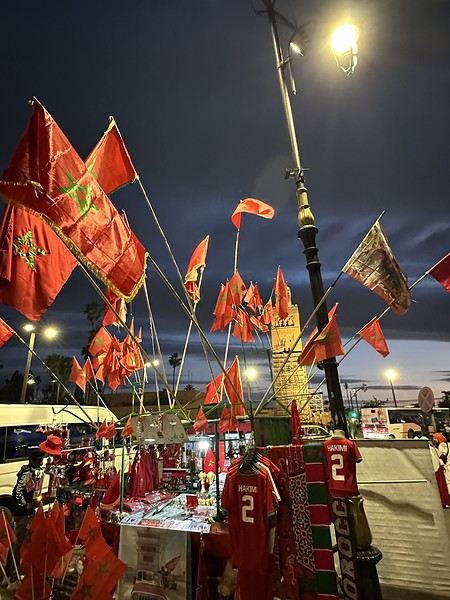 .
.
Day 1: Friday, May 2nd – The Day the Group Split
Before we dive in, let’s talk about the trip prep. Among my friends, I’ve got a rep as the go-to independent travel expert (thanks to a few trips, some with this same crew). So, naturally, the task of planning this one fell to me—and I took it on gladly (you’re never better served than by yourself, right?). The prep and itinerary were hashed out over multiple meet-ups (excuses?) during shared meals at one another’s places, guided by yours truly. Travel style, accommodation, sightseeing—all decisions were made together, trying to balance everyone’s wishes over a good bottle (generic term, not numerical!)
So, a group of five—including me and my girlfriend—set off for Geneva at 3 AM that Friday, while the rest would join us on Sunday due to family or work commitments. We’ll skip the EasyJet flight—it was nothing special, just a means to get us there safely (which, in itself, is already a win). We landed in Marrakech at 9 AM local time. There, a spotless Dacia Logan was waiting for us, chartered by MEDLOC, whose impeccable service I’ll praise here (thanks, friends, for the tip!). My first challenge, after loading the suitcases into the trunk: reaching the riad booked for our first two nights as the advance team. https://www.astradamusmarrakesh.top/fr/
I was a little nervous about driving here—Marrakech’s driving reputation precedes it. The hiccup? While setting up Google Maps for the route, I accidentally added a level-5 difficulty and enabled pedestrian mode... Imagine a rental car stubbornly trying for over half an hour to navigate the Medina (the riad was in the north), cursing all the pedestrians in streets too narrow for the car, and having to reverse multiple times because “it won’t fit,” ignoring the many Marrakechis waving to signal the street was impassable (but what are they trying to sell me now? 🤪)... Until my co-pilot, holding my phone, asked if it was “normal for the route to be dotted on Google Maps?” Yes, it’s normal—pedestrian mode was on.... We’ll still be laughing about this in the nursing home in 40 years, but at the time, I was genuinely surprised by what driving in Morocco had in store for me—and for good reason! After fixing the Google Maps settings, we arrived more calmly at the private parking lot (90 dirhams per night) and then at the riad, where we received a warm welcome while our rooms were being prepared.
After freshening up, we crossed the souks for the first time to have lunch at Jemaa el-Fna Square, at Zeitoun Café, where we enjoyed our first couscous or tagine on its terrace. We’d return to Jemaa el-Fna that evening after a restorative nap at the riad, another late afternoon in the souk, and an evening at this famous UNESCO World Heritage site. This time, it was the restaurant Lafarmacie (you can’t make this up!) that won us over, despite the lack of a rooftop. I recommend this place to everyone—the prices are great, the welcome is extraordinary, and the food is excellent...

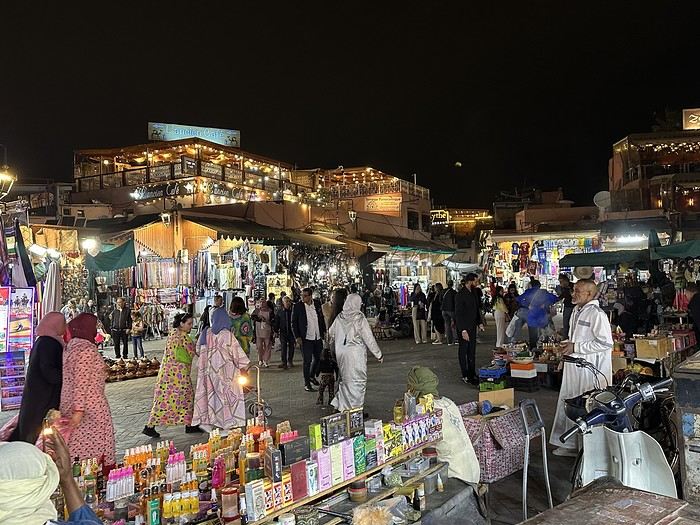
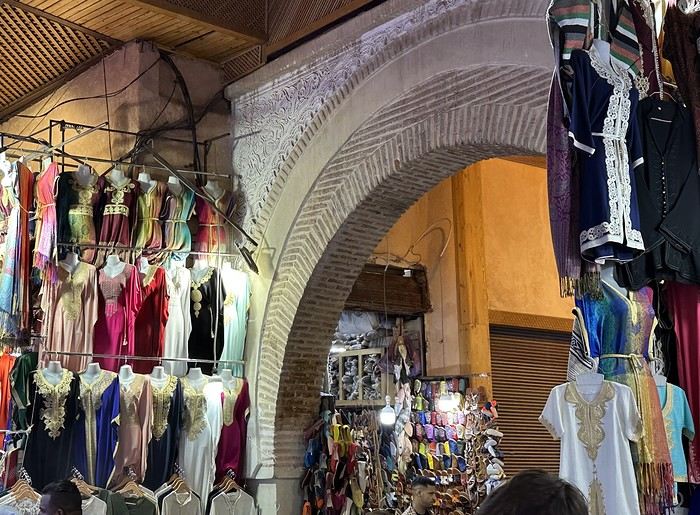
Returning after 11 PM, we learned the hard way that the souk has its own entry points and hours, and the path to our beds was full of detours and closed doors. Fortunately, we were guided by friendly locals who showed us the right way (in exchange for a fiercely negotiated tip each time...)
.Day 1: Friday, May 2nd – The Day the Group Split
Before we dive in, let’s talk about the trip prep. Among my friends, I’ve got a rep as the go-to independent travel expert (thanks to a few trips, some with this same crew). So, naturally, the task of planning this one fell to me—and I took it on gladly (you’re never better served than by yourself, right?). The prep and itinerary were hashed out over multiple meet-ups (excuses?) during shared meals at one another’s places, guided by yours truly. Travel style, accommodation, sightseeing—all decisions were made together, trying to balance everyone’s wishes over a good bottle (generic term, not numerical!)
So, a group of five—including me and my girlfriend—set off for Geneva at 3 AM that Friday, while the rest would join us on Sunday due to family or work commitments. We’ll skip the EasyJet flight—it was nothing special, just a means to get us there safely (which, in itself, is already a win). We landed in Marrakech at 9 AM local time. There, a spotless Dacia Logan was waiting for us, chartered by MEDLOC, whose impeccable service I’ll praise here (thanks, friends, for the tip!). My first challenge, after loading the suitcases into the trunk: reaching the riad booked for our first two nights as the advance team. https://www.astradamusmarrakesh.top/fr/
I was a little nervous about driving here—Marrakech’s driving reputation precedes it. The hiccup? While setting up Google Maps for the route, I accidentally added a level-5 difficulty and enabled pedestrian mode... Imagine a rental car stubbornly trying for over half an hour to navigate the Medina (the riad was in the north), cursing all the pedestrians in streets too narrow for the car, and having to reverse multiple times because “it won’t fit,” ignoring the many Marrakechis waving to signal the street was impassable (but what are they trying to sell me now? 🤪)... Until my co-pilot, holding my phone, asked if it was “normal for the route to be dotted on Google Maps?” Yes, it’s normal—pedestrian mode was on.... We’ll still be laughing about this in the nursing home in 40 years, but at the time, I was genuinely surprised by what driving in Morocco had in store for me—and for good reason! After fixing the Google Maps settings, we arrived more calmly at the private parking lot (90 dirhams per night) and then at the riad, where we received a warm welcome while our rooms were being prepared.
After freshening up, we crossed the souks for the first time to have lunch at Jemaa el-Fna Square, at Zeitoun Café, where we enjoyed our first couscous or tagine on its terrace. We’d return to Jemaa el-Fna that evening after a restorative nap at the riad, another late afternoon in the souk, and an evening at this famous UNESCO World Heritage site. This time, it was the restaurant Lafarmacie (you can’t make this up!) that won us over, despite the lack of a rooftop. I recommend this place to everyone—the prices are great, the welcome is extraordinary, and the food is excellent...
Returning after 11 PM, we learned the hard way that the souk has its own entry points and hours, and the path to our beds was full of detours and closed doors. Fortunately, we were guided by friendly locals who showed us the right way (in exchange for a fiercely negotiated tip each time...)
15 days in Texas in October 2022
Ah! This trip to Texas, postponed so many times because of Covid. I wanted to discover this state, but not in the summer due to the temperatures.
I’ll try to dig into my memories since I didn’t take any notes.
Day 1: Departure
Early morning flight from Lyon to Frankfurt (I often fly with Lufthansa). We only have a 50-minute layover, but I trust German organization—it’s not just talk, since it took us only 30 minutes to get to the boarding gate. Arriving in Houston, we’re excited because it’s been 3 years since we last visited the USA, and we’ve missed it.
Everything goes smoothly with the formalities and the car rental, so 1.5 hours after landing, I park near Sam Houston Park to start our discovery. The park is pretty, clean, and has the unique feature of housing some well-preserved Victorian houses. The sun is shining, and it’s always fun to see old wooden houses surrounded by gleaming skyscrapers. A quick drive to the Rothko Chapel, which is dedicated to all faiths. There are also modern artworks in an annex building and outside. Then we head to Pasadena to reach our hotel and go to bed since we’ve been awake for a while!
Hotel: A classic Days Inn. It’s standard, but the beds are comfortable, and it’s a quiet place. The + of the day: We're back in the USA The -: Nothing
Day 2: NASA and then Galveston
Of course, we wake up super early. A quick trip to the nearby Walmart for the usual small purchases. Surprise—I can’t buy a bottle of California white wine because in Texas, there are set hours for buying alcohol. Talk about a bummer for my apéro! Next, we head to Kemah, a small, hyper-touristy port where everything is kitschy but clean and nice. It’s a bit overdone, but since NASA doesn’t open until 10 AM and it’s still early, we might as well enjoy the good weather in a pleasant spot.
We arrive at the NASA Houston center without any issues. It’s smaller than the one in Florida and organized a bit differently. There are trains that take passengers to the different sites, but you need to get tickets (included in the price), and once you’ve finished visiting one site, you have to return to the center to get a ticket for another. Not very practical.
We choose to visit the training center and the rockets, skipping the control room, which, based on the photos, looks like the one at Cape Canaveral. The training center is a cool place because it’s still in use. Engineers are working on machines and computers. We don’t see any astronauts training, but we see the space chair, the shuttle’s robotic arm, and lots of gadgets—this hangar is like Gyro Gearloose’s or Doc’s domain!
Next, we head to the rocket hangar, featuring the Saturn V, the same one as at Cape Canaveral. Finally, we wrap up our tour by returning to the center, where a Boeing 747 with a shuttle attached to its back dominates the outside. We can visit the shuttle, and we don’t miss the chance.
A few exhibits inside complete the experience and satisfy our thirst for knowledge. I love the space exploration era, and gotta say, the Americans do it right. Then we drive to Galveston, about 100 km away. Why Galveston? It’s by the sea, so swimming in late October isn’t unpleasant, and there’s a neighborhood called East End Historic District filled with stunning Victorian houses, each more beautiful than the last. Plus, it’s Halloween season, so the decorations are over the top! They really go all out!
Madame takes a swim, but I find the water too cold for my taste. Apéro (they didn’t trick me twice—I had time to go back to another Walmart!) Dinner + bedtime
Hotel: A classic Quality Inn. No issues. The +: NASA, even if it’s smaller than Cape Canaveral The -: I would’ve preferred the water in the Gulf of Mexico to be a bit warmer
Day 1: Departure
Early morning flight from Lyon to Frankfurt (I often fly with Lufthansa). We only have a 50-minute layover, but I trust German organization—it’s not just talk, since it took us only 30 minutes to get to the boarding gate. Arriving in Houston, we’re excited because it’s been 3 years since we last visited the USA, and we’ve missed it.
Everything goes smoothly with the formalities and the car rental, so 1.5 hours after landing, I park near Sam Houston Park to start our discovery. The park is pretty, clean, and has the unique feature of housing some well-preserved Victorian houses. The sun is shining, and it’s always fun to see old wooden houses surrounded by gleaming skyscrapers. A quick drive to the Rothko Chapel, which is dedicated to all faiths. There are also modern artworks in an annex building and outside. Then we head to Pasadena to reach our hotel and go to bed since we’ve been awake for a while!
Hotel: A classic Days Inn. It’s standard, but the beds are comfortable, and it’s a quiet place. The + of the day: We're back in the USA The -: Nothing
Day 2: NASA and then Galveston
Of course, we wake up super early. A quick trip to the nearby Walmart for the usual small purchases. Surprise—I can’t buy a bottle of California white wine because in Texas, there are set hours for buying alcohol. Talk about a bummer for my apéro! Next, we head to Kemah, a small, hyper-touristy port where everything is kitschy but clean and nice. It’s a bit overdone, but since NASA doesn’t open until 10 AM and it’s still early, we might as well enjoy the good weather in a pleasant spot.
We arrive at the NASA Houston center without any issues. It’s smaller than the one in Florida and organized a bit differently. There are trains that take passengers to the different sites, but you need to get tickets (included in the price), and once you’ve finished visiting one site, you have to return to the center to get a ticket for another. Not very practical.
We choose to visit the training center and the rockets, skipping the control room, which, based on the photos, looks like the one at Cape Canaveral. The training center is a cool place because it’s still in use. Engineers are working on machines and computers. We don’t see any astronauts training, but we see the space chair, the shuttle’s robotic arm, and lots of gadgets—this hangar is like Gyro Gearloose’s or Doc’s domain!
Next, we head to the rocket hangar, featuring the Saturn V, the same one as at Cape Canaveral. Finally, we wrap up our tour by returning to the center, where a Boeing 747 with a shuttle attached to its back dominates the outside. We can visit the shuttle, and we don’t miss the chance.
A few exhibits inside complete the experience and satisfy our thirst for knowledge. I love the space exploration era, and gotta say, the Americans do it right. Then we drive to Galveston, about 100 km away. Why Galveston? It’s by the sea, so swimming in late October isn’t unpleasant, and there’s a neighborhood called East End Historic District filled with stunning Victorian houses, each more beautiful than the last. Plus, it’s Halloween season, so the decorations are over the top! They really go all out!
Madame takes a swim, but I find the water too cold for my taste. Apéro (they didn’t trick me twice—I had time to go back to another Walmart!) Dinner + bedtime
Hotel: A classic Quality Inn. No issues. The +: NASA, even if it’s smaller than Cape Canaveral The -: I would’ve preferred the water in the Gulf of Mexico to be a bit warmer
Road-Trip en solo dans l'Ouest américain en septembre 2019 English translation pending
Bonjour à tous, comme beaucoup d’entre vous, je me retrouve en repos forcé, ça va être très difficile.. J’ai beaucoup consulté ce forum, et beaucoup d’entre vous m’ont persuadé sans le savoir de voyager. Je vous en remercie. Comme j’ai du temps je me lance à mon tour dans la rédaction d’un carnet de voyage. Pour les photos, je ne suis pas un pro, il y en a de très belles sur de nombreux sites, je souhaitais juste quelques souvenirs et ne pas passer mon temps à mitrailler pour profiter. Avec le souhait que cela donne envie à d’autres de faire leurs valises.
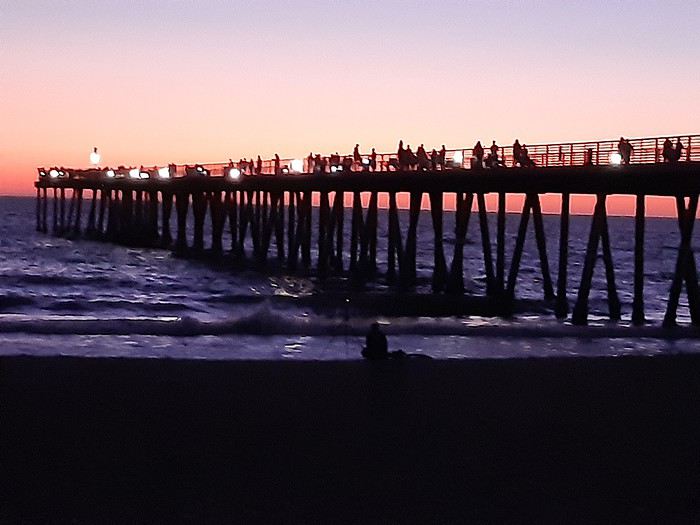
Je me présente : Laurent, 44 ans, j’habite La Rochelle où j’aiguille les trains. Je vis dehors en permanence : natation en mer, vélo, marche, cafés et pique-niques entre amis au bord de mer je ne suis pas fan de shopping, musées et parcs d’attractions. Je suis parti dans l’ouest américain en septembre 2019 : Californie, Arizona, Utah, Nevada. C’est un voyage qui me trottait dans la tête depuis un petit moment. J’ai hésité à partir seul j’avais tendu des perches qui n’ont pas été saisies. En fait cela ne m’inquiétait pas de partir seul et je pourrai aller à mon rythme selon mes envies. J’avais besoin de faire une pause. En février 2019 je suis sur Skyscanner sans savoir que 10mn plus tard ce serait parti pour un road-trip aux USA de 18 jours.
Je tombe sur un vol AR United Airlines Paris – San-Francisco à 415 euros, sans escale avec bagage. J’hésite (pas longtemps) et hop billet pris. En 48 h j’affine le parcours et là : Frustration (pas désagréable) ! Il devient évident que d’autres voyages seront nécessaires : il y a le budget (je pars seul donc ce sera cher), le temps, et surtout les concessions : il y a trop de choses à voir et à faire je le verrai pendant les six mois de préparation. Ce qui est magique en fait !!!
Jour 0 : 17 septembre La Rochelle – Paris Je me retrouve donc sur le quai de la gare de La Rochelle, deux amies m’ont accompagné, avec une valise pas trop lourde (16kgs) et un sac à dos. Je pars peu en vacances, je ne réalise pas, je flotte. Je n’ai aucune inquiétude. Je dormirai chez mes parents en banlieue ce soir. Tout se passe bien.
Jour 1 : 18 Septembre Une longue et belle journée Paris – San-Francisco
Départ pour Roissy à 5h00 avant les bouchons, tout s’enchaîne super bien, pas d’attente, pas de stress, je change la carte Sim de mon téléphone, embarquement, installation et décollage à l’heure 9h15. Je suis assis au hublot, 15mn après on survole Boulogne-sur-Mer, en 3mn c’est Folkestone. Le voyage a vraiment commencé. Les nuages s’effaceront au dessus du Groenland puis au bout de 11h, voilà enfin l’Océan Pacifique avec les forêts de l’Oregon. Puis c’est la descente vers l’aéroport. Dommage le temps est un peu nuageux. Il est 11h30, je débarque à San-Francisco en Californie en 15 mn je passe la douane, je récupère ma valise et je me retrouve sur le quai du BART (le RER de San Francisco). Nous sommes plusieurs français dubitatifs devant le distributeur de billets. Explication : sur le ticket, il n’y a pas de destination mais un prix. On regarde sur un tableau sa destination, et on sélectionne un ticket au prix correspondant, si on n’a pas payé assez on ne peut pas sortir.
 Je descends à la station « 16th Street Mission », je monte l’escalier et je me retrouve dans la série « Les Rues de San Francisco ». De vieux immeubles typiques, le drapeau américain, des sdf avec leurs cabats, une odeur de marijuana, des voitures de police. C’est sûr je suis aux USA mais tout est tranquille, il n’y aucune agressivité. Je trouve mon bus pour « Van Ness Avenue et Bay Street » le 49.
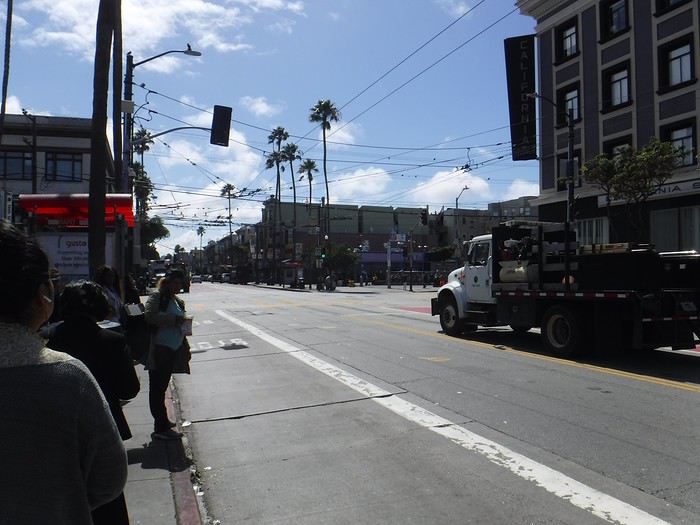
San-Francisco, ça monte et ça descend, à l’avant des bus il y a des supports où les gens peuvent installer leur vélo, je n’en reviens pas. Après 20mn, la baie de San-Francisco apparait. Je descends, j’ai 10mn de marche jusqu’à l’auberge de jeunesse « HI San Francisco Fisherman’s Warf Hostel » de Fort-Mason. Le soleil joue à cache-cache avec les nuages, il fait doux, ce n’est pas la même ambiance qu’à la sortie du BART. Sur la droite, il y a une plage avec des gradins, l’Ile d’Alcatraz est à sa place, je monte une côte dans une rue piétonne et arborée et je me retrouve face au Golden-Gate. C’est surréaliste
Je ne suis jamais allé en auberge de jeunesse. Un copain qui me connait bien m’avait mis en garde, « Ce n’est pas pour toi !». Je garde un souvenir amusé mais il avait raison, nous en reparlerons.
J’arrive donc à l’auberge de jeunesse, accueil super sympa, chambre sommaire mais propre, quatre lits qui semblent confortables. Il est à peine 13h30 j’ai le temps de profiter de l’après-midi. Je vais prendre une douche et là, premiers doutes. Une grande pièce avec trois WC fermés ni en haut, ni en bas, une rangée de lavabos et une douche au fond seulement fermée par un rideau… A cette heure pas de soucis, il n’y a personne.
Je prends des renseignements pour louer un vélo le lendemain et je pars découvrir Fisherman’s Warf. 4h de promenade, je ne vois pas le temps passer. Plusieurs jetées, la vue sur Alcatraz, les otaries qui se prélassent, Lombard Street avec ses lacets. Une petite déception, le cable-car est en maintenance depuis deux semaines et pour encore 3 jours et je serai parti. Vers 17h je commence sérieusement à avoir faim, pas très original mais pour le premier soir ce sera pizza face à la mer. La fatigue commence à se faire sentir mais le temps s’est dégagé et je vais pouvoir profiter d’un beau coucher de soleil sur le Golden-Gate et les anciens docks.
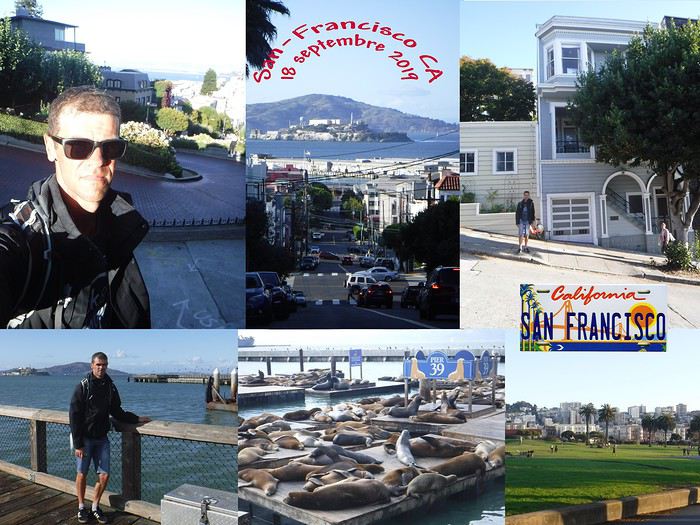
Je rejoins l’auberge de jeunesse, dans la chambre un italien, qui part randonner et faire du paddle au Lac Tahoe (une bonne idée) . Nous engageons la conversation. Je parle anglais comme une clef à molette mais j’arrive à bien comprendre. La fatigue arrive, ça fait 35h que je suis réveillé. Lavage de dents et joies de l’auberge, un gars est en train de caguer bruyamment. Pas très glop. Puis la nuit sera courte 2h se sommeil au maximum malgré les bouchons d’oreilles et le masque de nuit. Le décalage horaire, un ronfleur et un japonais qui se lèvera quinze fois. On m’avait prévenu…
Jour 2: 19 septembre Une journée en plein air à San-Francisco
Mon manque de sommeil n'entame pas ma bonne humeur ce matin, il fait un temps magnifique, je vais en profiter. Le petit déjeuner de l'auberge tarde et je décide de le prendre sur le Warf. Il sera très copieux au Boudin Bakery Cafe.
Puis je me rends chez Blazing Saddles Bikes où je loue un VTC , j'ai une réduction par l'intermédiaire de l'AJ (c'est déjà ça) et un retour en bac depuis l'autre côté de la baie. C'est donc parti pour une cinquantaine de kilomètres. Je suis habitué du vélo à La Rochelle et dans le Marais Poitevin où les dénivelés sont proches de "0 "mais à SF c'est un peu différent, ça compte double😉😉😉.
Je prends le chemin du Golden-Gate, sur des pistes cyclables le long du "Marina Blvd" il n'y a pas grand monde, il fait doux, beaucoup d'espace verts. J'arrive jusqu'au pied du pont, mais j'y passerai plus tard. je continue le long de la côte en direction d'"Ocean Beach" , une plage immense très sauvage aux portes de la ville. Il y a surtout des surfers. Ce n'est pas conseillé de se baigner car il y a beaucoup de rouleaux. Mais je ne résiste pas longtemps à tremper mes pieds dans l'Océan Pacifique!!! Après ce bon bol d'air je file dans le Golden Gate Park et je rejoins le Golden Gate par le Presidio. Par moment on se croit en Provence ou en Bretagne, on ne sent pas en ville, il y a plusieurs points de vue sur la baie et le large.
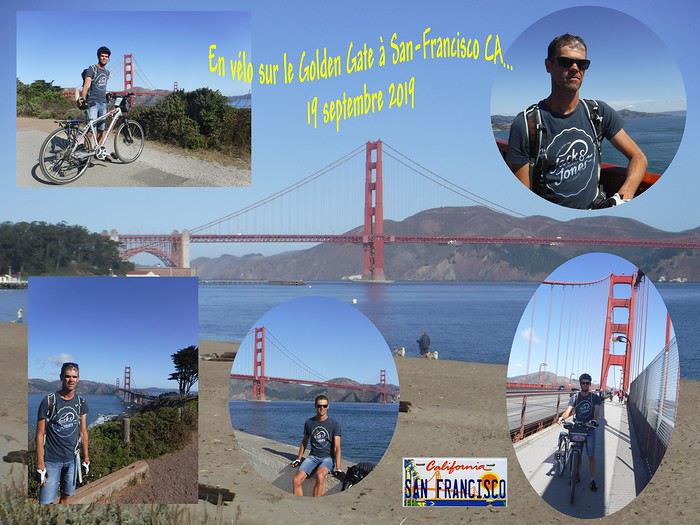 Il est temps de franchir le Golden Gate, cela prendra une dizaine de minutes, c'est très sympa malgré le vacarme des voitures. Ensuite je décide de rejoindre Sausalito et Tiburon pour faire la balade complète. Je m'attendais à un peu mieux car la piste n'est jamais très loin de l'autoroute et Sausalito n'est qu'une Marina avec des restaurants. En arrivant à l'embarcadère de Tiburon, il fait chaud, un Coca sera le bienvenue. La traversée est la récompense du trajet en vélo. Il y a peu de personnes au départ de Tiburon mais à Sausalito le bac se remplit. je peux contempler Angel's Island et Alcatraz.
 C'est très content de cette promenade que je rends le vélo. le matin j'avais discuté avec des triathlètes voyant quelques nageurs à la plage près de Fort-Mason, l'eau y est à 17°, on me dit quand même de venir avec le strict minimum pour éviter les vols. une grand-mère qui tricote sur les gradins me gardera mes affaires. Je nage 30mn, ça fait vraiment du bien. A 30m de la plage deux jeunes otaries s'amusent .
 Je terminerai la soirée en allant vers la "Coit Tower" déjà fermée puis en profitant d'un nouveau merveilleux coucher de soleil. Je passe au Safeway faire quelques courses pour le voyage de demain. Ce soir, j'ai changé de chambre, je la partage avec un australien, un italien et un américain. La salle de bain n'est pas la même, il y a plusieurs douches séparées par un simple rideau. Ce n'est vraiment pas pour moi. Mais à l'extinction des feux, miracle, pas un bruit...
Ce ne sera que de courte durée, deux personnes parlent dans le couloir. Et cela durera une bonne partie de la nuit. vers 3h je sors, il s'agit de deux jeunes (un gars une fille)de 20 ans qui discutent. En fait je ne leur dirait rien, cela me fait rire, de toute manière je me lève à 5h. La nuit est fichue...
Je terminerai la soirée en allant vers la "Coit Tower" déjà fermée puis en profitant d'un nouveau merveilleux coucher de soleil. Je passe au Safeway faire quelques courses pour le voyage de demain. Ce soir, j'ai changé de chambre, je la partage avec un australien, un italien et un américain. La salle de bain n'est pas la même, il y a plusieurs douches séparées par un simple rideau. Ce n'est vraiment pas pour moi. Mais à l'extinction des feux, miracle, pas un bruit...
Ce ne sera que de courte durée, deux personnes parlent dans le couloir. Et cela durera une bonne partie de la nuit. vers 3h je sors, il s'agit de deux jeunes (un gars une fille)de 20 ans qui discutent. En fait je ne leur dirait rien, cela me fait rire, de toute manière je me lève à 5h. La nuit est fichue...
Je me présente : Laurent, 44 ans, j’habite La Rochelle où j’aiguille les trains. Je vis dehors en permanence : natation en mer, vélo, marche, cafés et pique-niques entre amis au bord de mer je ne suis pas fan de shopping, musées et parcs d’attractions. Je suis parti dans l’ouest américain en septembre 2019 : Californie, Arizona, Utah, Nevada. C’est un voyage qui me trottait dans la tête depuis un petit moment. J’ai hésité à partir seul j’avais tendu des perches qui n’ont pas été saisies. En fait cela ne m’inquiétait pas de partir seul et je pourrai aller à mon rythme selon mes envies. J’avais besoin de faire une pause. En février 2019 je suis sur Skyscanner sans savoir que 10mn plus tard ce serait parti pour un road-trip aux USA de 18 jours.
Je tombe sur un vol AR United Airlines Paris – San-Francisco à 415 euros, sans escale avec bagage. J’hésite (pas longtemps) et hop billet pris. En 48 h j’affine le parcours et là : Frustration (pas désagréable) ! Il devient évident que d’autres voyages seront nécessaires : il y a le budget (je pars seul donc ce sera cher), le temps, et surtout les concessions : il y a trop de choses à voir et à faire je le verrai pendant les six mois de préparation. Ce qui est magique en fait !!!
Jour 0 : 17 septembre La Rochelle – Paris Je me retrouve donc sur le quai de la gare de La Rochelle, deux amies m’ont accompagné, avec une valise pas trop lourde (16kgs) et un sac à dos. Je pars peu en vacances, je ne réalise pas, je flotte. Je n’ai aucune inquiétude. Je dormirai chez mes parents en banlieue ce soir. Tout se passe bien.
Jour 1 : 18 Septembre Une longue et belle journée Paris – San-Francisco
Départ pour Roissy à 5h00 avant les bouchons, tout s’enchaîne super bien, pas d’attente, pas de stress, je change la carte Sim de mon téléphone, embarquement, installation et décollage à l’heure 9h15. Je suis assis au hublot, 15mn après on survole Boulogne-sur-Mer, en 3mn c’est Folkestone. Le voyage a vraiment commencé. Les nuages s’effaceront au dessus du Groenland puis au bout de 11h, voilà enfin l’Océan Pacifique avec les forêts de l’Oregon. Puis c’est la descente vers l’aéroport. Dommage le temps est un peu nuageux. Il est 11h30, je débarque à San-Francisco en Californie en 15 mn je passe la douane, je récupère ma valise et je me retrouve sur le quai du BART (le RER de San Francisco). Nous sommes plusieurs français dubitatifs devant le distributeur de billets. Explication : sur le ticket, il n’y a pas de destination mais un prix. On regarde sur un tableau sa destination, et on sélectionne un ticket au prix correspondant, si on n’a pas payé assez on ne peut pas sortir.
Je descends à la station « 16th Street Mission », je monte l’escalier et je me retrouve dans la série « Les Rues de San Francisco ». De vieux immeubles typiques, le drapeau américain, des sdf avec leurs cabats, une odeur de marijuana, des voitures de police. C’est sûr je suis aux USA mais tout est tranquille, il n’y aucune agressivité. Je trouve mon bus pour « Van Ness Avenue et Bay Street » le 49.San-Francisco, ça monte et ça descend, à l’avant des bus il y a des supports où les gens peuvent installer leur vélo, je n’en reviens pas. Après 20mn, la baie de San-Francisco apparait. Je descends, j’ai 10mn de marche jusqu’à l’auberge de jeunesse « HI San Francisco Fisherman’s Warf Hostel » de Fort-Mason. Le soleil joue à cache-cache avec les nuages, il fait doux, ce n’est pas la même ambiance qu’à la sortie du BART. Sur la droite, il y a une plage avec des gradins, l’Ile d’Alcatraz est à sa place, je monte une côte dans une rue piétonne et arborée et je me retrouve face au Golden-Gate. C’est surréaliste
Je ne suis jamais allé en auberge de jeunesse. Un copain qui me connait bien m’avait mis en garde, « Ce n’est pas pour toi !». Je garde un souvenir amusé mais il avait raison, nous en reparlerons.
J’arrive donc à l’auberge de jeunesse, accueil super sympa, chambre sommaire mais propre, quatre lits qui semblent confortables. Il est à peine 13h30 j’ai le temps de profiter de l’après-midi. Je vais prendre une douche et là, premiers doutes. Une grande pièce avec trois WC fermés ni en haut, ni en bas, une rangée de lavabos et une douche au fond seulement fermée par un rideau… A cette heure pas de soucis, il n’y a personne.
Je prends des renseignements pour louer un vélo le lendemain et je pars découvrir Fisherman’s Warf. 4h de promenade, je ne vois pas le temps passer. Plusieurs jetées, la vue sur Alcatraz, les otaries qui se prélassent, Lombard Street avec ses lacets. Une petite déception, le cable-car est en maintenance depuis deux semaines et pour encore 3 jours et je serai parti. Vers 17h je commence sérieusement à avoir faim, pas très original mais pour le premier soir ce sera pizza face à la mer. La fatigue commence à se faire sentir mais le temps s’est dégagé et je vais pouvoir profiter d’un beau coucher de soleil sur le Golden-Gate et les anciens docks.
Je rejoins l’auberge de jeunesse, dans la chambre un italien, qui part randonner et faire du paddle au Lac Tahoe (une bonne idée) . Nous engageons la conversation. Je parle anglais comme une clef à molette mais j’arrive à bien comprendre. La fatigue arrive, ça fait 35h que je suis réveillé. Lavage de dents et joies de l’auberge, un gars est en train de caguer bruyamment. Pas très glop. Puis la nuit sera courte 2h se sommeil au maximum malgré les bouchons d’oreilles et le masque de nuit. Le décalage horaire, un ronfleur et un japonais qui se lèvera quinze fois. On m’avait prévenu…
Jour 2: 19 septembre Une journée en plein air à San-Francisco
Mon manque de sommeil n'entame pas ma bonne humeur ce matin, il fait un temps magnifique, je vais en profiter. Le petit déjeuner de l'auberge tarde et je décide de le prendre sur le Warf. Il sera très copieux au Boudin Bakery Cafe.
Puis je me rends chez Blazing Saddles Bikes où je loue un VTC , j'ai une réduction par l'intermédiaire de l'AJ (c'est déjà ça) et un retour en bac depuis l'autre côté de la baie. C'est donc parti pour une cinquantaine de kilomètres. Je suis habitué du vélo à La Rochelle et dans le Marais Poitevin où les dénivelés sont proches de "0 "mais à SF c'est un peu différent, ça compte double😉😉😉.
Je prends le chemin du Golden-Gate, sur des pistes cyclables le long du "Marina Blvd" il n'y a pas grand monde, il fait doux, beaucoup d'espace verts. J'arrive jusqu'au pied du pont, mais j'y passerai plus tard. je continue le long de la côte en direction d'"Ocean Beach" , une plage immense très sauvage aux portes de la ville. Il y a surtout des surfers. Ce n'est pas conseillé de se baigner car il y a beaucoup de rouleaux. Mais je ne résiste pas longtemps à tremper mes pieds dans l'Océan Pacifique!!!
Après ce bon bol d'air je file dans le Golden Gate Park et je rejoins le Golden Gate par le Presidio. Par moment on se croit en Provence ou en Bretagne, on ne sent pas en ville, il y a plusieurs points de vue sur la baie et le large.
Il est temps de franchir le Golden Gate, cela prendra une dizaine de minutes, c'est très sympa malgré le vacarme des voitures. Ensuite je décide de rejoindre Sausalito et Tiburon pour faire la balade complète. Je m'attendais à un peu mieux car la piste n'est jamais très loin de l'autoroute et Sausalito n'est qu'une Marina avec des restaurants. En arrivant à l'embarcadère de Tiburon, il fait chaud, un Coca sera le bienvenue. La traversée est la récompense du trajet en vélo. Il y a peu de personnes au départ de Tiburon mais à Sausalito le bac se remplit. je peux contempler Angel's Island et Alcatraz.
C'est très content de cette promenade que je rends le vélo. le matin j'avais discuté avec des triathlètes voyant quelques nageurs à la plage près de Fort-Mason, l'eau y est à 17°, on me dit quand même de venir avec le strict minimum pour éviter les vols. une grand-mère qui tricote sur les gradins me gardera mes affaires. Je nage 30mn, ça fait vraiment du bien. A 30m de la plage deux jeunes otaries s'amusent .
Je terminerai la soirée en allant vers la "Coit Tower" déjà fermée puis en profitant d'un nouveau merveilleux coucher de soleil. Je passe au Safeway faire quelques courses pour le voyage de demain. Ce soir, j'ai changé de chambre, je la partage avec un australien, un italien et un américain. La salle de bain n'est pas la même, il y a plusieurs douches séparées par un simple rideau. Ce n'est vraiment pas pour moi. Mais à l'extinction des feux, miracle, pas un bruit...
Ce ne sera que de courte durée, deux personnes parlent dans le couloir. Et cela durera une bonne partie de la nuit. vers 3h je sors, il s'agit de deux jeunes (un gars une fille)de 20 ans qui discutent. En fait je ne leur dirait rien, cela me fait rire, de toute manière je me lève à 5h. La nuit est fichue...On part en vadrouille dans l'ouest américain! Oui, encore... English translation pending
En ces temps difficiles qui nous obligent à trouver des occupations, je vous soumets ici un carnet que j'avais rédigé il y a quelques années et que je n'ai jamais publié ici... Bonne lecture (pour ceux que ça intéresse...)...
24 juillet - Itinéraire d’une famille gâtée
Envie de t’évader ? Envie de rêver ? Envie de t’amuser ? Oui ? Alors tu as frappé à la bonne adresse... Plus précisément à l’adresse de celui qui a attrapé un virus… En l’occurrence, moi… Et ce virus, pas question de m’en débarrasser en me bourrant d’antibiotiques. Non seulement, les antibiotiques, ce n’est pas automatique, mais ce virus-là, j’en prends grand soin. Je l’entretiens, même… Ce virus, c’est l’étasunite ! Je l’ai contracté le jour où j’ai posé mes arpions chez l’oncle Sam pour la première fois, il y a une décennie de cela. Tout ça ne me rajeunit pas mais depuis ce fameux jour, lui et moi, nous ne nous sommes plus jamais quittés. Un proverbe dit à ce sujet que si tu vas aux Etats-Unis une fois, tu y reviendras un jour… Ben moi, depuis, j’y suis même retourné deux autres fois ! Et figure-toi que si tu lis ces quelques lignes, c’est que je m’apprête à y retourner pour une quatrième vadrouille !... Pour cette fois-ci, je vais accomplir un de mes rêves ! Me faire la route 66 sur mon Harley avec une belle brune accrochée à ma taille... Manque de bol, ma femme est blonde, je n'ai pas le permis moto et nous avons deux louloutes de quatre et sept ans… Va donc falloir que je revoie mes plans...
Bon, si tu es un lecteur assidu de nos précédentes vadrouilles, nous n’avons plus de secret pour toi, si bien que tu sais déjà que nous sommes quatre, juste un an de plus par rapport à la dernière fois… Il y a bien évidemment Sandrine, ma femme alias le portefeuille ; Sasha, notre petite globetrotteuse de quatre ans ; et Anna notre routarde de sept ans et plus toutes ses dents... Ah, et je m’oubliais ! Moi, Franck, la trentaine bien tassée, alias le conducteur, le tour opérateur, le narrateur, le cuisinier, le… Oui, je sais, moi aussi, j’aimerais bien déléguer… Ah, mais j’oublie encore quelqu’un !… Toi… Mais bon, sauf le respect que je te dois, tu ne seras une nouvelle fois que le spectateur du film que nous allons tourner et interpréter… D’ailleurs, quel en sera le titre ?... Et bien après réflexion, on a le choix entre « Voyage entre geysers et déserts », ou alors « Sous le soleil de Beverly Hills »… Pour ce coup-là, en espérant ne pas les vexer, on décide de poser un lapin à Brandon et Brenda… Car oui, c’est décidé, cette nouvelle édition sera composée d'indiens, de geysers, de trappeurs, de pionniers, de bisons, de chercheurs d'or, de hors-la-loi, de ranchs et de cowboys ! A nous les grands espaces… et les gros hamburgers !!! A nous l’ouest américain et ses films qui donnent tant envie : Délivrance, la colline a des yeux, Shining, The Descent, ...
Mais un voyage comme celui-là, ça se prépare un ‘tiot peu. Premièrement, il faut du blé, du flouze, du fric, du pognon, des pépettes, de la caillasse… Ben oui, ça coûte cher tout ça, donc à moins de faire comme le PSG et te faire subventionner par un investisseur qatari, il va falloir que tu en mettes de côté. Deuxièmement, il faut un minimum de travail de préparation. Et je commencerai mon histoire par un retour dans le passé, un bond dans le temps pour revenir pile poil au moment où Sandrine a enfin craqué sous mes coups de butoir et m’a donné son ô combien précieuse approbation… « Allez, ok, c’est bon, fais-toi plaisir ! » Sans avoir réellement conscience de la portée de ces quelques mots, elle venait de me signer un contrat de travail d’un an ! Car moi, ni une, ni deux, j'ai employé toute une équipe de lutins pour m'aider à préparer mon itinéraire. Lecture de carnets de voyage, questions sur des forums, épluchage de guides, visionnage de films, essorage d’internet, … Au final, je dois dire que je suis plus que satisfait de leur boulot ! Ce qui me permet non pas de faire un bilan puisqu'heureusement, le voyage n'est pas commencé, mais plutôt un petit compte-rendu chiffré de ce qui nous attend. Huit états à traverser ou à effleurer, plus de cinq mille kilomètres à parcourir, vingt jours pleins sur place, deux hôtels, quatorze campings différents, huit heures de décalage... Mes trois blondes vont-elles le supporter ? Optimiste que je suis, je mise sur un grand « Oui » ! D’ailleurs, pour les préparer, j’ai mis en place un programme intensif trois mois avant le départ : Marche autour de notre immense propriété, westerns tous les soirs, Coca et hamburgers à volonté à tous les repas !... Et oui, qui ménage sa monture voyage plus souvent !
Avant de tailler la route, je profite de cette intro pour publier une petite annonce à destination des cambrioleurs amateurs de textes de voyage : passez votre route, ma maison est équipée d’une alarme biométrique avec double varifocale et matrice de commutation. De plus, j’ai loué à un pote du neuf trois son gros pitbull pour l’occasion. Sans compter que pendant nos vacances, ma maison va être occupée par mes parents qui sont tous les deux experts en arts martiaux !... D’ailleurs, pourquoi je te raconte ces bobards alors que tu ne connais même pas mon adresse… C'est le 25, avenue des canaris à Triffouillis-sur-Retourne... Euh, merci de ne pas m’envoyer de carte postale à l'adresse ci-dessus... c'est une fausse !
Bon, chut, ça y est, c’est l’heure de l’évaluation… On va savoir si toute la famille est prête pour le grand départ : « Sandrine, donne-moi les huit états dans lesquels nous allons poser les pieds... - Colorado, Wyoming, Nebraska, Dakota du sud, Montana, Idaho, Utah et... euh... mince, oh, je l’ai sur le bout de la langue… Ah oui, l’Arizona !!!… - Mouais… C’était moins une… Encore un peu et tu n’partais pas avec nous ! Et toi, Anna, cite-moi les quatre présidents sculptés sur le Mont Rushmore ? - Abram Licol, Tomasse Washington, George Jeffessonne et Theodore Rousevelle... - Ok, on va dire que c’est bon… Et toi, Sasha, dans quel pays allons-nous cet été ? - Les Jétajuniiiiis de l’Amérique de Mickey ! » Ok, c’est bon, elles sont fin prêtes ! Attention, départ imminent !
24 juillet - Itinéraire d’une famille gâtée
Envie de t’évader ? Envie de rêver ? Envie de t’amuser ? Oui ? Alors tu as frappé à la bonne adresse... Plus précisément à l’adresse de celui qui a attrapé un virus… En l’occurrence, moi… Et ce virus, pas question de m’en débarrasser en me bourrant d’antibiotiques. Non seulement, les antibiotiques, ce n’est pas automatique, mais ce virus-là, j’en prends grand soin. Je l’entretiens, même… Ce virus, c’est l’étasunite ! Je l’ai contracté le jour où j’ai posé mes arpions chez l’oncle Sam pour la première fois, il y a une décennie de cela. Tout ça ne me rajeunit pas mais depuis ce fameux jour, lui et moi, nous ne nous sommes plus jamais quittés. Un proverbe dit à ce sujet que si tu vas aux Etats-Unis une fois, tu y reviendras un jour… Ben moi, depuis, j’y suis même retourné deux autres fois ! Et figure-toi que si tu lis ces quelques lignes, c’est que je m’apprête à y retourner pour une quatrième vadrouille !... Pour cette fois-ci, je vais accomplir un de mes rêves ! Me faire la route 66 sur mon Harley avec une belle brune accrochée à ma taille... Manque de bol, ma femme est blonde, je n'ai pas le permis moto et nous avons deux louloutes de quatre et sept ans… Va donc falloir que je revoie mes plans...
Bon, si tu es un lecteur assidu de nos précédentes vadrouilles, nous n’avons plus de secret pour toi, si bien que tu sais déjà que nous sommes quatre, juste un an de plus par rapport à la dernière fois… Il y a bien évidemment Sandrine, ma femme alias le portefeuille ; Sasha, notre petite globetrotteuse de quatre ans ; et Anna notre routarde de sept ans et plus toutes ses dents... Ah, et je m’oubliais ! Moi, Franck, la trentaine bien tassée, alias le conducteur, le tour opérateur, le narrateur, le cuisinier, le… Oui, je sais, moi aussi, j’aimerais bien déléguer… Ah, mais j’oublie encore quelqu’un !… Toi… Mais bon, sauf le respect que je te dois, tu ne seras une nouvelle fois que le spectateur du film que nous allons tourner et interpréter… D’ailleurs, quel en sera le titre ?... Et bien après réflexion, on a le choix entre « Voyage entre geysers et déserts », ou alors « Sous le soleil de Beverly Hills »… Pour ce coup-là, en espérant ne pas les vexer, on décide de poser un lapin à Brandon et Brenda… Car oui, c’est décidé, cette nouvelle édition sera composée d'indiens, de geysers, de trappeurs, de pionniers, de bisons, de chercheurs d'or, de hors-la-loi, de ranchs et de cowboys ! A nous les grands espaces… et les gros hamburgers !!! A nous l’ouest américain et ses films qui donnent tant envie : Délivrance, la colline a des yeux, Shining, The Descent, ...
Mais un voyage comme celui-là, ça se prépare un ‘tiot peu. Premièrement, il faut du blé, du flouze, du fric, du pognon, des pépettes, de la caillasse… Ben oui, ça coûte cher tout ça, donc à moins de faire comme le PSG et te faire subventionner par un investisseur qatari, il va falloir que tu en mettes de côté. Deuxièmement, il faut un minimum de travail de préparation. Et je commencerai mon histoire par un retour dans le passé, un bond dans le temps pour revenir pile poil au moment où Sandrine a enfin craqué sous mes coups de butoir et m’a donné son ô combien précieuse approbation… « Allez, ok, c’est bon, fais-toi plaisir ! » Sans avoir réellement conscience de la portée de ces quelques mots, elle venait de me signer un contrat de travail d’un an ! Car moi, ni une, ni deux, j'ai employé toute une équipe de lutins pour m'aider à préparer mon itinéraire. Lecture de carnets de voyage, questions sur des forums, épluchage de guides, visionnage de films, essorage d’internet, … Au final, je dois dire que je suis plus que satisfait de leur boulot ! Ce qui me permet non pas de faire un bilan puisqu'heureusement, le voyage n'est pas commencé, mais plutôt un petit compte-rendu chiffré de ce qui nous attend. Huit états à traverser ou à effleurer, plus de cinq mille kilomètres à parcourir, vingt jours pleins sur place, deux hôtels, quatorze campings différents, huit heures de décalage... Mes trois blondes vont-elles le supporter ? Optimiste que je suis, je mise sur un grand « Oui » ! D’ailleurs, pour les préparer, j’ai mis en place un programme intensif trois mois avant le départ : Marche autour de notre immense propriété, westerns tous les soirs, Coca et hamburgers à volonté à tous les repas !... Et oui, qui ménage sa monture voyage plus souvent !
Avant de tailler la route, je profite de cette intro pour publier une petite annonce à destination des cambrioleurs amateurs de textes de voyage : passez votre route, ma maison est équipée d’une alarme biométrique avec double varifocale et matrice de commutation. De plus, j’ai loué à un pote du neuf trois son gros pitbull pour l’occasion. Sans compter que pendant nos vacances, ma maison va être occupée par mes parents qui sont tous les deux experts en arts martiaux !... D’ailleurs, pourquoi je te raconte ces bobards alors que tu ne connais même pas mon adresse… C'est le 25, avenue des canaris à Triffouillis-sur-Retourne... Euh, merci de ne pas m’envoyer de carte postale à l'adresse ci-dessus... c'est une fausse !
Bon, chut, ça y est, c’est l’heure de l’évaluation… On va savoir si toute la famille est prête pour le grand départ : « Sandrine, donne-moi les huit états dans lesquels nous allons poser les pieds... - Colorado, Wyoming, Nebraska, Dakota du sud, Montana, Idaho, Utah et... euh... mince, oh, je l’ai sur le bout de la langue… Ah oui, l’Arizona !!!… - Mouais… C’était moins une… Encore un peu et tu n’partais pas avec nous ! Et toi, Anna, cite-moi les quatre présidents sculptés sur le Mont Rushmore ? - Abram Licol, Tomasse Washington, George Jeffessonne et Theodore Rousevelle... - Ok, on va dire que c’est bon… Et toi, Sasha, dans quel pays allons-nous cet été ? - Les Jétajuniiiiis de l’Amérique de Mickey ! » Ok, c’est bon, elles sont fin prêtes ! Attention, départ imminent !
L'importance des voyages pour vous English translation pending
Bonjour
Nous sommes bien sûr tous des voyageurs et c'est ce qui nous rassemble ici.
Mais nous avons tous une vision différente du voyage et n'y accordons pas la même importance.
Quelle place accordez vous au voyage dans votre vie ?
Est ce un loisir comme un autre ? Une passion ? Un vrai besoin ? Pouvez vous vous en passer facilement ?
Nous sommes bien sûr tous des voyageurs et c'est ce qui nous rassemble ici.
Mais nous avons tous une vision différente du voyage et n'y accordons pas la même importance.
Quelle place accordez vous au voyage dans votre vie ?
Est ce un loisir comme un autre ? Une passion ? Un vrai besoin ? Pouvez vous vous en passer facilement ?
Alaska 2018, The Last Frontier! English translation pending
De retour sur VF après plusieurs mois d'errance entre un road-trip en Afrique du Sud, un contrat en Guadeloupe, un voyage en Tanzanie et un déménagement surprise en Guyane... Je commence, enfin et parallèlement à la préparation de notre prochain voyage en Patagonie, le récit de notre voyage de 3 semaines en Alaska réalisé en Juillet 2018. 🙂
C'est un voyage que nous avons organisé 6 mois en avance.
Après deux longs voyages en Afrique australe nous aurions adoré remettre ça, mais cette année je ne pouvais pas partir plus de 3 semaines et nous nous sommes laissés dire que ce serait bien aussi de voir autre chose et de visiter de nouveaux continents. Qu'a cela ne tienne !
Passionnés de faune sauvage et de grands espaces nous n'avons pas mit longtemps à nous décider et c'est tout naturellement vers le 49ème état des Etats Unis que nous nous sommes tournés. L'Alaska ! L'Alaska et sa faune exceptionnelle qui font rêver bien des amoureux de nature.
Nous avons rapidement prit nos billets d'avions pour Anchorage et en avons profiter pour organiser une escale de 2 jours en Islande afin de visiter la péninsule de Reykjanes que nous n'avions pas pu explorer l'année passée pour cause de tempête de neige.
Nous avons décidé de partir en Juillet plutot qu'en Aout car c'est la période qui semblait la plus sèche (tout est relatif) et la plus propice à l'observation des célèbres grizzlys.
En entamant la préparation de notre voyage, nous nous sommes vite rendu compte qu'organiser un road-trip en Alaska serait très différent de ce que nous connaissions.
Tout d'abord l'Alaska est une destination réputée pour être peu abordable, les locations de voitures via les agences internationales habituelles sont très chères, il y a peu de solution d’hébergement donc il faut réserver longtemps en avance et le rapport qualité prix varie entre mauvais et moyen.
En somme, la façon la plus simple d'y voyager est de louer un camping-car, ce qui n'est pas donné non plus.
En 2017 nous nous étions vraiment beaucoup investis dans l'organisation de notre road-trip de 2 mois en Afrique australe que nous avions commencé à préparer presque 1 an en avance. Cette année nous ne voulions pas nous prendre la tête, nous louerons donc un gros SUV et dormirons dedans pendant 3 semaines comme nous l'avions fait lors de notre tour d'Islande.
C'est une option qui peut paraitre peu confortable mais nous aimons beaucoup la liberté qu'elle offre et cela permet de faire de grosses économies sur l'hébergement pour pouvoir faire plus d'activités ou simplement partir plus longtemps...
Nous nous sommes dépechés de louer un Hyundai Sante Fe (or similar) à Alamo via Happytour et de réserver une journée de bear watching (activité phare et très chère qui s'organise des mois en avance).
Puis, pour des raisons d'hygiènes et de repos obligatoire, nous nous sommes également offert 4 nuits en dur et nous avons acheté quelques guide de voyage, dont The Millepost pour attendre patiemment (ou pas) le jour du départ. 🙂
Au final le seul impératif de notre road-trip était d’être à Homer le 14 Juillet pour le bear watching à Katmai NP et c'est autour de cette date que nous avons élaboré notre programme.
J1 (03/07/18) : Islande, Blue Lagoon
J2 (04/07/18) : Islande, Péninsule de Reykjanes, Reykjavic -> Anchorage
J3 (05/07/18) : Anchorage -> Denali NP
J4 (06/07/18) : Denali NP
J5 (07/07/18) : Denali NP
J6 (08/08/18) : Denali NP
J7 (09/07/18) : Denali NP -> Talkeetna
J8 (10/07/18) : Talkeetna -> Anchorage
J9 (11/07/18) : Anchorage -> Girdwood
J10 (12/07/18) : Girdwood -> Russian River
J11 (13/0718) : Russian River -> Homer
J12 (14/07/18) : Brooks Falls - Katmai NP
J13 (15/07/18) : Homer - Kachemak Bay
J14 (16/07/18) : Homer -> Seward
J15 (17/07/18) : Seward
J16 (18/07/18) : Seward -> Whittiez
J17 (19/07/18) : Whittier -> Valdez
J18 (20/07/18) : Valdez
J19 (21/07/18) : Valdez -> Kenicott
J20 (22/07/18) : Kenicott
J21 (23/07/18) : Kenicott -> Anchorage
J22 (24/07/18) : Départ à 8h pour moi destination Pointe à Pitre et à 16h pour Alison destination Paris.
N'ayant que 19 jours sur place, nous avons fait le choix de nous concentrer sur l'Alaska "continentale" en particulier la très belle péninsule de Kenai et le Denali NP qui était une des principales raisons de notre voyage. 🙂 Le Yukon, et l'Alaska maritime seront donc les destinations de prochains voyages, si la vie le permet !
Le cout total de ce voyage a été d'environ 9000€ à deux et je détaillerai nos différentes dépenses à la fin de ce carnet.
Après ce petit texte d'introduction dont tout le monde se fout, place au récit et aux photos !! 😎
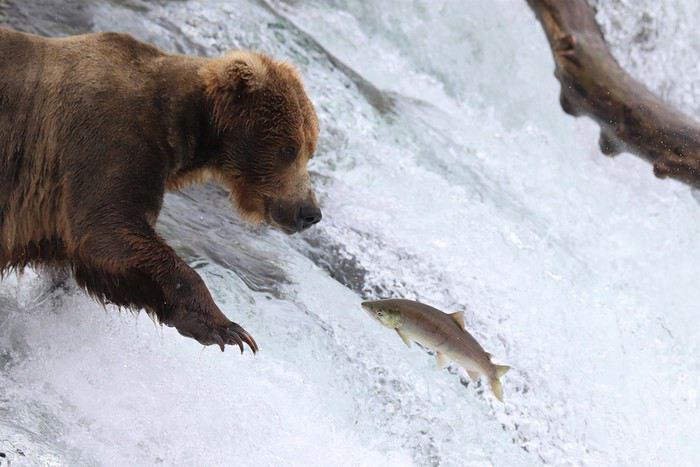
C'est un voyage que nous avons organisé 6 mois en avance.
Après deux longs voyages en Afrique australe nous aurions adoré remettre ça, mais cette année je ne pouvais pas partir plus de 3 semaines et nous nous sommes laissés dire que ce serait bien aussi de voir autre chose et de visiter de nouveaux continents. Qu'a cela ne tienne !
Passionnés de faune sauvage et de grands espaces nous n'avons pas mit longtemps à nous décider et c'est tout naturellement vers le 49ème état des Etats Unis que nous nous sommes tournés. L'Alaska ! L'Alaska et sa faune exceptionnelle qui font rêver bien des amoureux de nature.
Nous avons rapidement prit nos billets d'avions pour Anchorage et en avons profiter pour organiser une escale de 2 jours en Islande afin de visiter la péninsule de Reykjanes que nous n'avions pas pu explorer l'année passée pour cause de tempête de neige.
Nous avons décidé de partir en Juillet plutot qu'en Aout car c'est la période qui semblait la plus sèche (tout est relatif) et la plus propice à l'observation des célèbres grizzlys.
En entamant la préparation de notre voyage, nous nous sommes vite rendu compte qu'organiser un road-trip en Alaska serait très différent de ce que nous connaissions.
Tout d'abord l'Alaska est une destination réputée pour être peu abordable, les locations de voitures via les agences internationales habituelles sont très chères, il y a peu de solution d’hébergement donc il faut réserver longtemps en avance et le rapport qualité prix varie entre mauvais et moyen.
En somme, la façon la plus simple d'y voyager est de louer un camping-car, ce qui n'est pas donné non plus.
En 2017 nous nous étions vraiment beaucoup investis dans l'organisation de notre road-trip de 2 mois en Afrique australe que nous avions commencé à préparer presque 1 an en avance. Cette année nous ne voulions pas nous prendre la tête, nous louerons donc un gros SUV et dormirons dedans pendant 3 semaines comme nous l'avions fait lors de notre tour d'Islande.
C'est une option qui peut paraitre peu confortable mais nous aimons beaucoup la liberté qu'elle offre et cela permet de faire de grosses économies sur l'hébergement pour pouvoir faire plus d'activités ou simplement partir plus longtemps...
Nous nous sommes dépechés de louer un Hyundai Sante Fe (or similar) à Alamo via Happytour et de réserver une journée de bear watching (activité phare et très chère qui s'organise des mois en avance).
Puis, pour des raisons d'hygiènes et de repos obligatoire, nous nous sommes également offert 4 nuits en dur et nous avons acheté quelques guide de voyage, dont The Millepost pour attendre patiemment (ou pas) le jour du départ. 🙂
Au final le seul impératif de notre road-trip était d’être à Homer le 14 Juillet pour le bear watching à Katmai NP et c'est autour de cette date que nous avons élaboré notre programme.
J1 (03/07/18) : Islande, Blue Lagoon
J2 (04/07/18) : Islande, Péninsule de Reykjanes, Reykjavic -> Anchorage
J3 (05/07/18) : Anchorage -> Denali NP
J4 (06/07/18) : Denali NP
J5 (07/07/18) : Denali NP
J6 (08/08/18) : Denali NP
J7 (09/07/18) : Denali NP -> Talkeetna
J8 (10/07/18) : Talkeetna -> Anchorage
J9 (11/07/18) : Anchorage -> Girdwood
J10 (12/07/18) : Girdwood -> Russian River
J11 (13/0718) : Russian River -> Homer
J12 (14/07/18) : Brooks Falls - Katmai NP
J13 (15/07/18) : Homer - Kachemak Bay
J14 (16/07/18) : Homer -> Seward
J15 (17/07/18) : Seward
J16 (18/07/18) : Seward -> Whittiez
J17 (19/07/18) : Whittier -> Valdez
J18 (20/07/18) : Valdez
J19 (21/07/18) : Valdez -> Kenicott
J20 (22/07/18) : Kenicott
J21 (23/07/18) : Kenicott -> Anchorage
J22 (24/07/18) : Départ à 8h pour moi destination Pointe à Pitre et à 16h pour Alison destination Paris.
N'ayant que 19 jours sur place, nous avons fait le choix de nous concentrer sur l'Alaska "continentale" en particulier la très belle péninsule de Kenai et le Denali NP qui était une des principales raisons de notre voyage. 🙂 Le Yukon, et l'Alaska maritime seront donc les destinations de prochains voyages, si la vie le permet !
Le cout total de ce voyage a été d'environ 9000€ à deux et je détaillerai nos différentes dépenses à la fin de ce carnet.
Après ce petit texte d'introduction dont tout le monde se fout, place au récit et aux photos !! 😎
Sortir avec ses bagages soutes lors d'une escale aux États-Unis English translation pending
Bonjour à tous et à toutes,
J'ai pris un vol A/R : Bogotá - Paris avec pour les deux trajets : deux escales aux États Unis.
J'ai déjà consomme le billet Aller.
Pour le retour, au lieu d'aller jusqu'à Bogotá je souhaite m'arrêter à Chicago pour aller voir ma copine.
C'est à dire prendre mes bagages en soute, sortir de l'aéroport et ne pas prendre la correspondance pour Bogotá.
Je possède bien l'esta.
Je souhaite avoir la confirmation que je puisse sortir de l'aéroport 'sans soucis' (avec l'esta) et surtout avec mes bagages en soute.
Si qlqn l'a déjà fait ? Merci
Ps la compagnie est américain Airlines et c'est un trajet paris- Chicago- Miami - Bogotá. Full américain airlines
J'ai pris un vol A/R : Bogotá - Paris avec pour les deux trajets : deux escales aux États Unis.
J'ai déjà consomme le billet Aller.
Pour le retour, au lieu d'aller jusqu'à Bogotá je souhaite m'arrêter à Chicago pour aller voir ma copine.
C'est à dire prendre mes bagages en soute, sortir de l'aéroport et ne pas prendre la correspondance pour Bogotá.
Je possède bien l'esta.
Je souhaite avoir la confirmation que je puisse sortir de l'aéroport 'sans soucis' (avec l'esta) et surtout avec mes bagages en soute.
Si qlqn l'a déjà fait ? Merci
Ps la compagnie est américain Airlines et c'est un trajet paris- Chicago- Miami - Bogotá. Full américain airlines
Conseils pour choisir la localisation d'un hôtel à New York English translation pending
Bonjour, je pars en famille mari et 3 enfants adultes à New York en septembre
J’hesite entre 2 hôtels un dans hell’s kitchen et l’autre à Long Island city.
Celui de lond Island est moins cher mais pas à Manhattan
Qui peut m’aider à faire mon choix
Merci
Codes de réduction pour locations de voitures aux États-Unis English translation pending
Comme la discussion ci-dessous a été victime de son succès :
https://voyageforum.com/discussion/codes-reduction-location-voiture-etats-unis-d7669388/
Et comme proposé par le modérateur Voyageforum, je lance une nouvelle discussion où chacun pourra proposer des codes de réduction a jour (Il est vrai que ça devenait difficile de trouver des codes qui marchaient toujours).
A votre bon coeur !...
https://voyageforum.com/discussion/codes-reduction-location-voiture-etats-unis-d7669388/
Et comme proposé par le modérateur Voyageforum, je lance une nouvelle discussion où chacun pourra proposer des codes de réduction a jour (Il est vrai que ça devenait difficile de trouver des codes qui marchaient toujours).
A votre bon coeur !...
Train Moscou - Saint-Pétersbourg English translation pending
Bonsoir
Quelques précisions svp.
Prévoyant un classique combiné des 2 villes avec 6 jours dans chaque je commence à regarder le trajet en train qui semble pratique. Est ce bien d'abord sur ce site ?
pass.rzd.ru/main-pass/public/en
Si oui je vois qu'il faut mettre le n° de passeport. Est ce d'après vous modifiable après la réservation ? Je vais en changer prochainement après un dernier déplacement car je n'aurai pas les 6 mois de validité après le retour nécessaire.
Est ce indispensable de réserver à l'avance pour le mois d'août ?
Merci.
Quelques précisions svp.
Prévoyant un classique combiné des 2 villes avec 6 jours dans chaque je commence à regarder le trajet en train qui semble pratique. Est ce bien d'abord sur ce site ?
pass.rzd.ru/main-pass/public/en
Si oui je vois qu'il faut mettre le n° de passeport. Est ce d'après vous modifiable après la réservation ? Je vais en changer prochainement après un dernier déplacement car je n'aurai pas les 6 mois de validité après le retour nécessaire.
Est ce indispensable de réserver à l'avance pour le mois d'août ?
Merci.
Soirée de Gala pour femmes (croisière) English translation pending
Bonjour, je me posais (encore) une question concernant la soirée de Gala (ou du commandant) et là je demande à TOUTES femme de bien vouloir m'aider haha. Mon amie qui fait des croisières ma dis de prendre une belle robes mais belle robe comment ?
Robe de type mariage ? Robe plus banale ? Robe type demoiselle d'honneur ?
Je suis perdu ..... Les premières croisières sont difficile a cerné heureusement que le forum est là pour nous aider. Je ne voudrais pas prendre une robe trop simple ni trop sophistiquer (même si je ne serai sans doute pas la seule à ne pas savoir).
Merci de vos réponses.
Robe de type mariage ? Robe plus banale ? Robe type demoiselle d'honneur ?
Je suis perdu ..... Les premières croisières sont difficile a cerné heureusement que le forum est là pour nous aider. Je ne voudrais pas prendre une robe trop simple ni trop sophistiquer (même si je ne serai sans doute pas la seule à ne pas savoir).
Merci de vos réponses.
Collaborative travel journal for lovers of the American West!
Hi everyone!
So, I’m putting into action an idea I had two years ago... I’m inviting anyone who’s interested to help build a beautiful collaborative project—a shared travel journal!!!
The concept: one post =
a photo you’ve taken in the American West that means something to you and your thoughts on that photo or about it: where and when it was taken, the story behind it, why it’s special to you...
Grab your pens!!!! (And I hope this doesn’t flop, but if it does, at least I’ll have tried!!!)
And I’ll kick things off in the next post!
So, I’m putting into action an idea I had two years ago... I’m inviting anyone who’s interested to help build a beautiful collaborative project—a shared travel journal!!!
The concept: one post =
a photo you’ve taken in the American West that means something to you and your thoughts on that photo or about it: where and when it was taken, the story behind it, why it’s special to you...
Grab your pens!!!! (And I hope this doesn’t flop, but if it does, at least I’ll have tried!!!)
And I’ll kick things off in the next post!
Voyage en camping-car avec 2 enfants Canada - Ouest américain English translation pending
Bonjour à tous,
Nous sommes un couple avec 2 enfants et nous partons en Septembre 2019 pour un voyage dont on rêve depuis tres longtemps.
Nous avons besoin d'aide pour plusieurs points essentiels à notre voyage:
L'achat d'un camping car sur place est-il une bonne option ou est-il plus raisonnable de l'acheté en France et de le faire venir par cargot? Le carburant est-il au même prix qu'en France? Un permis international est-il suffisant pour une année de voyage? Peut-on obtenir un visa/permis de sejour d'un an pour les Etats Unis? Que doit on envisager en terme d'assurance? Vehicule? Tout risque? Medical?
Merci infiniment aux routards qui prendront le temps de me répondre.
Belle journée
Nous sommes un couple avec 2 enfants et nous partons en Septembre 2019 pour un voyage dont on rêve depuis tres longtemps.
Nous avons besoin d'aide pour plusieurs points essentiels à notre voyage:
L'achat d'un camping car sur place est-il une bonne option ou est-il plus raisonnable de l'acheté en France et de le faire venir par cargot? Le carburant est-il au même prix qu'en France? Un permis international est-il suffisant pour une année de voyage? Peut-on obtenir un visa/permis de sejour d'un an pour les Etats Unis? Que doit on envisager en terme d'assurance? Vehicule? Tout risque? Medical?
Merci infiniment aux routards qui prendront le temps de me répondre.
Belle journée