Results for "parapente+|+6+>+177"
1947 results found.
Valparaiso-San Pedro de Atacama du 20 juillet au 10 août English translation pending
Bonjour
Je vais au Chili à Valparaiso (5 jours je retrouve mon fils )et de la départ en bus avec ce programme:
La serena : visiter: la vallée de l'Elqui ;parc national Fray Jorge ; réserve de Humboldt (4jours );
Chanaral :parc de l'Azucar (2jours)
Antfastagasta : ville fantome.(2jours)
Calama : mine de chuquicamato 1jour.
San pedro / Vallée de la lune; salar de l'atacama;geyser de tatio ;lagunas miscanti
(5jours)
Calama retour sur santiago par avion
retour Valparaiso pour revoir
Voici en gros le séjour D'après ce que j'ai appris pour l'avion retour de Calama il vaut mieux prendre les billets avec Lan chile directement sur leur site au Chili .
J'ai lu que pour les hotels il vaut mieux payer en dollars .et qu'il était utile de prendre des travellers cheques.
Pour l'hotel pourrons nous réserver de Valparaiso, ou trouve-ton sur place, y-a-t-il beaucoup de monde en cette saison?la meme chose pour les reservations pour un certain nombre d'excursions .
Quelles sont les affaires qu'il vous semble necessaire d'amener et auquel on ne pense pas trop.
Avez vous fait un tel programme est-il réaliste ? Y a-til des sites à voir plus interessants sur ce trajet.?
merci daniel34
merci daniel34
Hôtel NH Krystal à Cayo Coco du 23 au 30 juin English translation pending
Bonjour,
nous partons mon mari et moi avec nos deux enfants, entre le 23 et 30 juin au Nh Krystal et j`aimerais bien savoir si vous savez si les rénovations sont terminées laba, si c`est une bonne période(achalandée).
Y a-t-il des gens qui pourraient nous donner des conseils pour notre séjour!Quoi faire!...
Y a-t-il des gens qui y seront durant cette période, nous espèrons nous faire des amis laba!😎
p.s C`est notre premier voyage en famille nous n`avons pas beaucoup d`expérience ... merci de vos conseils et de prendre le temps de me répondre!
Chantal
p.s C`est notre premier voyage en famille nous n`avons pas beaucoup d`expérience ... merci de vos conseils et de prendre le temps de me répondre!
Chantal
Conseils pour voyage au Pérou English translation pending
Voilà j'envisage de partir au pérou durant 4 mois après mes etudes c'est a dire après mon iut, plus que 3 mois!
j aurais aimez que vous me donniez des idées d'itinéraires, car j'en ai un qui me trotte dans la tete (atterire au chili puis remonter par route jusqu'au pérou et faire le tour du pérou (mais je veux rien rater!)
donc voilà et si vous pouvez me donner des conseils au passage, car je partiré sans doute seul et j'aimerais faire un peu d'humanitaire au passage, rencontrer des péruviens avec qui je peux garder contact...
encore merci si vous pouvez m aidez.
P.S: je recapitule car c'est pas très clair je pense! idées d'itinéraires conseils pour logements, transports, randonnées, guides...
j aurais aimez que vous me donniez des idées d'itinéraires, car j'en ai un qui me trotte dans la tete (atterire au chili puis remonter par route jusqu'au pérou et faire le tour du pérou (mais je veux rien rater!)
donc voilà et si vous pouvez me donner des conseils au passage, car je partiré sans doute seul et j'aimerais faire un peu d'humanitaire au passage, rencontrer des péruviens avec qui je peux garder contact...
encore merci si vous pouvez m aidez.
P.S: je recapitule car c'est pas très clair je pense! idées d'itinéraires conseils pour logements, transports, randonnées, guides...
Bretagne en avril... English translation pending
Bonjour à tous!!!
Qu'en est-il de la Bretagne en avril?? Je me doute que le temps est instable et imprévisble... Mais je me demandais si ca peut quand même être chouette ou bien si vous me conseillez d'attendre la belle saison??
Connaissez vous qq chouettes sites internet pour préparer son voyage en Bretagne? (sites à visiter, horaires des bateaux, etc...)
Merci à vous!!!
Qu'en est-il de la Bretagne en avril?? Je me doute que le temps est instable et imprévisble... Mais je me demandais si ca peut quand même être chouette ou bien si vous me conseillez d'attendre la belle saison??
Connaissez vous qq chouettes sites internet pour préparer son voyage en Bretagne? (sites à visiter, horaires des bateaux, etc...)
Merci à vous!!!
Golf en Thaïlande English translation pending
salut a tous
pouvez vous m'éclairer sur le golf en thailande? On m'a dit que c'est terrible et pas cher?
Visites sur l'Ile de la Réunion pour huit jours English translation pending
Bonjour
nous projetons de partir 15 jours.
8 jrs à la réunion pour "barouder" un peu
8 jrs à maurice pour plonger et farnienter.
Nous avons l'habitude de partir avec NF .... mais là, j'hésite ..... Quel endroit à la réunion ??? non loin de la mer et non loin des "sites touristiques" dans les terres.
Puis ensuite, Maurice mais là je pense que le choix de l'hôtel va être plus facile car en dehors de la plongée... nous ne pensons pas faire grand chose de plus.
Nous attendons donc vos avis pour la Réunion !!!
Merci
Nous avons l'habitude de partir avec NF .... mais là, j'hésite ..... Quel endroit à la réunion ??? non loin de la mer et non loin des "sites touristiques" dans les terres.
Puis ensuite, Maurice mais là je pense que le choix de l'hôtel va être plus facile car en dehors de la plongée... nous ne pensons pas faire grand chose de plus.
Nous attendons donc vos avis pour la Réunion !!!
Merci
Découverte d'Annecy en France English translation pending
Bonjour,
J'ai décidé de visiter Annecy ce week-end, j'aurais voulu savoir quels endroits sont à visiter absolument dans cette ville. Il y a t-il des petits endroits sympathiques pour avoir une vue d'enfer ? Que me conseillez-vous en restaurants ? Je vous fais confiance !
Merci d'avance pour vos réponses !
Nico 😉
J'ai décidé de visiter Annecy ce week-end, j'aurais voulu savoir quels endroits sont à visiter absolument dans cette ville. Il y a t-il des petits endroits sympathiques pour avoir une vue d'enfer ? Que me conseillez-vous en restaurants ? Je vous fais confiance !
Merci d'avance pour vos réponses !
Nico 😉
Activités et hôtel pour Cayo Coco? English translation pending
Finalement, je crois que notre choix va s'arrêter sur cayo coco. Nous planifions notre voyage, à la dernière minute, pour la fin avril. Nous serons deux couples dans la vingtaine et nous souhaitons avoir du plaisr et bien nous reposer. Je ne sais pas encore quel hotel choisir, mais le Tryp semble bien convenir à nos besoins (belle plage, bonne bouffe, chambres propres, de l'animation mais pas trop et des activités à proximité.)
En effet, avez-vous des activités à nous suggérer? (ex: catamaran, visite d'une ville, snorkilng, etc.)
Avez-vous d'autres hotels à nous suggérer? Nous devons avoir plusieurs choix, car nous voyagerons à la dernière minute...
Merci et j'attends vos précieux conseils!
Merci et j'attends vos précieux conseils!
Topo guide de randonnée aux Canaries English translation pending
Je compte faire un séjour de 2 semaines sur les différentes îles des Canaries et je cherche à savoir s'il est possible de se procurer ici en France ou sur place des topo guide pour nous guider et rester autonome.
Merci.
Manali et la vallée de Kulu (Inde) English translation pending
slt a vous intrepides voyageurs et autres jedi!est ce qu'il s'en trouverai parmi vous qques uns ou unes qui pourrai me refiler des infos sur manali et la vallée de kulu !?! ambiance generale, paysages, climat, ???etc etc ...merci et bon voyage a tous!!
Louer un petit avion en Inde? English translation pending
Est-ce possible de louer un petit avion à petit prix en inde? Par exemple Cessna 172
Voyage dans le cockpit English translation pending
Bonjour, avez vous eu l'occasion de voyager dans le cockpit, d'assister à un décollage ou à un atterrissage en étant assis près des pilotes? j'ai eu cette chance une fois en A 320 et j'en garde un souvenir extra.
Certains parmi vous sont-ils ou auraient-ils aimé etre pilote, hotesse ou steward?
Certains parmi vous sont-ils ou auraient-ils aimé etre pilote, hotesse ou steward?
Baie d'Olu Deniz et Hôtel Oludeniz Resort English translation pending
Salut à tous,
j'envisage de partir fin octobre en Turquie avec mon mari et mes deux enfants et j'ai vu que la baie d'Oludeniz est l'une des plus belles baies avec eau turquoise...
Est-ce quelqu'un connait l'hotel Oludeniz resort ou a des infos sur cette fameuse baie.
C'est à 12 km de la ville de Fethyie. Est-ce qu'il y a des belles choses à voir..
Merci d'avance.
Loulou
j'envisage de partir fin octobre en Turquie avec mon mari et mes deux enfants et j'ai vu que la baie d'Oludeniz est l'une des plus belles baies avec eau turquoise...
Est-ce quelqu'un connait l'hotel Oludeniz resort ou a des infos sur cette fameuse baie.
C'est à 12 km de la ville de Fethyie. Est-ce qu'il y a des belles choses à voir..
Merci d'avance.
Loulou
transport du matériel photo/video.... English translation pending
Bonjour,
nous partons très bientôt avec nos 2 enfants pour un voyage de presque 2 mois en malaisie/bornéo
d'habitude nous partons avec un appareil numérique(le coolpix 5700 Nikon)assez compact donc pas de soucis
mais pour ce voyage nous venons d'acquérir le reflex numérique Nikon D70, donc un autre format + les Zooms + un caméscope (hc42 Sony)assez petit mais qui prend qd même de la place, le tout devient assez conséquent
je ne sais pas comment vous faites, mais nous en général on se trimballe ça partout avec nous(impossible de laisser ça dans une chambre d'hôtel)
comment procédez vous pour les déplacements(j'entends par là, une fois les gros sacs à dos dans la chambre d'hôtel) sac à dos spéciaux pour appareil photo, ou alors tout en vrac dans un petit sac à dos ??!?
sachant qu'en + de tout ça nous avons aussi les truc basics, le guide, la bouteille d'eau, l'anti moustique.... enfin tout le bazar (nous avons un petit de 5 ans)
je sais c'est très pratique comme question, mais nous n'avons pas envie de nous charger comme des ânes
nous partons très bientôt avec nos 2 enfants pour un voyage de presque 2 mois en malaisie/bornéo
d'habitude nous partons avec un appareil numérique(le coolpix 5700 Nikon)assez compact donc pas de soucis
mais pour ce voyage nous venons d'acquérir le reflex numérique Nikon D70, donc un autre format + les Zooms + un caméscope (hc42 Sony)assez petit mais qui prend qd même de la place, le tout devient assez conséquent
je ne sais pas comment vous faites, mais nous en général on se trimballe ça partout avec nous(impossible de laisser ça dans une chambre d'hôtel)
comment procédez vous pour les déplacements(j'entends par là, une fois les gros sacs à dos dans la chambre d'hôtel) sac à dos spéciaux pour appareil photo, ou alors tout en vrac dans un petit sac à dos ??!?
sachant qu'en + de tout ça nous avons aussi les truc basics, le guide, la bouteille d'eau, l'anti moustique.... enfin tout le bazar (nous avons un petit de 5 ans)
je sais c'est très pratique comme question, mais nous n'avons pas envie de nous charger comme des ânes
Vos infos sur l'Ukraine English translation pending
coucou,
j'aimerais avoir des infos sur l'Ukraine, vos exprériences, impressions...bref tout...
car j'ai peut être l'occasion de partir 3 mois dans les carpates....
Merci a tt 😉
Brujita
j'aimerais avoir des infos sur l'Ukraine, vos exprériences, impressions...bref tout...
car j'ai peut être l'occasion de partir 3 mois dans les carpates....
Merci a tt 😉
Brujita
Les Alpes du nord au sud English translation pending
bonjour,
qui a fait cette rando, ce trek devrais-je dire?
J'y pense sérieux. Alors quelques questions: la durée totale raisonnable jusqu'à la mer??
Les ravitaillements possibles pour limiter portage? bivouac facile, partout??
Meilleure période? Difficultés particulieres, cols, altitude, meteo??
Les gites, réserver ou pas? camping possible pres des gites pour repas, douches.??
Balisage, orientation? risques?
Merci de vos conseils
JIP
qui a fait cette rando, ce trek devrais-je dire?
J'y pense sérieux. Alors quelques questions: la durée totale raisonnable jusqu'à la mer??
Les ravitaillements possibles pour limiter portage? bivouac facile, partout??
Meilleure période? Difficultés particulieres, cols, altitude, meteo??
Les gites, réserver ou pas? camping possible pres des gites pour repas, douches.??
Balisage, orientation? risques?
Merci de vos conseils
JIP
Your tips and recommendations for a trip through southern Morocco
Hello VF friends!
We’re planning to leave Marrakesh by rental car—this will be our second trip to Morocco. While we want to revisit some places, we also hope to explore new regions. Here’s the start of our itinerary, which could take 2 to 3 weeks. We don’t want to cover too many kilometers each day.
- Depart Marrakech for Essaouira, stopping to visit the Inzerki beehive. We’ll stay 3 nights in Essaouira to explore the city and the surrounding area. - Head toward Tamanar or that region for another 3 nights, exploring on a star-shaped route. We’d like to see the Paradise Valley and the coast. Not really keen on stopping in Agadir.
We’ve been to Tafraoute before, but I’d love to see some *greniers* (granaries) again, so we’re considering 1 or 2 nights there.
- Tiznit for 2 nights, making our way to Plage Blanche. - Guelmin and the Tighmert oasis for 2 nights. - Tata for 2 nights, visiting Akka Iguane and other villages.
After that, we’ll head east.
We’d love to hear about your experiences, great tips, and recommendations!
Thanks so much, and happy holidays!
- Depart Marrakech for Essaouira, stopping to visit the Inzerki beehive. We’ll stay 3 nights in Essaouira to explore the city and the surrounding area. - Head toward Tamanar or that region for another 3 nights, exploring on a star-shaped route. We’d like to see the Paradise Valley and the coast. Not really keen on stopping in Agadir.
We’ve been to Tafraoute before, but I’d love to see some *greniers* (granaries) again, so we’re considering 1 or 2 nights there.
- Tiznit for 2 nights, making our way to Plage Blanche. - Guelmin and the Tighmert oasis for 2 nights. - Tata for 2 nights, visiting Akka Iguane and other villages.
After that, we’ll head east.
We’d love to hear about your experiences, great tips, and recommendations!
Thanks so much, and happy holidays!
Cycling Algeria’s Coast – January 2025 Trip Report
Hi everyone,
First post here to share a quick recap of our west-to-east bike trip along Algeria’s coast in January 2025. It was just the two of us—my partner and I—with French passports and not a word of Arabic. No friends or welcoming hosts in the country.
Under those conditions, we’d strongly advise against going.
Our original plan was to follow the coast from Algiers to Tunis. We ended up cycling from Algiers to Béjaia, then took the train from Béjaia to Annaba (with a stop in Constantine), and finally biked to the border. We were tailed by police the whole way—whether on our bikes, on the train, or even on foot while exploring towns. On top of that, we couldn’t wild camp and were limited to the few state-approved hotels that accept foreigners. Under those circumstances, connecting with locals was especially tough.
With such an omnipresent and intrusive police presence, we’d definitely recommend against this destination for bike touring. A really sad situation that completely cuts you off from the local population...
We’d been warned, we went to check it out, and we weren’t disappointed!
You’ve been warned.
First post here to share a quick recap of our west-to-east bike trip along Algeria’s coast in January 2025. It was just the two of us—my partner and I—with French passports and not a word of Arabic. No friends or welcoming hosts in the country.
Under those conditions, we’d strongly advise against going.
Our original plan was to follow the coast from Algiers to Tunis. We ended up cycling from Algiers to Béjaia, then took the train from Béjaia to Annaba (with a stop in Constantine), and finally biked to the border. We were tailed by police the whole way—whether on our bikes, on the train, or even on foot while exploring towns. On top of that, we couldn’t wild camp and were limited to the few state-approved hotels that accept foreigners. Under those circumstances, connecting with locals was especially tough.
With such an omnipresent and intrusive police presence, we’d definitely recommend against this destination for bike touring. A really sad situation that completely cuts you off from the local population...
We’d been warned, we went to check it out, and we weren’t disappointed!
You’ve been warned.
4- to 5-day itinerary for Madagascar
Hi there, following a work trip, I’ll have 4.5 days left to get a quick overview of Madagascar during the last week of February. I’ll already have had a good look around Tana (3 days of work and 1.5 days beforehand to see 1 or 2 points of interest 2-3 hours from Tana).
Is it feasible to spend the remaining 4.5 days like this:
- Day 1 & 2 (and maybe the morning of Day 3): relaxing on a coast with a pleasant climate, for example, a one-way flight to Tuléar (there’s a flight on Day 1 at 3 AM) and heading to a nice beach. Ideally, I’d have liked to go toward Morondava (baobabs, beautiful beaches near Belo), but the flight schedules don’t really work, and it wouldn’t let me visit Isalo.
- Then 2 days to head back up via the RN7, ideally with a stop in Isalo, which really appeals to me (I’m an experienced hiker in France), and/or Ranomafana. But do the weather conditions allow for long hikes in that area? Ideally, I’d like to do Tuléar–Tana by public transport up to my first road stop (shared bus? To Isalo?), then find a local hiking guide for the day. And take another transport to another point of interest before returning to Tana, where I have my return flight to France on Day 5 at noon.
My questions: - How to travel from Day 3 to Day 5 from the west coast (Tuléar? Morondava?) back to Tana? I’d prefer not to depend on a guide the whole way, but if I have to 🤷🏽♂️) If I choose Morondava, will I miss out on really interesting spots I could’ve seen along the RN7?
I’m open to any suggestions or ideas to make the most of these 4.5 days, like another beach destination I might not have considered (I ruled out Nosy Bé because of the February weather—maybe I was wrong?)
Is it feasible to spend the remaining 4.5 days like this:
- Day 1 & 2 (and maybe the morning of Day 3): relaxing on a coast with a pleasant climate, for example, a one-way flight to Tuléar (there’s a flight on Day 1 at 3 AM) and heading to a nice beach. Ideally, I’d have liked to go toward Morondava (baobabs, beautiful beaches near Belo), but the flight schedules don’t really work, and it wouldn’t let me visit Isalo.
- Then 2 days to head back up via the RN7, ideally with a stop in Isalo, which really appeals to me (I’m an experienced hiker in France), and/or Ranomafana. But do the weather conditions allow for long hikes in that area? Ideally, I’d like to do Tuléar–Tana by public transport up to my first road stop (shared bus? To Isalo?), then find a local hiking guide for the day. And take another transport to another point of interest before returning to Tana, where I have my return flight to France on Day 5 at noon.
My questions: - How to travel from Day 3 to Day 5 from the west coast (Tuléar? Morondava?) back to Tana? I’d prefer not to depend on a guide the whole way, but if I have to 🤷🏽♂️) If I choose Morondava, will I miss out on really interesting spots I could’ve seen along the RN7?
I’m open to any suggestions or ideas to make the most of these 4.5 days, like another beach destination I might not have considered (I ruled out Nosy Bé because of the February weather—maybe I was wrong?)
Toilettes dans le train pour Manakara (Madagascar) English translation pending
Bonsoir,
Étant sensible des intestins, je me demande si dans le train qui relie Manakara a des toilettes convenables?
Merci d avance
Étant sensible des intestins, je me demande si dans le train qui relie Manakara a des toilettes convenables?
Merci d avance
Two weeks with a friend in southern Kazakhstan
Hello everyone!
I’m back from two weeks in southern Kazakhstan. I went with a friend, and we organized everything ourselves. We came back enchanted by this trip: stunning landscapes, lots of animals seen in the parks, and above all, top-notch hospitality and welcome... All of this makes me really want to go back and explore the other countries in the region. In the meantime, I’m sharing the story of these two weeks of travel... Don’t hesitate if you have any questions. And if you want more practical info and/or see more photos, you can check out my blog: https://smilingaroundtheworld.com/category/kazakhstan/
Day 1: First Kazakh steps in Shymkent
So here we are in Kazakhstan for two weeks. We had an excellent flight with Air Astana, which instantly made it into my top 3 best airlines! From the airport, the service was top-notch, with very friendly staff who went out of their way to ensure we both got vegetarian meals (my order hadn’t been taken into account when booking the tickets online). The flight to Nur-Sultan (the new name for the capital, formerly Astana, renamed last month in honor of the resigning president) was three-quarters empty, and we each got to stretch out over three seats. We were given an incredible travel kit, including a reversible sleep mask with phosphorescent writing: “Do not disturb” or “Wake me for meals.” Awesome! As for the lighting in the plane, I think the interior cycled through every color to simulate evening, early night, pitch-black night, and then dawn. It was even a bit surreal—those lights and everyone’s glowing masks ^^ The flight was a bit early and too short for us to sleep well, but it was still pleasant :-)
Upon arriving in Nur-Sultan, the atmosphere was a bit colder. There was staff everywhere, and we were under heavy surveillance. A camera even filmed us as we entered the terminal. We got our passports stamped and settled in to wait for our second flight. We eventually realized we were waiting in the wrong place... We were still in the international terminal, while our next flight was domestic. We finally found the right spot—saved! We started our trip in Shymkent, in the south of the country. We dropped our bags at the City Hostel, a super modern youth hostel offering double rooms. The decor is industrial-style, with very high ceilings—we loved it. When we arrived, it was too early for check-in, so we just left our luggage and went for a walk around the neighborhood. There was quite a bit of traffic, and the avenues were very wide. Despite that, there was also a lot of greenery and green spaces, which lightened things up a bit.
We had lunch (pizza + smoothie) on the top floor of a shopping mall, then headed to the pre-Russian quarter, a much quieter area with its little streets and individual houses.
Back at the hostel, after checking in, we treated ourselves to a two-hour nap—it felt great! In the late afternoon, we set out to find the Salman Bazaar. It wasn’t easy to organize—we realized Shymkent isn’t a very touristy destination—but we eventually managed with the help of the hostel receptionist, who called us a taxi. This bazaar is huge and has everything you could need for daily life: clothes, food, household products, toys... We did some shopping for dinner, then took another taxi to Independence Park, inaugurated in 2011 for the 20th anniversary of Kazakhstan’s independence. We really liked this park—it’s very wooded, and the late afternoon light was, as always, beautiful and pleasant... In the center, a large monument resembles the center of a yurt.
We then walked back to the hostel via Independence Square and several parks. We wanted to grab a drink along the way but didn’t find anything inspiring—oh well. We had dinner at the hostel and went straight to bed. Tomorrow, we’re getting up early... We’re heading out for two days to explore Aksou-Jabagly National Park. This park is famous for its landscapes at this time of year—it should be in full bloom, especially with tulips. We’ll see!
Days 2 & 3: Canyon, tulips, and wildlife in Aksou-Jabagly Park
Located two hours from Shymkent, Aksou-Jabagly Park is reputed to be one of the most beautiful in the region. We took a taxi from Shymkent, and upon arrival, we were warmly welcomed by Ruslan and his mother. They live at the entrance to the reserve, at the foot of the mountains, in a house surrounded by poplars. The setting is exceptional, and we immediately fell in love with the place. For our first day, we set off to explore the Aksou Canyon. Ruslan arranged a 4x4 with a driver and a ranger. The ranger speaks a few words of English, and with Coralie’s few words of Russian, we should manage! After a “viewpoint” stop, the road turns into a dirt track. It’s rained a lot lately, and the track is sometimes very muddy—at one point, we even had to cross a river. Four-wheel drive was definitely needed! The ranger pointed out some marmots by the side of the path—they were adorable.
We finally arrived at “Inspector’s House No. 1,” which overlooks the canyon. The view is magnificent, with high cliffs, wildflowers, conifers, and the Aksou River winding far below. While the driver chatted with the inspector, we descended to the bottom of the canyon with the ranger. The tulips I’d been hoping for were there—I was so happy! There were red, yellow, and even bicolor ones...
At the bottom of the canyon, we took a little break by the river. “Aksou” means “white waters” in Kazakh—the water does indeed have a very special color, a blue that’s both very light and very intense, like some South American lagoons. It bubbles around the rocks. The climb back up was easier than we feared. Once at the top, we continued along the canyon. The perspective changed as we progressed, and we never got tired of the view... Eagles circled above us.
After about 2 km, the driver picked us up, and we continued to a small kiosk at the foot of the mountains, where we had a picnic. Ruslan’s mother had prepared vegetarian “lunch boxes”—it was delicious and felt good to eat. However, it had gotten noticeably colder, so we put our jackets and scarves back on! After the meal, the driver walked off with a bucket—we figured he was going mushroom picking with Inspector No. 2, who had a house nearby.
We enjoyed the spot a bit longer while the driver gathered mushrooms, and then we headed back toward Ruslan’s place. Or so we thought... The return trip turned out to be quite long—the park wasn’t as deserted as it seemed, and the driver stopped every five minutes to chat with people we passed. At one point, we ran into Inspector No. 2 on horseback—it looked like there was a problem with a car further ahead... The driver and ranger bolted out of the car, headed toward the other vehicle, and we heard raised voices... When they came back, we tried to figure out what had happened, but no luck. We stopped again at Inspector No. 1’s house (are you following?), and they made us get out, telling us Inspector No. 2 needed the car for a few minutes... They left us stranded with Inspector No. 1, who went home, leaving us in the garden :-D We kept busy with the puppies, and I even took a little nap in the sun... Three-quarters of an hour later, we finally left—we didn’t fully understand what happened and never found out!
We got back (almost) without stopping to Ruslan’s house. Our room was ready, and we settled in quickly before dinner. It was already 6:30 PM, even though we were supposed to be back by 4 PM. Mushroom picking really slows things down ^^ Ruslan’s mother had prepared a delicious meal: vegetable soup, raw vegetable salad, and a mushroom, carrot, and potato stew. We loved it!
We spent the rest of the evening planning the rest of our trip while sipping tea. At one point, Ruslan and his mother signaled that there were wild boars right across from us—we could see them clearly! There were three adults and three piglets. We also took a little walk in the garden, watched the sunset, I did some blogging, and Coralie read... A lovely evening, and an equally lovely ten-hour night! The next morning, after a good breakfast, we set off on foot into the park. The trail starts right next to Ruslan’s house—so convenient! Today, we were with another ranger, two Germans (brother and sister), and their English-speaking guide (who didn’t guide much). We walked on a dirt road—there were even more tulips than yesterday, and the snow-capped mountains in the distance were stunning. After 5 km, we reached a small cabin, then continued another kilometer to Kishy Kaindy, a viewpoint overlooking the Jabagly River waterfalls (Jabagly means “year-old foal”). It was spectacular! We stayed a good while admiring this natural wonder. Like yesterday, the ranger didn’t rush us at all—it was really nice. We also saw eagles and an ibex perched on a ridge.
We had a picnic at the cabin before heading back the same way we came. This time, the snow-capped peaks were facing us—so beautiful! We picked up our bags and said goodbye to Ruslan’s mother. She was really happy today because her granddaughter was there. She told us she was a “babushka”—I understood that! Ruslan then drove us to Turar Ryskulov, where we took a shared taxi back to Shymkent.
In Shymkent, we struggled a bit with our Airbnb. We waited half an hour for the person who was supposed to let us in, then discovered the Wi-Fi wasn’t working—but we had a lot of bookings to make that evening. The lady finally lent us a Kazakh SIM card with data, which Coralie put in her phone in “hotspot” mode so I could get some internet too. All of that took nearly two hours. Phew! We then rushed to do some shopping at the supermarket. On the way back, some lights caught my eye—it was a pedestrian street all decorated with a funfair next to it. It was very lively, and we spent a good while strolling and people-watching! The rest of our evening was studious, between preparing dinner and booking our next stops.
Day 4: Turkestan, Yasawi Mausoleum, and Sauran ruins
This morning, after one last stroll in Shymkent, we headed to Turkestan. When we arrived at the bus station, we were told the next bus was in nearly three hours, but there were minibuses leaving when full. The system was well-oiled, and in just fifteen minutes, our minibus was ready to go. We each had a seat (and one for our luggage since there’s no trunk!), and the minibus was quite new—nothing like Madagascar ;-)
The trip went well despite a few driving scares—the driver was going a bit fast for my liking! Along the road, the fields were full of poppies—so pretty. When we arrived, we headed straight to the Edem hotel, where we wouldn’t be staying (we had a train to Almaty at midnight) but where we wanted to leave our luggage for the day. They agreed easily—great! Once we’d dropped off our bags and suitcases, we started our visits.
We began with the architectural gem and largest pilgrimage site in Kazakhstan: the mausoleum of Khodja Ahmad Yasawi, a great Sufi sage. Yasawi’s original tomb was already a pilgrimage site when Tamerlane ordered the construction of a larger mausoleum in 1390. It’s decorated with white and blue tiles and has a turquoise dome (currently under renovation). The main facade, unfinished at Tamerlane’s death, was left in earth with visible scaffolding. Impressive! The site is UNESCO-listed. Inside, the main hall displays a large cauldron, and other small rooms showcase plates, ancient coins, belts... Yasawi’s tomb is visible via two adjacent corridors.
We then strolled through the park, which includes many other mausoleums and tombs. We visited the old baths, the Friday Mosque, and then the history museum. The underground mosque, where Yasawi’s cell is located (where he retreated at the end of his life), was unfortunately closed for renovations.
We then went back to the Edem hotel to have them call us a taxi, and we set off to visit the ancient fortress of Sauran. This Silk Road city, once prosperous, is now reduced to ruins, with thousands of poppies blooming between them. High walls once surrounded a bustling and pleasant city. Many foundations remain visible. The place is vast, quiet, almost deserted, and imbued with a certain melancholy... The deep red poppies swayed in the wind, between the remnants of this city, reminding us how fleeting things are.
Back in Turkestan, we had dinner at the Edem hotel’s restaurant (we had to thank them somehow ;-)) and then rushed to the station to catch our train... 18 hours of travel awaited us to Almaty!
Day 5: From Turkestan to Almaty, 18 hours by train across the Kazakh steppe
We traveled from Turkestan to Almaty by train. We booked our tickets the day before departure, and only six seats were left: three in second class, not together at all, and three in first class, also not together but in the same carriage. We opted for first class! It was more expensive, but for such a long trip, a little comfort wouldn’t hurt... We wondered if we’d manage to switch cabins to be together, but it resolved itself: when we boarded, the conductor/carriage chief immediately noticed we weren’t together. He literally kicked a young man out of his berth so we could travel in the same cabin. We felt bad for the young man, even though he seemed to take it well... we thanked him with dried fruit (and I can confirm he took it well—the next day, he came to chat with us). In any case, we were really happy to have our own little cabin for this long journey, especially since we were the only foreigners and the only women in the carriage.
Eighteen hours by train might seem long, but these long trips while traveling aren’t wasted time—they’re the breathing space of the journey. They’re the essential moments for digesting what we’ve already experienced and preparing for future discoveries. They’re also privileged moments for reflection. Traveling slowly, to the rhythm of the train, means falling asleep in Turkestan’s outskirts, lulled by the train’s rocking and creaking, and waking up in the steppe. It’s feeling the train slow down and stop, stepping onto the platform for a moment, and watching the women sell food to passengers. It’s taking the time to write, read, think. It’s chatting with our neighbors and, despite the language barrier, managing to communicate a little. It’s picnicking at the little table in our cabin, with the landscape rolling by outside, and listening to music. It’s feeling privileged, imagining ourselves on the Orient Express or the Trans-Siberian. Reminding ourselves that one day, one day for real, we’ll take that Trans-Siberian. And smiling, thinking that in the meantime, in a few months, there’ll be the Trans-Canadian...
Days 6 & 7: Almaty, the “little apple”
The former capital of Kazakhstan, Almaty is known as the most Western and lively city in the country. At first, we had a bit of trouble identifying the city center—it’s more spread out and less dense than what we’re used to in Europe—but once we got our bearings, we really enjoyed strolling along the wide avenues lined with cafés and in the few pedestrian streets. The city’s emblem is the apple, which you’ll find in various forms around the city, from benches to statues to fountains. The original apple, from which all the apples we know today descend, is said to come from the mountains of Kazakhstan.
For nature, Almaty is a pretty green city. It has large parks, like Panfilov Park, which houses the Zenkov Cathedral. Some streets are also very tree-lined, so much so that they almost look like gardens. Often, high mountains peek out from behind the streets...
For shopping, traditional boutiques sit alongside big international brands. We really liked the Green Bazaar, a large market that sells everything. The food section was great, with stalls of pickled vegetables, dried fruits, and beautifully stacked fresh fruits... A feast for the eyes and lots of temptations for me!
For culture, Almaty has several museums. We visited two: the Fine Arts Museum and the National Museum. Both are housed in very Soviet-looking buildings on the outside, but the Fine Arts Museum turned out to be quite modern inside, with a pleasant museography. The National Museum, on the other hand, has stayed true to its roots ^^ Just walking through it was an experience in itself. And we did quite a bit of shopping there... The hall is a giant shop with lots of handicrafts—we treated ourselves.
The Arasan Baths are a must in Almaty. They’re said to be among the most beautiful baths in Central Asia... Architecturally, I didn’t find them amazing (nothing like Budapest’s, for example), but wow, did it feel good to relax there after a day of sightseeing! I happily moved between the sauna, hammam, and Russian sauna, with a preference for the latter—less dry than a traditional sauna and less humid than the hammam. You can buy bundles of leaves to slap yourself (or get slapped) with to boost circulation. The prices are very affordable too... On a weekday evening, we paid 1,800 tenge, or 4.5 euros, for an hour. Note that they add 20 minutes for changing, so you really get a full hour in the baths.
For restaurants, we didn’t try many because we preferred to limit our food budget by cooking ourselves. However, we did try and highly recommend Daredzhani, a great Georgian restaurant where we feasted. We didn’t know Georgian cuisine before, but we really liked it—vegetables cooked in various ways, cheese-filled breads, potato and/or egg-filled breads, and very thin fruit pastes made from grapes. We actually ate there twice because it was so good! We also loved Coffee Delia, where you can enjoy delicious pastries in a very cozy setting.
Besides being a pleasant place to live, Almaty is also a great base for exploring the surrounding area, and we were happy to stay eight days to discover more of the region!
Days 7, 8 & 9: Getting green around Almaty: Kok Tobe, Shymbulak, Medeo, and Big Almaty Lake
During our stay in Almaty, we used a rather unusual means of transport several times: the cable car! Here, it’s called a "gondola," and it allowed us to gain some altitude and breathe in the fresh mountain air surrounding Almaty ;-)
First cable car ride: Kok Tobe. The cable car starts in the city center and takes you to the top of a hill overlooking Almaty. At the top, it’s fairground vibes with an upside-down house, a Ferris wheel, rides, and the inevitable eagle trainer... There’s even a little corner dedicated to the Beatles, complete with music and a statue!
Second ride: Shymbulak. This time, you take a bus to Medeo, then three cable cars to the top of the mountain, at 3,200 meters altitude. Shymbulak is the largest ski resort in Central Asia. We went there to hike, but there was still snow and skiers, so we settled for admiring the view... With the blue sky and sun we had, it was gorgeous! We then treated ourselves to tea on the terrace—chalet vibes... At Paul’s, we weren’t completely out of place ;-)
Before taking the bus back, we stopped by Medeo, where there’s a large ice rink. With 10,000 m², it can host a thousand skaters in winter! This season, it’s closed; part of it is used as a go-kart track, and the other as a landing strip for paragliders.
Located an hour’s drive from the city center, Big Almaty Lake reveals itself at the last moment, around a bend, nestled in a setting of mountains and greenery. With the recent cold snap, it’s frozen, and the edges are snowy—a beautiful winter atmosphere! The ice was starting to melt, though—we could hear the water moving underneath, and when Coralie tried to walk on the ice, it collapsed under her feet. Unfortunately, it’s impossible to walk around it—a ranger keeps an eye out and blocks the adventurous (including us ;-)).
Days 10 & 11: Excursions around Almaty: Charyn Canyon, Issyk, and Turgen
Almaty’s tourism office is very active and organizes outings on weekends and holidays. We went to Charyn Canyon and then to Issyk and Turgen. A great way to discover the Almaty area at a modest cost (the outing costs about 6,000 tenge, or 15 euros per person).
Formed over millennia by erosion and wind, Charyn Canyon is reminiscent of the Colorado and the Grand Canyon. The most touristy part we visited is called the Valley of Castles, referring to the rock formations that resemble towers. We first walked along the ridge, where there are many viewpoints, then descended into the canyon. A three-kilometer walk leads to the banks of the Charyn River. The place seems to be a favorite relaxation spot for Kazakh families, who picnic, play ball, sunbathe... There’s also a hotel, bungalows, yurts, and a restaurant. Issyk is famous for its burial mounds and its Golden Man—maybe even a Golden Woman—found there. A small museum displays some artifacts. A little further on is Issyk Lake, once dried up but now reappearing... Whether naturally or not isn’t very clear!
As for Turgen, it’s a natural park known for its gorges and waterfalls. We didn’t have time to explore it in detail, but the bus drove through some beautiful landscapes, and we still walked to Bear Waterfall. It’s not incredible, but it’s still a nice little hike.
Besides the practical side of these organized excursions from Almaty, we appreciated being able to do an activity that Kazakhs do on weekends. During the Issyk/Turgen excursion, we really hit it off with Karina, a young student dragged there on vacation by her mother. She’s currently studying computer science at the best university in Astana and hopes to go to Europe eventually... A brilliant young woman, and a chance for us to chat in English ;-)
Days 12 & 13: The spectacular landscapes of Altyn-Emel Park
The last stop on our Kazakhstan trip was Altyn-Emel Park. This park is quite hard to access, so we opted for a car with a driver for two days—pure luxury!
Our driver’s name is Andrei. We met him at 7 AM outside our apartment on Wednesday morning. He doesn’t speak English, but a young man from the agency we booked through was also there, and we went over the itinerary together before leaving with Andrei.
Our first stop was Tamgaly Tas, two hours from Almaty. It’s a site where you can see 16th-century petroglyphs depicting Buddha. The place is also known for climbing—there were lots of young people harnessed up and/or climbing. It’s right in the middle of the Kazakh countryside, and we had a bit of trouble finding it!
Even with the language barrier, Andrei turned out to be very friendly. He suggested photo stops from time to time, didn’t rush us, and pointed out animals he saw... We even backed up on the road to see and help a tortoise cross!
It took another two and a half hours to reach Bashi, the “gateway” village to Altyn-Emel Park. After a quick stop at the rangers’, we arrived at the hotel. Our guidebook mentioned modest guesthouses, but things are changing... The hotel is large, brand new, and still being expanded. It reminded me of some Chinese hotels in Laos.
We had a quick lunch with Andrei—he explained that he’s a truck driver normally, delivering clothes and fabrics between Kazakhstan, Afghanistan, and Russia. He also showed us photos of his wife and son and told us he’s recently become a grandfather! We then headed to the park, grabbing a ranger on the way. Like in Aksou-Jabagly, he was dressed in full military gear. We first headed toward the Katutau Mountains. The rocks are reddish, sculpted by wind and erosion—the place reminded us a bit of Charyn Canyon. We had some “free time” to explore—we didn’t need to be told twice... Meanwhile, Andrei and the ranger chatted nonstop—it looked like they’d hit it off!
We got back in the car and continued along the track to the Aktau Mountains. Change of scenery! The mountains weren’t red anymore but white... Or so they appeared from afar. When we got closer, we realized they were actually multicolored, striped with yellow, pink, and ochre veins... It was magnificent, even more so with the late afternoon light. We had time to explore on our own again, and we walked with delight in this almost dreamlike landscape. We thought we’d made the right choice coming here ;-) We made one last stop before heading back to see a 700-year-old willow. It’s in an oasis where other tourists were camping—very tempting... I got the coordinates of their guide for next time ;-) The way back was in beautiful light, between sunset and a distant storm. Nature even treated us to a gorgeous sunset!
It was past 8 PM when we got back to the hotel, but our dinner was still waiting for us. We ate with Andrei, chatted a bit with a Polish woman who spoke both Russian and French (we put her to work chatting with Andrei ;-)), and then had a quiet evening with Wi-Fi, a shower, and reading in our room.
The next day, after breakfast, we met up with the same ranger and headed toward the singing dunes. These dunes are supposed to make a sound when you slide down their slopes. I was more than skeptical, but okay! When we arrived, we discovered a beautiful landscape—the main dune is gigantic, and when we reached the top, the view was extraordinary: it was the first time I’d seen a dune in the desert, snow-capped mountains, and a river all in one glance! A group of Chinese tourists was ahead of us on the dune, but they turned back quickly, and we were alone. After studying the terrain, I chose a slope that seemed good, and I started sliding down on my bottom... Quickly, I heard and felt a strong vibration, which turned into a hum. The dune really sings! It’s completely crazy... We did several tests—the most effective was sliding down side by side. But it works as long as there aren’t too many tourists doing it and the dune has time to rebuild between slides... There are about thirty singing dunes in the world. This phenomenon, already described by Marco Polo, comes from the synchronous movement of sand grains, which must be very round and covered with a varnish called “desert glaze”...
Covered in sand but delighted, we headed back to Bashi. The ranger stopped at a small spring so we could wash up, but it was almost dry. Along the way, we also saw the “Oshaktas,” a place where Genghis Khan’s expedition is said to have camped in 1219 during his conquest of Central Asia. The stones were apparently used to support the cauldron where food was prepared. A little further on, the ranger made us stop: there were antelopes!!! We saw one up close and a herd further away.
When we got back to the hotel, I took a quick shower to get rid of the sand—I felt like I had it everywhere! We had a quick lunch and then hit the road back to Almaty. Andrei drove very well, had a nice playlist, and I let myself be lulled while watching the landscape roll by outside...
For our last night in Kazakhstan, we booked a yurt in the hills above Almaty, not far from Medeo. For one night, we pretended to be nomads... The bed was a bit hard, and the air was a bit chilly, but we loved it! And the welcome was kind, the meal very good—only downside: the horse milk and camel milk, still warm... I almost threw up. Well, it was an experience, and all of this beautifully concluded our Kazakh stay!
I’m back from two weeks in southern Kazakhstan. I went with a friend, and we organized everything ourselves. We came back enchanted by this trip: stunning landscapes, lots of animals seen in the parks, and above all, top-notch hospitality and welcome... All of this makes me really want to go back and explore the other countries in the region. In the meantime, I’m sharing the story of these two weeks of travel... Don’t hesitate if you have any questions. And if you want more practical info and/or see more photos, you can check out my blog: https://smilingaroundtheworld.com/category/kazakhstan/
Day 1: First Kazakh steps in Shymkent
So here we are in Kazakhstan for two weeks. We had an excellent flight with Air Astana, which instantly made it into my top 3 best airlines! From the airport, the service was top-notch, with very friendly staff who went out of their way to ensure we both got vegetarian meals (my order hadn’t been taken into account when booking the tickets online). The flight to Nur-Sultan (the new name for the capital, formerly Astana, renamed last month in honor of the resigning president) was three-quarters empty, and we each got to stretch out over three seats. We were given an incredible travel kit, including a reversible sleep mask with phosphorescent writing: “Do not disturb” or “Wake me for meals.” Awesome! As for the lighting in the plane, I think the interior cycled through every color to simulate evening, early night, pitch-black night, and then dawn. It was even a bit surreal—those lights and everyone’s glowing masks ^^ The flight was a bit early and too short for us to sleep well, but it was still pleasant :-)
Upon arriving in Nur-Sultan, the atmosphere was a bit colder. There was staff everywhere, and we were under heavy surveillance. A camera even filmed us as we entered the terminal. We got our passports stamped and settled in to wait for our second flight. We eventually realized we were waiting in the wrong place... We were still in the international terminal, while our next flight was domestic. We finally found the right spot—saved! We started our trip in Shymkent, in the south of the country. We dropped our bags at the City Hostel, a super modern youth hostel offering double rooms. The decor is industrial-style, with very high ceilings—we loved it. When we arrived, it was too early for check-in, so we just left our luggage and went for a walk around the neighborhood. There was quite a bit of traffic, and the avenues were very wide. Despite that, there was also a lot of greenery and green spaces, which lightened things up a bit.
We had lunch (pizza + smoothie) on the top floor of a shopping mall, then headed to the pre-Russian quarter, a much quieter area with its little streets and individual houses.
Back at the hostel, after checking in, we treated ourselves to a two-hour nap—it felt great! In the late afternoon, we set out to find the Salman Bazaar. It wasn’t easy to organize—we realized Shymkent isn’t a very touristy destination—but we eventually managed with the help of the hostel receptionist, who called us a taxi. This bazaar is huge and has everything you could need for daily life: clothes, food, household products, toys... We did some shopping for dinner, then took another taxi to Independence Park, inaugurated in 2011 for the 20th anniversary of Kazakhstan’s independence. We really liked this park—it’s very wooded, and the late afternoon light was, as always, beautiful and pleasant... In the center, a large monument resembles the center of a yurt.
We then walked back to the hostel via Independence Square and several parks. We wanted to grab a drink along the way but didn’t find anything inspiring—oh well. We had dinner at the hostel and went straight to bed. Tomorrow, we’re getting up early... We’re heading out for two days to explore Aksou-Jabagly National Park. This park is famous for its landscapes at this time of year—it should be in full bloom, especially with tulips. We’ll see!
Days 2 & 3: Canyon, tulips, and wildlife in Aksou-Jabagly Park
Located two hours from Shymkent, Aksou-Jabagly Park is reputed to be one of the most beautiful in the region. We took a taxi from Shymkent, and upon arrival, we were warmly welcomed by Ruslan and his mother. They live at the entrance to the reserve, at the foot of the mountains, in a house surrounded by poplars. The setting is exceptional, and we immediately fell in love with the place. For our first day, we set off to explore the Aksou Canyon. Ruslan arranged a 4x4 with a driver and a ranger. The ranger speaks a few words of English, and with Coralie’s few words of Russian, we should manage! After a “viewpoint” stop, the road turns into a dirt track. It’s rained a lot lately, and the track is sometimes very muddy—at one point, we even had to cross a river. Four-wheel drive was definitely needed! The ranger pointed out some marmots by the side of the path—they were adorable.
We finally arrived at “Inspector’s House No. 1,” which overlooks the canyon. The view is magnificent, with high cliffs, wildflowers, conifers, and the Aksou River winding far below. While the driver chatted with the inspector, we descended to the bottom of the canyon with the ranger. The tulips I’d been hoping for were there—I was so happy! There were red, yellow, and even bicolor ones...
At the bottom of the canyon, we took a little break by the river. “Aksou” means “white waters” in Kazakh—the water does indeed have a very special color, a blue that’s both very light and very intense, like some South American lagoons. It bubbles around the rocks. The climb back up was easier than we feared. Once at the top, we continued along the canyon. The perspective changed as we progressed, and we never got tired of the view... Eagles circled above us.
After about 2 km, the driver picked us up, and we continued to a small kiosk at the foot of the mountains, where we had a picnic. Ruslan’s mother had prepared vegetarian “lunch boxes”—it was delicious and felt good to eat. However, it had gotten noticeably colder, so we put our jackets and scarves back on! After the meal, the driver walked off with a bucket—we figured he was going mushroom picking with Inspector No. 2, who had a house nearby.
We enjoyed the spot a bit longer while the driver gathered mushrooms, and then we headed back toward Ruslan’s place. Or so we thought... The return trip turned out to be quite long—the park wasn’t as deserted as it seemed, and the driver stopped every five minutes to chat with people we passed. At one point, we ran into Inspector No. 2 on horseback—it looked like there was a problem with a car further ahead... The driver and ranger bolted out of the car, headed toward the other vehicle, and we heard raised voices... When they came back, we tried to figure out what had happened, but no luck. We stopped again at Inspector No. 1’s house (are you following?), and they made us get out, telling us Inspector No. 2 needed the car for a few minutes... They left us stranded with Inspector No. 1, who went home, leaving us in the garden :-D We kept busy with the puppies, and I even took a little nap in the sun... Three-quarters of an hour later, we finally left—we didn’t fully understand what happened and never found out!
We got back (almost) without stopping to Ruslan’s house. Our room was ready, and we settled in quickly before dinner. It was already 6:30 PM, even though we were supposed to be back by 4 PM. Mushroom picking really slows things down ^^ Ruslan’s mother had prepared a delicious meal: vegetable soup, raw vegetable salad, and a mushroom, carrot, and potato stew. We loved it!
We spent the rest of the evening planning the rest of our trip while sipping tea. At one point, Ruslan and his mother signaled that there were wild boars right across from us—we could see them clearly! There were three adults and three piglets. We also took a little walk in the garden, watched the sunset, I did some blogging, and Coralie read... A lovely evening, and an equally lovely ten-hour night! The next morning, after a good breakfast, we set off on foot into the park. The trail starts right next to Ruslan’s house—so convenient! Today, we were with another ranger, two Germans (brother and sister), and their English-speaking guide (who didn’t guide much). We walked on a dirt road—there were even more tulips than yesterday, and the snow-capped mountains in the distance were stunning. After 5 km, we reached a small cabin, then continued another kilometer to Kishy Kaindy, a viewpoint overlooking the Jabagly River waterfalls (Jabagly means “year-old foal”). It was spectacular! We stayed a good while admiring this natural wonder. Like yesterday, the ranger didn’t rush us at all—it was really nice. We also saw eagles and an ibex perched on a ridge.
We had a picnic at the cabin before heading back the same way we came. This time, the snow-capped peaks were facing us—so beautiful! We picked up our bags and said goodbye to Ruslan’s mother. She was really happy today because her granddaughter was there. She told us she was a “babushka”—I understood that! Ruslan then drove us to Turar Ryskulov, where we took a shared taxi back to Shymkent.
In Shymkent, we struggled a bit with our Airbnb. We waited half an hour for the person who was supposed to let us in, then discovered the Wi-Fi wasn’t working—but we had a lot of bookings to make that evening. The lady finally lent us a Kazakh SIM card with data, which Coralie put in her phone in “hotspot” mode so I could get some internet too. All of that took nearly two hours. Phew! We then rushed to do some shopping at the supermarket. On the way back, some lights caught my eye—it was a pedestrian street all decorated with a funfair next to it. It was very lively, and we spent a good while strolling and people-watching! The rest of our evening was studious, between preparing dinner and booking our next stops.
Day 4: Turkestan, Yasawi Mausoleum, and Sauran ruins
This morning, after one last stroll in Shymkent, we headed to Turkestan. When we arrived at the bus station, we were told the next bus was in nearly three hours, but there were minibuses leaving when full. The system was well-oiled, and in just fifteen minutes, our minibus was ready to go. We each had a seat (and one for our luggage since there’s no trunk!), and the minibus was quite new—nothing like Madagascar ;-)
The trip went well despite a few driving scares—the driver was going a bit fast for my liking! Along the road, the fields were full of poppies—so pretty. When we arrived, we headed straight to the Edem hotel, where we wouldn’t be staying (we had a train to Almaty at midnight) but where we wanted to leave our luggage for the day. They agreed easily—great! Once we’d dropped off our bags and suitcases, we started our visits.
We began with the architectural gem and largest pilgrimage site in Kazakhstan: the mausoleum of Khodja Ahmad Yasawi, a great Sufi sage. Yasawi’s original tomb was already a pilgrimage site when Tamerlane ordered the construction of a larger mausoleum in 1390. It’s decorated with white and blue tiles and has a turquoise dome (currently under renovation). The main facade, unfinished at Tamerlane’s death, was left in earth with visible scaffolding. Impressive! The site is UNESCO-listed. Inside, the main hall displays a large cauldron, and other small rooms showcase plates, ancient coins, belts... Yasawi’s tomb is visible via two adjacent corridors.
We then strolled through the park, which includes many other mausoleums and tombs. We visited the old baths, the Friday Mosque, and then the history museum. The underground mosque, where Yasawi’s cell is located (where he retreated at the end of his life), was unfortunately closed for renovations.
We then went back to the Edem hotel to have them call us a taxi, and we set off to visit the ancient fortress of Sauran. This Silk Road city, once prosperous, is now reduced to ruins, with thousands of poppies blooming between them. High walls once surrounded a bustling and pleasant city. Many foundations remain visible. The place is vast, quiet, almost deserted, and imbued with a certain melancholy... The deep red poppies swayed in the wind, between the remnants of this city, reminding us how fleeting things are.
Back in Turkestan, we had dinner at the Edem hotel’s restaurant (we had to thank them somehow ;-)) and then rushed to the station to catch our train... 18 hours of travel awaited us to Almaty!
Day 5: From Turkestan to Almaty, 18 hours by train across the Kazakh steppe
We traveled from Turkestan to Almaty by train. We booked our tickets the day before departure, and only six seats were left: three in second class, not together at all, and three in first class, also not together but in the same carriage. We opted for first class! It was more expensive, but for such a long trip, a little comfort wouldn’t hurt... We wondered if we’d manage to switch cabins to be together, but it resolved itself: when we boarded, the conductor/carriage chief immediately noticed we weren’t together. He literally kicked a young man out of his berth so we could travel in the same cabin. We felt bad for the young man, even though he seemed to take it well... we thanked him with dried fruit (and I can confirm he took it well—the next day, he came to chat with us). In any case, we were really happy to have our own little cabin for this long journey, especially since we were the only foreigners and the only women in the carriage.
Eighteen hours by train might seem long, but these long trips while traveling aren’t wasted time—they’re the breathing space of the journey. They’re the essential moments for digesting what we’ve already experienced and preparing for future discoveries. They’re also privileged moments for reflection. Traveling slowly, to the rhythm of the train, means falling asleep in Turkestan’s outskirts, lulled by the train’s rocking and creaking, and waking up in the steppe. It’s feeling the train slow down and stop, stepping onto the platform for a moment, and watching the women sell food to passengers. It’s taking the time to write, read, think. It’s chatting with our neighbors and, despite the language barrier, managing to communicate a little. It’s picnicking at the little table in our cabin, with the landscape rolling by outside, and listening to music. It’s feeling privileged, imagining ourselves on the Orient Express or the Trans-Siberian. Reminding ourselves that one day, one day for real, we’ll take that Trans-Siberian. And smiling, thinking that in the meantime, in a few months, there’ll be the Trans-Canadian...
Days 6 & 7: Almaty, the “little apple”
The former capital of Kazakhstan, Almaty is known as the most Western and lively city in the country. At first, we had a bit of trouble identifying the city center—it’s more spread out and less dense than what we’re used to in Europe—but once we got our bearings, we really enjoyed strolling along the wide avenues lined with cafés and in the few pedestrian streets. The city’s emblem is the apple, which you’ll find in various forms around the city, from benches to statues to fountains. The original apple, from which all the apples we know today descend, is said to come from the mountains of Kazakhstan.
For nature, Almaty is a pretty green city. It has large parks, like Panfilov Park, which houses the Zenkov Cathedral. Some streets are also very tree-lined, so much so that they almost look like gardens. Often, high mountains peek out from behind the streets...
For shopping, traditional boutiques sit alongside big international brands. We really liked the Green Bazaar, a large market that sells everything. The food section was great, with stalls of pickled vegetables, dried fruits, and beautifully stacked fresh fruits... A feast for the eyes and lots of temptations for me!
For culture, Almaty has several museums. We visited two: the Fine Arts Museum and the National Museum. Both are housed in very Soviet-looking buildings on the outside, but the Fine Arts Museum turned out to be quite modern inside, with a pleasant museography. The National Museum, on the other hand, has stayed true to its roots ^^ Just walking through it was an experience in itself. And we did quite a bit of shopping there... The hall is a giant shop with lots of handicrafts—we treated ourselves.
The Arasan Baths are a must in Almaty. They’re said to be among the most beautiful baths in Central Asia... Architecturally, I didn’t find them amazing (nothing like Budapest’s, for example), but wow, did it feel good to relax there after a day of sightseeing! I happily moved between the sauna, hammam, and Russian sauna, with a preference for the latter—less dry than a traditional sauna and less humid than the hammam. You can buy bundles of leaves to slap yourself (or get slapped) with to boost circulation. The prices are very affordable too... On a weekday evening, we paid 1,800 tenge, or 4.5 euros, for an hour. Note that they add 20 minutes for changing, so you really get a full hour in the baths.
For restaurants, we didn’t try many because we preferred to limit our food budget by cooking ourselves. However, we did try and highly recommend Daredzhani, a great Georgian restaurant where we feasted. We didn’t know Georgian cuisine before, but we really liked it—vegetables cooked in various ways, cheese-filled breads, potato and/or egg-filled breads, and very thin fruit pastes made from grapes. We actually ate there twice because it was so good! We also loved Coffee Delia, where you can enjoy delicious pastries in a very cozy setting.
Besides being a pleasant place to live, Almaty is also a great base for exploring the surrounding area, and we were happy to stay eight days to discover more of the region!
Days 7, 8 & 9: Getting green around Almaty: Kok Tobe, Shymbulak, Medeo, and Big Almaty Lake
During our stay in Almaty, we used a rather unusual means of transport several times: the cable car! Here, it’s called a "gondola," and it allowed us to gain some altitude and breathe in the fresh mountain air surrounding Almaty ;-)
First cable car ride: Kok Tobe. The cable car starts in the city center and takes you to the top of a hill overlooking Almaty. At the top, it’s fairground vibes with an upside-down house, a Ferris wheel, rides, and the inevitable eagle trainer... There’s even a little corner dedicated to the Beatles, complete with music and a statue!
Second ride: Shymbulak. This time, you take a bus to Medeo, then three cable cars to the top of the mountain, at 3,200 meters altitude. Shymbulak is the largest ski resort in Central Asia. We went there to hike, but there was still snow and skiers, so we settled for admiring the view... With the blue sky and sun we had, it was gorgeous! We then treated ourselves to tea on the terrace—chalet vibes... At Paul’s, we weren’t completely out of place ;-)
Before taking the bus back, we stopped by Medeo, where there’s a large ice rink. With 10,000 m², it can host a thousand skaters in winter! This season, it’s closed; part of it is used as a go-kart track, and the other as a landing strip for paragliders.
Located an hour’s drive from the city center, Big Almaty Lake reveals itself at the last moment, around a bend, nestled in a setting of mountains and greenery. With the recent cold snap, it’s frozen, and the edges are snowy—a beautiful winter atmosphere! The ice was starting to melt, though—we could hear the water moving underneath, and when Coralie tried to walk on the ice, it collapsed under her feet. Unfortunately, it’s impossible to walk around it—a ranger keeps an eye out and blocks the adventurous (including us ;-)).
Days 10 & 11: Excursions around Almaty: Charyn Canyon, Issyk, and Turgen
Almaty’s tourism office is very active and organizes outings on weekends and holidays. We went to Charyn Canyon and then to Issyk and Turgen. A great way to discover the Almaty area at a modest cost (the outing costs about 6,000 tenge, or 15 euros per person).
Formed over millennia by erosion and wind, Charyn Canyon is reminiscent of the Colorado and the Grand Canyon. The most touristy part we visited is called the Valley of Castles, referring to the rock formations that resemble towers. We first walked along the ridge, where there are many viewpoints, then descended into the canyon. A three-kilometer walk leads to the banks of the Charyn River. The place seems to be a favorite relaxation spot for Kazakh families, who picnic, play ball, sunbathe... There’s also a hotel, bungalows, yurts, and a restaurant. Issyk is famous for its burial mounds and its Golden Man—maybe even a Golden Woman—found there. A small museum displays some artifacts. A little further on is Issyk Lake, once dried up but now reappearing... Whether naturally or not isn’t very clear!
As for Turgen, it’s a natural park known for its gorges and waterfalls. We didn’t have time to explore it in detail, but the bus drove through some beautiful landscapes, and we still walked to Bear Waterfall. It’s not incredible, but it’s still a nice little hike.
Besides the practical side of these organized excursions from Almaty, we appreciated being able to do an activity that Kazakhs do on weekends. During the Issyk/Turgen excursion, we really hit it off with Karina, a young student dragged there on vacation by her mother. She’s currently studying computer science at the best university in Astana and hopes to go to Europe eventually... A brilliant young woman, and a chance for us to chat in English ;-)
Days 12 & 13: The spectacular landscapes of Altyn-Emel Park
The last stop on our Kazakhstan trip was Altyn-Emel Park. This park is quite hard to access, so we opted for a car with a driver for two days—pure luxury!
Our driver’s name is Andrei. We met him at 7 AM outside our apartment on Wednesday morning. He doesn’t speak English, but a young man from the agency we booked through was also there, and we went over the itinerary together before leaving with Andrei.
Our first stop was Tamgaly Tas, two hours from Almaty. It’s a site where you can see 16th-century petroglyphs depicting Buddha. The place is also known for climbing—there were lots of young people harnessed up and/or climbing. It’s right in the middle of the Kazakh countryside, and we had a bit of trouble finding it!
Even with the language barrier, Andrei turned out to be very friendly. He suggested photo stops from time to time, didn’t rush us, and pointed out animals he saw... We even backed up on the road to see and help a tortoise cross!
It took another two and a half hours to reach Bashi, the “gateway” village to Altyn-Emel Park. After a quick stop at the rangers’, we arrived at the hotel. Our guidebook mentioned modest guesthouses, but things are changing... The hotel is large, brand new, and still being expanded. It reminded me of some Chinese hotels in Laos.
We had a quick lunch with Andrei—he explained that he’s a truck driver normally, delivering clothes and fabrics between Kazakhstan, Afghanistan, and Russia. He also showed us photos of his wife and son and told us he’s recently become a grandfather! We then headed to the park, grabbing a ranger on the way. Like in Aksou-Jabagly, he was dressed in full military gear. We first headed toward the Katutau Mountains. The rocks are reddish, sculpted by wind and erosion—the place reminded us a bit of Charyn Canyon. We had some “free time” to explore—we didn’t need to be told twice... Meanwhile, Andrei and the ranger chatted nonstop—it looked like they’d hit it off!
We got back in the car and continued along the track to the Aktau Mountains. Change of scenery! The mountains weren’t red anymore but white... Or so they appeared from afar. When we got closer, we realized they were actually multicolored, striped with yellow, pink, and ochre veins... It was magnificent, even more so with the late afternoon light. We had time to explore on our own again, and we walked with delight in this almost dreamlike landscape. We thought we’d made the right choice coming here ;-) We made one last stop before heading back to see a 700-year-old willow. It’s in an oasis where other tourists were camping—very tempting... I got the coordinates of their guide for next time ;-) The way back was in beautiful light, between sunset and a distant storm. Nature even treated us to a gorgeous sunset!
It was past 8 PM when we got back to the hotel, but our dinner was still waiting for us. We ate with Andrei, chatted a bit with a Polish woman who spoke both Russian and French (we put her to work chatting with Andrei ;-)), and then had a quiet evening with Wi-Fi, a shower, and reading in our room.
The next day, after breakfast, we met up with the same ranger and headed toward the singing dunes. These dunes are supposed to make a sound when you slide down their slopes. I was more than skeptical, but okay! When we arrived, we discovered a beautiful landscape—the main dune is gigantic, and when we reached the top, the view was extraordinary: it was the first time I’d seen a dune in the desert, snow-capped mountains, and a river all in one glance! A group of Chinese tourists was ahead of us on the dune, but they turned back quickly, and we were alone. After studying the terrain, I chose a slope that seemed good, and I started sliding down on my bottom... Quickly, I heard and felt a strong vibration, which turned into a hum. The dune really sings! It’s completely crazy... We did several tests—the most effective was sliding down side by side. But it works as long as there aren’t too many tourists doing it and the dune has time to rebuild between slides... There are about thirty singing dunes in the world. This phenomenon, already described by Marco Polo, comes from the synchronous movement of sand grains, which must be very round and covered with a varnish called “desert glaze”...
Covered in sand but delighted, we headed back to Bashi. The ranger stopped at a small spring so we could wash up, but it was almost dry. Along the way, we also saw the “Oshaktas,” a place where Genghis Khan’s expedition is said to have camped in 1219 during his conquest of Central Asia. The stones were apparently used to support the cauldron where food was prepared. A little further on, the ranger made us stop: there were antelopes!!! We saw one up close and a herd further away.
When we got back to the hotel, I took a quick shower to get rid of the sand—I felt like I had it everywhere! We had a quick lunch and then hit the road back to Almaty. Andrei drove very well, had a nice playlist, and I let myself be lulled while watching the landscape roll by outside...
For our last night in Kazakhstan, we booked a yurt in the hills above Almaty, not far from Medeo. For one night, we pretended to be nomads... The bed was a bit hard, and the air was a bit chilly, but we loved it! And the welcome was kind, the meal very good—only downside: the horse milk and camel milk, still warm... I almost threw up. Well, it was an experience, and all of this beautifully concluded our Kazakh stay!
Quinze jours à Zanzibar avec enfants English translation pending
Bonjour.
Je regarde pour nos futures vacances.
Si on se décide pour 15jours à Zanzibar auriez-vous un conseil pour le lieu et des noms d’hôtels à me recommender avec des enfants?
Merci et bonne journée
Trek - Tour des Aiguilles Rouges en 4 jours English translation pending
Bonjour à toutes et tous,
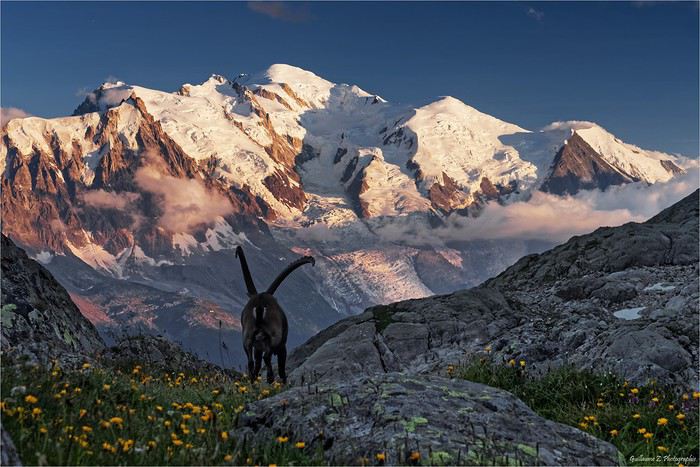
En réponse à un projet de longue date, à savoir l'organisation d'un trek dans les Alpes françaises, notre choix s'est porté sur le trek des Aiguilles Rouges, pour son accessibilité, sa durée (4 jours - on peut faire plus, on peut faire moins), et les paysages qu'il offre tout du long. Et c'est peu de le dire. Ce trek parcourt le grand balcon face au massif du Mt Blanc, offrant une vue imprenable sur les glaciers et les plus hauts sommets de France. Puis il descend dans la vallée de Passy et sa réserve naturelle, riche en faune et en flore. Le tout autour de l'imposant massif des Aiguilles Rouges, qui changent de visage au fil des lumières changeantes.
JOUR 1 - Montée au refuge du Lac Blanc
Distance 5,1 km Dénivelée +851m / -6m
11h30 - Départ du col des Montets, un peu au dessus d'Argentières, en vallée de Chamonix. Départ tardif, car on sait que cette première étape est relativement courte, que les conditions météo sont stables, et que cela nous laissera le temps, arrivés là-haut, de profiter des alentours somptueux !L'itinéraire monte d'entrée, en lacets, dans la forêt. Et très rapidement, une première rencontre avec deux très jeunes bouquetins nous surprend. Nous ne sommes pourtant pas partis depuis bien longtemps, et ils ne sont qu'à 10 mètres de nous. Le sentier est assez fréquenté, nombreux sont des randonneurs qui montent (ou redescendent déjà) au lac Blanc en aller-retour sur la journée.
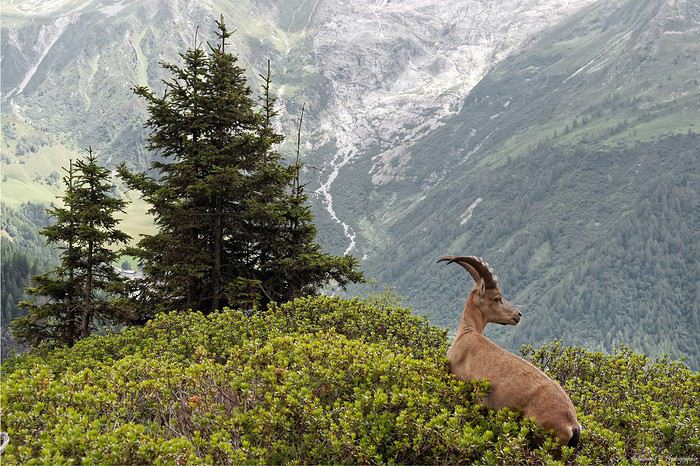
Après un pique nique pris entre les Aiguilles Rouges et le glacier d'Argentière, nous reprenons le chemin direction les lacs de Chéserys. En montée, nous croisons un nombre incroyable de bouquetins, souvent des jeunes. Le grand lac de Chéserys est connu pour son orientation qui permet d'y admirer le reflet du Mont blanc ! Tout au long de cette étape, le sentier est parfaitement tracé.
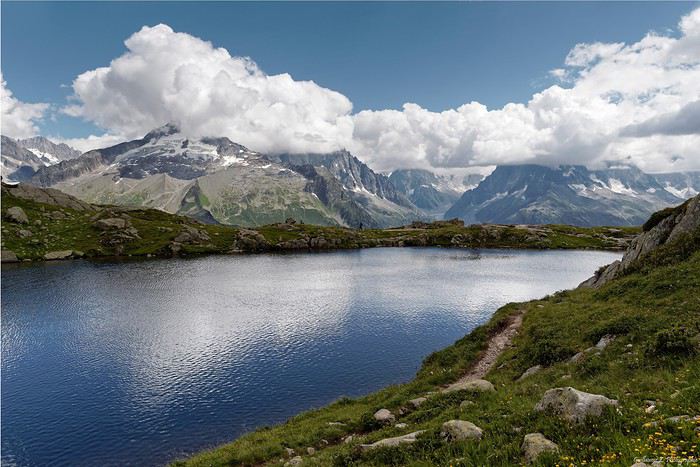
Après 850m de dénivelée, par une météo des plus agréables, nous arrivons au refuge du Lac Blanc. Bien installé au bord du petit lac, ce refuge dispose de 40 lits individuels en dortoir de 8-10 lits. Seul un drap-sac est nécessaire pour le couchage. Nous y avons reçu un très agréable accueil, et y avons très bien mangé. Nous avons fait en outre de chouettes rencontres, toute une famille qui finissaient le TMB, deux australiens dont un qui fait le voyage Australie-France tous les ans, juste parce qu'il est littéralement tombé amoureux du massif du Mt Blanc, et une photographe allemande qui finissait elle aussi le TMB, en solitaire.
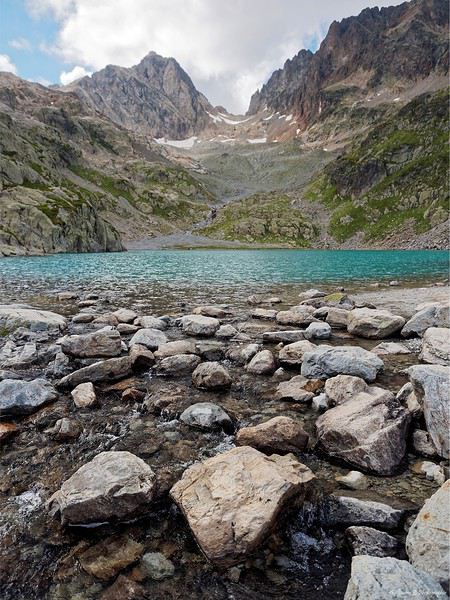
Après le dîner, les gérants nous orientent vers une petite balade digestive vers un lac, un peu plus haut, où les bouquetins ont l'habitude de venir boire au coucher.
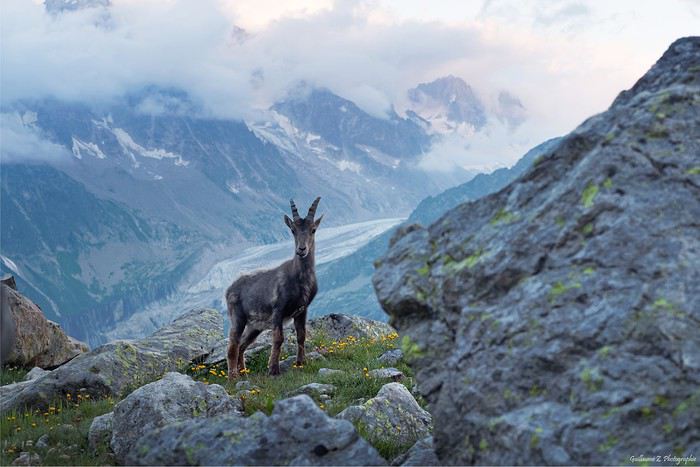
Ce lac, le lac de Persévérance, s'atteint en 15 minutes, et nous y avons effectivement croisé nombre de bouquetins, déjà un peu plus âgés que ceux que nous avons pu voir dans la journée. Le lac lui, est d'un bleu profond, presque noir, niché dans un écrin minéral.
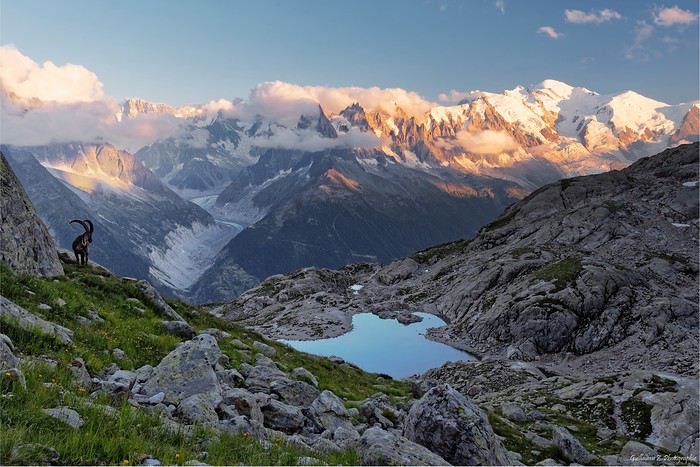
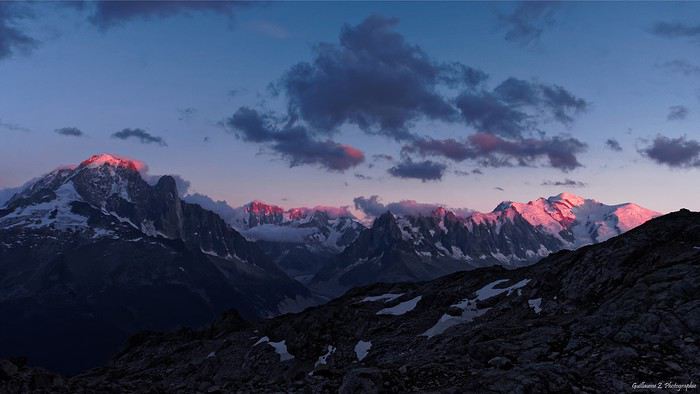
Et puis nous redescendons, la nuit tombante (presque tombée même), pour revenir sur les bords du lac blanc, où l'heure bleue nous attendait. Le vent est totalement tombé, ce qui offrait un miroir quasi-parfait !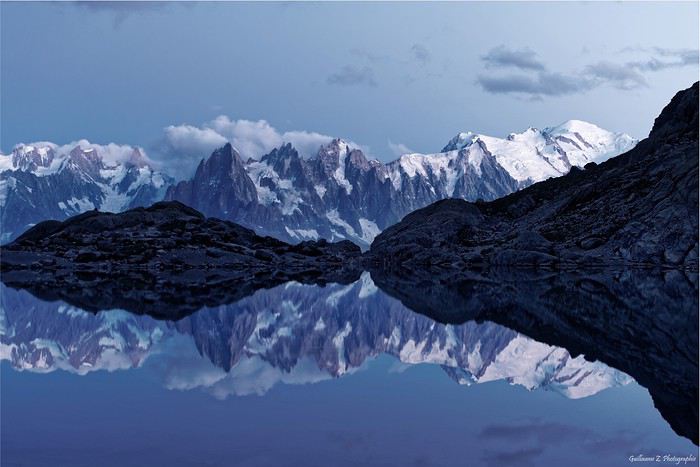
JOUR 1 - Montée au refuge du Lac Blanc
Distance 5,1 km Dénivelée +851m / -6m
11h30 - Départ du col des Montets, un peu au dessus d'Argentières, en vallée de Chamonix. Départ tardif, car on sait que cette première étape est relativement courte, que les conditions météo sont stables, et que cela nous laissera le temps, arrivés là-haut, de profiter des alentours somptueux !L'itinéraire monte d'entrée, en lacets, dans la forêt. Et très rapidement, une première rencontre avec deux très jeunes bouquetins nous surprend. Nous ne sommes pourtant pas partis depuis bien longtemps, et ils ne sont qu'à 10 mètres de nous. Le sentier est assez fréquenté, nombreux sont des randonneurs qui montent (ou redescendent déjà) au lac Blanc en aller-retour sur la journée.
Après un pique nique pris entre les Aiguilles Rouges et le glacier d'Argentière, nous reprenons le chemin direction les lacs de Chéserys. En montée, nous croisons un nombre incroyable de bouquetins, souvent des jeunes. Le grand lac de Chéserys est connu pour son orientation qui permet d'y admirer le reflet du Mont blanc ! Tout au long de cette étape, le sentier est parfaitement tracé.
Après 850m de dénivelée, par une météo des plus agréables, nous arrivons au refuge du Lac Blanc. Bien installé au bord du petit lac, ce refuge dispose de 40 lits individuels en dortoir de 8-10 lits. Seul un drap-sac est nécessaire pour le couchage. Nous y avons reçu un très agréable accueil, et y avons très bien mangé. Nous avons fait en outre de chouettes rencontres, toute une famille qui finissaient le TMB, deux australiens dont un qui fait le voyage Australie-France tous les ans, juste parce qu'il est littéralement tombé amoureux du massif du Mt Blanc, et une photographe allemande qui finissait elle aussi le TMB, en solitaire.
Après le dîner, les gérants nous orientent vers une petite balade digestive vers un lac, un peu plus haut, où les bouquetins ont l'habitude de venir boire au coucher.
Ce lac, le lac de Persévérance, s'atteint en 15 minutes, et nous y avons effectivement croisé nombre de bouquetins, déjà un peu plus âgés que ceux que nous avons pu voir dans la journée. Le lac lui, est d'un bleu profond, presque noir, niché dans un écrin minéral.
Et puis nous redescendons, la nuit tombante (presque tombée même), pour revenir sur les bords du lac blanc, où l'heure bleue nous attendait. Le vent est totalement tombé, ce qui offrait un miroir quasi-parfait !
Le concept de voyage raisonné English translation pending
Bonjour à tous!
Je souhaite aujourd'hui partager avec vous le fruit de mes questionnements des dernières semaines sur l'impact du voyageur sur la destination.
Et oui, à force de voyager, j'ai fait une overdose des backpackers qui voyagent uniquement pour faire la fête et pour se faire mousser de leurs exploits en se croyant les rois du monde dans des pays dits "pauvres".
J'en suis même venue à un point où je me demandait s'il était encore possible de voyager en tant que globetrotteuse à petit budget sans trop participer à la dégradation des destinations traversées.
Du coup, après moultes réflexions, j'ai lancé le concept de voyage raisonné. Ce n'est pas parfait, c'est sûr qu'on peut toujours aller plus loin dans les démarches, mais au moins cela s'adresses à tous les voyageurs quels que soit leur expérience, leur budget ou leur sensibilité à l'environnement. Si chacun connaissait ce concept, peut être que les voyageurs pourraient un peu redorer leur image.
Tout les détails du voyage raisonné et ses fondements sont dans mon article: Le voyage raisonné, c'est quoi?
N'hésitez pas à me dire ce que vous en pensez, si vous avez des points à améliorer... :) Je suis toute ouïe du temps que les commentaires restent constructifs...
Je souhaite aujourd'hui partager avec vous le fruit de mes questionnements des dernières semaines sur l'impact du voyageur sur la destination.
Et oui, à force de voyager, j'ai fait une overdose des backpackers qui voyagent uniquement pour faire la fête et pour se faire mousser de leurs exploits en se croyant les rois du monde dans des pays dits "pauvres".
J'en suis même venue à un point où je me demandait s'il était encore possible de voyager en tant que globetrotteuse à petit budget sans trop participer à la dégradation des destinations traversées.
Du coup, après moultes réflexions, j'ai lancé le concept de voyage raisonné. Ce n'est pas parfait, c'est sûr qu'on peut toujours aller plus loin dans les démarches, mais au moins cela s'adresses à tous les voyageurs quels que soit leur expérience, leur budget ou leur sensibilité à l'environnement. Si chacun connaissait ce concept, peut être que les voyageurs pourraient un peu redorer leur image.
Tout les détails du voyage raisonné et ses fondements sont dans mon article: Le voyage raisonné, c'est quoi?
N'hésitez pas à me dire ce que vous en pensez, si vous avez des points à améliorer... :) Je suis toute ouïe du temps que les commentaires restent constructifs...
Conseils itinéraire Colombie English translation pending
Bonjour,
Je pars bientôt en Colombie avec un budget serré de 1000 euros, seule avec mon sac à dos et ma tente, pour environ 4 semaines. Je dois donc me débrouiller avec cela pour le logement, les visites/activités et la nourriture ainsi que les éventuels vols internes.
Je pars pour découvrir la culture, rencontrer des personnes, découvrir la faune et la flore de la Colombie, mais aussi pour apprendre l'espagnol! Le voyage risque donc d'être un peu difficile au début ne parlant que très peu la langue et vos conseils seront évidemment les bienvenus.
J'ai beaucoup de questions et si vous pouviez m'apporter quelques réponses je vous en remercierai du fond du coeur!!
J'aimerai faire la côte caraïbe, la région du choco puis descendre jusqu'au Pérou. On m'a conseillé plusieurs lieux: - Palomino - Le parc de Tayrona - Taganga - Barranquilla - La casa del marquez de valse Hoyos à Cartagena - Mompos - Le parc national Los katios - Le parc national d'Utria - La région du choco - San Cipriano - Cali - Perreira - Salento - Leticia
Si vous connaissez certains de ces lieux, avez-vous des conseils (lieux précis à visiter, bons plans hébergement/nourriture sûrs)?
Concernant les moyens de transports entre chaque ville/village, pensez-vous que cela est risqué en bus? Et si oui, en quels termes? Que me conseillez-vous (pour la sécurité, le choix des bus et le meilleur qualité/prix)? Connaissez-vous d'autres solutions pas trop cher?
Est-il risqué (jeune femme seule) de demander à camper chez l'habitant s'il a un jardin? Dan les parcs nationaux? Les auberges de jeunesse sont-elles sûres (y a-t-il régulièrement des casier où je pourrais entreposer un sac de 60L? Si vous connaissez des lieux sûrs où dormir je suis preneuse!
Merci ! =)
J'aimerai faire la côte caraïbe, la région du choco puis descendre jusqu'au Pérou. On m'a conseillé plusieurs lieux: - Palomino - Le parc de Tayrona - Taganga - Barranquilla - La casa del marquez de valse Hoyos à Cartagena - Mompos - Le parc national Los katios - Le parc national d'Utria - La région du choco - San Cipriano - Cali - Perreira - Salento - Leticia
Si vous connaissez certains de ces lieux, avez-vous des conseils (lieux précis à visiter, bons plans hébergement/nourriture sûrs)?
Concernant les moyens de transports entre chaque ville/village, pensez-vous que cela est risqué en bus? Et si oui, en quels termes? Que me conseillez-vous (pour la sécurité, le choix des bus et le meilleur qualité/prix)? Connaissez-vous d'autres solutions pas trop cher?
Est-il risqué (jeune femme seule) de demander à camper chez l'habitant s'il a un jardin? Dan les parcs nationaux? Les auberges de jeunesse sont-elles sûres (y a-t-il régulièrement des casier où je pourrais entreposer un sac de 60L? Si vous connaissez des lieux sûrs où dormir je suis preneuse!
Merci ! =)
Nouvelle-Zélande: 4 semaines en van en haute saison - organisation English translation pending
Bonjour à tous,
nous partons en Décembre-Janvier pour 4 semaines du Nord au Sud en van self-contained. Quelques questions se posent concernant la logistique.
Est-il possible et conseillé de réserver à l'avance les emplacements pour la nuit sachant que le van signifie liberté et que l'on ne souhaite pas se bloquer toutes nos nuits à un endroit fixe. J'ai vu que certains conseillent l'appli Campermate pour trouver les emplacements, cela suffit-il pour les trouver au jour le jour?
Nous pensions surtout réserver ces emplacements pour les nuits concernant les excursions bateau déjà fixées pour le Milford sound puis le Doubtful sound le lendemain. Est-il facile de s'organiser sur place pour ces 2 excursions?
Nous avons prévu 3 jours à Abel Tasman Trek dont 1 nuit en hébergement en dur et une sous tente. Or pour le moment nous n'avons pas de tente. Est-il possible d'en louer sur place (à Awaroa Campsite)? Est-il déconseillé de laisser des affaires dans le van?
Enfin à propos du Tongariro Alpine Crossing Trek combien de temps faut-il compter? Est-il facile de trouver des navettes pour revenir au point de départ, si oui jusqu'à quelle heure?
Merci d'avance pour aide et vos conseils! Les questions s'amoncellent petit à petit, j'en aurai surement d'autres par la suite! ;-)
nous partons en Décembre-Janvier pour 4 semaines du Nord au Sud en van self-contained. Quelques questions se posent concernant la logistique.
Est-il possible et conseillé de réserver à l'avance les emplacements pour la nuit sachant que le van signifie liberté et que l'on ne souhaite pas se bloquer toutes nos nuits à un endroit fixe. J'ai vu que certains conseillent l'appli Campermate pour trouver les emplacements, cela suffit-il pour les trouver au jour le jour?
Nous pensions surtout réserver ces emplacements pour les nuits concernant les excursions bateau déjà fixées pour le Milford sound puis le Doubtful sound le lendemain. Est-il facile de s'organiser sur place pour ces 2 excursions?
Nous avons prévu 3 jours à Abel Tasman Trek dont 1 nuit en hébergement en dur et une sous tente. Or pour le moment nous n'avons pas de tente. Est-il possible d'en louer sur place (à Awaroa Campsite)? Est-il déconseillé de laisser des affaires dans le van?
Enfin à propos du Tongariro Alpine Crossing Trek combien de temps faut-il compter? Est-il facile de trouver des navettes pour revenir au point de départ, si oui jusqu'à quelle heure?
Merci d'avance pour aide et vos conseils! Les questions s'amoncellent petit à petit, j'en aurai surement d'autres par la suite! ;-)
Voir la Nouvelle-Zélande et être en paix English translation pending
Je dois vous l'avouer.
Depuis fort longtemps, je nourrissais ce rêve secret de fouler le sol de la Nouvelle-Zélande. Pourquoi ? Situé à l'autre bout du monde, magnifié par des films spectaculaires mais aussi souvent présenté comme un peuple très accueillant, le pays regorge de mystères du à son éloignement.
Lors d'un grand voyage de 7 mois en Océanie, j'y ait donc passé 4 mois afin de prendre le pouls du pays. A la fois en tant que sédentaire lors de volontariats chez des habitants et en nomade pur sur la route. J'ai ainsi alterné rythme rapide en auto-stop, rythme lent lors de 9 treks de plusieurs jours et foultitudes de randonnée à la journée, un road-trip fabuleux dans le Fiordland ainsi que quelques city-trips.
La Nouvelle-Zélande et surtout dans l'île du Sud, c'est avant tout un pays de montagnes désertiques qui s'étirent du Nord au Sud. La notion de sauvage ou même de wilderness est sans commune mesure avec ce que l'on connaît en Europe. Juste un exemple, j'ai passé 3 semaines dans un hameau de 20 habitants dans le Mackenzie Country, peuplé en tout et pour tout de 3000 habitants pour une superficie équivalente à la Loire Atlantique, soit 1,3M d'habitants. Imaginez-vous conduire sur ces routes désertes, aux paysages désolés mais pourtant si puissants à admirer.


La Nouvelle-Zélande, ce sont des habitants à la "no worries" au rythme de vie cool, bercés par la beauté et profusion de la nature. Je ne les ait jamais senti déconnectés de la nature, toujours à la recherche d'air. Il faut le dire, leurs villes ne sont pas oppressantes et vivre en Europe leur demanderait un gros effort d'adaptation. Il faut bien voir leurs sourires faciles dans n'importe quelle circonstance, que cela soit pour vous prendre en auto-stop (c'est un pays facile pour commencer) où pour n'importe quoi ! Je n'ai eu qu'un seul problème relationnel: avec un chauffeur de bus qui grognait à ma demande de connaître l'emplacement d'une station. Pour se rattraper, il m'a déposé à une intersection me menant là ou je devais aller. Non vraiment, rien à redire sur ce peuple, mais attention, tout n'est pas rose, ce n'est pas le monde des bisounours. Les arnaques des "backpackers car" sont légion comme une amie a été victime !


La Nouvelle-Zélande, c'est aussi un pays à la faune variée. Aucun animal dangereux n'est recensé, vous pouvez gambader en toute liberté sans ne rien craindre. A part les très nombreux boîtes destinées à attraper les possums, véritable poison de ce pays. Importés d'Australie, ils dévastent des forêts entières ainsi que nombre d'espèces animales. En attendant, le DOC, le Department of Conservation a mis en place bon nombre de programmes de protection, notamment des kéas, des perroquets natifs, des robins, des manchots aux yeux jaunes et bien d'autres encore !


La Nouvelle-Zélande ne serait pas aussi populaire, attractif et magnétique sans ses volcans. Pour moi, quand on se rapproche des éléments naturels les plus bruts, une force magnétique s'empare de nous. En tout cas, je l'ai ressenti comme tel dans la région des volcans, mais pas seulement. Aussi dans l'île du Sud, dans le prolongement de la chaîne volcanique. Le parc national du Tongariro attire des millions de touristes chaque année avec ses 3 volcans spectaculaires tandis que le mont Egmont/Taranaki, relativement inactif est tout aussi intéressant car parfaitement circulaire. Dernier détail: en cas de heavy rain dans la région, fuyez. Il y tombe jusqu'à 150/200 mm d'eau par jour.


La Nouvelle-Zélande est aussi un pays aux paysages très variés. Des vertes collines, aux longues plages et criques, aux côtes escarpées, aux lacs, aux fjords plongeant dans la mer et j'en passe, impossible de résumer le pays en un paysage typique tant on y trouve de tout. Un virage et vous changez de pays !


La Nouvelle-Zélande, bien sur a des villes, parmi elles, citons Auckland, Wellington, Dunedin, Christchurch mais soyons honnêtes, ne venez pas pour ça. Bien que agréables à vivre, elles n'ont guère de charme, excepté Dunedin avec son ton écossais et malheureusement, Christchurch a perdu de sa superbe sous le coup du tremblement de terre dévastateur en 2011. Mais même au sein des villes, la nature se rappelle aux habitants, pour admirer des couchers de soleil somptueux !


Alors forcément au bout de 4 mois, je me sentais chez moi, comme dans cette dernière photo (où j'y suis resté un bout de temps). Et puis, il a fallu rentrer en se promettant peut-être d'y revenir car j'avais encore cette sensation d'avoir beaucoup à découvrir. Et puis surtout, ce magnétisme qui collait mes pieds au sol. Difficile de monter dans l'avion, alors. Mais j'étais en paix d'avoir accompli ce chemin.

Je ne vous donnerait pas d'indication sur le plan précis de ce que j'ai fait, que cela soit des villes, sites touristiques, parcs nationaux visités, ou même des randonnées, great walks ou tramping tracks, ce n'est pas l'objet du post tel que je le voulais. Je désirais surtout écrire une hymne à ce pays, croulant parfois sous le tourisme de masse selon les sites, mais dont il est largement possible d'en sortir avec de l'imagination. Un exemple: alors que des hordes de randonneurs arpentaient certaines great walks, j'affrontais une vraie solitude durant plus de 2 jours sur un autre track totalement inconnu !
Quelques liens toutefois pour agrémenter cette lecture avec plus de concret, il s'agit des articles postés sur mon blog personnel: Carnet de voyage - Nouvelle-Zélande
Pour plus de photos, rendez-vous ici: TOP50 - Nouvelle-Zélande et ici: Nouvelle-Zélande
N'hésitez pas à poster vos questions, ressentis.
Lors d'un grand voyage de 7 mois en Océanie, j'y ait donc passé 4 mois afin de prendre le pouls du pays. A la fois en tant que sédentaire lors de volontariats chez des habitants et en nomade pur sur la route. J'ai ainsi alterné rythme rapide en auto-stop, rythme lent lors de 9 treks de plusieurs jours et foultitudes de randonnée à la journée, un road-trip fabuleux dans le Fiordland ainsi que quelques city-trips.
La Nouvelle-Zélande et surtout dans l'île du Sud, c'est avant tout un pays de montagnes désertiques qui s'étirent du Nord au Sud. La notion de sauvage ou même de wilderness est sans commune mesure avec ce que l'on connaît en Europe. Juste un exemple, j'ai passé 3 semaines dans un hameau de 20 habitants dans le Mackenzie Country, peuplé en tout et pour tout de 3000 habitants pour une superficie équivalente à la Loire Atlantique, soit 1,3M d'habitants. Imaginez-vous conduire sur ces routes désertes, aux paysages désolés mais pourtant si puissants à admirer.
La Nouvelle-Zélande, ce sont des habitants à la "no worries" au rythme de vie cool, bercés par la beauté et profusion de la nature. Je ne les ait jamais senti déconnectés de la nature, toujours à la recherche d'air. Il faut le dire, leurs villes ne sont pas oppressantes et vivre en Europe leur demanderait un gros effort d'adaptation. Il faut bien voir leurs sourires faciles dans n'importe quelle circonstance, que cela soit pour vous prendre en auto-stop (c'est un pays facile pour commencer) où pour n'importe quoi ! Je n'ai eu qu'un seul problème relationnel: avec un chauffeur de bus qui grognait à ma demande de connaître l'emplacement d'une station. Pour se rattraper, il m'a déposé à une intersection me menant là ou je devais aller. Non vraiment, rien à redire sur ce peuple, mais attention, tout n'est pas rose, ce n'est pas le monde des bisounours. Les arnaques des "backpackers car" sont légion comme une amie a été victime !
La Nouvelle-Zélande, c'est aussi un pays à la faune variée. Aucun animal dangereux n'est recensé, vous pouvez gambader en toute liberté sans ne rien craindre. A part les très nombreux boîtes destinées à attraper les possums, véritable poison de ce pays. Importés d'Australie, ils dévastent des forêts entières ainsi que nombre d'espèces animales. En attendant, le DOC, le Department of Conservation a mis en place bon nombre de programmes de protection, notamment des kéas, des perroquets natifs, des robins, des manchots aux yeux jaunes et bien d'autres encore !
La Nouvelle-Zélande ne serait pas aussi populaire, attractif et magnétique sans ses volcans. Pour moi, quand on se rapproche des éléments naturels les plus bruts, une force magnétique s'empare de nous. En tout cas, je l'ai ressenti comme tel dans la région des volcans, mais pas seulement. Aussi dans l'île du Sud, dans le prolongement de la chaîne volcanique. Le parc national du Tongariro attire des millions de touristes chaque année avec ses 3 volcans spectaculaires tandis que le mont Egmont/Taranaki, relativement inactif est tout aussi intéressant car parfaitement circulaire. Dernier détail: en cas de heavy rain dans la région, fuyez. Il y tombe jusqu'à 150/200 mm d'eau par jour.
La Nouvelle-Zélande est aussi un pays aux paysages très variés. Des vertes collines, aux longues plages et criques, aux côtes escarpées, aux lacs, aux fjords plongeant dans la mer et j'en passe, impossible de résumer le pays en un paysage typique tant on y trouve de tout. Un virage et vous changez de pays !
La Nouvelle-Zélande, bien sur a des villes, parmi elles, citons Auckland, Wellington, Dunedin, Christchurch mais soyons honnêtes, ne venez pas pour ça. Bien que agréables à vivre, elles n'ont guère de charme, excepté Dunedin avec son ton écossais et malheureusement, Christchurch a perdu de sa superbe sous le coup du tremblement de terre dévastateur en 2011. Mais même au sein des villes, la nature se rappelle aux habitants, pour admirer des couchers de soleil somptueux !
Alors forcément au bout de 4 mois, je me sentais chez moi, comme dans cette dernière photo (où j'y suis resté un bout de temps). Et puis, il a fallu rentrer en se promettant peut-être d'y revenir car j'avais encore cette sensation d'avoir beaucoup à découvrir. Et puis surtout, ce magnétisme qui collait mes pieds au sol. Difficile de monter dans l'avion, alors. Mais j'étais en paix d'avoir accompli ce chemin.
Je ne vous donnerait pas d'indication sur le plan précis de ce que j'ai fait, que cela soit des villes, sites touristiques, parcs nationaux visités, ou même des randonnées, great walks ou tramping tracks, ce n'est pas l'objet du post tel que je le voulais. Je désirais surtout écrire une hymne à ce pays, croulant parfois sous le tourisme de masse selon les sites, mais dont il est largement possible d'en sortir avec de l'imagination. Un exemple: alors que des hordes de randonneurs arpentaient certaines great walks, j'affrontais une vraie solitude durant plus de 2 jours sur un autre track totalement inconnu !
Quelques liens toutefois pour agrémenter cette lecture avec plus de concret, il s'agit des articles postés sur mon blog personnel: Carnet de voyage - Nouvelle-Zélande
Pour plus de photos, rendez-vous ici: TOP50 - Nouvelle-Zélande et ici: Nouvelle-Zélande
N'hésitez pas à poster vos questions, ressentis.
Les assurances voyage vous assurent-elles vraiment? English translation pending
Bonjour à tous,
Voilà, multitude de post traitent des contrats d’assurance et des assurances comprises avec les cartes Gold mastercard ou Visa premier… Par contre je viens de découvrir un chose qui m’inquiète un peu. Je retourne aux USA en novembre et je cherche à être éclairé sur les conditions d'assurances. Notamment sur le contrat mondial assistance qui assure les voyages dans le cadre d'une cartes Gold mastercard.
Vous pourriez me dire que je devrais me renseigner auprès de mondiale assistance, c’est chose faite, sans réponse à ce jour. Donc si vous avez des infos, je suis preneur.
Voilà ce que je découvre avec surprise ... En épluchant le contrat de ce qui est compris dans les frais médicaux, je réalise que les 150000 euros couverts par le contrat semblent ne pas l'être réellement.
Du moins rien n’est clair car il est évoqué de partout une simple avance en cas d’hospitalisation et non un paiement des frais d’hospitalisation… Bref, je suis un peu paumé…
J'ai épluché un contrat type assurance multirisque Mondial assistance. Voilà ce que je trouve concernant les 155000 euros de frais médicaux :
Avance des frais d’hospitalisation En cas d’hospitalisation, nous pouvons procéder à l’avance des frais, par règlement direct au centre hospitalier dans la limite du plafond figurant au tableau des montants de garanties et des franchises. Dans ce cas, vous vous engagez à nous rembourser cette avance dans un délai de trois mois à compter de la date de votre retour de voyage. Passé ce délai, nous serons en droit d’exiger, en outre, des frais et intérêts légaux. Nos remboursements et/ou avances cessent le jour où notre service médical estime que votre rapatriement est possible. Dans tous les cas, vous vous engagez à présenter votre demande de remboursement auprès de votre organisme social de base, de votre mutuelle et de tout organisme d’assurance ou de prévoyance auquel vous pouvez prétendre.
Idem pour la carte Gold Mastercard :
En gros il est dit dans l'article 1.9 que les 156 000 euros sont une avance qui doit être remboursée à Mondial Assistance. Et à l'article 1.10 que les 156 000 euros servent de remboursement complémentaire, notamment pour les remboursement des frais d'hospitalisation, mais selon les conditions prévues à l'article 1.9.
Petit rappel, l’Article 1.9 qui ne permet qu'une avance qui doit être remboursée...
Je serais heureux d'avoir des informations plus claires sur ce point. Si vous en avez…
Voici les articles :
1.9 AVANCE DES FRAIS D'HOSPITALISATION
Cette garantie est rendue : - dans tous les cas hors de France, et du Pays de Résidence, - pendant les 90 premiers jours du déplacement hors du Pays de Résidence de l'Assuré. IMPORTANT Cette garantie n'est acquise qu'à la condition et tant que les médecins de Mondial Assistance jugent l'Assuré intransportable après recueil des informations auprès du médecin local. Aucune avance n'est accordée à compter du moment où Mondial Assistance est en mesure d'effectuer le transport, même si l'Assuré décide de rester sur place. Mondial Assistance fait l'avance des frais d'hospitalisation engagés jusqu'à concurrence de 156.000 € par Assuré et par Événement, pour les soins prescrits en accord avec les médecins de Mondial Assistance. Mondial Assistance adresse préalablement à l'Assuré, à un Membre de la Famille ou le cas échéant à un tiers, un formulaire de reconnaissance des sommes dues que celui-ci retourne signé à Mondial Assistance. Le signataire s'engage à rembourser Mondial Assistance dans les 60 jours à compter de la date d'envoi de chaque facture par ce dernier, indépendamment de toute procédure de remboursement engagée par l'Assuré auprès d'organismes d'assurance maladie et par tout autre organisme de prévoyance ou organisme mutualiste auxquels il cotise. À défaut de paiement dans les 60 jours à compter de la date d'envoi de la facture, Mondial Assistance se réserve le droit d'engager toutes procédures de recouvrement utiles auprès de l'Assuré.
1.10 REMBOURSEMENT À TITRE COMPLÉMENTAIRE DES FRAIS MÉDICAUX
Cette garantie est rendue : dans tous les cas hors de France, et du Pays de Résidence, pendant les 90 premiers jours du déplacement hors du Pays de Résidence de l'Assuré. Mondial Assistance rembourse jusqu'à concurrence de 156.000 € par Assuré et par Événement le montant des frais médicaux engagés qui n'aura pas été pris en charge par l'organisme d'assurance maladie et/ou par tout autre organisme de prévoyance ou organisme mutualiste auxquels l'Assuré cotise. Mondial Assistance remboursera à l'Assuré les frais non pris en charge par les organismes susvisés, déduction faite d'une franchise de 50 € par Assuré et par Événement, et sous réserve de la communication par l'Assuré à Mondial Assistance des factures originales des frais médicaux et des justificatifs originaux de remboursement émanant de ces organismes. Dans l'hypothèse où les organismes auxquels l'Assuré cotise ne prendraient pas en charge les frais médicaux engagés, Mondial Assistance le remboursera jusqu'à concurrence de 156.000 € sous réserve de la communication par l'Assuré des factures originales de frais médicaux et de l'attestation de non prise en charge émanant de ces organismes. Nature des frais ouvrant droit à ce remboursement complémentaire : - honoraires médicaux, - frais de médicaments prescrits par un médecin, - frais d'ambulance prescrits par un médecin pour un transport vers l'hôpital le plus proche et ceci seulement en cas de refus de prise en charge par la Sécurité Sociale ou tout autre organisme d'assurance maladie, - frais d'hospitalisation selon les conditions prévues à l'article 1.9, - urgence dentaire considérée comme telle par les médecins de Mondial Assistance et prise en charge jusqu'à concurrence de 700 € par Assuré et par Événement, déduction faite de la franchise de 50 € par Assuré et par Événement.
Voilà, multitude de post traitent des contrats d’assurance et des assurances comprises avec les cartes Gold mastercard ou Visa premier… Par contre je viens de découvrir un chose qui m’inquiète un peu. Je retourne aux USA en novembre et je cherche à être éclairé sur les conditions d'assurances. Notamment sur le contrat mondial assistance qui assure les voyages dans le cadre d'une cartes Gold mastercard.
Vous pourriez me dire que je devrais me renseigner auprès de mondiale assistance, c’est chose faite, sans réponse à ce jour. Donc si vous avez des infos, je suis preneur.
Voilà ce que je découvre avec surprise ... En épluchant le contrat de ce qui est compris dans les frais médicaux, je réalise que les 150000 euros couverts par le contrat semblent ne pas l'être réellement.
Du moins rien n’est clair car il est évoqué de partout une simple avance en cas d’hospitalisation et non un paiement des frais d’hospitalisation… Bref, je suis un peu paumé…
J'ai épluché un contrat type assurance multirisque Mondial assistance. Voilà ce que je trouve concernant les 155000 euros de frais médicaux :
Avance des frais d’hospitalisation En cas d’hospitalisation, nous pouvons procéder à l’avance des frais, par règlement direct au centre hospitalier dans la limite du plafond figurant au tableau des montants de garanties et des franchises. Dans ce cas, vous vous engagez à nous rembourser cette avance dans un délai de trois mois à compter de la date de votre retour de voyage. Passé ce délai, nous serons en droit d’exiger, en outre, des frais et intérêts légaux. Nos remboursements et/ou avances cessent le jour où notre service médical estime que votre rapatriement est possible. Dans tous les cas, vous vous engagez à présenter votre demande de remboursement auprès de votre organisme social de base, de votre mutuelle et de tout organisme d’assurance ou de prévoyance auquel vous pouvez prétendre.
Idem pour la carte Gold Mastercard :
En gros il est dit dans l'article 1.9 que les 156 000 euros sont une avance qui doit être remboursée à Mondial Assistance. Et à l'article 1.10 que les 156 000 euros servent de remboursement complémentaire, notamment pour les remboursement des frais d'hospitalisation, mais selon les conditions prévues à l'article 1.9.
Petit rappel, l’Article 1.9 qui ne permet qu'une avance qui doit être remboursée...
Je serais heureux d'avoir des informations plus claires sur ce point. Si vous en avez…
Voici les articles :
1.9 AVANCE DES FRAIS D'HOSPITALISATION
Cette garantie est rendue : - dans tous les cas hors de France, et du Pays de Résidence, - pendant les 90 premiers jours du déplacement hors du Pays de Résidence de l'Assuré. IMPORTANT Cette garantie n'est acquise qu'à la condition et tant que les médecins de Mondial Assistance jugent l'Assuré intransportable après recueil des informations auprès du médecin local. Aucune avance n'est accordée à compter du moment où Mondial Assistance est en mesure d'effectuer le transport, même si l'Assuré décide de rester sur place. Mondial Assistance fait l'avance des frais d'hospitalisation engagés jusqu'à concurrence de 156.000 € par Assuré et par Événement, pour les soins prescrits en accord avec les médecins de Mondial Assistance. Mondial Assistance adresse préalablement à l'Assuré, à un Membre de la Famille ou le cas échéant à un tiers, un formulaire de reconnaissance des sommes dues que celui-ci retourne signé à Mondial Assistance. Le signataire s'engage à rembourser Mondial Assistance dans les 60 jours à compter de la date d'envoi de chaque facture par ce dernier, indépendamment de toute procédure de remboursement engagée par l'Assuré auprès d'organismes d'assurance maladie et par tout autre organisme de prévoyance ou organisme mutualiste auxquels il cotise. À défaut de paiement dans les 60 jours à compter de la date d'envoi de la facture, Mondial Assistance se réserve le droit d'engager toutes procédures de recouvrement utiles auprès de l'Assuré.
1.10 REMBOURSEMENT À TITRE COMPLÉMENTAIRE DES FRAIS MÉDICAUX
Cette garantie est rendue : dans tous les cas hors de France, et du Pays de Résidence, pendant les 90 premiers jours du déplacement hors du Pays de Résidence de l'Assuré. Mondial Assistance rembourse jusqu'à concurrence de 156.000 € par Assuré et par Événement le montant des frais médicaux engagés qui n'aura pas été pris en charge par l'organisme d'assurance maladie et/ou par tout autre organisme de prévoyance ou organisme mutualiste auxquels l'Assuré cotise. Mondial Assistance remboursera à l'Assuré les frais non pris en charge par les organismes susvisés, déduction faite d'une franchise de 50 € par Assuré et par Événement, et sous réserve de la communication par l'Assuré à Mondial Assistance des factures originales des frais médicaux et des justificatifs originaux de remboursement émanant de ces organismes. Dans l'hypothèse où les organismes auxquels l'Assuré cotise ne prendraient pas en charge les frais médicaux engagés, Mondial Assistance le remboursera jusqu'à concurrence de 156.000 € sous réserve de la communication par l'Assuré des factures originales de frais médicaux et de l'attestation de non prise en charge émanant de ces organismes. Nature des frais ouvrant droit à ce remboursement complémentaire : - honoraires médicaux, - frais de médicaments prescrits par un médecin, - frais d'ambulance prescrits par un médecin pour un transport vers l'hôpital le plus proche et ceci seulement en cas de refus de prise en charge par la Sécurité Sociale ou tout autre organisme d'assurance maladie, - frais d'hospitalisation selon les conditions prévues à l'article 1.9, - urgence dentaire considérée comme telle par les médecins de Mondial Assistance et prise en charge jusqu'à concurrence de 700 € par Assuré et par Événement, déduction faite de la franchise de 50 € par Assuré et par Événement.
Circuit de 4 semaines dans les parcs de l'Ouest américain juin 2015 English translation pending
le parcours du 30 mai au 27 juin 2015
boucle de Las Vegas à Las Vegas (deux semaines): Las Vegas -Zion-Bryce-Capitol Reef-Moab-Monument Valley-Lac Powell-Grand Canyon-Las Vegas
Californie (une semaine): Las Vegas-Death Valley-Sequoia-Kings Canyon-Yosemite-San Francisco
vol pour Jackson Hole
Yellowstone (une semaine): circuit dans le parc avec étapes à grant village- madison- mammoth hot springs- canyon village
Le budget vols avec delta airlines :2500 euros pour 2 hégergements ( campings, cabins, hotels) 1900 euros pour 27 nuits location de véhicules 4X4: 1150 euros (agence ALAMO très bien véhicules neufs)
Le circuit en détail
Las Vegas Nous y avons passé deux nuits, la première et la dernière de la boucle. Nous n'avons visité Las Vegas qu'en soirée s'agissant d'une ville étape dans notre circuit les hotels : Excalibur (note 3,5/5) et Mandalay Bay (4,5/5) plus classe, au sud du strip, un peu excentré mais navette gratuite de type métro aérien jusqu'à l'Excalibur. Les prix varient considérablement entre la semaine et le week-end. les hotels du strip sont immenses , des dizaines d'étages , des centaines de chambres. les comptoirs d'enregistrements, parfois difficile à trouver... se situent en général au niveau des casinos au rez de chaussée des hotels
Nos meilleurs souvenirs à Las Vegas Les burgers du Broadway bar and grill dans la galerie de l'hotel New York Le spectacle du Blue Man Group au Monte Carlo
Si c'était à refaire: Ne pas loger forcément sur le strip


Le budget vols avec delta airlines :2500 euros pour 2 hégergements ( campings, cabins, hotels) 1900 euros pour 27 nuits location de véhicules 4X4: 1150 euros (agence ALAMO très bien véhicules neufs)
Le circuit en détail
Las Vegas Nous y avons passé deux nuits, la première et la dernière de la boucle. Nous n'avons visité Las Vegas qu'en soirée s'agissant d'une ville étape dans notre circuit les hotels : Excalibur (note 3,5/5) et Mandalay Bay (4,5/5) plus classe, au sud du strip, un peu excentré mais navette gratuite de type métro aérien jusqu'à l'Excalibur. Les prix varient considérablement entre la semaine et le week-end. les hotels du strip sont immenses , des dizaines d'étages , des centaines de chambres. les comptoirs d'enregistrements, parfois difficile à trouver... se situent en général au niveau des casinos au rez de chaussée des hotels
Nos meilleurs souvenirs à Las Vegas Les burgers du Broadway bar and grill dans la galerie de l'hotel New York Le spectacle du Blue Man Group au Monte Carlo
Si c'était à refaire: Ne pas loger forcément sur le strip
Hébergement longue durée Chili English translation pending
Bonjour,
Nous serons au Chili de décembre 2015 à février 2016. Nous avons 3 enfants en bas âge (7 ans, 4 ans 1/2 et 18 mois). Nous avons décidé de nous poser dans une ville du Chili pour un mois environ pour profiter plus tranquillement de la ville et de ses alentours. Nous hésitons entre Valparaiso et La Serena. Toutefois, notre choix peut se porter sur une autre ville de cette partie de l'Argentine en fonction des conseils que l'on pourra avoir.
Nous sollicitons ceux qui connaissent bien ces villes pour nous aider dans notre choix en tenant compte de la logistique familiale et des activités à faire dans la ville et dans les alentours.
Nous recherchons également des contacts d'associations ou ONG qui nous permettraient de rencontrer des personnes, donner un peu de son temps en impliquant si possible nos enfants.
Nous sommes également ouverts à des propositions de logement à des tarifs corrects.
En vous remerciant par avance.
Bonne journée
Nous serons au Chili de décembre 2015 à février 2016. Nous avons 3 enfants en bas âge (7 ans, 4 ans 1/2 et 18 mois). Nous avons décidé de nous poser dans une ville du Chili pour un mois environ pour profiter plus tranquillement de la ville et de ses alentours. Nous hésitons entre Valparaiso et La Serena. Toutefois, notre choix peut se porter sur une autre ville de cette partie de l'Argentine en fonction des conseils que l'on pourra avoir.
Nous sollicitons ceux qui connaissent bien ces villes pour nous aider dans notre choix en tenant compte de la logistique familiale et des activités à faire dans la ville et dans les alentours.
Nous recherchons également des contacts d'associations ou ONG qui nous permettraient de rencontrer des personnes, donner un peu de son temps en impliquant si possible nos enfants.
Nous sommes également ouverts à des propositions de logement à des tarifs corrects.
En vous remerciant par avance.
Bonne journée