Results for "Mosquée+Bleue+|+123+>+233"
7292 results found.
Que voir avant de mourir? English translation pending
🙂Ce We, je suis tombée sur un livre qui avait à peu près ce titre là... Genre "100 choses à voir ou à vivre dans le monde avant de mourir"... J'ouvre.... curieuse.....
Et là! déception! L'hôtel 4 étoiles de la station super balnéaire, le plus grand palace du monde avec un lit à eau bouillonnante (😐bon, c est rigolo, mais ce serait pas ma dernière volonté non plus...) dans la suite royale plus plus...etc etc... (je précise que c'était à Londres... ce sont donc peut être les choix des anglais 😉)
Je suis sûre qu'à nous tous, on aura AUCUN mal à trouver 100 choses à voir qui nous font rêver POUR DE VRAI...
Voilà mes idées, j'en mets 5 pour vous laisser de la place : les chutes d'Iguacu (mon côté préféré : l'argentin, parce qu'il nous renvoit à notre.... petitesse au sens propre 😉) les fonds sous-marins de Pulau Bunaken (nord de Sulawesi, Indonésie) Rio de Janeiro depuis le Christ Rédempteur quand quelques nuages s'accrochent encore aux Dos Irmaos Venise, la place San Marco sous la neige au petit jour le temple de Borobudur sur Java
A vous!!! (j'ai encore plein d'idées mais bon..) ET QUE CE QUE VOUS AVEZ VU... sinon c est trop facile!!!🙂
Et là! déception! L'hôtel 4 étoiles de la station super balnéaire, le plus grand palace du monde avec un lit à eau bouillonnante (😐bon, c est rigolo, mais ce serait pas ma dernière volonté non plus...) dans la suite royale plus plus...etc etc... (je précise que c'était à Londres... ce sont donc peut être les choix des anglais 😉)
Je suis sûre qu'à nous tous, on aura AUCUN mal à trouver 100 choses à voir qui nous font rêver POUR DE VRAI...
Voilà mes idées, j'en mets 5 pour vous laisser de la place : les chutes d'Iguacu (mon côté préféré : l'argentin, parce qu'il nous renvoit à notre.... petitesse au sens propre 😉) les fonds sous-marins de Pulau Bunaken (nord de Sulawesi, Indonésie) Rio de Janeiro depuis le Christ Rédempteur quand quelques nuages s'accrochent encore aux Dos Irmaos Venise, la place San Marco sous la neige au petit jour le temple de Borobudur sur Java
A vous!!! (j'ai encore plein d'idées mais bon..) ET QUE CE QUE VOUS AVEZ VU... sinon c est trop facile!!!🙂
Libye en 4X4 English translation pending
Quelqu'un peut il nous faire partager son expérience recente sur son voyage en Lybie???
On projete un tour en 4X4 pendant trois semaines en decenbre / janvier.
Si vous avez des renseignements sur les prestations des agences de voyages, prix pour la lettre d'invitation et un guide pour trois semaines?
Merci d'avance
Michel
On projete un tour en 4X4 pendant trois semaines en decenbre / janvier.
Si vous avez des renseignements sur les prestations des agences de voyages, prix pour la lettre d'invitation et un guide pour trois semaines?
Merci d'avance
Michel
Itinéraire en Egypte English translation pending
Bonjour,
En désaccord dans notre couple au sujet de l'itinéraire en Egypte, je viens à vous pour vos précieux conseils, avis et aide à la décision.
Mon amie et moi comptons nous envoler pour l'Egypte le 11 novembre prochain, et y rester jusqu'au 27, soit un voyage d'un peu plus de 15 jours. J'ai potassé déjà un bon moment les guides du Routard et du Lonely Planets. Au bout de longues réflexion, j'ai fait une typologie d'itinéraire complètement différent, les voici :
L'itinéraire touristique :
3 jours au Caire, le voyage de 12h pour arriver à Assouan, 3 jours de felouque jusqu'à Edfou, 2 jours à Louxor, quelques jours à Hurghada pour baignade (je sais c'est pas jolie), 2 jours à Alexandrie, et terminer au Caire faire quelques achats (tenture, tapis, instruments de musique).
L'itinéraire authentique :
3 jours au Caire (j'y tiens), Marsa-Matrouh 1 ou 2 jours, l'oasis de Siwa 3-4 jours, retour au Caire en passant par Alexandrie rapide, Dahab 3 jours et retour au Caire faire quelques achats ...
Je vais pas dire qui est pour qui 😎, histoire de pas lever les tensions, mais dites-moi ce que vous en pensez ? Que faut-il préférer ? Est-ce si dommage de rater la croisière sur le nil en felouque ? Est-ce si dommage de rater l'oasis de Siwa ? En novembre, le temps est-il trop maussade sur la côte méditerranéenne (c'est la principale motivation pour aller dans le Sud) ?
Vous avez nos préférences, peut-on tracer un itinéraire "juste milieu". J'y suis pas arrivé personnellement 😐. Remplacer Dahab par Hurghada à la rigueur, mais niveau temps, c'est limite.
Merci de vos réponses et de l'attention que vous porterez à ma demande. 😉
Sébastien.
Inde du Nord-Ouest Ete 2004 English translation pending
Les differentes sections de ce fil...
sur le sejour a Jaisalmer et le depart pour Bikaner Attention la vache, attention le bouc ! Encore un petit effort ! Bonjour, un petit massage, ca vous dirait ? Depart Jaisalmer pour Bikaner sur la partie Bikaner Delhi Jaisalmer-Bikaner : pratiques douteuses De Aurangabad a Bikaner : ce qui fut bon sur les 16 jours a Ujjain Sejour a Ujjain : visites... Sejour a Ujjain : le train-train quotidien Sejour a Ujjain : revue de presse
Attention ! J'ajoute regulierement, au contenu de ces trois derniers messages, et non par un nouveau post, les dernieres visites, les dernieres journees vecues et les nouveaux articles du Times of India qui m'ont sembles interessants.
Ce sejour est decoupe en deux parties, la premiere du 26 juin au 17 juillet en couple, la seconde du 18 juillet au 24 septembre seul. Si la tolerance (je parlerais d'amour) de votre conjoint vous accorde de passer plus de deux mois seul a l’etranger, ne choisissez pas cette formule. En effet, apres neuf mois passes en commun a la maison, nous avons vecu pleinement cette decouverte a deux pendant vingt-deux jours, pour connaitre ensuite la totale separation pendant un tres long moment.
A l’avenir, nous reprendrons comme a l’habitude : ma femme me rejoindra a la fin, voire au milieu de mon sejour.
Plus je mets d'etoiles plus j'ai apprecie l'endroit
26 juin – 17 juillet
Mumbai (3 nuits puis train pour Aurangabad)
Aurangabad (5 nuits puis depart en bus pour Indore et taxi pour Mandu) Bibi ka Maqbara *** (1677), petit Taj Mahal dedie a Rabia-Ud-Daurani, 1ere femme de Aurangzeb http://membres.lycos.fr/indes/aur/aur_bbk.htm Le Pan Chakki *, un Moulin a eau situe dans un endroit tres paisible.Le muse Shiva-Ji ***. Superbe collection de pieces de monnaie (couvrant +-1300 ans). Les caves d’Ellora (en rickshaw) ****. Informations dans tous les guides et sur Internet. Au retour d’Ellora, le fort de Daulatabad ** et la tombe d’Aurangzeb a Khuldabad *. En bus, les caves d’Ajanta ****. Informations dans tous les guides et sur Internet. Mandu ***** (3 nuits puis taxi pour Indore et train pour Chittaurgarh)
Chittaurgarh ** (3 nuits puis train pour Ajmer et bus pour Pushkar)
Puskar (3 nuits de repos puis train pour Jodhpur)
Jodhpur *** (3 nuits)
18 juillet – 24 septembre. Sejour est place sous le signe de Krishna. C’est le surnom que m’a donne depuis longtemps notre chaleureux bhangiri Manu de la Kila Bhawan de Jaisalmer. Ensuite j’ai inaugure le Krishna hotel de Bikaner. Puis j’ai achete le magazine Outlook ou j’ai trouve l’article sur la naissance de Krishna. J’ai achete un superbe stylo (20 roupies) et un joli cahier de 184 pages (10 roupies) que je n’ai pas choisi et sur la couverture duquel est inscrit le nom de… Krishna. Mon sympathique chauffeur de taxi qui m’a enmene a Omkareshwar puis a Maheshwar a pour nom… Krishna.
Jaisalmer ***** (41 jours puis bus pour Bikaner) rencontres de Frenchgirl, puis de Phil64, party a Ram Kunda. retrouvailles avec la famille. Bikaner **** 27 Aout – 1er septembre (puis train pour Delhi) le jour des freres et des soeurs. Content de revoir Kussum*****Delhi *** 2 septembre – 5 septembre (puis train pour Ujjain) rencontre avec mon sympathique professeur de l’Inalco, Harit Joshi Visite commentee par Harit du Lodi garden Achats avec Harit de 6 dictionnaires aux editions Oxford Ujjain 6 septembre – 21 septembre (puis train pour Mumbai) Ujjain et ses temples *** Le Birla Mandir de Nagda ** et... rencontre *** du leader du syndicat HMS / Birla company. Les derniers joyaux de mon sejour : Omkareshwar ***** et Maheshwar ****. Le debut de ce fil s’institulait “Attention la vache, attention le bouc”. Le carnet debutait a Jaisalmer… Je reprends le fil la ou il avait debute... de facon un peu desordonnee.
=====================
Je suis tres serieux. Surveillez bien la vache que vous croisez. Meme si cela arrive rarement ce peut etre un animal dangereux (je ne voulais pas effrayer Phil : 15 jours avant mon arrivee une dame rajasthani est morte d'un coup de corne). Ne les quittez pas des yeux !
Les chevres, quand je vais donner a manger aux pigeons, sont aussi affectueuses que les vaches pour quemander quelque chose a grignoter. Oblige de me laver les pieds en rentrant, les museaux ne sont pas toujours propres.
Le bouc que je croise au matin a un petit truc dans l'oreille pour dire a tout le monde qu'il a le droit de vivre sa vie jusqu'au bout : sacre, don't cut !
Il a des cornes tres longues et surperbement vrillees. J'en ai encore le dessin sur mon abdomen. Les cours de jujitsu ont servi, une superbe esquive suivi d'une prise de cornes tetue. J'ai cru que j'y allais passer la journee. Aucun de nous deux voulait ceder et pas question de lacher un bouc en colere. Les amis locaux ont admire le spectacle sans realiser que j'etais un peu ennuye (quand est-ce que je vais le prendre mon pancake, moi ?). Heureusement, Yassine est venu a la rescousse (la prise de cornes ca s'appelle, une sorte de releve de la garde en plus spectaculaire).
Je l'ai croise a nouveau, il n'a pas l'air rancunier. Moi, si. Bon, j'ai decide quand meme de changer d'heure pour aller donner a manger aux pigeons.
A plus
sur le sejour a Jaisalmer et le depart pour Bikaner Attention la vache, attention le bouc ! Encore un petit effort ! Bonjour, un petit massage, ca vous dirait ? Depart Jaisalmer pour Bikaner sur la partie Bikaner Delhi Jaisalmer-Bikaner : pratiques douteuses De Aurangabad a Bikaner : ce qui fut bon sur les 16 jours a Ujjain Sejour a Ujjain : visites... Sejour a Ujjain : le train-train quotidien Sejour a Ujjain : revue de presse
Attention ! J'ajoute regulierement, au contenu de ces trois derniers messages, et non par un nouveau post, les dernieres visites, les dernieres journees vecues et les nouveaux articles du Times of India qui m'ont sembles interessants.
Ce sejour est decoupe en deux parties, la premiere du 26 juin au 17 juillet en couple, la seconde du 18 juillet au 24 septembre seul. Si la tolerance (je parlerais d'amour) de votre conjoint vous accorde de passer plus de deux mois seul a l’etranger, ne choisissez pas cette formule. En effet, apres neuf mois passes en commun a la maison, nous avons vecu pleinement cette decouverte a deux pendant vingt-deux jours, pour connaitre ensuite la totale separation pendant un tres long moment.
A l’avenir, nous reprendrons comme a l’habitude : ma femme me rejoindra a la fin, voire au milieu de mon sejour.
Plus je mets d'etoiles plus j'ai apprecie l'endroit
26 juin – 17 juillet
Mumbai (3 nuits puis train pour Aurangabad)
Aurangabad (5 nuits puis depart en bus pour Indore et taxi pour Mandu) Bibi ka Maqbara *** (1677), petit Taj Mahal dedie a Rabia-Ud-Daurani, 1ere femme de Aurangzeb http://membres.lycos.fr/indes/aur/aur_bbk.htm Le Pan Chakki *, un Moulin a eau situe dans un endroit tres paisible.Le muse Shiva-Ji ***. Superbe collection de pieces de monnaie (couvrant +-1300 ans). Les caves d’Ellora (en rickshaw) ****. Informations dans tous les guides et sur Internet. Au retour d’Ellora, le fort de Daulatabad ** et la tombe d’Aurangzeb a Khuldabad *. En bus, les caves d’Ajanta ****. Informations dans tous les guides et sur Internet. Mandu ***** (3 nuits puis taxi pour Indore et train pour Chittaurgarh)
Chittaurgarh ** (3 nuits puis train pour Ajmer et bus pour Pushkar)
Puskar (3 nuits de repos puis train pour Jodhpur)
Jodhpur *** (3 nuits)
18 juillet – 24 septembre. Sejour est place sous le signe de Krishna. C’est le surnom que m’a donne depuis longtemps notre chaleureux bhangiri Manu de la Kila Bhawan de Jaisalmer. Ensuite j’ai inaugure le Krishna hotel de Bikaner. Puis j’ai achete le magazine Outlook ou j’ai trouve l’article sur la naissance de Krishna. J’ai achete un superbe stylo (20 roupies) et un joli cahier de 184 pages (10 roupies) que je n’ai pas choisi et sur la couverture duquel est inscrit le nom de… Krishna. Mon sympathique chauffeur de taxi qui m’a enmene a Omkareshwar puis a Maheshwar a pour nom… Krishna.
Jaisalmer ***** (41 jours puis bus pour Bikaner) rencontres de Frenchgirl, puis de Phil64, party a Ram Kunda. retrouvailles avec la famille. Bikaner **** 27 Aout – 1er septembre (puis train pour Delhi) le jour des freres et des soeurs. Content de revoir Kussum*****Delhi *** 2 septembre – 5 septembre (puis train pour Ujjain) rencontre avec mon sympathique professeur de l’Inalco, Harit Joshi Visite commentee par Harit du Lodi garden Achats avec Harit de 6 dictionnaires aux editions Oxford Ujjain 6 septembre – 21 septembre (puis train pour Mumbai) Ujjain et ses temples *** Le Birla Mandir de Nagda ** et... rencontre *** du leader du syndicat HMS / Birla company. Les derniers joyaux de mon sejour : Omkareshwar ***** et Maheshwar ****. Le debut de ce fil s’institulait “Attention la vache, attention le bouc”. Le carnet debutait a Jaisalmer… Je reprends le fil la ou il avait debute... de facon un peu desordonnee.
=====================
Je suis tres serieux. Surveillez bien la vache que vous croisez. Meme si cela arrive rarement ce peut etre un animal dangereux (je ne voulais pas effrayer Phil : 15 jours avant mon arrivee une dame rajasthani est morte d'un coup de corne). Ne les quittez pas des yeux !
Les chevres, quand je vais donner a manger aux pigeons, sont aussi affectueuses que les vaches pour quemander quelque chose a grignoter. Oblige de me laver les pieds en rentrant, les museaux ne sont pas toujours propres.
Le bouc que je croise au matin a un petit truc dans l'oreille pour dire a tout le monde qu'il a le droit de vivre sa vie jusqu'au bout : sacre, don't cut !
Il a des cornes tres longues et surperbement vrillees. J'en ai encore le dessin sur mon abdomen. Les cours de jujitsu ont servi, une superbe esquive suivi d'une prise de cornes tetue. J'ai cru que j'y allais passer la journee. Aucun de nous deux voulait ceder et pas question de lacher un bouc en colere. Les amis locaux ont admire le spectacle sans realiser que j'etais un peu ennuye (quand est-ce que je vais le prendre mon pancake, moi ?). Heureusement, Yassine est venu a la rescousse (la prise de cornes ca s'appelle, une sorte de releve de la garde en plus spectaculaire).
Je l'ai croise a nouveau, il n'a pas l'air rancunier. Moi, si. Bon, j'ai decide quand meme de changer d'heure pour aller donner a manger aux pigeons.
A plus
Les Iles Andaman - FAQ English translation pending
Bonjour
Mon p'tit site http://andaman-islands.tripod.com étant curieusement bien référencé dans les moteurs de recherche, j’ai régulièrement des demandes d’infos. Alors plutôt que de répéter tout le temps la même chose j’ai décidé de faire un lien depuis mon site vers cette page qui me servira en même temps de forum spécial Andaman! Et si çà peut attirer de nouveaux membres sur voyageforum, c’est tant mieux ! 🙂
Les Iles Andaman, c’est un archipel de 300 îles, au large de l’Inde, situées au Nord de l’Indonésie. Très à l’écart des flux touristiques (car difficile d’accès, jusque très récemment, pour les touristes ayant peu de temps devant eux), c’est une destination qui reste très originale et peu connue. Le gouvernement local a fait un portail assez complet : http://andaman.nic.in - c'est le site de référence des Andaman).
J’y suis allé un mois en janvier 2002 puis un autre mois en janvier 2003 (tellement j’ai aimé 🙂). Certes, ces îles ne sont pas extrêmement belles (pas de cocotiers allongés sur la mer comme aux Maldives), mais tellement plus authentiques ! Là, on a un réel contact avec les habitants, les touristes que nous sommes ne sont pas encore parqués dans des Iles-hôtels (espérons que çà dure) et ce n'est pas le royaume des grandes chaînes d'hôtels... Les habitants, pas trop habitués aux touristes, restent encore très accueillants et il est facile de se créer des amitiés sur place (c’est mon cas ! ). C’est également un paradis pour la plongée, avec une vie sous-marine impressionnante, et 20m de visibilité sous l’eau (çà motive, même si on a pas envie, pour passer son diplôme PADI en accéléré). Si vous n'avez pas les moyens de pratiquer la plongée, un masque et un tuba seront indispensables car difficiles à trouver sur place (pénurie! Il vaut mieux amener le vôtre, voire plusieurs, c'est vraiment le meilleur cadeau qu'on puisse faire à un Andamais).
Pour s’y rendre, il faut prendre un vol pour Madras, dans le Sud de l’Inde (Visa obligatoire : http://www.amb-inde.fr/cons2.htm ). Impossible de rallier l’archipel depuis un autre pays que l’Inde pour des raisons stratégiques (tant mieux !). Depuis Madras, prendre le bateau, ou l’avion direction Port Blair (possibilité de réserver depuis la France chez Jet Airways à Paris (cf. Pages Jaunes). Le coût du billet d'avion Madras / Port Blair est relativement cher ( environ 400 euros en + du billet France-Madras***), il vaut donc mieux partir 3 semaines minimum pour rentabiliser son billet, ou bien inclure 10 à 15 jours aux Andaman au terme d'un trip plus long sur le continent indien (le bateau revient à environ 80 euros l’aller-retour, mais attention compter 1 petite semaine de navigation aller-retour !). La meilleure saison pour y aller est la saison sèche, c’est à dire l’hiver en Europe. Les Andaman sous la pluie, c’est quand même pas la joie !🏴☠️
* ** Mise à jour 2008: il existe désormais des compagnies low-cost qui vont aux les Andaman depuis Madras et Calcutta, et probablement depuis la Thailande dans pas longtemps. Avantage: c'est pas cher et facile d'y aller. Inconvénient: les tarifs sur place ont décuplés en quelques années et bien évidemment les lieux ont perdu de leur magie et deviennent une touristique comme une autre, sans compter le problèmes des ferries qui ne sont plus assez nombreux pour accueillir la nouvelle masse touristique 🙁
Une fois le transport payé, finis les soucis ! Le coût de la vie sur place est, pour le moment, pas cher du tout. Avec quelques euros par jour, on dort et on mange sans problème ! Les poissons sont vraiment délicieux ! Se déplacer à l’intérieur de l’archipel ne coûte presque rien, mais attention les ferries ne desservent pas certaines îles tous les jours. C’est pourquoi il est difficile d’envisager un séjour de moins de 2 semaines sur l’archipel car on perd pas mal de temps dans les transports. Ceci dit prendre le ferry est très folklorique, on discute avec la population sur des airs de musique indienne, et le tout cheveux aux vent, quel plaisir ! On peut aussi louer des vélos et des scooters sur les principales îles pour pas cher, et enfin se déplacer en bus, en taxi ou dans les barques des pêcheurs.
Les meilleures îles sont, à ma connaissance, Havelock (nombreux hébergements en hutte, en particulier l'excellent Pristine Beach Resort, voir l'excellent article http://www.participez.com/reportage.php?id=36 ), Long Island (camping sur la plage), et Neil Island (allez de ma part au Garden Restaurant dire bonjour à Sandjay 🙂, çà me fera très très plaisir et à lui aussi! Il peut également héberger quelques hôtes)....
A votre arrivée à Port Blair, on vous remet un laisser-passer qui donne la liste des îles autorisées au séjour, ou à la visite diurne uniquement (souvent inhabitées, certaines sont exceptionnelles comme Rutland Island), ou carrément interdites (attention les garde-côtes rôdent…). Si vous disposez d'un meilleur budget, vous pouvez louer un bateau avec son équipage (le maire de Wandoor, commune jouxtant le Parc National M. Ghandi, propose cette prestation depuis peu).
Il existe très peu de documentation sur les Andaman (tant mieux !) : quelques pages à la fin du LonelyPlanet « Inde » et le guide officiel gratuit qu’on vous remet à l’arrivée à Port Blair, capitale administrative des Iles Andaman.
AVERTISSEMENT : je ne voudrais pas inciter tout le monde à aller aux Andaman. Ce genre de voyage reste une destination pour voyageur ayant un minimum d'expérience en Asie. Les amateurs d’hôtels confortables, de forfaits tout-inclus, de piscines, de climatisation, d'animations nocturnes en tout genre ne seront pas du tout dans leur élément et je m’en voudrais personnellement beaucoup d’avoir fait mon site s’il draine ce genre de clientèle là-bas . Il y a les îles de Thaïlande pour cela.
En Inde, il faut savoir être patient (tout est très long, en particulier les temps d'attente dans les transports), s’adapter aux coutumes locales et les respecter, ne pas être exigent sur le confort (économiser l’eau et respecter l’écosystème très fragile), avoir déjà eu un premier contact avec la misère car la pauvreté est présente (moins que sur le continent Indien mais elle existe), et savoir aussi vivre parfois dans la saleté. En plus de ces incontournables problèmes d'hygiène, il existe un certains nombres de risques sanitaires. Mais ce sont tous ces éléments qui font que cet archipel reste pour le moment une destination encore authentique ! 😛
N’hésitez pas à me poser des questions et à lire toutes les pages de cette discussion qui apportent beaucoup de renseignements. A compléter avec également cette autre discussion http://voyageforum.com/voyage/inde_donne_informations_les_iles_andaman_D885427/ et vous saurez tout sur les Iles Andaman ! 🙂
Mon p'tit site http://andaman-islands.tripod.com étant curieusement bien référencé dans les moteurs de recherche, j’ai régulièrement des demandes d’infos. Alors plutôt que de répéter tout le temps la même chose j’ai décidé de faire un lien depuis mon site vers cette page qui me servira en même temps de forum spécial Andaman! Et si çà peut attirer de nouveaux membres sur voyageforum, c’est tant mieux ! 🙂
Les Iles Andaman, c’est un archipel de 300 îles, au large de l’Inde, situées au Nord de l’Indonésie. Très à l’écart des flux touristiques (car difficile d’accès, jusque très récemment, pour les touristes ayant peu de temps devant eux), c’est une destination qui reste très originale et peu connue. Le gouvernement local a fait un portail assez complet : http://andaman.nic.in - c'est le site de référence des Andaman).
J’y suis allé un mois en janvier 2002 puis un autre mois en janvier 2003 (tellement j’ai aimé 🙂). Certes, ces îles ne sont pas extrêmement belles (pas de cocotiers allongés sur la mer comme aux Maldives), mais tellement plus authentiques ! Là, on a un réel contact avec les habitants, les touristes que nous sommes ne sont pas encore parqués dans des Iles-hôtels (espérons que çà dure) et ce n'est pas le royaume des grandes chaînes d'hôtels... Les habitants, pas trop habitués aux touristes, restent encore très accueillants et il est facile de se créer des amitiés sur place (c’est mon cas !
). C’est également un paradis pour la plongée, avec une vie sous-marine impressionnante, et 20m de visibilité sous l’eau (çà motive, même si on a pas envie, pour passer son diplôme PADI en accéléré). Si vous n'avez pas les moyens de pratiquer la plongée, un masque et un tuba seront indispensables car difficiles à trouver sur place (pénurie! Il vaut mieux amener le vôtre, voire plusieurs, c'est vraiment le meilleur cadeau qu'on puisse faire à un Andamais).Pour s’y rendre, il faut prendre un vol pour Madras, dans le Sud de l’Inde (Visa obligatoire : http://www.amb-inde.fr/cons2.htm ). Impossible de rallier l’archipel depuis un autre pays que l’Inde pour des raisons stratégiques (tant mieux !). Depuis Madras, prendre le bateau, ou l’avion direction Port Blair (possibilité de réserver depuis la France chez Jet Airways à Paris (cf. Pages Jaunes). Le coût du billet d'avion Madras / Port Blair est relativement cher ( environ 400 euros en + du billet France-Madras***), il vaut donc mieux partir 3 semaines minimum pour rentabiliser son billet, ou bien inclure 10 à 15 jours aux Andaman au terme d'un trip plus long sur le continent indien (le bateau revient à environ 80 euros l’aller-retour, mais attention compter 1 petite semaine de navigation aller-retour !). La meilleure saison pour y aller est la saison sèche, c’est à dire l’hiver en Europe. Les Andaman sous la pluie, c’est quand même pas la joie !🏴☠️
* ** Mise à jour 2008: il existe désormais des compagnies low-cost qui vont aux les Andaman depuis Madras et Calcutta, et probablement depuis la Thailande dans pas longtemps. Avantage: c'est pas cher et facile d'y aller. Inconvénient: les tarifs sur place ont décuplés en quelques années et bien évidemment les lieux ont perdu de leur magie et deviennent une touristique comme une autre, sans compter le problèmes des ferries qui ne sont plus assez nombreux pour accueillir la nouvelle masse touristique 🙁
Une fois le transport payé, finis les soucis ! Le coût de la vie sur place est, pour le moment, pas cher du tout. Avec quelques euros par jour, on dort et on mange sans problème ! Les poissons sont vraiment délicieux ! Se déplacer à l’intérieur de l’archipel ne coûte presque rien, mais attention les ferries ne desservent pas certaines îles tous les jours. C’est pourquoi il est difficile d’envisager un séjour de moins de 2 semaines sur l’archipel car on perd pas mal de temps dans les transports. Ceci dit prendre le ferry est très folklorique, on discute avec la population sur des airs de musique indienne, et le tout cheveux aux vent, quel plaisir ! On peut aussi louer des vélos et des scooters sur les principales îles pour pas cher, et enfin se déplacer en bus, en taxi ou dans les barques des pêcheurs.
Les meilleures îles sont, à ma connaissance, Havelock (nombreux hébergements en hutte, en particulier l'excellent Pristine Beach Resort, voir l'excellent article http://www.participez.com/reportage.php?id=36 ), Long Island (camping sur la plage), et Neil Island (allez de ma part au Garden Restaurant dire bonjour à Sandjay 🙂, çà me fera très très plaisir et à lui aussi! Il peut également héberger quelques hôtes)....
A votre arrivée à Port Blair, on vous remet un laisser-passer qui donne la liste des îles autorisées au séjour, ou à la visite diurne uniquement (souvent inhabitées, certaines sont exceptionnelles comme Rutland Island), ou carrément interdites (attention les garde-côtes rôdent…). Si vous disposez d'un meilleur budget, vous pouvez louer un bateau avec son équipage (le maire de Wandoor, commune jouxtant le Parc National M. Ghandi, propose cette prestation depuis peu).
Il existe très peu de documentation sur les Andaman (tant mieux !) : quelques pages à la fin du LonelyPlanet « Inde » et le guide officiel gratuit qu’on vous remet à l’arrivée à Port Blair, capitale administrative des Iles Andaman.
AVERTISSEMENT : je ne voudrais pas inciter tout le monde à aller aux Andaman. Ce genre de voyage reste une destination pour voyageur ayant un minimum d'expérience en Asie. Les amateurs d’hôtels confortables, de forfaits tout-inclus, de piscines, de climatisation, d'animations nocturnes en tout genre ne seront pas du tout dans leur élément et je m’en voudrais personnellement beaucoup d’avoir fait mon site s’il draine ce genre de clientèle là-bas
. Il y a les îles de Thaïlande pour cela.En Inde, il faut savoir être patient (tout est très long, en particulier les temps d'attente dans les transports), s’adapter aux coutumes locales et les respecter, ne pas être exigent sur le confort (économiser l’eau et respecter l’écosystème très fragile), avoir déjà eu un premier contact avec la misère car la pauvreté est présente (moins que sur le continent Indien mais elle existe), et savoir aussi vivre parfois dans la saleté. En plus de ces incontournables problèmes d'hygiène, il existe un certains nombres de risques sanitaires. Mais ce sont tous ces éléments qui font que cet archipel reste pour le moment une destination encore authentique ! 😛
N’hésitez pas à me poser des questions et à lire toutes les pages de cette discussion qui apportent beaucoup de renseignements. A compléter avec également cette autre discussion http://voyageforum.com/voyage/inde_donne_informations_les_iles_andaman_D885427/ et vous saurez tout sur les Iles Andaman ! 🙂
Vos plus beaux portraits English translation pending
Vos plus beaux portraits ...
Je commence ...
Pak. = Pakistanais photographiés au nord Pakistan
Xin = Hommes et femmes Ouïghours du Xin-Jiang
Je commence ...
Pak. = Pakistanais photographiés au nord Pakistan
Xin = Hommes et femmes Ouïghours du Xin-Jiang
Budget pour 5 semaines en Malaisie, que visiter? English translation pending
J'ai besoin d'infos récentes sur la Malaisie. Quel budget prévoir pour 5 semaines ? Nous comptons passer du temps au Sarawak, puis aller faire de la plongée (masque et tuba) sur une île en Malaisie péninsulaire. Pas encore choisi où. Ce qui m'inquiète, c'est que cela paraît assez cher de se loger en Malaisie. par rapport à l'Indonésie ou le Vietnam que nous connaissons, qu'est-ce qu'il en est ? on cherche juste des chambres ou bungalows propres pas du grand luxe... Apparemment pour les repas, on peut manger local pour pas cher. Tant mieux.
Bref envoyez vos infos s'il vous plaît !
Bref envoyez vos infos s'il vous plaît !
Breathtaking Kyrgyzstan!
This trip had been on my mind for about fifteen years.
But the discomfort of overnight stays, the difficulty of communication, and the prices of the few car rental options kept making me postpone the project.
And then, everything suddenly fell into place—I told myself, it’s time!
The preparations took longer than usual; the destination is still far from mainstream.
A bit of Kazakhstan? Not in the end.
The south or not the south? Yes, in the end.
Pre-book or go with the flow? Only two stops were a leap into the unknown.
To help me find the ideal route, I made great use of this forum (thanks to everyone for patiently answering my questions!), pored over travel journals and blogs (Christian, Jeff), zoomed in on Google Maps and Yandex, and bought the guide published by OunTravela about this destination (the guide has been updated since).
---/---
You’ve got your passport, international driver’s license, bank cards, and euros?
Off we go to Lyon—just one night left before our early morning flight.
Tomorrow night, we’ll be sleeping in Bishkek! (Steak for my partner’s mischievous nephews...)
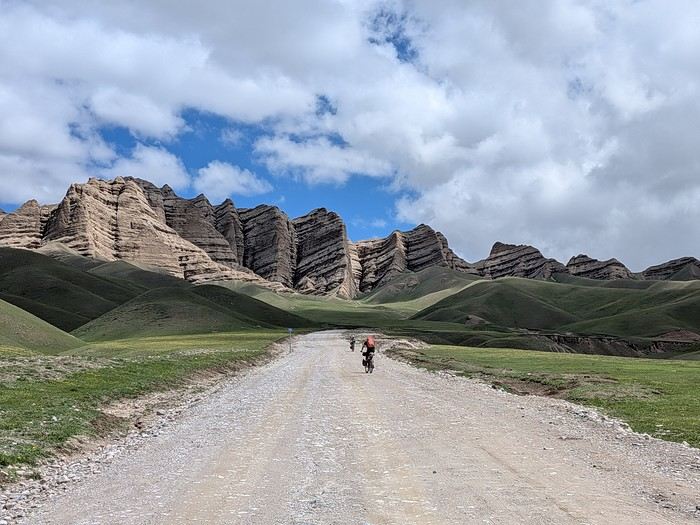
You’ll find here a post with some practical information.
And here, the version of the travel journal without comments.
---/---
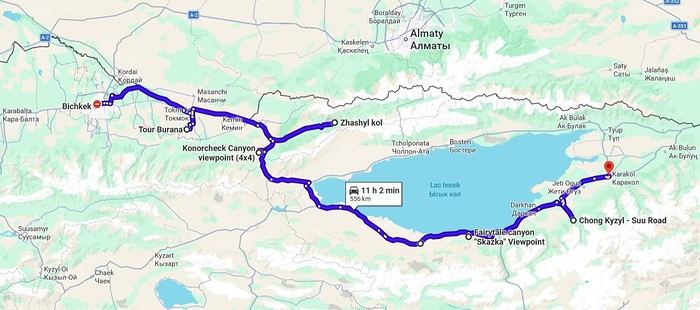
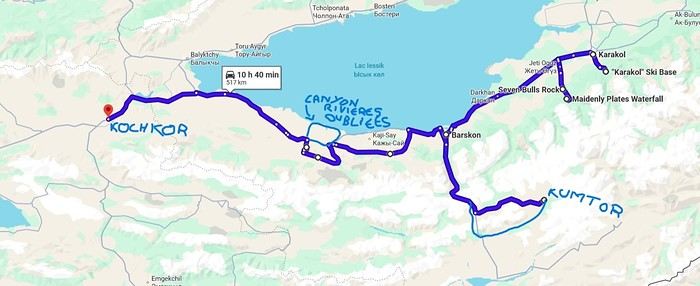
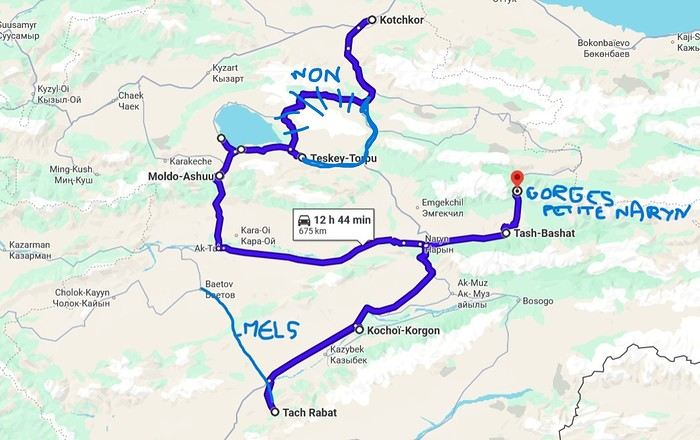
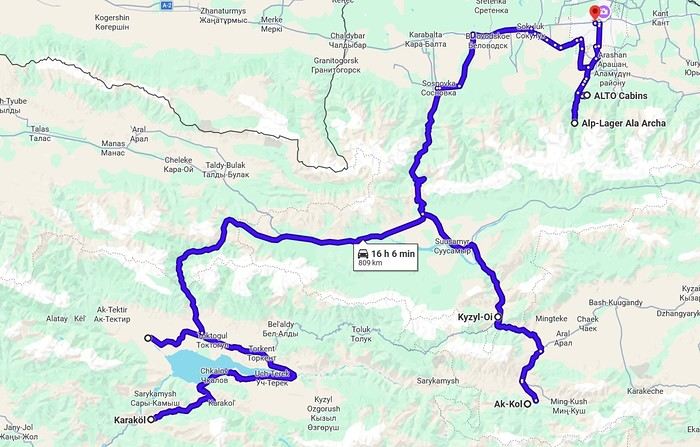
As a supplement, the route track. Not necessarily ultra-accurate since Google has serious gaps for this destination...
From Bishkek to Karakol:
From Karakol to Kochkor:
From Kochkor to Baetov:
From Baetov to Kara-Köl:
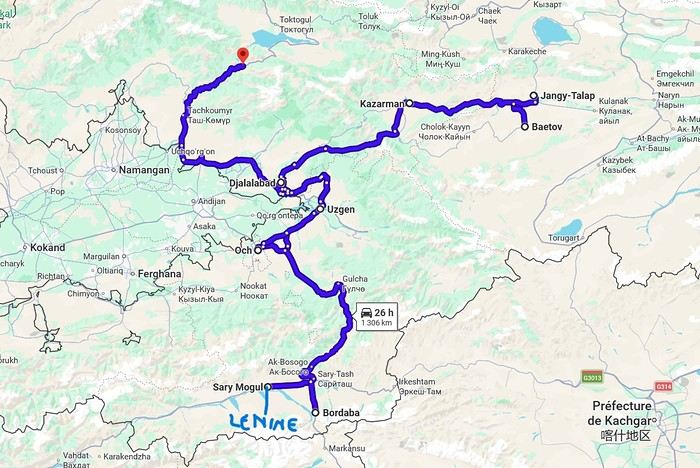
From Kara-Köl to Bishkek:

But the discomfort of overnight stays, the difficulty of communication, and the prices of the few car rental options kept making me postpone the project.
And then, everything suddenly fell into place—I told myself, it’s time!
The preparations took longer than usual; the destination is still far from mainstream.
A bit of Kazakhstan? Not in the end.
The south or not the south? Yes, in the end.
Pre-book or go with the flow? Only two stops were a leap into the unknown.
To help me find the ideal route, I made great use of this forum (thanks to everyone for patiently answering my questions!), pored over travel journals and blogs (Christian, Jeff), zoomed in on Google Maps and Yandex, and bought the guide published by OunTravela about this destination (the guide has been updated since).
---/---
You’ve got your passport, international driver’s license, bank cards, and euros?
Off we go to Lyon—just one night left before our early morning flight.
Tomorrow night, we’ll be sleeping in Bishkek! (Steak for my partner’s mischievous nephews...)
You’ll find here a post with some practical information.
And here, the version of the travel journal without comments.
---/---
As a supplement, the route track. Not necessarily ultra-accurate since Google has serious gaps for this destination...
From Bishkek to Karakol:
From Karakol to Kochkor:
From Kochkor to Baetov:
From Baetov to Kara-Köl:
From Kara-Köl to Bishkek:
Villages around Hazaribagh in West Bengal
Wednesday, April 1st
Hazaribagh I’ve got a meet-up with Adam Iman, a guide and painter. He picks me up from the hotel at 10 AM. Another traveler from Bangalore is supposed to join us, but while we wait for him to arrive, Adam takes me to see the paintings his mother and sister created at Hazaribagh station. The town became famous thanks to these murals, which can also be found in several surrounding villages. This art form has earned recognition and is now protected, a sign of its cultural importance. Once the visit is over, we go to pick up the other traveler and then head to our first village: Belwara, where Sohrai art is practiced. At the entrance, a sign proudly announces that we’re entering an artists’ village, where this art is created by women organized into micro-enterprises. Some even offer workshops for those who’d like to learn this tradition.
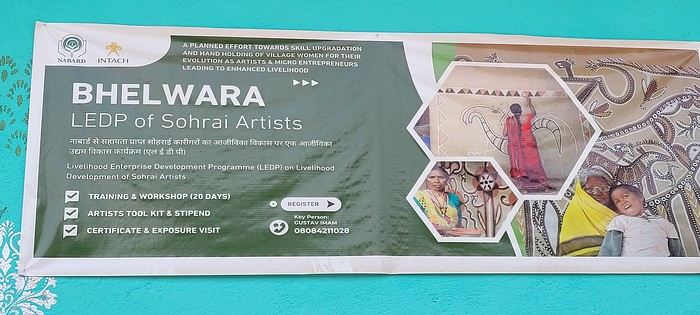
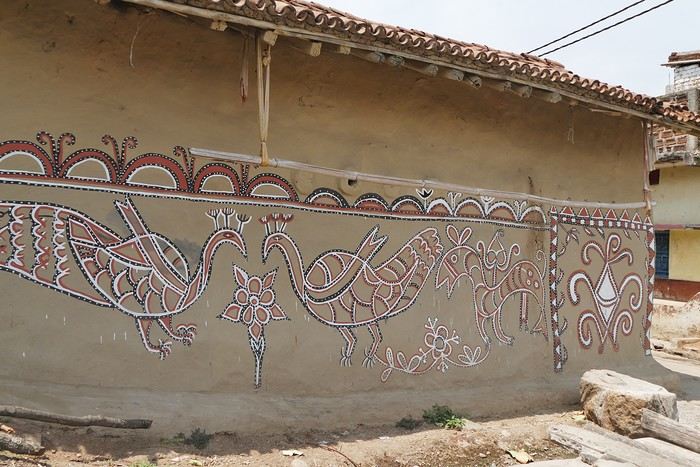
Sohrai art is tied to the harvest season, from October to mid-November. The motifs, in natural colors, celebrate fertility and abundance. The artists use pigments from the earth: red oxides, ochre, white kaolin, and black manganese. On the walls, you’ll see animals, fish, birds—all symbols of life and prosperity. As I look closer at the murals, I start to realize that each motif tells a story. Large animals like cows or bulls often take center stage. Their bodies are filled with intricate, almost hypnotic patterns. They symbolize wealth and prosperity for the household, as well as the deep respect for cattle, which are essential to daily life. On some facades, elephants stand out—massive and decorated with the same precision. They evoke quiet strength and protection. But it’s when I stop in front of one of the houses that I really take the time to look. The wall, a soft ochre, is entirely covered in murals. Two large animals stretch out on either side of the door, their elongated bodies fitting the length of the wall. Their silhouettes are filled with geometric patterns and incredibly fine curved lines, as if every space was patiently filled. Around them, stylized plants, flowers, and small decorative elements fill every gap. The door, dark and worn, becomes almost the silent center of the composition, framed by these living, protective forms. To the right, a more colorful motif catches the eye—a flower or a stylized lamp—like a touch of light on the earth. The whole thing gives an impression of perfect balance, between the rigor of the patterns and the freedom of the gesture.
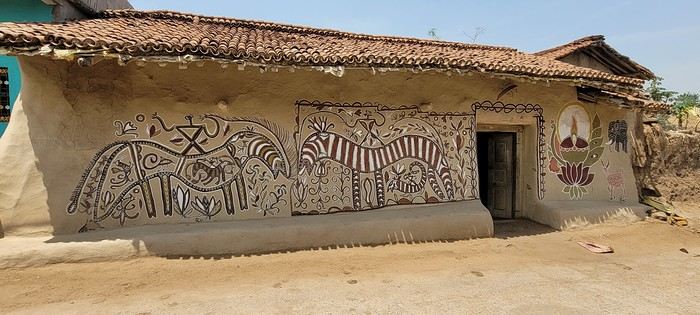
Elsewhere, birds and freer forms bring movement. Peacocks, recognizable by their stylized silhouettes, embody beauty and vitality, while fish symbolize water, fertility, and the continuity of life.
 On some paintings, the scenes become almost narrative: you can make out figures, everyday gestures, like a memory of the village inscribed in the walls. The decorative frames around the doors aren’t left to chance either—they symbolically protect the house, like a boundary between the inside and the outside world.
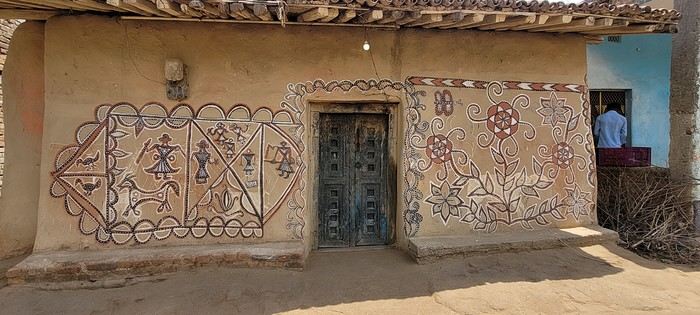
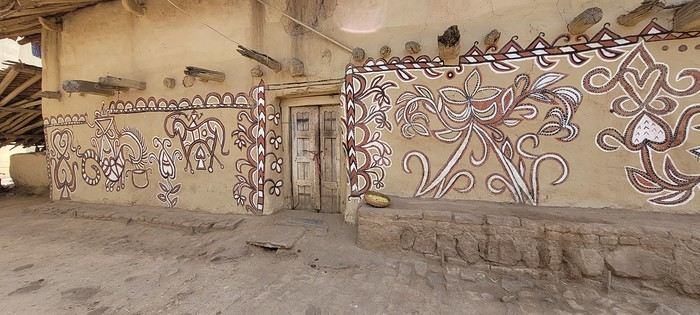
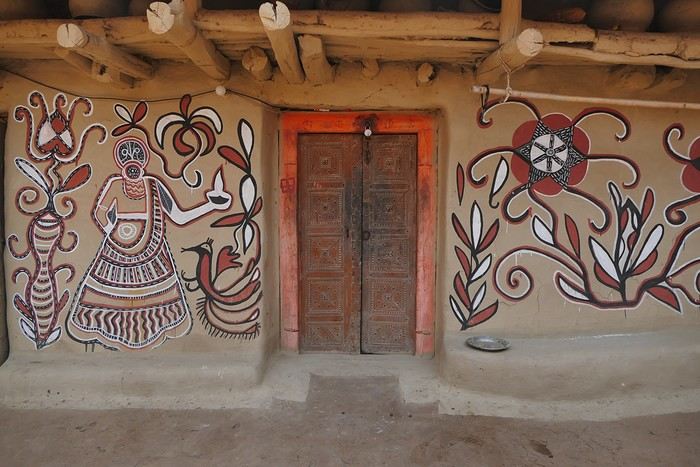
During the Sohrai festival, cattle are led into the jungle in the morning. Meanwhile, the women finish the *aripans*—these floor paintings—and continue the wall murals. Around noon, the animals return to the village, and the bulls’ horns are anointed with oil and vermilion in a gesture of gratitude, amid the vibrant colors adorning the houses. We visit several artists, including Parvat Devi, a well-known woman who has received many awards. Her arms are adorned with intriguing tattoos, which I’ll talk about in more detail later.
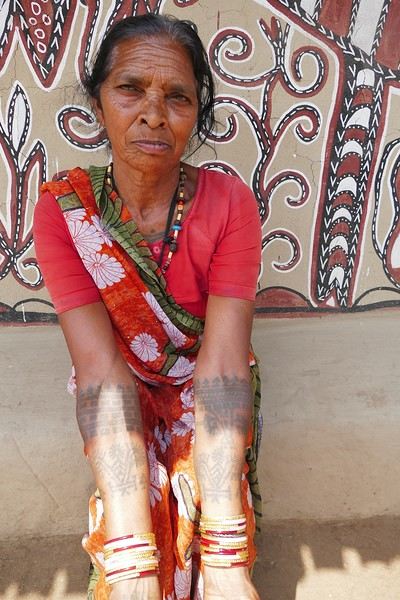
On another wall, the style changes completely. Here, no massive animals—just birds occupying the space, light and graceful, as if caught in mid-movement. Two silhouettes face each other, their long necks arched almost like mirrors, while their outstretched wings seem to vibrate with the patterns that compose them.
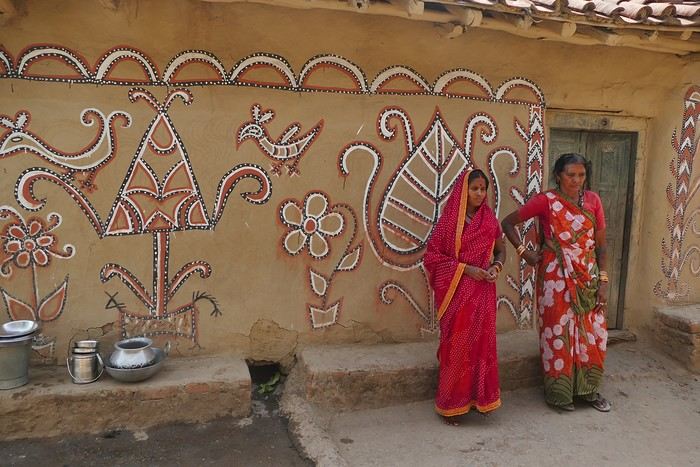
The design is more graphic, almost airy. The lines are smoother, more fluid, as if drawn in one confident stroke. The birds’ bodies aren’t solid—they’re filled with repetitive motifs like scales, stylized feathers, and spirals, giving a sense of continuous movement. Around them, everything comes to life: flowers burst open, arabesques swirl, and even the simplest shapes seem alive. What strikes me here is the sense of lightness. Where the large animals evoked stability and grounding, these birds bring something freer, almost joyful. They seem to embody movement, the circulation of life, like a breath flowing through the village.
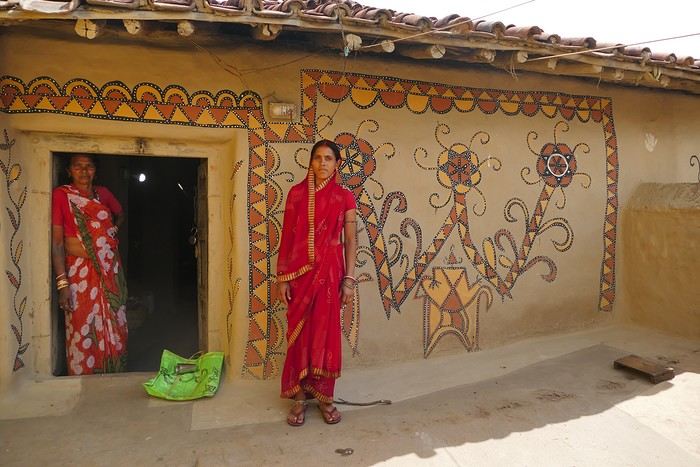
The colors remain the same—deep reds, intense blacks, and chalky white—but the rhythm is different. Faster, more spontaneous. As if each wall had its own personality, while still speaking the same language.
That’s probably why I’m so moved. I’d heard about these paintings from my friend Raja, and last year, I saw an exhibition in a village near my home. That first encounter made me want to come here. But seeing them in person is a whole different experience. These paintings are unique. This ancient art is passed down from mother to daughter, or mother-in-law to daughter-in-law, in a quiet, deeply living continuity. At first glance, it might seem almost childlike in its simplicity and pared-down forms. And yet, everything is thought out, balanced, mastered. Nothing is left to chance.
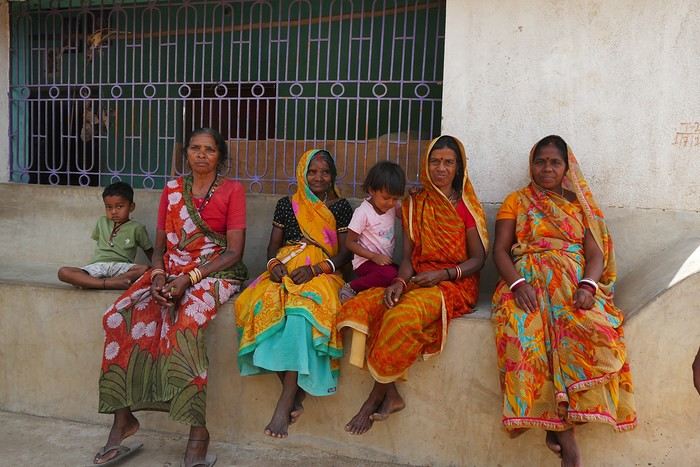
That apparent simplicity, combined with such rich symbolism, touches me deeply. There’s something sincere and essential in these walls—and that’s what moves me.
Hazaribagh I’ve got a meet-up with Adam Iman, a guide and painter. He picks me up from the hotel at 10 AM. Another traveler from Bangalore is supposed to join us, but while we wait for him to arrive, Adam takes me to see the paintings his mother and sister created at Hazaribagh station. The town became famous thanks to these murals, which can also be found in several surrounding villages. This art form has earned recognition and is now protected, a sign of its cultural importance. Once the visit is over, we go to pick up the other traveler and then head to our first village: Belwara, where Sohrai art is practiced. At the entrance, a sign proudly announces that we’re entering an artists’ village, where this art is created by women organized into micro-enterprises. Some even offer workshops for those who’d like to learn this tradition.
Sohrai art is tied to the harvest season, from October to mid-November. The motifs, in natural colors, celebrate fertility and abundance. The artists use pigments from the earth: red oxides, ochre, white kaolin, and black manganese. On the walls, you’ll see animals, fish, birds—all symbols of life and prosperity. As I look closer at the murals, I start to realize that each motif tells a story. Large animals like cows or bulls often take center stage. Their bodies are filled with intricate, almost hypnotic patterns. They symbolize wealth and prosperity for the household, as well as the deep respect for cattle, which are essential to daily life. On some facades, elephants stand out—massive and decorated with the same precision. They evoke quiet strength and protection. But it’s when I stop in front of one of the houses that I really take the time to look. The wall, a soft ochre, is entirely covered in murals. Two large animals stretch out on either side of the door, their elongated bodies fitting the length of the wall. Their silhouettes are filled with geometric patterns and incredibly fine curved lines, as if every space was patiently filled. Around them, stylized plants, flowers, and small decorative elements fill every gap. The door, dark and worn, becomes almost the silent center of the composition, framed by these living, protective forms. To the right, a more colorful motif catches the eye—a flower or a stylized lamp—like a touch of light on the earth. The whole thing gives an impression of perfect balance, between the rigor of the patterns and the freedom of the gesture.
Elsewhere, birds and freer forms bring movement. Peacocks, recognizable by their stylized silhouettes, embody beauty and vitality, while fish symbolize water, fertility, and the continuity of life.
On some paintings, the scenes become almost narrative: you can make out figures, everyday gestures, like a memory of the village inscribed in the walls. The decorative frames around the doors aren’t left to chance either—they symbolically protect the house, like a boundary between the inside and the outside world.During the Sohrai festival, cattle are led into the jungle in the morning. Meanwhile, the women finish the *aripans*—these floor paintings—and continue the wall murals. Around noon, the animals return to the village, and the bulls’ horns are anointed with oil and vermilion in a gesture of gratitude, amid the vibrant colors adorning the houses. We visit several artists, including Parvat Devi, a well-known woman who has received many awards. Her arms are adorned with intriguing tattoos, which I’ll talk about in more detail later.
On another wall, the style changes completely. Here, no massive animals—just birds occupying the space, light and graceful, as if caught in mid-movement. Two silhouettes face each other, their long necks arched almost like mirrors, while their outstretched wings seem to vibrate with the patterns that compose them.
The design is more graphic, almost airy. The lines are smoother, more fluid, as if drawn in one confident stroke. The birds’ bodies aren’t solid—they’re filled with repetitive motifs like scales, stylized feathers, and spirals, giving a sense of continuous movement. Around them, everything comes to life: flowers burst open, arabesques swirl, and even the simplest shapes seem alive. What strikes me here is the sense of lightness. Where the large animals evoked stability and grounding, these birds bring something freer, almost joyful. They seem to embody movement, the circulation of life, like a breath flowing through the village.
The colors remain the same—deep reds, intense blacks, and chalky white—but the rhythm is different. Faster, more spontaneous. As if each wall had its own personality, while still speaking the same language.
That’s probably why I’m so moved. I’d heard about these paintings from my friend Raja, and last year, I saw an exhibition in a village near my home. That first encounter made me want to come here. But seeing them in person is a whole different experience. These paintings are unique. This ancient art is passed down from mother to daughter, or mother-in-law to daughter-in-law, in a quiet, deeply living continuity. At first glance, it might seem almost childlike in its simplicity and pared-down forms. And yet, everything is thought out, balanced, mastered. Nothing is left to chance.
That apparent simplicity, combined with such rich symbolism, touches me deeply. There’s something sincere and essential in these walls—and that’s what moves me.
16 days with family in La Gomera (Canary Islands)
Preamble: Why La Gomera?
When we started looking for a summer destination a few months ago, our first criterion was to avoid extreme heat and heatwaves. We had already been to Norway two years ago and are considering going back in the future for other occasions. So, we had some fun asking ChatGPT which destinations enjoyed a mild climate during the summer without going too far. Among the list provided by the AI were the Canary Islands... The idea of a place we wouldn’t have thought of first, both not too far away and exotic enough, appealed to us: “Hmm, why not?”
This destination had never really attracted me, though Magali was a bit more interested. Five years earlier, COVID had caused a short break in my professional activity, and I had planned a trip because the flight price was attractive, and I was looking for a destination different from what usually appeals to me, more than out of deep interest. From a distance and with a social judgment I acknowledge (it’s not great, but it’s not completely wrong), I had the image of a destination for party-goers enjoying the sun without the slightest interest in local culture, with concrete coastlines and denatured landscapes—everything I detest the most. Still, I had done some quick research on the different islands and spotted Lanzarote for its beautiful volcanic landscapes, hiking trails, beaches, and the impression of a good balance between activity and fewer crowds than Tenerife or Gran Canaria. Then I dropped the idea of going, without ever reconsidering traveling to the Canaries...
Until now! Because we started researching the different islands of the archipelago to see which ones might appeal to us the most. It was La Gomera, the third smallest island of the archipelago, more praised for its hiking trails and preserved nature than for its beaches, away from mass tourism (fifty times fewer tourists than Tenerife) but still a bit more developed than its wild neighbor El Hierro, that caught our attention. Contrary to what might be suggested later, I’m not at all addicted to AI, but I use it from time to time to synthesize quick research or simply for experimentation. Since ChatGPT had started anticipating my tastes lately as if it had become my buddy (often successfully, sometimes off the mark), I asked which Canary Island would suit me best for a trip with my family. The tool answered first with... La Gomera. So, I tested it and teased it a bit to see if this suggestion was well-founded, as the method sometimes makes it contradict itself. But no luck: “You’d appreciate the wild nature of El Hierro, but with family, you’ll find little activity for the kids. You won’t like the touristy vibe of the big islands like Tenerife, Gran Canaria, Lanzarote, and Fuerteventura. You could consider La Palma, but it’s really La Gomera that will suit you best, based on your interests and the criteria given.” So, we dug deeper into our research and were convinced without a shadow of a doubt that this island was the one waiting for us.
Without knowing it, we had Canarians in our circle who revealed their origins when they heard about our travel plans. One from Tenerife insisted we’d be better off choosing Tenerife (obviously...) because it also has preserved spots and that La Gomera, “you can explore it in two or three days, you’ll get bored quickly...” The other, a colleague from Gran Canaria who had never visited La Gomera, still recommended it without hesitation because it turned out her parents had just gone there on vacation: they loved it and had encountered few tourists. She also tended to think this destination was usually the subject of short stays, but according to what her parents told her, taking your time there was also a great idea. However, in our research, the idea that La Gomera is an island you can explore in three or four days max kept coming up. So, we considered combining its visit with La Palma or El Hierro, the other two that caught our eye. But hopping between islands by ferry represents a significant budget for non-Canarians, even more so for a family of four. Then, scrutinizing Google Maps, it seemed obvious that two weeks were too short to discover two islands as they deserve, and that there seemed to be plenty to see in La Gomera, given its very unique culture. After all, we read that some people spend several months a year there, others never even leave... Finally, these landscapes and this atmosphere, which seemed to us a mix of Europe, North Africa, and Latin America, tempted us. So, it would be two weeks in La Gomera, deal!
La Gomera is therefore the second... well, the third smallest island of the Canaries since La Graciosa was recently recognized as a fully inhabited island. It has the shape of a rough circle about 20 to 25 kilometers in diameter and has just over 20,000 inhabitants, half of them in its capital, San Sebastián de la Gomera, the only real town. Like its Canarian sisters, La Gomera is a volcanic formation that rose about 10 million years ago. The island is very mountainous and rugged, covered with red and black rocky landscapes. Geological activity has shaped, between the sprawling massifs that end in steep cliffs in the ocean, six coastal valleys with tropical vegetation that have favored human settlement. They divide the island like slices of a cake; from the north clockwise: the agricultural Vallehermoso, the rustic Agulo, the green, humid, and fertile Hermigua, the sunny capital San Sebastián de la Gomera, the southern and isolated Alajeró-Santiago, and the seaside Valle Gran Rey. They constitute the six municipalities (more like cantons to our French understanding) of the territory.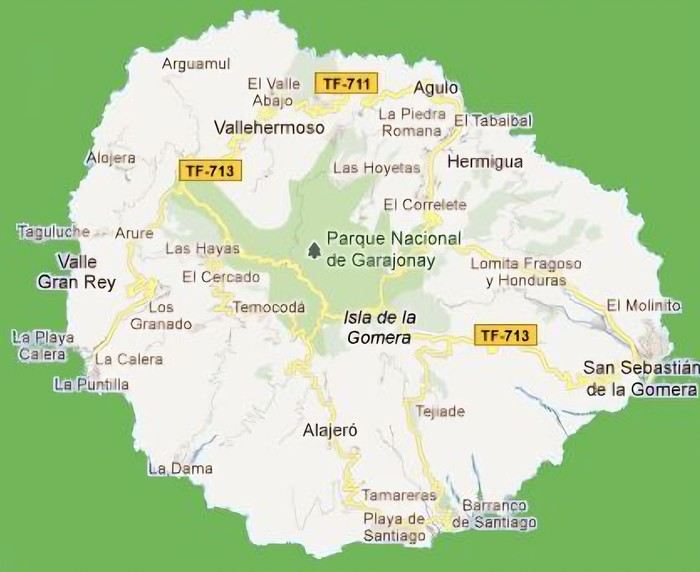 The large solidified magma massifs that shape the heart of the island have created a large depression more protected from the sun at its center, allowing the growth of a vast laurel forest, today grouped within the Garajonay National Park, La Gomera’s green lung, which has earned it the status of a World Biosphere Reserve. Its completely European appearance contrasts sharply with the rocky and tropical landscapes of the rest of the island. Thus, the climate varies greatly from one point to another on the island: in summer, you can quickly go from a dry and sunny valley at 35°C to a humid forest area at altitude at 18°C.
La Gomera was populated late. As with the rest of the Canaries, human presence is thought to have begun about 2,000 years ago. Groups of animist Berbers, probably fleeing persecution, gradually populated the archipelago, especially the western islands and La Gomera, becoming its small aboriginal population: the Guanches (or later Gomeros). The animist and pastoral civilization of the Guanches thrived until the Spanish takeover in the 15th century, which, after a short period of harmony and mixing with the indigenous people, suddenly ended in bloodshed... La Gomera later became the “Columbus Island” after Christopher Columbus’s stopover, increasing the blending of populations. In the 20th century, many Gomeros emigrated to Cuba and other Latin American countries in search of a better life, bringing back a mix of cultures and traits quite palpable in today’s Gomeran culture. It is, however, in La Gomera that the vestiges of Guanche culture seem to have left the most traces, in the language, gastronomy, social practices... Moreover, most Gomeros, especially in remote villages, have a particular identifiable type and proudly claim their ancestral roots, even making La Gomera a bit exotic in the eyes of other Canarians.
Perhaps that’s why it has never really wanted to develop its tourist infrastructure too much. If we set aside the tourists who visit for the day by bus or boat from Tenerife on a marked itinerary (and whom we ultimately rarely encounter), La Gomera has remained a hidden gem, a destination focused on nature discovery that attracts hikers, nature-loving divers, and scientists for its fauna and flora, and to a lesser extent, beachgoers who don’t seek overly developed coastlines. Tourist activity is therefore limited. Roughly speaking, you’ll find a majority of Spaniards, including a substantial number of residents from other Canary Islands, many Germans who have a particular fondness for La Gomera and spend long stays there or own second homes, to the point that the German cultural footprint is clearly noticeable in some places (it’s said to be Angela Merkel’s favorite holiday spot), and still quite a few French. The presence of other nationalities seemed negligible to us. Most travelers come mainly for hiking, but it’s also a prime spot for whale watching. Additionally, the seaside resorts of La Gomera—San Sebastián, Santiago, and especially Valle Gran Rey—are well-known destinations for hippies, especially German ones, ranging from chic boho hippies to old-school hippies who’ve been there for decades, quite similar to those you’d meet in India in Goa, Rishikesh, or Paharganj. Thus, practices like naturism, vegetarianism, and local organic production are quite well established in some areas.
Some practical info: - The round-trip flight from Paris to Tenerife cost us 365 € per person (outbound with Transavia, return with EasyJet), including checked luggage and three seats reserved side by side. - We chose two bases to explore the island: one week in Valle Gran Rey, reputed to be the most pleasant of the three seaside resorts, and one week in Hermigua, more mountainous and close to the natural park. We booked two houses with balconies and views: the first at 120 € per night, the second at 99 €. - The round-trip ferry between Tenerife and La Gomera cost us 270 € with the company Baleària Canarias, including discounts for children aged 4 and 12, but I don’t have the exact details. It was a bit cheaper than with the other company, Fred Olsen. - Finally, we rented a car through the agency Cicar for 360 € for 16 days, which comes to 22.50 € per day. - Apart from that, we didn’t plan anything and decided the day before or even the morning of what we wanted to do. We didn’t invest in any paper guide on the Canaries, as information on La Gomera was scarce, but we used the very comprehensive site La Gomera Travel, a travel guide published by the Canary Islands Tourism Council, a real goldmine of almost exhaustive information on the island.
Alright, off we go for 16 days of adventure discovering La Gomera!
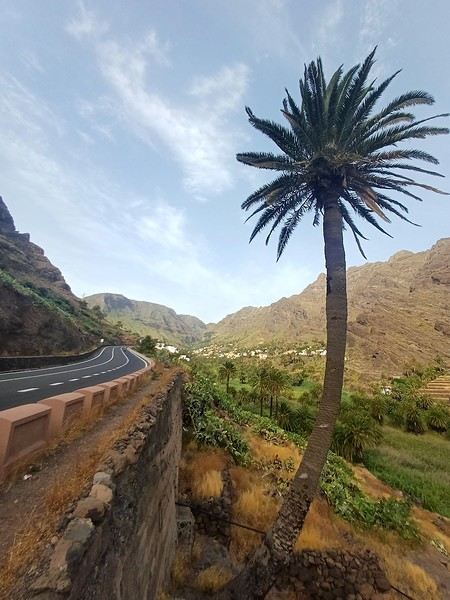
And we start the trip with music!
We start the trip with music!
When we started looking for a summer destination a few months ago, our first criterion was to avoid extreme heat and heatwaves. We had already been to Norway two years ago and are considering going back in the future for other occasions. So, we had some fun asking ChatGPT which destinations enjoyed a mild climate during the summer without going too far. Among the list provided by the AI were the Canary Islands... The idea of a place we wouldn’t have thought of first, both not too far away and exotic enough, appealed to us: “Hmm, why not?”
This destination had never really attracted me, though Magali was a bit more interested. Five years earlier, COVID had caused a short break in my professional activity, and I had planned a trip because the flight price was attractive, and I was looking for a destination different from what usually appeals to me, more than out of deep interest. From a distance and with a social judgment I acknowledge (it’s not great, but it’s not completely wrong), I had the image of a destination for party-goers enjoying the sun without the slightest interest in local culture, with concrete coastlines and denatured landscapes—everything I detest the most. Still, I had done some quick research on the different islands and spotted Lanzarote for its beautiful volcanic landscapes, hiking trails, beaches, and the impression of a good balance between activity and fewer crowds than Tenerife or Gran Canaria. Then I dropped the idea of going, without ever reconsidering traveling to the Canaries...
Until now! Because we started researching the different islands of the archipelago to see which ones might appeal to us the most. It was La Gomera, the third smallest island of the archipelago, more praised for its hiking trails and preserved nature than for its beaches, away from mass tourism (fifty times fewer tourists than Tenerife) but still a bit more developed than its wild neighbor El Hierro, that caught our attention. Contrary to what might be suggested later, I’m not at all addicted to AI, but I use it from time to time to synthesize quick research or simply for experimentation. Since ChatGPT had started anticipating my tastes lately as if it had become my buddy (often successfully, sometimes off the mark), I asked which Canary Island would suit me best for a trip with my family. The tool answered first with... La Gomera. So, I tested it and teased it a bit to see if this suggestion was well-founded, as the method sometimes makes it contradict itself. But no luck: “You’d appreciate the wild nature of El Hierro, but with family, you’ll find little activity for the kids. You won’t like the touristy vibe of the big islands like Tenerife, Gran Canaria, Lanzarote, and Fuerteventura. You could consider La Palma, but it’s really La Gomera that will suit you best, based on your interests and the criteria given.” So, we dug deeper into our research and were convinced without a shadow of a doubt that this island was the one waiting for us.
Without knowing it, we had Canarians in our circle who revealed their origins when they heard about our travel plans. One from Tenerife insisted we’d be better off choosing Tenerife (obviously...) because it also has preserved spots and that La Gomera, “you can explore it in two or three days, you’ll get bored quickly...” The other, a colleague from Gran Canaria who had never visited La Gomera, still recommended it without hesitation because it turned out her parents had just gone there on vacation: they loved it and had encountered few tourists. She also tended to think this destination was usually the subject of short stays, but according to what her parents told her, taking your time there was also a great idea. However, in our research, the idea that La Gomera is an island you can explore in three or four days max kept coming up. So, we considered combining its visit with La Palma or El Hierro, the other two that caught our eye. But hopping between islands by ferry represents a significant budget for non-Canarians, even more so for a family of four. Then, scrutinizing Google Maps, it seemed obvious that two weeks were too short to discover two islands as they deserve, and that there seemed to be plenty to see in La Gomera, given its very unique culture. After all, we read that some people spend several months a year there, others never even leave... Finally, these landscapes and this atmosphere, which seemed to us a mix of Europe, North Africa, and Latin America, tempted us. So, it would be two weeks in La Gomera, deal!
La Gomera is therefore the second... well, the third smallest island of the Canaries since La Graciosa was recently recognized as a fully inhabited island. It has the shape of a rough circle about 20 to 25 kilometers in diameter and has just over 20,000 inhabitants, half of them in its capital, San Sebastián de la Gomera, the only real town. Like its Canarian sisters, La Gomera is a volcanic formation that rose about 10 million years ago. The island is very mountainous and rugged, covered with red and black rocky landscapes. Geological activity has shaped, between the sprawling massifs that end in steep cliffs in the ocean, six coastal valleys with tropical vegetation that have favored human settlement. They divide the island like slices of a cake; from the north clockwise: the agricultural Vallehermoso, the rustic Agulo, the green, humid, and fertile Hermigua, the sunny capital San Sebastián de la Gomera, the southern and isolated Alajeró-Santiago, and the seaside Valle Gran Rey. They constitute the six municipalities (more like cantons to our French understanding) of the territory.
The large solidified magma massifs that shape the heart of the island have created a large depression more protected from the sun at its center, allowing the growth of a vast laurel forest, today grouped within the Garajonay National Park, La Gomera’s green lung, which has earned it the status of a World Biosphere Reserve. Its completely European appearance contrasts sharply with the rocky and tropical landscapes of the rest of the island. Thus, the climate varies greatly from one point to another on the island: in summer, you can quickly go from a dry and sunny valley at 35°C to a humid forest area at altitude at 18°C.La Gomera was populated late. As with the rest of the Canaries, human presence is thought to have begun about 2,000 years ago. Groups of animist Berbers, probably fleeing persecution, gradually populated the archipelago, especially the western islands and La Gomera, becoming its small aboriginal population: the Guanches (or later Gomeros). The animist and pastoral civilization of the Guanches thrived until the Spanish takeover in the 15th century, which, after a short period of harmony and mixing with the indigenous people, suddenly ended in bloodshed... La Gomera later became the “Columbus Island” after Christopher Columbus’s stopover, increasing the blending of populations. In the 20th century, many Gomeros emigrated to Cuba and other Latin American countries in search of a better life, bringing back a mix of cultures and traits quite palpable in today’s Gomeran culture. It is, however, in La Gomera that the vestiges of Guanche culture seem to have left the most traces, in the language, gastronomy, social practices... Moreover, most Gomeros, especially in remote villages, have a particular identifiable type and proudly claim their ancestral roots, even making La Gomera a bit exotic in the eyes of other Canarians.
Perhaps that’s why it has never really wanted to develop its tourist infrastructure too much. If we set aside the tourists who visit for the day by bus or boat from Tenerife on a marked itinerary (and whom we ultimately rarely encounter), La Gomera has remained a hidden gem, a destination focused on nature discovery that attracts hikers, nature-loving divers, and scientists for its fauna and flora, and to a lesser extent, beachgoers who don’t seek overly developed coastlines. Tourist activity is therefore limited. Roughly speaking, you’ll find a majority of Spaniards, including a substantial number of residents from other Canary Islands, many Germans who have a particular fondness for La Gomera and spend long stays there or own second homes, to the point that the German cultural footprint is clearly noticeable in some places (it’s said to be Angela Merkel’s favorite holiday spot), and still quite a few French. The presence of other nationalities seemed negligible to us. Most travelers come mainly for hiking, but it’s also a prime spot for whale watching. Additionally, the seaside resorts of La Gomera—San Sebastián, Santiago, and especially Valle Gran Rey—are well-known destinations for hippies, especially German ones, ranging from chic boho hippies to old-school hippies who’ve been there for decades, quite similar to those you’d meet in India in Goa, Rishikesh, or Paharganj. Thus, practices like naturism, vegetarianism, and local organic production are quite well established in some areas.
Some practical info: - The round-trip flight from Paris to Tenerife cost us 365 € per person (outbound with Transavia, return with EasyJet), including checked luggage and three seats reserved side by side. - We chose two bases to explore the island: one week in Valle Gran Rey, reputed to be the most pleasant of the three seaside resorts, and one week in Hermigua, more mountainous and close to the natural park. We booked two houses with balconies and views: the first at 120 € per night, the second at 99 €. - The round-trip ferry between Tenerife and La Gomera cost us 270 € with the company Baleària Canarias, including discounts for children aged 4 and 12, but I don’t have the exact details. It was a bit cheaper than with the other company, Fred Olsen. - Finally, we rented a car through the agency Cicar for 360 € for 16 days, which comes to 22.50 € per day. - Apart from that, we didn’t plan anything and decided the day before or even the morning of what we wanted to do. We didn’t invest in any paper guide on the Canaries, as information on La Gomera was scarce, but we used the very comprehensive site La Gomera Travel, a travel guide published by the Canary Islands Tourism Council, a real goldmine of almost exhaustive information on the island.
Alright, off we go for 16 days of adventure discovering La Gomera!
And we start the trip with music!
We start the trip with music!
A little piece of Sulawesi with the family: Rantepao and Selayar
I’d been wanting to discover Sulawesi for years. But then life happened—COVID, the cost of flight tickets, you name it. Long story short, years went by, but we finally set off as a family for a three-week trip in southern Sulawesi: Rammang Rammang, Rantepao, Sengkang, Bira, and Selayar.
I like to spend a good amount of time in the places I visit, giving myself the chance to really get to know the area and meet locals. So no island-hopping this time—just the south. But when I say "just," it’s not restrictive at all, given how rich this island is in landscapes, little encounters, and magical moments.
Wednesday 07/08 - Thursday 07/09: We left Montpellier for what was supposed to be five flights, though we only took four to start, landing in Jakarta. We picked up our luggage there to catch a flight to Makassar the next day. That’s the only way we could get an affordable ticket (702 €). I won’t bore you with the flight details—there’s not much to say. We arrived at 7 PM and considered heading straight to Makassar that evening. But we opted for a recovery night before taking off again. Good thing we did, because my son’s suitcase was missing... First contact with the locals was a bit stressful—a trip without your luggage isn’t exactly fun. But right away, a woman reassured us: the suitcase was just enjoying some extra time in Singapore. Maybe it was doing some last-minute shopping. Anyway, nothing serious—it was supposed to arrive at 9 AM the next day. That gave us some breathing room since our flight wasn’t until noon. So off we went to our hotel (Days Hotel & Suites) near the airport. It was cheap (40 € for three rooms—my kids are older and need their space), but it wasn’t worth much more. The place had definitely seen better days. But no big deal—we were only there for the night, and... we got to watch France beat Morocco in the World Cup live at 3 AM. That’s what really mattered!
Friday 07/10: In search of the lost suitcase First challenge of the morning: finding our missing suitcase. They sent us to the airport basement, to the staff entrance. We were greeted with smiles, and an airport employee led me through the underground corridors back to the baggage claim. Right on time at 9 AM, the suitcase arrived, just like they’d promised. We were finally complete! Off we went to change terminals, grab a well-deserved meal, and board our fifth flight to Makassar. Little side note: I struggled for a while trying to book domestic flights directly on the airlines’ websites with no luck. Without meaning to advertise (though I guess I am a little), I realized it’d be easier to use sites like tiket.com or Traveloka. That turned out to be a great choice—I even ended up booking hotels through them later in the trip. 12:40 PM: We were on our way to Makassar. First good news: we were the only tourists. Well, the only European tourists on the flight, anyway. No, you’re not dreaming—the bag is full of... potato chip packets. To each their own souvenirs, I guess...

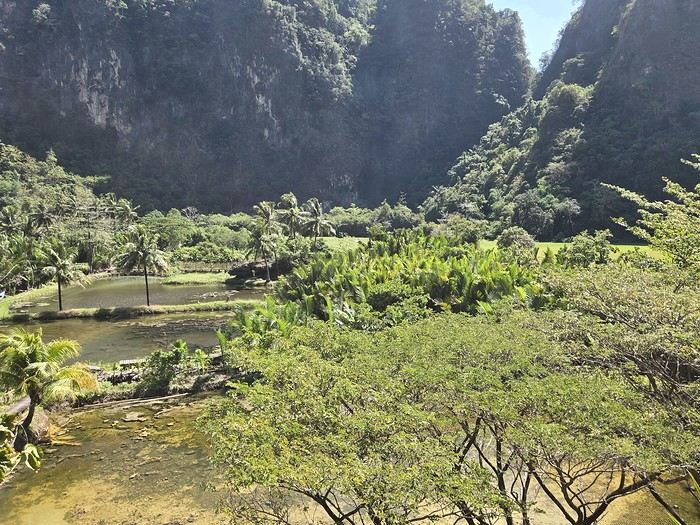
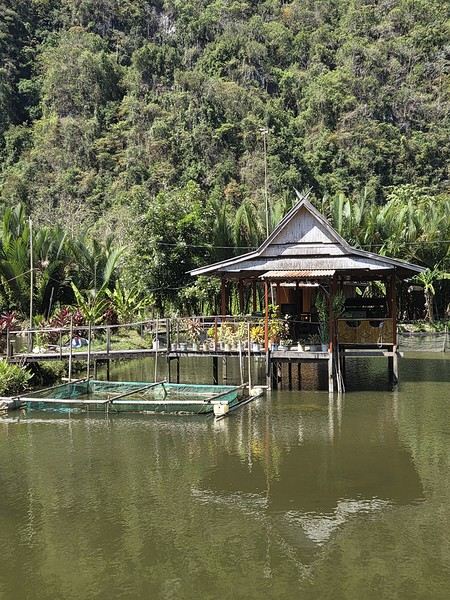
When we arrived in Makassar, a driver was waiting to take us straight to Rammang Rammang: 250,000 IDR (12 €) to our guesthouse (Rammang Rammang House). Forget about meeting people on the bus—we were headed straight to the first stop of our trip, and it was already stunning.
My kids’ guesthouse: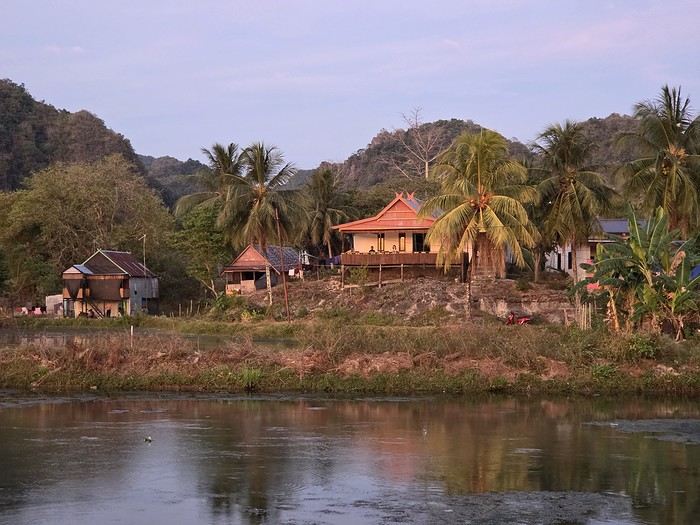
Ours: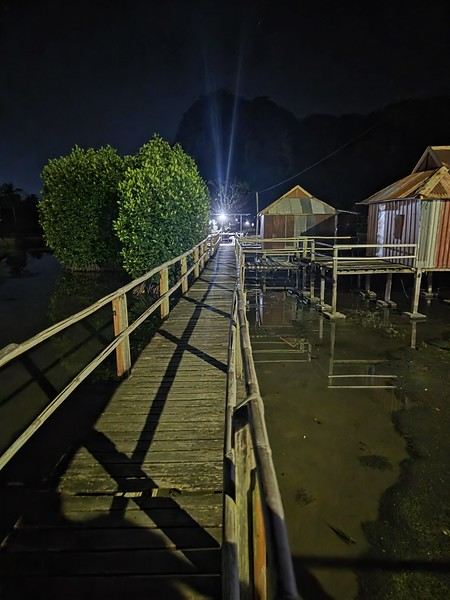
View of the little lake: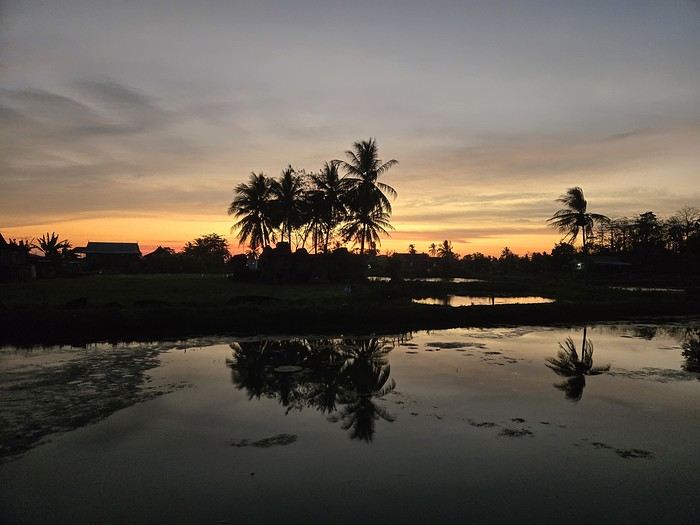
But not everything is straightforward around here. I wanted to get a local SIM card for internet and calls. I found them expensive at Jakarta’s airport (20 € for 20 GB), so I decided to wait. Well, no luck in Rammang Rammang either. You can’t just buy one from the local shop—you need a Telkomsat store (they have the best coverage). So we’d have to wait for Rantepao to get Wi-Fi... When I say "local shop," I mean the little shack around the corner. No big deal—we’d find one easily in Rantepao for 5 € and 25 GB. So there we were, offline, just the four of us enjoying the amazing view.
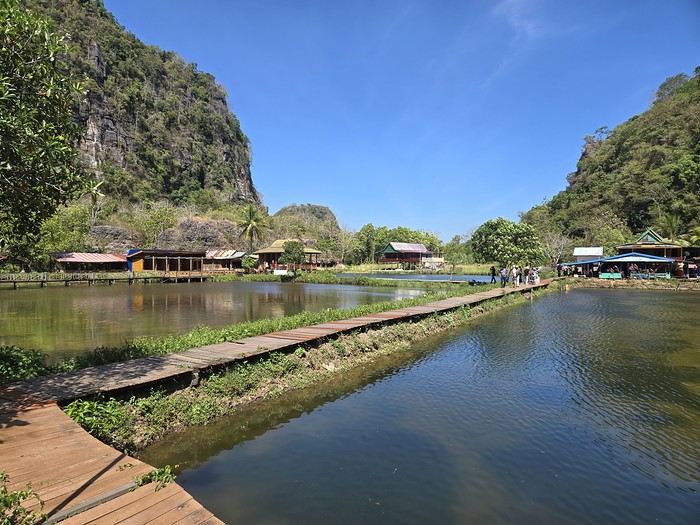
Saturday 07/11: Rammang Rammang We woke up early to the sound of wedding music blasting through the village (everyone’s invited!). Off we went to explore the area. A little walking, a little boat ride (shared with a French tourist and a Polish one—yes, there *are* tourists here, just not many; 750,000 IDR for up to 8 people) through a lovely canal, and we discovered the karst site. It was peaceful and beautiful. The river: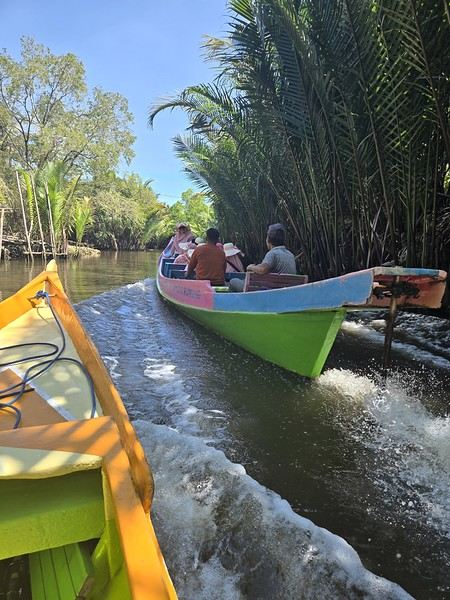 The karst site:
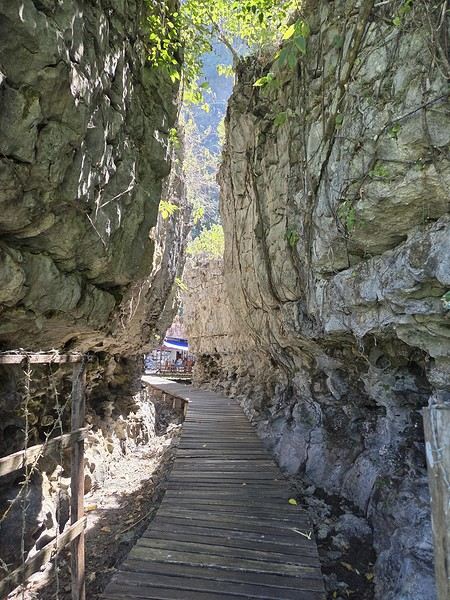
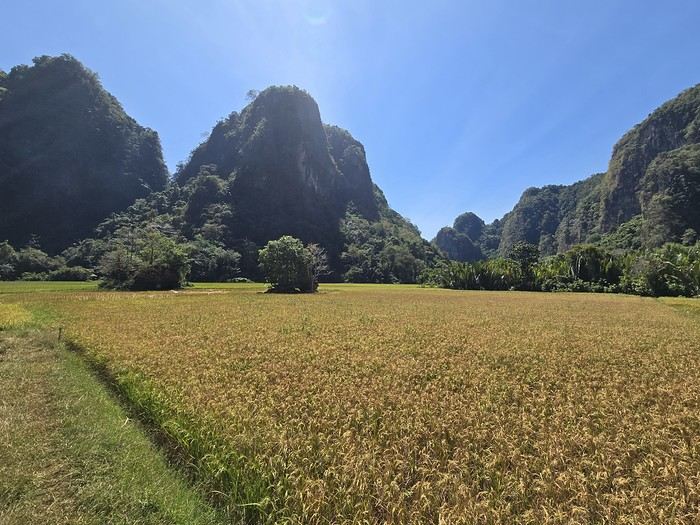
Wednesday 07/08 - Thursday 07/09: We left Montpellier for what was supposed to be five flights, though we only took four to start, landing in Jakarta. We picked up our luggage there to catch a flight to Makassar the next day. That’s the only way we could get an affordable ticket (702 €). I won’t bore you with the flight details—there’s not much to say. We arrived at 7 PM and considered heading straight to Makassar that evening. But we opted for a recovery night before taking off again. Good thing we did, because my son’s suitcase was missing... First contact with the locals was a bit stressful—a trip without your luggage isn’t exactly fun. But right away, a woman reassured us: the suitcase was just enjoying some extra time in Singapore. Maybe it was doing some last-minute shopping. Anyway, nothing serious—it was supposed to arrive at 9 AM the next day. That gave us some breathing room since our flight wasn’t until noon. So off we went to our hotel (Days Hotel & Suites) near the airport. It was cheap (40 € for three rooms—my kids are older and need their space), but it wasn’t worth much more. The place had definitely seen better days. But no big deal—we were only there for the night, and... we got to watch France beat Morocco in the World Cup live at 3 AM. That’s what really mattered!
Friday 07/10: In search of the lost suitcase First challenge of the morning: finding our missing suitcase. They sent us to the airport basement, to the staff entrance. We were greeted with smiles, and an airport employee led me through the underground corridors back to the baggage claim. Right on time at 9 AM, the suitcase arrived, just like they’d promised. We were finally complete! Off we went to change terminals, grab a well-deserved meal, and board our fifth flight to Makassar. Little side note: I struggled for a while trying to book domestic flights directly on the airlines’ websites with no luck. Without meaning to advertise (though I guess I am a little), I realized it’d be easier to use sites like tiket.com or Traveloka. That turned out to be a great choice—I even ended up booking hotels through them later in the trip. 12:40 PM: We were on our way to Makassar. First good news: we were the only tourists. Well, the only European tourists on the flight, anyway. No, you’re not dreaming—the bag is full of... potato chip packets. To each their own souvenirs, I guess...
When we arrived in Makassar, a driver was waiting to take us straight to Rammang Rammang: 250,000 IDR (12 €) to our guesthouse (Rammang Rammang House). Forget about meeting people on the bus—we were headed straight to the first stop of our trip, and it was already stunning.
My kids’ guesthouse:
Ours:
View of the little lake:
But not everything is straightforward around here. I wanted to get a local SIM card for internet and calls. I found them expensive at Jakarta’s airport (20 € for 20 GB), so I decided to wait. Well, no luck in Rammang Rammang either. You can’t just buy one from the local shop—you need a Telkomsat store (they have the best coverage). So we’d have to wait for Rantepao to get Wi-Fi... When I say "local shop," I mean the little shack around the corner. No big deal—we’d find one easily in Rantepao for 5 € and 25 GB. So there we were, offline, just the four of us enjoying the amazing view.
Saturday 07/11: Rammang Rammang We woke up early to the sound of wedding music blasting through the village (everyone’s invited!). Off we went to explore the area. A little walking, a little boat ride (shared with a French tourist and a Polish one—yes, there *are* tourists here, just not many; 750,000 IDR for up to 8 people) through a lovely canal, and we discovered the karst site. It was peaceful and beautiful. The river:
The karst site:
Off on an adventure in Uzbekistan!
April 5 - Day 1
After as many weeks as I have fingers on my right hand, we're hitting the road again, fully recovered from our pharaonic adventure. Back in France to drop off our daughters (sorry, girls!), this time it's just the two of us, ready to be welcomed by a new destination. They say it offers one of the richest cultural heritages in the world for those willing to put in the effort. It's the land of the ancient Silk Road, where we'll follow a journey steeped in history and discoveries straight out of *One Thousand and One Nights*. A former Soviet bloc region independent only since 1991, we'll be walking in the footsteps of Genghis Khan, Tamerlane, Alexander the Great, Marco Polo...
Another fun fact about this country: it's strictly forbidden to import porn on your phone. True story. The same goes for painkillers! Unless it's about sodomy—though the two don’t seem connected, that’s just how it is. Don’t ask me why! Anyway, I’m getting off track. Here’s the big question: Where do you think we’ve just landed?... To give you a hint, the locals are known for being incredibly welcoming. No sooner said than done—our first taxi driver, proud to transport French travelers, refused to let us pay for the ride. Great vibes for these two weeks ahead. So, any guesses? Uzbekistan!!!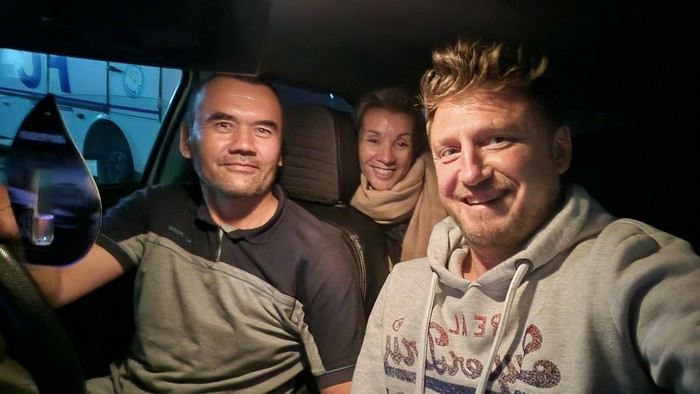
After as many weeks as I have fingers on my right hand, we're hitting the road again, fully recovered from our pharaonic adventure. Back in France to drop off our daughters (sorry, girls!), this time it's just the two of us, ready to be welcomed by a new destination. They say it offers one of the richest cultural heritages in the world for those willing to put in the effort. It's the land of the ancient Silk Road, where we'll follow a journey steeped in history and discoveries straight out of *One Thousand and One Nights*. A former Soviet bloc region independent only since 1991, we'll be walking in the footsteps of Genghis Khan, Tamerlane, Alexander the Great, Marco Polo...
Another fun fact about this country: it's strictly forbidden to import porn on your phone. True story. The same goes for painkillers! Unless it's about sodomy—though the two don’t seem connected, that’s just how it is. Don’t ask me why! Anyway, I’m getting off track. Here’s the big question: Where do you think we’ve just landed?... To give you a hint, the locals are known for being incredibly welcoming. No sooner said than done—our first taxi driver, proud to transport French travelers, refused to let us pay for the ride. Great vibes for these two weeks ahead. So, any guesses? Uzbekistan!!!
Oman, at the edge of the sands and the horizon

If I close my eyes and think of the Sultanate of Oman, I first smell a light scent of incense, feel the warmth of a sunbeam on my skin, before sand slips through my fingers. I taste the sweetness of a date, a real candy, then the flavor of coffee with a hint of cardamom and rosewater... I hear the desert wind whistling in my ears, the distant call of a muezzin, then the murmur of water. I open my eyes to see smiles, welcoming gestures, a turquoise sea, rocks ranging from ochre to purple, deep wadis where torrents burst forth, orange dunes, white sandy beaches where tiny crabs scurry at full speed. I see incredible oases emerging between arid mountains. I see abandoned villages that I’d dream were full of life, imposing fortresses overlooking valleys, and lively souks where offers are delicate and negotiation is a mutual courtesy.
All that, and so much more.
This is what I tried to capture in my illustrated travel journal, which I’ll fill in here and there with photos. I drew this journal “cold,” after my return (actually, I made it this summer, while our trip was last winter). It’s a pretty special format—I bought it in Japan without really knowing what I’d do with it. Well, it found its purpose! Below is a photo of this accordion-style journal: here, it’s only partially open, because when fully unfolded, it’s 5 meters long!
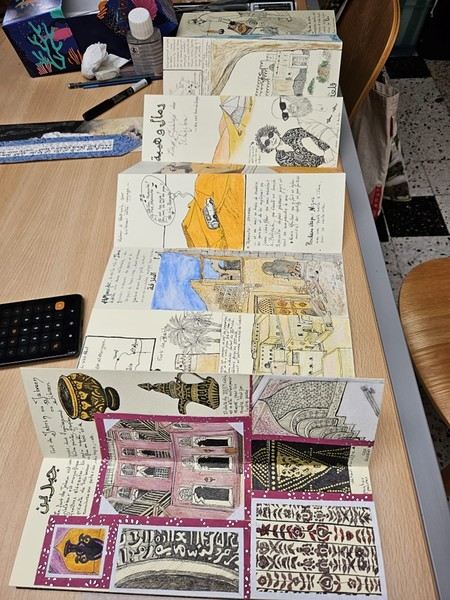
For drawing enthusiasts: The accordion format is both a constraint (each sheet is 9 cm x 27 cm) and a freedom (you can create a fresco). The paper is also a bit special: it doesn’t allow for fine lines, but it takes ink well (liner pen). However, everything has to be done almost in one go (with a very light pencil sketch) because it erases poorly. It absorbs too much water for coloring with markers or watercolors (unless you avoid soaking it), but it works well with oil pastels and their use with a brush and solvent. Since it’s yellowish, it allowed me to create contrasts even with white pastel.
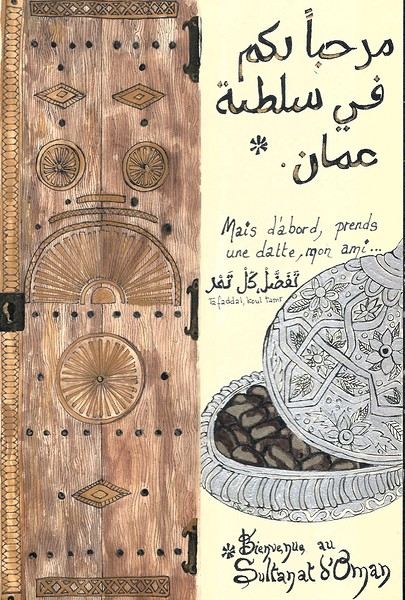 On the right, the "welcome marker"—those dates offered everywhere as a sign of hospitality. On the left, a tribute to those stunning doors worn by time, admired all over the old quarters, including the abandoned ones.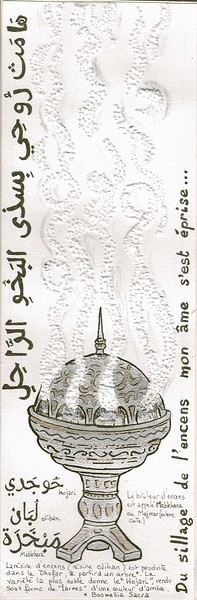
Oman is one of the world’s largest producers of frankincense resin. Incense burners are everywhere, from the simplest clay ones to the most precious handcrafted silver ones...
 Hospitality will often lead you to accept a small coffee, an "Omani coffee," very light, subtly flavored with cardamom, maybe a touch of saffron, and occasionally rosewater.
Here, I’ve depicted a man in the common everyday attire of Omanis: the dishdasha, mostly white (during the week and daytime; colors are more common in the evening or on Fridays and Saturdays). While you’ll see some men dressed in Western clothes, they’re very few. The white dishdasha is truly the shared attire of all men. The dishdasha, which has no hood, is distinguished by a small pom-pom attached to the collar, the furakha, which is soaked in perfume. And believe me, Omanis go overboard with it! "It smells like the pom-pom" is an expression that’s now part of our shared language, my husband and I.
Another must of men’s attire is the kuma, a small round head covering, usually white with brightly colored patterns. The keffiyeh is also worn (but without the cord called an agal in Arab countries), and it’s mostly worn by those with roots in the desert, from what I understood.
And what about the women, you might ask? Some are veiled, some in full black (but not a burka—more like a chador + abaya), due to the influence of Saudi Arabia and the United Arab Emirates, whereas the traditional outfit used to be a layering of very colorful dresses. Most of the women we saw wore neutral clothing, a plain veil over their hair, but with their faces uncovered. We also saw many saris and colorful veils—don’t forget that 40% of the population consists of Indian, Nepalese, and Bangladeshi immigrants, who work a lot in tourism, hospitality, restaurants, services, and construction.
Just to clarify, as a tourist, there’s no pressure to wear a veil, and never any disapproving looks. Of course, you’ll save the mini shorts, plunging necklines, bare shoulders, and midriffs for the hotel terrace—but I’d say that’s the same for men and women, and with the sun being strong, it’s better for your skin too.
Here’s the introduction! In the next post, I’ll tell you about my itinerary, and we can dive in!
Hospitality will often lead you to accept a small coffee, an "Omani coffee," very light, subtly flavored with cardamom, maybe a touch of saffron, and occasionally rosewater.
Here, I’ve depicted a man in the common everyday attire of Omanis: the dishdasha, mostly white (during the week and daytime; colors are more common in the evening or on Fridays and Saturdays). While you’ll see some men dressed in Western clothes, they’re very few. The white dishdasha is truly the shared attire of all men. The dishdasha, which has no hood, is distinguished by a small pom-pom attached to the collar, the furakha, which is soaked in perfume. And believe me, Omanis go overboard with it! "It smells like the pom-pom" is an expression that’s now part of our shared language, my husband and I.
Another must of men’s attire is the kuma, a small round head covering, usually white with brightly colored patterns. The keffiyeh is also worn (but without the cord called an agal in Arab countries), and it’s mostly worn by those with roots in the desert, from what I understood.
And what about the women, you might ask? Some are veiled, some in full black (but not a burka—more like a chador + abaya), due to the influence of Saudi Arabia and the United Arab Emirates, whereas the traditional outfit used to be a layering of very colorful dresses. Most of the women we saw wore neutral clothing, a plain veil over their hair, but with their faces uncovered. We also saw many saris and colorful veils—don’t forget that 40% of the population consists of Indian, Nepalese, and Bangladeshi immigrants, who work a lot in tourism, hospitality, restaurants, services, and construction.
Just to clarify, as a tourist, there’s no pressure to wear a veil, and never any disapproving looks. Of course, you’ll save the mini shorts, plunging necklines, bare shoulders, and midriffs for the hotel terrace—but I’d say that’s the same for men and women, and with the sun being strong, it’s better for your skin too.
Here’s the introduction! In the next post, I’ll tell you about my itinerary, and we can dive in!Quels sont les meilleurs coins à vister à Istanbul? English translation pending
salut pour tout le monde
que peut m'informer sur les excellents coins pour les visiter à l'istanbul turkey
et quels sont les meilleurs période pour la visiter
quels sont les meillleurs hotels et les moins cher
merci
En voiture jusqu'à Mazâr-e Charîf depuis la frontière ouzbek English translation pending
salut à tous.
des amis de Mourmansk (Russie) me proposent de les accompagner en août dans un circuit de 2 semaines au Pamir, au départ d'Almaty et retour par Tachkent. Ceci:

pour mieux en profiter, et comme il n'y a "que" trois jours de route entre chez moi et Almaty, et moins avec escale chez des amis à SPb, j'envisage de prendre ma voiture:

jusque là et ensuite en Kirghizie, Tadjikistan et Ouzbékistan aussi, tout va bien de mon point de vue, mais le circuit passerait à Mazar-e-Charif, point d'arrivée/départ traditionnel de cette route du Pamir, site de l'une des grandes mosquées bleues d'Asie Centrale, et donc début d'un circuit architectural/historique remontant dans le nord, via Samarcande et Tachkent.
Or l'idée de conduire ma voiture en Afghanistan, même sur 100 kms dans un sens, puis retour, entre Termez (UZ) et Mazar-e-Charif, ça me pose problème. J'envisage, si ce voyage se fait, de la garer dans un endroit sûr à Termez et prendre le bus pour Mazar-e-Charif.
Ce que je trouve de plus récent en ligne, est l'expérience d'un portuguais: http://www.joaoleitao.com/driving/survival-guide-afghanistan/
sinon il y a pas mal de journaux de voyage à Mazar-e-Charif, mais rien en voiture personnelle. J'aurai cru d'ailleurs que cette ville est plus "asiate" qu'afghane, mais d'après ce journal d'un gars qui s'est bien balladé dans le marché de la ville en 2011, il y a beaucoup de beurka aussi: http://varlamov.ru/442725.html
Voilà: expériences en voiture personnelle dans ce coin là?
pour mieux en profiter, et comme il n'y a "que" trois jours de route entre chez moi et Almaty, et moins avec escale chez des amis à SPb, j'envisage de prendre ma voiture:
jusque là et ensuite en Kirghizie, Tadjikistan et Ouzbékistan aussi, tout va bien de mon point de vue, mais le circuit passerait à Mazar-e-Charif, point d'arrivée/départ traditionnel de cette route du Pamir, site de l'une des grandes mosquées bleues d'Asie Centrale, et donc début d'un circuit architectural/historique remontant dans le nord, via Samarcande et Tachkent.
Or l'idée de conduire ma voiture en Afghanistan, même sur 100 kms dans un sens, puis retour, entre Termez (UZ) et Mazar-e-Charif, ça me pose problème. J'envisage, si ce voyage se fait, de la garer dans un endroit sûr à Termez et prendre le bus pour Mazar-e-Charif.
Ce que je trouve de plus récent en ligne, est l'expérience d'un portuguais: http://www.joaoleitao.com/driving/survival-guide-afghanistan/
sinon il y a pas mal de journaux de voyage à Mazar-e-Charif, mais rien en voiture personnelle. J'aurai cru d'ailleurs que cette ville est plus "asiate" qu'afghane, mais d'après ce journal d'un gars qui s'est bien balladé dans le marché de la ville en 2011, il y a beaucoup de beurka aussi: http://varlamov.ru/442725.html
Voilà: expériences en voiture personnelle dans ce coin là?
Comment bien préparer mes excursions pour perdre le moins de temps possible English translation pending
Escale à istanbul, le big bus tours, est-ce une bonne solution pour visiter la ville et est-ce facile d'accès a partir du port?
Visa pour la Géorgie et Chypre du Nord pour un Marocain English translation pending
bonjour
je suis un citoyen marocain j envisage d aller en Turquie pour quelques jours "sans visa" et j aimerais bien faire un saut en Géorgie et en Chypre du nord et ce que je dois faire une demande de visa?
Merci d avance
Merci d avance
Bons plans pour dix jours seule en Turquie et en Syrie? English translation pending
salut
je cherche des infos et des astuces pour reussir 10 jours et + a istanbul et alep en syrie pour cela j'ai besoin de savoir comment faire ce trajet quel moyen de transport est le mieux bus train...combien ça coute sachant que j'ai un petit budget et surtout la securité pour deux filles seule
merci d'avance
Croisière en Grèce sur le M/V Cristal de Louis Cruise Lines English translation pending
Bonjour à tous 🙂
Nous regardons présentement pour un voyage en Grèce, avec des escales dans les Cyclades, peut-être le circuit ; Découvertes helléniques chez Transat.
J'ai trouvé un forfait qui me semble intéressant , je veux dire pour les escales; Athènes, Istanbul, Mykonos, Santorin, Patmos, Kusadasi, Rhodes et Crète.
Une partie du voyage se déroule sur le M/V Cristal qui appartient à la compagnie Louis Cruise Lines.
Je cherche des infos, photos, commentaires, etc.. sur ce bateaux.
Quelqu'un a-t-il déjà pris ce bateau ?
Quelqu’un a-t-il déjà fait ce circuit ?
Je cherche aussi l'adresse du site où l'on peut voir l'intérieur des bateaux.
Merci a l’avance
Merci a l’avance
Bon plan pour une jeune fille seule en voyage organisé en Turquie? English translation pending
Bonjour, est-ce que quelqu'un aurait un bon plan pour une jeune fille qui désire
partir seule en Turquie cet été via une agence? Est-ce que vous connaissez des voyages organisés sympas qui mêlent culture et balades (pas trop sportives) et où l'on peut trouver des gens qui voyagent seuls eux aussi. Ca me rassurerait.
Merci d'avance.
Croisière en Grèce English translation pending
Bonjours
je voudrais des renseignements sur le voyage olympien en grèce je part le 10 septembre 06 comment s'habiller sur le bateau, lorsqu'on descend du bateau pour visiter les îles quels tours sont les plus profitable .Comme d'autres personnes je ne sais pas le nom du bateau nolitours nous offre plusieurs tours facultatif, mais je sais par d'autres voyages que ca ne vaut pas toujours le prix. les quelles sont les meilleurs.Merci
Voyage en Turquie depuis Genève par voie terrestre ou avion? English translation pending
Hello à tous,
Je viens de m'inscrire dans votre site pour avoir des infos sur la Turquie.
Plus je lis vos messages et plus ça me donne envie d'y aller!😛
Mais je commence à me demander si je pars par voie de terre depuis Genève(Suisse) ou en avion afin de plus profiter de la Turquie une fois là-bas!
Qqn l'a-t-il fait?Et si oui combien temps cela prend?
P.S.:je voyage avec bubget mini, sac à dos!
P.S.:je voyage avec bubget mini, sac à dos!
L'Iran en mai: par quoi commencer? English translation pending
Cette fois ci c'est décidé, je pars (seul pour l'instant) du 1er au 12 mai 2009. Je viens de trouver des billets d'avion compétitifs à ces dates avec Iranair (456, 58 euros A/R) itinéraire envisagé làbas => Téhéran, Qom, Kashan, Ispahan en privilégiant le bus ou le train sauf peut être un vol interne Ispahan/téhéran pour revenir plus vite dans la capitale avant le retour sur paris.
Maintenant par quoi dois-je commencer??
puis-je acheter les billets aussi tôt?? Je demande le visa avant l'achat des billets?? si oui quand au plus tôt??
Qui peut me renseigner sur les empruntes demandées, j'avais l'intention de passer par un intermédiaire pour le visa afin d'éviter le déplacement à Paris, mais vis à vis des empruntes, suis-je obligé de me rendre à Paris tout de même??
J'arrive un vendredi, est ce que cela me posera un problème, pour le change ou encore pour le taxi de l'aéroport à l'hôtel par exemple?
ensuite si quelqu'un est interéssé je ne demande pas mieux que de partir accompagné
enfin si un iranien francophone peut un peu me guider sur place, ce sera naturellement avec joie! je suis grand amateur de cartes postales... J'aime voyager sans passer par les agences pour rester libre de mes mouvements et aussi parce que souvent c'est moins onéreux, cela ne m'empêche pas d'apprécier d'être un peu aidé sur place.
je sais cela fait plusieurs questions en une... pas facile à classer cette annonce
Avez-vous des a prioris cons sur d'autres nations ou cultures? English translation pending
Malgré une certaine ouverture au monde, accompagnée de bonnes et très bonnes surprises, je dois être comme tout le monde, et ai des à-prioris complètement cons et peu fondés (c'est le propre d'un à-priori remarque...) sur des nations, des cultures, des paysages, des continents entiers peut etre qui fait que je n'ai pas envie du tout d'aller voir ces gens là ou ces endroits là.
"Il y a encore bien des choses que je n'ai pas encore vues pour m'enmerder à aller chez lez Ò%¬§œ@ ou à courir les plaines de la £`&÷ºîœÏ¬ƒ" "c'est ce que je me dis pour me rassurer...Ce n'est pas une histoire politique ou religieuse, même si cela "aide"
Je pourrais vois donner des exemples de pays ou régions pour illustrer mais je ne souhaite pas voir ce sujet se transformer en pugilat pro ou anti ...
Est ce que vous aussi vous vous appercevez du meme genre de phénomène dans votrre for intérieur ? comment réagissez vous ?
Je pourrais vois donner des exemples de pays ou régions pour illustrer mais je ne souhaite pas voir ce sujet se transformer en pugilat pro ou anti ...
Est ce que vous aussi vous vous appercevez du meme genre de phénomène dans votrre for intérieur ? comment réagissez vous ?
Lieux à visiter et sorties à Istanbul English translation pending
Bonjour à toutes et à tous....
je suis actuellement à Istanbul pour un stage au moins jusqu'en juillet... je connai pas grand monde donc sipouviez m'indiquer les lieux qui bouge et me donner des infos sur les lieux à visiter.
Merci d'avance....
Hôtel à Istanbul avec piscine? English translation pending
salut, je pars avec un ami a istanbul je cherche un hotel avec piscine, wifi et petit dejeuner copieux
vous en auriez un a conseiller ? car j'ai beau chercher je suis un peu perdu les avis divergent sur tripadvisor :)
merci
vous en auriez un a conseiller ? car j'ai beau chercher je suis un peu perdu les avis divergent sur tripadvisor :)
merci
Itinéraire/prix en Turquie: votre avis? English translation pending
Bonjour,
Je vais être en Turquie l'été prochain du 25 Juin au 4 Juillet. Je suis en congrès à Isparta du 26 au 28 Juin. Pour le reste du temps j'ai prévu jouer au touriste et profiter de la Turquie (donc du 29 Juin au 4 Juillet).
J'hésite entre 2 options de parcours :
Option 1 :
- Pammukkale / Hierapolis / Aphrodiasas (29 Juin) - Selcuk / Ephesus (30 Juin) - Flight to Istanbul - 2 jours in Istanbul (2-3 Juillet)
Option 2 :
- Konya (29 Juin) (facultatif) - Cappadocia (30 Juin 1er Juillet) - Flight to Istanbul - 2 jours in Istanbul (2-3 Juillet)
J'ai contacté l'agence "Backpackers Travel" avec ces informations et voici brièvement ce qu'ils me suggèrent :
Option 1 :
- Départ d'ISPARTA le 28 Juin - Bus à 22h30 vers Denizli - Dodo Pammukkale
- 29 Juin : Visite Pammukkale et Hierapolis - Bus vers Selcuk - Dodo Selcuk
- 30 Juin : Visite Ephesus & Maison de la vierge marie (incluant : Fountaiins of Traja, Polio, Temple of Hadrian and Domition, Library of Celcius, Bouloterion et Théatre. Temple d'Artemis, maison Vierge Marie, Musée archéologique de Selcuk. - Transfert vers aéroport d'Izmir - Vol vers Istanbul - Dodo Istanbul
- 1er Juillet : Visite guidée Vieille ville (Topkapi Palace, Blue Mosque, Hippodrome, Hagia Sophia, Basilica Cistern, Million stone, Tombe of Sultan Mahmud, cimetière Ottoman, Burnt Column, Grand Bazaar.
- 2 Juillet : Golden Horn & Chora Church & Bosphorus Tour (Fortress of the Seven Towers, Chora Church, Pierre Loti Hill, promenade dans Fener, Balat. Rustem Pasa Mosque, Egyptian Bazaar. Croisière sur le Bosphore
- 3 Juillet : journée libre à Istanbul
- 4 Juillet : départ vers Montreal.
Le prix du tour est de 820 euros incluant : billets d'autobus, billet d'avion entre Izmir et Istanbul, visite de groupe en anglais à Pammukkale, Ephesus et Istanbul (transport/prix d'entrée, guides et repas inclus), Chambre privée dans un hotel 3 étoiles, transfert d'aéroport inclus.
Option 2 :
- Départ d'ISPARTA le 28 Juin - Bus à 17h30 vers Konya - Dodo Konya
- 29 Juin : Visite libre Konya - Bus à 18h00 vers Urgup - Dodo Urgup
- 30 Juin : Musée Goreme - Visite Fairy Chimney (Devrent Valley, Pasabagi, Avanos, Goreme Open Air museum, Uchisar Castle
- 1er Juillet : Rose Valley & Visite Underground city (Rose Valley, village de Cavusin, Pigeons Valley, Underground city, Ortahisar Castle - Avion vers Istanbul
- 2 Juillet : Visite guidée Vieille ville (Topkapi Palace, Blue Mosque, Hippodrome, Hagia Sophia, Basilica Cistern, Million stone, Tombe of Sultan Mahmud, cimetière Ottoman, Burnt Column, Grand Bazaar.
- 3 Juillet : Golden Horn & Chora Church & Bosphorus Tour (Fortress of the Seven Towers, Chora Church, Pierre Loti Hill, promenade dans Fener, Balat. Rustem Pasa Mosque, Egyptian Bazaar. Croisière sur le Bosphore
- 4 Juillet : départ vers Montreal.
Le prix du tour est de 735 euros incluant : billets d'autobus, billet d'avion entre Cappadoce et Istanbul, visite de groupe en anglais en Cappadoce et Istanbul (transport/prix d'entrée, guides et repas inclus), Chambre privée dans un hotel 3 étoiles, transfert d'aéroport inclus.
J'aimerais avoir votre avis sur ces propositions de l'agence. Est-ce que l'offre est bonne ? est-ce que c'est trop cher ? J'aimerais aussi savoir si c'est plus intéressant de visiter par soi-même ou de suivre des tours organisés d'avance.
Est-ce que c'est du suicide de gérer soi même son transport (billets de bus/avion) et ses réservations d'hotel ? (personnellement je me contenterais d'auberges de jeunesse!)
Merci de vos réponses !
Je vais être en Turquie l'été prochain du 25 Juin au 4 Juillet. Je suis en congrès à Isparta du 26 au 28 Juin. Pour le reste du temps j'ai prévu jouer au touriste et profiter de la Turquie (donc du 29 Juin au 4 Juillet).
J'hésite entre 2 options de parcours :
Option 1 :
- Pammukkale / Hierapolis / Aphrodiasas (29 Juin) - Selcuk / Ephesus (30 Juin) - Flight to Istanbul - 2 jours in Istanbul (2-3 Juillet)
Option 2 :
- Konya (29 Juin) (facultatif) - Cappadocia (30 Juin 1er Juillet) - Flight to Istanbul - 2 jours in Istanbul (2-3 Juillet)
J'ai contacté l'agence "Backpackers Travel" avec ces informations et voici brièvement ce qu'ils me suggèrent :
Option 1 :
- Départ d'ISPARTA le 28 Juin - Bus à 22h30 vers Denizli - Dodo Pammukkale
- 29 Juin : Visite Pammukkale et Hierapolis - Bus vers Selcuk - Dodo Selcuk
- 30 Juin : Visite Ephesus & Maison de la vierge marie (incluant : Fountaiins of Traja, Polio, Temple of Hadrian and Domition, Library of Celcius, Bouloterion et Théatre. Temple d'Artemis, maison Vierge Marie, Musée archéologique de Selcuk. - Transfert vers aéroport d'Izmir - Vol vers Istanbul - Dodo Istanbul
- 1er Juillet : Visite guidée Vieille ville (Topkapi Palace, Blue Mosque, Hippodrome, Hagia Sophia, Basilica Cistern, Million stone, Tombe of Sultan Mahmud, cimetière Ottoman, Burnt Column, Grand Bazaar.
- 2 Juillet : Golden Horn & Chora Church & Bosphorus Tour (Fortress of the Seven Towers, Chora Church, Pierre Loti Hill, promenade dans Fener, Balat. Rustem Pasa Mosque, Egyptian Bazaar. Croisière sur le Bosphore
- 3 Juillet : journée libre à Istanbul
- 4 Juillet : départ vers Montreal.
Le prix du tour est de 820 euros incluant : billets d'autobus, billet d'avion entre Izmir et Istanbul, visite de groupe en anglais à Pammukkale, Ephesus et Istanbul (transport/prix d'entrée, guides et repas inclus), Chambre privée dans un hotel 3 étoiles, transfert d'aéroport inclus.
Option 2 :
- Départ d'ISPARTA le 28 Juin - Bus à 17h30 vers Konya - Dodo Konya
- 29 Juin : Visite libre Konya - Bus à 18h00 vers Urgup - Dodo Urgup
- 30 Juin : Musée Goreme - Visite Fairy Chimney (Devrent Valley, Pasabagi, Avanos, Goreme Open Air museum, Uchisar Castle
- 1er Juillet : Rose Valley & Visite Underground city (Rose Valley, village de Cavusin, Pigeons Valley, Underground city, Ortahisar Castle - Avion vers Istanbul
- 2 Juillet : Visite guidée Vieille ville (Topkapi Palace, Blue Mosque, Hippodrome, Hagia Sophia, Basilica Cistern, Million stone, Tombe of Sultan Mahmud, cimetière Ottoman, Burnt Column, Grand Bazaar.
- 3 Juillet : Golden Horn & Chora Church & Bosphorus Tour (Fortress of the Seven Towers, Chora Church, Pierre Loti Hill, promenade dans Fener, Balat. Rustem Pasa Mosque, Egyptian Bazaar. Croisière sur le Bosphore
- 4 Juillet : départ vers Montreal.
Le prix du tour est de 735 euros incluant : billets d'autobus, billet d'avion entre Cappadoce et Istanbul, visite de groupe en anglais en Cappadoce et Istanbul (transport/prix d'entrée, guides et repas inclus), Chambre privée dans un hotel 3 étoiles, transfert d'aéroport inclus.
J'aimerais avoir votre avis sur ces propositions de l'agence. Est-ce que l'offre est bonne ? est-ce que c'est trop cher ? J'aimerais aussi savoir si c'est plus intéressant de visiter par soi-même ou de suivre des tours organisés d'avance.
Est-ce que c'est du suicide de gérer soi même son transport (billets de bus/avion) et ses réservations d'hotel ? (personnellement je me contenterais d'auberges de jeunesse!)
Merci de vos réponses !
Croisière en Méditerranée sur le Ruby Princess, départ le 14 septembre 2010 English translation pending
Bonjour,
Qui seront avec nous sur le Ruby Princess départ le 14 septembre 2010.
Venise vers Barcelone 12 jours.
Denis & Denise Québec
Qui seront avec nous sur le Ruby Princess départ le 14 septembre 2010.
Venise vers Barcelone 12 jours.
Denis & Denise Québec
Congrès à Isparta, Turquie, comment organiser le voyage? English translation pending
Bonjour,
J'habite au Québec et je vais assister à un congrès à Isparta du 26 au 28 juin prochain. J'essaie d'organiser le voyage de sorte à voir "l'essentiel" de la Turquie. Je n'ai pas encore décidé combien de temps je resterai sur place mais je vise autour de 10 jours au total (incluant les 3 jrs à Isparta).
De ce que j'ai pu voir sur le net j'aimerais :
- Visiter Istanbul - Visiter la Cappadoce - Peut-être visiter Izmir?
Ce que je pensais...
- Arriver en avion à Antalya le 25 Juin - Bus jusqu'à Isparta pour être prêt pour le congrès le 26 - Dans la nuit du 28 au 29 ou le 29 au matin j'aimerais quitter vers .....
C'est là que j'ai de la difficulté à voir quel parcours faire... La Cappadoce ? Izmir ? Istanbul ? Disons que je quitte la Turquie le 5 Juillet, ca me laisse 6 jours pour ces 3 destinations, est-ce possible? Faudra que je vois aussi si je retourne au Canada via Istanbul ou Antalya.
Des conseils/suggestions?
J'habite au Québec et je vais assister à un congrès à Isparta du 26 au 28 juin prochain. J'essaie d'organiser le voyage de sorte à voir "l'essentiel" de la Turquie. Je n'ai pas encore décidé combien de temps je resterai sur place mais je vise autour de 10 jours au total (incluant les 3 jrs à Isparta).
De ce que j'ai pu voir sur le net j'aimerais :
- Visiter Istanbul - Visiter la Cappadoce - Peut-être visiter Izmir?
Ce que je pensais...
- Arriver en avion à Antalya le 25 Juin - Bus jusqu'à Isparta pour être prêt pour le congrès le 26 - Dans la nuit du 28 au 29 ou le 29 au matin j'aimerais quitter vers .....
C'est là que j'ai de la difficulté à voir quel parcours faire... La Cappadoce ? Izmir ? Istanbul ? Disons que je quitte la Turquie le 5 Juillet, ca me laisse 6 jours pour ces 3 destinations, est-ce possible? Faudra que je vois aussi si je retourne au Canada via Istanbul ou Antalya.
Des conseils/suggestions?
Du bleu plein les yeux (Iran et Ouzbékistan) English translation pending
Il y a 3 ans , nous sommes partis 2 semaine en Iran .Circuit classique : Téhéran, Chiraz, Persepolis, Yazd, Kashan .Nous avions tout préparé par nous mêmes et nous avons une la chance à Chiraz d'être accueillis par une famille iranienne car un membre de notre famille les connaissait
Allez en Iran : le pays est magnifique, les monuments grandioses( le bleu des mosquées et des palais ..juste sublime!) et les gens adorables !Ce pays a été diabolisé mais partout où nous sommes allés, nous avons été hyper bien reçus .
Une petite galère pour le visa en arrivant à l'aéroport mais pour le reste , no problem.
Les transports publics d'une ville à l'autre sont très bien et pas chers .
Grâce à l'agence Apochi, nous avons réservé tous les hôtels car sur place il n'y a pas possibilité de retirer d'argent donc prévoir le maximum avant de partir .Bien sûr, il y a des bureaux de change partout .
Cette année, nous avons poursuivi notre périple sur la route de la soie en Ouzbékistan où grâce à une agence locale " registon travel" nous avons vu les sites incontournables à notre rythme avec des guides très compétents .
Partout , aucun problème et la plupart des gens parlent anglais .
N'hésitez pas , partez à la découverte de ces 2 beaux pays.