Results for "Alger+et+bus+|+1+>+37"
292169 results found.
My 105 days of wandering across India
Practical tips from my 105 days of erratic wandering in India
Day 1 (10/10/2006): arrived in Mumbai around noon. Bus No. 338 5 Rs + 5 Rs (bag) 20' to Andheri station. Train 6 Rs to Dadar. Train 41 Rs to Lonavla 2h30 Hotel Chandralok 500 Rs **
Day 2: bike rental 7 Rs/h (too expensive, normal price 2-3 Rs/h) visit to the caves of Bhaja and Karla.
Day 3: train 28 Rs to Pune 1h20 Hotel National 416 Rs *
Day 4: train 141 Rs (with reservation) to Satara 2h45 Hotel Sagar 364 Rs **
Day 5: bus 110 Rs to Pandharpur 4h Hotel Aishwarya 450 Rs ***
Day 6: bike rental 2 Rs/h
Day 7: bus 125 Rs to Ahmadnagar 4h20 Hotel Parijat 250 Rs *
Day 8: train 151 Rs (!ticket for a mini 600 km trip!) to Jalgaon 5h30 Hotel Plaza 200 Rs **
Day 9: round-trip bus 38 Rs to Ajanta 1h30 + shuttle 6 Rs 5' Site entrance 250 Rs
Day 10: train 47 Rs to Khandwa 3h + bus 40 Rs to Omkareshwar 2h Ganesh G.H. 150 Rs *
Day 11 to 13: Omkareshwar
Day 14: bus 35 Rs to Maheshwar 2h45 Akashdeep Rest House 200 Rs **
Day 15: bus 8 Rs to Dhamnod 20' bus 20 Rs to crossroads 14 km from Mandu 1h40 bus 9 Rs to Mandu 20' Ram Mandir Dharamshala 100 Rs + 5 Rs for hot water *
Day 16: bike rental 3 Rs/h
Day 17: bus 50 Rs to Indore 4h Hotel Neelam 209 Rs
Day 18 to 20: Indore + round-trip bus 30 Rs to Ujjain 1h45
Day 21: train 82 Rs to Bhopal 5h30 Hotel Ranjeet 358 Rs *
Day 22: train 10 Rs to Sanchi 1h20 Jaiswal Lodge 200 Rs + 15 Rs for hot water! *
Day 23 and 24: visit to Sanchi + bike rental to visit the caves of Udayagiri
Day 25: train 69 Rs to Jhansi 5h + tempo 5 Rs to bus station + tempo 10 Rs + 5 Rs (bag) to Orccha 25' Sri Mahant G.H. 200 Rs **
Day 26 and 27: bike rental + train 20 Rs to Datia 30' + bemo 6 Rs to city center. Return bus 15 Rs 1h15
Day 28: bus 100 Rs to Khajuraho 4h Yogi Lodge 150 Rs **
Day 29: bike rental 30 Rs/day to visit the temples
Day 30: bus 70 Rs to Satna 4h + train 56 Rs to Jabalpur 3h Hotel Banjara 350 Rs **
Day 31: bike rental 2 Rs/h and visit to the Marble Rocks (50 km round trip)
Day 32: bus 50 Rs to Mandla 3h Hotel Satyam 250 Rs ** Round-trip bus 15 Rs to Ramnagar 1h15
Day 33: bus 60 Rs to Dindori 4h + bus 45 Rs to Amarkantak 3h (hellish road) Sarvodya Lodge 250 Rs °
Day 34: Amarkantak
Day 35: bus 25 Rs to Pendra Road 1h30 + train 120 Rs + 109 Rs (reservation) to Nagpur 8h Hotel Grand 257 Rs **
Day 36 and 37: bike rental + round-trip 25 Rs to Ramtek 1h40
Day 38: train 141 Rs + 125 Rs to Hyderabad 10h Hotel 3 Castles 200 Rs ° + Hotel Suhail 200 Rs °
Day 39 to 41: stay in Hyderabad
Day 42: train 48 Rs to Warangal 3h30 Hotel Surya 410 Rs **
Day 43: 60 Rs to Vijayawada 4h15 Hotel Sindhuri 275 Rs **
Day 44: round-trip bus 21 Rs to Amaravati 2h
Day 45: train 98 Rs to Visakhapatnam 7h30! (normally 6h) Hotel Sri Sampath Residency 250 Rs **
Day 46: train 111 Rs + 95 Rs to Puri 11h30 Travellers Inn 100 Rs ° + Hotel Z 300 Rs ***
Day 47 to 52: Puri + round-trip to Konarak
Day 53: train 38 Rs to Bhubaneshwar 1h15 Hotel Upasana 275 Rs *
Day 54: train 70 Rs to Balasore 4h bus 26 Rs to Baripada 1h40 Hotel Ambika 225 Rs °
Day 55: bus 25 Rs to Balasore 1h40 train 66 Rs + 68 Rs to Calcutta 6h30 Hotel Paragon 270 Rs * Hotel Crystal 350 Rs **
Day 56 to 62: Calcutta
Day 63: 60 Rs to Bishnupur 5h Hotel Monalisa 200 Rs *
Day 64: stay in Bishnupur no bike rental!
Day 65: bus 20 Rs to Bankura 1h30 bus 20 Rs to Durgapur 1h15 bus 28 Rs to Bolpur 2h15 Hotel Nisa 150 Rs *
Day 66 and 67: visit to Bolpur/Shantiniketan. Refused bike rental at ... 100 Rs/day!!! (Communist state of Bengal!!!)
Day 68: bus 20 Rs to Sainthia bus 35 Rs to Baharampur 4h30 bus 7 Rs to Murshidabad 40' Hotel Manjusha 350 Rs **
Day 69: bike lent by the friendly hotel owner and visit to Murshidabad
Day 70: bus 8 Rs to Baharampur 35' bus 60 Rs to Malda 6h (hellish road) Hotel Pratapaditya 231 Rs **
Day 71: train 66 Rs + 70 Rs to New Jalpaiguri 4h Hotel Holydon 250 Rs °
Day 72: train 52 Rs to Darjeeling 9h30! (normally 7h) Hotel Pineridge 500 Rs **
Day 73 to 75: Darjeeling
Day 76: train to New Jalpaiguri 9h30 + overnight train 271 Rs
Day 77: Patna Hotel President 482 Rs **
Day 78: stay in Patna
Day 79: train 18 Rs to Gaya 3h10 tempo 10 Rs to Bodhgaya 30' Deep G.H. 400 Rs!! °°
Day 80: return to Patna
Day 81: round-trip train 36 Rs to Rajgir 4h! (normally 3h)
Day 82: train 75 Rs to Varanasi 5h! (normally 4h) Yogi Lodge 150 Rs *
Day 83 to 87: Varanasi
Day 88: overnight train 310 Rs to Jaipur Evergreen G.H. 250 Rs **
Day 89: bike rental 30 Rs/day round-trip to Amber
Day 90: bus 59 Rs to Sikar 2h30 bus 23 Rs to Fatehpur 1h30 Rajshri Rest House 300 Rs *
Day 91: round-trip bus 12 Rs to Mandawa 30'
Day 92: round-trip bus 17 Rs to Churu 1h30
Day 93: bus 80 Rs to Jaipur 3h30 Evergreen G.H.
Day 94: bus 105 Rs to Bundi 5h30 Shivam G.H. 200 Rs **
Day 95: bike rental 3 Rs/h
Day 96: auto-rickshaw to station 45 Rs 25' train 44 Rs + 50 Rs to Chittorgarh train 21 Rs to Udaipur (total trip 8h) Badi Haveli 330 Rs **
Day 97 to 99: Udaipur + round-trip bus 45 Rs to Ranakpur 3h30
Day 100: bus 143 Rs to Ahmedabad 5h30 Hotel Manila 300 Rs **
Day 101: Ahmedabad
Day 102: bus 99 Rs to Bhavnagar 4h30 Hotel Vrindavan 200 Rs *
Day 103: round-trip bus 22 Rs to Palitana 1h10
Day 104: bus 85 Rs! to Ahmedabad 5h30 + overnight train ? Rs (feels like the end of the trip!)
Day 105 (January 22, 2007): train 6 Rs from Dadar to Andheri 20' + bus 5 Rs + 5 Rs (bag) to International Airport 20'
More figures British Airways flight price Brussels-London-Mumbai-London-Brussels 576 € Exchange rate from 55 Rs to 58.6 Rs per euro Average room price 272 Rs/night Daily budget 11 € Chai from 1 Rs (Calcutta-Bengal) to 6/7 Rs (Rajasthan) Bottle of water from 6 Rs (Udaipur), 8 Rs (Varanasi) to 12/13 Rs Internet from 8 Rs (Warangal), 10 Rs (Calcutta, Indore, Hyderabad), 20 Rs (often) to 40/60 Rs!! (Rajasthan) Beer in a restaurant from 85/100 Rs (often) to 150/165 Rs (Varanasi/Udaipur) More details on request
More figures British Airways flight price Brussels-London-Mumbai-London-Brussels 576 € Exchange rate from 55 Rs to 58.6 Rs per euro Average room price 272 Rs/night Daily budget 11 € Chai from 1 Rs (Calcutta-Bengal) to 6/7 Rs (Rajasthan) Bottle of water from 6 Rs (Udaipur), 8 Rs (Varanasi) to 12/13 Rs Internet from 8 Rs (Warangal), 10 Rs (Calcutta, Indore, Hyderabad), 20 Rs (often) to 40/60 Rs!! (Rajasthan) Beer in a restaurant from 85/100 Rs (often) to 150/165 Rs (Varanasi/Udaipur) More details on request
Sécurité au Guatemala? (janvier 2007) English translation pending
Bonjour à tous,
Couple voyageant avec sac sur le dos et évitant les excurssions organisées, nous devrions partir au Guatemala le 22 Janvier...nous n'avons pas encore pris nos billets car nous hésitons à cause de la sécurité!
Quelqun pourrait-il nous dire ce qu'il en est à l'heure actuelle? est-ce si dangereux que ça? Est-il possible de faire des randonnées sans guide, genre autour du lac atitlan et sur les volcans?
Merci d'avance,
Deux amoureux de la nature.😛
Autobus ou train en Italie? English translation pending
Bonjour,
je prépare actuellement un voyage en italie pour le mois de mai. Nous allons arriver à Venise et descendre vers le sud jusqu'à Naples. Venise-->Florence-->Rome-->Naples (et les petites villes séparant chacune de ces villes)
Nous nous demandons s'il est préférable d'utiliser le train ou le bus pour nos transports? Nous souhaitons voyager à petits prix, mais nous ne voulons pas non plus perdre des journées entières à voyager...
Comment fait-on pour réserver nos billets de trains et de bus? Est-il préférable de réserver à l'avance ou bien sur place directement à la gare? Est-ce que c'est réellement moins cher lorsque l'on prend une pass de train ou ça n'en vaut pas la peine?
Merci beaucoup,
je prépare actuellement un voyage en italie pour le mois de mai. Nous allons arriver à Venise et descendre vers le sud jusqu'à Naples. Venise-->Florence-->Rome-->Naples (et les petites villes séparant chacune de ces villes)
Nous nous demandons s'il est préférable d'utiliser le train ou le bus pour nos transports? Nous souhaitons voyager à petits prix, mais nous ne voulons pas non plus perdre des journées entières à voyager...
Comment fait-on pour réserver nos billets de trains et de bus? Est-il préférable de réserver à l'avance ou bien sur place directement à la gare? Est-ce que c'est réellement moins cher lorsque l'on prend une pass de train ou ça n'en vaut pas la peine?
Merci beaucoup,
Budget de 550 euros pour quatre mois en Inde English translation pending
Bonjour je suis nouveau sur se site, et j'ai vraiment besoin de conseil.
Je m'engage dans un voyage en Inde de 4 mois, je part le 3 novembre qui vient, billet d'avion déjà acheté passeport prêt et visa en préparation.
Le seul truc c'est que je suis pas énormément riche et je n'est pu rassembler qu'une somme de 550 euros pour vivre labas pour les 4 mois.
J'aurait voulu savoir si s'était possible, sinon comment évité l'hotel et les restos, enfin bref des petites astuces pour essayer de vivre labas sans dépenser trop.
Le seul truc c'est que je suis pas énormément riche et je n'est pu rassembler qu'une somme de 550 euros pour vivre labas pour les 4 mois.
J'aurait voulu savoir si s'était possible, sinon comment évité l'hotel et les restos, enfin bref des petites astuces pour essayer de vivre labas sans dépenser trop.
Lombok, Indonesia: A Forgotten Paradise?
Lombok, Indonesia: A Forgotten Paradise?
We’ve just returned from 3 weeks (yes, only that!) in Lombok, an island next to Bali, just a few miles away. Since I found very little information before leaving—except about the Gili Islands and organized Rinjani treks—I’ve tried to gather some details that might be useful for a Voyage Forum member looking to explore the area. Nothing exhaustive, but maybe a few great tips.
For those considering a Lonely Planet *Bali & Lombok* guide, be aware that the prices are wrong (expect a 30% increase, especially due to rising fuel costs), much of the info is outdated (the latest edition must be at least 2 or 3 years old), and the real good deals aren’t included. In short, don’t bother weighing down your bag (we already had 17kg of luggage for two—we’re getting soft!). A good map will be far more useful.
Climate: We went in late August to mid-September, so the weather was ideal in this region (best from June to September). It was pleasant, not too hot, with a light breeze keeping the Bintang cold in the evening—pure bliss!
Getting There: The cheapest way is to fly to Kuala Lumpur (Malaysia Airlines), then switch airports (getting to the LCC terminal costs 1.5 ringgit by bus) and take an AirAsia flight to Bali (booked in advance online). Once in Bali, to reach Lombok: either another flight—around 30 €—on a small propeller plane (probably a Dutch legacy); or by boat, but since you have to get to Padangbai in eastern Bali to catch the ferry, you “lose” (a very relative term when traveling) a lot of time (at least 6 hours total) to save a few euros. Since we were already mid-afternoon and didn’t want to spend a night in Bali, we opted for the “tuk-tuk with propellers” 😉. It was the first time I was weighed with my bag before boarding a plane! I know I’ve put on weight lately, but still…
After arriving in the late afternoon in Mataram, Lombok, we decided to find a bed nearby. Headed to Senggigi, Lombok’s main beach resort. We ended up at the first guesthouse, “Lina Cottages,” for 75,000 IDR a night. Exhausted, we headed straight to dreamland. I woke up around midnight, thinking I heard Massimo!??!! I hadn’t even had too much Bintang—was the jet lag giving me hallucinations ? No, I really did hear Massimo belting out a song! After a few seconds of “lost in translation,” I realized the Marina, Senggigi’s trendy bar, had—like every night—a live band playing, and these guys were covering that French classic (sic) you’ve probably heard at least once. Coming all this way just to hear “Massiiiimooooo, Massiiimmoooo, Massiiimmooomooooo…” blasting in your ears like you’re at a campsite in Juan-les-Pins—enough to depress anyone! Anyway, we left ASAP. Just enough time to check out Senggigi: its 4 or 5 bars, 10 restaurants, 3 or 4 luxury hotels—still far from Kuta Bali, but not really our scene anyway. We quickly realized there’s very little organized transport (except for a few Perama bus routes, almost all passing through Senggigi) in Lombok. To avoid spending our 3 weeks in bemos, we quickly opted to rent a car (too old for a two-person motorbike, though we’d done it in Bali… Turns out we made the right call—the roads in Lombok are way too rough for bikes). Senggigi is one of the few places on the island where you can rent a car and withdraw cash. After some tough negotiation, I got a Suzuki Katana for 120,000 IDR/day (instead of the usual 200,000 IDR). I was a bit frustrated—thought it was expensive. A local on vacation in Lombok (he’s lived in Australia for years) later told me he couldn’t even get that rate, saying prices had jumped with the fuel hike (from 2,500 IDR/liter two years ago to 5,000 IDR now).
Anyway, we left Massimo to his interplanetary success and headed south. I was curious to see if we could stay on a small island off Lombok’s southwest peninsula. After 60km and 1.5 hours, we arrived in Taun, where we found a “captain” willing to take us to Gili Nanggu. There seemed to be a guesthouse on the island. After some *very* tough negotiation, we got a round-trip price of 150,000 IDR for two days later (a guide taking tourists to the island for the day later told me he pays 185,000 IDR for the same trip). The island is barely a few hundred meters across, and the only guesthouse, “Gili Nanggu Cottages” (165,000 IDR/night), offered us a charming bungalow in traditional Lombok style. No negotiating possible—we were stuck on the island anyway! By mid-afternoon, the day-trippers (often from Senggigi) left. There were about ten of us staying overnight. The sand was white, the water crystal-clear with fish, and the sunsets stunning… but the coral was pretty damaged.
Next, we headed south to Kuta Lombok. The most direct route via Sepi was marked as “small” on the map… mmm… The Lonely Planet—this was the *only* time it was “useful” (sic)—had a special warning saying many readers had been robbed in the area. Wanting to clear this up for my Voyage Forum friends, we took the plunge! The road was *completely* wrecked—potholes everywhere, and if you ignore the rain-carved ravines, it was like a pothole per square meter! I was searching for tarmac to park my wheels! After 80km and 3 hours of bone-rattling driving, with stunning views of Lombok’s arid southern countryside and deserted turquoise bays, we arrived in Kuta Lombok. On the way, instead of robbers and thieves, we only met schoolchildren with big smiles shouting cheerful “hellloooo’s.” We didn’t see a single other car the whole trip.
Kuta is nothing like its Balinese namesake. It stretches just a few hundred meters along a beautiful round-sand bay (yes, round—it rolls under your feet). About ten deserted restaurants and just as many guesthouses (5% occupancy, I was told—we only saw about ten Westerners in 3 days). No guesthouses face the beach; they’re all on the other side of the road in an inner garden. A bit of a shame. Still, the bay is gorgeous, and a few fishing families live in very basic huts on the beach. We decided to check out the Novotel to get a feel for the area. The lush vegetation contrasted with the surrounding aridity, two pools… all that fresh water being used, plus the Accor flag, made me want to head back to the fishermen’s huts. Finally, we found a guesthouse on the beach at the eastern end of Kuta Bay, just before the Novotel: “Lombok Baru.” It’s the only one on the beach. The bungalow was spotless, right by the sea, for 105,000 IDR/night. The Chinese-Indonesian family running the place told me they’d only been open for 3 years and were growing slowly as they saved up. A new bungalow was under construction, and the “garden” was still a work in progress.
The Tanjung Aan bay, a few kilometers east of Kuta, is stunning—huge, white sand, and almost no one except a few persistent sarong sellers. The bay is definitely worth a visit (if not a sunburn). A toothless old man even tried to sell us a coconut, improvising a song (after my girlfriend started singing to ignore them 😉). With his three words of broken English, he sang: “Coconut mist’errrr… mister coconuttttee… If no coconut, no monyyyy… Coconut mister…” for at least 10 minutes! A rare moment, a beautiful encounter. The song stuck with us for the rest of the trip—even now, I hum it to avoid getting too depressed about being back home. One evening, a Balinese waiter who’d been living in Lombok for 7 years gave us lots of info about the area, the culture, and the people. He talked about the security issues in Kuta—yes, there are frequent thefts (money, cars, etc.). For him, it’s due to the lack of education among many locals, who don’t see beyond their immediate needs and risk scaring tourists away (which is why Kuta is so deserted). After a few days there, you do get the sense that you shouldn’t tempt fate by flashing money or jewelry amid such poverty in southern Lombok. But calling it a “dangerous area” is a stretch! That won’t stop me from going back, though!
Next, we headed east—northeast, actually. I was curious about the small islands on my map, and I hadn’t found *anyone* who’d been there to give me tips. So we drove to Labu Pandan (115km, 3 hours—I may have pushed the Katana a bit…). What looked like a small village was actually just a guesthouse and a few fishing boats on the beach. The “Pondok Gili Lampu” guesthouse also sold basic supplies to locals and had a simple restaurant with 5 or 6 basic bungalows (60,000 IDR/night) and a beautiful deserted black-sand beach. They offered snorkeling trips to Gili Lampu and camping there (organized by the guesthouse), but there were no facilities or water on the island. The strong wind made us decide to stay on the beach—poor visibility for snorkeling and sand in the sleeping bags didn’t sound appealing… The owner, Yanto, didn’t speak a word of English but was absolutely lovely. Another heartwarming encounter that did us so much good. Life was sweet, and we let ourselves drift to the rhythm of faraway relaxation.
Then we headed to Sembalun Lawang, the least crowded starting point for the Rinjani trek (most people start from Senaru). The southern route was fine—we crossed a 1,700m pass. The only person we met was an ice cream vendor on a motorbike overtaking us on the climb—he must’ve been in a hurry, which is ironic for an ice cream seller! After 65km and 1h15 of winding roads, we arrived in Sembalun Lawang and parked our trusty Katana at “Sembalun Nauli,” which had 4 standalone bungalows (90,000 IDR/night) in the middle of nowhere. There was nothing around—just the Rinjani looming ahead, our goal for the next 3 days. The guesthouse arranged our gear (sleeping bags, tent), hired two porters, and bought food. I got a price of 1,400,000 IDR for 2 people for 3 days. I think you could get it down to 1,000,000 or 1,200,000 if you did it yourself, but we hadn’t seen a single person in SL (not a restaurant in sight—even the Rinjani Trekking Center was closed, the guy was supposedly napping…). I didn’t feel like stressing over it. It was a far cry from the 170 USD/person quoted in Senggigi!
The 3-Day Rinjani Trek was a unique experience—not just for the scenery but also for the (relative) “sharing” with the porters: Mister Adi (who spoke a little English) and Mister An (who only spoke Sasak and Indonesian). On the first day, we went from Sembalun to base camp: 1,700m elevation gain under the sun, 6 solid hours of hiking (not counting breaks). My shared backpack, weighing around 10kg, felt heavy on the climb. We took breaks to drink, while our porters smoked!! I don’t know how they did it! The next day, we left at 2:30 AM to reach the summit (1,500m elevation gain) by 6 AM for sunrise. The last 300 meters were brutal—a 35/40° slope, straight up in sand and small stones. Those who say you move a meter forward and slide 50cm back haven’t seen the slope! It’s more like 20cm forward and sometimes 20cm back… tough stuff. But we made it to the summit (3,726m)—not everyone does. A word to the wise: you’d better be in good shape and, above all, have the right mindset! More beautiful than the sunrise was the moonrise—almost full and reddish—around 4 AM. It was stunning! As for vertigo, sure, you’re walking along a ridge, but even for someone like me who’s not a fan of heights, it was fine. Back at base camp, Mister An had made delicious banana pancakes—a local ritual, apparently, and a treat for us! Then we descended to Segara Anak Lake in the crater. It was steep, and with our legs like telephone poles, it wasn’t easy: “Adeng adeng, Mister An!!!” We enjoyed the hot springs (40°C!) and I even swam in the lake itself—the water must’ve been around 20°C, incredibly pure. I was alone facing Gunung Baru, the active volcanic cone: unforgettable! On the third day, we climbed back out of the crater, then descended 2,000m to Senaru, where ojek (motorcycle taxis) were waiting to take us back to Sembalun to retrieve our car, still parked at Sembalun Nauli. Then we drove to Senggigi (2 hours, flat out), where this time we stayed at Dharmarie (150,000 IDR instead of 300,000 IDR)—spotless room, nice bathroom, much quieter than Lina! We returned our Suzuki Katana 3 days late (I thought they’d have a heart attack—they’d been looking for us everywhere, even going to Kuta!). Anyway, I paid for 2 extra days out of the 3, and we headed to catch the Perama boat directly to Gili Air from Senggigi (70,000 IDR/person).
We chose Gili Air based on the posts I’d read on Voyage Forum (thanks 😉). Somehow, we ended up with a French friend at Hotel Gili Air (yes, I know—after our Rinjani adventure, we treated ourselves…) on the north side of the island, where we negotiated the room down to 225,000 IDR/night from the listed 38 USD. The included breakfast was huge, and the seawater pool was a nice touch (if not the hotel staff…). The island was pretty nice—white sand, pretty fish, turtles—but the coral was damaged in many places. Hammock, snorkeling, grilled fish, and Bintang—a simple pleasure
After 3 days, the travel bug bit us again. We wanted to reach Komodo by boat. Two agencies offered 4-day one-way trips to Flores: Perama (1,400,000 IDR/person for deck sleeping) and another (name forgotten) for 850,000 IDR. Couldn’t negotiate with Perama—the next departure was in 5 days (every 6 days, I think). We went with the other one. Everything seemed fine (the boat actually left from Labuhan Lombok, east of Lombok, which we reached by bus from Gili Air) until the agency told us there were only 2 flights a week from Labuan Bajo in Flores back to Bali, which would leave us stuck for 3 days in Flores and make us miss our return flight to Kuala Lumpur. To top it off, the agency lady said we were only 6 people signed up, and the boat wouldn’t leave with fewer than 8… so it fell through. We decided to end our trip with a few days in Bali to see how the island had changed since our last visit in 2003.
I won’t go on about Bali—it’s much better known than Lombok—but here are 3 great spots: - Ubud: So much construction since 2003! You’d think you were in a French city center with all the shops! “Nick’s Pension,” near the top of Monkey Forest—take a small alley to the left as you go up, all the way to the end. A green paradise in the middle of rice fields, quiet, just 50m from Monkey Forest. Nice pool. 300,000 IDR/night, negotiated down to 150,000 IDR. - Amed: “Wa Wa We We II” (120,000 IDR/night)—gorgeous infinity pool, charming bungalows, “relax” vibe. - Jimbaran: “Villa Puri Royan” (from 120,000 IDR)—like a hacienda on 3 levels with a pool in the middle. Right next to the beach warungs. *The* good deal in Jimbaran.
When you go from Lombok to Bali, you notice a clear difference. First, in terms of development. In Lombok, cars are rare outside Mataram/Senggigi. Development is far behind Bali—probably what Bali was like 20 years ago! I heard that construction on an international airport in Praya, central Lombok, started on August 1, 2006… Even if it takes 5 or 10 years to build, maybe it’s time to go. Then there’s the “people” factor—culture or religion plays a role. It’s true that it’s less easy than in Bali (which is so unique…), and relationships can be tougher, even tense at times. Maybe it’s just less accessible for “whirlwind travelers” like us. The car also saved us from many hassles (negotiating bemos, ferry arrivals, etc.). Still, we had some amazing encounters and never felt unsafe. I imagine other experiences could be different, especially if you’re easily intimidated.
I hope you’ll find some useful info in this post. When you visit this part of the world, try to get off the beaten path of the Gili Islands or Senggigi. Lombok and its people are well worth a detour.
Selamat Jalan
We’ve just returned from 3 weeks (yes, only that!) in Lombok, an island next to Bali, just a few miles away. Since I found very little information before leaving—except about the Gili Islands and organized Rinjani treks—I’ve tried to gather some details that might be useful for a Voyage Forum member looking to explore the area. Nothing exhaustive, but maybe a few great tips.
For those considering a Lonely Planet *Bali & Lombok* guide, be aware that the prices are wrong (expect a 30% increase, especially due to rising fuel costs), much of the info is outdated (the latest edition must be at least 2 or 3 years old), and the real good deals aren’t included. In short, don’t bother weighing down your bag (we already had 17kg of luggage for two—we’re getting soft!). A good map will be far more useful.
Climate: We went in late August to mid-September, so the weather was ideal in this region (best from June to September). It was pleasant, not too hot, with a light breeze keeping the Bintang cold in the evening—pure bliss!
Getting There: The cheapest way is to fly to Kuala Lumpur (Malaysia Airlines), then switch airports (getting to the LCC terminal costs 1.5 ringgit by bus) and take an AirAsia flight to Bali (booked in advance online). Once in Bali, to reach Lombok: either another flight—around 30 €—on a small propeller plane (probably a Dutch legacy); or by boat, but since you have to get to Padangbai in eastern Bali to catch the ferry, you “lose” (a very relative term when traveling) a lot of time (at least 6 hours total) to save a few euros. Since we were already mid-afternoon and didn’t want to spend a night in Bali, we opted for the “tuk-tuk with propellers” 😉. It was the first time I was weighed with my bag before boarding a plane! I know I’ve put on weight lately, but still…
After arriving in the late afternoon in Mataram, Lombok, we decided to find a bed nearby. Headed to Senggigi, Lombok’s main beach resort. We ended up at the first guesthouse, “Lina Cottages,” for 75,000 IDR a night. Exhausted, we headed straight to dreamland. I woke up around midnight, thinking I heard Massimo!??!! I hadn’t even had too much Bintang—was the jet lag giving me hallucinations ? No, I really did hear Massimo belting out a song! After a few seconds of “lost in translation,” I realized the Marina, Senggigi’s trendy bar, had—like every night—a live band playing, and these guys were covering that French classic (sic) you’ve probably heard at least once. Coming all this way just to hear “Massiiiimooooo, Massiiimmoooo, Massiiimmooomooooo…” blasting in your ears like you’re at a campsite in Juan-les-Pins—enough to depress anyone! Anyway, we left ASAP. Just enough time to check out Senggigi: its 4 or 5 bars, 10 restaurants, 3 or 4 luxury hotels—still far from Kuta Bali, but not really our scene anyway. We quickly realized there’s very little organized transport (except for a few Perama bus routes, almost all passing through Senggigi) in Lombok. To avoid spending our 3 weeks in bemos, we quickly opted to rent a car (too old for a two-person motorbike, though we’d done it in Bali… Turns out we made the right call—the roads in Lombok are way too rough for bikes). Senggigi is one of the few places on the island where you can rent a car and withdraw cash. After some tough negotiation, I got a Suzuki Katana for 120,000 IDR/day (instead of the usual 200,000 IDR). I was a bit frustrated—thought it was expensive. A local on vacation in Lombok (he’s lived in Australia for years) later told me he couldn’t even get that rate, saying prices had jumped with the fuel hike (from 2,500 IDR/liter two years ago to 5,000 IDR now).
Anyway, we left Massimo to his interplanetary success and headed south. I was curious to see if we could stay on a small island off Lombok’s southwest peninsula. After 60km and 1.5 hours, we arrived in Taun, where we found a “captain” willing to take us to Gili Nanggu. There seemed to be a guesthouse on the island. After some *very* tough negotiation, we got a round-trip price of 150,000 IDR for two days later (a guide taking tourists to the island for the day later told me he pays 185,000 IDR for the same trip). The island is barely a few hundred meters across, and the only guesthouse, “Gili Nanggu Cottages” (165,000 IDR/night), offered us a charming bungalow in traditional Lombok style. No negotiating possible—we were stuck on the island anyway! By mid-afternoon, the day-trippers (often from Senggigi) left. There were about ten of us staying overnight. The sand was white, the water crystal-clear with fish, and the sunsets stunning… but the coral was pretty damaged.
Next, we headed south to Kuta Lombok. The most direct route via Sepi was marked as “small” on the map… mmm… The Lonely Planet—this was the *only* time it was “useful” (sic)—had a special warning saying many readers had been robbed in the area. Wanting to clear this up for my Voyage Forum friends, we took the plunge! The road was *completely* wrecked—potholes everywhere, and if you ignore the rain-carved ravines, it was like a pothole per square meter! I was searching for tarmac to park my wheels! After 80km and 3 hours of bone-rattling driving, with stunning views of Lombok’s arid southern countryside and deserted turquoise bays, we arrived in Kuta Lombok. On the way, instead of robbers and thieves, we only met schoolchildren with big smiles shouting cheerful “hellloooo’s.” We didn’t see a single other car the whole trip.
Kuta is nothing like its Balinese namesake. It stretches just a few hundred meters along a beautiful round-sand bay (yes, round—it rolls under your feet). About ten deserted restaurants and just as many guesthouses (5% occupancy, I was told—we only saw about ten Westerners in 3 days). No guesthouses face the beach; they’re all on the other side of the road in an inner garden. A bit of a shame. Still, the bay is gorgeous, and a few fishing families live in very basic huts on the beach. We decided to check out the Novotel to get a feel for the area. The lush vegetation contrasted with the surrounding aridity, two pools… all that fresh water being used, plus the Accor flag, made me want to head back to the fishermen’s huts. Finally, we found a guesthouse on the beach at the eastern end of Kuta Bay, just before the Novotel: “Lombok Baru.” It’s the only one on the beach. The bungalow was spotless, right by the sea, for 105,000 IDR/night. The Chinese-Indonesian family running the place told me they’d only been open for 3 years and were growing slowly as they saved up. A new bungalow was under construction, and the “garden” was still a work in progress.
The Tanjung Aan bay, a few kilometers east of Kuta, is stunning—huge, white sand, and almost no one except a few persistent sarong sellers. The bay is definitely worth a visit (if not a sunburn). A toothless old man even tried to sell us a coconut, improvising a song (after my girlfriend started singing to ignore them 😉). With his three words of broken English, he sang: “Coconut mist’errrr… mister coconuttttee… If no coconut, no monyyyy… Coconut mister…” for at least 10 minutes! A rare moment, a beautiful encounter. The song stuck with us for the rest of the trip—even now, I hum it to avoid getting too depressed about being back home. One evening, a Balinese waiter who’d been living in Lombok for 7 years gave us lots of info about the area, the culture, and the people. He talked about the security issues in Kuta—yes, there are frequent thefts (money, cars, etc.). For him, it’s due to the lack of education among many locals, who don’t see beyond their immediate needs and risk scaring tourists away (which is why Kuta is so deserted). After a few days there, you do get the sense that you shouldn’t tempt fate by flashing money or jewelry amid such poverty in southern Lombok. But calling it a “dangerous area” is a stretch! That won’t stop me from going back, though!
Next, we headed east—northeast, actually. I was curious about the small islands on my map, and I hadn’t found *anyone* who’d been there to give me tips. So we drove to Labu Pandan (115km, 3 hours—I may have pushed the Katana a bit…). What looked like a small village was actually just a guesthouse and a few fishing boats on the beach. The “Pondok Gili Lampu” guesthouse also sold basic supplies to locals and had a simple restaurant with 5 or 6 basic bungalows (60,000 IDR/night) and a beautiful deserted black-sand beach. They offered snorkeling trips to Gili Lampu and camping there (organized by the guesthouse), but there were no facilities or water on the island. The strong wind made us decide to stay on the beach—poor visibility for snorkeling and sand in the sleeping bags didn’t sound appealing… The owner, Yanto, didn’t speak a word of English but was absolutely lovely. Another heartwarming encounter that did us so much good. Life was sweet, and we let ourselves drift to the rhythm of faraway relaxation.
Then we headed to Sembalun Lawang, the least crowded starting point for the Rinjani trek (most people start from Senaru). The southern route was fine—we crossed a 1,700m pass. The only person we met was an ice cream vendor on a motorbike overtaking us on the climb—he must’ve been in a hurry, which is ironic for an ice cream seller! After 65km and 1h15 of winding roads, we arrived in Sembalun Lawang and parked our trusty Katana at “Sembalun Nauli,” which had 4 standalone bungalows (90,000 IDR/night) in the middle of nowhere. There was nothing around—just the Rinjani looming ahead, our goal for the next 3 days. The guesthouse arranged our gear (sleeping bags, tent), hired two porters, and bought food. I got a price of 1,400,000 IDR for 2 people for 3 days. I think you could get it down to 1,000,000 or 1,200,000 if you did it yourself, but we hadn’t seen a single person in SL (not a restaurant in sight—even the Rinjani Trekking Center was closed, the guy was supposedly napping…). I didn’t feel like stressing over it. It was a far cry from the 170 USD/person quoted in Senggigi!
The 3-Day Rinjani Trek was a unique experience—not just for the scenery but also for the (relative) “sharing” with the porters: Mister Adi (who spoke a little English) and Mister An (who only spoke Sasak and Indonesian). On the first day, we went from Sembalun to base camp: 1,700m elevation gain under the sun, 6 solid hours of hiking (not counting breaks). My shared backpack, weighing around 10kg, felt heavy on the climb. We took breaks to drink, while our porters smoked!! I don’t know how they did it! The next day, we left at 2:30 AM to reach the summit (1,500m elevation gain) by 6 AM for sunrise. The last 300 meters were brutal—a 35/40° slope, straight up in sand and small stones. Those who say you move a meter forward and slide 50cm back haven’t seen the slope! It’s more like 20cm forward and sometimes 20cm back… tough stuff. But we made it to the summit (3,726m)—not everyone does. A word to the wise: you’d better be in good shape and, above all, have the right mindset! More beautiful than the sunrise was the moonrise—almost full and reddish—around 4 AM. It was stunning! As for vertigo, sure, you’re walking along a ridge, but even for someone like me who’s not a fan of heights, it was fine. Back at base camp, Mister An had made delicious banana pancakes—a local ritual, apparently, and a treat for us! Then we descended to Segara Anak Lake in the crater. It was steep, and with our legs like telephone poles, it wasn’t easy: “Adeng adeng, Mister An!!!” We enjoyed the hot springs (40°C!) and I even swam in the lake itself—the water must’ve been around 20°C, incredibly pure. I was alone facing Gunung Baru, the active volcanic cone: unforgettable! On the third day, we climbed back out of the crater, then descended 2,000m to Senaru, where ojek (motorcycle taxis) were waiting to take us back to Sembalun to retrieve our car, still parked at Sembalun Nauli. Then we drove to Senggigi (2 hours, flat out), where this time we stayed at Dharmarie (150,000 IDR instead of 300,000 IDR)—spotless room, nice bathroom, much quieter than Lina! We returned our Suzuki Katana 3 days late (I thought they’d have a heart attack—they’d been looking for us everywhere, even going to Kuta!). Anyway, I paid for 2 extra days out of the 3, and we headed to catch the Perama boat directly to Gili Air from Senggigi (70,000 IDR/person).
We chose Gili Air based on the posts I’d read on Voyage Forum (thanks 😉). Somehow, we ended up with a French friend at Hotel Gili Air (yes, I know—after our Rinjani adventure, we treated ourselves…) on the north side of the island, where we negotiated the room down to 225,000 IDR/night from the listed 38 USD. The included breakfast was huge, and the seawater pool was a nice touch (if not the hotel staff…). The island was pretty nice—white sand, pretty fish, turtles—but the coral was damaged in many places. Hammock, snorkeling, grilled fish, and Bintang—a simple pleasure
After 3 days, the travel bug bit us again. We wanted to reach Komodo by boat. Two agencies offered 4-day one-way trips to Flores: Perama (1,400,000 IDR/person for deck sleeping) and another (name forgotten) for 850,000 IDR. Couldn’t negotiate with Perama—the next departure was in 5 days (every 6 days, I think). We went with the other one. Everything seemed fine (the boat actually left from Labuhan Lombok, east of Lombok, which we reached by bus from Gili Air) until the agency told us there were only 2 flights a week from Labuan Bajo in Flores back to Bali, which would leave us stuck for 3 days in Flores and make us miss our return flight to Kuala Lumpur. To top it off, the agency lady said we were only 6 people signed up, and the boat wouldn’t leave with fewer than 8… so it fell through. We decided to end our trip with a few days in Bali to see how the island had changed since our last visit in 2003.
I won’t go on about Bali—it’s much better known than Lombok—but here are 3 great spots: - Ubud: So much construction since 2003! You’d think you were in a French city center with all the shops! “Nick’s Pension,” near the top of Monkey Forest—take a small alley to the left as you go up, all the way to the end. A green paradise in the middle of rice fields, quiet, just 50m from Monkey Forest. Nice pool. 300,000 IDR/night, negotiated down to 150,000 IDR. - Amed: “Wa Wa We We II” (120,000 IDR/night)—gorgeous infinity pool, charming bungalows, “relax” vibe. - Jimbaran: “Villa Puri Royan” (from 120,000 IDR)—like a hacienda on 3 levels with a pool in the middle. Right next to the beach warungs. *The* good deal in Jimbaran.
When you go from Lombok to Bali, you notice a clear difference. First, in terms of development. In Lombok, cars are rare outside Mataram/Senggigi. Development is far behind Bali—probably what Bali was like 20 years ago! I heard that construction on an international airport in Praya, central Lombok, started on August 1, 2006… Even if it takes 5 or 10 years to build, maybe it’s time to go. Then there’s the “people” factor—culture or religion plays a role. It’s true that it’s less easy than in Bali (which is so unique…), and relationships can be tougher, even tense at times. Maybe it’s just less accessible for “whirlwind travelers” like us. The car also saved us from many hassles (negotiating bemos, ferry arrivals, etc.). Still, we had some amazing encounters and never felt unsafe. I imagine other experiences could be different, especially if you’re easily intimidated.
I hope you’ll find some useful info in this post. When you visit this part of the world, try to get off the beaten path of the Gili Islands or Senggigi. Lombok and its people are well worth a detour.
Selamat Jalan
Déplacements Chiang Mai - Laos - Koh Tao - Bangkok English translation pending
Bonjour, je pars tout le mois de septembre en thailande, dont la deuxième quinzaine que je vais passer seul, j'aimerais quelques infos pour m'aider dans mes déplacements. je me retrouve vers le 15 septembbre dans la région de Chiang Mai et aimerais me rendre au Laos pour aller voir une amie à Vang Vieng ( entre Luang Prabang et Vientiane).
J'aimerais savoir les conditions de passages et ce que vous me conseillez pour me déplacer, sachant que je vais passer à Vang Vieng, que j'aimerais aussi passer voir Luang Prabang et me diriger ensuite dans le nord à Luang nam Tha pour descendre la rivière jusque Pak Tha. Une fois las bas j'aimetais terminer mon séjour en me dirigeant le plus vite possible sur Koh Tao pour y passer 4-5 jours et enfin passer mon PADI!!! Et j'espère finalement pouvoir me reprendre 1 ou 2 jours sur Bangkok avant de prendre mon vol le 31.
Je me demande donc si c'est réalisable et ce que vous me conseillez de mieux pour mes déplacements.
D'avance merci pour tous vos conseils...
Quentin
Quentin
Mission accomplie au Jilin (Chine) English translation pending
Grâce à mon changement de travail, je me suis vu contraint et forcé en juillet 2006 de liquider mes jours de vacances et ai donc dû affronter la douloureuse épreuve de choisir une destination de voyage. Cette fois, j'avais envie de rester en Chine plutôt que de partir à l'Etranger, les joies et peines du voyage en Chine commençant à me manquer après environ un an d'abstinence. Le pays est vaste, et il y a encore de nombreuses provinces où je n'ai jamais mis les pieds. Le Sichuan est à la mode, tout le monde y va en ce moment. Une bonne raison pour ne pas y aller donc, bien que la région m'attire beaucoup. Le Shandong? Sans doute trop chaud. Le Tibet ou le Xinjiang? Trop grand, pas le temps de les visiter en seulement 8 jours. Et pourquoi pas le nord-est tiens, cette région que l'on appelait autrefois Mandchourie et divisée aujourd'hui en trois provinces? Parmi ces trois provinces, c'est celle du Jilin, la moins connue, que j'ai retenue, car: les températures y sont sûrement bien moins élevées qu'à Shanghai qui connaissait alors la canicule, il y a des montagnes, il y a une très longue frontière avec la Corée du Nord, il ne viendrait pas à l'idée de la plupart des gens de la visiter. Je devrais donc être à peu près tranquille.
Adjugé donc, j'ai acheté un billet aller-retour Shanghai-Changchun
Adjugé donc, j'ai acheté un billet aller-retour Shanghai-Changchun
Maroc cet été en solitaire? English translation pending
Bonjour,
je souhaitais savoir si c'était une bonne idée que de partir, du 20 juillet à fin aout(possibilité aussi de partir 3 semaine en septembre), en solitaire, avec comme moyen de locomotion les transports locaux?(transport locaux sur place, je pense y aller en car) Y a t'il des régions à eviter?A voir? Je connais déjà très bien Essaouira et Marrakech et si je voulais faire ce sejour, outre le fait d'être plus proche des marocains, c'était pour voir d'autres paysages et d'autres villes. Pour les personnes ayant fait ce genre de voyage, y a t'il des précautions à prendre?Pour environ 4 semaines, un budget de 250€(2500Dhr) me parraissait raisonnable mais si quelqu'un pense que c'est pas assez ou trop...
Merci pour vos renseignements!
je souhaitais savoir si c'était une bonne idée que de partir, du 20 juillet à fin aout(possibilité aussi de partir 3 semaine en septembre), en solitaire, avec comme moyen de locomotion les transports locaux?(transport locaux sur place, je pense y aller en car) Y a t'il des régions à eviter?A voir? Je connais déjà très bien Essaouira et Marrakech et si je voulais faire ce sejour, outre le fait d'être plus proche des marocains, c'était pour voir d'autres paysages et d'autres villes. Pour les personnes ayant fait ce genre de voyage, y a t'il des précautions à prendre?Pour environ 4 semaines, un budget de 250€(2500Dhr) me parraissait raisonnable mais si quelqu'un pense que c'est pas assez ou trop...
Merci pour vos renseignements!
Hôtel Omer Village Vacances à Kusadasi English translation pending
Bonjour à tous,
J'ai un projet de vacances en Turquie et j'ai trouvé un séjour à l'hotel omer village vacances.
Si quelqu'un connait cet hotel, je serais ravie d'avoir quelques infos supplémentaires
Merci
Merci
Agences à Cusco pour les tours au Machu Picchu English translation pending
Quelqu'un peut me donner de bonnes agences situées à Cusco (fiables, pas trop cher) pour les tours à Macchu Picchu et à la Vallée sacrée entre autres...
Circuit au Pérou: quelle alternative choisir? English translation pending
Bonjour,
A quelques semaines du départ, je n’ai toujours pas réussi à arrêter mon circuit au Pérou…
Pour faire Lima – Cuzco, j’ai deux options : l’avion, ou le bus de nuit (Lima – Arequipa, 1 journée de repos à Arequipa, Arequipa – Cuzco). La première option est de loin beaucoup plus confortable et permet de gagner du temps, mais coûte plus cher !!!
Le souci, c’est que le budget n’est pas extensible donc…
1ère option : Si je prends l’avion, je vais devoir zapper les lignes de Nazca et aller à pied au Machu Picchu (et prendre le train pas cher pour le retour à 5H45 : est-on sûr d’avoir un billet ??? ). Par contre, j’évite les deux nuits dans le bus et je peux aussi faire les îles du Lac Titicaca en deux jours avec nuit sur Amantani ou Isla del Sol.
2ème option : Si je prends les bus de nuit, je peux prendre le train à l’aller et au retour pour le Machu Picchu, celui à 44$ (sachant qu’on n’est pas sûr d’avoir les billets car on sera à Ollantaytambo la veille du départ…) et faire les lignes de Nazca. Par contre, je fais Uros et Taquile en une journée (d’un côté, je ne suis pas très soirée folklo avec groupe…).
Pouvez-vous me donner votre avis sur ces deux options ? Avion ou 2 bus de nuit ? Lignes de Nazca ? nuit sur le Lac Titicaca ?
Merci de vos réponses.
Caroline
P.S : Arequipa, on y passe de toute façon au retour, en remontant du Chili.
A quelques semaines du départ, je n’ai toujours pas réussi à arrêter mon circuit au Pérou…
Pour faire Lima – Cuzco, j’ai deux options : l’avion, ou le bus de nuit (Lima – Arequipa, 1 journée de repos à Arequipa, Arequipa – Cuzco). La première option est de loin beaucoup plus confortable et permet de gagner du temps, mais coûte plus cher !!!
Le souci, c’est que le budget n’est pas extensible donc…
1ère option : Si je prends l’avion, je vais devoir zapper les lignes de Nazca et aller à pied au Machu Picchu (et prendre le train pas cher pour le retour à 5H45 : est-on sûr d’avoir un billet ??? ). Par contre, j’évite les deux nuits dans le bus et je peux aussi faire les îles du Lac Titicaca en deux jours avec nuit sur Amantani ou Isla del Sol.
2ème option : Si je prends les bus de nuit, je peux prendre le train à l’aller et au retour pour le Machu Picchu, celui à 44$ (sachant qu’on n’est pas sûr d’avoir les billets car on sera à Ollantaytambo la veille du départ…) et faire les lignes de Nazca. Par contre, je fais Uros et Taquile en une journée (d’un côté, je ne suis pas très soirée folklo avec groupe…).
Pouvez-vous me donner votre avis sur ces deux options ? Avion ou 2 bus de nuit ? Lignes de Nazca ? nuit sur le Lac Titicaca ?
Merci de vos réponses.
Caroline
P.S : Arequipa, on y passe de toute façon au retour, en remontant du Chili.
"La Peur" de partir English translation pending
Bonjour a tous et a toutes,
Je voulais et j'aimerai lancer un débat sur la peur de partir, de tout quitter et en meme temps j'aimerai vous faire part de mon témoignages et j'éspère avoir des réponses même si je sais que seul moi peu trouver les réponses mais je sais que pas mal de personnes vivent cette peur qui souvent prennes trop de place et qui au bout, leur fait perdre leur reves tellement ca parait insurmontable!!
Pour ma part je vais avoir 21ans, je vis en belgique et je suis un amoureux de la nature, je reve a une vie simple et pure, j'ai quitté l'école dés que j'en avait l'occasion car je voulais me faire ma propre culture, je voulais avoir ma vision des choses, ne pas être "ordinaire" et avoir une vie toute faite!
En quittant l'école je me suis plongé dans les bouquins(pas de lecture forcé 😉) pour apprendre de moi même et découvrir des choses que jamais tu n'apprendras a l'école(comme le respect, le partage et j'en passe; les choses essentiels a mes yeux) bref je ne trouve pas ma place ici, car je suis différent, personne ou presque ne partage mes idées et du coup on se sent seul, on se remet en question sans cesse et j'ai du mal a avancer!!
Tout ca pour vous dire que j'ai envi de partir, de vivre autres choses, de rencontrer des gens avec une autres cultures et une autres mentalités ou mes idées fusionneront avec les leurs(si possible)
Mais voila la "peur" de partir est omniprésente et ne me fait guère avancer, dans la société actuel ont a tout et on se sent en sécurité, le fait de partir, c'est l'inconnu, ca fait peur, je pense que c'est humain mais chez certaines personnes ca prend trop de place(en partis chez moi)!
On me dit souvent, ne réfléchis pas fonce, n'ai pas peur d'avoir peur, ca me touche de me donner des conseils de personne que je ne connais pas mais cela est plus facile a dire qu'a faire et donc ne m'avance pas, je stagne la, j'ai l'occasion de partir en corse pour travailler qques mois et donc de voir autres choses mais cela me fait peur de partir, et je sais aussi comme tjs que si je ne pars pas, je vais encore me dire "si j'avais su" pas facile du tout donc! J'aime le voyage et l'aventure bien que je ne suis pas bcq partis, c'est en moi, au fond c'est la vie que je veux mener et en meme temps je suis jeune mais voila, je suis un peu perdu!!
Donc voila faites moi part de vos impressions, de vos témoignages, de vos peurs, exprimer vous comme bon vous semble, cela m'apportera sans doute des réfléxions qui me feront réfléchir et j'éspère avancer(dsl d'avoir parlé autant de moi)
exprimez vous et je vous remercis tous et toutes et bonne continuation
Julien
Je voulais et j'aimerai lancer un débat sur la peur de partir, de tout quitter et en meme temps j'aimerai vous faire part de mon témoignages et j'éspère avoir des réponses même si je sais que seul moi peu trouver les réponses mais je sais que pas mal de personnes vivent cette peur qui souvent prennes trop de place et qui au bout, leur fait perdre leur reves tellement ca parait insurmontable!!
Pour ma part je vais avoir 21ans, je vis en belgique et je suis un amoureux de la nature, je reve a une vie simple et pure, j'ai quitté l'école dés que j'en avait l'occasion car je voulais me faire ma propre culture, je voulais avoir ma vision des choses, ne pas être "ordinaire" et avoir une vie toute faite!
En quittant l'école je me suis plongé dans les bouquins(pas de lecture forcé 😉) pour apprendre de moi même et découvrir des choses que jamais tu n'apprendras a l'école(comme le respect, le partage et j'en passe; les choses essentiels a mes yeux) bref je ne trouve pas ma place ici, car je suis différent, personne ou presque ne partage mes idées et du coup on se sent seul, on se remet en question sans cesse et j'ai du mal a avancer!!
Tout ca pour vous dire que j'ai envi de partir, de vivre autres choses, de rencontrer des gens avec une autres cultures et une autres mentalités ou mes idées fusionneront avec les leurs(si possible)
Mais voila la "peur" de partir est omniprésente et ne me fait guère avancer, dans la société actuel ont a tout et on se sent en sécurité, le fait de partir, c'est l'inconnu, ca fait peur, je pense que c'est humain mais chez certaines personnes ca prend trop de place(en partis chez moi)!
On me dit souvent, ne réfléchis pas fonce, n'ai pas peur d'avoir peur, ca me touche de me donner des conseils de personne que je ne connais pas mais cela est plus facile a dire qu'a faire et donc ne m'avance pas, je stagne la, j'ai l'occasion de partir en corse pour travailler qques mois et donc de voir autres choses mais cela me fait peur de partir, et je sais aussi comme tjs que si je ne pars pas, je vais encore me dire "si j'avais su" pas facile du tout donc! J'aime le voyage et l'aventure bien que je ne suis pas bcq partis, c'est en moi, au fond c'est la vie que je veux mener et en meme temps je suis jeune mais voila, je suis un peu perdu!!
Donc voila faites moi part de vos impressions, de vos témoignages, de vos peurs, exprimer vous comme bon vous semble, cela m'apportera sans doute des réfléxions qui me feront réfléchir et j'éspère avancer(dsl d'avoir parlé autant de moi)
exprimez vous et je vous remercis tous et toutes et bonne continuation
Julien
Trajet San Carlos de Bariloch (Argentine)-Puerto Montt (Chili) English translation pending
bonjour je cherche des info pour me rendre a puerto montt de san carlos de bariloch
j'ai mu que l'on peut le fair par des ferry et des bus le voyage dur 12 heures
si vous avez des info complementaire ....
merci
Argentine: vols intérieurs bloqués! English translation pending
Bonjour a vous tous,
Comme je le dis souvent, difficile de planifier et de faire du TT (Tourisme-Timing) en Argentine, en effet depuis jeudi dernier 17h, il y a un mouvemant de protestation de la part des employes de Aerolineas Argentinas, qui se traduit en l annulation de 75 % des vols interieurs argentins ( meme les vols aerolineas internationaux ont des problemes ).
Nous sommes bientot en periode de grandes vacances ( debut le 20 dec ) et les syndicats mettent la pression, cependant la direction de Aerolineas refuse encore tout compromis, donc l ambiance n'est pas au beau fixe. Les techniciens demandent une augmentation de 70 % ( rien que ca ! ) et les pilotes de 45 % .....et la direction est ok pour 4 % ...........euhhh c'est pour ca que ca bloque !
Pour l instant ( dimanche ) deja 22.000 passagers ont ete "punis" d avion ....
Donc pour les voyageurs qui debarquent cette semaine a Bsas, je recommande la patience et le bus !
 Ezeiza samedi apres midi, tout le monde attend !
Pour les hispanophiles allez lire l'article : http://www.clarin.com/diario/2005/11/27/sociedad/s-04601.htm
Une bonne nouvelle n'arrivant jamais seule, hier apres midi a 14h40 ( samedi ) l avion d'Aerolineas qui s envolait d Ezeiza en direction de El Calafate ( vol AR 2892 ) a fait eclater un pneu au decollage .......l avion a donc volé en rond au dessus de Bsas pendant 2 heures avec une tres bonne ambiance a bord pour perdre un maximum de combustible ...a 16h30 la tour d Ezeiza lui donne l autorisation d aterrir de nouveau ( avec un pneu en moins ) ....et il s est pose sans trop de dommage .
Bien sur les syndicats ont nié que cet incident avait un quelconque rapport avec la greve qui touche tout le personnel depuis jeudi, et que la qualite de la maintenance n etait pas affecte par leur mouvement.
En tout cas, les passagers ont ete evacué de maniere a n'avoir aucun contact avec la presse a la sortie de l'aeroport ( ca fait quand meme assez tache pour le secretariat au tourisme ).
Voici quand meme quelques extraits de declaration de passagers qui se souviendraiont de cette journee ou ils avaient deja du ( avant leurs tours de manege dans les airs ) patienter des heures avant de se faire confirmer leur vol dans la pagaille de la greve .
Patricio Rodríguez 31 ans, chilien
"Llegamos el viernes por la mañana desde Nueva York para hacer una escala y seguir camino a Santiago. Pero ya llevamos más de un día en Ezeiza y nunca en mi vida pensé que iba a estar tanto tiempo en un aeropuerto. Creo que la Argentina deja una muy mala imagen con este tipo de actitudes, porque parece que siempre están de protesta en protesta. Así no te dan ganas de venir."
Andrés Camargo 61 ans, espagnol
"Estoy de vacaciones y, si bien no tengo apuros, esto no me gusta nada. Tenemos un paquete de visitas que pagamos y no sé si la agencia contratada nos devolverá el dinero."
Raúl Muñoz 26 ans, chilien
"Cómo puede ser que la empresa primero te diga que vas a viajar a las 12, por ejemplo, y cuando llega la hora señalada, todo se cancela. Ya nos pasó tres veces lo mismo y hace más de un día que estamos en Buenos Aires dando vueltas por el aeropuerto. Nosotros nos tuvimos que pagar un hotel, que no era bueno, pero no había otras opciones. En Aerolíneas nos aseguraron que nos reintegrarán el dinero, pero eso no es lo que más nos importa. Queremos irnos ya de acá. Creo que esta situación no se ve muy a menudo en otros países donde se respeta más a los pasajeros."
Extrait de l'article de la Nacion du 27/11/05, article entier : http://www.lanacion.com.ar/informaciongeneral/nota.asp?nota_id=759969
A Bientot !
Herge !
Comme je le dis souvent, difficile de planifier et de faire du TT (Tourisme-Timing) en Argentine, en effet depuis jeudi dernier 17h, il y a un mouvemant de protestation de la part des employes de Aerolineas Argentinas, qui se traduit en l annulation de 75 % des vols interieurs argentins ( meme les vols aerolineas internationaux ont des problemes ).
Nous sommes bientot en periode de grandes vacances ( debut le 20 dec ) et les syndicats mettent la pression, cependant la direction de Aerolineas refuse encore tout compromis, donc l ambiance n'est pas au beau fixe. Les techniciens demandent une augmentation de 70 % ( rien que ca ! ) et les pilotes de 45 % .....et la direction est ok pour 4 % ...........euhhh c'est pour ca que ca bloque !
Pour l instant ( dimanche ) deja 22.000 passagers ont ete "punis" d avion ....
Donc pour les voyageurs qui debarquent cette semaine a Bsas, je recommande la patience et le bus !
Ezeiza samedi apres midi, tout le monde attend !Pour les hispanophiles allez lire l'article : http://www.clarin.com/diario/2005/11/27/sociedad/s-04601.htm
Une bonne nouvelle n'arrivant jamais seule, hier apres midi a 14h40 ( samedi ) l avion d'Aerolineas qui s envolait d Ezeiza en direction de El Calafate ( vol AR 2892 ) a fait eclater un pneu au decollage .......l avion a donc volé en rond au dessus de Bsas pendant 2 heures avec une tres bonne ambiance a bord pour perdre un maximum de combustible ...a 16h30 la tour d Ezeiza lui donne l autorisation d aterrir de nouveau ( avec un pneu en moins ) ....et il s est pose sans trop de dommage .
Bien sur les syndicats ont nié que cet incident avait un quelconque rapport avec la greve qui touche tout le personnel depuis jeudi, et que la qualite de la maintenance n etait pas affecte par leur mouvement.
En tout cas, les passagers ont ete evacué de maniere a n'avoir aucun contact avec la presse a la sortie de l'aeroport ( ca fait quand meme assez tache pour le secretariat au tourisme ).
Voici quand meme quelques extraits de declaration de passagers qui se souviendraiont de cette journee ou ils avaient deja du ( avant leurs tours de manege dans les airs ) patienter des heures avant de se faire confirmer leur vol dans la pagaille de la greve .
Patricio Rodríguez 31 ans, chilien
"Llegamos el viernes por la mañana desde Nueva York para hacer una escala y seguir camino a Santiago. Pero ya llevamos más de un día en Ezeiza y nunca en mi vida pensé que iba a estar tanto tiempo en un aeropuerto. Creo que la Argentina deja una muy mala imagen con este tipo de actitudes, porque parece que siempre están de protesta en protesta. Así no te dan ganas de venir."
Andrés Camargo 61 ans, espagnol
"Estoy de vacaciones y, si bien no tengo apuros, esto no me gusta nada. Tenemos un paquete de visitas que pagamos y no sé si la agencia contratada nos devolverá el dinero."
Raúl Muñoz 26 ans, chilien
"Cómo puede ser que la empresa primero te diga que vas a viajar a las 12, por ejemplo, y cuando llega la hora señalada, todo se cancela. Ya nos pasó tres veces lo mismo y hace más de un día que estamos en Buenos Aires dando vueltas por el aeropuerto. Nosotros nos tuvimos que pagar un hotel, que no era bueno, pero no había otras opciones. En Aerolíneas nos aseguraron que nos reintegrarán el dinero, pero eso no es lo que más nos importa. Queremos irnos ya de acá. Creo que esta situación no se ve muy a menudo en otros países donde se respeta más a los pasajeros."
Extrait de l'article de la Nacion du 27/11/05, article entier : http://www.lanacion.com.ar/informaciongeneral/nota.asp?nota_id=759969
A Bientot !
Herge !
De retour du Pérou English translation pending
Bonjour a tous,
Je rentre juste d'un mois au Perou, voyage effectuée seule dans le sud et le centre du pays. je voudrais vous donner quelques infos utiles et actualises les prix de certains grand incontournables qui depuis les editions du routard et du lonely ont augmenté ....
Avant tout il faut faire attention a Arequipa .... je me suis fait voler dans ma chambre d'hotel, la porte etant fermee a cle pendant que je prenais une douche ...apparement l'alliance francaise qui m'a aidé m'a informé que je n'etais pas la premiere a me faire voler dans cet hotel du routard ... donc eviter l'hotel Ejercicios, calle Alvarez Thomas et preferez l'hostal la Reyna ....
Au mois de mars de cette annee, Perurail a augmente ses tarifs vers le Macchu Pichu ..... inflation galopante puisque le tarif le moins cher était de 24 dollars Aller et retour pour un Ollantaytambo-Aqua Calientes avec 2 nuits a Aqua Calientes ... depart le soir vers 20h 30 et retour le surlmendemain a 5 h 45 du matin .... on a deja parle sur ce forum de cette formule sympa ... en fait le tarif est passé de 24 dollars donc a 40 dollars .... oui grosse inflation .... et c'est le tarif le moins cher a moins de doubler Aqua Calientes et de prendre le train de plus loin a la limite de la Selva. Pour les tarif du Macchu Pichu, l'entree etudiante donc moitie prix est a 38, 5 soles et le bus Aller et Retour Aqua Calientes-Macchu Pichu est a 40 soles aller/retour .... et contrairement a ce que dit le routard et meme le lonely le premier bus n'est pas a 6 h 30 du matin mais a 5 h 30 du matin ce qui permet d'arriver tres tot sur le site .... generalement avant ceux qui y montent a pied ..... Pour les plus temeraires, je conseille vivement le treck du Choquequirao de 2 jours aller et 2 jours retour .... a partir de Cachora ... car le site a l'arrivee est magnifique, sans touristes; avec des condors le soir si vous etes chanceux .. et a faire de tte urgence car ils sont en train d'agrandir le chamin des chevres qui y montent ... par contre je vous conseille de prendre un muletier et une mule directement sur place a cachora .... car le denivele est tres important ... vraiment tres important et ce treck est dur physiquement parlant donc ne pas se surestimer .....
Voila pour les grandes indications .... si vous avez des questions n'hesitez pas surtout .... et puis preferez les bus economiques avec les peruviens .... ils sont ravis d'engager la conversation, tres avenants, fantastiques ...bref adorables ... je leur dois beaucoup dans la reussite de mon voyage .... un rêve de gamine qui s'est realisée .....Merci
Je rentre juste d'un mois au Perou, voyage effectuée seule dans le sud et le centre du pays. je voudrais vous donner quelques infos utiles et actualises les prix de certains grand incontournables qui depuis les editions du routard et du lonely ont augmenté ....
Avant tout il faut faire attention a Arequipa .... je me suis fait voler dans ma chambre d'hotel, la porte etant fermee a cle pendant que je prenais une douche ...apparement l'alliance francaise qui m'a aidé m'a informé que je n'etais pas la premiere a me faire voler dans cet hotel du routard ... donc eviter l'hotel Ejercicios, calle Alvarez Thomas et preferez l'hostal la Reyna ....
Au mois de mars de cette annee, Perurail a augmente ses tarifs vers le Macchu Pichu ..... inflation galopante puisque le tarif le moins cher était de 24 dollars Aller et retour pour un Ollantaytambo-Aqua Calientes avec 2 nuits a Aqua Calientes ... depart le soir vers 20h 30 et retour le surlmendemain a 5 h 45 du matin .... on a deja parle sur ce forum de cette formule sympa ... en fait le tarif est passé de 24 dollars donc a 40 dollars .... oui grosse inflation .... et c'est le tarif le moins cher a moins de doubler Aqua Calientes et de prendre le train de plus loin a la limite de la Selva. Pour les tarif du Macchu Pichu, l'entree etudiante donc moitie prix est a 38, 5 soles et le bus Aller et Retour Aqua Calientes-Macchu Pichu est a 40 soles aller/retour .... et contrairement a ce que dit le routard et meme le lonely le premier bus n'est pas a 6 h 30 du matin mais a 5 h 30 du matin ce qui permet d'arriver tres tot sur le site .... generalement avant ceux qui y montent a pied ..... Pour les plus temeraires, je conseille vivement le treck du Choquequirao de 2 jours aller et 2 jours retour .... a partir de Cachora ... car le site a l'arrivee est magnifique, sans touristes; avec des condors le soir si vous etes chanceux .. et a faire de tte urgence car ils sont en train d'agrandir le chamin des chevres qui y montent ... par contre je vous conseille de prendre un muletier et une mule directement sur place a cachora .... car le denivele est tres important ... vraiment tres important et ce treck est dur physiquement parlant donc ne pas se surestimer .....
Voila pour les grandes indications .... si vous avez des questions n'hesitez pas surtout .... et puis preferez les bus economiques avec les peruviens .... ils sont ravis d'engager la conversation, tres avenants, fantastiques ...bref adorables ... je leur dois beaucoup dans la reussite de mon voyage .... un rêve de gamine qui s'est realisée .....Merci
Thaïlande + Vietnam: les transports? English translation pending
Bonjour à vous,
je compte partir vers le 20 Octobre pour ces régions et y passer 1 mois et demie. J'aimerais faire du Nord au sud le Vietnam et pourquoi pas remonter le Mekong jusqu'à Angkor et ensuite voir Bangkok, Chang Mai et Kho Phi Phi. Quelqu'un peut-il m'aider sur les questions suivantes : faut-il prendre un A/R PAris BAngkok (moins cher) et utiliser les transports en commun pour rejoindre Hanoi ? (si oui les quels, combien de temps et prix, visas ?) la descente par étapes Nord-Sud du vietnam se fait-elle plutôt en train ? Arrivée à Ho Chi Minh comment se dirige -t -on vers Angkor par le mekong et ou fait-on le visa ? depuis Angkor coment va-t-on à Bangkok ? vaut il mieux faire son visa pour le vietnam depuis la france ou depuis bangkok ? vu mon trajet ne vaut-il pas mieux faire un Paris Hanoi bangkok paris certes plus cher mais au final évite la liaison Bangkok Hanoi dificile ?
Voilà vous l'avez compris je suis pas callé niveau transports, c'est vraiment le flou entre les air pass, les trains, les bateaux et les bus ! je compte pour m'en sortir en budget transport pour 200/300 euros en tout.
Merci pour votre aide et conseils précieux !
je compte partir vers le 20 Octobre pour ces régions et y passer 1 mois et demie. J'aimerais faire du Nord au sud le Vietnam et pourquoi pas remonter le Mekong jusqu'à Angkor et ensuite voir Bangkok, Chang Mai et Kho Phi Phi. Quelqu'un peut-il m'aider sur les questions suivantes : faut-il prendre un A/R PAris BAngkok (moins cher) et utiliser les transports en commun pour rejoindre Hanoi ? (si oui les quels, combien de temps et prix, visas ?) la descente par étapes Nord-Sud du vietnam se fait-elle plutôt en train ? Arrivée à Ho Chi Minh comment se dirige -t -on vers Angkor par le mekong et ou fait-on le visa ? depuis Angkor coment va-t-on à Bangkok ? vaut il mieux faire son visa pour le vietnam depuis la france ou depuis bangkok ? vu mon trajet ne vaut-il pas mieux faire un Paris Hanoi bangkok paris certes plus cher mais au final évite la liaison Bangkok Hanoi dificile ?
Voilà vous l'avez compris je suis pas callé niveau transports, c'est vraiment le flou entre les air pass, les trains, les bateaux et les bus ! je compte pour m'en sortir en budget transport pour 200/300 euros en tout.
Merci pour votre aide et conseils précieux !
Transports en commun: + de contacts avec la population? English translation pending
Bonjour
J'ai souvent eu cette discussion autour de moi. J'entends souvent, "oui mais toi tu n'es pas un VRAI voyageur car tu ne voyages pas en bus ou en train"
Ben oui, j'aime pas les transports en commun, car je suis grand et j'ai vite mal partout, alors j'essaye de les éviter au maximum. Dès que je peux je loue une voiture ou prends l'avion si c'est pas cher pour éviter de me taper des heures de bus ou de train!
Du coup, on me dit que je n'ai pas vraiment de contact avec la population locale...
Je ne suis pas d'accord avec cette vision des choses qui veut que la vraie façon d'appréhender une culture est de l'approcher par le transport en commun! Je pars du principe que les usagers prennent les transports en commun le plus souvent parce qu'ils ne peuvent pas le faire autrement. AInsi, je conçois le voyage en bus ou en train comme une espèce de salle d'attente ou chacun attend que les heures défilent (à moins qu'il y ait un superbe paysage à admirer...). Dans les transports en commun, j'ai souvent constaté que les gens n'étaient pas forcément très réceptifs, souvent somnolents, aussi est-ce vraiment l'endroit pour faire des rencontres?
Moi ce que je préfère c'est louer une voiture ou mieux enfourcher un scooter et aller de village en village, de s'arrêter dans des bleds non mentionnés les guides de voyages, d'observer les regards autour de soi: dans ce genre de situation, les gens sont chez eux, dans leur vie quotidienne, je les trouve bien plus curieux, bien plus sympatiques aussi, certains vont vous poser des questions, vous inviter chez eux, et même s'ils sont trop occupés pour s'intéresser à l'étranger qui vient les visiter, on peut voir comment est leur vie au quotidien, alors que dans un bus ou dans le train tout le monde est aligné en rang d'oignon... dans le meilleur des cas!
Autre chose: l'amateur de paysages que je suis également est très frustré lorsqu'un bus ou un train va d'un point A à un point B et qu'il traverse des endroits magnifiques sans s'arrêter! En transport individuel, on peut s'arrêter où on veut, pas seulement dans une gare routière 😛
Donc bref: je n'aime trop pas les transports en commun et je ne considère pas que c'est le meilleur moyen pour avoir des contacts enrichissants avec les locaux.
Et vous?
J'ai souvent eu cette discussion autour de moi. J'entends souvent, "oui mais toi tu n'es pas un VRAI voyageur car tu ne voyages pas en bus ou en train"
Ben oui, j'aime pas les transports en commun, car je suis grand et j'ai vite mal partout, alors j'essaye de les éviter au maximum. Dès que je peux je loue une voiture ou prends l'avion si c'est pas cher pour éviter de me taper des heures de bus ou de train!
Du coup, on me dit que je n'ai pas vraiment de contact avec la population locale...
Je ne suis pas d'accord avec cette vision des choses qui veut que la vraie façon d'appréhender une culture est de l'approcher par le transport en commun! Je pars du principe que les usagers prennent les transports en commun le plus souvent parce qu'ils ne peuvent pas le faire autrement. AInsi, je conçois le voyage en bus ou en train comme une espèce de salle d'attente ou chacun attend que les heures défilent (à moins qu'il y ait un superbe paysage à admirer...). Dans les transports en commun, j'ai souvent constaté que les gens n'étaient pas forcément très réceptifs, souvent somnolents, aussi est-ce vraiment l'endroit pour faire des rencontres?
Moi ce que je préfère c'est louer une voiture ou mieux enfourcher un scooter et aller de village en village, de s'arrêter dans des bleds non mentionnés les guides de voyages, d'observer les regards autour de soi: dans ce genre de situation, les gens sont chez eux, dans leur vie quotidienne, je les trouve bien plus curieux, bien plus sympatiques aussi, certains vont vous poser des questions, vous inviter chez eux, et même s'ils sont trop occupés pour s'intéresser à l'étranger qui vient les visiter, on peut voir comment est leur vie au quotidien, alors que dans un bus ou dans le train tout le monde est aligné en rang d'oignon... dans le meilleur des cas!
Autre chose: l'amateur de paysages que je suis également est très frustré lorsqu'un bus ou un train va d'un point A à un point B et qu'il traverse des endroits magnifiques sans s'arrêter! En transport individuel, on peut s'arrêter où on veut, pas seulement dans une gare routière 😛
Donc bref: je n'aime trop pas les transports en commun et je ne considère pas que c'est le meilleur moyen pour avoir des contacts enrichissants avec les locaux.
Et vous?
3 semaines pour découvrir la Chine.. English translation pending
Bonjour,
Ayé je prepare mon voyage en Chine prévu cet été et inutile de vous dire à quel point je suis excité à l'idée de partir dans cet vaste pays.
En 3 semaines j'aimerai faire si possible Hong-Kong et ses villes avoisinantes (Canton, Shenzken et Macao), Xi'an, Shanghai, Pekin, Chengdu et Dali.
Pensez-vous que c'est viable dans une période aussi courte ? A votre avis, que pourrait etre le budget ?
Ayé je prepare mon voyage en Chine prévu cet été et inutile de vous dire à quel point je suis excité à l'idée de partir dans cet vaste pays.
En 3 semaines j'aimerai faire si possible Hong-Kong et ses villes avoisinantes (Canton, Shenzken et Macao), Xi'an, Shanghai, Pekin, Chengdu et Dali.
Pensez-vous que c'est viable dans une période aussi courte ? A votre avis, que pourrait etre le budget ?
3 ou 4 mois pour visiter l'Asie du Sud-Est English translation pending
Salut tlm, je voudrais partir en voyage dans envirion 1 an avant d'aller a l'universite. Je voudrais partir au mois de fevrier 2006 pour 3-4 mois je voudrais visiter la Thailande, la malaisie, le Viet-Nam, je ne suis pas certaine de vouloir aller au Laos.Est-ce qu'il y a quelque chose la-bes que je vais manquer? Est- ce que j'en ai asser de 3-4 mois pour tout voir. J'ai vraiment beaucoup d'interogation. Combien d'argent je devrais apporter? tout les conseils seront les bienvenues. Emn passant, je part en sac a dos pour la premiere fois de ma vie.
😉 Alexan de Montreal
😉 Alexan de Montreal
Les autobus en Bolivie English translation pending
J'aimerais savoir s'il y a un site internet, ou quelqu'un qui sache à propos des horaires des autobus en Bolivie, plus précisement entre les villes Uyuni, Oruro, La Paz, Copacabana et Puno au Pérou. J'ai lu qu'il y avait entre autres des bus-cama (de nuit)...
Merci à l'avance!
Nadia
Merci à l'avance!
Nadia
Bons plans au Ladakh (Inde) English translation pending
Bonjour,
Qui a été au Ladak ? nous parainons un enfant tibétain qui vit à Leh. C'est un voyage que nous aimerions faire. Je crois que les conditions sont difficiles aussi j'aimerais avoir des renseignements, des conseils.
Pour aller de Delhi à Leh, quelle est la meilleure façon ? combien faut il compter par jour et par personne pour un hébergement et les repas. Sans luxe mais avec les commodités de base.
Merci à tous ceux qui me répondront
Marijanick
Qui a été au Ladak ? nous parainons un enfant tibétain qui vit à Leh. C'est un voyage que nous aimerions faire. Je crois que les conditions sont difficiles aussi j'aimerais avoir des renseignements, des conseils.
Pour aller de Delhi à Leh, quelle est la meilleure façon ? combien faut il compter par jour et par personne pour un hébergement et les repas. Sans luxe mais avec les commodités de base.
Merci à tous ceux qui me répondront
Marijanick
Arrivée à Andorre de nuit English translation pending
Salut à tous,
Est ce que quel'q'un peut m'aider ?
Les faits : En mars, je dois arriver à l'aeroport de toulouse vers 14h30. je voudrais me rendre à Pas de la casa en Andorre. Je suis avec ma femme et une petite fille de 6 ans.
Problêmes : 1 - Le prochain bus (NOVATEL ) est à 18 h 30 avec une arrivée à 21 heures. Ca fait un peu tard pour arriver dans un endroit inconnu surtout avec un gosse de 6 ans.
2 - Je suis a la Reunion, j'ai jamais vu de la neige et je n'ose pas louer une voiture de peur de me retrouver sur une route enneigée. En mars il parit que c'est possible. c'est vrai ?
3 - J'ai pas envie de faire du stop toujours a cause du gosse et d'une valise.
Alors comment faire pour y aller ?
Y a t'il d'autres bus avec des horaires plus souples, des taxis à l'aeroport ?
En tout cas, ca me semble mal desservi comme endroit.
Merci de votre aide.
Est ce que quel'q'un peut m'aider ?
Les faits : En mars, je dois arriver à l'aeroport de toulouse vers 14h30. je voudrais me rendre à Pas de la casa en Andorre. Je suis avec ma femme et une petite fille de 6 ans.
Problêmes : 1 - Le prochain bus (NOVATEL ) est à 18 h 30 avec une arrivée à 21 heures. Ca fait un peu tard pour arriver dans un endroit inconnu surtout avec un gosse de 6 ans.
2 - Je suis a la Reunion, j'ai jamais vu de la neige et je n'ose pas louer une voiture de peur de me retrouver sur une route enneigée. En mars il parit que c'est possible. c'est vrai ?
3 - J'ai pas envie de faire du stop toujours a cause du gosse et d'une valise.
Alors comment faire pour y aller ?
Y a t'il d'autres bus avec des horaires plus souples, des taxis à l'aeroport ?
En tout cas, ca me semble mal desservi comme endroit.
Merci de votre aide.
1 month in northern Laos (Oct 23 to Nov 24, 2025)
Northern Laos, Nov 25
Thursday, Oct 23. Left home at 8:25 AM, took the bus from St Cyp to Perpignan, then a BlaBlaBus to Barcelona airport. Last night, a huge storm crossed France, and the bus was an hour late. We finally left at 11 AM. At the Spanish border, we were checked—several Africans were traveling on the bus, and their document verification took quite a while. In the end, everything was in order, and we set off again a good half-hour later. We finally arrived at Barcelona airport after 2 PM, but no stress since my flight was scheduled for 4:30 PM with Saudia. At check-in, the hostess told me there’d be a 1-hour delay due to bad weather in France and Belgium. In the end, the flight didn’t just have a 1-hour delay but a 5-hour one because of a technical issue. The next flight wouldn’t wait for us. When we arrived in Jeddah, they gave us another ticket for the following day—the flight to Bangkok was scheduled for 11:55 AM. The airline assigned us a room, which was good news since I was exhausted. Friday morning, the flight was still scheduled for 11:55 AM, but the gate wasn’t displayed. It was announced with a 1-hour delay, but that stretched to 4 hours. They handed out drinks and a snack—again, the delay was due to technical problems. In Bangkok, I had a connecting flight to Chiang Rai, where I’d also booked a room—I lost everything. We finally arrived in Bangkok on Saturday at 4 AM. I had to buy another ticket for a 7 AM flight. The formalities were quick, and my flight went smoothly. A taxi took me to Bus Terminal 1, where I caught a bus leaving at 10 AM, and we arrived at the Thailand-Laos border. I shared a taxi with other travelers, which took us to Houay Xai. The guesthouse I’d booked was right across from the stop—that was great. I exchanged some money and bought a SIM card at the guesthouse. Despite the fatigue, I needed to stretch my legs, so I walked down the street to the temple.
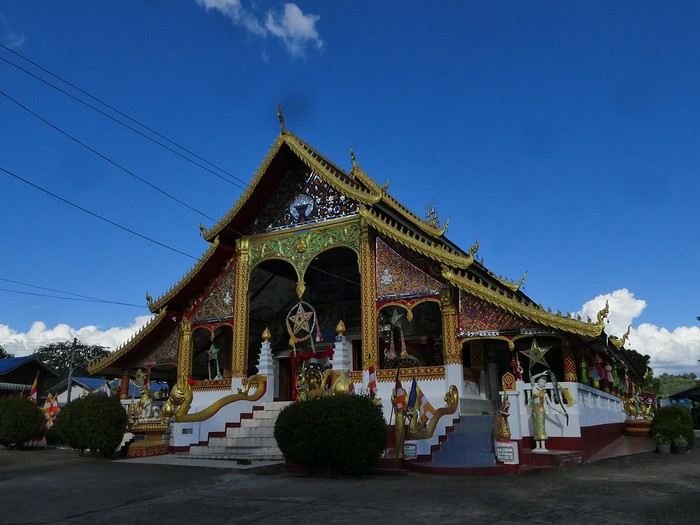
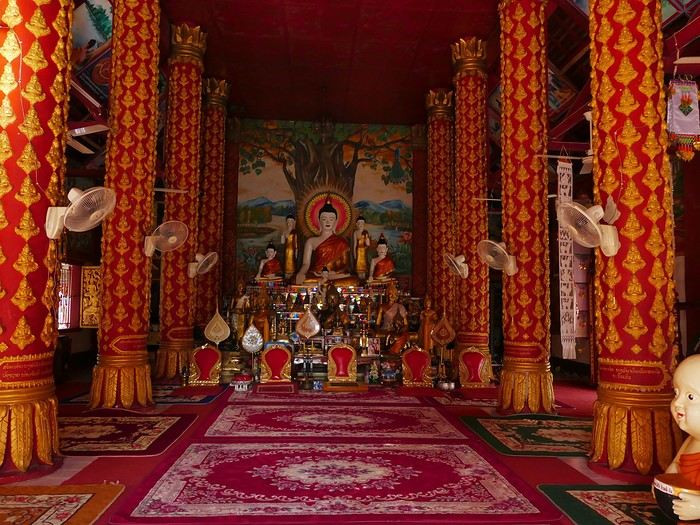
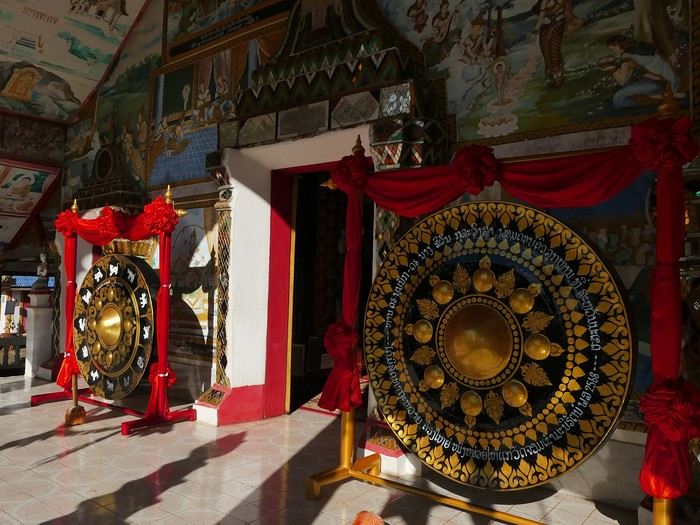
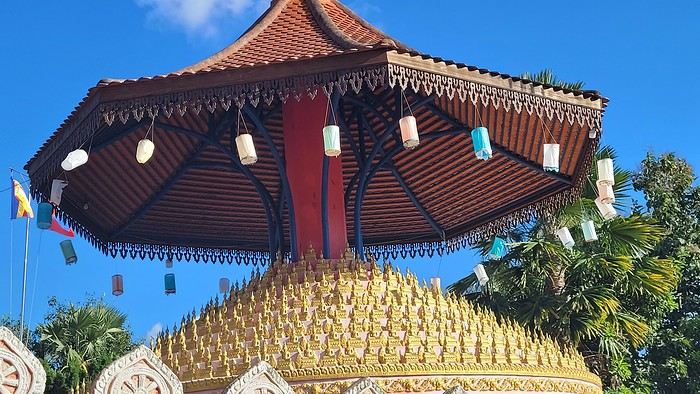
and continued to Fort Carnot, built by the French.
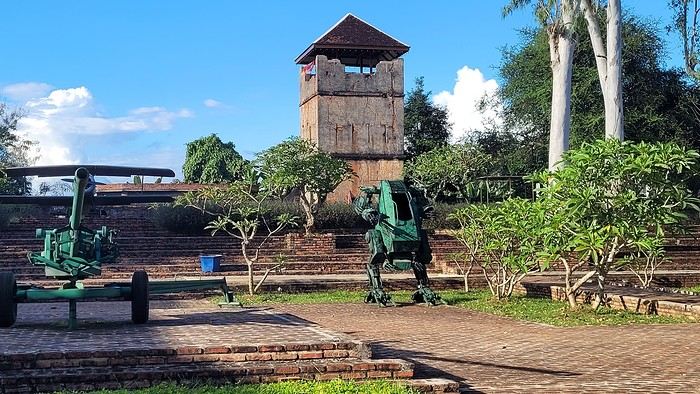
The views of the Mekong are beautiful for a first glimpse of the country.
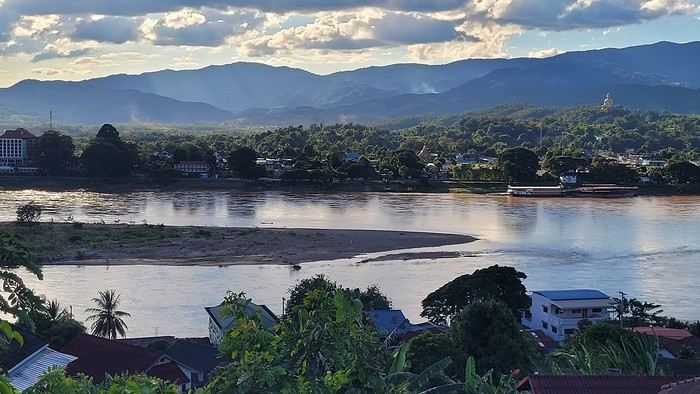
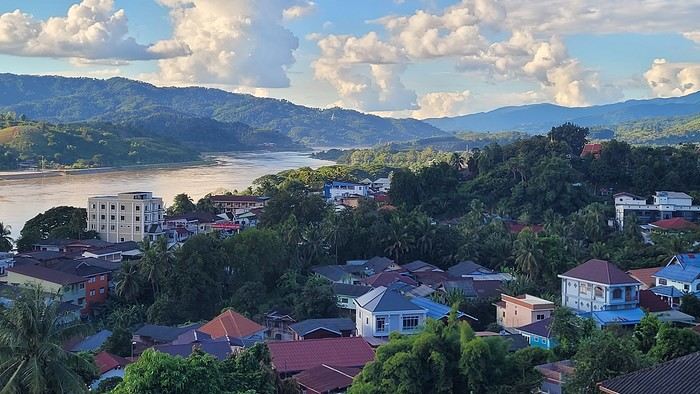
yum-yum, bon appétit!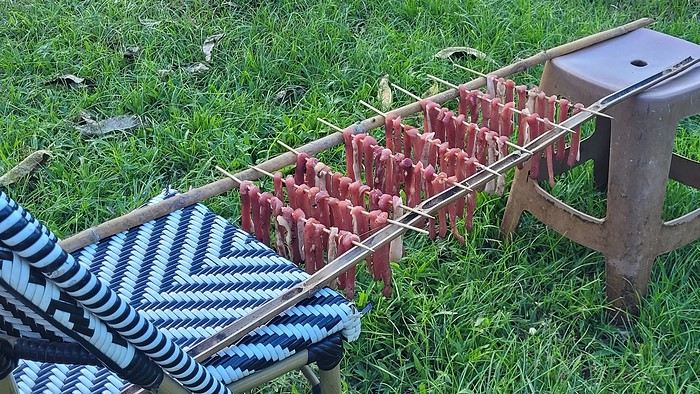
At 6:30 PM, I went to dinner at a restaurant across from the guesthouse—a chicken curry with vegetables.
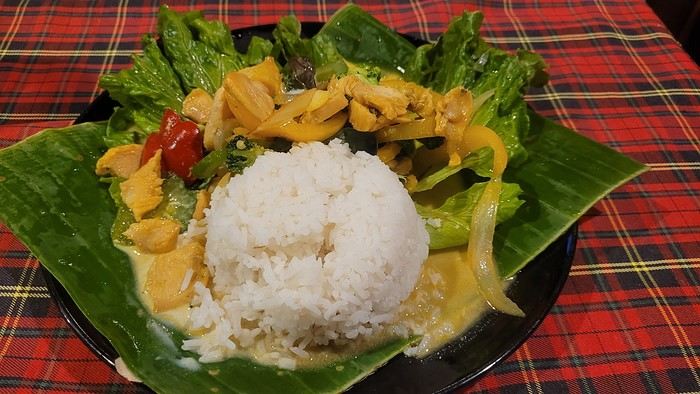
I didn’t linger and went back to bed. I slept well, even if I woke up often.
Thursday, Oct 23. Left home at 8:25 AM, took the bus from St Cyp to Perpignan, then a BlaBlaBus to Barcelona airport. Last night, a huge storm crossed France, and the bus was an hour late. We finally left at 11 AM. At the Spanish border, we were checked—several Africans were traveling on the bus, and their document verification took quite a while. In the end, everything was in order, and we set off again a good half-hour later. We finally arrived at Barcelona airport after 2 PM, but no stress since my flight was scheduled for 4:30 PM with Saudia. At check-in, the hostess told me there’d be a 1-hour delay due to bad weather in France and Belgium. In the end, the flight didn’t just have a 1-hour delay but a 5-hour one because of a technical issue. The next flight wouldn’t wait for us. When we arrived in Jeddah, they gave us another ticket for the following day—the flight to Bangkok was scheduled for 11:55 AM. The airline assigned us a room, which was good news since I was exhausted. Friday morning, the flight was still scheduled for 11:55 AM, but the gate wasn’t displayed. It was announced with a 1-hour delay, but that stretched to 4 hours. They handed out drinks and a snack—again, the delay was due to technical problems. In Bangkok, I had a connecting flight to Chiang Rai, where I’d also booked a room—I lost everything. We finally arrived in Bangkok on Saturday at 4 AM. I had to buy another ticket for a 7 AM flight. The formalities were quick, and my flight went smoothly. A taxi took me to Bus Terminal 1, where I caught a bus leaving at 10 AM, and we arrived at the Thailand-Laos border. I shared a taxi with other travelers, which took us to Houay Xai. The guesthouse I’d booked was right across from the stop—that was great. I exchanged some money and bought a SIM card at the guesthouse. Despite the fatigue, I needed to stretch my legs, so I walked down the street to the temple.
and continued to Fort Carnot, built by the French.
The views of the Mekong are beautiful for a first glimpse of the country.
yum-yum, bon appétit!
At 6:30 PM, I went to dinner at a restaurant across from the guesthouse—a chicken curry with vegetables.
I didn’t linger and went back to bed. I slept well, even if I woke up often.
Exploring the rice terraces of northern Vietnam: what transport options?
Hi everyone,
I’ve got a big project in northern Vietnam—discovering the most beautiful rice terraces before the harvest...
I’m planning to leave around September 15th until October 15th, then spend 15 days exploring the two bays, Lan Ha and Ha Long. In total, 45 days without a visa...
I’m traveling solo and very independent.
But is it possible to do this kind of trip using local trains and buses?
My plan is to leave Hanoi for Nghia Lo (2 days), then Mu Cang Chai (4 days), Sapa (4 days), Bac Ha (2 days), Ha Giang... Hoang Su Phi, then do the Meo Vac loop, Dong Van, etc., to see those stunning karst peaks before heading back to Hanoi.
In my research, I haven’t found any buses or vans going from Hanoi to Nghia Lo, even though it’s super popular for its rice terrace landscapes....
I don’t want a daily driver, but I’m thinking I could use moto-taxis to get around locally once I’m there....
What do you think?
These rice terraces are a dream for me, along with the markets and all the different ethnic groups, not to mention those spectacular rocky peaks...
Is the itinerary too ambitious? I’ve got time on my side.
Do you have any solutions? I’ve browsed the forum a lot, but the discussions are 5 or 6 years old, and I think things have changed since then.
Thanks for your help planning this adventure!
Visiting Abu Simbel from Aswan (Egypt)
Hi there,
I’ve booked a Nile cruise from Luxor to Aswan. The excursion to Abu Simbel is offered as an option, but for a family with 2 kids, it comes to 500 € for a lot of bus travel and very little time on site. Is it possible to find a local agency, taxi, or guide on the spot who’d offer the trip for less? Do we have to travel in a convoy? Thanks for your tips! Fred
I’ve booked a Nile cruise from Luxor to Aswan. The excursion to Abu Simbel is offered as an option, but for a family with 2 kids, it comes to 500 € for a lot of bus travel and very little time on site. Is it possible to find a local agency, taxi, or guide on the spot who’d offer the trip for less? Do we have to travel in a convoy? Thanks for your tips! Fred
On the Silk Road: Chronicles of a Sixty-Something Traveling Completely Independently
From Beijing to Khiva: China, Kyrgyzstan, Tajikistan, Uzbekistan
Chronicle of anecdotes, highlights, and other adventures that marked this eight-week journey in 2018.
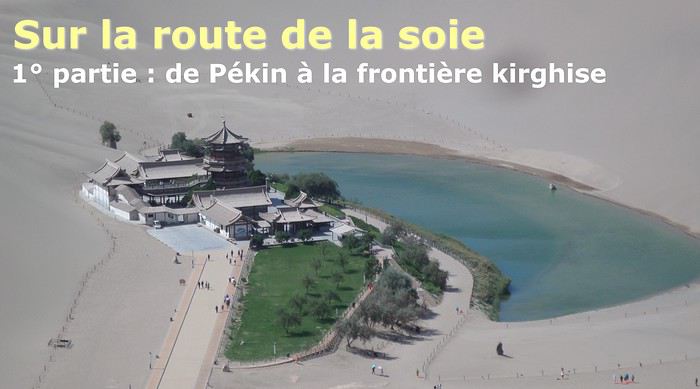
The Chinese Far West More than 30 years after my first trip to eastern China, I finally fulfilled an old dream: traveling solo from Beijing to the far west, discovering Xinjiang, the Uyghur people and the oppression they endure, the oases of Turpan and Kashgar, the Taklamakan Desert, the end of the Great Wall... The route was covered by train.
MENU PART 1: CHINA
1- Beijing (Jiankou) : the authentic Great Wall, without tourists 2- Cycling in Beijing, the best way to get around 3- Beijing : departure for the far west 4- Jiayuguan : getting by without English 5- Jiayuguan : scams and heritage 6- Dunhuang : abundance in the middle of the desert 7- Turpan : the Uyghurs under heavy surveillance 8- Kashgar : love at first sight for the old city 9- Kashgar : China’s recipe for controlling the populace 10- Tashkurgan : what on earth was I thinking going there! Kyrgyz border: a surreal epic Photo album from the 80s, contributions from other travelers (page 2)
1- JIANKOU Finding the authentic Great Wall, without tourists or a guide Friday, August 24, 2018 Thirty years later, I didn’t feel like revisiting the Great Wall at Badaling or any other overcrowded site. I chose to explore it at Jiankou, in its wildest, most authentic, and unrestored section, starting from a lost village deep in a valley—though it wasn’t *that* lost, since it had everything for communication.
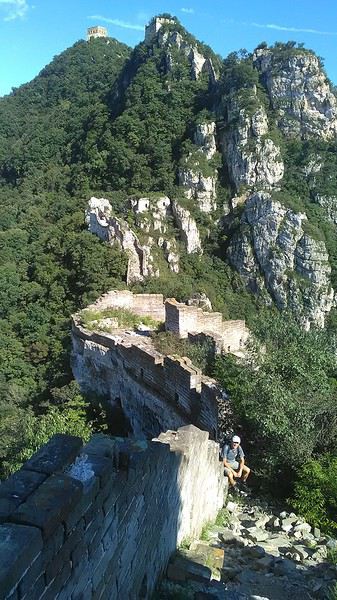
No need to pay for a taxi to get there—by timing it right, you can take the bus for just a few yuan. You have to get off at Xizhazi, the bus terminus. Be careful, there are only two buses a day in each direction. At the Xizhazi bus stop, I met a young couple who’d arrived with zero information about what to expect. We hiked the three of us toward the restored section of Mutianyu.
Still, be cautious With GPS and a topographic map (OpenTopoMap), you can set off without a problem or guide. The trail up to Jiankou is easy and well-marked. The trails down are too. But be careful—once you’re on the Wall, it’s real mountain hiking, with easy but dangerous climbing sections (over sheer drops). Not for amateurs or those afraid of heights! But what a reward. The Wall all to yourself, where it’s at its most daring. Truly mesmerizing.
More photos...
2- BEIJING The best way to get around the capital Sunday, August 26 The best way to explore the city is still by bike. Most are in a bike-share system, but you need to use an app—WeChat, the app that does everything, like monitoring your every move. No way I was installing that.
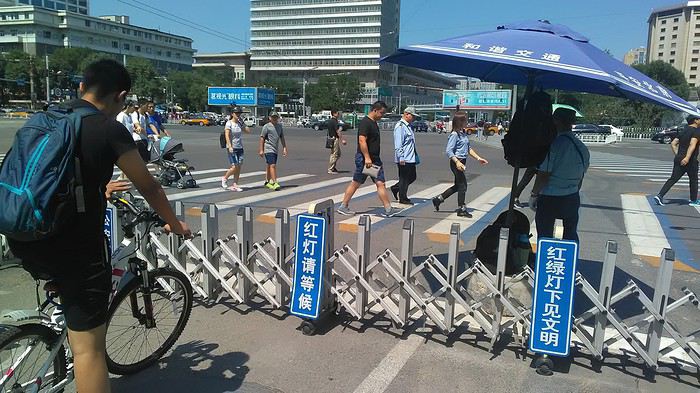
I found one at a rental shop near the hostel. The key is to quickly learn local traffic customs to minimize risks. Bike lanes are wide along the avenues.
But you still have to: - Watch out for anything parked on the bike paths—the most annoying are people napping or talking on the phone in their cars - Keep an eye on everything coming the wrong way—the list is long - The worst is right turns on red, which in Chinese traffic rules seem to have priority Once you get the hang of it, it’s fine. The city is huge but flat, so you can just wing it.
3- BEIJING By train to the far west Sunday, August 26 Beijing West Station is the size and operates like an airport. With your e-ticket from the agency, you first have to pick up your ticket at the special "English" counter, after passing through security. With your ticket in hand, you have to exit and enter through the boarding waiting area—not the platform—after a second security check.
 Then you find the right hall and wait for the sign to finally access the platform. In the end, it works pretty well given the incredible number of passengers to manage. Everywhere in Beijing, I saw that the Chinese have mastered crowd flow management.
Nice surprise: second-class carriages are clean, air-conditioned, and bright. Perfect, since I was in for 20 hours. One uniformed attendant per carriage, mobile meal service—luxury! Small downside: no luggage space. Hauling your suitcase up to the top bunk is quite a workout. I was in the middle, so it wasn’t too bad. The landscape, though, whether rural or urban, is pretty bleak. That should change once we leave the eastern plains.
Of course, I got my first police visit, with a thorough passport check and bag search. I was warned—going to the Chinese far west exposes you to this kind of hassle. But they were polite and respectful.
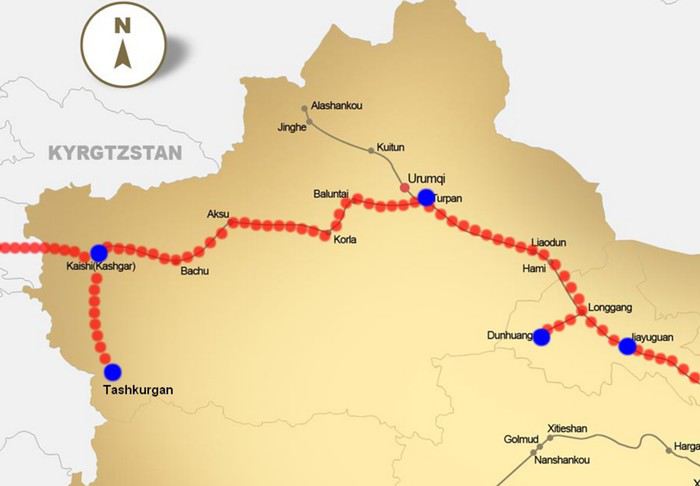 The Chinese Far West
4- JIAYUGUAN Getting by without English Monday, August 27 At the gates of two deserts (Gobi and Taklamakan) and at the foot of the Tibetan highlands, the Great Wall ends at Jiayuguan. Here, I found the deeper China I’d somewhat rediscovered during my bike ride, even if now everyone gets around on electric bikes and I’m no longer stared at like an alien.
Prices are nothing like Beijing: you can find a full meal for 2 €, and my bike cost 7 € for two days. Plus, few people speak English—neither the owner of the HI hostel where I stayed, nor the ticket sellers at the sites, let alone the servers at the small eateries where I ate. Everything is written in Chinese. So I had to use the little Chinese I know to communicate about essentials. It makes the locals laugh to see a European trying to speak their language, but it earns respect. With Google Translate’s help, I managed.
Rant: With their avenues blocked for construction for kilometers without warning, and new roads not yet on maps, I must’ve taken 15 km of detours. More photos...
5- JIAYUGUAN Scams and heritage Tuesday, August 28 The Great Wall doesn’t exactly end at the fort I visited yesterday but 10 km further, at the entrance to a river gorge at the foot of the mountains. All that’s left is a badly damaged tower (more like a mound of earth) and a section of clay wall, similar to the one I biked yesterday.
This morning, I hopped on my bike, determined to venture into the desert to see this highly symbolic site. First, you access it via a wide, brand-new road with not a soul in sight. Just before the site, I came across a grand welcome gate, very period-style, but it’s actually the inevitable toll booth.
Behind the gate, the road continues straight to the site, which you can see in the distance—at least 2 km away—the remains of the tower and wall. I had to leave my bike here. Fine. I went to the ticket counter and asked the price: 120 yuan! I couldn’t believe it—over 15 € for a simple mound of earth.
I showed my displeasure to the attendant, who couldn’t care less, and immediately turned back. 120 yuan—that’s the price for a new road, a fancy gate planted 2 km before the site just to force you to take a shuttle, and employees with nothing to do all day... Now I understand why I didn’t meet anyone!
Heritage China is a bit pricey Generally, sites are expensive for the country’s standard of living, but travelers are supposed to have money, so why hold back? I even gave up on the Forbidden City—reservations required days in advance (or on the black market at an impossible price). I prefer to keep the memory of my first visit, when entry must’ve cost a few dozen cents, and there were only a handful of visitors.
This morning, I took a taxi to see remarkable tombs of common people from the 3rd to 6th centuries. They’re small vaulted caves made of painted bricks, depicting scenes of daily life. Very pretty and moving. But even here, though the price was more reasonable, I was left wanting—only one of the 16 tombs is open to visitors, and it’s apparently not the most beautiful.
The authentic China—at least what’s left of it... Wandering the impersonal avenues of the city, you stumble upon a market. There, you still find traditional China—small shops with questionable hygiene, Go players, musicians, and even a dental prosthetist. The last refuge for those untouched by modernity. More photos...
6- DUNHUANG Abundance in the middle of the desert Wednesday, August 29 Well, I thought the landscape would be less bleak as I headed west. Nope. The only distraction in this expanse of dark, clayey sand is the forests of pylons and wind turbines, plus wild camels racing each other.
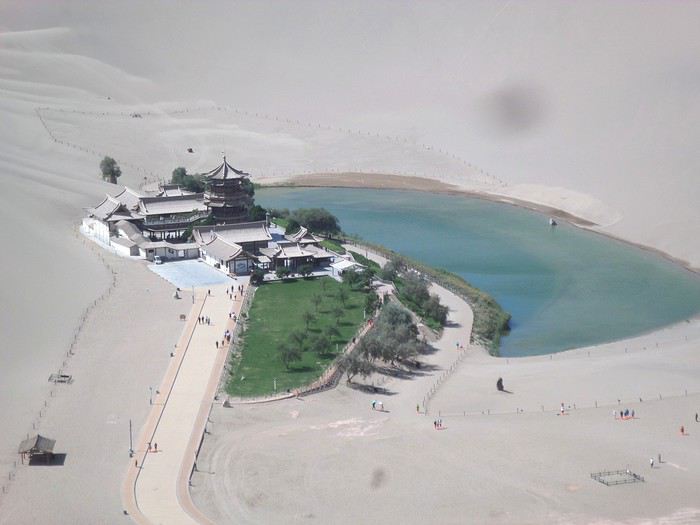 However, Dunhuang, the gateway to the Taklamakan, is by far the most pleasant Chinese city I know. There’s a real city center you can explore on foot. It’s hot but not unbearable, with a light, dry breeze. Much nicer than Beijing. The Han Chinese are still the majority, but the Muslim Uyghurs are more numerous, and the muezzin’s call to prayer echoes around the mosque.
The most surprising thing is the abundance and diversity of fruits and vegetables. You wonder how it all grows here. Well-irrigated, the desert sands are very fertile. Here, raisins have subtle, mysterious flavors, and the lamb really tastes like lamb.
Today, I visited the must-see Mingshashan, a dune complex next to which Pila is a molehill. The Basque Country, but covered in sand... More photos...
7- TURPAN The Uyghurs under heavy surveillance Friday, August 31 Surveillance cameras everywhere in the city, armed police stationed at intersections, in front of public buildings, at the entrance and inside tourist sites, police stations on every corner, patrols on foot or by car, khaki uniforms even for middle schoolers... here, the Han Chinese are in the minority, and you can feel it. Turpan feels like a city under siege.
To enter the youth hostel where I stayed, there’s even a security gate, and the receptionist (a Han, like everyone in tourism) wears a bulletproof vest! Reassuring. Still, you don’t feel particularly threatened here, especially as a European. The troublemakers are the Chinese, not the Uyghurs. Generally, China is a very safe country for visitors.
Smile, you’re on camera! I was biking on an avenue when the car in front of me got flashed for driving slowly. I quickly understood why when I got flashed too.
Here, the official time is Beijing time, but it gets dark two hours later. It’ll be even worse in Kashgar. Trickier to manage: everything is displayed in Chinese and Arabic. Nothing in English. Choosing a menu is a shot in the dark. Apart from a few young Chinese, no one here speaks English, and my Chinese doesn’t seem very understandable...
Mogao, the end of the road for the Han Yesterday, near Dunhuang, I went to Mogao, a complex of decorated caves with Buddha sculptures and paintings. Stunning, but so crowded! Luckily, here in Turpan, Chinese tourists barely venture out. So I visited a Silk Road ghost town with only a handful of other visitors and under a howling wind.
The modern Chinese city is swallowing up the old Uyghur neighborhoods—only a museum-like district remains in the center, and pockets of resistance on the outskirts are doomed to disappear soon. More photos...
8- KASHGAR A (relative) love at first sight for the old city Sunday, September 2 After three overnight trains, here I am in the far west of China, nearly 4,000 km from the capital. Despite the omnipresent police and an old city preserved UNESCO-style, Kashgar is my Chinese love at first sight.
Finally, Chinese... well, sort of, because we’re in Uyghur territory here—a Turkic people with nothing culturally in common with the Han, the eastern Chinese. It started badly yesterday at Turfan station, where after three security gate passes, at least five passport checks, and a bag search, three adorable policewomen confiscated my antibacterial lotion because it had a flammable logo...
Then came the welcoming committee of armed cops at Kashgar station. Once all that was over, they left me alone—except you still have to go through security checks like everyone else to enter the old city, the bazaar, the livestock market... The further west you go, the more the siege mentality is evident. Luckily, the border isn’t far...
Despite the inevitable destruction-reconstruction, the city center has been well preserved. Thankfully, because it’s a very original style, a mix of local and colonial. I love it, even if it’s a bit too artificial, sanitized, and watered-down, and rather empty of residents. On the Silk Road, the city was famous for its great food. And it still is—rarely have I seen such richness and abundance of food! And not just scorpions or snakes. More photos...
9- KASHGAR China’s recipe for controlling the populace Saturday, September 1 Xinjiang, along with Tibet, is a "sensitive" area of rebellion in the eyes of Chinese authorities. As a result, the state has these regions and their populations under total control. Tourists also feel the consequences, even if they’re not at risk of re-education camps.
 - Putting barbed wire and anti-ramming barriers around sensitive sites (schools, big hotels, government buildings...)
- Installing traffic surveillance gates with cameras and photo flashes (for all vehicles passing, including bikes) throughout the city and even in the countryside
- Posting uniformed guards with tasers, batons, or huge baseball bats every 100 meters
- Training the Han population (ethnic Chinese) in self-defense with sticks, preferably in the morning on the street. Men and women of all ages
- Starting school with the national anthem, doing military exercises, and receiving political indoctrination, all neatly lined up in the courtyard. (The dream school for any teacher)
- Placing a snitch in uniform (a pseudo-guard) in public gathering places, like youth hostels. Mine spends the day loafing around the courtyard
- Putting Chinese flags everywhere on the streets to remind everyone who’s in charge
- Installing security gates at every entrance to areas frequented by tourists (thanks for that) but not just there
- Never photographing cops, or else! I tried, but it’s not easy...
- Putting barbed wire and anti-ramming barriers around sensitive sites (schools, big hotels, government buildings...)
- Installing traffic surveillance gates with cameras and photo flashes (for all vehicles passing, including bikes) throughout the city and even in the countryside
- Posting uniformed guards with tasers, batons, or huge baseball bats every 100 meters
- Training the Han population (ethnic Chinese) in self-defense with sticks, preferably in the morning on the street. Men and women of all ages
- Starting school with the national anthem, doing military exercises, and receiving political indoctrination, all neatly lined up in the courtyard. (The dream school for any teacher)
- Placing a snitch in uniform (a pseudo-guard) in public gathering places, like youth hostels. Mine spends the day loafing around the courtyard
- Putting Chinese flags everywhere on the streets to remind everyone who’s in charge
- Installing security gates at every entrance to areas frequented by tourists (thanks for that) but not just there
- Never photographing cops, or else! I tried, but it’s not easy...
With all that, you can stroll around safely Not much crime! As for the amount the Chinese state spends to maintain such a system, it’s staggering! A third of the Han living in Xinjiang work in security. Today, I wandered freely around old Kashgar, which is quite large after all. More photos...
10- TASHKURGAN What on earth was I thinking going there! Wednesday, September 5 First, there’s the taxi—pretty crappy, with a driver who doesn’t speak a word of English and won’t stop smoking. Over six hours in that... shared with a completely out-of-it American.
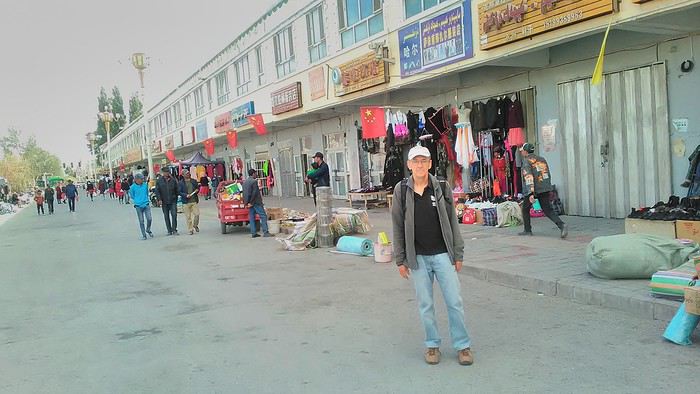
Then there are all the checkpoints along the way. I won’t go on—you know the drill by now.
After that, there’s Tashkurgan—a town with nothing to see, nothing to do. Deserted as soon as night falls. There’s this huge youth hostel and a few lost Chinese tapping away on their smartphones, chain-smoking. This lost American-European crowd, swapping tips on how to enter Pakistan or Tajikistan.
Luckily, there’s the Chinese Pamir Highway, lined with peaks over 7,000m. There’s the feeling of no longer being in China, with a population whose features are Middle Eastern. And these Tajik women with their stunning hairstyles and vibrant costumes. There’s the fact of having reached the westernmost Chinese city, far from crowds and tourist sites. A sort of end of the world. More photos...
11- KYRGYZ BORDER A surreal epic Thursday, September 6 The road from Kashgar to the Kyrgyzstan border is a little over 200 km and passes through beautiful landscapes of colorful, desert-like mountains with acrobatic folds. That’s the bucolic part of the trip.
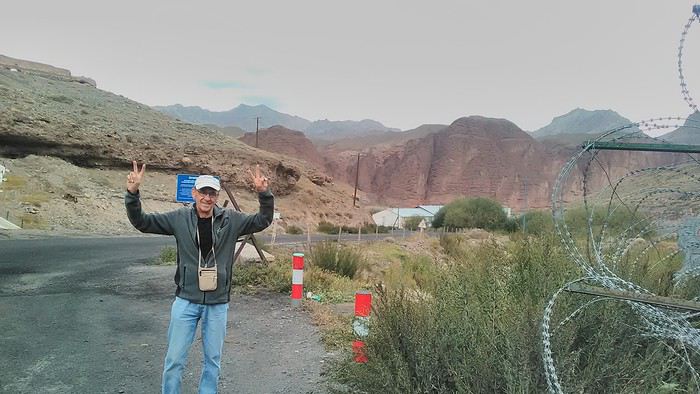 Yesterday, I managed to gather four people to rent a minibus to reach the border more easily: a Spaniard and an Argentine I’d already met in Turpan, and two New Zealanders who responded to the ad left at the hostel.
Absurdity and paranoia of Chinese authorities The highlight was crossing the town of Wuqia, 50 km past Kashgar. After tallying up with my fellow sufferers, we must’ve passed about ten checkpoints with: - Passport checks: 14 times, sometimes by two cops side by side - Bag checks: 4 times - Smartphone checks: 2 times, with deletion of "non-compliant" photos, and registration of your IMEI in the exit log!... Absurd and surreal at the same time, since my camera stayed in my bag, my apps are in French, and my photos have been online for ages...
With all that, we arrived just as the last checkpoint before the no man’s land marking the border between the two countries was on lunch break. And bam! Another 1.5-hour wait, alongside truckers who were much more used to this than we were.
What to think? The cops themselves aren’t fooled. They play the role they’re asked to, but sometimes you can coax a smile out of them—they realize how ridiculous the situation is.
What’s the point? That’s the big question my companions and I were tempted to answer with "to piss people off." To show you your place isn’t here, but with the other tourists, over there in the east, in Shanghai, Xi’an, or Guangzhou.
As for you, a traveler from a democratic country, you really experience this as aggression, humiliation, a violation of your private space. And yet, I’m respected, they speak to me properly. Today, I better understand what a Palestinian or a citizen of an occupied country might feel daily. A unique experience! Thanks, China.
And to top it off, the cherry on the cake! It’s still this glowing button you press to rate your passage after clearing the last obstacle before the exit stamp. I was so surprised it turned off before I could react. The Spaniard, with great humor and irony, had time to vote "excellent." In the end, he wasn’t wrong—you can hardly do better!
PS: I ditched my buddies at the border. They didn’t want to pay for a taxi to continue. So I took a direct taxi to Osh. The first 100 km are fabulous. I couldn’t take many photos, but I’ll be back on Monday to go to Tajikistan.
More photos...
The rest of the Silk Road, Part 2, in these travel journals: Kyrgyzstan, Tajikistan, Uzbekistan.
The Chinese Far West More than 30 years after my first trip to eastern China, I finally fulfilled an old dream: traveling solo from Beijing to the far west, discovering Xinjiang, the Uyghur people and the oppression they endure, the oases of Turpan and Kashgar, the Taklamakan Desert, the end of the Great Wall... The route was covered by train.
MENU PART 1: CHINA
1- Beijing (Jiankou) : the authentic Great Wall, without tourists 2- Cycling in Beijing, the best way to get around 3- Beijing : departure for the far west 4- Jiayuguan : getting by without English 5- Jiayuguan : scams and heritage 6- Dunhuang : abundance in the middle of the desert 7- Turpan : the Uyghurs under heavy surveillance 8- Kashgar : love at first sight for the old city 9- Kashgar : China’s recipe for controlling the populace 10- Tashkurgan : what on earth was I thinking going there! Kyrgyz border: a surreal epic Photo album from the 80s, contributions from other travelers (page 2)
1- JIANKOU Finding the authentic Great Wall, without tourists or a guide Friday, August 24, 2018 Thirty years later, I didn’t feel like revisiting the Great Wall at Badaling or any other overcrowded site. I chose to explore it at Jiankou, in its wildest, most authentic, and unrestored section, starting from a lost village deep in a valley—though it wasn’t *that* lost, since it had everything for communication.
No need to pay for a taxi to get there—by timing it right, you can take the bus for just a few yuan. You have to get off at Xizhazi, the bus terminus. Be careful, there are only two buses a day in each direction. At the Xizhazi bus stop, I met a young couple who’d arrived with zero information about what to expect. We hiked the three of us toward the restored section of Mutianyu.
Still, be cautious With GPS and a topographic map (OpenTopoMap), you can set off without a problem or guide. The trail up to Jiankou is easy and well-marked. The trails down are too. But be careful—once you’re on the Wall, it’s real mountain hiking, with easy but dangerous climbing sections (over sheer drops). Not for amateurs or those afraid of heights! But what a reward. The Wall all to yourself, where it’s at its most daring. Truly mesmerizing.
More photos...
2- BEIJING The best way to get around the capital Sunday, August 26 The best way to explore the city is still by bike. Most are in a bike-share system, but you need to use an app—WeChat, the app that does everything, like monitoring your every move. No way I was installing that.
I found one at a rental shop near the hostel. The key is to quickly learn local traffic customs to minimize risks. Bike lanes are wide along the avenues.
But you still have to: - Watch out for anything parked on the bike paths—the most annoying are people napping or talking on the phone in their cars - Keep an eye on everything coming the wrong way—the list is long - The worst is right turns on red, which in Chinese traffic rules seem to have priority Once you get the hang of it, it’s fine. The city is huge but flat, so you can just wing it.
3- BEIJING By train to the far west Sunday, August 26 Beijing West Station is the size and operates like an airport. With your e-ticket from the agency, you first have to pick up your ticket at the special "English" counter, after passing through security. With your ticket in hand, you have to exit and enter through the boarding waiting area—not the platform—after a second security check.
Then you find the right hall and wait for the sign to finally access the platform. In the end, it works pretty well given the incredible number of passengers to manage. Everywhere in Beijing, I saw that the Chinese have mastered crowd flow management.Nice surprise: second-class carriages are clean, air-conditioned, and bright. Perfect, since I was in for 20 hours. One uniformed attendant per carriage, mobile meal service—luxury! Small downside: no luggage space. Hauling your suitcase up to the top bunk is quite a workout. I was in the middle, so it wasn’t too bad. The landscape, though, whether rural or urban, is pretty bleak. That should change once we leave the eastern plains.
Of course, I got my first police visit, with a thorough passport check and bag search. I was warned—going to the Chinese far west exposes you to this kind of hassle. But they were polite and respectful.
The Chinese Far West4- JIAYUGUAN Getting by without English Monday, August 27 At the gates of two deserts (Gobi and Taklamakan) and at the foot of the Tibetan highlands, the Great Wall ends at Jiayuguan. Here, I found the deeper China I’d somewhat rediscovered during my bike ride, even if now everyone gets around on electric bikes and I’m no longer stared at like an alien.
Prices are nothing like Beijing: you can find a full meal for 2 €, and my bike cost 7 € for two days. Plus, few people speak English—neither the owner of the HI hostel where I stayed, nor the ticket sellers at the sites, let alone the servers at the small eateries where I ate. Everything is written in Chinese. So I had to use the little Chinese I know to communicate about essentials. It makes the locals laugh to see a European trying to speak their language, but it earns respect. With Google Translate’s help, I managed.
Rant: With their avenues blocked for construction for kilometers without warning, and new roads not yet on maps, I must’ve taken 15 km of detours. More photos...
5- JIAYUGUAN Scams and heritage Tuesday, August 28 The Great Wall doesn’t exactly end at the fort I visited yesterday but 10 km further, at the entrance to a river gorge at the foot of the mountains. All that’s left is a badly damaged tower (more like a mound of earth) and a section of clay wall, similar to the one I biked yesterday.
This morning, I hopped on my bike, determined to venture into the desert to see this highly symbolic site. First, you access it via a wide, brand-new road with not a soul in sight. Just before the site, I came across a grand welcome gate, very period-style, but it’s actually the inevitable toll booth.
Behind the gate, the road continues straight to the site, which you can see in the distance—at least 2 km away—the remains of the tower and wall. I had to leave my bike here. Fine. I went to the ticket counter and asked the price: 120 yuan! I couldn’t believe it—over 15 € for a simple mound of earth.
I showed my displeasure to the attendant, who couldn’t care less, and immediately turned back. 120 yuan—that’s the price for a new road, a fancy gate planted 2 km before the site just to force you to take a shuttle, and employees with nothing to do all day... Now I understand why I didn’t meet anyone!
Heritage China is a bit pricey Generally, sites are expensive for the country’s standard of living, but travelers are supposed to have money, so why hold back? I even gave up on the Forbidden City—reservations required days in advance (or on the black market at an impossible price). I prefer to keep the memory of my first visit, when entry must’ve cost a few dozen cents, and there were only a handful of visitors.
This morning, I took a taxi to see remarkable tombs of common people from the 3rd to 6th centuries. They’re small vaulted caves made of painted bricks, depicting scenes of daily life. Very pretty and moving. But even here, though the price was more reasonable, I was left wanting—only one of the 16 tombs is open to visitors, and it’s apparently not the most beautiful.
The authentic China—at least what’s left of it... Wandering the impersonal avenues of the city, you stumble upon a market. There, you still find traditional China—small shops with questionable hygiene, Go players, musicians, and even a dental prosthetist. The last refuge for those untouched by modernity. More photos...
6- DUNHUANG Abundance in the middle of the desert Wednesday, August 29 Well, I thought the landscape would be less bleak as I headed west. Nope. The only distraction in this expanse of dark, clayey sand is the forests of pylons and wind turbines, plus wild camels racing each other.
However, Dunhuang, the gateway to the Taklamakan, is by far the most pleasant Chinese city I know. There’s a real city center you can explore on foot. It’s hot but not unbearable, with a light, dry breeze. Much nicer than Beijing. The Han Chinese are still the majority, but the Muslim Uyghurs are more numerous, and the muezzin’s call to prayer echoes around the mosque.The most surprising thing is the abundance and diversity of fruits and vegetables. You wonder how it all grows here. Well-irrigated, the desert sands are very fertile. Here, raisins have subtle, mysterious flavors, and the lamb really tastes like lamb.
Today, I visited the must-see Mingshashan, a dune complex next to which Pila is a molehill. The Basque Country, but covered in sand... More photos...
7- TURPAN The Uyghurs under heavy surveillance Friday, August 31 Surveillance cameras everywhere in the city, armed police stationed at intersections, in front of public buildings, at the entrance and inside tourist sites, police stations on every corner, patrols on foot or by car, khaki uniforms even for middle schoolers... here, the Han Chinese are in the minority, and you can feel it. Turpan feels like a city under siege.
To enter the youth hostel where I stayed, there’s even a security gate, and the receptionist (a Han, like everyone in tourism) wears a bulletproof vest! Reassuring. Still, you don’t feel particularly threatened here, especially as a European. The troublemakers are the Chinese, not the Uyghurs. Generally, China is a very safe country for visitors.
Smile, you’re on camera! I was biking on an avenue when the car in front of me got flashed for driving slowly. I quickly understood why when I got flashed too.
Here, the official time is Beijing time, but it gets dark two hours later. It’ll be even worse in Kashgar. Trickier to manage: everything is displayed in Chinese and Arabic. Nothing in English. Choosing a menu is a shot in the dark. Apart from a few young Chinese, no one here speaks English, and my Chinese doesn’t seem very understandable...
Mogao, the end of the road for the Han Yesterday, near Dunhuang, I went to Mogao, a complex of decorated caves with Buddha sculptures and paintings. Stunning, but so crowded! Luckily, here in Turpan, Chinese tourists barely venture out. So I visited a Silk Road ghost town with only a handful of other visitors and under a howling wind.
The modern Chinese city is swallowing up the old Uyghur neighborhoods—only a museum-like district remains in the center, and pockets of resistance on the outskirts are doomed to disappear soon. More photos...
8- KASHGAR A (relative) love at first sight for the old city Sunday, September 2 After three overnight trains, here I am in the far west of China, nearly 4,000 km from the capital. Despite the omnipresent police and an old city preserved UNESCO-style, Kashgar is my Chinese love at first sight.
Finally, Chinese... well, sort of, because we’re in Uyghur territory here—a Turkic people with nothing culturally in common with the Han, the eastern Chinese. It started badly yesterday at Turfan station, where after three security gate passes, at least five passport checks, and a bag search, three adorable policewomen confiscated my antibacterial lotion because it had a flammable logo...
Then came the welcoming committee of armed cops at Kashgar station. Once all that was over, they left me alone—except you still have to go through security checks like everyone else to enter the old city, the bazaar, the livestock market... The further west you go, the more the siege mentality is evident. Luckily, the border isn’t far...
Despite the inevitable destruction-reconstruction, the city center has been well preserved. Thankfully, because it’s a very original style, a mix of local and colonial. I love it, even if it’s a bit too artificial, sanitized, and watered-down, and rather empty of residents. On the Silk Road, the city was famous for its great food. And it still is—rarely have I seen such richness and abundance of food! And not just scorpions or snakes. More photos...
9- KASHGAR China’s recipe for controlling the populace Saturday, September 1 Xinjiang, along with Tibet, is a "sensitive" area of rebellion in the eyes of Chinese authorities. As a result, the state has these regions and their populations under total control. Tourists also feel the consequences, even if they’re not at risk of re-education camps.
- Putting barbed wire and anti-ramming barriers around sensitive sites (schools, big hotels, government buildings...)
- Installing traffic surveillance gates with cameras and photo flashes (for all vehicles passing, including bikes) throughout the city and even in the countryside
- Posting uniformed guards with tasers, batons, or huge baseball bats every 100 meters
- Training the Han population (ethnic Chinese) in self-defense with sticks, preferably in the morning on the street. Men and women of all ages
- Starting school with the national anthem, doing military exercises, and receiving political indoctrination, all neatly lined up in the courtyard. (The dream school for any teacher)
- Placing a snitch in uniform (a pseudo-guard) in public gathering places, like youth hostels. Mine spends the day loafing around the courtyard
- Putting Chinese flags everywhere on the streets to remind everyone who’s in charge
- Installing security gates at every entrance to areas frequented by tourists (thanks for that) but not just there
- Never photographing cops, or else! I tried, but it’s not easy...With all that, you can stroll around safely Not much crime! As for the amount the Chinese state spends to maintain such a system, it’s staggering! A third of the Han living in Xinjiang work in security. Today, I wandered freely around old Kashgar, which is quite large after all. More photos...
10- TASHKURGAN What on earth was I thinking going there! Wednesday, September 5 First, there’s the taxi—pretty crappy, with a driver who doesn’t speak a word of English and won’t stop smoking. Over six hours in that... shared with a completely out-of-it American.
Then there are all the checkpoints along the way. I won’t go on—you know the drill by now.
After that, there’s Tashkurgan—a town with nothing to see, nothing to do. Deserted as soon as night falls. There’s this huge youth hostel and a few lost Chinese tapping away on their smartphones, chain-smoking. This lost American-European crowd, swapping tips on how to enter Pakistan or Tajikistan.
Luckily, there’s the Chinese Pamir Highway, lined with peaks over 7,000m. There’s the feeling of no longer being in China, with a population whose features are Middle Eastern. And these Tajik women with their stunning hairstyles and vibrant costumes. There’s the fact of having reached the westernmost Chinese city, far from crowds and tourist sites. A sort of end of the world. More photos...
11- KYRGYZ BORDER A surreal epic Thursday, September 6 The road from Kashgar to the Kyrgyzstan border is a little over 200 km and passes through beautiful landscapes of colorful, desert-like mountains with acrobatic folds. That’s the bucolic part of the trip.
Yesterday, I managed to gather four people to rent a minibus to reach the border more easily: a Spaniard and an Argentine I’d already met in Turpan, and two New Zealanders who responded to the ad left at the hostel.Absurdity and paranoia of Chinese authorities The highlight was crossing the town of Wuqia, 50 km past Kashgar. After tallying up with my fellow sufferers, we must’ve passed about ten checkpoints with: - Passport checks: 14 times, sometimes by two cops side by side - Bag checks: 4 times - Smartphone checks: 2 times, with deletion of "non-compliant" photos, and registration of your IMEI in the exit log!... Absurd and surreal at the same time, since my camera stayed in my bag, my apps are in French, and my photos have been online for ages...
With all that, we arrived just as the last checkpoint before the no man’s land marking the border between the two countries was on lunch break. And bam! Another 1.5-hour wait, alongside truckers who were much more used to this than we were.
What to think? The cops themselves aren’t fooled. They play the role they’re asked to, but sometimes you can coax a smile out of them—they realize how ridiculous the situation is.
What’s the point? That’s the big question my companions and I were tempted to answer with "to piss people off." To show you your place isn’t here, but with the other tourists, over there in the east, in Shanghai, Xi’an, or Guangzhou.
As for you, a traveler from a democratic country, you really experience this as aggression, humiliation, a violation of your private space. And yet, I’m respected, they speak to me properly. Today, I better understand what a Palestinian or a citizen of an occupied country might feel daily. A unique experience! Thanks, China.
And to top it off, the cherry on the cake! It’s still this glowing button you press to rate your passage after clearing the last obstacle before the exit stamp. I was so surprised it turned off before I could react. The Spaniard, with great humor and irony, had time to vote "excellent." In the end, he wasn’t wrong—you can hardly do better!
PS: I ditched my buddies at the border. They didn’t want to pay for a taxi to continue. So I took a direct taxi to Osh. The first 100 km are fabulous. I couldn’t take many photos, but I’ll be back on Monday to go to Tajikistan.
More photos...
The rest of the Silk Road, Part 2, in these travel journals: Kyrgyzstan, Tajikistan, Uzbekistan.
La Patagonie de Puerto Montt à Puerto Rio Tranquilo en van English translation pending
Bonjour,
On prépare un voyage pour janvier avec en grandes lignes 5 jours à San Pedro de Atacama, puis 8 jours en Patagonie. Là, on voudrait louer un van depuis Puerto Montt pour aller à Puerto Rio Tranquilo.... et retour! ça vous paraît réalisable en 8 jours, pour ne pas passer tout notre temps sur la route, mais profiter quand même! Ou alors on supprime le désert d'Atacama pour ne voire que cette portion de Patagonie ? Bref mon coeur balance! Et à quel climat s'attendre en Patagonie, même si c'est l'été? Merci pour vos réponses !!! Carpat
On prépare un voyage pour janvier avec en grandes lignes 5 jours à San Pedro de Atacama, puis 8 jours en Patagonie. Là, on voudrait louer un van depuis Puerto Montt pour aller à Puerto Rio Tranquilo.... et retour! ça vous paraît réalisable en 8 jours, pour ne pas passer tout notre temps sur la route, mais profiter quand même! Ou alors on supprime le désert d'Atacama pour ne voire que cette portion de Patagonie ? Bref mon coeur balance! Et à quel climat s'attendre en Patagonie, même si c'est l'été? Merci pour vos réponses !!! Carpat
L'improvisation en voyage, de plus en plus difficile English translation pending
Avec la multiplication des Expedia/Booking/Agoda etc., la prolifération des téléphones cellulaires et l'explosion du nombre de touristes, je trouve qu'il devient de plus en plus difficile de voyager sans avoir à tout, tout, tout planifier des mois à l'avance.
Quand je partais en voyage, J'avais l'habitude de réserver quelques nuits au lieu d'arrivée pour me remettre du décalage puis y aller au pif par la suite. Mais depuis quelques années, c'est devenu plus compliqué. Une réceptionniste d'hôtel m'a même déjà dit de réserver par Booking pour la nuit même!
Je me demande si nous ne sommes pas en train de perdre notre sens de l'improvisation, le plaisir de découvrir des lieux sans savoir à quoi nous attendre. Est-ce encore possible de partir en voyage sans avoir tout prévu?
Quand je partais en voyage, J'avais l'habitude de réserver quelques nuits au lieu d'arrivée pour me remettre du décalage puis y aller au pif par la suite. Mais depuis quelques années, c'est devenu plus compliqué. Une réceptionniste d'hôtel m'a même déjà dit de réserver par Booking pour la nuit même!
Je me demande si nous ne sommes pas en train de perdre notre sens de l'improvisation, le plaisir de découvrir des lieux sans savoir à quoi nous attendre. Est-ce encore possible de partir en voyage sans avoir tout prévu?
Conduire au Guatemala English translation pending
Bonjour
Est il si difficile que cela de conduire au Guatemala ; nous sommes 2 couples et nous partirons en janvier 2020 nous avons conduit à Cuba au Mexique et au Costa Rica sans pb
Trajets envisagés arrivée avion Guatemala City prendre un shuttle pour Antigua puis panjachel et Lac atitlan et chichitenango puis quetzaltenango et environ huehuetenango dodos Santos et les villages de chancol kebab et acul
Peut on continuer vers Coban ou faut il revenir prendre une plus grande route vers Guatemala City mais cela allonge sérieusement les km pour aller à lanquin semuc champ ey puis el remate et Tikal avant de rentrer par Rio dulce et Copan
Merci pour vos réponses
Visiter le nord du Pérou à deux sans agence English translation pending
Bonjour à tous,
Nous sommes un couple de retraités qui envisage de visiter le nord du Pérou (après avoir découvert le Sud en 2014) en individuel et si possible, sans passer par agence. Nous avons fait une première ébauche de circuit qui pourrait être le suivant :
Jour 1 et 2 Lima puis bus de nuit sur Chiclayo. Là, nous aimerions louer une voiture pour être autonome Jour 3 visite des environs de Chiclayo – Nuit Chiclayo Jour 4 Route sur Bagua Grande par Cutervo – Nuit Bagua Grande Jour 5 Continuation sur Chachapoyas Jour 6 Chachapoyas – 2 nuits Jour 7 Route sur Cajamarca Jour 8 Cajamarca – Kuelap – 2 nuits à Cajamarca Jour 9 Retour sur Chiclayo – restitution du véhicule – Nuit Chiclayo Jour 10 Bus sur Trujillo (3h30) Jour 11 Trujillo – Chan Chan – Huaca Esmeralda … - 2 nuits Trujillo Jour 12 Bus sur Chimbote (2h30) – Location de voiture - Départ sur Huaraz par Casma – Nuit à Huaraz Jour 13 Canon del Pato – Nuit Huaraz (2) Jour 14 Retour sur Chimbote – Restitution du véhicule – nuit Chimbote Jour 15 Chimbote/Lima en bus (7 h) – Nuit à Lima Jour 16 Location de voiture à Lima – trajet sur Tarma – nuit Tarma Jour 17 Route sur Huancayo – nuit Huancayo Jour 18 Route sur San Vicente de Canete Jour 19 Journée plage – 2 nuits à San Vicente Jour 20 Route sur Lima – restitution du véhicule – Nuit Lima Jour 21 Lima / Pisco en bus ou avion ? Jour 22 Réserve naturelle de Paracas – Islas Ballestas – nuit Pisco Jour 23 Pisco / Nazca en bus ou avion ? Jour 24 et 25 Nazca – Ica – 3 nuits à Nazca Jour 26 Nazca/Lima en avion ou bus ? Jour 27 et 28 Lima Jour 29 Retour sur Paris
Selon vous, est-ce réaliste ? Si oui, quelle est la meilleure période pour ce périple ? Nous avions pensé à mai.
Merci de vos conseils avisés.
martine
Nous sommes un couple de retraités qui envisage de visiter le nord du Pérou (après avoir découvert le Sud en 2014) en individuel et si possible, sans passer par agence. Nous avons fait une première ébauche de circuit qui pourrait être le suivant :
Jour 1 et 2 Lima puis bus de nuit sur Chiclayo. Là, nous aimerions louer une voiture pour être autonome Jour 3 visite des environs de Chiclayo – Nuit Chiclayo Jour 4 Route sur Bagua Grande par Cutervo – Nuit Bagua Grande Jour 5 Continuation sur Chachapoyas Jour 6 Chachapoyas – 2 nuits Jour 7 Route sur Cajamarca Jour 8 Cajamarca – Kuelap – 2 nuits à Cajamarca Jour 9 Retour sur Chiclayo – restitution du véhicule – Nuit Chiclayo Jour 10 Bus sur Trujillo (3h30) Jour 11 Trujillo – Chan Chan – Huaca Esmeralda … - 2 nuits Trujillo Jour 12 Bus sur Chimbote (2h30) – Location de voiture - Départ sur Huaraz par Casma – Nuit à Huaraz Jour 13 Canon del Pato – Nuit Huaraz (2) Jour 14 Retour sur Chimbote – Restitution du véhicule – nuit Chimbote Jour 15 Chimbote/Lima en bus (7 h) – Nuit à Lima Jour 16 Location de voiture à Lima – trajet sur Tarma – nuit Tarma Jour 17 Route sur Huancayo – nuit Huancayo Jour 18 Route sur San Vicente de Canete Jour 19 Journée plage – 2 nuits à San Vicente Jour 20 Route sur Lima – restitution du véhicule – Nuit Lima Jour 21 Lima / Pisco en bus ou avion ? Jour 22 Réserve naturelle de Paracas – Islas Ballestas – nuit Pisco Jour 23 Pisco / Nazca en bus ou avion ? Jour 24 et 25 Nazca – Ica – 3 nuits à Nazca Jour 26 Nazca/Lima en avion ou bus ? Jour 27 et 28 Lima Jour 29 Retour sur Paris
Selon vous, est-ce réaliste ? Si oui, quelle est la meilleure période pour ce périple ? Nous avions pensé à mai.
Merci de vos conseils avisés.
martine