Discussions similar to: suivi demande passeport ANTS fonctionne
FR

480 similar discussions in English

Mexico: The Magic of the Yucatán
Hello everyone,

What a pleasure to be back on VF after a few difficult years 😎 So, before diving into the topic, welcome back to VF and above all... keep going!

Well, I’m finally picking up my old habit of posting a new travel journal.

Before heading to Mexico in the summer of 2023 with my family (my partner and our two boys, aged 18 and 16), I had somehow convinced myself—though I can’t even remember why—that the Yucatán was too touristy, too cliché, too expensive, and overrated!

The country didn’t particularly appeal to me, but faced with my wife’s insistence—she’d been there years ago, before we met, and had promised to show our sons this incredible place—my arguments didn’t hold much weight.

And thank goodness, because I have to admit she was absolutely right to take us there! In the end, we encountered far fewer tourists than we’d feared (except at a few sites), and the prices, which we’d been told were geared toward American neighbors (US), turned out to be quite affordable. In short, it was pure joy on both counts. All that was left was for the trip itself to be beautiful and memorable—and it was...

1st stop: Isla Holbox and the whale sharks

Holbox (pronounced “Hol-bosh”) is a stunning island where you can relax in an enchanting setting.


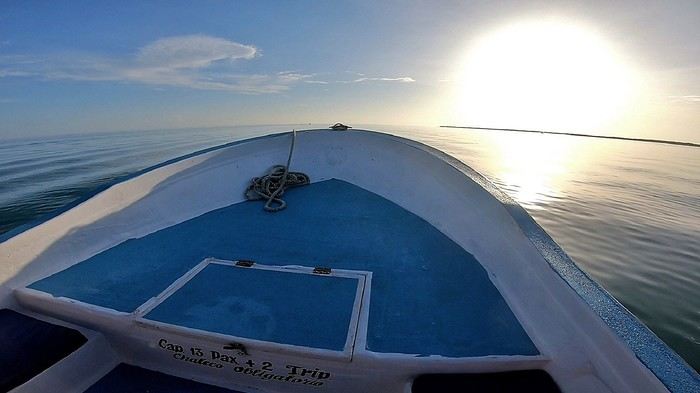
Our main goal in coming to Holbox was to swim with whale sharks. So, the first thing we told our hotel, Los Arcos Holbox, upon arrival was to arrange an excursion with one of the island’s many tour operators: Glendy Tours Holbox. We set off the next morning, bright and early.

The itinerary for this outing is the same for all tour operators (and there are about thirty of them!): roughly two hours by speedboat, then snorkeling with the whale sharks, followed by another boat ride to Cabo Catoche for lunch, then more boating to a fish-filled snorkeling spot before heading back. In total, the excursion can take eight hours—or even longer.


Besides my two sons and me, there were only two other clients on board—a French couple. Our boat was one of the very first to leave, but after ten minutes, the pilot got a radio call. We turned back without any explanation, returning to the departure dock.

There, a young woman who clearly fancied herself a diva was waiting for us. She was Mexican and boarded the boat, snubbing all five of us while flirting with the pilot and guide, who were suddenly all eyes for her. We couldn’t understand how this diva had convinced our tour operator to turn the boat around just to pick her up when she hadn’t even booked and we were already far out. We left 20 minutes late.

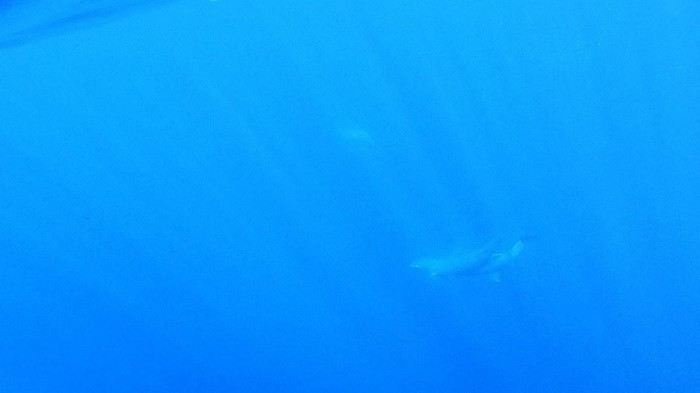
The two-hour journey passed surprisingly quickly, and for good reason: we spotted dolphins six times! They were leaping out of the water as they moved. Pure joy. We stopped whenever they were near the boat.


The photo isn’t great—the ultra-wide-angle lens on my GoPro makes the dolphins look smaller—but at least I got a souvenir.

A few flying fish (exocets) also glided a meter or two above the water as we sped along. The false start was forgotten, and the day was off to a fantastic start in this stunning marine environment...

When we reached the area where the whale sharks were supposed to be, the guide explained that we’d now have to scan the sea until we spotted one. It could take five minutes or forty-five, he said, and if we were unlucky, we might not see any at all!

An hour and a half later—still nothing! The captain then headed toward a distant area where about twenty other boats were already gathered.

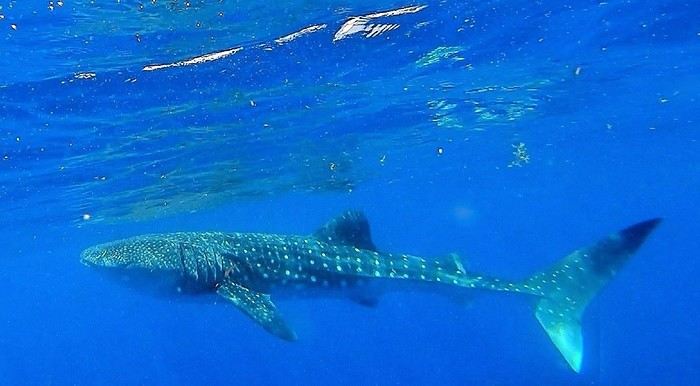
Sure enough, there was a juvenile whale shark (still a good eight meters long) there, and all the boats were lining up to approach it slowly, one by one, so as not to scare the animal. Each boat got about thirty seconds within a few meters of it, engine idling, before making way for the next. We were allowed to approach three times, but we weren’t permitted to dive in. That’s normal—such a crowd of divers around a single animal would stress it out, and here, whale sharks are protected by regulations: swimming with them is strictly controlled. There was even a coast guard boat with us at all times, monitoring everyone’s behavior.

We were torn between the luck of seeing such a magnificent animal, even from the surface, and the discomfort we felt about the absurd situation. All those boats lined up just to catch a fleeting glimpse of the shark for a few seconds—let’s be honest, it was ridiculous. In short, the whole thing was unpleasant, and probably even more so for the shark than for us, though it did keep gulping down kilos of plankton as if nothing were happening...

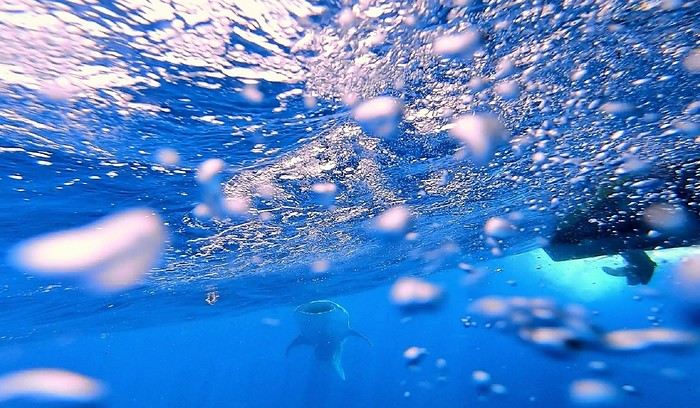
When it was our turn to approach, I dipped my GoPro into the water at arm’s length and framed the shot blindly, hoping for a decent image of the shark.


On the third and final approach, the sixth passenger on board—the one we’d had to turn back for ten minutes after departure—quietly spoke to the guide and captain after putting on her flippers (even though, I’ll remind you, no one was allowed to dive). She wanted them to ask the coast guard for permission to dive with the shark—just her! She whispered so we couldn’t hear what she was offering in exchange.

The two lackeys complied and shouted the request to the officials in front of all the other boats, with no shame whatsoever. With so many witnesses, the coast guard had no choice but to refuse. The diva wouldn’t let it go and asked them to insist, which they did, but the refusal was firm and final.

On the nearest boats, everyone had heard and was stunned. They openly mocked this bimbo who clearly had no shame. Hidden behind her star sunglasses, she responded with a dismissive smile. Pathetic.

The encounter with the shark ended, and we set off for Cabo Catoche, a site on Holbox Island where we were to have lunch.


We were a little disappointed not to have had the chance to see the usual school of whale sharks (they’re often dozens swimming together!), but that’s nature’s way, and we knew it.

And then, an unlikely stroke of luck: a boat ahead of us was putting divers in the water with a pair of adult whale sharks. We joined them, and while we were putting on our masks and snorkels, the guide briefed us. He said my sons and I would go first, followed by the French couple and the diva.

But Miss World, clearly unhappy with this order, quietly complained to the guide, who eventually switched the order. It didn’t bother us since we’d only get a minute in the water anyway—what’s a minute more or less?

So the three of them got in the water, and a moment later, they were done. My two sons and I, sitting on the edge of the boat with masks on and snorkels in our mouths, were ready to finally take the plunge. But instead of continuing to follow the shark, the captain was suddenly all eyes for Miss Silicone! He even let go of the wheel for a moment to help her back on board.

One of the two sharks had already left minutes earlier, and the second was swimming farther away. Other boats were arriving, and the captain went to join the queue 100 meters from the shark. Soon, even more boats showed up. There were way too many people, the shark left, and diving was no longer possible.

I was, of course, a little disappointed not to have fulfilled my long-time dream of swimming with a whale shark, even briefly. But I was mostly disgusted for my two boys, who had been so excited about it. I told the guide exactly what I thought and asked for compensation—not for missing out on swimming with the shark (you can never guarantee seeing one, nature isn’t at our beck and call), but for clearly skipping our turn to dive. He promised a refund.

At the end of the day, back on land, he dropped us all off, and as he was about to leave, I reminded him about the refund. He agreed again, calmly got back on board, and sped off as if nothing had happened—just him and the captain, two total cowards. I couldn’t believe it.

Of course, back at our hotel (which had booked this tour operator—Glendy Tours), I explained the situation and asked for my refund again. The receptionist called the manager, who arrived with the guide. Our runaway wasn’t so cocky anymore. Inside, I was fuming, but I kept my cool during the discussion that followed.

Right off the bat, I made a point of looking the so-called guide in the eyes while telling him he’d run off like a coward. I did my best to stay calm, speaking clearly, staring him down the whole time, and repeating several times that he was a coward, in front of the manager, who didn’t say a word. The guide had clearly been told by his boss to keep quiet because he didn’t utter a word during the entire twenty-minute conversation.

Anyway, I’ll spare you the details, but in the end, the manager only offered us another excursion the next day as compensation for the “inconvenience.” It was just snorkeling with fish, not another whale shark trip. He admitted their fault, but since we had to leave early the next morning and had other bookings for the rest of the trip, we couldn’t accept. And he refused to refund us.

On Tripadvisor, Glendy Tours has a mediocre rating (3 out of 5), but more importantly, it ranks 29th out of 36 nautical tour operators rated by customers. I was pretty upset with the hotel for booking such an amateur for us.


If you want to swim with whale sharks in Holbox, you might end up with Glendy Tours. And it might go well—I certainly hope so. But given the price of such an excursion (3,000 pesos per person, about 160 €!), I’d still suggest quickly checking online before you go to see which providers have the best ratings. You’ll have a much better chance of things going smoothly with the top-rated ones than with those as poorly ranked as Glendy Tours.

On the other hand, if you’re a beautiful young woman, you can choose them without worry—you’ll get better treatment than the rest of us...

To wrap up this excursion, I have to mention the “respect for nature” angle that all these tour operators highlight. They tell us they respect the whale sharks: only two or three people can dive at a time, and only for a few minutes, so as not to disturb these gentle giants...

We believed them before we left, but that’s not what we saw. When the sharks are hard to find except for one, everyone rushes it, and only the constant presence of the coast guard prevents the tour operators from putting their clients in the water.

Because for the second shark we saw, when the divers from our boat got out of the water and we left to join the queue while it was our turn to dive, other boats quickly arrived and started swarming the poor shark, which eventually left.

In other words, it’s clear these companies only respect the sharks when they’re being watched.

Boat reversing a meter away from a pelican

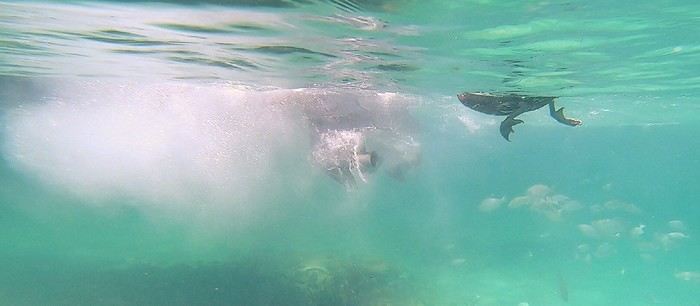
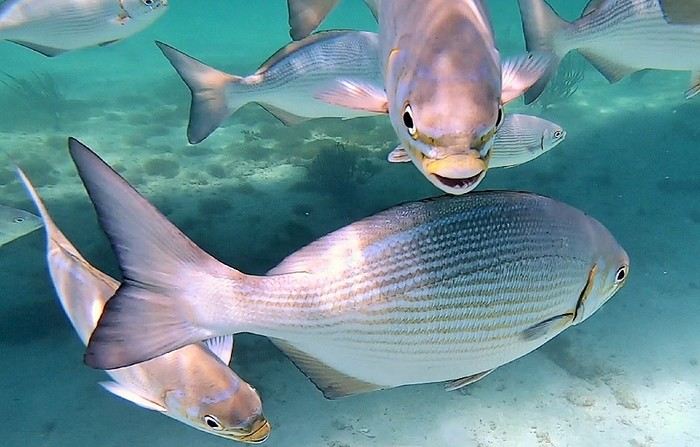
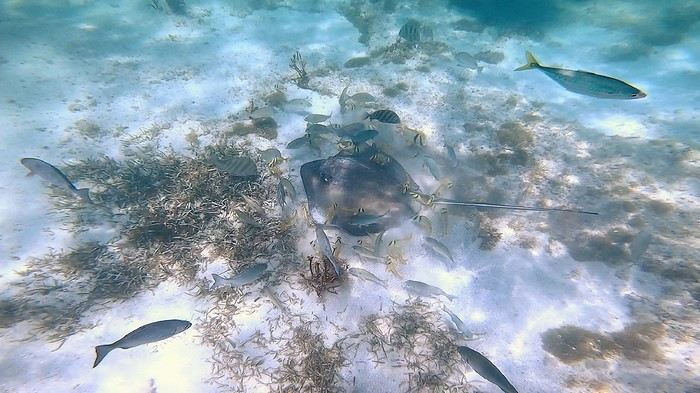
And for the snorkeling near Cabo Catoche, they attract fish daily by feeding them—a practice that’s normally discouraged. Afterward, these fish can’t feed naturally anymore and become dependent on Glendy Tours and its competitors.

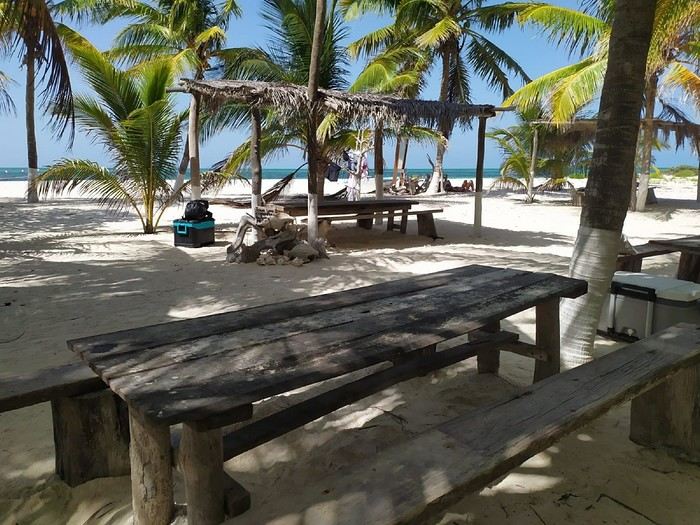
A quick note on the rest of the excursion: Cabo Catoche (the site where we had lunch, on Holbox Island) is the northernmost point of the entire Yucatán. The place is paradise.


On the way back, we spent half an hour snorkeling at a site that turned out to be fish-filled only because the tour operators had the bad habit of feeding the fish. But this practice, which isn’t respectful of nature, is normally discouraged.


Plus, life jackets—like in many places in the Yucatán—are mandatory!!


As divers, we didn’t find the site very interesting, but objectively, it should delight those who aren’t used to putting their heads underwater in beautiful dive spots.

We hated feeling trapped in those life jackets, stuck at the surface, and for me, the highlight was swimming next to a pelican that wasn’t too shy—it was paddling right beside me in green water.

Anyway, it seems we can’t post more than 10 photos at once on VF, so I’ll come back with the rest of the journal in another message. Because after these early trip mishaps, the rest of the journey turned out to be magnificent...
Open
4 friends discover a piece of North India
Hello fellow travelers!

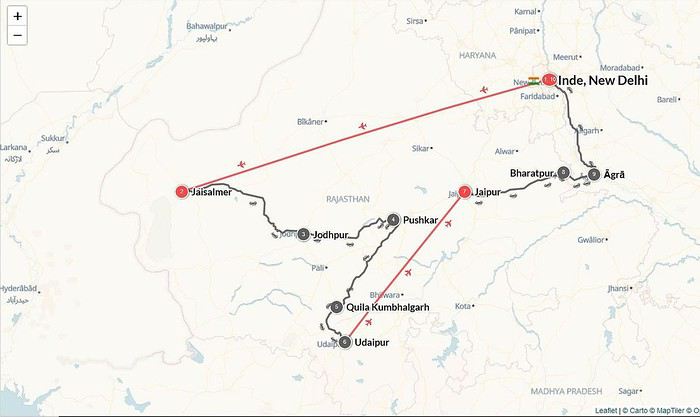
I’m adding my small contribution to the reopening celebration by posting this travel journal from India, made in January 2024. We’re 4 friends (2 couples), and we did a 3-week loop in Rajasthan, stopping by Delhi and Agra (which, as everyone knows, aren’t in Rajasthan 😛). Delhi - Agra - Jaipur - Bundi - Udaipur - Jodhpur - Jaisalmer - Delhi

We rented a car with a driver from Agra to Jaisalmer, 550 € for 14 days. https://chauffeurpriveeninde.com/fr/

We took the train from Delhi to Agra and the plane (Spicejet) from Jaisalmer to Delhi.

Most of the accommodations were booked on Booking before we left.

I’m sharing this story written by Richard and illustrated by me. We dedicate it to Nathalie and Bruno, our amazing travel companions.

Open
Questions about Tamil Nadu and Kerala
Hi there,

I’ve got a few questions about my upcoming 3.5-week trip to Tamil Nadu and Kerala (January 2025).

On the itinerary, we’re supposed to spend 3 or 4 days in Thanjavur (Tanjore). I thought the location would let us explore the surrounding area, but I’m realizing everything I want to see won’t fit into the schedule! I’d planned: 1 day to arrive from Pondicherry 1 day to go to Darasuram 1 day to go to Tiruchirappalli 1 day to head to Madurai with a stop in Chettinad Basically, we won’t see anything of Thanjavur itself! Should I skip one of the destinations?

In Kerala, after 3 days in Munnar, I’ve planned to spend a few days in Munroe Island since I didn’t get great feedback about Alleppey. I wanted to "wander" through the backwaters. Has anyone been there?

Finally, we’re ending the trip in Cherai. After booking, I realized the beaches seemed unusable (trash, rough sea...) and I’m pretty frustrated about not being able to swim. Unless there’s a better spot nearby?

Thanks for your input!
Open
MSC Lirica Cruise in April 2025 with stops in Kotor, Mykonos, Santorini, and Ancona
Hello everyone, So happy to be back on this Forum! We’re heading off on another cruise—our 7th—after a 5-year break... We’ll be leaving from Venice on April 26th with stops in Kotor, Mykonos, Santorini, and Ancona. Could you help me plan the stops by sharing tips, tricks, and advice? For those who already know me, you know we prefer not to take the cruise line’s excursions but instead organize everything ourselves. Thanks in advance to everyone, and looking forward to chatting with you all!
Open
VoyageForum is back!
Hello, how are you all? To be honest, this isn't really a "deep" topic—just a quick note to say I'm really happy VoyageForum is finally back up. I hope everyone who contributed to this site is still around, still traveling, and in good health. For my part, travel didn’t really stop despite the COVID crisis. Looking forward to sharing photos, travel stories, and discussions with all of you again. Jacques And I’ll share a photo right away—taken last year in the Vichada region of Colombia, where I’m heading back in 2 weeks.

Welcome back to VF!
Open
Recap of our family trip to Romania in 2019
Hi everyone,

Better late than never—I’m finally getting around to sharing our trip to Romania from last year.

Before I start, I have a personal history with this country: I lived there in 2004 for three and a half months during a student internship. I still have friends there and a decent grasp of Romanian. That helps. But more than anything, I’ve grown attached to the country. It’s well-deserved—Romania gives back just as much. That said, when I talk about it, maybe I see things differently than someone visiting for the first time.

This was my third trip to Romania. This time, I brought my wife and our two daughters. After years of wanting to take a family trip there, this was finally the right moment. My wife wasn’t exactly thrilled at first—she’d been hesitant for years. But she ended up loving it, and we’ll definitely go back together. For our 6- and 8-year-old girls, the trip was fascinating in so many ways: the sights, learning about communism and totalitarian regimes, the Roma community, how different religions coexist, the Saxon minorities...

We landed in Bucharest last July. We spent two and a half weeks in the country. We took off from Toulouse early in the morning and arrived at Bucharest airport around noon. We flew with Lufthansa because it’s a solid airline and the cheapest option we found.

We rented a car. I don’t remember the rental agency’s name, but we got scammed a bit. We’d booked insurance through Booking, but when we arrived, we couldn’t print a credit card receipt. The issue? We only had debit cards, not credit cards (or vice versa), and without one, we couldn’t pick up the car without buying their on-site insurance. It was buried in the fine print—I’d read it but naively assumed a gold card would work. So, we had to take extra insurance. Basically, we threw 120 € in insurance fees out the window. Still, we got a Dacia Logan, and it ran like a dream the whole trip.

Here’s our rough itinerary: - Bucharest Airport => Sinaia => Brasov - Brasov => Viscri => Sighișoara => Sovata - Sovata => Bicaz Gorge => Iași - Iași => Bucharest

**Sinaia** We started in Sinaia, in the Carpathians. It’s an old Romanian vacation spot from the country’s golden age. A really nice place with great hikes. The mountains are stunning, covered in tall fir trees. There are beautiful buildings and old houses—it’s all very charming. We took the cable car up to the summit (no time to hike with the kids). It’s an old 1960s cable car with two sections (there are also detachable chairlifts). The view from the top is amazing. Then, Peles Castle—a must-see.

**On the road to Brasov** We stayed in a homestay in the village of Purcareni (15 minutes from Brasov by car) through an association called "L’Arbre de Joie." We spent a few days there. The association was founded by a French woman in the 90s and runs local projects. The family we stayed with was Hungarian. The price was around 90 € per day, including breakfast and dinner. The host spoke a little French, and her 16-year-old daughter spoke English fluently. We had great conversations. This family lives like a typical French family—they work at a clinic and a factory, own a car, and have a small chalet in the nearby mountains. From Purcareni, we explored: - **Bran Castle**: The iconic castle. There are way more tourist stalls now than when I first visited in 2004, but it’s still charming and worth seeing. - **Zărnești Bear Reserve**: Interesting—you learn a lot about bears. But it’s expensive, and it’s sad to see these beautiful animals in captivity. - **Râșnov Citadel**: Right near Zărnești. We did Bran, the bears, and this citadel all in one day last year. It’s pretty—you hike up a trail to get there. The view is gorgeous, but the site feels a bit neglected (or not fully restored yet). Some people love it, others don’t, but at least it’s authentic and not some Disneyland with fry stands everywhere. - **Brasov**: Of course! We went twice. It’s beautiful and nothing like what you’d imagine Romania to look like. We hiked up the hill overlooking the city—about 45 to 60 minutes with the kids. The view from the top is incredible, especially over the medieval rooftops. I wasn’t expecting much—I thought we’d see rundown buildings, but the "new" part of town is built farther to the right, so you barely notice it. - One day, we took a horse-drawn carriage (a touristy thing to do for the kids) to our hosts’ second home. It was still really fun. The area is super wild—just a few kilometers from the village, so close to Brasov. We ate *amazingly* with them. Traditional Romanian food is best enjoyed in people’s homes, not restaurants. So, I’d recommend eating at small guesthouses or homestays as much as possible.

**On the road to Viscri** No stops—just straight to Viscri. I found Viscri just as I’d left it in 2004. Maybe a few more tourists, maybe one or two new restaurants. The road still isn’t paved in the village. Viscri is my favorite place in Romania—a simple village with colorful houses. We found a reasonably priced Airbnb and had a great evening with our hosts. They were fascinating people, and we talked about Romania, Saxon minorities, Europe... The next morning, I went for a run and found a trail in the nearby forest. I followed it for a while before turning back. We also visited the fortified church.

**Sighișoara** I’d been there in 2004 and wasn’t particularly moved or impressed. I felt the same way in 2019. But that’s just our take.

**Sovata** In Sovata, we traveled the way I love—arriving around 5 PM with nothing booked and finding a place to stay by asking around. We ended up in homestays for two nights, and both were great. It’s a Hungarian-Romanian thermal spa town. The place is nice but nothing extraordinary, except when you get closer (but not too close) to the thermal complexes. There, you’ll find beautiful mansions and hotels from the early 19th century. It’s touristy, but only Romanians go there. We visited a warm-water lake—it was fun for the folklore, though the water wasn’t exactly inviting. Apparently, there’s another lake higher up that’s so salty you float in it, but we didn’t go. In the afternoon, we took the tourist steam train ("mocăniță" in Romanian). It was a blast—we chatted with people in the carriage. The train covers about 20 kilometers, then turns around (the locomotive detaches, spins, and reattaches). Everyone gets off at the halfway point, where people grill corn on the cob. Then the train heads back. The scenery isn’t breathtaking, but the fields were full of flowers, and the ride was lovely.

**Toward Bicaz Gorge** The next day, we headed to Bicaz Gorge and the Ceahlău Massif in Neamț (pronounced "Nyamts"). We passed through Corund, a village known for local crafts. Whether it’s actually made there or not is always up for debate in a society where cutting corners is common. Still, we found some nice plates, dishes, and souvenirs to bring home. Funny story: I was chatting with a young saleswoman in Romanian and was shocked to realize she didn’t understand me—not because my Romanian was bad, but because she *didn’t speak Romanian at all*. She only spoke Hungarian. Mind-blowing: you’re Romanian and don’t speak Romanian? We crossed a mountain (or big hill) before reaching the Gheorgheni plain—a small town nestled in the mountains, feeling like the end of the world. Was it the season? We saw *so many* storks, and they were *so close*. It was adorable.

**Bicaz Gorge** We stopped at "Lacul Roșu" (Red Lake) to take a boat ride with the kids. (Yeah, we did things we don’t usually do—gotta keep everyone engaged! And maybe that’s why they have such great memories of the trip.) Then, the Bicaz Gorge—one of my favorite spots in Romania. We stayed at Pensiunea Paleu in Bicazu Ardelean, a place I already knew. I think the price for four people, half-board (with delicious home-cooked meals), was around 90 € per day. The rooms are clean and simple, and there’s a big garden with a vegetable patch, a cow, and a pig. Most of the food served comes straight from the garden.

In the afternoon, after much hesitation, we headed to Ceahlău National Park. About 30 minutes by car, we entered the park (after waking up the park ranger, who reeked of booze and was napping). We drove to the end of the road, and then—against all odds—the four of us made it to the summit of Toaca Peak. This peak towers over the surrounding mountains. It was a great hike—starting in the Carpathian fir forests, then crossing a plateau covered in flowers (mid-July). We stopped for a drink at Cabana Dochia before heading up. The summit is a bit unusual because they’ve installed a big metal staircase. It’s steep in places—straight up, and I wouldn’t want to fall. There’s a sturdy railing, though. Even if the "normal route" doesn’t seem too hard. The view from the top is stunning—you can see the entire Carpathian region, vast forests, and the Bicaz Lake below.

**Iași** I used to live in Iași. We stayed with my former internship supervisor and his family. It’s not the first time we’ve crashed at people’s places. In Iași, we visited: - **The Opera House**: A beautiful building from the early 20th century, if I’m not mistaken. Our friends arranged a tour with the firefighters, who let us in and showed us around. It was fun. - **The "Hall of Lost Steps"**: You enter a massive room with stunning woodwork. It’s a huge university library, home to around a million books. The whole place is meticulously decorated. Visiting this room makes you wonder how Romania could have such a grand image. This country, in its golden age, had universities and thinkers. When you build something like this for knowledge and science, you’ve come a long way. - **The Palace of Culture**: This building was completely run-down in 2004 but has since been fully renovated. Where it was once gray, dull, and dirty, it now shines in the sunlight. It’s magnificent.

Beyond these three sights, we explored parks, wandered the city, went treetop climbing, and spent time with friends. Sure, Iași is way over in the east on a map of Romania, but it’s worth the detour.

After Iași, we headed back.

**In conclusion**, we spent three weeks in Romania. Here’s a rough breakdown of expenses (in €, all taxes included): - Flight tickets: 660 € - Car rental for 2.5 weeks: 250 € - Everything else (accommodation, food, activities, etc.): around 1,500 €

All in all, the trip wasn’t exactly cheap—around 2,500 to 2,800 € total. But we had a blast, and that’s what matters.

I had tons of great photos and wanted to share some, but I couldn’t upload them. If anyone’s interested, I can send them along.
Open
Where to eat well in Finistère?
Leaving in 15 days for Brittany, specifically the southern Finistère and Bénodet...

Tourists expected to boost the culinary restaurant industry!

Haven’t read the guide for latecomers yet, and I’m really wary of online reviews. Where can I eat without getting ripped off, enjoy quality food—crêperies, seafood, nice atmosphere... Thanks to all you savvy foodies!
Open
Brazil 2020: Amazon, Northeast, Chapada, and Boipeba – a winning combo!
Hello everyone.

Preamble:

Sooner or later, you’ve got to take the plunge! I thought lockdown would be the perfect time to start this travel journal, but between working from home and gardening, I just didn’t have the time (or the motivation). Plus, long-haul trips weren’t really on the cards back then... But then I stumbled upon my photos and thought, "I’ve got to share my latest adventure in Brazil—you guessed it!"

First, a little flashback: some of you (yes, really, in DMs!) pointed out the big gaps in my travel journals—India in 2019, Vietnam in 2018, so many missed opportunities!

Truth is, for India, I traveled with a private guide and honestly didn’t have much to add to the tons of well-documented journals already out there. Plus, I still haven’t decided if I love or hate India... So, how do you share your feelings when you’re not even sure yourself? As for Vietnam, I had plenty to say—even though the itinerary was pretty classic—but I’ll admit the vibe on this part of the forum at the time kinda put me off for a while... And time flies, and memories fade... Anyway, just wanted to clear that up for my (many or few) readers. *Tudo bem*, let’s get started!!
Open
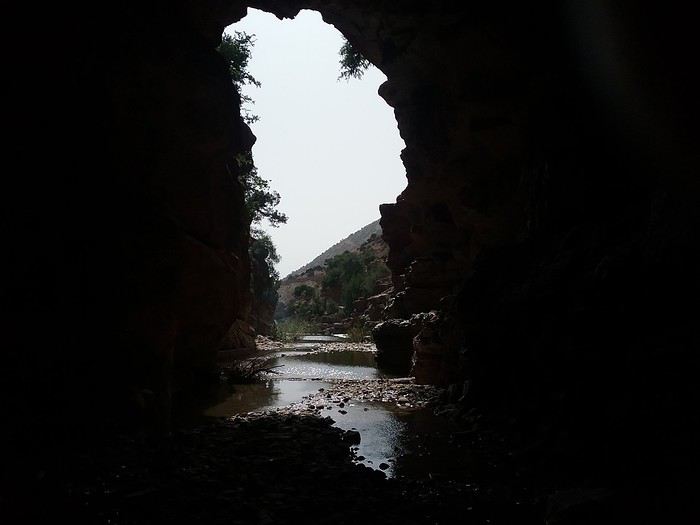
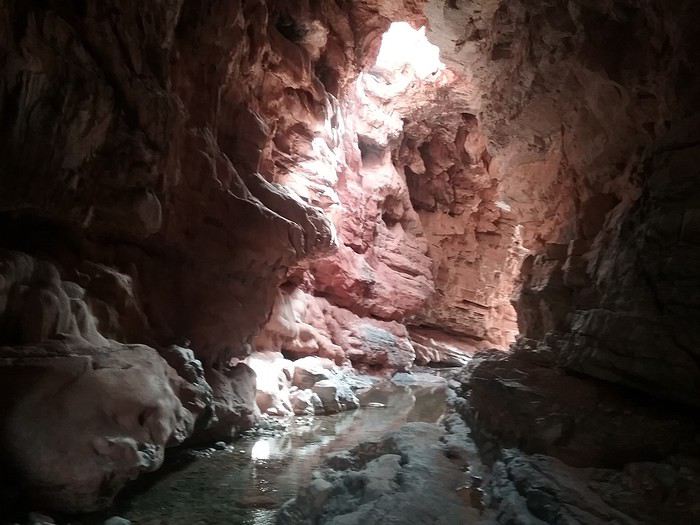
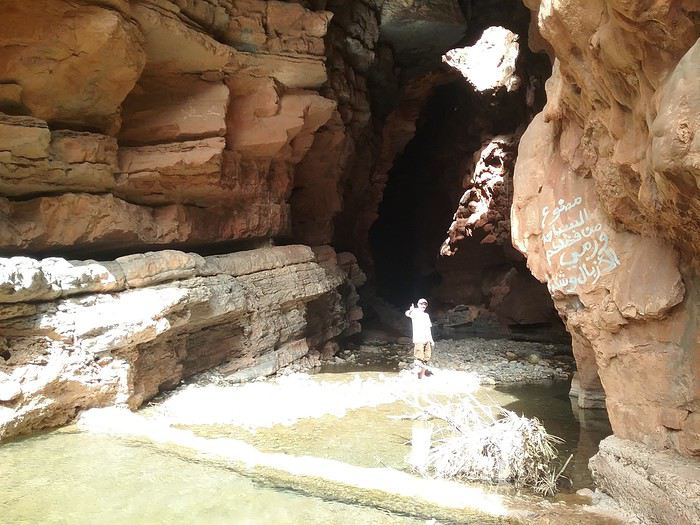
Beautiful stops and sites discovered in Morocco in March
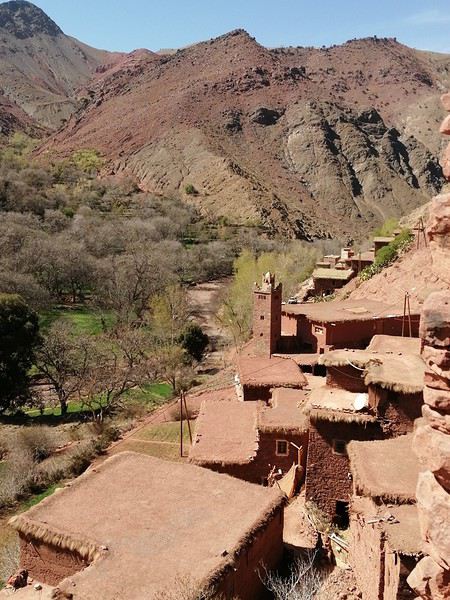
In early March, full of carefree joy and happy to return to Morocco, we landed in Marrakech under the sun. We spent just one night in Marrakech at the Hôtel Toulousain, as we did on our previous trip. And we booked our 3 nights for the end of our trip, the second half of March... Ouch! Ouch! Ouch! But we’re not there yet...

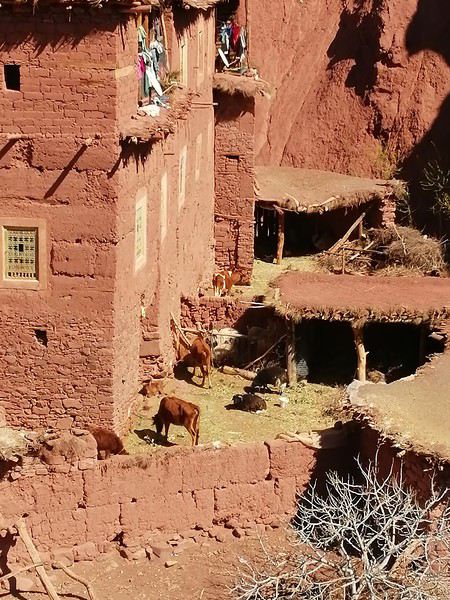
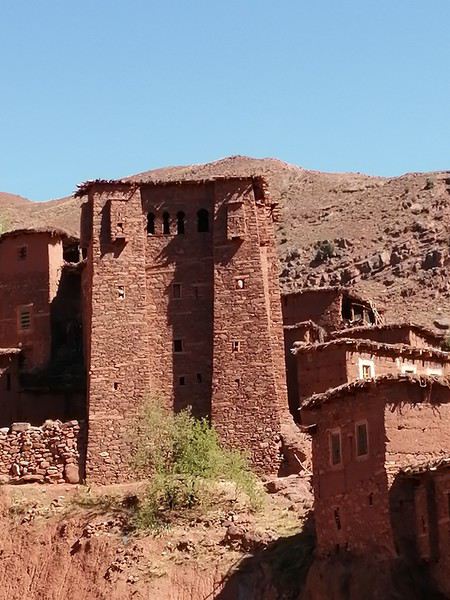
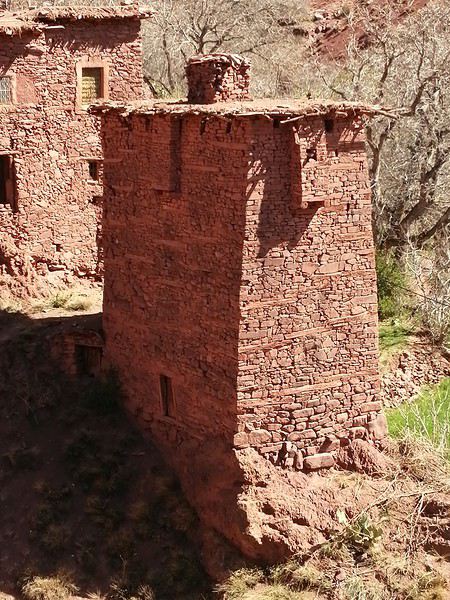
Our first goal is to reach Magdaz, a mountain village in the Tessaout Valley, sometimes called the lost valley. We discovered the village of Magdaz on this forum, and we were charmed by the photos and comments from travelers who came before us. The road is easy—it’s dry, and the tarmac takes us right to the village gates at over 2,000 meters above sea level. We arrive in the afternoon and are left speechless by the beauty of the place. A jewel of Berber architecture! Perfectly restored granaries and kasbahs!


A young man from the village guides us on the visit and opens the doors to the terraces overlooking the village.

Several magnificent collective granaries have been beautifully restored. The warm colors of the stone capture the light wonderfully. It’s stunning!


We won’t find anything decent to stay overnight there, so we head back down a bit and settle in at the Assounfou guesthouse. Lovely welcome. The place is in excellent condition and very clean. It’s spacious, but we’re the only ones there. First day full of promise!
Open
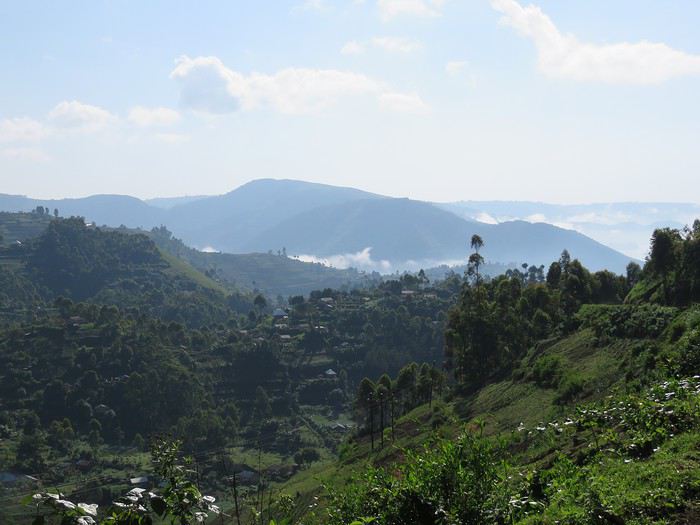
Self-drive in southwestern Uganda, February 2020
Since I used this forum a lot to prepare our trip, here’s a little feedback from our 15-day self-drive adventure in southwestern Uganda. For those who have questions, don’t hesitate! I’ll do my best to answer them 😉

We’d already traveled quite a bit in South Africa and once in Namibia, always self-driving. When the idea of visiting Uganda came up, we debated—especially me 😛—whether to go solo or with a guide. My husband quickly convinced me to do it self-drive, so I started planning and organizing the trip accordingly. We began preparations and bookings in June 2019 for a trip scheduled during the first two weeks of February 2020. We deliberately chose to explore just a small part of Uganda and take our time. We traveled as a group of four, with our oldest son and his partner.

Here’s our itinerary: - February 1: Departure from Brussels, arrival and overnight in Entebbe - February 2: Drive to Lake Mburo and overnight there - February 3: Drive to Lake Bunyonyi and overnight there - February 4: Boat ride on the lake, then departure for Kisoro. Overnight there - February 5: Trek in Mount Mgahinga National Park for the youngsters. Overnight in Kisoro - February 6: Drive to Bwindi Impenetrable Forest. Overnight in Rushaga - February 7: Gorilla tracking in Rushaga. Overnight in Rushaga - February 8: Drive to Queen Elizabeth National Park – Southern sector – Overnight on the park’s edge - February 9: Morning in the southern sector of the park, then crossing to the northern part – Short safari in the late afternoon – Overnight by the Kazinga Channel - February 10: Safari and boat cruise – Second night on site - February 11: Drive to Kibale Forest – Overnight there - February 12: Chimpanzee tracking in the morning – Bigodi swamps in the afternoon – Second night there - February 13: Scenic drive to see the crater lakes + walk at Lake Nkuruba Nature Reserve – Third night there - February 14: Return to Entebbe - February 15: Morning boat ride in the Mabamba swamps – Afternoon by Lake Victoria and midnight flight to Brussels. That’s the broad outline of our trip.

We fell in love with this country: the people, the kids shouting "muzungu," the colors, the landscapes, the wildlife... But we were also saddened by the poverty in some villages and the child labor, especially in "quarries."

I’ll try to post a day-by-day account if it interests anyone.

Open
From Ol Pejeta to Tsavo West (Kenya)
Hello everyone,

Here’s the story of our two-week trip—13 nights, actually—in the national parks of northern and southeastern Kenya, which we took last September at the end of summer. My wife and I planned this trip with a French agency (Bel Africa, Paris), which worked with a local operator in Nairobi (Nadhy Travels & Tours). The latter provided a driver-guide and vouchers, but no aperitif🙁! Our all-inclusive package included animal safaris exclusively in a customized 4x4 vehicle (with a pop-up roof) and accommodations in high-quality lodges that we selected ourselves. It’s great for comfort, but not so much for the wallet. The cost was obviously astronomical for the services provided. But that’s just my usual take on lodging in East and Southern Africa! Our itinerary was a loop starting and ending in Nairobi, passing through Ol Pejeta, Buffalo Springs-Samburu, Meru NP, Amboseli, and Tsavo West.

Trip breakdown:

Day 1 to 3: Ol Pejeta Day 3 to 7: Buffalo Springs Day 7 to 8: Meru NP-Nairobi Day 9 to 11: Nairobi-Amboseli Day 11 to 14: Tsavo West

Photo gear we brought:

- 1 bridge camera - 2 DSLR bodies - 2 telephoto lenses: 70-200mm f/2.8 and 200-500mm f/5.6 - 2 pairs of 10x42 binoculars

What motivated this trip? We wanted to recharge and were looking for a certain tranquility that would be ideal for wildlife observation and photography—our hobbies. That immediately ruled out the parks in the southwest, which are too crowded. Plus, those would have likely been a repeat of what we experienced in Tanzania a few years earlier (see my travel journal "The Great Migration"). Buffalo Springs particularly appealed to us because of the unique animal species it’s home to. It was really their existence that drove our choices. We wanted to see animals we’d never seen before in their natural habitats.

So, on a beautiful late-summer evening, we took off from Paris-CDG for Nairobi. The overnight flight was uneventful, and we landed early in the morning at Jomo Kenyatta International Airport (NBO). But our driver-guide wasn’t waiting for us. Judging by the number of signs being held up, we must have been the only travelers in that situation. Good grief, why wasn’t he there like all the others?
Open
Six-week trip to Mexico
I recently took a six-week trip to Mexico with Y, my Thai partner. To be precise, we spent 43 days there plus a final half-day before heading to Mexico City Airport for our return flight to Europe.

I’d already been to Mexico about 40 years ago! But that was only for a week or so, between Mérida and the Belize border.

First off, I should mention that I’ve never seen a beach in Mexico. I say this because discussions about Mexico always seem to revolve around the Costa / Riviera Maya.

Let’s start with an overview of the trip. Our itinerary can be split into two halves:

- First half: Querétaro, San Miguel de Allende, Morelia, Guanajuato, Mexico City “CDMX” (the capital). - Second half: Palenque, San Cristóbal de Las Casas, Chiapa de Corzo, Oaxaca, Puebla, Cholula, and finally Mexico City CDMX.

To move from one part of the trip to the other, we took a flight from Mexico City CDMX to Villahermosa, then a bus to Palenque.

In six weeks, we visited maybe a quarter or a fifth of the country (see the attached maps). Mexico is about three times the size of France! And when I say “visited,” it was really just a quick stop—enough to get a first impression. I understand that some people can only spend one or two weeks on vacation in a given country, but that’s not my idea of travel. Personally, I’d say a country as rich in every way as Mexico deserves several months of travel before you can say you’ve “seen” it.

In my next post, I’ll break down the expenses. That might help future travelers plan their trips. You don’t go to a country for several weeks (or more) without thinking about the budget! Besides, one of those future travelers to Mexico is us—we were so thrilled by Mexico that we’re definitely going back.
Open
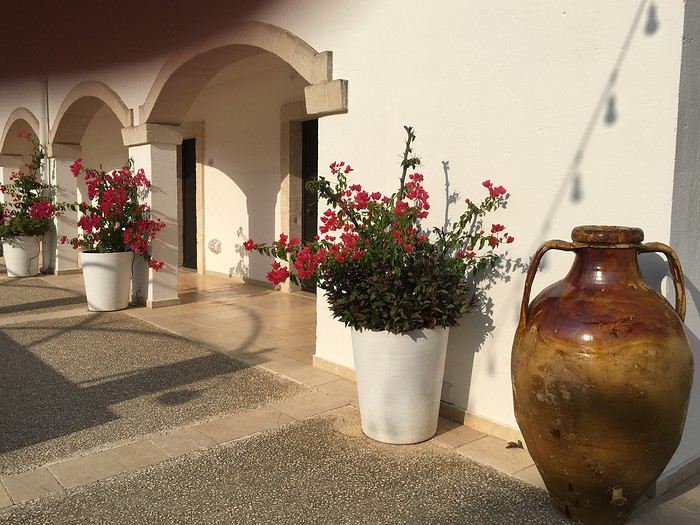
Autumn trip from Puglia to Naples via Basilicata...
Hi everyone!!!

I’m finally getting around to writing about this 20-day trip to southern Italy: we didn’t travel this summer, and luckily, we found beautiful light and dreamy weather there at the end of September.

First, here’s the context of the trip: we’re both "confirmed seniors" but still curious and alert enough to enjoy the itinerary we’d imagined! We wanted a mix of discoveries—culture, cities, and nature—with guaranteed sunshine and the occasional short hike... We’re flying to Naples, round-trip, because the flight times work better for us. We rented a car online, picked it up at the airport (details to come... and it won’t be the highlight of the trip!), and booked our hotels in advance.

A quick overview of the itinerary: leaving Naples on September 15th, early in the morning, we’ll drive straight across the boot of Italy to Bari. After 11 days in Puglia, we’ll head back toward our starting point, taking our time: Matera in Basilicata, Maratea by the sea, and finally Paestum with its incredible temples.

Day 1: Brussels-Naples flight (Brussels Airlines) went smoothly; it landed an hour early, and we were thrilled, thinking we could use that time for a quick visit or two... Everything went well until we left the airport. We took the shuttle to the car rental offices, and at first glance, we realized this wouldn’t be smooth sailing!!! In front of every office (they’re side by side), there were already lines and kids sitting on suitcases—everyone looked exhausted... We resigned ourselves to waiting: nothing moved until tempers flared at the counters, and two people nearly came to blows. Things sped up a little, and after 2 (two...) hours of waiting, we finally got our chariot: a black Fiat Tipo, dirty, with a few dents and scratches that we made sure to note in the contract... but it ran!

Off to Bari, then: no time for sightseeing along the way! From there, we headed straight to our hotel in the countryside near Polignano a Mare.


A recurring detail: this happened constantly during our travels. We’d installed our own GPS, fully updated... In recent years, many dirt roads have become drivable, and lots of hotels and hostels have opened in the outskirts of towns. It was extremely rare for our ‘guide’ to recognize the street—let alone the number—we entered. Often, we got by calling the hotel reception: it might seem like a small thing, but it happened so often it became frustrating. In hindsight, it seems like without Google Maps, we’d have been lost!

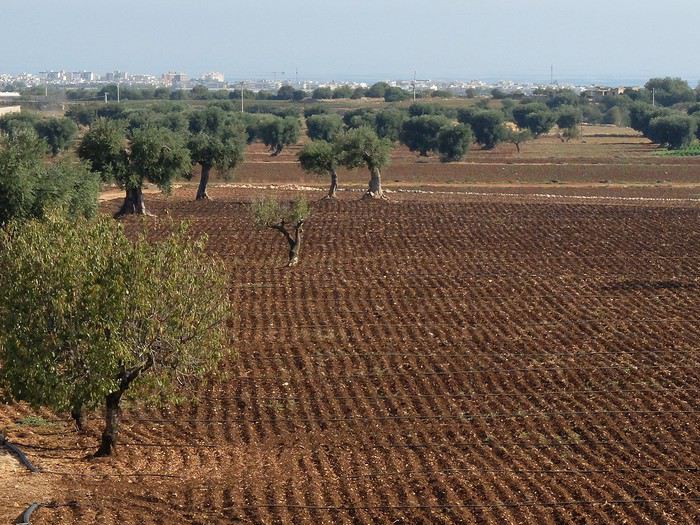
Anyway, we were beautifully settled, with a terrace overlooking olive groves and the sea in the distance: all was well.


To be continued...
Open
Two Sides of China: Urban Shanghai and Rural Yangshuo


Vast, diverse, and multifaceted China! During a recent journey across part of this fascinating country, I enthusiastically discovered so many aspects of it. But such variety seems hard to condense into a single story. So, for this travel journal, I’ve focused on two main facets of China. First, a modern and urban China—the sprawling city of Shanghai—and then, in a second part, a China that’s the complete opposite: a rural and more traditional side explored around Yangshuo, where nature is absolutely stunning. Ready for a tour of China, city first, then countryside? Travel stories, descriptions, and impressions are on the program, with plenty of room for photos. Enjoy the journey and happy reading!

--

Urban China: Shanghai

As soon as you explore the city, it’s clear: the Chinese wanted to turn Shanghai—once a small fishing village—into a showcase of a modern, powerful, and forward-looking China. The megacity is immense, with around 24 million people bustling through its avenues or stuck in monstrous traffic jams at the foot of some of the world’s tallest skyscrapers. Towers so high they almost touch the sky—well, almost. But this gigantism is just one side of this southern metropolis in the Middle Kingdom.

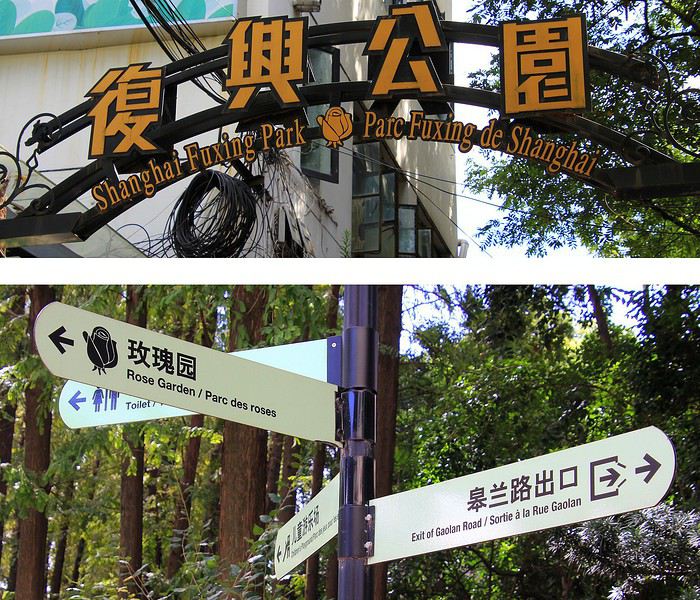
Away from the towers and business districts, you discover another side of Shanghai—more traditional and, some would say, more human. This is where my travel story begins: on a quiet morning among smiling, relaxed locals. We’re in one of the city’s parks, specifically Fuxing Park.


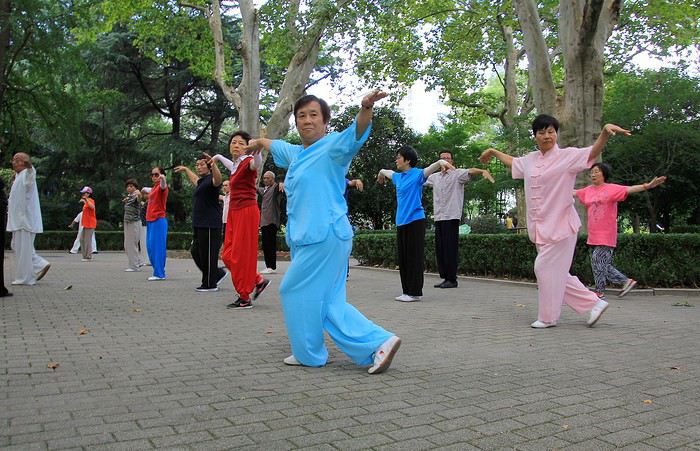
As everyone knows, the Chinese love practicing Tai Chi Chuan, in groups or solo, so it’s no surprise to see so many here, moving slowly and precisely through their sequences. Here’s a first group, their movements and postures perfectly coordinated.


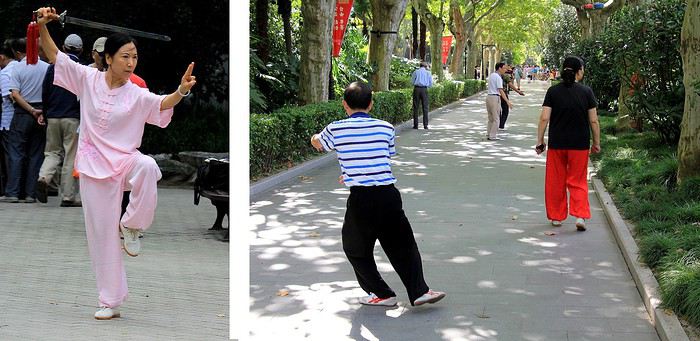
In another alley, a lone practitioner is deep in concentration, executing his movements with focus. I watch him for a few moments, discreetly and from a distance, so as not to disturb him. To his right, a woman in bright red pants keeps walking, almost as if she’s marching in place. A strange ballet: a series of steps forward, then backward, and so on...

Nearby, this elegant athlete (or artist) performs Tai Chi with a sword—almost like a choreography, her movements resembling a true sword dance.


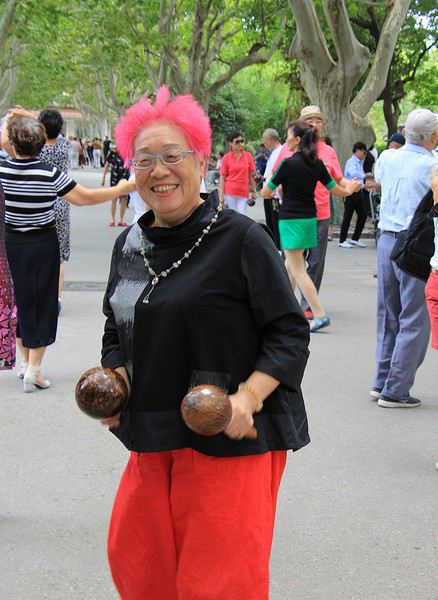
Further on, the atmosphere is more relaxed and melodic. People are playing music and dancing joyfully, like this woman with her colorful, original hairstyle, all smiles with maracas in hand. You almost want to clap along—her energy is so contagious!


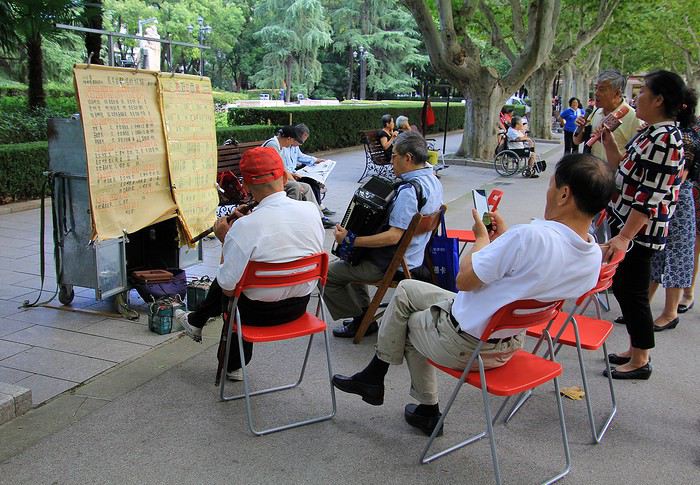
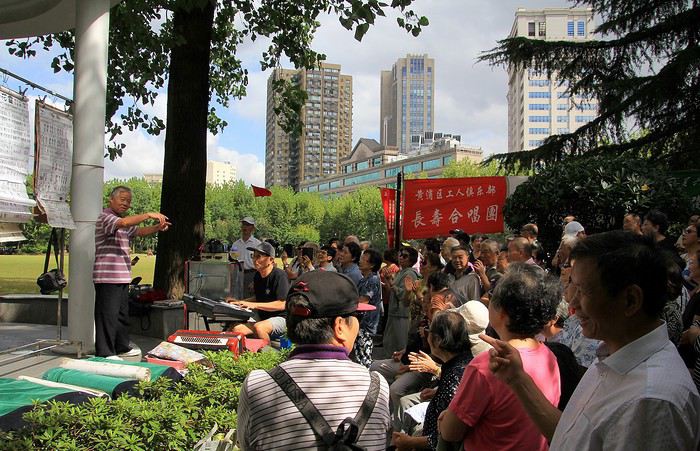
The mood is lighthearted among this group of retirees. Their choir alternates between patriotic hymns and lighter songs. Someone must have told them some French people were watching, because suddenly they start singing an old French tune: « Vive le vent, vive le vent d’hiver... » And the cheerful choir leader invites us to sing along—all together! The result was a fun cacophony: us in French, them in Chinese. But it was so charming!

These Chinese locals definitely passed on their good mood. It’s a joy to see all these retirees—you can imagine them leaving their small apartments to get some fresh air and meet up in the park for these morning activities. But let’s not kid ourselves: while they seem so happy and content with those big smiles, most of them probably didn’t have an easy life. Food shortages, draconian regulations, propaganda, the one-child policy—just to name a few! No, what many endured in their daily lives didn’t always give them reason to smile so brightly. But now, they’re making the most of it, and as I wrote earlier, it’s wonderful to see them like this.

Encouraged by these shared moments, I decide to keep going. Without hesitation, I join a Tai Chi session. I tried my best to follow the movements of my neighbors practicing this traditional exercise, but I’ll admit—it wasn’t easy!


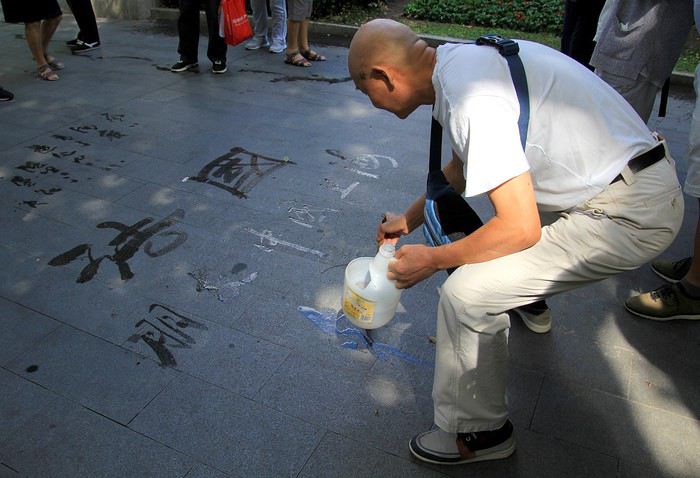
This artist, especially attentive, rewards us with a calligraphed phrase about France. A lover of Chinese calligraphy, he writes these sinograms in ancient characters directly on the ground. Is it writing or drawing? It’s hard to say—the result is so aesthetic. An ephemeral phrase, written in water that slowly fades as it dries, before disappearing entirely.


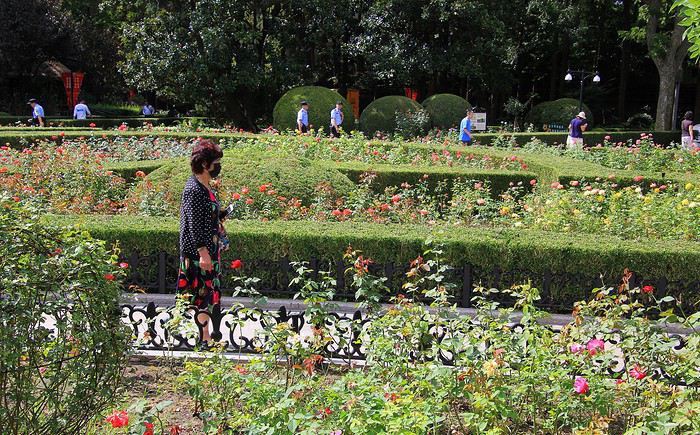
As we walk, we approach one of the park’s exits—so beautifully flowered. These flowerbeds and their blooms hint at the name of this charming place: Parc des Roses—and it’s even written in French!


--

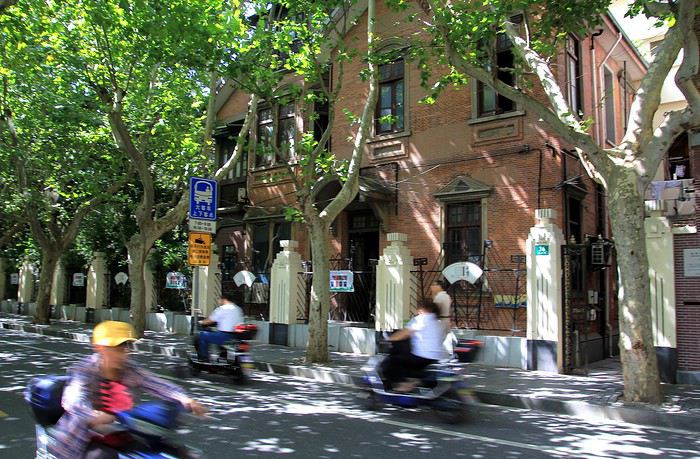
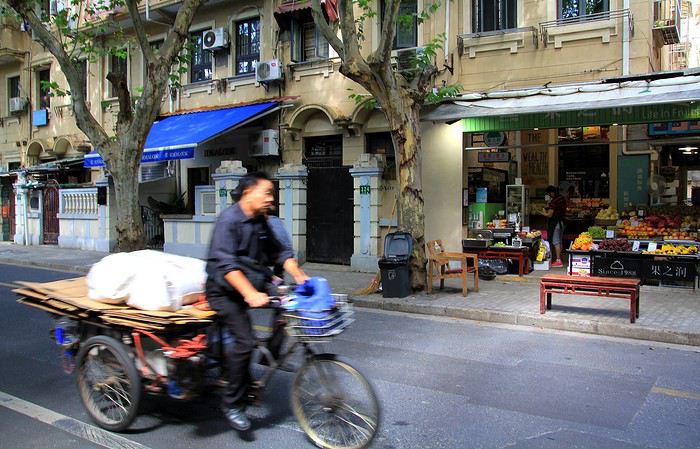
We’re now in the former French Concession of Shanghai, which explains the French inscriptions. The era of foreign concessions in Shanghai is an old story, dating back to the 1840s—a time when China opened its market to international trade. Several nations, including European ones, established trading posts in the city. There were British, American, Japanese, Russian, Italian, German, and French communities. This part of Shanghai was under French administration for a time, starting in 1846.


Some buildings in the area still bear witness to that time, like these ones, with bikes and scooters passing by. The architecture popular at the time blended European influences with the style of Shanghai’s elegant residences: stone arches above entrances, brick walls, and pleasant inner courtyards. Large homes often divided into several apartments today.


--

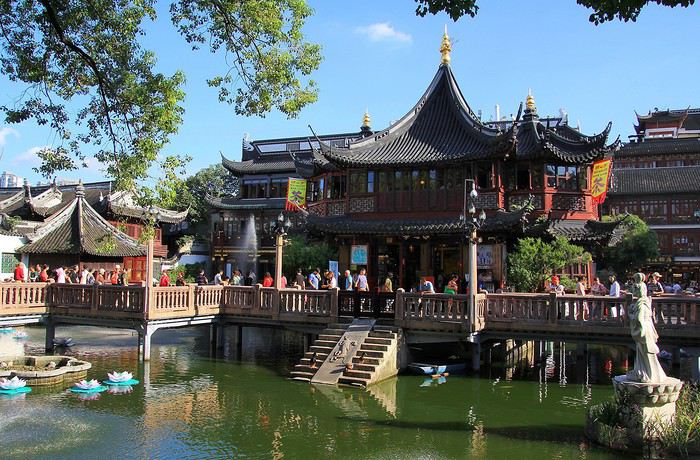
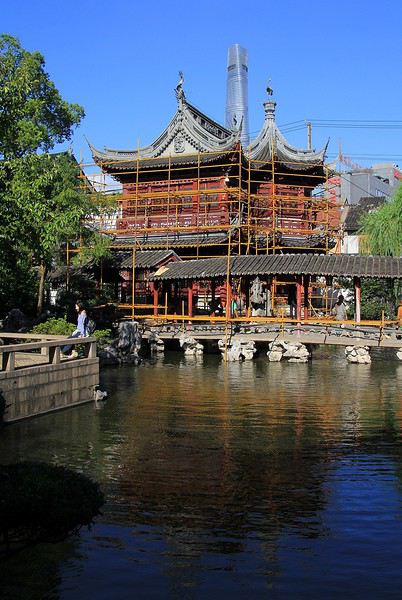
Traditional Chinese architecture shines in all its splendor at this tea house. With pagoda-style roofs—corners turned up toward the sky—refined colors and decorations, and a small corner tower on the right, this Huxinting Pavilion dates back to 1784. It was built in the middle of a pond, offering beautiful reflections. A truly charming spot where you can savor the subtle flavors of Oriental teas in the interior rooms.


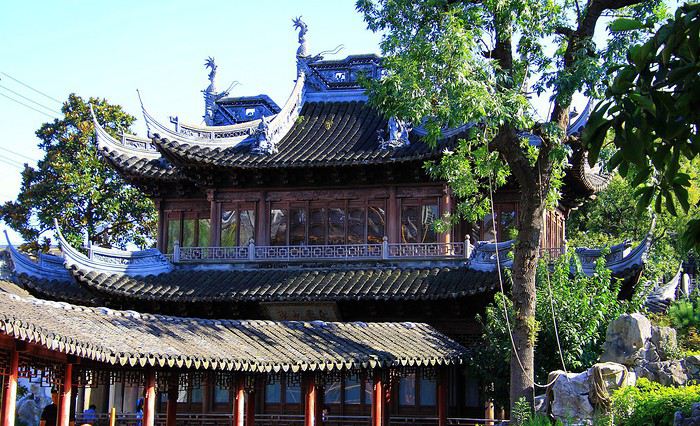
Just steps from this picturesque spot, don’t miss the Yuyuan Pavilions and Garden. The whole complex is stunning and gives a glimpse of imperial-era homes and parks from the Ming Dynasty.


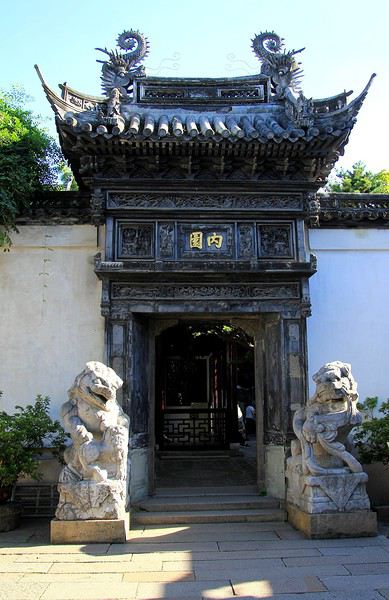
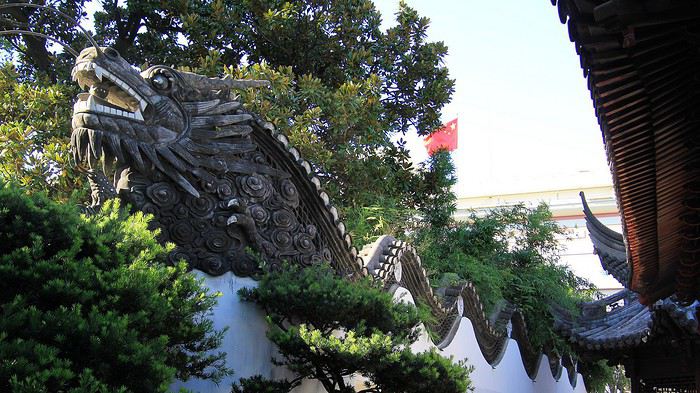
Pass through the entrance gate to enter this opulent property, well protected by a high surrounding wall. On one of them, a dragon sculpture sprawled at full length—about 7 meters—is impressive. The symbol represents power but also happiness.


Created in 1577 by the Pan family, wealthy dignitaries of the time, the visit takes you from pavilions with poetic names like the Pavilion of Three Ears to the Pavilion of Spring’s Announcement. Charming!


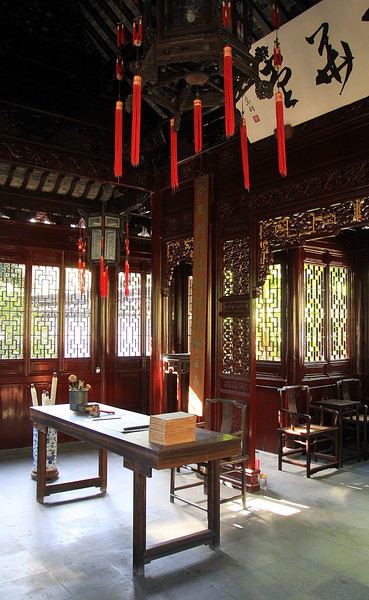
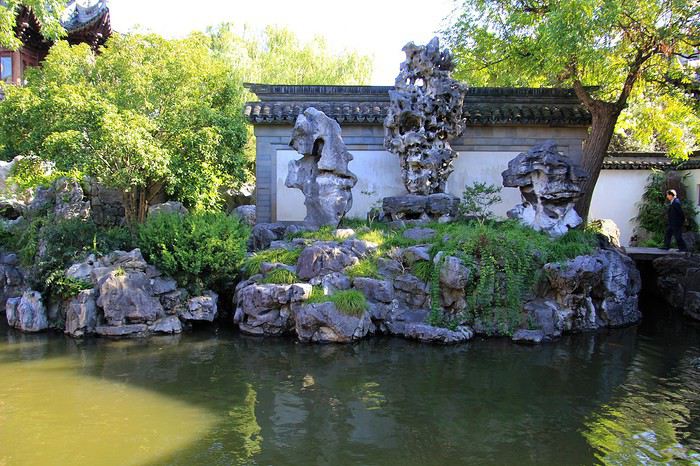
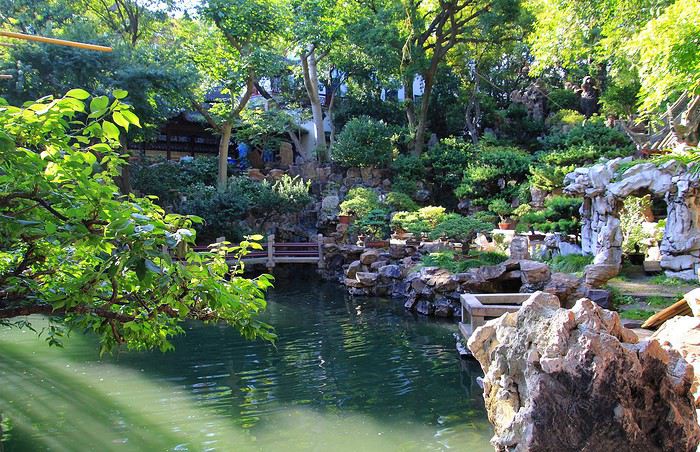
The interiors are decorated with woodwork from walls to ceilings, where beautiful Asian lanterns hang. But the real charm is outside. These shaded gardens, rustling with bamboo, are adorned with several ponds surrounded by impressive rock formations. A world that recreates (in miniature) the mountain and water landscapes of rural China.


This historic Yuyuan Garden, in the heart of the city, took about 18 years to design and build (pavilions and gardens). Its current appearance is the result of a faithful renovation—much needed, because in 1942, during the so-called Opium War, British officers made it one of their residences. It was partly destroyed by bombings, and later, French troops ransacked it after an attack on their concession.


The site is still under construction—maintenance and renovation—with scaffolding as proof. The garden’s enclosure was set to close for work the day after our visit (for a few weeks, until the end of October 2019). That’s probably why crowds of visitors were rushing in, making the atmosphere a bit less peaceful than this beautiful architectural ensemble might suggest. For the photos, I had to be a bit clever, avoiding the crowds to give an impression of tranquility—this historic place deserves it.

--

To be continued in the next post...
Open
Discovering the joys of camping in Namibia
This three-week trip to Namibia was a big first for us: - Visiting a country in winter, for someone who starts feeling comfortable at 25°C (77°F). - Camping, when we usually feel at home in a starred hotel. - Sleeping on the roof of a car—what an idea... when a comfy bed is waiting just a bit further. - Grocery shopping, cooking, doing the dishes... all the things we usually avoid to fully enjoy our vacation. - Washing up when and how we can, when we can’t imagine going a day without a shower. - Driving a big 4x4 on the left, with a manual transmission, when we usually opt for an automatic for more comfort.

Yep! You guessed it—we stepped way out of our comfort zone during this trip.

I had quite a few doubts while planning this adventure, but the more I read travel journals about Namibia, the more I wanted to go.

Personally, without this forum, I never would’ve dared to hit the Namibian roads in a 4x4. I was really anxious during the planning, so I want to thank everyone who contributed with their journals and forum discussions for helping me leave more peacefully.

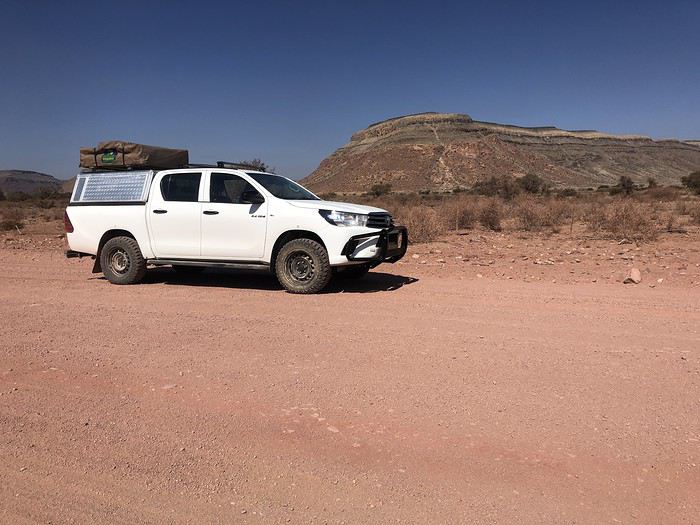
At first, I wasn’t even considering sleeping in a tent. But after my husband’s persuasion—and my own curiosity to experience what I’d read in those travel journals—I gave in. So off we went in a double-cab Hilux with a rooftop tent.

And of course, let’s talk about me—the big cold-weather wimp. One of the biggest pre-trip challenges was choosing a sleeping bag. After a while, sleeping bags had no more secrets for me: temperature ratings (comfort, limit, extreme), shapes (mummy, rectangular), fillings (synthetic, down), compression rate, and weight... all these factors were a real puzzle. In the end, to make sure I wouldn’t be put off camping in winter (Australian winter, mind you), I went for a sleeping bag with a comfort rating of -10°C. And just to be *extra* sure I wouldn’t get cold, I bought a liner (never knew what that was before) in Thermolite, which boosts the sleeping bag’s temperature by 11°C. There are liners that add up to 15°C, but let’s not exaggerate—we’re not heading to the North Pole! My husband, on the other hand, got a sleeping bag with a -5°C comfort rating and a silk liner.

Was it enough? You’ll find out soon. In the meantime, another big thank you to everyone who helped me make this choice with their advice and experience.

Over a year in advance, we planned a three-week itinerary for our first trip to Namibia—classic route, nothing too out there. We chose to do the circuit clockwise because we wanted to finish on a high note in Etosha and its wildlife. They say it’s like Noah’s Ark out there! And why not, the cherry on top... some big cats.

We used Tourmaline’s services to book our accommodations and the 4x4.

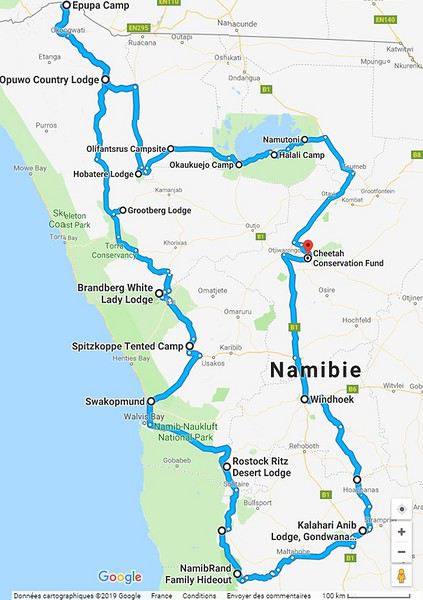
Here’s our planned itinerary with campsites and lodgings—yes, there are a few solid roofs in there; we didn’t want to push it too far.

Day 1: Windhoek – Windhoek Gardens Guesthouse Day 2: Kalahari Anib Campsite Day 3: Namibrand Family Hideout Day 4: Sesriem Camp Day 5: Sesriem Camp Day 6: Rostock Ritz Camp Day 7: Swakopmund - Sea Breeze Guesthouse Day 8: Swakopmund - Sea Breeze Guesthouse Day 9: Spitzkoppe Camp Tented Day 10: Brandberg White Lady Campsite Day 11: Grootberg Lodge Day 12: Opuwo Country Campsite Day 13: Epupa Camp Day 14: Hobatere Lodge Day 15: Etosha Olifantsrus Camp Day 16: Etosha Okaukuejo Camp Day 17: Etosha Halali Camp Day 18: Etosha Namutoni Camp Day 19: Cheetah Eco Lodge Day 20: Windhoek – Londiningi B&B


Alright! Are you ready to follow this adventure with us in our Hilux?

Open
Rajasthan: Incredible India?
Valérie (Alexval2) convinced me to publish this travel journal about our trip to Rajasthan, so here I go, sharing what will be my first travel journal! 🙂

But first, why India? This question has already been discussed on the forum. For me, I had these idealized images in mind: maharajahs, palaces, elephants, and friends who gave me glowing reviews. We’ve already been to Asia and wanted to do something different. We weren’t disappointed.

So, after spending what felt like hundreds of hours 😛 researching forums, blogs, and various guides, the Rajasthan region stood out as the perfect choice for a first discovery.

We managed to plan this itinerary, which is quite classic but structured around a must-see: the Pushkar Camel Fair. I’d read reviews and watched videos about it, all very enticing. We’ll see later how it turned out.


As usual, I had everything booked in advance because I don’t like wasting time looking for solutions once we’re there.

Our Air France flight arrived on time at 11:15 PM. We’d read the recommendations, and after collecting our luggage, we headed to the prepaid taxi booth. We got the receipt, and two charming guys took our suitcases to the taxi. When we arrived at the taxi, they asked for 500 INR for the porter service. Of course, I resisted, and with the driver’s help, we settled on 200 INR. Welcome to India.

We agreed with the friendly driver that he’d pick us up from the hotel (Ibis, great breakfast) for our flight to Jaisalmer. It was 2 AM, we collapsed into bed, but the night was short since we had to wake up at 5 AM.
Open
In Search of Warmth in California, Utah, and Arizona in February
It all started last December, after another price alert from Gilou for United/Lufthansa flights at 250 € from Paris to San Francisco. Meanwhile, I was planning to spend a week alone with our three kids (Maxime, 14, Rachel, 12, and Timéo, 8) somewhere in France for the February break.

But this time, Gilou really outdid himself—way too tempting! 😮 His great tip worked for both the February and Easter breaks. I know April is the ideal month, especially if you love hiking! But for family reasons, only February would work for us.

Isn’t February a month to avoid for the Southwest? To keep our summer trip budget intact, I was thinking of camping as much as possible. After checking weather sites for temperature histories in key spots (Furnace Creek, Saint George, Page, Sedona), nighttime temps over the past two years ranged from +5 to -2°C. So, it seemed doable...

I started discussing (aka negotiating, even begging) with my better half. The kids caught on fast that there was a chance we’d go, and they were thrilled! She finally gave her consent to make the kids happy 😎. I quickly checked that our ESTAs were still valid, and 48 hours later, I had the tickets in hand 😎😎. But five days later, Laetitia changed her mind—her "Yes" turned back into a "No." No way were we going without her to her favorite country!!

Damn it 🤪! I had to tell her I’d already bought the four tickets (without bringing it up again, of course—a "Yes" is a "Yes," right?). And since the tickets were non-refundable, there was no going back... Apparently, with women, some "Yeses" mean *really* yes, but others mean, "I said yes in principle, but I wasn’t actually on board—and I never thought you’d have the nerve to buy the tickets without telling me!!" I had no idea 🤪!

Us guys? We’re way more straightforward—binary, even monetary... Yes means yes! And no can mean yes too 😏!! Anyway, in a lovely family atmosphere, I opened a thread to start planning and thanked Trois14 and Bluemesa for their help. On Trois14’s advice, I booked 5 nights in motels around St. George-Page at super tempting rates—around $35-40 a night...

On that note, Christmas cost me an arm and a leg... Gotta try to make up for it 😛!

Here’s the theoretical itinerary:

Death Valley (2 days) Valley of Fire The White Dome (hike up and down via Squirrel Canyon) 4 nights in the Kanab-Page area Sedona (2 days) Route 66 Alabama Hills / Trona Pinnacles Drive back to SFO via Highway 1

That’s the plan, at least...

In reality, it turned into a whole different story. I learned that in February, you’ve got to be flexible—*very* flexible sometimes—to dodge the weather. Halfway through, a cold snap made our second week (planned 100% camping) impossible, completely upending the itinerary.

So, a huge thanks to PapJ59, Noyellebis, and especially Caribou44 and Simonic. 🙂 A thousand thanks for your quick responses, availability, and sound advice, which let us have an original and unforgettable second week—Organ Pipe Cactus NM, Yuma, Salvation Mountain, Anza Borrego SP, a palm grove in Joshua Tree, then back to SFO!! Without you, we’d have been miserable on the spot, but instead... 😇

A big shout-out to Thibaut and his famous blog (rightfully praised on VF—it’s one of the few that details Organ Pipe), to travel journal writers for inspiration in general, and to those who helped me prep or during the trip (journals by Pong, Hiacinthe, Zitounet, and Laetitia).

Now, for the story...
Open
Three Passes Trek in Nepal
Hi there. I know this topic has been covered countless times, but I can't seem to find clear answers to my questions.

I'm currently looking into doing the Three Passes Trek, including some adjacent routes like EBC, Kala Patthar, Gokyo Ri, and maybe Chukung Ri. I'm planning to do this trek between April and May.

But I have a few questions.

In terms of difficulty, I think I'm physically up for it—I'm athletic and used to mountain hiking in France—but is there any specific training I should do? Just to note, I did the Annapurna Base Camp last year without any issues.

Is it doable without a guide? I’d prefer to skip a guide and porter so I can really move freely. Is that crazy, or is it common? I’m mostly concerned about the Cho La and Renjo La passes (more about the route and risk of getting lost than safety).

Finally, I’m wondering about the duration. I’m a fast hiker, but I plan to take my time to acclimatize properly and enjoy the scenery (and maybe relax a bit in those landscapes🙂(By the way, does living at 2,000m altitude for 90% of the year help with AMS?) How much time should I budget for the trek to be safe, even if it means spending 2-3 extra days around Lukla-Namche? I was thinking of setting aside 20 days—does that sound reasonable?

Thanks for reading, and sorry in advance for any spelling mistakes. If I think of more questions, I’ll post them in this thread.

Cheers
Open
A Magnificent Loop in the Southern Rainbow Nation
Hello everyone, It’s been a little over a year and a half since we first set foot in South Africa, and ever since, we’ve been dreaming of returning to explore Southern Africa.

First of all, a big thank you to all the forum members—there are so many on this VoyageForum section, some of whom are unconditional and indispensable experts on the destination—for the amazing travel journals that only make you want one thing: to go and discover these stunning lands. The first journal I read was Bruno’s (Montagnard74), and I was completely captivated by the face in the colors of the rainbow nation.


Now it’s my turn to add my small contribution by recounting our two-week trip during the Christmas period in South Africa.

Even though Attila strongly advised against visiting South Africa during the South African summer holidays, we still gave it a try since my husband doesn’t have the option to choose his vacation dates.

So we went during the peak tourist season, with all its drawbacks: difficulties finding accommodations, crowds at certain sites... But on the bright side, it’s the beautiful season in South Africa while it’s gray and cold back home.

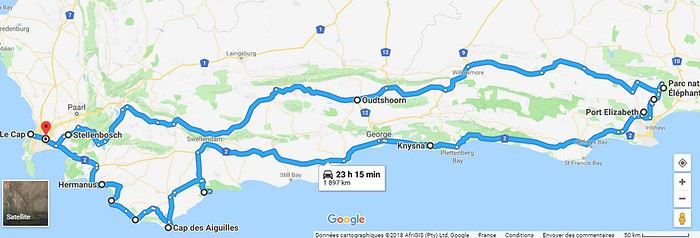
For this trip, we wanted to explore Cape Town and its surroundings, which are already packed with things to see. As a result, we didn’t have time to head north without rushing too much. So we planned the following itinerary, staying in the south:

J1: Lyon/Dubai J2: Dubai/Cape Town J3: Table Mountain – Cape Town J4: Botanic Garden - Robben Island J5: Cape Peninsula J6: Cape Agulhas - Gansbaai J7: De Hoop - Swellendam J8: Garden Route - Knysna J9: Garden Route - Addo NP J10: Addo NP J11: Oudtshoorn J12: Little Karoo J13: Wine Route - Cape Town/Dubai J14: Dubai/Lyon


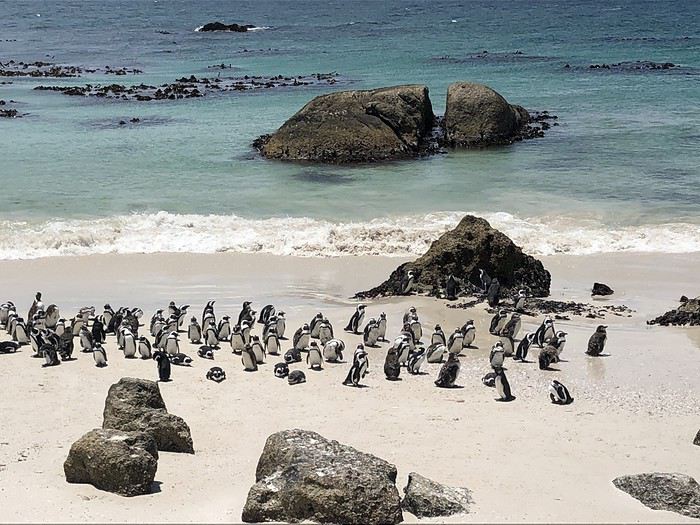
To give you a taste of what we experienced on the South African roads, here’s a little preview of the wildlife and flora we encountered, as well as the beaches and mountains we glimpsed.


The rest here
Open
She Sees Giants Everywhere! (Ducasse of Ath, Belgium, August 2018)
Sometimes fantasy and a change of scenery are right near home! I love exploring the four corners of the planet, but there can also be a whole world just a little farther than the end of your street—or even the tip of your nose! So I’ll share with you in pictures the beautiful kermesse of Ath, which we only discovered last August, even though we’re neighbors (we live in Lille).

I could have subtitled this travel journal: "Ferme eut’bouc tin nez va quer eud’dans"; it’s an expression in Picard language, literally “Close your mouth or your nose will fall in,” said to someone who’s amazed—and amazed I was!!! Ooooooooh, giants! Oh, how I love them! In the North, we have lots of these giants, like Reuze Papa and Reuze Maman in Cassel, or Gayant, Marie, and their children Binbin, Jacquot, and Fillon in Douai, and many more.

Huh? What? You don’t know what a Géant du Nord is?

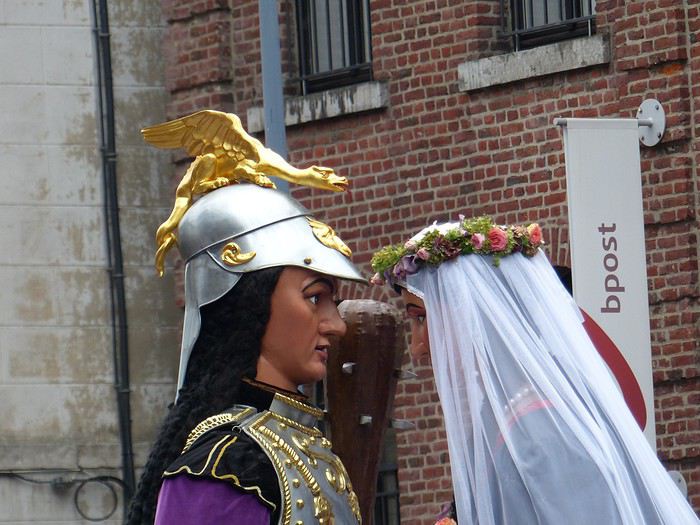
Well, it’s a benevolent hero, a legendary figure, a protector, a symbol tied to a city that parades through it, walking and dancing during carnival or the local festival. The tradition is said to have originated in Portugal in the 13th century (at least that’s where we have the first records), then we see them in the Netherlands starting in the 15th century. In the North, the oldest are Gayant and Marie of Douai (16th century), but many new ones have appeared since the 1980s with the revival of carnivals. In practice, it’s a large character (or animal figure) several meters tall; the structure is made of wicker, the body is often papier-mâché, but the head can be wood, as in Ath (lime wood), and the clothes and accessories are made of fabric, leather, and wood. The flared robe (for both male and female giants) allows one or more carriers to slip underneath to move it using only their arms, shoulders, and legs—and even make it dance! There are over 1,500 giants in Belgium and 450 in Hauts-de-France, mostly in the Nord and Pas-de-Calais departments.

In Ath, there are giants—LOTS of them! I’ve never seen so many at once. And each one is carried by only one man at a time (except for Bayard, you’ll see why later), even though the structure weighs over 100 kilos—so the carriers take turns quickly! The Ducasse of Ath and its giants have been inscribed on the UNESCO Intangible Cultural Heritage list since 2008, as part of the "Processional Giants and Dragons of Belgium and France." What’s more, the Ducasse of Ath is remarkable for its age and local roots; a procession was first mentioned in 1399, and today the many musical groups are still local (Ath and surrounding towns). The event is extremely popular: a good part of the population is there, all generations mixed together. Everyone knows the groups, floats, and giants, and each has their favorite! Originally, religious groups paraded, illustrating episodes from the Bible or the Golden Legend. Gradually, the parade became secular and kept evolving by adding new giants, historical figures, or allegories linked to local history (Ath, Belgian Hainaut, Belgium).


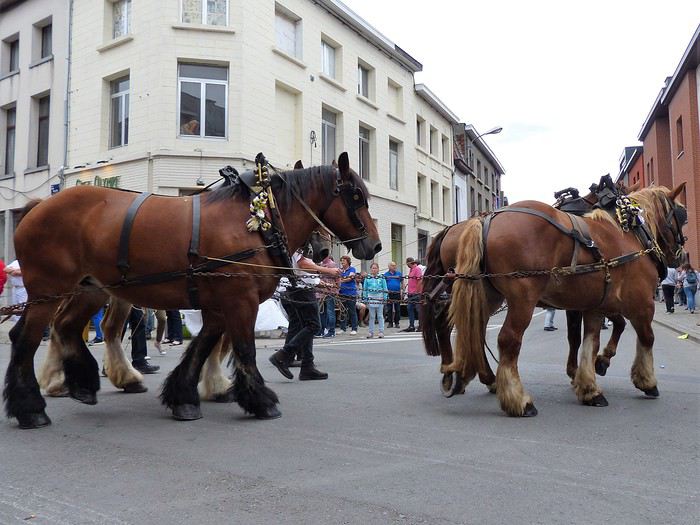
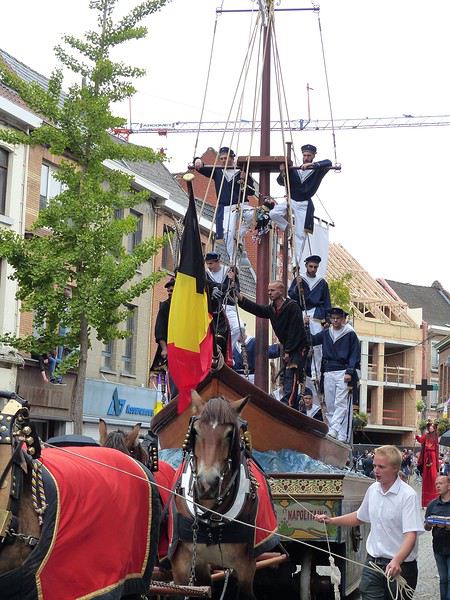
Finally, the beautiful floats are all pulled by magnificent draft horses, and that’s extraordinary! The town council itself rides in fine carriages that close the parade.

To wrap up this long introduction, know that the Ducasse of Ath lasts several days, but the highlight is the highly codified procession that takes place on the 4th Sunday of August (actually, the procession passes twice, once in the morning and once in the afternoon).

So, let’s go!

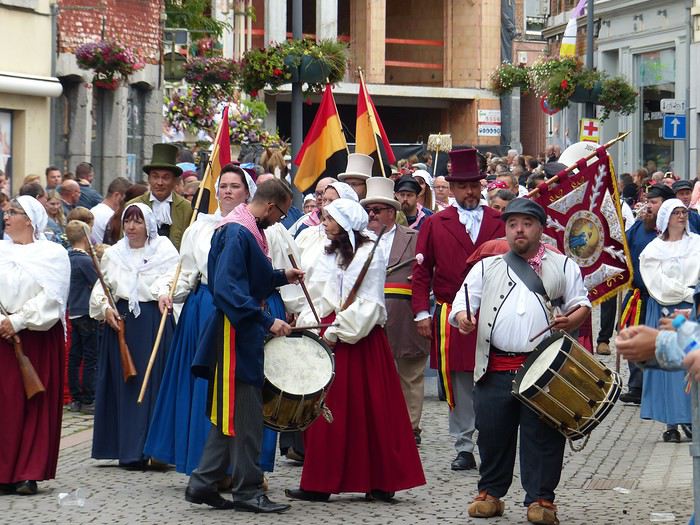
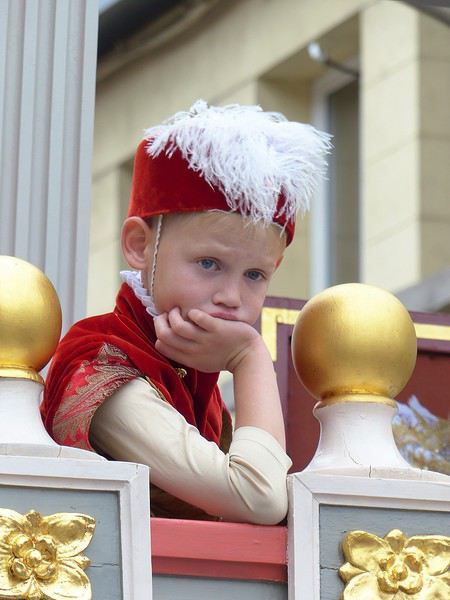
On this Sunday, August 26th, we’re in Ath in the early afternoon to see the procession. What a popular enthusiasm! Everyone is wearing the city’s colors (purple, yellow, and white), often with a twisted fabric necklace. Everyone is happy, smiling, from the giggling toddler to the sprightly centenarian sipping beer with her rosy-cheeked cousin and the pretty freckled blonde niece. People call out to each other, laugh, hum, and congratulate each other all around.

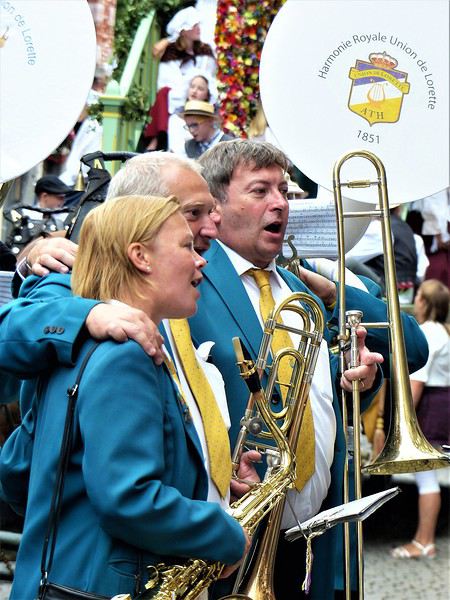
People start positioning themselves at strategic spots along the route—wider areas where the giants stop to perform a dance to the tunes of the brass bands accompanying them. And there are brass bands—at least one per giant and float!

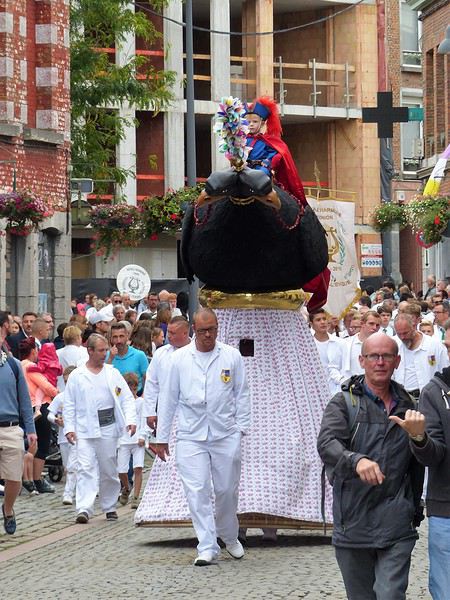
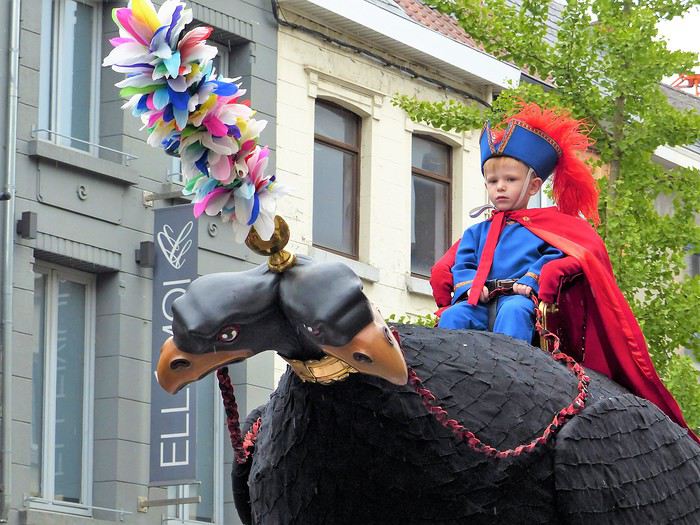
The wait passes quickly in this joyful atmosphere. Suddenly, the music grows louder, and here comes the first giant at last! It’s the "two-headed eagle," with a child (a real one) sitting safely on a little chair.

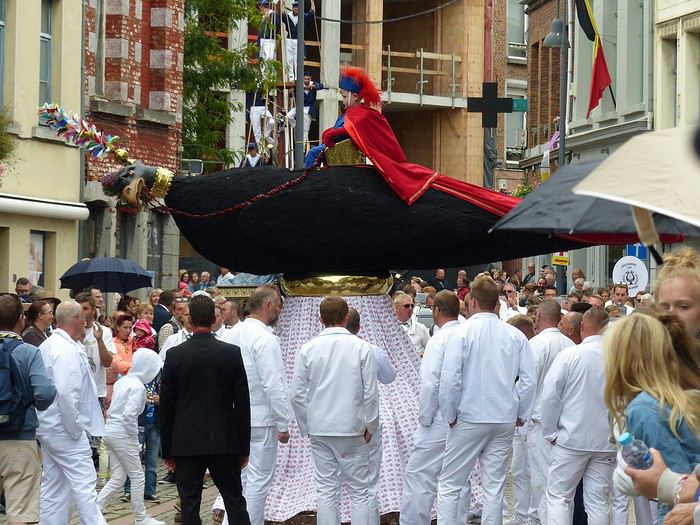
Present in the procession since the late 17th century, it originally had only one head (normal, right?) and accompanied the tailors’ guild. It gained a second head during the royal visit of 1854 (go figure why!). It’s 3.30 meters tall and weighs 115 kilos (without the child). All the men you see in white are carriers taking turns. Its dance consists of spinning the bird around—you’d think that little kid up there must be getting dizzy!


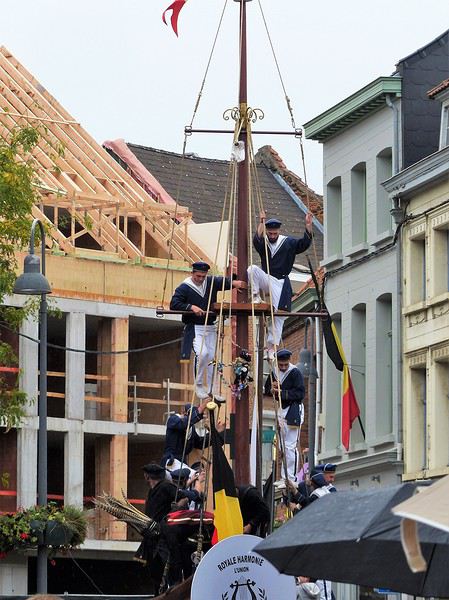
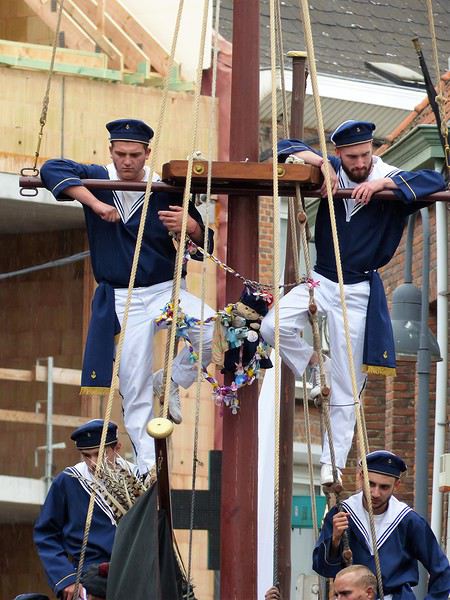
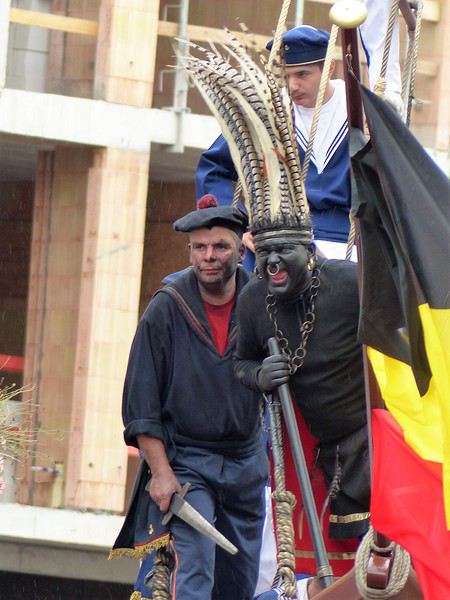
Next is the "Neapolitan fishermen’s boat." It’s a magnificent float representing a ship, with handsome sailors clinging to its rigging. This float first appeared in the parade in 1856.

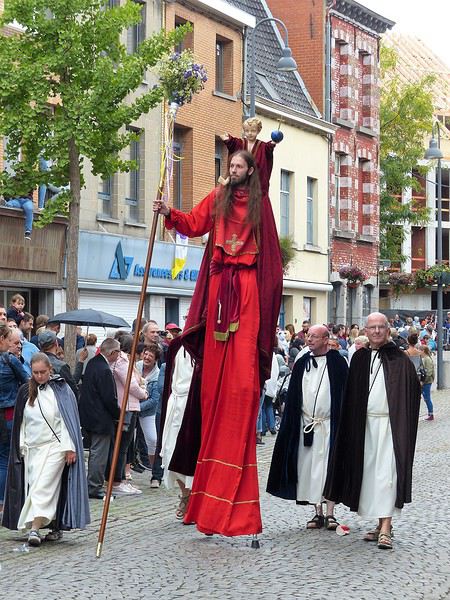
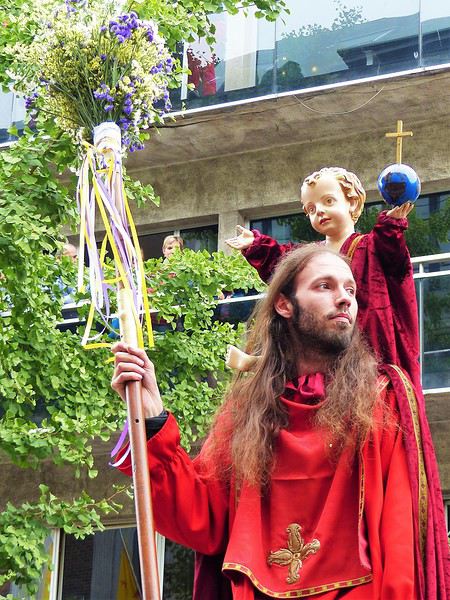
It’s followed by a human giant on stilts: "Saint Christopher of Flobecq," holding a flowered staff and carrying Christ on his shoulders (this time, not a real child!). It appeared in the 19th century, then disappeared from the procession before being reintroduced in 1976.


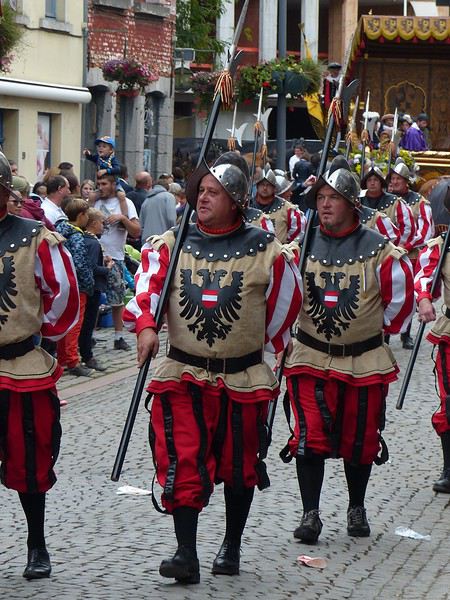
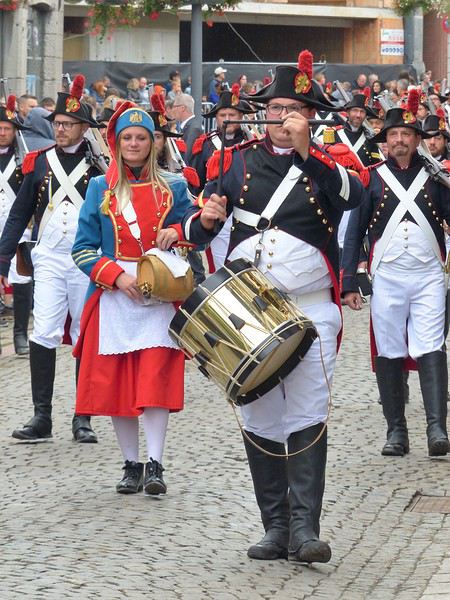
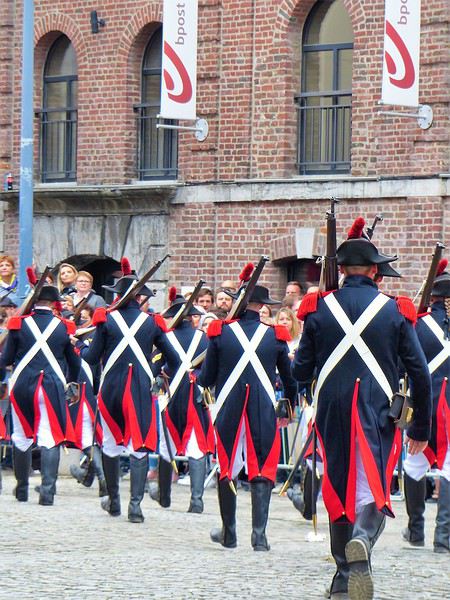
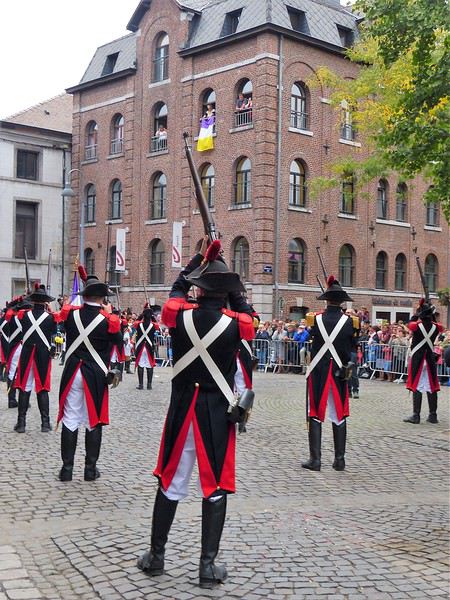
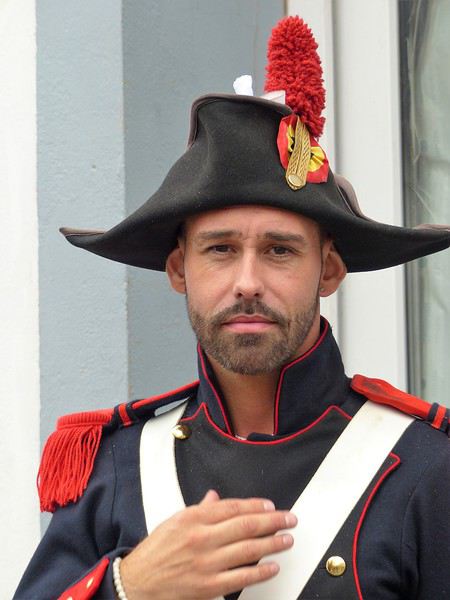
Now here come the "Blues," dressed in French uniforms. This group is the heir of the former cannon-arquebusier company, and they punctuate their parade with gun salutes!


To be continued: the giant Samson!
Open
An Off-the-Beaten-Path Destination? Cape Verde!


It’s been a month and a half since our family returned from Cape Verde, and I’ve finally found the time to write this travel journal about this beautiful yet little-known destination.

Cape Verde is a small volcanic archipelago made up of ten isolated islands in the middle of the Atlantic Ocean. At the crossroads of maritime routes between three continents—Africa, the Americas, and Europe—its name is tied to the history of slavery.

But today, this little piece of Africa with Creole influences has a lot to offer travelers craving a change of scenery and adventures off the beaten path.

We visited three of these ten lovely islands rising from the ocean: Maio, the wild and authentic island; Fogo, the volcanic one; and Santiago, the cosmopolitan hub.

MAIO: THE SMALL, WILD, AND AUTHENTIC ISLAND

To travel between the neighboring islands of Santiago, where we landed from France, and Maio, the first stop on our trip, there are two options: plane or boat. To avoid the risk of the boat being canceled due to rough seas—and to save time—we chose to fly. The flight takes just fifteen minutes, while the boat ride lasts three hours. Since our stay was only fifteen days, saving that half-day was a big deal.

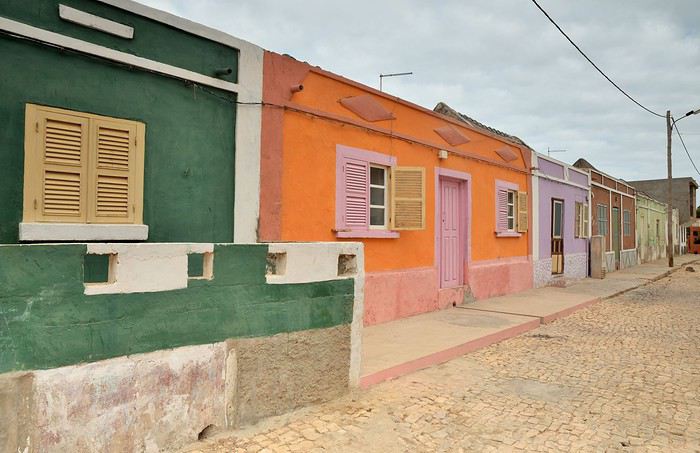
The colorful houses of Vila de Maio

Our first day on the island didn’t let us see the sun. It’s mid-August, the very start of the rainy season—which should really be called the cloudy season. This “rainy” period has nothing to do with what happens in other parts of the world, like Southeast Asia, where the monsoon can be devastating. Here, locals hadn’t seen a drop of rain in nearly a year, and for them, it’s a tragedy. That’s why the ground is so dry and the vegetation so sparse.

As a result, fruits and vegetables are scarce, and livestock are suffering so much that some farmers are forced to cull their herds. Ironically, back in France, we’d just come out of a miserable winter with nearly five months of nonstop gray skies and frequent rain, especially in some regions. Is our climate out of whack?...

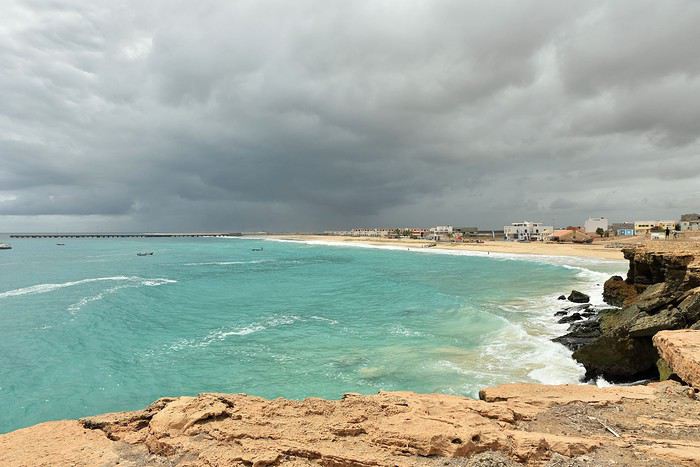
The beach bordering the village of Vila de Maio

We stayed a week on Maio. We were lodged at Stella Maris Village, a small residence at the edge of Vila. A shared pool, perched on a small cliff, overlooks the deep blue sea.

Sunset at Stella Maris Village

The cliff isn’t very high, but it offers a nice view of the surroundings.


From the residence, it’s just a ten-minute walk through the village to reach the beach.

> The beach and the fishermen

We didn’t choose Maio just for its calm, wild, and authentic vibe. It was also so Victor and Arthur, our two sons, could earn their Level 1 scuba certification in Cape Verde’s beautiful waters, known for their abundant marine life but still relatively untouched by divers—for now...

On the first day, we met Bernard, who runs AAA Maio Plongée, to plan the five dives needed for their certification.

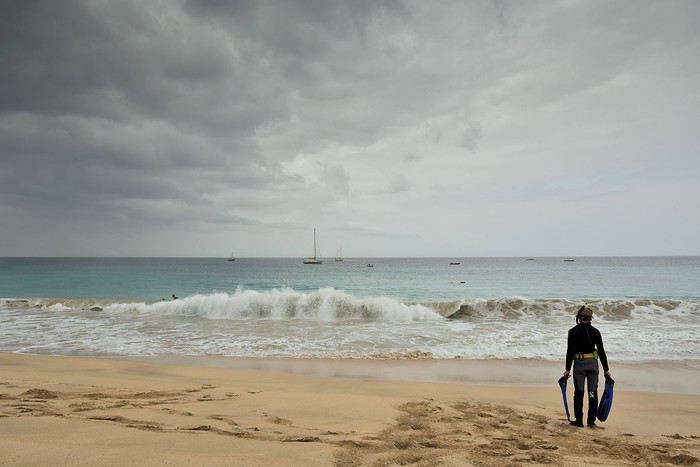
The dive sites are accessible by boat, but to reach it, you have to cross the surf. The waves vary in strength, and while they were gentle for our first snorkeling trip, getting past them with scuba tanks on our backs was a bit more of a workout for the later dives.


Snorkeling trip: this time, the waves were gentle...

The week of diving with Bernard went perfectly, in Cape Verde’s surprisingly fish-rich waters. On the morning of the last dive, while checking the sea to cross the surf safely, we even spotted a pod of dolphins swimming across the bay in the distance. Always a magical moment...

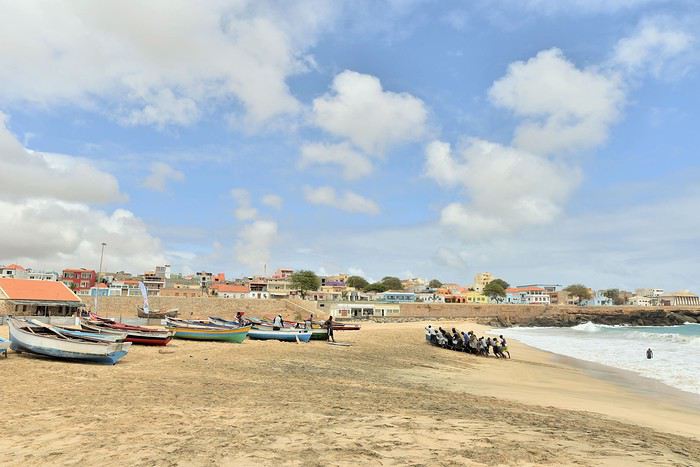
In a week, the beach at Vila, where the dive club is located, was the liveliest spot we saw on the whole island. All day long, fishing boats returned loaded with fish of all sizes.

Return from fishing

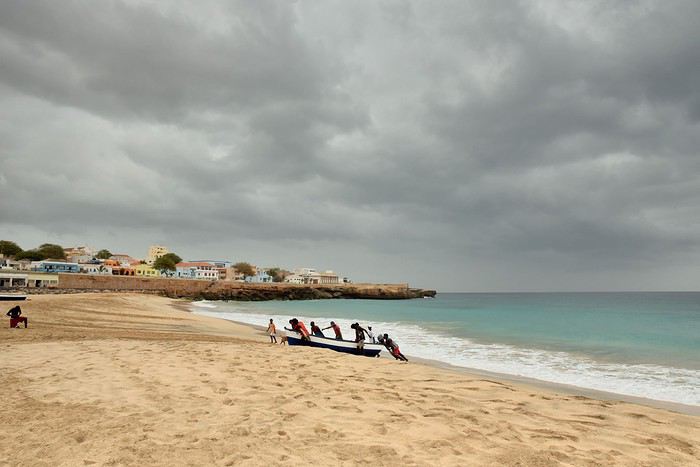
Here, fishermen have a strong sense of solidarity because they can’t pull their boats out of the water alone, especially when the waves are rough.

So, all day long, whenever a boat comes in, the fishermen on the beach rush to help drag it ashore and secure it higher up on the sand, away from the sea.


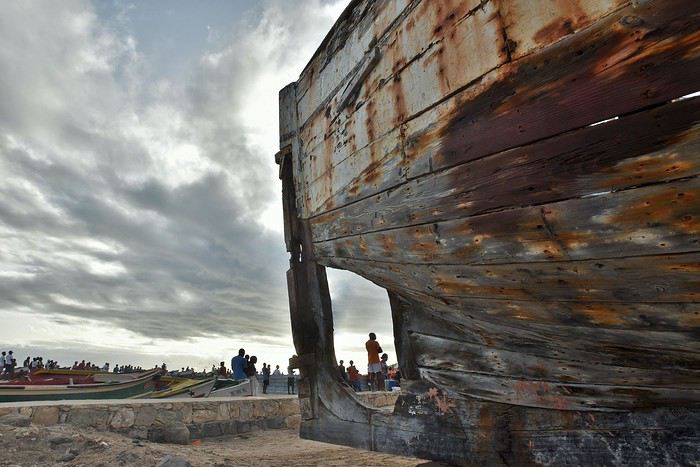
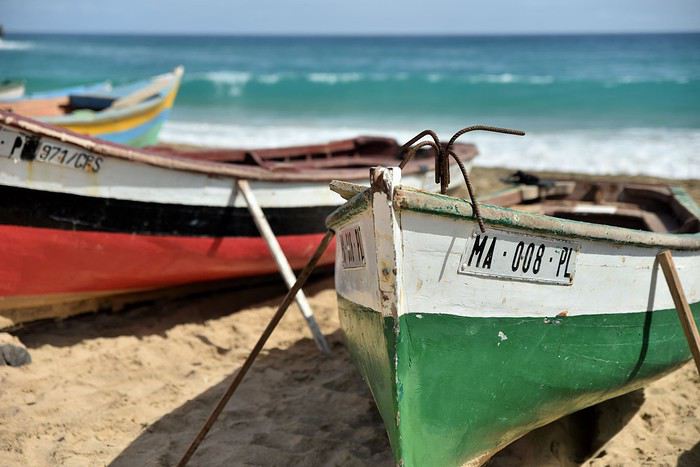
The sight of these colorful fishing boats on the beach is something we saw everywhere in Cape Verde.


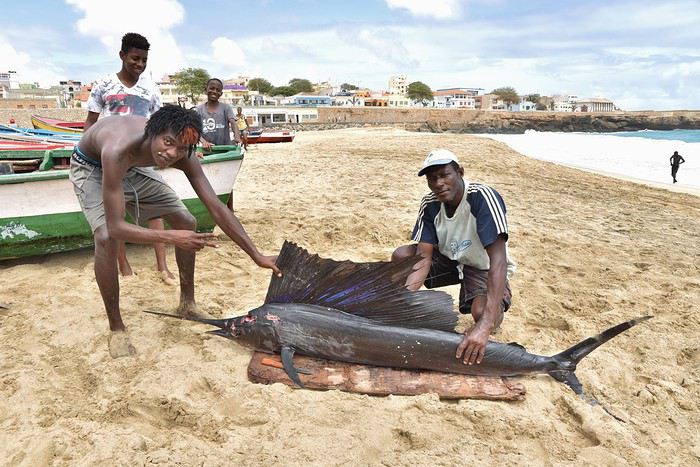
Sometimes, the fishermen bring back impressive catches. Instead of carrying the fish by hand to a proper spot, they clean them right on the beach.


Sailfish

But every evening during our stay, this beach also hosted Maio’s annual soccer tournament. Residents from villages across the island gathered here at the end of the day to compete, including a few women’s teams.

Players were cheered on by hundreds of spectators—which is a lot for a small island with barely 8,000 inhabitants.


The beach doubled as a stadium: sand replaced grass, and the fishermen’s colorful boats served as seats and bleachers. The celebration had a laid-back vibe, with loudspeakers blasting music and the smell of grilled fish in the air.


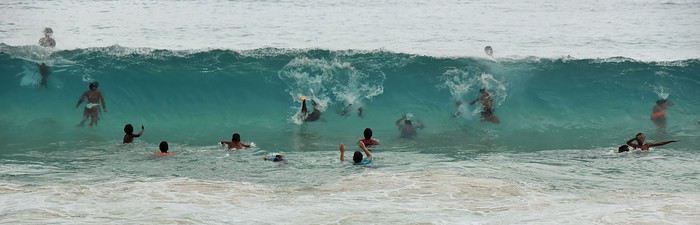
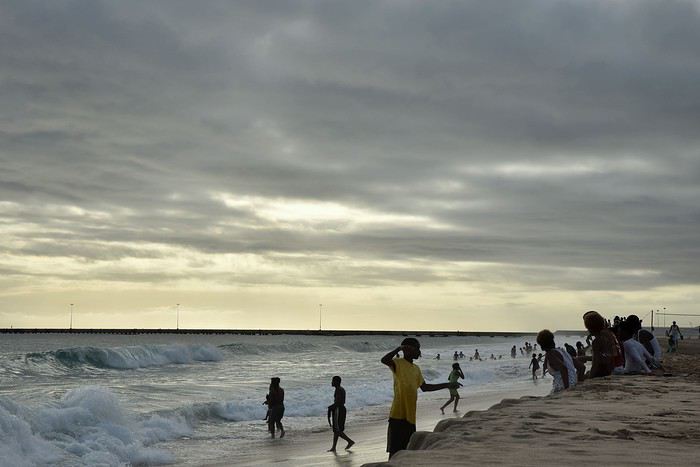
Meanwhile, kids splashed around in the sea, which could sometimes be dangerous. The waves could be strong, but the currents were the real concern.


Open
Self-drive Tanzania in July - August 2018
Hi everyone,

Here’s a recap of our self-drive trip in Tanzania.

Tanzania is a stunning country, but it’s changing fast, which means that any self-drive info you gather in advance might be outdated by the time you travel.

Still, here’s some info for future self-drivers.

The vehicle: After lots of research, thinking, and calculations, we had our 4x4 with roof tents shipped from South Africa through our rental company of two years, Safari4x4Hire. The price for 31 days came to $247.00 per day. That’s cheaper than some Tanzanian rental companies (Shawsafaris: $380.00 per day, total with 18% tax) and just a little more expensive than others (Tanzanian Pionners), but with the guarantee of having a well-maintained and reliable vehicle. You can check out the discussion I started: here

Traffic: The speed limit is 80 km/h on roads and 50 km/h in villages. Watch out—there are lots of police checks at village entrances (speed radar). In villages and towns, also be careful with minibuses, which are everywhere and stop and start without signaling. As for paved roads, most are in good condition, and many tracks are brand new or being renovated (the Chinese are in the area!).

Campsites: It’s very easy to find a spot in Tanzanian campsites (few self-drivers), so no need to book in advance (we were often alone in campsites outside the parks). Inside the parks, it’s easy to book public campsites at the gates. With roof tents, the downside is that sites are usually designed for travelers with ground tents, but we always found space for our vehicle. Another downside is making a fire—it’s nearly impossible to find wood (Tanzanians don’t usually make fires for cooking or ambiance). Campsite prices outside the parks range from $5.00 to $15.00 (price with 18% tax). I’ll list the prices for campsites inside the parks below.

Food: There are very few supermarkets in Tanzania, and prices can be steep if you’re not careful (European brands). For fruits and vegetables, you can easily find roadside vendors. For other groceries, you can shop at supermarkets (Dar es Salaam, Arusha). In Arusha, there’s a brand-new Shoppers Supermarket—clean and well-stocked—and for meat, don’t hesitate to visit the Meat King butcher. It’s also often possible to eat well at campsites with restaurants for around $10.00 (price with 18% tax).

Some other info: 1. At gas stations, you almost always pay in cash, usually in Tanzanian shillings.

2. Park entries, campsites, and Ngorongoro are paid with a card (Visa, etc.) directly at the gates. Exception: Selous, where you need a permit in advance (we didn’t have one when we arrived at the north gate, but we were still able to enter thanks to the kindness of the gate attendant).

3. Watch out—some regions outside the parks have a tax: the Wildlife Management Fee. Payment is a bit unclear: - For Lake Chala, we paid at the gate in cash. - For Lake Natron, you can’t pay at the gate—we had to arrange it with the campsite. - For the area between Tarangire Gate and Lake Burungi (to reach a campsite), you can’t pass the gate without paying in Arusha first.

4. For divers, you can do amazing dives in Pangani with Kasa Divers.

Park entry and campsite prices in July/August 2018:

Saadani National Park:

Park entry per person: $30 + 18% (for 24 hours)

Park entry for vehicle (under 2000 kg): $40 + 18% (for 24 hours)

Night at Public Campsite per person: $30 + 18%

Arusha National Park:

Park entry per person: $45 + 18% (for 24 hours)

Park entry for vehicle (under 2000 kg): $40 + 18% (for 24 hours)

We slept outside the park.

Serengeti National Park:

Park entry per person: $60 + 18% (for 24 hours)

Park entry for vehicle (under 2000 kg): $40 + 18% (for 24 hours)

Night at Public Campsite per person: $30 + 18%

We couldn’t get a night in a Special Campsite.

Ngorongoro Conservation Area:

Park entry per person: $60 + 18% (for 24 hours)

Park entry for vehicle (under 2000 kg): $40 + 18% (for 24 hours)

Night at Public Campsite per person: $30 + 18%

Night at Special Campsite per person: $60 + 18%

Descent into the crater for vehicle: $250 + 18% (you don’t need a guide to go into the crater).

Tarangire National Park:

Park entry per person: $45 + 18% (for 24 hours)

Park entry for vehicle (under 2000 kg): $40 + 18% (for 24 hours)

Night at Public Campsite per person: $30 + 18%

Ruaha National Park:

Park entry per person: $30 + 18% (for 24 hours)

Park entry for vehicle (under 2000 kg): $40 + 18% (for 24 hours)

Night at Public Campsite per person: $30 + 18%

Selous Game Reserve:

Park entry per person: $75 + 18% (for 24 hours)

Park entry for vehicle (under 2000 kg): $50 + 18% (for 24 hours)

Night at public campsite per person: $30 + 18% (You don’t need a guide to visit Selous, but a GPS with the Tracks4Africa map is essential—there are lots of tracks).

Conclusion: We loved the northern parks, but they’re really crowded, especially with safari vehicles (though that does make it easier to spot wildlife—just follow the cars). Still, we preferred the southern parks—they’re wilder, less crowded, and almost no safari vehicles. In the campsites, you can often find yourself alone (just how we like it 😏!). But both north and south have amazing wildlife and friendly people!

If you’re interested in more info about Tanzania, I’d be happy to help.
Open
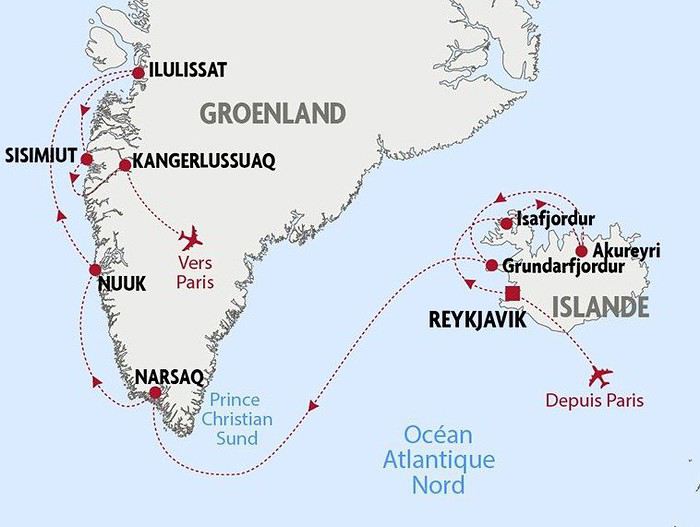
Review of a disappointing cruise with Rivages du Monde in Iceland and Greenland


Hello everyone,

The itinerary was tempting, and we decided to take this cruise with friends. It also gave us a chance to discover this company, which offers many river cruises in a French-speaking atmosphere. The boat is only rated 3 stars, so we knew we wouldn’t have the same comfort or services as usual, but we accepted that. After all, the price is half that of a cruise with Ponant in the same area.

From the booking stage, this company was unlike any other. We later learned that Rivages du Monde isn’t a shipowner but just a service provider.

It operates in a somewhat outdated, old-fashioned, or even backward way, depending on how you see it. Information about the cruise, excursions, and the boat comes in the form of a very brief PDF. Documents, quotes, and invoices are sent by mail.

There’s no personal account on the company’s website, no passenger form to fill out, and no online check-in.

Fifteen days before the balance was due, I received the invoice with its share of surprises. I had to send my credit card details by mail (well, why not?), or pay by check.

The bad surprise was a fuel surcharge. The good one was that we were upgraded from category 3 to category 7, moving from deck 6 to deck 4. Since the information was so lacking, I had no idea what the benefits of this upgrade would be. I almost complained and asked to keep the cabin I had chosen, but I read in some comments that cabins on deck 6 were to be avoided due to loud creaking. So I said nothing.

Booking excursions, which had to be paid at the same time as the balance, was strongly recommended before departure. They were reserved by filling out an A4 sheet after reading a 3- or 4-line description in the PDF. The duration of the excursion and the departure time weren’t indicated. No information about disembarkation—would it be at the dock or by tender?

The boat. The MS Astoria is the oldest passenger ship in the world. Built in 1948, it started its career as a transatlantic liner until 1960. Often restored, it has retained an old-fashioned, vintage charm... or so the ads say. In the end, it didn’t look that old, as it had been modified and refurbished so much. Only its original bell remains in a display case. Its vintage look is more visible on the outside than inside. The outdoor decks are spacious, great for sightseeing. There weren’t too many passengers for the size of the ship. Inside, it’s not very modern or beautiful, but it was decent. A pleasant surprise—it handled the sea better than we expected.

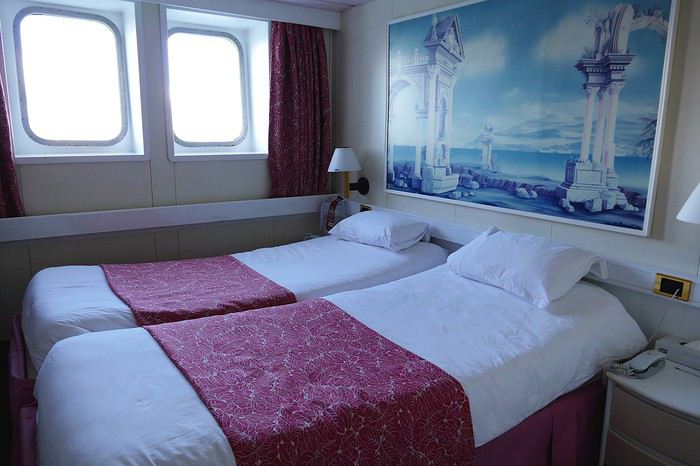
The cabin was outdated and small, as we expected—no desk, no sofa, and two portholes that made it very bright. Well-equipped with new storage furniture, it even had a fridge. The bathroom would have been spacious if it didn’t have a bidet. The bed had a board instead of a proper base, but the mattress was good, and we slept well the whole cruise. Don’t look too closely at the finishing details, but overall, it was better than I expected. On deck 4, the cabin creaked a little at night, but it didn’t bother us. The cabins are different sizes on the plan, but in reality, they all have the same surface area.

Note the strange color of the hot water.


The buffet was tiny, with few choices and very basic, ordinary dishes. A few mixed industrial salads, some fresh salad and cold cuts. For the main course, chicken, pork, some kind of minced meat, or fish. Then potatoes, rice, pasta, or steamed vegetables (always the same ones). For dessert, flavorless pastries in various colors or fresh melon and watermelon salad. That was the sad, single menu for the entire cruise at the buffet. Note that the buffet was only open for 2 hours at lunchtime and 1 hour in the afternoon for a snack.

Tea, coffee, and water were available all day.

The restaurant. The table was nicely set and pretty, but the meals weren’t much better than at the buffet. The “beef fillet in pastry” was like boiled beef stew—it fell apart easily (even though we asked for it rare or at least medium-rare). The “asparagus velouté” was actually leek soup with “hay” that crunched under your teeth. The poire belle Hélène or profiteroles were sad, distant relatives of the well-known desserts—very skimpy. And those were just a few examples.

Drinks were included with meals: still or sparkling bottled water, white, red, or rosé wine, coffee, tea, or herbal tea.

The bar. The servers were nice but far from having the class and know-how you find on other cruise lines. We wanted to try the cocktails, but only once. The margarita was warm, with bottled chemical lemon, no ice, and no salt. The caipirinha was brown! And later, we noticed that in the Singapore Sling, they replaced the Champagne with soda!!! What a skill set!!!

The lectures were very popular. Almost all passengers eagerly attended the talks by the two naturalists.

The musical entertainment was French variety—good-natured and friendly most of the time. A little classical music, chamber music so sad it made you sleepy. Nothing like the pianos and violins you find elsewhere... (Princess or HAL).

The shows. With very limited resources, the dancers did their best. The outfits were very revealing in certain strategic areas, and that was the rule for all themes.

The “red vests.” The atmosphere on board was more like a company outing than a cruise. There was a lot of staff to run the excursions desk, assist and supervise passengers during stops, or act as guides during excursions. These “red vests” behaved like they were on a summer camp—they had a great time and gathered as often as possible to laugh and have fun. They didn’t hesitate to roll their eyes behind passengers’ backs. But the “group leaders” became very authoritarian and directive when addressing passengers.

One evening, our friend asked a “red vest” about the excursion time the next day. That was top-secret information, impossible to get (I’ll come back to that). The “red vest” replied that they wouldn’t tell him because, by the next day, he would have forgotten anyway. That shows the level of respect this staff had for the passengers.

Also worth noting: among the passengers was a man in a wheelchair. For the entire cruise, he couldn’t go ashore. No one ever offered to help his wife get him off the ship.

My perception of this cruise is inevitably shaped by my past experiences. Some passengers shared my opinion, but others were completely satisfied with everything and found the food good. They also swallowed all the bad excuses, cooked up with a security sauce, without question—reassured and delighted that “everything” was done for “their safety,” which is the most important thing, isn’t it?

To be continued—the stops and the organization, even more pitiful than the hospitality...
Open
Scandinavian Road Trip, July 2018
EDITOR’S NOTE: As with every travel journal I publish, I won’t force anyone to agree with my comments—they’re my own, I share my feelings, and that’s it. Your comments are, of course, welcome, but I’ll refrain from responding to any hint of controversy, as has happened in the past.
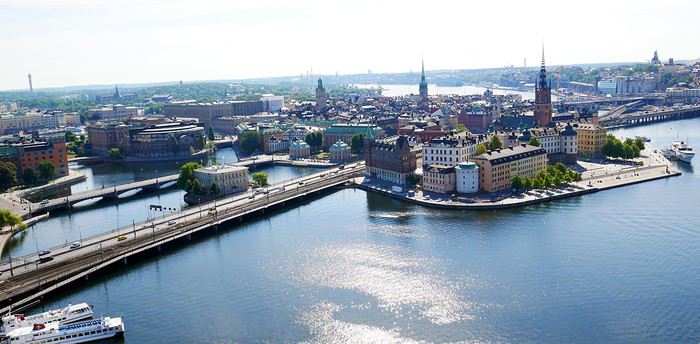


For the summer holidays of 2018, we decided to take a break from long-haul, transcontinental trips. They’re expensive and exhausting, and this year, we also had to consider our young student’s limited vacation days. So, it was a short 14-day circuit in Scandinavia. Very quickly, I had to abandon the unrealistic idea of driving door-to-door with our personal car (unlike last year—see my "Balkan Stroll" story). Too many kilometers and stops. Still, crossing Poland, Lithuania, Estonia, and Latvia before taking a ferry from Tallinn to Helsinki and Finland was tempting—what a shame.
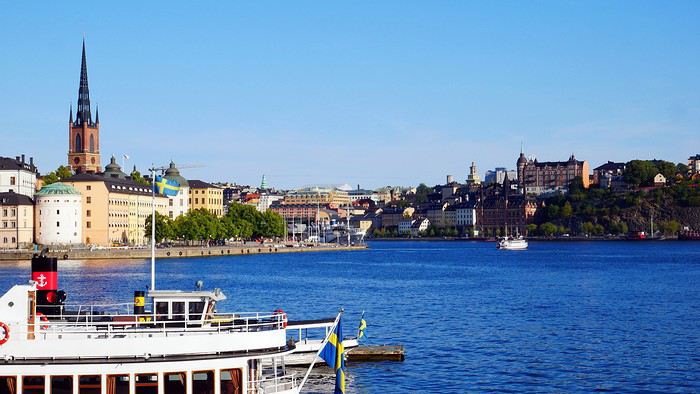


As usual, I planned ahead and started booking in early February for a mid-July departure, typically the best time weather-wise for this destination. Browsing tour operator catalogs didn’t offer much insight—just the usual circuits. Most aim for the North Cape, but we didn’t have time for that. First, via Expedia, we booked our flight tickets: Paris to Stockholm, Helsinki to Paris for the return (880 euros for three), plus a domestic flight from Oulu to Helsinki in Finland (220 euros). The unanimous advice was that there’s not much to see between the two cities, so this saved us a night’s accommodation and a day of car rental. However, the "drop-off" fees (not returning the car to the country of origin) were unavoidable. Out of 1,100 euros for 12 days of rental, this fee was significant—I say this from memory because I never received a detailed document or even the contract itself after picking up the car, despite my complaints. That said, Holiday Autos offered the best rates at the time with Hertz. Plus, I think we were unknowingly upgraded to a Volvo XC 40 T5 automatic, packed with electronics and an incredibly efficient GPS (so I lugged around my updated TomTom for nothing). I wasn’t used to it, and I’ll come back to that. For 50 euros, I also booked one of the many mandatory ferry crossings in Norway—unless you want to drive kilometers around the countless fjords. Specifically, the Bognes-Lødingen route to reach the Lofoten Islands, a must-see in Norway (though not necessarily the best choice I made—I’ll come back to that). Then, gradually via Booking.com, I reserved hotel accommodations, which wasn’t easy at reasonable prices. For three people, it’s nearly impossible to find a room with three real beds—often a sofa bed or even two separate rooms!!!! Norway isn’t a budget-friendly destination for us, yet French tourists are everywhere—groups or families traveling independently. Okay, you’re probably wondering when I’ll get started—I’m getting there... First up, Stockholm, a two-hour flight from Paris. A first for us: we’d gotten used to online check-in within 30 hours of the flight and sometimes printing our boarding passes. But, as progress never stops, at Roissy, we now also print our baggage tags at a kiosk, then place them on the conveyor belt ourselves, scan the barcode with the handheld scanner, and watch the luggage disappear—hoping it doesn’t get misrouted. With all this reduced staff, I hope ticket prices will drop. What? Huh? I’m naive... Okay, fine! Plus, during the flight, don’t expect any snacks—everything’s paid for now, except for water and coffee. I didn’t think I was on a low-cost flight!!! Picking up the car at Arlanda Airport went smoothly, except the contract signed on a tablet (progress, right?) was never emailed to me as promised—too bad... The Volvo SUV packed with electronics: as usual, aside from adjusting the mirrors and seat, I didn’t bother learning all the features and accessories for better handling. So, from the start, I felt jerky movements in the steering, independent of my control. The white-line detection was activated and corrected my direction whenever I got too close... And that’s not all—there’s also driving assistance. Besides the speed limiter, the car accelerates or brakes on its own based on the distance from the vehicle ahead. You still have to keep your hands on the wheel, though—too bad, we could’ve played cards and let it drive itself. When you slow down, if you signal to overtake and turn the wheel, it accelerates to pass. Soon, we won’t even need a driver’s license... Not to mention the little light in the side mirror to signal vehicles in the "blind spot"—very useful. But given the excessively strict speed limits in these parts, it’s still handy. I’ll unfortunately come back to this later!!!!!! In the end, we covered 4,700 km in 8 days of actual travel—no small feat!!!!!! Stockholm: still loyal to the hop-on-hop-off sightseeing buses (or the reverse), I booked our tickets online with a discount. It remains (for us) one of the best ways to visit and get around big cities. The tourist attractions aren’t that numerous. Forty kilometers from the airport, we reached our hotel, Clarion Amaranten. At reception, we were told our reservation was for four days, not two. I insisted, and they told me to call Booking.com to fix it—they couldn’t do anything themselves. Luckily, a nice blonde understood the situation and asked where we were from to lighten the mood. For me, it worked... After a few minutes of back-and-forth, we realized a namesake had booked at the same time. I think the intern got mixed up—oh well. We finally dropped off our bags and headed out under the sun for the included boat tour. It’s beautiful and relaxing under 26°C. We glided past massive cruise ships, very common in these Nordic countries, especially for fjord tours.
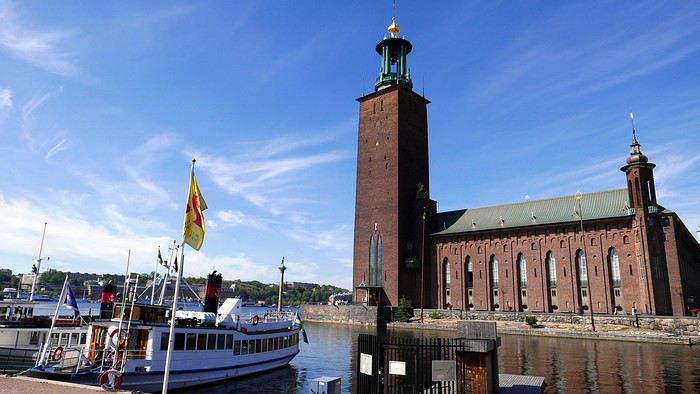


We passed Djurgården, one of the city’s 14 islands, home to the Tivoli amusement park and several museums, including the ABBA Museum and the Vasa Museum. I’m not talking about the crispy sandwiches sold since 1919 but the infamous warship that sank in the harbor on its maiden voyage in 1628 after sailing just a few hundred meters. Its intact hull was salvaged in 1961, and since then, it’s one of Sweden’s most visited museums. The country is a quarter smaller than France and has 10 million inhabitants, mostly in the three big cities (Stockholm, Gothenburg, Malmö). The rest is empty, filled with lakes and forests. The currency is the krona, with 1 euro worth about 10 SEK. Dinner in the Old Town consisted of a so-called Viking burger (more like a kebab) and meatballs—the famous Swedish meatballs with potatoes, just like at IKEA... I have to say, here, it seems the Vikings have long been just blond heads—I get it... It still cost us 550 SEK. A beer alone costs at least 9 euros!!!!

DAY 2. Sunny skies. After a hearty buffet breakfast with salmon, herring in all forms, eggs, cold cuts, bread, and pastries (don’t worry, the classics are there), we started the day by visiting the City Hall tower, famous for hosting the Nobel Prizes (except the Peace Prize, awarded in Oslo). At 106 meters tall, with 365 steps and 9 clocks, it weighs twice as much as the Eiffel Tower. Access is at fixed times in small groups for safety. You can climb up to 73 meters for a 360° view of the city. Next, we visited the Royal Palace, still the official residence of the King of Sweden, and its Treasury (entry: 160 SEK). We skipped the 12:15 PM changing of the guard—three-quarters of an hour before, dozens of onlookers were already crowding the front rows in the sun.
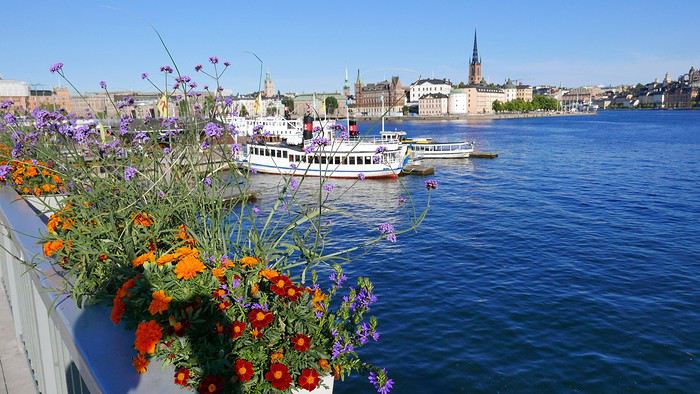


So, we took our favorite bus to rest a bit and tour the city. We also took the subway to see several "decorated" stations—love it or hate it, but it’s original. In the late afternoon, we returned to the Old Town and its Gamla Stan to find some souvenirs, even if it feels more like Bollywood than Viking country, complete with music in the shops—a nice sign of integration... One of the first things that surprised us was the very light car traffic—no traffic jams in this capital. But there are tons of electric and regular bikes, skateboards, and scooters. Also, lots of roadwork and housing construction—apparently a big need. For dinner (our only meal of the day), we treated ourselves to something local at Borgmästaren (Stora Nygatan 35). DECIDEDLY, I’M TELLING YOU EVERYTHING...

DAYS 3 & 4. Contrary to what I was told upon arrival, the hotel parking (700 SEK for 2 nights) didn’t open at 7:00 AM but at 9:00 AM on Saturday. After having to call myself (the French-speaking African receptionist couldn’t do it for me, especially after I told him I thought Croatia would win against France in the World Cup final), the kind parking attendant (partnered with the hotel—there’s the catch) arrived early and let us leave at 8:30 AM to start our east-to-west route to Norway and Oslo, 530 km away, finally beginning our summer adventure. At the border, absolutely no checks, and on the road, aside from lakes and forests, not much to see. However, tolls are very common—don’t overlook this in your budget. In Sweden, everything’s covered by the rental company, but not in other countries. In Norway, there are many automatic toll sections—cameras film your license plate and send you the bill later. So, you must register online at www.epcplc.com/rental, with or without your credit card details, and wait for the final bill. As of now, I haven’t received it, but after noting almost all of them, it should easily reach 200 euros. Roads, tunnels, and bridges are often toll-based to fund maintenance or new constructions. We reached the Norwegian capital at 3:00 PM and checked into our room. Small hiccup: the hotel parking, not reservable, was full on Saturday. Parking meters only take coins for a max of 2 hours. Luckily, tomorrow’s Sunday—free parking from 8:00 PM until Monday morning. After circling the neighborhood, I finally found a spot for my little car—even if it’s not mine, I still care about it...
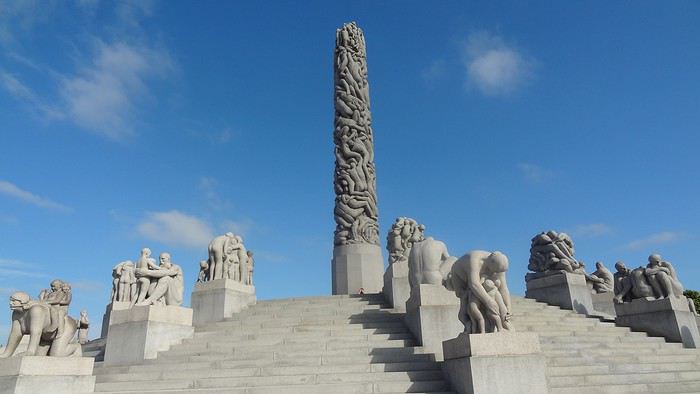


The Thon Slottsparken Hotel is slightly off-center, but a little walking won’t hurt. The nearby Hertz agency was closed—too bad, I would’ve liked to complain about still not receiving my rental contract by email... With the nice weather, we started with a walking tour of the main sights: the palace, Karl Johans gate (the main street), and some souvenir shopping to fill the display cases back home—if there’s space. We also visited the deserted Akershus Fortress, where two poor young soldiers stood guard in the scorching sun. Below it, the World Cup final fan zone was being set up. Dinner was at Rorbua for 90 euros—ouch. Hard to find, tucked away from the harbor pier. We skipped the paid ascent of the city’s only "tower" with a panoramic view—tickets had to be paid by credit card, and given the fees my bank charges, I’d had enough. Note that card payments are widely accepted here, even for small amounts. When I tried to get change in cash for a 50-euro equivalent bill, some café owners were embarrassed.

DAY 4. After discussion, we planned the day: first up, one of Oslo’s must-sees, the Vigeland Sculpture Park, featuring bronze, granite, and cast-iron works by Gustav Vigeland (1869–1943). Given the distance, we took the tram—some cars still had their old-school charm!!!! Despite the early hour, hordes of Asian tourists were already there, making photo-taking a nightmare—same everywhere they go. The park is a matter of taste... The 17-meter monolith with 121 intertwined bodies is remarkable, and rightly so. Lazy, we took the tram again to save time—same name, tight schedule. I stopped by the Hertz agency, where the overwhelmed employee promised to try to help. Given his enthusiasm, I doubted it. From the start, I’ve really felt the welcome here, at least for French visitors, isn’t great. Remember my previous reports—it’s becoming a habit. Tourist brochures aren’t available in French here either—strange... Anyway, we took a relaxing fjord cruise. Besides the quirky opera house, the beautiful summer homes on the islands were really tempting. Next, with another paid boat, we headed to the Bygdøy peninsula and its museums. We skipped the Viking Ship Museum in favor of the Norwegian Folk Museum. It features different buildings from across the country, by era and region. Unfortunately, few actors in period costumes—common in this type of tourist attraction. Its real highlight is the stave church, very beautiful. On this late Sunday afternoon, bars and restaurants competed to become World Cup 2018 fan zones—crowds everywhere. So, we decided to head back to rest and catch a glimpse of the African French team against Croatia. It’ll go down in history: a 4-2 victory, with a beautiful goal by Lloris... Go "Les Bleus"—I get it...

DAY 5. Oslo to Bergen: 450 km, but with detours, it was nearly 550. The real journey begins. Departure at 7:00 AM after sleeping in and a mediocre breakfast. Arrival at 5:00 PM—yes, driving’s slow... More tolls, but under 26°C, the real beauty starts around Geilo. First real fjord—it’s stunning. Then those houses with vegetated roofs blending perfectly into the landscape, sometimes nearly invisible... (Not bad, right? And it’s all me!!!)
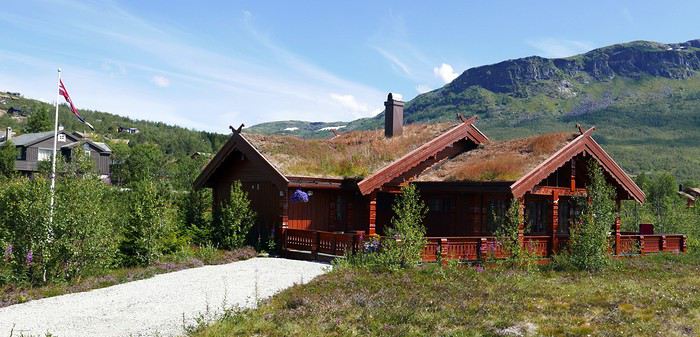


We also discovered tunnels with "indoor roundabouts" and underground roads crossing—never seen that before!! We followed the shores of Lake Tyrifjord and the Hallingdal valleys. After Geilo, views of the Hardangerjøkulen glacier (achoo!) and the Vøringfossen waterfall (Norway’s highest at 163 meters) and Steinsdalsfossen in the Hardangerfjord (the country’s second-longest). Bergen, Norway’s second city, is built between seven mountains. Aside from the colorful old docks along the wharf, there’s not much to see. At the market, stalls of fresh fish, jars of various fish eggs (all called "caviar" here), and cold cuts made from reindeer, moose, and whale.
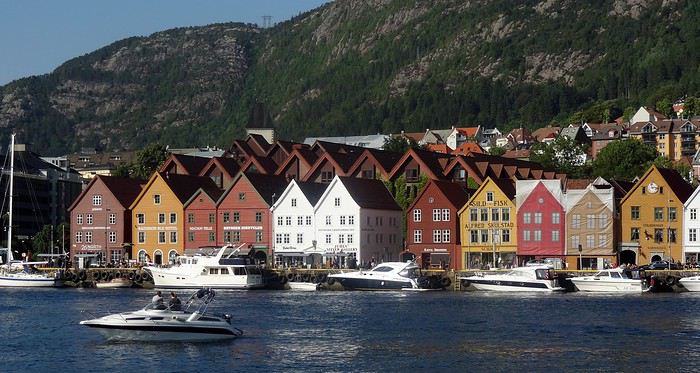


For 10 euros per person, we queued for the steep funicular for a great view of the city. Dinner was at "Fish Me," very busy. The salmon looked appetizing, and my first whale steak for 27 euros was... interesting. Our hotel, Augustin, is near the center. They charged me 150 NOK to park in the nearby public lot...

DAY 6. Bøverdalen, our evening stop, was less than 300 km away, but along the way, we had our first two scenic routes and first ferry crossing. When I got back in the car, I noticed the seagulls—rightful tenants of the harbor—had turned it into a Picasso painting overnight... First stop in Voss to peek inside its Vangskyrkja church (for a fee). The mural icons all have a marked squint, making the angels on the ceiling smile—quite the original touch. In 1277, it shocked people.
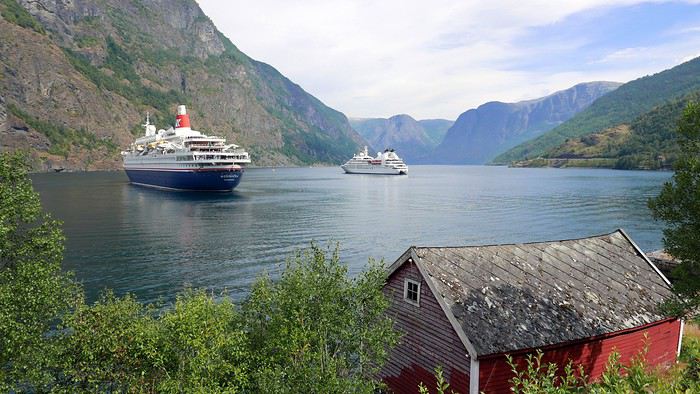


Gudvangen at the end of the Nærøyfjord offers beautiful views and a waterfall. An 11 km tunnel took us to Aurland and the Sognefjord, the king of fjords at 180 km long. Then we took Route 243 to Lærdal instead of a second long tunnel. A 47 km very narrow road with no passing except in designated spots. Buses, RVs, and trailers were in the mix—between backing up and moving forward, how do you expect me to... pass? At some spots, I had to "burn some oil" (non-edible). The beautiful viewpoints along Jotunheimen Park and its high peaks were hard-earned.
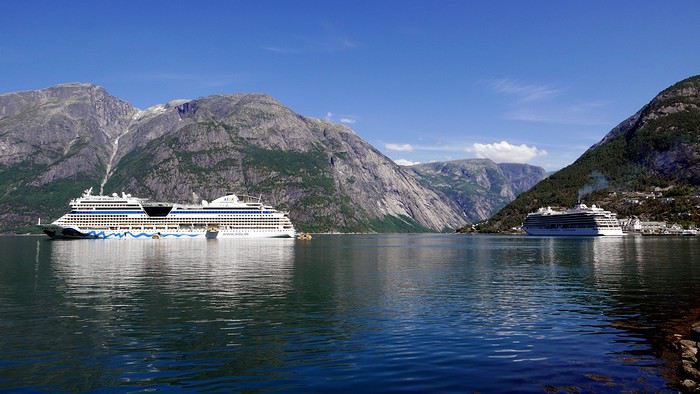


By midday, the 26°C of previous days gave way to 11°C with downpours and gusts. To reach Kaupanger, its stave church, and Route 55 (108 km), we took the Fodnes-Mannheller ferry for 119 kr (about 13 euros) for a 20-minute crossing. For these short trips, rotations are frequent, and wait times are short. The Sognefjellet route took us along lakes and snow-capped peaks—too bad the weather wasn’t cooperating. In Bøverdalen, in the middle of nowhere, we reached the Elveseter Hotel, the only one in the area, and it was packed. Luckily, it’s big. Recent reviews had us a bit worried, but personally, all the well-maintained wooden buildings gave the place charm. Our two small, simple rooms had character, and the common areas’ decor was interesting—a pile of antiques... Unless you dine on-site (reservations required for one of two sittings), the only option is to drive 20 km to Lom to see its beautiful stave church—but we didn’t go in (7 euros per person, and that’s enough). Dinner was three pizzas for 70 euros—yes, it’s expensive here.
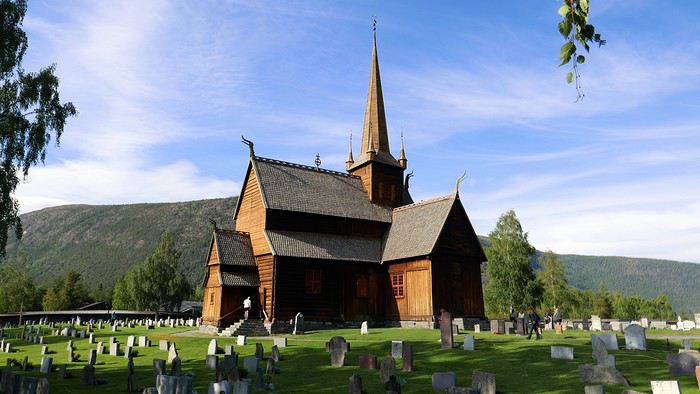


Note that in most establishments, bars, or restaurants, you have to order and pay at the counter yourself. A *stavkirke* or *stavkyrkje* (in Norwegian Bokmål and Nynorsk) is a medieval wooden church typical of Norway, though excavations suggest similar churches may have existed elsewhere in Northern Europe. About 1,300 medieval churches were recorded, with 28 preserved in Norway. In French, they’re called "églises en bois debout" (standing wood churches) because masts or posts support the roof and nave elevation, as well as the walls. The stave church is one of the most elaborate and technically advanced types of wooden construction in Northwestern Europe during the Middle Ages. This technique is represented by the Urnes Stave Church (a UNESCO World Heritage Site), Borgund (the best-preserved in its medieval form), and 25 others—from the largest, Heddal, to the smallest, Undredal, in the stunning Sognefjord, plus a few others in Northwestern Europe.

DAY 7. Heading to Trondheim—supposedly 320 km, but with detours, it was nearly 550. Unpredictable weather until about 1:00 PM, but it’s better because it’s the day of the "triples": 3 scenic routes, 3 ferries, and 3 "underwater" tunnels. No rush—here, there’s no need to "hurry to arrive before night" because as you head north, the sun lingers and sets less and less, eventually not setting at all. First, in Grotli, we took the 27 km of Route 258, *Gamle Strynefjellsvegen* (achoo), also very narrow and unpaved in the first section. Luckily, campers and RVs aren’t early risers—otherwise, I’d have had to make not just oil but olives this time. We only passed four other users. However, despite the early hour, local road workers were already on the job, and we had to ask the excavators to move several times to let us pass. At Langvatnet, we joined Route 63, called the Eagle Road here—mediocre, except for Geiranger at the end of the narrowest fjord in the country. A cruise ship had just unloaded its passengers, who rushed into the few shops. After the Eidsdal-Linge ferry (10 minutes) and Gudbrandsjuvet with its waterfalls, we tackled the famous Trollstigen (Troll’s Path), winding and very touristy. Coming from the south, we descended it. Mandatory photo stop at the tourist center and its impressive walkway. The descent into the valley was tough—the bus driver ahead of us must’ve been disabled, blind, and quadriplegic, taking two tries at every hairpin turn, causing a traffic jam behind and for those "going up" waiting at passing spots!!!
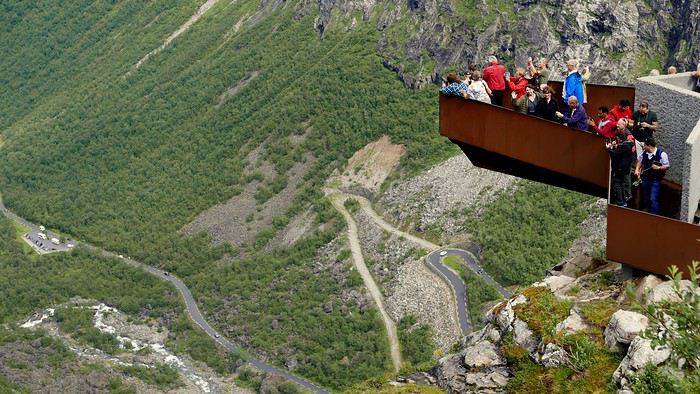


On Route 64, we took the Åfarnes-Solnes ferry instead of the initially planned 660 because my young passenger insisted on part of the "Atlantic Road." From what we’d read on blogs, only the last 11 km are spectacular, with arched bridges connecting islets. So, in Molde, we headed to Eide, then Vevang—beautiful but nothing more. The rain spoiled the scenery. Quick photo stop in Kristiansund, then a long underwater tunnel and the Kanestraum-Halsa ferry (7 km, 20 minutes) to reach the E39 toward Trondheim.
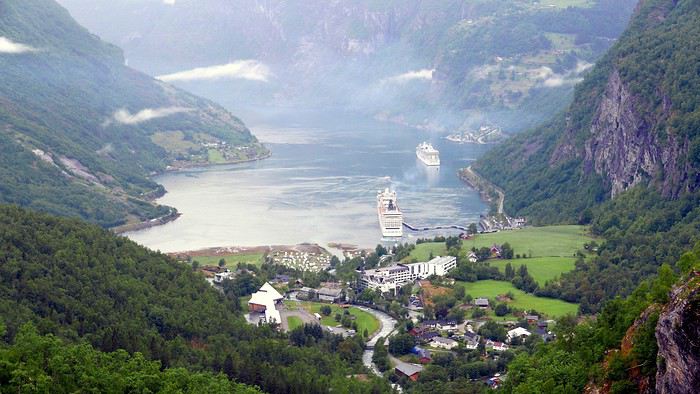


We all agreed that all these wooden houses and churches reminded us of the U.S. in their architecture—especially since, like there, a flagpole with the national flag often stands in front of homes. Trondheim, Norway’s third city, doesn’t have much to see. A university town in the country’s center, aside from its Nidaros Cathedral (closed when we arrived late), its wooden bridge, and colorful old docks on pilings—nothing else. Even finding food was complicated. As for accommodation, Booking.com had forgotten to mention that the Nidaros Pilgrimsgard is a "pilgrim hostel" on the Camino de Santiago. Monastic atmosphere and spartan rooms for reflection—same for the frugal breakfast in silence... Anyway... Luckily, the night before, in a kitschy place run by hip youngsters, I’d stocked up on a hearty assortment of marinated herring with aquavit that burned the rest of my esophagus. (BAKLANDET SKYDSSTATION) I’m really doing all the work for you...

DAY 8. Heading to Mo i Rana—633 km actually covered instead of the planned 480 through Nord-Trøndelag!!! After Steinkjer and its fjord, we decided to take Route 763, parallel to the E6, for less traffic and to see pretty mountain villages. We also stopped in Bola to see a petroglyph (Stone Age rock carving) of a reindeer. After Medja, we skipped Kjerringfoss and Europe’s largest salmon ladder (paid access). Instead, via the Holm-Vennesund ferry, we took a bit of the scenic Route 17 before reaching Mosjøen and Mo i Rana (too many ferries if you do the whole route). Along the way, we saw reindeer and moose relaxing on the road several times. Mo i Rana is small. The Ole Tobias Hotel was packed, and parking was complicated. For dinner, we crossed the street to "No. 3," the only option. Two spicy bacalao and a whale steak cost us 90 euros... At this rate, I had to find an ATM to finish the Norwegian stay properly. The 2,000 euros exchanged before leaving (at 9.28) were already partially gone. Cigarettes cost 13 euros a pack here—twice as much as in Sweden—while unleaded gas is 1.85 euros per liter.

DAY 9. Heading to the main event of the trip: the Lofoten Islands. First programming mistake: not studying the subject well, I preferred a shorter ferry crossing from further north on the mainland. But that also meant arriving further north on the islands.
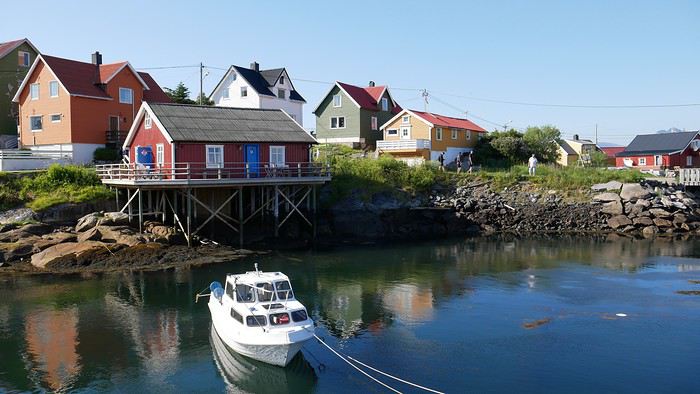


I booked for 50 euros (vehicle, driver, and two passengers included on the official Torghatten Nord site) for Bognes-Lødingen—a one-hour crossing. I should’ve left from Bodø to Leknes or better yet Moskenes and the town of Å for three hours—it would’ve saved time by avoiding the drive north and crossing to the south before heading back up the islands. Luckily, we still managed two different routes. Fortunately, the great weather returned, and I have to say, IT’S REALLY, REALLY, REALLY... BEAUTIFUL... Memory cards are melting—not just from the heat.
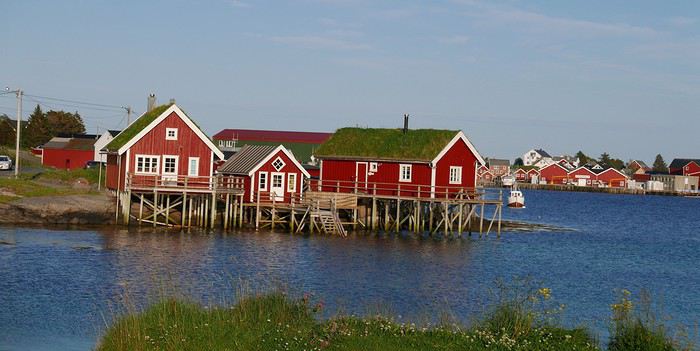


Two things worked in our favor, if I may say so, and countered my little blunder: first, I’d booked the 2:30 PM ferry, but arriving at the departure at noon, we easily took the earlier one—two hours saved. With the longer crossings, rotations with only two boats are much less frequent (8 to 12 per day depending on the season, vs. 6 to 8 for the southern route). Second, after Mo i Rana, we crossed the Arctic Circle, and today, the sun only "sets" from 12:20 AM to 1:50 AM. What luck! With a 7:40 AM departure (after sleeping in), I could drive until 11:00 PM easy!!!!!! And cover only 740 km!!!!!! Here, winters don’t drop below zero, but from early November to late January, it’s night almost all the time, with a supposed daylight clarity from 10:00 AM to 2:00 PM like a rainy day back home. But apparently, the northern lights and reflections on the snow also provide light!! I’d love to see that, but I’ll have to come back... We crisscrossed everything humanly possible, sometimes stopping abruptly in the middle of the road for photos—much to the locals’ dismay, but they’re used to the madness of temporary invaders enchanted by the place... These steep mountains "falling" into the water with all those colorful "rorbu" villages are magnificent. Rorbu are traditional fishermen’s cabins on stilts by the water, which over time have become the must-stay accommodation here—many have never housed any fishermen!!! The villages follow one after another, each more beautiful than the last. In Nusfjord, in season, pedestrians are even charged an access fee between 10:00 AM and 6:00 PM. At 7:00 PM, the booth was closed—lucky us, no crowd. The ochre wooden facades are beautiful, but don’t get too close—the seagulls nest there and see any approach as aggression. The result? Bomb-like droppings that can leave unpleasant memories. Go peek inside the grocery store—it’s kept its old-world charm. With the season, the many cod drying racks are empty. The hour turned, and our southward journey stopped in Reine—too bad for Å, not far, but fatigue got the better of me. We had to "go back up" to Kabelvåg for our rorbu at Nyvågar. We’d stocked up on groceries to eat quietly in this cozy little place (very small single beds upstairs).

DAY 10. We headed back north on the islands to reach Tromsø (grandiosely nicknamed the "Paris of the North"), with a late 7:50 AM departure despite 450 km to cover—things are getting lax at the end of the trip!!! However, this stop didn’t reveal much of interest—it’s the lake region, but meh. Tour operators include it as the last stop toward the far north. Aside from the Målselvfossen waterfall and its (paid) salmon ladder, nothing to report. We arrived at 3:00 PM, and the second room in our Quality Saga Hotel wasn’t ready yet. Plus, the parking we’d requested wasn’t accessible—the eight spots were taken. Even in this small town, free and easy parking is rare. Two souvenir shops and a main street (Storgata)—that’s it. Not to mention a nice storm that cooled things down. The only curiosity is the church, but it’s closed and under renovation—the exterior scaffolding ruins the only photo opportunity here. Otherwise, the Arctic Cathedral is visible from afar—that’s enough for us. The sun only sets for 20 minutes, from 12:40 AM to 1:00 AM!!!!! Last note before leaving this country: every morning at the breakfast buffet with all those eggs, I asked for a Norwegian omelet. Believe it or not, they don’t know the recipe for a Norwegian omelet!!!! 😏😛😉

DAY 11. Heading to Finland (with an extra hour time difference) and Rovaniemi, self-proclaimed official Santa Claus Village—it’s not nice to play on kids’ heartstrings for money!!!! On the 400 km of road (that or avoiding the Lofoten), nothing to see except two sad "Sami" shops. But there’s also AND ESPECIALLY: The run-in with a police radar mounted on the dashboard to welcome me to this country: alone, on a straight, flat road in the middle of the forest, I had this privilege—especially at a spot limited to 80 km/h instead of 100 as I thought. Of course, most well-meaning readers will think: serves him right... Only here’s the thing: in Finland, for years, speeding fines depend on the "Päiväsakko," meaning based on your income and number of children, a subtle calculation of average daily money is made and multiplied proportionally to the estimated severity of the offense... Ignorant of this, I naively but honestly answered the questions. The result? The fine was enormous—I won’t say the amount out of shame, but especially out of hatred for this country that ruined my vacation. Others like me, potential murderers, have been fined up to 170,000 euros (I wrote ONE HUNDRED SEVENTY THOUSAND EUROS) for a 40 km/h speeding offense!!!! I hope the clowns running France quickly adopt this particularly SOCIAL measure. Let the lazy and parasites of the country freely enjoy the road in their BMWs and MERCs!!! Let me tell you, I’ll spend my savings elsewhere in the future. So, a tip: be as dishonest as these conscientious police—say you’re unemployed with five kids, and maybe they’ll give you money!!!!! I’m really disgusted. No wonder in this nothing-to-see town, drivers sheepishly drive in a "little train" at 40 behind an RV without anyone daring to overtake. I think sometimes human stupidity should have limits, and the word freedom should regain its meaning!!! To those who understand, cheers. And as written at the start: trolls, abstain. I stand by what I said and sign it. After this brutal introduction to Finnish discriminatory laws, you can imagine Rovaniemi and its two-bit Santa Claus—I couldn’t care less. Even under the storm, at 6:00 PM on Sunday, even in summer, the scammer shops and profiteers of the Santa Claus Village (conveniently located on the Arctic Circle...) were already closed. Good riddance!!! The Arctic City Hotel is fine. I struggled to swallow my Tex-Mex at Pancho Villa (local chain).

DAY 12. Toward Oulu via Tornio, 200 km, and again, nothing to see in this land of lakes and forests. Detour and only photo stop in Tervola for a wooden church—my vacation is officially ruined... The Cumulus City Hotel is fine in this pleasant but empty and dull city, though it’s a university and tech hub. To cheer myself up, we splurged on a supposedly Viking meal at Harald—don’t know if the recipes are authentic, but my "Viking" knowledge stops at Vik, the animated boobs... Anyway, it’s good, unusual, and hearty.

DAY 13. After struggling to fill the tank (no station open with cash payment, only cards), we returned the chariot at the airport. The offices weren’t open yet at this early hour (8:35 AM flight), so I left the key in a mailbox without any inspection—I didn’t like that at all. I thought we’d get a propeller plane, but it was a well-filled Airbus. One-hour flight to Helsinki, the capital. Impossible to get clear information on buses to the city center, 40 km away. So, for 37 euros, we took a taxi with a trunk big enough for our three suitcases and three "cabin" bags. I’m not counting the cost anymore. At 10:00 AM, we could finally check into our large triple room at the Cumulus City Hotel on Hakaniemi Square—again, despite the size, with a fold-out armchair bed. Off to visit our last city, with the obvious purchase—you guessed it—a 24-hour bus ticket with a 1.5-hour mini-cruise for 43 euros per person...
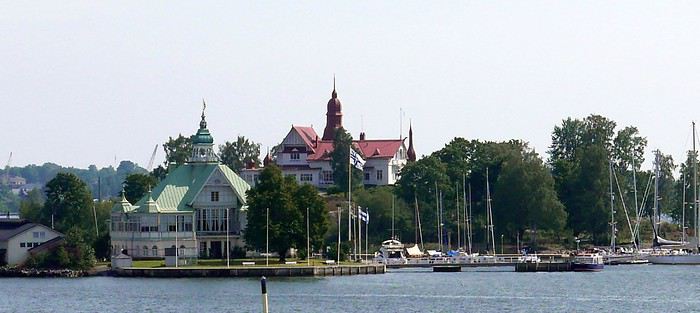


The boat tour showed that the standard of living seems high here too—summer homes (or not) on the islands are very beautiful. A small canal was even dug to save these lucky owners time on maritime transport. Apartments sell for a fortune. Back at Market Square, we grabbed a snack at the market—a reindeer kebab with dried reindeer, cheese, and a mini cracker—simple but delicious. No time to waste—ours is limited. Even if there’s not much to see tourist-wise. Four churches compete: the very busy and beautiful Helsinki Cathedral (better outside than in), its direct rival the Orthodox Uspenski Cathedral (same), the Rock Church (Temppeliaukio) and the Wooden Church (Kampin)—both as beautiful inside as out!!! Here too, very little car traffic, but tons of people—tourists or not—and joggers. In the evening, a bit tired, we headed to the off-center hotel to try the Scandinavian Hesburger chain. For connoisseurs and 29 euros, decent fries and burgers resembling Burger King’s—while the other American giant is left behind. Personal taste, I guess. The next day, we took the bus tour again, passing the Parliament and the controversial Sibelius Monument—a 24-ton pile of clanging iron pipes. Then, to kill time, we headed to Linnanmäki amusement park, on a hill overlooking the city. Rides are packed together, and a new one appears every year. Mostly family-oriented, but two or three thrill rides were packed. Despite my advancing age, I gave it a try—obviously regretted it afterward... Europe’s oldest wooden roller coaster (1950) shows the genius of its creators, with a brakeman at the back—worth the detour and passes the time. We ate (if you can call it that) on-site for 19 euros. Back "in town," classic shopping centers are numerous, but souvenir shops can be counted on one hand. No matter—we had to pack because tomorrow’s the return. We ate burgers again near the hotel and Hes... but served at the table for 67 euros. The next morning, to kill time before the 4:00 PM flight, we went to the port and its tourist market, where I splurged 15 euros on a cap to add to (or clutter) my already well-stocked collection. We finally learned that bus 615 goes to the airport, with a stop in front of our hotel where the luggage was left in storage after checking out. Still, count 40 minutes with this indirect route. Via an Air France flight operated by Finnair, after 3 hours, we returned to Roissy CDG—our vacation is truly over!!!!!!

CONCLUSION (if I may) Among the three capitals we visited, our unanimous ranking is: Oslo, Helsinki, and Stockholm—period. Despite a few imperfections in my itinerary, I’d say the Lofoten Islands are really worth it—two days on-site is a minimum. Finland, and not just because of the radars, is way below—nothing to see tourist-wise. I didn’t say nothing to do for those with time—nuance... Norwegian fjords, even if once you’ve seen one, you’ve seen them all, are really beautiful, though this destination is quite expensive for us. Norway, thanks to its oil and gas, is very wealthy, near full employment, with an annual GDP per capita of 70,000 euros!!! A pack of cigarettes at 13 euros and beer at 10 euros doesn’t make this a dream destination for an addict like me. We were very lucky with the weather—only two and a half days of rain over 14, unlike many bloggers whose stories I read before leaving. The welcome wasn’t always what we expected. Despite the massive French presence, we’re not always as welcome as Asian conquerors, to whom the West, racing to its doom, continues to roll out the red carpet—literally! I don’t regret our choice—it’s worth seeing once, but only once. At least now we know what we’re talking about!!!!! Finally, as always, here’s the link to my public slideshow on YouTube. For the private one, some spicy scenes (especially with Santa and a troll) could cause me more problems—I’ve had enough!!! www.youtube.com/...zbIgZC6Pk&t=165s See you soon, maybe for new adventures and getaways. DJ93.
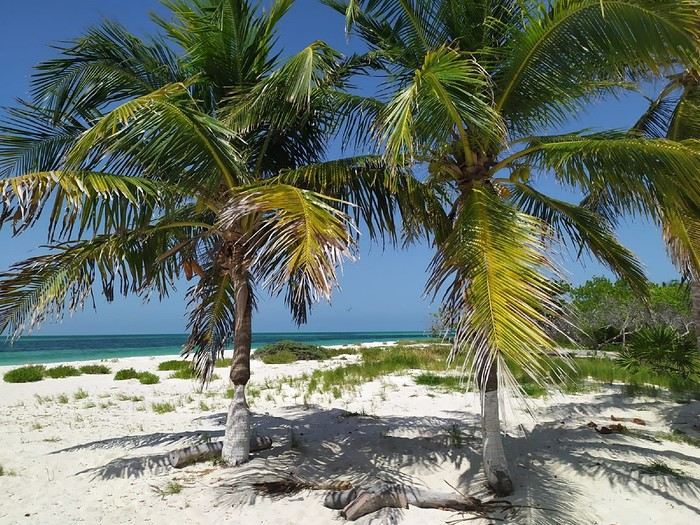
Open
Three weeks in Japan with the family
Hi everyone,

Actually, we ended up going to Japan almost by chance. I’d caught glimpses of the country during business trips, and it had been on my “wish list” for a while, but I thought we’d go “when the kids were grown up.”

But this summer (2016), the kids couldn’t agree on a destination—their wishes were completely opposite. Then, realizing that flight tickets weren’t outrageously priced—and having read that Japan wasn’t as expensive as people think—we, the parents, suggested Japan… while warning that it would be scorching hot and humid and that no one should complain. Our eldest (18) was immediately thrilled: “Oh! Mom! I’ve always dreamed of going to Japan!” She convinced her brother (16) that it was the perfect destination. Deal sealed: we’re going to Japan, but no one complains about the heat.

After some forum discussions and family brainstorming, I settled on the following itinerary. One non-negotiable shaped part of our choices: being in Hiroshima on August 6th to attend the lantern floating ceremony. To avoid overloading the trip with extra transport, we skipped Nara, Nikko, and Kamakura.

Day 1 - Arrival at 8:30 AM in Osaka – Kyoto - around the station Day 2 - Kyoto - East - night: Kyoto Day 3 - Kyoto - North and center - night: Kyoto Day 4 - Osaka (stroll with Osaka Safari) - Fushimi Inari -night : Kyoto Day 5 - Train - Naoshima - night: Uno Day 6 - Teshima -night: Uno Day 7 - Naoshima – Hiroshima - night: Hiroshima Day 8 - Hiroshima – Commemorations - night: Hiroshima Day 10 - Miyajima- night: Miyajima Day 10 - Miyajima - Himeji Castle - night: Osaka Day 11 - Osaka - night: Osaka Day 12 - Kyoto - West -night: Osaka Day 13 - Kanazawa to Ainokura - night: Ainokura Day 14 - Shirakawa-go - Takayama - night: Takayama Day 15 - Kamikochi night: Takayama Day 16 - Takayama - return to Kanazawa night: Kanazawa Day 17 - Kanazawa -night: Kanazawa Day 18 - Travel to Tokyo (Shibuya) -night: Tokyo Day 19 - Tokyo (visit with Tokyo Free Guide – Yoyogi Park - Meiji Shrine - Harajuku - Takeshita-dori - Omote Sando - Odaiba) - night: Tokyo Day 20 - Tokyo (with Tokyo Safari) - night: Tokyo Day 21 - Tokyo (Tsukiji, Hama-Rikyu Onshi Teien, Asakusa and Senso-ji, Kappabashi, Ameyoko, and Ueno) - night: Tokyo Day 22 - Tokyo (Shibuya-Yoyogi Park again - Ikebukuro - Shinjuku (Tokyo Metropolitan Government Building, Omoide-yokocho, Golden Gai) - night: Tokyo Day 23 - Tokyo (Yanaka – Ueno – Edo-Tokyo Museum - Takashita-Dori again - back to Shibuya) - departure at 10:50 PM for Paris

(You can access the published days directly by clicking on them).

The itinerary perfectly matched our expectations: a good pace, a wide variety of visits, the must-sees, but also a first taste of rural Japan. If we were to do it again, I’d do exactly the same (except for the back-and-forth between Kyoto and Osaka on Days 4 and 12, which were due to my desire to explore Osaka with Osaka Safari). Of course, we had to skip some sights, especially in Kyoto where we missed a few “highlights,” but that was a deliberate choice—I’d limited our time in the city, which is known for being stifling in summer.

For accommodations, we mixed Airbnb apartments and quadruple rooms in guesthouses and ryokan. It worked out perfectly. The apartments gave us more space and the chance to dine in some evenings, while the guesthouses and ryokan helped us experience Japanese customs.

First, a quick recap: all four of us were enchanted by our trip. Japan is a constant source of wonder, just like the preface of *Tokyo Sanpo* by Florent Chavouet describes—I’ll take this opportunity to plug the book, which I read with great pleasure after our vacation. That’s exactly it: everything is a reason for amazement. Everything is so different from home. I wanted to photograph everything around me constantly. I promise, I won’t say “photograph like a Japanese” anymore—during this trip, *I* was the Japanese. And I better understand the culture shock Japanese travelers experience in Europe.

As a friend of mine put it: “It’s simple—they have ten fingers, so they count in base 10. Otherwise, they do everything differently from us.” Well summarized.

Another thing: everything is easy. Everything seems to have its place and be exactly where it should be. The smallest detail seems to have been thought out to make life easier. Things that come to mind: the incredibly well-designed signage in train stations and the subway, the ubiquitous public toilets, designated smoking areas, those hyper-detailed maps with all the useful information available at every place we visited… These maps are so well done that we got into the habit of picking them up systematically. It’s that simple: I came back to Paris with a complete collection. And when we arrived in Takayama by car, our first stop was at the train station to get THE map. But this order goes beyond all these practical elements. There’s a certain *je ne sais quoi* that makes you feel like everything is exactly where it should be. Even during rush hour, in the crowds, people manage to avoid each other in a smooth, collision-free flow—the opposite of the Paris metro. Anyone who’s experienced certain transfers in Paris at certain times will understand.

The exquisite politeness of the Japanese and their desire to be helpful are another highlight of the trip. Every person we met tried to help us and make our lives easier. It was really great.

Oh! I almost forgot: Japan’s hyper-safe side. I’ve rarely felt as safe as I did in Japan. No need to keep an eye on your belongings—they’re not going anywhere. One example among many: in Tokyo, Japanese women leave their bags open with their smartphones casually placed on top. Even I could’ve taken them without them noticing, let alone a pickpocket… No wonder France is seen as dangerous.

That said, I’m not claiming Japanese society is flawless. The role of women and gender relations are downright shocking and archaic from our European perspective. I also don’t think I could live in such a codified society, where the individual is so dissolved into the collective. But for a vacation, it’s simply delightful. On that note, I recommend *Nââânde?!* by Eriko Nakamura, which I discovered after our trip on the recommendation of our eldest’s friend. It’s the story of a Japanese woman married to a Frenchman living in Paris, recounting her astonishment at French habits and customs. Even though I tried to be careful, I’m sure I made quite a few blunders.

As for the climate, it didn’t stop us from enjoying our trip. Sure, we were hot—*really* hot—but by protecting ourselves from the sun (hat for me, caps for the others, plus umbrellas—Japanese-style parasols) and drinking liters and liters of water, it was manageable and didn’t bother us too much, even if we probably had a slower pace than we would’ve with milder weather. That said, with small children, we would’ve struggled more.

Last point before diving into the trip details: the cost. Despite what I’d read, traveling in Japan is still expensive. I’m not talking about our specific trip, where—using our daughter’s 18th birthday and our 20th wedding anniversary as an excuse—I splurged on a few extras that drove up the cost. I was particularly surprised by the price of quadruple rooms, which is roughly the same as two double rooms. So for a family, that’s a significant extra cost. The various paid sites in Kyoto also add up. As for food, it’s generally cheap, but it would be a shame not to budget for a few extras to try some less affordable specialties—like Hida beef in our case.
Open
Dubai, family vacation
After the wide-open spaces of the American West, we're off to a new destination: Dubai. Not just for a layover, but for a real family vacation!! The question that kept coming up was "why Dubai?" (after why Colorado this summer, people are going to think we're really weird 😅). So, why Dubai? First, because skiing isn’t really our thing anymore—so in winter, we want sunshine 😎. But not just any sunshine—warm enough to swim, which narrows things down a bit 😅. The second constraint this year: Franck can’t take more than a week off (and it’s unpaid), so we’re ruling out destinations with 12-hour flights and jet lag that knocks you out when you get back 😅. The options are getting tighter… So, against all odds, it’s me who ends up suggesting Dubai (my husband’s been nagging me for years about Atlantis and its mega water park—ah, the kids! 😉).

Actually, Dubai only has 2 days of rain a year (you’d have to be *really* unlucky!!), temperatures around 30°C in winter, the sea (oh yeah, I forgot—the sea was something we missed this summer, so it was on our list 😅), a 6/7-hour flight, just 3 hours of jet lag, reasonable family prices, and tons of activities for all tastes. Starting my research with a pretty negative bias, I’m now looking forward to this trip with excitement and impatience… and without spoiling the ending, I won’t be disappointed—our whole family will come back enthusiastic and ready to go back!!

So, I’m taking you along for a week in Dubai at the beginning of March.
Open
Petting a lion in South Africa?
In South Africa, over the past few years, places offering interactions with lions have exploded across the country—but mainly in the most tourist-heavy areas (well, well...).

Under various names ("reserve," "center," "park," "institute"), tourists are lured in with the chance to pet lion cubs, walk alongside lions—all for a fee, of course. Volunteers are even recruited to support the animal cause—also for a fee.

The origin story of these big cats is always noble: orphaned cubs rescued from the wild, or from terrible places, or from an injured mother that was saved. (That’s an awful lot of orphaned lion cubs... a real epidemic?)

The future of these felines is supposedly bright—either a return to the wild or retirement in a reserve.

The "center’s" activities—the rescue of these poor cubs or lions, the study of their behavior, genetic improvement, repopulating the wild, and lately, advertising.

What will the tourist do?

How can you resist the incredible opportunity to pet a lion cub, walk beside a lion, get up close without barriers, see them so near? Plus, you’re doing a good deed by funding the rescue of these magnificent animals, cared for with such dedication by these passionate people!

What have you actually just done?

What are the facts? (Conclusions from a very interesting report)

There are over 200 lion breeding farms, currently holding more than 12,000 captive felines, most of which are lions. (Up from 8,000 in recent years.) More than 800 captive lions are killed each year by hunters. Who, by the way, try to establish ethical hunting rules. Almost none of these places have any real connection to animal protection agencies or wildlife conservation scientists. It’s a commercial operation, generating over $100,000 USD/month, particularly through volunteer programs. The real rescue centers can be counted on one hand! There are no reintroduction programs for captive lions. They aren’t needed—lions don’t require captive-bred animals for reintroduction, especially not those imprinted by humans or genetically compromised. And they don’t breed, sell, or interact with the animals in any way!

(They don’t breed, trade—mostly receiving animals rather than acquiring them—or interact with the animals in any way.)

Taking a lion cub from its mother is unnatural and only done to exploit the animals, visitors, and volunteers.

(Taking lion cubs away from their mothers isn’t natural and is only done to exploit the animals and you as the visitor or volunteer.)

Obviously, the number of animals actually "rescued from the wild" is minuscule. Information provided at these places is poor, confusing, and biased—or outright false. They exploit people’s gullibility and empathy for a commercial operation under the guise of animal welfare. Under the pretense of animal protection and research, many lions end up sold to zoos. Most are sold to hunting reserves. The use of big cat bones in traditional Chinese medicine is ancient and growing rapidly—over 1,000 lions are killed each year for this purpose.

The uncomfortable questions!

* Is there interaction with the lions? * Where are the old lions? * Do you buy or sell animals? * Where do the animals come from, and where do they go? Where do all these cubs come from? * Do you have a recognized predator specialist? * If you release animals, when and where?

The right answers!

We interact minimally, if at all! They need to stay wild! The old lions are here. Never buying. Selling is extremely rare. It’d be like an animal shelter buying dogs! We have few animals, all rescued. No breeding, ever. It’d be like an animal shelter breeding dogs! Yes. Extremely rare!

It’s clear this is purely a financial operation, and there’s a 99% chance you’re participating in what I’d call a scam.

Basically, lions are bred on farms. When they’re cubs, you pay to pet them. When they’re older, you pay to walk with them or get close. And when they’re fully grown, they either become breeders on the farm or end up as targets—in a zoo, as bone powder, or worse.

Pet a lion cub, and you’re sentencing it to a lifetime in captivity or death!

The same principle applies to leopards—though not exactly to cheetahs.

Real rescue and conservation centers exist, but they’re rare. The others are everywhere.

Please, keep this in mind on your next vacation!
Open
Come discover Ireland with us
IRELAND - INTRODUCTION

We planned our 15-day trip to Ireland several months in advance to create an itinerary that would let us see a multitude of tourist attractions across various regions of the Republic of Ireland and Northern Ireland.

We researched the main attractions in each region and noted their GPS coordinates.

After that, we used Google Maps to create a packed but realistic daily route. We printed all the itineraries, and they proved extremely useful since some attractions weren’t listed on the GPS a friend lent us, and some roads aren’t clearly marked.

This way, we were able to stick to our daily schedule.

Three months before our departure, we rented a car directly from Autoescape’s website for 136.44 € over 14 days. The rental was with BUDGET, and the car we got was a ŠKODA Citigo.

This rate includes unlimited mileage, collision damage waiver (CDW), theft protection (TP) with a 1,500 € excess, and unlimited third-party liability coverage.

Some roads in Ireland are very narrow, so a compact car is much appreciated. Don’t forget that driving is on the left, and there are plenty of roundabouts.

Luckily, my partner finds driving this way easy, and our travels went smoothly.

It’s worth mentioning how courteous and patient Irish drivers are—it’s truly phenomenal.

Two weeks before our trip, we booked our accommodations at various places like B&Bs, hotels, and university campuses through Hotels.com. We’ll talk more about each of them later.

When we arrived at Dublin Airport, going through customs was quite tedious. There are two lines: one for EU citizens and another for other foreigners. The wait for non-EU travelers is significantly longer.

The car rental isn’t directly at the terminal. You have to take a shuttle to the rental center. Once there, a company representative finalizes the contract and hands over the keys to our rental car.

And off we went on our adventure!

It’s also important to note that some roads have tolls. For most of them, you pay directly at a toll booth, and the fees are usually under 2 €.

However, the M50 motorway around Dublin works differently—it’s a prepaid toll. You’re charged when you drive between Junction 6 (N3 Blanchardstown) and Junction 7 (N4 Lucan). A large purple sign warns you as you approach one of these junctions.

Cameras automatically record your license plate, and fees are applied based on your vehicle category. For a standard car, the fee is 3.10 €.

You have until 8:00 PM the next day to pay at an authorized retailer or online at https://www.eflow.ie/.

We prepaid these fees directly on the site mentioned above.

If you don’t pay within the required time, you’ll be charged substantial penalties.

For dining, most grocery stores and gas stations offer a great selection of hot and cold meals at very reasonable prices. That’s why we mostly bought our food at places like SuperValu, Lidl, Spar, and Centra.

We invite you to keep reading about our adventure in the next section.
Open
Stunning Botswana
Well, here goes—I’m taking the plunge. This is my first blog on VF, so I hope I don’t make too many blunders. In advance, you’ll have to excuse me because they’ll definitely happen anyway Here’s the context of our trip: - Project started: December 2015 ... yeah, that’s a while ago - Family of 4: 2 adults, 1 teen (17) and a 10-year-old boy - First trip to Southern Africa

Originally, we’d planned to go to Namibia. But after watching a TV documentary, we took a slight detour to the right and ended up in Botswana 🙂 Don’t worry, we’ll still do Namibia—just a bit later. It’s definitely not off the table. Quite the opposite!!

After that big decision, the question was: "Should we go alone or with an agency?" Through my son, who’s into music, we were lucky enough to meet some VF members who love Botswana: Marygabrielle and Yves (I won’t name-drop, but you know who you are). They were amazing and helped us with every aspect of our trip. We can’t thank them enough 😉 So, I didn’t even need to ask VF for all my questions 😛

For a first time in Southern Africa, and especially for Botswana, they easily convinced us to use a small local agency for at least part of the tour we wanted to do. After multiple conversations online—and thanks to Marygabrielle acting as our translator (our English is *terrible* )—our itinerary was finalized, and ... we ended up spending our entire vacation with this local agency:

Letsatsi Safaris (email for those interested: letsatsisafaris@gmail.com, website: www.letsatsisafarilodge.com, phone: +267 71692093/71351892) Joe and William (the owners) are brothers and true Batswana.

Since Marygabrielle and Yves knew them well, we set off with them in complete confidence. Everything was planned and paid for in advance, so all we had to do was relax once we arrived. Pure bliss for me—real vacation time without having to prepare meals 😛 and being able to fully enjoy everything. Everything was included: guides (them, in this case), accommodation (mostly in tents), and a cook. All we had to do was help set up and take down the tents. Indiana Jones better watch out—we’re going camping in the wild too 🙂 A dream come true!

Of course, there’s an extra cost compared to traveling solo. But this time, we splurged, and we don’t regret that choice at all.

They were all fantastic—professional, friendly—and it was a huge joy for us. We had an amazing time thanks to them. A big thank you to Joe, William, and all their staff we met: Jonah, Junien, and Doris.

Now, time for the story!
Open
Back from 3 weeks in Morocco in April
We just spent a little over 3 weeks in Morocco. Three weeks on the road starting from Marrakech in a rental Logan. We decided to split this trip into 3 highlights: the seaside first, a week in Aourir north of Agadir, Aït Baha and Tafraoute for another week, then a week in the Skoura palm grove followed by 3 days in Marrakech before heading back.

When we arrived, we were surprised by the temperatures—much higher than in previous years—and we were amazed by the quantities of flowers we saw throughout our journey. Moroccans explained that they had a lot of rain this winter, beneficial water, not the kind that destroys everything in its path.

First stop: AOURIR. Staying at Bab Aourir, we were able to explore the area. A great discovery this year: the Assif El Had cave, beyond Imouzzer. A beautiful road to get there. Absolute tranquility once you're inside. A lovely spot for a picnic by the *séquia* (irrigation channel) at the cave’s entrance.


Open

You might also like