On the Orly-Saint-Denis flight, under the pretext that Air France had paired their delicious chicken with mushrooms meal with a little bottle of rum, Dom noticed that some passengers hadn’t even opened theirs. So he bribed a flight attendant to bring him the abandoned mini bottles! Needless to say, the guy slept like a baby!
Sunday, September 29, 2019
Saint-Pierre
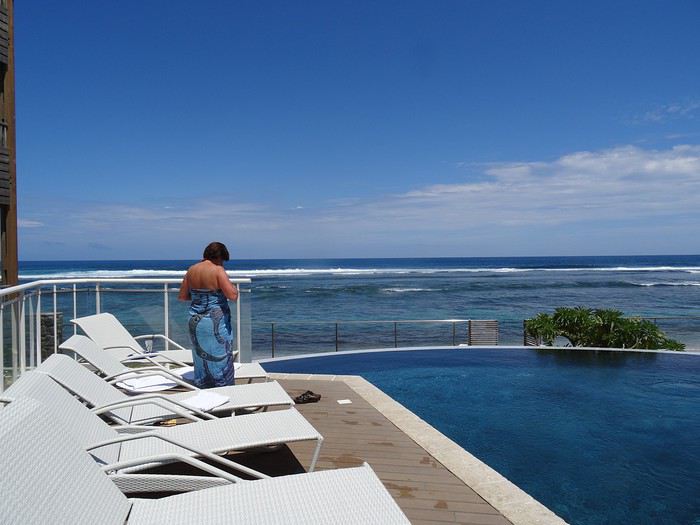
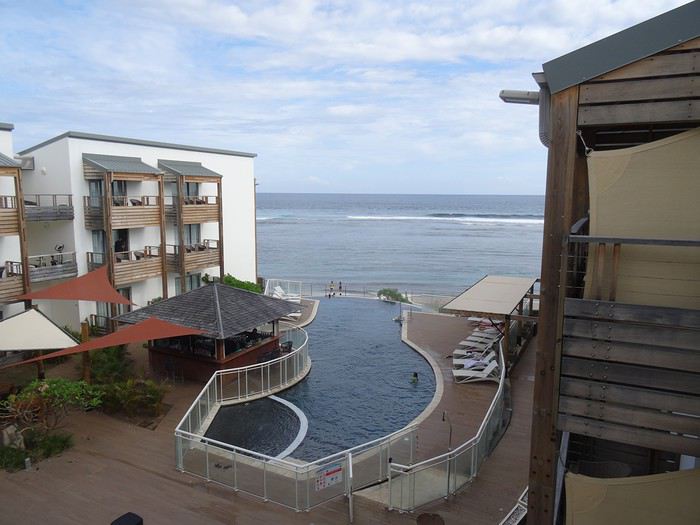
A flawless journey (well, except for a minor distraction in the massive Hertz queue that led me to cut in front of a few young couples, who weren’t too happy about it—though I joked with the agent about it: *"It happens!"*). We ended up at Hôtel Le Battant des Lames in Saint-Pierre, a gorgeous combo of an infinity pool and the Indian Ocean. We rushed straight into the pool—after over ten hours of sitting on a plane, it felt *amazing*!
We didn’t waste any time—you know Dom—exploring the city on foot. It’s lovely: the seaside is well-developed, it’s tropical, but with the budget of a wealthy country.
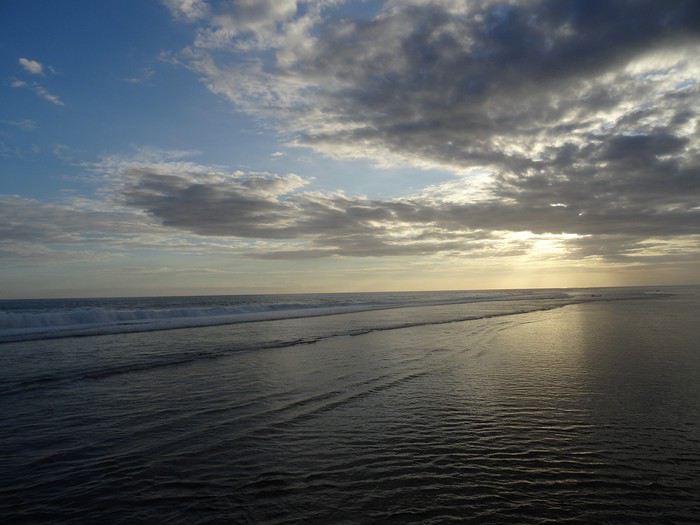
Réunion is also famous for its killer sharks…
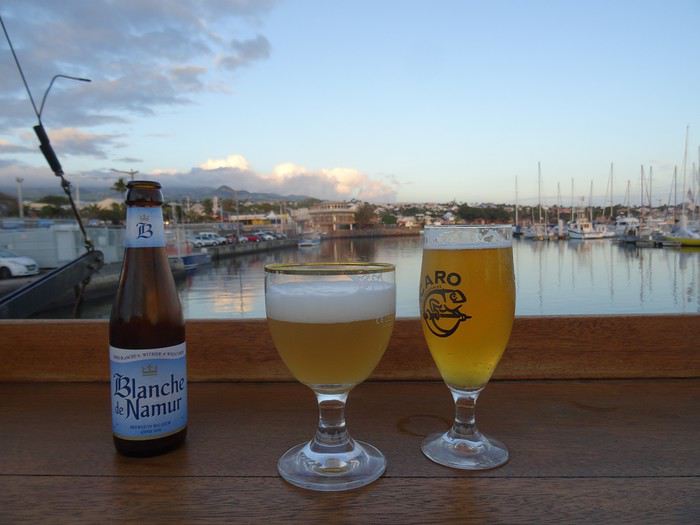
A Creole music group was playing at a seaside bar, so we settled in.
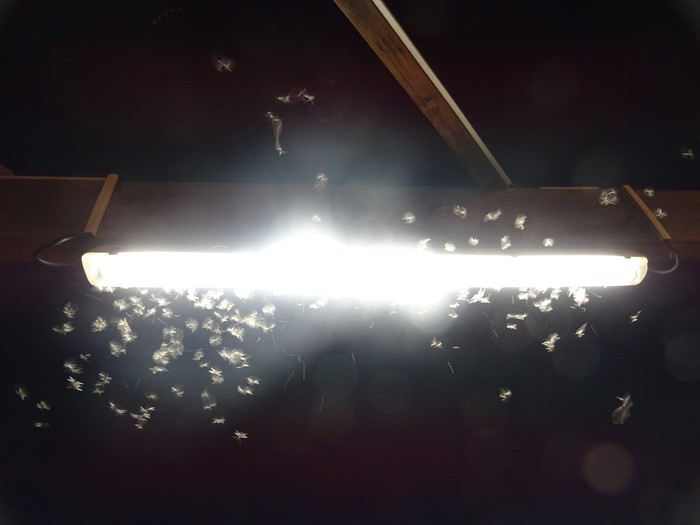
Night fell, and with it, swarms of insects suddenly invaded the city!
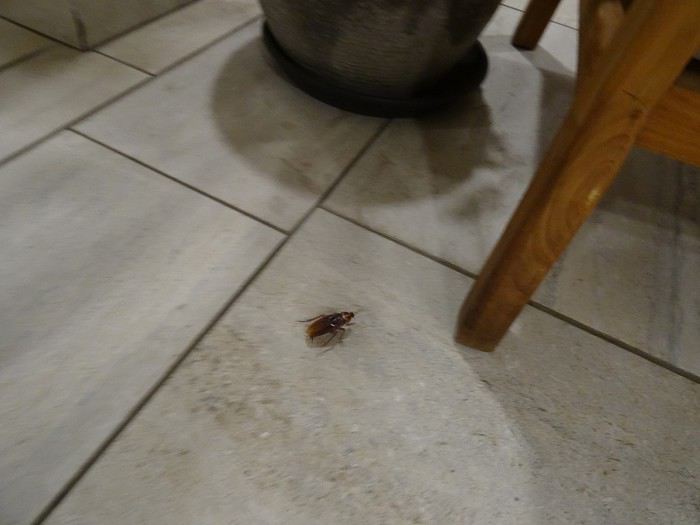
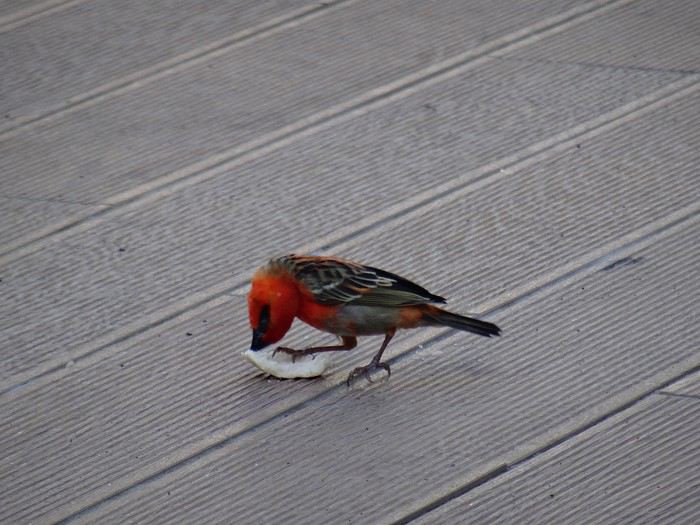
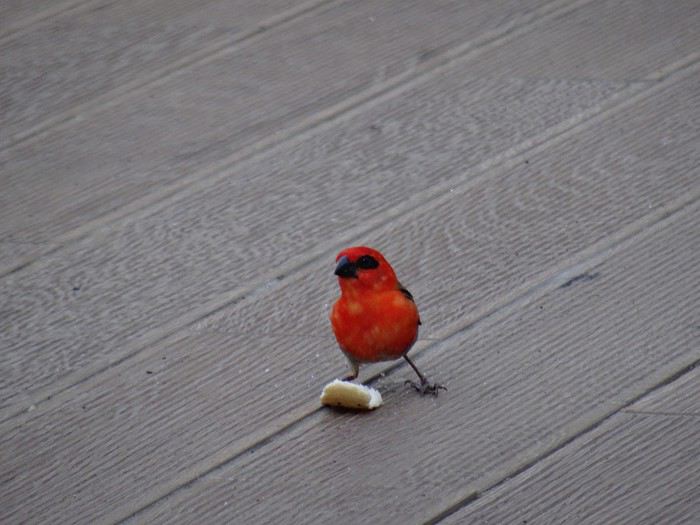
One of the few signs of the tropics here! Insects, geckos, and cockroaches...
Monday, September 30, 2019
Saint-Pierre
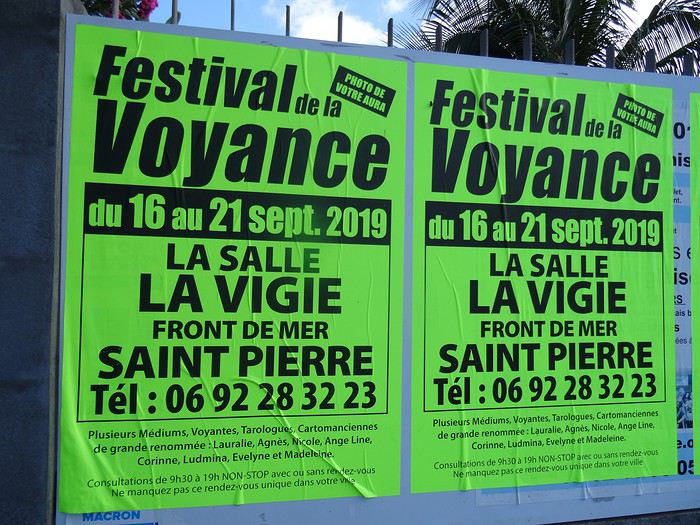
We were disappointed, of course! We could’ve gotten a photo of our *aura* and missed the chance by just a week! In tears, we decided to tackle the island’s most famous site.
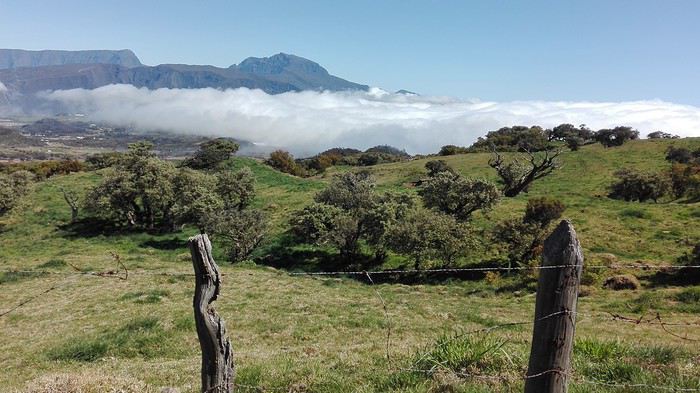
Excursion to Piton de la Fournaise. The plan was to head to one of the nearby parking lots and take a relaxed stroll. But it quickly turned into… something else.
First, I realized the built-in GPS operates on a pretty basic algorithm—like the earliest models. If there’s a bumpy road that even the toughest Mitsubishi 4x4 struggles with, a path through a junkyard, or any shortcut to save a few meters, it’ll proudly suggest it. So instead of taking the main road—the royal route to the famous volcano—we ended up on charming little mountain roads…
Hi everyone!
I’m heading to Sri Lanka soon for my honeymoon and I’m looking for affordable, French-speaking drivers for 15 days. I’ve already planned the route and booked the hotels myself. I’ve seen some driver rates at 95 €/day—honestly, that’s pretty steep!
Any leads or recommendations?
Thanks,
This three-week trip to Namibia was a big first for us:
- Visiting a country in winter, for someone who starts feeling comfortable at 25°C (77°F).
- Camping, when we usually feel at home in a starred hotel.
- Sleeping on the roof of a car—what an idea... when a comfy bed is waiting just a bit further.
- Grocery shopping, cooking, doing the dishes... all the things we usually avoid to fully enjoy our vacation.
- Washing up when and how we can, when we can’t imagine going a day without a shower.
- Driving a big 4x4 on the left, with a manual transmission, when we usually opt for an automatic for more comfort.
Yep! You guessed it—we stepped way out of our comfort zone during this trip.
I had quite a few doubts while planning this adventure, but the more I read travel journals about Namibia, the more I wanted to go.
Personally, without this forum, I never would’ve dared to hit the Namibian roads in a 4x4. I was really anxious during the planning, so I want to thank everyone who contributed with their journals and forum discussions for helping me leave more peacefully.
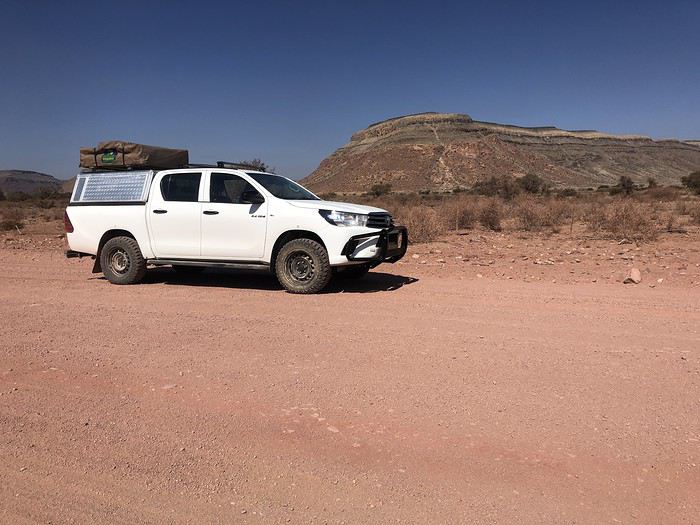
At first, I wasn’t even considering sleeping in a tent. But after my husband’s persuasion—and my own curiosity to experience what I’d read in those travel journals—I gave in. So off we went in a double-cab Hilux with a rooftop tent.
And of course, let’s talk about me—the big cold-weather wimp. One of the biggest pre-trip challenges was choosing a sleeping bag. After a while, sleeping bags had no more secrets for me: temperature ratings (comfort, limit, extreme), shapes (mummy, rectangular), fillings (synthetic, down), compression rate, and weight... all these factors were a real puzzle.
In the end, to make sure I wouldn’t be put off camping in winter (Australian winter, mind you), I went for a sleeping bag with a comfort rating of -10°C. And just to be *extra* sure I wouldn’t get cold, I bought a liner (never knew what that was before) in Thermolite, which boosts the sleeping bag’s temperature by 11°C. There are liners that add up to 15°C, but let’s not exaggerate—we’re not heading to the North Pole!
My husband, on the other hand, got a sleeping bag with a -5°C comfort rating and a silk liner.
Was it enough? You’ll find out soon. In the meantime, another big thank you to everyone who helped me make this choice with their advice and experience.
Over a year in advance, we planned a three-week itinerary for our first trip to Namibia—classic route, nothing too out there.
We chose to do the circuit clockwise because we wanted to finish on a high note in Etosha and its wildlife. They say it’s like Noah’s Ark out there!
And why not, the cherry on top... some big cats.
We used Tourmaline’s services to book our accommodations and the 4x4.
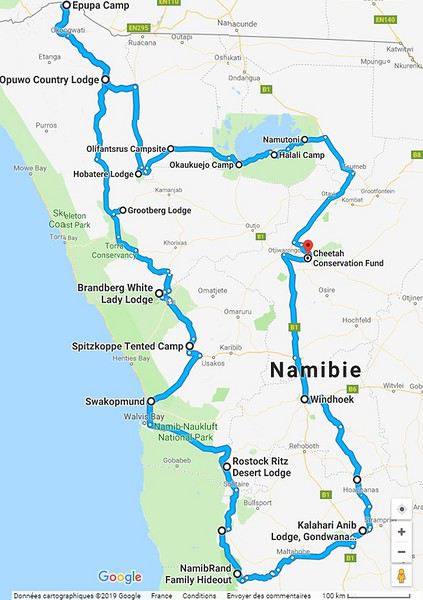
Here’s our planned itinerary with campsites and lodgings—yes, there are a few solid roofs in there; we didn’t want to push it too far.
Day 1: Windhoek – Windhoek Gardens Guesthouse
Day 2: Kalahari Anib Campsite
Day 3: Namibrand Family Hideout
Day 4: Sesriem Camp
Day 5: Sesriem Camp
Day 6: Rostock Ritz Camp
Day 7: Swakopmund - Sea Breeze Guesthouse
Day 8: Swakopmund - Sea Breeze Guesthouse
Day 9: Spitzkoppe Camp Tented
Day 10: Brandberg White Lady Campsite
Day 11: Grootberg Lodge
Day 12: Opuwo Country Campsite
Day 13: Epupa Camp
Day 14: Hobatere Lodge
Day 15: Etosha Olifantsrus Camp
Day 16: Etosha Okaukuejo Camp
Day 17: Etosha Halali Camp
Day 18: Etosha Namutoni Camp
Day 19: Cheetah Eco Lodge
Day 20: Windhoek – Londiningi B&B
Alright! Are you ready to follow this adventure with us in our Hilux?
Really disappointed with Costa Rica! Pura vida? The scam of the century!
(Costa Rica pure emptiness).
The country where animals are free and people are in cages.
3 weeks in December in this country and never again. Imagine the trailer of a movie that seems interesting, and when you go see it, you realize it’s a flop and the best moments were in the trailer.
Well, that’s exactly how we felt with Costa Rica pure emptiness.
My wife and I have traveled quite a bit and didn’t expect to be so wrong about a place.
On the main routes, we visited:
San José
Alajuela
Limón, Cahuita, Puerto Viejo, Manzanillo (Caribbean side)
Jaco, Quepos, Manuel Antonio (Pacific side)
And a few short stops in intermediate towns.
Our dissatisfaction grew gradually like this:
When we arrived at the hotel, the taxi dropped us off on a small street in front of a white metal gate with ground-floor windows barred. We looked at it skeptically, but the sign matched.
He approached the gate, rang the bell, the buzzer sounded, and the door opened slightly. The hotel wasn’t bad for the price, a 10-minute walk from downtown, but with a "Fleury-Mérogis" vibe guaranteed.
So far, so good.
After showering and regaining our bearings, we headed downtown.
What started to unsettle us on the way was seeing houses with bars on the ground-floor windows and even on the second floor.
At first, we thought the hotel’s neighborhood wasn’t great.
Downtown San José:
It’s a generic city, not very exotic, with a pedestrian street and a small mercado where you can eat local food without frills. Very few tourists—if any—which let you blend in with the locals. We had lunch and struggled to make ourselves understood because, aside from one or two shops, English wasn’t spoken.
On the way back to the hotel, we took a different route, and while chatting and strolling, my wife pointed out a beautiful two-story white house completely barricaded like Fort Knox.
From that moment, we started noticing the facades of houses and buildings, and wow, it was creepy—most looked like prisons, some even with barbed wire.
Though put off, we told ourselves it was probably a big-city thing and the rest of the country couldn’t be like this.
So far, so good.
We relaxed at the hotel and had a drink at the bar. Night falls early, around 5:30 PM. By 7:30 PM, we headed back downtown for dinner. A bit unsettling for a capital—downtown was almost deserted, and aside from fast-food chains, very few restaurants were open, with hardly anyone on the streets.
Bars with security guards out front.
I won’t say we felt unsafe that night, but once it got dark, we realized the bars on the windows weren’t for nothing. First day in, and our impression was already mixed.
The next day, we explored the city and surroundings, and our feelings didn’t change.
So far, so good.
Off to Cahuita by bus—4 hours of travel.
The landscapes are very green but quickly become monotonous. The road runs alongside the forest and passes through a few towns and villages, and even in the countryside, there were just as many prison-like houses.
The bus dropped us off at Cahuita’s terminal station—only four of us got off. It’s a village, or rather, a small town. Cahuita is basically one straight road and a perpendicular one, and honestly, doubt started to creep in.
A few restaurants that add 13% tax and 10% service charge—so 23% extra. We dropped our stuff at the hotel and went to explore. In 20 minutes, we’d seen it all. We had lunch and planned to check out the famous park.
Entry is by donation—well, the "entry" is a joke. There’s a path along the forest by the sea, and that’s it.
Nothing’s going right anymore.
We thought it was a total scam, but since we hadn’t gone far, we decided to come back the next day to explore further.
We returned to the hotel, relaxed, and around 8:00 PM, we went out for dinner. Only two restaurants were open, and the streets were deserted.
Creepy!
The next day, we explored the so-called park more thoroughly and really got it.
A path along the forest by the sea—2 hours there and 2 hours back, where you see animals that feel like showing their faces.
A total joke—"all that for this?"
The beach was full of wood debris and coconut husks. We wondered if the photos online were edited because the sea, very rough, wasn’t the azure blue we’d seen in pictures.
But calling this a park is a joke—it’s like a new concept.
When we thought about the reviews online, we started to suspect that professionals with interests in the country were monitoring and countering any negative feedback that could harm their business.
Too bad we didn’t check the negative reviews beforehand—we did while we were there, and it helped. We wondered if we’d become too demanding after all our travels, but no—when something’s bad, it’s bad.
Manuel Antonio’s park is even more ridiculous—there’s a short path along the sea for about 500 meters, and then nothing. You have to climb through mud and hack your way through the forest. We ended up barefoot because the mud was up to our calves. All that to see a raccoon and a few parrots flying overhead.
We didn’t expect Noah’s Ark, but we’ve seen more animals in Bali, Mexico, and Thailand while visiting temples or just walking around than in these so-called parks!
Puerto Viejo, not far from Cahuita and supposedly livelier—well, it couldn’t be worse!
According to Lonely Planet, it had a Caribbean vibe and wild nights, but maybe that was a long time ago. The good reggae music playing everywhere isn’t enough.
In the evening, Puerto Viejo was a bit livelier than Cahuita, but that’s not saying much. Very few tourists—if any—no night market, just two or three shops open selling $20 T-shirts. Same vibe as San José.
No big deal—we enjoyed the beach and the sun, which was reliable.
Our itinerary was supposed to include Tortuguero Park, but after talking to other travelers who’d just been, we changed our minds, knowing we’d be visiting Manuel Antonio Park on the Pacific side.
To get back to the Pacific side, you have to take the bus and go through San José again—5 hours this time—then switch bus terminals and another 4.5 hours to Quepos.
A stopover town to get to Manuel Antonio’s beach and park!
A town just like the others we’d seen—deserted as soon as the sun sets, and not exactly bustling during the day either. (Where are all the tourists?)
Still as many bars on the windows and that feeling of being in the wrong place.
7 km later: Manuel Antonio beach and park.
The beach is very beautiful and quite large, but don’t expect turquoise blue water—the waves stir up the sand, giving the water a brownish color.
Along the beach, shops and restaurants for about 300 meters, and then nothing. At night, after sunset, the town shuts down too.
Manuel Antonio Park is highly praised for its wildlife, so we were eager to see it. When you express dissatisfaction with Cahuita or Manzanillo parks, the response is always, "But you should’ve gone to Monteverde or Manuel Antonio!" No matter what you do or say, they’ll tell you, "You should’ve gone there or here."
Back to our famous park—entry was about $16, and contrary to what we’d heard, it wasn’t crowded!
Guides at the entrance with spotting scopes offered their services for about $30.
The park: a mix of boardwalk and dirt paths through the forest, sometimes running alongside beautiful coves and beaches.
As soon as we entered, a crowd was taking photos of a deer eating leaves.
A little further on, a guide with a group of five stopped. The guide raised his arm and set up his spotting scope! He showed them, about 100 meters away, a hummingbird perched on a branch. Some, looking through the scope, exclaimed, "Oh my God! Amazing! Incredible!"
For a moment, we thought they’d discovered a unicorn or were in Jurassic Park and had just crossed paths with a T-Rex!
The concept is comical—looking at a bird or another animal through a spotting scope because it’s too far away. Isn’t that what TV is for?
For our part, we saw monkeys, ants, an armadillo, an iguana, and the backside of a sloth climbing a tree. Amazing, incredible!
We stayed a few days in Manuel Antonio to enjoy the beach, changing hotels often because prices varied wildly from one day to the next for shameful services. On top of that, they’d quote a price in dollars and convert it at their discretion—thieves!
Alajuela, a city near the airport, has a two-story mall and a local market downtown! No interest except its proximity to the airport.
What we liked:
The climate and, in hindsight, San José—the most authentic city we visited.
What we didn’t like, in addition to what we’ve already mentioned:
Costa Ricans aren’t very friendly or communicative. English is barely spoken, not even by doctors at Quepos Hospital, where my wife ended up with food poisoning (thanks, Google Translate). The widespread obesity among Costa Ricans, who eat like Americans. The insecurity. The eco-hipsters who leave their $150 lodges in minivans with guides to visit parks and other sites, then return to barricade themselves in their fortresses at nightfall (oh my God, amazing, incredible). The blue signs at the entrance of towns that accept this payment method: "We accept American Express." Parking lots that become paid just because a guy is watching your car. Prices displayed in dollars. The cost of living (hotels, restaurants, taxes). Landscapes that are too green and not flowery enough. Beaches—nothing exceptional. Pollution in cities where big American trucks rule. Sewage dumped directly into the sea. Aside from the jungle, there’s nothing to visit—no ruins, monuments, or anything worth seeing.
In short, my wife and I think the hype about this supposedly eco-friendly country is overrated. It’s just the trendy destination of the moment. There are much better, cheaper, and more authentic places.
In hindsight, we keep the good memories and our beautiful photos, but if we had to do it over...
Before signing off, a little message to those who don’t like hearing opinions different from theirs:
Well, some things aren’t up for debate. And to those who’d have us believe that in 3 weeks, we don’t have the right to criticize a country or express our feelings—how can you praise it in so little time? What a scam. Costa Rica is a money pit. Pura vida? Pure cosmic emptiness.
If you like spending your evenings barricaded in your cozy hotel after dark, this country is for you.
For everyone else: run!
The idea of visiting Japan goes back a year now. I remember because I was looking for cheap flights to Europe from Paris. Surprisingly, the round-trip to Japan with Air China was just as affordable—if not cheaper—than many European destinations.
So, the tickets were booked. Three seats (including one for a 12-year-old), ten days over Easter 2018, AirBnB accommodation. Of course, in ten days, you visit without *really* visiting—you only scratch the surface. Just the classics: Kyoto, temples, moonlit rivers; the Shinkansen; and Tokyo, gardens, wandering, high-tech, and... maids.
I have to admit, we don’t know much about the country, and the thought of how we’d manage is a constant source of worry. What if this trip reveals my inability to open up to other cultures?
We board the first Air China flight with that question on our minds.
Actually, we ended up going to Japan almost by chance. I’d caught glimpses of the country during business trips, and it had been on my “wish list” for a while, but I thought we’d go “when the kids were grown up.”
But this summer (2016), the kids couldn’t agree on a destination—their wishes were completely opposite. Then, realizing that flight tickets weren’t outrageously priced—and having read that Japan wasn’t as expensive as people think—we, the parents, suggested Japan… while warning that it would be scorching hot and humid and that no one should complain. Our eldest (18) was immediately thrilled: “Oh! Mom! I’ve always dreamed of going to Japan!” She convinced her brother (16) that it was the perfect destination. Deal sealed: we’re going to Japan, but no one complains about the heat.
After some forum discussions and family brainstorming, I settled on the following itinerary. One non-negotiable shaped part of our choices: being in Hiroshima on August 6th to attend the lantern floating ceremony. To avoid overloading the trip with extra transport, we skipped Nara, Nikko, and Kamakura.
Day 1 - Arrival at 8:30 AM in Osaka – Kyoto - around the station
Day 2 - Kyoto - East - night: Kyoto
Day 3 - Kyoto - North and center - night: Kyoto
Day 4 - Osaka (stroll with Osaka Safari) - Fushimi Inari -night : Kyoto
Day 5 - Train - Naoshima - night: Uno
Day 6 - Teshima -night: Uno
Day 7 - Naoshima – Hiroshima - night: Hiroshima
Day 8 - Hiroshima – Commemorations - night: Hiroshima
Day 10 - Miyajima- night: Miyajima
Day 10 - Miyajima - Himeji Castle - night: Osaka
Day 11 - Osaka - night: Osaka
Day 12 - Kyoto - West -night: Osaka
Day 13 - Kanazawa to Ainokura - night: Ainokura
Day 14 - Shirakawa-go - Takayama - night: Takayama
Day 15 - Kamikochi night: Takayama
Day 16 - Takayama - return to Kanazawa night: Kanazawa
Day 17 - Kanazawa -night: Kanazawa
Day 18 - Travel to Tokyo (Shibuya) -night: Tokyo
Day 19 - Tokyo (visit with Tokyo Free Guide – Yoyogi Park - Meiji Shrine - Harajuku - Takeshita-dori - Omote Sando - Odaiba) - night: Tokyo
Day 20 - Tokyo (with Tokyo Safari) - night: Tokyo
Day 21 - Tokyo (Tsukiji, Hama-Rikyu Onshi Teien, Asakusa and Senso-ji, Kappabashi, Ameyoko, and Ueno) - night: Tokyo
Day 22 - Tokyo (Shibuya-Yoyogi Park again - Ikebukuro - Shinjuku (Tokyo Metropolitan Government Building, Omoide-yokocho, Golden Gai) - night: Tokyo
Day 23 - Tokyo (Yanaka – Ueno – Edo-Tokyo Museum - Takashita-Dori again - back to Shibuya) - departure at 10:50 PM for Paris
(You can access the published days directly by clicking on them).
The itinerary perfectly matched our expectations: a good pace, a wide variety of visits, the must-sees, but also a first taste of rural Japan. If we were to do it again, I’d do exactly the same (except for the back-and-forth between Kyoto and Osaka on Days 4 and 12, which were due to my desire to explore Osaka with Osaka Safari). Of course, we had to skip some sights, especially in Kyoto where we missed a few “highlights,” but that was a deliberate choice—I’d limited our time in the city, which is known for being stifling in summer.
For accommodations, we mixed Airbnb apartments and quadruple rooms in guesthouses and ryokan. It worked out perfectly. The apartments gave us more space and the chance to dine in some evenings, while the guesthouses and ryokan helped us experience Japanese customs.
First, a quick recap: all four of us were enchanted by our trip.
Japan is a constant source of wonder, just like the preface of *Tokyo Sanpo* by Florent Chavouet describes—I’ll take this opportunity to plug the book, which I read with great pleasure after our vacation.
That’s exactly it: everything is a reason for amazement. Everything is so different from home. I wanted to photograph everything around me constantly. I promise, I won’t say “photograph like a Japanese” anymore—during this trip, *I* was the Japanese. And I better understand the culture shock Japanese travelers experience in Europe.
As a friend of mine put it: “It’s simple—they have ten fingers, so they count in base 10. Otherwise, they do everything differently from us.” Well summarized.
Another thing: everything is easy. Everything seems to have its place and be exactly where it should be. The smallest detail seems to have been thought out to make life easier. Things that come to mind: the incredibly well-designed signage in train stations and the subway, the ubiquitous public toilets, designated smoking areas, those hyper-detailed maps with all the useful information available at every place we visited… These maps are so well done that we got into the habit of picking them up systematically. It’s that simple: I came back to Paris with a complete collection. And when we arrived in Takayama by car, our first stop was at the train station to get THE map. But this order goes beyond all these practical elements. There’s a certain *je ne sais quoi* that makes you feel like everything is exactly where it should be. Even during rush hour, in the crowds, people manage to avoid each other in a smooth, collision-free flow—the opposite of the Paris metro. Anyone who’s experienced certain transfers in Paris at certain times will understand.
The exquisite politeness of the Japanese and their desire to be helpful are another highlight of the trip. Every person we met tried to help us and make our lives easier. It was really great.
Oh! I almost forgot: Japan’s hyper-safe side. I’ve rarely felt as safe as I did in Japan. No need to keep an eye on your belongings—they’re not going anywhere. One example among many: in Tokyo, Japanese women leave their bags open with their smartphones casually placed on top. Even I could’ve taken them without them noticing, let alone a pickpocket… No wonder France is seen as dangerous.
That said, I’m not claiming Japanese society is flawless. The role of women and gender relations are downright shocking and archaic from our European perspective. I also don’t think I could live in such a codified society, where the individual is so dissolved into the collective. But for a vacation, it’s simply delightful. On that note, I recommend *Nââânde?!* by Eriko Nakamura, which I discovered after our trip on the recommendation of our eldest’s friend. It’s the story of a Japanese woman married to a Frenchman living in Paris, recounting her astonishment at French habits and customs. Even though I tried to be careful, I’m sure I made quite a few blunders.
As for the climate, it didn’t stop us from enjoying our trip. Sure, we were hot—*really* hot—but by protecting ourselves from the sun (hat for me, caps for the others, plus umbrellas—Japanese-style parasols) and drinking liters and liters of water, it was manageable and didn’t bother us too much, even if we probably had a slower pace than we would’ve with milder weather. That said, with small children, we would’ve struggled more.
Last point before diving into the trip details: the cost. Despite what I’d read, traveling in Japan is still expensive. I’m not talking about our specific trip, where—using our daughter’s 18th birthday and our 20th wedding anniversary as an excuse—I splurged on a few extras that drove up the cost. I was particularly surprised by the price of quadruple rooms, which is roughly the same as two double rooms. So for a family, that’s a significant extra cost. The various paid sites in Kyoto also add up. As for food, it’s generally cheap, but it would be a shame not to budget for a few extras to try some less affordable specialties—like Hida beef in our case.
Among other things, they don’t just mention fake taxis that rob you or express kidnappings (especially in Arequipa), but also drugs that can be slipped into your drink if left unattended, "with the risk of scopolamine being added."
They’ve marked the Cuzco region as a red zone (formally avoid!!) and central Lima as an orange zone, "to avoid after dark."
For a few years now, it’s become obvious that the typical tourist in Thailand is increasingly "mimile"—I see it every day.
The issue is that Thais know how to adapt and are offering more and more things that appeal to this kind of crowd. That’s why we’re seeing more and more pizzerias and burger joints... Even hotels are proudly displaying up to 5 stars for places that barely deserve 3 by European standards, and this "working-class" crowd is over the moon, totally buying into it!
In short, travelers looking to discover other civilizations and cultures might end up pretty disappointed.
As usual, I’m posting a new travel journal about our trip to Norway last September.
This one will span several months, with a day-by-day account of our adventure. I won’t be posting many photos on the forum (the publishing rules have become even more complicated since my last journal), but you can find all the shots on my blog (address in my signature).
We’ve just returned from a truly extraordinary, unforgettable trip.
Planning this trip wasn’t easy, and I’ll admit I struggled to decide on the itinerary… Should we take the Hurtigruten all the way from the south to the north? But a whole trip by boat didn’t really appeal to us. Or focus on the south in the fjord region? But that would mean missing out on the Lofoten Islands…
In the end, we chose to concentrate on southern Norway, exploring the coast and fjords, while including a stop in Oslo and mixing train, boat, and car travel.
I also opted for a trip where we’d drive less than in previous years (1,650 km compared to 2,000 km in Portugal and 3,800 km in the American West), but we’d still move around a bit and do some hikes.
Here’s the itinerary we followed:
This trip was absolutely amazing and introduced us to so many things we’d never seen or done before—fjords, a night on a boat, glaciers, stave churches, snow in summer (…and the high cost of living!).
If we had to sum up our top highlights, here’s our top 3:
Mr.:
the variety of landscapes
the colors, especially the colors of the water—from crystal clear to light blue and turquoise in some spots
eating good fish
Mrs.:
the roads: the ones in the area we explored were truly stunning
Geirangerfjord, especially in the late afternoon, when it was quiet and free of cruise ships
the Trolltunga hike: a challenging trek and a little personal achievement for us
What we liked less:
the sometimes inconsistent signage on hikes
the cost of living (everything costs money, and even food is expensive)
the tunnels: there are so many, and they’re not much fun (except for one with a roundabout inside…!)
That’s it for this first summary/overview, and I can already tell that choosing photos is going to be tough!!! Here’s a little preview of what we discovered:
To see the photos in full size on my blog: check it out here
A year ago, I posted looking for a cycling route for a trip in Sicily with my partner and our two kids (3 and 4 years old) in a trailer—something calm, with nature and a bit of culture. I didn’t get many replies, so I’m sharing our itinerary, which we really enjoyed. We cycled from the southeast (Syracuse) to the northwest (Palermo).
**Note:** We had no issues on the road—drivers were very courteous, the welcome was exceptional (lots of invitations to eat and/or stay overnight), and there were very few people on the roads, even the big ones, since we were there from September 23 to October 7.
**Weather:** Apparently, the summer of 2014 had been awful (only 25°C...). We, on the other hand, had 3 days at 44°C—it was *brutal*, including one day at 35°C at 1,000m altitude in the center of the island on October 1st...
**Accommodation:** 15 days of wild camping, with just one really nice apartment after 7 days in Piazza Armerina. Wild camping was tough—rocky, dusty, hard to pitch tent stakes. Our tent got pierced by thorns (even the groundsheet) from one side to the other. We washed up at village fountains, and—let’s be honest—less often than we’d have liked. The kids’ clothes, which spent a lot of time on the ground, were pretty grimy since laundry was rare. Only one official campsite (otherwise, they’re all on the beaches): Da Vinci Camping, in the middle of lemon groves near the southeast (Rosolini). It’s well-known on social media for being very "roots."
**Water:** A real challenge—*very* tough. Off-season, many homes are abandoned, and on some days, we passed through few villages. Result: we always carried our max water (9L) and sometimes had to add extra bottles to last 2 days, covering the day’s ride, wild camping, and the next morning—that’s 15L on the bikes. So be careful with this!
**Itinerary**
We arrived by train in Messina from southern Italy (yes, the train goes onto the ferry—worth seeing!), then took the train to Syracuse. We decided the northeast coast was too dangerous to cycle, so we visited Syracuse and then picked the SP roads (the smallest ones, more or less following the coast) toward Noto. We were supposed to head southeast to Pachino, but since our ferry from Palermo was booked 15 days later, we cut the route short and headed toward Rosolini instead. Nothing exceptional until Modica, crossing the Ispica fault. Modica is a really pretty town to see.
Then Ragusa’s old town via the SS 115—a quiet but very scenic road. The town is stunning, but getting through the modern part (Ragusa Alta) means 300–400m of elevation gain...
Caltagirone: a lovely town (famous for ceramics), but the center is uphill. We took a bigger road, but there was hardly anyone around.
Left via Mirabella, then visited Piazza Armerina and the Villa Romana.
Took the SP 15 to Barrafranca, Pietraperzia, then Caltanissetta via the SP96 (choose carefully—there’s a bigger road nearby).
Then Serradifalco, Mussomeli (castle), San Giovanni Gemini—a series of hilltop villages with valleys in between. We climbed and descended 500m+ repeatedly. Santo Stefano Quisquina, Prizzi (passing at 1,000m altitude—really nice, no one around). Corleone (great road, some climbing, but it’s awesome); Ficuzza, Santa Cristina Gela, Altofonte, and Palermo (no traffic issues).
**Reminder:** This was off-season—no one on the roads. We found the route through Caltanissetta, Mussomeli, etc., *spectacular* and sometimes breathtaking. Sicily is a rugged place for rugged people (especially wild camping).
We’d heard the center of Sicily was overrated (not at all...). After 4 months of traveling without always listening to others’ opinions, we confirm: central Sicily is amazing—rugged, dramatic, and perfect for what we were looking for (though we didn’t swim).
**Elevation:** People kept saying Sicily was a nightmare for climbing. We’ve done much tougher routes in the Black Forest or Slovenia. The tricky part in central Sicily is the constant ups and downs—you climb 300–600m in one go, then descend right after. We used "Ride with GPS" to test different routes and avoid unnecessary descents (or minimize them). With a few extra kilometers, we saved about 2,000m of elevation gain overall, especially around Caltanissetta, the Modica-Ragusa link, arriving in Modica, and leaving Ragusa.
Hi everyone, I’m really keen to visit Iran for three weeks in mid-March 2015.
What worries me a bit isn’t so much traveling alone—I’m used to it and know the Middle East well—but rather the current events (Islamic State) that could potentially become dangerous.
Flights are pretty cheap at the moment, and I’d like to book before prices go up.
Any advice from people who know the ground situation and Iranian current affairs better than I do would be much appreciated! :)
This travel journal is our second on VoyageForum, following last year’s where we recounted our four weeks in Vietnam.
The goal remains the same: since some members on this site share tips, experiences, and great deals that help us prepare for our trips, we do the same after returning—both to give back a little and in the hope that our experiences might be useful to others in some way.
Our route was as follows: Bangkok, Siem Reap, Krabi, Suratthani, Koh Phangan, Koh Tao, Chumphon, Bang Saphan, Prachuab Khiri Khan, Sam Roi Yod, Hua Hin, Phetchaburi, Bangkok.
Beyond rediscovering Bangkok, our objectives were the long-held dream of seeing Angkor and exploring southern Thailand, much of which isn’t overly touristy.
A quick big thank-you to Barbot, who took the time to answer several of our questions.
12/07/2013
The cheapest flight we found earlier this year was a Paris-Bangkok route with a layover in Moscow for 1440 €, total for two people.
So, this time we tried Aeroflot. Airbus A318 for the first leg, A330 for the second. Nothing particularly annoying to report—the passengers were very calm, the cabin temperature was comfortable, and we had enough legroom.
That said, the quality of the meal trays was pretty mediocre, and the flight attendants weren’t exactly comedians.
We’d like to remind everyone that it’s best to exchange as little money as possible at the airport upon arrival, since the rate is about 5% worse than at city banks.
Of course, we made sure to take the airport exit where you can catch official taxis to avoid getting scammed. So, we queued up, a little lady gave us the ticket, and off we went with the driver.
Generally, this system works well because these drivers are registered, know their duties, and the risks they face if they break the rules. Except that day, right off the bat, we got the scammer of the day. His first move was to snatch the ticket from my wife’s hands—the one you’re supposed to keep in case of a complaint. My husband saw it, but after a full day of travel, we were a bit out of it, and honestly, there was no reason to be suspicious. But once we started driving, the guy refused to turn on the meter. We insisted more and more firmly, but nothing. So, I used the famous method of opening the door and starting to step out of the car. At 40 km/h, that scares the driver more than the passenger. He finally turned on the meter, but that didn’t calm him down—quite the opposite. For the next half-hour, he ruined the ride by demanding extra fees here and there. Having dealt with several scam attempts last year in Vietnam, this wasn’t exactly new, and we were proud of ourselves for staying pretty zen. Still, this guy was a little scary—he was completely wired and aggressive. Honestly, it was hard not to think he was on something. He’d be perfect for a *Scarface* remake. When we finally arrived at the hotel, he followed us to the entrance. We paid the two tolls (25 and 45 baht), gave him the usual 100 baht extra for the ride, and stayed polite but firm. So, meter: 245 baht + 100 baht + 25 and 45 baht for tolls—we paid the exact amount, no way we were tipping this guy. He left furious, but he was already like that before picking us up... Anyway, avoid Mr. Chartree Chidchen, number 089 826 7308, car E2663!
We were so relieved to finally settle in at Feung Nakorn Balcony hotel in the temple district. 42 € per night, great reception, all the staff is friendly. The AC works fine, the bed seemed hard at first but turned out to be comfortable. The hotel is quiet, away from the nightlife, but at this time of year, many places are less crowded than in high season. Even with a nice fish pond and outdoor breakfast area, it’s a decent hotel, though we felt we could’ve found something better.
After a night on the plane, the first afternoon is always a bit of a slog. We napped for a few hours, and when we woke up—guess what—we were starving. We visited a temple across from the hotel (nothing special) and then decided to take the Chao Phraya Express, the river shuttle that serves many piers along the river. It was a really enjoyable experience. The steel gangway wobbles when you board and disembark, the boat sits low in the water, and sometimes you get splashed. During peak times, you’re packed in like sardines, but most of all, there’s that exotic urban landscape passing by, especially the temple rooftops.
At that exact moment, the boat was packed. We didn’t see a ticket booth at the pier, and we tried in vain to pay the few baht for the ride. The cashier on the boat was too busy, and another employee we called didn’t have time to help us. Oh well, we weren’t going to force the issue. Still, this mode of transport is super practical for avoiding traffic, and at the piers, the lines with station names are clearly marked, with colors matching the flags on the boats. Combined with a map like the *Routard* guide, it’s easy to navigate.
We easily made it to the restaurant *Harmonique*, located near one of these piers. It’s a unanimous favorite on this forum, and let us tell you—it’s well-deserved. What a wonderful experience that evening! We only saw the outdoor gazebo because there was no way we were dining inside. It’s not flashy, so those looking for a luxurious setting should look elsewhere.
That night, the staff was a bit slow, and we had to track them down several times to move things along. But oh, my friends—what a feast on the plate! Start with the appetizer platter for two at 250 baht, featuring four specialties, each more tempting than the last, followed by their famous crab curry for 200 baht. There’s *so much* crab in there! The dish is so delicious and rich that when you finish, you feel—how to put it—like it was almost *too* good, to the point where you’re almost put off eating for days. And also, oh yes, we *will* be back. Their satay chicken is just as amazing, and it would be a crime not to mention their generous dessert with ice cream, warm banana, and chocolate, plus their *excellent* almond milkshake.
Later, we took a taxi to Kao San Road, mainly to book a Ko Tao-Chumphon trip for 600 baht per person at the Lomprayah counter. In hindsight, we should’ve booked all three of our trips there right away.
Kao San Road is *ultra*-touristy—better for younger crowds, but it’s still worth seeing. There’s rock ‘n’ roll, hippies, and crowds everywhere.
We walked back to the hotel, and when we got a little lost near a canal, a really nice older Thai man spontaneously appeared out of the night to kindly point us in the right direction.
Finally, a real long night of sleep ahead—we cranked up the AC. Sweet, the vacation has begun!
Hello everyone, and especially to the regulars of the MADA forum that I read every day.
This time, I’m asking you not to argue and to try to help me with my problem.
A week ago, I submitted a visa application for France where I was supposed to meet a family who was going to help me with medical exams and host me on a short-stay tourist visa.
My application was put together with the help of my friends over the past two months, and we checked everything multiple times—nothing was missing, and everything was in order.
Last Friday, I picked up a visa refusal from the embassy in Tana with the reason: your intention to leave the territory of the member states before the visa expires could not be established.
Yet, I had handwritten a letter committing to return to my country.
I went to the embassy twice because the first time they couldn’t find my file, and the second time I still wasn’t registered in their computer. After a while, the person came back from another room with my passport and this refusal slip. I’m starting to wonder if my application was even reviewed.
I’m completely desperate, and even though my friends in France have filed an appeal in Nantes, I’m forced to leave Tana because my savings are running out fast. We have very little hope for the appeal in France since there must be hundreds of applications.
So I’m open to any information or advice, but please "HELP ME".
As soon as I return to France, I catch myself thinking, "it’s better elsewhere."
Wherever we’ve been, I feel this lightness of living—less restriction, less pressure, less sadness—and I start dreaming of somewhere else, of living somewhere else, a simpler life, more authentic, with colors everywhere: markets, clothes, homes...!!! Meeting kindred spirits, genuine people, gentle and kind, and letting go of all this modernism, this technological rat race, the indifference toward others, the confinement, the racism against the elderly in France, against the poor, the weak, the beautiful... fleeing the news, politics, jealousy, meanness, stupidity, greed... And in my moments of clarity, I tell myself that every country, every city has its pros and cons, and that maybe the best of all worlds isn’t down here. But I also remind myself that you have to know how to COME BACK in order to LEAVE again... yet still...!!! IS IT REALLY BETTER ELSEWHERE?😏😏😏
After a first trip to South Africa in 2009 that enchanted us, we decided to return to this part of the world this year.
Given how much I enjoy reading others' travel journals, I'm mustering up the courage to try my hand at this kind of exercise (which I'm not used to at all 😕).
Thanks, of course, to everyone who answered my questions and helped finalize this trip...
So, it's decided—it'll be Southern Africa... but where, with only two weeks of vacation?
Victoria Falls, which we had to cancel in 2009 due to turbulent Zimbabwean elections, was automatically back on the itinerary (yes, I know some say "the falls, meh," but I wanted to see them 😛!). We added South Luangwa and ultimately swapped Chobe and Hwange for Lesotho.
We have no experience driving a 4x4, which limited our routes in both countries, especially since it's not yet the dry season... but that didn’t stop us from bringing back amazing memories.
Sunday, April 14: After a smooth flight (and even quite comfortable in BA’s brand-new 747), we land early in the morning in Johannesburg.
We pick up the car (a little Micra) and off we go toward Clarens, our first stop. We get back into the swing of driving (moving over to the right—sorry, to the left—to let others pass, flashing lights, hazard signals, "thank you," "you’re welcome"...).
I was expecting a small town, but Clarens looks more like a village: a large grassy square,
a few cars,
and dirt roads as soon as you leave the main street.
Still, we found the same quality of South African B&Bs here. We stayed at Patcham Place (the little white speck in the photo above is our Micra!).
We end the afternoon with a walk around Clarens and its surroundings. No doubt about it—it’s autumn...
Monday, April 15: We set off for Lesotho on nearly deserted roads, heading toward Malealea.
We quickly cross the border at Caledon Poort, and the atmosphere changes: more people on the roadside, animals, scattered huts... and lots of traffic police!
We still managed to get stopped four times! Mostly, after checking our driver’s license, it was just to chat for ten minutes or so (police aren’t like that back home!). Well, one officer wanted to fine us for not waiting for him to wave us through after I stopped at a stop sign. After some tough negotiations, he let us go 😇.
We leave the main road and find ourselves in wilder landscapes.
The road narrows until it becomes a dirt track. A short climb to the gates of paradise:
... and then it’s just a matter of descending toward Malealea.
Malealea is like a village within a village. You’ll find different types of accommodations, a canteen-style restaurant (no menu choices, but the food is great, and it’s a fun way to chat with others around big tables), and lots of activities offered in partnership with the locals.
We’re shown different rondavels to choose from... we pick this one:
Simple but clean and functional, with a private bathroom.
On the bed, "real" Basotho blankets.
We decided to stay two nights to have a full day there.
Tuesday, April 16: We opted for a four-hour pony trek to the waterfall—nothing difficult, everything is done at a walking pace, with just a few "slightly" steep climbs and descents where you have to trust the Basotho ponies (no worries, they’re sure-footed 😏).
The landscapes are truly stunning:
We walk down to the waterfall (which isn’t anything special—it’s the trek itself that’s worth it) and take the return path...
... crossing through Malealea village again.
We spend the rest of the day exploring the area, reading in the sun, and sipping marula coffee on the bar terrace.
We really loved the family atmosphere in Malealea and how the locals were involved in the activities.
Wednesday, April 17: We hit the road again toward Katse. The owner of Malealea advised us against taking our car through Theba Tseka (I know Chris did it last year around the same time, but since we’re not very adventurous, we’ll go back through Maseru and Leribe—oh well, we’ll just take the same route back from Katse).
Quick aside unrelated to the story: putting together a travel journal is taking even longer than I thought 🤪... so, the rest will come a little later...
January 12, 2013, 5:30 AM, Flight BA043 London-Cape Town
Directly below, Windhoek glittered like a tangle of fairy lights still lit and tossed into a box.
The horizon, edged in purple, was setting up a backup fireworks display, and suddenly, like a cherry on the platter and with unbearable intensity, in less than two minutes the entire sun revealed a gray dam and then a vast, untouched massif.
A few more minutes and the glare to the east of the plane was total. In Africa, the sun is swift.
We still had a France to cross before landing, but it felt as if we were already there. To the west, the raking light revealed what looked like acne and long, swollen scars in a desert region that might be the Swartkloofberg. Further still, straight as far as the eye could see, the two parallel tracks of a dirt road.
At 11,500 meters altitude and 940 km/h, we had a sense of stillness until the Orange River appeared, an incongruous serpent, gray edged with green.
The first South African settlements were dotted with trees providing shade, then rivers highlighted by continuous lines of vegetation.
Water and shade that make life possible.
We’ll return here by the backroads.
Half an hour from Cape Town, the plane tilted toward the sea, crossing plantations (likely citrus) and then an explosion of cultivated greenery in circles on either side of an unruly river. Finally, the coastline was no longer just sand and water—a frothy hem, a suture?
A peninsula came into view, forming two magnificent bays, and... a flight attendant firmly instructed me to return to my seat: we’d arrived!
The Colors of Cape Town
The city was dressed up as I like them—deserted, fluid, free of its vendors.
In the parking lot of the endless beach next to the commercial port north of the city, about two hundred people were unloading their goods in front of their pickups or combis, none of which were from this century: mixed-race, ageless Black people, and white folks who looked like they’d stepped out of another era.
After a few minutes, intrigued, I played a game: first looking at the merchandise, then imagining who was selling it, and finally looking at who was actually manning the stall. Tall Black vendors were selling what they often sell in Europe—leather, sunglasses, watches; mixed-race folks offered discount bundles, and the tanned older white people seemed to have emptied their attics.
We left with an antique tin kettle for morning tea over an open fire, a pack of five exercise books (that’s 600 pages to fill), Bill Bryson’s earliest stories in English, some snoek rillettes (a local fish), and—never seen before—tuna biltong and snoek biltong.
In so-called advanced countries, Sunday is for sports: white cyclists dressed like pros sweating diligently, Black street vendors running in loops at red lights to sell trash bags that day; white golfers losing their balls, which a scantily clad Black man retrieves from the water; under the sails of kite surf boards, it’s all blondes, and in the foam, joyful splashes from a bunch of Black kids.
Searching for an unusual spot for lunch, we drove through the fishing port looking for a dive and, at the end of a dead-end road with no warning, we arrived at the Shimmy Beach Club—quite the program.
The place, open for just three weeks, aims to be ultra-trendy. You could be in San Francisco, Lisbon’s docks, or St. Barth. This time, the "visible" staff was diverse, but the clientele was exclusively white, except for one mixed-race couple.
For this Sunday lunch, the women had pulled out all the stops, and local starlets—who’d make ours look tame—were turning the terrace into a frenzy.
At Cape Town’s port, the girls have *port*. The trend seems to be crochet dresses over swimsuits.
For two hours, a team of employees watered and raked the sand, starting over when they finished. A child in a floaty pink dress and a gold headband, but a future adventurer, stepped onto the freshly raked artificial beach sand for the first time.
A lanky mixed-race man dragged a hose across the ground, followed by a white woman—enchanted?—who then started watering the sand herself, carelessly splashing the glass terrace her colleague had just swept. I suspect a tacit work arrangement to keep everyone employed.
A galleon packed with tourists (are there any in the hold? Does it take tourists to Robben Island?) left the port. A helicopter took off in its wake. Trawlers returned, cutting through a ballet of catamarans, their waterlines well above the water: a bad catch.
If there’s one country where you can’t pretend to ignore skin color, it’s this one. The question is in everyone’s mind, and here more than anywhere else, it’s a decisive economic and political factor.
Columbine of Brittany
200 km north of Cape Town and 9,000 km south of the Breton coast, but on the same cold ocean, we camped on the shore of the Columbine Cape Nature Reserve, sheltered by a rocky chaos that, at first light tomorrow, would transport us to Perros-Guirec.
Our first encounter with wild animals wouldn’t end well for them: it was crayfish season, and they were the size of lobsters at Lorient’s fish market. Bought for R60 (5.5 €) a pair from kids in Pater Noster, they’d end up between two rocks, over a fire. But first, we had to pair the Chenin blanc with some snoek biltong.
With no wood, I lit a fire at dawn with dried seaweed and kelp, as if petrified; it gave off a smell of court-bouillon and... tires. Two hundred fathoms away, on an outpost, an army of cormorants stood at attention, unmoved among the frolicking seals.
At the reserve’s exit, the guard spoke French; Patrick Mwanba had arrived from Congo three years earlier to study, but the cost of living here forced him to drop out. He’d like to return home because life is cheaper there, but the war made him hesitate.
Ding ding dong! Vroom! Arf arf, Woof! Buzz! (A night from hell!)
I’d long planned to visit Calvinia, the center of a region known for extensive sheep farming. An excellent provincial museum, run by an enthusiastic curator, kept us too late to start the drive north.
So we camped in a tiny, charming campsite set up in the garden of a house. A few trees, a patch of resilient grass, and a view of a pretty lit-up steeple—what else?
Well, it turned out to be a sound-and-light show, with the pretty steeple chiming the hours and half-hours. Then suddenly, we were in the VIP stands of the Karoo-Kalahari Truck Race: roaring trucks paraded under our canvas windows, and we realized we were on the main road through town. To top it off, we enjoyed an uninterrupted canine cacophony, from the *arf arf* of little dogs to the *woof* of a mastiff. Oh, and some mosquitoes—the first ones—insisted on keeping us company in the tent, and we hadn’t yet bought the arsenal to neutralize them.
I walked through Calvinia at night; the house gardens weren’t fenced, nor did they have the «Armed Response» signs so common in the country.
The Kalahari Trails
(No, no, I haven’t converted to hiking.)
North of Calvinia, in the south of the Northern Cape, small towns follow one another up to Upington, about a hundred kilometers apart—welcome havens. Between them, with no trees in sight, we stopped in the shade of a motionless cloud: the temperature exceeded 40°C in mid-January.
We were almost out of the High Karoo and into a region of pans drying up, until the first red dunes appeared, precursors of the Kalahari. In the sparse veld vegetation, gatherings of quiver trees in the kopjes, and a caravan of camels without a handler or packs, marching in perfect formation across a pan (no, I hadn’t overdone the Windhoek at the last stop, and no, I wasn’t dehydrated enough to hallucinate).
The historic part of these towns, European in style, was built on the same plans as those in the American Midwest or the Australian Outback: a grid of streets wide enough to turn a wagon pulled by eight pairs of oxen. The architecture was Dutch-inspired, tropicalized with awnings.
Then came more recent housing, functional in style, where the wealthier mixed-race people—who make up the majority of this state—lived, and further on, the township, an assemblage of corrugated iron and plastic, like everywhere else.
Orange, Right Bank
North of Augrabies Falls National Park, on the other side of the Orange River, stretches a rugged and wild territory the size of fifty Groix islands, crisscrossed by a few tracks—the Riemvasmaak.
The inhabitants were driven out half a century ago for a military base, and as soon as President Mandela was elected, he made it a symbol by allowing the exiled populations to return. Several ethnic groups live here on almost nothing, in government-built shacks.
A community camp is set up in a small cirque at the end of a canyon that, while not in the history books, offers a good descent. By mid-afternoon, the air was at 44°C, but luckily there was a spring... except it was a hot spring, with water at 38°C. And they haven’t invented a reversible spring yet. Once the birds and baboons had settled in, in absolute silence and far from any light pollution, we enjoyed the stars like nowhere else (well, that’s what they claim in the region).
The Orange didn’t choose the easy path: arriving from Lesotho, it was almost at the ocean. The terrain to the south and north of this massif seemed easier to cross. Was it to avoid the curse of the Okavango, whose waters disappear into the sands without ever seeing the sea, that it chose this rocky route, thinking that at least the granite wouldn’t steal its water?
I Love You, I Eat You
In the dry bed of the Auob, it lay panting, head raised, alert, between its paws but head-to-tail, a tawny springbok, motionless.
A few minutes earlier, their story had been written in a lightning-fast chase, captured in photos by the driver of the car that alerted us.
It would be a long time before it started eating at the groin without breaking its surveillance.
Earlier, there was a lion lounging in the shade and hundreds of antelopes: springboks and gemsboks (oryx) in herds, hartebeests and steenboks alone. Strange pairs, apart several times, formed by a springbok and a gemsbok.
A few solitary jackals moved slightly sideways, looking furtive. Ostriches, alone, looking a bit dazed.
It was a lucky morning in the Kgalagadi (KTP).
In and Out
Kgalagadi, Nossob Camp.
We were at the very end of the almost-empty camp, ten meters from the fence, whose structure wouldn’t resist an elephant (though there aren’t any here), but it was electrified.
At dusk, on the other side, ten meters away, three lions passed in a row, as if on parade, seemingly focused on their goal and indifferent to the camp, though they glanced at it.
A jackal had gotten into the camp and was trying to get out without success while scavenging. I offered it two pieces of snoek biltong (Don’t feed the animals!) from three meters away—it smelled strong and had bones (bones in biltong!). When it passed by again, it sniffed but didn’t dare approach. Curled up in the chair, motionless, by the faint moonlight, I finally saw it come closer, grab the nearest piece, and move ten meters away to enjoy it (how many jackals know the finer points of sea biltong?). A little reassured, it came back for the second piece.
Another Morning
By morning, the jackal was gone, but our luck hadn’t left us. Two cheetahs again, who found me in the way and slowly moved toward a calmer shadow. Enough birds of prey to form a squadron, but they’re solitary hunters. Two ostriches busy with their dozen unruly chicks. And while we’re at it, a group of four Kalahari lions, sprawled under a thorny bush. Lots of oryx crossing the dunes and herds of red hartebeest. Kori bustards and secretary birds.
It was the first time the Kgalagadi had spoiled us so much.
This question has probably already been asked on this forum.
What would be the best way for me to learn how to sail a boat? I’m 45, have no experience in the matter, but I’ve got plenty of time available and I live in Marseille.
I’ve tried courses at different schools here, but they’re all focused on competition—it’s not my thing at all.
I’d like to learn so I can eventually think about traveling by sailboat.
Thanks for your insights!
After browsing the site, I didn’t find any precise info about whale watching in Sept-Îles. I’m planning a trip to Quebec from June 10 to July 7, 2012, and I’d *love* to see whales. The Sept-Îles area appeals to me for its wilder side, plus the hiking and camping opportunities along the river.
Does anyone have info on kayak rentals in Sept-Îles, a nice campsite, or excursions to do?
Has anyone seen whales there in June?
I read there are spots where Atlantic puffins nest—any more details on that?
Trip planned with a tent, binoculars, and a camera!
Reading an excerpt from "The Art of Boring People by Telling Your Travel Stories" by Matthias Debureaux first made me smile, then got me thinking… Are we "travel-bores" with our travel stories?
"Annoying is the one who, like Ulysses, had a wonderful trip. Because for every silver-tongued storyteller with marvelous tales, how many bores and nuisances… The traveler, drunk on grand images and magical encounters, has only one thing on their mind: pelting us with anecdotes, life lessons, and ideals. They’ll paint the most beautiful and distant Edens… the traveler has an endless pharmacy of stories. But nothing is designed to immunize us against travel tales. We should impose a quarantine on returning travelers. At least a dozen hours in a sobering cell. What’s the point? Months, years later, they’ll never miss an opportunity to reminisce. The evocation of their odyssey is a perpetual fireplace fire."
A provocative text, sure, but isn’t the person telling their travel story doing it mostly for themselves? Just to relive the joy of their trip?
At friendly gatherings or with family, we sometimes have to endure the enthusiast… without necessarily sharing their passion for the destination!
The advantage of writing—and also of exchanges on sites like VF—is that only those who want to read a story do so… with the option to skip it anytime!
So, what do you think, authors and fans of travel stories published online?
Jean
P.S.: "The Art of Boring People by Telling Your Travel Stories" by Matthias Debureaux, Éditions Cavatines, 2005
Excerpts read in "The Taste of Travel" Éditions Mercure de France, 2008
P.S.: As a little wink… I still invite you to check out my latest travel story about a trip to the Aeolian Islands… see the story and photos by following this link:
http://voyageforum.com/v.f?post=4409520;page=unread#unread
I hope I didn’t "bore" you too much with this story 😉
Hello,
Taking the boat from VENICE to Alexandria is easier than going through Tunisia and Libya.
We’re putting together a group to split costs for a trip in 2011 or early 2012.
Inshallah.
I’m looking for people who’ve recently crossed the Libyan Desert—sand sea, oases, etc.—with their 4x4s.
Any info is welcome, thanks in advance.
Things like:
Entry formalities for the 4x4.
Agencies and guides for the desert.
Military requirements.
Fuel, etc.
Thanks again.
Saharan greetings.
hi everyone 🙂, I’d like to know if any of you have recently—or within the last 2 years—built a house in Thailand and could give me an idea of the all-in price. I’m not looking for luxury, just a comfortable home with 3 bedrooms. I already have the land, which is in the Khorat region for those who know it. I’d really appreciate any info you can share—thanks in advance!
Best regards.
That said, it won’t just fall into your lap by chance! ;-) Believe me, just because no degree is required doesn’t mean you can approach this project as an amateur.
You’ll need to be a technical expert, invest thousands of euros in gear and software, have a unique aesthetic vision, sharp business sense, and a rigorous approach at every stage of your work—because this *is* a profession. Without a minimum of commitment and professionalism, you won’t get far... But then again, other careers aren’t exactly easier...
So, for those who already have a portfolio that triggers uncontrollable gasps of wonder at every slide show at Aunt Monique’s place, here are some great places to test your determination and skills:
Finally, you might want to start by simply showcasing your work online at low cost and submitting your photos to a massive, not-always-agreeable-but-not-hostile audience for feedback:
I’m a bit pressed for time... On one hand, the seller of the land I want to buy is in a hurry, but on the other, I’d have preferred to wait a bit. I’m worried about rushing things...
If any of you own land in Indonesia, could you share: an estimate of notary fees for a transaction under 10,000 € (using the classic local nominee structure), and what annual taxes I’d need to pay?
Also, if anyone knows a good notary in Lombok, I’d love the recommendation!
I’ve read quite a bit in English, but some info in French would be great!
As I mentioned before, I’m heading to Istanbul next summer, and I’ve heard there have been quite a few attacks by Kurds in Turkey recently, which is making me hesitate about my trip.
What do you all think? :( I’m wondering if it’s really a good idea to go...
I’d love to hear your thoughts and experiences about marrying a Cuban and moving to Cuba (not the other way around!). Yes, some of us actually *want* to stay on the island! Is it possible to work there without too much hassle, or is it really complicated?
Who’d like to share their best and worst travel memories in a few lines?
For me, it’s watching the TAJ MAHAL at sunrise and getting chased by dogs at the top of a mountain pass in GREECE on the way back from ISTANBUL.
THANKS GUYS
If you're looking for great tips and offbeat spots, if you love exploring uncharted parts of a country, if the exotic is your adrenaline, then move along!
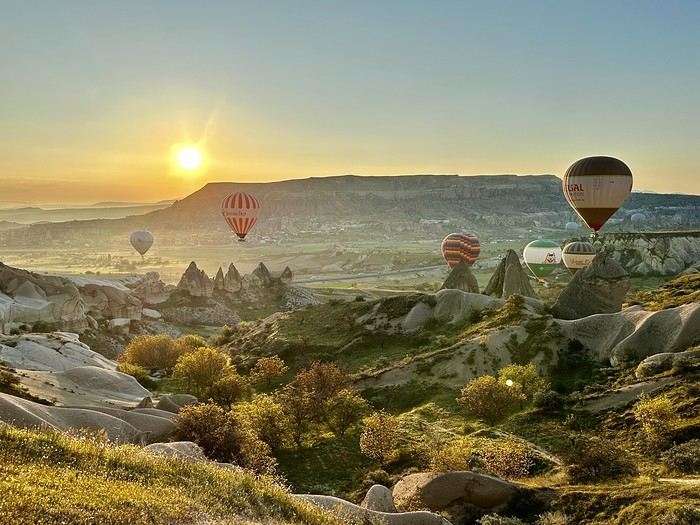
Our 15 days in early May in this part of Turkey (a country I first discovered during a city trip to Istanbul in 2017) will only tread well-worn paths and revisit popular routes. Simply because I kept hoping until the very end that our flight to Jordan wouldn’t be canceled. Events in the Gulf proved me wrong, so we left with:
Zero preparation.
Not a single hotel booked (well, except the first one), no visits planned, just a flight ticket bought three weeks earlier. No guidebook, no app—just the desire to explore southern Turkey and Cappadocia, whose images and the chance to stretch our legs had caught my eye.
Oh, wait—I did bring along a new guide: Gemini! Yes, my friends, generative AI was my chief advisor throughout the trip for sites to visit, accommodations, routes, and even restaurants! An experiment I wanted to try to form my own opinion on using this new technology. And what better way to test it than a Turkish getaway?
The verdict? You’ll have to wait for the trip recap to find out!
The main idea of the trip is also relaxation.
So, the plan is Antalya for a few days, the Turkish Riviera for a few more, Cappadocia as the highlight, and a return via Antalya to wrap up the trip. And it was all planned by AI!
So, if you're ready, fasten your seatbelts—cabin crew, doors to automatic and cross check—boarding for Turkey now!
June 2024.
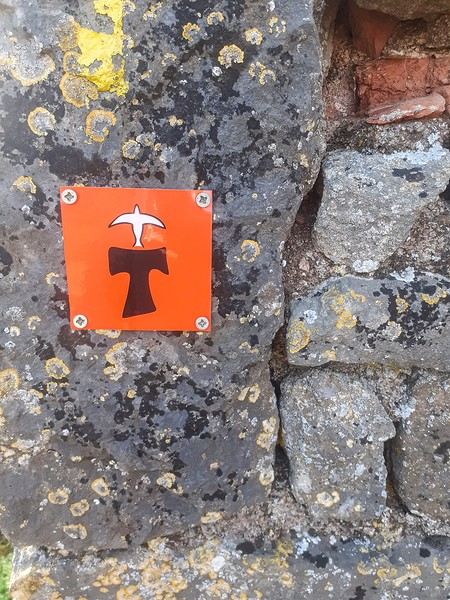
While hiking with my brother on the GR 36 Tour du Morvan, I catch sight now and then of strange rectangular markers fixed to tree trunks. Against a bright orange background, a deep black Greek tau topped with a white dove. My first encounter with the Assisi Way.
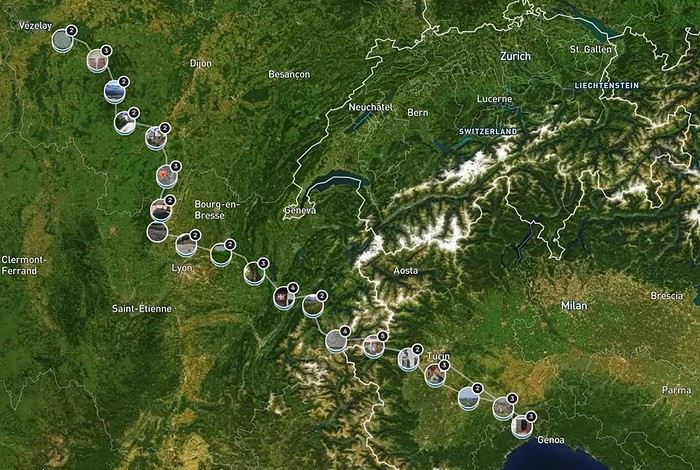
The Way of St. Francis: a pilgrimage route linking Vézelay in Burgundy to Assisi in Italy, covering nearly 1,800 km.
It felt like an obvious next step—I immediately knew I’d take it on, attempt the adventure solo.
In the months that followed, I talked about my project to everyone—family, friends, my partner. An avalanche of comments, more or less the same but varying depending on each person’s character and life experiences. But deep down, it all boiled down to one legitimate question: why?
And the answers?
Hesitant, awkward, partial, even confused. I quickly realized they weren’t so easy to find. It was as if my project seemed more like a whim, a kind of intimate caprice, rather than a well-thought-out plan.
Of course, I knew the reasons that pushed me to leave—you always have to give some. Loved ones need to understand to feel reassured, and that’s understandable.
But I fear that when I list them, they’ll sound like the same old checklist anyone embarking on this kind of journey might give.
Of all the reasons I could mention, I’ll highlight just one here: the call of the road, the solo adventure that brings a powerful sense of freedom.
A bit like Monsieur Seguin’s goat, who from her comfortable pen gazes longingly at the unconstrained horizon of the mountain.
But if I’m being honest, I think I didn’t really know what I was looking for—or, more importantly, what I’d find. Deep down, when I reflect on it, one word keeps coming up that explains nothing and everything at once: desire.
Now well past sixty, I know that when I ask myself who I am or where I’m going, two things bring me fully back to myself: hiking and writing.
And my intention was also to anchor this adventure through words, day by day. Writing down my feelings, emotions, discoveries, and reflections each evening. The famous travel journal that grounds the daily experience in reality.
When I discovered the app "Polarstep," which was initially just meant to keep my loved ones updated and reassured, inform them of my progress, and maintain a connection, I found an opportunity to do it a little differently than usual.
No retrospective notes polished up after returning, but spontaneous writing—recounting everything that crossed my mind during the day and publishing it immediately. A journey lived in real time.
This text is the exact transcription of my daily writings. Rereading them, I didn’t change a thing—just corrected a few mistakes and tweaked some awkward phrasing here and there. Short texts, fitting the format imposed by this kind of app. Writing as if addressing others.
Now, all that was left was to walk.
April 18, 2026 – Vézelay.




 A little sneak peek?