Discussions GeorgesOZ took part in
About 597 results.
More options
Search results
18 days in Bali in June - itinerary feedback
Hello everyone!
I’m planning an 18-day trip to Bali between June 12th and 30th. I’ve been to Bali twice before, in 1981 and 1982, but I know it’s changed a lot since then. I have a rough itinerary in mind but I’m open to tweaking it based on any advice I can get:
- Arriving the evening of June 12th, 2 nights in Sanur. Not because I’m particularly attached to Sanur, but just to rest a bit before heading further; - 3 nights in Lovina; - 3 nights in Ubud; - 2 nights in Kintamani (I remember being blown away by the view of the giant caldera!); - 2 nights in Besakih; - 1 night in Sidemen; - 3 nights in Candi Dasa; - 2 nights back in Ubud to wrap up, in case we’ve made any purchases or have shopping plans. By shopping, I mean handicrafts (fabrics, batik, etc.), and I think Ubud is the perfect place for that.
I’m a bit unsure about public transport, especially for getting from Kintamani down to Candi Dasa via Besakih and Sidemen.
We’re traveling as a couple—I forgot to mention that! We’re seasoned travelers and used to packing light. Also, I speak pretty good Bahasa Indonesia, having lived in Indonesia a long time ago!
What do the ‘experts’ think?
Cities of the World – Cost and Quality of Life
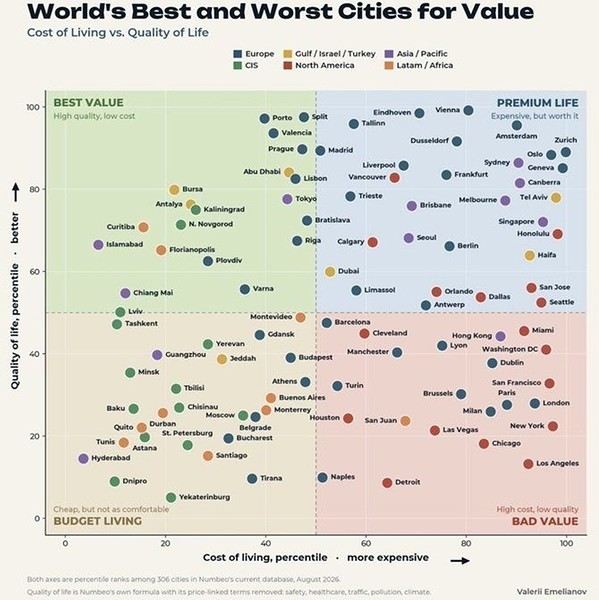
A few days ago, I came across a chart showing a number of cities around the world ranked by cost and quality of life. The source is the Numbeo database, based in Serbia, dated August 2026. There will undoubtedly be a thousand possible questions and criticisms. The main objection is methodological. Anyone with an internet connection can rate a city, so the sample is neither random nor representative, and its size varies enormously from one city to another. Numbeo describes the ranking as reflecting the perceptions and experiences of its contributors rather than measured results.
Is this an appropriate topic for VF? I think so. When traveling abroad, you notice huge differences in lifestyle and naturally ask yourself: is it better here than there, or than at home? The question arises differently depending on the type of trip—short or medium-term tourism, or medium to long-term residence.
And we’re back to the methodology problem. Since anyone can submit ratings to the database, how do we know whether the ranking of a city like Novgorod, Quito, or Islamabad (chosen at random) comes from travelers, foreign residents, or only people who are native to the place and have never left their hometown?
The cost of living in the database is indexed based on restaurant prices, transportation, services, housing (rented or purchased), and income. Fair enough. For quality of life, they mention safety, medical services, traffic, pollution, and climate. I would have liked to see social quality of life (interpersonal relationships, nightlife, shows, restaurants, etc.) as well as the possibility of pleasant and interesting excursions included.
That said, I don’t think it’s completely meaningless. In any case, it can serve as a starting point for those interested in the topic. So, I’m posting the original chart here, along with two versions with my personal annotations. A few comments:
- In principle and in my opinion, there should be a simple cost-quality relationship, which I represent with a diagonal sector running from the bottom-left quadrant to the top-right quadrant—that is, from cheap but low-quality cities to expensive cities offering a higher quality of life. It’s no surprise to find several Australian cities at one extreme of this sector, for example. Take Melbourne: sure, it’s a very pleasant city to live in, but living or visiting there is very expensive.
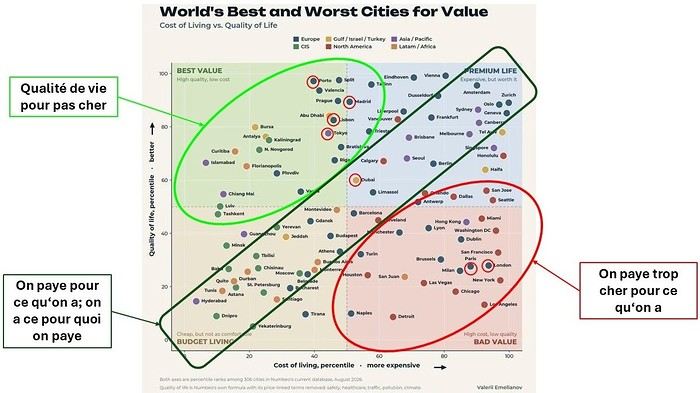
- The bottom-right and top-left quadrants: these are the cities that don’t fit this expected relationship:
o Bottom-right quadrant: expensive cities with mediocre quality of life. London and Paris are here, along with several U.S. cities. No surprise there. The worst is Los Angeles, closely followed by London, Paris, New York, Chicago, Milan... I don’t think that’s a huge revelation. o Top-left quadrant: relatively affordable cities with a good quality of life. We find cities in Brazil (Curitiba, Florianópolis), Turkey (Antalya), Spain, and Portugal. I’m intrigued by the presence of Russian cities and Islamabad—again, who are the people rating these cities?
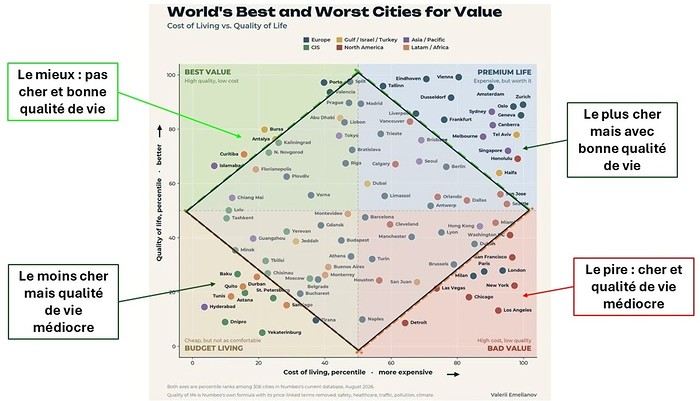
I was drawn to this chart after returning from a trip to Japan. I know some travelers don’t think much of Tokyo, but I had a good impression of it. So, I’m inclined to agree with ranking Tokyo right near Lisbon in the best quadrant. I’m even wondering if it wouldn’t be a good idea to move there for a few months. Other cities in Japan could be worth considering...
What do you think?
Is this an appropriate topic for VF? I think so. When traveling abroad, you notice huge differences in lifestyle and naturally ask yourself: is it better here than there, or than at home? The question arises differently depending on the type of trip—short or medium-term tourism, or medium to long-term residence.
And we’re back to the methodology problem. Since anyone can submit ratings to the database, how do we know whether the ranking of a city like Novgorod, Quito, or Islamabad (chosen at random) comes from travelers, foreign residents, or only people who are native to the place and have never left their hometown?
The cost of living in the database is indexed based on restaurant prices, transportation, services, housing (rented or purchased), and income. Fair enough. For quality of life, they mention safety, medical services, traffic, pollution, and climate. I would have liked to see social quality of life (interpersonal relationships, nightlife, shows, restaurants, etc.) as well as the possibility of pleasant and interesting excursions included.
That said, I don’t think it’s completely meaningless. In any case, it can serve as a starting point for those interested in the topic. So, I’m posting the original chart here, along with two versions with my personal annotations. A few comments:
- In principle and in my opinion, there should be a simple cost-quality relationship, which I represent with a diagonal sector running from the bottom-left quadrant to the top-right quadrant—that is, from cheap but low-quality cities to expensive cities offering a higher quality of life. It’s no surprise to find several Australian cities at one extreme of this sector, for example. Take Melbourne: sure, it’s a very pleasant city to live in, but living or visiting there is very expensive.
- The bottom-right and top-left quadrants: these are the cities that don’t fit this expected relationship:
o Bottom-right quadrant: expensive cities with mediocre quality of life. London and Paris are here, along with several U.S. cities. No surprise there. The worst is Los Angeles, closely followed by London, Paris, New York, Chicago, Milan... I don’t think that’s a huge revelation. o Top-left quadrant: relatively affordable cities with a good quality of life. We find cities in Brazil (Curitiba, Florianópolis), Turkey (Antalya), Spain, and Portugal. I’m intrigued by the presence of Russian cities and Islamabad—again, who are the people rating these cities?
I was drawn to this chart after returning from a trip to Japan. I know some travelers don’t think much of Tokyo, but I had a good impression of it. So, I’m inclined to agree with ranking Tokyo right near Lisbon in the best quadrant. I’m even wondering if it wouldn’t be a good idea to move there for a few months. Other cities in Japan could be worth considering...
What do you think?
Japan, five weeks between unknown lands and familiar paths
Japan, five weeks between unknown lands and familiar paths
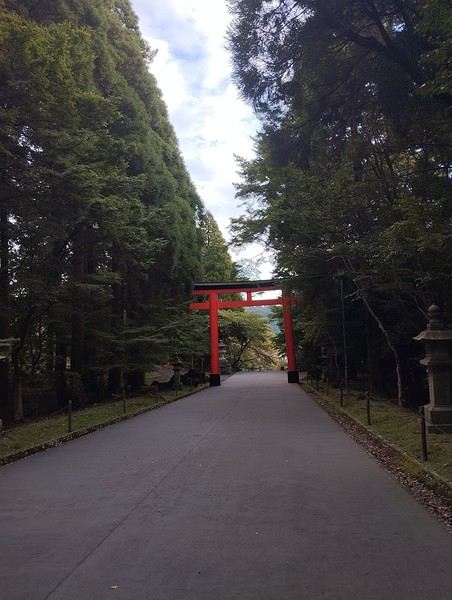
Hello everyone,
I invite you to follow me on this fifth exploration trip to Japan.
Five weeks or so!
For the itinerary, my usual mix: New discoveries, well-known places, and others less so.
At the heart of the trip, a two-week road trip by car. I wavered for a long time between the San'in region, from Tottori to Yamaguchi, and southern Kyushu. By a narrow margin, southern Kyushu won out.
Waterfalls that seem even more impressive. A more exotic atmosphere. Tea-growing lands to savor... Kagoshima will be the starting point. Then a loop from west to east.
And, of course, the must-see stops... Those little Japanese touches. Gourmet cuisine. Japanese, but not only!
And then, the soul of the trip, I hope: Human connections. Big or small.
Otherwise? Several local festivals. Osaka, unexpected. Miyakojima, between beauty and small disappointments. Tokyo... it's Tokyo!
So, travel with me. The suitcase is waiting, with stories that are sometimes generous, but always driven by the love of travel experienced firsthand.
Yōkoso, Nihon! Welcome to Japan!
14 Days in Japan – September-October 2026
I had to leave Thailand as my 60-day visa was coming to an end, and this time I opted for a 14-day visit to Japan. I’d already spent 3 days in Tokyo a few years ago on a business trip, which left me with a great impression. Y, my Thai partner, had never been there. That’s why we chose a fairly classic itinerary, including a few castles and Kyoto among other things.
Before diving into the details of our trip, I’d like to recap the expenses we incurred. This will be useful for some of you, and it’ll help us prepare for our next trip to Japan.
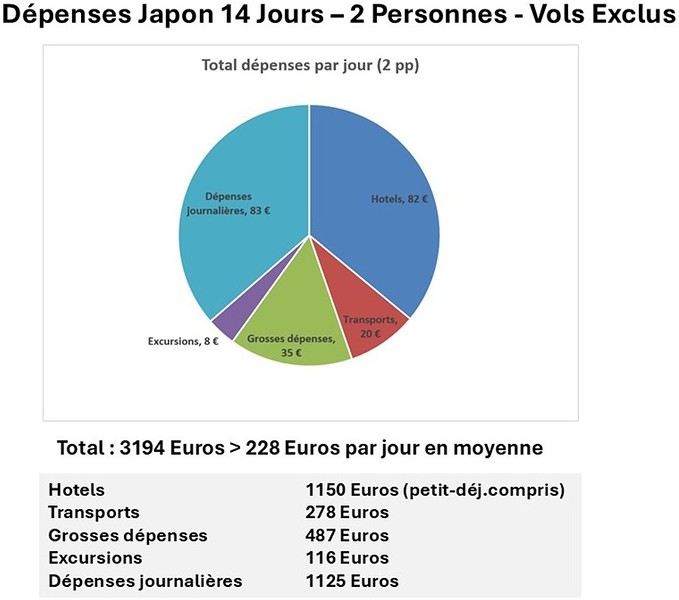
I’ve categorized our expenses into 5 groups: - Hotels: 1150 € (breakfast included) - Transportation: 278 € (trains, buses) - Big expenses: 487 € (souvenirs and a few necessary items) - Excursions: 116 € (museum visits, temples, castles) - Daily expenses: 1125 € (meals, small purchases) Total = 3194 €, or 228 € per day on average. I’m excluding flights, as those depend on everyone’s arrangements (departure location, travel dates, etc.).
Jpeg below: apologies for “hotel” without a circumflex—my software isn’t French!
For hotels, we always chose decent but not luxurious places, well-located to let us walk to and from transportation hubs. We systematically avoided taxis, which are notoriously expensive in Japan. We’ve also gotten into the habit over several trips of traveling with minimal luggage: one duffel bag each (7-8 kg) plus the small carry-on allowed on planes (2-3 kg). This lets us travel with three sets of clothes (what we’re wearing plus two changes). We add a checked bag for the return trip to accommodate the things we buy along the way.
‘Transportation’ and ‘Big expenses’: I’ll give more details in the day-by-day account.
We didn’t do any extravagant excursions, like safaris or sports activities.
Meals and food make up the bulk of our daily expenses. We often ate at izakayas, which offer great value—between 2000 and 6000 yen for two (about 11-12 to 33-34 € for two, usually around 20-25 €). We didn’t hold back, but we also didn’t go to high-end restaurants.
More to come while I gather my photos: General Remarks.
Before diving into the details of our trip, I’d like to recap the expenses we incurred. This will be useful for some of you, and it’ll help us prepare for our next trip to Japan.
I’ve categorized our expenses into 5 groups: - Hotels: 1150 € (breakfast included) - Transportation: 278 € (trains, buses) - Big expenses: 487 € (souvenirs and a few necessary items) - Excursions: 116 € (museum visits, temples, castles) - Daily expenses: 1125 € (meals, small purchases) Total = 3194 €, or 228 € per day on average. I’m excluding flights, as those depend on everyone’s arrangements (departure location, travel dates, etc.).
Jpeg below: apologies for “hotel” without a circumflex—my software isn’t French!
For hotels, we always chose decent but not luxurious places, well-located to let us walk to and from transportation hubs. We systematically avoided taxis, which are notoriously expensive in Japan. We’ve also gotten into the habit over several trips of traveling with minimal luggage: one duffel bag each (7-8 kg) plus the small carry-on allowed on planes (2-3 kg). This lets us travel with three sets of clothes (what we’re wearing plus two changes). We add a checked bag for the return trip to accommodate the things we buy along the way.
‘Transportation’ and ‘Big expenses’: I’ll give more details in the day-by-day account.
We didn’t do any extravagant excursions, like safaris or sports activities.
Meals and food make up the bulk of our daily expenses. We often ate at izakayas, which offer great value—between 2000 and 6000 yen for two (about 11-12 to 33-34 € for two, usually around 20-25 €). We didn’t hold back, but we also didn’t go to high-end restaurants.
More to come while I gather my photos: General Remarks.
Poon Hill trek in February: what are the conditions?
Hello,
I know there are plenty of discussions on VF about the Poon Hill trek, but most seem outdated and/or don’t provide info specific to February. That’s why I’m bringing this topic back up.
Here’s my plan: - Spending about two weeks in Nepal in the first half of February. - Maybe extending by a few days to a week if needed. - Heading to Pokhara—first time for my partner, second for me (I was there in September/October 1982!). - Doing a relatively easy 4- to 5-day trek. We’re not exactly spring chickens anymore (though we’re in pretty good shape for our age). - We don’t want to go above 3,000–3,500 meters, deal with difficult sections if there’s too much snow, or face daytime temperatures below 10°C. No problem if it drops to 0–5°C at night since we’ll be sheltered somewhere.
So, I’m wondering if the Mardi Himal trek might be too demanding for us, and if we’d be better off sticking with Poon Hill. What do the experts think?
Applying for a Non-Immigrant O Visa
I have two questions about applying for a Non-Immigrant O Visa at the Thai embassy in France for someone over 50:
- - Do I need to provide the address(es) of stay in Thailand (hotels, staying with a Thai friend)?
- - Financial proof: Is a retirement statement showing over 2,000 € per month sufficient, or are bank statements also required?
I know there’s already a lot of information about the visa requirements on the embassy’s website, but from my experience—having dealt with embassies in other countries in previous years—I know that the information is sometimes (!) incomplete or inconsistent. So, I’d rather hear from people who’ve recently gone through this process to avoid any surprises after submitting my application, which could cause unpleasant delays.
I know there’s already a lot of information about the visa requirements on the embassy’s website, but from my experience—having dealt with embassies in other countries in previous years—I know that the information is sometimes (!) incomplete or inconsistent. So, I’d rather hear from people who’ve recently gone through this process to avoid any surprises after submitting my application, which could cause unpleasant delays.
Pray for Nepal
Yeah, VF, which used to be so responsive, still doesn’t even have a thread about this devastating mudslide that’s ravaged a region of Nepal where hundreds have died and hundreds more are missing (provisional toll). But from the images, we know the number of victims is going to be terrifying.
Thoughts to everyone affected, including, according to early reports, many travelers..
14 days in Brazil at the end of March/beginning of April 27: itinerary tips
Hi everyone, we're heading to Brazil for two weeks during the Easter holidays.
Arriving in Rio and departing from São Paulo. Any recommendations for hotels, guides, or must-see spots?
I’d like to organize everything myself with reliable local drivers, and I’m looking for nice, comfortable accommodations considering my 5-year-old son.
Thanks so much!
Emilie
Excessive Abbreviations
Hello everyone on this forum!
I know in advance that what I'm about to say here won't please everyone, but honesty is a virtue, isn't it?
Here's the thing: for many years now, I've noticed a habit in French-speaking posts of using abbreviations left and right, as if to show that we're "in the know." Let me explain with a few examples:
- - In discussions about Peru, I see "Aguas" for "Aguas Calientes." And if it's Mexico, well, it'll be "Aguas" for "Aguascalientes"!
- - For Guatemala, "travelers" will say "Guaté." Come on, saying "Guatemalas" would maybe be the undeniable sign that you know nothing about the country???
- - Back from Indonesia, many will talk about how familiar they've become with the country's language: "bahasa." Of course, everyone will know what you're talking about, but it still gets on my nerves because the language (one of the many languages) of Indonesia is "bahasa Indonesia." "Bahasa" actually means "language," and you'll find this word of Indian origin ‘Bhāṣā’ (it's Sanskrit originally) outside Indonesia too: in Thailand, for example, any language will be "phasa" as in "phasa thai" (official Thai), "phasa isan" (what's spoken in northeastern Thailand), "phasa angkrit" = English, etc.
Am I an incorrigible nitpicker? Maybe. But I'd also find it ridiculous if a foreigner came and told me they visited "Monte" during their trip to France, when it was actually Monte Carlo.
I read a lot in English and don't think I've encountered such a habit among English speakers.
Traveler Reviews and Recommendations for Taiwan
Hi,
My departure is coming up soon—two months backpacking in Taiwan, so much to discover! I’d love to hear about your travel experiences.
My main interests are meeting people, understanding how things work, hiking, and nature in general. I’ve also done a lot of reading about Taiwan’s complex situation. I do stone sculpture. I also want to visit Orchid Island for its history. Marie
My main interests are meeting people, understanding how things work, hiking, and nature in general. I’ve also done a lot of reading about Taiwan’s complex situation. I do stone sculpture. I also want to visit Orchid Island for its history. Marie
Accommodation in Pokhara
Hi everyone!
I’m planning a short visit to Pokhara around mid-February 2027 (it’ll be my 4th time in Nepal 😊, over 40 years!). I’d like to book a room in advance rather than looking when I arrive. I’ve checked a bit on Bxxking.com and see lots of options. I’m used to scoping out the surroundings of places listed, just to avoid ending up in areas that are either unappealing or far from everything.
So, I see quite a few offers around the lake (Lakeside?), but every time I check what it looks like, the streets seem really uninviting. It’s kind of like a construction site with buildings everywhere… Nothing like Bhaktapur (for example) or even Thamel, where the streets seem way more pleasant.
Could anyone give me some advice?
Also, I don’t really get the impression that Pokhara is worth a visit of several days. The lake, sure, but once you’ve seen it—what else is there?
Three beautiful weeks during the Japanese autumn
I’m sharing our three-week trip to Japan from late October to mid-November 2025. There were four of us—my partner and a couple of friends.
I’ve traveled often with my friend Christian (Bolivia, Argentina, Costa Rica, Namibia, Laos), but this time our partners joined us.
The rough itinerary:
Arrival in Tokyo. Visiting Shinjuku/Shibuya districts + day trip to Kamakura
5 days in the Japanese Alps, from Matsumoto to Kanazawa (via Kamikochi, Hirayu Onsen, and Takayama)
5 days in Kyoto
Nara, Osaka, Koyasan
Return to Tokyo (Asakusa district), with a day trip to Nikko
We booked our flights well in advance (9 months ahead): the flight cost 1086 € per person. Compared to over 2000 € if we’d booked for the same dates just 3 months prior.
For accommodations, we mostly used Booking.com. The onsen was booked via Japanican, and in Kyoto, we stayed in an Airbnb.
We also made 5 train reservations a month in advance on Klook or directly on the train’s website.
Day 1: Departure from Brussels (October 24, 2025) Early morning takeoff at 6 AM to Munich (1.5-hour layover) with Lufthansa, then a 12-hour flight with ANA, arriving the next morning at 7 AM at Tokyo Haneda.
Day 2: Arrival in Tokyo Airport formalities were quick. The eSIM we bought before leaving activated as soon as we landed (10 GB plan with Saily—more than enough for our mobile internet needs, mainly Google Maps and Google Translate). We’d received 4 ICOCA cards from our neighbors, which we loaded with 15000 ¥ each. We took the Keihin train, then the Yamanote Line. It’s easy to navigate since everything is in English, and each station is announced on scrolling displays in English too.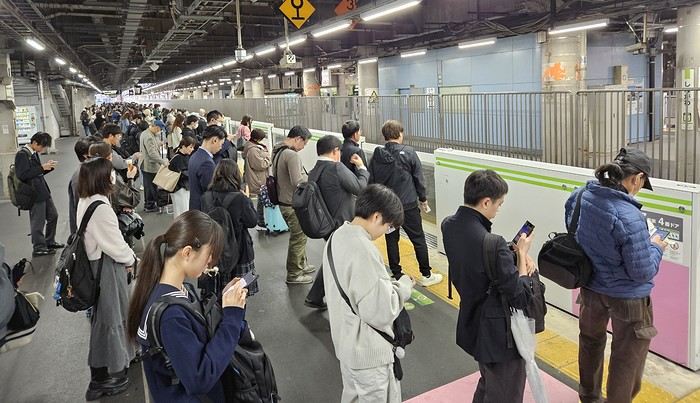
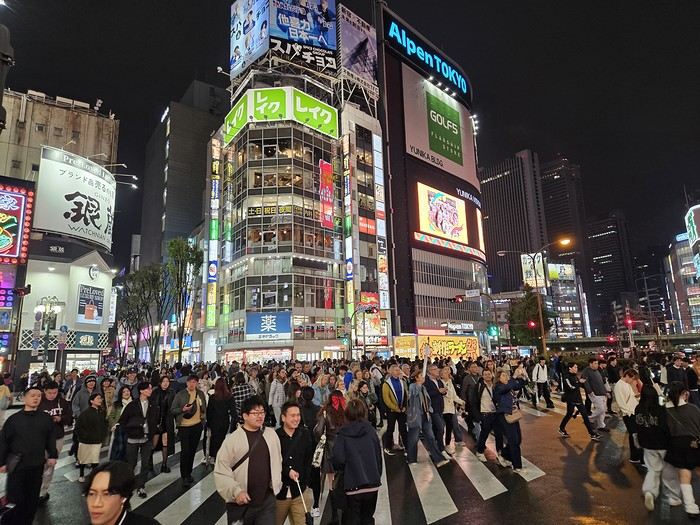
We got off the Yamanote Line at the station just after Shinjuku because it’s easier to exit that massive station with our luggage. So we ended up in Shin-Okubo, right in the Korean district. A 10-minute walk took us to Villa Fontaine Hotel. A great hotel, well-located north of the Kabukichō district. The room even seemed bigger than we’d expected.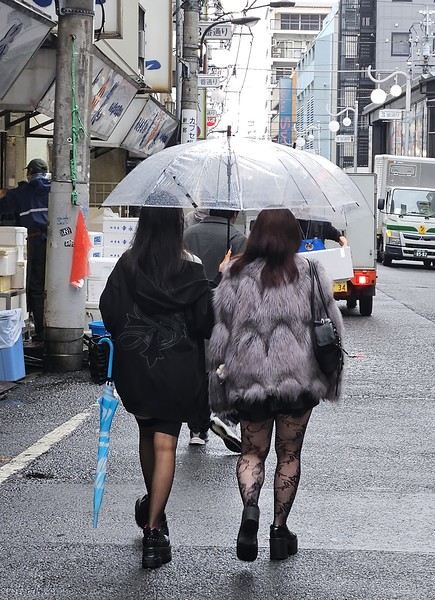
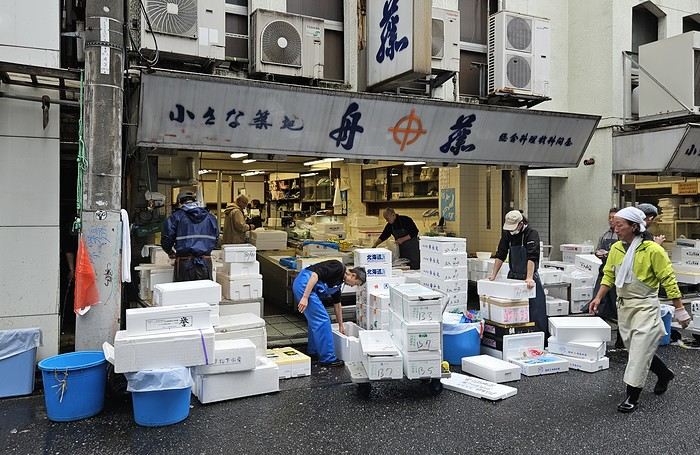 It was 15°C, but it rained—and kept raining on and off all day. Belgian weather, basically.
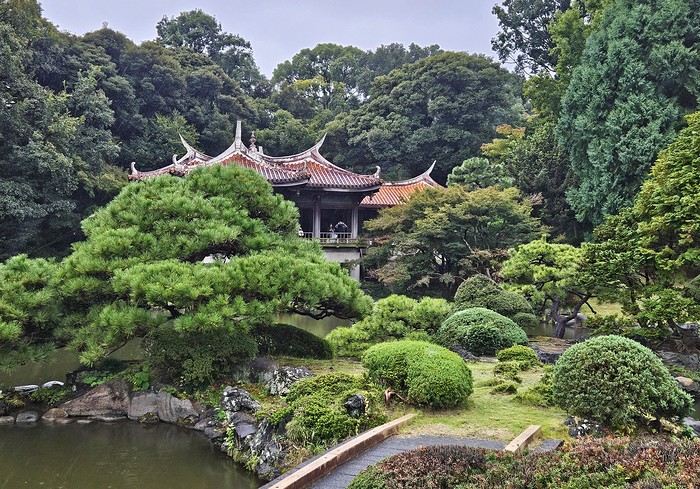
We went for a walk in Shinjuku Gyoen Park. Not as pretty in the rain, but the big greenhouse was interesting.
Then our first ramen (hearty and for 1000 ¥—pretty much the price of all our ramen during the trip). We headed back to the hotel since check-in was after 3 PM. Shower and relax before going out for dinner. Dinner was barbecue at Shichirin Yakiniku Anan (1700 ¥ each—good and cheap). Ordering via tablet wasn’t easy, but luckily it was in English.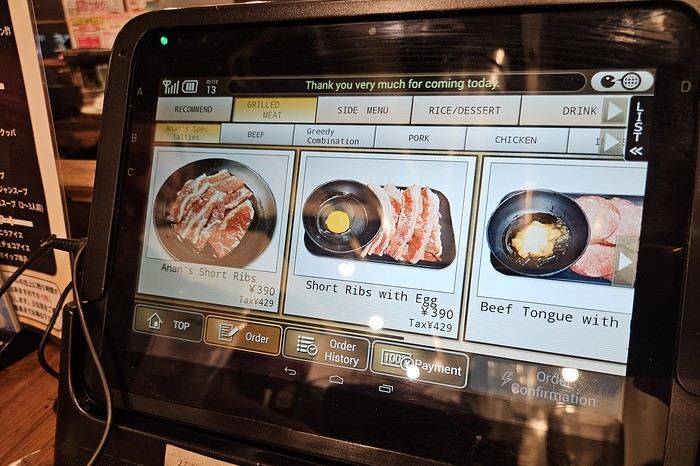
We ended the evening with a stroll through Kabukichō before a well-deserved sleep.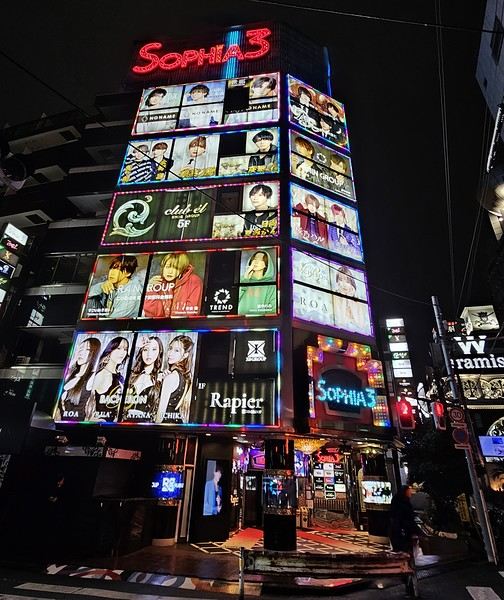
Day 1: Departure from Brussels (October 24, 2025) Early morning takeoff at 6 AM to Munich (1.5-hour layover) with Lufthansa, then a 12-hour flight with ANA, arriving the next morning at 7 AM at Tokyo Haneda.
Day 2: Arrival in Tokyo Airport formalities were quick. The eSIM we bought before leaving activated as soon as we landed (10 GB plan with Saily—more than enough for our mobile internet needs, mainly Google Maps and Google Translate). We’d received 4 ICOCA cards from our neighbors, which we loaded with 15000 ¥ each. We took the Keihin train, then the Yamanote Line. It’s easy to navigate since everything is in English, and each station is announced on scrolling displays in English too.
We got off the Yamanote Line at the station just after Shinjuku because it’s easier to exit that massive station with our luggage. So we ended up in Shin-Okubo, right in the Korean district. A 10-minute walk took us to Villa Fontaine Hotel. A great hotel, well-located north of the Kabukichō district. The room even seemed bigger than we’d expected.
It was 15°C, but it rained—and kept raining on and off all day. Belgian weather, basically.
We went for a walk in Shinjuku Gyoen Park. Not as pretty in the rain, but the big greenhouse was interesting.
Then our first ramen (hearty and for 1000 ¥—pretty much the price of all our ramen during the trip). We headed back to the hotel since check-in was after 3 PM. Shower and relax before going out for dinner. Dinner was barbecue at Shichirin Yakiniku Anan (1700 ¥ each—good and cheap). Ordering via tablet wasn’t easy, but luckily it was in English.
We ended the evening with a stroll through Kabukichō before a well-deserved sleep.
Questions about visiting Guatemala in 14 days
hi there,
we’re traveling as a couple to Guatemala from Feb 8 to 22. We’ve realized that given the distances, it feels a bit short. So, we’ve decided to limit ourselves to:
- Antigua: 3 nights (from Feb 8 to 11), including the arrival day - Lake Atitlán: from Feb 11 to 14 – 3 nights in San Juan La Laguna, including the morning trip from Antigua to Lake Atitlán - Chichicastenango: from Feb 14 to 15 – 1 night to attend the Sunday market and visit the cemetery
We have 7 days left that we’re not sure how to organize to cover: Flores – Tikal – El Remate, then head back to Guatemala City for our flight on Feb 22. Actually, I have a few questions: Do you think the time in Antigua and at the lake is enough? We might do the Pacaya Volcano, which is accessible for beginners, and that’s it. Should we spend a bit more time at these two spots: Antigua and the lake? If so, we’d have to skip the Chichicastenango market. We’re also thinking of leaving Chichicastenango to head to Flores, then staying overnight in El Remate. Does that seem doable in one day? We’ve noted that the trips are long, and since we don’t want to rush, we’ve reduced the number of accommodations. Even though we know we won’t see everything, we don’t want to miss the must-sees. We’re also wondering if we’ve planned the route in the right direction, or if we should head straight to Tikal when we arrive. Anyway, I know this is long, but we’re a bit lost. Thanks so much for your help! Annick
Langtang – Trekking in the Rain
We did the Langtang trek (hike) from September 10th to 17th, with the first and last days being the trip from Kathmandu and back—so 6 days of actual walking. It’s a fairly well-known trek but certainly not as famous or crowded as those in the Annapurna or Everest regions, which is why we chose it.
In theory, it’s mandatory to have a guide for this trek. In reality, it seems there are ways to bypass the regulations: we met at least two people hiking without a guide—a South Korean, a New Zealander, and possibly also a couple of English women and an American couple, though we’re not sure if they had a guide.
The agency we booked with had told us it was an affordable trek for relatively older people in good shape—which is our case (I’m 72 myself). I have to say upfront that we found it quite challenging, maybe because we didn’t have good weather—it was the end of the monsoon season. To be clear, no matter your fitness level, I’d say doing this trek in the middle of the monsoon season would be suicidal.
Day 1 – Journey from Kathmandu to Syapru Besi
On Monday, September 8th, there had been violent protests in Kathmandu against the government, which had, among other things, blocked access to social media and been accused of nepotism and corruption. There were 19 deaths. The situation was very tense on the day of our departure, Wednesday the 10th. The agency warned us that public transport was very unreliable. So, we decided to take a jeep, at an additional cost of $100 ($160 minus what was already budgeted for the bus).
We left a little before 7 a.m. and it took us a good hour just to reach the outskirts of Kathmandu. Along the way, we saw several houses and vehicles set on fire by protesters.
The road to Syapru Besi is only 120 km, but it’s frankly awful. It’s always narrow, winds through endless mountains, and the shoulders range from bad to confusing to nonexistent. Several sections are just dirt tracks. We didn’t regret opting for the jeep, as we could stop several times at our convenience—if only to let Y (my Thai partner) throw up everything she had. She’d taken her usual motion sickness medication, but the constant turns, accelerations, and braking eventually made her terribly carsick.
In Nuwakot, we stopped for breakfast at a nice little restaurant, Jimbu. It was around 8:30 a.m., and we’d barely covered 60 km. The restaurant has a lovely garden overlooking the Trishuli Ganga, the river flowing down from Syapru Besi. First photo: the river in the bottom right corner, mist and clouds over the mountain on the other side.
An hour later, my second photo: the hills along the Trishuli Ganga. You can see the different crops—lush green rice paddies in the lower right and corn, already yellowed and likely harvested, in the foreground on the left. And of course, the mist and clouds through which you can glimpse the mountain on the other side of the river.
Thailand and TDAC: How does it work?
Hello to all the Thailand regulars.
I’ve been to Thailand several times, but it was about 20 years ago…
There’s a new system in place now, it seems.
TDAC – Thailand Digital Arrival Card.
Before arriving, I apply for a TDAC, okay. If during my stay I cross the border to spend a few days in Malaysia and then re-enter Thailand, do I need to submit a new TDAC application? Do I use the same TDAC as when I first entered the country?
Or do I initially have to pay for a Thai multi-entry visa?
Thanks in advance for your insights—I can’t find the answer online.
Pierre
What to see in Goa and tourist crowds?
My partner and I are planning a 2-week trip to Goa from late September to early October. It’s sandwiched between a trip to Nepal (September) and our return home to Thailand. We can’t stay longer, but cutting it shorter wouldn’t be worth the effort or flight costs.
I’ve visited several regions of India in the past (between 2000 and 2020) and spent a total of about 4 months there. My only time in Goa was a few days in Palolem in 2007—I didn’t like it. I found the place almost sordid with all the crowds... not at all the India I love.
But I have an Indian friend with 2 or 3 apartments in a residence in North Goa who keeps telling me to visit. I’m tempted. But where should we go? I don’t want to rent from him because it’s expensive (high-end) and I don’t want to feel too dependent on him either.
After 2 days in Panaji (since it’s near GOI), I’ve booked 5 days in Mandrem, which I’ve heard great things about. This’ll let us explore the Arambol area. I’m hesitant to stay there longer—if we don’t like it or get bored after a few days, spending the full 2 weeks there isn’t ideal! I’m thinking of trying South Goa instead, somewhere between Benaulim and Agonda. The downside? All the rumors about the vibe in different spots—loud techno here, jet skis there, "paunchy English tourists" elsewhere, package tours everywhere... not to mention the expected influx of Russians and/or Israelis (I’ve seen this in other parts of India, Thailand, and Vietnam). Plus, accommodation options are way more limited in the south.
Basically, I’m leaning toward Agonda—relaxed but not too quiet or isolated. But there’s so little availability on sites like Booking and Agoda...
Any recent tips or advice from folks who’ve been to Goa lately? I’d really appreciate it, thanks in advance!
Driving in Thailand
For those wondering about driving: no problem at all. The road network is excellent, with plenty of four-lane highways.
Driving is easy if you're careful. Avoid driving at night and stay alert around two-wheelers.
I’ve been driving there since 2016—I’m no spring chicken—and I’ve covered Thailand from north to south and east to west, even Bangkok. Maps.me and vigilance are all you need...
It gives you incredible freedom and lets you discover places that aren’t too crowded yet.
Is Kullu worth a stop?
I'm planning a return trip to India next year, and this time I want to check out what's nice on the way up to Manali. Since the bus rides are really long coming from the plains (Chandigarh or even Delhi), I'm looking for a place to stop along the way (my partner and I). I’ve spotted Kullu, about an hour from Manali, but no matter how much I study the map, I can’t tell if there’s an actual town there. We really don’t want to end up in some isolated hotel that’s only convenient for people traveling with their own transport—definitely not our style. We prefer to drop our bags in a room, freshen up a bit, then wander around streets or alleys with at least a little life.
So, I’m wondering if we’d be better off just skipping Kullu altogether.
What do you think, folks who’ve been there before?
So, I’m wondering if we’d be better off just skipping Kullu altogether.
What do you think, folks who’ve been there before?
Recap of 17 days between São Paulo, Rio de Janeiro, and Iguaçu/Puerto Iguazu
I’ll repost here the comments I gave in reply to Camidav – see their post https://voyageforum.com/forum/partir-10-jours-bresil-en-autonomie-d10702249/.
As we’ve said several times, 10 days is short for Brazil! But it’s still enough for a “little introduction.” My very recent experience (April 2025) with a 2½-week itinerary might give you some ideas. To start, here’s the route:
- - Saturday, March 29: departure from Lisbon and arrival in São Paulo with LATAM
- - 2 nights in São Paulo
- - Monday, March 31: bus from São Paulo to Paraty
- - Monday 31, Tuesday 1st, and Wednesday, April 2: 3 nights in Paraty
- - Thursday, April 3: bus from Paraty to Angra dos Reis, then ferry > Ilha Grande
- - Thursday 3, Friday 4, and Saturday, April 5: 3 nights in Abraão, on Ilha Grande
- - Sunday, April 6: speedboat > Conceição de Jacareí, then bus > Rio de Janeiro
- - Sunday 6, Monday 7, Tuesday 8, and Wednesday, April 9: 4 nights in Rio
- - Thursday, April 10: flight with LATAM from Rio to Foz do Iguaçu
- - Thursday, April 10: one night in Foz do Iguaçu
- - Friday, April 11: visit to Iguaçu Falls on the Brazilian side, then crossing the border to Puerto Iguazu
- - Friday 11 and Saturday, April 12: 2 nights in Puerto Iguazu
- - Saturday, April 12: visit to the falls on the Argentine side
- - Sunday, April 13: return to Brazil, LATAM flight > São Paulo
- - Sunday 13 and Monday, April 14: 2 nights in São Paulo
- - Tuesday, April 15: flight from São Paulo > Lisbon with LATAM, arriving Wednesday the 16th.
So, it’s clear I’m writing this now from Puerto Iguazu (Argentina), and the end of the trip is near: back to São Paulo and then the flight to Lisbon. I’ll of course share more about all this in the following messages.
10-day independent trip to Brazil
hi,
We’re planning a trip to Brazil in March 2026, just the two of us, for 10 days without using an agency. Rio, the falls, and Bahia too. How can we get around there? Train? Car rental? Plane? Are the roads easy to drive on? Is Rio safe to explore on our own? We’d love any travel journals with ideas for places to see, as well as books to help us plan the whole trip. Thanks in advance for all your tips! See you soon, cheers
We’re planning a trip to Brazil in March 2026, just the two of us, for 10 days without using an agency. Rio, the falls, and Bahia too. How can we get around there? Train? Car rental? Plane? Are the roads easy to drive on? Is Rio safe to explore on our own? We’d love any travel journals with ideas for places to see, as well as books to help us plan the whole trip. Thanks in advance for all your tips! See you soon, cheers