Results for "Kenya+itinéraire"
About 5,038 results.
More options
Many results are in French, the community’s main language. English translations are added over time.
Search results
Agence pour safari en Afrique?
Bonjour,
Je désire planifier d'avance un safari en afrique. Est-ce que vous pouvez me suggérer une bonne agence dans la région de Québec ? Et avoir des conseils de personnes qui ont vécus cette belle aventure
Je désire planifier d'avance un safari en afrique. Est-ce que vous pouvez me suggérer une bonne agence dans la région de Québec ? Et avoir des conseils de personnes qui ont vécus cette belle aventure
Cherche personne qui irait au Malawi
Bonjour,
Ayant un peu voyagé en Afrique Australe, j'ai réalisé des enregistrements Audio. Je chercherai une persoonne qui irait bientot au Malawi et particulièrement à Monkey Bay pour donner a des enfants des enregistrements et photos que j'ai fait d'eux. Merci par avance
Cordialement
Grégoire Martini
Traverser le Soudan en 4X4?
Je voudrais traverser le Soudan en 4X4, en venant de Lybie (pour éviter l'Egypte car la caution pour le carnet passage en douane est double) et pour continuer sur l'Ethiopie. Quelqu'un a t'il effectué ce voyage? Toutes infos me seraient utiles. Merci
Traversée de l'Europe à vélo?
Bonjour à Tous.
Bientôt fini les études 😉, et envi de me surpasser, j'ai depuis quelques temps l'objectif de découvrir les diversités culturelles en Europe. J'envisage de faire une traversée d'Europe en vélo et en autonomie, de Porto à Moscou🤪. J'ai déjà derrière moi quelques périples qui, je pense faciliterons ce projet. Cependant je n'arrive pas forcement à me rendre compte de l'ampleur des choses.
Avez vous un idée du temps qu'il faut pour faire une expé de ce genre, avez-vous vécu une expé similaire? Y a t'il selon vous des itinéraires intéressant, où des cultures à ne pas manquer?
D'avance merci pour vos réactions et réponses
JD
Sénégal avec un enfant?
Bonjour,
Nous sommes un couple avec un enfant de 4 ans et nous souhaiterions aller au Sénégal au mois de mars prochain; j'ai vu que cette destination peut combiner parcs et balnéaire; nous souhaitons voir la faune et aller à la rencontre des habitants mais aussi aller du côté de cap skiriing je crois que c'est là le plus beau au niveau des plages; pouvez vous me donner des conseils d'itinéraires ? Est ce qu'on peut facilement se déplacer d'est en ouest ? avion ? voiture ? est ce que mars est une bonne période pour voir la faune ? est ce que cap skiring est une usine à touristes ?
Merci pour vos réponses
Safari en Tanzanie
Bonjour,
Je souhaite effectuer un safari en Tanzanie au mois de février. Est-ce que vous pouvez m'indiquer une agence qui proposerait des séjours sortant un peu des sentiers battus? Est-ce que quelq'uns est déjà parti avec l'agence "safaris de fred")
Merci de vos réponse Philippe
Je souhaite effectuer un safari en Tanzanie au mois de février. Est-ce que vous pouvez m'indiquer une agence qui proposerait des séjours sortant un peu des sentiers battus? Est-ce que quelq'uns est déjà parti avec l'agence "safaris de fred")
Merci de vos réponse Philippe
Marrakech 2025: My First Steps as a Private Guide
Preamble:
.
This isn’t about drumming up business for a new professional venture—just sharing, under pressure from eager Vf members hungry for juicy anecdotes, my 10-day trip to Marrakech with 10 friends.
I’d mentioned during the planning discussion for this trip ((https://voyageforum.com/forum/questions-excursions-autour-marrakech-d10685703/)) that there wouldn’t be a travel journal... And since I’m a man of my word—but also stuck with a nasty calf muscle tear at the end of the trip that’s keeping me immobile for 15 days (more on that later)—I’ve got some time to dedicate to this. So, after this preamble, off we go to the Medina!
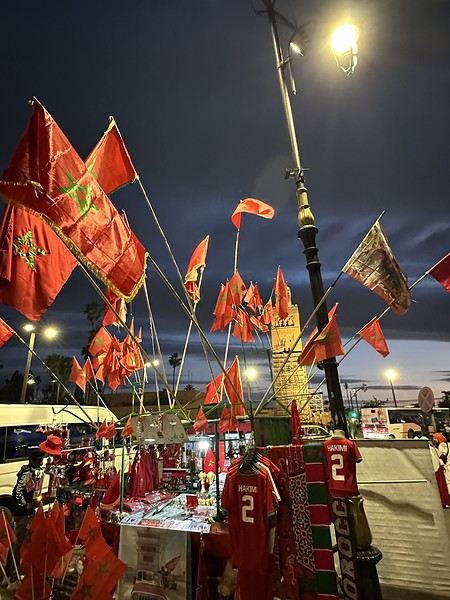 .
.
Day 1: Friday, May 2nd – The Day the Group Split
Before we dive in, let’s talk about the trip prep. Among my friends, I’ve got a rep as the go-to independent travel expert (thanks to a few trips, some with this same crew). So, naturally, the task of planning this one fell to me—and I took it on gladly (you’re never better served than by yourself, right?). The prep and itinerary were hashed out over multiple meet-ups (excuses?) during shared meals at one another’s places, guided by yours truly. Travel style, accommodation, sightseeing—all decisions were made together, trying to balance everyone’s wishes over a good bottle (generic term, not numerical!)
So, a group of five—including me and my girlfriend—set off for Geneva at 3 AM that Friday, while the rest would join us on Sunday due to family or work commitments. We’ll skip the EasyJet flight—it was nothing special, just a means to get us there safely (which, in itself, is already a win). We landed in Marrakech at 9 AM local time. There, a spotless Dacia Logan was waiting for us, chartered by MEDLOC, whose impeccable service I’ll praise here (thanks, friends, for the tip!). My first challenge, after loading the suitcases into the trunk: reaching the riad booked for our first two nights as the advance team. https://www.astradamusmarrakesh.top/fr/
I was a little nervous about driving here—Marrakech’s driving reputation precedes it. The hiccup? While setting up Google Maps for the route, I accidentally added a level-5 difficulty and enabled pedestrian mode... Imagine a rental car stubbornly trying for over half an hour to navigate the Medina (the riad was in the north), cursing all the pedestrians in streets too narrow for the car, and having to reverse multiple times because “it won’t fit,” ignoring the many Marrakechis waving to signal the street was impassable (but what are they trying to sell me now? 🤪)... Until my co-pilot, holding my phone, asked if it was “normal for the route to be dotted on Google Maps?” Yes, it’s normal—pedestrian mode was on.... We’ll still be laughing about this in the nursing home in 40 years, but at the time, I was genuinely surprised by what driving in Morocco had in store for me—and for good reason! After fixing the Google Maps settings, we arrived more calmly at the private parking lot (90 dirhams per night) and then at the riad, where we received a warm welcome while our rooms were being prepared.
After freshening up, we crossed the souks for the first time to have lunch at Jemaa el-Fna Square, at Zeitoun Café, where we enjoyed our first couscous or tagine on its terrace. We’d return to Jemaa el-Fna that evening after a restorative nap at the riad, another late afternoon in the souk, and an evening at this famous UNESCO World Heritage site. This time, it was the restaurant Lafarmacie (you can’t make this up!) that won us over, despite the lack of a rooftop. I recommend this place to everyone—the prices are great, the welcome is extraordinary, and the food is excellent...
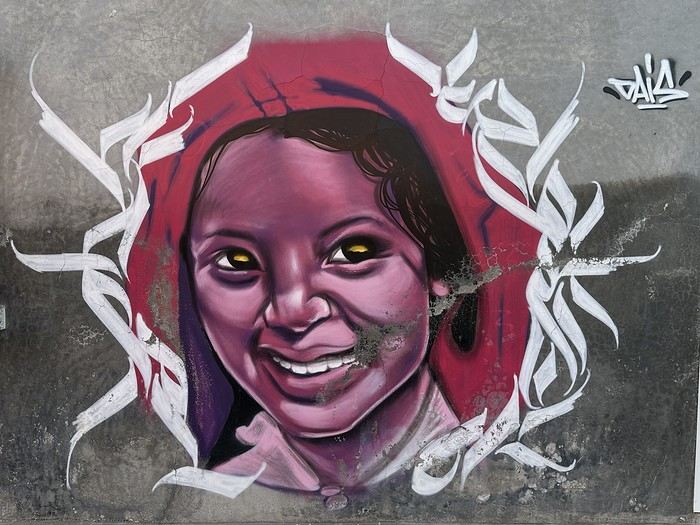
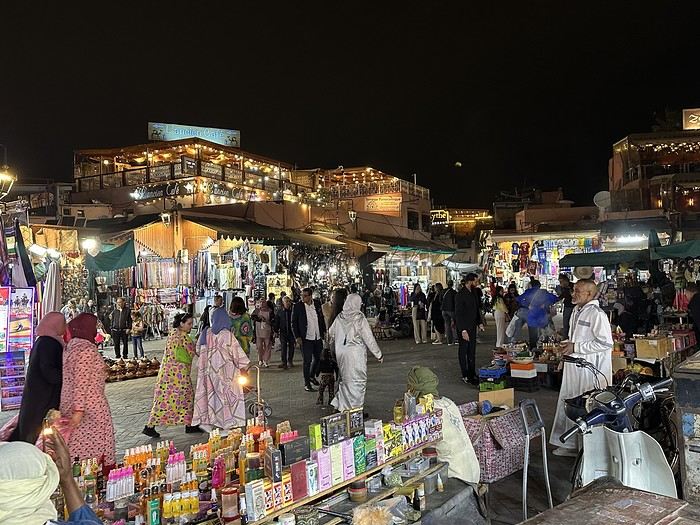
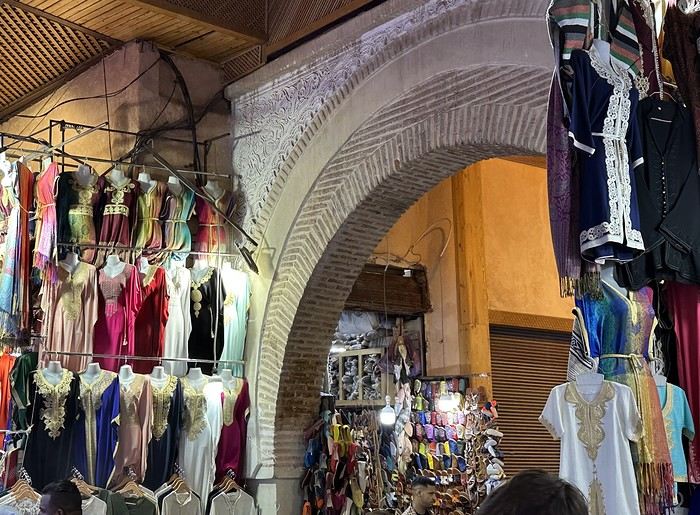
Returning after 11 PM, we learned the hard way that the souk has its own entry points and hours, and the path to our beds was full of detours and closed doors. Fortunately, we were guided by friendly locals who showed us the right way (in exchange for a fiercely negotiated tip each time...)
.Day 1: Friday, May 2nd – The Day the Group Split
Before we dive in, let’s talk about the trip prep. Among my friends, I’ve got a rep as the go-to independent travel expert (thanks to a few trips, some with this same crew). So, naturally, the task of planning this one fell to me—and I took it on gladly (you’re never better served than by yourself, right?). The prep and itinerary were hashed out over multiple meet-ups (excuses?) during shared meals at one another’s places, guided by yours truly. Travel style, accommodation, sightseeing—all decisions were made together, trying to balance everyone’s wishes over a good bottle (generic term, not numerical!)
So, a group of five—including me and my girlfriend—set off for Geneva at 3 AM that Friday, while the rest would join us on Sunday due to family or work commitments. We’ll skip the EasyJet flight—it was nothing special, just a means to get us there safely (which, in itself, is already a win). We landed in Marrakech at 9 AM local time. There, a spotless Dacia Logan was waiting for us, chartered by MEDLOC, whose impeccable service I’ll praise here (thanks, friends, for the tip!). My first challenge, after loading the suitcases into the trunk: reaching the riad booked for our first two nights as the advance team. https://www.astradamusmarrakesh.top/fr/
I was a little nervous about driving here—Marrakech’s driving reputation precedes it. The hiccup? While setting up Google Maps for the route, I accidentally added a level-5 difficulty and enabled pedestrian mode... Imagine a rental car stubbornly trying for over half an hour to navigate the Medina (the riad was in the north), cursing all the pedestrians in streets too narrow for the car, and having to reverse multiple times because “it won’t fit,” ignoring the many Marrakechis waving to signal the street was impassable (but what are they trying to sell me now? 🤪)... Until my co-pilot, holding my phone, asked if it was “normal for the route to be dotted on Google Maps?” Yes, it’s normal—pedestrian mode was on.... We’ll still be laughing about this in the nursing home in 40 years, but at the time, I was genuinely surprised by what driving in Morocco had in store for me—and for good reason! After fixing the Google Maps settings, we arrived more calmly at the private parking lot (90 dirhams per night) and then at the riad, where we received a warm welcome while our rooms were being prepared.
After freshening up, we crossed the souks for the first time to have lunch at Jemaa el-Fna Square, at Zeitoun Café, where we enjoyed our first couscous or tagine on its terrace. We’d return to Jemaa el-Fna that evening after a restorative nap at the riad, another late afternoon in the souk, and an evening at this famous UNESCO World Heritage site. This time, it was the restaurant Lafarmacie (you can’t make this up!) that won us over, despite the lack of a rooftop. I recommend this place to everyone—the prices are great, the welcome is extraordinary, and the food is excellent...
Returning after 11 PM, we learned the hard way that the souk has its own entry points and hours, and the path to our beds was full of detours and closed doors. Fortunately, we were guided by friendly locals who showed us the right way (in exchange for a fiercely negotiated tip each time...)
A lovely wander at the mercy of the wind in this amazing Rajasthan
Hey there, forum friends 😉
Some of you have mentioned missing the activity on this Indian "page," so let’s try to liven things up a bit—with joy and good vibes (mandatory with me 😜). Plus, it’ll make Jojoone happy 😊.
As big lovers of India—we’ve been six times—my co-traveler husband and I decided to explore Rajasthan this time around. The reason we waited so long to come here? We were dreading the tourist crowds in this state. But thanks to the timing (late March to early April 2024, which is starting to get pretty hot) and Aleph’s great tips, we were *very* far from mass tourism.
We spent three weeks getting around on our own for transport: mostly taxis and trains.
And I’ll admit, we had a rather "Arabian Nights" experience, far from the "real" India (Marien, if you’re reading this 😉). So this travel journal makes no claims other than to share what we saw, experienced, and felt—with all our ignorance about this country (which I’m fully aware of).
But fair warning: I go overboard with emojis, and this journal is super casual because it’s the one I share, almost in "live" mode, with our loved ones.
So, if you’re here, consider yourself almost part of the family 😄.
See you soon and....
Some of you have mentioned missing the activity on this Indian "page," so let’s try to liven things up a bit—with joy and good vibes (mandatory with me 😜). Plus, it’ll make Jojoone happy 😊.
As big lovers of India—we’ve been six times—my co-traveler husband and I decided to explore Rajasthan this time around. The reason we waited so long to come here? We were dreading the tourist crowds in this state. But thanks to the timing (late March to early April 2024, which is starting to get pretty hot) and Aleph’s great tips, we were *very* far from mass tourism.
We spent three weeks getting around on our own for transport: mostly taxis and trains.
And I’ll admit, we had a rather "Arabian Nights" experience, far from the "real" India (Marien, if you’re reading this 😉). So this travel journal makes no claims other than to share what we saw, experienced, and felt—with all our ignorance about this country (which I’m fully aware of).
But fair warning: I go overboard with emojis, and this journal is super casual because it’s the one I share, almost in "live" mode, with our loved ones.
So, if you’re here, consider yourself almost part of the family 😄.
See you soon and....
La crise de l’aviation va faire exploser le prix des billets d'avion?
La crise de l’aviation va faire
exploser le prix des billets
les pistes explorées
pour convaincre les voyageurs sont diverses.
Mais il est déjà certain qu’elles vont
renchérir le prix des billets d’avion.
Certaines compagnies à bas prix ont déjà
fait faillite, et la pression sur les voyages low
● Prendre l’avion sera plus cher, et surtout
plus compliqué. Les compagnies cherchent
la parade.
Les mois qui viennent seront très compliquéspour l’aviation civile. Car il s’agit avant tout de regagner la confiance des usagers, tout en répondant aux nouvelles normes de sécurité sanitaire. Diminution des sièges en cabine, obligation de porter le masque, contrôle des températures est particulièrement forte. Certains prédisent carrément le retour à des prix que l’on connaissait avant les années 90. Et pour cette année, il faudrait s’attendre à une augmentation moyenne de près de 50%
Les mois qui viennent seront très compliquéspour l’aviation civile. Car il s’agit avant tout de regagner la confiance des usagers, tout en répondant aux nouvelles normes de sécurité sanitaire. Diminution des sièges en cabine, obligation de porter le masque, contrôle des températures est particulièrement forte. Certains prédisent carrément le retour à des prix que l’on connaissait avant les années 90. Et pour cette année, il faudrait s’attendre à une augmentation moyenne de près de 50%
Enjoy Jordan: 3 semaines inoubliables
Je vais me lancer dans un énième carnet sur cette fabuleuse destination. Je ne prétends pas égaler le style humoristique de certaines ou certains (ils se reconnaîtront !). Je vais juste essayer de vous faire vivre ou revivre quelques-uns de nos beaux souvenirs en ces temps où l'on ne sait plus vraiment quand nous pourrons refaire nos bagages et pour quelle destination.
Allez c'est parti, embarquement immédiat !
Mi-octobre 2019, mon épouse et moi sommes revenus d'un beau voyage de 3 semaines en Jordanie et 3,5 jours à Jérusalem.
Mais pourquoi 3 semaines dans un aussi petit pays où la plupart des touristes en 'font le tour' en 8/10 jours ?
Parce que... C'est la meilleure réponse... Surtout parce que nous le pouvons (pas de vacances en juillet/août) et que nous aimons prendre notre temps, visiter des sites moins connus, faire des activités parfois surprenante à nos âges.
Nous avons parcouru la Jordanie de Madaba et des rives de la Mer Morte à Jerash en passant par les châteaux du désert, de Jerash à Dana en passant par Kerak, de Dana au sublime Wadi Rum en passant par la merveilleuse Petra. Pour terminer, je vous proposerai de flâner dans la vieille ville d'Aman. Et au bout du bout, je pourrai éventuellement vous raconter nos derniers jours de ce périple passés à Jérusalem.
Etape 1 : Madaba
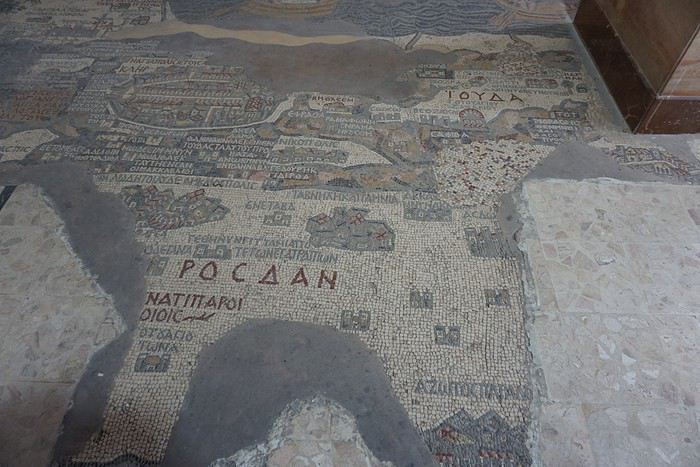
L’objectif de cette étape était de visiter tranquillement la ville et de voir les nombreuses mosaïques sur ses différents sites. Mais aussi de passer une journée au bord de la Mer Morte (objectif : repos dans un cadre sympa), de visiter quelques sites, villes ou villages tout autour et d’aller tenter le canyoning dans le wadi Mujib, nous qui n’avons jamais fait de canyoning ! Etape 2 : Jerash
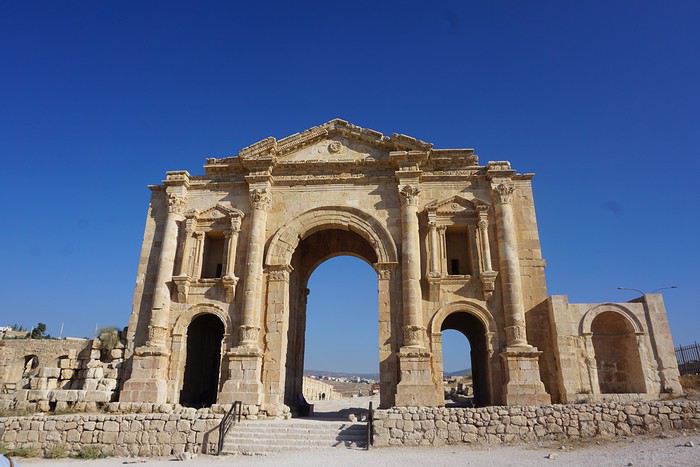
Etape à 100% culturelle avec au programme les châteaux du désert (petit détour pour relier Madaba à Jerash), les sites romains de Jerash, Um Qais et Pella, mais aussi le château médiéval d’Ajlun. Etape 3 : Kerak par la route du roi.
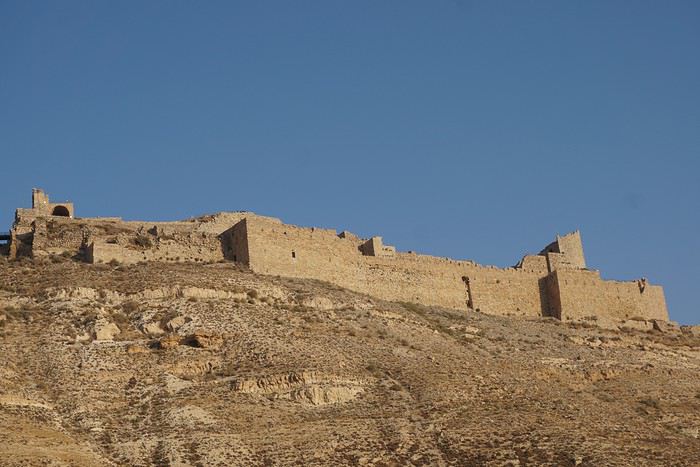
Nous ne passerons qu’une nuit à Kerak. Une demi-journée pour visiter le château, c’est très largement suffisant (même pour nous !) et donc cela va nous laisser du temps pour aller se balader dans des wadis faciles d’accès. Etape 4 : Dana
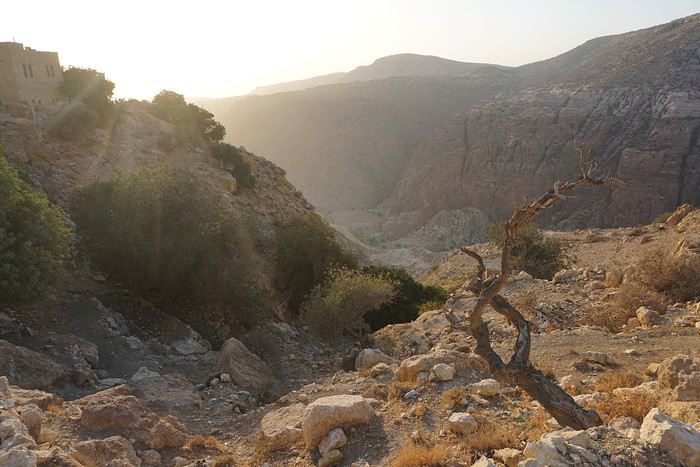
Ici aussi nous ne passerons qu’une nuit alors qu’au départ j’envisageai de passer plusieurs jours dans la réserve. Cela a été a priori un bon choix car si les randonnées y sont probablement très belles, Justine aurait eu beaucoup de mal compte-tenu du dénivelé. Et puis derrière, il y a Pétra et le trek dans le Wadi Rum. Il fallait donc se garder un peu d’énergie. Etape 5 : Pétra
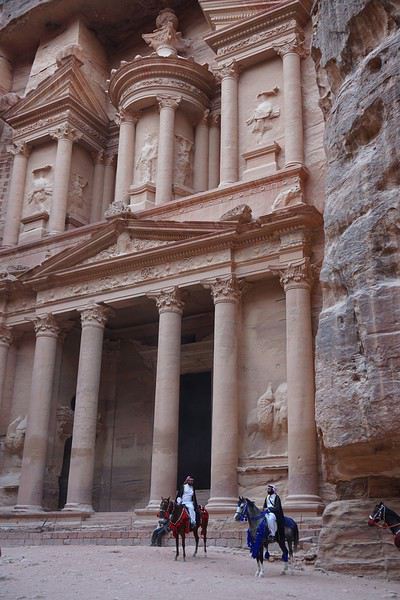
Que dire de cette étape ? Mon projet est de visiter le site en 4 journées complètes sans savoir si on pourra y rentrer 4 jours avec un Jordan Pass de 3 jours à Pétra. Si pas possible, on improvisera ! Etape 6 : Wadi Rum
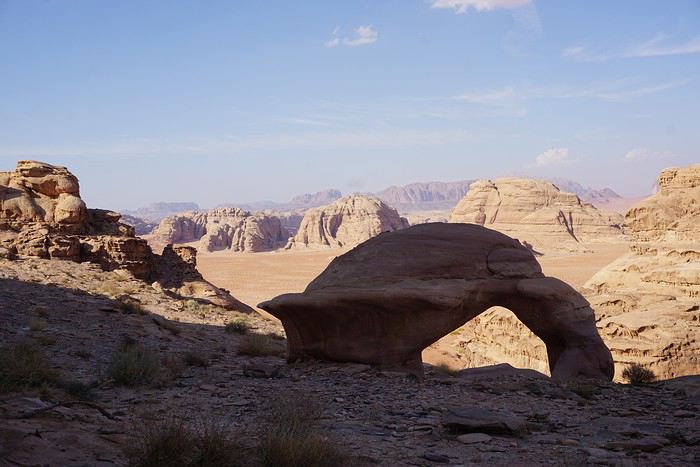
Nous allons y fêter notre anniversaire de mariage. Un trek de 3 jours, des camps itinérants et les nuits à la belle étoile. Et le jour de note anniversaire, le survol du désert au lever du soleil en montgolfière… projet sympa non ? Mais chut, c'est une surprise pour mon épouse ! Etape 7 : Amman
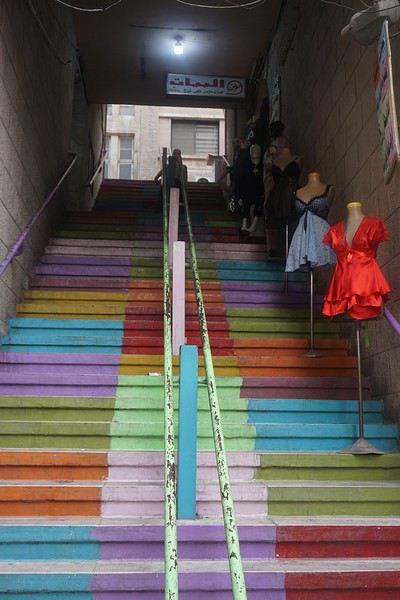
Dernière étape en Jordanie avant de traverser la frontière et terminer notre voyage à Jérusalem Etape 8 : Jérusalem
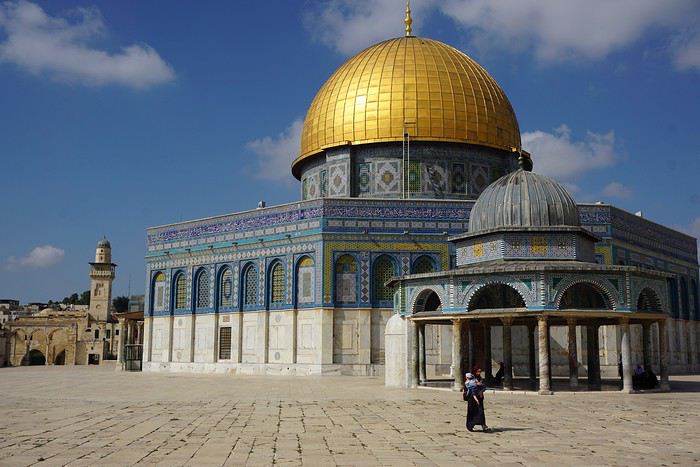
On ne présente plus cette destination : la vieille ville avec ses souks et les 4 quartiers (arabe, juif, chrétien et arménien), le Mont des Oliviers, le Mur des Lamentations, l’Esplanade des Mosquées. Mais aussi le mémorial de la Shoah.
L’objectif de cette étape était de visiter tranquillement la ville et de voir les nombreuses mosaïques sur ses différents sites. Mais aussi de passer une journée au bord de la Mer Morte (objectif : repos dans un cadre sympa), de visiter quelques sites, villes ou villages tout autour et d’aller tenter le canyoning dans le wadi Mujib, nous qui n’avons jamais fait de canyoning ! Etape 2 : Jerash
Etape à 100% culturelle avec au programme les châteaux du désert (petit détour pour relier Madaba à Jerash), les sites romains de Jerash, Um Qais et Pella, mais aussi le château médiéval d’Ajlun. Etape 3 : Kerak par la route du roi.
Nous ne passerons qu’une nuit à Kerak. Une demi-journée pour visiter le château, c’est très largement suffisant (même pour nous !) et donc cela va nous laisser du temps pour aller se balader dans des wadis faciles d’accès. Etape 4 : Dana
Ici aussi nous ne passerons qu’une nuit alors qu’au départ j’envisageai de passer plusieurs jours dans la réserve. Cela a été a priori un bon choix car si les randonnées y sont probablement très belles, Justine aurait eu beaucoup de mal compte-tenu du dénivelé. Et puis derrière, il y a Pétra et le trek dans le Wadi Rum. Il fallait donc se garder un peu d’énergie. Etape 5 : Pétra
Que dire de cette étape ? Mon projet est de visiter le site en 4 journées complètes sans savoir si on pourra y rentrer 4 jours avec un Jordan Pass de 3 jours à Pétra. Si pas possible, on improvisera ! Etape 6 : Wadi Rum
Nous allons y fêter notre anniversaire de mariage. Un trek de 3 jours, des camps itinérants et les nuits à la belle étoile. Et le jour de note anniversaire, le survol du désert au lever du soleil en montgolfière… projet sympa non ? Mais chut, c'est une surprise pour mon épouse ! Etape 7 : Amman
Dernière étape en Jordanie avant de traverser la frontière et terminer notre voyage à Jérusalem Etape 8 : Jérusalem
On ne présente plus cette destination : la vieille ville avec ses souks et les 4 quartiers (arabe, juif, chrétien et arménien), le Mont des Oliviers, le Mur des Lamentations, l’Esplanade des Mosquées. Mais aussi le mémorial de la Shoah.
Adventures of a Bygone Era: The Philippines in 1984
After several discussions on VF about travel journals from the Philippines, I decided to write this curiosity: a trip report from a journey made in 1984, when traveling to the Philippines was still an adventure.
A curiosity because writing a travel journal about a trip 35 years later isn’t common, but also (mostly?) because exploring the Philippines at that time had little in common with traveling there today.
Obviously, I’ve forgotten a number of facts, most of the details, but with the help of a few notes from that time and a stack of slides (yes, there was life before digital 😊), many memories came back and added to the highlights I’d never forgotten. The scanned slides aren’t always great quality, but there are still quite a few to brighten up this chatter. Back then, we didn’t snap photos like we do now—film was too expensive—so I don’t have pictures of every place we visited... too bad, comparing some of those spots to how they look today would’ve been interesting.
Why "Adventures"? Why call it "Adventures" in the Philippines in 1984, a word so often used for a simple exotic trip? - Because the lack of information (no *Guide du Routard*, no *Lonely Planet*, no *Michelin Guide*, nothing, and obviously no internet) gave this trip what’s at the heart of adventure: the unknown. - Because the political situation made the stay sometimes dangerous. - Because transportation conditions were always epic, often perilous. - Because the question of where we’d spend the night came up almost every evening. - And for... quite a few other reasons.
That said, we weren’t exactly explorers!
Why the Philippines? First of all, why go to the Philippines in 1984—a country not exactly set up for tourism and about which we knew very little? How could we get an idea of the beauty of the Philippines and its points of interest when we had no guides or photos?
The idea came to us from Thailand a year earlier, during our first long-haul trip. After touring the north of the country, we met a Frenchman living in Phuket, where there were only a few tourists in Patong, with just a few small hotels and guesthouses. Kata and Karon had no buildings or roads, Rawai only had three palm-thatched bungalows, including ours, and the other islands were unknown to tourists. There was plenty to discover, and we wanted to return to this beautiful country... but the Frenchman made us dream about the Philippines—a country to explore, with wild landscapes.
Long evenings of discussion over multiple Sprite-Mekong cocktails (what memories of those headaches!) finally convinced us we had to go to the Philippines.
Episode 0: Before Departure The decision was made: we’d go to the Philippines in May 1984. Our friends and family were surprised when we announced we were going on vacation to the Philippines (a bit like saying today we were going paddleboarding in the Kerguelen Islands 🤪).
These days, preparing for each of our trips takes long evenings of research, planning, and noting down good addresses... etc. But for the Philippines in 1984, preparation was quick: we had very little information about the country, we were leaving almost at random, and the discovery would only be more exciting.
We still had a few bits of info gathered here and there: the rice terraces in northern Luzon, volcanoes, Negros where we were supposed to visit an acquaintance, Cebu and its marine life (we ended up going elsewhere), and absolutely avoid Mindanao, which was practically at war with the regime. That was about it, but it was already a great itinerary.
Nothing was organized in advance; we’d see day by day. We had no idea about travel times or even the existence of transportation options. The main (and sometimes only) way to connect two islands was by overloaded, rusty ferry. Only the big cities had airports.
Let’s Go: Episode 1: Paris to Manila My travel journals always start after arriving at the airport—the Europe-to-“Other Continent” trip isn’t interesting—but the flight to the Philippines was already an adventure, so I’ll make an exception.
This was the era when only a few Asian airlines were on par with Western ones: Thai, Singapore Airlines, and Philippine Airlines. They had beautiful, brand-new planes, and to attract customers (almost exclusively “businessmen”) from the usual airlines (Air France, Lufthansa, British Airways), there was opulence on board: unlimited champagne, all sorts of cocktails... Compared to today’s long-haul flights, there was still one small difference: no personal screens, just one screen at the front of the cabin with one mandatory movie. And I don’t know why, but we only got James Bond films, both ways... that must’ve been the trend at the time.
The tourism boom to Southeast Asia hadn’t started yet, and the “Asian Tigers” weren’t a thing, so there weren’t many business trips. That meant long-haul flights made stops everywhere to fill the planes. Our Philippine Airlines Boeing 747 left London, picked us up in Paris, then stopped in Frankfurt to take on a few Germans. I don’t know why we then made a stop in Dubai—a totally exotic place at the time. There was nothing to do there... things have changed a lot since. It was a small town lost in the desert. The airport was tiny, with just one or two buildings and a supermarket. During the stopover, everyone had to get off the plane and walk to the supermarket. Photo and electronic equipment were dirt cheap—I guess that was the only reason for the stop. Maybe it was their first commercial move. Emirates didn’t exist yet, as I checked online, but anyway, the idea that such a remote place could have its own airline was unthinkable.
Online, I found this photo of Dubai Airport in 1980. Anyone who’s transited through today’s massive airport with its rows of A380s will appreciate it: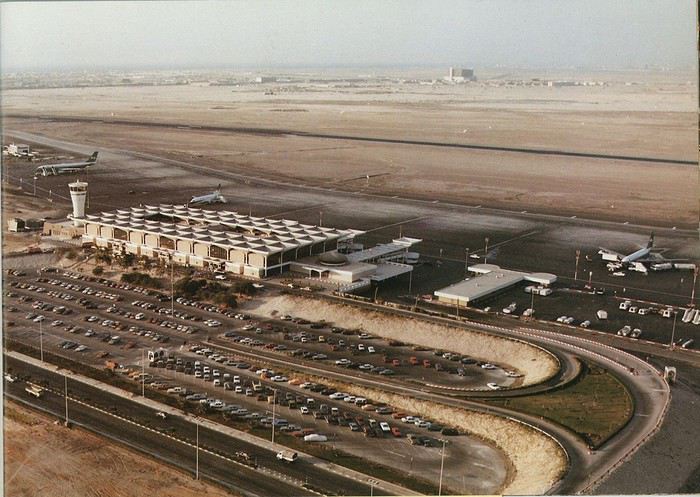
Next stop: New Delhi to drop off some Europeans and pick up a few Indians, and finally, the terminus: Manila. I don’t remember how long the trip took with its five stops—an unimaginable journey today. Despite all those stops to fill the plane, there was still enough space to stretch out on the four center seats of the 747, something that never happens these days despite all the flights in every direction.
So here we are, finally at Manila Airport around midnight.
Episode 1: Manila and Baguio To start, a quick note on the political and economic situation in the Philippines in 1984, which had consequences for us as tourists, as we’d soon realize upon arrival.
After several centuries of Spanish colonization, the Philippines became American at the start of the 20th century, then independent. In 1966, Marcos took power, and little by little, his regime sank into corruption and mismanagement, becoming a dictatorship with martial law, all for the benefit of his family and friends, who enriched themselves endlessly. The peak was the assassination of opposition leader Benigno Aquino in August 1983, which triggered harshly repressed protests. So we arrived a few months later in a very poor country, with omnipresent corruption and an extremely tense political situation, as we’d soon see for ourselves. Major protests took place in the main cities during our trip—I’ll come back to that. Two years later, Marcos fled to Hawaii after being forced out of power following rigged elections. This historical context explains a lot of the situations we found ourselves in over the following weeks.
Arriving in the middle of the night isn’t very cheerful. Manila was already a huge city with many slums, where you could find a few business hotels like the Hilton or Intercontinental—way out of our budget—and plenty of run-down hotels. Luckily, two Indians we’d chatted with on the plane offered to take us to their usual hotel. They came to Manila twice a year for business. We accepted their offer, relieved not to have to look for a place to stay in the middle of the night, figuring the address must be good since they came back every time... we were wrong 🙁
We left the airport and immediately got a taste of the local vibe when we got into the taxi: the police asked for our passports. We thought: what’s more normal than police in a dictatorship?
But that wasn’t it at all. Our two Indian friends explained that the police were noting our names along with the taxi number and time. Crime in Manila was so bad that the taxi driver would be held responsible if anything happened to us... welcome to the Philippines 😎 😎
Historically, the Philippines was a very violent country, where everything was settled with guns or machetes. Previous governments had banned carrying weapons, but Marcos later allowed the free sale and carrying of guns, and disputes were settled with pistols again (or worse, as we’d discover later). Since he’d released most of the criminals from prison to form a paramilitary militia at his service (I’ll talk about our encounter with these “heroes” later), it was pretty dangerous to go into many parts of Manila, where these “tonton macoutes” ruled.
We arrived at our hotel without incident... and then things started badly. The room was infested with big cockroaches—exactly what I hate most in those kinds of countries. No way to find another hotel at that hour. After the long flight, the urge to take a shower was so strong that we squeezed into the bathroom as best we could. After that, I don’t remember—I guess we must’ve fallen asleep exhausted under the sheets in the heat... air conditioning wasn’t widespread yet.
The next day, we just wanted to leave that dump as soon as possible. So we decided to head north right away, stopping in Baguio, and we’d visit Manila a bit on the way back.
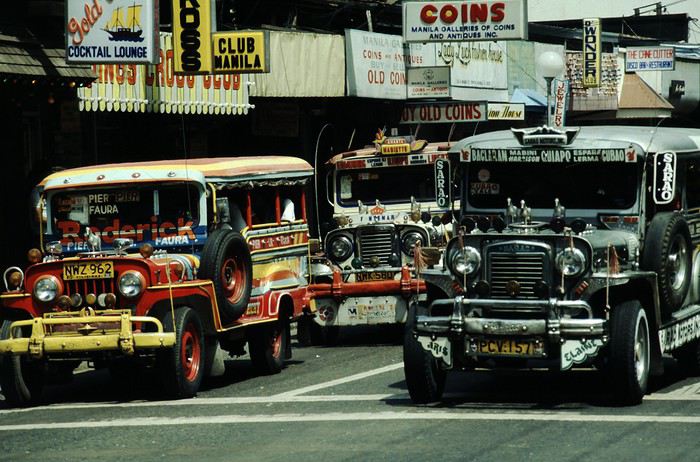
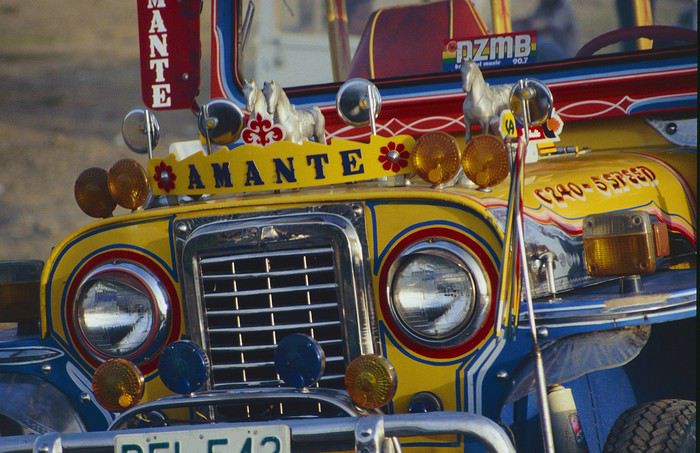
When we stepped outside, we discovered a pretty run-down neighborhood with potholed streets. But we also discovered the jeepneys. They were everywhere, flooding the streets.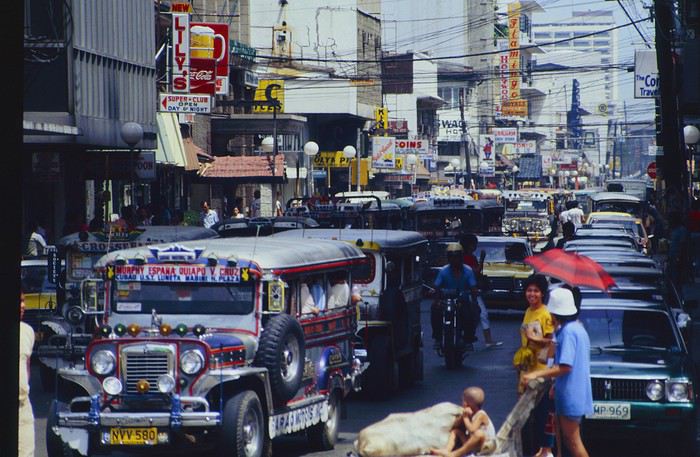
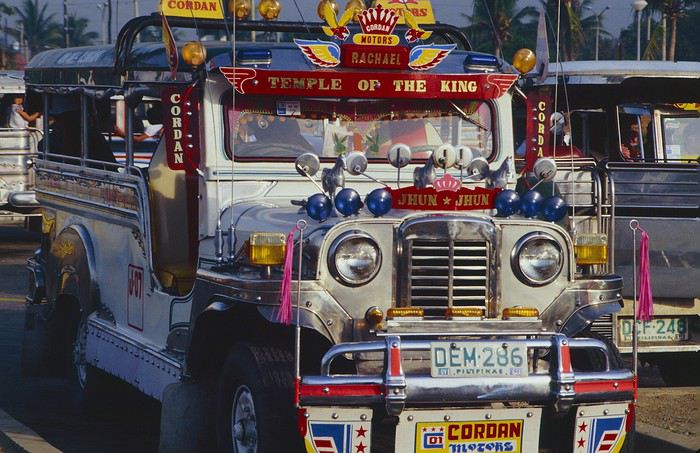
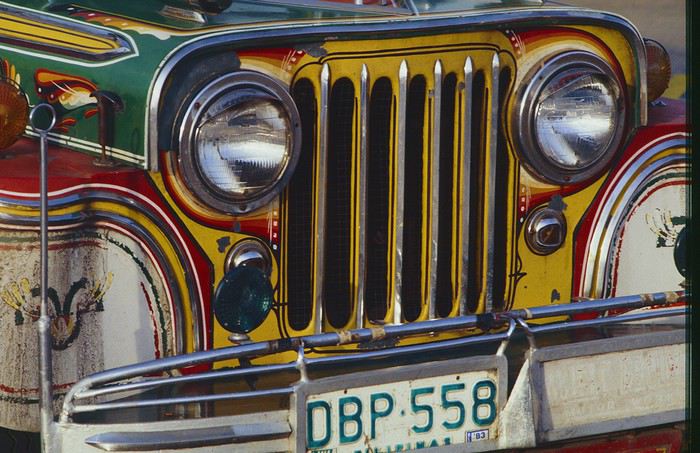
They had crazy sound systems, each one blasting louder than the last. The interiors were kitschy but fun. There weren’t many private cars—almost all transportation was by jeepney, with buses reserved for intercity trips.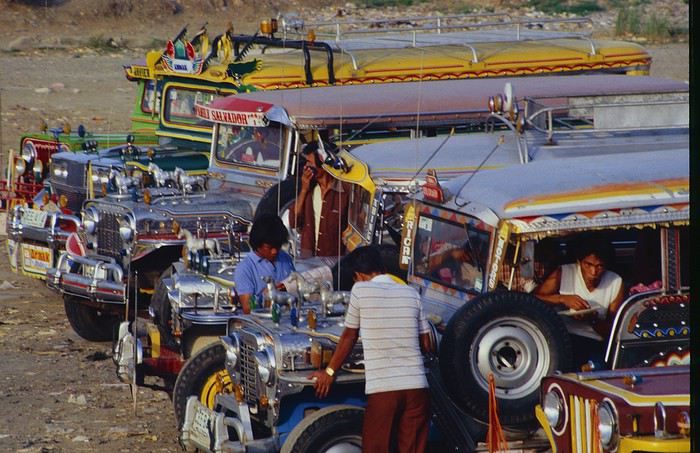
Before heading to the bus terminal for the north, somewhere on the outskirts of the city, we needed to exchange some money. I don’t remember how we ended up in a policeman’s jeep who offered his services: - Exchange money on the black market at a better rate than the banks. - Take us wherever we wanted, in this case, the bus terminal.
We accepted both offers (we’d still checked the official exchange rate from dollars to pesos). So we found ourselves in his jeep. After exchanging money, we left in his vehicle and stopped for gas. Without turning off the engine, he calmly smoked a cigarette while filling up. Since we were in a jeep with no doors or roof, we were ready to jump out if things went south, our travel bag in hand.
But we weren’t done with surprises yet. Once we left the small streets, we ended up in a neighborhood with wide avenues and not much traffic, which didn’t justify his incredible behavior. At every intersection, he made the sign of the cross, closed his eyes, and crossed without looking. I was more stunned than terrified! It wasn’t until we got out of the car later that I told Anne-Marie what had happened. I’d seen everything because the cop had put me in the front seat. Luckily, A-Marie hadn’t noticed anything from the back. Crossing Manila by trusting God rather than the rules of the road was ultimately effective. We were lucky—the trip was off to a good start. 🙂 🙂
We then passed through a neighborhood where slums stretched on for a while, and we left our policeman—friendly but a bit crazy—with relief.
A few hours by bus later, here we are in Baguio, cool in the mountains. My memories of Baguio are pretty fuzzy. I remember a small town. After some research while writing this journal, I found that the population was 120,000 in 1980. Given the population density in each home, that confirms my memory of a smallish town. Outside the “official” district with the president’s summer residence and government buildings, there were two or three paved streets with nice houses. The rest was very dirty and very poor, with lots of slums and dirt roads.
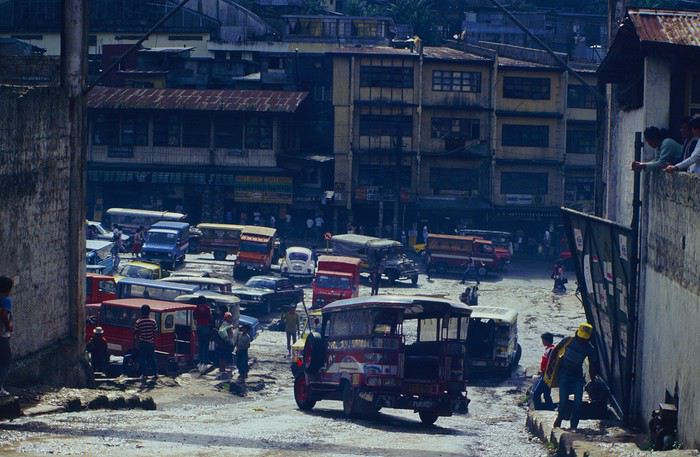
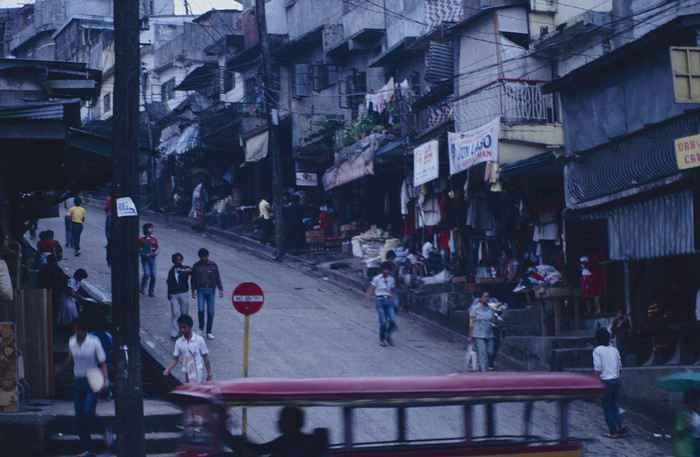
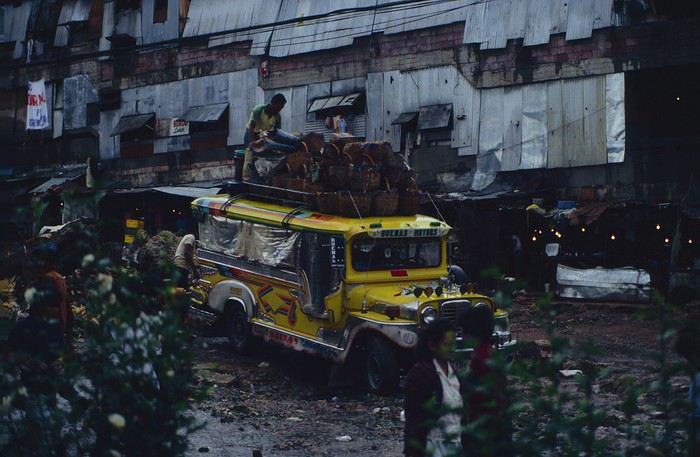
People we met on the street invited us to stay with them. These days, we wouldn’t just show up at strangers’ houses, which we should’ve done in Baguio—it would’ve saved us from an unimaginable and dangerous situation... which I won’t say anything about... !😊
The simple wooden house was on stilts at the edge of a hill with a view of the mountains. Since it was the start of the rainy season in a city that gets a lot of rain, we saw a lot of water. Our outings in town happened between downpours.
View from our lodging: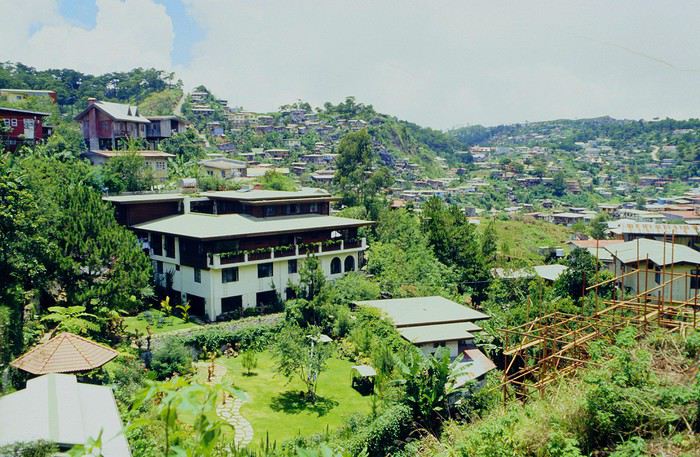
Episode 2: Baguio to Bontoc Aside from the situation briefly mentioned above, it was on the next leg to Bontoc that the adventure really began: an endless and dangerous road, a bus from another era, breathtaking landscapes, and surprising people.
We didn’t know the distance or how long it would take to get to Bontoc. When we arrived after about ten hours, we learned that Baguio to Bontoc was 140 km.
We got on a bus with wooden seats and settled in, two to a seat meant for two. As the bus filled up, passengers squeezed in three or four per seat, with chickens and baskets full of all sorts of things in the aisle. A little embarrassed, we didn’t know if we should squeeze in three on our seat. The seats were super tight (luckily, Filipinos are small), and I didn’t know where to put my legs given my height. I don’t remember if we stayed alone on our bench or if we ended up sharing with others.
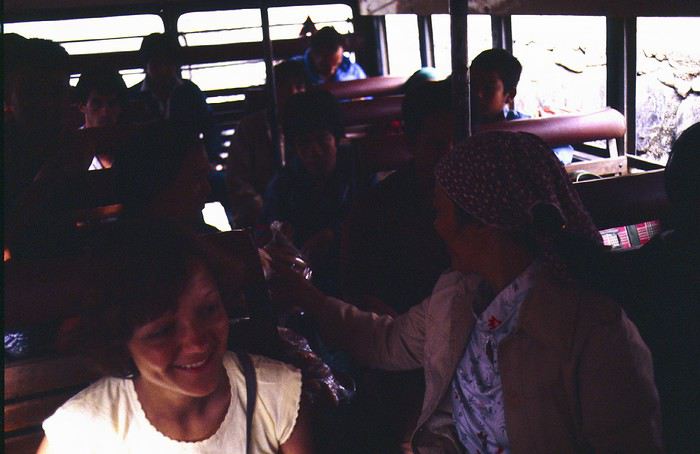
The “road” was a dirt track (or rather, a mud track) with endless turns. We held on as best we could to our slippery wooden seats—it was shaking in every direction. The woman behind us was carsick and throwing up... gross... but what were we doing there? Then we plunged into the Sierra Madre... just the name is dreamy!
Rice terraces started to appear: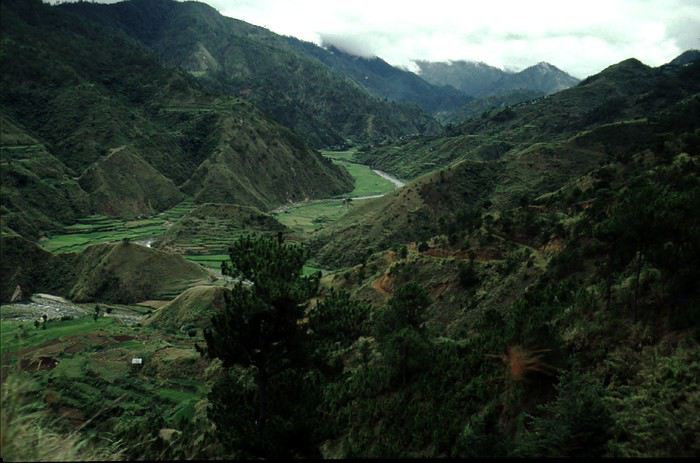
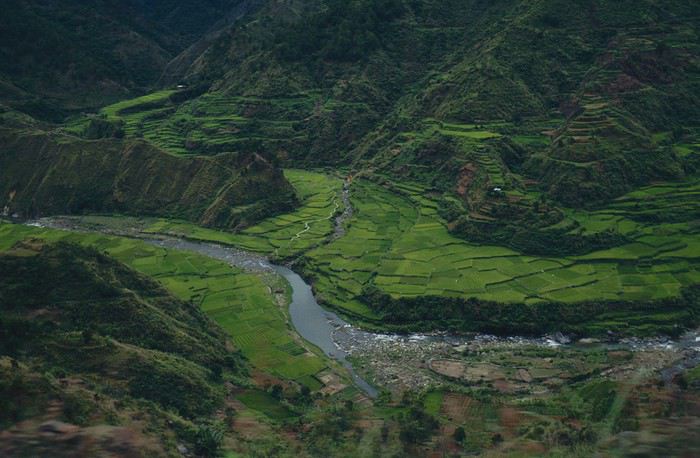
they took up more and more space along cliffs where we weren’t always reassured,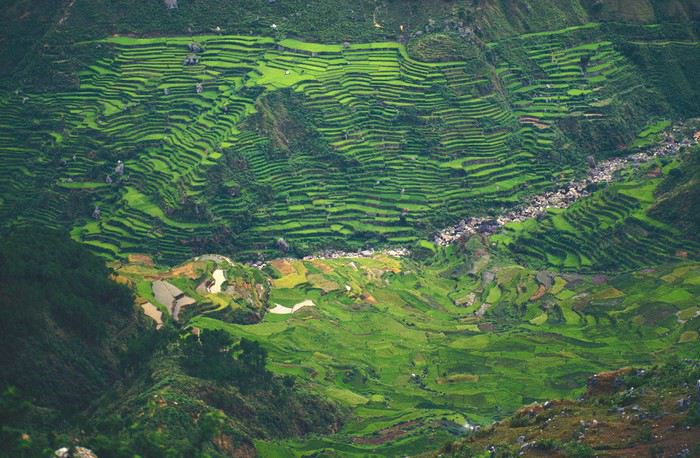
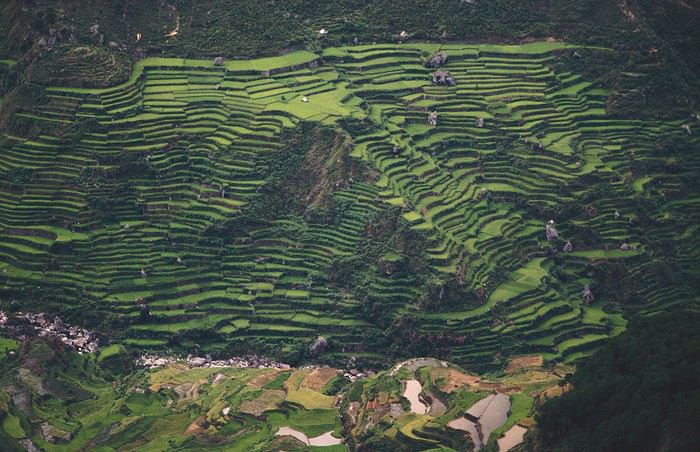
with lots of waterfalls (all that water had to go somewhere).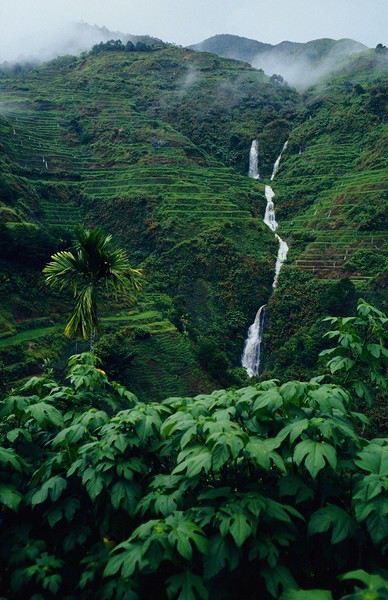
A few miserable villages stretched along the track, most often just a few houses balancing between the road and the drop. The bus stopped in every village—people got on or off and settled inside or on the roof. Street vendors offered their products to the bus passengers—a common sight in Asia, even today.
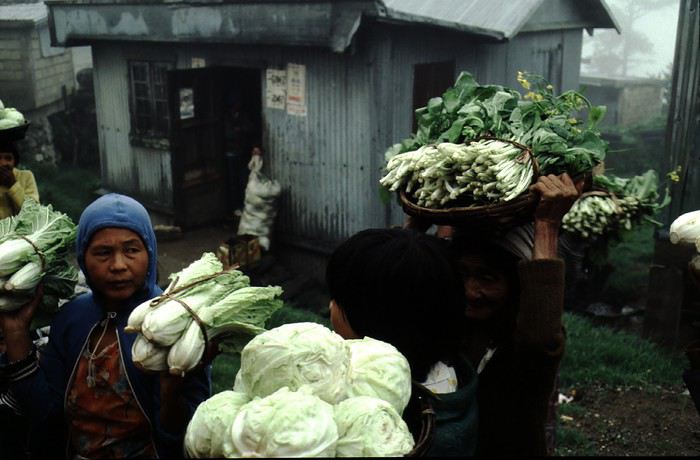
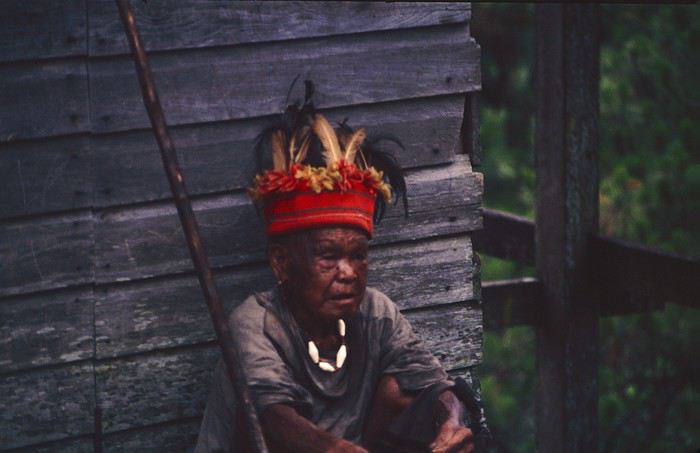
We were in another world—villagers were in loincloths, others had spears. The atmosphere was strange... but all good, we wanted exoticism, and we got it: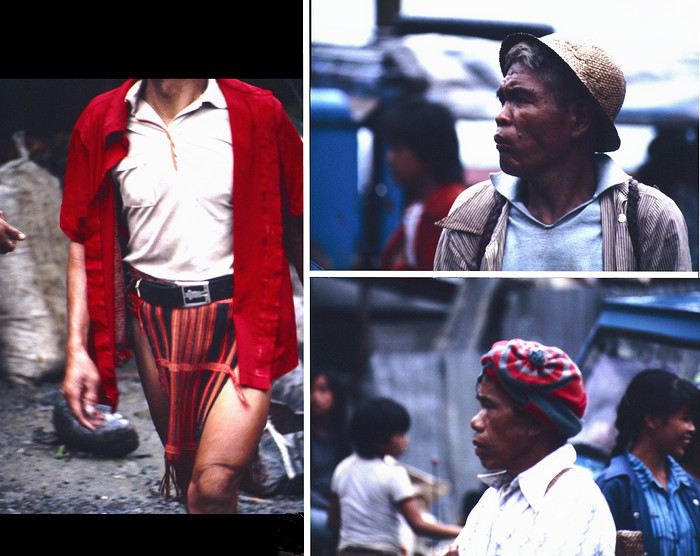
This so-called traditional outfit was everyday wear—it wasn’t for tourists since there weren’t any.
A curiosity because writing a travel journal about a trip 35 years later isn’t common, but also (mostly?) because exploring the Philippines at that time had little in common with traveling there today.
Obviously, I’ve forgotten a number of facts, most of the details, but with the help of a few notes from that time and a stack of slides (yes, there was life before digital 😊), many memories came back and added to the highlights I’d never forgotten. The scanned slides aren’t always great quality, but there are still quite a few to brighten up this chatter. Back then, we didn’t snap photos like we do now—film was too expensive—so I don’t have pictures of every place we visited... too bad, comparing some of those spots to how they look today would’ve been interesting.
Why "Adventures"? Why call it "Adventures" in the Philippines in 1984, a word so often used for a simple exotic trip? - Because the lack of information (no *Guide du Routard*, no *Lonely Planet*, no *Michelin Guide*, nothing, and obviously no internet) gave this trip what’s at the heart of adventure: the unknown. - Because the political situation made the stay sometimes dangerous. - Because transportation conditions were always epic, often perilous. - Because the question of where we’d spend the night came up almost every evening. - And for... quite a few other reasons.
That said, we weren’t exactly explorers!
Why the Philippines? First of all, why go to the Philippines in 1984—a country not exactly set up for tourism and about which we knew very little? How could we get an idea of the beauty of the Philippines and its points of interest when we had no guides or photos?
The idea came to us from Thailand a year earlier, during our first long-haul trip. After touring the north of the country, we met a Frenchman living in Phuket, where there were only a few tourists in Patong, with just a few small hotels and guesthouses. Kata and Karon had no buildings or roads, Rawai only had three palm-thatched bungalows, including ours, and the other islands were unknown to tourists. There was plenty to discover, and we wanted to return to this beautiful country... but the Frenchman made us dream about the Philippines—a country to explore, with wild landscapes.
Long evenings of discussion over multiple Sprite-Mekong cocktails (what memories of those headaches!) finally convinced us we had to go to the Philippines.
Episode 0: Before Departure The decision was made: we’d go to the Philippines in May 1984. Our friends and family were surprised when we announced we were going on vacation to the Philippines (a bit like saying today we were going paddleboarding in the Kerguelen Islands 🤪).
These days, preparing for each of our trips takes long evenings of research, planning, and noting down good addresses... etc. But for the Philippines in 1984, preparation was quick: we had very little information about the country, we were leaving almost at random, and the discovery would only be more exciting.
We still had a few bits of info gathered here and there: the rice terraces in northern Luzon, volcanoes, Negros where we were supposed to visit an acquaintance, Cebu and its marine life (we ended up going elsewhere), and absolutely avoid Mindanao, which was practically at war with the regime. That was about it, but it was already a great itinerary.
Nothing was organized in advance; we’d see day by day. We had no idea about travel times or even the existence of transportation options. The main (and sometimes only) way to connect two islands was by overloaded, rusty ferry. Only the big cities had airports.
Let’s Go: Episode 1: Paris to Manila My travel journals always start after arriving at the airport—the Europe-to-“Other Continent” trip isn’t interesting—but the flight to the Philippines was already an adventure, so I’ll make an exception.
This was the era when only a few Asian airlines were on par with Western ones: Thai, Singapore Airlines, and Philippine Airlines. They had beautiful, brand-new planes, and to attract customers (almost exclusively “businessmen”) from the usual airlines (Air France, Lufthansa, British Airways), there was opulence on board: unlimited champagne, all sorts of cocktails... Compared to today’s long-haul flights, there was still one small difference: no personal screens, just one screen at the front of the cabin with one mandatory movie. And I don’t know why, but we only got James Bond films, both ways... that must’ve been the trend at the time.
The tourism boom to Southeast Asia hadn’t started yet, and the “Asian Tigers” weren’t a thing, so there weren’t many business trips. That meant long-haul flights made stops everywhere to fill the planes. Our Philippine Airlines Boeing 747 left London, picked us up in Paris, then stopped in Frankfurt to take on a few Germans. I don’t know why we then made a stop in Dubai—a totally exotic place at the time. There was nothing to do there... things have changed a lot since. It was a small town lost in the desert. The airport was tiny, with just one or two buildings and a supermarket. During the stopover, everyone had to get off the plane and walk to the supermarket. Photo and electronic equipment were dirt cheap—I guess that was the only reason for the stop. Maybe it was their first commercial move. Emirates didn’t exist yet, as I checked online, but anyway, the idea that such a remote place could have its own airline was unthinkable.
Online, I found this photo of Dubai Airport in 1980. Anyone who’s transited through today’s massive airport with its rows of A380s will appreciate it:
Next stop: New Delhi to drop off some Europeans and pick up a few Indians, and finally, the terminus: Manila. I don’t remember how long the trip took with its five stops—an unimaginable journey today. Despite all those stops to fill the plane, there was still enough space to stretch out on the four center seats of the 747, something that never happens these days despite all the flights in every direction.
So here we are, finally at Manila Airport around midnight.
Episode 1: Manila and Baguio To start, a quick note on the political and economic situation in the Philippines in 1984, which had consequences for us as tourists, as we’d soon realize upon arrival.
After several centuries of Spanish colonization, the Philippines became American at the start of the 20th century, then independent. In 1966, Marcos took power, and little by little, his regime sank into corruption and mismanagement, becoming a dictatorship with martial law, all for the benefit of his family and friends, who enriched themselves endlessly. The peak was the assassination of opposition leader Benigno Aquino in August 1983, which triggered harshly repressed protests. So we arrived a few months later in a very poor country, with omnipresent corruption and an extremely tense political situation, as we’d soon see for ourselves. Major protests took place in the main cities during our trip—I’ll come back to that. Two years later, Marcos fled to Hawaii after being forced out of power following rigged elections. This historical context explains a lot of the situations we found ourselves in over the following weeks.
Arriving in the middle of the night isn’t very cheerful. Manila was already a huge city with many slums, where you could find a few business hotels like the Hilton or Intercontinental—way out of our budget—and plenty of run-down hotels. Luckily, two Indians we’d chatted with on the plane offered to take us to their usual hotel. They came to Manila twice a year for business. We accepted their offer, relieved not to have to look for a place to stay in the middle of the night, figuring the address must be good since they came back every time... we were wrong 🙁
We left the airport and immediately got a taste of the local vibe when we got into the taxi: the police asked for our passports. We thought: what’s more normal than police in a dictatorship?
But that wasn’t it at all. Our two Indian friends explained that the police were noting our names along with the taxi number and time. Crime in Manila was so bad that the taxi driver would be held responsible if anything happened to us... welcome to the Philippines 😎 😎
Historically, the Philippines was a very violent country, where everything was settled with guns or machetes. Previous governments had banned carrying weapons, but Marcos later allowed the free sale and carrying of guns, and disputes were settled with pistols again (or worse, as we’d discover later). Since he’d released most of the criminals from prison to form a paramilitary militia at his service (I’ll talk about our encounter with these “heroes” later), it was pretty dangerous to go into many parts of Manila, where these “tonton macoutes” ruled.
We arrived at our hotel without incident... and then things started badly. The room was infested with big cockroaches—exactly what I hate most in those kinds of countries. No way to find another hotel at that hour. After the long flight, the urge to take a shower was so strong that we squeezed into the bathroom as best we could. After that, I don’t remember—I guess we must’ve fallen asleep exhausted under the sheets in the heat... air conditioning wasn’t widespread yet.
The next day, we just wanted to leave that dump as soon as possible. So we decided to head north right away, stopping in Baguio, and we’d visit Manila a bit on the way back.
When we stepped outside, we discovered a pretty run-down neighborhood with potholed streets. But we also discovered the jeepneys. They were everywhere, flooding the streets.
They had crazy sound systems, each one blasting louder than the last. The interiors were kitschy but fun. There weren’t many private cars—almost all transportation was by jeepney, with buses reserved for intercity trips.
Before heading to the bus terminal for the north, somewhere on the outskirts of the city, we needed to exchange some money. I don’t remember how we ended up in a policeman’s jeep who offered his services: - Exchange money on the black market at a better rate than the banks. - Take us wherever we wanted, in this case, the bus terminal.
We accepted both offers (we’d still checked the official exchange rate from dollars to pesos). So we found ourselves in his jeep. After exchanging money, we left in his vehicle and stopped for gas. Without turning off the engine, he calmly smoked a cigarette while filling up. Since we were in a jeep with no doors or roof, we were ready to jump out if things went south, our travel bag in hand.
But we weren’t done with surprises yet. Once we left the small streets, we ended up in a neighborhood with wide avenues and not much traffic, which didn’t justify his incredible behavior. At every intersection, he made the sign of the cross, closed his eyes, and crossed without looking. I was more stunned than terrified! It wasn’t until we got out of the car later that I told Anne-Marie what had happened. I’d seen everything because the cop had put me in the front seat. Luckily, A-Marie hadn’t noticed anything from the back. Crossing Manila by trusting God rather than the rules of the road was ultimately effective. We were lucky—the trip was off to a good start. 🙂 🙂
We then passed through a neighborhood where slums stretched on for a while, and we left our policeman—friendly but a bit crazy—with relief.
A few hours by bus later, here we are in Baguio, cool in the mountains. My memories of Baguio are pretty fuzzy. I remember a small town. After some research while writing this journal, I found that the population was 120,000 in 1980. Given the population density in each home, that confirms my memory of a smallish town. Outside the “official” district with the president’s summer residence and government buildings, there were two or three paved streets with nice houses. The rest was very dirty and very poor, with lots of slums and dirt roads.
People we met on the street invited us to stay with them. These days, we wouldn’t just show up at strangers’ houses, which we should’ve done in Baguio—it would’ve saved us from an unimaginable and dangerous situation... which I won’t say anything about... !😊
The simple wooden house was on stilts at the edge of a hill with a view of the mountains. Since it was the start of the rainy season in a city that gets a lot of rain, we saw a lot of water. Our outings in town happened between downpours.
View from our lodging:
Episode 2: Baguio to Bontoc Aside from the situation briefly mentioned above, it was on the next leg to Bontoc that the adventure really began: an endless and dangerous road, a bus from another era, breathtaking landscapes, and surprising people.
We didn’t know the distance or how long it would take to get to Bontoc. When we arrived after about ten hours, we learned that Baguio to Bontoc was 140 km.
We got on a bus with wooden seats and settled in, two to a seat meant for two. As the bus filled up, passengers squeezed in three or four per seat, with chickens and baskets full of all sorts of things in the aisle. A little embarrassed, we didn’t know if we should squeeze in three on our seat. The seats were super tight (luckily, Filipinos are small), and I didn’t know where to put my legs given my height. I don’t remember if we stayed alone on our bench or if we ended up sharing with others.
The “road” was a dirt track (or rather, a mud track) with endless turns. We held on as best we could to our slippery wooden seats—it was shaking in every direction. The woman behind us was carsick and throwing up... gross... but what were we doing there? Then we plunged into the Sierra Madre... just the name is dreamy!
Rice terraces started to appear:
they took up more and more space along cliffs where we weren’t always reassured,
with lots of waterfalls (all that water had to go somewhere).
A few miserable villages stretched along the track, most often just a few houses balancing between the road and the drop. The bus stopped in every village—people got on or off and settled inside or on the roof. Street vendors offered their products to the bus passengers—a common sight in Asia, even today.
We were in another world—villagers were in loincloths, others had spears. The atmosphere was strange... but all good, we wanted exoticism, and we got it:
This so-called traditional outfit was everyday wear—it wasn’t for tourists since there weren’t any.
Bolivia: Exploring the South Lipez by Self-Drive
Hi everyone,
The idea of traveling to Bolivia came to me after seeing Jean-François (Max68)’s photos on his website. I thought we *had* to see those stunning landscapes with the colorful lagoons for ourselves. But a self-drive trip didn’t seem doable at first. A few years ago, everyone advised against going to the South Lipez with just one car.
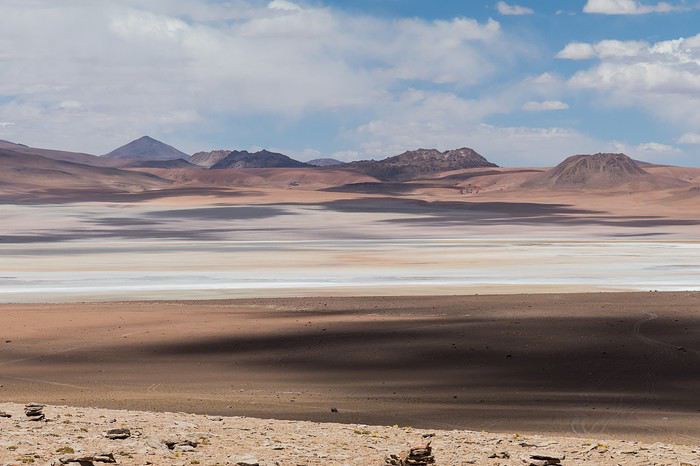 Laguna Kara
It was only after reading Laurent (Lolobe) and Pascal (Pepe874)’s travel journals—who explored the South Lipez solo with a car from Biz Rent a Car—that I thought we might be able to do the same. Meanwhile, we’d already contacted a local agency to organize a trip with a driver and guide. But the idea of a self-drive adventure really appealed to us. With encouragement and tips from Thierry (Tbernay) and Jean-François (Max68), we decided to plan our own self-drive trip. I’d like to thank them for their advice—it was *super* helpful. And a big thanks to all the other forum members for the info shared during our prep!
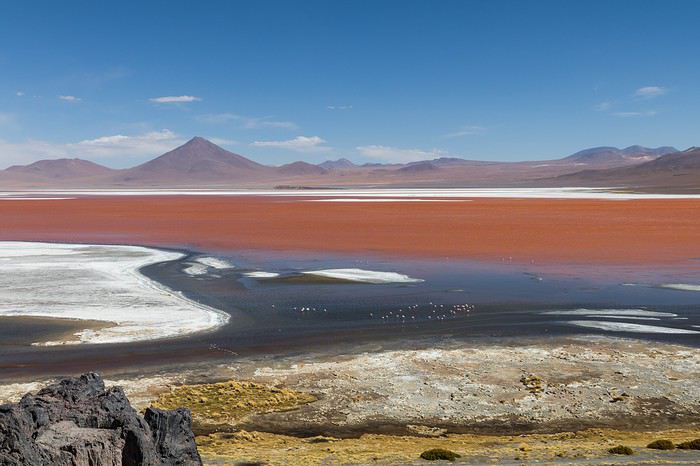 Laguna Colorada
Planning this trip happened during a tough time for our family. My mother-in-law’s illness and passing, plus a few health issues of my own, made us doubt the trip multiple times and nearly scrap the whole thing.
We booked our international flights in February with Swiss. They offered the best balance of travel time and price from Switzerland. Swiss operates Zurich–São Paulo with their own fleet, and São Paulo–Santa Cruz with GOL. In June, GOL canceled the Saturday flight and rebooked us on Sunday. Spending over 24 hours in that huge Brazilian city didn’t work for us at all, so we asked Swiss to put us on the next Zurich–São Paulo flight. Too bad—we lost a day in Bolivia and had to skip the Tarabucco market on Sunday.
Right after, we also booked the car in February. After contacting Imbex and Biz, we went with Biz. Not speaking Spanish, we were relieved to communicate with Alejandra in French. The contact was great—she answered all our questions patiently. Sometimes it took a few days to get a reply, but we could also reach her on WhatsApp. After our trip, we can *only* recommend Biz for rentals in Bolivia. The cars are well-prepped for the South Lipez tracks. The agency is reliable, and the vehicles are new and well-maintained.
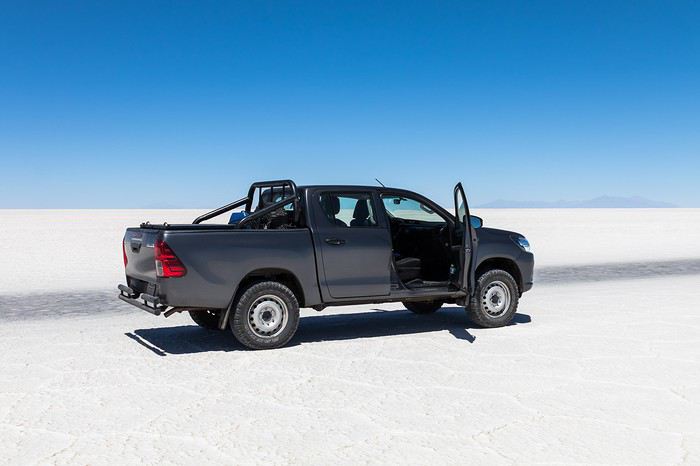 “Our” car, a Toyota Hilux
While planning, we realized the presidential elections would happen while we were in Bolivia. The risk of *bloqueos* (roadblocks and protests) was very real. But in Bolivia, *bloqueos* seem common—you always have to account for that kind of hassle. In late August/early September, Uyuni and the Salar region were blocked for days, leading to food, fuel, and cash shortages. Worried about a blockade in Uyuni and missing the Salar, we decided to visit it first *just in case*.
On election day, the whole country shut down. Planes were grounded, buses and taxis couldn’t circulate, and private cars were banned. There were a few exceptions—ambulances, police, or certain professions—but as tourists, we couldn’t get permission to drive. We asked the embassy, and Biz even requested a permit from the electoral office. So we had to plan to be somewhere with things to do *without* the car.
We decided not to book any accommodations in advance—a first for us. Usually, we plan our stops and reserve lodges, hotels, or campgrounds well ahead. This time, only the room in Sucre was booked, so we’d have a base when we arrived.
In July, Alex (Delhenry) reached out to propose joining part of the trip. He didn’t realize we were leaving in October. Still, we got fresh updates when he returned from the South Lipez. Thanks, Alex—your tips, especially about the Guadalupe–Tupiza stretch, were *super* useful.
In September, we connected with Jean-Louis (Avx) and Anne (Xeta), who were also heading to Bolivia in October, one and two weeks after us. We had dinner with Jean-Louis and his friend after our South Lipez trip and stayed in touch with Anne. It was great to chat with them! Unfortunately, Anne and her husband had a much rockier trip—they got hit hard by post-election issues.
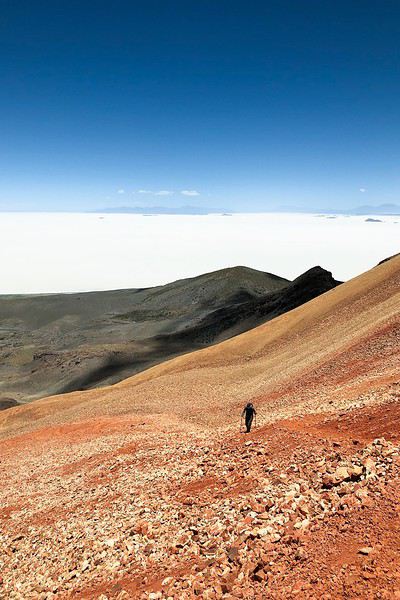 Climbing Volcán Tunupa
Our itinerary wasn’t set in stone—we decided to wing it on the spot. Two weeks before departure, I reconnected with Alejandra at Biz to move the car rental up by a day. With the elections, we wanted to leave Sucre ASAP and focus on the South Lipez. Outside Uyuni and Tupiza, the risk of blockades was zero. We also planned a two-night buffer in Sucre before our flights, just in case. It might sound overcautious, but in hindsight, we made the right call. If we’d left Sucre a day later, we wouldn’t have made it to Potosí—it was completely blocked. On the way back, we *just* dodged blockades in Potosí and elsewhere. Sometimes, you’ve gotta trust your gut.
Here’s our route—only the first two nights in Sucre were booked ahead:
D1 Departure from Switzerland
D2 Sucre (La Selenita)
D3 Sucre (La Selenita)
D4 Colchani (Hotel de Sal Luna Salada)
D5 Jirira (Auberge Doña Lupe)
D6 On the Salar (in the car)
D7 A few kilometers from Estancia Catal (in the car)
D8 Laguna Hedionda (Hotel Los Flamencos)
D9 Laguna Colorada (Lodge by the lagoon)
D10 Middle of nowhere, en route Laguna Verde–Mina Horsu–Quetena Chico (in the car)
D11 Quetena Chico (Lamphaya Lodge Andino)
D12 Quetena Chico (Lamphaya Lodge Andino)
D13 Guadalupe (Guest room at Celia’s)
D14 Along the Rio Grande (in the car)
D15 Tupiza (Hotel Mitru)
D16 Tupiza (Hotel Mitru)
D17 Sucre (La Selenita)
D18 Sucre (La Selenita)
D19 Santa Cruz (Hotel Sun)
D20 Departure from Santa Cruz
D21 Arrival in Switzerland
As you can see, we spent 13 nights in the South Lipez. Initially, we’d planned for nine, but Jean-François (Max68) suggested staying longer. Great advice—we didn’t regret it one bit. We could’ve even added 2–3 more days without getting bored.
Self-driving in the South Lipez takes some prep and a good GPS. We kept it simple and used maps.me to navigate. It’s a solid app—just save your waypoints ahead of time. For some stretches, I used Google Earth to visualize the tracks and sites. If you stick to the tour operator routes, you *almost* can’t get lost. But we often veered off the beaten path and took different routes. Some days, we didn’t see another car. So in case of a breakdown, it’s key to have water and food for several days. In some spots, there’s *zero* signal—your phone won’t work. Another must: it gets *cold* in the South Lipez, and a good sleeping bag is essential. We brought down sleeping bags rated for -10°C and didn’t regret it during our car nights.
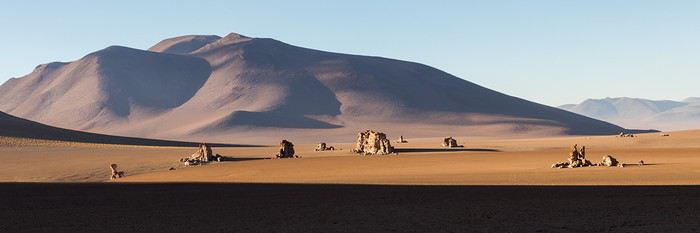 The Dalí Desert
Some tracks are *super* rocky—flat tires are a real risk. On those stretches, maps.me’s estimated travel time was way off. Some sections barely let us go over 15 km/h.
Lots of forum members recommend doing the South Lipez “loop” from Tupiza to Uyuni—ending with the Salar—to avoid Uyuni’s crowds. That might work for organized tours, but for self-drive, the direction *doesn’t* matter. I’ll say this: the few vehicles we saw mostly came from Tupiza and Chile, not Uyuni. So if starting from Uyuni works better for you, go for it! Ending in Tupiza means heading toward warmer weather. For our planned stops and climbs, starting in Uyuni helped with acclimatization. Spending a few nights between 3,600–3,800 m before going over 4,000 m is a smart move.
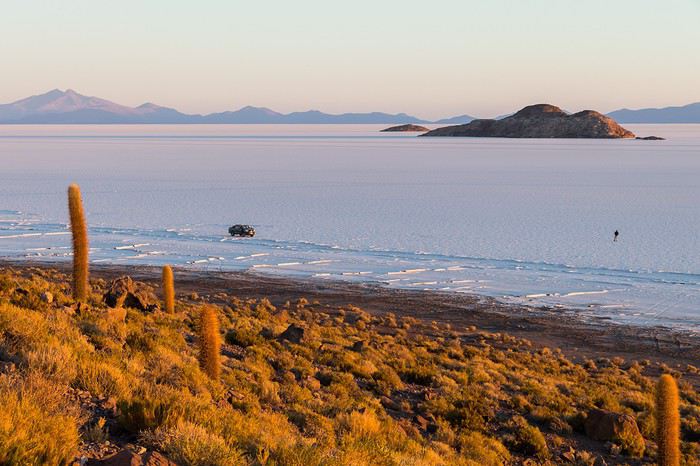 Uyuni Salt Flats in the morning
Overall, we barely saw anyone—except at Laguna Hedionda and Chalviri. There were several tour groups at Hotel Los Flamencos (Laguna Hedionda), but we didn’t cross paths during the day. Hardly anyone on the Salar, on the roads, or at the lodges in the evenings. The *only* place that shocked us was Chalviri. We’d planned to stay there, but it was fully booked—and we counted *forty* tour jeeps on-site. This was around noon! At the Polques hot springs (Chalviri), it was *packed*—we quickly nixed the idea of a dip. Plus, the vibe wasn’t great: soaking right by the road with lodges and restaurants in the background? Meh. Still, lots of tourists love it, so it’s up to you.
For the photos, I kept the colors and mood we saw. The lagoons’ hues are often stunning, but some online photos are *way* over-edited and oversaturated. The South Lipez’s landscapes are breathtaking—no need for excessive retouching.
If you don’t want to read all the details, the start of the travel journal is here: https://voyageforum.com/v.f?post=9888761;a=9888761
The idea of traveling to Bolivia came to me after seeing Jean-François (Max68)’s photos on his website. I thought we *had* to see those stunning landscapes with the colorful lagoons for ourselves. But a self-drive trip didn’t seem doable at first. A few years ago, everyone advised against going to the South Lipez with just one car.
Laguna KaraIt was only after reading Laurent (Lolobe) and Pascal (Pepe874)’s travel journals—who explored the South Lipez solo with a car from Biz Rent a Car—that I thought we might be able to do the same. Meanwhile, we’d already contacted a local agency to organize a trip with a driver and guide. But the idea of a self-drive adventure really appealed to us. With encouragement and tips from Thierry (Tbernay) and Jean-François (Max68), we decided to plan our own self-drive trip. I’d like to thank them for their advice—it was *super* helpful. And a big thanks to all the other forum members for the info shared during our prep!
Laguna ColoradaPlanning this trip happened during a tough time for our family. My mother-in-law’s illness and passing, plus a few health issues of my own, made us doubt the trip multiple times and nearly scrap the whole thing.
We booked our international flights in February with Swiss. They offered the best balance of travel time and price from Switzerland. Swiss operates Zurich–São Paulo with their own fleet, and São Paulo–Santa Cruz with GOL. In June, GOL canceled the Saturday flight and rebooked us on Sunday. Spending over 24 hours in that huge Brazilian city didn’t work for us at all, so we asked Swiss to put us on the next Zurich–São Paulo flight. Too bad—we lost a day in Bolivia and had to skip the Tarabucco market on Sunday.
Right after, we also booked the car in February. After contacting Imbex and Biz, we went with Biz. Not speaking Spanish, we were relieved to communicate with Alejandra in French. The contact was great—she answered all our questions patiently. Sometimes it took a few days to get a reply, but we could also reach her on WhatsApp. After our trip, we can *only* recommend Biz for rentals in Bolivia. The cars are well-prepped for the South Lipez tracks. The agency is reliable, and the vehicles are new and well-maintained.
“Our” car, a Toyota HiluxWhile planning, we realized the presidential elections would happen while we were in Bolivia. The risk of *bloqueos* (roadblocks and protests) was very real. But in Bolivia, *bloqueos* seem common—you always have to account for that kind of hassle. In late August/early September, Uyuni and the Salar region were blocked for days, leading to food, fuel, and cash shortages. Worried about a blockade in Uyuni and missing the Salar, we decided to visit it first *just in case*.
On election day, the whole country shut down. Planes were grounded, buses and taxis couldn’t circulate, and private cars were banned. There were a few exceptions—ambulances, police, or certain professions—but as tourists, we couldn’t get permission to drive. We asked the embassy, and Biz even requested a permit from the electoral office. So we had to plan to be somewhere with things to do *without* the car.
We decided not to book any accommodations in advance—a first for us. Usually, we plan our stops and reserve lodges, hotels, or campgrounds well ahead. This time, only the room in Sucre was booked, so we’d have a base when we arrived.
In July, Alex (Delhenry) reached out to propose joining part of the trip. He didn’t realize we were leaving in October. Still, we got fresh updates when he returned from the South Lipez. Thanks, Alex—your tips, especially about the Guadalupe–Tupiza stretch, were *super* useful.
In September, we connected with Jean-Louis (Avx) and Anne (Xeta), who were also heading to Bolivia in October, one and two weeks after us. We had dinner with Jean-Louis and his friend after our South Lipez trip and stayed in touch with Anne. It was great to chat with them! Unfortunately, Anne and her husband had a much rockier trip—they got hit hard by post-election issues.
Climbing Volcán TunupaOur itinerary wasn’t set in stone—we decided to wing it on the spot. Two weeks before departure, I reconnected with Alejandra at Biz to move the car rental up by a day. With the elections, we wanted to leave Sucre ASAP and focus on the South Lipez. Outside Uyuni and Tupiza, the risk of blockades was zero. We also planned a two-night buffer in Sucre before our flights, just in case. It might sound overcautious, but in hindsight, we made the right call. If we’d left Sucre a day later, we wouldn’t have made it to Potosí—it was completely blocked. On the way back, we *just* dodged blockades in Potosí and elsewhere. Sometimes, you’ve gotta trust your gut.
Here’s our route—only the first two nights in Sucre were booked ahead:
D1 Departure from Switzerland
D2 Sucre (La Selenita)
D3 Sucre (La Selenita)
D4 Colchani (Hotel de Sal Luna Salada)
D5 Jirira (Auberge Doña Lupe)
D6 On the Salar (in the car)
D7 A few kilometers from Estancia Catal (in the car)
D8 Laguna Hedionda (Hotel Los Flamencos)
D9 Laguna Colorada (Lodge by the lagoon)
D10 Middle of nowhere, en route Laguna Verde–Mina Horsu–Quetena Chico (in the car)
D11 Quetena Chico (Lamphaya Lodge Andino)
D12 Quetena Chico (Lamphaya Lodge Andino)
D13 Guadalupe (Guest room at Celia’s)
D14 Along the Rio Grande (in the car)
D15 Tupiza (Hotel Mitru)
D16 Tupiza (Hotel Mitru)
D17 Sucre (La Selenita)
D18 Sucre (La Selenita)
D19 Santa Cruz (Hotel Sun)
D20 Departure from Santa Cruz
D21 Arrival in Switzerland
As you can see, we spent 13 nights in the South Lipez. Initially, we’d planned for nine, but Jean-François (Max68) suggested staying longer. Great advice—we didn’t regret it one bit. We could’ve even added 2–3 more days without getting bored.
Self-driving in the South Lipez takes some prep and a good GPS. We kept it simple and used maps.me to navigate. It’s a solid app—just save your waypoints ahead of time. For some stretches, I used Google Earth to visualize the tracks and sites. If you stick to the tour operator routes, you *almost* can’t get lost. But we often veered off the beaten path and took different routes. Some days, we didn’t see another car. So in case of a breakdown, it’s key to have water and food for several days. In some spots, there’s *zero* signal—your phone won’t work. Another must: it gets *cold* in the South Lipez, and a good sleeping bag is essential. We brought down sleeping bags rated for -10°C and didn’t regret it during our car nights.
The Dalí DesertSome tracks are *super* rocky—flat tires are a real risk. On those stretches, maps.me’s estimated travel time was way off. Some sections barely let us go over 15 km/h.
Lots of forum members recommend doing the South Lipez “loop” from Tupiza to Uyuni—ending with the Salar—to avoid Uyuni’s crowds. That might work for organized tours, but for self-drive, the direction *doesn’t* matter. I’ll say this: the few vehicles we saw mostly came from Tupiza and Chile, not Uyuni. So if starting from Uyuni works better for you, go for it! Ending in Tupiza means heading toward warmer weather. For our planned stops and climbs, starting in Uyuni helped with acclimatization. Spending a few nights between 3,600–3,800 m before going over 4,000 m is a smart move.
Uyuni Salt Flats in the morningOverall, we barely saw anyone—except at Laguna Hedionda and Chalviri. There were several tour groups at Hotel Los Flamencos (Laguna Hedionda), but we didn’t cross paths during the day. Hardly anyone on the Salar, on the roads, or at the lodges in the evenings. The *only* place that shocked us was Chalviri. We’d planned to stay there, but it was fully booked—and we counted *forty* tour jeeps on-site. This was around noon! At the Polques hot springs (Chalviri), it was *packed*—we quickly nixed the idea of a dip. Plus, the vibe wasn’t great: soaking right by the road with lodges and restaurants in the background? Meh. Still, lots of tourists love it, so it’s up to you.
For the photos, I kept the colors and mood we saw. The lagoons’ hues are often stunning, but some online photos are *way* over-edited and oversaturated. The South Lipez’s landscapes are breathtaking—no need for excessive retouching.
If you don’t want to read all the details, the start of the travel journal is here: https://voyageforum.com/v.f?post=9888761;a=9888761
Uganda: 20 days discovering authenticity
Preamble:
For summer 2019, the idea was to return to Africa. We had already been to Namibia in 2017 (+ a few days in Botswana and the end of the trip at Victoria Falls), which we loved, and a trip to Asia in 2018 (Borneo, Perhentian, and Singapore), a nature-focused trip but a bit disappointing due to environmental destruction. The desire to return to Africa was very strong. We wanted a change of scenery, nature, discoveries, to step out of our little comfort zone (a bit, anyway!) and experience travel differently. In short, we dreamed of authenticity, and we weren’t disappointed.
We traveled as a family of four with our daughters, aged 19 and 17. When the urge for Africa hit, Uganda quickly stood out, especially for the chance to see rare animals, particularly the famous mountain gorillas. When I looked into the budget, I was quickly disheartened. It’s really expensive. Too expensive… Then, after reading a few trip reports on "VoyageForum" (thanks Muriel J!), I decided to ask a local agency for a quote. The first contact was very friendly and responsive, and the initial offer for two weeks fit our budget :). A few images gathered from the internet (especially Sipi Falls) finally convinced us all. I asked for an adapted offer with a few more sites to extend the trip to three weeks and cover a fairly complete visit to the country (which, of course, increased the budget! To stay within an acceptable range, we prioritized activities over accommodations and regularly chose the cheapest options, with 2-3 nice lodges in between). It’s booked! We were in October 2018, and the first thing to do was reserve permits to see the gorillas and chimpanzees. Then, the agency took care of all the bookings except for the international flights, which we booked with Ethiopian Airlines. A few months of waiting to look forward to… and a little worry too! Two events didn’t reassure us: the kidnapping of an American tourist by four men at the DRC border and the Ebola outbreak in Congo, with confirmed cases in Uganda by mid-June…
Here we are in July, and departure is approaching. The suitcases are packed (warm clothes, long, short, dark, light, practical, sun, rain, hiking/trekking shoes, flip-flops—clothes for every situation! Don’t forget: headlamp (essential!), binoculars, cameras), and we’re ready.
One day before departure, our agency Mpolampola, through its manager Paul, informs us that he won’t be the one taking care of us during the trip but another guide named Moses. He has a big problem with a vehicle and can’t do otherwise. For us, as long as everything is okay, no worries, especially since I had read glowing reviews about Moses, who turned out to be a very pleasant guide, cautious (most important) on the road, clear about all the activities, and an expert on birds, his specialty. We briefly met Paul in the middle of the trip, who is also very friendly. In short, we 100% recommend this agency. Flights to Entebbe went smoothly; we arrived around 10:30 AM, filled out health forms (Ebola information signs everywhere), visas, baggage claim, and met Moses, who took us directly to the vehicle. It was in pretty good condition with huge tires (we’d understand why later!), but it had quite a few miles (400,000 on the odometer!). Just missing a seatbelt… Okay, it’s Africa!
Now, here’s our day-by-day itinerary, which I’ll summarize briefly with ratings for each activity: ****TOPISSIME (Amazing) ***Very good **Good *Meh
Day 1) Departure from the airport at 11:45 AM for some currency exchange. Stop along the way at the equator for a meal and souvenir photo! Arrival at Lake Mburo Park *** around 5:00 PM. Even before entering the park, we saw lots of antelopes, zebras, elks, etc.—it’s magnificent. On the way, we had already encountered many goats and cows, and we were impressed by their enormous horns. We enjoyed a nice game drive until about 7:00 PM, when we reached our lodge, one of the nicest of the trip, Eagle’s Nest ****, with a magnificent view, a tent with a nice bathroom/shower, and a very good meal.
Day 2) Departure at 7:00 AM for a game drive; we encountered many animals again, especially antelopes, zebras, and birds. There are no giraffes, lions, or cheetahs in this park. We didn’t get lucky enough to see a leopard… :-) Then, we continued to Lake Bunyonyi ***, where the road and views are very beautiful, but we were shocked to see locals (mostly women and children) breaking stones by hand on the mountainside in very precarious safety conditions. There are regularly dramatic accidents because, over time, entire sections detach and cause landslides. These stones are then used for road construction… Another world… This was the only place we saw this. Lake Bunyonyi is a nice stop (but less exotic in our opinion since we have many lakes back home too!). We took a boat to our accommodation, Byoona Amagara ***, which has a lot of charm. We stayed in huts called "geodomes," completely open to nature, so it was very cool at night. To reach the toilets located below, you had to be brave! The meal consisted of lake shrimp—good but a bit bland.
Day 3) After a good breakfast, departure at 9:00 AM to visit three islands. We took several nice walks with beautiful views of the lake and islands. A local meal was served on the last island. At 1:00 PM, we met Moses for the rest of the program and headed to Ruhija in Bwindi Forest****. The landscapes are breathtaking. After two hours of driving and many photo stops, we arrived at our accommodation near the trekking starting point, Ruhija Gorilla Friends Resort **. We stayed in a room instead of the initially planned tents, which was just as well because there was a lot of wind during the night. We still had time for an activity and decided to meet the Bwata pygmies despite the bad reviews in the guide… The first part of the visit was quite nice, with a visit to a school where the children gave us a very joyful welcome. We had a great time listening to them sing and dance! Then we met the Bwata pygmies who live on the edge of the forest. When Bwindi Forest was declared a national park, they had to leave their habitat because their activities weren’t compatible with nature and wildlife protection. We left on a somewhat sad note… The visit ended with a local doctor explaining different medicinal plants, and we watched the making of local beer from sorghum. Good meal. We had butterflies in our stomachs—tomorrow was a big day! I admit I was a bit stressed, not entirely confident in my physical abilities…
Day 4) After a short night due to excitement, breakfast, and departure at 7:30 AM. First, it started calmly with singing and dancing. Then, a 15-minute briefing and group assignments. No one asked if we had any physical problems or anything (when booking, I had inquired a bit, and they told me groups were assigned based on physical abilities). We were assigned to the Mukiza group. At first, I was pretty happy—it was a fairly large group with babies :). The ranger explained that for now, they didn’t know where the gorillas were… the trackers couldn’t find them… Oh… (that’s not a good sign!!!) We set off at a good pace, first on a reasonably sloped path. We were accompanied by a family of four Italians and five porters (four for us!). After an hour, the ranger stopped us and informed us they still couldn’t find them—they had fought with another group the day before and scattered throughout the forest, so they were very far away, and we needed to move faster… Hmm… we picked up the pace (we weren’t going slowly before!!!) and walked for another good hour—down, up, down again, up again, we kept going, but always more or less on paths. Then another stop. A 10-minute break waiting for news. The news wasn’t very precise, it seemed! The ranger decided to cut through the forest—machetes were used to clear the path. We descended unimaginable slopes, then climbed back up. Our stick kept getting stuck; luckily, our porter helped us, held our hands, and the terrain was vertical! An hour later, another stop: we heard gorilla cries (yay!!!). False hope—we waited again for news from the trackers, who informed our ranger that it was a non-habituated family, so we couldn’t see them. Cold shower—we had to go all the way back up and return to the starting point to maybe see another group. But time was running out… We arrived around 1:30 PM; all the other groups had already left long ago. Our guide was worried because we still had a long drive ahead. We quickly ate a banana, and off we went for another trek (I was exhausted!). Luckily, this group was close—about 45 minutes of steep descent (I was already thinking about the climb back and considering being adopted by a gorilla ). The forest was sublime, with magnificent tree ferns—the place was truly splendid. Finally, we were there. The porters stayed behind, we grabbed our cameras, and followed the ranger. The progress wasn’t easy, but suddenly, a female was in front of us, curled up in a little ball, eating—so cute. The emotion overwhelmed us. But she moved away—it’s hard to observe them; they move constantly, and the terrain is very steep and uneven. We saw a female descending from a tree with a baby on her back—too adorable. Then, here was the silverback, enormous, incredible, yet so calm and peaceful. He ate quietly and gave us a nice demonstration of nostril exploration! We could observe them for a good hour, but photographing them wasn’t easy because they kept moving, and we could barely stand! Toward the end, a large male (black back) suddenly stood up and decided to pass right where I was! I ended up in the bushes, and the male passed in front of me just a few centimeters away (he stepped on one of my daughters’ feet!) followed by the whole family. Just an exceptional moment. It was time to leave; we had to climb back up. I dreaded it because, I admit, I was exhausted. We finished the hike after 4:00 PM, exhausted but happy. The ranger gave us diplomas, and we didn’t linger because we still had a long drive—we needed to reach Ishasha before nightfall. Our guide was a bit stressed. If we were to do it again, we’d spend an extra night in Bwindi. However, it seems finishing so late is exceptional—it never happens, according to our guide! The road between Bwindi and Ishasha is sublime, with extraordinary landscapes, and despite the late hour, we regularly asked our guide to stop for photos. We arrived at Enjojo *** Lodge around 6:00 PM. The huts are located quite far from the reception and the bathrooms, a bit far from the huts, but otherwise, it was very nice.
Day 5) Departure at 8:00 AM after a good breakfast with the hope of seeing tree-climbing lions (no luck!). Overall, there weren’t many animals, and we arrived around 12:45 PM at our next stop, Parkview Safari Lodge ****, with a magnificent view, a beautiful family bungalow, and a good meal. We enjoyed a short relaxation by the lovely pool. At 4:00 PM, we left to see Kyambura Gorge *** and hike there. Unfortunately, this activity is no longer available, so we walked around the area—it was very beautiful. Back at the hotel, a little rest after the previous day wasn’t a bad idea! Reading, swimming, meals, and dances made the end of the day enjoyable.
Day 6) Departure at 6:30 AM—one of our daughters was sick (stomachache, cold sweats…). Safari in Queen Elizabeth ** (Kaseny Plains)—a bit disappointing. Stop by the salt lake with a nice view. A small market, but we weren’t thrilled by the crafts (overall, apart from some beautiful baskets/plates, there wasn’t much, and the wooden objects were, in our opinion, much less pretty than in Namibia). Then we took the crater road (27 km long) **** with magnificent landscapes. However, you absolutely must close the windows because it’s infested with tsetse flies. At noon, we arrived at Mweya, where we stayed in basic rooms, but the restaurant was well-placed with a beautiful view of the Kazinga Channel. At 2:00 PM, we enjoyed a magnificent cruise **** on the channel. Elephants, antelopes, crocodiles, hippos (including adorable babies), buffaloes, all kinds of birds. Wow!!! Two hours of pure bliss. Quiet end of the day playing cards with a view of the channel and elephants.
Day 7) Departure at 6:00 AM—still sick, we weren’t sure if it was due to the preventive treatment (Malarone) or something else… Another game drive in Queen Elizabeth (Kaseny Plains) and breakfast by the salt lake. Overall, we were a bit disappointed by this park. Then we took the road to Crater Lakes***, again with very beautiful landscapes. A hike of about an hour and a half allowed us to discover these beautiful crater lakes (the water mainly comes from the Rwenzoris). We crossed pretty villages and had nice encounters. End of the day at Tinka’s Home ****, with a family. We loved this place—very welcoming, where we took a cooking class with our hosts. A really great time. After the meal, we enjoyed African stories and dances. Really awesome.
Day 8) Departure at 7:30 AM for another highly anticipated discovery—the chimpanzees in Kibale Forest ****. We went to the meeting point and were split into groups of six, each with a guide. We saw three different groups, and for the last group, we followed a chimpanzee (slightly more comfortable running in the forest than we were!) that led us to the group. Their cries are very impressive, and we could observe them well, even though they were often high up in the trees. We were lucky enough to see two on the ground, very close to us. It was magnificent. End of the encounter and return to the starting point—it was noon. We went back to Tinka’s Home for the meal (delicious!). At 2:00 PM, we hiked in Bigodi Swamp ***, a marsh surrounded by beautiful vegetation, especially huge papyrus, and inhabited by many birds and monkeys. We saw, among others, black-and-white colobus monkeys, red colobus monkeys, and vervet monkeys. We also visited a basket-weaving workshop where we bought two beautiful baskets. Then a short stop in Fort Portal, where we stayed for two nights at Ruwenzori View Guesthouse ***, a nice place with a family room and very good communal meals.
Day 9) Departure at 8:00 AM for a hike in the Rwenzori****—it was a bit chaotic today. First, we had to exchange shillings because we wouldn’t have another chance in the following days. At the bank, employees went to get the bills by motorcycle from other buildings—it was quite surreal! And it took time! Then there was a misunderstanding between the organizer and me… I really wanted to see the region where chameleons are found in the Rwenzori—this region is south of the mountain range, and we were in the north! Anyway, the program included an ascent in the northern part with a positive elevation gain of over 1,500 meters… Talking to the guide scheduled for this hike (Noah), we explained that we really wanted to discover the vegetation and these famous chameleons, not necessarily achieve a physical feat… (we’d had enough!). The decision was made to go south, which meant quite a bit of driving. The hike was really enjoyable, with magnificent vegetation by the river. We saw three of the four chameleon species present, including the famous three-horned chameleon. The region is superb. We ended with a drink at Ruboni Camp, which has a magnificent view of the region (ideally, we should have stayed there). Two hours of driving to finish, and a good meal :).
Day 10) Departure at 8:00 AM—we had a long drive to Ziwa Rhino Ranch****. We passed through Hoima, had lunch in Masindi, and arrived in time for the rhino tracking walk. We could approach them closely on foot—it was impressive. We saw eight. Since we were staying on-site in the guesthouse **, we received precise safety instructions for moving between the rooms and the restaurant. And we quickly understood why!
Day 11) Departure at 6:00 AM for breakfast—surprise, in front of our room, several large rhinos were sleeping (we had also heard a lot of animal noises during the night—rhinos but also what seemed to be predators). So we had to take a detour to reach the restaurant! Second surprise—next to the restaurant, just three meters away at most, two mothers and their baby were also sleeping! Memorable! Then we had an appointment for the shoebill trek and canoe ride **** (package with the previous day’s walk). So there we were, in our boots, splashing through 30 cm of water in search of the shoebill (I really wanted to see one :))! It was really fun, and luck was on our side—a shoebill had just landed in the distance! We approached as best we could and observed it from afar. What a strange bird! There are very few left, and Uganda is one of the countries where the chances of seeing one are quite good. The tour continued with a canoe cruise where we saw a herd of cows (the famous ones with enormous horns) being swum as a dowry to the father of the future bride! A funny spectacle. This stop wasn’t the most anticipated, but we all thought it was really worth the detour. Road to Murchison Falls Park, and arrival around noon at Red Chili Rest Camp **, where we stayed for two nights (family banda). Good meal. Then a cruise to Murchison Falls*** where we disembarked and continued on foot. It was pretty. Back to Red Chili.
Day 12) This morning, early departure for a cruise in search of the shoebill*** (booked in case we didn’t see one at Ziwa). The landscapes were pretty, but there weren’t many birds in the end. We spotted the chosen one from afar after the first 10 minutes—so the suspense didn’t last long :-) It was a nice activity but quite long—5 hours. In the afternoon, safari in Murchison Park****—this park is sublime, the landscapes fabulous. Really one of our favorite parts of the trip. Lots of animals and even a leopard spotted with binoculars because it was far away! Night at Red Chili.
Day 13) Departure for the first morning ferry—it was drizzling, the sky was threatening at first, so the landscape was spectacular! Beautiful contrasts. In the middle of the morning, we were lucky to observe a whole group of lions, first from afar, then with a little patience, the whole group approached until they passed beside and in front of our vehicle. What emotion and excitement! We could then observe large groups of giraffes. They were magnificent. The morning was incredible. Then we headed to our lodge, Fort Murchison ****, and on the way, we saw a whole group of elephants—the view was magnificent. We had a very good meal and enjoyed the pool a bit. We also met Paul, the organizer of our trip. Very nice :). In the late afternoon, off for a short safari in the park. We slept in very well-equipped tents.
Day 14) Today, we had a long drive to Kidepo Park. It was raining, which didn’t help our guide—according to him, the tracks near Kidepo turn to mud with rain and become difficult to navigate. We saw, among other things, a bus in a bad situation in the ditch. Some sections were really tricky, and we were glad to have a driver. The end of the trip—the landscape was spectacular and original, and we saw some traditional villages. We arrived at Kidepo quite late. Short safari in the park before reaching the accommodation. We booked two simple bandas in the park camp**. It was clean but didn’t hold up well in the rain . The restaurant was very nice, though.
Day 15) The day was dedicated to discovering Kidepo Park **** where the landscapes were again superb. First encounter with a lioness resting on a rock. We saw other lions later and observed them for a long time. There were almost no other tourists in the park. Our daughter wasn’t feeling well, and by the time we arrived at the lodge, she had a temperature of 39.5°C (103.1°F)… A nap was necessary. In the late afternoon, we returned to the spot where we had seen the lions that morning, and they were still there—they weren’t happy because rain was threatening! It was a great photo opportunity. Then came the downpour, and our driver urged us to return quickly because the tracks were becoming impassable. Indeed, a jeep was in the ditch… The return was eventful, and several times we slid without being able to do anything… Wow, what a day!
Day 16) No safari this morning because of impassable tracks—the road to Kotido*** was longer than expected as we had to take a detour. The landscapes along the way were surprising. We finally arrived around 1:00 PM at the accommodation and left at 3:00 PM to visit the largest manyatta in East Africa with two translators. It was incredible—a very beautiful experience. The manyatta is immense and has 28,000 inhabitants. Night at Karamojaarts guesthouse*—very average meal.
Day 17) Departure for Moroto****—on the way, we saw many bird species. Moroto doesn’t look like other Ugandan cities. Life there seems very pleasant. We arrived at Kara-Tunga and had a bite to eat. At 4:00 PM, we left to visit a Karamojong village. We enjoyed beautiful dances and watched communal games—it was fun and so authentic. Then we headed to a kraal (where shepherds and herds are) to set up our camp. Moses had to get used to the idea of sleeping in the tribe in a tent! It was incredible to find ourselves in this universe. The place was beautiful, and we had a great time with the Karamojong. Some had never seen white people… had never been in a car… Their culture is incredible. During the evening, around the fire, to our guide’s dismay (a bird enthusiast), they grilled hornbills! On our side, we ate a meal prepared by Kara-Tunga for our sensitive stomachs! Night in a tent.
Day 18) Dawn wake-up in the fog—the atmosphere was quite strange. Our daughter was attacked by a cow—fortunately, more fear than harm, but she ended up with a lot of thorns in her buttocks and thighs ! Then we left for the Mount Elgon region, specifically Sipi Falls****. Lacam Lodge****, perched on the edge of the cliff with a direct view of one of the falls, was just magnificent. The view and landscapes were fabulous. Big favorite. We had dinner and then went for a hike to visit the three falls in the region, partly in the rain. The landscapes were breathtaking! Sunset at Lacam Lodge with the sun setting over the waterfall. We couldn’t get enough and stayed to admire until nightfall!
Day 19) Visit to coffee plantations*** where we were given all the useful explanations to understand the culture and the incredible work required for this product, which is ultimately not very glorified. The visit was very interesting, and we drank very good coffee with the owners. Last photos at Lacam Lodge, and then departure for Jinja, where we arrived in the middle of the afternoon. We took a small cruise to see the source of the Nile*. Very touristy and not at all to our taste… Then a meal at Jinja Base Camp** where we enjoyed guacamole. Our guide Moses left us because another group was waiting for him!
Day 20) Road to Kampala***, the market, the Gaddafi Mosque. Short but interesting visit. Last meal in Entebbe by Lake Victoria, where we almost felt like we were by the sea. Transfer to the airport and return to Switzerland…
Epilogue: All four of us were enchanted by this trip, which will undoubtedly remain one of the most beautiful we’ve ever taken. Talking about it gives me chills and brings tears to my eyes. It was simply a magnificent experience. However, I wouldn’t recommend this trip to everyone because you often have to overlook small inconveniences like toilets (the worst of my life) and certain comfort details that, for us, remain details but could be important to others.
Our favorites: - The gorilla trek - The cruise on Kazinga Channel - The Fort Portal region - The Rwenzori Mountains - The chimpanzee trek - Murchison Falls - Kidepo - Spending time with the Karamojong tribe - The Sipi Falls region - The accommodations: Eagle’s Nest, Byonna Amagara, Parkview Lodge, Tinka’s Home, Rwenzori Guesthouse, Fort Murchison, Night in the kraal, and Lacam Lodge
What we liked less: - Queen Elizabeth Park - Jinja - The accommodations: Ziwa Rhino Ranch, Karamojaarts Guesthouse
I’ll try to post some photos later. If you have any questions about a future trip, I’d be happy to answer them.
For summer 2019, the idea was to return to Africa. We had already been to Namibia in 2017 (+ a few days in Botswana and the end of the trip at Victoria Falls), which we loved, and a trip to Asia in 2018 (Borneo, Perhentian, and Singapore), a nature-focused trip but a bit disappointing due to environmental destruction. The desire to return to Africa was very strong. We wanted a change of scenery, nature, discoveries, to step out of our little comfort zone (a bit, anyway!) and experience travel differently. In short, we dreamed of authenticity, and we weren’t disappointed.
We traveled as a family of four with our daughters, aged 19 and 17. When the urge for Africa hit, Uganda quickly stood out, especially for the chance to see rare animals, particularly the famous mountain gorillas. When I looked into the budget, I was quickly disheartened. It’s really expensive. Too expensive… Then, after reading a few trip reports on "VoyageForum" (thanks Muriel J!), I decided to ask a local agency for a quote. The first contact was very friendly and responsive, and the initial offer for two weeks fit our budget :). A few images gathered from the internet (especially Sipi Falls) finally convinced us all. I asked for an adapted offer with a few more sites to extend the trip to three weeks and cover a fairly complete visit to the country (which, of course, increased the budget! To stay within an acceptable range, we prioritized activities over accommodations and regularly chose the cheapest options, with 2-3 nice lodges in between). It’s booked! We were in October 2018, and the first thing to do was reserve permits to see the gorillas and chimpanzees. Then, the agency took care of all the bookings except for the international flights, which we booked with Ethiopian Airlines. A few months of waiting to look forward to… and a little worry too! Two events didn’t reassure us: the kidnapping of an American tourist by four men at the DRC border and the Ebola outbreak in Congo, with confirmed cases in Uganda by mid-June…
Here we are in July, and departure is approaching. The suitcases are packed (warm clothes, long, short, dark, light, practical, sun, rain, hiking/trekking shoes, flip-flops—clothes for every situation! Don’t forget: headlamp (essential!), binoculars, cameras), and we’re ready.
One day before departure, our agency Mpolampola, through its manager Paul, informs us that he won’t be the one taking care of us during the trip but another guide named Moses. He has a big problem with a vehicle and can’t do otherwise. For us, as long as everything is okay, no worries, especially since I had read glowing reviews about Moses, who turned out to be a very pleasant guide, cautious (most important) on the road, clear about all the activities, and an expert on birds, his specialty. We briefly met Paul in the middle of the trip, who is also very friendly. In short, we 100% recommend this agency. Flights to Entebbe went smoothly; we arrived around 10:30 AM, filled out health forms (Ebola information signs everywhere), visas, baggage claim, and met Moses, who took us directly to the vehicle. It was in pretty good condition with huge tires (we’d understand why later!), but it had quite a few miles (400,000 on the odometer!). Just missing a seatbelt… Okay, it’s Africa!
Now, here’s our day-by-day itinerary, which I’ll summarize briefly with ratings for each activity: ****TOPISSIME (Amazing) ***Very good **Good *Meh
Day 1) Departure from the airport at 11:45 AM for some currency exchange. Stop along the way at the equator for a meal and souvenir photo! Arrival at Lake Mburo Park *** around 5:00 PM. Even before entering the park, we saw lots of antelopes, zebras, elks, etc.—it’s magnificent. On the way, we had already encountered many goats and cows, and we were impressed by their enormous horns. We enjoyed a nice game drive until about 7:00 PM, when we reached our lodge, one of the nicest of the trip, Eagle’s Nest ****, with a magnificent view, a tent with a nice bathroom/shower, and a very good meal.
Day 2) Departure at 7:00 AM for a game drive; we encountered many animals again, especially antelopes, zebras, and birds. There are no giraffes, lions, or cheetahs in this park. We didn’t get lucky enough to see a leopard… :-) Then, we continued to Lake Bunyonyi ***, where the road and views are very beautiful, but we were shocked to see locals (mostly women and children) breaking stones by hand on the mountainside in very precarious safety conditions. There are regularly dramatic accidents because, over time, entire sections detach and cause landslides. These stones are then used for road construction… Another world… This was the only place we saw this. Lake Bunyonyi is a nice stop (but less exotic in our opinion since we have many lakes back home too!). We took a boat to our accommodation, Byoona Amagara ***, which has a lot of charm. We stayed in huts called "geodomes," completely open to nature, so it was very cool at night. To reach the toilets located below, you had to be brave! The meal consisted of lake shrimp—good but a bit bland.
Day 3) After a good breakfast, departure at 9:00 AM to visit three islands. We took several nice walks with beautiful views of the lake and islands. A local meal was served on the last island. At 1:00 PM, we met Moses for the rest of the program and headed to Ruhija in Bwindi Forest****. The landscapes are breathtaking. After two hours of driving and many photo stops, we arrived at our accommodation near the trekking starting point, Ruhija Gorilla Friends Resort **. We stayed in a room instead of the initially planned tents, which was just as well because there was a lot of wind during the night. We still had time for an activity and decided to meet the Bwata pygmies despite the bad reviews in the guide… The first part of the visit was quite nice, with a visit to a school where the children gave us a very joyful welcome. We had a great time listening to them sing and dance! Then we met the Bwata pygmies who live on the edge of the forest. When Bwindi Forest was declared a national park, they had to leave their habitat because their activities weren’t compatible with nature and wildlife protection. We left on a somewhat sad note… The visit ended with a local doctor explaining different medicinal plants, and we watched the making of local beer from sorghum. Good meal. We had butterflies in our stomachs—tomorrow was a big day! I admit I was a bit stressed, not entirely confident in my physical abilities…
Day 4) After a short night due to excitement, breakfast, and departure at 7:30 AM. First, it started calmly with singing and dancing. Then, a 15-minute briefing and group assignments. No one asked if we had any physical problems or anything (when booking, I had inquired a bit, and they told me groups were assigned based on physical abilities). We were assigned to the Mukiza group. At first, I was pretty happy—it was a fairly large group with babies :). The ranger explained that for now, they didn’t know where the gorillas were… the trackers couldn’t find them… Oh… (that’s not a good sign!!!) We set off at a good pace, first on a reasonably sloped path. We were accompanied by a family of four Italians and five porters (four for us!). After an hour, the ranger stopped us and informed us they still couldn’t find them—they had fought with another group the day before and scattered throughout the forest, so they were very far away, and we needed to move faster… Hmm… we picked up the pace (we weren’t going slowly before!!!) and walked for another good hour—down, up, down again, up again, we kept going, but always more or less on paths. Then another stop. A 10-minute break waiting for news. The news wasn’t very precise, it seemed! The ranger decided to cut through the forest—machetes were used to clear the path. We descended unimaginable slopes, then climbed back up. Our stick kept getting stuck; luckily, our porter helped us, held our hands, and the terrain was vertical! An hour later, another stop: we heard gorilla cries (yay!!!). False hope—we waited again for news from the trackers, who informed our ranger that it was a non-habituated family, so we couldn’t see them. Cold shower—we had to go all the way back up and return to the starting point to maybe see another group. But time was running out… We arrived around 1:30 PM; all the other groups had already left long ago. Our guide was worried because we still had a long drive ahead. We quickly ate a banana, and off we went for another trek (I was exhausted!). Luckily, this group was close—about 45 minutes of steep descent (I was already thinking about the climb back and considering being adopted by a gorilla ). The forest was sublime, with magnificent tree ferns—the place was truly splendid. Finally, we were there. The porters stayed behind, we grabbed our cameras, and followed the ranger. The progress wasn’t easy, but suddenly, a female was in front of us, curled up in a little ball, eating—so cute. The emotion overwhelmed us. But she moved away—it’s hard to observe them; they move constantly, and the terrain is very steep and uneven. We saw a female descending from a tree with a baby on her back—too adorable. Then, here was the silverback, enormous, incredible, yet so calm and peaceful. He ate quietly and gave us a nice demonstration of nostril exploration! We could observe them for a good hour, but photographing them wasn’t easy because they kept moving, and we could barely stand! Toward the end, a large male (black back) suddenly stood up and decided to pass right where I was! I ended up in the bushes, and the male passed in front of me just a few centimeters away (he stepped on one of my daughters’ feet!) followed by the whole family. Just an exceptional moment. It was time to leave; we had to climb back up. I dreaded it because, I admit, I was exhausted. We finished the hike after 4:00 PM, exhausted but happy. The ranger gave us diplomas, and we didn’t linger because we still had a long drive—we needed to reach Ishasha before nightfall. Our guide was a bit stressed. If we were to do it again, we’d spend an extra night in Bwindi. However, it seems finishing so late is exceptional—it never happens, according to our guide! The road between Bwindi and Ishasha is sublime, with extraordinary landscapes, and despite the late hour, we regularly asked our guide to stop for photos. We arrived at Enjojo *** Lodge around 6:00 PM. The huts are located quite far from the reception and the bathrooms, a bit far from the huts, but otherwise, it was very nice.
Day 5) Departure at 8:00 AM after a good breakfast with the hope of seeing tree-climbing lions (no luck!). Overall, there weren’t many animals, and we arrived around 12:45 PM at our next stop, Parkview Safari Lodge ****, with a magnificent view, a beautiful family bungalow, and a good meal. We enjoyed a short relaxation by the lovely pool. At 4:00 PM, we left to see Kyambura Gorge *** and hike there. Unfortunately, this activity is no longer available, so we walked around the area—it was very beautiful. Back at the hotel, a little rest after the previous day wasn’t a bad idea! Reading, swimming, meals, and dances made the end of the day enjoyable.
Day 6) Departure at 6:30 AM—one of our daughters was sick (stomachache, cold sweats…). Safari in Queen Elizabeth ** (Kaseny Plains)—a bit disappointing. Stop by the salt lake with a nice view. A small market, but we weren’t thrilled by the crafts (overall, apart from some beautiful baskets/plates, there wasn’t much, and the wooden objects were, in our opinion, much less pretty than in Namibia). Then we took the crater road (27 km long) **** with magnificent landscapes. However, you absolutely must close the windows because it’s infested with tsetse flies. At noon, we arrived at Mweya, where we stayed in basic rooms, but the restaurant was well-placed with a beautiful view of the Kazinga Channel. At 2:00 PM, we enjoyed a magnificent cruise **** on the channel. Elephants, antelopes, crocodiles, hippos (including adorable babies), buffaloes, all kinds of birds. Wow!!! Two hours of pure bliss. Quiet end of the day playing cards with a view of the channel and elephants.
Day 7) Departure at 6:00 AM—still sick, we weren’t sure if it was due to the preventive treatment (Malarone) or something else… Another game drive in Queen Elizabeth (Kaseny Plains) and breakfast by the salt lake. Overall, we were a bit disappointed by this park. Then we took the road to Crater Lakes***, again with very beautiful landscapes. A hike of about an hour and a half allowed us to discover these beautiful crater lakes (the water mainly comes from the Rwenzoris). We crossed pretty villages and had nice encounters. End of the day at Tinka’s Home ****, with a family. We loved this place—very welcoming, where we took a cooking class with our hosts. A really great time. After the meal, we enjoyed African stories and dances. Really awesome.
Day 8) Departure at 7:30 AM for another highly anticipated discovery—the chimpanzees in Kibale Forest ****. We went to the meeting point and were split into groups of six, each with a guide. We saw three different groups, and for the last group, we followed a chimpanzee (slightly more comfortable running in the forest than we were!) that led us to the group. Their cries are very impressive, and we could observe them well, even though they were often high up in the trees. We were lucky enough to see two on the ground, very close to us. It was magnificent. End of the encounter and return to the starting point—it was noon. We went back to Tinka’s Home for the meal (delicious!). At 2:00 PM, we hiked in Bigodi Swamp ***, a marsh surrounded by beautiful vegetation, especially huge papyrus, and inhabited by many birds and monkeys. We saw, among others, black-and-white colobus monkeys, red colobus monkeys, and vervet monkeys. We also visited a basket-weaving workshop where we bought two beautiful baskets. Then a short stop in Fort Portal, where we stayed for two nights at Ruwenzori View Guesthouse ***, a nice place with a family room and very good communal meals.
Day 9) Departure at 8:00 AM for a hike in the Rwenzori****—it was a bit chaotic today. First, we had to exchange shillings because we wouldn’t have another chance in the following days. At the bank, employees went to get the bills by motorcycle from other buildings—it was quite surreal! And it took time! Then there was a misunderstanding between the organizer and me… I really wanted to see the region where chameleons are found in the Rwenzori—this region is south of the mountain range, and we were in the north! Anyway, the program included an ascent in the northern part with a positive elevation gain of over 1,500 meters… Talking to the guide scheduled for this hike (Noah), we explained that we really wanted to discover the vegetation and these famous chameleons, not necessarily achieve a physical feat… (we’d had enough!). The decision was made to go south, which meant quite a bit of driving. The hike was really enjoyable, with magnificent vegetation by the river. We saw three of the four chameleon species present, including the famous three-horned chameleon. The region is superb. We ended with a drink at Ruboni Camp, which has a magnificent view of the region (ideally, we should have stayed there). Two hours of driving to finish, and a good meal :).
Day 10) Departure at 8:00 AM—we had a long drive to Ziwa Rhino Ranch****. We passed through Hoima, had lunch in Masindi, and arrived in time for the rhino tracking walk. We could approach them closely on foot—it was impressive. We saw eight. Since we were staying on-site in the guesthouse **, we received precise safety instructions for moving between the rooms and the restaurant. And we quickly understood why!
Day 11) Departure at 6:00 AM for breakfast—surprise, in front of our room, several large rhinos were sleeping (we had also heard a lot of animal noises during the night—rhinos but also what seemed to be predators). So we had to take a detour to reach the restaurant! Second surprise—next to the restaurant, just three meters away at most, two mothers and their baby were also sleeping! Memorable! Then we had an appointment for the shoebill trek and canoe ride **** (package with the previous day’s walk). So there we were, in our boots, splashing through 30 cm of water in search of the shoebill (I really wanted to see one :))! It was really fun, and luck was on our side—a shoebill had just landed in the distance! We approached as best we could and observed it from afar. What a strange bird! There are very few left, and Uganda is one of the countries where the chances of seeing one are quite good. The tour continued with a canoe cruise where we saw a herd of cows (the famous ones with enormous horns) being swum as a dowry to the father of the future bride! A funny spectacle. This stop wasn’t the most anticipated, but we all thought it was really worth the detour. Road to Murchison Falls Park, and arrival around noon at Red Chili Rest Camp **, where we stayed for two nights (family banda). Good meal. Then a cruise to Murchison Falls*** where we disembarked and continued on foot. It was pretty. Back to Red Chili.
Day 12) This morning, early departure for a cruise in search of the shoebill*** (booked in case we didn’t see one at Ziwa). The landscapes were pretty, but there weren’t many birds in the end. We spotted the chosen one from afar after the first 10 minutes—so the suspense didn’t last long :-) It was a nice activity but quite long—5 hours. In the afternoon, safari in Murchison Park****—this park is sublime, the landscapes fabulous. Really one of our favorite parts of the trip. Lots of animals and even a leopard spotted with binoculars because it was far away! Night at Red Chili.
Day 13) Departure for the first morning ferry—it was drizzling, the sky was threatening at first, so the landscape was spectacular! Beautiful contrasts. In the middle of the morning, we were lucky to observe a whole group of lions, first from afar, then with a little patience, the whole group approached until they passed beside and in front of our vehicle. What emotion and excitement! We could then observe large groups of giraffes. They were magnificent. The morning was incredible. Then we headed to our lodge, Fort Murchison ****, and on the way, we saw a whole group of elephants—the view was magnificent. We had a very good meal and enjoyed the pool a bit. We also met Paul, the organizer of our trip. Very nice :). In the late afternoon, off for a short safari in the park. We slept in very well-equipped tents.
Day 14) Today, we had a long drive to Kidepo Park. It was raining, which didn’t help our guide—according to him, the tracks near Kidepo turn to mud with rain and become difficult to navigate. We saw, among other things, a bus in a bad situation in the ditch. Some sections were really tricky, and we were glad to have a driver. The end of the trip—the landscape was spectacular and original, and we saw some traditional villages. We arrived at Kidepo quite late. Short safari in the park before reaching the accommodation. We booked two simple bandas in the park camp**. It was clean but didn’t hold up well in the rain . The restaurant was very nice, though.
Day 15) The day was dedicated to discovering Kidepo Park **** where the landscapes were again superb. First encounter with a lioness resting on a rock. We saw other lions later and observed them for a long time. There were almost no other tourists in the park. Our daughter wasn’t feeling well, and by the time we arrived at the lodge, she had a temperature of 39.5°C (103.1°F)… A nap was necessary. In the late afternoon, we returned to the spot where we had seen the lions that morning, and they were still there—they weren’t happy because rain was threatening! It was a great photo opportunity. Then came the downpour, and our driver urged us to return quickly because the tracks were becoming impassable. Indeed, a jeep was in the ditch… The return was eventful, and several times we slid without being able to do anything… Wow, what a day!
Day 16) No safari this morning because of impassable tracks—the road to Kotido*** was longer than expected as we had to take a detour. The landscapes along the way were surprising. We finally arrived around 1:00 PM at the accommodation and left at 3:00 PM to visit the largest manyatta in East Africa with two translators. It was incredible—a very beautiful experience. The manyatta is immense and has 28,000 inhabitants. Night at Karamojaarts guesthouse*—very average meal.
Day 17) Departure for Moroto****—on the way, we saw many bird species. Moroto doesn’t look like other Ugandan cities. Life there seems very pleasant. We arrived at Kara-Tunga and had a bite to eat. At 4:00 PM, we left to visit a Karamojong village. We enjoyed beautiful dances and watched communal games—it was fun and so authentic. Then we headed to a kraal (where shepherds and herds are) to set up our camp. Moses had to get used to the idea of sleeping in the tribe in a tent! It was incredible to find ourselves in this universe. The place was beautiful, and we had a great time with the Karamojong. Some had never seen white people… had never been in a car… Their culture is incredible. During the evening, around the fire, to our guide’s dismay (a bird enthusiast), they grilled hornbills! On our side, we ate a meal prepared by Kara-Tunga for our sensitive stomachs! Night in a tent.
Day 18) Dawn wake-up in the fog—the atmosphere was quite strange. Our daughter was attacked by a cow—fortunately, more fear than harm, but she ended up with a lot of thorns in her buttocks and thighs ! Then we left for the Mount Elgon region, specifically Sipi Falls****. Lacam Lodge****, perched on the edge of the cliff with a direct view of one of the falls, was just magnificent. The view and landscapes were fabulous. Big favorite. We had dinner and then went for a hike to visit the three falls in the region, partly in the rain. The landscapes were breathtaking! Sunset at Lacam Lodge with the sun setting over the waterfall. We couldn’t get enough and stayed to admire until nightfall!
Day 19) Visit to coffee plantations*** where we were given all the useful explanations to understand the culture and the incredible work required for this product, which is ultimately not very glorified. The visit was very interesting, and we drank very good coffee with the owners. Last photos at Lacam Lodge, and then departure for Jinja, where we arrived in the middle of the afternoon. We took a small cruise to see the source of the Nile*. Very touristy and not at all to our taste… Then a meal at Jinja Base Camp** where we enjoyed guacamole. Our guide Moses left us because another group was waiting for him!
Day 20) Road to Kampala***, the market, the Gaddafi Mosque. Short but interesting visit. Last meal in Entebbe by Lake Victoria, where we almost felt like we were by the sea. Transfer to the airport and return to Switzerland…
Epilogue: All four of us were enchanted by this trip, which will undoubtedly remain one of the most beautiful we’ve ever taken. Talking about it gives me chills and brings tears to my eyes. It was simply a magnificent experience. However, I wouldn’t recommend this trip to everyone because you often have to overlook small inconveniences like toilets (the worst of my life) and certain comfort details that, for us, remain details but could be important to others.
Our favorites: - The gorilla trek - The cruise on Kazinga Channel - The Fort Portal region - The Rwenzori Mountains - The chimpanzee trek - Murchison Falls - Kidepo - Spending time with the Karamojong tribe - The Sipi Falls region - The accommodations: Eagle’s Nest, Byonna Amagara, Parkview Lodge, Tinka’s Home, Rwenzori Guesthouse, Fort Murchison, Night in the kraal, and Lacam Lodge
What we liked less: - Queen Elizabeth Park - Jinja - The accommodations: Ziwa Rhino Ranch, Karamojaarts Guesthouse
I’ll try to post some photos later. If you have any questions about a future trip, I’d be happy to answer them.
Retour de 10 jours en Tanzanie avec guide local
Bonjour à tous,
Je poste ce message presque 9 mois après notre retour faute de temps!
Ayant eu beaucoup de mal a trouve des informations pour organiser notre voyage en Tanzanie, nous nous sommes dis qu’il serait intéressant de partager notre retour d’expérience !
En préparation de notre voyage nous avons effectue plusieurs devis auprès d’agence en France, d’agence locale, et pour finir auprès de guides locaux en direct.
Notre choix s’est porte sur un guide local, Juma, dans un premier temps pour une raison de budget, sa proposition était en tout points similaire a celle des agences, pour un prix deux fois moins cher ! Mais également car il a su nous proposer des expériences en dehors des sentiers touristiques.
Nous sommes partis, mon mari, notre fille de 15 ans et moi, du 27 décembre 2018 au 5 janvier 2019. Soit 9 nuits sur place.
Juma nous a pris en charge de notre arrivée à l’aéroport du Kilimandjaro le 27 décembre au soir jusqu’à notre départ du même aéroport le 5 janvier au matin.
Juma, notre guide pendant ces 10 jours au paradis des animaux : Juma est guide de safari depuis 2007, il a d’abord travaillé pour des agences locales, et il a décidé il y a maintenant 2 ans de travailler à son compte. Nous ne pouvons que recommander chaudement les services de Juma si vous chercher un guide pour votre prochain voyage en Tanzanie. Il parle couramment français et anglais (et swahili bien sur !). Juma est passionné, il connaît tout le monde, et pourra vous faire découvrir son pays avec son cœur. Et tout cela pour un prix défiant toute concurrence !! Sa voiture est Toyota Landrover, 8 places, avec le toit qui se soulève, ce qui vous permet d’observer les animaux au mieux lors des safaris. Son offre comprend absolument tout, les nuits lodges, les entrées dans les parcs, les repas (petit déjeuner et diner dans les lodges, lunch box pour les midis), l’eau. La seule qui chose qui reste a votre charge sont les boissons, les souvenirs, et le pourboire à votre discrétion bien entendu J
N’hésitez pas à me contacter si vous souhaitez ses coordonnées.
Notre itinéraire :
En bref : Première nuit a l’arrivée - Arusha Summit Lodge (1 nuit) 2 jours de safari au Tarangire National Park, Sangaiwe tented camp (2 nuits) 1 jour de safari au Manyara Lake National Park, Marera Valley Lodge (3 nuits) 1 jour de visite de village Masaï, puis village local pour voir les diverses plantations (riz, bananes, …) 2 jours de safari au Serengeti National Park, Thorn Tree tented camp (2 nuits) 1 jour de safari au Ngorongoro crater National Park, Eileen's tree inn (1 nuit)
En détails :
Jour 1 : Vol Paris – Amsterdam – Kilimandjaro Arrivée assez tardive, première nuit à Arusha
Jour 2 : Visite d’une plantation de café, et dégustation Route vers Tarangire National Park, notre hôtel - Sangaiwe tented camp - propose des tentes complètement aménagés avec salle de bain et sanitaire privée, sur pilotis, dans la nature luxuriante avec une vue magnifique sur le lac Manyara, et se trouve juste a l’entrée du parc Tarangire.
Jour 3 : Premier jour de safari dans le Tarangire NP, un régal pour les yeux : zèbres, phacochères, antilopes, singes, autruches, girafes, et éléphants par centaines. Et le clou du spectacle, des lions…
Jour 4 : Deuxième journée de safari dans le Tarangire NP, toute aussi merveilleuse. Juma nous fait même entrer dans un arbre, pour nous montrer comment se cachaient les braconniers à l’intérieur des arbres en attendant la nuit pour chasser. Depuis quelques années le gouvernement a pris des mesures très sévères contre les braconniers, ce qui fait qu’il n’y en a presque plus en Tanzanie !
Puis route vers Karuta pour rejoindre notre lodge - Marera Valley Lodge- qui propose des cottages spacieux avec salle de bain et sanitaires. Les cottages sont repartis autours d’une très grande piscine, parfait pour se relaxer après une journée intense de safaris.
Jour 5 : Safari dans le Manyara NP, encore une journée dont nous sortons émerveillés, beaucoup de singes, des éléphants, des buffles, des oiseaux magnifiques, des flamands roses, des hippopotames et un rhinocéros.
Jour 6 : Pas de safari aujourd’hui, nous passons notre matinée dans une village Masaï, mais Juma ne nous emmène pas dans un village fabrique pour les touristes, nous faisons de la route et nous passons par ces villages ou l’on voit une dizaine de voiture de touristes qui se bousculent, et nous continuons notre chemin pendant des dizaines de km. Pour arriver dans un village authentique, ou nous sommes accueillis par des enfants qui sont heureux de nous montrer comment ils vivent, et surtout de nous montrer leur salle de classe ! Alors évidemment il y a un petit stand ou les femmes Masaï vous proposer d’acheter des réalisations en perles, mais n’y voyez pas un attrape touristes, mais plutôt un moyen pour elles de gagner leur vie. Nous repartons ravis et avec de jolis souvenirs.
Puis nous reprenons la route pour visiter le village Mto wa Mbu, leur plantation de riz, les champs de bananes, les rencontres avec les habitants locaux et un délicieux déjeuner dans une cuisine locale !!
Jour 7 :
Nous voilà partis pour le Serengeti, reconnu dans le monde entier, et identifiée comme le must de notre voyage. A vrai dire nous nous sommes tellement régalés depuis le début du voyage que nous imaginons mal comment cela peut être encore mieux… Et bien si ! Nous confirmons, nous allons passer la plus belle journée de notre voyage, encore une fois grâce a Juma qui nous fait découvrir les plaines du Ndutu, étape qui n’était pas à l’origine dans notre programme mais que Juma décide d’ajouter pour nous faire la surprise. Mais avant cela nous avons la chance de profiter de la grande migration ! Nous croisons pendant des km des milliers de gnous, zèbres et antilopes à perte de vue ! Puis nous arrivons dans les plaines du Ndutu. Et la le spectacle est tout simplement magique, nous nous retrouvons à 1 mètre d’une femelle guépard et de son guépardeau J Puis s’enchainent, les lions par dizaines, les lionceaux, les hyènes, les zèbres, … Ce jour la nous prenons notre déjeuner dans la voiture car nous assistons a une scène de chasse, deux lions sont en alerte devant un troupeaux de centaines de zèbres et de gnous ! Un moment à couper le souffle.
Le soir venu nous nous dirigeons vers notre camp, le Thorn Tree tented camp, en plein Serengeti. Encore une fois des tentes complètement équipées avec douche et sanitaire, le grand luxe en pleine savane !
Jour 8 :
C’est la journée des lions et des hippopotames ! Nous passons donc notre deuxième journée dans le Serengeti. Les lions s’enchainent, c’est magique. Nous passons à coté d’un lac ou s’entassent des centaines d’hippopotames ! Et le clou de la journée, Juma repère a une distance incroyable un léopard dans un arbre, et nous nous en approchons, et avons le bonheur de l’observer pendant de longues minutes en tête a tête. Il vient donc compléter notre big 5 ! Le parc du Serengeti est une merveille, nous y voyons tous les animaux par centaines, girafes, éléphants, zèbres, gnous, antilopes, oiseaux.
Jour 9 :
En route pour notre dernière journée de safari dans le cratère du Ngorongoro ! Sur la route en quittant le Serengeti nous croisons des lions, des éléphants, des guépards, des hyènes, des girafes … un bonheur ! Et nous arrivons finalement à l’intérieur du cratère, qui est une immense plaine où les zèbres, les gnous, les buffles, les lions, les flamands roses, les hyènes, les hippopotames et les rhinocéros se prélassent. Ils sont tous la ! C’est extraordinaire !
En fin de journée nous regagnons le dernier hôtel de notre voyage, le Eileen's tree inn, nous y passons notre dernière soirée et nuit.
Jour 10 :
Il est temps de rentrer, nous prenons la direction de l’aéroport du Kilimandjaro où nous prenons notre vol pour Amsterdam puis pour Paris. Juma nous aura accompagné à chaque minute de ce voyage, et en a fait un moment inoubliable !
Les recommandations de Juma concernant toutes les étapes de notre séjour étaient excellentes et dépassaient toujours nos attentes. Dormir dans le Serengeti dans une tente (de luxe) est une expérience incroyable, surtout lorsque vous êtes ici avec les animaux la nuit. C'est une expérience unique !
Juma prend extrêmement soin de ses clients, et même si vous passer de longues heures dans le voiture lors des safaris, le temps passe à une vitesse incroyable car Juma a toujours des histoires intéressantes à raconter et des choses à vous montrer !
Pour finir, je dirais que de fut un voyage merveilleux et extraordinaire et sans Juma, nous sommes convaincus que cela n’aurait pas été ainsi. Alors si vous prévoyez de vous rendre en Tanzanie, contactez-le, vous ne serez pas déçu ! Je vous le garantis.
Je vous laisse avec quelques photos de notre voyage de rêve.
En préparation de notre voyage nous avons effectue plusieurs devis auprès d’agence en France, d’agence locale, et pour finir auprès de guides locaux en direct.
Notre choix s’est porte sur un guide local, Juma, dans un premier temps pour une raison de budget, sa proposition était en tout points similaire a celle des agences, pour un prix deux fois moins cher ! Mais également car il a su nous proposer des expériences en dehors des sentiers touristiques.
Nous sommes partis, mon mari, notre fille de 15 ans et moi, du 27 décembre 2018 au 5 janvier 2019. Soit 9 nuits sur place.
Juma nous a pris en charge de notre arrivée à l’aéroport du Kilimandjaro le 27 décembre au soir jusqu’à notre départ du même aéroport le 5 janvier au matin.
Juma, notre guide pendant ces 10 jours au paradis des animaux : Juma est guide de safari depuis 2007, il a d’abord travaillé pour des agences locales, et il a décidé il y a maintenant 2 ans de travailler à son compte. Nous ne pouvons que recommander chaudement les services de Juma si vous chercher un guide pour votre prochain voyage en Tanzanie. Il parle couramment français et anglais (et swahili bien sur !). Juma est passionné, il connaît tout le monde, et pourra vous faire découvrir son pays avec son cœur. Et tout cela pour un prix défiant toute concurrence !! Sa voiture est Toyota Landrover, 8 places, avec le toit qui se soulève, ce qui vous permet d’observer les animaux au mieux lors des safaris. Son offre comprend absolument tout, les nuits lodges, les entrées dans les parcs, les repas (petit déjeuner et diner dans les lodges, lunch box pour les midis), l’eau. La seule qui chose qui reste a votre charge sont les boissons, les souvenirs, et le pourboire à votre discrétion bien entendu J
N’hésitez pas à me contacter si vous souhaitez ses coordonnées.
Notre itinéraire :
En bref : Première nuit a l’arrivée - Arusha Summit Lodge (1 nuit) 2 jours de safari au Tarangire National Park, Sangaiwe tented camp (2 nuits) 1 jour de safari au Manyara Lake National Park, Marera Valley Lodge (3 nuits) 1 jour de visite de village Masaï, puis village local pour voir les diverses plantations (riz, bananes, …) 2 jours de safari au Serengeti National Park, Thorn Tree tented camp (2 nuits) 1 jour de safari au Ngorongoro crater National Park, Eileen's tree inn (1 nuit)
En détails :
Jour 1 : Vol Paris – Amsterdam – Kilimandjaro Arrivée assez tardive, première nuit à Arusha
Jour 2 : Visite d’une plantation de café, et dégustation Route vers Tarangire National Park, notre hôtel - Sangaiwe tented camp - propose des tentes complètement aménagés avec salle de bain et sanitaire privée, sur pilotis, dans la nature luxuriante avec une vue magnifique sur le lac Manyara, et se trouve juste a l’entrée du parc Tarangire.
Jour 3 : Premier jour de safari dans le Tarangire NP, un régal pour les yeux : zèbres, phacochères, antilopes, singes, autruches, girafes, et éléphants par centaines. Et le clou du spectacle, des lions…
Jour 4 : Deuxième journée de safari dans le Tarangire NP, toute aussi merveilleuse. Juma nous fait même entrer dans un arbre, pour nous montrer comment se cachaient les braconniers à l’intérieur des arbres en attendant la nuit pour chasser. Depuis quelques années le gouvernement a pris des mesures très sévères contre les braconniers, ce qui fait qu’il n’y en a presque plus en Tanzanie !
Puis route vers Karuta pour rejoindre notre lodge - Marera Valley Lodge- qui propose des cottages spacieux avec salle de bain et sanitaires. Les cottages sont repartis autours d’une très grande piscine, parfait pour se relaxer après une journée intense de safaris.
Jour 5 : Safari dans le Manyara NP, encore une journée dont nous sortons émerveillés, beaucoup de singes, des éléphants, des buffles, des oiseaux magnifiques, des flamands roses, des hippopotames et un rhinocéros.
Jour 6 : Pas de safari aujourd’hui, nous passons notre matinée dans une village Masaï, mais Juma ne nous emmène pas dans un village fabrique pour les touristes, nous faisons de la route et nous passons par ces villages ou l’on voit une dizaine de voiture de touristes qui se bousculent, et nous continuons notre chemin pendant des dizaines de km. Pour arriver dans un village authentique, ou nous sommes accueillis par des enfants qui sont heureux de nous montrer comment ils vivent, et surtout de nous montrer leur salle de classe ! Alors évidemment il y a un petit stand ou les femmes Masaï vous proposer d’acheter des réalisations en perles, mais n’y voyez pas un attrape touristes, mais plutôt un moyen pour elles de gagner leur vie. Nous repartons ravis et avec de jolis souvenirs.
Puis nous reprenons la route pour visiter le village Mto wa Mbu, leur plantation de riz, les champs de bananes, les rencontres avec les habitants locaux et un délicieux déjeuner dans une cuisine locale !!
Jour 7 :
Nous voilà partis pour le Serengeti, reconnu dans le monde entier, et identifiée comme le must de notre voyage. A vrai dire nous nous sommes tellement régalés depuis le début du voyage que nous imaginons mal comment cela peut être encore mieux… Et bien si ! Nous confirmons, nous allons passer la plus belle journée de notre voyage, encore une fois grâce a Juma qui nous fait découvrir les plaines du Ndutu, étape qui n’était pas à l’origine dans notre programme mais que Juma décide d’ajouter pour nous faire la surprise. Mais avant cela nous avons la chance de profiter de la grande migration ! Nous croisons pendant des km des milliers de gnous, zèbres et antilopes à perte de vue ! Puis nous arrivons dans les plaines du Ndutu. Et la le spectacle est tout simplement magique, nous nous retrouvons à 1 mètre d’une femelle guépard et de son guépardeau J Puis s’enchainent, les lions par dizaines, les lionceaux, les hyènes, les zèbres, … Ce jour la nous prenons notre déjeuner dans la voiture car nous assistons a une scène de chasse, deux lions sont en alerte devant un troupeaux de centaines de zèbres et de gnous ! Un moment à couper le souffle.
Le soir venu nous nous dirigeons vers notre camp, le Thorn Tree tented camp, en plein Serengeti. Encore une fois des tentes complètement équipées avec douche et sanitaire, le grand luxe en pleine savane !
Jour 8 :
C’est la journée des lions et des hippopotames ! Nous passons donc notre deuxième journée dans le Serengeti. Les lions s’enchainent, c’est magique. Nous passons à coté d’un lac ou s’entassent des centaines d’hippopotames ! Et le clou de la journée, Juma repère a une distance incroyable un léopard dans un arbre, et nous nous en approchons, et avons le bonheur de l’observer pendant de longues minutes en tête a tête. Il vient donc compléter notre big 5 ! Le parc du Serengeti est une merveille, nous y voyons tous les animaux par centaines, girafes, éléphants, zèbres, gnous, antilopes, oiseaux.
Jour 9 :
En route pour notre dernière journée de safari dans le cratère du Ngorongoro ! Sur la route en quittant le Serengeti nous croisons des lions, des éléphants, des guépards, des hyènes, des girafes … un bonheur ! Et nous arrivons finalement à l’intérieur du cratère, qui est une immense plaine où les zèbres, les gnous, les buffles, les lions, les flamands roses, les hyènes, les hippopotames et les rhinocéros se prélassent. Ils sont tous la ! C’est extraordinaire !
En fin de journée nous regagnons le dernier hôtel de notre voyage, le Eileen's tree inn, nous y passons notre dernière soirée et nuit.
Jour 10 :
Il est temps de rentrer, nous prenons la direction de l’aéroport du Kilimandjaro où nous prenons notre vol pour Amsterdam puis pour Paris. Juma nous aura accompagné à chaque minute de ce voyage, et en a fait un moment inoubliable !
Les recommandations de Juma concernant toutes les étapes de notre séjour étaient excellentes et dépassaient toujours nos attentes. Dormir dans le Serengeti dans une tente (de luxe) est une expérience incroyable, surtout lorsque vous êtes ici avec les animaux la nuit. C'est une expérience unique !
Juma prend extrêmement soin de ses clients, et même si vous passer de longues heures dans le voiture lors des safaris, le temps passe à une vitesse incroyable car Juma a toujours des histoires intéressantes à raconter et des choses à vous montrer !
Pour finir, je dirais que de fut un voyage merveilleux et extraordinaire et sans Juma, nous sommes convaincus que cela n’aurait pas été ainsi. Alors si vous prévoyez de vous rendre en Tanzanie, contactez-le, vous ne serez pas déçu ! Je vous le garantis.
Je vous laisse avec quelques photos de notre voyage de rêve.
Discovering the joys of camping in Namibia
This three-week trip to Namibia was a big first for us:
- Visiting a country in winter, for someone who starts feeling comfortable at 25°C (77°F).
- Camping, when we usually feel at home in a starred hotel.
- Sleeping on the roof of a car—what an idea... when a comfy bed is waiting just a bit further.
- Grocery shopping, cooking, doing the dishes... all the things we usually avoid to fully enjoy our vacation.
- Washing up when and how we can, when we can’t imagine going a day without a shower.
- Driving a big 4x4 on the left, with a manual transmission, when we usually opt for an automatic for more comfort.
Yep! You guessed it—we stepped way out of our comfort zone during this trip.
I had quite a few doubts while planning this adventure, but the more I read travel journals about Namibia, the more I wanted to go.
Personally, without this forum, I never would’ve dared to hit the Namibian roads in a 4x4. I was really anxious during the planning, so I want to thank everyone who contributed with their journals and forum discussions for helping me leave more peacefully.
At first, I wasn’t even considering sleeping in a tent. But after my husband’s persuasion—and my own curiosity to experience what I’d read in those travel journals—I gave in. So off we went in a double-cab Hilux with a rooftop tent.
And of course, let’s talk about me—the big cold-weather wimp. One of the biggest pre-trip challenges was choosing a sleeping bag. After a while, sleeping bags had no more secrets for me: temperature ratings (comfort, limit, extreme), shapes (mummy, rectangular), fillings (synthetic, down), compression rate, and weight... all these factors were a real puzzle. In the end, to make sure I wouldn’t be put off camping in winter (Australian winter, mind you), I went for a sleeping bag with a comfort rating of -10°C. And just to be *extra* sure I wouldn’t get cold, I bought a liner (never knew what that was before) in Thermolite, which boosts the sleeping bag’s temperature by 11°C. There are liners that add up to 15°C, but let’s not exaggerate—we’re not heading to the North Pole! My husband, on the other hand, got a sleeping bag with a -5°C comfort rating and a silk liner.
Was it enough? You’ll find out soon. In the meantime, another big thank you to everyone who helped me make this choice with their advice and experience.
Over a year in advance, we planned a three-week itinerary for our first trip to Namibia—classic route, nothing too out there. We chose to do the circuit clockwise because we wanted to finish on a high note in Etosha and its wildlife. They say it’s like Noah’s Ark out there! And why not, the cherry on top... some big cats.
We used Tourmaline’s services to book our accommodations and the 4x4.
Here’s our planned itinerary with campsites and lodgings—yes, there are a few solid roofs in there; we didn’t want to push it too far.
Day 1: Windhoek – Windhoek Gardens Guesthouse Day 2: Kalahari Anib Campsite Day 3: Namibrand Family Hideout Day 4: Sesriem Camp Day 5: Sesriem Camp Day 6: Rostock Ritz Camp Day 7: Swakopmund - Sea Breeze Guesthouse Day 8: Swakopmund - Sea Breeze Guesthouse Day 9: Spitzkoppe Camp Tented Day 10: Brandberg White Lady Campsite Day 11: Grootberg Lodge Day 12: Opuwo Country Campsite Day 13: Epupa Camp Day 14: Hobatere Lodge Day 15: Etosha Olifantsrus Camp Day 16: Etosha Okaukuejo Camp Day 17: Etosha Halali Camp Day 18: Etosha Namutoni Camp Day 19: Cheetah Eco Lodge Day 20: Windhoek – Londiningi B&B
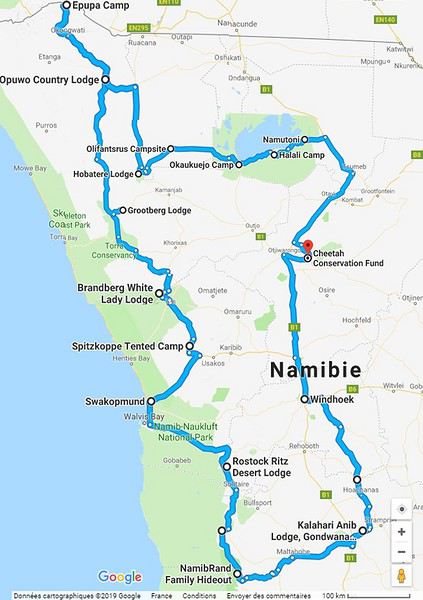
Alright! Are you ready to follow this adventure with us in our Hilux?
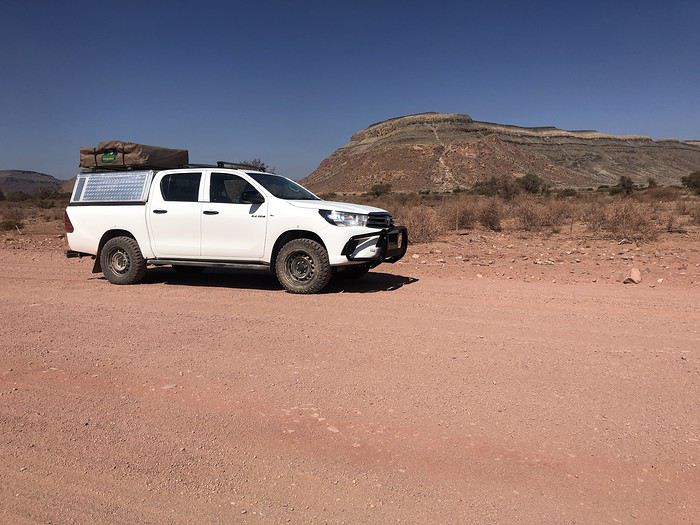
Yep! You guessed it—we stepped way out of our comfort zone during this trip.
I had quite a few doubts while planning this adventure, but the more I read travel journals about Namibia, the more I wanted to go.
Personally, without this forum, I never would’ve dared to hit the Namibian roads in a 4x4. I was really anxious during the planning, so I want to thank everyone who contributed with their journals and forum discussions for helping me leave more peacefully.
At first, I wasn’t even considering sleeping in a tent. But after my husband’s persuasion—and my own curiosity to experience what I’d read in those travel journals—I gave in. So off we went in a double-cab Hilux with a rooftop tent.
And of course, let’s talk about me—the big cold-weather wimp. One of the biggest pre-trip challenges was choosing a sleeping bag. After a while, sleeping bags had no more secrets for me: temperature ratings (comfort, limit, extreme), shapes (mummy, rectangular), fillings (synthetic, down), compression rate, and weight... all these factors were a real puzzle. In the end, to make sure I wouldn’t be put off camping in winter (Australian winter, mind you), I went for a sleeping bag with a comfort rating of -10°C. And just to be *extra* sure I wouldn’t get cold, I bought a liner (never knew what that was before) in Thermolite, which boosts the sleeping bag’s temperature by 11°C. There are liners that add up to 15°C, but let’s not exaggerate—we’re not heading to the North Pole! My husband, on the other hand, got a sleeping bag with a -5°C comfort rating and a silk liner.
Was it enough? You’ll find out soon. In the meantime, another big thank you to everyone who helped me make this choice with their advice and experience.
Over a year in advance, we planned a three-week itinerary for our first trip to Namibia—classic route, nothing too out there. We chose to do the circuit clockwise because we wanted to finish on a high note in Etosha and its wildlife. They say it’s like Noah’s Ark out there! And why not, the cherry on top... some big cats.
We used Tourmaline’s services to book our accommodations and the 4x4.
Here’s our planned itinerary with campsites and lodgings—yes, there are a few solid roofs in there; we didn’t want to push it too far.
Day 1: Windhoek – Windhoek Gardens Guesthouse Day 2: Kalahari Anib Campsite Day 3: Namibrand Family Hideout Day 4: Sesriem Camp Day 5: Sesriem Camp Day 6: Rostock Ritz Camp Day 7: Swakopmund - Sea Breeze Guesthouse Day 8: Swakopmund - Sea Breeze Guesthouse Day 9: Spitzkoppe Camp Tented Day 10: Brandberg White Lady Campsite Day 11: Grootberg Lodge Day 12: Opuwo Country Campsite Day 13: Epupa Camp Day 14: Hobatere Lodge Day 15: Etosha Olifantsrus Camp Day 16: Etosha Okaukuejo Camp Day 17: Etosha Halali Camp Day 18: Etosha Namutoni Camp Day 19: Cheetah Eco Lodge Day 20: Windhoek – Londiningi B&B
Alright! Are you ready to follow this adventure with us in our Hilux?
Découvrir le Rwanda à pied et en bus
Bonjour, je viens de prendre mes billets pour le Rwanda du 25 novembre au 11 décembre prochain. L'idée est de découvrir le pays le plus possible à pied ou avec les transports locaux. J'ai l'impression que les accès aux parcs nationaux sont tous payants (chers) à la journée. Y-a-t-il moyen de randonner plusieurs jours en itinérant dans certains d'entre eux ? Peut-on se débrouiller pour y accéder avec les transports en commun ou faut-il passer par d'autres solutions ? Taxis ou location de voiture ? D'une manière générale, je suis preneur de tous les tuyaux qui pourraient m'être utiles ! Merci d'avance. Patrick
Récidive en Afrique australe: deux semaines au Malawi en juillet 2016
Prologue
Il n’y a pas beaucoup de carnets sur ou autour ou même incluant le Malawi. Donc, je pose ma pierre. Si à votre tour vous décidez d'y aller, n'hésitez pas à me contacter. Mais peut être que quand vous aurez fini de lire ce carnet, vous n'aurez pas du tout envie d'y aller. Dans ce cas, vous n'êtes pas obligé de me contacter, mais rien ne vous en empêche, surtout si vous être sympas.
J'ai écrit ce carnet peu après mon retour, puis j'ai beaucoup trainé à le publier, beaucoup trop... J'allais laisser tomber et finalement, je me suis dit que c'était dommage. Alors voilà...
Tout a commencé… en Islande. Ou plutôt, non. Tout a commencé en cherchant une destination pour 15 jours cet été. Et nous avions opté pour… l’Islande. Pourquoi l’Islande ? Mais pardi, parce que la Namibie nous avait beaucoup plu. Et c’est très habituel, amis forumistes. Regardez bien le site et vous verrez que tous ceux qui ont adoré la Namibie vont en Islande… et adorent l’Islande. Beaucoup de ceux qui ont publié un carnet sur la Namibie en publient un sur l’Islande dans les années qui suivent. Et bien justement, nous avions publié un carnet sur la Namibie. Donc, nous programmons des vacances en Islande. Les enfants nous abandonnent. L’ainée travaille cet été (dure existence) et la cadette nous explique sans vergogne que passer 15 jours avec nous comme seuls être humains, au milieu d’un désert de roches et de lave battu par les vents, c’est juste pas possible. Faites des enfants… On cherche un 4x4, on monte le budget. C’est cher… Et là, ma moitié me dit : euh, mais toutes les photos de l’Islande, en vrai, le ciel, il est gris. En quand il est bleu, la photo est accompagnée d’un commentaire du genre : « j’ai eu de la chance », « journée exceptionnelle », « un été exceptionnel aux dires des Islandais », « nous ne verrons pas deux fois le ciel comme ça », « dix minutes après, il pleuvait », « ce furent les 5 minutes de beau temps de nos vacances »… Et il y a beaucoup de vent et puis sérieux, passer l’été en combinaison de ski, bof, bof. Ah, ouais. Pourquoi on n’irait pas en Afrique ?
Tiens, mais quelle bonne idée. Rétrospectivement, on n’a pas eu tort : cet été, l’Islande a accueilli 1 million de touristes, soit trois fois sa population. Retour à l’Afrique : on élimine tous les pays méditerranéens puisque ce n’était pas l’objectif (ça en déjà fait pas mal), ceux qui craignent à cause du terrorisme, de l’insécurité extrême ou des deux (un honnête paquet), ceux à propos desquels notre culpabilité nous interdit encore aujourd’hui d’aller (je pense au Rwanda), ceux où on est déjà allé, ceux qui ressemblent un peu trop à ceux où on est déjà allé et ceux où la saison des pluies tombe en juillet-août. De fil en aiguille, on en retient deux : le Malawi et le Mozambique. Problème pour le second : nous ne parlons pas 3 mots de portugais ça va sérieusement compromettre les rapports humains. Et nous, on aime bien se poser avec les gens qu’on rencontre et tailler le bout de gras. Et puis, on aime bien l’Afrique anglophone… Donc, ce sera le Malawi, entre autres en raison de la présence d’un grand lac africain : nous n’en avions jamais vu. En vrai, on aurait pu et même dû discuter l’Ouganda, mais le Lonely Planet d’Ouganda ou d’Afrique de l’Est n’avaient jamais trop trainé dans nos toilettes, épicentre de la créativité en matière de voyages. Alors voilà pourquoi le Malawi.
Le forum regroupe peu d’informations à propose du Malawi. C’est aussi le cas des autres forums de voyage francophones. Le Malawi n’est pas sur les routes des voyageurs français. Dites simplement à vos amis ou collègues que vous allez au Malawi et leur réponse sera : hein ? C’est où ? En revanche, le Malawi est bien connu des anglophones et notamment des anglais. Au sein du Commonwealth, le Malawi est une forme d’archétype du pays émergeant, et par conséquent l’endroit où se projettent un nombre considérable d’ONG en tout genre, pour le meilleur et pour le pire. Les ressources pour organiser le voyage, c’est sur les sites anglais et sud-africains. Le guide Bradt est, comme bien souvent, de très bon niveau. Je me suis mis à bien apprécier ces guides Bradt, finalement plus détaillés que le Lonely et pas beauf pour un sou (contrairement à tu-sais-qui). Un vol Paris-Amsterdam-Nairobi-Lilongwe sur Kenya Airways. Pas de loueurs de voitures « internationaux » sur place. Quelques petits loueurs, mais pas tant que ça. SS Rent-a-Car retient notre attention. Comme on va faire de la piste, il nous faut un 4x4. Et comme nous ne sommes que deux, nous choisissons un Jimny. Ce fut peut être une erreur car les pistes du Malawi sont vites de mauvaise qualité (sans comparaison avec les gravels namibiennes) et un bon gros Hilux n’aurait pas été du luxe. Disons que, au Malawi, la plupart des routes sont goudronnées. Mais celles qui ne le sont pas sont souvent en mauvais état. Après, les pistes, c’est comme temps, leur condition change vite. Le Jimny, ce fut un peu fatigant pour le dos, les bras, les fesses… Sans compter un peu moins de stabilité. On avait pensé camper et cherché un 4x4 avec rooftop tent, mais ce n’était pas simple à trouver, mais faisable en fin de compte. Quelques hôtels et lodges « clés » sont réservés aux mois de mai et juin. A posteriori, c’était pas trop la peine de s’y prendre bien en avance : beaucoup d’hébergements étaient très vides. Les visas… parlons des visas. Depuis 2015, les français ont besoin d’un visa pour le Malawi, qui a besoin de devises. Normalement, ce visa peut être pris à un post frontière, comme un aéroport international. Je contacte donc le service consulaire de l’ambassade du Malawi à Bruxelles (il n’y en a pas à Paris, preuve des intenses relations diplomatiques entre la France et le Malawi) : ah, mais Mister, il vous faut absooooolument un visa avant votre départ, et ça se fait très simplement par la poste. Mon passeport par la poste ? Ben oui l’ami (notez que la plupart des transporteurs privés refusent de convoyer un passeport. Bon, alors là, je me suis grave dégonflé : j’ai dégainé les euros et suis passé par une boite spécialisé. Pourtant, j’ai fait mes visas pour la Russie (yes), l’I… (re-yes) et la Chine (re-re-yes, mais en fait très simple) tout seul. Mais sérieux, le coup de la poste, je ne le sens pas. Pour info, ça a pris presque trois semaines contre deux annoncées… Ah oui, et pour tout vous dire, à l’arrivée à l’aéroport, de nombreux visiteurs (c’est que nous étions bien dix) faisaient établir leur visa à l’arrivée. Gromfff…
Et voilà à quoi ressemble l’itinéraire que nous envisageons, les horaires ont été calculés sur T4A.
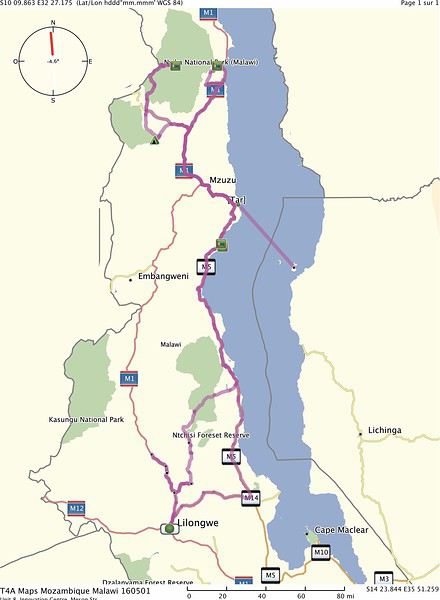
La suite, bientôt...
J'ai écrit ce carnet peu après mon retour, puis j'ai beaucoup trainé à le publier, beaucoup trop... J'allais laisser tomber et finalement, je me suis dit que c'était dommage. Alors voilà...
Tout a commencé… en Islande. Ou plutôt, non. Tout a commencé en cherchant une destination pour 15 jours cet été. Et nous avions opté pour… l’Islande. Pourquoi l’Islande ? Mais pardi, parce que la Namibie nous avait beaucoup plu. Et c’est très habituel, amis forumistes. Regardez bien le site et vous verrez que tous ceux qui ont adoré la Namibie vont en Islande… et adorent l’Islande. Beaucoup de ceux qui ont publié un carnet sur la Namibie en publient un sur l’Islande dans les années qui suivent. Et bien justement, nous avions publié un carnet sur la Namibie. Donc, nous programmons des vacances en Islande. Les enfants nous abandonnent. L’ainée travaille cet été (dure existence) et la cadette nous explique sans vergogne que passer 15 jours avec nous comme seuls être humains, au milieu d’un désert de roches et de lave battu par les vents, c’est juste pas possible. Faites des enfants… On cherche un 4x4, on monte le budget. C’est cher… Et là, ma moitié me dit : euh, mais toutes les photos de l’Islande, en vrai, le ciel, il est gris. En quand il est bleu, la photo est accompagnée d’un commentaire du genre : « j’ai eu de la chance », « journée exceptionnelle », « un été exceptionnel aux dires des Islandais », « nous ne verrons pas deux fois le ciel comme ça », « dix minutes après, il pleuvait », « ce furent les 5 minutes de beau temps de nos vacances »… Et il y a beaucoup de vent et puis sérieux, passer l’été en combinaison de ski, bof, bof. Ah, ouais. Pourquoi on n’irait pas en Afrique ?
Tiens, mais quelle bonne idée. Rétrospectivement, on n’a pas eu tort : cet été, l’Islande a accueilli 1 million de touristes, soit trois fois sa population. Retour à l’Afrique : on élimine tous les pays méditerranéens puisque ce n’était pas l’objectif (ça en déjà fait pas mal), ceux qui craignent à cause du terrorisme, de l’insécurité extrême ou des deux (un honnête paquet), ceux à propos desquels notre culpabilité nous interdit encore aujourd’hui d’aller (je pense au Rwanda), ceux où on est déjà allé, ceux qui ressemblent un peu trop à ceux où on est déjà allé et ceux où la saison des pluies tombe en juillet-août. De fil en aiguille, on en retient deux : le Malawi et le Mozambique. Problème pour le second : nous ne parlons pas 3 mots de portugais ça va sérieusement compromettre les rapports humains. Et nous, on aime bien se poser avec les gens qu’on rencontre et tailler le bout de gras. Et puis, on aime bien l’Afrique anglophone… Donc, ce sera le Malawi, entre autres en raison de la présence d’un grand lac africain : nous n’en avions jamais vu. En vrai, on aurait pu et même dû discuter l’Ouganda, mais le Lonely Planet d’Ouganda ou d’Afrique de l’Est n’avaient jamais trop trainé dans nos toilettes, épicentre de la créativité en matière de voyages. Alors voilà pourquoi le Malawi.
Le forum regroupe peu d’informations à propose du Malawi. C’est aussi le cas des autres forums de voyage francophones. Le Malawi n’est pas sur les routes des voyageurs français. Dites simplement à vos amis ou collègues que vous allez au Malawi et leur réponse sera : hein ? C’est où ? En revanche, le Malawi est bien connu des anglophones et notamment des anglais. Au sein du Commonwealth, le Malawi est une forme d’archétype du pays émergeant, et par conséquent l’endroit où se projettent un nombre considérable d’ONG en tout genre, pour le meilleur et pour le pire. Les ressources pour organiser le voyage, c’est sur les sites anglais et sud-africains. Le guide Bradt est, comme bien souvent, de très bon niveau. Je me suis mis à bien apprécier ces guides Bradt, finalement plus détaillés que le Lonely et pas beauf pour un sou (contrairement à tu-sais-qui). Un vol Paris-Amsterdam-Nairobi-Lilongwe sur Kenya Airways. Pas de loueurs de voitures « internationaux » sur place. Quelques petits loueurs, mais pas tant que ça. SS Rent-a-Car retient notre attention. Comme on va faire de la piste, il nous faut un 4x4. Et comme nous ne sommes que deux, nous choisissons un Jimny. Ce fut peut être une erreur car les pistes du Malawi sont vites de mauvaise qualité (sans comparaison avec les gravels namibiennes) et un bon gros Hilux n’aurait pas été du luxe. Disons que, au Malawi, la plupart des routes sont goudronnées. Mais celles qui ne le sont pas sont souvent en mauvais état. Après, les pistes, c’est comme temps, leur condition change vite. Le Jimny, ce fut un peu fatigant pour le dos, les bras, les fesses… Sans compter un peu moins de stabilité. On avait pensé camper et cherché un 4x4 avec rooftop tent, mais ce n’était pas simple à trouver, mais faisable en fin de compte. Quelques hôtels et lodges « clés » sont réservés aux mois de mai et juin. A posteriori, c’était pas trop la peine de s’y prendre bien en avance : beaucoup d’hébergements étaient très vides. Les visas… parlons des visas. Depuis 2015, les français ont besoin d’un visa pour le Malawi, qui a besoin de devises. Normalement, ce visa peut être pris à un post frontière, comme un aéroport international. Je contacte donc le service consulaire de l’ambassade du Malawi à Bruxelles (il n’y en a pas à Paris, preuve des intenses relations diplomatiques entre la France et le Malawi) : ah, mais Mister, il vous faut absooooolument un visa avant votre départ, et ça se fait très simplement par la poste. Mon passeport par la poste ? Ben oui l’ami (notez que la plupart des transporteurs privés refusent de convoyer un passeport. Bon, alors là, je me suis grave dégonflé : j’ai dégainé les euros et suis passé par une boite spécialisé. Pourtant, j’ai fait mes visas pour la Russie (yes), l’I… (re-yes) et la Chine (re-re-yes, mais en fait très simple) tout seul. Mais sérieux, le coup de la poste, je ne le sens pas. Pour info, ça a pris presque trois semaines contre deux annoncées… Ah oui, et pour tout vous dire, à l’arrivée à l’aéroport, de nombreux visiteurs (c’est que nous étions bien dix) faisaient établir leur visa à l’arrivée. Gromfff…
Et voilà à quoi ressemble l’itinéraire que nous envisageons, les horaires ont été calculés sur T4A.
La suite, bientôt...
Troisième séjour en Tanzanie, avec la même agence locale
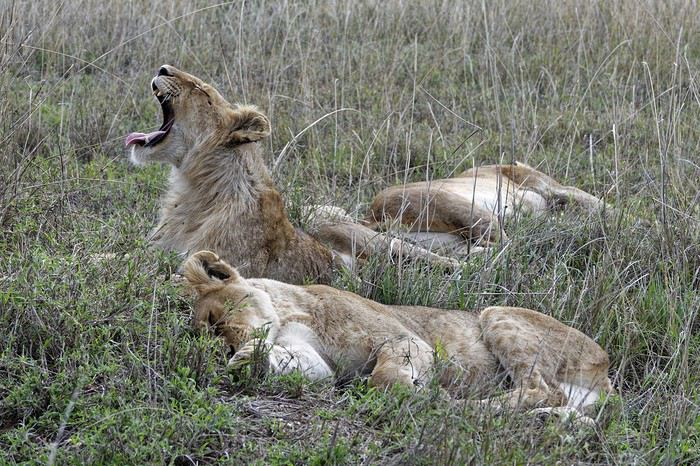 Qu’est-ce qui m’attire autant dans ce pays, au point d’y être allé trois fois (2013 – 2015 – 2018), alors que je ne reviens jamais sur mes pas habituellement ?
Il est presque impossible de l’expliquer à qui ne s’est jamais trouvé devant un léopard guettant l’horizon sur sa branche-observatoire, ou devant des lionceaux joueurs, ou encore face à un groupe de girafes qui marchent au pas, dans un mouvement d’une élégance incomparable… J’en ai des frissons rien que d’y repenser… Je sens bien que ces voyages sont plus intenses que tous les autres, comme un retour vers l’essentiel, qu’ils me bouleversent, qu’ils m’aspirent, m’enveloppent dans cette nature vierge fascinante. Je me sens invité par elle, comme si elle voulait bien me laisser une toute petite place à condition de témoigner en retour de sa beauté et de l’importance de sa biodiversité, en effet gage de survie de l’humanité.
Qu’est-ce qui m’attire autant dans ce pays, au point d’y être allé trois fois (2013 – 2015 – 2018), alors que je ne reviens jamais sur mes pas habituellement ?
Il est presque impossible de l’expliquer à qui ne s’est jamais trouvé devant un léopard guettant l’horizon sur sa branche-observatoire, ou devant des lionceaux joueurs, ou encore face à un groupe de girafes qui marchent au pas, dans un mouvement d’une élégance incomparable… J’en ai des frissons rien que d’y repenser… Je sens bien que ces voyages sont plus intenses que tous les autres, comme un retour vers l’essentiel, qu’ils me bouleversent, qu’ils m’aspirent, m’enveloppent dans cette nature vierge fascinante. Je me sens invité par elle, comme si elle voulait bien me laisser une toute petite place à condition de témoigner en retour de sa beauté et de l’importance de sa biodiversité, en effet gage de survie de l’humanité.Un voyage en Tanzanie est bouleversant. La vie et la mort y font bon ménage. On est témoin de scènes qui ne trichent pas, qui interpellent et renvoient à nos propres modes de vie en société et à bien des questions philosophiques… Ce serait trop long de développer…
Après avoir visité le nord de la Tanzanie une première fois, puis le sud, je suis donc retourné dans les parcs du nord pour faire un safari-photo d’amateur. Je n’ai pas de matériel professionnel (j’ai juste un bridge Sony RX10 IV) ni d’objectifs longs comme le bras ! Je savais qu’avec mon agence locale habituelle (Hotsun safaris), les conditions seraient réunies et qu’elle ferait ce qu’il faut pour nous approcher au mieux des animaux sans les déranger et qu’elle prendrait toutes les précautions pour m’aider dans la prise de photos (arrêt systématique du moteur, orientation du soleil, temps d’attente, etc.). Alors j’ai repris un billet et je suis arrivé à l’aéroport Kilimandjaro, via une escale à Addis-Ababa en Éthiopie (Ethiopian Airlines). Edgar le guide, Andréa le chauffeur et Ally le directeur de l’agence m’attendaient. Une heure plus tard, j’étais dans le parc d’Arusha…
Avertissement : je raconte mon voyage en détail sur un blog que j’ai réalisé pour ma famille et mes amis. J’y décris les hôtels, les parcs, les distances, les prix, les saisons, l’agence… et bien sûr je présente également une galerie de photos. Je vous y invite, d’autant que je suis tout à fait disposé à répondre à vos propres questions (dans la limite de mes expériences), car je me sens presque redevable : ce pays m’a donné de tels instants de bonheur que j’ai envie de les faire partager au plus grand nombre et, qui sait, à donner à quelques-uns d’entre vous l’envie de faire le pas et d’embarquer pour Kilimandjaro… L’adresse de mon site www.christiantanzanie.jimdofree.comQui suis-je ? Un français de 66 ans, plutôt « père tranquille » dans la vie quotidienne, mais toujours prêt à voyager !
Pour ceux qui n’ont pas le temps d’aller sur mon site, voici mon parcours en résumé et quelques conseils. Jour 1 : parc d’Arusha Jour 2 : parc du Tarangire Jour 3 et 4 : parc du Serengeti Jour 5 : Ngorongoro Jour 6 : parc de Manyara
Le parc d’Arusha : forêt tropicale, les animaux se cachent et ne sont pas faciles à voir. On peut y faire des randonnées (accompagnées par un ranger armé !) : plus efficace pour voir les animaux et la végétation est stupéfiante… (suite sur mon site)
Le parc du Tarangire : mon préféré ! En peu de temps, on peut observer beaucoup d’animaux dans un paysage splendide parsemé d’acacias et de baobabs. Ici, c’est le royaume des éléphants, tant ils sont nombreux…
Le parc du Serengeti : l’opposé des autres. Aussi grand que la Slovénie, cette immensité plate est recouverte de grandes herbes et parfois entièrement dénudée, sol sablonneux durci par le temps. C’est la savane, les animaux se sont adaptés à ces conditions de vie très insécurisées. Ce territoire est le royaume des lions. Il se mérite, car son accès est difficile et le « massage africain » (comme disent les autochtones) est une réalité qui peut être difficile à vivre pour les personnes qui ont mal au dos tant les kilomètres sont nombreux. Pour les autres, ce territoire est fascinant et mérite vraiment le difficile déplacement. Il est absolument nécessaire d’y passer au moins deux nuits, tant les points d’intérêts sont nombreux. En un mois, on n’en ferait pas le tour !...
Le cratère du Ngorongoro : c’est l’arche de Noé ! Protégés par les parois du cratère d’une hauteur de 600 m, les animaux (en apparence) vivent en paix. C’est la douceur qui prévaut dans ce paysage où l’on côtoie antilopes, lions, éléphants, hyènes et zèbres à quelques mètres les uns des autres. Quelques rhinos (bien cachés) y séjournent également…
Le parc de Manyara :imaginez un lac immense entouré d’une langue de terre, plate et marécageuse, elle-même entourée d’une forêt tropicale. Ce parc est mon coup de cœur (c’est la première fois que je le visite), car on va de surprise en surprise. On est d’abord accueilli par une foule de singes, de nombreuses espèces emblématiques de la Tanzanie rythment le chemin du visiteur, que l’on soit à pied (randonnées possibles) ou en 4x4.
Après expérience, je suggère de visiter TOUS ces parcs, à l’exception peut-être de celui d’Arusha, mais en organisant l’itinéraire différemment. À la sortie de l’avion, foncez au parc Manyara, dépaysement garanti, mise en conditions immédiate. Puis, le Serengeti, car il est son opposé et c’est celui qui est le plus loin. Le retour passe obligatoirement par le Ngorongoro. Finir par le Tarangire (deux jours), c’est le feu d’artifice, le point d’orgue…
La Tanzanie est une destination qui coûte cher. Le gouvernement impose des tarifs d’accès aux parcs… étonnants ! Une entrée est plus chère que le Futuroscope. Les hôtels, et même le camping, suivent la même courbe inflationniste : l’un des établissements fréquentés en 2013 coûtait 240 $ (par personne !) par jour en pension complète en 2018 il coûte 500 $, inaccessible ! Le mode d’hébergement et le choix des sites (à l’intérieur ou à l’extérieur des parcs) peuvent modifier considérablement le montant de la facture. Il faut bien discuter avec l’agence, expliquer ses besoins (camping, lodge, vous voulez une douche avec de l’eau chaude ?...), donner ses limites et… bien choisir l’agence locale : on dit qu’il y en a plus de 6000 ! N’ayant jamais eu le moindre problème avec la mienne, je peux vous indiquer leurs coordonnées. Petite entreprise familiale née il y a une vingtaine d’années, l’équipe est professionnelle, sérieuse et compétente, un rapport qualité-prix exceptionnel. Je peux répondre à toutes vos questions (dans la limite de mes trois expériences !), soit sur ce forum, soit en m’écrivant sur mon blog christiantanzanie.jimdofree.com Les Français ne pensent pas forcément à la Tanzanie comme destination de vacances. Pourtant, elle est fascinante, bouleversante et l’on en revient avec une seule envie : y retourner au plus vite. Hakuna matata !
Trois semaines en "self drive" en Tanzanie
Bonjour,
Nous aimerions partir en couple au mois de Septembre ou Octobre prochain en Tanzanie pour une durée de 3 semaines, Nous avons fait un safari en Namibie avec location de 4x4 et hébergements en lodge il y a une dizaine d'années avec nos enfants et souhaiterions renouveler l'experience, La Tanzanie est semble t-il plus difficile à découvrir en self drive ? j'ai malgré tout vu des récits dans ce sens :) Si cela est trop compliqué nous ferons appel à un chauffeur ... Je me pose la question tente sur le toit ou lodge (les nuits sont fraiches en afrique :() ou un mix des 2, Je pense qu'il est préférable que l'on se concentre sur la région nord évitant ainsi trop de longs déplacements D'après ce que j'ai pu voir les indispensables sont : ngorongoro, seregenti, tarangine, pour le reste c'est encore flou ... On voudrait ne pas avoir à bouger chaques jours afin de prendre notre temps et finir par quelques jours au bord de mer : zanzibar, mafia ou pemba ? Je vais me plonger dans le lonely planet :) Vos avis sont les bienvenues, Bonne soirée,
Nathalie
Nous aimerions partir en couple au mois de Septembre ou Octobre prochain en Tanzanie pour une durée de 3 semaines, Nous avons fait un safari en Namibie avec location de 4x4 et hébergements en lodge il y a une dizaine d'années avec nos enfants et souhaiterions renouveler l'experience, La Tanzanie est semble t-il plus difficile à découvrir en self drive ? j'ai malgré tout vu des récits dans ce sens :) Si cela est trop compliqué nous ferons appel à un chauffeur ... Je me pose la question tente sur le toit ou lodge (les nuits sont fraiches en afrique :() ou un mix des 2, Je pense qu'il est préférable que l'on se concentre sur la région nord évitant ainsi trop de longs déplacements D'après ce que j'ai pu voir les indispensables sont : ngorongoro, seregenti, tarangine, pour le reste c'est encore flou ... On voudrait ne pas avoir à bouger chaques jours afin de prendre notre temps et finir par quelques jours au bord de mer : zanzibar, mafia ou pemba ? Je vais me plonger dans le lonely planet :) Vos avis sont les bienvenues, Bonne soirée,
Nathalie
Retour de Tanzanie: Kilimandjaro, safari, Zanzibar
Bonjour,
La destination ne se prête pas à un carnet détaillé mais mérité bien une synthèse des informations pratiques.
Nous sommes partis en couple (la trentaine) en Juin 2018 pour réaliser le circuit suivant :
Ascension de Kilimandjaro via la voie Machame en 7 jours Safari dans les parcs du Tarangire (2 nuits), Serengeti (3 nuits), Cratère du Ngorongoro (1 nuit) Zanzibar (4 nuits à Jambiani et 1 nuit à Stone Town)
Kilimandjaro Je vous recommande vraiment de le faire en 7 jours. Sinon la journée avant l'ascension finale de nuit est vraiment trop longue. Nous ne sommes pas des grands sportifs. Avant de partir, nous avions couru une heure /semaine pendant 6 mois. Egalement, 2 randonnées à la journée en Ile-de-France : La Bossapas et les 25 Bosses. Notre unique expérienc en terme de trekking était le Salkantay au Pérou. Nous avons douté à 2 moments : le troisième jour où on arrive pour la première fois à 4 600m à la Lava Tower et lors de l'ascension finale où nous avons pas eu de chance niveau conditions (beaucoup de neige qui rend la montée encore plus difficile).
Safari Malgré la journée de pose après le safari, j'ai trouvé cela assez fatiguant. Surtout que nous l'avons fait en mode camping. je ne m'attendais pas à voir autant d'animaux et surtout d'aussi près. Si c'était à refaire, nous réduirons d'une journée le safari au Senrengeti mais nous avons eu beaucoup de chance. Nous avons pu voir énormément de lions, des léopards, des guépards et même un rhino. Sans oublié la grande migration !
Zanzibar Idéal pour la détente en fin de voyage. Je vous recommande vraiment un hôtel avec piscine car avec les marées c'est assez contraignant. Le côté pénible c'est les beach boys qui proposent tous la même chose et au bout du dixième c'est fatiguant. Même à Jambiani qui est sensé être à l'écart du tourisme, ce n'est pas possible d'être épargné. Ne perdez pas trop de temps à Stone Town : c'est bien pour se promener une après-midi mais à part cela c'est surtout des successions de boutiques de souvenirs et des vendeurs un peu insistant mais pas agressifs.
Coût (pour 2 personnes)
1. Vols
Aller Paris-Kilimandjaro / Retour Zanzibar-Paris : 975€ avec la compagnie Emirates (courte escale à l'aller, plus longue au retour qui nous a donné la possibilité d'aller visiter rapidement Dubaï) Kilimandjaro-Zanzibar : 290€ avec la compagnie Precision Aiir
2. Ascension du Kilimanjaro + Safari 7 jours : 6400$. Je laisse le prix en dollars pour que le taux de change n'influence pas. Cela inclus vraiment tout (hôtels avant et après soit 4 nuits, la récupération et la dépose aux aéroports, les repas, les frais d'entrées, etc.)
3. Pourboires
Kilimandjaro : 900$ Safari : 230$
4. Visa : 100$
5. Hôtels : 335€. Il s'agit des 5 nuits à Zanzibar. le reste étant pris en charge par l'agence
Soit un total de 8 000€ si on inclus les autres frais non listés (transport à Zanzibar, repas, etc.)
N'hésitez pas si vous avez des questions.
La destination ne se prête pas à un carnet détaillé mais mérité bien une synthèse des informations pratiques.
Nous sommes partis en couple (la trentaine) en Juin 2018 pour réaliser le circuit suivant :
Ascension de Kilimandjaro via la voie Machame en 7 jours Safari dans les parcs du Tarangire (2 nuits), Serengeti (3 nuits), Cratère du Ngorongoro (1 nuit) Zanzibar (4 nuits à Jambiani et 1 nuit à Stone Town)
Kilimandjaro Je vous recommande vraiment de le faire en 7 jours. Sinon la journée avant l'ascension finale de nuit est vraiment trop longue. Nous ne sommes pas des grands sportifs. Avant de partir, nous avions couru une heure /semaine pendant 6 mois. Egalement, 2 randonnées à la journée en Ile-de-France : La Bossapas et les 25 Bosses. Notre unique expérienc en terme de trekking était le Salkantay au Pérou. Nous avons douté à 2 moments : le troisième jour où on arrive pour la première fois à 4 600m à la Lava Tower et lors de l'ascension finale où nous avons pas eu de chance niveau conditions (beaucoup de neige qui rend la montée encore plus difficile).
Safari Malgré la journée de pose après le safari, j'ai trouvé cela assez fatiguant. Surtout que nous l'avons fait en mode camping. je ne m'attendais pas à voir autant d'animaux et surtout d'aussi près. Si c'était à refaire, nous réduirons d'une journée le safari au Senrengeti mais nous avons eu beaucoup de chance. Nous avons pu voir énormément de lions, des léopards, des guépards et même un rhino. Sans oublié la grande migration !
Zanzibar Idéal pour la détente en fin de voyage. Je vous recommande vraiment un hôtel avec piscine car avec les marées c'est assez contraignant. Le côté pénible c'est les beach boys qui proposent tous la même chose et au bout du dixième c'est fatiguant. Même à Jambiani qui est sensé être à l'écart du tourisme, ce n'est pas possible d'être épargné. Ne perdez pas trop de temps à Stone Town : c'est bien pour se promener une après-midi mais à part cela c'est surtout des successions de boutiques de souvenirs et des vendeurs un peu insistant mais pas agressifs.
Coût (pour 2 personnes)
1. Vols
Aller Paris-Kilimandjaro / Retour Zanzibar-Paris : 975€ avec la compagnie Emirates (courte escale à l'aller, plus longue au retour qui nous a donné la possibilité d'aller visiter rapidement Dubaï) Kilimandjaro-Zanzibar : 290€ avec la compagnie Precision Aiir
2. Ascension du Kilimanjaro + Safari 7 jours : 6400$. Je laisse le prix en dollars pour que le taux de change n'influence pas. Cela inclus vraiment tout (hôtels avant et après soit 4 nuits, la récupération et la dépose aux aéroports, les repas, les frais d'entrées, etc.)
3. Pourboires
Kilimandjaro : 900$ Safari : 230$
4. Visa : 100$
5. Hôtels : 335€. Il s'agit des 5 nuits à Zanzibar. le reste étant pris en charge par l'agence
Soit un total de 8 000€ si on inclus les autres frais non listés (transport à Zanzibar, repas, etc.)
N'hésitez pas si vous avez des questions.