Results for "Saint-Louis+|+101+>+78"
82344 results found.
Hôtel pas cher en République Dominicaine? English translation pending
Salut a tous, je pars dans 5 j en rep dom, pour 17j, de santo domingo a cabarete, et je n ai trouve sur le net aucun hotel pas chers? Y a t il quelqu un pour m aider sur ce coups la?????J'offre ce trip a ma copine, mais je ne me voit pas payer un hotel 3 etoiles tous les soirs...Please help!
Lionel
Lionel
Hôtels et itinéraire au Québec? English translation pending
bonjour, 🙂
nous envisageons un séjour au Québec l'été prochain, nous serons 6 adultes; il y a une telle foule d'infos sur les sites ou les livres que nous consultons qu'il est bien difficile de se décider ! nous envisageons de louer une voiture bien sûr mais je voudrais savoir s'il est préférable de se déplacer quotidiennement ou si l'on peut rester qq jours à un même endroit et sillonner alentour ; les b&b me semblent sympas mais y a-t'il comme aux USA des motels partout ? (nous pensons rester 3 ou 4 semaines).
quelqu'un peut-il me donner des infos sur un expérience vécue à peu près identique ?
ah oui, une info importante : nous n'avons pas l'intention de dépenser un fric fou !
merci beaucoup pour vos réponses
mima
Bons plans pour le Québec English translation pending
Bonjour,
J'ai besoin de vos conseils, l'année prochaine je devrais normalement partir 4 mois au Québec, plus particulièrement à Rismouski à l'Uqar (de septembre à décembre). J'aimerais qu'on puisse me dire ce qu'il y a d'interressant à voir et à visiter dans la ville et dans la région ainsi que tous ce qui à faire (je précise que je n'ai aucun moyen de transport)ce qui est sûr c'est que je visiterais Montréal et Québec. Peut-on faire confiance à "allo-stop" (j'ai su qu'il y avait une agence dans la ville), comment cela marche-t-il, cela est-il sûr même si on voyage seule?? Où puis-je me loger sur Montréal et Québec de manière économique (est-il possible de louer une chambre à un particulier seulement pour 2 semaines? est-ce courant?...)
Merci !😉
J'ai besoin de vos conseils, l'année prochaine je devrais normalement partir 4 mois au Québec, plus particulièrement à Rismouski à l'Uqar (de septembre à décembre). J'aimerais qu'on puisse me dire ce qu'il y a d'interressant à voir et à visiter dans la ville et dans la région ainsi que tous ce qui à faire (je précise que je n'ai aucun moyen de transport)ce qui est sûr c'est que je visiterais Montréal et Québec. Peut-on faire confiance à "allo-stop" (j'ai su qu'il y avait une agence dans la ville), comment cela marche-t-il, cela est-il sûr même si on voyage seule?? Où puis-je me loger sur Montréal et Québec de manière économique (est-il possible de louer une chambre à un particulier seulement pour 2 semaines? est-ce courant?...)
Merci !😉
Carte routière du Turkmenistan et Ouzbekistan, infos diverses English translation pending
Bonjour,
En 2004 - septembre pour être précis - j'ai l'intention de me rendre avec mon amie à Boukhara, Samarkande en 2cv.
Je suis à la recherche de plusieurs informations. D'abord je voudrais envoyer ma voiture à Istambul par le train pour démarrer de là bas, la traversée de l'Europe ne me tentant plus trop. D'ailleurs cet été je vais à Istambul en descendant le long de la cote adriatique puis en repartant en remontant le long de la mer noire, puis Bucarest et Vienne.
Deuxièmement quelles sont les formalités pour la voiture au Turkmenistan et en Ouzbekistan.
Il s'agit d'une 2cv préparée raid -> renforts de chassis et de suspensions, moteur de visa, etc etc.
D'autre part toutes informations seront les bienvenues pour le trajet Istamboul, Bakou, Turkmenbashi ( par le ferry), Ashgabat, Mary, Chärjew, Boukhara, Samarkande.
De plus je cherche une carte routière du Turkmenistan et de l'Ouzbekistan.
Merci d'avance.
Vieux
En 2004 - septembre pour être précis - j'ai l'intention de me rendre avec mon amie à Boukhara, Samarkande en 2cv.
Je suis à la recherche de plusieurs informations. D'abord je voudrais envoyer ma voiture à Istambul par le train pour démarrer de là bas, la traversée de l'Europe ne me tentant plus trop. D'ailleurs cet été je vais à Istambul en descendant le long de la cote adriatique puis en repartant en remontant le long de la mer noire, puis Bucarest et Vienne.
Deuxièmement quelles sont les formalités pour la voiture au Turkmenistan et en Ouzbekistan.
Il s'agit d'une 2cv préparée raid -> renforts de chassis et de suspensions, moteur de visa, etc etc.
D'autre part toutes informations seront les bienvenues pour le trajet Istamboul, Bakou, Turkmenbashi ( par le ferry), Ashgabat, Mary, Chärjew, Boukhara, Samarkande.
De plus je cherche une carte routière du Turkmenistan et de l'Ouzbekistan.
Merci d'avance.
Vieux
Chine: Conseils sur la route de la soie (Kashgar-Pekin) English translation pending
🤪 🤪 🤪
nous preparons gros voyage sur la route de la soie a partir de l'ouzbekistan jusqu'a pekin pendant plusieurs mois.
nous aurions besoin de conseils et d'impressions en tous genres surtout sur la partie chinoise:de kashgar à pekin et de facon generale sur le xingkiang (nord ouest) et aussi sur le tibet .
merci d'avance
nous preparons gros voyage sur la route de la soie a partir de l'ouzbekistan jusqu'a pekin pendant plusieurs mois.
nous aurions besoin de conseils et d'impressions en tous genres surtout sur la partie chinoise:de kashgar à pekin et de facon generale sur le xingkiang (nord ouest) et aussi sur le tibet .
merci d'avance
3 weeks in Laos, stress-free
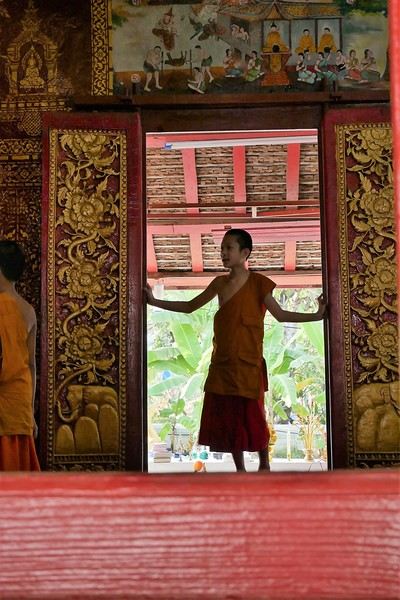 Come along, I'm taking you to this country where it's so nice to wander and slow down...
This trip was in 2023, but when I wanted to write my travel journal, VF was still closed to contributions... So, now that I've just finished my Japan travel journal here, I figured it was high time to honor this destination we came back from so enchanted. Disclaimer 1: This is a written travel journal. There’ll be text! Too much, for some! Disclaimer 2: This is an illustrated travel journal. There’ll be photos! Too many, for some!
I have to say, every time I try to discipline myself, to keep it shorter, to include fewer photos... I end up adding more. It feels like my dear Aunt Nicole, who exhausted us with her slide-show evenings in the 70s/80s, decided to take her revenge. The upside for you, readers, is that you can slip away anytime without offending Aunt Nicole. I won’t even notice!
Anyway, since I love maps, here’s one to give you an idea of where I’m taking you. As you can see, we only saw a tiny part of Laos (the areas circled in red); we only had 3 weeks for ourselves (my husband’s newly retired, I still work), and we prefer taking our time over rushing around like crazy.
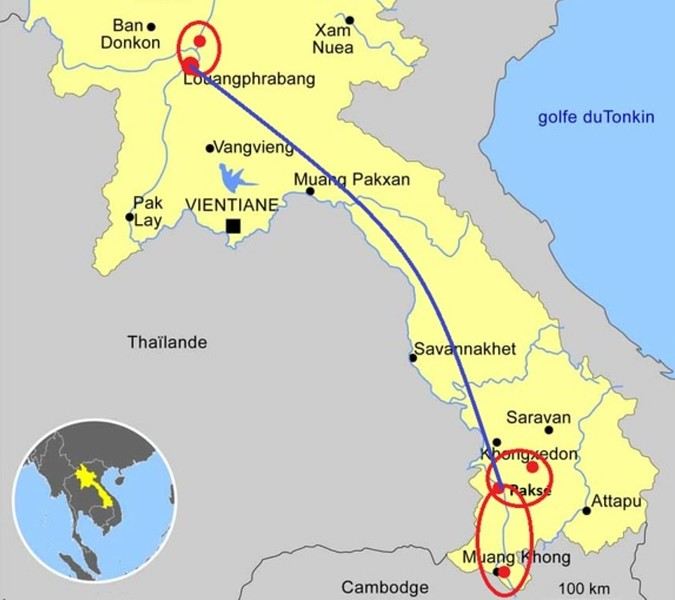
In broad strokes, it was very classic:
First, we “settled in” at Luang Prabang (8 days), because we wanted and needed to. From there, we took three days to venture a little further north—not far in kilometers, but as we know, distances aren’t just about km! Then we flew south to Paksé, letting ourselves drift down to the 4,000 Islands while stopping by the pre-Angkorian archaeological sites. We wrapped up with the Bolaven Plateau.
A few practical notes: We arrived via Bangkok, then took a Bangkok-Luang Prabang flight, having picked up our luggage in Bangkok to check it in for Luang Prabang. No issues—the Bangkok airport, which many of you know, is very well organized. We got our visas on arrival in Luang Prabang. Quick, but to be fair, we were on a “small” plane, and the big flights had arrived earlier, so we weren’t too crowded in line! At the end of our trip, we didn’t fly out of Paksé but from the nearby airport in Thailand, Ubon Ratchathani (a 2.5-hour drive from Paksé), then Bangkok and Paris. You’ll notice we skipped Vientiane to stay longer in Luang Prabang. That said, there’s now a high-speed train between Vientiane and Luang Prabang—good to know—and soon the (Chinese) train will go all the way to Bangkok and even Kuala Lumpur!
With that intro out of the way, let’s dive into the heart of the matter. To be continued: Slowing down the pace... in Luang Prabang
Single Russia-Belarus visa and new train routes
Since last year, the unification of the Russian visa with Belarus has been in effect.
For reference, EU citizens haven’t needed a visa for Belarus for two years. However, it wasn’t possible to travel to Russia. Only Belarusian and Russian citizens could move freely within the union.
With the unified system, if you enter one of the two countries with a visa from either, you can now travel between them freely.
In the case of a Russian visa, it must be a paper visa glued into your passport—not an electronic visa.
This opens up the possibility of traveling to Russia from Lithuania via Minsk, for example, starting from Vilnius.
It also allows for travel circuits that would otherwise be difficult, despite the proximity of the cities.
So, I’m leaving on June 12th for Vilnius. A one-hour flight for around thirty euros with a carry-on bag, and from Vilnius Airport, there’s a bus to Minsk. My planned route for now is Vilnius-Minsk-Smolensk-Vitebsk-Polotsk-Pskov-Riga.
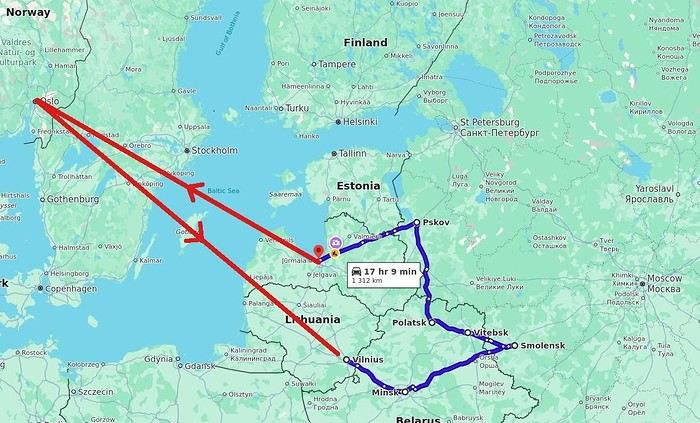
This crosses the Belarus-Russia border three times: from Minsk to Smolensk, then from Smolensk to Vitebsk, and finally from Polotsk to Pskov.
The region of this itinerary was, a thousand years ago, essentially that of the Krivichs, a local Slavic political entity. The term comes from "blood," *krew* in Polish, *krov* in Russian—basically "blood brothers." In Latvian, the word for Russians is *krievu*, by the way. Historically, the region corresponds to some of the old Russian principalities. Later, what marks Belarusian regions in general is, after the Great Schism of 1054, the division between Catholic and Orthodox zones, particularly as the Polish-Lithuanian Commonwealth expanded and contracted. In architecture, this corresponds to variations in Baroque styles, for example.
Vitebsk is known in France as the birthplace of Chagall. Born Russian, he first trained at the art school in Vitebsk, which was also attended by Malevich and Lissitzky, before completing his studies in Saint Petersburg, then moving to Berlin and later Paris. In Paris, Chagall met Cendrars, who had spent three years in Russia before and spoke enough Russian to help the newcomer get by a bit.
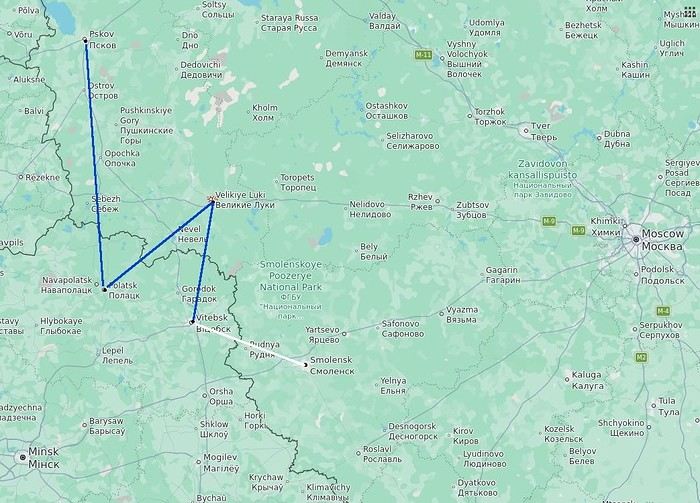
Back to the practical travel aspects: a local Pskov newspaper mentions that the Russian and Belarusian governments have a project for a Pskov-Polotsk train line. Previously, there were also plans for lines between Veliky Luki and Vitebsk, and Polotsk. A recently launched railway is Smolensk-Vitebsk, shown in white on the map, with projected lines in blue. https://pln-pskov.ru/society/583817.html https://pln-pskov.ru/society/578335.html
These will likely be "Hirondelle"—that is, *Lastochka*—the fast, spacious regional trains in Russia. Currently, all of this is done by bus, so the train is a very appealing and comfortable option. We’ll see how it goes.
With the unified system, if you enter one of the two countries with a visa from either, you can now travel between them freely.
In the case of a Russian visa, it must be a paper visa glued into your passport—not an electronic visa.
This opens up the possibility of traveling to Russia from Lithuania via Minsk, for example, starting from Vilnius.
It also allows for travel circuits that would otherwise be difficult, despite the proximity of the cities.
So, I’m leaving on June 12th for Vilnius. A one-hour flight for around thirty euros with a carry-on bag, and from Vilnius Airport, there’s a bus to Minsk. My planned route for now is Vilnius-Minsk-Smolensk-Vitebsk-Polotsk-Pskov-Riga.
This crosses the Belarus-Russia border three times: from Minsk to Smolensk, then from Smolensk to Vitebsk, and finally from Polotsk to Pskov.
The region of this itinerary was, a thousand years ago, essentially that of the Krivichs, a local Slavic political entity. The term comes from "blood," *krew* in Polish, *krov* in Russian—basically "blood brothers." In Latvian, the word for Russians is *krievu*, by the way. Historically, the region corresponds to some of the old Russian principalities. Later, what marks Belarusian regions in general is, after the Great Schism of 1054, the division between Catholic and Orthodox zones, particularly as the Polish-Lithuanian Commonwealth expanded and contracted. In architecture, this corresponds to variations in Baroque styles, for example.
Vitebsk is known in France as the birthplace of Chagall. Born Russian, he first trained at the art school in Vitebsk, which was also attended by Malevich and Lissitzky, before completing his studies in Saint Petersburg, then moving to Berlin and later Paris. In Paris, Chagall met Cendrars, who had spent three years in Russia before and spoke enough Russian to help the newcomer get by a bit.
Back to the practical travel aspects: a local Pskov newspaper mentions that the Russian and Belarusian governments have a project for a Pskov-Polotsk train line. Previously, there were also plans for lines between Veliky Luki and Vitebsk, and Polotsk. A recently launched railway is Smolensk-Vitebsk, shown in white on the map, with projected lines in blue. https://pln-pskov.ru/society/583817.html https://pln-pskov.ru/society/578335.html
These will likely be "Hirondelle"—that is, *Lastochka*—the fast, spacious regional trains in Russia. Currently, all of this is done by bus, so the train is a very appealing and comfortable option. We’ll see how it goes.
Storm in the Canary Islands
15 days across Gran Canaria, El Hierro, and a dash of Tenerife under the storm Thérèse!
The planned itinerary will be slightly disrupted...
(The version without discussions is here)
The planned itinerary will be slightly disrupted...
(The version without discussions is here)
My life in Camargue, my homeland, and in Colombia, my heart's country
My two bullfighting traditions when I'm back home in Camargue (France) and in Colombia (Caribbean) every time I return. 🤠
Details:
Bullfights (corridas) aren’t part of my two bullfighting traditions, but I respect those who attend them!!!
In these two ancestral bullfighting traditions—which aren’t bullfights—the Bulls and Toros aren’t killed or tortured, as some might think.
These are bull games where the animals return to their pastures afterward and only come back to the Arenas 2–3 times a year at most.
They spend 15 minutes in the ring for the Camarguais and 5 minutes for the Toros in the Colombian Corralejas.
They’re cared for and pampered. They’ll die of old age in miles of open fields.
The young people who face them are professionals, risking their lives to support their families and live their Passion for the Toro!!! 😄
https://youtu.be/yYKQer42HoQ
Colombian Corraleja in the link below (hope it works) 🤪
https://fb.watch/BMfmuCgQpG/
Preparing for Quebec: 1 month with the family
Hello everyone,
We’ve decided to head to Quebec next year—it’s been a dream for the whole family (after watching so many travel shows and the like...). There’ll be five of us: 2 adults, 2 teens (16 and 13), and a child (8 years old). We’re all pretty good walkers, though maybe the teens a little less so—it’s just that age, you know? 😊 That said, they’ve got no problem doing 15 km hikes, just not every single day.
We’re planning to go from July 23 to August 14, arriving and departing from Montreal, so almost 3 weeks. I’ve started looking into logistics and accommodation prices, but before I dive into bookings, I’d love some advice on the itinerary. I’ve read a few threads here and there. Our idea is to visit between 3 and 5 different places over the 3 weeks, so that means the same number of accommodations. The goal is to optimize travel as much as possible—I’ve realized that getting around can take a long time. I think the first two days will be in Montreal to adjust to the time difference, and the last two in Quebec City, though that’s not set in stone.
Anyway, I’m not really sure about the route. I’ve got time to plan everything, but I know the longer we wait, the more expensive and scarce accommodations will get. Same goes for budget—we’ve set aside a mid-range budget, flights included: 3k per person (1k for the flight). So if you’ve got any great tips or advice, we’re all ears!
I was thinking of going up the St. Lawrence River, but I’m not sure how long that takes or where to stop. Maybe there are other places worth visiting farther away...
Anyway, thanks for reading this far! If you’ve got any questions, don’t hesitate.
Thanks, everyone.
We’re planning to go from July 23 to August 14, arriving and departing from Montreal, so almost 3 weeks. I’ve started looking into logistics and accommodation prices, but before I dive into bookings, I’d love some advice on the itinerary. I’ve read a few threads here and there. Our idea is to visit between 3 and 5 different places over the 3 weeks, so that means the same number of accommodations. The goal is to optimize travel as much as possible—I’ve realized that getting around can take a long time. I think the first two days will be in Montreal to adjust to the time difference, and the last two in Quebec City, though that’s not set in stone.
Anyway, I’m not really sure about the route. I’ve got time to plan everything, but I know the longer we wait, the more expensive and scarce accommodations will get. Same goes for budget—we’ve set aside a mid-range budget, flights included: 3k per person (1k for the flight). So if you’ve got any great tips or advice, we’re all ears!
I was thinking of going up the St. Lawrence River, but I’m not sure how long that takes or where to stop. Maybe there are other places worth visiting farther away...
Anyway, thanks for reading this far! If you’ve got any questions, don’t hesitate.
Thanks, everyone.
Kenya - January 2025 - Tsavo East - Tsavo West - Samburu - Meru NP - Aberdare NP
Hello everyone,
I’d like to invite you on a new adventure in Kenya.
Back in 2010, my husband Ben and I fell in love with Kenya, and we’ve been traveling there regularly ever since. This 2025 safari marked the first weeks of an important milestone in my life: retirement.
Of course, Felix—our guide and friend for all these years, whom some of you may even know from this forum—joined us again.
We chose an itinerary that takes us through the parks and reserves we particularly love in Kenya: Tsavo East (3 nights), Tsavo West (2 nights), a transition day in Embu, Samburu (5 nights), Meru NP (4 nights), Nanuyki to visit the Mount Kenya Animal Orphanage (https://mountkenyawildlifeconservancy.org/) (1 night), and Aberdare NP (2 nights).
This safari wasn’t our most prolific in terms of wildlife sightings and photos (all taken by Ben), but I still think it’s worth sharing our experiences and impressions of the places we visited. Maybe other travelers will find useful information here to help them fulfill their dream of a Kenyan safari one day...
Living in Brittany, we left from Nantes on Wednesday, January 8, 2025, on the 6 AM Air France flight to CDG, then took the direct flight to Nairobi at 10:50 AM. No issues this time on either flight (unlike in October 2023...).
We arrived in Nairobi at 9:20 PM local time (there’s a two-hour time difference with France at this time of year). Going through passport control and collecting our luggage went smoothly. The hotel shuttle (https://67airporthotel.co.ke/) was waiting for us. We shared it with a friendly Swiss couple who were there to climb Mount Kenya. We arrived at the hotel around midnight. The 67 Airport Hotel is 10-15 minutes from Jomo Kenyatta Airport and offers great value for money. Plus, it’s close to the Mombasa road, which is handy when heading that way the next morning.
On Thursday, January 9, we had breakfast at the hotel restaurant at 6:30 AM, and as planned, Felix arrived around 7 AM. We got to check out his brand-new 4x4 Nissan—we’d be the first to test it! 🙂
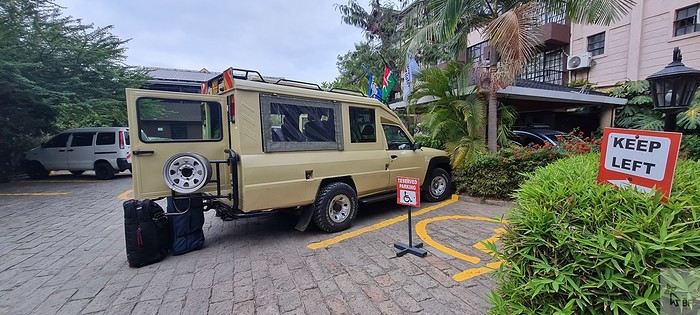
We set off for Voi, making our usual stop in Mtito Andei. Traffic was heavy on the Mombasa road, with lots of trucks.
We arrived at the entrance of Tsavo East around 1 PM and made it to Sentrim Camp (https://www.sentrim-hotels.com/sentrim-tsavo.html) just in time for lunch.
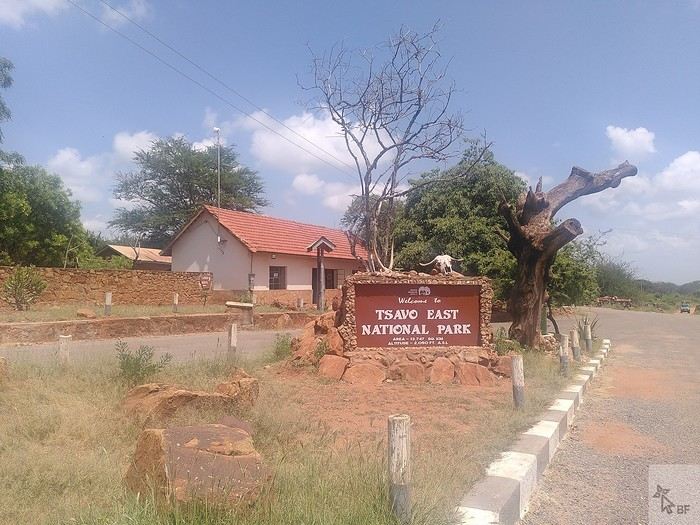
We found Tsavo East unusually green—there had been heavy rains in December, which isn’t typical. As a result, the animals were scattered and harder to spot. The watering hole visible from the camp’s dining area was completely deserted, whereas it’s usually bustling with herds of elephants and other mammals.
Our tent, No. 9, for 3 nights.
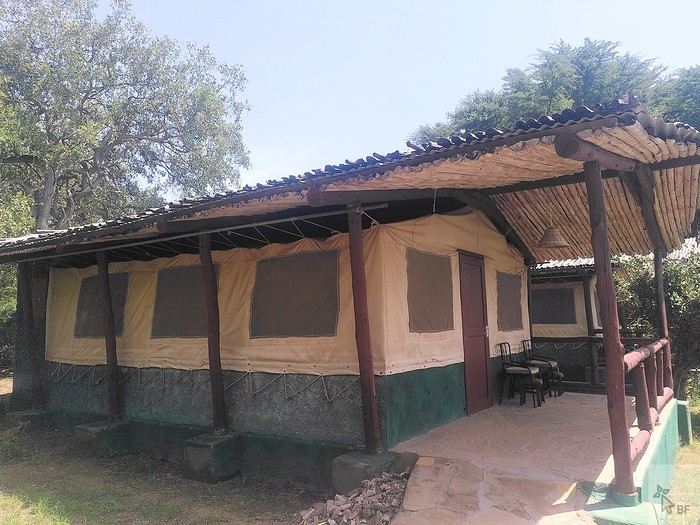
This camp is well-located inside the park. It’s simple but comfortable enough for our tastes, the staff is super friendly (as is often the case in Kenya), and the buffet-style meals are varied and good. Tsavo is the main destination for tourists staying on the coast who come for a night or two on safari. In January, some days at the camp are very quiet, while some evenings, the restaurant is packed with groups (lots of Italians, in particular).
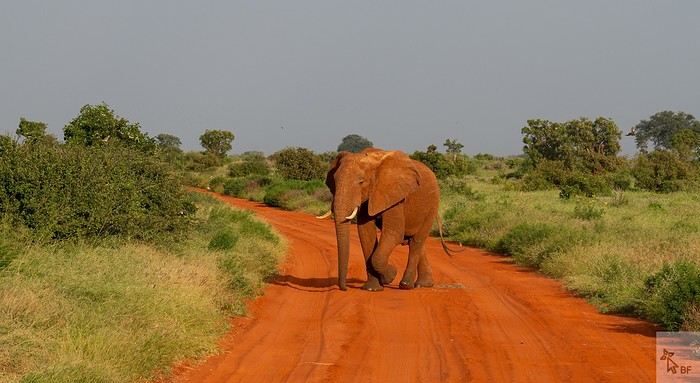
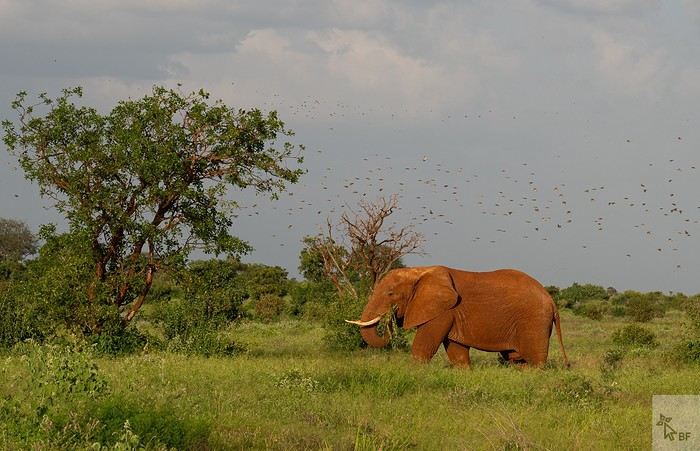
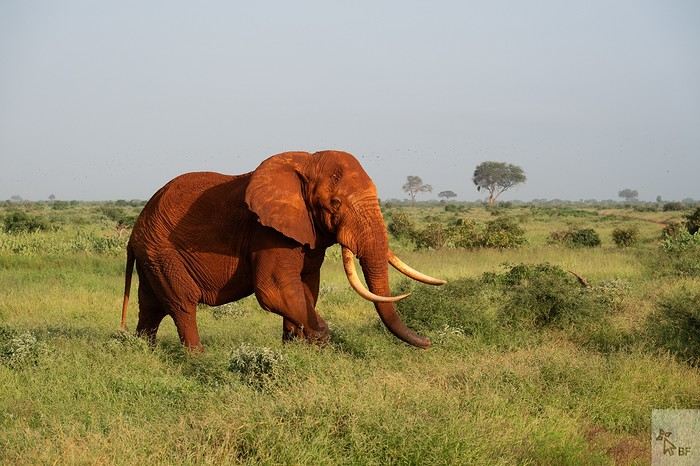
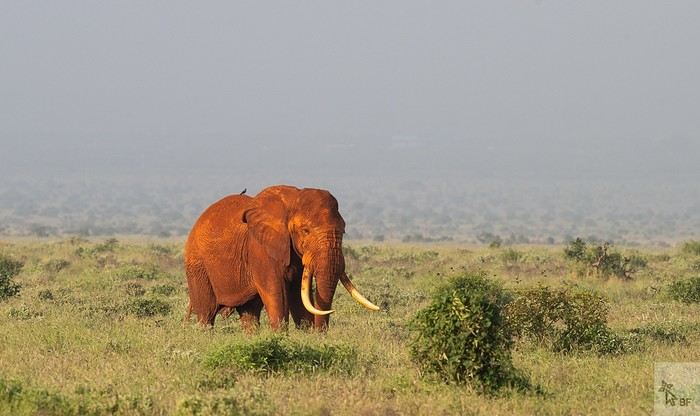
Tsavo is, of course, famous for its elephants. This time, we didn’t see many large herds, but we did have some great encounters with solitary males.
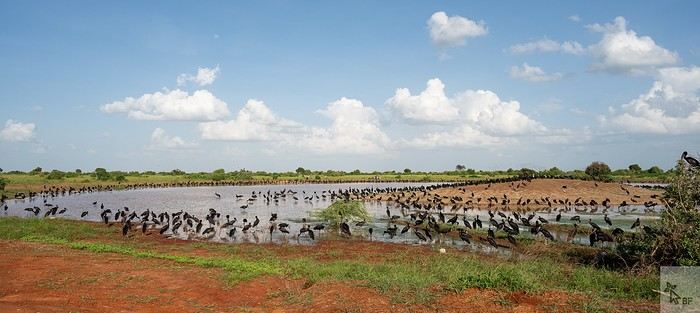
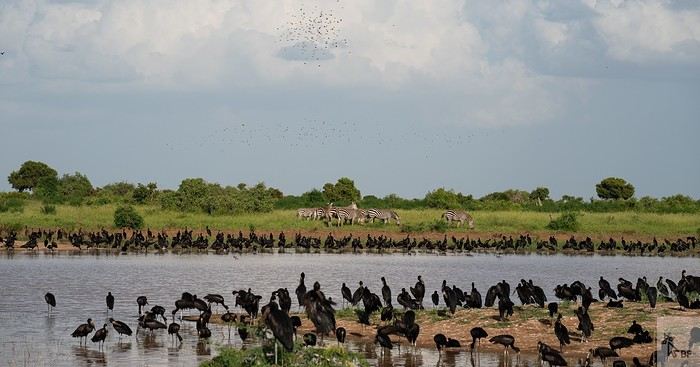
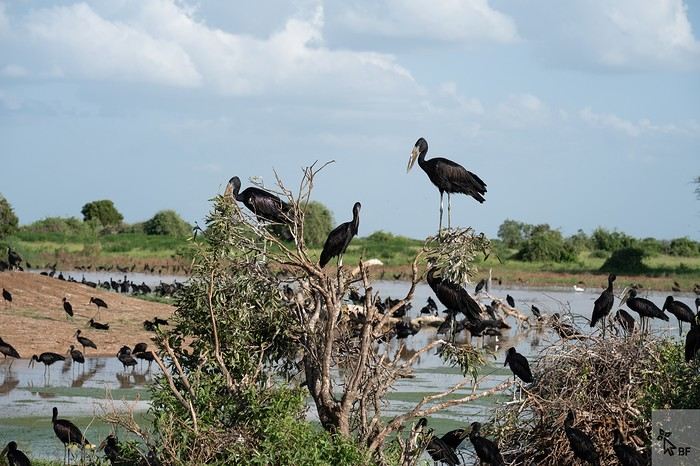
Around this small watering hole, we saw a gathering of African open-billed storks—we’d never seen so many before!
I’d like to invite you on a new adventure in Kenya.
Back in 2010, my husband Ben and I fell in love with Kenya, and we’ve been traveling there regularly ever since. This 2025 safari marked the first weeks of an important milestone in my life: retirement.
Of course, Felix—our guide and friend for all these years, whom some of you may even know from this forum—joined us again.
We chose an itinerary that takes us through the parks and reserves we particularly love in Kenya: Tsavo East (3 nights), Tsavo West (2 nights), a transition day in Embu, Samburu (5 nights), Meru NP (4 nights), Nanuyki to visit the Mount Kenya Animal Orphanage (https://mountkenyawildlifeconservancy.org/) (1 night), and Aberdare NP (2 nights).
This safari wasn’t our most prolific in terms of wildlife sightings and photos (all taken by Ben), but I still think it’s worth sharing our experiences and impressions of the places we visited. Maybe other travelers will find useful information here to help them fulfill their dream of a Kenyan safari one day...
Living in Brittany, we left from Nantes on Wednesday, January 8, 2025, on the 6 AM Air France flight to CDG, then took the direct flight to Nairobi at 10:50 AM. No issues this time on either flight (unlike in October 2023...).
We arrived in Nairobi at 9:20 PM local time (there’s a two-hour time difference with France at this time of year). Going through passport control and collecting our luggage went smoothly. The hotel shuttle (https://67airporthotel.co.ke/) was waiting for us. We shared it with a friendly Swiss couple who were there to climb Mount Kenya. We arrived at the hotel around midnight. The 67 Airport Hotel is 10-15 minutes from Jomo Kenyatta Airport and offers great value for money. Plus, it’s close to the Mombasa road, which is handy when heading that way the next morning.
On Thursday, January 9, we had breakfast at the hotel restaurant at 6:30 AM, and as planned, Felix arrived around 7 AM. We got to check out his brand-new 4x4 Nissan—we’d be the first to test it! 🙂
We set off for Voi, making our usual stop in Mtito Andei. Traffic was heavy on the Mombasa road, with lots of trucks.
We arrived at the entrance of Tsavo East around 1 PM and made it to Sentrim Camp (https://www.sentrim-hotels.com/sentrim-tsavo.html) just in time for lunch.
We found Tsavo East unusually green—there had been heavy rains in December, which isn’t typical. As a result, the animals were scattered and harder to spot. The watering hole visible from the camp’s dining area was completely deserted, whereas it’s usually bustling with herds of elephants and other mammals.
Our tent, No. 9, for 3 nights.
This camp is well-located inside the park. It’s simple but comfortable enough for our tastes, the staff is super friendly (as is often the case in Kenya), and the buffet-style meals are varied and good. Tsavo is the main destination for tourists staying on the coast who come for a night or two on safari. In January, some days at the camp are very quiet, while some evenings, the restaurant is packed with groups (lots of Italians, in particular).
Tsavo is, of course, famous for its elephants. This time, we didn’t see many large herds, but we did have some great encounters with solitary males.
Around this small watering hole, we saw a gathering of African open-billed storks—we’d never seen so many before!
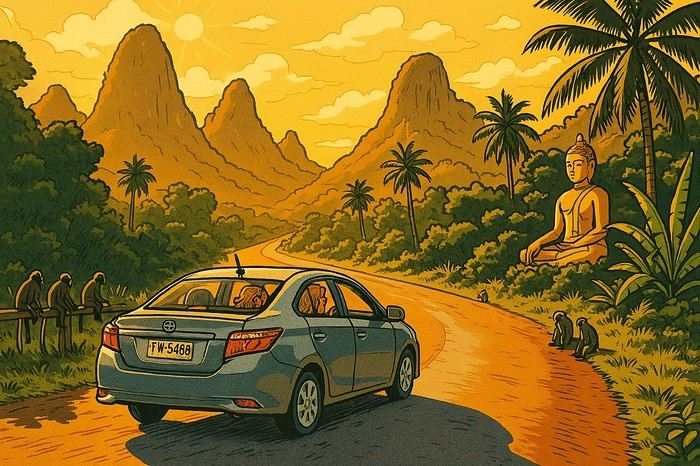
From Bangkok to Krabi, Thailand by Car!
This first trip of 2025 will have the taste of Asia.
More precisely, Thailand!
It’s not my first time—I’ve often traveled across Southeast Asia between 2000 and 2015. (This travel journal, for example...)
But it’ll be my partner’s first steps in this part of the world.
The itinerary we’ve chosen will alternate between familiar sights for me and new discoveries for both of us.
I’ll get to see how the country has changed in 20 years—and what’s stayed the same!
We were torn between the north and the south of the kingdom. Fears of smoke from slash-and-burn farming and a desire to relax on the sand tipped the scales toward the south...
What if we rented a car?
I think driving in sprawling Bangkok would be a bit ambitious, so we’ll only book our vehicle from Hua Hin to return it in Surat Thani.
Other transportation will range from tuk-tuks to overnight trains and ride-hailing services.
And of course, the plane!
I’d love to travel from Auvergne to Bangkok by road, but 15 days wouldn’t be enough...
Plus, the current geopolitical situation isn’t exactly favorable...
So, once again, we’ll be stuck for hours in the less-than-comfortable economy class of Qatar Airways.
The arrival time was on schedule, entry formalities were quick, and all our luggage made it.
We left Lyon in wind and cold—now we’re breathing in the warm, humid air of กรุงเทพมหานคร.
To reach our hotel, we first took the metro, which dropped us off in the city center in about 30 minutes for the incredible price of 1.18 €.
A few taps on the GRAB app, and we booked a ride-hailing service for the last few kilometers.
We waited a while for our driver due to insane traffic in the area, but once in the 4x4, we were at our lodging in no time.
We chose this small hotel for its riverside location, tranquility, and price.
It’ll do the job perfectly—the only downside is the weak breakfast.
The room is inviting, and we collapse onto the bed for a well-deserved short nap.
Wake-up call in an hour for our first visits!
See you soon...
More precisely, Thailand!
It’s not my first time—I’ve often traveled across Southeast Asia between 2000 and 2015. (This travel journal, for example...)
But it’ll be my partner’s first steps in this part of the world.
The itinerary we’ve chosen will alternate between familiar sights for me and new discoveries for both of us.
I’ll get to see how the country has changed in 20 years—and what’s stayed the same!
We were torn between the north and the south of the kingdom. Fears of smoke from slash-and-burn farming and a desire to relax on the sand tipped the scales toward the south...
What if we rented a car?
I think driving in sprawling Bangkok would be a bit ambitious, so we’ll only book our vehicle from Hua Hin to return it in Surat Thani.
Other transportation will range from tuk-tuks to overnight trains and ride-hailing services.
And of course, the plane!
I’d love to travel from Auvergne to Bangkok by road, but 15 days wouldn’t be enough...
Plus, the current geopolitical situation isn’t exactly favorable...
So, once again, we’ll be stuck for hours in the less-than-comfortable economy class of Qatar Airways.
The arrival time was on schedule, entry formalities were quick, and all our luggage made it.
We left Lyon in wind and cold—now we’re breathing in the warm, humid air of กรุงเทพมหานคร.
To reach our hotel, we first took the metro, which dropped us off in the city center in about 30 minutes for the incredible price of 1.18 €.
A few taps on the GRAB app, and we booked a ride-hailing service for the last few kilometers.
We waited a while for our driver due to insane traffic in the area, but once in the 4x4, we were at our lodging in no time.
We chose this small hotel for its riverside location, tranquility, and price.
It’ll do the job perfectly—the only downside is the weak breakfast.
The room is inviting, and we collapse onto the bed for a well-deserved short nap.
Wake-up call in an hour for our first visits!
See you soon...
Albania in Autumn Colors
A new work assignment means our vacation dates can't stay the same.
We had planned to go to the Canary Islands, but flight prices are skyrocketing with this new holiday schedule.
So, I’m looking for an alternative to Gran Canaria and El Hierro and found two round-trip flights with Wizz Air to Tirana.
398 €, including baggage and seats—perfect!
Plus, the departure and return times are great, which is pretty rare for a low-cost flight!
All that’s left is to rent a car, plan the route, and book accommodations.
With two weeks, we’ll have to make some choices!
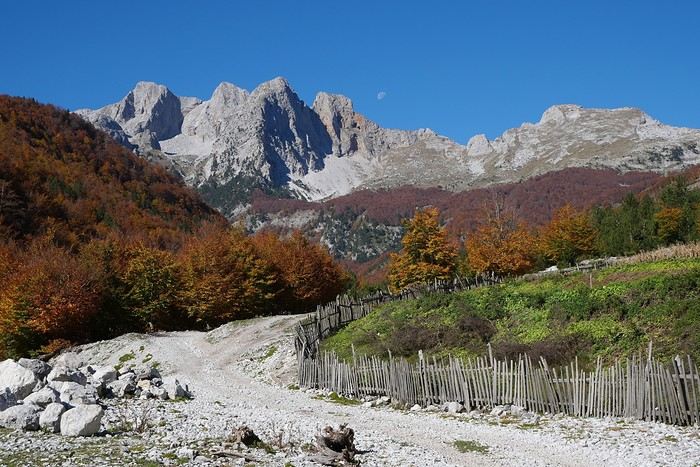
Here’s the final itinerary: Shkodra (2 nights), Valbonë (3 nights), Tirana (1 night), Lake Ohrid (1 night), Korçë (1 night), Përmet (1 night), Gjirokastër (1 night), Himarë (2 nights), Berat (2 nights), and Krujë (1 night).
A mix of countryside and small towns, a bit of the Mediterranean, and some mountains!
Late October isn’t the best season, so let’s keep our fingers crossed for the rest...
We had planned to go to the Canary Islands, but flight prices are skyrocketing with this new holiday schedule.
So, I’m looking for an alternative to Gran Canaria and El Hierro and found two round-trip flights with Wizz Air to Tirana.
398 €, including baggage and seats—perfect!
Plus, the departure and return times are great, which is pretty rare for a low-cost flight!
All that’s left is to rent a car, plan the route, and book accommodations.
With two weeks, we’ll have to make some choices!
Here’s the final itinerary: Shkodra (2 nights), Valbonë (3 nights), Tirana (1 night), Lake Ohrid (1 night), Korçë (1 night), Përmet (1 night), Gjirokastër (1 night), Himarë (2 nights), Berat (2 nights), and Krujë (1 night).
A mix of countryside and small towns, a bit of the Mediterranean, and some mountains!
Late October isn’t the best season, so let’s keep our fingers crossed for the rest...
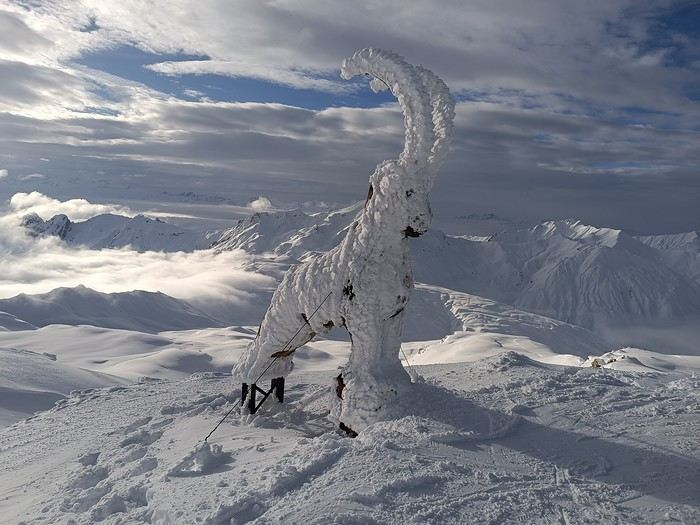
White as snow: February 2025 friendly photo contest
I could just as easily have written white as marble, white as salt, white as coconut milk...
This month’s theme is white in every way imaginable.
Not just a little touch in the top right corner of the photo!
Nor a white square on a white background...
Also, black and white won’t be allowed.
For the rest, I’ll let the voters be the sole judges of whether the theme is respected!
I’m now borrowing Ragamuffin’s wording for the rules:
Every VF member can submit up to 3 photos, until Sunday, February 23 at 11:59 PM, Clermont-Ferrand time.
Each photo must be posted in a separate message, with its number (1, 2, or 3).
Don’t forget to add a little explanation (comment, location, etc.).
Voting:
Every VF member can vote for the 3 photos they think are the best, based on their own criteria and the theme.
Voting will take place from Monday, February 24 to Friday, February 28 at 2:00 PM, Clermont-Ferrand time.
The chosen photos should be listed in order of preference: - 1st photo: 3 points - 2nd: 2 points - 3rd: 1 point
The winner is the author of the photo with the most points.
Results will be published on February 28 in the late afternoon. In case of a tie, the number of first-place votes will decide. The winner will have the honor of organizing March’s contest.
Photos that have already been nominated (1st, 2nd, or 3rd) in another contest are not eligible to participate in this one.
The off-topic contest discussion is happening here
This month’s theme is white in every way imaginable.
Not just a little touch in the top right corner of the photo!
Nor a white square on a white background...
Also, black and white won’t be allowed.
For the rest, I’ll let the voters be the sole judges of whether the theme is respected!
I’m now borrowing Ragamuffin’s wording for the rules:
Every VF member can submit up to 3 photos, until Sunday, February 23 at 11:59 PM, Clermont-Ferrand time.
Each photo must be posted in a separate message, with its number (1, 2, or 3).
Don’t forget to add a little explanation (comment, location, etc.).
Voting:
Every VF member can vote for the 3 photos they think are the best, based on their own criteria and the theme.
Voting will take place from Monday, February 24 to Friday, February 28 at 2:00 PM, Clermont-Ferrand time.
The chosen photos should be listed in order of preference: - 1st photo: 3 points - 2nd: 2 points - 3rd: 1 point
The winner is the author of the photo with the most points.
Results will be published on February 28 in the late afternoon. In case of a tie, the number of first-place votes will decide. The winner will have the honor of organizing March’s contest.
Photos that have already been nominated (1st, 2nd, or 3rd) in another contest are not eligible to participate in this one.
The off-topic contest discussion is happening here
Come discover the North Shore
INTRODUCTION
Travel journal updated in MAY 2025
Since our travel plans outside Canada were canceled due to Covid-19, we decided to take our vacation in Quebec this summer and cover over 5,270 kilometers to explore the various tourist attractions of the North Shore and Gaspésie.
This summary will cover our experiences on the North Shore, while Gaspésie will be the subject of a future summary.
The North Shore, known for its stunning nature, is the perfect spot for outdoor enthusiasts since you can enjoy activities like hiking, wildlife observation, sea kayaking, fishing, and hunting (to name just a few).
It’s also one of the best places in the world to see whales.
Our journey along the North Shore took place between the villages of Tadoussac and Kegaska, as Route 138 ends at the beautiful, long beach in Kegaska.
Travel journal updated in MAY 2025
Since our travel plans outside Canada were canceled due to Covid-19, we decided to take our vacation in Quebec this summer and cover over 5,270 kilometers to explore the various tourist attractions of the North Shore and Gaspésie.
This summary will cover our experiences on the North Shore, while Gaspésie will be the subject of a future summary.
The North Shore, known for its stunning nature, is the perfect spot for outdoor enthusiasts since you can enjoy activities like hiking, wildlife observation, sea kayaking, fishing, and hunting (to name just a few).
It’s also one of the best places in the world to see whales.
Our journey along the North Shore took place between the villages of Tadoussac and Kegaska, as Route 138 ends at the beautiful, long beach in Kegaska.
Société très fiable pour nous faire découvrir l'île Maurice English translation pending
bonjour nous allons a flic en flac en janvier
nous cherchons une societe tres fiable et de confiance pour nous faire decouvrir l ile maurice sans etre arnaque
Trek de la Rota Vicentina en solo, des conseils? (Portugal) English translation pending
Bonjour,
Ca y est c'est décidé. Je vais faire la Rota Vincentina en solo en Août. Je prendrais le sentier des pêcheurs. La côte au bord de l'Océan me tente plus. Ca sera mon 1er trek. Je me pose quelques questions:
- J'ai vu que nous pouvions trouver des hébergements sur la route mais je ne souhaite pas être dans un parcours trop "cadré". Est-ce qu'il faut réserver en avance? Est-ce que certains d'entre vous ont tenté "chez l'habitant" en demandant aux gens dans les petits villages de pêcheurs ou est-ce que je me fais une idée idyllique que les gens peuvent nous accueillir chez eux en leur demandant simplement? - Je n'ai jamais fais de trek, est-ce que c'est un niveau "intense" pour un débutant? - Mon appréhension est de ne pas arriver à un village quand la nuit tombe ou si je suis épuisée. Comment prévoir que je ferais assez de kilomètres pour trouver un hébergement entre chaque étape? - Enfin, quels matériels essentiels et basique faut-il apporter avec soi?
Merci beaucoup pour vos conseils!!
Leïla
Ca y est c'est décidé. Je vais faire la Rota Vincentina en solo en Août. Je prendrais le sentier des pêcheurs. La côte au bord de l'Océan me tente plus. Ca sera mon 1er trek. Je me pose quelques questions:
- J'ai vu que nous pouvions trouver des hébergements sur la route mais je ne souhaite pas être dans un parcours trop "cadré". Est-ce qu'il faut réserver en avance? Est-ce que certains d'entre vous ont tenté "chez l'habitant" en demandant aux gens dans les petits villages de pêcheurs ou est-ce que je me fais une idée idyllique que les gens peuvent nous accueillir chez eux en leur demandant simplement? - Je n'ai jamais fais de trek, est-ce que c'est un niveau "intense" pour un débutant? - Mon appréhension est de ne pas arriver à un village quand la nuit tombe ou si je suis épuisée. Comment prévoir que je ferais assez de kilomètres pour trouver un hébergement entre chaque étape? - Enfin, quels matériels essentiels et basique faut-il apporter avec soi?
Merci beaucoup pour vos conseils!!
Leïla
Brazil 2020: Amazon, Northeast, Chapada, and Boipeba – a winning combo!
Hello everyone.
Preamble:
Sooner or later, you’ve got to take the plunge! I thought lockdown would be the perfect time to start this travel journal, but between working from home and gardening, I just didn’t have the time (or the motivation). Plus, long-haul trips weren’t really on the cards back then... But then I stumbled upon my photos and thought, "I’ve got to share my latest adventure in Brazil—you guessed it!"
First, a little flashback: some of you (yes, really, in DMs!) pointed out the big gaps in my travel journals—India in 2019, Vietnam in 2018, so many missed opportunities!
Truth is, for India, I traveled with a private guide and honestly didn’t have much to add to the tons of well-documented journals already out there. Plus, I still haven’t decided if I love or hate India... So, how do you share your feelings when you’re not even sure yourself? As for Vietnam, I had plenty to say—even though the itinerary was pretty classic—but I’ll admit the vibe on this part of the forum at the time kinda put me off for a while... And time flies, and memories fade... Anyway, just wanted to clear that up for my (many or few) readers. *Tudo bem*, let’s get started!!
Preamble:
Sooner or later, you’ve got to take the plunge! I thought lockdown would be the perfect time to start this travel journal, but between working from home and gardening, I just didn’t have the time (or the motivation). Plus, long-haul trips weren’t really on the cards back then... But then I stumbled upon my photos and thought, "I’ve got to share my latest adventure in Brazil—you guessed it!"
First, a little flashback: some of you (yes, really, in DMs!) pointed out the big gaps in my travel journals—India in 2019, Vietnam in 2018, so many missed opportunities!
Truth is, for India, I traveled with a private guide and honestly didn’t have much to add to the tons of well-documented journals already out there. Plus, I still haven’t decided if I love or hate India... So, how do you share your feelings when you’re not even sure yourself? As for Vietnam, I had plenty to say—even though the itinerary was pretty classic—but I’ll admit the vibe on this part of the forum at the time kinda put me off for a while... And time flies, and memories fade... Anyway, just wanted to clear that up for my (many or few) readers. *Tudo bem*, let’s get started!!
Valence - Toulouse à vélo, en bivouac English translation pending
Bonjour à vous,
Je vais partir demain pour Valence -> Toulouse à velo, en bivouacs. Est-ce que vous auriez des conseils sur des lieux à visiter, des routes ou piscts cyclables sympas svp ?
Merci par avance !
William
Je vais partir demain pour Valence -> Toulouse à velo, en bivouacs. Est-ce que vous auriez des conseils sur des lieux à visiter, des routes ou piscts cyclables sympas svp ?
Merci par avance !
William
Dans quel pays aimeriez-vous vous expatrier? English translation pending
Je saisis au vol cette remarque d'Attila (que je partage!)
Franchement, je serais le gouvernement, je demanderais l'asile en ...?... et dirais aux français, démerdez vous.
et cette autre :
On fait le coucou dans les discussions mais jamais on n'en entame une...
pour proposer un nouveau post sur un mode très différent de voyager.
Où aimeriez-vous partir vivre?
Bien sûr vous choisissez votre pays ou région d'accueil, on part du principe que ce n'est pas une obligation que l'on vous fait.
Et vous avez besoin de vous éloigner momentanément de votre lieu de vie habituel, pour quelque raison que ce soit.
Quels seraient les atouts locaux importants pour vous de cette nouvelle installation : population, climat, paysages, archéologie, autres .... ?
Franchement, je serais le gouvernement, je demanderais l'asile en ...?... et dirais aux français, démerdez vous.
et cette autre :
On fait le coucou dans les discussions mais jamais on n'en entame une...
pour proposer un nouveau post sur un mode très différent de voyager.
Où aimeriez-vous partir vivre?
Bien sûr vous choisissez votre pays ou région d'accueil, on part du principe que ce n'est pas une obligation que l'on vous fait.
Et vous avez besoin de vous éloigner momentanément de votre lieu de vie habituel, pour quelque raison que ce soit.
Quels seraient les atouts locaux importants pour vous de cette nouvelle installation : population, climat, paysages, archéologie, autres .... ?
La Dordogne à vélo avec bivouac English translation pending
Bonjour à tous.
Voici que je vais vous présenter le récit de notre troisième périple. Toujours les mêmes protagonistes, c’est-à-dire Mathieu et moi. C’est une nouvelle aventure, mais la même impatience nous tenaille, la même joie des préparatifs la veille du départ et les mêmes papillons dans le ventre quand on prend la route.
Cette année, c’est la Dordogne qui fut désignée par le hasard des dés. Une autre très belle région à découvrir.
Mathieu, à toujours son Bergamon, mais il a abandonné la remorque au profit de belles sacoches artisanales. Dans l’année, j’ai investi dans une nouvelle monture. Un VSF Fahrradmanufaktur TX-Randonneur. C’est un robuste vélo allemand, très bien équipé, avec lequel je m’entraîne depuis le mois de juin. J’y ai rajouté une sacoche de guidon.
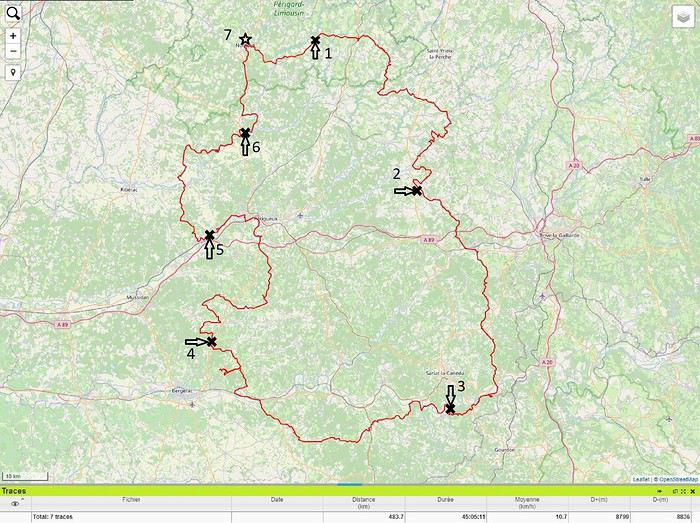
Voici notre voyage en quelques chiffres.
Durée : 7 jours
Distance : ~ 484 km
Dénivelé : ~ 5700m D+
Voici que je vais vous présenter le récit de notre troisième périple. Toujours les mêmes protagonistes, c’est-à-dire Mathieu et moi. C’est une nouvelle aventure, mais la même impatience nous tenaille, la même joie des préparatifs la veille du départ et les mêmes papillons dans le ventre quand on prend la route.
Cette année, c’est la Dordogne qui fut désignée par le hasard des dés. Une autre très belle région à découvrir.
Mathieu, à toujours son Bergamon, mais il a abandonné la remorque au profit de belles sacoches artisanales. Dans l’année, j’ai investi dans une nouvelle monture. Un VSF Fahrradmanufaktur TX-Randonneur. C’est un robuste vélo allemand, très bien équipé, avec lequel je m’entraîne depuis le mois de juin. J’y ai rajouté une sacoche de guidon.
Voici notre voyage en quelques chiffres.
Durée : 7 jours
Distance : ~ 484 km
Dénivelé : ~ 5700m D+
Voyage à La Réunion compromis et remboursement des billets d'avion English translation pending
Bonjour !
Avec ma famille, nous avions prévu d'aller à La Réunion du 5 au 29 juin prochain. Or, avec la crise sanitaire actuelle, tout est remis en question ! En cas d'annulation, Puis je me faire rembourser les billets d'avion où aurais je droit à un avoir ? merci à vous pour votre aide !
Finir mon voyage de Pologne jusqu'à Göteborg English translation pending
Qu'est-ce que on s'--de avec cette histoire de corona no pas que je soies confiné, moi j'ai toujours été confiné par choix donc j'ai 70ans, je vis à Paris, Barcelone et à Alger et je suis diabéto-cardiaque avec 2 stents et depuis le 29 février je suis bloqué à Alger pas d'avion et certainement les frontières fermées mais celà ne durera pas longtemps car les gens du CHR, les avioneurs et les gens en auront tellement marre que celà va gicler........en 2018 je voulais faire toute la Scandinavie via l'allemagne, le danemark mais arrivé à Kobenhaven,1 seule nuit et come back sur Hambourg, ville extraordinairre mais cette année avec tout ce merdier, car fin mai ou mi juin tout rentrera dans l'ordre car faire rentrer de l'argent et les emplois passeront avant, donc pour cet été, tou seul et à bord de mon duster la Scandinavie mai non plus via Le danemark mais via la pologne (un peu réticent sur ce choix), les pays baltes, en estonie une virée à St Petersbourgh, la finlande, nord de la suède, nord de la norvège, ,, ,, une virée aux fjords de Geiranger, Stronda puis après un zig zag entre la norvège et la suède jusqu'Goteborg, Kobenhaven, Hambourg, traversée rapide des pays bas, Brugge, une ville que j'adore puis Paris et ensuite 2ème quizaine d'aout jusqu'à mi septembre l'Andalousie puis auto reconfinemententre dans mes trois résidences........ vos conseils et infos me seront très utiles à partir de mon entrée en pologne jusquà Goteborg......Merci Beaucoup
Les mythes touristiques English translation pending
Les Mythes Touristiques
Dans un carnet que je suis en train d'écrire sur un voyage récent au Mexique, nous sommes arrivés à une petite discussion sur les fameux groupes de musiciens Mexicains, les mariachis. Il existe un mythe selon lequel « mariachi » serait une déformation du mot Français « mariage », et que cela viendrait des fêtes tenues par les Français lors de leurs quelques années d’occupation du Mexique, dans les années 1860 et quelques. Je cite l’un des intervenants sur mon poste Mexicain :
« Les français organisaient de grandes fêtes aux mariages et avaient l'habitude d'inviter des musiciens…. Mariachi serait une déformation du mot mariage ..? »
Ce mythe a été réfuté car il a été prouvé que le terme « mariachi » était d’usage longtemps avant la peu glorieuse « Intervention » de la France au Mexique (c’était sous Napoléon III).
Plusieurs mythes semblables circulent. Certains semblent être propagés à l’intention des touristes, pour leur donner l’illusion de « mieux comprendre le pays », pour donner une profondeur supplémentaire à leurs voyages, pour alimenter leurs conversations avec les amis quand ils sont de retour. Car tout cela gonfle l’égo et donne envie de faire d’autres voyages, ça alimente le tourisme. D’où revenus, tiens donc, pour qui ?
Mais d’autres mythes existent qui ne sont peut-être pas créés à but lucratif.
Vous connaissez sans aucun doute de tels mythes et je vous propose de les partager. Et de donner les raisons pour lesquelles ces mythes existent.
Dans un carnet que je suis en train d'écrire sur un voyage récent au Mexique, nous sommes arrivés à une petite discussion sur les fameux groupes de musiciens Mexicains, les mariachis. Il existe un mythe selon lequel « mariachi » serait une déformation du mot Français « mariage », et que cela viendrait des fêtes tenues par les Français lors de leurs quelques années d’occupation du Mexique, dans les années 1860 et quelques. Je cite l’un des intervenants sur mon poste Mexicain :
« Les français organisaient de grandes fêtes aux mariages et avaient l'habitude d'inviter des musiciens…. Mariachi serait une déformation du mot mariage ..? »
Ce mythe a été réfuté car il a été prouvé que le terme « mariachi » était d’usage longtemps avant la peu glorieuse « Intervention » de la France au Mexique (c’était sous Napoléon III).
Plusieurs mythes semblables circulent. Certains semblent être propagés à l’intention des touristes, pour leur donner l’illusion de « mieux comprendre le pays », pour donner une profondeur supplémentaire à leurs voyages, pour alimenter leurs conversations avec les amis quand ils sont de retour. Car tout cela gonfle l’égo et donne envie de faire d’autres voyages, ça alimente le tourisme. D’où revenus, tiens donc, pour qui ?
Mais d’autres mythes existent qui ne sont peut-être pas créés à but lucratif.
Vous connaissez sans aucun doute de tels mythes et je vous propose de les partager. Et de donner les raisons pour lesquelles ces mythes existent.
Concours photo du mois d'avril 2020: "En famille" English translation pending
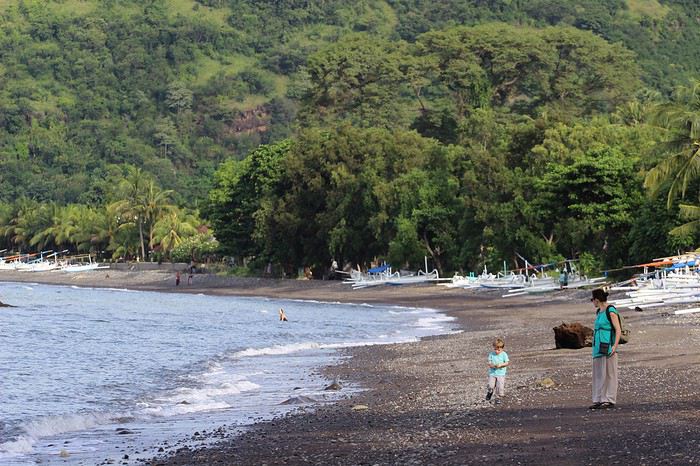
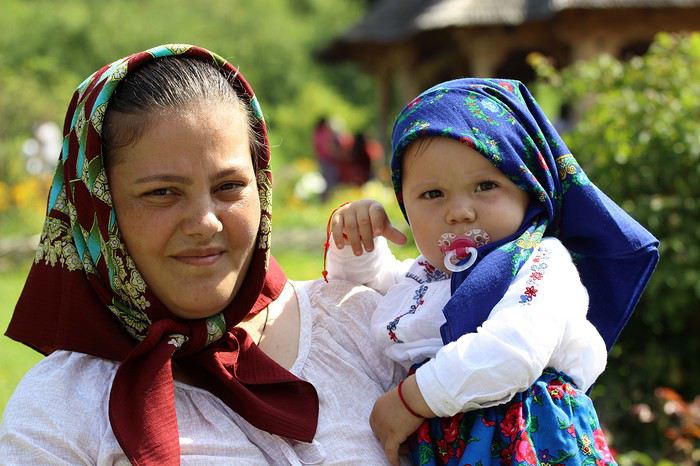
Le monde traverse une crise éprouvante pour chacun, je vous propose donc un thème universel et optimiste: la famille.
Si une multitude de définitions peuvent s'appliquer au thème, je souhaite cependant que vous nous montriez des enfants et leurs parents (au moins un enfant, un parent). Plusieurs génération doivent-être représentées (minimum deux, vous l'aurez compris).
Ces photos peuvent être des plans larges ou serrés, prises lors de promenades, de scènes de la vie quotidienne, de voyages...
Quelques exemples:
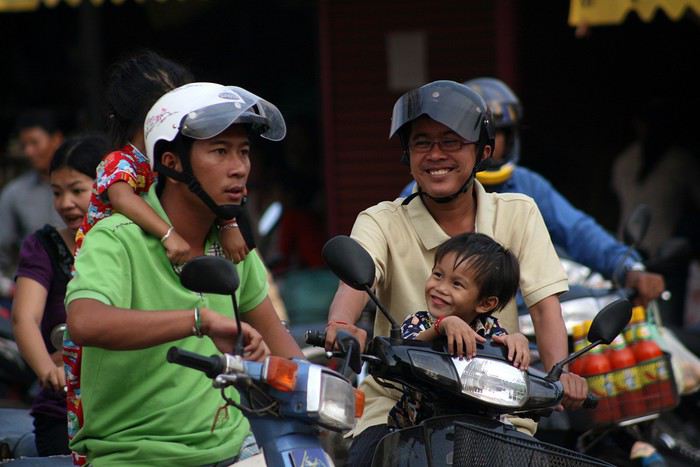
A Bali
En Roumanie
Au Cambodge
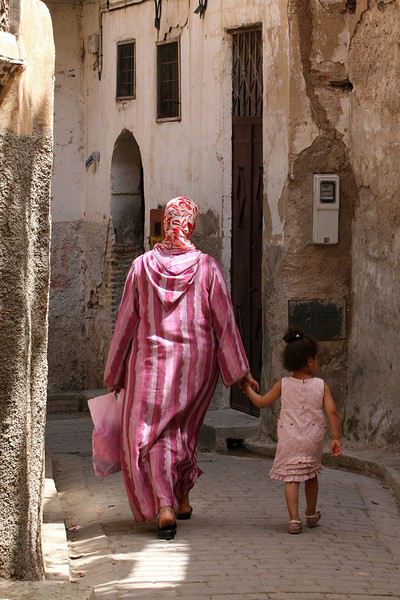
Au Maroc
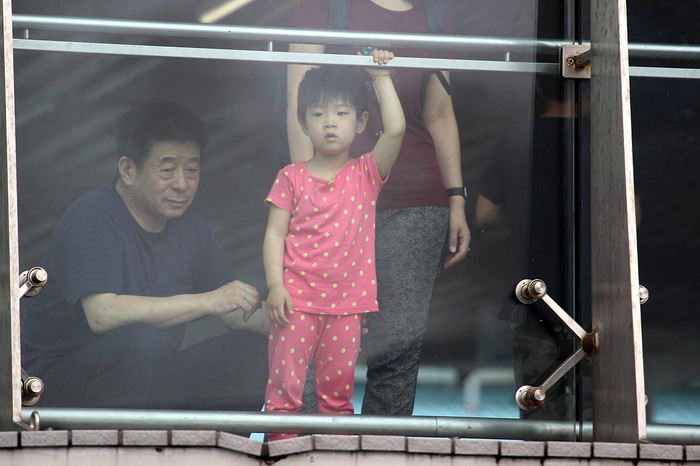
A Hong Kong
Evidemment, il ne vous sera pas demandé d'attestation sur l'honneur sur la véracité des relations familiales qui unissent les différents sujets de la photo 😉. Cette relation doit être supposée, suggérée.
Chaque participant peut proposer jusqu'à 3 photos, et ce jusqu'au mercredi 22/04 à 20h00, heure de Paris. Chaque photo sera présentée dans un seul message, en indiquant son numéro (1, 2 ou 3). Pensez à ajouter une petite explication, commentaire ou localisation.
Chaque membre VF peut voter pour les 3 photos qu'il ou elle juge les meilleures selon ses propres critères et en tenant compte du thème. Les votes se feront du jeudi 23/04 au mercredi 29/04 à 20h00, heure de Paris. Les photos choisies seront citées dans l'ordre de préférence : - la 1ère photo : 3 points - la 2ème: 2 points - la 3ème: 1 point
Un seul et unique vote pour 3 photos est accepté par membre.
Le vainqueur est l'auteur de la photo ayant reçu le plus de points. Les résultats seront publiés le 30/04. En cas d'égalité, le nombre de premières places prévaudra. Le vainqueur aura l'honneur d'organiser le concours du mois de mai. Le diaporama est ici. La discussion est là.
Une pensée à tous dans ces moments troubles et prenez soin de votre famille 🙂 C'est parti ! 🙂
Quelques exemples:
A Bali
En Roumanie
Au Cambodge
Au Maroc
A Hong Kong
Evidemment, il ne vous sera pas demandé d'attestation sur l'honneur sur la véracité des relations familiales qui unissent les différents sujets de la photo 😉. Cette relation doit être supposée, suggérée.
Chaque participant peut proposer jusqu'à 3 photos, et ce jusqu'au mercredi 22/04 à 20h00, heure de Paris. Chaque photo sera présentée dans un seul message, en indiquant son numéro (1, 2 ou 3). Pensez à ajouter une petite explication, commentaire ou localisation.
Chaque membre VF peut voter pour les 3 photos qu'il ou elle juge les meilleures selon ses propres critères et en tenant compte du thème. Les votes se feront du jeudi 23/04 au mercredi 29/04 à 20h00, heure de Paris. Les photos choisies seront citées dans l'ordre de préférence : - la 1ère photo : 3 points - la 2ème: 2 points - la 3ème: 1 point
Un seul et unique vote pour 3 photos est accepté par membre.
Le vainqueur est l'auteur de la photo ayant reçu le plus de points. Les résultats seront publiés le 30/04. En cas d'égalité, le nombre de premières places prévaudra. Le vainqueur aura l'honneur d'organiser le concours du mois de mai. Le diaporama est ici. La discussion est là.
Une pensée à tous dans ces moments troubles et prenez soin de votre famille 🙂 C'est parti ! 🙂
L'hiver au pays des merveilles (Maroc) English translation pending
Bonjour,
Je crains que le forum ne soit morose dans les mois à venir , alors pourquoi ne pas faire un nouveau carnet de voyage . J'ai eu la chance de rentrer du Maroc 2 jours avant la suspension des vols et me retrouve donc, comme vous sans doute , en mode confinement total, chez moi, en Basse-Bretagne , avec quelques centaines de photos de mon dernier séjour à sélectionner, recadrer, retravailler .... On s'occupe comme on peut, alors pourquoi ne pas en faire profiter les Forumeurs ?
Je suis resté au Maroc un mois et j'avais organisé un circuit de 10 nuits / 11 jours pour ma plus jeune fille ( 17 ans ) , mon épouse et la grand- mère, ma chère belle-mère, Mina . Ça correspond aux vacances de février en France .
J'avais donc prévu un voyage " simple" sur le papier, mais qui chaque jour et comme toujours allait nous réserver son lot de découvertes, d'émerveillements, de rencontres, de surprises ....
Au programme :
- Départ de Rabat - 2 nuits à Ouarzazate - 2 nuits à N'kob - 2 nuits à Foum Zguid, avec une longue journée 4X4 au plus profond du désert - 4 nuits à Icht / Borj Biramane et retour sur Rabat
Je vais donc essayer d'éviter des redites avec mes précédents carnets, mais le Maroc a tant de richesses à montrer.....
Rabat est une de mes balades urbaines préférées au Maroc . Je découvre toujours de nouveaux endroits, de jolis détails, des points de vue .... Je vais donc m'y balader avec toujours un plaisir renouvelé
Ma première surprise se passe en médina où je découvre avec étonnement que les autorités ont fait le ménage . Tout ce qui encombrait les rues ( déballages sauvages, marchands de tortues et autres lézards, empiétements sur les trottoirs, la rue , etc.... ) a disparu . Plus rien . Même les commerces " en dur " sont "rentrés dans leurs murs" : plus rien sur la voie publique, pas même une chaise.... Une première au Maroc ?
Si le résultat est plutôt agréable dans la rue des consuls ( rue de l'artisanat ) et la rue Souika ( commerces vestimentaires surtout ) , le boulevard Mohamed V, où régnaient les petits restaurants et gargotes , est désormais mort . Ils ont perdu la quasi-totalité de leur ancienne surface commerciale et ne peuvent plus accueillir que quelques clients à la fois . La rue est tuée et il ne me reste plus qu'à chercher un autre endroit où casser la croûte dans la ville . Ce qui est bénéfique dans une rue ( on peut enfin flâner tranquillement ) est catastrophique dans l'autre ( le commerce est mort et le charme est parti ) . A suivre ....
Bon. C'est comme çà . Ici, dans la rue Souika ( à l'heure de la prière ) . Il y a même des poubelles en plastique positionnées dans la rue !
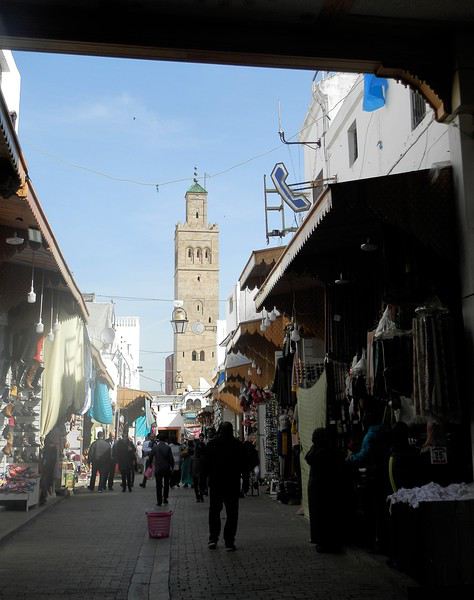
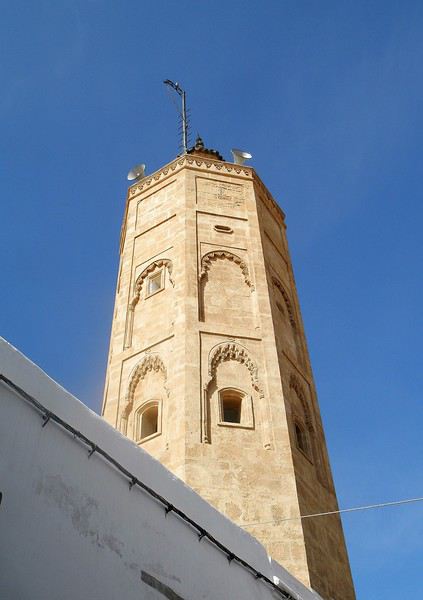
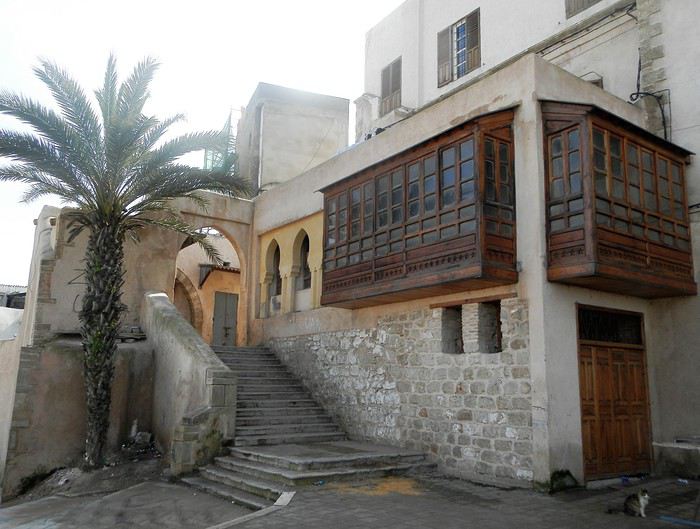
Une autre artère de la médina est la rue Sidi Fatah . Elle donne sur la rue Souika . Une magnifique mosquée y a été restaurée . Si j'en crois mon plan, il s'agit de la mosquée Moulay El Mekki . La porte principale est couverte et on trouve sur chacun des côtés 2 très belles portes ( 4 au total ) . Le minaret octogonal est remarquable . L'ensemble est complété par plusieurs marabout et un peu plus loin se trouve une importante zaouia . C'est vraiment très joli .
L'entrée principale est somptueuse . Le grand art de la peinture sur bois.
Quelques portes latérales
C'est vraiment très agréable de se balader sur la côte atlantique en cette saison ( mi-février ) . Il fait entre 18 et 22 degrés . Temps lumineux . Je n'aurai d'ailleurs pas de pluie pendant un mois ( après avoir eu de la pluie à peu près tous les jours les 5 derniers mois ) : que du bonheur donc ....
Le minaret octogonal
et la rue Sidi Fatah
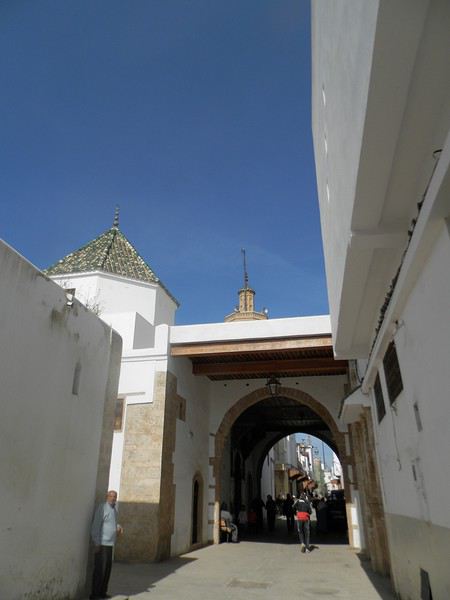
La rénovation des monuments de la médina est presque terminée . La rue des consuls reprend vie, même si les nombreux fondouks de cette rue sont toujours en travaux . J'ai hâte de les revoir . Je déambule dans les ruelles tranquilles , toujours à l’affût de ces détails qui en font le charme .
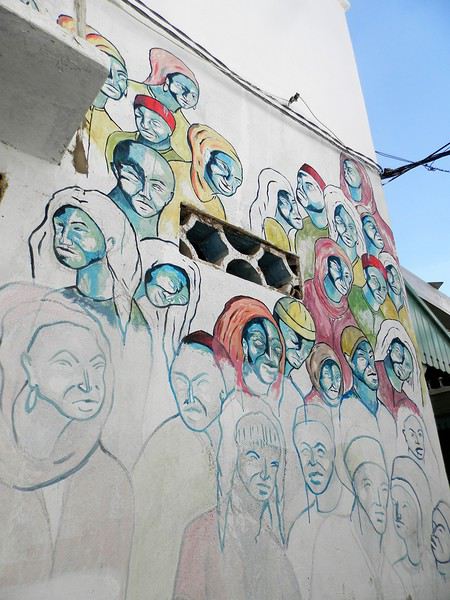
Une belle oeuvre de street-art accroche mon œil ....
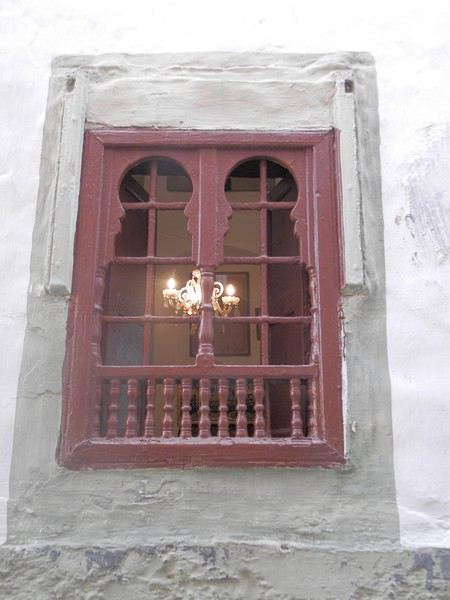
et cette fenêtre a un charme fou .
Cette fois , mes pas me portent vers les quais ( on pourrait presque dire le port ) de Rabat . Je quitte la médina par un jolie porte : l'ensemble , également restauré, est charmant . J'arrive directement sur l'Oued Bou Regreg .
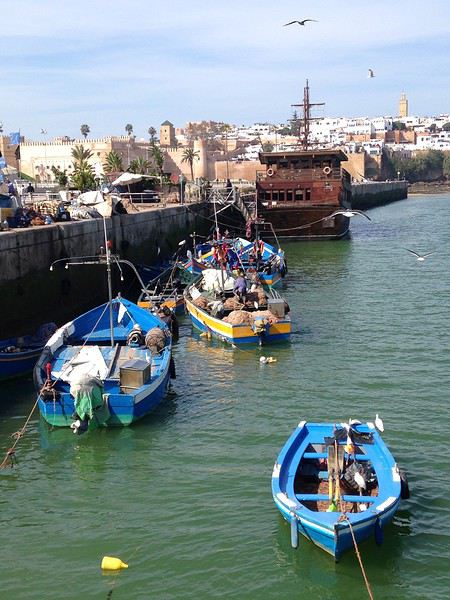
Au cœur de la capitale subsiste un coin " pêche " . Un petit navire est devenu un restaurant-Lounge , plutôt luxueux ( menu à 790 dirhams pour 2 en cette Saint Valentin ) .
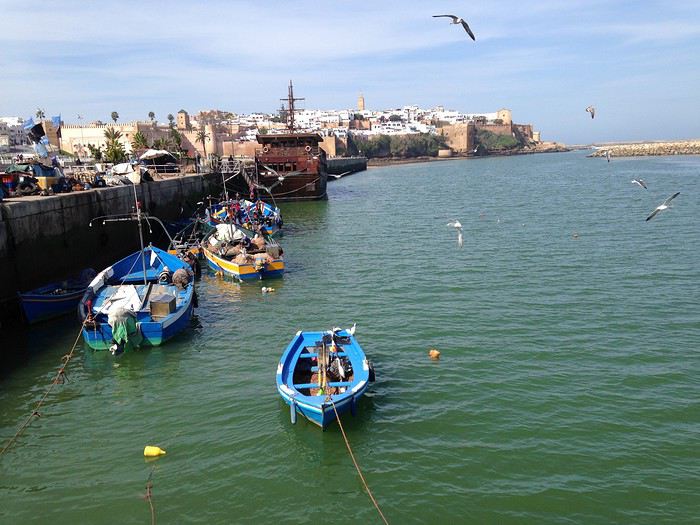
Rabat se donne des airs de petite Essaouira avec ses mouettes, ses bateaux, sa médina au fond, ses filets de pêche .... Le même site à l'horizontale .
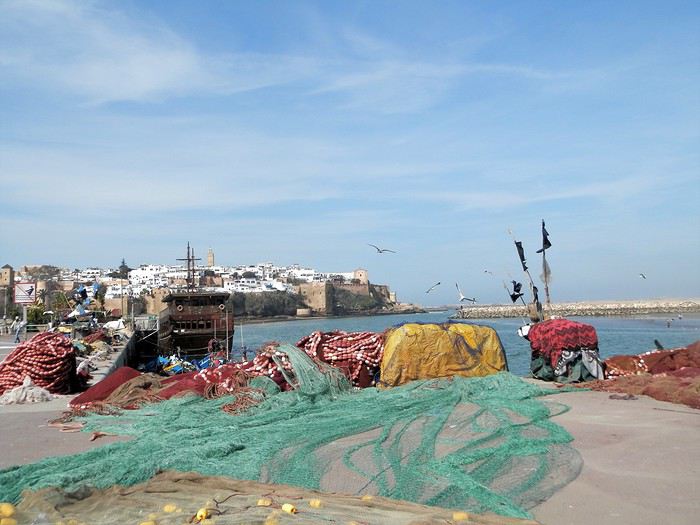
Au fond, Les Oudayas
Un " pêche promenade ", me passe sous le nez . C'est mignon . On a envie de le faire la prochaine fois . Il y avait une activité de passeurs entre Rabat et Salé . Mais avec les ponts, le tramway, ..... Certains se sont adaptés , même si çà se fait toujours, plutôt en été ( la plage de Salé est toute proche ) .
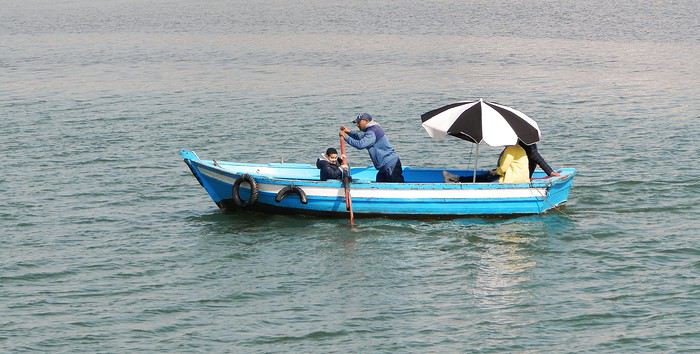
Quelques barques rentrent , les unes après les autres et s'amarrent au ponton, côté Salé . Surement les lointains descendants des redoutables corsaires de Salé . Leur univers a été " explosé" ces dernières années avec l'immense projet d'aménagement de l'oued Bou Regreg . Il leur reste un petit ponton , ..... et juste après, on a construit une grande marina pour accueillir les nouveaux jouets de l'aristocratie locale .
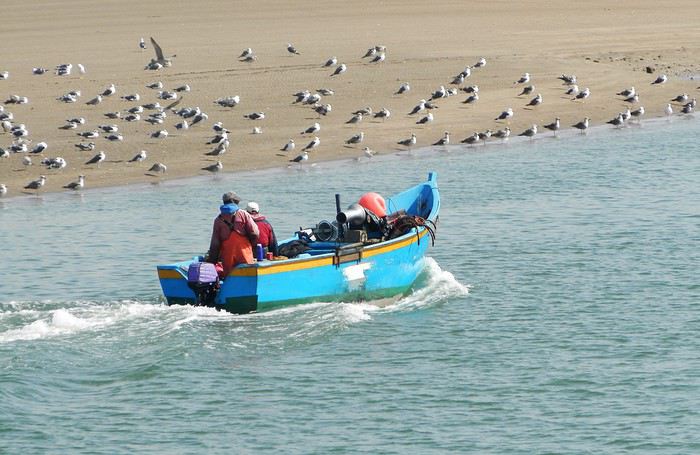
et une autre
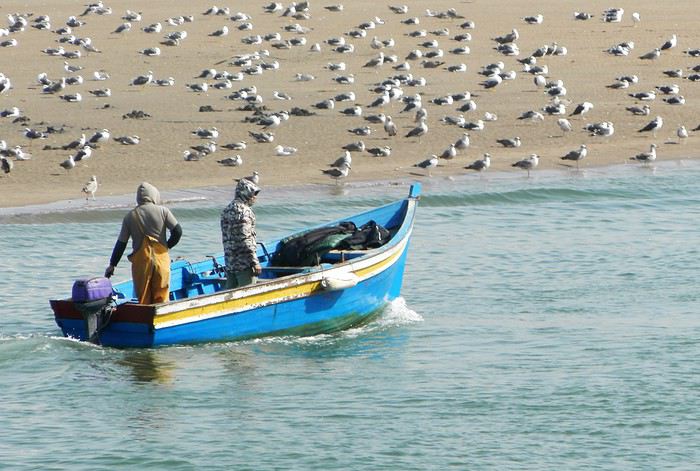
Tout ceci fait un curieux mélange entre une architecture ancestrale et la plus grande modernité ....
Ci-après, à gauche, le médina sur sa falaise, au fond le toit blanc du nouveau " Grand Théâtre de Rabat ), à côté duquel commence à sortir la future tour Mohamed VI qui sera la plus haute d' Afrique , et à droite la marina côté Salé .
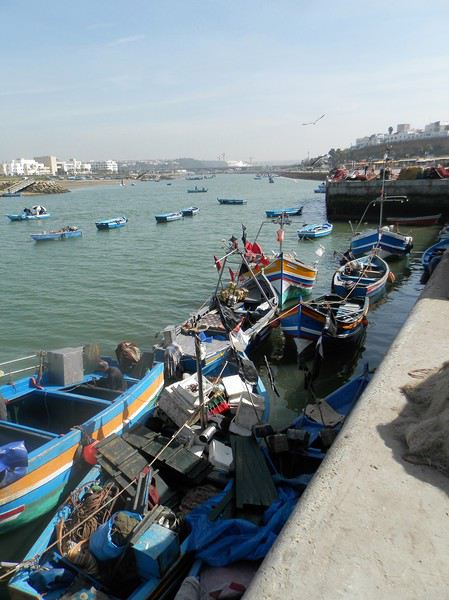
Mais la Kasbah veille toujours sur la capitale
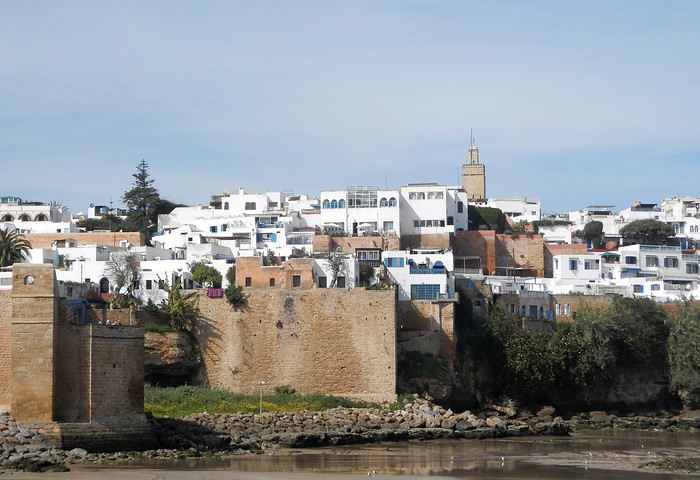
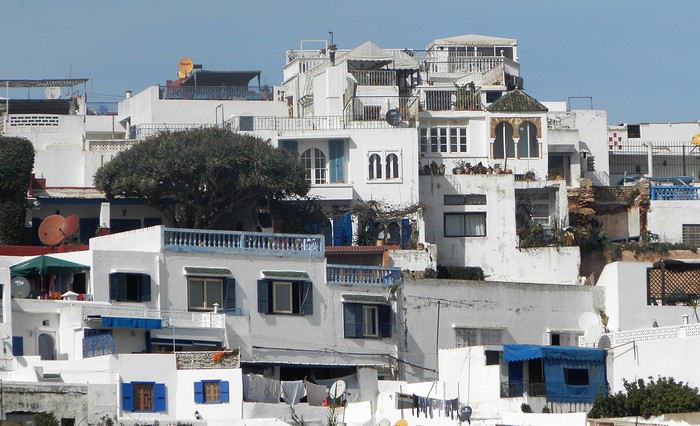
Un dernier regard ...
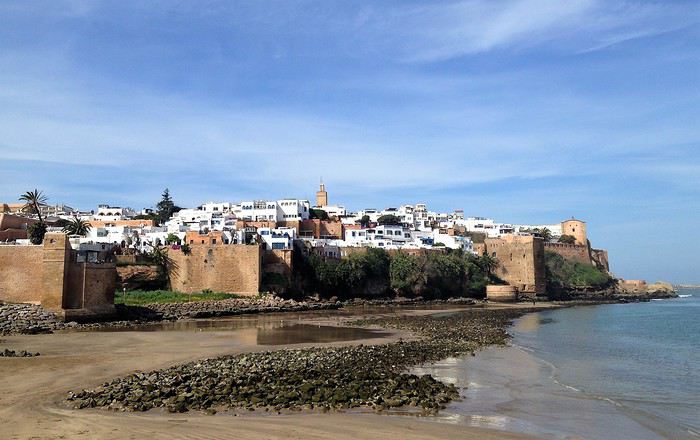
Voila pour ce nouveau coup de projecteur sur la capitale . Faites le détour et surprenez- vous
Demain, j'enfourche ma bonne Dacia Sandero et nous partons à l'assaut de l'Atlas .
Je crains que le forum ne soit morose dans les mois à venir , alors pourquoi ne pas faire un nouveau carnet de voyage . J'ai eu la chance de rentrer du Maroc 2 jours avant la suspension des vols et me retrouve donc, comme vous sans doute , en mode confinement total, chez moi, en Basse-Bretagne , avec quelques centaines de photos de mon dernier séjour à sélectionner, recadrer, retravailler .... On s'occupe comme on peut, alors pourquoi ne pas en faire profiter les Forumeurs ?
Je suis resté au Maroc un mois et j'avais organisé un circuit de 10 nuits / 11 jours pour ma plus jeune fille ( 17 ans ) , mon épouse et la grand- mère, ma chère belle-mère, Mina . Ça correspond aux vacances de février en France .
J'avais donc prévu un voyage " simple" sur le papier, mais qui chaque jour et comme toujours allait nous réserver son lot de découvertes, d'émerveillements, de rencontres, de surprises ....
Au programme :
- Départ de Rabat - 2 nuits à Ouarzazate - 2 nuits à N'kob - 2 nuits à Foum Zguid, avec une longue journée 4X4 au plus profond du désert - 4 nuits à Icht / Borj Biramane et retour sur Rabat
Je vais donc essayer d'éviter des redites avec mes précédents carnets, mais le Maroc a tant de richesses à montrer.....
Rabat est une de mes balades urbaines préférées au Maroc . Je découvre toujours de nouveaux endroits, de jolis détails, des points de vue .... Je vais donc m'y balader avec toujours un plaisir renouvelé
Ma première surprise se passe en médina où je découvre avec étonnement que les autorités ont fait le ménage . Tout ce qui encombrait les rues ( déballages sauvages, marchands de tortues et autres lézards, empiétements sur les trottoirs, la rue , etc.... ) a disparu . Plus rien . Même les commerces " en dur " sont "rentrés dans leurs murs" : plus rien sur la voie publique, pas même une chaise.... Une première au Maroc ?
Si le résultat est plutôt agréable dans la rue des consuls ( rue de l'artisanat ) et la rue Souika ( commerces vestimentaires surtout ) , le boulevard Mohamed V, où régnaient les petits restaurants et gargotes , est désormais mort . Ils ont perdu la quasi-totalité de leur ancienne surface commerciale et ne peuvent plus accueillir que quelques clients à la fois . La rue est tuée et il ne me reste plus qu'à chercher un autre endroit où casser la croûte dans la ville . Ce qui est bénéfique dans une rue ( on peut enfin flâner tranquillement ) est catastrophique dans l'autre ( le commerce est mort et le charme est parti ) . A suivre ....
Bon. C'est comme çà . Ici, dans la rue Souika ( à l'heure de la prière ) . Il y a même des poubelles en plastique positionnées dans la rue !
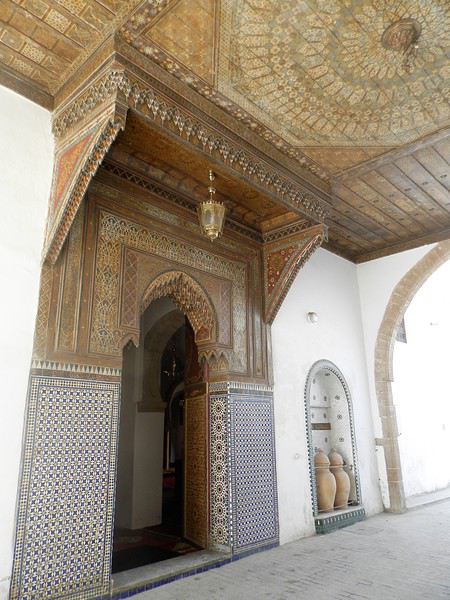
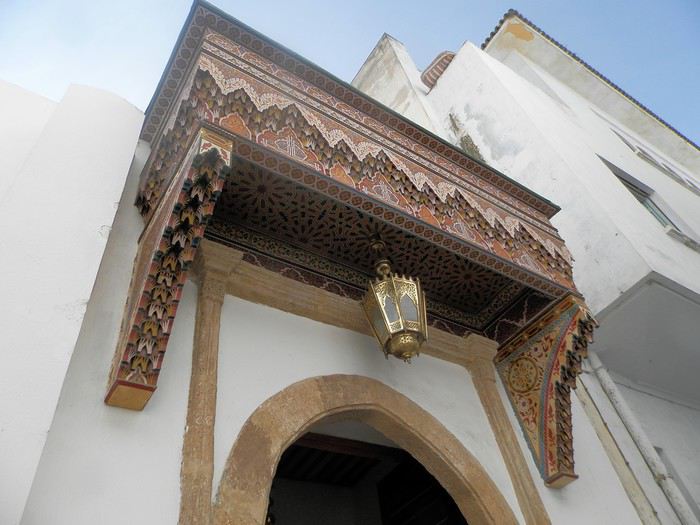
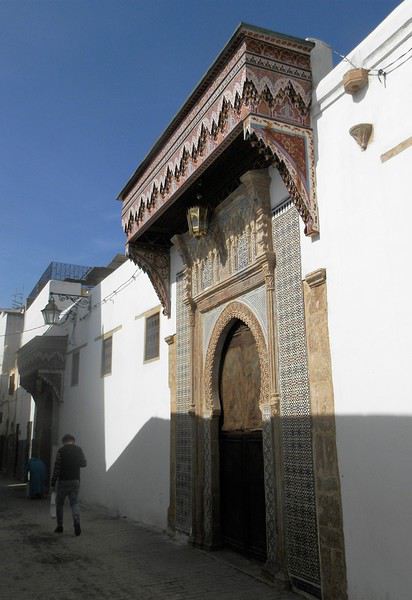
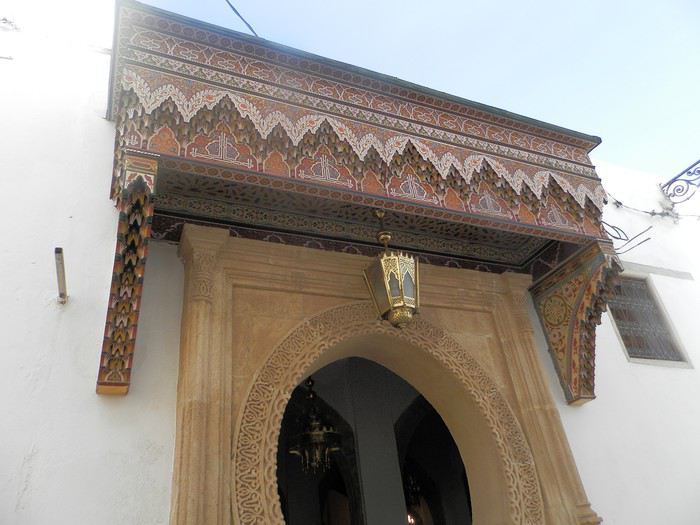
Une autre artère de la médina est la rue Sidi Fatah . Elle donne sur la rue Souika . Une magnifique mosquée y a été restaurée . Si j'en crois mon plan, il s'agit de la mosquée Moulay El Mekki . La porte principale est couverte et on trouve sur chacun des côtés 2 très belles portes ( 4 au total ) . Le minaret octogonal est remarquable . L'ensemble est complété par plusieurs marabout et un peu plus loin se trouve une importante zaouia . C'est vraiment très joli .
L'entrée principale est somptueuse . Le grand art de la peinture sur bois.
Quelques portes latérales
C'est vraiment très agréable de se balader sur la côte atlantique en cette saison ( mi-février ) . Il fait entre 18 et 22 degrés . Temps lumineux . Je n'aurai d'ailleurs pas de pluie pendant un mois ( après avoir eu de la pluie à peu près tous les jours les 5 derniers mois ) : que du bonheur donc ....
Le minaret octogonal
et la rue Sidi Fatah
La rénovation des monuments de la médina est presque terminée . La rue des consuls reprend vie, même si les nombreux fondouks de cette rue sont toujours en travaux . J'ai hâte de les revoir . Je déambule dans les ruelles tranquilles , toujours à l’affût de ces détails qui en font le charme .
Une belle oeuvre de street-art accroche mon œil ....
et cette fenêtre a un charme fou .
Cette fois , mes pas me portent vers les quais ( on pourrait presque dire le port ) de Rabat . Je quitte la médina par un jolie porte : l'ensemble , également restauré, est charmant . J'arrive directement sur l'Oued Bou Regreg .
Au cœur de la capitale subsiste un coin " pêche " . Un petit navire est devenu un restaurant-Lounge , plutôt luxueux ( menu à 790 dirhams pour 2 en cette Saint Valentin ) .
Rabat se donne des airs de petite Essaouira avec ses mouettes, ses bateaux, sa médina au fond, ses filets de pêche .... Le même site à l'horizontale .
Au fond, Les Oudayas
Un " pêche promenade ", me passe sous le nez . C'est mignon . On a envie de le faire la prochaine fois . Il y avait une activité de passeurs entre Rabat et Salé . Mais avec les ponts, le tramway, ..... Certains se sont adaptés , même si çà se fait toujours, plutôt en été ( la plage de Salé est toute proche ) .
Quelques barques rentrent , les unes après les autres et s'amarrent au ponton, côté Salé . Surement les lointains descendants des redoutables corsaires de Salé . Leur univers a été " explosé" ces dernières années avec l'immense projet d'aménagement de l'oued Bou Regreg . Il leur reste un petit ponton , ..... et juste après, on a construit une grande marina pour accueillir les nouveaux jouets de l'aristocratie locale .
et une autre
Tout ceci fait un curieux mélange entre une architecture ancestrale et la plus grande modernité ....
Ci-après, à gauche, le médina sur sa falaise, au fond le toit blanc du nouveau " Grand Théâtre de Rabat ), à côté duquel commence à sortir la future tour Mohamed VI qui sera la plus haute d' Afrique , et à droite la marina côté Salé .
Mais la Kasbah veille toujours sur la capitale
Un dernier regard ...
Voila pour ce nouveau coup de projecteur sur la capitale . Faites le détour et surprenez- vous
Demain, j'enfourche ma bonne Dacia Sandero et nous partons à l'assaut de l'Atlas .
Eternal Russia! A deep dive into rural, provincial, and everyday Russia...
Hello 😏
Four trips to Russia in our little camper van have allowed us to meet ordinary Russians, those who live far from the Westernized elites of the country's major western cities.
Even with our few words of Russian, we clearly understood what we were so often told: Russia is not just Moscow or St. Petersburg.
This post doesn’t claim to address the sociological realities of this magnificent country. More modestly, it aims to take you on a visual journey to discover the three fundamentals that shape Russian identity: rural life, religion, and patriotism.
VoyageForum allows 20 photos per post, so we’ll stick to this selection. They were taken during our fourth road trip, in April and May 2019.
RURAL LIFE
For this dive into rural Russia, we deliberately left the paved roads to take small dirt tracks and country lanes.
We traveled through the oblasts of Ulyanovsk (Ульяновск), Nizhny Novgorod (Нижний Новгород), and the Republic of Mordovia (Республика Мордовия).
1. We leave the main road to enter the first villages. Very quickly, we find these splendid homes that make up the historical heritage of rural Russia.
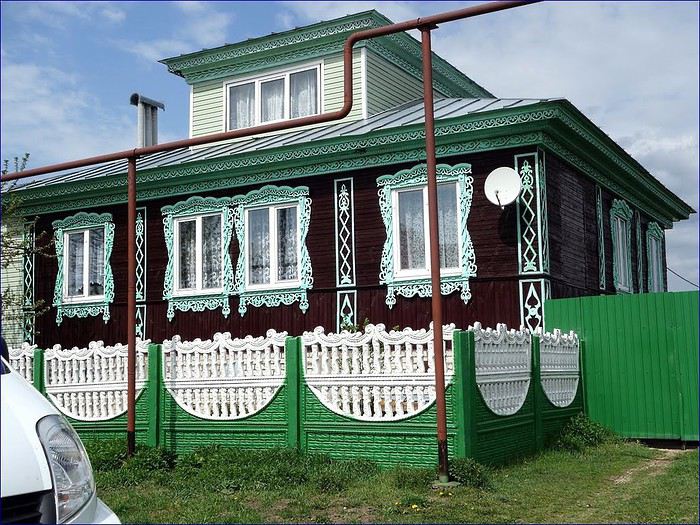
2. A little further on, we enter a village where time seems to have stood still. A single street, izbas on either side, small plots of land behind, a few wells for water...

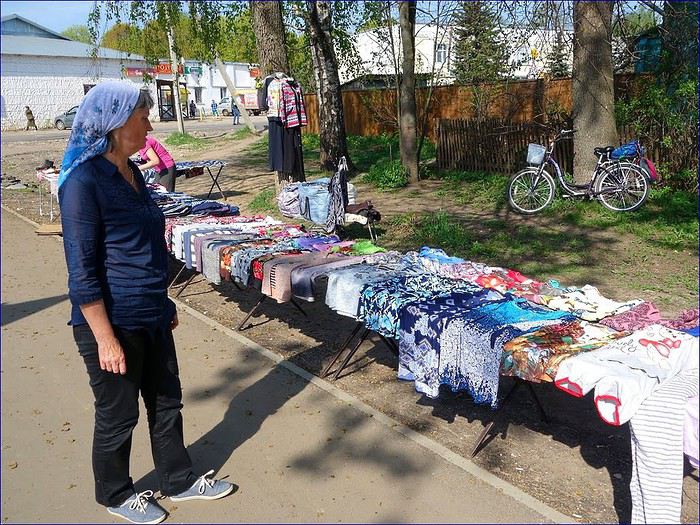
3. Shopping in rural Russia isn’t like GUM! Here, no luxury boutiques—vendors set up right by the roadside!
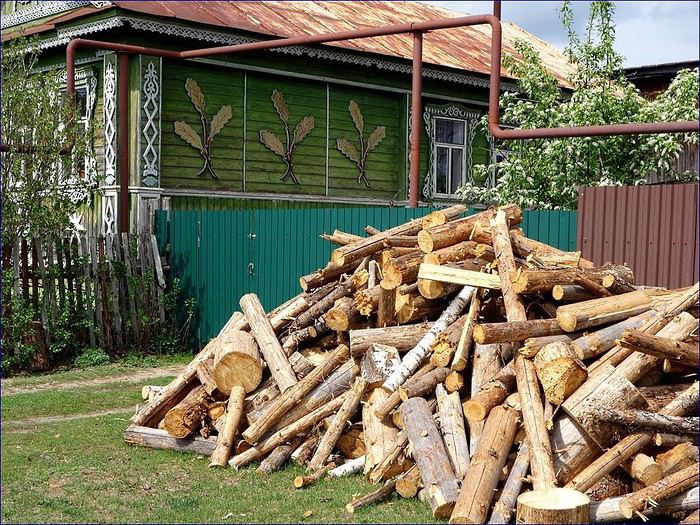
4. In another village, with a few words of Russian, I ask the owner of this house why he’s bringing in firewood in spring. From what I understood, you shouldn’t wait for autumn when everyone needs it and prices go up.
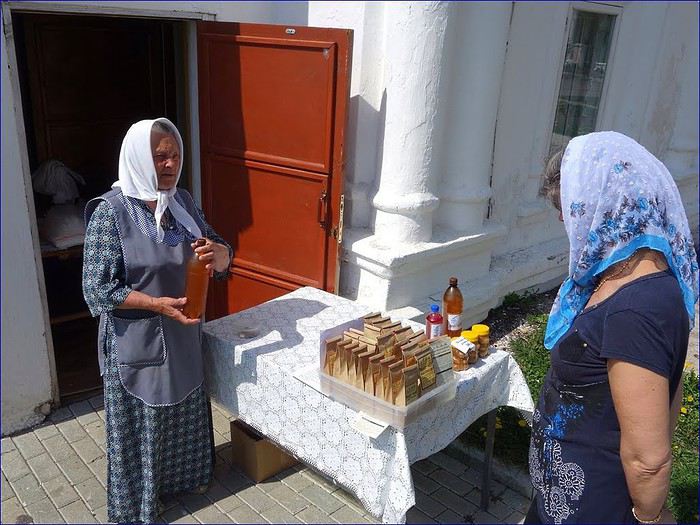
5. In the Nizhny Novgorod Oblast, we stop near a small church that the parishioners show us around. To thank them, Sylvie buys them fruit juice and delicious honey cakes. Generously, the priest gives us permission to sleep in the parking lot!
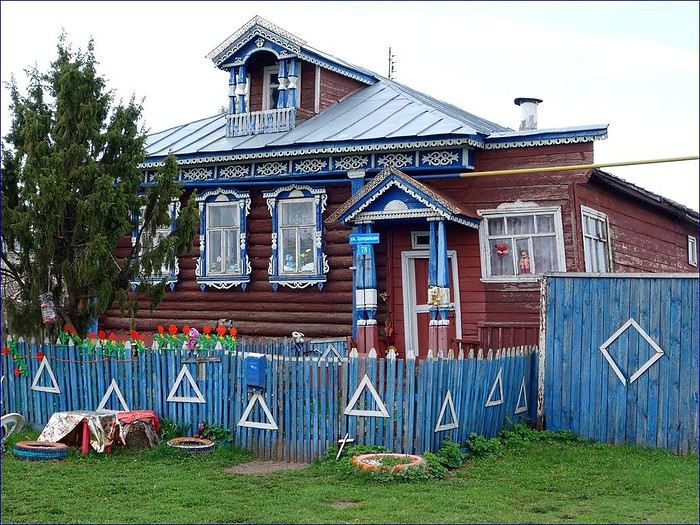
6. The next day, wandering rural roads, we admire this house for a long time, with its traditional wooden figurines behind the windows.
7. We hit the road again toward a small town where, of course, they sell local fish. We know Russians are the biggest consumers of freshwater fish in the world. And here, we’re in the central Volga basin with its dozens of tributaries!

RELIGION
A few years ago, we visited the Makaryevo Monastery. That’s where we learned about the Saint Seraphimo convent for nuns. It was hard to find, on the border of the Republic of Mordovia and the Nizhny Novgorod Oblast.
We discovered a place of pilgrimage, a space for religious expression, authentic, popular, and very Russian—where nuns, believers, and (most importantly) no tourists mix! Just 500 km from Moscow and the Golden Ring, the monastery mainly welcomes groups and families staying in the huge pilgrim house.
We’d only planned a quick visit but ended up staying two full days! Thanks to the staff for letting us park and sleep in the pilgrims’ parking lot.
8. The site is much larger than we imagined. Over several hectares, religious buildings, the nuns’ living quarters, visitor accommodations, and schools all coexist...
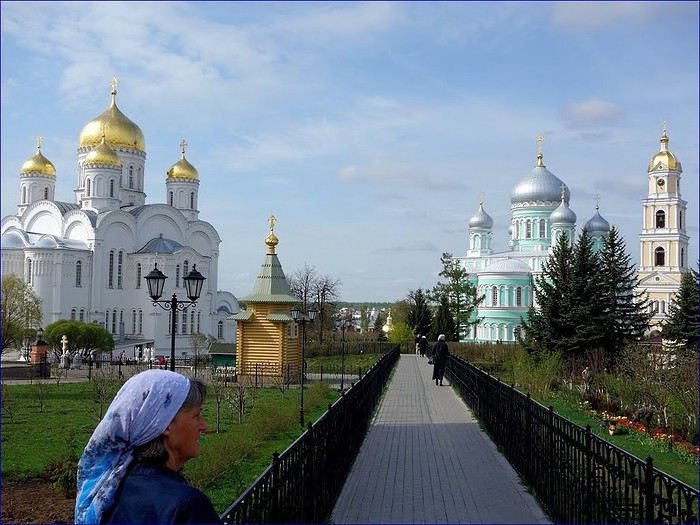
9. For two days, we mixed with kind religious figures and pilgrims—welcoming even to non-Orthodox folks like us!
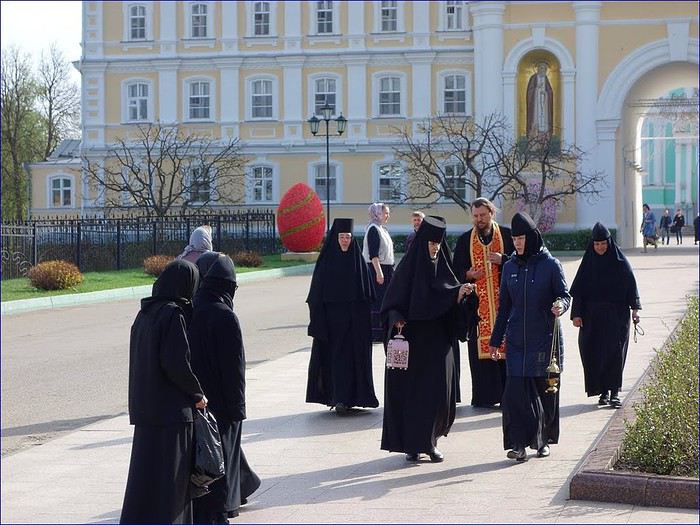
10. But what really stood out was the presence of groups of young people. We were also struck by how young the religious figures we met were.
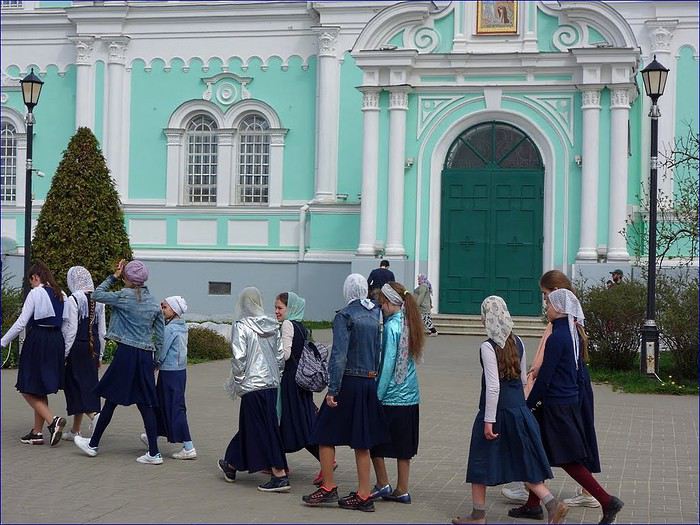
11. The next morning, having slept in the pilgrims’ parking lot, we were the first visitors. It was a special moment to walk the grounds alone.
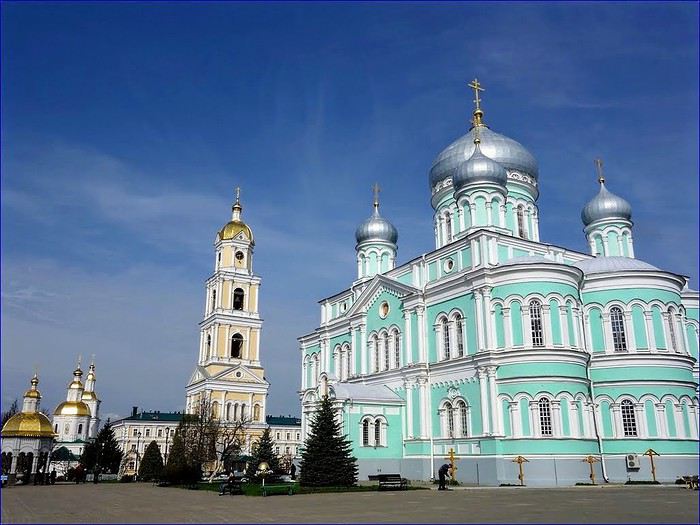
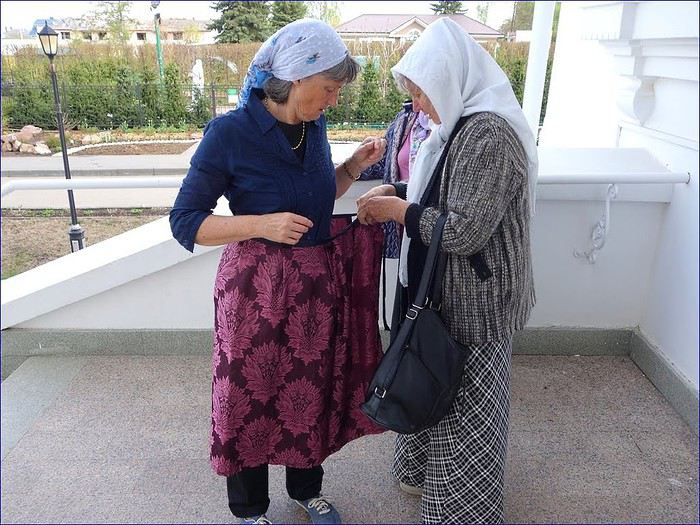
12. That morning was marked by an unlikely event. Sylvie chats with a nun who speaks English. Perhaps touched that we’d driven from France, she offers Sylvie a private tour. She asks two parishioners to dress her and grants her the privilege of seeing the sacred places closed to the public. Me? I got nothing—I was left outside!
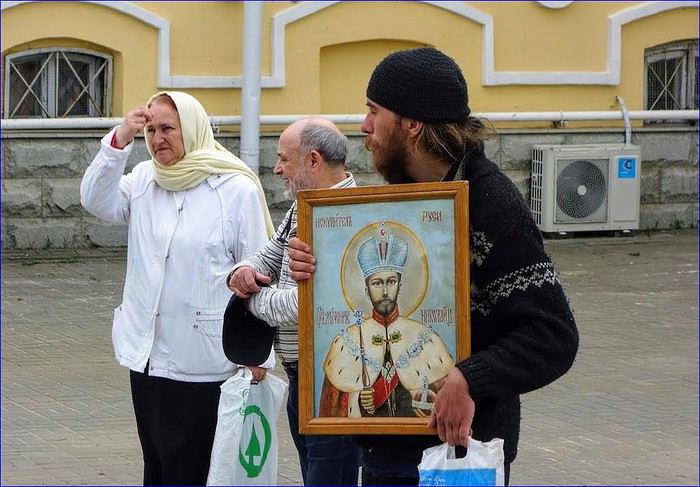
13. I take the chance to observe pilgrims in prayer. I meet a small group of believers gathered around a portrait of Nicholas II, praying for him.
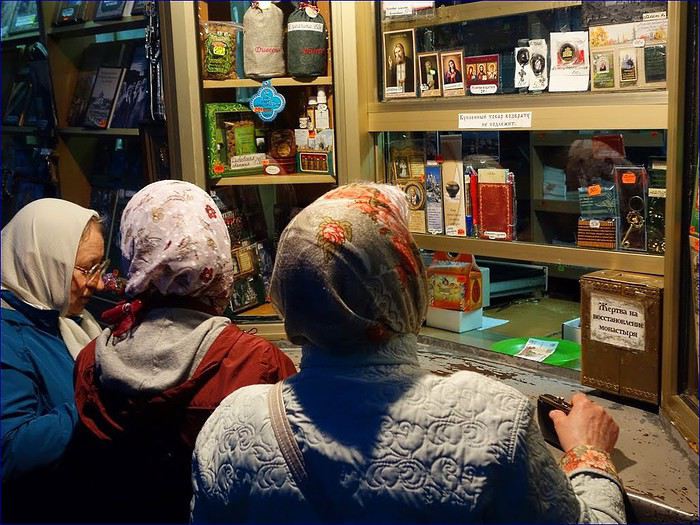
14. In the evening, after dinner, we attend the last service of the day. Until the site closes, we mingle with the *babushkas* buying icons, sacred images, and religious objects blessed by the priest—for just a few rubles.
PATRIOTISM
May 9, 1945, is the day Germany signed its surrender in Berlin. In Russia, it’s celebrated as День Победы—Victory Day. As we know, the Soviet Union paid the heaviest price: nearly 22 million dead. Not a single Russian family was spared.
We wanted to share this special moment, but far from the official ceremonies of the military parade on Red Square. We chose a provincial city, 180 km east of Moscow.
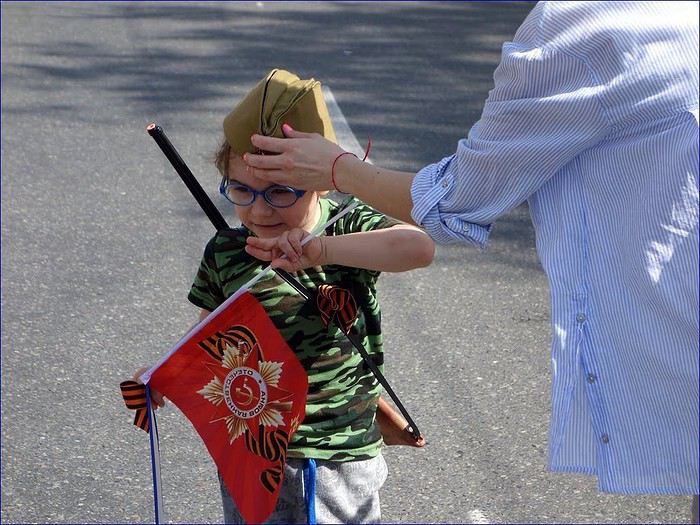
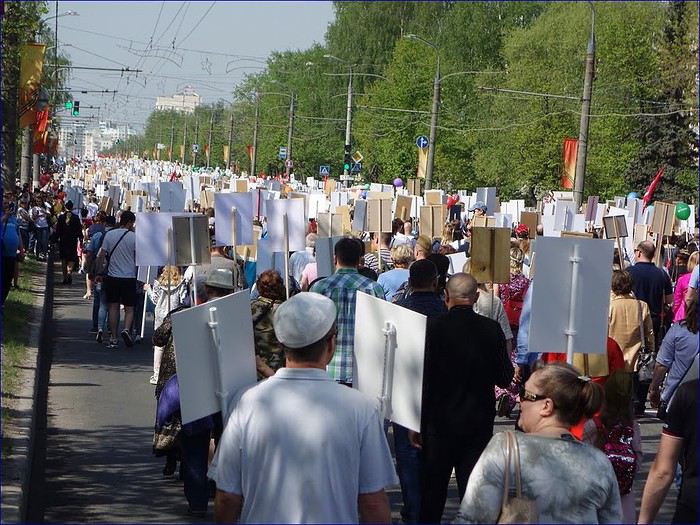
15. By 10 a.m., the crowd starts gathering downtown. Right away, what stands out is the family makeup of the procession.
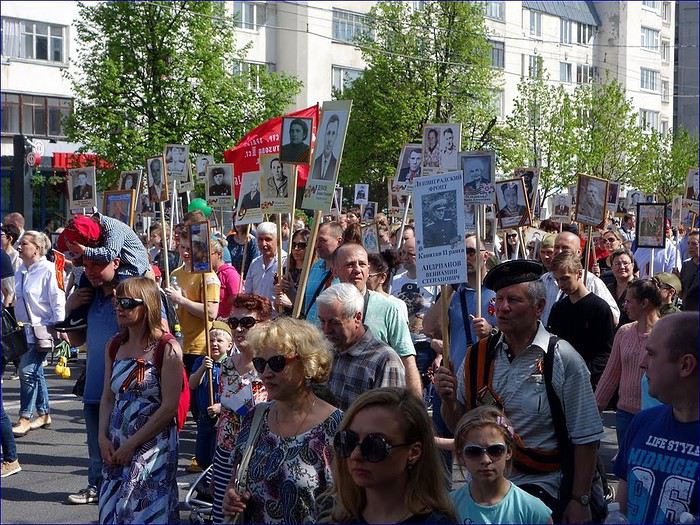
16. We walk among the families, like this mom adjusting her daughter’s cap. The atmosphere is a mix of solemnity and reflection, punctuated by the joyful laughter of children.
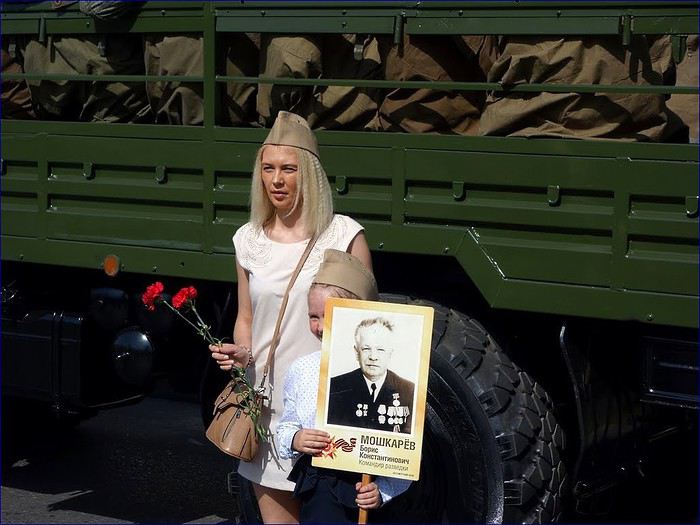
17. This mother and daughter pose behind a portrait of their grandfather.
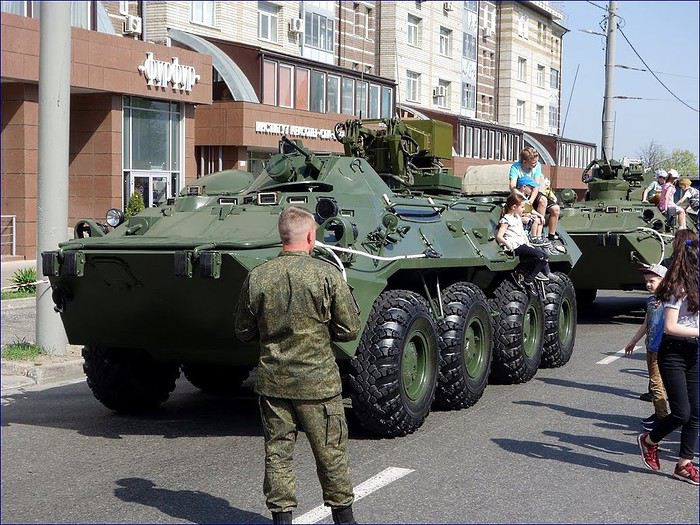
18. I spend a long time watching how patient and helpful the soldiers are. They lift kids onto the vehicles, make sure they don’t slip, then hand them back to their parents.
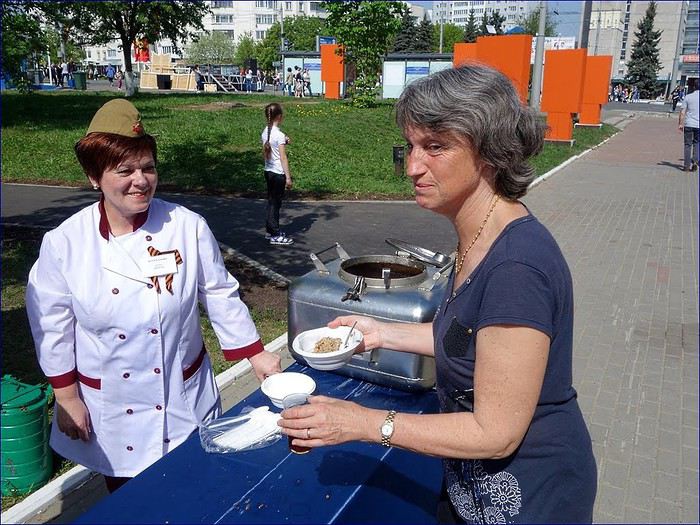
19. Around noon, we’re introduced to a tradition we didn’t know about. On May 9, in some cities, neighborhood committees made up of volunteers offer meals and drinks to participants. So we have lunch with families—parents, kids, and grandparents—all surprised we came from France.
20. By afternoon, the crowd has grown dense, with a procession stretching over 2 km! We stay until the end of the day, impressed by this authentic, popular demonstration of Russians’ attachment to the Motherland.
That’s all 😏
The full story is online here: ETERNAL RUSSIA.
Those who want to discover the world through the eyes of a plumber’s little van can check out Trafic Life.
Best regards,
Sylvie & Bernard
Four trips to Russia in our little camper van have allowed us to meet ordinary Russians, those who live far from the Westernized elites of the country's major western cities.
Even with our few words of Russian, we clearly understood what we were so often told: Russia is not just Moscow or St. Petersburg.
This post doesn’t claim to address the sociological realities of this magnificent country. More modestly, it aims to take you on a visual journey to discover the three fundamentals that shape Russian identity: rural life, religion, and patriotism.
VoyageForum allows 20 photos per post, so we’ll stick to this selection. They were taken during our fourth road trip, in April and May 2019.
RURAL LIFE
For this dive into rural Russia, we deliberately left the paved roads to take small dirt tracks and country lanes.
We traveled through the oblasts of Ulyanovsk (Ульяновск), Nizhny Novgorod (Нижний Новгород), and the Republic of Mordovia (Республика Мордовия).
1. We leave the main road to enter the first villages. Very quickly, we find these splendid homes that make up the historical heritage of rural Russia.
2. A little further on, we enter a village where time seems to have stood still. A single street, izbas on either side, small plots of land behind, a few wells for water...
3. Shopping in rural Russia isn’t like GUM! Here, no luxury boutiques—vendors set up right by the roadside!
4. In another village, with a few words of Russian, I ask the owner of this house why he’s bringing in firewood in spring. From what I understood, you shouldn’t wait for autumn when everyone needs it and prices go up.
5. In the Nizhny Novgorod Oblast, we stop near a small church that the parishioners show us around. To thank them, Sylvie buys them fruit juice and delicious honey cakes. Generously, the priest gives us permission to sleep in the parking lot!
6. The next day, wandering rural roads, we admire this house for a long time, with its traditional wooden figurines behind the windows.
7. We hit the road again toward a small town where, of course, they sell local fish. We know Russians are the biggest consumers of freshwater fish in the world. And here, we’re in the central Volga basin with its dozens of tributaries!
RELIGION
A few years ago, we visited the Makaryevo Monastery. That’s where we learned about the Saint Seraphimo convent for nuns. It was hard to find, on the border of the Republic of Mordovia and the Nizhny Novgorod Oblast.
We discovered a place of pilgrimage, a space for religious expression, authentic, popular, and very Russian—where nuns, believers, and (most importantly) no tourists mix! Just 500 km from Moscow and the Golden Ring, the monastery mainly welcomes groups and families staying in the huge pilgrim house.
We’d only planned a quick visit but ended up staying two full days! Thanks to the staff for letting us park and sleep in the pilgrims’ parking lot.
8. The site is much larger than we imagined. Over several hectares, religious buildings, the nuns’ living quarters, visitor accommodations, and schools all coexist...
9. For two days, we mixed with kind religious figures and pilgrims—welcoming even to non-Orthodox folks like us!
10. But what really stood out was the presence of groups of young people. We were also struck by how young the religious figures we met were.
11. The next morning, having slept in the pilgrims’ parking lot, we were the first visitors. It was a special moment to walk the grounds alone.
12. That morning was marked by an unlikely event. Sylvie chats with a nun who speaks English. Perhaps touched that we’d driven from France, she offers Sylvie a private tour. She asks two parishioners to dress her and grants her the privilege of seeing the sacred places closed to the public. Me? I got nothing—I was left outside!
13. I take the chance to observe pilgrims in prayer. I meet a small group of believers gathered around a portrait of Nicholas II, praying for him.
14. In the evening, after dinner, we attend the last service of the day. Until the site closes, we mingle with the *babushkas* buying icons, sacred images, and religious objects blessed by the priest—for just a few rubles.
PATRIOTISM
May 9, 1945, is the day Germany signed its surrender in Berlin. In Russia, it’s celebrated as День Победы—Victory Day. As we know, the Soviet Union paid the heaviest price: nearly 22 million dead. Not a single Russian family was spared.
We wanted to share this special moment, but far from the official ceremonies of the military parade on Red Square. We chose a provincial city, 180 km east of Moscow.
15. By 10 a.m., the crowd starts gathering downtown. Right away, what stands out is the family makeup of the procession.
16. We walk among the families, like this mom adjusting her daughter’s cap. The atmosphere is a mix of solemnity and reflection, punctuated by the joyful laughter of children.
17. This mother and daughter pose behind a portrait of their grandfather.
18. I spend a long time watching how patient and helpful the soldiers are. They lift kids onto the vehicles, make sure they don’t slip, then hand them back to their parents.
19. Around noon, we’re introduced to a tradition we didn’t know about. On May 9, in some cities, neighborhood committees made up of volunteers offer meals and drinks to participants. So we have lunch with families—parents, kids, and grandparents—all surprised we came from France.
20. By afternoon, the crowd has grown dense, with a procession stretching over 2 km! We stay until the end of the day, impressed by this authentic, popular demonstration of Russians’ attachment to the Motherland.
That’s all 😏
The full story is online here: ETERNAL RUSSIA.
Those who want to discover the world through the eyes of a plumber’s little van can check out Trafic Life.
Best regards,
Sylvie & Bernard
Road trip Canada et USA pour 15 jours de parcs nationaux English translation pending
Bonjour à toutes et à tous,
Nous sommes quatre trentenaires, amoureux de la nature et des Etats-Unis, qui avons décidés de réaliser un road trip de 15 jours en parcourant les parcs nationaux américains et canadiens.
Je souhaiterai partager le programme que nous avons en tête avec l'ensemble des membres du forum, et le modifier en fonction de vos commentaires/avis sur celui-ci.
Petite précision : nous partirons du 12 au 26 Septembre 2020, et nos billets d'avion pour les vols internationaux ont fraichement été réservés (nous avons bénéficié d'une jolie promo, youhou ! 😛).
Voici le programme :
J1 [12/09/2020] Vol CDG - Calgary : arrivée à Calgary prévue à 17h55. Nuit sur place.
J2 [13/09/2020] Calgary => Banff NP : balade dans Calgary le matin, puis route jusqu'à Banff NP l'après-midi.
J3 [14/09/2020] Banff NP : journée de randonnée dans le parc.
J4 [15/09/2020] Banff NP => Jasper NP : route vers Jasper NP dans l'après-midi.
J5 [16/09/2020] Jasper NP : journée de randonnée dans le parc.
J6 [17/09/2020] Jasper NP => Edmonton : route vers l'aéroport d'Edmonton pour y prendre un vol jusqu'à Kalispell (USA). Nous souhaitons prendre un vol Canada => USA afin de résoudre la problématique liée à la voiture de location entre ces deux pays. Nuit près de Glacier NP.
J7 [18/09/2020] Glacier NP : randonnée dans le parc.
J8 [19/09/2020] Glacier NP => Yellowstone NP (entrée Nord). Nuit à Gardiner ou dans le secteur nord du parc. Question : des choses sympa à faire sur cette portion ?
J9 [20/09/2020] Yellowstone NP. Question : quel itinéraire conseilleriez-vous pour 3 jours dans le parc de Yellowstone avec une sortie le troisième jour par le sud ?
J10 [21/09/2020] Yellowstone NP.
J11 [22/09/2020] Yellowstone NP, puis route vers Grand Teton NP en fin de journée. Nuit près de Grand Teton NP.
J12 [23/09/2020] Grand Teton NP : randonnée dans le parc.
J13 [24/09/2020] Grand Teton NP => Rapid City. Question : des choses sympa à faire sur cette longue portion de route ?
J14 [25/09/2020] Mont Rushmore + Custer State Park ou Badland NP.
J15 [26/09/2020] Vol Rapid City => CDG.
Qu'en pensez-vous ? C'est un premier jet et je suis persuadé que des améliorations pourront être effectués suite à vos précieux conseils...
Des hébergements sont-ils à réserver en urgence ? Ou sont-ils incoutournables ?
Je vous remercie par avance pour vos retours & vous souhaite une excellente journée,
Bien à vous,
PA
Nous sommes quatre trentenaires, amoureux de la nature et des Etats-Unis, qui avons décidés de réaliser un road trip de 15 jours en parcourant les parcs nationaux américains et canadiens.
Je souhaiterai partager le programme que nous avons en tête avec l'ensemble des membres du forum, et le modifier en fonction de vos commentaires/avis sur celui-ci.
Petite précision : nous partirons du 12 au 26 Septembre 2020, et nos billets d'avion pour les vols internationaux ont fraichement été réservés (nous avons bénéficié d'une jolie promo, youhou ! 😛).
Voici le programme :
J1 [12/09/2020] Vol CDG - Calgary : arrivée à Calgary prévue à 17h55. Nuit sur place.
J2 [13/09/2020] Calgary => Banff NP : balade dans Calgary le matin, puis route jusqu'à Banff NP l'après-midi.
J3 [14/09/2020] Banff NP : journée de randonnée dans le parc.
J4 [15/09/2020] Banff NP => Jasper NP : route vers Jasper NP dans l'après-midi.
J5 [16/09/2020] Jasper NP : journée de randonnée dans le parc.
J6 [17/09/2020] Jasper NP => Edmonton : route vers l'aéroport d'Edmonton pour y prendre un vol jusqu'à Kalispell (USA). Nous souhaitons prendre un vol Canada => USA afin de résoudre la problématique liée à la voiture de location entre ces deux pays. Nuit près de Glacier NP.
J7 [18/09/2020] Glacier NP : randonnée dans le parc.
J8 [19/09/2020] Glacier NP => Yellowstone NP (entrée Nord). Nuit à Gardiner ou dans le secteur nord du parc. Question : des choses sympa à faire sur cette portion ?
J9 [20/09/2020] Yellowstone NP. Question : quel itinéraire conseilleriez-vous pour 3 jours dans le parc de Yellowstone avec une sortie le troisième jour par le sud ?
J10 [21/09/2020] Yellowstone NP.
J11 [22/09/2020] Yellowstone NP, puis route vers Grand Teton NP en fin de journée. Nuit près de Grand Teton NP.
J12 [23/09/2020] Grand Teton NP : randonnée dans le parc.
J13 [24/09/2020] Grand Teton NP => Rapid City. Question : des choses sympa à faire sur cette longue portion de route ?
J14 [25/09/2020] Mont Rushmore + Custer State Park ou Badland NP.
J15 [26/09/2020] Vol Rapid City => CDG.
Qu'en pensez-vous ? C'est un premier jet et je suis persuadé que des améliorations pourront être effectués suite à vos précieux conseils...
Des hébergements sont-ils à réserver en urgence ? Ou sont-ils incoutournables ?
Je vous remercie par avance pour vos retours & vous souhaite une excellente journée,
Bien à vous,
PA
Bolivia: Exploring the South Lipez by Self-Drive
Hi everyone,
The idea of traveling to Bolivia came to me after seeing Jean-François (Max68)’s photos on his website. I thought we *had* to see those stunning landscapes with the colorful lagoons for ourselves. But a self-drive trip didn’t seem doable at first. A few years ago, everyone advised against going to the South Lipez with just one car.
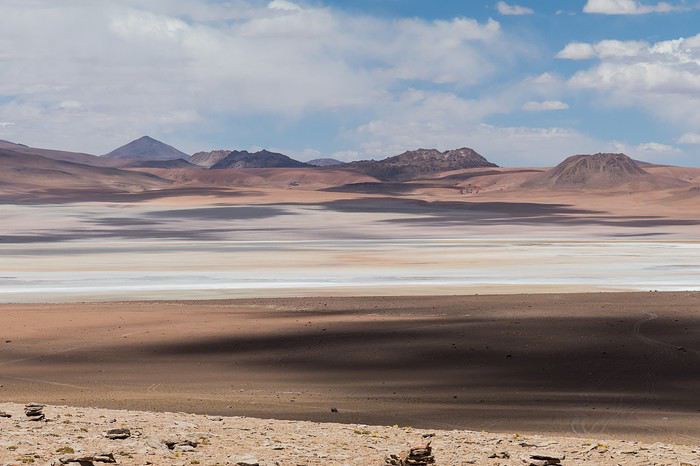 Laguna Kara
It was only after reading Laurent (Lolobe) and Pascal (Pepe874)’s travel journals—who explored the South Lipez solo with a car from Biz Rent a Car—that I thought we might be able to do the same. Meanwhile, we’d already contacted a local agency to organize a trip with a driver and guide. But the idea of a self-drive adventure really appealed to us. With encouragement and tips from Thierry (Tbernay) and Jean-François (Max68), we decided to plan our own self-drive trip. I’d like to thank them for their advice—it was *super* helpful. And a big thanks to all the other forum members for the info shared during our prep!
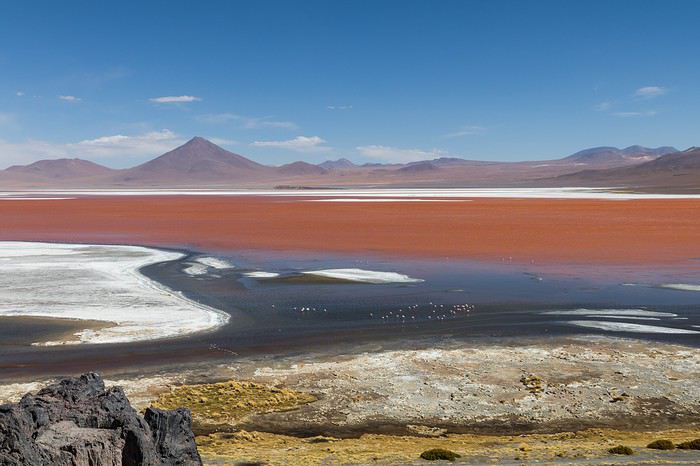 Laguna Colorada
Planning this trip happened during a tough time for our family. My mother-in-law’s illness and passing, plus a few health issues of my own, made us doubt the trip multiple times and nearly scrap the whole thing.
We booked our international flights in February with Swiss. They offered the best balance of travel time and price from Switzerland. Swiss operates Zurich–São Paulo with their own fleet, and São Paulo–Santa Cruz with GOL. In June, GOL canceled the Saturday flight and rebooked us on Sunday. Spending over 24 hours in that huge Brazilian city didn’t work for us at all, so we asked Swiss to put us on the next Zurich–São Paulo flight. Too bad—we lost a day in Bolivia and had to skip the Tarabucco market on Sunday.
Right after, we also booked the car in February. After contacting Imbex and Biz, we went with Biz. Not speaking Spanish, we were relieved to communicate with Alejandra in French. The contact was great—she answered all our questions patiently. Sometimes it took a few days to get a reply, but we could also reach her on WhatsApp. After our trip, we can *only* recommend Biz for rentals in Bolivia. The cars are well-prepped for the South Lipez tracks. The agency is reliable, and the vehicles are new and well-maintained.
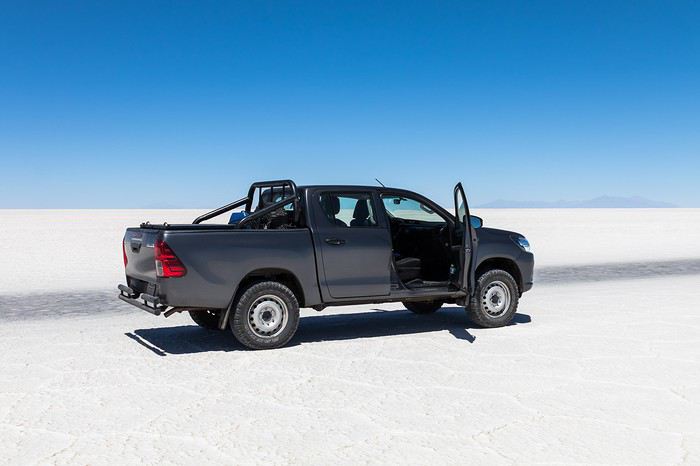 “Our” car, a Toyota Hilux
While planning, we realized the presidential elections would happen while we were in Bolivia. The risk of *bloqueos* (roadblocks and protests) was very real. But in Bolivia, *bloqueos* seem common—you always have to account for that kind of hassle. In late August/early September, Uyuni and the Salar region were blocked for days, leading to food, fuel, and cash shortages. Worried about a blockade in Uyuni and missing the Salar, we decided to visit it first *just in case*.
On election day, the whole country shut down. Planes were grounded, buses and taxis couldn’t circulate, and private cars were banned. There were a few exceptions—ambulances, police, or certain professions—but as tourists, we couldn’t get permission to drive. We asked the embassy, and Biz even requested a permit from the electoral office. So we had to plan to be somewhere with things to do *without* the car.
We decided not to book any accommodations in advance—a first for us. Usually, we plan our stops and reserve lodges, hotels, or campgrounds well ahead. This time, only the room in Sucre was booked, so we’d have a base when we arrived.
In July, Alex (Delhenry) reached out to propose joining part of the trip. He didn’t realize we were leaving in October. Still, we got fresh updates when he returned from the South Lipez. Thanks, Alex—your tips, especially about the Guadalupe–Tupiza stretch, were *super* useful.
In September, we connected with Jean-Louis (Avx) and Anne (Xeta), who were also heading to Bolivia in October, one and two weeks after us. We had dinner with Jean-Louis and his friend after our South Lipez trip and stayed in touch with Anne. It was great to chat with them! Unfortunately, Anne and her husband had a much rockier trip—they got hit hard by post-election issues.
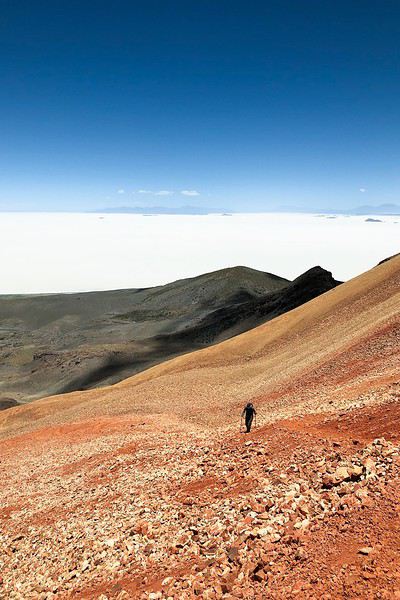 Climbing Volcán Tunupa
Our itinerary wasn’t set in stone—we decided to wing it on the spot. Two weeks before departure, I reconnected with Alejandra at Biz to move the car rental up by a day. With the elections, we wanted to leave Sucre ASAP and focus on the South Lipez. Outside Uyuni and Tupiza, the risk of blockades was zero. We also planned a two-night buffer in Sucre before our flights, just in case. It might sound overcautious, but in hindsight, we made the right call. If we’d left Sucre a day later, we wouldn’t have made it to Potosí—it was completely blocked. On the way back, we *just* dodged blockades in Potosí and elsewhere. Sometimes, you’ve gotta trust your gut.
Here’s our route—only the first two nights in Sucre were booked ahead:
D1 Departure from Switzerland
D2 Sucre (La Selenita)
D3 Sucre (La Selenita)
D4 Colchani (Hotel de Sal Luna Salada)
D5 Jirira (Auberge Doña Lupe)
D6 On the Salar (in the car)
D7 A few kilometers from Estancia Catal (in the car)
D8 Laguna Hedionda (Hotel Los Flamencos)
D9 Laguna Colorada (Lodge by the lagoon)
D10 Middle of nowhere, en route Laguna Verde–Mina Horsu–Quetena Chico (in the car)
D11 Quetena Chico (Lamphaya Lodge Andino)
D12 Quetena Chico (Lamphaya Lodge Andino)
D13 Guadalupe (Guest room at Celia’s)
D14 Along the Rio Grande (in the car)
D15 Tupiza (Hotel Mitru)
D16 Tupiza (Hotel Mitru)
D17 Sucre (La Selenita)
D18 Sucre (La Selenita)
D19 Santa Cruz (Hotel Sun)
D20 Departure from Santa Cruz
D21 Arrival in Switzerland
As you can see, we spent 13 nights in the South Lipez. Initially, we’d planned for nine, but Jean-François (Max68) suggested staying longer. Great advice—we didn’t regret it one bit. We could’ve even added 2–3 more days without getting bored.
Self-driving in the South Lipez takes some prep and a good GPS. We kept it simple and used maps.me to navigate. It’s a solid app—just save your waypoints ahead of time. For some stretches, I used Google Earth to visualize the tracks and sites. If you stick to the tour operator routes, you *almost* can’t get lost. But we often veered off the beaten path and took different routes. Some days, we didn’t see another car. So in case of a breakdown, it’s key to have water and food for several days. In some spots, there’s *zero* signal—your phone won’t work. Another must: it gets *cold* in the South Lipez, and a good sleeping bag is essential. We brought down sleeping bags rated for -10°C and didn’t regret it during our car nights.
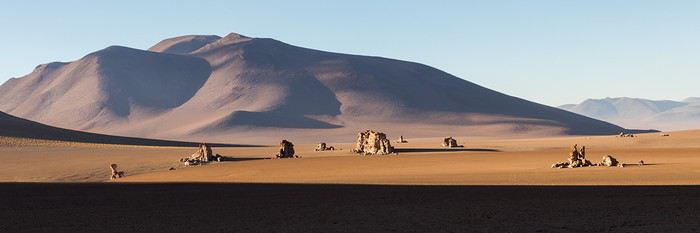 The Dalí Desert
Some tracks are *super* rocky—flat tires are a real risk. On those stretches, maps.me’s estimated travel time was way off. Some sections barely let us go over 15 km/h.
Lots of forum members recommend doing the South Lipez “loop” from Tupiza to Uyuni—ending with the Salar—to avoid Uyuni’s crowds. That might work for organized tours, but for self-drive, the direction *doesn’t* matter. I’ll say this: the few vehicles we saw mostly came from Tupiza and Chile, not Uyuni. So if starting from Uyuni works better for you, go for it! Ending in Tupiza means heading toward warmer weather. For our planned stops and climbs, starting in Uyuni helped with acclimatization. Spending a few nights between 3,600–3,800 m before going over 4,000 m is a smart move.
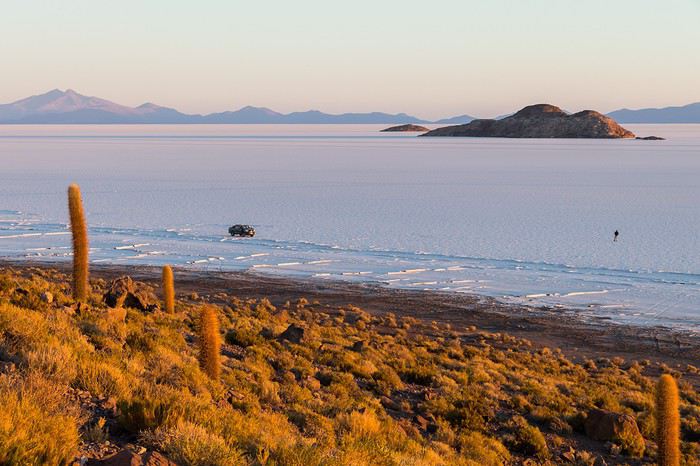 Uyuni Salt Flats in the morning
Overall, we barely saw anyone—except at Laguna Hedionda and Chalviri. There were several tour groups at Hotel Los Flamencos (Laguna Hedionda), but we didn’t cross paths during the day. Hardly anyone on the Salar, on the roads, or at the lodges in the evenings. The *only* place that shocked us was Chalviri. We’d planned to stay there, but it was fully booked—and we counted *forty* tour jeeps on-site. This was around noon! At the Polques hot springs (Chalviri), it was *packed*—we quickly nixed the idea of a dip. Plus, the vibe wasn’t great: soaking right by the road with lodges and restaurants in the background? Meh. Still, lots of tourists love it, so it’s up to you.
For the photos, I kept the colors and mood we saw. The lagoons’ hues are often stunning, but some online photos are *way* over-edited and oversaturated. The South Lipez’s landscapes are breathtaking—no need for excessive retouching.
If you don’t want to read all the details, the start of the travel journal is here: https://voyageforum.com/v.f?post=9888761;a=9888761
The idea of traveling to Bolivia came to me after seeing Jean-François (Max68)’s photos on his website. I thought we *had* to see those stunning landscapes with the colorful lagoons for ourselves. But a self-drive trip didn’t seem doable at first. A few years ago, everyone advised against going to the South Lipez with just one car.
Laguna KaraIt was only after reading Laurent (Lolobe) and Pascal (Pepe874)’s travel journals—who explored the South Lipez solo with a car from Biz Rent a Car—that I thought we might be able to do the same. Meanwhile, we’d already contacted a local agency to organize a trip with a driver and guide. But the idea of a self-drive adventure really appealed to us. With encouragement and tips from Thierry (Tbernay) and Jean-François (Max68), we decided to plan our own self-drive trip. I’d like to thank them for their advice—it was *super* helpful. And a big thanks to all the other forum members for the info shared during our prep!
Laguna ColoradaPlanning this trip happened during a tough time for our family. My mother-in-law’s illness and passing, plus a few health issues of my own, made us doubt the trip multiple times and nearly scrap the whole thing.
We booked our international flights in February with Swiss. They offered the best balance of travel time and price from Switzerland. Swiss operates Zurich–São Paulo with their own fleet, and São Paulo–Santa Cruz with GOL. In June, GOL canceled the Saturday flight and rebooked us on Sunday. Spending over 24 hours in that huge Brazilian city didn’t work for us at all, so we asked Swiss to put us on the next Zurich–São Paulo flight. Too bad—we lost a day in Bolivia and had to skip the Tarabucco market on Sunday.
Right after, we also booked the car in February. After contacting Imbex and Biz, we went with Biz. Not speaking Spanish, we were relieved to communicate with Alejandra in French. The contact was great—she answered all our questions patiently. Sometimes it took a few days to get a reply, but we could also reach her on WhatsApp. After our trip, we can *only* recommend Biz for rentals in Bolivia. The cars are well-prepped for the South Lipez tracks. The agency is reliable, and the vehicles are new and well-maintained.
“Our” car, a Toyota HiluxWhile planning, we realized the presidential elections would happen while we were in Bolivia. The risk of *bloqueos* (roadblocks and protests) was very real. But in Bolivia, *bloqueos* seem common—you always have to account for that kind of hassle. In late August/early September, Uyuni and the Salar region were blocked for days, leading to food, fuel, and cash shortages. Worried about a blockade in Uyuni and missing the Salar, we decided to visit it first *just in case*.
On election day, the whole country shut down. Planes were grounded, buses and taxis couldn’t circulate, and private cars were banned. There were a few exceptions—ambulances, police, or certain professions—but as tourists, we couldn’t get permission to drive. We asked the embassy, and Biz even requested a permit from the electoral office. So we had to plan to be somewhere with things to do *without* the car.
We decided not to book any accommodations in advance—a first for us. Usually, we plan our stops and reserve lodges, hotels, or campgrounds well ahead. This time, only the room in Sucre was booked, so we’d have a base when we arrived.
In July, Alex (Delhenry) reached out to propose joining part of the trip. He didn’t realize we were leaving in October. Still, we got fresh updates when he returned from the South Lipez. Thanks, Alex—your tips, especially about the Guadalupe–Tupiza stretch, were *super* useful.
In September, we connected with Jean-Louis (Avx) and Anne (Xeta), who were also heading to Bolivia in October, one and two weeks after us. We had dinner with Jean-Louis and his friend after our South Lipez trip and stayed in touch with Anne. It was great to chat with them! Unfortunately, Anne and her husband had a much rockier trip—they got hit hard by post-election issues.
Climbing Volcán TunupaOur itinerary wasn’t set in stone—we decided to wing it on the spot. Two weeks before departure, I reconnected with Alejandra at Biz to move the car rental up by a day. With the elections, we wanted to leave Sucre ASAP and focus on the South Lipez. Outside Uyuni and Tupiza, the risk of blockades was zero. We also planned a two-night buffer in Sucre before our flights, just in case. It might sound overcautious, but in hindsight, we made the right call. If we’d left Sucre a day later, we wouldn’t have made it to Potosí—it was completely blocked. On the way back, we *just* dodged blockades in Potosí and elsewhere. Sometimes, you’ve gotta trust your gut.
Here’s our route—only the first two nights in Sucre were booked ahead:
D1 Departure from Switzerland
D2 Sucre (La Selenita)
D3 Sucre (La Selenita)
D4 Colchani (Hotel de Sal Luna Salada)
D5 Jirira (Auberge Doña Lupe)
D6 On the Salar (in the car)
D7 A few kilometers from Estancia Catal (in the car)
D8 Laguna Hedionda (Hotel Los Flamencos)
D9 Laguna Colorada (Lodge by the lagoon)
D10 Middle of nowhere, en route Laguna Verde–Mina Horsu–Quetena Chico (in the car)
D11 Quetena Chico (Lamphaya Lodge Andino)
D12 Quetena Chico (Lamphaya Lodge Andino)
D13 Guadalupe (Guest room at Celia’s)
D14 Along the Rio Grande (in the car)
D15 Tupiza (Hotel Mitru)
D16 Tupiza (Hotel Mitru)
D17 Sucre (La Selenita)
D18 Sucre (La Selenita)
D19 Santa Cruz (Hotel Sun)
D20 Departure from Santa Cruz
D21 Arrival in Switzerland
As you can see, we spent 13 nights in the South Lipez. Initially, we’d planned for nine, but Jean-François (Max68) suggested staying longer. Great advice—we didn’t regret it one bit. We could’ve even added 2–3 more days without getting bored.
Self-driving in the South Lipez takes some prep and a good GPS. We kept it simple and used maps.me to navigate. It’s a solid app—just save your waypoints ahead of time. For some stretches, I used Google Earth to visualize the tracks and sites. If you stick to the tour operator routes, you *almost* can’t get lost. But we often veered off the beaten path and took different routes. Some days, we didn’t see another car. So in case of a breakdown, it’s key to have water and food for several days. In some spots, there’s *zero* signal—your phone won’t work. Another must: it gets *cold* in the South Lipez, and a good sleeping bag is essential. We brought down sleeping bags rated for -10°C and didn’t regret it during our car nights.
The Dalí DesertSome tracks are *super* rocky—flat tires are a real risk. On those stretches, maps.me’s estimated travel time was way off. Some sections barely let us go over 15 km/h.
Lots of forum members recommend doing the South Lipez “loop” from Tupiza to Uyuni—ending with the Salar—to avoid Uyuni’s crowds. That might work for organized tours, but for self-drive, the direction *doesn’t* matter. I’ll say this: the few vehicles we saw mostly came from Tupiza and Chile, not Uyuni. So if starting from Uyuni works better for you, go for it! Ending in Tupiza means heading toward warmer weather. For our planned stops and climbs, starting in Uyuni helped with acclimatization. Spending a few nights between 3,600–3,800 m before going over 4,000 m is a smart move.
Uyuni Salt Flats in the morningOverall, we barely saw anyone—except at Laguna Hedionda and Chalviri. There were several tour groups at Hotel Los Flamencos (Laguna Hedionda), but we didn’t cross paths during the day. Hardly anyone on the Salar, on the roads, or at the lodges in the evenings. The *only* place that shocked us was Chalviri. We’d planned to stay there, but it was fully booked—and we counted *forty* tour jeeps on-site. This was around noon! At the Polques hot springs (Chalviri), it was *packed*—we quickly nixed the idea of a dip. Plus, the vibe wasn’t great: soaking right by the road with lodges and restaurants in the background? Meh. Still, lots of tourists love it, so it’s up to you.
For the photos, I kept the colors and mood we saw. The lagoons’ hues are often stunning, but some online photos are *way* over-edited and oversaturated. The South Lipez’s landscapes are breathtaking—no need for excessive retouching.
If you don’t want to read all the details, the start of the travel journal is here: https://voyageforum.com/v.f?post=9888761;a=9888761
Angkor: l'École Française d'Extrême-Orient (EFEO) English translation pending
Ce post se compose de trois parties
Première partie
Sources :
- "Les monuments du Groupe d'Angkor" de Maurice Glaize. Dans ce livre il y a le chapitre suivant : "L'œuvre de l'Ecole Française d'Extrême-Orient"
- "Angkor résidences des dieux", de Claude Jacques et Michael Freeman.
- "Un siècle d'histoire. L'Ecole Française d'Extrême-Orient et le Cambodge" (Editions Magellan & Cie – EFEO)
- Le site de l'EFEO
- Différents BEFEO (Bulletins de l'EFEO)
Le site de l'EFEO : https://www.efeo.fr/ - En haut dans la partie EFEO, dans ACCUEIL, cliquer sur CHERCHEURS D'ASIE, cliquer ensuite sur "Cliquez ici". On peut alors accéder aux différents membres (par pays ou index alphabétique). Pour chaque membre on y trouve une biographie et leurs publications avec des références :
• BEFEO, voir le site Persée BEFEO.
• Pour les Arts asiatiques : https://www.persee.fr/collection/arasi
• Comptes rendus des séances de l'Académie des Inscriptions et Belles-Lettres : https://www.persee.fr/collection/crai
• Journal des Savants : https://www.persee.fr/collection/jds
- En haut, dans la partie CENTRES on trouve la liste des villes où l'EFEO est présente
Le site Persée BEFEO : https://www.persee.fr/collection/befeo • Dans certains livres ou documents on trouve le nom de l'auteur, le titre, l'année de publication et éventuellement les numéros des pages. Cela facilite la recherche. Il en est de même pour les autres sites Persée (Arts asiatiques…). • Le BEFEO apparait sous forme de Pdf. En haut à gauche de l'article il y a plusieurs icônes. Cliquer sur l'icône en dessous de Pdf, on passe alors sur la "version texte", cela facilite la lecture de l'article et on peut alors faire un copier-coller (à mettre par exemple dans un document Word)
"En 1860, l’explorateur et naturaliste Henri Mouhot redécouvrit les temples d’Angkor au Cambodge. Cet événement fit alors grande impression sur l’opinion publique en Occident. Dès lors, la beauté et la majesté de ces monuments n’ont cessé de fasciner les amateurs d’art oriental. La cité khmère d’Angkor fut le centre d’une civilisation qui, au sommet de sa puissance, englobait une région allant, à l’Ouest, jusqu’à l’actuelle Birmane et, au Nord, jusqu’au Vat Phu, situé au Laos.…Il est vrai que l’Occident ignorait tout des ruines khmères, n’ayant pas prêté attention aux notes de voyage des Espagnols et des Portugais. Rien n’en transparaît dans les récits écrits par les français qui vinrent à Ayutthaya à la fin du XVIIème siècle. En fait le premier européen à signaler l’existence des monuments d’Angkor au XIXème siècle ne fut d’ailleurs pas le célèbre botaniste Henri Mouhot comme on le dit trop souvent, mais un missionnaire français, le père Charles-Emile Bouillevaux, établi à Battambang, alors sous la juridiction des Thaïs" ("Angkor résidences des dieux", de Claude Jacques et Michael Freeman).
- Décembre 1850 : Le Père Charles-Emile Bouillevaux (1823-1913), visita les ruines d'Angkor, qu'il signala à l'attention du monde savant. Il a écrit "Voyage en Indo-Chine, 1848 – 1856", édité en 1858, ce livre n'a pas eu un grand succès. Cet ouvrage a été réédité en 2012 aux éditions "Hachette – Livre BNF". Dans son livre, Charles-Emile Bouillevaux parle très peu des temples d'Angkor. Un peu décevant. Je ne recommande pas cet ouvrage.
- Henri MOUHOT (1826–1861) : naturaliste et explorateur français, en mission pour la British Royal Géographique Society. En Janvier 1860, Il arriva à Angkor Vat. Il fut le premier occidental à vanter auprès du grand public les merveilles d'Angkor. Ses descriptions publiées en France dans le journal le "Tour du Monde" et la "Bibliothèque Rose" après sa mort au Laos firent sensation. Ses écrits ont été rassemblés par Patrick Salès et publiés après sa mort en 1868 sous le titre "Voyage dans les royaumes de Siam, de Cambodge, de Laos, et autres parties centrales de l'Indochine, 1858-1861". Réédité à plusieurs reprises. Voir "Laos – Henri Mouhot, ce méconnu" http://www.souvenir-francais-asie.com/2009/12/04/laos-henri-mouhot-ce-meconnu/
- 1863 : début du protectorat français
- 1886-1868 : La mission Doudart de Lagrée - Garnier (1866-1868) : Le but principal de cette mission était de reconnaitre les voies navigables pour rejoindre la Chine. Au cours de cette mission les participants ont visité les ruines d'Angkor.
- Louis DELAPORTE a participé à la mission de Doudard de Lagrée. Il a été émerveillé par les temples d'Angkor. Il a fait connaitre l'art khmer. C'est aussi un peu grâce à lui et à l'intérêt qu'il a su éveiller pour les arts du Cambodge qu'en 1898 est fondée à Hanoï la M.A.I. (Mission Archéologique d'Indo-Chine) qui deviendra l'EFEO en 1900.
• Pour plus de détails voir mon post "L'art khmer dans les collections du Musée Guimet" https://voyageforum.com/v.f?post=6703899#6703899
• Les plâtres de Louis Delaporte D'Octobre 2013 à Janvier 2014 il y a eu une exposition au Musée Guimet "Angkor, naissance d'un mythe" où l'on pouvait voir une partie des plâtres que Louis Delaporte avait fait faire. Un livre avait alors été édité :"Angkor naissance d'un mythe, Louis Delaporte et le Cambodge" de Pierre Baptiste et Thierry Zéphir. J'ai trouvé ce livre très intéressant. Lors de cette exposition on pouvait voir l'excellent documentaire "Angkor redécouvert" Voir le post d'Enrodage https://voyageforum.com/v.f?post=6266628#6266628
- Etienne François AYMONIER (1844 – 1929). Officier et administrateur colonial français, spécialiste des cultures khmères et Cham. Il est l'auteur d'une étude en trois volumes sur le Cambodge qui donne pour la première fois les traductions des inscriptions trouvées sur le site. Il mène de multiples travaux épigraphiques, notamment des relevés systématiques d'inscriptions khmères qui précisent la chronologie des anciens royaumes. Il innove sur le plan technique en utilisant la méthode d'estampage (*) pour reproduire une inscription gravée dans la pierre
(*) L’estampage : une feuille de papier de soie est appliquée sur une pierre à l’aide d’une brosse humide, afin d’épouser la gravure dans ses moindres détails. On tamponne ensuite la surface redevenue sèche avec de l’encre : les parties qui ont épousé les creux de la gravure apparaîtront en blanc sur fond noir.
Il joue aussi un rôle en 1899 dans la fondation de la M.A.I. (EFEO)
Œuvres : "I – Le Cambodge. Le royaume actuel" : Editions Leroux, Paris, 1900-1904. Réédité en 2014 par la BNF. Disponible sur "Gallica": gallica.bnf.fr/...0s.r=cambodge.langEN "II – Le Cambodge. Les provinces siamoises". Réédité en 2014 par la BNF. Disponible sur "Gallica": gallica.bnf.fr/...14.r=cambodge.langEN "III - Le Cambodge. Le groupe d'Angkor et l'histoire, (Editions Leroux, 1900-1904). Réédité en 2014 par la BNF. Disponible sur "Gallica" : gallica.bnf.fr/...2g.r=cambodge.langEN Voir le BEFEO de George Cœdès : "Étienne-François Aymonier (1844-1929)". BEFEO, 1929, pp. 542-548
Voir le BEFEO année 1929 – 29 – pp. 542 548. De George Coedès "Etienne-François Aymonier (1844-1929) https://www.persee.fr/doc/befeo_0336-1519_1929_num_29_1_3305
Jacques
- "Angkor résidences des dieux", de Claude Jacques et Michael Freeman.
- "Un siècle d'histoire. L'Ecole Française d'Extrême-Orient et le Cambodge" (Editions Magellan & Cie – EFEO)
- Le site de l'EFEO
- Différents BEFEO (Bulletins de l'EFEO)
Le site de l'EFEO : https://www.efeo.fr/ - En haut dans la partie EFEO, dans ACCUEIL, cliquer sur CHERCHEURS D'ASIE, cliquer ensuite sur "Cliquez ici". On peut alors accéder aux différents membres (par pays ou index alphabétique). Pour chaque membre on y trouve une biographie et leurs publications avec des références :
• BEFEO, voir le site Persée BEFEO.
• Pour les Arts asiatiques : https://www.persee.fr/collection/arasi
• Comptes rendus des séances de l'Académie des Inscriptions et Belles-Lettres : https://www.persee.fr/collection/crai
• Journal des Savants : https://www.persee.fr/collection/jds
- En haut, dans la partie CENTRES on trouve la liste des villes où l'EFEO est présente
Le site Persée BEFEO : https://www.persee.fr/collection/befeo • Dans certains livres ou documents on trouve le nom de l'auteur, le titre, l'année de publication et éventuellement les numéros des pages. Cela facilite la recherche. Il en est de même pour les autres sites Persée (Arts asiatiques…). • Le BEFEO apparait sous forme de Pdf. En haut à gauche de l'article il y a plusieurs icônes. Cliquer sur l'icône en dessous de Pdf, on passe alors sur la "version texte", cela facilite la lecture de l'article et on peut alors faire un copier-coller (à mettre par exemple dans un document Word)
"En 1860, l’explorateur et naturaliste Henri Mouhot redécouvrit les temples d’Angkor au Cambodge. Cet événement fit alors grande impression sur l’opinion publique en Occident. Dès lors, la beauté et la majesté de ces monuments n’ont cessé de fasciner les amateurs d’art oriental. La cité khmère d’Angkor fut le centre d’une civilisation qui, au sommet de sa puissance, englobait une région allant, à l’Ouest, jusqu’à l’actuelle Birmane et, au Nord, jusqu’au Vat Phu, situé au Laos.…Il est vrai que l’Occident ignorait tout des ruines khmères, n’ayant pas prêté attention aux notes de voyage des Espagnols et des Portugais. Rien n’en transparaît dans les récits écrits par les français qui vinrent à Ayutthaya à la fin du XVIIème siècle. En fait le premier européen à signaler l’existence des monuments d’Angkor au XIXème siècle ne fut d’ailleurs pas le célèbre botaniste Henri Mouhot comme on le dit trop souvent, mais un missionnaire français, le père Charles-Emile Bouillevaux, établi à Battambang, alors sous la juridiction des Thaïs" ("Angkor résidences des dieux", de Claude Jacques et Michael Freeman).
- Décembre 1850 : Le Père Charles-Emile Bouillevaux (1823-1913), visita les ruines d'Angkor, qu'il signala à l'attention du monde savant. Il a écrit "Voyage en Indo-Chine, 1848 – 1856", édité en 1858, ce livre n'a pas eu un grand succès. Cet ouvrage a été réédité en 2012 aux éditions "Hachette – Livre BNF". Dans son livre, Charles-Emile Bouillevaux parle très peu des temples d'Angkor. Un peu décevant. Je ne recommande pas cet ouvrage.
- Henri MOUHOT (1826–1861) : naturaliste et explorateur français, en mission pour la British Royal Géographique Society. En Janvier 1860, Il arriva à Angkor Vat. Il fut le premier occidental à vanter auprès du grand public les merveilles d'Angkor. Ses descriptions publiées en France dans le journal le "Tour du Monde" et la "Bibliothèque Rose" après sa mort au Laos firent sensation. Ses écrits ont été rassemblés par Patrick Salès et publiés après sa mort en 1868 sous le titre "Voyage dans les royaumes de Siam, de Cambodge, de Laos, et autres parties centrales de l'Indochine, 1858-1861". Réédité à plusieurs reprises. Voir "Laos – Henri Mouhot, ce méconnu" http://www.souvenir-francais-asie.com/2009/12/04/laos-henri-mouhot-ce-meconnu/
- 1863 : début du protectorat français
- 1886-1868 : La mission Doudart de Lagrée - Garnier (1866-1868) : Le but principal de cette mission était de reconnaitre les voies navigables pour rejoindre la Chine. Au cours de cette mission les participants ont visité les ruines d'Angkor.
- Louis DELAPORTE a participé à la mission de Doudard de Lagrée. Il a été émerveillé par les temples d'Angkor. Il a fait connaitre l'art khmer. C'est aussi un peu grâce à lui et à l'intérêt qu'il a su éveiller pour les arts du Cambodge qu'en 1898 est fondée à Hanoï la M.A.I. (Mission Archéologique d'Indo-Chine) qui deviendra l'EFEO en 1900.
• Pour plus de détails voir mon post "L'art khmer dans les collections du Musée Guimet" https://voyageforum.com/v.f?post=6703899#6703899
• Les plâtres de Louis Delaporte D'Octobre 2013 à Janvier 2014 il y a eu une exposition au Musée Guimet "Angkor, naissance d'un mythe" où l'on pouvait voir une partie des plâtres que Louis Delaporte avait fait faire. Un livre avait alors été édité :"Angkor naissance d'un mythe, Louis Delaporte et le Cambodge" de Pierre Baptiste et Thierry Zéphir. J'ai trouvé ce livre très intéressant. Lors de cette exposition on pouvait voir l'excellent documentaire "Angkor redécouvert" Voir le post d'Enrodage https://voyageforum.com/v.f?post=6266628#6266628
- Etienne François AYMONIER (1844 – 1929). Officier et administrateur colonial français, spécialiste des cultures khmères et Cham. Il est l'auteur d'une étude en trois volumes sur le Cambodge qui donne pour la première fois les traductions des inscriptions trouvées sur le site. Il mène de multiples travaux épigraphiques, notamment des relevés systématiques d'inscriptions khmères qui précisent la chronologie des anciens royaumes. Il innove sur le plan technique en utilisant la méthode d'estampage (*) pour reproduire une inscription gravée dans la pierre
(*) L’estampage : une feuille de papier de soie est appliquée sur une pierre à l’aide d’une brosse humide, afin d’épouser la gravure dans ses moindres détails. On tamponne ensuite la surface redevenue sèche avec de l’encre : les parties qui ont épousé les creux de la gravure apparaîtront en blanc sur fond noir.
Il joue aussi un rôle en 1899 dans la fondation de la M.A.I. (EFEO)
Œuvres : "I – Le Cambodge. Le royaume actuel" : Editions Leroux, Paris, 1900-1904. Réédité en 2014 par la BNF. Disponible sur "Gallica": gallica.bnf.fr/...0s.r=cambodge.langEN "II – Le Cambodge. Les provinces siamoises". Réédité en 2014 par la BNF. Disponible sur "Gallica": gallica.bnf.fr/...14.r=cambodge.langEN "III - Le Cambodge. Le groupe d'Angkor et l'histoire, (Editions Leroux, 1900-1904). Réédité en 2014 par la BNF. Disponible sur "Gallica" : gallica.bnf.fr/...2g.r=cambodge.langEN Voir le BEFEO de George Cœdès : "Étienne-François Aymonier (1844-1929)". BEFEO, 1929, pp. 542-548
Voir le BEFEO année 1929 – 29 – pp. 542 548. De George Coedès "Etienne-François Aymonier (1844-1929) https://www.persee.fr/doc/befeo_0336-1519_1929_num_29_1_3305
Jacques