Results for "Promenade+Anglais+|+127"
23293 results found.
Spitzberg (Norvège): budget, guide, précautions English translation pending
Salut à tous;
je recherche des infos concernant le Spitzberg; à savoir: comment circuler là bas quelles précautions à prendre (nottament contre les ours) y-a-t-il obligation / recommandation d'avoir un guide? comment se rendre sur les iles du Nord comment se ravitailler le budget à prévoir (hors transport continent-spitzberg)
je recherche des infos concernant le Spitzberg; à savoir: comment circuler là bas quelles précautions à prendre (nottament contre les ours) y-a-t-il obligation / recommandation d'avoir un guide? comment se rendre sur les iles du Nord comment se ravitailler le budget à prévoir (hors transport continent-spitzberg)
Breathtaking Kyrgyzstan!
This trip had been on my mind for about fifteen years.
But the discomfort of overnight stays, the difficulty of communication, and the prices of the few car rental options kept making me postpone the project.
And then, everything suddenly fell into place—I told myself, it’s time!
The preparations took longer than usual; the destination is still far from mainstream.
A bit of Kazakhstan? Not in the end.
The south or not the south? Yes, in the end.
Pre-book or go with the flow? Only two stops were a leap into the unknown.
To help me find the ideal route, I made great use of this forum (thanks to everyone for patiently answering my questions!), pored over travel journals and blogs (Christian, Jeff), zoomed in on Google Maps and Yandex, and bought the guide published by OunTravela about this destination (the guide has been updated since).
---/---
You’ve got your passport, international driver’s license, bank cards, and euros?
Off we go to Lyon—just one night left before our early morning flight.
Tomorrow night, we’ll be sleeping in Bishkek! (Steak for my partner’s mischievous nephews...)
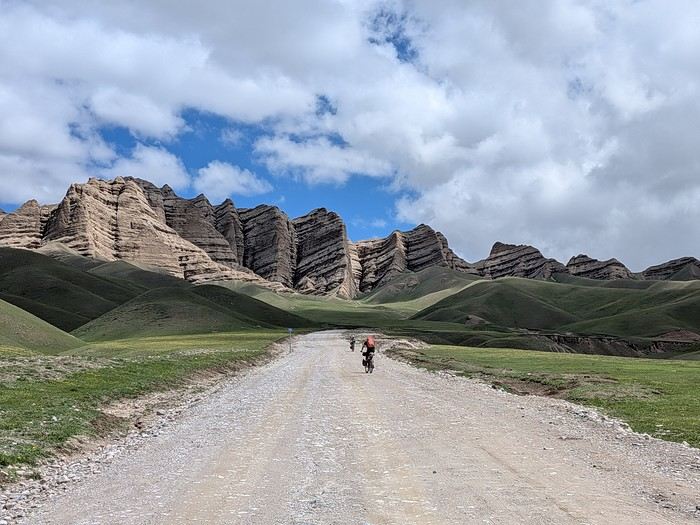
You’ll find here a post with some practical information.
And here, the version of the travel journal without comments.
---/---
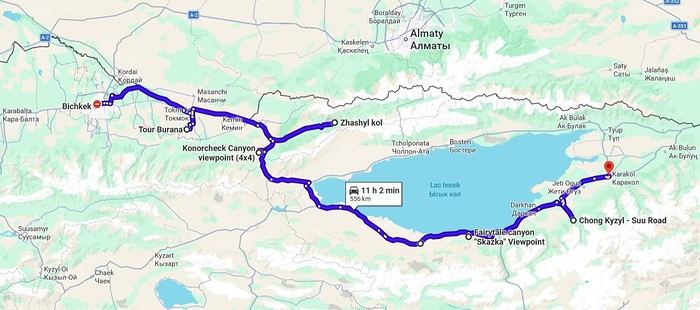
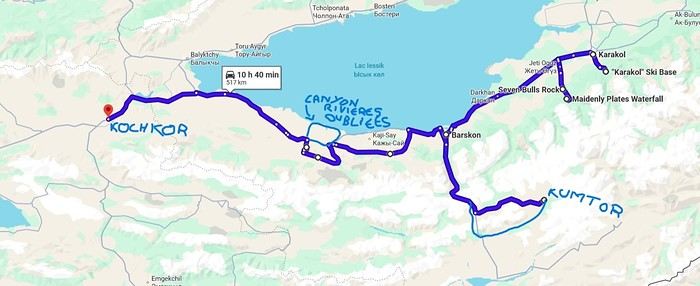
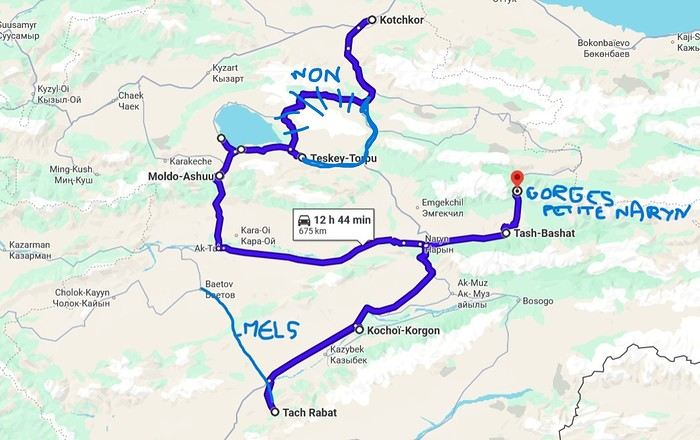
As a supplement, the route track. Not necessarily ultra-accurate since Google has serious gaps for this destination...
From Bishkek to Karakol:
From Karakol to Kochkor:
From Kochkor to Baetov:
From Baetov to Kara-Köl:
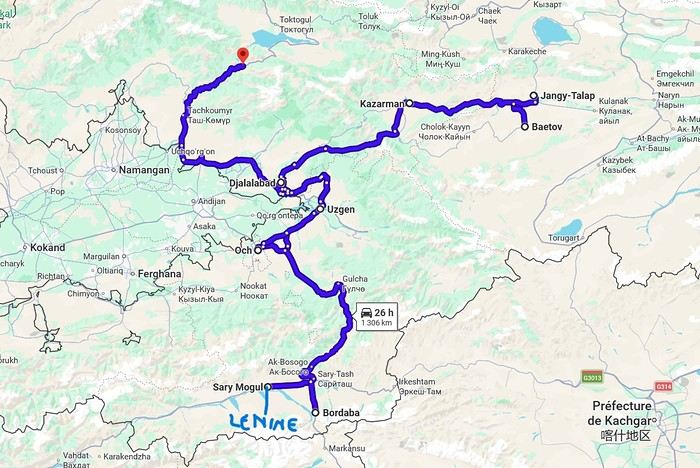
From Kara-Köl to Bishkek:
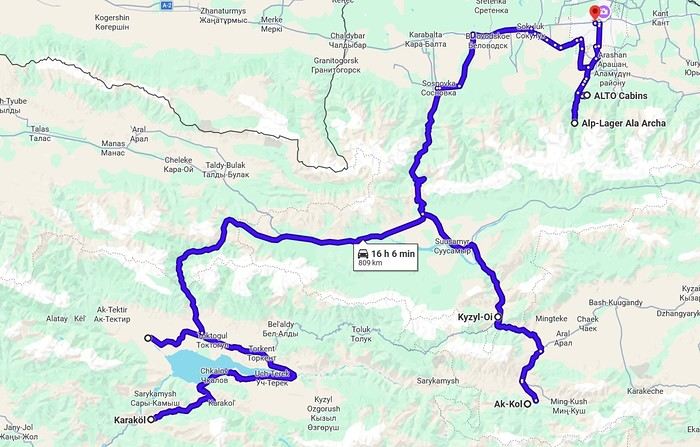

But the discomfort of overnight stays, the difficulty of communication, and the prices of the few car rental options kept making me postpone the project.
And then, everything suddenly fell into place—I told myself, it’s time!
The preparations took longer than usual; the destination is still far from mainstream.
A bit of Kazakhstan? Not in the end.
The south or not the south? Yes, in the end.
Pre-book or go with the flow? Only two stops were a leap into the unknown.
To help me find the ideal route, I made great use of this forum (thanks to everyone for patiently answering my questions!), pored over travel journals and blogs (Christian, Jeff), zoomed in on Google Maps and Yandex, and bought the guide published by OunTravela about this destination (the guide has been updated since).
---/---
You’ve got your passport, international driver’s license, bank cards, and euros?
Off we go to Lyon—just one night left before our early morning flight.
Tomorrow night, we’ll be sleeping in Bishkek! (Steak for my partner’s mischievous nephews...)
You’ll find here a post with some practical information.
And here, the version of the travel journal without comments.
---/---
As a supplement, the route track. Not necessarily ultra-accurate since Google has serious gaps for this destination...
From Bishkek to Karakol:
From Karakol to Kochkor:
From Kochkor to Baetov:
From Baetov to Kara-Köl:
From Kara-Köl to Bishkek:
The Pearl of Africa - July-August 2026
Preamble:
Africa was calling to me, so a year ago, with our usual travel companions, we decided to return to the continent we love so much.
Where to go?
Uganda quickly caught our attention—wildlife we’re used to seeing, plus gorillas and the shoebill we missed in Zambia.
We got in touch with Paul, who’s been mentioned several times on the forum back in September, booked our flight tickets, secured the gorilla permits, and by early October, the most important things were done.
We still had plenty of time to hold our "prep meetings" for the final itinerary.
Three days before departure, I sprained my ankle (my weak spot, as you’ll recall from our Colombia trip). I wasn’t in great spirits, but after a year of waiting, nothing was going to stop me. We’d see how it goes! Off we went for our new adventures
Three days before departure, I sprained my ankle (my weak spot, as you’ll recall from our Colombia trip). I wasn’t in great spirits, but after a year of waiting, nothing was going to stop me. We’d see how it goes! Off we went for our new adventures
Review of our cruise on the Renaissance - August 1-11, 2026
Just back from our first cruise on the Renaissance, and I’d like to share a few thoughts about life on board. Our feelings are mixed—we wanted a change after several MSC cruises, but the value for money on this repositioning cruise left us torn.
After taking advantage of successive promotions, we finally secured a well-located balcony cabin for 2600 € (almost 50% off the brochure rate). Given the amenities and the ship’s age, this now feels like the absolute maximum we’d pay for that period.
Overall, we were happy with our vacation on board, but a few details—when added up—left us with a somewhat mixed impression.
The pros: - Ship size - Reasonable noise levels, except in the restaurants (aside from the covered pool area) - Spacious balcony cabin (20 + 5 m²) with plenty of storage and a bathtub with jets - Understated, tasteful decor - French language spoken on board - Friendly staff for the most part - 100% French-speaking clientele - Decent food with French dishes (even with an Indian chef) - Tables for two available (though the ship was full, so no changes possible) - Some high-quality shows, thanks to an excellent English-speaking troupe - Interesting lectures (especially on history and cetaceans)
The cons: - Unreliable air conditioning in common areas (you’d go from a freezing lounge to a hot one, as if the system only worked in certain spaces at certain times) - Aging ship with a few glitches (noises, AC, toilet flushes, lights) reported at reception (luckily, our only issue was the bathroom door not closing...) - Industrial, thawed-out bread and pastries (a letdown for a ship with a French image) - Limited fruit selection (often just apples and watermelon/melon) and not much variety in vegetables - Worn, sometimes stained restaurant towels
We’re not ruling out another cruise on the Renaissance—their itineraries are unique—but only at a very competitive price.
The pros: - Ship size - Reasonable noise levels, except in the restaurants (aside from the covered pool area) - Spacious balcony cabin (20 + 5 m²) with plenty of storage and a bathtub with jets - Understated, tasteful decor - French language spoken on board - Friendly staff for the most part - 100% French-speaking clientele - Decent food with French dishes (even with an Indian chef) - Tables for two available (though the ship was full, so no changes possible) - Some high-quality shows, thanks to an excellent English-speaking troupe - Interesting lectures (especially on history and cetaceans)
The cons: - Unreliable air conditioning in common areas (you’d go from a freezing lounge to a hot one, as if the system only worked in certain spaces at certain times) - Aging ship with a few glitches (noises, AC, toilet flushes, lights) reported at reception (luckily, our only issue was the bathroom door not closing...) - Industrial, thawed-out bread and pastries (a letdown for a ship with a French image) - Limited fruit selection (often just apples and watermelon/melon) and not much variety in vegetables - Worn, sometimes stained restaurant towels
We’re not ruling out another cruise on the Renaissance—their itineraries are unique—but only at a very competitive price.
16 days with family in La Gomera (Canary Islands)
Preamble: Why La Gomera?
When we started looking for a summer destination a few months ago, our first criterion was to avoid extreme heat and heatwaves. We had already been to Norway two years ago and are considering going back in the future for other occasions. So, we had some fun asking ChatGPT which destinations enjoyed a mild climate during the summer without going too far. Among the list provided by the AI were the Canary Islands... The idea of a place we wouldn’t have thought of first, both not too far away and exotic enough, appealed to us: “Hmm, why not?”
This destination had never really attracted me, though Magali was a bit more interested. Five years earlier, COVID had caused a short break in my professional activity, and I had planned a trip because the flight price was attractive, and I was looking for a destination different from what usually appeals to me, more than out of deep interest. From a distance and with a social judgment I acknowledge (it’s not great, but it’s not completely wrong), I had the image of a destination for party-goers enjoying the sun without the slightest interest in local culture, with concrete coastlines and denatured landscapes—everything I detest the most. Still, I had done some quick research on the different islands and spotted Lanzarote for its beautiful volcanic landscapes, hiking trails, beaches, and the impression of a good balance between activity and fewer crowds than Tenerife or Gran Canaria. Then I dropped the idea of going, without ever reconsidering traveling to the Canaries...
Until now! Because we started researching the different islands of the archipelago to see which ones might appeal to us the most. It was La Gomera, the third smallest island of the archipelago, more praised for its hiking trails and preserved nature than for its beaches, away from mass tourism (fifty times fewer tourists than Tenerife) but still a bit more developed than its wild neighbor El Hierro, that caught our attention. Contrary to what might be suggested later, I’m not at all addicted to AI, but I use it from time to time to synthesize quick research or simply for experimentation. Since ChatGPT had started anticipating my tastes lately as if it had become my buddy (often successfully, sometimes off the mark), I asked which Canary Island would suit me best for a trip with my family. The tool answered first with... La Gomera. So, I tested it and teased it a bit to see if this suggestion was well-founded, as the method sometimes makes it contradict itself. But no luck: “You’d appreciate the wild nature of El Hierro, but with family, you’ll find little activity for the kids. You won’t like the touristy vibe of the big islands like Tenerife, Gran Canaria, Lanzarote, and Fuerteventura. You could consider La Palma, but it’s really La Gomera that will suit you best, based on your interests and the criteria given.” So, we dug deeper into our research and were convinced without a shadow of a doubt that this island was the one waiting for us.
Without knowing it, we had Canarians in our circle who revealed their origins when they heard about our travel plans. One from Tenerife insisted we’d be better off choosing Tenerife (obviously...) because it also has preserved spots and that La Gomera, “you can explore it in two or three days, you’ll get bored quickly...” The other, a colleague from Gran Canaria who had never visited La Gomera, still recommended it without hesitation because it turned out her parents had just gone there on vacation: they loved it and had encountered few tourists. She also tended to think this destination was usually the subject of short stays, but according to what her parents told her, taking your time there was also a great idea. However, in our research, the idea that La Gomera is an island you can explore in three or four days max kept coming up. So, we considered combining its visit with La Palma or El Hierro, the other two that caught our eye. But hopping between islands by ferry represents a significant budget for non-Canarians, even more so for a family of four. Then, scrutinizing Google Maps, it seemed obvious that two weeks were too short to discover two islands as they deserve, and that there seemed to be plenty to see in La Gomera, given its very unique culture. After all, we read that some people spend several months a year there, others never even leave... Finally, these landscapes and this atmosphere, which seemed to us a mix of Europe, North Africa, and Latin America, tempted us. So, it would be two weeks in La Gomera, deal!
La Gomera is therefore the second... well, the third smallest island of the Canaries since La Graciosa was recently recognized as a fully inhabited island. It has the shape of a rough circle about 20 to 25 kilometers in diameter and has just over 20,000 inhabitants, half of them in its capital, San Sebastián de la Gomera, the only real town. Like its Canarian sisters, La Gomera is a volcanic formation that rose about 10 million years ago. The island is very mountainous and rugged, covered with red and black rocky landscapes. Geological activity has shaped, between the sprawling massifs that end in steep cliffs in the ocean, six coastal valleys with tropical vegetation that have favored human settlement. They divide the island like slices of a cake; from the north clockwise: the agricultural Vallehermoso, the rustic Agulo, the green, humid, and fertile Hermigua, the sunny capital San Sebastián de la Gomera, the southern and isolated Alajeró-Santiago, and the seaside Valle Gran Rey. They constitute the six municipalities (more like cantons to our French understanding) of the territory.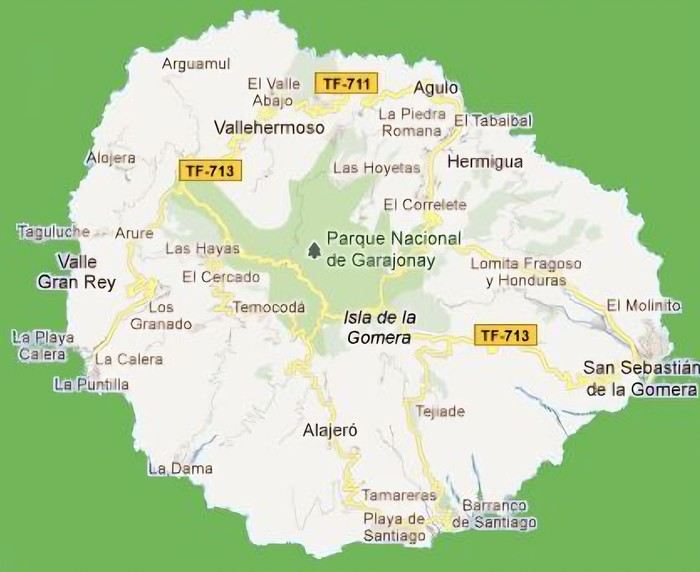 The large solidified magma massifs that shape the heart of the island have created a large depression more protected from the sun at its center, allowing the growth of a vast laurel forest, today grouped within the Garajonay National Park, La Gomera’s green lung, which has earned it the status of a World Biosphere Reserve. Its completely European appearance contrasts sharply with the rocky and tropical landscapes of the rest of the island. Thus, the climate varies greatly from one point to another on the island: in summer, you can quickly go from a dry and sunny valley at 35°C to a humid forest area at altitude at 18°C.
La Gomera was populated late. As with the rest of the Canaries, human presence is thought to have begun about 2,000 years ago. Groups of animist Berbers, probably fleeing persecution, gradually populated the archipelago, especially the western islands and La Gomera, becoming its small aboriginal population: the Guanches (or later Gomeros). The animist and pastoral civilization of the Guanches thrived until the Spanish takeover in the 15th century, which, after a short period of harmony and mixing with the indigenous people, suddenly ended in bloodshed... La Gomera later became the “Columbus Island” after Christopher Columbus’s stopover, increasing the blending of populations. In the 20th century, many Gomeros emigrated to Cuba and other Latin American countries in search of a better life, bringing back a mix of cultures and traits quite palpable in today’s Gomeran culture. It is, however, in La Gomera that the vestiges of Guanche culture seem to have left the most traces, in the language, gastronomy, social practices... Moreover, most Gomeros, especially in remote villages, have a particular identifiable type and proudly claim their ancestral roots, even making La Gomera a bit exotic in the eyes of other Canarians.
Perhaps that’s why it has never really wanted to develop its tourist infrastructure too much. If we set aside the tourists who visit for the day by bus or boat from Tenerife on a marked itinerary (and whom we ultimately rarely encounter), La Gomera has remained a hidden gem, a destination focused on nature discovery that attracts hikers, nature-loving divers, and scientists for its fauna and flora, and to a lesser extent, beachgoers who don’t seek overly developed coastlines. Tourist activity is therefore limited. Roughly speaking, you’ll find a majority of Spaniards, including a substantial number of residents from other Canary Islands, many Germans who have a particular fondness for La Gomera and spend long stays there or own second homes, to the point that the German cultural footprint is clearly noticeable in some places (it’s said to be Angela Merkel’s favorite holiday spot), and still quite a few French. The presence of other nationalities seemed negligible to us. Most travelers come mainly for hiking, but it’s also a prime spot for whale watching. Additionally, the seaside resorts of La Gomera—San Sebastián, Santiago, and especially Valle Gran Rey—are well-known destinations for hippies, especially German ones, ranging from chic boho hippies to old-school hippies who’ve been there for decades, quite similar to those you’d meet in India in Goa, Rishikesh, or Paharganj. Thus, practices like naturism, vegetarianism, and local organic production are quite well established in some areas.
Some practical info: - The round-trip flight from Paris to Tenerife cost us 365 € per person (outbound with Transavia, return with EasyJet), including checked luggage and three seats reserved side by side. - We chose two bases to explore the island: one week in Valle Gran Rey, reputed to be the most pleasant of the three seaside resorts, and one week in Hermigua, more mountainous and close to the natural park. We booked two houses with balconies and views: the first at 120 € per night, the second at 99 €. - The round-trip ferry between Tenerife and La Gomera cost us 270 € with the company Baleària Canarias, including discounts for children aged 4 and 12, but I don’t have the exact details. It was a bit cheaper than with the other company, Fred Olsen. - Finally, we rented a car through the agency Cicar for 360 € for 16 days, which comes to 22.50 € per day. - Apart from that, we didn’t plan anything and decided the day before or even the morning of what we wanted to do. We didn’t invest in any paper guide on the Canaries, as information on La Gomera was scarce, but we used the very comprehensive site La Gomera Travel, a travel guide published by the Canary Islands Tourism Council, a real goldmine of almost exhaustive information on the island.
Alright, off we go for 16 days of adventure discovering La Gomera!
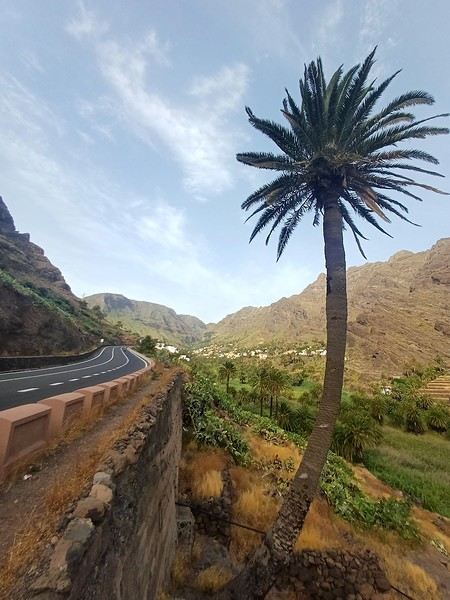
And we start the trip with music!
We start the trip with music!
When we started looking for a summer destination a few months ago, our first criterion was to avoid extreme heat and heatwaves. We had already been to Norway two years ago and are considering going back in the future for other occasions. So, we had some fun asking ChatGPT which destinations enjoyed a mild climate during the summer without going too far. Among the list provided by the AI were the Canary Islands... The idea of a place we wouldn’t have thought of first, both not too far away and exotic enough, appealed to us: “Hmm, why not?”
This destination had never really attracted me, though Magali was a bit more interested. Five years earlier, COVID had caused a short break in my professional activity, and I had planned a trip because the flight price was attractive, and I was looking for a destination different from what usually appeals to me, more than out of deep interest. From a distance and with a social judgment I acknowledge (it’s not great, but it’s not completely wrong), I had the image of a destination for party-goers enjoying the sun without the slightest interest in local culture, with concrete coastlines and denatured landscapes—everything I detest the most. Still, I had done some quick research on the different islands and spotted Lanzarote for its beautiful volcanic landscapes, hiking trails, beaches, and the impression of a good balance between activity and fewer crowds than Tenerife or Gran Canaria. Then I dropped the idea of going, without ever reconsidering traveling to the Canaries...
Until now! Because we started researching the different islands of the archipelago to see which ones might appeal to us the most. It was La Gomera, the third smallest island of the archipelago, more praised for its hiking trails and preserved nature than for its beaches, away from mass tourism (fifty times fewer tourists than Tenerife) but still a bit more developed than its wild neighbor El Hierro, that caught our attention. Contrary to what might be suggested later, I’m not at all addicted to AI, but I use it from time to time to synthesize quick research or simply for experimentation. Since ChatGPT had started anticipating my tastes lately as if it had become my buddy (often successfully, sometimes off the mark), I asked which Canary Island would suit me best for a trip with my family. The tool answered first with... La Gomera. So, I tested it and teased it a bit to see if this suggestion was well-founded, as the method sometimes makes it contradict itself. But no luck: “You’d appreciate the wild nature of El Hierro, but with family, you’ll find little activity for the kids. You won’t like the touristy vibe of the big islands like Tenerife, Gran Canaria, Lanzarote, and Fuerteventura. You could consider La Palma, but it’s really La Gomera that will suit you best, based on your interests and the criteria given.” So, we dug deeper into our research and were convinced without a shadow of a doubt that this island was the one waiting for us.
Without knowing it, we had Canarians in our circle who revealed their origins when they heard about our travel plans. One from Tenerife insisted we’d be better off choosing Tenerife (obviously...) because it also has preserved spots and that La Gomera, “you can explore it in two or three days, you’ll get bored quickly...” The other, a colleague from Gran Canaria who had never visited La Gomera, still recommended it without hesitation because it turned out her parents had just gone there on vacation: they loved it and had encountered few tourists. She also tended to think this destination was usually the subject of short stays, but according to what her parents told her, taking your time there was also a great idea. However, in our research, the idea that La Gomera is an island you can explore in three or four days max kept coming up. So, we considered combining its visit with La Palma or El Hierro, the other two that caught our eye. But hopping between islands by ferry represents a significant budget for non-Canarians, even more so for a family of four. Then, scrutinizing Google Maps, it seemed obvious that two weeks were too short to discover two islands as they deserve, and that there seemed to be plenty to see in La Gomera, given its very unique culture. After all, we read that some people spend several months a year there, others never even leave... Finally, these landscapes and this atmosphere, which seemed to us a mix of Europe, North Africa, and Latin America, tempted us. So, it would be two weeks in La Gomera, deal!
La Gomera is therefore the second... well, the third smallest island of the Canaries since La Graciosa was recently recognized as a fully inhabited island. It has the shape of a rough circle about 20 to 25 kilometers in diameter and has just over 20,000 inhabitants, half of them in its capital, San Sebastián de la Gomera, the only real town. Like its Canarian sisters, La Gomera is a volcanic formation that rose about 10 million years ago. The island is very mountainous and rugged, covered with red and black rocky landscapes. Geological activity has shaped, between the sprawling massifs that end in steep cliffs in the ocean, six coastal valleys with tropical vegetation that have favored human settlement. They divide the island like slices of a cake; from the north clockwise: the agricultural Vallehermoso, the rustic Agulo, the green, humid, and fertile Hermigua, the sunny capital San Sebastián de la Gomera, the southern and isolated Alajeró-Santiago, and the seaside Valle Gran Rey. They constitute the six municipalities (more like cantons to our French understanding) of the territory.
The large solidified magma massifs that shape the heart of the island have created a large depression more protected from the sun at its center, allowing the growth of a vast laurel forest, today grouped within the Garajonay National Park, La Gomera’s green lung, which has earned it the status of a World Biosphere Reserve. Its completely European appearance contrasts sharply with the rocky and tropical landscapes of the rest of the island. Thus, the climate varies greatly from one point to another on the island: in summer, you can quickly go from a dry and sunny valley at 35°C to a humid forest area at altitude at 18°C.La Gomera was populated late. As with the rest of the Canaries, human presence is thought to have begun about 2,000 years ago. Groups of animist Berbers, probably fleeing persecution, gradually populated the archipelago, especially the western islands and La Gomera, becoming its small aboriginal population: the Guanches (or later Gomeros). The animist and pastoral civilization of the Guanches thrived until the Spanish takeover in the 15th century, which, after a short period of harmony and mixing with the indigenous people, suddenly ended in bloodshed... La Gomera later became the “Columbus Island” after Christopher Columbus’s stopover, increasing the blending of populations. In the 20th century, many Gomeros emigrated to Cuba and other Latin American countries in search of a better life, bringing back a mix of cultures and traits quite palpable in today’s Gomeran culture. It is, however, in La Gomera that the vestiges of Guanche culture seem to have left the most traces, in the language, gastronomy, social practices... Moreover, most Gomeros, especially in remote villages, have a particular identifiable type and proudly claim their ancestral roots, even making La Gomera a bit exotic in the eyes of other Canarians.
Perhaps that’s why it has never really wanted to develop its tourist infrastructure too much. If we set aside the tourists who visit for the day by bus or boat from Tenerife on a marked itinerary (and whom we ultimately rarely encounter), La Gomera has remained a hidden gem, a destination focused on nature discovery that attracts hikers, nature-loving divers, and scientists for its fauna and flora, and to a lesser extent, beachgoers who don’t seek overly developed coastlines. Tourist activity is therefore limited. Roughly speaking, you’ll find a majority of Spaniards, including a substantial number of residents from other Canary Islands, many Germans who have a particular fondness for La Gomera and spend long stays there or own second homes, to the point that the German cultural footprint is clearly noticeable in some places (it’s said to be Angela Merkel’s favorite holiday spot), and still quite a few French. The presence of other nationalities seemed negligible to us. Most travelers come mainly for hiking, but it’s also a prime spot for whale watching. Additionally, the seaside resorts of La Gomera—San Sebastián, Santiago, and especially Valle Gran Rey—are well-known destinations for hippies, especially German ones, ranging from chic boho hippies to old-school hippies who’ve been there for decades, quite similar to those you’d meet in India in Goa, Rishikesh, or Paharganj. Thus, practices like naturism, vegetarianism, and local organic production are quite well established in some areas.
Some practical info: - The round-trip flight from Paris to Tenerife cost us 365 € per person (outbound with Transavia, return with EasyJet), including checked luggage and three seats reserved side by side. - We chose two bases to explore the island: one week in Valle Gran Rey, reputed to be the most pleasant of the three seaside resorts, and one week in Hermigua, more mountainous and close to the natural park. We booked two houses with balconies and views: the first at 120 € per night, the second at 99 €. - The round-trip ferry between Tenerife and La Gomera cost us 270 € with the company Baleària Canarias, including discounts for children aged 4 and 12, but I don’t have the exact details. It was a bit cheaper than with the other company, Fred Olsen. - Finally, we rented a car through the agency Cicar for 360 € for 16 days, which comes to 22.50 € per day. - Apart from that, we didn’t plan anything and decided the day before or even the morning of what we wanted to do. We didn’t invest in any paper guide on the Canaries, as information on La Gomera was scarce, but we used the very comprehensive site La Gomera Travel, a travel guide published by the Canary Islands Tourism Council, a real goldmine of almost exhaustive information on the island.
Alright, off we go for 16 days of adventure discovering La Gomera!
And we start the trip with music!
We start the trip with music!
A little piece of Sulawesi with the family: Rantepao and Selayar
I’d been wanting to discover Sulawesi for years. But then life happened—COVID, the cost of flight tickets, you name it. Long story short, years went by, but we finally set off as a family for a three-week trip in southern Sulawesi: Rammang Rammang, Rantepao, Sengkang, Bira, and Selayar.
I like to spend a good amount of time in the places I visit, giving myself the chance to really get to know the area and meet locals. So no island-hopping this time—just the south. But when I say "just," it’s not restrictive at all, given how rich this island is in landscapes, little encounters, and magical moments.
Wednesday 07/08 - Thursday 07/09: We left Montpellier for what was supposed to be five flights, though we only took four to start, landing in Jakarta. We picked up our luggage there to catch a flight to Makassar the next day. That’s the only way we could get an affordable ticket (702 €). I won’t bore you with the flight details—there’s not much to say. We arrived at 7 PM and considered heading straight to Makassar that evening. But we opted for a recovery night before taking off again. Good thing we did, because my son’s suitcase was missing... First contact with the locals was a bit stressful—a trip without your luggage isn’t exactly fun. But right away, a woman reassured us: the suitcase was just enjoying some extra time in Singapore. Maybe it was doing some last-minute shopping. Anyway, nothing serious—it was supposed to arrive at 9 AM the next day. That gave us some breathing room since our flight wasn’t until noon. So off we went to our hotel (Days Hotel & Suites) near the airport. It was cheap (40 € for three rooms—my kids are older and need their space), but it wasn’t worth much more. The place had definitely seen better days. But no big deal—we were only there for the night, and... we got to watch France beat Morocco in the World Cup live at 3 AM. That’s what really mattered!
Friday 07/10: In search of the lost suitcase First challenge of the morning: finding our missing suitcase. They sent us to the airport basement, to the staff entrance. We were greeted with smiles, and an airport employee led me through the underground corridors back to the baggage claim. Right on time at 9 AM, the suitcase arrived, just like they’d promised. We were finally complete! Off we went to change terminals, grab a well-deserved meal, and board our fifth flight to Makassar. Little side note: I struggled for a while trying to book domestic flights directly on the airlines’ websites with no luck. Without meaning to advertise (though I guess I am a little), I realized it’d be easier to use sites like tiket.com or Traveloka. That turned out to be a great choice—I even ended up booking hotels through them later in the trip. 12:40 PM: We were on our way to Makassar. First good news: we were the only tourists. Well, the only European tourists on the flight, anyway. No, you’re not dreaming—the bag is full of... potato chip packets. To each their own souvenirs, I guess...

When we arrived in Makassar, a driver was waiting to take us straight to Rammang Rammang: 250,000 IDR (12 €) to our guesthouse (Rammang Rammang House). Forget about meeting people on the bus—we were headed straight to the first stop of our trip, and it was already stunning.
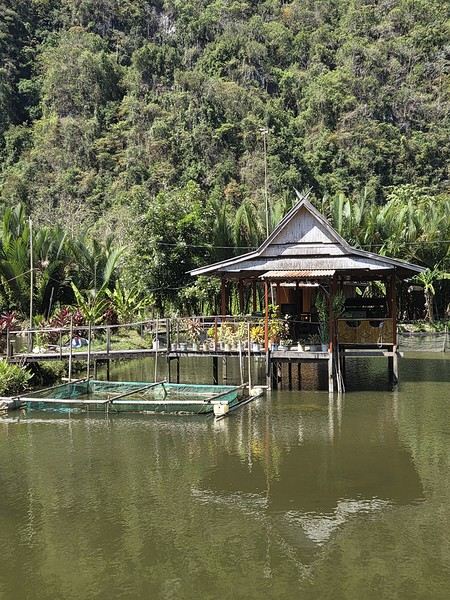
My kids’ guesthouse: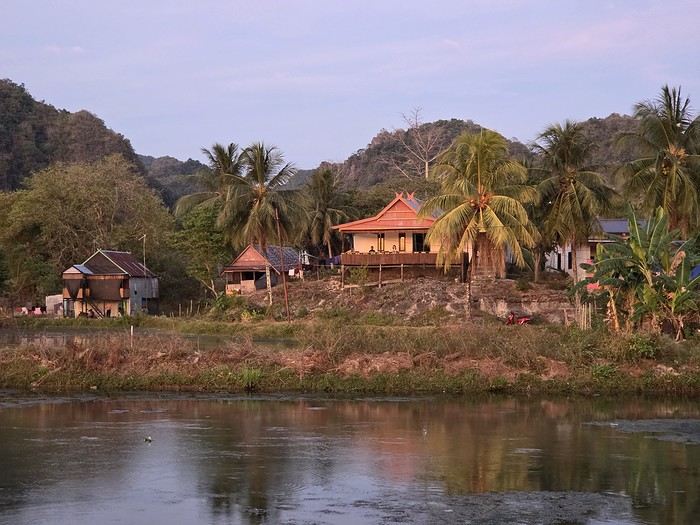
Ours: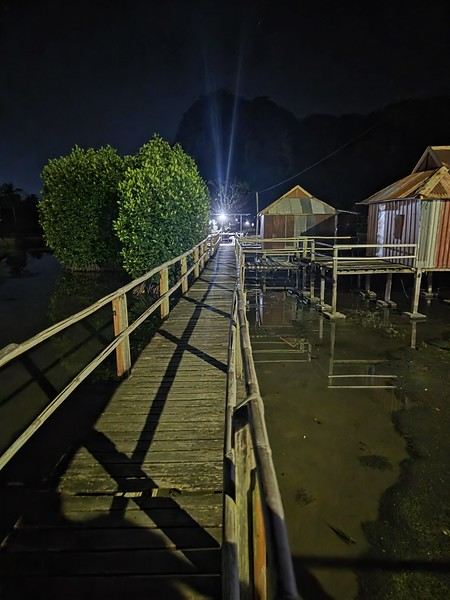
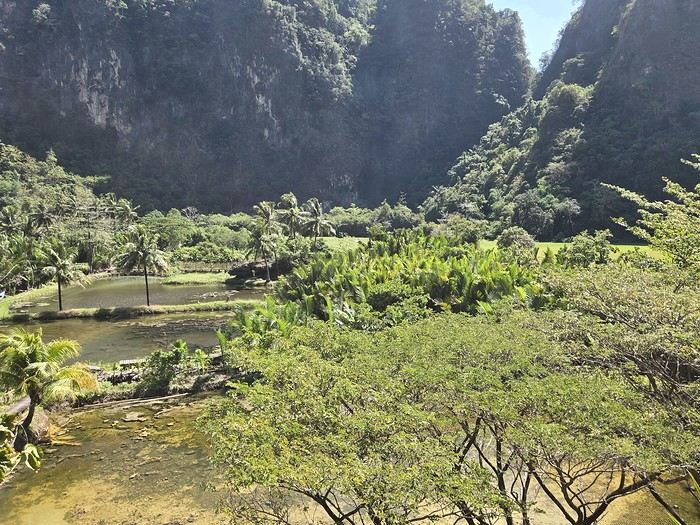
View of the little lake: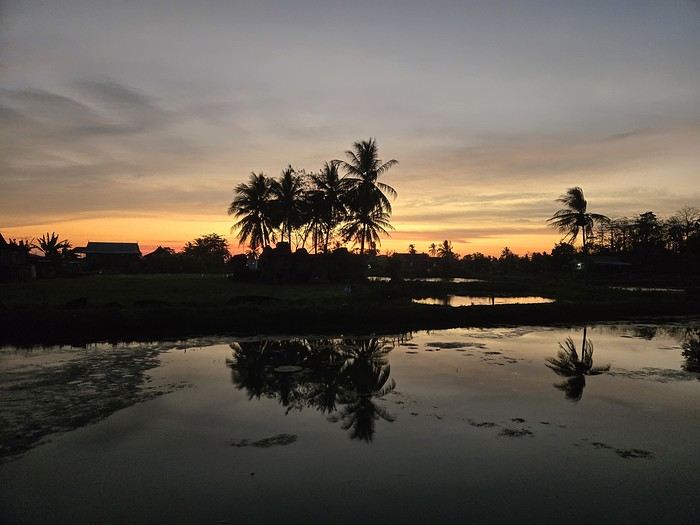
But not everything is straightforward around here. I wanted to get a local SIM card for internet and calls. I found them expensive at Jakarta’s airport (20 € for 20 GB), so I decided to wait. Well, no luck in Rammang Rammang either. You can’t just buy one from the local shop—you need a Telkomsat store (they have the best coverage). So we’d have to wait for Rantepao to get Wi-Fi... When I say "local shop," I mean the little shack around the corner. No big deal—we’d find one easily in Rantepao for 5 € and 25 GB. So there we were, offline, just the four of us enjoying the amazing view.
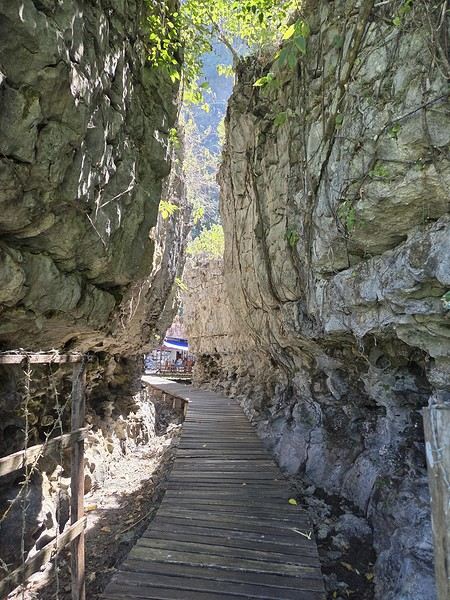
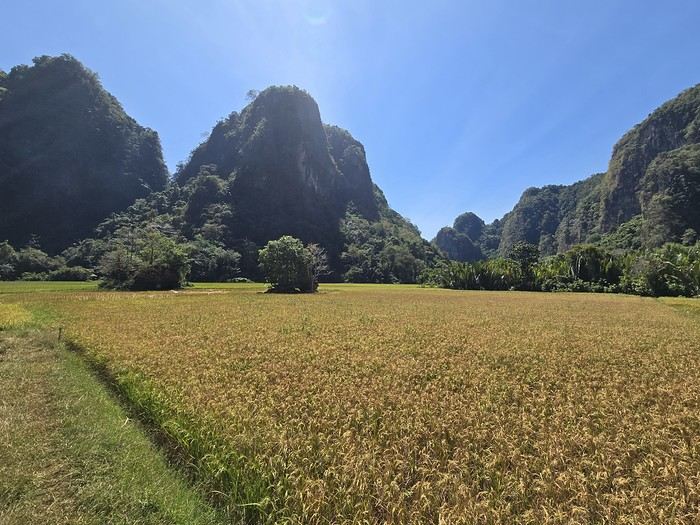
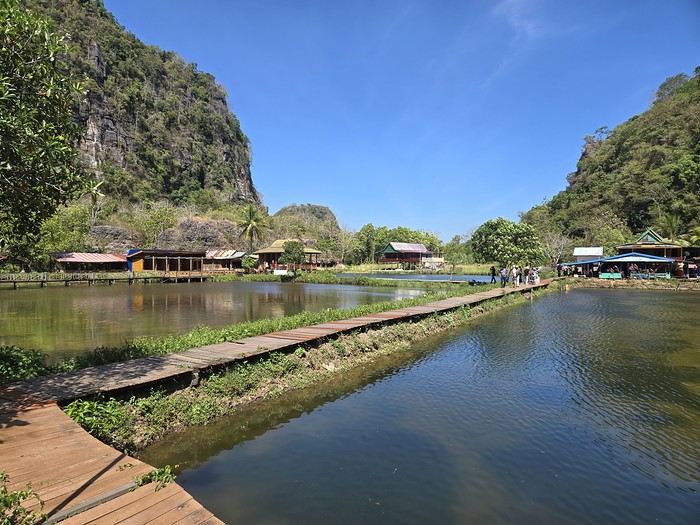
Saturday 07/11: Rammang Rammang We woke up early to the sound of wedding music blasting through the village (everyone’s invited!). Off we went to explore the area. A little walking, a little boat ride (shared with a French tourist and a Polish one—yes, there *are* tourists here, just not many; 750,000 IDR for up to 8 people) through a lovely canal, and we discovered the karst site. It was peaceful and beautiful. The river: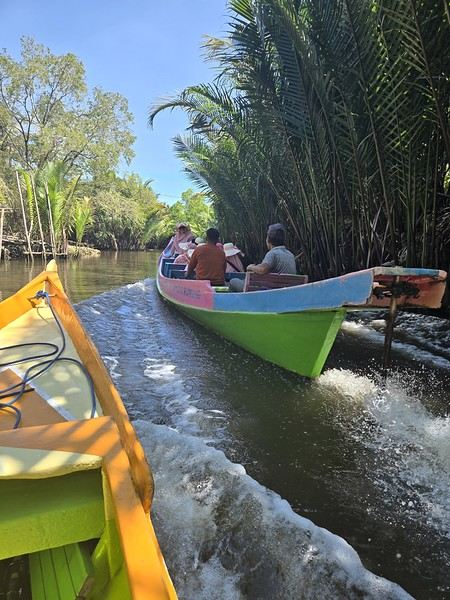 The karst site:
Wednesday 07/08 - Thursday 07/09: We left Montpellier for what was supposed to be five flights, though we only took four to start, landing in Jakarta. We picked up our luggage there to catch a flight to Makassar the next day. That’s the only way we could get an affordable ticket (702 €). I won’t bore you with the flight details—there’s not much to say. We arrived at 7 PM and considered heading straight to Makassar that evening. But we opted for a recovery night before taking off again. Good thing we did, because my son’s suitcase was missing... First contact with the locals was a bit stressful—a trip without your luggage isn’t exactly fun. But right away, a woman reassured us: the suitcase was just enjoying some extra time in Singapore. Maybe it was doing some last-minute shopping. Anyway, nothing serious—it was supposed to arrive at 9 AM the next day. That gave us some breathing room since our flight wasn’t until noon. So off we went to our hotel (Days Hotel & Suites) near the airport. It was cheap (40 € for three rooms—my kids are older and need their space), but it wasn’t worth much more. The place had definitely seen better days. But no big deal—we were only there for the night, and... we got to watch France beat Morocco in the World Cup live at 3 AM. That’s what really mattered!
Friday 07/10: In search of the lost suitcase First challenge of the morning: finding our missing suitcase. They sent us to the airport basement, to the staff entrance. We were greeted with smiles, and an airport employee led me through the underground corridors back to the baggage claim. Right on time at 9 AM, the suitcase arrived, just like they’d promised. We were finally complete! Off we went to change terminals, grab a well-deserved meal, and board our fifth flight to Makassar. Little side note: I struggled for a while trying to book domestic flights directly on the airlines’ websites with no luck. Without meaning to advertise (though I guess I am a little), I realized it’d be easier to use sites like tiket.com or Traveloka. That turned out to be a great choice—I even ended up booking hotels through them later in the trip. 12:40 PM: We were on our way to Makassar. First good news: we were the only tourists. Well, the only European tourists on the flight, anyway. No, you’re not dreaming—the bag is full of... potato chip packets. To each their own souvenirs, I guess...
When we arrived in Makassar, a driver was waiting to take us straight to Rammang Rammang: 250,000 IDR (12 €) to our guesthouse (Rammang Rammang House). Forget about meeting people on the bus—we were headed straight to the first stop of our trip, and it was already stunning.
My kids’ guesthouse:
Ours:
View of the little lake:
But not everything is straightforward around here. I wanted to get a local SIM card for internet and calls. I found them expensive at Jakarta’s airport (20 € for 20 GB), so I decided to wait. Well, no luck in Rammang Rammang either. You can’t just buy one from the local shop—you need a Telkomsat store (they have the best coverage). So we’d have to wait for Rantepao to get Wi-Fi... When I say "local shop," I mean the little shack around the corner. No big deal—we’d find one easily in Rantepao for 5 € and 25 GB. So there we were, offline, just the four of us enjoying the amazing view.
Saturday 07/11: Rammang Rammang We woke up early to the sound of wedding music blasting through the village (everyone’s invited!). Off we went to explore the area. A little walking, a little boat ride (shared with a French tourist and a Polish one—yes, there *are* tourists here, just not many; 750,000 IDR for up to 8 people) through a lovely canal, and we discovered the karst site. It was peaceful and beautiful. The river:
The karst site:
Oman, at the edge of the sands and the horizon

If I close my eyes and think of the Sultanate of Oman, I first smell a light scent of incense, feel the warmth of a sunbeam on my skin, before sand slips through my fingers. I taste the sweetness of a date, a real candy, then the flavor of coffee with a hint of cardamom and rosewater... I hear the desert wind whistling in my ears, the distant call of a muezzin, then the murmur of water. I open my eyes to see smiles, welcoming gestures, a turquoise sea, rocks ranging from ochre to purple, deep wadis where torrents burst forth, orange dunes, white sandy beaches where tiny crabs scurry at full speed. I see incredible oases emerging between arid mountains. I see abandoned villages that I’d dream were full of life, imposing fortresses overlooking valleys, and lively souks where offers are delicate and negotiation is a mutual courtesy.
All that, and so much more.
This is what I tried to capture in my illustrated travel journal, which I’ll fill in here and there with photos. I drew this journal “cold,” after my return (actually, I made it this summer, while our trip was last winter). It’s a pretty special format—I bought it in Japan without really knowing what I’d do with it. Well, it found its purpose! Below is a photo of this accordion-style journal: here, it’s only partially open, because when fully unfolded, it’s 5 meters long!
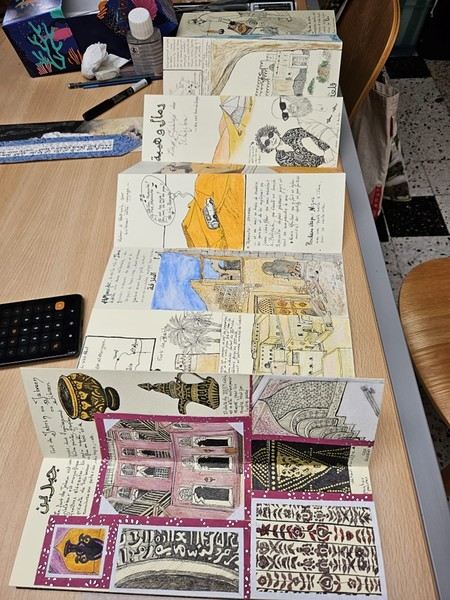
For drawing enthusiasts: The accordion format is both a constraint (each sheet is 9 cm x 27 cm) and a freedom (you can create a fresco). The paper is also a bit special: it doesn’t allow for fine lines, but it takes ink well (liner pen). However, everything has to be done almost in one go (with a very light pencil sketch) because it erases poorly. It absorbs too much water for coloring with markers or watercolors (unless you avoid soaking it), but it works well with oil pastels and their use with a brush and solvent. Since it’s yellowish, it allowed me to create contrasts even with white pastel.
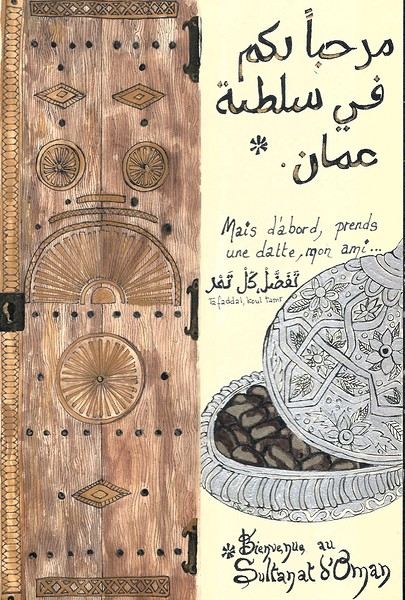 On the right, the "welcome marker"—those dates offered everywhere as a sign of hospitality. On the left, a tribute to those stunning doors worn by time, admired all over the old quarters, including the abandoned ones.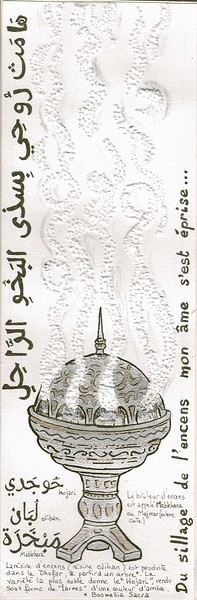
Oman is one of the world’s largest producers of frankincense resin. Incense burners are everywhere, from the simplest clay ones to the most precious handcrafted silver ones...
 Hospitality will often lead you to accept a small coffee, an "Omani coffee," very light, subtly flavored with cardamom, maybe a touch of saffron, and occasionally rosewater.
Here, I’ve depicted a man in the common everyday attire of Omanis: the dishdasha, mostly white (during the week and daytime; colors are more common in the evening or on Fridays and Saturdays). While you’ll see some men dressed in Western clothes, they’re very few. The white dishdasha is truly the shared attire of all men. The dishdasha, which has no hood, is distinguished by a small pom-pom attached to the collar, the furakha, which is soaked in perfume. And believe me, Omanis go overboard with it! "It smells like the pom-pom" is an expression that’s now part of our shared language, my husband and I.
Another must of men’s attire is the kuma, a small round head covering, usually white with brightly colored patterns. The keffiyeh is also worn (but without the cord called an agal in Arab countries), and it’s mostly worn by those with roots in the desert, from what I understood.
And what about the women, you might ask? Some are veiled, some in full black (but not a burka—more like a chador + abaya), due to the influence of Saudi Arabia and the United Arab Emirates, whereas the traditional outfit used to be a layering of very colorful dresses. Most of the women we saw wore neutral clothing, a plain veil over their hair, but with their faces uncovered. We also saw many saris and colorful veils—don’t forget that 40% of the population consists of Indian, Nepalese, and Bangladeshi immigrants, who work a lot in tourism, hospitality, restaurants, services, and construction.
Just to clarify, as a tourist, there’s no pressure to wear a veil, and never any disapproving looks. Of course, you’ll save the mini shorts, plunging necklines, bare shoulders, and midriffs for the hotel terrace—but I’d say that’s the same for men and women, and with the sun being strong, it’s better for your skin too.
Here’s the introduction! In the next post, I’ll tell you about my itinerary, and we can dive in!
Hospitality will often lead you to accept a small coffee, an "Omani coffee," very light, subtly flavored with cardamom, maybe a touch of saffron, and occasionally rosewater.
Here, I’ve depicted a man in the common everyday attire of Omanis: the dishdasha, mostly white (during the week and daytime; colors are more common in the evening or on Fridays and Saturdays). While you’ll see some men dressed in Western clothes, they’re very few. The white dishdasha is truly the shared attire of all men. The dishdasha, which has no hood, is distinguished by a small pom-pom attached to the collar, the furakha, which is soaked in perfume. And believe me, Omanis go overboard with it! "It smells like the pom-pom" is an expression that’s now part of our shared language, my husband and I.
Another must of men’s attire is the kuma, a small round head covering, usually white with brightly colored patterns. The keffiyeh is also worn (but without the cord called an agal in Arab countries), and it’s mostly worn by those with roots in the desert, from what I understood.
And what about the women, you might ask? Some are veiled, some in full black (but not a burka—more like a chador + abaya), due to the influence of Saudi Arabia and the United Arab Emirates, whereas the traditional outfit used to be a layering of very colorful dresses. Most of the women we saw wore neutral clothing, a plain veil over their hair, but with their faces uncovered. We also saw many saris and colorful veils—don’t forget that 40% of the population consists of Indian, Nepalese, and Bangladeshi immigrants, who work a lot in tourism, hospitality, restaurants, services, and construction.
Just to clarify, as a tourist, there’s no pressure to wear a veil, and never any disapproving looks. Of course, you’ll save the mini shorts, plunging necklines, bare shoulders, and midriffs for the hotel terrace—but I’d say that’s the same for men and women, and with the sun being strong, it’s better for your skin too.
Here’s the introduction! In the next post, I’ll tell you about my itinerary, and we can dive in!Thaïlande du 4 février au 4 mars 2012 English translation pending
Ma petite famille et moi même avons décidé de voyager en Asie du Sud Est.
Des amis nous ont conseillé pour notre voyage de commencer par la Thaïlande du 4 fevrier au 4 mars 2012.
Nous aimons la nature, les animaux et rencontrer des gens et nous voudrions éviter de passer notre temps dans des moyens de transport.
Nous avons donc pensé faire un séjour de une semaine minimum dans 3 à 4 endroits différents avec bien entendu un séjour à la mer, bien que nous habitions sur la Cote d'Azur et quelques jours à Bangkok.
Nous aimerions éviter ressembler à certains touristes peu respectueux que nous rencontrons sur la Promenades des Anglais.
Merci de vos conseils
Julie
...qui doit retourner à la réalité quotidienne...😉
Quels sont vos projets pour cet été? English translation pending
En ce qui me concerne, un été tranquille.
Quelques petits voyages ici et là avec mon conjoint. Recevoir quelques amis avec un bon gueuleton que parfois l`on néglige, sauf de temps, et qui s`éternise souvent jusqu`aux petites feures du matin.
Pièces de théâtres d`été, spectacles et profiter des mes petits-enfants en donnant du bon temps à leurs parents...( je (on) me gâte avec eux )Relaxer avec un bon livre au bord de la piscine avec son amoureux ..et oui et pourquoi pas ne pas commencer à planifier un autre voyage, une autre croisière😉
Alors, quoi demander de mieux ! 😊 Et vous quels sont vos projets ....
KAT2
Idée d'itinéraire pour six jours sur la côte d'Azur? English translation pending
🙂 Salut, j'aurais besoin d'aide pour un bon plan en juillet,6 jours sur la côte d'azur sans voiture comment faire pour en voir le maximum en si peu de tempts, mon avion part de Montréal, oû serait-il le mieux pour atterrir, et si possible une idée d'itinéraire, merçi.
Idées d'endroits pour deux semaines en France? English translation pending
bonjour! je pars pour la premiere fois en france au mois d'avril 2008 je vais rejoindre une copine qui est en stage la bas... la durée est de 2 semaines... on part en "packsac" et on compte faire les auberges de jeunesse, histoire que notre voyage ne coute pas la peau des fesses! j'aimerais bien peut etre aller au sud de la france ma mere ma dit que cétait tres beau alors ca me tente...
auriez vous des idées d'endroits ou aller? cé sur que je vais aller a paris je peux pas passer a coté mais sinon je veux visiter ailleurs aussi... avec vous des suggestions? ;livres a me conseiller? sites avec photos?
merci beaucoup!
auriez vous des idées d'endroits ou aller? cé sur que je vais aller a paris je peux pas passer a coté mais sinon je veux visiter ailleurs aussi... avec vous des suggestions? ;livres a me conseiller? sites avec photos?
merci beaucoup!
10 jours à Atlanta, Savannah, Charleston English translation pending
Bonjour,
Nous partons 10 jours pendant les vacances de février, avec nos enfants de 6 et 7 ans, direction Atlanta. Nous avons prévu de passer 2/3 jours à Atlanta, 2 jours à Savannah, 3 jours à Charleston et 2 jours à Dahlonega.
Pour cette dernière destination, nous sommes pas encore surs mais nous voulons ne pas nous éloigner d'Atlanta (aéroport) tout en découvrant une autre région que la côte, dans les montagnes/ forêts. Avez-vous une autre vile à nous conseiller ?
Par ailleurs, que nous conseillez-vous de visiter à Atlanta ? A Charleston ? Le parc de Stone Mountain est-il intéressant en février ? Où peut-on faire un petit tour en bateau à aubes ? Quelle plantation visiter près de Charleston ? Qu'est-ce qu'il ne faut pas manquer avec des enfants (visites, restaurants, ...) ?
J'ai lu plusieurs discussions sur ces destinations mais la différence là, c'est que l'on est en février...
Merci pour vos avis !!!
Nous partons 10 jours pendant les vacances de février, avec nos enfants de 6 et 7 ans, direction Atlanta. Nous avons prévu de passer 2/3 jours à Atlanta, 2 jours à Savannah, 3 jours à Charleston et 2 jours à Dahlonega.
Pour cette dernière destination, nous sommes pas encore surs mais nous voulons ne pas nous éloigner d'Atlanta (aéroport) tout en découvrant une autre région que la côte, dans les montagnes/ forêts. Avez-vous une autre vile à nous conseiller ?
Par ailleurs, que nous conseillez-vous de visiter à Atlanta ? A Charleston ? Le parc de Stone Mountain est-il intéressant en février ? Où peut-on faire un petit tour en bateau à aubes ? Quelle plantation visiter près de Charleston ? Qu'est-ce qu'il ne faut pas manquer avec des enfants (visites, restaurants, ...) ?
J'ai lu plusieurs discussions sur ces destinations mais la différence là, c'est que l'on est en février...
Merci pour vos avis !!!
10 jours en Géorgie - Promenades à la journée en boucle English translation pending
Bonjour,
Je pars en Géorgie le 10 juillet pendant 10 jours en couple. Nous parlons anglais, allemand, italien, néerlandais et arabe (mais pas russe). Nous avons 32 et 26 ans et nous avons une bonne condition physique mais nous ne sommes pas des randonneurs. J'ai épluché les forums et les guides et j'ai quelques questions qui restent en suspens. Nous nous déplacerons le plus possible en mashrukta.
Svaténie, Kasbeghie ou Touchétie? Le choix est difficile. On recherche surtout la beauté des paysages. Nous aimons beaucoup marcher sans backpack, ce qui nous impose de faire des marches en boucle (ou aller-retour) à la journée et non itinérantes. Avec cette contrainte, avez-vous des conseils, des itinéraires, des références? J'ai vu qu'on pouvait aussi faire des treks à cheval. C'est aussi valable pour des promenades de 2h?
Mashrutka Roulent-elles le dimanche? Comment connaître le temps de trajet entre 2 villes?
Akhaltsikhe J'ai lu des avis très contradictoires sur cette destination. Les photos du fort ont pourtant l'air magnifique. Vous recommandez ou pas? Et Vardzia? Comment s'y rendre depuis Akhaltikhe.
Autres conseils bienvenus.
Merci
Je pars en Géorgie le 10 juillet pendant 10 jours en couple. Nous parlons anglais, allemand, italien, néerlandais et arabe (mais pas russe). Nous avons 32 et 26 ans et nous avons une bonne condition physique mais nous ne sommes pas des randonneurs. J'ai épluché les forums et les guides et j'ai quelques questions qui restent en suspens. Nous nous déplacerons le plus possible en mashrukta.
Svaténie, Kasbeghie ou Touchétie? Le choix est difficile. On recherche surtout la beauté des paysages. Nous aimons beaucoup marcher sans backpack, ce qui nous impose de faire des marches en boucle (ou aller-retour) à la journée et non itinérantes. Avec cette contrainte, avez-vous des conseils, des itinéraires, des références? J'ai vu qu'on pouvait aussi faire des treks à cheval. C'est aussi valable pour des promenades de 2h?
Mashrutka Roulent-elles le dimanche? Comment connaître le temps de trajet entre 2 villes?
Akhaltsikhe J'ai lu des avis très contradictoires sur cette destination. Les photos du fort ont pourtant l'air magnifique. Vous recommandez ou pas? Et Vardzia? Comment s'y rendre depuis Akhaltikhe.
Autres conseils bienvenus.
Merci
Itinéraires pour balades/walking maps (en anglais) pour Bangkok English translation pending
Bonjour,
J'espère que les itinéraires sur ce site "Thai Travel News and Events" pour des balades à Bangkok seront utiles.
Les itinéraires ont été séparés en petits dossiers qu'on peut télécharger sur Google Drive. https://www.thaitravelblogs.com/2018/02/download-15-free-walking-maps-of-bangkok-in-english-japanese-and-thai/ ou https://bit.ly/2KdYwAr en URL raccourci.
Bonnes promenades, Dominique PS: je suis inscrite depuis 2011 et je crois que c'est l première fois que je contribue quelque chose ! j'ai toujours trouvé réponse à ce que je cherchais sur le forum mais ce n'est pas sympa de ma part de ne pas remercier les personnes qui contribuent leurs adresses et carnets de voyage. Toutes mes excuses.
Les itinéraires ont été séparés en petits dossiers qu'on peut télécharger sur Google Drive. https://www.thaitravelblogs.com/2018/02/download-15-free-walking-maps-of-bangkok-in-english-japanese-and-thai/ ou https://bit.ly/2KdYwAr en URL raccourci.
Bonnes promenades, Dominique PS: je suis inscrite depuis 2011 et je crois que c'est l première fois que je contribue quelque chose ! j'ai toujours trouvé réponse à ce que je cherchais sur le forum mais ce n'est pas sympa de ma part de ne pas remercier les personnes qui contribuent leurs adresses et carnets de voyage. Toutes mes excuses.
Apprendre l'anglais à San Francisco ou Honolulu? English translation pending
Salut à tous !
Je compte partir 9 mois aux US pour apprendre l'anglais , mais j'hésite entre ces deux villes que sont SF et Honolulu.
Donc voilà , si vous pourriez me donner juste quelques avis , conseil etc... ça serait sympa !
Merci à tous !
Je compte partir 9 mois aux US pour apprendre l'anglais , mais j'hésite entre ces deux villes que sont SF et Honolulu.
Donc voilà , si vous pourriez me donner juste quelques avis , conseil etc... ça serait sympa !
Merci à tous !
Promenades pour quatre jours à Paris English translation pending
Bonjour à tous,
J'arrive ce Jeudi 29sept à Paris pour un petit week end détente jusqu'à dimanche. Je logerai près du parc Monceau. Mon programme est le suivant: longues promenades en plein air pour découvrir Paris, ponctuées de pauses gourmandes (bon cafés, crêperies, resto asiatiques, indiens...)
En regardant un peu la carte de Paris et quelques posts ici, voici une première idée.
Jeudi: Montmartre, Sacré Cœur et les environs
vendredi: Notre Dame, St Germain, Quartier Latin, Marais, Bastille
Samedi: Champs Élysées, Arc de Triomphe, Faubourg St-Honoré, Grand Palais, Trocadéro et Tour Eiffel
Dimanche:Open
Je n'ai aucune idée si tout ça tient la route compte tenu des distances et des choses à voir.
Sentez vous libre de chambouler ce plan avec vos suggestions sur d'autres endroits qui valent le détour à Paris, des marchés aux puces, des bonnes choses à déguster dans certains quartiers ...
Merci beaucoup d'avance!
J'arrive ce Jeudi 29sept à Paris pour un petit week end détente jusqu'à dimanche. Je logerai près du parc Monceau. Mon programme est le suivant: longues promenades en plein air pour découvrir Paris, ponctuées de pauses gourmandes (bon cafés, crêperies, resto asiatiques, indiens...)
En regardant un peu la carte de Paris et quelques posts ici, voici une première idée.
Jeudi: Montmartre, Sacré Cœur et les environs
vendredi: Notre Dame, St Germain, Quartier Latin, Marais, Bastille
Samedi: Champs Élysées, Arc de Triomphe, Faubourg St-Honoré, Grand Palais, Trocadéro et Tour Eiffel
Dimanche:Open
Je n'ai aucune idée si tout ça tient la route compte tenu des distances et des choses à voir.
Sentez vous libre de chambouler ce plan avec vos suggestions sur d'autres endroits qui valent le détour à Paris, des marchés aux puces, des bonnes choses à déguster dans certains quartiers ...
Merci beaucoup d'avance!
Trouver son chemin au Japon, panneaux en anglais? English translation pending
Bonjour,
Je compte me rendre au japon au printemps prochain. Par contre, je m'inquiète de savoir s'il est difficile de trouver son chemin en parlant un anglais moyen ? Les panneaux sont-ils aussi en anglais ?
Par avance, merci pour vos réponses.
Je compte me rendre au japon au printemps prochain. Par contre, je m'inquiète de savoir s'il est difficile de trouver son chemin en parlant un anglais moyen ? Les panneaux sont-ils aussi en anglais ?
Par avance, merci pour vos réponses.
Deuxième séjour à La Réunion: quelques idées de promenades English translation pending
Bonjour,
Nous retournons à la Réunion la semaine prochaine, 5 jours. Nous y sommes allés il y a 4 ans. Cette île est magnifique et je suis à la recherche d'autres idées que les grands classiques. Que nous conseilleriez vous ? Nous avons déjà fait ceci : Le piton de la fournaise, les 3 bassins, les dauphins, la vanillerie, Hell-bourg, Cilaos, le lever du soleil à Maido, cap méchant, chutes Niagara, la route de la lave, Ste Rose ....
Nous pensions à faire Cap noir et le Col du taibit ? Nous avons fait les 3 bassins sur les recommandations d'habitant de l'île par les chemins détournés ..... si vous avez des suggestions à nous proposer nous sommes preneurs :) !
Merci d'avance !
Nous retournons à la Réunion la semaine prochaine, 5 jours. Nous y sommes allés il y a 4 ans. Cette île est magnifique et je suis à la recherche d'autres idées que les grands classiques. Que nous conseilleriez vous ? Nous avons déjà fait ceci : Le piton de la fournaise, les 3 bassins, les dauphins, la vanillerie, Hell-bourg, Cilaos, le lever du soleil à Maido, cap méchant, chutes Niagara, la route de la lave, Ste Rose ....
Nous pensions à faire Cap noir et le Col du taibit ? Nous avons fait les 3 bassins sur les recommandations d'habitant de l'île par les chemins détournés ..... si vous avez des suggestions à nous proposer nous sommes preneurs :) !
Merci d'avance !
Partir un an à l'étranger pour apprendre l'anglais, mais où? English translation pending
Bonjour à tous,
Comme le dit si bien le titre, nous sommes 2 amis à vouloir partir au mois de septembre entre 9 et 12 mois dans un pays anglophone. Nous aurons tous les 2 un bac +3, mais afin d'avoir plus de chances de rentrer en master (où un certain niveau d'anglais est exigé), nous souhaitons partir une année à l'étranger, et le faire ensuite. L'objectif, pour tous les 2, est de découvrir d'autres horizons, mais surtout d'avoir un très bon niveau d'anglais.
Si on ne part pas cette année, ce sera difficile par la suite, donc c'est maintenant ou jamais !
J'aimerai donc avoir des avis concernant la destination la plus appropriée en fonction des critères suivants :
- Facilité de trouver du travail ? - Coût de la vie (loyer/nourriture/avion/etc.) ? - Simplicité au niveau de l'administration (visas, etc.)
Nous avons déjà peut être quelques idées en tête mais je préfère ne rien dire pour le moment afin que chacun ne soit pas influencé.
Un grand merci en tout cas pour le partage, plus je lis de sujets, plus il me tarde septembre !
Antoine 😉
Comme le dit si bien le titre, nous sommes 2 amis à vouloir partir au mois de septembre entre 9 et 12 mois dans un pays anglophone. Nous aurons tous les 2 un bac +3, mais afin d'avoir plus de chances de rentrer en master (où un certain niveau d'anglais est exigé), nous souhaitons partir une année à l'étranger, et le faire ensuite. L'objectif, pour tous les 2, est de découvrir d'autres horizons, mais surtout d'avoir un très bon niveau d'anglais.
Si on ne part pas cette année, ce sera difficile par la suite, donc c'est maintenant ou jamais !
J'aimerai donc avoir des avis concernant la destination la plus appropriée en fonction des critères suivants :
- Facilité de trouver du travail ? - Coût de la vie (loyer/nourriture/avion/etc.) ? - Simplicité au niveau de l'administration (visas, etc.)
Nous avons déjà peut être quelques idées en tête mais je préfère ne rien dire pour le moment afin que chacun ne soit pas influencé.
Un grand merci en tout cas pour le partage, plus je lis de sujets, plus il me tarde septembre !
Antoine 😉
Travailler dans un ranch en Australie English translation pending
Fana de chevaux j'aimerais enfin de parfaire mon anglais partir travailler dans un ranch quelque temps en australie ou nouvelle zélande.Connaissez vous des contacts ou organismes qui peuvent aider pour la préparation du voyage.
Merci d'avance😉
Selfie à Auschwitz English translation pending
Bonjour à tous,
Le hasard total de mes "promenades " sur le net m'ont amené à un article du Huffington post qui explique que le centre mémorial d'Auschwitz a été contraint de faire un " rappel à l'ordre " devant la recrudescence des visiteurs ( comme si on visitait en ce lieu ! ) faisant des selfies devant la porte, devant les bâtiments, devant des photos de prisonniers décharnés, sur les rails....
J'ai eu peine à le croire et en regardant sur G images en tapant selfie Auschwitz, j'ai pu constater le summum de la honte ! Déjà, cette mode des selfies m'agace un peu, mais alors là, cela dépasse mon entendement et le respect qui doit prévaloir en ce lieu.
C'était mon " coup de gueule de ce soir,
Respect à vous toutes et tous et bonne soirée.
Le hasard total de mes "promenades " sur le net m'ont amené à un article du Huffington post qui explique que le centre mémorial d'Auschwitz a été contraint de faire un " rappel à l'ordre " devant la recrudescence des visiteurs ( comme si on visitait en ce lieu ! ) faisant des selfies devant la porte, devant les bâtiments, devant des photos de prisonniers décharnés, sur les rails....
J'ai eu peine à le croire et en regardant sur G images en tapant selfie Auschwitz, j'ai pu constater le summum de la honte ! Déjà, cette mode des selfies m'agace un peu, mais alors là, cela dépasse mon entendement et le respect qui doit prévaloir en ce lieu.
C'était mon " coup de gueule de ce soir,
Respect à vous toutes et tous et bonne soirée.
Cherche bénévole pour la Thaïlande English translation pending
Bonjour,
Nous cherchons une ou un bénévole pour le mois de mars 2010 (dernier mois avant les grandes vacances) pour notre Centre One dream one world, qui accueille de jeunes enfants birmans réfugiés en Thaïlande.
Cahier des charges :
- enseignement des bases d'anglais, organisation activités diverses, jeux, promenades, etc... - Travail de coordination
(cahier des charges complet à demander)
Contact : info@actionenfantsbirmans.org
Site : http://www.actionenfantsbirmans.org/ (attention, le site est un pleine mise à jour)
Nous cherchons une ou un bénévole pour le mois de mars 2010 (dernier mois avant les grandes vacances) pour notre Centre One dream one world, qui accueille de jeunes enfants birmans réfugiés en Thaïlande.
Cahier des charges :
- enseignement des bases d'anglais, organisation activités diverses, jeux, promenades, etc... - Travail de coordination
(cahier des charges complet à demander)
Contact : info@actionenfantsbirmans.org
Site : http://www.actionenfantsbirmans.org/ (attention, le site est un pleine mise à jour)
Bons plans au Maroc English translation pending
Bonjour ! (desolee pour les accents mais mon clavier est anglais...)
Mon ami et moi sommes arrives au Maroc depuis 1 semaine car nous travaillons avec une ong dans les regions de Settat et Beni Mellal. nous y sommes au minimum pour 1 annee alors je me disais que si il y'a des personnes qui connaissent des endroits a voir, (certes nous avons deja qq idees..) des coins pas chers pour dormir, etc.et bien nous serions ravis de recevoir de vos nouvelles. Cette demande concerne tout le Maroc car meme si l'on travail, nous avons tout de meme des week-end et des vacances de temps en temps.
Alors merci a tous ! et puis en une annee nous recolterons aussi des infos que nous pourrons vous faire partager !🙂 Anne
Alors merci a tous ! et puis en une annee nous recolterons aussi des infos que nous pourrons vous faire partager !🙂 Anne
Guide francophone sur Bangkok English translation pending
Bonjour, bonjour,
Auriez vous des adresses pour un guide francophone sur Bangkok?
Mon anglais étant scolaire, j'aurais souhaité être quelque peu aiguillée en arrivant sur place .
Merci.
Fanny
La vallée de Kangra dans l'Himachal Pradesh English translation pending

L’Himachal Pradesh ne se résume pas à la visite de McLeod Ganj où l’influence Bouddhiste est présente à chaque coin de rue.
On commencerait d’ailleurs à se demander si on est bien en Inde…
La vallée de Kangra offrent de belles promenades dans les environs, entre forêts de pins et campagne où vous pourrez découvrir la vie locale. Mais aussi des temples hindous, bouddhistes, des marchés colorés et également des plantations de thé grâce au climat bénéfique.

Vous pouvez réserver un taxi à la journée comme je l’ai fait, il suffit de descendre à pied en direction de la station de bus à McLeod Ganj et là vous trouverez de nombreux taxis. N’hésitez pas à discuter du prix qui tourne autour des 2000 rupees selon les visites souhaitées.
J’ai trouvé cette formule intéressante car le chauffeur connaissait bien les routes, ce qui vous évite de perdre du temps et il vous servira également d’interprète car très peu de d’indiens parle anglais dans les villages.
Palampur

Palampur est une jolie station de montagne située à environ 45 km de McLeod Ganj. C’est le docteur Jameson qui a introduit au 19è siècle la culture du thé. La vallée étant arrosée par de nombreux ruisseaux qui descendent des montagnes, la culture a ainsi fait la prospérité de la région qui est devenue la capitale du thé dans le nord de l’Inde.
Si cela vous intéresse, vous pouvez visitez la coopérative de thé de Kangra où l’on vous expliquera le processus de la cueillette et du traitement des feuilles jusqu’à la commercialisation. J’ai ramené du thé vert et du thé au Tulsi, le basilic sacré, de la marque ‘Himalayan Brew‘ mais vous trouverez également d’autres marques vendues dans les échoppes.
Et avec un peu de chance, vous pourrez apercevoir les cueilleuses en plein travail.

Si vous voulez découvrir la vie dans les campagnes, la vallée de Kangra est l’endroit idéal.

Vous traverserez de nombreux villages et pourrez voir les hommes au travail.

Mais le plus souvent les femmes.

J’ai pu assister à la moisson lors de mon dernier voyage en avril-mai.

Et même si la langue était souvent une barrière, le sourire qui illuminait leur visage était le plus beau cadeau qu’ils puissent me donner en retour.

Et puis tout au long du chemin, j’ai pu rencontrerez des écoliers rentrant à la maison. Là encore c’est un festival de couleur, les uniformes étant différents d’un village à l’autre.

Peu habitués à rencontrer des touristes dans leurs villages, ils étaient très étonnés qu’une une étrangère s’aventure dans leurs villages. Mais également très fiers.

Le Fort de Kangra

Le fort de Kangra est situé au sommet d’une colline avec une très belle vue sur la vallée. Il a été construit par la famille royale des Rajputs qui appartenait à Kangra et a été le siège de nombreuses batailles jusqu’au 19è siècle. Des audio guides sont disponibles à l’entrée en anglais afin de mieux comprendre l’histoire.

Ce fort a été très fortement endommagé lors du tremblement de terre en 1905. Cependant, de belles sculptures sont toujours présentes.

Je vous donne rendez-vous dans un prochain article afin de découvrir d’autres lieux à visiter dans l’Himachal Pradesh. Mon blog http://oneday-onedream.com/
Astuces pour un premier voyage en Grèce? English translation pending
Bonjour,
Je vais partir en Grèce pour la 1ere fois début Octobre pour 1 semaine seulement. - Nous arriverons à Athenes en avion.
1. Est-il facile de communiquer en Grèce en Français et/ou Anglais?
2. Quelles visites typiques me conseiller vous sur place et autour de la ville d'Athenes (trajet en train ou bus pas trop long) ? Au delà des visites de monuments, musées, sites historiques, quels endoits me conseillez-vous pour la beauté du paysage et également ceux pour être au contact de la population locale = marchés, Puces, quartiers populaires, endroits habituels des locaux (promenades, bars...) etc..
- J'aimerais dormir chez l'habitant si c'est possible pour avoir un contact direct- Savez-vous si c'est facilement gèrable et si je peux trouver des infos sur le web avant de partir pour réserver?
Merci Par avance
Isabelle
Je vais partir en Grèce pour la 1ere fois début Octobre pour 1 semaine seulement. - Nous arriverons à Athenes en avion.
1. Est-il facile de communiquer en Grèce en Français et/ou Anglais?
2. Quelles visites typiques me conseiller vous sur place et autour de la ville d'Athenes (trajet en train ou bus pas trop long) ? Au delà des visites de monuments, musées, sites historiques, quels endoits me conseillez-vous pour la beauté du paysage et également ceux pour être au contact de la population locale = marchés, Puces, quartiers populaires, endroits habituels des locaux (promenades, bars...) etc..
- J'aimerais dormir chez l'habitant si c'est possible pour avoir un contact direct- Savez-vous si c'est facilement gèrable et si je peux trouver des infos sur le web avant de partir pour réserver?
Merci Par avance
Isabelle
Ne pas parler espagnol et voyager au Pérou... English translation pending
Bonjour à tous,
Ma copine et moi commencons à faire des recherches pour notre voyage au Pérou cet été, d'une durée de 3 semaines. Or nous avons une question qui reste sans réponse, allons nous être capable de nous débrouiller en voyageant par nous même en parlant que francais, anglais et que quelques mots très simplistes en espanol? Ma copine qui est inquète à se sujet aimerait mieux opter pour un forfait tout organisé, qui vous le savez, est plus onéreux et plus restrictif, moi j'aimerais le faire en pleine liberté en ayant recours aux agences sur place pour les tours guidés de certaines attactions et pour le trek Inca Trail de 4 jours.
Merci de bien vouloir nous aider à prendre une décision!
Louis et Christine!
Ma copine et moi commencons à faire des recherches pour notre voyage au Pérou cet été, d'une durée de 3 semaines. Or nous avons une question qui reste sans réponse, allons nous être capable de nous débrouiller en voyageant par nous même en parlant que francais, anglais et que quelques mots très simplistes en espanol? Ma copine qui est inquète à se sujet aimerait mieux opter pour un forfait tout organisé, qui vous le savez, est plus onéreux et plus restrictif, moi j'aimerais le faire en pleine liberté en ayant recours aux agences sur place pour les tours guidés de certaines attactions et pour le trek Inca Trail de 4 jours.
Merci de bien vouloir nous aider à prendre une décision!
Louis et Christine!
Hôtel Alladin à Hurghada du 3 au 17 décembre English translation pending
Bonjours a tous
Je pars du 3/12/2010 au 17/12/2010 hôtel Alladin
Quelqu'un pourrais il me donner des renseignements sur les visites depuis Hurghada je pars avec ma sœur pour 15 jours
Les visites organisée par tour opérateur ou celles en bus vicinaux j'ai un budget de 1000 €
Également les promenades a pied enfin bref ce que l'on peut visiter je prévoit faire une visite par tour operateur 2 fois semaine
J'ai 61 ans et ne suis pas pressé (qui va doucement va surement ce que tu ne fait pas aujourd'hui fait le demain ou plus tard)
Bien a vous
Merci d'avance
Rene
Faire une randonnée à cheval au Portugal? English translation pending
Bonsoir,
Quelqu'un d'entre vous a-t-il eu l'occasion de faire une randonnée au Portugal (Région Setubal Côte Bleue) ? Si oui, avec quel organisateur local ? Avez-vous une adresse à nous recommander ?
Merci d'avance !
Chausey
Quelqu'un d'entre vous a-t-il eu l'occasion de faire une randonnée au Portugal (Région Setubal Côte Bleue) ? Si oui, avec quel organisateur local ? Avez-vous une adresse à nous recommander ?
Merci d'avance !
Chausey
Excursion de l'hôtel Sol Rio de Luna à Guardalavaca, Cuba English translation pending
Bonjour
je voudrais savoir quels sont les escursions a faire en français au depart de cet hotel ou du coin (guardalavaca) car je part avec une agence anglaise et je n'ai pas trouver d'agence française qui vendait cet hotel pour voir les escursions qu'il y aurait a faire.
Merci pour vos reponses.