Results for "ferry+ou+Buquebus+|+4+>+135"
26853 results found.
Traversée du Maroc, Algérie, Tunisie, Libye, Egypte English translation pending
Bonjour à tous!
Je n'ai que peu voyagé jusqu'à maintenant, mais je prévois partir pour fair le nord de l'afrique (maroc, algérie, tunisie, libye, égypte) a la fin de mes études... Alors voila, comme on ne trouve pas beaucoup d'.informations sur cette partie du monde je me suis dit qu'il n'y a rien de mieux qu demander a des gens qui ont lexperience!! Donc je veut tout savoir! Est-il mieux de se procurer une voiture ou si le trajet est fesable en autobus pour pas trop cher? Est-il possible de faire du camping? Y'a-t-il des choses qu'on doit absolument savoir pour traverser tout ces pays?? Enfin, je veut tout savoir pour savoir a quoi mattendre pendant mon periple... Merci beaucoup!
Louis-Filip
Je n'ai que peu voyagé jusqu'à maintenant, mais je prévois partir pour fair le nord de l'afrique (maroc, algérie, tunisie, libye, égypte) a la fin de mes études... Alors voila, comme on ne trouve pas beaucoup d'.informations sur cette partie du monde je me suis dit qu'il n'y a rien de mieux qu demander a des gens qui ont lexperience!! Donc je veut tout savoir! Est-il mieux de se procurer une voiture ou si le trajet est fesable en autobus pour pas trop cher? Est-il possible de faire du camping? Y'a-t-il des choses qu'on doit absolument savoir pour traverser tout ces pays?? Enfin, je veut tout savoir pour savoir a quoi mattendre pendant mon periple... Merci beaucoup!
Louis-Filip
Endroit inoubliable à New York? English translation pending
Hello à tous!
Je pars à NYC le 8 mai avec un tres cher ami et j'aimerai bien lui faire une surprise et l'mener dans un endroit à couper le souffle!
Quelque un parmi vous pourrais m'aider avec de idées please?
Merci beaucoup et bonne journe
Je pars à NYC le 8 mai avec un tres cher ami et j'aimerai bien lui faire une surprise et l'mener dans un endroit à couper le souffle!
Quelque un parmi vous pourrais m'aider avec de idées please?
Merci beaucoup et bonne journe
Budget pour six semaines en Indonésie? English translation pending
Bonjour,
je compte partir avec une amie en Indonésie pour environ un mois et demi ( juin-juillet). J'ai déjà beaucoup appris sur la région grâce au forum alors merci à tous. Néanmoins avant de me lancer dans l'organisation du voyage, j'aimerais avoir votre avis sur le budget: nous avons prévu 2OOO euros chacune (billets compris bien sûr). Nous aimerions aller à Bali, mais si possible pousser un peu plus loin (Lambok, Sumbawa, Flores?... rien de défini encore).
Avec ce budget pouvons nous vivre 6 semaines (hébergement simple, visites, quelques treks, un peu de farniente, etc...) sans trop galérer, et nous déplacer dans une ou deux autre îles? Combien doit-on prévoir environ pour notre billet AR (en le prenant environ un mois à l'avance)?
Ou notre budget est-il trop petit?
en résumé, avec environ 1000 euros sur place, à quoi peut-on prétendre en gros pour 6 semaines à Bali et aux environs?
merci d'avance pour vos précieux conseils.
en résumé, avec environ 1000 euros sur place, à quoi peut-on prétendre en gros pour 6 semaines à Bali et aux environs?
merci d'avance pour vos précieux conseils.
Sulawesi en Indonésie English translation pending
bonsoir à tous,
je compte partir en indonésie en aôut pour trois semaines (on sera deux)
Quelques petites questions: On m'a dit que bali était petite et que sur une période de trois semaines, il valait mieux prévoir de visiter également l'est de Java (?) et le sud de sulawesi (qui il parait est particulièrement magnifique): est ce facile de trouver des vols entre ces îles, peut on les reserver sur place ou faut il les reserver avant de partir?
Connaissez vous une bonne compagnie aérienne avec tarifs raisonnables pour faire Paris/Bali?est ce mieux de réserver dès maintenant?
Est ce qu'on trouvera sans problème (en aout= pleine période touristique) des hôtels corrects et un taxi avec chauffeur sans réservation?Combien faut il compter?Est ce qu'on en trouve aussi facilement même dans l'ouest de bali (apparemment moins fréquenté)?
Quel circuit conseillez vous et dans quel ordre?
Quel temps fait t'il en aôut?
Pour la plongée avec bouteilles, comment ca se passe, quels sont les meilleurs sites??
Et si vous avez des bonnes adresses à recommander ou des conseils, n'hésitez pas...
Voilà, ca fait beaucoup de questions mais on est un peu perdu dans "l'organisation"... Merci😉
je compte partir en indonésie en aôut pour trois semaines (on sera deux)
Quelques petites questions: On m'a dit que bali était petite et que sur une période de trois semaines, il valait mieux prévoir de visiter également l'est de Java (?) et le sud de sulawesi (qui il parait est particulièrement magnifique): est ce facile de trouver des vols entre ces îles, peut on les reserver sur place ou faut il les reserver avant de partir?
Connaissez vous une bonne compagnie aérienne avec tarifs raisonnables pour faire Paris/Bali?est ce mieux de réserver dès maintenant?
Est ce qu'on trouvera sans problème (en aout= pleine période touristique) des hôtels corrects et un taxi avec chauffeur sans réservation?Combien faut il compter?Est ce qu'on en trouve aussi facilement même dans l'ouest de bali (apparemment moins fréquenté)?
Quel circuit conseillez vous et dans quel ordre?
Quel temps fait t'il en aôut?
Pour la plongée avec bouteilles, comment ca se passe, quels sont les meilleurs sites??
Et si vous avez des bonnes adresses à recommander ou des conseils, n'hésitez pas...
Voilà, ca fait beaucoup de questions mais on est un peu perdu dans "l'organisation"... Merci😉
Trois semaines au nord de l'Ecosse English translation pending
Bonjour,
je pars trois semaines de fin aout à mi septembre, j'arrive à Inverness. Le but de ce voyage est surtout de me changer les idées alors je pense qu'un peu de nature sauvage me fera pas de mal. Je pensais faire un tour en passant par okney islands, la côte nord, lewis, puis sky...
auriez vous des endroits particuliers a me conseiller pour la rando, le camping...
eventuellement des distilleries, ou un endroit pour la pêche du brochet
merci d'avance
aurel
aurel
Intérêt de Death Valley English translation pending
Bonjour,
Avant de rejoindre San francisco, nous souhaitons traverser Death Valley depuis Las Vegas. Deux options s'offrent à nous : Partir de Las Vegas le matin, faire les points de vue intéressants dans Death Valley, rejoindre Bakersfield pour y passer la nuit (ou s'arrêter avant si le trajet est trop loin) et repartir le lendemain pour San Francisco. Partir de Las Vegas le matin, faire les points de vue intéressants dans Death Valley et revenir sur Las Vegas pour prendre l'avion vers San Francisco le lendemain.
La seconde solution offre l'avantage de ne pas faire toute la route en voiture jusqu'à San Francisco (trajet long !). Faire l'aller retour Las Vegas --> Death Valley n'est peut être pas la solution idéale.
Aussi, je me demandais si aller à Death Valley était indispensable : ce sera fin mai et il fera une chaleur étouffante qui ne nous permettra pas de faire des "balades" dans Death valley. Nous aurons seulement un aperçu de la voiture. Après avoir vu les merveilles que sont Bryce, Monument Valley, Canyonlansds, etc, Page et les randos dans les parcs, cela pourraît s'avérer frustrants non ?
Qu'en pensez vous ? Si nous "zappons" Death valley, que manquons nous ? Est ce comme si nous allions en Italie sans passer par Rome par exemple ?
Merci pour vos précieux conseils
Avant de rejoindre San francisco, nous souhaitons traverser Death Valley depuis Las Vegas. Deux options s'offrent à nous : Partir de Las Vegas le matin, faire les points de vue intéressants dans Death Valley, rejoindre Bakersfield pour y passer la nuit (ou s'arrêter avant si le trajet est trop loin) et repartir le lendemain pour San Francisco. Partir de Las Vegas le matin, faire les points de vue intéressants dans Death Valley et revenir sur Las Vegas pour prendre l'avion vers San Francisco le lendemain.
La seconde solution offre l'avantage de ne pas faire toute la route en voiture jusqu'à San Francisco (trajet long !). Faire l'aller retour Las Vegas --> Death Valley n'est peut être pas la solution idéale.
Aussi, je me demandais si aller à Death Valley était indispensable : ce sera fin mai et il fera une chaleur étouffante qui ne nous permettra pas de faire des "balades" dans Death valley. Nous aurons seulement un aperçu de la voiture. Après avoir vu les merveilles que sont Bryce, Monument Valley, Canyonlansds, etc, Page et les randos dans les parcs, cela pourraît s'avérer frustrants non ?
Qu'en pensez vous ? Si nous "zappons" Death valley, que manquons nous ? Est ce comme si nous allions en Italie sans passer par Rome par exemple ?
Merci pour vos précieux conseils
Céfalu en Sicile English translation pending
Bonjour,
je cherche des personnes ayant déjà fait un séjour à Céfalu dans la nord de la Sicile, afin d avoir une idée sur mon prochun voyage !!
Les Canadiens sont-ils bilingues? English translation pending
Bonjour 😉
Nous aimerions partir cet été à Toronto et à Niagara.
Nous ne parlons pas très bien l'Anglais, est ce que quelqu'un sait si cela nous posera des problèmes pour communiquer? En Ontario, les Canadiens parlent ils aussi le Français?
Merci pour vos futures réponses Nanette2b 😏
Merci pour vos futures réponses Nanette2b 😏
Grèce en août en famille non motorisée: quelle île choisir? English translation pending
Bonjour,
Nous sommes un couple avec un enfant de 4 ans. Non motorisé. Je suis en train de faire des recherches pour un séjour de 2 semaines en Grèce (evitant les gros complexes hôteliers ). Je sais que le mois d’août est la période la plus " en Grèce cependant nous n’avons pas le choix. Je commence mes amorces de recherches sur des iles tels que Paros et Naxos : aisement accessible en avion après arrivée à Athènes car nous n’avons pas le permis de conduire et cherchons un endroit avec tavernes, supermarket plage agréable pour un enfant, notre crevette fatigue assez vite s’il faut prendre, ferries bus et bus à répetition … Cependant même si les endroits tels que Paros ou Naxo semblent idyllique au rgard des photos j’ai du mal à me rendre compte jusqu'à quel c’est le cas : Naxos => belles plages, hôtel sympas et pas trop cher en bord de plage : mais est ce la réalité en pleins mois d’aout et ne serons nous pas " le nez sur les pieds du voisin ? obligés de mettre des boules quies pour dormir ? pollués parce que la plage de Agios Giorgios est quand même très près du port ?
Paros => la mer semble plus agitée ? est ce un spot pour surfeurs ? Si vous avez un point de vues sur ces 2 endroits ou un autre lieu en Grèce correspondant à ma recherche …très vaste et pointue (je le concois)
Merci de vos commentaire aguisés ! !
Nous sommes un couple avec un enfant de 4 ans. Non motorisé. Je suis en train de faire des recherches pour un séjour de 2 semaines en Grèce (evitant les gros complexes hôteliers ). Je sais que le mois d’août est la période la plus " en Grèce cependant nous n’avons pas le choix. Je commence mes amorces de recherches sur des iles tels que Paros et Naxos : aisement accessible en avion après arrivée à Athènes car nous n’avons pas le permis de conduire et cherchons un endroit avec tavernes, supermarket plage agréable pour un enfant, notre crevette fatigue assez vite s’il faut prendre, ferries bus et bus à répetition … Cependant même si les endroits tels que Paros ou Naxo semblent idyllique au rgard des photos j’ai du mal à me rendre compte jusqu'à quel c’est le cas : Naxos => belles plages, hôtel sympas et pas trop cher en bord de plage : mais est ce la réalité en pleins mois d’aout et ne serons nous pas " le nez sur les pieds du voisin ? obligés de mettre des boules quies pour dormir ? pollués parce que la plage de Agios Giorgios est quand même très près du port ?
Paros => la mer semble plus agitée ? est ce un spot pour surfeurs ? Si vous avez un point de vues sur ces 2 endroits ou un autre lieu en Grèce correspondant à ma recherche …très vaste et pointue (je le concois)
Merci de vos commentaire aguisés ! !
Bali - Flores à moto English translation pending
Salut
ça y est 🙂 Je viens juste d'acheter mon billet pour l'été (en passant par le moteur de VF d'ailleurs...). J'aimerais savoir si quelqu'un a déjà traversé l'archipel de Nusa Tenggara avec un véhicule individuel (le sien ou un véhicule loué). Notamment: comment passe t'on d'une ile à une autre? Peut on charger la moto facilement? faut-il avoir un cadenas et une méfiance à toute épreuve lorsqu'on laisse son engin? (notamment par exemple lorsqu'on part couler quelques jours heureux dans une des petites Gili alentours...😉) - faut-il faire l'aller-retour Bali / Florès / Bali ou connaissez vous une solution pour éviter de refaire tout le trajet dans l'autre sens ??
merci !!
ça y est 🙂 Je viens juste d'acheter mon billet pour l'été (en passant par le moteur de VF d'ailleurs...). J'aimerais savoir si quelqu'un a déjà traversé l'archipel de Nusa Tenggara avec un véhicule individuel (le sien ou un véhicule loué). Notamment: comment passe t'on d'une ile à une autre? Peut on charger la moto facilement? faut-il avoir un cadenas et une méfiance à toute épreuve lorsqu'on laisse son engin? (notamment par exemple lorsqu'on part couler quelques jours heureux dans une des petites Gili alentours...😉) - faut-il faire l'aller-retour Bali / Florès / Bali ou connaissez vous une solution pour éviter de refaire tout le trajet dans l'autre sens ??
merci !!
Turquie-Syrie en 4x4 English translation pending
bonjour,
je prépare un voyage de 4 semaines, en aout 2007, à partir de la France qui reprendrait les grandes lignes du Transorient(en 4x4). Il s'agit de faire turquie, syrie, peut etre jordanie(Petra) et retour en faisant une boucle en syrie et turquie. le voyage sera à 4 : 2 adultes et 2 ados de 16 et 14ans. Notre but est de voyager tranquille et de découvrir les pays. le 4x4 permet de passer un peu partout et une certaine autonomie (bivouac, rythme du voyage). c'est un vieux pajero de 88, qui nous a déjà emmené au Maroc et en Roumanie. j'ai plusieurs interrogations que je souhaite partager :quelqu'un aurait-il fait le transorient ? pourrait-il m'en parler : parcours, type de route, piste, sentiment général sur les pays traversé?pour le trajet en 4x4 : peut-on s'aventurer avec un seul véhicule partout en turquie et en syrie. Je parle pas du désert mais de pistes faciles pour sortir des sentiers battus et rencontrer des gens ? est-on libre de circuler avec son véhicule en syrie? faut-il un guide ou une déclaration de parcours ou je ne sais quelle autre formalité? problème d'assurances?
voila des questions générales pour commencer... les réponses me permettront d'avancer dans certaines voix plutot que d'autres.
merci d'avance Dominique http://perso.orange.fr/valdom.beton/domval.htm
je prépare un voyage de 4 semaines, en aout 2007, à partir de la France qui reprendrait les grandes lignes du Transorient(en 4x4). Il s'agit de faire turquie, syrie, peut etre jordanie(Petra) et retour en faisant une boucle en syrie et turquie. le voyage sera à 4 : 2 adultes et 2 ados de 16 et 14ans. Notre but est de voyager tranquille et de découvrir les pays. le 4x4 permet de passer un peu partout et une certaine autonomie (bivouac, rythme du voyage). c'est un vieux pajero de 88, qui nous a déjà emmené au Maroc et en Roumanie. j'ai plusieurs interrogations que je souhaite partager :quelqu'un aurait-il fait le transorient ? pourrait-il m'en parler : parcours, type de route, piste, sentiment général sur les pays traversé?pour le trajet en 4x4 : peut-on s'aventurer avec un seul véhicule partout en turquie et en syrie. Je parle pas du désert mais de pistes faciles pour sortir des sentiers battus et rencontrer des gens ? est-on libre de circuler avec son véhicule en syrie? faut-il un guide ou une déclaration de parcours ou je ne sais quelle autre formalité? problème d'assurances?
voila des questions générales pour commencer... les réponses me permettront d'avancer dans certaines voix plutot que d'autres.
merci d'avance Dominique http://perso.orange.fr/valdom.beton/domval.htm
Itinéraire aux Philippines en novembre 2006 English translation pending
Bonjour,
grâce à certains ici présent, notre itinéraire se précise, il reste néanmoins quelques questions.
Ce Road Map n'est bien évidement qu'un fil conducteur et sera certainement modifié au cours du voyage, en fonction des aléas du voyage, ou tout simplement si on a envie de rester plus de temps à un endroit, je pense notament à Palawan pour Puerto P, Sabang et Port Barton...
Nous allons passé le moins longtemps possible à Manille, mais nous avons besoin de faire quelques achats, comme tailleur, bague de fiancailles. J'ai quelques adresse, récupérer ici et là. Ensuite, on monte sur Banaue, Sagada, retour Manille, puis Palawan... J'ai laissé les questions en rouge, afin que ce soit plus lisible. N'hésitez pas à nous commenter, rectifier..
11/11 : Arrivée 09h50 à Manille On se renseigne pour les billets d'avion pour Puerto Princessa => Est-il facile d'acheter ses billets d'avion pour Puerto Princessa à la dernière minute ou vaut il mieux réserver avant? Combien de vol par jour? Quel prix? On monte dans un taxi direction Saint Illians : http://reservations.bookhostels.com/hostelz.com/hostel.php?HostelNumber=1391&Language=French => Connaissez vous ce GH? On va réserver d'ici pour ne pas avoir de surprise Puis la journée Glorietta et Greenbelt Tailleur : King Philip Tailors - Ayala Avenue, Glorietta 1, Ayala Center, Makati City, Manila, 1224 Exclusively His, on Pasay Rd. in Makati (behind Greenbelt). Joailler : Faut qu'on en trouve un dans le Ayala Center (si vou savez des adresse...) Nuit à Saint Illians
12/11 : Manille Soit on continue le shopping si on n'a pas terminé et on visite un peu => Que faire à Manille la journée? Que voir? Voir aussi location de la voture : http://www.avalonrentacar.com/ (1040 -A Teresa St. Brgy. Valenzuela, Makati City, Philippines) Nuit à Saint Illians Diner dans un bon resto => Avez vous une adresse pour un resto assez romantic? Quel Budget?
13/11 : Départ pour le Nord On récupère la voiture de location L'avantage, c'est que j'ai un GPS avec la carte de Manille, ce qui va nous aider pour sortir de la ville sans soucis. Direction banaue => Combien de temps pour rejoindre? - Que faire sur place? Combien de temps? => Avez vous une bonne adresse pour dormir? Nuit à Banaue
14/11 : visite Banaue Visite des rices terrasse Nuit à Banaue
15/11 : Départ pour Sagada et visite de Sagada => Combien de temps pour rejoindre? - Que faire sur place? Combien de temps? Nuit à Sagada
16/11 : Visite de Sagada Nuit à Sagada
17/11 : Retour Manille => Combien de temps pour rejoindre Manille? Voir avancé Tailleur et bague Nuit à Saint Illians et changer argent pour palawan
18/11 : Départ Puerto Princessa Nuit à Puerto Princessa => Vaut il le coup de rester un peu ici ou pas?
19/11 : Départ pour Sabang en Jeepney (6 heures) Nuit à Sabang
20/11 : Journée Sabang Nuit à Sabang
21/11 : Départ pour Port Barton en bateau (2h00) Nuit à Port barton
22/11 : Journée à Port Barton Nuit à Port Barton
23/11 : Départ pour El Nido en bateau (6h00) Nuit à El Nido
24/11 : El Nido Nuit à El Nido
25/11 : El Nido Nuit à El Nido
26/11 : El Nido Nuit à El Nido
27/11 : El Nido Nuit à El Nido
28/11 : El Nido Nuit à El Nido
29/11 : El Nido Nuit à El Nido
30/11 : Départ d'El Nido pour Manille en avion Tailleur et bague et Market Market pour les kdo de noël Nuit à Saint Illians Dernier resto le soir Possibilité de rentrer à Manille la veille au cas où tailleur et bague pas sûr
01/12 : départ 11h50 pour la France 😕
Nous allons passé le moins longtemps possible à Manille, mais nous avons besoin de faire quelques achats, comme tailleur, bague de fiancailles. J'ai quelques adresse, récupérer ici et là. Ensuite, on monte sur Banaue, Sagada, retour Manille, puis Palawan... J'ai laissé les questions en rouge, afin que ce soit plus lisible. N'hésitez pas à nous commenter, rectifier..
11/11 : Arrivée 09h50 à Manille On se renseigne pour les billets d'avion pour Puerto Princessa => Est-il facile d'acheter ses billets d'avion pour Puerto Princessa à la dernière minute ou vaut il mieux réserver avant? Combien de vol par jour? Quel prix? On monte dans un taxi direction Saint Illians : http://reservations.bookhostels.com/hostelz.com/hostel.php?HostelNumber=1391&Language=French => Connaissez vous ce GH? On va réserver d'ici pour ne pas avoir de surprise Puis la journée Glorietta et Greenbelt Tailleur : King Philip Tailors - Ayala Avenue, Glorietta 1, Ayala Center, Makati City, Manila, 1224 Exclusively His, on Pasay Rd. in Makati (behind Greenbelt). Joailler : Faut qu'on en trouve un dans le Ayala Center (si vou savez des adresse...) Nuit à Saint Illians
12/11 : Manille Soit on continue le shopping si on n'a pas terminé et on visite un peu => Que faire à Manille la journée? Que voir? Voir aussi location de la voture : http://www.avalonrentacar.com/ (1040 -A Teresa St. Brgy. Valenzuela, Makati City, Philippines) Nuit à Saint Illians Diner dans un bon resto => Avez vous une adresse pour un resto assez romantic? Quel Budget?
13/11 : Départ pour le Nord On récupère la voiture de location L'avantage, c'est que j'ai un GPS avec la carte de Manille, ce qui va nous aider pour sortir de la ville sans soucis. Direction banaue => Combien de temps pour rejoindre? - Que faire sur place? Combien de temps? => Avez vous une bonne adresse pour dormir? Nuit à Banaue
14/11 : visite Banaue Visite des rices terrasse Nuit à Banaue
15/11 : Départ pour Sagada et visite de Sagada => Combien de temps pour rejoindre? - Que faire sur place? Combien de temps? Nuit à Sagada
16/11 : Visite de Sagada Nuit à Sagada
17/11 : Retour Manille => Combien de temps pour rejoindre Manille? Voir avancé Tailleur et bague Nuit à Saint Illians et changer argent pour palawan
18/11 : Départ Puerto Princessa Nuit à Puerto Princessa => Vaut il le coup de rester un peu ici ou pas?
19/11 : Départ pour Sabang en Jeepney (6 heures) Nuit à Sabang
20/11 : Journée Sabang Nuit à Sabang
21/11 : Départ pour Port Barton en bateau (2h00) Nuit à Port barton
22/11 : Journée à Port Barton Nuit à Port Barton
23/11 : Départ pour El Nido en bateau (6h00) Nuit à El Nido
24/11 : El Nido Nuit à El Nido
25/11 : El Nido Nuit à El Nido
26/11 : El Nido Nuit à El Nido
27/11 : El Nido Nuit à El Nido
28/11 : El Nido Nuit à El Nido
29/11 : El Nido Nuit à El Nido
30/11 : Départ d'El Nido pour Manille en avion Tailleur et bague et Market Market pour les kdo de noël Nuit à Saint Illians Dernier resto le soir Possibilité de rentrer à Manille la veille au cas où tailleur et bague pas sûr
01/12 : départ 11h50 pour la France 😕
Bali pour six semaines? English translation pending
coucou à tous, je suis actuellement en fac de médecine, dans 8 mois c'est le big exam et après cela avec deux amies nous voudrions faire "la méga coupure" et partir loin, longtemps avec le sac a dos! on hésite pas mal sur la destination. Conseillez vous Bali? l'indonésie? LOmbok? C'est facile d'aller d'une ile à l'autre? faut il un visa si on rsste la bas 6 semaines? ca craint pour 3 filles? deplus on aimerait bien faire 1 ou 2 semaines d'humanitaire avec une ONG francaise ( aider a construire quelque chose par ex) avez vous des adresses? je suis fan de l'indonésie depuis que j'ai vu le film avec marc lavoine (histoire nulle mais ^paysages a tomber) y'a t'il des français expatriés qui pourraient nous conseiller? on ne veut pas se tromper sur la destination... merci d'avance.3 (sinon on hésite aussi avec l'amérique latine) ce sera peut etre le seul gros "trip" de notre vie avant bien longtemps alors...
aurélie.
Resort aux Philippines pour le Nouvel An English translation pending
Bonjour,
on voudrait passer 5 jours dans un beau resort aux Philippines autour du 1er janvier. On part de Hong Kong et on atterrit a Manille. Le sejour est donc tres court et l'idee est de se fixer a un endroit. On est en famille donc on recherche un endroit pas trop touristique, original, plutot tranquille, mais pas non plus trop difficile d'acces (un acces plus ou moins direct par avion depuis Manille serait l'ideal).
Activites sur place recherchees: snorkling, belles plages, excursions, voile et plongee eventuellement.
Par ailleurs j'ai lu dans d'autres annonces que le temps etait generalement meilleur dans l'Ouest du pays... Merci pour vos suggestions !
Antoine
on voudrait passer 5 jours dans un beau resort aux Philippines autour du 1er janvier. On part de Hong Kong et on atterrit a Manille. Le sejour est donc tres court et l'idee est de se fixer a un endroit. On est en famille donc on recherche un endroit pas trop touristique, original, plutot tranquille, mais pas non plus trop difficile d'acces (un acces plus ou moins direct par avion depuis Manille serait l'ideal).
Activites sur place recherchees: snorkling, belles plages, excursions, voile et plongee eventuellement.
Par ailleurs j'ai lu dans d'autres annonces que le temps etait generalement meilleur dans l'Ouest du pays... Merci pour vos suggestions !
Antoine
Birmanie: visiter Mrauk-U et Myiktyina en juillet English translation pending
Bonjour à tous,
Je pars la semaine prochaine et j'aimerais avoir votre avis sur la possibilité de visiter ces 2 villes.
1) Pensez-vous que ce soit raisonnable eu égard à la saison ? J'avais déjà tenté l'expérience il y a 2 ans mais j'avais dû renoncer à cause de la mousson.
2) La liaison par avion est-elle la seule possible ?
3) Avez-vous des adresses d'hôtels sympa (10-12 $) ? Les guides sont peu diserts sur le sujet.
Bref, je suis preneur de toute information et j'ai bien l'intention de vous faire partager mon périple au retour.
Je pars la semaine prochaine et j'aimerais avoir votre avis sur la possibilité de visiter ces 2 villes.
1) Pensez-vous que ce soit raisonnable eu égard à la saison ? J'avais déjà tenté l'expérience il y a 2 ans mais j'avais dû renoncer à cause de la mousson.
2) La liaison par avion est-elle la seule possible ?
3) Avez-vous des adresses d'hôtels sympa (10-12 $) ? Les guides sont peu diserts sur le sujet.
Bref, je suis preneur de toute information et j'ai bien l'intention de vous faire partager mon périple au retour.
Lesbos (Mytilène) en camping-car English translation pending
🙂Bonjour
nous souhaitons nous rendre à Lesbos (Mytilène) cet été en camping car... quelqu'un aurait-il déjà fait ce voyage ? On chercher des bonnes adresses d'emplacements, des tuyaux divers ...
Merci d'avance !
Alain
Aller en Corse à bas prix de Montréal English translation pending
Bonjour,
Je demeure en Estrie. Je suis à la recherche du transport le moins cher et le plus adapté à une famille de 2 adultes, 2 enfants. Pour l'instant, nous avons Montréal - Corse pour 735$ taxes incluses. Est-ce bien?
Merci Martine
Je demeure en Estrie. Je suis à la recherche du transport le moins cher et le plus adapté à une famille de 2 adultes, 2 enfants. Pour l'instant, nous avons Montréal - Corse pour 735$ taxes incluses. Est-ce bien?
Merci Martine
Tour opérateur à Hong Kong English translation pending
Bonjour,
je voudrais partir à hong kong l'année prochaine et, à partir de ce point de chute, visiter le sud de la chine. Notamment Guilin et les environs. Quelqu'un connait il un tour opérateur à hong kong ? Parlant anglais, pcq français, faut pas rêver...
Merci beaucoup.
je voudrais partir à hong kong l'année prochaine et, à partir de ce point de chute, visiter le sud de la chine. Notamment Guilin et les environs. Quelqu'un connait il un tour opérateur à hong kong ? Parlant anglais, pcq français, faut pas rêver...
Merci beaucoup.
Informations pour le Mexique English translation pending
Bonjour a tous nous sommes de passage un peu plus d un mois au mexique, playa del Carmen, Cancun, tulum...
Pour ceux qui seraientt intereses nous pouvons vous donner des infos 😉.
Et pour ceux qui sont dans le coincoin on se boit une tequila quand vous voulez😎!!!!
Et pour ceux qui sont dans le coincoin on se boit une tequila quand vous voulez😎!!!!
Comment se rendre à Kho Chang de Bangkok? English translation pending
Je souhaiterais lors de mon séjour au Laos faire un tit détour à Kho chang mais comment s'y rendre depuis BKK, kel est le moyen de transport le plus adéquat ??
Merci de votre aide !
Merci de votre aide !
Climat en Malaisie en novembre English translation pending
Salut a tous les travellers !
Voilà, je pars en Australie en novembre et j'ai demandé un stop gratuit de 2 semaines. Malheureusement je viens de voir aujourd'hui sur le guide du routard que ça correspond a la saison des pluies. Bon j'ai lu aussi que c'etait pas la mousson indienne et que de toute façon ça peut etre aussi une bonne experience (comme toute les bonnes experience d'ailleurs 😉) Mais bon, j'ai jamais vu encore de belles plages ni de belles mers turquoises alors je demande à qui aurait connu la Malaisie en novembre si ça vaut le coup quand meme que j'aille visiter les iles de la cote est (n'importe) ? si je vais pas me retrouver trop enfermé a cause de la pluie ? Deja que j'ai lu que les liaisons maritimes sont tres limités a cette periode !!!! A moins qu'il n'existe sur la cote ouest ou autre endroit d'autre plage pas trop pluvieuse a cette epoque ? Ou encore lol, je monte direct vers bangkok puis je redescend a kuala lumpur pour reprendre mon avion pour l'Australie, mais bon c un peu juste quand meme en temps !!! Voila j'attends vos infos avec hate !! Have a beautiful and fun trip !! Poulos
Voilà, je pars en Australie en novembre et j'ai demandé un stop gratuit de 2 semaines. Malheureusement je viens de voir aujourd'hui sur le guide du routard que ça correspond a la saison des pluies. Bon j'ai lu aussi que c'etait pas la mousson indienne et que de toute façon ça peut etre aussi une bonne experience (comme toute les bonnes experience d'ailleurs 😉) Mais bon, j'ai jamais vu encore de belles plages ni de belles mers turquoises alors je demande à qui aurait connu la Malaisie en novembre si ça vaut le coup quand meme que j'aille visiter les iles de la cote est (n'importe) ? si je vais pas me retrouver trop enfermé a cause de la pluie ? Deja que j'ai lu que les liaisons maritimes sont tres limités a cette periode !!!! A moins qu'il n'existe sur la cote ouest ou autre endroit d'autre plage pas trop pluvieuse a cette epoque ? Ou encore lol, je monte direct vers bangkok puis je redescend a kuala lumpur pour reprendre mon avion pour l'Australie, mais bon c un peu juste quand meme en temps !!! Voila j'attends vos infos avec hate !! Have a beautiful and fun trip !! Poulos
Bons plans pour 5 jours à New York English translation pending
Bonjour à tous,
Je vais à New York fin août pour 5 jours. J'ai déja réservé avion + hôtel à coté de Manathann.
Je voudrais faire le maximum de choses durant ces 5 jours, qu'est ce qui est incontournable? (sauf musée et boîte de nuits)
Ou manger pour pas trop cher?
y a t-il des pièges à éviter?
J attends tous vos conseils, merci.
J attends tous vos conseils, merci.
Partir au maroc en voiture... (en partant de France) English translation pending
voilà, avec des amis on a décidé de partir trois semaines au maroc, au mois de juillet. Seulement j'aimerai savoir un peu comment s'y prendre... Combien de temps on mets en partant de la bretagne?? Combien faut t il prevoir au niveau budget... etc
venez partager vos experiences avec moi!
Merci d'avance
venez partager vos experiences avec moi!
Merci d'avance
Syrie-Jordanie en 4x4 English translation pending
Je pars en 4x4 le 2 juillet pour la Syrie et la Jordanie.
Peut-on payer la taxe d'entrée des véhicules en euros ( et pas en dollars)?
Quelqu'un a-t-il des points GPS d'itinéraires sympas dans ces pays ?
Québécois: bilingues or not bilingues? English translation pending
Suite a une discussion et des opinions divergeantes, je voudrais avoir le point de vue des quebecois (surtout les francophones) sur le bilinguisme au Quebec. A savoir, par rapport a l'anglais, est-ce que les francophones sont dans leur tres grosse majorite : Completement bilingues Se debrouillent pas trop mal Ont le niveau des francais (cad basique) Causent pas anglais (ou veulent pas ?) Bref, est-ce qu'un visiteur qui ne parle pas le francais peut voyager et se faire comprendre sans probleme au Quebec ?
Which island for a first trip to Greece?
Hi there,
Our first trip to Greece as a couple. We're planning to spend 7 days in Greece from August 30th to September 5th. We'll reserve 2 days for Athens at the end of the trip. For the remaining 5 days, we want to visit an island—any recommendations? Thanks for your tips and details, we really appreciate it.
Discovering Assam and Nagaland 2025
Before I begin, I’d like to thank Michèle Buisson and her "Misha’s travel journals," which really helped me plan this trip. It’s tough to find information about this part of India, which is quite different from the "more traditional India." I’m so grateful to her for introducing me to a family who hosted me for 4 nights and 3 days. I can’t wait to return the favor and welcome you all to my place in early July!
Thursday, March 20th. The alarm goes off super early, but I’m already awake—I was too worried I’d sleep through it. I leave the house at 4:00 AM. The rain has stopped, and at this hour, there aren’t many trucks on the road. I arrive at Barcelona Airport easily by 6:20 AM, let the valet know I’m there, and he quickly picks up my car. This time, I’m flying with Etihad Airways again. I booked the ticket during my trip to Cambodia: Barcelona/Kolkata, Delhi/Barcelona for 567 €. At that price, I didn’t hesitate for long—I knew I had to take it. And I’m glad I did because, by the time I returned, the price had gone up to 700 €. I can already hear the reactions: "Wow, how’d you get a ticket for that price? What site did you use? You’re amazing, MarieJo!" One thing’s for sure—I’m really happy with this deal. The flights from Barcelona to Abu Dhabi and Abu Dhabi to Kolkata go smoothly, and we arrive on time at 2:55 AM. There aren’t many people at immigration, so I get through quickly. My luggage isn’t on the carousel yet. After collecting my bag, I check in for my next flight with IndiGo, a 5:40 AM flight to Guwahati, arriving at 7:00 AM. I’m starting to feel pretty tired, so I take a taxi from the airport to Gruham Sojourn Homestay. The house is upstairs, and the neighborhood seems quiet, with restaurants lining the street. The room won’t be ready until 10:00 AM, so I rest on the bench in the meantime. Once in the room, I take a shower—it really helps me feel refreshed. I need to exchange some euros, so I look up a nearby exchange bureau on Google and head out to find it. I locate it easily, and the staff are super friendly. I get a great rate (1 € = 90 INR). I wander around the neighborhood. The train station isn’t far, and small markets line the streets. I head back to my area, walking along the main avenue. About 500 meters from my street, I discover a museum. The visit is fascinating—I see the famous Majuli masks, among other things.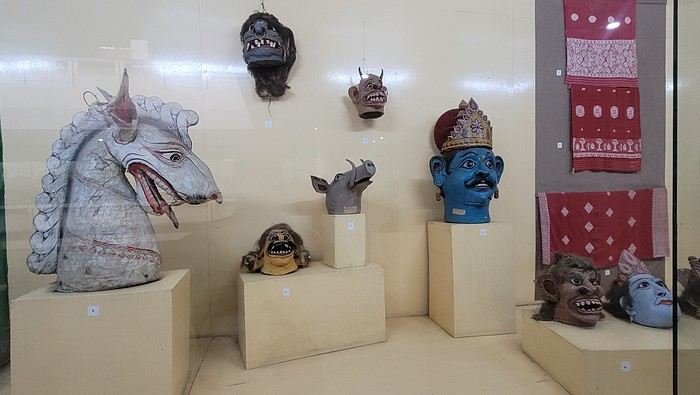

I’m not far from the Brahmaputra River, and the temptation to visit is too strong to resist. I’d hoped to find a promenade along the river, but that doesn’t exist here. I walk back calmly and notice several restaurants in my street. On the doorstep of my accommodation, I spot a pastry shop with cakes that look more like the ones we have in France than the typical ones here in India. A visit is a must, and I’m not disappointed!
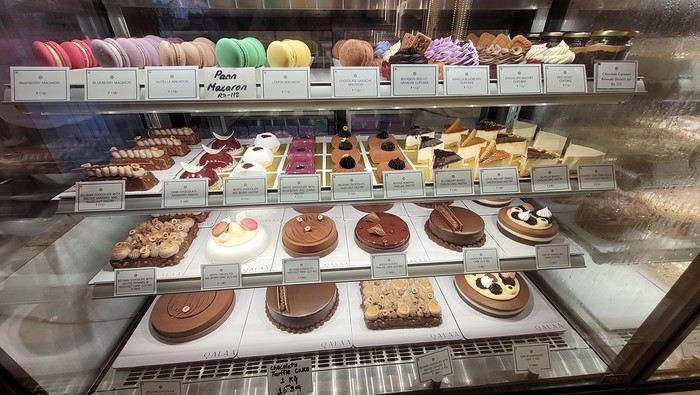
Tonight, I’m dining at a restaurant in the street. The menu is a bit disappointing—burgers, pizzas, pasta—nothing very Indian. So, I’ll go with tomato pasta.
Thursday, March 20th. The alarm goes off super early, but I’m already awake—I was too worried I’d sleep through it. I leave the house at 4:00 AM. The rain has stopped, and at this hour, there aren’t many trucks on the road. I arrive at Barcelona Airport easily by 6:20 AM, let the valet know I’m there, and he quickly picks up my car. This time, I’m flying with Etihad Airways again. I booked the ticket during my trip to Cambodia: Barcelona/Kolkata, Delhi/Barcelona for 567 €. At that price, I didn’t hesitate for long—I knew I had to take it. And I’m glad I did because, by the time I returned, the price had gone up to 700 €. I can already hear the reactions: "Wow, how’d you get a ticket for that price? What site did you use? You’re amazing, MarieJo!" One thing’s for sure—I’m really happy with this deal. The flights from Barcelona to Abu Dhabi and Abu Dhabi to Kolkata go smoothly, and we arrive on time at 2:55 AM. There aren’t many people at immigration, so I get through quickly. My luggage isn’t on the carousel yet. After collecting my bag, I check in for my next flight with IndiGo, a 5:40 AM flight to Guwahati, arriving at 7:00 AM. I’m starting to feel pretty tired, so I take a taxi from the airport to Gruham Sojourn Homestay. The house is upstairs, and the neighborhood seems quiet, with restaurants lining the street. The room won’t be ready until 10:00 AM, so I rest on the bench in the meantime. Once in the room, I take a shower—it really helps me feel refreshed. I need to exchange some euros, so I look up a nearby exchange bureau on Google and head out to find it. I locate it easily, and the staff are super friendly. I get a great rate (1 € = 90 INR). I wander around the neighborhood. The train station isn’t far, and small markets line the streets. I head back to my area, walking along the main avenue. About 500 meters from my street, I discover a museum. The visit is fascinating—I see the famous Majuli masks, among other things.
I’m not far from the Brahmaputra River, and the temptation to visit is too strong to resist. I’d hoped to find a promenade along the river, but that doesn’t exist here. I walk back calmly and notice several restaurants in my street. On the doorstep of my accommodation, I spot a pastry shop with cakes that look more like the ones we have in France than the typical ones here in India. A visit is a must, and I’m not disappointed!
Tonight, I’m dining at a restaurant in the street. The menu is a bit disappointing—burgers, pizzas, pasta—nothing very Indian. So, I’ll go with tomato pasta.
3 months in Iceland in a camper cell: stunning landscapes and little mishaps!
Welcome everyone!
It’s been a while since I last wrote a travel journal, but this recent trip to Iceland reignited my urge to write—both for the breathtaking landscapes we discovered and our adventure full of twists and turns!
This Iceland trip is part of our world tour, which we started back in August 2019. We (Sandrine and Flo) left by plane with our baby, Lena, who was barely 5 months old at the time. We backpacked around the Pacific for 5 months before returning home for a short break to see family. That was just before COVID hit, in late January 2020.
What followed was a bit chaotic... For the second part of our world tour, we were supposed to pick up a new vehicle: a brand-new pickup with a camper cell we planned to live in for several years. Due to lockdown, we received the cell weeks late, and with borders closing, we had to rethink all our plans.
So, we postponed our Iceland departure by over a month and a half, jumping on the first ferry accessible to French travelers after lockdown! Our goal is to spend 3 months there, from early July to late September, in our new camper cell. Our base vehicle is a Toyota Hilux we bought new, fitted with a flatbed where the cell sits, and we’ve prepped it for this trip (reinforced springs + airbags, snorkel, chassis protection, and off-road tires...). The aim is to tackle as many off-road tracks in Iceland as possible, knowing this is already our 3rd trip there (3 weeks in summer 2016 with a Durango, then 1 week in winter 2018).
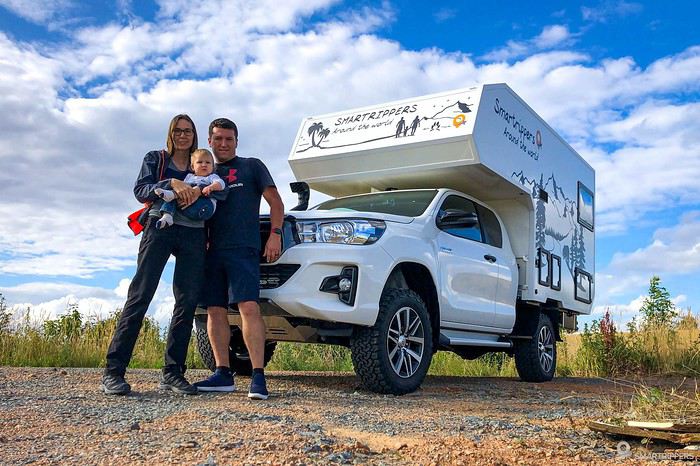
I’m kicking off our travel journal here! Along with photos, I’ll also include our vlogs, which we’ve been posting weekly since our departure in June—hope you enjoy them too! :-)
TRAVEL JOURNAL SUMMARY The journey up to Denmark The horrible ferry crossing The south of the Eastern Fjords
It’s been a while since I last wrote a travel journal, but this recent trip to Iceland reignited my urge to write—both for the breathtaking landscapes we discovered and our adventure full of twists and turns!
This Iceland trip is part of our world tour, which we started back in August 2019. We (Sandrine and Flo) left by plane with our baby, Lena, who was barely 5 months old at the time. We backpacked around the Pacific for 5 months before returning home for a short break to see family. That was just before COVID hit, in late January 2020.
What followed was a bit chaotic... For the second part of our world tour, we were supposed to pick up a new vehicle: a brand-new pickup with a camper cell we planned to live in for several years. Due to lockdown, we received the cell weeks late, and with borders closing, we had to rethink all our plans.
So, we postponed our Iceland departure by over a month and a half, jumping on the first ferry accessible to French travelers after lockdown! Our goal is to spend 3 months there, from early July to late September, in our new camper cell. Our base vehicle is a Toyota Hilux we bought new, fitted with a flatbed where the cell sits, and we’ve prepped it for this trip (reinforced springs + airbags, snorkel, chassis protection, and off-road tires...). The aim is to tackle as many off-road tracks in Iceland as possible, knowing this is already our 3rd trip there (3 weeks in summer 2016 with a Durango, then 1 week in winter 2018).
I’m kicking off our travel journal here! Along with photos, I’ll also include our vlogs, which we’ve been posting weekly since our departure in June—hope you enjoy them too! :-)
TRAVEL JOURNAL SUMMARY The journey up to Denmark The horrible ferry crossing The south of the Eastern Fjords
Adventures of a Bygone Era: The Philippines in 1984
After several discussions on VF about travel journals from the Philippines, I decided to write this curiosity: a trip report from a journey made in 1984, when traveling to the Philippines was still an adventure.
A curiosity because writing a travel journal about a trip 35 years later isn’t common, but also (mostly?) because exploring the Philippines at that time had little in common with traveling there today.
Obviously, I’ve forgotten a number of facts, most of the details, but with the help of a few notes from that time and a stack of slides (yes, there was life before digital 😊), many memories came back and added to the highlights I’d never forgotten. The scanned slides aren’t always great quality, but there are still quite a few to brighten up this chatter. Back then, we didn’t snap photos like we do now—film was too expensive—so I don’t have pictures of every place we visited... too bad, comparing some of those spots to how they look today would’ve been interesting.
Why "Adventures"? Why call it "Adventures" in the Philippines in 1984, a word so often used for a simple exotic trip? - Because the lack of information (no *Guide du Routard*, no *Lonely Planet*, no *Michelin Guide*, nothing, and obviously no internet) gave this trip what’s at the heart of adventure: the unknown. - Because the political situation made the stay sometimes dangerous. - Because transportation conditions were always epic, often perilous. - Because the question of where we’d spend the night came up almost every evening. - And for... quite a few other reasons.
That said, we weren’t exactly explorers!
Why the Philippines? First of all, why go to the Philippines in 1984—a country not exactly set up for tourism and about which we knew very little? How could we get an idea of the beauty of the Philippines and its points of interest when we had no guides or photos?
The idea came to us from Thailand a year earlier, during our first long-haul trip. After touring the north of the country, we met a Frenchman living in Phuket, where there were only a few tourists in Patong, with just a few small hotels and guesthouses. Kata and Karon had no buildings or roads, Rawai only had three palm-thatched bungalows, including ours, and the other islands were unknown to tourists. There was plenty to discover, and we wanted to return to this beautiful country... but the Frenchman made us dream about the Philippines—a country to explore, with wild landscapes.
Long evenings of discussion over multiple Sprite-Mekong cocktails (what memories of those headaches!) finally convinced us we had to go to the Philippines.
Episode 0: Before Departure The decision was made: we’d go to the Philippines in May 1984. Our friends and family were surprised when we announced we were going on vacation to the Philippines (a bit like saying today we were going paddleboarding in the Kerguelen Islands 🤪).
These days, preparing for each of our trips takes long evenings of research, planning, and noting down good addresses... etc. But for the Philippines in 1984, preparation was quick: we had very little information about the country, we were leaving almost at random, and the discovery would only be more exciting.
We still had a few bits of info gathered here and there: the rice terraces in northern Luzon, volcanoes, Negros where we were supposed to visit an acquaintance, Cebu and its marine life (we ended up going elsewhere), and absolutely avoid Mindanao, which was practically at war with the regime. That was about it, but it was already a great itinerary.
Nothing was organized in advance; we’d see day by day. We had no idea about travel times or even the existence of transportation options. The main (and sometimes only) way to connect two islands was by overloaded, rusty ferry. Only the big cities had airports.
Let’s Go: Episode 1: Paris to Manila My travel journals always start after arriving at the airport—the Europe-to-“Other Continent” trip isn’t interesting—but the flight to the Philippines was already an adventure, so I’ll make an exception.
This was the era when only a few Asian airlines were on par with Western ones: Thai, Singapore Airlines, and Philippine Airlines. They had beautiful, brand-new planes, and to attract customers (almost exclusively “businessmen”) from the usual airlines (Air France, Lufthansa, British Airways), there was opulence on board: unlimited champagne, all sorts of cocktails... Compared to today’s long-haul flights, there was still one small difference: no personal screens, just one screen at the front of the cabin with one mandatory movie. And I don’t know why, but we only got James Bond films, both ways... that must’ve been the trend at the time.
The tourism boom to Southeast Asia hadn’t started yet, and the “Asian Tigers” weren’t a thing, so there weren’t many business trips. That meant long-haul flights made stops everywhere to fill the planes. Our Philippine Airlines Boeing 747 left London, picked us up in Paris, then stopped in Frankfurt to take on a few Germans. I don’t know why we then made a stop in Dubai—a totally exotic place at the time. There was nothing to do there... things have changed a lot since. It was a small town lost in the desert. The airport was tiny, with just one or two buildings and a supermarket. During the stopover, everyone had to get off the plane and walk to the supermarket. Photo and electronic equipment were dirt cheap—I guess that was the only reason for the stop. Maybe it was their first commercial move. Emirates didn’t exist yet, as I checked online, but anyway, the idea that such a remote place could have its own airline was unthinkable.
Online, I found this photo of Dubai Airport in 1980. Anyone who’s transited through today’s massive airport with its rows of A380s will appreciate it: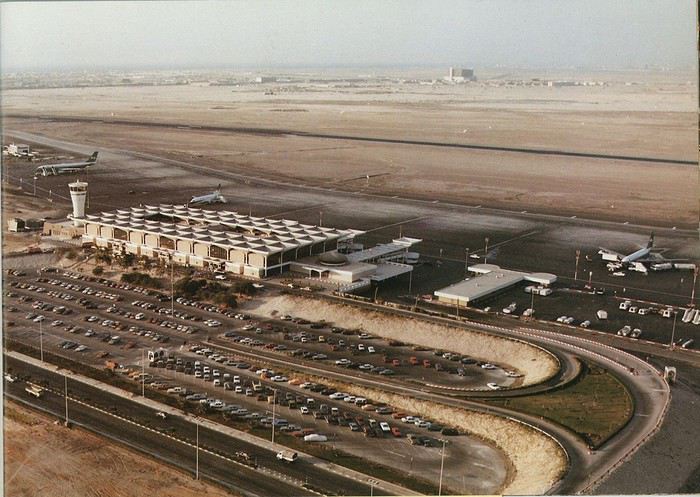
Next stop: New Delhi to drop off some Europeans and pick up a few Indians, and finally, the terminus: Manila. I don’t remember how long the trip took with its five stops—an unimaginable journey today. Despite all those stops to fill the plane, there was still enough space to stretch out on the four center seats of the 747, something that never happens these days despite all the flights in every direction.
So here we are, finally at Manila Airport around midnight.
Episode 1: Manila and Baguio To start, a quick note on the political and economic situation in the Philippines in 1984, which had consequences for us as tourists, as we’d soon realize upon arrival.
After several centuries of Spanish colonization, the Philippines became American at the start of the 20th century, then independent. In 1966, Marcos took power, and little by little, his regime sank into corruption and mismanagement, becoming a dictatorship with martial law, all for the benefit of his family and friends, who enriched themselves endlessly. The peak was the assassination of opposition leader Benigno Aquino in August 1983, which triggered harshly repressed protests. So we arrived a few months later in a very poor country, with omnipresent corruption and an extremely tense political situation, as we’d soon see for ourselves. Major protests took place in the main cities during our trip—I’ll come back to that. Two years later, Marcos fled to Hawaii after being forced out of power following rigged elections. This historical context explains a lot of the situations we found ourselves in over the following weeks.
Arriving in the middle of the night isn’t very cheerful. Manila was already a huge city with many slums, where you could find a few business hotels like the Hilton or Intercontinental—way out of our budget—and plenty of run-down hotels. Luckily, two Indians we’d chatted with on the plane offered to take us to their usual hotel. They came to Manila twice a year for business. We accepted their offer, relieved not to have to look for a place to stay in the middle of the night, figuring the address must be good since they came back every time... we were wrong 🙁
We left the airport and immediately got a taste of the local vibe when we got into the taxi: the police asked for our passports. We thought: what’s more normal than police in a dictatorship?
But that wasn’t it at all. Our two Indian friends explained that the police were noting our names along with the taxi number and time. Crime in Manila was so bad that the taxi driver would be held responsible if anything happened to us... welcome to the Philippines 😎 😎
Historically, the Philippines was a very violent country, where everything was settled with guns or machetes. Previous governments had banned carrying weapons, but Marcos later allowed the free sale and carrying of guns, and disputes were settled with pistols again (or worse, as we’d discover later). Since he’d released most of the criminals from prison to form a paramilitary militia at his service (I’ll talk about our encounter with these “heroes” later), it was pretty dangerous to go into many parts of Manila, where these “tonton macoutes” ruled.
We arrived at our hotel without incident... and then things started badly. The room was infested with big cockroaches—exactly what I hate most in those kinds of countries. No way to find another hotel at that hour. After the long flight, the urge to take a shower was so strong that we squeezed into the bathroom as best we could. After that, I don’t remember—I guess we must’ve fallen asleep exhausted under the sheets in the heat... air conditioning wasn’t widespread yet.
The next day, we just wanted to leave that dump as soon as possible. So we decided to head north right away, stopping in Baguio, and we’d visit Manila a bit on the way back.
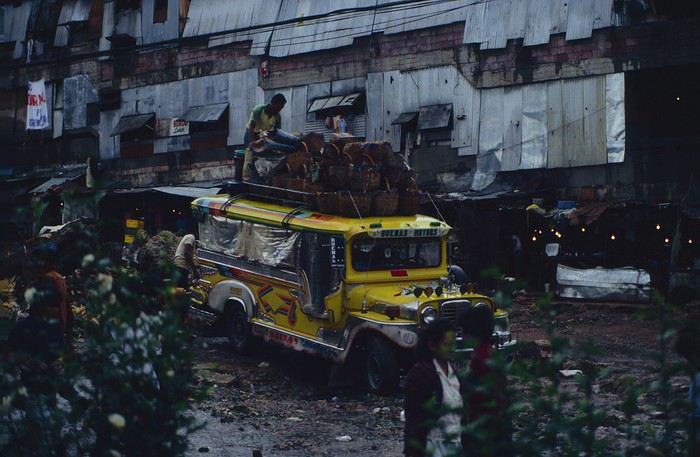
When we stepped outside, we discovered a pretty run-down neighborhood with potholed streets. But we also discovered the jeepneys. They were everywhere, flooding the streets.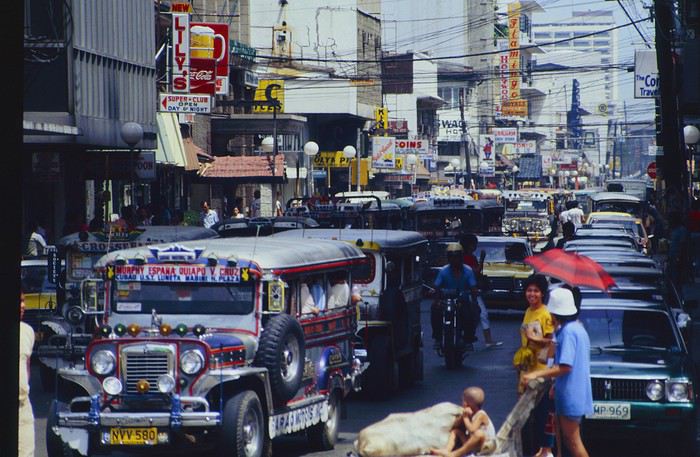
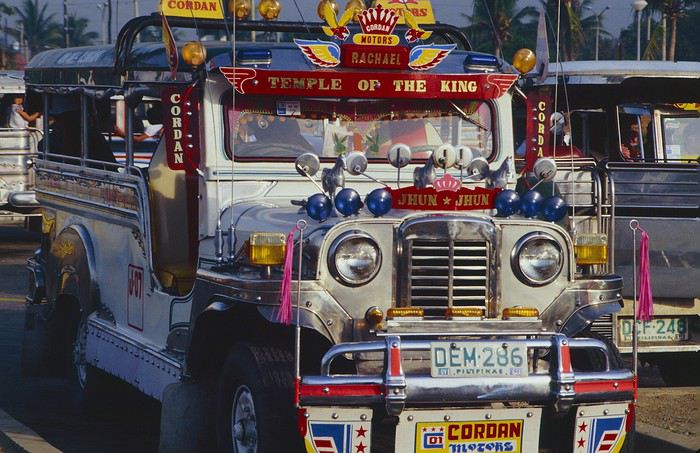
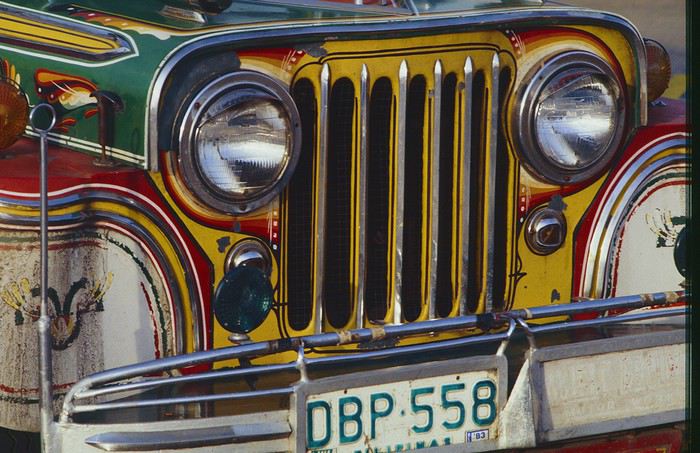
They had crazy sound systems, each one blasting louder than the last. The interiors were kitschy but fun. There weren’t many private cars—almost all transportation was by jeepney, with buses reserved for intercity trips.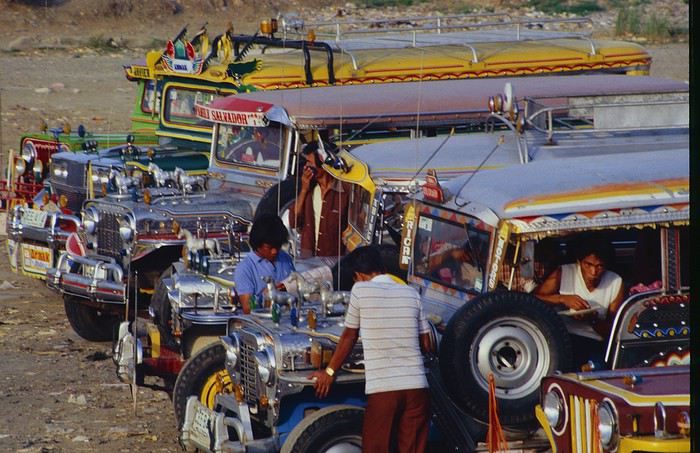
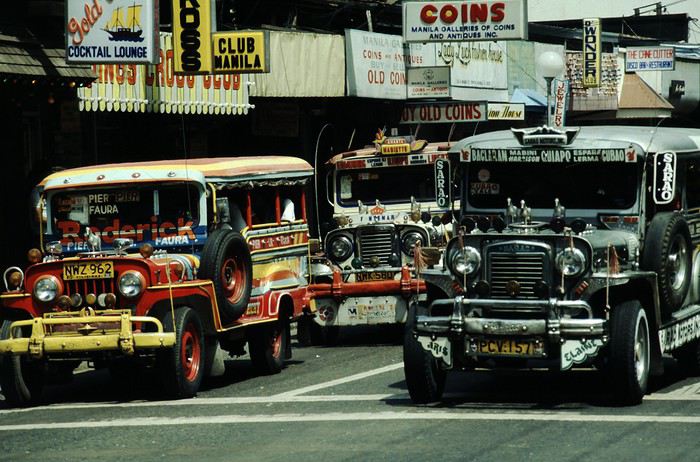
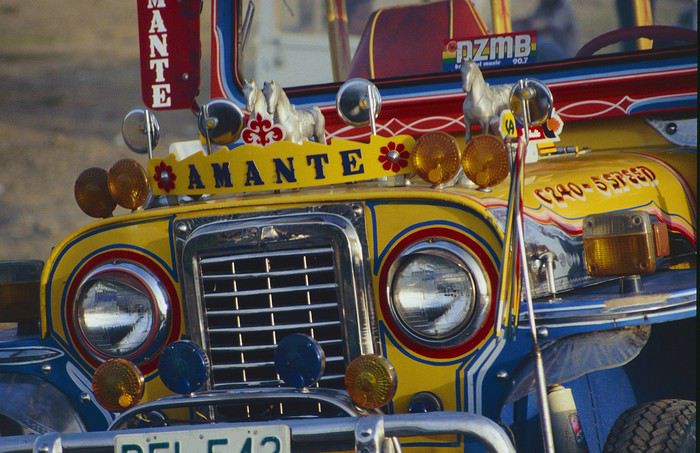
Before heading to the bus terminal for the north, somewhere on the outskirts of the city, we needed to exchange some money. I don’t remember how we ended up in a policeman’s jeep who offered his services: - Exchange money on the black market at a better rate than the banks. - Take us wherever we wanted, in this case, the bus terminal.
We accepted both offers (we’d still checked the official exchange rate from dollars to pesos). So we found ourselves in his jeep. After exchanging money, we left in his vehicle and stopped for gas. Without turning off the engine, he calmly smoked a cigarette while filling up. Since we were in a jeep with no doors or roof, we were ready to jump out if things went south, our travel bag in hand.
But we weren’t done with surprises yet. Once we left the small streets, we ended up in a neighborhood with wide avenues and not much traffic, which didn’t justify his incredible behavior. At every intersection, he made the sign of the cross, closed his eyes, and crossed without looking. I was more stunned than terrified! It wasn’t until we got out of the car later that I told Anne-Marie what had happened. I’d seen everything because the cop had put me in the front seat. Luckily, A-Marie hadn’t noticed anything from the back. Crossing Manila by trusting God rather than the rules of the road was ultimately effective. We were lucky—the trip was off to a good start. 🙂 🙂
We then passed through a neighborhood where slums stretched on for a while, and we left our policeman—friendly but a bit crazy—with relief.
A few hours by bus later, here we are in Baguio, cool in the mountains. My memories of Baguio are pretty fuzzy. I remember a small town. After some research while writing this journal, I found that the population was 120,000 in 1980. Given the population density in each home, that confirms my memory of a smallish town. Outside the “official” district with the president’s summer residence and government buildings, there were two or three paved streets with nice houses. The rest was very dirty and very poor, with lots of slums and dirt roads.
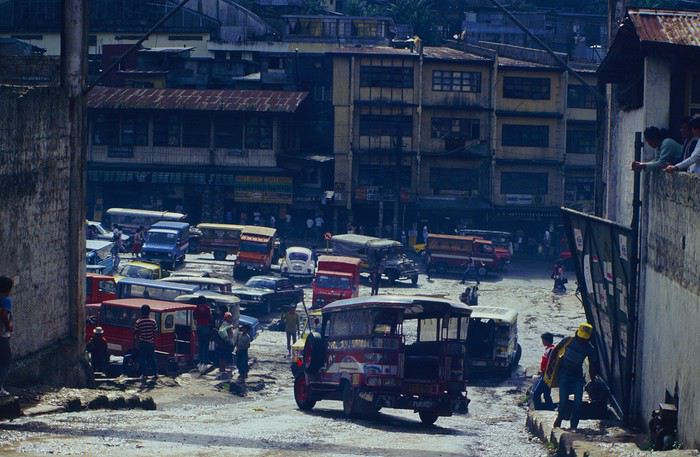
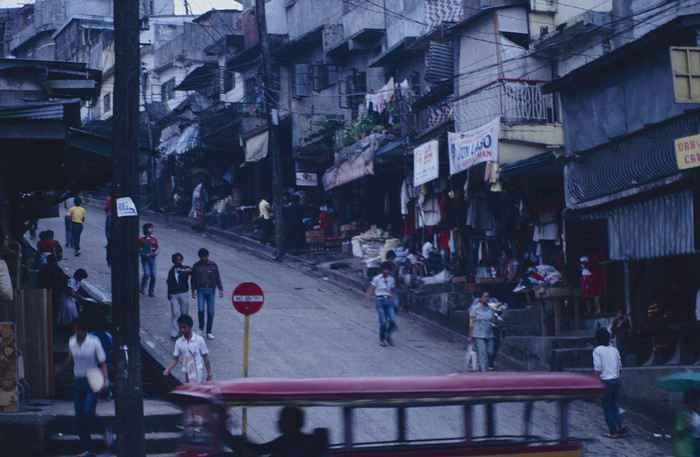
People we met on the street invited us to stay with them. These days, we wouldn’t just show up at strangers’ houses, which we should’ve done in Baguio—it would’ve saved us from an unimaginable and dangerous situation... which I won’t say anything about... !😊
The simple wooden house was on stilts at the edge of a hill with a view of the mountains. Since it was the start of the rainy season in a city that gets a lot of rain, we saw a lot of water. Our outings in town happened between downpours.
View from our lodging: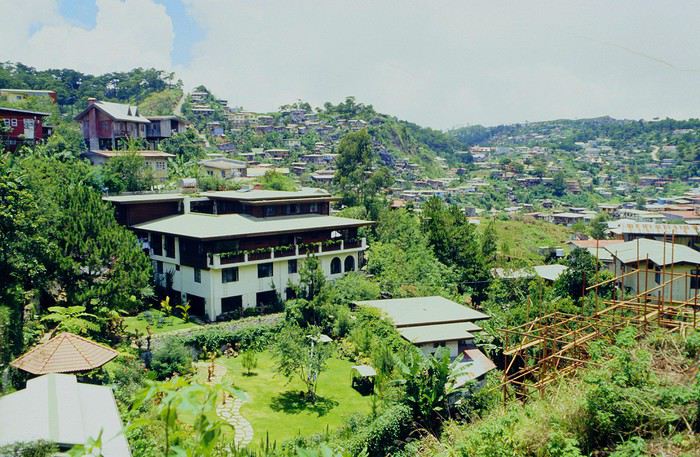
Episode 2: Baguio to Bontoc Aside from the situation briefly mentioned above, it was on the next leg to Bontoc that the adventure really began: an endless and dangerous road, a bus from another era, breathtaking landscapes, and surprising people.
We didn’t know the distance or how long it would take to get to Bontoc. When we arrived after about ten hours, we learned that Baguio to Bontoc was 140 km.
We got on a bus with wooden seats and settled in, two to a seat meant for two. As the bus filled up, passengers squeezed in three or four per seat, with chickens and baskets full of all sorts of things in the aisle. A little embarrassed, we didn’t know if we should squeeze in three on our seat. The seats were super tight (luckily, Filipinos are small), and I didn’t know where to put my legs given my height. I don’t remember if we stayed alone on our bench or if we ended up sharing with others.
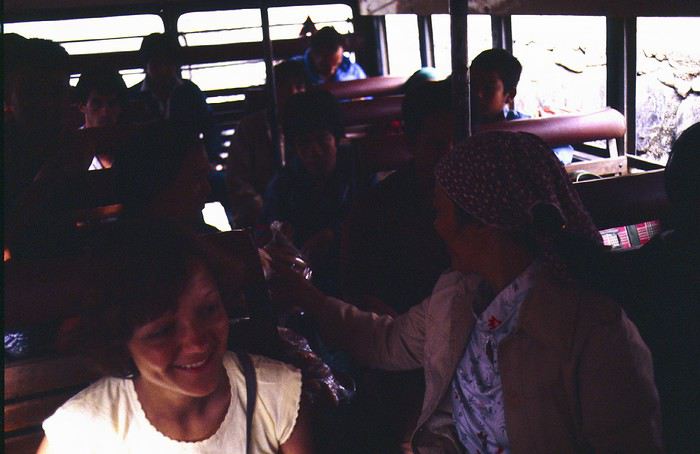
The “road” was a dirt track (or rather, a mud track) with endless turns. We held on as best we could to our slippery wooden seats—it was shaking in every direction. The woman behind us was carsick and throwing up... gross... but what were we doing there? Then we plunged into the Sierra Madre... just the name is dreamy!
Rice terraces started to appear: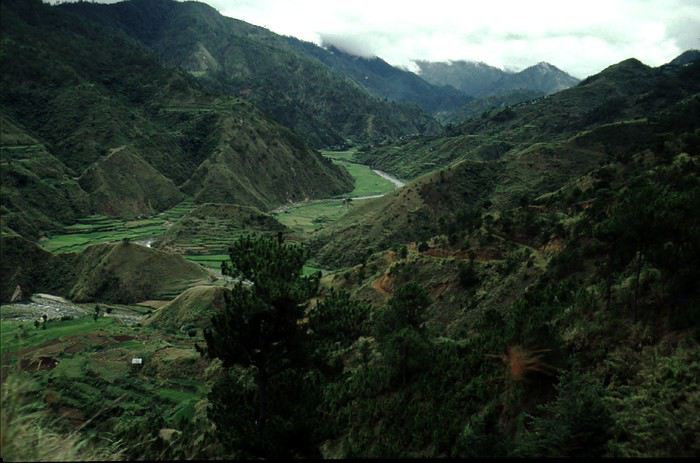
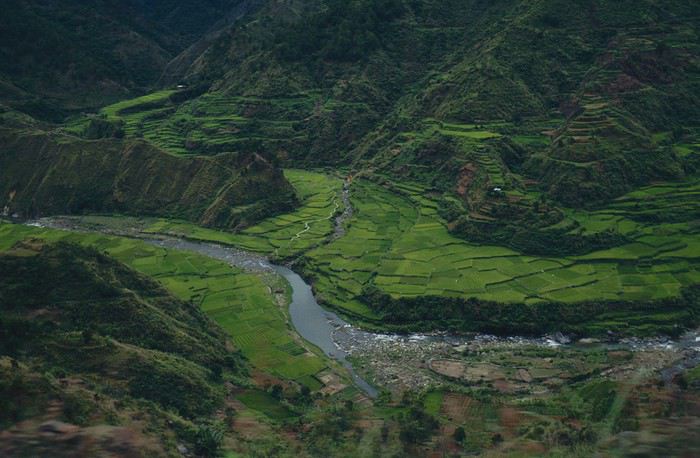
they took up more and more space along cliffs where we weren’t always reassured,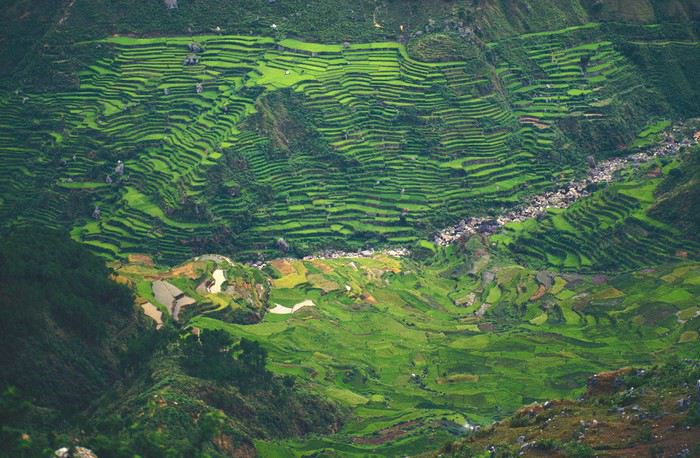
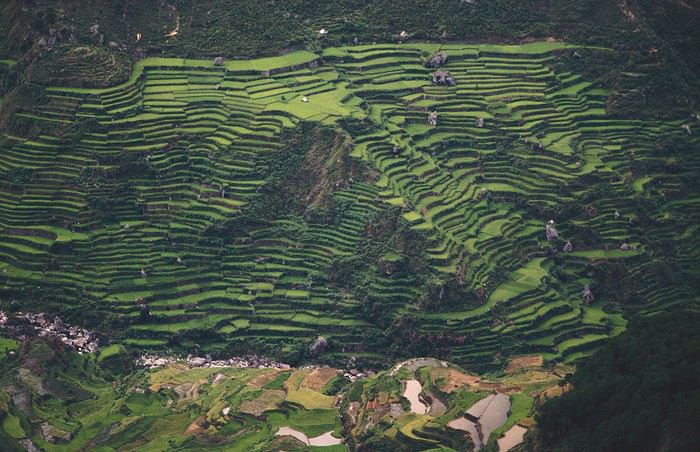
with lots of waterfalls (all that water had to go somewhere).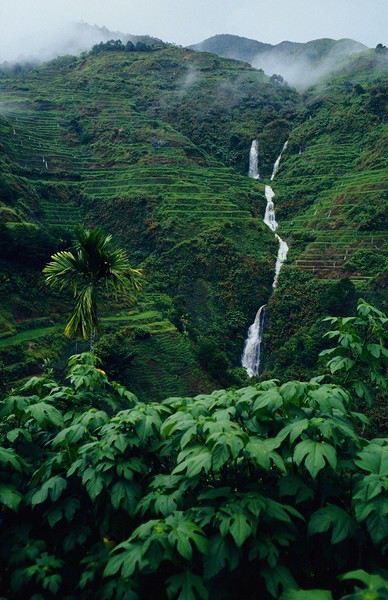
A few miserable villages stretched along the track, most often just a few houses balancing between the road and the drop. The bus stopped in every village—people got on or off and settled inside or on the roof. Street vendors offered their products to the bus passengers—a common sight in Asia, even today.
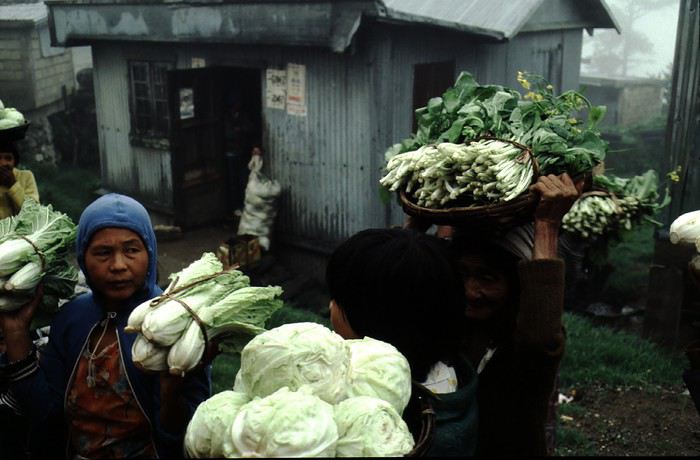
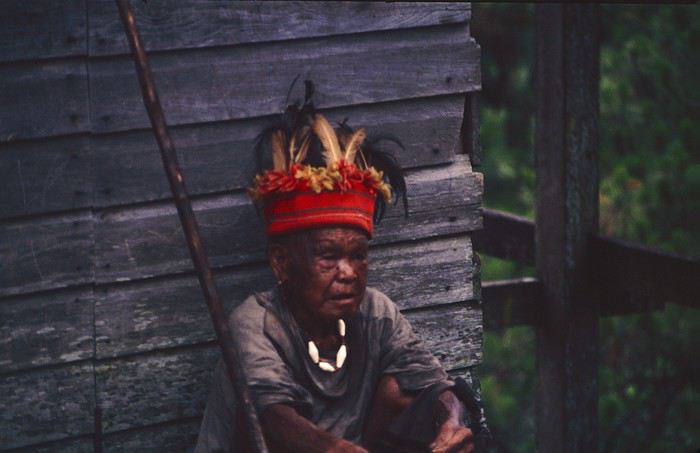
We were in another world—villagers were in loincloths, others had spears. The atmosphere was strange... but all good, we wanted exoticism, and we got it: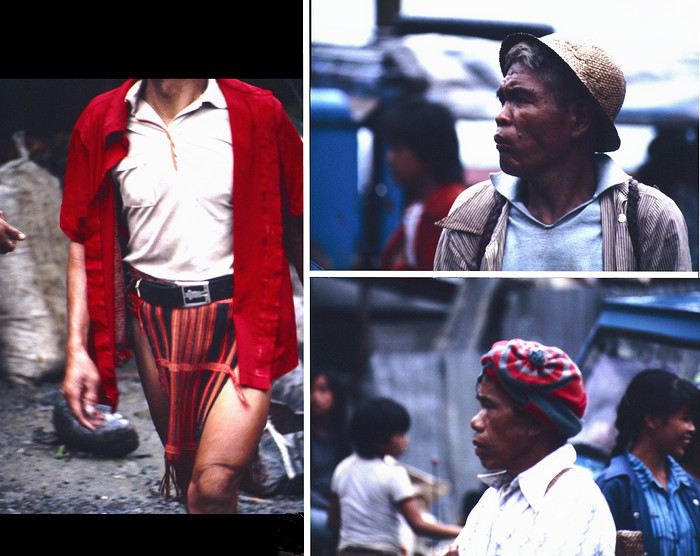
This so-called traditional outfit was everyday wear—it wasn’t for tourists since there weren’t any.
A curiosity because writing a travel journal about a trip 35 years later isn’t common, but also (mostly?) because exploring the Philippines at that time had little in common with traveling there today.
Obviously, I’ve forgotten a number of facts, most of the details, but with the help of a few notes from that time and a stack of slides (yes, there was life before digital 😊), many memories came back and added to the highlights I’d never forgotten. The scanned slides aren’t always great quality, but there are still quite a few to brighten up this chatter. Back then, we didn’t snap photos like we do now—film was too expensive—so I don’t have pictures of every place we visited... too bad, comparing some of those spots to how they look today would’ve been interesting.
Why "Adventures"? Why call it "Adventures" in the Philippines in 1984, a word so often used for a simple exotic trip? - Because the lack of information (no *Guide du Routard*, no *Lonely Planet*, no *Michelin Guide*, nothing, and obviously no internet) gave this trip what’s at the heart of adventure: the unknown. - Because the political situation made the stay sometimes dangerous. - Because transportation conditions were always epic, often perilous. - Because the question of where we’d spend the night came up almost every evening. - And for... quite a few other reasons.
That said, we weren’t exactly explorers!
Why the Philippines? First of all, why go to the Philippines in 1984—a country not exactly set up for tourism and about which we knew very little? How could we get an idea of the beauty of the Philippines and its points of interest when we had no guides or photos?
The idea came to us from Thailand a year earlier, during our first long-haul trip. After touring the north of the country, we met a Frenchman living in Phuket, where there were only a few tourists in Patong, with just a few small hotels and guesthouses. Kata and Karon had no buildings or roads, Rawai only had three palm-thatched bungalows, including ours, and the other islands were unknown to tourists. There was plenty to discover, and we wanted to return to this beautiful country... but the Frenchman made us dream about the Philippines—a country to explore, with wild landscapes.
Long evenings of discussion over multiple Sprite-Mekong cocktails (what memories of those headaches!) finally convinced us we had to go to the Philippines.
Episode 0: Before Departure The decision was made: we’d go to the Philippines in May 1984. Our friends and family were surprised when we announced we were going on vacation to the Philippines (a bit like saying today we were going paddleboarding in the Kerguelen Islands 🤪).
These days, preparing for each of our trips takes long evenings of research, planning, and noting down good addresses... etc. But for the Philippines in 1984, preparation was quick: we had very little information about the country, we were leaving almost at random, and the discovery would only be more exciting.
We still had a few bits of info gathered here and there: the rice terraces in northern Luzon, volcanoes, Negros where we were supposed to visit an acquaintance, Cebu and its marine life (we ended up going elsewhere), and absolutely avoid Mindanao, which was practically at war with the regime. That was about it, but it was already a great itinerary.
Nothing was organized in advance; we’d see day by day. We had no idea about travel times or even the existence of transportation options. The main (and sometimes only) way to connect two islands was by overloaded, rusty ferry. Only the big cities had airports.
Let’s Go: Episode 1: Paris to Manila My travel journals always start after arriving at the airport—the Europe-to-“Other Continent” trip isn’t interesting—but the flight to the Philippines was already an adventure, so I’ll make an exception.
This was the era when only a few Asian airlines were on par with Western ones: Thai, Singapore Airlines, and Philippine Airlines. They had beautiful, brand-new planes, and to attract customers (almost exclusively “businessmen”) from the usual airlines (Air France, Lufthansa, British Airways), there was opulence on board: unlimited champagne, all sorts of cocktails... Compared to today’s long-haul flights, there was still one small difference: no personal screens, just one screen at the front of the cabin with one mandatory movie. And I don’t know why, but we only got James Bond films, both ways... that must’ve been the trend at the time.
The tourism boom to Southeast Asia hadn’t started yet, and the “Asian Tigers” weren’t a thing, so there weren’t many business trips. That meant long-haul flights made stops everywhere to fill the planes. Our Philippine Airlines Boeing 747 left London, picked us up in Paris, then stopped in Frankfurt to take on a few Germans. I don’t know why we then made a stop in Dubai—a totally exotic place at the time. There was nothing to do there... things have changed a lot since. It was a small town lost in the desert. The airport was tiny, with just one or two buildings and a supermarket. During the stopover, everyone had to get off the plane and walk to the supermarket. Photo and electronic equipment were dirt cheap—I guess that was the only reason for the stop. Maybe it was their first commercial move. Emirates didn’t exist yet, as I checked online, but anyway, the idea that such a remote place could have its own airline was unthinkable.
Online, I found this photo of Dubai Airport in 1980. Anyone who’s transited through today’s massive airport with its rows of A380s will appreciate it:
Next stop: New Delhi to drop off some Europeans and pick up a few Indians, and finally, the terminus: Manila. I don’t remember how long the trip took with its five stops—an unimaginable journey today. Despite all those stops to fill the plane, there was still enough space to stretch out on the four center seats of the 747, something that never happens these days despite all the flights in every direction.
So here we are, finally at Manila Airport around midnight.
Episode 1: Manila and Baguio To start, a quick note on the political and economic situation in the Philippines in 1984, which had consequences for us as tourists, as we’d soon realize upon arrival.
After several centuries of Spanish colonization, the Philippines became American at the start of the 20th century, then independent. In 1966, Marcos took power, and little by little, his regime sank into corruption and mismanagement, becoming a dictatorship with martial law, all for the benefit of his family and friends, who enriched themselves endlessly. The peak was the assassination of opposition leader Benigno Aquino in August 1983, which triggered harshly repressed protests. So we arrived a few months later in a very poor country, with omnipresent corruption and an extremely tense political situation, as we’d soon see for ourselves. Major protests took place in the main cities during our trip—I’ll come back to that. Two years later, Marcos fled to Hawaii after being forced out of power following rigged elections. This historical context explains a lot of the situations we found ourselves in over the following weeks.
Arriving in the middle of the night isn’t very cheerful. Manila was already a huge city with many slums, where you could find a few business hotels like the Hilton or Intercontinental—way out of our budget—and plenty of run-down hotels. Luckily, two Indians we’d chatted with on the plane offered to take us to their usual hotel. They came to Manila twice a year for business. We accepted their offer, relieved not to have to look for a place to stay in the middle of the night, figuring the address must be good since they came back every time... we were wrong 🙁
We left the airport and immediately got a taste of the local vibe when we got into the taxi: the police asked for our passports. We thought: what’s more normal than police in a dictatorship?
But that wasn’t it at all. Our two Indian friends explained that the police were noting our names along with the taxi number and time. Crime in Manila was so bad that the taxi driver would be held responsible if anything happened to us... welcome to the Philippines 😎 😎
Historically, the Philippines was a very violent country, where everything was settled with guns or machetes. Previous governments had banned carrying weapons, but Marcos later allowed the free sale and carrying of guns, and disputes were settled with pistols again (or worse, as we’d discover later). Since he’d released most of the criminals from prison to form a paramilitary militia at his service (I’ll talk about our encounter with these “heroes” later), it was pretty dangerous to go into many parts of Manila, where these “tonton macoutes” ruled.
We arrived at our hotel without incident... and then things started badly. The room was infested with big cockroaches—exactly what I hate most in those kinds of countries. No way to find another hotel at that hour. After the long flight, the urge to take a shower was so strong that we squeezed into the bathroom as best we could. After that, I don’t remember—I guess we must’ve fallen asleep exhausted under the sheets in the heat... air conditioning wasn’t widespread yet.
The next day, we just wanted to leave that dump as soon as possible. So we decided to head north right away, stopping in Baguio, and we’d visit Manila a bit on the way back.
When we stepped outside, we discovered a pretty run-down neighborhood with potholed streets. But we also discovered the jeepneys. They were everywhere, flooding the streets.
They had crazy sound systems, each one blasting louder than the last. The interiors were kitschy but fun. There weren’t many private cars—almost all transportation was by jeepney, with buses reserved for intercity trips.
Before heading to the bus terminal for the north, somewhere on the outskirts of the city, we needed to exchange some money. I don’t remember how we ended up in a policeman’s jeep who offered his services: - Exchange money on the black market at a better rate than the banks. - Take us wherever we wanted, in this case, the bus terminal.
We accepted both offers (we’d still checked the official exchange rate from dollars to pesos). So we found ourselves in his jeep. After exchanging money, we left in his vehicle and stopped for gas. Without turning off the engine, he calmly smoked a cigarette while filling up. Since we were in a jeep with no doors or roof, we were ready to jump out if things went south, our travel bag in hand.
But we weren’t done with surprises yet. Once we left the small streets, we ended up in a neighborhood with wide avenues and not much traffic, which didn’t justify his incredible behavior. At every intersection, he made the sign of the cross, closed his eyes, and crossed without looking. I was more stunned than terrified! It wasn’t until we got out of the car later that I told Anne-Marie what had happened. I’d seen everything because the cop had put me in the front seat. Luckily, A-Marie hadn’t noticed anything from the back. Crossing Manila by trusting God rather than the rules of the road was ultimately effective. We were lucky—the trip was off to a good start. 🙂 🙂
We then passed through a neighborhood where slums stretched on for a while, and we left our policeman—friendly but a bit crazy—with relief.
A few hours by bus later, here we are in Baguio, cool in the mountains. My memories of Baguio are pretty fuzzy. I remember a small town. After some research while writing this journal, I found that the population was 120,000 in 1980. Given the population density in each home, that confirms my memory of a smallish town. Outside the “official” district with the president’s summer residence and government buildings, there were two or three paved streets with nice houses. The rest was very dirty and very poor, with lots of slums and dirt roads.
People we met on the street invited us to stay with them. These days, we wouldn’t just show up at strangers’ houses, which we should’ve done in Baguio—it would’ve saved us from an unimaginable and dangerous situation... which I won’t say anything about... !😊
The simple wooden house was on stilts at the edge of a hill with a view of the mountains. Since it was the start of the rainy season in a city that gets a lot of rain, we saw a lot of water. Our outings in town happened between downpours.
View from our lodging:
Episode 2: Baguio to Bontoc Aside from the situation briefly mentioned above, it was on the next leg to Bontoc that the adventure really began: an endless and dangerous road, a bus from another era, breathtaking landscapes, and surprising people.
We didn’t know the distance or how long it would take to get to Bontoc. When we arrived after about ten hours, we learned that Baguio to Bontoc was 140 km.
We got on a bus with wooden seats and settled in, two to a seat meant for two. As the bus filled up, passengers squeezed in three or four per seat, with chickens and baskets full of all sorts of things in the aisle. A little embarrassed, we didn’t know if we should squeeze in three on our seat. The seats were super tight (luckily, Filipinos are small), and I didn’t know where to put my legs given my height. I don’t remember if we stayed alone on our bench or if we ended up sharing with others.
The “road” was a dirt track (or rather, a mud track) with endless turns. We held on as best we could to our slippery wooden seats—it was shaking in every direction. The woman behind us was carsick and throwing up... gross... but what were we doing there? Then we plunged into the Sierra Madre... just the name is dreamy!
Rice terraces started to appear:
they took up more and more space along cliffs where we weren’t always reassured,
with lots of waterfalls (all that water had to go somewhere).
A few miserable villages stretched along the track, most often just a few houses balancing between the road and the drop. The bus stopped in every village—people got on or off and settled inside or on the roof. Street vendors offered their products to the bus passengers—a common sight in Asia, even today.
We were in another world—villagers were in loincloths, others had spears. The atmosphere was strange... but all good, we wanted exoticism, and we got it:
This so-called traditional outfit was everyday wear—it wasn’t for tourists since there weren’t any.
Croisières, à quand la reprise? English translation pending
Bonsoir,
beaucoup se posent la question, parfois avec un optimisme surprenant ! Voici un petit rappel :
Pour qu'il y ait des croisières il faut au moins réunir 3 conditions principales (et d'autres aussi) :
- 1 un bateau DÉSINFECTÉ avec son équipage au complet et opérationnel. Pour l'instant les équipages sont disséminés dans le monde. Il faudra les retrouver, les convaincre, certains auront peur. Les convaincus devront trouver des vols pour revenir ; enfin venant de pays "exotiques" ils devront être acceptés à l'entrée des pays où seront les bateaux. Pas gagné avec toutes ces contraintes !!
- 2 un minimum de passagers car en mer un bateau armé coûte beaucoup plus cher que désarmé dans 1 port ou au mouillage !!! Comment vont-ils arriver au port d'embarquement s'ils viennent de loin ? Et mêmes remarques que pour l'équipage, ils faudra qu'ils puissent entrer dans le pays de départ...
- 3 des ports qui acceptent les bateaux. Ce que diront les gouvernements est une chose, ce que décideront les locaux qui, déjà avant l'épidémie ne voyaient plus les croisiéristes d'un très bon œil en est une autre ! Pas gagné non plus pour beaucoup d'endroits où les populations risquent de très très mal réagir à l'arrivée de milliers de personnes potentiellement porteuses du virus même si elles ne sont pas malades.
On peut rêver, mais il faut aussi parfois revenir sur terre à défaut d'être en mer. Pour moi il y aura extrêmement peu de départs avant l'automne en étant très optimiste !!! Je prépare déjà un plan B pour notre départ du 17/10 depuis le Japon Nous avons heureusement des vols reportables. Qui vivra verra.... Qu'en pensez-vous ?
beaucoup se posent la question, parfois avec un optimisme surprenant ! Voici un petit rappel :
Pour qu'il y ait des croisières il faut au moins réunir 3 conditions principales (et d'autres aussi) :
- 1 un bateau DÉSINFECTÉ avec son équipage au complet et opérationnel. Pour l'instant les équipages sont disséminés dans le monde. Il faudra les retrouver, les convaincre, certains auront peur. Les convaincus devront trouver des vols pour revenir ; enfin venant de pays "exotiques" ils devront être acceptés à l'entrée des pays où seront les bateaux. Pas gagné avec toutes ces contraintes !!
- 2 un minimum de passagers car en mer un bateau armé coûte beaucoup plus cher que désarmé dans 1 port ou au mouillage !!! Comment vont-ils arriver au port d'embarquement s'ils viennent de loin ? Et mêmes remarques que pour l'équipage, ils faudra qu'ils puissent entrer dans le pays de départ...
- 3 des ports qui acceptent les bateaux. Ce que diront les gouvernements est une chose, ce que décideront les locaux qui, déjà avant l'épidémie ne voyaient plus les croisiéristes d'un très bon œil en est une autre ! Pas gagné non plus pour beaucoup d'endroits où les populations risquent de très très mal réagir à l'arrivée de milliers de personnes potentiellement porteuses du virus même si elles ne sont pas malades.
On peut rêver, mais il faut aussi parfois revenir sur terre à défaut d'être en mer. Pour moi il y aura extrêmement peu de départs avant l'automne en étant très optimiste !!! Je prépare déjà un plan B pour notre départ du 17/10 depuis le Japon Nous avons heureusement des vols reportables. Qui vivra verra.... Qu'en pensez-vous ?