Travel Journal - 28 Days in China in August 2025
FR

Translated into English.

Original post
VI
Hi everyone! I’m sharing a modest travel journal from my trip to China in August 2025.

There wasn’t much room for improvisation on this trip—everything was planned in advance. Since August is peak season, I decided to book train tickets early, and once that was set, I reserved all the accommodations too. I got everything on Trip.com.

I bought the flight tickets back in March from Hainan Airlines. They were super expensive, but with these travel dates, I couldn’t exactly dream of a bargain!

I picked up e-SIMs valid for a month from Free just before departure: 10 € for the e-SIM + 19.90 € for a one-month plan with 35 GB of data abroad.

No need for a VPN with these e-SIMs, but D. still got one—a multi-device plan for 5 € with a discount from Let’s VPN, valid for a month. It was for evenings at the hotel on Wi-Fi to avoid burning through the 35 GB with video.

I downloaded Alipay, WeChat, Amap (Baidu Maps), and Trip.com. We also have Google Translate and Maps.me—absolute must-haves.
We’re ready to go!

I’ve been waiting for this day for nearly 15 years!! I travel a lot, but this one—this is MY TRIP 🙂 It’s been postponed so many times: because I wanted to do it with the right person, because I have a Turkish stamp in my passport and heard they don’t issue visas with that, because of COVID... and then China introduced a 30-day visa exemption, and that was the green light! Ugh, they forced us to take our vacation in August this year—far from ideal—but no more delays. Saturday, August 2, 2025: it’s finally the big day!

Days 1 and 2: We got dropped off at Charles de Gaulle at 9:30 AM. I supposedly checked in online, but only for the first flight and without getting the boarding pass... Might as well scrap online check-in in that case. So, we spent over an hour in line at the counter to get them. We didn’t have any checked luggage—just our backpacks as carry-ons—so this was a step we’d never had to deal with before, but whatever, it’s done. No wait at passport control, 5 minutes through security, a quick walk around the terminal, 10 minutes in the boarding area, and it was already time to board. Departure around 12:45 PM, arrival in Chongqing at 4:50 AM. We had a few hours of layover before our next flight. Went through immigration, connecting flight control, and security. Pro tip: check your next flight’s boarding gate right after immigration. We never saw it displayed again anywhere in the terminal.

The Free e-SIMs work—phew!

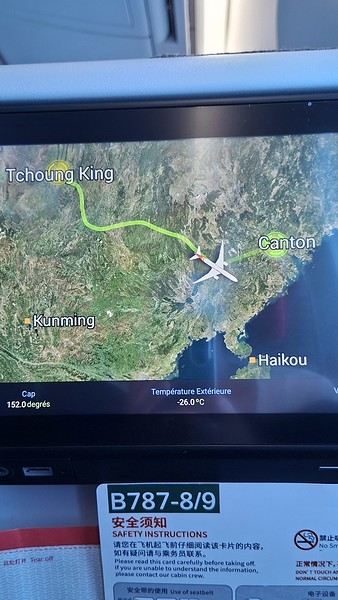
Took off at 9:30 AM, arrived in Guangzhou (Canton) at 11:20 AM in the rain. I love how Chongqing is translated as "Tchoung King" on the screens in the plane—very French!


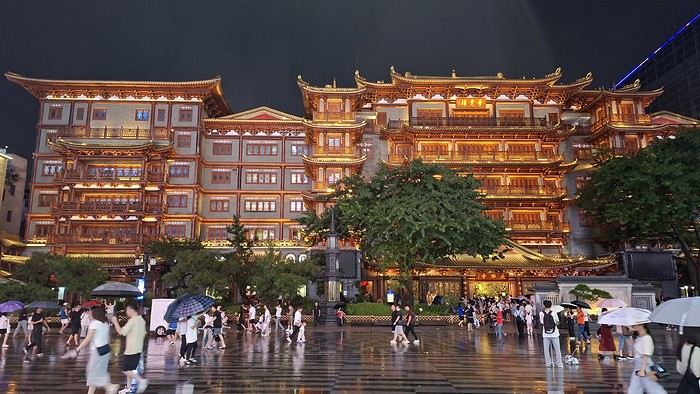
During my first two trips to China, we paid for everything in cash, but this time, we’re going all-in on Alipay and WeChat. I still brought the leftover change from previous trips—it might come in handy. At the metro station, they showed us a QR code to buy tickets via WeChat. There were probably machines and even a ticket counter, but we didn’t see them, and buying via WeChat was pretty simple. 8 yuan to Changshu Lu, which is 22 stops. So far, so good. Then, we had to find the hotel, which wasn’t on Google Maps, Maps.me, or Amap... Easy 😎! We found it without too much hassle, though. Dropped off our stuff and went out to eat. 55 yuan for two claypots with fish/eel, rice, cabbage, and purple eggplant. When we left, it was pouring. We grabbed our umbrellas and set off to explore the neighborhood: Enning Road (we’ll come back later to check out a specific spot), Shangxiajiu (the pedestrian shopping street), Baohua Road... The area is pretty diverse—one street to the next, it’s like stepping into a different world.


There weren’t many people around, probably because of the rain. We grabbed a quick street food dinner and went to bed—we were exhausted. We struggled to stay awake until 11 PM to adjust to the time change as quickly as possible. There’s a 6-hour time difference.
JO Jojoone1 Globetrotter ·
A huge thank you for sharing a travel journal about a destination that hasn’t had many yet!
« Tout le monde s'interroge sur comment laisser une meilleure planète à nos enfants, mais on devrait plutôt penser à laisser de meilleurs enfants pour notre planète. » Clint Eastwood
VI Vilabel Regular ·
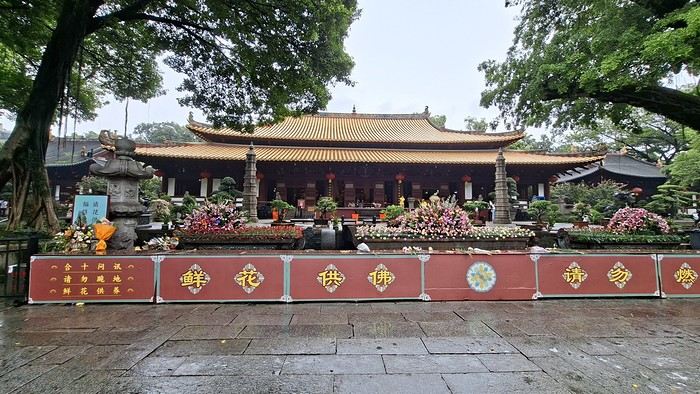
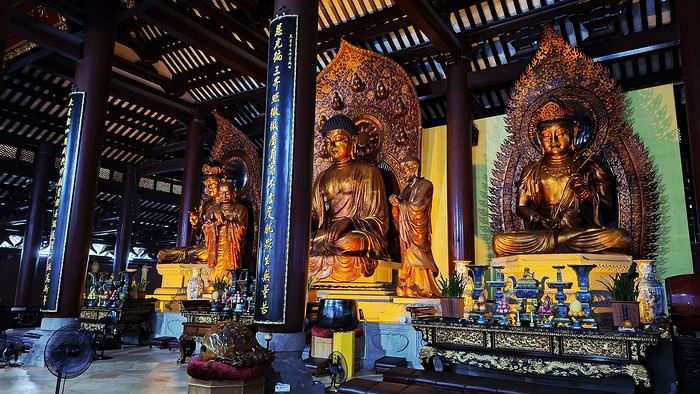
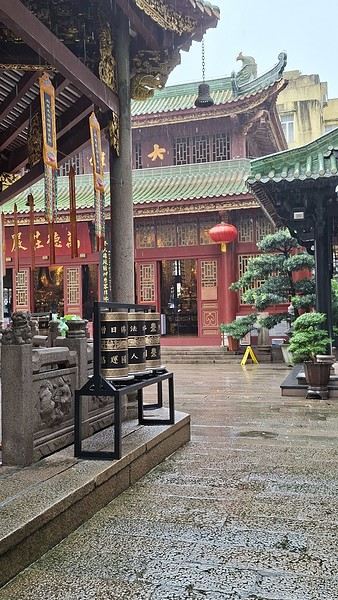
Day 3: Left in the rain at 10:30 AM for Guangxiao Temple, one of the oldest and most important Buddhist temples in Guangzhou. Originally founded during the Han Dynasty (25-220), it has been rebuilt several times over the centuries.

We continued to the Temple of the Six Banyan Trees, built in the 6th century. It has also been burned down and completely rebuilt multiple times. There’s a 60-meter-tall pagoda, prayer scrolls—it’s really beautiful and peaceful.


I can’t figure out how to upload videos—what a shame.

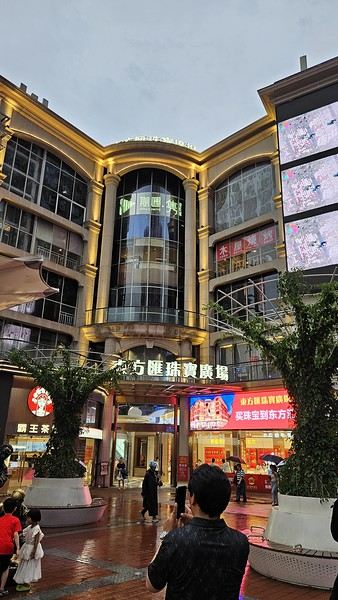
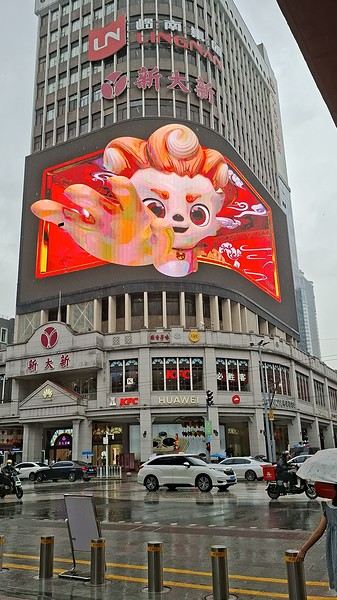
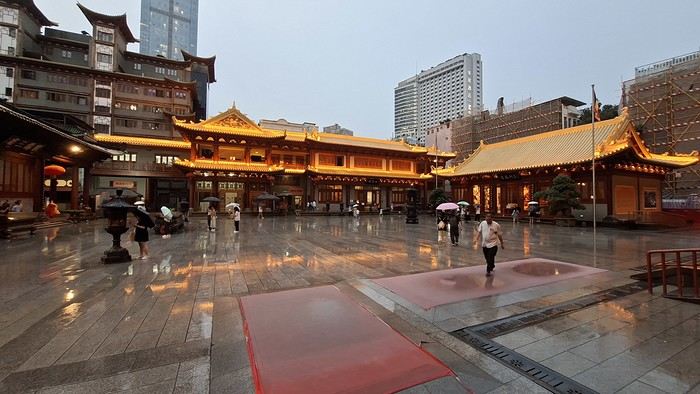
We moved on to Beijing Road, a large pedestrian shopping area with huge screens showing pretty well-made 3D ads. Nearby is Dafo Temple, dating back to the 10th century. It has several imposing buildings—it’s amazing how cut off from the world you feel as soon as you step inside! The religious chants, the peaceful atmosphere… We’ll come back to see it at night.


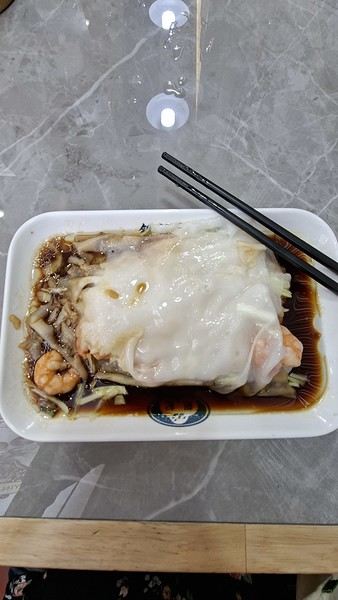
We had lunch at a small restaurant on Beijing Road—shrimp rice rolls for me, beef for D. Loved it. 29 yuan.


A quick metro ride to what looks like the knockoff district to hunt for soccer jerseys at 55 yuan. We bought metro tokens easily from a machine, paid via Alipay by scanning the QR code on the screen. You can also pay with a bank card or cash.

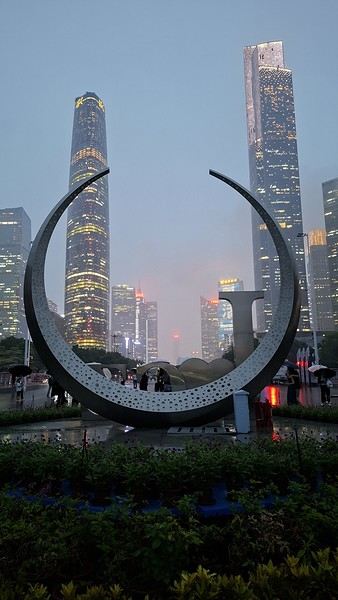
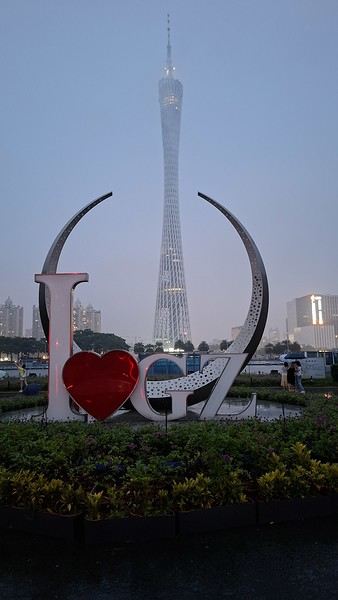
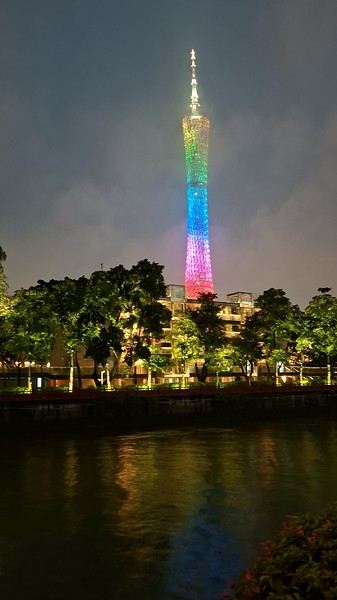
Then off to Huacheng Square, Canton Tower, Linjiang Park, and the "bottle opener" bridge. Night fell, the towers lit up, and it was still raining. Visibility wasn’t great—sometimes we couldn’t even see the towers! We still enjoyed the area for a while, even if the rain really ruined the visit. The lights on the tower might be a bit tacky, but I still like them 🙂


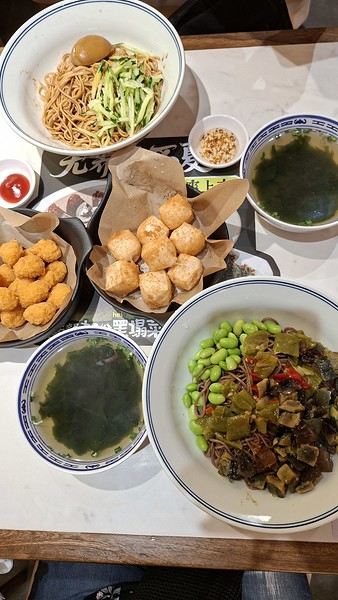
We ended with an amazing dinner at Hefu Noodles—buckwheat noodles with red and green chili, soybeans, and century eggs for me, served with a small seaweed soup. And just to add to the fun, sweet potato fritters and fried mochi with honey and osmanthus. I loved it.


It’s past 9 PM, and it’s been raining nonstop all day. We’ve been walking in water for nearly 12 hours and logged over 18 km. I had the bright idea of breaking in my brand-new sandals today. My feet are bleeding, and I’m limping to the metro, wondering how I’ll walk tomorrow. More rain is forecast for the whole day…
VI Vilabel Regular ·
A big thank you for sharing a travel journal about a destination that hasn’t had many.

Yeah, that’s true—it’s what motivated me too! 😊
BL Bluequark Veteran ·
Awesome! A travel journal about China! I can't wait to read the rest! Thanks.
Bluequark

Carnets : Namibie, Laos-Perhentias-BKK, Ouest US, Lanzarote, New-York, Berlin, Cuba, Bardenas Reales, AFS -Lesotho-Swaziland, Japon et le dernier né Colombie: https://voyageforum.com/discussion/ete-2017-trois-semaines-en-colmobie-en-famille-d10108246/
VI Vilabel Regular ·
Awesome! A travel journal about China! Can’t wait for the rest! Thanks.

Thanks! 🙂
NI Nimou74 Veteran ·
Oh, finally a travel journal about China🙂! I’m happily jumping in. Our trip is coming up soon. It’s not our first time in China, but this time we’re venturing into Gansu. We’ll head to Yunnan afterward.

I’ve downloaded Alipay and WeChat, but WeChat isn’t working yet. Probably need to wait until we’re there...

Otherwise, we’ve signed up for Free’s international plan. From what I understand, there’s no need to get an extra SIM card? And we’ll bring a VPN—useful when using Wi-Fi, right?

Looking forward to reading your updates
VI Vilabel Regular ·
Day 4. We’re actually on orange alert for heavy rain and storms. It’s pouring, so we’re waiting for it to calm down. I stick six band-aids on each of my feet and slip into my old sandals that have traveled thousands of kilometers with me around the world. So glad I packed them at the bottom of my bag "just in case." They could give out any minute, but for now, I feel like they’re saving my trip! 🙂

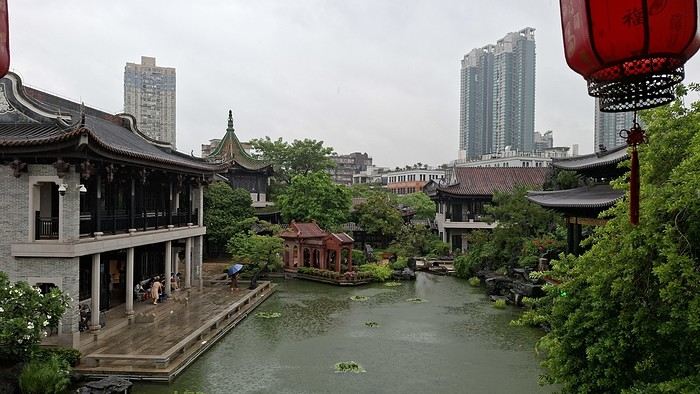
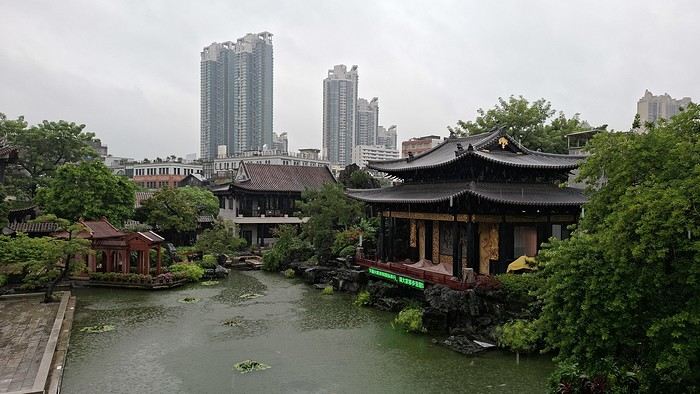
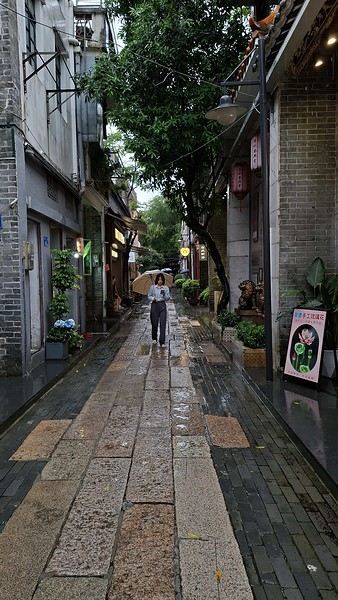
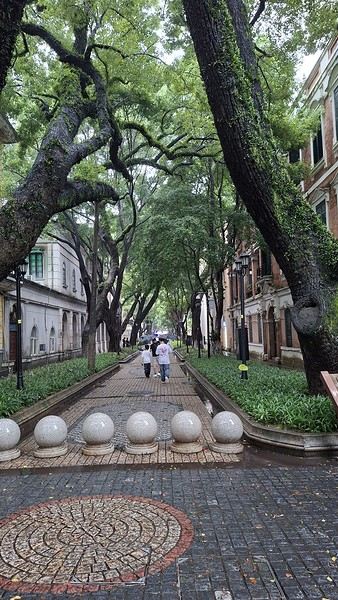
Around 1:00 PM, we head out to eat and check out the Cantonese Opera Art Museum on Enning Road, where we’d already passed by on the first night. The site is really nice, though a bit limited, surrounded by a small canal. Performances are held outdoors, but I didn’t quite get where the audience sits... I guess they set up some chairs on the terrace? The neighborhood is lovely too, with little pedestrian streets lined with stylish boutiques and galleries. We wander every alley with pleasure, despite the rain.


Next, we head to Shamian Island, located on the Pearl River, a former Franco-British concession. It’s kept its Western architecture. The colonial buildings have become big hotels. There are churches, cute little statues depicting scenes of daily life, small squares... It’s very peaceful and green. I realize I didn’t really take photos of this place—what a shame. This neighborhood must be really pleasant in good weather. Once again, it’s crazy how you can go from one city vibe to another in no time. Guangzhou is truly multifaceted.


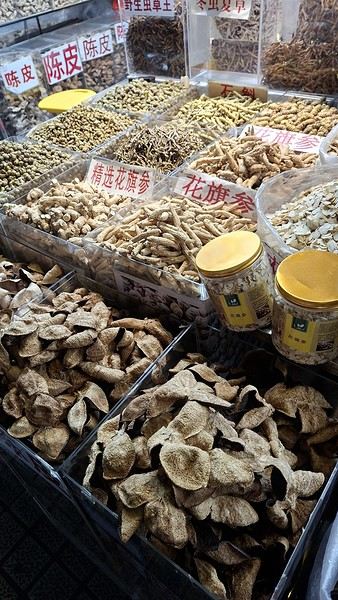
We cross the river again and wander through Qingping Medicine Market, filled with stalls of mushrooms, seahorses, bones, tendons, deer antlers, fish, starfish, and all sorts of dried things we can’t identify.


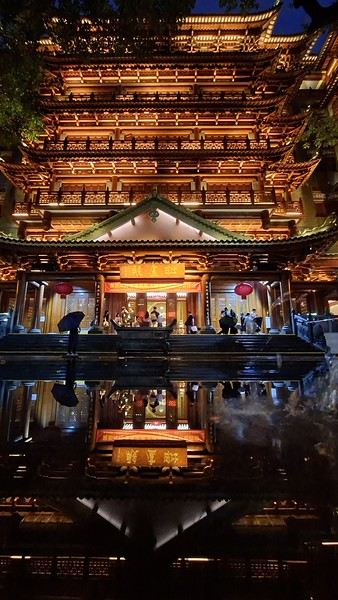
Then we take the metro to see the Dafo Temple at night. We arrive during the monks’ chants—it’s transporting, absolutely beautiful. The illuminated temple is stunning. I take advantage of the puddles to snap photos with the temple’s reflection in the water. Everyone’s wondering what I’m doing and giving me curious looks, but eventually, someone else starts doing the same thing above the puddles too 😊 Might as well make the rain useful!


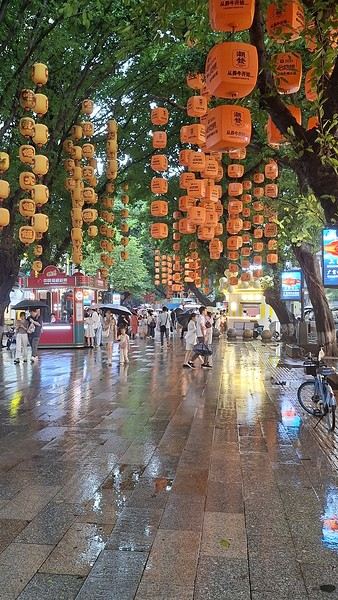
When we leave around 8:30 PM, it’s barely raining anymore. Still, that’s 48 hours straight! We take the opportunity to revisit those pedestrian shopping streets. We eat very late—a bowl of fish ball noodle soup. And for dessert, a bowl of *tangyuan*, glutinous rice balls stuffed with sweet chopped peanuts, in a thick red bean soup. We finish up quickly and head to the nearest metro station, since the metro here has pretty limited hours—roughly 6:20 AM to 11:30 PM. It’s raining. My old sandals held up, and so did my feet. I managed to walk 15 km today without any pain. I love my old sandals so much, but they’re really on their last legs. They won’t make it through the four weeks...
VI Vilabel Regular ·
A VPN is really only if you have high data usage, like if you watch Netflix, which would make you exceed your plan. Otherwise, 35GB is already more than enough for "classic" use. Personally, I stopped using Wi-Fi after 15 days when I saw I’d only used 1.5 GB of my plan (while regularly watching YouTube and using social media).

So yeah, no need to get an extra SIM if you’ve already got this plan.
VI Vilabel Regular ·
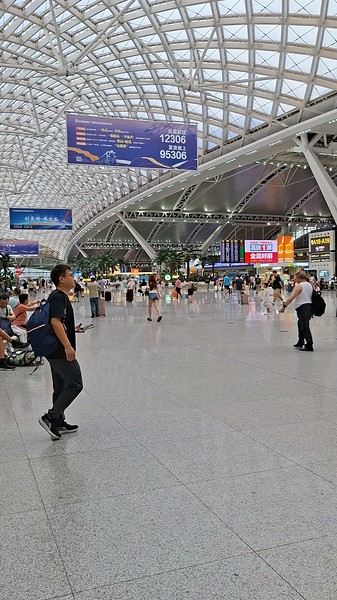
Day 5. This morning, we take metro line 1 then line 2 to Guangzhou’s south station. The station is huge, but everything’s super well organized, and we find where to go to catch our train really easily. No ticket—your passport gives you all access. However, for now, we can’t scan them at the gates, which apparently only accept Chinese ID cards, so we have to join the "assistance" line where an employee is present at the gate.

To help you navigate, stations are often named with a cardinal point after the city name. Ours, for example, is Guangzhounan. *Nan*: south. *Xi*: west. *Bei*: north. *Dong*: east. And if there’s nothing after the city name, then it’s the central station. :)


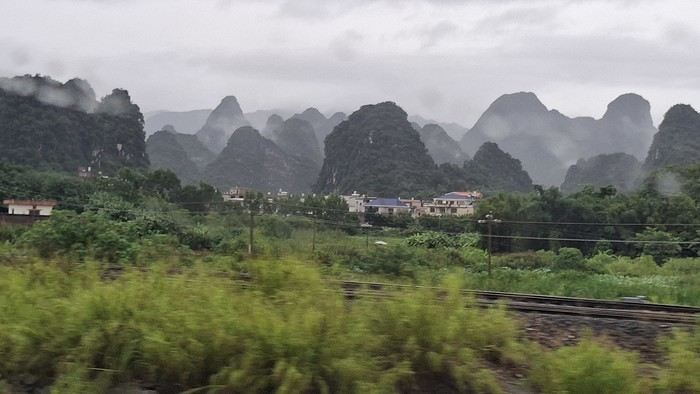
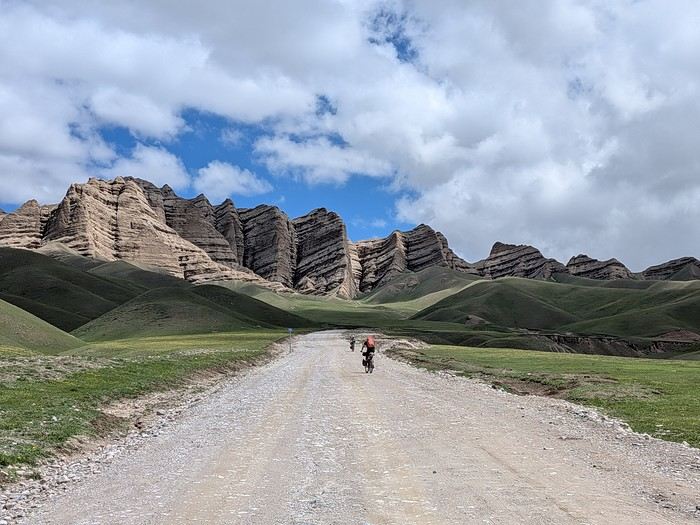
12:04 PM, departure for Yangshuo! I’m so excited—I’ve been waiting for this day for so long! Before 2 PM, we arrive near Hezhou, and the landscapes are already stunning.


2:15 PM, arrival in Yangshuo. We take a bus because the station is actually 35 km from Yangshuo: 20 yuan. The trip is supposed to take 55 minutes. It took us 2 hours. The road is jam-packed. If you’re doing the reverse trip to catch your train, plan plenty of extra time. Oh, and it’s raining... They’re also under an orange alert for storms and heavy rain here until Thursday at 12:16 PM. Yes, the Chinese are precise. :)

We messed up—we should’ve taken a Didi (= Uber, available on Alipay or WeChat, cheaper on WeChat) straight from the station because the bus drops us off more than 3 km from the hotel. So we end up in a Didi that drops us at the only spot it can park, not the exact address. Then we start another scavenger hunt with a hotel that isn’t on any map. To make it even trickier, it doesn’t have the name that appears on Trip.com. Luckily, Trip includes photos of the hotel’s exterior—that’s how we found it. Just so you know, the hotel "Yangshuo Jinlong" is actually called "Guilin Yangshuo Nursing Manor." Yeah, nothing to do with the original name!

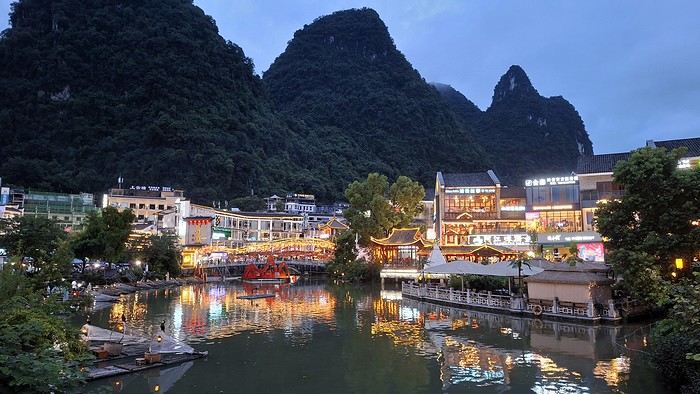
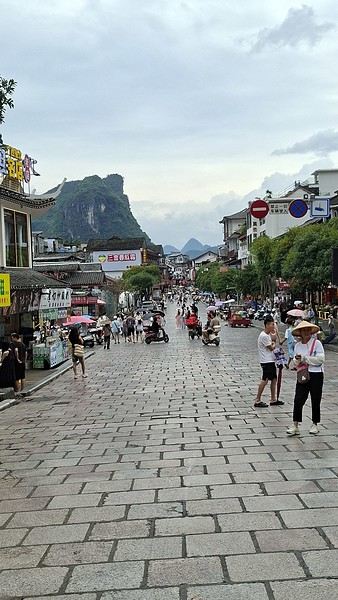
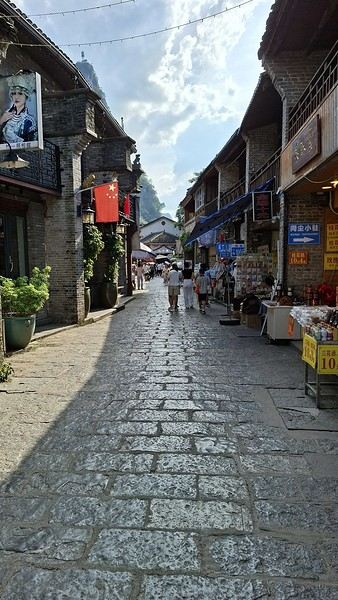
With all that, it’s already nearly 6 PM by the time we drop our stuff in the room. We head out right away. And then, I’m a little taken aback... Yangshuo isn’t at all what I imagined. The whole area is just a cluster of pedestrian shopping streets with touts in front of most shops and restaurants, blasting music, packed with people, and *super* loud. The famous West Street.


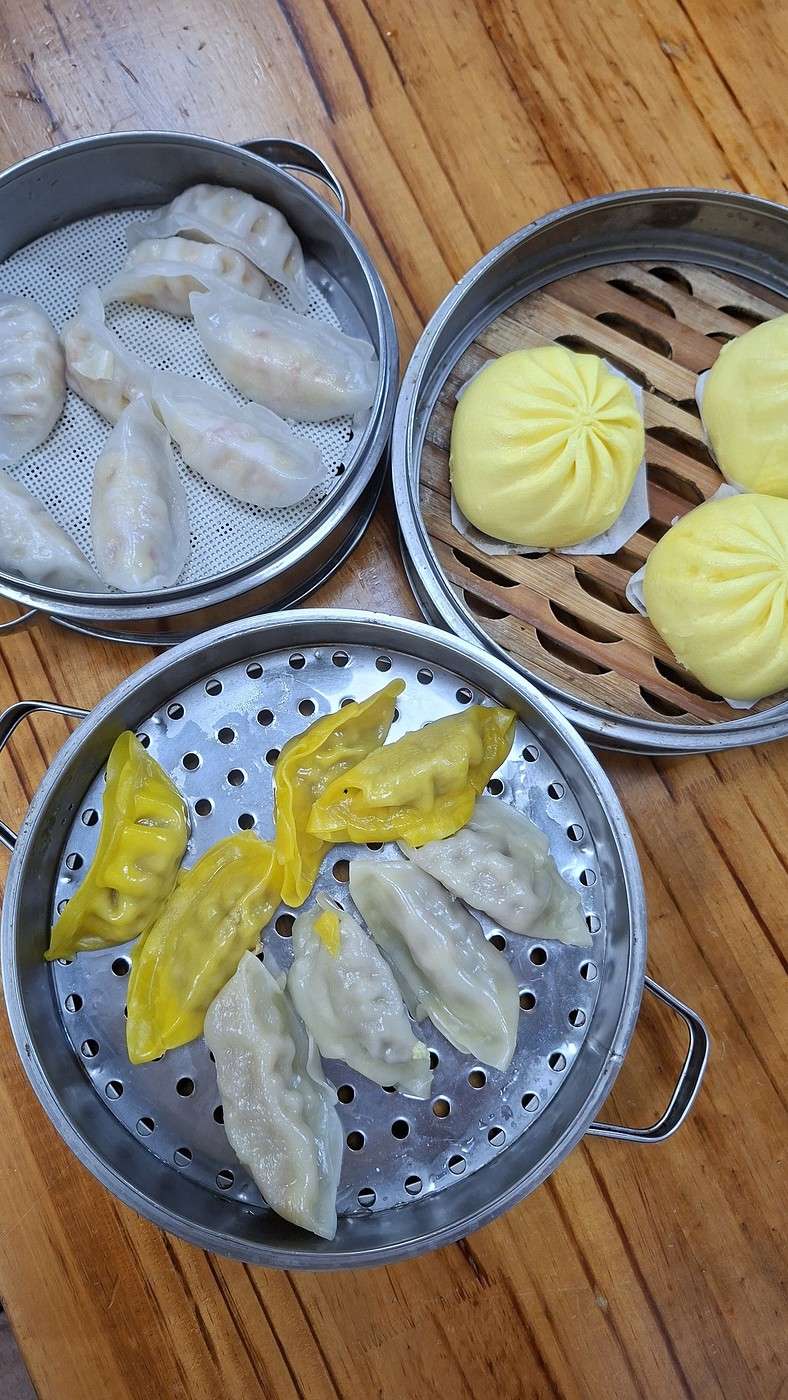
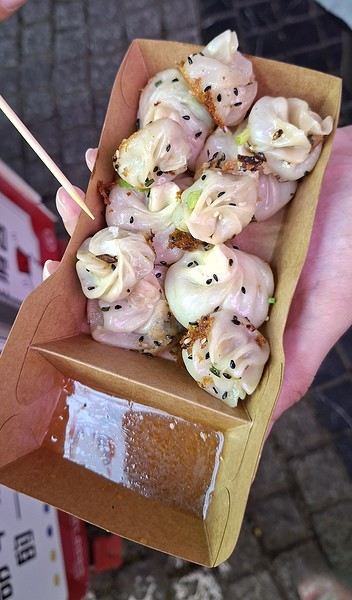
We grab some street food, then end up with some baos/dim sum at a small, unpretentious restaurant with no touts. I imagine the area looks totally different during the day. I *hope* so, actually. It’s stopped raining. We still enjoy the evening and the neighborhood until 10 PM, then head back. Tomorrow, we’ll need to find some bikes to rent.

PA Parigino Veteran ·
Here we go. Or for those who watch French TV (I do a lot since I'm a sports fan). Always prioritize hotel Wi-Fi, but sometimes it's not great. If you're not streaming Netflix or TV on your phone, a VPN isn't necessary because all sites are accessible with Free's network.

And since we're sharing tips, I've never been able to create an Alipay account, and payments don't always go through with WeChat. So it's always better to have some cash on hand. Apps are nice, but they take time (my bank always asks for authentication before approving), and I don't necessarily want all my purchases to be tracked.

Anyway, time for the travel journal.
HO Holigirl Veteran ·
Thanks for the travel journal!

China—what a change of scenery, it must’ve been a real eye-opener.

Hope the skies finally cleared up.

Looking forward to the next part
NI Nimou74 Veteran ·
A VPN is really only if you have high data usage, like if you watch Netflix, which would make you exceed your plan. Otherwise, 35GB is already more than enough for "classic" use. Personally, I stopped using Wi-Fi after 15 days when I saw I’d only used 1.5 GB of my plan (while regularly watching YouTube and using social media).

So yeah, no need to get an extra SIM if you’ve got this plan.

Thanks for this feedback! 🙂 The Yangshuo part brings back so many memories...
VI Vilabel Regular ·
Day 6. We take off in the late morning. I grab a taro shake for breakfast—I love those—and we head out to find bikes to rent on West Street. The neighborhood is completely different at this hour, really quiet but not deserted at all.


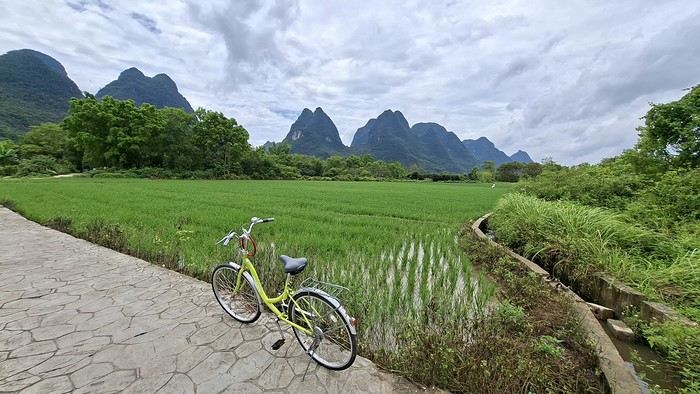
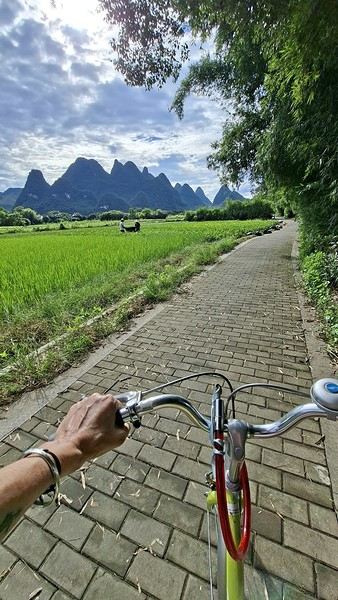
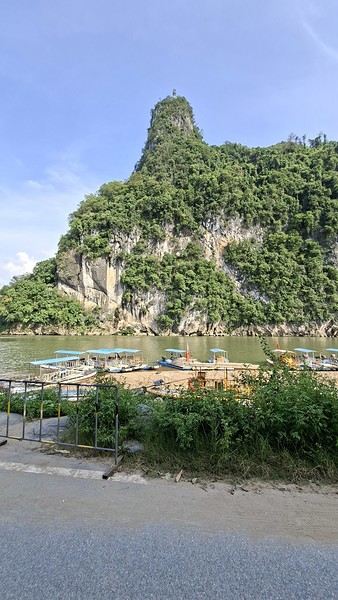
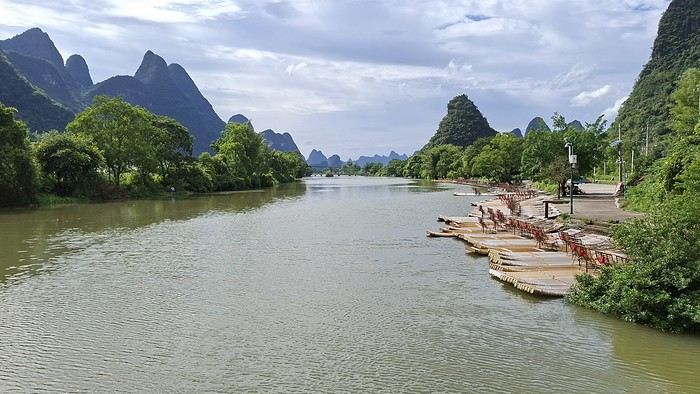
We spot scooters for rent at a shop, ask if they have bikes, and the woman says, “Yes, come with me.” She takes us to the middle of nowhere, deep into a dark, super slippery basement that opens onto the back of the shops. We end up in a small room with a few bikes that don’t look like they’ve been ridden much—everyone gets around by scooter here. Electric ones, actually, for both scooters and cars, which makes the cities quiet. Nice! We pick classic bikes, not mountain bikes: 30 yuan each for the day, plus a 200 yuan deposit for both bikes. Just as we’re about to leave, D. doesn’t feel well and starts throwing up. Pale face, white lips, shaky hands... We wait a bit before heading out. We stop a little farther to buy bananas. Again, D. redecorates the sidewalk and decides to go back to the room. Seems like the only solution... So, I set off alone on my bike for the highlight of my trip—the banks of the Yulong River. The road is pleasant, and I don’t feel unsafe at all. Everyone rides calmly, and there’s always a kind of wide lane where scooters (and the very rare bikes) go. I ride to the village of Chaolong, where I leave the road to reach the riverbank.


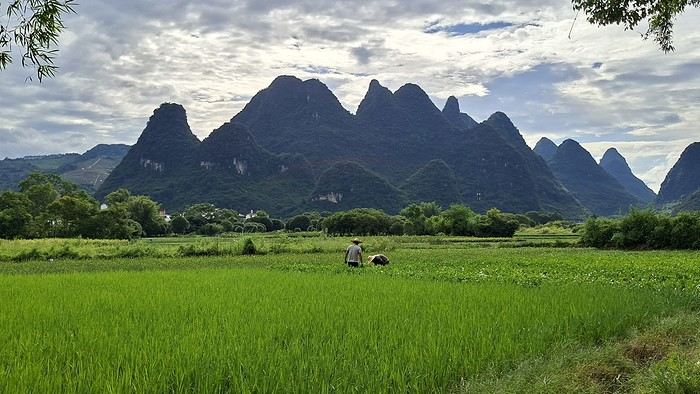
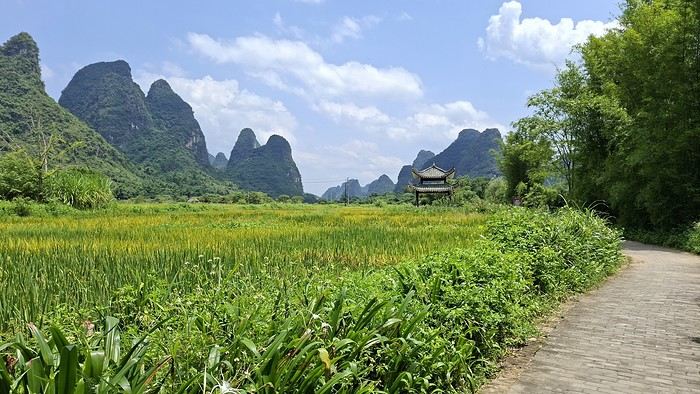
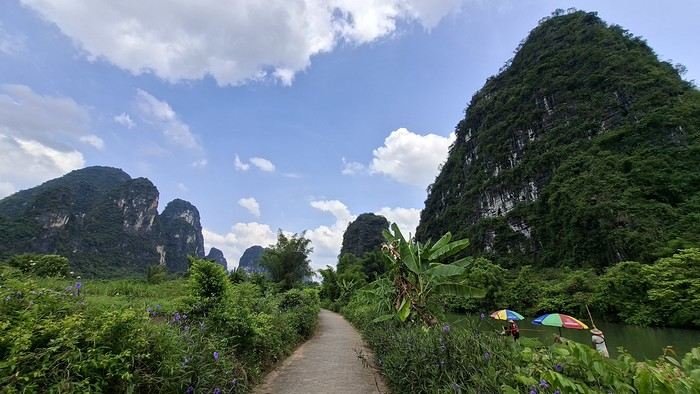
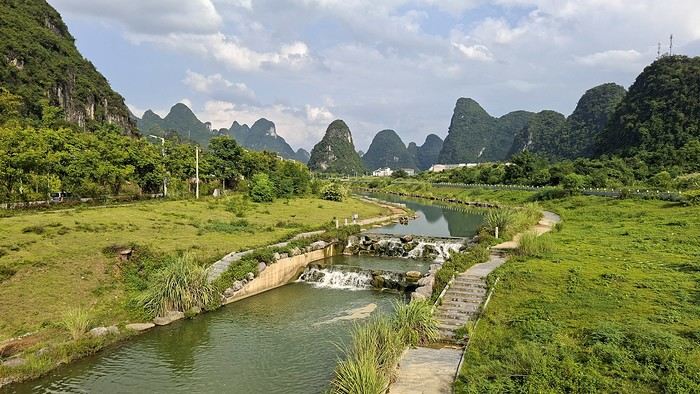
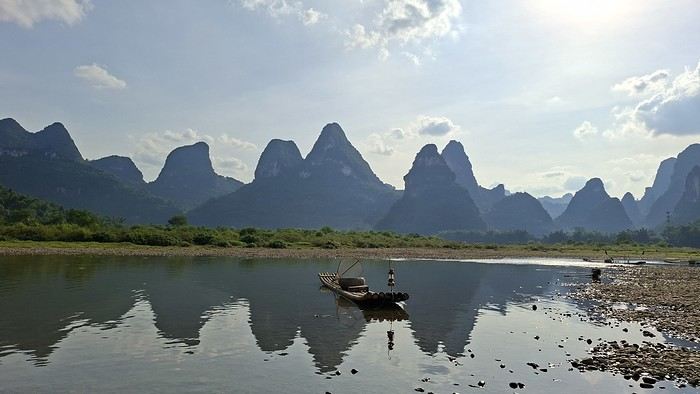
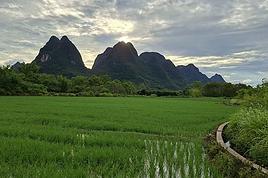
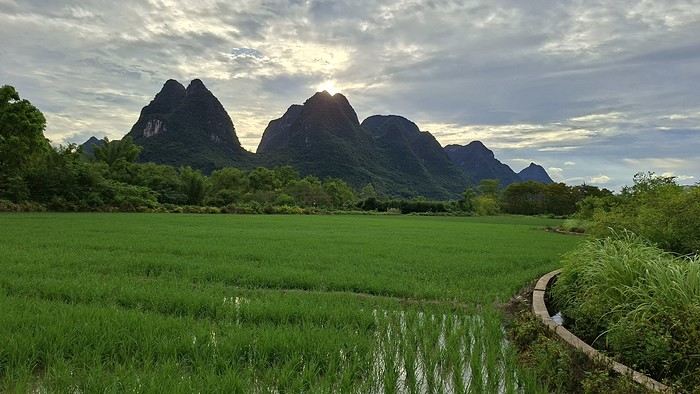
What a wonder! I loved this place as soon as my bike hit that little path through the rice fields, with those karst peaks in the background. And on top of that, it’s not raining. I wander around a bit, send D. a video of the landscape—she’s asleep and doesn’t reply. I call her around 1:30 PM, and she’s feeling better. We decide to meet up in Chaolong to spend the rest of the day together in this extraordinary place.

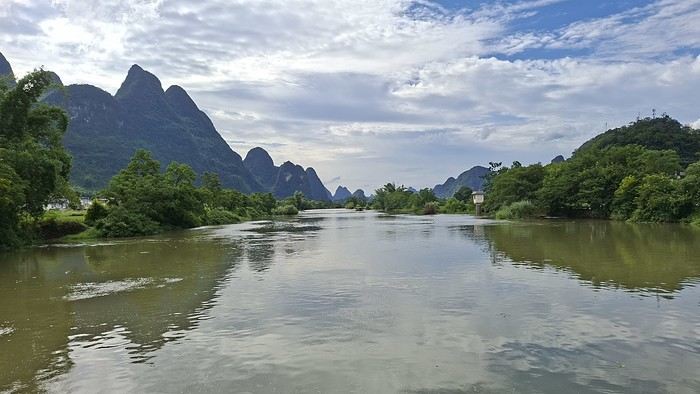
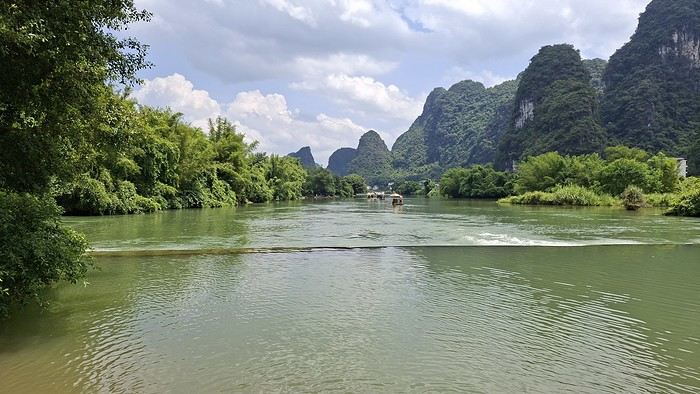
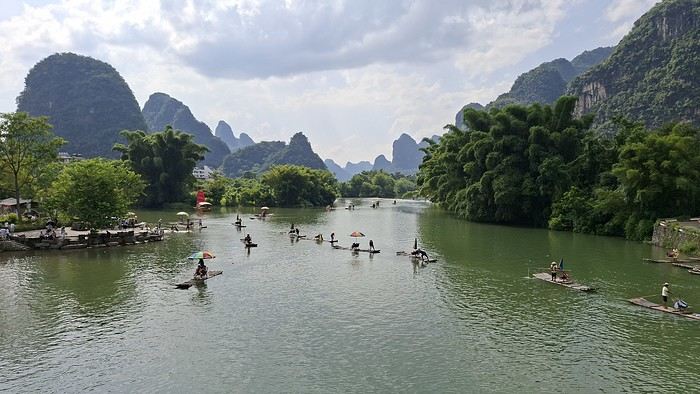
We ride to the Yulong Bridge Bamboo Boat Terminal. Bamboo rafting is closed because the water level is too high. I’m not sure we would’ve done it anyway—D. is scared of water. I’m usually not into that kind of attraction, but I loved the boat tour in Ninh Binh, Vietnam, so why not?


There’s really not many people around. I think most come here for the bamboo rafting. So, we have the path pretty much to ourselves most of the time—it’s awesome. We see a few people working in the rice fields. It’s so peaceful and *so* beautiful! We stayed until sunset. And yes, we finally saw the sun—I wasn’t thinking about sunscreen this morning after all the downpours we’d had. So tonight, I’m pretty sunburned all over.


We rode about 35 km in total. Aside from D.’s rough morning, this day was MAGNIFICENT. I loved it. I had such high expectations that I was afraid of being a little disappointed, but it was even better than I’d hoped!
VI Vilabel Regular ·
China, what a change of scenery—it must be a real eye-opener.

Thanks! Yeah, that’s exactly it—a good wake-up call 🙂
RO Rouquine38 Globetrotter ·
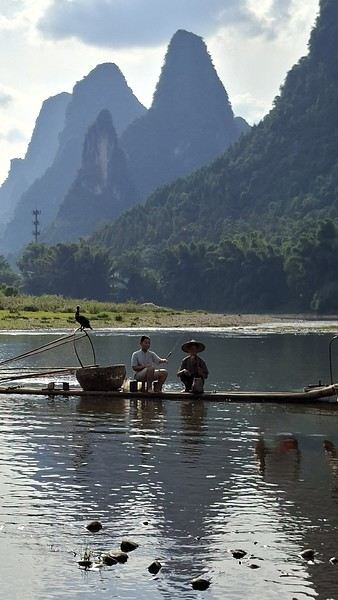
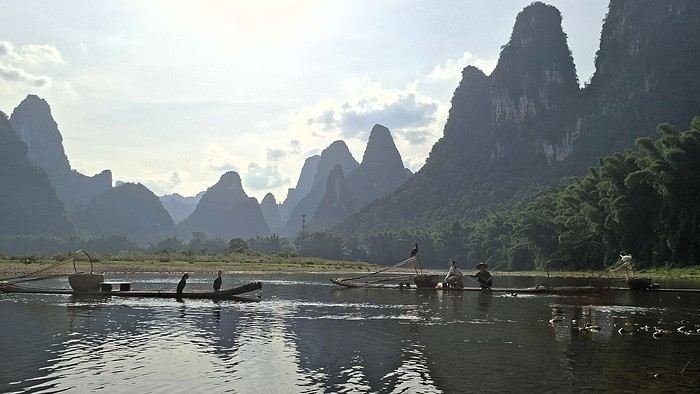
Hello, So far, China hasn't been on our itinerary, but just looking at these latest photos... wow! I love them, especially with that amazing sky! 🙂 Thanks for sharing this update
"Voyager est un triple plaisir : l'attente, l'éblouissement et le souvenir." Ilka Chase
JO Jojoone1 Globetrotter ·
For me, this region is the most beautiful on the planet. If I remember correctly, the Chinese call it "the most beautiful land under the sky." There’s an extension of nearly 100 km all the way to the northeast of Vietnam, at its border with China, that also enchanted me.

Guilin/Yangshuo/Xinping—it’s absolutely fabulous! !
« Tout le monde s'interroge sur comment laisser une meilleure planète à nos enfants, mais on devrait plutôt penser à laisser de meilleurs enfants pour notre planète. » Clint Eastwood
VI Vilabel Regular ·
Haha! Yes, for me too! It was my most amazing trip ever, anyway!
VI Vilabel Regular ·
Day 7. This morning, we take a Didi to Ruyi Peak, 17 km away: 48 yuan for the ride. Hardly anyone at the entrance. We had to wait a minute to buy our tickets, which were pretty expensive, by the way—220 yuan per person (+13.20 yuan in international card fees charged by Alipay, what a rip-off!).
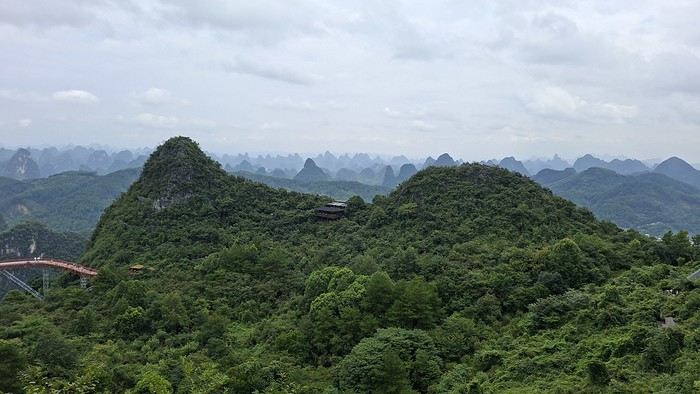
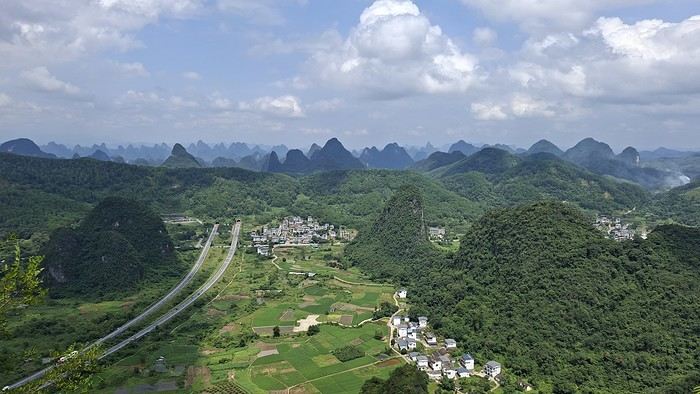
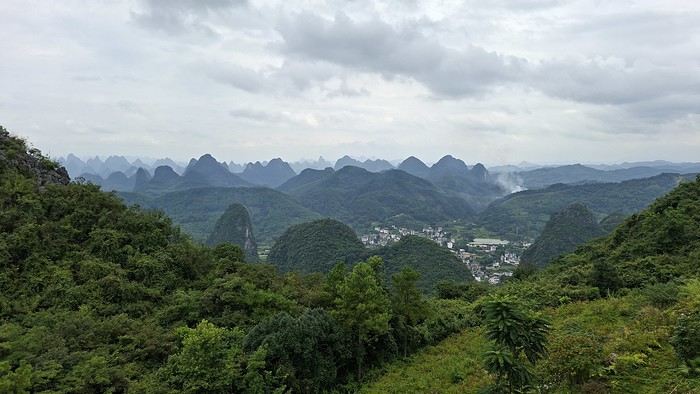
We start by taking the cable car to the top of the mountain, with no wait since we’re the only ones. It’s gorgeous, and the 360° view adds to the magic. Once at the top, we see everything is well laid out. A path lets us do a loop, going from peak to peak.


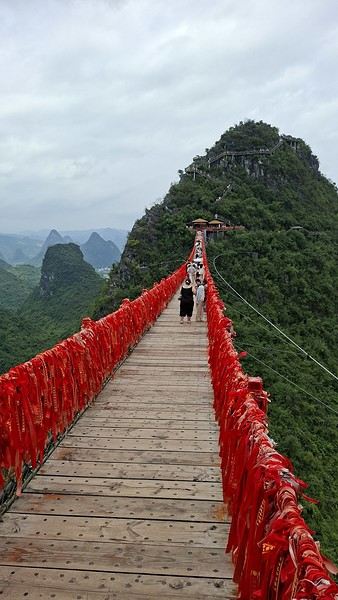
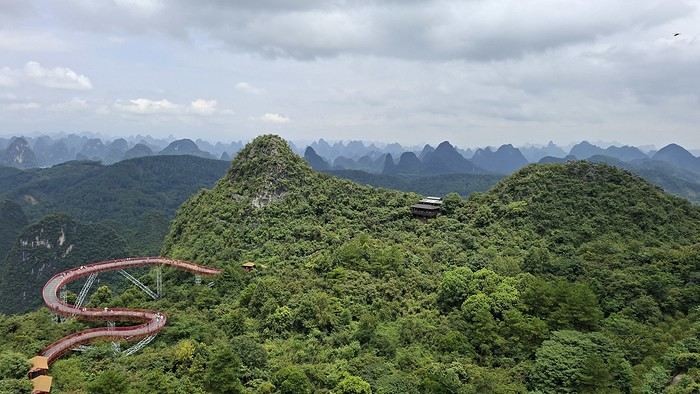
We tackle "a few" steps, then cross a long suspension bridge between two peaks. Impressive! Then we climb hundreds of steps to reach the highest 360° platform on the site. Stunning! Unbelievable! We’re really high up, the view is incredible. There’s no one on the platform—we’ve got it all to ourselves.


Then hundreds of steps to go down and up again, two glass bridges, a photo spot, even more steps, and just before taking the cable car back, in a dark room, there’s a 360° cinema showing animations and videos of the region’s stunning scenic spots.


Right next to it, we find the photo we just took on the glass bridge—already printed and even as a keychain. D. can’t resist and buys the photo and keychain for 30 yuan for both. We can also get the digital version of the photo with a QR code. However, there’s a second photo spot that’s totally pointless since it’s on a green screen while the landscape is extraordinary. We skip that one.

This site offers an incredible 360° view, there’s hardly anyone around, and it’s easily accessible by Didi—maybe even by bus. I recommend it if you’re in the area and your thighs can handle the hundreds of steps. We spent 4 hours there, really taking our time, with lots of breaks, and including lunch. I think 2 hours is usually enough.
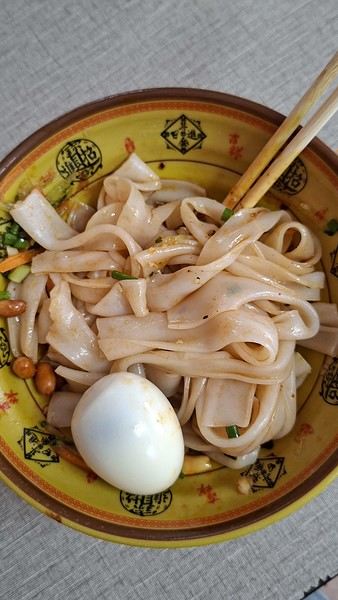
There’s a small restaurant right in front of the ticket office where we eat a delicious noodle salad before taking another Didi around 4:00 PM.


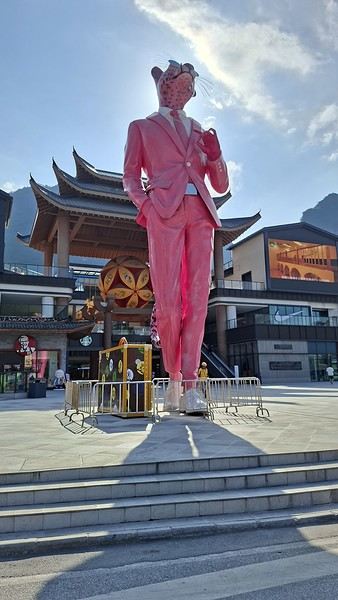
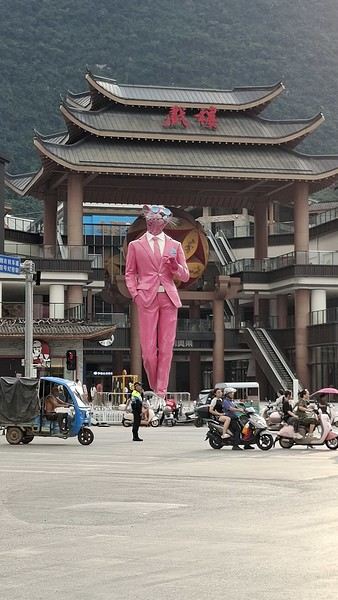
We get dropped off at the feet of the giant Pink Panther in another part of Yangshuo. That panther’s got serious style—I love it. But seriously, what the fuck?? 🙂 We walk around a bit, then chill in the shade with a really good coconut matcha.


We try to take bus 806 to get back, but it’s 6:15 PM. The last bus usually leaves the high school at 6:05 PM. We have no idea if it’s already gone or not. We wait a bit, then decide to walk back—it’s not too far, just 1.8 km. Of course, bus 806 passes us 100 meters later... We go out to eat local specialties, including beer duck for D. We splurge with 158 yuan for this meal—nearly four times more expensive than usual. But still only 18 €.

There’s a washing machine and dryer available at the hotel with detergent, all free. Super handy since we haven’t seen a laundry place yet. I hope we won’t struggle with this for the rest of the trip. We take advantage of it to do a big load of laundry since a week has already passed and we’re traveling light!

Another amazing day! Can’t wait for tomorrow.
VI Vilabel Regular ·
Day 8. We take off late today. A trip to the supermarket, which we discover by chance in the basement on the way to buy stuff for our breakfast, then we go back to rent bikes at the same place.

We take the same route as the day before yesterday, up to the Yulong River, near the village of Chaoyang (I mentioned Chaolong on Day 6, but that’s the village right next to it). This time, though, once we’re by the water, we head left.


We go up (or down?) to Gongnong Bridge. There’s no one on this entire stretch, except at the bamboo rafting spots, which are back in service. There are sometimes a few steps on the path, so scooters can’t ride here. It’s a bit less nice than the other side, which explains why. But the landscapes are still stunning, and the place is super peaceful.


We find a bit more hustle and bustle at Gongnong Bridge, along with car traffic. There are also really nice views from this bridge.


We continue along the small paths.


We pass through the villages of Yan and Aishan, where we stop around 4:00 PM for a snack since we skipped lunch. I get tapioca pearls in coconut milk. I love it. We get back on our bikes and more or less follow the Yulong River, which we cross to then follow the Li River, and we finish the loop on West Street to return the bikes. One last walk around this area before the huge evening crowds. We buy some osmanthus cakes and sticky rice cakes—sort of big, flat green mochi with mugwort, stuffed with sweet chopped nuts. They’re delicious! We go back to freshen up a bit and head out for dinner on our last evening in Yangshuo, trying a local specialty: snail noodles. To finish off, we wander around the West Street area again, packed with people, super noisy, and exhausting. It’s not hunger driving me, but I grab some shrimp-stuffed mushrooms from a street food stand. D. searches everywhere for osmanthus ice cream in a black cone and finally finds it. It’s nearly midnight, so we head back to bed. Another amazing day!
VI Vilabel Regular ·
Day 9. Already a week in China, only 3 days left. We treated ourselves to a lie-in this morning—we’ve been going to bed super late every night, usually around 1:45 AM. Unfortunately, we slept with the window open without realizing it, so the outside noise woke me up way earlier than planned. Check-out at 12:00 PM.

We ordered a Didi to take us to our hotel in Xingping, 28 km north along the Li River. We got in the car, and the driver started yelling at us. We had no idea what was going on. I turned on the translator, and he yelled again. The translator clearly struggled—it spat out something like, “I’m very calm in spirit, but I can’t do it with Taiwan.” 😐 We sat there for 5 minutes, trying to understand each other. I kept saying, “Take us to Xingping,” while he responded, according to the translator, “My son went to university.” 😐 Eventually, we figured out he couldn’t enter the old town of Xingping. A simple “go” with a hand gesture worked better than the translator—he understood it was okay to drop us off before the actual address (in my head, 100 meters early). That’s when we started seeing the limits of Google Translate. Most Chinese people use a much more effective translator, but our driver apparently didn’t have one.

The short trip took an hour and a half. Just saying—plan *plenty* of extra time if you’re heading to Yangshuo train station, which is 6 km past Xingping when coming from Yangshuo. The road is apparently jammed every day. After sitting in traffic for several minutes, our driver started yelling at us again. I had a feeling he was going to kick us out here. Bingo! He pulled over, pointed in a direction with his hand. I gestured back that it was “really far,” and he laughed, nodding in agreement. But hey, we’d paid for the full ride... Anyway, we thanked him, hoisted our bags, and set off for 1.2 km in the blazing sun—36°C. This time, we found our hotel super easily.

I don’t know why I’d imagined we’d be “in the countryside” here, but nope—we’re definitely in a town, albeit a small one. Construction is everywhere, though. I think in a few years, this’ll be a much bigger city. And it’s not just here—construction is happening *everywhere*.

We settled into our room with the AC blasting to recharge, then headed out to eat. The restaurant lady also yelled at us—it’s weird how aggressive their way of speaking seems, but now that we know not to take the tone personally, we just roll with it. Apparently, she was just asking what we wanted to eat...

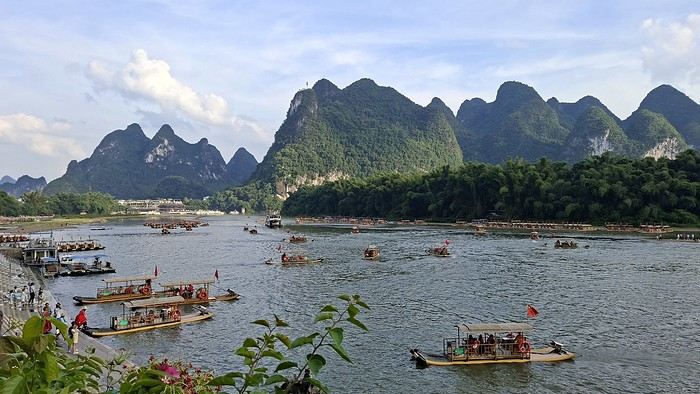
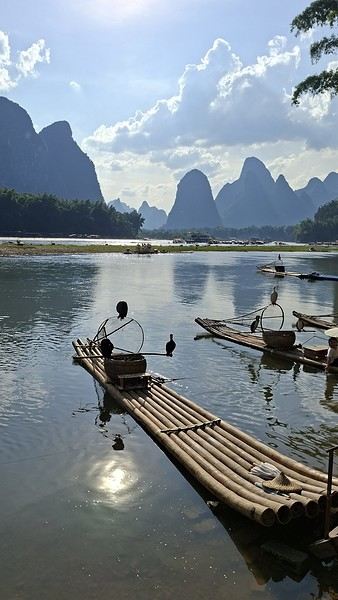
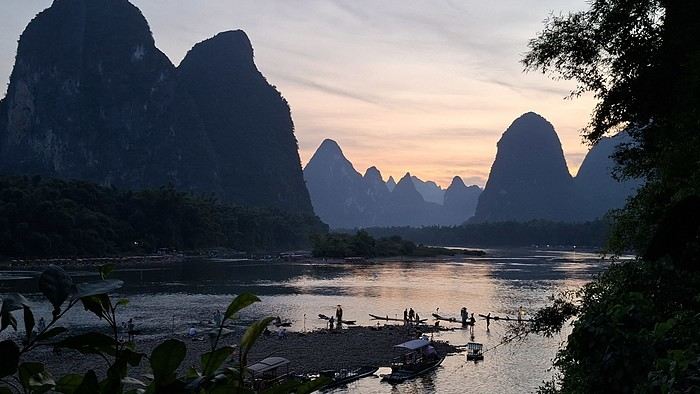
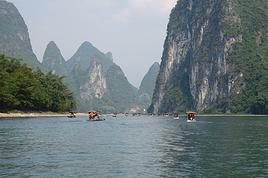
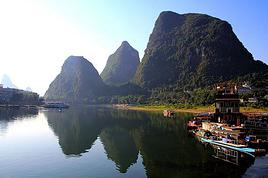
After that, we took a quick stroll through the old town’s alleys—really nice and pretty quiet—then along the Li River. It’s gorgeous but packed with motorized bamboo rafts and a few small ferries. And people—*so* many people. The vibe is totally different from Yangshuo or the Yulong River banks. Plus, we mostly walked along the roadside, so the atmosphere wasn’t the same. Still, the landscape is *so* beautiful! And the sky is *so* blue!


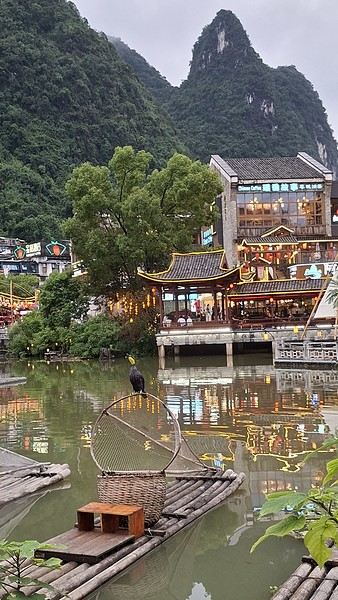
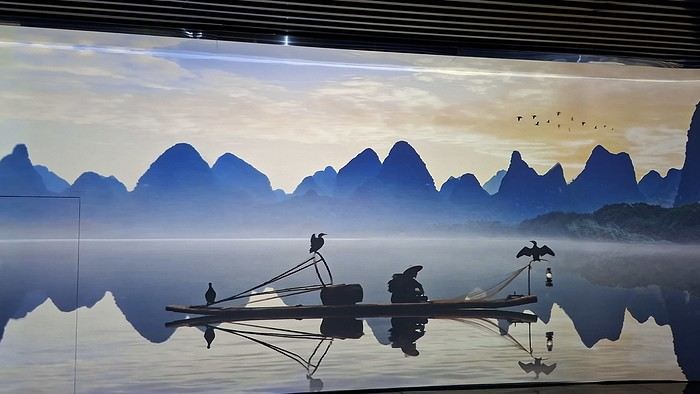
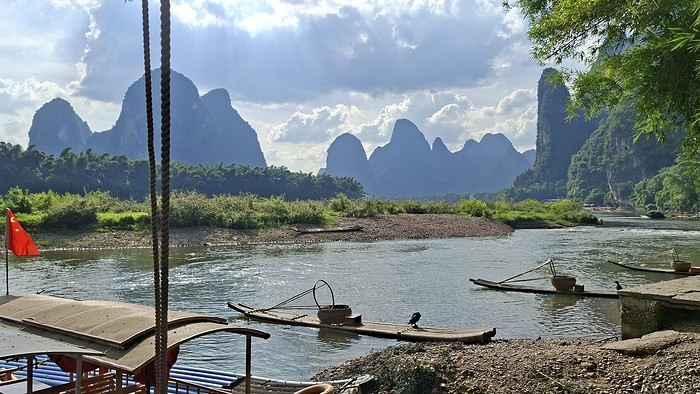
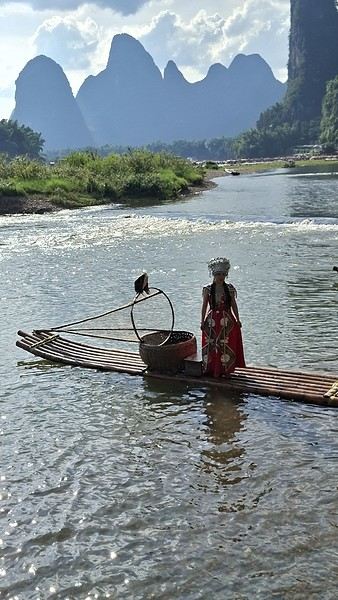
There are several fishing rafts with cormorants (poor birds tied up in the sun all day) and photographers taking stunning photos of Chinese women dressed in traditional outfits for the occasion. (We’ll see this *everywhere* during our trip—there are costume rental and hair/makeup shops in every city we stop in.)


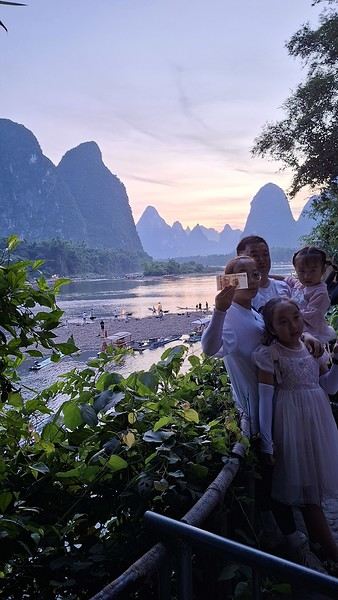
It’s *so* beautiful! We walked farther and ended up alone on a little path away from the road, but with all the vegetation, we couldn’t see much. Too bad—I’d thought we’d have amazing views the whole way, but nope. Past the 20-yuan bill view (the photo on the bill was taken here, so people take pictures here with a 20-yuan bill!), there wasn’t much to see on this side of the river. We turned back—it was late anyway, and the sun had set. We’d still walked 11 km, though. We grabbed dinner in town, and by 9:00 PM, we were back in our room. We’ll be able to turn in earlier tonight, especially since we’ve got a morning outing planned tomorrow.


Another amazing day! 🙂
MA Mariecurry Globetrotter ·
Hi there, Thanks for this travel journal that transports me to a country I love so much. I miss China a lot. So I’m joining you on this journey. I’d love to eat with you too. The food in China is still such a strong memory. I don’t think I was ever disappointed. 🙂
MO Montagnard74 Globetrotter ·
Hi there! All I know of China is Beijing, which I visited for 10 days in September 2008! I’ve made up for lost time—so many beautiful landscapes (reminding me of Ninh Binh). I’m excited to set off for the next three weeks! Thanks for sharing!
"Le véritable voyage de découverte ne consiste pas à chercher de nouveaux paysages, mais à avoir de nouveaux yeux." Marcel Proust
VI Vilabel Regular ·
Hi, Thanks! Food is such a big part of traveling! 🙂
VI Vilabel Regular ·
Hi, Thanks, that encourages me to keep going! 🙂
VI Vilabel Regular ·
Day 10. We’ve got killer calf soreness from Ruyi Peak and biking along the Yulong River. Following the "hair of the dog" principle, today’s plan was to climb up and down the 500 steps of Xianggong Hill. Problem: when I went to order a Didi, I saw on the app that the only route there goes back through Yangshuo and up near Xingping—53 km total—even though Xianggong Hill is just 4.8 km as the crow flies from Xingping. No way were we doing over 100 km and hours in the car when it’s right there. I checked Amap, and it gave the same 53 km route. I couldn’t find a way to walk there either. So, oh well, we scrapped it. Super disappointed, but I changed the plan to Laozhai Hill, whose climb starts at the end of the street. Laozhai is known for being tough, pretty steep, with 1,150 steps (lol, what’s a few more at this point?! 🙂), but doable in about 40 minutes, supposedly.

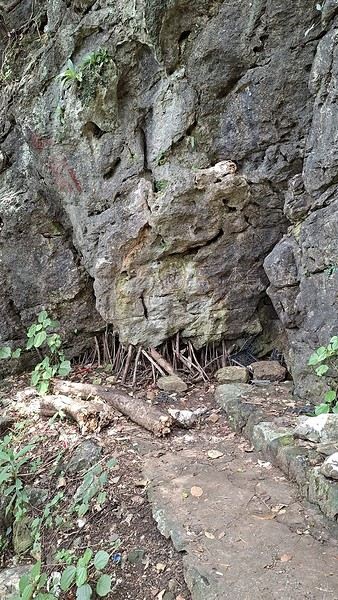
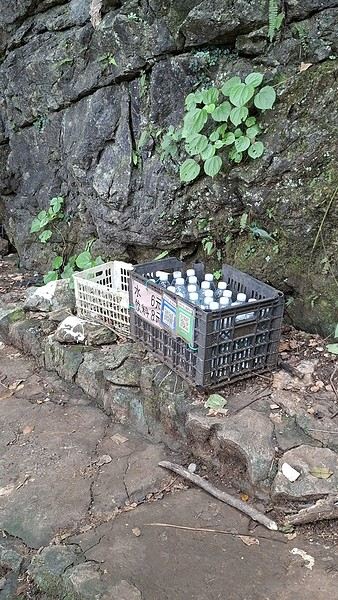
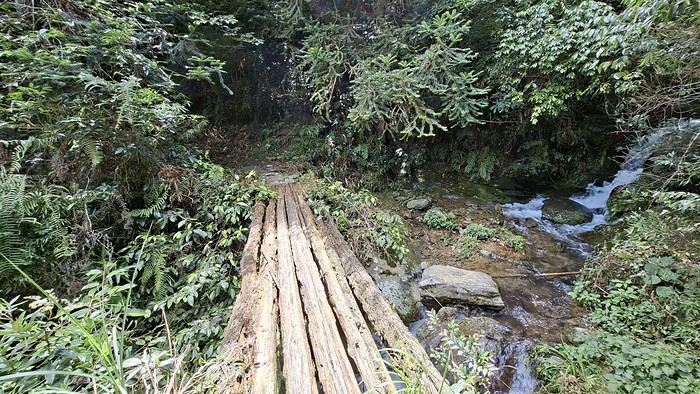
Right from the start of the trail, big signs warn us not to proceed because the path isn’t maintained, there have been deaths and disappearances, and rocks could collapse, etc. Obviously, we went anyway 😇. We took our sweet time. We were exhausted, and it was scorching—feels like 44°C—sweating from head to toe. Along the way, we saw little wooden supports propping up the rocks. "Great, we’re safe!!" We also saw bins with water bottles and QR codes to pay. We grabbed some; it was *so* hot. I love the total trust—I can’t imagine any Chinese person taking without paying.


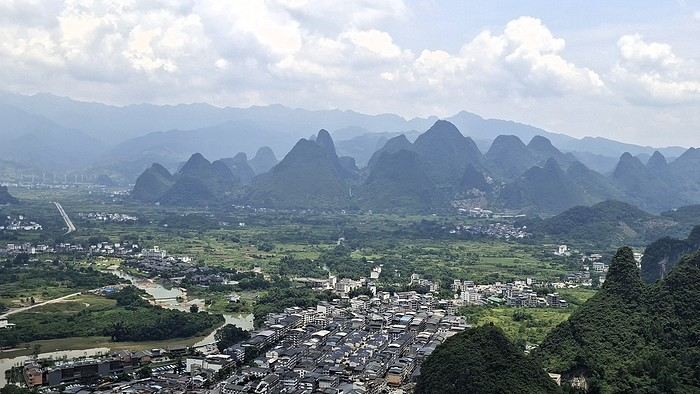
It took us 1 hour and 10 minutes to reach the top, with constant stops. Honestly, nothing too difficult—we were just taking it *super* slow. At the top, wow, what a view!


There were only six of us up there. We barely saw anyone on the trail, and that was perfect. We stayed for 45 minutes, then took 50 minutes to descend at a leisurely pace. The trail was littered with trash—bottles, papers, tissues, wrappers... Such a shame.

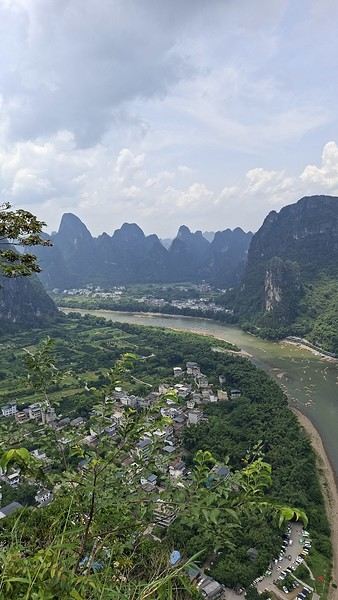
We went to eat, then took a boat to cross the river: 5 yuan, a 3-minute crossing tops. On my map, it was marked as a pedestrian path, but when we reached the other side, we realized it was a paved road with quite a few cars, even "minibuses"—like big golf carts—that shuttle tourists around Xingping. And that’s when I thought some people *must* go to Xianggong Hill. I figured it was probably possible to get there by boat too. Oh well, we still climbed this karst peak with a gorgeous view:


Yep, that’s where we climbed to! 🙂 We strolled along the river. There were photographers, so we took the chance to snap tons of shots of the stunning scenery ourselves. This place is *so* incredible, breathtaking!


I’m backlit, so the photos don’t do the place justice, but trust me—this spot is extraordinary! Then we turned back; it was *so* hot, we were drenched. We headed back to do laundry, and for that, I trekked up and down the stairs to the 6th floor of the hotel three times—just to add a few more steps for my poor calves. The washing machine was on a rooftop terrace. The sun had set, but it was still light out, so I enjoyed the view from the roof for a while. This place is *so* amazing.

A delicious meal of shrimp, ginger, and green onion. So good. Then back to the room. The town is super quiet at night—hardly anyone on the streets. During the day, it’s packed. I think tourists come for the day from Guilin or Yangshuo and leave by evening.

Another amazing day with stunning landscapes (yes, I realize I’ve already said "stunning" at least 20 times, but that’s *exactly* how it is! 🙂).
AL Aleph240758 Veteran ·
What a beautiful travel journal. China isn’t on my itinerary, but all these stunning landscapes are giving me serious travel envy. Thanks for sharing these amazing discoveries.
Qui a l'habitude de voyager sait qu'il vient toujours un moment où il faut partir... Paulo Coelho
VI Vilabel Regular ·
Thanks, I’m happy to help!
MU Muriel18 Globetrotter ·
Hi there

I’m also following this travel journal with great pleasure 🙂

This region and/or Yunnan were on my travel list for a while, but not anymore (time flies and other destinations are tempting me more now), but it’s still a real pleasure to discover these stunning landscapes through the photos!
Si tu diffères de moi, mon frère, loin de me léser, tu m'enrichis (Saint Exupéry)
VI Vilabel Regular ·
Haha, "magnificent" is really the word that sums up this trip! Thanks! !
VI Vilabel Regular ·
Day 11. This morning, we head to Yangshuo train station. We could’ve taken the bus—it’s just at the end of the street—but Didi is really cheap, 14 yuan (1.67 €). Even though we’re only 8 km away, we’ve seen what the traffic jams are like around here, so we decide to leave early. Not early enough for D., though, who insists we’ll leave at 10:45 for our 12:39 train. By the time we wait for the Didi stuck in traffic at the entrance of Xingping, we don’t actually leave until 11:00, but we’re the only ones on the road in that direction, and we arrive at the station in 10 minutes.

The train is on time, too, and in an hour, we reach Sanjiangnan, the south station of Sanjiang, in the Dong autonomous district. From there, we’ll be improvising for a few days. I don’t know where to buy tickets for the scenic area. I don’t know how to get to the hotel. I don’t even know where the hotel is on a map.

We ask someone how to get to Pingyan village, but I must be mispronouncing it, or maybe the guy doesn’t know, and the translator is clearly messing up again. We ditch his translator. He checks his map and offers to take us for $100. LOL, no thanks! 😂 Hopefully, that was another translator glitch, and he meant yuan, not dollars. We drop the bus idea and order a Didi, pasting the hotel’s Chinese coordinates from trip.com. The ride costs 61 yuan. However, the Didi driver drops us at the entrance of the scenic area and says he won’t go any further. Again, we paid for the full ride—this app isn’t great in that regard. It’s not about the few yuan but the principle; I think it’s just wrong. Our driver comes with us to talk to the ticket area guard to explain. Sure enough, the setup is designed so you can’t go any further with your Didi. We say goodbye to our driver a few kilometers before our destination. We buy our entry tickets for the scenic area, which include a bus ride to continue the journey (another kind of big golf cart, like in Xingping). 95 yuan per person. The receptionist doesn’t speak a word of English, but when we show her our hotel’s name, she points it out on a paper map she gives us, circling other points of interest.

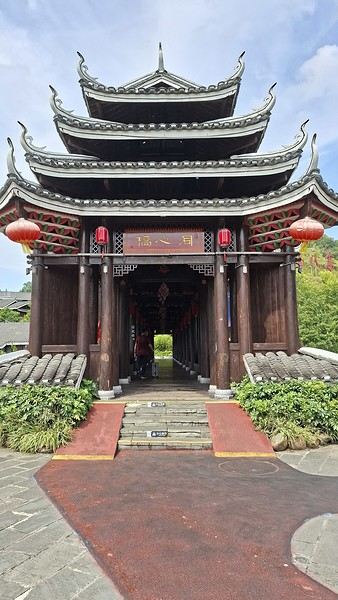
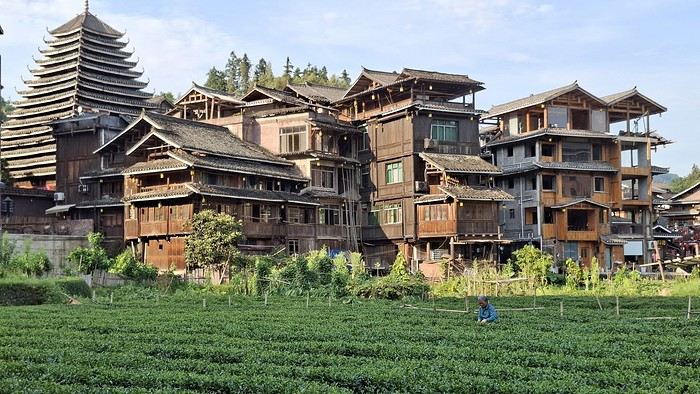
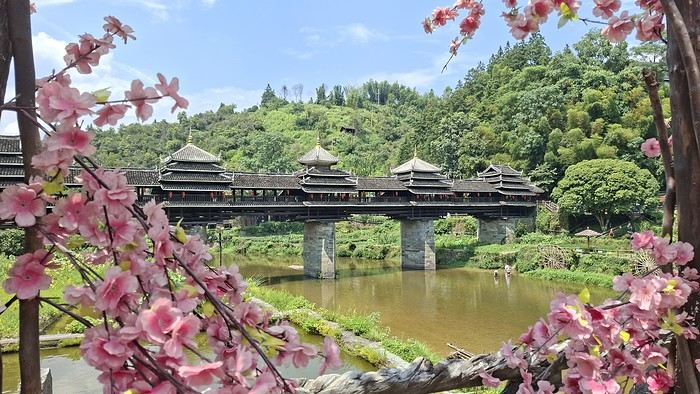
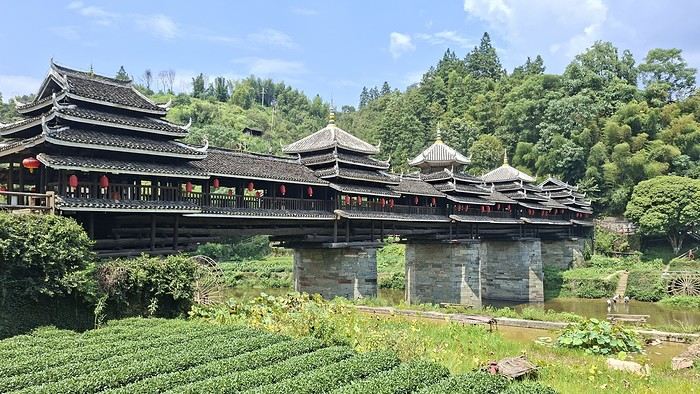
The ticket area already sets the mood with these typical regional buildings:


The "bus" drops us off 300 meters from the hotel. The village interior is a pedestrian zone. We check the hotel’s exterior photos on trip.com to try to recognize it. We head in the direction indicated on our paper map and walk into what seems to be a restaurant (only two tables). I show the hotel’s name in Chinese. The guy doesn’t nod. There’s an awkward moment where we just stand there in silence, then we get the impression he’s asking us to follow him, and he takes us upstairs to the room without taking our passports or anything. Looks like we found the hotel!

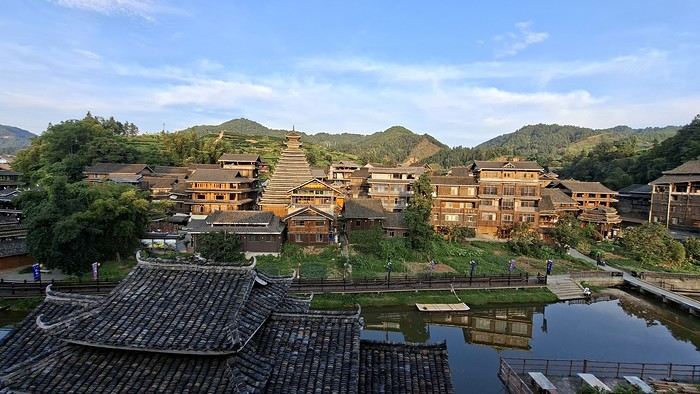
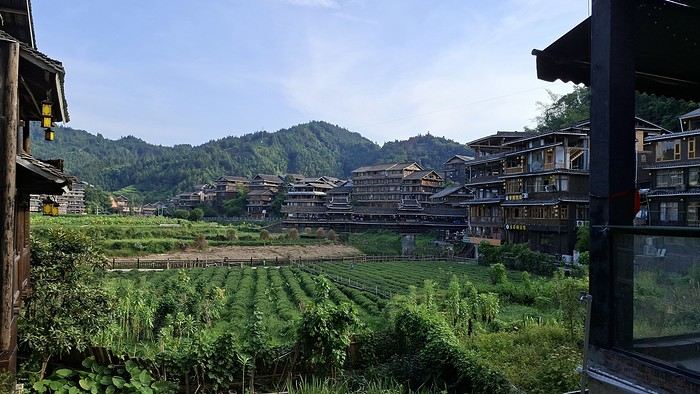
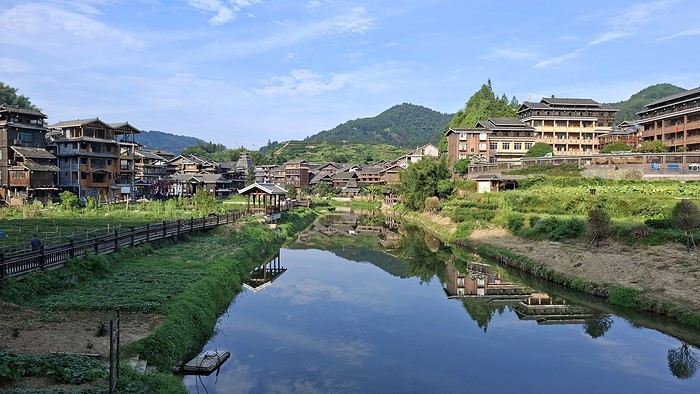
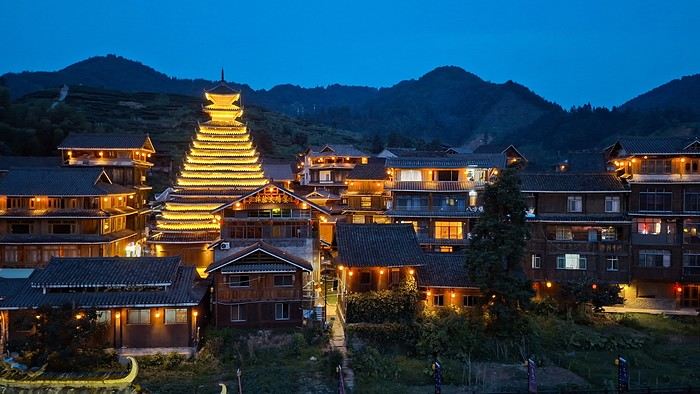
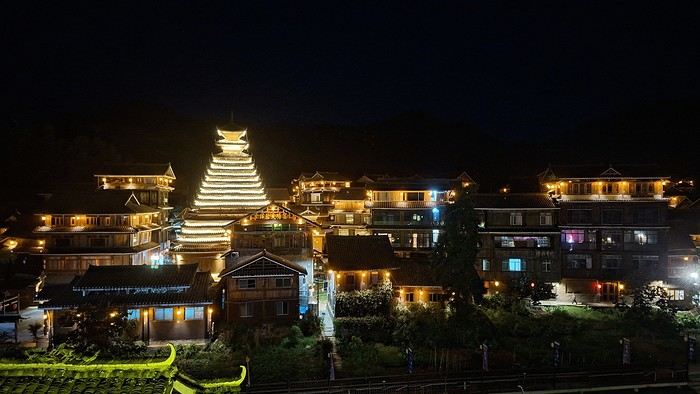
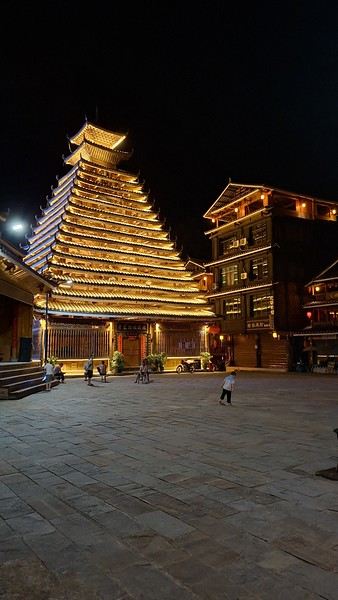
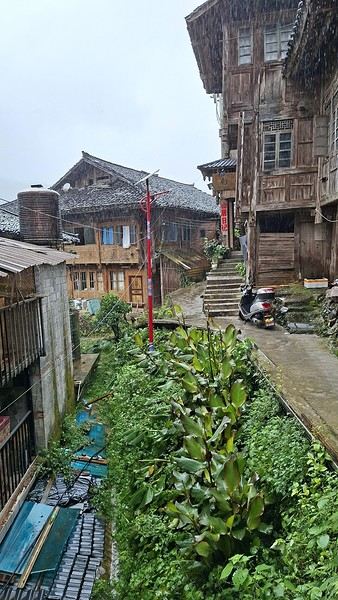
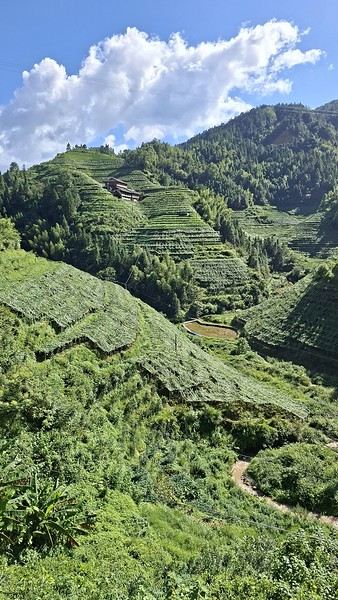
Pingyan Dong village is gorgeous. The hotel is typical, like all the other buildings around here, all wood. We’re surrounded by terraced tea fields. We have an amazing view from the room—over the river, the tea terraces, the village’s drum tower, and the mountains. Stunning!


We go out to eat; it’s already 4 PM. The villagers are adorable and super smiley. We get tofu, eggplant, and fried rice at a small restaurant. Prices are a bit higher here—our three dishes cost 75 yuan. Then we wander through the alleys until 7 PM. It’s beautiful, peaceful, and less hot. Though we notice with the new constructions that the base is all concrete, just covered with wood.


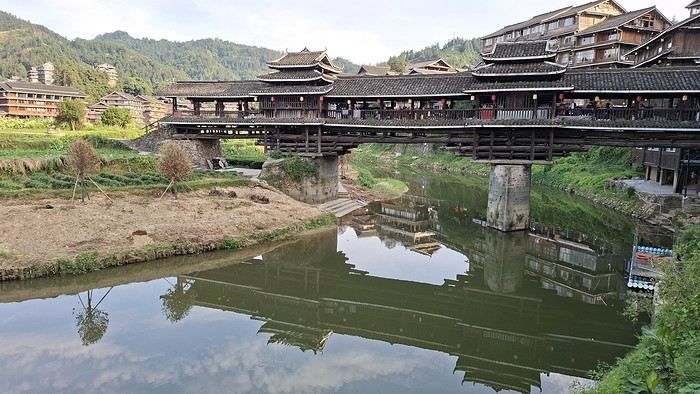
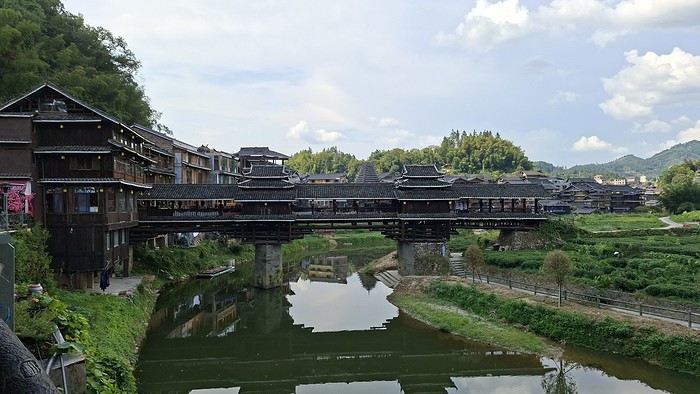
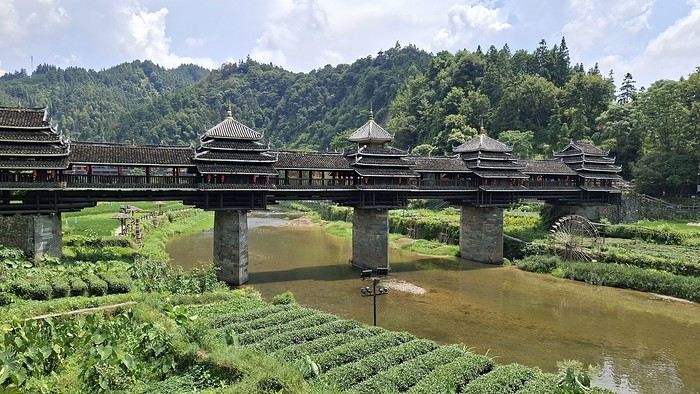
The Dong are renowned carpenters, and you can tell right away from their covered bridges and drum towers. The Chengyang Bridge, just a little further away, which we’ll see tomorrow, is considered one of China’s most exceptional architectural structures, built in 1912 without a single nail.


Night starts to fall as we head back. The view from the room is just as beautiful when the village lights are on. We go out to eat again even though we’re not hungry. When it’s time to pay, neither Alipay nor WeChat works on either of our phones. Always handy to have a bit of cash on you at some point!


RO Robert498 Regular ·
Hi, I tried to locate the village of Pingyan on Google Maps, but I can't find it...
VI Vilabel Regular ·
Day 12. A short day today. Originally, I’d planned a hike to Guandong, 7 km away, but D. hasn’t been feeling well for a few days, and the heat is really getting to us, even though there’s a bit of a breeze here. Plus, we slept pretty badly—the beds here are wooden, and so are the mattresses. So, we kept our itinerary to nearby villages: Ma’an, Pingzhai, Yanzhai, Dazhai. It’s so peaceful, even quieter than yesterday—there’s no one around.


The locals are always super friendly, and everyone says hello. That said, some are a bit too interested in our wallets. They invite us into drum towers or other community spaces, and then, just as we’re leaving, they point to the roof and ask for money for upkeep. Still, I think the ticket money for the area really does go toward maintaining it—everything’s well-kept and clean. There’s always someone cleaning, and the toilets are spotless, with paper and soap—super practical.

There’s a performance space near the drum tower in our village where the Dong people put on traditional dance and song shows, but it doesn’t seem to be happening. We’ve never seen or heard anything, and the entrance gates are deactivated (free entry). Maybe it’s just on weekends? Too bad, because Dong polyphonic singing is a UNESCO cultural heritage thing—it must be amazing.

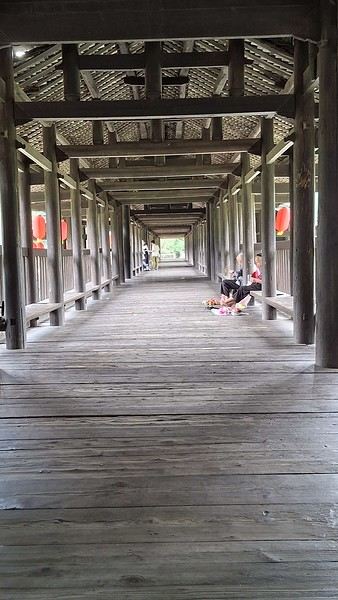
All the covered bridges we’ve seen (wind-and-rain bridges) are built the same way—no nails, no screws. Yongji Bridge, also called Chengyang Qiao, is the most famous, a historic site, but we were expecting something more spectacular. It’s great, but not as impressive as I’d imagined. The story goes that it was built in honor of a dragon that saved a woman who fell into the river while trying to cross. It’s 64 meters long, with five pillars, tiered roofs, and not a single nail. Total kapla champions!


Oh, and we realized our tickets were only valid for yesterday. After that bridge, we had to go back to the road and exit the controlled zone, then re-enter 50 meters later. We slipped past the guard, who didn’t even notice us, but otherwise, I don’t know how we’d have done it—take a bus back to the ticket office? And if we stay longer, do we have to go back every day? When we bought the tickets, no one asked how long we were staying. Or maybe, even though it says on the ticket that it’s valid *this day*, it actually means *from this day*? Mystery...

Anyway, tomorrow we’re leaving this area, and it’s gonna be a mess trying to get out of here. I checked today—no buses, no Didi... This is gonna be fun! 🙂
VI Vilabel Regular ·
Hello,

Looking for "Chengyang Wind and Rain Bridge"
JE Jeeaan Globetrotter ·
Amazing trip. Stunning photos. Really interesting story. Thanks.
VI Vilabel Regular ·
Day 13. We leave the Dong for the Yao and the Zhuang. We set off around 11 AM, walk to the road, and hop into an extra-large golf-cart shuttle. It takes us to the south gate of the Chengyang site. The driver is super friendly—he asks where we’re headed and offers to help call a taxi. We tell him we’re ordering a Didi via WeChat. He still suggests asking for help at the reception desk. We do, and ask if there’s a bus to the Longji Terraces. She laughs and says no. End of assistance.

We head back out and book a Didi to take us to the Longji ticket office for 184 yuan. We wait a long time, but no drivers accept the ride. We decide to walk down to the village where the highway to Longji passes, and a driver shows up quickly. I set the bus station as the destination, thinking we might find a bus to Longji there, but when we arrive, we realize we’re in the middle of nowhere with no bus station in sight. It’s probably just a local bus stop. Our driver yells at us that there’s nothing here—we’re used to his tone by now, knowing he’s just trying to help, albeit in a surprisingly aggressive way. He asks where we’re going, and we say, “the Longji Terraces.” He offers to take us. I ask for the price: 300 yuan. That’s steep. He says he has to pay 120 yuan in highway tolls round-trip (since he has to get home afterward!). I ask him to take us all the way to Tiantouzhai, the final destination. He says it’s far from the Longji zone entrance, and the price jumps to 400 yuan. I counter with 350. We settle on 380. It’s way more expensive than local transport usually is, but we don’t care. We’re not sweating 30 € on this trip. Plus, he drives carefully, which is a huge relief for me—I’m terrified of cars on mountain roads. After an hour’s drive, he stops for two minutes at the ticket office, where there’s no one around (and tells us we could’ve bought the tickets online): 80 yuan per person. We finish the last 40 minutes of the drive. Unlike the Chengyang area, he can enter the scenic zone without paying and take us right to our final destination.

When we arrive in Tiantouzhai—a tiny pedestrian village perched on top of the mountain, surrounded by rice terraces—we quickly realize it’s a maze of narrow paths and staircases on different levels. Finding our hotel is going to be a nightmare.


That’s when I discover Trip.com’s map feature, which shows our hotel’s location. Amazing! Why didn’t I notice this sooner? It’s going to make our lives so much easier. We start following the map, but it’s glitchy and unhelpful. We’ve been walking in circles for half an hour, and I’m getting frustrated. We show the hotel’s name in Chinese to the few people we pass, but either they don’t know or they point us in the opposite direction of where Trip.com says we should go. We’re on the complete opposite side of the map when I spot someone tinkering in front of a hotel. I show him the hotel’s name, and he seems to say it’s here. Then he makes a call—I realize he’s calling our hotel to come get us. He sits us down and brings us drinks. I tell him I just want to go to my hotel. He says, “It’s here.” No, it’s not—his hotel is called Yinfu, and mine is Longji Rice Terraces Jiamei Pavilion, nowhere near this side of the village! Then D. says, “It *is* here—look at the photos on Trip.com, one matches.” Hmm, okay, there’s a vague resemblance in one photo. Fine, we’ve arrived!

His wife shows up and takes us to a room after asking what type we booked... I’m still doubting we’re in the right place. I compare the room to the photos on Trip.com. Okay, this is it. What a letdown. It’s all wood, which is fine, but the beds are wooden planks, and... that’s it. No toilet paper, no soap, no towels, no water, no tea, no kettle, no TV (though we don’t care about that—we were supposed to have one). The windows don’t close, the squat toilet is in a creepy bathroom, and the room is filthy—dust everywhere, like I’ve never seen before. The pillowcases reek of sweat. We ask to change rooms. She gives us the one next door without argument, just mentioning it’s okay to upgrade us since we’re staying three nights. This one’s much better: a decent bathroom, clean beds, windows that close, soap, shampoo, and a useless TV. Still, there’s an insane amount of dust... I ask for toilet paper and towels, and she gives us disposable ones that’ll do. I think we’re the only guests, so we shouldn’t hear much noise. The big plus? The view from the terrace is incredible!


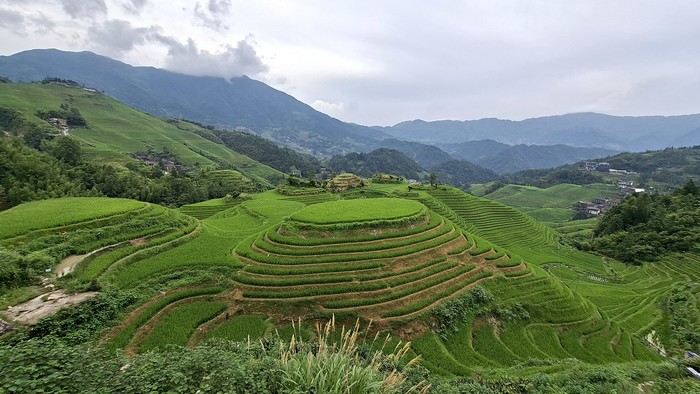
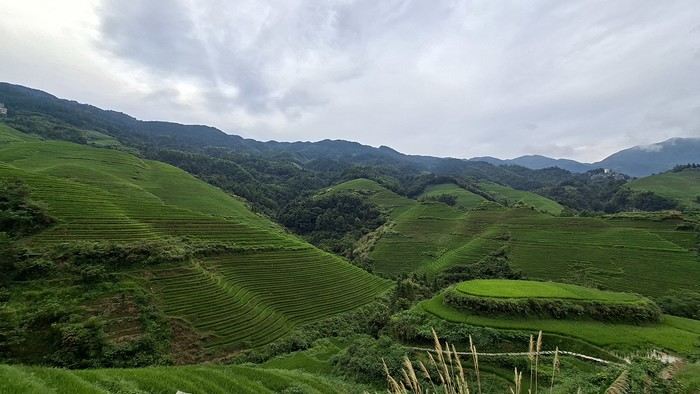
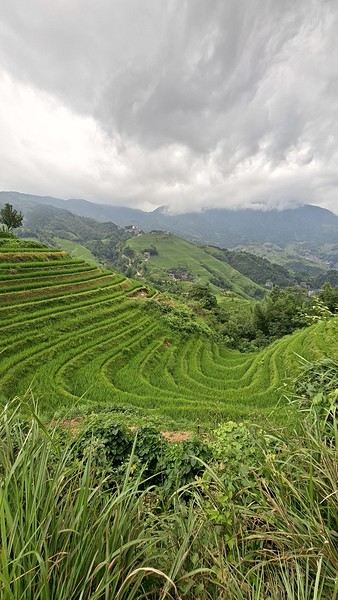
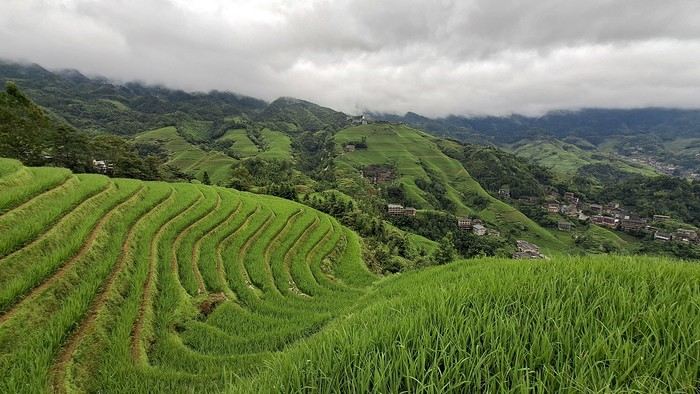
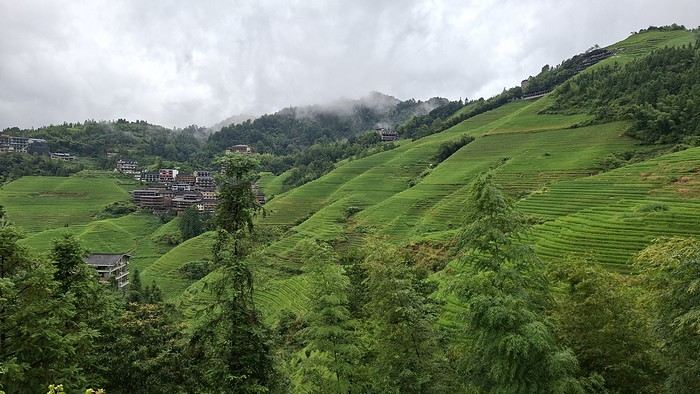
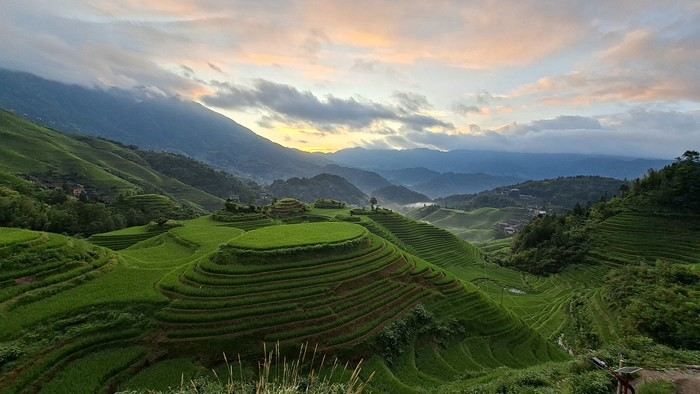
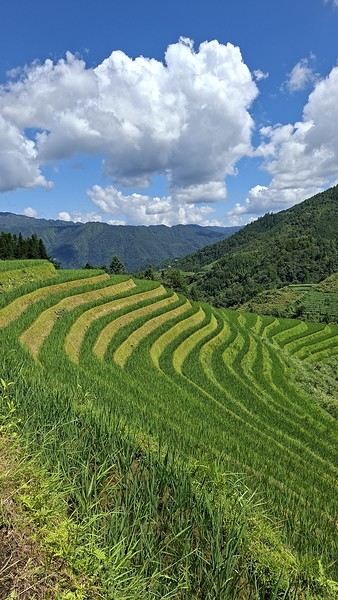
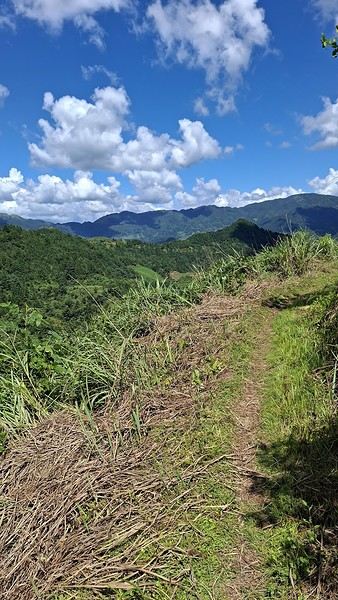
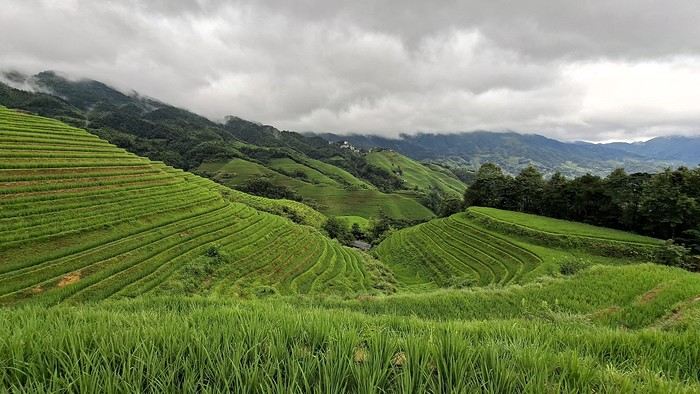
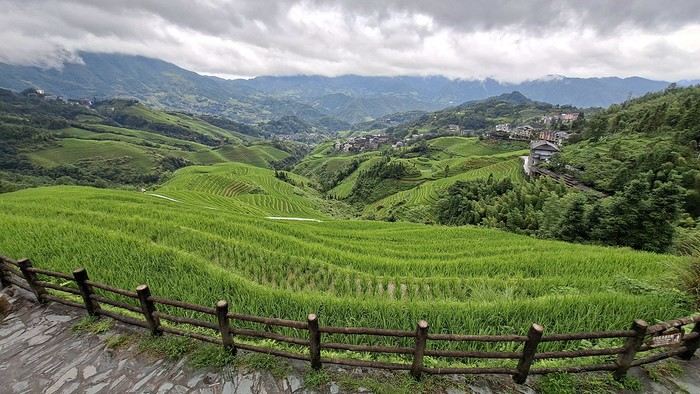
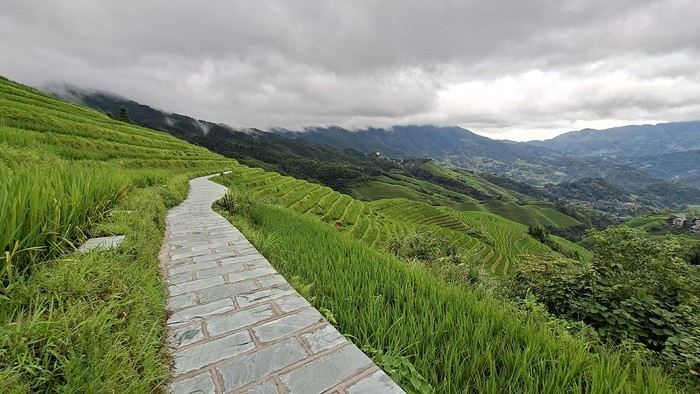
We take another walk around the village to get our bearings and find our way back to the hotel more easily. There’s no shop, but I think there was one where the Didi dropped us off. A storm’s brewing, but we decide to head to the “Seven Stars Chasing the Moon” viewpoint anyway. On the way, we pass near the Didi drop-off spot, and sure enough, there’s a tiny shop selling snacks and drinks—we spend a few yuan there. Then we hike up to the viewpoint in the rain. It’s a 15-minute walk, no real difficulty, just a long flight of stairs at the start. It’s stunning, even in the rain. The rice terraces stretch as far as the eye can see. It’s breathtaking. Everything’s so green. It’s August, and the terraces are full of water—gorgeous. Tiantouzhai is the highest village in the area, which is why I picked it. The view from up here is unreal!


We head back, still getting a little lost, and pass a hotel/restaurant where we chat with the young woman from the owner’s family. She wants to live in France someday. We ask what time the restaurant closes: 10 PM. We go back around 8 PM, but everything’s shut, lights off. There’s still a little light at the counter, so we walk around and go in. A woman comes over, turns everything back on, and tells us she’s the cook and it’s no problem—she can make whatever we want. I feel bad, but we sit down. She speaks a little French—we don’t quite understand why, but there’s mention of a Jean-Claude. As we leave, she tells us to come back for breakfast tomorrow. See you then!
VI Vilabel Regular ·
Oh thanks, that makes me happy 🙂
BL Bluequark Veteran ·
Your travel journal is really great. I’m making so many discoveries! Can’t wait for the next part!
Bluequark

Carnets : Namibie, Laos-Perhentias-BKK, Ouest US, Lanzarote, New-York, Berlin, Cuba, Bardenas Reales, AFS -Lesotho-Swaziland, Japon et le dernier né Colombie: https://voyageforum.com/discussion/ete-2017-trois-semaines-en-colmobie-en-famille-d10108246/
VI Vilabel Regular ·
Thanks, that’s sweet! 🙂
AL Aleph240758 Veteran ·
Ohhh, all these discoveries are amazing—it’s magnificent! Thanks for this beautiful travel journal, I’m loving it.
Qui a l'habitude de voyager sait qu'il vient toujours un moment où il faut partir... Paulo Coelho
VI Vilabel Regular ·
Happy to see we all agree on the word "magnificent" to describe this trip 🙂 So glad you like it!
VI Vilabel Regular ·
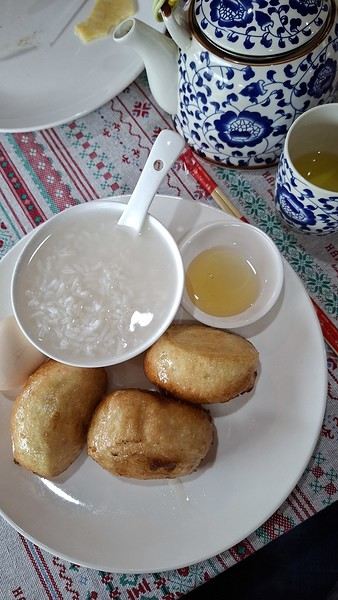
Day 14. It rained all night and all morning. We went for breakfast as planned at the same restaurant from last night. I had a Chinese-style breakfast, while D. had banana pancakes with jasmine tea.


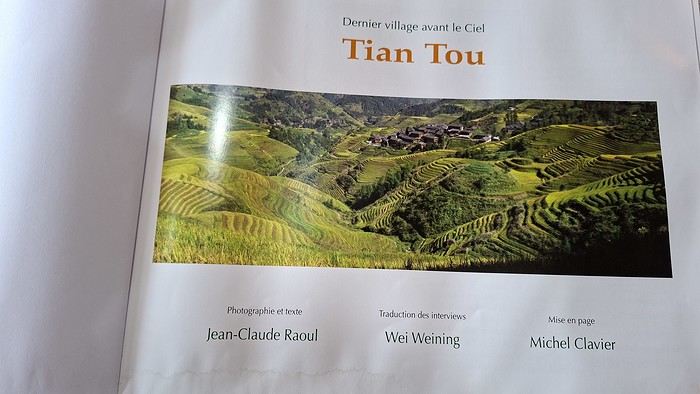
They brought us a book while we were eating, and we figured out who Jean-Claude (Raoul) was. He spent 5 or 6 months a year in Tiantouzhai for years and put together this book of photos and interviews with the villagers. They must be really proud of it and of seeing themselves in these amazing photos. And that’s how they picked up some basic French from him.


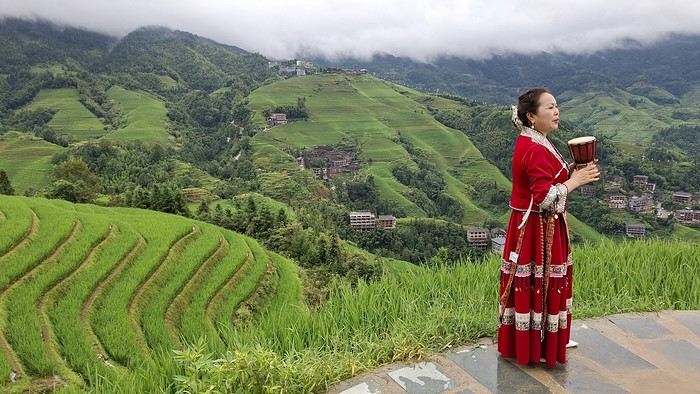
The rain stopped around 1 p.m., so we took the opportunity to set off on our first little hike, passing by the viewpoint “Seven Stars Chasing the Moon,” where we’d already been yesterday. Then “Thousand Layers to Heaven,” with great views of the rice terraces where Chinese women in traditional outfits were getting their photos taken, Zhuangjie, Dazhai, and we finished the loop by heading back up to Tiantouzhai from the north.


The path is a mix of stone steps, some flat sections, crossing the rice terraces toward Dazhai, then mostly forest and small waterfalls after Dazhai before returning to the terraces. It’s accessible to anyone who can handle stairs without too much trouble, but it still involves over 500 meters of elevation gain and the same in descent over about 6 km. We found it super enjoyable. Sure, it rained again from 2 p.m. to 3:30 p.m., but we used the time to take a break at a restaurant in Dazhai where D. had more Guilin rice noodles. I was still full from my late breakfast. Even in the rain, it was amazing. I loved this loop. And we had the place to ourselves, except for the first two viewpoints—so for me, ideal conditions, aside from the weather.


Since we weren’t tired enough, we kept going on the other side to a viewpoint that wasn’t named on my map but was signposted as Xishan Shaole—gorgeous—then “Music from Paradise,” ab-so-lute-ly stunning. We were really high up, and the climb to get there is steep, but it’s totally worth it. Just extraordinary!


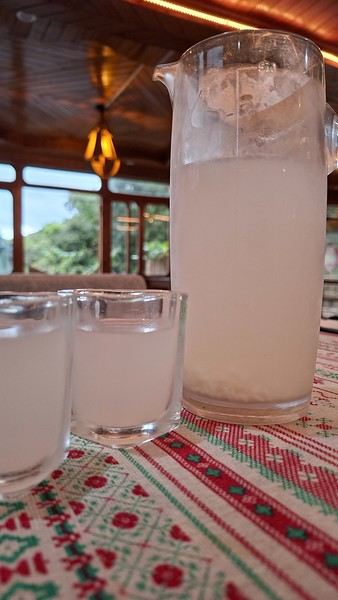
That added 4.5 km, 400 meters of elevation gain and descent round trip. It’s 6:40 p.m., so we decide to stop at our usual restaurant where we order two glasses of glutinous rice wine (2 or 3% alcohol) with a plate of fried peanuts (because otherwise, it’s not fatty enough!). Before we know it, she brings us a whole carafe of rice wine! Honestly, it’s not amazing—pretty bland, really—except that it’s local, so of course, you’ve got to try it.


Despite the gray skies and quite a bit of rain, this day was incredible. A little chilly—I kept a light sweater on most of the time—but we’re at a decent altitude, and the gloomy weather brought the temperature down. I love this place, and I’m so, so happy to be here and experiencing all these emotions!
VI Vilabel Regular ·
Day 15. Today, I woke up at 6 AM to watch the sunrise over the rice terraces. I settled onto the hotel terrace. I was alone, but I could see people behind the windows of their hotel rooms. It was quite chilly. A few clouds clung lower over Dazhai. Higher up, they turned pink as the sun was about to appear. Once again, it was stunning and so peaceful! Oh wow, I loved this moment—until a woman came next to me to make a video call to show the sunrise to her friend. The Chinese on the phone... you have to experience it to understand the noise level...


Back to bed to squeeze in a bit more sleep, then we started with a meal around 11:30 AM and set off on the hiking trail toward Ping'an. I’d read several times that we shouldn’t miss the rice terraces behind the village of Zhangliu. The weather was gorgeous. The trail was rougher than yesterday’s, mostly shaded, along the forest edge, crossing several streams on tree trunks eaten away by moisture—some of them broken—passing near small waterfalls, and skirting two tiny rice terraces. All the other terraces were now passion fruit crops as far as the eye could see. Well, that wasn’t what we were hoping to see.


When we arrived in Zhangliu, a little lady came out of her house and started talking to us. We know roughly ten words in Chinese, and I was so happy they were enough to understand each other without a translator. The exchange was simple:

“You going to Ping'an?” “No, we’re going to Zhangliu.” “Here, it’s Zhangliu.” “Yes, we’re going to the village.” “You’re not going to Ping'an?” “No.” “Where are you from?” “Tiantouzhai.” “You want to eat?” “No, thank you.”

I was so proud.

We didn’t go to Ping'an—we were too "disappointed" by this hike. We stopped just outside Zhangliu village and turned back. I thought it was a nice mountain hike, but it wasn’t what I was looking for. I wanted rice terraces, and we got almost nothing but passion fruit. The round trip had us walking 11 km, with 800 meters of elevation gain and loss, no particular difficulty except the return, which climbs steeply for the first two kilometers (I had to stop every 20 meters to catch my breath...).


On the way back, we started worrying about how we’d leave Tiantouzhai for our next destination. We’d already talked a bit about it with the young guy at the restaurant this morning, who gave us bus schedules and marked the bus departure point on our maps.me. Tonight, we asked the managers of our hotel to book the noon bus for us. They told us we could walk to the bus station, 3 km away. No way—that wasn’t the option we chose with our backpacks and the elevation over those 3 km. We told them we wanted to take the XL golf cart shuttle, but we didn’t know how it worked or the schedule. She said the shuttle leaves as soon as there’s someone, and it costs 30 yuan per person, 20 minutes by road. That works for us, but she offered that we pay 60 yuan to her and her husband, and they’d drive us. Perfect, that works for us. Meet-up tomorrow at 11 AM for the ride to the Dazhai bus station, which is at the base of the cable car. Oh, and tonight, at "our" restaurant, we tried a local fruit liquor—it tastes like a brandy without sugar and less alcoholic. It’s not good. Luckily, the carafe was smaller than yesterday’s 🙂
CL Claireber ·
Thanks for this "travel journal"—it’s fascinating!
Claire
VI Vilabel Regular ·
With pleasure, so glad you like it! 🙂
VI Vilabel Regular ·
Day 16. A peaceful wake-up, one last long look at this incredible landscape because I want it to be etched deeply in my memory, and at 11 AM, we leave with our host to his car. A magnificent car with two huge screens taking up two-thirds of the dashboard space. I’d never seen anything like it—cameras everywhere, assistance for everything. What a ride! In 15 minutes, he drops us right next to bus 33720 (a minibus) in Dazhai. There are quite a few shops and restaurants around the square, so we have time to walk around and grab something to eat since we haven’t had lunch and we’ve got a 2.5-hour journey ahead. We put our bags on the front-row seats in the bus and go make our purchases. 12:04 PM, the bus departs.

For an hour, we’re on the narrow mountain road where passing is tough. People start throwing up. After the Longji ticket office, the road improves, but I don’t know why—I’d imagined the bus would take the highway, but no way. It stays on a secondary road that’s still a bit winding the whole way, and the other passengers keep vomiting. At 2:35 PM, half of them switch buses to reach their destination. We get off at Guilin Station, the central train station, 10 minutes later.

The trip cost us 50 yuan per person. We continue on foot—our hotel isn’t far. It’s really hot here. This morning at 11 AM, I saw in the car that the temperature in Tiantouzhai was only 26°. Now, it’s 10° higher, and on top of that, there are crowds and lots of noise. I’d already forgotten that detail after those few days of complete peace in Chengyang and Tiantouzhai.

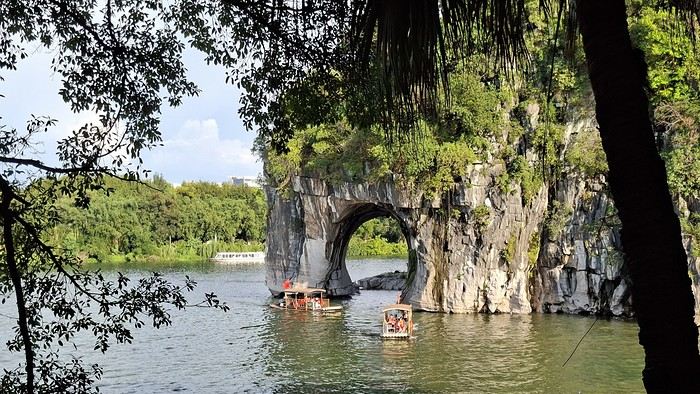
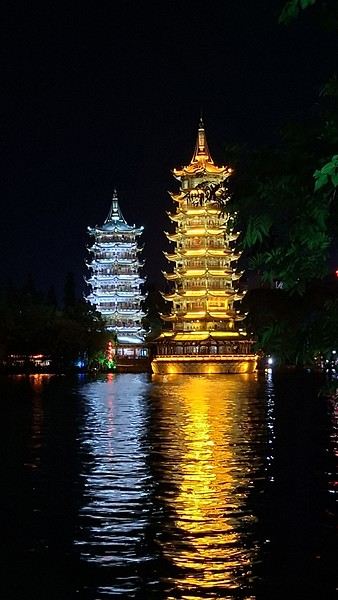
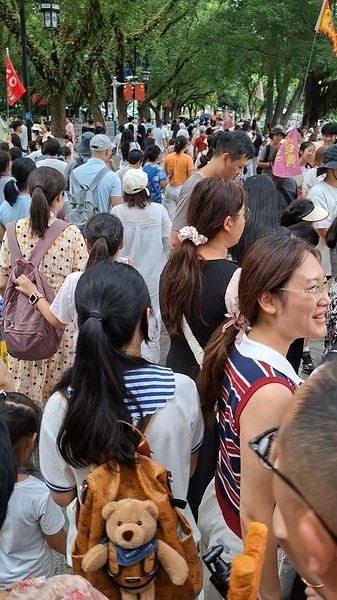
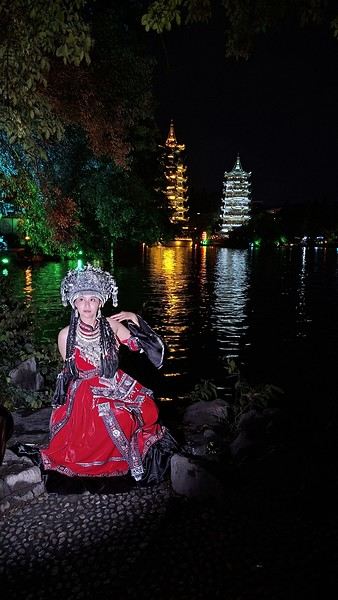
We relax for a moment under the AC in the room, then head toward Zhengyang Walking Street, passing by Elephant Trunk Hill along the Li River, and the Sun and Moon Pagodas on the lake on the other side. Packed with people. We don’t linger too long—we’ll come back tomorrow to explore this area.


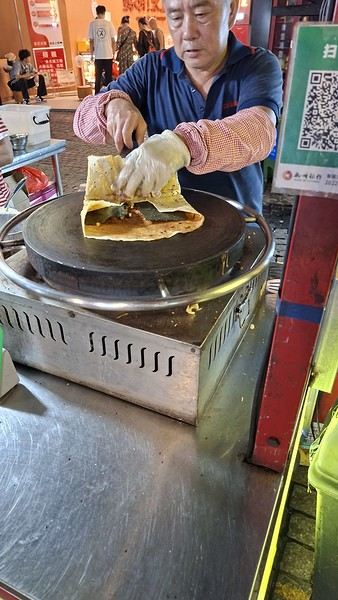
We make a few purchases, including mini fans (yeah, we caved with the heat coming back, plus they’re too cute with their little bunny ears 🙂). Then street food: grilled mini buns and meat pastries for D., jianbing for me, a nod to the ones we’d eaten in Beijing during a previous trip.


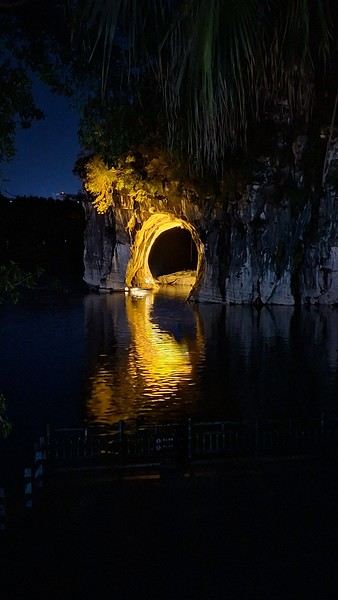
On the way back, we pass by the Sun and Moon Pagodas again, lit up at night—they’re really beautiful—and then Elephant Trunk Hill, also illuminated. There are still lots of people. We head back quietly at 10 PM after walking about twelve kilometers.

VI Vilabel Regular ·
Day 17. Another relaxed wake-up today—we don’t have a packed schedule. We head out to eat: shrimp galette fries, grilled sticky rice squares with taro and garlic leaves, and something really out of the ordinary—oil tea. Puffed rice, chives, crunchy balls of who-knows-what, peanuts, all to be drenched in a green liquid made from fried tea, pounded, then boiled with ginger. It’s a Miao specialty around Longchen, listed as part of Guangxi’s intangible cultural heritage.


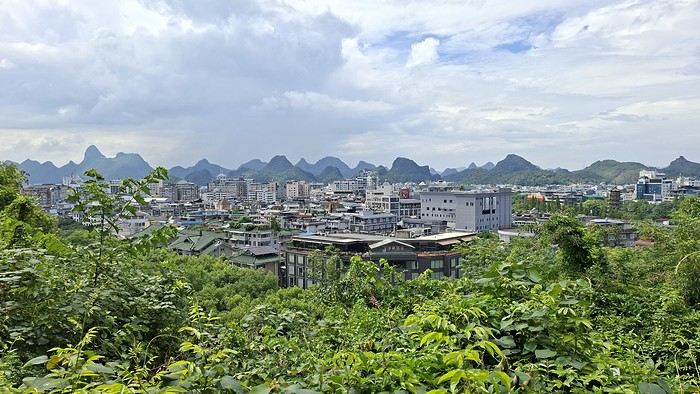
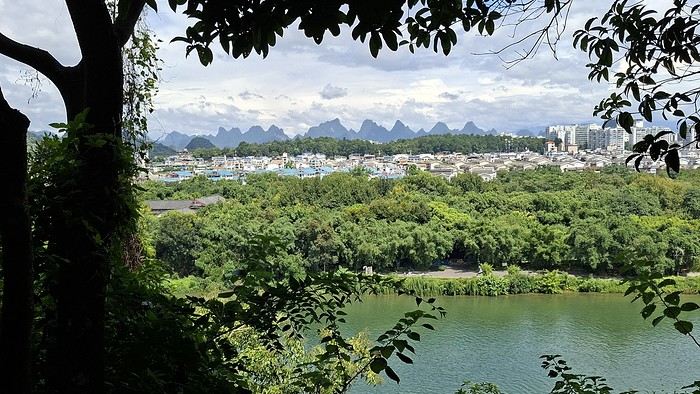
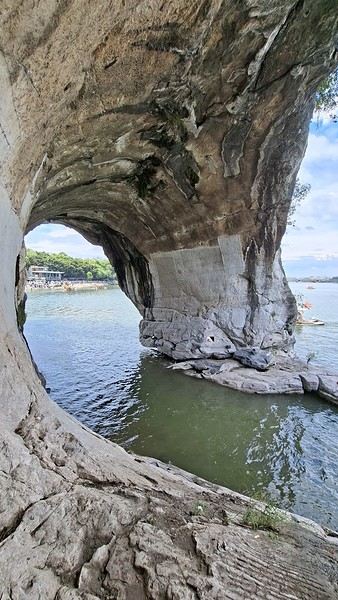
Next, we head toward Elephant Trunk Hill. The Chinese have to scan a QR code and maybe even pay an entrance ticket, but for foreigners, they let us in without anything. We climb all the way to the top of the hill. A tiny platform at the summit offers a 360° view. The weather’s nice, the view is great, and not many people make it up here.


That said, there are *so* many people down below—tons of Chinese tour groups with guides blasting through megaphones. It’s awful. I’m part of the crowd too, but this is just too much.


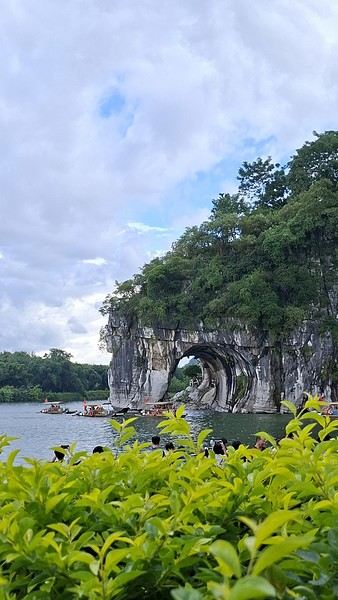
We take a quick stroll near the elephant’s trunk.


And we go back to see it from the other side. A little greenery to hide the crowd 🙂


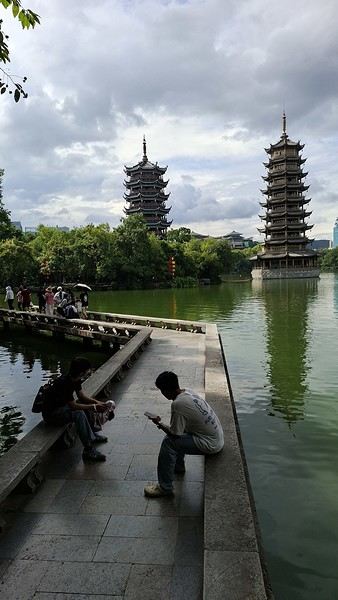
Then we head to Shanhu Lake and the Sun and Moon Pagodas. It’s much quieter here.


We were chilling in the sun when rain suddenly started pouring out of nowhere. We keep walking along the series of lakes until the last one, Mulon Lake. The path isn’t very interesting, and it’s still raining.


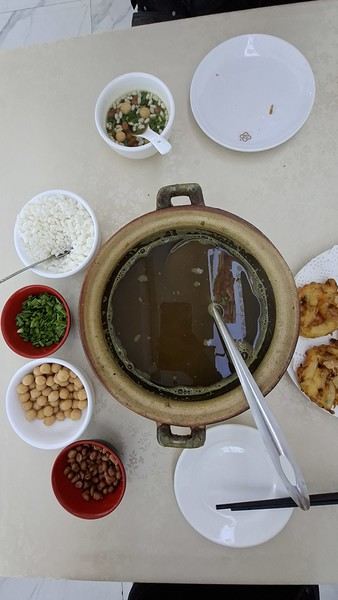
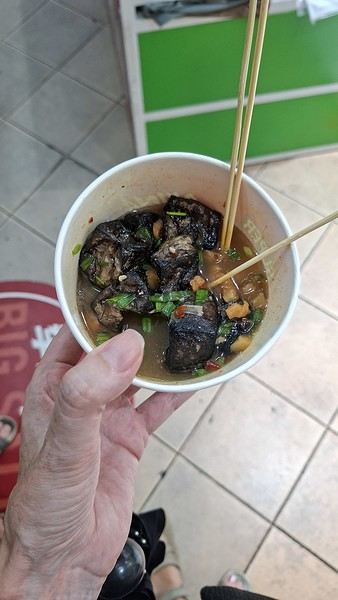
A little osmanthus ice cream along the way, then we head back down, walking alongside the Prince Jingjiang City Wall, which looks closed. It’s stopped raining. We end up in Zhengyang, the pedestrian street we explored last night. We stop at different street food stalls. D. gets more grilled bao, and I try a big skewer of grilled octopus pieces, then a bowl of stinky tofu—fermented black tofu, pickles, chives, a little chili, and broth that fills the tofu squares. It’s not bad—I finish the whole bowl, down to the last drop of broth and pickle.


D. gets a little osmanthus dessert (it’s their thing right now), and we take a quick walk by the lake to see the pagodas again—then it starts raining, until it turns into a full-on downpour.


The streets are flooded—water’s over our ankles. We make it back to the hotel soaked from head to toe, umbrellas doing little to keep anything dry in that kind of rain. We pick up the laundry we dropped off this morning (no self-service here)—two bags for 15 yuan—and head upstairs to dry off. We walked 16 km today.

Tomorrow, we leave the city. Originally, I hadn’t planned to stop in Guilin, but logistically, it made sense to pass through, so we figured we’d explore a bit. But honestly, I don’t think it’s essential to stop here—I didn’t find much to do in the city itself. It’s more of a base for exploring the region, but beyond that practical aspect, there’s not much left, in my opinion. Maybe I missed something, though?
VI Vilabel Regular ·
Day 18. We left the hotel around 11:40 AM, bags on our backs. We stopped at a restaurant, then headed to Guilin’s central train station, just 500 meters away. I was expecting a huge station, but not at all. It’s a very reasonable size, and everything went smoothly without any waiting.

First hiccup: security confiscated our mosquito repellent even though we’d already taken the train with it. She quickly showed me the ban. I saw "100" written and realized my 200 ml bottle was too big. Okay, we went upstairs to sit and wait for our train. I checked 2-3 shops to see if I could find a 100 ml container to transfer the confiscated product into. Nothing. I went back down to security to translate their restrictions because I was still unsure—our water bottles were fine, even the big 1.5-liter ones. I pointed out that the ban was for pressurized products, and mine wasn’t pressurized. She told me alcoholic products over 100 ml were banned. I said there was no alcohol in mine. She said it was over 100 ml. I said okay and left empty-handed. I tried, at least! And hey, I had nothing else to do—it kept me busy!

The train arrived on time, as usual, and left at 2:38 PM. We had nearly 6.5 hours and 14 stops ahead of us. It was *very* long. The train took a big detour northeast before finally heading west. Only two trains run this route per day, and this was the first one. Otherwise, we could’ve taken a connecting train, but it wouldn’t have saved any time...

We arrived in Fenghuang at 8:57 PM. A few weeks ago, I’d asked our hotel to pick us up at the station since they offer it for free. They’d agreed. This morning, as a reminder, I asked via Trip.com how we’d recognize them at the station. All I got was a notification: “request refused.” Okay, so they weren’t coming to get us after all.

We followed the signs to the bus heading toward the old town. They run until 10 PM, 7 yuan per person. We took line 1 to Xifeng Square and walked the last 250 meters to our hotel. I still couldn’t find it on the map, but I used the Trip.com app and ended up in a maze of tiny, pitch-black alleys—what I’d call a mugger’s paradise. People spontaneously offered to help guide us. When we showed them the hotel name, the first person made a weird face and said “no.” Okay, they didn’t know where it was. The second person made a weird face but started leading us there. We went deeper into the maze, then they stopped and typed on their translator: “you made a pact.” *Whoa*—what’s with this vibe? Don’t say stuff like that when I’m already on edge! We translated it our way as “did you book?” and tried answering “yes,” hoping we’d understood the gist. At that moment, a guy showed up, and she told him to take us to the hotel. Honestly, I wasn’t reassured, but we followed him. When we arrived, everything was closed, no lights anywhere. We were definitely at our hotel, but it was shut. It had to happen to me eventually, but I’d have preferred it not be at 10 PM in a sketchy alley.

I tried calling the hotel—no answer. I called Trip.com, got an immediate response, and they handled everything in French. The guy took care of it all and called me back a little later. He couldn’t reach the hotel, so he booked us another one, 25 meters from the original, a room for 4 with two big beds, and refunded me for the hassle. Customer service was *perfect*. All I had to say was, “I’m in front of the booked hotel, but it’s closed—the neighbors confirm it’s shut,” and he handled the rest without me needing to do anything else. Top-notch.

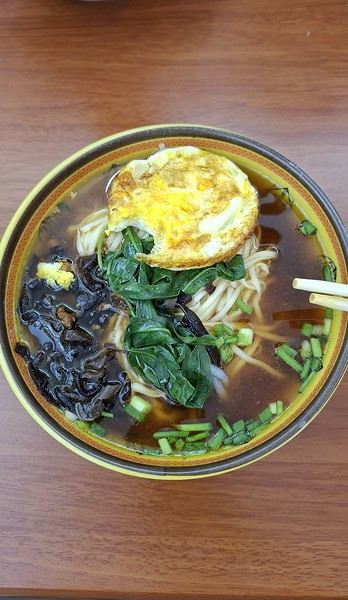
While we waited, we stopped at the nearest restaurant and ate really well. I had a bowl of noodle soup with mushrooms and an egg, and D had *bao* (again) and *tangyuan* (again)—glutinous rice balls with black sesame in a sweet rice wine soup. Everything was delicious, and the total was 33 yuan, or 3.90 €.


Then we headed into the alleys to find our new hotel. Again, a woman asked where we were going and had the same guy who’d taken us to the first hotel lead us there. We settled into a nice room—twice as expensive as the one I’d booked on Trip.com, but Trip covered it. These are the only two photos from the day. Oh, and by the way, we left Guangxi for Hunan.
NI Nimou74 Veteran ·
Those Longji rice terraces really are stunning, and your photos are gorgeous! 🙂 Mine are over 20 years old now. We’ll see the Yuanyang ones at the end of November. I hope I’ll be just as amazed. Can’t wait to read the next part about Hunan—we’re also spending a few days there with a Chinese friend.
VI Vilabel Regular ·
I’m adding the Yuanyang rice terraces to my list for an upcoming trip 🙂

Similar discussions

You might also like