je vais prendre mes billets d'avion ce week end pour l'Amérique du Sud, pour un voyage cet été. Je suis un peu perdue sur les termes de l'aviation, c'est la première fois que je fais un si long vol.
Y a t il une différence entre escale / correspondance et transit? Combien de temps prévoir pour assurer le coup (avec escale pas dans le même pays que celui de départ, ex: décollage de bolivie, escale au brésil, et deuxième vol pour paris)?
Escale: les PAX continuant le voyage restent dans l'avion.
J'ai déjà fait des escales et même en continuant mon voyage et le changement d'avion était très souvent la règle... 😛
Dans le genre je fais un Toulouse-Londres-Hong-Kong-Auckland-Nouméa, ben j'ai des escales (décrites), je change bien d'avion et pourtant je continue mon voyage...
Et au lieu de poster un lien, de mettre un screenshot qui ne dément absolument pas mes dires, si vous postiez plutôt quelque chose de concret ?
J'ai certe schématisé, mais la différence entre une escale et une correspondance est que dans le premier cas les pax utilisent le même avion, ou à défaut le même numéro de vol.
Escale: les PAX continuant le voyage restent dans l'avion
Bonjour (à nouveau),
Ce n'est pas non plus toujours exact. Par exemple, le vol direct AMS > DPS avait une " escale " (ce qui surprenait les passagers d'ailleurs), c'était à SIN, mais les passagers ne pouvaient pas rester dans l'appareil en son temps.
Nota : il y a une nuance (souvent méconnue) car vol direct ne signifie pas vol non stop.
Le terme d'escale est une notion précise techniquement (et sur le plan aéronautique) et le lien communiqué apporte un simple éclairage sur ce point. Maintenant il vous est bien évidemment loisible d'estimer que le code de l'aviation civile n'est pas " concret ".
et dans le cas donc d'une correspondance, avec changement d'avion, s'il y a du retard sur le premier vol, est ce que le deuxième nous attend?
Pour compléter la réponse de Canarvon, par contre si vous avez pris un seul billet, alors la compagnie doit vous mettre sur un prochain vol gratuitement. Si par contre vous avez acheté deux billets séparés, alors vous devrez repayer.
Escale: les PAX continuant le voyage restent dans l'avion
Bonjour (à nouveau),
Ce n'est pas non plus toujours exact. Par exemple, le vol direct AMS > DPS avait une " escale " (ce qui surprenait les passagers d'ailleurs), c'était à SIN, mais les passagers ne pouvaient pas rester dans l'appareil en son temps.
Certe, mais prenaient t-ils un autre appareil, ou le même ? Le même je parie ?
je ne serai pas en première et ce sera un même billet pour deux vols (vendus par air france). Combien de temps estimez vous qu'il faille pour mener à bien sa correspondance et ne pas rater l'avion suivant? D'ailleurs, dans une correspondance, on ne récupère pas nos bagages? Faut il passer la douane du pays ? J imagine que oui si on sort de l aéroport pour une longue correspondance, mais si on reste dans l'aéroport?
Air France propose une escale d'1H40 à Sao Paulo, ça me paraît juste non?
Sinon 4H50 à Panama.
Ou carrément 12H20 à Lima, ce qui pourrait nous permettre de voir le centre ville et de se balader avant le long retour.
je ne serai pas en première et ce sera un même billet pour deux vols (vendus par air france). Combien de temps estimez vous qu'il faille pour mener à bien sa correspondance et ne pas rater l'avion suivant? D'ailleurs, dans une correspondance, on ne récupère pas nos bagages? Faut il passer la douane du pays ? J imagine que oui si on sort de l aéroport pour une longue correspondance, mais si on reste dans l'aéroport?
Air France propose une escale d'1H40 à Sao Paulo, ça me paraît juste non?
Sinon 4H50 à Panama.
Ou carrément 12H20 à Lima, ce qui pourrait nous permettre de voir le centre ville et de se balader avant le long retour.
Alors.
Sauf rare cas (USA par exemple), il est inutile de récupérer les bagages. A condition toutefois de rester dans le même aéroport.
Sauf rare cas encore (US, c'est vous que je regarde là…) vous ne passerez pas la douane. Après tout, vous ne rentrez techniquement pas dans ledit pays.
4h50 est raisonnable, les "chances" de rater la correspondances sont extrêmement réduites.
12h20, si vous avez prévu de visiter alors oui, ça peu être un bon plan. Mais penser à vous renseigner pour un éventuel visa, et dans ce cas, oui, vous devriez passer la douane, donc attention à l'heure.
D’un strict point de vue technique, et donc au sens le plus rigoureux du terme...
- Un vol avec une ou plusieurs escale(s), est un vol ou cours duquel un avion se pose en un ou plusieurs aéroport(s) avant d’arriver à son aéroport de destination finale. Sur un tel vol et qu’ils soient ou pas obligés de débarquer durant les éventuelles opérations techniques et commerciales, les passagers n’ont pas à changer d’avion au cours de leur voyage.
- Un vol avec correspondance est quant à lui, un vol au cours duquel les passagers sont obligés de changer d’avion (mais pas nécessairement de compagnie) au cours d’une escale dite de transit.
La fréquente confusion vient à mon avis principalement du fait, que d’un point de vue commercial, beaucoup d’intervenants officiant dans le monde du tourisme (intermédiaires en ligne, TO, agences, prestataires, etc.) utilisent exactement le même terme (celui d’escale) pour désigner : soit un vol avec une simple escale technique, soit un vol avec une escale de correspondance ! 😉
Histoire de corser le tout : il est à noter qu’un "vol direct" est un vol qui sous exactement le même numéro, relie deux aéroports entre eux, avec ou sans... une ou plusieurs escale(s) technique(s) ! 😐
Et un assez intéressant détail pour finir : tout comme d’ailleurs un assez grand nombre de termes qui sont actuellement utilisés dans l’aviation moderne, celui d’escale trouve sa (très lointaine) origine, dans le monde maritime. Certains termes actuellement en vigueur, datant même de la marine à voile !
Et dans le cas d une correspondance de 12h à Lima, la douane péruvienne, venant de Bolivie, je ne la passerai qu en descendant du premier avion, pas en allant rembarquer pour le second?
As t on "le droit" a chaque correspondance de sortir de l aéroport ou est ce possible d avoir une correspondance de 12h et de rester "bloqués" a l aéroport?
Et dans le cas d une correspondance de 12h à Lima, la douane péruvienne, venant de Bolivie, je ne la passerai qu en descendant du premier avion, pas en allant rembarquer pour le second?
Deux fois.
La première fois pour rentrer dans le pays (en assumant que vous voulez sortir de l'aéroport pour visiter, ce qui est le cas ici), et bien sûr une deuxième fois pour sortir du pays (rentrer dans la zone airside de l'aéroport.
As t on "le droit" a chaque correspondance de sortir de l aéroport ou est ce possible d avoir une correspondance de 12h et de rester "bloqués" a l aéroport?
C'est pour ça que je vous ai dis de vous renseigner à propos d'un éventuel visa. Chaque pays est différent.
Vous avez raison, tout autant que l'origine de certaines notations est effectivement empruntée à la marine (vitesses en KTS en bas niveaux de vol par exemple).
Vous l'avez aussi souligné, certains termes n'ont pas du tout la même acceptation pour le voyageur (passager) et pour un intervenant technique. Le vocable " premier segment " (de vol) pour un passager effectuant par exemple le voyage TOULOUSE > PARIS > NEW-YORK sera le vol TOULOUSE > PARIS. Pour un naviguant technique cela sera une phase spécifique de la configuration après décollage.
De même le terme STOPOVER n'est pas pris exactement en le même sens suivant les interlocuteurs, sites, et autres " acteurs " du voyage (et aussi dans le FARE RULES du billet d'avion).
Vous communiquez différents textes que vous présentez " au sens rigoureux du terme " mais ceux-ci ne sont pas strictement équivalents à ceux des définitions, tout aussi rigoureuses, qui se retrouveront en la langue d'origine des textes aéronautiques O.A.C.I, I.A.T.A, et autres (anglais donc) :
Stopover: Scheduled interruption of a flight at an intermediate airport, either to refuel (in which case, it is known as a “technical stopover”) or to pick up/drop off payload (for example: flight 789 from New York to Delhi, with a stopover in London). Unlike a connection a stopover usually does not involve a change of flight number or airline, but may involve a change of aircraft.
Non-stop: A direct flight that operates from point A to point B without a stopover.
Connection: Transfer between two different flights at an intermediate airport (for example: flight 123 from New York to Miami followed by flight 456 from Miami to Sao Paulo). If a passenger’s flights are operated by two different airlines, they may check baggage or obtain boarding passes for the entire itinerary directly at the departure city’s airport, pursuant to interlining agreements or airline alliances. A connection is not the same as a stopover.
car à travers les années la complexité des cas (et des nouvelles possibilités offertes aux voyageurs) dont la notion de " cinquième degré de liberté " (parmi de multiples évolutions) :
weekendblitz.com/...line-flights-routes/
a rendu certaines mentions obsolètes, inexactes, ou incomplètes ....
Un vol direct (numéro unique) peut amener à un changement d'appareil (raison opérationnelle entre autres). A titre anecdotique, il y a très (très) longtemps, le vol AFXXXX de PARIS à FORT DE FRANCE (vol direct) faisant escale à POINTE A PITRE amenait à passer d'un B 747 à un B 707 (à POINTE-A-PITRE). C'était lors de la mise en service des B 747 par ce que FORT-DE-FRANCE ne pouvait pas encore opérer les " gros porteurs ". Il y a, bien évidemment, différentes autres situations similaires (changement d'appareil sous un même numéro de vol) à travers les années, pays, et " routes " (itinéraires).
Pour un site comme V.F, axé sur le tourisme principalement, il convient (vous l'avez évoqué également) de prendre en compte la terminologie que le voyageur trouvera sur les sites qu'il consulte (comparateurs de vol " grand public " , agences en ligne). Voici un exemple d'un site de voyagiste (un de ceux qui n'a pas trop mauvaise réputation) :
Si vous envisagez de vous arrêter un peu en chemin vers votre destination finale, réservez un vol avec escale. Sélectionnez « Multi-destinations » dans la zone de recherche de vol, puis saisissez les dates de départ de votre choix pour chaque étape de votre vol. Les résultats de votre recherche contiendront toutes les étapes du vol regroupées, ainsi que les heures et dates de départ et d'arrivée. Vous pourrez ainsi voir le temps dont vous disposez pour chaque escale.
où le terme d'escale est donc pris en dehors de la notion d'escale de vol direct.
Pour revenir à ce qui (en fait) intéresse l'auteur du sujet si il souhaite des éléments quantifiés (plus détaillés que ceux trouvés sur les sites de comparaison usuels) pour son projet de voyage je serai ravi de lui communiquer.
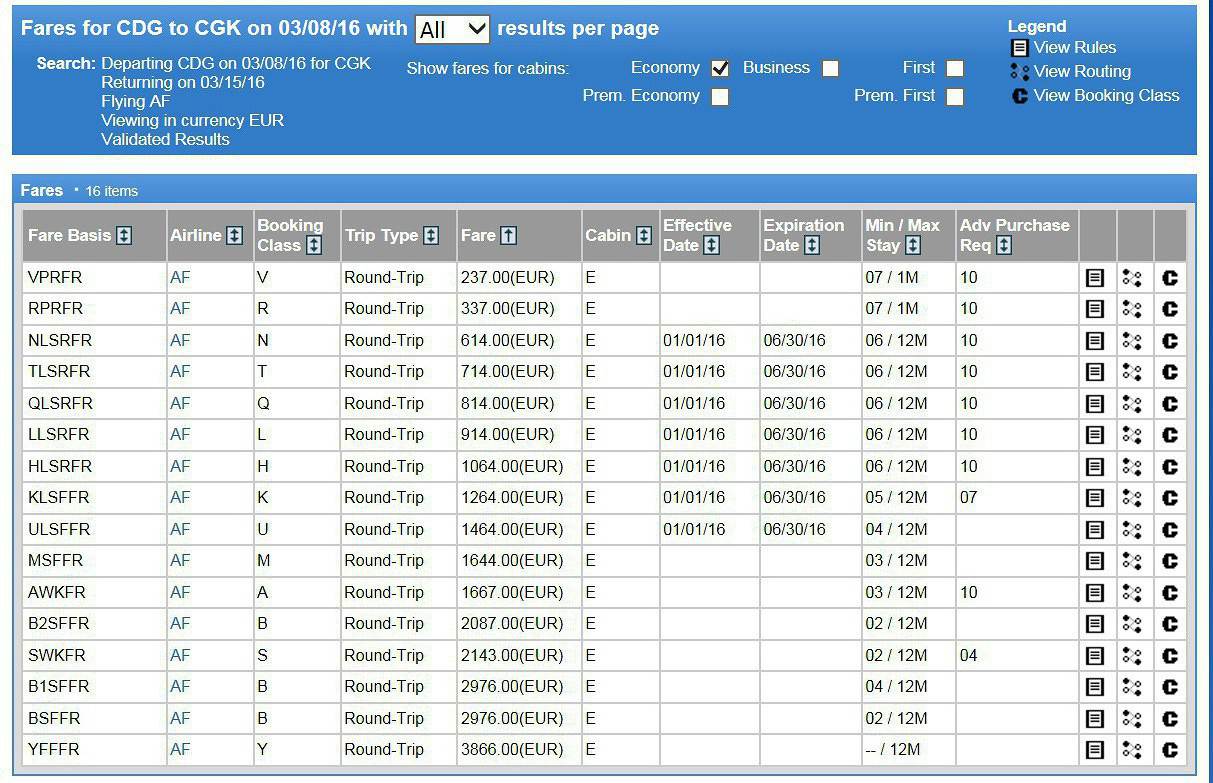
Nota : pour illustration de la multiplicité des tarifs je joins un exemple pour le vol AF 254 (PARIS > JAKARTA) : aller / retour en mai et pour la seule cabine économique (les prix dans le tableau ont hors taxes) : nombre impressionnant !
De même le terme STOPOVER n'est pas pris exactement en le même sens suivant les interlocuteurs, sites, et autres " acteurs " du voyage (et aussi dans le FARE RULES du billet d'avion).
Ceci est tout à fait exact ! 🙂
D'un point de vue commercial, un stop-over se définit comme une possible interruption de voyage (lors d'une escale intermédiaire programmée d'un vol) durant une période d'au minimum 24 heures, à l'issue de laquelle le passager pourra reprendre un vol lui permettant d'atteindre la destination finale de son voyage. Une personne intéressée par une telle possibilité, doit d'ailleurs impérativement vérifier auprès de l'agence émettrice de son billet (agence, compagnie aérienne, etc.) que les conditions tarifaires régissant son vol le lui permettent. Car certains tarifs ne l'autorisent absolument pas !
Alors que d'un strict point de vue technique, et comme spécifié ci-dessous dans ton texte :
Stopover: Scheduled interruption of a flight at an intermediate airport, either to refuel (in which case, it is known as a “technical stopover”) or to pick up/drop off payload (for example: flight 789 from New York to Delhi, with a stopover in London). Unlike a connection a stopover usually does not involve a change of flight number or airline, but may involve a change of aircraft.
Le stop-over peut vouloir également signifier une escale technique d'assez courte durée programmée sur un aéroport intermédiaire, situé sur la route reliant l'aéroport de départ à celui d'arrivée à destination finale. Et durant laquelle pourront être effectuées un certain nombre d'opérations techniques et commerciales (avitaillement en carburant, débarquement et/ou embarquement de passagers et de fret (selon les droits de trafic en vigueur), nettoyage de l'appareil, chargement de vivres, etc.
Par contre, tu seras très certainement d'accord avec moi pour dire, que les changements d'appareils aussi bien évoqués dans le chapitre ci-dessus (apparemment extrait d'un texte d'origine aéronautique, rédigé en langue anglaise) que dans celui de ton propre texte repris ci-dessous :
Un vol direct (numéro unique) peut amener à un changement d'appareil (raison opérationnelle entre autres).
Correspondent à des situations opérationnelles devenues tout de même assez rares, voire quasiment exceptionnelles. Qu'en penses-tu ? 😉
Bien cordialement et une excellente fin de soirée...
pas besoin de visa pour entrer au Pérou, du coup, je pourrai sortir de l'aéroport comme bon me semble (et sans mes bagages puisque Air France est sensée s'en occuper).
Combien de temps ça prend le passage de douane ? 1H? 2H?
pas besoin de visa pour entrer au Pérou, du coup, je pourrai sortir de l'aéroport comme bon me semble (et sans mes bagages puisque Air France est sensée s'en occuper).
Combien de temps ça prend le passage de douane ? 1H? 2H?
Alors pour le passage en douane, c'est comme le temps que met le fond du canon pour se refroidir, à savoir: Un certain temps.
Il y a trop de paramètre à prendre en compte pour vraiment donner une réponse.
il y a très (très) longtemps, le vol AFXXXX de PARIS à FORT DE FRANCE (vol direct) faisant escale à POINTE A PITRE amenait à passer d'un B 747 à un B 707 (à POINTE-A-PITRE). C'était lors de la mise en service des B 747
c'est vrai que c'était il y a très très très très longtemps: vintage & oldies but goodies! une vidéo sympa tout aussi vintage sur le -100 et son cauchemar de JT9D :-)!
Sur les quelques routes de compagnies Françaises avec un numéro de vol unique et arrêt entre le point d'origine et le point de destination (comme le vol AF 254 PARIS > SINGAPOUR > JAKARTA) il est certain que si il y a un changement d'appareil (B 777-300 ER) à SINGAPOUR c'est qu'il y a un sérieux " problème ". Cela sera sans aucun doute pour une raison technique un peu comme la A330 de la République Française l'a subi en Amérique du Sud voici quelques jours : bref une panne ou un problème lié à la M.E.L ce qui revient au même). Mais, en aviation, il n'y a pas que les compagnies Françaises et ce type de " route ". Les références (toujours en origine aéronautique américaine) sont explicites :
et les changements d'appareil existent.
Le message qui posait en " définition " qu'en un vol avec " escale " les passagers ne descendaient pas de l'appareil et que c'était le même appareil était (et reste) inexact pour chacune des mentions. Pour la seconde, il peut être cité les vols directs (AIR FRANCE ou TAHITI NUI) de PAPEETE à PARIS (escale à LOS ANGELES) qui voient évidemment les passagers obligés de descendre de l'appareil à LOS ANGELES :
www.tourmag.com/...hiti-Nui_a41693.html
A noter les passagers du vol similaire AIR FRANCE subissent des procédures différentes :
Mais contrairement aux vols Air France, les passagers d’Air Tahiti Nui n’ont pas besoin de récupérer leurs bagages en soute.
AIR FRANCE (du fait des évolutions que vous évoquez) écrit en ses propres documents (vol AF 254 de PARIS à JAKARTA pour ce qui concerne SINGAPOUR) " temps de correspondance optimisé " (cela ne simplifie pas la terminologie d'ailleurs pour les passagers définitivement perdus entre les mots d'escale, correspondance, et transit : heureusement que dans les faits c'est pratiquement sans importance ! ).
L'évolution (des termes et contenus) est aussi liée aux nouveaux droits ouverts de STOPOVER ("arrêt volontaire" ou " escale " ou " escale intermédiaire " suivant termes des conditions de transport de telle ou telle compagnie). Plus encore (cas du vol AF 254) il y a les droits de trafic ouverts à AIR FRANCE entre SINGAPOUR et JAKARTA. C'est à dire qu'il est possible d'acheter un billet sur le vol AF254 pour n'effectuer que le trajet SINGAPOUR > JAKARTA (cinquième degré de liberté). A titre anecdotique : si une recherche est effectuée pour un billet aller-retour SINGAPOUR > JAKARTA sur le site Français de AIR FRANCE : il ne se trouve pas (tout au moins à ce jour) ! Il faut aller sur le site AIR FRANCE de SINGAPOUR car il existe et est tarifié (prix non compétitif d'ailleurs !) :
Tout cela ne passionne certainement pas les membres de VF qui se seront " égarés " à la lecture de ce message quelque peu hors sujet et je ne " récidiverai donc pas plus avant " sur ce sujet en message public !
Enfin, pour revenir à ce que vous aviez fort justement évoqué sur l'apport de la marine à l'aéronautique je vous joins un lien qui l'illustre (en une ouverture de route commerciale qui n'était " pas simple " en son temps) avec l'utilisation de sextant et de navigation astronomique :
Encore plus vintage (l'appareil) la vidéo étant récente (un des quelques L 1049 en état de vol) et quel spectacle la mise en route des W 3350 CYCLONE :
Encore plus vintage (l'appareil) la vidéo étant récente (un des quelques L 1049 en état de vol) et quel spectacle.
Trop élégant!
Et en vol, quelle classe. Je l'ai vu voler au salon du Bourget et rien qu'en y repensant j'en ai des frissons.
LH travaille à la remise en fonctionnement d'un autre super constellation, avec cockpit modernisé pour pouvoir emporter des passagers. 🎆
@Aixois54 et Carnarvon :
Quelle belle prestance et très grande classe peut en effet avoir en vol, cet admirable avion L1049 appelé "Super Constellation" du constructeur Lockheed. Et qui comme un certain nombre d'autres appareils construits de par le monde, a définitivement marqué la longue histoire de l'aviation, tout en faisant rêver un assez grand nombre de passionnés des choses de l'air. Mais si parmi toutes ces admirables machines, il en est une qui pour moi surpasse et de loin toutes les autres... c'est bien le fameux Douglas DC-3 construit par la Douglas Aircraft Company, et dont la célèbre version militaire fut appelée C-47 Skytrain pour ensuite un petit peu plus tard, définitivement prendre le bien plus joli nom de Dakota. Alors que la production des Constellations avoisina tout juste les 850 appareils, celle des DC-3 / C-47 Dakota frisa allègrement les 13 000 appareils, dont certains volent encore de par le monde (Afrique, Amérique du Sud et quelque-uns en Europe) alors que sa production initiale avait débuté en... 1935 ?! D'ailleurs, plus de 400 étaient encore en service à la fin des années 90. Et que dire alors... du bruit très particulier de ses moteurs : Wright R-1820 et Pratt & Whitney R-2000 pour le DC3, et Pratt & Whitney R-1830 pour le C-47 Dakota ? Qui au démarrage aussi bien qu'en vol, me procurent également de biens agréables frissons ! 🙂
Un très grand nombre d'histoires vraies et de belles légendes, ont constellé (petit clin d'oeil au L1049) la formidable et à présent devenue bien longue histoire de l'aviation. Et je vais aujourd'hui vous raconter comment a commencé, celle qui a permise la réalisation du DC-3. Tout aurait paraît-il débuté par une simple phrase prononcée sous la forme d'une remarque directive, par Cyrus R. Smith alors à l'époque président de la très célèbre compagnie American Airlines, à son ingénieur en chef William Littlewood : "Bill, ce dont nous avons besoin, c'est d'un DC-2 à couchettes !" Mais bon, nous parlons ici d'une époque où les avions faisaient tout autant rêver que le prestigieux voyage en lui-même ! De nos jours, ce sont les billets dont les tarifs avoisinent l'équivalent du prix d'une petite poignée de cacahuètes, achetés à des compagnies aériennes dont le fuselage se couvre de très "poétiques" noms se terminant en ".Com" qui font rêver les jeunes et parfois moins jeunes générations de voyageurs ?! 😮 Autres temps autres rêves, car... autres moeurs ! 😏
Que tous les passionnés quels qu'ils soient continuent à bien agréablement rêver, même si chacun le fait à sa propre manière...
Tout cela ne passionne certainement pas les membres de VF qui se seront " égarés " à la lecture de ce message quelque peu hors sujet et je ne " récidiverai donc pas plus avant " sur ce sujet en message public !
Tu es très probablement dans le vrai, et c'est d'ailleurs la raison pour laquelle je vais moi-même également te suivre, dans la décision de ne (pas trop) récidiver dans ce genre de sujet ! 😉
Enfin, pour revenir à ce que vous aviez fort justement évoqué sur l'apport de la marine à l'aéronautique je vous joins un lien qui l'illustre (en une ouverture de route commerciale qui n'était " pas simple " en son temps) avec l'utilisation de sextant et de navigation astronomique...
Merci beaucoup pour ce lien conduisant vers un très intéressant article, ayant pour sujet l'ouverture par la compagnie aérienne Air France, d'une route commerciale qui fera passer ses avions par la zone polaire Nord via une navigation tout simplement appelée "navigation polaire", afin de beaucoup plus rapidement (et donc beaucoup plus économiquement) rejoindre Tokyo, au départ de Paris.
Une époque assez lointaine, où les biens plus complexes et beaucoup plus sophistiqués actuels systèmes de navigation (rendu entre autres possible, par le formidable et très rapide développement de l'informatique et de l'électronique de bord) n'existaient pas encore, et où il fallait donc utiliser une incroyable masse de documentation papier éditée sous la forme de très volumineux bouquins dénommés "éphémérides", si l'on voulait se servir d'un sextant permettant de faire le point lors d'une navigation astronomique. Et sans bien sûr oublier d'emporter une montre, tout à fait capable d'indiquer l'heure exacte avec une extrême précision ! 🙂
Hi there,
I’m planning a winter trip across India. Departing in early December and returning to France in mid-April.
My main concern is finding an airline that offers this round-trip with the fewest hassles regarding cancellations or flight schedule changes. The unstable geopolitical situation in the Middle East isn’t making this search any easier—recent reviews online about airlines from Gulf states describe quite a few struggles over the past few months.
The direct Paris-Delhi round-trip flights offered by Air France or Air India are probably the safest options, but not the cheapest!
Given this uncertainty, I’m still holding off on finalizing my ticket purchase... Maybe some of you India lovers on VoyageForum have tips or experiences to share?
Thanks, and happy travels to all.
Hi everyone,
Next January, I’m heading to India.
My outbound flight is with Emirates from Paris to Dubai, then another Emirates flight from Dubai to Calcutta.
Could anyone tell me how the connection works? I’ve heard there’s a dedicated Emirates zone, but how does it actually work in practice—I’ve got a 2-hour layover.
Thanks so much!
Take care.
Hi everyone,
I’m heading to Madagascar in early October to cycle from Tana to Diego along the east coast.
I really want to visit the Masoala Peninsula and its primary forest. If anyone’s interested, I’m open to company.
Maybe see you soon!
Hi,
I’m thinking of heading to Malaysia soon.
I’ve seen some great prices and direct flights from Paris with Malaysia Airlines.
Is it a reliable airline?
Thanks for your feedback!
Back in February, I booked a flight with Air France-KLM from Lyon to San Diego with a layover in Amsterdam (flights operated by KLM). The flight is scheduled for late August.
My Lyon→Amsterdam flight was canceled by KLM in June, and a replacement flight the evening before was booked for me. So, I’ll end up spending the night at Amsterdam Airport to catch my flight to San Diego the next morning.
Since the cancellation happened more than 14 days before departure, I know I’m not entitled to financial compensation (EU Regulation 261/2004). But am I entitled to reimbursement for a hotel night in Amsterdam?
Hi there,
We had planned a trip to Sicily in August, and due to the volcanic eruption of Mount Etna, my flight was canceled. The airline is refunding the outbound flight, but none of the non-refundable expenses: accommodation booked through Booking, rental car, and the return flight aren’t covered. My SUPER Gold card doesn’t work in this specific case! :( If anyone has been in this situation, could you let me know if you were able to get any recourse and, if so, how?
Thanks in advance
I’ve been traveling regularly for over twenty years,
but this is the first time an airline has treated me as poorly as Air France.
Two trips, two problems. The latest:
Trip from Seoul to Rennes. Last leg from Paris CDG to Rennes with Air France.
I arrive in Paris and go straight to Air France to get my boarding pass to Rennes. They assure me my baggage is continuing to Rennes.
Arriving in Rennes, no baggage—same as five other people.
The Air France office is closed, and the airport staff tell me there’s rarely anyone there.
With the help of the airport staff, I file a claim online, and my baggage is almost immediately located. As a result, I’m told I’ll have it the next day.
Four days later, the baggage is still in the same place at CDG—nothing’s moving.
The problem is Air France has no customer service. What they call customer service is a department that takes an hour to answer and just repeats what’s on the online form. No coordination, no way to get things moving. I guess Air France would rather pay the compensation after 21 days than actually do something.
I’ve had lost baggage on other trips, but this is the first time I’ve seen such indifference and lack of professionalism.
Hi,
Air Cairo offers good prices on domestic flights and schedules that work for us, but is this airline reliable?
Thanks in advance for your feedback.
Hi,
I booked an Etihad ticket on their website for Dusseldorf-Abu Dhabi. In the first name field, I entered all my first names (something I never do and I regret it, but the site was confusing). Everything is spelled correctly, but the problem is that I just received my new passport and only my first two first names and the first letter of the third appear—there’s no trace of the last one.
I called Etihad, and of course, they tried to charge me $100 USD to remove that last first name. But I’m hesitant because usually, I only put my first first name and not the others, and I’ve never had an issue... So I’m wondering if having that extra first name, which isn’t on my passport, could get me denied at check-in.
Thanks for your feedback!
I’d like to fly to Malta from Lyon.
I’ve read a lot of negative reviews about KM MALTA, especially regarding baggage fees at the airport.
Of course, I don’t want to book through third parties (like SkyScanner, Opodo…).
AIR FRANCE offers tickets to MALTA in partnership, if I understood correctly.
On AIR FRANCE, the tickets include everything (checked baggage, cabin bag, small personal item, seat), whereas with KM MALTA, everything is extra and the final price is almost double!
In this case, is AIR FRANCE considered the same as sites like Opodo or others?
Given the price difference, I’m hesitant…
Have any of you booked with AIR FRANCE for this destination? How did it go?
Thanks,
HERVE
Hi everyone, I’ve unfortunately only just noticed that I booked two flight tickets, but I made a mistake on the second first name. Basically, my computer auto-filled and typed my first name twice, so both tickets are in my first name. Only the last names—mine and my friend’s—are correct.
TAP Portugal refuses to make the change because they consider it a change of passenger, even though it’s clearly a typo (plus, my last name isn’t common).
I’m leaving in 5 days, and buying a new ticket would cost 3 times the original price. Has anyone been in this situation before? I’d like to try negotiating at the airport, but it’s a gamble… Thanks in advance for any advice!
Since it came into force, Regulation 261/2004 of the European Parliament and Council, which defines air passenger rights, has faced fierce resistance from airlines, backed by IATA (the association representing almost all passenger airlines).
Beyond the airlines' often abusive—and even frequently bad-faith—resistance to passenger rights, IATA has been lobbying EU institutions for years, with the Council paying close attention for a long time.
As a result, the Council and the Commission have been proposing revisions to Regulation 261/2004 for years that are particularly unfavorable to passengers. The latest attempt nearly eliminated the right to compensation for delays of 3 hours or more upon arrival at the final destination.
However, since this is a regulation of both the European Parliament AND the Council, the two bodies had to agree.
But the European Parliament has always stood firm, consistently responding that passenger rights must be preserved.
After 11 years of struggle, it seems likely that we’re finally nearing the end of the match between the European Commission, the Council (the 27 heads of state or government), and the European Parliament.
Indeed, the Commission and the European Parliament have agreed on a text that will be debated again on Monday, July 6, 2026, with a vote scheduled for July 7, 2026. It’s very likely that this text, which would come into force in a year, will be adopted.
The main changes would be as follows:
- Families with children will no longer be forced to pay to sit together on planes;
- A flight will be considered canceled (not just delayed) if it departs more than one hour late;
- Right to compensation for arrival at the final destination if the delay exceeds 3 hours (no longer "3 hours OR more"). The arrival time will be when the plane, having reached its parking spot, engages its parking brakes (no longer when the aircraft door opens);
- Airlines can no longer refuse boarding or charge extra on the return flight for a passenger who didn’t take the outbound flight;
- If a flight is canceled, the airline must, at the same time as informing passengers of the event, offer the choice between a refund and re-routing, and inform them of their rights to assistance and, if applicable, compensation;
- The airline must, without undue delay, inform passengers of the reason;
- In the case of a connecting flight, if the connection is missed and the delay at the final destination entitles the passenger to compensation, the responsible airline will be liable. This is very different from the current situation, where, under the KLM ruling, any airline operating a segment of the flight is liable for compensation. This promises more disputes that the Court of Justice of the European Union will have to resolve if two separate airlines operating segments of a connecting flight are both responsible for the delay. See this case for an example: https://retardimportantavion.wordpress.com/2026/04/18/swiss-international-air-lines-la-mauvaise-foi/
Moreover, this case demonstrates in advance another potential dispute: It could be argued that it wasn’t a missed connection since the flight was canceled before the first leg even departed.
- Within 96 hours of a flight that could entitle passengers to compensation, the airline must contact them to inform them of their rights and explain the next steps.
- Passengers must claim their right to compensation within 9 months. This is very different from the current situation, as Regulation 261/2004 sets no time limit. Currently, national law applies—in France, the limit is 5 years. The airline must respond within 30 days. If the airline refuses compensation on the grounds of "extraordinary circumstances," it must specify which type of case it refers to from the list in the annex of the new regulation. If the case isn’t on the list, the airline must explain what the event was, why it qualifies as extraordinary circumstances with "clear, substantial, and concise" explanations, and why it’s directly linked to the reason given. It must also declare what "reasonable measures" were taken to mitigate the issue. This is, of course, a huge change in the regulation, with the clear goal of preventing airlines from declaring just anything as "extraordinary circumstances" to avoid compensation.
- If, within 3 hours of a last-minute canceled or delayed flight, the airline hasn’t offered re-routing under comparable transport conditions and as soon as possible—whether on one of its own flights or another airline’s—the passenger will have the right to arrange their own re-routing and demand a refund for the new ticket, up to 400% of the original ticket price. This is a significant improvement that would have likely prevented the case described here: https://retardimportantavion.wordpress.com/2024/01/12/reacheminement-catastrophique-droit-indemnisation-meme-circonstances-extraordinaires-2/
- If a flight is canceled due to "extraordinary circumstances," the airline will only be required to offer up to 3 nights in a hotel. This is a major change, as there’s currently no limit. Expect disputes if the extraordinary circumstances end while the passenger hasn’t been re-routed.
- The price of a flight, as first displayed, must obligatorily include a cabin bag. This doesn’t prevent the airline from offering a price reduction if the passenger waives the cabin bag. This will put an end to abnormal practices, such as (just one example) Condor charging extra for a cabin bag on long-haul flights like Frankfurt (Germany)–Puerto Plata (Dominican Republic)–Santo Domingo (Dominican Republic)–Frankfurt.
- Free correction of a passenger’s name if requested 48 hours before departure. Note: This can’t be used to replace one passenger with another—just to correct a typo, e.g., Dupont instead of Dpont.
- Airlines’ websites and apps must include information on how to file a claim.
It’s clear that, despite a few details, these changes are very positive for upholding passenger rights. It remains to be seen whether this text will be definitively adopted on July 7, 2026, as is very likely, and, more importantly, whether IATA will encourage airlines to loyally respect these new rules or persist in their old habits.
I’m planning a trip to Georgia this summer and I’ve been comparing some airlines. I’m not particularly set on flying with Pegasus (though it’s convenient with direct flights from Lyon to Tbilisi), but right off the bat, Pegasus states this:
As of January 1, 2026, all foreign nationals traveling to Georgia for tourism purposes will be required to present valid travel health insurance. Guests who fail to provide the relevant health insurance will not be accepted on our flights to Georgia.
Sincerely,
Pegasus Airlines
In other words, if you don’t show proof of travel health insurance, you’ll be denied boarding.
Personally, my credit card insurance has always been enough for me, and I’d rather not take out extra coverage...
Have any of you run into this issue before? If not, what do you think? Why is Pegasus asking for this proof? Other airlines don’t mention it at all.
I bought my flight ticket with my first (usual) first name, which appears first on my passport. However, I have two first names on my passport, and of course, it’s mentioned in the machine-readable zone at the bottom.
I booked with Turkish Airlines (through an online agency) for a trip to South Korea.
I wanted to know if it would be a problem that I only used my first first name on the ticket, while my passport has two. I had requested through the agency to add the second first name, but the airline refused because it doesn’t meet their general conditions. (They must have seen that the last name and first name were the same, and only the second first name was added.)
So, my ticket has my last name and first first name correctly spelled, and when I check in online, I’ll enter the passport details correctly.
I’ll have a layover in Istanbul on the flight.
Thanks in advance for your replies.
Have a great day.
Hi there,
I traveled in June 2025 with Nouvelair Destinations to Hammamet.
I had one checked bag and one carry-on sized 40x24x30, which I usually take on low-cost flights, and I didn’t have any issues. But I just read on a website that Nouvel Air only accepts carry-ons of 40x20x15. I’m flying back to Djerba in June—what do you think? Especially since that size is impossible to find??????? Thanks
Hi, it's my first time taking a plane and I chose EasyJet for a Geneva -> Barcelona flight.
I booked my ticket.
I received my booking reference by email, but I don’t see the actual ticket (barcode or QR code?).
Then I checked in to get the boarding pass with the flight details, QR code, etc. But does this boarding pass act as the ticket?
Because I’ve seen several times online that the flight ticket and the boarding pass aren’t the same thing.
We're leaving for Albania on June 18th. When I validated the flight tickets with Wizz Air on Booking, I only put my son's first name but forgot to include his other three first names on the ticket.
On the passport: SURNAME: Dupont, FIRST NAMES: toto titi tutu tata
On the flight ticket: SURNAME: Dupont, FIRST NAME: toto
I can't seem to reach anyone at Wizz Air to get an answer.
Booking and Wizz Air's chat say I need to modify it, but ChatGPT says it should be fine.
I wanted to know if he can fly like this or if I need to change his ticket?
(It costs 140 €, I know I shouldn't have made a mistake🙁)
Basically, all airlines have been blacklisted because they don’t meet European safety standards. They’re banned from flying in Europe but continue operating in Tanzania.
The main issue is that travel agencies’ civil liability no longer applies to blacklisted airlines.
So we can’t allow clients to fly with these carriers.
Of course, there’s huge pressure from European agencies, which are forced to disrupt their plans or even cancel trips because of this.
Personally, I’ve got a trip planned for February 2026 to the southern parks in Tanzania, so I’ll be keeping an eye on how this develops.
Do any of you have updates?
Thanks!
Right now, with the war raging in Iran and affecting all the neighboring countries of the Persian Gulf, many airports are completely closed to all traffic.
Several airlines like Qatar Airways, Emirates, and others have almost completely halted their operations.
Whether in the Middle East or Africa, many travelers are stranded—maybe for a long time... A heartfelt thought for them and the struggles this will cause.
Four months ago, I was in Kenya with a flight booked through Qatar Airways... I can’t even imagine how I’d react if I were stuck there now. ??
Wishing all these travelers courage, patience, and success in making it back home.
Hello, some (potentially) good news for Brazil lovers—GOL airline is launching a route to Europe from Rio, starting in September for Lisbon, then Paris at a later date that hasn’t been announced yet.
They’ll be using their new A330-900 neo.
No prices have been announced so far, but hopefully we’ll find direct flights from GIG at a more interesting fare than AF or Latam…
I’m really surprised because in TUI’s new tour packages, the airlines they’re using are of low quality. Before, they used to prioritize major airlines, but now it’s small airlines from small countries—companies with terrible ratings and borderline safety concerns. I even just noticed this note for a Tanzania trip: "We inform you that the domestic flight segment in Tanzania included in your trip is operated by an airline listed on the European Union’s list of air carriers subject to an operating ban within the European Union. This ban only applies to European Union airspace, meaning this airline is not permitted to take off, land, or fly over European airspace. However, this airline is authorized to operate in Tanzania."
This means they’re using airlines on the blacklist!! It’s pretty worrying for safety. What do you all think?
We’re planning a cruise to the UAE/QATAR/OMAN starting from DUBAI, with flights departing from Paris CDG.
Which airlines would you recommend for round-trip flights, with or without a layover?
We need assistance for check-in and boarding/disembarking (my husband is a mobility-impaired traveler who uses a cane and/or a walker).
We’ve done a cruise return from Dubai to Paris CDG before in 2016, with a layover in Istanbul, but we booked the transfer and return flight with COSTA.
For our current plan, it would be with Celestyal, which doesn’t offer round-trip flights from Paris to Dubai.
Should we book very far in advance, or is a few months before departure enough (4/6 months)?
We’re thinking of arriving the day before the ship departs, so we’d need to stay overnight in Dubai—either on the way there or for the return flight, depending on the flight schedules. Could you recommend a hotel not too far from the airport, and how to get to the port from the airport?
Thanks so much for your advice. Have a great Sunday! Mum49
Hi,
It's all in the title—this means nothing's getting through, so no more oil.
In Europe, kerosene reserves are still good, but by the end of April, flights will have to be reduced.
European airports fear running out of kerosene if the Strait of Hormuz isn’t reopened within three weeks
I’m reaching out to ask for your help with a bit of a problem:
I booked a flight to Berlin from Orly for April 15th—it’s coming up fast. But I just made an annoying discovery: my passport expired two weeks ago.
From what I understand, in principle, I can still travel within the Schengen Zone with an expired passport as long as it’s been less than five years. However, EasyJet’s website explicitly requires a valid ID (and just to add to the fun, my national ID card has been expired for a while now).
So, I’d love to know: how strict are EasyJet’s ID checks? Do they enforce validity rules strictly and refuse boarding if the ID isn’t valid? Or is it more of a luck-of-the-draw situation?
Basically, should I just write off this trip now, or should I still try my luck—maybe with a little tearful plea? Has anyone here had a similar experience? I can’t be the only one, right!
I booked a flight with RyanAir for next month, with the priority+ option and two cabin bags. So I can take a 10 kg bag with dimensions 55x40x20 in the cabin (plus another smaller one).
The problem is that the smallest suitcase I have (which is supposed to be designed specifically for cabin size standards, according to the manual) has the following dimensions: 55x37x21, so it's just 1 cm over (wheels included) on one of the measurements.
I wasn’t too worried at first, but I’ve read dozens of stories about people’s misadventures and the hassles they’ve had with RyanAir.
Since I don’t want my suitcase to end up in the hold (that would waste time picking it up when I’m already arriving late and need to get to the city center), nor do I want to pay an extra fee (apparently 50 €) for the outbound and return flights for just 1 centimeter—especially since I paid for the "priority+" option and I’m not exactly rolling in money—I’d love some advice.
Have any of you been in the same situation? I’ve read that with this airline, they check bags in templates (testing them in different positions) and are completely uncompromising. I tried contacting customer service, who, as luck would have it, "don’t handle this kind of request," and a rep I spoke to wasn’t much help.
I know it’s a low-cost airline, and I don’t expect luxury or even kindness, but come on—just 1 cm on a short flight with the + option... I’m a bit overwhelmed by everything I’ve read...
Just to clarify, since I’m going for 8 days, I can’t just take one bag for my stuff. I’ve done that for shorter trips before, and it was a hassle—I even had to buy an extra bag for the return trip... Luckily, the inspector was nice about it!
Thanks so much!
I’m a newbie when it comes to air travel :) Hope I posted this in the right section!
When I run searches on Skyscanner, I see that only Lufthansa has flights to Seoul with just one stop. Air France doesn’t show up, even though I thought the French airline served Seoul?
I can’t even log into the Air France website—it keeps glitching.
Hi there,
I’d like to return to Uzbekistan next April for 10 days with my husband to visit our son who lives there. We went last July and I bought the flight tickets (direct flight from Paris on Uzbekistan Airways) about 2 months in advance at very reasonable prices. I’ve been checking for late April for a few weeks now, and the tickets are much more expensive and keep rising. I can’t figure out if the prices are going up because it’s still a bit too early to buy and they’ll likely drop if the planes aren’t full, or if it’s because the period is actually in high demand. For reference, last year I bought my son’s ticket on May 30th for a departure on June 3rd—just 3 days later—at a very low price that didn’t budge at all.
Just in case, does anyone know the pricing trends for this airline and can advise me? Should I wait or not?
Thanks, and feel free to ask if you need any tips about the country!
My wife bought a flight ticket (Lucky Air) under her Thai maiden name and was issued a Chinese visa on her new Thai passport but with her French married name (due to administrative requirements). She was denied boarding by the airline in Bangkok for the flight to Kunming—resulting in the loss of our round-trip flight tickets, including mine since we were traveling together—despite presenting both passports at the airline counter at the same time.
Hi there.
I’m planning a trip to Chile, and the fares from the Colombian airline Avianca are really appealing.
Way cheaper than Air France, for example.
That said, the reviews I’ve seen online aren’t great.
What do you think of this airline?
Have any of you taken long-haul flights with Avianca?
Thanks in advance for your replies.
Eric