Bonjour,
Nous aimerions connaître le coût de la vie à Windhoek, le nom des quartiers sécurisés et leurs tarifs. Y a t' il un lycée français? Pour ceux qui y ont vécu, l'intégration a t'elle été facile pour des enfants francophones ? Comment sont les namibiens? quelles sont les modalités d'importation d'un véhicule? toute information utile est bienvenue. D'avance merci.
Bonjour à tous!
Est-ce possible d'habiter en Namibie si on est blanc?
Quelle sont les conditions de vie? Le coût d'une maison? Le climat idéal pour vivre à l'année est dans quelle région? Est-ce possible d'être enceinte et d'élever des enfants là-bas?
Comment ça fonctionne si on travaille là-bas, difficle? Le paludisme est-il aussi dangereux partout?
Merci beaucoup
MArtine
Est-ce possible d'habiter en Namibie si on est blanc?
Quelle sont les conditions de vie? Le coût d'une maison? Le climat idéal pour vivre à l'année est dans quelle région? Est-ce possible d'être enceinte et d'élever des enfants là-bas?
Comment ça fonctionne si on travaille là-bas, difficle? Le paludisme est-il aussi dangereux partout?
Merci beaucoup
MArtine
Bonjour à tous
Pour cette année 2017 j'aimerai pouvoir découvrir l'Afrique et proposer mes services tout en me familiarisant avec une nouvelle culture. Depuis un certain temps je m'intéresse beaucoup à la Namibie, pour ses paysages, son mode de vie, et la relative sécurité ambiante qui semble y régner (contrastant avec bon nombre de pays africain)
J'ai 28 ans, avec une bonne expérience internationale (australie, france, suisse, angleterre, danemark) dans le milieu de l'hôtellerie restauration, et du bar (cocktails/café).
Je suis preneur de tout conseil concernant une installation en Namibie sachant que j'ai un tout petit budget
• Possible de trouver un travail de serveur ou barman en parlant seulement Anglais ? • Les visas travail ? • Le salaire moyen pour ces métiers ? Les types de contrats qui existent ? • Je pensais y aller avec un visa touriste et prospecter directement sur place. Est-ce une bonne idée ? • Facile de trouver une logement sur place ? À quel coût en 2017 pour un studio ou une colloc ?
Je vous remercie d'avance de toutes les réponses qui pourront m'aider à réaliser ce rêve ! Bien à vous
Tao
Pour cette année 2017 j'aimerai pouvoir découvrir l'Afrique et proposer mes services tout en me familiarisant avec une nouvelle culture. Depuis un certain temps je m'intéresse beaucoup à la Namibie, pour ses paysages, son mode de vie, et la relative sécurité ambiante qui semble y régner (contrastant avec bon nombre de pays africain)
J'ai 28 ans, avec une bonne expérience internationale (australie, france, suisse, angleterre, danemark) dans le milieu de l'hôtellerie restauration, et du bar (cocktails/café).
Je suis preneur de tout conseil concernant une installation en Namibie sachant que j'ai un tout petit budget
• Possible de trouver un travail de serveur ou barman en parlant seulement Anglais ? • Les visas travail ? • Le salaire moyen pour ces métiers ? Les types de contrats qui existent ? • Je pensais y aller avec un visa touriste et prospecter directement sur place. Est-ce une bonne idée ? • Facile de trouver une logement sur place ? À quel coût en 2017 pour un studio ou une colloc ?
Je vous remercie d'avance de toutes les réponses qui pourront m'aider à réaliser ce rêve ! Bien à vous
Tao
Je pars 2 ans en Namibie comme volontaire dans le cadre d'une mission humanitaire.
Je vais travailler et resider dans la ville d'Oshakati dans le nord du pays (pres de l'Angola); est ce que qqun connait et peut me renseigner sur cette ville et sa region; securité, climat, paludisme, vie locale, choses a voir dans la region, transports...enfin je suis preneur de toutes les infos.
Merci en avance pour vos infos Alex
Merci en avance pour vos infos Alex
Bonjour,
J'envisage de quitter la france. J'ai bosser avec des félins et j'aimerai évoluer dans le sense de leur protection et de l'ecotourisme.
Aussi jaimerai savoir quel est le cout de la vie dans ces 2 pays et avec quel somme peut on entreprentre de démarer une petite affaire et j'aimerai savoir combien coute une terre en sud afrique ou en namibie.
Cordialement.
Cordialement.
Bonjour,
Je fais un nouveau post, les données changeants, je ne veux pas embrouiller encore plus.🙂
Compte tenu du coût de l'avion additionné au prix du one way (environ 1.600 € en tout pour nous 4) on se demande s'il ne vaut pas mieux rentrer en voiture à Windhoek. Pour ce faire on a regardé, on pourrait tirer 2 jours de vacances en plus ... dire qu'on avait commencé à 18 sur place et là on en est à 23 😊.
On a très peu de temps pour se décider (ce week-end), seulement on ne connait absolument pas ce secteur 🤪. Voici les principales directions possibles:
1- faire Kasane -Windhoek en 3 jours, comment composer ces 3 jours ?
2- "sacrifier" le nord du Kaokoland: Opuwo, Epupa, Kunene River soit 2 jours et dans ce cas on aurait 5 jours pour faire Kasane - Windhoek: qu'en pensez-vous ?, ça vaut le sacrifice ? et si oui comment agencer ces journees ?
par avance merci
Merci
Je fais un nouveau post, les données changeants, je ne veux pas embrouiller encore plus.🙂
Compte tenu du coût de l'avion additionné au prix du one way (environ 1.600 € en tout pour nous 4) on se demande s'il ne vaut pas mieux rentrer en voiture à Windhoek. Pour ce faire on a regardé, on pourrait tirer 2 jours de vacances en plus ... dire qu'on avait commencé à 18 sur place et là on en est à 23 😊.
On a très peu de temps pour se décider (ce week-end), seulement on ne connait absolument pas ce secteur 🤪. Voici les principales directions possibles:
1- faire Kasane -Windhoek en 3 jours, comment composer ces 3 jours ?
2- "sacrifier" le nord du Kaokoland: Opuwo, Epupa, Kunene River soit 2 jours et dans ce cas on aurait 5 jours pour faire Kasane - Windhoek: qu'en pensez-vous ?, ça vaut le sacrifice ? et si oui comment agencer ces journees ?
par avance merci
Merci
Bonjour à tous !
Départ le 28 avril 2012 pour la Namibie, séjour de 15 jours / 14 nuits... Bien sûr, nous avons super hâte d'y être... et bien sûr, nous avons des doutes sur notre itinéraire.
Nous sommes un petit groupe de 6 adultes sportifs (entre 30 et 40 ans), nous avons loué via VdM un véhicule type van (8 personnes = nous + les bagages). Les connaisseurs du pays pourraient-ils nous donner leur avis sur l'itinéraire prévu ? Des astuces pour profiter au maximum du séjour ? Merci beaucoup par avance, nous sommes ouverts à toute amélioration !!!
- arrivée à Windhoek le 29 avril, prise du véhicule et départ pour le Kalahari - nuit du 29/04 à Teufels Krallen Tented Lodge - 30/04 et 1/05 : Fish River Canyon, 2 nuits au Canon Lodge - 2/05 : Helmeringhausen, nuit au Namtib Desert Lodge - 3/05 et 4/05 : désert du Namib, 2 nuits au Hoodia Desert Lodge - 5/05 et 6/05 : Swakopmund, 2 nuits à Central Guest House (6 mai : catamaran cruise) - 7/05 : Damaraland, nuit au White Lady - 8/05 : Khorixas, nuit au Damara Mopan Lodge - 9/05 : Etosha ouest, nuit à Okaukeuajo Rest Camp - 10/05 : Etosha centre, nuit à Halali Rest Camp - 11/05 : Etosha est, Hauts Plateaux, nuit à Etosha Aoba Lodge - 12/05 : Otjiwarongo, nuit à Okonjima Main Camp - 13/05 : retour sur Windhoek, départ en fin de soirée.
Dernier point : nous hésitons (surtout à cause du tarif) pour le tour de montgolfière au Namib, des avis sur cette activité ?
Merci par avance !!!
- arrivée à Windhoek le 29 avril, prise du véhicule et départ pour le Kalahari - nuit du 29/04 à Teufels Krallen Tented Lodge - 30/04 et 1/05 : Fish River Canyon, 2 nuits au Canon Lodge - 2/05 : Helmeringhausen, nuit au Namtib Desert Lodge - 3/05 et 4/05 : désert du Namib, 2 nuits au Hoodia Desert Lodge - 5/05 et 6/05 : Swakopmund, 2 nuits à Central Guest House (6 mai : catamaran cruise) - 7/05 : Damaraland, nuit au White Lady - 8/05 : Khorixas, nuit au Damara Mopan Lodge - 9/05 : Etosha ouest, nuit à Okaukeuajo Rest Camp - 10/05 : Etosha centre, nuit à Halali Rest Camp - 11/05 : Etosha est, Hauts Plateaux, nuit à Etosha Aoba Lodge - 12/05 : Otjiwarongo, nuit à Okonjima Main Camp - 13/05 : retour sur Windhoek, départ en fin de soirée.
Dernier point : nous hésitons (surtout à cause du tarif) pour le tour de montgolfière au Namib, des avis sur cette activité ?
Merci par avance !!!
Bonjour à tous les amoureux de l'Afrique Australe,
Après plusieurs voyages ds le Southwest Américain, nous sommes décidés à voir d'autres horizons l'été prochain🙂 Je dis "nous"... car ns sommes en fait 2 familles à vouloir voyager ensemble (c'est une 1ère!!): - la famille de max68 (2 adultes + 2 ados de 15(garçon) et 17 ans(fille)) - et ma famille (1 adulte(moi!) + 2 très grands de 20 (fille)et 27 ans (garçon)... mon 2ème fils de 24 ans n'est pas sûr de pouvoir se libérer pour partir avec nous)
Voilà, après avoir pris bcp de renseignements à droite et à gauche (surtout au travers de vos nombreux carnets de voyage, et grâce à certains d'entre vous qui ns ont déjà soufflé plusieurs idées😉), et après avoir bcp tergiversé sur ce qu'on voulait voir et sur la manière de voyager, ns avons finalement opté pour ce parcours dont le logement se fera en lodges (le choix n'est pas encore définitif... ns devons encore travailler la chose pour essayer de diminuer le coût total de ce mode d'hébergement😎):
J01 : Arrivée à Windhoek tôt le matin Nuit sur la route > Sesriem
J02: Windhoek- Sesriem : 300Km/5h (moins ce qui aura été fait la veille) Nuit à Sossusvlei Desert Camp
J03 : Sesriem - Naukluft (Olive Trail): 110Km/1h30 Nuit à Namib Desert Lodge
J04 : Naukluft - Walvis Bay : 250Km/3h30 Nuit Lagoon Lodge
J05 : Walvis Bay Nuit Lagoon Lodge
J06 : Walvis Bay - Spitzkoppe - Twyfelfontein (ou Omaruru) Nuit Aabadi Mountain Camp
J07 : Twyfelfontein - Grootberg: (en faisant Palmwag Concession) 120Km/1h45 Nuit au Grootberg Lodge
J08 : Grootberg – Purros: 250Km/4h Ici, gros problème pour le logement... puisque le lodge y est hors de prix😕 Et pourtant, on aurait bien envie d'aller voir les éléphants du côté de Purros... Comment faire?
J09 : Purros- Opuwo: 230Km/4h. Y a-t-il moyen de faire Purros-Epupa Falls d'une traite? Nuit Opuwo Country Hotel
J10 : Opuwo – Epupa Falls : 170Km/2H Nuit Epupa Falls Lodge
J11 : Epupa Falls matin, puis route vers Kunene: 150Km/2h30 Nuit au Kunene River Lodge
J12 : Kunene River Lodge – Kamanjab Otjitotongwxe Cheetah Park : 360Km/5h30 Nuit Kavita Lion Lodge ou Kamanjab Rest Camp
J13 : Kamanjab - Etosha: 160Km/2h45 Nuit à Okaukuejo Rest Camp
J14 : Etosha : 70Km/1h Nuit à Halali Rest Camp
J15 : Etosha (Halali) – Grootfontein : 240Km/3h30 Nuit Roy’s Rest Camp ou Guest Farm Ghaub
J16 : Grootfontein - Mahango: 480Km/6h Nuit Mahangu Safari Lodge ou N Gepi Camp ou N Kwasi Lodge
J17 : Mahango - Kongola 230Km/3h Nuit Camp Kwando
J18 : Kongola – Chobe, Chobe après-midi: 240Km/3h30 Nuit Chobe Safari Lodge
J19 : Chobe game drive Nuit Chobe Safari Lodge
J20 : Chobe le matin, route > Victoria Falls à voir l’après-midi : 75Km/1h Nuit ? ou départ en soirée (mais y a-t-il possibilité de redécoller en soirée?)
J21 : Départ ?
Les temps de route sont-ils corrects ? (je me suis basée sur google maps, comme je le fais pour préparer mes étapes ds l'Ouest Américain... mais je ne sais pas si cela est aussi valable pour l'Afrique Australe? Ce programme vous parait-il trop chargé?
Tous les conseils (notamment à propos des game drive ou autres visites à ne pas rater) sont les bienvenus😉 Merci d'avance
Jacqueline
Après plusieurs voyages ds le Southwest Américain, nous sommes décidés à voir d'autres horizons l'été prochain🙂 Je dis "nous"... car ns sommes en fait 2 familles à vouloir voyager ensemble (c'est une 1ère!!): - la famille de max68 (2 adultes + 2 ados de 15(garçon) et 17 ans(fille)) - et ma famille (1 adulte(moi!) + 2 très grands de 20 (fille)et 27 ans (garçon)... mon 2ème fils de 24 ans n'est pas sûr de pouvoir se libérer pour partir avec nous)
Voilà, après avoir pris bcp de renseignements à droite et à gauche (surtout au travers de vos nombreux carnets de voyage, et grâce à certains d'entre vous qui ns ont déjà soufflé plusieurs idées😉), et après avoir bcp tergiversé sur ce qu'on voulait voir et sur la manière de voyager, ns avons finalement opté pour ce parcours dont le logement se fera en lodges (le choix n'est pas encore définitif... ns devons encore travailler la chose pour essayer de diminuer le coût total de ce mode d'hébergement😎):
J01 : Arrivée à Windhoek tôt le matin Nuit sur la route > Sesriem
J02: Windhoek- Sesriem : 300Km/5h (moins ce qui aura été fait la veille) Nuit à Sossusvlei Desert Camp
J03 : Sesriem - Naukluft (Olive Trail): 110Km/1h30 Nuit à Namib Desert Lodge
J04 : Naukluft - Walvis Bay : 250Km/3h30 Nuit Lagoon Lodge
J05 : Walvis Bay Nuit Lagoon Lodge
J06 : Walvis Bay - Spitzkoppe - Twyfelfontein (ou Omaruru) Nuit Aabadi Mountain Camp
J07 : Twyfelfontein - Grootberg: (en faisant Palmwag Concession) 120Km/1h45 Nuit au Grootberg Lodge
J08 : Grootberg – Purros: 250Km/4h Ici, gros problème pour le logement... puisque le lodge y est hors de prix😕 Et pourtant, on aurait bien envie d'aller voir les éléphants du côté de Purros... Comment faire?
J09 : Purros- Opuwo: 230Km/4h. Y a-t-il moyen de faire Purros-Epupa Falls d'une traite? Nuit Opuwo Country Hotel
J10 : Opuwo – Epupa Falls : 170Km/2H Nuit Epupa Falls Lodge
J11 : Epupa Falls matin, puis route vers Kunene: 150Km/2h30 Nuit au Kunene River Lodge
J12 : Kunene River Lodge – Kamanjab Otjitotongwxe Cheetah Park : 360Km/5h30 Nuit Kavita Lion Lodge ou Kamanjab Rest Camp
J13 : Kamanjab - Etosha: 160Km/2h45 Nuit à Okaukuejo Rest Camp
J14 : Etosha : 70Km/1h Nuit à Halali Rest Camp
J15 : Etosha (Halali) – Grootfontein : 240Km/3h30 Nuit Roy’s Rest Camp ou Guest Farm Ghaub
J16 : Grootfontein - Mahango: 480Km/6h Nuit Mahangu Safari Lodge ou N Gepi Camp ou N Kwasi Lodge
J17 : Mahango - Kongola 230Km/3h Nuit Camp Kwando
J18 : Kongola – Chobe, Chobe après-midi: 240Km/3h30 Nuit Chobe Safari Lodge
J19 : Chobe game drive Nuit Chobe Safari Lodge
J20 : Chobe le matin, route > Victoria Falls à voir l’après-midi : 75Km/1h Nuit ? ou départ en soirée (mais y a-t-il possibilité de redécoller en soirée?)
J21 : Départ ?
Les temps de route sont-ils corrects ? (je me suis basée sur google maps, comme je le fais pour préparer mes étapes ds l'Ouest Américain... mais je ne sais pas si cela est aussi valable pour l'Afrique Australe? Ce programme vous parait-il trop chargé?
Tous les conseils (notamment à propos des game drive ou autres visites à ne pas rater) sont les bienvenus😉 Merci d'avance
Jacqueline
Bonjour,
J'ai bien parcouru le forum mais une question me travaille :
Si par exemple, je voulais aller en Namibie pour voyager tranquillement, à savoir rester 2 jours à Windhoek en arrivant, puis prendre le bus pour une région définie à l'avance, rester 3 jours sur place en logement semi dur ou bed and brekfast, prendre 1 guide pour partir en balade à pied 1 journée, 1 autre jour visiter une réserve, le 3è jour rester tranquillement à regarder vivre les gens du village, et repartir ailleurs en bus pour voir un peu plus loin, ceci pendant 12 ou 13 jours, ce qui ferait disons 3 étapes si on compte une journée de bus à chaque fois. Est ce possible?
Je pose cette question car tout d'abord nous voyagerions en plein pendant les vacances de noel, et nous ne tenons absolument pas à courir après le temps qui passe trop vite.
Ensuite, nous serions une famille de 5 adultes à participer à ce voyage, et les parents ne se sentent pas d'humeur à dormir sous la tente tous les soirs, mal de dos oblige!!!
Enfin, le budget! Nous voudrions bien le faire ce 1er voyage en afrique, mais les prix des logements et de la location de voiture semblent nous en interdire l'accès.
Alors merci pour votre aide et vos conseils.
Bon week end à tous, il fait très très beau , il faut profiter de cette belle journée.
Bonjour, je compte faire en octobre un "petit détour" par la Namibie et le Botswana avec une possibilité d'extension vers les chutes Victoria. Je voyage seul et comme je ne conduis pas de véhicule ni ai les moyens financiers de me louer, du moins individuellement, un 4X4 avec chauffeur privé, je me demandais si des personnes parmi vous ont des des trucs ou des endroits (par exemple des noms de café ou d'auberge) où il me serait possible de rencontrer d'autres personnes dans ma situation prêtes à se réunir et à partager les frais de location d'un 4X4. Je me réfère à mon expérience en Mongolie, un pays où il n'existe pas, sauf un train, de transport public, ni vraiment de routes. Aussi la seule façon pour les voyageurs en solo comme moi pour se déplacer dans le pays consiste-t-elle à s'associer avec d'autres voyageurs à partir de points de rencontre connus de tous à Oulan-Bator.
L'idée de me retrouver dans un (grand) groupe organisé me sourit beaucoup moins, mais peut-être est-ce la meilleure façon pour se déplacer hors des sentiers battus et des grands axes routiers ? Je pose la question.
Autre chose, j'ai l'habitude de voyager léger. Or, le camping semble être une des meilleures manières pour voyager à faible coût dans ce coins du monde. Est-ce le cas ? Si oui, est-ce possible de louer ou d'acheter sur place une tente et autres équipements ou est-ce vraiment mieux de partir avec tout ce matériel avec soi ? Existe-t-il d'autres alternatives intéressantes, tel loger chez l'habitant ?
Tout truc et conseil sur les mànières de se déplacer et de se loger, ainsi que sur les "incontournables" de la région sont très bienvenues.
Je vous remercie à l'avance.
Marc P.
Bonjour,
je suis parti en Nambie fin août 2005, pendant 3 semaines. Nous étions deux, et avons fait appel à Madiza (petite agence tenue par Caroline, une Française très sympa et compétente, www.madiza.com) pour nous réserver une voiture (Toyota Condor, non 4x4, équipée camping) et nous proposer un circuit.
la voiture était louée chez "Pegasus" à Windhoek. Ce n'est pas le loueur habituel de Madiza, et il faut espérer que cela ne le devienne pas : le proprio est un type très désagréable (raciste), et la voiture était vraiment "limite" : pneus usés, bouteille de gaz qui fuyait, et on a même du rembourser un cric cassé que l'on avait pas utilisé... Pour le reste, la Condor aménagée pour dormir dedans est vraiment une excellente solution : on est de véritables escargots, on a l'impression de voyager avec sa maison toute prête dans le dos. C'est la solution idéale pour les personnes voyageant à deux.
Le Condor est également parfaitement adapté aux pistes de la Namibie : nous sommes passés partout, et le surplus de coût d'un 4x4 n'est pas justifié (du moins pour la saison sèche).
Petite remarque à ne pas négliger pour un budget : le prix de l'essence, qui a augmenté comme partout ailleurs. Le litre était fin août 2005 à 5 ou 5, 10 dollars namibiens.
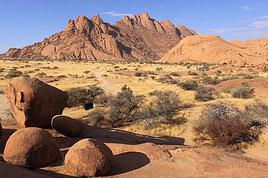
le circuit proposé était génial : Windhoek, Etosha, Epupa Falls, Damaraland (Palmwag, Twyfelfontein), Cape Cross, Spitzkoppe, Swakopmund, Sessriem, Luderitz et la zone diamantifère, la Fish River, et retour à Windhoek. C'est un grand tour, effectué à un rythme soutenu. Pour que ce rythme soit plus "cool", il est sans doute possible d'éviter la Fish River, qui est magnifique, mais qui nécessite énormément de km pour une "simple" vue (la descente dans le canyon étant interdite, sauf pour les randonnées organisées). Luderitz est intéressant pour la zone interdite diamantifère : pas si interdite que ça, puisqu'il est possible de partir en excursion (encadrée) dans cette zone unique.
Quelques observations par rapport aux carnets de voyage vus sur ce site : Etosha : pas grand chose à rajouter, le parc est génial, facile d'accès, extrêmement riche en faune. Le point d'eau de Namutoni est par contre relativement pauvre en animaux. Le plus beau est sans doute Goas, au milieu du parc. Epupa et le Kaokoland sont maintenant accessibles à tous les véhicules (en saison sèche toujours, bien sûr, soit de mai à octobre environ). Nous sommes passés sans problèmes, et avons vu des petites voitures (VW Golf, etc.) également passer. Il faut juste être prudent avec les nombreux lits de rivière cimentés un peu cassants. Du coup la destination est devenue touristique, et... les Himbas sont certes toujours là, toujours parmi les derniers témoins du "matin du monde", mais les groupes de touristes se succèdent dans les villages, et cela commence à ressembler un peu trop à un zoo. Pas très agréable, pour nous, mais surtout pour eux bien sûr. Il est sans doute possible de tenter de nouer des relations plus directes et sincères avec les Himbas, mais la pression touristique a déjà fait son oeuvre... Il ne faut pourtant pas négliger la beauté du site : Epupa, ce sont aussi des chutes grandioses (bon d'accord, je ne connais pas les chutes Victoria), dans un cadre magnifique, et dans une région superbe aussi. le Damaraland : la région de Palmwag, sa terre rouge et ses buissons verts, ses animaux, est magnifique. Twyfelfontein est vraiment intéressant, les Organ Pipes très sympa. Cape Cross : c'est un gros détour (il n'y a pratiquement que ça à voir sur la côte) pour quelques otaries (non je plaisante : près de 100 000), mais l'arrivée par le désert est impressionnante, et puis ces cris, cette odeur... c'est quand même à vivre. le Spitzkoppe : moi, j'adore les rochers, et celui-là est vraiment magnifique Swakopmund : ville-étape, sans intérêt, sauf pour le ravitaillement Sossuvlei (Sessriem) : pour qui ne connaît pas le désert, c'est un vrai choc. Pour les autres (dont moi), c'est aussi un vrai choc... Indispensable. Route 707 (qui conduit de Sessriem au sud, vers Luderitz) : un itinéraire conseillé par Madiza, qui comprend une portion de route incroyable : à droite, des dunes rouges, oranges, avec le sol jaune vif (herbe brûlée), et à gauche des montagnes, avec du sable gris-bleu. Bref indescriptible tellement c'est beau... Luderitz : en fait, intéressant quand on a organisé une balade dans la zone interdite, ce qu'avait fait Madiza pour nous. Super : exploration des anciennes mines de diamants, visite de villes fantômes, chevauchée en 4x4 dans les dunes, etc. Fish River : comme dit plus haut, le site est à couper le souffle, mais on ne peut le voir que d'en haut et sur une petite portion (alors que le canyon fait je crois près de 100 km), donc c'est un peu frustrant d'avoir traversé le pays pour une vision de 1h (un peu plus si on se balade à pied sur la crète). Il existe d'autres pistes pour profiter d'autres vues que la principale, mais il faut un 4x4 pour les parcourir.
Nos hébergements (choisis avec soin et goût par Caroline de Madiza) étaient : à Windhoek : Charlotte's Guesthouse, parfait à Etosha : campings de Namutoni et d'Okaukuejo (de toutes façons, il n'y a pas le choix !) Hobatere Campsite sur la route d'Epupa : un site incroyable, sauvage, mais il faut aimer les conditions spartiates à Epupa, Epupa Campsite (le plus près des chutes) : un peu les uns sur les autres, mais au bord d'un fleuve et sous les palmiers, il est difficile de se plaindre... Palmwag (le camping, pas le lodge malheureusement...) : parfait Xaragu (camping près de Twyfelfontein) : parfait au Spitzkoppe : on a dormi au pied de la montagne, on était sensé payer une entrée pour un camping, mais il n'y avait personne. Mais de camping, il n'y a en fait que des "emplacements" : un recoin de la montagne marqué d'un numéro, sans aucun point d'eau, toilettes, ou barbecue. à Swakopmund : hôtel "A la mer" : parfait à Sessriem : le camping bien sûr, qui ne mérite à notre sens pas tant de critiques : de grands emplacements individuels très bien limités et ombragés, que demander de plus... sur la route 707 : Namtib Farm (là aussi le camping, pas le lodge...). Un site encore incroyable au pied d'une montagne. à Luderitz : hôtel Kratzplatz, parfait toujours Fish River : Canyon Roadhouse (toujours le camping), parfait encore sur la route en remontant vers Windhoek : Anib Lodge (et là c'était vraiment le lodge : génial!)
Je suis bien sûr à votre disposition pour toutes demandes de renseignements supplémentaires. Bon voyage à tous ceux qui ont la chance de découvrir ce pays magique !
Quelques observations par rapport aux carnets de voyage vus sur ce site : Etosha : pas grand chose à rajouter, le parc est génial, facile d'accès, extrêmement riche en faune. Le point d'eau de Namutoni est par contre relativement pauvre en animaux. Le plus beau est sans doute Goas, au milieu du parc. Epupa et le Kaokoland sont maintenant accessibles à tous les véhicules (en saison sèche toujours, bien sûr, soit de mai à octobre environ). Nous sommes passés sans problèmes, et avons vu des petites voitures (VW Golf, etc.) également passer. Il faut juste être prudent avec les nombreux lits de rivière cimentés un peu cassants. Du coup la destination est devenue touristique, et... les Himbas sont certes toujours là, toujours parmi les derniers témoins du "matin du monde", mais les groupes de touristes se succèdent dans les villages, et cela commence à ressembler un peu trop à un zoo. Pas très agréable, pour nous, mais surtout pour eux bien sûr. Il est sans doute possible de tenter de nouer des relations plus directes et sincères avec les Himbas, mais la pression touristique a déjà fait son oeuvre... Il ne faut pourtant pas négliger la beauté du site : Epupa, ce sont aussi des chutes grandioses (bon d'accord, je ne connais pas les chutes Victoria), dans un cadre magnifique, et dans une région superbe aussi. le Damaraland : la région de Palmwag, sa terre rouge et ses buissons verts, ses animaux, est magnifique. Twyfelfontein est vraiment intéressant, les Organ Pipes très sympa. Cape Cross : c'est un gros détour (il n'y a pratiquement que ça à voir sur la côte) pour quelques otaries (non je plaisante : près de 100 000), mais l'arrivée par le désert est impressionnante, et puis ces cris, cette odeur... c'est quand même à vivre. le Spitzkoppe : moi, j'adore les rochers, et celui-là est vraiment magnifique Swakopmund : ville-étape, sans intérêt, sauf pour le ravitaillement Sossuvlei (Sessriem) : pour qui ne connaît pas le désert, c'est un vrai choc. Pour les autres (dont moi), c'est aussi un vrai choc... Indispensable. Route 707 (qui conduit de Sessriem au sud, vers Luderitz) : un itinéraire conseillé par Madiza, qui comprend une portion de route incroyable : à droite, des dunes rouges, oranges, avec le sol jaune vif (herbe brûlée), et à gauche des montagnes, avec du sable gris-bleu. Bref indescriptible tellement c'est beau... Luderitz : en fait, intéressant quand on a organisé une balade dans la zone interdite, ce qu'avait fait Madiza pour nous. Super : exploration des anciennes mines de diamants, visite de villes fantômes, chevauchée en 4x4 dans les dunes, etc. Fish River : comme dit plus haut, le site est à couper le souffle, mais on ne peut le voir que d'en haut et sur une petite portion (alors que le canyon fait je crois près de 100 km), donc c'est un peu frustrant d'avoir traversé le pays pour une vision de 1h (un peu plus si on se balade à pied sur la crète). Il existe d'autres pistes pour profiter d'autres vues que la principale, mais il faut un 4x4 pour les parcourir.
Nos hébergements (choisis avec soin et goût par Caroline de Madiza) étaient : à Windhoek : Charlotte's Guesthouse, parfait à Etosha : campings de Namutoni et d'Okaukuejo (de toutes façons, il n'y a pas le choix !) Hobatere Campsite sur la route d'Epupa : un site incroyable, sauvage, mais il faut aimer les conditions spartiates à Epupa, Epupa Campsite (le plus près des chutes) : un peu les uns sur les autres, mais au bord d'un fleuve et sous les palmiers, il est difficile de se plaindre... Palmwag (le camping, pas le lodge malheureusement...) : parfait Xaragu (camping près de Twyfelfontein) : parfait au Spitzkoppe : on a dormi au pied de la montagne, on était sensé payer une entrée pour un camping, mais il n'y avait personne. Mais de camping, il n'y a en fait que des "emplacements" : un recoin de la montagne marqué d'un numéro, sans aucun point d'eau, toilettes, ou barbecue. à Swakopmund : hôtel "A la mer" : parfait à Sessriem : le camping bien sûr, qui ne mérite à notre sens pas tant de critiques : de grands emplacements individuels très bien limités et ombragés, que demander de plus... sur la route 707 : Namtib Farm (là aussi le camping, pas le lodge...). Un site encore incroyable au pied d'une montagne. à Luderitz : hôtel Kratzplatz, parfait toujours Fish River : Canyon Roadhouse (toujours le camping), parfait encore sur la route en remontant vers Windhoek : Anib Lodge (et là c'était vraiment le lodge : génial!)
Je suis bien sûr à votre disposition pour toutes demandes de renseignements supplémentaires. Bon voyage à tous ceux qui ont la chance de découvrir ce pays magique !
NAMIBIA TRIP 2025: April 24 to May 20: Feel free to comment or ask us any questions about this amazing journey.
>> Find all our photos and videos for each day on our website here: www.montagne-aventure.net
**DAY 1: Thursday, April 24, 2025: Outbound Flights from Lyon to Windhoek via Munich - Visit to Munich:**
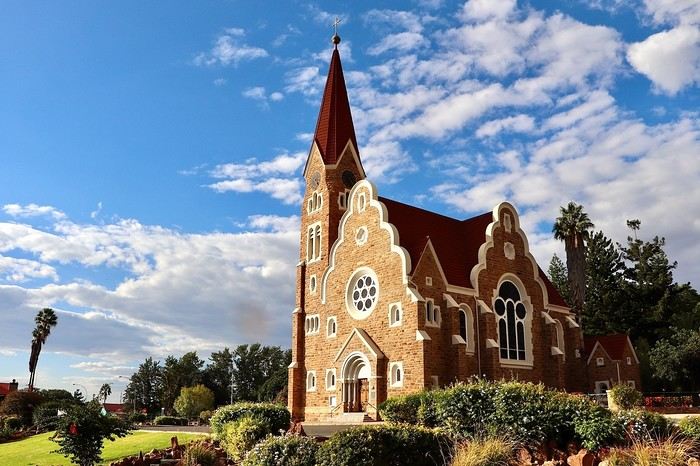
Off we go on a new adventure. The alarm rings at 6:30 AM, the travel bags are packed, and we head to Lyon Airport. We booked our flight tickets with Lufthansa. The first leg to Munich, Germany, is operated by AirBaltic. Departure at 1:05 PM for a 1-hour and 20-minute flight. We arrive at 2:30 PM.
**We now have a 7-hour layover, so we take the opportunity to get some fresh air and explore Munich.** We quickly exit Terminal 2 of the airport and head towards the subway. We buy a group day ticket "Airport-city Day Zone M-5," valid for 2 to 5 people at a price of 30.50 € (instead of 16.30 € per person). We take the S8 line to **Marienplatz** in 35 minutes. **This is the heart of the city.** The weather is overcast, quite cool, but dry. Perfect for a little city trip between two flights while leaving our large luggage in transit at the airport. **Munich is the third-largest German city after Berlin and Hamburg, in the Bavaria region.** **The center has a lot of charm and brings together several religious buildings, easy to explore on foot.** We are impressed by the number of people enjoying these 100% pedestrian streets, which are very pleasant. After Marienplatz, the most famous square with the town hall, we head to the Cathedral of Our Lady, a Gothic church, then continue to **Karlsplatz** and move on to **the food market offering a wide selection of high-end food products in an atmosphere where a certain art of living prevails.** We also visit St. Peter's Church before grabbing a bite to eat. Two good hours were enough for this 10 km city walk. It's time to take the subway back: by 6:30 PM, we are back at the airport. Now, it's time for a bit of waiting and rest. Our second flight is scheduled for 9:35 PM for a 9-hour and 30-minute journey to our final destination in Namibia: **Windhoek.**
> Round-trip flight tickets with Lufthansa from Lyon: 2029 €, or 1,014.50 € per person.
> Lyon Airport parking: 120 €
> Today's expenses: 7 € for 2 pizzas in France / 14 € for the restaurant in Munich / 30.50 € for the daily subway ticket in Munich.
**DAY 2: Friday, April 25, 2024: Arrival in Windhoek, Visit to the Namibian Capital:**
After a 9-hour and 30-minute overnight flight with Discover Airlines, we finally land on Namibian soil just before 7:30 AM. The day is breaking, and the colors are already stunning. We are eager despite the usual fatigue from the flight. The airline was punctual, with friendly staff and good meals, though a bit light. We are the first flight of the day to land, with no more than 15 flights per day here, from 7 AM to 8 PM. We disembark on the tarmac at this airport located in the middle of nowhere, **I finally set foot on African soil for the first time.** We exit among the first from the aircraft to go through the long formalities at the front of the line, as the wait can quickly become endless. Allow at least 5 minutes per person for e-visas. We still wait 45 minutes despite only about twenty people ahead of us. Phew, it's done. We collect our luggage and then withdraw money from an ATM. We make 4 withdrawals of the maximum amount, 2000 NAD $ per withdrawal, for a total of 380 €, or 95.33 € per withdrawal.
Our driver arrives at the same time, perfect timing, we were quick.
We leave the airport at 8:45 AM. By 9:30 AM, we arrive at the **Gracious Whisp vehicle rental agency**, located at the entrance of Windhoek, small and human-sized with a fleet of recent vehicles. More formalities, then a short wait as our vehicle is not yet ready. Time to decompress, catch our breath, and enjoy the very pleasant morning temperature. Not a cloud in sight. Next, a briefing on the vehicle, always with a bit of apprehension due to our approximate English. Allow 45 minutes of explanations, including setting up the roof tent, camping equipment, technical information in case of a flat tire, driving tips in Namibia, and a tour of the 4x4. We have all the necessary equipment for camping: mattresses, sleeping bags, pillows, table, chairs, gas stove, BBQ grill... as well as 2 spare tires, a compressor, a dual tank, and accessories for removing wheels. Off we go, it's time to muster our courage and get behind the wheel. **Heading to SuperSpar Maerua**, fortunately located less than 10 minutes away. We park with the help of a parking attendant; it's very crowded, the space is narrow, but everything goes well despite the cursed right-hand drive. Today's new mission: stock up on groceries. The store is well-stocked with local and imported products, catering to all tastes. We spend 114 € on groceries, from pasta to meat, BBQ lighters to dishwashing products. Two people load our groceries into two carts and transfer them to our vehicle; we feel compelled to leave a tip, 50 NAD $, as we don't have change yet. Now, we head to the hotel, 15 minutes away. Traffic is difficult at a complicated intersection; this will likely be the only traffic jam in Namibia. **We arrive at Kate's Nest Guesthouse & Backpackers around 1:15 PM, quite tired.** We take some well-deserved rest at this recent establishment, quite calm with secure private parking. After a short nap, we enjoy the quiet by the hotel pool. Night falls between 6:30 PM and 7 PM. We eat quietly in our room tonight before starting this long 4x4 road trip in camping mode in the heart of Namibia.
> Today's grocery expenses: 114 € at Super Spar Marua (2395.21 NAD $).
> Round-trip flight tickets with Lufthansa from Lyon: 2029 €, or 1,014.50 € per person.
> Vehicle rental: 4x4 Toyota with roof tent for 24 days: Gracious Whisp Car Rentals: 2,638 € (N$50,640) or **1,319 €** per person - (https://gwcarrentals.com/)
> Distance driven today: 15 km.
> Accommodation: Kate's Nest Guesthouse & Backpackers - 4 Aristotles Street Academia, 9000 Windhoek - 36 € for two for one night.
> Windhoek International Airport website: (https://www.airports.com.na/)
**DAY 3: Saturday, April 26, 2025: Windhoek to Hardap: Mariental Region - Kalahari Desert:**
After a good, restful night, we wake up leisurely around 7 AM. We enjoy the comfort provided by this first and last hotel before 24 nights under the tent.
**We leave Kate's Nest Guesthouse at 8:30 AM to tackle the Namibian roads.** We quickly leave the capital; in just 30 minutes, we find ourselves almost alone in the world. The landscape is dotted with small domes. We leave the **paved B1** quickly to turn left onto the **C15**. **From there, we won't see more than 10 vehicles all day.** After passing through the few houses of **Lekkerwaterpoort**, we tackle our first gravel road. These road sections are limited to 100 km/h, but even at 70 km/h, I find it already challenging. However, I quickly get used to it and gradually pick up speed to reach my cruising speed of around 80 to 90 km/h. **We are on immense straight lines crossing wild expanses as far as the eye can see.** **We come across two baboons, a few ostriches, and numerous cattle and sheep farms.** We pass through the charming village of **Uhlenhorst** with its typical houses and children with broad smiles waving at us. Life here is already very different from Windhoek. **The thermometer rises quickly from 16°C at 8:30 AM to over 28°C in the early afternoon.**
**We arrive at the Hardap Dam reserve at 2 PM.** We stop at the toll booth at the park entrance to pay the entrance fee: 250 NAD $ for 2 people and 1 vehicle. We continue to the dam and then the camp entrance, located a bit further. We had booked in advance, but this place remains little frequented by foreigners.
We take advantage of the hottest hours to rest by the large pool overlooking the immense lake, a very enjoyable moment. Would this be a bit of a vacation?
Around 4:30 PM, we head to the campsite. We overlook this vast water reserve. We arrive first; we will be only 3 vehicles spending the night here. It's time to get to work and set up our equipment for the first time. It takes us a good 20 minutes to set everything up, with a slight apprehension about unfolding the tent. Once this task is done, which we will have to repeat for almost a month, we will become much more efficient over time. Time for rest and contemplation in total silence. The sun gradually sets, and the heat quickly becomes bearable again. Bliss! **This dam is located 20 km northwest of Mariental in an area dotted with conical hills topped with dolerite buttons (Hardap means "hillock" in Nama). It captures the Fish River, which flows south, creating a large lake in the middle of an arid environment. The contrast is striking.** We enjoy our first sunset facing this 360° otherworldly landscape.
Around 7 PM, we start our first BBQ, or "braai" as it's called here. The temperature is perfect. The sun sets, giving way to a star-filled sky of incredible beauty thanks to the absence of any light pollution. The Milky Way will lull us throughout the evening. After some good sausages and potatoes on the BBQ, we head to our roof tent around 9:30 PM with a complete change of scenery in just 24 hours. France already seems so far away...
This campsite has shared showers and toilets, quite clean and functional, as well as a central area with several BBQs and tables. The sites are arranged in a semicircle, each with an electrical outlet. The sites are close to each other but spacious, some slightly shaded. We are only three vehicles tonight, so it's perfectly comfortable and quiet. Not to mention the large pool near the restaurant. Our trip is off to a great start.
> Today's road itinerary: Windhoek > Head south on the B1 to Rehoboth > Turn left onto the C25 then C15 to Stampriet > C20 to Hardap > Full north on the B1 > Then turn left onto the M93 - 5 hours of driving.
> Distance driven today: 354 km.
> Accommodation: Hardap Recreation Resort - 23.3 € for two - Large pool - GR6W+3M2, Hardap Game Reserve, Mariental, Namibia - (http://www.nwr.com.na/resorts/hardap-resort/)
**DAY 4: Sunday, April 27, 2025: Hardap - Brukkaros Volcano - Keetmanshoop - Quivertree Forest Rest Camp**
Our first night under the tent was very pleasant; the little wind quickly calmed down, giving way to absolute silence. The mattress is decent, more comfortable than some nights in Nepal. The length and width give us enough space for maximum comfort, despite my height (1.91 m). We wake up a little before 7 AM as the sun rises, and the lights dazzle us from the start of the day. We pack up the equipment in 30 minutes, quite easily. Then we enjoy the sun, which warms up quickly while we keep our light fleece on.
At 8:30 AM, **we hit the road again, heading south** to our first stop in **Mariental**. We want to do some shopping at SuperSpar, but once we arrive in the parking lot, a young local is fighting with the supermarket security guards and then threatens to throw stones. We don't want to take any risks right at the start, so despite the baton blows he receives, he doesn't stop. We leave empty-handed but fill up with fuel at the Shell station 1 km further. The price per liter is 21.33 NAD $, we fill our 107-liter tank for 107 €. In Namibia, you get served, and they bring the card machine to the window to pay. It's then customary to leave a tip.
We then take the B1 heading due south on a recently renovated road. Around 11:30 AM, we leave it on our right to take **a wild gravel road, the M98**. Just before **Berseba**, we turn right onto a small track, the **D3904 towards Brukkaros Crater up to a camp at 1588 m altitude**. The track then becomes too bumpy. We stop on the counter-slopes where **a wide panorama unfolds over these immense plains as far as the eye can see**. It's 12:15 PM, time for us to eat a rice and tuna salad facing this landscape.
**We are alone in the world until a vehicle arrives and parks next to us.** A bit of apprehension, 4 men head towards us. It turns out to be 4 shepherds looking for a lost foal. The conversation is pleasant, lost in the middle of nowhere. We find ourselves alone again in this absolute silence. **The heat becomes stifling with a good 30°C**. We get back on the road around 1 PM. Back on the B1, **we continue due south to Keetmanshoop**, which we reach around 3 PM. We stop there to do some shopping for 262 NAD $ (12 eggs, a can of tuna, a can of corn, bread, a soda, and a 5-liter water container), or 12.48 €. Two quite insistent children ask us for money or candy at the store exit, yet we give them a small tip, but they continue to cling to the car. Locals parked next to us tell them to leave us alone. Anyway, we finish the trip to **Quivertree Forest**, 15 km away. We will spend the night in this **pleasant farm run by a German**. Upon arrival, as the day before, and as I suppose in the future, we dive straight into the cool pool to relax after all these kilometers. A bliss. Then we take our 4x4 and choose a spot near these famous trees. After the 33°C this afternoon, once 4 PM passed, the temperature drops again and becomes very pleasant. **We are in the middle of the Kokerboom, one of the most interesting and characteristic plants of hot and arid regions. It's not really a tree but a variant of the aloe plant whose botanical name is Aloe Dichotoma. This Kokerboom has a smooth and thick trunk reaching up to 1 m in thickness and 9 m in height. They bloom for the first time at the age of 20 to 30 years.** The flowers are yellow and reach about thirty centimeters during the season between June and July. **They grow mainly in an environment with a high concentration of black rocks absorbing a large amount of heat (38°C). The rocks also serve to anchor the tree with its tentacle-like roots. It also resists frost. Each is between 200 and 300 years old.**
Around 5 PM, we walk to the farm reception to watch the feeding of **two cheetahs**. Magnificent carnivores taking their time to savor their piece of meat. **Then we return near our campsite to enjoy the sunset among these trees. The colors are sublime, as every evening apparently. A magnificent spectacle with colors evolving from yellow to orange then to pink, before giving way once again to a sky filled with thousands of stars.** Our campsite at Quiver Tree Forest Camp is very comfortable; we have a water supply, a stone table, a small lamp, an electrical outlet, a small tree for shade, and a BBQ that we won't use tonight; we'll cook on gas. The sites are far apart, with some shared facilities scattered around, a very beautiful setting. No reservation possible, no need, just show up directly. **The campsite accommodation for 2 people costs 28 €, including the reserve entrance fee of 5 €**. We finish this second bivouac evening around 9:30 PM, time for some reading and sleep in peaceful silence without wind.
> Today's road itinerary: Mariental > B1 heading south to Brukkaros > At Tses turn right towards Berseba via the M98 > Turn right onto the D3904 > 8 km > Brukkaros Volcano (stop at the lower camp as the track is difficult for 1 hour) > Keetmanshoop > Turn left onto the M29 > Quivertree Forest - 4 hours of driving.
> Distance driven today: 371 km.
> Distance walked today: 6 km.
> Today's expenses: Groceries for 12.48 € (262 NAD $) / Fuel for 107 € (1 liter of diesel for 21.33 NAD $).
> Accommodation: Quivertree Forest Rest Camp, P.O. Box 262, Keetmanshoop, Namibia - BBQ, hot showers, toilets, and electricity - No reservation - Pool - 18 €/Person (N$ 340.00 with park entrance) - (http://www.quivertreeforest.com/)
**DAY 5: Monday, April 28, 2025: Quivertree Forest Rest Camp - Giant's Playground - Keetmanshoop - Fish River Canyon - Canyon Roadhouse:**
After an excellent start to the night, we are woken up by the wind shortly before 6 AM, but the sunrise is not far off. We get up at 6:30 AM to enjoy it. The atmosphere is a bit cooler this morning, but the reward is already here.
The adventure continues. At 7:45 AM, we head towards **Giant's Playground**, 4 km away. We take a 3-kilometer walk through this expanse of blocks and igneous rocks.
We continue south at 8:45 AM, passing through Keetmanshoop again where we do some shopping for 25 €, a big stock-up for a good part of the trip: meats, canned goods, pasta, fruits... At 9:30 AM, we take the B4 to Fish River Canyon.
At 11:30 AM, we arrive at the entrance to the NWR park (350 NAD $ entrance for 2 people and 1 vehicle). The track becomes bumpy immediately upon entering the park. After about ten kilometers, we come upon this landscape carved by nature. In the end, it's well worth the detour. We were at the Grand Canyon in the USA exactly (https://www.montagne-aventure.net/2024/04/29/j21-3-juin-2024-grand-canyon-et-lac-powell/) and can thus confirm that this Fish River Canyon is comparable. We make several stops along the southern flank. **Here, nothing is developed; nature is almost in the wild state.** **With 160 km in length, up to 27 km in width, and a depth of 150 m, it is indeed the second-largest canyon in the world.** The history of the canyon is apparent in its different earth layers and stratification: the antiquity of the place is tangible, and the absence of vegetation is surprising. **It consists of two nested canyons, formed at distinct periods. The first distinct layer of schist, sandstone, and eruptive material surrounding the canyon was formed a few two billion years ago, then transformed due to heat and pressure into more solid rock such as gneiss. The inner canyon, carved more recently by the Fish River, has a depth of 270 m.**
We have a picnic once again alone in the world facing this grand panorama at the **Sulphur Spring View Point**. This is where the hiking trail begins, plunging into this narrow canyon, but it is forbidden to venture there alone without a guide. It's 30°C, but a slight wind makes the atmosphere bearable. At 1 PM, we retrace our steps and continue to the **Main View Point** then to the **Hikers View Point**.
In the south of Namibia, the Fish River Canyon, 160 km long, is a true geological wonder: a canyon nested within another canyon, one of the largest in the world. The first sedimentary layers formed two billion years ago; 500 million years ago, a period of tectonic activity caused these layers to crack and tilt, opening a vast canyon in the Earth's crust. The second canyon, with a depth of 270 m, was carved over time by the passage of the Fish River in this new valley.
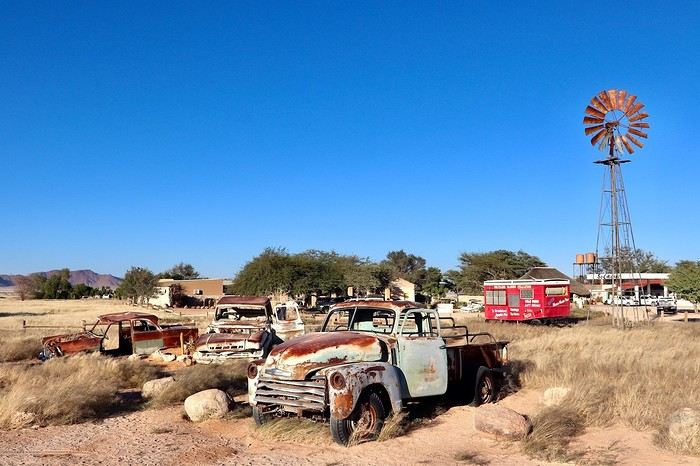
At 3 PM, we arrive at our very charming camp for the evening, the **Canyon Road House**. We fill up with fuel right away because tomorrow we have a long day of isolated driving: 55 liters for 1240 NAD $. Then we settle into the campsite we had previously reserved in France. We are assigned site 2, very well set up under a tree with its BBQ and stone table just steps from the pool. We quickly set up the tent and jump straight into the pool for the relaxation moment of the day. As usual, the water is quite cool, but it's a real pleasure. Then we stroll around this Canyon Road House, which recreates the atmosphere of the roadside inns of the 1950s with old car wrecks and vintage gas pumps in a bygone era. **Around 5:45 PM, we start a short walk leading us to the top of a hill overlooking the wide plateau where we are to watch the sunset.**
And finally, to end this beautiful day, it's time for the braai, with grilled sausages and white beans on the evening menu.
> Park entrance: 150 DN/person + 50 DN/vehicle (18 € for two). It is possible to enter at two access points: Hobas in the north and Ai-Ais in the south.
> Today's road itinerary: M29 > Keetmanshoop > B1 > B4 > C12 (track) > After Holoog turn right onto the D601 (C37 track) > Accommodation on our right (stop just to check in before 6 PM) > Continue 30 km (30 minutes of track) to the viewpoints after Hobas where you must pay the entrance fee. Sunset View Point to the left > Return before sunset as the park closes (best lights at sunrise). 3 hours.
> Distance driven today: 228 km.
> Distance walked today: 10 km.
> Today's expenses: 25 € for groceries / 17 € for the Fish River Canyon park entrance / 58 € for fuel.
> Accommodation: Canyon Roadhouse, Gondwana Collection Namibia – 34.4 € for two - Pool - Near Hobas - (http://www.gondwana-collection.com/fr/accommodation/canyon-road-campsite)
**DAY 6: Tuesday, April 29, 2025: Canyon Roadhouse - Orange River - South African Border - Vista Trail - Gondwana Sperrgebiet Park - Aus:**
The night was excellent in this very comfortable campsite. **We wake up to the sound of birds** before the alarm at 6:45 AM. Our little morning routine starts as the sun rises. **A big day of driving awaits us to the South African border. This will be the southernmost point of our journey.** We hit the road at 8 AM via the C37, pass through **Hobas**, then turn onto the D207 to **Aussenkehr.** **We cross a mountainous barrier with some high peaks and perfect cones. The rock varies from orange to pink to black.**
We then cross a lunar desert as far as the eye can see on a giant dome; the track winds through nowhere without meeting anyone for hours. The landscapes are surprising. **We spot several ostriches and a gemsbok.** In the middle of this endless expanse, we come to an improbable intersection and continue right onto the D278.
In the middle of these arid lands, we come across a green zone: a vast vineyard. At 10:30 AM, **we come across a "Road closed" sign, fortunately, a local resident waves us to continue; a bit stressed, we proceed.** We start to follow the beautiful Orange River. On the other side of the bank, just a few meters away, South Africa is there. It is the second-longest river in Southern Africa, after the Zambezi. It flows over 2,000 km to the Atlantic. After passing through narrow gorges, we regain altitude before starting the descent, gently heading back north.
**We now cross and follow the Fish River, which joins the Orange River further south** **along this gorge dating back millennia.** At exactly noon, we take a lunch break by the Fish River, still without meeting a soul in this landscape between greenery and aridity. The temperature here is cooler with a pleasant 23°C on the banks, the perfect spot. **We continue on the track to Rosh Pinah**, where we find a paved road again. **The section along the Orange River and the Fish River was officially closed, but we were able to pass without any issues, avoiding a detour of at least 3 hours.** Phew. We now drive at high speed (limited to 120 km/h) through these vast spaces. We come across many ostriches after the **dozens of monkeys along the Fish River**. Around 3 PM, 3 km after the very small town of **Aus**, we reach **our campsite for the evening at Klein Aus Vista**. A new **small peaceful haven very well set up**. As usual, after checking in at reception, we jump straight into the beautiful pool to get our well-deserved dose of coolness, another good thermal shock that our bodies appreciate. Once this moment of relaxation is over, we take our 4x4 to reach the campsite located a bit higher, set apart at the foot of a hill that overlooks us.
After setting up, **around 5 PM, we head to the Vista Trail to climb to the top of a mountain overlooking the vast plain that surrounds us at 360°**. It takes about 30 minutes to climb. The place is just magical, **the perfect viewpoint to admire the sunset**. **We fully savor the moment. We also spot one of the few wild horses in the world capable of living in the desert.** Their numbers have decreased in recent years due to predation and drought (around 100 to 150). At 7 PM, we return to the camp, time for the braai and preparing the meal in this peaceful little camp.
In the south of Namibia, the Fish River Canyon, 160 km long, is a true geological wonder: a canyon nested within another canyon, one of the largest in the world. The first sedimentary layers formed two billion years ago; 500 million years ago, a period of tectonic activity caused these layers to crack and tilt, opening a vast canyon in the Earth's crust. The second canyon, with a depth of 270 m, was carved over time by the passage of the Fish River in this new valley.
> Today's road itinerary: 5 hours of driving: D324 heading south (track) > turn right onto the C10 (track) > D316 heading south > turn right onto the C13 > In Aus turn left onto the B4 > Campsite via a track on the left.
> Fuel station: Solitaire or Aus.
> Distance driven today: 398 km.
> Distance walked today: 7 km.
> Accommodation: Klein-Aus Vista Desert Horse Campsite - Farm Klein-Aus No 8 on the B4 main road to Luederitz Aus 9000, Aus, Namibia - (http://www.klein-aus-vista.com/accommodation/desert-horse-campsite/) 17908 420 DN - Water + Shared shower (hot water). No electricity.
**DAY 7: Wednesday, April 30, 2025: Aus - Kolmanskop - Diaz Point - Luderitz - Kanaan Desert:**
We wake up around 6:45 AM, with partly cloudy weather for once; we feel the ocean's influence gradually. But the sun isn't far off. At 7 AM, we leave the campsite heading west towards Luderitz via the B4. **First stop of the day: Kolmanskop, the ghost town we reach at 8:30 AM**, entry costs 180 NAD $ per person. We discover this **timeless place** in 1.5 hours, moving from building to building amidst violent sand-laden gusts of wind. There's a lot of charm in these different living spaces. **The sand quickly reclaimed the place after this mining town was abandoned.** This was once the headquarters of Consolidated Diamond Mines. It's hard to believe that this former town, where the diamond industry once flourished, had a hospital, a bowling alley, and a theater. The decline in diamond sales after World War II and the discovery of richer deposits put an end to this golden age. By 1956, the town was already completely deserted, and the sand had reclaimed its rights. **These dilapidated buildings swallowed by shifting dunes have something surreal about them.**
At 10:15 AM, we hit the road again **heading to Luderitz, 22 km away**, and first to **Diaz Point** **facing the Atlantic Ocean**. It's a wind-swept peninsula with its characteristic red and white lighthouse. There's a campsite and a coffee shop on site, but the place doesn't inspire rest without shade or shelter from the wind. We return to the city via the D701 track that runs along the ocean, be careful at low tide. We come across **a few fishermen and a fox as well as flamingos.**
We walk through the few streets of the city, much smaller than I imagined, then climb to the **famous little Lutheran church that overlooks the city, the Felsenkirchr.** **The wind blows very strongly here, and the sand is omnipresent, surrounded by the Namib Desert and the southern Atlantic coast.** **A German colonial relic barely touched by the 21st century, Luderitz seems frozen in the past, giving it both a gloomy and a certain charm. In short, it's certainly one of the most incongruous places in Africa.**
At 1:15 PM, just before leaving Luderitz, we do some shopping for 20.50 € and fill up with fuel: 61.50 €, 1290 NAD $ for 61 liters (21.18 $ per liter).
**We return via the B4 to Aus** (paved), **then via rougher tracks**, the C13 then the D707, magnificent as it runs along a mountain range with multiple colors on our right and an endless flat desert on the other side.
To access our campsite for the evening, we must take a **narrow private track for 7 km** on our right to emerge, in this total vastness, at the **isolated Kanaan Desert Retreat on a small hill**. I don't have time today to jump into the pool near the reception; we arrive at 5 PM at 8 small, isolated, and unique sites with a small kitchen, a shower, and a private toilet under a small tarp shelter. **A crazy charm with a unique view...** **This will be my favorite accommodation of this trip. The photos speak for themselves.** We jump into the outdoor shower while savoring the landscape, then prepare our evening braai while enjoying the colors fading, facing this plateau with bushes turning a vivid orange. **A moment that will remain etched for life.** **Savanna atmosphere under a thin emerging moon. Every minute offers different colors. Facing our meal, we have a natural giant screen.**
We end this day contemplating the stars and admire this thin orange moon setting on the horizon (8:42 PM).
**Ghost town just before Luderitz: Kolmanskop** (open from 8 AM to 3 PM - N$ 180 p.p – 9 €). Once, Kolmanskoppe was organized around diamond mining. After finding new, more prolific spots, the town was abandoned and is now a ghost town. The sand and dunes have reclaimed their rights and buried everything humans had built. Houses, train station, bakery, everything has been covered by sand, which passes through the windows, even though they are 1 meter high.
> Today's road itinerary: 5h30: B4 to Luderitz (paved) > Round trip > Kolmanskop on the left > Return via the previous campsite > Then C13 (track) > Turn left D707 (track) > Then track to the right to the campsite.
> Distance driven today: 438 km.
> Distance walked today: 8 km.
> Today's expenses: Groceries at the Spar in Luderitz for 20.50 € / Fuel fill-up in Luderitz for 61.50 €.
> Official Kolmanskop website: (https://kolmanskuppe.com) (open from 8 AM to 1 PM - N$ 180 p.p – 9 €).
> Accommodation: Night at the south of the Namibrand Nature Reserve: Kanaan Desert Retreat – 26.5 € for two - (http://www.kanaannamibia.com/) - Farm 104 Karas 9000 - Sanitary facilities + BBQ + Water + Pool - No electricity - My favorite accommodation of this trip.
**DAY 8: Thursday, May 1, 2025: Kanaan Desert Retreat - Namib Desert - Crossing the Namibrand Nature Reserve – Sesriem Canyon - Elim Dune - Little Sossus Lodge**
After a cooler night than the previous ones with about 10°C, we wake up around 7 AM. We admire, as usual, the sunrise between the desert and the mountains. **The spot from last night was truly perfect, isolated from the world, in total serenity, with a wake-up call to the sound of birds.**
We hit the road a little after 8 AM, heading north via the D707 to Spes Bona, then the gravel road C27 via Betta to Sesriem. **The landscapes roll by and dazzle us.** **We are right in the heart of the Namibrand reserve**, coming across numerous **zebras**, **impalas**, **ruminants that reproduce in large numbers**, and **gemsboks**. At noon, we stop in the shade of a tree to eat. The spot is so romantic facing orange arid mountains and a vast green plateau. **A landscape full of contrasts, timeless and silent.**
**The Namib Desert is the oldest on the planet; its name means "vast arid plain," and it also gave its name to the entire country: Namibia.** The majority of these arid and semi-arid lands dotted with viewpoints are part of the Namib-Naukluft National Park, which covers 23,000 km².
At 1 PM, we enter the Sossusvlei park. We start with the **Sesriem Canyon**, which is 3 km long and 30 m deep. We enter it with a short 1-hour hike into its depths. **It was carved by the Tsauchab River in an agglomerate of sand and pebbles over 15 million years old.** We retrace our steps back to Sesriem, which means "six belts," referring to the number of leather belts (from ox wagons) needed to draw water from the canyon. This remote locality is mainly the gateway to Sossusvlei but offers a gas station and some accommodations. For our part, we sleep 40 km away tonight.
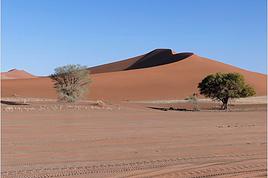
**We then move on to Elim Dune.** It takes about 45 minutes of walking to reach its summit, and the climb is very breath-taking as we progress in the sand where we almost slide back with each step. **A first grand 360° panorama unfolds. The ochre color of the sand contrasts completely with the yellow plain and the brown and black mountains in the distance.**
At 3:15 PM, we start the descent facing Sesriem. We were completely alone once again on this dune. **These Namib dunes are composed of colored quartzite sand, presenting hues ranging from cream to orange and from red to purple. Unlike the ancient dunes of the Kalahari, these move with the wind and adopt distinct, ever-changing shapes.** Star dunes resemble stars seen from above, while transverse dunes, like those on the coast south of Walvis Bay, stand perpendicular to the prevailing southwest wind. The most stable dunes, which thus have the most vegetation, are parabolic dunes, due to the variability of the winds. Longitudinal (seif) dunes measure up to 100 m in height, while barchan dunes, crescent-shaped and predominant at the extreme north of the Skeleton Coast and south of Luderitz, are the most mobile, created by unidirectional winds.
**We get back on the road for 45 minutes to our campsite for the evening, Little Sossus, which we reach at 5 PM**, via C27 then right onto C19. As often upon our arrival, I jump into the cool pool to relax after all this driving, then we proceed to set up the camp. As the day before, the campsite consists of 10 fairly distant sites, with private sanitary facilities and a small roof. We are delighted with this crazy charm. The hot water for our shower is wood-heated: a Namibian lights it every evening around 5 PM.
For a change, or not, the menu features a small BBQ with pork ribs and pasta, facing another sunset, this time with partial cloud cover giving equally splendid colors. Time for a well-deserved rest after long corrugated tracks covered in our 4x4 today.
> Today's road itinerary: 4h45 of driving: Find the D707 and head north (track) > At Spesbona turn left onto the C27 (track) > At Sesriem after entering the park, turn left following View Point Sesriem > Continue 4.5 km to the Sesriem Canyon Parking > Return then head towards Elim Dune > Exit the park then take the D826 > Turn right onto the C19 heading SE > Turn right facing the D854 to the campsite (campsite closes at 7 PM).
> Distance driven today: 272 km.
> Distance walked today: 8 km.
> Today's expenses: Entry to the Sossusvlei Namib-Naukluft Park: 17 € for two (with one car).
> Accommodation: Little Sossus Lodge – 35 € for two - At the junction of the C19 and D854 roads Maltahohe 9000, Maltahohe, Namibia - (http://www.littlesossus.net/) - Pool + Private bathroom + Hot water + Electricity + BBQ + Grocery store (bread to order the day before).
**DAY 9: Friday, May 2, 2025: Little Sossus Lodge - Namib-Naukluft National Park – Sesriem - Sossusvlei - Big Daddy – Deadvlei - Tsauchab River Camp**
Today we start the day early to tackle **the famous dunes of Sossusvlei at first light**. The alarm goes off at 6 AM to leave the camp at 6:45 AM. The wind is blowing quite strongly in gusts this morning, but it only woke us up a quarter of an hour before sunrise. The park opens at 7:15 AM. We start with a small encounter: a friendly **jackal lounging by the roadside.**
We first have to cover the 40 km of track to Sesriem, pay the entrance fee (350 NAD $), and drive 65 km on a paved road this time to reach the **vast salt pan (a lake whose sediments are made of salts) of Sossusvlei**. **It appears amidst the gigantic red dunes that rise on either side. The wind constantly changes the shape of the dunes, as well as their colors, which vary with the light. The setting is breathtaking, giving an impression of immensity and timeless grandeur.**
The paved road ends; the last 4 kilometers become technical and are reserved for 4x4s. Phew, I pass without any problems, though not without stress, switching to L4 mode. **We start the ascent to Big Daddy at 8:45 AM, 325 m of elevation gain in the sand nonetheless.** We climb at an excellent speed despite the strong wind, in exactly 1 hour. At 9:45 AM, we are at the summit of what will remain etched for a long time. The 360° view is simply unimaginable; you have to experience it to believe it. The wind blows violently up there, **it feels like being in the high mountains, on a snow ridge, with a strong transport of sand. The atmosphere is magical.** We start the descent running barefoot in the steep sand.
**We then move on to its neighbor, Deadvlei.** **Here, petrified trees stand in the "vlei" (basin) with their dried branches casting desolate shadows on the white ground. The juxtaposition of the deep blue sky and the towering dunes is captivating.**
We return to the 4x4 parking at 11 AM, the stress rises again for the sandy track passage. We retrace our steps and stop at **Dune 45**.
At noon, we take the opportunity to picnic at the foot of **the beautiful Dune 40**, where there is already no one left. We enjoy the quiet again, well, almost, as the wind remains omnipresent.
At 1 PM, we return to **Sesriem**, where we fill up with fuel (21.15 NAD $ per liter), totaling 1630 for 77 liters (78 €), and do some shopping for 245 NAD $ (two nice pieces of pork, 2 cans, 2 sandwiches for tomorrow, and 1 soda), which is 12.48 €. It's 27°C. We hit the road again, heading to a new destination at 2 PM. We take the C19 back to Little Sossus where we spent the night, then turn left onto the gravel road D854 for about 40 km to **Tsauchab River camp**. Finally, we won't be sleeping here; we are redirected 7 km downstream to **Naukluft View Camp**, which also belongs to Tsauchab River Camp.
We arrive at 4 PM, and thankfully, the fatigue was starting to set in. **Our campsite is located under a small forest, providing some protection from the wind that blew strongly all day. The calm does us a world of good. Once again, a lot of charm**, with very spaced-out sites without any visibility. We can't wait to take our shower. It will be possible from 5 PM with, as the day before, water heated by a wood fire. Time to prepare the campsite for the night. And on the menu, a braai with two superb pieces of pork bought in Sesriem and fries!!!!
**The Namib Desert**
An impressive coastal desert stretching from the Atlantic to a high plateau inland, the narrow Namib Desert runs along the southwest African coast for about 1,300 km. **Considered one of the oldest deserts in the world**, it is bordered to the north by the Kaokoland Desert, which extends into Angola, and to the south by South Africa's Karoo. The narrow Namib is mostly less than 160 km wide. Despite this, it is considered to consist of three sections: the coastal strip influenced by the Atlantic; the Outer Namib, occupying what remains of the western half; and the Inner Namib, comprising the eastern half of the desert. Generally called the Skeleton Coast, the coastal Namib receives almost no rain and depends on regular marine fogs for moisture. From sea level, the terrain rises to 900 m, where the desert meets the base of the Great Escarpment to the east. In the Inner Namib, average annual rainfall is only about 50 mm.
The dryness is such a characteristic of the Namib that it is thought to have been in this arid state for at least 55 million years. It is all the more surprising to learn that animals such as vipers, geckos, zebras, and elephants live in this desert. Some areas of the Namib are also rich in flora, including Welwitschia mirabilis, which grows near the ground with seemingly exhausted leaves, extracting moisture from marine fogs and can live over 1,000 years. In the southern Namib, some dunes are up to 32 km long and 240 m high.
**The frequent fog of the Skeleton Coast:** Driving north along the coast of Namibia, the cold Benguela Current in the Atlantic cools the moist air above the ocean, which, upon meeting the warm desert air, leads to the formation of thick fog banks that drift up to 100 km into the center of the Namib before evaporating under the sun.
> Today's road itinerary: 4 hours of driving: C19 towards Sesriem (track) > D826 (paved) > Foot of Big Daddy via a technical sandy track > Return via the same route > D854 to Tsauchab.
> Gas station: Sesriem.
> Distance driven today: 254 km.
> Distance walked today: 12 km.
> Today's expenses: Park entry at Sesriem for 2 people: 17 € / Fuel fill-up: 78 € / Groceries at Sesriem gas station: 12 € (245 NAD $).
> Accommodation: Tsauchab River Camp - Naukluft View Camp - D054 & D850 GPS: S24 26' 37" E16 10' 11" Sossusvlei 22007, Maltahohe, Namibia - BBQ + Private sanitary facilities + Water - www.tsauchab.com
**DAY 10: Saturday, May 3, 2025: Tsauchab River Camp - Naukluft National Park - Olive Trail Hike (10 km) - Ababis Guest Farm**
We pack up the camp at 8 AM and continue our road trip north via the D854, a bumpy track with many corrugated sections. It's cool this morning, 12°C.
**We enter the Naukluft massif, discovering landscapes with very different terrain than before.** We first need to check in at the campsite, 13 km from the entrance at the end of the track: 350 NAD $ for 2 people and 1 vehicle, then return 4 km back. **On the agenda is the lovely Olive Trail, a 10 km hiking loop that starts 4 km northwest of the park office**, along the D854 that we follow. At 9:45 AM, the hike begins with a fairly steep ascent (about 45 minutes) among the **wild olive trees** from which the trail gets its name. **At the summit, we enjoy a view that embraces the Naukluft Valley.** We then turn east and gradually descend into a deep valley, passing over sometimes slippery rocks. We have a snack around 11:30 AM in these small gorges. **Further on, to cross the wall of a canyon in front of us, some chains are fixed to the rock to help us pass.** We finish this superb loop clockwise at 1:15 PM, taking 3.5 hours including 30 minutes of breaks. We only crossed a small group of 3 people on this wild adventure far from everything. At 1:45 PM, we exit the park and take the **D854 track north to Bullsport**. From there, we turn left and take the C14, which **runs along the bed of the Tsondab River.**
**We arrive at our campsite for the evening, Ababis Guest Farm, at 3 PM.** Quite early for once, allowing us to rest a bit in this peaceful farm where many sheep wander around us. We also enjoy the pool under a magnificent sun, less hot than the previous days, it's 22°C. The camp has only 4 spaced-out sites around shared sanitary facilities. **We are in the middle of a vast plain facing the Naukluft massif mountains.** We will have another beautiful sunset on these mountains. For the first time on this trip, **we will be completely alone at this campsite.** **We haven't encountered many people today**, just 3 during the hike and fewer than 10 vehicles all day.
> Today's road itinerary: Head north on the D854 (track) > Turn left to enter the Naukfluft National Park > Continue on the track then turn right to the Olive Trail hike parking lot (1 hour for 45 km). Return to the D854 and continue north > At Bullsport turn left onto the C14 to Ababis (still a track) > The camp is located on the left facing the D1261 (1 hour for 60 km from Olive Trail). Total: 2 hours of driving for 100 km.
> Gas station: No gas station on the route, except in Solitaire.
> Distance driven today: 115 km.
> Distance walked today: 13 km.
> Accommodation: Ababis Gaestefarm - Night booked by email – payment on site: (https://www.ababis-gaestefarm.de/) - P.O.Box 1004, Maltahöhe - N$ 300.00 per person
**DAY 11: Sunday, May 4, 2025: Ababis Gaestefarm - Namib-Naukluft National Park – Solitaire - Gaub Pass - Kuiseb Canyon - Moon Landscape - Walvis Bay**
The night was, for the first time since the start of this road trip, quite difficult. A strong wind accompanied us all night, making the tent flap constantly. A racket that drove us crazy. We still managed to sleep a few hours. The morning sun brings back our smiles. We hit the road for this new stage a little before 7:45 AM.
We start the day with a first stop less than 15 km away **on the C14 in Solitaire** at 8:15 AM. **This town is lost in the middle of nowhere with its small gas station with a western atmosphere adorned with rusted and sand-covered car wrecks.** After a quick supply stop: 86 NAD $, or 4 € for 1 water container and a box of cookies, we continue north still on the C14, **crossing the Tropic of Capricorn** then devouring this **magnificent track up to Gaub Pass**. **A succession of narrow gorges, turns, climbs, and descents breaking the monotony of the previous long straight lines.** We are right in the heart of no man's land for 200 km. We then start the descent to the **Kuiseb Canyon. It houses the wide bed of the eponymous river, dry almost all year.** Even when it flows for 2 to 3 weeks during the rainy season, it doesn't go beyond Gobabeb and then seeps into the sand. **The drinking water that supplies Walvis Bay is pumped at Rooibank from this underground water table.** **We now cross the Kuiseb Desert where impressive dunes roll down.** We make a short stop at a **natural rock arch** reminding us of our (https://www.montagne-aventure.net/2024/04/29/j19-1-juin-2024-canyonlands-national-park-et-arches-national-park/). Then we gradually descend towards **Walvis Bay** where we will spend the night. At noon, we enter the **Dorob National Park**. The thermometer drops 10°C in 10 minutes as we get closer to the Atlantic Ocean.
At 12:45 PM, much earlier than initially planned, we arrive at the **Moon Landscape** (View Point 4, free) to have a snack, via a very recent surprising dual carriageway in the middle of nowhere, then via the C28. We are again in the hinterlands, the temperature has soared: 30°C without a bit of shade. Even if the colors and the panorama must be exceptional at sunrise or sunset, the detour for this 360° panorama is still worth it. Extreme aridity as far as the eye can see. The place lives up to its name; it really feels like being on the moon. We get back on the road at 1:30 PM via the D1991, C28, then again the A2, which is very new. The latter runs along the beautiful dunes up to the **Dune 7**, where we make another stop.
Then we head towards our final destination of the day, **Walvis Bay. Its port is sheltered by a sand spit, a natural breakwater that protects the city from the powerful assaults of the ocean. Its port was long a strategic place: claimed by the Cape Colony in 1795, it was officially annexed by the British in 1878 to counter Germany's ambitions in the region. A colony of fur seals, pelicans, flamingos, and whale terns have made it their home.**
We do a big grocery shopping at the Spar located in the center for 66 €; it's very easy to park there. Then we fill up with fuel at an Engen station right across for 1117 NAD $ for 54 liters (20.6 NAD $ per liter), which is 54 €. We then **enjoy the seaside in the Lagoon neighborhood**, where it's also easy to park. After kilometers in the desert, **this cool break is more than welcome. The outside temperature is 22°C. In the distance, we can clearly see the clouds lingering over Swakopmund.**
We take the 4x4 one last time to the **Lagoon Chalets where we will spend the night**. The spot is well set up and surprising in the heart of a residential neighborhood. The sites are quite large, separated by fences around very comfortable shared sanitary facilities. BBQ, electricity, and shaded area. We settle in quietly before going out on foot to watch the **sunset over the Pacific Ocean along Lagoon Promenade Road**. We can still see this impressive persistent mist in the distance. The neighborhood is very peaceful, certainly without much charm, but with a very well-developed seafront that inspires relaxation after kilometers without meeting anyone in inhospitable lands. We end the day with our traditional braai: grilled chicken thighs and sautéed potatoes in the coolness of a starry sky.
> Today's road itinerary: 5h30 of driving (or 3h30 of driving for 250 km without the Moon Landscape): Head north on the C14 > Cross the Tropic of Capricorn > Gaub Pass > Kuiseb Canyon on our left in a round trip > Continue to Green Valley and leave the C14 to the right on the D1984 > Turn right on the C28 > Then left D1991 to Moon Landscape D1991 View Point 4 > Return via the same road and stop at Dune 7 for sunset > Walvis Bay.
> Gas station: Solitaire or Walvis Bay.
> Distance driven today: 372 km.
> Distance walked today: 5 km.
> Today's expenses: Fuel fill-up for 54 € + Groceries for 66 € at Spar.
> Accommodation: Walvis Bay: Lagoon Chalets – 36.6 € for two - (http://www.lagoonchaletswb.com/) - 8th Road West, Meersig Meersig 9000, Walvis Bay, Namibia - BBQ – Electricity – Shared sanitary facilities.
**DAY 12: Monday, May 5, 2025: Walvis Bay - Swakopmund - Round Trip to Cape Cross (seals) - Wreck of the Zeila en route - Henties Bay - Spitzkoppe Tented Camp & Campsite**
After an excellent night, a bit cooler and more humid than usual, we wake up around 7 AM and leave the camp at 7:45 AM to **follow the Atlantic coast heading north**. We thus leave **Walvis Bay**, a very pleasant stopover town, and follow the ocean via the B2. **We enter the mist and Swakopmund** at 8:40 AM, parking **near the lighthouse**. The atmosphere is very quiet, the streets seem dead with large empty parking lots and very little traffic, but the few open shops are filled with expatriates enjoying their breakfasts, French bakeries, cafes, travel agencies... **We are in this Benguela Current, a fast cold ocean current that flows from South Africa, up the coasts of Namibia and Angola, towards the northwest to join a warm equatorial current. Hence the supply of very fish-rich waters and this tenacious mist depending on the seasons. In the northern part of the Namib Desert, fogs are frequent during the southern winter. It's almost the only source of moisture since the city of Swakopmund receives, on average, only 11 liters of water per m² in December and January.**
**Swakopmund is wedged between the dunes and the Atlantic rollers. It is the Namibian capital of adventure activities and has a ghostly colonial remnant. With its German architecture, its seaside promenade, it resembles a seaside town of the North Sea or the Baltic.** It is also a bustling African city. **Nearly two-thirds of Swakopmund's population live in Mondesa, a township created during apartheid, northeast of the city center, a legacy of the South African mandate.** The heart of the city is located in the area of the pier, at the foot of the lighthouse, better known as the Mole. During the South African occupation of Swakopmund, the port took a back seat to Walvis Bay.
Continuing on this C34, sometimes on salt, we come across the famous **wreck of the Zeila, stranded in 2008**, on our left. We can see it through the thick fog, being very close to the beach. It's 10:15 AM. Further on, Henties Bay is a bay that attracts many fishermen; it's teeming with vehicles equipped with fishing rods. Besides its fish-rich waters, it enjoys a relaxed atmosphere and a large beach suitable for walks.
We continue further north, heading to Cape Cross, this time a round trip because we will turn off later here in Henties Bay to reach Spitzkoppe via good gravel roads that are quiet alternatives to the very busy paved B2 further south. **Henties Bay is part of the Dorob National Park, a multi-purpose park protecting coastal ecosystems and hosting the many renowned recreational activities of the region. The part of the coast north of Swakopmund up to the Ugab is particularly popular with fishermen who come in droves to fish for saltwater fish.** The small concrete buildings spaced at regular intervals are actually toilets for fishermen and campers. The coastline is also dotted with world-renowned surf spots.
Even before arriving, we can already smell it before we come across thousands of seals (population in 2021: 1.5 million). **The Cape Cross Seal Reserve, the most renowned on the Namibian coast, is home to the most famous breeding colony of fur seals, which seems to take full advantage of the high concentrations of fish present in the icy waters of the Benguela Current. We are impressed by the sight of these 100,000 pinnipeds lounging on the beach and frolicking in the waves.** We have a picnic a little away from the smells facing the ocean in the sun.
At 12:45 PM, it's time to hit the road again. We retrace our steps back to Henties Bay. We stop there to do another big grocery run before not encountering any big cities for many days. We will only buy fresh items day by day until the end of the trip; we have 23 € worth. **In the space of 30 minutes, we go from 15 to 36°C. The thermal shock with an amplitude of more than 20°C.** At 1:45 PM, we hit the road again via the D1918, then we try a very small track on our left, the D1925. It becomes narrow and rough; I have a bit of apprehension. We arrive at a gate to open in the middle of nowhere, then young children run up to us asking for water or food... We then drive to **Spitzkoppe. The arrival right in front of the mountains is majestic, off the beaten path. This mountain appears in the distance like a mirage above the dusty plains of southern Damaraland.** We come across a second gate held by a guard. We enter the "Community Camp" campsite without realizing it through the west entrance. We are given a small paper, then we go to the reception passing **at the foot of these gigantic, magnificent rocks.** Once at the reception, we are informed that this is not the camp we had booked. Ours is located just a little further, and in the end, it's better because the latter was packed. We were able to cross the park very close to these rocks without paying. We exit through the main entrance; 5 Himba children cling to our doors and trunk asking for bread and food again. We continue despite them staying attached, worried about hurting them. Phew, more fear than harm. We cross the few houses and arrive at the right camp at 4:30 PM, the Spitzkoppe Tented & Campsite. The spot is much quieter and well set up. We have site C12, cozy to perfection with its sink, a private shower and toilet, as well as electricity, under the shade of a tree and facing the mountains. The sunset and sunrise will be perfect. We set up the tent and, without delay, head to the pool for a big dose of coolness. Then it's time to prepare the BBQ and **contemplate the fading lights on the Spitzkoppe massif.**
> Today's road itinerary: 5 hours of driving: Head north on the B2 (paved) along the ocean > Swakopmund > C34 (paved) still heading north > On the left, the wreck of the Zeila before Henties Bay > Cape Cross round trip > Henties Bay > D1916 heading east (track) > Turn left onto D3716 > Turn left to the campsite.
> Gas station: Swakopmund or Henties Bay.
> Distance driven today: 344 km.
> Distance walked today: 6 km.
> Today's expenses: Groceries in Henties Bay: 23 € + Cape Cross park entry: 17 €.
> Accommodation: Spitzkoppe Tented Camp & Campsite - Spitzkoppe River Valley 00000, Spitzkoppe river valley, Namibia - (http://spitzkoppemountaincamp.com/) - 26 € - Pool - BBQ - Shower and toilet.
**DAY 13: Tuesday, May 6, 2025: Spitzkoppe - Rock Pools - Uis**
It's 6:45 AM, **we wake up at the foot of one of the most emblematic landscapes of the country, Spitzkoppe, which towers over the valley at 1,728 m.** **The Spitzkoppe massif, "pointed hat" in Afrikaans, is actually a set of three rock formations: Big Spitzkoppe, the granite domes of the Pontok Mountains that surround it, and Little Spitzkoppe, to the southwest. It was first climbed in 1946 and has never stopped attracting experienced climbers; it remains one of the most challenging ascents in the country. The climate in the region is hot**, so try to visit during the cooler months, as it can quickly reach 36°C in the sun in the afternoon. **Spitzkoppe is particularly striking at dusk, as it was last night, and at dawn this morning when the low light sets the rocks ablaze with red and orange hues. The spectacle is unique.**
We re-enter the park managed by the local community (160 NAD $ per person), then start with the **arch sector**. We quietly enjoy all the viewpoints under perfect orange colors. We leave this magnificent spot, reminding us of (https://www.montagne-aventure.net/2024/04/29/j19-1-juin-2024-canyonlands-national-park-et-arches-national-park/), but with much less crowding here. Around 10 AM, we head closer to these mythical peaks, including the main one nicknamed the Matterhorn of Namibia. Then we finish with the **ascent of the rock above Rock Pool. The 360° view of the park is a must-see. Small natural pools carved into the rock bring a bit of water to this arid and rocky landscape.** The wind blows strongly up there, and during a photo shoot with a tripod, it falls forward right onto the lens glass, cracking it... Frustration and shouts, these will be the last quality photos of this trip, and a new bill to pay when we return to replace it... Disgusted.
We continue to **Bushmans Paradise**, have a lunch break in the shade of a rock before hitting the road again around 12:30 PM after thoroughly exploring the park, feeling weakened and sad about my passion: photography...
We fill up with fuel as soon as we arrive in Uis at the price of 21 NAD $ per liter, a total of 1021 NAD $ for 50 liters (52 € by card). **Uis is a former mining town. Tin mining ceased in the early 1990s, but the high white mountain where the ore was dumped is clearly visible. The region is rich in amethysts, Brandberg crystals, and other semi-precious stones; we come across many vendors on the roadside.**
We then head to our final destination of the day, the **Daureb Isib Restcamp**. We arrive quite early for once at 2:45 PM in the heat, but the camp is just perfectly set up, surely the most upscale we will have during this trip. We are in a fortunately shaded area under palm leaves, with a table, chairs with cushions, a sink, a hot shower, toilets, a beautiful pool, and of course our private BBQ. Perfect for regaining a bit of a smile after the fall of my DSLR camera. **We are facing the Brandberg massif, the "fire mountain" in Afrikaans, dominated by Königstein (2,573 m), the highest peak in Namibia.** **The Brandberg owes its name to the reddish-orange glow that forms on its slopes at dawn and dusk, when the sun's rays awaken its red granite faces studded with crystals. It also hides a real treasure inside, as it contains an exceptional concentration of prehistoric rock art**, mainly paintings and some petroglyphs, including the most famous of them, the **White Lady in the Tsisab Gorge**. There are over 43,000 in total, dating back 2,000 to 4,000 years, scattered in hundreds of crevices around the mountain.
Time for the usual swim, laundry, and evening cooking. On the braai menu, local sausages with cheese pasta and leftovers for a good salad the next day.
> Today's road itinerary: 1h45: Head north on the D3716 > Then D1930 (gravel and sand track) to Uis.
> Gas station: Uis.
> Distance driven today: 113 km.
> Distance walked today: 6 km.
> Today's expenses: Fuel fill-up in Uis for 52 € (1,021 NAD $).
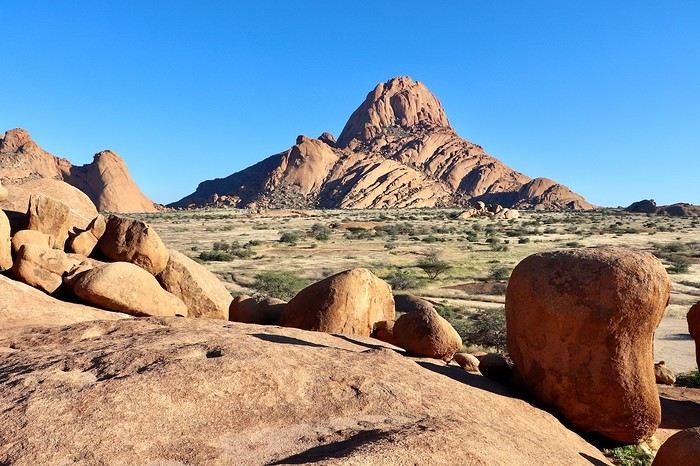
> Accommodation: Daureb Isib Restcamp - Erf 672 C/O 3rd & 4th Avenue Uis 9000, Uis, Namibia - (http://www.daurebisib.com/) – 31 € - Pool. Comfort with private bathroom + electricity + Wi-Fi at the restaurant. Clear sky for a beautiful starry night.
**DAY 14: Wednesday, May 7, 2025: Brandberg (Namibia's Highest Mountain) - Damaraland:**
**The Brandberg massif is an isolated, dome-shaped mountain, an inselberg, that towers over the gravel plains scorched by the sun of the Namib Desert to the northwest. It measures 23 km long and 20 km wide. It is the highest point in Namibia at 2,573 meters.**
This massif formed about 130 million years ago when a gigantic viscous mass of magma from deep within the Earth's crust rose through the surrounding rock layers before solidifying. Later, the granite mass was exposed by the erosion of the surrounding rocks.
**The Brandberg is the highest mountain in Namibia, peaking at an altitude of 2,573 m. The indigenous San people call it the "burning mountain," as it appears to glow with a red light at sunset. With its considerable height and width, this massif influences the local climate, attracting more rain on its slopes than the desert below.** The rain seeps through the springs. Unique animal and plant species thrive in this high-altitude environment, and prehistoric paintings adorn the rock faces hidden in the ravines around the base of the mountain.
The first night was also hot since the start of this trip, the thermometer did not drop below 20°C. We wake up gently around 8 AM, a pleasant sleep-in, the sun is already out. After a quick morning cleanup of the 4x4, we have time today, we hit the road at 9:30 AM, getting lost in the Brandberg massif. We are now in the **Damaraland, which stretches from the majestic rock formations of the Brandberg in the south, where we are today, to the bushy expanses at the foot of the rugged mountains of Sesfontein in the north, where we will be tomorrow. It is the perfect destination for wildlife and flora observation.**
We take the track heading towards the **White Lady**, but we want an alternative to this guided visit only. So, just before arriving, we turn right towards a viewpoint named on Google Maps **Rastplatz**. We come across **small Himba villages, living in extreme poverty with no natural resources; the inhabitants ask for water with every passing vehicle...** A bit further, we encounter about ten **ostriches** in the middle of the track, magnificent, as we get closer to the mountains in the background, and a few meters further, **a herd of Oryx**. Then we approach the **bed of the Ugab River**. We then go back and have a snack in the middle of nowhere, under the shade of our 4x4, facing the mountainous massif. We get back on the road around noon, while the temperature is at its peak in this very hot region, 35°C on the gauge with very dry air. We go up the C35 slightly then turn left onto the small track D2319 until we reach the Ugab bed again. Back to Uis in the mid-afternoon.
We did not book the same campsite as the previous night; today we are at the Brandberg Rest Camp. Unfortunately, the camp is not at the same level as the previous one, which was perfect. But the price is also much lower. The sites are next to each other, separated by small fences behind the main building. But it will do just fine. We have our BBQ and electricity, the shared sanitary facilities are decent. We then lounge in the large pool. We will then buy some water for 10 € at the supermarket located right across.
> Gas station: Uis.
> Distance driven today: 118 km.
> Today's expenses: Groceries in Uis: 10 €.
> Accommodation: Brandberg Rest Camp Uis - No 3 Uis Street Namibia 9000, Damaraland, Namibia - (http://www.brandbergrestcamp.com/) - Large pool – Shower – Electricity
**DAY 15: Thursday, May 8, 2025: Damaraland: Petrified Forest - Ugab Valley - Palmwag**
The night was excellent and slightly cooler than the previous one. We wake up around 7 AM and hit the road just before 7:45 AM heading to a new destination as we continue this Namibian road trip. **We cross Damaraland today from south to north.** First via the C35 to **Khorixas**, then turning left onto the C39. **We come across some villagers walking kilometers under the scorching sun with only a small water container in their hand... What a tough life, light-years away from ours.** About 40 km west of this town, we arrive at the **Petrified Forest National Monument**. It is a vast expanse of veld (open vegetation area), dotted with petrified tree trunks that can reach 34 m in length and 6 m in circumference, estimated to be over 260 million years old. These trees belonged to the Gymnospermae family, conifers among which we find today's cycads and welwitschias. The absence of roots and branches suggests that the trunks were deposited here during a significant flood. The site has about fifty trees, some half-buried in sandstone, others perfectly petrified in silica with their bark and growth rings. A guide is mandatory at the entrance to visit the site.
We then continue on this C39 due west to the junction of the D2612. We make a round trip to the south to **Twyfelfontein, which means "uncertain spring" or "bubbling spring" in Damara**. The site is a UNESCO World Heritage site, located at the entrance of the grassy Aba Huab Valley and houses one of the largest collections of rock art on the continent. More than **2,500 petroglyphs** have been discovered on over 200 stones, as well as some rock paintings. They date back about 6,000 years and others 2,500 years. Many engravings depict species that have since disappeared from the region, such as elephants, rhinoceroses, giraffes, and lions. The presence of a seal attests to the existence of links with the coastline at the time, now over 100 km away. It is here, as well as at Brandberg, that the human history of Namibia began with these testimonies of ritual and economic practices among hunter-gatherer peoples.
We continue a bit further south on the D3214 then D3254 to visit the **Organ Pipes, "organ pipes"**. The entrance is also paid, much to our regret... 500 NAD $ for two. We take a well-marked trail leading to a small gorge containing dolerite (coarse-grained basalt) columns 4 m high and aligned on an astonishing 100 m long wall. We are in a volcanic chain stretching over a dozen kilometers, a pile of scoria that seems to have been exposed to fire, the Burnt Mountain "burnt mountain" stands in a bleak and desolate landscape where almost nothing grows.
We head back north and return to the C39 then the C43 to **Palmwag where we will spend the night**. **This concession, covering an area of 5,500 km², is a region of red hills and plains, remarkable for its rolling landscapes as well as its rich fauna and flora**. The region serves as a **buffer zone between Etosha and the Skeleton Coast**. We have a good chance of encountering black rhinos, desert elephants, and lions, as well as spotted hyenas, giraffes, gemsboks, and other antelopes.
We pass the sanitary control barrier at 4 PM, just before entering Palmwag. In our direction, from south to north, we are simply asked about our future destinations and to present my French driver's license. A few meters further, there is a small gas station, then on our left our final destination of the day: the Palmwag Lodge Campsites. We are happy to arrive after this long journey. The welcome is very pleasant, and the site is very comfortable with a real brick shelter housing our shower and toilet, as well as water and electricity. We always have a BBQ available, but today we unfortunately no longer have meat due to concerns about the sanitary control, but we were not sure if it was rather in the other direction that the transport of fresh meat and dairy products is prohibited. We now cross our fingers to be able to observe some different animals, as the place is renowned for elephants, giraffes, and rhinos. We first take some time to relax in the pool before going for a walk around the reserve, without encountering anything unfortunately this evening, but the wake-up will be up to par... Time for the sunset, which is always one of the highlights of the day.
> Today's road itinerary: 5h30 of driving: C35 heading north > Then turn left onto the C39 > Petrified Forest > Go down on the D3612 in a round trip to Twyfelfontain (rock paintings and Organ Pipes) > Go back up on the C39 then C43 to Palmwag > Round trip on the C40 to Mount Grootberg Pass.
For info on the C43, there is a sanitary control at the entrance and exit (transporting raw meat is prohibited).
Palmwag: black rhinos (guided or free visit? at sunrise or sunset).
> Gas station: Twyfelfontain or Palmwag (07:00 – 19:00) – Tire repair in Palmwag.
> Distance driven today: 349 km.
> Distance walked today: km.
> Accommodation: North of Palmwag Lodge Campsites - GPS Coordinates -19.88556°, 13.93694° - Pool – Water and electricity – 34 € - (https://gondwana-collection.com/accommodation/palmwag-campsite?LodgeName=PALMWAG%20CAMPSITE)
**DAY 16: Friday, May 9, 2025: Palmwag - Sesfontein - Entry into Kaokoland - Opuwo**
This morning, we take our time watching for wildlife. We can finally observe our first **kudus** as the sun begins to illuminate the plain in front of us (see video and time-lapse of the day). A few minutes later, we also spot **a couple of giraffes with their calf**, moving calmly and serenely.
**We leave Palmwag** at 9 AM, heading to the northernmost point of Damaraland via the C43 to Sesfontein.
A few kilometers on the track, and we come across **a herd of zebras**, 11 to be exact, in the middle of green hills. Even further, it's more than twenty that cross right in front of us, a treat for our eyes. Their gait is majestic; they are very sensitive to noise. Some are more curious than others and don't hesitate to stay close if we remain quiet. We then cross numerous rough riverbeds. We must always stay very attentive at the wheel because we can drive at over 80 km/h on straight lines and then suddenly have to brake to cross these small streams, usually already dry at this time of year. Many antelopes are still present by the side of the track; the heat is already rising, and they are often lying on the ground at this hour.
**We arrive in Sesfontein at 11:15 AM**, just as the children are leaving school. Transportation is done by donkey-drawn carts. The villagers spend their time in the shade of the trees and in front of the few small shops. The atmosphere of its streets is dusty with a laid-back pace; this town has the feel of an oasis located **by the Hoanib River**, the town of six springs from which it gets its name. Founded in 1896, it was a military outpost built after a cattle plague epidemic. This page of its history is reflected in Fort Sesfontein, erected in 1905 to fight cattle diseases, arms smuggling, and poaching.
We take a lunch break at the exit of the village around 11:30 AM in the shade of a tree, so peaceful, it's 32°C. We continue further north, away from the usual tourist routes, and **enter the Kunene region, also called Kaokoland**. The track becomes narrower and more winding. **These are now vast solitary spaces largely devoid of roads, simply crossed by sandy tracks opened by the South African army just a few decades ago.** The fauna and flora have managed to adapt to this harsh and dry environment, like the desert elephant, an endangered species whose slender legs are perfectly suited to the long journeys the animal must make to find water, a rare resource. This region is also the territory of the Himba people, emblematic of the country. Its name comes from the Kunene River, which marks a narrow belt of vegetation at the Angolan border.
**We arrive in Opuwo at 3 PM**, **this town is the capital of the Kunene region**. Its name means "the end" in the Herero language, a fitting term for this dusty collection of commercial buildings surrounded by traditional huts with round thatched roofs.
**Opuwo is a strong cultural moment of this trip in Himba territory, this semi-nomadic people traditionally settles in an onganda (small village), moving if necessary to find access to water. Himba women are known for their ochre-colored cream, otjize, a mixture of butterfat and ochre powder, applied to protect and moisturize the skin and hair. Fire and smoke play an important role in their culture.** Smoke, often scented with herbs, is used by women for purification. It can also convey prayers to the supreme being, Muluru. In traditional celebrations, there is always a sacred fire that remains lit between the main hut and the animal enclosure, to maintain ties with the ancestors.
Right upon arrival, we fill up with fuel at the Shell station at the price of 21.48 NAD $ per liter, or 67 liters for 1454 NAD $ (72 €) by card. We then quickly stock up on meat at the Spar **where Himba women with bare breasts mix with us, the only white people shopping in the aisles**. **Since the beginning of this trip, this is where life is most bustling**. There are many people on these dusty streets, after kilometers without seeing anyone, the shock is brutal. There are small markets, poverty but also wealth. The town is quite spread out. There are no white people left, **we finally discover the true, harsh African life.**
We arrive at the **Opuwo Country Lodge at 3:30 PM**, located slightly on the heights. We have site 9 at the end of the property for maximum isolation as we like. Once again, we have private sanitary facilities, a BBQ, and electricity. Once settled, we walk 10 minutes to the reception where the pool is located to cool off. An infinity pool that is just magnificent facing the vast landscape before us. But this contrast between this little comfort and the town below makes us uneasy. The employees walk back down. A guard is present at the entrance of the lodge to ensure security; the park where we are is fenced. We enjoy a good braai, then enjoy the few lights of the town gradually lighting up. The night will be quite noisy for once with very loud music rising from a party below until 2:30 AM... And yet it comes from far away... Maybe a bar? In any case, we rule out what we thought was just a party during our visit here on Friday.
> Today's road itinerary: 4 hours of track: Return via the C43 heading south to Opuwo.
> Gas station: Okangwati or Opuwo
> Distance driven today: 261 km.
> Today's expenses: Fuel fill-up in Opuwo for 72 € + Groceries in Opuwo for 21 €.
> Accommodation: Opuwo Country Hotel - Opuwo Hilltop Opuwo 9000, Opuwo, Namibia - -18.044682 / 13.833861 - (http://www.opuwolodge.com/) - N$600.00 - Pool / Water / Private sanitary facilities / Electricity / BBQ.
**DAY 17: Saturday, May 10, 2025: Opuwo to Epupa Falls:**
We take our time this morning by the **Kunene River**, then we hit the road at 8:45 AM. This is our return trip to Opuwo.
After 4 good hours of driving, **we return to the bustling life of Opuwo**. We refill with fuel at the Shell station (21.48 NAD $ per liter) 820 NAD $ (40 €) for 38 liters and do a quick grocery run at the Spar for 488 NAD $ (24 €). We don't take any meat because we have the **sanitary barrier** to cross tomorrow before entering Etosha Park. We pay for these two expenses in cash for the first time; until now, the credit card was always accepted, so we now have to use the cash we withdrew at the airport. Then we head back to the Opuwo Country Lodge, arriving at the campsite at 2 PM. We are the first to arrive, we rest for a moment before heading to the pool and then end the day around our traditional BBQ with sausages and sautéed potatoes. The full moon accompanies us, perfect for nighttime observations in Etosha starting tomorrow.
The campsite's location should be avoided because we again have infernal music that gets louder from 7 PM to 2:30 AM... And yet it comes from far away... Maybe a bar? In any case, we eliminate what we thought was just a party during our visit here on Friday.
> Today's road itinerary: 4 hours of track: Return via the C43 heading south to Opuwo.
> Gas station: Okangwati or Opuwo
> Distance driven today: 180 km.
> Accommodation: Opuwo Country Hotel - Opuwo Hilltop Opuwo 9000, Opuwo, Namibia - -18.044682 / 13.833861 - (http://www.opuwolodge.com/) - N$600.00 - Pool / Water / Electricity / BBQ
**DAY 18: Sunday, May 11, 2025: Epupa Falls:**
Time for a "vacation" day; we wake up leisurely at 8 AM and take our time this morning. Breakfast and even coffee. The night was good, lulled by the sound of the waterfalls.
In the late morning, we head out on the small path along the banks of the Kunene River, which offers magnificent landscapes. We have a beautiful view of Angola from the opposite bank. The falls extend over about 1.5 km and flow over a series of promontories, the highest of which reaches 37 m.
At noon, we return to our campsite to eat in the shade of the palm trees. On the menu: fried eggs and pasta. We take advantage of this afternoon to rest before the last part of this road trip, with reading, writing, and pool time on the agenda.
In the late afternoon, we return to one of the viewpoints overlooking Epupa Falls to once again enjoy the sunset colors from a different angle. We are over the moon; our thoughts wander in all directions. We discuss future trips, adventures, reminisce about our memories, and think about the world around us... We savor the luck of being here. On the way back, a Himba woman asks if we can give her a ride in our 4x4 to Opuwo tomorrow.
Tonight, we dine on our traditional braai with white beans by the Kunene River. We are lulled by the sound of this powerful river flowing under the song of insects. The coolness sets in, and we fall asleep under the stars.
> Distance driven today: 0 km.
> Distance walked today: 10 km.
> Accommodation: Omarunga Lodge Campsites - 68 € for two nights - Site by the river - (https://gondwana-collection.com/fr/accommodation/omarunga-epupa-falls-campsite?LodgeName=OMARUNGA%20EPUPA-FALLS%20CAMPSITE&hsLang=en)
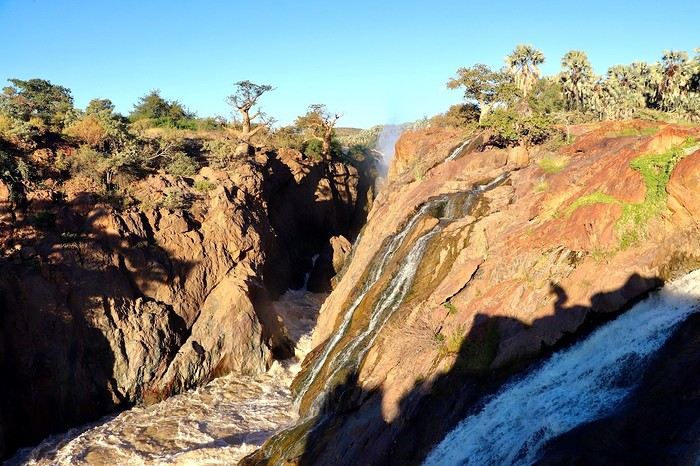
**DAY 19: Monday, May 12, 2025: Epupa to Opuwo**
We enjoy the morning a bit more by the **Kunene River**, then we hit the road at 8:45 AM. This is our return trip to Opuwo.
After 4 good hours on the road, **we return to the bustling life of Opuwo**. We refill with fuel at the Shell station (21.48 NAD $ per liter) for 820 NAD $ (40 €) for 38 liters and do a quick grocery run at the Spar for 488 NAD $ (24 €). We don't take any meat because we have the **sanitary barrier** to cross tomorrow before entering Etosha Park. We pay in cash for these two expenses for the first time; until now, the credit card was always accepted, so we have to use the cash we withdrew at the airport. Then we head back to the Opuwo Country Lodge, arriving at the campsite at 2:30 PM. We are the first to arrive, rest for a moment before heading to the pool, and then end the day with our traditional BBQ: sausages and sautéed potatoes. The full moon accompanies us, perfect for nighttime observations in Etosha starting tomorrow.
The campsite's location should be avoided, as we again have loud music until 2:30 AM... And it comes from far away... Maybe a bar? In any case, we rule out what we thought was just a party during our visit here on Friday.
> Today's road itinerary: 4 hours of track: Return via the C43 heading south to Opuwo.
> Gas station: Okangwati or Opuwo
> Distance driven today: 180 km.
> Accommodation: Opuwo Country Hotel - Opuwo Hilltop Opuwo 9000, Opuwo, Namibia - -18.044682 / 13.833861 - (http://www.opuwolodge.com/) - N$600.00 - Pool / Water / Private sanitary facilities / Electricity / BBQ
**DAY 20: Tuesday, May 13, 2025: Opuwo – Etosha - Olifantsrus**
We wake up before dawn around 6:30 AM. We pack up the camp at 7:15 AM heading to a first waterhole to watch the sunrise and start our day of observations and discoveries. It's 11°C, and as soon as we leave the campsite, we come across numerous zebras, foxes, and springboks with the sun rising on the horizon. Magnificent images.
**At 8:30 AM, we are still alone**, we witness **one of the most beautiful scenes of this trip: 3 lionesses hunting springboks**. It's thanks to the latter, slowing down, that we manage to spot 4 lionesses' heads barely above the tall grass. They hide, stand up, move slowly... We wait without moving. This is their perfect terrain for camouflage. **We are on the lookout and try to be discreet during this hunting scene**. We leave the area to let them finish their remarkable work and continue the track towards the East. The terrain becomes completely flat. It's now been 3 hours since we left the campsite without noticing the time passing, and especially without meeting anyone. Around 10 AM, near a waterhole, we come across a solitary elephant mixed with zebras, buffaloes, and springboks.
Around 11 AM, we take a lunch break; here, it's us who are enclosed in enclosures. Whether in the campsites or the few small equipped areas, we are fenced in by a gate. The animals are free on their territory. The wind has picked up again, just like the sun. We eat alone in absolute calm in the heart of this incredible, unique park; there are no words to describe what nature offers us here, far from any human activity. We start to see some safari vehicles arriving, but the attendance remains much lower than I had imagined. At most, a total of fifteen throughout the day.
Etosha is also a wonderful reserve of vegetation; you can find multiple mopane groves. But also acacias and other trees appreciated by ruminants. The south and east of the park have the most waterholes, which is where most animals gather. In the West, the vegetation is denser, and the wildlife is harder to spot, but it is well present, especially the black-faced impala and Hartmann's mountain zebra, which are found almost nowhere else. The area being less frequented, the bush feeling is more pronounced.
30 minutes of track after eating, **we come across a solitary male lion. The build compared to the females this morning is noticeable from afar**, even though this one is quite far from us unfortunately, unlike this morning when they were right on top of us.
**Etosha is the preferred habitat of lions in Namibia, with about 330 individuals roaming the park's plains, nearly half of the country's wild lions.** The big cats rest under the trees near waterholes, especially the one at Okaukuejo where we arrive today, but it's also a good spot for elephants and rhinos.
We then enter the territory of buffaloes, which we come across by the dozens now. Wow, the encounters keep coming. Then around 2 PM, we follow this immense **Etosha Pan** for the first time, which we will follow for a good part of tomorrow's day.
We arrive at our campsite at 3:30 PM after more than 8 hours of self-safari filled with discoveries. We sleep tonight at the **Olifantsrus Camp**, which we had previously booked in France. We had to wait and click several times for a spot to open up, as the camp has very few sites, and that's a good thing. It is located in one of the wildest areas of Etosha and has a practical observation tower overlooking a waterhole, offering us great opportunities to spot wildlife after nightfall (see photos). **The sunset is once again memorable.** In the guestbook at the reception, where each visitor can note their observations, 3 lions were seen the day before just a few steps from here (1 male, 1 female, and their cub), on a part of the track we didn't cover today; it will be on tomorrow morning's program. We cross our fingers for these predators.
> Today's road itinerary: 6 hours of driving: Leave Opuwo via the C41 (paved road) > Turn right onto the C35 (paved road) to the Galton Gate > Enter Etosha Park.
> Gas station: Opuwo.
> Distance driven today: 369 km.
> Accommodation: Olifantsrus Camping site - 53.4 € for two – Shared sanitary facilities – Electricity – BBQ – No grocery store - (https://www.etoshanationalpark.org/fr/accommodation/olifantsrus-camp)
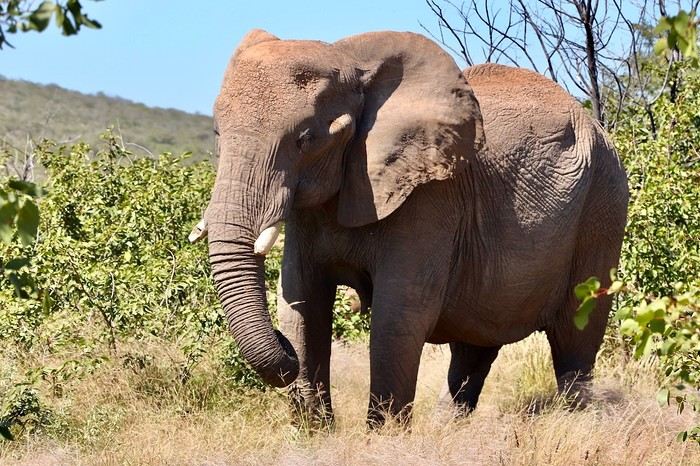
**DAY 21: Wednesday, May 14, 2025: Etosha National Park: From Olifantsrus to Okaukuejo:**
We wake up before dawn around 6:30 AM. We pack up the camp at 7:15 AM as the gates open, heading to a first waterhole to watch the sunrise and start our day of observations. It's 11°C, and just outside the campsite, we come across numerous zebras, foxes, and springboks with the sun rising on the horizon. Magnificent scenes.
**At 8:30 AM, we are still alone**, and we witness **one of the most beautiful moments of this trip: three lionesses hunting springboks**. Thanks to the springboks slowing down, we manage to spot four lionesses' heads barely above the tall grass. They hide, stand up, and move slowly... We wait without moving. This is their perfect terrain for camouflage. **We stay alert and try to be discreet during this hunting scene**. We leave the area to let them finish their remarkable work and continue the track towards the east. The terrain becomes completely flat. It's been 3 hours since we left the campsite without noticing the time, and especially without meeting anyone. Around 10 AM, near a waterhole, we come across a solitary elephant mixed with zebras, buffaloes, and springboks.
Around 11 AM, we take a lunch break; here, it's us who are enclosed in enclosures. Whether in the campsites or the few small equipped areas, we are fenced in by a gate. The animals are free on their territory. The wind has picked up again, just like the sun. We eat alone in absolute calm in the heart of this incredible, unique park; there are no words to describe what nature offers us here, far from any human activity. We start to see some safari vehicles arriving, but the attendance remains much lower than I had imagined. At most, a total of fifteen throughout the day.
Etosha is also a wonderful reserve of vegetation; you can find multiple mopane groves. But also acacias and other trees appreciated by ruminants. The south and east of the park have the most waterholes, which is where most animals gather. In the west, the vegetation is denser, and the wildlife is harder to spot, but it is well present, especially the black-faced impala and Hartmann's mountain zebra, which are found almost nowhere else. The area being less frequented, the bush feeling is more pronounced.
Thirty minutes of track after eating, **we come across a solitary male lion. The build compared to the females this morning is noticeable from afar**, even though this one is quite far from us unfortunately, unlike this morning when they were right on top of us.
**Etosha is the preferred habitat of lions in Namibia, with about 330 individuals roaming the park's plains, nearly half of the country's wild lions.** The big cats rest under the trees near waterholes, especially the one at Okaukuejo where we arrive today, but it's also a good spot for elephants and rhinos.
We then enter the territory of buffaloes, which we come across by the dozens now. Wow, the encounters keep coming. Then around 2 PM, we follow this immense **Etosha Pan** for the first time, which we will follow for a good part of tomorrow's day.
We arrive at our campsite at 3:30 PM after more than 8 hours of self-safari filled with discoveries. We sleep tonight at the **Okaukuejo Resort**. Upon arrival, this impression of a small town in the middle of hundreds of kilometers without infrastructure remains shocking. **The atmosphere is quite different from last night in our small wild campsite**. However, even though the attendance is higher, we are lucky to get a site in a corner (number 46). **The lit waterhole will also be a reward**. After checking in, we take advantage of the small grocery store to buy two meats for our next BBQs in the park, 3 pork chops and sausages, as well as a cold drink for 252 NAD $. This locality also offers a gas station, a restaurant, and a nice pool, but our goal during this park stay remains focused on the wildlife, so I won't give in this time. Time to set up, followed by a short rest, then our toilette before heading to the "waterhole" for the sunset around 6 PM. **A new grand spectacle unfolds before us, a hundred zebras come to hydrate right before our eyes at the water reserve facing the sunset in a cloud of dust. Then a couple of lions approach stealthily without managing to fill their stomachs. A third guest arrives, a second male lion also comes to drink. The waterhole now becomes the territory of the lions... We are speechless facing what nature offers us, we savor for over an hour scrutinizing the smallest details. What an intense day, images that will remain forever etched in our minds.** It's our turn to have our meal with three beautiful pork chops on the BBQ accompanied by curry vegetables.
At 9 PM, we decide to return to the waterhole, a wonderful idea because we find **an elephant and two black rhinos courting in the water. The male has a hard time seducing his sweetheart and eventually leaves, but a third rhino appears out of nowhere to join her. The scenes unfold under the spotlights** accompanied by a sky full of stars. We eventually go to bed. Looking forward to the rest of the story tomorrow.
> Today's road itinerary: Camp Olifantsrus > Camp Okaukuejo.
> Gas station: Okaukuejo camp.
> Distance driven today: 229 km. > Today's expenses: Groceries for 12 €.
> Accommodation: Okaukuejo Camping Site - 48.12 € for two - Pool - Gas station - Lit waterhole - Grocery store - (https://www.etoshanationalpark.org/fr/accommodation/okaukuejo)
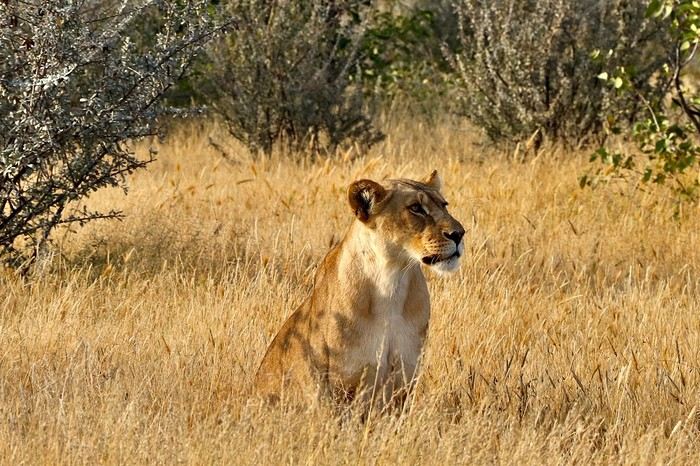
**DAY 22: Thursday, May 15, 2025: Etosha National Park: From Okaukuejo to Halali:**
We wake up around 5:30 AM to a strange noise getting closer, a few thunderclaps, then heavy rain pours down on us! The first since the start of this trip, we had forgotten its sound and smell. We leave the campsite quickly at 7:13 AM as the gates open, the rain stops just in time!
We are right in the heart of the park today. We arrive at the Etosha Pan, an immense flat salt desert that, a few days a year, transforms into a shallow expanse teeming with flamingos and pelicans. At the end of the dry season, everything, from elephants to grasslands, is covered in the white, chalky dust of Etosha.
Around noon, at the Riedfontein waterhole, we spot two male lions in this picturesque savannah. As we've noticed, the females hunt while the males protect the territory. The males and cubs will benefit first.
The day was less emotional than the previous one. We encounter far fewer animals, often at a greater distance. Is it because of the stormy rain we had at dawn this morning, or is it the area? The tracks were also more exhausting, especially the Rhino Drive without meeting a soul. But the view over the immense salt pan as far as the eye can see is worth seeing. Maybe the waterhole at the campsite will surprise us tonight as it did yesterday?
We arrive at 4 PM at the Halali Resort for our last night in the park. We still have a lit waterhole, more intimate than yesterday's, and we can walk around the park thanks to a hiking trail. The sanitary facilities are shared and quite recent, with each site offering its own BBQ and electrical outlet. After setting up and a quick wash, we head on foot to the Halali waterhole for sunset. Tonight's menu features local sausages (beef and pork) with curry pasta.
> Today's road itinerary: Camp Okaukuejo > Camp Halali.
> Gas station: Halali Camp.
> Distance driven today: 242 km.
> Accommodation: Halali Camping Site - 48.12 € for two - Pool - Gas station - Lit waterhole - Grocery store - (https://www.nwr.com.na/resorts/halali-resort/)
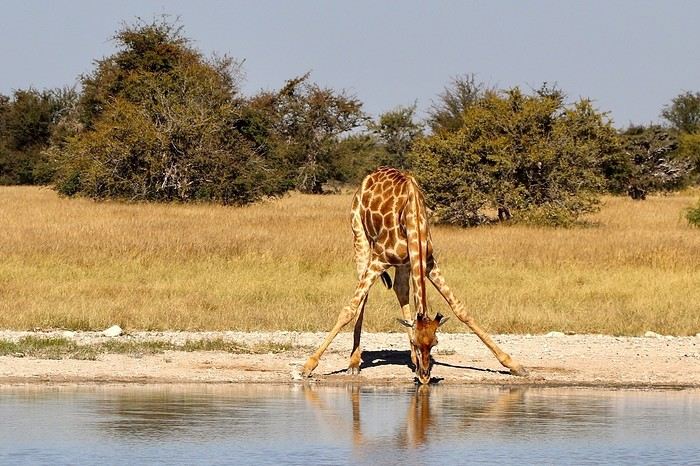
**DAY 23: Friday, May 16, 2025: Etosha National Park: From Halali to Namutoni - Waterberg Park:**
We pack up the camp at 7:15 AM as the gates open. It's 17°C, and the sun is out as usual. **We follow the Etosha Pan, still quite wet at this time of year.** The small track offers different viewpoints under a sun gradually rising higher.
The further east we go, the more we encounter gnus, kudus, and impalas. **We are once again spoiled and delighted by everything we discover this morning.** A majestic **giraffe** appears before our eyes just before arriving at **Namutoni** around 9:45 AM, quickly followed by 4 other companions. From there, we change plans, do the **Fischer's Pan** loop, and then decide to exit through the northern gate, allowing us to cover the entire park. Our last encounters will be with these tallest animals, the giraffes, and what a spectacle to see them spread their legs to hydrate, followed by gnus.
Just before the exit, we take a lunch break at an equipped area at 11:30 AM.
**We leave Etosha National Park with a touch of nostalgia through the King Nehale Iya Mpingana gate** at 12:30 PM. We find the beautiful paved B1 road, which is a great relief. Cows and goats take over; driving at 120 km/h on these single-lane, two-way roads with these animals we brush past requires constant vigilance. We fill up with fuel at 1:30 PM in **Oshivelo** (21.33 $ per liter), 93 liters for 99 € by card. Since we hadn't planned to go so far north out of Etosha, we are surprised to go through a **sanitary check** at the exit of the town, but it turns out to be even quicker than the previous one, a simple glance in the fridge by very smiling women, much more pleasant than the staff at the Etosha entrances and exits.
We pass **near Lake Otjikoto** ("deep hole" in Herero), which is **one of the only two natural lakes in Namibia along with its neighbor Lake Guinas**. In 1851, explorers Charles Andersson and Francis Galton came across this karst lake occupying a limestone cauldron 100 m long, 150 m wide, and 55 m deep. Its steep walls, about 20 m high, are the result of the collapse of the rock roof of the sinkhole under water pressure. This lake is also known for the large quantity of weapons and ammunition found in its depths. Remnants of the region's violent past, they were dumped there in 1915 by the retreating German army, refusing to let South African troops get their hands on them. Unfortunately, it's paid entry, and given the late hour, we continue on our way. To our great surprise, there is a lot of traffic on this B1, including many trucks, the first time we've seen so many people in this country. The landscapes change; we even discover deciduous trees taking on their autumn colors.
We pass through **Tsumeb**, and the road continues to **Otjiwarongo**, which means "pleasant place" in the Herero language, and the town lives up to its name. Prosperous and peaceful, with wide avenues and a relaxed atmosphere, we stop there to do some shopping. We buy some local meat to treat ourselves during these last two remaining camping nights: skewers, pork, and sausages, as well as biscuits, a last water tank, and yogurt for Mimi; 388 NAD $ - 20 €. We get back on the road heading south via the B1 for 15 minutes, then turn left onto the C42, still paved, for 30 minutes and 41 km, then left again onto the D2512, a wavy sandy track for 15 minutes.
**We enter the Waterberg National Park this evening.** The arrival facing this mountainous massif in the middle of the plains under the end-of-day lights of a deep red makes us even more eager to discover it. **Composed of impressive sandstone cliffs, tangles of vines, a canopy teeming with birds, elusive wildlife, and improbable dinosaur footprints. The Waterberg occupies a large sandstone plateau 50 km long and 16 km wide, at an altitude of 150 m above the plain.** It is possible to encounter elands, black wildebeests, roan antelopes, buffaloes, and red hartebeests, and with luck, leopards, as well as 200 identified bird species.
We arrive at the NWR campsite at 6 PM, the first time we arrive so late, just before nightfall. It's from here that various hiking trails start for tomorrow's day, including the **Mountain View Trail** that climbs to the edge of the plateau. We quickly settle into this peaceful camp where calm reigns, no more than 5 vehicles tonight. The place is shaded, with fairly recent shared sanitary facilities, electricity, and a BBQ for each. We savor our second-to-last braai under the stars, hearing our plane that brought us to Frankfurt fly over, every day at the same time over the Waterberg then Etosha. Very rare, as there are very few flights that land or fly over Namibian skies.
> Today's road itinerary: 10 hours of driving: B1 then C42 then D2512.
> Gas station: Exit of Etosha Park, Tsumeb, Otavi, or Waterberg Park.
> Distance driven today: 616 km.
> Accommodation: NWR Waterberg Camping Site - Pool - Water - 45 € for two - (https://www.nwr.com.na/resorts/waterberg-resort/#1577510913112-8f243e49-35a647e7-1997)
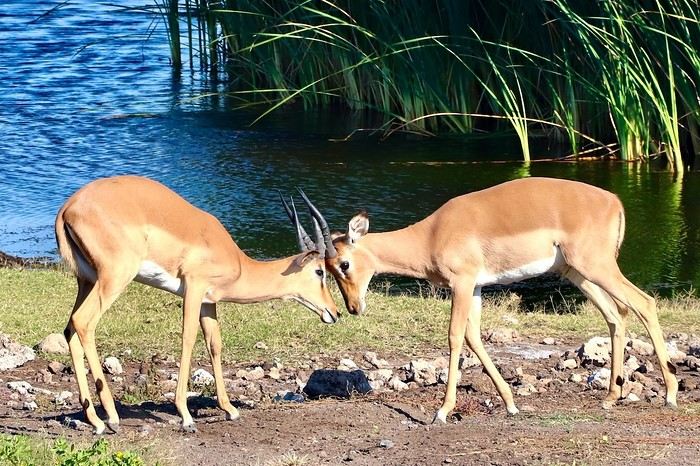
**DAY 24: Saturday, May 17, 2025: Waterberg Park - Otjiwa:**
We wake up around 7 AM after a very cool night.
**At sunrise, the cliffs appear even redder, and the cries of baboons echo around us.** We come across about thirty of them. We start the hike around 8:15 AM. **The Mountain View Trail will take us to the Waterberg Plateau.** The temperature is pleasant for walking. **The trail starts in a thick forest where the song of birds resonates.** The path is little frequented, so progress is slow and irregular; we regularly have to duck, step over, and climb rocks. However, in 35 minutes, we reach the top of the plateau. We are once again alone in the world in this Namibian nature. **The 360° panorama extends over a wide plain of green shrubs below, then over these steep red cliffs** giving access to this suspended plateau of the Waterberg. To enter, unfortunately, a special permit is required, and you must be accompanied by a guide. We savor the moment under the already hot sun at 9 AM. After an hour reminiscing about our journey on our rocky promontory, we start the descent at 10 AM, completing a loop back to our starting point. **At 10:30 AM, we pass by the small cemetery of German fighters who died in 1904**, then we hit the road back to the B1. We take a lunch break at noon at one of the tables scattered regularly along the paved roads. We are watched by **baboons** perched in their tree. We then decide to make a **detour through the town of Otjiwarongo**, which we didn't have time to explore properly yesterday. **A quick visit to the train station is a must to see locomotive No. 41, built in 1912 by the German company Henschel. It was transported to Namibia to carry ore between the mines of Tsumeb and the port of Swakopmund before being decommissioned in 1960 when the tracks were modified.**
We return to do some shopping and bring back some souvenirs for 300 NAD $ (14 €). We then take the road south on the B1. I start to feel the end of this immense loop through Namibia. Morale is gradually dropping. But we still have plenty of beautiful things to discover. We arrive at 3 PM at the **Otjiwa Safari Lodge. This will be our last night camping after 22 nights sleeping in the wild to the sound of animals.** The nostalgia is palpable. We enter this high-end private park; we don't really feel at home upon arrival. The reception, the pool, the restaurant, everything is very upscale, unlike anything we've experienced during this road trip. However, the reserve has its charm; we come across our beautiful antelopes again. The 10 sites are very comfortable, spaced apart under some bushes. Each has, of course, its BBQ, electricity, lighting, and sink. Before enjoying our last evening, we need to do a thorough dusting of the 4x4 and a good cleaning and organizing of our belongings. Then it's time for our last perfect braai: chicken and pork skewers, as well as tomato-flavored white beans.
> Today's road itinerary: 1h30 of driving: Waterberg > Otjiwarongo > Okonjima wildlife reserve - D2512 then C22 then B1 then turn right onto a 3 km track.
> Gas station: Waterberg Park.
> Distance driven today: 135 km.
> Distance walked today: 6 km.
> Today's expenses: Souvenirs for 14 €.
> Accommodation: Otjiwa Safari Lodge - B1 main road, west side Otjiwarongo 12001, Otjiwarongo, Namibia - (http://www.otjiwa.com.na/) – 40 € for two – From 3 PM.
**DAY 25: Sunday, May 18, 2025: Otjiwa - Windhoek:**
For this last leg of our Namibian journey, we complete the loop back to our starting point, Windhoek. We leave our last campsite at Otjiwa, later than usual, at 10 AM. We head due south on the B1 in less than 3 hours to the country's capital, not without a touch of nostalgia after all these kilometers traveled through Namibia. The landscapes roll by with a lot of melancholy. We make a stop 60 km north, in Okahandja. We take the opportunity to fill up with fuel (21.10 $ per liter), 500 NAD $ for 23 liters; the card machine wasn't working, so we had to withdraw from an ATM at the next gas station. A local was quite insistent at my window, asking for food or money. Anyway, after 15 minutes, we get back on the road.
From here, we take the new A1, a 2x2 lane highway limited, like the previous roads, to 120 km/h. Then we gradually see some of the country's industries before entering the capital in the blink of an eye. We arrive at 1:45 PM at Chameleon Backpackers. It's a small hostel-style hotel with a central pool, a shared kitchen, secure indoor parking, and a restaurant. They also organize tours (3 Day Express, 3 Day Link, 4 Days Etosha, 7 Day Norbert Adventure), very different from everything we've encountered so far, a kind of atmosphere like in Thailand. There are dormitories, rooms with shared bathrooms, and our little cocoon, the Love Bird, a room located alone on the upper floor with its small balcony, a swing, its bathroom, and its large bed with a thatched roof. A lot of charm while overlooking the pool. We eat before setting off to explore the capital.
Windhoek is a modern and well-maintained city, contrasting completely with the rest of the country. It is heavily influenced by its German colonial heritage, still very present in some streets of the capital. The architecture is colorful and surprising. The skyline is shared between the spires of a neo-baroque cathedral, the unusual silhouette of three castles from the German colonial era, and glass and steel skyscrapers. Office workers head to Zoo Park at lunchtime.
We enjoy the smell of grills at some street corners lined with small single-story houses with zinc roofs.
We first head to Windhoek's emblematic monument, its unofficial symbol: Christuskirche, just a 10-minute walk away. This German Lutheran church rises above the traffic at the center of an intersection. Built in 1907 with local sandstone. The roof and other elements were imported from Europe. The result evokes a gingerbread house.
We then walk along the pedestrian shopping street of **Post Street Mall** to admire African crafts, but on this Sunday, most shops are closed; we'll come back tomorrow. We return via the Wernhil shopping center.
> Today's road itinerary: Return to Windhoek in 3 hours via the B1 then the A1. In the capital, turn left onto Florence Nightingale, then right onto Beethoven Street then C28 then B6, then Bismarck Street. Take Church Street and Trift Street towards Voight Street.
> Gas station: Okahandja or Windhoek.
> Distance driven today: 245 km.
> Accommodation: Chameleon Backpackers & Guesthouse – 49 € for two - 5-7 Voigt St, North Windhoek Central, 9000 Windhoek
**DAY 26: Monday, May 19, 2025: Windhoek, Visit to the Namibian Capital:**
Our last sleep in Namibia... The wake-up is a bit sad; we still enjoy this return to comfort in a real bed. After a hearty breakfast, we check out of our little cocoon at 10 AM. We leave our vehicle in the secure parking lot and return for a walk in the center of Windhoek. On this Monday, the center is immediately livelier while still remaining extremely calm for a capital. The pace of life is slow; employees move slowly without rushing, each task is performed with a slowness that is almost surprising. A few skyscrapers further on, we quickly leave the hyper-center. We retrace our steps to the shopping gallery where we linger for a while. We eat around noon with African music in the background, making us even more nostalgic. Then the trip will gradually come to an end, unfortunately, until the moment when we will have to, not without regret, return our rental vehicle around 3 PM... We stop by the hotel again and then head to the rental agency and then to the airport by shuttle, included in our contract.
At 4:20 PM, we are back at the airport. We see ourselves upon arrival as if it were yesterday... Tears are not far off; we wait, the formalities are much quicker than upon arrival. **We board by walking across the tarmac on foot, escorted by about fifteen Namibians, facing the sunset. It will be there until the end, beautifully drawn on the horizon, to say goodbye to Namibia...**
> Round-trip flight tickets with Lufthansa from Lyon: 2029 €, or **1,014.50 €** per person.
> Vehicle rental: 4x4 Toyota with roof tent for 24 days: Gracious Whisp Car Rentals: 2,638 € (N$50,640) or **1,319 €** per person - (https://gwcarrentals.com/)
**DAY 27: Tuesday, May 20, 2025:** Flight FRA 8:15 AM -> 9:35 AM LYS (Air Dolomite No. 1074)
Total expenses including flight tickets + vehicle rental + visa + Lyon parking + food + fuel:
Cost per person: 3467 € Cost for two: 6935 €
>> All our photos and videos for each day on our website here: (https://www.montagne-aventure.net/voyages-découvertes/namibie-2025/)
>> Find all our photos and videos for each day on our website here: www.montagne-aventure.net
**DAY 1: Thursday, April 24, 2025: Outbound Flights from Lyon to Windhoek via Munich - Visit to Munich:**
Off we go on a new adventure. The alarm rings at 6:30 AM, the travel bags are packed, and we head to Lyon Airport. We booked our flight tickets with Lufthansa. The first leg to Munich, Germany, is operated by AirBaltic. Departure at 1:05 PM for a 1-hour and 20-minute flight. We arrive at 2:30 PM.
**We now have a 7-hour layover, so we take the opportunity to get some fresh air and explore Munich.** We quickly exit Terminal 2 of the airport and head towards the subway. We buy a group day ticket "Airport-city Day Zone M-5," valid for 2 to 5 people at a price of 30.50 € (instead of 16.30 € per person). We take the S8 line to **Marienplatz** in 35 minutes. **This is the heart of the city.** The weather is overcast, quite cool, but dry. Perfect for a little city trip between two flights while leaving our large luggage in transit at the airport. **Munich is the third-largest German city after Berlin and Hamburg, in the Bavaria region.** **The center has a lot of charm and brings together several religious buildings, easy to explore on foot.** We are impressed by the number of people enjoying these 100% pedestrian streets, which are very pleasant. After Marienplatz, the most famous square with the town hall, we head to the Cathedral of Our Lady, a Gothic church, then continue to **Karlsplatz** and move on to **the food market offering a wide selection of high-end food products in an atmosphere where a certain art of living prevails.** We also visit St. Peter's Church before grabbing a bite to eat. Two good hours were enough for this 10 km city walk. It's time to take the subway back: by 6:30 PM, we are back at the airport. Now, it's time for a bit of waiting and rest. Our second flight is scheduled for 9:35 PM for a 9-hour and 30-minute journey to our final destination in Namibia: **Windhoek.**
> Round-trip flight tickets with Lufthansa from Lyon: 2029 €, or 1,014.50 € per person.
> Lyon Airport parking: 120 €
> Today's expenses: 7 € for 2 pizzas in France / 14 € for the restaurant in Munich / 30.50 € for the daily subway ticket in Munich.
**DAY 2: Friday, April 25, 2024: Arrival in Windhoek, Visit to the Namibian Capital:**
After a 9-hour and 30-minute overnight flight with Discover Airlines, we finally land on Namibian soil just before 7:30 AM. The day is breaking, and the colors are already stunning. We are eager despite the usual fatigue from the flight. The airline was punctual, with friendly staff and good meals, though a bit light. We are the first flight of the day to land, with no more than 15 flights per day here, from 7 AM to 8 PM. We disembark on the tarmac at this airport located in the middle of nowhere, **I finally set foot on African soil for the first time.** We exit among the first from the aircraft to go through the long formalities at the front of the line, as the wait can quickly become endless. Allow at least 5 minutes per person for e-visas. We still wait 45 minutes despite only about twenty people ahead of us. Phew, it's done. We collect our luggage and then withdraw money from an ATM. We make 4 withdrawals of the maximum amount, 2000 NAD $ per withdrawal, for a total of 380 €, or 95.33 € per withdrawal.
Our driver arrives at the same time, perfect timing, we were quick.
We leave the airport at 8:45 AM. By 9:30 AM, we arrive at the **Gracious Whisp vehicle rental agency**, located at the entrance of Windhoek, small and human-sized with a fleet of recent vehicles. More formalities, then a short wait as our vehicle is not yet ready. Time to decompress, catch our breath, and enjoy the very pleasant morning temperature. Not a cloud in sight. Next, a briefing on the vehicle, always with a bit of apprehension due to our approximate English. Allow 45 minutes of explanations, including setting up the roof tent, camping equipment, technical information in case of a flat tire, driving tips in Namibia, and a tour of the 4x4. We have all the necessary equipment for camping: mattresses, sleeping bags, pillows, table, chairs, gas stove, BBQ grill... as well as 2 spare tires, a compressor, a dual tank, and accessories for removing wheels. Off we go, it's time to muster our courage and get behind the wheel. **Heading to SuperSpar Maerua**, fortunately located less than 10 minutes away. We park with the help of a parking attendant; it's very crowded, the space is narrow, but everything goes well despite the cursed right-hand drive. Today's new mission: stock up on groceries. The store is well-stocked with local and imported products, catering to all tastes. We spend 114 € on groceries, from pasta to meat, BBQ lighters to dishwashing products. Two people load our groceries into two carts and transfer them to our vehicle; we feel compelled to leave a tip, 50 NAD $, as we don't have change yet. Now, we head to the hotel, 15 minutes away. Traffic is difficult at a complicated intersection; this will likely be the only traffic jam in Namibia. **We arrive at Kate's Nest Guesthouse & Backpackers around 1:15 PM, quite tired.** We take some well-deserved rest at this recent establishment, quite calm with secure private parking. After a short nap, we enjoy the quiet by the hotel pool. Night falls between 6:30 PM and 7 PM. We eat quietly in our room tonight before starting this long 4x4 road trip in camping mode in the heart of Namibia.
> Today's grocery expenses: 114 € at Super Spar Marua (2395.21 NAD $).
> Round-trip flight tickets with Lufthansa from Lyon: 2029 €, or 1,014.50 € per person.
> Vehicle rental: 4x4 Toyota with roof tent for 24 days: Gracious Whisp Car Rentals: 2,638 € (N$50,640) or **1,319 €** per person - (https://gwcarrentals.com/)
> Distance driven today: 15 km.
> Accommodation: Kate's Nest Guesthouse & Backpackers - 4 Aristotles Street Academia, 9000 Windhoek - 36 € for two for one night.
> Windhoek International Airport website: (https://www.airports.com.na/)
**DAY 3: Saturday, April 26, 2025: Windhoek to Hardap: Mariental Region - Kalahari Desert:**
After a good, restful night, we wake up leisurely around 7 AM. We enjoy the comfort provided by this first and last hotel before 24 nights under the tent.
**We leave Kate's Nest Guesthouse at 8:30 AM to tackle the Namibian roads.** We quickly leave the capital; in just 30 minutes, we find ourselves almost alone in the world. The landscape is dotted with small domes. We leave the **paved B1** quickly to turn left onto the **C15**. **From there, we won't see more than 10 vehicles all day.** After passing through the few houses of **Lekkerwaterpoort**, we tackle our first gravel road. These road sections are limited to 100 km/h, but even at 70 km/h, I find it already challenging. However, I quickly get used to it and gradually pick up speed to reach my cruising speed of around 80 to 90 km/h. **We are on immense straight lines crossing wild expanses as far as the eye can see.** **We come across two baboons, a few ostriches, and numerous cattle and sheep farms.** We pass through the charming village of **Uhlenhorst** with its typical houses and children with broad smiles waving at us. Life here is already very different from Windhoek. **The thermometer rises quickly from 16°C at 8:30 AM to over 28°C in the early afternoon.**
**We arrive at the Hardap Dam reserve at 2 PM.** We stop at the toll booth at the park entrance to pay the entrance fee: 250 NAD $ for 2 people and 1 vehicle. We continue to the dam and then the camp entrance, located a bit further. We had booked in advance, but this place remains little frequented by foreigners.
We take advantage of the hottest hours to rest by the large pool overlooking the immense lake, a very enjoyable moment. Would this be a bit of a vacation?
Around 4:30 PM, we head to the campsite. We overlook this vast water reserve. We arrive first; we will be only 3 vehicles spending the night here. It's time to get to work and set up our equipment for the first time. It takes us a good 20 minutes to set everything up, with a slight apprehension about unfolding the tent. Once this task is done, which we will have to repeat for almost a month, we will become much more efficient over time. Time for rest and contemplation in total silence. The sun gradually sets, and the heat quickly becomes bearable again. Bliss! **This dam is located 20 km northwest of Mariental in an area dotted with conical hills topped with dolerite buttons (Hardap means "hillock" in Nama). It captures the Fish River, which flows south, creating a large lake in the middle of an arid environment. The contrast is striking.** We enjoy our first sunset facing this 360° otherworldly landscape.
Around 7 PM, we start our first BBQ, or "braai" as it's called here. The temperature is perfect. The sun sets, giving way to a star-filled sky of incredible beauty thanks to the absence of any light pollution. The Milky Way will lull us throughout the evening. After some good sausages and potatoes on the BBQ, we head to our roof tent around 9:30 PM with a complete change of scenery in just 24 hours. France already seems so far away...
This campsite has shared showers and toilets, quite clean and functional, as well as a central area with several BBQs and tables. The sites are arranged in a semicircle, each with an electrical outlet. The sites are close to each other but spacious, some slightly shaded. We are only three vehicles tonight, so it's perfectly comfortable and quiet. Not to mention the large pool near the restaurant. Our trip is off to a great start.
> Today's road itinerary: Windhoek > Head south on the B1 to Rehoboth > Turn left onto the C25 then C15 to Stampriet > C20 to Hardap > Full north on the B1 > Then turn left onto the M93 - 5 hours of driving.
> Distance driven today: 354 km.
> Accommodation: Hardap Recreation Resort - 23.3 € for two - Large pool - GR6W+3M2, Hardap Game Reserve, Mariental, Namibia - (http://www.nwr.com.na/resorts/hardap-resort/)
**DAY 4: Sunday, April 27, 2025: Hardap - Brukkaros Volcano - Keetmanshoop - Quivertree Forest Rest Camp**
Our first night under the tent was very pleasant; the little wind quickly calmed down, giving way to absolute silence. The mattress is decent, more comfortable than some nights in Nepal. The length and width give us enough space for maximum comfort, despite my height (1.91 m). We wake up a little before 7 AM as the sun rises, and the lights dazzle us from the start of the day. We pack up the equipment in 30 minutes, quite easily. Then we enjoy the sun, which warms up quickly while we keep our light fleece on.
At 8:30 AM, **we hit the road again, heading south** to our first stop in **Mariental**. We want to do some shopping at SuperSpar, but once we arrive in the parking lot, a young local is fighting with the supermarket security guards and then threatens to throw stones. We don't want to take any risks right at the start, so despite the baton blows he receives, he doesn't stop. We leave empty-handed but fill up with fuel at the Shell station 1 km further. The price per liter is 21.33 NAD $, we fill our 107-liter tank for 107 €. In Namibia, you get served, and they bring the card machine to the window to pay. It's then customary to leave a tip.
We then take the B1 heading due south on a recently renovated road. Around 11:30 AM, we leave it on our right to take **a wild gravel road, the M98**. Just before **Berseba**, we turn right onto a small track, the **D3904 towards Brukkaros Crater up to a camp at 1588 m altitude**. The track then becomes too bumpy. We stop on the counter-slopes where **a wide panorama unfolds over these immense plains as far as the eye can see**. It's 12:15 PM, time for us to eat a rice and tuna salad facing this landscape.
**We are alone in the world until a vehicle arrives and parks next to us.** A bit of apprehension, 4 men head towards us. It turns out to be 4 shepherds looking for a lost foal. The conversation is pleasant, lost in the middle of nowhere. We find ourselves alone again in this absolute silence. **The heat becomes stifling with a good 30°C**. We get back on the road around 1 PM. Back on the B1, **we continue due south to Keetmanshoop**, which we reach around 3 PM. We stop there to do some shopping for 262 NAD $ (12 eggs, a can of tuna, a can of corn, bread, a soda, and a 5-liter water container), or 12.48 €. Two quite insistent children ask us for money or candy at the store exit, yet we give them a small tip, but they continue to cling to the car. Locals parked next to us tell them to leave us alone. Anyway, we finish the trip to **Quivertree Forest**, 15 km away. We will spend the night in this **pleasant farm run by a German**. Upon arrival, as the day before, and as I suppose in the future, we dive straight into the cool pool to relax after all these kilometers. A bliss. Then we take our 4x4 and choose a spot near these famous trees. After the 33°C this afternoon, once 4 PM passed, the temperature drops again and becomes very pleasant. **We are in the middle of the Kokerboom, one of the most interesting and characteristic plants of hot and arid regions. It's not really a tree but a variant of the aloe plant whose botanical name is Aloe Dichotoma. This Kokerboom has a smooth and thick trunk reaching up to 1 m in thickness and 9 m in height. They bloom for the first time at the age of 20 to 30 years.** The flowers are yellow and reach about thirty centimeters during the season between June and July. **They grow mainly in an environment with a high concentration of black rocks absorbing a large amount of heat (38°C). The rocks also serve to anchor the tree with its tentacle-like roots. It also resists frost. Each is between 200 and 300 years old.**
Around 5 PM, we walk to the farm reception to watch the feeding of **two cheetahs**. Magnificent carnivores taking their time to savor their piece of meat. **Then we return near our campsite to enjoy the sunset among these trees. The colors are sublime, as every evening apparently. A magnificent spectacle with colors evolving from yellow to orange then to pink, before giving way once again to a sky filled with thousands of stars.** Our campsite at Quiver Tree Forest Camp is very comfortable; we have a water supply, a stone table, a small lamp, an electrical outlet, a small tree for shade, and a BBQ that we won't use tonight; we'll cook on gas. The sites are far apart, with some shared facilities scattered around, a very beautiful setting. No reservation possible, no need, just show up directly. **The campsite accommodation for 2 people costs 28 €, including the reserve entrance fee of 5 €**. We finish this second bivouac evening around 9:30 PM, time for some reading and sleep in peaceful silence without wind.
> Today's road itinerary: Mariental > B1 heading south to Brukkaros > At Tses turn right towards Berseba via the M98 > Turn right onto the D3904 > 8 km > Brukkaros Volcano (stop at the lower camp as the track is difficult for 1 hour) > Keetmanshoop > Turn left onto the M29 > Quivertree Forest - 4 hours of driving.
> Distance driven today: 371 km.
> Distance walked today: 6 km.
> Today's expenses: Groceries for 12.48 € (262 NAD $) / Fuel for 107 € (1 liter of diesel for 21.33 NAD $).
> Accommodation: Quivertree Forest Rest Camp, P.O. Box 262, Keetmanshoop, Namibia - BBQ, hot showers, toilets, and electricity - No reservation - Pool - 18 €/Person (N$ 340.00 with park entrance) - (http://www.quivertreeforest.com/)
**DAY 5: Monday, April 28, 2025: Quivertree Forest Rest Camp - Giant's Playground - Keetmanshoop - Fish River Canyon - Canyon Roadhouse:**
After an excellent start to the night, we are woken up by the wind shortly before 6 AM, but the sunrise is not far off. We get up at 6:30 AM to enjoy it. The atmosphere is a bit cooler this morning, but the reward is already here.
The adventure continues. At 7:45 AM, we head towards **Giant's Playground**, 4 km away. We take a 3-kilometer walk through this expanse of blocks and igneous rocks.
We continue south at 8:45 AM, passing through Keetmanshoop again where we do some shopping for 25 €, a big stock-up for a good part of the trip: meats, canned goods, pasta, fruits... At 9:30 AM, we take the B4 to Fish River Canyon.
At 11:30 AM, we arrive at the entrance to the NWR park (350 NAD $ entrance for 2 people and 1 vehicle). The track becomes bumpy immediately upon entering the park. After about ten kilometers, we come upon this landscape carved by nature. In the end, it's well worth the detour. We were at the Grand Canyon in the USA exactly (https://www.montagne-aventure.net/2024/04/29/j21-3-juin-2024-grand-canyon-et-lac-powell/) and can thus confirm that this Fish River Canyon is comparable. We make several stops along the southern flank. **Here, nothing is developed; nature is almost in the wild state.** **With 160 km in length, up to 27 km in width, and a depth of 150 m, it is indeed the second-largest canyon in the world.** The history of the canyon is apparent in its different earth layers and stratification: the antiquity of the place is tangible, and the absence of vegetation is surprising. **It consists of two nested canyons, formed at distinct periods. The first distinct layer of schist, sandstone, and eruptive material surrounding the canyon was formed a few two billion years ago, then transformed due to heat and pressure into more solid rock such as gneiss. The inner canyon, carved more recently by the Fish River, has a depth of 270 m.**
We have a picnic once again alone in the world facing this grand panorama at the **Sulphur Spring View Point**. This is where the hiking trail begins, plunging into this narrow canyon, but it is forbidden to venture there alone without a guide. It's 30°C, but a slight wind makes the atmosphere bearable. At 1 PM, we retrace our steps and continue to the **Main View Point** then to the **Hikers View Point**.
In the south of Namibia, the Fish River Canyon, 160 km long, is a true geological wonder: a canyon nested within another canyon, one of the largest in the world. The first sedimentary layers formed two billion years ago; 500 million years ago, a period of tectonic activity caused these layers to crack and tilt, opening a vast canyon in the Earth's crust. The second canyon, with a depth of 270 m, was carved over time by the passage of the Fish River in this new valley.
At 3 PM, we arrive at our very charming camp for the evening, the **Canyon Road House**. We fill up with fuel right away because tomorrow we have a long day of isolated driving: 55 liters for 1240 NAD $. Then we settle into the campsite we had previously reserved in France. We are assigned site 2, very well set up under a tree with its BBQ and stone table just steps from the pool. We quickly set up the tent and jump straight into the pool for the relaxation moment of the day. As usual, the water is quite cool, but it's a real pleasure. Then we stroll around this Canyon Road House, which recreates the atmosphere of the roadside inns of the 1950s with old car wrecks and vintage gas pumps in a bygone era. **Around 5:45 PM, we start a short walk leading us to the top of a hill overlooking the wide plateau where we are to watch the sunset.**
And finally, to end this beautiful day, it's time for the braai, with grilled sausages and white beans on the evening menu.
> Park entrance: 150 DN/person + 50 DN/vehicle (18 € for two). It is possible to enter at two access points: Hobas in the north and Ai-Ais in the south.
> Today's road itinerary: M29 > Keetmanshoop > B1 > B4 > C12 (track) > After Holoog turn right onto the D601 (C37 track) > Accommodation on our right (stop just to check in before 6 PM) > Continue 30 km (30 minutes of track) to the viewpoints after Hobas where you must pay the entrance fee. Sunset View Point to the left > Return before sunset as the park closes (best lights at sunrise). 3 hours.
> Distance driven today: 228 km.
> Distance walked today: 10 km.
> Today's expenses: 25 € for groceries / 17 € for the Fish River Canyon park entrance / 58 € for fuel.
> Accommodation: Canyon Roadhouse, Gondwana Collection Namibia – 34.4 € for two - Pool - Near Hobas - (http://www.gondwana-collection.com/fr/accommodation/canyon-road-campsite)
**DAY 6: Tuesday, April 29, 2025: Canyon Roadhouse - Orange River - South African Border - Vista Trail - Gondwana Sperrgebiet Park - Aus:**
The night was excellent in this very comfortable campsite. **We wake up to the sound of birds** before the alarm at 6:45 AM. Our little morning routine starts as the sun rises. **A big day of driving awaits us to the South African border. This will be the southernmost point of our journey.** We hit the road at 8 AM via the C37, pass through **Hobas**, then turn onto the D207 to **Aussenkehr.** **We cross a mountainous barrier with some high peaks and perfect cones. The rock varies from orange to pink to black.**
We then cross a lunar desert as far as the eye can see on a giant dome; the track winds through nowhere without meeting anyone for hours. The landscapes are surprising. **We spot several ostriches and a gemsbok.** In the middle of this endless expanse, we come to an improbable intersection and continue right onto the D278.
In the middle of these arid lands, we come across a green zone: a vast vineyard. At 10:30 AM, **we come across a "Road closed" sign, fortunately, a local resident waves us to continue; a bit stressed, we proceed.** We start to follow the beautiful Orange River. On the other side of the bank, just a few meters away, South Africa is there. It is the second-longest river in Southern Africa, after the Zambezi. It flows over 2,000 km to the Atlantic. After passing through narrow gorges, we regain altitude before starting the descent, gently heading back north.
**We now cross and follow the Fish River, which joins the Orange River further south** **along this gorge dating back millennia.** At exactly noon, we take a lunch break by the Fish River, still without meeting a soul in this landscape between greenery and aridity. The temperature here is cooler with a pleasant 23°C on the banks, the perfect spot. **We continue on the track to Rosh Pinah**, where we find a paved road again. **The section along the Orange River and the Fish River was officially closed, but we were able to pass without any issues, avoiding a detour of at least 3 hours.** Phew. We now drive at high speed (limited to 120 km/h) through these vast spaces. We come across many ostriches after the **dozens of monkeys along the Fish River**. Around 3 PM, 3 km after the very small town of **Aus**, we reach **our campsite for the evening at Klein Aus Vista**. A new **small peaceful haven very well set up**. As usual, after checking in at reception, we jump straight into the beautiful pool to get our well-deserved dose of coolness, another good thermal shock that our bodies appreciate. Once this moment of relaxation is over, we take our 4x4 to reach the campsite located a bit higher, set apart at the foot of a hill that overlooks us.
After setting up, **around 5 PM, we head to the Vista Trail to climb to the top of a mountain overlooking the vast plain that surrounds us at 360°**. It takes about 30 minutes to climb. The place is just magical, **the perfect viewpoint to admire the sunset**. **We fully savor the moment. We also spot one of the few wild horses in the world capable of living in the desert.** Their numbers have decreased in recent years due to predation and drought (around 100 to 150). At 7 PM, we return to the camp, time for the braai and preparing the meal in this peaceful little camp.
In the south of Namibia, the Fish River Canyon, 160 km long, is a true geological wonder: a canyon nested within another canyon, one of the largest in the world. The first sedimentary layers formed two billion years ago; 500 million years ago, a period of tectonic activity caused these layers to crack and tilt, opening a vast canyon in the Earth's crust. The second canyon, with a depth of 270 m, was carved over time by the passage of the Fish River in this new valley.
> Today's road itinerary: 5 hours of driving: D324 heading south (track) > turn right onto the C10 (track) > D316 heading south > turn right onto the C13 > In Aus turn left onto the B4 > Campsite via a track on the left.
> Fuel station: Solitaire or Aus.
> Distance driven today: 398 km.
> Distance walked today: 7 km.
> Accommodation: Klein-Aus Vista Desert Horse Campsite - Farm Klein-Aus No 8 on the B4 main road to Luederitz Aus 9000, Aus, Namibia - (http://www.klein-aus-vista.com/accommodation/desert-horse-campsite/) 17908 420 DN - Water + Shared shower (hot water). No electricity.
**DAY 7: Wednesday, April 30, 2025: Aus - Kolmanskop - Diaz Point - Luderitz - Kanaan Desert:**
We wake up around 6:45 AM, with partly cloudy weather for once; we feel the ocean's influence gradually. But the sun isn't far off. At 7 AM, we leave the campsite heading west towards Luderitz via the B4. **First stop of the day: Kolmanskop, the ghost town we reach at 8:30 AM**, entry costs 180 NAD $ per person. We discover this **timeless place** in 1.5 hours, moving from building to building amidst violent sand-laden gusts of wind. There's a lot of charm in these different living spaces. **The sand quickly reclaimed the place after this mining town was abandoned.** This was once the headquarters of Consolidated Diamond Mines. It's hard to believe that this former town, where the diamond industry once flourished, had a hospital, a bowling alley, and a theater. The decline in diamond sales after World War II and the discovery of richer deposits put an end to this golden age. By 1956, the town was already completely deserted, and the sand had reclaimed its rights. **These dilapidated buildings swallowed by shifting dunes have something surreal about them.**
At 10:15 AM, we hit the road again **heading to Luderitz, 22 km away**, and first to **Diaz Point** **facing the Atlantic Ocean**. It's a wind-swept peninsula with its characteristic red and white lighthouse. There's a campsite and a coffee shop on site, but the place doesn't inspire rest without shade or shelter from the wind. We return to the city via the D701 track that runs along the ocean, be careful at low tide. We come across **a few fishermen and a fox as well as flamingos.**
We walk through the few streets of the city, much smaller than I imagined, then climb to the **famous little Lutheran church that overlooks the city, the Felsenkirchr.** **The wind blows very strongly here, and the sand is omnipresent, surrounded by the Namib Desert and the southern Atlantic coast.** **A German colonial relic barely touched by the 21st century, Luderitz seems frozen in the past, giving it both a gloomy and a certain charm. In short, it's certainly one of the most incongruous places in Africa.**
At 1:15 PM, just before leaving Luderitz, we do some shopping for 20.50 € and fill up with fuel: 61.50 €, 1290 NAD $ for 61 liters (21.18 $ per liter).
**We return via the B4 to Aus** (paved), **then via rougher tracks**, the C13 then the D707, magnificent as it runs along a mountain range with multiple colors on our right and an endless flat desert on the other side.
To access our campsite for the evening, we must take a **narrow private track for 7 km** on our right to emerge, in this total vastness, at the **isolated Kanaan Desert Retreat on a small hill**. I don't have time today to jump into the pool near the reception; we arrive at 5 PM at 8 small, isolated, and unique sites with a small kitchen, a shower, and a private toilet under a small tarp shelter. **A crazy charm with a unique view...** **This will be my favorite accommodation of this trip. The photos speak for themselves.** We jump into the outdoor shower while savoring the landscape, then prepare our evening braai while enjoying the colors fading, facing this plateau with bushes turning a vivid orange. **A moment that will remain etched for life.** **Savanna atmosphere under a thin emerging moon. Every minute offers different colors. Facing our meal, we have a natural giant screen.**
We end this day contemplating the stars and admire this thin orange moon setting on the horizon (8:42 PM).
**Ghost town just before Luderitz: Kolmanskop** (open from 8 AM to 3 PM - N$ 180 p.p – 9 €). Once, Kolmanskoppe was organized around diamond mining. After finding new, more prolific spots, the town was abandoned and is now a ghost town. The sand and dunes have reclaimed their rights and buried everything humans had built. Houses, train station, bakery, everything has been covered by sand, which passes through the windows, even though they are 1 meter high.
> Today's road itinerary: 5h30: B4 to Luderitz (paved) > Round trip > Kolmanskop on the left > Return via the previous campsite > Then C13 (track) > Turn left D707 (track) > Then track to the right to the campsite.
> Distance driven today: 438 km.
> Distance walked today: 8 km.
> Today's expenses: Groceries at the Spar in Luderitz for 20.50 € / Fuel fill-up in Luderitz for 61.50 €.
> Official Kolmanskop website: (https://kolmanskuppe.com) (open from 8 AM to 1 PM - N$ 180 p.p – 9 €).
> Accommodation: Night at the south of the Namibrand Nature Reserve: Kanaan Desert Retreat – 26.5 € for two - (http://www.kanaannamibia.com/) - Farm 104 Karas 9000 - Sanitary facilities + BBQ + Water + Pool - No electricity - My favorite accommodation of this trip.
**DAY 8: Thursday, May 1, 2025: Kanaan Desert Retreat - Namib Desert - Crossing the Namibrand Nature Reserve – Sesriem Canyon - Elim Dune - Little Sossus Lodge**
After a cooler night than the previous ones with about 10°C, we wake up around 7 AM. We admire, as usual, the sunrise between the desert and the mountains. **The spot from last night was truly perfect, isolated from the world, in total serenity, with a wake-up call to the sound of birds.**
We hit the road a little after 8 AM, heading north via the D707 to Spes Bona, then the gravel road C27 via Betta to Sesriem. **The landscapes roll by and dazzle us.** **We are right in the heart of the Namibrand reserve**, coming across numerous **zebras**, **impalas**, **ruminants that reproduce in large numbers**, and **gemsboks**. At noon, we stop in the shade of a tree to eat. The spot is so romantic facing orange arid mountains and a vast green plateau. **A landscape full of contrasts, timeless and silent.**
**The Namib Desert is the oldest on the planet; its name means "vast arid plain," and it also gave its name to the entire country: Namibia.** The majority of these arid and semi-arid lands dotted with viewpoints are part of the Namib-Naukluft National Park, which covers 23,000 km².
At 1 PM, we enter the Sossusvlei park. We start with the **Sesriem Canyon**, which is 3 km long and 30 m deep. We enter it with a short 1-hour hike into its depths. **It was carved by the Tsauchab River in an agglomerate of sand and pebbles over 15 million years old.** We retrace our steps back to Sesriem, which means "six belts," referring to the number of leather belts (from ox wagons) needed to draw water from the canyon. This remote locality is mainly the gateway to Sossusvlei but offers a gas station and some accommodations. For our part, we sleep 40 km away tonight.
**We then move on to Elim Dune.** It takes about 45 minutes of walking to reach its summit, and the climb is very breath-taking as we progress in the sand where we almost slide back with each step. **A first grand 360° panorama unfolds. The ochre color of the sand contrasts completely with the yellow plain and the brown and black mountains in the distance.**
At 3:15 PM, we start the descent facing Sesriem. We were completely alone once again on this dune. **These Namib dunes are composed of colored quartzite sand, presenting hues ranging from cream to orange and from red to purple. Unlike the ancient dunes of the Kalahari, these move with the wind and adopt distinct, ever-changing shapes.** Star dunes resemble stars seen from above, while transverse dunes, like those on the coast south of Walvis Bay, stand perpendicular to the prevailing southwest wind. The most stable dunes, which thus have the most vegetation, are parabolic dunes, due to the variability of the winds. Longitudinal (seif) dunes measure up to 100 m in height, while barchan dunes, crescent-shaped and predominant at the extreme north of the Skeleton Coast and south of Luderitz, are the most mobile, created by unidirectional winds.
**We get back on the road for 45 minutes to our campsite for the evening, Little Sossus, which we reach at 5 PM**, via C27 then right onto C19. As often upon our arrival, I jump into the cool pool to relax after all this driving, then we proceed to set up the camp. As the day before, the campsite consists of 10 fairly distant sites, with private sanitary facilities and a small roof. We are delighted with this crazy charm. The hot water for our shower is wood-heated: a Namibian lights it every evening around 5 PM.
For a change, or not, the menu features a small BBQ with pork ribs and pasta, facing another sunset, this time with partial cloud cover giving equally splendid colors. Time for a well-deserved rest after long corrugated tracks covered in our 4x4 today.
> Today's road itinerary: 4h45 of driving: Find the D707 and head north (track) > At Spesbona turn left onto the C27 (track) > At Sesriem after entering the park, turn left following View Point Sesriem > Continue 4.5 km to the Sesriem Canyon Parking > Return then head towards Elim Dune > Exit the park then take the D826 > Turn right onto the C19 heading SE > Turn right facing the D854 to the campsite (campsite closes at 7 PM).
> Distance driven today: 272 km.
> Distance walked today: 8 km.
> Today's expenses: Entry to the Sossusvlei Namib-Naukluft Park: 17 € for two (with one car).
> Accommodation: Little Sossus Lodge – 35 € for two - At the junction of the C19 and D854 roads Maltahohe 9000, Maltahohe, Namibia - (http://www.littlesossus.net/) - Pool + Private bathroom + Hot water + Electricity + BBQ + Grocery store (bread to order the day before).
**DAY 9: Friday, May 2, 2025: Little Sossus Lodge - Namib-Naukluft National Park – Sesriem - Sossusvlei - Big Daddy – Deadvlei - Tsauchab River Camp**
Today we start the day early to tackle **the famous dunes of Sossusvlei at first light**. The alarm goes off at 6 AM to leave the camp at 6:45 AM. The wind is blowing quite strongly in gusts this morning, but it only woke us up a quarter of an hour before sunrise. The park opens at 7:15 AM. We start with a small encounter: a friendly **jackal lounging by the roadside.**
We first have to cover the 40 km of track to Sesriem, pay the entrance fee (350 NAD $), and drive 65 km on a paved road this time to reach the **vast salt pan (a lake whose sediments are made of salts) of Sossusvlei**. **It appears amidst the gigantic red dunes that rise on either side. The wind constantly changes the shape of the dunes, as well as their colors, which vary with the light. The setting is breathtaking, giving an impression of immensity and timeless grandeur.**
The paved road ends; the last 4 kilometers become technical and are reserved for 4x4s. Phew, I pass without any problems, though not without stress, switching to L4 mode. **We start the ascent to Big Daddy at 8:45 AM, 325 m of elevation gain in the sand nonetheless.** We climb at an excellent speed despite the strong wind, in exactly 1 hour. At 9:45 AM, we are at the summit of what will remain etched for a long time. The 360° view is simply unimaginable; you have to experience it to believe it. The wind blows violently up there, **it feels like being in the high mountains, on a snow ridge, with a strong transport of sand. The atmosphere is magical.** We start the descent running barefoot in the steep sand.
**We then move on to its neighbor, Deadvlei.** **Here, petrified trees stand in the "vlei" (basin) with their dried branches casting desolate shadows on the white ground. The juxtaposition of the deep blue sky and the towering dunes is captivating.**
We return to the 4x4 parking at 11 AM, the stress rises again for the sandy track passage. We retrace our steps and stop at **Dune 45**.
At noon, we take the opportunity to picnic at the foot of **the beautiful Dune 40**, where there is already no one left. We enjoy the quiet again, well, almost, as the wind remains omnipresent.
At 1 PM, we return to **Sesriem**, where we fill up with fuel (21.15 NAD $ per liter), totaling 1630 for 77 liters (78 €), and do some shopping for 245 NAD $ (two nice pieces of pork, 2 cans, 2 sandwiches for tomorrow, and 1 soda), which is 12.48 €. It's 27°C. We hit the road again, heading to a new destination at 2 PM. We take the C19 back to Little Sossus where we spent the night, then turn left onto the gravel road D854 for about 40 km to **Tsauchab River camp**. Finally, we won't be sleeping here; we are redirected 7 km downstream to **Naukluft View Camp**, which also belongs to Tsauchab River Camp.
We arrive at 4 PM, and thankfully, the fatigue was starting to set in. **Our campsite is located under a small forest, providing some protection from the wind that blew strongly all day. The calm does us a world of good. Once again, a lot of charm**, with very spaced-out sites without any visibility. We can't wait to take our shower. It will be possible from 5 PM with, as the day before, water heated by a wood fire. Time to prepare the campsite for the night. And on the menu, a braai with two superb pieces of pork bought in Sesriem and fries!!!!
**The Namib Desert**
An impressive coastal desert stretching from the Atlantic to a high plateau inland, the narrow Namib Desert runs along the southwest African coast for about 1,300 km. **Considered one of the oldest deserts in the world**, it is bordered to the north by the Kaokoland Desert, which extends into Angola, and to the south by South Africa's Karoo. The narrow Namib is mostly less than 160 km wide. Despite this, it is considered to consist of three sections: the coastal strip influenced by the Atlantic; the Outer Namib, occupying what remains of the western half; and the Inner Namib, comprising the eastern half of the desert. Generally called the Skeleton Coast, the coastal Namib receives almost no rain and depends on regular marine fogs for moisture. From sea level, the terrain rises to 900 m, where the desert meets the base of the Great Escarpment to the east. In the Inner Namib, average annual rainfall is only about 50 mm.
The dryness is such a characteristic of the Namib that it is thought to have been in this arid state for at least 55 million years. It is all the more surprising to learn that animals such as vipers, geckos, zebras, and elephants live in this desert. Some areas of the Namib are also rich in flora, including Welwitschia mirabilis, which grows near the ground with seemingly exhausted leaves, extracting moisture from marine fogs and can live over 1,000 years. In the southern Namib, some dunes are up to 32 km long and 240 m high.
**The frequent fog of the Skeleton Coast:** Driving north along the coast of Namibia, the cold Benguela Current in the Atlantic cools the moist air above the ocean, which, upon meeting the warm desert air, leads to the formation of thick fog banks that drift up to 100 km into the center of the Namib before evaporating under the sun.
> Today's road itinerary: 4 hours of driving: C19 towards Sesriem (track) > D826 (paved) > Foot of Big Daddy via a technical sandy track > Return via the same route > D854 to Tsauchab.
> Gas station: Sesriem.
> Distance driven today: 254 km.
> Distance walked today: 12 km.
> Today's expenses: Park entry at Sesriem for 2 people: 17 € / Fuel fill-up: 78 € / Groceries at Sesriem gas station: 12 € (245 NAD $).
> Accommodation: Tsauchab River Camp - Naukluft View Camp - D054 & D850 GPS: S24 26' 37" E16 10' 11" Sossusvlei 22007, Maltahohe, Namibia - BBQ + Private sanitary facilities + Water - www.tsauchab.com
**DAY 10: Saturday, May 3, 2025: Tsauchab River Camp - Naukluft National Park - Olive Trail Hike (10 km) - Ababis Guest Farm**
We pack up the camp at 8 AM and continue our road trip north via the D854, a bumpy track with many corrugated sections. It's cool this morning, 12°C.
**We enter the Naukluft massif, discovering landscapes with very different terrain than before.** We first need to check in at the campsite, 13 km from the entrance at the end of the track: 350 NAD $ for 2 people and 1 vehicle, then return 4 km back. **On the agenda is the lovely Olive Trail, a 10 km hiking loop that starts 4 km northwest of the park office**, along the D854 that we follow. At 9:45 AM, the hike begins with a fairly steep ascent (about 45 minutes) among the **wild olive trees** from which the trail gets its name. **At the summit, we enjoy a view that embraces the Naukluft Valley.** We then turn east and gradually descend into a deep valley, passing over sometimes slippery rocks. We have a snack around 11:30 AM in these small gorges. **Further on, to cross the wall of a canyon in front of us, some chains are fixed to the rock to help us pass.** We finish this superb loop clockwise at 1:15 PM, taking 3.5 hours including 30 minutes of breaks. We only crossed a small group of 3 people on this wild adventure far from everything. At 1:45 PM, we exit the park and take the **D854 track north to Bullsport**. From there, we turn left and take the C14, which **runs along the bed of the Tsondab River.**
**We arrive at our campsite for the evening, Ababis Guest Farm, at 3 PM.** Quite early for once, allowing us to rest a bit in this peaceful farm where many sheep wander around us. We also enjoy the pool under a magnificent sun, less hot than the previous days, it's 22°C. The camp has only 4 spaced-out sites around shared sanitary facilities. **We are in the middle of a vast plain facing the Naukluft massif mountains.** We will have another beautiful sunset on these mountains. For the first time on this trip, **we will be completely alone at this campsite.** **We haven't encountered many people today**, just 3 during the hike and fewer than 10 vehicles all day.
> Today's road itinerary: Head north on the D854 (track) > Turn left to enter the Naukfluft National Park > Continue on the track then turn right to the Olive Trail hike parking lot (1 hour for 45 km). Return to the D854 and continue north > At Bullsport turn left onto the C14 to Ababis (still a track) > The camp is located on the left facing the D1261 (1 hour for 60 km from Olive Trail). Total: 2 hours of driving for 100 km.
> Gas station: No gas station on the route, except in Solitaire.
> Distance driven today: 115 km.
> Distance walked today: 13 km.
> Accommodation: Ababis Gaestefarm - Night booked by email – payment on site: (https://www.ababis-gaestefarm.de/) - P.O.Box 1004, Maltahöhe - N$ 300.00 per person
**DAY 11: Sunday, May 4, 2025: Ababis Gaestefarm - Namib-Naukluft National Park – Solitaire - Gaub Pass - Kuiseb Canyon - Moon Landscape - Walvis Bay**
The night was, for the first time since the start of this road trip, quite difficult. A strong wind accompanied us all night, making the tent flap constantly. A racket that drove us crazy. We still managed to sleep a few hours. The morning sun brings back our smiles. We hit the road for this new stage a little before 7:45 AM.
We start the day with a first stop less than 15 km away **on the C14 in Solitaire** at 8:15 AM. **This town is lost in the middle of nowhere with its small gas station with a western atmosphere adorned with rusted and sand-covered car wrecks.** After a quick supply stop: 86 NAD $, or 4 € for 1 water container and a box of cookies, we continue north still on the C14, **crossing the Tropic of Capricorn** then devouring this **magnificent track up to Gaub Pass**. **A succession of narrow gorges, turns, climbs, and descents breaking the monotony of the previous long straight lines.** We are right in the heart of no man's land for 200 km. We then start the descent to the **Kuiseb Canyon. It houses the wide bed of the eponymous river, dry almost all year.** Even when it flows for 2 to 3 weeks during the rainy season, it doesn't go beyond Gobabeb and then seeps into the sand. **The drinking water that supplies Walvis Bay is pumped at Rooibank from this underground water table.** **We now cross the Kuiseb Desert where impressive dunes roll down.** We make a short stop at a **natural rock arch** reminding us of our (https://www.montagne-aventure.net/2024/04/29/j19-1-juin-2024-canyonlands-national-park-et-arches-national-park/). Then we gradually descend towards **Walvis Bay** where we will spend the night. At noon, we enter the **Dorob National Park**. The thermometer drops 10°C in 10 minutes as we get closer to the Atlantic Ocean.
At 12:45 PM, much earlier than initially planned, we arrive at the **Moon Landscape** (View Point 4, free) to have a snack, via a very recent surprising dual carriageway in the middle of nowhere, then via the C28. We are again in the hinterlands, the temperature has soared: 30°C without a bit of shade. Even if the colors and the panorama must be exceptional at sunrise or sunset, the detour for this 360° panorama is still worth it. Extreme aridity as far as the eye can see. The place lives up to its name; it really feels like being on the moon. We get back on the road at 1:30 PM via the D1991, C28, then again the A2, which is very new. The latter runs along the beautiful dunes up to the **Dune 7**, where we make another stop.
Then we head towards our final destination of the day, **Walvis Bay. Its port is sheltered by a sand spit, a natural breakwater that protects the city from the powerful assaults of the ocean. Its port was long a strategic place: claimed by the Cape Colony in 1795, it was officially annexed by the British in 1878 to counter Germany's ambitions in the region. A colony of fur seals, pelicans, flamingos, and whale terns have made it their home.**
We do a big grocery shopping at the Spar located in the center for 66 €; it's very easy to park there. Then we fill up with fuel at an Engen station right across for 1117 NAD $ for 54 liters (20.6 NAD $ per liter), which is 54 €. We then **enjoy the seaside in the Lagoon neighborhood**, where it's also easy to park. After kilometers in the desert, **this cool break is more than welcome. The outside temperature is 22°C. In the distance, we can clearly see the clouds lingering over Swakopmund.**
We take the 4x4 one last time to the **Lagoon Chalets where we will spend the night**. The spot is well set up and surprising in the heart of a residential neighborhood. The sites are quite large, separated by fences around very comfortable shared sanitary facilities. BBQ, electricity, and shaded area. We settle in quietly before going out on foot to watch the **sunset over the Pacific Ocean along Lagoon Promenade Road**. We can still see this impressive persistent mist in the distance. The neighborhood is very peaceful, certainly without much charm, but with a very well-developed seafront that inspires relaxation after kilometers without meeting anyone in inhospitable lands. We end the day with our traditional braai: grilled chicken thighs and sautéed potatoes in the coolness of a starry sky.
> Today's road itinerary: 5h30 of driving (or 3h30 of driving for 250 km without the Moon Landscape): Head north on the C14 > Cross the Tropic of Capricorn > Gaub Pass > Kuiseb Canyon on our left in a round trip > Continue to Green Valley and leave the C14 to the right on the D1984 > Turn right on the C28 > Then left D1991 to Moon Landscape D1991 View Point 4 > Return via the same road and stop at Dune 7 for sunset > Walvis Bay.
> Gas station: Solitaire or Walvis Bay.
> Distance driven today: 372 km.
> Distance walked today: 5 km.
> Today's expenses: Fuel fill-up for 54 € + Groceries for 66 € at Spar.
> Accommodation: Walvis Bay: Lagoon Chalets – 36.6 € for two - (http://www.lagoonchaletswb.com/) - 8th Road West, Meersig Meersig 9000, Walvis Bay, Namibia - BBQ – Electricity – Shared sanitary facilities.
**DAY 12: Monday, May 5, 2025: Walvis Bay - Swakopmund - Round Trip to Cape Cross (seals) - Wreck of the Zeila en route - Henties Bay - Spitzkoppe Tented Camp & Campsite**
After an excellent night, a bit cooler and more humid than usual, we wake up around 7 AM and leave the camp at 7:45 AM to **follow the Atlantic coast heading north**. We thus leave **Walvis Bay**, a very pleasant stopover town, and follow the ocean via the B2. **We enter the mist and Swakopmund** at 8:40 AM, parking **near the lighthouse**. The atmosphere is very quiet, the streets seem dead with large empty parking lots and very little traffic, but the few open shops are filled with expatriates enjoying their breakfasts, French bakeries, cafes, travel agencies... **We are in this Benguela Current, a fast cold ocean current that flows from South Africa, up the coasts of Namibia and Angola, towards the northwest to join a warm equatorial current. Hence the supply of very fish-rich waters and this tenacious mist depending on the seasons. In the northern part of the Namib Desert, fogs are frequent during the southern winter. It's almost the only source of moisture since the city of Swakopmund receives, on average, only 11 liters of water per m² in December and January.**
**Swakopmund is wedged between the dunes and the Atlantic rollers. It is the Namibian capital of adventure activities and has a ghostly colonial remnant. With its German architecture, its seaside promenade, it resembles a seaside town of the North Sea or the Baltic.** It is also a bustling African city. **Nearly two-thirds of Swakopmund's population live in Mondesa, a township created during apartheid, northeast of the city center, a legacy of the South African mandate.** The heart of the city is located in the area of the pier, at the foot of the lighthouse, better known as the Mole. During the South African occupation of Swakopmund, the port took a back seat to Walvis Bay.
Continuing on this C34, sometimes on salt, we come across the famous **wreck of the Zeila, stranded in 2008**, on our left. We can see it through the thick fog, being very close to the beach. It's 10:15 AM. Further on, Henties Bay is a bay that attracts many fishermen; it's teeming with vehicles equipped with fishing rods. Besides its fish-rich waters, it enjoys a relaxed atmosphere and a large beach suitable for walks.
We continue further north, heading to Cape Cross, this time a round trip because we will turn off later here in Henties Bay to reach Spitzkoppe via good gravel roads that are quiet alternatives to the very busy paved B2 further south. **Henties Bay is part of the Dorob National Park, a multi-purpose park protecting coastal ecosystems and hosting the many renowned recreational activities of the region. The part of the coast north of Swakopmund up to the Ugab is particularly popular with fishermen who come in droves to fish for saltwater fish.** The small concrete buildings spaced at regular intervals are actually toilets for fishermen and campers. The coastline is also dotted with world-renowned surf spots.
Even before arriving, we can already smell it before we come across thousands of seals (population in 2021: 1.5 million). **The Cape Cross Seal Reserve, the most renowned on the Namibian coast, is home to the most famous breeding colony of fur seals, which seems to take full advantage of the high concentrations of fish present in the icy waters of the Benguela Current. We are impressed by the sight of these 100,000 pinnipeds lounging on the beach and frolicking in the waves.** We have a picnic a little away from the smells facing the ocean in the sun.
At 12:45 PM, it's time to hit the road again. We retrace our steps back to Henties Bay. We stop there to do another big grocery run before not encountering any big cities for many days. We will only buy fresh items day by day until the end of the trip; we have 23 € worth. **In the space of 30 minutes, we go from 15 to 36°C. The thermal shock with an amplitude of more than 20°C.** At 1:45 PM, we hit the road again via the D1918, then we try a very small track on our left, the D1925. It becomes narrow and rough; I have a bit of apprehension. We arrive at a gate to open in the middle of nowhere, then young children run up to us asking for water or food... We then drive to **Spitzkoppe. The arrival right in front of the mountains is majestic, off the beaten path. This mountain appears in the distance like a mirage above the dusty plains of southern Damaraland.** We come across a second gate held by a guard. We enter the "Community Camp" campsite without realizing it through the west entrance. We are given a small paper, then we go to the reception passing **at the foot of these gigantic, magnificent rocks.** Once at the reception, we are informed that this is not the camp we had booked. Ours is located just a little further, and in the end, it's better because the latter was packed. We were able to cross the park very close to these rocks without paying. We exit through the main entrance; 5 Himba children cling to our doors and trunk asking for bread and food again. We continue despite them staying attached, worried about hurting them. Phew, more fear than harm. We cross the few houses and arrive at the right camp at 4:30 PM, the Spitzkoppe Tented & Campsite. The spot is much quieter and well set up. We have site C12, cozy to perfection with its sink, a private shower and toilet, as well as electricity, under the shade of a tree and facing the mountains. The sunset and sunrise will be perfect. We set up the tent and, without delay, head to the pool for a big dose of coolness. Then it's time to prepare the BBQ and **contemplate the fading lights on the Spitzkoppe massif.**
> Today's road itinerary: 5 hours of driving: Head north on the B2 (paved) along the ocean > Swakopmund > C34 (paved) still heading north > On the left, the wreck of the Zeila before Henties Bay > Cape Cross round trip > Henties Bay > D1916 heading east (track) > Turn left onto D3716 > Turn left to the campsite.
> Gas station: Swakopmund or Henties Bay.
> Distance driven today: 344 km.
> Distance walked today: 6 km.
> Today's expenses: Groceries in Henties Bay: 23 € + Cape Cross park entry: 17 €.
> Accommodation: Spitzkoppe Tented Camp & Campsite - Spitzkoppe River Valley 00000, Spitzkoppe river valley, Namibia - (http://spitzkoppemountaincamp.com/) - 26 € - Pool - BBQ - Shower and toilet.
**DAY 13: Tuesday, May 6, 2025: Spitzkoppe - Rock Pools - Uis**
It's 6:45 AM, **we wake up at the foot of one of the most emblematic landscapes of the country, Spitzkoppe, which towers over the valley at 1,728 m.** **The Spitzkoppe massif, "pointed hat" in Afrikaans, is actually a set of three rock formations: Big Spitzkoppe, the granite domes of the Pontok Mountains that surround it, and Little Spitzkoppe, to the southwest. It was first climbed in 1946 and has never stopped attracting experienced climbers; it remains one of the most challenging ascents in the country. The climate in the region is hot**, so try to visit during the cooler months, as it can quickly reach 36°C in the sun in the afternoon. **Spitzkoppe is particularly striking at dusk, as it was last night, and at dawn this morning when the low light sets the rocks ablaze with red and orange hues. The spectacle is unique.**
We re-enter the park managed by the local community (160 NAD $ per person), then start with the **arch sector**. We quietly enjoy all the viewpoints under perfect orange colors. We leave this magnificent spot, reminding us of (https://www.montagne-aventure.net/2024/04/29/j19-1-juin-2024-canyonlands-national-park-et-arches-national-park/), but with much less crowding here. Around 10 AM, we head closer to these mythical peaks, including the main one nicknamed the Matterhorn of Namibia. Then we finish with the **ascent of the rock above Rock Pool. The 360° view of the park is a must-see. Small natural pools carved into the rock bring a bit of water to this arid and rocky landscape.** The wind blows strongly up there, and during a photo shoot with a tripod, it falls forward right onto the lens glass, cracking it... Frustration and shouts, these will be the last quality photos of this trip, and a new bill to pay when we return to replace it... Disgusted.
We continue to **Bushmans Paradise**, have a lunch break in the shade of a rock before hitting the road again around 12:30 PM after thoroughly exploring the park, feeling weakened and sad about my passion: photography...
We fill up with fuel as soon as we arrive in Uis at the price of 21 NAD $ per liter, a total of 1021 NAD $ for 50 liters (52 € by card). **Uis is a former mining town. Tin mining ceased in the early 1990s, but the high white mountain where the ore was dumped is clearly visible. The region is rich in amethysts, Brandberg crystals, and other semi-precious stones; we come across many vendors on the roadside.**
We then head to our final destination of the day, the **Daureb Isib Restcamp**. We arrive quite early for once at 2:45 PM in the heat, but the camp is just perfectly set up, surely the most upscale we will have during this trip. We are in a fortunately shaded area under palm leaves, with a table, chairs with cushions, a sink, a hot shower, toilets, a beautiful pool, and of course our private BBQ. Perfect for regaining a bit of a smile after the fall of my DSLR camera. **We are facing the Brandberg massif, the "fire mountain" in Afrikaans, dominated by Königstein (2,573 m), the highest peak in Namibia.** **The Brandberg owes its name to the reddish-orange glow that forms on its slopes at dawn and dusk, when the sun's rays awaken its red granite faces studded with crystals. It also hides a real treasure inside, as it contains an exceptional concentration of prehistoric rock art**, mainly paintings and some petroglyphs, including the most famous of them, the **White Lady in the Tsisab Gorge**. There are over 43,000 in total, dating back 2,000 to 4,000 years, scattered in hundreds of crevices around the mountain.
Time for the usual swim, laundry, and evening cooking. On the braai menu, local sausages with cheese pasta and leftovers for a good salad the next day.
> Today's road itinerary: 1h45: Head north on the D3716 > Then D1930 (gravel and sand track) to Uis.
> Gas station: Uis.
> Distance driven today: 113 km.
> Distance walked today: 6 km.
> Today's expenses: Fuel fill-up in Uis for 52 € (1,021 NAD $).
> Accommodation: Daureb Isib Restcamp - Erf 672 C/O 3rd & 4th Avenue Uis 9000, Uis, Namibia - (http://www.daurebisib.com/) – 31 € - Pool. Comfort with private bathroom + electricity + Wi-Fi at the restaurant. Clear sky for a beautiful starry night.
**DAY 14: Wednesday, May 7, 2025: Brandberg (Namibia's Highest Mountain) - Damaraland:**
**The Brandberg massif is an isolated, dome-shaped mountain, an inselberg, that towers over the gravel plains scorched by the sun of the Namib Desert to the northwest. It measures 23 km long and 20 km wide. It is the highest point in Namibia at 2,573 meters.**
This massif formed about 130 million years ago when a gigantic viscous mass of magma from deep within the Earth's crust rose through the surrounding rock layers before solidifying. Later, the granite mass was exposed by the erosion of the surrounding rocks.
**The Brandberg is the highest mountain in Namibia, peaking at an altitude of 2,573 m. The indigenous San people call it the "burning mountain," as it appears to glow with a red light at sunset. With its considerable height and width, this massif influences the local climate, attracting more rain on its slopes than the desert below.** The rain seeps through the springs. Unique animal and plant species thrive in this high-altitude environment, and prehistoric paintings adorn the rock faces hidden in the ravines around the base of the mountain.
The first night was also hot since the start of this trip, the thermometer did not drop below 20°C. We wake up gently around 8 AM, a pleasant sleep-in, the sun is already out. After a quick morning cleanup of the 4x4, we have time today, we hit the road at 9:30 AM, getting lost in the Brandberg massif. We are now in the **Damaraland, which stretches from the majestic rock formations of the Brandberg in the south, where we are today, to the bushy expanses at the foot of the rugged mountains of Sesfontein in the north, where we will be tomorrow. It is the perfect destination for wildlife and flora observation.**
We take the track heading towards the **White Lady**, but we want an alternative to this guided visit only. So, just before arriving, we turn right towards a viewpoint named on Google Maps **Rastplatz**. We come across **small Himba villages, living in extreme poverty with no natural resources; the inhabitants ask for water with every passing vehicle...** A bit further, we encounter about ten **ostriches** in the middle of the track, magnificent, as we get closer to the mountains in the background, and a few meters further, **a herd of Oryx**. Then we approach the **bed of the Ugab River**. We then go back and have a snack in the middle of nowhere, under the shade of our 4x4, facing the mountainous massif. We get back on the road around noon, while the temperature is at its peak in this very hot region, 35°C on the gauge with very dry air. We go up the C35 slightly then turn left onto the small track D2319 until we reach the Ugab bed again. Back to Uis in the mid-afternoon.
We did not book the same campsite as the previous night; today we are at the Brandberg Rest Camp. Unfortunately, the camp is not at the same level as the previous one, which was perfect. But the price is also much lower. The sites are next to each other, separated by small fences behind the main building. But it will do just fine. We have our BBQ and electricity, the shared sanitary facilities are decent. We then lounge in the large pool. We will then buy some water for 10 € at the supermarket located right across.
> Gas station: Uis.
> Distance driven today: 118 km.
> Today's expenses: Groceries in Uis: 10 €.
> Accommodation: Brandberg Rest Camp Uis - No 3 Uis Street Namibia 9000, Damaraland, Namibia - (http://www.brandbergrestcamp.com/) - Large pool – Shower – Electricity
**DAY 15: Thursday, May 8, 2025: Damaraland: Petrified Forest - Ugab Valley - Palmwag**
The night was excellent and slightly cooler than the previous one. We wake up around 7 AM and hit the road just before 7:45 AM heading to a new destination as we continue this Namibian road trip. **We cross Damaraland today from south to north.** First via the C35 to **Khorixas**, then turning left onto the C39. **We come across some villagers walking kilometers under the scorching sun with only a small water container in their hand... What a tough life, light-years away from ours.** About 40 km west of this town, we arrive at the **Petrified Forest National Monument**. It is a vast expanse of veld (open vegetation area), dotted with petrified tree trunks that can reach 34 m in length and 6 m in circumference, estimated to be over 260 million years old. These trees belonged to the Gymnospermae family, conifers among which we find today's cycads and welwitschias. The absence of roots and branches suggests that the trunks were deposited here during a significant flood. The site has about fifty trees, some half-buried in sandstone, others perfectly petrified in silica with their bark and growth rings. A guide is mandatory at the entrance to visit the site.
We then continue on this C39 due west to the junction of the D2612. We make a round trip to the south to **Twyfelfontein, which means "uncertain spring" or "bubbling spring" in Damara**. The site is a UNESCO World Heritage site, located at the entrance of the grassy Aba Huab Valley and houses one of the largest collections of rock art on the continent. More than **2,500 petroglyphs** have been discovered on over 200 stones, as well as some rock paintings. They date back about 6,000 years and others 2,500 years. Many engravings depict species that have since disappeared from the region, such as elephants, rhinoceroses, giraffes, and lions. The presence of a seal attests to the existence of links with the coastline at the time, now over 100 km away. It is here, as well as at Brandberg, that the human history of Namibia began with these testimonies of ritual and economic practices among hunter-gatherer peoples.
We continue a bit further south on the D3214 then D3254 to visit the **Organ Pipes, "organ pipes"**. The entrance is also paid, much to our regret... 500 NAD $ for two. We take a well-marked trail leading to a small gorge containing dolerite (coarse-grained basalt) columns 4 m high and aligned on an astonishing 100 m long wall. We are in a volcanic chain stretching over a dozen kilometers, a pile of scoria that seems to have been exposed to fire, the Burnt Mountain "burnt mountain" stands in a bleak and desolate landscape where almost nothing grows.
We head back north and return to the C39 then the C43 to **Palmwag where we will spend the night**. **This concession, covering an area of 5,500 km², is a region of red hills and plains, remarkable for its rolling landscapes as well as its rich fauna and flora**. The region serves as a **buffer zone between Etosha and the Skeleton Coast**. We have a good chance of encountering black rhinos, desert elephants, and lions, as well as spotted hyenas, giraffes, gemsboks, and other antelopes.
We pass the sanitary control barrier at 4 PM, just before entering Palmwag. In our direction, from south to north, we are simply asked about our future destinations and to present my French driver's license. A few meters further, there is a small gas station, then on our left our final destination of the day: the Palmwag Lodge Campsites. We are happy to arrive after this long journey. The welcome is very pleasant, and the site is very comfortable with a real brick shelter housing our shower and toilet, as well as water and electricity. We always have a BBQ available, but today we unfortunately no longer have meat due to concerns about the sanitary control, but we were not sure if it was rather in the other direction that the transport of fresh meat and dairy products is prohibited. We now cross our fingers to be able to observe some different animals, as the place is renowned for elephants, giraffes, and rhinos. We first take some time to relax in the pool before going for a walk around the reserve, without encountering anything unfortunately this evening, but the wake-up will be up to par... Time for the sunset, which is always one of the highlights of the day.
> Today's road itinerary: 5h30 of driving: C35 heading north > Then turn left onto the C39 > Petrified Forest > Go down on the D3612 in a round trip to Twyfelfontain (rock paintings and Organ Pipes) > Go back up on the C39 then C43 to Palmwag > Round trip on the C40 to Mount Grootberg Pass.
For info on the C43, there is a sanitary control at the entrance and exit (transporting raw meat is prohibited).
Palmwag: black rhinos (guided or free visit? at sunrise or sunset).
> Gas station: Twyfelfontain or Palmwag (07:00 – 19:00) – Tire repair in Palmwag.
> Distance driven today: 349 km.
> Distance walked today: km.
> Accommodation: North of Palmwag Lodge Campsites - GPS Coordinates -19.88556°, 13.93694° - Pool – Water and electricity – 34 € - (https://gondwana-collection.com/accommodation/palmwag-campsite?LodgeName=PALMWAG%20CAMPSITE)
**DAY 16: Friday, May 9, 2025: Palmwag - Sesfontein - Entry into Kaokoland - Opuwo**
This morning, we take our time watching for wildlife. We can finally observe our first **kudus** as the sun begins to illuminate the plain in front of us (see video and time-lapse of the day). A few minutes later, we also spot **a couple of giraffes with their calf**, moving calmly and serenely.
**We leave Palmwag** at 9 AM, heading to the northernmost point of Damaraland via the C43 to Sesfontein.
A few kilometers on the track, and we come across **a herd of zebras**, 11 to be exact, in the middle of green hills. Even further, it's more than twenty that cross right in front of us, a treat for our eyes. Their gait is majestic; they are very sensitive to noise. Some are more curious than others and don't hesitate to stay close if we remain quiet. We then cross numerous rough riverbeds. We must always stay very attentive at the wheel because we can drive at over 80 km/h on straight lines and then suddenly have to brake to cross these small streams, usually already dry at this time of year. Many antelopes are still present by the side of the track; the heat is already rising, and they are often lying on the ground at this hour.
**We arrive in Sesfontein at 11:15 AM**, just as the children are leaving school. Transportation is done by donkey-drawn carts. The villagers spend their time in the shade of the trees and in front of the few small shops. The atmosphere of its streets is dusty with a laid-back pace; this town has the feel of an oasis located **by the Hoanib River**, the town of six springs from which it gets its name. Founded in 1896, it was a military outpost built after a cattle plague epidemic. This page of its history is reflected in Fort Sesfontein, erected in 1905 to fight cattle diseases, arms smuggling, and poaching.
We take a lunch break at the exit of the village around 11:30 AM in the shade of a tree, so peaceful, it's 32°C. We continue further north, away from the usual tourist routes, and **enter the Kunene region, also called Kaokoland**. The track becomes narrower and more winding. **These are now vast solitary spaces largely devoid of roads, simply crossed by sandy tracks opened by the South African army just a few decades ago.** The fauna and flora have managed to adapt to this harsh and dry environment, like the desert elephant, an endangered species whose slender legs are perfectly suited to the long journeys the animal must make to find water, a rare resource. This region is also the territory of the Himba people, emblematic of the country. Its name comes from the Kunene River, which marks a narrow belt of vegetation at the Angolan border.
**We arrive in Opuwo at 3 PM**, **this town is the capital of the Kunene region**. Its name means "the end" in the Herero language, a fitting term for this dusty collection of commercial buildings surrounded by traditional huts with round thatched roofs.
**Opuwo is a strong cultural moment of this trip in Himba territory, this semi-nomadic people traditionally settles in an onganda (small village), moving if necessary to find access to water. Himba women are known for their ochre-colored cream, otjize, a mixture of butterfat and ochre powder, applied to protect and moisturize the skin and hair. Fire and smoke play an important role in their culture.** Smoke, often scented with herbs, is used by women for purification. It can also convey prayers to the supreme being, Muluru. In traditional celebrations, there is always a sacred fire that remains lit between the main hut and the animal enclosure, to maintain ties with the ancestors.
Right upon arrival, we fill up with fuel at the Shell station at the price of 21.48 NAD $ per liter, or 67 liters for 1454 NAD $ (72 €) by card. We then quickly stock up on meat at the Spar **where Himba women with bare breasts mix with us, the only white people shopping in the aisles**. **Since the beginning of this trip, this is where life is most bustling**. There are many people on these dusty streets, after kilometers without seeing anyone, the shock is brutal. There are small markets, poverty but also wealth. The town is quite spread out. There are no white people left, **we finally discover the true, harsh African life.**
We arrive at the **Opuwo Country Lodge at 3:30 PM**, located slightly on the heights. We have site 9 at the end of the property for maximum isolation as we like. Once again, we have private sanitary facilities, a BBQ, and electricity. Once settled, we walk 10 minutes to the reception where the pool is located to cool off. An infinity pool that is just magnificent facing the vast landscape before us. But this contrast between this little comfort and the town below makes us uneasy. The employees walk back down. A guard is present at the entrance of the lodge to ensure security; the park where we are is fenced. We enjoy a good braai, then enjoy the few lights of the town gradually lighting up. The night will be quite noisy for once with very loud music rising from a party below until 2:30 AM... And yet it comes from far away... Maybe a bar? In any case, we rule out what we thought was just a party during our visit here on Friday.
> Today's road itinerary: 4 hours of track: Return via the C43 heading south to Opuwo.
> Gas station: Okangwati or Opuwo
> Distance driven today: 261 km.
> Today's expenses: Fuel fill-up in Opuwo for 72 € + Groceries in Opuwo for 21 €.
> Accommodation: Opuwo Country Hotel - Opuwo Hilltop Opuwo 9000, Opuwo, Namibia - -18.044682 / 13.833861 - (http://www.opuwolodge.com/) - N$600.00 - Pool / Water / Private sanitary facilities / Electricity / BBQ.
**DAY 17: Saturday, May 10, 2025: Opuwo to Epupa Falls:**
We take our time this morning by the **Kunene River**, then we hit the road at 8:45 AM. This is our return trip to Opuwo.
After 4 good hours of driving, **we return to the bustling life of Opuwo**. We refill with fuel at the Shell station (21.48 NAD $ per liter) 820 NAD $ (40 €) for 38 liters and do a quick grocery run at the Spar for 488 NAD $ (24 €). We don't take any meat because we have the **sanitary barrier** to cross tomorrow before entering Etosha Park. We pay for these two expenses in cash for the first time; until now, the credit card was always accepted, so we now have to use the cash we withdrew at the airport. Then we head back to the Opuwo Country Lodge, arriving at the campsite at 2 PM. We are the first to arrive, we rest for a moment before heading to the pool and then end the day around our traditional BBQ with sausages and sautéed potatoes. The full moon accompanies us, perfect for nighttime observations in Etosha starting tomorrow.
The campsite's location should be avoided because we again have infernal music that gets louder from 7 PM to 2:30 AM... And yet it comes from far away... Maybe a bar? In any case, we eliminate what we thought was just a party during our visit here on Friday.
> Today's road itinerary: 4 hours of track: Return via the C43 heading south to Opuwo.
> Gas station: Okangwati or Opuwo
> Distance driven today: 180 km.
> Accommodation: Opuwo Country Hotel - Opuwo Hilltop Opuwo 9000, Opuwo, Namibia - -18.044682 / 13.833861 - (http://www.opuwolodge.com/) - N$600.00 - Pool / Water / Electricity / BBQ
**DAY 18: Sunday, May 11, 2025: Epupa Falls:**
Time for a "vacation" day; we wake up leisurely at 8 AM and take our time this morning. Breakfast and even coffee. The night was good, lulled by the sound of the waterfalls.
In the late morning, we head out on the small path along the banks of the Kunene River, which offers magnificent landscapes. We have a beautiful view of Angola from the opposite bank. The falls extend over about 1.5 km and flow over a series of promontories, the highest of which reaches 37 m.
At noon, we return to our campsite to eat in the shade of the palm trees. On the menu: fried eggs and pasta. We take advantage of this afternoon to rest before the last part of this road trip, with reading, writing, and pool time on the agenda.
In the late afternoon, we return to one of the viewpoints overlooking Epupa Falls to once again enjoy the sunset colors from a different angle. We are over the moon; our thoughts wander in all directions. We discuss future trips, adventures, reminisce about our memories, and think about the world around us... We savor the luck of being here. On the way back, a Himba woman asks if we can give her a ride in our 4x4 to Opuwo tomorrow.
Tonight, we dine on our traditional braai with white beans by the Kunene River. We are lulled by the sound of this powerful river flowing under the song of insects. The coolness sets in, and we fall asleep under the stars.
> Distance driven today: 0 km.
> Distance walked today: 10 km.
> Accommodation: Omarunga Lodge Campsites - 68 € for two nights - Site by the river - (https://gondwana-collection.com/fr/accommodation/omarunga-epupa-falls-campsite?LodgeName=OMARUNGA%20EPUPA-FALLS%20CAMPSITE&hsLang=en)
**DAY 19: Monday, May 12, 2025: Epupa to Opuwo**
We enjoy the morning a bit more by the **Kunene River**, then we hit the road at 8:45 AM. This is our return trip to Opuwo.
After 4 good hours on the road, **we return to the bustling life of Opuwo**. We refill with fuel at the Shell station (21.48 NAD $ per liter) for 820 NAD $ (40 €) for 38 liters and do a quick grocery run at the Spar for 488 NAD $ (24 €). We don't take any meat because we have the **sanitary barrier** to cross tomorrow before entering Etosha Park. We pay in cash for these two expenses for the first time; until now, the credit card was always accepted, so we have to use the cash we withdrew at the airport. Then we head back to the Opuwo Country Lodge, arriving at the campsite at 2:30 PM. We are the first to arrive, rest for a moment before heading to the pool, and then end the day with our traditional BBQ: sausages and sautéed potatoes. The full moon accompanies us, perfect for nighttime observations in Etosha starting tomorrow.
The campsite's location should be avoided, as we again have loud music until 2:30 AM... And it comes from far away... Maybe a bar? In any case, we rule out what we thought was just a party during our visit here on Friday.
> Today's road itinerary: 4 hours of track: Return via the C43 heading south to Opuwo.
> Gas station: Okangwati or Opuwo
> Distance driven today: 180 km.
> Accommodation: Opuwo Country Hotel - Opuwo Hilltop Opuwo 9000, Opuwo, Namibia - -18.044682 / 13.833861 - (http://www.opuwolodge.com/) - N$600.00 - Pool / Water / Private sanitary facilities / Electricity / BBQ
**DAY 20: Tuesday, May 13, 2025: Opuwo – Etosha - Olifantsrus**
We wake up before dawn around 6:30 AM. We pack up the camp at 7:15 AM heading to a first waterhole to watch the sunrise and start our day of observations and discoveries. It's 11°C, and as soon as we leave the campsite, we come across numerous zebras, foxes, and springboks with the sun rising on the horizon. Magnificent images.
**At 8:30 AM, we are still alone**, we witness **one of the most beautiful scenes of this trip: 3 lionesses hunting springboks**. It's thanks to the latter, slowing down, that we manage to spot 4 lionesses' heads barely above the tall grass. They hide, stand up, move slowly... We wait without moving. This is their perfect terrain for camouflage. **We are on the lookout and try to be discreet during this hunting scene**. We leave the area to let them finish their remarkable work and continue the track towards the East. The terrain becomes completely flat. It's now been 3 hours since we left the campsite without noticing the time passing, and especially without meeting anyone. Around 10 AM, near a waterhole, we come across a solitary elephant mixed with zebras, buffaloes, and springboks.
Around 11 AM, we take a lunch break; here, it's us who are enclosed in enclosures. Whether in the campsites or the few small equipped areas, we are fenced in by a gate. The animals are free on their territory. The wind has picked up again, just like the sun. We eat alone in absolute calm in the heart of this incredible, unique park; there are no words to describe what nature offers us here, far from any human activity. We start to see some safari vehicles arriving, but the attendance remains much lower than I had imagined. At most, a total of fifteen throughout the day.
Etosha is also a wonderful reserve of vegetation; you can find multiple mopane groves. But also acacias and other trees appreciated by ruminants. The south and east of the park have the most waterholes, which is where most animals gather. In the West, the vegetation is denser, and the wildlife is harder to spot, but it is well present, especially the black-faced impala and Hartmann's mountain zebra, which are found almost nowhere else. The area being less frequented, the bush feeling is more pronounced.
30 minutes of track after eating, **we come across a solitary male lion. The build compared to the females this morning is noticeable from afar**, even though this one is quite far from us unfortunately, unlike this morning when they were right on top of us.
**Etosha is the preferred habitat of lions in Namibia, with about 330 individuals roaming the park's plains, nearly half of the country's wild lions.** The big cats rest under the trees near waterholes, especially the one at Okaukuejo where we arrive today, but it's also a good spot for elephants and rhinos.
We then enter the territory of buffaloes, which we come across by the dozens now. Wow, the encounters keep coming. Then around 2 PM, we follow this immense **Etosha Pan** for the first time, which we will follow for a good part of tomorrow's day.
We arrive at our campsite at 3:30 PM after more than 8 hours of self-safari filled with discoveries. We sleep tonight at the **Olifantsrus Camp**, which we had previously booked in France. We had to wait and click several times for a spot to open up, as the camp has very few sites, and that's a good thing. It is located in one of the wildest areas of Etosha and has a practical observation tower overlooking a waterhole, offering us great opportunities to spot wildlife after nightfall (see photos). **The sunset is once again memorable.** In the guestbook at the reception, where each visitor can note their observations, 3 lions were seen the day before just a few steps from here (1 male, 1 female, and their cub), on a part of the track we didn't cover today; it will be on tomorrow morning's program. We cross our fingers for these predators.
> Today's road itinerary: 6 hours of driving: Leave Opuwo via the C41 (paved road) > Turn right onto the C35 (paved road) to the Galton Gate > Enter Etosha Park.
> Gas station: Opuwo.
> Distance driven today: 369 km.
> Accommodation: Olifantsrus Camping site - 53.4 € for two – Shared sanitary facilities – Electricity – BBQ – No grocery store - (https://www.etoshanationalpark.org/fr/accommodation/olifantsrus-camp)
**DAY 21: Wednesday, May 14, 2025: Etosha National Park: From Olifantsrus to Okaukuejo:**
We wake up before dawn around 6:30 AM. We pack up the camp at 7:15 AM as the gates open, heading to a first waterhole to watch the sunrise and start our day of observations. It's 11°C, and just outside the campsite, we come across numerous zebras, foxes, and springboks with the sun rising on the horizon. Magnificent scenes.
**At 8:30 AM, we are still alone**, and we witness **one of the most beautiful moments of this trip: three lionesses hunting springboks**. Thanks to the springboks slowing down, we manage to spot four lionesses' heads barely above the tall grass. They hide, stand up, and move slowly... We wait without moving. This is their perfect terrain for camouflage. **We stay alert and try to be discreet during this hunting scene**. We leave the area to let them finish their remarkable work and continue the track towards the east. The terrain becomes completely flat. It's been 3 hours since we left the campsite without noticing the time, and especially without meeting anyone. Around 10 AM, near a waterhole, we come across a solitary elephant mixed with zebras, buffaloes, and springboks.
Around 11 AM, we take a lunch break; here, it's us who are enclosed in enclosures. Whether in the campsites or the few small equipped areas, we are fenced in by a gate. The animals are free on their territory. The wind has picked up again, just like the sun. We eat alone in absolute calm in the heart of this incredible, unique park; there are no words to describe what nature offers us here, far from any human activity. We start to see some safari vehicles arriving, but the attendance remains much lower than I had imagined. At most, a total of fifteen throughout the day.
Etosha is also a wonderful reserve of vegetation; you can find multiple mopane groves. But also acacias and other trees appreciated by ruminants. The south and east of the park have the most waterholes, which is where most animals gather. In the west, the vegetation is denser, and the wildlife is harder to spot, but it is well present, especially the black-faced impala and Hartmann's mountain zebra, which are found almost nowhere else. The area being less frequented, the bush feeling is more pronounced.
Thirty minutes of track after eating, **we come across a solitary male lion. The build compared to the females this morning is noticeable from afar**, even though this one is quite far from us unfortunately, unlike this morning when they were right on top of us.
**Etosha is the preferred habitat of lions in Namibia, with about 330 individuals roaming the park's plains, nearly half of the country's wild lions.** The big cats rest under the trees near waterholes, especially the one at Okaukuejo where we arrive today, but it's also a good spot for elephants and rhinos.
We then enter the territory of buffaloes, which we come across by the dozens now. Wow, the encounters keep coming. Then around 2 PM, we follow this immense **Etosha Pan** for the first time, which we will follow for a good part of tomorrow's day.
We arrive at our campsite at 3:30 PM after more than 8 hours of self-safari filled with discoveries. We sleep tonight at the **Okaukuejo Resort**. Upon arrival, this impression of a small town in the middle of hundreds of kilometers without infrastructure remains shocking. **The atmosphere is quite different from last night in our small wild campsite**. However, even though the attendance is higher, we are lucky to get a site in a corner (number 46). **The lit waterhole will also be a reward**. After checking in, we take advantage of the small grocery store to buy two meats for our next BBQs in the park, 3 pork chops and sausages, as well as a cold drink for 252 NAD $. This locality also offers a gas station, a restaurant, and a nice pool, but our goal during this park stay remains focused on the wildlife, so I won't give in this time. Time to set up, followed by a short rest, then our toilette before heading to the "waterhole" for the sunset around 6 PM. **A new grand spectacle unfolds before us, a hundred zebras come to hydrate right before our eyes at the water reserve facing the sunset in a cloud of dust. Then a couple of lions approach stealthily without managing to fill their stomachs. A third guest arrives, a second male lion also comes to drink. The waterhole now becomes the territory of the lions... We are speechless facing what nature offers us, we savor for over an hour scrutinizing the smallest details. What an intense day, images that will remain forever etched in our minds.** It's our turn to have our meal with three beautiful pork chops on the BBQ accompanied by curry vegetables.
At 9 PM, we decide to return to the waterhole, a wonderful idea because we find **an elephant and two black rhinos courting in the water. The male has a hard time seducing his sweetheart and eventually leaves, but a third rhino appears out of nowhere to join her. The scenes unfold under the spotlights** accompanied by a sky full of stars. We eventually go to bed. Looking forward to the rest of the story tomorrow.
> Today's road itinerary: Camp Olifantsrus > Camp Okaukuejo.
> Gas station: Okaukuejo camp.
> Distance driven today: 229 km. > Today's expenses: Groceries for 12 €.
> Accommodation: Okaukuejo Camping Site - 48.12 € for two - Pool - Gas station - Lit waterhole - Grocery store - (https://www.etoshanationalpark.org/fr/accommodation/okaukuejo)
**DAY 22: Thursday, May 15, 2025: Etosha National Park: From Okaukuejo to Halali:**
We wake up around 5:30 AM to a strange noise getting closer, a few thunderclaps, then heavy rain pours down on us! The first since the start of this trip, we had forgotten its sound and smell. We leave the campsite quickly at 7:13 AM as the gates open, the rain stops just in time!
We are right in the heart of the park today. We arrive at the Etosha Pan, an immense flat salt desert that, a few days a year, transforms into a shallow expanse teeming with flamingos and pelicans. At the end of the dry season, everything, from elephants to grasslands, is covered in the white, chalky dust of Etosha.
Around noon, at the Riedfontein waterhole, we spot two male lions in this picturesque savannah. As we've noticed, the females hunt while the males protect the territory. The males and cubs will benefit first.
The day was less emotional than the previous one. We encounter far fewer animals, often at a greater distance. Is it because of the stormy rain we had at dawn this morning, or is it the area? The tracks were also more exhausting, especially the Rhino Drive without meeting a soul. But the view over the immense salt pan as far as the eye can see is worth seeing. Maybe the waterhole at the campsite will surprise us tonight as it did yesterday?
We arrive at 4 PM at the Halali Resort for our last night in the park. We still have a lit waterhole, more intimate than yesterday's, and we can walk around the park thanks to a hiking trail. The sanitary facilities are shared and quite recent, with each site offering its own BBQ and electrical outlet. After setting up and a quick wash, we head on foot to the Halali waterhole for sunset. Tonight's menu features local sausages (beef and pork) with curry pasta.
> Today's road itinerary: Camp Okaukuejo > Camp Halali.
> Gas station: Halali Camp.
> Distance driven today: 242 km.
> Accommodation: Halali Camping Site - 48.12 € for two - Pool - Gas station - Lit waterhole - Grocery store - (https://www.nwr.com.na/resorts/halali-resort/)
**DAY 23: Friday, May 16, 2025: Etosha National Park: From Halali to Namutoni - Waterberg Park:**
We pack up the camp at 7:15 AM as the gates open. It's 17°C, and the sun is out as usual. **We follow the Etosha Pan, still quite wet at this time of year.** The small track offers different viewpoints under a sun gradually rising higher.
The further east we go, the more we encounter gnus, kudus, and impalas. **We are once again spoiled and delighted by everything we discover this morning.** A majestic **giraffe** appears before our eyes just before arriving at **Namutoni** around 9:45 AM, quickly followed by 4 other companions. From there, we change plans, do the **Fischer's Pan** loop, and then decide to exit through the northern gate, allowing us to cover the entire park. Our last encounters will be with these tallest animals, the giraffes, and what a spectacle to see them spread their legs to hydrate, followed by gnus.
Just before the exit, we take a lunch break at an equipped area at 11:30 AM.
**We leave Etosha National Park with a touch of nostalgia through the King Nehale Iya Mpingana gate** at 12:30 PM. We find the beautiful paved B1 road, which is a great relief. Cows and goats take over; driving at 120 km/h on these single-lane, two-way roads with these animals we brush past requires constant vigilance. We fill up with fuel at 1:30 PM in **Oshivelo** (21.33 $ per liter), 93 liters for 99 € by card. Since we hadn't planned to go so far north out of Etosha, we are surprised to go through a **sanitary check** at the exit of the town, but it turns out to be even quicker than the previous one, a simple glance in the fridge by very smiling women, much more pleasant than the staff at the Etosha entrances and exits.
We pass **near Lake Otjikoto** ("deep hole" in Herero), which is **one of the only two natural lakes in Namibia along with its neighbor Lake Guinas**. In 1851, explorers Charles Andersson and Francis Galton came across this karst lake occupying a limestone cauldron 100 m long, 150 m wide, and 55 m deep. Its steep walls, about 20 m high, are the result of the collapse of the rock roof of the sinkhole under water pressure. This lake is also known for the large quantity of weapons and ammunition found in its depths. Remnants of the region's violent past, they were dumped there in 1915 by the retreating German army, refusing to let South African troops get their hands on them. Unfortunately, it's paid entry, and given the late hour, we continue on our way. To our great surprise, there is a lot of traffic on this B1, including many trucks, the first time we've seen so many people in this country. The landscapes change; we even discover deciduous trees taking on their autumn colors.
We pass through **Tsumeb**, and the road continues to **Otjiwarongo**, which means "pleasant place" in the Herero language, and the town lives up to its name. Prosperous and peaceful, with wide avenues and a relaxed atmosphere, we stop there to do some shopping. We buy some local meat to treat ourselves during these last two remaining camping nights: skewers, pork, and sausages, as well as biscuits, a last water tank, and yogurt for Mimi; 388 NAD $ - 20 €. We get back on the road heading south via the B1 for 15 minutes, then turn left onto the C42, still paved, for 30 minutes and 41 km, then left again onto the D2512, a wavy sandy track for 15 minutes.
**We enter the Waterberg National Park this evening.** The arrival facing this mountainous massif in the middle of the plains under the end-of-day lights of a deep red makes us even more eager to discover it. **Composed of impressive sandstone cliffs, tangles of vines, a canopy teeming with birds, elusive wildlife, and improbable dinosaur footprints. The Waterberg occupies a large sandstone plateau 50 km long and 16 km wide, at an altitude of 150 m above the plain.** It is possible to encounter elands, black wildebeests, roan antelopes, buffaloes, and red hartebeests, and with luck, leopards, as well as 200 identified bird species.
We arrive at the NWR campsite at 6 PM, the first time we arrive so late, just before nightfall. It's from here that various hiking trails start for tomorrow's day, including the **Mountain View Trail** that climbs to the edge of the plateau. We quickly settle into this peaceful camp where calm reigns, no more than 5 vehicles tonight. The place is shaded, with fairly recent shared sanitary facilities, electricity, and a BBQ for each. We savor our second-to-last braai under the stars, hearing our plane that brought us to Frankfurt fly over, every day at the same time over the Waterberg then Etosha. Very rare, as there are very few flights that land or fly over Namibian skies.
> Today's road itinerary: 10 hours of driving: B1 then C42 then D2512.
> Gas station: Exit of Etosha Park, Tsumeb, Otavi, or Waterberg Park.
> Distance driven today: 616 km.
> Accommodation: NWR Waterberg Camping Site - Pool - Water - 45 € for two - (https://www.nwr.com.na/resorts/waterberg-resort/#1577510913112-8f243e49-35a647e7-1997)
**DAY 24: Saturday, May 17, 2025: Waterberg Park - Otjiwa:**
We wake up around 7 AM after a very cool night.
**At sunrise, the cliffs appear even redder, and the cries of baboons echo around us.** We come across about thirty of them. We start the hike around 8:15 AM. **The Mountain View Trail will take us to the Waterberg Plateau.** The temperature is pleasant for walking. **The trail starts in a thick forest where the song of birds resonates.** The path is little frequented, so progress is slow and irregular; we regularly have to duck, step over, and climb rocks. However, in 35 minutes, we reach the top of the plateau. We are once again alone in the world in this Namibian nature. **The 360° panorama extends over a wide plain of green shrubs below, then over these steep red cliffs** giving access to this suspended plateau of the Waterberg. To enter, unfortunately, a special permit is required, and you must be accompanied by a guide. We savor the moment under the already hot sun at 9 AM. After an hour reminiscing about our journey on our rocky promontory, we start the descent at 10 AM, completing a loop back to our starting point. **At 10:30 AM, we pass by the small cemetery of German fighters who died in 1904**, then we hit the road back to the B1. We take a lunch break at noon at one of the tables scattered regularly along the paved roads. We are watched by **baboons** perched in their tree. We then decide to make a **detour through the town of Otjiwarongo**, which we didn't have time to explore properly yesterday. **A quick visit to the train station is a must to see locomotive No. 41, built in 1912 by the German company Henschel. It was transported to Namibia to carry ore between the mines of Tsumeb and the port of Swakopmund before being decommissioned in 1960 when the tracks were modified.**
We return to do some shopping and bring back some souvenirs for 300 NAD $ (14 €). We then take the road south on the B1. I start to feel the end of this immense loop through Namibia. Morale is gradually dropping. But we still have plenty of beautiful things to discover. We arrive at 3 PM at the **Otjiwa Safari Lodge. This will be our last night camping after 22 nights sleeping in the wild to the sound of animals.** The nostalgia is palpable. We enter this high-end private park; we don't really feel at home upon arrival. The reception, the pool, the restaurant, everything is very upscale, unlike anything we've experienced during this road trip. However, the reserve has its charm; we come across our beautiful antelopes again. The 10 sites are very comfortable, spaced apart under some bushes. Each has, of course, its BBQ, electricity, lighting, and sink. Before enjoying our last evening, we need to do a thorough dusting of the 4x4 and a good cleaning and organizing of our belongings. Then it's time for our last perfect braai: chicken and pork skewers, as well as tomato-flavored white beans.
> Today's road itinerary: 1h30 of driving: Waterberg > Otjiwarongo > Okonjima wildlife reserve - D2512 then C22 then B1 then turn right onto a 3 km track.
> Gas station: Waterberg Park.
> Distance driven today: 135 km.
> Distance walked today: 6 km.
> Today's expenses: Souvenirs for 14 €.
> Accommodation: Otjiwa Safari Lodge - B1 main road, west side Otjiwarongo 12001, Otjiwarongo, Namibia - (http://www.otjiwa.com.na/) – 40 € for two – From 3 PM.
**DAY 25: Sunday, May 18, 2025: Otjiwa - Windhoek:**
For this last leg of our Namibian journey, we complete the loop back to our starting point, Windhoek. We leave our last campsite at Otjiwa, later than usual, at 10 AM. We head due south on the B1 in less than 3 hours to the country's capital, not without a touch of nostalgia after all these kilometers traveled through Namibia. The landscapes roll by with a lot of melancholy. We make a stop 60 km north, in Okahandja. We take the opportunity to fill up with fuel (21.10 $ per liter), 500 NAD $ for 23 liters; the card machine wasn't working, so we had to withdraw from an ATM at the next gas station. A local was quite insistent at my window, asking for food or money. Anyway, after 15 minutes, we get back on the road.
From here, we take the new A1, a 2x2 lane highway limited, like the previous roads, to 120 km/h. Then we gradually see some of the country's industries before entering the capital in the blink of an eye. We arrive at 1:45 PM at Chameleon Backpackers. It's a small hostel-style hotel with a central pool, a shared kitchen, secure indoor parking, and a restaurant. They also organize tours (3 Day Express, 3 Day Link, 4 Days Etosha, 7 Day Norbert Adventure), very different from everything we've encountered so far, a kind of atmosphere like in Thailand. There are dormitories, rooms with shared bathrooms, and our little cocoon, the Love Bird, a room located alone on the upper floor with its small balcony, a swing, its bathroom, and its large bed with a thatched roof. A lot of charm while overlooking the pool. We eat before setting off to explore the capital.
Windhoek is a modern and well-maintained city, contrasting completely with the rest of the country. It is heavily influenced by its German colonial heritage, still very present in some streets of the capital. The architecture is colorful and surprising. The skyline is shared between the spires of a neo-baroque cathedral, the unusual silhouette of three castles from the German colonial era, and glass and steel skyscrapers. Office workers head to Zoo Park at lunchtime.
We enjoy the smell of grills at some street corners lined with small single-story houses with zinc roofs.
We first head to Windhoek's emblematic monument, its unofficial symbol: Christuskirche, just a 10-minute walk away. This German Lutheran church rises above the traffic at the center of an intersection. Built in 1907 with local sandstone. The roof and other elements were imported from Europe. The result evokes a gingerbread house.
We then walk along the pedestrian shopping street of **Post Street Mall** to admire African crafts, but on this Sunday, most shops are closed; we'll come back tomorrow. We return via the Wernhil shopping center.
> Today's road itinerary: Return to Windhoek in 3 hours via the B1 then the A1. In the capital, turn left onto Florence Nightingale, then right onto Beethoven Street then C28 then B6, then Bismarck Street. Take Church Street and Trift Street towards Voight Street.
> Gas station: Okahandja or Windhoek.
> Distance driven today: 245 km.
> Accommodation: Chameleon Backpackers & Guesthouse – 49 € for two - 5-7 Voigt St, North Windhoek Central, 9000 Windhoek
**DAY 26: Monday, May 19, 2025: Windhoek, Visit to the Namibian Capital:**
Our last sleep in Namibia... The wake-up is a bit sad; we still enjoy this return to comfort in a real bed. After a hearty breakfast, we check out of our little cocoon at 10 AM. We leave our vehicle in the secure parking lot and return for a walk in the center of Windhoek. On this Monday, the center is immediately livelier while still remaining extremely calm for a capital. The pace of life is slow; employees move slowly without rushing, each task is performed with a slowness that is almost surprising. A few skyscrapers further on, we quickly leave the hyper-center. We retrace our steps to the shopping gallery where we linger for a while. We eat around noon with African music in the background, making us even more nostalgic. Then the trip will gradually come to an end, unfortunately, until the moment when we will have to, not without regret, return our rental vehicle around 3 PM... We stop by the hotel again and then head to the rental agency and then to the airport by shuttle, included in our contract.
At 4:20 PM, we are back at the airport. We see ourselves upon arrival as if it were yesterday... Tears are not far off; we wait, the formalities are much quicker than upon arrival. **We board by walking across the tarmac on foot, escorted by about fifteen Namibians, facing the sunset. It will be there until the end, beautifully drawn on the horizon, to say goodbye to Namibia...**
> Round-trip flight tickets with Lufthansa from Lyon: 2029 €, or **1,014.50 €** per person.
> Vehicle rental: 4x4 Toyota with roof tent for 24 days: Gracious Whisp Car Rentals: 2,638 € (N$50,640) or **1,319 €** per person - (https://gwcarrentals.com/)
**DAY 27: Tuesday, May 20, 2025:** Flight FRA 8:15 AM -> 9:35 AM LYS (Air Dolomite No. 1074)
Total expenses including flight tickets + vehicle rental + visa + Lyon parking + food + fuel:
Cost per person: 3467 € Cost for two: 6935 €
>> All our photos and videos for each day on our website here: (https://www.montagne-aventure.net/voyages-découvertes/namibie-2025/)
Hello,
voila les élections sont finies. Elles concernaient les députés et le président.
Le résultat sera sans surprise, en effet Mr Geingob, représentant de la Swapo devrait être élu dès le premier tour.
Alors que dire ?première utilisation en afrique de machines électroniques pour le voteles listes "zébre" alternance 1 femme , 1 homme sur les listes avec la promesse d'avoir autant d'élus femmes que d'hommes. Les députés ont pris soin de faire passer leur nombre de +/- 70 à +/-90 pour être sur qu'aucun homme ne perde son mandat.Le seul enjeu, est de savoir si le président sera élu avec le même score que ses prédécesseurs. A moins de 70%, on parlerait d'un demi échec.Pour Otjiwarongo, Un bazar indescriptible, les machines compliquent le vote, les files sont immenses, au moins 40% des inscrits n'ont pas pu voter. Des bureaux ont fermé à 13h00 sans explication alors qu'à 21h00 (heure de fermeture) il y avait encore des files incroyables à d'autres. La colère gronde...Les quelques blancs avec qui j'ai parlé ne se sentent pas concernés, chose plus surprenante on entend aussi ce discours chez certaines personnes de la population noire "ça sert à rien"A suivre
Emmanuel
voila les élections sont finies. Elles concernaient les députés et le président.
Le résultat sera sans surprise, en effet Mr Geingob, représentant de la Swapo devrait être élu dès le premier tour.
Alors que dire ?première utilisation en afrique de machines électroniques pour le voteles listes "zébre" alternance 1 femme , 1 homme sur les listes avec la promesse d'avoir autant d'élus femmes que d'hommes. Les députés ont pris soin de faire passer leur nombre de +/- 70 à +/-90 pour être sur qu'aucun homme ne perde son mandat.Le seul enjeu, est de savoir si le président sera élu avec le même score que ses prédécesseurs. A moins de 70%, on parlerait d'un demi échec.Pour Otjiwarongo, Un bazar indescriptible, les machines compliquent le vote, les files sont immenses, au moins 40% des inscrits n'ont pas pu voter. Des bureaux ont fermé à 13h00 sans explication alors qu'à 21h00 (heure de fermeture) il y avait encore des files incroyables à d'autres. La colère gronde...Les quelques blancs avec qui j'ai parlé ne se sentent pas concernés, chose plus surprenante on entend aussi ce discours chez certaines personnes de la population noire "ça sert à rien"A suivre
Emmanuel
Salut à tous!
Nous comptons partir 3 semaines avec ma copine pour Madagascar ou la Namibie en Octobre ou en Novembre 2014? Nous adorons la nature et apprécions les populations très accueillantes et amicales qui ne voient pas les touristes avec des euros dans leurs yeux. Nous hésitons entre ces 2 pays. Au niveau budget, combien faut il compter pour 3 semaines à Madagascar ou en Namibie (billet de vol aller retour inclus dans le budget) au départ de Paris? J'ai lu sur certains sites que Madagascar était un pays de plus en plus dangereux. est ce que vous me confirmez cette information pour ceux et celles qui y sont allés? J'aimerais vraiment que vous me donniez vos ressentis sur ces 2 pays pour ceux qui ont eu la chance de les visiter tous les 2. Je vous remercie d'avance en attendant vos messages. A bientôt
Nous comptons partir 3 semaines avec ma copine pour Madagascar ou la Namibie en Octobre ou en Novembre 2014? Nous adorons la nature et apprécions les populations très accueillantes et amicales qui ne voient pas les touristes avec des euros dans leurs yeux. Nous hésitons entre ces 2 pays. Au niveau budget, combien faut il compter pour 3 semaines à Madagascar ou en Namibie (billet de vol aller retour inclus dans le budget) au départ de Paris? J'ai lu sur certains sites que Madagascar était un pays de plus en plus dangereux. est ce que vous me confirmez cette information pour ceux et celles qui y sont allés? J'aimerais vraiment que vous me donniez vos ressentis sur ces 2 pays pour ceux qui ont eu la chance de les visiter tous les 2. Je vous remercie d'avance en attendant vos messages. A bientôt
Comme chaque année, le massacre va se reproduire en Namibie :
http://www.maxisciences.com/otarie/des-dizaines-de-milliers-d-otaries-massacrees-chaque-annee-en-namibie_art13506.html
Pourquoi tant de cruauté envers les animaux...
http://www.maxisciences.com/otarie/des-dizaines-de-milliers-d-otaries-massacrees-chaque-annee-en-namibie_art13506.html
Pourquoi tant de cruauté envers les animaux...
Bonjour à tous,
Je suis actuellement basé en Namibie pour un stage de 9 mois à l'Ambassade de France. J'ai donc eu l'occasion de visiter déjà pas mal de trucs dans ce pays merveilleux, mais dans 2 semaines une amie vient me rendre visite et nous allons faire un tour.
Nous allons dans le Spitzkoppe en venant de Walvis Bay (c'est à dire via la B2 puis en prenant la D1930 je pense)
De la même manière nous irons ensuite dans le Brandberg en venant de Uis (D2359)
Je souhaiterai savoir, sachant que le reste de mon périple ne nécessite pas de 4x4, s'il est impératif d'avoir un 4x4 pour aller dans ces endroits (quand on connait la différence de cout, ca fait réflechir...) Si vous y êtes déjà allés, pouvez vous me renseigner??
Merci d'avance!
Pierre
Je suis actuellement basé en Namibie pour un stage de 9 mois à l'Ambassade de France. J'ai donc eu l'occasion de visiter déjà pas mal de trucs dans ce pays merveilleux, mais dans 2 semaines une amie vient me rendre visite et nous allons faire un tour.
Nous allons dans le Spitzkoppe en venant de Walvis Bay (c'est à dire via la B2 puis en prenant la D1930 je pense)
De la même manière nous irons ensuite dans le Brandberg en venant de Uis (D2359)
Je souhaiterai savoir, sachant que le reste de mon périple ne nécessite pas de 4x4, s'il est impératif d'avoir un 4x4 pour aller dans ces endroits (quand on connait la différence de cout, ca fait réflechir...) Si vous y êtes déjà allés, pouvez vous me renseigner??
Merci d'avance!
Pierre
Bonsoir à tous,
suite à l'élaboration un peu au dernier moment d'un circuit en Namibie-Bostwana, j'aurais une question aux Vforumistes qui veulent bien m'aider...
Nous aurons un 4x4 avec tente et après les 10 premiers jours en Namibie, nous voudrions passer par le Bostwana. Il nous restera pour cela encore 8 jours (au depart d'Etosha). Pensez vous que l'un ou l'autre des itineraires suivants soit faisable (en temps et en fonction du fait que nous n'avons pas de reservation pour les campings) et selon vous quel est le plus interessant:
1) J1: Etosha - Grootfontein J2: Grootfontein - Bagani J3: Bagani - Ngoma - Ihaha camp dans le Chobe J4: Ihaha - Tchinga camp dans le Chobe J5: Tchinga - Savuti camp dans le Chobe J6: Savuti - Maun J7: Maun - Buitepos (un peu avant, au Chobokwane camp) J8: Buitepos - Windhoek
2) J1: Etosha - Grootfontein J2: Grootfontein - Bagani J3: Bagani - Mahango le matin - Zone de Tsodilo Hills (par exemple Guma Lagoon Camp) J4: Guma Lagoon Camp - Maun J5: Maun - Savuti camp dans le Chobe J6: Savuti - Maun J7: Maun - Buitepos (un peu avant, au Chobokwane camp) J8: Buitepos - Windhoek
En fait l'idée est de faire Moremi et un peu du Chobe si cela en vaut la peine... mais ça parait serré vu comme ça. Cela dit je ne me rends pas compte du temps que ces trajets prennent, je l'ai fait avec Mapsource et les cartes t4a...
Merci de votre aide !!!! A bientot j'espere...
PS: quelqu'un saurait me dire plus ou moins combien coute de dormir dans ces campings au Bostwana, est-ce vraiment beaucoup plus cher que la Namibie?
suite à l'élaboration un peu au dernier moment d'un circuit en Namibie-Bostwana, j'aurais une question aux Vforumistes qui veulent bien m'aider...
Nous aurons un 4x4 avec tente et après les 10 premiers jours en Namibie, nous voudrions passer par le Bostwana. Il nous restera pour cela encore 8 jours (au depart d'Etosha). Pensez vous que l'un ou l'autre des itineraires suivants soit faisable (en temps et en fonction du fait que nous n'avons pas de reservation pour les campings) et selon vous quel est le plus interessant:
1) J1: Etosha - Grootfontein J2: Grootfontein - Bagani J3: Bagani - Ngoma - Ihaha camp dans le Chobe J4: Ihaha - Tchinga camp dans le Chobe J5: Tchinga - Savuti camp dans le Chobe J6: Savuti - Maun J7: Maun - Buitepos (un peu avant, au Chobokwane camp) J8: Buitepos - Windhoek
2) J1: Etosha - Grootfontein J2: Grootfontein - Bagani J3: Bagani - Mahango le matin - Zone de Tsodilo Hills (par exemple Guma Lagoon Camp) J4: Guma Lagoon Camp - Maun J5: Maun - Savuti camp dans le Chobe J6: Savuti - Maun J7: Maun - Buitepos (un peu avant, au Chobokwane camp) J8: Buitepos - Windhoek
En fait l'idée est de faire Moremi et un peu du Chobe si cela en vaut la peine... mais ça parait serré vu comme ça. Cela dit je ne me rends pas compte du temps que ces trajets prennent, je l'ai fait avec Mapsource et les cartes t4a...
Merci de votre aide !!!! A bientot j'espere...
PS: quelqu'un saurait me dire plus ou moins combien coute de dormir dans ces campings au Bostwana, est-ce vraiment beaucoup plus cher que la Namibie?
Bonsoir tout le monde
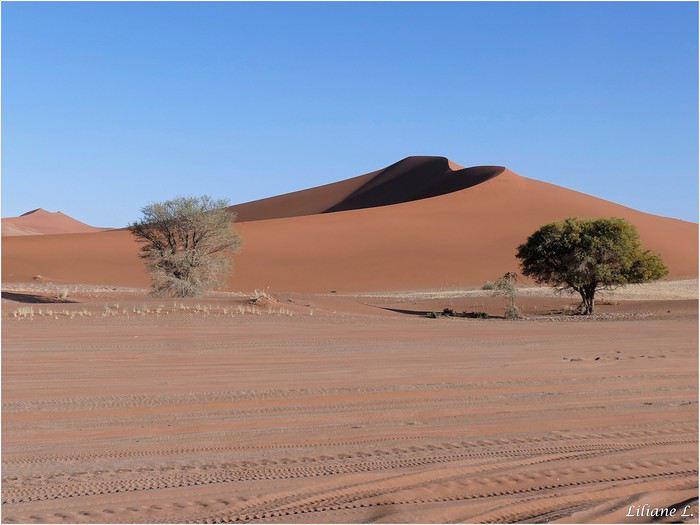
En Octobre 2018 nous avons fait un superbe voyage en Namibie entre déserts, safaris, et observations animalières. Nous ne l’avons pas fait en individuel comme c’est le cas sur ce forum mais j’ai quand même envie de le partager avec vous. Etant conscients que le montage, repliage de la tente sur le toit ce n’était pas pour nous, que nous n’avions jamais conduit sur piste ni même un 4 /4, mais surtout que si nous crevions nous n’aurions pas la force de changer la roue, nous avons opté pour un safari organisé par une agence en France que nous connaissions et ne l’avons pas regretté. Pour convenance personnelle nous sommes partis de Londres et retour à Paris. Nous retrouvons donc certains de nos co-équipiers à Londres, d'autres a Johannesburg et les 2 derniers à Windhoeck. Nous sommes 14 personnes répartis en deux 4/4 y compris nos deux Chauffeurs-Guides francophones et une Accompagnatrice. Nous logeons en bungalow.
Si notre circuit vous intéresse vous pouvez voir le récit complet avec photos ici
Bristol - Londres - JohannesburgWindhoek - Omaruru Omaruru - Mushara Bush camps (près entrée est du parc National d'Etosha) Parc National d'Etosha (Okaukuejo Lodge) Parc National d'Etosha - Hobatère Lodge (sortie Ouest du Parc) Hobatere Lodge -Epupa Falls Epupa Falls et les alentours(visite Himbas chutes) Epupa Epupa - Palmwag - Grooteberg Lodge Grootberg Lodge - Twyfelfontein Twyfelfontein - Swakopmund Swakopmund - Wallis Bay - Swakopmund Swakopmund - Sesriem - Sossus Lodge Désert du Namib (Sossus Lodge) Sossus Lodge - Windhoek Windhoek - Paris
7 Octobre
Bristol – Londres – Johannesburg
A Londres nous retrouvons 3 de nos compagnons de voyage partis de Paris ainsi que Caroline notre Guide.Nous voyageons sur un A380, c’est une première pour nous deux. Nous avons réservé des places duo au 1er étage. Ce qui est bien du côté hublot, c’est qu’ il y a un grand coffre où l’on peut mettre ses affaires. Il y a aussi un peu plus de place pour les jambes. Notre avion décolle à 19 h 05. Peu après le décollage on nous sert une boisson, jus de fruits ou autres, puis le dîner. C’est parti pour 12 heures de vol pour Johannesburg notre escale avant d’arriver à Windhoek.
8 Octobre
Johannesburg - Windhoek -Omaruru
Petit à petit tout le monde s’éveille et on nous sert le petit déjeuner.Nous arrivons à Johannesburg à 8 h 10 mn. heure locale. Notre avion pour Windhoek est à midi. Nous retrouvons nos compagnons de voyage.
Nous arrivons à 14 h 00 à Windhoek, il fait gris. Il y a du monde pour passer les formalités, pour mes compagnons de voyage c’est rapide, mais pour moi c’est plus long, je ne sais pas pourquoi, enfin il tamponne mon passeport, ouf je peux rejoindre les autres. A la sortie de l’aéroport les 2 dernières personnes du groupe nous attendent ainsi que nos 2 Chauffeurs –Guides Blandine et Rédemptus. Tout le monde se présente et nous montons dans les deux 4×4 direction Omaruru.
C’est parti pour Omaruru notre étape de ce soir. Premier arrêt au marché artisanal de Okahandja. A peine arrivés tout le monde veut nous attirer à son stand, c’est notre première journée en Namibie je voulais juste regarder tranquillement ce qu’ils vendaient.
Vers 18 h 45 mn, nous prenons la piste vers Omaruru avec un magnifique soleil couchant.
Dîner et nuit à Omaru Game Lodge. Il est situé dans une réserve privée à 15 km au Nord-Est d’Omaruru. Il est construit en style africain avec un toit de chaume. Les chambres et le restaurant sont organisés autour d’un point d’eau. Très beau lodge et très bon repas.Quelques animaux sont là, zèbres, oryx, etc. quel spectacle !
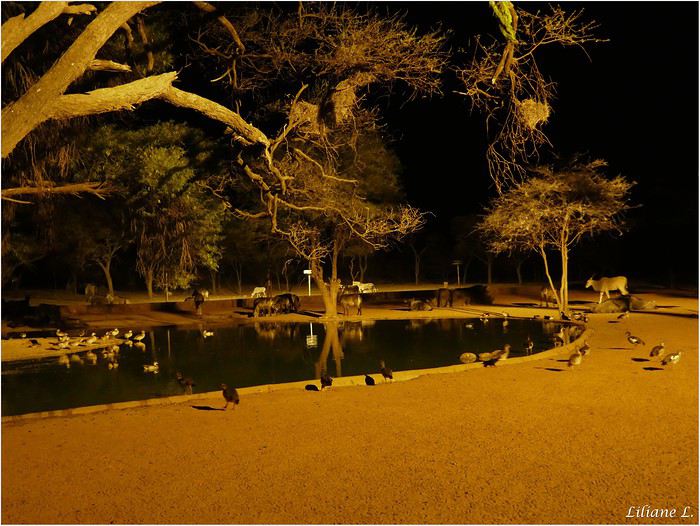
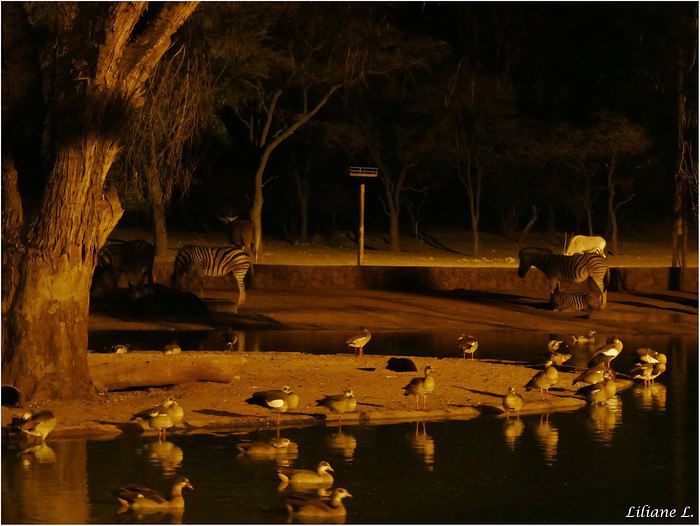
En Octobre 2018 nous avons fait un superbe voyage en Namibie entre déserts, safaris, et observations animalières. Nous ne l’avons pas fait en individuel comme c’est le cas sur ce forum mais j’ai quand même envie de le partager avec vous. Etant conscients que le montage, repliage de la tente sur le toit ce n’était pas pour nous, que nous n’avions jamais conduit sur piste ni même un 4 /4, mais surtout que si nous crevions nous n’aurions pas la force de changer la roue, nous avons opté pour un safari organisé par une agence en France que nous connaissions et ne l’avons pas regretté. Pour convenance personnelle nous sommes partis de Londres et retour à Paris. Nous retrouvons donc certains de nos co-équipiers à Londres, d'autres a Johannesburg et les 2 derniers à Windhoeck. Nous sommes 14 personnes répartis en deux 4/4 y compris nos deux Chauffeurs-Guides francophones et une Accompagnatrice. Nous logeons en bungalow.
Si notre circuit vous intéresse vous pouvez voir le récit complet avec photos ici
Bristol - Londres - JohannesburgWindhoek - Omaruru Omaruru - Mushara Bush camps (près entrée est du parc National d'Etosha) Parc National d'Etosha (Okaukuejo Lodge) Parc National d'Etosha - Hobatère Lodge (sortie Ouest du Parc) Hobatere Lodge -Epupa Falls Epupa Falls et les alentours(visite Himbas chutes) Epupa Epupa - Palmwag - Grooteberg Lodge Grootberg Lodge - Twyfelfontein Twyfelfontein - Swakopmund Swakopmund - Wallis Bay - Swakopmund Swakopmund - Sesriem - Sossus Lodge Désert du Namib (Sossus Lodge) Sossus Lodge - Windhoek Windhoek - Paris
7 Octobre
Bristol – Londres – Johannesburg
A Londres nous retrouvons 3 de nos compagnons de voyage partis de Paris ainsi que Caroline notre Guide.Nous voyageons sur un A380, c’est une première pour nous deux. Nous avons réservé des places duo au 1er étage. Ce qui est bien du côté hublot, c’est qu’ il y a un grand coffre où l’on peut mettre ses affaires. Il y a aussi un peu plus de place pour les jambes. Notre avion décolle à 19 h 05. Peu après le décollage on nous sert une boisson, jus de fruits ou autres, puis le dîner. C’est parti pour 12 heures de vol pour Johannesburg notre escale avant d’arriver à Windhoek.
8 Octobre
Johannesburg - Windhoek -Omaruru
Petit à petit tout le monde s’éveille et on nous sert le petit déjeuner.Nous arrivons à Johannesburg à 8 h 10 mn. heure locale. Notre avion pour Windhoek est à midi. Nous retrouvons nos compagnons de voyage.
Nous arrivons à 14 h 00 à Windhoek, il fait gris. Il y a du monde pour passer les formalités, pour mes compagnons de voyage c’est rapide, mais pour moi c’est plus long, je ne sais pas pourquoi, enfin il tamponne mon passeport, ouf je peux rejoindre les autres. A la sortie de l’aéroport les 2 dernières personnes du groupe nous attendent ainsi que nos 2 Chauffeurs –Guides Blandine et Rédemptus. Tout le monde se présente et nous montons dans les deux 4×4 direction Omaruru.
C’est parti pour Omaruru notre étape de ce soir. Premier arrêt au marché artisanal de Okahandja. A peine arrivés tout le monde veut nous attirer à son stand, c’est notre première journée en Namibie je voulais juste regarder tranquillement ce qu’ils vendaient.
Vers 18 h 45 mn, nous prenons la piste vers Omaruru avec un magnifique soleil couchant.
Dîner et nuit à Omaru Game Lodge. Il est situé dans une réserve privée à 15 km au Nord-Est d’Omaruru. Il est construit en style africain avec un toit de chaume. Les chambres et le restaurant sont organisés autour d’un point d’eau. Très beau lodge et très bon repas.Quelques animaux sont là, zèbres, oryx, etc. quel spectacle !
Bonjour à tous,
Tout nouvel inscrit sur ce forum, je viens à vous afin de récolter des conseils précieux ! Je suis actuellement en pleine préparation avec ma femme d'un long voyage d'une année autour du monde. Le troisième et dernier continent que nous visiterons sera l'Afrique sur une période de 2 mois environ, la durée exacte dépendra du déroulement de tout ce voyage. La période de notre visite sera entre Juin et Août (2020, donc on a encore du temps !). L'idée pour nous est de visiter une partie de l'Afrique australe (notre itinéraire ci-dessous). Nous souhaiterions faire un maximum de safaris au cours de ce périple car c'est notre principal point d'intérêt pour cette partie du voyage. A l'origine (le rêve initial!) nous souhaitions réaliser un road trip en 4x4 avec tente sur le toit, mais à 90/100€ de location la journée, ça ne passera pas dans notre budget à priori.
Nous voici donc à la question majeure de mon message : Afin de pouvoir aller plus dans le détail de nos visites et donc d'avoir une idée plus précise du budget sur ces quelques semaines en Afrique australe, je voulais savoir comment pouvait-on gérer un tel voyage en ne louant qu'un véhicule classique (SUV?, berline?) ? Je me pose en effet des questions sur les safaris notamment : Est-ce que la combinaison location de véhicule "classique" entre les parcs + game drive avec guide dans les parcs est valable au niveau du coût par rapport à la location d'un 4x4 pour tout le voyage en autonomie ?
Seconde question : Étant donné que nous n'avons aucune expérience de ce type de voyage (conduite de 4x4, safaris, etc.), nous nous posons la question de la faisabilité des self-drive ? J'imagine que sans expérience particulière nous aurons plus de difficultés à réussir de belles observations. Les parties les plus propices à la rencontre et sauvages sont elles uniquement accessibles aux 4x4 ?
Dernier point : Notre itinéraire, voici une ébauche de celui-ci selon les différents sites et carnets du forum que nous avons lu. Cela vous semble-t-il réalisable et juste au niveau des durées de chaque étape ? Af du Sud (1/2) 16 jours 1/ Johannesbourg - 2j 2 / Sainte Lucie + Hluhluwe-Umfolozi Reserve 3j 3 / Cote sauvage Est (Sardine run en Juin/Juillet) - 3j 4 / Drakensberg - 2j 5 / Cape Town + Hermanus - 6j
Namibie 16 jours 6 / Fish river canyon - 3j 7 / Désert Namib , Sossusvlei, Sesriem Canyon - 4j 8 / Côte Ouest : Walvis Bay, Skeleton Coast National Park, Spitzkoppe - 4j 9 / Damaraland, Twyfelfontein- 1j 10 / Etosha Park - 4j
Botswana 8 jours 11/ Delta Okavengo + Moremi reserve - 4j 12 / Chobe NP - 4j
Zimbabwe 8 jours 13 / Chutes Victoria - 2j 14 / Safari Zambèze + Matusadona National Park + Kariba Lake - 5j 15 / 1 journée de route jusqu'à Af du Sud Pas de Hwange NP, Matobo NP ?
Af du Sud (2/2) 7 jours 16 / Blyde River Canyon + Kruger National Park- 5j 17 / Johannesbourg - 2j
D'avance merci d'avoir pris le temps de me lire (et éventuellement de me répondre).
Tout nouvel inscrit sur ce forum, je viens à vous afin de récolter des conseils précieux ! Je suis actuellement en pleine préparation avec ma femme d'un long voyage d'une année autour du monde. Le troisième et dernier continent que nous visiterons sera l'Afrique sur une période de 2 mois environ, la durée exacte dépendra du déroulement de tout ce voyage. La période de notre visite sera entre Juin et Août (2020, donc on a encore du temps !). L'idée pour nous est de visiter une partie de l'Afrique australe (notre itinéraire ci-dessous). Nous souhaiterions faire un maximum de safaris au cours de ce périple car c'est notre principal point d'intérêt pour cette partie du voyage. A l'origine (le rêve initial!) nous souhaitions réaliser un road trip en 4x4 avec tente sur le toit, mais à 90/100€ de location la journée, ça ne passera pas dans notre budget à priori.
Nous voici donc à la question majeure de mon message : Afin de pouvoir aller plus dans le détail de nos visites et donc d'avoir une idée plus précise du budget sur ces quelques semaines en Afrique australe, je voulais savoir comment pouvait-on gérer un tel voyage en ne louant qu'un véhicule classique (SUV?, berline?) ? Je me pose en effet des questions sur les safaris notamment : Est-ce que la combinaison location de véhicule "classique" entre les parcs + game drive avec guide dans les parcs est valable au niveau du coût par rapport à la location d'un 4x4 pour tout le voyage en autonomie ?
Seconde question : Étant donné que nous n'avons aucune expérience de ce type de voyage (conduite de 4x4, safaris, etc.), nous nous posons la question de la faisabilité des self-drive ? J'imagine que sans expérience particulière nous aurons plus de difficultés à réussir de belles observations. Les parties les plus propices à la rencontre et sauvages sont elles uniquement accessibles aux 4x4 ?
Dernier point : Notre itinéraire, voici une ébauche de celui-ci selon les différents sites et carnets du forum que nous avons lu. Cela vous semble-t-il réalisable et juste au niveau des durées de chaque étape ? Af du Sud (1/2) 16 jours 1/ Johannesbourg - 2j 2 / Sainte Lucie + Hluhluwe-Umfolozi Reserve 3j 3 / Cote sauvage Est (Sardine run en Juin/Juillet) - 3j 4 / Drakensberg - 2j 5 / Cape Town + Hermanus - 6j
Namibie 16 jours 6 / Fish river canyon - 3j 7 / Désert Namib , Sossusvlei, Sesriem Canyon - 4j 8 / Côte Ouest : Walvis Bay, Skeleton Coast National Park, Spitzkoppe - 4j 9 / Damaraland, Twyfelfontein- 1j 10 / Etosha Park - 4j
Botswana 8 jours 11/ Delta Okavengo + Moremi reserve - 4j 12 / Chobe NP - 4j
Zimbabwe 8 jours 13 / Chutes Victoria - 2j 14 / Safari Zambèze + Matusadona National Park + Kariba Lake - 5j 15 / 1 journée de route jusqu'à Af du Sud Pas de Hwange NP, Matobo NP ?
Af du Sud (2/2) 7 jours 16 / Blyde River Canyon + Kruger National Park- 5j 17 / Johannesbourg - 2j
D'avance merci d'avoir pris le temps de me lire (et éventuellement de me répondre).
Bonsoir,
Nous voici rentrés de 4 magnifiques semaines en NAMIBIE, BOTSWANA et ZWIMBABWE.
Tout s'est bien passé mis à part le retour hier matin en train de Francfort à Bruxelles où mon mari s'est fait volé le sac à dos qui contenait, entre autre, un appareil photo CANON 700d, un zoom 55/250, un grand angle, une tablette et son téléphone portable, sans compte des lunettes de vue et divers chargeurs et batteries.
Nous nous sommes endormis peu de temps après le départ de l'aéroport et un malfrat en a profité. Nous nous sommes aperçus de la disparation du sac qui était placé au dessus avec les valises une fois arrivés à la gare de Cologne. Heureusement j'avais toutes les cartes photos avec moi ainsi que le vieil appareil photo canon 500D et surtout le téléobjectif. Côté photos j'ai malheureusement à déplorer que la perte de celles prises les 2 derniers jours avec le grand angle c'est à dire et surtout les chutes Victoria vues d'hélicoptère (j'étais devant près du pilote) et les photos de l'hotel Victoria falls.
Mais passons aux choses plus réjouissantes. Je remercie tous ceux qui m'ont aidé dans la préparation de ce voyage et particulièrement Krikri, max68 (surtout pour en avoir parlé à Patrick l'an passé lors de notre rencontre en Islande, première tentative pour le convaincre d'aller en Afrique), Emma, Michelle, Lili, Pierre et les autres forumeurs .
Voici nos impressions de ces 4 semaines La météo : En Namibie : Que cela fait du bien d'avoir chaud, même très chaud à certains endroits car nous avons eu jusqu'à 38° aux heures les plus chaudes... J'adore ! On nous avait parlé de nuits froides : on n'a pas eu à se plaindre. En mai c'est parfait mais les namibiens sont unanimes pour dire qu'en juillet/aout c'est " glagla ". Nous avions dans les 20° au réveil. En revanche l'endroit où il ne faisait pas vraiment beau mais froid c'était à SWAKOPMUND : Brouillard le matin, ciel couvert...idem à WALVIS BAY mais ciel qui se dégage vers 11h et vent. Ailleurs : ciel sans nuages. Ce qu'il faut retenir c'est que dès que le soleil se couche et tant qu'il n'est pas levé le matin : fait frais !
Exception pour Kavango, Caprivi, Kasane (Botswana) et Victoria falls (Zimbabwe) : Nous avons visité cette région en dernière semaine. Les matins étaient plus frais, autour de 15 à 18°et les journées très agréables (max 28°).
L'agence Tourmaline a bien fait son job. Aucun soucis de réservation pour les hébergements et les activités. C'est Alex, le patron de la Londiningi guest house qui nous a fait le briefing de départ pour l'agence. Il nous attendait chez le louer de véhicule, Asco, pour nous expliquer aussi tout concernant l'auto. Nous avons apprécié d'avoir toutes ces explications en français.
La voiture J'avais demandé un Hillux automatique diesel . On nous a doté d'un véhicule neuf qui affichait seulement 4000 km au compteur. Les pneus étaient impeccables. Nous n'avons pas crevé. J'avais pris avec moi des grands sacs poubelles pour protéger les valises de la poussière, nous n'en n'avons pas eu besoin. Etait-ce parce que nous étions en mai, juste après la saison des pluies, ou parce que le véhicule était neuf ou bien parce que le coffre en alu fixé à l'arrière était bien étanche, mais nous n'avons pas eu beaucoup de poussière et nous nous sommes finalement passés des sacs poubelles.

Les routes Les routes asphaltées sont bien entretenues. Les " gravel roads " sont généralement larges bien entretenues. Les petites pistes sont un peu plus rudes mais pas de grosses difficultés pour notre part. Ce que nous avons trouvé dangereux : - Les limitations de vitesse sont hautes, trop par rapport à ce que nous connaissons. Les locaux roulent vite et certains touristes tentent de les imiter, ce qui n'est pas très raisonnable en raison des nombreux obstacles qui peuvent surgir (enfants, animaux – sauvages mais aussi et surtout les animaux domestiques ânes, vaches, chèvres- , tas de sable ou de gravier sur certaines routes, surtout secteur de Solitaire et plus précisément entre Solitaire et Rostock sur la C14. - Beaucoup de routes sont droites et interminables parmi des paysages désertiques ce qui sont des facteurs favorables à l'endormissement, une de nos principales craintes.
 Ci-dessus : Zebra crossing
La nourriture Autre grand sujet de préoccupation des touristes " surtout français "… quoique les belges ne sont pas en reste... Nous avons très bien mangé en Afrique mais une nourriture plutôt de type européen alors que je m'attendais aussi à goûter des spécialités africaines. La majeure partie des plats proposés se composent de grillades (bœuf, agneau, gibier) ou poulet. Le gibier (game) n'est pas aussi fort en goût que celui que l'on trouve chez nous (sanglier, cerf, etc...) et c'est tant mieux pour moi qui préfère des goûts moins prononcés. Comme souvent lu sur le forum je confirme que la viande de Kudu est souvent la plus tendre. Les légumes accompagnants manquent souvent de cuisson. Croquant ça va, pas cuit bonjour les dégâts... Les pique-niques organisés par les lodges sont souvent opulents et très agréables. Le petit déjeuner au champagne sud africain après le vol en mongolfière est tout aussi exceptionnel qu'inoubliable

Les hébergements Nous ne faisions pas de camping. Nous avons eu l'occasion de tester des lodges, des guest houses et un hébergement basique au Spitkoppe. Les hébergements sont très biens, propres, parfois très luxueux. Ce qui est à déplorer c'est parfois le manque d'ambiance, surtout durant les diner : Peu ou pas de musique par exemple... alors quand on est de 2 ou 3 tables c'est tristounet. Par exemple, le buffet de l'eagle nest du Vingerklip était très chouette mais pas de musique... et personne n'osait moufeter... Seuls 3 lodges avaient un fond musical sympa : Le Hoodia, le Mowani et le Divava.
Voici notre " tierçé " de nos lodges préférés tout confondu (confort, accueil, nourriture, ambiance générale) :
1) Le Hoodia desert lodge : Il y a beaucoup de lodge dans le secteur de Sossusvlei. Le Hoodia est assez petit et discret, c'est sans doute aussi ce qui fait son charme. D'aucun diront que les chambres sont un peu petites mais il n'y a vraiment rien à reprocher à cet établissement ou le patron est très présent et super sympa. La nourriture est raffinée et excellente. Le staff est souriant et l'on sent qu'il y a une bonne ambiance. Ce lodge mérite amplement sa première place sur Tripadvisor. La journée organisée dans les dunes est exceptionnelle. D'ailleurs j'en avais lu tellement de bien que c'est pour cela que j'avais opté pour le Hoodia. Cette journée a vraiment dépassé mes espérances C'était incroyable ! Notre guide, Amgula était aux petits soins et nous avons pleinement apprécié tout ce qu'il nous a fait découvrir. Certes nous aurions pu aller dans le parc par nous même... cela aurait été très différent...

2) Le Divava lodge & spa : Situé sur les bords du Kavango, ce lodge pourrait être l'écho de la célèbre citation de Beaudelaire " Là, tout n'est qu'ordre et beauté, Luxe, calme et volupté ". Un personnel souriant et aux petits soins, une nourriture excellente et raffinée, une chambre immense et luxueuse : Le Divava etait certainement le plus beau des lodge que nous avons visité durant notre séjour. Nous avons eu l'occasion de faire 2 activités : Une promenade en bateau jusqu'aux Popa falls et un game drive à Mahango le matin à l'aube.
3) Na an Kusé lodge : C'est ici que nous avons littéralement " débarqué " lorsque nous sommes arrivés à l'aube de notre premier jour sur le sol Africain. L'accueil par Rhona était adorable. Nous avions été prévenus que notre chambre ne serait pas prête car ils avaient un mariage la veille. Avouez qu'à 6h30 du matin c'est un peu normal. Aussi, on nous avait proposé de faire 2 activités en arrivant. Rhona nous a offert du café en attendant le guide et à 7h00 nous étions dans le busch avec Kiki le guépard.. mais ça c'est une autre histoire... Pour ce qui est du lodge, il y a très peu de chambres. On peut donc dire qu'il est vraiment exclusif. L'environnement est très beau. Près de la piscine, il y a un petit canyon peuplé de daman des rochers (première rencontre animalière du matin). La chambre est immense et la déco plutôt " branchée ". Au matin, un babouin était sur la terrasse et un kudu grignotait un arbuste juste devant la fenêtre... Quelle introduction au voyage !

Note "coup de cœur" … pour le Khowareb lodge. Ce lodge est situé près de Sesfontein sur la rivière Khowareb. Nous y sommes restés 2 nuits, le temps d'apprécier la gentillesse du staff. Ici s'est tout de suite sentis bien. Pas de chichis et relax... La chambre est petite mais suffisante avec des murs en toile de tente et la salle de bain est totalement ouverte en extérieur. La nourriture est bonne et le staff chante après le repas. Ambiance ambiance... Côté accueil, la jeune fille était très présente et venait à notre rencontre avec un cocktail à chaque retour d'excursion. Nous avons fait 2 excursions avec le lodge : une visite de village himba – égale à ce que j'attendais- et une journée track rhino exceptionnelle où nous n'avons pas trouvé le rhino mais ... des lions et des éléphants...

Mention spéciale repas : Bien sur une guest house n'est pas un lodge avec le cadre et le personnel qui va avec mais nous avons apprécié la fameuse LONDININGI guets house, bien connue des forumeurs, avec un très bon accueil de Alex, le propriétaire qui nous a pris en charge chez Asco, le loueur de voiture et nous a fait le briefing au nom de l'agence Tourmaline. Les chambres sont tout à fait correctes mais le point fort c'est le diner. La cuisine est tout simplement délicieuse et nous avons pu apprécié un excellent steak de Kudu suivi d'une fine tarte aux pommes... je ne vous dit que ça ! Miam ...
So british : Quand on va au Victoria falls hotel, on se prépare à un retour dans le temps car l'hotel est de style colonial avec un nombre d'employés impressionnant. Même si les chambres sont vieillottes, le cadre de cet hotel tout simplement magnifique et nous avons apprécié de nous y relaxer pour nos deux derniers jours en Afrique.

Une déception On nous avait dit beaucoup de bien du Mowani lodge dans le Damaraland. Il est vrai que le site est très beau, que les chambres sont grandes mais quelle déception au niveau de la nourriture : un œuf mollet recouvert d'une sauce tomate insipide le tout posé sur un bout de saumon fumé, un morceau de bœuf très tendre recouvert d'une pâte de foie de volailles aux champignons (quel mélange!), et une meringue collante avec une glace. Le lendemain avec le game drive des éléphants du désert, nous avons tenté le lunch pour voir si c'était mieux : Petite salade avec quelques poivrons grillés marinés et dessert nommé injustement smothies mais qui se compose en fait de yaourt mixé avec les fruits du petit dej du matin, surtout du melon, le tout sans sucre... vraiment pas bon.
Les gens rencontrés lors du voyage : Nous avons eu l'occasion de rencontrer des namibiens blancs parlant soit anglais, soit afrikaans soit allemand et des namibiens noirs de différentes etnies, toujours très courtois et souvent très souriants. Nous parlions généralement en anglais ou en allemand et nous comprenions certains mots d'afrikaans.

Dans les lodges, nous avons eu l'occasion de rencontrer des clients sud africains et de discuter avec eux. Nous étions curieux de connaître leur culture, leur pays et leur esprit... C'est là que le nous ne sommes définitivement pas sur la même longueur d'ondes... En revanche nous avons eu de bons contacts avec des touristes allemands, un couple de vieux anglais ainsi que des canadiens de Vancouver très sympas.
Les paysages
La Namibie on y va pour les animaux mais aussi pour la diversité de ses paysages, et certains ne sont pas sans nous rappeler les USA (Vingerklip, Grootberg, désert...)
Les paysages sont vraiments exceptionnels, surtout au Nord, et diversifiés : déserts de sables, de cailloux, montagnes, verdure à Caprivi...

Les animaux A part le léopard que nous n'avons pas eu la chance de voir, nous avons vu les principaux animaux d'Afrique et des tas d'oiseaux magnifiques. Ci-dessous : Heure de pointe au point d'eau (Etosha)

Ci-dessous : Girafe de Bagatelle (Kalahari)

D'ailleurs à la fin, nous avons eu tendance à ne plus trop prêter attention aux éléphants et aux girafes tellement nous en avions vu et à nous focaliser sur le " shooting " de " zoziaux ", ce qui n'est pas toujours évident croyez moi ! Ci-dessous : Buffle et son oiseau (Chobe)


Les activités Nous avons beaucoup aimé les activités proposées par les lodges et les game drive. D'ailleurs, pour la petite histoire, à la fin de notre séjour à Etosha, Patrick était fatigué de conduire et moi je n'étais pas rassasiée d'animaux. Alors on s'est offert un game drive d'après-midi où nous n'étions que 2 passagers. Le guide nous a averti que l'après-midi on ne voyait pas beaucoup d'animaux actifs... Mais était-ce du aux bons yeux du guide ou à un énorme coup de chance, cet après-midi là fut exceptionnel: Nous avons vu un guépard en train de chasser et qui est ensuite tranquillement passé devant nous, un autre guépard qui venait de déguster sa proie, un lion, 3 rhino noirs et un rhino blanc... entre autres....

Parmi les activités exceptionnelles : Je ne vais pas tout raconter ici mais aucune ne nous a déçu, au contraire, nous en garderons un souvenir ému. Je dois ajouter que nous n'étions généralement pas nombreux, voire même certaines fois rien que nous deux : Marche avec le guépard à Na an kusé, Journée à Sossusvlei avec le Hoodia lodge, Ballon à Sossusvlei,

journée combiné catamaran + sandwich harbour,
 (La photo du flamand rose ci-dessus a été prise a Sandwich Harbour, ce qui explique le jaune orangé de la dune en arrière plan)
rhino tracking à Khowareb, journée chez les buschmen avec le Fiume lodge (on parle peu de ce lodge sur le forum mais la journée découverte de la culture buchmen dans le village exclusif pour le lodge, est tout simplement magnifique),
 (La photo de la madame buschmen topless ayant été censurée, je l'ai remplacée par les buschmens chasseurs)
Journée prise de vues et conseils photographiques avec Pangolin à Kasane (formidable), hélicoptère aux chutes Victoria...
En conclusion : Un voyage exceptionnel et l'on se dit qu'on a bien eu raison d'y aller ! Il n'y a pas eu une journée où l'on se soit ennuyé, pas une journée où l'on ait pas découvert quelque chose de différent. Comme pour les USA où nous sommes allés 4 fois, la Namibie et les pays voisins donnent très envie d'y retourner.
Ce qui nous a manqué : Les enfants. C'est la première fois que nous n'étions que tous les 2, mon mari et moi.
Si c'était à refaire : On séjournerait à Walvis Bay plutôt qu'à Swakopmund. On éviterait peut-être la bande de Caprivi car trop de route. On passerait peut-être par les Epupa falls au nord, ou bien le fish river canyon au sud... On passerait moins de temps dans le Damaraland...quoique...

Celui-ci nous attend l'année prochaine :

Je vous donne rendez-vous sur mon site pour suivre le carnet de voyage jour après jour. Pour l'instant il n'y a que la page de préparation mais si vous me laissez un peu de temps...
Nous nous sommes endormis peu de temps après le départ de l'aéroport et un malfrat en a profité. Nous nous sommes aperçus de la disparation du sac qui était placé au dessus avec les valises une fois arrivés à la gare de Cologne. Heureusement j'avais toutes les cartes photos avec moi ainsi que le vieil appareil photo canon 500D et surtout le téléobjectif. Côté photos j'ai malheureusement à déplorer que la perte de celles prises les 2 derniers jours avec le grand angle c'est à dire et surtout les chutes Victoria vues d'hélicoptère (j'étais devant près du pilote) et les photos de l'hotel Victoria falls.
Mais passons aux choses plus réjouissantes. Je remercie tous ceux qui m'ont aidé dans la préparation de ce voyage et particulièrement Krikri, max68 (surtout pour en avoir parlé à Patrick l'an passé lors de notre rencontre en Islande, première tentative pour le convaincre d'aller en Afrique), Emma, Michelle, Lili, Pierre et les autres forumeurs .
Voici nos impressions de ces 4 semaines La météo : En Namibie : Que cela fait du bien d'avoir chaud, même très chaud à certains endroits car nous avons eu jusqu'à 38° aux heures les plus chaudes... J'adore ! On nous avait parlé de nuits froides : on n'a pas eu à se plaindre. En mai c'est parfait mais les namibiens sont unanimes pour dire qu'en juillet/aout c'est " glagla ". Nous avions dans les 20° au réveil. En revanche l'endroit où il ne faisait pas vraiment beau mais froid c'était à SWAKOPMUND : Brouillard le matin, ciel couvert...idem à WALVIS BAY mais ciel qui se dégage vers 11h et vent. Ailleurs : ciel sans nuages. Ce qu'il faut retenir c'est que dès que le soleil se couche et tant qu'il n'est pas levé le matin : fait frais !
Exception pour Kavango, Caprivi, Kasane (Botswana) et Victoria falls (Zimbabwe) : Nous avons visité cette région en dernière semaine. Les matins étaient plus frais, autour de 15 à 18°et les journées très agréables (max 28°).
L'agence Tourmaline a bien fait son job. Aucun soucis de réservation pour les hébergements et les activités. C'est Alex, le patron de la Londiningi guest house qui nous a fait le briefing de départ pour l'agence. Il nous attendait chez le louer de véhicule, Asco, pour nous expliquer aussi tout concernant l'auto. Nous avons apprécié d'avoir toutes ces explications en français.
La voiture J'avais demandé un Hillux automatique diesel . On nous a doté d'un véhicule neuf qui affichait seulement 4000 km au compteur. Les pneus étaient impeccables. Nous n'avons pas crevé. J'avais pris avec moi des grands sacs poubelles pour protéger les valises de la poussière, nous n'en n'avons pas eu besoin. Etait-ce parce que nous étions en mai, juste après la saison des pluies, ou parce que le véhicule était neuf ou bien parce que le coffre en alu fixé à l'arrière était bien étanche, mais nous n'avons pas eu beaucoup de poussière et nous nous sommes finalement passés des sacs poubelles.
Les routes Les routes asphaltées sont bien entretenues. Les " gravel roads " sont généralement larges bien entretenues. Les petites pistes sont un peu plus rudes mais pas de grosses difficultés pour notre part. Ce que nous avons trouvé dangereux : - Les limitations de vitesse sont hautes, trop par rapport à ce que nous connaissons. Les locaux roulent vite et certains touristes tentent de les imiter, ce qui n'est pas très raisonnable en raison des nombreux obstacles qui peuvent surgir (enfants, animaux – sauvages mais aussi et surtout les animaux domestiques ânes, vaches, chèvres- , tas de sable ou de gravier sur certaines routes, surtout secteur de Solitaire et plus précisément entre Solitaire et Rostock sur la C14. - Beaucoup de routes sont droites et interminables parmi des paysages désertiques ce qui sont des facteurs favorables à l'endormissement, une de nos principales craintes.
Ci-dessus : Zebra crossingLa nourriture Autre grand sujet de préoccupation des touristes " surtout français "… quoique les belges ne sont pas en reste... Nous avons très bien mangé en Afrique mais une nourriture plutôt de type européen alors que je m'attendais aussi à goûter des spécialités africaines. La majeure partie des plats proposés se composent de grillades (bœuf, agneau, gibier) ou poulet. Le gibier (game) n'est pas aussi fort en goût que celui que l'on trouve chez nous (sanglier, cerf, etc...) et c'est tant mieux pour moi qui préfère des goûts moins prononcés. Comme souvent lu sur le forum je confirme que la viande de Kudu est souvent la plus tendre. Les légumes accompagnants manquent souvent de cuisson. Croquant ça va, pas cuit bonjour les dégâts... Les pique-niques organisés par les lodges sont souvent opulents et très agréables. Le petit déjeuner au champagne sud africain après le vol en mongolfière est tout aussi exceptionnel qu'inoubliable
Les hébergements Nous ne faisions pas de camping. Nous avons eu l'occasion de tester des lodges, des guest houses et un hébergement basique au Spitkoppe. Les hébergements sont très biens, propres, parfois très luxueux. Ce qui est à déplorer c'est parfois le manque d'ambiance, surtout durant les diner : Peu ou pas de musique par exemple... alors quand on est de 2 ou 3 tables c'est tristounet. Par exemple, le buffet de l'eagle nest du Vingerklip était très chouette mais pas de musique... et personne n'osait moufeter... Seuls 3 lodges avaient un fond musical sympa : Le Hoodia, le Mowani et le Divava.
Voici notre " tierçé " de nos lodges préférés tout confondu (confort, accueil, nourriture, ambiance générale) :
1) Le Hoodia desert lodge : Il y a beaucoup de lodge dans le secteur de Sossusvlei. Le Hoodia est assez petit et discret, c'est sans doute aussi ce qui fait son charme. D'aucun diront que les chambres sont un peu petites mais il n'y a vraiment rien à reprocher à cet établissement ou le patron est très présent et super sympa. La nourriture est raffinée et excellente. Le staff est souriant et l'on sent qu'il y a une bonne ambiance. Ce lodge mérite amplement sa première place sur Tripadvisor. La journée organisée dans les dunes est exceptionnelle. D'ailleurs j'en avais lu tellement de bien que c'est pour cela que j'avais opté pour le Hoodia. Cette journée a vraiment dépassé mes espérances C'était incroyable ! Notre guide, Amgula était aux petits soins et nous avons pleinement apprécié tout ce qu'il nous a fait découvrir. Certes nous aurions pu aller dans le parc par nous même... cela aurait été très différent...
2) Le Divava lodge & spa : Situé sur les bords du Kavango, ce lodge pourrait être l'écho de la célèbre citation de Beaudelaire " Là, tout n'est qu'ordre et beauté, Luxe, calme et volupté ". Un personnel souriant et aux petits soins, une nourriture excellente et raffinée, une chambre immense et luxueuse : Le Divava etait certainement le plus beau des lodge que nous avons visité durant notre séjour. Nous avons eu l'occasion de faire 2 activités : Une promenade en bateau jusqu'aux Popa falls et un game drive à Mahango le matin à l'aube.
3) Na an Kusé lodge : C'est ici que nous avons littéralement " débarqué " lorsque nous sommes arrivés à l'aube de notre premier jour sur le sol Africain. L'accueil par Rhona était adorable. Nous avions été prévenus que notre chambre ne serait pas prête car ils avaient un mariage la veille. Avouez qu'à 6h30 du matin c'est un peu normal. Aussi, on nous avait proposé de faire 2 activités en arrivant. Rhona nous a offert du café en attendant le guide et à 7h00 nous étions dans le busch avec Kiki le guépard.. mais ça c'est une autre histoire... Pour ce qui est du lodge, il y a très peu de chambres. On peut donc dire qu'il est vraiment exclusif. L'environnement est très beau. Près de la piscine, il y a un petit canyon peuplé de daman des rochers (première rencontre animalière du matin). La chambre est immense et la déco plutôt " branchée ". Au matin, un babouin était sur la terrasse et un kudu grignotait un arbuste juste devant la fenêtre... Quelle introduction au voyage !
Note "coup de cœur" … pour le Khowareb lodge. Ce lodge est situé près de Sesfontein sur la rivière Khowareb. Nous y sommes restés 2 nuits, le temps d'apprécier la gentillesse du staff. Ici s'est tout de suite sentis bien. Pas de chichis et relax... La chambre est petite mais suffisante avec des murs en toile de tente et la salle de bain est totalement ouverte en extérieur. La nourriture est bonne et le staff chante après le repas. Ambiance ambiance... Côté accueil, la jeune fille était très présente et venait à notre rencontre avec un cocktail à chaque retour d'excursion. Nous avons fait 2 excursions avec le lodge : une visite de village himba – égale à ce que j'attendais- et une journée track rhino exceptionnelle où nous n'avons pas trouvé le rhino mais ... des lions et des éléphants...
Mention spéciale repas : Bien sur une guest house n'est pas un lodge avec le cadre et le personnel qui va avec mais nous avons apprécié la fameuse LONDININGI guets house, bien connue des forumeurs, avec un très bon accueil de Alex, le propriétaire qui nous a pris en charge chez Asco, le loueur de voiture et nous a fait le briefing au nom de l'agence Tourmaline. Les chambres sont tout à fait correctes mais le point fort c'est le diner. La cuisine est tout simplement délicieuse et nous avons pu apprécié un excellent steak de Kudu suivi d'une fine tarte aux pommes... je ne vous dit que ça ! Miam ...
So british : Quand on va au Victoria falls hotel, on se prépare à un retour dans le temps car l'hotel est de style colonial avec un nombre d'employés impressionnant. Même si les chambres sont vieillottes, le cadre de cet hotel tout simplement magnifique et nous avons apprécié de nous y relaxer pour nos deux derniers jours en Afrique.
Une déception On nous avait dit beaucoup de bien du Mowani lodge dans le Damaraland. Il est vrai que le site est très beau, que les chambres sont grandes mais quelle déception au niveau de la nourriture : un œuf mollet recouvert d'une sauce tomate insipide le tout posé sur un bout de saumon fumé, un morceau de bœuf très tendre recouvert d'une pâte de foie de volailles aux champignons (quel mélange!), et une meringue collante avec une glace. Le lendemain avec le game drive des éléphants du désert, nous avons tenté le lunch pour voir si c'était mieux : Petite salade avec quelques poivrons grillés marinés et dessert nommé injustement smothies mais qui se compose en fait de yaourt mixé avec les fruits du petit dej du matin, surtout du melon, le tout sans sucre... vraiment pas bon.
Les gens rencontrés lors du voyage : Nous avons eu l'occasion de rencontrer des namibiens blancs parlant soit anglais, soit afrikaans soit allemand et des namibiens noirs de différentes etnies, toujours très courtois et souvent très souriants. Nous parlions généralement en anglais ou en allemand et nous comprenions certains mots d'afrikaans.
Dans les lodges, nous avons eu l'occasion de rencontrer des clients sud africains et de discuter avec eux. Nous étions curieux de connaître leur culture, leur pays et leur esprit... C'est là que le nous ne sommes définitivement pas sur la même longueur d'ondes... En revanche nous avons eu de bons contacts avec des touristes allemands, un couple de vieux anglais ainsi que des canadiens de Vancouver très sympas.
Les paysages
La Namibie on y va pour les animaux mais aussi pour la diversité de ses paysages, et certains ne sont pas sans nous rappeler les USA (Vingerklip, Grootberg, désert...)
Les paysages sont vraiments exceptionnels, surtout au Nord, et diversifiés : déserts de sables, de cailloux, montagnes, verdure à Caprivi...
Les animaux A part le léopard que nous n'avons pas eu la chance de voir, nous avons vu les principaux animaux d'Afrique et des tas d'oiseaux magnifiques. Ci-dessous : Heure de pointe au point d'eau (Etosha)
Ci-dessous : Girafe de Bagatelle (Kalahari)
D'ailleurs à la fin, nous avons eu tendance à ne plus trop prêter attention aux éléphants et aux girafes tellement nous en avions vu et à nous focaliser sur le " shooting " de " zoziaux ", ce qui n'est pas toujours évident croyez moi ! Ci-dessous : Buffle et son oiseau (Chobe)
Les activités Nous avons beaucoup aimé les activités proposées par les lodges et les game drive. D'ailleurs, pour la petite histoire, à la fin de notre séjour à Etosha, Patrick était fatigué de conduire et moi je n'étais pas rassasiée d'animaux. Alors on s'est offert un game drive d'après-midi où nous n'étions que 2 passagers. Le guide nous a averti que l'après-midi on ne voyait pas beaucoup d'animaux actifs... Mais était-ce du aux bons yeux du guide ou à un énorme coup de chance, cet après-midi là fut exceptionnel: Nous avons vu un guépard en train de chasser et qui est ensuite tranquillement passé devant nous, un autre guépard qui venait de déguster sa proie, un lion, 3 rhino noirs et un rhino blanc... entre autres....
Parmi les activités exceptionnelles : Je ne vais pas tout raconter ici mais aucune ne nous a déçu, au contraire, nous en garderons un souvenir ému. Je dois ajouter que nous n'étions généralement pas nombreux, voire même certaines fois rien que nous deux : Marche avec le guépard à Na an kusé, Journée à Sossusvlei avec le Hoodia lodge, Ballon à Sossusvlei,
journée combiné catamaran + sandwich harbour,
(La photo du flamand rose ci-dessus a été prise a Sandwich Harbour, ce qui explique le jaune orangé de la dune en arrière plan)rhino tracking à Khowareb, journée chez les buschmen avec le Fiume lodge (on parle peu de ce lodge sur le forum mais la journée découverte de la culture buchmen dans le village exclusif pour le lodge, est tout simplement magnifique),
(La photo de la madame buschmen topless ayant été censurée, je l'ai remplacée par les buschmens chasseurs)Journée prise de vues et conseils photographiques avec Pangolin à Kasane (formidable), hélicoptère aux chutes Victoria...
En conclusion : Un voyage exceptionnel et l'on se dit qu'on a bien eu raison d'y aller ! Il n'y a pas eu une journée où l'on se soit ennuyé, pas une journée où l'on ait pas découvert quelque chose de différent. Comme pour les USA où nous sommes allés 4 fois, la Namibie et les pays voisins donnent très envie d'y retourner.
Ce qui nous a manqué : Les enfants. C'est la première fois que nous n'étions que tous les 2, mon mari et moi.
Si c'était à refaire : On séjournerait à Walvis Bay plutôt qu'à Swakopmund. On éviterait peut-être la bande de Caprivi car trop de route. On passerait peut-être par les Epupa falls au nord, ou bien le fish river canyon au sud... On passerait moins de temps dans le Damaraland...quoique...
Celui-ci nous attend l'année prochaine :
Je vous donne rendez-vous sur mon site pour suivre le carnet de voyage jour après jour. Pour l'instant il n'y a que la page de préparation mais si vous me laissez un peu de temps...
Bonjour,
Cela fait qqs années que l'envie d'aller en Namibie nous trotte dans la tête.
Donc, je parcours les carnets anciens ou en cours, je lis les prépas... et je me pose une question clef: est-ce un pays envisageable sans résa d'avance des hébergements ou cela nous limiterait grandement dans nos possibles ???
Ce serait en juillet/août... Pour diverses raisons le camping nous est impossible.
Nous sommes peu fans des voyages avec réservations d'hébergement faites à l'avance et donc étapes pré-établies. Comme nous sommes au stade des envisagés pour l'an prochain, je vous remercie de m'aider par vos commentaires pour savoir si nous gardons la Namibie dans la liste ou si nous l'éliminons...
Ce que j'ai lu me fait pencher pour l'élimination mais peut-être que cela reste jouable...
😉
Cela fait qqs années que l'envie d'aller en Namibie nous trotte dans la tête.
Donc, je parcours les carnets anciens ou en cours, je lis les prépas... et je me pose une question clef: est-ce un pays envisageable sans résa d'avance des hébergements ou cela nous limiterait grandement dans nos possibles ???
Ce serait en juillet/août... Pour diverses raisons le camping nous est impossible.
Nous sommes peu fans des voyages avec réservations d'hébergement faites à l'avance et donc étapes pré-établies. Comme nous sommes au stade des envisagés pour l'an prochain, je vous remercie de m'aider par vos commentaires pour savoir si nous gardons la Namibie dans la liste ou si nous l'éliminons...
Ce que j'ai lu me fait pencher pour l'élimination mais peut-être que cela reste jouable...
😉
Bonjour,
Noue revenons d'un voyage de trois semaines en Namibie en camping-car. C'était superbe. On a adoré. Des paysages magnifiques, des immensités, des animaux en quantité, la nature. Et les gens sont sympas. J'ai beaucoup utilisé ce forum pour préparer ce voyage. Que d'heures passées les dimanches d'hiver à lire vos récits, chercher des informations, rêver devant vos photos. J'y ai trouvé les réponses à toutes les questions que je me posais. Je vais donc apporter ma contribution et raconter ce que nous avons fait. Beaucoup a déjà été dit mais c'est toujours une expérience de plus. En espérant que cela aidera un peu les prochains qui partiront Je commence par les détails pratiques puis le récit jour par jour avec quelques photos (http://site.etienne.free.fr/).
Nous étions trois, mes deux filles, 20 et 18 ans et moi-même. Nous sommes partis du 3 au 25 août 2013.
L'itinéraire d'abord : J1 arrivée à Windhoek. Camping Arebush àWindhoek J2 Ravitaillement à Windhoek, route B1 jusqu'à Otjiwarongo, visite du CCF (Guépards) J3 Visite de l'école le l'association Peri-Naua. Camping à Tsumeb J4 Etosha par von Lindequist Gate. Camping à Namutoni J5 Etosha. Camping à Halali J6 Etosha. Camping à Outjo J7 C40. C35. Opuwo. C43. Camping à Epupa Falls J8 Epupa Falls. Randonnées. Camping à Epupa Falls. J9 C43. Opuwo. Sesfontein. Camping Top Camel à Sesfontein. J10 C43. Visite de Twyfelfontein (gravures). D2612. Camping à Uis. J11 Visite du Brandberg (peintures). C35. Camping à Hentiesbaai. J12 Cape Cross (otaries). D1918. Spitzkoppe. Camping du NWR au Spitzkoppe J13 Ballade au Spitzkoppe. B2. Camping à Swakopmund. J14. Swakopmund. Welwitschia Drive. Camping à Walwys Bay J15 Excursion à Sandwich Harbor. C14. Camping au Rostock Ritz. J16 Solitaire. C14. Naukluft. Randonnée Olive Trail. Camping NWR Naukluft. J17 Sesriem. Dunes. Sossusvlei. C19. Camping Little Sossusvlei. J18 C19. Mariental. B1 Camping à Grünau. J19 C10. Ai-Ais. Rivière. Fish Rivier Canyon. Camping NWR au Fish River Canyon. J20 Fish River Canyon. Keetmanshoop. Quivertree Forest. C17. Gochas. Camping Auob. J21 C15. C23. Windhoek. Tour en ville. Camping Arrebush. J22 Départ. C'est fini ! Total 5250Km Et 3300 photos !

Le voyage : Nous avions pris les billets Paris – Windhoek via Johannesburg chez Air France. Pour nous Roissy est accessible en RER. Paris-Johannesburg en Airbus A380 (vraiment silencieux cet avion) et Johannesburg – Windhoek effectué par British Airways en Boeing 737. Le vol partait le 3 août à 23h de Roissy et on arrive à 13h le lendemain à Windhoek. Pour le retour départ à 14h de Windhoek le 25 août et on arrive à 6h le lendemain matin à Roissy (et on a été sur-classés pour le vol en A380, sympa !). Prix 1465€ par personne pour ces dates (août). J'avais réservé les vols fin décembre 2012.
Le véhicule : Nous avions choisi la formule camping-car. J’avais lu sur ce forum que ça marche bien en Namibie et c'est vrai que ça a été. Nous on aime bien le camping-car, nous l'avons déjà fait pour d'autres voyages en Europe (Grèce, Italie, Croatie, Espagne) et aux USA. On aime bien le confort et la flexibilité. On est toujours « installé ». Ce n'est pas un 4x4 et en Namibie, ils nous demandent de rester sur les routes C mais pour un premier voyage dans ce pays on peut déjà voir pas mal d'endroits. Et certaines D sont meilleures que certaines C d'ailleurs. C'est vrai que sur certaines pistes ça remue mais ça a été. On ne regrette pas. On avait un six places pour nous trois, ce qui permet d'avoir chacun son lit et de l'espace pour vivre. Nous avions réservé chez Bobo Camper fin décembre 2012. Le camping-car était en bon état et bien équipé. Prix N$35860 pour 22 jours plus l'assurance Maxi (N$ 6820), les transferts de et vers l'aéroport et une surcharge pour arrivée et départ un dimanche (je n'avais pas vu cela avant de réserver mon vol!) soit un total de N$43785 (3512€). Nous avons eu une crevaison au total et le pneu et la réparation nous ont été remboursés par Bobo Camper. Ils ont été sympa à l'arrivée comme lors de la restitution. Pas d'histoires lorsqu'on a rendu le camping-car. C'est vrai que la grande majorité des touristes que nous avons croisés étaient en 4x4 avec tentes sur le toit. Quelques uns en voiture normale et tente au sol. Nous n'avons croisé que quelques petits camping-cars sur 4x4 et un seul comme notre. Mais comme je l'ai déjà dit, le camping-car ça a été pour nous.
Cartes et guides J'avais acheté la carte Reise know-how et le guide Bradt chez la www.lacompagniedescartes. La carte était bien, elle indique les stations essence et les campings et s'est avérée correcte. Nous n'avions pas de GPS mais avec notre itinéraire « classique » ça a été.
Les campings J'avais uniquement réservé les deux nuits à Etosha (courant juin) et rien d'autre. Et ça a toujours bien été en arrivant en fin d'après-midi. A part à Etosha, les campings n'étaient pas très pleins. On était même quelques fois quasi-seuls. Dans l'ensemble les campings étaient bien. En pleine nature, ça c'est sympa. C'était de temps en temps un peu limite pour l'eau chaude mais rien de très gênant. Au total nous aurons dépensé N$6217 (515€) à trois pour 21 nuits. Je donne quelques avis sur les différents campings dans le récit.
Gas-oil Le prix moyen est d'environ N$11-12 par litre de diesel. Comme je l'avais lu sur ce forum, c'est vrai qu'il faut anticiper un peu et ne pas hésiter à faire le plein dès qu'on voit une station et qu'on est en-dessous des ¾. Il n'y a pas de stations tous les 50km ! Mais ça a été, on ne s'est jamais trouvé en situation inquiétante, et les stations-service étaient indiquées sur notre carte. Une seule fois à Okaukuejo dans Etosha, il n'y avait plus de diesel et on a du aller à Outjo à 109 km de là. Attention, l'essence se paie toujours en liquide et pas par carte.
Argent Liquide J'avais acheté des Rands Sud-Africains en France avant de partir (chez Amex). Ils ont la même valeur que les Dollars Namibiens et on peut les utiliser partout en Namibie. De même on peut utiliser ses Dollars Namibiens à l'aéroport de Johannesburg. Il y a des distributeurs dans toutes les villes même petites. Dans les distributeurs isolés, le montant que l'on peut retirer est souvent limité (500 voire 80 N$) mais dans les distributeurs situés à une banque on peut retirer normalement (j'y ai retiré 1500-3000 N$).
Nourriture Les prix en supermarché sont semblables ou un peu supérieurs à ce qu'on paie en Europe. Pas beaucoup de fruits et légumes et pas très murs. Par contre les viandes sont très bonnes, on mange du gibier local (Kudu, Orix, etc….) Hum ! Et on trouve toutes sortes de viandes séchées, j'ai bien aimé ça aussi.
Températures C'était l'hiver austral. Il faisait très bon la journée (22 à 30°C) et il y toujours du soleil qui nous chauffe. Sauf au bord de l'océan où il peut y avoir du brouillard et toujours du vent frais et donc plutôt 12-15°C la journée sur la plage. Par contre les nuits sont partout froides, on avait en général 5-6 °C le matin au réveil (et une fois -1°C) ! Prévoir polaires, grosses chaussettes et bonnets pour le petit-déjeuner. Et des duvets chauds, nous avions aussi des draps de soie dans les duvets. On est presque tout le temps à 1000-1500m d'altitude, et le ciel est sans nuages.
Les routes C'est de la piste à part les quelques grands axes goudronnés qui partent de Windhoek. On ne roule pas très vite, 80km/h max quand c'est lisse car ça reste de la terre sans forte adhérence. Et quand c'est défoncé, en « tôle ondulée » ou plein de cailloux, il faut adapter la vitesse au confort voulu ! Par contre les pistes sont larges. C'est correctement signalé, il y a des panneaux à chaque intersection (peu fréquentes) avec le n° de la route et la direction. Avec une bonne carte il n'est pas trop difficile de ne pas se tromper. Par contre on mange plein de poussière, elle pénètre partout, dans les coffres, sur nous, sur nos affaires, sur nos vêtements. Et il n'y vraiment pas beaucoup de circulation.
La foule Il n'y en a pas en Namibie ! On est seuls, tranquilles. Mêmes aux endroits les plus connus et réputés fréquentés, ça reste très faible. Aux points d'eau à Etosha, lorsqu'on y reste quelque temps il y a entre 0 et 5 autres voitures. Pareil à Dune 45 à Sossusvlei. A Deathvlei, les 2 seules autres personnes étaient à plusieurs centaines de mètres de nous. Et ailleurs, personne ! On a des fois croisé une seule voiture en 100km. Pendant la balade de l'Olive Trail au Naukluft Park, nous n'avons vu personne.
Le rythme des journées Il fait nuit tôt à cette époque (août), un peu avant 18h et le matin il fait jour un peu avant 6h. Et comme tout se fait de jour, admirer les paysages, voir les animaux, etc..., nous avons vite pris le rythme de se lever tôt et de se coucher tôt. On s'arrêtait tous les jours vers 17h-17h30 max.
Budget. 3 personnes, 22 jours Vols : 4395€ (3x1465€) Camping-car : N$35860 / 3512€ (22 jours, avec assurances maxi, transferts aéroport, prise et remise le dimanche). Aucun sur-coût lors de l'état des lieux au retour. La crevaison m'a été remboursée. Gas-oil : N$7728 / 652€ Campings : N$6217 / 515€ Entrées des parcs, excursions : N$6576 / 557€ (dont N$2700 pour Sandwhich Harbour) Nourriture : N$7890 / 620€ Divers, faux-frais : N$1830 / 156€ La conversion N$/€ correspond à ce qui m'a été réellement appliqué par ma banque pour les retraits et achats par carte.
Récit : http://site.etienne.free.fr/
Conclusion : C'était vraiment très beau. Les paysages, les immensités, la nature. Et tous ces animaux sauvages. J'ai bien aimé partout mais Etosha c'est génial, Sossussvlei c'est vraiment très beau et j'ai bien aimé le Nord-Ouest (Kaokoland, Damaraland) jusqu'à Epupa, il y a des villages, des gens, c'est quand même sympa quand c'est vivant. Un seul regret, c'était trop court, en fait il faudrait plusieurs mois pour bien visiter la Namibie, voir tous les coins qu'on a pas vus et passer plus de temps à profiter de ceux qu'on a vus. On a envie d'y retourner.
Bon voyage à vous si vous partez prochainement en Namibie!
Noue revenons d'un voyage de trois semaines en Namibie en camping-car. C'était superbe. On a adoré. Des paysages magnifiques, des immensités, des animaux en quantité, la nature. Et les gens sont sympas. J'ai beaucoup utilisé ce forum pour préparer ce voyage. Que d'heures passées les dimanches d'hiver à lire vos récits, chercher des informations, rêver devant vos photos. J'y ai trouvé les réponses à toutes les questions que je me posais. Je vais donc apporter ma contribution et raconter ce que nous avons fait. Beaucoup a déjà été dit mais c'est toujours une expérience de plus. En espérant que cela aidera un peu les prochains qui partiront Je commence par les détails pratiques puis le récit jour par jour avec quelques photos (http://site.etienne.free.fr/).
Nous étions trois, mes deux filles, 20 et 18 ans et moi-même. Nous sommes partis du 3 au 25 août 2013.
L'itinéraire d'abord : J1 arrivée à Windhoek. Camping Arebush àWindhoek J2 Ravitaillement à Windhoek, route B1 jusqu'à Otjiwarongo, visite du CCF (Guépards) J3 Visite de l'école le l'association Peri-Naua. Camping à Tsumeb J4 Etosha par von Lindequist Gate. Camping à Namutoni J5 Etosha. Camping à Halali J6 Etosha. Camping à Outjo J7 C40. C35. Opuwo. C43. Camping à Epupa Falls J8 Epupa Falls. Randonnées. Camping à Epupa Falls. J9 C43. Opuwo. Sesfontein. Camping Top Camel à Sesfontein. J10 C43. Visite de Twyfelfontein (gravures). D2612. Camping à Uis. J11 Visite du Brandberg (peintures). C35. Camping à Hentiesbaai. J12 Cape Cross (otaries). D1918. Spitzkoppe. Camping du NWR au Spitzkoppe J13 Ballade au Spitzkoppe. B2. Camping à Swakopmund. J14. Swakopmund. Welwitschia Drive. Camping à Walwys Bay J15 Excursion à Sandwich Harbor. C14. Camping au Rostock Ritz. J16 Solitaire. C14. Naukluft. Randonnée Olive Trail. Camping NWR Naukluft. J17 Sesriem. Dunes. Sossusvlei. C19. Camping Little Sossusvlei. J18 C19. Mariental. B1 Camping à Grünau. J19 C10. Ai-Ais. Rivière. Fish Rivier Canyon. Camping NWR au Fish River Canyon. J20 Fish River Canyon. Keetmanshoop. Quivertree Forest. C17. Gochas. Camping Auob. J21 C15. C23. Windhoek. Tour en ville. Camping Arrebush. J22 Départ. C'est fini ! Total 5250Km Et 3300 photos !
Le voyage : Nous avions pris les billets Paris – Windhoek via Johannesburg chez Air France. Pour nous Roissy est accessible en RER. Paris-Johannesburg en Airbus A380 (vraiment silencieux cet avion) et Johannesburg – Windhoek effectué par British Airways en Boeing 737. Le vol partait le 3 août à 23h de Roissy et on arrive à 13h le lendemain à Windhoek. Pour le retour départ à 14h de Windhoek le 25 août et on arrive à 6h le lendemain matin à Roissy (et on a été sur-classés pour le vol en A380, sympa !). Prix 1465€ par personne pour ces dates (août). J'avais réservé les vols fin décembre 2012.
Le véhicule : Nous avions choisi la formule camping-car. J’avais lu sur ce forum que ça marche bien en Namibie et c'est vrai que ça a été. Nous on aime bien le camping-car, nous l'avons déjà fait pour d'autres voyages en Europe (Grèce, Italie, Croatie, Espagne) et aux USA. On aime bien le confort et la flexibilité. On est toujours « installé ». Ce n'est pas un 4x4 et en Namibie, ils nous demandent de rester sur les routes C mais pour un premier voyage dans ce pays on peut déjà voir pas mal d'endroits. Et certaines D sont meilleures que certaines C d'ailleurs. C'est vrai que sur certaines pistes ça remue mais ça a été. On ne regrette pas. On avait un six places pour nous trois, ce qui permet d'avoir chacun son lit et de l'espace pour vivre. Nous avions réservé chez Bobo Camper fin décembre 2012. Le camping-car était en bon état et bien équipé. Prix N$35860 pour 22 jours plus l'assurance Maxi (N$ 6820), les transferts de et vers l'aéroport et une surcharge pour arrivée et départ un dimanche (je n'avais pas vu cela avant de réserver mon vol!) soit un total de N$43785 (3512€). Nous avons eu une crevaison au total et le pneu et la réparation nous ont été remboursés par Bobo Camper. Ils ont été sympa à l'arrivée comme lors de la restitution. Pas d'histoires lorsqu'on a rendu le camping-car. C'est vrai que la grande majorité des touristes que nous avons croisés étaient en 4x4 avec tentes sur le toit. Quelques uns en voiture normale et tente au sol. Nous n'avons croisé que quelques petits camping-cars sur 4x4 et un seul comme notre. Mais comme je l'ai déjà dit, le camping-car ça a été pour nous.
Cartes et guides J'avais acheté la carte Reise know-how et le guide Bradt chez la www.lacompagniedescartes. La carte était bien, elle indique les stations essence et les campings et s'est avérée correcte. Nous n'avions pas de GPS mais avec notre itinéraire « classique » ça a été.
Les campings J'avais uniquement réservé les deux nuits à Etosha (courant juin) et rien d'autre. Et ça a toujours bien été en arrivant en fin d'après-midi. A part à Etosha, les campings n'étaient pas très pleins. On était même quelques fois quasi-seuls. Dans l'ensemble les campings étaient bien. En pleine nature, ça c'est sympa. C'était de temps en temps un peu limite pour l'eau chaude mais rien de très gênant. Au total nous aurons dépensé N$6217 (515€) à trois pour 21 nuits. Je donne quelques avis sur les différents campings dans le récit.
Gas-oil Le prix moyen est d'environ N$11-12 par litre de diesel. Comme je l'avais lu sur ce forum, c'est vrai qu'il faut anticiper un peu et ne pas hésiter à faire le plein dès qu'on voit une station et qu'on est en-dessous des ¾. Il n'y a pas de stations tous les 50km ! Mais ça a été, on ne s'est jamais trouvé en situation inquiétante, et les stations-service étaient indiquées sur notre carte. Une seule fois à Okaukuejo dans Etosha, il n'y avait plus de diesel et on a du aller à Outjo à 109 km de là. Attention, l'essence se paie toujours en liquide et pas par carte.
Argent Liquide J'avais acheté des Rands Sud-Africains en France avant de partir (chez Amex). Ils ont la même valeur que les Dollars Namibiens et on peut les utiliser partout en Namibie. De même on peut utiliser ses Dollars Namibiens à l'aéroport de Johannesburg. Il y a des distributeurs dans toutes les villes même petites. Dans les distributeurs isolés, le montant que l'on peut retirer est souvent limité (500 voire 80 N$) mais dans les distributeurs situés à une banque on peut retirer normalement (j'y ai retiré 1500-3000 N$).
Nourriture Les prix en supermarché sont semblables ou un peu supérieurs à ce qu'on paie en Europe. Pas beaucoup de fruits et légumes et pas très murs. Par contre les viandes sont très bonnes, on mange du gibier local (Kudu, Orix, etc….) Hum ! Et on trouve toutes sortes de viandes séchées, j'ai bien aimé ça aussi.
Températures C'était l'hiver austral. Il faisait très bon la journée (22 à 30°C) et il y toujours du soleil qui nous chauffe. Sauf au bord de l'océan où il peut y avoir du brouillard et toujours du vent frais et donc plutôt 12-15°C la journée sur la plage. Par contre les nuits sont partout froides, on avait en général 5-6 °C le matin au réveil (et une fois -1°C) ! Prévoir polaires, grosses chaussettes et bonnets pour le petit-déjeuner. Et des duvets chauds, nous avions aussi des draps de soie dans les duvets. On est presque tout le temps à 1000-1500m d'altitude, et le ciel est sans nuages.
Les routes C'est de la piste à part les quelques grands axes goudronnés qui partent de Windhoek. On ne roule pas très vite, 80km/h max quand c'est lisse car ça reste de la terre sans forte adhérence. Et quand c'est défoncé, en « tôle ondulée » ou plein de cailloux, il faut adapter la vitesse au confort voulu ! Par contre les pistes sont larges. C'est correctement signalé, il y a des panneaux à chaque intersection (peu fréquentes) avec le n° de la route et la direction. Avec une bonne carte il n'est pas trop difficile de ne pas se tromper. Par contre on mange plein de poussière, elle pénètre partout, dans les coffres, sur nous, sur nos affaires, sur nos vêtements. Et il n'y vraiment pas beaucoup de circulation.
La foule Il n'y en a pas en Namibie ! On est seuls, tranquilles. Mêmes aux endroits les plus connus et réputés fréquentés, ça reste très faible. Aux points d'eau à Etosha, lorsqu'on y reste quelque temps il y a entre 0 et 5 autres voitures. Pareil à Dune 45 à Sossusvlei. A Deathvlei, les 2 seules autres personnes étaient à plusieurs centaines de mètres de nous. Et ailleurs, personne ! On a des fois croisé une seule voiture en 100km. Pendant la balade de l'Olive Trail au Naukluft Park, nous n'avons vu personne.
Le rythme des journées Il fait nuit tôt à cette époque (août), un peu avant 18h et le matin il fait jour un peu avant 6h. Et comme tout se fait de jour, admirer les paysages, voir les animaux, etc..., nous avons vite pris le rythme de se lever tôt et de se coucher tôt. On s'arrêtait tous les jours vers 17h-17h30 max.
Budget. 3 personnes, 22 jours Vols : 4395€ (3x1465€) Camping-car : N$35860 / 3512€ (22 jours, avec assurances maxi, transferts aéroport, prise et remise le dimanche). Aucun sur-coût lors de l'état des lieux au retour. La crevaison m'a été remboursée. Gas-oil : N$7728 / 652€ Campings : N$6217 / 515€ Entrées des parcs, excursions : N$6576 / 557€ (dont N$2700 pour Sandwhich Harbour) Nourriture : N$7890 / 620€ Divers, faux-frais : N$1830 / 156€ La conversion N$/€ correspond à ce qui m'a été réellement appliqué par ma banque pour les retraits et achats par carte.
Récit : http://site.etienne.free.fr/
Conclusion : C'était vraiment très beau. Les paysages, les immensités, la nature. Et tous ces animaux sauvages. J'ai bien aimé partout mais Etosha c'est génial, Sossussvlei c'est vraiment très beau et j'ai bien aimé le Nord-Ouest (Kaokoland, Damaraland) jusqu'à Epupa, il y a des villages, des gens, c'est quand même sympa quand c'est vivant. Un seul regret, c'était trop court, en fait il faudrait plusieurs mois pour bien visiter la Namibie, voir tous les coins qu'on a pas vus et passer plus de temps à profiter de ceux qu'on a vus. On a envie d'y retourner.
Bon voyage à vous si vous partez prochainement en Namibie!
Bonjour à tous
Je suis actuellement en tour du monde avec ma femme. Etant parti en voyage très rapidement sans trop de préparation (j'ai déjà eu la chance de faire, entre autre, un premier tour du monde "seul" avec mon sac à dos, et ma femme à également un sac habitué à voyager) et ayant bien profités de nos déjà 5 mois de visite principalement en Amérique du Sud, la suite du voyage est déjà là : nous arrivons à Johannesburg le 17 septembre 2013 ! Oui je sais, on est vraiment détendu :-) d'où le titre du sujet. Mais même si on avoue aimer l'improvisation, il y a des limites et je me pose beaucoup de questions, la première étant :
Est-il possible d'improviser son voyage en Namibie (Je ne "connais" que l'Afrique du Sud et le Swaziland en 2002) ?
La seconde étant : vu qu'on aime, comme beaucoup d'entre vous ici, être tranquille, autonome et faire de belles rencontres de voyage avec les habitants, est-il préférable de louer un véhicule à Johannesburg, remonter le Botswana, passer par la bande de Caprivi, redescendre la Namibie pour rejoindre la ville du cap en Afrique du sud...et tout ça en 1mois et demi et dans un budget minimum bien sûr (camping dans la nature ou camp ou au pire backpacker ) !!! Bon, on est libre de changer notre date d'avion à Cape town voire même de s'arrêter à Windhoek (histoire de "limiter" les km)
OU
prendre un avion jusqu'au chute victoria, passer la frontière et voir après pour louer ponctuellement une voiture ou un 4*4 pour la visite de certains sites. Les autres liaison se faisant en bus par exemple ?
Voilà, je vous remercie d'avance pour vos informations et vous souhaite une bien belle journée où que vous soyez dans le monde
Cordialement
Eric
Je n'ai pas d'expérience en 4*4 à proprement parlé
Je suis actuellement en tour du monde avec ma femme. Etant parti en voyage très rapidement sans trop de préparation (j'ai déjà eu la chance de faire, entre autre, un premier tour du monde "seul" avec mon sac à dos, et ma femme à également un sac habitué à voyager) et ayant bien profités de nos déjà 5 mois de visite principalement en Amérique du Sud, la suite du voyage est déjà là : nous arrivons à Johannesburg le 17 septembre 2013 ! Oui je sais, on est vraiment détendu :-) d'où le titre du sujet. Mais même si on avoue aimer l'improvisation, il y a des limites et je me pose beaucoup de questions, la première étant :
Est-il possible d'improviser son voyage en Namibie (Je ne "connais" que l'Afrique du Sud et le Swaziland en 2002) ?
La seconde étant : vu qu'on aime, comme beaucoup d'entre vous ici, être tranquille, autonome et faire de belles rencontres de voyage avec les habitants, est-il préférable de louer un véhicule à Johannesburg, remonter le Botswana, passer par la bande de Caprivi, redescendre la Namibie pour rejoindre la ville du cap en Afrique du sud...et tout ça en 1mois et demi et dans un budget minimum bien sûr (camping dans la nature ou camp ou au pire backpacker ) !!! Bon, on est libre de changer notre date d'avion à Cape town voire même de s'arrêter à Windhoek (histoire de "limiter" les km)
OU
prendre un avion jusqu'au chute victoria, passer la frontière et voir après pour louer ponctuellement une voiture ou un 4*4 pour la visite de certains sites. Les autres liaison se faisant en bus par exemple ?
Voilà, je vous remercie d'avance pour vos informations et vous souhaite une bien belle journée où que vous soyez dans le monde
Cordialement
Eric
Je n'ai pas d'expérience en 4*4 à proprement parlé
La Namibie, cela faisait quelques années que j’en rêvais! Alors, il y a 2 ans, j’ai commencé à rêver tout haut, mon enthousiasme a convaincu toute ma tribu et mon beau-frère en plus. J’ai passé des heures et des heures sur le forum, appris des tas de choses dans vos magnifiques carnets de voyage et les discussions, sur internet, sur des cartes détaillées, j’ai pris des paquets de notes, fait des tas de calculs autant en km qu’en Euro, pas un jour sans que j’y pense, les images et les noms des endroits dansaient dans ma tête, j’ai épargné tout ce que je pouvais, j’ai rencontré Vincent de Bel Africa, on a conclu notre circuit et il s’est occupé de toutes nos réservations, j’ai acheté nos vols, réservé le parking à Francfort et puis il restait plus qu’à attendre 9 mois.
Le forum Namibie est riche de très beaux carnets, on sent combien cette destination laisse de traces dans le cœur et la mémoire. Entre les textes superbement rédigés par les uns, les photos merveilleuses des autres ou les exploits hors pistes de certains, mon carnet et notre circuit sont très classiques. Cependant, j’espère apporter ma pierre à l’édifice dans le sens où nous avons réalisé ce voyage avec deux petites filles de 6 et presque 4 ans (= les petites, famille de mon beau-frère), ainsi qu’avec nos deux ados, le fiston de 15 ans et notre fille de 18 ans (= les grands), je me dis donc que cela intéressera peut être de nouveaux candidats à la recherche de ce genre d’infos. En tous les cas, pour nous, ce voyage fut exceptionnel !
Pour ceux qui veulent directement accéder au récit de voyage avec photos, c’est ici :
http://voyageslalie.blogspot.be/p/namibie.html
Et pour ceux qui veulent en lire plus sur nos impressions personnelles et notre expérience sur place :
Namibie pour les jeunes enfants: on a trouvé la Namibie, une excellente destination pour les enfants. C’est un pays sûr où ils peuvent s'amuser dans la nature, être libres, il y a toujours un caillou sur lequel sauter, des rochers ou un arbre à escalader, du sable ou une branche pour jouer, une dune à grimper, des animaux à voir ou à entendre. Les petites ont eu des vacances formidables, un grand sourire chaque matin, jamais elles ne s'ennuyaient. Camper, dormir dans les tentes, se laver dans une douche attachée au tronc d’un arbre, … tout était une aventure. C'est fou ce que les jeunes enfants s'amusent en Namibie! Durant les trajets en voiture, elles coloriaient, faisaient de petits bricolages, collaient des autocollants dans des livres ou sur les vitres, chantaient, parlaient avec leurs parents ou regardaient un DVD. A noter quand même que les fillettes sont des enfants faciles, qu’elles aiment voyager et être en vadrouille en famille, qu’elles supportent la voiture et qu’elles ont été très contentes d’avoir la piscine à chaque étape dans le nord et à Etosha où la température de l’eau était acceptable à cette saison.
Namibie pour les ados: nos deux grands sont revenus enchantés de leur voyage. Ils ont dû d’abord aussi se mettre au rythme namibien. Il y a des jours où les trajets leur ont semblés un peu longs car nous avons, nous adultes, plus longtemps de plaisir à la contemplation des paysages qu'eux (heureusement ils avaient leur MP3) et certains jours étaient plus répétitifs que lors de nos autres voyages. Le contact avec la population locale et la découverte d’une autre culture sont aussi des aspects qu'ils ont fort appréciés lors de nos autres voyages en Asie et qui leur ont un peu manqué cette fois. Mais la beauté de la Namibie les a charmé. Ils ont adoré les activités (Mola-Mola, Sandwish Harbour, Living Desert Tour, les sundowners, le rafting, ...), la recherche des animaux, la vie de camping en pleine nature, les feux de camp, la voûte étoilé, la lune qui nous éclaire un peu plus chaque soir, .... Il ne suffirait vraiment que d’un mot pour qu’ils repartent avec nous en Namibie !
Santé : nous n’avons eu absolument aucun problème sur place. Comme toujours, nous avions une pharmacie bien remplie mais à part un pansement et du désinfectant pour quelques égratignures, nous n’avons eu besoin de rien. Il est impératif d’avoir du beurre de cacao (avec protection solaire) toujours sous la main. Il fait extrêmement sec et les lèvres en font les frais très rapidement si on ne se protège pas dès le début. Un body lotion est aussi recommandé car la peau devient très sèche. Nous avions aussi le nez très sec et les muqueuses irritées avec souvent un peu de sang quand on se mouchait (air sec et très poussiéreux), aucun problème mais comme ça vous êtes prévenus que c’est normal.
Hygiène: excellente, partout très propre, même dans les toilettes des stations service perdues au milieu de nul part.
Air Namibia: aucun commentaire négatif malgré ce que j’avais parfois lu. Vol à l'heure (on est même arrivé en avance à Windhoek), personnel « normal » (ni très sympa ni antipathique). A bord: vins et apéro (Amarula, mmm !) gratuits, boissons souvent servies, repas tout à fait correct, avion un peu vieillot (les nouveaux appareils arrivent bientôt avec écrans individuels !) mais franchement j'ai déjà vu pire. Très bon pilote, vol calme avec quelques turbulences classiques, mais vraiment rien de bien inquiétant.
Véhicule : on a été très content de rouler en 4x4 sur les pistes (pneus, suspension, amortisseurs, …), selon nous, ce doit être nettement plus confortable. Par moment, on est bien secoué. Avec une voiture normale, je suppose qu’on est quand même obligé de rouler un peu moins vite aussi.
Routes et pistes: la majorité très bonnes et roulantes, parfois franchement désagréables et fatigantes (heureusement cela n’est pas arrivé souvent !). Une piste « D » peut être meilleure qu’une « C ». Mais dans l’ensemble, ça roule bien et en général la vitesse varie du 65km/h à 85km/h en fonction de l’état de la piste, des cuvettes et des troupeaux. Les routes asphaltées sont bonnes à très bonnes (vitesse entre 100km/h à 120km/h).
Temps de route: pas toujours facile à déterminer car fonction de l'état de la piste qui peut être très variable et on ne le sait pas avant de partir. Donc, le temps de route est parfois plus long que prévu dans le roadbook ce qui peut être frustrant au vu des activités que l'on veut faire avant de se mettre en route ou qu’on espérait encore faire en arrivant avant que le soleil ne se couche. Mais en général, ça se gère bien.
Lodge: en général très beau, charmant, bien situé. Nous avons toujours été accueilli les bras ouverts par des personnes très aimables et avec un grand sourire. Etre serviable veut encore vraiment dire quelque chose là-bas.
Campings: excellents, beaux emplacements, sanitaires propres. Très différents les uns des autres (certains avec plus de confort que d’autres, avec une prise électrique ou non, piscine, …)
Repas: il est possible de manger au resto pour pas trop cher. Dans l'ensemble, j'ai trouvé les courses au Spar assez chères comparées à chez nous alors que les prix des restos sont souvent inférieurs à nos standards. La viande est d’une qualité exceptionnelle qu’on ne connaît plus chez nous et le poisson à la côte est excellent.
Adaptation : Il nous a fallu quelques jours pour prendre le rythme, avoir nos repères, nous habituer à la conduite sur les pistes, à la nuit qui tombe vite, aux temps de routes, à la vie en camping, à s'organiser pour maximaliser nos journées enfin bref pour prendre le rythme namibien. J'avoue avoir eu un doute tout au début me demandant si j'avais choisis la bonne formule pour faire ce voyage. 😉 Mais, c’est très vite passé et après c'est que du plaisir, que du bonheur! Si on avais pu, on serait resté un mois de plus !
Points forts: les paysages extraordinaires, tellement beaux qu'on ne peut pas vraiment en rendre la beauté sur photos, surtout certaines nuances de couleurs et l'immensité. Difficile de tout photographier, on a laissé pleins de photos là- bas car on ne peut pas sans cesse s'arrêter sur le bord de la piste. Mais heureusement, on stocke toutes ces magnifiques images dans sa mémoire. La gentillesse et la passion des gens qui nous ont accueilli sur place et lors de nos excursions. Se sentir seuls au monde, être loin du matérialisme, du stress et du 'trop' européen. La vie en pleine nature, se re-sourcer, vivre au rythme du lever et coucher de soleil.
Points négatifs: il y en a très peu !! les jours sont très courts ce qui hélas ne laisse pas énormément de place au farniente (faut aussi faire les courses et cuisiner) et rend certain jours trop courts car il n'est pas possible de faire tout ce qu’on aurait voulu. Parfois, on regrette de ne pas pouvoir rester plus longtemps à un endroit qui plaît bien.
Quelques chiffres : 22 jours complets sur place, 4450 km de parcourus, 765l d’essence, 12 nuits en camping, 7 nuits en lodge, 2 nuits en appartement.
Combien ça coûte ? Vols Francfort-Windhoek Air Namibia: 4x 840€ Parking Francfort : 100€, essence A/R : 100€ Rachat franchise Assurlocauto : 99€ Frais sur place : 2400€ (dont 700€ d’essence, 400€ courses alimentaires, 112€ entrées dans les parcs, 118€ nouveau pneu, 2 campings à payer sur place, les activités dans les lodges, boissons, quelques restaurants, souvenirs, don à l’école, visite village Himba, …) Bel Africa : 6990€ (réservations campings et lodges en ½ pension, certaines activités sur place, location 4x4 pour 22 jours)
Conclusion : un voyage magique! La Namibie vous touche cœur et âme. Après, il n’y a plus que le désir de retrouver cette plénitude, l’entendue des paysages, les pistes à perte de vue, se sentir seul au monde et en accord avec la nature, la beauté du silence, la splendeur des couleurs, la magie des sundowners sur la Kunene river, la voie lactée étincelante, … Après, demeure l’obsédante question : pourrons-nous jamais y retourner un jour ?
Pour ceux qui veulent directement accéder au récit de voyage avec photos, c’est ici :
http://voyageslalie.blogspot.be/p/namibie.html
Et pour ceux qui veulent en lire plus sur nos impressions personnelles et notre expérience sur place :
Namibie pour les jeunes enfants: on a trouvé la Namibie, une excellente destination pour les enfants. C’est un pays sûr où ils peuvent s'amuser dans la nature, être libres, il y a toujours un caillou sur lequel sauter, des rochers ou un arbre à escalader, du sable ou une branche pour jouer, une dune à grimper, des animaux à voir ou à entendre. Les petites ont eu des vacances formidables, un grand sourire chaque matin, jamais elles ne s'ennuyaient. Camper, dormir dans les tentes, se laver dans une douche attachée au tronc d’un arbre, … tout était une aventure. C'est fou ce que les jeunes enfants s'amusent en Namibie! Durant les trajets en voiture, elles coloriaient, faisaient de petits bricolages, collaient des autocollants dans des livres ou sur les vitres, chantaient, parlaient avec leurs parents ou regardaient un DVD. A noter quand même que les fillettes sont des enfants faciles, qu’elles aiment voyager et être en vadrouille en famille, qu’elles supportent la voiture et qu’elles ont été très contentes d’avoir la piscine à chaque étape dans le nord et à Etosha où la température de l’eau était acceptable à cette saison.
Namibie pour les ados: nos deux grands sont revenus enchantés de leur voyage. Ils ont dû d’abord aussi se mettre au rythme namibien. Il y a des jours où les trajets leur ont semblés un peu longs car nous avons, nous adultes, plus longtemps de plaisir à la contemplation des paysages qu'eux (heureusement ils avaient leur MP3) et certains jours étaient plus répétitifs que lors de nos autres voyages. Le contact avec la population locale et la découverte d’une autre culture sont aussi des aspects qu'ils ont fort appréciés lors de nos autres voyages en Asie et qui leur ont un peu manqué cette fois. Mais la beauté de la Namibie les a charmé. Ils ont adoré les activités (Mola-Mola, Sandwish Harbour, Living Desert Tour, les sundowners, le rafting, ...), la recherche des animaux, la vie de camping en pleine nature, les feux de camp, la voûte étoilé, la lune qui nous éclaire un peu plus chaque soir, .... Il ne suffirait vraiment que d’un mot pour qu’ils repartent avec nous en Namibie !
Santé : nous n’avons eu absolument aucun problème sur place. Comme toujours, nous avions une pharmacie bien remplie mais à part un pansement et du désinfectant pour quelques égratignures, nous n’avons eu besoin de rien. Il est impératif d’avoir du beurre de cacao (avec protection solaire) toujours sous la main. Il fait extrêmement sec et les lèvres en font les frais très rapidement si on ne se protège pas dès le début. Un body lotion est aussi recommandé car la peau devient très sèche. Nous avions aussi le nez très sec et les muqueuses irritées avec souvent un peu de sang quand on se mouchait (air sec et très poussiéreux), aucun problème mais comme ça vous êtes prévenus que c’est normal.
Hygiène: excellente, partout très propre, même dans les toilettes des stations service perdues au milieu de nul part.
Air Namibia: aucun commentaire négatif malgré ce que j’avais parfois lu. Vol à l'heure (on est même arrivé en avance à Windhoek), personnel « normal » (ni très sympa ni antipathique). A bord: vins et apéro (Amarula, mmm !) gratuits, boissons souvent servies, repas tout à fait correct, avion un peu vieillot (les nouveaux appareils arrivent bientôt avec écrans individuels !) mais franchement j'ai déjà vu pire. Très bon pilote, vol calme avec quelques turbulences classiques, mais vraiment rien de bien inquiétant.
Véhicule : on a été très content de rouler en 4x4 sur les pistes (pneus, suspension, amortisseurs, …), selon nous, ce doit être nettement plus confortable. Par moment, on est bien secoué. Avec une voiture normale, je suppose qu’on est quand même obligé de rouler un peu moins vite aussi.
Routes et pistes: la majorité très bonnes et roulantes, parfois franchement désagréables et fatigantes (heureusement cela n’est pas arrivé souvent !). Une piste « D » peut être meilleure qu’une « C ». Mais dans l’ensemble, ça roule bien et en général la vitesse varie du 65km/h à 85km/h en fonction de l’état de la piste, des cuvettes et des troupeaux. Les routes asphaltées sont bonnes à très bonnes (vitesse entre 100km/h à 120km/h).
Temps de route: pas toujours facile à déterminer car fonction de l'état de la piste qui peut être très variable et on ne le sait pas avant de partir. Donc, le temps de route est parfois plus long que prévu dans le roadbook ce qui peut être frustrant au vu des activités que l'on veut faire avant de se mettre en route ou qu’on espérait encore faire en arrivant avant que le soleil ne se couche. Mais en général, ça se gère bien.
Lodge: en général très beau, charmant, bien situé. Nous avons toujours été accueilli les bras ouverts par des personnes très aimables et avec un grand sourire. Etre serviable veut encore vraiment dire quelque chose là-bas.
Campings: excellents, beaux emplacements, sanitaires propres. Très différents les uns des autres (certains avec plus de confort que d’autres, avec une prise électrique ou non, piscine, …)
Repas: il est possible de manger au resto pour pas trop cher. Dans l'ensemble, j'ai trouvé les courses au Spar assez chères comparées à chez nous alors que les prix des restos sont souvent inférieurs à nos standards. La viande est d’une qualité exceptionnelle qu’on ne connaît plus chez nous et le poisson à la côte est excellent.
Adaptation : Il nous a fallu quelques jours pour prendre le rythme, avoir nos repères, nous habituer à la conduite sur les pistes, à la nuit qui tombe vite, aux temps de routes, à la vie en camping, à s'organiser pour maximaliser nos journées enfin bref pour prendre le rythme namibien. J'avoue avoir eu un doute tout au début me demandant si j'avais choisis la bonne formule pour faire ce voyage. 😉 Mais, c’est très vite passé et après c'est que du plaisir, que du bonheur! Si on avais pu, on serait resté un mois de plus !
Points forts: les paysages extraordinaires, tellement beaux qu'on ne peut pas vraiment en rendre la beauté sur photos, surtout certaines nuances de couleurs et l'immensité. Difficile de tout photographier, on a laissé pleins de photos là- bas car on ne peut pas sans cesse s'arrêter sur le bord de la piste. Mais heureusement, on stocke toutes ces magnifiques images dans sa mémoire. La gentillesse et la passion des gens qui nous ont accueilli sur place et lors de nos excursions. Se sentir seuls au monde, être loin du matérialisme, du stress et du 'trop' européen. La vie en pleine nature, se re-sourcer, vivre au rythme du lever et coucher de soleil.
Points négatifs: il y en a très peu !! les jours sont très courts ce qui hélas ne laisse pas énormément de place au farniente (faut aussi faire les courses et cuisiner) et rend certain jours trop courts car il n'est pas possible de faire tout ce qu’on aurait voulu. Parfois, on regrette de ne pas pouvoir rester plus longtemps à un endroit qui plaît bien.
Quelques chiffres : 22 jours complets sur place, 4450 km de parcourus, 765l d’essence, 12 nuits en camping, 7 nuits en lodge, 2 nuits en appartement.
Combien ça coûte ? Vols Francfort-Windhoek Air Namibia: 4x 840€ Parking Francfort : 100€, essence A/R : 100€ Rachat franchise Assurlocauto : 99€ Frais sur place : 2400€ (dont 700€ d’essence, 400€ courses alimentaires, 112€ entrées dans les parcs, 118€ nouveau pneu, 2 campings à payer sur place, les activités dans les lodges, boissons, quelques restaurants, souvenirs, don à l’école, visite village Himba, …) Bel Africa : 6990€ (réservations campings et lodges en ½ pension, certaines activités sur place, location 4x4 pour 22 jours)
Conclusion : un voyage magique! La Namibie vous touche cœur et âme. Après, il n’y a plus que le désir de retrouver cette plénitude, l’entendue des paysages, les pistes à perte de vue, se sentir seul au monde et en accord avec la nature, la beauté du silence, la splendeur des couleurs, la magie des sundowners sur la Kunene river, la voie lactée étincelante, … Après, demeure l’obsédante question : pourrons-nous jamais y retourner un jour ?
Hello, nous pensons partir en aout en namibie. Qulqu'un aurait-il un bon plan pour les tickets d'avion car le prix est fort cher ? Nouspartons de bruxelles. Nous voyageons en famille 2adultes, 2enfants (12 et 15ans).on aimerait louer un jeep avec tente sur le toit. Avez-vs un idee du budget pour 20 nuits ? Merci
Bonjour,
J'ai lu que l'on pouvait quelquefois rencontrer des difficultés pour recharger les accus de son matériel photo ou vidéo en Namibie: pas de prises, ou pas assez, ou pas d'électricité à certaines heures... Avez-vous expérimenté ce genre de problèmes ? Si oui, était-ce plutôt dans les campings et/ou les lodges ? Qu'en est-il réellement ?
Merci
J'ai lu que l'on pouvait quelquefois rencontrer des difficultés pour recharger les accus de son matériel photo ou vidéo en Namibie: pas de prises, ou pas assez, ou pas d'électricité à certaines heures... Avez-vous expérimenté ce genre de problèmes ? Si oui, était-ce plutôt dans les campings et/ou les lodges ? Qu'en est-il réellement ?
Merci
Bonjour,
Vous m' avez été d' un grand secours pour établir mon itinéraire estival ... Celui-ci établi, j' ai un peu laissé tomber, me disant que j' avais du temps ... Parce que vous me semblez passionnés et heureux de renseigner le voyageur débutant, à J - 10, je reprends contact . Mon itinéraire a été établi en fonction des nuitées, mais entre celles-ci, subsistent des inconnues sur les routes à emprunter, sur les endroits à ne pas louper ... Je ne livrerai pas l' ensemble de mon itinéraire dans ce premier message , mais vous en propose les premiers jours, et une progression au fur et à mesure que se rapproche la date de mon départ .J-0 : celle du départ . Pas de question particulière ... Je m' inquiète un peu car nous n' avons jamais voyagé avec escale(s), mais je me renseignerai au départ !J-1 : Windhoek . Pas de question particulière non plus ... Possession du véhicule, courses, nuit à Arrebush Restcamp (ou autre, pas de résa) .J-2 : il me faut rallier Gecko Camp (réservé) . Un itinéraire particulier à me recommander ? Durée à envisager pour ce trajet ?J-3 : nous envisageons l' Olive Trail puis rejoindre l' Océan Campsite (réservé) aux portes de Sesriem ... Des suggestions ? Le fameux gâteau, c' est bien à Solitaire ? J-4 : Sossusleï, Dead Vlei, Canyon Sesriem, camping de Sesriem, dune Denim . Je me pose encore la question des 4 derniers km de Sossusleï : je l' tente ou pas ? Çà, j' crois qu' verrai sur place ! J-5 : il semble qu' il n' y ait qu' une seule route pour rejoindre Walvis Bay . Étant au camping de Sesriem, et bénéficiant du privilège d' un accès plus matinal encore, est-il raisonnable d' envisager se rendre à nouveau à Sossusleï (la route me semble longue !) . Nuit Kleines Nest réservée .Bon voilà pour cette première étape ... Une image pour visualiser !

Merci ! Amicalement . Jean-Fi .
Vous m' avez été d' un grand secours pour établir mon itinéraire estival ... Celui-ci établi, j' ai un peu laissé tomber, me disant que j' avais du temps ... Parce que vous me semblez passionnés et heureux de renseigner le voyageur débutant, à J - 10, je reprends contact . Mon itinéraire a été établi en fonction des nuitées, mais entre celles-ci, subsistent des inconnues sur les routes à emprunter, sur les endroits à ne pas louper ... Je ne livrerai pas l' ensemble de mon itinéraire dans ce premier message , mais vous en propose les premiers jours, et une progression au fur et à mesure que se rapproche la date de mon départ .J-0 : celle du départ . Pas de question particulière ... Je m' inquiète un peu car nous n' avons jamais voyagé avec escale(s), mais je me renseignerai au départ !J-1 : Windhoek . Pas de question particulière non plus ... Possession du véhicule, courses, nuit à Arrebush Restcamp (ou autre, pas de résa) .J-2 : il me faut rallier Gecko Camp (réservé) . Un itinéraire particulier à me recommander ? Durée à envisager pour ce trajet ?J-3 : nous envisageons l' Olive Trail puis rejoindre l' Océan Campsite (réservé) aux portes de Sesriem ... Des suggestions ? Le fameux gâteau, c' est bien à Solitaire ? J-4 : Sossusleï, Dead Vlei, Canyon Sesriem, camping de Sesriem, dune Denim . Je me pose encore la question des 4 derniers km de Sossusleï : je l' tente ou pas ? Çà, j' crois qu' verrai sur place ! J-5 : il semble qu' il n' y ait qu' une seule route pour rejoindre Walvis Bay . Étant au camping de Sesriem, et bénéficiant du privilège d' un accès plus matinal encore, est-il raisonnable d' envisager se rendre à nouveau à Sossusleï (la route me semble longue !) . Nuit Kleines Nest réservée .Bon voilà pour cette première étape ... Une image pour visualiser !
Merci ! Amicalement . Jean-Fi .
Difficile de faire un choix pour mon trip de 20 j max dans ce grand pays mi octobre debut novembre.
Sachant que faire nord -sud sera difficile a moins de s appeler S.Loeb , quels sont a vos yeux les incontournables ?
A la recherche de paysages uniques ou rares Etosha en fait il parti quand on a deja fait south africa kenya tanzanie.
Le4x4 avec tente sur le toit est il le meilleur rapport deplacement/logement/fun et prix?
Thks pour les reponses
Sachant que faire nord -sud sera difficile a moins de s appeler S.Loeb , quels sont a vos yeux les incontournables ?
A la recherche de paysages uniques ou rares Etosha en fait il parti quand on a deja fait south africa kenya tanzanie.
Le4x4 avec tente sur le toit est il le meilleur rapport deplacement/logement/fun et prix?
Thks pour les reponses
Il y a un an, j'ai effectué un superbe voyage en Namibie, j'avais donné le lien avec mon weblog pour ceux qui étaient intéressés de visualiser quelques photos ( http://jacou13.neufblog.com ). Je pense néanmoins qu'un récit détaillé du voyage peut profiter à tous, c'est pourquoi avec un peu de retard je le publie sur le forum:
CARNET DE VOYAGE EN NAMIBIE PÉRIODE DU VOYAGE 28 Septembre au 12 Octobre 2007 QUELQUES ÉLÉMENTS PRATIQUES Voyagiste choisi : AVENTURIA-Agence de Marseille-Correspondante : Sèverine Coût total du voyage: 6000€ pour deux adultes (Aventuria: 5200€ - Dépenses sur place : 800€) Détail des dépenses sur place :Essence :290€ (pour 3600km) - Restauration:335€ - Entrées Parcs :90€ -Divers achats et Pourboires :85€ PRESTATIONS AVENTURIA - Vols A/R Marseille-Londres par British AirWays et Londres Windhoek sans escale par Air Namibia Toutes taxes comprises - Location véhicule catégorie V (Toyota Condor), 12 jours, Kilométrage illimité, Climatisation, 2roues de secours, Glacière et franchise réduite à zéro couvrant les dommages aux roues, vitres, pare-brise, tempêtes de sable. Loueur : ODYSSEY CAR HIRE est également chargé d'assurer le transfert entre les bureaux de Windhoek et l'aéroport. - Accueil par Matiti Safaris (prestataire sur place de AVENTURIA) correspondant parlant français. Remise du Road Book très complet avec cartes détaillées. PROGRAMME DU VOYAGE : 28/09 Marseille-Londres et envol pour Windhoek 29/09 Windhoek -Otjiwarongo (270km - 3heures): Atterrissage 8h45- transfert à Windhoek, récupération du véhicule. Quelques courses, déjeuner à Windhoek arrivée à Otjibamba lodge vers 16heures, safari à pieds dans la propriété jusqu'au soleil couchant. 30/09 Otjiwarongo- ETOSHA Namutoni (330km - 4heures) : Arrivée vers 12heures à Namutoni Restcamp Bush Chalet, Safari dans la partie Est l'Aprés-midi. 01/10 Namutoni - Halali ( distance réelle 75km): Safaris toute la journée ( environ 200km 9heures de pistes). Suivre les pistes secondaires et boucles. 02/10 Halali - Okaukuejo (distance réelle 75km) : Safaris toute la journée environ 200km de pistes en explorant particulièrement les points d'eau. 03/10 Okaukuejo - Khorixas (250km - 4 heures) : Arrivée vers midi à Igowati lodge. Visite de Finger Rock le matin sur le trajet. L'après-midi, visite de Petrified Forest et observations de nombreuses Welwitshia Mirabilis. Il y en a de grandes quantité aux alentours du site de Petrified Forest .Arrivée vers 16 heures à Okaukeuejo restcamp Bush chalet. 04/10 Khorixas -Twyfelfontein - Brandberg (300km - 5heures): Arrivée vers 16 heures à White Lady lodge face au Brandberg. Visite des gravures de Twyfelfontein le matin, de Burnt Mountains et de Organ Pipes. Des trois sites, Twyfelfontein vaut vraiment le détour.Trail l'après-midi dans la propriété du lodge jusqu'au soleil couchant à la recherche des éléphants du désert qui viennent régulièrement dans le lit asséché de la rivière. 05/10 Brandberg - ERONGO mountains (150km environ 3heures) Arrivée vers 12 heures à Ai Aiba lodge, aprés avoir visité White Lady painting le matin dans une vallée encaissée au coeur du Brandberg. Trail l'après-midi dans l'immense propriété du lodge à la découverte des curiosités géologiques du massif de l'Erongo, que le soleil couchant illumine magnifiquement. 06/10 Erongo -Swakopmund (220km -4heures): Arrivée à Dunedin StarGuesthouse après un arrêt au Spitzkoppe. Visite de la ville l'après-midi. Trois restaurants, cités plus loin permettent de déguster d'excellents poissons. 07/10 Swakopmund Le matin visite de Moon landscape, paysage lunaire, impressionnant. L'après-midi visite de Walvis Bay, des salines et ses nombreux oiseaux marins, contact avec les premières dunes . 8/10 Swakopmund - Tsaris mountains (400km - 5heures) Arrivée à Zebra river lodge vers 15 heures après un coup d'oeil sur Kuiseb Canyon, Trail l'après -midi dans les Tsaris Mountains, à l'Est du massif du Naukluft. site remarquable par sa géologie, ses canyons impressionnants, ses plantes et arbres endémiques. 9/10 Tsaris-Namib (150km-2h30) Trail de 5heures le matin dans les montagnes et canyons du tsaris, puis route vers Namib desert lodge. Au lodge, possibilité d'admirer les dunes fossilisées du Namib. 10/10 désert du namib ( A/R 220km - 4 heures) Route le matin vers Sesriem puis Sossusvlei pour voir les dunes. Malheureusement ce jour là, une tempête de sable a contrarié nos projets d'escalade des dunes. 11/10 Namib desert lodge- Windhoek (300km -4heures) Route vers Windhoek, arrivée vers 12h30, visite de la ville, shopping, restitution du véhicule, transfert vers l'aéroport pour décollage vers Londres à 20h40. 12/10 arrivée à Londres à 5h55 puis correspondance vers Marseille COUPS DE COEUR ET DECEPTIONS Coups de coeur: ETOSHA Il faut absolument traverser le parc en trois étapes au moins pour s'imprégner de l'environnement et avoir un maximum d'occasions de rencontrer les représentants de la faune locale. A cette époque de l'année, il ne subsiste que quelques points d'eau, les animaux s'y rendent plusieurs fois par jour et ne s'écartent peu de la route les menant d'un trou d'eau à l'autre. En achetant la carte détaillée des trous d'eau (vendue dans les boutiques des lodges), on peut facilement suivre les pistes qui offrent la meilleure chance de voir des animaux.Pour les grands prédateurs, il faut privilégier les premières et dernières heures de la journée car lorsque le soleil se fait plus ardent, ils passent leur temps à se reposer à l'ombre et si possible dans un endroit tranquille, loin des regards des touristes. DESERT DU NAMIB: Site remarquable.Notre lodge était situé à 50km au nord de Sesriem, soit une heure de route qu'il faut ajouter à celle nécessaire pour se rendre à Sosusvlei par une excellente piste en asphalte mais dont la vitesse est limitée à 60km/h.Nous recommandons de privilégier les lodges situés prés de l'entrée du parc à Sesriem, il y en a au moins deux( le Mirage et Sosusvlei lodge).Comme nous l'avons déjà dit, le seul regret, c'est d'avoir essuyé une tempête de sable qui a perturbée nos projets de visite - ceci dit, une tempête dans le désert est aussi une expérience à vivre. TSARIS ET ERONGO : Ces deux massifs, à l'écart des grands sites touristiques sont remarquables par leurs richesses géologiques, végétales et animales.On peut y faire des trails magnifiques.Nous conseillons vivement un séjour dans les deux lodges ( Zebra river et Ai Aiba ) qui tous deux sont situés sur d'immenses propriétés qui permettent de découvrir la beauté du pays en toute sécurité, nombreux trails bien balisés de quelques kilomètres à 20km. A voir : Le DAMARLAND : - Région de Twyfelfontein pour ses gravures rupestres et ses paysages sauvages - Petrified Forest, site géologique remarquable, un des plus beaux du monde en la matière. On peut aussi y observer à loisir les fameuses plantes préhistoriques "Welwitshia Mirabilis"nombreuses vers ce site. - Brandberg et ses peintures rupestres ( white lady painting notamment mais il en existent d'autres dans le massif que l'on peut aller admirer mais seulement avec des guides.) - Spitzkoppe pour y faire une rando ou pour y admirer un coucher de soleil Déceptions : Swakopmund et Walvis Bay : Rien de trés intéressant à voir si ce n'est qu'une station balnéaire très ordinaire, voire un peu prétentieuse, pour Walvis et quelques maisons de style colonial allemand à Swakopmund. On peut rencontrer un grand nombres d'oiseaux marins dans la baie de Walvis et sans mettre en doute l'intérêt qu'ils présentent pour quelques ornithologues pointus, pour notre part, nous avons vu mieux ailleurs. Un seul avantage pour Swakopmund, on peut y déguster d'excellents poissons. A ne pas louper dans l'ordre de préférence: The light house - Ocean Basket - The Tug ...Il s'agit des principaux, mais il y en a d'autres que nous n'avons pas eu le temps d' essayer! Pour le reste, pleins d'activités touristiques que certains trouveront probablement géniales, c'est affaire de goût! CONCLUSIONS : Superbe voyage, excellente organisation de la part d'AVENTURIA (Agence de Marseille - Bravo à Sèverine) Lodges de bonne qualité, soci��té de location de véhicules impeccable (ODYSSEY CAR HIRE) personnel d'accueil sur place très professionnel et sympathique. Road book très complet avec cartes détaillées Nous avons effectué plusieurs voyage en Afrique( Botswana - Kenya - Ouganda - Tanzanie - Zimbabwe) mais celui-ci s'inscrit parmi les meilleurs compte tenu de sa diversité mais aussi parce qu'on le découvre seul, à son rythme. Si nous avions à le refaire, nous n'hésiterions pas à nous enfoncer plus profondément dans le Damarland, certainement visiter le Kaokoland voire Fish river canyon. La qualité du réseau routier est telle qu'il ne faut pas avoir peur des trajets dans ce pays.
CARNET DE VOYAGE EN NAMIBIE PÉRIODE DU VOYAGE 28 Septembre au 12 Octobre 2007 QUELQUES ÉLÉMENTS PRATIQUES Voyagiste choisi : AVENTURIA-Agence de Marseille-Correspondante : Sèverine Coût total du voyage: 6000€ pour deux adultes (Aventuria: 5200€ - Dépenses sur place : 800€) Détail des dépenses sur place :Essence :290€ (pour 3600km) - Restauration:335€ - Entrées Parcs :90€ -Divers achats et Pourboires :85€ PRESTATIONS AVENTURIA - Vols A/R Marseille-Londres par British AirWays et Londres Windhoek sans escale par Air Namibia Toutes taxes comprises - Location véhicule catégorie V (Toyota Condor), 12 jours, Kilométrage illimité, Climatisation, 2roues de secours, Glacière et franchise réduite à zéro couvrant les dommages aux roues, vitres, pare-brise, tempêtes de sable. Loueur : ODYSSEY CAR HIRE est également chargé d'assurer le transfert entre les bureaux de Windhoek et l'aéroport. - Accueil par Matiti Safaris (prestataire sur place de AVENTURIA) correspondant parlant français. Remise du Road Book très complet avec cartes détaillées. PROGRAMME DU VOYAGE : 28/09 Marseille-Londres et envol pour Windhoek 29/09 Windhoek -Otjiwarongo (270km - 3heures): Atterrissage 8h45- transfert à Windhoek, récupération du véhicule. Quelques courses, déjeuner à Windhoek arrivée à Otjibamba lodge vers 16heures, safari à pieds dans la propriété jusqu'au soleil couchant. 30/09 Otjiwarongo- ETOSHA Namutoni (330km - 4heures) : Arrivée vers 12heures à Namutoni Restcamp Bush Chalet, Safari dans la partie Est l'Aprés-midi. 01/10 Namutoni - Halali ( distance réelle 75km): Safaris toute la journée ( environ 200km 9heures de pistes). Suivre les pistes secondaires et boucles. 02/10 Halali - Okaukuejo (distance réelle 75km) : Safaris toute la journée environ 200km de pistes en explorant particulièrement les points d'eau. 03/10 Okaukuejo - Khorixas (250km - 4 heures) : Arrivée vers midi à Igowati lodge. Visite de Finger Rock le matin sur le trajet. L'après-midi, visite de Petrified Forest et observations de nombreuses Welwitshia Mirabilis. Il y en a de grandes quantité aux alentours du site de Petrified Forest .Arrivée vers 16 heures à Okaukeuejo restcamp Bush chalet. 04/10 Khorixas -Twyfelfontein - Brandberg (300km - 5heures): Arrivée vers 16 heures à White Lady lodge face au Brandberg. Visite des gravures de Twyfelfontein le matin, de Burnt Mountains et de Organ Pipes. Des trois sites, Twyfelfontein vaut vraiment le détour.Trail l'après-midi dans la propriété du lodge jusqu'au soleil couchant à la recherche des éléphants du désert qui viennent régulièrement dans le lit asséché de la rivière. 05/10 Brandberg - ERONGO mountains (150km environ 3heures) Arrivée vers 12 heures à Ai Aiba lodge, aprés avoir visité White Lady painting le matin dans une vallée encaissée au coeur du Brandberg. Trail l'après-midi dans l'immense propriété du lodge à la découverte des curiosités géologiques du massif de l'Erongo, que le soleil couchant illumine magnifiquement. 06/10 Erongo -Swakopmund (220km -4heures): Arrivée à Dunedin StarGuesthouse après un arrêt au Spitzkoppe. Visite de la ville l'après-midi. Trois restaurants, cités plus loin permettent de déguster d'excellents poissons. 07/10 Swakopmund Le matin visite de Moon landscape, paysage lunaire, impressionnant. L'après-midi visite de Walvis Bay, des salines et ses nombreux oiseaux marins, contact avec les premières dunes . 8/10 Swakopmund - Tsaris mountains (400km - 5heures) Arrivée à Zebra river lodge vers 15 heures après un coup d'oeil sur Kuiseb Canyon, Trail l'après -midi dans les Tsaris Mountains, à l'Est du massif du Naukluft. site remarquable par sa géologie, ses canyons impressionnants, ses plantes et arbres endémiques. 9/10 Tsaris-Namib (150km-2h30) Trail de 5heures le matin dans les montagnes et canyons du tsaris, puis route vers Namib desert lodge. Au lodge, possibilité d'admirer les dunes fossilisées du Namib. 10/10 désert du namib ( A/R 220km - 4 heures) Route le matin vers Sesriem puis Sossusvlei pour voir les dunes. Malheureusement ce jour là, une tempête de sable a contrarié nos projets d'escalade des dunes. 11/10 Namib desert lodge- Windhoek (300km -4heures) Route vers Windhoek, arrivée vers 12h30, visite de la ville, shopping, restitution du véhicule, transfert vers l'aéroport pour décollage vers Londres à 20h40. 12/10 arrivée à Londres à 5h55 puis correspondance vers Marseille COUPS DE COEUR ET DECEPTIONS Coups de coeur: ETOSHA Il faut absolument traverser le parc en trois étapes au moins pour s'imprégner de l'environnement et avoir un maximum d'occasions de rencontrer les représentants de la faune locale. A cette époque de l'année, il ne subsiste que quelques points d'eau, les animaux s'y rendent plusieurs fois par jour et ne s'écartent peu de la route les menant d'un trou d'eau à l'autre. En achetant la carte détaillée des trous d'eau (vendue dans les boutiques des lodges), on peut facilement suivre les pistes qui offrent la meilleure chance de voir des animaux.Pour les grands prédateurs, il faut privilégier les premières et dernières heures de la journée car lorsque le soleil se fait plus ardent, ils passent leur temps à se reposer à l'ombre et si possible dans un endroit tranquille, loin des regards des touristes. DESERT DU NAMIB: Site remarquable.Notre lodge était situé à 50km au nord de Sesriem, soit une heure de route qu'il faut ajouter à celle nécessaire pour se rendre à Sosusvlei par une excellente piste en asphalte mais dont la vitesse est limitée à 60km/h.Nous recommandons de privilégier les lodges situés prés de l'entrée du parc à Sesriem, il y en a au moins deux( le Mirage et Sosusvlei lodge).Comme nous l'avons déjà dit, le seul regret, c'est d'avoir essuyé une tempête de sable qui a perturbée nos projets de visite - ceci dit, une tempête dans le désert est aussi une expérience à vivre. TSARIS ET ERONGO : Ces deux massifs, à l'écart des grands sites touristiques sont remarquables par leurs richesses géologiques, végétales et animales.On peut y faire des trails magnifiques.Nous conseillons vivement un séjour dans les deux lodges ( Zebra river et Ai Aiba ) qui tous deux sont situés sur d'immenses propriétés qui permettent de découvrir la beauté du pays en toute sécurité, nombreux trails bien balisés de quelques kilomètres à 20km. A voir : Le DAMARLAND : - Région de Twyfelfontein pour ses gravures rupestres et ses paysages sauvages - Petrified Forest, site géologique remarquable, un des plus beaux du monde en la matière. On peut aussi y observer à loisir les fameuses plantes préhistoriques "Welwitshia Mirabilis"nombreuses vers ce site. - Brandberg et ses peintures rupestres ( white lady painting notamment mais il en existent d'autres dans le massif que l'on peut aller admirer mais seulement avec des guides.) - Spitzkoppe pour y faire une rando ou pour y admirer un coucher de soleil Déceptions : Swakopmund et Walvis Bay : Rien de trés intéressant à voir si ce n'est qu'une station balnéaire très ordinaire, voire un peu prétentieuse, pour Walvis et quelques maisons de style colonial allemand à Swakopmund. On peut rencontrer un grand nombres d'oiseaux marins dans la baie de Walvis et sans mettre en doute l'intérêt qu'ils présentent pour quelques ornithologues pointus, pour notre part, nous avons vu mieux ailleurs. Un seul avantage pour Swakopmund, on peut y déguster d'excellents poissons. A ne pas louper dans l'ordre de préférence: The light house - Ocean Basket - The Tug ...Il s'agit des principaux, mais il y en a d'autres que nous n'avons pas eu le temps d' essayer! Pour le reste, pleins d'activités touristiques que certains trouveront probablement géniales, c'est affaire de goût! CONCLUSIONS : Superbe voyage, excellente organisation de la part d'AVENTURIA (Agence de Marseille - Bravo à Sèverine) Lodges de bonne qualité, soci��té de location de véhicules impeccable (ODYSSEY CAR HIRE) personnel d'accueil sur place très professionnel et sympathique. Road book très complet avec cartes détaillées Nous avons effectué plusieurs voyage en Afrique( Botswana - Kenya - Ouganda - Tanzanie - Zimbabwe) mais celui-ci s'inscrit parmi les meilleurs compte tenu de sa diversité mais aussi parce qu'on le découvre seul, à son rythme. Si nous avions à le refaire, nous n'hésiterions pas à nous enfoncer plus profondément dans le Damarland, certainement visiter le Kaokoland voire Fish river canyon. La qualité du réseau routier est telle qu'il ne faut pas avoir peur des trajets dans ce pays.