Discussions similar to: Taux remplissage bateau Explora Journey
FR

208 similar discussions in English

Practical tips after 3 months in Morocco
MOROCCO END 2024 / BEGINNING 2025 Off-season, I was lucky enough to negotiate hotel prices. I should also mention that this was for a solo traveler until December 30th. After that, there’ll be three of us! Practical info. Here’s all the info I gathered during my 3-month trip. Cities: TANGIER / CHEFCHAOUEN / FES / MOULAY IDRISS, VOLUBILIS / AZROU / MIDELT / ERRACHIDIA / RISSANI / MERZOUGA / TINGHIR / BOUMLANE DADES, AIT OUGLIF / OUARZAZATE / TALIOUINE / TAROUDANT / TIZNIT / TAFRAOUT / SIDI IFNI, LEGZIRA / AGADIR / ESSAOUIRA / MARRAKECH ///

From there, we’ll be three people. Cities: IMLIL / OUARZAZATE / AGDZ / ZAGORA / AIT BEN HADDOU / MARRAKECH / ESSAOUIRA / CASABLANCA. (Generally, I found that mattresses in Morocco were quite hard. My solution: I put two, even three folded blankets on the mattress to add some softness. Wi-Fi almost never works in the room.)

Tangier: Hôtel Fuentes Petit Socco, Old Medina +212 539 934 669 (For one person, end of October) Upon arrival, 19 € for a double room with a private bathroom. Breakfast included. Chefchaouen: Dar Besmellah Av Ibn Askar +212 539 986 489 (For one person, end of October). I don’t recommend it. A small, low-ceilinged room with a window facing a patio. Very dark and damp. Shared bathroom. 9 € Dar Bleu Pearl N° 4 Derb Benyaakoub +212 (0)539 88 28 86. Negotiated on-site to 130 MAD instead of 160 on Booking. Small room, furniture, Wi-Fi, private bathroom. Fes: Riad Alfredo or Riad Rocco—it’s the same place. It’s in a very narrow alley. N° 15 Derb Sidi Kjih or Qjih Talla Sagira +212 662 769 688 (see photos and virtual tour) Negotiated to 13 € on-site; on Booking, it was 16 €. Breakfast included. Atypical Anne room with private bathroom, Wi-Fi. The room is a bit dark. One of the best beds on my trip. Again, this was for a solo traveler off-season (end of October to end of December). Moulay Idriss: Gite El Menzeh (see the map) Negotiated on-site to 14 € with breakfast; on Booking, it was 24 €. I also negotiated for dinner—very good and hearty—for 5 € (the manager wanted 20 €). I stayed in the large upstairs room with a double bed, window, and private bathroom, not the tiny windowless rooms downstairs. Azrou: Hôtel des Cèdres Place Mohamed V. (see the map and photos) Negotiated 13 € instead of 16 € on Booking for a room with two small beds and a private bathroom. This hotel is honestly run-down and not worth the price at all. The owner thinks it’s a very classy hotel because of its old reputation! Midelt: Chez Ali, city center (see map) Negotiated to 14 € instead of 17 € on Booking. Room with two beds, bathroom, window, small terrace, and Wi-Fi. Er Rachidia: Hôtel El Fekri. Rue Moulay Abdalah Ben Ali (see map and photos) Couldn’t negotiate on-site—14 €, but on Booking, it was 5 € more! Rissani: Hôtel Restaurant Panorama +212 615 978 445 Well, I’d say skip it. Rooms without windows and shared bathrooms. Or on the terrace, there’s a sort of space with a big bed and a small bed behind a locked iron door with a window and an external bathroom that’s also used by people eating on the terrace. If there are people on the terrace, forget about privacy! Not to mention the internet doesn’t work, and the bed is as hard as a straw mat. All that for 150 MAD—luckily, I didn’t book through Booking, or it would’ve been more expensive!!! I didn’t stay. This closet isn’t even worth 100 MAD—and even that’s too much! A little further on, I went to a hotel where no one spoke English or anything else. I got a large room with 3 beds, a private bathroom, and Wi-Fi for 100 MAD. Merzouga: Said’s apartment +212 618 659 264. No real address—it’s right next to a souvenir shop, far from the center. (see photos) 15 €. The apartment is large with two bedrooms and all the comforts. But for me, it was too far from the village. Chez Belkecem: Marked on GPS. I don’t have any coordinates (see photos). +212 666 911 732 Negotiated on-site to 13 € with breakfast; on Booking, it was 2 € more. The room is decorated in a Berber style, with a private bathroom and a window to the outside. The worst breakfast I had in Morocco! Tinghir: Dar Al Medina Av Mohamed V (see map) Beautiful hotel negotiated to 13 € instead of 18 € on Booking. Breakfast included, Wi-Fi, room with a double bed and a single bed, window, and private bathroom. (Top floor) Boumlane Dades: Auberge Tamazirt (no contact) see GPS. Negotiated to 13 € with breakfast. It’s rustic, but I had a private bathroom, a large bed, Wi-Fi, a window, and a double bed. And the best part—the super-friendly owner gave me one of the gas heaters from the hallway. Aït Ouglif: Hôtel Aït Marghad. (See the map) Negotiated to 150 MAD instead of 240 MAD with breakfast. The place was half-closed because it was off-season. Room with a double bed on the ground floor, window, Wi-Fi, and bathroom. Heating provided—essential. The hassle was that there was almost no hot water. Ouarzazate: Hôtel Atlas 13 rue du marché +212 524 887 745 It’s on the pedestrian street. (See photos) Negotiated to 13 €. Old-fashioned room, double bed with a very hard mattress. Private bathroom, window, and Wi-Fi. Taliouine: Hôtel Le Safran. A 20-minute walk from the center—no other choice. Otherwise, there are a few local hotels, but even if I’m not always picky, there are limits. (See the map) Negotiated from 300 MAD to 200 MAD. Breakfast, Wi-Fi, window, king-size bed, private bathroom. The room is large (No. 11). (There’s a pool in the hotel.) Hôtel Atlas Bordeaux: +212 666 752 292 (next to the bus station) Usually, I’m not too picky, but honestly, skip this one. This place could be good because it’s central if: the cleaning was thorough. The bathrooms need to be redone... etc. No sheets—just a sort of blanket on the mattress and another to cover yourself. Obviously not clean. No towel. A bathroom that hasn’t been cleaned in way too long. In short, absolutely avoid. 120 MAD! Taroudant: Hôtel (mini) Atlas Bld Mansour Eddahbi (see map and photos) Double room with window, large bed, private bathroom, Wi-Fi (not great). A hotel that doesn’t look like much but is sparkling clean! 90 MAD for a single, 120 MAD for a double. Tiznit: Résidence Chem (see map) 100 MAD for a room with two single beds (very hard), window, private bathroom, and Wi-Fi. Clean but poorly maintained. Tafraout: Espace Tifawine (see the map). Hotel with a pool. Negotiated to 14 € on-site instead of 30 € on Booking. I could even choose my room. A large room with two beds—one big and one small. A large bathroom, a window, and Wi-Fi. Sidi Ifni: Hôtel Suerte Loca. (No contact, see GPS) I paid 140 MAD for a room in this dive—no negotiation possible. My room had a tiny terrace, the walls were repainted, but it’s super noisy (neighbors). Worse, when someone uses the water, there’s a loud machinery noise. That’s not all—the mattress is really worn out and sagging. The bathroom isn’t great. The Wi-Fi doesn’t work! This place still enjoys its old reputation, but it’s really run-down, and everything is old. The bedding is the worst I had in Morocco. Skip it. There’s much better for cheaper elsewhere! Hôtel La Belle Vue: Just before Suerte Loca +212 528 875 242 The reception staff was more than unfriendly. After seeing the rooms, I didn’t stay because the bedding would’ve been like sleeping on a yoga mat. Obviously not worth the 200 MAD asked for. Hôtel Aït Baamrane. Further down on the beach. Same price as above. The only difference is that everything is in good condition and comfortable, with a warm welcome.

Hôtel Safa: (see the map and photos.) On-site, no negotiation possible—200 MAD; on Booking, it was over 350 MAD. Huge room with all the luxury you could hope for. Breakfast included, large bay window, king-size bed, TV, Wi-Fi, furniture, and of course, a private bathroom. Agadir: Hôtel Kamal (see map) The only hotel I booked through Booking because there was a good discount. Except on-site, the hotel never wanted to give me the discount. At night, small insects that strongly resemble cockroaches—yet it’s high-end with doormen, etc. I contacted Booking, but nothing worked! I paid 250 MAD! Essaouira: Hôtel Elkasbah Souiria (See map and photo) Small room (No. 18) with a single bed and all the comforts. Private bathroom, window, Wi-Fi, and breakfast included (all-you-can-eat buffet). No negotiation possible—200 MAD. Chez Lina: Rue El Khemiset +212 658 042 562 (she speaks French) Large apartment with two bedrooms. Private bathroom on the landing. Wi-Fi. New, so not yet well set up. Far from the center. I paid 15 € instead of 18 € on Booking. Marrakech: Hôtel Atlas 50 rue Sidi Bouloukate +212 661 358 662 Tiny room on the ground floor with a shared bathroom. Wi-Fi, tiny window, very dark and noisy. 12 €

On December 31st, I’m joined by friends. The rooms will be for three people. Marrakech: Hôtel Agnaou 10 avenue or passage Moulay Rachid. +212 705 306 275. Negotiated on-site to 28 € for a room with a window to the outside and a private bathroom. Wi-Fi. Riad Todos: in the old medina +34 643 480 502 Watch out for extra taxes they might try to charge you. No heating. This place could be nice if better maintained. Bad smell of cat urine. Water leak in the bathroom. Wall crumbling from humidity. However, the reception staff is warm and tries to satisfy you. 120 MAD booked on Airbnb! Imlil: Auberge de la Vallée (see map) Large room with 4 beds. All comforts. Private bathroom, heating, Wi-Fi, and breakfast. Negotiated on-site to 300 MAD for three people. Ouarzazate: Hôtel Iazal: Av. Moulay Abdellah +212 524 886 187 (see photos) Very expensive for this hotel. Small room for 3 with a tiny, impractical bathroom. Heating, Wi-Fi, window. The showerhead is placed between the tiny sink and the toilet. The small space floods quickly. Far from the pedestrian center. No negotiation possible—350 MAD for three. Agdz: Guesthouse Le Chant des Palmiers. (See map) Very nice room—more like a small apartment with a fireplace corner, gas heating, private bathroom, Wi-Fi, windows, bedroom area plus two single beds. Breakfast included. Negotiated to 400 MAD for 3 people instead of 840 MAD on Booking. Zagora: Hôtel La Palmeraie. (See map) Room with bathroom, Wi-Fi (not great), heating, and window. Breakfast included. No negotiation—300 MAD (for 3). Aït Ben Haddou: Auberge La Barraka (see the map) Large, beautiful room with windows, Wi-Fi, heating, bathroom. Breakfast included. Pool. Negotiate a good price—but I didn’t note it down. (Around mid-January) Essaouira: El Kasbah Souiria. (See above) Room for three. Same benefits. No negotiation. 500 MAD. Casablanca: 664, Résidence Clémentine BD Mohamed V, Roches Noires. +33 6681 48002 Large, upscale apartment. Not far from Casa Voyageurs train station. Booked on Booking. 45 € (Last day, January 16th). Upon arrival, the price is always a few euros cheaper than on Booking—except in rare cases. Then, negotiation is possible or not! Prices vary depending on the season.

A few good places (for me) to eat.

Fes: Chez Hakim. (See map) Very good, hearty, and almost cheaper than anywhere else in the medina. Ouarzazate: Pasto wood-fired oven Place Al-Mouahidine +212 696 484 281 It had been a long time since I’d eaten such a good pizza (better than in most restaurants in France). At a price that beats all competition! Midelt: Berber Restaurant. (See map and photos) A dive that doesn’t look like much but is delicious at a more than affordable price. Marrakech: Dar EL WALIDIN Raid laahrouse, Rte Sidi Abdelaziz +212 653 493 637 Great selection, good food, and also cheap!

(At Jemaa el-Fnaa square. Under the warm welcome at restaurant « Chez Ali N° 65 », we got scammed out of 7 € when paying the bill! Experts at swindling.) Azrou: Snack La Forêt (see map) Again, good food at a low price. Merzouga: Snack Alafrah VOLUBILIS: The price has gone up to 100 MAD. Honestly, if you’re not an archaeology buff, it’s not worth it! BANKS: The best exchange rate I got was at BMCI. For ATMs, I paid the least fees at Banque Populaire. TRANSPORTATION:

Airport taxi Tangier to Petit Socco: 100 MAD Train: Fes to Meknès Al Amir: 35 MAD Casablanca to Airport: 60 MAD

Grand Taxis: (Shared taxi for 7 people that only leaves when full. I never waited more than 15 minutes to leave. There’s good turnover, and the vehicles are in good condition. They go faster than buses and are almost always cheaper. Prices are fixed, and you don’t pay the driver but the station chief!)

Meknès to Moulay Idriss: 12 MAD Moulay Idriss to Azrou: 35 MAD Midelt to Errachidia: 60 MAD Errachidia to Rissani: 40 MAD (I preferred this option rather than leaving at night or very early in the morning from Errachidia to Merzouga with Supratour, the only company that goes to Merzouga.) Rissani to Merzouga: 15 MAD Taliouine to Taroudant: 45 MAD (The bus is cheaper but takes longer) Taroudant to Inezgane: 35 MAD (Agadir suburb) I connected directly to Tiznit. Inezgane to Tiznit: 35 MAD Tiznit to Tafraout: 45 MAD (2-hour trip) Tiznit to Sidi Ifni: 35 MAD Agadir to Essaouira: 100 MAD Essaouira to Marrakech: 100 MAD Imlil to Marrakech: 35 MAD Grand taxi for three to Imlil: 220 MAD BUS: Tangier to Chefchaouen: 65 + 5 MAD baggage CTM Chefchaouen to Fes: 135 + 5 MAD CTM Azrou to Midelt: 50 MAD local bus Merzouga to Tinghir: 110 + 5 MAD Supratour Tinghir to Boumlane Dades: 30 + 5 MAD Supratour Boumlane Dades to Ouarzazate: 30 MAD minibus Ouarzazate to Taliouine: 60 MAD Satas company Sidi Ifni to Agadir: 95 + 5 MAD CTM Agadir to Essaouira: 70 MAD Trans Al Yamama Essaouira to Marrakech: 65 MAD Argana company Marrakech to Essaouira: 60 + 5 MAD Virago Mogador company Essaouira to Casablanca: 100 + 5 MAD

Sidi Ifni: To go to Legzira, there are green shared buses that leave every 2 hours for 6 MAD. Petit Taxis: You have to negotiate hard—the price can double. Example: In Fes, they asked me for 50 MAD from the bus station to the Blue Gate. By walking a bit further and being patient, I got a taxi for 20 MAD! Another example: From Agadir’s bus station, they asked for 40 MAD to go to Hôtel Kamal. In the end, I paid 15 MAD! Here’s all the practical info I gathered during my trip to Morocco from late October to mid-January. It’s up to you to see if it’s useful or not.

Open
Itinerary choices: Jeonju, Hahoe, Gyeongju, Suncheon Bay Nature Reserve, Boseong...
Hi everyone,

I’m planning a 3-week solo trip to South Korea in April/May 2025. Here’s my current wishlist on the map—I need to check how realistic it is.

Questions: The DMZ: I haven’t planned to go, and I’m struggling to see the appeal. What do you think? Jeju: I’m on the fence about Jeju. It seems like the *place to be*, but I’m not sure what makes it so charming or what’s really a must-do there?

On my map, I’m hesitating about Hahoe. I’m definitely going to Jeonju because there are several sites in that area. For Hahoe, I’m unsure because I’d need to stop overnight and arrange transfers between Andong and Hahoe. Is Hahoe the same as Jeonju? (Hanok village)—if so, I’ll skip Hahoe.

Last question: In the south, there are lots of sites that interest me, but I’m wondering about transportation. Can I stay in one place for several days and do day trips to each site? Is that possible with buses?

Anyway, thanks in advance for your tips! Sabrina
Open
So where are they and what are they doing?
This catchy and somewhat mysterious title comes from several questions I’ve been asking myself.

VF has been back open for a reasonable number of weeks and months now. The number of visitors overall matches past averages, but the number of members online in the last 24 hours seems relatively lower than what we used to see.

Yet, to my surprise, I’m seeing fewer travel journals, way fewer messages, and way fewer questions. I don’t see many new registered users online, and I notice a number of members who are logged in but either aren’t participating or have stopped participating.

Something’s not adding up for me because, in my opinion, VF is still appealing, and I don’t see which other sites could really compete.

Was there a real break between pre- and post-Covid? Does it just take more time for some people to discover the site or learn that it’s active again? Do people now prefer quick consumption on sites like FB or others I’m not familiar with? Where have the site’s old-timers gone, and what are they doing with their time now? What’s really going on here?
Open
All Over Thailand
You can post your personal photos in the following thread: https://voyageforum.com/forum/quelque-part-en-thailande-d10655574/

This travel journal is therefore intended solely for my photos, to present a consistent style. All the shots were taken with a simple Samsung Galaxy smartphone and with whatever was at hand.

All stays combined, I’ve spent the equivalent of three years at most in Thailand, and I’m not a big expert on the country. However, after many trips, lots of reading on VoyageForum and other sites, and conversations with many locals as well as expats, my view of the country is becoming clearer, though it’s constantly evolving. You never stop discovering and learning.

I guess I wanted to piece together a puzzle, mainly for those who want to get an idea of the country here and for those who miss it. I don’t know if this minimalist sharing will interest anyone, but it’ll do me good to put it together. After so many months without traveling and then these other long months with VF closed, there’s plenty of material available.

There’ll be a mix of places, periods, and subjects, but it might well be intentional.


I suspect many Thais have dogs because they make excellent guards for the home. Nothing better to deter burglars or to signal the presence of a snake. You’ll often see Thais tapping the top of their dog’s head, but don’t be fooled: it’s a sign of affection from them. Judging by the dogs’ reactions, they’re used to it.

Thailand is one of the countries on the planet where rabies is still present, so keep that in mind. It’s not just bites that can be dangerous, so don’t let just any dog lick you. Especially on a wound, of course. Even though dogs often fear humans—this dangerous and unpredictable predator—we still need to stay cautious. Be careful when walking into alleys because the dog will defend its master’s big property, be careful at night, and be careful when they’re in packs. It sometimes crosses our minds that Thailand isn’t really made for walking around, and dogs are one of the reasons. That said, it’s not uncommon to see them chasing bikes or scooters. Cars, though, are much rarer—they’re too big.

It seems Thais prefer to give their dogs freedom by not locking them behind gates. Though sometimes the gate is closed, the little side door is wide open. Oh, and sometimes there’s no gate in front of the property, or it’s been broken for years.

You’ll often see dogs sleeping on the side of the road, sometimes right on the road. When you arrive, they move aside nonchalantly—or not at all. It’s less funny when they suddenly appear from thick vegetation, which reminds visitors not to drive too fast. As a result, you’ll notice that dogs with injuries or missing legs aren’t that rare.

Since they believe in reincarnation and respect for all forms of life, they don’t chase dog packs away too much, and they don’t sterilize them enough. Seeing a small pack roaming freely in the countryside, you might think it’s best not to cross paths with them at the edge of a field. A darker side of this is that euthanasia isn’t often practiced. Twice, we saw dogs at temples on the brink of death, enduring terrible suffering. No one did anything about it. The image (and the smell) of one of them, dying and emitting the stench of death, still comes back to me sometimes.

Some of you may have seen the YouTube vlog of a French woman living in Phuket who was given a little pig by her Thai friends. The well-fed animal quickly became a happy, enormous beast with its own garden. Yet, it didn’t take long for it to fall seriously ill and become incurable. In her video, the French woman described how difficult it was to find a vet willing to perform euthanasia.

You’ll often see bowls by the side of the road. Thais leave food and water in them for stray cats and dogs. Overall, they have a big heart for animals.

If you ever pop into a shopping mall, you might see people pushing their small dogs in strollers. It’s not a gimmick—it’s just that these strollers are provided for customers to put their pets in, otherwise you can’t bring them inside. It looks a bit odd when you expect to see a baby.
Open
A Turquoise Dream Come True in Uzbekistan - 2022
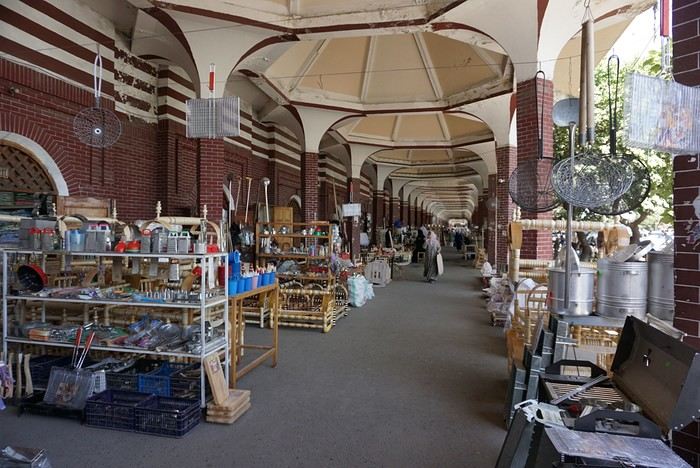
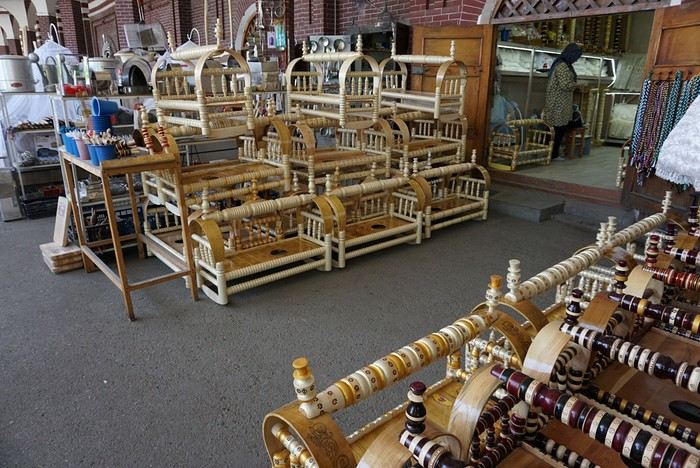
We took this trip from September 12 to October 7, 2022. I didn’t post this travel journal earlier in Voyage Forum because the site wasn’t back up yet (and also because I was short on time). Then, at the end of 2024, I made a promise to a friend: to publish my travel journal on VF. So here it is! We took off from Paris in the late afternoon on September 12 and arrived in Tashkent around 7:15 AM on the 13th. This trip was the result of long contemplation and preparation (it was originally planned for the year of the lockdown (2020) and was prepared with the help and advice of Nasrullo Jumanov from Turquoise Travel. Stages and Itinerary Stage 1: Tashkent - September 13 and 14 Stage 2: Ferghana Valley – September 15 to 17 Stage 3: Nukus and Moynaq - September 18 and 19 Stage 4: Mysterious Khiva - September 20 to 22 Stage 5: Holy Bukhara - September 23 to 26 Stage 6: Asraf - September 27 and 28 Stage 7: Mythical Samarkand - September 29 to October 2 Stage 8: Tersak (via Shakhrisabz and Urgut) – October 3 and 4 Stage 9: Samarkand – October 5 and 6 Stage 10: Tashkent/Istanbul/Paris – October 6 and 7 Stage 1: Tashkent September 13 At the airport exit, we were greeted by the owner of our B&B (B&B Gulnara). Today was all about recovery and our first steps in the capital. Our first currency exchange made us feel like sudden millionaires. Our first stroll down the avenue leading to Chorsu Market introduced us to the fact that 80 to 90% of the cars here are white Chevrolets. A walk under the arcades facing Chorsu: hardware stores, cabinetmakers, lute makers (one of them gave me a little concert/demo of a few string instruments).
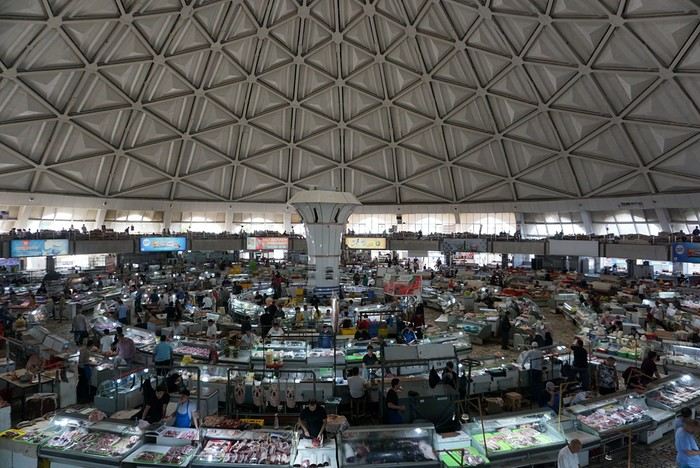
As we entered the market, many vendors called out to us, including this florist who asked where we were from: ‘France? Ah! Macron! PSG!’ He then recited a list of players from the Parisian team as well as past (Platini, Zidane, etc.) and current (Giroud, Griezmann, Mbappé, etc.) French national team players. Since we’re more into rugby (we live near Toulouse), he knew more players than I did!

The market sprawls outside around the large circular, multi-story hall. We bought some grapes and bottles of freshly squeezed pomegranate juice for just a few sums. This evening, we had a meet-up with Nasrullo. The reunion was very warm: we’d been exchanging messages for over two years, and I’d been ‘torturing’ him with changes to our itinerary and trip duration. We were finally eager to meet, and honestly, I wasn’t disappointed—in fact, it was the opposite. Nasrullo was very attentive throughout our trip and always made sure, even from a distance (and most often from a distance!), that everything went smoothly. His goal was for us to leave delighted with our trip and, why not, indirectly become ambassadors for this destination. September 14 Breakfast with Nasrullo, then we set off with him by taxi to explore some of the capital’s sites.


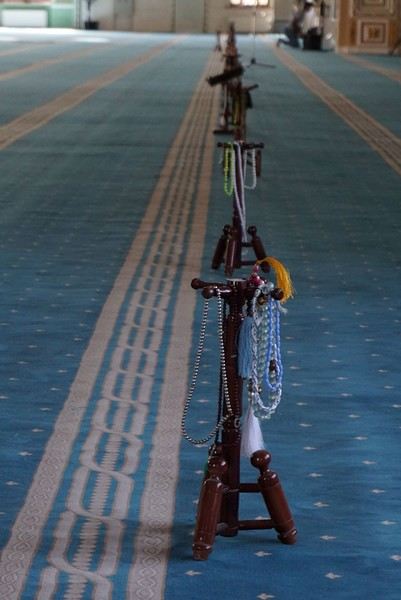
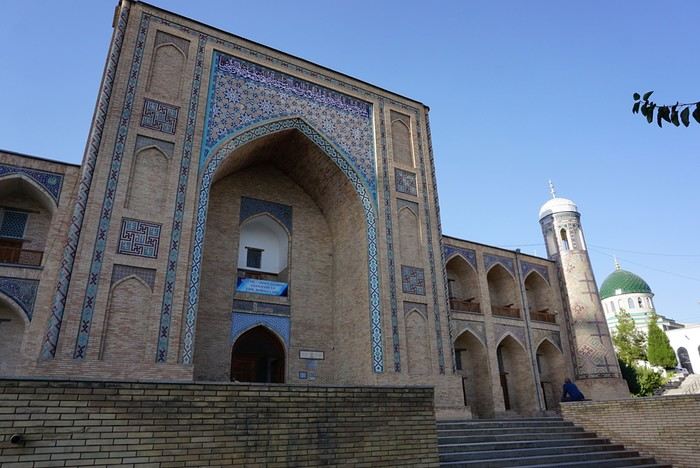
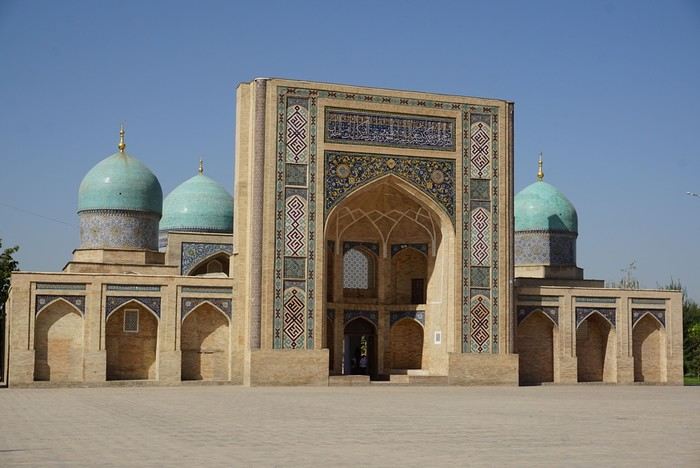
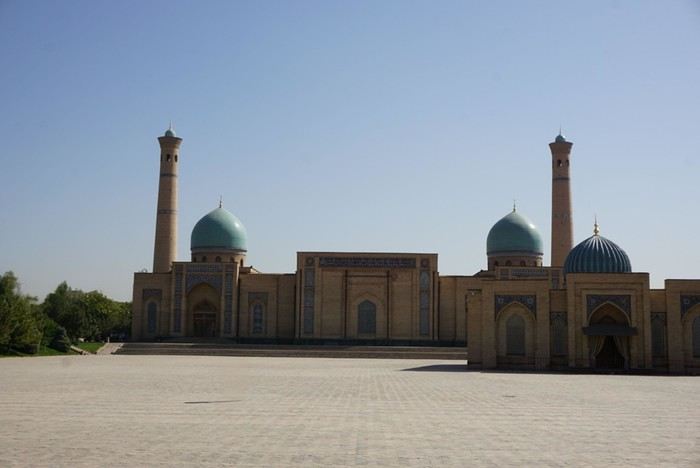
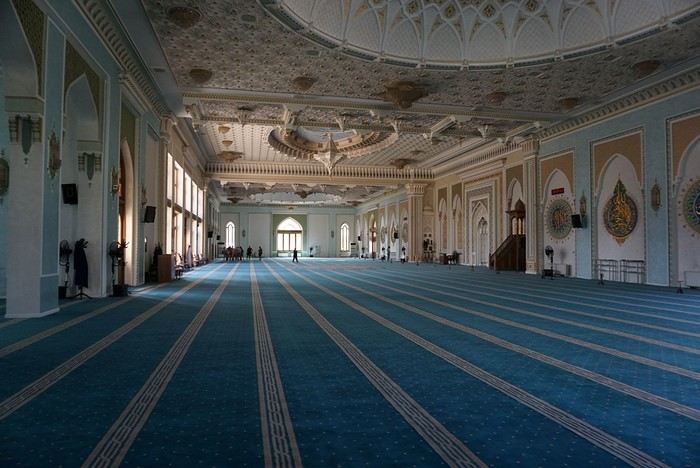
We started by visiting the Khazrati Imam complex, which includes the mausoleum of Kaffal Shashi, the Barak Khan and Muyi Muborak madrasas, and the great Khazrati Imam Mosque with its immense prayer hall.


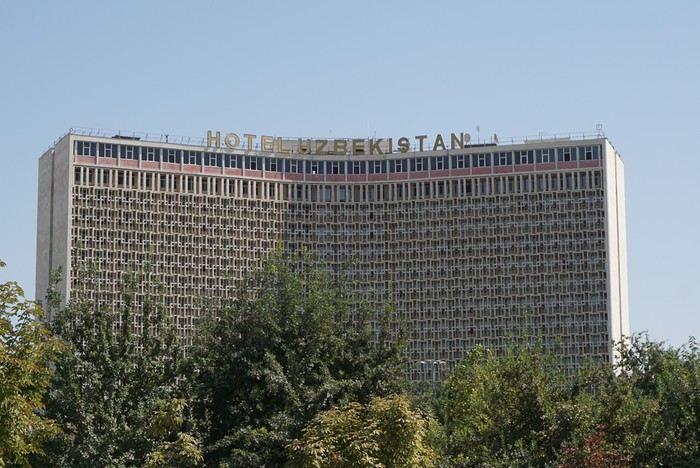
In the Muyi Muborak madrasa, now a museum, you can see the oldest Quran in the world. It was written by three religious scholars, including the secretary of the Prophet Muhammad, on large ‘pages’ made of antelope skin. Next, we explored Soviet-era Tashkent, discovering its parks, canals, and squares: Independence Square with its storks and phoenixes, Amir Temur Square with its large statue and, in the background, the massive Soviet-era hotel that has become one of Tashkent’s iconic buildings. Nasrullo took us through Broadway Boulevard and along what he calls ‘Tashkent’s Montmartre’… Well, it’s far, very far from Montmartre (in every sense of the word!). Then we took the metro to Chorsu station. Rush hour is pretty much the same everywhere in the metro… When we arrived at Chorsu, it was time to say goodbye. Nasrullo had to head back to Samarkand. Before leaving, he recommended some chaikhanas at the end of the galleries facing the market. We ate there for just a few euros (2 or 3 € for two people). After eating, we headed back to our room to cool off (our B&B is about a 10-minute walk away).


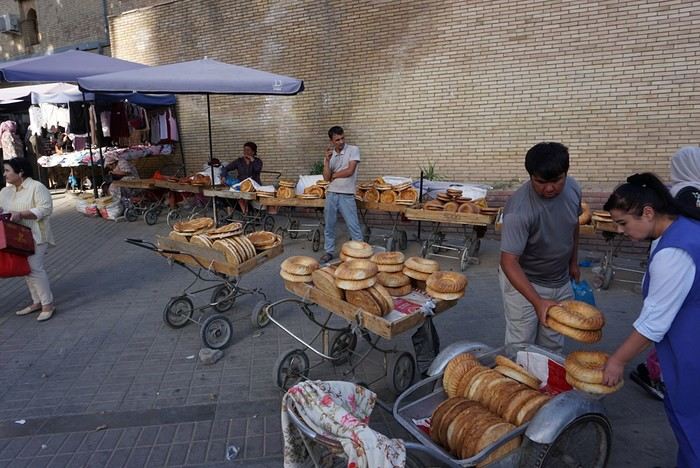
Around 4 PM, we set off to visit the Kokeldash Madrasa, which is still active. On the way, we stopped to watch some bread vendors and take a few photos. We were hesitating about buying some for our evening picnic when a young woman approached us. In perfect English, she asked: ‘Are you looking for something? Do you want to buy bread? Which one? How much?’ She then spoke to one of the vendors and negotiated the price. ‘Do you want one?’ And she took two. She paid directly. I took out my wallet to reimburse her, but she refused. It’s on the house! Then the vendor asked where we were from. And off we went again: Macron, PSG, football players… We’ll have to get used to it. The young woman smiled at the questions and comments, barely gave us time to thank her, and left as quickly as she had approached us.

We continued our walk. Visited the madrasa. Then we crossed the boulevard to see the Tashkent Circus. I would’ve loved to go in and visit, but the ticket seller wouldn’t hear of it. We carried on around what should’ve been a park with old-fashioned rides and attractions. All we found was a construction site. Oh well! Back at our hotel, a message from Nasrullo was waiting for us. He had managed to change our train ticket for the next day. Instead of taking the 6:00 AM train, we’d take the 8:00 AM one. And instead of second class, we’d be in first class! Great! This evening, we had a picnic at one of the breakfast tables in the B&B courtyard. Under a shelter, the owner and his family were celebrating a birthday. The owner started by offering us some tea. Then they brought us some fruit (watermelon and melon). Finally, after the song, candles, and cake cutting, they brought us two generous slices of that beautiful birthday cake. Delicious!
Open
Mora Mora in Boraha, One Week on a Little Malagasy Polynesian Vibe
Just back from a week on Nosy Boraha, better known as Île Sainte-Marie. Mostly on Île aux Nattes, actually, at the very south of the island—literally just a few hundred meters from Sainte-Marie’s airport. Far east of Madagascar, and if you keep going straight, you’ll hit Australia.

We flew in through that airport to avoid a long, rough road trip before and after Tamatave, plus a boat ride that could be short or long (boat time was inversely proportional to the bus ride to the port for the Sainte-Marie ferry). No issues with Tsaradia—departures and returns were on time, service was impeccable, and the ATR plane was smooth. Too bad the prices are so high. We managed a change due to a delayed Kenya Airways flight.

First, we stayed in the northern half, on the west coast of the island, at Natiora Green Lodge. The place is absolutely stunning—a little cove opening onto a small bay dotted with rocky outcrops under lush vegetation. The bungalows are practically on the beach, in a gorgeous, forested setting alive with birdsong. It’s the perfect spot for a pirate crew and just begs for daydreaming. No reef barrier, so it gets deep pretty quickly, but the rocks have healthy coral and plenty of small fish. Great snorkeling—we even saw a turtle. Really, really nice. The only downside is that it’s a bit far from the island’s center and kinda isolated, so eating anywhere but the hotel or going for a walk without a rental car or tuk-tuk is tricky. Not impossible, but harder than if you’re somewhere livelier.

Next, we moved to Île aux Nattes at Baboo Village, which overlooks the channel between Nosy Boraha and Nosy Nato. The bungalows are right on the water, nicely and simply decorated, with a restaurant and terrace right next door. You get to the hotel directly by pirogue from Sainte-Marie’s "embarcadère"—it takes 2-3 minutes, or a little longer if the motor’s acting up. The owner is super friendly and welcoming, with a relaxed, "family/friendly" vibe. There are often a few lemurs in the hotel’s park, adding life to the place, and the vegetation is beautiful once again. The path that circles the island starts right at the hotel entrance, making it easy to reach the island’s dock and the different beaches on the west, east, or even south. Several restaurants are within walking distance, and nothing’s far by pirogue anyway. You can also find the island’s "center" with a few small shops for basic supplies or a meal at a hotely. Since there’s no electricity on the island, the generator at the hotel runs from 6 PM to 10 PM, but you can charge your phone anytime by leaving it at reception. Kayaks are free to use and great for exploring—the whole island is doable, even if you’re not an expert. Just take your time. The upside of Île aux Nattes and Sainte-Marie’s east coast is the reef barrier and lagoon (unlike the west side), which means those gorgeous water colors, accessible coral, and shallow swimming spots. The only downside of Baboo for me, since I love snorkeling, is its location right on the channel. Personally, I prefer the south side of Île aux Nattes (near the Aurora) or the east side (like Kintana) for the lagoon views and easier snorkeling (though my wife didn’t agree). But as I said, those spots are still super easy to reach from Baboo. The west side’s okay, but I like it less—except for the view of Madagascar and the sunset. Again, totally subjective.

On Sainte-Marie, we didn’t try any restaurants other than Natiora’s. Not a ton of options, but it was fine. We weren’t fans of Chez Nono in Baie d’Ampanihy—overpriced for the tiny portions. Sure, the crab was good, but there was so little of it for the price. A bit of a rip-off, since crabs are everywhere and can’t cost much for Nono. On Île aux Nattes, there are plenty of little restaurants. We tried three—Chez Adelaide, La Buvette, and Coco Sud—and every time, we had fish or seafood, and it was always good and generous, with great achards. Prices were very reasonable.

Of course, we soaked up the time, the light, the beauty of the place, the sounds, the smells... just chilling in full *tranquillou billou* mode.

We also did some activities. Snorkeling—I’ll come back to it. In 2019, I thought it was a disaster, with no nice spots and really disappointing. This year, I jumped in everywhere I could and tested spots I’d spotted on Maps or during my last trip. And it was *really* good. Mostly on Île aux Nattes: the south side near the sacred islet, west in front of Kintana, west north of the channel (especially the sand islets), and on Sainte-Marie at Natiora’s rocks. Lots of healthy coral and plenty of fish typical of the area. If you’re into big fish, this isn’t the place, but if you love coral and little critters, it’s awesome. Snorkeling outside the reef was disappointing again, and diving was too. Unless you get lucky, it’s not worth it, in my opinion.

The tour of Île aux Nattes with a meal included was great—perfect for taking breaks whenever you find a pretty spot to snorkel or just relax on a nice beach.

A trip to the sand islets was also really fun. You can’t stay long because it gets super hot, and you’re at the mercy of the tides. There’s a good flock of terns that probably nest there. The coral reefs on the east side of the islet are gorgeous. Really, really nice. Plus, the islets themselves are just stunning.

We chose to go to Ampanihy via the lagoon, hugging the shore—it’s beautiful, with amazing colors, a wilder coastline than the west, and views of seaweed farms. It’s a long trip, though, and at Ampanihy, there’s a pretty beach (but there are tons elsewhere) and a nice mangrove. Maybe it’s better to go by road to the bay and take a boat to explore the lagoon and stop somewhere without going all the way to Ampanihy, saving yourself 2 hours of boat time round-trip. Once there, you can take a little pirogue tour to the beach and through the mangrove. The way we did it, the trip wasn’t essential. As I said, Chez Nono was disappointing—bring a picnic or try Chez Samson instead.

Of course, we visited the pirate cemetery, a place I love even though there’s not much left to see—just a few graves, unfortunately, and some vandalism. The site is still magical, though, and you can let your thoughts drift with La Buse and William Kidd, who passed through here.

We organized all our outings with Crépin, who runs two small boats with his brother. We met him totally by chance, but we don’t regret it. We could adjust the trips based on what we wanted—where to stop or which spot to visit next—and Crépin handled the meals. Prices were super affordable for a full day. I can share his number if you want. We didn’t try anyone else, but I’m sure there are other great operators—I just can’t compare or recommend.

Good prep for anyone looking for an alternative to Nosy Be. Way fewer activities, sure, but also way fewer people and a really nice vibe on Sainte-Marie in general, and Île aux Nattes in particular. The beaches are more beautiful than Nosy Be’s, and there’s a reef and lagoon (it *is* the pirate island, after all). And in whale season, well, the whales.

All in all, a great place to stay for a trip.
Open
Feasibility and safety for a trip to Bangladesh
Hi there, I’m planning a trip to Bangladesh for tourism during All Saints' Day 25. The government website is pretty discouraging! I’d love to hear from people living there or who’ve been recently before I buy my tickets. How’s the security level and feasibility of a circuit (boat, train, bus around the country)? We’re used to basic conditions :) Thanks in advance for your tips! Cécile
Open
Travel: A Right for All? Reflections on Global Freedoms and Inequalities
Hello fellow travel enthusiasts! 🌍 As a traveler and blogger, I’ve often been struck by the huge inequalities tied to freedom of movement. While some cross borders with ease, others face major obstacles due to their nationality, background, or the restrictive policies of certain countries.

On the occasion of International Human Rights Day, I wrote an article reflecting on this issue: 📖 Travelers' Rights: A Reflection on Freedom of Movement and Global Inequalities

In this article, I cover topics like:

Inequalities between passports ("strong" vs. "weak" passports). The specific challenges faced by travelers from marginalized communities. How to take action to promote more inclusive and equitable travel.

I’d love to hear your thoughts! 😊 Have you ever experienced these inequalities while traveling? How do you think we could raise more awareness about this issue? Feel free to share your experiences or ask questions in this thread. I can’t wait to discuss this with you!

Travel is also about building bridges between cultures. So let’s make sure it becomes a reality for everyone. ✈️🌎 Thanks for reading, and I look forward to exchanging ideas with you!
Open
Luang Prabang, Nong Khiaw, and Muang Ngoi (Laos) – Trip Report
Arrival at Luang Prabang Airport: Got my visa on the spot in under 5 minutes, but it cost me $40 + $1 for some "processing fee" and a photo. First ATM withdrawal of the maximum allowed—about 82 €! Luckily, I had euros on me because each withdrawal comes with a fixed fee of 30,000 kips (like in Thailand, where it’s 200 baht per withdrawal, but here you can take out up to 800 €!). Then I took the airport taxi service for 100,000 kips per person. It’s a minivan that drops passengers (8–10) at their hotels. The ticket booth is right at the exit—easy to spot with a sign that says "Taxi Service."

I left Luang Prabang for Nong Khiaw by minivan, paying 180,000 kips. A big tuk-tuk taxi picked us up at the hotel at 8:40 AM, and we picked up more people along the way until we reached a small minivan station. Our "minivan" was *very* mini—we still managed to squeeze in 12 people, with 2 up front + the driver, even though there wasn’t really space for 2 full seats—more like 1.5! Luggage was strapped to the roof under a tarp for the trip. Scheduled to leave at 9 AM, we finally took off at 9:30. The ride took 4 hours and 15 minutes from station to station—roads were rough, sometimes unpaved, and always full of potholes. This route is mostly used by trucks registered in China. We passed the dam that now blocks boat traffic between Luang Prabang and Nong Khiaw. About 40 km from Nong Khiaw, we turned off the main road onto a smaller one, less crowded with trucks but still rough. At the Nong Khiaw bus station, a shared taxi was waiting to drop everyone off at their hotels. I walked to mine—the Nam Ou View Villa, about 600 meters from the station. Nice room with a great view of the river.

Nong Khiaw is easy to explore on foot. One unpaved road runs along the river, lined with hotels and restaurants with terraces, while a parallel paved road has little traffic and all the shops. I loved the vibe and tranquility of the town. There are plenty of guesthouses, especially on the other side of the bridge. Restaurants everywhere, all in a calm atmosphere. I hiked up to the highest viewpoint—there are several. The climb is supposed to take 1.5 hours, but it took me 2. Time to enjoy the nature and catch my breath! No real difficulty, just a *lot* of uphill. There’s a small toll at the start of the climb—I don’t remember the exact amount, but it wasn’t expensive. The view at the top is stunning—360°! Mornings are cloudy, midday is usually clear, and evenings are all about the sunset ☀️. The descent was tougher for me—guaranteed sore muscles!

I also walked along the Nam Ou toward Muang Ngoi. The road is quiet and unpaved but often narrow with no views. Small villages along the way. In town, you can rent canoes, and agencies offer day trips or multi-day excursions. There are shops, a bank, and 2 ATMs.

Departure for Muang Ngoi—a village only accessible by private or public boat. I took the 11:30 AM public boat (sold as 11 AM) for 70,000 kips. There were so many of us that two boats were needed, and we were still packed in! We left 40 minutes late because the ticket collector didn’t check anything, and one ticket was missing. Of course, everyone insisted they’d paid—which was probably true, given the general disorganization. The trip took 1 hour and 5 minutes, going upstream against the current. Gorgeous.

Arriving at Muang Ngoi’s tiny dock, hotel owners were waiting for their guests or offering rooms to those without reservations. I’d booked the Riverview Bungalows & GH. The room was a bit worn but comfortable, and the view was amazing!

Muang Ngoi has ONE recently paved main street—all other paths are red dirt and dusty, perfect for unguided day hikes. I *loved* this village. People live their lives without worrying much about tourists, who aren’t too numerous yet. There’s no bank or ATM, and dollars are accepted (even preferred) for transport and hotels. Watch the condition of your bills—the hotelier refused one with a tiny stain I hadn’t even noticed! There are travel agencies for excursions, small shops... I often ate at Gecko (Western food, I admit) and across the street at Vita, which serves a delicious local dish called *Suzy*—a curry-like specialty. From Muang Ngoi, there are plenty of easy hikes. The trails are simple to find and follow, except for those crossing rice fields. Maps.Me helped me stay on track.

If you don’t want to walk, there are very local transport options: modified tractors with platforms for passengers and luggage. I took an excursion to Sopchem, a small village 40 minutes away by boat. I paid $20 round-trip for two people on a private boat. The ride was stunning—the river cuts through mountains in this section. Sopchem is tiny but charming, especially for buying textiles. Every house has a loom out front and a display selling their work. I bought two scarves for 60,000 kips each without bargaining—it seemed like a steal. Back in Luang Prabang, I saw the same scarves in a fancy boutique for 55,000 kips each—9 or 10 times the price!!!!

I also tried the village laundry service—everywhere lists the price as 25,000 kips per kilo. I picked the closest one to my hotel and watched from my balcony as the woman washed my clothes in the river, then hung them on her fence all day in the dust! Turns out only hotels have washing machines. Better to postpone laundry or do it yourself—my clothes didn’t smell great afterward!

For the return to Luang Prabang, I splurged on a private transfer. An agency at the dock arranged it for $100. I took the public boat to Nong Khiaw, where a driver was waiting. His vehicle was a pickup truck, and the trip took 4 hours total to my hotel in the city center. I recommend this agency (Lattanavongsa Tour Adventure)—very professional. They also run a hotel (same name) that looked nice from the outside, though not riverfront.

In Luang Prabang, I did the Mekong sunset cruise. Departed at 4:30 PM with Sasa Sunset Cruise for 245,000 kips, including one drink and spring rolls. I was lucky to see a beautiful sunset—I don’t regret it. I also visited the tiny Traditional Arts and Ethnology Centre—very interesting for learning about Laos’ ethnic groups and textile traditions, but *very* small. Of course, I visited the temples and wandered the alleys to admire the stunning houses. The sunset at Mount Phousi was nice, but *so* crowded! The night market is fun but not super interesting—vendors sell pretty much the same things you’ll find in daytime shops at the same prices. There are two food courts, one huge at the end of the market. I love the concept, but the quality of the stalls is debatable.

Luang Prabang The morning alms-giving ceremony for monks is called *Tak Bat*. This ritual has turned into a circus for Chinese tourists. I’d visited Luang Prabang 15 years ago and didn’t find the same serenity in the ceremony. In Luang Prabang, I exchanged euros at BFL BRED Bank (recommended in the *Routard* guide). Good rates and a smooth transaction. The employee spoke excellent French and offered me deals on the Sasa sunset cruise (with dinner) and a taxi to the airport. I took her up on the taxi—it was much cheaper. She explained that she works evenings at Sasa Sunset Cruise and the taxi driver is her husband.

Hope this gives you some practical tips for your next trip!
Open
License to legally ride a scooter in Thailand
Hi everyone!

What a joy to be back on this forum where I’ve spent so many hours traveling and gathering info—let’s get started! 👋

Almost everything’s in the title, but just to clarify: As far as I know, you currently need a full French motorcycle license (A) to legally ride a scooter in Thailand, since they don’t recognize A1 or A2 licenses. Yes, I know most rental places only ask for an international car license (B), or sometimes nothing at all… but that’s not what I’m asking. What I’d like to know is whether you think this might change in the future, allowing A1 licenses (which are easier to get) or even car licenses (B), since you can ride a scooter in France with one. I don’t want to get a motorcycle license—I’m scared of motorcycles, even though I’m comfortable on a scooter. I’m a bit confused by their regulations. Thanks for any insights you can share!

Lulu56😅
Open
What is a travel journal?
I thought I knew the definition, but since VF reopened, I’ve been wondering—so if you could help me out, that’d be great! 🙂.

Thanks a lot!
Open
Mexico: The Magic of the Yucatán
Hello everyone,

What a pleasure to be back on VF after a few difficult years 😎 So, before diving into the topic, welcome back to VF and above all... keep going!

Well, I’m finally picking up my old habit of posting a new travel journal.

Before heading to Mexico in the summer of 2023 with my family (my partner and our two boys, aged 18 and 16), I had somehow convinced myself—though I can’t even remember why—that the Yucatán was too touristy, too cliché, too expensive, and overrated!

The country didn’t particularly appeal to me, but faced with my wife’s insistence—she’d been there years ago, before we met, and had promised to show our sons this incredible place—my arguments didn’t hold much weight.

And thank goodness, because I have to admit she was absolutely right to take us there! In the end, we encountered far fewer tourists than we’d feared (except at a few sites), and the prices, which we’d been told were geared toward American neighbors (US), turned out to be quite affordable. In short, it was pure joy on both counts. All that was left was for the trip itself to be beautiful and memorable—and it was...

1st stop: Isla Holbox and the whale sharks

Holbox (pronounced “Hol-bosh”) is a stunning island where you can relax in an enchanting setting.


Our main goal in coming to Holbox was to swim with whale sharks. So, the first thing we told our hotel, Los Arcos Holbox, upon arrival was to arrange an excursion with one of the island’s many tour operators: Glendy Tours Holbox. We set off the next morning, bright and early.

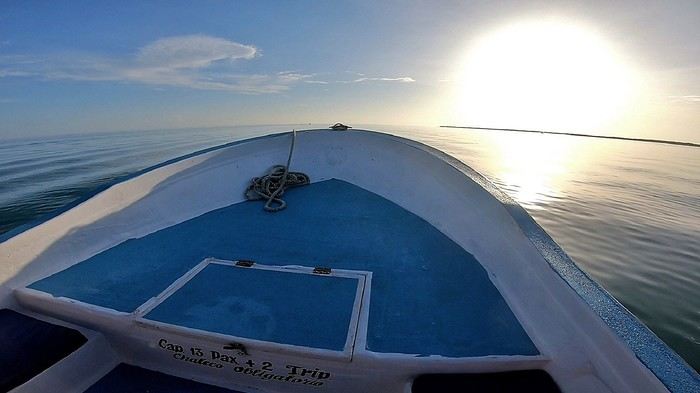
The itinerary for this outing is the same for all tour operators (and there are about thirty of them!): roughly two hours by speedboat, then snorkeling with the whale sharks, followed by another boat ride to Cabo Catoche for lunch, then more boating to a fish-filled snorkeling spot before heading back. In total, the excursion can take eight hours—or even longer.


Besides my two sons and me, there were only two other clients on board—a French couple. Our boat was one of the very first to leave, but after ten minutes, the pilot got a radio call. We turned back without any explanation, returning to the departure dock.

There, a young woman who clearly fancied herself a diva was waiting for us. She was Mexican and boarded the boat, snubbing all five of us while flirting with the pilot and guide, who were suddenly all eyes for her. We couldn’t understand how this diva had convinced our tour operator to turn the boat around just to pick her up when she hadn’t even booked and we were already far out. We left 20 minutes late.

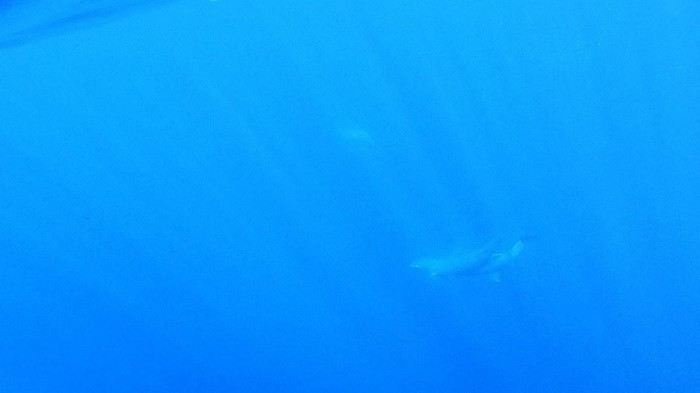
The two-hour journey passed surprisingly quickly, and for good reason: we spotted dolphins six times! They were leaping out of the water as they moved. Pure joy. We stopped whenever they were near the boat.


The photo isn’t great—the ultra-wide-angle lens on my GoPro makes the dolphins look smaller—but at least I got a souvenir.

A few flying fish (exocets) also glided a meter or two above the water as we sped along. The false start was forgotten, and the day was off to a fantastic start in this stunning marine environment...

When we reached the area where the whale sharks were supposed to be, the guide explained that we’d now have to scan the sea until we spotted one. It could take five minutes or forty-five, he said, and if we were unlucky, we might not see any at all!

An hour and a half later—still nothing! The captain then headed toward a distant area where about twenty other boats were already gathered.

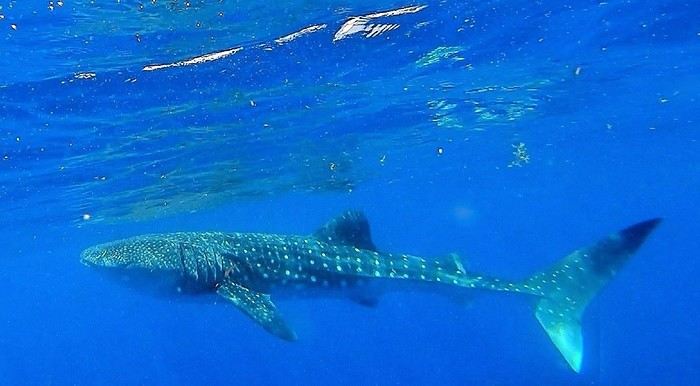
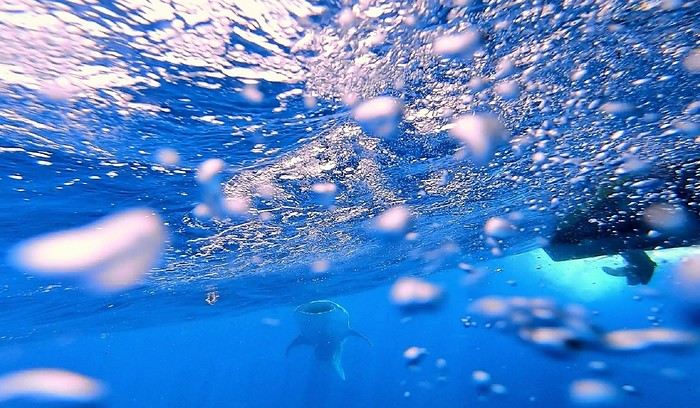
Sure enough, there was a juvenile whale shark (still a good eight meters long) there, and all the boats were lining up to approach it slowly, one by one, so as not to scare the animal. Each boat got about thirty seconds within a few meters of it, engine idling, before making way for the next. We were allowed to approach three times, but we weren’t permitted to dive in. That’s normal—such a crowd of divers around a single animal would stress it out, and here, whale sharks are protected by regulations: swimming with them is strictly controlled. There was even a coast guard boat with us at all times, monitoring everyone’s behavior.

We were torn between the luck of seeing such a magnificent animal, even from the surface, and the discomfort we felt about the absurd situation. All those boats lined up just to catch a fleeting glimpse of the shark for a few seconds—let’s be honest, it was ridiculous. In short, the whole thing was unpleasant, and probably even more so for the shark than for us, though it did keep gulping down kilos of plankton as if nothing were happening...

When it was our turn to approach, I dipped my GoPro into the water at arm’s length and framed the shot blindly, hoping for a decent image of the shark.


On the third and final approach, the sixth passenger on board—the one we’d had to turn back for ten minutes after departure—quietly spoke to the guide and captain after putting on her flippers (even though, I’ll remind you, no one was allowed to dive). She wanted them to ask the coast guard for permission to dive with the shark—just her! She whispered so we couldn’t hear what she was offering in exchange.

The two lackeys complied and shouted the request to the officials in front of all the other boats, with no shame whatsoever. With so many witnesses, the coast guard had no choice but to refuse. The diva wouldn’t let it go and asked them to insist, which they did, but the refusal was firm and final.

On the nearest boats, everyone had heard and was stunned. They openly mocked this bimbo who clearly had no shame. Hidden behind her star sunglasses, she responded with a dismissive smile. Pathetic.

The encounter with the shark ended, and we set off for Cabo Catoche, a site on Holbox Island where we were to have lunch.


We were a little disappointed not to have had the chance to see the usual school of whale sharks (they’re often dozens swimming together!), but that’s nature’s way, and we knew it.

And then, an unlikely stroke of luck: a boat ahead of us was putting divers in the water with a pair of adult whale sharks. We joined them, and while we were putting on our masks and snorkels, the guide briefed us. He said my sons and I would go first, followed by the French couple and the diva.

But Miss World, clearly unhappy with this order, quietly complained to the guide, who eventually switched the order. It didn’t bother us since we’d only get a minute in the water anyway—what’s a minute more or less?

So the three of them got in the water, and a moment later, they were done. My two sons and I, sitting on the edge of the boat with masks on and snorkels in our mouths, were ready to finally take the plunge. But instead of continuing to follow the shark, the captain was suddenly all eyes for Miss Silicone! He even let go of the wheel for a moment to help her back on board.

One of the two sharks had already left minutes earlier, and the second was swimming farther away. Other boats were arriving, and the captain went to join the queue 100 meters from the shark. Soon, even more boats showed up. There were way too many people, the shark left, and diving was no longer possible.

I was, of course, a little disappointed not to have fulfilled my long-time dream of swimming with a whale shark, even briefly. But I was mostly disgusted for my two boys, who had been so excited about it. I told the guide exactly what I thought and asked for compensation—not for missing out on swimming with the shark (you can never guarantee seeing one, nature isn’t at our beck and call), but for clearly skipping our turn to dive. He promised a refund.

At the end of the day, back on land, he dropped us all off, and as he was about to leave, I reminded him about the refund. He agreed again, calmly got back on board, and sped off as if nothing had happened—just him and the captain, two total cowards. I couldn’t believe it.

Of course, back at our hotel (which had booked this tour operator—Glendy Tours), I explained the situation and asked for my refund again. The receptionist called the manager, who arrived with the guide. Our runaway wasn’t so cocky anymore. Inside, I was fuming, but I kept my cool during the discussion that followed.

Right off the bat, I made a point of looking the so-called guide in the eyes while telling him he’d run off like a coward. I did my best to stay calm, speaking clearly, staring him down the whole time, and repeating several times that he was a coward, in front of the manager, who didn’t say a word. The guide had clearly been told by his boss to keep quiet because he didn’t utter a word during the entire twenty-minute conversation.

Anyway, I’ll spare you the details, but in the end, the manager only offered us another excursion the next day as compensation for the “inconvenience.” It was just snorkeling with fish, not another whale shark trip. He admitted their fault, but since we had to leave early the next morning and had other bookings for the rest of the trip, we couldn’t accept. And he refused to refund us.

On Tripadvisor, Glendy Tours has a mediocre rating (3 out of 5), but more importantly, it ranks 29th out of 36 nautical tour operators rated by customers. I was pretty upset with the hotel for booking such an amateur for us.


If you want to swim with whale sharks in Holbox, you might end up with Glendy Tours. And it might go well—I certainly hope so. But given the price of such an excursion (3,000 pesos per person, about 160 €!), I’d still suggest quickly checking online before you go to see which providers have the best ratings. You’ll have a much better chance of things going smoothly with the top-rated ones than with those as poorly ranked as Glendy Tours.

On the other hand, if you’re a beautiful young woman, you can choose them without worry—you’ll get better treatment than the rest of us...

To wrap up this excursion, I have to mention the “respect for nature” angle that all these tour operators highlight. They tell us they respect the whale sharks: only two or three people can dive at a time, and only for a few minutes, so as not to disturb these gentle giants...

We believed them before we left, but that’s not what we saw. When the sharks are hard to find except for one, everyone rushes it, and only the constant presence of the coast guard prevents the tour operators from putting their clients in the water.

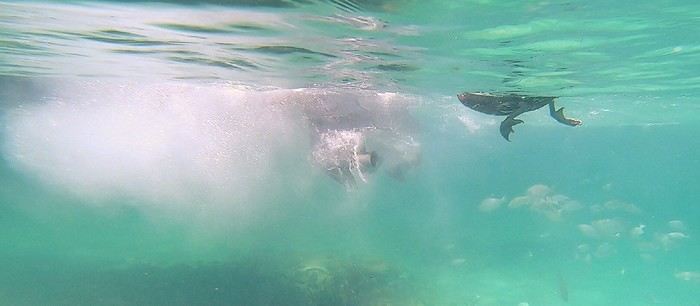
Because for the second shark we saw, when the divers from our boat got out of the water and we left to join the queue while it was our turn to dive, other boats quickly arrived and started swarming the poor shark, which eventually left.

In other words, it’s clear these companies only respect the sharks when they’re being watched.

Boat reversing a meter away from a pelican
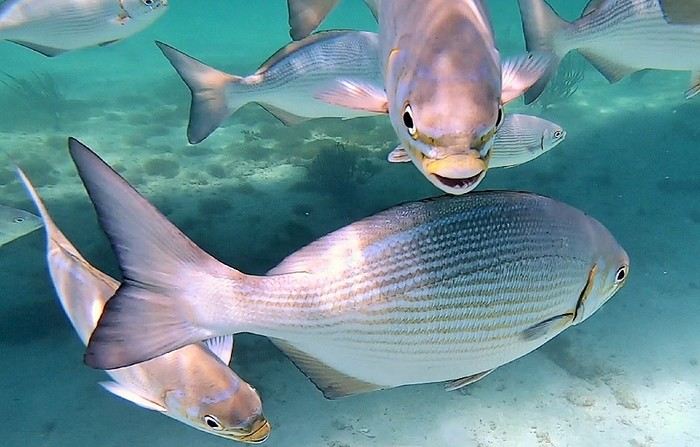
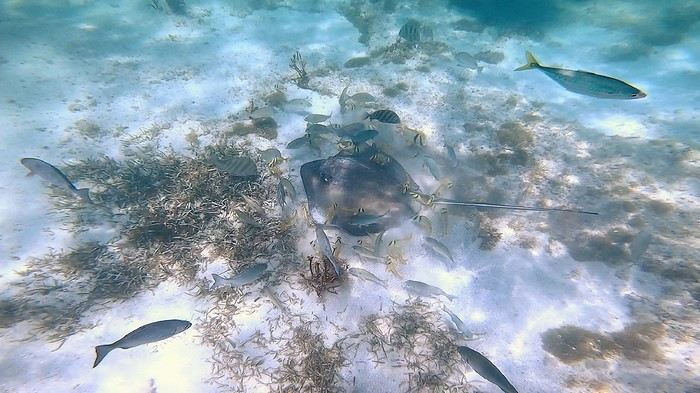
And for the snorkeling near Cabo Catoche, they attract fish daily by feeding them—a practice that’s normally discouraged. Afterward, these fish can’t feed naturally anymore and become dependent on Glendy Tours and its competitors.

A quick note on the rest of the excursion: Cabo Catoche (the site where we had lunch, on Holbox Island) is the northernmost point of the entire Yucatán. The place is paradise.


On the way back, we spent half an hour snorkeling at a site that turned out to be fish-filled only because the tour operators had the bad habit of feeding the fish. But this practice, which isn’t respectful of nature, is normally discouraged.


Plus, life jackets—like in many places in the Yucatán—are mandatory!!


As divers, we didn’t find the site very interesting, but objectively, it should delight those who aren’t used to putting their heads underwater in beautiful dive spots.

We hated feeling trapped in those life jackets, stuck at the surface, and for me, the highlight was swimming next to a pelican that wasn’t too shy—it was paddling right beside me in green water.

Anyway, it seems we can’t post more than 10 photos at once on VF, so I’ll come back with the rest of the journal in another message. Because after these early trip mishaps, the rest of the journey turned out to be magnificent...
Open
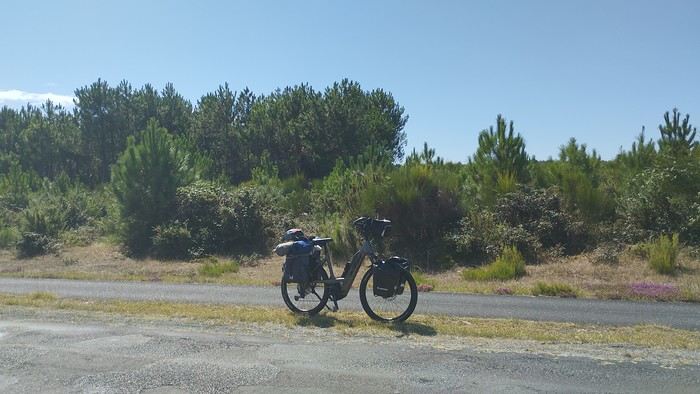
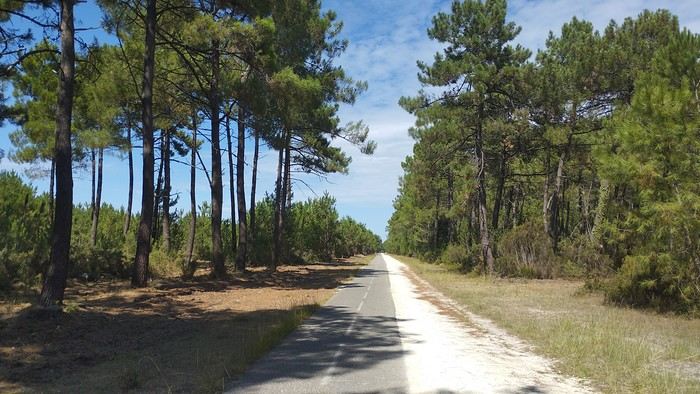
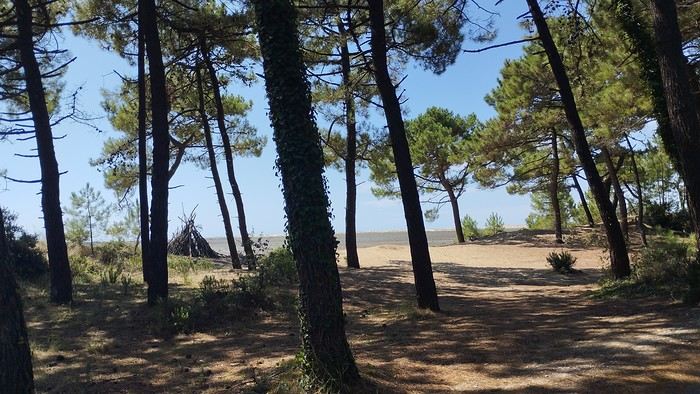
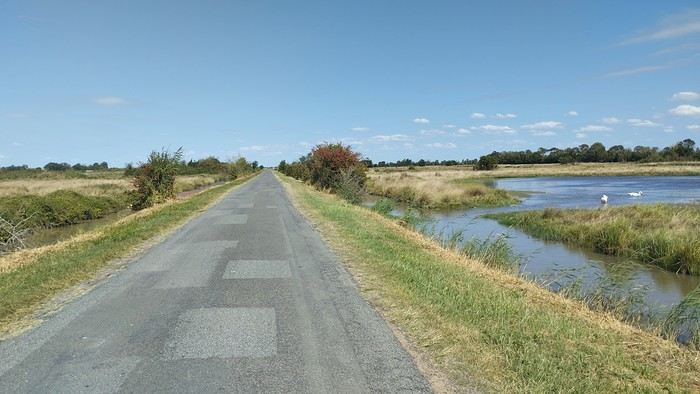
Bike trip: from Carcans Maubuisson to Plaisir (Yvelines)
Monday, August 21, 2023 - Rochefort - Marans

No journal for the first two days. Day 1 - CARCANS-ROYAN Day 2 - ROYAN - ROCHEFORT Tonight I'm in MARANS in the "dry marsh" according to the campsite manager—it’s the first time I’ve heard of a "dry marsh"?!

Photos from the first two days

My gear


The Landes region—nothing extraordinary, but the calm and serenity are nice.


Le Verdon


The wild coast


This marsh isn’t dry, though.

Today is the third day of my trip, and I’m writing to you from a campsite in Marans. I’ve set out to bike from Carcans Maubuisson back to Plaisir. Why Carcans? Because we spent a week there as a family—a great week that lets everyone reconnect for a long stretch. Also, on Saturday, we all headed home—some by car, and me by bike. This journey is about 850 km via bike paths and small cycling roads. It’s not a sporting feat, just a nice long ride for fun. As the old Chinese sage says, "The destination doesn’t matter—it’s the journey that counts." But he also told me, "Traveling is great, but what’s the point if you don’t share it?" You see, this old sage has told me a lot of things—he often keeps me company when I’m biking. Of course, he doesn’t pedal, but we travel in harmony. Sure, he can be a bit annoying sometimes, but we still get along. All this to say I’ve created a group to share my story. I’d be happy to share this experience with you—it’s an adventure for me. On Saturday, I wasn’t sure I’d even leave because I’d been dealing with sciatica for days. Luckily, Juliette, a friend of the old Chinese sage, recommended a lifesaving remedy: Alternately stretching your legs with an elastic band under your foot. Obviously, a jam jar rubber band won’t cut it.

From Marans - The mosquitoes are attacking; time to head back to shelter.

The first two legs took me to Royan and then Rochefort. The Sèvre Niortaise flows nearby, and I followed a canal from La Rochelle. You could say the area is as dry as the marsh, judging by the state of the crops.


As I mentioned, it’s the third day, and if Jesus rose again on this day, for me it was more like the crucifixion. The scorching heat—only bearable when you’re moving—combined with rough trail conditions, and the old Chinese sage says, "Terrible roads, slow speed, and watch your limbs." I set out to do 60 km but ended up doing 80, and the last 20 were tough. I kept checking the GPS to see how much farther until the campsite. Today: Rochefort to Marans, sticking to the coast until La Rochelle, then no notable towns after that—just a constant canal. But since the sky isn’t too low, it hasn’t gotten lost. I’ve still got plenty of anecdotes to share, but it’s pitch black out, and the mosquitoes are still around. This morning, I counted ten in my tent, all full of my blood. Yesterday, at the end of the leg to Rochefort, I was really looking forward to crossing the Charente using the transporter bridge, but a sneaky GPS conspiracy led me far from it. I ended up crossing the Charente on a completely ordinary bridge, watching the transporter bridge in the distance with disappointment.

End of the first episode. Until tomorrow, if you’d like!
Open
Budget for Tanzania with a safari
Hi there, We’re planning a trip for 2 adults and 2 kids to Tanzania and Zanzibar. I’ve had a quick look, and the prices are starting to get pretty wild. We’ve got a budget of 8,000 €, and I was thinking of doing three or four days of safari and three or four days in Zanzibar, but even that seems like it might be over budget. Have you got any thoughts? I was also considering heading straight to Zanzibar and doing a one- or two-day excursion by plane instead—maybe that’d be cheaper than staying in a lodge. Anyway, thanks for sharing your experiences and any price tips, departing from Nice!
Open
Back from 3 weeks in Quebec
Hi there, just back from a three-week round trip to Quebec and a side trip to New Brunswick. Departed from Montpellier, via CDG, then arrived in Montreal from July 31 to August 20, 2024. AF flights went smoothly.

The RT itinerary (without the visit details):

Arrival in Montreal; Trois-Rivières; Tadoussac; Matane; Gaspé; Campbellton; Trois-Pistoles; Quebec City; Montreal and return to France, AF to CDG then Hop! to Montpellier.

Observations:

Getting out of Montreal airport is a nightmare! Two hours at Avis Auto to pick up the car (nice ride, though—a WW SUV Atlas V6 for two). From what I’ve heard, Montreal Airport is a pain because it was initially under-dimensioned for its infrastructure, and it seems impossible to reorganize everything.

Quebecers: Wonderful people in terms of hospitality and behavior toward tourists—especially French ones. You can ask them for advice at the supermarket, for directions here and there, and those distant cousins are great! That said, I’d exclude Montreal, which, due to its size and perhaps its cosmopolitanism, can’t be considered as welcoming as the countryside and small towns we passed through. A bit like Paris, you could say.

Quebecers prefer Quebec City over Montreal, and I get it. On a positive note for the city, I left some money in the hotel at the end of my stay. Once back in France, I contacted the hotel (day before yesterday), and they confirmed the oversight and are taking steps to send the money back. A nice gesture. It’s the Nouvel Hôtel, 1740 Avenue René Lévesque. Well-located, too.

Tourists: Same as always!

Americans: Still lacking in culture and education, but we already knew that. Loud, intrusive, annoying, you could say. And I’ll skip the “Oh my God! Oh my God!” all day long. And always with a coffee cup in hand on the streets. Not just American tourists, actually. Coffee is either enjoyed at the counter of a café or at home in front of the day’s news. It must also be said that our cousins’ coffee is more like dishwater.

Tourists from the Middle Kingdom: No change there! Flagrant lack of European culture and respect. They can be quite annoying at times. Thankfully, they don’t like the countryside or small towns.

Tourists from the Land of the Rising Sun: As usual, impeccable behavior. Both in terms of dress and discretion.

The British: They feel at home. Well, they kind of are, actually. Distant, inaccessible—typical English folks.

South Americans: A lot of them in Montreal during my stay. Quite noisy, especially at breakfast. But deep down, they’re great and very polite. I really like them. Must be my 36.1% Iberian DNA from my ancestry test that makes me say that.

And the French? Always the same! Complainers, grumblers, never happy with the meal, always finding prices too high, cutting in line, sometimes with a Quechua backpack but not always. In short, we don’t change. That said, there were some really nice people and great encounters that will leave wonderful memories. Some folks from Marseille in Quebec City, Toulouse in Montreal, Perpignan... But not many Parisians. Or maybe they just don’t talk to outsiders. When I think that my wife is from the 14th arrondissement...

And lots of lovely young French people there on a Working Holiday Visa for two years.

Others? Italians? Didn’t run into many. Eastern Europeans? Didn’t see any, or they were super discreet.

The trip started on July 31. 2,000 photos to sort through. More to come later.

Open
Getting around Zambia and choosing wildlife parks
Hello, We’re planning a trip to Zambia in 2 years. This will be our 4th trip to Southern Africa—the last one this year was Moremi, Boteti, KCGR, and KTP as a self-drive with campsites and no guide, just my wife and me. For this year’s trip, we prepared 2 years in advance—bookings are really complicated. We were lucky to get a spot at Bitterpan in KTP (there are only 4 chalets).

We’d like to know if it’s easy to get around Zambia, especially when it comes to restocking supplies. Should we rent a 4x4 in Zambia, Namibia, or South Africa? Botswana is very expensive. Which parks are the most interesting? We’re into wildlife photography.

Looking forward to hearing from you. Thanks in advance! Best regards, Jean-Marc
Open
4 friends discover a piece of North India
Hello fellow travelers!

I’m adding my small contribution to the reopening celebration by posting this travel journal from India, made in January 2024. We’re 4 friends (2 couples), and we did a 3-week loop in Rajasthan, stopping by Delhi and Agra (which, as everyone knows, aren’t in Rajasthan 😛). Delhi - Agra - Jaipur - Bundi - Udaipur - Jodhpur - Jaisalmer - Delhi

We rented a car with a driver from Agra to Jaisalmer, 550 € for 14 days. https://chauffeurpriveeninde.com/fr/

We took the train from Delhi to Agra and the plane (Spicejet) from Jaisalmer to Delhi.

Most of the accommodations were booked on Booking before we left.

I’m sharing this story written by Richard and illustrated by me. We dedicate it to Nathalie and Bruno, our amazing travel companions.

Open
Concrete changes in how you travel during the crisis
Hi everyone,

I was wondering how the coronavirus pandemic has impacted the way you travel or plan your trips. I know some of these points have been discussed before, but what I’m interested in here is the concrete, present, and personal—no politics and nothing post-COVID.

Here are a few ideas—do any of these resonate with you?

- Traveling shorter distances / for shorter durations - Favoring rural or less crowded areas over urban or overcrowded ones - Opting for private transportation over public transit - Traveling solo or at least in pairs rather than in groups - Waiting until the crisis is over and saving money in the meantime - Reassessing health risks (and updating your first-aid kit/medications and vaccinations) - ...

I’m sure you’ll have other things to add. The floor is yours!
Open
Adventures of a Bygone Era: The Philippines in 1984
After several discussions on VF about travel journals from the Philippines, I decided to write this curiosity: a trip report from a journey made in 1984, when traveling to the Philippines was still an adventure.

A curiosity because writing a travel journal about a trip 35 years later isn’t common, but also (mostly?) because exploring the Philippines at that time had little in common with traveling there today.

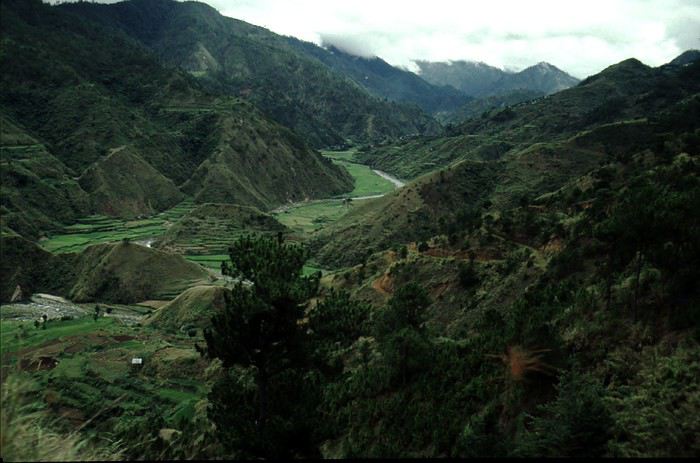
Obviously, I’ve forgotten a number of facts, most of the details, but with the help of a few notes from that time and a stack of slides (yes, there was life before digital 😊), many memories came back and added to the highlights I’d never forgotten. The scanned slides aren’t always great quality, but there are still quite a few to brighten up this chatter. Back then, we didn’t snap photos like we do now—film was too expensive—so I don’t have pictures of every place we visited... too bad, comparing some of those spots to how they look today would’ve been interesting.

Why "Adventures"? Why call it "Adventures" in the Philippines in 1984, a word so often used for a simple exotic trip? - Because the lack of information (no *Guide du Routard*, no *Lonely Planet*, no *Michelin Guide*, nothing, and obviously no internet) gave this trip what’s at the heart of adventure: the unknown. - Because the political situation made the stay sometimes dangerous. - Because transportation conditions were always epic, often perilous. - Because the question of where we’d spend the night came up almost every evening. - And for... quite a few other reasons.

That said, we weren’t exactly explorers!

Why the Philippines? First of all, why go to the Philippines in 1984—a country not exactly set up for tourism and about which we knew very little? How could we get an idea of the beauty of the Philippines and its points of interest when we had no guides or photos?

The idea came to us from Thailand a year earlier, during our first long-haul trip. After touring the north of the country, we met a Frenchman living in Phuket, where there were only a few tourists in Patong, with just a few small hotels and guesthouses. Kata and Karon had no buildings or roads, Rawai only had three palm-thatched bungalows, including ours, and the other islands were unknown to tourists. There was plenty to discover, and we wanted to return to this beautiful country... but the Frenchman made us dream about the Philippines—a country to explore, with wild landscapes.

Long evenings of discussion over multiple Sprite-Mekong cocktails (what memories of those headaches!) finally convinced us we had to go to the Philippines.

Episode 0: Before Departure The decision was made: we’d go to the Philippines in May 1984. Our friends and family were surprised when we announced we were going on vacation to the Philippines (a bit like saying today we were going paddleboarding in the Kerguelen Islands 🤪).

These days, preparing for each of our trips takes long evenings of research, planning, and noting down good addresses... etc. But for the Philippines in 1984, preparation was quick: we had very little information about the country, we were leaving almost at random, and the discovery would only be more exciting.

We still had a few bits of info gathered here and there: the rice terraces in northern Luzon, volcanoes, Negros where we were supposed to visit an acquaintance, Cebu and its marine life (we ended up going elsewhere), and absolutely avoid Mindanao, which was practically at war with the regime. That was about it, but it was already a great itinerary.

Nothing was organized in advance; we’d see day by day. We had no idea about travel times or even the existence of transportation options. The main (and sometimes only) way to connect two islands was by overloaded, rusty ferry. Only the big cities had airports.

Let’s Go: Episode 1: Paris to Manila My travel journals always start after arriving at the airport—the Europe-to-“Other Continent” trip isn’t interesting—but the flight to the Philippines was already an adventure, so I’ll make an exception.

This was the era when only a few Asian airlines were on par with Western ones: Thai, Singapore Airlines, and Philippine Airlines. They had beautiful, brand-new planes, and to attract customers (almost exclusively “businessmen”) from the usual airlines (Air France, Lufthansa, British Airways), there was opulence on board: unlimited champagne, all sorts of cocktails... Compared to today’s long-haul flights, there was still one small difference: no personal screens, just one screen at the front of the cabin with one mandatory movie. And I don’t know why, but we only got James Bond films, both ways... that must’ve been the trend at the time.

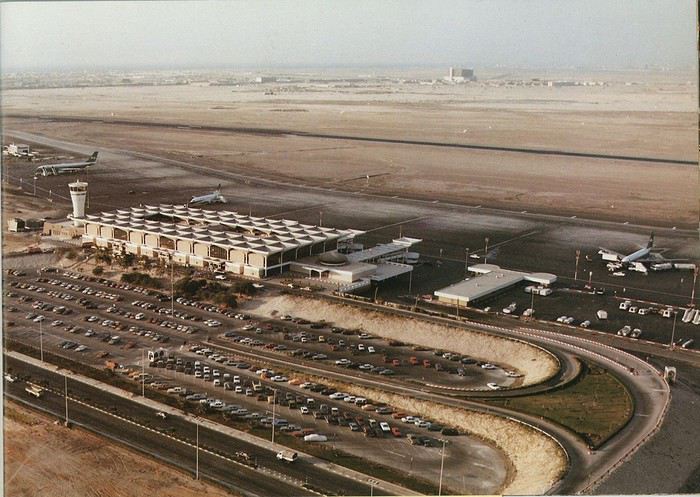
The tourism boom to Southeast Asia hadn’t started yet, and the “Asian Tigers” weren’t a thing, so there weren’t many business trips. That meant long-haul flights made stops everywhere to fill the planes. Our Philippine Airlines Boeing 747 left London, picked us up in Paris, then stopped in Frankfurt to take on a few Germans. I don’t know why we then made a stop in Dubai—a totally exotic place at the time. There was nothing to do there... things have changed a lot since. It was a small town lost in the desert. The airport was tiny, with just one or two buildings and a supermarket. During the stopover, everyone had to get off the plane and walk to the supermarket. Photo and electronic equipment were dirt cheap—I guess that was the only reason for the stop. Maybe it was their first commercial move. Emirates didn’t exist yet, as I checked online, but anyway, the idea that such a remote place could have its own airline was unthinkable.

Online, I found this photo of Dubai Airport in 1980. Anyone who’s transited through today’s massive airport with its rows of A380s will appreciate it:

Next stop: New Delhi to drop off some Europeans and pick up a few Indians, and finally, the terminus: Manila. I don’t remember how long the trip took with its five stops—an unimaginable journey today. Despite all those stops to fill the plane, there was still enough space to stretch out on the four center seats of the 747, something that never happens these days despite all the flights in every direction.

So here we are, finally at Manila Airport around midnight.

Episode 1: Manila and Baguio To start, a quick note on the political and economic situation in the Philippines in 1984, which had consequences for us as tourists, as we’d soon realize upon arrival.

After several centuries of Spanish colonization, the Philippines became American at the start of the 20th century, then independent. In 1966, Marcos took power, and little by little, his regime sank into corruption and mismanagement, becoming a dictatorship with martial law, all for the benefit of his family and friends, who enriched themselves endlessly. The peak was the assassination of opposition leader Benigno Aquino in August 1983, which triggered harshly repressed protests. So we arrived a few months later in a very poor country, with omnipresent corruption and an extremely tense political situation, as we’d soon see for ourselves. Major protests took place in the main cities during our trip—I’ll come back to that. Two years later, Marcos fled to Hawaii after being forced out of power following rigged elections. This historical context explains a lot of the situations we found ourselves in over the following weeks.

Arriving in the middle of the night isn’t very cheerful. Manila was already a huge city with many slums, where you could find a few business hotels like the Hilton or Intercontinental—way out of our budget—and plenty of run-down hotels. Luckily, two Indians we’d chatted with on the plane offered to take us to their usual hotel. They came to Manila twice a year for business. We accepted their offer, relieved not to have to look for a place to stay in the middle of the night, figuring the address must be good since they came back every time... we were wrong 🙁

We left the airport and immediately got a taste of the local vibe when we got into the taxi: the police asked for our passports. We thought: what’s more normal than police in a dictatorship?

But that wasn’t it at all. Our two Indian friends explained that the police were noting our names along with the taxi number and time. Crime in Manila was so bad that the taxi driver would be held responsible if anything happened to us... welcome to the Philippines 😎 😎

Historically, the Philippines was a very violent country, where everything was settled with guns or machetes. Previous governments had banned carrying weapons, but Marcos later allowed the free sale and carrying of guns, and disputes were settled with pistols again (or worse, as we’d discover later). Since he’d released most of the criminals from prison to form a paramilitary militia at his service (I’ll talk about our encounter with these “heroes” later), it was pretty dangerous to go into many parts of Manila, where these “tonton macoutes” ruled.

We arrived at our hotel without incident... and then things started badly. The room was infested with big cockroaches—exactly what I hate most in those kinds of countries. No way to find another hotel at that hour. After the long flight, the urge to take a shower was so strong that we squeezed into the bathroom as best we could. After that, I don’t remember—I guess we must’ve fallen asleep exhausted under the sheets in the heat... air conditioning wasn’t widespread yet.

The next day, we just wanted to leave that dump as soon as possible. So we decided to head north right away, stopping in Baguio, and we’d visit Manila a bit on the way back.

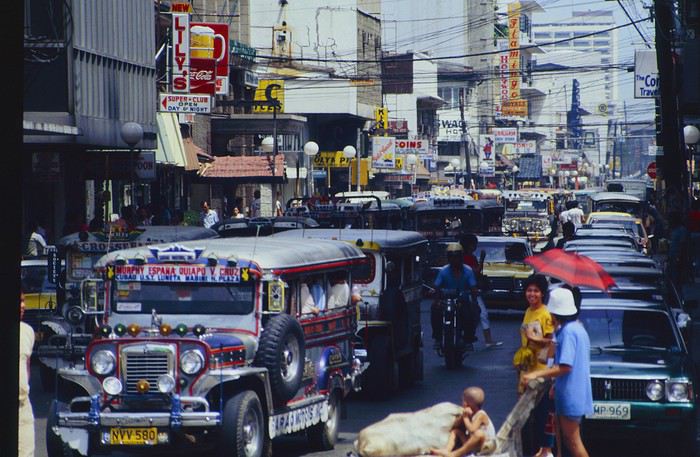
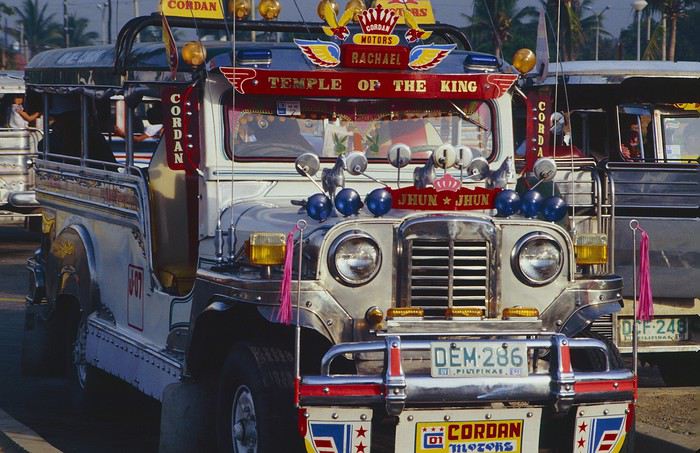
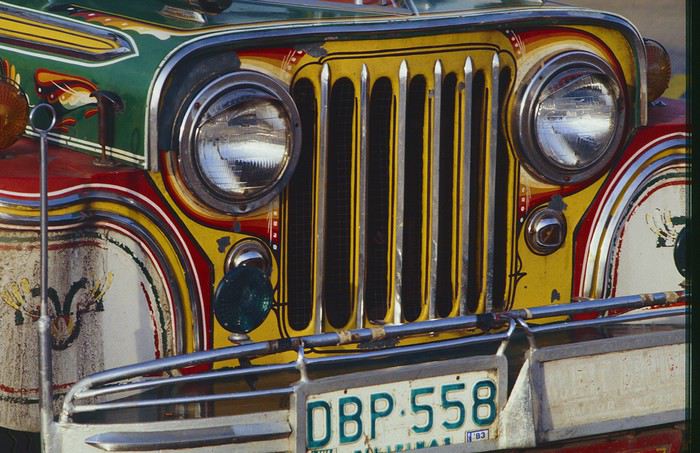
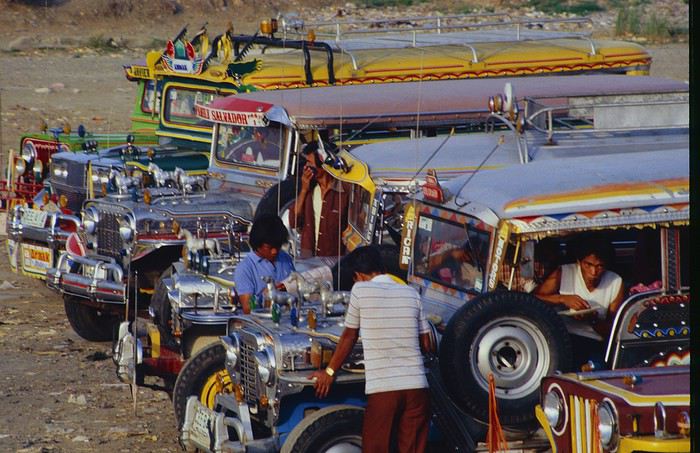
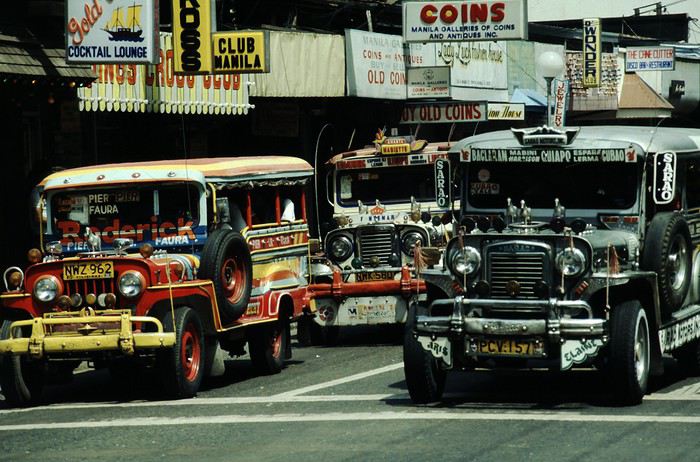
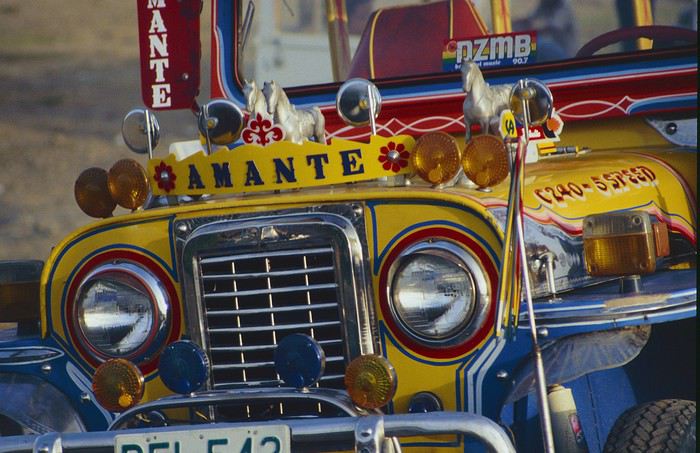
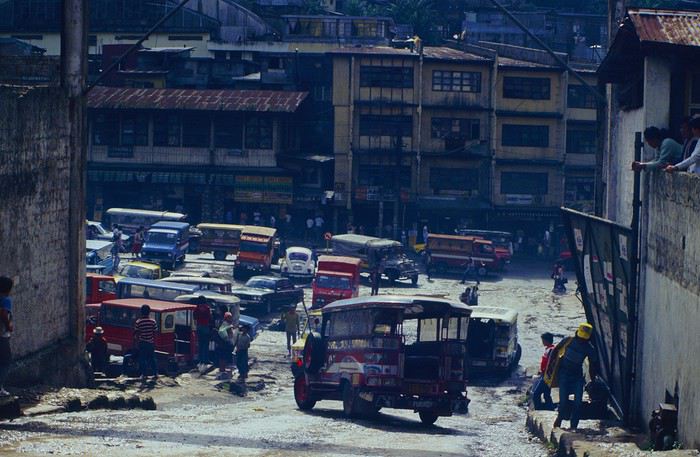
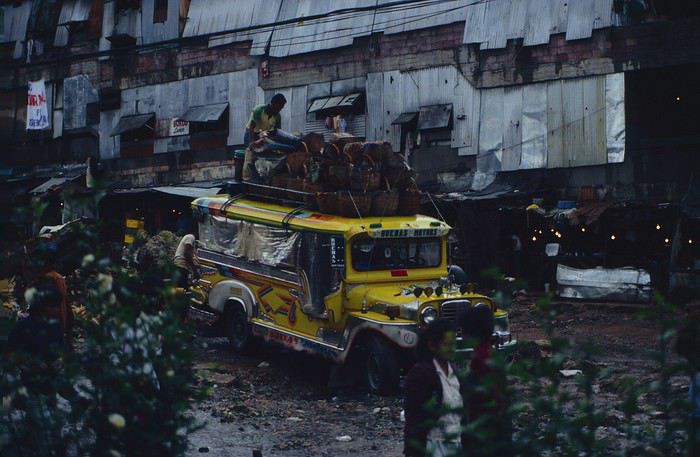
When we stepped outside, we discovered a pretty run-down neighborhood with potholed streets. But we also discovered the jeepneys. They were everywhere, flooding the streets.


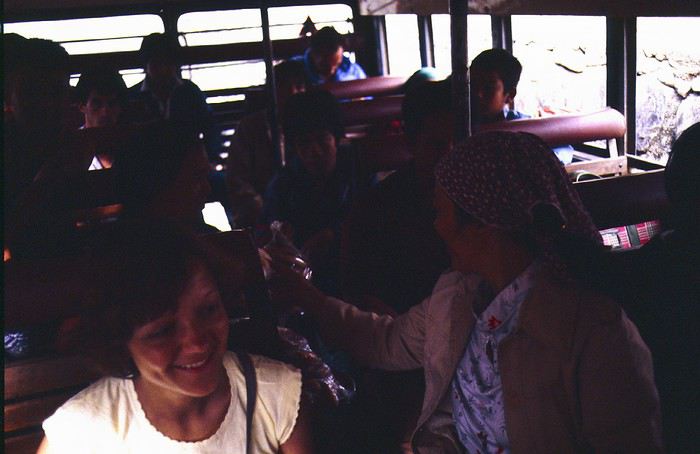
They had crazy sound systems, each one blasting louder than the last. The interiors were kitschy but fun. There weren’t many private cars—almost all transportation was by jeepney, with buses reserved for intercity trips.


Before heading to the bus terminal for the north, somewhere on the outskirts of the city, we needed to exchange some money. I don’t remember how we ended up in a policeman’s jeep who offered his services: - Exchange money on the black market at a better rate than the banks. - Take us wherever we wanted, in this case, the bus terminal.

We accepted both offers (we’d still checked the official exchange rate from dollars to pesos). So we found ourselves in his jeep. After exchanging money, we left in his vehicle and stopped for gas. Without turning off the engine, he calmly smoked a cigarette while filling up. Since we were in a jeep with no doors or roof, we were ready to jump out if things went south, our travel bag in hand.

But we weren’t done with surprises yet. Once we left the small streets, we ended up in a neighborhood with wide avenues and not much traffic, which didn’t justify his incredible behavior. At every intersection, he made the sign of the cross, closed his eyes, and crossed without looking. I was more stunned than terrified! It wasn’t until we got out of the car later that I told Anne-Marie what had happened. I’d seen everything because the cop had put me in the front seat. Luckily, A-Marie hadn’t noticed anything from the back. Crossing Manila by trusting God rather than the rules of the road was ultimately effective. We were lucky—the trip was off to a good start. 🙂 🙂

We then passed through a neighborhood where slums stretched on for a while, and we left our policeman—friendly but a bit crazy—with relief.

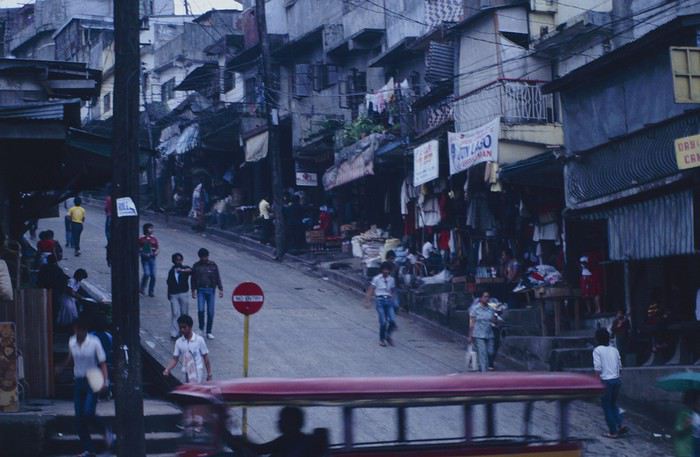
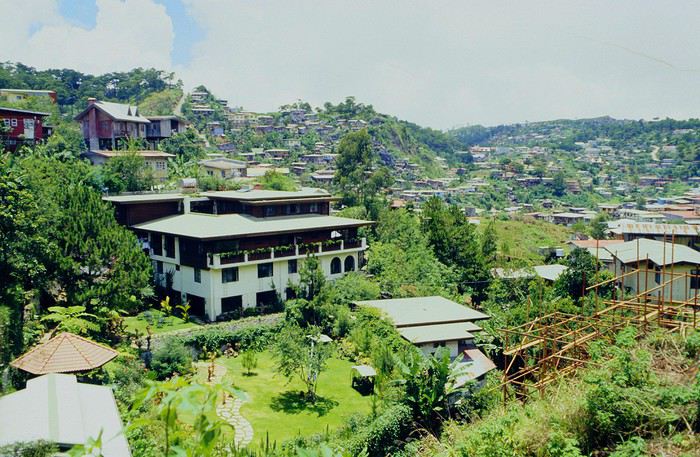
A few hours by bus later, here we are in Baguio, cool in the mountains. My memories of Baguio are pretty fuzzy. I remember a small town. After some research while writing this journal, I found that the population was 120,000 in 1980. Given the population density in each home, that confirms my memory of a smallish town. Outside the “official” district with the president’s summer residence and government buildings, there were two or three paved streets with nice houses. The rest was very dirty and very poor, with lots of slums and dirt roads.


People we met on the street invited us to stay with them. These days, we wouldn’t just show up at strangers’ houses, which we should’ve done in Baguio—it would’ve saved us from an unimaginable and dangerous situation... which I won’t say anything about... !😊

The simple wooden house was on stilts at the edge of a hill with a view of the mountains. Since it was the start of the rainy season in a city that gets a lot of rain, we saw a lot of water. Our outings in town happened between downpours.

View from our lodging:

Episode 2: Baguio to Bontoc Aside from the situation briefly mentioned above, it was on the next leg to Bontoc that the adventure really began: an endless and dangerous road, a bus from another era, breathtaking landscapes, and surprising people.

We didn’t know the distance or how long it would take to get to Bontoc. When we arrived after about ten hours, we learned that Baguio to Bontoc was 140 km.

We got on a bus with wooden seats and settled in, two to a seat meant for two. As the bus filled up, passengers squeezed in three or four per seat, with chickens and baskets full of all sorts of things in the aisle. A little embarrassed, we didn’t know if we should squeeze in three on our seat. The seats were super tight (luckily, Filipinos are small), and I didn’t know where to put my legs given my height. I don’t remember if we stayed alone on our bench or if we ended up sharing with others.


The “road” was a dirt track (or rather, a mud track) with endless turns. We held on as best we could to our slippery wooden seats—it was shaking in every direction. The woman behind us was carsick and throwing up... gross... but what were we doing there? Then we plunged into the Sierra Madre... just the name is dreamy!

Rice terraces started to appear:


they took up more and more space along cliffs where we weren’t always reassured,


with lots of waterfalls (all that water had to go somewhere).

A few miserable villages stretched along the track, most often just a few houses balancing between the road and the drop. The bus stopped in every village—people got on or off and settled inside or on the roof. Street vendors offered their products to the bus passengers—a common sight in Asia, even today.


We were in another world—villagers were in loincloths, others had spears. The atmosphere was strange... but all good, we wanted exoticism, and we got it:

This so-called traditional outfit was everyday wear—it wasn’t for tourists since there weren’t any.

Open
In the Land of Mountain Gorillas: The Story of an "Epic" Trip
Passionate about travel, animals (furry, feathered, scaly), and my partner’s love for photography, it was in 2014, after encountering orangutans in Gunung Leuser National Park in Sumatra, that I felt the urge to see other great apes in their natural habitat and in the wild. For my 40th birthday, I dreamed of only one thing... seeing gorillas. I still had four years to wait and four years to save up.

At the time, I had only heard of the Virunga Mountains, particularly the part in Rwanda. To be honest, Uganda had never really struck me as a destination I’d ever set foot in, and the DRC, for security reasons, didn’t particularly appeal to me.

But then, one day, I heard that Rwanda was going to increase the price of gorilla permits to USD 1,500 per person. Ouch... that seemed way overpriced, especially since we were going as a couple and I really wanted to see them twice. $6,000 for two days... Okay, it’s for my 40th birthday, but still...

At the end of 2017, I started looking more closely into our trip planned for December 2018. A stroke of luck in my schedule meant my former English teacher sent me a link to an article she’d written for her travel agency about her encounter with gorillas in Uganda. Hmm, Uganda? It was the first time I’d read about the country. Why not?

I scoured various forums in French and English and re-discovered voyageforum.com. And most importantly, I came across Ticapi’s travel journal, which I devoured in one evening, and a few months later, Muriel18’s, whose release I eagerly awaited. Wow!!! Not only can you see gorillas in Uganda, but also chimpanzees and the shoebill, not to mention the savannah and the chance to go on more classic safaris.

All that’s left is to convince my better half that Uganda is a safe country...

Usually, and now more than ever, we prefer independent travel and self-drive trips in particular. But given the proximity to the DRC border, the potentially impassable roads after rain, and rental cars that aren’t always in the best condition, we hired a guide for two weeks in December 2018. The months passed, and the excitement grew.

Three weeks before departure, I fell ill after a work trip to Asia. Darn! This time, I didn’t waste any time—I quickly saw a doctor and got rid of that virus. That was the plan! Flu or malaria? (I’d been to the Amazon six months earlier.) The doctor didn’t know; the cough only appeared a few days later. We did blood tests two days in a row to rule out malaria. So it was the flu or... pneumonia :-( ...?

The X-rays spoke for themselves—it was pneumonia, and it was already quite advanced. No big deal, I still had two weeks to recover! I religiously took my antibiotics, downed loads of vitamin C, but nothing worked—the antibiotics didn’t seem to be doing anything. I was coughing so hard I thought my lungs would come up, I was short of breath, exhausted. I’d dreamed of this trip for so long... it seemed unthinkable not to go. Five days before departure, my doctor hospitalized me—the pneumonia had worsened, and my blood oxygen levels were dangerously low. I was in tears but still in denial about what was happening to me. Besides, I’d still taken my anti-malarial, because I was determined to leave.

I spent the first day in the emergency room on oxygen 24/7. The germ causing my pneumonia was unknown to the infectious disease and pulmonary specialists. They tried a combination of antibiotics. No big deal, in four days, I’d be leaving. I harassed the doctor, who must have thought I was crazy, to find out when I could be discharged—"because, you see, doctor, I have a flight to Uganda on Saturday." On Thursday, the doctor was firm: I’d still be hospitalized on Saturday... deep down, I knew it but didn’t want to admit it. My partner handled canceling the flights, contacted our travel insurance (thankfully we had some), and I wrote to our guide (who, in the meantime, had become our tour operator) who could hardly believe it. And neither could I! We told ourselves it was just postponed and that we’d take this long-awaited trip at the end of 2019!

March 2019, the tour operator reached out to us: "Didn’t you say you wanted to go to Uganda this year? You’d better hurry and book the gorilla permits before they run out."

Oh yes, we wanted to see the gorillas. But we hesitated about rebooking. I still hoped to do this trip as a self-drive. The thing is, this year, we managed to take three weeks off, and we also wanted to spend a week in Rwanda. My partner still didn’t feel comfortable driving there. Yet, he’s driven all over the world. I respected his feelings, especially since he’s the only one who drives.

Anyway, we went back and forth but neither of us really said what we were thinking: "What if we used someone else to organize our trip?" In the end, we went with him again, made a first deposit for four gorilla permits (two days each) (not the best idea we’ve ever had), and looked into adding Rwanda to our itinerary. We’d have a guide/driver for the whole trip with mid-range accommodations.

After several back-and-forths, the itinerary was supposed to look something like this. To be honest, I got fed up after a while.

Day 1: Arrival in Kigali in the evening Day 2: Transfer from Kigali to Akagera NP Day 3: Safari in Akagera NP Day 4: Akagera NP and night in Nyagatare Day 5: Transfer from Nyagatare to Nyungwe Forest Day 6: Nyungwe Day 7: Nyungwe Day 8: Transfer from Nyungwe to Lake Kivu, Rubavu/Gisenyi Day 9: Transfer from Rubavu/Gisenyi to Kisoro/Uganda via the Cyanika border Day 10: Gorilla tracking in Mgahinga NP Day 11: Golden Monkey tracking in Mgahinga NP, night at Lake Mutanda Day 12: Gorilla tracking in Bwindi, Ruhija (later changed to Rushaga) Day 13: Queen Elizabeth NP, Ishasha sector in the morning and Kazinga Channel in the afternoon Day 14: No clear answer on activities for that day. After three attempts, I gave up. I shouldn’t have... Day 15: Chimpanzee tracking in Kyambura Gorge, night at Lake Nkuruba Day 16: Lake Nkuruba, morning activities around the lake and Bigodi Swamps in the afternoon Day 17: Transfer from Lake Nkuruba to Murchison Falls Day 18: Murchison Falls Day 19: Murchison Falls Day 20: Transfer from Murchison Falls via Ziwa Rhino Sanctuary, night in Entebbe Day 21: Entebbe – Mabamba Swamps Day 22: Mabamba Swamps in the morning, Botanical Garden in Entebbe in the afternoon, and transfer to the airport for the overnight return flight.

In April, he asked us for a substantial deposit for the accommodations and some park activities, as one of his colleagues was doing the same tour in May and it would be good if he could secure the already-made reservations by paying the bill.

A week before departure, just like in 2018, we paid the remaining balance of the agreed amount. Three days later, since I hadn’t heard from him (the TO is based in Germany), I sent him a message to confirm he’d received the payment.

My partner joked, "And that’s when he tells us he closed the account we sent the money to." I forced a laugh... and even more so when the TO asked me which account I’d sent the balance to... "Uh, the same one as before." And then he told me he’d closed that account and maybe should’ve mentioned it earlier... uh, you think?! And of course, he needed the money sent again quickly. "Well, buddy, you’ll have to wait until I get it back!!!

It was already late, and my bank had been closed for hours. The next morning, first thing, I called my bank and explained the situation.

"Unfortunately, we can’t do anything for you; you’ll have to wait for the money to be returned." "But how long will that take?" "A few days or weeks, depending on the banks, and you should expect transfer fees."

Brilliant! :-(

After nearly 10 years of traveling almost exclusively without traditional travel agencies, had we just been scammed? I went back to the forums to reread posts about this TO from other travelers. They were all positive; no one mentioned a scam.

The next day, I searched online for the contact details of his bank in Germany. I wrote to the generic email address in English, explaining that I’d made a transfer without knowing that this gentleman had closed his bank account. The employee replied in impeccable English that the bank only responded to emails written in German. Grrr! I used a well-known translator since my German is, let’s say, rusty, and resent my email in German. The same agent replied in German that unfortunately, they couldn’t do anything for me—that if the account had been closed, an automatic rule would return the money to the sender... period, end of story!

Well, our money is lost somewhere in the "cloud," or so we hope! Wait and see!

No news from our TO, and we didn’t reach out either—we were too annoyed by the whole situation.
Open
Bolivia: Exploring the South Lipez by Self-Drive
Hi everyone,

The idea of traveling to Bolivia came to me after seeing Jean-François (Max68)’s photos on his website. I thought we *had* to see those stunning landscapes with the colorful lagoons for ourselves. But a self-drive trip didn’t seem doable at first. A few years ago, everyone advised against going to the South Lipez with just one car.

Laguna Kara
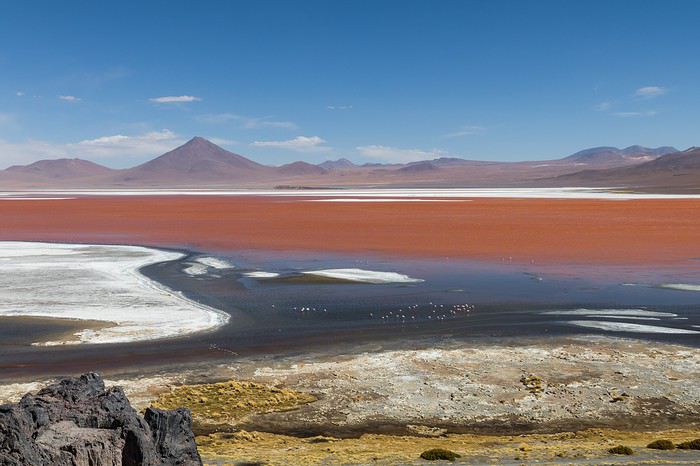
It was only after reading Laurent (Lolobe) and Pascal (Pepe874)’s travel journals—who explored the South Lipez solo with a car from Biz Rent a Car—that I thought we might be able to do the same. Meanwhile, we’d already contacted a local agency to organize a trip with a driver and guide. But the idea of a self-drive adventure really appealed to us. With encouragement and tips from Thierry (Tbernay) and Jean-François (Max68), we decided to plan our own self-drive trip. I’d like to thank them for their advice—it was *super* helpful. And a big thanks to all the other forum members for the info shared during our prep!

Laguna Colorada

Planning this trip happened during a tough time for our family. My mother-in-law’s illness and passing, plus a few health issues of my own, made us doubt the trip multiple times and nearly scrap the whole thing.

We booked our international flights in February with Swiss. They offered the best balance of travel time and price from Switzerland. Swiss operates Zurich–São Paulo with their own fleet, and São Paulo–Santa Cruz with GOL. In June, GOL canceled the Saturday flight and rebooked us on Sunday. Spending over 24 hours in that huge Brazilian city didn’t work for us at all, so we asked Swiss to put us on the next Zurich–São Paulo flight. Too bad—we lost a day in Bolivia and had to skip the Tarabucco market on Sunday.

Right after, we also booked the car in February. After contacting Imbex and Biz, we went with Biz. Not speaking Spanish, we were relieved to communicate with Alejandra in French. The contact was great—she answered all our questions patiently. Sometimes it took a few days to get a reply, but we could also reach her on WhatsApp. After our trip, we can *only* recommend Biz for rentals in Bolivia. The cars are well-prepped for the South Lipez tracks. The agency is reliable, and the vehicles are new and well-maintained.

“Our” car, a Toyota Hilux

While planning, we realized the presidential elections would happen while we were in Bolivia. The risk of *bloqueos* (roadblocks and protests) was very real. But in Bolivia, *bloqueos* seem common—you always have to account for that kind of hassle. In late August/early September, Uyuni and the Salar region were blocked for days, leading to food, fuel, and cash shortages. Worried about a blockade in Uyuni and missing the Salar, we decided to visit it first *just in case*.

On election day, the whole country shut down. Planes were grounded, buses and taxis couldn’t circulate, and private cars were banned. There were a few exceptions—ambulances, police, or certain professions—but as tourists, we couldn’t get permission to drive. We asked the embassy, and Biz even requested a permit from the electoral office. So we had to plan to be somewhere with things to do *without* the car.

We decided not to book any accommodations in advance—a first for us. Usually, we plan our stops and reserve lodges, hotels, or campgrounds well ahead. This time, only the room in Sucre was booked, so we’d have a base when we arrived.

In July, Alex (Delhenry) reached out to propose joining part of the trip. He didn’t realize we were leaving in October. Still, we got fresh updates when he returned from the South Lipez. Thanks, Alex—your tips, especially about the Guadalupe–Tupiza stretch, were *super* useful.

In September, we connected with Jean-Louis (Avx) and Anne (Xeta), who were also heading to Bolivia in October, one and two weeks after us. We had dinner with Jean-Louis and his friend after our South Lipez trip and stayed in touch with Anne. It was great to chat with them! Unfortunately, Anne and her husband had a much rockier trip—they got hit hard by post-election issues.

Climbing Volcán Tunupa

Our itinerary wasn’t set in stone—we decided to wing it on the spot. Two weeks before departure, I reconnected with Alejandra at Biz to move the car rental up by a day. With the elections, we wanted to leave Sucre ASAP and focus on the South Lipez. Outside Uyuni and Tupiza, the risk of blockades was zero. We also planned a two-night buffer in Sucre before our flights, just in case. It might sound overcautious, but in hindsight, we made the right call. If we’d left Sucre a day later, we wouldn’t have made it to Potosí—it was completely blocked. On the way back, we *just* dodged blockades in Potosí and elsewhere. Sometimes, you’ve gotta trust your gut.

Here’s our route—only the first two nights in Sucre were booked ahead:

D1 Departure from Switzerland

D2 Sucre (La Selenita)

D3 Sucre (La Selenita)

D4 Colchani (Hotel de Sal Luna Salada)

D5 Jirira (Auberge Doña Lupe)

D6 On the Salar (in the car)

D7 A few kilometers from Estancia Catal (in the car)

D8 Laguna Hedionda (Hotel Los Flamencos)

D9 Laguna Colorada (Lodge by the lagoon)

D10 Middle of nowhere, en route Laguna Verde–Mina Horsu–Quetena Chico (in the car)

D11 Quetena Chico (Lamphaya Lodge Andino)

D12 Quetena Chico (Lamphaya Lodge Andino)

D13 Guadalupe (Guest room at Celia’s)

D14 Along the Rio Grande (in the car)

D15 Tupiza (Hotel Mitru)

D16 Tupiza (Hotel Mitru)

D17 Sucre (La Selenita)

D18 Sucre (La Selenita)

D19 Santa Cruz (Hotel Sun)

D20 Departure from Santa Cruz

D21 Arrival in Switzerland

As you can see, we spent 13 nights in the South Lipez. Initially, we’d planned for nine, but Jean-François (Max68) suggested staying longer. Great advice—we didn’t regret it one bit. We could’ve even added 2–3 more days without getting bored.

Self-driving in the South Lipez takes some prep and a good GPS. We kept it simple and used maps.me to navigate. It’s a solid app—just save your waypoints ahead of time. For some stretches, I used Google Earth to visualize the tracks and sites. If you stick to the tour operator routes, you *almost* can’t get lost. But we often veered off the beaten path and took different routes. Some days, we didn’t see another car. So in case of a breakdown, it’s key to have water and food for several days. In some spots, there’s *zero* signal—your phone won’t work. Another must: it gets *cold* in the South Lipez, and a good sleeping bag is essential. We brought down sleeping bags rated for -10°C and didn’t regret it during our car nights.

The Dalí Desert

Some tracks are *super* rocky—flat tires are a real risk. On those stretches, maps.me’s estimated travel time was way off. Some sections barely let us go over 15 km/h.

Lots of forum members recommend doing the South Lipez “loop” from Tupiza to Uyuni—ending with the Salar—to avoid Uyuni’s crowds. That might work for organized tours, but for self-drive, the direction *doesn’t* matter. I’ll say this: the few vehicles we saw mostly came from Tupiza and Chile, not Uyuni. So if starting from Uyuni works better for you, go for it! Ending in Tupiza means heading toward warmer weather. For our planned stops and climbs, starting in Uyuni helped with acclimatization. Spending a few nights between 3,600–3,800 m before going over 4,000 m is a smart move.

Uyuni Salt Flats in the morning
Overall, we barely saw anyone—except at Laguna Hedionda and Chalviri. There were several tour groups at Hotel Los Flamencos (Laguna Hedionda), but we didn’t cross paths during the day. Hardly anyone on the Salar, on the roads, or at the lodges in the evenings. The *only* place that shocked us was Chalviri. We’d planned to stay there, but it was fully booked—and we counted *forty* tour jeeps on-site. This was around noon! At the Polques hot springs (Chalviri), it was *packed*—we quickly nixed the idea of a dip. Plus, the vibe wasn’t great: soaking right by the road with lodges and restaurants in the background? Meh. Still, lots of tourists love it, so it’s up to you.

For the photos, I kept the colors and mood we saw. The lagoons’ hues are often stunning, but some online photos are *way* over-edited and oversaturated. The South Lipez’s landscapes are breathtaking—no need for excessive retouching.

If you don’t want to read all the details, the start of the travel journal is here: https://voyageforum.com/v.f?post=9888761;a=9888761
Open
California! Nevada! Utah! Oh!
After my trip to Oregon in 2018 (see Travel Journal "Oregon and Only Oregon"), I vaguely intended to return to the West (the western USA, of course—the west of France is where I almost live) someday, later... with no specific date or plan.

November 2018, I stumbled upon a promotion for round-trip flights from Paris to San Francisco. Well, I *stumbled*—they must’ve collected some "data" on me to make sure this deal crossed my path. And it worked! My ESTA was still valid, and two days later, it was decided: May 13, 2019 (departure from Paris) to June 15, 2019 (return to Paris).

The travel style? Just like last year: low-budget trip, rental car, and accommodation only in campgrounds, with no reservations to stay as free as possible.

Exceptions? 3 nights in a youth hostel upon arrival in downtown San Francisco, and 1 night on the way back (right before flying) in Montara, near Pacifica—a spot that seemed well-located for driving back to the airport in the middle of the night.

Now, to sketch out the rough itinerary. Here’s what it looked like after the trip:

Westernmost point: Montara Lighthouse on the coast, 30 km south of San Francisco (California); Easternmost point: Zion National Park (Utah). Northernmost point: Reno (Nevada). Southernmost point: Spring Mountain Ranch State Park in Blue Diamond, near Las Vegas (Nevada).

Another view:


I’ll be spending 33 days in this little area! I’m a slow traveler.

Meanwhile, I realized that in some places I wanted to visit (Las Vegas and National Parks), it was better to book ahead. So, I added to my reservations: - 2 nights in a hostel in Las Vegas - 6 nights of camping in the national parks (2 at Zion NP, 2 at Yosemite NP, 2 at Sequoia-Kings Canyon NP). Between all these dated stops, it’s a choose-your-own-adventure from the ideas I found.

I’m also a slow writer—slow writer, slow traveler—so it’ll take me a while to wrap this up. I’ll start tomorrow.
Open
Six-week trip to Mexico
I recently took a six-week trip to Mexico with Y, my Thai partner. To be precise, we spent 43 days there plus a final half-day before heading to Mexico City Airport for our return flight to Europe.

I’d already been to Mexico about 40 years ago! But that was only for a week or so, between Mérida and the Belize border.

First off, I should mention that I’ve never seen a beach in Mexico. I say this because discussions about Mexico always seem to revolve around the Costa / Riviera Maya.

Let’s start with an overview of the trip. Our itinerary can be split into two halves:

- First half: Querétaro, San Miguel de Allende, Morelia, Guanajuato, Mexico City “CDMX” (the capital). - Second half: Palenque, San Cristóbal de Las Casas, Chiapa de Corzo, Oaxaca, Puebla, Cholula, and finally Mexico City CDMX.

To move from one part of the trip to the other, we took a flight from Mexico City CDMX to Villahermosa, then a bus to Palenque.

In six weeks, we visited maybe a quarter or a fifth of the country (see the attached maps). Mexico is about three times the size of France! And when I say “visited,” it was really just a quick stop—enough to get a first impression. I understand that some people can only spend one or two weeks on vacation in a given country, but that’s not my idea of travel. Personally, I’d say a country as rich in every way as Mexico deserves several months of travel before you can say you’ve “seen” it.

In my next post, I’ll break down the expenses. That might help future travelers plan their trips. You don’t go to a country for several weeks (or more) without thinking about the budget! Besides, one of those future travelers to Mexico is us—we were so thrilled by Mexico that we’re definitely going back.
Open
Eastern Canada and a few parks in September (Bic, Gaspésie, Forillon, Bonaventure Island...)
Eastern Canada: the Eastern Townships, Gaspésie, New Brunswick, Acadia, and Nova Scotia.

Forests, lakes, lighthouses, parks, and encounters. To sum up this trip: amazing encounters, stunning parks, wildlife, and passionate, fascinating Parks Rangers. Bic Park, Gaspésie, Forillon, Bonaventure Island, Cape Breton Highlands Park, Hopewell Rock

My tips:

Don’t hesitate to chat with the park rangers and check out the activities they organize—it’s really interesting.

If you want to see wildlife, get up early.

The kilometers go by pretty easily; driving 500 km in Canada with an automatic car on long, straight roads with light traffic isn’t much more tiring than doing 120 km on Ireland’s narrow roads...

Try to catch a Quebecois film at the cinema or on TV.

For the ferry, plan ahead. Taking it at least once is a great experience.

For the rest, once you know what you want to see, just go with your gut—it’s easy.

The Trip:

Arrived in Montreal on 09/02. Family meal where we tried homemade *pouding chômeur*.

We spent 3 days exploring the Eastern Townships: the Abbey of Saint-Benoît-du-Lac, Bolton, Magog (its wine fair and thunderstorms), Granby, Bromont and its little lake, and its spa…

Gaspésie, New Brunswick, Nova Scotia:

We didn’t stop in Quebec City or at the Montmorency Falls, as we’d already visited them on a previous trip. Otherwise, plan an extra day and a stop in the lovely city of Quebec.

Day 1: Left on 09/05 for Saint-Fabien and Bic Park, famous for its coastline, marshy landscapes, and harbor seals (brochure). About 500 km. Stayed overnight in Saint-Fabien.

Along the way, we saw *barachois*—bodies of water usually at the mouth of a river, separated from the sea by a gravel, sand, or pebble barrier. They can be freshwater or saltwater. The fresh water of the St. Lawrence River mixes with the sea up to Orléans Island. And there’s a measurable tide up to the Trois-Rivières bridge. Visited Bic Park and observed seals molting with the park rangers. More park photos.

Days 2 & 3: Headed to Sainte-Anne-des-Monts (about 200 km). The lighthouse route guided us 😊.

Two nights in Sainte-Anne-des-Monts for a short hike in Gaspésie Park (brochure) and its stunning landscapes between mountains, forests, rivers, and lakes. We didn’t see any caribou or moose, but from the top of Xalibu (a well-marked 5-hour round-trip hike), we had a 360° view of Mont Jacques-Cartier and Mont Albert. More photos. This was Muriel’s favorite park—it’s exactly what she imagined Canadian forests, rivers, and lakes to be. You can also stay overnight in the park (especially by Lac Cascapédia), which is better but pricier 😢.

Days 4 to 6: Left for Forillon Park (brochure) near Gaspé (200 km). Magical... We were lucky—we came face-to-face with a mother bear and her cubs (brown bears). It was incredible. We also saw beavers at work...

Our lodging was out of the ordinary—what luck! A ranch in the middle of the woods. We stayed 3 nights. This is my favorite park. More Forillon photos.

Gaspé in Mi’gmaq means "end of the land." But for Jacques Cartier, it was the beginning of the country. On July 6, 1534, he and his crew made contact with the first Indigenous people of the Mi’gmaq Nation off the Baie des Chaleurs. On July 24, 1534, he landed in Gaspé, planted a 30-foot cross, and claimed the region for the King of France, where they met the St. Lawrence Iroquoians. Visited Bonaventure Island (brochure) and its 100,000 northern gannets. Bonaventure Park photos.

Not to mention our first freshly caught and cooked lobster, bought at a fish market on the port.

Day 7: Finished the Gaspésie loop with a stop in Campbellton (300 km) before crossing into New Brunswick. Stopped at Bourdage Tradition farm. We could’ve gone as far as Caraquet, which would’ve been better. Rain all day.

Day 8: Headed to Cape Breton Highlands National Park in Nova Scotia. Overnight in Moncton to split the drive (500 km). We stopped in Acadia, a truly unique region with incredibly friendly and open people. New Brunswick is over 80% forest—it’s impressive how many trucks and dead raccoons you see on the side of the road.

Sunset at Hopewell Rock—bring mosquito repellent! There are thousands, it’s awful. Photos.

Days 9 to 11: Left for Sydney (500 km) for 3 days exploring Cape Breton Highlands Park. If you have time, stop at the "Train Station Inn in Tatamagouche"—I love the concept. You can eat there, sleep there, or just visit.

The Cape Breton Highlands Park loop is over 300 km. Photos. Our apartment was in North Sydney, a bit far from Chéticamp (2-hour drive) and 1.5 hours from the park entrance. But the road itself is beautiful. We should’ve found lodging in Chéticamp or Ingonish. At the time, we were also planning to visit Louisbourg, but it was too much.

Day 12: Time to head back, but there were still over 1,500 km to go. We’d planned to stop at "Le Pays de la Sagouine," a local heroine from Antonine Maillet’s imagination, played by the wonderful local actress Viola Léger. A fantastic place for shows and passion—don’t miss it if you get the chance. Another overnight in Moncton to split the trip (550 km).

Returned through Gaspésie and the Matapédia Valley, famous for its salmon fishing. We met a guy from Haute-Savoie who’d been living there for 15 years, making a living from fishing (he runs a shop) and dog sledding in winter.

Day 13: Things didn’t go exactly as planned. We were supposed to take the ferry from Rimouski to Tadoussac and the Saguenay Fjord. But due to Storm Florence, all boats were docked. We tried the ferry from Trois-Pistoles, but all crossings were canceled. The only other way was a 500 km detour to Quebec City. So we decided to spend the night of 09/17 in Trois-Pistoles (we’d already driven 600–700 km that day).

Days 14 & 15: We changed our plans, heading to Trois-Rivières and La Mauricie Park for a quick seaplane tour. There, we had an amazing encounter at the "Gîte de la Vieille Caisse" (the Old Bank Inn). The welcome was warm, breakfast was hearty, and the outdoor spa in the rain was great. We took our flight with Hydravion Aventure—the team was super friendly, and it was close to our inn. We’ll be back to explore this side of the St. Lawrence 😊.

Returned to family for a quiet end to the trip, with a little hike on Bromont Mountain, a visit to the Bombardier Museum, and a detour to local vineyards to buy a few bottles as souvenirs.

Bromont is the local ski resort, open until midnight on weekends.

We were 10 days too early for the fall colors and the cranberry harvest. I think it’s worth seeing.

If we go back, we’ll try to combine a trip to the north shore of the St. Lawrence (Mauricie, Lac Saint-Jean, Saguenay), the cranberry harvest, and a day at the Saint-Tite Festival. It must be amazing...

In summary: Parks, forests, but also plains, fields, farms, lighthouses, beaches, small fishing ports, hikes, family moments, and encounters...

Trip Cost:

We spent 3,400 € total for two, including souvenirs. The exchange rate with the Canadian dollar was pretty good.

Flights: 830 € for two.

Accommodations: 750 € for 14 nights, averaging 54 € per night in B&Bs and Airbnbs (family stays not included).

Car rental: 600 € for 3 weeks + 350 € for gas. We drove over 6,000 km—it’s a lot but doable. We wanted to go to New Brunswick and Nova Scotia.

Park entry fees were about 8 CAD per person. We didn’t get a pass because some parks are national (Forillon), others are Quebec national parks, and some are neither.

The seaplane cost 99 CAD per person for 30 minutes.

For meals, we had a cooler to do some basic cooking in apartments or hostels. We ate out 4 evenings.
Open
Autumn trip from Puglia to Naples via Basilicata...
Hi everyone!!!

I’m finally getting around to writing about this 20-day trip to southern Italy: we didn’t travel this summer, and luckily, we found beautiful light and dreamy weather there at the end of September.

First, here’s the context of the trip: we’re both "confirmed seniors" but still curious and alert enough to enjoy the itinerary we’d imagined! We wanted a mix of discoveries—culture, cities, and nature—with guaranteed sunshine and the occasional short hike... We’re flying to Naples, round-trip, because the flight times work better for us. We rented a car online, picked it up at the airport (details to come... and it won’t be the highlight of the trip!), and booked our hotels in advance.

A quick overview of the itinerary: leaving Naples on September 15th, early in the morning, we’ll drive straight across the boot of Italy to Bari. After 11 days in Puglia, we’ll head back toward our starting point, taking our time: Matera in Basilicata, Maratea by the sea, and finally Paestum with its incredible temples.

Day 1: Brussels-Naples flight (Brussels Airlines) went smoothly; it landed an hour early, and we were thrilled, thinking we could use that time for a quick visit or two... Everything went well until we left the airport. We took the shuttle to the car rental offices, and at first glance, we realized this wouldn’t be smooth sailing!!! In front of every office (they’re side by side), there were already lines and kids sitting on suitcases—everyone looked exhausted... We resigned ourselves to waiting: nothing moved until tempers flared at the counters, and two people nearly came to blows. Things sped up a little, and after 2 (two...) hours of waiting, we finally got our chariot: a black Fiat Tipo, dirty, with a few dents and scratches that we made sure to note in the contract... but it ran!

Off to Bari, then: no time for sightseeing along the way! From there, we headed straight to our hotel in the countryside near Polignano a Mare.


A recurring detail: this happened constantly during our travels. We’d installed our own GPS, fully updated... In recent years, many dirt roads have become drivable, and lots of hotels and hostels have opened in the outskirts of towns. It was extremely rare for our ‘guide’ to recognize the street—let alone the number—we entered. Often, we got by calling the hotel reception: it might seem like a small thing, but it happened so often it became frustrating. In hindsight, it seems like without Google Maps, we’d have been lost!

Anyway, we were beautifully settled, with a terrace overlooking olive groves and the sea in the distance: all was well.


To be continued...
Open
Currency exchange while traveling: why do some still carry wads of cash?
Hi everyone,

In this age of zero-commission cards and fee-free accounts, I’m curious why some travelers still prefer to set off with a wallet stuffed with bills and exchange money on the spot.

I get it for those whose income comes from undeclared activities, but what about everyone else?

Between the risk of theft, scams at exchange counters, and fees that often end up being higher, I’m really puzzled.

The last time I traveled with a wad of cash was because I had to pay for accommodation in cash only, the local currency was the dollar (easy to exchange at a very low cost), and I was still paying some fees.

I’m still wondering about my next trip to Argentina because the situation there is very specific, but otherwise?

Is it an allergy to modern payment methods?

A budget so tight that an extra 20 € (the fees some local banks charge for withdrawals) on a 2000 € budget would be impossible to manage?

Thanks for shedding some light on this!
Open
Trouble finding seats on trains in India?
Hi,

I’ve read that trains in India are packed and it’s pretty tough to find seats 2-3 days in advance... Apparently, there’s still a small tourist quota for available seats, but they’re limited. Would anyone have more specific info on this?
Open
Who uses the N26 or Revolut card in India?
Hi, I'm about to open an account (payment card) with N26 Black (seems more transparent in its presentation and explanations) or maybe Revolut (but it seems to hide quite a few things). Has anyone here used either of these two cards (or both) in India? Thanks for your feedback and experience with this payment method.
Open

You might also like