Results for "Albanie+hébergement"
About 2,104 results.
More options
Many results are in French, the community’s main language. English translations are added over time.
Search results
Two weeks under the Puglia sun
After a pretty disastrous weather-wise trip to Gran Canaria, we’re hoping this time the sun will shine in Puglia.
It’s not a sure thing, though—the weather’s been awful all over Europe in early May.
For those who’d like to (re)read the story without the digressions, it’s here.
Saturday, May 16: This time we’re flying out of Charleroi (Brussels South): the ticket prices, flight times, and proximity all worked for us. The airport (Ryanair) was recently renovated... but it’s still not very well organized. There are hardly any seats in the boarding areas, and... the restrooms cost money!!! The flight goes smoothly, though, and we land in Bari a little late.
We quickly pick up our rental car, a very local-looking Pandina (even more so than the Fiat 500 in this region), and hit the Italian roads... and their unique driving quirks (like the fact that the countless road signs along the streets and in towns are purely decorative 😏, and that Italian cars don’t have turn signals 😮... except for rental cars).
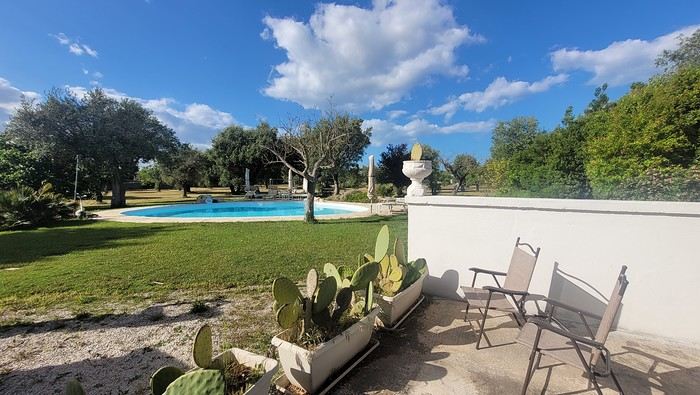
About an hour later, we arrive at our first accommodation, right in the middle of the countryside near Monopoli. The owner isn’t there, but they’ve left us a ton of info via messages and even turned on the space heater, which is a nice touch. We explore the property:
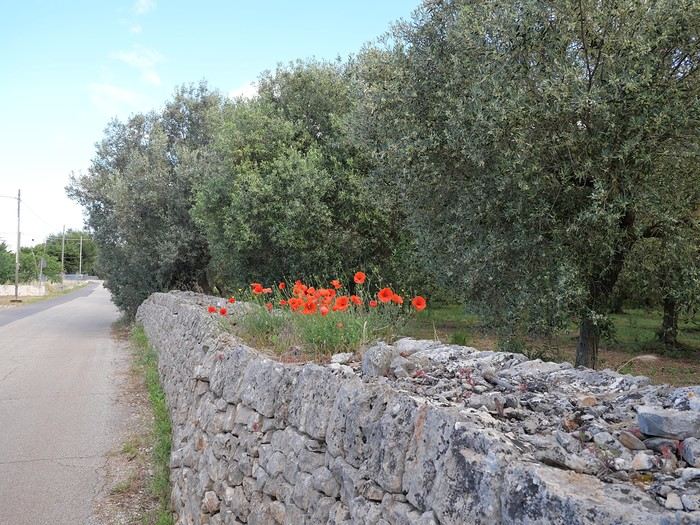
And the next morning before breakfast, its immediate surroundings:
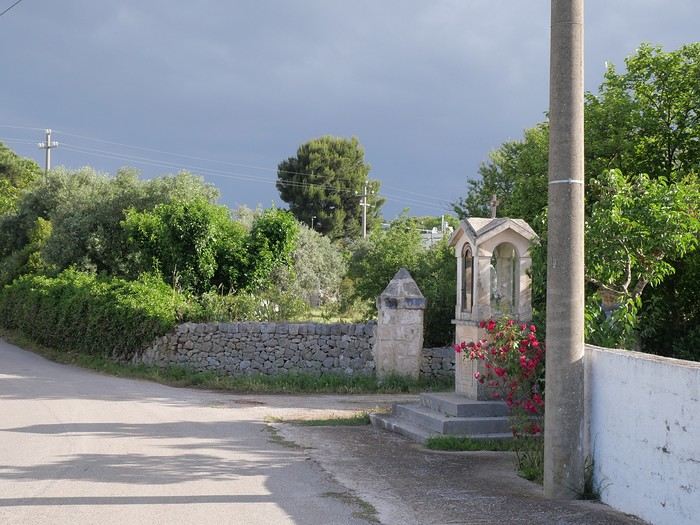
Sunday, May 17: After our "seaside" experience in Gran Canaria last weekend (packed with people and locals), we decide to start inland. After a hearty breakfast,
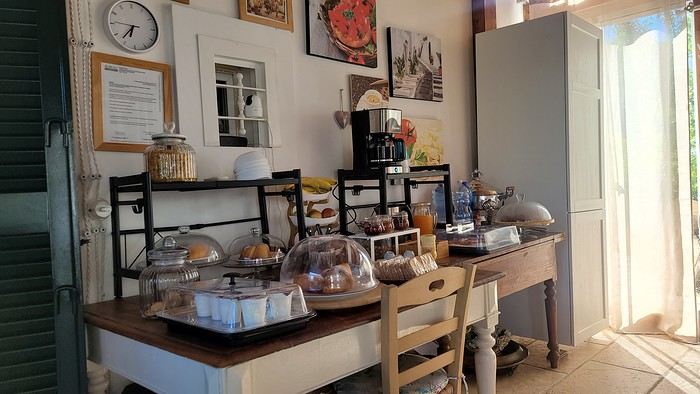
we head toward Alberobello, a super touristy village famous for its trulli—those stone houses with conical roofs. We easily find a free parking spot on a street near the Aia Piccola district, where some trulli are still lived in year-round.
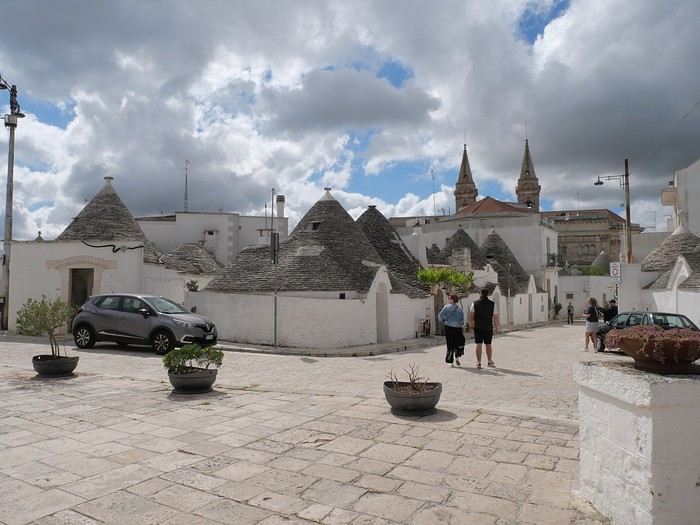
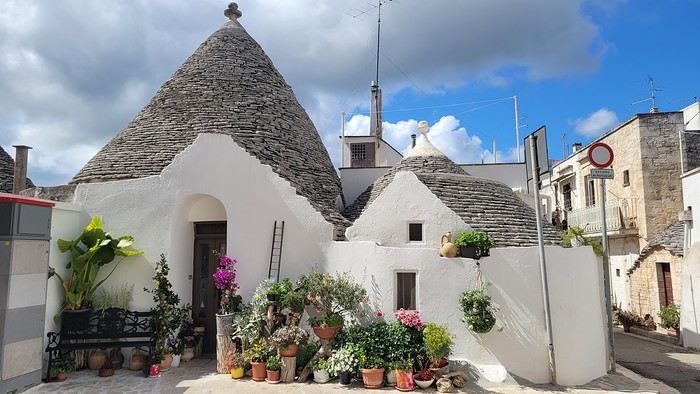
We almost immediately come across the Trullo Sovrano (the only two-story one), which you can visit (but we skip it—it’s opening time, and there’s already a line).
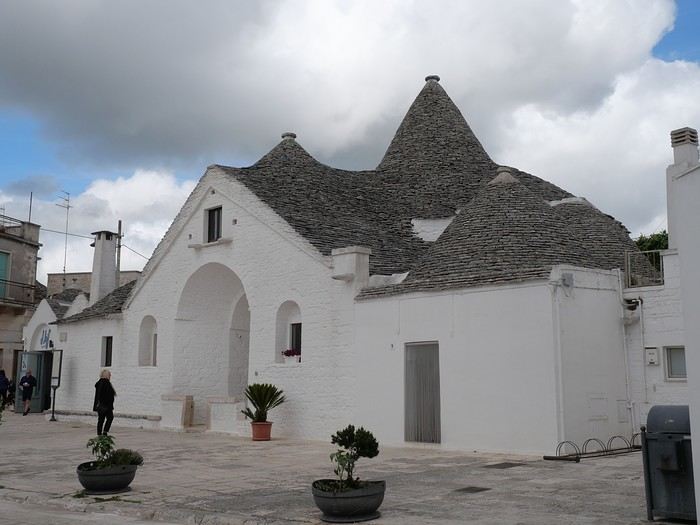
From there, we head down toward the Basilica of Cosma e Damiano... but we don’t go in because there’s a mass.
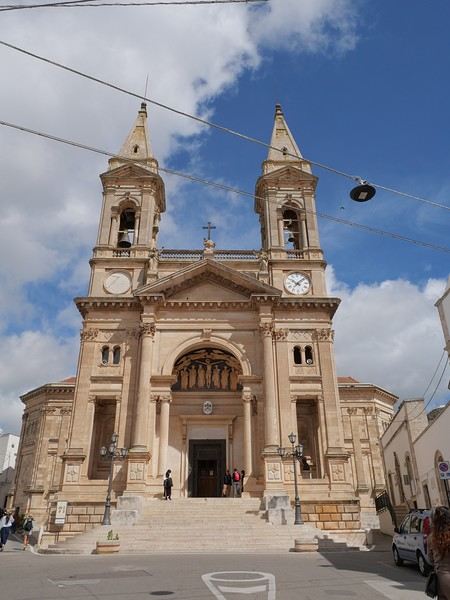
Now we’re on the main Piazza del Popolo, which connects the two districts of Alberobello: Rione Aia Piccola and Rione Monti, the more touristy one.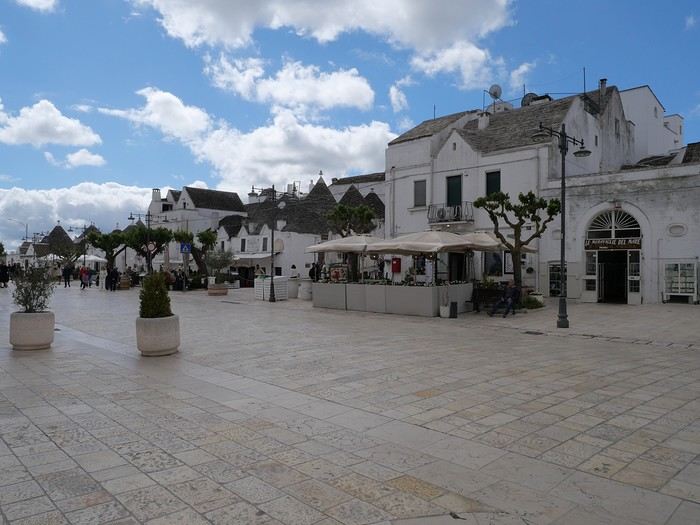
For those who’d like to (re)read the story without the digressions, it’s here.
Saturday, May 16: This time we’re flying out of Charleroi (Brussels South): the ticket prices, flight times, and proximity all worked for us. The airport (Ryanair) was recently renovated... but it’s still not very well organized. There are hardly any seats in the boarding areas, and... the restrooms cost money!!! The flight goes smoothly, though, and we land in Bari a little late.
We quickly pick up our rental car, a very local-looking Pandina (even more so than the Fiat 500 in this region), and hit the Italian roads... and their unique driving quirks (like the fact that the countless road signs along the streets and in towns are purely decorative 😏, and that Italian cars don’t have turn signals 😮... except for rental cars).
About an hour later, we arrive at our first accommodation, right in the middle of the countryside near Monopoli. The owner isn’t there, but they’ve left us a ton of info via messages and even turned on the space heater, which is a nice touch. We explore the property:
And the next morning before breakfast, its immediate surroundings:
Sunday, May 17: After our "seaside" experience in Gran Canaria last weekend (packed with people and locals), we decide to start inland. After a hearty breakfast,
we head toward Alberobello, a super touristy village famous for its trulli—those stone houses with conical roofs. We easily find a free parking spot on a street near the Aia Piccola district, where some trulli are still lived in year-round.
We almost immediately come across the Trullo Sovrano (the only two-story one), which you can visit (but we skip it—it’s opening time, and there’s already a line).
From there, we head down toward the Basilica of Cosma e Damiano... but we don’t go in because there’s a mass.
Now we’re on the main Piazza del Popolo, which connects the two districts of Alberobello: Rione Aia Piccola and Rione Monti, the more touristy one.
Hitchhiking in the 70s-80s
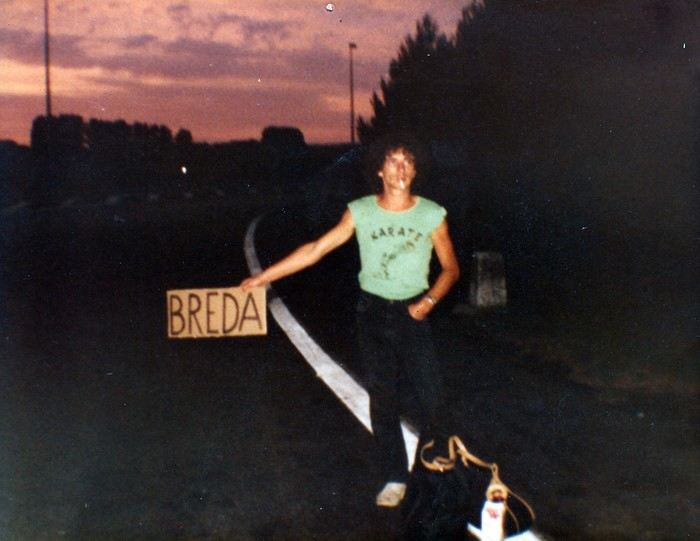
“Hey, your Marker... - My Marker? - The one you used to make hitchhiking signs.”
The marker in question is sitting proudly on the kitchen table. Marielle found it at the bottom of a moving box.
I’ve been meaning to tell the long story of my love affair with hitchhiking for years. Here we go.
To be honest, I’m not quite sure when it started. My earliest memory goes back to a fair with a bike race in my maternal grandparents’ village. I was with my cousin, my little sister, and three girl cousins. There were six of us, ages ranging from six or seven to thirteen or fourteen. Our parents stayed at the fair, and we’d had enough. So we decided to walk home. Only it was four kilometers away. So we hitchhiked. A guy driving an old car picked us all up and dropped us off at the farm. He probably found it amusing to see us thumbing a ride by the side of the road, but maybe it also worried him a bit. With everything you read in the papers...
Around fifteen or sixteen, I started hitchhiking regularly, alone or with a friend, to go to the nearby town. But it was especially when I started boarding school in Orléans that it became more regular. The first year, I’d leave Monday morning and come back Saturday noon by bus. It was an old, uncomfortable bus where we froze in winter. To make matters worse, I often got motion sickness if, as was too often the case, I ended up sitting in the back. In the spring, a high school friend suggested I hitchhike back. It meant a slight detour, but the advantage was taking only national roads.
So that’s how, from the end of tenth grade to twelfth grade, I’d thumb a ride every Saturday on the Pont de Bourgogne. Drivers were used to seeing young people hitchhiking, and it worked pretty well. Our biggest fear? Soldiers! At that time, military service was still mandatory, and on weekends, it wasn’t rare to see them competing with us. They’d keep their uniforms on to go home. That gave people confidence—with everything you read in the papers—and they’d rarely wait more than five minutes. We, with our long hair, were definitely less popular. From time to time, three big red-faced guys in a van coming back from a construction site would flip us off, yelling things like “go get a haircut, you bums!” Those were the good old days.
We still had a good laugh, though. Patrice, the friend I’d hitchhike back from school with on Saturdays, is a musician—I’d later discover he’s an excellent composer. A die-hard Beatles fan, he knows their repertoire by heart and spends his time singing at the top of his lungs while we thumb a ride. One Saturday late morning, we’d been waiting for a while at the exit of Châteauneuf-sur-Loire when a little lady came up to him and asked if he could please sing a little quieter: a baby was sleeping in the house. He put on the most sorry face: “Oh, sorry ma’am, we didn’t realize.” No sooner had the lady gone back inside than he started again. Luckily, a car stopped just then, sparing me the embarrassment of seeing the lady come back out.
Saturday was also the day when the cigarette pack was dangerously low. So before leaving, we’d go buy some “Parisiennes,” the “P4s” as we called them back then. They were slightly thinner cigarettes with a mix of tobacco scraps. Sometimes they tasted like light tobacco, sometimes like dark. Not great, but by the end of the week, our pocket money was gone. They were sold in small packs of four, hence the name P4. We’d only pay 20 centimes. On Saturdays, it was rare for the two of us to manage to scrape together 1.50 F to buy a whole pack of Gauloises...
The last twenty kilometers, I’d usually do alone, Patrice having reached his destination. From time to time, luck would smile on me: an acquaintance would just happen to pass by and stop. One January Saturday, at the exit of Gien, I ran into another guy from Argenton whom I knew a little. That day, the weather was nice, but the temperature was well below zero. It was around noon, and it was the off-peak hour. We were shivering, stamping our feet by the side of the road, when a Citroën “Tube” arrived: it was his father’s boss’s, a mason. They were both sitting in the front, but since they were obese, they had us climb onto the open back. Even though we huddled against the cab to shelter from the wind, the twenty kilometers felt very long, especially since we were only going sixty kilometers an hour. Our hands and cheeks were blue when we finally arrived.
The year I took my baccalaureate, a friend with a 2CV would take me Monday mornings with one or two others we’d pick up in nearby villages. We’d share the gas costs, but it was still cheaper than the bus. And in winter, the bus was my nightmare. You had to get up at five to catch it at six. Not enough sleep, and outside it was freezing or raining—or both. The 2CV was luxury. Plus, Philippe would pick me up at home. On the other hand, since I didn’t have class Saturday mornings—well, I did, but we only had PE the first two hours and nothing after—I’d skip class and slip out right after breakfast to thumb a ride at the Pont de Bourgogne.
Those three high school years were formative in this optional subject that was hitchhiking. Little by little, I learned the rules of the game. First, you shouldn’t walk along the road while thumbing. Cars go too fast and can’t stop easily. Accepting a ride that’s too short is also a no-go. The guy who offers to take you a little way but drops you off at some vague crossroads in the middle of nowhere? No thanks. You need to get dropped off in a town. If it’s a fairly big city, you often have to cross it from one end to the other, but it’s better. At the exit, you have to choose your spot well. Actually, you have to put yourself in the driver’s shoes: they need to see you early enough, not be going too fast, and be able to stop easily without risking an accident. So when leaving a city, it’s better not to go too far. It’s wiser to find a spot where cars go slowly and can stop easily. And preferably near a café. The café is for when you still have a few coins for a coffee and need to warm up. From time to time, you’d run into someone nice who’d make a detour to drop you off at a better spot to start again. Finally, if possible, avoid hitchhiking on Sundays. Cars are packed with whole families who, most of the time, aren’t going far. And then there’s the little worry of those people who rarely leave home: with everything you read in the papers...
During those high school years, it was only short trips, rarely exceeding a hundred kilometers. Later, I aimed bigger, and things were a bit different. In 1973-74, I crossed part of France for the first time on two or three occasions, coming back from the German border or returning to Bordeaux, where we lived briefly. Since there weren’t many highways back then, we took national roads. It was during these trips that I realized it was better to leave in the evening. As I said earlier, Sunday is to be avoided, but on weekdays, there’s another problem: if you leave in the morning, you only make short hops. First, it often takes longer to get going because drivers are people going to work nearby. Which brings us back to those who drop you off in a bad spot, far from everything. There, you have to know how to refuse. You thank the driver for stopping—oh, if only everyone could be like you—while explaining why you’d rather stay put. People don’t take offense, by the way. Those who pick up hitchhikers often hitchhiked themselves when they were in the military or before they had a car. In the late afternoon, you’d often run into salespeople or truckers, in other words, people who drive a lot. At that time, salespeople no longer had appointments and were more relaxed. They wanted to talk about something other than the merits of their products. On the radio, it was time for *Les Grosses Têtes*. You’d also quite often run into small business owners, professionals, or even hippies. The conversations were pleasant and often enriching. A little later in the evening, truckers would take over. They’d already driven a few hundred kilometers, and the depot or customs was still far away. So they’d gladly take a hitchhiker to stay awake at the wheel and chat. The radio with Max Ménier’s show *Les routiers sont sympas*, you’d eventually get tired of it. So a hitchhiker was a change. Others, who’d hit the road at midnight to be at their destination by morning, were nice and offered to let you lie down on the bunk while they drove. When you’d been hitchhiking since six in the evening, freezing in the wind between two vehicles, you weren’t unhappy to take a little nap.
Speaking of Max Ménier, he’d often make announcements for hitchhikers. One evening, I called him. It was getting late, and I still had quite a way to go. No luck: the show had ended for good the day before!
In short, it’s better not to rush, sleep in, and leave after lunch, or better yet, in the late afternoon. Obviously, I’m talking about when you have several hundred kilometers to cover. That’s when you have to play it pro.
First thing, especially at night, but it also applies in the middle of summer when the light is blinding: dress to be seen from far away. I’ll admit I have an advantage over most other hitchhikers: I’m small and don’t scare people. To balance that out, racist drivers often take me for an Arab and are less likely to pick me up, but overall, the balance tips in my favor. Back to the need to be seen: at night, I wear light-colored clothes. In headlights, you can see me from far away.
Second thing: travel light. Forget the big backpack with a frame. Drivers don’t always have room in the trunk or on the back seat, especially if it’s rained and the ground is wet. Plus, it forces them to get out of the car. If they’re nice enough to pick up a hitchhiker, you shouldn’t ask for too much either.
Third thing: bring a cardboard sign and a big marker—like the ones in the photo at the start of this post—to write the name of your destination. In the early 80s, I ran a tourist house in the Cher, but I lived in the Netherlands. In the off-season, it was only open on weekends. On Fridays, I’d leave Holland and return on Mondays. 1200 km round trip. On the way there, in Paris, I’d stand at Porte de la Chapelle. At that spot, the road is very wide, and drivers could stop easily. Obviously, on the sign, I didn’t write Eindhoven, which not everyone knows, and even less Amsterdam because of its seedy reputation. In that case, you’d expect to see a police car stop and two officers in kepis ask for your papers. So as a first destination, I’d write Compiègne. We were well out of Paris, and since it wasn’t too far, a trucker or salesperson was less reluctant to stop. Once past Compiègne, I’d take out my Lille sign. Once in Belgium, it wasn’t really necessary to use a sign anymore, since everyone was going in the same direction. Usually, the guy who picked me up at Porte de la Chapelle would say he wasn’t going far but could take me a little way. Before that, I’d still ask if there was a gas station on the highway where he could drop me off before exiting. While talking, the guy would realize he wasn’t dealing with a dangerous criminal. He’d pretend to check his watch, think for a moment, then say that actually, he was going to Belgium and could take me to the border or a little beyond. To leave Paris on the way back, I’d take the train to Melun, where it was easier to hitchhike than at Porte d’Italie.
Over all those years, I think I was pretty lucky. Or maybe philosophical enough not to imagine a car would stop after a few minutes. An hour’s wait was average. Sure, I sometimes waited three, four, or five hours. Most often at odd hours and in terrible weather. When it doesn’t work, it doesn’t work. But there’s always a moment when things pick up. Sure, when you’re soaked in freezing rain in the early morning after a sleepless night, you’re less philosophical than when I’m writing these lines comfortably at my computer, but it still holds true.
Earlier, I mentioned clothing and the importance of being well-rested before leaving. When you’ve eaten well and just gotten out of the shower, shaved, you’re in a better mood. And somehow, drivers sense it. Or at least, that’s the impression I’ve always had. It’s better to look in shape than disgusted at standing there, half-heartedly thumbing a ride. In short, when I’d start to get fed up with waiting, I’d go into the first café I saw for a coffee. Coming back out, I’d be refreshed, and most of the time, a car would stop within minutes. I’ve often said that when I stood by the side of the road thumbing a ride, I felt a bit like a gambler in front of a slot machine. It was a matter of giving luck a chance. And well, it worked out pretty well.
Then, there are countries where hitchhiking works really well and others where it’s harder. In the 70s-80s, it worked best in Germany and England. In the late afternoon, it wasn’t rare to be invited for tea. Well, that was in England. Tea meant being offered room and board. In Germany, they’d offer you coffee. Once there, they’d first show you the guest room and point out the bathroom before sitting you down in front of a big plate of cold cuts. In the evening, they’d go out in town, and the next morning, they’d usually drop you off at a good spot for hitchhiking. On the other hand, in Mediterranean and Scandinavian countries, you’d better be patient. In Spain or Italy, it’s better to take the train, which was dirt cheap back then. However, if you’re a couple traveling light, it’s already easier in most countries.
In 1982, I went on a trip around Turkey with my girlfriend. We only had two small bags, which was plenty. It was November-December, and we wore our warm, bulky clothes. Leaving Eindhoven at nine in the morning, we arrived in Graz, near the Yugoslav border, at eleven at night. 1300 km in a day! In just four or five vehicles. One to the German border, about fifty kilometers from Eindhoven, the second to Hagen in the Ruhr, the third to Salzburg, and the last to Graz at the Yugoslav border. Record broken. During the night crossing of Yugoslavia, we ran into a trucker close to retirement who lent us the truck’s bunk. So we arrived fresh and rested near Skopje the next morning. We continued to Thessaloniki in northern Greece before taking the train to Istanbul. In Turkey, we traveled a good part of the country by hitchhiking too. With truckers in old, overloaded, slow trucks that climbed hills at fifteen kilometers an hour, but also in cars where five or six people were already crammed in. And every time, we were invited for tea. Once, we were even picked up by a big shot in his Mercedes with a chauffeur. Until then, the average speed was around fifty kilometers an hour. There, we were going two hundred. On a national road, not a nice European highway.
I’ve also hitchhiked in Nepal, from Lumbini, Buddha’s birthplace, to a village on the way to Pokhara. It must have been midday. No bus until the next day. I gave it a try. A small truck overloaded with rice sacks, with two or three young people already perched on top, stopped. I rode on the roof of the cab. At fifty kilometers an hour when it was going well, with a breathtaking view. Coming back from India, I also crossed part of Iran by hitchhiking, from Tehran to the Turkish border. I did this trip with an Austrian I met at the hotel who, like me, had to watch his pennies. We gave it a shot. There was almost no traffic, but to our great surprise, the first car that passed in the area would always stop. They’d just ask for a modest contribution for gas, and it cost next to nothing.
Sometimes, you get scared too. After leaving Turkey in early December 82, we spent about two weeks in the southern Peloponnese harvesting olives. A few days before Christmas, we hitchhiked back to Holland. A girl picked us up in her little Fiat 500. We were driving on a mountain road, and that morning there was a bit of black ice. After crossing a pass, we saw the old Ford Taunus ahead of us at fifty meters start to skid. The driver let out a “heeee!” while grabbing my knees. I reflexively grabbed the wheel. Finally, the Taunus got back on track. And we didn’t swerve. But those few seconds felt very long.
In January 77, while I’d been living in Germany for a few months, I decided to spend a few days in Italy. By hitchhiking, of course. I left in the early afternoon, and by ten at night, I wasn’t far from Frankfurt. I saw a big Mercedes stop. The four or five young people crammed inside were listening to Schlager at full volume. Beer cans littered the floor. They didn’t have a precise destination, and as long as they were going south, that was fine with me. They’d finished their military service that very day and had clearly already celebrated their discharge. The driver was going 160, zigzagging dangerously from one side of the highway to the other. I should have realized he wasn’t entirely sober either. Luckily, there was almost no traffic. Finally, I managed to get dropped off at a gas station just before Frankfurt, relieved. I hope their trip didn’t end tragically.
Another time, coming back from Holland with my wife, we were picked up early in the morning near Senlis by two guys from Lille. They were going to work near Tours and could drop us off at Porte d’Italie. Apparently, they were coworkers but barely knew each other. The driver offered us a beer—at six in the morning, sure!—before opening another can for himself. He was clearly having trouble staying in the right lane. We politely declined, the passenger too. Everyone was tense. Luckily, it was rush hour on the ring road, and we were going slowly. When we got out of the car, the passenger said goodbye with the look of a guy being offered the condemned man’s rum and cigarette.
Finally, there are the annoying remarks from drivers who are either gay when you’re alone or turned on by the sight of your girlfriend when you’re a couple. In those cases, I’d get in the back so the guy wouldn’t feel too confident. And if the conversation got a little too suggestive, we’d deflect until we got dropped off.
And luckily, there are the times, not so rare after all, when you run into really nice people who invite you to eat and sleep at their place and drive you to a good spot the next morning. In Germany and England, that was common. And then there are the big strokes of luck, like during our trip to Turkey when we crossed most of Germany in one car, or that other time when some Germans drove me from the exit of Geneva all the way to the Costa Brava.
Going back to “with everything you read in the papers” and its variant “with everything you see on TV”—and now on the internet—it’s always left me perplexed. Personally, I’ve never heard of hitchhikers assaulting drivers, even if it may have happened. On the other hand, what was most common were hitchhikers being assaulted, especially girls. Anyway, even armed, it seems a bit stupid to assault the driver—wouldn’t that risk causing an accident?
Finally, since that time, I’ve occasionally wanted to hitchhike somewhere far away in France. Most often, too busy with work, it never happened, but the nostalgia hasn’t completely disappeared.
* * *
Other Hitchhikers
And then one day, I... settled down to become a driver myself. Ten years had passed, and you saw fewer and fewer hitchhikers. Or maybe I saw fewer because I had a regular job and wasn’t traveling the same way. And then I understood a few things.
Several times, I was tempted to pick up a hitchhiker, but they didn’t meet the required conditions. They were walking along the road instead of staying at the exit of the previous town. Hard to stop without risking an accident. Or the guy looked really scruffy. Or he was sulking, if not both. Then you think of that famous “with everything you read in the papers.” Not that I was scared, but unfortunately, the few hitchhikers I did pick up later were rarely interesting.
A few years ago, we picked up a young guy at the exit of a small town in Sologne. Not an easy spot for hitchhiking. Bad luck, he was a pretentious little jerk. He was barely 20 or 25 and talked like a bitter old man. He was a waiter in a restaurant. According to him, it was lucky he was there, otherwise the boss would have closed up shop long ago. You’d think he had thirty or forty years of professional experience behind him. As we approached Blois, he started ranting about Arabs, blaming them for all evils. And he laid it on thick. That morning, we were going to a teenager’s funeral who had just committed suicide, so he really got on our nerves, Mr. Know-It-All. Out of anger, I dropped him off next to a shopping center a few kilometers from downtown. Not nice, but it felt good.
Some time ago, we were driving around the Limousin on a Sunday to try out the used Twingo we’d just bought. We picked up a guy in his forties. A German who spoke French well. He started talking about the environment. He was a green Khmer. He got worked up all by himself with his pseudo-eco rant and, after a few kilometers, was almost yelling at us. As we were about to leave the main road for a small one, I dropped him off at a crossroads in the middle of nowhere. Normally, I would have made a little detour to take him to a better spot, but this time, I didn’t feel like doing the... eco-warrior a favor.
On the other hand, I’ve still done my good deed a few times. One June morning, coming back from Orléans, I saw a man in his sixties hitchhiking. The poor guy had had a rough time. He was from Montpellier and was coming back from Caen, where he’d been promised a job. Once there, they bluntly told him the position was already taken, and he had to go back. Except he didn’t have enough money left for the train. He’d spent the night hitchhiking without success. I could only take him as far as Lamotte-Beuvron, where I dropped him off near the fire station. Apparently, there was some vague shelter there or something, but it only opened a few hours later. In the meantime, he settled on the grass in a corner to sleep a little. While he was doing that, I quickly went to the train station to check the price of a ticket to Montpellier. It was within my means. Since he was sound asleep, I slipped the train ticket and 100 francs into his pocket. I couldn’t imagine him continuing to hitchhike all the way to Montpellier. And I bet he didn’t even have a piece of cardboard and a marker!
When we go to Brazil, we usually rent a small car. One day, we were coming back from Paracuru to Fortaleza when we saw a whole family hitchhiking. Two adults and two or three small children. Here near the equator, the sun sets very quickly, and it would soon be night. There was little traffic, and trucks wouldn’t stop because there was no room in the cab. As for the rich people driving big 4x4s, they wouldn’t stoop to picking up the lower classes. The only hope for this kind of family was usually a farmer or artisan who’d let them ride in the back of his pickup. Obviously, they were a bit surprised to see us. Everyone crammed in as best they could in the back of our little car. When we dropped them off, we got a whole string of “Deus lhes abençõe”—God bless you.
Still in Brazil, we were on the road from Barreirinhas to São Luís do Maranhão. About 150 km of deserted road with an isolated mud house here and there. A young woman flagged us down. She was very pregnant and had to get to the clinic twenty or thirty kilometers away to give birth. Someone was supposed to drive her, but the first signs of labor started earlier than expected, and the driver was unavailable. Even driving fast, we weren’t feeling great: it would be just our luck if she gave birth in the car!
Today, we’re in the age of smartphones and carpooling apps. Safety. With everything you see on TV... Three or four years ago, we signed up on a platform. Our first, and only, “client” was a little jerk who didn’t say a word the whole trip. No hello, no goodbye, and certainly no thank you. The next day, we found his Ray-Bans in the car. We didn’t run after him to give them back. Ha!
Do travel encounters matter to you?
Hi there,
My name’s Emilie, and my view of travel has changed. I used to travel just to tick off the "places and things to do/see" boxes. But lately, I’ve realized that encounters have become really important to me while traveling. In fact, the people I’ve met and what they’ve brought to my life are now my best travel memories. What do you think? Have you had a similar shift in perspective? Are you more interested in meeting people while traveling now?
To be totally honest, I’m training to become a travel planner (a trip organizer), and I was thinking of focusing on organizing trips that are more centered around encounters. So I’d love to know if this makes sense—if travelers are interested in this kind of experience. Just to be clear, I’m not selling anything; I just want to chat and hear your thoughts.
Have a lovely evening, everyone! :)
My name’s Emilie, and my view of travel has changed. I used to travel just to tick off the "places and things to do/see" boxes. But lately, I’ve realized that encounters have become really important to me while traveling. In fact, the people I’ve met and what they’ve brought to my life are now my best travel memories. What do you think? Have you had a similar shift in perspective? Are you more interested in meeting people while traveling now?
To be totally honest, I’m training to become a travel planner (a trip organizer), and I was thinking of focusing on organizing trips that are more centered around encounters. So I’d love to know if this makes sense—if travelers are interested in this kind of experience. Just to be clear, I’m not selling anything; I just want to chat and hear your thoughts.
Have a lovely evening, everyone! :)
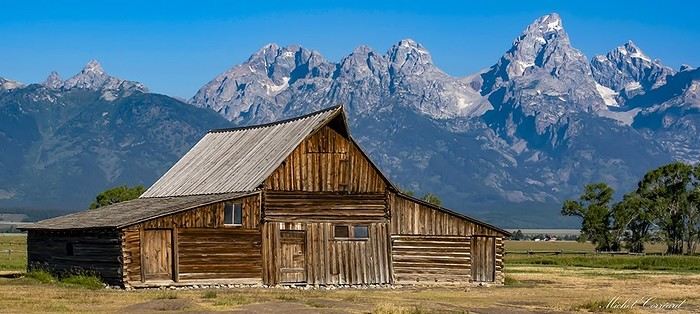
Grand Teton National Park
Every day, I look back at my 2022 trip to Wyoming. And every day, I tell myself I need to start getting ready to go back. Don’t agree? 😎
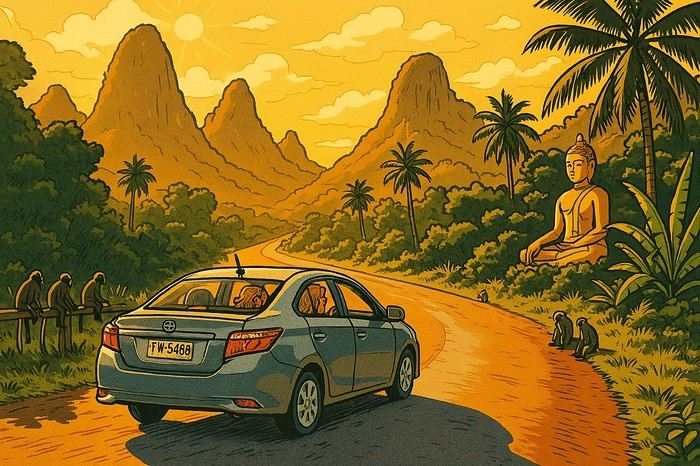
From Bangkok to Krabi, Thailand by Car!
This first trip of 2025 will have the taste of Asia.
More precisely, Thailand!
It’s not my first time—I’ve often traveled across Southeast Asia between 2000 and 2015. (This travel journal, for example...)
But it’ll be my partner’s first steps in this part of the world.
The itinerary we’ve chosen will alternate between familiar sights for me and new discoveries for both of us.
I’ll get to see how the country has changed in 20 years—and what’s stayed the same!
We were torn between the north and the south of the kingdom. Fears of smoke from slash-and-burn farming and a desire to relax on the sand tipped the scales toward the south...
What if we rented a car?
I think driving in sprawling Bangkok would be a bit ambitious, so we’ll only book our vehicle from Hua Hin to return it in Surat Thani.
Other transportation will range from tuk-tuks to overnight trains and ride-hailing services.
And of course, the plane!
I’d love to travel from Auvergne to Bangkok by road, but 15 days wouldn’t be enough...
Plus, the current geopolitical situation isn’t exactly favorable...
So, once again, we’ll be stuck for hours in the less-than-comfortable economy class of Qatar Airways.
The arrival time was on schedule, entry formalities were quick, and all our luggage made it.
We left Lyon in wind and cold—now we’re breathing in the warm, humid air of กรุงเทพมหานคร.
To reach our hotel, we first took the metro, which dropped us off in the city center in about 30 minutes for the incredible price of 1.18 €.
A few taps on the GRAB app, and we booked a ride-hailing service for the last few kilometers.
We waited a while for our driver due to insane traffic in the area, but once in the 4x4, we were at our lodging in no time.
We chose this small hotel for its riverside location, tranquility, and price.
It’ll do the job perfectly—the only downside is the weak breakfast.
The room is inviting, and we collapse onto the bed for a well-deserved short nap.
Wake-up call in an hour for our first visits!
See you soon...
More precisely, Thailand!
It’s not my first time—I’ve often traveled across Southeast Asia between 2000 and 2015. (This travel journal, for example...)
But it’ll be my partner’s first steps in this part of the world.
The itinerary we’ve chosen will alternate between familiar sights for me and new discoveries for both of us.
I’ll get to see how the country has changed in 20 years—and what’s stayed the same!
We were torn between the north and the south of the kingdom. Fears of smoke from slash-and-burn farming and a desire to relax on the sand tipped the scales toward the south...
What if we rented a car?
I think driving in sprawling Bangkok would be a bit ambitious, so we’ll only book our vehicle from Hua Hin to return it in Surat Thani.
Other transportation will range from tuk-tuks to overnight trains and ride-hailing services.
And of course, the plane!
I’d love to travel from Auvergne to Bangkok by road, but 15 days wouldn’t be enough...
Plus, the current geopolitical situation isn’t exactly favorable...
So, once again, we’ll be stuck for hours in the less-than-comfortable economy class of Qatar Airways.
The arrival time was on schedule, entry formalities were quick, and all our luggage made it.
We left Lyon in wind and cold—now we’re breathing in the warm, humid air of กรุงเทพมหานคร.
To reach our hotel, we first took the metro, which dropped us off in the city center in about 30 minutes for the incredible price of 1.18 €.
A few taps on the GRAB app, and we booked a ride-hailing service for the last few kilometers.
We waited a while for our driver due to insane traffic in the area, but once in the 4x4, we were at our lodging in no time.
We chose this small hotel for its riverside location, tranquility, and price.
It’ll do the job perfectly—the only downside is the weak breakfast.
The room is inviting, and we collapse onto the bed for a well-deserved short nap.
Wake-up call in an hour for our first visits!
See you soon...
Skyscrapers, Markets, Ice Cubes, Tourism, and Waterfalls... Thailand's Excesses
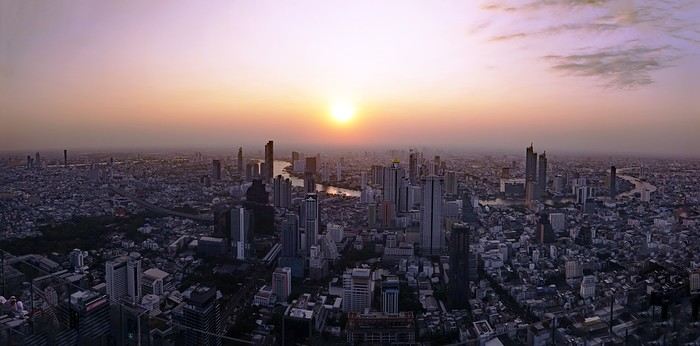
A somewhat lengthy title... I could have simply written: from Bangkok to Chiang Rai, via Chiang Mai, since that was my route. But when poets embellish our travel journals with their verbal flourishes, you’ve got to try not to be too ordinary.
Skyscrapers of excess? You’ll have gathered that from the photo illustrating this journal—though it might change as the trip goes on.
The excess of markets—not so much in their size, though... Chatuchak... But in their sheer number. Day markets, night markets, floating markets, fresh produce markets, fish markets, meat markets, spice markets, fabric markets... and even... amulet markets... For luck, good fortune, protection. Not to mention, sadly, the market for girls—and boys, incidentally. I’ve even heard they’re displayed in windows. I’ve heard about that one, like you have, but I didn’t set foot in it, so I can’t say anything about it. Some even claim there’s a black-market trade in children. Disgusting! It reminded me of the book *The Parcel* by Anosh Irani, which I recommended in another journal. The story is set in India, but I’ve been told it exists in Thailand too. So, the "famous Thai markets" we’re bombarded with in paper and online guides—sure, they amazed me in the first few days, and I don’t regret visiting them. But no matter how big they were, I quickly got my fill since you saw the same things at every stall...
I had a market overdose.
Excess of tourism? I should say *tourists*, since I saw them literally swarming in the streets and those famous markets. I’d forgotten about them. I’d lost the habit, living in an Indian city for so long...
Waterfalls are a bit like markets. At this time of year, they’re not particularly spectacular, but they’re everywhere. There are the ones everyone goes to see. For example, Erawan, which I decided to skip even though it was in my original itinerary—I guessed it’d be a nightmare with the selfie circus. On the other hand, you come across them all over the place, hidden in the mountains and forests, not listed in any guide. Not to mention the ones you can find in temples or even private homes... Yes, really! Thais love waterfalls, so they install them in their gardens—and I even saw one in the middle of the city, right on the street! Sometimes they’re tiny, but very photogenic.
But what do ice cubes have to do with this? Why the excess of ice cubes? Not only are they everywhere by the ton, but they put them in *everything* you drink. You’d think they’d even put them in soup! And it’s not just one or two ice cubes—no! They fill the container to the brim, whatever it is, then pour the liquid on top to fill the gaps. They’ll make you an excellent coffee right in front of you, piping hot, then—bam! An avalanche of ice cubes in the glass. Okay, I’m exaggerating a little. They *do* sometimes ask if you prefer your coffee—or tea—hot. Everything edible, and especially everything drinkable, is refrigerated: vegetables, fruit, hot drinks (I mean, drinks that are *usually* hot), but meat and fish are left out in the open. They just wave a little whisk to shoo away the flies when they get too eager. Mind you, I never put fruit, cheese, eggs, or water in the fridge in France, but I do in India. And I refrigerate meat and fish too... Though sometimes one of those little flies sneaks into the fridge...
You won’t find practical or technical details in this journal, like addresses or prices. Others do that better than me. You also won’t find the names of obscure or unknown places I discovered, or directions to get there.
I don’t really feel like recounting what I saw day by day, following my schedule and route. There might be flashbacks, projections into the future. It’ll depend on my memories, what I felt, what I hated, what comes back to me—and maybe your questions and our exchanges. And for those who’ve never read me before, you’ll have to get used to my parentheses and digressions, maybe on a completely different subject, as my thoughts wander. Stories within stories. There’ll also be long, endless sentences—but still punctuated, so you can follow along. Though I used to curse Proust and his sentences that started on one page and ended on the next, sometimes even further. I’d have to reread them twenty times to follow and understand what he was saying. I hated Proust. But hey, I was 20. Maybe I’d like him now?
See? The digressions are starting already. Forgive me.
You’ll find few photos here. First, the number is limited, and second, photos aren’t the main purpose of either VF or a travel journal. They’re too often used to mask the poverty of the text. And, sorry to say it, but so many of them are just plain ugly! If you really want to see photos, I’ll share some links where you can browse them at your leisure
What are the criteria that make you choose one destination over another?
Hi there,
The title might be a bit long, but I hope it’s completely understandable!
When it comes to choosing your next trip, what tips the scales in favor of Eritrea over Ibiza?
Why pick Canada over French Polynesia?
The price? A magazine or TV report, a travel journal, an Instagram ad? Ease of travel? Minimal time difference? The country that has the most in common with all the trip participants? Activities? Relaxation? The desire to push your limits?
A photo?
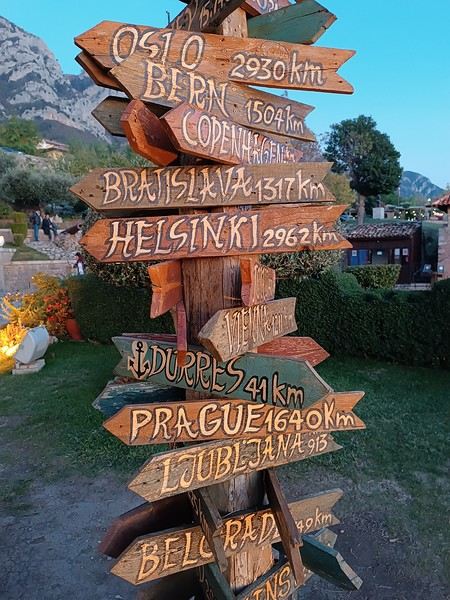
What else, I wonder...
Personally, I often prioritize simple destinations (no administrative hassles), where I’m not at risk (nothing extraordinary like getting kidnapped by Daesh or ending up in a jail cell because the current geopolitics aren’t favorable to my passport, etc.), and where I can drive.
Wide-open natural spaces are more my thing than urban anthills.
Finally, I try not to spend three days on a plane to reach my destination, and I aim for a maximum budget of 3500 € (for 3 weeks) in comfortable conditions—that means charming hotels, good meals, etc.
What about you?🙂
The title might be a bit long, but I hope it’s completely understandable!
When it comes to choosing your next trip, what tips the scales in favor of Eritrea over Ibiza?
Why pick Canada over French Polynesia?
The price? A magazine or TV report, a travel journal, an Instagram ad? Ease of travel? Minimal time difference? The country that has the most in common with all the trip participants? Activities? Relaxation? The desire to push your limits?
A photo?
What else, I wonder...
Personally, I often prioritize simple destinations (no administrative hassles), where I’m not at risk (nothing extraordinary like getting kidnapped by Daesh or ending up in a jail cell because the current geopolitics aren’t favorable to my passport, etc.), and where I can drive.
Wide-open natural spaces are more my thing than urban anthills.
Finally, I try not to spend three days on a plane to reach my destination, and I aim for a maximum budget of 3500 € (for 3 weeks) in comfortable conditions—that means charming hotels, good meals, etc.
What about you?🙂
What’s your definition of a nature destination?
Hi,
I’m starting this thread after a digression that began in the India section and continued in a travel journal about Kerala.
The original topic was whether India is—or isn’t—a nature destination.
I’ll let you all discuss and share your own definition of a nature destination. 🙂
I’m starting this thread after a digression that began in the India section and continued in a travel journal about Kerala.
The original topic was whether India is—or isn’t—a nature destination.
I’ll let you all discuss and share your own definition of a nature destination. 🙂
First trips after...
A turbulent period came to an end around 2022.
Many of us have returned to big trips after making only very small ones—or none at all. For a little anecdote, my dentist told me that due to the lack of travel, a lot of clients treated themselves to implants they would’ve otherwise skipped. The joy of traveling again probably gave some vacationers smiles they hadn’t dared to show before!
Here, you can share what’s on your mind: Have these new, real trips disappointed you, rejuvenated you, or just relieved a long frustration?
For my part, not being so young anymore, there was definitely relief but no explosion of joy. I just had the feeling of picking up the thread of life after a foggy pause, with the bitter taste that 2 or 3 years of my life had been partly stolen from me.
Many of us have returned to big trips after making only very small ones—or none at all. For a little anecdote, my dentist told me that due to the lack of travel, a lot of clients treated themselves to implants they would’ve otherwise skipped. The joy of traveling again probably gave some vacationers smiles they hadn’t dared to show before!
Here, you can share what’s on your mind: Have these new, real trips disappointed you, rejuvenated you, or just relieved a long frustration?
For my part, not being so young anymore, there was definitely relief but no explosion of joy. I just had the feeling of picking up the thread of life after a foggy pause, with the bitter taste that 2 or 3 years of my life had been partly stolen from me.
Villages où loger dans les Cyclades en août
Bonjour à tous,
Mon voyage initial (Madagascar) étant tombé à l'eau j'étudie un plan B.
Je me suis dis "où est-ce que je rêve d'aller mais en y renonçant parce que trop touristique et qui ne soit pas trop loin ???" et là tout de suite Santorin m'est venu à l'esprit, ainsi que les Cyclades.😎 En effet, pas de croisière et une Europe qui se rouvre doucement devrait être une opportunité d'aller dans ces îles magiques sans croiser trop de monde.
Du coup j'ai élaboré rapidement un programme qui va du 23 juillet au 3 août. Arrivée et départ depuis Santorin (puisqu'il y a un vol direct Zurich - Santorin).
Cela pourrait ressembler à ça: J1 arrivée à Santorin J2 Santorin -> Sifnos J3 à 6 (soit 4 jours pleins) Sifnos J7 Sifnos - Amorgos. J8 et 9 Amorgos J10 Amorgos -> Santorin J11 à 13 Santorin (soit 3 jours, le départ du vol retour étant J13 à 20h45).
Je trouve qu'il manque 1 jour à Amorgos, mais je ne peux plus en rajouter, donc soit j'en enlève 1 à Sifnos, soit 1 à Santorin ??? Qu'en pensez-vous ?
Dans quel village me conseillez-vous de loger sur chacune d'elles ? Pour Amorgos je pensais Aegiali parce que c'est là qu'il y a le club de plongée sous-marine. Pour le reste je n'ai pas encore étudier.
Par avance merci 🙂
Mon voyage initial (Madagascar) étant tombé à l'eau j'étudie un plan B.
Je me suis dis "où est-ce que je rêve d'aller mais en y renonçant parce que trop touristique et qui ne soit pas trop loin ???" et là tout de suite Santorin m'est venu à l'esprit, ainsi que les Cyclades.😎 En effet, pas de croisière et une Europe qui se rouvre doucement devrait être une opportunité d'aller dans ces îles magiques sans croiser trop de monde.
Du coup j'ai élaboré rapidement un programme qui va du 23 juillet au 3 août. Arrivée et départ depuis Santorin (puisqu'il y a un vol direct Zurich - Santorin).
Cela pourrait ressembler à ça: J1 arrivée à Santorin J2 Santorin -> Sifnos J3 à 6 (soit 4 jours pleins) Sifnos J7 Sifnos - Amorgos. J8 et 9 Amorgos J10 Amorgos -> Santorin J11 à 13 Santorin (soit 3 jours, le départ du vol retour étant J13 à 20h45).
Je trouve qu'il manque 1 jour à Amorgos, mais je ne peux plus en rajouter, donc soit j'en enlève 1 à Sifnos, soit 1 à Santorin ??? Qu'en pensez-vous ?
Dans quel village me conseillez-vous de loger sur chacune d'elles ? Pour Amorgos je pensais Aegiali parce que c'est là qu'il y a le club de plongée sous-marine. Pour le reste je n'ai pas encore étudier.
Par avance merci 🙂
On part en vadrouille dans les Balkans!
Et bien le confinement a de beaux jours devant lui ! Chose promise, chose due (publier une journée de vadrouille par jour de confinement) ! Après le carnet sur un voyage aux Etats-Unis (voyageforum.com/...-americain-d9943984/), après le carnet sur une vadrouille en Jordanie (https://voyageforum.com/discussion/on-part-en-vadrouille-en-jordanie-d9991360/), voici maintenant un carnet dans les balkans, voyage réalisé il y a maintenant quelques années :
Et on garde les bonnes habitudes, publication d'une journée par jour, à chaque fois à 17h30 ! Bonne lecture et n'hésite pas à laisser un commentaire, une question, une remarque, ...
Franck
Et on garde les bonnes habitudes, publication d'une journée par jour, à chaque fois à 17h30 ! Bonne lecture et n'hésite pas à laisser un commentaire, une question, une remarque, ...
Franck
L'hiver au pays des merveilles (Maroc)
Bonjour,
Je crains que le forum ne soit morose dans les mois à venir , alors pourquoi ne pas faire un nouveau carnet de voyage . J'ai eu la chance de rentrer du Maroc 2 jours avant la suspension des vols et me retrouve donc, comme vous sans doute , en mode confinement total, chez moi, en Basse-Bretagne , avec quelques centaines de photos de mon dernier séjour à sélectionner, recadrer, retravailler .... On s'occupe comme on peut, alors pourquoi ne pas en faire profiter les Forumeurs ?
Je suis resté au Maroc un mois et j'avais organisé un circuit de 10 nuits / 11 jours pour ma plus jeune fille ( 17 ans ) , mon épouse et la grand- mère, ma chère belle-mère, Mina . Ça correspond aux vacances de février en France .
J'avais donc prévu un voyage " simple" sur le papier, mais qui chaque jour et comme toujours allait nous réserver son lot de découvertes, d'émerveillements, de rencontres, de surprises ....
Au programme :
- Départ de Rabat - 2 nuits à Ouarzazate - 2 nuits à N'kob - 2 nuits à Foum Zguid, avec une longue journée 4X4 au plus profond du désert - 4 nuits à Icht / Borj Biramane et retour sur Rabat
Je vais donc essayer d'éviter des redites avec mes précédents carnets, mais le Maroc a tant de richesses à montrer.....
Rabat est une de mes balades urbaines préférées au Maroc . Je découvre toujours de nouveaux endroits, de jolis détails, des points de vue .... Je vais donc m'y balader avec toujours un plaisir renouvelé
Ma première surprise se passe en médina où je découvre avec étonnement que les autorités ont fait le ménage . Tout ce qui encombrait les rues ( déballages sauvages, marchands de tortues et autres lézards, empiétements sur les trottoirs, la rue , etc.... ) a disparu . Plus rien . Même les commerces " en dur " sont "rentrés dans leurs murs" : plus rien sur la voie publique, pas même une chaise.... Une première au Maroc ?
Si le résultat est plutôt agréable dans la rue des consuls ( rue de l'artisanat ) et la rue Souika ( commerces vestimentaires surtout ) , le boulevard Mohamed V, où régnaient les petits restaurants et gargotes , est désormais mort . Ils ont perdu la quasi-totalité de leur ancienne surface commerciale et ne peuvent plus accueillir que quelques clients à la fois . La rue est tuée et il ne me reste plus qu'à chercher un autre endroit où casser la croûte dans la ville . Ce qui est bénéfique dans une rue ( on peut enfin flâner tranquillement ) est catastrophique dans l'autre ( le commerce est mort et le charme est parti ) . A suivre ....
Bon. C'est comme çà . Ici, dans la rue Souika ( à l'heure de la prière ) . Il y a même des poubelles en plastique positionnées dans la rue !
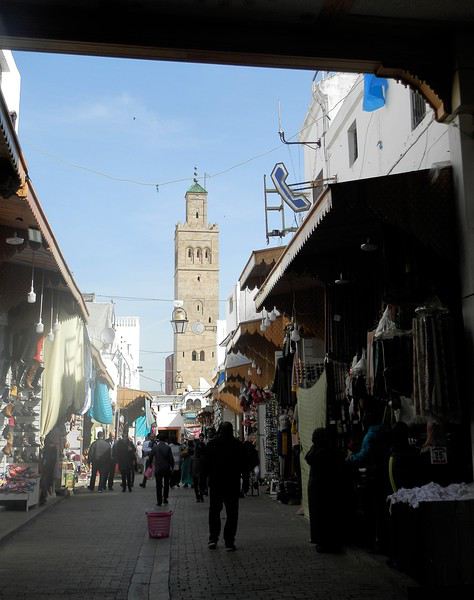
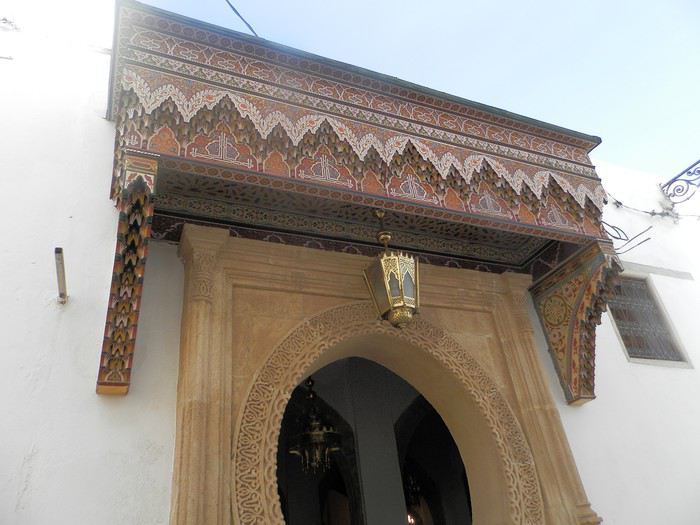
Une autre artère de la médina est la rue Sidi Fatah . Elle donne sur la rue Souika . Une magnifique mosquée y a été restaurée . Si j'en crois mon plan, il s'agit de la mosquée Moulay El Mekki . La porte principale est couverte et on trouve sur chacun des côtés 2 très belles portes ( 4 au total ) . Le minaret octogonal est remarquable . L'ensemble est complété par plusieurs marabout et un peu plus loin se trouve une importante zaouia . C'est vraiment très joli .
L'entrée principale est somptueuse . Le grand art de la peinture sur bois.
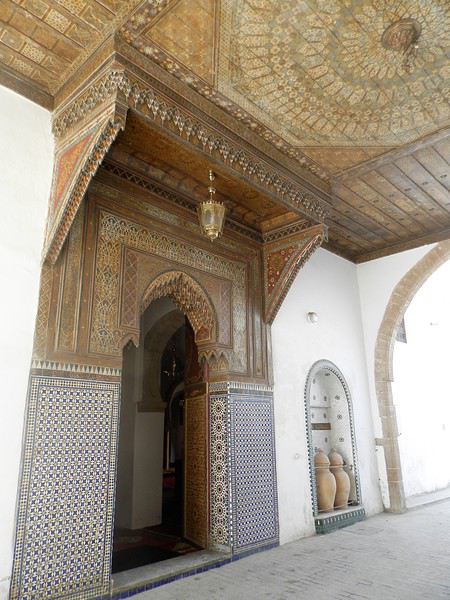
Quelques portes latérales
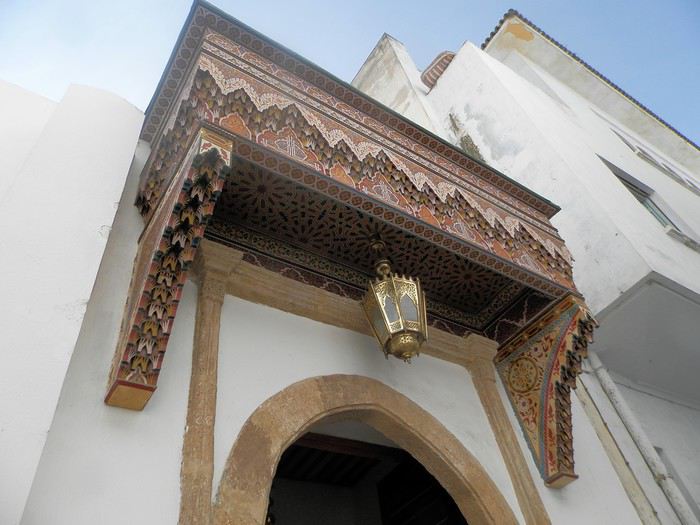
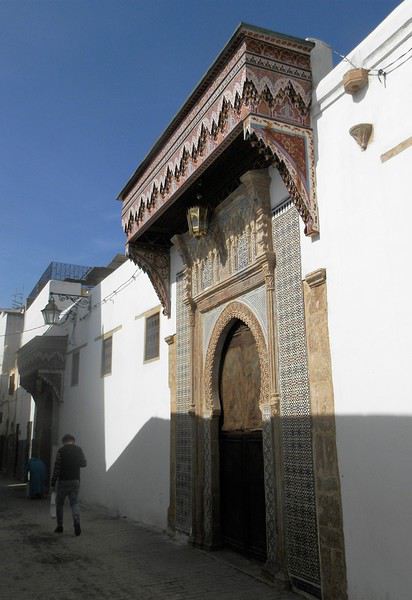
C'est vraiment très agréable de se balader sur la côte atlantique en cette saison ( mi-février ) . Il fait entre 18 et 22 degrés . Temps lumineux . Je n'aurai d'ailleurs pas de pluie pendant un mois ( après avoir eu de la pluie à peu près tous les jours les 5 derniers mois ) : que du bonheur donc ....
Le minaret octogonal
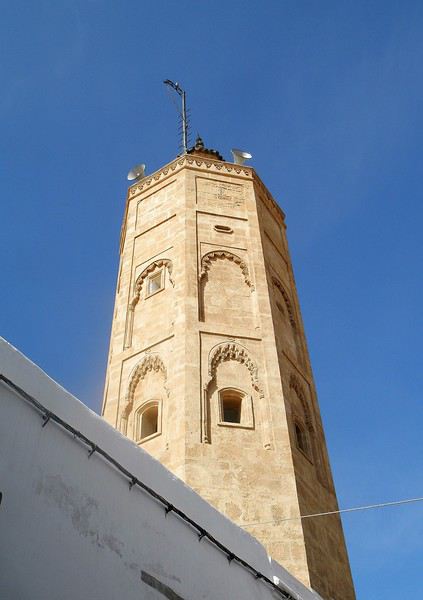
et la rue Sidi Fatah
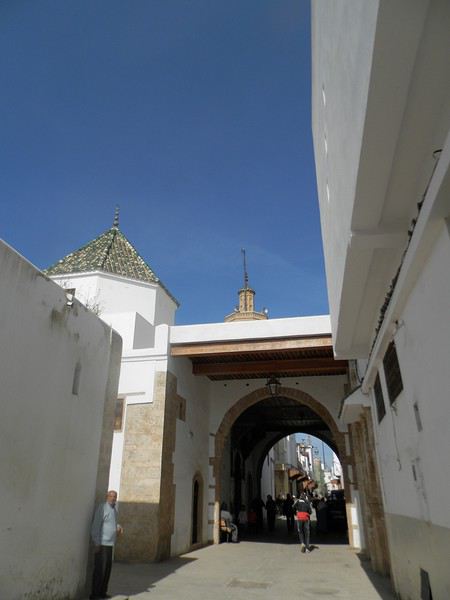
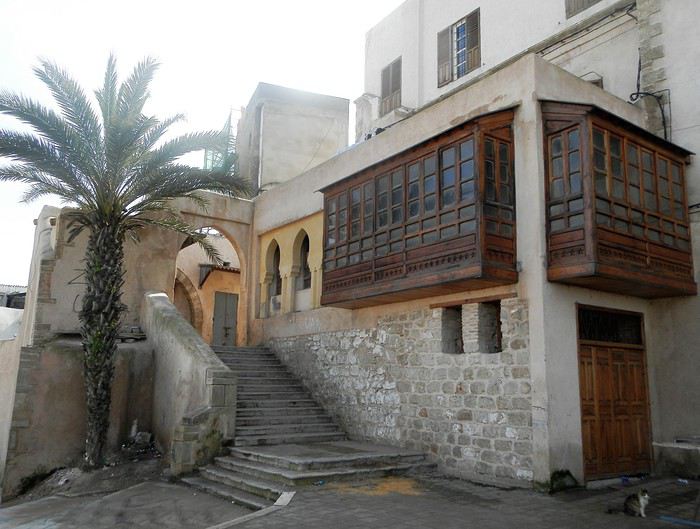
La rénovation des monuments de la médina est presque terminée . La rue des consuls reprend vie, même si les nombreux fondouks de cette rue sont toujours en travaux . J'ai hâte de les revoir . Je déambule dans les ruelles tranquilles , toujours à l’affût de ces détails qui en font le charme .
Une belle oeuvre de street-art accroche mon œil ....
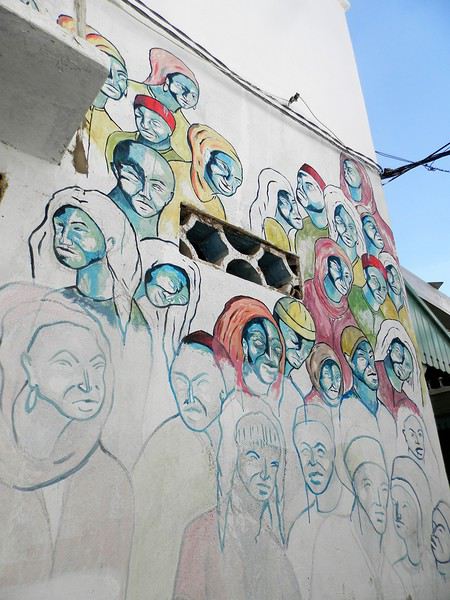
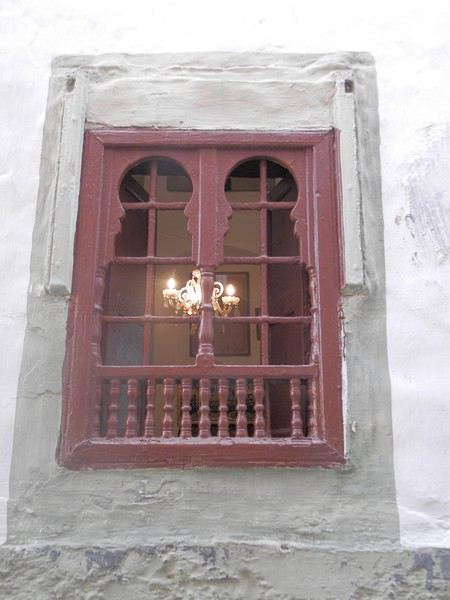
et cette fenêtre a un charme fou .
Cette fois , mes pas me portent vers les quais ( on pourrait presque dire le port ) de Rabat . Je quitte la médina par un jolie porte : l'ensemble , également restauré, est charmant . J'arrive directement sur l'Oued Bou Regreg .
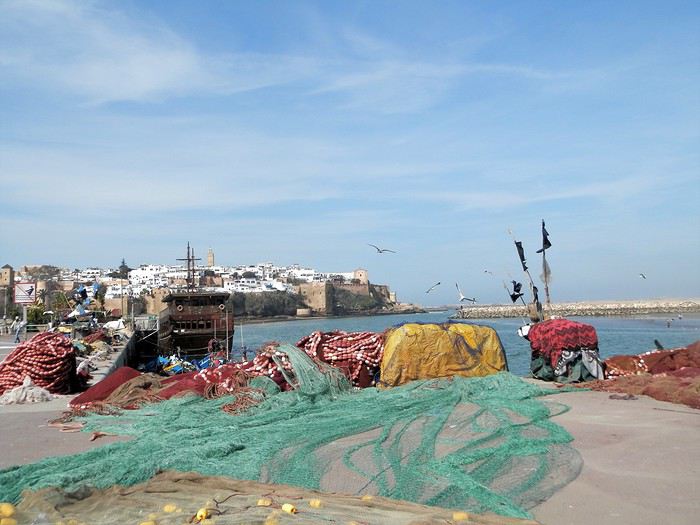
Au cœur de la capitale subsiste un coin " pêche " . Un petit navire est devenu un restaurant-Lounge , plutôt luxueux ( menu à 790 dirhams pour 2 en cette Saint Valentin ) .
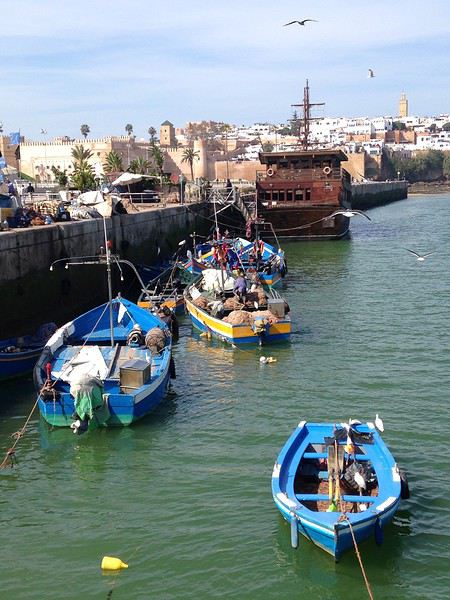
Rabat se donne des airs de petite Essaouira avec ses mouettes, ses bateaux, sa médina au fond, ses filets de pêche .... Le même site à l'horizontale .
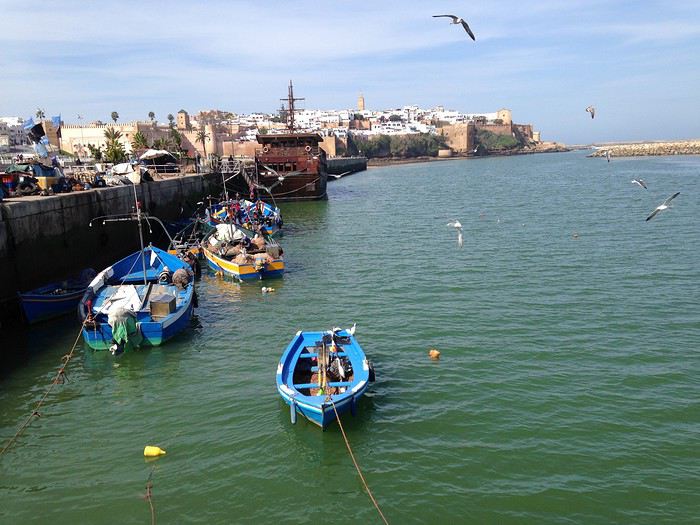
Au fond, Les Oudayas
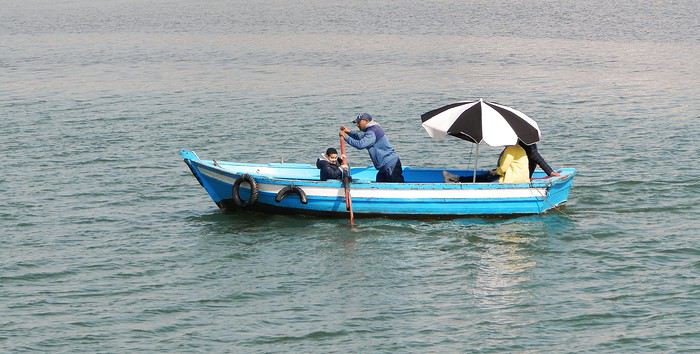
Un " pêche promenade ", me passe sous le nez . C'est mignon . On a envie de le faire la prochaine fois . Il y avait une activité de passeurs entre Rabat et Salé . Mais avec les ponts, le tramway, ..... Certains se sont adaptés , même si çà se fait toujours, plutôt en été ( la plage de Salé est toute proche ) .
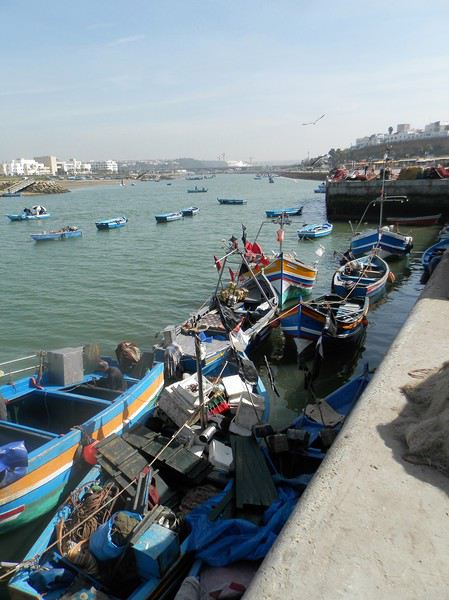
Quelques barques rentrent , les unes après les autres et s'amarrent au ponton, côté Salé . Surement les lointains descendants des redoutables corsaires de Salé . Leur univers a été " explosé" ces dernières années avec l'immense projet d'aménagement de l'oued Bou Regreg . Il leur reste un petit ponton , ..... et juste après, on a construit une grande marina pour accueillir les nouveaux jouets de l'aristocratie locale .
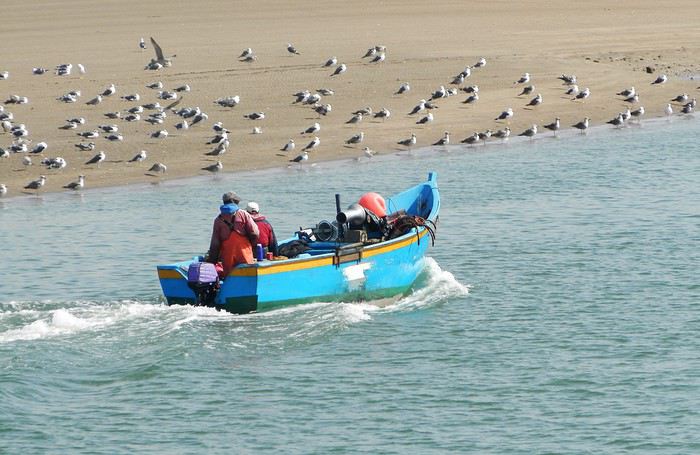
et une autre
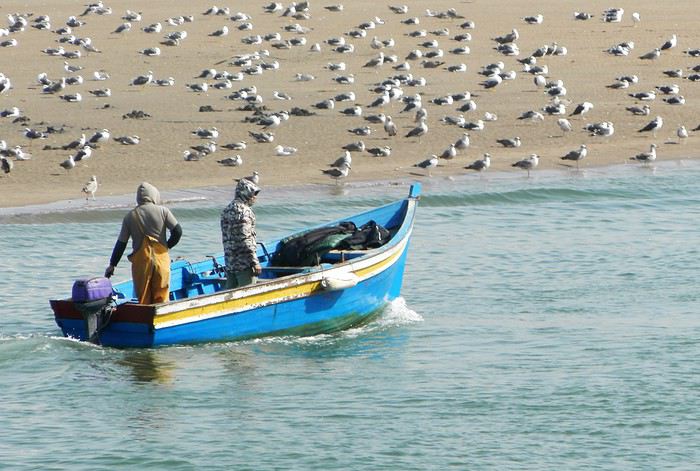
Tout ceci fait un curieux mélange entre une architecture ancestrale et la plus grande modernité ....
Ci-après, à gauche, le médina sur sa falaise, au fond le toit blanc du nouveau " Grand Théâtre de Rabat ), à côté duquel commence à sortir la future tour Mohamed VI qui sera la plus haute d' Afrique , et à droite la marina côté Salé .
Mais la Kasbah veille toujours sur la capitale
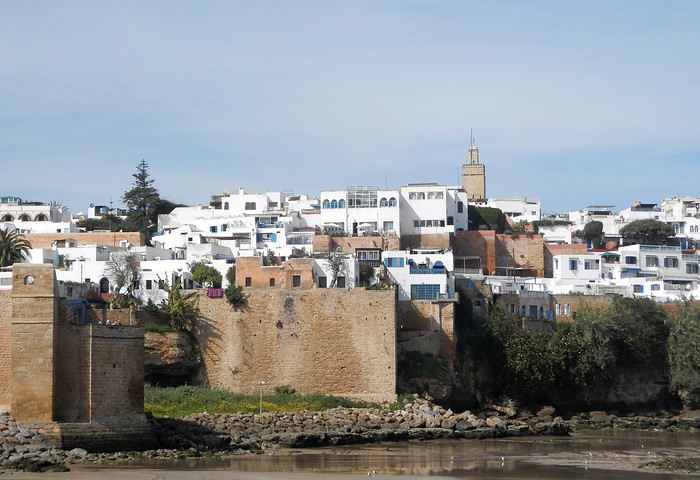
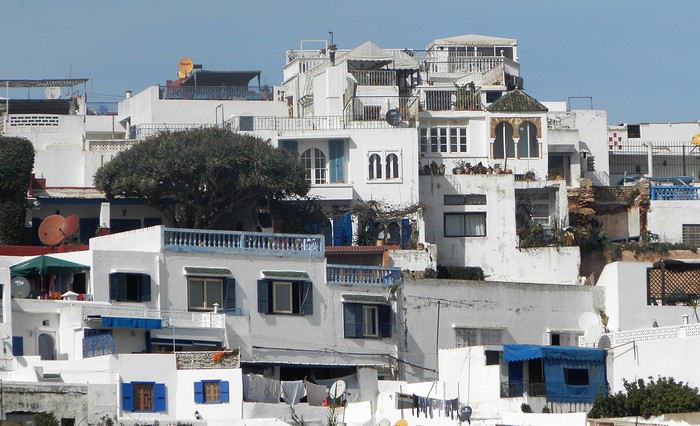
Un dernier regard ...
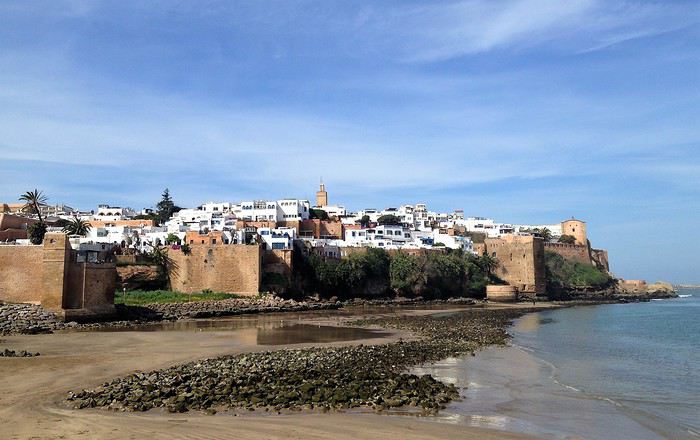
Voila pour ce nouveau coup de projecteur sur la capitale . Faites le détour et surprenez- vous
Demain, j'enfourche ma bonne Dacia Sandero et nous partons à l'assaut de l'Atlas .
Je crains que le forum ne soit morose dans les mois à venir , alors pourquoi ne pas faire un nouveau carnet de voyage . J'ai eu la chance de rentrer du Maroc 2 jours avant la suspension des vols et me retrouve donc, comme vous sans doute , en mode confinement total, chez moi, en Basse-Bretagne , avec quelques centaines de photos de mon dernier séjour à sélectionner, recadrer, retravailler .... On s'occupe comme on peut, alors pourquoi ne pas en faire profiter les Forumeurs ?
Je suis resté au Maroc un mois et j'avais organisé un circuit de 10 nuits / 11 jours pour ma plus jeune fille ( 17 ans ) , mon épouse et la grand- mère, ma chère belle-mère, Mina . Ça correspond aux vacances de février en France .
J'avais donc prévu un voyage " simple" sur le papier, mais qui chaque jour et comme toujours allait nous réserver son lot de découvertes, d'émerveillements, de rencontres, de surprises ....
Au programme :
- Départ de Rabat - 2 nuits à Ouarzazate - 2 nuits à N'kob - 2 nuits à Foum Zguid, avec une longue journée 4X4 au plus profond du désert - 4 nuits à Icht / Borj Biramane et retour sur Rabat
Je vais donc essayer d'éviter des redites avec mes précédents carnets, mais le Maroc a tant de richesses à montrer.....
Rabat est une de mes balades urbaines préférées au Maroc . Je découvre toujours de nouveaux endroits, de jolis détails, des points de vue .... Je vais donc m'y balader avec toujours un plaisir renouvelé
Ma première surprise se passe en médina où je découvre avec étonnement que les autorités ont fait le ménage . Tout ce qui encombrait les rues ( déballages sauvages, marchands de tortues et autres lézards, empiétements sur les trottoirs, la rue , etc.... ) a disparu . Plus rien . Même les commerces " en dur " sont "rentrés dans leurs murs" : plus rien sur la voie publique, pas même une chaise.... Une première au Maroc ?
Si le résultat est plutôt agréable dans la rue des consuls ( rue de l'artisanat ) et la rue Souika ( commerces vestimentaires surtout ) , le boulevard Mohamed V, où régnaient les petits restaurants et gargotes , est désormais mort . Ils ont perdu la quasi-totalité de leur ancienne surface commerciale et ne peuvent plus accueillir que quelques clients à la fois . La rue est tuée et il ne me reste plus qu'à chercher un autre endroit où casser la croûte dans la ville . Ce qui est bénéfique dans une rue ( on peut enfin flâner tranquillement ) est catastrophique dans l'autre ( le commerce est mort et le charme est parti ) . A suivre ....
Bon. C'est comme çà . Ici, dans la rue Souika ( à l'heure de la prière ) . Il y a même des poubelles en plastique positionnées dans la rue !
Une autre artère de la médina est la rue Sidi Fatah . Elle donne sur la rue Souika . Une magnifique mosquée y a été restaurée . Si j'en crois mon plan, il s'agit de la mosquée Moulay El Mekki . La porte principale est couverte et on trouve sur chacun des côtés 2 très belles portes ( 4 au total ) . Le minaret octogonal est remarquable . L'ensemble est complété par plusieurs marabout et un peu plus loin se trouve une importante zaouia . C'est vraiment très joli .
L'entrée principale est somptueuse . Le grand art de la peinture sur bois.
Quelques portes latérales
C'est vraiment très agréable de se balader sur la côte atlantique en cette saison ( mi-février ) . Il fait entre 18 et 22 degrés . Temps lumineux . Je n'aurai d'ailleurs pas de pluie pendant un mois ( après avoir eu de la pluie à peu près tous les jours les 5 derniers mois ) : que du bonheur donc ....
Le minaret octogonal
et la rue Sidi Fatah
La rénovation des monuments de la médina est presque terminée . La rue des consuls reprend vie, même si les nombreux fondouks de cette rue sont toujours en travaux . J'ai hâte de les revoir . Je déambule dans les ruelles tranquilles , toujours à l’affût de ces détails qui en font le charme .
Une belle oeuvre de street-art accroche mon œil ....
et cette fenêtre a un charme fou .
Cette fois , mes pas me portent vers les quais ( on pourrait presque dire le port ) de Rabat . Je quitte la médina par un jolie porte : l'ensemble , également restauré, est charmant . J'arrive directement sur l'Oued Bou Regreg .
Au cœur de la capitale subsiste un coin " pêche " . Un petit navire est devenu un restaurant-Lounge , plutôt luxueux ( menu à 790 dirhams pour 2 en cette Saint Valentin ) .
Rabat se donne des airs de petite Essaouira avec ses mouettes, ses bateaux, sa médina au fond, ses filets de pêche .... Le même site à l'horizontale .
Au fond, Les Oudayas
Un " pêche promenade ", me passe sous le nez . C'est mignon . On a envie de le faire la prochaine fois . Il y avait une activité de passeurs entre Rabat et Salé . Mais avec les ponts, le tramway, ..... Certains se sont adaptés , même si çà se fait toujours, plutôt en été ( la plage de Salé est toute proche ) .
Quelques barques rentrent , les unes après les autres et s'amarrent au ponton, côté Salé . Surement les lointains descendants des redoutables corsaires de Salé . Leur univers a été " explosé" ces dernières années avec l'immense projet d'aménagement de l'oued Bou Regreg . Il leur reste un petit ponton , ..... et juste après, on a construit une grande marina pour accueillir les nouveaux jouets de l'aristocratie locale .
et une autre
Tout ceci fait un curieux mélange entre une architecture ancestrale et la plus grande modernité ....
Ci-après, à gauche, le médina sur sa falaise, au fond le toit blanc du nouveau " Grand Théâtre de Rabat ), à côté duquel commence à sortir la future tour Mohamed VI qui sera la plus haute d' Afrique , et à droite la marina côté Salé .
Mais la Kasbah veille toujours sur la capitale
Un dernier regard ...
Voila pour ce nouveau coup de projecteur sur la capitale . Faites le détour et surprenez- vous
Demain, j'enfourche ma bonne Dacia Sandero et nous partons à l'assaut de l'Atlas .
Un "Esta" bientôt nécessaire pour se rendre au Royaume-Uni?
Visiblement, les autorités britanniques auraient dans l'idée de mettre en place un système d'Esta identique à celui existant pour les USA pour tous les voyageurs actuellement dispensés de visa (y compris donc les ressortissants de l'U.E.) souhaitant se rendre dans le pays une fois le Brexit effectif (s'il le devient un jour...).
Lire la suite...
Coup de gueule au sujet de la Turquie
En 1997, lors de mon dernier "road trip" en Turquie, j'ai quitté un peuple attachant, souriant, honnête, libre, toujours prêt à vous aider. J'y suis retourné ce mois d'août après deux semaines à avoir sillonné la Grèce du Nord en famille. J'ai été profondément choqué par le changement que j'ai pu observer et vivre. Lors de mes 5 précédents voyages en 1985, 1989, 1991, 1996 et 1997, à avoir sillonné la Turquie d'est en ouest, et du Nord au Sud, je n'avais jamais vu de femmes vêtues intégralement de noir et intégralement voilées. Après avoir traversé la frontière Gréco-Turque, à la première grande ville traversée, j'ai pu voir de nombreuses femmes intégralement voilées de noir. N'ayant pas prévu de me rendre à Istanbul, je n'avais pas téléchargé la carte de Turquie dans mon GPS. Avec l'absence de panneaux clairs, à environ 2 ou 3 Km de Sultanahmet, j'ai demandé à un groupe de jeunes la direction à suivre pour rejoindre Sultanahmet. " Luetfen, could you please tell me the way to Sultanahmet ?". Il regarde ma plaque d'immatriculation et me répond "Yok" = "non". Cette première expérience d'antipathie a l'égard de nous, perçus comme occidentaux ou mécréants, ou les deux, je pourrais malheureusement la revivre régulièrement durant nos 3 jours passés à Istanbul. Quasiment toutes les femmes Turques d'Istanbul sont désormais voilées, inversement proportionnel à il y a 22ans. Plus moyen de boire une Efes Pilsen ou un vin Turc dans les restaurants où j'ai mangé, il n'y a plus de boissons alcoolisées proposées à la carte !
Je suis profondément triste pour ce peuple qui sombre dans l'obscurantisme de l'Akape et du fondamentalisme islamiste. Ce peuple si attachant, si aimable que j'ai quitté il y a 22 ans est devenu arrogant, fondamentaliste, antipathique. Dommage pour eux ... Il y a 20 fois moins d'occidentaux qu'auparavant à Istanbul ... Je comprends désormais pourquoi ...
Trois semaines entre Dubrovnik et Split, où aller?
Bonjour,
j'ai decouvert la croatie l'an dernier, en famille.... et nous avons adoré ! nous avons fait ce périple : Dubrovnik => mjlet (notre coup de coeur) => korkula => hvar => brac => Dubrovnik.
Les seuls points noirs ont été la foule a Dubrovnik (insupportable) et les prix des resto sur les iles completement aberrant. On a surtout aimé Mjlet pour le coté "nature" et aussi Korcula ou nous avons fait de bien belles ballades.
Cette année je pensais a rester sur le continent pour environ 18 jours... Atterir a Dubrovnik et repartir de split...en louant une voiture. Nous avons de jeunes enfants donc je ne veux pas faire trop de kilometres et faire minimum 3 nuits par étape... pas envie de courir partout et au final de rien voir.
Est ce une bonne idée ? il y t'il des endroits a ne pas manquer dans tout ce secteur ? et surtout il y a t'il autant de monde que sur les iles ? car c'est tout ce que nous detestons... a mjlet c'etait tranquille, et sur les autres iles nous avons soigneusement éviter les endroits les plus peuplés (hvar par ex, nous somme resté du coté de Jelsa et c'etait tres bien).
Je sais que le sud est bien plus prisé que l'intérieur mais avec nos bambins il nous faut la plage.
Merci d'avance pour vos précieux conseils.
j'ai decouvert la croatie l'an dernier, en famille.... et nous avons adoré ! nous avons fait ce périple : Dubrovnik => mjlet (notre coup de coeur) => korkula => hvar => brac => Dubrovnik.
Les seuls points noirs ont été la foule a Dubrovnik (insupportable) et les prix des resto sur les iles completement aberrant. On a surtout aimé Mjlet pour le coté "nature" et aussi Korcula ou nous avons fait de bien belles ballades.
Cette année je pensais a rester sur le continent pour environ 18 jours... Atterir a Dubrovnik et repartir de split...en louant une voiture. Nous avons de jeunes enfants donc je ne veux pas faire trop de kilometres et faire minimum 3 nuits par étape... pas envie de courir partout et au final de rien voir.
Est ce une bonne idée ? il y t'il des endroits a ne pas manquer dans tout ce secteur ? et surtout il y a t'il autant de monde que sur les iles ? car c'est tout ce que nous detestons... a mjlet c'etait tranquille, et sur les autres iles nous avons soigneusement éviter les endroits les plus peuplés (hvar par ex, nous somme resté du coté de Jelsa et c'etait tres bien).
Je sais que le sud est bien plus prisé que l'intérieur mais avec nos bambins il nous faut la plage.
Merci d'avance pour vos précieux conseils.
26 à 28 jours de voyage en road trip Dolomites - Slovénie - Croatie
Bonjour toute la communauté de voyageurs !
j'ai besoin de votre aide pour notre plan estival. Un peu de contextualisation:
-Couple avec deux enfants de 7 et 11 ans - Originaire de Montréal - vacances du 2 juillet au 23 aout - Budget de voyage pour 25 à 28 nuits.
Notre plan est de visiter le nord de l'Italie (les Dolomites en fait) , la Slovénie et la Croatie. En gros nous avions pensé la chose suivante: - Vol Mtl-Venise (2 nuits à Venise). 2 nuits c, est peu, mais nous y sommes allé l, année passée sans les enfants , nous voulons simplement profiter d'un vol sans escale et prendre un peu de temps pour montrer ce lieu aux enfants. Location d'une voiture - Venise -dolomites (5-6 nuits dans les Dolomites). nous voudrions 2 bases de 2-3 nuits chacune qui nous permettraient de visiter des coins intéressants. Nous ne somme pas de grands marcheurs en montagne, mais de courte randonnées pas trop ardue ça va. - Dolomites Slovénie (5-6 nuits) Encore une fois 2 bases en Slovénie pour voir : Lacs Bled et Bohinj, Ljubljana, caves, alpes juliennes, Vrsic pass.... - Zagreb (2 nuits) - Plitvice (1 ou 2 nuits selon l'arrivée et le départ) - Istrie (5-6 nuits) Besoin d'une base à partir de laquelle nous nous pourrions voir toute la région avec notre voiture de location. - Trieste (1 nuit) - Venise, retour de la voiture et retour à Montréal.
ça fait entre 21 et 25 nuits, resterait donc quelque nuits (3-5) à mettre ailleurs
Questions:
1) Le rythme et le nombre de journées est correct ?
2) c'est un réel déchirement de ne pas pouvoir inclure Split et Dubrovnik dans ce périple, il y aurait moyen de les inclure en coupant ailleurs ?
3) Alpes juliennes et dolomites c'est trop de montagnes ?
4) On fait la boucle comme ça ou dans le sens contraire (Venise-Trieste-Istrie-Zagreb-Slovénie-Dolomites-Venise) ? Dans le sens contraire on serait en Istrie au début juillet et on verrait les Alpes Julienne (moins impressionnantes avant les Dolomites).
Merci beaucoup !
j'ai besoin de votre aide pour notre plan estival. Un peu de contextualisation:
-Couple avec deux enfants de 7 et 11 ans - Originaire de Montréal - vacances du 2 juillet au 23 aout - Budget de voyage pour 25 à 28 nuits.
Notre plan est de visiter le nord de l'Italie (les Dolomites en fait) , la Slovénie et la Croatie. En gros nous avions pensé la chose suivante: - Vol Mtl-Venise (2 nuits à Venise). 2 nuits c, est peu, mais nous y sommes allé l, année passée sans les enfants , nous voulons simplement profiter d'un vol sans escale et prendre un peu de temps pour montrer ce lieu aux enfants. Location d'une voiture - Venise -dolomites (5-6 nuits dans les Dolomites). nous voudrions 2 bases de 2-3 nuits chacune qui nous permettraient de visiter des coins intéressants. Nous ne somme pas de grands marcheurs en montagne, mais de courte randonnées pas trop ardue ça va. - Dolomites Slovénie (5-6 nuits) Encore une fois 2 bases en Slovénie pour voir : Lacs Bled et Bohinj, Ljubljana, caves, alpes juliennes, Vrsic pass.... - Zagreb (2 nuits) - Plitvice (1 ou 2 nuits selon l'arrivée et le départ) - Istrie (5-6 nuits) Besoin d'une base à partir de laquelle nous nous pourrions voir toute la région avec notre voiture de location. - Trieste (1 nuit) - Venise, retour de la voiture et retour à Montréal.
ça fait entre 21 et 25 nuits, resterait donc quelque nuits (3-5) à mettre ailleurs
Questions:
1) Le rythme et le nombre de journées est correct ?
2) c'est un réel déchirement de ne pas pouvoir inclure Split et Dubrovnik dans ce périple, il y aurait moyen de les inclure en coupant ailleurs ?
3) Alpes juliennes et dolomites c'est trop de montagnes ?
4) On fait la boucle comme ça ou dans le sens contraire (Venise-Trieste-Istrie-Zagreb-Slovénie-Dolomites-Venise) ? Dans le sens contraire on serait en Istrie au début juillet et on verrait les Alpes Julienne (moins impressionnantes avant les Dolomites).
Merci beaucoup !
Je vous invite à découvrir le Maroc
INTRODUCTION
Des vidéos sont insérées tout au long du résumé. Veuillez cliquer sur l'image pour démarrer la vidéo.
Nous avons séjourné 15 jours au Maroc en septembre 2018 et avons parcouru plus de 5000 km pour découvrir ce pays sous ses différentes facettes.
Plusieurs semaines ont été consacrées à la création de notre itinéraire afin de pouvoir être en mesure d'atteindre parfaitement nos objectifs.
Nous avons fait l'achat d'une carte routière Michelin (742) et nous avions également téléchargé une carte du Maroc dans notre GPS.
Finalement, lors de notre séjour, nous n'avons utilisé que l'application Maps.me qui s'est avérée une application très précieuse lors de nos déplacements en voiture, en randonnée et même dans la recherche de nos hôtels dans les médinas ou lors de nos circuits à pied dans les grandes villes.
J'avais préalablement téléchargé les coordonnées GPS de toutes les attractions prévues à notre itinéraire dans l'application Maps.me, ce qui a facilité grandement nos déplacements.
La réservation de tous les hôtels ainsi que la location d'une voiture ont été effectuées sur internet avant notre départ.
Les attraits touristiques que nous avons visité sont les suivants:
Belyounech Tétouan Cascades d'Akchour et Pont de Dieu Chefchaouen Plage de Maresdar à El Jebha Al-Hoceima Source chaude Hammat Chaabi Plage Cara Blanca Plage de Tmadet Sidi El Bachir Gorges de Zegzel (grotte du chameau) Cascades de l'Aggai à Sefrou Fes Meknes Volubilis Sources de l'Oum Er-Rbia Route des Cèdres à Azrou Vallée du Ziz Moyenne Vallée du Ziz Erg Chebbi à Merzouga Gorges du Todgha Gorges du Dades Vallée des Roses Kasbah Aït-Ben-Haddou Tizi-N-Tichka Casdades d'Ouzoud Pont d'Imi-n-Ifri Cascades de l'Ourika Cascade d'Imlil Route vers Tacheddirt Tizi N' Test Mosquée de Tinmel Kasbah de Tizourgane Agard-Oudad - Les rochers bleus (les roches peintes) Gorges d'Aït Mansour Mosquée Tamsaout Grotte et Bassin Win-Timdouine Paradise Valley Agadir Essaouira Mosquée Hassan-II à Casablanca
Conduire une automobile au Maroc est tout un défi lorsque l'on sait qu'il est un des pays qui possède les routes les plus meurtrières au monde. Il n'y a aucune discipline sur les routes du Maroc. La vitesse, les dépassements illégaux, le passage aux feux rouges, les voitures délabrées, l'étroitesse de certaines routes, les piétons et les cyclistes qui traversent la route sans avertissement, les motocyclistes qui se faufilent entre les voitures, sans oublier les nombreux animaux qui se dressent en bordure de la route. Et je n'exagère surtout pas...
Il n'existe pratiquement aucun civisme sur la route. C'est chacun pour soi. Nous avons dû céder le passage la majorité du temps afin d'éviter que notre voiture de location soit amochée.
Toute une expérience pour mon conjoint Alain qui a réussi à parcourir ces milliers de kilomètres sans aucun accrochage. Après coup, nous comprenons pourquoi la voiture que nous avions louée avait autant de bosses et d'éraflures ....
Il y a énormément de postes de contrôle (gendarmes) au Maroc. Nous avons vécu quelques expériences, de bonnes et de moins bonnes. Je vous en ferai part au moment opportun.
Il est très important de respecter les limites de vitesse et de connaître le fonctionnement des postes de contrôle.
Ceux-ci se trouvent généralement à proximité d'un embranchement ou d'un carrefour giratoire. Des panneaux sont installées temporairement en bordure de la route pour indiquer le poste de contrôle ainsi que les limitations de vitesse.
C'est assez spécial car nous roulons à une vitesse d'environ 80 km/h et tout à coup on aperçoit le panneau indiquant le poste de contrôle et trois panneaux consécutifs invitant à réduire rapidement notre vitesse à 60, 40 et 20 km/h dans un espace vraiment restreint.
C'est toujours un stress de passer ces contrôles , même si nous n'avions rien à nous reprocher... Je passais mon temps à vérifier l'odomètre pour m'assurer que nous respections bien les limites de vitesse. 60, 40, 20.. 60, 40, 20 ... Combien de fois Alain m'a entendu répéter ces chiffres afin de passer les contrôles sans problème.
Lorsque nous avons effectué la réservation des hôtels, il était indiqué que le stationnement était gratuit. Cependant, la majorité du temps, il a fallu payer des frais de 10 MAD (environ 1,40 $ CAD ) pour qu'un gardien surveille la voiture.
Que la voiture soit en bordure de la route ou dans un stationnement, il y avait toujours quelqu'un portant un dossard qui se présentait pour réclamer son dû.
A Essaouira, nous avons battu un record: 50 MAD (7 $ CAD), soit 40 MAD pour le stationnement et 10 MAD pour le gardien.
Une arnaque pour les touristes lorsque l'on sait que le prix est fixé à 5 MAD à Essaouira pour toute une nuit. Mais que peut-on faire lorsque nous avons besoin d'un espace de stationnement pour la nuit et que le préposé au stationnement te réclame 40 MAD et te harcèle de rajouter un 10 MAD pour le gardien?
Par ailleurs, nous avons été très bien accueillis au Maroc. Les gens étaient contents de nous voir et aimaient discuter avec nous. Particulièrement les jeunes hommes qui se sont montrés très avenants et ont été d'une gentillesse extraordinaire.
Nous avons été choyés côté température. Le ciel était toujours d'un bleu éclatant, sauf dans le désert où le ciel était couvert. Mais heureusement, nous avons eu droit à une éclaircie au moment du coucher du soleil.
Sans plus attendre, je vous invite à venir découvrir par le biais de nos vidéos les différents attraits que nous avons visités ainsi que nos escapades sur les routes du Maroc.
POUR LA SUITE, C'EST ICI
POUR VOUS RENDRE À UNE JOURNÉE SPÉCIFIQUE, VOICI LES LIENS APPROPRIÉS:
Jour 1: De Casablanca à Tétouan Jour 2: De Tétouan à Chefchaouen Jour 3: De Chefchaouen à Al Hoceima Jour 4: De Al Hoceima à Oujda Jour 5: De Oujda à Meknès Jour 6: De Meknès à Azrou Jour 7: De Azrou à Merzouga Jour 8: De Merzouga à la Vallée des Roses Jour 9: De la Vallée des Roses à Ouzoud Jour 10: D'Ouzoud à la Vallée de l'Ourika Jour 11: De la Vallée de l'Ourika à Ouirgane (détour à Imlil) Jour 12: De Ouirgane (route du Tizi-n-Test) à Tafraoute Jour 13: De Tafraoute à Tizgui N'Chorfa Jour 14: De la Vallée du Paradis à Essaouira Jour 15: De Essaouira à Casablanca
Des vidéos sont insérées tout au long du résumé. Veuillez cliquer sur l'image pour démarrer la vidéo.
Nous avons séjourné 15 jours au Maroc en septembre 2018 et avons parcouru plus de 5000 km pour découvrir ce pays sous ses différentes facettes.
Plusieurs semaines ont été consacrées à la création de notre itinéraire afin de pouvoir être en mesure d'atteindre parfaitement nos objectifs.
Nous avons fait l'achat d'une carte routière Michelin (742) et nous avions également téléchargé une carte du Maroc dans notre GPS.
Finalement, lors de notre séjour, nous n'avons utilisé que l'application Maps.me qui s'est avérée une application très précieuse lors de nos déplacements en voiture, en randonnée et même dans la recherche de nos hôtels dans les médinas ou lors de nos circuits à pied dans les grandes villes.
J'avais préalablement téléchargé les coordonnées GPS de toutes les attractions prévues à notre itinéraire dans l'application Maps.me, ce qui a facilité grandement nos déplacements.
La réservation de tous les hôtels ainsi que la location d'une voiture ont été effectuées sur internet avant notre départ.
Les attraits touristiques que nous avons visité sont les suivants:
Belyounech Tétouan Cascades d'Akchour et Pont de Dieu Chefchaouen Plage de Maresdar à El Jebha Al-Hoceima Source chaude Hammat Chaabi Plage Cara Blanca Plage de Tmadet Sidi El Bachir Gorges de Zegzel (grotte du chameau) Cascades de l'Aggai à Sefrou Fes Meknes Volubilis Sources de l'Oum Er-Rbia Route des Cèdres à Azrou Vallée du Ziz Moyenne Vallée du Ziz Erg Chebbi à Merzouga Gorges du Todgha Gorges du Dades Vallée des Roses Kasbah Aït-Ben-Haddou Tizi-N-Tichka Casdades d'Ouzoud Pont d'Imi-n-Ifri Cascades de l'Ourika Cascade d'Imlil Route vers Tacheddirt Tizi N' Test Mosquée de Tinmel Kasbah de Tizourgane Agard-Oudad - Les rochers bleus (les roches peintes) Gorges d'Aït Mansour Mosquée Tamsaout Grotte et Bassin Win-Timdouine Paradise Valley Agadir Essaouira Mosquée Hassan-II à Casablanca
Conduire une automobile au Maroc est tout un défi lorsque l'on sait qu'il est un des pays qui possède les routes les plus meurtrières au monde. Il n'y a aucune discipline sur les routes du Maroc. La vitesse, les dépassements illégaux, le passage aux feux rouges, les voitures délabrées, l'étroitesse de certaines routes, les piétons et les cyclistes qui traversent la route sans avertissement, les motocyclistes qui se faufilent entre les voitures, sans oublier les nombreux animaux qui se dressent en bordure de la route. Et je n'exagère surtout pas...
Il n'existe pratiquement aucun civisme sur la route. C'est chacun pour soi. Nous avons dû céder le passage la majorité du temps afin d'éviter que notre voiture de location soit amochée.
Toute une expérience pour mon conjoint Alain qui a réussi à parcourir ces milliers de kilomètres sans aucun accrochage. Après coup, nous comprenons pourquoi la voiture que nous avions louée avait autant de bosses et d'éraflures ....
Il y a énormément de postes de contrôle (gendarmes) au Maroc. Nous avons vécu quelques expériences, de bonnes et de moins bonnes. Je vous en ferai part au moment opportun.
Il est très important de respecter les limites de vitesse et de connaître le fonctionnement des postes de contrôle.
Ceux-ci se trouvent généralement à proximité d'un embranchement ou d'un carrefour giratoire. Des panneaux sont installées temporairement en bordure de la route pour indiquer le poste de contrôle ainsi que les limitations de vitesse.
C'est assez spécial car nous roulons à une vitesse d'environ 80 km/h et tout à coup on aperçoit le panneau indiquant le poste de contrôle et trois panneaux consécutifs invitant à réduire rapidement notre vitesse à 60, 40 et 20 km/h dans un espace vraiment restreint.
C'est toujours un stress de passer ces contrôles , même si nous n'avions rien à nous reprocher... Je passais mon temps à vérifier l'odomètre pour m'assurer que nous respections bien les limites de vitesse. 60, 40, 20.. 60, 40, 20 ... Combien de fois Alain m'a entendu répéter ces chiffres afin de passer les contrôles sans problème.
Lorsque nous avons effectué la réservation des hôtels, il était indiqué que le stationnement était gratuit. Cependant, la majorité du temps, il a fallu payer des frais de 10 MAD (environ 1,40 $ CAD ) pour qu'un gardien surveille la voiture.
Que la voiture soit en bordure de la route ou dans un stationnement, il y avait toujours quelqu'un portant un dossard qui se présentait pour réclamer son dû.
A Essaouira, nous avons battu un record: 50 MAD (7 $ CAD), soit 40 MAD pour le stationnement et 10 MAD pour le gardien.
Une arnaque pour les touristes lorsque l'on sait que le prix est fixé à 5 MAD à Essaouira pour toute une nuit. Mais que peut-on faire lorsque nous avons besoin d'un espace de stationnement pour la nuit et que le préposé au stationnement te réclame 40 MAD et te harcèle de rajouter un 10 MAD pour le gardien?
Par ailleurs, nous avons été très bien accueillis au Maroc. Les gens étaient contents de nous voir et aimaient discuter avec nous. Particulièrement les jeunes hommes qui se sont montrés très avenants et ont été d'une gentillesse extraordinaire.
Nous avons été choyés côté température. Le ciel était toujours d'un bleu éclatant, sauf dans le désert où le ciel était couvert. Mais heureusement, nous avons eu droit à une éclaircie au moment du coucher du soleil.
Sans plus attendre, je vous invite à venir découvrir par le biais de nos vidéos les différents attraits que nous avons visités ainsi que nos escapades sur les routes du Maroc.
POUR LA SUITE, C'EST ICI
POUR VOUS RENDRE À UNE JOURNÉE SPÉCIFIQUE, VOICI LES LIENS APPROPRIÉS:
Jour 1: De Casablanca à Tétouan Jour 2: De Tétouan à Chefchaouen Jour 3: De Chefchaouen à Al Hoceima Jour 4: De Al Hoceima à Oujda Jour 5: De Oujda à Meknès Jour 6: De Meknès à Azrou Jour 7: De Azrou à Merzouga Jour 8: De Merzouga à la Vallée des Roses Jour 9: De la Vallée des Roses à Ouzoud Jour 10: D'Ouzoud à la Vallée de l'Ourika Jour 11: De la Vallée de l'Ourika à Ouirgane (détour à Imlil) Jour 12: De Ouirgane (route du Tizi-n-Test) à Tafraoute Jour 13: De Tafraoute à Tizgui N'Chorfa Jour 14: De la Vallée du Paradis à Essaouira Jour 15: De Essaouira à Casablanca
No, I Won’t Be Going Back to China
Hello forum,
Did any of you feel the same things we did in China?
We spent a good twenty days there in August. First, we traveled solo around Chengdu, then joined an organized tour for 12 days (Beijing, Pingyao, Xi'an, Guilin, Xingping, Yangshuo, Shanghai, Wuzhen) and extended our stay by 4 extra days to visit Zhangjiajie.
The landscapes were stunning, and we have unforgettable memories... but we were really disappointed by the following points:
- The food: way too spicy. Lacking in flavor, not much taste. I’m speaking "in general" because we did enjoy some good steamed dumplings, smoked pork, and other dumplings... But compared to Thailand, Cambodia, or India, Chinese cuisine didn’t impress us at all.
- The behavior of the Chinese: disrespectful, rushed, agitated. You constantly have to fight—people push, crowd, and overwhelm you... At the entrance to the Terracotta Army (and other sites), it’s a human tidal wave... and I mean that literally. We were carried by the crowd without even touching the ground. It was like a situation where you have one bowl of rice and 20,000 starving people diving for it...
You’re at a ticket counter, and they cut in front of you. You’re in line for boarding, suitcase ready to go on the conveyor belt, and someone shows up out of nowhere to put THEIR suitcase down... even though they have a flight ticket with THEIR seat number and won’t be leaving before you!!!! You’re getting on the bus, and someone shoves past you just so they don’t end up behind you.
It’s like these people only think about themselves. I didn’t see a single person let someone else go first or even ask—it’s as if politeness and respect are completely foreign to them.
It’s honestly exhausting and draining...
- Communication: In every other country we’ve visited, whether in Asia or Europe, we always manage—with English, a few words of Italian, French, or Spanish. In China, I’ll be blunt: if you don’t speak Chinese, you’re screwed. And yet, a pair of kids around ten or twelve years old asked us in English where we were from :)
- Understanding: Here’s the rule. Even if the person you’re talking to speaks a little English and says they understand you... make sure they *really* do, because 9 times out of 10, they don’t. Out of pride or just cluelessness, they’ll give you a big smile and nod, but in reality, they didn’t get what you were saying.
Several times with our group, in the evening at a restaurant, if we hadn’t been helped by someone at another table who spoke a little English, we’d still be there. The classic example: the waiter brings one menu (for 10 people at the table), and we’re all trying to explain that we need 4 or more menus. Five minutes later, he’s still staring at us with that same blank smile...
In 3* or 4* hotels, you go to the front desk for a hot water or AC issue. Three or four staff members just stand there beaming at you. You try to explain with photos or a translator, but in the end, you leave with the problem unresolved.
They don’t speak—they shout... on buses, in hotels...
We were also surprised to find that self-service laundromats were almost nonexistent. We got scammed once at a hotel with an astronomical bill!
As for flights, we flew Air China on the way there and Austrian Airlines on the way back—no comparison. Air China had zero service and food that was "baby food" quality. Austrian Airlines had multiple services, a decent meal, and smiling flight attendants.
I don’t know if any of you had the same experience in this country, but I’m definitely not eager to go back. Whereas if someone offered me India, Thailand, or Vietnam tomorrow, I’d be there in a heartbeat!!!
Did any of you feel the same things we did in China?
We spent a good twenty days there in August. First, we traveled solo around Chengdu, then joined an organized tour for 12 days (Beijing, Pingyao, Xi'an, Guilin, Xingping, Yangshuo, Shanghai, Wuzhen) and extended our stay by 4 extra days to visit Zhangjiajie.
The landscapes were stunning, and we have unforgettable memories... but we were really disappointed by the following points:
- The food: way too spicy. Lacking in flavor, not much taste. I’m speaking "in general" because we did enjoy some good steamed dumplings, smoked pork, and other dumplings... But compared to Thailand, Cambodia, or India, Chinese cuisine didn’t impress us at all.
- The behavior of the Chinese: disrespectful, rushed, agitated. You constantly have to fight—people push, crowd, and overwhelm you... At the entrance to the Terracotta Army (and other sites), it’s a human tidal wave... and I mean that literally. We were carried by the crowd without even touching the ground. It was like a situation where you have one bowl of rice and 20,000 starving people diving for it...
You’re at a ticket counter, and they cut in front of you. You’re in line for boarding, suitcase ready to go on the conveyor belt, and someone shows up out of nowhere to put THEIR suitcase down... even though they have a flight ticket with THEIR seat number and won’t be leaving before you!!!! You’re getting on the bus, and someone shoves past you just so they don’t end up behind you.
It’s like these people only think about themselves. I didn’t see a single person let someone else go first or even ask—it’s as if politeness and respect are completely foreign to them.
It’s honestly exhausting and draining...
- Communication: In every other country we’ve visited, whether in Asia or Europe, we always manage—with English, a few words of Italian, French, or Spanish. In China, I’ll be blunt: if you don’t speak Chinese, you’re screwed. And yet, a pair of kids around ten or twelve years old asked us in English where we were from :)
- Understanding: Here’s the rule. Even if the person you’re talking to speaks a little English and says they understand you... make sure they *really* do, because 9 times out of 10, they don’t. Out of pride or just cluelessness, they’ll give you a big smile and nod, but in reality, they didn’t get what you were saying.
Several times with our group, in the evening at a restaurant, if we hadn’t been helped by someone at another table who spoke a little English, we’d still be there. The classic example: the waiter brings one menu (for 10 people at the table), and we’re all trying to explain that we need 4 or more menus. Five minutes later, he’s still staring at us with that same blank smile...
In 3* or 4* hotels, you go to the front desk for a hot water or AC issue. Three or four staff members just stand there beaming at you. You try to explain with photos or a translator, but in the end, you leave with the problem unresolved.
They don’t speak—they shout... on buses, in hotels...
We were also surprised to find that self-service laundromats were almost nonexistent. We got scammed once at a hotel with an astronomical bill!
As for flights, we flew Air China on the way there and Austrian Airlines on the way back—no comparison. Air China had zero service and food that was "baby food" quality. Austrian Airlines had multiple services, a decent meal, and smiling flight attendants.
I don’t know if any of you had the same experience in this country, but I’m definitely not eager to go back. Whereas if someone offered me India, Thailand, or Vietnam tomorrow, I’d be there in a heartbeat!!!
20 jours dans le Tamil Nadu (Inde du Sud): carnet (presque) en direct
Bonjour à tous,
Me voilà depuis 3 jours dans la région Tamil Nadu, en solo et en indépendant: sac à dos (enfin petite valise cabine + petit sac à dos), transports publics, etc... Il s'agit de mon neuvième voyage en Inde.
Je publie ce carnet pour donner des renseignements pratiques et des impressions subjectives pour aider ceux qui envisagent un voyage dans la région, car il n'est pas facile de trouver des carnets précis très récents. Je décide aussi de le faire presque en direct, à mes heures perdues, pour donner des informations à chaud, parce qu'à chaque fois que j'ai voulu me lancer dans un carnet, les souvenirs et les détails étaient devenus flous, et avec le temps, on oublie plein de choses... Cette formule me paraît intéressante, même si j'écris avec peu de recul, à part celui de mon expérience passée de l'Inde.
Je n'ai pas vraiment d'itinéraire fixé et je décide de mes étapes au gré du voyage, même si j'ai une idée vague du circuit que je vais faire.
Je remercie tout particulièrement les membres du forum qui m'ont donné des informations précieuses et continuent à m'en donner: Marcomarco, Fabgreg, Aleph, Raggamuffin et Marien (désolé si j'en ai oublié, je les ajouterai plus tard). Je suis parti un peu à la dernière minute, sans vraiment préparer mon voyage, et leur aide me fait gagner beaucoup de temps.
Avant de commencer, quelques infos générales sur mon voyage: - Séjour de 20 jours dans le Tamil Nadu, mon premier vrai voyage en Inde du Sud à part un assez court passage dans le nord du Karnataka et à Goa en 2010. - Vol Air France/Jet Airways Toulouse-Paris-Chennai et Chennai-Mumbai-Paris-Toulouse: 622€ (réservé sur le site Jetcost une dizaine de jours avant le départ). À noter que le même vol depuis Paris, donc avec deux voyages en moins Toulouse-Paris et Paris-Toulouse, coûtait plus de 150€ en plus. Allez comprendre... Ça tombe bien, je devais me rendre à Toulouse! - e-tourist visa en ligne, qui a bien augmenté il y a quelque jours: j'ai oublié le prix exact, mais autour de 80€: abusif mais toujours plus avantageux que le visa de 6 mois si on part peu de temps. - J'ai investi dans la dernière version du Lonely Planet "Inde du Sud" qui est très décevante: de moins en moins de renseignements fiables et précis, des adresses de plus en plus chères, des cartes en moins... À 27€, c'est une arnaque. Je ne suis pas sûr qu'il existe encore des guides papiers vraiment utiles. Une époque révolue? Vive les forums!
Allez c'est parti!
Me voilà depuis 3 jours dans la région Tamil Nadu, en solo et en indépendant: sac à dos (enfin petite valise cabine + petit sac à dos), transports publics, etc... Il s'agit de mon neuvième voyage en Inde.
Je publie ce carnet pour donner des renseignements pratiques et des impressions subjectives pour aider ceux qui envisagent un voyage dans la région, car il n'est pas facile de trouver des carnets précis très récents. Je décide aussi de le faire presque en direct, à mes heures perdues, pour donner des informations à chaud, parce qu'à chaque fois que j'ai voulu me lancer dans un carnet, les souvenirs et les détails étaient devenus flous, et avec le temps, on oublie plein de choses... Cette formule me paraît intéressante, même si j'écris avec peu de recul, à part celui de mon expérience passée de l'Inde.
Je n'ai pas vraiment d'itinéraire fixé et je décide de mes étapes au gré du voyage, même si j'ai une idée vague du circuit que je vais faire.
Je remercie tout particulièrement les membres du forum qui m'ont donné des informations précieuses et continuent à m'en donner: Marcomarco, Fabgreg, Aleph, Raggamuffin et Marien (désolé si j'en ai oublié, je les ajouterai plus tard). Je suis parti un peu à la dernière minute, sans vraiment préparer mon voyage, et leur aide me fait gagner beaucoup de temps.
Avant de commencer, quelques infos générales sur mon voyage: - Séjour de 20 jours dans le Tamil Nadu, mon premier vrai voyage en Inde du Sud à part un assez court passage dans le nord du Karnataka et à Goa en 2010. - Vol Air France/Jet Airways Toulouse-Paris-Chennai et Chennai-Mumbai-Paris-Toulouse: 622€ (réservé sur le site Jetcost une dizaine de jours avant le départ). À noter que le même vol depuis Paris, donc avec deux voyages en moins Toulouse-Paris et Paris-Toulouse, coûtait plus de 150€ en plus. Allez comprendre... Ça tombe bien, je devais me rendre à Toulouse! - e-tourist visa en ligne, qui a bien augmenté il y a quelque jours: j'ai oublié le prix exact, mais autour de 80€: abusif mais toujours plus avantageux que le visa de 6 mois si on part peu de temps. - J'ai investi dans la dernière version du Lonely Planet "Inde du Sud" qui est très décevante: de moins en moins de renseignements fiables et précis, des adresses de plus en plus chères, des cartes en moins... À 27€, c'est une arnaque. Je ne suis pas sûr qu'il existe encore des guides papiers vraiment utiles. Une époque révolue? Vive les forums!
Allez c'est parti!
L'Afrique à vélo
Bonjour,
Préparant un voyage à vélo depuis la France vers l'est et n'envisageant pas revenir, je me pause de plus en plus la question de l'Afrique, qui se présente finalement comme une évidence.
Depuis la France, en passant par l'Espagne je pourrais rejoindre le Maroc. Je m'imagine un trajet qui me plaît bien, Maroc - Mauritanie - Sénégal - Guinée (je ne trouve pas de documentation récente) - Liberia - Côté d'Ivoire - Ghana - Togo - Bénin - bateau jusqu'au Cameroun puisqu'il est fortement déconseillé d'aller au Nigéria - continuer depuis le Cameroun jusqu'au Gabon, puis République du Congo - là je dois passer par la République Démocratique du Congo, qui semble être une zone à risque... puis Angola - Namibie - Afrique du sud - Botswana - Zimbabwe - Zambie - Malawi - Mozambique - Madagascar - Tanzanie - Kenya et là...soit je fais demi-tour, soit je prends un avion puisque tout ce qui suit semble être en guerre.
Qu'en pensez vous ? les zones qui me semblent être risquées le sont elles vraiment ? les zones qui me semblent correctes le sont elles également ?
Des conseils particuliers pour l'Afrique ?
Merci !!
Préparant un voyage à vélo depuis la France vers l'est et n'envisageant pas revenir, je me pause de plus en plus la question de l'Afrique, qui se présente finalement comme une évidence.
Depuis la France, en passant par l'Espagne je pourrais rejoindre le Maroc. Je m'imagine un trajet qui me plaît bien, Maroc - Mauritanie - Sénégal - Guinée (je ne trouve pas de documentation récente) - Liberia - Côté d'Ivoire - Ghana - Togo - Bénin - bateau jusqu'au Cameroun puisqu'il est fortement déconseillé d'aller au Nigéria - continuer depuis le Cameroun jusqu'au Gabon, puis République du Congo - là je dois passer par la République Démocratique du Congo, qui semble être une zone à risque... puis Angola - Namibie - Afrique du sud - Botswana - Zimbabwe - Zambie - Malawi - Mozambique - Madagascar - Tanzanie - Kenya et là...soit je fais demi-tour, soit je prends un avion puisque tout ce qui suit semble être en guerre.
Qu'en pensez vous ? les zones qui me semblent être risquées le sont elles vraiment ? les zones qui me semblent correctes le sont elles également ?
Des conseils particuliers pour l'Afrique ?
Merci !!