Results for "American+|+55"
32371 results found.
Southwest USA Road Trip Part II
Here we go with this second travel journal dedicated to the American West! It’s a must when you love it! 😊
We had left off in the charming town of Bisbee, which once thrived thanks to its copper mines. Today, mining is a thing of the past, and the town seems a bit sleepy.
Unfortunately, I didn’t dig deep enough on-site to answer all the questions my observations raised. Guess I’ll have to *dig* into the subject a bit more... no pun intended! 😊
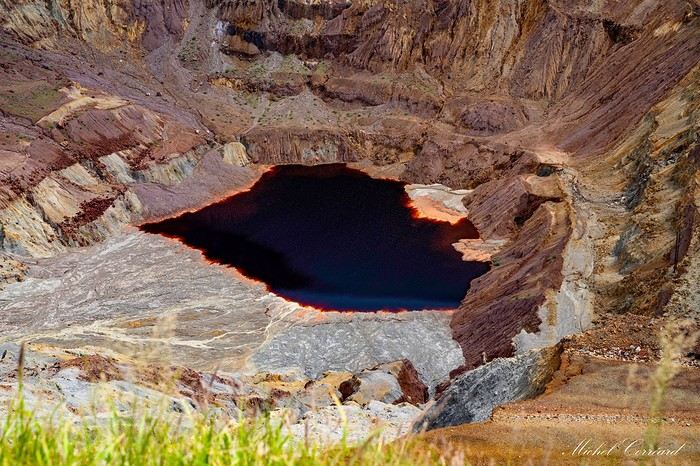
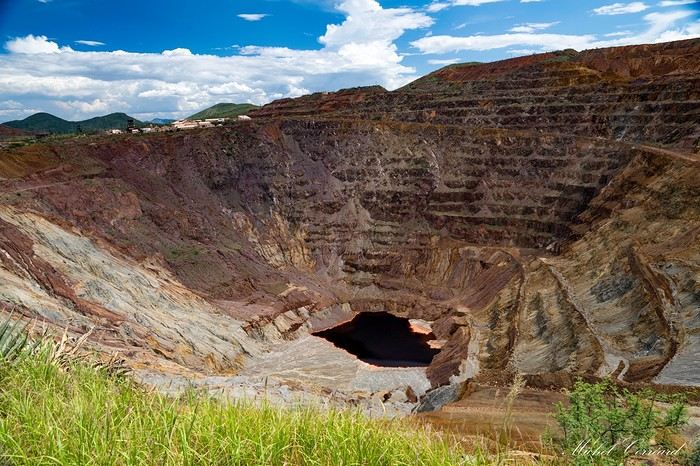
Let’s hop back in the car and head a little further south to check out the esplanade that offers a view—if you can call it that—of the impressive open-pit mine. Then, it’s off to the Lowell neighborhood.
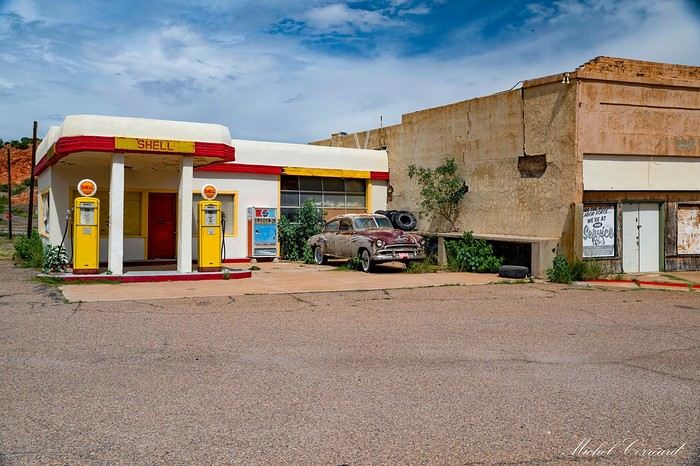
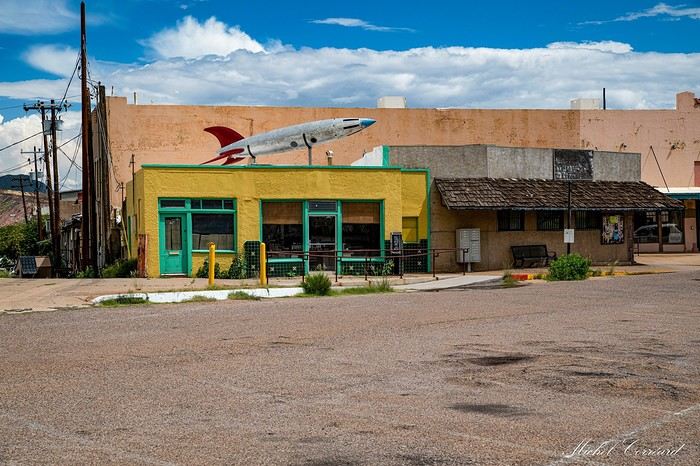
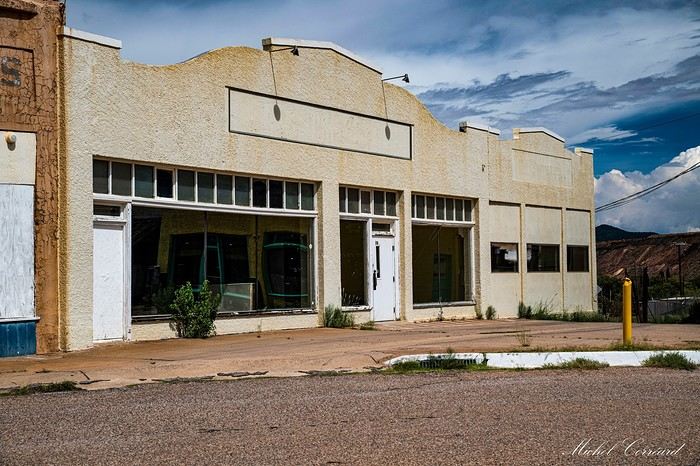
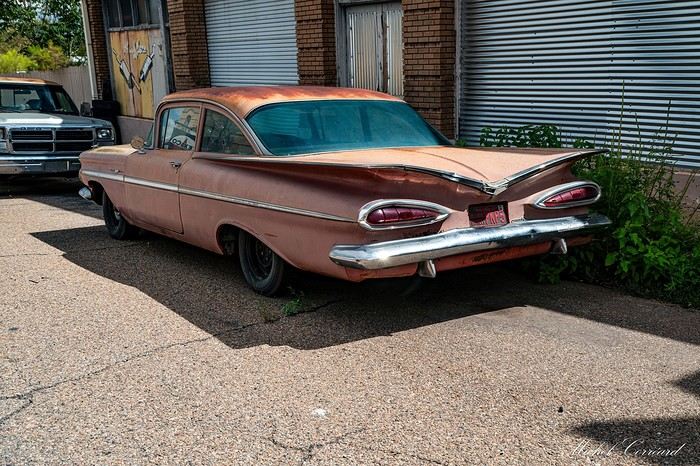
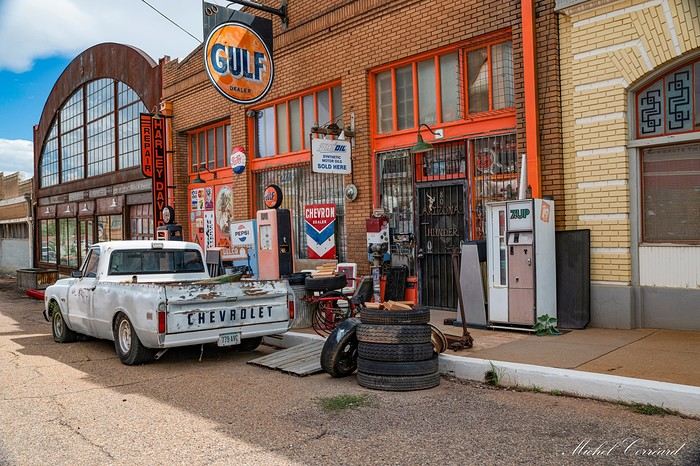
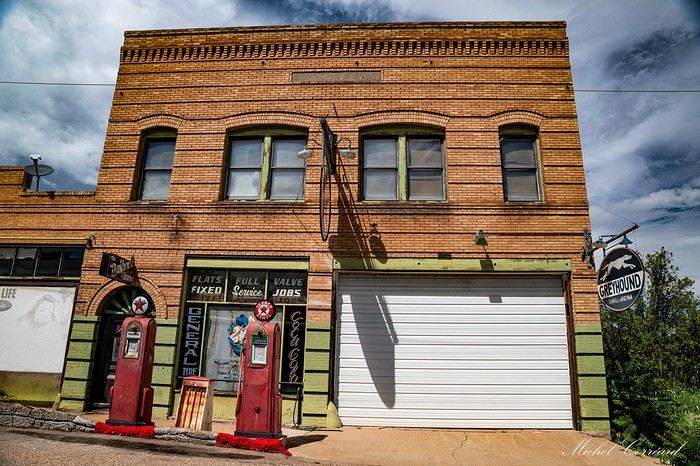
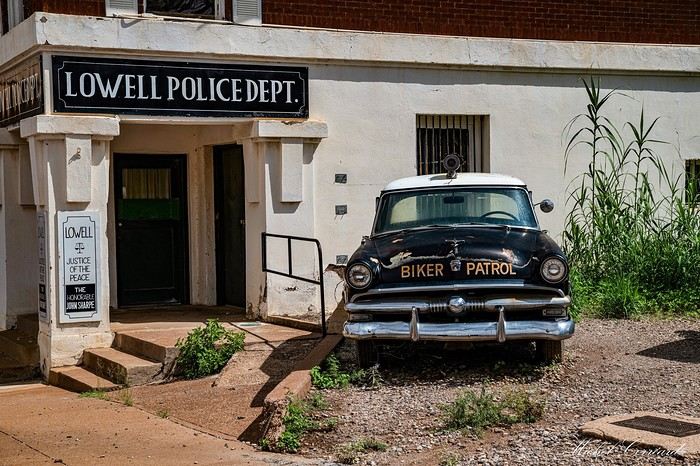
Preserved almost exactly as it was, this area must’ve been bustling in its heyday. The vintage cars are still around, storefronts and signs look like they’re straight out of another era, and the whole place has a pretty amazing vibe. You’d almost think you were on Route 66!
Here, we’re not just discovering an old neighborhood—it’s a little slice of American history. And, a detail that’s great for my physical health: the area isn’t too spread out. Lucky me! 😊
I won’t post too many photos here since I think I can turn them into a future photo exhibit. Between these and some shots from Route 66, I should have more than enough material! So, let’s keep a few under wraps... to preserve the surprise. 😊
We had left off in the charming town of Bisbee, which once thrived thanks to its copper mines. Today, mining is a thing of the past, and the town seems a bit sleepy.
Unfortunately, I didn’t dig deep enough on-site to answer all the questions my observations raised. Guess I’ll have to *dig* into the subject a bit more... no pun intended! 😊
Let’s hop back in the car and head a little further south to check out the esplanade that offers a view—if you can call it that—of the impressive open-pit mine. Then, it’s off to the Lowell neighborhood.
Preserved almost exactly as it was, this area must’ve been bustling in its heyday. The vintage cars are still around, storefronts and signs look like they’re straight out of another era, and the whole place has a pretty amazing vibe. You’d almost think you were on Route 66!
Here, we’re not just discovering an old neighborhood—it’s a little slice of American history. And, a detail that’s great for my physical health: the area isn’t too spread out. Lucky me! 😊
I won’t post too many photos here since I think I can turn them into a future photo exhibit. Between these and some shots from Route 66, I should have more than enough material! So, let’s keep a few under wraps... to preserve the surprise. 😊
"Tropical Odyssey" CFC Renaissance – November 1st to 22nd, 2025
We’ve just returned from a cruise that my wife and I will remember—unfortunately, not in a good way.
There’s so much to say that I’ll proceed chapter by chapter.
Pre-Cruise
On January 24th, 2025, I booked through a supposedly attentive cruise agent the repositioning cruise of the CFC Renaissance to the French West Indies, initially departing from Le Havre, then from Dunkirk, on November 1st, 2025.
The return flight was included in the price of this trip.
From January, right after booking, this adventure got off to a bad start.
Used to major cruise lines, I asked my agent to reserve a table for 4 at the "Vatel" restaurant for the second seating, and to link this reservation to the cabin of friends traveling with us. First brush-off: "Ask the maître d’ at the restaurant entrance on the first night."
"To govern is to foresee, and to foresee nothing is to head for disaster," as Émile de Girardin said.
Following this maxim, in February, I started looking for transportation to Le Havre, which was initially the departure port. Then, I asked the travel agent which airport the return flight would land at. I knew flights from Pointe-à-Pitre to Paris served both main Parisian airports. Here, I found myself like a ping-pong ball between the cruise agent and CFC: The cruise agent said, "Ask CFC," and CFC replied, "No, your agent is your intermediary—ask them." It went back and forth like that. Impossible to pre-book the flight that would take us back to our final destination. During the summer, we learned that the departure port was no longer Le Havre but Dunkirk. We canceled our transfers to Le Havre but, of course, lost the cost of the reservations. Meanwhile, we purchased our "Beverage" package—we chose the "Fraîcheur" option, which included all non-alcoholic cocktails, canned sodas, fruit juices, bottled water, and regular coffees. This detail is important for the rest of the story. Every month, I followed up to find out the return airport. Nothing until October 28th (3 days before departure), when CFC finally informed me it was Orly, along with the flight number and time. Of course, on top of booking at full price, I had to arrange my final transfer home. Since I had very little time before the return flight, I had to book an Uber in a rush for the Orly/CDG transfer. Right after, we were told that our first stop in Lisbon—the most anticipated for many cruisers—had been canceled due to a strike at the port of Lisbon and replaced with Vigo, Spain. A completely unremarkable stop—nothing outstanding. As you can see, the prelude was already problematic, yet we’re far from reaching the peak of our disappointments. .......... to be continued soon.
"To govern is to foresee, and to foresee nothing is to head for disaster," as Émile de Girardin said.
Following this maxim, in February, I started looking for transportation to Le Havre, which was initially the departure port. Then, I asked the travel agent which airport the return flight would land at. I knew flights from Pointe-à-Pitre to Paris served both main Parisian airports. Here, I found myself like a ping-pong ball between the cruise agent and CFC: The cruise agent said, "Ask CFC," and CFC replied, "No, your agent is your intermediary—ask them." It went back and forth like that. Impossible to pre-book the flight that would take us back to our final destination. During the summer, we learned that the departure port was no longer Le Havre but Dunkirk. We canceled our transfers to Le Havre but, of course, lost the cost of the reservations. Meanwhile, we purchased our "Beverage" package—we chose the "Fraîcheur" option, which included all non-alcoholic cocktails, canned sodas, fruit juices, bottled water, and regular coffees. This detail is important for the rest of the story. Every month, I followed up to find out the return airport. Nothing until October 28th (3 days before departure), when CFC finally informed me it was Orly, along with the flight number and time. Of course, on top of booking at full price, I had to arrange my final transfer home. Since I had very little time before the return flight, I had to book an Uber in a rush for the Orly/CDG transfer. Right after, we were told that our first stop in Lisbon—the most anticipated for many cruisers—had been canceled due to a strike at the port of Lisbon and replaced with Vigo, Spain. A completely unremarkable stop—nothing outstanding. As you can see, the prelude was already problematic, yet we’re far from reaching the peak of our disappointments. .......... to be continued soon.
Old Burmese Adventures (oh, so many!)
Hey everyone,
Yesterday, I checked the Thailand forum to see if there were any questions to answer, but not much was happening—it was pretty quiet. Then I scrolled through the Southeast Asia section and realized that, even though Burma (Myanmar) was included, there weren’t many posts about it... I’ve only been there once, back in 1987, so it’s hard to create a photo thread about multiple trips like I sometimes do for Thailand. Still, that one trip was packed with unusual adventures, so I thought I’d share a few stories from it.
Since I didn’t take any notes at the time, this is all from memory—it’s not an exhaustive travel journal and isn’t meant to help plan a future trip to Myanmar.
Don’t expect photos; there won’t be any. I have some, but they’re slides that would need scanning and editing one by one to fix the wear and tear of time—way too much work.
The Context.
Back then (reminder: 1987), I was volunteering in Paris at the counter of a travel agency on Rue des Écoles. The agency was part of a well-known organization based in Mulhouse that mostly offered scheduled flights to Asia, charter flights to the Mediterranean, and flights to Mali with their own plane. They also had a few rare "roots"-style trips to certain destinations—trips where you didn’t bring your tennis racket but were ready to soak in everything, even if it meant tough conditions.
I’d already been to Thailand, Indonesia, and the Philippines in Asia. The director knew this, so he asked me to accompany a group to Burma. At the time, tours to Burma were already being sold by competitors, but they all had to go through the state-run agency, Touristburma (buses and hotels for tourists, and they only showed you what they wanted you to see—kind of like traveling in North Korea today). The service was only payable in dollars at the official exchange rate (which was six times worse than the black market rate, mind you...), and since it went through the state agency, all the money ended up with the junta.
My job was to do everything *without* going through Touristburma, which was completely illegal there. Nothing would be booked in advance. Back then, the Burmese visa was only valid for 8 days/7 nights, and since clients were paying for the experience, the itinerary was planned ahead. I’d have to find transport and a guide on the black market as soon as I arrived.
The clients weren’t misled—they knew from the start that the trip would be off the books, that officially we’d be a small group of friends (not an agency), unlike the truth (Touristburma wasn’t mandatory for individual travelers), and that it would be challenging. They also knew their trip would cost 3-4 times less while giving them a much better experience of Burma. As for pretending to be a group of friends, there were only six of us, so it worked out.
To cover all expenses (accommodation, transport, excursions), the agency gave me a sufficient budget. They also gave me the *same* budget a second time, which was strictly for bribing officials who might cause trouble, for backshish (tips), and, if needed, to "help" me get out of prison.
Before I left, I was thoroughly briefed by another guy who’d led the previous trip (he’d dealt with all the initial challenges). He explained everything I needed to know, what to watch out for, and advised me on what to bring as "gifts" (samples of well-known perfumes, specific cigarette and whisky brands, etc.). For the perfume samples, I rallied my family, friends, and even stores. For the rest, I’d pick things up at the duty-free shops in Don Muang (Bangkok’s only airport at the time)—I had the budget for it.
I couldn’t wait to leave...
Yesterday, I checked the Thailand forum to see if there were any questions to answer, but not much was happening—it was pretty quiet. Then I scrolled through the Southeast Asia section and realized that, even though Burma (Myanmar) was included, there weren’t many posts about it... I’ve only been there once, back in 1987, so it’s hard to create a photo thread about multiple trips like I sometimes do for Thailand. Still, that one trip was packed with unusual adventures, so I thought I’d share a few stories from it.
Since I didn’t take any notes at the time, this is all from memory—it’s not an exhaustive travel journal and isn’t meant to help plan a future trip to Myanmar.
Don’t expect photos; there won’t be any. I have some, but they’re slides that would need scanning and editing one by one to fix the wear and tear of time—way too much work.
The Context.
Back then (reminder: 1987), I was volunteering in Paris at the counter of a travel agency on Rue des Écoles. The agency was part of a well-known organization based in Mulhouse that mostly offered scheduled flights to Asia, charter flights to the Mediterranean, and flights to Mali with their own plane. They also had a few rare "roots"-style trips to certain destinations—trips where you didn’t bring your tennis racket but were ready to soak in everything, even if it meant tough conditions.
I’d already been to Thailand, Indonesia, and the Philippines in Asia. The director knew this, so he asked me to accompany a group to Burma. At the time, tours to Burma were already being sold by competitors, but they all had to go through the state-run agency, Touristburma (buses and hotels for tourists, and they only showed you what they wanted you to see—kind of like traveling in North Korea today). The service was only payable in dollars at the official exchange rate (which was six times worse than the black market rate, mind you...), and since it went through the state agency, all the money ended up with the junta.
My job was to do everything *without* going through Touristburma, which was completely illegal there. Nothing would be booked in advance. Back then, the Burmese visa was only valid for 8 days/7 nights, and since clients were paying for the experience, the itinerary was planned ahead. I’d have to find transport and a guide on the black market as soon as I arrived.
The clients weren’t misled—they knew from the start that the trip would be off the books, that officially we’d be a small group of friends (not an agency), unlike the truth (Touristburma wasn’t mandatory for individual travelers), and that it would be challenging. They also knew their trip would cost 3-4 times less while giving them a much better experience of Burma. As for pretending to be a group of friends, there were only six of us, so it worked out.
To cover all expenses (accommodation, transport, excursions), the agency gave me a sufficient budget. They also gave me the *same* budget a second time, which was strictly for bribing officials who might cause trouble, for backshish (tips), and, if needed, to "help" me get out of prison.
Before I left, I was thoroughly briefed by another guy who’d led the previous trip (he’d dealt with all the initial challenges). He explained everything I needed to know, what to watch out for, and advised me on what to bring as "gifts" (samples of well-known perfumes, specific cigarette and whisky brands, etc.). For the perfume samples, I rallied my family, friends, and even stores. For the rest, I’d pick things up at the duty-free shops in Don Muang (Bangkok’s only airport at the time)—I had the budget for it.
I couldn’t wait to leave...
Mauritian Ti' Punch
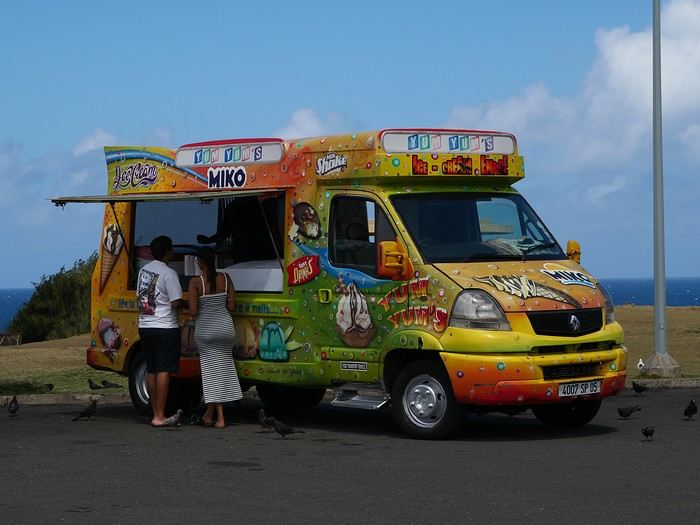
The recipe for the cocktail: endless beaches, a dazzling palette of colors, some breathtaking hikes, and excellent cuisine...
For the tasting, follow along in the pages of this travel journal! 😉
Don’t forget your hiking shoes, a swimsuit, sunscreen, but also a sweater, your driver’s license, and your credit card...
Just over 11 hours of flight, and we’ll be setting foot on Mauritian soil!
For the tasting, follow along in the pages of this travel journal! 😉
Don’t forget your hiking shoes, a swimsuit, sunscreen, but also a sweater, your driver’s license, and your credit card...
Just over 11 hours of flight, and we’ll be setting foot on Mauritian soil!
10 Days in Afghanistan with the Taliban
Hi, I’m not sure if this belongs here.
The videos aren’t mine—they’re from a YouTuber.
I find his trip mind-blowing and totally different from what we see on TV!
So far, two 1-hour-12-minute videos have been released, but there’ll be at least one more!
Some French journalists and politicians have been tearing him apart lately. At the same time, the guy put in insane work without any funding...
Personally, I’m really impressed by what he’s done...
Here are the links. Sorry if this feels like an ad, but I genuinely think his trip is great—and most importantly, judgment-free. The only other thing I’d seen from him was his trip to Transnistria.
I Lived 10 Days with the Taliban 🇦🇫
Under Taliban Sharia in Afghanistan 🇦🇫
I find his trip mind-blowing and totally different from what we see on TV!
So far, two 1-hour-12-minute videos have been released, but there’ll be at least one more!
Some French journalists and politicians have been tearing him apart lately. At the same time, the guy put in insane work without any funding...
Personally, I’m really impressed by what he’s done...
Here are the links. Sorry if this feels like an ad, but I genuinely think his trip is great—and most importantly, judgment-free. The only other thing I’d seen from him was his trip to Transnistria.
I Lived 10 Days with the Taliban 🇦🇫
Under Taliban Sharia in Afghanistan 🇦🇫
Norway Cruise: Sightseeing Ideas
Hi, we're going on a cruise to Norway departing from Dunkirk and sailing up the coast—can you share some ideas on what to visit? Thanks!
Gigi
Yet Another Travel Journal in this (Too) Familiar Rajasthan, But with Family and Kids
Prologue
This journal recounts a trip to Rajasthan that’s already over a year old and that I’ve only now found the chance to write about. The summer of 2024 marked my return to India—my tenth trip—after six long years away since my last solo wanderings in Tamil Nadu in 2018 (the journal of which is published on this site). That absence was partly (but not only) due to the long COVID and post-COVID period, which saw a complete halt and then a major slowdown in global tourism. To top it off, Voyage Forum announced its closure in an end-of-the-world atmosphere. A sad time for our favorite social activity…
A few weeks after returning from Rajasthan, I tried to motivate myself to start writing a journal to publish on a forum claiming to be VF’s successor, which I’d eventually signed up for out of desperation. But I kept hesitating and putting the project off because, for one, I no longer have the time I used to. For another, the vibe wasn’t really taking off on that forum—it was overrun with ads and not very active, contrary to what its host’s name suggested. Despite its good intentions and commendable role as a stopgap, it also turned out to be very impractical to use, especially when you don’t have much time like me. I’ll admit I’d occasionally check back on VF to see if anything was happening. But all the discussions remained frozen in time, stuck in that fateful year, 2020. Then, rumors swirled online about shady reasons behind its closure, leaving little room for hope.
And then, one fine morning, I got a message at work from Marien informing me that VF had reopened. What a huge surprise! Even though the forum’s “end” had played out in a somewhat apocalyptic atmosphere, the memories of passionate and heated discussions, the frank debates, and the useful exchanges that made this site a traveler’s goldmine and a unique hub of conviviality all came rushing back to me like a breath of fresh air. I finally saw a sign and tried to motivate myself to find the time to publish the journal of this tenth trip to India and fifth to Rajasthan. But in the end, I got bogged down in professional and family obligations and never managed to find the time to get started. That’s now fixed, though, because I had two reasons for wanting to do it: I find that looking back on a trip to tell others about it is a highly beneficial introspective exercise. Also, I thought this journal could be useful to other travelers on a few points.
Because, “do we really need yet another journal about Rajasthan?” you might rightly ask! Especially in a time when so many journals about the “Land of Kings” have been published since VF’s return, not to mention the countless stories you can already find online about this region, one of India’s most touristy. And I’d add, why go back to Rajasthan for a fifth time, where I’ve already dragged my feet more than enough—through its forts, deserts, temples, cities, villages, bumpy roads, train stations, tasty street food stalls, cheap guesthouses, and more? Where some might see just another overhyped tourist destination full of the same old *Arabian Nights* clichés, worn to a thread, that I mentioned earlier, when there’s so much else to see in India? Well, first because it’s a magnificent country I never tire of, where I started an academic study and made so many connections. It’s also packed with places where you won’t find a single tourist (right, Marie-Jo?), even in the heart of well-trodden paths and classic itineraries. And most importantly, as I said earlier, things have changed in recent years. First, after six years without traveling far, the urge to go back to India was getting stronger. But this time, no more solo trips (often) or duo adventures (sometimes)—now it’s a team of four that has to come along! And even if you can argue with that, what better place than Rajasthan to introduce India to people who’ve never seen it? To kids you want to amaze? Plus, traveling with your new little family to your favorite country isn’t the same as going solo in often spartan conditions that only affect you. It’s a different challenge, but ultimately probably much harder. So, is it really reasonable to take two kids to India, including a two-year-old baby? That’s one of the main goals of this journal (but not the only one)—to try to answer that question.
As you can tell, it’s not so much the destination but the slightly unusual setup of this trip that, in my opinion, will make this journal interesting. Despite my experience and expertise (yes, I dare say it) in India, there were plenty of questions before we finalized the plan and said, “Alright, let’s go!” The questions were flying for us parents. Is it wise to travel to India with a two-year-old? What would we do (it happened) if the kids got very sick? Would they be able to handle a road trip on Rajasthan’s bumpy, dusty roads using public transport? Could they handle the shock of such a different world—the dirt, poverty, pollution, noise (…and the smell, as they say), the spicy food, monkeys, mosquitoes, snakes, tigers, leopards, and so on? In short, all the clichés that I usually joke about suddenly became potential realities. Another concern: as a mixed Franco-African family (not me, but my partner and her oldest), wouldn’t we risk not always being well received, given what you sometimes hear about that in India? How would Indians react to seeing a mixed-race family, the ultimate taboo in a country of purity and social segregation, which would undoubtedly raise many questions for them? Of course, not everything went as expected… Because, as you know, with India—and what makes it charming for some—there are always complications: sometimes where you don’t expect them… and sometimes where you do. I’ll go into detail about that in the journal to come (not right away) and in the final review (even later). These experiences could be useful to travelers who find themselves in similar situations and have the same questions we did before embarking on such a journey. And maybe it’ll spark the curiosity of those who aren’t concerned and will read yet another Rajasthan journal, but with its own unique twists.
Despite my unchanged constraints, which mean I have little time to write this, I don’t want to rush the story, so I’ll take my time. There will probably be lulls. I hope that won’t stop people from coming to react, debate, share their impressions, or ask for information.
This journal recounts a trip to Rajasthan that’s already over a year old and that I’ve only now found the chance to write about. The summer of 2024 marked my return to India—my tenth trip—after six long years away since my last solo wanderings in Tamil Nadu in 2018 (the journal of which is published on this site). That absence was partly (but not only) due to the long COVID and post-COVID period, which saw a complete halt and then a major slowdown in global tourism. To top it off, Voyage Forum announced its closure in an end-of-the-world atmosphere. A sad time for our favorite social activity…
A few weeks after returning from Rajasthan, I tried to motivate myself to start writing a journal to publish on a forum claiming to be VF’s successor, which I’d eventually signed up for out of desperation. But I kept hesitating and putting the project off because, for one, I no longer have the time I used to. For another, the vibe wasn’t really taking off on that forum—it was overrun with ads and not very active, contrary to what its host’s name suggested. Despite its good intentions and commendable role as a stopgap, it also turned out to be very impractical to use, especially when you don’t have much time like me. I’ll admit I’d occasionally check back on VF to see if anything was happening. But all the discussions remained frozen in time, stuck in that fateful year, 2020. Then, rumors swirled online about shady reasons behind its closure, leaving little room for hope.
And then, one fine morning, I got a message at work from Marien informing me that VF had reopened. What a huge surprise! Even though the forum’s “end” had played out in a somewhat apocalyptic atmosphere, the memories of passionate and heated discussions, the frank debates, and the useful exchanges that made this site a traveler’s goldmine and a unique hub of conviviality all came rushing back to me like a breath of fresh air. I finally saw a sign and tried to motivate myself to find the time to publish the journal of this tenth trip to India and fifth to Rajasthan. But in the end, I got bogged down in professional and family obligations and never managed to find the time to get started. That’s now fixed, though, because I had two reasons for wanting to do it: I find that looking back on a trip to tell others about it is a highly beneficial introspective exercise. Also, I thought this journal could be useful to other travelers on a few points.
Because, “do we really need yet another journal about Rajasthan?” you might rightly ask! Especially in a time when so many journals about the “Land of Kings” have been published since VF’s return, not to mention the countless stories you can already find online about this region, one of India’s most touristy. And I’d add, why go back to Rajasthan for a fifth time, where I’ve already dragged my feet more than enough—through its forts, deserts, temples, cities, villages, bumpy roads, train stations, tasty street food stalls, cheap guesthouses, and more? Where some might see just another overhyped tourist destination full of the same old *Arabian Nights* clichés, worn to a thread, that I mentioned earlier, when there’s so much else to see in India? Well, first because it’s a magnificent country I never tire of, where I started an academic study and made so many connections. It’s also packed with places where you won’t find a single tourist (right, Marie-Jo?), even in the heart of well-trodden paths and classic itineraries. And most importantly, as I said earlier, things have changed in recent years. First, after six years without traveling far, the urge to go back to India was getting stronger. But this time, no more solo trips (often) or duo adventures (sometimes)—now it’s a team of four that has to come along! And even if you can argue with that, what better place than Rajasthan to introduce India to people who’ve never seen it? To kids you want to amaze? Plus, traveling with your new little family to your favorite country isn’t the same as going solo in often spartan conditions that only affect you. It’s a different challenge, but ultimately probably much harder. So, is it really reasonable to take two kids to India, including a two-year-old baby? That’s one of the main goals of this journal (but not the only one)—to try to answer that question.
As you can tell, it’s not so much the destination but the slightly unusual setup of this trip that, in my opinion, will make this journal interesting. Despite my experience and expertise (yes, I dare say it) in India, there were plenty of questions before we finalized the plan and said, “Alright, let’s go!” The questions were flying for us parents. Is it wise to travel to India with a two-year-old? What would we do (it happened) if the kids got very sick? Would they be able to handle a road trip on Rajasthan’s bumpy, dusty roads using public transport? Could they handle the shock of such a different world—the dirt, poverty, pollution, noise (…and the smell, as they say), the spicy food, monkeys, mosquitoes, snakes, tigers, leopards, and so on? In short, all the clichés that I usually joke about suddenly became potential realities. Another concern: as a mixed Franco-African family (not me, but my partner and her oldest), wouldn’t we risk not always being well received, given what you sometimes hear about that in India? How would Indians react to seeing a mixed-race family, the ultimate taboo in a country of purity and social segregation, which would undoubtedly raise many questions for them? Of course, not everything went as expected… Because, as you know, with India—and what makes it charming for some—there are always complications: sometimes where you don’t expect them… and sometimes where you do. I’ll go into detail about that in the journal to come (not right away) and in the final review (even later). These experiences could be useful to travelers who find themselves in similar situations and have the same questions we did before embarking on such a journey. And maybe it’ll spark the curiosity of those who aren’t concerned and will read yet another Rajasthan journal, but with its own unique twists.
Despite my unchanged constraints, which mean I have little time to write this, I don’t want to rush the story, so I’ll take my time. There will probably be lulls. I hope that won’t stop people from coming to react, debate, share their impressions, or ask for information.
Texas, Louisiana, and a Touch of Florida
After five trips to the American West, we had planned to switch countries and continents to visit Turkey. However, by the time we made up our minds, flight ticket prices had nearly doubled, reaching 400 € for a round-trip ticket. A bit disappointed, I started looking at transatlantic flight prices and stumbled upon discounted tickets from Basel-Mulhouse to Dallas—at the same price as our tickets to Turkey!
No hesitation needed; we bought the five tickets for a total of 1,860 € excluding baggage!
From Fort Worth Airport, we had two options: - Head west on a loop through Texas, New Mexico, and southern Colorado - Head east to change the scenery and explore East Texas, Louisiana, with a possible detour into Florida.
The latter option won unanimously, so here we are, off to discover new states, mainly Louisiana and Texas.
One of the main post-COVID challenges is finding a reasonably priced car rental. After an initial booking around 1,300 €, we kept an eye on prices a few weeks before departure and managed to snag a better deal at around 900 € for a comfortable sedan.
Yes, this summer will also be a first: no 4x4, no camping, and plenty of restaurants!
As always, I’ve planned a packed itinerary, ready to adjust on the go. A few weeks before departure, we learned we’d be at full capacity—our eldest son, Maxime, got his first-year med school results. By finishing as a top admit, he avoided the mandatory July-August internship that would’ve kept him from joining us. Instead, he wrapped up his internship at the last minute the night before our big departure.
We’ll get to savor these special moments together.
The itinerary: Day 1 - 07/15: Fort Worth Day 2: Dallas Day 3: Jefferson - Caddo Lake Day 4: Black Bayou Lake - Natchez - Stanton Hall and Rosalie Mansion Day 5: St. Francisville - Rosedown Plantation - Cat Island Wildlife Refuge Day 6: Mobile - USS Alabama Battleship Memorial Park Day 7 - 8: Pensacola Beach Day 9: Bellingrath Gardens - New Orleans Day 10 - 11: New Orleans Day 12: Plantation Route Day 13: Jungle Gardens - Tabasco Factory - Vermilionville - Lake Martin Day 14: Baton Rouge - USS Kidd Day 15: Houma - Cajun Man's Swamp Tour Day 16: Galveston, Texas Day 17: Space Center Houston - Painted Churches Day 18: San Antonio Day 19: Texas Hill Country Day 20: Texas Hill Country and evening in San Antonio Day 21: Austin and Waco
Day 0 - 07/14: The departure timing isn’t exactly relaxing. On Thursday late afternoon, we hit the road to Alsace, aiming to drop off our two cockers with family before reaching the airport at 2 AM for a 3-hour power nap. Not exactly fresh, we arrive at the terminal looking for a British Airways counter. None in sight, so we try our luck at a United Airlines counter—who knows, maybe it’ll work out. And bingo! The agent checks us in. We didn’t quite understand why, but maybe there’s some agreement between airlines. For the first time, we’re traveling without checked baggage, so no extra fees. Not a huge feat, given the scorching temperatures awaiting us!
The connecting flight to London goes smoothly.
During the layover, liquid checks get stricter—now requiring small bottles to be in a pre-approved clear bag, with only one bag allowed per passenger. Normally, no big deal, but between deodorant, sunscreen, after-sun lotion, hand sanitizer, contact lens solution, etc., we spend 20 minutes optimizing the arrangement! When we finally succeed, one of the security staff bursts out laughing and congratulates us!
With our stomachs growling, we grab an American breakfast before browsing the airport shops.
We then discover our plane for the long-haul flight and are thrilled to see it’s an A380—a first for Laetitia, though the rest of the family experienced it during our winter getaway. Still just as impressive!
With a hint of uncertainty, we take off for the States—my third trip in barely 12 months. This time, no endless badlands, canyons, slot canyons, hoodoos, or brain rocks, but a journey through five states (Texas, Louisiana, a quick stop in Mississippi, Alabama, and the northwest tip of Florida), where we hope to soak up a unique vibe... with a packed schedule of diverse visits.
Arrival at Fort Worth Airport and customs go smoothly. Since we have no checked baggage, we’re first in line at the Dollar counter. In just 3 minutes, the formalities are done. We decline the Toll Pass, which I don’t think we’ll need based on my "calculations," and head to the Dollar parking lot, where an employee tells us we can pick any car we want!
There are about thirty cars waiting. Too many choices!
After last year’s mishap in Oakland, where our 4x4’s trunk was broken into, we’re looking for a sedan to hide our luggage this time. Unfortunately, there are none—only SUVs. We finally settle on a comfortable 7-seater Ford SUV with a massive trunk when set up for five.
On the road from Fort Worth to Dallas, we accidentally take a toll highway without realizing until it’s too late to exit. Let’s hope Dollar doesn’t charge us a week’s worth of their pricey Toll Pass for a $2 toll. We’ll see... In the meantime, Maxime sets up Google Maps to avoid toll roads.
Since it’s not too late, we stop by the nearest Walmart for groceries before checking into our hotel room for three nights in East Dallas suburb.
No hesitation needed; we bought the five tickets for a total of 1,860 € excluding baggage!
From Fort Worth Airport, we had two options: - Head west on a loop through Texas, New Mexico, and southern Colorado - Head east to change the scenery and explore East Texas, Louisiana, with a possible detour into Florida.
The latter option won unanimously, so here we are, off to discover new states, mainly Louisiana and Texas.
One of the main post-COVID challenges is finding a reasonably priced car rental. After an initial booking around 1,300 €, we kept an eye on prices a few weeks before departure and managed to snag a better deal at around 900 € for a comfortable sedan.
Yes, this summer will also be a first: no 4x4, no camping, and plenty of restaurants!
As always, I’ve planned a packed itinerary, ready to adjust on the go. A few weeks before departure, we learned we’d be at full capacity—our eldest son, Maxime, got his first-year med school results. By finishing as a top admit, he avoided the mandatory July-August internship that would’ve kept him from joining us. Instead, he wrapped up his internship at the last minute the night before our big departure.
We’ll get to savor these special moments together.
The itinerary: Day 1 - 07/15: Fort Worth Day 2: Dallas Day 3: Jefferson - Caddo Lake Day 4: Black Bayou Lake - Natchez - Stanton Hall and Rosalie Mansion Day 5: St. Francisville - Rosedown Plantation - Cat Island Wildlife Refuge Day 6: Mobile - USS Alabama Battleship Memorial Park Day 7 - 8: Pensacola Beach Day 9: Bellingrath Gardens - New Orleans Day 10 - 11: New Orleans Day 12: Plantation Route Day 13: Jungle Gardens - Tabasco Factory - Vermilionville - Lake Martin Day 14: Baton Rouge - USS Kidd Day 15: Houma - Cajun Man's Swamp Tour Day 16: Galveston, Texas Day 17: Space Center Houston - Painted Churches Day 18: San Antonio Day 19: Texas Hill Country Day 20: Texas Hill Country and evening in San Antonio Day 21: Austin and Waco
Day 0 - 07/14: The departure timing isn’t exactly relaxing. On Thursday late afternoon, we hit the road to Alsace, aiming to drop off our two cockers with family before reaching the airport at 2 AM for a 3-hour power nap. Not exactly fresh, we arrive at the terminal looking for a British Airways counter. None in sight, so we try our luck at a United Airlines counter—who knows, maybe it’ll work out. And bingo! The agent checks us in. We didn’t quite understand why, but maybe there’s some agreement between airlines. For the first time, we’re traveling without checked baggage, so no extra fees. Not a huge feat, given the scorching temperatures awaiting us!
The connecting flight to London goes smoothly.
During the layover, liquid checks get stricter—now requiring small bottles to be in a pre-approved clear bag, with only one bag allowed per passenger. Normally, no big deal, but between deodorant, sunscreen, after-sun lotion, hand sanitizer, contact lens solution, etc., we spend 20 minutes optimizing the arrangement! When we finally succeed, one of the security staff bursts out laughing and congratulates us!
With our stomachs growling, we grab an American breakfast before browsing the airport shops.
We then discover our plane for the long-haul flight and are thrilled to see it’s an A380—a first for Laetitia, though the rest of the family experienced it during our winter getaway. Still just as impressive!
With a hint of uncertainty, we take off for the States—my third trip in barely 12 months. This time, no endless badlands, canyons, slot canyons, hoodoos, or brain rocks, but a journey through five states (Texas, Louisiana, a quick stop in Mississippi, Alabama, and the northwest tip of Florida), where we hope to soak up a unique vibe... with a packed schedule of diverse visits.
Arrival at Fort Worth Airport and customs go smoothly. Since we have no checked baggage, we’re first in line at the Dollar counter. In just 3 minutes, the formalities are done. We decline the Toll Pass, which I don’t think we’ll need based on my "calculations," and head to the Dollar parking lot, where an employee tells us we can pick any car we want!
There are about thirty cars waiting. Too many choices!
After last year’s mishap in Oakland, where our 4x4’s trunk was broken into, we’re looking for a sedan to hide our luggage this time. Unfortunately, there are none—only SUVs. We finally settle on a comfortable 7-seater Ford SUV with a massive trunk when set up for five.
On the road from Fort Worth to Dallas, we accidentally take a toll highway without realizing until it’s too late to exit. Let’s hope Dollar doesn’t charge us a week’s worth of their pricey Toll Pass for a $2 toll. We’ll see... In the meantime, Maxime sets up Google Maps to avoid toll roads.
Since it’s not too late, we stop by the nearest Walmart for groceries before checking into our hotel room for three nights in East Dallas suburb.
3 weeks in Colombia in August 2024
Hi there,
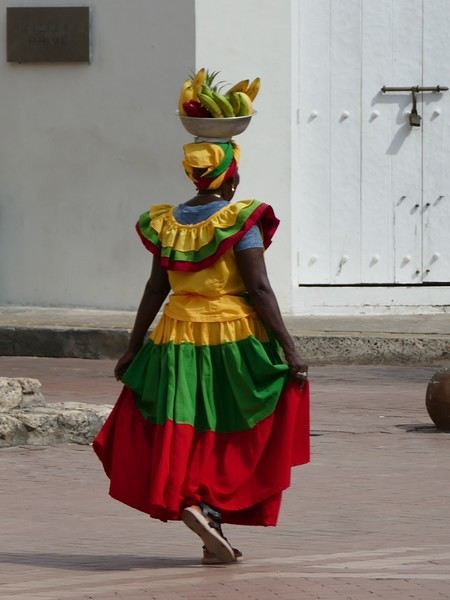
This summer, we spent 3 weeks in northern Colombia. A vibrant trip that complemented our southern Peru adventure from the previous year perfectly. Two neighboring countries, but completely different.
To start, we had to make a choice because the country is vast.
So we focused on 3 different regions for our 3 weeks: - Week 1: Bogotá and the colonial villages (Villa de Leyva, Barichara) - Week 2: Medellín and the Coffee Region - Week 3: the Caribbean coast
We entrusted the organization to a small local agency that handled accommodations, guides, and transportation. Transportation is key. The country is large, the road network isn’t very efficient, and we spent a lot of time traveling (cars, planes, and boats...), but it was the price to pay to explore it.
The overall budget isn’t exactly "backpacker" level. We spent 7,500 € (excluding Air France) for our 3-week stay (hotels, drivers, guides, flights, visits, meals). But we treated ourselves to nice accommodations—you’ll see as we share more posts.
For vacations, I try to follow Philippe Noiret’s motto: "Travel is short. Let’s try to do it first class."
This summer, we spent 3 weeks in northern Colombia. A vibrant trip that complemented our southern Peru adventure from the previous year perfectly. Two neighboring countries, but completely different.
To start, we had to make a choice because the country is vast.
So we focused on 3 different regions for our 3 weeks: - Week 1: Bogotá and the colonial villages (Villa de Leyva, Barichara) - Week 2: Medellín and the Coffee Region - Week 3: the Caribbean coast
We entrusted the organization to a small local agency that handled accommodations, guides, and transportation. Transportation is key. The country is large, the road network isn’t very efficient, and we spent a lot of time traveling (cars, planes, and boats...), but it was the price to pay to explore it.
The overall budget isn’t exactly "backpacker" level. We spent 7,500 € (excluding Air France) for our 3-week stay (hotels, drivers, guides, flights, visits, meals). But we treated ourselves to nice accommodations—you’ll see as we share more posts.
For vacations, I try to follow Philippe Noiret’s motto: "Travel is short. Let’s try to do it first class."
Biking Across New York State on the Empire State Trail
From Buffalo to New York City, the Empire State Trail is a 900 km route specifically designed for biking, with 75% on dedicated bike paths.
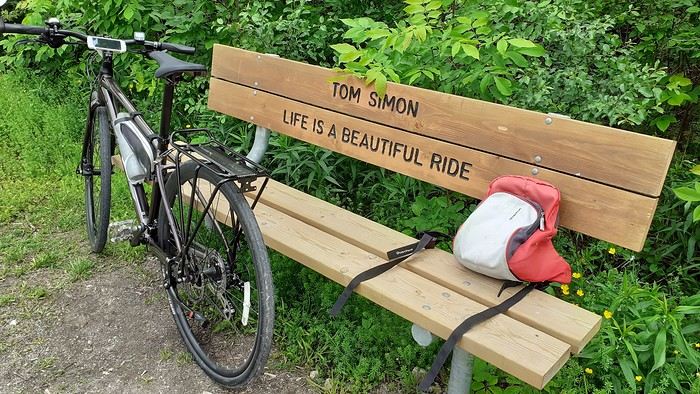
A special train with bike spaces runs almost the entire route. First along the Erie Canal to Albany, then through the Hudson Valley all the way to the tip of Manhattan. This lets you skip sections and also return to your starting point without having to take a flight. Just be aware that bike spaces need to be reserved and can fill up during peak times. In June, no problem though.
This aspect really appealed to me, since my last trip had kinda put me off biking in the US. But here, 75% on dedicated paths, plus that legendary finish in NYC with your bike—I couldn’t resist celebrating my 70th birthday this way.
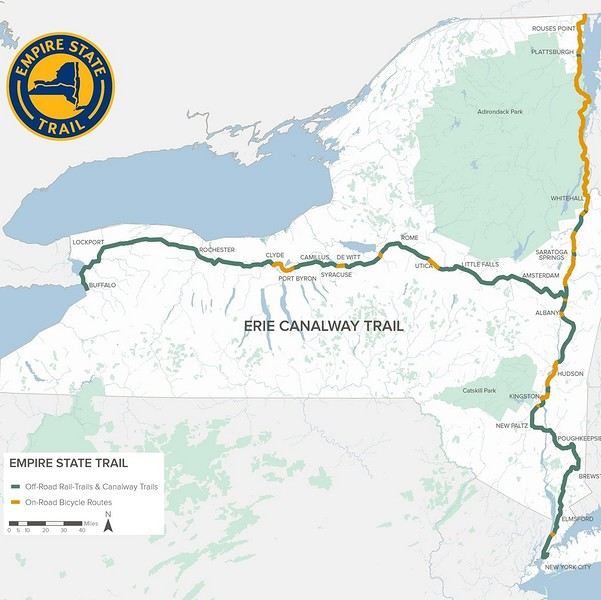 https://empiretrail.ny.gov/map
Two branches to reach NYC: from Buffalo (mostly on dedicated paths) or from Montreal (mostly on roads)
The route was developed in just three years. While it’s popular with cyclists on certain stretches near cities, those who bike the whole thing are still pretty rare.
It’s true that the scenery isn’t exactly breathtaking, and some sections—especially along the Erie Canal—can feel a bit tedious, though they’re very easy since there’s no elevation.
https://empiretrail.ny.gov/map
Two branches to reach NYC: from Buffalo (mostly on dedicated paths) or from Montreal (mostly on roads)
The route was developed in just three years. While it’s popular with cyclists on certain stretches near cities, those who bike the whole thing are still pretty rare.
It’s true that the scenery isn’t exactly breathtaking, and some sections—especially along the Erie Canal—can feel a bit tedious, though they’re very easy since there’s no elevation.
The trail starts in Buffalo, but since my bus from Toronto goes straight to Niagara, I’ll be starting at the falls instead. Plus, that’s where the direct train to NYC departs from (and arrives at).
A special train with bike spaces runs almost the entire route. First along the Erie Canal to Albany, then through the Hudson Valley all the way to the tip of Manhattan. This lets you skip sections and also return to your starting point without having to take a flight. Just be aware that bike spaces need to be reserved and can fill up during peak times. In June, no problem though.
This aspect really appealed to me, since my last trip had kinda put me off biking in the US. But here, 75% on dedicated paths, plus that legendary finish in NYC with your bike—I couldn’t resist celebrating my 70th birthday this way.
https://empiretrail.ny.gov/map
Two branches to reach NYC: from Buffalo (mostly on dedicated paths) or from Montreal (mostly on roads)
The route was developed in just three years. While it’s popular with cyclists on certain stretches near cities, those who bike the whole thing are still pretty rare.
It’s true that the scenery isn’t exactly breathtaking, and some sections—especially along the Erie Canal—can feel a bit tedious, though they’re very easy since there’s no elevation.The trail starts in Buffalo, but since my bus from Toronto goes straight to Niagara, I’ll be starting at the falls instead. Plus, that’s where the direct train to NYC departs from (and arrives at).
Harley Road Trip in the American West with West Forever
Hi there,
I’m planning a road trip in the American West in July 2025 with West Forever, which was highly recommended to me.
Has anyone done this route recently and could tell me a bit more about:
- the stages (easy or not/the stops)
- hotels
- restaurants to recommend
- things to prepare for
- must-see spots
This will be my first time in the U.S. and my first group road trip, so I have tons of questions, and your advice would be invaluable.
Thanks in advance!
Visa, forms, and currency in Cuba
Hi there,
I just booked my round-trip flight ticket to visit Cuba for two months, from January to March 2025. I’ve heard about the challenges Cubans are facing and the recent changes the island has gone through—economically (like the end of the dual-currency system) and administratively (the introduction of an e-visa)...
This is my first time visiting the country, so I’m still figuring out all the administrative steps I need to take before I go.
1) Can I apply for the electronic e-visa now (still 22 €?) from home on the website evisacuba.cu?
2) I read that I need to fill out a form 48 hours before departure on the site dviajeros.mitrans.gol-.cu/inicio. Is it possible to do this now to save time?
3) I’m a bit confused about the currency. From what I understand, there’s now only the Cuban Peso. Should I exchange my euros at the airport, or wait until I arrive at the *casas particulares* in Havana that I’ve already booked and ask the owner?
Thanks in advance for your help!
I just booked my round-trip flight ticket to visit Cuba for two months, from January to March 2025. I’ve heard about the challenges Cubans are facing and the recent changes the island has gone through—economically (like the end of the dual-currency system) and administratively (the introduction of an e-visa)...
This is my first time visiting the country, so I’m still figuring out all the administrative steps I need to take before I go.
1) Can I apply for the electronic e-visa now (still 22 €?) from home on the website evisacuba.cu?
2) I read that I need to fill out a form 48 hours before departure on the site dviajeros.mitrans.gol-.cu/inicio. Is it possible to do this now to save time?
3) I’m a bit confused about the currency. From what I understand, there’s now only the Cuban Peso. Should I exchange my euros at the airport, or wait until I arrive at the *casas particulares* in Havana that I’ve already booked and ask the owner?
Thanks in advance for your help!
Conversation transatlantique English translation pending
Ciao a tutti,
Ras le censuré du covid! Et si on causait d'autre chose, hein?
Dans un livre au beau titre, Globe-trotteur en français, Svetski putnik en langue originale bcms (littéralement La Conscience du voyageur) David Albahari, auteur serbe émigré au Canada, place ces mots dans la bouche de l'un des personnages du roman, Daniel Atias, écrivain de l'"ex-pays" invité à une résidence d'artistes à Banff :
Dans son monde, l'Europe,
il n’y a que l’instant présent, et dans cet instant on vit, en fait, pour le passé, que chacun voudrait bien changer, alors qu’ici, s’il ne se trompait point […] l’instant présent n’est que l’antichambre du futur, et le passé reste, comme il se doit, aussi immuable que les montagnes qui nous entourent.
L'ici qu'il évoque est le Nouveau Monde, l'Amérique aux vastes étendues.
La lectrice que je suis avait adhéré à la vision d' Albahari sur l'homme européen, du moins d'un certain âge et curiosité intellectuelle sur sa propre histoire, sur la matière de sa mémoire, Frankenstein couturé de traumatismes mal digérés (comment ne pas entendre aujourd'hui sans masque sur les oreilles les grincements de dents dans l'Egée?) et de quelques rares périodes resplendissantes. Je n'avais eu en revanche aucun point d'appui pour évaluer sa perception du Nord Américain.
Qu'en pensent mes compatriotes européens et les natifs des vastes étendues (pratiquement absents de cette rubrique) ou bourlingueurs attentifs des deux rives de l'Atlantique?
Catherine (qui se dit que son esprit serait peut-être différent, autre texture, autres réflexes, si elle habitait rue des écureuils au lieu de rue d'un général napoléonien syphilitique à quelques pas de la place d'un empereur romain grand massacreur de chrétiens)
PS : pour contextualiser (sans épistémologiser 😇) la citation extraite du livre, voici la critique complète que j'avais écrite de l'ouvrage :
« Ce qui m’inquiétait c’était une chose que je devinais plutôt que je ne la voyais vraiment, une chose qui n’avait pas encore de forme déterminée et ne se rattachait pas davantage à telle ou telle partie de son visage, quelque chose qui du moins à ce moment là n’aurait pas pu être saisi par le dessin, mais qui, telle une ombre, ne cessait de glisser sur ses joues, ses sourcils et l arête de son nez, menaçant de s’y fixer et – la voilà mon inquiétude, de s’y établir à demeure. »
Deux hommes. Un peintre et un écrivain. Un peintre canadien et un écrivain de Belgrade. En cet été 1998, ils sont tout deux invités du Centre des Arts de Banff, artistes en résidence, longue pour le premier, à peine 13 jours pour le second. Le visage de l’auteur fascine le plasticien, qui en scrute les moindres détails, les moindres expressions, et tente dans les heures où ils ne sont pas ensemble de dessiner ses traits, de la simple épure d’une ride à la physionomie complète. Il tente péniblement de faire apparaître une forme qui se dérobe.
Cette passion exclusive et oh combien possessive du peintre envers l’écrivain qui ne la découvrira, en feuilletant le haut paquet de dessins dans un parfait silence, que quelques minutes avant son départ définitif de Banff, est contrariée par l’arrivée d’un troisième homme, un Canadien de Calgary, rejeton d’Ivan Matulić, globe-trotter croate dont les deux artistes ont vu la signature dans une vitrine du Musée d’Histoire naturelle de Banff. L’écrivain et le petit-fils partageant une origine géographique commune et par là même une fraction d’histoire commune, il se noue entre eux une discussion, une entente même, dont le peintre, à son grand regret, se sent exclu.
Le peintre est le narrateur. Narration intime où il relate ses sentiments, les mouvements du groupe, les discussions.
Thé pris au grand hôtel à l’orgueilleuse architecture, conférences au Centre des Arts, cocktail petit doigt en l’air et expression inspirée de rigueur chez le directeur des programmes littéraires, fraîches eaux des torrents et wapitis vaquant, indifférents aux hommes, à leurs occupations. Déambulations plus ou moins rapides selon l’heure et l’humeur dans les rues du Bison, de la Loutre, du Castor…
Les rues ont à Banff des noms d’animaux, le peintre s’attirera la sympathie de Daniel Atias en définissant son identité par la prairie.
Les deux hommes viennent de deux mondes profondément différents. Dans le monde de Daniel Atias dit-il, « il n’y a que l’instant présent, et dans cet instant on vit, en fait, pour le passé, que chacun voudrait bien changer, alors qu’ici, s’il ne se trompait point […] l’instant présent n’est que l’antichambre du futur, et le passé reste, comme il se doit, aussi immuable que les montagnes qui nous entourent. » La réflexion sur le temps, sur l’histoire, sur les relations que les peuples entretiennent avec elle influençant ainsi leur existence, charpente le livre.
Au-delà de la confrontation du rapport au temps, à la mémoire sur les deux rives de l’Atlantique se développe la relation entre des ressortissants de deux camps opposés de l' »ex-pays » comme le nomme l’écrivain qui ne mentionnera jamais ni la « Yougoslavie« , ni encore moins la « Serbie« , discussions intenses, prises de conscience qui réveillent l’espoir assoupi de Daniel Atias. Mais le petit-fils du globe-trotter croate, né dans un pays d’avenir, cédant à l’impulsion de contempler le passé de son ancêtre, de Canadien devenant ainsi Croate, sera empoisonné, à mort, par cette dislocation abyssale de son identité.
En mode mineur, une réflexion sur la nature de la peinture et de la littérature, sur leur façon différente d’appréhender le monde, d’en rendre compte, traverse l’ouvrage.
Le texte est dense, pas de chapitre, pas même d’alinéa. Un bloc de langue, d’idées, de sentiments. Daniel Atias prétend que « le mieux serait encore de lire un seul livre pendant toute sa vie…« . Au vu de l’épaisseur de ces 200 pages, on se dit que si elles n’occupent pas toute une vie, il ne serait sans doute pas inutile de les fréquenter longuement pour en approfondir la compréhension, en déceler le cheminement, en apprécier le système d’échos.
Ras le censuré du covid! Et si on causait d'autre chose, hein?
Dans un livre au beau titre, Globe-trotteur en français, Svetski putnik en langue originale bcms (littéralement La Conscience du voyageur) David Albahari, auteur serbe émigré au Canada, place ces mots dans la bouche de l'un des personnages du roman, Daniel Atias, écrivain de l'"ex-pays" invité à une résidence d'artistes à Banff :
Dans son monde, l'Europe,
il n’y a que l’instant présent, et dans cet instant on vit, en fait, pour le passé, que chacun voudrait bien changer, alors qu’ici, s’il ne se trompait point […] l’instant présent n’est que l’antichambre du futur, et le passé reste, comme il se doit, aussi immuable que les montagnes qui nous entourent.
L'ici qu'il évoque est le Nouveau Monde, l'Amérique aux vastes étendues.
La lectrice que je suis avait adhéré à la vision d' Albahari sur l'homme européen, du moins d'un certain âge et curiosité intellectuelle sur sa propre histoire, sur la matière de sa mémoire, Frankenstein couturé de traumatismes mal digérés (comment ne pas entendre aujourd'hui sans masque sur les oreilles les grincements de dents dans l'Egée?) et de quelques rares périodes resplendissantes. Je n'avais eu en revanche aucun point d'appui pour évaluer sa perception du Nord Américain.
Qu'en pensent mes compatriotes européens et les natifs des vastes étendues (pratiquement absents de cette rubrique) ou bourlingueurs attentifs des deux rives de l'Atlantique?
Catherine (qui se dit que son esprit serait peut-être différent, autre texture, autres réflexes, si elle habitait rue des écureuils au lieu de rue d'un général napoléonien syphilitique à quelques pas de la place d'un empereur romain grand massacreur de chrétiens)
PS : pour contextualiser (sans épistémologiser 😇) la citation extraite du livre, voici la critique complète que j'avais écrite de l'ouvrage :
« Ce qui m’inquiétait c’était une chose que je devinais plutôt que je ne la voyais vraiment, une chose qui n’avait pas encore de forme déterminée et ne se rattachait pas davantage à telle ou telle partie de son visage, quelque chose qui du moins à ce moment là n’aurait pas pu être saisi par le dessin, mais qui, telle une ombre, ne cessait de glisser sur ses joues, ses sourcils et l arête de son nez, menaçant de s’y fixer et – la voilà mon inquiétude, de s’y établir à demeure. »
Deux hommes. Un peintre et un écrivain. Un peintre canadien et un écrivain de Belgrade. En cet été 1998, ils sont tout deux invités du Centre des Arts de Banff, artistes en résidence, longue pour le premier, à peine 13 jours pour le second. Le visage de l’auteur fascine le plasticien, qui en scrute les moindres détails, les moindres expressions, et tente dans les heures où ils ne sont pas ensemble de dessiner ses traits, de la simple épure d’une ride à la physionomie complète. Il tente péniblement de faire apparaître une forme qui se dérobe.
Cette passion exclusive et oh combien possessive du peintre envers l’écrivain qui ne la découvrira, en feuilletant le haut paquet de dessins dans un parfait silence, que quelques minutes avant son départ définitif de Banff, est contrariée par l’arrivée d’un troisième homme, un Canadien de Calgary, rejeton d’Ivan Matulić, globe-trotter croate dont les deux artistes ont vu la signature dans une vitrine du Musée d’Histoire naturelle de Banff. L’écrivain et le petit-fils partageant une origine géographique commune et par là même une fraction d’histoire commune, il se noue entre eux une discussion, une entente même, dont le peintre, à son grand regret, se sent exclu.
Le peintre est le narrateur. Narration intime où il relate ses sentiments, les mouvements du groupe, les discussions.
Thé pris au grand hôtel à l’orgueilleuse architecture, conférences au Centre des Arts, cocktail petit doigt en l’air et expression inspirée de rigueur chez le directeur des programmes littéraires, fraîches eaux des torrents et wapitis vaquant, indifférents aux hommes, à leurs occupations. Déambulations plus ou moins rapides selon l’heure et l’humeur dans les rues du Bison, de la Loutre, du Castor…
Les rues ont à Banff des noms d’animaux, le peintre s’attirera la sympathie de Daniel Atias en définissant son identité par la prairie.
Les deux hommes viennent de deux mondes profondément différents. Dans le monde de Daniel Atias dit-il, « il n’y a que l’instant présent, et dans cet instant on vit, en fait, pour le passé, que chacun voudrait bien changer, alors qu’ici, s’il ne se trompait point […] l’instant présent n’est que l’antichambre du futur, et le passé reste, comme il se doit, aussi immuable que les montagnes qui nous entourent. » La réflexion sur le temps, sur l’histoire, sur les relations que les peuples entretiennent avec elle influençant ainsi leur existence, charpente le livre.
Au-delà de la confrontation du rapport au temps, à la mémoire sur les deux rives de l’Atlantique se développe la relation entre des ressortissants de deux camps opposés de l' »ex-pays » comme le nomme l’écrivain qui ne mentionnera jamais ni la « Yougoslavie« , ni encore moins la « Serbie« , discussions intenses, prises de conscience qui réveillent l’espoir assoupi de Daniel Atias. Mais le petit-fils du globe-trotter croate, né dans un pays d’avenir, cédant à l’impulsion de contempler le passé de son ancêtre, de Canadien devenant ainsi Croate, sera empoisonné, à mort, par cette dislocation abyssale de son identité.
En mode mineur, une réflexion sur la nature de la peinture et de la littérature, sur leur façon différente d’appréhender le monde, d’en rendre compte, traverse l’ouvrage.
Le texte est dense, pas de chapitre, pas même d’alinéa. Un bloc de langue, d’idées, de sentiments. Daniel Atias prétend que « le mieux serait encore de lire un seul livre pendant toute sa vie…« . Au vu de l’épaisseur de ces 200 pages, on se dit que si elles n’occupent pas toute une vie, il ne serait sans doute pas inutile de les fréquenter longuement pour en approfondir la compréhension, en déceler le cheminement, en apprécier le système d’échos.
Ouverture des frontières aux États-Unis pour les Européens English translation pending
Bonjour ma famille et moi même devont partir le 09 juillet pour faire un trip en Californie pour 3 semaines le souci je n’arrive pas à voir des informations sur l’ouverture des frontières américaines pour nous les européens. Quelqu’un aurait il une réponse à me donner . Merci
Voyage à Playa del Carmen avec escale aux États-Unis en juillet English translation pending
Bonjour je pars le 22 juillet pour playa del Carmen j ai réservé via voyage privé nous ferons escale aux États Unis pour l’instant mon voyage est maintenu.POuvez vous me dire la situation là-bas et est ce que mon voyage sera annulé ?
Merci d avance
Voyageurs européens bientôt autorisés aux États-Unis? English translation pending
Hello,
Je suis tombé sur cet article de Newsweek, apparemment les voyageurs Européens pourrait bientôt de nouveau être autorisés.
https://www.newsweek.com/trump-suggests-u-s-could-soon-lift-coronavirus-travel-ban-countries-that-are-making-progress-1506707
https://www.newsweek.com/trump-suggests-u-s-could-soon-lift-coronavirus-travel-ban-countries-that-are-making-progress-1506707
Annulation croisière MSC au départ de Miami en août English translation pending
Bonjour,
J’ai besoin de vos conseils. Je suis complètement perdue. Nous avons réservé une croisière msc le 1 août au départ de Miami, une suite yacht club famille (nous avons trois enfants et, à 5 c’est compliqué de trouver des cabines. On a réservé via croisierenet. On a payé 10000 euros (somme déjà énorme pour une croisière, surtout par rapport à ce qu’on payait avant). Pour le moment, hélâs MSC n’a pas encore annulé pour le mois d’août. On a demandé un report pour là prochain. La nana de croisienet a la gentillesse de nous proposer pour seulement 300 euros de plus ... deux cabines avec balcon!!! En perdant bien entendu tous les avantages du yacht club. Cette année deux cabines avec balcon coûtaient 7000 euros. Hors de question. Elle nous prend pour des chèvres!!!
Que nous conseillez vous? Soit on attend en espérant que msc annule ses croisières pour août, soit on attend 18 ans pour récupérer les sommes engagées (enfin, 10000 euros ce n’est pas rien!). Nous devons payer le solde le 1 juin. Je vous remercie.
Adventures of a Bygone Era: The Philippines in 1984
After several discussions on VF about travel journals from the Philippines, I decided to write this curiosity: a trip report from a journey made in 1984, when traveling to the Philippines was still an adventure.
A curiosity because writing a travel journal about a trip 35 years later isn’t common, but also (mostly?) because exploring the Philippines at that time had little in common with traveling there today.
Obviously, I’ve forgotten a number of facts, most of the details, but with the help of a few notes from that time and a stack of slides (yes, there was life before digital 😊), many memories came back and added to the highlights I’d never forgotten. The scanned slides aren’t always great quality, but there are still quite a few to brighten up this chatter. Back then, we didn’t snap photos like we do now—film was too expensive—so I don’t have pictures of every place we visited... too bad, comparing some of those spots to how they look today would’ve been interesting.
Why "Adventures"? Why call it "Adventures" in the Philippines in 1984, a word so often used for a simple exotic trip? - Because the lack of information (no *Guide du Routard*, no *Lonely Planet*, no *Michelin Guide*, nothing, and obviously no internet) gave this trip what’s at the heart of adventure: the unknown. - Because the political situation made the stay sometimes dangerous. - Because transportation conditions were always epic, often perilous. - Because the question of where we’d spend the night came up almost every evening. - And for... quite a few other reasons.
That said, we weren’t exactly explorers!
Why the Philippines? First of all, why go to the Philippines in 1984—a country not exactly set up for tourism and about which we knew very little? How could we get an idea of the beauty of the Philippines and its points of interest when we had no guides or photos?
The idea came to us from Thailand a year earlier, during our first long-haul trip. After touring the north of the country, we met a Frenchman living in Phuket, where there were only a few tourists in Patong, with just a few small hotels and guesthouses. Kata and Karon had no buildings or roads, Rawai only had three palm-thatched bungalows, including ours, and the other islands were unknown to tourists. There was plenty to discover, and we wanted to return to this beautiful country... but the Frenchman made us dream about the Philippines—a country to explore, with wild landscapes.
Long evenings of discussion over multiple Sprite-Mekong cocktails (what memories of those headaches!) finally convinced us we had to go to the Philippines.
Episode 0: Before Departure The decision was made: we’d go to the Philippines in May 1984. Our friends and family were surprised when we announced we were going on vacation to the Philippines (a bit like saying today we were going paddleboarding in the Kerguelen Islands 🤪).
These days, preparing for each of our trips takes long evenings of research, planning, and noting down good addresses... etc. But for the Philippines in 1984, preparation was quick: we had very little information about the country, we were leaving almost at random, and the discovery would only be more exciting.
We still had a few bits of info gathered here and there: the rice terraces in northern Luzon, volcanoes, Negros where we were supposed to visit an acquaintance, Cebu and its marine life (we ended up going elsewhere), and absolutely avoid Mindanao, which was practically at war with the regime. That was about it, but it was already a great itinerary.
Nothing was organized in advance; we’d see day by day. We had no idea about travel times or even the existence of transportation options. The main (and sometimes only) way to connect two islands was by overloaded, rusty ferry. Only the big cities had airports.
Let’s Go: Episode 1: Paris to Manila My travel journals always start after arriving at the airport—the Europe-to-“Other Continent” trip isn’t interesting—but the flight to the Philippines was already an adventure, so I’ll make an exception.
This was the era when only a few Asian airlines were on par with Western ones: Thai, Singapore Airlines, and Philippine Airlines. They had beautiful, brand-new planes, and to attract customers (almost exclusively “businessmen”) from the usual airlines (Air France, Lufthansa, British Airways), there was opulence on board: unlimited champagne, all sorts of cocktails... Compared to today’s long-haul flights, there was still one small difference: no personal screens, just one screen at the front of the cabin with one mandatory movie. And I don’t know why, but we only got James Bond films, both ways... that must’ve been the trend at the time.
The tourism boom to Southeast Asia hadn’t started yet, and the “Asian Tigers” weren’t a thing, so there weren’t many business trips. That meant long-haul flights made stops everywhere to fill the planes. Our Philippine Airlines Boeing 747 left London, picked us up in Paris, then stopped in Frankfurt to take on a few Germans. I don’t know why we then made a stop in Dubai—a totally exotic place at the time. There was nothing to do there... things have changed a lot since. It was a small town lost in the desert. The airport was tiny, with just one or two buildings and a supermarket. During the stopover, everyone had to get off the plane and walk to the supermarket. Photo and electronic equipment were dirt cheap—I guess that was the only reason for the stop. Maybe it was their first commercial move. Emirates didn’t exist yet, as I checked online, but anyway, the idea that such a remote place could have its own airline was unthinkable.
Online, I found this photo of Dubai Airport in 1980. Anyone who’s transited through today’s massive airport with its rows of A380s will appreciate it: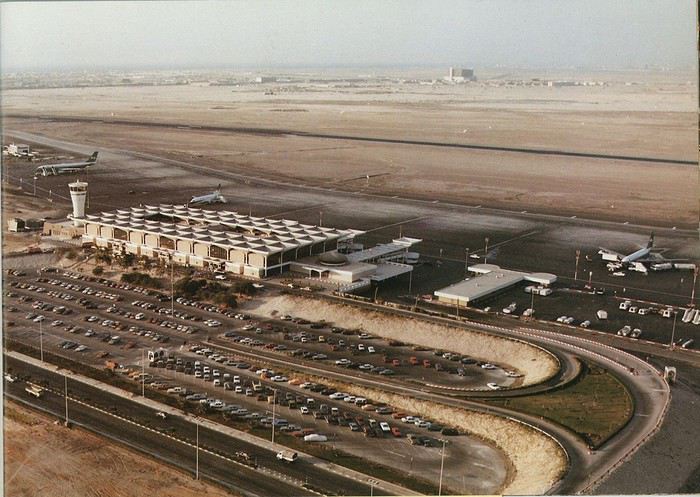
Next stop: New Delhi to drop off some Europeans and pick up a few Indians, and finally, the terminus: Manila. I don’t remember how long the trip took with its five stops—an unimaginable journey today. Despite all those stops to fill the plane, there was still enough space to stretch out on the four center seats of the 747, something that never happens these days despite all the flights in every direction.
So here we are, finally at Manila Airport around midnight.
Episode 1: Manila and Baguio To start, a quick note on the political and economic situation in the Philippines in 1984, which had consequences for us as tourists, as we’d soon realize upon arrival.
After several centuries of Spanish colonization, the Philippines became American at the start of the 20th century, then independent. In 1966, Marcos took power, and little by little, his regime sank into corruption and mismanagement, becoming a dictatorship with martial law, all for the benefit of his family and friends, who enriched themselves endlessly. The peak was the assassination of opposition leader Benigno Aquino in August 1983, which triggered harshly repressed protests. So we arrived a few months later in a very poor country, with omnipresent corruption and an extremely tense political situation, as we’d soon see for ourselves. Major protests took place in the main cities during our trip—I’ll come back to that. Two years later, Marcos fled to Hawaii after being forced out of power following rigged elections. This historical context explains a lot of the situations we found ourselves in over the following weeks.
Arriving in the middle of the night isn’t very cheerful. Manila was already a huge city with many slums, where you could find a few business hotels like the Hilton or Intercontinental—way out of our budget—and plenty of run-down hotels. Luckily, two Indians we’d chatted with on the plane offered to take us to their usual hotel. They came to Manila twice a year for business. We accepted their offer, relieved not to have to look for a place to stay in the middle of the night, figuring the address must be good since they came back every time... we were wrong 🙁
We left the airport and immediately got a taste of the local vibe when we got into the taxi: the police asked for our passports. We thought: what’s more normal than police in a dictatorship?
But that wasn’t it at all. Our two Indian friends explained that the police were noting our names along with the taxi number and time. Crime in Manila was so bad that the taxi driver would be held responsible if anything happened to us... welcome to the Philippines 😎 😎
Historically, the Philippines was a very violent country, where everything was settled with guns or machetes. Previous governments had banned carrying weapons, but Marcos later allowed the free sale and carrying of guns, and disputes were settled with pistols again (or worse, as we’d discover later). Since he’d released most of the criminals from prison to form a paramilitary militia at his service (I’ll talk about our encounter with these “heroes” later), it was pretty dangerous to go into many parts of Manila, where these “tonton macoutes” ruled.
We arrived at our hotel without incident... and then things started badly. The room was infested with big cockroaches—exactly what I hate most in those kinds of countries. No way to find another hotel at that hour. After the long flight, the urge to take a shower was so strong that we squeezed into the bathroom as best we could. After that, I don’t remember—I guess we must’ve fallen asleep exhausted under the sheets in the heat... air conditioning wasn’t widespread yet.
The next day, we just wanted to leave that dump as soon as possible. So we decided to head north right away, stopping in Baguio, and we’d visit Manila a bit on the way back.
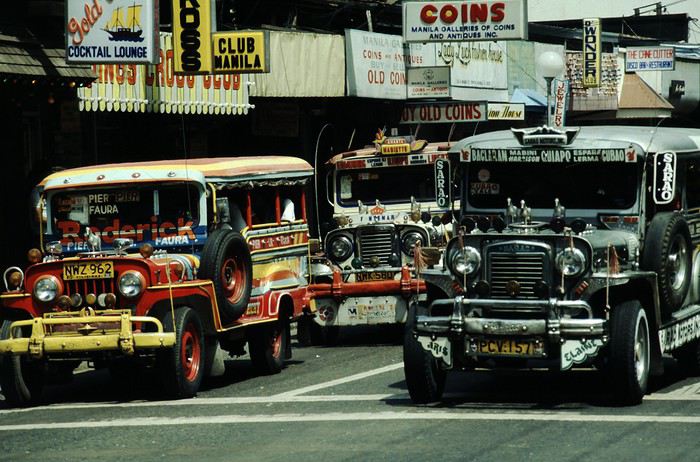
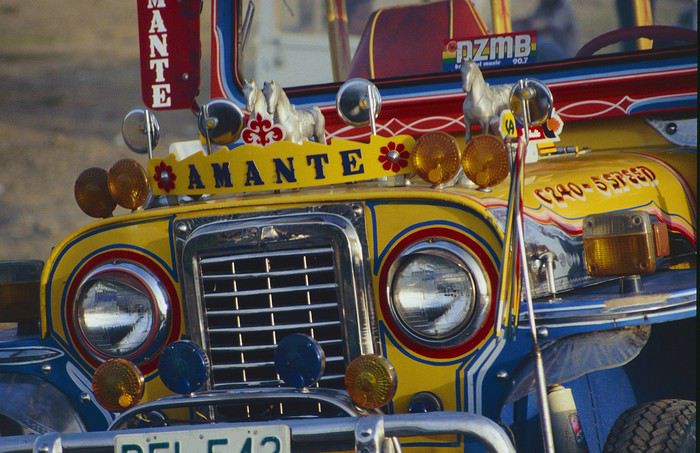
When we stepped outside, we discovered a pretty run-down neighborhood with potholed streets. But we also discovered the jeepneys. They were everywhere, flooding the streets.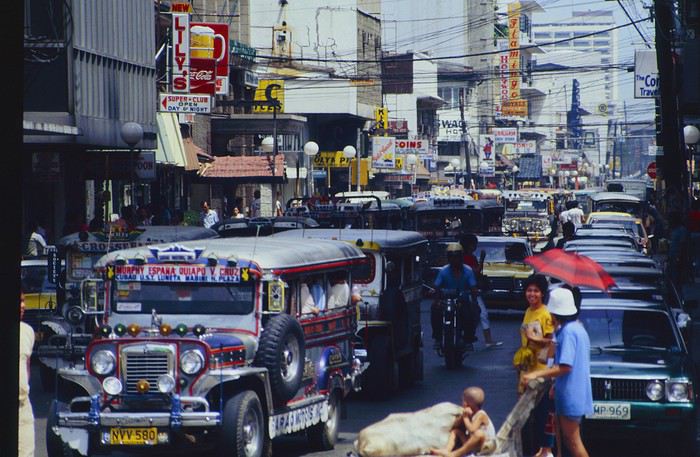
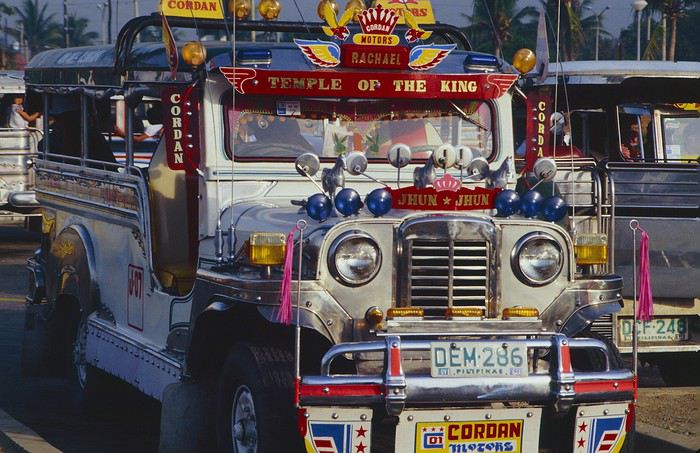
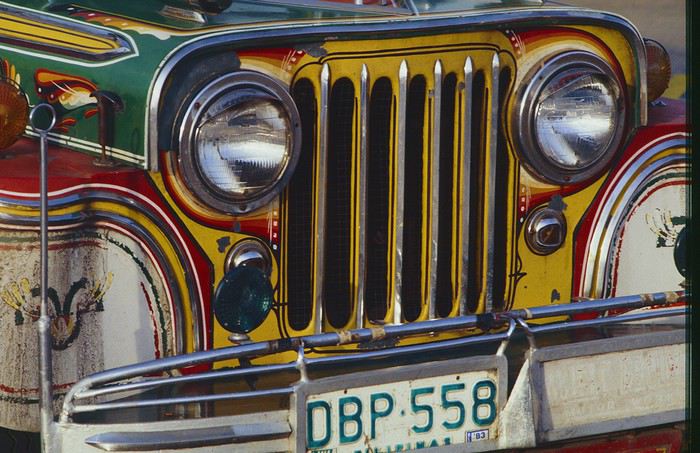
They had crazy sound systems, each one blasting louder than the last. The interiors were kitschy but fun. There weren’t many private cars—almost all transportation was by jeepney, with buses reserved for intercity trips.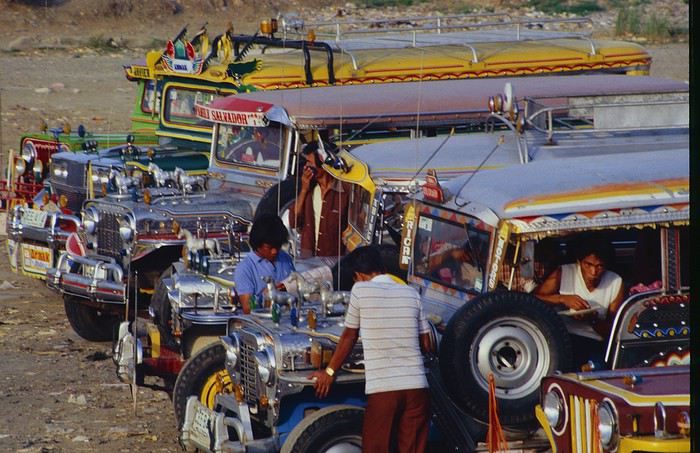
Before heading to the bus terminal for the north, somewhere on the outskirts of the city, we needed to exchange some money. I don’t remember how we ended up in a policeman’s jeep who offered his services: - Exchange money on the black market at a better rate than the banks. - Take us wherever we wanted, in this case, the bus terminal.
We accepted both offers (we’d still checked the official exchange rate from dollars to pesos). So we found ourselves in his jeep. After exchanging money, we left in his vehicle and stopped for gas. Without turning off the engine, he calmly smoked a cigarette while filling up. Since we were in a jeep with no doors or roof, we were ready to jump out if things went south, our travel bag in hand.
But we weren’t done with surprises yet. Once we left the small streets, we ended up in a neighborhood with wide avenues and not much traffic, which didn’t justify his incredible behavior. At every intersection, he made the sign of the cross, closed his eyes, and crossed without looking. I was more stunned than terrified! It wasn’t until we got out of the car later that I told Anne-Marie what had happened. I’d seen everything because the cop had put me in the front seat. Luckily, A-Marie hadn’t noticed anything from the back. Crossing Manila by trusting God rather than the rules of the road was ultimately effective. We were lucky—the trip was off to a good start. 🙂 🙂
We then passed through a neighborhood where slums stretched on for a while, and we left our policeman—friendly but a bit crazy—with relief.
A few hours by bus later, here we are in Baguio, cool in the mountains. My memories of Baguio are pretty fuzzy. I remember a small town. After some research while writing this journal, I found that the population was 120,000 in 1980. Given the population density in each home, that confirms my memory of a smallish town. Outside the “official” district with the president’s summer residence and government buildings, there were two or three paved streets with nice houses. The rest was very dirty and very poor, with lots of slums and dirt roads.
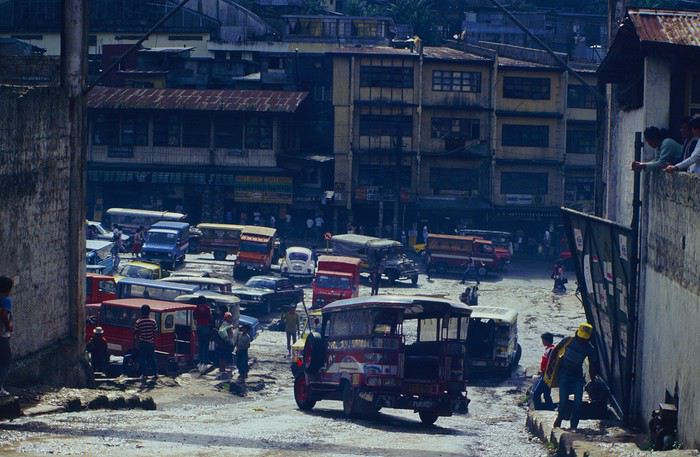
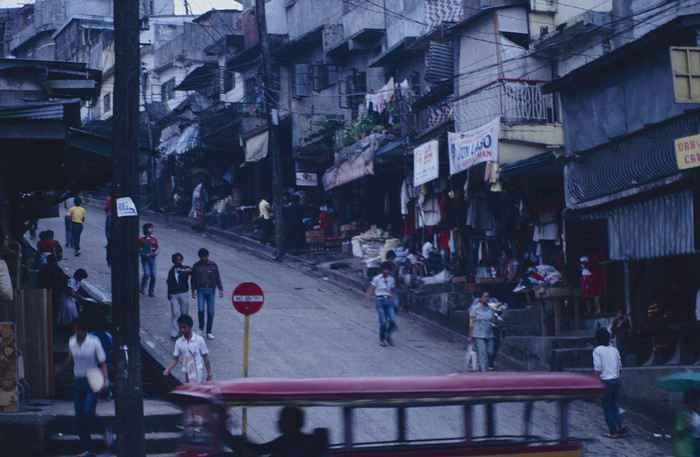
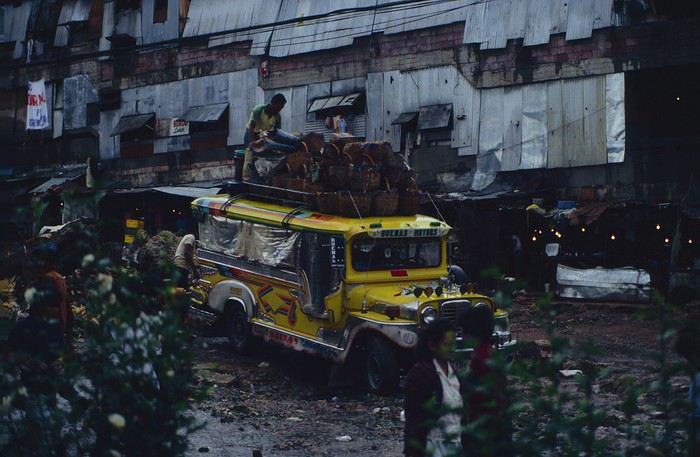
People we met on the street invited us to stay with them. These days, we wouldn’t just show up at strangers’ houses, which we should’ve done in Baguio—it would’ve saved us from an unimaginable and dangerous situation... which I won’t say anything about... !😊
The simple wooden house was on stilts at the edge of a hill with a view of the mountains. Since it was the start of the rainy season in a city that gets a lot of rain, we saw a lot of water. Our outings in town happened between downpours.
View from our lodging: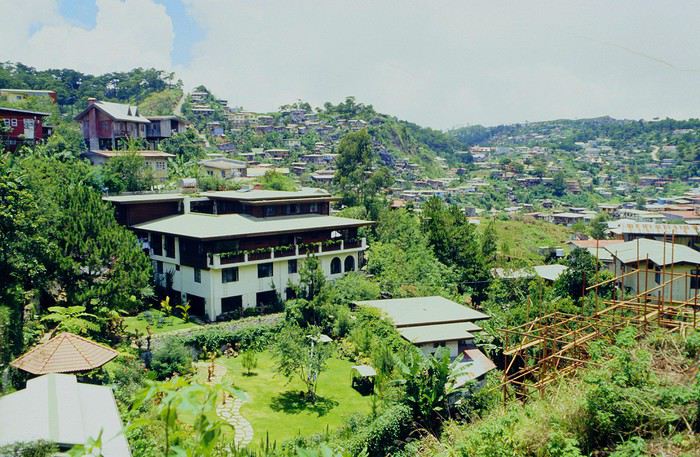
Episode 2: Baguio to Bontoc Aside from the situation briefly mentioned above, it was on the next leg to Bontoc that the adventure really began: an endless and dangerous road, a bus from another era, breathtaking landscapes, and surprising people.
We didn’t know the distance or how long it would take to get to Bontoc. When we arrived after about ten hours, we learned that Baguio to Bontoc was 140 km.
We got on a bus with wooden seats and settled in, two to a seat meant for two. As the bus filled up, passengers squeezed in three or four per seat, with chickens and baskets full of all sorts of things in the aisle. A little embarrassed, we didn’t know if we should squeeze in three on our seat. The seats were super tight (luckily, Filipinos are small), and I didn’t know where to put my legs given my height. I don’t remember if we stayed alone on our bench or if we ended up sharing with others.
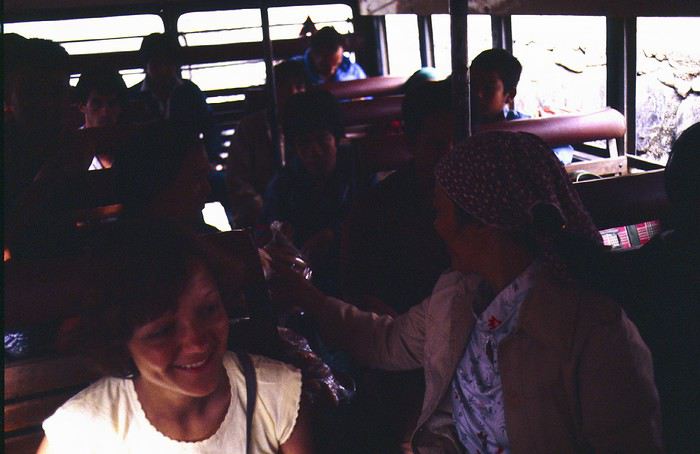
The “road” was a dirt track (or rather, a mud track) with endless turns. We held on as best we could to our slippery wooden seats—it was shaking in every direction. The woman behind us was carsick and throwing up... gross... but what were we doing there? Then we plunged into the Sierra Madre... just the name is dreamy!
Rice terraces started to appear: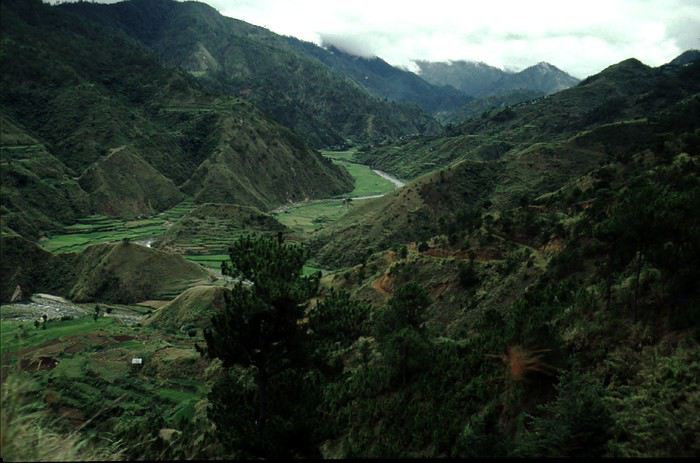
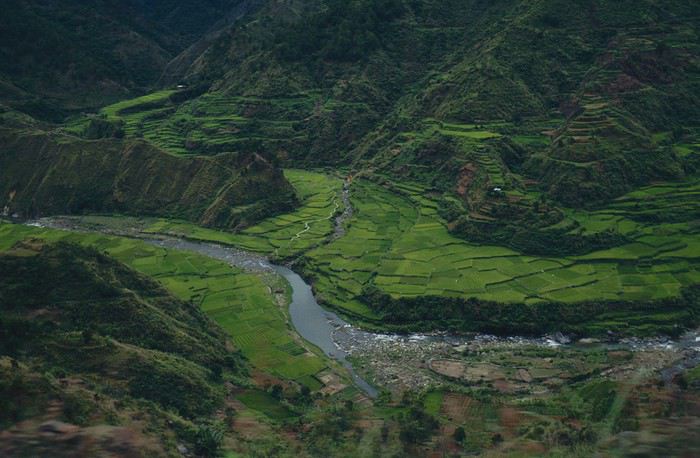
they took up more and more space along cliffs where we weren’t always reassured,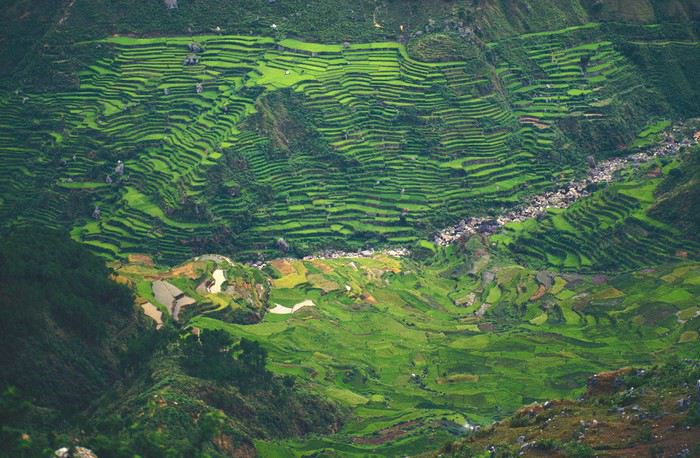
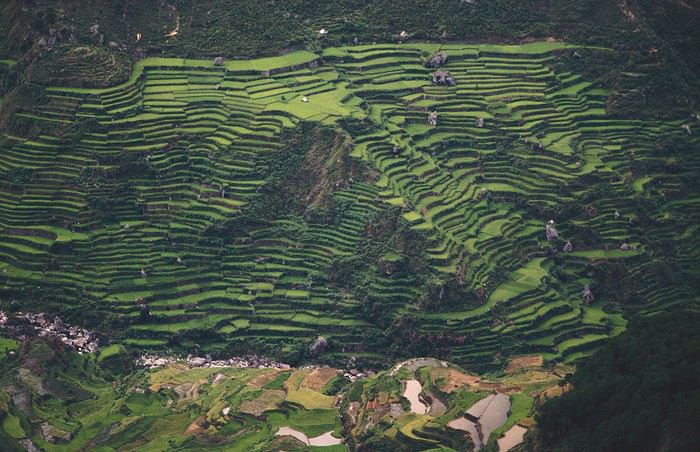
with lots of waterfalls (all that water had to go somewhere).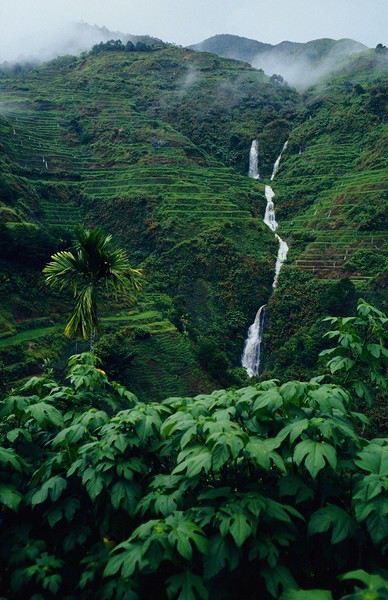
A few miserable villages stretched along the track, most often just a few houses balancing between the road and the drop. The bus stopped in every village—people got on or off and settled inside or on the roof. Street vendors offered their products to the bus passengers—a common sight in Asia, even today.
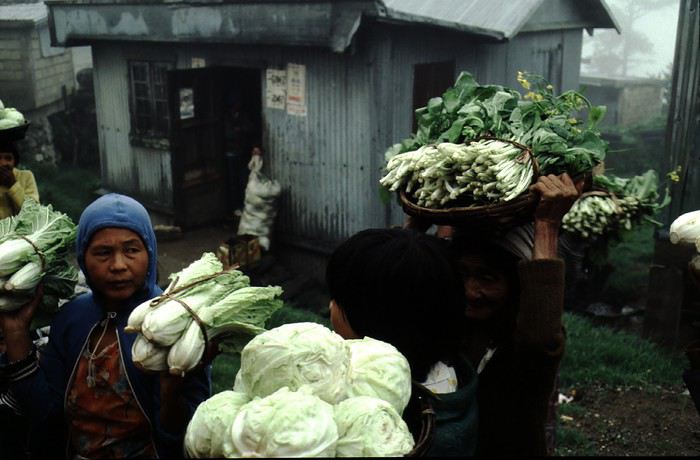
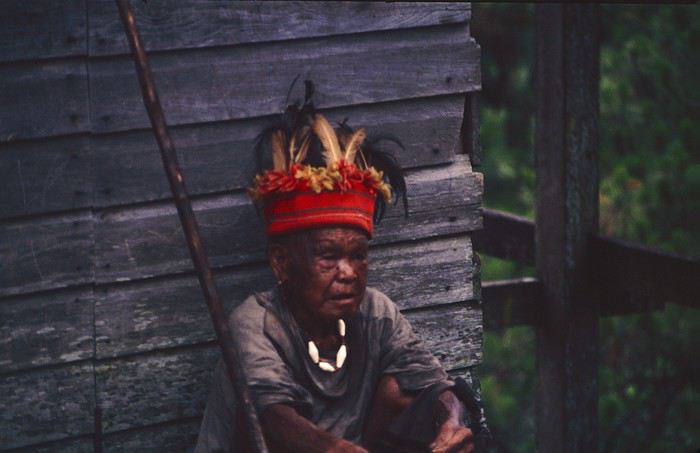
We were in another world—villagers were in loincloths, others had spears. The atmosphere was strange... but all good, we wanted exoticism, and we got it: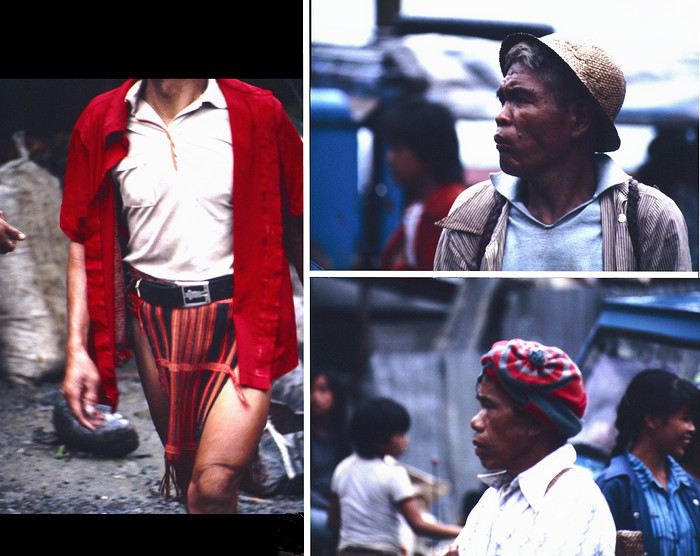
This so-called traditional outfit was everyday wear—it wasn’t for tourists since there weren’t any.
A curiosity because writing a travel journal about a trip 35 years later isn’t common, but also (mostly?) because exploring the Philippines at that time had little in common with traveling there today.
Obviously, I’ve forgotten a number of facts, most of the details, but with the help of a few notes from that time and a stack of slides (yes, there was life before digital 😊), many memories came back and added to the highlights I’d never forgotten. The scanned slides aren’t always great quality, but there are still quite a few to brighten up this chatter. Back then, we didn’t snap photos like we do now—film was too expensive—so I don’t have pictures of every place we visited... too bad, comparing some of those spots to how they look today would’ve been interesting.
Why "Adventures"? Why call it "Adventures" in the Philippines in 1984, a word so often used for a simple exotic trip? - Because the lack of information (no *Guide du Routard*, no *Lonely Planet*, no *Michelin Guide*, nothing, and obviously no internet) gave this trip what’s at the heart of adventure: the unknown. - Because the political situation made the stay sometimes dangerous. - Because transportation conditions were always epic, often perilous. - Because the question of where we’d spend the night came up almost every evening. - And for... quite a few other reasons.
That said, we weren’t exactly explorers!
Why the Philippines? First of all, why go to the Philippines in 1984—a country not exactly set up for tourism and about which we knew very little? How could we get an idea of the beauty of the Philippines and its points of interest when we had no guides or photos?
The idea came to us from Thailand a year earlier, during our first long-haul trip. After touring the north of the country, we met a Frenchman living in Phuket, where there were only a few tourists in Patong, with just a few small hotels and guesthouses. Kata and Karon had no buildings or roads, Rawai only had three palm-thatched bungalows, including ours, and the other islands were unknown to tourists. There was plenty to discover, and we wanted to return to this beautiful country... but the Frenchman made us dream about the Philippines—a country to explore, with wild landscapes.
Long evenings of discussion over multiple Sprite-Mekong cocktails (what memories of those headaches!) finally convinced us we had to go to the Philippines.
Episode 0: Before Departure The decision was made: we’d go to the Philippines in May 1984. Our friends and family were surprised when we announced we were going on vacation to the Philippines (a bit like saying today we were going paddleboarding in the Kerguelen Islands 🤪).
These days, preparing for each of our trips takes long evenings of research, planning, and noting down good addresses... etc. But for the Philippines in 1984, preparation was quick: we had very little information about the country, we were leaving almost at random, and the discovery would only be more exciting.
We still had a few bits of info gathered here and there: the rice terraces in northern Luzon, volcanoes, Negros where we were supposed to visit an acquaintance, Cebu and its marine life (we ended up going elsewhere), and absolutely avoid Mindanao, which was practically at war with the regime. That was about it, but it was already a great itinerary.
Nothing was organized in advance; we’d see day by day. We had no idea about travel times or even the existence of transportation options. The main (and sometimes only) way to connect two islands was by overloaded, rusty ferry. Only the big cities had airports.
Let’s Go: Episode 1: Paris to Manila My travel journals always start after arriving at the airport—the Europe-to-“Other Continent” trip isn’t interesting—but the flight to the Philippines was already an adventure, so I’ll make an exception.
This was the era when only a few Asian airlines were on par with Western ones: Thai, Singapore Airlines, and Philippine Airlines. They had beautiful, brand-new planes, and to attract customers (almost exclusively “businessmen”) from the usual airlines (Air France, Lufthansa, British Airways), there was opulence on board: unlimited champagne, all sorts of cocktails... Compared to today’s long-haul flights, there was still one small difference: no personal screens, just one screen at the front of the cabin with one mandatory movie. And I don’t know why, but we only got James Bond films, both ways... that must’ve been the trend at the time.
The tourism boom to Southeast Asia hadn’t started yet, and the “Asian Tigers” weren’t a thing, so there weren’t many business trips. That meant long-haul flights made stops everywhere to fill the planes. Our Philippine Airlines Boeing 747 left London, picked us up in Paris, then stopped in Frankfurt to take on a few Germans. I don’t know why we then made a stop in Dubai—a totally exotic place at the time. There was nothing to do there... things have changed a lot since. It was a small town lost in the desert. The airport was tiny, with just one or two buildings and a supermarket. During the stopover, everyone had to get off the plane and walk to the supermarket. Photo and electronic equipment were dirt cheap—I guess that was the only reason for the stop. Maybe it was their first commercial move. Emirates didn’t exist yet, as I checked online, but anyway, the idea that such a remote place could have its own airline was unthinkable.
Online, I found this photo of Dubai Airport in 1980. Anyone who’s transited through today’s massive airport with its rows of A380s will appreciate it:
Next stop: New Delhi to drop off some Europeans and pick up a few Indians, and finally, the terminus: Manila. I don’t remember how long the trip took with its five stops—an unimaginable journey today. Despite all those stops to fill the plane, there was still enough space to stretch out on the four center seats of the 747, something that never happens these days despite all the flights in every direction.
So here we are, finally at Manila Airport around midnight.
Episode 1: Manila and Baguio To start, a quick note on the political and economic situation in the Philippines in 1984, which had consequences for us as tourists, as we’d soon realize upon arrival.
After several centuries of Spanish colonization, the Philippines became American at the start of the 20th century, then independent. In 1966, Marcos took power, and little by little, his regime sank into corruption and mismanagement, becoming a dictatorship with martial law, all for the benefit of his family and friends, who enriched themselves endlessly. The peak was the assassination of opposition leader Benigno Aquino in August 1983, which triggered harshly repressed protests. So we arrived a few months later in a very poor country, with omnipresent corruption and an extremely tense political situation, as we’d soon see for ourselves. Major protests took place in the main cities during our trip—I’ll come back to that. Two years later, Marcos fled to Hawaii after being forced out of power following rigged elections. This historical context explains a lot of the situations we found ourselves in over the following weeks.
Arriving in the middle of the night isn’t very cheerful. Manila was already a huge city with many slums, where you could find a few business hotels like the Hilton or Intercontinental—way out of our budget—and plenty of run-down hotels. Luckily, two Indians we’d chatted with on the plane offered to take us to their usual hotel. They came to Manila twice a year for business. We accepted their offer, relieved not to have to look for a place to stay in the middle of the night, figuring the address must be good since they came back every time... we were wrong 🙁
We left the airport and immediately got a taste of the local vibe when we got into the taxi: the police asked for our passports. We thought: what’s more normal than police in a dictatorship?
But that wasn’t it at all. Our two Indian friends explained that the police were noting our names along with the taxi number and time. Crime in Manila was so bad that the taxi driver would be held responsible if anything happened to us... welcome to the Philippines 😎 😎
Historically, the Philippines was a very violent country, where everything was settled with guns or machetes. Previous governments had banned carrying weapons, but Marcos later allowed the free sale and carrying of guns, and disputes were settled with pistols again (or worse, as we’d discover later). Since he’d released most of the criminals from prison to form a paramilitary militia at his service (I’ll talk about our encounter with these “heroes” later), it was pretty dangerous to go into many parts of Manila, where these “tonton macoutes” ruled.
We arrived at our hotel without incident... and then things started badly. The room was infested with big cockroaches—exactly what I hate most in those kinds of countries. No way to find another hotel at that hour. After the long flight, the urge to take a shower was so strong that we squeezed into the bathroom as best we could. After that, I don’t remember—I guess we must’ve fallen asleep exhausted under the sheets in the heat... air conditioning wasn’t widespread yet.
The next day, we just wanted to leave that dump as soon as possible. So we decided to head north right away, stopping in Baguio, and we’d visit Manila a bit on the way back.
When we stepped outside, we discovered a pretty run-down neighborhood with potholed streets. But we also discovered the jeepneys. They were everywhere, flooding the streets.
They had crazy sound systems, each one blasting louder than the last. The interiors were kitschy but fun. There weren’t many private cars—almost all transportation was by jeepney, with buses reserved for intercity trips.
Before heading to the bus terminal for the north, somewhere on the outskirts of the city, we needed to exchange some money. I don’t remember how we ended up in a policeman’s jeep who offered his services: - Exchange money on the black market at a better rate than the banks. - Take us wherever we wanted, in this case, the bus terminal.
We accepted both offers (we’d still checked the official exchange rate from dollars to pesos). So we found ourselves in his jeep. After exchanging money, we left in his vehicle and stopped for gas. Without turning off the engine, he calmly smoked a cigarette while filling up. Since we were in a jeep with no doors or roof, we were ready to jump out if things went south, our travel bag in hand.
But we weren’t done with surprises yet. Once we left the small streets, we ended up in a neighborhood with wide avenues and not much traffic, which didn’t justify his incredible behavior. At every intersection, he made the sign of the cross, closed his eyes, and crossed without looking. I was more stunned than terrified! It wasn’t until we got out of the car later that I told Anne-Marie what had happened. I’d seen everything because the cop had put me in the front seat. Luckily, A-Marie hadn’t noticed anything from the back. Crossing Manila by trusting God rather than the rules of the road was ultimately effective. We were lucky—the trip was off to a good start. 🙂 🙂
We then passed through a neighborhood where slums stretched on for a while, and we left our policeman—friendly but a bit crazy—with relief.
A few hours by bus later, here we are in Baguio, cool in the mountains. My memories of Baguio are pretty fuzzy. I remember a small town. After some research while writing this journal, I found that the population was 120,000 in 1980. Given the population density in each home, that confirms my memory of a smallish town. Outside the “official” district with the president’s summer residence and government buildings, there were two or three paved streets with nice houses. The rest was very dirty and very poor, with lots of slums and dirt roads.
People we met on the street invited us to stay with them. These days, we wouldn’t just show up at strangers’ houses, which we should’ve done in Baguio—it would’ve saved us from an unimaginable and dangerous situation... which I won’t say anything about... !😊
The simple wooden house was on stilts at the edge of a hill with a view of the mountains. Since it was the start of the rainy season in a city that gets a lot of rain, we saw a lot of water. Our outings in town happened between downpours.
View from our lodging:
Episode 2: Baguio to Bontoc Aside from the situation briefly mentioned above, it was on the next leg to Bontoc that the adventure really began: an endless and dangerous road, a bus from another era, breathtaking landscapes, and surprising people.
We didn’t know the distance or how long it would take to get to Bontoc. When we arrived after about ten hours, we learned that Baguio to Bontoc was 140 km.
We got on a bus with wooden seats and settled in, two to a seat meant for two. As the bus filled up, passengers squeezed in three or four per seat, with chickens and baskets full of all sorts of things in the aisle. A little embarrassed, we didn’t know if we should squeeze in three on our seat. The seats were super tight (luckily, Filipinos are small), and I didn’t know where to put my legs given my height. I don’t remember if we stayed alone on our bench or if we ended up sharing with others.
The “road” was a dirt track (or rather, a mud track) with endless turns. We held on as best we could to our slippery wooden seats—it was shaking in every direction. The woman behind us was carsick and throwing up... gross... but what were we doing there? Then we plunged into the Sierra Madre... just the name is dreamy!
Rice terraces started to appear:
they took up more and more space along cliffs where we weren’t always reassured,
with lots of waterfalls (all that water had to go somewhere).
A few miserable villages stretched along the track, most often just a few houses balancing between the road and the drop. The bus stopped in every village—people got on or off and settled inside or on the roof. Street vendors offered their products to the bus passengers—a common sight in Asia, even today.
We were in another world—villagers were in loincloths, others had spears. The atmosphere was strange... but all good, we wanted exoticism, and we got it:
This so-called traditional outfit was everyday wear—it wasn’t for tourists since there weren’t any.
Vol annulé par la compagnie aérienne: remboursement et non bon d'achat méthode à suivre English translation pending
Bonjour,
Si on peut comprendre que les compagnies aériennes soient en difficulté, on ne peut pas non plus oublier que les passagers peuvent l'être aussi ! En ce qui me concerne, mon rapatriement de République Dominicaine m'a coûté 1100 euros environ ! Et il y en a plein d'autres qui, n'ayant pas pu être rapatriés, voient, bloqués sur place, leurs budget vacances exploser avec, pour couronner le tout, les hôtels qui ferment les uns après les autres....
Et sans parler de tous ceux qui, en raison du confinement, subissent une perte importante de pouvoir d'achat.
Par ailleurs, imposer un bon d'achat d'un montant égal au montant du vol annulé n'est pas acceptable. En effet, outre les contraintes qu'il impose, il empêche de faire jouer la concurrence et donc, impose de payer plus cher un futur billet d'avion.
C'est pourquoi un bon d'achat n'est acceptable que si, et uniquement si, il est d'un montant largement supérieur au remboursement.
Pour ceux qui se verraient opposer un refus de remboursement, allez voir la méthode à suivre là : http://retardimportantavion.unblog.fr/vols-annules-pour-coronavirus-remboursement-et-non-bon-dachat/
Cordialement
Si on peut comprendre que les compagnies aériennes soient en difficulté, on ne peut pas non plus oublier que les passagers peuvent l'être aussi ! En ce qui me concerne, mon rapatriement de République Dominicaine m'a coûté 1100 euros environ ! Et il y en a plein d'autres qui, n'ayant pas pu être rapatriés, voient, bloqués sur place, leurs budget vacances exploser avec, pour couronner le tout, les hôtels qui ferment les uns après les autres....
Et sans parler de tous ceux qui, en raison du confinement, subissent une perte importante de pouvoir d'achat.
Par ailleurs, imposer un bon d'achat d'un montant égal au montant du vol annulé n'est pas acceptable. En effet, outre les contraintes qu'il impose, il empêche de faire jouer la concurrence et donc, impose de payer plus cher un futur billet d'avion.
C'est pourquoi un bon d'achat n'est acceptable que si, et uniquement si, il est d'un montant largement supérieur au remboursement.
Pour ceux qui se verraient opposer un refus de remboursement, allez voir la méthode à suivre là : http://retardimportantavion.unblog.fr/vols-annules-pour-coronavirus-remboursement-et-non-bon-dachat/
Cordialement
Road-Trip en solo dans l'Ouest américain en septembre 2019 English translation pending
Bonjour à tous, comme beaucoup d’entre vous, je me retrouve en repos forcé, ça va être très difficile.. J’ai beaucoup consulté ce forum, et beaucoup d’entre vous m’ont persuadé sans le savoir de voyager. Je vous en remercie. Comme j’ai du temps je me lance à mon tour dans la rédaction d’un carnet de voyage. Pour les photos, je ne suis pas un pro, il y en a de très belles sur de nombreux sites, je souhaitais juste quelques souvenirs et ne pas passer mon temps à mitrailler pour profiter. Avec le souhait que cela donne envie à d’autres de faire leurs valises.
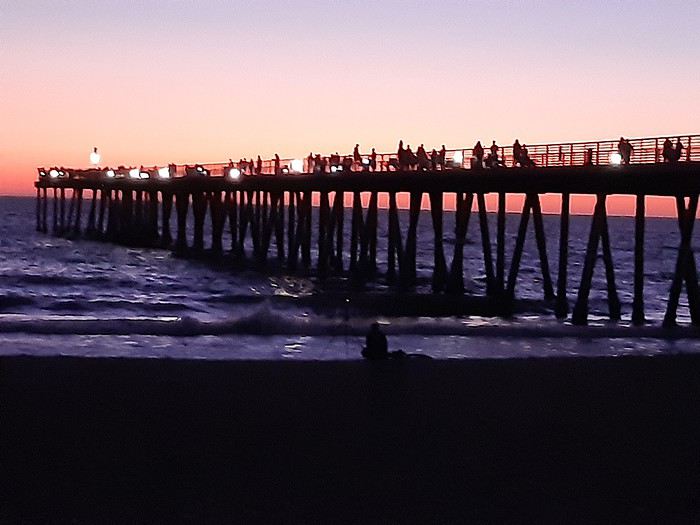
Je me présente : Laurent, 44 ans, j’habite La Rochelle où j’aiguille les trains. Je vis dehors en permanence : natation en mer, vélo, marche, cafés et pique-niques entre amis au bord de mer je ne suis pas fan de shopping, musées et parcs d’attractions. Je suis parti dans l’ouest américain en septembre 2019 : Californie, Arizona, Utah, Nevada. C’est un voyage qui me trottait dans la tête depuis un petit moment. J’ai hésité à partir seul j’avais tendu des perches qui n’ont pas été saisies. En fait cela ne m’inquiétait pas de partir seul et je pourrai aller à mon rythme selon mes envies. J’avais besoin de faire une pause. En février 2019 je suis sur Skyscanner sans savoir que 10mn plus tard ce serait parti pour un road-trip aux USA de 18 jours.
Je tombe sur un vol AR United Airlines Paris – San-Francisco à 415 euros, sans escale avec bagage. J’hésite (pas longtemps) et hop billet pris. En 48 h j’affine le parcours et là : Frustration (pas désagréable) ! Il devient évident que d’autres voyages seront nécessaires : il y a le budget (je pars seul donc ce sera cher), le temps, et surtout les concessions : il y a trop de choses à voir et à faire je le verrai pendant les six mois de préparation. Ce qui est magique en fait !!!
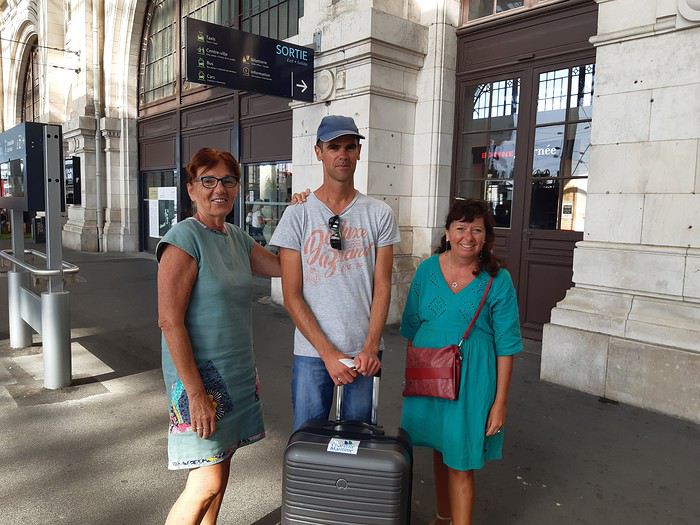
Jour 0 : 17 septembre La Rochelle – Paris Je me retrouve donc sur le quai de la gare de La Rochelle, deux amies m’ont accompagné, avec une valise pas trop lourde (16kgs) et un sac à dos. Je pars peu en vacances, je ne réalise pas, je flotte. Je n’ai aucune inquiétude. Je dormirai chez mes parents en banlieue ce soir. Tout se passe bien.
Jour 1 : 18 Septembre Une longue et belle journée Paris – San-Francisco
Départ pour Roissy à 5h00 avant les bouchons, tout s’enchaîne super bien, pas d’attente, pas de stress, je change la carte Sim de mon téléphone, embarquement, installation et décollage à l’heure 9h15. Je suis assis au hublot, 15mn après on survole Boulogne-sur-Mer, en 3mn c’est Folkestone. Le voyage a vraiment commencé. Les nuages s’effaceront au dessus du Groenland puis au bout de 11h, voilà enfin l’Océan Pacifique avec les forêts de l’Oregon. Puis c’est la descente vers l’aéroport. Dommage le temps est un peu nuageux. Il est 11h30, je débarque à San-Francisco en Californie en 15 mn je passe la douane, je récupère ma valise et je me retrouve sur le quai du BART (le RER de San Francisco). Nous sommes plusieurs français dubitatifs devant le distributeur de billets. Explication : sur le ticket, il n’y a pas de destination mais un prix. On regarde sur un tableau sa destination, et on sélectionne un ticket au prix correspondant, si on n’a pas payé assez on ne peut pas sortir.
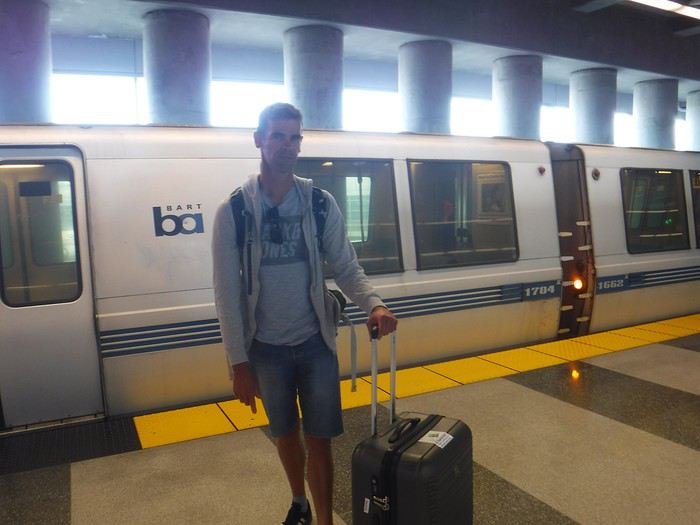 Je descends à la station « 16th Street Mission », je monte l’escalier et je me retrouve dans la série « Les Rues de San Francisco ». De vieux immeubles typiques, le drapeau américain, des sdf avec leurs cabats, une odeur de marijuana, des voitures de police. C’est sûr je suis aux USA mais tout est tranquille, il n’y aucune agressivité. Je trouve mon bus pour « Van Ness Avenue et Bay Street » le 49.
San-Francisco, ça monte et ça descend, à l’avant des bus il y a des supports où les gens peuvent installer leur vélo, je n’en reviens pas. Après 20mn, la baie de San-Francisco apparait. Je descends, j’ai 10mn de marche jusqu’à l’auberge de jeunesse « HI San Francisco Fisherman’s Warf Hostel » de Fort-Mason. Le soleil joue à cache-cache avec les nuages, il fait doux, ce n’est pas la même ambiance qu’à la sortie du BART. Sur la droite, il y a une plage avec des gradins, l’Ile d’Alcatraz est à sa place, je monte une côte dans une rue piétonne et arborée et je me retrouve face au Golden-Gate. C’est surréaliste
Je ne suis jamais allé en auberge de jeunesse. Un copain qui me connait bien m’avait mis en garde, « Ce n’est pas pour toi !». Je garde un souvenir amusé mais il avait raison, nous en reparlerons.
J’arrive donc à l’auberge de jeunesse, accueil super sympa, chambre sommaire mais propre, quatre lits qui semblent confortables. Il est à peine 13h30 j’ai le temps de profiter de l’après-midi. Je vais prendre une douche et là, premiers doutes. Une grande pièce avec trois WC fermés ni en haut, ni en bas, une rangée de lavabos et une douche au fond seulement fermée par un rideau… A cette heure pas de soucis, il n’y a personne.
Je prends des renseignements pour louer un vélo le lendemain et je pars découvrir Fisherman’s Warf. 4h de promenade, je ne vois pas le temps passer. Plusieurs jetées, la vue sur Alcatraz, les otaries qui se prélassent, Lombard Street avec ses lacets. Une petite déception, le cable-car est en maintenance depuis deux semaines et pour encore 3 jours et je serai parti. Vers 17h je commence sérieusement à avoir faim, pas très original mais pour le premier soir ce sera pizza face à la mer. La fatigue commence à se faire sentir mais le temps s’est dégagé et je vais pouvoir profiter d’un beau coucher de soleil sur le Golden-Gate et les anciens docks.
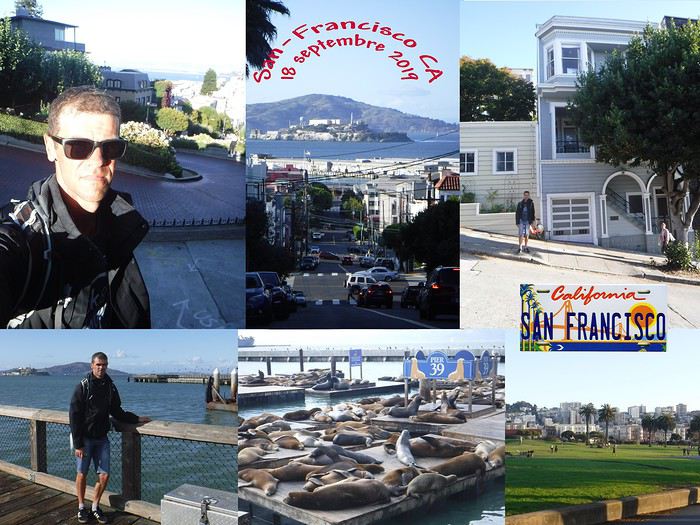
Je rejoins l’auberge de jeunesse, dans la chambre un italien, qui part randonner et faire du paddle au Lac Tahoe (une bonne idée) . Nous engageons la conversation. Je parle anglais comme une clef à molette mais j’arrive à bien comprendre. La fatigue arrive, ça fait 35h que je suis réveillé. Lavage de dents et joies de l’auberge, un gars est en train de caguer bruyamment. Pas très glop. Puis la nuit sera courte 2h se sommeil au maximum malgré les bouchons d’oreilles et le masque de nuit. Le décalage horaire, un ronfleur et un japonais qui se lèvera quinze fois. On m’avait prévenu…
Jour 2: 19 septembre Une journée en plein air à San-Francisco
Mon manque de sommeil n'entame pas ma bonne humeur ce matin, il fait un temps magnifique, je vais en profiter. Le petit déjeuner de l'auberge tarde et je décide de le prendre sur le Warf. Il sera très copieux au Boudin Bakery Cafe.
Puis je me rends chez Blazing Saddles Bikes où je loue un VTC , j'ai une réduction par l'intermédiaire de l'AJ (c'est déjà ça) et un retour en bac depuis l'autre côté de la baie. C'est donc parti pour une cinquantaine de kilomètres. Je suis habitué du vélo à La Rochelle et dans le Marais Poitevin où les dénivelés sont proches de "0 "mais à SF c'est un peu différent, ça compte double😉😉😉.
Je prends le chemin du Golden-Gate, sur des pistes cyclables le long du "Marina Blvd" il n'y a pas grand monde, il fait doux, beaucoup d'espace verts. J'arrive jusqu'au pied du pont, mais j'y passerai plus tard. je continue le long de la côte en direction d'"Ocean Beach" , une plage immense très sauvage aux portes de la ville. Il y a surtout des surfers. Ce n'est pas conseillé de se baigner car il y a beaucoup de rouleaux. Mais je ne résiste pas longtemps à tremper mes pieds dans l'Océan Pacifique!!! Après ce bon bol d'air je file dans le Golden Gate Park et je rejoins le Golden Gate par le Presidio. Par moment on se croit en Provence ou en Bretagne, on ne sent pas en ville, il y a plusieurs points de vue sur la baie et le large.
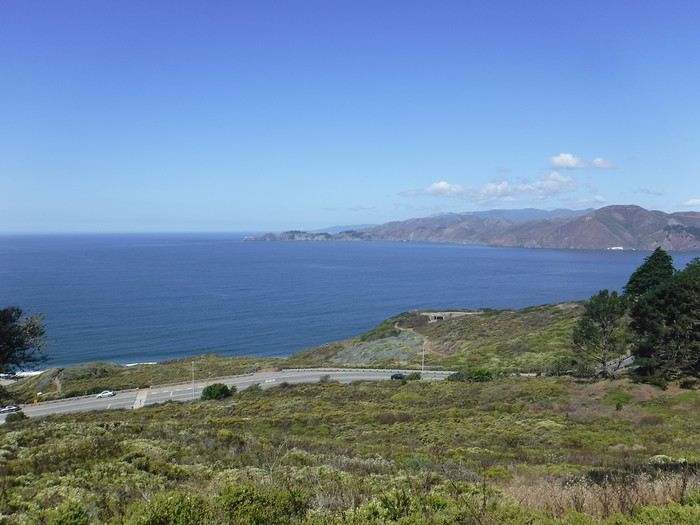
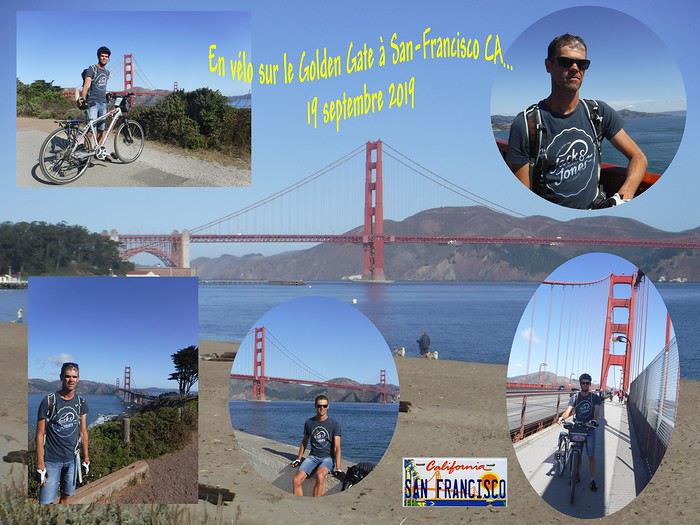 Il est temps de franchir le Golden Gate, cela prendra une dizaine de minutes, c'est très sympa malgré le vacarme des voitures. Ensuite je décide de rejoindre Sausalito et Tiburon pour faire la balade complète. Je m'attendais à un peu mieux car la piste n'est jamais très loin de l'autoroute et Sausalito n'est qu'une Marina avec des restaurants. En arrivant à l'embarcadère de Tiburon, il fait chaud, un Coca sera le bienvenue. La traversée est la récompense du trajet en vélo. Il y a peu de personnes au départ de Tiburon mais à Sausalito le bac se remplit. je peux contempler Angel's Island et Alcatraz.
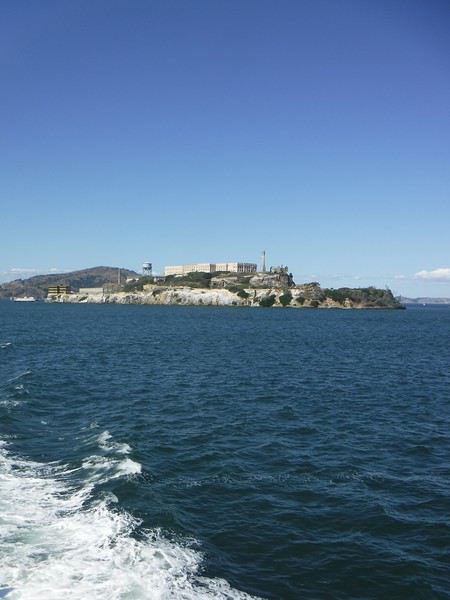 C'est très content de cette promenade que je rends le vélo. le matin j'avais discuté avec des triathlètes voyant quelques nageurs à la plage près de Fort-Mason, l'eau y est à 17°, on me dit quand même de venir avec le strict minimum pour éviter les vols. une grand-mère qui tricote sur les gradins me gardera mes affaires. Je nage 30mn, ça fait vraiment du bien. A 30m de la plage deux jeunes otaries s'amusent .
 Je terminerai la soirée en allant vers la "Coit Tower" déjà fermée puis en profitant d'un nouveau merveilleux coucher de soleil. Je passe au Safeway faire quelques courses pour le voyage de demain. Ce soir, j'ai changé de chambre, je la partage avec un australien, un italien et un américain. La salle de bain n'est pas la même, il y a plusieurs douches séparées par un simple rideau. Ce n'est vraiment pas pour moi. Mais à l'extinction des feux, miracle, pas un bruit...
Ce ne sera que de courte durée, deux personnes parlent dans le couloir. Et cela durera une bonne partie de la nuit. vers 3h je sors, il s'agit de deux jeunes (un gars une fille)de 20 ans qui discutent. En fait je ne leur dirait rien, cela me fait rire, de toute manière je me lève à 5h. La nuit est fichue...
Je terminerai la soirée en allant vers la "Coit Tower" déjà fermée puis en profitant d'un nouveau merveilleux coucher de soleil. Je passe au Safeway faire quelques courses pour le voyage de demain. Ce soir, j'ai changé de chambre, je la partage avec un australien, un italien et un américain. La salle de bain n'est pas la même, il y a plusieurs douches séparées par un simple rideau. Ce n'est vraiment pas pour moi. Mais à l'extinction des feux, miracle, pas un bruit...
Ce ne sera que de courte durée, deux personnes parlent dans le couloir. Et cela durera une bonne partie de la nuit. vers 3h je sors, il s'agit de deux jeunes (un gars une fille)de 20 ans qui discutent. En fait je ne leur dirait rien, cela me fait rire, de toute manière je me lève à 5h. La nuit est fichue...
Je me présente : Laurent, 44 ans, j’habite La Rochelle où j’aiguille les trains. Je vis dehors en permanence : natation en mer, vélo, marche, cafés et pique-niques entre amis au bord de mer je ne suis pas fan de shopping, musées et parcs d’attractions. Je suis parti dans l’ouest américain en septembre 2019 : Californie, Arizona, Utah, Nevada. C’est un voyage qui me trottait dans la tête depuis un petit moment. J’ai hésité à partir seul j’avais tendu des perches qui n’ont pas été saisies. En fait cela ne m’inquiétait pas de partir seul et je pourrai aller à mon rythme selon mes envies. J’avais besoin de faire une pause. En février 2019 je suis sur Skyscanner sans savoir que 10mn plus tard ce serait parti pour un road-trip aux USA de 18 jours.
Je tombe sur un vol AR United Airlines Paris – San-Francisco à 415 euros, sans escale avec bagage. J’hésite (pas longtemps) et hop billet pris. En 48 h j’affine le parcours et là : Frustration (pas désagréable) ! Il devient évident que d’autres voyages seront nécessaires : il y a le budget (je pars seul donc ce sera cher), le temps, et surtout les concessions : il y a trop de choses à voir et à faire je le verrai pendant les six mois de préparation. Ce qui est magique en fait !!!
Jour 0 : 17 septembre La Rochelle – Paris Je me retrouve donc sur le quai de la gare de La Rochelle, deux amies m’ont accompagné, avec une valise pas trop lourde (16kgs) et un sac à dos. Je pars peu en vacances, je ne réalise pas, je flotte. Je n’ai aucune inquiétude. Je dormirai chez mes parents en banlieue ce soir. Tout se passe bien.
Jour 1 : 18 Septembre Une longue et belle journée Paris – San-Francisco
Départ pour Roissy à 5h00 avant les bouchons, tout s’enchaîne super bien, pas d’attente, pas de stress, je change la carte Sim de mon téléphone, embarquement, installation et décollage à l’heure 9h15. Je suis assis au hublot, 15mn après on survole Boulogne-sur-Mer, en 3mn c’est Folkestone. Le voyage a vraiment commencé. Les nuages s’effaceront au dessus du Groenland puis au bout de 11h, voilà enfin l’Océan Pacifique avec les forêts de l’Oregon. Puis c’est la descente vers l’aéroport. Dommage le temps est un peu nuageux. Il est 11h30, je débarque à San-Francisco en Californie en 15 mn je passe la douane, je récupère ma valise et je me retrouve sur le quai du BART (le RER de San Francisco). Nous sommes plusieurs français dubitatifs devant le distributeur de billets. Explication : sur le ticket, il n’y a pas de destination mais un prix. On regarde sur un tableau sa destination, et on sélectionne un ticket au prix correspondant, si on n’a pas payé assez on ne peut pas sortir.
Je descends à la station « 16th Street Mission », je monte l’escalier et je me retrouve dans la série « Les Rues de San Francisco ». De vieux immeubles typiques, le drapeau américain, des sdf avec leurs cabats, une odeur de marijuana, des voitures de police. C’est sûr je suis aux USA mais tout est tranquille, il n’y aucune agressivité. Je trouve mon bus pour « Van Ness Avenue et Bay Street » le 49.San-Francisco, ça monte et ça descend, à l’avant des bus il y a des supports où les gens peuvent installer leur vélo, je n’en reviens pas. Après 20mn, la baie de San-Francisco apparait. Je descends, j’ai 10mn de marche jusqu’à l’auberge de jeunesse « HI San Francisco Fisherman’s Warf Hostel » de Fort-Mason. Le soleil joue à cache-cache avec les nuages, il fait doux, ce n’est pas la même ambiance qu’à la sortie du BART. Sur la droite, il y a une plage avec des gradins, l’Ile d’Alcatraz est à sa place, je monte une côte dans une rue piétonne et arborée et je me retrouve face au Golden-Gate. C’est surréaliste
Je ne suis jamais allé en auberge de jeunesse. Un copain qui me connait bien m’avait mis en garde, « Ce n’est pas pour toi !». Je garde un souvenir amusé mais il avait raison, nous en reparlerons.
J’arrive donc à l’auberge de jeunesse, accueil super sympa, chambre sommaire mais propre, quatre lits qui semblent confortables. Il est à peine 13h30 j’ai le temps de profiter de l’après-midi. Je vais prendre une douche et là, premiers doutes. Une grande pièce avec trois WC fermés ni en haut, ni en bas, une rangée de lavabos et une douche au fond seulement fermée par un rideau… A cette heure pas de soucis, il n’y a personne.
Je prends des renseignements pour louer un vélo le lendemain et je pars découvrir Fisherman’s Warf. 4h de promenade, je ne vois pas le temps passer. Plusieurs jetées, la vue sur Alcatraz, les otaries qui se prélassent, Lombard Street avec ses lacets. Une petite déception, le cable-car est en maintenance depuis deux semaines et pour encore 3 jours et je serai parti. Vers 17h je commence sérieusement à avoir faim, pas très original mais pour le premier soir ce sera pizza face à la mer. La fatigue commence à se faire sentir mais le temps s’est dégagé et je vais pouvoir profiter d’un beau coucher de soleil sur le Golden-Gate et les anciens docks.
Je rejoins l’auberge de jeunesse, dans la chambre un italien, qui part randonner et faire du paddle au Lac Tahoe (une bonne idée) . Nous engageons la conversation. Je parle anglais comme une clef à molette mais j’arrive à bien comprendre. La fatigue arrive, ça fait 35h que je suis réveillé. Lavage de dents et joies de l’auberge, un gars est en train de caguer bruyamment. Pas très glop. Puis la nuit sera courte 2h se sommeil au maximum malgré les bouchons d’oreilles et le masque de nuit. Le décalage horaire, un ronfleur et un japonais qui se lèvera quinze fois. On m’avait prévenu…
Jour 2: 19 septembre Une journée en plein air à San-Francisco
Mon manque de sommeil n'entame pas ma bonne humeur ce matin, il fait un temps magnifique, je vais en profiter. Le petit déjeuner de l'auberge tarde et je décide de le prendre sur le Warf. Il sera très copieux au Boudin Bakery Cafe.
Puis je me rends chez Blazing Saddles Bikes où je loue un VTC , j'ai une réduction par l'intermédiaire de l'AJ (c'est déjà ça) et un retour en bac depuis l'autre côté de la baie. C'est donc parti pour une cinquantaine de kilomètres. Je suis habitué du vélo à La Rochelle et dans le Marais Poitevin où les dénivelés sont proches de "0 "mais à SF c'est un peu différent, ça compte double😉😉😉.
Je prends le chemin du Golden-Gate, sur des pistes cyclables le long du "Marina Blvd" il n'y a pas grand monde, il fait doux, beaucoup d'espace verts. J'arrive jusqu'au pied du pont, mais j'y passerai plus tard. je continue le long de la côte en direction d'"Ocean Beach" , une plage immense très sauvage aux portes de la ville. Il y a surtout des surfers. Ce n'est pas conseillé de se baigner car il y a beaucoup de rouleaux. Mais je ne résiste pas longtemps à tremper mes pieds dans l'Océan Pacifique!!!
Après ce bon bol d'air je file dans le Golden Gate Park et je rejoins le Golden Gate par le Presidio. Par moment on se croit en Provence ou en Bretagne, on ne sent pas en ville, il y a plusieurs points de vue sur la baie et le large.
Il est temps de franchir le Golden Gate, cela prendra une dizaine de minutes, c'est très sympa malgré le vacarme des voitures. Ensuite je décide de rejoindre Sausalito et Tiburon pour faire la balade complète. Je m'attendais à un peu mieux car la piste n'est jamais très loin de l'autoroute et Sausalito n'est qu'une Marina avec des restaurants. En arrivant à l'embarcadère de Tiburon, il fait chaud, un Coca sera le bienvenue. La traversée est la récompense du trajet en vélo. Il y a peu de personnes au départ de Tiburon mais à Sausalito le bac se remplit. je peux contempler Angel's Island et Alcatraz.
C'est très content de cette promenade que je rends le vélo. le matin j'avais discuté avec des triathlètes voyant quelques nageurs à la plage près de Fort-Mason, l'eau y est à 17°, on me dit quand même de venir avec le strict minimum pour éviter les vols. une grand-mère qui tricote sur les gradins me gardera mes affaires. Je nage 30mn, ça fait vraiment du bien. A 30m de la plage deux jeunes otaries s'amusent .
Je terminerai la soirée en allant vers la "Coit Tower" déjà fermée puis en profitant d'un nouveau merveilleux coucher de soleil. Je passe au Safeway faire quelques courses pour le voyage de demain. Ce soir, j'ai changé de chambre, je la partage avec un australien, un italien et un américain. La salle de bain n'est pas la même, il y a plusieurs douches séparées par un simple rideau. Ce n'est vraiment pas pour moi. Mais à l'extinction des feux, miracle, pas un bruit...
Ce ne sera que de courte durée, deux personnes parlent dans le couloir. Et cela durera une bonne partie de la nuit. vers 3h je sors, il s'agit de deux jeunes (un gars une fille)de 20 ans qui discutent. En fait je ne leur dirait rien, cela me fait rire, de toute manière je me lève à 5h. La nuit est fichue...On part en vadrouille dans l'ouest américain! Oui, encore... English translation pending
En ces temps difficiles qui nous obligent à trouver des occupations, je vous soumets ici un carnet que j'avais rédigé il y a quelques années et que je n'ai jamais publié ici... Bonne lecture (pour ceux que ça intéresse...)...
24 juillet - Itinéraire d’une famille gâtée
Envie de t’évader ? Envie de rêver ? Envie de t’amuser ? Oui ? Alors tu as frappé à la bonne adresse... Plus précisément à l’adresse de celui qui a attrapé un virus… En l’occurrence, moi… Et ce virus, pas question de m’en débarrasser en me bourrant d’antibiotiques. Non seulement, les antibiotiques, ce n’est pas automatique, mais ce virus-là, j’en prends grand soin. Je l’entretiens, même… Ce virus, c’est l’étasunite ! Je l’ai contracté le jour où j’ai posé mes arpions chez l’oncle Sam pour la première fois, il y a une décennie de cela. Tout ça ne me rajeunit pas mais depuis ce fameux jour, lui et moi, nous ne nous sommes plus jamais quittés. Un proverbe dit à ce sujet que si tu vas aux Etats-Unis une fois, tu y reviendras un jour… Ben moi, depuis, j’y suis même retourné deux autres fois ! Et figure-toi que si tu lis ces quelques lignes, c’est que je m’apprête à y retourner pour une quatrième vadrouille !... Pour cette fois-ci, je vais accomplir un de mes rêves ! Me faire la route 66 sur mon Harley avec une belle brune accrochée à ma taille... Manque de bol, ma femme est blonde, je n'ai pas le permis moto et nous avons deux louloutes de quatre et sept ans… Va donc falloir que je revoie mes plans...
Bon, si tu es un lecteur assidu de nos précédentes vadrouilles, nous n’avons plus de secret pour toi, si bien que tu sais déjà que nous sommes quatre, juste un an de plus par rapport à la dernière fois… Il y a bien évidemment Sandrine, ma femme alias le portefeuille ; Sasha, notre petite globetrotteuse de quatre ans ; et Anna notre routarde de sept ans et plus toutes ses dents... Ah, et je m’oubliais ! Moi, Franck, la trentaine bien tassée, alias le conducteur, le tour opérateur, le narrateur, le cuisinier, le… Oui, je sais, moi aussi, j’aimerais bien déléguer… Ah, mais j’oublie encore quelqu’un !… Toi… Mais bon, sauf le respect que je te dois, tu ne seras une nouvelle fois que le spectateur du film que nous allons tourner et interpréter… D’ailleurs, quel en sera le titre ?... Et bien après réflexion, on a le choix entre « Voyage entre geysers et déserts », ou alors « Sous le soleil de Beverly Hills »… Pour ce coup-là, en espérant ne pas les vexer, on décide de poser un lapin à Brandon et Brenda… Car oui, c’est décidé, cette nouvelle édition sera composée d'indiens, de geysers, de trappeurs, de pionniers, de bisons, de chercheurs d'or, de hors-la-loi, de ranchs et de cowboys ! A nous les grands espaces… et les gros hamburgers !!! A nous l’ouest américain et ses films qui donnent tant envie : Délivrance, la colline a des yeux, Shining, The Descent, ...
Mais un voyage comme celui-là, ça se prépare un ‘tiot peu. Premièrement, il faut du blé, du flouze, du fric, du pognon, des pépettes, de la caillasse… Ben oui, ça coûte cher tout ça, donc à moins de faire comme le PSG et te faire subventionner par un investisseur qatari, il va falloir que tu en mettes de côté. Deuxièmement, il faut un minimum de travail de préparation. Et je commencerai mon histoire par un retour dans le passé, un bond dans le temps pour revenir pile poil au moment où Sandrine a enfin craqué sous mes coups de butoir et m’a donné son ô combien précieuse approbation… « Allez, ok, c’est bon, fais-toi plaisir ! » Sans avoir réellement conscience de la portée de ces quelques mots, elle venait de me signer un contrat de travail d’un an ! Car moi, ni une, ni deux, j'ai employé toute une équipe de lutins pour m'aider à préparer mon itinéraire. Lecture de carnets de voyage, questions sur des forums, épluchage de guides, visionnage de films, essorage d’internet, … Au final, je dois dire que je suis plus que satisfait de leur boulot ! Ce qui me permet non pas de faire un bilan puisqu'heureusement, le voyage n'est pas commencé, mais plutôt un petit compte-rendu chiffré de ce qui nous attend. Huit états à traverser ou à effleurer, plus de cinq mille kilomètres à parcourir, vingt jours pleins sur place, deux hôtels, quatorze campings différents, huit heures de décalage... Mes trois blondes vont-elles le supporter ? Optimiste que je suis, je mise sur un grand « Oui » ! D’ailleurs, pour les préparer, j’ai mis en place un programme intensif trois mois avant le départ : Marche autour de notre immense propriété, westerns tous les soirs, Coca et hamburgers à volonté à tous les repas !... Et oui, qui ménage sa monture voyage plus souvent !
Avant de tailler la route, je profite de cette intro pour publier une petite annonce à destination des cambrioleurs amateurs de textes de voyage : passez votre route, ma maison est équipée d’une alarme biométrique avec double varifocale et matrice de commutation. De plus, j’ai loué à un pote du neuf trois son gros pitbull pour l’occasion. Sans compter que pendant nos vacances, ma maison va être occupée par mes parents qui sont tous les deux experts en arts martiaux !... D’ailleurs, pourquoi je te raconte ces bobards alors que tu ne connais même pas mon adresse… C'est le 25, avenue des canaris à Triffouillis-sur-Retourne... Euh, merci de ne pas m’envoyer de carte postale à l'adresse ci-dessus... c'est une fausse !
Bon, chut, ça y est, c’est l’heure de l’évaluation… On va savoir si toute la famille est prête pour le grand départ : « Sandrine, donne-moi les huit états dans lesquels nous allons poser les pieds... - Colorado, Wyoming, Nebraska, Dakota du sud, Montana, Idaho, Utah et... euh... mince, oh, je l’ai sur le bout de la langue… Ah oui, l’Arizona !!!… - Mouais… C’était moins une… Encore un peu et tu n’partais pas avec nous ! Et toi, Anna, cite-moi les quatre présidents sculptés sur le Mont Rushmore ? - Abram Licol, Tomasse Washington, George Jeffessonne et Theodore Rousevelle... - Ok, on va dire que c’est bon… Et toi, Sasha, dans quel pays allons-nous cet été ? - Les Jétajuniiiiis de l’Amérique de Mickey ! » Ok, c’est bon, elles sont fin prêtes ! Attention, départ imminent !
24 juillet - Itinéraire d’une famille gâtée
Envie de t’évader ? Envie de rêver ? Envie de t’amuser ? Oui ? Alors tu as frappé à la bonne adresse... Plus précisément à l’adresse de celui qui a attrapé un virus… En l’occurrence, moi… Et ce virus, pas question de m’en débarrasser en me bourrant d’antibiotiques. Non seulement, les antibiotiques, ce n’est pas automatique, mais ce virus-là, j’en prends grand soin. Je l’entretiens, même… Ce virus, c’est l’étasunite ! Je l’ai contracté le jour où j’ai posé mes arpions chez l’oncle Sam pour la première fois, il y a une décennie de cela. Tout ça ne me rajeunit pas mais depuis ce fameux jour, lui et moi, nous ne nous sommes plus jamais quittés. Un proverbe dit à ce sujet que si tu vas aux Etats-Unis une fois, tu y reviendras un jour… Ben moi, depuis, j’y suis même retourné deux autres fois ! Et figure-toi que si tu lis ces quelques lignes, c’est que je m’apprête à y retourner pour une quatrième vadrouille !... Pour cette fois-ci, je vais accomplir un de mes rêves ! Me faire la route 66 sur mon Harley avec une belle brune accrochée à ma taille... Manque de bol, ma femme est blonde, je n'ai pas le permis moto et nous avons deux louloutes de quatre et sept ans… Va donc falloir que je revoie mes plans...
Bon, si tu es un lecteur assidu de nos précédentes vadrouilles, nous n’avons plus de secret pour toi, si bien que tu sais déjà que nous sommes quatre, juste un an de plus par rapport à la dernière fois… Il y a bien évidemment Sandrine, ma femme alias le portefeuille ; Sasha, notre petite globetrotteuse de quatre ans ; et Anna notre routarde de sept ans et plus toutes ses dents... Ah, et je m’oubliais ! Moi, Franck, la trentaine bien tassée, alias le conducteur, le tour opérateur, le narrateur, le cuisinier, le… Oui, je sais, moi aussi, j’aimerais bien déléguer… Ah, mais j’oublie encore quelqu’un !… Toi… Mais bon, sauf le respect que je te dois, tu ne seras une nouvelle fois que le spectateur du film que nous allons tourner et interpréter… D’ailleurs, quel en sera le titre ?... Et bien après réflexion, on a le choix entre « Voyage entre geysers et déserts », ou alors « Sous le soleil de Beverly Hills »… Pour ce coup-là, en espérant ne pas les vexer, on décide de poser un lapin à Brandon et Brenda… Car oui, c’est décidé, cette nouvelle édition sera composée d'indiens, de geysers, de trappeurs, de pionniers, de bisons, de chercheurs d'or, de hors-la-loi, de ranchs et de cowboys ! A nous les grands espaces… et les gros hamburgers !!! A nous l’ouest américain et ses films qui donnent tant envie : Délivrance, la colline a des yeux, Shining, The Descent, ...
Mais un voyage comme celui-là, ça se prépare un ‘tiot peu. Premièrement, il faut du blé, du flouze, du fric, du pognon, des pépettes, de la caillasse… Ben oui, ça coûte cher tout ça, donc à moins de faire comme le PSG et te faire subventionner par un investisseur qatari, il va falloir que tu en mettes de côté. Deuxièmement, il faut un minimum de travail de préparation. Et je commencerai mon histoire par un retour dans le passé, un bond dans le temps pour revenir pile poil au moment où Sandrine a enfin craqué sous mes coups de butoir et m’a donné son ô combien précieuse approbation… « Allez, ok, c’est bon, fais-toi plaisir ! » Sans avoir réellement conscience de la portée de ces quelques mots, elle venait de me signer un contrat de travail d’un an ! Car moi, ni une, ni deux, j'ai employé toute une équipe de lutins pour m'aider à préparer mon itinéraire. Lecture de carnets de voyage, questions sur des forums, épluchage de guides, visionnage de films, essorage d’internet, … Au final, je dois dire que je suis plus que satisfait de leur boulot ! Ce qui me permet non pas de faire un bilan puisqu'heureusement, le voyage n'est pas commencé, mais plutôt un petit compte-rendu chiffré de ce qui nous attend. Huit états à traverser ou à effleurer, plus de cinq mille kilomètres à parcourir, vingt jours pleins sur place, deux hôtels, quatorze campings différents, huit heures de décalage... Mes trois blondes vont-elles le supporter ? Optimiste que je suis, je mise sur un grand « Oui » ! D’ailleurs, pour les préparer, j’ai mis en place un programme intensif trois mois avant le départ : Marche autour de notre immense propriété, westerns tous les soirs, Coca et hamburgers à volonté à tous les repas !... Et oui, qui ménage sa monture voyage plus souvent !
Avant de tailler la route, je profite de cette intro pour publier une petite annonce à destination des cambrioleurs amateurs de textes de voyage : passez votre route, ma maison est équipée d’une alarme biométrique avec double varifocale et matrice de commutation. De plus, j’ai loué à un pote du neuf trois son gros pitbull pour l’occasion. Sans compter que pendant nos vacances, ma maison va être occupée par mes parents qui sont tous les deux experts en arts martiaux !... D’ailleurs, pourquoi je te raconte ces bobards alors que tu ne connais même pas mon adresse… C'est le 25, avenue des canaris à Triffouillis-sur-Retourne... Euh, merci de ne pas m’envoyer de carte postale à l'adresse ci-dessus... c'est une fausse !
Bon, chut, ça y est, c’est l’heure de l’évaluation… On va savoir si toute la famille est prête pour le grand départ : « Sandrine, donne-moi les huit états dans lesquels nous allons poser les pieds... - Colorado, Wyoming, Nebraska, Dakota du sud, Montana, Idaho, Utah et... euh... mince, oh, je l’ai sur le bout de la langue… Ah oui, l’Arizona !!!… - Mouais… C’était moins une… Encore un peu et tu n’partais pas avec nous ! Et toi, Anna, cite-moi les quatre présidents sculptés sur le Mont Rushmore ? - Abram Licol, Tomasse Washington, George Jeffessonne et Theodore Rousevelle... - Ok, on va dire que c’est bon… Et toi, Sasha, dans quel pays allons-nous cet été ? - Les Jétajuniiiiis de l’Amérique de Mickey ! » Ok, c’est bon, elles sont fin prêtes ! Attention, départ imminent !
Toadstool hoodoos English translation pending
Bonjour,
Je suis revenues des States le dimanche, le mercredi, Trump annonçait la fermeture des frontières aux Européens. J'ai eu une profonde respiration en entendant la nouvelle!!!
Je ne raconterai pas tout mon voyage... J'aime autant le chemin qui conduit aux sites que les sites eux-mêmes.
J'ai eu un vrai coup de cœur pour pleins de sites dont j'ai profité dans le south west, mais ce qui m'a surtout marqué, c'est le fait que souvent, sur les carnets, on a parfois l'impression (à tort d'ailleurs) qu'un site c'est juste une succession de choses importantes à voir dont il faut faire la liste et puis c'est tout.
Je vais donc vous faire découvrir toadstool à ma façon, j'aimerais vous faire découvrir les différentes étapes de ma découverte de ce park gratuit..
Voici tout d'abord ce qu'on découvre de la route: des montagnes chocolatées. Le parking placé devant à notre arrivée ne comporte qu'une voiture noire en fin de matinée.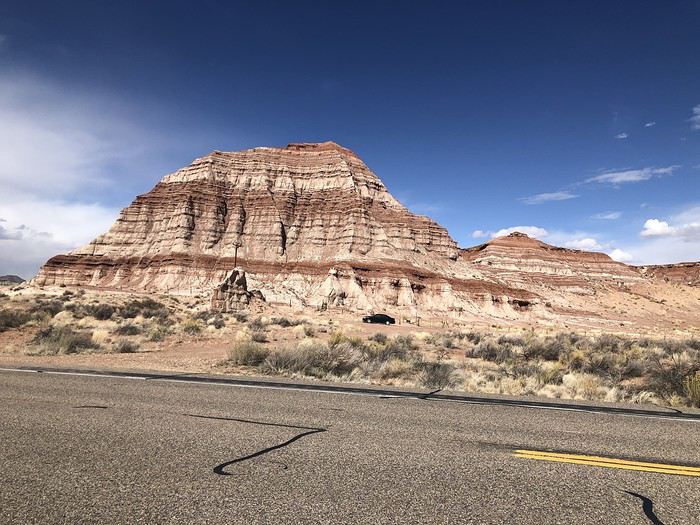
Puis sur le parking, ou se trouve la voiture noire, on voit le panneau qui vous rassure sur le nom du park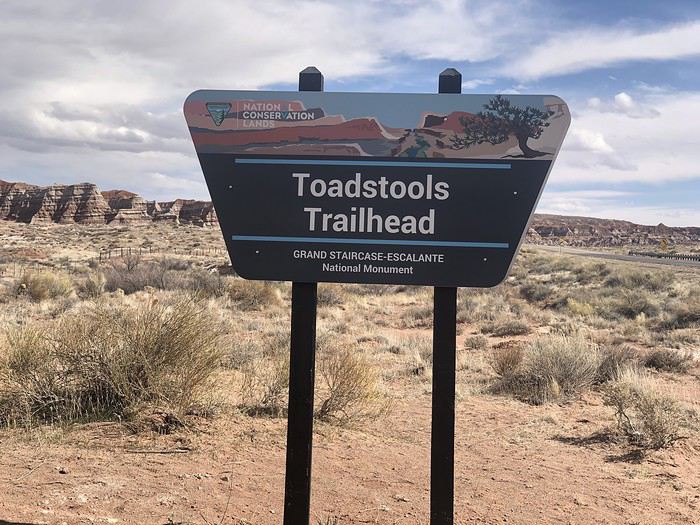
Il y a aussi un panneau qui vous informe sur ce qu'est un toadstool, c'est à-dire un champignon vénéneux, mais si vous allez sur place vous le verrez. Vous aurez toutes les infos sur la formation des toadstools, et aussi sur le fait que le chemin allé simple fait 0,8 miles et aller retour fait 1,6 miles. Je n'ai pas très bien compris l'intérêt de la distance aller simple et me suis demandée s'il y avait des gens qui comptaient rester la-bas définitivement??? 🤪
Ce panneau vous informe aussi du fait qu'en été il peut y faire terriblement chaud, et qu'il vaut mieux vous munir de litres d'eau, d'un chapeau..... A notre arrivée début mars, la température extérieure est de 15°C, le soleil éclaire juste ce qu'il faut, une petite bouteille d'eau pour chacun de nous est amplement suffisante, et de chapeau que nenni!
08 miles aller simple....Mais en fait, vous marcherez beaucoup plus que ça, car une fois sur le site il y aura tellement de coins qui vous attireront que vous y passerez facilement plus de 2 heures si vous vous donnez la peine d'aller découvrir les recoins qui sont derrière le site principal. Et surtout si vous vous donnez la peine de farfouiller un peu. C'est un vrai jeu de chasse au trésor auquel nous nous sommes livrés.
Donc une fois que nous avons complété le registre inséré dans une boite métallique noire qui permet aux rangers de savoir qui chercher s'il vous prenait l'envie d'y rester définitivement, et qu'ensuite nous avons franchi la barrière en barbelés qui laisse entrer les humains qui peuvent se faufiler, mais pas les bovins et les ovins qui ne pourraient pas tordre leur abdomen pour suivre le grillage, vous découvrez de plus près les massifs chocolatés.
Puis vous découvrez que vous avez le choix de marcher dans des washs (ce sont des lits de rivière à sec)
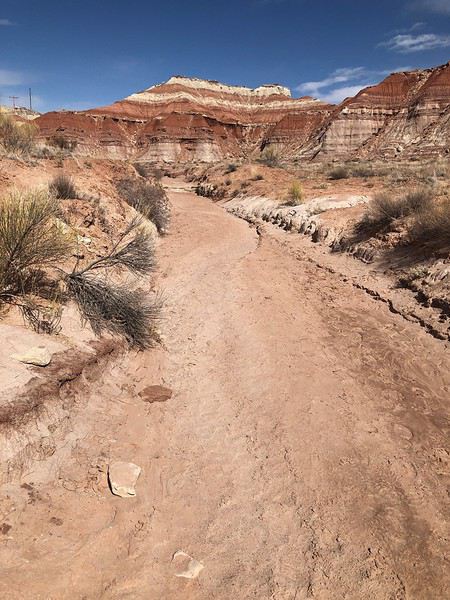
Les massifs chocolatés sont parfois ornés de chantilly, et parfois, le sentier semble sortir du wash pour venir s'incruster entre les mamelons. C'est ce que montre le petit poteau planté sur la droite. C'est une sorte de cairn civilisé, quoi.
Le sentier peut parfois devenir un peu étroit, et si vous n'êtes pas à l'aise, il vaut mieux retourner dans le wash.
Parfois, c'est carrément acrobatique. Je me suis bien aidée de mes bâtons de marche.
Parfois ce poteau soi disant indicateur m'a laissé perplexe. Tout droit semble-t-il dire... oui mais où est le tout droit en question?
Inutile de dire que s'il a plu les jours qui précèdent votre passage, ou s'il a neigé, alors c'est une vraie pataugeoire dans laquelle vous évoluez. De simples sandales comme j'ai vu des gens en porter, ou même les chaussures de randonnée peuvent conduire à des chutes rocambolesques, ou causer des blessures sérieuses... Nous avons eu la chance en fin d'hiver d'être à une période sèche.
Et puis, il arrive que vous vous trouviez devant une ouverture comme celle là. Et à ce moment précis, plus aucun poteau, sinon ce ne serait pas marrant. Vous sauriez où aller, ce qui n'est manifestement pas le but. Alors, vous suivez votre instinct. Plutôt à droite? Plutôt à gauche? non? au centre alors?
Et bien j'n'en sais rien. J'ai pris une direction au hasard, (ça fonctionne parfois) et j'ai atterri en face de ça.
Sur ma gauche se trouvait le fameux chameau qui est sur toutes les photos de photographes professionnels, d'ailleurs sur place, il y en avait un qui ne s'intéressait qu'à ce mastodonte. C'est comme s'il était hermétique à toute la magie du reste.
D'ailleurs, il s'est plein à mon mari du mauvais balisage des pistes qui lui avait fait perdre du temps. Il n'est resté qu'autour du chameau, le prenant sous toutes ses coutures, avec différents éclairages. Bon, comme ça, c'est un truc de vrai photographe et que je n'en suis pas, vous n'aurez donc pas la super photo avec le super éclairage qui fait rêver. Au lieu de ça, je suis partie sur la droite par rapport au chameau à la recherche d'un spot de hoodoos blancs, dont j'avais découvert l'existence sur un carnet. J'ai trouvé que ce mélange de blanc et de rouge était très beau.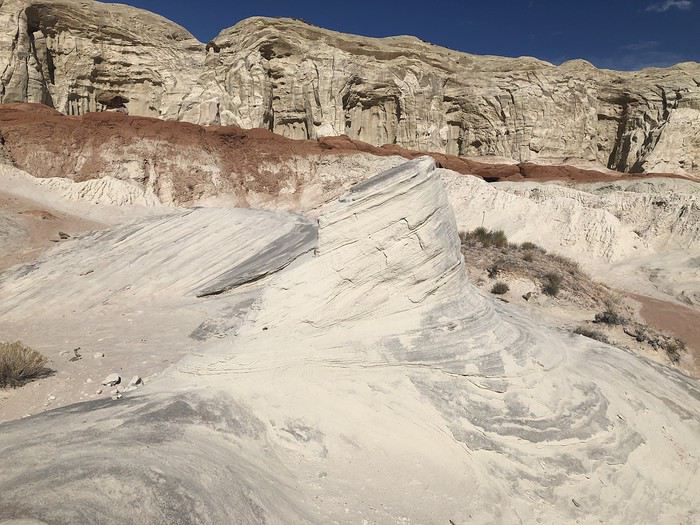
Vraiment très photogénique.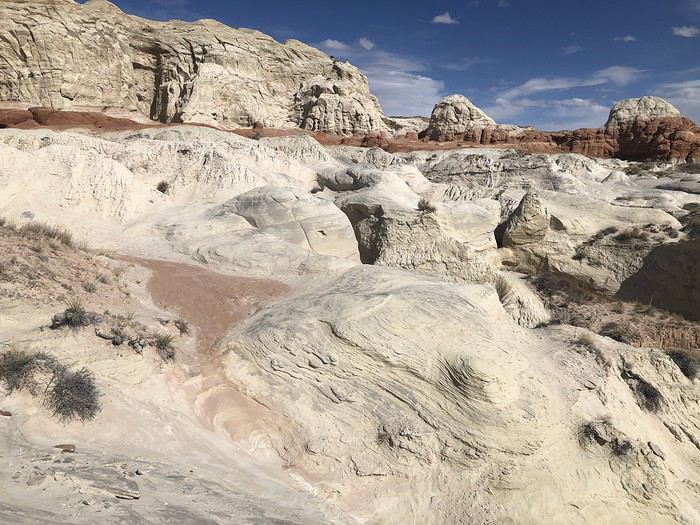
J'ai fait la connaissance du sphinx dont on a coupé le nez
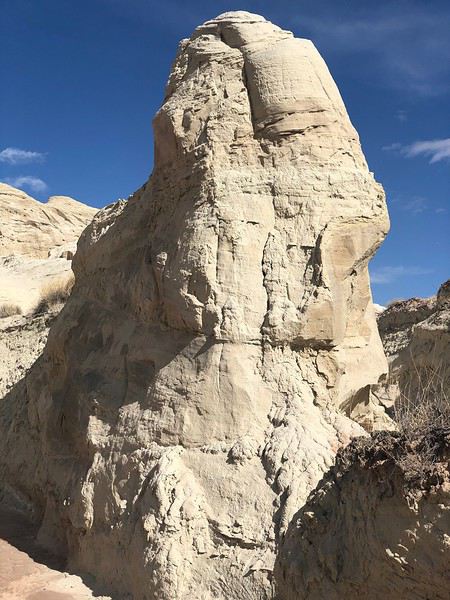
Puis j'ai continué à me diriger vers les massifs blancs qui sont sur la droite, curieuse de tout voir.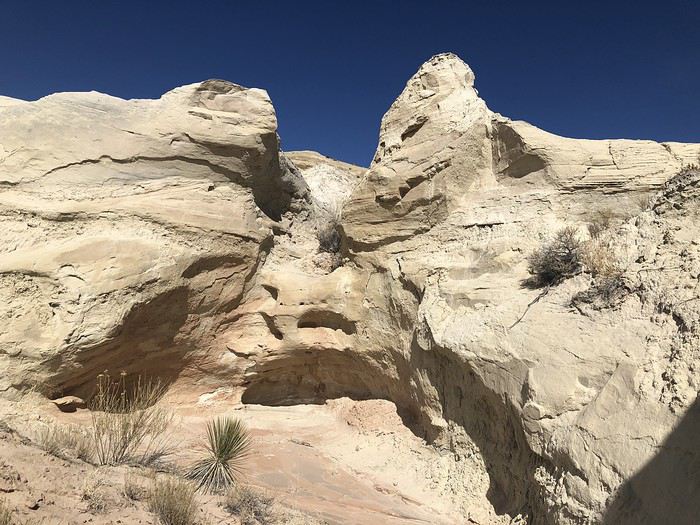
Je me suis retrouvée devant une paroi verticale que j'ai dû escalader, pour finalement, me retrouvée au milieu d'une alcove sans issue (enfin pour moi qui ne suis nullement cascadeuse). J'ai donc redescendu ma paroi verticale, et suis retournée sur mes pas.
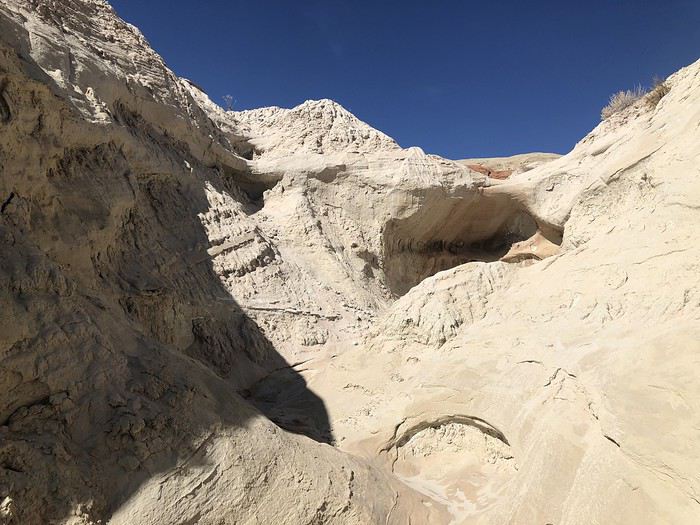
En revenant, je me suis retrouvée face à ce joli E.T. de Spielberg.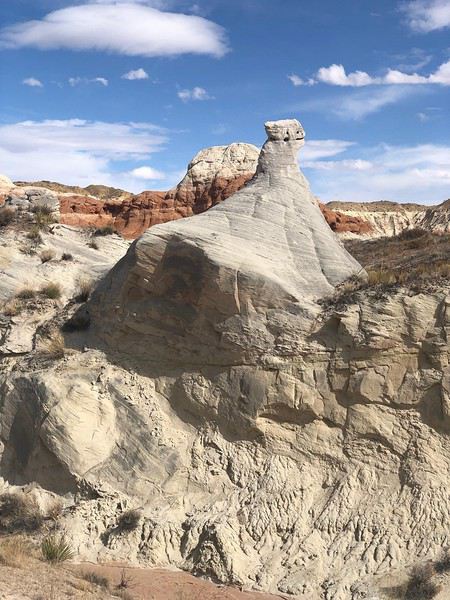
Puis après avoir laissé le chameau toujours sur ma gauche, je me suis retrouvée devant cette cour en rouge et blanc, avec quelques champignons qui émergeaient. Le tout entouré d'une paroi de colonnes blanches. C'est du plus bel effet.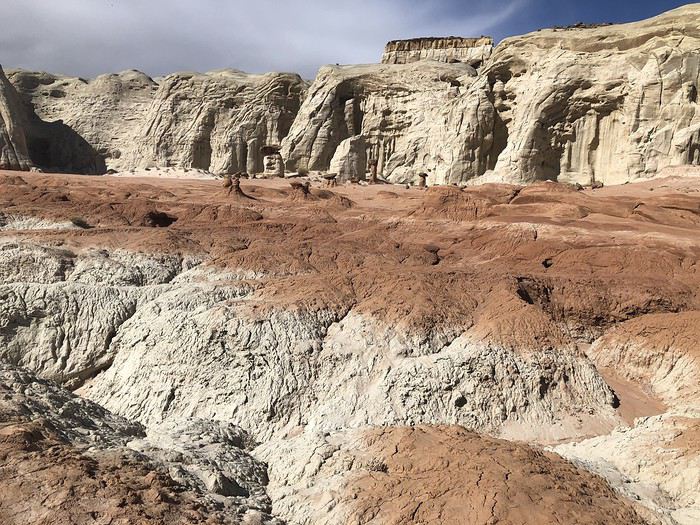
Le chameau au loin dans son environnement en rouge et blanc, a, je trouve, beaucoup plus d'assurance, surtout sous un ciel nuageux.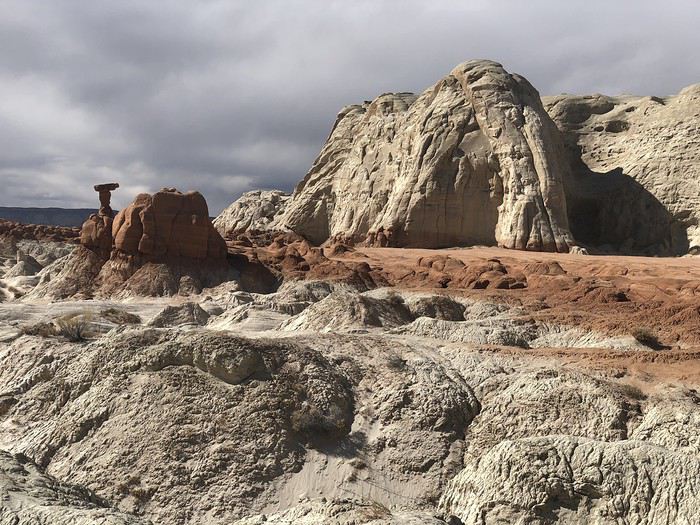
Il est une star parmi les autres, et ce personnage de Star wars ne me démentira pas.
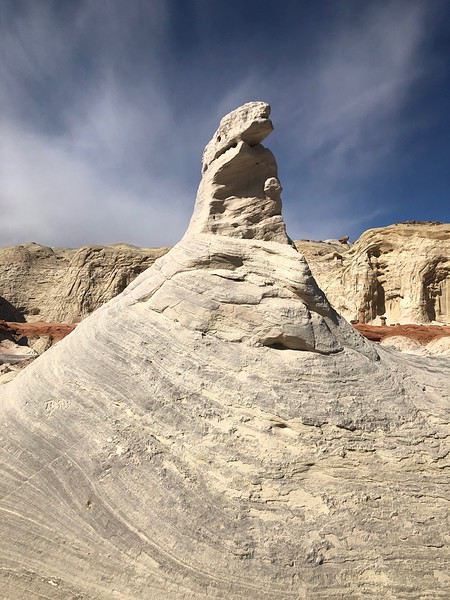
Je suis revenues des States le dimanche, le mercredi, Trump annonçait la fermeture des frontières aux Européens. J'ai eu une profonde respiration en entendant la nouvelle!!!
Je ne raconterai pas tout mon voyage... J'aime autant le chemin qui conduit aux sites que les sites eux-mêmes.
J'ai eu un vrai coup de cœur pour pleins de sites dont j'ai profité dans le south west, mais ce qui m'a surtout marqué, c'est le fait que souvent, sur les carnets, on a parfois l'impression (à tort d'ailleurs) qu'un site c'est juste une succession de choses importantes à voir dont il faut faire la liste et puis c'est tout.
Je vais donc vous faire découvrir toadstool à ma façon, j'aimerais vous faire découvrir les différentes étapes de ma découverte de ce park gratuit..
Voici tout d'abord ce qu'on découvre de la route: des montagnes chocolatées. Le parking placé devant à notre arrivée ne comporte qu'une voiture noire en fin de matinée.
Puis sur le parking, ou se trouve la voiture noire, on voit le panneau qui vous rassure sur le nom du park
Il y a aussi un panneau qui vous informe sur ce qu'est un toadstool, c'est à-dire un champignon vénéneux, mais si vous allez sur place vous le verrez. Vous aurez toutes les infos sur la formation des toadstools, et aussi sur le fait que le chemin allé simple fait 0,8 miles et aller retour fait 1,6 miles. Je n'ai pas très bien compris l'intérêt de la distance aller simple et me suis demandée s'il y avait des gens qui comptaient rester la-bas définitivement??? 🤪
Ce panneau vous informe aussi du fait qu'en été il peut y faire terriblement chaud, et qu'il vaut mieux vous munir de litres d'eau, d'un chapeau..... A notre arrivée début mars, la température extérieure est de 15°C, le soleil éclaire juste ce qu'il faut, une petite bouteille d'eau pour chacun de nous est amplement suffisante, et de chapeau que nenni!
08 miles aller simple....Mais en fait, vous marcherez beaucoup plus que ça, car une fois sur le site il y aura tellement de coins qui vous attireront que vous y passerez facilement plus de 2 heures si vous vous donnez la peine d'aller découvrir les recoins qui sont derrière le site principal. Et surtout si vous vous donnez la peine de farfouiller un peu. C'est un vrai jeu de chasse au trésor auquel nous nous sommes livrés.
Donc une fois que nous avons complété le registre inséré dans une boite métallique noire qui permet aux rangers de savoir qui chercher s'il vous prenait l'envie d'y rester définitivement, et qu'ensuite nous avons franchi la barrière en barbelés qui laisse entrer les humains qui peuvent se faufiler, mais pas les bovins et les ovins qui ne pourraient pas tordre leur abdomen pour suivre le grillage, vous découvrez de plus près les massifs chocolatés.
Puis vous découvrez que vous avez le choix de marcher dans des washs (ce sont des lits de rivière à sec)
Les massifs chocolatés sont parfois ornés de chantilly, et parfois, le sentier semble sortir du wash pour venir s'incruster entre les mamelons. C'est ce que montre le petit poteau planté sur la droite. C'est une sorte de cairn civilisé, quoi.
Le sentier peut parfois devenir un peu étroit, et si vous n'êtes pas à l'aise, il vaut mieux retourner dans le wash.
Parfois, c'est carrément acrobatique. Je me suis bien aidée de mes bâtons de marche.
Parfois ce poteau soi disant indicateur m'a laissé perplexe. Tout droit semble-t-il dire... oui mais où est le tout droit en question?
Inutile de dire que s'il a plu les jours qui précèdent votre passage, ou s'il a neigé, alors c'est une vraie pataugeoire dans laquelle vous évoluez. De simples sandales comme j'ai vu des gens en porter, ou même les chaussures de randonnée peuvent conduire à des chutes rocambolesques, ou causer des blessures sérieuses... Nous avons eu la chance en fin d'hiver d'être à une période sèche.
Et puis, il arrive que vous vous trouviez devant une ouverture comme celle là. Et à ce moment précis, plus aucun poteau, sinon ce ne serait pas marrant. Vous sauriez où aller, ce qui n'est manifestement pas le but. Alors, vous suivez votre instinct. Plutôt à droite? Plutôt à gauche? non? au centre alors?
Et bien j'n'en sais rien. J'ai pris une direction au hasard, (ça fonctionne parfois) et j'ai atterri en face de ça.
Sur ma gauche se trouvait le fameux chameau qui est sur toutes les photos de photographes professionnels, d'ailleurs sur place, il y en avait un qui ne s'intéressait qu'à ce mastodonte. C'est comme s'il était hermétique à toute la magie du reste.
D'ailleurs, il s'est plein à mon mari du mauvais balisage des pistes qui lui avait fait perdre du temps. Il n'est resté qu'autour du chameau, le prenant sous toutes ses coutures, avec différents éclairages. Bon, comme ça, c'est un truc de vrai photographe et que je n'en suis pas, vous n'aurez donc pas la super photo avec le super éclairage qui fait rêver. Au lieu de ça, je suis partie sur la droite par rapport au chameau à la recherche d'un spot de hoodoos blancs, dont j'avais découvert l'existence sur un carnet. J'ai trouvé que ce mélange de blanc et de rouge était très beau.
Vraiment très photogénique.
J'ai fait la connaissance du sphinx dont on a coupé le nez
Puis j'ai continué à me diriger vers les massifs blancs qui sont sur la droite, curieuse de tout voir.
Je me suis retrouvée devant une paroi verticale que j'ai dû escalader, pour finalement, me retrouvée au milieu d'une alcove sans issue (enfin pour moi qui ne suis nullement cascadeuse). J'ai donc redescendu ma paroi verticale, et suis retournée sur mes pas.
En revenant, je me suis retrouvée face à ce joli E.T. de Spielberg.
Puis après avoir laissé le chameau toujours sur ma gauche, je me suis retrouvée devant cette cour en rouge et blanc, avec quelques champignons qui émergeaient. Le tout entouré d'une paroi de colonnes blanches. C'est du plus bel effet.
Le chameau au loin dans son environnement en rouge et blanc, a, je trouve, beaucoup plus d'assurance, surtout sous un ciel nuageux.
Il est une star parmi les autres, et ce personnage de Star wars ne me démentira pas.
On the Silk Road: Chronicles of a Sixty-Something Traveling Completely Independently
From Beijing to Khiva: China, Kyrgyzstan, Tajikistan, Uzbekistan
Chronicle of anecdotes, highlights, and other adventures that marked this eight-week journey in 2018.
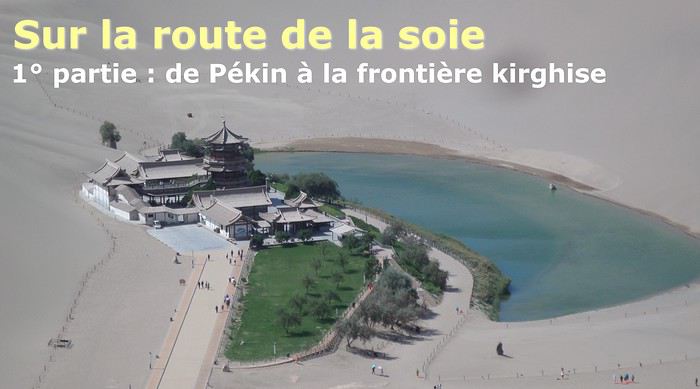
The Chinese Far West More than 30 years after my first trip to eastern China, I finally fulfilled an old dream: traveling solo from Beijing to the far west, discovering Xinjiang, the Uyghur people and the oppression they endure, the oases of Turpan and Kashgar, the Taklamakan Desert, the end of the Great Wall... The route was covered by train.
MENU PART 1: CHINA
1- Beijing (Jiankou) : the authentic Great Wall, without tourists 2- Cycling in Beijing, the best way to get around 3- Beijing : departure for the far west 4- Jiayuguan : getting by without English 5- Jiayuguan : scams and heritage 6- Dunhuang : abundance in the middle of the desert 7- Turpan : the Uyghurs under heavy surveillance 8- Kashgar : love at first sight for the old city 9- Kashgar : China’s recipe for controlling the populace 10- Tashkurgan : what on earth was I thinking going there! Kyrgyz border: a surreal epic Photo album from the 80s, contributions from other travelers (page 2)
1- JIANKOU Finding the authentic Great Wall, without tourists or a guide Friday, August 24, 2018 Thirty years later, I didn’t feel like revisiting the Great Wall at Badaling or any other overcrowded site. I chose to explore it at Jiankou, in its wildest, most authentic, and unrestored section, starting from a lost village deep in a valley—though it wasn’t *that* lost, since it had everything for communication.
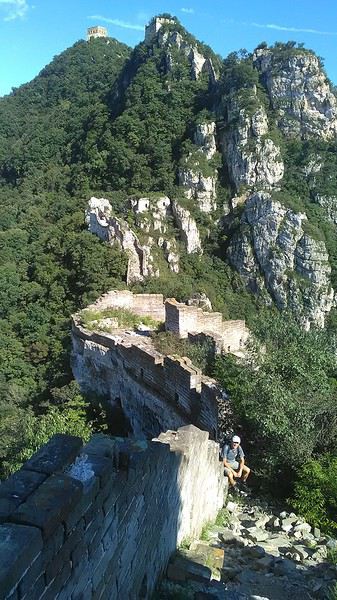
No need to pay for a taxi to get there—by timing it right, you can take the bus for just a few yuan. You have to get off at Xizhazi, the bus terminus. Be careful, there are only two buses a day in each direction. At the Xizhazi bus stop, I met a young couple who’d arrived with zero information about what to expect. We hiked the three of us toward the restored section of Mutianyu.
Still, be cautious With GPS and a topographic map (OpenTopoMap), you can set off without a problem or guide. The trail up to Jiankou is easy and well-marked. The trails down are too. But be careful—once you’re on the Wall, it’s real mountain hiking, with easy but dangerous climbing sections (over sheer drops). Not for amateurs or those afraid of heights! But what a reward. The Wall all to yourself, where it’s at its most daring. Truly mesmerizing.
More photos...
2- BEIJING The best way to get around the capital Sunday, August 26 The best way to explore the city is still by bike. Most are in a bike-share system, but you need to use an app—WeChat, the app that does everything, like monitoring your every move. No way I was installing that.
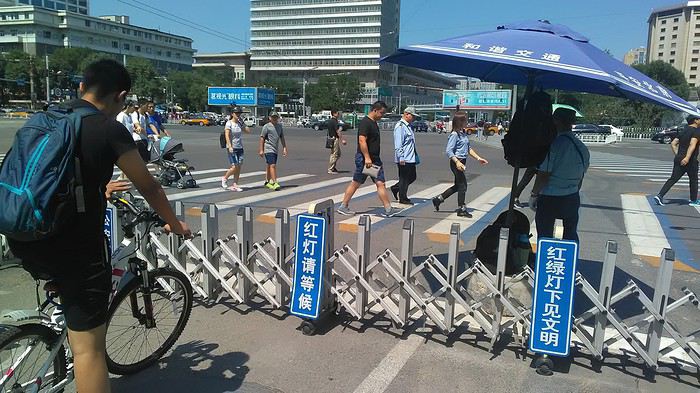
I found one at a rental shop near the hostel. The key is to quickly learn local traffic customs to minimize risks. Bike lanes are wide along the avenues.
But you still have to: - Watch out for anything parked on the bike paths—the most annoying are people napping or talking on the phone in their cars - Keep an eye on everything coming the wrong way—the list is long - The worst is right turns on red, which in Chinese traffic rules seem to have priority Once you get the hang of it, it’s fine. The city is huge but flat, so you can just wing it.
3- BEIJING By train to the far west Sunday, August 26 Beijing West Station is the size and operates like an airport. With your e-ticket from the agency, you first have to pick up your ticket at the special "English" counter, after passing through security. With your ticket in hand, you have to exit and enter through the boarding waiting area—not the platform—after a second security check.
 Then you find the right hall and wait for the sign to finally access the platform. In the end, it works pretty well given the incredible number of passengers to manage. Everywhere in Beijing, I saw that the Chinese have mastered crowd flow management.
Nice surprise: second-class carriages are clean, air-conditioned, and bright. Perfect, since I was in for 20 hours. One uniformed attendant per carriage, mobile meal service—luxury! Small downside: no luggage space. Hauling your suitcase up to the top bunk is quite a workout. I was in the middle, so it wasn’t too bad. The landscape, though, whether rural or urban, is pretty bleak. That should change once we leave the eastern plains.
Of course, I got my first police visit, with a thorough passport check and bag search. I was warned—going to the Chinese far west exposes you to this kind of hassle. But they were polite and respectful.
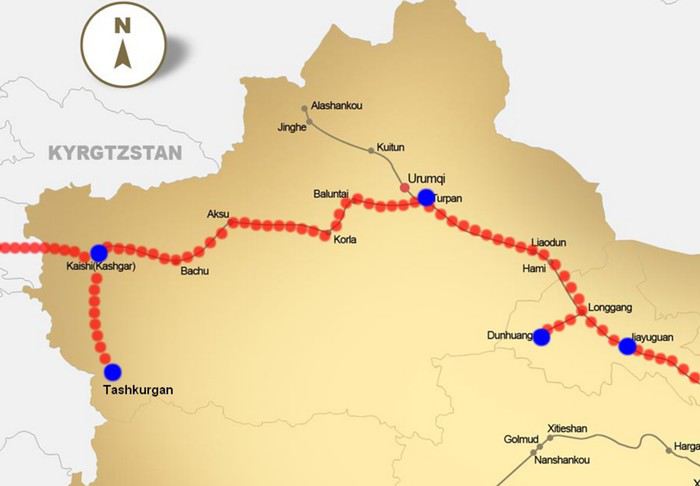 The Chinese Far West
4- JIAYUGUAN Getting by without English Monday, August 27 At the gates of two deserts (Gobi and Taklamakan) and at the foot of the Tibetan highlands, the Great Wall ends at Jiayuguan. Here, I found the deeper China I’d somewhat rediscovered during my bike ride, even if now everyone gets around on electric bikes and I’m no longer stared at like an alien.
Prices are nothing like Beijing: you can find a full meal for 2 €, and my bike cost 7 € for two days. Plus, few people speak English—neither the owner of the HI hostel where I stayed, nor the ticket sellers at the sites, let alone the servers at the small eateries where I ate. Everything is written in Chinese. So I had to use the little Chinese I know to communicate about essentials. It makes the locals laugh to see a European trying to speak their language, but it earns respect. With Google Translate’s help, I managed.
Rant: With their avenues blocked for construction for kilometers without warning, and new roads not yet on maps, I must’ve taken 15 km of detours. More photos...
5- JIAYUGUAN Scams and heritage Tuesday, August 28 The Great Wall doesn’t exactly end at the fort I visited yesterday but 10 km further, at the entrance to a river gorge at the foot of the mountains. All that’s left is a badly damaged tower (more like a mound of earth) and a section of clay wall, similar to the one I biked yesterday.
This morning, I hopped on my bike, determined to venture into the desert to see this highly symbolic site. First, you access it via a wide, brand-new road with not a soul in sight. Just before the site, I came across a grand welcome gate, very period-style, but it’s actually the inevitable toll booth.
Behind the gate, the road continues straight to the site, which you can see in the distance—at least 2 km away—the remains of the tower and wall. I had to leave my bike here. Fine. I went to the ticket counter and asked the price: 120 yuan! I couldn’t believe it—over 15 € for a simple mound of earth.
I showed my displeasure to the attendant, who couldn’t care less, and immediately turned back. 120 yuan—that’s the price for a new road, a fancy gate planted 2 km before the site just to force you to take a shuttle, and employees with nothing to do all day... Now I understand why I didn’t meet anyone!
Heritage China is a bit pricey Generally, sites are expensive for the country’s standard of living, but travelers are supposed to have money, so why hold back? I even gave up on the Forbidden City—reservations required days in advance (or on the black market at an impossible price). I prefer to keep the memory of my first visit, when entry must’ve cost a few dozen cents, and there were only a handful of visitors.
This morning, I took a taxi to see remarkable tombs of common people from the 3rd to 6th centuries. They’re small vaulted caves made of painted bricks, depicting scenes of daily life. Very pretty and moving. But even here, though the price was more reasonable, I was left wanting—only one of the 16 tombs is open to visitors, and it’s apparently not the most beautiful.
The authentic China—at least what’s left of it... Wandering the impersonal avenues of the city, you stumble upon a market. There, you still find traditional China—small shops with questionable hygiene, Go players, musicians, and even a dental prosthetist. The last refuge for those untouched by modernity. More photos...
6- DUNHUANG Abundance in the middle of the desert Wednesday, August 29 Well, I thought the landscape would be less bleak as I headed west. Nope. The only distraction in this expanse of dark, clayey sand is the forests of pylons and wind turbines, plus wild camels racing each other.
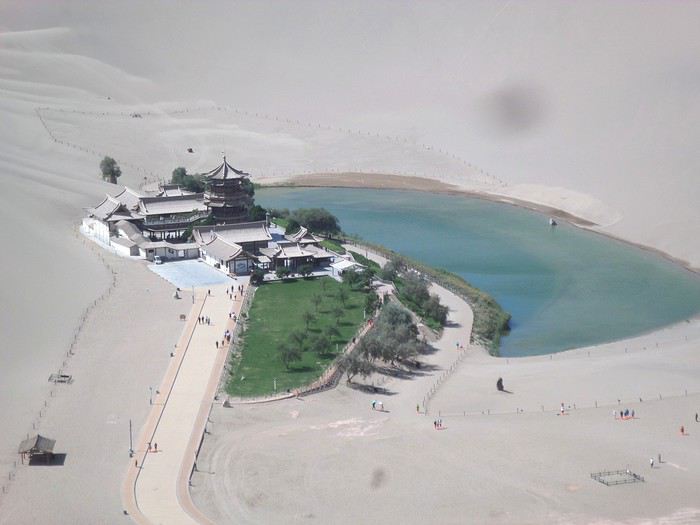 However, Dunhuang, the gateway to the Taklamakan, is by far the most pleasant Chinese city I know. There’s a real city center you can explore on foot. It’s hot but not unbearable, with a light, dry breeze. Much nicer than Beijing. The Han Chinese are still the majority, but the Muslim Uyghurs are more numerous, and the muezzin’s call to prayer echoes around the mosque.
The most surprising thing is the abundance and diversity of fruits and vegetables. You wonder how it all grows here. Well-irrigated, the desert sands are very fertile. Here, raisins have subtle, mysterious flavors, and the lamb really tastes like lamb.
Today, I visited the must-see Mingshashan, a dune complex next to which Pila is a molehill. The Basque Country, but covered in sand... More photos...
7- TURPAN The Uyghurs under heavy surveillance Friday, August 31 Surveillance cameras everywhere in the city, armed police stationed at intersections, in front of public buildings, at the entrance and inside tourist sites, police stations on every corner, patrols on foot or by car, khaki uniforms even for middle schoolers... here, the Han Chinese are in the minority, and you can feel it. Turpan feels like a city under siege.
To enter the youth hostel where I stayed, there’s even a security gate, and the receptionist (a Han, like everyone in tourism) wears a bulletproof vest! Reassuring. Still, you don’t feel particularly threatened here, especially as a European. The troublemakers are the Chinese, not the Uyghurs. Generally, China is a very safe country for visitors.
Smile, you’re on camera! I was biking on an avenue when the car in front of me got flashed for driving slowly. I quickly understood why when I got flashed too.
Here, the official time is Beijing time, but it gets dark two hours later. It’ll be even worse in Kashgar. Trickier to manage: everything is displayed in Chinese and Arabic. Nothing in English. Choosing a menu is a shot in the dark. Apart from a few young Chinese, no one here speaks English, and my Chinese doesn’t seem very understandable...
Mogao, the end of the road for the Han Yesterday, near Dunhuang, I went to Mogao, a complex of decorated caves with Buddha sculptures and paintings. Stunning, but so crowded! Luckily, here in Turpan, Chinese tourists barely venture out. So I visited a Silk Road ghost town with only a handful of other visitors and under a howling wind.
The modern Chinese city is swallowing up the old Uyghur neighborhoods—only a museum-like district remains in the center, and pockets of resistance on the outskirts are doomed to disappear soon. More photos...
8- KASHGAR A (relative) love at first sight for the old city Sunday, September 2 After three overnight trains, here I am in the far west of China, nearly 4,000 km from the capital. Despite the omnipresent police and an old city preserved UNESCO-style, Kashgar is my Chinese love at first sight.
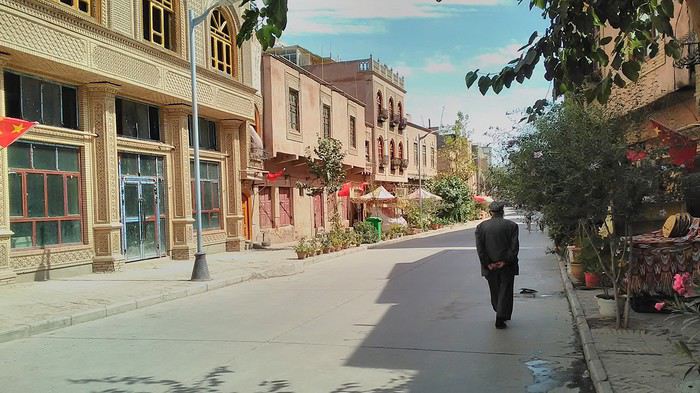
Finally, Chinese... well, sort of, because we’re in Uyghur territory here—a Turkic people with nothing culturally in common with the Han, the eastern Chinese. It started badly yesterday at Turfan station, where after three security gate passes, at least five passport checks, and a bag search, three adorable policewomen confiscated my antibacterial lotion because it had a flammable logo...
Then came the welcoming committee of armed cops at Kashgar station. Once all that was over, they left me alone—except you still have to go through security checks like everyone else to enter the old city, the bazaar, the livestock market... The further west you go, the more the siege mentality is evident. Luckily, the border isn’t far...
Despite the inevitable destruction-reconstruction, the city center has been well preserved. Thankfully, because it’s a very original style, a mix of local and colonial. I love it, even if it’s a bit too artificial, sanitized, and watered-down, and rather empty of residents. On the Silk Road, the city was famous for its great food. And it still is—rarely have I seen such richness and abundance of food! And not just scorpions or snakes. More photos...
9- KASHGAR China’s recipe for controlling the populace Saturday, September 1 Xinjiang, along with Tibet, is a "sensitive" area of rebellion in the eyes of Chinese authorities. As a result, the state has these regions and their populations under total control. Tourists also feel the consequences, even if they’re not at risk of re-education camps.
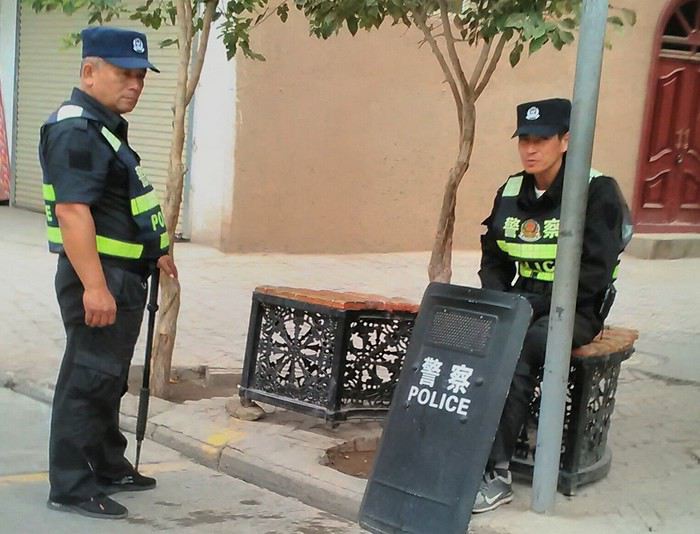 - Putting barbed wire and anti-ramming barriers around sensitive sites (schools, big hotels, government buildings...)
- Installing traffic surveillance gates with cameras and photo flashes (for all vehicles passing, including bikes) throughout the city and even in the countryside
- Posting uniformed guards with tasers, batons, or huge baseball bats every 100 meters
- Training the Han population (ethnic Chinese) in self-defense with sticks, preferably in the morning on the street. Men and women of all ages
- Starting school with the national anthem, doing military exercises, and receiving political indoctrination, all neatly lined up in the courtyard. (The dream school for any teacher)
- Placing a snitch in uniform (a pseudo-guard) in public gathering places, like youth hostels. Mine spends the day loafing around the courtyard
- Putting Chinese flags everywhere on the streets to remind everyone who’s in charge
- Installing security gates at every entrance to areas frequented by tourists (thanks for that) but not just there
- Never photographing cops, or else! I tried, but it’s not easy...
- Putting barbed wire and anti-ramming barriers around sensitive sites (schools, big hotels, government buildings...)
- Installing traffic surveillance gates with cameras and photo flashes (for all vehicles passing, including bikes) throughout the city and even in the countryside
- Posting uniformed guards with tasers, batons, or huge baseball bats every 100 meters
- Training the Han population (ethnic Chinese) in self-defense with sticks, preferably in the morning on the street. Men and women of all ages
- Starting school with the national anthem, doing military exercises, and receiving political indoctrination, all neatly lined up in the courtyard. (The dream school for any teacher)
- Placing a snitch in uniform (a pseudo-guard) in public gathering places, like youth hostels. Mine spends the day loafing around the courtyard
- Putting Chinese flags everywhere on the streets to remind everyone who’s in charge
- Installing security gates at every entrance to areas frequented by tourists (thanks for that) but not just there
- Never photographing cops, or else! I tried, but it’s not easy...
With all that, you can stroll around safely Not much crime! As for the amount the Chinese state spends to maintain such a system, it’s staggering! A third of the Han living in Xinjiang work in security. Today, I wandered freely around old Kashgar, which is quite large after all. More photos...
10- TASHKURGAN What on earth was I thinking going there! Wednesday, September 5 First, there’s the taxi—pretty crappy, with a driver who doesn’t speak a word of English and won’t stop smoking. Over six hours in that... shared with a completely out-of-it American.
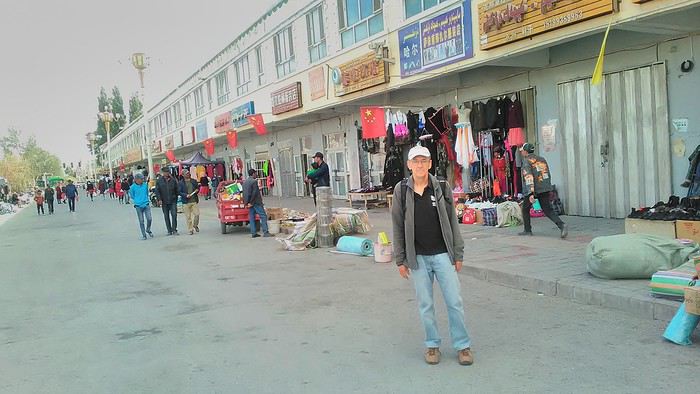
Then there are all the checkpoints along the way. I won’t go on—you know the drill by now.
After that, there’s Tashkurgan—a town with nothing to see, nothing to do. Deserted as soon as night falls. There’s this huge youth hostel and a few lost Chinese tapping away on their smartphones, chain-smoking. This lost American-European crowd, swapping tips on how to enter Pakistan or Tajikistan.
Luckily, there’s the Chinese Pamir Highway, lined with peaks over 7,000m. There’s the feeling of no longer being in China, with a population whose features are Middle Eastern. And these Tajik women with their stunning hairstyles and vibrant costumes. There’s the fact of having reached the westernmost Chinese city, far from crowds and tourist sites. A sort of end of the world. More photos...
11- KYRGYZ BORDER A surreal epic Thursday, September 6 The road from Kashgar to the Kyrgyzstan border is a little over 200 km and passes through beautiful landscapes of colorful, desert-like mountains with acrobatic folds. That’s the bucolic part of the trip.
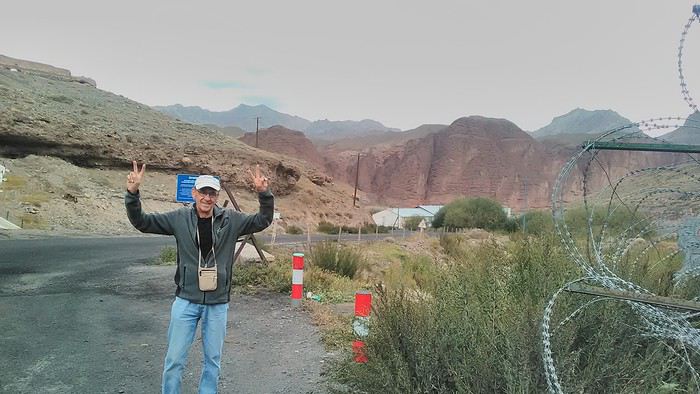 Yesterday, I managed to gather four people to rent a minibus to reach the border more easily: a Spaniard and an Argentine I’d already met in Turpan, and two New Zealanders who responded to the ad left at the hostel.
Absurdity and paranoia of Chinese authorities The highlight was crossing the town of Wuqia, 50 km past Kashgar. After tallying up with my fellow sufferers, we must’ve passed about ten checkpoints with: - Passport checks: 14 times, sometimes by two cops side by side - Bag checks: 4 times - Smartphone checks: 2 times, with deletion of "non-compliant" photos, and registration of your IMEI in the exit log!... Absurd and surreal at the same time, since my camera stayed in my bag, my apps are in French, and my photos have been online for ages...
With all that, we arrived just as the last checkpoint before the no man’s land marking the border between the two countries was on lunch break. And bam! Another 1.5-hour wait, alongside truckers who were much more used to this than we were.
What to think? The cops themselves aren’t fooled. They play the role they’re asked to, but sometimes you can coax a smile out of them—they realize how ridiculous the situation is.
What’s the point? That’s the big question my companions and I were tempted to answer with "to piss people off." To show you your place isn’t here, but with the other tourists, over there in the east, in Shanghai, Xi’an, or Guangzhou.
As for you, a traveler from a democratic country, you really experience this as aggression, humiliation, a violation of your private space. And yet, I’m respected, they speak to me properly. Today, I better understand what a Palestinian or a citizen of an occupied country might feel daily. A unique experience! Thanks, China.
And to top it off, the cherry on the cake! It’s still this glowing button you press to rate your passage after clearing the last obstacle before the exit stamp. I was so surprised it turned off before I could react. The Spaniard, with great humor and irony, had time to vote "excellent." In the end, he wasn’t wrong—you can hardly do better!
PS: I ditched my buddies at the border. They didn’t want to pay for a taxi to continue. So I took a direct taxi to Osh. The first 100 km are fabulous. I couldn’t take many photos, but I’ll be back on Monday to go to Tajikistan.
More photos...
The rest of the Silk Road, Part 2, in these travel journals: Kyrgyzstan, Tajikistan, Uzbekistan.
The Chinese Far West More than 30 years after my first trip to eastern China, I finally fulfilled an old dream: traveling solo from Beijing to the far west, discovering Xinjiang, the Uyghur people and the oppression they endure, the oases of Turpan and Kashgar, the Taklamakan Desert, the end of the Great Wall... The route was covered by train.
MENU PART 1: CHINA
1- Beijing (Jiankou) : the authentic Great Wall, without tourists 2- Cycling in Beijing, the best way to get around 3- Beijing : departure for the far west 4- Jiayuguan : getting by without English 5- Jiayuguan : scams and heritage 6- Dunhuang : abundance in the middle of the desert 7- Turpan : the Uyghurs under heavy surveillance 8- Kashgar : love at first sight for the old city 9- Kashgar : China’s recipe for controlling the populace 10- Tashkurgan : what on earth was I thinking going there! Kyrgyz border: a surreal epic Photo album from the 80s, contributions from other travelers (page 2)
1- JIANKOU Finding the authentic Great Wall, without tourists or a guide Friday, August 24, 2018 Thirty years later, I didn’t feel like revisiting the Great Wall at Badaling or any other overcrowded site. I chose to explore it at Jiankou, in its wildest, most authentic, and unrestored section, starting from a lost village deep in a valley—though it wasn’t *that* lost, since it had everything for communication.
No need to pay for a taxi to get there—by timing it right, you can take the bus for just a few yuan. You have to get off at Xizhazi, the bus terminus. Be careful, there are only two buses a day in each direction. At the Xizhazi bus stop, I met a young couple who’d arrived with zero information about what to expect. We hiked the three of us toward the restored section of Mutianyu.
Still, be cautious With GPS and a topographic map (OpenTopoMap), you can set off without a problem or guide. The trail up to Jiankou is easy and well-marked. The trails down are too. But be careful—once you’re on the Wall, it’s real mountain hiking, with easy but dangerous climbing sections (over sheer drops). Not for amateurs or those afraid of heights! But what a reward. The Wall all to yourself, where it’s at its most daring. Truly mesmerizing.
More photos...
2- BEIJING The best way to get around the capital Sunday, August 26 The best way to explore the city is still by bike. Most are in a bike-share system, but you need to use an app—WeChat, the app that does everything, like monitoring your every move. No way I was installing that.
I found one at a rental shop near the hostel. The key is to quickly learn local traffic customs to minimize risks. Bike lanes are wide along the avenues.
But you still have to: - Watch out for anything parked on the bike paths—the most annoying are people napping or talking on the phone in their cars - Keep an eye on everything coming the wrong way—the list is long - The worst is right turns on red, which in Chinese traffic rules seem to have priority Once you get the hang of it, it’s fine. The city is huge but flat, so you can just wing it.
3- BEIJING By train to the far west Sunday, August 26 Beijing West Station is the size and operates like an airport. With your e-ticket from the agency, you first have to pick up your ticket at the special "English" counter, after passing through security. With your ticket in hand, you have to exit and enter through the boarding waiting area—not the platform—after a second security check.
Then you find the right hall and wait for the sign to finally access the platform. In the end, it works pretty well given the incredible number of passengers to manage. Everywhere in Beijing, I saw that the Chinese have mastered crowd flow management.Nice surprise: second-class carriages are clean, air-conditioned, and bright. Perfect, since I was in for 20 hours. One uniformed attendant per carriage, mobile meal service—luxury! Small downside: no luggage space. Hauling your suitcase up to the top bunk is quite a workout. I was in the middle, so it wasn’t too bad. The landscape, though, whether rural or urban, is pretty bleak. That should change once we leave the eastern plains.
Of course, I got my first police visit, with a thorough passport check and bag search. I was warned—going to the Chinese far west exposes you to this kind of hassle. But they were polite and respectful.
The Chinese Far West4- JIAYUGUAN Getting by without English Monday, August 27 At the gates of two deserts (Gobi and Taklamakan) and at the foot of the Tibetan highlands, the Great Wall ends at Jiayuguan. Here, I found the deeper China I’d somewhat rediscovered during my bike ride, even if now everyone gets around on electric bikes and I’m no longer stared at like an alien.
Prices are nothing like Beijing: you can find a full meal for 2 €, and my bike cost 7 € for two days. Plus, few people speak English—neither the owner of the HI hostel where I stayed, nor the ticket sellers at the sites, let alone the servers at the small eateries where I ate. Everything is written in Chinese. So I had to use the little Chinese I know to communicate about essentials. It makes the locals laugh to see a European trying to speak their language, but it earns respect. With Google Translate’s help, I managed.
Rant: With their avenues blocked for construction for kilometers without warning, and new roads not yet on maps, I must’ve taken 15 km of detours. More photos...
5- JIAYUGUAN Scams and heritage Tuesday, August 28 The Great Wall doesn’t exactly end at the fort I visited yesterday but 10 km further, at the entrance to a river gorge at the foot of the mountains. All that’s left is a badly damaged tower (more like a mound of earth) and a section of clay wall, similar to the one I biked yesterday.
This morning, I hopped on my bike, determined to venture into the desert to see this highly symbolic site. First, you access it via a wide, brand-new road with not a soul in sight. Just before the site, I came across a grand welcome gate, very period-style, but it’s actually the inevitable toll booth.
Behind the gate, the road continues straight to the site, which you can see in the distance—at least 2 km away—the remains of the tower and wall. I had to leave my bike here. Fine. I went to the ticket counter and asked the price: 120 yuan! I couldn’t believe it—over 15 € for a simple mound of earth.
I showed my displeasure to the attendant, who couldn’t care less, and immediately turned back. 120 yuan—that’s the price for a new road, a fancy gate planted 2 km before the site just to force you to take a shuttle, and employees with nothing to do all day... Now I understand why I didn’t meet anyone!
Heritage China is a bit pricey Generally, sites are expensive for the country’s standard of living, but travelers are supposed to have money, so why hold back? I even gave up on the Forbidden City—reservations required days in advance (or on the black market at an impossible price). I prefer to keep the memory of my first visit, when entry must’ve cost a few dozen cents, and there were only a handful of visitors.
This morning, I took a taxi to see remarkable tombs of common people from the 3rd to 6th centuries. They’re small vaulted caves made of painted bricks, depicting scenes of daily life. Very pretty and moving. But even here, though the price was more reasonable, I was left wanting—only one of the 16 tombs is open to visitors, and it’s apparently not the most beautiful.
The authentic China—at least what’s left of it... Wandering the impersonal avenues of the city, you stumble upon a market. There, you still find traditional China—small shops with questionable hygiene, Go players, musicians, and even a dental prosthetist. The last refuge for those untouched by modernity. More photos...
6- DUNHUANG Abundance in the middle of the desert Wednesday, August 29 Well, I thought the landscape would be less bleak as I headed west. Nope. The only distraction in this expanse of dark, clayey sand is the forests of pylons and wind turbines, plus wild camels racing each other.
However, Dunhuang, the gateway to the Taklamakan, is by far the most pleasant Chinese city I know. There’s a real city center you can explore on foot. It’s hot but not unbearable, with a light, dry breeze. Much nicer than Beijing. The Han Chinese are still the majority, but the Muslim Uyghurs are more numerous, and the muezzin’s call to prayer echoes around the mosque.The most surprising thing is the abundance and diversity of fruits and vegetables. You wonder how it all grows here. Well-irrigated, the desert sands are very fertile. Here, raisins have subtle, mysterious flavors, and the lamb really tastes like lamb.
Today, I visited the must-see Mingshashan, a dune complex next to which Pila is a molehill. The Basque Country, but covered in sand... More photos...
7- TURPAN The Uyghurs under heavy surveillance Friday, August 31 Surveillance cameras everywhere in the city, armed police stationed at intersections, in front of public buildings, at the entrance and inside tourist sites, police stations on every corner, patrols on foot or by car, khaki uniforms even for middle schoolers... here, the Han Chinese are in the minority, and you can feel it. Turpan feels like a city under siege.
To enter the youth hostel where I stayed, there’s even a security gate, and the receptionist (a Han, like everyone in tourism) wears a bulletproof vest! Reassuring. Still, you don’t feel particularly threatened here, especially as a European. The troublemakers are the Chinese, not the Uyghurs. Generally, China is a very safe country for visitors.
Smile, you’re on camera! I was biking on an avenue when the car in front of me got flashed for driving slowly. I quickly understood why when I got flashed too.
Here, the official time is Beijing time, but it gets dark two hours later. It’ll be even worse in Kashgar. Trickier to manage: everything is displayed in Chinese and Arabic. Nothing in English. Choosing a menu is a shot in the dark. Apart from a few young Chinese, no one here speaks English, and my Chinese doesn’t seem very understandable...
Mogao, the end of the road for the Han Yesterday, near Dunhuang, I went to Mogao, a complex of decorated caves with Buddha sculptures and paintings. Stunning, but so crowded! Luckily, here in Turpan, Chinese tourists barely venture out. So I visited a Silk Road ghost town with only a handful of other visitors and under a howling wind.
The modern Chinese city is swallowing up the old Uyghur neighborhoods—only a museum-like district remains in the center, and pockets of resistance on the outskirts are doomed to disappear soon. More photos...
8- KASHGAR A (relative) love at first sight for the old city Sunday, September 2 After three overnight trains, here I am in the far west of China, nearly 4,000 km from the capital. Despite the omnipresent police and an old city preserved UNESCO-style, Kashgar is my Chinese love at first sight.
Finally, Chinese... well, sort of, because we’re in Uyghur territory here—a Turkic people with nothing culturally in common with the Han, the eastern Chinese. It started badly yesterday at Turfan station, where after three security gate passes, at least five passport checks, and a bag search, three adorable policewomen confiscated my antibacterial lotion because it had a flammable logo...
Then came the welcoming committee of armed cops at Kashgar station. Once all that was over, they left me alone—except you still have to go through security checks like everyone else to enter the old city, the bazaar, the livestock market... The further west you go, the more the siege mentality is evident. Luckily, the border isn’t far...
Despite the inevitable destruction-reconstruction, the city center has been well preserved. Thankfully, because it’s a very original style, a mix of local and colonial. I love it, even if it’s a bit too artificial, sanitized, and watered-down, and rather empty of residents. On the Silk Road, the city was famous for its great food. And it still is—rarely have I seen such richness and abundance of food! And not just scorpions or snakes. More photos...
9- KASHGAR China’s recipe for controlling the populace Saturday, September 1 Xinjiang, along with Tibet, is a "sensitive" area of rebellion in the eyes of Chinese authorities. As a result, the state has these regions and their populations under total control. Tourists also feel the consequences, even if they’re not at risk of re-education camps.
- Putting barbed wire and anti-ramming barriers around sensitive sites (schools, big hotels, government buildings...)
- Installing traffic surveillance gates with cameras and photo flashes (for all vehicles passing, including bikes) throughout the city and even in the countryside
- Posting uniformed guards with tasers, batons, or huge baseball bats every 100 meters
- Training the Han population (ethnic Chinese) in self-defense with sticks, preferably in the morning on the street. Men and women of all ages
- Starting school with the national anthem, doing military exercises, and receiving political indoctrination, all neatly lined up in the courtyard. (The dream school for any teacher)
- Placing a snitch in uniform (a pseudo-guard) in public gathering places, like youth hostels. Mine spends the day loafing around the courtyard
- Putting Chinese flags everywhere on the streets to remind everyone who’s in charge
- Installing security gates at every entrance to areas frequented by tourists (thanks for that) but not just there
- Never photographing cops, or else! I tried, but it’s not easy...With all that, you can stroll around safely Not much crime! As for the amount the Chinese state spends to maintain such a system, it’s staggering! A third of the Han living in Xinjiang work in security. Today, I wandered freely around old Kashgar, which is quite large after all. More photos...
10- TASHKURGAN What on earth was I thinking going there! Wednesday, September 5 First, there’s the taxi—pretty crappy, with a driver who doesn’t speak a word of English and won’t stop smoking. Over six hours in that... shared with a completely out-of-it American.
Then there are all the checkpoints along the way. I won’t go on—you know the drill by now.
After that, there’s Tashkurgan—a town with nothing to see, nothing to do. Deserted as soon as night falls. There’s this huge youth hostel and a few lost Chinese tapping away on their smartphones, chain-smoking. This lost American-European crowd, swapping tips on how to enter Pakistan or Tajikistan.
Luckily, there’s the Chinese Pamir Highway, lined with peaks over 7,000m. There’s the feeling of no longer being in China, with a population whose features are Middle Eastern. And these Tajik women with their stunning hairstyles and vibrant costumes. There’s the fact of having reached the westernmost Chinese city, far from crowds and tourist sites. A sort of end of the world. More photos...
11- KYRGYZ BORDER A surreal epic Thursday, September 6 The road from Kashgar to the Kyrgyzstan border is a little over 200 km and passes through beautiful landscapes of colorful, desert-like mountains with acrobatic folds. That’s the bucolic part of the trip.
Yesterday, I managed to gather four people to rent a minibus to reach the border more easily: a Spaniard and an Argentine I’d already met in Turpan, and two New Zealanders who responded to the ad left at the hostel.Absurdity and paranoia of Chinese authorities The highlight was crossing the town of Wuqia, 50 km past Kashgar. After tallying up with my fellow sufferers, we must’ve passed about ten checkpoints with: - Passport checks: 14 times, sometimes by two cops side by side - Bag checks: 4 times - Smartphone checks: 2 times, with deletion of "non-compliant" photos, and registration of your IMEI in the exit log!... Absurd and surreal at the same time, since my camera stayed in my bag, my apps are in French, and my photos have been online for ages...
With all that, we arrived just as the last checkpoint before the no man’s land marking the border between the two countries was on lunch break. And bam! Another 1.5-hour wait, alongside truckers who were much more used to this than we were.
What to think? The cops themselves aren’t fooled. They play the role they’re asked to, but sometimes you can coax a smile out of them—they realize how ridiculous the situation is.
What’s the point? That’s the big question my companions and I were tempted to answer with "to piss people off." To show you your place isn’t here, but with the other tourists, over there in the east, in Shanghai, Xi’an, or Guangzhou.
As for you, a traveler from a democratic country, you really experience this as aggression, humiliation, a violation of your private space. And yet, I’m respected, they speak to me properly. Today, I better understand what a Palestinian or a citizen of an occupied country might feel daily. A unique experience! Thanks, China.
And to top it off, the cherry on the cake! It’s still this glowing button you press to rate your passage after clearing the last obstacle before the exit stamp. I was so surprised it turned off before I could react. The Spaniard, with great humor and irony, had time to vote "excellent." In the end, he wasn’t wrong—you can hardly do better!
PS: I ditched my buddies at the border. They didn’t want to pay for a taxi to continue. So I took a direct taxi to Osh. The first 100 km are fabulous. I couldn’t take many photos, but I’ll be back on Monday to go to Tajikistan.
More photos...
The rest of the Silk Road, Part 2, in these travel journals: Kyrgyzstan, Tajikistan, Uzbekistan.
Voyage d’un mois en Colombie avec deux enfants: notre cauchemar English translation pending
J'aurais voulu poster un carnet de voyage avec notre itinéraire et quelques conseils que j'aurais aimé trouver moi-même, mais comme notre voyage s'est mal terminé, je vais surtout parler de notre expérience traumatique à Santa Marta.
Nous avons préparé depuis plus d'un an ce voyage, le premier aussi loin avec nos deux enfants (3 et 7 ans). Nous nous sommes calés sur les vacances scolaires en ajoutant une semaine avant et une semaine après, en accord avec les écoles de nos enfants (programme de rattrapage scolaire que nous avons suivi !).
Arrivée Bogota et environs (Zipaquira, Guatavita) 4 jours
Région du café Armenia Salento Armenia parc du café Manizales Parque de los Nevados 8 jours
Pour certaines excursions, nous avons alterné : un adulte avec notre aîné, l'autre restant au calme avec la petite. Très bon système qui nous convenait très bien, et permettait de faire des choses assez difficile sans se mettre en danger et en prenant notre temps, au rythme des enfants tout en profitant.
Medellin 3 jours
Premiers trajets : tous en bus
Medellin - Cartagena : avion
Cartagena et îles voisines : 5 jours
Santa Marta et Parc Tayrona 3 jours
C'est là que notre voyage a mal tourné. Nous avons été victimes d'une agression tr��s grave à Santa Marta, un homme nous a menacés avec une bouteille en verre cassée, drogué sans doute, il a pris notre fils "en otage" puisque c'est lui qu'il a attrapé et menacé tout d'abord. Nous avons donné nos affaires, mais alors que nous sommes tous les deux calmes et habitués au voyage (beaucoup de voyages seuls ou en couple pour mon conjoint et moi). Mais dans cette situation, nos enfants hurlaient et nous avons été totalement été submergés, larmes et nerfs à vif, malgré la nécessité de rester calmes pour les enfants. Un autre voleur que nous n'avions pas vu nous a arraché des bouts de vêtements, pour voir si nous avions des poches ou des ceintures de voyage. Les cris ont attiré des policiers, les voleurs sont partis, il y a eu des coups de feu sans que nous puissions voir la suite, ce qui a augmenté le traumatisme. Nous étions dans un état second, il fallait prendre en charge les enfants, c'était vraiment très dur, les mots manquent pour décrire. Il était 17heures. Nous avons été pris en charge par la police. Mais on ne nous a pas rendu nos affaires, ce qui laisse penser que le voleur n'a pas été arrêté. Au plan matériel, rien de grave puisque nos passeports n'étaient pas sur nous, seulement des photocopies, et rien de grande valeur dans nos sacs. Nous pensions le soir même demander un rapatriement, et après une nuit d'hésitation nous avons décidé de terminer notre voyage, sans plaisir il faut le dire. Les derniers jours à San Gil puis Villa de Leyva ont été les pires journées de voyage, car la peur ne nous quittait plus Nous avons pensé que poursuivre le voyage atténuerait le traumatisme ("life goes on"), mais ça l'a peut-être prolongé ou accentué. Quelques jours après le retour, nous reprenons une vie "normale", mais les nuits sont difficiles. Je ne porte aucun jugement sur la Colombie, c'est la vie, c'est le destin, mais le souvenir en restera plus qu'amer pour nous.
C'est là que notre voyage a mal tourné. Nous avons été victimes d'une agression tr��s grave à Santa Marta, un homme nous a menacés avec une bouteille en verre cassée, drogué sans doute, il a pris notre fils "en otage" puisque c'est lui qu'il a attrapé et menacé tout d'abord. Nous avons donné nos affaires, mais alors que nous sommes tous les deux calmes et habitués au voyage (beaucoup de voyages seuls ou en couple pour mon conjoint et moi). Mais dans cette situation, nos enfants hurlaient et nous avons été totalement été submergés, larmes et nerfs à vif, malgré la nécessité de rester calmes pour les enfants. Un autre voleur que nous n'avions pas vu nous a arraché des bouts de vêtements, pour voir si nous avions des poches ou des ceintures de voyage. Les cris ont attiré des policiers, les voleurs sont partis, il y a eu des coups de feu sans que nous puissions voir la suite, ce qui a augmenté le traumatisme. Nous étions dans un état second, il fallait prendre en charge les enfants, c'était vraiment très dur, les mots manquent pour décrire. Il était 17heures. Nous avons été pris en charge par la police. Mais on ne nous a pas rendu nos affaires, ce qui laisse penser que le voleur n'a pas été arrêté. Au plan matériel, rien de grave puisque nos passeports n'étaient pas sur nous, seulement des photocopies, et rien de grande valeur dans nos sacs. Nous pensions le soir même demander un rapatriement, et après une nuit d'hésitation nous avons décidé de terminer notre voyage, sans plaisir il faut le dire. Les derniers jours à San Gil puis Villa de Leyva ont été les pires journées de voyage, car la peur ne nous quittait plus Nous avons pensé que poursuivre le voyage atténuerait le traumatisme ("life goes on"), mais ça l'a peut-être prolongé ou accentué. Quelques jours après le retour, nous reprenons une vie "normale", mais les nuits sont difficiles. Je ne porte aucun jugement sur la Colombie, c'est la vie, c'est le destin, mais le souvenir en restera plus qu'amer pour nous.
Tour de passe-passe d'Air France (vo lretour Delhi - Paris) English translation pending
Bonjour ,
J'ai pourtant l'habitude des voyages et résas avion , mais là ... , je n'ai rien vu venir !
J'ai du modifier pour raison familiale , la date de mon retour de Delhi pour Paris , j'avais un billet modifiable , avec bien sûr une taxe de 150 € annoncée à l'avance .
Quand j'ai contacté le service client AF , par téléphone de Delhi , pas de problème sauf le prix demandé , 150 € +250€ de surcoût , et si on prend en compte le prix du billet initial plus cher en modifiable , ça m'est revenu plus cher que de racheter un simple billet retour ..... Bonjour , A savoir aussi qu'à Delhi L'agence Air France ne fait pas les modifications , et ne pouvant pas les faire sur un smartphone , reste le téléphone avec le sce client de Paris , soit environ 60/80€de communication .
Bien joué Air France , d'autant plus qu'ayant par mail signalé mon mécontentement au sce client , ils n'ont pas eu honte de me conseiller d'appeler un service surtaxé ....
Voilà je voulais rapporter mon expérience , réfléchissez à deux fois avant d'acheter un billet modifiable .
Loïc
J'ai du modifier pour raison familiale , la date de mon retour de Delhi pour Paris , j'avais un billet modifiable , avec bien sûr une taxe de 150 € annoncée à l'avance .
Quand j'ai contacté le service client AF , par téléphone de Delhi , pas de problème sauf le prix demandé , 150 € +250€ de surcoût , et si on prend en compte le prix du billet initial plus cher en modifiable , ça m'est revenu plus cher que de racheter un simple billet retour ..... Bonjour , A savoir aussi qu'à Delhi L'agence Air France ne fait pas les modifications , et ne pouvant pas les faire sur un smartphone , reste le téléphone avec le sce client de Paris , soit environ 60/80€de communication .
Bien joué Air France , d'autant plus qu'ayant par mail signalé mon mécontentement au sce client , ils n'ont pas eu honte de me conseiller d'appeler un service surtaxé ....
Voilà je voulais rapporter mon expérience , réfléchissez à deux fois avant d'acheter un billet modifiable .
Loïc
Air France suspend ses vols vers la Chine English translation pending
Air France suspend des aujourd’hui ses vols a destination de la Chine Communiste en raison de la situation sanitaire en cours.
Des vols spéciaux seront cependant organises pour rapatrier ses salaries et clients. La compagnie avait deja suspendu ses vols vers Wuhan
La France a actuellement envoyé, semble t il aux frais du contribuable, deux appareils dont un de l’armée pour rapatrier les francais expatries souhaitant fuir la situation sanitaire dans le pays communiste.
https://www.lefigaro.fr/sciences/2020/01/30/01008-20200130LIVWWW00001-en-direct-chine-Wuhan-coronavirus-epidemie-contagion-virus-rapatriement.php
De nombreuses autres compagnies (British Airways, Lufthansa, Swiss, Air Canada) ont egalement annonce avoir suspendu leurs vols a destination de la Chine communiste en raison de la situation sanitaire actuelle.
PS: la photo d’illustration sur le site internet du magazine Le Point est assez amusante... https://www.lepoint.fr/monde/coronavirus-air-france-suspend-ses-vols-vers-la-chine-30-01-2020-2360528_24.php
Des vols spéciaux seront cependant organises pour rapatrier ses salaries et clients. La compagnie avait deja suspendu ses vols vers Wuhan
La France a actuellement envoyé, semble t il aux frais du contribuable, deux appareils dont un de l’armée pour rapatrier les francais expatries souhaitant fuir la situation sanitaire dans le pays communiste.
https://www.lefigaro.fr/sciences/2020/01/30/01008-20200130LIVWWW00001-en-direct-chine-Wuhan-coronavirus-epidemie-contagion-virus-rapatriement.php
De nombreuses autres compagnies (British Airways, Lufthansa, Swiss, Air Canada) ont egalement annonce avoir suspendu leurs vols a destination de la Chine communiste en raison de la situation sanitaire actuelle.
PS: la photo d’illustration sur le site internet du magazine Le Point est assez amusante... https://www.lepoint.fr/monde/coronavirus-air-france-suspend-ses-vols-vers-la-chine-30-01-2020-2360528_24.php
Compte rendu d'une semaine sur le Costa Smeralda du 11 au 18 janvier 2020 English translation pending
Bonjour,
Nous rentrons d’une semaine de croisière sur le nouveau navire amiral de COSTA, le COSTA SMERALDA.
Cette croisière s’est déroulée du 11 au 18 janvier de Savone à Savone selon l’itinéraire et le planning prévus contrairement aux croisières de la semaine précédente et de la semaine suivante perturbées par le mauvais temps et les grèves françaises.
Pourquoi le SMERALDA et pourquoi à cette période de l’année ?
D’abord pour découvrir ce nouveau bateau mais aussi pour réserver, à bord, nos croisières suivantes pour 2020 chez COSTA.
Ce petit compte-rendu se limitera au bateau et à la vie à bord, les escales de la croisière (Savone, Marseille, Barcelone, Palma, Civitavecchia et La Spezia) étant très connues ne seront pas évoquées
Comme d’habitude lorsque nous embarquons à Savone, nous prenons la navette COSTA à la gare de Nice à 12h00 et nous arrivons à Savone à 14h45 après arrêt « technique » à mi-chemin. L’embarquement a débuté à 13h00 et, à notre arrivée, il n’y a donc aucune file ni attente pour embarquer et nous sommes à bord à 15h00.
La cabine N° 10138 (cabine balcon premium) située à babord au centre du navire nous attend. C’est une belle cabine, de bonne taille, qui s’avèrera confortable et bien insonorisée. Elle ne nous est pas apparue comme étant plus petite que les autres cabines balcon premium des autres COSTA.
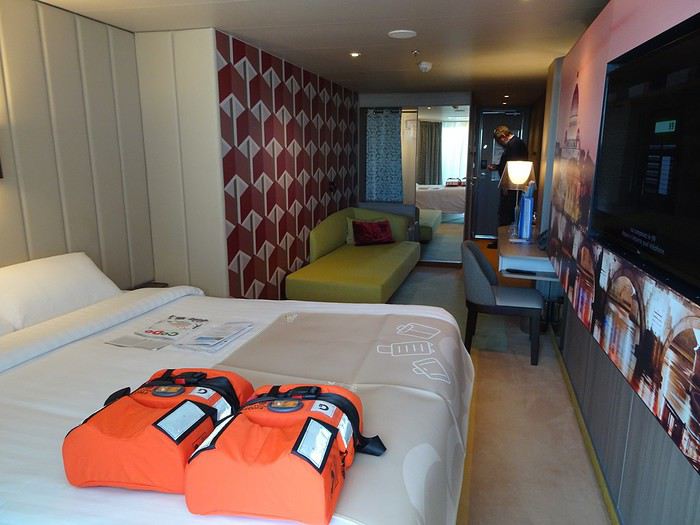
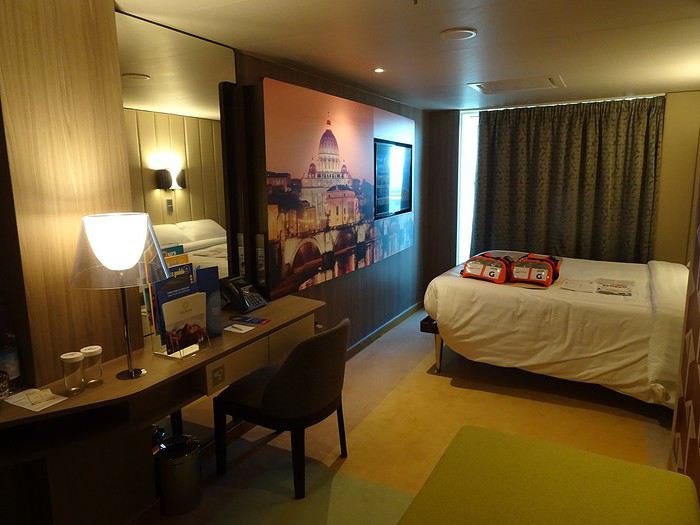
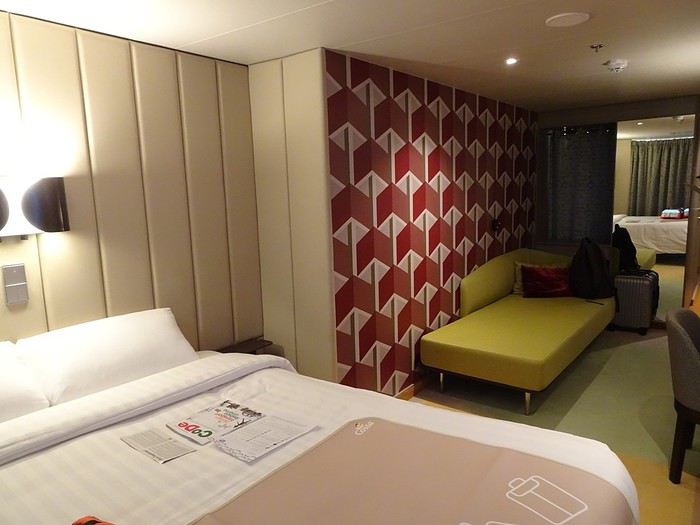
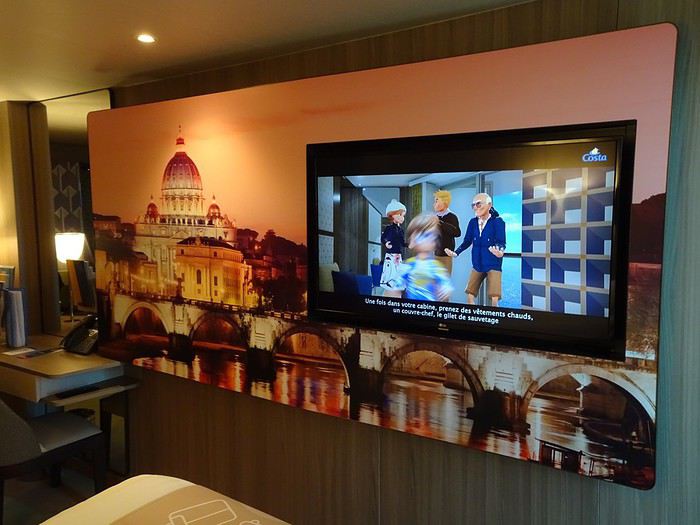
Affirmer que « les cabines sont plus petites » de manière générale est incorrect
L’examen des plans du navire montre que la structure des cabines varie selon l’architecture « tourmentée » du bateau et il est plus que vraisemblable que différentes variantes de la « cabine balcon Premium » plus petites ou plus grandes coexistent.
Quelques remarques au sujet de la cabine
L’ouverture de la cabine se fait, classiquement, avec la carte COSTA (format carte bancaire) à mettre en contact avec le boitier d’ouverture extérieure placé sur l’extérieur de la porte de la cabine. Une fois dans la cabine et tout aussi classiquement, l’éclairage de la cabine est conditionné au placement de la carte dans le récepteur ad hoc. Le but est évidemment de couper tout éclairage et alimentation des prises électriques lorsque la cabine n’est pas occupée.
A ce sujet, une petite astuce; nous emportons toujours avec nous une vielle carte de fidélité en plastique dur d’un grand magasin au format d’une carte de crédit que nous utilisons pour l’éclairage.
Cela évite la permutation des cartes Costa si l’un de nous deux quitte la cabine et doit donc récupérer sa carte et placer celle de l’autre dans le boitier. Cela permet au premier levé de sortir de la cabine avec sa carte sans devoir chercher celle de l’autre dans le noir pour remplacer sa carte dans le boitier et de réveiller le partenaire.
Cela permet aussi de maintenir en charge, l’appareil photo ou un GSM dans la cabine en notre absence.
Le lit est composé de deux lits simples de 2X0.8 m accolés
Le frigo à disparu, ce qui ne nous gêne guère, n’ayant JAMAIS (hors suite) consommé des boissons y comprises.
Il est toutefois dommage que ce frigo n’ait pas été remplacé par une petite armoire.
Les tables de chevet ont également disparu et sont remplacées par deux tablettes murales asymétriques de chaque côté.
Les armoires « classiques » se trouvent dans le couloir contre le bloc sanitaire avec le coffre classique.
Sur la paroi se trouve également le thermostat d’ambiance et le réglage classique de la T° Le bloc de ventilation/climatisation se situe à la hauteur du lit et la ventilation est sensible en position couchée mais pas spécifiquement dérangeante (pour nous).
Deux petits "bureaux" sont présents, l'un avec fauteuil, l'autre devant la vitre de la douche évoquée plus bas équipé d'un petit pouf.
Le bloc sanitaire est novateur, plus particulièrement pour ce qui est de la douche, une vraie douche maintenant qui remplace agréablement le minuscule espace douche habituel où on se colle au rideau plastique blanc, surtout quand on fait 1,93 m.
Ici, c’est une « vraie » douche à l’italienne, de taille réduite bien sûr (0, 7 m X 1 m, me semble t il) mais efficace.

Les grandes parois de la douche sont vitrées et la « grande » vitre fixe (partiellement opaque) donne sur la chambre (bonjour les fantasmes …) mais un rideau doublant cette vitre permet dignement de l’occulter ….
Le balcon est accessible par porte coulissante et de taille assez réduite, munis de deux sièges et SANS cendrier.
La taille des balcons est, comme celle des cabines, impactée par l’emplacement de la cabine dans le rafiot.
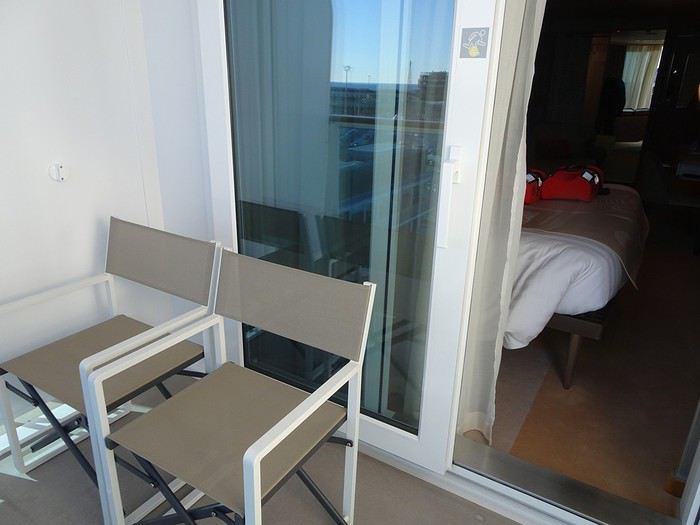
En conclusion une belle et agréable cabine, mais avec espaces de rangement quand même limités
La suite … prochainement
Joseph 😉
Nous rentrons d’une semaine de croisière sur le nouveau navire amiral de COSTA, le COSTA SMERALDA.
Cette croisière s’est déroulée du 11 au 18 janvier de Savone à Savone selon l’itinéraire et le planning prévus contrairement aux croisières de la semaine précédente et de la semaine suivante perturbées par le mauvais temps et les grèves françaises.
Pourquoi le SMERALDA et pourquoi à cette période de l’année ?
D’abord pour découvrir ce nouveau bateau mais aussi pour réserver, à bord, nos croisières suivantes pour 2020 chez COSTA.
Ce petit compte-rendu se limitera au bateau et à la vie à bord, les escales de la croisière (Savone, Marseille, Barcelone, Palma, Civitavecchia et La Spezia) étant très connues ne seront pas évoquées
Comme d’habitude lorsque nous embarquons à Savone, nous prenons la navette COSTA à la gare de Nice à 12h00 et nous arrivons à Savone à 14h45 après arrêt « technique » à mi-chemin. L’embarquement a débuté à 13h00 et, à notre arrivée, il n’y a donc aucune file ni attente pour embarquer et nous sommes à bord à 15h00.
La cabine N° 10138 (cabine balcon premium) située à babord au centre du navire nous attend. C’est une belle cabine, de bonne taille, qui s’avèrera confortable et bien insonorisée. Elle ne nous est pas apparue comme étant plus petite que les autres cabines balcon premium des autres COSTA.
Affirmer que « les cabines sont plus petites » de manière générale est incorrect
L’examen des plans du navire montre que la structure des cabines varie selon l’architecture « tourmentée » du bateau et il est plus que vraisemblable que différentes variantes de la « cabine balcon Premium » plus petites ou plus grandes coexistent.
Quelques remarques au sujet de la cabine
L’ouverture de la cabine se fait, classiquement, avec la carte COSTA (format carte bancaire) à mettre en contact avec le boitier d’ouverture extérieure placé sur l’extérieur de la porte de la cabine. Une fois dans la cabine et tout aussi classiquement, l’éclairage de la cabine est conditionné au placement de la carte dans le récepteur ad hoc. Le but est évidemment de couper tout éclairage et alimentation des prises électriques lorsque la cabine n’est pas occupée.
A ce sujet, une petite astuce; nous emportons toujours avec nous une vielle carte de fidélité en plastique dur d’un grand magasin au format d’une carte de crédit que nous utilisons pour l’éclairage.
Cela évite la permutation des cartes Costa si l’un de nous deux quitte la cabine et doit donc récupérer sa carte et placer celle de l’autre dans le boitier. Cela permet au premier levé de sortir de la cabine avec sa carte sans devoir chercher celle de l’autre dans le noir pour remplacer sa carte dans le boitier et de réveiller le partenaire.
Cela permet aussi de maintenir en charge, l’appareil photo ou un GSM dans la cabine en notre absence.
Le lit est composé de deux lits simples de 2X0.8 m accolés
Le frigo à disparu, ce qui ne nous gêne guère, n’ayant JAMAIS (hors suite) consommé des boissons y comprises.
Il est toutefois dommage que ce frigo n’ait pas été remplacé par une petite armoire.
Les tables de chevet ont également disparu et sont remplacées par deux tablettes murales asymétriques de chaque côté.
Les armoires « classiques » se trouvent dans le couloir contre le bloc sanitaire avec le coffre classique.
Sur la paroi se trouve également le thermostat d’ambiance et le réglage classique de la T° Le bloc de ventilation/climatisation se situe à la hauteur du lit et la ventilation est sensible en position couchée mais pas spécifiquement dérangeante (pour nous).
Deux petits "bureaux" sont présents, l'un avec fauteuil, l'autre devant la vitre de la douche évoquée plus bas équipé d'un petit pouf.
Le bloc sanitaire est novateur, plus particulièrement pour ce qui est de la douche, une vraie douche maintenant qui remplace agréablement le minuscule espace douche habituel où on se colle au rideau plastique blanc, surtout quand on fait 1,93 m.
Ici, c’est une « vraie » douche à l’italienne, de taille réduite bien sûr (0, 7 m X 1 m, me semble t il) mais efficace.
Les grandes parois de la douche sont vitrées et la « grande » vitre fixe (partiellement opaque) donne sur la chambre (bonjour les fantasmes …) mais un rideau doublant cette vitre permet dignement de l’occulter ….
Le balcon est accessible par porte coulissante et de taille assez réduite, munis de deux sièges et SANS cendrier.
La taille des balcons est, comme celle des cabines, impactée par l’emplacement de la cabine dans le rafiot.
En conclusion une belle et agréable cabine, mais avec espaces de rangement quand même limités
La suite … prochainement
Joseph 😉
Bolivia: Exploring the South Lipez by Self-Drive
Hi everyone,
The idea of traveling to Bolivia came to me after seeing Jean-François (Max68)’s photos on his website. I thought we *had* to see those stunning landscapes with the colorful lagoons for ourselves. But a self-drive trip didn’t seem doable at first. A few years ago, everyone advised against going to the South Lipez with just one car.
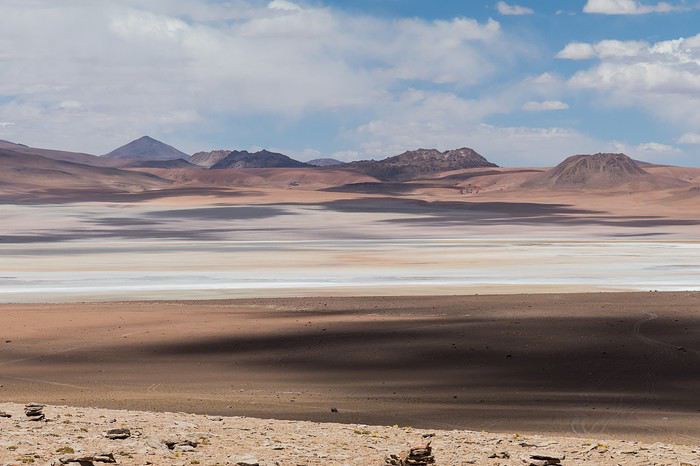 Laguna Kara
It was only after reading Laurent (Lolobe) and Pascal (Pepe874)’s travel journals—who explored the South Lipez solo with a car from Biz Rent a Car—that I thought we might be able to do the same. Meanwhile, we’d already contacted a local agency to organize a trip with a driver and guide. But the idea of a self-drive adventure really appealed to us. With encouragement and tips from Thierry (Tbernay) and Jean-François (Max68), we decided to plan our own self-drive trip. I’d like to thank them for their advice—it was *super* helpful. And a big thanks to all the other forum members for the info shared during our prep!
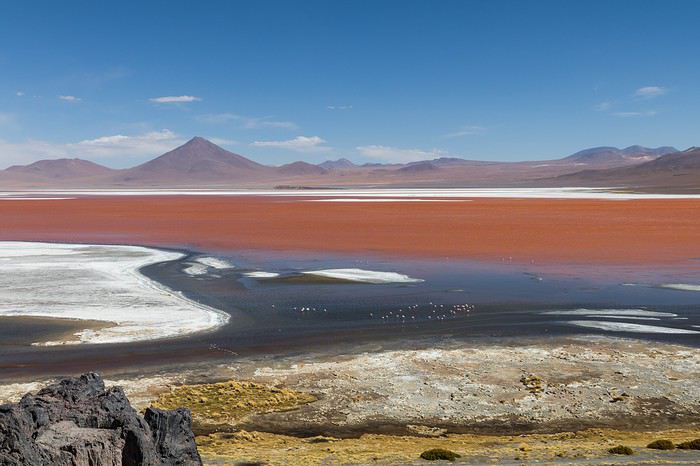 Laguna Colorada
Planning this trip happened during a tough time for our family. My mother-in-law’s illness and passing, plus a few health issues of my own, made us doubt the trip multiple times and nearly scrap the whole thing.
We booked our international flights in February with Swiss. They offered the best balance of travel time and price from Switzerland. Swiss operates Zurich–São Paulo with their own fleet, and São Paulo–Santa Cruz with GOL. In June, GOL canceled the Saturday flight and rebooked us on Sunday. Spending over 24 hours in that huge Brazilian city didn’t work for us at all, so we asked Swiss to put us on the next Zurich–São Paulo flight. Too bad—we lost a day in Bolivia and had to skip the Tarabucco market on Sunday.
Right after, we also booked the car in February. After contacting Imbex and Biz, we went with Biz. Not speaking Spanish, we were relieved to communicate with Alejandra in French. The contact was great—she answered all our questions patiently. Sometimes it took a few days to get a reply, but we could also reach her on WhatsApp. After our trip, we can *only* recommend Biz for rentals in Bolivia. The cars are well-prepped for the South Lipez tracks. The agency is reliable, and the vehicles are new and well-maintained.
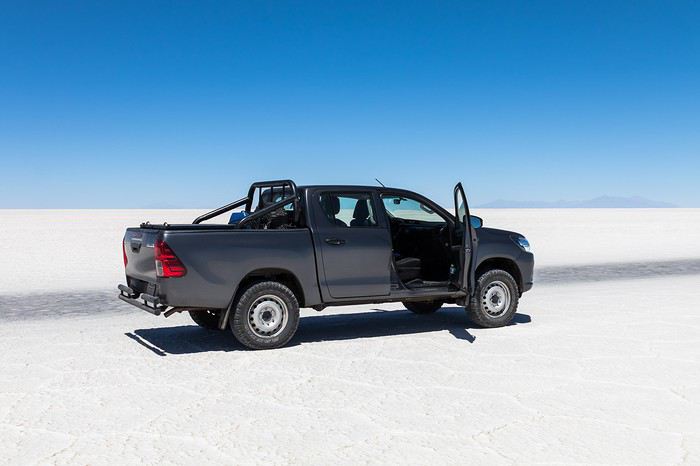 “Our” car, a Toyota Hilux
While planning, we realized the presidential elections would happen while we were in Bolivia. The risk of *bloqueos* (roadblocks and protests) was very real. But in Bolivia, *bloqueos* seem common—you always have to account for that kind of hassle. In late August/early September, Uyuni and the Salar region were blocked for days, leading to food, fuel, and cash shortages. Worried about a blockade in Uyuni and missing the Salar, we decided to visit it first *just in case*.
On election day, the whole country shut down. Planes were grounded, buses and taxis couldn’t circulate, and private cars were banned. There were a few exceptions—ambulances, police, or certain professions—but as tourists, we couldn’t get permission to drive. We asked the embassy, and Biz even requested a permit from the electoral office. So we had to plan to be somewhere with things to do *without* the car.
We decided not to book any accommodations in advance—a first for us. Usually, we plan our stops and reserve lodges, hotels, or campgrounds well ahead. This time, only the room in Sucre was booked, so we’d have a base when we arrived.
In July, Alex (Delhenry) reached out to propose joining part of the trip. He didn’t realize we were leaving in October. Still, we got fresh updates when he returned from the South Lipez. Thanks, Alex—your tips, especially about the Guadalupe–Tupiza stretch, were *super* useful.
In September, we connected with Jean-Louis (Avx) and Anne (Xeta), who were also heading to Bolivia in October, one and two weeks after us. We had dinner with Jean-Louis and his friend after our South Lipez trip and stayed in touch with Anne. It was great to chat with them! Unfortunately, Anne and her husband had a much rockier trip—they got hit hard by post-election issues.
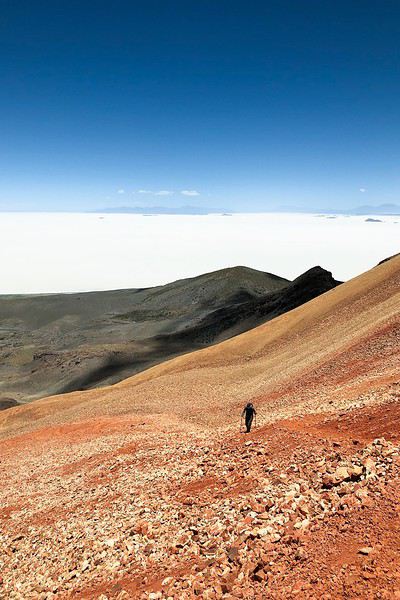 Climbing Volcán Tunupa
Our itinerary wasn’t set in stone—we decided to wing it on the spot. Two weeks before departure, I reconnected with Alejandra at Biz to move the car rental up by a day. With the elections, we wanted to leave Sucre ASAP and focus on the South Lipez. Outside Uyuni and Tupiza, the risk of blockades was zero. We also planned a two-night buffer in Sucre before our flights, just in case. It might sound overcautious, but in hindsight, we made the right call. If we’d left Sucre a day later, we wouldn’t have made it to Potosí—it was completely blocked. On the way back, we *just* dodged blockades in Potosí and elsewhere. Sometimes, you’ve gotta trust your gut.
Here’s our route—only the first two nights in Sucre were booked ahead:
D1 Departure from Switzerland
D2 Sucre (La Selenita)
D3 Sucre (La Selenita)
D4 Colchani (Hotel de Sal Luna Salada)
D5 Jirira (Auberge Doña Lupe)
D6 On the Salar (in the car)
D7 A few kilometers from Estancia Catal (in the car)
D8 Laguna Hedionda (Hotel Los Flamencos)
D9 Laguna Colorada (Lodge by the lagoon)
D10 Middle of nowhere, en route Laguna Verde–Mina Horsu–Quetena Chico (in the car)
D11 Quetena Chico (Lamphaya Lodge Andino)
D12 Quetena Chico (Lamphaya Lodge Andino)
D13 Guadalupe (Guest room at Celia’s)
D14 Along the Rio Grande (in the car)
D15 Tupiza (Hotel Mitru)
D16 Tupiza (Hotel Mitru)
D17 Sucre (La Selenita)
D18 Sucre (La Selenita)
D19 Santa Cruz (Hotel Sun)
D20 Departure from Santa Cruz
D21 Arrival in Switzerland
As you can see, we spent 13 nights in the South Lipez. Initially, we’d planned for nine, but Jean-François (Max68) suggested staying longer. Great advice—we didn’t regret it one bit. We could’ve even added 2–3 more days without getting bored.
Self-driving in the South Lipez takes some prep and a good GPS. We kept it simple and used maps.me to navigate. It’s a solid app—just save your waypoints ahead of time. For some stretches, I used Google Earth to visualize the tracks and sites. If you stick to the tour operator routes, you *almost* can’t get lost. But we often veered off the beaten path and took different routes. Some days, we didn’t see another car. So in case of a breakdown, it’s key to have water and food for several days. In some spots, there’s *zero* signal—your phone won’t work. Another must: it gets *cold* in the South Lipez, and a good sleeping bag is essential. We brought down sleeping bags rated for -10°C and didn’t regret it during our car nights.
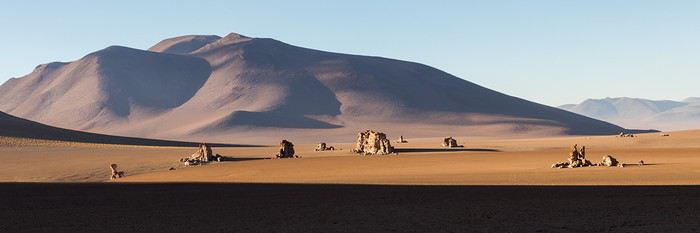 The Dalí Desert
Some tracks are *super* rocky—flat tires are a real risk. On those stretches, maps.me’s estimated travel time was way off. Some sections barely let us go over 15 km/h.
Lots of forum members recommend doing the South Lipez “loop” from Tupiza to Uyuni—ending with the Salar—to avoid Uyuni’s crowds. That might work for organized tours, but for self-drive, the direction *doesn’t* matter. I’ll say this: the few vehicles we saw mostly came from Tupiza and Chile, not Uyuni. So if starting from Uyuni works better for you, go for it! Ending in Tupiza means heading toward warmer weather. For our planned stops and climbs, starting in Uyuni helped with acclimatization. Spending a few nights between 3,600–3,800 m before going over 4,000 m is a smart move.
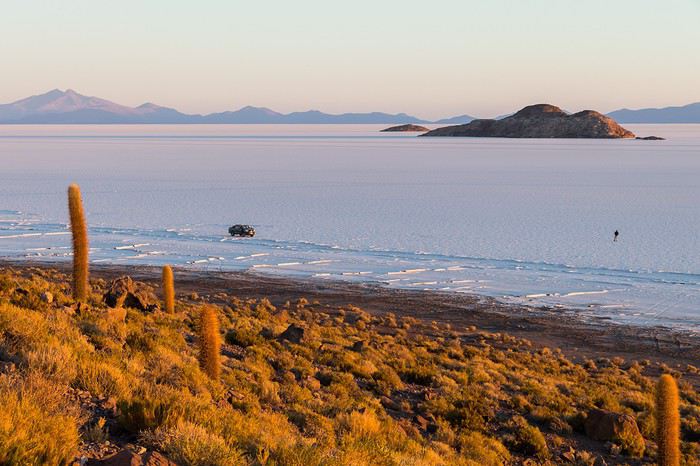 Uyuni Salt Flats in the morning
Overall, we barely saw anyone—except at Laguna Hedionda and Chalviri. There were several tour groups at Hotel Los Flamencos (Laguna Hedionda), but we didn’t cross paths during the day. Hardly anyone on the Salar, on the roads, or at the lodges in the evenings. The *only* place that shocked us was Chalviri. We’d planned to stay there, but it was fully booked—and we counted *forty* tour jeeps on-site. This was around noon! At the Polques hot springs (Chalviri), it was *packed*—we quickly nixed the idea of a dip. Plus, the vibe wasn’t great: soaking right by the road with lodges and restaurants in the background? Meh. Still, lots of tourists love it, so it’s up to you.
For the photos, I kept the colors and mood we saw. The lagoons’ hues are often stunning, but some online photos are *way* over-edited and oversaturated. The South Lipez’s landscapes are breathtaking—no need for excessive retouching.
If you don’t want to read all the details, the start of the travel journal is here: https://voyageforum.com/v.f?post=9888761;a=9888761
The idea of traveling to Bolivia came to me after seeing Jean-François (Max68)’s photos on his website. I thought we *had* to see those stunning landscapes with the colorful lagoons for ourselves. But a self-drive trip didn’t seem doable at first. A few years ago, everyone advised against going to the South Lipez with just one car.
Laguna KaraIt was only after reading Laurent (Lolobe) and Pascal (Pepe874)’s travel journals—who explored the South Lipez solo with a car from Biz Rent a Car—that I thought we might be able to do the same. Meanwhile, we’d already contacted a local agency to organize a trip with a driver and guide. But the idea of a self-drive adventure really appealed to us. With encouragement and tips from Thierry (Tbernay) and Jean-François (Max68), we decided to plan our own self-drive trip. I’d like to thank them for their advice—it was *super* helpful. And a big thanks to all the other forum members for the info shared during our prep!
Laguna ColoradaPlanning this trip happened during a tough time for our family. My mother-in-law’s illness and passing, plus a few health issues of my own, made us doubt the trip multiple times and nearly scrap the whole thing.
We booked our international flights in February with Swiss. They offered the best balance of travel time and price from Switzerland. Swiss operates Zurich–São Paulo with their own fleet, and São Paulo–Santa Cruz with GOL. In June, GOL canceled the Saturday flight and rebooked us on Sunday. Spending over 24 hours in that huge Brazilian city didn’t work for us at all, so we asked Swiss to put us on the next Zurich–São Paulo flight. Too bad—we lost a day in Bolivia and had to skip the Tarabucco market on Sunday.
Right after, we also booked the car in February. After contacting Imbex and Biz, we went with Biz. Not speaking Spanish, we were relieved to communicate with Alejandra in French. The contact was great—she answered all our questions patiently. Sometimes it took a few days to get a reply, but we could also reach her on WhatsApp. After our trip, we can *only* recommend Biz for rentals in Bolivia. The cars are well-prepped for the South Lipez tracks. The agency is reliable, and the vehicles are new and well-maintained.
“Our” car, a Toyota HiluxWhile planning, we realized the presidential elections would happen while we were in Bolivia. The risk of *bloqueos* (roadblocks and protests) was very real. But in Bolivia, *bloqueos* seem common—you always have to account for that kind of hassle. In late August/early September, Uyuni and the Salar region were blocked for days, leading to food, fuel, and cash shortages. Worried about a blockade in Uyuni and missing the Salar, we decided to visit it first *just in case*.
On election day, the whole country shut down. Planes were grounded, buses and taxis couldn’t circulate, and private cars were banned. There were a few exceptions—ambulances, police, or certain professions—but as tourists, we couldn’t get permission to drive. We asked the embassy, and Biz even requested a permit from the electoral office. So we had to plan to be somewhere with things to do *without* the car.
We decided not to book any accommodations in advance—a first for us. Usually, we plan our stops and reserve lodges, hotels, or campgrounds well ahead. This time, only the room in Sucre was booked, so we’d have a base when we arrived.
In July, Alex (Delhenry) reached out to propose joining part of the trip. He didn’t realize we were leaving in October. Still, we got fresh updates when he returned from the South Lipez. Thanks, Alex—your tips, especially about the Guadalupe–Tupiza stretch, were *super* useful.
In September, we connected with Jean-Louis (Avx) and Anne (Xeta), who were also heading to Bolivia in October, one and two weeks after us. We had dinner with Jean-Louis and his friend after our South Lipez trip and stayed in touch with Anne. It was great to chat with them! Unfortunately, Anne and her husband had a much rockier trip—they got hit hard by post-election issues.
Climbing Volcán TunupaOur itinerary wasn’t set in stone—we decided to wing it on the spot. Two weeks before departure, I reconnected with Alejandra at Biz to move the car rental up by a day. With the elections, we wanted to leave Sucre ASAP and focus on the South Lipez. Outside Uyuni and Tupiza, the risk of blockades was zero. We also planned a two-night buffer in Sucre before our flights, just in case. It might sound overcautious, but in hindsight, we made the right call. If we’d left Sucre a day later, we wouldn’t have made it to Potosí—it was completely blocked. On the way back, we *just* dodged blockades in Potosí and elsewhere. Sometimes, you’ve gotta trust your gut.
Here’s our route—only the first two nights in Sucre were booked ahead:
D1 Departure from Switzerland
D2 Sucre (La Selenita)
D3 Sucre (La Selenita)
D4 Colchani (Hotel de Sal Luna Salada)
D5 Jirira (Auberge Doña Lupe)
D6 On the Salar (in the car)
D7 A few kilometers from Estancia Catal (in the car)
D8 Laguna Hedionda (Hotel Los Flamencos)
D9 Laguna Colorada (Lodge by the lagoon)
D10 Middle of nowhere, en route Laguna Verde–Mina Horsu–Quetena Chico (in the car)
D11 Quetena Chico (Lamphaya Lodge Andino)
D12 Quetena Chico (Lamphaya Lodge Andino)
D13 Guadalupe (Guest room at Celia’s)
D14 Along the Rio Grande (in the car)
D15 Tupiza (Hotel Mitru)
D16 Tupiza (Hotel Mitru)
D17 Sucre (La Selenita)
D18 Sucre (La Selenita)
D19 Santa Cruz (Hotel Sun)
D20 Departure from Santa Cruz
D21 Arrival in Switzerland
As you can see, we spent 13 nights in the South Lipez. Initially, we’d planned for nine, but Jean-François (Max68) suggested staying longer. Great advice—we didn’t regret it one bit. We could’ve even added 2–3 more days without getting bored.
Self-driving in the South Lipez takes some prep and a good GPS. We kept it simple and used maps.me to navigate. It’s a solid app—just save your waypoints ahead of time. For some stretches, I used Google Earth to visualize the tracks and sites. If you stick to the tour operator routes, you *almost* can’t get lost. But we often veered off the beaten path and took different routes. Some days, we didn’t see another car. So in case of a breakdown, it’s key to have water and food for several days. In some spots, there’s *zero* signal—your phone won’t work. Another must: it gets *cold* in the South Lipez, and a good sleeping bag is essential. We brought down sleeping bags rated for -10°C and didn’t regret it during our car nights.
The Dalí DesertSome tracks are *super* rocky—flat tires are a real risk. On those stretches, maps.me’s estimated travel time was way off. Some sections barely let us go over 15 km/h.
Lots of forum members recommend doing the South Lipez “loop” from Tupiza to Uyuni—ending with the Salar—to avoid Uyuni’s crowds. That might work for organized tours, but for self-drive, the direction *doesn’t* matter. I’ll say this: the few vehicles we saw mostly came from Tupiza and Chile, not Uyuni. So if starting from Uyuni works better for you, go for it! Ending in Tupiza means heading toward warmer weather. For our planned stops and climbs, starting in Uyuni helped with acclimatization. Spending a few nights between 3,600–3,800 m before going over 4,000 m is a smart move.
Uyuni Salt Flats in the morningOverall, we barely saw anyone—except at Laguna Hedionda and Chalviri. There were several tour groups at Hotel Los Flamencos (Laguna Hedionda), but we didn’t cross paths during the day. Hardly anyone on the Salar, on the roads, or at the lodges in the evenings. The *only* place that shocked us was Chalviri. We’d planned to stay there, but it was fully booked—and we counted *forty* tour jeeps on-site. This was around noon! At the Polques hot springs (Chalviri), it was *packed*—we quickly nixed the idea of a dip. Plus, the vibe wasn’t great: soaking right by the road with lodges and restaurants in the background? Meh. Still, lots of tourists love it, so it’s up to you.
For the photos, I kept the colors and mood we saw. The lagoons’ hues are often stunning, but some online photos are *way* over-edited and oversaturated. The South Lipez’s landscapes are breathtaking—no need for excessive retouching.
If you don’t want to read all the details, the start of the travel journal is here: https://voyageforum.com/v.f?post=9888761;a=9888761
Antelope Canyon, Horseshoe Bend, etc... "overcrowded". Effet de Panurge ou Instagram? English translation pending
trop de touristes dans les lieux … touristiques ( air connu😛)
Les derniers vingt ans et surtout la dernière décennie ont vu grimper en flèche la fréquentation des Parcs nationaux, enfin au moins de certains, ainsi que de certains sites tels que Antelope Canyon et Horseshoe Bend
Antelope Canyon, parce que c’est payant, revient souvent sur les forums francophones, anglophones, hispanophones et certainement d’autres . Taper ‘’ Antelope Canyon rip-off ( ou scam) ‘’ et vous verrez que les Français ne sont pas les seuls à râler !
Voici quelques uns des repères qui ont jalonné la montée en puissance d’Antelope Canyon dans le monde du tourisme !
Dans les années 70 ces parages étaient parcourus par les bergers Navajos, quelques scientifiques, naturalistes ou géologues, de rares photographes et c’était à peu près tout ! Par exemple c’est par un collègue senior que j’en ai entendu parler …
L’histoire dit qu’un jour un berger Navajo rencontre un photographe tout équipé, marchant dans le désert, quelque peu hagard, qui cherchait désespérément un certain canyon aux couleurs et formes étonnantes dont il avait entendu parler . Il l’y aurait conduit et aurait vite réalisé que les ‘Américains’ étaient prêts à payer pour y venir.
Ça aurait donc commencé comme cela… !
En tous cas vers le milieu ou la fin des années 70 deux revues importantes présentent le site aux Américains…
- au niveau régional Arizona Highways
- au niveau national National Geographic qui lui apporte une première consécration
En 1997 les Français et autres Européens notamment font partie de la nouvelle clientèle internationale qui commence à affluer. Cette période est évidemment marquée par la tragédie du flash flood au cours duquel plusieurs touristes français trouvent la mort. Selon les responsables locaux du moment la fréquentation aurait en fait sensiblement augmentée après cette tragédie !
En 2009 quand Microsoft décide d’incorporer une série de photos à Windows 7 les choses changent d’échelle. En deux ans Microsoft vend plus de 450 millions de licences et fait ainsi visionner les images à haute fidélité du site à des centaines de millions de personnes ( les titulaires de la licence et toute le reste de la famille ou du bureau!)
En 2010 c’est le lancement de Instagramdont la presse américaine s’accorde à dire qu’il a été instrumental dans le flux touristique toujours croissant et pas seulement à Antelope Canyon !
En 2019 on vient de faire le constat que les requêtes Google sur Antelope Canyon ont explosé depuis : elles auraient augmenté de 660 % !
L’année 2019 marque aussi la fin des créneaux horaires réservés aux ‘’photographes avec tripode’’ les tours ''standard'' étant devenus trop difficiles à gérer
Antelope Canyon is Shutting Down Its Photo Tours Due to …
Antelope Canyon photography tours are canceled. Here's why
En 2020 les opérateurs affirment que cette décision devrait réduire la pression sur les groupes de visiteurs ‘’standard’’ ceux qui arrivent en masse, le portable au bout d’une perche pour le selfie de rigueur ( paraît-il)
…
Si vous avez aimez la montée en puissance d’ Antelope Canyon et le rôle des réseaux sociaux (Instagram etc….)
.. vous allez adorer celle de Horseshoe Bend….
… en 10 ans (2009-2019) la fréquentation touristique annuelle y est passée de moins de 40 000 personnes à environ 2 200 000 mais ce sont surtout les cinq dernières années qui ont vu s’emballer le flux, la fièvre Antelope canyon se serait alors propagée via Instagram selon le Wall Street Journal lui-même l’été dernier
Instagram Turns Obscure U.S. Sights Into Social-Media …
Et comme nous l’expliquait ABC TV, également en juillet dernier
Link to ABC News story
pas étonnant donc que le prix des chambres d’hôtel à PAGE flambe!
Les derniers vingt ans et surtout la dernière décennie ont vu grimper en flèche la fréquentation des Parcs nationaux, enfin au moins de certains, ainsi que de certains sites tels que Antelope Canyon et Horseshoe Bend
Antelope Canyon, parce que c’est payant, revient souvent sur les forums francophones, anglophones, hispanophones et certainement d’autres . Taper ‘’ Antelope Canyon rip-off ( ou scam) ‘’ et vous verrez que les Français ne sont pas les seuls à râler !
Voici quelques uns des repères qui ont jalonné la montée en puissance d’Antelope Canyon dans le monde du tourisme !
Dans les années 70 ces parages étaient parcourus par les bergers Navajos, quelques scientifiques, naturalistes ou géologues, de rares photographes et c’était à peu près tout ! Par exemple c’est par un collègue senior que j’en ai entendu parler …
L’histoire dit qu’un jour un berger Navajo rencontre un photographe tout équipé, marchant dans le désert, quelque peu hagard, qui cherchait désespérément un certain canyon aux couleurs et formes étonnantes dont il avait entendu parler . Il l’y aurait conduit et aurait vite réalisé que les ‘Américains’ étaient prêts à payer pour y venir.
Ça aurait donc commencé comme cela… !
En tous cas vers le milieu ou la fin des années 70 deux revues importantes présentent le site aux Américains…
- au niveau régional Arizona Highways
- au niveau national National Geographic qui lui apporte une première consécration
En 1997 les Français et autres Européens notamment font partie de la nouvelle clientèle internationale qui commence à affluer. Cette période est évidemment marquée par la tragédie du flash flood au cours duquel plusieurs touristes français trouvent la mort. Selon les responsables locaux du moment la fréquentation aurait en fait sensiblement augmentée après cette tragédie !
En 2009 quand Microsoft décide d’incorporer une série de photos à Windows 7 les choses changent d’échelle. En deux ans Microsoft vend plus de 450 millions de licences et fait ainsi visionner les images à haute fidélité du site à des centaines de millions de personnes ( les titulaires de la licence et toute le reste de la famille ou du bureau!)
En 2010 c’est le lancement de Instagramdont la presse américaine s’accorde à dire qu’il a été instrumental dans le flux touristique toujours croissant et pas seulement à Antelope Canyon !
En 2019 on vient de faire le constat que les requêtes Google sur Antelope Canyon ont explosé depuis : elles auraient augmenté de 660 % !
L’année 2019 marque aussi la fin des créneaux horaires réservés aux ‘’photographes avec tripode’’ les tours ''standard'' étant devenus trop difficiles à gérer
Antelope Canyon is Shutting Down Its Photo Tours Due to …
Antelope Canyon photography tours are canceled. Here's why
En 2020 les opérateurs affirment que cette décision devrait réduire la pression sur les groupes de visiteurs ‘’standard’’ ceux qui arrivent en masse, le portable au bout d’une perche pour le selfie de rigueur ( paraît-il)
…
Si vous avez aimez la montée en puissance d’ Antelope Canyon et le rôle des réseaux sociaux (Instagram etc….)
.. vous allez adorer celle de Horseshoe Bend….
… en 10 ans (2009-2019) la fréquentation touristique annuelle y est passée de moins de 40 000 personnes à environ 2 200 000 mais ce sont surtout les cinq dernières années qui ont vu s’emballer le flux, la fièvre Antelope canyon se serait alors propagée via Instagram selon le Wall Street Journal lui-même l’été dernier
Instagram Turns Obscure U.S. Sights Into Social-Media …
Et comme nous l’expliquait ABC TV, également en juillet dernier
Link to ABC News story
pas étonnant donc que le prix des chambres d’hôtel à PAGE flambe!
Carte de débit pour location de voiture en Floride English translation pending
Bonjour,
Je poste ici car j'ai besoin de vos lumières ! J'ai réservé le mois dernier avec mon vol pour la Floride la location de mon véhicule ! Tout cela à donc été réglé avec ma carte dite carte "Débit". Malheureusement sur mon contrat de location c'est indiqué que lors du retrait il faut présenter une carte de "Crédit" car les cartes de "débit" ne sont pas autorisées. Je pensais donc faire une demande à ma banque d'une carte de "crédit" pour être tranquille. C'est là qu'arrive ma question ! Est ce que cela posera un problème donc, de présenter au comptoir lors du retrait du véhicule, une carte différente que celle utilisée pour la réservation ? Merci grandement !
Je poste ici car j'ai besoin de vos lumières ! J'ai réservé le mois dernier avec mon vol pour la Floride la location de mon véhicule ! Tout cela à donc été réglé avec ma carte dite carte "Débit". Malheureusement sur mon contrat de location c'est indiqué que lors du retrait il faut présenter une carte de "Crédit" car les cartes de "débit" ne sont pas autorisées. Je pensais donc faire une demande à ma banque d'une carte de "crédit" pour être tranquille. C'est là qu'arrive ma question ! Est ce que cela posera un problème donc, de présenter au comptoir lors du retrait du véhicule, une carte différente que celle utilisée pour la réservation ? Merci grandement !