Results for "Tribulation+|+11+>+237"
704 results found.
L'Australie et les reptiles: un rêve? English translation pending
Bonjour,
Je viens de découvrir avec joie votre forum après avoir fait une recherche sur google a propos de Steeve Irwin, qui était pour moi, une de mes idoles. Je suis en effet passionné par la nature, et surtout par mes amis souvent detesté par la majorité, les reptiles.
Mon rêve est en effet de partir un an en Australie pour deux choses, ameliorer mon Anglais qui reste très moyen et d'autre part, découvrir et approfondir mes connaissances sur les reptiles d'Australie.
Je voulais donc savoir si quelqu'un pouvait m'aider a trouver une solution afin de partir en Australie (très surement dans une famillé) et a coté pouvoir partir faiure des expeditions avec des herpetologues ou autre personne passionné.
Je n'ai en effet pas trouver de lien, d'adresse ou autre pour allier ces deux choses.
L'herpetologie est pour moi une vraie raison de vivre, et j'aimerais donc si possible faire un bout de chemin avec l'étude de certains reptiles australien...
Merci beaucoup de m'aider et a très bientôt!
ps: il y a des passionné de terrario sur ce forum?^^
L'herpetologie est pour moi une vraie raison de vivre, et j'aimerais donc si possible faire un bout de chemin avec l'étude de certains reptiles australien...
Merci beaucoup de m'aider et a très bientôt!
ps: il y a des passionné de terrario sur ce forum?^^
Passer la frontière Asie Centrale-Chine en voiture English translation pending
Bonjour à Tous !
Un nouveau voyage se profile à l'horizon (fin février) et voici venu le temps des préparatifs. Avec mon ami nous allons partir en Asie centrale en voiture, une VW de 20 ans d'âge. Notre objectif est d'atteindre ce coin d'Asie. Maintenant si notre voiture est brave et tient le coup nous pensons nous rendre au Pakistan et ce en passant par la Chine. J'ai entendu dire que ce n'était pas très facile et coûteux. Est-ce que certains parmis vous pourraient me renseigner ? De plus je ne sais depuis quels pays d'Asie centrale c'est le plus aisé de passer la frontière !
Je suis toute impatiente de lire vos témoignages et vous remercie infiniment!! Bon vent à vous tous et à bientôt Lapinfou
Un nouveau voyage se profile à l'horizon (fin février) et voici venu le temps des préparatifs. Avec mon ami nous allons partir en Asie centrale en voiture, une VW de 20 ans d'âge. Notre objectif est d'atteindre ce coin d'Asie. Maintenant si notre voiture est brave et tient le coup nous pensons nous rendre au Pakistan et ce en passant par la Chine. J'ai entendu dire que ce n'était pas très facile et coûteux. Est-ce que certains parmis vous pourraient me renseigner ? De plus je ne sais depuis quels pays d'Asie centrale c'est le plus aisé de passer la frontière !
Je suis toute impatiente de lire vos témoignages et vous remercie infiniment!! Bon vent à vous tous et à bientôt Lapinfou
Bateau de Phnom Penh à Siem Reap English translation pending
hello !
qui me dit si les bateaux fonctionnent encore bien sur Tonlé sap, quelle est la best compagnie et les tarifs ?? question de sécurité et de rapidité. si vous l'avez pris ces temps çi quelle est la meilleure heure matinale
merci
Avis sur itinéraire de trente jours en Australie English translation pending
je commence a preparer un voyage en Australie pour 2007: (30 jours maxi sur place) Arrivee a Adelaïde Visite Adelaïde (3 jours) trajet en voiture de location entre Adelaide et Sydney en passant par blues montains (3 jours) Sydney (5 jours) vol pour Brisbane (1 j) + louer voiture passer 2/3 jours sur les plages du cote de Noosa Heads vol pour Cairns (4 jours) +louer voiturebalade en bateau barriere corail (1 jour) vol pour Darwin (2 j) + louer voiturevol pour Alice Springs + louer voiture Alice Springs / Ayers Rocks (7 jours) vol pour Adelaide et retour en France
Que pensez vous de ce projet? est il realisable? quels modifs apporter ; a enlever ou a rajouter?
d'autre part, cest ma grande inquietude, on fera pas mal de camping donc on aura des bagages.... combien de kilos on peut mettre en soute sans frais supplementaires dans les vols interieurs? (Quantas etc...) ??? et dans les vols entre France et Australie ???
Merci à tout le monde pour votre aide!
Que pensez vous de ce projet? est il realisable? quels modifs apporter ; a enlever ou a rajouter?
d'autre part, cest ma grande inquietude, on fera pas mal de camping donc on aura des bagages.... combien de kilos on peut mettre en soute sans frais supplementaires dans les vols interieurs? (Quantas etc...) ??? et dans les vols entre France et Australie ???
Merci à tout le monde pour votre aide!
Ouzbékistan et Kirghizistan en Renault 4L English translation pending
bonjour
je m'appelle Nicolas, et je suis francais.
Cela fait maintenant 3 mois que je parcours le monde a bord de ma renault 4L. Et oui elle a tenu le coup. La je suis a Symkent et je vais demain sur Taschkent.
J'aurais besoin de conseils sur la faisabilite de parcourir l'ouzbekistan en 4L, du moins jusqu'a Buchara, et dans la vallee du fergana dóu je pense franchir la frontiere kirghise. Quelle est la route la plus sur pour passer la frontiere. Est-je besoin d'un guide? Je me pose la question car je suis tout seul et j'avoue avoir un peu peur.
Ensuite je voudrais franchir la frontiere chinoise. Certaines personnes me soutiennent que c'est possible, d'autres que ca ne l'est pas du tout. Quand est-il reellement?
Est-il possible de vendre la voiture a un chinois qui franchira la frontiere sans moi, et que je la recupere en chine, a Kashgar par exemple. Cést tordu je sais, mais je trouve dommage de laisser ma 4L dans un fossee apres tant d'aventures et de mesaventures. Paris - Pekin en 4L, ca le ferait quand meme.
Il y a-t-il des francais a Tashkent ou meme a Symkent qui seraient volontaire pour me faire decouvrir la region a bord dune charmante 4L... Je suis preneur, car je nái pas envie de visiter l'ouzbekistan et le kirghizstan tout seul.
A bon entendeur
salut et merci d'avance
Nicolas
email : nicokenherve@hotmail.com
site web : http://perso.top-depart.com/cromagnon
Climat du Nord de l'Australie en octobre? English translation pending
salut à tous!! 🙂nous partons ;en australie le 10 oct;et comptons faire un périple de 2 mois !!à partir de sydney;nous allons remonter vers le nords est et faire la cote en bus jusqu'a cairns donc on seras à cairns puis darwin pour faire l'outback vers le 20 octobre n'est ce pas trop tard !! pour le climat !!vas t'on vraiment trouver beaucoup de pluies? ou faudrait'il que l'on monte directement dans le nords? svp répondez moi?car nous sommes un peu perplexe.🤪
Itinéraire pour 1 mois et demi en Australie English translation pending
Bonjour à tous,
Je vous écris ce message car j'aurais besoin de vos conseils pour un trajet d'un mois et demi en Australie. Je pensais arriver à Sydney puis louer une voiture (4x4 couchette) et ensuite remonter jusqu'à Cairns. Puis de Cairns je prendrais un avions jusqu'Alice Springs puis à nouveau une location jusqu'à Darwins.
Je suis un peu perdu dans l'immensité de ce pays et j'ai du mal à évaluer le temps et les distances. De plus j'aurais besoin d'être aiguillé sur les sites incontournables. D'après mon trajet n'est pas dommage de manquer Melbourne et la Tasmanie ? La location de voiture est il vraiment le meilleur moyen de découvrir ce pays ?
Je vous remercie pour vos précieux conseils.
Nicolas
Je vous écris ce message car j'aurais besoin de vos conseils pour un trajet d'un mois et demi en Australie. Je pensais arriver à Sydney puis louer une voiture (4x4 couchette) et ensuite remonter jusqu'à Cairns. Puis de Cairns je prendrais un avions jusqu'Alice Springs puis à nouveau une location jusqu'à Darwins.
Je suis un peu perdu dans l'immensité de ce pays et j'ai du mal à évaluer le temps et les distances. De plus j'aurais besoin d'être aiguillé sur les sites incontournables. D'après mon trajet n'est pas dommage de manquer Melbourne et la Tasmanie ? La location de voiture est il vraiment le meilleur moyen de découvrir ce pays ?
Je vous remercie pour vos précieux conseils.
Nicolas
Australie et Nouvelle-Zélande: quelles parties visiter? English translation pending
bonjour.
je pars faire un tdm bientot, et je passe par l'australie et la nouvelle -zelande, pour une petite periode;3semane en austr et 1semaine en NZ.
j'aimerai savoir quelle region serait interessante, à visiter en priorité en austr, sans que j'aie besoin de trop de temps!
ma 2ème questionest:si je ne peux faire qu'une partie de la NZ, que me conseillez-vous, le sud ou le nord(en sachant que je ne suis pas une fana de sport, mais je prefère la nature)
je vous remercie pour les conseiles
Films en français sur la cie Lufthansa? English translation pending
bonjour
je voyage en famille avec mes 2 filles avec Lufthansa pour un Paris/Francfort/Los Angeles
est-il vrai que les films ne sont pas proposés en français?
rassurez-moi vite sinon 11h30 de vol sans rien pour les distraire, je crains le pire!!
merci
Réservation de France ou sur place en Australie? (centre rouge/kakadu) English translation pending
nous partons pour 1mois en australie de fin juil a fin aout 🙂
normalement pour nos voyages nous reservons juste le vol +qq nuits d hotels la pour l australie j hesite le pays est tellement grd que pas trop le temps de chercher sur place....et peur de passer a coté de qq chose.....
notament je n arrive pas a me decider surtout pour le centre rouge et le kakadu si je reserve ou pas de france car j aimerai voir un max de faune et avoir un contact direct avec la population aborigene vivant ds le parc
ma question :en louant un 4x4 a kakadu peut t on trouver un guide aborigene ou une organisation sur place en tres petit groupe.....a prix correct (le devis que j ai fait faire en france ateint + de 9000 euros pour deux tt compris hors repas et essence )
pour le centre rouge de meme est il facile de trouver une chambre en plein aout ???
je cherche aussi une organisation pour l observation des baleine a fraser qui ne soit pas usine a touristes je deteste ca!!!!
je suis ouvert a tout bon plan concernant le kakadu centre rouge et cote est que ns faisons en 4x4 puis camping car .......merci d avance😛
normalement pour nos voyages nous reservons juste le vol +qq nuits d hotels la pour l australie j hesite le pays est tellement grd que pas trop le temps de chercher sur place....et peur de passer a coté de qq chose.....
notament je n arrive pas a me decider surtout pour le centre rouge et le kakadu si je reserve ou pas de france car j aimerai voir un max de faune et avoir un contact direct avec la population aborigene vivant ds le parc
ma question :en louant un 4x4 a kakadu peut t on trouver un guide aborigene ou une organisation sur place en tres petit groupe.....a prix correct (le devis que j ai fait faire en france ateint + de 9000 euros pour deux tt compris hors repas et essence )
pour le centre rouge de meme est il facile de trouver une chambre en plein aout ???
je cherche aussi une organisation pour l observation des baleine a fraser qui ne soit pas usine a touristes je deteste ca!!!!
je suis ouvert a tout bon plan concernant le kakadu centre rouge et cote est que ns faisons en 4x4 puis camping car .......merci d avance😛
Information à confirmer ou infirmer sur la mendicité organisée à Siem Reap? English translation pending
Bonjour à tous
Je viens de lire sur un autre forum connu ( où de nombreux routards s'expriment)un truc assez effarant sur une sorte de mendicité organisée dans Sieam Reap.. le texte est assez "violent" dans sa rédaction et laisse une drôle d'impression.. Il serait bon que ceux qui connaissent bien les lieux infirment ou confirment de tels propos qui peuvent, s'ils sont inexacts avoir des effets assez dévastateurs...
Merci
Je viens de lire sur un autre forum connu ( où de nombreux routards s'expriment)un truc assez effarant sur une sorte de mendicité organisée dans Sieam Reap.. le texte est assez "violent" dans sa rédaction et laisse une drôle d'impression.. Il serait bon que ceux qui connaissent bien les lieux infirment ou confirment de tels propos qui peuvent, s'ils sont inexacts avoir des effets assez dévastateurs...
Merci
Tour du monde à moto English translation pending
Bonjour à tous ceux qui sont partis ou partiront un jour.
Nous sommes deux et nous envisageons (départ juin 2006) de partir en moto pour un tour du monde d'un an. Nous aimerions pouvoir échanger avec des gens qui l'ont fait (ou pour partie), ou souhaitent eux aussi le faire, pour avoir leur avis sur divers aspects d'organisation (partir avec une ou deux motos, itinéraire choisi, transport de la moto...). Amis motards (tous les autres sont bien evidemment aussi les bienvenus!!) n'hésitez pas à vous faire connaitre, nous ferons avec plaisir quelques brins de causette entre deux virées motardes.
Nous sommes deux et nous envisageons (départ juin 2006) de partir en moto pour un tour du monde d'un an. Nous aimerions pouvoir échanger avec des gens qui l'ont fait (ou pour partie), ou souhaitent eux aussi le faire, pour avoir leur avis sur divers aspects d'organisation (partir avec une ou deux motos, itinéraire choisi, transport de la moto...). Amis motards (tous les autres sont bien evidemment aussi les bienvenus!!) n'hésitez pas à vous faire connaitre, nous ferons avec plaisir quelques brins de causette entre deux virées motardes.
Australie - Help!! conseils English translation pending
Bonjour bonsoir !🙂
Nous prévoyons de voyager entre 3 semaines /1 mois en Australie en commençant par Cairns. Nous pensions louer un camping-car pour nous faciliter la vie.
Quel est le mieux selon vous : se faire un trajet d'une ville à une autre ?( genre Cairns-Darwin ou Cairns-Birsbane) ou plutôt se faire une grande boucle autour de Cairns ? (apparemment il y a déjà pas mal de choses à découvrir)
On se pose la question car c'est peut-être un peu perdre du temps sur la route entre deux villes, plutot que de profiter pleinement d'une région....
Merci d'avance !😎
Nous prévoyons de voyager entre 3 semaines /1 mois en Australie en commençant par Cairns. Nous pensions louer un camping-car pour nous faciliter la vie.
Quel est le mieux selon vous : se faire un trajet d'une ville à une autre ?( genre Cairns-Darwin ou Cairns-Birsbane) ou plutôt se faire une grande boucle autour de Cairns ? (apparemment il y a déjà pas mal de choses à découvrir)
On se pose la question car c'est peut-être un peu perdre du temps sur la route entre deux villes, plutot que de profiter pleinement d'une région....
Merci d'avance !😎
La route de la soie à vélo English translation pending
je prépare un voyage sur la route de la soie et je cherche des cyclo intérressés (ées) pour partager la route avec moi
Bush australien English translation pending
Salut
Toujours l'Australie avec le Powershot A80
Quatre photos du bush au soleil couchant
Happy new year
Toujours l'Australie avec le Powershot A80
Quatre photos du bush au soleil couchant
Happy new year
Assurance - Carnet de passage en douane de Barhein à Paris? English translation pending
Bonjour,
D ici quelques mois, je vais rentrer de Bahrain a Paris en passant par l egypte - Turquie - Italie.
Je suis proprietaire d un vehicule immatricule a Bahrain et je me pose la question de l assurance. En effet, peux t on assurer depuis la france pour une partie du trajet ? Et faire de meme depuis l etranger pour une autre partie des pays traverses non pris en charge par la France ? Les sites des assureurs ne sont pas tres clairs sur ce point.
Que valle les assurances que l on est obliger d acheter aux frontieres ?
Egalement, pour ce qui est du carnet de passage en douane, pour l Egypte il semblerait qu il faut payer une garant de 2.5 fois la valeur. Est-ce payable (ou cautionnable) des l achat du CPD ou regularisable a la douane ? Egalement, si j achete le CPD au liban ou Jordanie (il y a des automobiles clubs), suis-je toujours obliger de payer cette caution ahurissante ?
Merci pour vos reponses
Stephane
D ici quelques mois, je vais rentrer de Bahrain a Paris en passant par l egypte - Turquie - Italie.
Je suis proprietaire d un vehicule immatricule a Bahrain et je me pose la question de l assurance. En effet, peux t on assurer depuis la france pour une partie du trajet ? Et faire de meme depuis l etranger pour une autre partie des pays traverses non pris en charge par la France ? Les sites des assureurs ne sont pas tres clairs sur ce point.
Que valle les assurances que l on est obliger d acheter aux frontieres ?
Egalement, pour ce qui est du carnet de passage en douane, pour l Egypte il semblerait qu il faut payer une garant de 2.5 fois la valeur. Est-ce payable (ou cautionnable) des l achat du CPD ou regularisable a la douane ? Egalement, si j achete le CPD au liban ou Jordanie (il y a des automobiles clubs), suis-je toujours obliger de payer cette caution ahurissante ?
Merci pour vos reponses
Stephane
Egypte à vélo English translation pending
Il me trotte un projet en tete, plutot pour l'hiver prochain : remonter le nil en vélo du caire à abbou simbel.
Il semble qu'un piste longe le nil sur toute la route, ce qui est parfait.
Je ne sais pas en revanche si le projet est réalisable en terme de sécurité.
Si quelqu'un a des infos sur le parcours, a déjà pensé à cette idée, ou connait un peu l'Egypte, n'hésitez pas à me faire part de vos infos
box
Il semble qu'un piste longe le nil sur toute la route, ce qui est parfait.
Je ne sais pas en revanche si le projet est réalisable en terme de sécurité.
Si quelqu'un a des infos sur le parcours, a déjà pensé à cette idée, ou connait un peu l'Egypte, n'hésitez pas à me faire part de vos infos
box
Prix des hôtels, pensions en Chine English translation pending
Les guides touristiques et les sites de voyageurs annonce des prix d'hôtels aux alentours de 12 euros par personne en Chine.
Je reviens de Malaisie où les chambres doubles ne dépassaient pas 9 euros pour autant qu'on discute un peu et qu'on ne cherche pas la qualité supérieure (5 euros à 2 très confortable à Malacca pourtant ville touristique).
Je suis très étonné de voir qu'en Chine ce soit 2 à 4 fois plus cher. Comment font les chinois eux-mêmes pour se loger?
N'y a t il pas moyen de trouver des hôtels bon marché suivant les régions?
Itinéraire de Sydney à Cairns? English translation pending
Bonjour,
Je serais en Australie du 07 janvier au 04 février 2005, j'arrive à Sydney et je repars de Cairns.
Quel itinéraire me conseillez vous avec les étapes à ne pas manquer entre ces deux villes ?
Quel moyen de locomotion utilisé au moins cher et où loger ? Bus + hôtels ou camping-car avec l'avantage d'avoir l'hébergement ?
Merci de vos conseils, je suis preneur de toutes infos.
Je serais en Australie du 07 janvier au 04 février 2005, j'arrive à Sydney et je repars de Cairns.
Quel itinéraire me conseillez vous avec les étapes à ne pas manquer entre ces deux villes ?
Quel moyen de locomotion utilisé au moins cher et où loger ? Bus + hôtels ou camping-car avec l'avantage d'avoir l'hébergement ?
Merci de vos conseils, je suis preneur de toutes infos.
Camping en Chine de l'ouest English translation pending
hello, nous passons tout le mois d aout en chine de l ouest, urumqi, kashgar ...etc... et nous aimerions savoir si ceux d entre vous qui y ont ete ont pris leur matos de camping, si oui est ce que ca vallait le coup ou est ce que vous l avez regrettes ?
en sachant que le camping est interdit en chine donc faut monter sa tente tard le soir, et se lever aux aurores, et que la geographie de la region fait qu on passe de -30 a +30, et qu on lit autant de posts contradictoires sur les yourtes (pour les uns c est une arnaque, pour les autres c est tres bien), nous n arrivons pas a nous decider !!!
merci beaucoup a vous, bon voyage pour ceux qui partent,
Julia
merci beaucoup a vous, bon voyage pour ceux qui partent,
Julia
Bons plans au Tibet English translation pending
Salut a tous,
J ai bien compris que rentrer au tibet par le Nepal était assez difficile en dehors d une agence. Mais une fois arrivé a Lhasa
1) Est il possible de visiter par ses propres moyens une bonne partie du Tibet (surtout les regions qui n exigent pas le Alien Travel Permit - ATP) en bus local sans passer par une agence? Y a t il beaucoup de bus comme en inde notamment?
2) Pour les autres regions (pour lesquelles l'ATP est obligatoire), est ce possible de se procurer l ATP sans liaison avec une agence et ensuite de se ballader tout seul sans etre obligé de passer par les prestations d'une agence de tourisme
3) Est ce possible de voir des choses interessantes sans passer par des agences (ou le systeme est-il plutot bloqué a tous les niveaux pour ne pas laisser certaines personnes voyager tout seul?)
4) Est il possible de faire facilement du stop (meme s'il faut payer le chauffeur)
5) j ai prévu de passer 2 semaines pleines au Tibet, est ce suffisant? Combien cela peut il me couter si : 5a)je passe par des agences si je n ai pas le choix 5b)j arrive a voyager sans passer par des agences
Parce que j ai l impression que voyager au Tibet n est pas donné et que pour voir des choses interessantes, il faut passer par des agences et debourser les 5 jours d excursions environ 170$
Merci de vos réponses
La vie est douce
x
J ai bien compris que rentrer au tibet par le Nepal était assez difficile en dehors d une agence. Mais une fois arrivé a Lhasa
1) Est il possible de visiter par ses propres moyens une bonne partie du Tibet (surtout les regions qui n exigent pas le Alien Travel Permit - ATP) en bus local sans passer par une agence? Y a t il beaucoup de bus comme en inde notamment?
2) Pour les autres regions (pour lesquelles l'ATP est obligatoire), est ce possible de se procurer l ATP sans liaison avec une agence et ensuite de se ballader tout seul sans etre obligé de passer par les prestations d'une agence de tourisme
3) Est ce possible de voir des choses interessantes sans passer par des agences (ou le systeme est-il plutot bloqué a tous les niveaux pour ne pas laisser certaines personnes voyager tout seul?)
4) Est il possible de faire facilement du stop (meme s'il faut payer le chauffeur)
5) j ai prévu de passer 2 semaines pleines au Tibet, est ce suffisant? Combien cela peut il me couter si : 5a)je passe par des agences si je n ai pas le choix 5b)j arrive a voyager sans passer par des agences
Parce que j ai l impression que voyager au Tibet n est pas donné et que pour voir des choses interessantes, il faut passer par des agences et debourser les 5 jours d excursions environ 170$
Merci de vos réponses
La vie est douce
x
Billets d'avion pour Beijing-Séoul-HK English translation pending
Bonjour à tous
Je suis nouveau sur ce forum qui a l'air très interessant.
Je prépare un voyage de 3 semaines en Asie. J'ai plusieurs destinations que je souhaite visiter. Si au niveau de l'hébergement, je n'aurai à rpiori pas de problèmes, c'est au niveau des vols que je m'inquiète le plus. En effet, il semble assez compliquer d'organiser des trajets différents pour un prix raisonnable.
Voici mon projet de voyage :
Toulouse (ou Paris) - Beijing (2 semaines chez une famille) Beijing - Séoul (3 jours dans une auberge de jeunesse et visite aidée d'une amie) Séoul - HK (3 jours et moyen de d'hébergement à déterminer, mais j'ai aussi un contact sur place) HK - Toulouse (ou Paris)
Si vous avez quelques conseils à me donner au niveaux des vols et Visa, je serai prenneur ;-)
Merci de votre aide ^.^
Je suis nouveau sur ce forum qui a l'air très interessant.
Je prépare un voyage de 3 semaines en Asie. J'ai plusieurs destinations que je souhaite visiter. Si au niveau de l'hébergement, je n'aurai à rpiori pas de problèmes, c'est au niveau des vols que je m'inquiète le plus. En effet, il semble assez compliquer d'organiser des trajets différents pour un prix raisonnable.
Voici mon projet de voyage :
Toulouse (ou Paris) - Beijing (2 semaines chez une famille) Beijing - Séoul (3 jours dans une auberge de jeunesse et visite aidée d'une amie) Séoul - HK (3 jours et moyen de d'hébergement à déterminer, mais j'ai aussi un contact sur place) HK - Toulouse (ou Paris)
Si vous avez quelques conseils à me donner au niveaux des vols et Visa, je serai prenneur ;-)
Merci de votre aide ^.^
Envoi de colis depuis la Chine English translation pending
bonjour à tous,
j'espère pouvoir partir en chine en septembre. Je suis une grande fan de mobilier chinois, et j'ai peur de craquer pour un meuble dans un magasin une fois là-bas.
J'aimerai savoir si certains d'entre vous on déjà fait revenir des gros colis (genre meubles ou autre chose) de Chine pour la France.
Je viens de faire une petite recherche parmi les grands transporteurs internationaux, et ce que je trouve de moins chez est chez ups, qui sont à 790 $ pour 70 kg envoyés.
Est-ce que quelqu'un a déjà utilisé cette pratique, ou a d'autres bons plans à me faire part? J'attends toutes vos bonnes idées...
merci à tous!
j'espère pouvoir partir en chine en septembre. Je suis une grande fan de mobilier chinois, et j'ai peur de craquer pour un meuble dans un magasin une fois là-bas.
J'aimerai savoir si certains d'entre vous on déjà fait revenir des gros colis (genre meubles ou autre chose) de Chine pour la France.
Je viens de faire une petite recherche parmi les grands transporteurs internationaux, et ce que je trouve de moins chez est chez ups, qui sont à 790 $ pour 70 kg envoyés.
Est-ce que quelqu'un a déjà utilisé cette pratique, ou a d'autres bons plans à me faire part? J'attends toutes vos bonnes idées...
merci à tous!
Quel budget pour partir? English translation pending
Je réfléchis à tout laisser tomber pour partir une bonne fois pour toute pour des raisons personnelles.
Je dispose d'un budget au mieux de 6000 euros.
Je ne sais pas combien de tps partir ( le plus lgtps possible ) et encore moins comment m'y prendre, mais je me renseigne.
A combien s'élevait vos dépenses par mois ? Sachant que je ne suis pas du tout exigent sur la nourriture et les nuités.
Merci
Je dispose d'un budget au mieux de 6000 euros.
Je ne sais pas combien de tps partir ( le plus lgtps possible ) et encore moins comment m'y prendre, mais je me renseigne.
A combien s'élevait vos dépenses par mois ? Sachant que je ne suis pas du tout exigent sur la nourriture et les nuités.
Merci
Où trouver un job en Australie? English translation pending
Bonjour a tous!😉
Je souhaiterai partir en Australie de janvier a juillet 2004 mon projet n'es pas encore défini et je ne sais pas trop vers quelle ville m'orienter... on m'a dit qu'a Brisbane il pleuvait tt le temps... ??? vrai ou faux??? 🤪 Je cherche une ville dynamique et ou il est possible de trouver un job (meme si aparament c mission impossible la bas...) si vous avez des infos sur les coins sympa ou sur les possibilité d'emploi ou meme si vous voulez faire un bou de route avec moi... contactez moi!
Je souhaiterai partir en Australie de janvier a juillet 2004 mon projet n'es pas encore défini et je ne sais pas trop vers quelle ville m'orienter... on m'a dit qu'a Brisbane il pleuvait tt le temps... ??? vrai ou faux??? 🤪 Je cherche une ville dynamique et ou il est possible de trouver un job (meme si aparament c mission impossible la bas...) si vous avez des infos sur les coins sympa ou sur les possibilité d'emploi ou meme si vous voulez faire un bou de route avec moi... contactez moi!
My Australia itinerary: What to do in 3 weeks between Sydney and Cairns?
Discover everything you can do during a three-week road trip between Sydney and Cairns on Australia’s east coast. All the steps for a memorable journey.
3-week road trip between Sydney and Cairns: itinerary tips A three-week stay in Australia is the perfect amount of time to explore part of the country. Just a part, because the territory is so vast that you could spend months there without seeing it all. For a first trip to this Oceanic country, the route between Sydney and Cairns is a classic. It offers a glimpse of what makes so many travelers dream, with legendary beaches, vibrant cities, tropical forests, paradise islands, and the unmissable Great Barrier Reef. This route along the East Coast alternates between natural landscapes and urban atmosphere, scenic roads, and relaxing days. Here’s a realistic itinerary designed for three weeks, with balanced stops and time to enjoy without feeling rushed.
Days 1 to 3 – Sydney, first steps in Australia Even before setting foot on Australian soil, travelers must have a valid passport and a visa. Australia doesn’t mess around with entry formalities, so it’s best to take care of this in advance. To apply for a tourist visa, the site aus-visa.org guides travelers step by step. Once this formality is sorted, it’s time to focus on the most exciting part: the trip itself. Arriving in Sydney is often a memorable step. You discover one of Australia’s most iconic cities and immediately feel far from Europe. The first few days are for adjusting to the time difference while exploring the city’s landmarks. There’s the Opera House, of course, but also the Harbour Bridge, which dominates the bay and gives Sydney its instantly recognizable silhouette. During these three days in Sydney, you can head to Circular Quay to take a ferry to Manly, just for the pleasure of crossing the bay and admiring the city from the water. You can also walk along Bondi Beach or lay out your towel, depending on the time of year. The coastal walk between Bondi and Coogee offers a spectacular view of the Australian coast. Of course, you won’t want to miss strolling through The Rocks district to soak up the buzz of the capital of New South Wales.
Days 4 to 6 – From Sydney to Byron Bay, the road trip begins The road trip kicks off heading north. The Pacific Highway unfolds its kilometers between the ocean and eucalyptus forests. You quickly realize that driving in Australia is a unique experience. Sure, the distances are long, but the landscapes make every stretch enjoyable. A first stop in Port Macquarie or Coffs Harbour lets you rest while discovering wild beaches. Then comes Byron Bay, the beach town often described as Australia’s surfing and alternative lifestyle capital. After Sydney, the vibe slows down. You wake up early to watch the sunrise near the lighthouse, then spend your days swimming, trying surfing, and exploring the tropical hinterland. You can also hike in nearby national parks to discover hidden waterfalls in the heart of wild landscapes. You might plan to spend one night in Byron Bay before hitting the road again, but it’s so nice that you end up staying for three days.
Days 7 to 9 – Gold Coast and Sunshine Coast, between modernity and nature Heading toward the Gold Coast, the contrast is striking again. Here, skyscrapers line the beach, and you stroll along wide avenues. The vibe is more urban. Surfers Paradise is another ideal stop for surfing. You can also enjoy a lively nightlife. Those who prefer tranquility can relax in Burleigh Heads, known for its beautiful beach and more local atmosphere. The hinterland also holds surprises. The lush forests of Springbrook National Park and its waterfalls remind you that Australia’s nature is everywhere, even near big cities. As you head up to the Sunshine Coast, we recommend stopping in Noosa to discover its elegant houses, peaceful beaches, and national park bordering the ocean. The coastal trails reveal exceptional marine landscapes. The locals’ hospitality is also remarkable.
Days 10 to 12 – Fraser Island, adventure on sand Get ready for a magical moment! From Hervey Bay, you board a ferry to Fraser Island—or K’gari—the world’s largest sand island. Once there, you drive a 4x4 on the beach and discover raw, almost surreal landscapes. Lake McKenzie, with its impressively clear water and dazzling white sand, remains one of the trip’s most memorable highlights. You swim, walk barefoot, observe dingoes from a distance, and feel a rare sense of isolation. It’s as if you’re far from civilization. After two intense days, you hit the road north again. The distances get longer, but the excitement grows as you approach the Whitsundays.
Days 13 to 15 – The Whitsundays, a giant postcard Airlie Beach is the gateway to the Whitsundays, a group of islands 55 km off the coast of Queensland. The water turns turquoise, lush green islands emerge on the horizon, and the sand at Whitehaven Beach looks too white to be real. What to do in the archipelago? Well, snorkel for hours over the coral, swim in secluded coves, and spend peaceful evenings watching the sunset. For those who love discovering hidden spots, head to Cedar Creek Falls for a picnic and a refreshing swim. These days at sea often rank among travelers’ favorite moments. You’ll understand why once you’re there.
Days 16 to 18 – Mission Beach, the tropical break After the magical moments in the Whitsundays, Mission Beach offers a quieter pause. Here, you enjoy a long palm-fringed beach and an almost intimate atmosphere. It’s the perfect spot between Sydney and Cairns to take time to do nothing. That means walking along the water at sunrise, then exploring the surroundings between tropical forest and isolated backroads. Thrill-seekers, however, can skydive over the beach. It’s a uniquely Australian experience that offers plenty of wow moments. This stop marks the entry into North Queensland’s tropical region, where many more wonders await travelers.
Days 19 to 21 – Cairns, the Great Barrier Reef, and the ancient rainforest Cairns is a city in Australia that’s loved for its lively markets, cafés, and beautiful beaches. It’s also the gateway to one of the world’s natural jewels: the Great Barrier Reef. A boat excursion lets you dive or snorkel over colorful reefs. Seeing the coral and fish in this crystal-clear water leaves a lasting impression. But you’ll also discover another wonder with the poetic name of Daintree Rainforest. It’s one of the oldest tropical forests on the planet. Walking under its dense canopy lets you feel the power of nature preserved in its original state. At Cape Tribulation, the forest meets the ocean in a spectacular setting. This end of the trip is packed with emotion.
Traveling from Sydney to Cairns in three weeks means exploring a contrasting and exotic Australia. You start in a dynamic metropolis, cross endless beaches, sail between paradise islands, and finish in an ancient tropical forest. Often, as soon as you’re back, you’re already thinking about returning.
3-week road trip between Sydney and Cairns: itinerary tips A three-week stay in Australia is the perfect amount of time to explore part of the country. Just a part, because the territory is so vast that you could spend months there without seeing it all. For a first trip to this Oceanic country, the route between Sydney and Cairns is a classic. It offers a glimpse of what makes so many travelers dream, with legendary beaches, vibrant cities, tropical forests, paradise islands, and the unmissable Great Barrier Reef. This route along the East Coast alternates between natural landscapes and urban atmosphere, scenic roads, and relaxing days. Here’s a realistic itinerary designed for three weeks, with balanced stops and time to enjoy without feeling rushed.
Days 1 to 3 – Sydney, first steps in Australia Even before setting foot on Australian soil, travelers must have a valid passport and a visa. Australia doesn’t mess around with entry formalities, so it’s best to take care of this in advance. To apply for a tourist visa, the site aus-visa.org guides travelers step by step. Once this formality is sorted, it’s time to focus on the most exciting part: the trip itself. Arriving in Sydney is often a memorable step. You discover one of Australia’s most iconic cities and immediately feel far from Europe. The first few days are for adjusting to the time difference while exploring the city’s landmarks. There’s the Opera House, of course, but also the Harbour Bridge, which dominates the bay and gives Sydney its instantly recognizable silhouette. During these three days in Sydney, you can head to Circular Quay to take a ferry to Manly, just for the pleasure of crossing the bay and admiring the city from the water. You can also walk along Bondi Beach or lay out your towel, depending on the time of year. The coastal walk between Bondi and Coogee offers a spectacular view of the Australian coast. Of course, you won’t want to miss strolling through The Rocks district to soak up the buzz of the capital of New South Wales.
Days 4 to 6 – From Sydney to Byron Bay, the road trip begins The road trip kicks off heading north. The Pacific Highway unfolds its kilometers between the ocean and eucalyptus forests. You quickly realize that driving in Australia is a unique experience. Sure, the distances are long, but the landscapes make every stretch enjoyable. A first stop in Port Macquarie or Coffs Harbour lets you rest while discovering wild beaches. Then comes Byron Bay, the beach town often described as Australia’s surfing and alternative lifestyle capital. After Sydney, the vibe slows down. You wake up early to watch the sunrise near the lighthouse, then spend your days swimming, trying surfing, and exploring the tropical hinterland. You can also hike in nearby national parks to discover hidden waterfalls in the heart of wild landscapes. You might plan to spend one night in Byron Bay before hitting the road again, but it’s so nice that you end up staying for three days.
Days 7 to 9 – Gold Coast and Sunshine Coast, between modernity and nature Heading toward the Gold Coast, the contrast is striking again. Here, skyscrapers line the beach, and you stroll along wide avenues. The vibe is more urban. Surfers Paradise is another ideal stop for surfing. You can also enjoy a lively nightlife. Those who prefer tranquility can relax in Burleigh Heads, known for its beautiful beach and more local atmosphere. The hinterland also holds surprises. The lush forests of Springbrook National Park and its waterfalls remind you that Australia’s nature is everywhere, even near big cities. As you head up to the Sunshine Coast, we recommend stopping in Noosa to discover its elegant houses, peaceful beaches, and national park bordering the ocean. The coastal trails reveal exceptional marine landscapes. The locals’ hospitality is also remarkable.
Days 10 to 12 – Fraser Island, adventure on sand Get ready for a magical moment! From Hervey Bay, you board a ferry to Fraser Island—or K’gari—the world’s largest sand island. Once there, you drive a 4x4 on the beach and discover raw, almost surreal landscapes. Lake McKenzie, with its impressively clear water and dazzling white sand, remains one of the trip’s most memorable highlights. You swim, walk barefoot, observe dingoes from a distance, and feel a rare sense of isolation. It’s as if you’re far from civilization. After two intense days, you hit the road north again. The distances get longer, but the excitement grows as you approach the Whitsundays.
Days 13 to 15 – The Whitsundays, a giant postcard Airlie Beach is the gateway to the Whitsundays, a group of islands 55 km off the coast of Queensland. The water turns turquoise, lush green islands emerge on the horizon, and the sand at Whitehaven Beach looks too white to be real. What to do in the archipelago? Well, snorkel for hours over the coral, swim in secluded coves, and spend peaceful evenings watching the sunset. For those who love discovering hidden spots, head to Cedar Creek Falls for a picnic and a refreshing swim. These days at sea often rank among travelers’ favorite moments. You’ll understand why once you’re there.
Days 16 to 18 – Mission Beach, the tropical break After the magical moments in the Whitsundays, Mission Beach offers a quieter pause. Here, you enjoy a long palm-fringed beach and an almost intimate atmosphere. It’s the perfect spot between Sydney and Cairns to take time to do nothing. That means walking along the water at sunrise, then exploring the surroundings between tropical forest and isolated backroads. Thrill-seekers, however, can skydive over the beach. It’s a uniquely Australian experience that offers plenty of wow moments. This stop marks the entry into North Queensland’s tropical region, where many more wonders await travelers.
Days 19 to 21 – Cairns, the Great Barrier Reef, and the ancient rainforest Cairns is a city in Australia that’s loved for its lively markets, cafés, and beautiful beaches. It’s also the gateway to one of the world’s natural jewels: the Great Barrier Reef. A boat excursion lets you dive or snorkel over colorful reefs. Seeing the coral and fish in this crystal-clear water leaves a lasting impression. But you’ll also discover another wonder with the poetic name of Daintree Rainforest. It’s one of the oldest tropical forests on the planet. Walking under its dense canopy lets you feel the power of nature preserved in its original state. At Cape Tribulation, the forest meets the ocean in a spectacular setting. This end of the trip is packed with emotion.
Traveling from Sydney to Cairns in three weeks means exploring a contrasting and exotic Australia. You start in a dynamic metropolis, cross endless beaches, sail between paradise islands, and finish in an ancient tropical forest. Often, as soon as you’re back, you’re already thinking about returning.
To the Top West End
In this time of general travel-journal scarcity, I’m stepping up to tell you about a far-too-short getaway to the Top West End, a local term for the very northern part of Western Australia, right on the border ( ;) ) with the Northern Territory.
As usual, I didn’t manage to keep it short, but this time I’ve got photos to go with it!
August 2020. Since the opportunities to explore the world are extremely limited right now, all we (R&X) can do is explore our own island! Well, just a part of it, because with the state borders still closed, we’re stuck in Western Australia (WA).
Luckily, we’re pretty fortunate because this state is huge: over 2.5 million km² (that’s more than four times the size of France or 1.5 times Quebec). What’s more, stretching over 20 degrees of latitude between the Antarctic Ocean and the Timor Sea, you’ll find climates ranging from Mediterranean to arid to tropical. That’s actually why we decided to head as far north as possible. Sick of the endless rainy winter in Perth, bring on the heat of the Kimberley... way up Nooorth!
Friday. At the airport, the main terminal was closed (not enough flights), so we ended up in the annex (where flights to the various mines usually depart from). There was no crowd at the gate, and in this huge, single departure lounge, empty seats were plentiful. Only three flights were listed on the screens for the rest of the morning: the first to Coondewanna (?), the second to Darwin, and ours to Kununurra (code KNX).
A cool breeze swept through the half-open corridors along the runways. At the top of the walkway leading to the Fokker 100 (the Airbuses and Boeings are now parked!), a flight attendant greeted us with a basket full of sanitary masks. We were actually the only masked passengers (the staff weren’t wearing them either). With zero Covid-19 cases in WA at the time, the only rule was to maintain social distancing—something pretty hard to do on a full plane!
It was also my first time wearing a mask—it felt weird, pretty uncomfortable, and after a while, painful behind the ears. I really feel for those who have to wear one all day, every day. The flight lasted three long hours, but luckily, I had a good book. From the window, I watched an endless expanse of salt lakes in all shapes and sizes—round, elongated, gray, white, sometimes blue and green—and an infinity of winding, capricious meanders, along with long straight lines that led nowhere. The last half-hour got more interesting as rocky, swollen formations and long, sloping plateaus appeared. Against the vast ochre landscape, green patches became more frequent.
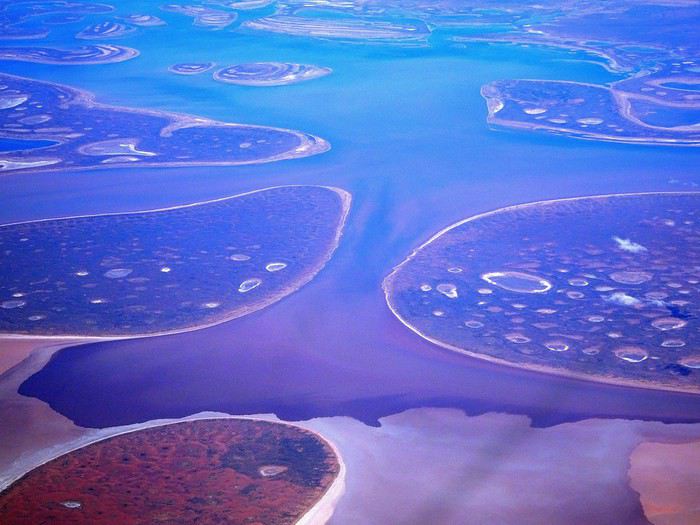
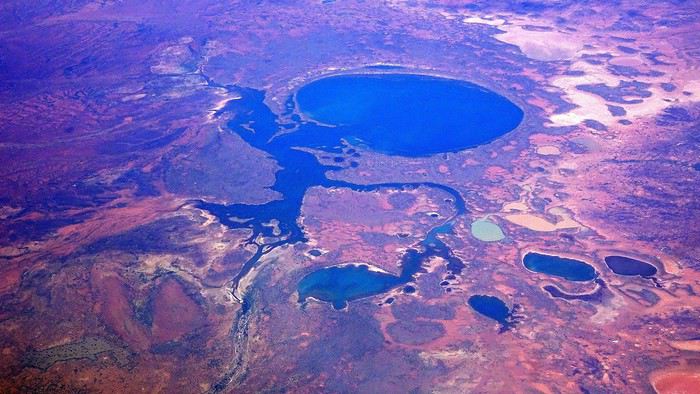
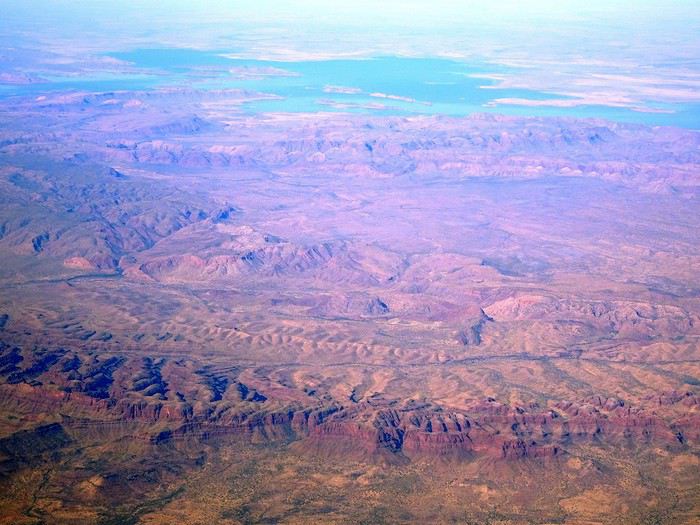
Just before landing, rows of green fields briefly appeared, along with an surprisingly wide river—but we were already rolling down the tarmac. A few hangars, a myriad of small, stationary planes, and a tiny terminal topped with a sign: “Welcome to Kununurra.”
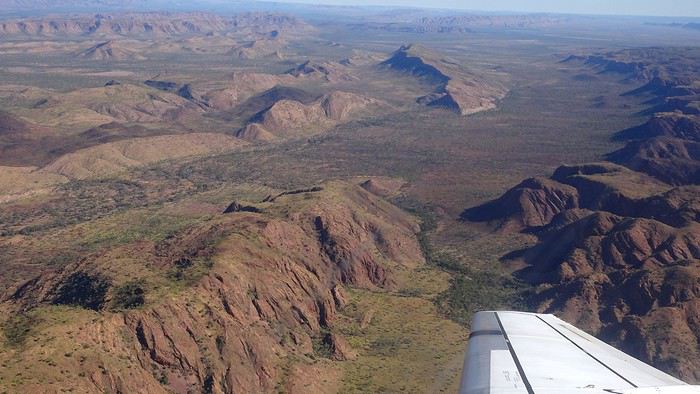
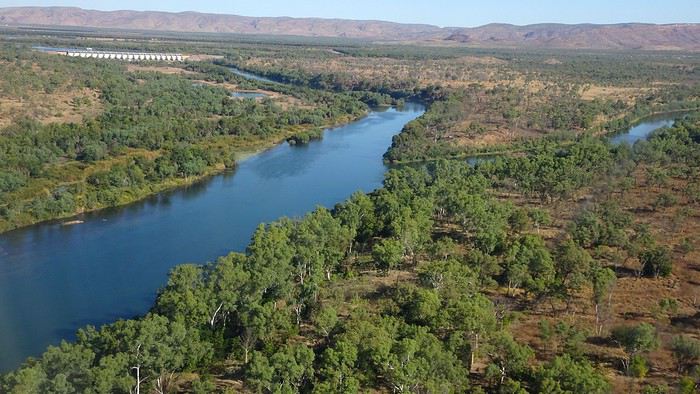
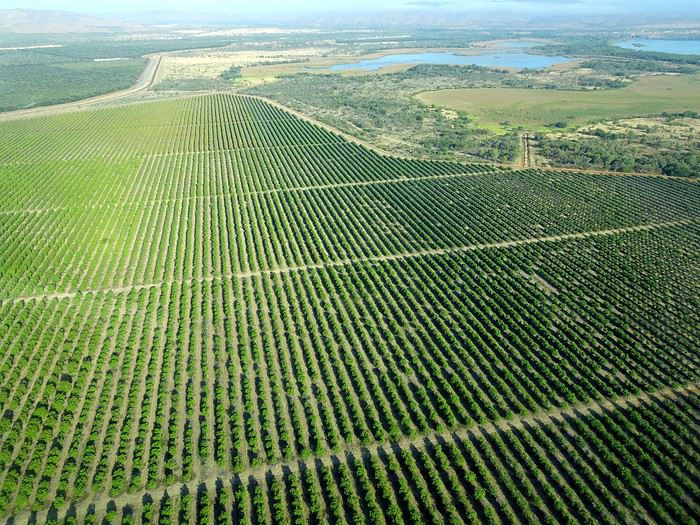
We wanted heat, and here it was—34°C the moment we stepped off the plane! We felt alive again and totally ridiculous in our jeans and sweaters. We quickly grabbed our suitcase and picked up the 4x4 we’d rented—more out of necessity, since only that type of vehicle can access the national parks we planned to visit.
Just four kilometers separated us from Kununurra, a town of 5,000 people founded in 1961 during the construction of the Lake Argyle Dam and the development of the Ord River Irrigation Area Scheme (more on that later). On the horizon, mountain ranges (a bit of an exaggeration, since we know Mt. Meharry, WA’s highest ‘mountain,’ doesn’t even reach 1,250 meters!) and closer to the road, a few irrigation canals cutting through stretches of bush, then a huge park overlooking a small lake lined with reeds.
A row of baobabs (yes, there are baobabs in Australia too!), a series of motels with immaculate lawns, a gas station, and there’s the main street leading to the town center—that is, the parking lots of the two supermarkets, the bottleshop, the pub, the Town Hall, the municipal pool, and the Tourist Office (already closed!), and at the next roundabout, another park, the Presbyterian church, and a few other shops. In short, two or three green blocks that you can explore in no time.
One road leads to the small industrial area and one of the town’s three or four campgrounds, while another heads toward the residential neighborhoods, which look just like the typical suburbs you find in any Australian city—except with tropical vegetation. We stocked up at Coles, an identical copy of the one near our place, and—surprise—the prices were practically the same.
We checked into one of the motels. The receptionist listed the town’s three or four restaurants, insisting that it’s always better to book a table. She recommended the Pump House, a bit outside town on the lake’s edge. “Best spot to watch the sunset, but hurry up.” she told us. It was only 5:00 PM!
When we got there half an hour later, the place was packed, and the sun had already disappeared behind a row of trees! Sure enough, we’d see a few days later that the sunset can be a stunning spectacle—if you wait a bit for the sky (especially if it’s cloudy) to blaze and reflect in the lake’s calm waters. A little disappointed, we headed back into town, where we easily found the other lively spot in town: the pub (nothing like an old English pub). Above the long L-shaped bar, several giant screens (thankfully muted) were broadcasting live footy, rugby league, etc. In one corner, players circled the pool table, while in another, customers were digging into plates of the day’s special. Instead of rooms, there were various patios where groups of friends and coworkers (easily recognizable by the fluoro vests they were still wearing) were gathered. We found a table under a mango tree—unfortunately, a little too close to the guitarist strumming his entire Country Music repertoire, complete with Keith Urban-style tremolos. Guaranteed culture shock!
Since it’s the custom here, we called the Country Club to book a table before the kitchen closed! The CC is the town’s—and even the region’s—fancy spot. Dark decor, modern furniture, dim lighting, and the air conditioning blasting. The twenty or so customers had taken refuge on the vast terrace, lit by torches. The view of the tall eucalyptus trees, illuminated by spotlights shifting from red to blue, was breathtaking.
The menu was minimal, but the grilled salmon was excellent, and the Pavlova (the meringue dessert Kiwis and Aussies have been arguing over since 1906) with melon and watermelon was absolutely divine.
It wasn’t even 9:00 PM, and we were already in bed. Had we already adopted the Top West End’s chicken schedule?!
To be continued... Journal dedicated to Attila
As usual, I didn’t manage to keep it short, but this time I’ve got photos to go with it!
August 2020. Since the opportunities to explore the world are extremely limited right now, all we (R&X) can do is explore our own island! Well, just a part of it, because with the state borders still closed, we’re stuck in Western Australia (WA).
Luckily, we’re pretty fortunate because this state is huge: over 2.5 million km² (that’s more than four times the size of France or 1.5 times Quebec). What’s more, stretching over 20 degrees of latitude between the Antarctic Ocean and the Timor Sea, you’ll find climates ranging from Mediterranean to arid to tropical. That’s actually why we decided to head as far north as possible. Sick of the endless rainy winter in Perth, bring on the heat of the Kimberley... way up Nooorth!
Friday. At the airport, the main terminal was closed (not enough flights), so we ended up in the annex (where flights to the various mines usually depart from). There was no crowd at the gate, and in this huge, single departure lounge, empty seats were plentiful. Only three flights were listed on the screens for the rest of the morning: the first to Coondewanna (?), the second to Darwin, and ours to Kununurra (code KNX).
A cool breeze swept through the half-open corridors along the runways. At the top of the walkway leading to the Fokker 100 (the Airbuses and Boeings are now parked!), a flight attendant greeted us with a basket full of sanitary masks. We were actually the only masked passengers (the staff weren’t wearing them either). With zero Covid-19 cases in WA at the time, the only rule was to maintain social distancing—something pretty hard to do on a full plane!
It was also my first time wearing a mask—it felt weird, pretty uncomfortable, and after a while, painful behind the ears. I really feel for those who have to wear one all day, every day. The flight lasted three long hours, but luckily, I had a good book. From the window, I watched an endless expanse of salt lakes in all shapes and sizes—round, elongated, gray, white, sometimes blue and green—and an infinity of winding, capricious meanders, along with long straight lines that led nowhere. The last half-hour got more interesting as rocky, swollen formations and long, sloping plateaus appeared. Against the vast ochre landscape, green patches became more frequent.
Just before landing, rows of green fields briefly appeared, along with an surprisingly wide river—but we were already rolling down the tarmac. A few hangars, a myriad of small, stationary planes, and a tiny terminal topped with a sign: “Welcome to Kununurra.”
We wanted heat, and here it was—34°C the moment we stepped off the plane! We felt alive again and totally ridiculous in our jeans and sweaters. We quickly grabbed our suitcase and picked up the 4x4 we’d rented—more out of necessity, since only that type of vehicle can access the national parks we planned to visit.
Just four kilometers separated us from Kununurra, a town of 5,000 people founded in 1961 during the construction of the Lake Argyle Dam and the development of the Ord River Irrigation Area Scheme (more on that later). On the horizon, mountain ranges (a bit of an exaggeration, since we know Mt. Meharry, WA’s highest ‘mountain,’ doesn’t even reach 1,250 meters!) and closer to the road, a few irrigation canals cutting through stretches of bush, then a huge park overlooking a small lake lined with reeds.
A row of baobabs (yes, there are baobabs in Australia too!), a series of motels with immaculate lawns, a gas station, and there’s the main street leading to the town center—that is, the parking lots of the two supermarkets, the bottleshop, the pub, the Town Hall, the municipal pool, and the Tourist Office (already closed!), and at the next roundabout, another park, the Presbyterian church, and a few other shops. In short, two or three green blocks that you can explore in no time.
One road leads to the small industrial area and one of the town’s three or four campgrounds, while another heads toward the residential neighborhoods, which look just like the typical suburbs you find in any Australian city—except with tropical vegetation. We stocked up at Coles, an identical copy of the one near our place, and—surprise—the prices were practically the same.
We checked into one of the motels. The receptionist listed the town’s three or four restaurants, insisting that it’s always better to book a table. She recommended the Pump House, a bit outside town on the lake’s edge. “Best spot to watch the sunset, but hurry up.” she told us. It was only 5:00 PM!
When we got there half an hour later, the place was packed, and the sun had already disappeared behind a row of trees! Sure enough, we’d see a few days later that the sunset can be a stunning spectacle—if you wait a bit for the sky (especially if it’s cloudy) to blaze and reflect in the lake’s calm waters. A little disappointed, we headed back into town, where we easily found the other lively spot in town: the pub (nothing like an old English pub). Above the long L-shaped bar, several giant screens (thankfully muted) were broadcasting live footy, rugby league, etc. In one corner, players circled the pool table, while in another, customers were digging into plates of the day’s special. Instead of rooms, there were various patios where groups of friends and coworkers (easily recognizable by the fluoro vests they were still wearing) were gathered. We found a table under a mango tree—unfortunately, a little too close to the guitarist strumming his entire Country Music repertoire, complete with Keith Urban-style tremolos. Guaranteed culture shock!
Since it’s the custom here, we called the Country Club to book a table before the kitchen closed! The CC is the town’s—and even the region’s—fancy spot. Dark decor, modern furniture, dim lighting, and the air conditioning blasting. The twenty or so customers had taken refuge on the vast terrace, lit by torches. The view of the tall eucalyptus trees, illuminated by spotlights shifting from red to blue, was breathtaking.
The menu was minimal, but the grilled salmon was excellent, and the Pavlova (the meringue dessert Kiwis and Aussies have been arguing over since 1906) with melon and watermelon was absolutely divine.
It wasn’t even 9:00 PM, and we were already in bed. Had we already adopted the Top West End’s chicken schedule?!
To be continued... Journal dedicated to Attila
Adventures of a Bygone Era: The Philippines in 1984
After several discussions on VF about travel journals from the Philippines, I decided to write this curiosity: a trip report from a journey made in 1984, when traveling to the Philippines was still an adventure.
A curiosity because writing a travel journal about a trip 35 years later isn’t common, but also (mostly?) because exploring the Philippines at that time had little in common with traveling there today.
Obviously, I’ve forgotten a number of facts, most of the details, but with the help of a few notes from that time and a stack of slides (yes, there was life before digital 😊), many memories came back and added to the highlights I’d never forgotten. The scanned slides aren’t always great quality, but there are still quite a few to brighten up this chatter. Back then, we didn’t snap photos like we do now—film was too expensive—so I don’t have pictures of every place we visited... too bad, comparing some of those spots to how they look today would’ve been interesting.
Why "Adventures"? Why call it "Adventures" in the Philippines in 1984, a word so often used for a simple exotic trip? - Because the lack of information (no *Guide du Routard*, no *Lonely Planet*, no *Michelin Guide*, nothing, and obviously no internet) gave this trip what’s at the heart of adventure: the unknown. - Because the political situation made the stay sometimes dangerous. - Because transportation conditions were always epic, often perilous. - Because the question of where we’d spend the night came up almost every evening. - And for... quite a few other reasons.
That said, we weren’t exactly explorers!
Why the Philippines? First of all, why go to the Philippines in 1984—a country not exactly set up for tourism and about which we knew very little? How could we get an idea of the beauty of the Philippines and its points of interest when we had no guides or photos?
The idea came to us from Thailand a year earlier, during our first long-haul trip. After touring the north of the country, we met a Frenchman living in Phuket, where there were only a few tourists in Patong, with just a few small hotels and guesthouses. Kata and Karon had no buildings or roads, Rawai only had three palm-thatched bungalows, including ours, and the other islands were unknown to tourists. There was plenty to discover, and we wanted to return to this beautiful country... but the Frenchman made us dream about the Philippines—a country to explore, with wild landscapes.
Long evenings of discussion over multiple Sprite-Mekong cocktails (what memories of those headaches!) finally convinced us we had to go to the Philippines.
Episode 0: Before Departure The decision was made: we’d go to the Philippines in May 1984. Our friends and family were surprised when we announced we were going on vacation to the Philippines (a bit like saying today we were going paddleboarding in the Kerguelen Islands 🤪).
These days, preparing for each of our trips takes long evenings of research, planning, and noting down good addresses... etc. But for the Philippines in 1984, preparation was quick: we had very little information about the country, we were leaving almost at random, and the discovery would only be more exciting.
We still had a few bits of info gathered here and there: the rice terraces in northern Luzon, volcanoes, Negros where we were supposed to visit an acquaintance, Cebu and its marine life (we ended up going elsewhere), and absolutely avoid Mindanao, which was practically at war with the regime. That was about it, but it was already a great itinerary.
Nothing was organized in advance; we’d see day by day. We had no idea about travel times or even the existence of transportation options. The main (and sometimes only) way to connect two islands was by overloaded, rusty ferry. Only the big cities had airports.
Let’s Go: Episode 1: Paris to Manila My travel journals always start after arriving at the airport—the Europe-to-“Other Continent” trip isn’t interesting—but the flight to the Philippines was already an adventure, so I’ll make an exception.
This was the era when only a few Asian airlines were on par with Western ones: Thai, Singapore Airlines, and Philippine Airlines. They had beautiful, brand-new planes, and to attract customers (almost exclusively “businessmen”) from the usual airlines (Air France, Lufthansa, British Airways), there was opulence on board: unlimited champagne, all sorts of cocktails... Compared to today’s long-haul flights, there was still one small difference: no personal screens, just one screen at the front of the cabin with one mandatory movie. And I don’t know why, but we only got James Bond films, both ways... that must’ve been the trend at the time.
The tourism boom to Southeast Asia hadn’t started yet, and the “Asian Tigers” weren’t a thing, so there weren’t many business trips. That meant long-haul flights made stops everywhere to fill the planes. Our Philippine Airlines Boeing 747 left London, picked us up in Paris, then stopped in Frankfurt to take on a few Germans. I don’t know why we then made a stop in Dubai—a totally exotic place at the time. There was nothing to do there... things have changed a lot since. It was a small town lost in the desert. The airport was tiny, with just one or two buildings and a supermarket. During the stopover, everyone had to get off the plane and walk to the supermarket. Photo and electronic equipment were dirt cheap—I guess that was the only reason for the stop. Maybe it was their first commercial move. Emirates didn’t exist yet, as I checked online, but anyway, the idea that such a remote place could have its own airline was unthinkable.
Online, I found this photo of Dubai Airport in 1980. Anyone who’s transited through today’s massive airport with its rows of A380s will appreciate it: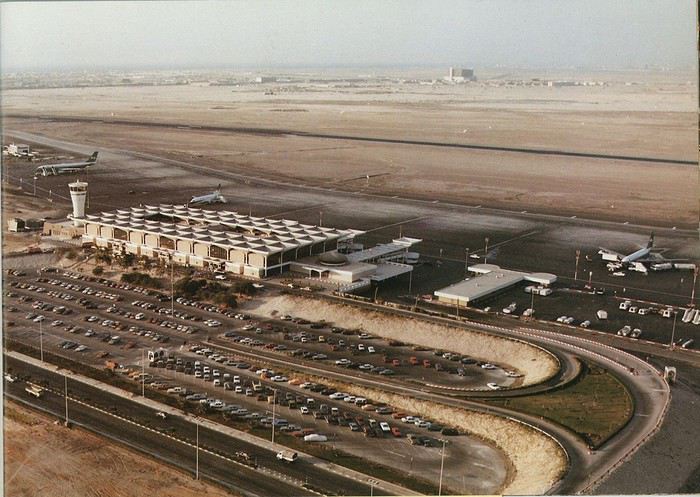
Next stop: New Delhi to drop off some Europeans and pick up a few Indians, and finally, the terminus: Manila. I don’t remember how long the trip took with its five stops—an unimaginable journey today. Despite all those stops to fill the plane, there was still enough space to stretch out on the four center seats of the 747, something that never happens these days despite all the flights in every direction.
So here we are, finally at Manila Airport around midnight.
Episode 1: Manila and Baguio To start, a quick note on the political and economic situation in the Philippines in 1984, which had consequences for us as tourists, as we’d soon realize upon arrival.
After several centuries of Spanish colonization, the Philippines became American at the start of the 20th century, then independent. In 1966, Marcos took power, and little by little, his regime sank into corruption and mismanagement, becoming a dictatorship with martial law, all for the benefit of his family and friends, who enriched themselves endlessly. The peak was the assassination of opposition leader Benigno Aquino in August 1983, which triggered harshly repressed protests. So we arrived a few months later in a very poor country, with omnipresent corruption and an extremely tense political situation, as we’d soon see for ourselves. Major protests took place in the main cities during our trip—I’ll come back to that. Two years later, Marcos fled to Hawaii after being forced out of power following rigged elections. This historical context explains a lot of the situations we found ourselves in over the following weeks.
Arriving in the middle of the night isn’t very cheerful. Manila was already a huge city with many slums, where you could find a few business hotels like the Hilton or Intercontinental—way out of our budget—and plenty of run-down hotels. Luckily, two Indians we’d chatted with on the plane offered to take us to their usual hotel. They came to Manila twice a year for business. We accepted their offer, relieved not to have to look for a place to stay in the middle of the night, figuring the address must be good since they came back every time... we were wrong 🙁
We left the airport and immediately got a taste of the local vibe when we got into the taxi: the police asked for our passports. We thought: what’s more normal than police in a dictatorship?
But that wasn’t it at all. Our two Indian friends explained that the police were noting our names along with the taxi number and time. Crime in Manila was so bad that the taxi driver would be held responsible if anything happened to us... welcome to the Philippines 😎 😎
Historically, the Philippines was a very violent country, where everything was settled with guns or machetes. Previous governments had banned carrying weapons, but Marcos later allowed the free sale and carrying of guns, and disputes were settled with pistols again (or worse, as we’d discover later). Since he’d released most of the criminals from prison to form a paramilitary militia at his service (I’ll talk about our encounter with these “heroes” later), it was pretty dangerous to go into many parts of Manila, where these “tonton macoutes” ruled.
We arrived at our hotel without incident... and then things started badly. The room was infested with big cockroaches—exactly what I hate most in those kinds of countries. No way to find another hotel at that hour. After the long flight, the urge to take a shower was so strong that we squeezed into the bathroom as best we could. After that, I don’t remember—I guess we must’ve fallen asleep exhausted under the sheets in the heat... air conditioning wasn’t widespread yet.
The next day, we just wanted to leave that dump as soon as possible. So we decided to head north right away, stopping in Baguio, and we’d visit Manila a bit on the way back.
When we stepped outside, we discovered a pretty run-down neighborhood with potholed streets. But we also discovered the jeepneys. They were everywhere, flooding the streets.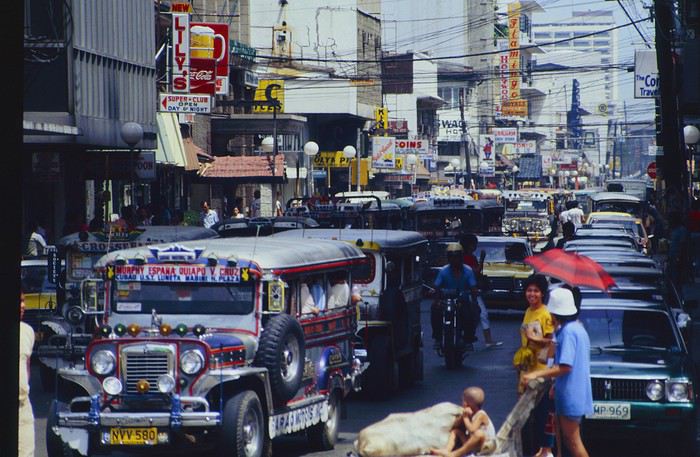
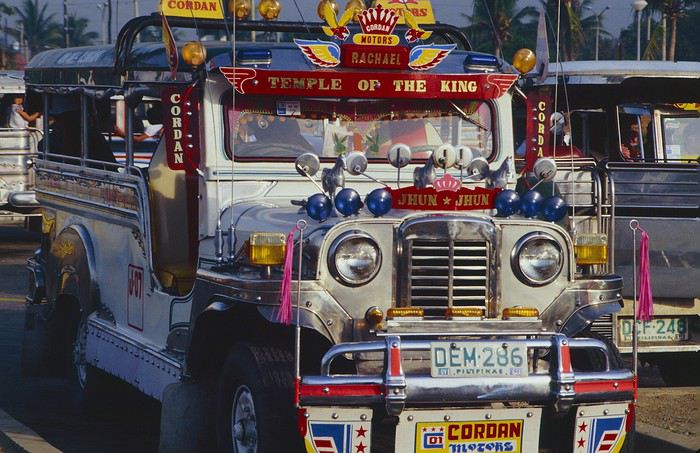
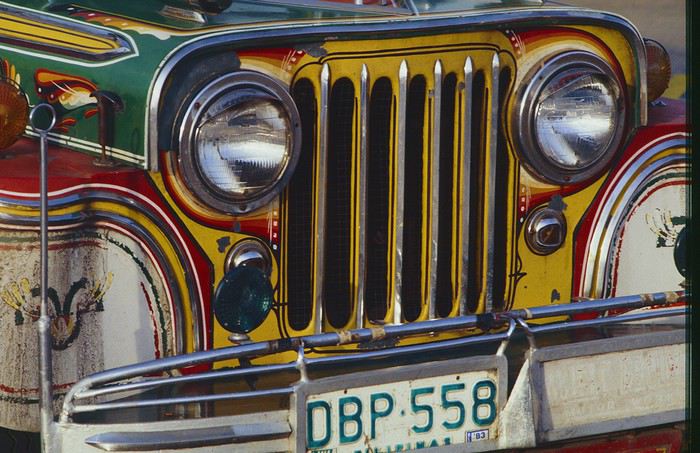
They had crazy sound systems, each one blasting louder than the last. The interiors were kitschy but fun. There weren’t many private cars—almost all transportation was by jeepney, with buses reserved for intercity trips.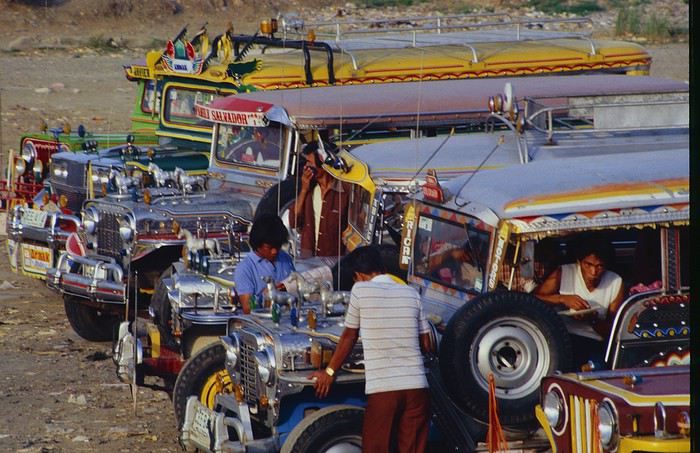
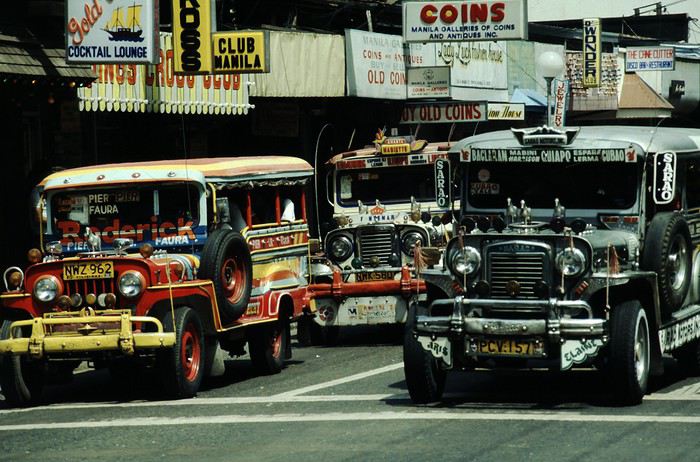
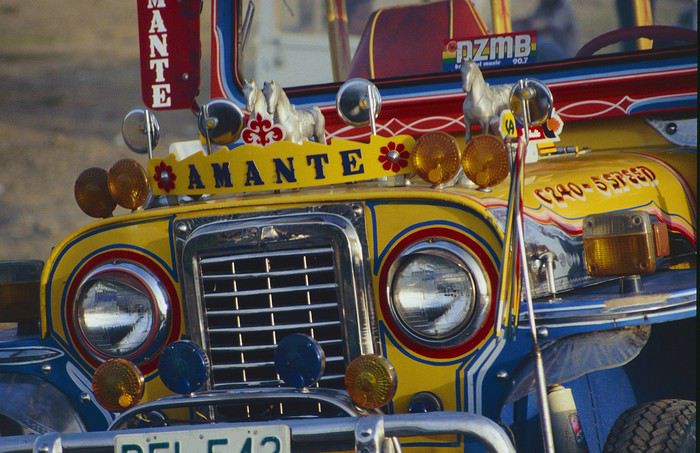
Before heading to the bus terminal for the north, somewhere on the outskirts of the city, we needed to exchange some money. I don’t remember how we ended up in a policeman’s jeep who offered his services: - Exchange money on the black market at a better rate than the banks. - Take us wherever we wanted, in this case, the bus terminal.
We accepted both offers (we’d still checked the official exchange rate from dollars to pesos). So we found ourselves in his jeep. After exchanging money, we left in his vehicle and stopped for gas. Without turning off the engine, he calmly smoked a cigarette while filling up. Since we were in a jeep with no doors or roof, we were ready to jump out if things went south, our travel bag in hand.
But we weren’t done with surprises yet. Once we left the small streets, we ended up in a neighborhood with wide avenues and not much traffic, which didn’t justify his incredible behavior. At every intersection, he made the sign of the cross, closed his eyes, and crossed without looking. I was more stunned than terrified! It wasn’t until we got out of the car later that I told Anne-Marie what had happened. I’d seen everything because the cop had put me in the front seat. Luckily, A-Marie hadn’t noticed anything from the back. Crossing Manila by trusting God rather than the rules of the road was ultimately effective. We were lucky—the trip was off to a good start. 🙂 🙂
We then passed through a neighborhood where slums stretched on for a while, and we left our policeman—friendly but a bit crazy—with relief.
A few hours by bus later, here we are in Baguio, cool in the mountains. My memories of Baguio are pretty fuzzy. I remember a small town. After some research while writing this journal, I found that the population was 120,000 in 1980. Given the population density in each home, that confirms my memory of a smallish town. Outside the “official” district with the president’s summer residence and government buildings, there were two or three paved streets with nice houses. The rest was very dirty and very poor, with lots of slums and dirt roads.
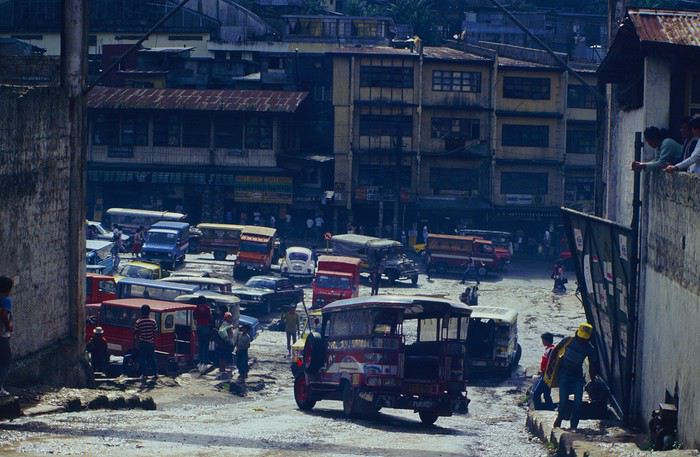
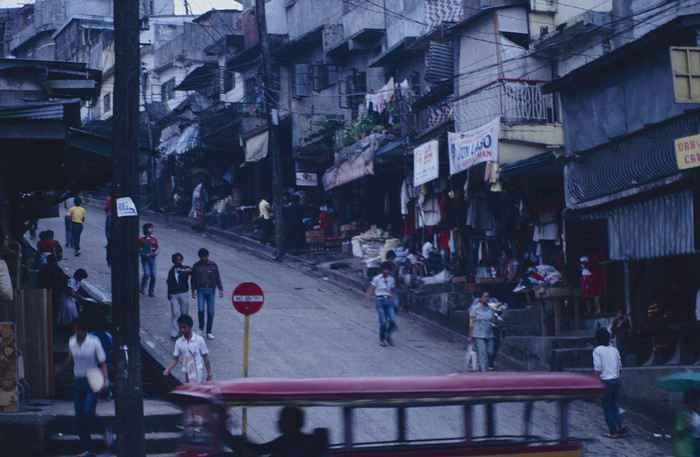
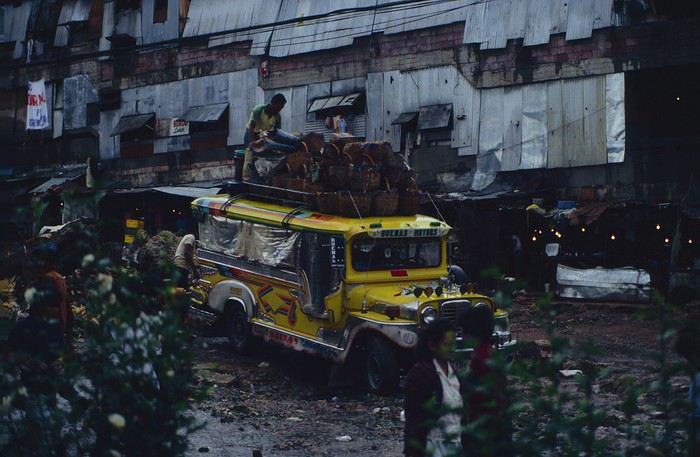
People we met on the street invited us to stay with them. These days, we wouldn’t just show up at strangers’ houses, which we should’ve done in Baguio—it would’ve saved us from an unimaginable and dangerous situation... which I won’t say anything about... !😊
The simple wooden house was on stilts at the edge of a hill with a view of the mountains. Since it was the start of the rainy season in a city that gets a lot of rain, we saw a lot of water. Our outings in town happened between downpours.
View from our lodging: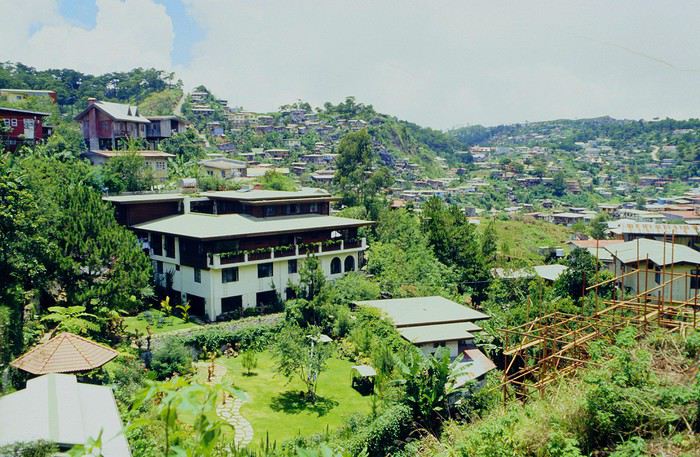
Episode 2: Baguio to Bontoc Aside from the situation briefly mentioned above, it was on the next leg to Bontoc that the adventure really began: an endless and dangerous road, a bus from another era, breathtaking landscapes, and surprising people.
We didn’t know the distance or how long it would take to get to Bontoc. When we arrived after about ten hours, we learned that Baguio to Bontoc was 140 km.
We got on a bus with wooden seats and settled in, two to a seat meant for two. As the bus filled up, passengers squeezed in three or four per seat, with chickens and baskets full of all sorts of things in the aisle. A little embarrassed, we didn’t know if we should squeeze in three on our seat. The seats were super tight (luckily, Filipinos are small), and I didn’t know where to put my legs given my height. I don’t remember if we stayed alone on our bench or if we ended up sharing with others.
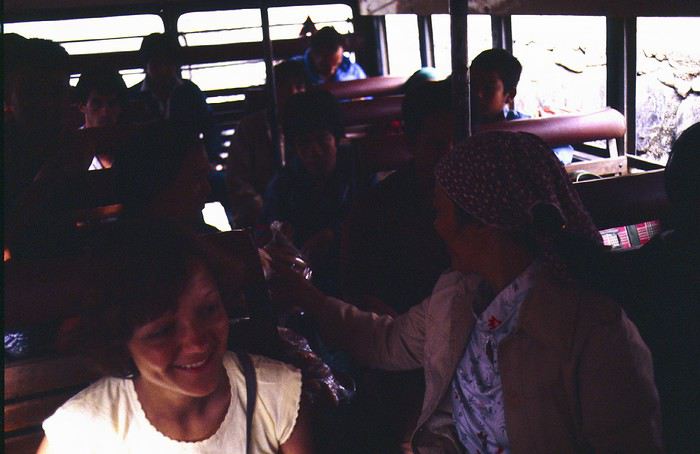
The “road” was a dirt track (or rather, a mud track) with endless turns. We held on as best we could to our slippery wooden seats—it was shaking in every direction. The woman behind us was carsick and throwing up... gross... but what were we doing there? Then we plunged into the Sierra Madre... just the name is dreamy!
Rice terraces started to appear: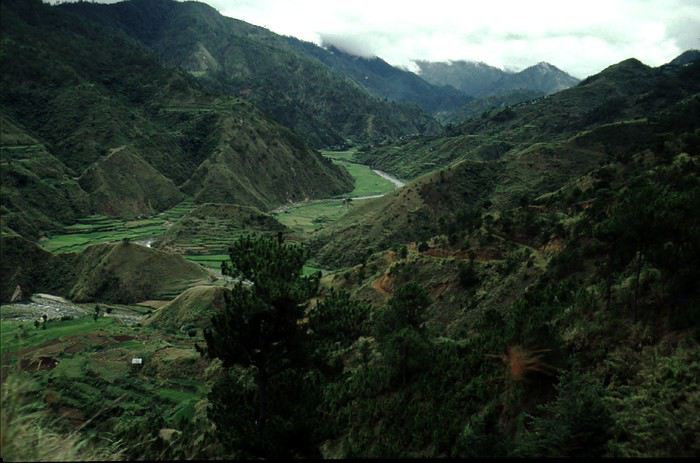
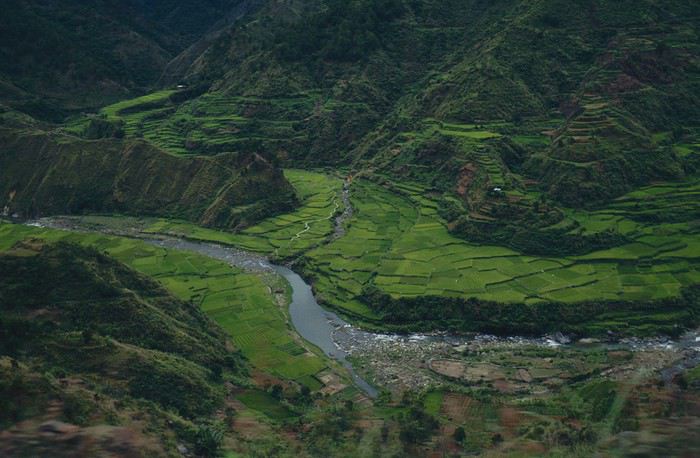
they took up more and more space along cliffs where we weren’t always reassured,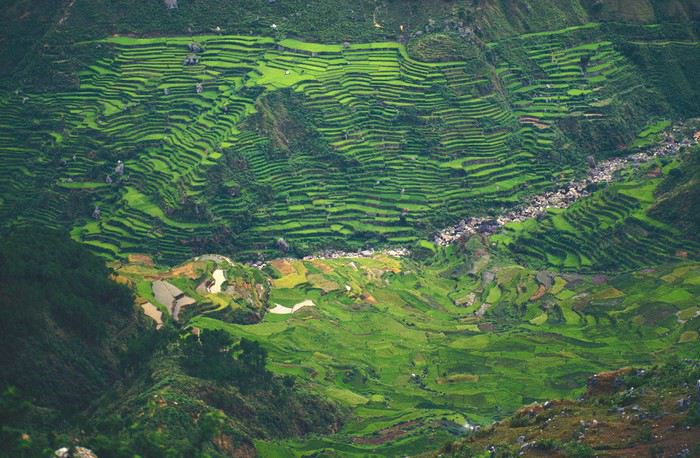
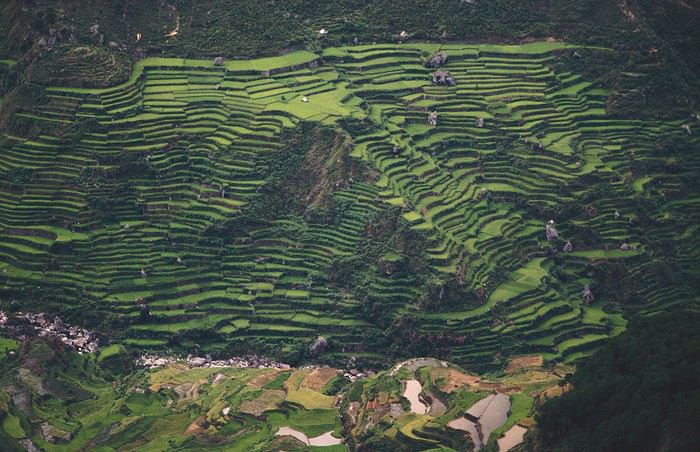
with lots of waterfalls (all that water had to go somewhere).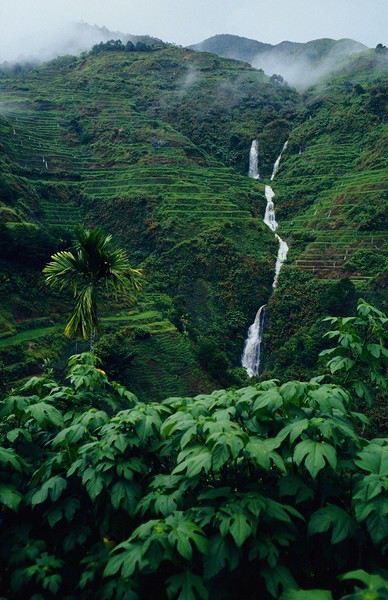
A few miserable villages stretched along the track, most often just a few houses balancing between the road and the drop. The bus stopped in every village—people got on or off and settled inside or on the roof. Street vendors offered their products to the bus passengers—a common sight in Asia, even today.
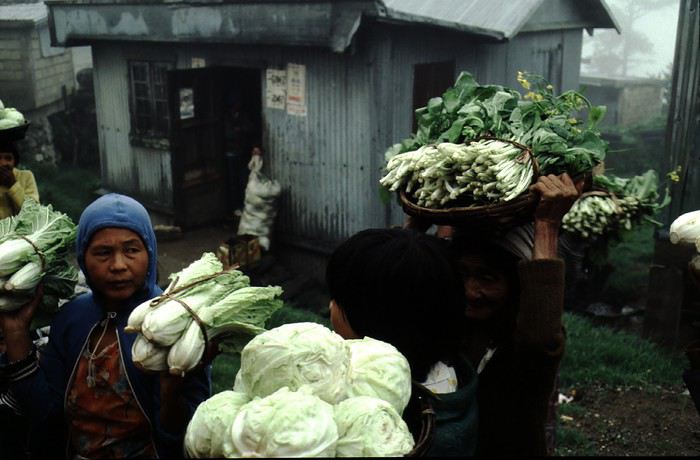
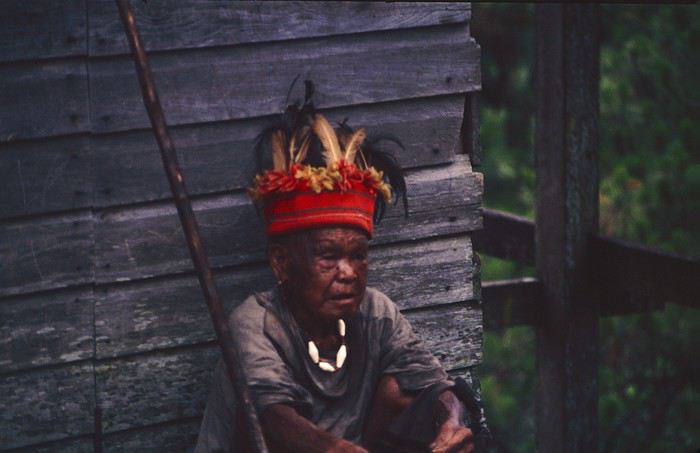
We were in another world—villagers were in loincloths, others had spears. The atmosphere was strange... but all good, we wanted exoticism, and we got it: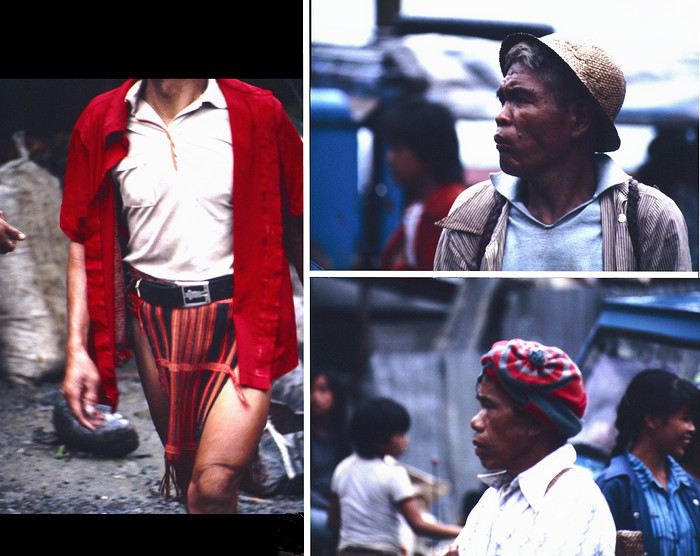
This so-called traditional outfit was everyday wear—it wasn’t for tourists since there weren’t any.
A curiosity because writing a travel journal about a trip 35 years later isn’t common, but also (mostly?) because exploring the Philippines at that time had little in common with traveling there today.
Obviously, I’ve forgotten a number of facts, most of the details, but with the help of a few notes from that time and a stack of slides (yes, there was life before digital 😊), many memories came back and added to the highlights I’d never forgotten. The scanned slides aren’t always great quality, but there are still quite a few to brighten up this chatter. Back then, we didn’t snap photos like we do now—film was too expensive—so I don’t have pictures of every place we visited... too bad, comparing some of those spots to how they look today would’ve been interesting.
Why "Adventures"? Why call it "Adventures" in the Philippines in 1984, a word so often used for a simple exotic trip? - Because the lack of information (no *Guide du Routard*, no *Lonely Planet*, no *Michelin Guide*, nothing, and obviously no internet) gave this trip what’s at the heart of adventure: the unknown. - Because the political situation made the stay sometimes dangerous. - Because transportation conditions were always epic, often perilous. - Because the question of where we’d spend the night came up almost every evening. - And for... quite a few other reasons.
That said, we weren’t exactly explorers!
Why the Philippines? First of all, why go to the Philippines in 1984—a country not exactly set up for tourism and about which we knew very little? How could we get an idea of the beauty of the Philippines and its points of interest when we had no guides or photos?
The idea came to us from Thailand a year earlier, during our first long-haul trip. After touring the north of the country, we met a Frenchman living in Phuket, where there were only a few tourists in Patong, with just a few small hotels and guesthouses. Kata and Karon had no buildings or roads, Rawai only had three palm-thatched bungalows, including ours, and the other islands were unknown to tourists. There was plenty to discover, and we wanted to return to this beautiful country... but the Frenchman made us dream about the Philippines—a country to explore, with wild landscapes.
Long evenings of discussion over multiple Sprite-Mekong cocktails (what memories of those headaches!) finally convinced us we had to go to the Philippines.
Episode 0: Before Departure The decision was made: we’d go to the Philippines in May 1984. Our friends and family were surprised when we announced we were going on vacation to the Philippines (a bit like saying today we were going paddleboarding in the Kerguelen Islands 🤪).
These days, preparing for each of our trips takes long evenings of research, planning, and noting down good addresses... etc. But for the Philippines in 1984, preparation was quick: we had very little information about the country, we were leaving almost at random, and the discovery would only be more exciting.
We still had a few bits of info gathered here and there: the rice terraces in northern Luzon, volcanoes, Negros where we were supposed to visit an acquaintance, Cebu and its marine life (we ended up going elsewhere), and absolutely avoid Mindanao, which was practically at war with the regime. That was about it, but it was already a great itinerary.
Nothing was organized in advance; we’d see day by day. We had no idea about travel times or even the existence of transportation options. The main (and sometimes only) way to connect two islands was by overloaded, rusty ferry. Only the big cities had airports.
Let’s Go: Episode 1: Paris to Manila My travel journals always start after arriving at the airport—the Europe-to-“Other Continent” trip isn’t interesting—but the flight to the Philippines was already an adventure, so I’ll make an exception.
This was the era when only a few Asian airlines were on par with Western ones: Thai, Singapore Airlines, and Philippine Airlines. They had beautiful, brand-new planes, and to attract customers (almost exclusively “businessmen”) from the usual airlines (Air France, Lufthansa, British Airways), there was opulence on board: unlimited champagne, all sorts of cocktails... Compared to today’s long-haul flights, there was still one small difference: no personal screens, just one screen at the front of the cabin with one mandatory movie. And I don’t know why, but we only got James Bond films, both ways... that must’ve been the trend at the time.
The tourism boom to Southeast Asia hadn’t started yet, and the “Asian Tigers” weren’t a thing, so there weren’t many business trips. That meant long-haul flights made stops everywhere to fill the planes. Our Philippine Airlines Boeing 747 left London, picked us up in Paris, then stopped in Frankfurt to take on a few Germans. I don’t know why we then made a stop in Dubai—a totally exotic place at the time. There was nothing to do there... things have changed a lot since. It was a small town lost in the desert. The airport was tiny, with just one or two buildings and a supermarket. During the stopover, everyone had to get off the plane and walk to the supermarket. Photo and electronic equipment were dirt cheap—I guess that was the only reason for the stop. Maybe it was their first commercial move. Emirates didn’t exist yet, as I checked online, but anyway, the idea that such a remote place could have its own airline was unthinkable.
Online, I found this photo of Dubai Airport in 1980. Anyone who’s transited through today’s massive airport with its rows of A380s will appreciate it:
Next stop: New Delhi to drop off some Europeans and pick up a few Indians, and finally, the terminus: Manila. I don’t remember how long the trip took with its five stops—an unimaginable journey today. Despite all those stops to fill the plane, there was still enough space to stretch out on the four center seats of the 747, something that never happens these days despite all the flights in every direction.
So here we are, finally at Manila Airport around midnight.
Episode 1: Manila and Baguio To start, a quick note on the political and economic situation in the Philippines in 1984, which had consequences for us as tourists, as we’d soon realize upon arrival.
After several centuries of Spanish colonization, the Philippines became American at the start of the 20th century, then independent. In 1966, Marcos took power, and little by little, his regime sank into corruption and mismanagement, becoming a dictatorship with martial law, all for the benefit of his family and friends, who enriched themselves endlessly. The peak was the assassination of opposition leader Benigno Aquino in August 1983, which triggered harshly repressed protests. So we arrived a few months later in a very poor country, with omnipresent corruption and an extremely tense political situation, as we’d soon see for ourselves. Major protests took place in the main cities during our trip—I’ll come back to that. Two years later, Marcos fled to Hawaii after being forced out of power following rigged elections. This historical context explains a lot of the situations we found ourselves in over the following weeks.
Arriving in the middle of the night isn’t very cheerful. Manila was already a huge city with many slums, where you could find a few business hotels like the Hilton or Intercontinental—way out of our budget—and plenty of run-down hotels. Luckily, two Indians we’d chatted with on the plane offered to take us to their usual hotel. They came to Manila twice a year for business. We accepted their offer, relieved not to have to look for a place to stay in the middle of the night, figuring the address must be good since they came back every time... we were wrong 🙁
We left the airport and immediately got a taste of the local vibe when we got into the taxi: the police asked for our passports. We thought: what’s more normal than police in a dictatorship?
But that wasn’t it at all. Our two Indian friends explained that the police were noting our names along with the taxi number and time. Crime in Manila was so bad that the taxi driver would be held responsible if anything happened to us... welcome to the Philippines 😎 😎
Historically, the Philippines was a very violent country, where everything was settled with guns or machetes. Previous governments had banned carrying weapons, but Marcos later allowed the free sale and carrying of guns, and disputes were settled with pistols again (or worse, as we’d discover later). Since he’d released most of the criminals from prison to form a paramilitary militia at his service (I’ll talk about our encounter with these “heroes” later), it was pretty dangerous to go into many parts of Manila, where these “tonton macoutes” ruled.
We arrived at our hotel without incident... and then things started badly. The room was infested with big cockroaches—exactly what I hate most in those kinds of countries. No way to find another hotel at that hour. After the long flight, the urge to take a shower was so strong that we squeezed into the bathroom as best we could. After that, I don’t remember—I guess we must’ve fallen asleep exhausted under the sheets in the heat... air conditioning wasn’t widespread yet.
The next day, we just wanted to leave that dump as soon as possible. So we decided to head north right away, stopping in Baguio, and we’d visit Manila a bit on the way back.
When we stepped outside, we discovered a pretty run-down neighborhood with potholed streets. But we also discovered the jeepneys. They were everywhere, flooding the streets.
They had crazy sound systems, each one blasting louder than the last. The interiors were kitschy but fun. There weren’t many private cars—almost all transportation was by jeepney, with buses reserved for intercity trips.
Before heading to the bus terminal for the north, somewhere on the outskirts of the city, we needed to exchange some money. I don’t remember how we ended up in a policeman’s jeep who offered his services: - Exchange money on the black market at a better rate than the banks. - Take us wherever we wanted, in this case, the bus terminal.
We accepted both offers (we’d still checked the official exchange rate from dollars to pesos). So we found ourselves in his jeep. After exchanging money, we left in his vehicle and stopped for gas. Without turning off the engine, he calmly smoked a cigarette while filling up. Since we were in a jeep with no doors or roof, we were ready to jump out if things went south, our travel bag in hand.
But we weren’t done with surprises yet. Once we left the small streets, we ended up in a neighborhood with wide avenues and not much traffic, which didn’t justify his incredible behavior. At every intersection, he made the sign of the cross, closed his eyes, and crossed without looking. I was more stunned than terrified! It wasn’t until we got out of the car later that I told Anne-Marie what had happened. I’d seen everything because the cop had put me in the front seat. Luckily, A-Marie hadn’t noticed anything from the back. Crossing Manila by trusting God rather than the rules of the road was ultimately effective. We were lucky—the trip was off to a good start. 🙂 🙂
We then passed through a neighborhood where slums stretched on for a while, and we left our policeman—friendly but a bit crazy—with relief.
A few hours by bus later, here we are in Baguio, cool in the mountains. My memories of Baguio are pretty fuzzy. I remember a small town. After some research while writing this journal, I found that the population was 120,000 in 1980. Given the population density in each home, that confirms my memory of a smallish town. Outside the “official” district with the president’s summer residence and government buildings, there were two or three paved streets with nice houses. The rest was very dirty and very poor, with lots of slums and dirt roads.
People we met on the street invited us to stay with them. These days, we wouldn’t just show up at strangers’ houses, which we should’ve done in Baguio—it would’ve saved us from an unimaginable and dangerous situation... which I won’t say anything about... !😊
The simple wooden house was on stilts at the edge of a hill with a view of the mountains. Since it was the start of the rainy season in a city that gets a lot of rain, we saw a lot of water. Our outings in town happened between downpours.
View from our lodging:
Episode 2: Baguio to Bontoc Aside from the situation briefly mentioned above, it was on the next leg to Bontoc that the adventure really began: an endless and dangerous road, a bus from another era, breathtaking landscapes, and surprising people.
We didn’t know the distance or how long it would take to get to Bontoc. When we arrived after about ten hours, we learned that Baguio to Bontoc was 140 km.
We got on a bus with wooden seats and settled in, two to a seat meant for two. As the bus filled up, passengers squeezed in three or four per seat, with chickens and baskets full of all sorts of things in the aisle. A little embarrassed, we didn’t know if we should squeeze in three on our seat. The seats were super tight (luckily, Filipinos are small), and I didn’t know where to put my legs given my height. I don’t remember if we stayed alone on our bench or if we ended up sharing with others.
The “road” was a dirt track (or rather, a mud track) with endless turns. We held on as best we could to our slippery wooden seats—it was shaking in every direction. The woman behind us was carsick and throwing up... gross... but what were we doing there? Then we plunged into the Sierra Madre... just the name is dreamy!
Rice terraces started to appear:
they took up more and more space along cliffs where we weren’t always reassured,
with lots of waterfalls (all that water had to go somewhere).
A few miserable villages stretched along the track, most often just a few houses balancing between the road and the drop. The bus stopped in every village—people got on or off and settled inside or on the roof. Street vendors offered their products to the bus passengers—a common sight in Asia, even today.
We were in another world—villagers were in loincloths, others had spears. The atmosphere was strange... but all good, we wanted exoticism, and we got it:
This so-called traditional outfit was everyday wear—it wasn’t for tourists since there weren’t any.
La Papouasie-Nouvelle-Guinée, l'Indonésie et la Malaisie seule English translation pending
Bonjour à tous,
Je suis actuellement en Nouvelle-Zélande jusqu'à Mars 2019. J'envisage de rentrer en France en Juin, pas de dates fixes mais avant cela j'aimerais voyager d'autres iles.
J'aimerais commencer mon voyage en Papouasie Nouvelle-Guinée, poursuivre par l'Indonésie et terminer par la Malaisie. Si vous avez des conseils ou infos à me donner, ils seront les bienvenus.
J'ai 23 ans bientôt, je prévois de voyager seule et je ne suis pas du genre hotels. Je suis intéressé par les trek, je suis passionnée de la plongée et j'en prévois la bas! ( si vous connaissez des sites...) J'aimerai aller à la rencontre de locaux voir tribus. Pourquoi pas faire quelques semaines de bénévolats dans une association ou entreprise axée animaux, environnement, milieu marin. Je pensais relier les pays (du moins Indonésie-Malaisie) par bateaux, mais j'ignore si les déplacements sont faciles et quels couts entre les iles locales?
Ensuite si il y a des vaccins obligatoire ? Je suis vraiment très dévorée par les moustiques et je suis preneuse de tous remède EFFICACE. J'ai deja essayer beaucoup de chose notamment en Guadeloupe ou j'ai vécu quelques mois.
Concernant les VISAS pour ces pays je suppose visa tourisme mais pour quels durée ?
Je vous remercie d'avance pour toutes vos réponse !
🙂
Je suis actuellement en Nouvelle-Zélande jusqu'à Mars 2019. J'envisage de rentrer en France en Juin, pas de dates fixes mais avant cela j'aimerais voyager d'autres iles.
J'aimerais commencer mon voyage en Papouasie Nouvelle-Guinée, poursuivre par l'Indonésie et terminer par la Malaisie. Si vous avez des conseils ou infos à me donner, ils seront les bienvenus.
J'ai 23 ans bientôt, je prévois de voyager seule et je ne suis pas du genre hotels. Je suis intéressé par les trek, je suis passionnée de la plongée et j'en prévois la bas! ( si vous connaissez des sites...) J'aimerai aller à la rencontre de locaux voir tribus. Pourquoi pas faire quelques semaines de bénévolats dans une association ou entreprise axée animaux, environnement, milieu marin. Je pensais relier les pays (du moins Indonésie-Malaisie) par bateaux, mais j'ignore si les déplacements sont faciles et quels couts entre les iles locales?
Ensuite si il y a des vaccins obligatoire ? Je suis vraiment très dévorée par les moustiques et je suis preneuse de tous remède EFFICACE. J'ai deja essayer beaucoup de chose notamment en Guadeloupe ou j'ai vécu quelques mois.
Concernant les VISAS pour ces pays je suppose visa tourisme mais pour quels durée ?
Je vous remercie d'avance pour toutes vos réponse !
🙂
Kyoto, Shinkansen, Tokyo: three first-timers in Japan via Air China
Hi everyone,
The idea of visiting Japan goes back a year now. I remember because I was looking for cheap flights to Europe from Paris. Surprisingly, the round-trip to Japan with Air China was just as affordable—if not cheaper—than many European destinations.
So, the tickets were booked. Three seats (including one for a 12-year-old), ten days over Easter 2018, AirBnB accommodation. Of course, in ten days, you visit without *really* visiting—you only scratch the surface. Just the classics: Kyoto, temples, moonlit rivers; the Shinkansen; and Tokyo, gardens, wandering, high-tech, and... maids.
I have to admit, we don’t know much about the country, and the thought of how we’d manage is a constant source of worry. What if this trip reveals my inability to open up to other cultures?
We board the first Air China flight with that question on our minds.
The idea of visiting Japan goes back a year now. I remember because I was looking for cheap flights to Europe from Paris. Surprisingly, the round-trip to Japan with Air China was just as affordable—if not cheaper—than many European destinations.
So, the tickets were booked. Three seats (including one for a 12-year-old), ten days over Easter 2018, AirBnB accommodation. Of course, in ten days, you visit without *really* visiting—you only scratch the surface. Just the classics: Kyoto, temples, moonlit rivers; the Shinkansen; and Tokyo, gardens, wandering, high-tech, and... maids.
I have to admit, we don’t know much about the country, and the thought of how we’d manage is a constant source of worry. What if this trip reveals my inability to open up to other cultures?
We board the first Air China flight with that question on our minds.