Results for "Roche+Oëtre+|+127"
26116 results found.
Les moines et les femmes, peut-on m'expliquer? English translation pending
Bonjour à tous...
je dois rediger un truc et j'ai besoin d'aide. je suis un peu bloquer cette nuit devant mon ignorance sur ce sujet.
les bonzes et les femmes. je voudrais connaitre les raisons qui font que les bonzes ne doivent pas croiser le regards d'une femme (je l'avais lu...mais ou?) qu'ils ne peuvent egalement pas les tatouer, ni les toucher... Je respect tout a fait les croyances et superstitions...mais j'ai besoin d'eclaircissement!!!😎
je ne suis pas encore assez calé dans le monde du bouddhisme pour me permettre d'en parler! mais je suis obligée sur ce sujet!
merci merci merciiii....
je dois rediger un truc et j'ai besoin d'aide. je suis un peu bloquer cette nuit devant mon ignorance sur ce sujet.
les bonzes et les femmes. je voudrais connaitre les raisons qui font que les bonzes ne doivent pas croiser le regards d'une femme (je l'avais lu...mais ou?) qu'ils ne peuvent egalement pas les tatouer, ni les toucher... Je respect tout a fait les croyances et superstitions...mais j'ai besoin d'eclaircissement!!!😎
je ne suis pas encore assez calé dans le monde du bouddhisme pour me permettre d'en parler! mais je suis obligée sur ce sujet!
merci merci merciiii....
Quoi voir sur la Côte d'Azur et la Provence? English translation pending
Coucou tout le monde!
Je part pour la France le 3 Juillet 🙂 où je me suis trouvée un petit emploi pour l'été. Je part plus exactement pour un petit village près de Cannes nommé le Cannet. Mon séjour s'allonge jusqu'au 26 Août et j'aimerais savoir quel villes proche vaut la peine d'être visité? Je planifie peut-être d'aller à Arles pour voir un peu de la vie de Vincent Van Gogh(ainsi que sa pierre tombale), voir Menton et les environs, aussi Monaco (monte-carlo).... mais j'aimerais visiter des endroits qui pourrait m'apprendre des choses, ou voir des paysages vaste et vert... Sachant que je n'ai pas beaucoup d'argent j'aimerais quand même m'imprégner du rythme de vie Français... Je suis ouverte à toutes les suggestions que vous pourrez me faire! J'attend avec impatience et enthousiasme vos conseils! 🙂
Merci beaucoup, Jess
Je part pour la France le 3 Juillet 🙂 où je me suis trouvée un petit emploi pour l'été. Je part plus exactement pour un petit village près de Cannes nommé le Cannet. Mon séjour s'allonge jusqu'au 26 Août et j'aimerais savoir quel villes proche vaut la peine d'être visité? Je planifie peut-être d'aller à Arles pour voir un peu de la vie de Vincent Van Gogh(ainsi que sa pierre tombale), voir Menton et les environs, aussi Monaco (monte-carlo).... mais j'aimerais visiter des endroits qui pourrait m'apprendre des choses, ou voir des paysages vaste et vert... Sachant que je n'ai pas beaucoup d'argent j'aimerais quand même m'imprégner du rythme de vie Français... Je suis ouverte à toutes les suggestions que vous pourrez me faire! J'attend avec impatience et enthousiasme vos conseils! 🙂
Merci beaucoup, Jess
Dans quel quartier se loger à Montréal?? English translation pending
Bonjour à tous !
Je vais effectuer un stage d'environ 2 mois (mi-juin à mi-août) dans une usine de Montréal située au 4895 Hickmore, Ville St-Laurent (près de l’aéroport international de Dorval).
J'aimerais profiter de ce stage pour découvrir cette ville que l'on dit si agréable et si bouillonnante.
J'aimerais donc pour cela loger dans un quartier agréable (le vieux Montréal ?), animé (où il y a de quoi sortir un peu le soir) et où l'on peut tout faire sans voiture (que je n'aurai pas...). J'aimerais aussi ne pas être trop loin de mon lieu de travail...(oui, c'est vrai, ça fait beaucoup de critères ! 😕 )
D'après ce que j'ai pu voir, le métro ne va pas jusqu'à St-Laurent, les bus ont l'air très nombreux mais peut-être pas très fréquents..., j'ai vu que le vélo est assez répandu, est-il une bonne solution ?
Sinon, le quartier de St-Laurent est-il attrayant ?
Puis-je loger dans le centre ville tout en ayant un temps et un itinéraire de transport raisonnable (le rêve... 😎 ) ?
Je pensais chercher une colocation, est-ce une bonne solution à Montréal ?
Merci d'avance à ceux qui pourront me conseiller ! 😉
Rémi
Je vais effectuer un stage d'environ 2 mois (mi-juin à mi-août) dans une usine de Montréal située au 4895 Hickmore, Ville St-Laurent (près de l’aéroport international de Dorval).
J'aimerais profiter de ce stage pour découvrir cette ville que l'on dit si agréable et si bouillonnante.
J'aimerais donc pour cela loger dans un quartier agréable (le vieux Montréal ?), animé (où il y a de quoi sortir un peu le soir) et où l'on peut tout faire sans voiture (que je n'aurai pas...). J'aimerais aussi ne pas être trop loin de mon lieu de travail...(oui, c'est vrai, ça fait beaucoup de critères ! 😕 )
D'après ce que j'ai pu voir, le métro ne va pas jusqu'à St-Laurent, les bus ont l'air très nombreux mais peut-être pas très fréquents..., j'ai vu que le vélo est assez répandu, est-il une bonne solution ?
Sinon, le quartier de St-Laurent est-il attrayant ?
Puis-je loger dans le centre ville tout en ayant un temps et un itinéraire de transport raisonnable (le rêve... 😎 ) ?
Je pensais chercher une colocation, est-ce une bonne solution à Montréal ?
Merci d'avance à ceux qui pourront me conseiller ! 😉
Rémi
Philippines, pourquoi si peu d'infos? English translation pending
Bonjour a tous,
Preparant un grand periple en Asie, je suis en train de m'equiper en guide de voyage. Laos, Cambodge, Indonesie... le choix est vaste et les guides multiples... sauf pour les Philippines !
Le "LONELY" n'existe qu'en version anglaise, je n'ai pas trouvé de "ROUTARD" sur cette destination et meme sur internet, les infos sont nettement moins nombreuses.
Mon fournisseur d'acces (dont le nom commence par un A et se termine par un L...) met a la disposition de ses abonnes un service special voyage en partenariat avec le "ROUTARD". Se site propose une mine d'infos pour avoir une premiere approche d'une multitude de pays et a nouveau, les Philippines s'en trouvent absents.
A quoi est du cette carence en infos concernant ce pays ? On m'a pourtant dit qu'il ne manquait pas de charme et qu'il proposait des plages tout aussi blanches et ensoleillees que la Thailande. Qu'en est-il vraiment ?
Si vous avez des infos sur le pourquoi de la chose, tout comme sur le pays en lui-meme, je suis preneur.
Merci a tous.
Preparant un grand periple en Asie, je suis en train de m'equiper en guide de voyage. Laos, Cambodge, Indonesie... le choix est vaste et les guides multiples... sauf pour les Philippines !
Le "LONELY" n'existe qu'en version anglaise, je n'ai pas trouvé de "ROUTARD" sur cette destination et meme sur internet, les infos sont nettement moins nombreuses.
Mon fournisseur d'acces (dont le nom commence par un A et se termine par un L...) met a la disposition de ses abonnes un service special voyage en partenariat avec le "ROUTARD". Se site propose une mine d'infos pour avoir une premiere approche d'une multitude de pays et a nouveau, les Philippines s'en trouvent absents.
A quoi est du cette carence en infos concernant ce pays ? On m'a pourtant dit qu'il ne manquait pas de charme et qu'il proposait des plages tout aussi blanches et ensoleillees que la Thailande. Qu'en est-il vraiment ?
Si vous avez des infos sur le pourquoi de la chose, tout comme sur le pays en lui-meme, je suis preneur.
Merci a tous.
Le tourisme menace-t-il le berceau Maya? English translation pending
Ami(e)s voyageurs d'Amérique Centrale, voici un article intéressant qui peut faire réfléchir / hésiter sur ce que doit devenir le tourisme dans un pays qui s'ouvre comme le Guatemala... Un nouveau Machu Pichu avec tout ce que cela suppose ou pas ?
Vos réactions ?
Mano
Le tourisme menace le berceau maya
Guatemala : Anne Vigna [28 mars 2005]
Selon Richard Hansen, un complexe touristique permettrait d'assurer des revenus pour restaurer le site, endiguer le pillage archéologique et préserver les ressources naturelles.
Le site du Mirador, l'une des plus importantes cités mayas encore enfouies au Guatemala, est-il menacé par un important projet touristique ? La question ravive les rapports conflictuels qu'entretiennent l'archéologie et le tourisme, et relance dans ce pays la demande des descendants des Indiens à gérer leur patrimoine culturel.
L'histoire, qui divise autant qu'elle passionne les Guatémaltèques, se déroule au Petén, région du Nord qui abrite la plus importante aire protégée d'Amérique centrale, la réserve biosphère maya (RBM) et plusieurs centres mayas d'envergure dont celui de Tikal.
L'archéologue américain Richard Hansen travaille depuis 25 ans sur le site du Mirador qui regroupe 26 cités mayas, datant de la période préclassique et antérieures de 1 000 à 1 800 ans aux autres sites mayas les plus prestigieux tels que ceux de Tikal, Copan (Honduras) et Palenque (Mexique). «Il s'agit des plus hautes pyramides jamais construites en Méso-Amérique, jusqu'à 147 mètres de haut, et encore enfouies. La cité du Mirador peut être considérée comme le berceau de la civilisation maya. Nous avons ici une combinaison unique de forêt tropicale et de sites archéologiques d'une valeur inestimable, qui créent un potentiel touristique énorme», affirme Richard Hansen. Selon l'archéologue, un complexe touristique permettrait d'assurer des revenus pour à la fois restaurer le site, endiguer le pillage archéologique et préserver les ressources naturelles.
Ce projet, qui a reçu l'appui du président Oscar Berger et de son prédécesseur, est âprement combattu par les ONG et les communautés locales : initialement, le projet prévoyait un aéroport et une route pour acheminer les touristes dans une zone de la RBM encore préservée, grâce à sa difficulté d'accès. «Aujourd'hui ces infrastructures ont disparu pour l'idée d'un train et un héliport suite au tollé général. Mais M. Hansen n'a encore fourni aucune étude d'impact ni posé la question de l'eau. Or il sait que cette cité a sûrement été abandonnée par manque d'eau, s'emporte Claudia Sanchez, membre de l'ONG Tropico verde. Pour les fouilles actuelles, l'eau est amenée par voie aérienne. Vous imaginez combien il en faudra pour les touristes !»
L'impact économique du complexe est également contesté : Richard Hansen table sur 120 000 touristes par an, ou encore annonce dans la presse locale des bénéfices de l'ordre de 600 millions de dollars par an à partir de 2010. «Des chiffres fantaisistes. Le site récemment restauré de Yaxha, d'un accès beaucoup plus facile et d'une richesse culturelle comparable, est un échec touristique», explique Véronique Breuil, archéologue rattachée au Cemca et qui travaille depuis douze ans au Guatemala.
«Le problème est que nous ne voulons pas 120 000 touristes. C'est le contraire du développement bien orienté pour lequel nous luttons depuis des années. Et, s'il a lieu, à qui va vraiment profiter cette arrivée ?», demande Fredy Molina de l'organisation Acofop, qui regroupe 22 communautés forestières à l'intérieur de la RBM. Même analyse chez les Mayas Itza, pour qui le projet est vécu comme un affront : «Nous avons appris ce projet par la presse alors que nous avons toujours conservé ce patrimoine bien avant l'arrivée de Richard Hansen. C'est devenu son «bébé» et bientôt un produit commercial», affirme Reginaldo Huex, représentant des Mayas Itza.
La question de la privatisation des sites archéologiques est bien d'actualité au Guatemala où l'Institut d'anthropologie et d'histoire a déjà réalisé plusieurs études sur le sujet. Ce petit pays d'Amérique centrale a sur son territoire plus de 3 000 sites archéologiques répertoriés. Pour donner une autre idée du phénomène, sur les 331 communes, seules trois ne disposent d'aucun site archéologique. Si aujourd'hui le projet du Mirador attire nombre de convoitises privées, il est vu également dans la sphère publique comme un moyen de gérer un patrimoine coûteux. D'après un diagnostic réalisé par Véronique Breuil à Tikal à la demande du Guatemala, «après cinquante ans d'exposition, la pierre devient friable et se pulvérise. En outre, malgré sa renommée, ce site ne s'autofinance toujours pas. Pour le Mirador le dilemme est encore plus complexe puisqu'il s'agit de structures stuquées qu'on ne sait pas conserver».
En dépit de ces difficultés – restauration impérative du site, opposition locale, manque d'eau –, financeurs (Banque interaméricaine de développement) et fondations privées (National Geography Society, Global Heritage Fund, Counterpart International, etc.) ont déjà répondu à l'appel de Richard Hansen et le gouvernement va présenter prochainement le Mirador pour un classement auprès de l'Unesco. Interrogé, le bureau de l'Unesco au Guatemala n'a pas souhaité s'exprimer sur la question du projet touristique. Mais sur son site Internet, l'institution insiste déjà dans ses nouvelles directives concernant le «développement du tourisme pour financer les sites classés Patrimoine de l'Humanité».
Site du projet de Richard Hansen : www.miradorbasin.com Site de l'association opposée : www.acofop.org
Vos réactions ?
Mano
Le tourisme menace le berceau maya
Guatemala : Anne Vigna [28 mars 2005]
Selon Richard Hansen, un complexe touristique permettrait d'assurer des revenus pour restaurer le site, endiguer le pillage archéologique et préserver les ressources naturelles.
Le site du Mirador, l'une des plus importantes cités mayas encore enfouies au Guatemala, est-il menacé par un important projet touristique ? La question ravive les rapports conflictuels qu'entretiennent l'archéologie et le tourisme, et relance dans ce pays la demande des descendants des Indiens à gérer leur patrimoine culturel.
L'histoire, qui divise autant qu'elle passionne les Guatémaltèques, se déroule au Petén, région du Nord qui abrite la plus importante aire protégée d'Amérique centrale, la réserve biosphère maya (RBM) et plusieurs centres mayas d'envergure dont celui de Tikal.
L'archéologue américain Richard Hansen travaille depuis 25 ans sur le site du Mirador qui regroupe 26 cités mayas, datant de la période préclassique et antérieures de 1 000 à 1 800 ans aux autres sites mayas les plus prestigieux tels que ceux de Tikal, Copan (Honduras) et Palenque (Mexique). «Il s'agit des plus hautes pyramides jamais construites en Méso-Amérique, jusqu'à 147 mètres de haut, et encore enfouies. La cité du Mirador peut être considérée comme le berceau de la civilisation maya. Nous avons ici une combinaison unique de forêt tropicale et de sites archéologiques d'une valeur inestimable, qui créent un potentiel touristique énorme», affirme Richard Hansen. Selon l'archéologue, un complexe touristique permettrait d'assurer des revenus pour à la fois restaurer le site, endiguer le pillage archéologique et préserver les ressources naturelles.
Ce projet, qui a reçu l'appui du président Oscar Berger et de son prédécesseur, est âprement combattu par les ONG et les communautés locales : initialement, le projet prévoyait un aéroport et une route pour acheminer les touristes dans une zone de la RBM encore préservée, grâce à sa difficulté d'accès. «Aujourd'hui ces infrastructures ont disparu pour l'idée d'un train et un héliport suite au tollé général. Mais M. Hansen n'a encore fourni aucune étude d'impact ni posé la question de l'eau. Or il sait que cette cité a sûrement été abandonnée par manque d'eau, s'emporte Claudia Sanchez, membre de l'ONG Tropico verde. Pour les fouilles actuelles, l'eau est amenée par voie aérienne. Vous imaginez combien il en faudra pour les touristes !»
L'impact économique du complexe est également contesté : Richard Hansen table sur 120 000 touristes par an, ou encore annonce dans la presse locale des bénéfices de l'ordre de 600 millions de dollars par an à partir de 2010. «Des chiffres fantaisistes. Le site récemment restauré de Yaxha, d'un accès beaucoup plus facile et d'une richesse culturelle comparable, est un échec touristique», explique Véronique Breuil, archéologue rattachée au Cemca et qui travaille depuis douze ans au Guatemala.
«Le problème est que nous ne voulons pas 120 000 touristes. C'est le contraire du développement bien orienté pour lequel nous luttons depuis des années. Et, s'il a lieu, à qui va vraiment profiter cette arrivée ?», demande Fredy Molina de l'organisation Acofop, qui regroupe 22 communautés forestières à l'intérieur de la RBM. Même analyse chez les Mayas Itza, pour qui le projet est vécu comme un affront : «Nous avons appris ce projet par la presse alors que nous avons toujours conservé ce patrimoine bien avant l'arrivée de Richard Hansen. C'est devenu son «bébé» et bientôt un produit commercial», affirme Reginaldo Huex, représentant des Mayas Itza.
La question de la privatisation des sites archéologiques est bien d'actualité au Guatemala où l'Institut d'anthropologie et d'histoire a déjà réalisé plusieurs études sur le sujet. Ce petit pays d'Amérique centrale a sur son territoire plus de 3 000 sites archéologiques répertoriés. Pour donner une autre idée du phénomène, sur les 331 communes, seules trois ne disposent d'aucun site archéologique. Si aujourd'hui le projet du Mirador attire nombre de convoitises privées, il est vu également dans la sphère publique comme un moyen de gérer un patrimoine coûteux. D'après un diagnostic réalisé par Véronique Breuil à Tikal à la demande du Guatemala, «après cinquante ans d'exposition, la pierre devient friable et se pulvérise. En outre, malgré sa renommée, ce site ne s'autofinance toujours pas. Pour le Mirador le dilemme est encore plus complexe puisqu'il s'agit de structures stuquées qu'on ne sait pas conserver».
En dépit de ces difficultés – restauration impérative du site, opposition locale, manque d'eau –, financeurs (Banque interaméricaine de développement) et fondations privées (National Geography Society, Global Heritage Fund, Counterpart International, etc.) ont déjà répondu à l'appel de Richard Hansen et le gouvernement va présenter prochainement le Mirador pour un classement auprès de l'Unesco. Interrogé, le bureau de l'Unesco au Guatemala n'a pas souhaité s'exprimer sur la question du projet touristique. Mais sur son site Internet, l'institution insiste déjà dans ses nouvelles directives concernant le «développement du tourisme pour financer les sites classés Patrimoine de l'Humanité».
Site du projet de Richard Hansen : www.miradorbasin.com Site de l'association opposée : www.acofop.org
Boucan ou Hermitage English translation pending
Bonjour,
Nous envisageons de partir mi-mars pour un séjour "plongée-farniente-cirques" à la Réunion, et j'hésite entre choisir un logement situé à Boucan Canot ou sur la plage de l'Hermitage à St Gilles ? Quelle est la plus jolie plage ?
Quelqu'un aurait-il des infos sur les Hotels Villas du Lagon et Saint Alexis ?
Merciiiiiii.
Nous envisageons de partir mi-mars pour un séjour "plongée-farniente-cirques" à la Réunion, et j'hésite entre choisir un logement situé à Boucan Canot ou sur la plage de l'Hermitage à St Gilles ? Quelle est la plus jolie plage ?
Quelqu'un aurait-il des infos sur les Hotels Villas du Lagon et Saint Alexis ?
Merciiiiiii.
L'Asie du sud ravagée par les raz-de-marée: plus de 2 000 morts, des centaines de disparus English translation pending
Au moins 2 000 personnes ont été tuées et des centaines d'autres sont portées disparues, notamment au Sri Lanka, après une série de raz-de-marée qui a ravagé l'Asie du sud à la suite d'un très fort séisme au large de l'île indonésienne de Sumatra.
Sri Lanka, Thaïlande, Indonésie, Inde, Maldives, Malaisie, Singapour, un à un les pays de l'Asie du sud ont été violemment frappés dimanche 26 décembre par une série de raz-de-marée post-sismique. Le séisme survenu dimanche à 1 h 58 (heure française) au large de l'île indonésienne de Sumatra, avec une magnitude de 8, 9 sur l'échelle ouverte de Richter, selon l'institut géologique américain, est le plus violent qui ait été enregistré dans le monde depuis celui de 1960 au Chili (9, 5 Richter). Le séisme a provoqué une série de raz-de-marée en Asie provoquant la mort de plus de 2 000 personnes, notamment au Sri Lanka et en Inde.
Au moins 1 000 personnes sont mortes dans les raz-de-marée au Sri Lanka, a déclaré un conseiller du premier ministre. Selon la police et des responsables des secours, il y aurait des centaines de disparus. Selon un responsable des secours, M.D. Rodrigo, au moins 200 corps ont été conduits dans un hôpital local à Muttur, dans le nord-est, alors que 16 autres corps étaient dénombrés dans le principal hôpital du district, à Trincomalee. Dans la ville de Matara, 160 km plus au sud, 190 corps ont été amenés dans l'hôpital principal de le ville, a affirmé la police.
En vacances en Grande-Bretagne, la présidente du Sri Lanka, Chandrika Kumaratunga, a déclaré, dimanche "l'état de catastrophe nationale, en raison de la gravité de la situation", a annoncé un membre de son cabinet dans un communiqué. Elle a "demandé une aide d'urgence à la communauté internationale", selon le communiqué.
En Thailande au moins 84 personnes ont été tuées, plus de 400 autres blessées et de nombreuses personnes portées disparues après un raz-de-marée qui a ravagé dimanche les îles touristiques de Phuket et de Phi Phi (sud), à la suite de la secousse sismique, selon un bilan donné de sources officielles et par les hôpitaux. Au moins quatre touristes étrangers sont portés disparus, des bateaux ont coulé et plusieurs hôtels ont été évacués à la suite du raz-de-marée, ont indiqué des responsables officiels sur la radio publique.
En outre, selon un responsable des services météorologiques thaïlandais, 200 personnes ont été blessées lorsque d'immenses vagues ont submergé plusieurs stations balnéaires de Phuket et la ville principale de l'île, Patong, sur la cote ouest.
En Indonésie, plus de 150 personnes ont trouvé la mort dans le nord de l'île indonésienne de Sumatra, selon une source gouvernementale. Mustofa Gelanggang, responsable du district Bireuen d'Aceh, a précisé que 49 corps avaient été retrouvés après qu'un raz-de-marée consécutif à la secousse sismique eut touché le rivage de la province. Des témoins ont également rapporté d'importantes destructions à Banda Aceh, la capitale de la province d'Aceh.
En Inde, plus de 1 000 personnes ont été tuées dans un raz-de-marée qui a touché dimanche l'archipel d'Andaman, dans l'océan Indien, a indiqué un ministre du gouvernement à New Delhi. 26 personnes sont mortes sur la côte sud de l'Inde dans la région de Madras.
Les Maldives, petit paradis touristique de l'Océan indien, ont été également touchées, mais aucune victime n'était signalée dans l'immédiat dans l'archipel. Des habitants de la capitale, Male, contactés par téléphone, ont déclaré que la plus grande partie de la ville était inondée.
La Malaisie a également été touchée par la série de raz-de-marée. Six morts et plusieurs disparus ont été signalés dans l'île touristique malaisienne de Penang par la police et les secours.
Le séisme a aussi été ressenti à Singapour.
"ÉVÉNEMENT RARE"
Le tremblement de terre de dimanche s'est produit un an après celui de Bam, dans le sud-est de l'Iran, qui avait fait plus de 30000 morts. La violence du séisme est "un événement très rare", du à une énorme accumulation d'énergie sous l'écorce terrestre, a expliqué le directeur de l'institut national de géophysique italien (INGV), Enzo Boschi. "Une telle secousse n'avait pas été enregistrée depuis au moins 40 ans", a-t-il souligné.
Avec AFP
Sri Lanka, Thaïlande, Indonésie, Inde, Maldives, Malaisie, Singapour, un à un les pays de l'Asie du sud ont été violemment frappés dimanche 26 décembre par une série de raz-de-marée post-sismique. Le séisme survenu dimanche à 1 h 58 (heure française) au large de l'île indonésienne de Sumatra, avec une magnitude de 8, 9 sur l'échelle ouverte de Richter, selon l'institut géologique américain, est le plus violent qui ait été enregistré dans le monde depuis celui de 1960 au Chili (9, 5 Richter). Le séisme a provoqué une série de raz-de-marée en Asie provoquant la mort de plus de 2 000 personnes, notamment au Sri Lanka et en Inde.
Au moins 1 000 personnes sont mortes dans les raz-de-marée au Sri Lanka, a déclaré un conseiller du premier ministre. Selon la police et des responsables des secours, il y aurait des centaines de disparus. Selon un responsable des secours, M.D. Rodrigo, au moins 200 corps ont été conduits dans un hôpital local à Muttur, dans le nord-est, alors que 16 autres corps étaient dénombrés dans le principal hôpital du district, à Trincomalee. Dans la ville de Matara, 160 km plus au sud, 190 corps ont été amenés dans l'hôpital principal de le ville, a affirmé la police.
En vacances en Grande-Bretagne, la présidente du Sri Lanka, Chandrika Kumaratunga, a déclaré, dimanche "l'état de catastrophe nationale, en raison de la gravité de la situation", a annoncé un membre de son cabinet dans un communiqué. Elle a "demandé une aide d'urgence à la communauté internationale", selon le communiqué.
En Thailande au moins 84 personnes ont été tuées, plus de 400 autres blessées et de nombreuses personnes portées disparues après un raz-de-marée qui a ravagé dimanche les îles touristiques de Phuket et de Phi Phi (sud), à la suite de la secousse sismique, selon un bilan donné de sources officielles et par les hôpitaux. Au moins quatre touristes étrangers sont portés disparus, des bateaux ont coulé et plusieurs hôtels ont été évacués à la suite du raz-de-marée, ont indiqué des responsables officiels sur la radio publique.
En outre, selon un responsable des services météorologiques thaïlandais, 200 personnes ont été blessées lorsque d'immenses vagues ont submergé plusieurs stations balnéaires de Phuket et la ville principale de l'île, Patong, sur la cote ouest.
En Indonésie, plus de 150 personnes ont trouvé la mort dans le nord de l'île indonésienne de Sumatra, selon une source gouvernementale. Mustofa Gelanggang, responsable du district Bireuen d'Aceh, a précisé que 49 corps avaient été retrouvés après qu'un raz-de-marée consécutif à la secousse sismique eut touché le rivage de la province. Des témoins ont également rapporté d'importantes destructions à Banda Aceh, la capitale de la province d'Aceh.
En Inde, plus de 1 000 personnes ont été tuées dans un raz-de-marée qui a touché dimanche l'archipel d'Andaman, dans l'océan Indien, a indiqué un ministre du gouvernement à New Delhi. 26 personnes sont mortes sur la côte sud de l'Inde dans la région de Madras.
Les Maldives, petit paradis touristique de l'Océan indien, ont été également touchées, mais aucune victime n'était signalée dans l'immédiat dans l'archipel. Des habitants de la capitale, Male, contactés par téléphone, ont déclaré que la plus grande partie de la ville était inondée.
La Malaisie a également été touchée par la série de raz-de-marée. Six morts et plusieurs disparus ont été signalés dans l'île touristique malaisienne de Penang par la police et les secours.
Le séisme a aussi été ressenti à Singapour.
"ÉVÉNEMENT RARE"
Le tremblement de terre de dimanche s'est produit un an après celui de Bam, dans le sud-est de l'Iran, qui avait fait plus de 30000 morts. La violence du séisme est "un événement très rare", du à une énorme accumulation d'énergie sous l'écorce terrestre, a expliqué le directeur de l'institut national de géophysique italien (INGV), Enzo Boschi. "Une telle secousse n'avait pas été enregistrée depuis au moins 40 ans", a-t-il souligné.
Avec AFP
Marchander? English translation pending
Le faite de négocier les prix avec les commerçants d’Asie Sud est me gêne considérablement, pour ma part que ce soit au Laos ou au Vietnam je n’ai jamais négocier un seul prix, pour situer ma richesse je gagne 1500 euro par mois pas de quoi faire le malin, je sais que sur 15 jours je vais perdre entre100 a 150 euro en ne négociant pas pendant plusieurs minutes avec des personnes qui trime tous les jours pour faire vivre leurs familles.
Je préfère savoir que ce commerçant va passe une bonne journée grâce à moi.
Quand je vois les conneries que tous le monde achète en France sans jamais négocier !Si je suis seul dans ce raisonnement je m’ouvre les veines dans le mois qui suit.
Je préfère savoir que ce commerçant va passe une bonne journée grâce à moi.
Quand je vois les conneries que tous le monde achète en France sans jamais négocier !Si je suis seul dans ce raisonnement je m’ouvre les veines dans le mois qui suit.
Article sur le pseudo humanitaire English translation pending
Bonjour
Ce poste va déranger, j'en suis sûr ... Je ne suis pas le créateur de l'article et je l'ai trouvé sur un autre site internet de voyage (ouais, je sais, j'ai fait une infidélité à VF)...
Un article du journal "La Croix":
"La truelle et le crayon" par Odon Vallet
Avec l’été voici le retour des voyages humanitaires, versions ethnologiques des safaris photos. En un mois, des jeunes croient pouvoir découvrir et secourir des populations inconnues et des civilisations ignorées. Ils vont aider des gens dont ils ne parlent pas la langue et méconnaissent les mœurs. Les résultats sont consternants. Tel groupe d’étudiants construit une école au Vietnam alors que pas un ne sait manier la truelle : les murs ne tiennent pas debout. Tel autre va lutter contre le sida en Afrique avec des affichettes représentant des phallus géants : il scandalise la population. Tel autre encore fait du soutien scolaire au Togo pendant les vacances d’été : les lycéens togolais étant aux champs pour gagner un peu d’argent, les tuteurs français ne soutiennent pas grand monde. Et avec le prix d’un seul billet d’avion aller retour Paris – Lomé, on peut faire vivre quatre élèves africains pendant un an. Certains de ces jeunes amènent du matériel scolaire inutile ou mal adapté qu’il aurait été moins coûteux d’acheter sur place. D’autres offrent des cédéroms à des écoles qui n’ont même pas l’électricité. Voici trente ans, un ministre français voulait sauver l’Afrique en parachutant des ordinateurs dans la brousse. Mais des petits écoliers africains n’ont toujours pas de quoi acheter des cahiers et des crayons au bazar du coin. Les organismes sérieux, comme la Délégation catholique à la coopération, se méfient de cette charité estivale et proposent aux jeunes de vraies missions d’un ou deux ans précédés d’une solide formation. Nombre de congrégations religieuses assaillies de demandes aussi brouillonnes que généreuses, ne savent plus quoi répondre. Il serait dommage de décevoir l’altruisme des jeunes, mais il serait tout aussi regrettable de gaspiller leurs ardeurs par des efforts inutiles et de dilapider leur enthousiasme par des gestes inefficaces. Il faudra donc inventer de nouvelles formes de solidarité conciliant spiritualité, générosité, efficacité. Ce sera long et difficile si l’on en juge par le déclin de la persévérance et la montée de l’éphémère. Il y a cent ans, un missionnaire partait pour sa vie entière dans une contrée où l’attendait sa tombe. Il y a vingt ans, un coopérant partait vers un pays où il enseignait durant deux années scolaires. Aujourd’hui des étudiants partent pour un mois, soit la moitié de leurs vacances. Il faudra renverser la vapeur en se souvenant qu’un mois, c’était la durée d’un Paris – Saigon à l’époque des steamers et d’un Paris – Dakar au temps des marines à voiles."
Inutile de vous dire que je suis d'accord avec l'article ...
Philo
Ce poste va déranger, j'en suis sûr ... Je ne suis pas le créateur de l'article et je l'ai trouvé sur un autre site internet de voyage (ouais, je sais, j'ai fait une infidélité à VF)...
Un article du journal "La Croix":
"La truelle et le crayon" par Odon Vallet
Avec l’été voici le retour des voyages humanitaires, versions ethnologiques des safaris photos. En un mois, des jeunes croient pouvoir découvrir et secourir des populations inconnues et des civilisations ignorées. Ils vont aider des gens dont ils ne parlent pas la langue et méconnaissent les mœurs. Les résultats sont consternants. Tel groupe d’étudiants construit une école au Vietnam alors que pas un ne sait manier la truelle : les murs ne tiennent pas debout. Tel autre va lutter contre le sida en Afrique avec des affichettes représentant des phallus géants : il scandalise la population. Tel autre encore fait du soutien scolaire au Togo pendant les vacances d’été : les lycéens togolais étant aux champs pour gagner un peu d’argent, les tuteurs français ne soutiennent pas grand monde. Et avec le prix d’un seul billet d’avion aller retour Paris – Lomé, on peut faire vivre quatre élèves africains pendant un an. Certains de ces jeunes amènent du matériel scolaire inutile ou mal adapté qu’il aurait été moins coûteux d’acheter sur place. D’autres offrent des cédéroms à des écoles qui n’ont même pas l’électricité. Voici trente ans, un ministre français voulait sauver l’Afrique en parachutant des ordinateurs dans la brousse. Mais des petits écoliers africains n’ont toujours pas de quoi acheter des cahiers et des crayons au bazar du coin. Les organismes sérieux, comme la Délégation catholique à la coopération, se méfient de cette charité estivale et proposent aux jeunes de vraies missions d’un ou deux ans précédés d’une solide formation. Nombre de congrégations religieuses assaillies de demandes aussi brouillonnes que généreuses, ne savent plus quoi répondre. Il serait dommage de décevoir l’altruisme des jeunes, mais il serait tout aussi regrettable de gaspiller leurs ardeurs par des efforts inutiles et de dilapider leur enthousiasme par des gestes inefficaces. Il faudra donc inventer de nouvelles formes de solidarité conciliant spiritualité, générosité, efficacité. Ce sera long et difficile si l’on en juge par le déclin de la persévérance et la montée de l’éphémère. Il y a cent ans, un missionnaire partait pour sa vie entière dans une contrée où l’attendait sa tombe. Il y a vingt ans, un coopérant partait vers un pays où il enseignait durant deux années scolaires. Aujourd’hui des étudiants partent pour un mois, soit la moitié de leurs vacances. Il faudra renverser la vapeur en se souvenant qu’un mois, c’était la durée d’un Paris – Saigon à l’époque des steamers et d’un Paris – Dakar au temps des marines à voiles."
Inutile de vous dire que je suis d'accord avec l'article ...
Philo
Inde du Nord 35 jours: itinéraire réaliste ou pas? English translation pending
Hola, il est prevu que je parte en bonne compagnie entre le 1 septembre et le 6 octobre en Inde.
Nous disposons donc de 35 jours sur place et avons pensé faire le trajet suivant :
Mumbay, Aurangabad, Mandu, Sanchi, Jhansi, Khajuraho, Varanasi, Agra, Delhi, Jaipur, Jaisalmer, Jodhpur, Udaipur, Ahmedabad (ou inversement)
J'en appel donc a ceux qui connaissent ce pays, pour me dire si oui ou non ce trajet est réaliste pour de jeunes gens comme nous (25 et 22) qui sommes plutôt voyage en sac a dos etc. ou est ce vraiment trop d'étapes pour pleinement apprecier le voyage ?
Nous n'avons pas un budget particulièrement serré, sans être pour autant illimité (on garde le reste pour notre tour du monde, très prochainement)
Merci d'avance a ceux qui pourront nous apporter un avis avant que nous n'achetions définitivement nos billets.
Nous disposons donc de 35 jours sur place et avons pensé faire le trajet suivant :
Mumbay, Aurangabad, Mandu, Sanchi, Jhansi, Khajuraho, Varanasi, Agra, Delhi, Jaipur, Jaisalmer, Jodhpur, Udaipur, Ahmedabad (ou inversement)
J'en appel donc a ceux qui connaissent ce pays, pour me dire si oui ou non ce trajet est réaliste pour de jeunes gens comme nous (25 et 22) qui sommes plutôt voyage en sac a dos etc. ou est ce vraiment trop d'étapes pour pleinement apprecier le voyage ?
Nous n'avons pas un budget particulièrement serré, sans être pour autant illimité (on garde le reste pour notre tour du monde, très prochainement)
Merci d'avance a ceux qui pourront nous apporter un avis avant que nous n'achetions définitivement nos billets.
Hampi... Vijayanagar (Inde) English translation pending
Vu à http://deccanherald.com/deccanherald/jun082004/s10.asp
Vous pouvez, si l'anglais ne vous rebute pas trop, parcourir les éditions Deccan Herald à partir du 8 juin (en changeant le 08 dans le lien par 09...). Vous trouverez une traduction de l'article du 8 juin à la ligne - La traduction... -
Vijayanagara, cité de la victoire, victoire de la cité
Le voyageur qui a foulé le sol de la cité de Hampi en revient émerveillé. Il ne connait probablement pas l'histoire de ces frères princes de Warangal faits prisonniers par le Sultanat de Delhi au début des années 1330. Convertis à l'Islam ils furent renvoyés chez eux avec la charge de diriger leur pays d'origine pour le compte du Sultanat. Ils eurent tôt fait de renier l'Islam, de diriger pour leur propre compte, puis et surtout de fonder Vijayanagar, le dernier grand Empire Hindou.
Les dirigeants de cet Empire se sont montrés tolérants avec les Jaïns. Ils surent reconnaître le pacifisme des Musulmans installés sur les côtes occidentales et pratiquèrent avec ceux-ci un commerce florissant - tu me donnes tes bons chevaux contre mon bel or -.
La place et le temps me manque. Je conseille donc au lecteur de parcourir, au moins, le début du chapitre III de - Histoire de l'Inde Moderne 1480-1950 - livre écrit sous la direction de Claude Markovits, chez Fayard. Le curieux fouillera les bibliothèques, consultera le site du SUDOC pour trouver d'autres belles Histoires de cet Empire.
Pour vous tenter : - L'empire de Vijayanagar favorisa l'éclosion d'une civilisation qui fut l'héritière des traditions et l'expression du génie de tous les peuples du Sud -.
Là n'est pas le centre du sujet.
La traduction de l'article du 8 juin est mon oeuvre personnelle, donc sujette à des imprécisions.
L'équipe de l'Unesco qui lundi visitait le site de Hampi a posé un ultimatum au gouvernement de l'état et à l'administration locale. Ils ont précisé que Hampi serait retiré de la liste des sites menacés seulement si celui-ci était restoré dans la splendeur de l'époque de Vijyanagar*.
...
L'équipe de l'Unesco qui restera sur le site de Hampi jusqu'au 11 juin inclus est composée de M. Paul Traulad, du Professeur Kammer et de Mme Minja Yang qui espère rejoindre l'équipe mardi.
Il a été annoncé que l'emplacement actuel du pont Anegundi n'était pas adapté et devait être déplacé aussi rapidement que possible. Le Professeur Kramer a insisté - Il sera nécessaire de construire dans le futur un autre pont plus loin plus en bas de la rivière -.
L'équipe de l'Unesco était accompagné de M. K P Poonacha de la branche de Delhi du Département pour l'Archéologie en Inde*, M S V P Halakatti, de T M Vijayabhasker, T M Keshav, J Ranganath, K R Ramakrishna de la branche de Bangalore, le commissaire assistant de Hospet B P Adnur, Tahasildar Venkatachalapathy et d'autres participants.
Il est clair qu'un tel projet ne peut manquer d'affecter les populations locales. Il semblerait que l'Unesco, l'équipe du World Heritage plus précisément, se préoccupe de plus en plus de leur sort lors de la planification. Heureuse intention...
Allez, fouillez dans les livres, parcourez Internet puis, quand vous reviendrez de votre visite à Hampi, vous pourrez dire - Ah, Vijayanagar ! -
Vous pouvez, si l'anglais ne vous rebute pas trop, parcourir les éditions Deccan Herald à partir du 8 juin (en changeant le 08 dans le lien par 09...). Vous trouverez une traduction de l'article du 8 juin à la ligne - La traduction... -
Vijayanagara, cité de la victoire, victoire de la cité
Le voyageur qui a foulé le sol de la cité de Hampi en revient émerveillé. Il ne connait probablement pas l'histoire de ces frères princes de Warangal faits prisonniers par le Sultanat de Delhi au début des années 1330. Convertis à l'Islam ils furent renvoyés chez eux avec la charge de diriger leur pays d'origine pour le compte du Sultanat. Ils eurent tôt fait de renier l'Islam, de diriger pour leur propre compte, puis et surtout de fonder Vijayanagar, le dernier grand Empire Hindou.
Les dirigeants de cet Empire se sont montrés tolérants avec les Jaïns. Ils surent reconnaître le pacifisme des Musulmans installés sur les côtes occidentales et pratiquèrent avec ceux-ci un commerce florissant - tu me donnes tes bons chevaux contre mon bel or -.
La place et le temps me manque. Je conseille donc au lecteur de parcourir, au moins, le début du chapitre III de - Histoire de l'Inde Moderne 1480-1950 - livre écrit sous la direction de Claude Markovits, chez Fayard. Le curieux fouillera les bibliothèques, consultera le site du SUDOC pour trouver d'autres belles Histoires de cet Empire.
Pour vous tenter : - L'empire de Vijayanagar favorisa l'éclosion d'une civilisation qui fut l'héritière des traditions et l'expression du génie de tous les peuples du Sud -.
Là n'est pas le centre du sujet.
La traduction de l'article du 8 juin est mon oeuvre personnelle, donc sujette à des imprécisions.
L'équipe de l'Unesco qui lundi visitait le site de Hampi a posé un ultimatum au gouvernement de l'état et à l'administration locale. Ils ont précisé que Hampi serait retiré de la liste des sites menacés seulement si celui-ci était restoré dans la splendeur de l'époque de Vijyanagar*.
...
L'équipe de l'Unesco qui restera sur le site de Hampi jusqu'au 11 juin inclus est composée de M. Paul Traulad, du Professeur Kammer et de Mme Minja Yang qui espère rejoindre l'équipe mardi.
Il a été annoncé que l'emplacement actuel du pont Anegundi n'était pas adapté et devait être déplacé aussi rapidement que possible. Le Professeur Kramer a insisté - Il sera nécessaire de construire dans le futur un autre pont plus loin plus en bas de la rivière -.
L'équipe de l'Unesco était accompagné de M. K P Poonacha de la branche de Delhi du Département pour l'Archéologie en Inde*, M S V P Halakatti, de T M Vijayabhasker, T M Keshav, J Ranganath, K R Ramakrishna de la branche de Bangalore, le commissaire assistant de Hospet B P Adnur, Tahasildar Venkatachalapathy et d'autres participants.
Il est clair qu'un tel projet ne peut manquer d'affecter les populations locales. Il semblerait que l'Unesco, l'équipe du World Heritage plus précisément, se préoccupe de plus en plus de leur sort lors de la planification. Heureuse intention...
Allez, fouillez dans les livres, parcourez Internet puis, quand vous reviendrez de votre visite à Hampi, vous pourrez dire - Ah, Vijayanagar ! -
Quel itinéraire pour 15 jours en Afrique du Sud? English translation pending
Bonjour,
je prépare mon futur voyage de 15j en Afrique du sud avec mon homme et mon fils qui aura alors 2ans et demi.
Je pensais prendre un vol sec et location de voiture ensuite maison d'hôtes de charme.
Avez-vous des idées d'itinéraires, des bonnes adresses et des conseils??
merci
milie
je prépare mon futur voyage de 15j en Afrique du sud avec mon homme et mon fils qui aura alors 2ans et demi.
Je pensais prendre un vol sec et location de voiture ensuite maison d'hôtes de charme.
Avez-vous des idées d'itinéraires, des bonnes adresses et des conseils??
merci
milie
Hypocrisie (Cuba) English translation pending
je suis allé a cuba pour la vingtieme fois et encore une fois je me suis rendu compte de l'hypocrisie des cubains. je suis tanné d'entendre les agents de voyages dire que les cubains sont amicaux et acceuillants. c'est sur, j'en ai eu des amis cubains. cependant tout amitié entre un cubain et un canadien ca coute quelque chose. il n'y a pas un cubain qui sera gentil avec un touriste sans vouloir quelque chose en echange. au cours de cette derniere vacanse, le cubain que j'ai respecté le plus c'est celui qui m'a emmené faire un tour de catamaran. il ne m'a pas dit bonjours, il a été bete tout le long du voyage me regardant presque avec mepris. il ne m'a pas salué en s'en allant. il a été sincere ou moins. bien sur, vous pouvez me demander pourquoi ca fait 20 fois que je vai a cuba. c'est tres simple. je suis en amour avec ce pays merveilleux. il suffit d'emparquer dans l'hypocrisie cubaine et tout va a merveille. leur faire comprendre d'etre heureux d'avoir une si precieuse amitié. je ne suis pas un chiche. je suis un vrai gars a pourboire. je ne laisse jamais en bas de 20 dollars par jours en pourboir. mais en fin, qu'on me dise bonjours en tant qu'etre humain et pas en tant que $$$$$$$$$. que les agents de voyage cesse de dire que le cubains sont acceuillants. il y a 5 ans je me suis fait voler des objets sans valeurs mais d'une grande importance et utilité pour moi. je me suis avventuré dans la campagne cubaine(santiago) a la recherce de mes choses. j'ai recontré des gens qui étaient capables de vendre leur mere pour m'aider et se faire ainsi quelques dollars. au bout de 4 heures j'avait tout retrouvé, un homme avait, pour quelques dollars, denoncé sa voisine de toujours. cuba c'est le seul pays de l'amerique latine que j'ai visité et que je continurai a visiter. mais il a fallu que je me vide le coeur. de toute maniere je n'en veux pas au cubains. ils esseyent tout simplement de survire. c'est leur vie.il ne peut pas y avoir de l'amitié entre une personne qui se pense pauvre et une personne qui a l'aire d'etre riche. SVP arretons l'hypocrisie au mois ici. les gens continuront a aller a cuba meme si on se dit la verité.
PS. j'en ai des amis cubains tres bien et surtout siceres, ici a montréal et je vous assure qu'il sont daccord avec moi.
Mais où vont-ils? English translation pending
En lisant le post d'ALAN, je me suis mis a penser(ca m'arrive) a que sera devenus dans 50 ou 100 ans l'industrie du voyage.Je parle aussi bien pour le voyage "tout inclus" que pour le "routard".Quelle seront les changements majeurs, les destinations phares?
Y auras t'il de nouveaux spots qui seront sorti de terre???
Ben j'ai bien une petite idée mais je laisse la main !
grand playa turquesa a cuba English translation pending
Bonjours a tous!!!
Je suis un petit nouveau sur le site. Je vousdrais des informations sur playa turquesa a cuba je voudrais y aller fin janvier.
J'ai entendu dire qu'il y avait beaucoup de moustique ma question est la suivante (pour ceux qui sont aller) c'est tu quand même bien ou vous me déconseillé ce club car j'ai vu des photos et il me semble vraiment super beau.
Je voudrai savoir votre opinion.
Merci a tous.😉
Je suis un petit nouveau sur le site. Je vousdrais des informations sur playa turquesa a cuba je voudrais y aller fin janvier.
J'ai entendu dire qu'il y avait beaucoup de moustique ma question est la suivante (pour ceux qui sont aller) c'est tu quand même bien ou vous me déconseillé ce club car j'ai vu des photos et il me semble vraiment super beau.
Je voudrai savoir votre opinion.
Merci a tous.😉
Le Transsibérien, extraits de carnets de route, seconde partie English translation pending
Samedi 13/09/03, Irkoutsk, 15:30 LOC, 10:30 MOS
J'attends le bus de 16h30 pour Listvianka. J'ai manqué le précédent à cause d'une erreur de débutant relative au décalage horaire. J'avais fini par trouver au centre ville un cyber-café, où j'envoyais tranquillement mes premiers mails d'une série que je prévoyais longue, quand j'ai vu l'heure sur l'ordinateur. J'ai tout d'abord pensé que, comme d'habitude, il n'étais pas à l'heure du lieu dans lequel nous nous trouvions lui et moi, mais j'ai alors immédiatement pensé à ce qui vient naturellement suite à une telle réflexion: j'avais changé de fuseau horaire, et j'avais oublié de donner à manger à ma montre une heure de plus. La cinquième depuis Moscou. J'en suis quitte pour prendre le prochain bus, seule conséquence de cette erreur. J'ai donc une heure d'attente en sus à dépenser dans cette gare routière. J'en profite pour observer, et je me retrouve plongé quatre ans en arrière, à la gare routière de Bernaoul.
J'ai trop pris l'habitude de resserrer l'écriture, si bien que j'oublie de sauter de nouveau les lignes, quand bien même j'ai acheté un nouveau cahier, flambant neuf, que je réserve pour plus tard.
Pour changer mon billet de car, ce ne fut pas une mince affaire. Je me serais cru dans une parodie particulièrement caricaturée. Après avoir fait une première queue, importante, et souvent anarchique, notamment ignorée de certaines vieilles babaïagas à l'air mauvais, quand ce fut mon tour, je me suis fait renvoyer dans mes vingt deux par la caissière, qui m'a dit que les remboursements, c'était la caisse d'à côté. J'ai eu beau lui expliquer que je venais de faire la queue, et que c'était injuste, elle n'en eut, évidemment, cure. La nouvelle queue fut en tout point identique à la première. Ensuite, pour le remboursement, outre les vingt cinq pour cent de frais d'annulation, il a fallu que la caissière remplisse un immense cahier, sur lequel elle devait noter mes noms, prénoms, et patronymes. Je lui ai donné mon passeport, mais elle a fini par se décourager. Ensuite, elle m'a remboursé, lentement, alors que je lui avais bien précisé que je voulais juste prendre le bus d'après. Derrière, ça poussait comme dans un mirage 2000 qui met la post-combustion. Rien que des fait routiniers, au final. J'ai hésité à les relater sur ce cahier, tant ce genre de scènes est banal ici.
Avant cet incident somme toute mineur, j'ai visité la ville qui a un certain charme. Les maisons sont de vieilles bâtisses toutes de bois construites, très joliment décorées, mais elles mériteraient un coupe de restauration. Il y a de belles églises, sans trop d'or, pour une fois, peintes avec beaucoup de goût. Le grand marché central est également charmant, véritablement authentique.
Avant cela, j'ai réussi à acheter mon billet de train de Ulan Udé à Vladivostok. Départ d'Ulan Ude mardi après midi. En attendant, je vais essayer de visiter le Baïkal, et d'aller par un moyen ou un autre de l'autre côté, en Bouriatie, jusqu'à sa capitale, Ulan Udé. Ce soir, je serai donc à Listvianka, village situé au bord du mythique Lac, et j'espère trouver un petit hôtel sympathique où me poser un peu. Je vais essayer de me laver, et de laver quelques habits.
Coordonnées des dispensaires de Mère Thérésa en Inde? English translation pending
alloha
1ère inscription et 1ère question: je cherche les coordonnées des dispensaires de Mère Thérésa en Inde pour une mission courte, su qq'un connaît? ou tout autre asso n'importe ou dans le monde qui propose des missions courtes rapport aux 9 mois des volontaires
à plouche, si je sais comment lire les réponses!!!!!!
delphine
1ère inscription et 1ère question: je cherche les coordonnées des dispensaires de Mère Thérésa en Inde pour une mission courte, su qq'un connaît? ou tout autre asso n'importe ou dans le monde qui propose des missions courtes rapport aux 9 mois des volontaires
à plouche, si je sais comment lire les réponses!!!!!!
delphine
Pourquoi voyager?! English translation pending
Bonjour a tous et toutes!!!!
Amoureux du voyage? Amoureux de le bourlingue, amoureux de la terre, amoureux d'ailleurs...
Une question m'est venu en répondant a un autre poste. Je pense que jamais elle n'a été posé ici.
Pourquoi voyager vous?
La réponse est facile me direz-vous: pour DECOUVRIR.
Mais ma question va plus loin que ca, qu'est ce qui vous pousse a repartir encore et encore, pourquoi toujours partir plus loin, plus souvent, plus longtemps?
Pourquoi ce couper de ses etres qui nous aiment et nous chérissent pour aller se perdre au fin fond de la jungle et manger des trucs a l'odeur, couleur et gout bizarre? en revenir le coeur a l'envers, la tete ailleur avec l'impression que personne nous comprend et repartir pour trouver des gens qui nous comprennent?
Est ce que vous voyagez pour fuir quelque chose? Pour trouver quelque chose? Pour oublier?
A vos plumes les amis, et bonne chance .....😉
Amoureux du voyage? Amoureux de le bourlingue, amoureux de la terre, amoureux d'ailleurs...
Une question m'est venu en répondant a un autre poste. Je pense que jamais elle n'a été posé ici.
Pourquoi voyager vous?
La réponse est facile me direz-vous: pour DECOUVRIR.
Mais ma question va plus loin que ca, qu'est ce qui vous pousse a repartir encore et encore, pourquoi toujours partir plus loin, plus souvent, plus longtemps?
Pourquoi ce couper de ses etres qui nous aiment et nous chérissent pour aller se perdre au fin fond de la jungle et manger des trucs a l'odeur, couleur et gout bizarre? en revenir le coeur a l'envers, la tete ailleur avec l'impression que personne nous comprend et repartir pour trouver des gens qui nous comprennent?
Est ce que vous voyagez pour fuir quelque chose? Pour trouver quelque chose? Pour oublier?
A vos plumes les amis, et bonne chance .....😉
Danger Turquie = prison pour les touristes English translation pending
c’est en réponse à une certaine Anne vivant en Turquie et qui considère que c’est une affabulation que de dire que l’on peux aller en prison pour un simple fossile d’oursin acheté légalement dans une boutique à touriste.
Je suis désolé de la contrarier, je m’appel Marc et c’est à moi que cette histoire est arrivée. Je viens de sortir de prison grâce à une caution de 6000 euros que m’on père à du payer pour m’a libération.
Vous allez croire peut-être, que j’avais acheté une véritable antiquité d’une valeur inestimable et bien non c’était un simple fossile d’oursin qui se vend par centaines pour une valeur entre 1 et 5 millions de livres turque. Notre guide ne nous a rien dit, pourtant il en connaissait les conséquence. La vente est interdite, pourtant les commerçants non jamais été inquiété. La seul chose que je sais, s’est qu’a l’aéroport d’Antalya on a fouillé mes bagages, que l’on a sorti mon fossile et que l’on m’a arrêté.
La première nuit j’ai dormi sur une planche en bois. Le lendemain j’ai du subir tout se que l’on fait subir aux pires criminels. Après quoi on m’a jeté dans la prison D’Antalya. Nous étions 15 dans la cellules que des étranger. C’est là que j’ai appris qu’il était monnaie courante que d’arrêter de temps en temps un touriste pour ces raisons. Une centaine par an pas plus n’y moins.
J’encourais une peine de prison allant de 5 à 10 ans et que seul mon jugement déterminerait si l’on m’accorderai de sortir ou pas en payant une caution de 6000 euros.Vous devinerez les angoisses que j’ai du subir pendant les 43 jours que j’ai attendu avant d’être jugé. Pas le droit de téléphoner pas le droit d’écrir sauf en Turc un isolement total accompagné de malnutrition, racket, la douche tout les 10 jours il fallait tout payer même son électricité.
Un Allemand de 37 ans s’est pendu dans la cellule. Il avait ramassé un caillou, non, pas une pierre antique, non un caillou et s’était là, la raison de son incarcération.
Mon avocat sur place a fait un très bon travail, il a rassemblé beaucoup de preuves, il est même retourné en Cappadoce prendre des photos des étalages des commerçants. Accompagné de la police et d’un arquéologue il a fait faire une déposition au vendeur qui m’avait vendu le fossile.
Mais tout ça n’a servi a rien.Le but final de se complot était de me soutirer 6000 euros. Mais cette histoire m’a coûté bien plus, 12000 euros, un casier judiciaire et un préjudice morale et physique du au condition de tétention.
Marc
Marc
Africa: A Heartfelt Love for a Continent
“When the Whites came to Africa, we had the land and they had the Bible. They taught us to pray with our eyes closed: when we opened them, the Whites had the land and we had the Bible.” Jomo Kenyatta (p.7)
The Maggi cube, an unchallenged hegemony, and so much more
“The hopeless continent,” headlined The Economist, a British magazine, in July 2000 about Africa. Eleven years later, the same magazine headlined “Africa rising” instead. Images of Africa in the prosperous North constantly oscillate between apocalyptic scenarios and enthusiastic projections. A key issue with such images lies in the generalization they entail. If you look at the continent, considerable contrasts emerge depending on space and time. It’s no surprise that a region of the world encompassing such diverse ecological zones, maintaining such varied ties with other continents, comprising nearly fifty nation-states in sub-Saharan Africa alone, and characterized by a great diversity of languages, belief systems, and historical paths, doesn’t share a single destiny.
And yet, for many people outside Africa, as well as for many Africans, the continent constitutes a single entity, defined by criteria such as skin color, a colonial past, poverty, and the art of survival. Until now, these perspectives were generally accompanied by the idea that Africa had to—or should have—followed a single path together, sometimes called development, sometimes modernization, sometimes liberation, then a market economy. None of these paths delivered on their promises.
The two writers Alain Mabanckou and Abdourahman Waberi—one from Congo, the other raised in Djibouti, both long settled in France and now professors at renowned North American universities (Los Angeles, Washington)—have had enough of pessimistic scenarios: “We are aware that Africa is in the world and the world is in Africa. The same goes for all other continents, as our destinies are inextricably linked for better or worse. We refuse to see Africa as a reservoir of misfortunes or a continent cursed by atavistic misfortune and characterized by ethnic conflicts. [...] It’s this passionate flame we wanted to capture in a book [...] a kind of stroll through African cultures, without any demands, each letter of the alphabet leading us to a notion, a practice, a concept, a moment in history, literature, painting, politics, economics, cuisine, etc.” (p.10-11). Africa, they write, is on the verge of “imposing a signature, a style, a way of being in the world and in relation to the rest of the world.” (p.11) To put words to the continent’s diversity and dynamism, the two authors created a “rambling ABC,” a kind of portrait—or more precisely, a mythography—that lets you see and feel the pulse of a vast continent whose cultural power is unfolding before our eyes. Once marginalized or even mocked, the voice and importance of the Continent in global affairs are now undeniable” (p.11), containing over a hundred entries, mostly concise, written in a relaxed and casual style. The optimistic, even exuberant tone is set from the brief introduction. The duo of authors wants to “sing a love song to the cultures of our continent, to its inhabitants past and present, to its exceptional resources and its spectacular globalization despite a certain pollution that still clouds our skies due to the unmatched duration of dictatorships in some of our regions.” (p.12) In doing so, they don’t want to be too distracted by today’s Afewerki-Biya-Bongo-Déby & Co. ...
Of course, you’ll find tributes to great precursors like Frantz Fanon (“[...] it was a love story and admiration that wasn’t dimmed by the four decades separating his birth from ours. Let’s add that we were born while the native of Fort-de-France had left the world’s stage four years earlier, in the prime of life” p.141), Mongo Beti (“You must read and reread Mongo Beti, a genius who used his fame to support often just causes in Africa, like defending oppressed groups. His place is already in History. His oppressors, like the dictators Ahmadou Ahidjo and Paul Biya, can’t compete in the same category” p.64), the Malian Amadou Hampâté Bâ
(“Posterity remembers him mainly as an tireless defender of African cultures. His plea for the collection and preservation of traditional African knowledge remains a major event for all men and women of good will. One day in 1960, at the UNESCO podium, the native of Bandiagara sounded the alarm: ‘[...] Since we’ve admitted that the humanity of each people is the heritage of all humanity, if African traditions aren’t collected in time and written down, they’ll one day be missing from the universal archives of humanity.’” p.51),
Kwame Nkrumah, “one of the founders of Pan-Africanism, father of Ghana’s independence” (p.239), as well as the historian Cheikh Anta Diop, the writer, poet, and politician Aimé Césaire, and the economist and thinker Samir Amin, but also very warm tributes to certain contemporary African intellectuals like Souleymane Bachir Diagne and Achille Mbembe
(“A few years ago, in dominant economic circles, a rumor often resurfaced, usually disguised as a cold and scientifically proven analysis: Africa is useless. It’s a burden for the rest of the human community. With its 2% share in world trade, it would disappear from stock market radars without anyone noticing. So? Maybe it’ll be pulled up by other continents. Wanting to surpass itself is a crazy bet for Africans, they concluded. Arrogant or clueless, President Nicolas Sarkozy declared before an audience of students and teachers at Cheikh Anta Diop University in Dakar: ‘The African man hasn’t entered history enough [...] He only knows the eternal repetition of time marked by the endless repetition of the same gestures and words.’ That was in 2007. For decades, armed only with reason, an intellectual often steps up to debunk prejudices, lazy readings, and dishonest frameworks used as false fronts by those who, like Nicolas Sarkozy or former journalist Stephen Smith, out of ignorance, contempt, or condescension, distort African reality. This intellectual is none other than the historian and political scientist Achille Mbembe. This heir of Frantz Fanon, Amílcar Cabral, Jean-Marc Ela, and Fabien Eboussi-Boulaga was born in 1957 in Cameroon, in the Bassa region. Marked early by the upheavals of a fratricidal war, Achille Mbembe became the guardian of the memory of martyrs. After brilliant studies in Paris, he went on to teach at the best American universities, but the call of the Continent was stronger than anything else. In Dakar, he once directed CODESRIA (Council for the Development of Social Science Research in Africa) before joining the University of the Witwatersrand in Johannesburg, South Africa. Even though the author of *Critique of Black Reason* (Éditions La Découverte, 2015) spends a few months at Duke University in North Carolina, his observation post remains South Africa. From Johannesburg, Achille Mbembe scrutinizes Africa and the whole world. A lucid observer with an elegant and generous pen, Achille Mbembe knows how to blend big and small history: ‘I was born one day in July, as the month was drawing to a close. It was 1957, in that part of Africa recently named ‘Cameroon,’ a memory of the wonder that seized Portuguese sailors in the 15th century when, sailing up the river near Douala, they couldn’t help but note the presence of a multitude of crustaceans, and named it *Rio dos Camarões*, meaning ‘River of Shrimp.’ I grew up in the shadow of this nameless land, since, in a way, the name it bears is only the product of someone else’s astonishment: a lexical mistake, if you will.’ From this mistake or wound, he made leaven, a springboard to compose a rich work, recognized worldwide. To denounce barriers and barbarians too. But that’s not enough. Among his peers in circles of thought and action, Achille Mbembe passionately and consistently defends human dignity and the beauty of the world. In doing so, he fulfills the mission Frantz Fanon entrusted to him.” (p.227-229),
as well as entries dedicated to lesser-known artists and intellectuals, like the French journalist and activist Rokhaya Diallo, daughter of Senegalese and Gambian parents, or the Ethiopian filmmaker Haile Gerima, who has long lived in the United States. Other names from politics, sports, music, art, and literature: Kofi Annan, p.36; Barack Obama, p.243; Thomas Sankara, p.277; Ousmane Sow, p.285; Yambo Ouologuem, p.250; Léopold Sédar Senghor, p.282; Muhammad Ali, p.30; Nuruddin Farah, p.146; Salif Keita, p.203; Ahmadou Kourouma, p.206; Ngũgĩ wa Thiong’o, p.236; Winnie Mandela, p.224; Kylian Mbappé, p.226 ...
The authors, who resolutely commit to a “mythography” (p.11) of Africa, also pay special attention to local social movements, cultural events, and aspects of daily life. *Y’en a marre*, “which also meant ‘we’re fed up with sitting on our hands’” (p.320-321), emerged about a decade ago in Senegal as a citizen movement of peaceful resistance and symbolizes, the authors emphasize, the fact that African youth are increasingly fed up “with the political circus deployed in Africa since independence, as our parents would say, ‘since the White man left’...” (p.321). A full entry is dedicated to the Maggi bouillon cube, which has flooded African markets for about forty years and enjoys immense popularity (“It’s everywhere in Africa, from Dakar to Djibouti, and from Tangier to Cape Town. It’s in every pot, every stew. Little hands put it in every sauce, every local or adapted dish. An unchallenged hegemony! You’ll find it in diasporas too. The culinary strolls in Paris, in the [...] neighborhood” p.90). Critics blame it not only for impoverishing the aromatic diversity of local dishes but also for being harmful to health. And yet, “he poorest Africans, those who eat only once a day, a few spoonfuls of white beans and a ball of *foufou*, for example, are the most fervent users of the magic cube.” (p.92-93)
For *fonio*, “the new trendy cereal. [...] From the millet family, fonio is probably the oldest cereal cultivated in West Africa, and mainly in its sub-Saharan part, for millennia. [...] Easy to grow, water-efficient, fonio grows everywhere except on clay soils. Long neglected because it was considered the poor man’s crop, fonio is now a source of pride for the farmers who cultivate it and cherish it like the apple of their eye” (p.156-157), the authors immediately offer a detailed recipe, letting the reader know that “e can’t resist sharing this fonio with chicken recipe from Mali with you:
Ingredients: 1 chicken 3 large ripe red tomatoes 4 tbsp tomato paste 4 large onions 1 garlic clove 1/2 cup oil 2 Maggi cubes or salt 2 large carrots 1 turnip 1 large cabbage 2 large potatoes 1 celery stalk 1 packet pre-cooked fonio 4 okra (or okra powder) salt, pepper
Preparation: 1. Prepare the sauce: wash and cut the chicken. Peel the onions, garlic, and vegetables. 2. In a pot, fry the chicken pieces. 3. Dice the onions, tomatoes, carrots, and turnip very small and add them to the pot. 4. Add the tomato paste, salt, and pepper. 5. Simmer for 15 min, then add 2 L of water and the cooked chicken pieces. 6. Simmer for 30 min, then add the crushed garlic and celery, plus the cabbage cut into 4 and the potatoes cut in half. 7. Prepare the fonio: cover it with warm water, let it rest for 15 min, and cook it over low heat. 8. In a small pot, boil the okra and crush them. 9. Mix the crushed okra with the cooked fonio, then salt. Serve hot.” (p.158-159)
The comedy *Black Mic Mac*, released in French theaters in 1986 and addressing France’s increasingly restrictive immigration policy at the time, also gets an entry, as do *Tintin in the Congo*, the popular comic, and *Jip’s Café* (“[...] a little Africa in the heart of Paris, with passersby stopping to admire the ‘ambianceurs’ on the dance floor or attend the cultural events offered by the place” (p.194), an African establishment in Paris that Alain Mabanckou already immortalized in one of his novels.
The duo of authors also tackles thorny subjects like jihadism (p.119), the Rwandan genocide (p.272), the CFA franc (p.82), and dictatorship (p.110). While the two strike the right tone here, many entries leave a slightly bitter taste. Two examples: why doesn’t the text on Barack Obama mention the great disappointment of many people in Africa, who expected more from the African policy of the first U.S. president with African roots than just occasional warm words? Why do the comments on Winnie Mandela gloss over the fact that she was a highly controversial icon of the anti-apartheid movement due to her involvement in kidnappings, acts of torture, and murders of alleged apartheid collaborators? Instead, there’s a compassion that brings tears to the eyes: “She was often reduced to a secondary role, the wife of a great man” or “When victory came, she didn’t taste its fruits. Divorced, isolated. She would never be a ‘first lady’ in an evening gown, posing before a bed of chrysanthemums. They’d keep her far from the circles of power” (p.224-225). At this point, I would’ve liked the authors to take a slightly more critical stance...
That said, these “weaknesses” (if you can call them that) shouldn’t overshadow the book as a whole. It remains an informative, sometimes very entertaining, and often even original work in its own way.
Book information (the original French and the German translation):
Alain Mabanckou/Abdourahman Waberi. Dictionnaire enjoué des cultures africaines. Fayard, 2019. Alain Mabanckou/Abdourahman Waberi. Der Puls Afrikas. Eine Liebeserklärung von A bis Z. Reclam, 2022.
Hery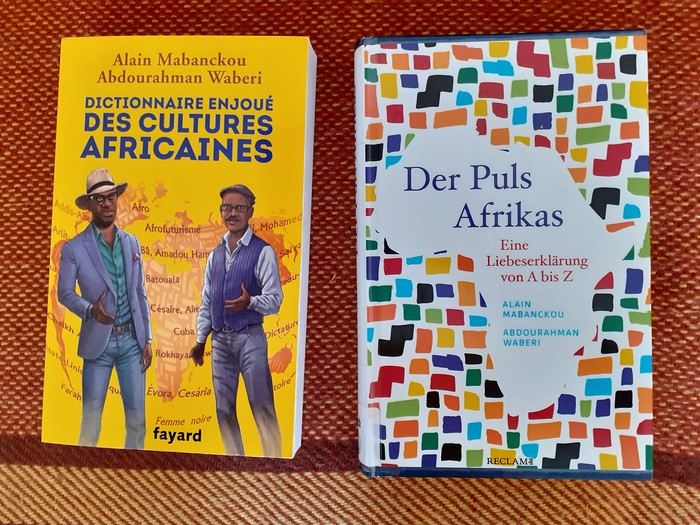
The Maggi cube, an unchallenged hegemony, and so much more
“The hopeless continent,” headlined The Economist, a British magazine, in July 2000 about Africa. Eleven years later, the same magazine headlined “Africa rising” instead. Images of Africa in the prosperous North constantly oscillate between apocalyptic scenarios and enthusiastic projections. A key issue with such images lies in the generalization they entail. If you look at the continent, considerable contrasts emerge depending on space and time. It’s no surprise that a region of the world encompassing such diverse ecological zones, maintaining such varied ties with other continents, comprising nearly fifty nation-states in sub-Saharan Africa alone, and characterized by a great diversity of languages, belief systems, and historical paths, doesn’t share a single destiny.
And yet, for many people outside Africa, as well as for many Africans, the continent constitutes a single entity, defined by criteria such as skin color, a colonial past, poverty, and the art of survival. Until now, these perspectives were generally accompanied by the idea that Africa had to—or should have—followed a single path together, sometimes called development, sometimes modernization, sometimes liberation, then a market economy. None of these paths delivered on their promises.
The two writers Alain Mabanckou and Abdourahman Waberi—one from Congo, the other raised in Djibouti, both long settled in France and now professors at renowned North American universities (Los Angeles, Washington)—have had enough of pessimistic scenarios: “We are aware that Africa is in the world and the world is in Africa. The same goes for all other continents, as our destinies are inextricably linked for better or worse. We refuse to see Africa as a reservoir of misfortunes or a continent cursed by atavistic misfortune and characterized by ethnic conflicts. [...] It’s this passionate flame we wanted to capture in a book [...] a kind of stroll through African cultures, without any demands, each letter of the alphabet leading us to a notion, a practice, a concept, a moment in history, literature, painting, politics, economics, cuisine, etc.” (p.10-11). Africa, they write, is on the verge of “imposing a signature, a style, a way of being in the world and in relation to the rest of the world.” (p.11) To put words to the continent’s diversity and dynamism, the two authors created a “rambling ABC,” a kind of portrait—or more precisely, a mythography—that lets you see and feel the pulse of a vast continent whose cultural power is unfolding before our eyes. Once marginalized or even mocked, the voice and importance of the Continent in global affairs are now undeniable” (p.11), containing over a hundred entries, mostly concise, written in a relaxed and casual style. The optimistic, even exuberant tone is set from the brief introduction. The duo of authors wants to “sing a love song to the cultures of our continent, to its inhabitants past and present, to its exceptional resources and its spectacular globalization despite a certain pollution that still clouds our skies due to the unmatched duration of dictatorships in some of our regions.” (p.12) In doing so, they don’t want to be too distracted by today’s Afewerki-Biya-Bongo-Déby & Co. ...
Of course, you’ll find tributes to great precursors like Frantz Fanon (“[...] it was a love story and admiration that wasn’t dimmed by the four decades separating his birth from ours. Let’s add that we were born while the native of Fort-de-France had left the world’s stage four years earlier, in the prime of life” p.141), Mongo Beti (“You must read and reread Mongo Beti, a genius who used his fame to support often just causes in Africa, like defending oppressed groups. His place is already in History. His oppressors, like the dictators Ahmadou Ahidjo and Paul Biya, can’t compete in the same category” p.64), the Malian Amadou Hampâté Bâ
(“Posterity remembers him mainly as an tireless defender of African cultures. His plea for the collection and preservation of traditional African knowledge remains a major event for all men and women of good will. One day in 1960, at the UNESCO podium, the native of Bandiagara sounded the alarm: ‘[...] Since we’ve admitted that the humanity of each people is the heritage of all humanity, if African traditions aren’t collected in time and written down, they’ll one day be missing from the universal archives of humanity.’” p.51),
Kwame Nkrumah, “one of the founders of Pan-Africanism, father of Ghana’s independence” (p.239), as well as the historian Cheikh Anta Diop, the writer, poet, and politician Aimé Césaire, and the economist and thinker Samir Amin, but also very warm tributes to certain contemporary African intellectuals like Souleymane Bachir Diagne and Achille Mbembe
(“A few years ago, in dominant economic circles, a rumor often resurfaced, usually disguised as a cold and scientifically proven analysis: Africa is useless. It’s a burden for the rest of the human community. With its 2% share in world trade, it would disappear from stock market radars without anyone noticing. So? Maybe it’ll be pulled up by other continents. Wanting to surpass itself is a crazy bet for Africans, they concluded. Arrogant or clueless, President Nicolas Sarkozy declared before an audience of students and teachers at Cheikh Anta Diop University in Dakar: ‘The African man hasn’t entered history enough [...] He only knows the eternal repetition of time marked by the endless repetition of the same gestures and words.’ That was in 2007. For decades, armed only with reason, an intellectual often steps up to debunk prejudices, lazy readings, and dishonest frameworks used as false fronts by those who, like Nicolas Sarkozy or former journalist Stephen Smith, out of ignorance, contempt, or condescension, distort African reality. This intellectual is none other than the historian and political scientist Achille Mbembe. This heir of Frantz Fanon, Amílcar Cabral, Jean-Marc Ela, and Fabien Eboussi-Boulaga was born in 1957 in Cameroon, in the Bassa region. Marked early by the upheavals of a fratricidal war, Achille Mbembe became the guardian of the memory of martyrs. After brilliant studies in Paris, he went on to teach at the best American universities, but the call of the Continent was stronger than anything else. In Dakar, he once directed CODESRIA (Council for the Development of Social Science Research in Africa) before joining the University of the Witwatersrand in Johannesburg, South Africa. Even though the author of *Critique of Black Reason* (Éditions La Découverte, 2015) spends a few months at Duke University in North Carolina, his observation post remains South Africa. From Johannesburg, Achille Mbembe scrutinizes Africa and the whole world. A lucid observer with an elegant and generous pen, Achille Mbembe knows how to blend big and small history: ‘I was born one day in July, as the month was drawing to a close. It was 1957, in that part of Africa recently named ‘Cameroon,’ a memory of the wonder that seized Portuguese sailors in the 15th century when, sailing up the river near Douala, they couldn’t help but note the presence of a multitude of crustaceans, and named it *Rio dos Camarões*, meaning ‘River of Shrimp.’ I grew up in the shadow of this nameless land, since, in a way, the name it bears is only the product of someone else’s astonishment: a lexical mistake, if you will.’ From this mistake or wound, he made leaven, a springboard to compose a rich work, recognized worldwide. To denounce barriers and barbarians too. But that’s not enough. Among his peers in circles of thought and action, Achille Mbembe passionately and consistently defends human dignity and the beauty of the world. In doing so, he fulfills the mission Frantz Fanon entrusted to him.” (p.227-229),
as well as entries dedicated to lesser-known artists and intellectuals, like the French journalist and activist Rokhaya Diallo, daughter of Senegalese and Gambian parents, or the Ethiopian filmmaker Haile Gerima, who has long lived in the United States. Other names from politics, sports, music, art, and literature: Kofi Annan, p.36; Barack Obama, p.243; Thomas Sankara, p.277; Ousmane Sow, p.285; Yambo Ouologuem, p.250; Léopold Sédar Senghor, p.282; Muhammad Ali, p.30; Nuruddin Farah, p.146; Salif Keita, p.203; Ahmadou Kourouma, p.206; Ngũgĩ wa Thiong’o, p.236; Winnie Mandela, p.224; Kylian Mbappé, p.226 ...
The authors, who resolutely commit to a “mythography” (p.11) of Africa, also pay special attention to local social movements, cultural events, and aspects of daily life. *Y’en a marre*, “which also meant ‘we’re fed up with sitting on our hands’” (p.320-321), emerged about a decade ago in Senegal as a citizen movement of peaceful resistance and symbolizes, the authors emphasize, the fact that African youth are increasingly fed up “with the political circus deployed in Africa since independence, as our parents would say, ‘since the White man left’...” (p.321). A full entry is dedicated to the Maggi bouillon cube, which has flooded African markets for about forty years and enjoys immense popularity (“It’s everywhere in Africa, from Dakar to Djibouti, and from Tangier to Cape Town. It’s in every pot, every stew. Little hands put it in every sauce, every local or adapted dish. An unchallenged hegemony! You’ll find it in diasporas too. The culinary strolls in Paris, in the [...] neighborhood” p.90). Critics blame it not only for impoverishing the aromatic diversity of local dishes but also for being harmful to health. And yet, “he poorest Africans, those who eat only once a day, a few spoonfuls of white beans and a ball of *foufou*, for example, are the most fervent users of the magic cube.” (p.92-93)
For *fonio*, “the new trendy cereal. [...] From the millet family, fonio is probably the oldest cereal cultivated in West Africa, and mainly in its sub-Saharan part, for millennia. [...] Easy to grow, water-efficient, fonio grows everywhere except on clay soils. Long neglected because it was considered the poor man’s crop, fonio is now a source of pride for the farmers who cultivate it and cherish it like the apple of their eye” (p.156-157), the authors immediately offer a detailed recipe, letting the reader know that “e can’t resist sharing this fonio with chicken recipe from Mali with you:
Ingredients: 1 chicken 3 large ripe red tomatoes 4 tbsp tomato paste 4 large onions 1 garlic clove 1/2 cup oil 2 Maggi cubes or salt 2 large carrots 1 turnip 1 large cabbage 2 large potatoes 1 celery stalk 1 packet pre-cooked fonio 4 okra (or okra powder) salt, pepper
Preparation: 1. Prepare the sauce: wash and cut the chicken. Peel the onions, garlic, and vegetables. 2. In a pot, fry the chicken pieces. 3. Dice the onions, tomatoes, carrots, and turnip very small and add them to the pot. 4. Add the tomato paste, salt, and pepper. 5. Simmer for 15 min, then add 2 L of water and the cooked chicken pieces. 6. Simmer for 30 min, then add the crushed garlic and celery, plus the cabbage cut into 4 and the potatoes cut in half. 7. Prepare the fonio: cover it with warm water, let it rest for 15 min, and cook it over low heat. 8. In a small pot, boil the okra and crush them. 9. Mix the crushed okra with the cooked fonio, then salt. Serve hot.” (p.158-159)
The comedy *Black Mic Mac*, released in French theaters in 1986 and addressing France’s increasingly restrictive immigration policy at the time, also gets an entry, as do *Tintin in the Congo*, the popular comic, and *Jip’s Café* (“[...] a little Africa in the heart of Paris, with passersby stopping to admire the ‘ambianceurs’ on the dance floor or attend the cultural events offered by the place” (p.194), an African establishment in Paris that Alain Mabanckou already immortalized in one of his novels.
The duo of authors also tackles thorny subjects like jihadism (p.119), the Rwandan genocide (p.272), the CFA franc (p.82), and dictatorship (p.110). While the two strike the right tone here, many entries leave a slightly bitter taste. Two examples: why doesn’t the text on Barack Obama mention the great disappointment of many people in Africa, who expected more from the African policy of the first U.S. president with African roots than just occasional warm words? Why do the comments on Winnie Mandela gloss over the fact that she was a highly controversial icon of the anti-apartheid movement due to her involvement in kidnappings, acts of torture, and murders of alleged apartheid collaborators? Instead, there’s a compassion that brings tears to the eyes: “She was often reduced to a secondary role, the wife of a great man” or “When victory came, she didn’t taste its fruits. Divorced, isolated. She would never be a ‘first lady’ in an evening gown, posing before a bed of chrysanthemums. They’d keep her far from the circles of power” (p.224-225). At this point, I would’ve liked the authors to take a slightly more critical stance...
That said, these “weaknesses” (if you can call them that) shouldn’t overshadow the book as a whole. It remains an informative, sometimes very entertaining, and often even original work in its own way.
Book information (the original French and the German translation):
Alain Mabanckou/Abdourahman Waberi. Dictionnaire enjoué des cultures africaines. Fayard, 2019. Alain Mabanckou/Abdourahman Waberi. Der Puls Afrikas. Eine Liebeserklärung von A bis Z. Reclam, 2022.
Hery
South Africa in safari mode: February/March 2026
Hi everyone,
With my girlfriend Christelle, we’ve chosen South Africa for our first trip to Southern Africa, focusing on safaris—after a long debate with a Cape Town/Kruger combo. But that would’ve meant cutting out St Lucia, which would’ve been harder to fit into another trip. And St Lucia—thanks to Michel and all those travel journals—we really wanted to go there.
So our 11-night itinerary ended up like this, mostly shaped by school holidays: - 3 nights in St Lucia - 1 night in Hluhluwe - 1 night at Mkhaya Game Reserve (Eswatini) - 1 night at Hlane Royal National Park (Eswatini) - 3 nights in Kruger (Berg en Dal / Satara / Tamboti) - 1 night at Shindzela Tented Camp in the Timbavati private reserve - 1 final night in Kruger at Lower Sabie
All of this in the off-season and rainy season, just a month after catastrophic floods that killed over 150 people and seriously damaged Kruger’s infrastructure.
I’ll jump straight to St Lucia and skip the loooong journey to get there (with a layover in Frankfurt, landing in Johannesburg, a domestic flight to Durban, and the rest by rental SUV—First Car Rental, perfect, no complaints).
To motivate readers—especially some familiar faces here—I’ll drop in a first photo.
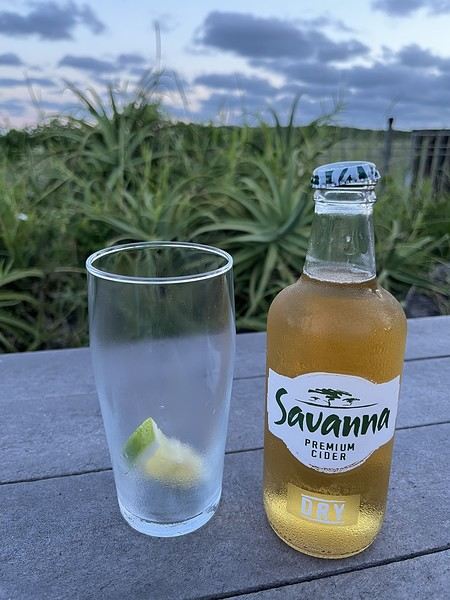
With my girlfriend Christelle, we’ve chosen South Africa for our first trip to Southern Africa, focusing on safaris—after a long debate with a Cape Town/Kruger combo. But that would’ve meant cutting out St Lucia, which would’ve been harder to fit into another trip. And St Lucia—thanks to Michel and all those travel journals—we really wanted to go there.
So our 11-night itinerary ended up like this, mostly shaped by school holidays: - 3 nights in St Lucia - 1 night in Hluhluwe - 1 night at Mkhaya Game Reserve (Eswatini) - 1 night at Hlane Royal National Park (Eswatini) - 3 nights in Kruger (Berg en Dal / Satara / Tamboti) - 1 night at Shindzela Tented Camp in the Timbavati private reserve - 1 final night in Kruger at Lower Sabie
All of this in the off-season and rainy season, just a month after catastrophic floods that killed over 150 people and seriously damaged Kruger’s infrastructure.
I’ll jump straight to St Lucia and skip the loooong journey to get there (with a layover in Frankfurt, landing in Johannesburg, a domestic flight to Durban, and the rest by rental SUV—First Car Rental, perfect, no complaints).
To motivate readers—especially some familiar faces here—I’ll drop in a first photo.
From Avignon to Casamance Without Flying
Hi there,
Last February, I made a trip using "public transport" from France to southern Senegal via Spain, Morocco, Western Sahara, and Mauritania.
It’s a journey of about 5,000 km, where I took trains (as far as Marrakech), ferries (to cross Gibraltar and then to reach Casamance from Dakar), and mostly buses on the long desert straightaways. I hadn’t planned any stops in advance or booked any hotels, except for the very first train to Spain, which left plenty of room for the unexpected. Why travel by land and sea? In recent years, flight-free travel has been gaining popularity. On social media, posts explaining how to cross Europe by train as quickly as possible go viral. Traveling without flying—and making sure people know about it—has become a great way to earn a badge of eco-responsibility: an essential totem for anyone wanting to prove both their dedication to the ecological cause and the wisdom of slow travel. I haven’t flown in years, and this journey to West Africa could easily be filed under "responsible travel." But it wouldn’t be honest to say that: in reality, it wasn’t really my aversion to flying that motivated this long trek. I see overland travel primarily as a way to experience the world’s geography at a grounded, earthly pace—the pace of the locals. Besides, I’ll be flying back, which disqualifies any claim to being a model of sustainability. So no eco-badge, and no adventurer’s badge either: you won’t find any heroic tales of camel rides in lost lands or mineral train wagons in this account (popular with influencers, the Mauritania iron ore train now attracts tourists from all over the world, turning "the experience" into something you "have to do at least once in your life"). This five-part story, written on the road, has no other ambition than to recount a journey through places and people, and to share the thoughts they inspire in me. As simply and, I hope, as humbly as possible.
I’m posting the episodes here, which you can also find on my blog (with more photos) at the following links:
Episode 1: Spain, from Avignon to Algeciras
Episode 2: Morocco, from Tangier to Tarfaya
Episode 3: Western Sahara, from Tarfaya to Guerguerat
Episode 4: Mauritania, from Guerguerat to Nouakchott
Episode 5: Senegal, from Rosso to Saloulou
To help those who might want to make the same trip, I’ve also put together a summary of the route with recommendations—you can read it at the end of the story and on the blog: From France to Senegal Without Flying: Route and Itinerary Recommendations
Happy reading, and safe travels!
Last February, I made a trip using "public transport" from France to southern Senegal via Spain, Morocco, Western Sahara, and Mauritania.
It’s a journey of about 5,000 km, where I took trains (as far as Marrakech), ferries (to cross Gibraltar and then to reach Casamance from Dakar), and mostly buses on the long desert straightaways. I hadn’t planned any stops in advance or booked any hotels, except for the very first train to Spain, which left plenty of room for the unexpected. Why travel by land and sea? In recent years, flight-free travel has been gaining popularity. On social media, posts explaining how to cross Europe by train as quickly as possible go viral. Traveling without flying—and making sure people know about it—has become a great way to earn a badge of eco-responsibility: an essential totem for anyone wanting to prove both their dedication to the ecological cause and the wisdom of slow travel. I haven’t flown in years, and this journey to West Africa could easily be filed under "responsible travel." But it wouldn’t be honest to say that: in reality, it wasn’t really my aversion to flying that motivated this long trek. I see overland travel primarily as a way to experience the world’s geography at a grounded, earthly pace—the pace of the locals. Besides, I’ll be flying back, which disqualifies any claim to being a model of sustainability. So no eco-badge, and no adventurer’s badge either: you won’t find any heroic tales of camel rides in lost lands or mineral train wagons in this account (popular with influencers, the Mauritania iron ore train now attracts tourists from all over the world, turning "the experience" into something you "have to do at least once in your life"). This five-part story, written on the road, has no other ambition than to recount a journey through places and people, and to share the thoughts they inspire in me. As simply and, I hope, as humbly as possible.
I’m posting the episodes here, which you can also find on my blog (with more photos) at the following links:
Episode 1: Spain, from Avignon to Algeciras
Episode 2: Morocco, from Tangier to Tarfaya
Episode 3: Western Sahara, from Tarfaya to Guerguerat
Episode 4: Mauritania, from Guerguerat to Nouakchott
Episode 5: Senegal, from Rosso to Saloulou
To help those who might want to make the same trip, I’ve also put together a summary of the route with recommendations—you can read it at the end of the story and on the blog: From France to Senegal Without Flying: Route and Itinerary Recommendations
Happy reading, and safe travels!
A Bold Combo: Southern Peru, Bolivia, and Northern Chile
Hello everyone,
For our latest 3-week family trip (yes, the kids are growing up, and two of them are about to enter the working world), we’re heading to South America! For our first time on this continent, I had planned a classic 3-week loop in Peru.
But since we won’t be returning to this part of the world anytime soon, I thought: why not follow in the footsteps of Franck, aka Bibouns51, who, in 18 days, didn’t just stick to Peru but also added two of the planet’s most stunning landscapes to his itinerary... the Salar de Uyuni in Bolivia and its neighbor, the fabulous Atacama Desert in northern Chile !!
So, I set about the tricky task of limiting the regions we’d visit in Peru to those we considered must-sees, to avoid rushing too much. The visit schedules were optimized, including several comfortable overnight buses that have the huge advantage of letting us hop between regions.
So, we’re off on a somewhat adventurous trip with three domestic flights (two on the first day and one on the last), two overnight buses for quick hops, several car rentals, the services of a few drivers to make the trip more comfortable, and even a tour operator for crossing the Salar...
Our main concern is altitude sickness, and we’re bringing Diamox, aspirin, etc., just in case.
Our second worry before departure was not even getting off the ground... Yes, for once, we’re leaving from France—Marseille, to be exact. The week before our departure, with the surprise air traffic controllers’ strike, I remembered why we usually prefer to leave from abroad, like Turin or Barcelona... In the end, it wasn’t the air traffic controllers who made us nervous but the early July wildfires that paralyzed the airport a few days before our departure. Fortunately, the fires were quickly brought under control, and on the big day, everything was smooth sailing!
Detailed itinerary (which changed on Day 1 due to departure hiccups): Day 0: Flight Marseille - Madrid - Lima PERU Theoretical and abandoned Day 1: Flight Lima - Cuzco and visit Cuzco (Puka Pukara, Tambomachay, Cristo Blanco Observatory, Sacsayhuaman sunset) - Night in Cuzco Day 2: Taxi -> Chinchero - Moray - Maras Salt Mines - Ollantaytambo - Train to Aguas Calientes Day 3: Machu Picchu - Return train to Ollantaytambo Day 4: 2-day taxi -> Pisac - Tipon - Andahuaylillas - Huaro - Night in San Pedro Day 5: Palcoyo - Checacupe - Vinicunca - Return and night in Cuzco Day 6: Day in Cuzco (catch-up on Sacsayhuaman, San Blas district, Temple of the Sun) - Overnight bus to Arequipa Day 7: Rental car -> On the road to Colca Canyon, night in Cabanaconde Day 8: Descent to the bottom of Colca Canyon, night at Oasis Sangalle Day 9: Ascent from the canyon - Maca - Chivay - Return and night in Arequipa Day 10: Visit Arequipa (Santa Catalina Convent, La Recoleta Church and Monastery, La Compañía Church, Cathedral) - Overnight bus to Puno Day 11: Lake Titicaca - Night in Puno BOLIVIA Day 12: Shared taxi -> Road to La Paz, visit downtown La Paz - Night 1 in La Paz Day 13: Moon Valley and Las Animas Valley - Night 2 in La Paz Day 14: Day in La Paz - Night 3 in La Paz Day 15: Flight to Uyuni - Day 1 of Salar de Uyuni tour - Night at the edge of the Salar Day 16: Crossing the Lipez region and lagoons - Night near Laguna Colorada Day 17: Sol de Mañana CHILE Day 17 cont.: Pre-booked transfer to SPDA - 4x4 rental - Pukara de Quitor - Stargazing tour - Night 1 in SPDA Day 18: Death Valley and Moon Valley - Night 2 in SPDA Day 19: Miscanti and Miniques Lagoons, Salar de Aguas Calientes and its Piedra Roja, Tebenquiche Lagoon and Quebrada del Diablo - Night 3 in SPDA Day 20: Rainbow Valley and swim in the Puritama River - Night 4 in SPDA Day 21: Tebenquiche Lagoon - Bus to Calama - Flight to Santiago Day 22: Return Santiago - Madrid - Marseille
Day 0 - 11/07: Destination Lima
Our first flight from Marseille went smoothly to our Iberia layover in Madrid.
In Madrid, just after getting off the plane around 8 PM, and as we were walking through the terminal, we got a rude awakening!!
We saw the word "Cancelled" next to our flight number on the display boards. Thinking it must be a glitch, we checked another screen, but the system was stubborn, and the same dreaded word appeared !
So, we headed to the Iberia counter, where an agent confirmed that our Friday evening flight was canceled and rescheduled for the next morning. The reason? A breakdown and no replacement plane, even though we were in Madrid, Iberia’s home base!
To make matters worse, I remembered our super-tight schedule, planned to the minute, with no buffer day in Lima. Since I’m a bit phobic of megacities and hadn’t found anything appealing in the Peruvian capital in our guidebooks, we’d planned to leave Lima as soon as possible for Cusco, the heart of the Sacred Valley, to spend our first day there.
Bad idea, because we already knew the 4-hour buffer wouldn’t be enough, and we’d miss the domestic flight, which was, of course, non-refundable and non-changeable. So, we had to call LATAM from Madrid to find another flight for Saturday evening and negotiate a rate to recover some of our initial outlay.
After an hour on the phone with customer service, several endless holds, and three failed attempts to dictate our credit card number over the phone to a Spaniard speaking English with a thick accent, we finally managed to confirm the transaction, securing our new flight tickets for a moderate extra cost of just 150 € total.
At first, we were pretty bummed about losing a day and incurring extra fees to reschedule the domestic flight, but then, when we learned from an Iberia customer service rep that we’d receive the max compensation of 600 € per traveler, we even ended up grinning... because 3000 € in refunds for only losing the first day in Cusco? We’d sign up for that 10 times over!!
Iberia then took care of us, putting us up in a hotel where we had dinner before a short 5-hour night and an early morning departure. I took the opportunity to improvise a quick day of sightseeing in Lima, focusing on the Barranco and Miraflores districts.
For our latest 3-week family trip (yes, the kids are growing up, and two of them are about to enter the working world), we’re heading to South America! For our first time on this continent, I had planned a classic 3-week loop in Peru.
But since we won’t be returning to this part of the world anytime soon, I thought: why not follow in the footsteps of Franck, aka Bibouns51, who, in 18 days, didn’t just stick to Peru but also added two of the planet’s most stunning landscapes to his itinerary... the Salar de Uyuni in Bolivia and its neighbor, the fabulous Atacama Desert in northern Chile !!
So, I set about the tricky task of limiting the regions we’d visit in Peru to those we considered must-sees, to avoid rushing too much. The visit schedules were optimized, including several comfortable overnight buses that have the huge advantage of letting us hop between regions.
So, we’re off on a somewhat adventurous trip with three domestic flights (two on the first day and one on the last), two overnight buses for quick hops, several car rentals, the services of a few drivers to make the trip more comfortable, and even a tour operator for crossing the Salar...
Our main concern is altitude sickness, and we’re bringing Diamox, aspirin, etc., just in case.
Our second worry before departure was not even getting off the ground... Yes, for once, we’re leaving from France—Marseille, to be exact. The week before our departure, with the surprise air traffic controllers’ strike, I remembered why we usually prefer to leave from abroad, like Turin or Barcelona... In the end, it wasn’t the air traffic controllers who made us nervous but the early July wildfires that paralyzed the airport a few days before our departure. Fortunately, the fires were quickly brought under control, and on the big day, everything was smooth sailing!
Detailed itinerary (which changed on Day 1 due to departure hiccups): Day 0: Flight Marseille - Madrid - Lima PERU Theoretical and abandoned Day 1: Flight Lima - Cuzco and visit Cuzco (Puka Pukara, Tambomachay, Cristo Blanco Observatory, Sacsayhuaman sunset) - Night in Cuzco Day 2: Taxi -> Chinchero - Moray - Maras Salt Mines - Ollantaytambo - Train to Aguas Calientes Day 3: Machu Picchu - Return train to Ollantaytambo Day 4: 2-day taxi -> Pisac - Tipon - Andahuaylillas - Huaro - Night in San Pedro Day 5: Palcoyo - Checacupe - Vinicunca - Return and night in Cuzco Day 6: Day in Cuzco (catch-up on Sacsayhuaman, San Blas district, Temple of the Sun) - Overnight bus to Arequipa Day 7: Rental car -> On the road to Colca Canyon, night in Cabanaconde Day 8: Descent to the bottom of Colca Canyon, night at Oasis Sangalle Day 9: Ascent from the canyon - Maca - Chivay - Return and night in Arequipa Day 10: Visit Arequipa (Santa Catalina Convent, La Recoleta Church and Monastery, La Compañía Church, Cathedral) - Overnight bus to Puno Day 11: Lake Titicaca - Night in Puno BOLIVIA Day 12: Shared taxi -> Road to La Paz, visit downtown La Paz - Night 1 in La Paz Day 13: Moon Valley and Las Animas Valley - Night 2 in La Paz Day 14: Day in La Paz - Night 3 in La Paz Day 15: Flight to Uyuni - Day 1 of Salar de Uyuni tour - Night at the edge of the Salar Day 16: Crossing the Lipez region and lagoons - Night near Laguna Colorada Day 17: Sol de Mañana CHILE Day 17 cont.: Pre-booked transfer to SPDA - 4x4 rental - Pukara de Quitor - Stargazing tour - Night 1 in SPDA Day 18: Death Valley and Moon Valley - Night 2 in SPDA Day 19: Miscanti and Miniques Lagoons, Salar de Aguas Calientes and its Piedra Roja, Tebenquiche Lagoon and Quebrada del Diablo - Night 3 in SPDA Day 20: Rainbow Valley and swim in the Puritama River - Night 4 in SPDA Day 21: Tebenquiche Lagoon - Bus to Calama - Flight to Santiago Day 22: Return Santiago - Madrid - Marseille
Day 0 - 11/07: Destination Lima
Our first flight from Marseille went smoothly to our Iberia layover in Madrid.
In Madrid, just after getting off the plane around 8 PM, and as we were walking through the terminal, we got a rude awakening!!
We saw the word "Cancelled" next to our flight number on the display boards. Thinking it must be a glitch, we checked another screen, but the system was stubborn, and the same dreaded word appeared !
So, we headed to the Iberia counter, where an agent confirmed that our Friday evening flight was canceled and rescheduled for the next morning. The reason? A breakdown and no replacement plane, even though we were in Madrid, Iberia’s home base!
To make matters worse, I remembered our super-tight schedule, planned to the minute, with no buffer day in Lima. Since I’m a bit phobic of megacities and hadn’t found anything appealing in the Peruvian capital in our guidebooks, we’d planned to leave Lima as soon as possible for Cusco, the heart of the Sacred Valley, to spend our first day there.
Bad idea, because we already knew the 4-hour buffer wouldn’t be enough, and we’d miss the domestic flight, which was, of course, non-refundable and non-changeable. So, we had to call LATAM from Madrid to find another flight for Saturday evening and negotiate a rate to recover some of our initial outlay.
After an hour on the phone with customer service, several endless holds, and three failed attempts to dictate our credit card number over the phone to a Spaniard speaking English with a thick accent, we finally managed to confirm the transaction, securing our new flight tickets for a moderate extra cost of just 150 € total.
At first, we were pretty bummed about losing a day and incurring extra fees to reschedule the domestic flight, but then, when we learned from an Iberia customer service rep that we’d receive the max compensation of 600 € per traveler, we even ended up grinning... because 3000 € in refunds for only losing the first day in Cusco? We’d sign up for that 10 times over!!
Iberia then took care of us, putting us up in a hotel where we had dinner before a short 5-hour night and an early morning departure. I took the opportunity to improvise a quick day of sightseeing in Lima, focusing on the Barranco and Miraflores districts.
On the Roads of Costa Rica
Hello everyone, I’m happy to welcome you to this new travel journal.
We’re heading to Costa Rica together—a Central American destination that dreams are made of for many French travelers and attracts crowds from France.
It was the country’s wild nature and safety that convinced us to go, since we’re traveling with our 7-year-old little one. We didn’t have much vacation time in February 2026 (only 12 days), so we optimized as much as possible.
Here’s the itinerary: Wednesday, February 11: Flight from Marseille to San Jose via Paris and Atlanta Thursday, February 12: Pick up the car, drive to Poas Volcano, visit La Paz Waterfall Gardens Friday, February 13: Poas Volcano and drive to Manuel Antonio Saturday, February 14: Manuel Antonio National Park Sunday, February 15: Nauyaca Waterfall and Playa Linda Monday, February 16: Drive to Monte Verde and Santa Elena Reserve Tuesday, February 17: El Tigre Waterfall Reserve and Treetopia Park Wednesday, February 18: Monte Verde Reserve with a guide and drive to La Fortuna Thursday, February 19: Sloth guided tour, Observatory Lodge Park Friday, February 20: Arenal Volcano National Park, Termalistas del Arenal hot springs, and night tour Saturday, February 21: Return to San Jose, flight to Paris via Atlanta Sunday, February 22: Arrival in Paris and flight to Marseille. That gives us a solid 9 days in the country.
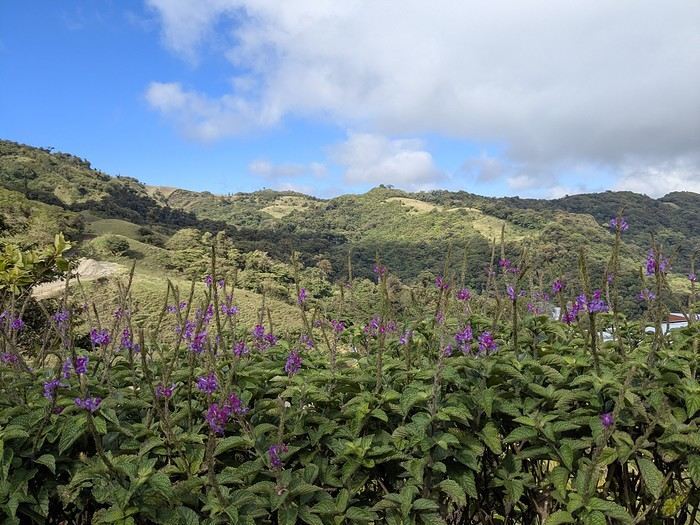
Budget breakdown: Costa Rica is an expensive country, but no more so than France. However, almost all hikes and waterfalls are paid entry, which can really add up. For meals, sodas (6–10 €) are cheaper than restaurants (10–20 € per dish).
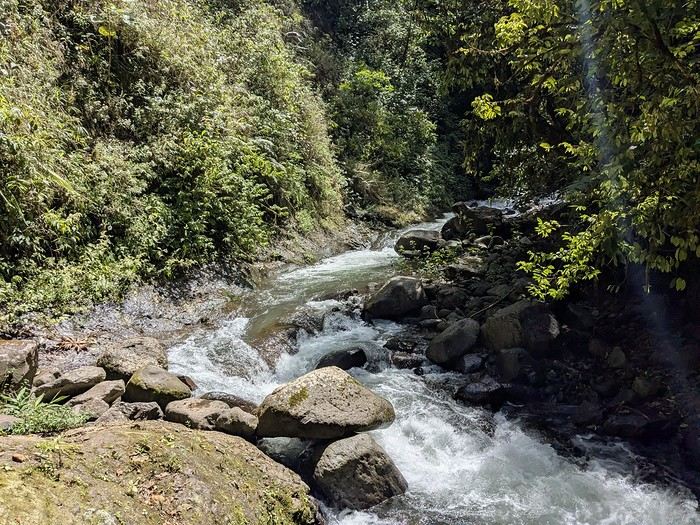
Flights: We chose Delta Airlines for the price: Marseille to San Jose was 740 € per person (modifiable, with checked baggage and seat selection included). Other direct flights from Europe were priced between 1200 € and 1600 € with more restrictive conditions. That’s 2220 € for the family.
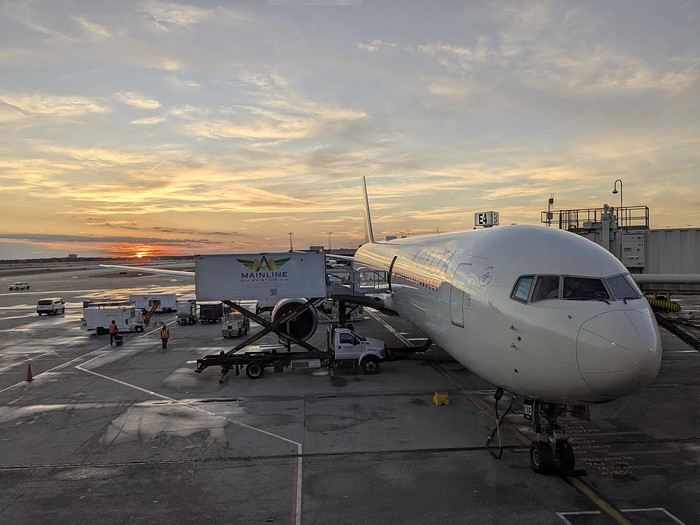
Accommodations: Alajuela, first night: 139 € (1 night) at Rodeo Estancia Boutique Hotel, with personalized airport pickup, transfer to the hotel, and a briefing from Vert Costa Rica agency the next day. Poas: 66 € (1 night) at Cabañas Tierra Fértil (entire apartment). Manuel Antonio: 394 € (3 nights) at La Palapa Ecolodge (hotel in the jungle). Monte Verde: Chalet Aloha Monteverde Cloud Forest (2 bedrooms): 125 € (2 nights). La Fortuna: Arenal Dream Garden (1 bedroom): 217 € (3 nights). Total: 941 €.
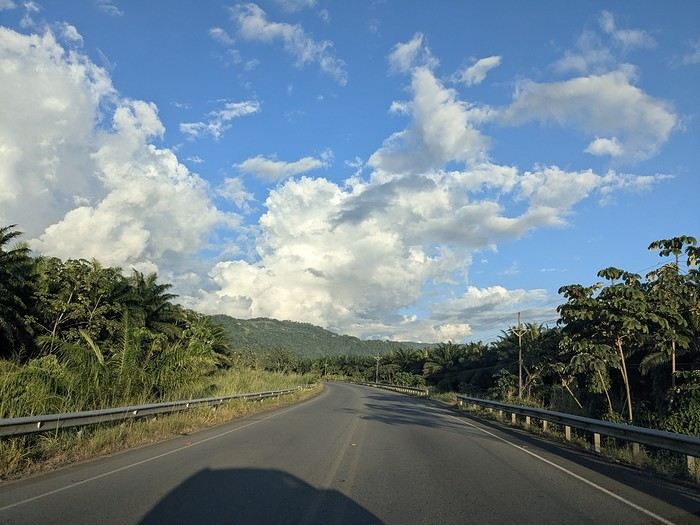
Car rental: I went through Vert Costa Rica agency (Vincent is a French expat who set up the agency in Costa Rica and makes great YouTube videos with useful tips). I rented a 4x4 that was delivered to the hotel the day after arrival and returned at the airport before the flight. The total was 772 €, including full insurance (zero deductible), a child seat, and a phone with a Costa Rican SIM and WhatsApp. The rental company was Poas Rent a Car. The vehicle was well-maintained—no complaints. Gas: 100 € for the whole trip (3 fill-ups).
Activities: To get discounts, I bought the pass offered by Vincent, which paid for itself after just one activity. It cost me 30 € (promo since I rented the car through him). Prices are for 3 people. I’ve added stars to rate them: La Paz Waterfall Gardens ****: 112 € Poas Volcano National Park *: 33 € Manuel Antonio National Park ****: 35 € Nauyaca Waterfall ***: 25 € Santa Elena Reserve **: 45 € El Tigre Waterfall Reserve ****: 141 € (with meal) Treetopia (ziplining, suspension bridges) **: 250 € Guided tour of Monte Verde Reserve ***: 113 € Sloth guided tour (with breakfast) ***: 115 € Arenal Observatory Lodge (with meal) ****: 102 € Arenal Volcano National Park *: 34 € Termalistas del Arenal ****: 20 € Night tour ***: 116 € Total: 1171 €.
Meals: 600 € My favorite restaurants: Poas: Food court Mercaditas in Fraijanes Manuel Antonio (near La Palapa): La Langosta and also El Patio Near Nauyaca Waterfall: Ricar2 el Avión Between Manuel Antonio and Monte Verde: Soda D’Calle Santa Elena: HG’s Food Guadalupe (between Monte Verde and La Fortuna): Soda Río Piedras Arenal Observatory Lodge restaurant Arenal Oasis Ecolodge restaurant
Other expenses: 300 € (groceries for breakfast, drinks, ice cream, souvenirs, etc.) Total overall: 6065 € (about 2020 € per person).
Now, here’s the day-by-day account of this beautiful trip.
https://voyageforum.com/images/posts/small/1772295011-z8mILBEUXHU8Ajz.jpg
It was the country’s wild nature and safety that convinced us to go, since we’re traveling with our 7-year-old little one. We didn’t have much vacation time in February 2026 (only 12 days), so we optimized as much as possible.
Here’s the itinerary: Wednesday, February 11: Flight from Marseille to San Jose via Paris and Atlanta Thursday, February 12: Pick up the car, drive to Poas Volcano, visit La Paz Waterfall Gardens Friday, February 13: Poas Volcano and drive to Manuel Antonio Saturday, February 14: Manuel Antonio National Park Sunday, February 15: Nauyaca Waterfall and Playa Linda Monday, February 16: Drive to Monte Verde and Santa Elena Reserve Tuesday, February 17: El Tigre Waterfall Reserve and Treetopia Park Wednesday, February 18: Monte Verde Reserve with a guide and drive to La Fortuna Thursday, February 19: Sloth guided tour, Observatory Lodge Park Friday, February 20: Arenal Volcano National Park, Termalistas del Arenal hot springs, and night tour Saturday, February 21: Return to San Jose, flight to Paris via Atlanta Sunday, February 22: Arrival in Paris and flight to Marseille. That gives us a solid 9 days in the country.
Budget breakdown: Costa Rica is an expensive country, but no more so than France. However, almost all hikes and waterfalls are paid entry, which can really add up. For meals, sodas (6–10 €) are cheaper than restaurants (10–20 € per dish).
Flights: We chose Delta Airlines for the price: Marseille to San Jose was 740 € per person (modifiable, with checked baggage and seat selection included). Other direct flights from Europe were priced between 1200 € and 1600 € with more restrictive conditions. That’s 2220 € for the family.
Accommodations: Alajuela, first night: 139 € (1 night) at Rodeo Estancia Boutique Hotel, with personalized airport pickup, transfer to the hotel, and a briefing from Vert Costa Rica agency the next day. Poas: 66 € (1 night) at Cabañas Tierra Fértil (entire apartment). Manuel Antonio: 394 € (3 nights) at La Palapa Ecolodge (hotel in the jungle). Monte Verde: Chalet Aloha Monteverde Cloud Forest (2 bedrooms): 125 € (2 nights). La Fortuna: Arenal Dream Garden (1 bedroom): 217 € (3 nights). Total: 941 €.
Car rental: I went through Vert Costa Rica agency (Vincent is a French expat who set up the agency in Costa Rica and makes great YouTube videos with useful tips). I rented a 4x4 that was delivered to the hotel the day after arrival and returned at the airport before the flight. The total was 772 €, including full insurance (zero deductible), a child seat, and a phone with a Costa Rican SIM and WhatsApp. The rental company was Poas Rent a Car. The vehicle was well-maintained—no complaints. Gas: 100 € for the whole trip (3 fill-ups).
Activities: To get discounts, I bought the pass offered by Vincent, which paid for itself after just one activity. It cost me 30 € (promo since I rented the car through him). Prices are for 3 people. I’ve added stars to rate them: La Paz Waterfall Gardens ****: 112 € Poas Volcano National Park *: 33 € Manuel Antonio National Park ****: 35 € Nauyaca Waterfall ***: 25 € Santa Elena Reserve **: 45 € El Tigre Waterfall Reserve ****: 141 € (with meal) Treetopia (ziplining, suspension bridges) **: 250 € Guided tour of Monte Verde Reserve ***: 113 € Sloth guided tour (with breakfast) ***: 115 € Arenal Observatory Lodge (with meal) ****: 102 € Arenal Volcano National Park *: 34 € Termalistas del Arenal ****: 20 € Night tour ***: 116 € Total: 1171 €.
Meals: 600 € My favorite restaurants: Poas: Food court Mercaditas in Fraijanes Manuel Antonio (near La Palapa): La Langosta and also El Patio Near Nauyaca Waterfall: Ricar2 el Avión Between Manuel Antonio and Monte Verde: Soda D’Calle Santa Elena: HG’s Food Guadalupe (between Monte Verde and La Fortuna): Soda Río Piedras Arenal Observatory Lodge restaurant Arenal Oasis Ecolodge restaurant
Other expenses: 300 € (groceries for breakfast, drinks, ice cream, souvenirs, etc.) Total overall: 6065 € (about 2020 € per person).
Now, here’s the day-by-day account of this beautiful trip.
https://voyageforum.com/images/posts/small/1772295011-z8mILBEUXHU8Ajz.jpg
From the Awakening to Travel to Morocco in the 90s
As I’ve mentioned elsewhere, I inherited my love of travel from my parents and some of my grandparents. A strong passion, but one that was unfortunately limited by our family’s modest resources. Back then, living in northern Alsace, a simple trip to the southern part of the region—with the Wine Route as our destination—felt like an extraordinary journey to a land of plenty for the little boy I was in the late 60s and early 70s.
Everything seemed so huge when you were still just a kid.
Back then, I was overwhelmed by countless sensations—I was already highly sensitive, with a keen mind and a nose and taste buds that were developing like a pro’s. Which, as I’d later realize, wasn’t always an advantage.
Those magical days always began with a gentle late-spring or midsummer morning. The interior of the white Peugeot 404, license plate 210 LZ 67, had already soaked up the sun before the engine purred to life, and the cabin gave off a scent I could still recognize today—a fragrance I found so pleasant. Back then, I had no idea it was just the smell of warm plastic from the car’s interior. Yes, the scents of the 404 on sunny days became my madeleine de Proust... What’s more, the whole family was unusually cheerful because those moments of relaxation and leisure were rare. Everyone worked, and no one had an easy job or was well paid. Without the *Trente Glorieuses*, these experiences might never have happened.
Once we crossed the canton’s borders, I felt like I was light-years away from my everyday surroundings, and every kilometer plunged me deeper into *terra incognita*. It was thrilling. Far from my so-called "medium-sized" town, wheat fields, cornfields, and cabbage patches stretched out, punctuated by tall poles connected by long wires and topped with vegetation—like giant clotheslines without laundry, where magical beanstalks might grow to touch the sky. Back then, I was still far from tasting their product, which was simply beer. At the time, there was still a significant local hop production. Fun fact: it wasn’t until 2002 that Anglo-Saxon scientists proved hops and cannabis belong to the same biological family.
After the fields, the landscape took another step up as it rolled past the little boy’s eyes, often glued to the windows. First came modest hills, then a succession of rolling slopes that soon formed an unbroken chain. Their 700 meters in altitude felt like Himalayan peaks to me—impressive, inert giants, a whole new world. Gazing at them, an intense emotion welled up somewhere between my stomach and lungs, nearly taking my breath away. What mysteries, what treasures did these heights hold? And then there were the cherries on top—the crowning touch that made the scene even more magical: proud, majestic castles perched on the summits like impassive sentinels. Monuments from the past, yet firmly rooted in the present on their rocky spurs. The little boy’s eyes sparkled—he’d been given a castle for Christmas, complete with battlements, towers, a drawbridge, and fully armed knights. He’d watched and lived *Ivanhoe* on the only French TV channel that existed back then.
Only once did my paternal grandfather join us on one of these trips. A tall, intelligent man with a face that could shift from stern to mischievous, clearly full of humor and charisma. Sadly, his relationship with alcohol had taken a toll on his life and, by extension, those of his loved ones. He had a strong personality—if his boss crossed the line, he wouldn’t hesitate to punch him, which meant he went through a lot of different jobs. Back then, you could quit one job and easily find another. It was quite something to see him in his final stages, hallucinating pink elephants and even drinking perfume when he had nothing else left. The last time I saw him, he’d slipped away from the doctors and nurses while hospitalized in pretty bad shape—at least, I assume his liver was the issue. We were sitting down for a family lunch when the door burst open, and there he stood in his pajamas, eyes twinkling with mischief, clearly pleased with the dramatic entrance. That theatrical moment didn’t spare us from burying him a few months later at the age of 71. One day, my mother told me the family doctor had quietly remarked that it was a shame—with his robust constitution, he could’ve lived to be a hundred. Yes, the family doctor—this was the man who’d come treat you any day, at almost any hour, just for a phone call. It really existed, it’s not a myth!
That day, his wife—my paternal grandmother—was also along for the ride. Everyone agreed that Jeannette was a good woman. She worked as a waitress at *Le Tigre*, the biggest brasserie in town, right in the center. Most customers preferred to be served by her, including local dignitaries and even the mayor. As a kid, I didn’t find her very fun, open, or warm—she seemed a bit stern. Back then, women in their fifties already had the face and build of grandmothers. Same went for men, don’t get me wrong. I had no idea about the struggles she faced because of her husband. I didn’t know that 30 years earlier, she’d had to flee Alsace while pregnant, under threat from Nazi fighter-bombers. I didn’t know she’d had several miscarriages, and that my father—her only surviving child, born prematurely in March 1940 at the other end of France—weighed less than a kilo at birth and was so tiny he could fit in a shoebox. Hard to imagine he’d grow into a strapping man nearly 1.80 meters tall, tipping the scales at 100 kilos. When you come back from summer camp in early August and ask why she didn’t pick you up with your parents, and they gently tell you she’s "in heaven," you don’t realize she passed away at 54 after suffering greatly from stomach cancer that had spread.
Back to that family outing, that enchanted parenthesis. I even remembered where we’d had lunch when I passed through Dambach-la-Ville decades later. One of those charming, flower-filled towns Alsace produces in abundance—and preserves so well. This one sits high on a hill, and I was a bit stunned on the parking lot because the view stretched far, revealing the Alsace plain below—its fields, villages, hills, and forests. The world seemed so vast and enticing that day, even though I was only glimpsing a tiny fraction of it.
The region was already very touristy, but I wouldn’t notice the downsides until much later. That Sunday noon, I discovered a large restaurant filled with diners. I can still see the enormous piece of meat they served me, decorated with a little wooden skewer topped with a flag. I kept that one for a long time. Those were the golden days of rich, flowing, thick sauces—so flavorful—and the era of the world’s best fries, made on the spot with the best potatoes. To top it off, I was *exceptionally* allowed a small bottle of apple juice, Orangina, or—even better if possible—Sinalco. Yes, Sinalco—like Orangina, but better. A brand that must’ve disappeared in the 70s, but why, and what a shame! Since then, Orangina’s little bubbles have taken the brand to the other side of the planet—it’s now Japanese.
Year after year, I’d eagerly await that ecstatic moment when the most beautiful castle in Alsace, the Haut-Koenigsbourg, appeared in my field of vision. The perfect model, the archetype that blended into the landscape at the height of a child’s dreams. The trip home always felt like a reality check—less jarring than an alarm clock, but more diffuse and melancholic. From then on, there was only one wish: *When do we leave again?*
Those magical days always began with a gentle late-spring or midsummer morning. The interior of the white Peugeot 404, license plate 210 LZ 67, had already soaked up the sun before the engine purred to life, and the cabin gave off a scent I could still recognize today—a fragrance I found so pleasant. Back then, I had no idea it was just the smell of warm plastic from the car’s interior. Yes, the scents of the 404 on sunny days became my madeleine de Proust... What’s more, the whole family was unusually cheerful because those moments of relaxation and leisure were rare. Everyone worked, and no one had an easy job or was well paid. Without the *Trente Glorieuses*, these experiences might never have happened.
Once we crossed the canton’s borders, I felt like I was light-years away from my everyday surroundings, and every kilometer plunged me deeper into *terra incognita*. It was thrilling. Far from my so-called "medium-sized" town, wheat fields, cornfields, and cabbage patches stretched out, punctuated by tall poles connected by long wires and topped with vegetation—like giant clotheslines without laundry, where magical beanstalks might grow to touch the sky. Back then, I was still far from tasting their product, which was simply beer. At the time, there was still a significant local hop production. Fun fact: it wasn’t until 2002 that Anglo-Saxon scientists proved hops and cannabis belong to the same biological family.
After the fields, the landscape took another step up as it rolled past the little boy’s eyes, often glued to the windows. First came modest hills, then a succession of rolling slopes that soon formed an unbroken chain. Their 700 meters in altitude felt like Himalayan peaks to me—impressive, inert giants, a whole new world. Gazing at them, an intense emotion welled up somewhere between my stomach and lungs, nearly taking my breath away. What mysteries, what treasures did these heights hold? And then there were the cherries on top—the crowning touch that made the scene even more magical: proud, majestic castles perched on the summits like impassive sentinels. Monuments from the past, yet firmly rooted in the present on their rocky spurs. The little boy’s eyes sparkled—he’d been given a castle for Christmas, complete with battlements, towers, a drawbridge, and fully armed knights. He’d watched and lived *Ivanhoe* on the only French TV channel that existed back then.
Only once did my paternal grandfather join us on one of these trips. A tall, intelligent man with a face that could shift from stern to mischievous, clearly full of humor and charisma. Sadly, his relationship with alcohol had taken a toll on his life and, by extension, those of his loved ones. He had a strong personality—if his boss crossed the line, he wouldn’t hesitate to punch him, which meant he went through a lot of different jobs. Back then, you could quit one job and easily find another. It was quite something to see him in his final stages, hallucinating pink elephants and even drinking perfume when he had nothing else left. The last time I saw him, he’d slipped away from the doctors and nurses while hospitalized in pretty bad shape—at least, I assume his liver was the issue. We were sitting down for a family lunch when the door burst open, and there he stood in his pajamas, eyes twinkling with mischief, clearly pleased with the dramatic entrance. That theatrical moment didn’t spare us from burying him a few months later at the age of 71. One day, my mother told me the family doctor had quietly remarked that it was a shame—with his robust constitution, he could’ve lived to be a hundred. Yes, the family doctor—this was the man who’d come treat you any day, at almost any hour, just for a phone call. It really existed, it’s not a myth!
That day, his wife—my paternal grandmother—was also along for the ride. Everyone agreed that Jeannette was a good woman. She worked as a waitress at *Le Tigre*, the biggest brasserie in town, right in the center. Most customers preferred to be served by her, including local dignitaries and even the mayor. As a kid, I didn’t find her very fun, open, or warm—she seemed a bit stern. Back then, women in their fifties already had the face and build of grandmothers. Same went for men, don’t get me wrong. I had no idea about the struggles she faced because of her husband. I didn’t know that 30 years earlier, she’d had to flee Alsace while pregnant, under threat from Nazi fighter-bombers. I didn’t know she’d had several miscarriages, and that my father—her only surviving child, born prematurely in March 1940 at the other end of France—weighed less than a kilo at birth and was so tiny he could fit in a shoebox. Hard to imagine he’d grow into a strapping man nearly 1.80 meters tall, tipping the scales at 100 kilos. When you come back from summer camp in early August and ask why she didn’t pick you up with your parents, and they gently tell you she’s "in heaven," you don’t realize she passed away at 54 after suffering greatly from stomach cancer that had spread.
Back to that family outing, that enchanted parenthesis. I even remembered where we’d had lunch when I passed through Dambach-la-Ville decades later. One of those charming, flower-filled towns Alsace produces in abundance—and preserves so well. This one sits high on a hill, and I was a bit stunned on the parking lot because the view stretched far, revealing the Alsace plain below—its fields, villages, hills, and forests. The world seemed so vast and enticing that day, even though I was only glimpsing a tiny fraction of it.
The region was already very touristy, but I wouldn’t notice the downsides until much later. That Sunday noon, I discovered a large restaurant filled with diners. I can still see the enormous piece of meat they served me, decorated with a little wooden skewer topped with a flag. I kept that one for a long time. Those were the golden days of rich, flowing, thick sauces—so flavorful—and the era of the world’s best fries, made on the spot with the best potatoes. To top it off, I was *exceptionally* allowed a small bottle of apple juice, Orangina, or—even better if possible—Sinalco. Yes, Sinalco—like Orangina, but better. A brand that must’ve disappeared in the 70s, but why, and what a shame! Since then, Orangina’s little bubbles have taken the brand to the other side of the planet—it’s now Japanese.
Year after year, I’d eagerly await that ecstatic moment when the most beautiful castle in Alsace, the Haut-Koenigsbourg, appeared in my field of vision. The perfect model, the archetype that blended into the landscape at the height of a child’s dreams. The trip home always felt like a reality check—less jarring than an alarm clock, but more diffuse and melancholic. From then on, there was only one wish: *When do we leave again?*
Societal Evolution
Hello everyone,
It’s something we often notice in this forum—and many others—this behavioral shift.
A long-time member, or even a new one, asks a question. They get one or more answers, some brief, some detailed, and then... nothing???
Not even a simple thank you!!!
From what I’ve gathered, if the answers don’t align with what they wanted to hear, it seems natural for the asker to just disappear!! 😕 Unless—(and I fear this is the case)—basic politeness is no longer part of our society????
Please forgive my little rant.
Wishing everyone all the best. Cheers,
Puma2A

...
It’s something we often notice in this forum—and many others—this behavioral shift.
A long-time member, or even a new one, asks a question. They get one or more answers, some brief, some detailed, and then... nothing???
Not even a simple thank you!!!
From what I’ve gathered, if the answers don’t align with what they wanted to hear, it seems natural for the asker to just disappear!! 😕 Unless—(and I fear this is the case)—basic politeness is no longer part of our society????
Please forgive my little rant.
Wishing everyone all the best. Cheers,
Puma2A
...
Trip to Thailand and Laos
Hello! 🙂
January 2026 Here we go again for new adventures and the pleasure of sharing them with you here! First of all, I’d like to thank everyone who helped me with the preparations, even with some last-minute improvisations just days before departure. Thanks to Montagnard74, Jojoone1, Songsam, Attila, Dennis2, NadegerFERM, and the authors whose travel journals about Laos inspired me (Montagnard74, Muriel18, Mavietongs...).
In this story, written by Richard and illustrated by me, we’ll tell you about the journey of four friends: Catherine, Richard, Nathalie, and Bruno. A reinvented but overall successful trip, filled with discoveries and surprises, the scents of spices and frangipani flowers, (too) spicy food, sunsets, and... one big mess.
January 2026 Here we go again for new adventures and the pleasure of sharing them with you here! First of all, I’d like to thank everyone who helped me with the preparations, even with some last-minute improvisations just days before departure. Thanks to Montagnard74, Jojoone1, Songsam, Attila, Dennis2, NadegerFERM, and the authors whose travel journals about Laos inspired me (Montagnard74, Muriel18, Mavietongs...).
In this story, written by Richard and illustrated by me, we’ll tell you about the journey of four friends: Catherine, Richard, Nathalie, and Bruno. A reinvented but overall successful trip, filled with discoveries and surprises, the scents of spices and frangipani flowers, (too) spicy food, sunsets, and... one big mess.
Bright red and a headache
Hello 🙂
I should be serving a warming drink to the participants in the discussion about gardens and parks that provide us with beautiful photos, I could mention the delicious buttery scent wafting from bakeries in the thread about returning to France, but my heart, its powerful pulse that nourishes my entire being, is elsewhere.
Dasht-e Lut, Yazd, Esfahan, Bam, Kerman, Qeshm, Hormuz—a melody, a prayer at the heart of desire.
A dream, an unattainable fantasy? No. Not anymore. A very serious Italian travel agency is organizing this trip for 6 people this winter. I’m signed up, I’m going, I’m living. Maybe.
"But you’re completely crazy!!!!"
I know... I know that every civilization, every society has a vital need to create scapegoats to define and justify itself, pathetically. And Iran is one of them, top of the list. I laugh or sigh, and it doesn’t bother me.
But that unchanging red, deep red and garnet, so beautiful in itself, in all the Western chancelleries repeats, whispers, shouts: don’t go, don’t go, don’t go, you’re putting yourself in danger and we can’t do anything for you. You’ll be turned into mere bargaining chips, into arguments for endless negotiations. Fear must be instilled, its power absolutely preserved, no concessions made to the enemy. The information (how many French hostages, real or fake, compared to the number of travelers?) is always lacking.
Traveling becomes a merciless confrontation between desire, the vital pulse, and anxiety, its ghosts.
Catherine
I should be serving a warming drink to the participants in the discussion about gardens and parks that provide us with beautiful photos, I could mention the delicious buttery scent wafting from bakeries in the thread about returning to France, but my heart, its powerful pulse that nourishes my entire being, is elsewhere.
Dasht-e Lut, Yazd, Esfahan, Bam, Kerman, Qeshm, Hormuz—a melody, a prayer at the heart of desire.
A dream, an unattainable fantasy? No. Not anymore. A very serious Italian travel agency is organizing this trip for 6 people this winter. I’m signed up, I’m going, I’m living. Maybe.
"But you’re completely crazy!!!!"
I know... I know that every civilization, every society has a vital need to create scapegoats to define and justify itself, pathetically. And Iran is one of them, top of the list. I laugh or sigh, and it doesn’t bother me.
But that unchanging red, deep red and garnet, so beautiful in itself, in all the Western chancelleries repeats, whispers, shouts: don’t go, don’t go, don’t go, you’re putting yourself in danger and we can’t do anything for you. You’ll be turned into mere bargaining chips, into arguments for endless negotiations. Fear must be instilled, its power absolutely preserved, no concessions made to the enemy. The information (how many French hostages, real or fake, compared to the number of travelers?) is always lacking.
Traveling becomes a merciless confrontation between desire, the vital pulse, and anxiety, its ghosts.
Catherine
How do you feel about coming back to France?
Hi there, I’ve been traveling for 18 years now, at least 6 months a year, and as the years go by, I actually enjoy coming back to France more and more—a feeling I struggled with at first. I mean, we always think the grass is greener elsewhere.
But in the end, I find meaning in that saying about how there’s no place like home. I still love traveling just as much, but now my trips are shorter, and I enjoy spending more time in our beautiful country, even though I don’t hesitate to criticize it.
How about you? How do you handle coming back from your travels?
Road Trip USA 2023 - Part 2
HIGHWAY 1
Highway 1 runs along the Pacific coast of California from Leggett in the north to Dana Point in the south. It's the longest state route in California, stretching 1,050 km.
It's famous for its breathtaking ocean views. That’s actually why it’s become such a popular route for road trips, with tons of attractions and points of interest all along the way.
After crossing the U.S. interior on our way out (see Road Trip USA 2023 - Part 1), we’re starting our return trip along this route from Leggett.
Videos are embedded throughout the summary. Please click on the image to start the video. To jump to a specific post, here are the appropriate links:
CALIFORNIA:
Scenic Overlooks on Route 1 Between Leggett and Fort Bragg The Pudding Creek Trestle Bridge in Fort Bragg Glass Beach - Fort Bragg Jenner Lookout Point - Highway 1 Goat Rock Beach - Sonoma Coast State Park - Jenner Point Reyes National Seashore - White House Pool Trail Point Reyes National Seashore - Limantour Beach Point Reyes National Seashore - Point Reyes Shipwreck Point Reyes National Seashore - Kehoe Beach Trail Point Reyes National Seashore - McClures Beach Trail Point Reyes National Seashore - Cypress Tree Tunnel Point Reyes National Seashore - Point Reyes Beach North Point Reyes National Seashore - Elephant Seals on Drakes Beach Point Reyes National Seashore - Point Reyes Beach South Point Reyes National Seashore – Elephant Seals Overlooks Point Reyes National Seashore - Chimney Rock Trail Point Reyes National Seashore - Point Reyes Lighthouse Trail Point Reyes National Seashore – Tule Elk Observation Point Bonita Lighthouse Trail - Sausalito Hawk Hill - Sausalito Battery Spencer Trail - Sausalito Rodeo Beach - Sausalito Point Cavallo - Golden Gate View - Sausalito Exploring Downtown Sausalito Visiting Sausalito’s Houseboats Crossing the Golden Gate Bridge - San Francisco Golden Gate Bridge Viewpoints - San Francisco Cruise to Alcatraz Island - San Francisco Visiting Alcatraz Island - San Francisco Civic Center - Downtown San Francisco Market Street & Yerba Buena Gardens - Downtown San Francisco Union Square & Financial District - Downtown San Francisco Fisherman's Wharf, Pier 39 & Embarcadero - San Francisco Sea Lion Observation - Pier 39 - San Francisco Lombard Street & Cable Car - Russian Hill - San Francisco Macondray Lane Historic District - Russian Hill - San Francisco Grace Cathedral & Huntington Park - Nob Hill - San Francisco Telegraph Hill - San Francisco Chinatown - San Francisco Alamo Square & Painted Ladies - Western Addition - San Francisco Palace of Fine Arts - Marina District - San Francisco Presidio of San Francisco California Coastal Trail - Lincoln Park - San Francisco California Palace of the Legion of Honor - Lincoln Park - San Francisco Sutro Baths - Lincoln Park - San Francisco Queen Wilhelmina Garden - Golden Gate Park - San Francisco Bison Paddock - Golden Gate Park - San Francisco Portals of the Past - Golden Gate Park - San Francisco Strawberry Hill - Golden Gate Park – San Francisco Prayerbook Cross & Robin Williams Meadow - Golden Gate Park - San Francisco Hidden Garden Steps & 16th Avenue Tiled Steps - San Francisco Grandview Park - San Francisco Hike - Twin Peaks Three Summits - San Francisco Longboarding Down Twin Peaks Blvd in San Francisco Haight-Ashbury - San Francisco Corona Heights Park - San Francisco Mission Dolores - San Francisco Mural Frescoes (Part 1) - Mission District - San Francisco Mural Frescoes (Part 2) - Mission District - San Francisco Devil's Slide Bunker - Pacifica Mavericks Beach - Half Moon Bay Martins Beach - Half Moon Bay Pigeon Point Lighthouse State Historic Park - Pescadero What to See in Santa Cruz Visiting Capitola What to See in Monterey Carmel-by-the-Sea Lovers Point Park - Pacific Grove Castle Rock, Hurricane Point & Little Sur River Viewpoints Pfeiffer Falls Trail Julia Pfeiffer Burns State Park Vista Point & McWay Falls Highway 1 - Big Sur Viewpoints Salmon Creek Falls San Carpoforo Creek Trail Elephant Seal Vista Point - San Simeon San Simeon Pier Moonstone Beach Boardwalk Shipwreck - Estero Bluffs State Park Surfing Competition in Morro Bay Port San Luis Pier - San Luis Obispo Pismo Beach Monarch Butterfly Grove - Pismo State Beach Nojoqui Falls Park - Solvang Arroyo Hondo Vista Point Solvang, a Charming Danish Town in California Chumash Painted Cave - Santa Barbara Goleta San Marcos Rd & Cachuma Lake Vista Points - Santa Barbara Old Santa Barbara Mission Walking Tour of Santa Barbara’s Historic Downtown West Beach - Santa Barbara What to See in Ventura Paradise Falls - Wildwood Regional Park - Thousand Oaks Sandy Dune & El Matador State Beach - Malibu Point Dume Nature Reserve - Malibu Malibu Pier Road Trip in the Malibu Mountains Los Liones Trail - Santa Monica Santa Monica Pier Rodeo Drive - Beverly Hills Greystone Mansion - Beverly Hills Hollywood Walk of Fame - Los Angeles Griffith Observatory - Los Angeles Hollywood Forever Cemetery - Los Angeles What to See in Venice Beach Venice Beach Skatepark ShoreLine Aquatic Park - Long Beach Alamitos Beach - Long Beach Naples Island - Long Beach Crescent Bay Point Park & Helser Park Kiosk - Laguna Beach Shell Beach at Twin Points - Laguna Beach Prairie Dogs at Agra Vista Point Top Gun House & Oceanside Pier Annie's Canyon Trail - Solana Beach (Via North Rios Trailhead Loop) Old Town San Diego La Jolla Coastal Trail - San Diego Balboa Park - San Diego Pacific Beach - San Diego Mission Beach - San Diego Ocean Beach Tide Pools - San Diego Sunset Cliffs Natural Park - San Diego Tuna Harbor Park - San Diego Seaport Village & Embarcadero Marina Park - San Diego Gaslamp Quarter - Downtown San Diego Coronado Island - San Diego Dead Dolly Lane - Alpine Galleta Meadows Metal Sculptures - Borrego Springs What to See in Palm Springs Robolights - Palm Springs Andreas Canyon Trail - Indian Canyons - Palm Springs Palm Canyon Trail - Indian Canyons - Palm Springs West Fork Falls Trail - Indian Canyons - Palm Springs Tahquitz Canyon Loop Trail - Indian Canyons - Palm Springs Desert Christ Park - Yucca Valley Pioneertown Salvation Mountain - Niland Slab City - Niland
Highway 1 runs along the Pacific coast of California from Leggett in the north to Dana Point in the south. It's the longest state route in California, stretching 1,050 km.
It's famous for its breathtaking ocean views. That’s actually why it’s become such a popular route for road trips, with tons of attractions and points of interest all along the way.
After crossing the U.S. interior on our way out (see Road Trip USA 2023 - Part 1), we’re starting our return trip along this route from Leggett.
Videos are embedded throughout the summary. Please click on the image to start the video. To jump to a specific post, here are the appropriate links:
CALIFORNIA:
Scenic Overlooks on Route 1 Between Leggett and Fort Bragg The Pudding Creek Trestle Bridge in Fort Bragg Glass Beach - Fort Bragg Jenner Lookout Point - Highway 1 Goat Rock Beach - Sonoma Coast State Park - Jenner Point Reyes National Seashore - White House Pool Trail Point Reyes National Seashore - Limantour Beach Point Reyes National Seashore - Point Reyes Shipwreck Point Reyes National Seashore - Kehoe Beach Trail Point Reyes National Seashore - McClures Beach Trail Point Reyes National Seashore - Cypress Tree Tunnel Point Reyes National Seashore - Point Reyes Beach North Point Reyes National Seashore - Elephant Seals on Drakes Beach Point Reyes National Seashore - Point Reyes Beach South Point Reyes National Seashore – Elephant Seals Overlooks Point Reyes National Seashore - Chimney Rock Trail Point Reyes National Seashore - Point Reyes Lighthouse Trail Point Reyes National Seashore – Tule Elk Observation Point Bonita Lighthouse Trail - Sausalito Hawk Hill - Sausalito Battery Spencer Trail - Sausalito Rodeo Beach - Sausalito Point Cavallo - Golden Gate View - Sausalito Exploring Downtown Sausalito Visiting Sausalito’s Houseboats Crossing the Golden Gate Bridge - San Francisco Golden Gate Bridge Viewpoints - San Francisco Cruise to Alcatraz Island - San Francisco Visiting Alcatraz Island - San Francisco Civic Center - Downtown San Francisco Market Street & Yerba Buena Gardens - Downtown San Francisco Union Square & Financial District - Downtown San Francisco Fisherman's Wharf, Pier 39 & Embarcadero - San Francisco Sea Lion Observation - Pier 39 - San Francisco Lombard Street & Cable Car - Russian Hill - San Francisco Macondray Lane Historic District - Russian Hill - San Francisco Grace Cathedral & Huntington Park - Nob Hill - San Francisco Telegraph Hill - San Francisco Chinatown - San Francisco Alamo Square & Painted Ladies - Western Addition - San Francisco Palace of Fine Arts - Marina District - San Francisco Presidio of San Francisco California Coastal Trail - Lincoln Park - San Francisco California Palace of the Legion of Honor - Lincoln Park - San Francisco Sutro Baths - Lincoln Park - San Francisco Queen Wilhelmina Garden - Golden Gate Park - San Francisco Bison Paddock - Golden Gate Park - San Francisco Portals of the Past - Golden Gate Park - San Francisco Strawberry Hill - Golden Gate Park – San Francisco Prayerbook Cross & Robin Williams Meadow - Golden Gate Park - San Francisco Hidden Garden Steps & 16th Avenue Tiled Steps - San Francisco Grandview Park - San Francisco Hike - Twin Peaks Three Summits - San Francisco Longboarding Down Twin Peaks Blvd in San Francisco Haight-Ashbury - San Francisco Corona Heights Park - San Francisco Mission Dolores - San Francisco Mural Frescoes (Part 1) - Mission District - San Francisco Mural Frescoes (Part 2) - Mission District - San Francisco Devil's Slide Bunker - Pacifica Mavericks Beach - Half Moon Bay Martins Beach - Half Moon Bay Pigeon Point Lighthouse State Historic Park - Pescadero What to See in Santa Cruz Visiting Capitola What to See in Monterey Carmel-by-the-Sea Lovers Point Park - Pacific Grove Castle Rock, Hurricane Point & Little Sur River Viewpoints Pfeiffer Falls Trail Julia Pfeiffer Burns State Park Vista Point & McWay Falls Highway 1 - Big Sur Viewpoints Salmon Creek Falls San Carpoforo Creek Trail Elephant Seal Vista Point - San Simeon San Simeon Pier Moonstone Beach Boardwalk Shipwreck - Estero Bluffs State Park Surfing Competition in Morro Bay Port San Luis Pier - San Luis Obispo Pismo Beach Monarch Butterfly Grove - Pismo State Beach Nojoqui Falls Park - Solvang Arroyo Hondo Vista Point Solvang, a Charming Danish Town in California Chumash Painted Cave - Santa Barbara Goleta San Marcos Rd & Cachuma Lake Vista Points - Santa Barbara Old Santa Barbara Mission Walking Tour of Santa Barbara’s Historic Downtown West Beach - Santa Barbara What to See in Ventura Paradise Falls - Wildwood Regional Park - Thousand Oaks Sandy Dune & El Matador State Beach - Malibu Point Dume Nature Reserve - Malibu Malibu Pier Road Trip in the Malibu Mountains Los Liones Trail - Santa Monica Santa Monica Pier Rodeo Drive - Beverly Hills Greystone Mansion - Beverly Hills Hollywood Walk of Fame - Los Angeles Griffith Observatory - Los Angeles Hollywood Forever Cemetery - Los Angeles What to See in Venice Beach Venice Beach Skatepark ShoreLine Aquatic Park - Long Beach Alamitos Beach - Long Beach Naples Island - Long Beach Crescent Bay Point Park & Helser Park Kiosk - Laguna Beach Shell Beach at Twin Points - Laguna Beach Prairie Dogs at Agra Vista Point Top Gun House & Oceanside Pier Annie's Canyon Trail - Solana Beach (Via North Rios Trailhead Loop) Old Town San Diego La Jolla Coastal Trail - San Diego Balboa Park - San Diego Pacific Beach - San Diego Mission Beach - San Diego Ocean Beach Tide Pools - San Diego Sunset Cliffs Natural Park - San Diego Tuna Harbor Park - San Diego Seaport Village & Embarcadero Marina Park - San Diego Gaslamp Quarter - Downtown San Diego Coronado Island - San Diego Dead Dolly Lane - Alpine Galleta Meadows Metal Sculptures - Borrego Springs What to See in Palm Springs Robolights - Palm Springs Andreas Canyon Trail - Indian Canyons - Palm Springs Palm Canyon Trail - Indian Canyons - Palm Springs West Fork Falls Trail - Indian Canyons - Palm Springs Tahquitz Canyon Loop Trail - Indian Canyons - Palm Springs Desert Christ Park - Yucca Valley Pioneertown Salvation Mountain - Niland Slab City - Niland