
An 80-Day Tour of Southern Africa
FR

Translated into English.

VO Voyajou Globetrotter ·
Thanks, Christine, for these explanations (which gave me one of those alveolar headaches). If what I saw is just the shell’s structure, then there’s still room for a brain that isn’t connected to the animal’s mass—which means we’re not at its mercy.
KI Kinousam Veteran ·
Here are a few links to make bedtime a little smarter tonight... a quick break before diving back into exotic work...

http://www.elefantasia.org/spip.php?article55 A site in French + English + Laotian (I think) with some interesting illustrations. Apparently, the honeycomb-like structures in your photo are called "pneumatized cells" (air cells) (though I’m not sure if that’s the correct term?..)

http://www.asianelephantresearch.com/about-elephant-anatomy-and-biology-p1.php The most clear, in my opinion. Check the "Skull" section. The skull needs to be massive to support all the organs, muscles, and other attachments. That’s why the spongy structure helps lighten the load.

http://fr.wikipedia.org/wiki/%C3%89l%C3%A9phant The go-to Wikipedia page. An elephant’s brain weighs about 5-6 kg on average, making it the mammal with the smallest brain relative to body size.

http://www.u-bordeaux1.fr/collections_biologie/Fiches_mammiferes/Elephant-afrique.html This one mentions that the bone cavities are filled with spongy bone, not marrow. Is that why the honeycomb-like structures exist??

http://elephant.elehost.com/About_Elephants/Anatomy/The_Skeleton/the_skeleton.html http://elephant.elehost.com/About_Elephants/Anatomy/The_Brain/the_brain.html So, it’s explained that the forehead is made of solid spongy bone. Then there’s a whole network of sinuses... and the brain sits at the back of the skull.

(Don’t confuse this with spongiform encephalopathy... the brain’s fine—it’s the bone that looks like a giant sponge.)

See you later, christine
- http://kinouworld.free.fr - http://kinouworlds.blogspot.fr/ : Californie-Oregon 2014 / Southwest Loop 2016 / Four Corners 2018 et plus encore
VO Voyajou Globetrotter ·
Well, I don’t have a photographer for my expeditions yet, but I already have a naturalist who’s also a documentarian! 🙂 (Just be careful not to overdo it—the editor’s watching! )
LA Lacalo Globetrotter ·
Hats off for this detailed documentation! 😎 Thanks! !
" Nous ne saurons jamais tout le bien qu'un simple sourire peut être capable de faire." Mère Teresa
VO Voyajou Globetrotter ·
Mythology

Two French couples built a lodge in the heart of nature on the coast of the Indian Ocean (here called the Indico) with their own two hands, their sharp minds, and hearts as big as all outdoors.

It took them four years from the initial idea to opening. Early on, they trained thirty Mozambicans in construction trades and then hired sixty more laborers—mostly porters—modern-day Sisyphuses who endlessly hauled materials from the base of the dune, where the track ends, to its summit.

Today, it’s an Eden (I even had the pleasure of a magnificent green snake playfully slithering down the thatch to my feet during the tour). Or at least, it’s as close to paradise as one can imagine. And in their great wisdom, they didn’t plant an apple tree—so the paradise will last forever.

One observation, though: on the platforms where the toilets stand, the designers forgot (or perhaps it was mischief) to include doors. So if you lose yourself in the view of the ocean while the sun rises and catches you, you’ll turn as red as it does.

Game of (Not) Fools

The imposing policewoman blocking the road, hand raised, leaves me no choice but to comply. I was driving too fast in this uninhabited but still 60 km/h zone. I could’ve sworn we were stopped at the same spot two years ago. She asks for my driver’s license and invites me to check the speed on the radar screen myself: 81 km/h, a 2000 MZN fine (60 €).

I gesture, and she pulls out her fine chart: between 60 and 80 km/h, it’s 1000 MZN; over 80, it’s 2000 MZN.

Behind the three police officers sit three women in khaki, machine guns resting on their knees, calm.

When they present me with the promptly written fine, I refuse to pay and ask to verify the radar’s functionality, hinting it might not work. Obligingly, the chief fiddles with it, and numbers scroll by—1, 2, 3... 49, 50—the machine can count. Suddenly, he points to a truck appearing on the horizon. I look, and when I turn back, the screen shows 72, and the officer wears a triumphant look. But he doesn’t know I saw him freeze the display out of the corner of my eye.

I tell him you can’t flash a vehicle from that far away and that their trick is exposed—even in France, we know their radars always show 81. Annoyed, he stops the truck and pretends to fine it (probably to mess with the tourist). Faced with his act, I put on my own show: grabbing my phone, I ostentatiously call the consul (I narrate the situation to myself, pausing dramatically).

We’re back under the plum tree (these trees are perfect—shade and discretion) and the imposing officer hands me the receipt again. I ask her to write her name and her chief’s on the back. At a signal from the latter, she returns my license and swallows her pride.

The chief motions for me to leave, tilting his head slightly, offering the smile of a child caught with their hand in the cookie jar.

Stiff as justice, I take my leave.

Maputo Elephant Reserve

I’d long wanted to see elephants on the beach bordering this small park tucked into a sliver of the country between the sea, South Africa, and Eswatini.

I arrive at the entrance at 5:30 PM; the park closes at 6:00 PM, and it gets dark by 6:30 PM. The campsite is on the beach, a one-and-a-half-hour drive along a sandy track. The guards tell me it’s too late, that driving at night in the park is forbidden, and offer to let me share their camp for free. They’re probably thinking I’ll buy them beers in the morning. Seeing my disappointed look, the ticket officer, who seems to have authority, says that after all, the gate is still open, and if I want to go, I can—at my own risk. She’s probably thinking she has nothing to gain by keeping me here.

I arrive in pitch darkness, relieved that a mischievous elephant didn’t knock over a tree where the narrow track cuts through dense foliage. The Toyota had to use all its resources to climb the dunes, as there was no room to build up speed.

A beautiful night ahead. To sum up: in front of me, a foaming sea—with the possibility of a mermaid; behind me, a few hundred elephants; and above, a thunderstorm with megawatt lightning bolts.

At dawn, stepping onto the beach as the sun rises, I feel my hand move to my face, and I hear myself whisper, “Oh! My God.”

The camp guard tells me elephants never come to the beach—but that’s to keep it a secret. I know they do when humpback whales pass through the bay, and then they hold meetings in honor of their common goddess: a mermaid with the body of a whale and the bust of an elephant.

On the way back, I only see elephant tracks, but there were so many hippos in Mundi Lagoa that they were spilling out.

Glimpses of Mozambique

As I leave Vilanculos Airport after dropping off my co-pilot, who’s ending the trip, and drive slowly through town, a teenager slowly drags his finger across his throat while staring at me. I look at him, puzzled, and he does it again, faster. Just as I get out of the car to ask for an explanation, he bolts.

For every one who dares, how many think it?

…/…

At Fatima’s Backpacker in Tofo, there are no tire tracks in the sand of the campsite where I arrive after dark.

In the morning, the maintenance crew arrives at the kitchen assigned to campers. I’d already suspected from their pace and the contents of their pots that it had become the staff kitchen. They settle in for breakfast and shoot me sideways glances when I go to the trash to throw away my morning waste: a tea bag! What a waste—something that could still be used!

The camp is littered with trash—bottles, cans, buckets, bags, shoes. It’s six in the morning, and at the bar, the server is fast asleep on his notebooks.

…/…

Some women carrying various loads on their heads are now equipped with mobile phones, which they use while walking. They strike the pose of a painter sizing up an object with their finger on the brush handle, bringing the screen into their field of vision and typing while watching where they step and keeping their load balanced.

This clash of civilizations makes me fear new occupational hazards: tendonitis, scoliosis, etc.

…/…

Tofo, in the name of tourism, has set up a waste collection service. On a trailer without sides hitched to an old tractor, a man in rubber boots acts as the press while three others hand him the trash bins.

Here and there, open platforms have been built two meters off the ground, accessible by stairs, where people deposit more or less bagged garbage. When the trailer passes, all they have to do is push it.

The crew manages to scatter some of what the residents had carefully gathered into the street.

…/…

At one point on the beach, where a bottleneck concentrates the backwash, seven fishermen are hard at work. You can’t see the fishing lines—one winds them into a spool, another around a small board. A third casts his weighted hook like a woman throwing a pétanque ball, while a fourth gives the line brief jerks with his forearm.

It looks like a mime show or a conversation between deaf-mutes.

…/…

The main deities of the bush, judging by the signs and banners: Coca-Cola, Frelimo (the ruling party, ex-revolutionary), Vodafone, and the Adventist Church.

…/…

In this small roadside restaurant, he sits across from me—a mauve polo shirt with a knockoff logo, wide open to reveal a gold chain, a heavy bracelet on his wrist, and fingers weighed down by rings. He talks loudly into his phone as if calling the next village with his bare voice. From what I gather, he’s a car dealer.

The other diners don’t seem bothered. I don’t dare tell him that in France, people leave the room to take a call—though!
LA Lacalo Globetrotter ·
their shared goddess: a mermaid with the body of a whale and the bust of an elephant.

Now *that’s* heavy stuff! 😏 Though... her skull is still lightened by the air cells... ;)
" Nous ne saurons jamais tout le bien qu'un simple sourire peut être capable de faire." Mère Teresa
RJ Rjulie95 Globetrotter ·
Your story is always so beautiful, and your words are always so well-chosen! A pleasure to read.

Two French couples built with their own two hands, their sharp minds, and hearts as big as this, a lodge in the middle of nature on the coast of the Indian Ocean (here we call it Indico).

It's sweet of you to make us drool over paradise-like places, but clearly, you don’t want to share them... you want to keep them all to yourself? By the way, have you turned as red as the sun? 😇

The chef signals for me to leave and, tilting his head slightly, gives me the smile of a child caught with their fingers in the jam.

Wow, I take my hat off to you! How much did they have to pay without complaining too much?

After leaving Vilanculos airport, where I dropped off my co-pilot who had to end the trip, I’m driving slowly when a teenager slowly drags his finger across his throat while staring at me. I look at him, confused, and he does it again, faster. Just as I get out of the car to ask for an explanation, he bolts.

For every one who dares, how many are thinking it?

Wait, you abandoned your co-pilot? So now you’re navigating alone. Work, you’ve got us hooked. The rest of that sentence isn’t very reassuring.

Keep going, and I look forward to reading more!
"Je suis africain, non pas parce que je suis né en Afrique, mais parce que l'Afrique est née en moi." Kwame Nkrumah.

"J'ai appris que le courage n'est pas l'absence de peur, mais la capacité de la vaincre." Nelson Mandela

https://www.en-voyages.fr
SI Sitaelle Regular ·
Some delays are real blessings when you really don’t feel like getting to work on Monday morning ("Oh no, I can’t make it to the meeting—I’ve got my Voyajou travel journal to read, sorry!").

A bit all over the place:

I think Mademoiselle Himba is really pretty,

I’m glad I got to revisit Kennedy (how are the lions?) and take the Binga road again… where our little angels never once paid a dollar to the police. Still, be happy—thanks to you, the state coffers were at $217 last February 😉,

I love the green version of the baobab in the middle of the track leading to Mana Pools. Plus, Mana is absolutely stunning this time of year… makes me really want to go back (clever, isn’t it?),

Why don’t the hyraxes of Mandavu have their own little story, huh? 😉

Thanks for this African morning—I really needed it!
JE Jemaflor Veteran ·
Interesting text, a lovely style, pleasant to read. I enjoyed all these lived moments and anecdotes—you don’t fall into the tourist-guide type of narrative with exhaustive descriptions, prices, and addresses... Without photos, your story leaves plenty of room for the writing, which is ultimately the essence of a travel tale. Keep up the good work.
Jean http://perso.wanadoo.fr/groenland-disko/yukon-dempster/
MI Mimi48 Regular ·
Some delays are real blessings when you really don’t feel like getting to work on Monday morning ("Oh no, I can’t make it to the meeting—I’ve got my travel journal to read for Voyajou, sorry!").

A bit all over the place:

I think Mademoiselle Himba is really pretty,

I’m glad I got to swing by Kennedy again (how are the lions?) and took the Binga road once more… where our little angels never once paid a dollar to the police… Be happy anyway—thanks to you, the state coffers were at $217 last February 😉.

I love the green version of the baobab in the middle of the track leading to Mana Pools. Plus, Mana is absolutely stunning this time of year… Makes me want to go back so badly (clever, right?).

Why don’t the hyraxes of Mandavu have their own little story, huh? 😉

Thanks for this African morning—I really needed it!

Are you looking at photos??? How do you do that??? I can’t see anything—just text, which is actually really nice to read and interesting… but I’d love to see the photos!!!
Mimi48 http://www.vacanceo.com/membres/fiche.php?fiche=23094
LA Lacalo Globetrotter ·
Hello,

If there are any photos posted...

For example: posts 60 and 63 for Mme Himba post 100 for the baobab in the middle of the road

But it’s true that these short stories, so beautifully told and vivid, don’t really need illustrations... 🙂
" Nous ne saurons jamais tout le bien qu'un simple sourire peut être capable de faire." Mère Teresa
VO Voyajou Globetrotter ·
Yo, you still handle photo support even outside the contest? Thanks🙂
VO Voyajou Globetrotter ·
Thanks Jean, You didn’t overdo it, then...😉 I really like the classic style of your travel journals, but there’s one issue: your photos are so stunning they make everything else look tough to compete with.😏
KA Kate Globetrotter ·
Yo is on all fronts 😉 Always! So nice to see...
Mes photos sur Flickr: https://www.flickr.com/photos/153304262@N05/albums "Le Temps nous égare. Le Temps nous étreint. Le Temps nous est gare. Le Temps nous est train".
VO Voyajou Globetrotter ·
Some delays are real blessings when you really don’t feel like getting to work on Monday morning ("Oh no, I can’t make it to the meeting, I’ve got my VoyageForum travel journal to read, sorry").

Who’s going to measure the damage VF inflicts on the French economy?

Why don’t the hyraxes of Mandavu have their own little story, huh? 😉

Little Tawana, come closer. That’s it, listen: "Once upon a time, there was a dashing hyrax lover..."

I don’t think I’m going to make it. And girls, you’d be sweet not to talk to me about hyraxes anymore—I don’t like them, and Mandavu’s story confirms they’re just squatters.
VO Voyajou Globetrotter ·
From what I can see, the Cambodians have shrunk you and... turned you inside out. 😛
VO Voyajou Globetrotter ·
It's sweet of you to make us drool over paradise-like places, but clearly you don’t want to share them... keeping them all to yourself?

I didn’t mean to advertise; besides, paradise is something some people spend a lifetime earning (here, a few days will do, depending on the situation). And those people, sir, are incorruptible—no indulgence trade here! Paradise sits atop the dunes of the Indian Ocean, five hours north of Maputo (DM for the address if you're interested; the merely curious can sit this one out😏).

I only spent an afternoon there, visiting and chatting with Adam before heading off to camp further away. At the decadent coffee I was treated to, I can confirm that gluttony is indeed Eve’s sin.
HE Herikles Globetrotter ·
Hey there, 🙂

You’ve got a great eye for things, and you describe them just as well. After reading this, I’d almost hesitate to go there for fear of being disappointed. That’s what happens when the book is better than the movie. 😉

Looking forward to the rest of this beautiful and warm journey. 🙂
Les concours photos VF
KO Kola Globetrotter ·
That’s what happens when the book is better than the movie. 😉... Looking forward to the rest of this beautiful and warm journey. 🙂

You say that as if... "Books had an influence on the climate or vice versa?"

As if fiery words could, stronger than distance and time (or the weather...), breathe a little of the warmth from where they come into these freezing days...
VO Voyajou Globetrotter ·
Hello Erik,

You’re seeing things clearly,

A photographer’s eye?

After that, you’d almost hesitate to go there for fear of being disappointed.

Tsk! Don’t look for excuses. You’ll find roads as straight as your avatar here, others as sandy as the one from the contest. Like the West, this region is made for road-trippers.

And then, a photographer’s eye captures different things—and differently.
VO Voyajou Globetrotter ·
Goodbye mangroves, miasmas, and mosquitoes; farewell sea, dunes, and lagoons. No more altimeter at zero—I’m climbing toward Lesotho.

I’ve decided to embrace solidarity: already at 1,500m in the Drakensberg, and even though it’s just the end of summer, people are bundled up. Today, I’m tackling the Sani Pass (2,850m), which leads to Lesotho.

As if burning words could... breathe warmth into these freezing days

To face what’s coming, I can’t do better than François, who bravely left the gilded life to brave the elements alongside his people, armed only with his little scarf. Trust his words, even if his path is more winding than the road to Sani Pass.
KO Kola Globetrotter ·
To combat what’s happening to you, I couldn’t do better than François, who bravely left the gilded halls to face the elements (...) Trust his words,

You wrote those lines very early... But François I wasn’t elected until the end of the day. 🤪

... 😇 "I rise toward Lesotho." 😇 ... This cryptic metaphor actually suggests that this ascent, through impenetrable paths, was your initiatory journey leading to the (very) highest heights? After enlightening you, it sent you back to mere mortals to dispel the cloud of (white) smoke... Which you did this morning at 7:41... a premonitory revelation, or perhaps premature.

Where there’s smoke, there’s fire...
AI AirOne Globetrotter ·
Just two days ago, my brooding adventurer’s gaze—hollow-cheeked and weary—scanned the surroundings for some brave farmer on his tractor. Nothing. A blizzard, a backcountry road, icy gusts, and my car stuck on a snowdrift... I grab the snow shovel from the trunk and start digging. From then on, my thoughts wander. Damn these hillbillies! Always in your way with their freaking tractors, but when it comes to giving *you* a tow? CRICKETS! I yell out loud. The blizzard drowns out my rant. ... Aren’t there wolves around here? .... What if I put branches under the wheels? .... Ugh—how I’d love to be in Voyajou’s shoes right now...

This travel journal is pure joy.
Erwan La vie est belle ! La vie est belle ! Je me tue à vous le dire disait la fleur. Et elle meurt ( J.Prévert)
FR Francky4 Veteran ·
Alright, a bit of provocation... :

How I’d love to be in Voyajou’s shoes.....

Yeah, because down there, public services are pretty much nonexistent. So when you get stuck in a mud pit or stranded in the middle of a dune, you’ve only got yourself to blame—cursing yourself for venturing into risky spots despite the warnings (T4A). All you can do is pray to François, but not the ordinary guy (the rep for Public Services with no real power), the other one, the Simple, representing a God who’ll remind you of his favorite saying: "God helps those who help themselves..."

Just kidding, Erwan—gotta laugh a little!

Having said that, I agree with you...

How I’d love to be in Voyajou’s shoes.....

Cheers, Franck
Tanzanie-2010 Kawaza Village Botswana : https://voyageforum.com/v.f?post=2037270
AI AirOne Globetrotter ·
Yes, because down there, public services are practically nonexistent. So when you get stuck in a quagmire or in the middle of a dune, you can only blame yourself, curse yourself for venturing into risky places despite the warnings (T4A), and pray to François—but not the normal guy (representative of Public Services with no real authority), the other one, the Simple, representative of a God who will remind you of his favorite saying: "help yourself! heaven will help you..."

In all friendship, I think you’re being really unfair!

I’ve never prayed to see an orange truck arrive! Perched on top of my snowdrift, snow shovel in hand, facing the wind, I scanned the surroundings for the arrival of the local Norman who was slow to come to my aid... he never showed up at all, the jerk! From the top of my snowdrift, shovel in hand, I thought to myself that there probably weren’t many people as prepared as me, driving around with a snow shovel in the trunk in Normandy. From the top of my snowdrift, shoveling like a madman in the blizzard to dig myself out, I only counted on myself, even if I cowardly hoped for a tractor and even if I stupidly feared a wolf that hasn’t existed in these parts for ages. I never counted on François, whose existence I didn’t even know about at the time!

Let it be known! 😛
Erwan La vie est belle ! La vie est belle ! Je me tue à vous le dire disait la fleur. Et elle meurt ( J.Prévert)
FR Francky4 Veteran ·
Yes, because down there, public services are practically nonexistent. So when you get stuck in a mud pit or in the middle of a dune, you can only blame yourself, curse yourself for venturing into risky places despite the warnings (T4A), and pray to François—but not the normal guy (the representative of Public Services with no real power), the other one, the Simple, representing a God who will remind you of his favorite saying: "help yourself! Heaven will help you..."

In all friendship, I think you’re being really unfair!

I’ve never prayed to see an orange truck arrive! Perched on top of my snowdrift, snow shovel in hand, facing the wind, I scanned the surroundings for the local Norman who was late to come to my aid... he never showed up at all, the jerk! From the top of my snowdrift, shovel in hand, I still thought that there couldn’t be that many people as cautious as me, driving around with a snow shovel in the trunk in Normandy. From the top of my snowdrift, shoveling like a madman in the blizzard to free myself, I only counted on myself, even if I cowardly hoped for a tractor and stupidly feared a wolf that hasn’t been around for ages in these parts. I never counted on François, whose existence I didn’t even know about at the time!

Let it be known!

risky places despite the warnings... !

And to insult the poor farmer like that just because he didn’t have the divine intuition to pass by... ! ! !

😛

Franck
Tanzanie-2010 Kawaza Village Botswana : https://voyageforum.com/v.f?post=2037270
AI AirOne Globetrotter ·
Well, the little doc has to ignore the warnings, even if they come from the T4A or Météo France. 😇

As for the bumpkin who was watching me through the window, all cozy behind his curtains: I insist, I despise him. But if he didn’t actually see me, which is possible since there wasn’t a house around, well, François can forgive me....
Erwan La vie est belle ! La vie est belle ! Je me tue à vous le dire disait la fleur. Et elle meurt ( J.Prévert)
VO Voyajou Globetrotter ·
Passing Through Zululand

The proud Zulu has traded his spear for a pickaxe handle, which he plants angrily into the roadside verge.

…/…

This Zulu, proudly insisting on giving me directions in his own language, to the point of missing his bus.

…/…

The small town of Mtubatuba, despite its insistence, will never be the world capital of snorkeling: it forgot to settle by the sea.

…/…

In KwaZulu-Natal, where everyone fought against everyone—English, Boers, Zulus—the battlefields have become sugarcane fields, leaving space here and there for a memorial.

…/…

For eShowe, the party is over. The cradle of the Zulu kings is now just a bustling hub of shops, and I lunch on fish & chips at The George Hotel pub.

…/…

But the Zulu nation has given the country a new leader, its current president, who, like the great King Shaka—a terror to the English—is polygamous and embraces it in the name of Zulu traditions. Fair enough, but isn’t he the president of the rainbow nation? And when he claims, in a country severely affected, that there’s no need to "cover up" and that a shower after a woman is enough to avoid HIV, what can you say?

…/…

In English, the same word means both "game" and "wildlife": game. For two months, the second meaning dominated, but from what I read in the magazines, Durban’s South Coast is restoring the first sense of the word.

DisUnited Colors of

I know I’m obsessed—please forgive me, and feel free to skip this paragraph.

In this historic pub in Mooi River, Blacks and Whites are mixed. Well, not entirely: Blacks are clustered on one side of the bar, Whites on the other, even though members of each group don’t necessarily know each other and are there in twos or threes. Across the room, near the fireplace, at the only mixed table, the White man has a messianic look—beard and long, loose hair.

The next day, the century-old Himeville Arms Hotel pub consists of a large room split in the middle by a wall with arches. This layout is due to architectural constraints, not policy, though less than twenty years ago, only Whites were allowed in the pub. At the center of a long circular bar spanning both rooms, servers—two Black, one White—flit about, while on one side of the wall, three groups of Black patrons drink beers, and on the other, a dozen Whites do the same.

I sit with the Black patrons: here I am, a progressive at little cost, and above all, a pathetic and ridiculous tourist.

Sani Pass, Gateway to Lesotho

To reach paradise, everyone knows you must cross the clouds. But if they thicken and darken as you climb, are you on the right path when you were told to expect celestial light?

And when a cold, insistent rain joins in, shouldn’t you turn back?

And at the summit, are all these Blacks in rags fallen angels? And are these tattered blankets what remains of their wings?

Sani Pass (Sani Top) pushes its luck, claiming to be the highest in Southern Africa, brushing against the tallest peak and hosting the continent’s highest pub (2,874m). In June 2012, it was -21°C, and in 2013, the first snow of the year fell in the middle of summer, on February 11. The decor isn’t trophies but skis. On the way up, I passed a police car with a wheel at a right angle—a nasty break—and another with a broken front-wheel drive.

To answer a recurring question about how many driven wheels are needed to cross it—and though I had four, lockable in all directions—I tried climbing in two-wheel drive. It worked, the challenge being to keep the first gear’s momentum without shifting to lower gears, but it was uncomfortable and jarring. That said, a sign at the base of the pass states that two-wheel drive is prohibited unless pre-approved by the police, who, indeed, check vehicle types a little further on.

Seated at the pub, I watch a bizarre, enormous ball of heather rolling down the mountain, wearing white boots (like those used in food processing). The ball stops abruptly on the slope, and a man emerges: they pull up the roots, bundle them, and carry them under their arms to the hearth. There are no—or no longer—trees in these mountains.

On the Road

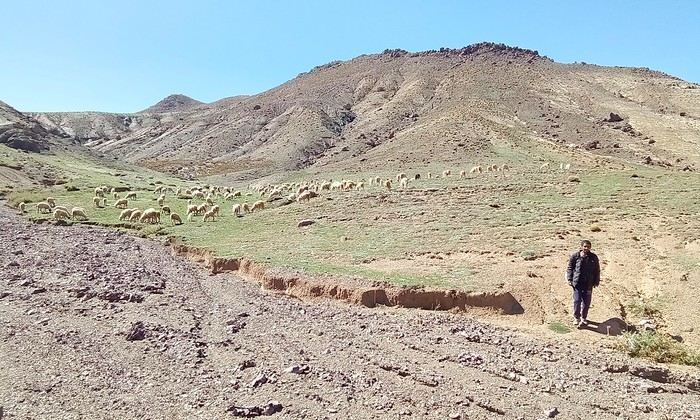
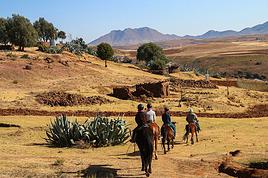
Tiny sheep that, beneath their woolly disguise, look scrawny.

Horses grazing, saddled and harnessed, waiting for an invisible rider.

A Chinese man, bareheaded, assisted by Sothos wearing their traditional pointed hats, conducting topographic surveys—next thing you know, they’ll pave the track that peaks here at 3,230 meters.

Like a Mauritanian goat—here, even the sheep have nothing tasty to nibble on—a shepherd chews on a piece of plastic. Is it from a corn-based recyclable bag? I offer him bread; he floors me with a smile—I’m richly rewarded.

In the mountains, women sometimes stop you and show you they’re hungry. Even though no one here is overweight, I wonder if it’s not more about curiosity and craving for what might come out of this mobile grocery store that is a White person’s car.

They’re harvesting meager rye by hand, carrying it in sheaves to a rocky ledge that serves as a threshing floor. The straw is stored on-site in conical bundles, dotting the mountain with tiny hats, and the docile mules carry the grain to the mill, which never stops.

No slackers in the mountains—everyone, even the animals, works hard.

The new manager of the Ramabanta, a young local woman, is surprised I’m making a small fire on a summer evening. I respond with circular hand motions around my head. Inspired, and with a knowing look, she says, "Oh! It is for your mind."

Diamond Email

On the hairpin bends below, I see him running in plastic boots without feeling concerned. I climb, he keeps running. Am I the object of the chase? Does he want a ride? I’m not keen, wanting to go at my own pace. He keeps running and, when I glance out the window, waves at me. I’m caught. I stop and get out; he finishes at a walk, out of breath.

He carefully unwraps a tightly rolled piece of plastic, like a butterfly around a round shape. Is he offering me candy? No, he pulls out a stone, then others similarly wrapped, rough or polished, including a diamond—yes, sir.

Seeing my lack of interest, he laughs with a mouth that would depress toothpaste. I offer him a beer, which he saves for later.

Soup’s On!

At this Catholic school, it’s lunchtime. Three hundred students in blue uniforms scatter on the hill before forming a patient line that snakes to the canteen—a 10-square-meter cinder-block bunker—each with a plastic bowl.

Single menu, single dish, yesterday, today, and tomorrow: a pound of porridge, served by a cafeteria worker sitting on a stool, the huge pot between her legs, in two scoops, before they move to a second station where the porridge is sauced with a glass of milk (that’ll help!). Given the height of the service, the children bow (prostrate themselves?) to receive their meal.

The teachers offer to share, but unfortunately, I forgot my bowl.

Executive

Dusk, cold, and fatigue drive me to a guesthouse in Thaba Tseka, in the center of Lesotho, advertised ten kilometers earlier by an inviting MotherLand GH.

Built recently for local clients, government seminars, and NGO staff, it’s the antithesis of a charming address—everything is sanitized and scented. The decor is inspired by the Italian Renaissance filtered through a pizzeria, enriched by Xhosas who love pastels, and topped with American sauce.

They offer me a standard room for 500 maloti (about 45 €) or, with relish, an executive room for six hundred. I’ll take the executive—I’ve always had a weakness for them. Synthetic satin sheets, fleecy blanket, damask throw in an unidentified material, faux-leather black armchairs, a wooden sailboat and lighthouse on the wardrobe—like those sold on our coasts—this is today’s camp.

The female staff, from the receptionist to the bartender to the manager, all dressed executive, worry about my solitude. "And your wife?" She went back to France. "Ah! But are you still together?" All would have inspired Fernando Botero. "Yes, of course, we’re still together."

A Dazzling Smile

Warning: Reading this paragraph may cause palpitations or even surges of hatred in those with low tolerance for the very idea of a 4x4 in nature.

West of Thaba Tseka, a track, described as drivable, connects a string of high-altitude villages and should lead to Semonkong. The kind of shortcut that’s three times shorter but three times longer. The track becomes less and less drivable until it’s just a mule path, with only a single trace visible.

Since there’s a watershed, often the track, having narrowed to serve a last village, widens again at the next, marking the spheres of influence of the larger villages where supplies are stocked. But here, nothing.

I’ve passed the section classified as dangerous road by Tracks4Africa (and when they use that term, it’s not out of an abundance of caution). There’s a wide ford of rolling boulders, water up to the axle, and after Chief Village, the track heads straight into the opposite slope. In the village, no one speaks English, but they make it clear it’s passable if you fill in the gullies as you go.

Forgotten the horizontal position—now it’s all acrobatics and contortions, stone steps with steep cambers. Two kids follow me, and now we’re three road workers. The car struggles, I sweat and palpitate. I scout ahead on foot: every twenty meters, I’ll need to lay stones to avoid scraping or tipping. It’s almost five p.m. when I give up—I’ll sleep in the village and backtrack tomorrow.

My helpers walk back down, staying level with me and savoring the chocolate I give them. When they smile, you can’t see their teeth, and the car ends up on a tilt, the chassis resting on an edge, no wheel gripping enough. (You know full well a smile is dangerous, and a second of inattention can be fatal.)

Japanese technology is powerless. I lift the car and slide stones under the wheels, then ask the kids and two elderly women coming down from the mountain—who’ve been commenting forcefully—to push while lifting the back of the car. Fearing a kickback, they flatly refuse and leave, taking the kids with them.

I gently transfer power to the wheels; the stones shift, the car hasn’t moved except slightly around the pivot point. It would be a good idea if it turned into a flying saucer.

I lift higher, careful the car doesn’t take off without me down the slope, and place larger stones under the wheels, wedged together. It’s past six p.m.; if I have to spend the night on a 30° slope, it won’t be comfortable.

I hear voices coming up and decide to wait. Three men from the village come to help, alerted by the women. One, two, three! Gulp, it lurches! I stop after 50 cm, free. We still need to pave a few meters so the back isn’t left on the edge.

My rescuers escort me to the village, where one offers to let me sleep near his hut. Sign-language negotiations, beers, cakes, payment. An old woman arrives and suggests (orders?) I set up near the river, a hundred meters down, which suits me fine.

By six a.m., the first schoolgirl in uniform crosses the footbridge over the river—four more will follow, one by one. Where’s the school? My pack of biscuits won’t last.

This morning’s toll: a torn mudflap and a ripped freshwater hose. Nothing serious! But if a vital part fails here, it could take a while to get help. I vow, if I get out of this without further damage, to stop the nonsense for the week.

At times, there’s nothing but sky in front of the hood, and if the track weren’t marked by an intermittent line of stones, you’d lose it. It must be tough to pass here in the fog.

First hour: 3 kilometers; second: 5; third: 7; fourth: 12. It only takes half an hour to cover the last thirteen kilometers.
VO Voyajou Globetrotter ·
I’m no fortune-teller, and besides, do they even get along with the divine? I was talking more literally about *Moi, quand je serais Président de la République*—I’d read that it was making the rounds in the provinces. Didn’t the "winding route" clue give it away?
VO Voyajou Globetrotter ·
Happy Erwan (no double "n" in Breton, right?), glad I could bring you some joy. 🙂

Reading about your countryside adventures makes me think you don’t need to go to the other side of the world to tell captivating stories. I wonder if, after giving up Namibia for budget reasons in favor of South Africa (that’s you, isn’t it?), you shouldn’t just stay in Normandy and share your daily life with us. 😉
KO Kola Globetrotter ·
I was more prosaically talking about "Me, When I Become President of the Republic," which I’d read was hitting the pavement in the provinces.

Good thing you clarified that... (😕) The twists and turns of the road must’ve shaken the second degree out of it so hard only the first degree was left.
VO Voyajou Globetrotter ·
So when you get stuck in a mud pit or in the middle of a dune, you’ve only got yourself to blame—cursing yourself for venturing into risky spots despite the warnings (T4A),

Are you psychic or what?😉 You’ll read something like that in *A Smile Upside Down*.

And to insult the poor farmer who didn’t have the divine intuition to pass by there... ! ! !

Country doctors aren’t what they used to be.😇
AI AirOne Globetrotter ·
Country doctors aren’t what they used to be.😇

If anything, they still brave wind, storms, and blizzards to help those in need. It’s the tractor owners who are becoming scarce, leaving us stranded in ditches or snowdrifts... In the end, it’s their disappearance I was railing against. I love savoring a coffee (usually awful) with the locals, talking about rain, sunshine (rarely), and the harvest that’s bound to be bad. I love hearing, "What we need is a good cold snap, doc," though last Tuesday, I might’ve taken offense to that.

Reading your countryside adventures, I realize you don’t need to go to the other side of the world to tell captivating stories. I wonder if, after giving up Namibia for budget reasons in favor of South Africa (that’s you, right?), you shouldn’t just stay in Normandy and share your daily life with us.

That’s me, and that’s exactly what I’m doing—I’m not going to bore you with my vacation platitudes when my work life is an adventure, a journey! A journey? No, an epic! 😉 (For the "n’s," do as you please: ID has 1 "n," passport has 2! 😮 Go figure)
Erwan La vie est belle ! La vie est belle ! Je me tue à vous le dire disait la fleur. Et elle meurt ( J.Prévert)
RJ Rjulie95 Globetrotter ·
Oh Jean... when Trak4Africa says the track is difficult, it *is* difficult... luckily for you and the car, everything ended well with the return to the normal track.

Safe travels—heading to Kruger soon?
"Je suis africain, non pas parce que je suis né en Afrique, mais parce que l'Afrique est née en moi." Kwame Nkrumah.

"J'ai appris que le courage n'est pas l'absence de peur, mais la capacité de la vaincre." Nelson Mandela

https://www.en-voyages.fr
VO Voyajou Globetrotter ·
Did you read everything carefully, Lucky Luke? Watch out for the quiz!

No Kruger this year—I’ve had my fill of wildlife🏴‍☠️! But I’m still planning to spend my remaining two weeks visiting Addo Elephant, which I don’t know yet but now hosts the Big 5, and especially returning to Great Karoo NP. The rest will be more about the people and their lives.
RJ Rjulie95 Globetrotter ·
Jean, I’m quoting you here:

If all goes well, I’ll be in Kruger around mid-March—I’ll get to experience your daughter’s wonder before she does.🙂

😛

The message is on the first page of this post! But hey, you’re totally free to change your mind—it’s the beauty of traveling wherever the mood takes you! As for the stopover, no worries, I was keeping track. 😎
"Je suis africain, non pas parce que je suis né en Afrique, mais parce que l'Afrique est née en moi." Kwame Nkrumah.

"J'ai appris que le courage n'est pas l'absence de peur, mais la capacité de la vaincre." Nelson Mandela

https://www.en-voyages.fr
VO Voyajou Globetrotter ·
Oops! Sorry! 😇

That was back when there were two of us, before we were so spoiled—especially in the Makgadikgadi, Mana Pools, and I won’t even mention KTP, Etosha, CKGR, Nxai, or Hwange. We were greedy, and we were lucky enough to get our fill. 🙂

Student Régis: 20/20 😎
RJ Rjulie95 Globetrotter ·
Elève Régis: 20/20😎

This time I won’t say a thing! But don’t let me catch you doing it again 😎
"Je suis africain, non pas parce que je suis né en Afrique, mais parce que l'Afrique est née en moi." Kwame Nkrumah.

"J'ai appris que le courage n'est pas l'absence de peur, mais la capacité de la vaincre." Nelson Mandela

https://www.en-voyages.fr
RI Rivièrefox Globetrotter ·
Hey Jean!

What an adventure! This episode is even spicier than the others. The solitude, maybe?!

This Zulu guy proudly insisting on giving me directions in his language, to the point of missing his bus.

Did that amuse you, and weren’t you even a little embarrassed?! 😠

Mtubatuba, the snorkeling capital

That’s a good one! 🙂 😏 🙂

Be careful, my dear Jean, when leaving the rugged trails of Lesotho—we’d be sad to lose such a talented writer! 😇 Let me know if you stop by to taste the chef’s treats I gave you the address for in the Karoo! 😎
Michelle
MU Muriel18 Globetrotter ·
Hi Jean,

I’ve been following your African adventures from the start (silently 😉), and really enjoying them, by the way.

To address your concern:

manquerait plus qu’ils goudronnent la piste qui culmine ici à 3230 mètres

I read in the *Blanket Wrap* (a kind of local newspaper in Lesotho that I subscribed to since I’ll be spending a few days there—less than a month now 🙂)—but in a regular sedan, so no Sani Pass—that yes, unfortunately (well, it depends who you ask, I guess), they *are* planning to pave it.

Keep up the great work (I’ll keep reading, still loving it just as much).

Muriel
Si tu diffères de moi, mon frère, loin de me léser, tu m'enrichis (Saint Exupéry)
PI Pierre77N Globetrotter ·
Hi there! All alone in here... 🤪 🤪 🤪 But hey, you made it back to tell the tale. 🙂
AT Atila Globetrotter ·
Not Kruger this year—I’ve had my fill of the wildlife🏴‍☠️!

Too bad...

I left my stash of Chenin Blanc in bungalow 178 at Satara yesterday...

Might’ve been able to enjoy some? 😉
VO Voyajou Globetrotter ·
Evening Michelle,

I wasn’t making fun of Zulu—I think it was the other way around! He understood my English but proudly decided to answer me in Zulu, which is the mother tongue (and why not the father tongue too? ) of 20% of South Africans. When he heard the minibus start up, he let out a war cry, stopping the vehicle in its tracks so he could run and catch it.

Be careful, my little Jean

Feels so good to have a guardian angel. 🙂
VO Voyajou Globetrotter ·
Thanks for following along, quietly but kindly! 🙂 Is your local Lesotho journal online or do you get a paper copy? I’d love one. Here’s the road info I gathered a few days ago from the owner of Semonkong Lodge. As part of a three-year plan (they’re in year two), the road will be paved from Ramabanta to Qacha’s Nek via Semonkong, opening up the country to KwaZulu-Natal. Everyone seems happy about it. The track from Oxbow to Sani Pass will also be paved later. It’s obviously great for the locals and the country’s economic development, and there’ll still be plenty of remote spots left for the mules for a long time to come.
VO Voyajou Globetrotter ·
All alone in there... 🤪 🤪 🤪

You're right, Pierre, but there was no one to stop me or come with me.😇 To get through there, you’d need at least: 1- To be less heavy, not to have your house on your back. 2- To have a bit more ground clearance. 3- To be fitted with wider tires. The geisha tires (original fit) I have just want to sink into the ravines.

The boss at Semonkong Lodge told me they don’t send anyone that way anymore, and they were probably the only ones maintaining the track.
MU Muriel18 Globetrotter ·
For Jean, the "local journal" is actually a newsletter I receive through Maliba Lodge. There’s a tab on the lodge’s website (blanket wrap blog) where you can access it—it’s not exactly the same layout as the newsletter, but I think it has pretty much the same info.

Best, Muriel
Si tu diffères de moi, mon frère, loin de me léser, tu m'enrichis (Saint Exupéry)
PI Pierre77N Globetrotter ·
but there was no one to stop me

You’d need a few people for that too, right? 😇

To get through there, you’d need at least: 1- To be lighter, not carrying your house on your back. 2- To have a bit more ground clearance. 3- To be fitted with wider tires. The geisha tires (original fit) I have just want to sink into every ditch.

Does your caravan have front and rear diff locks?
NA Nammanu Veteran ·
Hello,

What if we started a betting pool?

Will he ever make it back?

Just saying hi—I’m here too...

Emmanuel
VO Voyajou Globetrotter ·
Whoa! 178 spots at Satara? Good call skipping that. For the Chenin Blanc, I don’t get why you didn’t bring it along—did you forget we’re meeting up next week in the 4X4 only section of Karoo NP? (In that little quiver tree grove... I’ll shoot you an arrow😎)
VO Voyajou Globetrotter ·
Yes sir! Front and rear. It was sometimes useful in deep sand or mud near the Zambezi, but here, on the rocks, it was of little help. Worse, it reduced steering precision. The car (it had 500 km at the start) was originally fitted with Yokohama 7.50R16 tires (geisha model, so), which slipped at the bottom of very narrow, eroded ravines when there was no way to place the wheels elsewhere due to the narrowness of the mountain-side track, further reducing ground clearance. I think with 265 minis, I would’ve gained a few centimeters, as the tires wouldn’t sink to the bottom.

Similar discussions

You might also like