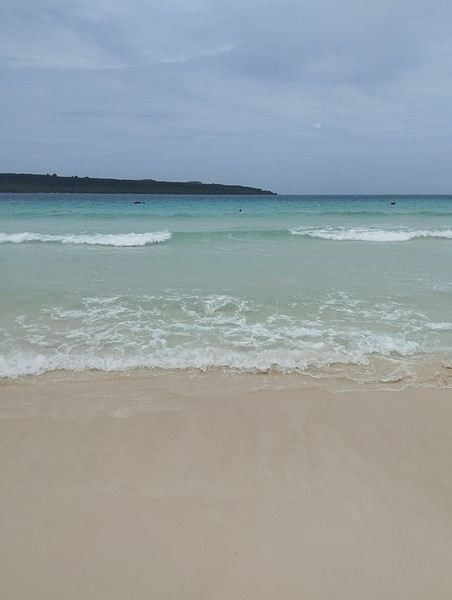
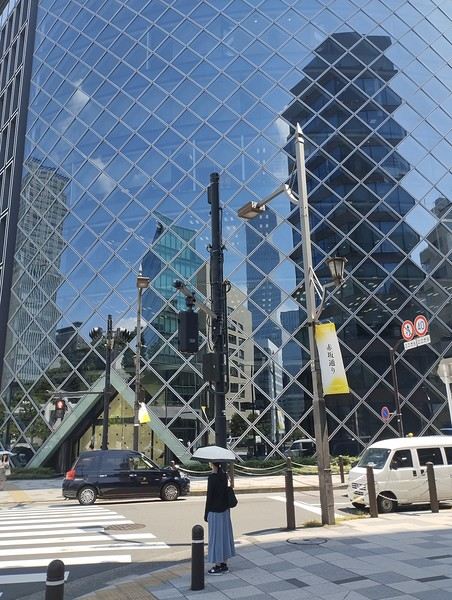
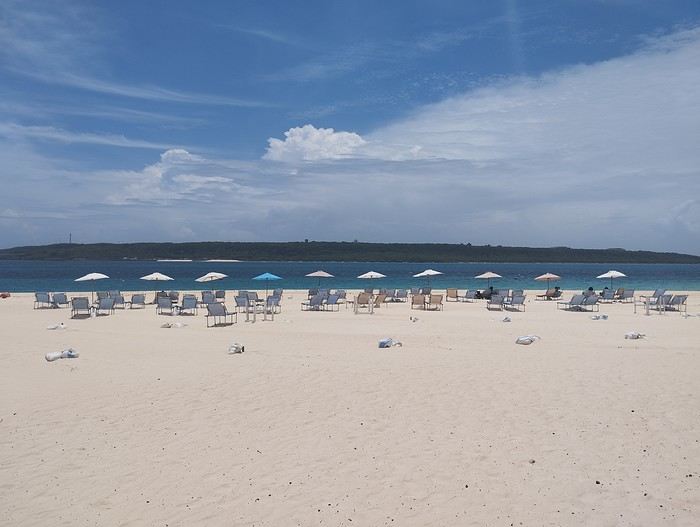
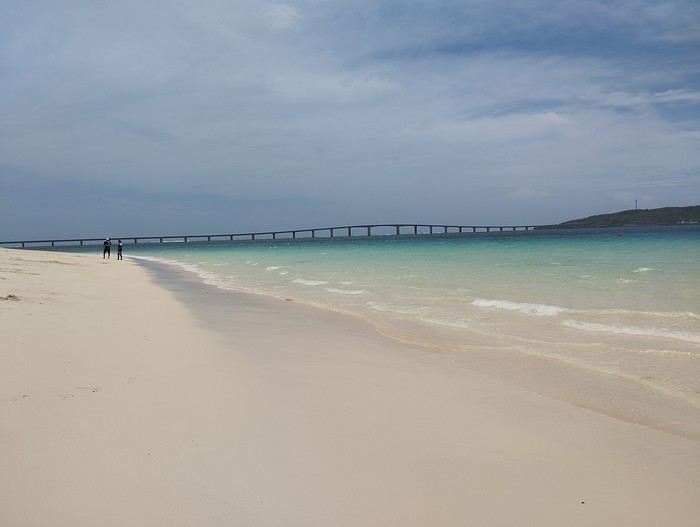
From Southern Shikoku, between land and sea, to the blue waters of Miyakojima and finally Tokyo’s megacity
Hi everyone,
I have to admit, I really hesitated before deciding to write this travel journal... Writing one takes a lot of time and energy, and since this is my 4th trip, I wondered if it would even interest anyone other than myself (both for the discovery and the writing). But after a few people asked, "Are you going to write a journal?" and especially after rediscovering the joy of reading other travelers’ journals about Japan or elsewhere on this forum, I’ve decided to share my 4th installment in the Land of the Rising Sun here.
The itinerary:
27 full days, from late May to late June 2025, right in the middle of the rainy season, including:
-->13 days in Shikoku, from Kochi (Kochi Prefecture) to Matsuyama (Ehime Prefecture)
-->7 days in Miyakojima (Okinawa Prefecture)
-->7 days in Tokyo
The trip was decided on fairly last-minute again this year.
Since I regularly check flight prices to track fluctuations for this destination even without concrete plans, stumbling upon a slightly cheaper direct flight (900 €) than what I’d seen in previous months (around 1,200–1,400 € on average) for a Paris-Tokyo route with Japanese airline ANA was too tempting to resist the urge to return to this enchanting country. After much hesitation between exploring the San’in region (Matsue, Tottori, Yamaguchi) and Southern Shikoku, the decision was made—I took the plunge! The ticket is booked: Paris to Kochi with a layover in Tokyo, all with ANA, the airline I’d been dreaming of... for 1,120 € per person. Okay, it’s not cheap, but it’s better than in 2023.
Departure in 2 weeks! Now I just have to get everything ready!
Intense prep work over these next 2 weeks to:
finalize a more precise itinerary and reach an agreement—yep, because even though we both love Japan, our preferences differ slightly, and we have to choose between exploring new places or revisiting beloved spots...
decide how much time to spend in each area without rushing while still exploring
research places that might interest us and watch videos about Japan
book accommodations: yes, it’s possible to do this on the spot, but last year, we realized that last-minute options were pretty expensive, so we’re booking ahead—though we’ll keep a few options open in case better deals pop up later
reserve rental cars
order yen
check the weather regularly and wonder if choosing the *tsuyu* (rainy season) was really a good idea—are we going to be drenched the whole time???
"What hard work," you might say! Going to Japan for a month—what a tough life!
Despite this being my 4th trip, the excitement is just as intense as the first time.
The only small downside is that when we booked the flight, there weren’t many seats left, so we’re only sitting together on the international return flight. Plus, on the way there, we have middle seats.
Another lingering question: what French-language films will be available? According to the internet, the selection seems limited.
Oh well, these are just minor details—it’s already time to fly!
PS: I’ll be posting slowly and irregularly... so for those interested, be patient, and maybe set an alert...
Re: From Southern Shikoku, between land and sea, to the blue waters of Miyakojima and finally the megalopolis T
Good evening Nathalie,
To be honest, Japan isn’t a destination that appeals to me at all because all I see is the very urbanized and concrete side. But I’m curious and hope to discover another side of this country through your travel journal.
So see you soon for the next part, and thanks for sharing! 😊
Christelle
Le monde est comme un miroir, si tu lui souris, il te sourit aussi!
Re: From Southern Shikoku, between land and sea, to the blue waters of Miyakojima and finally to the megalopolis T
I don’t know Japan.
But I have a lot of friends who’ve been there, and they all came back completely enchanted by these islands and this culture.
So we’ll be following your journey closely!
Nos escapades : Le Maroc, l'Egypte, la Mauritanie, la Tunisie, l'Afrique du Sud, Lanzarote, les Etats-Unis (3 ans), le Canada, le Mexique, la Colombie, le Pérou, la Guadeloupe, la Martinique, l'Indonésie, la Thaïlande, Israël, Dubaï, la Jordanie, la Turquie, et Tahiti... pour l'instant !
Re: From Southern Shikoku, between land and sea, to the blue waters of Miyakojima and finally to the megacity T
Good evening Christelle,
To be honest, Japan isn’t a destination that appeals to me at all
First of all, thank you for your message. It’s motivating and interesting to hear the perspective of someone who’s "not a fan" of this country. We all have one or more destinations that don’t attract us... that was my case too for Japan before my first trip, and now I’m completely smitten.
...because all I see is the very urbanized and concrete side.
Yet Japan is made up of 70% mountains and forests, so the urbanized parts are far from representative of the country.
Sure, some cities like Tokyo can be densely packed, but even in those places, nature is never far away—gardens, parks, or rivers are part of these urban spaces. The urban environment never feels overwhelming, at least from what I’ve seen and felt there.
Plus, this urban landscape isn’t just modern—it’s often mixed with older elements, through scattered monuments or neighborhoods like in Tokyo, where each district has its own vibe.
But I’m curious and hope to discover another side of this country through your travel journal
I hope this journal helps dispel the misconception that it’s all concrete everywhere.
And to add to what I said above, I’d also recommend—or rather, suggest—checking out one or more of my travel journals from my previous three trips, covering other Japanese regions like Tohoku, Kyushu, and Yakushima Island. Other travelers have also shared journals about these places. Here are two links I really liked:
In Kyushu https://forumvoyage.forumactif.com/t4699-kyushu-2-boucles-en-voiture-et-une-escapade-a-yakushima
In Tohokubut not only, and in winter! https://forumvoyage.forumactif.com/t3614-2024-back-to-japan-goshogawara
See you soon for the next part, and thanks for sharing! 😊
Get your suitcase ready—the takeoff is coming soon ;)
Re: From Southern Shikoku, between land and sea, to the blue waters of Miyakojima and finally the megalopolis T
Hi Manu—or rather, hi to the whole family,
I don’t know Japan.
Not yet, but maybe you’ll feel like it by the end of the travel journal.
But I have a lot of friends who’ve been there, and they all came back enchanted by these islands and this culture.
That’s the Japan effect—it seems to work almost every time when you read travelers’ forum posts or talk to friends like yours. If it can be explained, I think it’s only fully understandable once you’ve set foot there. Japan is an absolute joy for tourists.
(PS: I’m not saying everything’s perfect, obviously...)
We’ll be following your trip closely!
Japan is so diverse—don’t hesitate to read up on other regions too, as Christelle mentioned earlier.
Anyway, thanks for your interest, and see you soon.
Re: From Southern Shikoku, between land and sea, to the blue waters of Miyakojima and finally to the megalopolis T
Day 0 - Wednesday - From Paris to Kochi in 24 hours
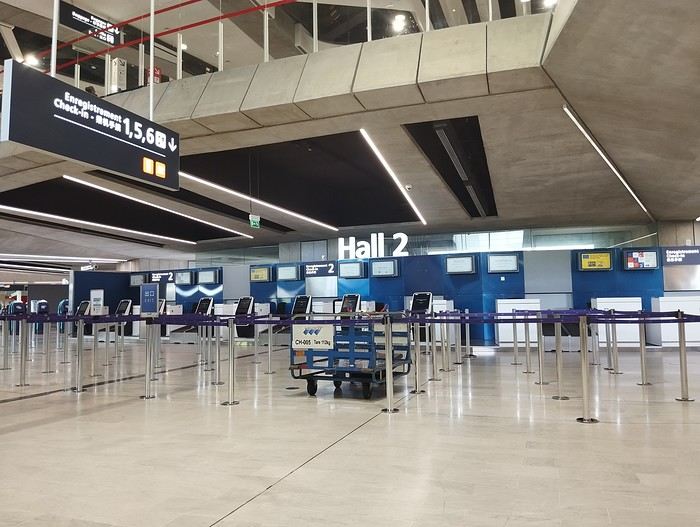
2:30 PM, Dad just dropped us off at terminal 2 or 1 (I can’t quite remember) at Charles de Gaulle Étoile Airport. We’re really early—our flight isn’t until 7:20 PM tonight. We can take our time and not rush from one step to another just to board the plane.
For some, the airport is a stressful transit place and/or synonymous with discomfort. My partner definitely falls into that camp. For me, though, the airport is a source of joy. I’m as excited as a teenager in the throes of a passionate love affair. The airport, for me, means an imminent trip filled with discoveries, encounters, languages, adventures, and the unexpected. It’s also the last moments when you can imagine, hope, dream, doubt, ask questions, and gather info before facing reality in a country that will, in turn, bring its own set of emotions.
Today, we’re about to take off for Japan for the 4th time. It still feels incredible, and the happiness it brings can only be understood by someone who’s wanted to return to the same country multiple times. That’s what I tell myself when I think back to some reactions when we announced this 4th trip—"again," almost a bit jaded, or sometimes just a wordless laugh.
Still, I don’t have time to dwell on this blissful happiness. I want to finish as much work as possible before takeoff. So, once we’ve found the check-in area—right where we arrived, perfect—we settle onto some benches. Like I said, I’m acting like a teenager: a Japanese woman is sitting on the bench, and that makes me happy. It’s a little visual taste of Japan. With my phones charging, I focus on getting work done. Then, a group of Japanese travelers arrives with a Japanese guide giving them explanations in Japanese, and I’m suddenly *in* Japan even though I haven’t taken off yet. Hearing Japanese spoken is an endless pleasure. I move to make room for a few people from the group. The little bows to say thank you and the delicacy of their gestures are also elements that contribute to this Japanese projection.
Check-in time arrives. I’m a little disappointed because even ANA is replacing humans with machines. Yep, self-service kiosks where you print your own baggage tags and stick them on your bag yourself. Once you’ve done part of the staff’s job, you can go to the counter to finalize your check-in.
With our tickets in hand, we walk to the security gates. Strangely, the airport seems really quiet today, almost deserted. And I don’t know if it’s cause and effect, but everyone we’ve encountered has been charming. The ground staff seem relaxed, smiling, friendly, and helpful. Am I in some kind of fantasized virtual world? What’s going on? It’s crazy that in 2025, being surprised by such simple, kind politeness feels so good! I wonder if it’s because we’re traveling on a weekday, a Wednesday, with an early evening flight. If that’s the case, I think next time, if possible, I’ll prioritize traveling on weekdays and at these times. Have any of you noticed differences in service depending on flight times or days?
In the boarding area, it’s the same—almost deserted, with a peaceful vibe.
This time, we’re sitting in light brown leather seats. I can keep working while occasionally looking up to watch the Roland Garros tennis match on the TV screen right in front of me or just to see what’s happening around me.
With my head down, I wrap up my workday at 6 PM. I can finally let go and relax a little.
Funny enough, I got a message from a friend asking how I am. Just like last year, I tell her—at the exact same moment, in the waiting area before boarding—that we’re flying to Japan again. Life’s little coincidences. (A little shout-out to you, L—you’ll recognize yourself.)
This year, no administrative hassles, so here we are, finally on the plane in seats 29J and 28J. My partner hopes to ask someone to swap seats. I tell him, "Who’d want to take a middle seat?" If these were the only seats left at booking, it’s because no one likes them. Or so I thought—turns out the young woman to his right, who I’ll call Cécile (and who has the dream window seat, right?), is totally willing to switch if needed. I’m almost stunned by her generosity. But it won’t be necessary because when the doors close, we realize the plane has *tons* of empty seats. Lots of people will be able to stretch out. I don’t get why these seats weren’t available at booking. Cécile doesn’t even have to move—the seat to my partner’s left is free.
Before this, my only neighbor in row 28, a Japanese woman, settled in by folding her legs and balancing on her seat with her feet and butt. Her incredible flexibility will always amaze me.
The flight from Paris to Tokyo flies by. We end up chatting a lot with our friendly neighbor Cécile during the flight, taking time to watch a few movies and get some sleep.
Cécile is also smitten with Japan. Surprising, right?! This is her 3rd trip to Japan.
She’s done the classics—"Tokyo-Kyoto-Miyajima"—but also Okayama, whose black castle is supposedly stunning. For this trip, she only had a few days off and is flying for 12 days. She’s meeting friends who are already on vacation there. The plan: Kinosaki Onsen, Osaka, Okinawa, and Zamami.
For her airfare, she bought a Paris-Tokyo-Osaka ticket for 1,400 €. This, along with the plane’s low occupancy, confirms that our ticket—bought 15 days before—was probably a "promo," and the price we saw and paid was "good" for the period.
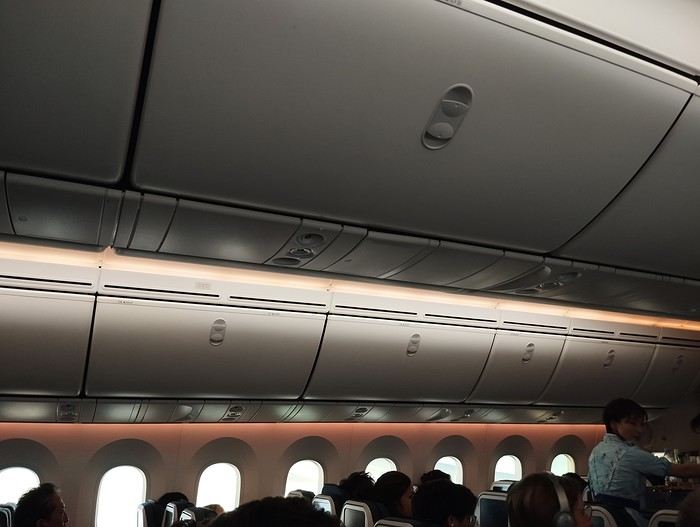
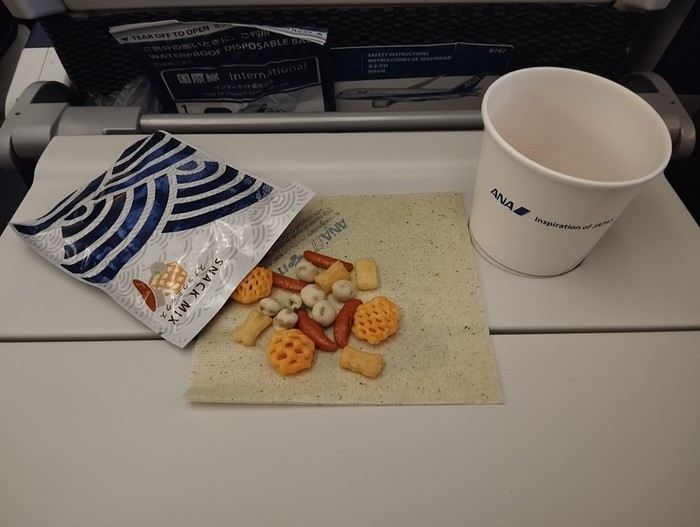
Throughout the flight, since it was our first with ANA, we tried to observe the differences compared to other airlines we’ve taken to the same destination in economy. Here’s a little unordered list of what we noticed:
Much more legroom—the seat in front seems almost far away
Much more overhead space—Cécile tells us it’s thanks to the clever curved (not straight) cabin baggage storage system,
Real headphones, not those tiny earbuds,
Windows where you can adjust the brightness by choosing the opacity of the shade,
Pretty generous meals
Neighbors’ screens are blurred for privacy, so you can’t see what they’re watching
Paper napkins made from tea leaves that smell like green tea, plus cold green tea bottles
Refreshing towels
Thicker cardboard cups with a hole on the tray to set them in
Lots of alcohol choices—wine, whiskey, gin, beer—but no champagne (only in higher classes)
Free candy
We arrive in Tokyo without a hitch. It’s around 4 PM. We have a 3-hour, 15-minute layover.
We need to pick up our luggage. We’re a little confused because our layover is with the same airline, but switching from an international to a domestic flight requires this step. Still, the process is simplified—once we’ve gone through security, customs, and retrieved our bags, there’s a dedicated transit counter. The staff comes to us, scans the baggage tag, and takes the bags. Done in 3 minutes flat.
Cécile’s flight to Osaka leaves before ours, so it’s time to say goodbye and wish her a great trip.
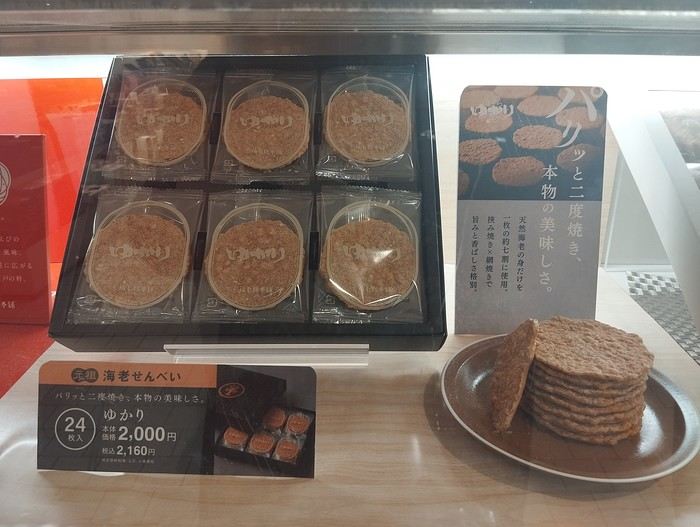
Before heading to the boarding area, we take a quick stroll through a store selling local products. We spot lobster chips—just like the ones a Japanese friend gave our family during her trip to Hokkaido in early 2025. The taste is incredible: you really get that briny lobster flavor, and the chips aren’t greasy at all—just a concentrated taste of the sea.
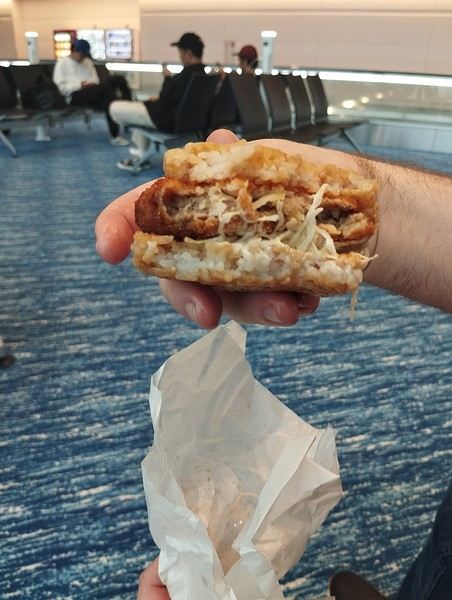
Craving a taste of Japan, we buy rice burgers. We recently discovered them in a TV report but had never seen them before, so we can’t resist trying them while we wait for our next flight.
We savor our delicious burgers—pork with ginger for me, breaded beef with 7-Eleven fried chicken for my partner—along with a cold drink, some tea.
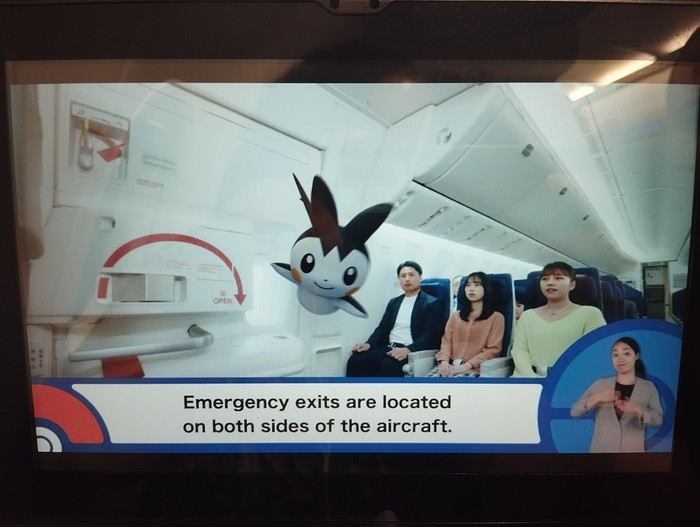
The flight to Kochi is super short—1 hour, 20 minutes—and it goes by fast. We’re on an A321, and the seats are wider. The in-flight safety demo is done with animated characters in ads. It’s quirky but so Japanese. It always amuses me, I think.
In the blink of an eye, we’re at Kochi Airport. I love small local airports—everything’s so much quicker. Our flight is the last to land. We easily grab our bags. The fun, propaganda-style Japanese touch: transparent lockers with giant fake bonito pieces—a local specialty—mixed in with the luggage.
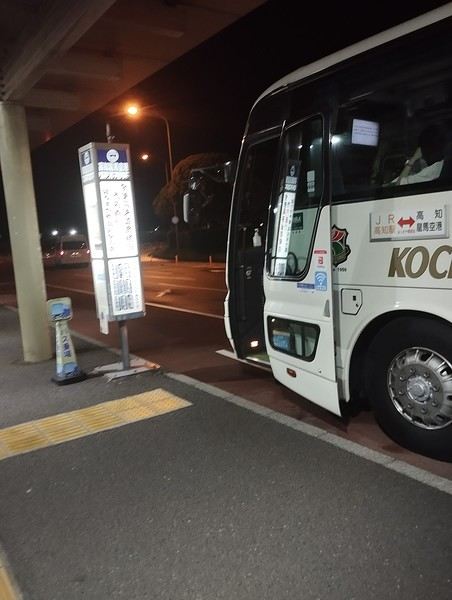
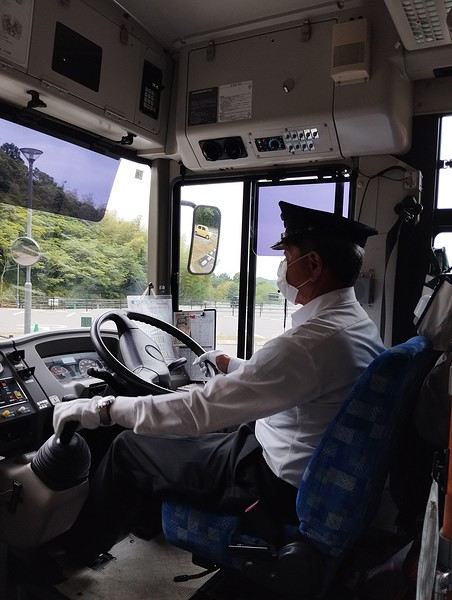
Right next to it, there’s a stand with tourist brochures and a tourist office. We quickly grab a few. The Kochi tourist office had mentioned a connecting bus after the flight—logical, since we’re in Japan. I barely have time to tell my partner that the airport’s probably about to close when the lights start turning off. You don’t mess around with time in Japan. We hurry outside, and sure enough, the bus to Kochi City is waiting for travelers. The driver, wearing white gloves, is outside keeping an eye out. He helps us buy tickets from the machine (1,700 yen for 2 people, just under 11 €), takes our suitcases to stow them, and we board. The bus is delightfully retro with its vintage-patterned carpet, seat doilies, and the red button to ring for a stop.
Everything happens so fast, and we’re on our way to Kochi City. It’s dark, so it’s hard to see the city. The bus isn’t full—no Westerners, just Japanese people. The ride is short, 25-30 minutes. We let ourselves be lulled by the Japanese conversations nearby while looking out the window, catching glimpses of a bridge hinting at a river or distant lights.
The bus stop isn’t far from our hotel—about a 5-minute walk.
The sound of the pedestrian crossings—a kind of high-pitched bird chirp—makes us smile. Welcome to Japan.
The street is wide, a big avenue. It’s dark, but the lights reflect off the damp sidewalk, suggesting it rained today... Ahhh, I keep praying that the rainy season won’t drench us nonstop.
We pass a restaurant with a sliding door that opens and closes, letting the customers’ laughter spill out to our ears. It’s pleasant but not too hot. We’ll drop off our stuff and then head to the konbini we spotted nearby.
Check-in is quick—it’s done at kiosks, but there’s staff nearby to help.
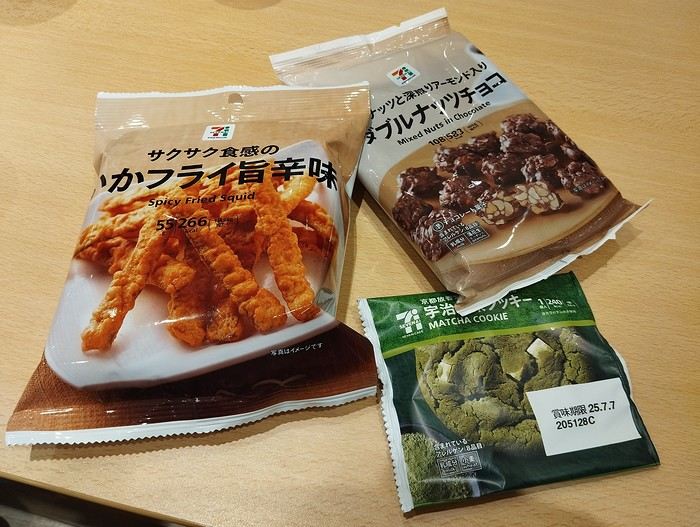
As I said earlier, we head to the konbini to grab some supplies for tonight and the next few days. We find a drink that seems local, made with yuzu and another green fruit. We grab one to try.
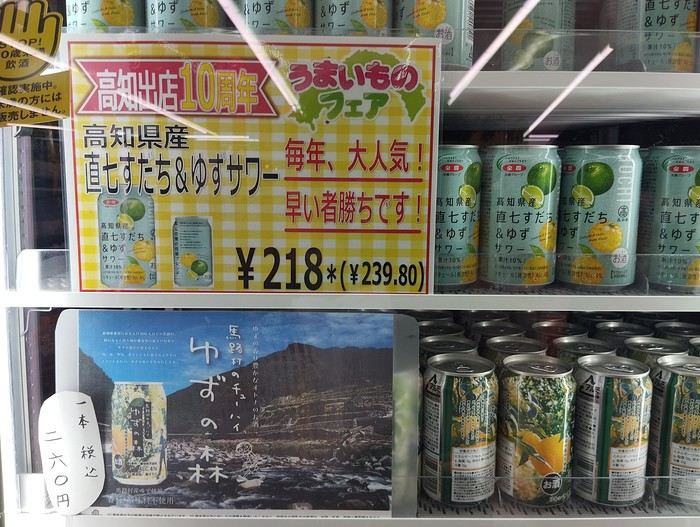
Back at the hotel, we settle into the common room, which is open until 11 PM with free hot and cold drinks. The room isn’t very big, but it’s cozy and clean. There are books available too.
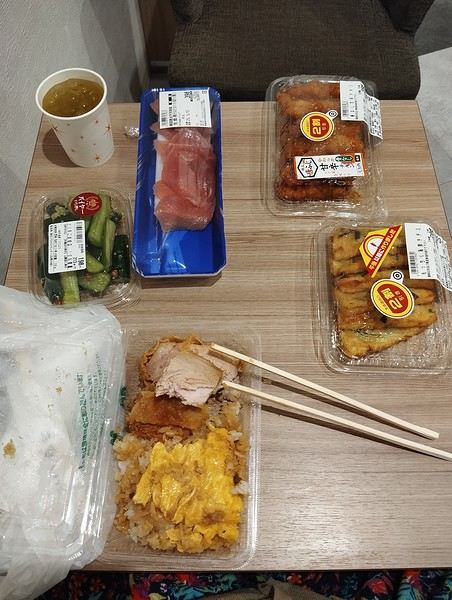
Quick, unbalanced dinner: curry pan (a fried bun stuffed with curry), fried chicken, egg cake, green tea, and the yuzu drink. Google Translate says it’s a drink with yuzu and sudachi, another local citrus fruit that’s more bitter. The drink is really nice and refreshing.
A few sweet and savory treats for the next few days in case we need a snack:
11 PM—we finally head up to our room. In France, it’s already 4 PM the next day. It took us 24 hours to get from Paris to Kochi.
One of the pleasures of staying in Japanese hotels is the free access to certain amenities—cotton swabs, razors, cotton, etc. We take what we need and head to our room. As soon as we open the door, a pleasant scent fills our noses.
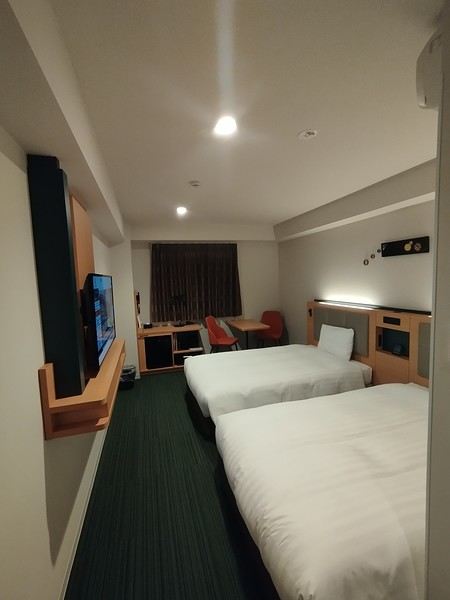
Our room is standard for this type of hotel, so nothing to complain about. Time to sleep before starting the real first day of the trip.
To those who’ve made it this far—since details matter in my travel journal—bravo, and see you next time if you’re not too discouraged!
The next part will take place in Kochi City.
Re: From Southern Shikoku, between land and sea, to the blue waters of Miyakojima and finally the megacity T
Hi Nathalie,
I’m also setting off for Japan through this travel journal (it’s packed with details but still a pleasant read [;)]).
All I know of the country is Tokyo and its immediate surroundings, since my son lived there for 7 years.
Like other commenters, I’m not exactly a Japan fan (it’s odd—Japan enthusiasts haven’t spoken up yet ), but more than that, I’m just not a city person. I’m hoping this journal will show me some countryside landscapes that might make me want to go back.
Si tu diffères de moi, mon frère, loin de me léser, tu m'enrichis (Saint Exupéry)
Re: From Southern Shikoku, between land and sea, to the blue waters of Miyakojima and finally to the megalopolis T
Thanks for this huge effort in writing and sharing. Those who have already created travel journals here know how much time it takes. There are never enough readers who speak up.
« Tout le monde s'interroge sur comment laisser une meilleure planète à nos enfants, mais on devrait plutôt penser à laisser de meilleurs enfants pour notre planète. » Clint Eastwood
Re: From Southern Shikoku, between land and sea, to the blue waters of Miyakojima and ending in the megacity T
Hello Nathalie,
I’m also setting off for Japan through this travel journal (it’s quite detailed but a pleasant read [;)]).
All I know of the country is Tokyo and its immediate surroundings, since my son lived there for 7 years.
Like other contributors, I’m not a huge fan of Japan (it’s odd, actually—the Japan fans haven’t spoken up yet ), but I’m especially not a fan of cities, and I hope this journal will let me discover some countryside landscapes that might make me want to go back.
Hello Muriel,
Thanks for joining the journey.
I’m not a total city person, but Tokyo is, for me, a one-of-a-kind city in the world, where nature isn’t completely absent—something that, in my opinion, adds to its charm.
We’ll see at the end whether it makes you want to return someday. In the meantime, as I’ve told others, I invite you to check out some Japanese travel journals that cover areas outside Tokyo.
Re: From Southern Shikoku, between land and sea, to the blue waters of Miyakojima and ending in the megacity T
Hello,
I’m curious to read your travel journal and thanks for doing this "work". I know Tokyo, Kyoto, and Nara but I’d love to read about a different itinerary.
Have a great day
Re: From Southern Shikoku, between land and sea, to the blue waters of Miyakojima and ending in the megacity T
Hello,
I’m curious to read your travel journal and thanks for doing this "work". I know Tokyo, Kyoto, and Nara but I’m interested in reading about a different itinerary.
Have a nice day
Hi Rozenn,
They say curiosity is a bad habit, but to me, it mostly shows an openness to others, to the unknown, and to all the richness life has to offer. So thank you for your interest.
I haven’t been to Nara yet. It seems very touristy. Did you like it? Why?
Re: From Southern Shikoku, between land and sea, to the blue waters of Miyakojima and ending in the megalopolis T
Hi Nathalie,
I took this trip in 2013, and Japan wasn’t the popular destination it is today. So, there were people around, but it wasn’t overcrowded. In Nara, I loved the park, two temples (Todaiji and Kofukuji), and the ryokan where I stayed—Ryokan Asukasou (I checked the current prices: wow, no comparison to what I paid in 2013, of course). I also remember a stunning garden, but I can’t recall its name or location. Anyway, I loved everything in Nara, just like in Tokyo and Kyoto. It’s Japan and its very special atmosphere—but you know all that much better than I do. I’m maybe thinking of going back to Japan, which is why your travel journal interests me. Thanks for the links to your journals; I’ll read them.
Re: From Southern Shikoku, between land and sea, to the blue waters of Miyakojima and finally the megalopolis T
Translator
That was my case before going.
I went to Japan with my brother—it was his dream (I’m more of a fine-sand-beach person). We did Osaka (and the surrounding area) and Tokyo. In the end, I came back wanting to go again, who would’ve thought.
Juillet 2010 : La Dolce Vita / Costa Concordia
Février 2018 : Perle des Caraïbes / Costa Pacifica
Re: From Southern Shikoku, between land and sea, to the blue waters of Miyakojima and ending in the megacity T
Hi Nathalie,
I took this trip in 2013, and Japan wasn’t the popular destination it is today. So, there were people, but it wasn’t overrun. I loved Nara’s park, two temples (Todaiji and Kofukuji), and the ryokan where I stayed—Ryokan Asukasou (I checked the current prices: wow, no comparison to what I paid in 2013, of course). I also remember a stunning garden, but I can’t recall the name or location. Anyway, I loved everything in Nara, just like Tokyo and Kyoto. It’s Japan and its very special atmosphere—but you know all that much better than I do. I’m maybe thinking of going back to Japan, which is why your travel journal interests me. Thanks for the links to your journals; I’ll read them.
Oh, to be in Japan in 2013 before the tourism boom—that must’ve been a whole different vibe. If you haven’t been back since and decide to return, it’ll be interesting to hear your take on any changes you notice.
Nara and the surrounding area seem really interesting.
Re: Southern Shikoku, between land and sea, to the blue waters of Miyakojima and finally the megalopolis T
Day 1 - A day in Kochi City using public transport - Part 1
The alarm goes off. We open the curtain to discover the view from our window. Last night, it was dark.
The room faces the main street. In the foreground, we see the KS sign, an electronics store with its roof, then residential buildings in the background, and finally, in the distance, the mountains that often surround Japanese cities. The sky is gray. I wonder what the weather will be like today. It's true that at the start of the trip, the weather is something that worries me—I’m dreading entire days of rain that could totally ruin our plans.
Dressed, we take the elevator down to the common breakfast room, the same one we had our snack in last night.
It’s on the ground floor, right next to reception. Breakfast is in full swing. A staff member gives us a small bento-style tray with compartments for different dishes. Breakfast is a buffet where everyone takes what they like. There are cold vegetables for a salad, hot vegetables and meat, small rolls (some to toast), the essential scrambled eggs, fruit, soup, and rice—plus hot drinks.
With our trays full, we just need to find a spot. We settle at the "bar" area, which is better suited for solo travelers but has the advantage of a ledge where I can put my bag. Side by side, we eat our breakfast. The quality is pretty average, but let’s just say it’s practical and balanced. It’s not exactly a feast, but it’s edible.
Now, off to explore Kochi City! As soon as we step out of the hotel, a light rain starts falling. It only lasts a few minutes.
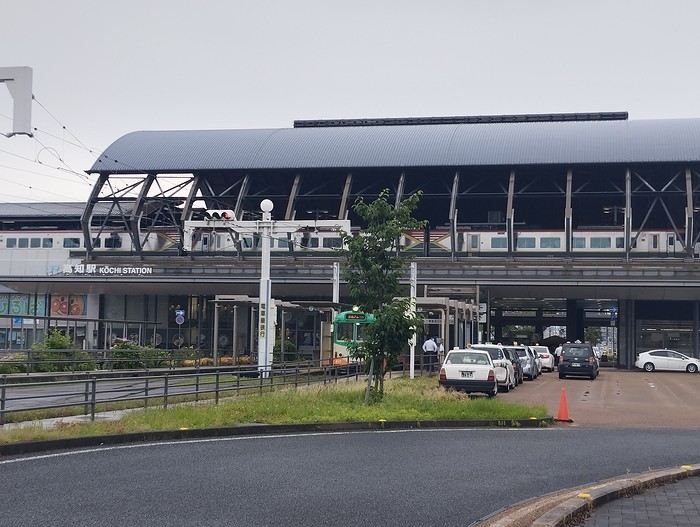
We reach the train station in 5 minutes on foot since the hotel is nearby.
For now, the city seems quite calm—there aren’t many people on the streets.
We start by heading to the tourist office, a lovely wooden building located in the square outside the station, across from the tram departure point.
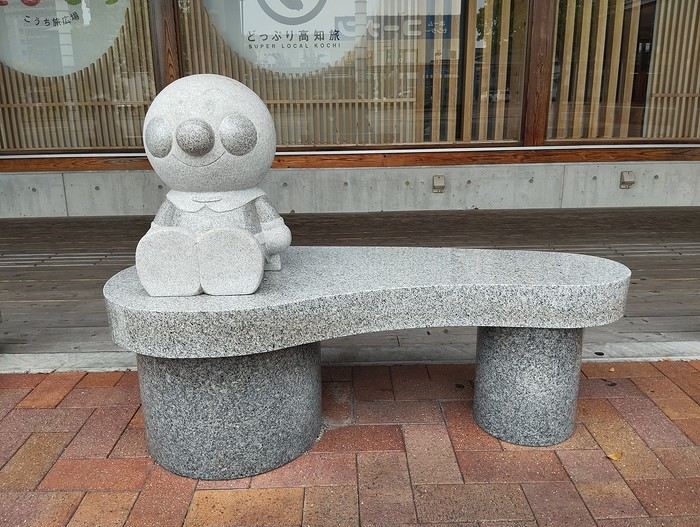
Right in front, there are benches featuring Anpanman, a Japanese superhero character whose creator is from Kochi.
The inside of the tourist office is spacious and very open. The place is modern. There are 4 staff members. The woman helping us is sweet and pleasant. The explanations are clear, partly thanks to a translator used by the staff. When we ask for information about a less touristy area in Kochi Prefecture, she apologizes because the documentation is only in Japanese and rushes to the shop to get it.
That sense of quick and efficient service is always there, even when no other customers are waiting. And on top of that, they give us a bag with the tourist office’s logo to carry the documents. It’s amusing when you think that in France, getting a bag in a store these days is almost a crime...
We also bought our unlimited day bus tickets here for getting around the city’s tourist spots.
A few stammered words in Japanese, and I quickly got a "Where did you learn to speak Japanese so well?" Let’s be clear—my Japanese is basic, but it’s always nice when a local notices the effort to communicate in their language, even if the Japanese tend to exaggerate ("so well spoken") out of kindness or politeness.
The view of Kochi Station from the esplanade is charming. With these tram lines, the city’s retro vibe is already visible.
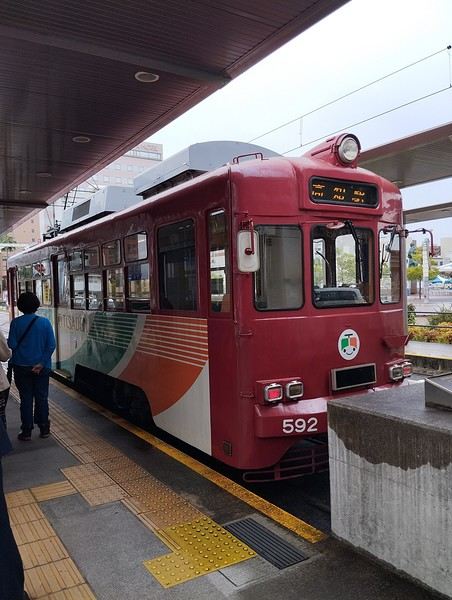
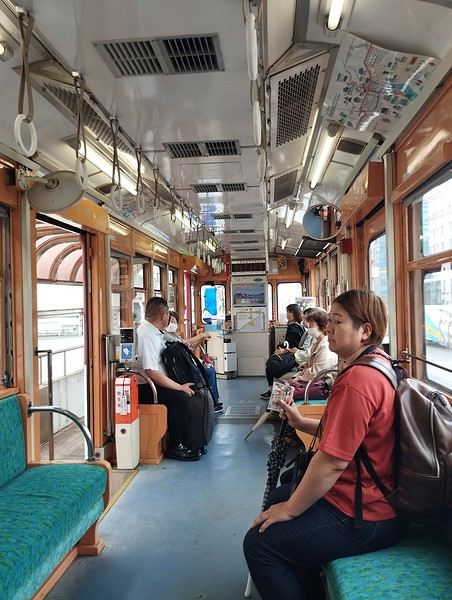
It’s time to take one of these trams. We’ll see that the trams have a lot of charm, each with different colors or designs. Our first tram is burgundy. Inside, we sit on one of the dark jade-green velvet seats.
To get off, while locals tap their cards, we just show our paper ticket to the tram driver, who’s wearing nice white gloves.
The distinctive chime that plays when crossing a pedestrian crossing rings in our ears. It’s one of those sounds that instantly transports you to Japan, even when you’re not there.
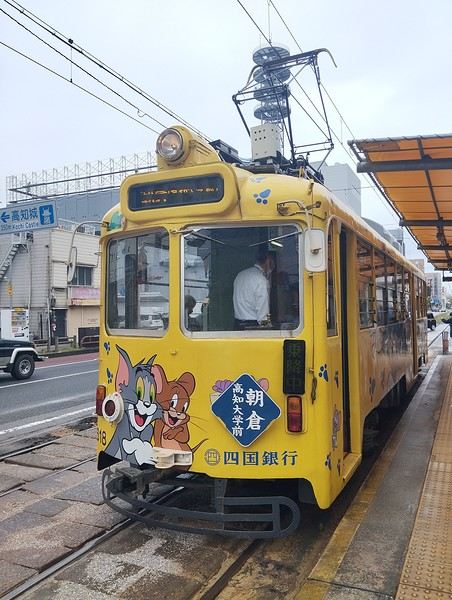
Our goal is to visit Kochi Castle. To get there, we need to take two trams. The second one is completely decked out in *Tom & Jerry* themes, both inside and out.
On the tram, there are mostly older Japanese people and a few Western tourists.
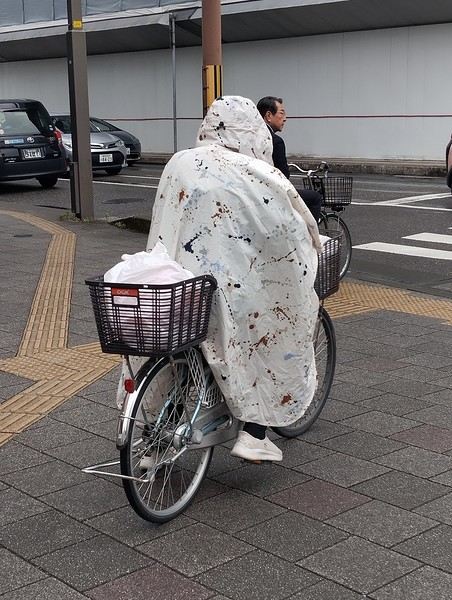
On the streets, even though it’s not raining at the moment, people are walking around with umbrellas or wearing raincoats while cycling.
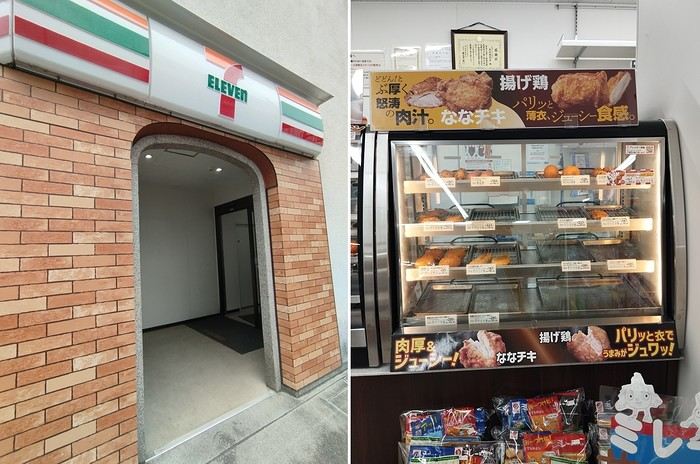
Walking toward the castle, we pass a very retro 7-Eleven convenience store, from its facade to its umbrella stands. But inside, you’ll find all the classic konbini staples, like fried chicken.
We continue on our way. We’re in the lower grounds of the castle, across from the Kochi Castle History Museum, where the Olympic rings are displayed.
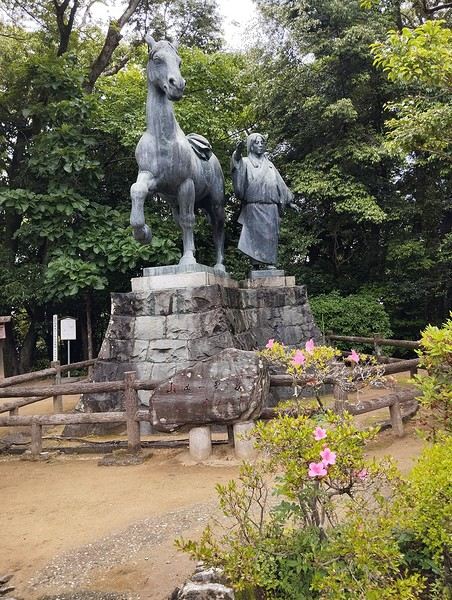
Since the castle is built on a hill, Mount Otakasaka, we take this rather majestic staircase leading to a statue of the first feudal lord’s wife.
The first level offers a nice view of the castle and access to a garden (a large green meadow) overlooking the city, where we eat some pepper-fried chicken bought from the retro konbini a few minutes earlier. We were hoping to find the same kind we’d had in Tohoku, but it wasn’t the same. It’s pretty rare to find, so when you see it, you don’t hesitate to try it.
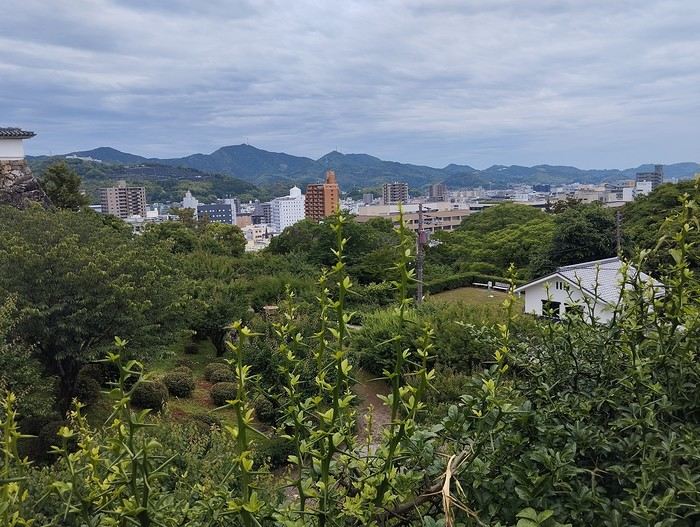
Now we’re at the top of the hill, which offers an open space with trees and a view of the surroundings.
Re: From Southern Shikoku, between land and sea, to the blue waters of Miyakojima and finally the megalopolis T
Day 1 follow-up - A day in Kochi City using public transport - Part 2
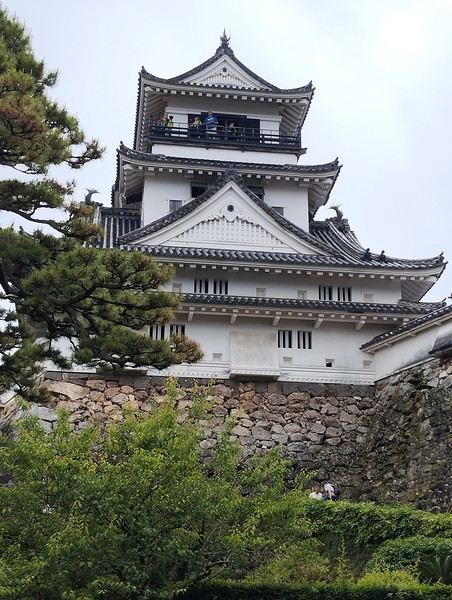
We pass through the castle gate, walk a little further, and there it is—the castle reveals itself in all its incredible elegance. Dating back to the 17th century, it’s made of wood and stone. It’s one of the 12 rare castles in Japan that are still authentic. In fact, its keep and tower are original since it never saw battle, though it did suffer from fires.
However, we’re surprised by the crowd—especially since a large part of it is foreign. The usual zen atmosphere isn’t quite there; instead, it’s a bit of a cacophony. We get the impression that some of the Western foreigners are from a cruise ship.
To visit the castle, we have to take off our shoes and put them in lockers outside, which we lock with a key. It’s free.
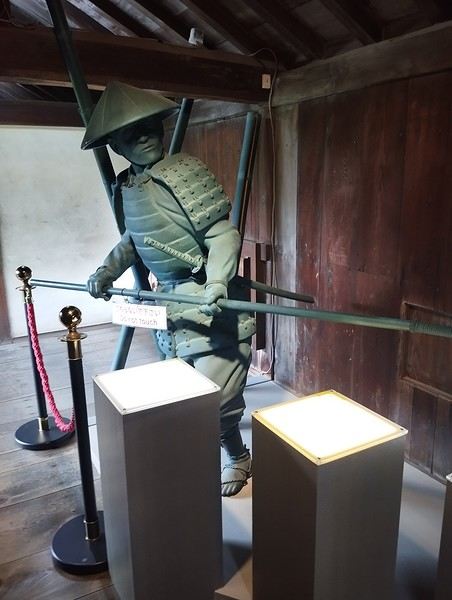
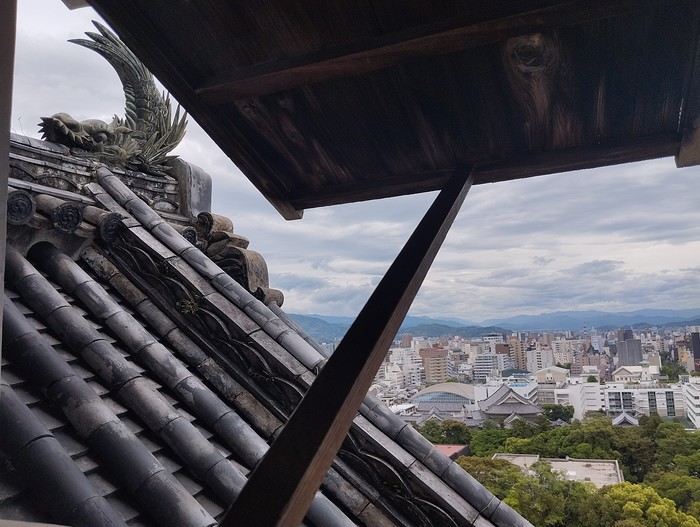
With our entry ticket in hand (paid), the visit is done in socks, walking sometimes on rice mats and sometimes on wooden floors. Since the castle isn’t large, it’s hard to escape the crowd, as there’s a set route to follow. Still, the visit is interesting, with various objects on display, models, and viewpoints from the castle’s five floors. To reach each floor, we queue up to climb the steep stairs at every level.
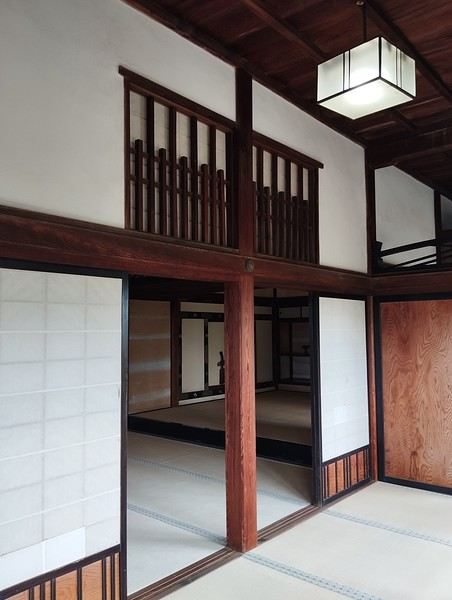
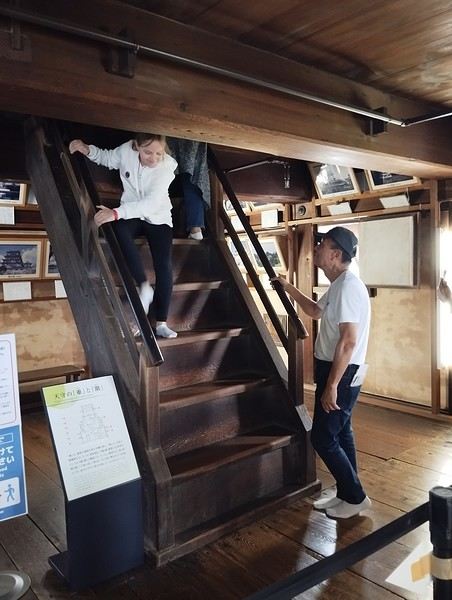
After this historical visit, we check the bus schedule for our next destination, but it turns out the next bus isn’t for another 2 hours. So, we head to the famous Hirome Market nearby on foot. Along the way, we pass a small shrine where the unusual sight of roosters roaming freely on sheet metal catches my attention.
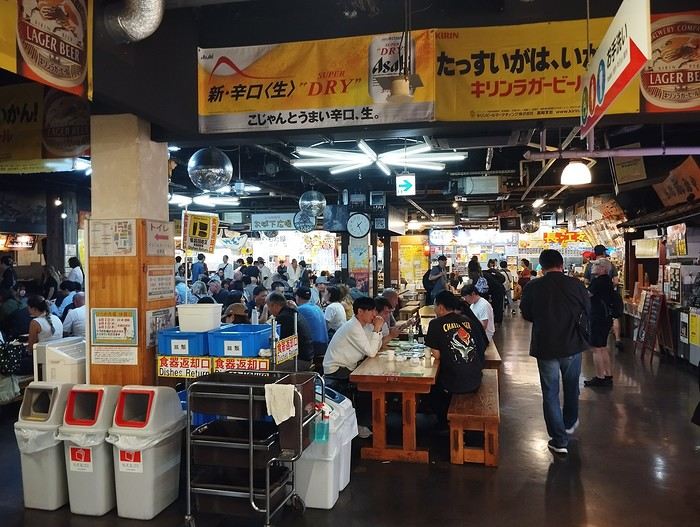
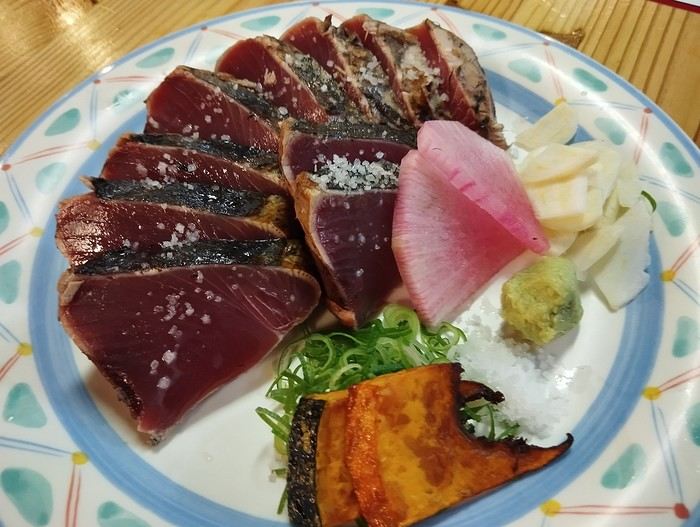
Hirome Market is mainly a food market where you can also eat. It’s a popular spot for locals and tourists alike. For us, it’s a chance to try one of the local specialties: *katsuo no tataki*—bonito seared on the outside and raw inside. The bonito is delicious, with a smoky/hay-like flavor that’s both strong and subtle at the same time.
Re: From Southern Shikoku, between land and sea, to the blue waters of Miyakojima and finally the megalopolis T
Continuation Day 1 - A day in Kochi City using public transport - Part 3
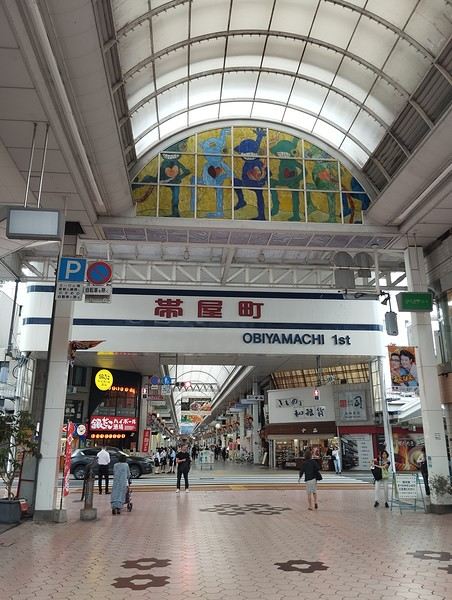
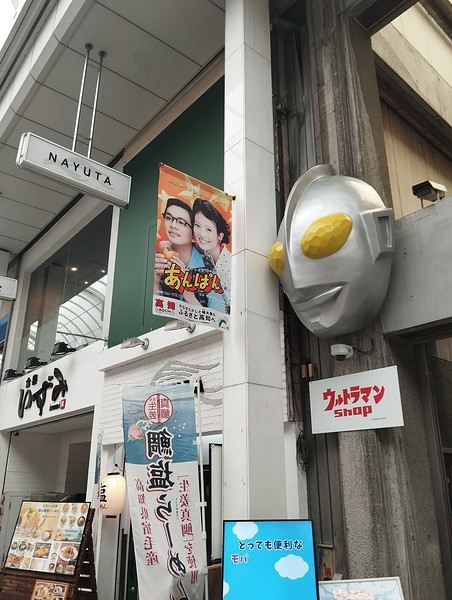
With our taste buds delighted and our bellies full from that simple but delicious meal, we continue our stroll by taking the shotengai (covered shopping arcade) Obiyamachi, located at the foot of Hirome Market. This is the longest shotengai in Kochi, stretching 650 meters. Wandering through it is really pleasant because the alley is wide, and above all, we’re charmed by its retro style and atmosphere. There are places where you instantly feel at ease—this shotengai is one of them.
Many of the shops have an "old-school" vibe, like the numerous clothing stores with styles geared toward "older folks." The same goes for the bridal shop selling kimonos. Despite that, you see all generations strolling around. The atmosphere is very laid-back.
Our senses are stimulated here—sight with the eye-catching, sometimes futuristic storefronts, or the deep violet flowers that catch my eye; smell with the sweet, warm scent wafting from the Mister Donut sign, which almost makes me want to try one even though I’m not a donut fan; and hearing with the music playing from the speakers or the special tunes at pedestrian crossings.
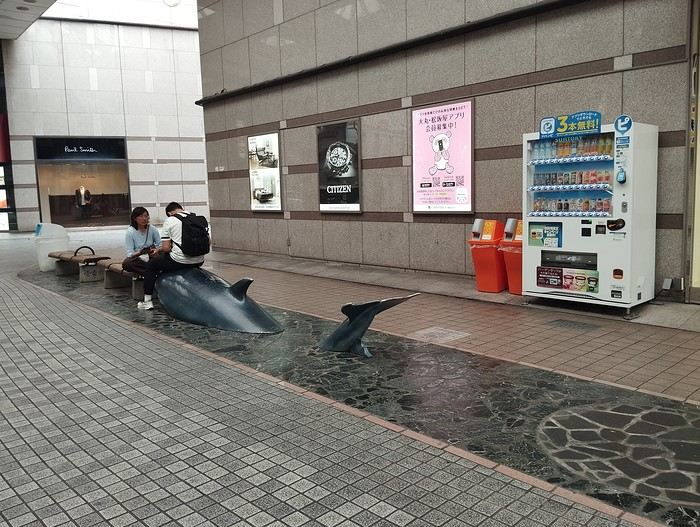
We even spotted a bench shaped like a whale—cetaceans that swim in the Pacific Ocean, both admired and fished here. There are restaurants serving whale meat and moray eel, but we didn’t have time to try them.
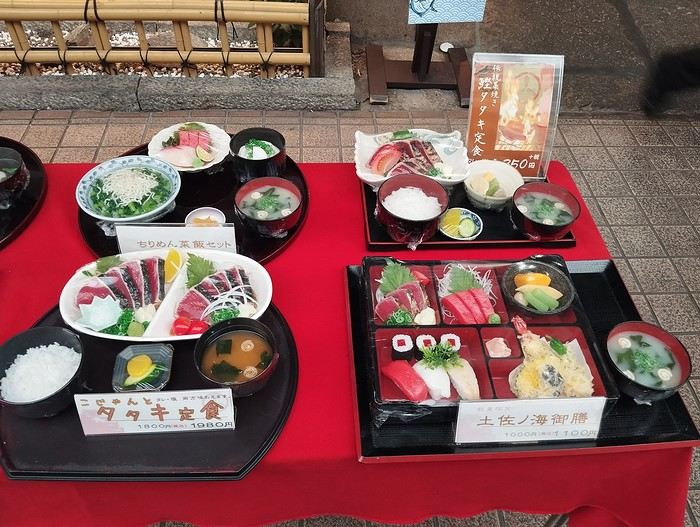
The space is so wide that one restaurant set up a table outside with several *sampuru*—fake food displays.
A square in the middle of this shopping arcade seems to be a local hangout spot. Artists, elderly folks on bikes grabbing coffee and chatting occupy the benches or the ground.
In Kochi, it’s retro, as I mentioned—no flashiness like in Tokyo, but a mixed population where some signs of hardship seem to show, like the older men on bikes we pass by. Kochi feels like a place where life is good, human-scale, more rural, more working-class—the unfiltered side of Japanese life.
At the end of the shotengai, almost opposite, there’s another shorter arcade with a beautiful wooden framework. Its aesthetic really draws the eye.
We would’ve liked to keep exploring, but we prefer to arrive a little early at the bus stop. Except we struggle to find the right one, so we walk from one stop to another, try asking a young teenager who doesn’t know, then a sign enlightens me—we’re not in the right place at all, and the bus is about to pass. Sure enough, we spot it, wave it down, but it doesn’t stop. If we miss this bus, we’re done for, so we start running as fast as we can. Luckily, a red light buys us some time, but it’s not over yet. I’m a bit out of breath, Mr. is ahead of me, and I tell him, "Don’t stop, keep going, I’m coming!" I run, and somehow—miraculously—we manage to hop on the bus just before it pulls away! That was a close one!! The seats are a welcome relief after that unexpected sprint. A little cardio never hurt anyone!
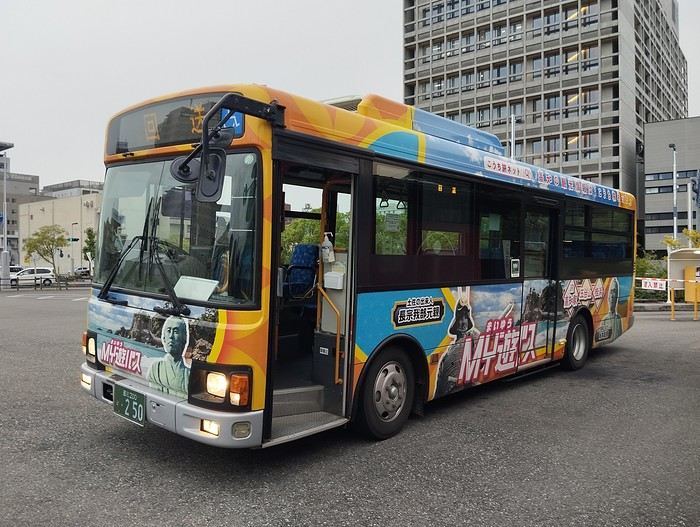
We took the MY YU Bus line, which serves Kochi’s main tourist spots.
The bus crosses the city and quickly reaches a narrow, winding mountain road that plunges us into the heart of the forest. The road is flanked by mountains on both sides. For the latter, we only catch glimpses of the valley now and then since we’re climbing higher. Bathed in the green light of the trees, the bus takes us to our destination—the Makino Botanical Garden, located on Mount Godai.
The site is vast, nearly 8 hectares, where you wander from path to path, leading sometimes to the medicinal plant area, sometimes to the glass tropical greenhouse. The species are well-labeled, and the place is really pleasant—especially since there aren’t many people left. The scientist, Dr. Makino, was the first Japanese person to give a scientific name to a new plant species.
During our self-guided tour, a young woman approaches us in Japanese to ask if there’s anything worth seeing where we came from. We answer as best we can, point her in the right direction, and part ways. A second later, she turns around and asks to take a photo with us to commemorate her solo trip—all with a sweet smile and contagious laughter.
The garden is so big that we don’t have time to visit the café overlooking it because the garden closes. In Japan, many places close at 4:00 PM, 4:30 PM, or 5:00 PM—even in summer when it doesn’t get dark until 7:00 PM or 7:30 PM.
We also don’t have time to visit Chikurinji Temple, right across from the garden. We just pass by while waiting for the bus—about 30 minutes. We won’t make it to Katsurahama Beach either because there wouldn’t be a bus back to the city center. I hesitated about renting a car starting today, and if I had to do it over, I’d rent one from the first day—it’s much less restrictive, I think. That said, I should mention that all these visits are doable by public transport, and they’re well-served, but having to watch the clock and wonder how much time you have to visit a place so you don’t miss your bus or the right connection is, for me, a source of stress on vacation.
The bus arrives, and while the driver indicates his stop—there’s a sign for that—we get on.
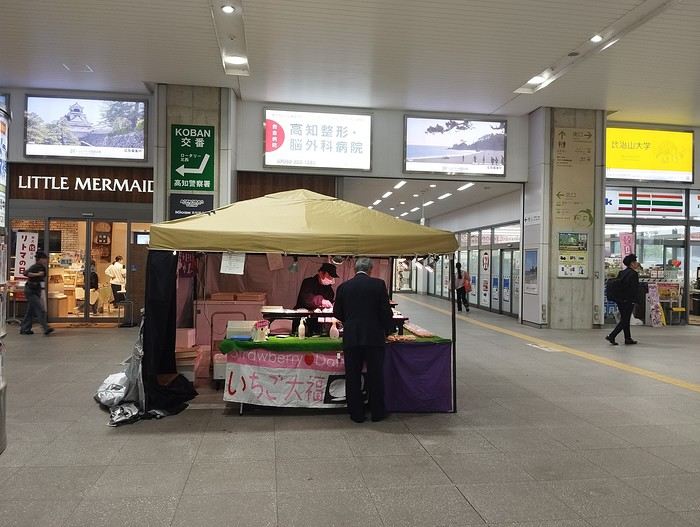
The return trip is the same in reverse. We get off at the terminus—Kochi Station. It’s a chance to see a bit more of the inside. There’s a *konbini* and food stalls, including Japanese pastries. The elderly man running the stall was already there this morning—you could say he works long hours.
We have a ritual when we arrive in Japan—those who’ve read our previous travel journals know it—buying Japanese liposomal vitamin C. Usually, we find it in medical or dental clinics. But this time, the closest place is a beauty salon. We find it without trouble and spot the car rental agency for tomorrow morning. Arriving at the beauty salon called "La Chambre," located in a house, the esthetician is a bit surprised to see us. We explain why we’re there, and we’re allowed in. After the explanations and confirming our purchase, the owner arrives. Her employee introduces us, and we chat with the owner. The conversation then drifts to a few French words she knows (she’d been once) and the places we’re visiting on this trip. We even get a little gift—a storage box for the vitamins.
Warm goodbyes, and we continue our quest for hydrogen water, spotting a *drugstore*—a huge pharmacy-like store. For the first time, we find water that might fit the bill, thanks to asking the staff. There are only 4 bottles left, and she apologizes because satisfying the customer is an unconditional rule.
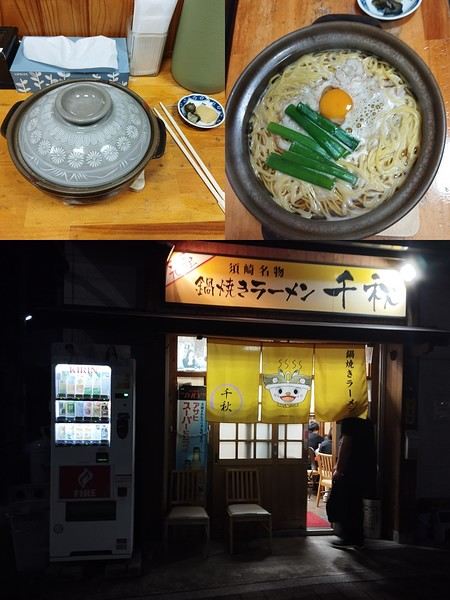
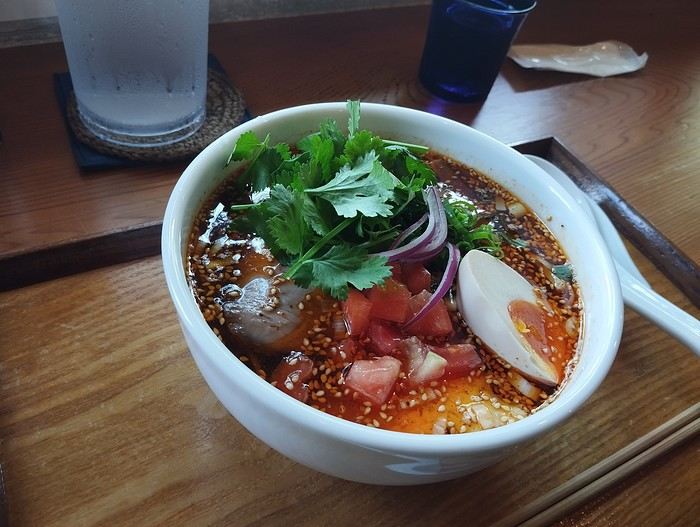
After these purchases, we head back to the hotel to relax a bit. We go out again to eat nearby at a restaurant serving another local specialty—*nabeyaki ramen*. It’s a ramen with a light chicken broth, egg, and raw onions, served in a clay pot to keep it hot.
The restaurant was pretty basic, so the taste didn’t wow us. We should try another place next time. On the bright side, it was cheap—1500 yen for two, about 9.50 € for both of us.
Afterward, we take a walk to a supermarket—here, *Food & Drug*—which is often open until 9:00 PM or 10:00 PM, to grab some fresh fruit, water bottles, and cold green tea—essential for staying hydrated.
On our way back to the hotel, while waiting at a pedestrian crossing, a woman who looked Japanese but apparently hadn’t lived in Japan approached us for directions. The exchange was a bit strange, even surreal—the lady was a bit peculiar, maybe even a little eccentric. We couldn’t help her since we weren’t from the area.
We end the evening watching a bit of Japanese TV. I stumble upon a movie and catch a few words here and there.
Re: Southern Shikoku: Between Land and Sea, the Blue Waters of Miyakojima, and Ending in the Megacity
Day 2 - Cave Visits
The day starts off great because it's 7:45 AM and outside, the sky is a brilliant blue with not a cloud in sight. Only the sun is lighting our way.
From the hotel, we walk to the car rental agency we spotted yesterday. It's located at the north exit of the station, just behind the retro bike parking lot.
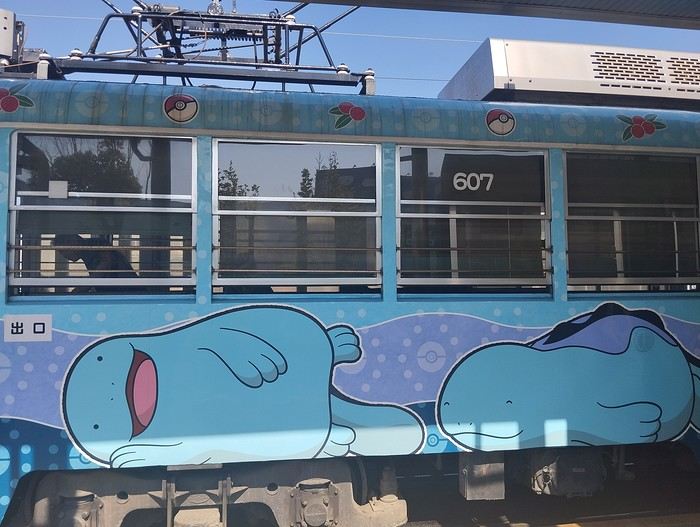
Just before that, at the south exit, we spotted a tram in shades of blue. I don’t know the name of the character depicted on it.
We’re greeted by a very pleasant Japanese woman and man. Despite a few moments of confusion trying to understand each other, there’s no impatience or annoyance. For some reason, the credit card isn’t working, even though I’ve used it for payments on previous trips. We’re forced to pay in cash. Given that we’re renting the car for a one-way road trip from point A to point B, the options were limited, and the price reflected that. Usually, car rentals cost us around 42-44 € on average, but this time it was more like 50 € per day.
The car is very comfortable. However, once again, the GPS doesn’t work with phone numbers. We improvise by roughly selecting locations on the map and using Maps.me, which works offline.
At 9:00 AM, I get back into the swing of driving on the left in an automatic car—it comes back pretty easily since the last time was only six months ago. We stop at a konbini, and a young Indian guy is at the register. We chat with him a bit. He’s here for his studies and says Kochi is a very small city, and it’s hard to make friends without speaking Japanese since very few people speak English.
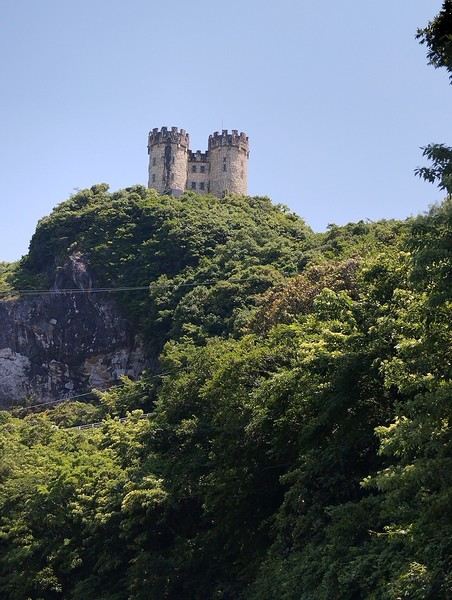
Back on the road, we’re close to our morning destination. We see the signs and follow the GPS, but it tries to take us up a mountain path where a sign seems to indicate it’s off-limits, so I turn around. Even though we were only 200 meters from the spot, I took a mountain road that gave us a free detour through the mountains of Kochi Prefecture. That said, the landscapes we passed were lovely—forest on one side and the sea on the other. We even spotted a stone castle with French architectural style. We wanted to stop and check it out, intrigued by the building, but we couldn’t find the road leading to it.
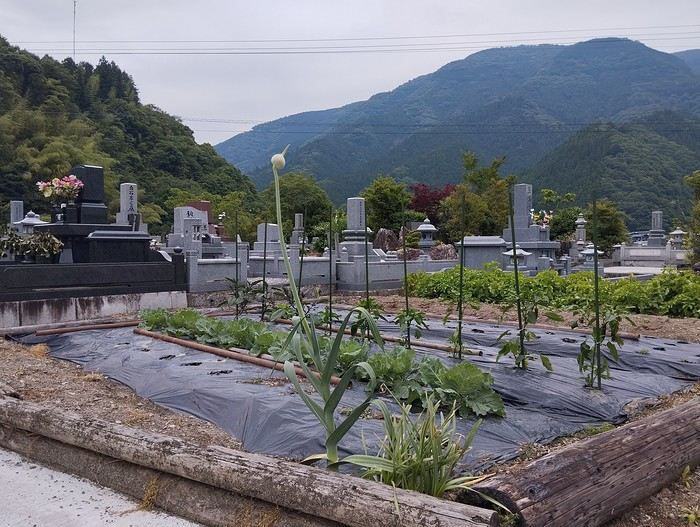
After a free detour, a stop at a very mineral cemetery, and an hour of driving, we end up right back where we started. This time, the entrance to the place jumps out at us—right in front of us, just a few meters away, and we turned right. Oh well, that’s part of the adventure.
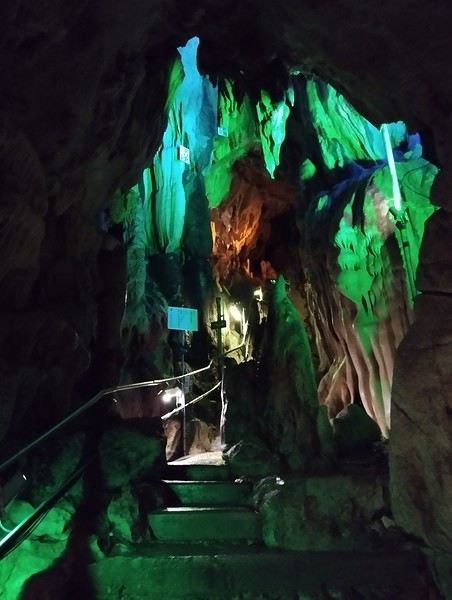
We came to visit Ryugado Cave, which means "Dragon River Cave." It’s located in the city of Kami and is one of Japan’s three largest limestone caves. It’s 4 km long, but only 1 km is open to the public. It’s supposedly 175 million years old.
To reach the entrance, you have to walk through a shopping street. There are a few shops selling knives, precious stones, a tourist office with no staff, and one or two restaurants open. Despite it being late morning—after 11:00 AM—there aren’t many people around. We pass two Japanese people coming the other way. At the end of the street, there are the inevitable stairs, made of stone here, a steep climb, but if you turn around, you get a clear view of the peaceful Japanese countryside, not to mention the birdsong, lizards crawling on the ground, and the sound of mountain water flowing—it’s a lovely moment.
There *is* staff: a woman greeting you at the top of the stairs and another at the ticket office.
With our tickets in hand and encouraged by the gentle smile of the woman opening the gate for us, we step into the cave’s depths. The path is well-maintained, so no mining work needed, but there are quite a few very narrow and/or low passages. It requires some gymnastics or hula hoop moves to make progress. You can see stalactites and unique formations. There’s also a waterfall highlighted by lighting. Some sections go up, then down. In several spots, you can take a break if you’re tired or feeling unwell. There are phones to call for help if needed. The accessible 1 km ends with a sound and light show projected onto the cave’s cliffs. It’s quite nice.
We exit higher up in the mountain. There’s a closed, glass-walled room with armchairs and sofas, free to use for anyone who wants to relax after the visit. The windows look out onto the surrounding forest. The visit itself isn’t very long—less than an hour if you take your time. So, we skip the break and keep going. The path at tree height, swaying in the wind, is very pleasant. The rustling of leaves and branches is refreshing.
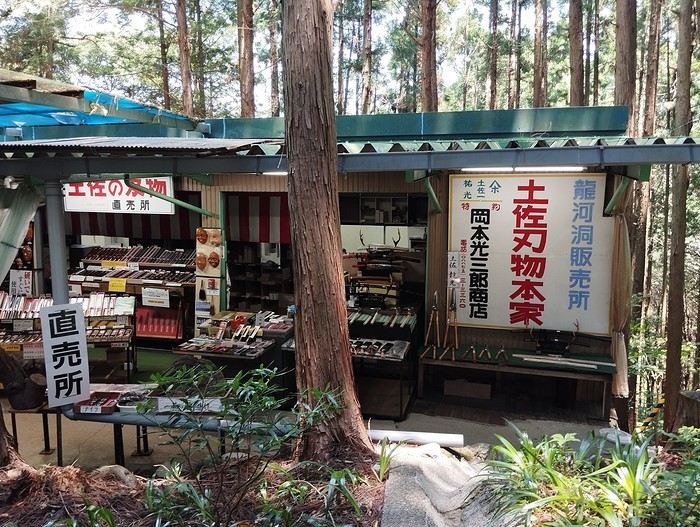
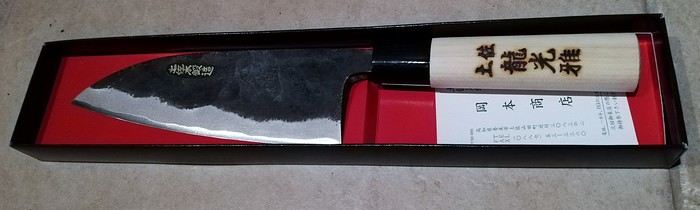
Then, to our right, we see a stand selling handmade knives. The region is known for knife-making. There’s an impressive selection, all beautifully crafted. I’ve been wanting to buy a real Japanese knife for a while, so I take a look. In Tokyo, I went into a small shop, but the price stopped me in my tracks. This summer in Brittany, at a handmade knife shop, the prices were much higher—between 600 and 1000 € on average. The 300 € in Tokyo now seems like a steal compared to the quality.
The seller—and maker, since he only sells his own work—shows us a knife for cutting meat, among other things. The price is 9500 yen (about 60 €). For the first time in Japan, we try negotiating, not really expecting it to work, but the maker agrees to sell it to us for 1000 yen less—8500 yen. The discount isn’t huge, but I’m proud I managed it because it doesn’t seem like a common practice here, unlike in other Asian countries. And most importantly, I’m going home with a beautiful knife of guaranteed quality.
We continue downhill and arrive in front of the entrance to a free museum, open to the public with no staff. The museum is in a pretty building surrounded by greenery, bathed in sunlight.
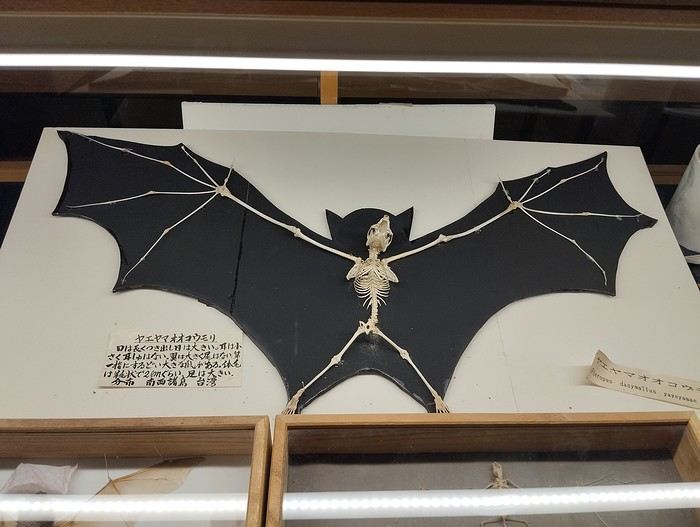
At the museum entrance, there’s another fun sound and light display. Inside, you’ll find bones, ancient objects, and bat skeletons, among other things.
After the visit, we head back to the car, descending the stone stairs and walking through the shopping street with its everyday art.
This morning’s detour cost us some time, so we change the original plan. We’re now driving toward the coastal town of Aki. There, we try artisanal ice cream flavors like sweet potato, ginger, and grilled eggplant. The ginger ice cream is really nice.
We stop at a supermarket to buy some food, where we ask a couple to help us identify the type of fish in the tray we’re holding. They help us kindly. We make a stop at the station, where a mascot is on display, and then at Aki’s tourist office. Three people work there, even though the town seems small and there’s hardly anyone around, including on the streets. For some of our questions, they don’t have the information in English, so they apologize.
The sun’s heat is overwhelming, and time is passing. After a bit of wandering, we decide to eat by the sea at Cape Oyama.
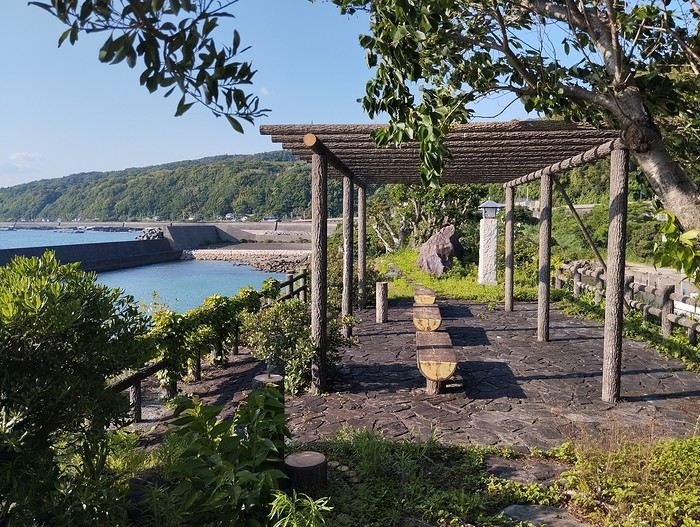
We have a picnic near a peaceful little port and a lovers’ sanctuary, which seems to be new. The setting is lovely. We’re lulled by the sound of small waves.
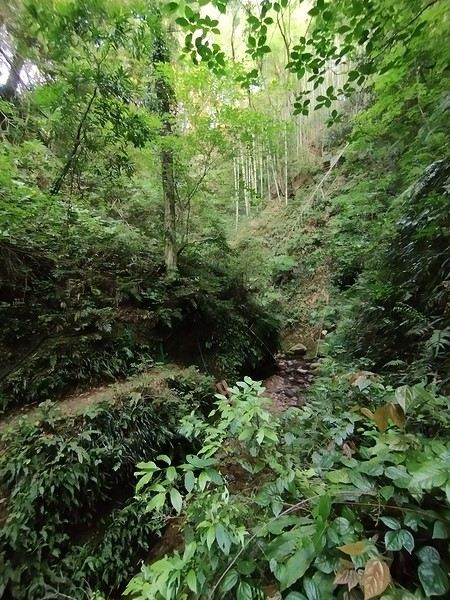
After that, we visit another kind of cave. Ioki Cave is a natural tunnel carved by waves millions of years ago. Inside, there are many different species of tropical ferns creating a green canopy—it feels like you’re in the middle of a forest, even though the road is just a few steps from the cave entrance. First, we cross the tunnel using our phone lights because it’s dark, then we reach the heart of the canyon, and the light returns. We cross several shallow river sections, walk on branches, use a small bridge, and climb slightly with the help of a thick rope provided to descend along the riverbed. We arrive at a small waterfall.
It’s possible to do a loop by going further, but honestly, we don’t take the risk because it’s already late, night is falling, we don’t have a headlamp, and we can’t see how bright it really is inside the canyon. So, a bit reluctantly, we simply turn back. We didn’t see anyone except a Japanese family leaving the cave as we arrived, and we exchanged a few words with them.
We had planned to do more today, but sometimes there are unexpected things—like getting lost, chatting, and driving time. So, we drive calmly back to the hotel. We can’t find the hotel’s affiliated parking lots, so I park a bit randomly. We go to the reception, which helps us locate the different parking areas, and we go back to park properly. We’ll eat what’s left from our supermarket purchases earlier.
Re: From Southern Shikoku, between land and sea, to the blue waters of Miyakojima and finally the megacity T
Day 4 – Rice Fields and Lake
After stopping by a 7-Eleven, we take the car to head into the center of Kochi Prefecture.
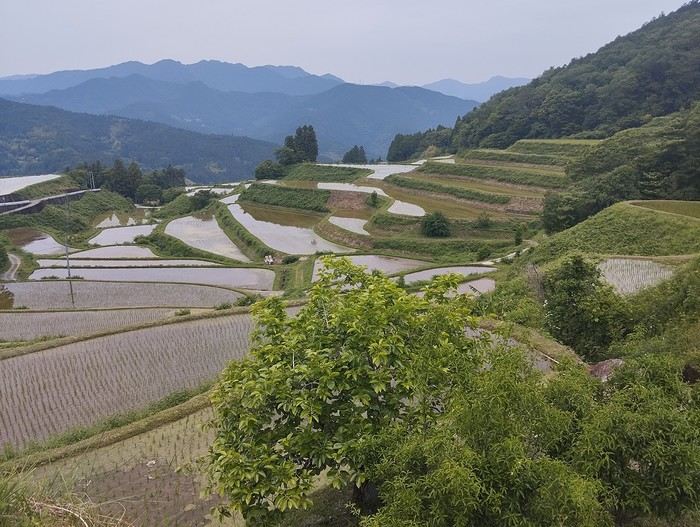
Not much driving time later, we find ourselves in a completely rural and mountainous environment. We intended to visit some waterfalls, but a sign pointing to rice fields leads us to make an unplanned stop.
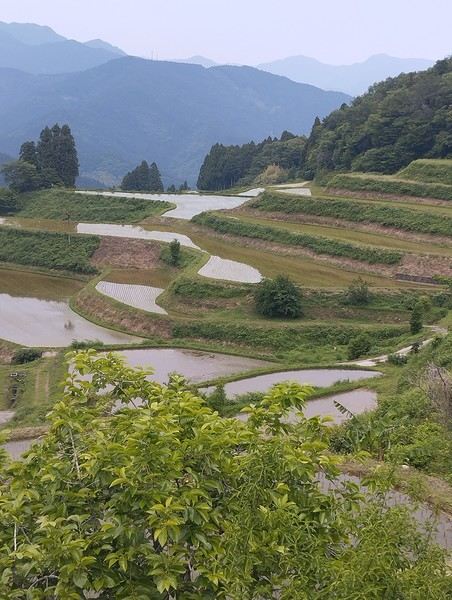
We take a narrow road that winds through tiny villages, climbing higher and higher until we reach the viewpoint overlooking the Takasu rice fields. There’s absolutely no one around. We can enjoy a spectacular view of the rice fields. The sky is gray, but it’s not raining. We settle at the picnic tables and just take in the scenery, savoring the silence.
Every now and then, a car passes by. But mostly, a van drives by—once, twice, three times—I’m sure it’s the same van. It’s a local guy, I’m certain of it; he watches us as he passes. Then suddenly, the van speeds up and parks. Out steps a burly guy wearing only a sleeveless, slightly worn black vest. He’s got muscular arms and a thick, dark mustache. He’s got a cowboy vibe, but the Japanese version. He comes over to ask who we are and where we’re from. He speaks a little English. Eager to chat and clearly happy to speak English, even when I speak Japanese to him.
We learn he owns 20 plots of the rice fields stretching out before us. He tells us he uses very little fertilizer and that organic farming is tricky here because of the wind and how close the plots are to each other. He’s married with three kids, aged 30 to 37. He doesn’t seem worried about passing the fields down—his kids will take over. He says it’s a lot of work and not very profitable, but his wife is a teacher, and she’s the one who ensures the family’s financial security.
Given the type of rice fields and the cost, he works manually but has five horses to harvest the rice. He warns us to be careful because there are a lot of snakes and pretty dangerous spiders.
He also makes sake.
We ask if we can buy some rice from him, but he says he can’t sell to us because of the price. He only sells in 3-kilogram batches for 20,000 yen, about 130 €—that’s 40 € per kilo. White gold, indeed! He mostly supplies luxury hotels.
We also learn he lived in the U.S. for two years, which explains his cowboy look and his eagerness to speak English!
One of his friends stops by. He introduces us. This friend grows flowers higher up in the mountains. Today, he’s taking part in a TV show that’s already on-site. They’re on a break.
Usually, this place is packed with tourists, especially in the summer when the rice is golden. We’re thrilled to enjoy this setting in absolute tranquility.
He gives us tips for the rest of our day—the waterfall—and warns us to watch out for dangerous poisonous creatures.
We take a souvenir photo and leave this colorful character after chatting for a good part of the morning.
The waterfall isn’t supposed to be far—just 30 minutes by car. After driving through a lifeless hamlet, we turn at an intersection where a vague sign points to different routes for different waterfalls.
We think we’re close. But we hadn’t counted on the total lack of signs, people, or anything to guide us afterward. We stop several times as we venture deeper into the mountains, sometimes following a stream with the forest covering the road, other times climbing higher, watching the paved road turn into a dirt path covered in leaves or a rocky trail, praying we don’t get a flat or damage the car. The GPS insists we’re right there, and according to the vague map we saw earlier, we’re heading in the right direction—but there’s no sign of the waterfall.
Driving slowly because of the road, we still enjoy the exceptional natural surroundings. After driving for over an hour without spotting the waterfall and seeing how rough the path has become, we reluctantly decide to turn back. Plus, it’s started raining.
We carefully descend the mountain, still scanning for any clue—but nothing. Suddenly, a van passes us and pulls over. I stop next to it. The elderly driver doesn’t understand me trying to talk to him from my window. I have to get out, but I have to insist for him to roll down his window. He doesn’t seem to know the waterfall and doesn’t seem eager to help. Oh well, we get back on the road when I spot a woman working. I go talk to her, but she doesn’t seem to speak Japanese.
Total bust. We drove for hours and found nothing. Knowing we’d already done a fair bit of driving for the rice fields, the day is already well underway because the winding roads and slow speeds mean getting inland takes time. We give up on the second waterfall and continue toward our next goal: Lake Sameura.
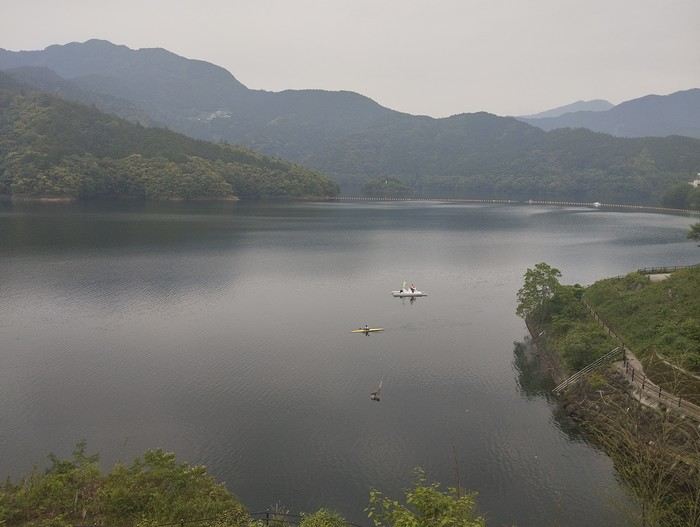
Despite the misty sky, we enjoy the lake’s scenery and the surrounding forests, especially while having a drink on the terrace of the nautical center overlooking the lake. We watch the kayakers on the water and when they return to the center.
We then head to the city center to grab an ice cream before the shop closes. Many stores in Japan close early, so you have to plan accordingly. We arrive just in time—five minutes before closing. The woman working was already tidying up, but she agrees to sell us some ice cream. We’ll have to eat them outside, though. We try a delicious matcha ice cream and a shiso sorbet. It’s super refreshing and has a beautiful pomegranate color. We enjoy these treats on the bench in front of the shop, whose curtains are already drawn. We’re on the main street of Motoyama, and it’s very quiet. The woman comes out afterward to tell us to go around back to throw away our cups, which we do. We can even use the restroom. In the end, I think we could’ve eaten inside since she hadn’t completely finished cleaning and tidying up, but rules are rules.
Then we think about what to do next. Given the time—late afternoon—and the drive back, we decide to eat early. We’d spotted a sushi restaurant online. We park in front of what looks like a house. We’d barely parked when a woman comes out to tell us we can’t park there, but we say we’re here to eat, and suddenly, there’s no problem. Parking in Japan isn’t like in France. You have to park in the right spot, or you might run into trouble, as we’ve experienced on previous trips.
We sit at the counter. The restaurant is run by a man and his lively mother. We quickly start chatting with the sushi master and then his mother, who’s serving. A few words of Japanese work their usual magic, especially with Grandma, who then keeps giving me gifts throughout the evening: a sake serving dish, a *naruko* (a Yosakoi dance instrument), tea bags, and above all, lots of laughter, warmth, and an invitation to come back and see them next time we’re in the area.
We learn the sushi master trained under a master in Shizuoka for 15 years before opening his own restaurant here 23 years ago. His mother is from Motoyama, which is why they’re here. His father was a *salaryman* in Osaka.
He works a lot and is single. Meeting women is complicated. On the other hand, he has five dogs—photos of them are displayed in the restaurant. He practices Yosakoi dance, which is why his mother wanted to give me an instrument. He buys the fish for his sushi in Kochi every three days or so—about an hour’s drive away.
In addition to sushi, we try a bowl of local beef *gyudon*—meat over rice with an egg.
We have an amazing evening and leave only after taking a souvenir photo at Grandma’s request—she’s full of energy.
Of course, they stay in front of the restaurant until we leave, making sure to remind us to drive carefully on the way back.
The evening ends quietly at the hotel.
While this day wasn’t rich in sightseeing due to travel times and missed spots, it was filled with two wonderful human encounters and the stunning mountain landscapes we drove through.
Re: From Southern Shikoku, between land and sea, to the blue waters of Miyakojima and finally the megalopolis T
Day 5 – Temple and arrival in Shimanto
Today, we’re leaving Kochi with a touch of nostalgia since we really enjoyed the city and its surroundings. Plus, there were still so many places we wanted to explore.
Before heading to Shimanto at the southwestern tip of Kochi Prefecture, we drive to Chikurin-ji Temple.
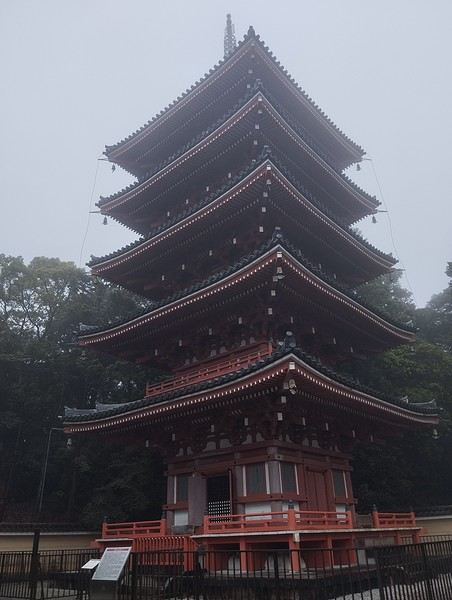
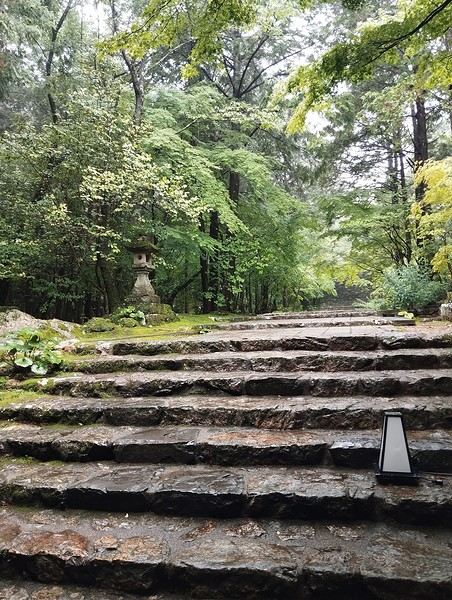
The mist follows us, adding a mystical charm to the temple. The rain makes the chlorophyll in the leaves and some tree trunks glisten.
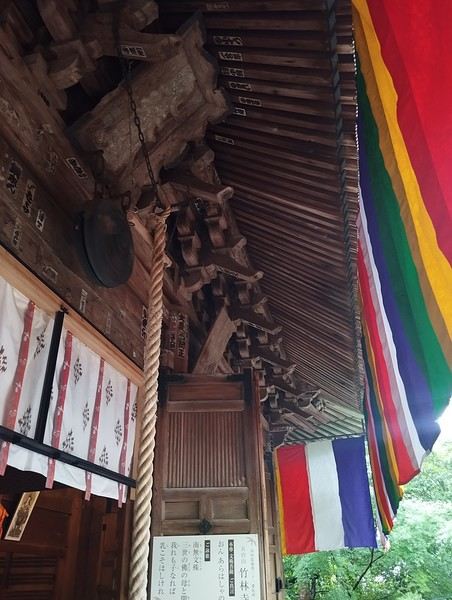
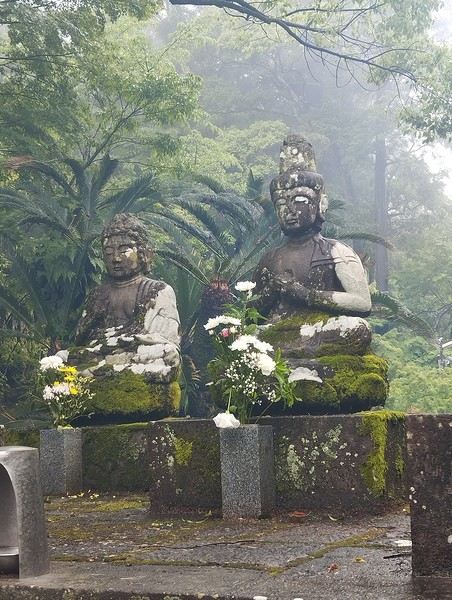
Several things make this visit special, like the five-story pagoda, the many protective statues, the daikon offering, the statues that almost feel like they’re from Thailand, or the plaque dedicated to pilgrims.
There’s almost no one around—just the two of us and two other people. We soak in the temple’s serene, mystical atmosphere to the sound of Buddhist gongs.
Now, we’re on our way to Shimanto.
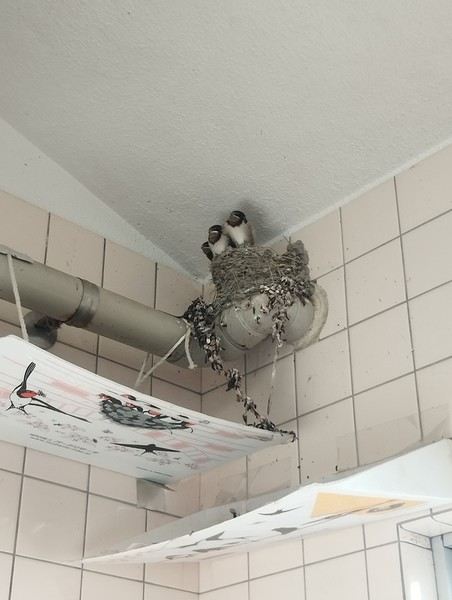
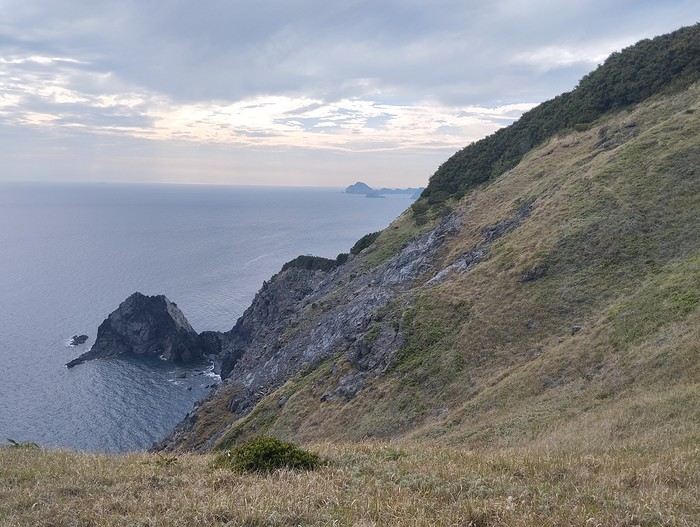
We stop a few times. The first stop is to enjoy the sea view, the second to grab a bite at a Marunaka supermarket and take a quick nap, and the third to relax while admiring a vast wild beach and a swallow’s nest that had settled in the women’s restroom.
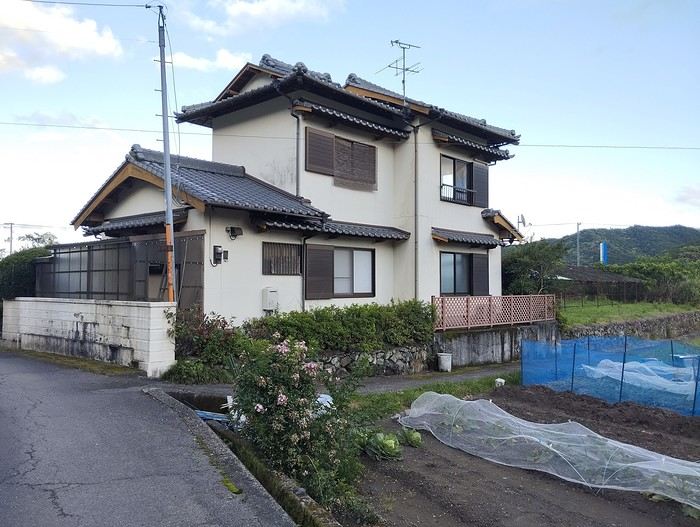
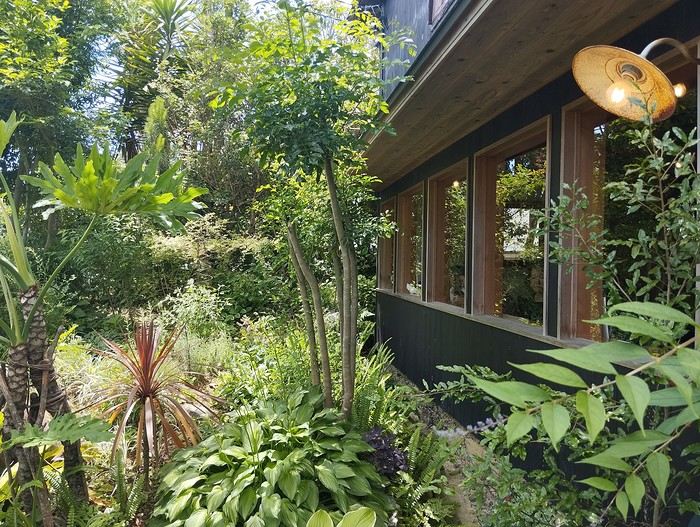
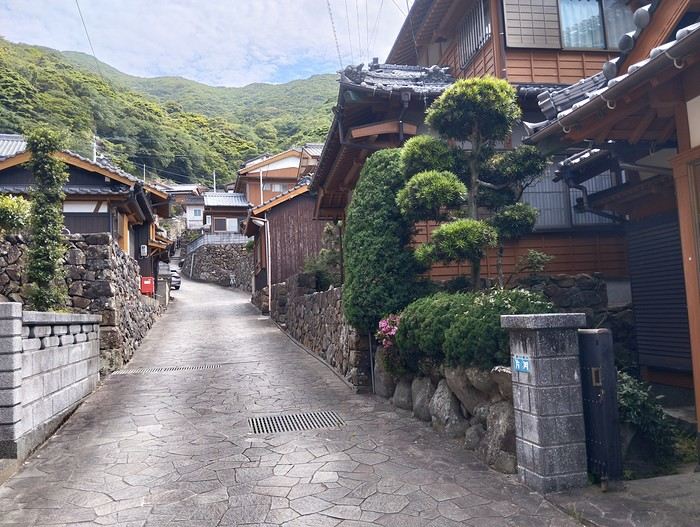
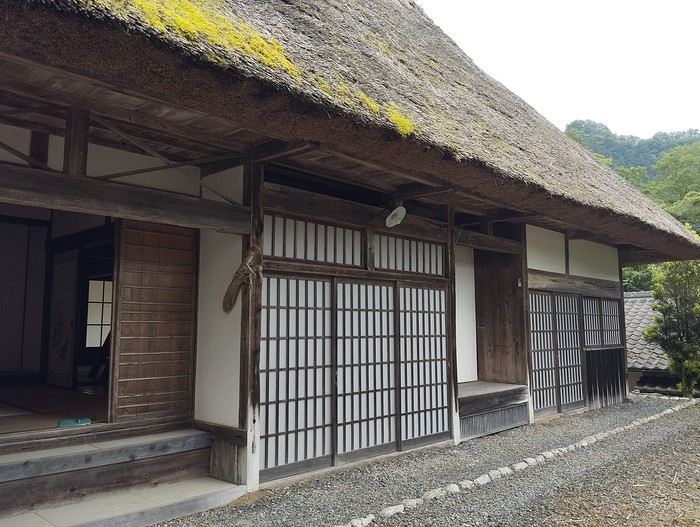
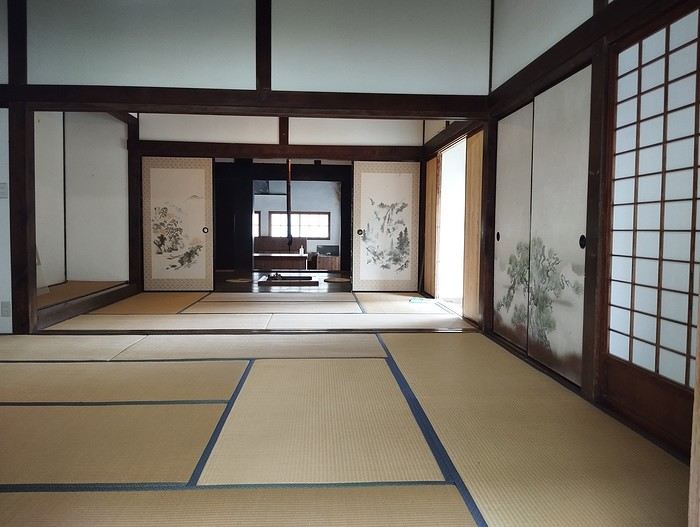
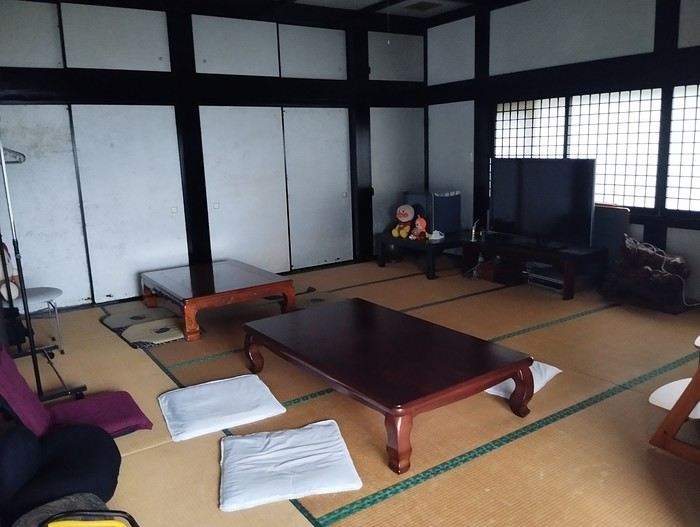
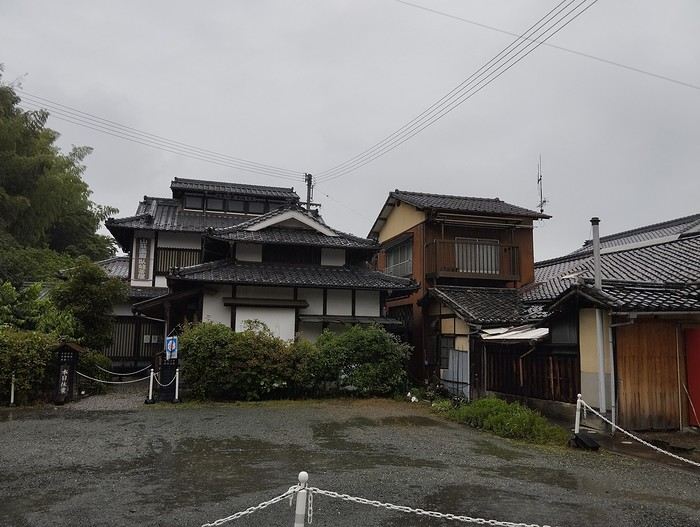
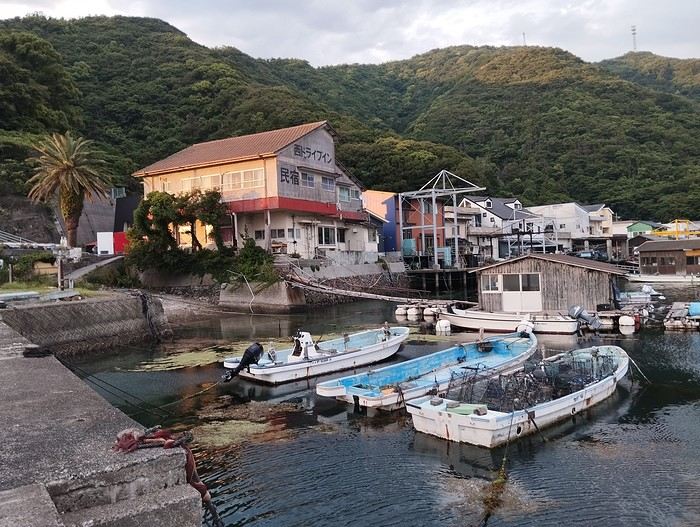
Finally, we arrive at our accommodation in the late afternoon. By chance, we’re staying in a Japanese house to save on costs. I can’t wait to experience this! We got here a little early, so we take a moment to look around. The house is in a quiet alley with several other homes. The gardens are in bloom, and a neighbor next door has a lovely vegetable garden.
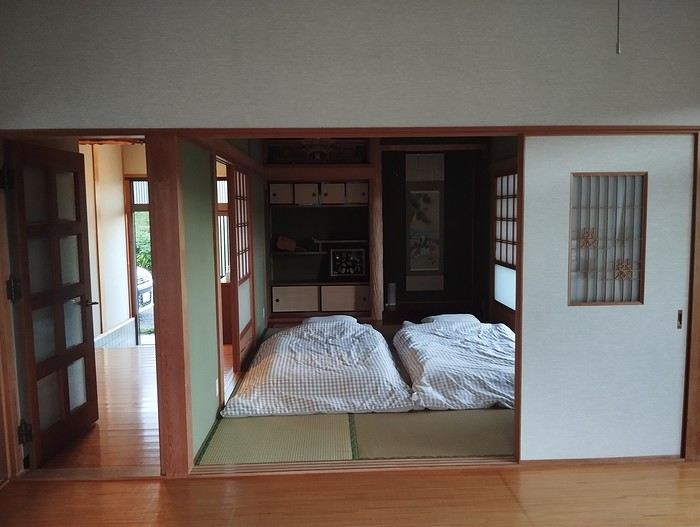
Check-in goes smoothly, and now we’re settled into a spacious Japanese house—four bedrooms for the next three nights. The best part? A garden.
We head to Sunny Mart supermarket to pick up some snacks for tonight, but as always, it’s also a chance to discover local specialties. It closes at 10 PM, which is super convenient.
The evening ends at home, enjoying a meal at the kitchen table like we would back home, followed by a cozy night on the couch watching Japanese TV before tucking into our carefully prepared futons in the bedroom.
Re: From Southern Shikoku, between land and sea, to the blue waters of Miyakojima and finally the megalopolis T
Day 6 – Stroll in SHIMANTO
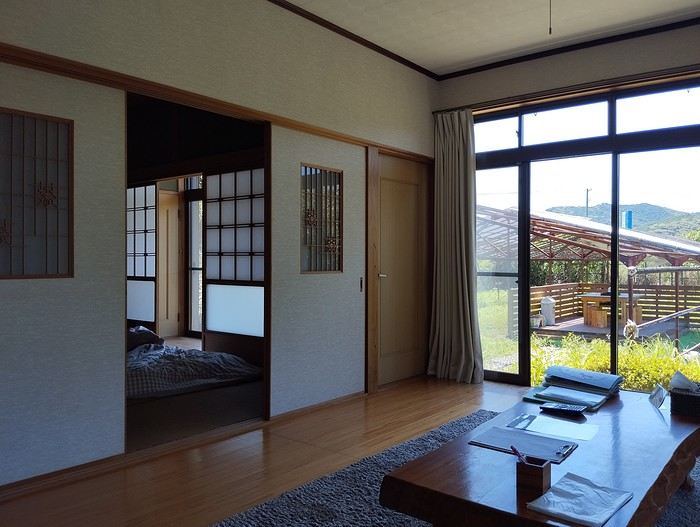
Since I’m sick and pretty exhausted, I rested this morning by sleeping in to recharge. When we finally get up, we slide open the rice-paper panels on the garden side, letting us enjoy the view of the garden through the glass doors. The sun floods the room. It’s so peaceful. Lying on our futons, we savor this simple moment of pleasure in this really charming house.
We enjoy our breakfast, cozily settled under the pergola in the garden, where we get a different view of the house. We also spot an elderly couple dressed head-to-toe to protect themselves from the sun. They’re gardening.
Leaving in the early afternoon, we discover the “village” under the sun.
We head to Shimanto Station, where the tourist office is nearby. We pick up some info, and I especially ask about the possibility of a traditional boat ride on the Shimanto River. Lucky day—a boatman offers the classic excursion but in the evening since it’s combined with a firefly “hunt.” Without hesitation, we go for it. Meet-up at 7 PM.
The Shimanto River is considered one of Japan’s wildest because it has no dams. It flows directly from dense forests without interruption. It passes through few urban areas, so it’s seen as a natural, clear river—one of, if not *the* last in Japan.
After that, we get back in the car to visit the dragonfly park not far away.
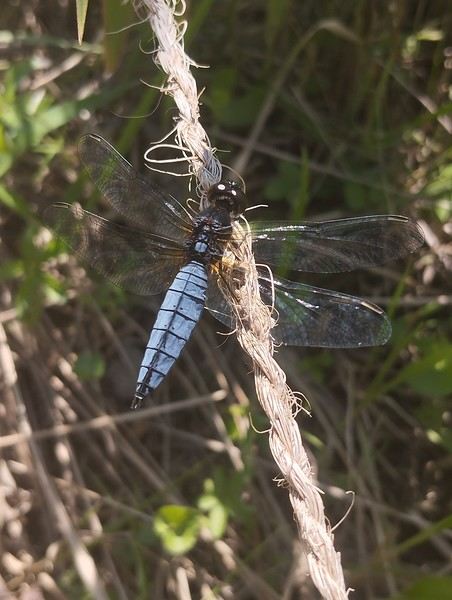
It’s a free-access park. There are quite a few iris flowers still in bloom, and we go dragonfly-spotting. We see a bunch—some are almost invisible, blending in with natural elements like a blade of grass. We end up spotting 10 different types of dragonflies.
Next, we stop by a local products store. We see things like ginger oil and rice miso. You shouldn’t skip these shops—many products are only found in their regions. You might think, *I’ll check it out later*, but you’re usually only in the area for a few days, and if you put it off, you’ll regret it because you won’t find those products again. It’s also a great way to learn more about Japanese cuisine.
We continue this “shopping spree” by heading to a store that was closed last night, next to the Sunny Mart (the equivalent of our garden/DIY store). We’re planning a barbecue but need lighter fluid. Getting understood starts as a panic for the staff but always ends in laughter.
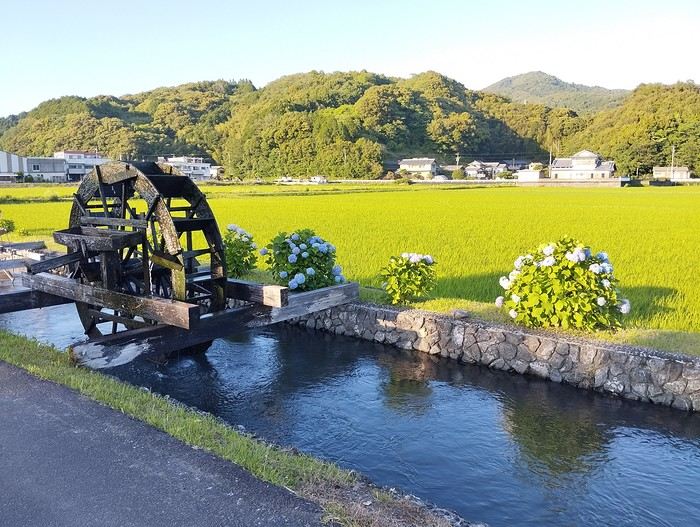
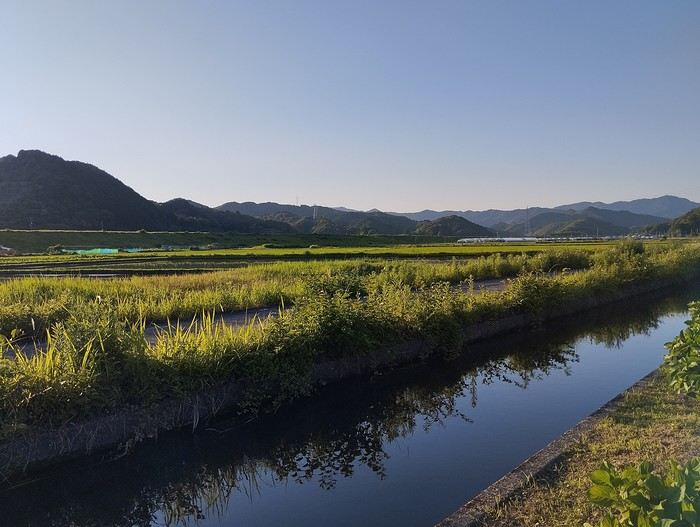
We still have time before the boat ride but not enough for a big outing, so we visit the Shimamura Canal. It was built to divert water from the Aso River, a tributary of the Shimanto, via a dam to irrigate four villages. Waterwheels were installed to pump water to the rice fields. Today, only a few of these wheels are still functional—the rest are there for tourism and maintained by the villagers.
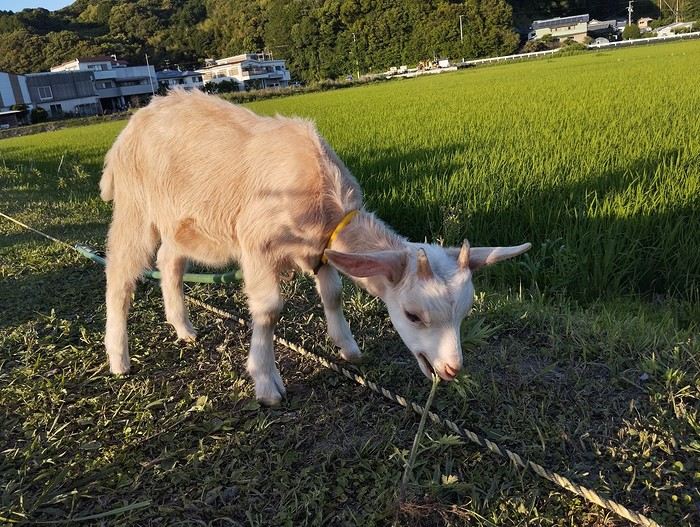
The site is in a rural, pastoral setting. It’s nicely arranged, and with the rice fields and the sun, the view is lovely. A few goats live here too, much to the delight of passersby.
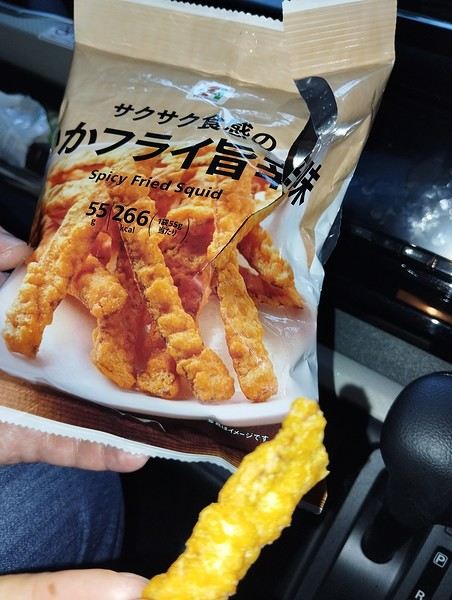
It’s time for the traditional boat ride. We arrive a little early, so we wait. We take the opportunity to snack on treats we bought at the konbini in previous days, like the octopus pieces. The taste is strongly briny with a slight “stale” flavor, and the texture is rubbery. We can say we tried it, but we won’t be doing that again. But we also try spicy squid appetizer crackers, and those we like.
Re: Southern Shikoku: Between Land and Sea, the Blue Waters of Miyakojima, and Finally the Megacity T
Day 6 - Stroll along the Shimanto River
The sun has set, but it’s not quite night yet.
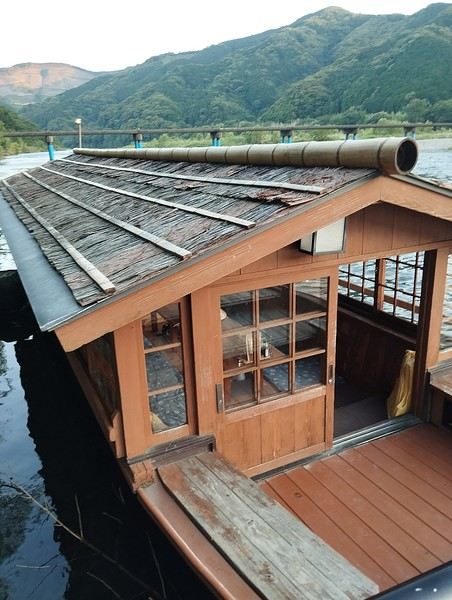
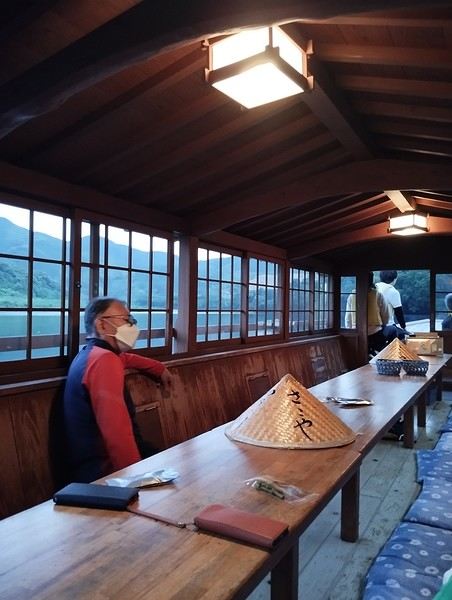
We board the beautiful traditional boat called a Yakatabune. Here too, we have to take off our shoes. Inside, a long low table divides the space into two parts. The boatman arranges the passengers by size and weight to balance the boat. Once everyone is settled, we start sailing. The boat has windows that can be slid open to feel the air and see outside.
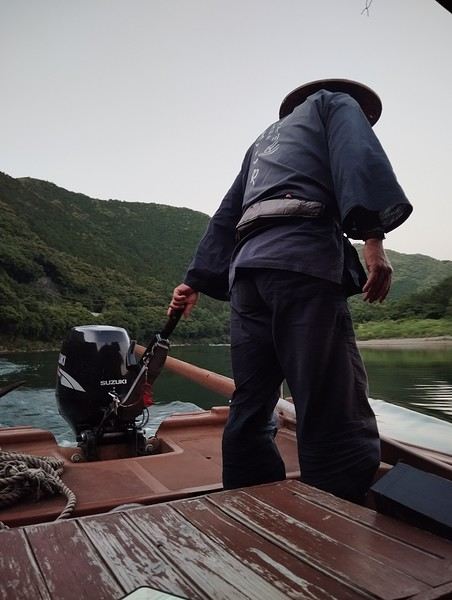
The boatman is really friendly. He explains a lot, even for us two—the only foreigners in the group—thanks mostly to the voice translator. The boatman used to be a fisherman, so he knows the river very well. We can see some photos of him in a small photo album he leaves out in the boat. He offers us some small Japanese appetizers. He tells us the river is 3 meters wide and the longest on Shikoku. You can fish for shrimp and eel here, among other things. We also learn that plastic bottles with trash are used to mark where fishermen’s nets are. He says some Japanese tourists think they’re just litter. I joke that maybe they want to pick them up. At that, the boatman bursts into laughter—a mix of shock and amusement. He quickly tells me that could never happen because those plastic bottles are private property, and taking them would be a crime.
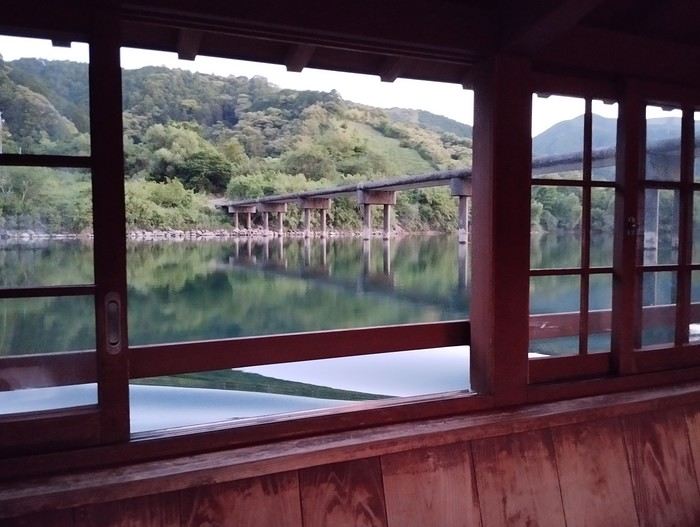
We pass under one of the region’s submersible bridges. They’re called Chinkabashi. These are bridges with no railings, and they’re quite low. They were designed this way to reduce the risk of being washed away by floods.
We enjoy the tranquility of the river, being the only ones out for a ride.
The boatman also tells us that the colder the water, the clearer it is. However, the color of the water—sometimes emerald, sometimes blue—seems to depend on the season.
Once night falls, we can see fireflies in different spots, glowing in groups. They shine with a bright light. It’s a natural spectacle that’s best enjoyed in silence, punctuated by a few “kirei” (beautiful/pretty) and “kawaii” (cute) from the older Japanese woman sitting next to me, who marvels with the innocence of an 8-year-old.
And it’s true—watching fireflies feels magical. You’re in the dark, watching carefully, and when the night lights up with glowing dots, you can’t help but feel joy.
Apparently, here in Shimanto, you can start seeing them as early as April, depending on the year.
The boatman asks if we have this kind of activity in France.
For the firefly-watching part, the boatman uses an “oar” to guide the boat closer to the shore once the motor is off.
The word for firefly is *hotaru*.
The excursion lasted 2 hours.
At the dock, a young man waits to help us back ashore.
We had planned to eat at the barbecue house, but given the time, we change our plans and decide to go to the izakaya recommended by our host. But it’s now 10 PM, and eating late in Japan is an adventure. When we arrive, the woman who greets us starts by saying no, then hesitates, thinks about it, goes to ask the chef, and finally tells us okay—but we have to leave in 45 minutes. We say yes because we know we won’t find anywhere else easily—or maybe at all.
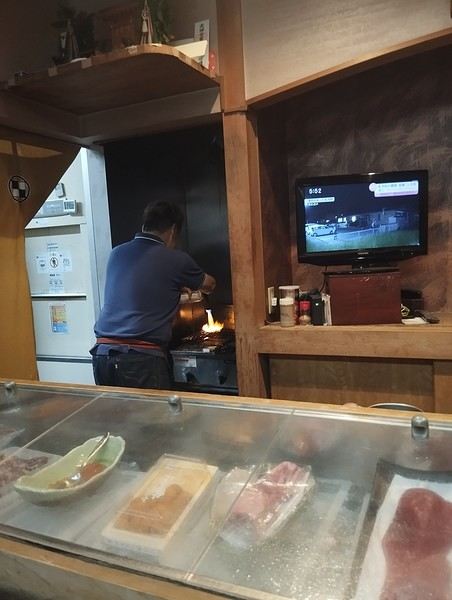
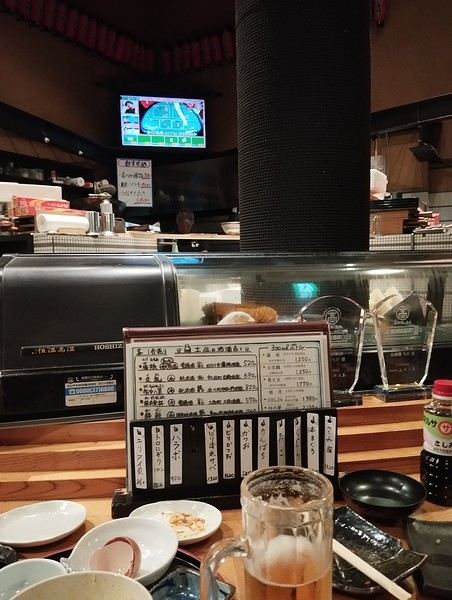
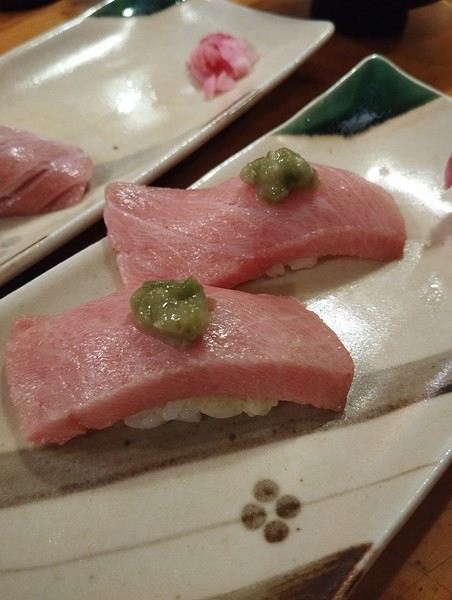
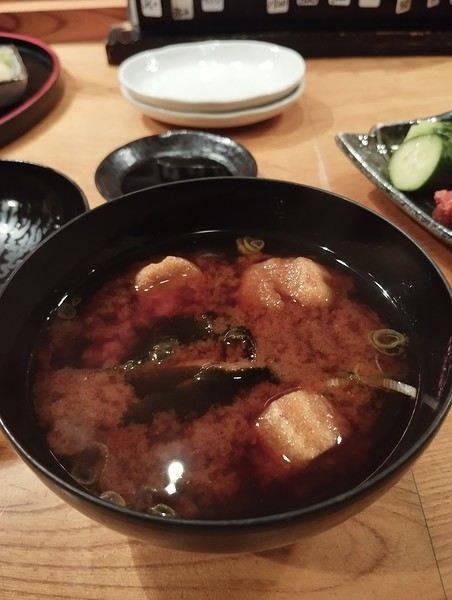
The vibe at this izakaya is really nice. We sit in a circle at the bar, with the TV in the background, customers chatting, and lots of chefs busy cooking, cleaning, and tidying up. We order quickly since we don’t have much time to look at the menu, but we end up loving it: the miso broth is excellent, the fried chicken karaage is amazing, the fatty tuna sushi is delicious, and the grilled rice onigiri is great—plus the cucumber. We chat a bit with the servers, especially one energetic grandma who notices I’m learning Japanese and announces it to the chefs, sparking some conversation. In short, it was short but sweet. We head back home afterward. Time to sleep.
Re: From Southern Shikoku, between land and sea, to the blue waters of Miyakojima and ending in the megacity T
Here’s an aspect of Japan that draws me in more than the cities [;)].
No worries about making yourself understood (without a voice translator) once you're there?
This might just inspire you to discover this side of Japan for yourself.
Without a translator, of course, if you don’t speak any Japanese at all, it can be tricky—but Japanese people often use their phones to translate. I’d say it depends on the situation: if it’s just to find a place, it’s not a problem because the Japanese will guide you to the spot you’re looking for. If you want to chat with them about yourself or them without knowing Japanese or English, it’ll be limited, though you can always communicate with gestures and eye contact.
From my four trips, even though I’ve picked up a little Japanese since my second visit, language never felt like a barrier—but obviously, we didn’t have philosophical debates. It’s also very personal; everyone connects with people differently.
Re: Southern Shikoku: Between Land and Sea, the Blue Waters of Miyakojima, and Finally the Megacity T
Day 7 - Heading to Cape Ashizuri
This morning again, we enjoy the house and garden while having breakfast there. We hit the road leisurely in the early afternoon. Today, we're heading all the way south toward the tip called Cape Ashizuri.
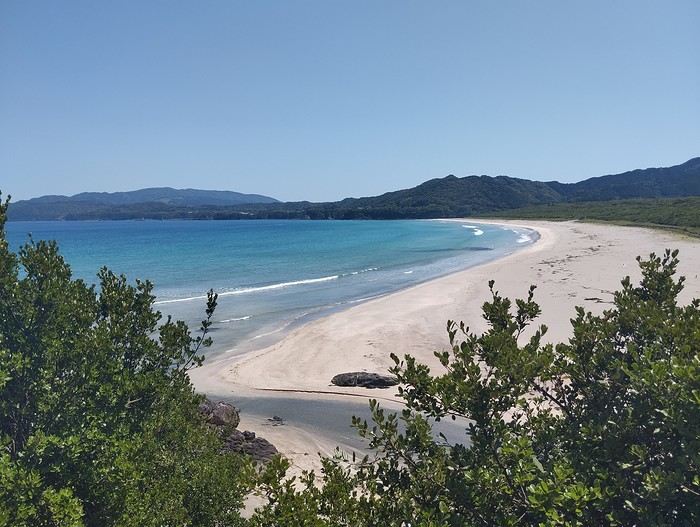
On Route 321, while I'm driving, a stunning beach suddenly appears on the left. As is often the case in Japan, where there's a spot, there's a well-placed parking lot right in front of it. I decide to stop and take a closer look. But I wasn't prepared for what I saw—a magnificent, nearly 2-kilometer-long pristine beach lined with rows of pine trees.
This is Oki no Hama beach. The view hypnotizes me and calls out to me. We decide to stop there. Since we're up high, we get back in the car and turn left five minutes later to descend to beach level. In the parking lot, there are only 5-6 vans belonging to Japanese surfers who are camping. They're napping, and their wetsuits are drying in the sun. Absolute tranquility reigns here.
A sign warns to watch out for *bahin*.
We walk along the beach, lulled by the sound of the waves gently rolling in and out. It's hot, and a breeze brings a bit of coolness. The heat combined with the beauty of the place makes me want to go for a swim. I had planned to do it later in the afternoon at Kashiwajima, but I decide to take advantage of this spot right away. I swim and see quite a few fish with the naked eye. I think this place must be great for snorkeling. The setting, with its lush nature, makes this swim really enjoyable—especially since there's no one around. Only a pilgrim walker comes by for a few minutes. Meanwhile, my partner takes the opportunity to go for a walk in the area. Total relaxation... I even dozed off for a mini nap while drying off, listening to the waves. But it's time for us to get back on the road. We head to the car, rehydrate, and an eagle flies overhead. We enjoy this wildlife spectacle, which has been a frequent occurrence during our stay in Shikoku.
Back on the road toward Cape Ashizuri, a totally surprising scene unfolds before us. Pruning work is underway, and as usual, there are many workers—but what really strikes us is that two workers are holding a screen to prevent debris from landing on the road where drivers pass. Another example of the pragmatism of daily life in Japan.
Further on, we stop at a gas station. As soon as the two employees see we intend to stop, they rush to guide us into a parking spot, then quickly ask what type of fuel and how much we want. We don’t even need to get out of the car—just roll down the window. While one fills the tank, the other has already grabbed supplies to clean the windshield, both outside and inside. It all happens so fast we barely have time to process it. Five minutes later, we're back on the road with a clean car and a full tank, having been guided out of the gas station as well.
We cross the road to go to the Sunny Mart supermarket to grab some snacks. As soon as we enter the store, staff greet us warmly. Here, you don’t go unnoticed. We find a tray of tuna sushi and sashimi, as well as some yellow watermelon. And in this rural spot, we see a sign for all-gender restrooms for the first time.
After shopping, we hit the road again and finally arrive at our destination.
The cape is accessible on foot via hiking trails surrounded by tropical plants. There are different paths, so you don’t have to take a linear route.
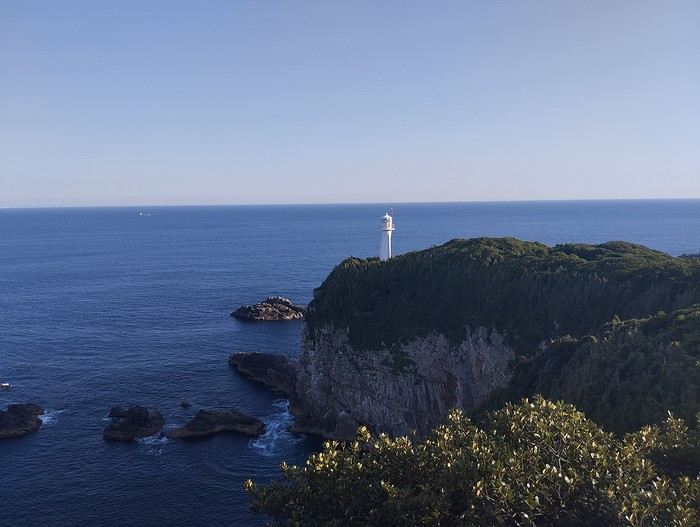
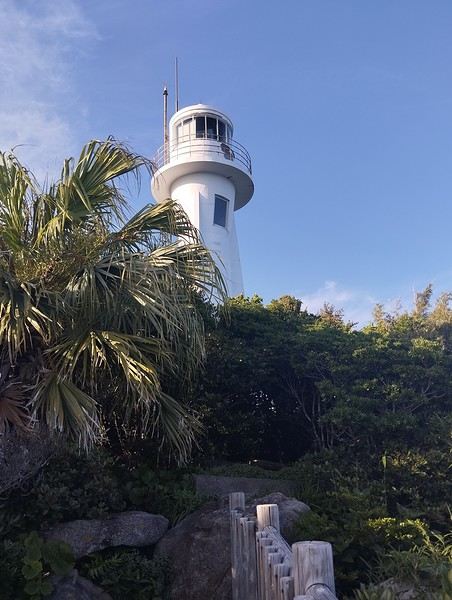
At the observatory, we have a clear view of the white lighthouse perched on a promontory in the distance. The Pacific Ocean stretches out before us as far as the eye can see. The site is quiet at this hour; we only cross paths with about four Japanese and Spanish tourists.
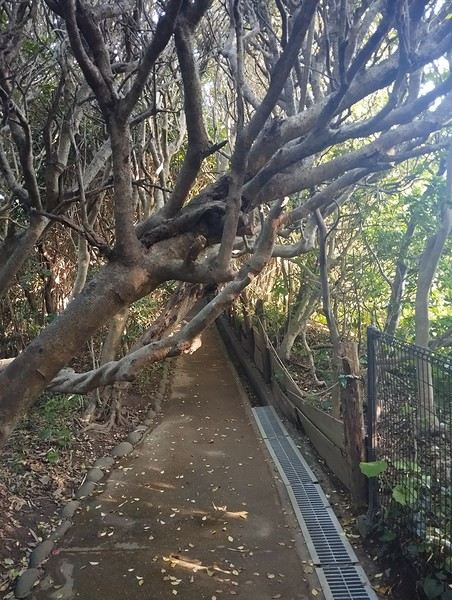
From the observatory, we take the trail along the coast, which leads us through a tunnel of trees.
Re: From Southern Shikoku, between land and sea, to the blue waters of Miyakojima and finally the megalopolis T
Day 7 Follow-up - Heading to Cape Ashizuri
This contrast between sea and forest is really interesting. Then the lighthouse appears, towering over the steep cliff. It’s all white and dates back to the early 20th century. It’s surrounded by palm trees—definitely a tropical vibe.
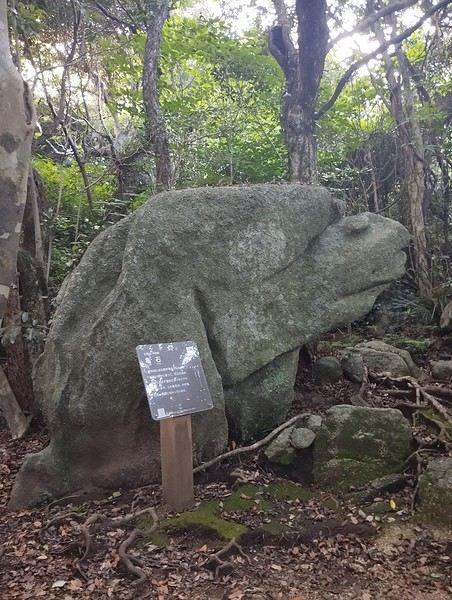
Next, we pass a turtle sculpture (kameoshi) and decide to continue along the coast.
Wooden signs point out several different points of interest. The one we picked is supposedly only 600 meters away. However, the path, which had been flat until then, turns into a mix of uneven stone and dirt staircases, with some steep climbs and descents. It’s pretty steep. With the humid heat, this walk suddenly becomes much more of a workout—but we keep going, even though the 600 meters feel way off.
Finally, after a climb, we reach a fork: one path is a steep descent toward the sea, and the other leads who-knows-where since there are no more signs. We take the stairs plunging toward the ocean, and the view opens up, giving us a breath of fresh air. On his way up, a young Japanese man passes us. My partner, who’s faster, is already chatting with him by the time I catch up. He seems eager to talk, and we get to know him a little. He lives in Miyako, in the Tohoku region, and works on large fishing ferries. He explains that working on ferries is tough—he starts at 6 PM and finishes at noon the next day. He’s currently on a two-week break. He’s visited Matsuyama and Uwajima. When we tell him we’re here for a month-long vacation, he’s shocked. He also teaches us the Japanese word for butterfly.
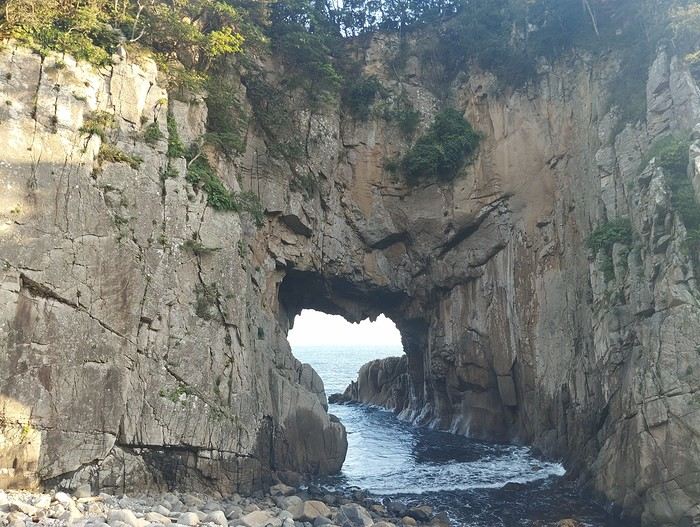
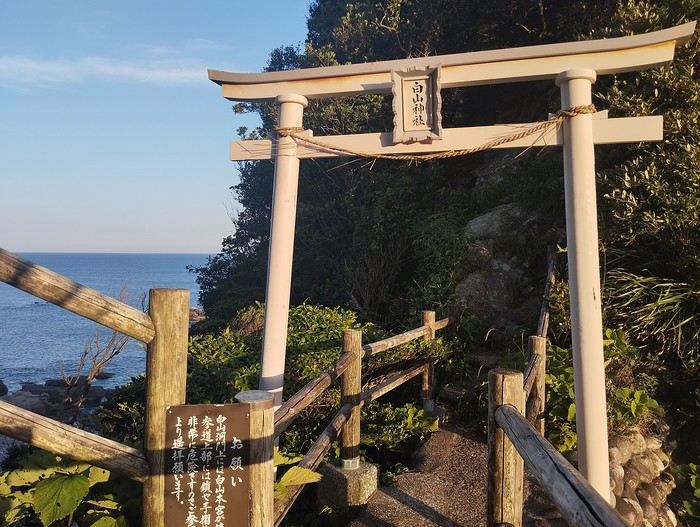
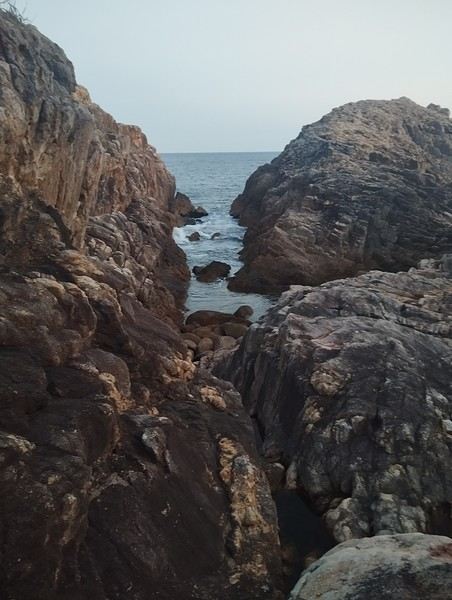
After this chat, we finish the descent and finally reach Hakusan Cave, carved out by marine erosion. It forms a heart shape. The cave is said to be 16 meters high and 17 meters wide. The waves crash in, sending us a salty, invigorating spray. As expected in Japan, benches have been set up so you can enjoy the view—and we do, all alone since there’s no one else around.
We then retrace our steps, passing under the torii—the spiritual gate of the place—again. At this time of day, it’s bathed in the soft evening sunlight.
Despite the lack of clear signs, we easily find another path, partly along the main road that runs through the park, and make it back to the car without running into any wild boars.
Just before that, there’s a sort of quarry with Buddhist statues. Nearby is Temple No. 38, I think—maybe there’s a connection.
Anyway, we hit the road again to visit Ryugu Shrine. It’s only a 15–20 minute drive, but part of the route is through a mountainous area with narrow roads.
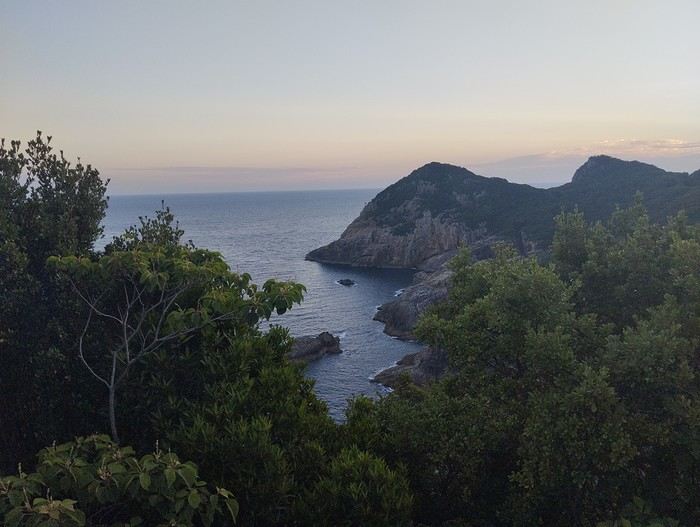
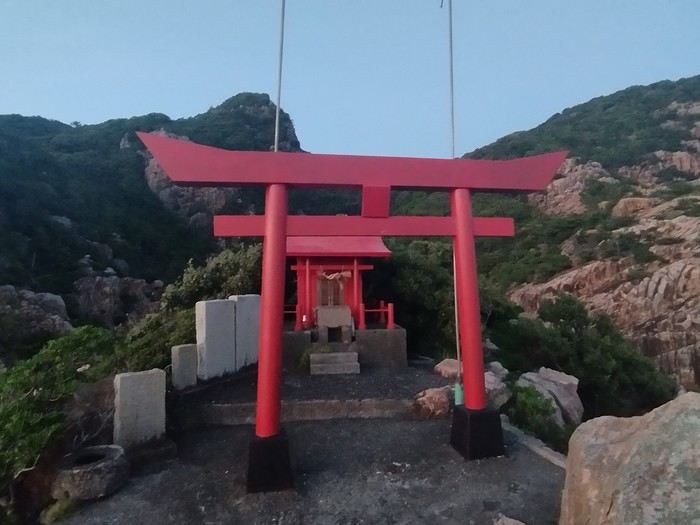
The entrance to the shrine is very discreet. Again, it’s a forest path, and the shrine isn’t far, but you have to reach the sea. To get there, we walk through a tunnel of trees, descending a stone staircase. The descent is tough, but at the end of the tunnel, we emerge from the shade—almost darkness—cast by the trees, and the view that greets us is spectacular. The ocean, cliffs, a lighthouse, pink rocks—it’s an incredible panorama, and once again, there’s no one else around. Still, we have to walk a little further to reach the shrine, which is tiny but right by the water.
The shrine is said to be dedicated to a sea goddess. Legend has it that women from the area would come here after their men had gone out to sea. They’d dance with their kimonos open, revealing themselves to the sea, hoping their god would grant them a pleasant surprise.
When we finally decide to leave, the sun has already set. In the tunnel, we have to turn on our phone flashlights—we didn’t bring headlamps since we didn’t expect to need them. We pass a small group of Japanese fishermen heading down to the shrine, all properly equipped with their headlamps.
After this beautiful nature-filled day, we head back home.
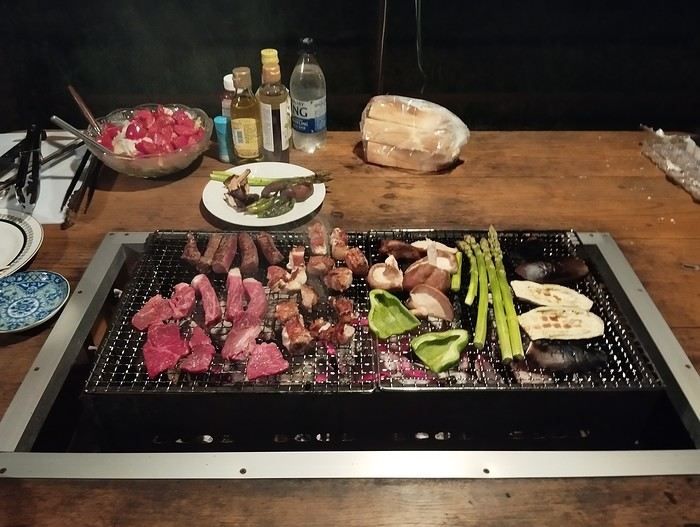
It’s our last night in the house, and we end on a high note with a barbecue. We bought some local wagyu, veggies to grill, and ingredients for a salad. The barbecue rental is 500 yen per use. It works on an honor system—the payment goes into a piggy bank in the kitchen. The same piggy bank is used to pay for drinks and a few dry goods available for sale in the kitchen. We didn’t have to buy charcoal since the previous guests had left some, so the manager told us to use it.
We enjoy this last evening under the starry sky, our taste buds delighted, though a little sad to leave this house and the area we’ve grown to love—there’s still so much left to explore. The tranquility of Shimanto and its surroundings, the natural landscapes between mountains, sea, and rivers, offer one of the most pleasant sides of Japan.
Re: From Southern Shikoku, between land and sea, to the blue waters of Miyakojima and finally the megalopolis T
Day 8 - Departure from Shimanto to Uwajima
The time has come. We have to leave this house that welcomed us for 3 nights. That’s probably why we’re a bit behind schedule. Japanese punctuality, on the other hand, never changes. The housekeeper is here. She smiles and stays calm despite what I imagine is an inconvenience in her schedule. To avoid losing too much time, she starts by taking care of the garden while we rush to finish packing and load our things into the car. Despite everything, aside from taking out the garden trash, she doesn’t have much to do, so she’s just waiting. So there I am, chatting to keep her patient, feeling a bit guilty inside for making her wait. But she shows no sign of irritation—she seems completely zen. Oh well, all the better. Once everything is in the car, we give her the green light for the house, repeating *gomenasai* (sorry, sorry) over and over. We say goodbye, and she doesn’t waste any time getting to work.
As for us, we finish loading the car before hitting the road under a magnificent, blazing sun. The plan for the day is mainly to reach the city of Uwajima. We have about 2 to 3 hours of driving ahead. To break up the trip, I looked for a place to stop for lunch roughly halfway. The road is pleasant, winding through the countryside. It’s always a joy to drive through the villages. Thanks to Google Maps, we can spot addresses, but most importantly, the comments and photos from other travelers give us extra tips—without which, in some cases, we might never have found the places, especially in a country where we can’t read the language and the alphabet is completely unfamiliar. For instance, today at this restaurant, a small sign in one of the photos helped me spot the place without any trouble.
We park nearby, following other cars’ lead. The restaurant is on a lane bordered by houses, with mountains across the way and rice fields at their base. We decided to eat early today because the Google reviews advised it, mentioning that you often have to queue.
We arrive shortly after the restaurant opens, around 11:15 AM. The sign for the restaurant is at the foot of a staircase. At the bottom, we discover a lush, exotic garden. The higher we climb the steps, the more we uncover an intimate space—a small terrace to wait for a table and a cozy seating area surrounded by plants. Someone is already waiting. A woman comes out of the restaurant and gestures for us to write down our names and wait. How long? No idea, but we comply. We take the opportunity to get a closer look at the outdoor area, which isn’t visible from the road at all. Two young men arrive and add their names to the waiting list. Then a woman shows up, soon joined by a friend, who doesn’t hesitate to call out to us from her bench. She speaks to us in English, asking where we’re from and how we found this place. She quickly wishes us a great trip. Finally, it’s our turn. We’re invited inside. The restaurant isn’t big, as is often the case. There are two tables for two, four seats at the bar, and six by the window with a view of the exotic garden, the rice fields, and the mountains in the distance. And guess what? We’re lucky enough to be seated at the bar by the garden! So cool. The setting is amazing!
There’s no internet here, and the waitress doesn’t speak English, so we’re left with a menu in kanji. Okay, we’ll improvise. Our table neighbors—the woman who spoke to us and her friend—are here too.
We ask the waitress a few questions, but it’s clear it’ll be tough to get explanations about the menu. So, to keep it simple, I use a screenshot of a ramen dish from the restaurant that I saved when I first spotted it on Google Maps to place our order. As for my partner, he chose at random.
Even though they arrived after us, the two women ordered before us, and their dishes look deliciously gourmet. The online reviews suggested this was a top spot, and the first impressions are very positive. The only downside? There are no drinks except water. So much for the ice-cold beer we were dreaming of to go with our ramen. While we wait, we enjoy the lush green landscape stretching out before us. And then our dishes arrive. They look appetizing, and we can already tell we’re in for a treat. The aroma is making our mouths water. Then comes the moment of truth. And wow—what a culinary punch! This is gourmet ramen. The broths are perfectly crafted—flavorful, delicate, and far from your typical ramen. These dishes have bold, distinct identities. One of our neighbors ordered a miso and tomato ramen, which also looks amazing. During the meal, the woman chats with us some more. We talk a bit more. She’s Japanese but lives in Miami, Florida. She’s back in Japan to take advantage of the more favorable Japanese healthcare system compared to the American one. We also discuss our trip and our plans for visiting the area. Then everyone finishes their meal in peace.
I can tell you this ramen restaurant is more than excellent, and even though it’s in the middle of nowhere, if the opportunity arises, I’d happily drive three hours just for the chance to taste their other ramen dishes. In the kitchen, there’s a grandmother whose smile brings you joy, and a young man—maybe it’s a family-run place.
We drive on to the small village of Sotodomari Ishigaki no Sato (the stone-wall village) in the town of Ainan, Ehime Prefecture. The village is located on the Sakai Peninsula. It was built between the late Edo period and the early Meiji era. At the time, the population of the neighboring village of Nakadomari grew rapidly. Lacking space to accommodate everyone, the village chief proposed that the second (or youngest) son of each family move there. That’s how the village was created.
The village is perched on a steep slope overlooking the Uchiumi Sea. The houses, stretching up the mountainside, are adorned with carefully stacked stone walls that rise up to the eaves to protect the homes and their inhabitants from typhoons and seasonal winds.
This village, with its unique row of houses, was selected as one of the “Most Beautiful Villages in Japan” by the Ministry of Agriculture, Forestry and Fisheries and is also listed among the “100 Most Beautiful Historical and Cultural Fishing Villages to Preserve for the Future.”
In 2007, it was also chosen as one of the “100 Most Beautiful Historical Landscapes of Japan” by the Foundation for the Preservation of Ancient Capitals, making it a major picturesque site of stone-wall culture, a symbol of Japan.
We didn’t know any of this when we visited. We stumbled upon it by chance while searching on a GPS map, so it was an unexpected discovery.
The place is small and remote, so tourism isn’t very developed here.
We’re greeted by a curious cat. Then we run into a group of four Japanese visitors. They’re here to participate in a marathon nearby the next day and are taking the opportunity to explore.
Though small, the village is charming to discover as you wander its steep alleys. Some houses are well-maintained, while others are less so. The village still seems partially inhabited, though we didn’t see any locals. Painted pebbles scattered throughout the village add a playful artistic touch. Probably on weekends, the gallery is open, but not today.
The higher you climb, the more the slope offers a stunning, unobstructed view of the village and the sea surrounded by mountains. You can even spot pearl farms, as the region is famous for them. The sun lights up the landscape, making it incredibly peaceful.
We pass by the renovated oven where women used to cook while waiting for the men of the village, who mainly lived off fishing at the time.
On the way down, we walk past the well-kept cemetery. A Japanese woman is there, paying her respects at her father’s grave.
At the port, all is calm, but the crystal-clear water reveals plenty of fish, some with bright electric-blue hues.
This village is so peaceful and gave us yet another glimpse of Japan and Shikoku.
The next part of our adventure takes us down a very narrow, winding road through a tunnel of trees, where we spot and hear monkeys jumping from branch to branch. We also see what looks like a nutria. The seaside road is wild, and nature thrives here—flora and fauna in full freedom. Branches and rocks litter the road. We drive carefully.
At the top, we park at the scenic Cap Koumo parking lot. Only one other car is there.
As soon as we step out, we breathe in the fresh air and feel a sense of freedom. Cap Koumo is located in the heart of Ashizuri-Uwakai National Park. We take the walking path, which gradually descends to offer a breathtaking view of the 80- to 100-meter-high cliffs, shaped by the ocean and wind. Nature is grand here. We cross paths with a Japanese grandmother and her grandson, who are leaving. We have the place to ourselves. And apparently, so do the snakes. On the way back up, my partner freezes when he spots a very long, thick snake that also freezes before slithering away. We also enjoy the sight of eagles soaring over the cape. A refreshing nature break.
Re: Southern Shikoku: Between Land and Sea, the Blue Waters of Miyakojima, and Ending in the Megacity T
Day 8 – Departure from Shimanto to Uwajima
It’s time to head back toward Uwajima. Leaving Cape Koumo is pleasant because this time we’re taking the other side of the peninsula on a downhill ride. We keep an eye out for wild monkeys. We pass through seaside villages where life flows gently. It’s an unfiltered face of the world that gives the feeling of being at the edge of it.
The need for a break leads us to stop in a parking lot at the end of a village. And by chance, we discover a lovely spot—the small but very cute Mishima Shrine in the village of Tsushimacho Harigi. Unlike the usual wooden shrines, this one is all white. It sits by the sea next to this port village. We can’t resist a little stroll to the harbor. The water is once again absolutely transparent, filled with colorful fish. The boats and buildings connected to the sea by bridges offer a truly picturesque photo of Japan. Eagles soar above the village. It’s so peaceful.
We’re lucky enough to meet a man who strikes up a conversation—surprised to see foreigners here and wondering what we’re doing. It turns out he’s a pearl farmer in this bay. He works with his wife, mother-in-law, and two other people. We learn that it takes a year to produce a beige pearl and two years for a shiny one, which is therefore more valuable. He doesn’t work in January or February because it’s too cold. Another man from the village, out walking his 8-year-old Shiba Inu, joins the conversation. He introduces us to his dog and explains who we are. The four of us chat. They ask about our travels in Japan and realize we know the geography of Japan “better” than they do since they rarely travel. The pearl farmer, however, has been abroad. For his honeymoon, he went to Cancun, Mexico, and he’s also visited the United States—Los Angeles and Las Vegas. As for the man with the dog, we share knowledge of Miyako Island in Okinawa Prefecture.
We talked for a while before parting ways. We enjoy the sunset reflecting on the water, offering a magnificently romantic view.
After this mid-journey interlude, we finally drive the last hour to our hotel—the cheapest of the trip. It’s an excellent surprise. For less than 50 euros, and based on the photos we’d seen, we had some apprehensions, but it’s much better than expected in terms of value for money. First, we have a reserved parking spot right in front of the hotel. And it’s serious business—a white-and-orange striped post with our name on it marks our spot. Every time we park, an employee rushes out to remove it so we don’t have to get out of the car, guides us into the space, and puts the post back when we leave. What incredible service!
The room isn’t luxurious, of course, but it’s not as small as we’d imagined. Plus, there are unlimited drinks available 24/7, fresh fruit juice for a snack, free bath salts, and all the usual amenities (razors, cotton swabs, etc.) at our disposal.
We arrived late, so after checking into our room, we quickly set off in search of a restaurant. As mentioned earlier, given the time, we need to hurry. Plus, we’re in a small town, so it’s quieter.
We’re in front of a restaurant but can’t quite tell what kind of place it is. We ask a young man passing by, not expecting it would lead to another lovely encounter. We ask him for a restaurant that’s still open at this hour and, more importantly, a good one. As always, he thinks seriously before giving us a name. With no internet, he eventually decides to take us there himself—it’s much simpler. We walk for about 10 minutes. He takes us to what he considers the best izakaya. Along the way, we chat a little. He’s 18 and a student.
The izakaya is near a canal, tucked away in little-known streets, on the second floor of a building. He comes up with us to introduce us and explain our arrival. We’re on the restaurant’s landing, the door slightly ajar, and the young man explains that we’re French and looking for a good, open restaurant, which is why he brought us here—because, in his opinion, it’s the best izakaya.
The staff is surprised to see French people and touched that the young man thought of their restaurant. They give us a very warm welcome because we’re their first French customers.
As for the young man, to thank him for bringing us to their restaurant, the owner invites him to eat for free. He’s seated at the counter while we’re given a table for four. It’s tiny—just two tables, two private rooms, and a bar.
The atmosphere is family-like and very laid-back. You can really feel the love. We receive a fabulous welcome. The owner, Yuki, comes to explain the dishes, offers us a bottle of sake, chats with us, and tells his regulars that we’re his “best friends.” In short, the evening unfolds in a joyful atmosphere, and the food is great. The team jokes around, and we laugh with them. The izakaya’s specialty is chicken. We try, for example, a cherry tomato wrapped in fried chicken skin. We also eat sashimi of a fish called Kibinago, which we discovered and particularly enjoyed on our last trip.
The young student eats heartily (omurice, ramen, karaage).
When the restaurant quiets down, Yuka-san, the owner’s wife, comes to talk to us. We chat with her for at least an hour in Japanese, sometimes using a voice translator. She and her husband have rented the restaurant. They’ve been married for 20 years but never had a honeymoon because they’ve been too busy. Her dream is to go to France, but it’s expensive and requires time off.
She’s been to Korea, Hawaii, Tokyo, and Osaka because their 21-year-old son lives in the latter city.
Yuka is so cheerful. She seems to have the innocence and joy of an 8-year-old, and it’s refreshing. She’s thrilled to welcome French tourists. They’ve maybe had Americans three or four times. She gives us some sightseeing tips.
The night is well underway, and it’s time for us to head back to sleep after such a great day.
Re: Southern Shikoku: Between Land and Sea, the Blue Waters of Miyakojima, and Finally the Megacity T
Day 9 – Uwajima
After my long rant, I’ll keep it short for today’s story. Also because the day was more relaxed. We stayed up late last night, so this morning, Morpheus put us back on track. We took our time waking up, and it’s nice to slow down sometimes during a road trip. As a result, only one activity today—but not just any. We discovered the grand and splendid Nanrakuen Garden. It’s the largest garden on Shikoku.
Entry fees for gardens in Japan are usually affordable, but this one is a steal. 160 yen per adult—about one euro. That’s the first pleasant surprise.
Right after the entrance (and exit), there are several stalls with local food, like a mini market. There’s also the garden’s shop with lots of local products. You can grab an ice cream and relax near the bay windows, which offer a clear view of part of the garden.
After checking it out, we started our floral stroll. There were a few Japanese tourists. The place is peaceful and full of different spots: two ponds, flower-lined paths, lots of irises this season, a waterfall area in the forest, several red bridges. Each of these spots can be seen from various angles, offering a different perspective depending on where you stand. There are plenty of places to sit and escape the heat. You can also go boating. For this activity, there’s no supervision—just a few boats docked, and you drop 100 or 200 yen into a free-standing box before rowing on the water. You can buy duck food the same way if you’d like.
--Walking around is incredibly bucolic, despite the mugginess under the gray sky that followed us all day.
--Walking around is an invitation to contemplation.
--Walking around is an ode to Japanese gardens, and I’m surprised it isn’t more prominently featured in tourism. It’s one of the most beautiful Japanese gardens I’ve seen so far.
Tonight, there’s an illumination event in the garden, but it doesn’t start until 7 PM. The entry fee isn’t increased for the event. If we’d known, we would’ve come later to see it by day and night. Still, the daytime visit was enchanting. We spent several hours there.
We got back in the car and headed to a café by the sea. We drove through coastal villages where daily life seemed to unfold peacefully—like the group of grandmas sitting by the road chatting, fishermen of all ages waiting for a bite, or joggers going about their usual run.
We also noticed lots of people walking dogs, especially Labradors. I mention this because dogs are generally rare in Japan, and when you do see them, they’re usually small. But here in Shikoku, there are not only more dogs, but they’re often larger breeds. Maybe—rightly or wrongly—I associate this with the very natural environment, which gives a sense of space and makes it easier to care for a dog. I don’t know for sure, but the observation stands.
After driving along the coast for a while, the GPS said we’d arrived—but there was nothing, just the sea, a young man fishing, and a narrow road. I got out of the car to ask him. He didn’t know but pointed to a sign down the road written in kanji, making a cross sign to indicate it was closed today. I took a photo of the sign to translate later at the hotel with Wi-Fi. We learned it was an exceptional closure.
We turned around and headed back to the hotel. In the parking lot, as usual, we laughed at the staff welcoming us like stars, removing that famous nameplate for us and putting it back when we left again. We’d spotted an izakaya we wanted to try. Though it wasn’t far, we decided to drive. We parked, but nothing indicated it was the right parking lot for the restaurant. A young woman greeted us at the restaurant and made it clear it wasn’t the correct parking. She struggled to explain where their parking was, and we couldn’t find it after getting back in the car. We didn’t want to risk getting blocked in a parking lot again, like we had on two other trips. So, we went back to drop off the car at the hotel and walked to the izakaya, which wasn’t too far.
At the restaurant, we were seated in a traditional private room on the floor. From a standing height, it seemed high, and my partner misjudged the distance between his backside and the floor—nearly knocking over the partition separating us from another private room. His fall and the loud noise startled the people in the other room. The noise of the fall plus their gasps drew all eyes to us for a good five minutes. Luckily, the partition wasn’t broken, just moved. A server fixed it, and life in the restaurant went back to normal.
Here, too, there was no menu with photos. The staff, who only spoke Japanese, seemed uncomfortable serving foreigners. They were hesitant but eventually took the plunge. Despite the communication challenges, we managed to order enough to fill our stomachs. On the menu: karaage (fried chicken), beef tongue, egg, onigiri, beef skewers, and gyoza. It was good.
The izakaya was packed, and the conversations were lively.
Re: From Southern Shikoku, between land and sea, to the blue waters of Miyakojima and finally the megalopolis T
Day 9 - Yusuhara
After a little break, I’m continuing the travel journal. Thanks for your patience!
This morning, like many others, was no exception—we headed to the holy grail: the 7-Eleven konbini to grab breakfast. We’ve become fans of their fresh, cheap smoothies, not to mention the must-have fried chicken. Though I sometimes cheat and go for a *curry pan* (hot bread stuffed with curry), which has a spicy, bold flavor I really enjoy.
We then set off on our road trip pilgrimage. We wanted to stop at Ayukaeri Falls, but it seems Shikoku’s waterfalls are trickier to find than we thought. We ended up driving in circles, going a little crazy. Having internet at that moment—and other times—would’ve probably helped. So, we hit the road again, feeling a bit defeated. As we drove through the peaceful Japanese countryside, alternating between mountain landscapes and rice fields, passing through villages big and small, something familiar caught our eye. We knew we weren’t imagining things when we spotted it again a little further down the road.
It was Mamoru-kun, the iconic police officer from Miyakojima (Okinawa). A cop who’s always smiling, stands strong against typhoons, and never takes a day off—always warning island residents about road dangers. Apparently, Shikoku cloned Mamoru-kun, and seeing him here in unfamiliar territory made us smile. What an adventurer!
So, where were we headed today?
Well, we were returning to Kochi Prefecture for a few hours. The destination was chosen for its architectural appeal: the small mountain town of Yusuhara, in the northwest part of Kochi.
What makes this town special is that it inspired the style (local materials, environmental integration, and a home-like feel) of the famous Japanese architect Kengo Kuma when he visited a friend in 1992. That’s why this tiny town of barely 3,000 people has six buildings designed by him.
We started by visiting the stunning and impressive library. From the outside, the building has style and invites you in without being intimidating.
You have to take off your shoes to explore it in socks. The visit begins in the café area, with a few round tables where you can snack and read. As I moved further in, I caught a glimpse of the main space. It was both calm and lively—kids moving around, background noise from a TV in the lounge area, and the first bookshelves coming into view. The children’s section is sunken, with all-wood shelves and a cozy nook for playing and reading. And incredibly, there’s even a nursery where moms can warm up milk or take care of their babies.
In this space, a man was drawing characters from books. He struck up a conversation with us, and after a little chat, I left him to continue exploring this soothing and warm library.
When you’re in the main space, you notice the soft light filtering in through the large windows that outline the building. There’s also a grand piano, and you get a sense of space and height created by the wooden "stalactites" and the various staircases leading to other areas—the adult and teen sections, as well as several cozy, cocooning rooms. Teens also have their own corners on the ground floor for climbing or just hanging out with friends.
The place is absolutely gorgeous, and the trip was totally worth it. Plus, I left with another gift—the young artist I’d chatted with earlier ran after me in the library to give me two of his drawings. They’re characters from books.
Books, manga, magazines...
I could’ve happily settled in for the afternoon, reading now on the grand staircase, now on the lounge sofa, now in one of the private rooms. But the rest of Yusuhara awaited us, and this little immersion was already so enjoyable. A place like this can only make you want to read more.
We continued on to Mishima Shrine, accessible via the Miyuki Bridge that spans the town’s river. At the end of the bridge, the shrine unfolds in the heart of a forest, as evidenced by a 400-year-old fir tree.
We then took what was called the *Dappan Road*, regularly used by Ryoma Sakamoto and his group of samurai (key figures in the overthrow of the Tokugawa shogunate). This path leads to the samurai tombs and a traditional house, all while offering a panoramic view of the town.
Re: Southern Shikoku: Between Land and Sea, the Blue Waters of Miyakojima, and Finally the Megacity T
After turning back to head into town, we found ourselves strolling down its main street where few people were out and about. There were a few shops, but not many, and a lot of them were closed when we passed by. A café selling whole-bean coffee and brewing it on-site was open.
Characters kept us company all along the street.
We discovered another architectural building, the market, Machi no eki. This building has a thatched roof. Inside, you’ll find local food and non-food products.
Game meat
We continued our walk through the lower streets, eventually making our way back to the river and another bridge.
We headed toward the bronze samurai statues near a cemetery and a vegetable garden. Along the way, we came across a very elderly man sitting in a chair, gathering his sweet potatoes—a quiet village life scene.
The samurai statues have a proud presence, thanks to their size and dynamic poses.
We made our way back to the town center through the narrow streets lined with houses.
Re: From Southern Shikoku, between land and sea, to the blue waters of Miyakojima and finally the megalopolis of T
The walk continues with a visit to an old thatched-roof house.
We had planned to take the scenic route to Shikoku Karst next, but the sky wasn’t clear. We decided not to venture onto a mountain road with limited visibility to make the most of our walk. So, we cut our visit short and headed back to Uwajima. We wanted to go to yesterday’s café, so we took the same route back.
Before heading to the café, we stopped at a very special shrine in Uwajima: Taga Shrine, where people pray for longevity, good health, and fertility—hence the suggestive objects you’ll find there.
We reached the shrine from our hotel, where we’d left the car in the parking lot. It was about a 10-minute walk—we passed through a residential neighborhood and along a river. A florist’s child seemed intrigued by our presence.
We then returned to the café, which had been closed yesterday but was open this time. A sign at the bottom of the hill instructed visitors to leave their cars there since there were only two parking spots, reserved for those who had made reservations.
So, we walked up to the restaurant overlooking the sea, though in the end, we could’ve parked since there were no other customers.
The restaurant/café felt like stepping into a home with a mix of Japanese, English, and Irish styles. The woman who greeted us seemed surprised to see us but welcomed us after a few moments of hesitation at the sight of foreigners.
You have to order before sitting down. There were a few language barriers and some items weren’t available at that hour, but we managed to place our order and headed upstairs (the only option) to settle in. It was small and quirky but charming.
Since there were no other customers, we had our pick of seats. There was a cozy family area with sofas and a TV, like being at home.
There was also a bar area with a sea view, but we opted for the veranda space with two armchairs facing the ocean. The view through the window was incredibly zen, despite the gray sky. The vegetation was right at the foot of the building, so we watched all sorts of insects and birds pass by through the glass.
The woman brought us our colorful, chilled drinks and sweet treats—a kind of matcha tiramisu, rich and smooth.
Everything was perfect, or almost—the air conditioning was blasting, making it a bit chilly despite the heat outside, but the view and the treats made up for it.
The sweets whetted our appetite, so back at the hotel, we took some time to look for a restaurant for dinner before setting out on foot. We decided on a sushi master’s place.
Walking in felt like stepping back in time to the Showa era, with the sushi grandpa welcoming us without fuss and inviting us to sit down.
Grandpa sushi was a master at his craft—his knife skills, the speed of service, his intense focus on every task, and the quality of the dishes (fish/seaweed, omelet) spoke for themselves.
At first, conversation wasn’t really flowing—he was so focused, and probably hesitant to talk to foreigners given his age. Grandpa was assisted by his wife and their adult daughter. Honestly, the family seemed worn out from work—the mother was hunched over, the daughter looked depressed, and every movement seemed to cause them pain. Grandpa often had to step in to help. For example, the daughter was very slow, distracted, and struggled to answer the phone correctly. I don’t know how old grandpa was, but I’d easily guess over 80. Seeing them work so hard until they could barely stand was heartbreaking. I wondered why they kept going like this—was it to make ends meet? Because work was all they knew? Or some other reason?
About 15-20 minutes after us, a couple walked into the restaurant. A little surprised to see us, they still came in and sat to my left. The counter had six seats, so there were now four of us.
We’d ordered omakase—it’s simpler when you don’t know the fish, and I love the idea of letting the chef guide us. Plus, grandpa spoke very quickly and wore a mask, so understanding him was really tough.
You can still specify some preferences for omakase. In this case, we mentioned we didn’t want any cuttlefish, for example.
We enjoyed our sushi while the couple next to us placed their order. Seeing them order an onigiri reminded me that it was one of the restaurant’s specialties, so I pointed to their plate and ordered the same. But grandpa didn’t understand us. The husband from the couple helped us out, and that’s how a long conversation and many laughs began.
He recommended the miso soup, and it was delicious—one of the best we’d had so far, with a strong but not overpowering fish flavor.
We also asked for plum and shiso maki, like the couple. Interesting!
We also tried a sushi with Hajzi fish (not sure about the spelling), a white fish with gray skin, firm yet melting in your mouth.
As for the couple, the man was a former fugu restaurant chef. He’d closed his restaurant in February this year. Too bad—we would’ve loved to eat at his place. He showed us photos of the dishes he’d prepared, and they looked amazing.
He asked how we’d found this little restaurant tucked away on a dimly lit street—he said it was excellent. He explained to grandpa sushi that we’d found it online. Thanks to our chat with the couple, grandpa relaxed a bit, connecting with us more, though he never lost his posture or intense focus. The atmosphere shifted in minutes—it just takes a little to break down barriers and share good moments.
We even teased the fugu chef about his supposed wealth from fugu, and it didn’t kill the mood. He got our joking spirit! The man had a Porsche, knew ambassadors from some countries (Estonia), and owned a boat. Just to clarify, none of this necessarily indicates their wealth—it’s just what we teased him about.
The couple had also traveled in Europe, especially Italy and France, and as a good chef, he loved Chianti and Burgundy wine.
Another person sat at the counter next to my companion, and the man struck up a conversation with them too.
The evening continued like this, with chatter and delicious food. Special mention to the nori seaweed—it was soft and tender.
But all good things must come to an end. The couple wanted a photo, so the man handed his phone to grandpa to take a picture of us. It was hilarious—grandpa didn’t even seem to know how to use the phone and called his wife for help, but she wasn’t much better. They’re still living in the past here! After 10 minutes of explaining how to take a photo, we finally got our souvenir shot, and it was time to say goodbye. The couple told us they’d had a great time and wished us a good trip. Now it was just us with grandpa and his wife—their daughter had gone to lie down as soon as she could. Grandpa even asked us more freely if we’d enjoyed our meal. We reassured him, and a big smile spread across his face.
All in all, an excellent culinary and sharing experience.
Plus, we paid very little for a sushi restaurant, especially given the quality and quantity—less than 13,000 yen for two, or about 40 € per person.
We ended the evening walking back to the hotel in a light rain.
Re: From Southern Shikoku, between land and sea, to the blue waters of Miyakojima and finally the megalopolis T
Day 10 - From Uwajima to Matsuyama
It’s time for us to leave Uwajima. Rain is keeping us company this morning.
We head out to visit the city’s castle. We take a few wrong turns trying to find the entrance and parking, but the folks at the gas station point us in the right direction. They even block the road to let us make a U-turn and leave the gas station smoothly.
Two minutes later, we park in the paid lot.
We have to climb through a park, following paths that alternate between stone and muddy earth, careful not to slip or step in puddles. Despite the rain picking up, the atmosphere is peaceful and pleasant. The path is lush and green, helping you disconnect from the city.
After maybe 20 minutes of climbing, the castle finally comes into view. It sits on a wooded hill overlooking a bay and the city. The castle entrance is also paid—400 yen per person.
The castle isn’t very large, but it’s one of the last 12 in the country to still have its original keep. It was built in 1601. Like in Kochi, you have to climb steep, high steps to reach the upper floors. We scramble up in our socks, gripping with our hands to make it up those steps. The feel and smell of the wood are nice.
Inside the castle, samurai armor is on display, along with some stunning modern samurai artwork.
You can get a view of the city and the sea. Yes, Uwajima is a port city nestled between hills and the ocean. Today, though, the sky is overcast, and we can’t see much because of the misty weather.
Even though the visit is short, it’s still enjoyable. Plus, there were only three other Japanese visitors, so we got to enjoy the place in peace.
Still under steady rain, we head back down to the car to start our drive to our next destination, Matsuyama. The GPS said it’d take about two hours.
We drive through Japanese suburbs when a restaurant storefront catches our eye. We pull over.
We discover a modern restaurant with a very appealing counter where you can watch the chefs prepare beautiful cuts of pork for katsudon (breaded pork with eggs).
We dig into a generous katsudon—deliciously rich and tender, with good wasabi and Japanese mustard (hatarashi), all paired with a unique and tasty plum-flavored alcoholic soda.
Given the size of the dish, we can’t finish it all. The restaurant thought of everything and provides us with a plastic container, rubber band, and chopsticks so we can pack up our leftovers and take them with us.
We hadn’t really paid attention to the time when we walked in, but when we see one of the servers flip the "open" sign to "closed," we realize the restaurant is shutting down (elementary, my dear Watson). We apologize and hurry, but the smiling staff tells us to take our time. We still have a drive ahead, though, and don’t want to cut into their break too much, so we finish up quickly, pay, and leave. An excellent spot.
A few minutes later, we stop again—this time at a konbini—to pick up a clear umbrella since we’ve planned a stop before reaching Matsuyama.
Re: From Southern Shikoku, between land and sea, to the blue waters of Miyakojima and finally the megalopolis T
Day 10 - Passing through Ozu, from Uwajima to Matsuyama
Several kilometers later, we park in a lot. Much to our disappointment, the rain is still here, and it seems clear it doesn’t plan on taking a break. Despite the rain, we decide to try visiting the town of Ozu in Ehime Prefecture.
Dressed in raincoats and with our clear umbrellas, we make our way through the cute but empty streets toward Garyu Sanso Villa. Along the way, we pass a few Korean tourists leaving on bicycles. This traditional-style house sits by the Hiji River.
From the outside, you can tell the building has a striking presence. The wood and the yellow color of some walls give it style.
The villa visit is paid. From what I recall, the entrance was 500 yen, I think. But be careful—no wandering around with wet clothes that might drip water inside, so you’ll have to leave umbrellas at the entrance and stow away raincoats or any other wet clothing, in addition to removing your shoes as usual.
This building was reportedly constructed by a wealthy merchant named Torajiro Kawauchi. It took years (10) between its design and completion, finalized in 1907. The house has a thatched roof and traditional Japanese decor.
What struck me the most was the constant feeling of being both outside and inside at the same time—the interior and exterior can be appreciated and observed simultaneously. The terrace running along the rooms overlooking the garden is particularly pleasant. You feel like sitting there, legs dangling, and contemplating the charming garden. The rain falling from the roof adds a peaceful atmosphere. From the terrace, you can also see the river below.
We also stroll through the garden, which leads to an old tea house overlooking the river at the end.
This villa is a bubble of old Japan.
The visit ends when you have to crouch to pass under the half-door at the exit of the building.
Though the visit is short, it’s still very enjoyable.
Re: From Southern Shikoku, between land and sea, to the blue waters of Miyakojima and finally the megalopolis T
The non-stop rain and wind that keeps blowing our umbrellas inside out made us rethink our plans. We wanted to spend more time exploring the city of Ozu, but the weather makes walking around tiring and not very enjoyable. So, after trudging through a few streets anyway, we decide to call it a day and head toward Matsuyama, even though Ozu has plenty more to offer. This city really deserves at least a full day. For those interested, I’m sharing a link to a video by a Japanese YouTuber couple strolling through Ozu—it shows a charming city that’s definitely worth the detour, in my opinion, of course. (English subtitles available).
On the road, we pass through increasingly urban and dense towns. We spot a mall and stop to grab some snacks for tonight so we don’t have to go back out in this rain. The shopping center is huge, with plenty of parking.
We wander around a bit before filling a basket with groceries and essentials for tonight and the next few days. The food options are impressive, with some really interesting choices.
After finishing our shopping, we take turns going to the restroom while the other watches the bags.
While I was in the restroom, my partner was approached by two young men who were surprised and curious to see a foreigner in the mall. They chatted for a bit, asking the usual questions—where we’re from, where we’re going, and what we’ve already visited, etc.
We finally reach Matsuyama in the dark, the road lit only by car headlights and traffic lights. Through the car windows, we can feel the energy of a bustling, urban city—much more so than Kochi. But Matsuyama is the largest city on Shikoku, so that makes sense.
We’re staying at the same hotel chain as in Kochi—Comfort Hotel Matsuyama—for the next few nights.
The hotel was "affordable," so we even splurged on a slightly "larger" room: twin beds in a 21 m² space instead of the standard 15 m² double room, for 30,000 yen for 3 nights, including breakfast. At the exchange rate in June, that worked out to about 62 € per night.
There’s also the option to park nearby at a discounted rate, which we took advantage of.
After checking into our pretty cozy room, we head down to the common area, where you can relax and eat until 11 PM, just like in Kochi. There are books and a microwave available for free use.
Re: From Southern Shikoku, between land and sea, to the blue waters of Miyakojima and ending in the megalopolis T
Hi Nathalie,
and happy 2026!
I’m taking a flight through your travel journal—I love the content and photos (just like your previous ones). It’s a real mood-lifter during my Japanese blues.
I didn’t particularly enjoy Nara, except for Todai-ji; nearby Uji charmed me more. The castles of Kochi and Wajima confirmed my (mistaken?) feeling of déjà vu. But the castles of Kanazawa, Himeji, and Okayama satisfied my love for these fortresses.
Anyway, thanks for sharing this journey through lesser-known lands. I know how much work goes into a travel journal.
I’m curious to read your thoughts on Tokyo—I visited again last year.
I’ll add our May 2025 trip journal to my long to-do list [:)]
Re: From Southern Shikoku, between land and sea, to the blue waters of Miyakojima and finally to the megacity T
Hello Nathalie,
and happy New Year 2026
Hi Gérard,
Thanks, and Happy New Year to you too!
I’m following your travel journal, which I enjoy (like your previous ones) for its content and photos. It’s a nice break, right in the middle of my Japanese blues.
I think you were already here at the start of the journal. Thanks for coming back.
PS: I checked, and actually, I mixed it up with the previous journal about Kyushu, I think.
Japanese blues after your May trip? Does it ever really leave us? ;)
I didn’t particularly enjoy Nara, except for Todai-ji; nearby Uji appealed to me more. The castles in Kochi and Wajima confirmed my (mistaken?) impression of déjà vu. The castles in Kanazawa, Himeji, and Okayama satisfied my fondness for these fortresses.
Is there a castle in Nara and Uji?
I haven’t seen the castles in the cities you mentioned, but indeed, the ones I’ve visited so far (Kochi, Uwajima, Yokote, and Matsuyama) all look alike. Still, their surroundings are often pleasant and different. Plus, they can offer a great view of the city.
The inside can also vary in terms of exhibits.
Anyway, thanks for sharing this journey through lesser-known places. I know how much work a travel journal takes.
I’ll add our May 2025 trip journal to my long to-do list.
It’s true that it takes time, which is why I can’t publish regularly. It’s still a "tangible" souvenir of the trip, besides photos, purchases, and, of course, the memories in my head. Mostly, it’s a way to extend the Japan trip. And if it can help people looking for information, well, that’s even better.
I’ll be reading your journal when you have time to share your trip recap. Where did you end up going, since I remember you were hesitating about Tohoku?
I’m curious to read your thoughts on Tokyo, where I made a second visit last year.
This year was my third visit to Tokyo, and indeed, this latest trip was different from the previous ones.
Re: From Southern Shikoku, between land and sea, to the blue waters of Miyakojima and ending in the megalopolis T
Thanks for this travel journal that lets us discover a lesser-known Japan. It’s really interesting, and I’m envious of all your discoveries, especially the culinary ones.
Bluequark
Carnets :
Namibie, Laos-Perhentias-BKK, Ouest US, Lanzarote, New-York, Berlin, Cuba, Bardenas Reales, AFS -Lesotho-Swaziland, Japon et le dernier né Colombie: https://voyageforum.com/discussion/ete-2017-trois-semaines-en-colmobie-en-famille-d10108246/
Re: From Southern Shikoku, between land and sea, to the blue waters of Miyakojima and finally to the megalopolis T
Thanks for this travel journal that lets us discover a lesser-known Japan. It’s really interesting, and I’m envious of all your discoveries, especially the culinary ones.
Hi Bluequark,
Thanks for your message and for joining the journey. Eating is a pleasure that’s inseparable from life—and from travel.
You’ll find a few more food photos from this same travel journal here if you’re interested.
Re: Southern Shikoku: Between Land and Sea, the Blue Waters of Miyakojima, and Ending in the Megacity T
Day 11 – Tobe
The alarm goes off. It’s raining outside. We get ready and head down for breakfast.
It’s not quite the same as in Kochi, even though we’re in the same hotel chain. The selection is a bit less varied, and it doesn’t taste as good as in Kochi. We eat, but we’re not exactly savoring it. Thankfully, there’s always the safe bet: scrambled eggs.
The sky is dark, and the rain is still heavy. Walking around in these conditions is out of the question. So, we decide to rest and enjoy our room for a bit. Fatigue catches up with us, and we take a nap. Admittedly, it’s not unpleasant.
By late morning, the rain has stopped, though the sky remains gray and overcast.
We pick up the car. It’s the last day—we have to return it tonight.
The plan for the day is to visit the town of Tobe. It’s not far, just about 30 minutes away. Just enough time for the rain to make a grand comeback. I’d spotted a udon restaurant that looked nice. We rush from the parking lot to the restaurant in the pouring rain. But the place is dark—it seems closed. Still, the sliding door opens when we pull it. Within seconds, a man appears and quickly tells us it’s closed, just as the lack of lights suggested.
Oh well, we quickly look up another restaurant online. Another udon place—today’s craving.
It’s not far, less than 10 minutes away. It’s along the national highway. Four or five shops are clustered together, but the storefronts are very discreet. The restaurant doesn’t stand out—it’s set back, and everything is written in kanji.
A little hesitant in front of the restaurant, a young man arrives and confirms it’s indeed a udon place. We follow him inside. The owners greet us from a distance. We have to order from a machine with no pictures. The young man in front of us orders and points out the udon line. Clearly, we’re ordering at random. The prices give us a vague idea. We get our tickets and hand them to the manager.
In the end, we eat ramen and tempura. It’s simple but good. We’d ordered three udon ramen but were only brought two. The owners were watching us as we ate. She realized we wouldn’t be able to finish the extra bowl. So, the manager finally comes over with a bill and the money for the third ramen. The owners could’ve just brought the dish and thrown it away if we hadn’t finished it, but this is Japan—you don’t sell just to sell. We’re always in awe of these small gestures that breathe attention and honesty. There’s no sun in the sky, but our hearts are warmed by Japanese kindness.
Two large bowls of udon and two plates of tempura for 1,840 yen, about 11 €. A cheap and tasty restaurant.
We came to Tobe to see ceramics. The town is a large suburban area, so nothing too exciting. There’s ceramic decor along the national highway, separating the opposite lanes of traffic.
We visit the ceramics center, which is a shop and a small museum with a free section and a paid one.
At the entrance, like others, we’re invited by the staff to place a dot indicating where we’re from. It’s a chance to see how many Europeans have already visited this place.
We also find ceramics in the restrooms, just like we’d seen in Arita, a small town in the northwest of Kyushu in the south.
After the visit, we continue on foot along a walking trail where we can spot traces of ceramics. It’s short, about 1 kilometer.
Given the weather, we decide to head back to Matsuyama, knowing we have to return the car around 6 PM. We want to stop at a park that offers a viewpoint over Matsuyama, but we take the wrong road. We end up in hilly backstreets, getting lost—even the GPS is confused. We finally stumble upon a temple, which we visit quickly.
There’s traffic in Matsuyama, and rush hour is causing jams, so we skip the park—it’s time to return the car.
We find the Nissan agency without any trouble. We hadn’t even turned off the engine or parked the car when one of the agents rushed over at lightning speed for the check-out formalities. It’s a bit overwhelming, and the agent isn’t the friendliest, though not unpleasant either. That said, no time is wasted—the car is returned quickly. All we have to do is walk back to the hotel, which is a 20-minute walk away. Luckily, it’s not raining anymore—for now.
Re: From Southern Shikoku, between land and sea, to the blue waters of Miyakojima and finally the megacity T
The evening unfolds very simply. We find a random restaurant in the street. A desire for change leads us to an Italian restaurant with Japanese touches, like this tuna carpaccio that looks like thick sashimi served with sauce.
We ate well. We’re up and about, and while I wait for my partner who’s gone to the restroom, I start chatting with the chef and restaurant owner. He’s put up photos of Tuscany all over the restaurant walls, along with some of himself. We learn that he lived in Tuscany for a year, where he learned to cook Italian food. The family that hosted him is in the photos with him.
When we leave, the chef and the waitress walk us to the door and even outside.
Re: From Southern Shikoku, between land and sea, to the blue waters of Miyakojima and finally to the megalopolis T
Day 12 - Matsuyama
Second wake-up in Matsuyama. We head to breakfast a little later, just before 9 a.m., but it's rush hour and it's crowded. The room is less pleasant than the one at the hotel in Kochi, even though the space itself is nice. It just feels less smooth in terms of human flow, and the noise creates a kind of buzz.
Small disappointment—no edamame on the menu this morning. On the other hand, there’s chili con carne. Mr. tries it but doesn’t approve.
We need to stop by the station to get information from the tourist office about how to reach the airport tomorrow. Except I didn’t realize there were two stations in the city. The hotel is right near the downtown station, but of course, it’s not the right one. We have to get to the other one. After asking an elderly woman for directions—who mumbled something we didn’t understand, asked us to follow her, then left without us really getting it—we make our way to the station via the main streets, walking along part of the river surrounding the park at the foot of the castle. These streets are pretty quiet for a big city.
The station is still under renovation. The old station from 1927 is being modernized in a very contemporary style. You can see the old tracks. Too bad—the old-time atmosphere must have been charming. The modern look isn’t bad, but it’s more sterile. A TV crew is filming a report.
So we went to the tourist office and sorted out our travel logistics. We also bought a transit card, an ICOCA that works in Tokyo too. Perfect since we no longer have our SUICA.
After that, we walk back to the hotel to drop off our stuff, taking time to check out the little shops, the underground passages with spaces to make rolling suitcases easier, bike parking, responding to the "hello"s from teenagers who half-laugh as they say it, or waiting for trains to pass right in the heart of the city.
After lightening our load, we head back to the downtown station because we want to visit the shopping mall and the Ferris wheel we spotted last night. The latter is on the roof of the mall.
As we walk, we can easily spot the city buses thanks to their bright colors.
Re: From Southern Shikoku, between land and sea, to the blue waters of Miyakojima and finally the megacity T
Next, we’ll continue our leisurely stroll through the city, crossing a shotengai with two very different vibes—one retro and the other a modern 90s version.
In the second, Gintengai, there are plenty of entertainment spots: an e-sports arena, karaoke, and game centers.
We treat ourselves to a matcha ice cream break at a small tea shop. We enjoy our ice cream inside the store, but it’s pretty hot in there with no air conditioning. The staff kindly offers us two small cups of tea, which we really appreciate.
Our steps lead us to the food basement of Mitsukoshi, though it’s not the one in Tokyo. This sparkling supermarket still offers a fantastic selection of beef and gift-worthy fruits that look tempting.
We also admire the architecture of the Bansuiso villa from the outside—a villa with French-inspired design.
Nearby, there’s also a museum (Saka no Ue no Kumo Museum) with striking architecture. For fans, it’s a building designed by Tadao Ando.
After that, we head toward the castle park before taking the path leading to the castle. The sun has already started to set.
Re: From Southern Shikoku, between land and sea, to the blue waters of Miyakojima and finally the megalopolis T
We weren’t expecting a path that climbs through a sort of forest, plunging us into semi-darkness.
The stone steps are uneven. It’s an unexpected little workout, but when you emerge from the forest and finally catch sight of the castle ramparts under a magnificent rainbow, you think it’s a lovely reward. Then you get your first view of the city. The vista is clear. Only a few joggers pass by. In the distance, you can see the famous Ferris wheel on the shopping center.
Next, we enter the castle grounds. The castle stands watch in the distance, at the end of the large esplanade. The esplanade itself is a lively spot for athletes and romantic meet-ups. The city of Matsuyama, with the sea in the distance, unfolds unfiltered before our eyes. A beautiful scene with different faces as the sun sets.
As for the castle, its lighting really highlights it. And with those birds flying in formation, it feels like we’re in the middle of a historical film.
We enjoy the nighttime view of the city, with its many glowing buildings giving us a sense of its grandeur.
The place is both peaceful and alive. We stayed a while to take in this urban and historical magic. The area is lit until 9 PM. If you visit the castle during the day, I highly recommend coming back in the evening and taking the forest path.
We come across countless vending machines for a nice cold drink.
For the return trip, we walked down but took the cable car side this time.
This leads to a charming street where, not long after, we find an izakaya to eat.
The atmosphere is 100% Japanese. We’re seated at a table where we can soak up the lively vibe with the various conversations of the customers.
We don’t have internet, as I mentioned, so the waitress gives us the chef’s phone so we can access the menu and order. The phone is left on our table the whole time we’re there without anyone worrying about it. I can’t imagine something like that happening in France.
We eat some delicious meat skewers, omelet, garlic, and a small tomato-avocado salad. We paired our meal with those "sour" drinks, which are basically syrup mixed with soda—at least that’s what they taste like to me. For the more natural versions, you’ll find these drinks made with fresh fruit, and the taste is undeniably better.
After this pleasant culinary break, we walk back to the hotel while strolling. We discover a nightlife that doesn’t shut down at 8 PM. It’s nice to get back to the hustle and bustle of city life after over 10 days in the quieter countryside.
We pass by sculptures of Botchan and the Virgin, characters from Natsume Soseki’s novel *Botchan*.
We walk through a bit of the shotengai before finally heading back to the hotel.
Re: From Southern Shikoku, between land and sea, to the blue waters of Miyakojima and finally to the megalopolis
Day 13 - Flight to Miyakojima
Today, we’re heading back to our little slice of paradise for the third time. Every trip brings the same question: are we going back to Okinawa Prefecture, specifically Miyakojima? And if we do, should we switch islands? Even though we’re tempted to explore another region longer (Shikoku on this trip) and the extra cost of getting there, the pull this island has on us brings us back again. Let’s be clear—it’s not that it’s *more* "touristy" than the rest of Japan, but rather a kind of alchemy you sometimes feel in certain places. Plus, this island gives us a break within our break. It’s a vacation within the vacation.
We leave Matsuyama with the desire to come back and explore this city more deeply, as well as the prefectures of Kochi and Ehime, which we really enjoyed. However, the rain from the last three days—and the forecast for more—makes us feel no guilt about flying to Miyakojima, while hoping the rainy season (tsuyu) doesn’t hit too hard there.
From our hotel, which we leave early, we walk to the city-center train station—just 5-10 minutes away—to catch the bus. We pay for the ride with our prepaid Icoca card. The trip to the airport costs 800 yen and takes about 15-20 minutes, if I remember correctly.
There was no direct flight from Matsuyama Airport to Miyakojima, so a layover in Naha, Okinawa’s capital, was mandatory. We’re happy to fly with ANA again—they’re so comfortable. The flight from Matsuyama to Naha lasts 1 hour and 50 minutes, from 10:35 AM to 12:25 PM. The flight attendants greet passengers before takeoff.
The layover in Naha is only 50 minutes—just enough time to grab a quick bite. If we’d known, we would’ve packed snacks because the options in our waiting area are pretty limited. There are also several school groups in transit. The students and teachers sit on the floor.
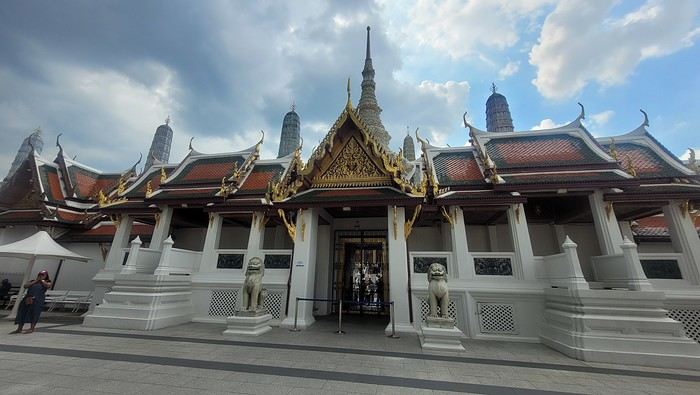
The airport already has that Okinawan exotic vibe, with lots of hibiscus flowers everywhere. There’s even an aquarium where you pick up luggage (ours is checked through).
At 2:10 PM, we take off again from Naha to Miyakojima. The flight gives us a glimpse of the small islands surrounded by blue lagoons scattered across the sea. The trip only lasts 50 minutes, so it goes by fast. However, even though it’s not raining, the sky over Miyakojima is filled with gray clouds. A few bumps, and we land in Miyakojima.
It’s almost like coming home—an exaggerated way to say we feel joy and serenity.
Miyakojima Airport is tiny, so it doesn’t take long to grab our bags and head into the main hall. We reserved a car from the same Japanese rental company as last time. It’s affordable, and even cheaper this season: 24,500 yen for 7 days, about 150 €.
It’s a family-run business—the father, mother, and son. They’ve modernized a bit since our last visit in 2023. When booking through a Japanese friend, we had to fill out an online form to confirm our reservation, on top of the phone call. We even got an email confirmation!
The son recognizes us right away at the airport before we even have time to think about it. We head to the van, where we’re surprised to see the dad (wow) waiting to say hello as we arrive with our luggage. They remember us perfectly from last time. This family exudes a quiet strength—happiness without stress, in shorts and flip-flops, with that elegant Japanese calm. We chat casually during the 20-minute drive to their agency from the airport. Apparently, this year in Miyakojima, the tsuyu (rainy season) only lasted 10 days. So it’s sunny and hot.
We get the same car as last time. After the quick formalities and setting up the GPS (which only works in Japanese), we leave and drive to our accommodation.
We wanted to rent the same place as last time, but it seems to be gone, so we booked another one. It’s a great surprise—a nice 40 m² studio apartment in a *Desperate Housewives*-style complex. We’re even in the "Hollywood Boulevard" neighborhood. We settle in and rest a bit since the night was short and the transfer tiring, despite everything.
Since we didn’t have a choice with flight times, we arrived midday, and with all the formalities, it’s unfortunately too late for a sea swim tonight. So we just go out to eat. We want to eat at Ramen Tonta, a ramen spot we go to every stay.
No frills here—you’re welcomed with total simplicity. It’s local, rustic, but good and cheap.
Beer, gyoza, and ramen to fill our stomachs and warm our hearts.
We brought a piece of Shikoku with us—this bottle of mikan juice, sweet and fragrant.
Re: From Southern Shikoku, between land and sea, to the blue waters of Miyakojima and ending in the megacity T
Day 14 - Bocca and Tsuyu
A vacation within a vacation and exotic vibes mean a change of wardrobe. From today, we’re exploring in flip-flops, shorts, dresses, and caps! Goodbye, sneakers, and hello to feet feeling the breeze!
As we step out of our residence, the sun dazzles us and warms our skin. What a pleasant feeling. For now, at least...
The plan is simple because one of the joys of returning to a familiar place is revisiting spots we loved and saving time on daily planning. So this morning, we’re heading to Miyakojima’s most famous beach, Yonaha Maehama.
On the way, we stop to see Yoanaha Bay. It’s low tide. Nothing extraordinary, but we can walk along the shore.
We park at one of the free parking lots—it’s not full, but there are a few vehicles. The wind is blowing, and sand has taken over part of the lot. There are clearly more people than on our previous trips. Last time, we came in early October and mid-September. This time, it’s mid-June. We’ll get to compare these periods—June being the start of summer.
And something new here: sun loungers and parasols set up on a tiny section of the beach, though few are occupied.
The beach is 7 kilometers long, so finding a spot is no problem.
We settle a little farther away. The beach is still just as beautiful. The milky blue stretches out before us. There’s a bit more movement in the water, with small waves coming and going. The sand remains as white, fine, and sparkling as ever.
We don’t hesitate to leave our towels, bag, phone, passport, and other things on the beach while we dive into the water, unconcerned about theft despite the slightly larger crowd than usual. The water is warm. We wade in with delight, splashing around and people-watching.
The beach is lively. More movement with a few more people. We even spot two other Western families—a first for us.
After a pleasant swim, we notice the wind has blown quite a bit of sand onto our stuff.
At the parking lot, there are restrooms and a water point to rinse off our feet. We realize my partner has gotten a little sunburned in a short time, even though the sky was overcast. He thought he could go for a swim without a long-sleeved rash guard, but the next few days will make him regret that mistake.
We get back in the car and head to Bocca Burger.
We’ve been looking forward to eating their burger again—it’s the best I’ve ever had, in my opinion.
Here too, there are more people: mostly Korean tourists. The place seems to have become a must-visit. It’s also within walking distance of the downtown beach.
The menu has a few updates: new burgers, the option to add ingredients, and new drinks.
I order a kind of herbal infusion. The color changes when you add lemon. It’s unsweetened and very refreshing.
The burgers arrive, still as mouthwatering as ever—beautiful and packed. The side veggies are just like we remember, always served with three condiments (Miyakojima salt, ginger sauce, and tomato/vegetable juice). The bread slice is still cut and meant to be eaten with a small meat-stew-like sauce. We wrap our burgers in the paper to hold them better and keep our hands clean. Pure bliss.
While we’re eating, the sky darkens and turns black. It starts pouring, and it won’t stop for the rest of the day. We take the opportunity to do some grocery shopping. Then, since it’s still raining, we decide to grab a drink at Mango Café, which we spotted yesterday on the way from the airport to our accommodation.
To reach the café entrance, there’s a path through a kind of tropical jungle. With the rain making the leaves glisten, the tropical vibe is perfect. The café itself is modern and minimalist, but the outdoor area is really nice. There’s a rooftop terrace with sofas, swings, and a tropical zone you reach by crossing a bridge. We won’t get to enjoy it much because it’s raining and everything’s wet. We sit on the slightly damp sofas while eating our ice cream—one mango, one melon. Unfortunately, we’re disappointed. The fruit is frozen and flavorless. Yet the place has great reviews online.
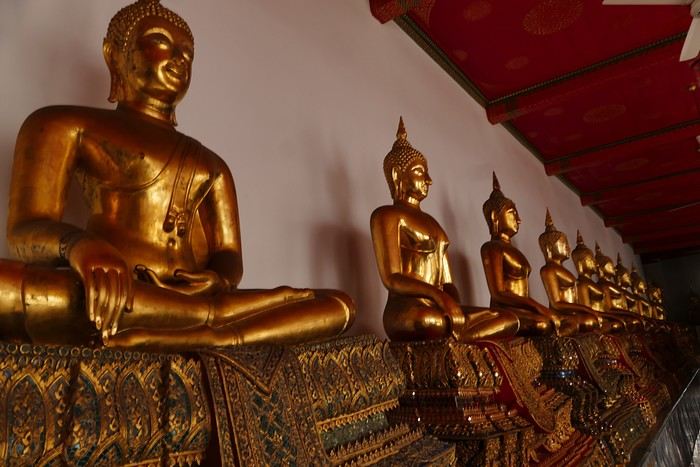
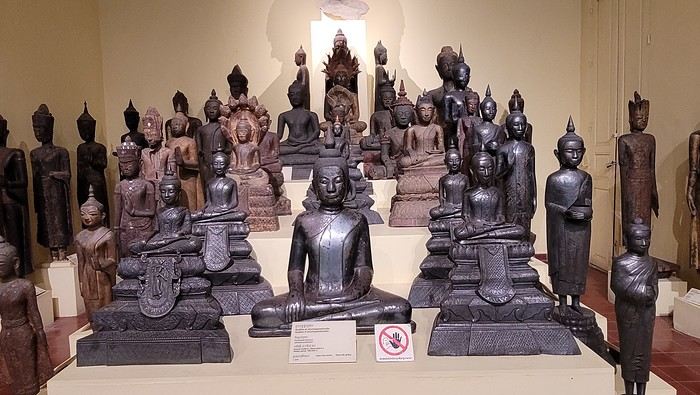
The rain keeps falling, so we stick to Plan B for the beach. Next up: a "stroll" at Don Quijote. It’s a chain store you find in many cities—kind of like Babou, Foire Fouille, or Action, but with a wider variety of products.
Of course, given the weather, we’re not the only ones with this idea. With all the rain creating big puddles, driving to the store isn’t risk-free.
We find plenty of non-food items, but also groceries.
Japan’s sorting madness in one image: 7 trash bins.
Finally, we end with a stop at Max Value supermarket, where we pick up some snacks for dinner.
But we also find some unusual apéritifs for a French person.
Broccoli is the favorite green vegetable of the Japanese, including kids. Apparently, if a movie, cartoon, or ad criticizes broccoli, it gets swapped for another veggie to suit the Japanese audience.
But we also spot some French references... madeleines.
And even seawater from another Okinawa island (Kumejima).