Bonjour!
Je me rends en Ouzbékistan cet été et arriverai de nuit à l'aéroport de Tashkent...
J'aimerai réserver la première nuit dans une guest house pas trop chère et aussi qu'on vienne me chercher à l'aéroport.
QQn m'a parlé de la Gulnara gh, mais je ne m'en sors pas avec leur site...
Merci à tous ceux qui prendront la peine de me répondre; je suis aussi preneuse de vos tuyaux les plus sympa...
Nous projetons de voyager vers les STAN (départ au printemps prochain) : Kazakstan , Ouzbekistan , Tadjikistan (route du Pamir) , Kirgistan ...
Nous avons entendu parler de trés gros problèmes d' approvisionnement en gas oil : est e que quelqu'un a des infos récentes à ce sujet ???
et également sur la fermeture possible de la route du PAMIR ??
Michele
From Beijing to Khiva: China, Kyrgyzstan, Tajikistan, Uzbekistan
Chronicle of anecdotes, highlights, and other adventures that marked this eight-week journey in 2018.
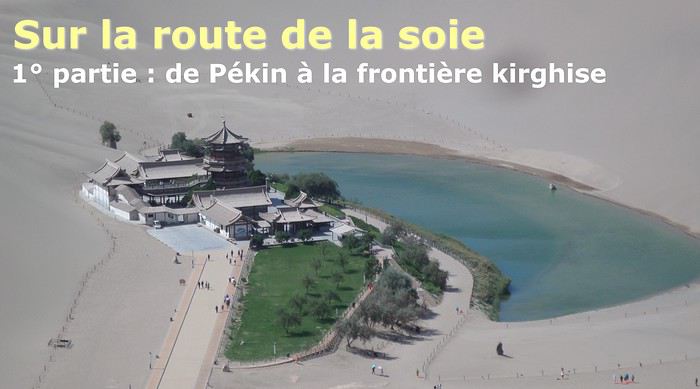
The Chinese Far West More than 30 years after my first trip to eastern China, I finally fulfilled an old dream: traveling solo from Beijing to the far west, discovering Xinjiang, the Uyghur people and the oppression they endure, the oases of Turpan and Kashgar, the Taklamakan Desert, the end of the Great Wall... The route was covered by train.
MENU PART 1: CHINA
1- Beijing (Jiankou) : the authentic Great Wall, without tourists 2- Cycling in Beijing, the best way to get around 3- Beijing : departure for the far west 4- Jiayuguan : getting by without English 5- Jiayuguan : scams and heritage 6- Dunhuang : abundance in the middle of the desert 7- Turpan : the Uyghurs under heavy surveillance 8- Kashgar : love at first sight for the old city 9- Kashgar : China’s recipe for controlling the populace 10- Tashkurgan : what on earth was I thinking going there! Kyrgyz border: a surreal epic Photo album from the 80s, contributions from other travelers (page 2)
1- JIANKOU Finding the authentic Great Wall, without tourists or a guide Friday, August 24, 2018 Thirty years later, I didn’t feel like revisiting the Great Wall at Badaling or any other overcrowded site. I chose to explore it at Jiankou, in its wildest, most authentic, and unrestored section, starting from a lost village deep in a valley—though it wasn’t *that* lost, since it had everything for communication.
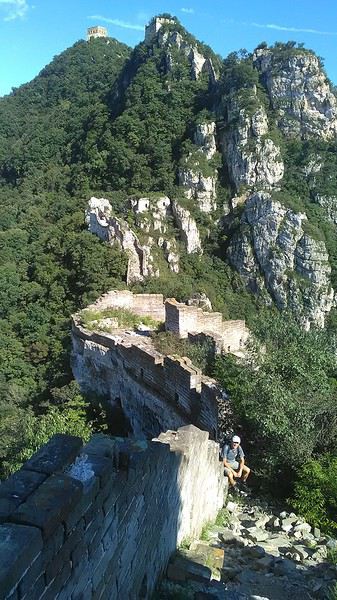
No need to pay for a taxi to get there—by timing it right, you can take the bus for just a few yuan. You have to get off at Xizhazi, the bus terminus. Be careful, there are only two buses a day in each direction. At the Xizhazi bus stop, I met a young couple who’d arrived with zero information about what to expect. We hiked the three of us toward the restored section of Mutianyu.
Still, be cautious With GPS and a topographic map (OpenTopoMap), you can set off without a problem or guide. The trail up to Jiankou is easy and well-marked. The trails down are too. But be careful—once you’re on the Wall, it’s real mountain hiking, with easy but dangerous climbing sections (over sheer drops). Not for amateurs or those afraid of heights! But what a reward. The Wall all to yourself, where it’s at its most daring. Truly mesmerizing.
More photos...
2- BEIJING The best way to get around the capital Sunday, August 26 The best way to explore the city is still by bike. Most are in a bike-share system, but you need to use an app—WeChat, the app that does everything, like monitoring your every move. No way I was installing that.
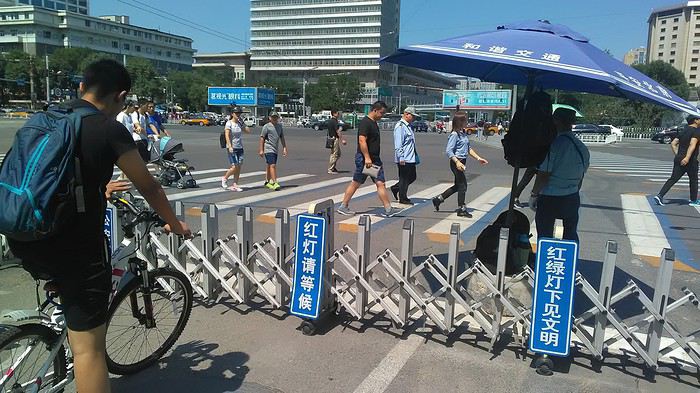
I found one at a rental shop near the hostel. The key is to quickly learn local traffic customs to minimize risks. Bike lanes are wide along the avenues.
But you still have to: - Watch out for anything parked on the bike paths—the most annoying are people napping or talking on the phone in their cars - Keep an eye on everything coming the wrong way—the list is long - The worst is right turns on red, which in Chinese traffic rules seem to have priority Once you get the hang of it, it’s fine. The city is huge but flat, so you can just wing it.
3- BEIJING By train to the far west Sunday, August 26 Beijing West Station is the size and operates like an airport. With your e-ticket from the agency, you first have to pick up your ticket at the special "English" counter, after passing through security. With your ticket in hand, you have to exit and enter through the boarding waiting area—not the platform—after a second security check.
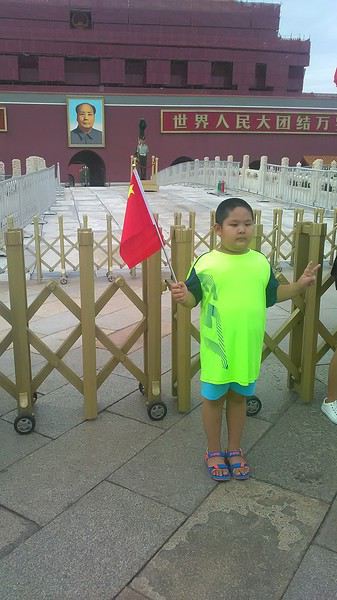 Then you find the right hall and wait for the sign to finally access the platform. In the end, it works pretty well given the incredible number of passengers to manage. Everywhere in Beijing, I saw that the Chinese have mastered crowd flow management.
Nice surprise: second-class carriages are clean, air-conditioned, and bright. Perfect, since I was in for 20 hours. One uniformed attendant per carriage, mobile meal service—luxury! Small downside: no luggage space. Hauling your suitcase up to the top bunk is quite a workout. I was in the middle, so it wasn’t too bad. The landscape, though, whether rural or urban, is pretty bleak. That should change once we leave the eastern plains.
Of course, I got my first police visit, with a thorough passport check and bag search. I was warned—going to the Chinese far west exposes you to this kind of hassle. But they were polite and respectful.
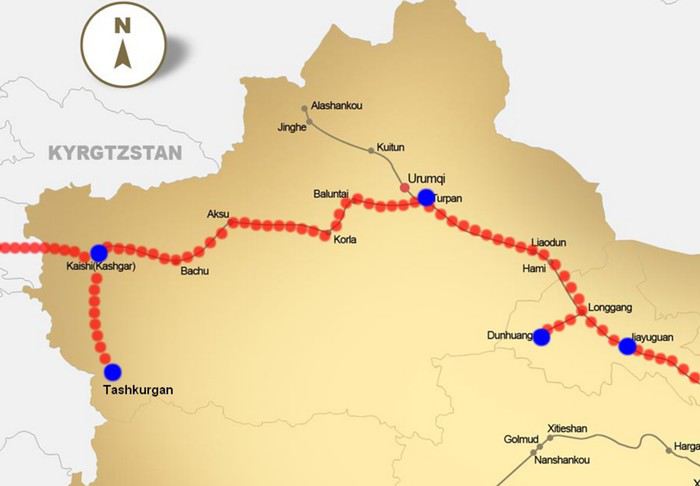 The Chinese Far West
4- JIAYUGUAN Getting by without English Monday, August 27 At the gates of two deserts (Gobi and Taklamakan) and at the foot of the Tibetan highlands, the Great Wall ends at Jiayuguan. Here, I found the deeper China I’d somewhat rediscovered during my bike ride, even if now everyone gets around on electric bikes and I’m no longer stared at like an alien.
Prices are nothing like Beijing: you can find a full meal for 2 €, and my bike cost 7 € for two days. Plus, few people speak English—neither the owner of the HI hostel where I stayed, nor the ticket sellers at the sites, let alone the servers at the small eateries where I ate. Everything is written in Chinese. So I had to use the little Chinese I know to communicate about essentials. It makes the locals laugh to see a European trying to speak their language, but it earns respect. With Google Translate’s help, I managed.
Rant: With their avenues blocked for construction for kilometers without warning, and new roads not yet on maps, I must’ve taken 15 km of detours. More photos...
5- JIAYUGUAN Scams and heritage Tuesday, August 28 The Great Wall doesn’t exactly end at the fort I visited yesterday but 10 km further, at the entrance to a river gorge at the foot of the mountains. All that’s left is a badly damaged tower (more like a mound of earth) and a section of clay wall, similar to the one I biked yesterday.
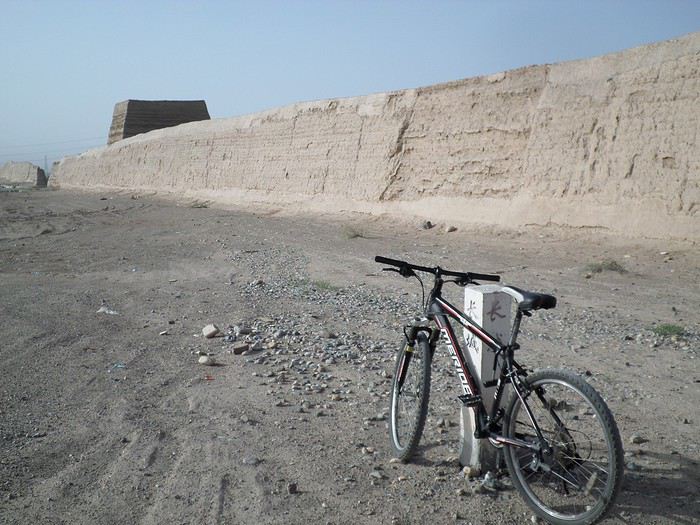
This morning, I hopped on my bike, determined to venture into the desert to see this highly symbolic site. First, you access it via a wide, brand-new road with not a soul in sight. Just before the site, I came across a grand welcome gate, very period-style, but it’s actually the inevitable toll booth.
Behind the gate, the road continues straight to the site, which you can see in the distance—at least 2 km away—the remains of the tower and wall. I had to leave my bike here. Fine. I went to the ticket counter and asked the price: 120 yuan! I couldn’t believe it—over 15 € for a simple mound of earth.
I showed my displeasure to the attendant, who couldn’t care less, and immediately turned back. 120 yuan—that’s the price for a new road, a fancy gate planted 2 km before the site just to force you to take a shuttle, and employees with nothing to do all day... Now I understand why I didn’t meet anyone!
Heritage China is a bit pricey Generally, sites are expensive for the country’s standard of living, but travelers are supposed to have money, so why hold back? I even gave up on the Forbidden City—reservations required days in advance (or on the black market at an impossible price). I prefer to keep the memory of my first visit, when entry must’ve cost a few dozen cents, and there were only a handful of visitors.
This morning, I took a taxi to see remarkable tombs of common people from the 3rd to 6th centuries. They’re small vaulted caves made of painted bricks, depicting scenes of daily life. Very pretty and moving. But even here, though the price was more reasonable, I was left wanting—only one of the 16 tombs is open to visitors, and it’s apparently not the most beautiful.
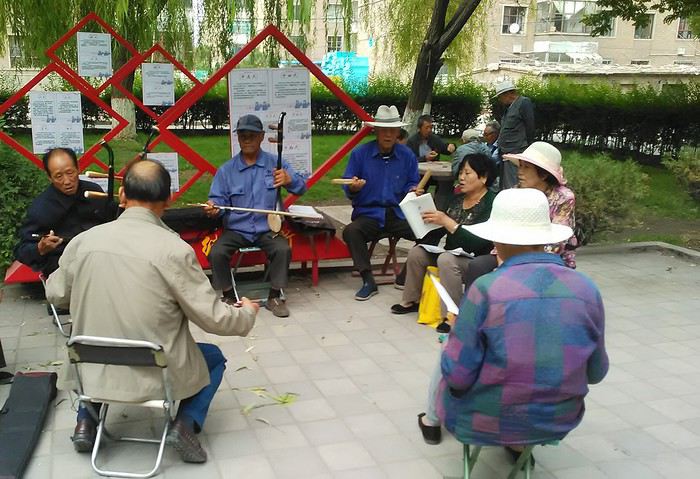
The authentic China—at least what’s left of it... Wandering the impersonal avenues of the city, you stumble upon a market. There, you still find traditional China—small shops with questionable hygiene, Go players, musicians, and even a dental prosthetist. The last refuge for those untouched by modernity. More photos...
6- DUNHUANG Abundance in the middle of the desert Wednesday, August 29 Well, I thought the landscape would be less bleak as I headed west. Nope. The only distraction in this expanse of dark, clayey sand is the forests of pylons and wind turbines, plus wild camels racing each other.
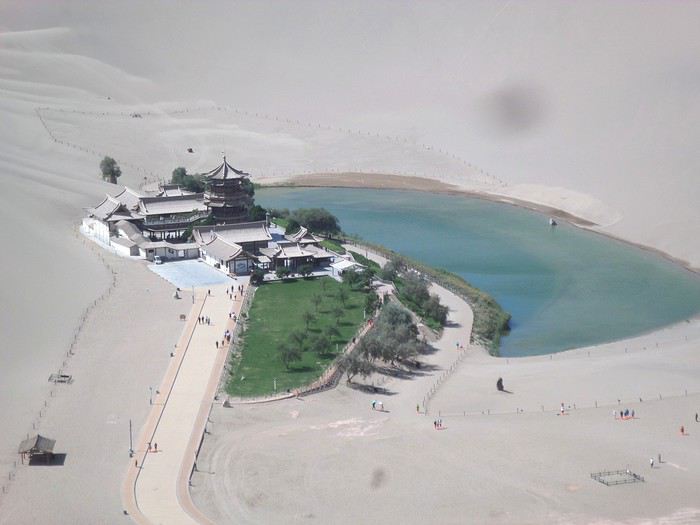 However, Dunhuang, the gateway to the Taklamakan, is by far the most pleasant Chinese city I know. There’s a real city center you can explore on foot. It’s hot but not unbearable, with a light, dry breeze. Much nicer than Beijing. The Han Chinese are still the majority, but the Muslim Uyghurs are more numerous, and the muezzin’s call to prayer echoes around the mosque.
The most surprising thing is the abundance and diversity of fruits and vegetables. You wonder how it all grows here. Well-irrigated, the desert sands are very fertile. Here, raisins have subtle, mysterious flavors, and the lamb really tastes like lamb.
Today, I visited the must-see Mingshashan, a dune complex next to which Pila is a molehill. The Basque Country, but covered in sand... More photos...
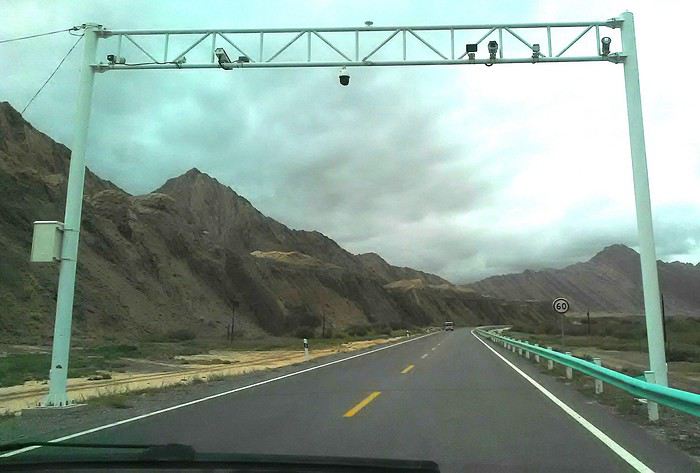
7- TURPAN The Uyghurs under heavy surveillance Friday, August 31 Surveillance cameras everywhere in the city, armed police stationed at intersections, in front of public buildings, at the entrance and inside tourist sites, police stations on every corner, patrols on foot or by car, khaki uniforms even for middle schoolers... here, the Han Chinese are in the minority, and you can feel it. Turpan feels like a city under siege.
To enter the youth hostel where I stayed, there’s even a security gate, and the receptionist (a Han, like everyone in tourism) wears a bulletproof vest! Reassuring. Still, you don’t feel particularly threatened here, especially as a European. The troublemakers are the Chinese, not the Uyghurs. Generally, China is a very safe country for visitors.
Smile, you’re on camera! I was biking on an avenue when the car in front of me got flashed for driving slowly. I quickly understood why when I got flashed too.
Here, the official time is Beijing time, but it gets dark two hours later. It’ll be even worse in Kashgar. Trickier to manage: everything is displayed in Chinese and Arabic. Nothing in English. Choosing a menu is a shot in the dark. Apart from a few young Chinese, no one here speaks English, and my Chinese doesn’t seem very understandable...
Mogao, the end of the road for the Han Yesterday, near Dunhuang, I went to Mogao, a complex of decorated caves with Buddha sculptures and paintings. Stunning, but so crowded! Luckily, here in Turpan, Chinese tourists barely venture out. So I visited a Silk Road ghost town with only a handful of other visitors and under a howling wind.
The modern Chinese city is swallowing up the old Uyghur neighborhoods—only a museum-like district remains in the center, and pockets of resistance on the outskirts are doomed to disappear soon. More photos...
8- KASHGAR A (relative) love at first sight for the old city Sunday, September 2 After three overnight trains, here I am in the far west of China, nearly 4,000 km from the capital. Despite the omnipresent police and an old city preserved UNESCO-style, Kashgar is my Chinese love at first sight.
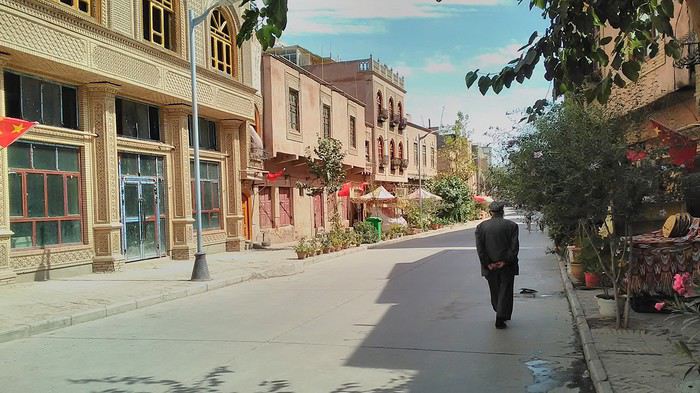
Finally, Chinese... well, sort of, because we’re in Uyghur territory here—a Turkic people with nothing culturally in common with the Han, the eastern Chinese. It started badly yesterday at Turfan station, where after three security gate passes, at least five passport checks, and a bag search, three adorable policewomen confiscated my antibacterial lotion because it had a flammable logo...
Then came the welcoming committee of armed cops at Kashgar station. Once all that was over, they left me alone—except you still have to go through security checks like everyone else to enter the old city, the bazaar, the livestock market... The further west you go, the more the siege mentality is evident. Luckily, the border isn’t far...
Despite the inevitable destruction-reconstruction, the city center has been well preserved. Thankfully, because it’s a very original style, a mix of local and colonial. I love it, even if it’s a bit too artificial, sanitized, and watered-down, and rather empty of residents. On the Silk Road, the city was famous for its great food. And it still is—rarely have I seen such richness and abundance of food! And not just scorpions or snakes. More photos...
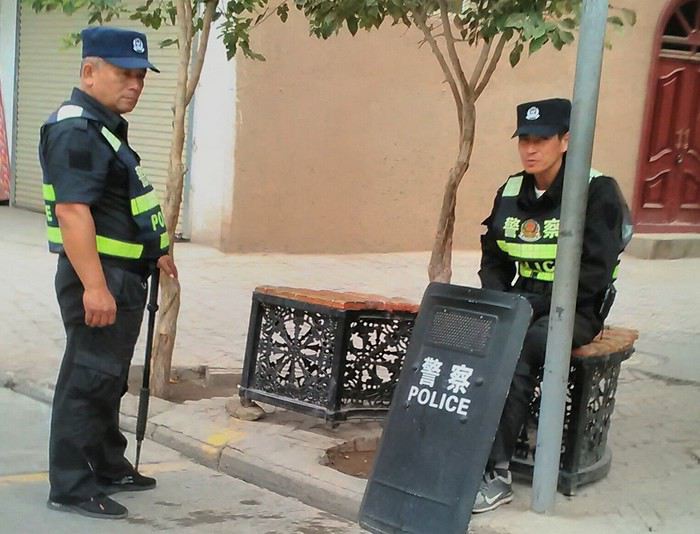
9- KASHGAR China’s recipe for controlling the populace Saturday, September 1 Xinjiang, along with Tibet, is a "sensitive" area of rebellion in the eyes of Chinese authorities. As a result, the state has these regions and their populations under total control. Tourists also feel the consequences, even if they’re not at risk of re-education camps.
 - Putting barbed wire and anti-ramming barriers around sensitive sites (schools, big hotels, government buildings...)
- Installing traffic surveillance gates with cameras and photo flashes (for all vehicles passing, including bikes) throughout the city and even in the countryside
- Posting uniformed guards with tasers, batons, or huge baseball bats every 100 meters
- Training the Han population (ethnic Chinese) in self-defense with sticks, preferably in the morning on the street. Men and women of all ages
- Starting school with the national anthem, doing military exercises, and receiving political indoctrination, all neatly lined up in the courtyard. (The dream school for any teacher)
- Placing a snitch in uniform (a pseudo-guard) in public gathering places, like youth hostels. Mine spends the day loafing around the courtyard
- Putting Chinese flags everywhere on the streets to remind everyone who’s in charge
- Installing security gates at every entrance to areas frequented by tourists (thanks for that) but not just there
- Never photographing cops, or else! I tried, but it’s not easy...
- Putting barbed wire and anti-ramming barriers around sensitive sites (schools, big hotels, government buildings...)
- Installing traffic surveillance gates with cameras and photo flashes (for all vehicles passing, including bikes) throughout the city and even in the countryside
- Posting uniformed guards with tasers, batons, or huge baseball bats every 100 meters
- Training the Han population (ethnic Chinese) in self-defense with sticks, preferably in the morning on the street. Men and women of all ages
- Starting school with the national anthem, doing military exercises, and receiving political indoctrination, all neatly lined up in the courtyard. (The dream school for any teacher)
- Placing a snitch in uniform (a pseudo-guard) in public gathering places, like youth hostels. Mine spends the day loafing around the courtyard
- Putting Chinese flags everywhere on the streets to remind everyone who’s in charge
- Installing security gates at every entrance to areas frequented by tourists (thanks for that) but not just there
- Never photographing cops, or else! I tried, but it’s not easy...
With all that, you can stroll around safely Not much crime! As for the amount the Chinese state spends to maintain such a system, it’s staggering! A third of the Han living in Xinjiang work in security. Today, I wandered freely around old Kashgar, which is quite large after all. More photos...
10- TASHKURGAN What on earth was I thinking going there! Wednesday, September 5 First, there’s the taxi—pretty crappy, with a driver who doesn’t speak a word of English and won’t stop smoking. Over six hours in that... shared with a completely out-of-it American.
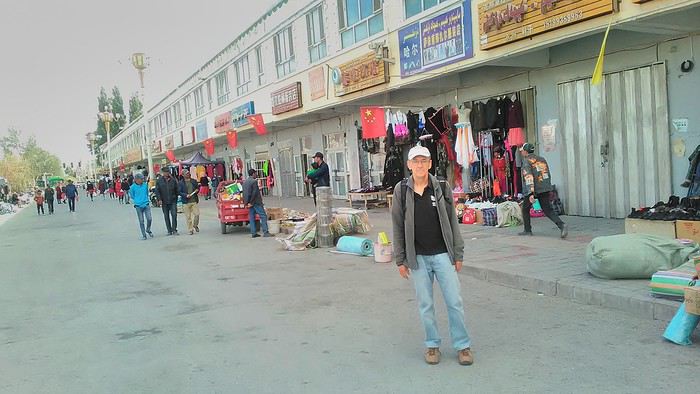
Then there are all the checkpoints along the way. I won’t go on—you know the drill by now.
After that, there’s Tashkurgan—a town with nothing to see, nothing to do. Deserted as soon as night falls. There’s this huge youth hostel and a few lost Chinese tapping away on their smartphones, chain-smoking. This lost American-European crowd, swapping tips on how to enter Pakistan or Tajikistan.
Luckily, there’s the Chinese Pamir Highway, lined with peaks over 7,000m. There’s the feeling of no longer being in China, with a population whose features are Middle Eastern. And these Tajik women with their stunning hairstyles and vibrant costumes. There’s the fact of having reached the westernmost Chinese city, far from crowds and tourist sites. A sort of end of the world. More photos...
11- KYRGYZ BORDER A surreal epic Thursday, September 6 The road from Kashgar to the Kyrgyzstan border is a little over 200 km and passes through beautiful landscapes of colorful, desert-like mountains with acrobatic folds. That’s the bucolic part of the trip.
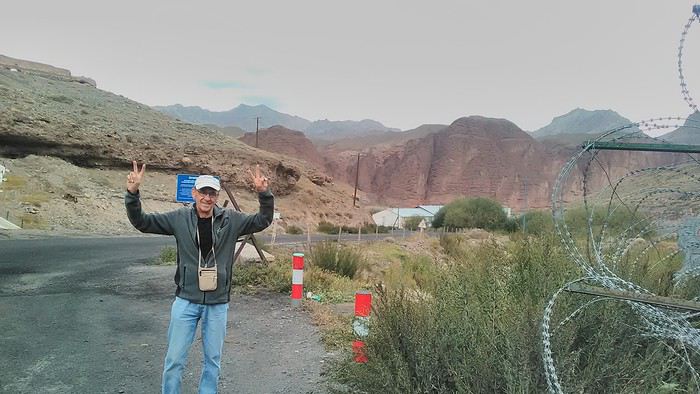 Yesterday, I managed to gather four people to rent a minibus to reach the border more easily: a Spaniard and an Argentine I’d already met in Turpan, and two New Zealanders who responded to the ad left at the hostel.
Absurdity and paranoia of Chinese authorities The highlight was crossing the town of Wuqia, 50 km past Kashgar. After tallying up with my fellow sufferers, we must’ve passed about ten checkpoints with: - Passport checks: 14 times, sometimes by two cops side by side - Bag checks: 4 times - Smartphone checks: 2 times, with deletion of "non-compliant" photos, and registration of your IMEI in the exit log!... Absurd and surreal at the same time, since my camera stayed in my bag, my apps are in French, and my photos have been online for ages...
With all that, we arrived just as the last checkpoint before the no man’s land marking the border between the two countries was on lunch break. And bam! Another 1.5-hour wait, alongside truckers who were much more used to this than we were.
What to think? The cops themselves aren’t fooled. They play the role they’re asked to, but sometimes you can coax a smile out of them—they realize how ridiculous the situation is.
What’s the point? That’s the big question my companions and I were tempted to answer with "to piss people off." To show you your place isn’t here, but with the other tourists, over there in the east, in Shanghai, Xi’an, or Guangzhou.
As for you, a traveler from a democratic country, you really experience this as aggression, humiliation, a violation of your private space. And yet, I’m respected, they speak to me properly. Today, I better understand what a Palestinian or a citizen of an occupied country might feel daily. A unique experience! Thanks, China.
And to top it off, the cherry on the cake! It’s still this glowing button you press to rate your passage after clearing the last obstacle before the exit stamp. I was so surprised it turned off before I could react. The Spaniard, with great humor and irony, had time to vote "excellent." In the end, he wasn’t wrong—you can hardly do better!
PS: I ditched my buddies at the border. They didn’t want to pay for a taxi to continue. So I took a direct taxi to Osh. The first 100 km are fabulous. I couldn’t take many photos, but I’ll be back on Monday to go to Tajikistan.
More photos...
The rest of the Silk Road, Part 2, in these travel journals: Kyrgyzstan, Tajikistan, Uzbekistan.
The Chinese Far West More than 30 years after my first trip to eastern China, I finally fulfilled an old dream: traveling solo from Beijing to the far west, discovering Xinjiang, the Uyghur people and the oppression they endure, the oases of Turpan and Kashgar, the Taklamakan Desert, the end of the Great Wall... The route was covered by train.
MENU PART 1: CHINA
1- Beijing (Jiankou) : the authentic Great Wall, without tourists 2- Cycling in Beijing, the best way to get around 3- Beijing : departure for the far west 4- Jiayuguan : getting by without English 5- Jiayuguan : scams and heritage 6- Dunhuang : abundance in the middle of the desert 7- Turpan : the Uyghurs under heavy surveillance 8- Kashgar : love at first sight for the old city 9- Kashgar : China’s recipe for controlling the populace 10- Tashkurgan : what on earth was I thinking going there! Kyrgyz border: a surreal epic Photo album from the 80s, contributions from other travelers (page 2)
1- JIANKOU Finding the authentic Great Wall, without tourists or a guide Friday, August 24, 2018 Thirty years later, I didn’t feel like revisiting the Great Wall at Badaling or any other overcrowded site. I chose to explore it at Jiankou, in its wildest, most authentic, and unrestored section, starting from a lost village deep in a valley—though it wasn’t *that* lost, since it had everything for communication.
No need to pay for a taxi to get there—by timing it right, you can take the bus for just a few yuan. You have to get off at Xizhazi, the bus terminus. Be careful, there are only two buses a day in each direction. At the Xizhazi bus stop, I met a young couple who’d arrived with zero information about what to expect. We hiked the three of us toward the restored section of Mutianyu.
Still, be cautious With GPS and a topographic map (OpenTopoMap), you can set off without a problem or guide. The trail up to Jiankou is easy and well-marked. The trails down are too. But be careful—once you’re on the Wall, it’s real mountain hiking, with easy but dangerous climbing sections (over sheer drops). Not for amateurs or those afraid of heights! But what a reward. The Wall all to yourself, where it’s at its most daring. Truly mesmerizing.
More photos...
2- BEIJING The best way to get around the capital Sunday, August 26 The best way to explore the city is still by bike. Most are in a bike-share system, but you need to use an app—WeChat, the app that does everything, like monitoring your every move. No way I was installing that.
I found one at a rental shop near the hostel. The key is to quickly learn local traffic customs to minimize risks. Bike lanes are wide along the avenues.
But you still have to: - Watch out for anything parked on the bike paths—the most annoying are people napping or talking on the phone in their cars - Keep an eye on everything coming the wrong way—the list is long - The worst is right turns on red, which in Chinese traffic rules seem to have priority Once you get the hang of it, it’s fine. The city is huge but flat, so you can just wing it.
3- BEIJING By train to the far west Sunday, August 26 Beijing West Station is the size and operates like an airport. With your e-ticket from the agency, you first have to pick up your ticket at the special "English" counter, after passing through security. With your ticket in hand, you have to exit and enter through the boarding waiting area—not the platform—after a second security check.
Then you find the right hall and wait for the sign to finally access the platform. In the end, it works pretty well given the incredible number of passengers to manage. Everywhere in Beijing, I saw that the Chinese have mastered crowd flow management.Nice surprise: second-class carriages are clean, air-conditioned, and bright. Perfect, since I was in for 20 hours. One uniformed attendant per carriage, mobile meal service—luxury! Small downside: no luggage space. Hauling your suitcase up to the top bunk is quite a workout. I was in the middle, so it wasn’t too bad. The landscape, though, whether rural or urban, is pretty bleak. That should change once we leave the eastern plains.
Of course, I got my first police visit, with a thorough passport check and bag search. I was warned—going to the Chinese far west exposes you to this kind of hassle. But they were polite and respectful.
The Chinese Far West4- JIAYUGUAN Getting by without English Monday, August 27 At the gates of two deserts (Gobi and Taklamakan) and at the foot of the Tibetan highlands, the Great Wall ends at Jiayuguan. Here, I found the deeper China I’d somewhat rediscovered during my bike ride, even if now everyone gets around on electric bikes and I’m no longer stared at like an alien.
Prices are nothing like Beijing: you can find a full meal for 2 €, and my bike cost 7 € for two days. Plus, few people speak English—neither the owner of the HI hostel where I stayed, nor the ticket sellers at the sites, let alone the servers at the small eateries where I ate. Everything is written in Chinese. So I had to use the little Chinese I know to communicate about essentials. It makes the locals laugh to see a European trying to speak their language, but it earns respect. With Google Translate’s help, I managed.
Rant: With their avenues blocked for construction for kilometers without warning, and new roads not yet on maps, I must’ve taken 15 km of detours. More photos...
5- JIAYUGUAN Scams and heritage Tuesday, August 28 The Great Wall doesn’t exactly end at the fort I visited yesterday but 10 km further, at the entrance to a river gorge at the foot of the mountains. All that’s left is a badly damaged tower (more like a mound of earth) and a section of clay wall, similar to the one I biked yesterday.
This morning, I hopped on my bike, determined to venture into the desert to see this highly symbolic site. First, you access it via a wide, brand-new road with not a soul in sight. Just before the site, I came across a grand welcome gate, very period-style, but it’s actually the inevitable toll booth.
Behind the gate, the road continues straight to the site, which you can see in the distance—at least 2 km away—the remains of the tower and wall. I had to leave my bike here. Fine. I went to the ticket counter and asked the price: 120 yuan! I couldn’t believe it—over 15 € for a simple mound of earth.
I showed my displeasure to the attendant, who couldn’t care less, and immediately turned back. 120 yuan—that’s the price for a new road, a fancy gate planted 2 km before the site just to force you to take a shuttle, and employees with nothing to do all day... Now I understand why I didn’t meet anyone!
Heritage China is a bit pricey Generally, sites are expensive for the country’s standard of living, but travelers are supposed to have money, so why hold back? I even gave up on the Forbidden City—reservations required days in advance (or on the black market at an impossible price). I prefer to keep the memory of my first visit, when entry must’ve cost a few dozen cents, and there were only a handful of visitors.
This morning, I took a taxi to see remarkable tombs of common people from the 3rd to 6th centuries. They’re small vaulted caves made of painted bricks, depicting scenes of daily life. Very pretty and moving. But even here, though the price was more reasonable, I was left wanting—only one of the 16 tombs is open to visitors, and it’s apparently not the most beautiful.
The authentic China—at least what’s left of it... Wandering the impersonal avenues of the city, you stumble upon a market. There, you still find traditional China—small shops with questionable hygiene, Go players, musicians, and even a dental prosthetist. The last refuge for those untouched by modernity. More photos...
6- DUNHUANG Abundance in the middle of the desert Wednesday, August 29 Well, I thought the landscape would be less bleak as I headed west. Nope. The only distraction in this expanse of dark, clayey sand is the forests of pylons and wind turbines, plus wild camels racing each other.
However, Dunhuang, the gateway to the Taklamakan, is by far the most pleasant Chinese city I know. There’s a real city center you can explore on foot. It’s hot but not unbearable, with a light, dry breeze. Much nicer than Beijing. The Han Chinese are still the majority, but the Muslim Uyghurs are more numerous, and the muezzin’s call to prayer echoes around the mosque.The most surprising thing is the abundance and diversity of fruits and vegetables. You wonder how it all grows here. Well-irrigated, the desert sands are very fertile. Here, raisins have subtle, mysterious flavors, and the lamb really tastes like lamb.
Today, I visited the must-see Mingshashan, a dune complex next to which Pila is a molehill. The Basque Country, but covered in sand... More photos...
7- TURPAN The Uyghurs under heavy surveillance Friday, August 31 Surveillance cameras everywhere in the city, armed police stationed at intersections, in front of public buildings, at the entrance and inside tourist sites, police stations on every corner, patrols on foot or by car, khaki uniforms even for middle schoolers... here, the Han Chinese are in the minority, and you can feel it. Turpan feels like a city under siege.
To enter the youth hostel where I stayed, there’s even a security gate, and the receptionist (a Han, like everyone in tourism) wears a bulletproof vest! Reassuring. Still, you don’t feel particularly threatened here, especially as a European. The troublemakers are the Chinese, not the Uyghurs. Generally, China is a very safe country for visitors.
Smile, you’re on camera! I was biking on an avenue when the car in front of me got flashed for driving slowly. I quickly understood why when I got flashed too.
Here, the official time is Beijing time, but it gets dark two hours later. It’ll be even worse in Kashgar. Trickier to manage: everything is displayed in Chinese and Arabic. Nothing in English. Choosing a menu is a shot in the dark. Apart from a few young Chinese, no one here speaks English, and my Chinese doesn’t seem very understandable...
Mogao, the end of the road for the Han Yesterday, near Dunhuang, I went to Mogao, a complex of decorated caves with Buddha sculptures and paintings. Stunning, but so crowded! Luckily, here in Turpan, Chinese tourists barely venture out. So I visited a Silk Road ghost town with only a handful of other visitors and under a howling wind.
The modern Chinese city is swallowing up the old Uyghur neighborhoods—only a museum-like district remains in the center, and pockets of resistance on the outskirts are doomed to disappear soon. More photos...
8- KASHGAR A (relative) love at first sight for the old city Sunday, September 2 After three overnight trains, here I am in the far west of China, nearly 4,000 km from the capital. Despite the omnipresent police and an old city preserved UNESCO-style, Kashgar is my Chinese love at first sight.
Finally, Chinese... well, sort of, because we’re in Uyghur territory here—a Turkic people with nothing culturally in common with the Han, the eastern Chinese. It started badly yesterday at Turfan station, where after three security gate passes, at least five passport checks, and a bag search, three adorable policewomen confiscated my antibacterial lotion because it had a flammable logo...
Then came the welcoming committee of armed cops at Kashgar station. Once all that was over, they left me alone—except you still have to go through security checks like everyone else to enter the old city, the bazaar, the livestock market... The further west you go, the more the siege mentality is evident. Luckily, the border isn’t far...
Despite the inevitable destruction-reconstruction, the city center has been well preserved. Thankfully, because it’s a very original style, a mix of local and colonial. I love it, even if it’s a bit too artificial, sanitized, and watered-down, and rather empty of residents. On the Silk Road, the city was famous for its great food. And it still is—rarely have I seen such richness and abundance of food! And not just scorpions or snakes. More photos...
9- KASHGAR China’s recipe for controlling the populace Saturday, September 1 Xinjiang, along with Tibet, is a "sensitive" area of rebellion in the eyes of Chinese authorities. As a result, the state has these regions and their populations under total control. Tourists also feel the consequences, even if they’re not at risk of re-education camps.
- Putting barbed wire and anti-ramming barriers around sensitive sites (schools, big hotels, government buildings...)
- Installing traffic surveillance gates with cameras and photo flashes (for all vehicles passing, including bikes) throughout the city and even in the countryside
- Posting uniformed guards with tasers, batons, or huge baseball bats every 100 meters
- Training the Han population (ethnic Chinese) in self-defense with sticks, preferably in the morning on the street. Men and women of all ages
- Starting school with the national anthem, doing military exercises, and receiving political indoctrination, all neatly lined up in the courtyard. (The dream school for any teacher)
- Placing a snitch in uniform (a pseudo-guard) in public gathering places, like youth hostels. Mine spends the day loafing around the courtyard
- Putting Chinese flags everywhere on the streets to remind everyone who’s in charge
- Installing security gates at every entrance to areas frequented by tourists (thanks for that) but not just there
- Never photographing cops, or else! I tried, but it’s not easy...With all that, you can stroll around safely Not much crime! As for the amount the Chinese state spends to maintain such a system, it’s staggering! A third of the Han living in Xinjiang work in security. Today, I wandered freely around old Kashgar, which is quite large after all. More photos...
10- TASHKURGAN What on earth was I thinking going there! Wednesday, September 5 First, there’s the taxi—pretty crappy, with a driver who doesn’t speak a word of English and won’t stop smoking. Over six hours in that... shared with a completely out-of-it American.
Then there are all the checkpoints along the way. I won’t go on—you know the drill by now.
After that, there’s Tashkurgan—a town with nothing to see, nothing to do. Deserted as soon as night falls. There’s this huge youth hostel and a few lost Chinese tapping away on their smartphones, chain-smoking. This lost American-European crowd, swapping tips on how to enter Pakistan or Tajikistan.
Luckily, there’s the Chinese Pamir Highway, lined with peaks over 7,000m. There’s the feeling of no longer being in China, with a population whose features are Middle Eastern. And these Tajik women with their stunning hairstyles and vibrant costumes. There’s the fact of having reached the westernmost Chinese city, far from crowds and tourist sites. A sort of end of the world. More photos...
11- KYRGYZ BORDER A surreal epic Thursday, September 6 The road from Kashgar to the Kyrgyzstan border is a little over 200 km and passes through beautiful landscapes of colorful, desert-like mountains with acrobatic folds. That’s the bucolic part of the trip.
Yesterday, I managed to gather four people to rent a minibus to reach the border more easily: a Spaniard and an Argentine I’d already met in Turpan, and two New Zealanders who responded to the ad left at the hostel.Absurdity and paranoia of Chinese authorities The highlight was crossing the town of Wuqia, 50 km past Kashgar. After tallying up with my fellow sufferers, we must’ve passed about ten checkpoints with: - Passport checks: 14 times, sometimes by two cops side by side - Bag checks: 4 times - Smartphone checks: 2 times, with deletion of "non-compliant" photos, and registration of your IMEI in the exit log!... Absurd and surreal at the same time, since my camera stayed in my bag, my apps are in French, and my photos have been online for ages...
With all that, we arrived just as the last checkpoint before the no man’s land marking the border between the two countries was on lunch break. And bam! Another 1.5-hour wait, alongside truckers who were much more used to this than we were.
What to think? The cops themselves aren’t fooled. They play the role they’re asked to, but sometimes you can coax a smile out of them—they realize how ridiculous the situation is.
What’s the point? That’s the big question my companions and I were tempted to answer with "to piss people off." To show you your place isn’t here, but with the other tourists, over there in the east, in Shanghai, Xi’an, or Guangzhou.
As for you, a traveler from a democratic country, you really experience this as aggression, humiliation, a violation of your private space. And yet, I’m respected, they speak to me properly. Today, I better understand what a Palestinian or a citizen of an occupied country might feel daily. A unique experience! Thanks, China.
And to top it off, the cherry on the cake! It’s still this glowing button you press to rate your passage after clearing the last obstacle before the exit stamp. I was so surprised it turned off before I could react. The Spaniard, with great humor and irony, had time to vote "excellent." In the end, he wasn’t wrong—you can hardly do better!
PS: I ditched my buddies at the border. They didn’t want to pay for a taxi to continue. So I took a direct taxi to Osh. The first 100 km are fabulous. I couldn’t take many photos, but I’ll be back on Monday to go to Tajikistan.
More photos...
The rest of the Silk Road, Part 2, in these travel journals: Kyrgyzstan, Tajikistan, Uzbekistan.
Bonjour, je suis en train d'organiser un voyage avec des amies début aout 2014.
Nous passerons par l'Ouzbékistan et donc forcément par Khiva.
Nous avons très envie d'aller voir Darvaza et de rester dans les environs pour la nuit, mais pour des questions de temps nous ne voulons pas faire la boucle entière par Ashgabat et Merv.
Savez-vous si / comment / en combien de temps il est possible de faire un saut à Darvaza depuis Khiva (bonus: en s'arrêtant un peu à Kone Urgentch) ?? Idéalement en 2 jours (3 si besoin) pour l'a/r depuis Khiva. Oui je sais ça fait beaucoup de route, mais c'est une occasion unique de voir la porte de l'enfer.
merci de vos conseils !
Savez-vous si / comment / en combien de temps il est possible de faire un saut à Darvaza depuis Khiva (bonus: en s'arrêtant un peu à Kone Urgentch) ?? Idéalement en 2 jours (3 si besoin) pour l'a/r depuis Khiva. Oui je sais ça fait beaucoup de route, mais c'est une occasion unique de voir la porte de l'enfer.
merci de vos conseils !
Bonjour à tous(tes),
Je prépare un circuit de 3000 km en l'Ouzbékistan en avril 2014. Moyen de locomotion : camping-car
Après avoir parcouru plusieurs forums et autres renseignements, il appert qu'il y a certaines difficultés à surmonter dans ce magnifique pays.
Pouvez-vous me fournir quelques détails récents ? 1) assurance automobile, où l'acheter(avant ou après la frontière) ? 2) approvisionnement en diesel(gasoil) qu'en est-il exactement en 2013 ? 3) est-il possible de s'approvisionner en eau pour le cc ? 4) la police est-elle corrompue avec les touristes?(ex URSS) 5) faut-il passer à l'Ovir alors que l'on voyage en camping-car ? 6) état des routes !
Pour un voyage en Russie aucun problème sauf 1 km après la frontière PV de 250 € par la police frontalière( bakchich)délai d'attente 5h devant un officier 4 étoiles pour en fin de compte 0 € payer !Ensuite 1 mois sans aucun problème.
Merci si vous pouvez m'aider.
Je prépare un circuit de 3000 km en l'Ouzbékistan en avril 2014. Moyen de locomotion : camping-car
Après avoir parcouru plusieurs forums et autres renseignements, il appert qu'il y a certaines difficultés à surmonter dans ce magnifique pays.
Pouvez-vous me fournir quelques détails récents ? 1) assurance automobile, où l'acheter(avant ou après la frontière) ? 2) approvisionnement en diesel(gasoil) qu'en est-il exactement en 2013 ? 3) est-il possible de s'approvisionner en eau pour le cc ? 4) la police est-elle corrompue avec les touristes?(ex URSS) 5) faut-il passer à l'Ovir alors que l'on voyage en camping-car ? 6) état des routes !
Pour un voyage en Russie aucun problème sauf 1 km après la frontière PV de 250 € par la police frontalière( bakchich)délai d'attente 5h devant un officier 4 étoiles pour en fin de compte 0 € payer !Ensuite 1 mois sans aucun problème.
Merci si vous pouvez m'aider.
bonsoir,
est il possible et sous quelles conditions (financière, de temps, documents necessaires pour un véhicule), d'obtenir un visa à taschkent pour le kazhakstan. Merci
We took this trip from September 12 to October 7, 2022. I didn’t post this travel journal earlier in Voyage Forum because the site wasn’t back up yet (and also because I was short on time).
Then, at the end of 2024, I made a promise to a friend: to publish my travel journal on VF. So here it is!
 We took off from Paris in the late afternoon on September 12 and arrived in Tashkent around 7:15 AM on the 13th.
This trip was the result of long contemplation and preparation (it was originally planned for the year of the lockdown (2020) and was prepared with the help and advice of Nasrullo Jumanov from Turquoise Travel.
Stages and Itinerary
Stage 1: Tashkent - September 13 and 14
Stage 2: Ferghana Valley – September 15 to 17
Stage 3: Nukus and Moynaq - September 18 and 19
Stage 4: Mysterious Khiva - September 20 to 22
Stage 5: Holy Bukhara - September 23 to 26
Stage 6: Asraf - September 27 and 28
Stage 7: Mythical Samarkand - September 29 to October 2
Stage 8: Tersak (via Shakhrisabz and Urgut) – October 3 and 4
Stage 9: Samarkand – October 5 and 6
Stage 10: Tashkent/Istanbul/Paris – October 6 and 7
Stage 1: Tashkent
September 13
At the airport exit, we were greeted by the owner of our B&B (B&B Gulnara).
Today was all about recovery and our first steps in the capital. Our first currency exchange made us feel like sudden millionaires.
Our first stroll down the avenue leading to Chorsu Market introduced us to the fact that 80 to 90% of the cars here are white Chevrolets.
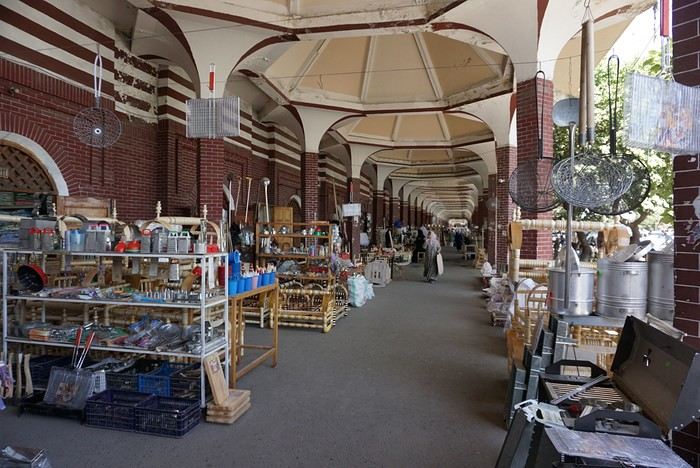
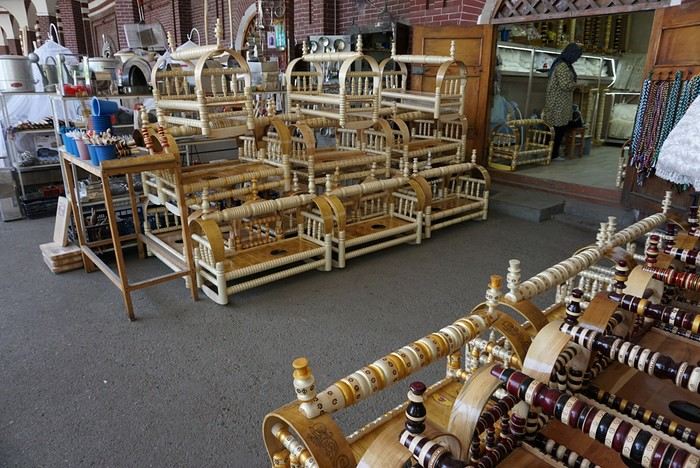
A walk under the arcades facing Chorsu: hardware stores, cabinetmakers, lute makers (one of them gave me a little concert/demo of a few string instruments).
We took off from Paris in the late afternoon on September 12 and arrived in Tashkent around 7:15 AM on the 13th.
This trip was the result of long contemplation and preparation (it was originally planned for the year of the lockdown (2020) and was prepared with the help and advice of Nasrullo Jumanov from Turquoise Travel.
Stages and Itinerary
Stage 1: Tashkent - September 13 and 14
Stage 2: Ferghana Valley – September 15 to 17
Stage 3: Nukus and Moynaq - September 18 and 19
Stage 4: Mysterious Khiva - September 20 to 22
Stage 5: Holy Bukhara - September 23 to 26
Stage 6: Asraf - September 27 and 28
Stage 7: Mythical Samarkand - September 29 to October 2
Stage 8: Tersak (via Shakhrisabz and Urgut) – October 3 and 4
Stage 9: Samarkand – October 5 and 6
Stage 10: Tashkent/Istanbul/Paris – October 6 and 7
Stage 1: Tashkent
September 13
At the airport exit, we were greeted by the owner of our B&B (B&B Gulnara).
Today was all about recovery and our first steps in the capital. Our first currency exchange made us feel like sudden millionaires.
Our first stroll down the avenue leading to Chorsu Market introduced us to the fact that 80 to 90% of the cars here are white Chevrolets.
A walk under the arcades facing Chorsu: hardware stores, cabinetmakers, lute makers (one of them gave me a little concert/demo of a few string instruments).
As we entered the market, many vendors called out to us, including this florist who asked where we were from: ‘France? Ah! Macron! PSG!’ He then recited a list of players from the Parisian team as well as past (Platini, Zidane, etc.) and current (Giroud, Griezmann, Mbappé, etc.) French national team players. Since we’re more into rugby (we live near Toulouse), he knew more players than I did!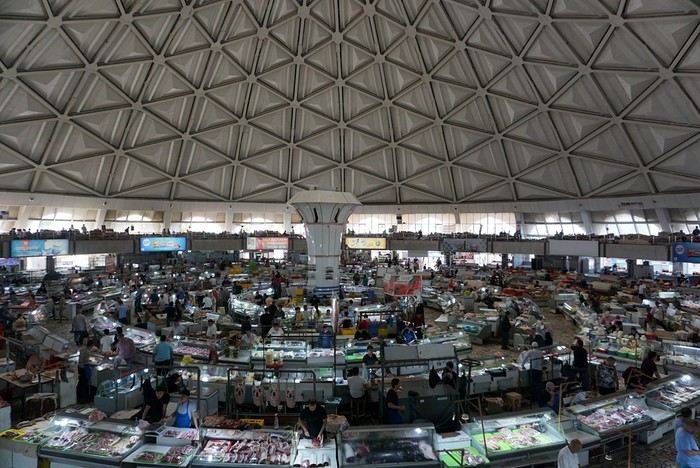
The market sprawls outside around the large circular, multi-story hall. We bought some grapes and bottles of freshly squeezed pomegranate juice for just a few sums. This evening, we had a meet-up with Nasrullo. The reunion was very warm: we’d been exchanging messages for over two years, and I’d been ‘torturing’ him with changes to our itinerary and trip duration. We were finally eager to meet, and honestly, I wasn’t disappointed—in fact, it was the opposite. Nasrullo was very attentive throughout our trip and always made sure, even from a distance (and most often from a distance!), that everything went smoothly. His goal was for us to leave delighted with our trip and, why not, indirectly become ambassadors for this destination. September 14 Breakfast with Nasrullo, then we set off with him by taxi to explore some of the capital’s sites.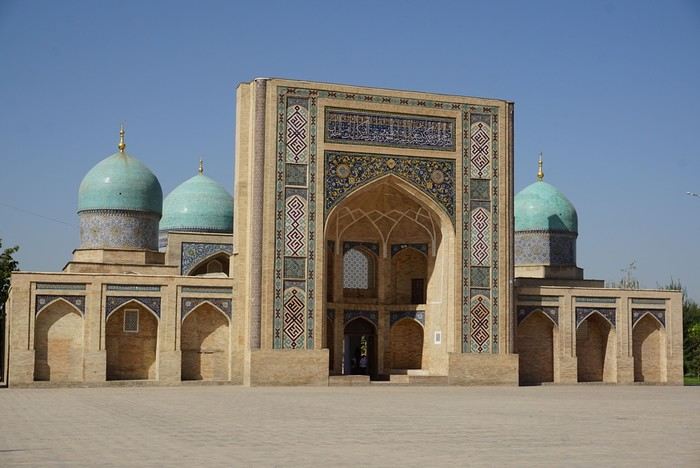
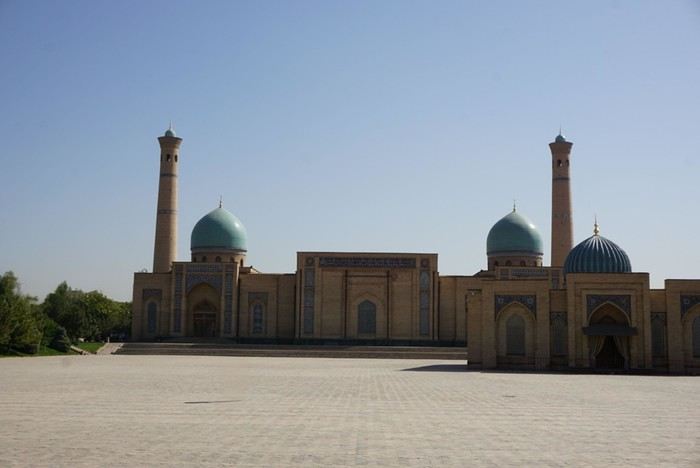
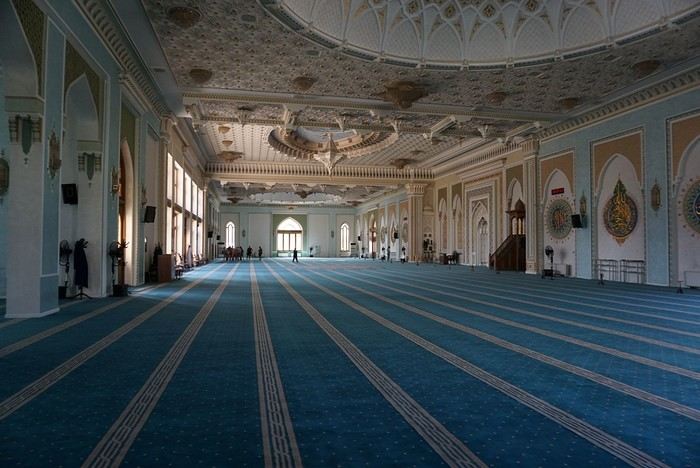
We started by visiting the Khazrati Imam complex, which includes the mausoleum of Kaffal Shashi, the Barak Khan and Muyi Muborak madrasas, and the great Khazrati Imam Mosque with its immense prayer hall.
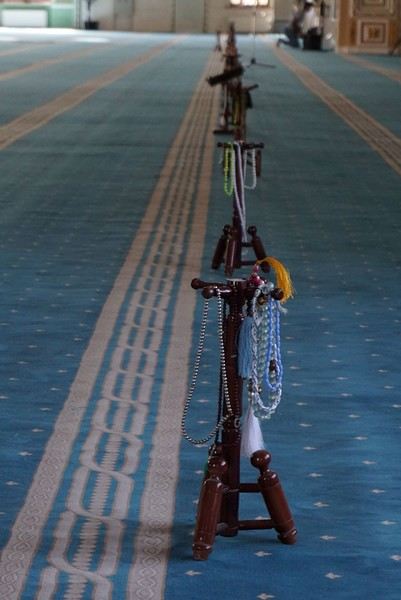
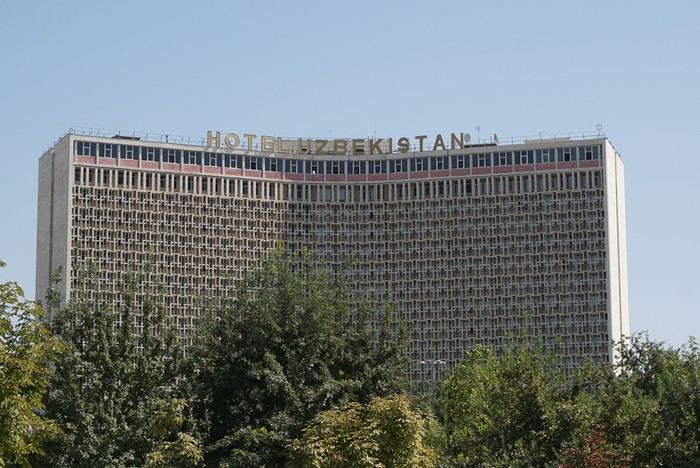
In the Muyi Muborak madrasa, now a museum, you can see the oldest Quran in the world. It was written by three religious scholars, including the secretary of the Prophet Muhammad, on large ‘pages’ made of antelope skin. Next, we explored Soviet-era Tashkent, discovering its parks, canals, and squares: Independence Square with its storks and phoenixes, Amir Temur Square with its large statue and, in the background, the massive Soviet-era hotel that has become one of Tashkent’s iconic buildings. Nasrullo took us through Broadway Boulevard and along what he calls ‘Tashkent’s Montmartre’… Well, it’s far, very far from Montmartre (in every sense of the word!). Then we took the metro to Chorsu station. Rush hour is pretty much the same everywhere in the metro… When we arrived at Chorsu, it was time to say goodbye. Nasrullo had to head back to Samarkand. Before leaving, he recommended some chaikhanas at the end of the galleries facing the market. We ate there for just a few euros (2 or 3 € for two people). After eating, we headed back to our room to cool off (our B&B is about a 10-minute walk away).
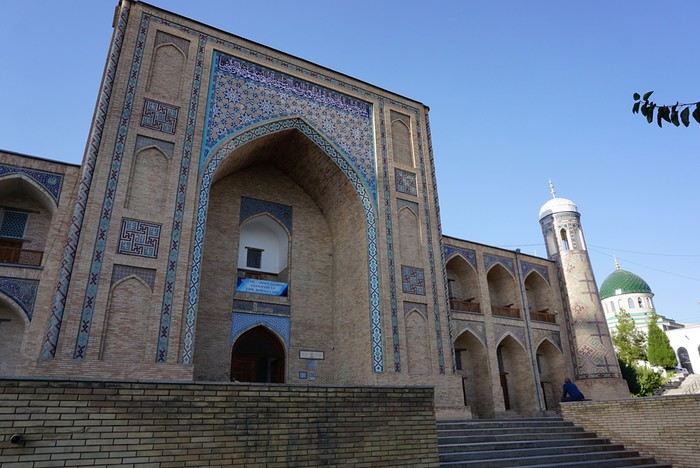
Around 4 PM, we set off to visit the Kokeldash Madrasa, which is still active. On the way, we stopped to watch some bread vendors and take a few photos. We were hesitating about buying some for our evening picnic when a young woman approached us. In perfect English, she asked: ‘Are you looking for something? Do you want to buy bread? Which one? How much?’ She then spoke to one of the vendors and negotiated the price. ‘Do you want one?’ And she took two. She paid directly. I took out my wallet to reimburse her, but she refused. It’s on the house! Then the vendor asked where we were from. And off we went again: Macron, PSG, football players… We’ll have to get used to it. The young woman smiled at the questions and comments, barely gave us time to thank her, and left as quickly as she had approached us.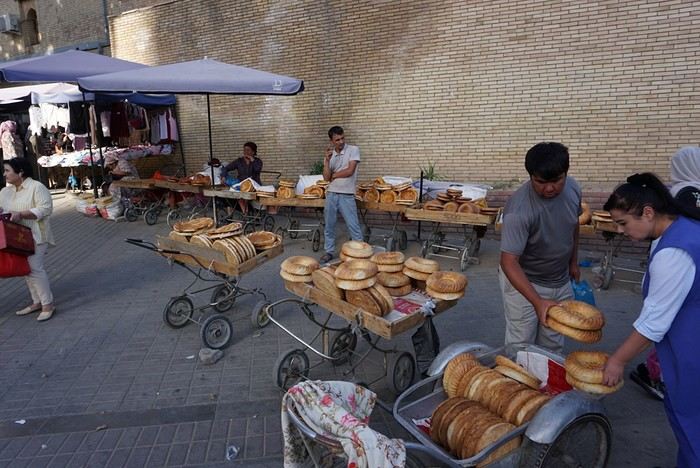
We continued our walk. Visited the madrasa. Then we crossed the boulevard to see the Tashkent Circus. I would’ve loved to go in and visit, but the ticket seller wouldn’t hear of it. We carried on around what should’ve been a park with old-fashioned rides and attractions. All we found was a construction site. Oh well! Back at our hotel, a message from Nasrullo was waiting for us. He had managed to change our train ticket for the next day. Instead of taking the 6:00 AM train, we’d take the 8:00 AM one. And instead of second class, we’d be in first class! Great! This evening, we had a picnic at one of the breakfast tables in the B&B courtyard. Under a shelter, the owner and his family were celebrating a birthday. The owner started by offering us some tea. Then they brought us some fruit (watermelon and melon). Finally, after the song, candles, and cake cutting, they brought us two generous slices of that beautiful birthday cake. Delicious!
We took off from Paris in the late afternoon on September 12 and arrived in Tashkent around 7:15 AM on the 13th.
This trip was the result of long contemplation and preparation (it was originally planned for the year of the lockdown (2020) and was prepared with the help and advice of Nasrullo Jumanov from Turquoise Travel.
Stages and Itinerary
Stage 1: Tashkent - September 13 and 14
Stage 2: Ferghana Valley – September 15 to 17
Stage 3: Nukus and Moynaq - September 18 and 19
Stage 4: Mysterious Khiva - September 20 to 22
Stage 5: Holy Bukhara - September 23 to 26
Stage 6: Asraf - September 27 and 28
Stage 7: Mythical Samarkand - September 29 to October 2
Stage 8: Tersak (via Shakhrisabz and Urgut) – October 3 and 4
Stage 9: Samarkand – October 5 and 6
Stage 10: Tashkent/Istanbul/Paris – October 6 and 7
Stage 1: Tashkent
September 13
At the airport exit, we were greeted by the owner of our B&B (B&B Gulnara).
Today was all about recovery and our first steps in the capital. Our first currency exchange made us feel like sudden millionaires.
Our first stroll down the avenue leading to Chorsu Market introduced us to the fact that 80 to 90% of the cars here are white Chevrolets.
A walk under the arcades facing Chorsu: hardware stores, cabinetmakers, lute makers (one of them gave me a little concert/demo of a few string instruments).As we entered the market, many vendors called out to us, including this florist who asked where we were from: ‘France? Ah! Macron! PSG!’ He then recited a list of players from the Parisian team as well as past (Platini, Zidane, etc.) and current (Giroud, Griezmann, Mbappé, etc.) French national team players. Since we’re more into rugby (we live near Toulouse), he knew more players than I did!
The market sprawls outside around the large circular, multi-story hall. We bought some grapes and bottles of freshly squeezed pomegranate juice for just a few sums. This evening, we had a meet-up with Nasrullo. The reunion was very warm: we’d been exchanging messages for over two years, and I’d been ‘torturing’ him with changes to our itinerary and trip duration. We were finally eager to meet, and honestly, I wasn’t disappointed—in fact, it was the opposite. Nasrullo was very attentive throughout our trip and always made sure, even from a distance (and most often from a distance!), that everything went smoothly. His goal was for us to leave delighted with our trip and, why not, indirectly become ambassadors for this destination. September 14 Breakfast with Nasrullo, then we set off with him by taxi to explore some of the capital’s sites.
We started by visiting the Khazrati Imam complex, which includes the mausoleum of Kaffal Shashi, the Barak Khan and Muyi Muborak madrasas, and the great Khazrati Imam Mosque with its immense prayer hall.
In the Muyi Muborak madrasa, now a museum, you can see the oldest Quran in the world. It was written by three religious scholars, including the secretary of the Prophet Muhammad, on large ‘pages’ made of antelope skin. Next, we explored Soviet-era Tashkent, discovering its parks, canals, and squares: Independence Square with its storks and phoenixes, Amir Temur Square with its large statue and, in the background, the massive Soviet-era hotel that has become one of Tashkent’s iconic buildings. Nasrullo took us through Broadway Boulevard and along what he calls ‘Tashkent’s Montmartre’… Well, it’s far, very far from Montmartre (in every sense of the word!). Then we took the metro to Chorsu station. Rush hour is pretty much the same everywhere in the metro… When we arrived at Chorsu, it was time to say goodbye. Nasrullo had to head back to Samarkand. Before leaving, he recommended some chaikhanas at the end of the galleries facing the market. We ate there for just a few euros (2 or 3 € for two people). After eating, we headed back to our room to cool off (our B&B is about a 10-minute walk away).
Around 4 PM, we set off to visit the Kokeldash Madrasa, which is still active. On the way, we stopped to watch some bread vendors and take a few photos. We were hesitating about buying some for our evening picnic when a young woman approached us. In perfect English, she asked: ‘Are you looking for something? Do you want to buy bread? Which one? How much?’ She then spoke to one of the vendors and negotiated the price. ‘Do you want one?’ And she took two. She paid directly. I took out my wallet to reimburse her, but she refused. It’s on the house! Then the vendor asked where we were from. And off we went again: Macron, PSG, football players… We’ll have to get used to it. The young woman smiled at the questions and comments, barely gave us time to thank her, and left as quickly as she had approached us.
We continued our walk. Visited the madrasa. Then we crossed the boulevard to see the Tashkent Circus. I would’ve loved to go in and visit, but the ticket seller wouldn’t hear of it. We carried on around what should’ve been a park with old-fashioned rides and attractions. All we found was a construction site. Oh well! Back at our hotel, a message from Nasrullo was waiting for us. He had managed to change our train ticket for the next day. Instead of taking the 6:00 AM train, we’d take the 8:00 AM one. And instead of second class, we’d be in first class! Great! This evening, we had a picnic at one of the breakfast tables in the B&B courtyard. Under a shelter, the owner and his family were celebrating a birthday. The owner started by offering us some tea. Then they brought us some fruit (watermelon and melon). Finally, after the song, candles, and cake cutting, they brought us two generous slices of that beautiful birthday cake. Delicious!
Bonjour,
Nous partons en Ouzbékistan fin Septembre pour deux semaines. L'agence locale nous propose de nous rendre à Noukous et, de là, de filer vers Moinaq, un ancien port sur la mer d'Aral. Je voudrais connaître l'avis de forumeurs sur l'intérêt de cette excursion?... Esct ce qu'il ne vaudrait pas mieux la remplacer par autre chose
Pour info, mon programme actuel :
Tashkent - Noukous
Noukous - Moinaq - Noukous
Noukous - Khiva
Khiva
Khiva - Boukhara
Boukhara
Boukhara
Boukhara - Nourata - Yangui Gazgan
Yangui Gazgan - Haydarkoul - Oukhum
Oukhum - Tepakul
Tepakul - Samarcande
Samarcande
Samarcande - Tashkent
Est ce qu nous passon à côté de quelque chose de ne pas ratable selon vous?... La vallée de Ferran, par exemple?... Et si nous faisons l'impasse sur la mer d'Aral, que me conseilleriez vous?...
A vous lire!
Le commentaire de Perju sur "l'arnaque" représentée par le coût d'une excursion Mer d'Aral à
500/ 600 € me révolte un peu ... Pourquoi ?
- les touristes français qui interrogent VF sont des voyageurs avertis, ce qui ne veut pas forcément dire "backpackers "prêts à tout pour réduire les coûts ! Effectivement, lorsque l'on a un budget ultra-serré, on peut dormir à la belle étoile avec son sac à viande ; mais d'autres préfèreront la "sécurité" d'une yourte et en paieront le coût (non pas le "coût réel", celui que paierait un ouzbèque ou un tadjike, mais le coût "touristique").
- idem pour le transport en 4 x4 pour aller de Moynaq au bord de la Mer d'Aral puisqu'il n'y a pas de transports en commun réguliers. Si l'on a du temps, on peut séjourner 3 ou 4 jrs à Moynaq en attente d'un hypothétique 4 x4 qui irait au Lac avec 4 ou 5 pers... TB ... Quand on est touriste, que l'on a 4 semaines de vacances et que l'on a que ce mois pour parcourir l'Ouzbék dont on a tant rêvé, que l'on a préparé un itinéraire ajusté au mieux ... on se doit de prévoir à l'avance "l'excursion Mer d'Aral " c'est à dire
1/ à une date donnée (que l'on choisit)
2/ en individuel (ou partagé si on le souhaite) avec un guide francophone ou anglophone
3/ avec un chauffeur connaissant les pistes et disposant d'un véhicule en bon état (NB : ne pas oublier que les véhicules 4 x 4 sont peu répandus en Ouzb. et qu'ils coûtent très cher),
tout cela a un coût, fatalement.
Ce qui fait que si l'Ouzb est effectivement bon marché pour l'hôtellerie, les repas, les taxis, la vie courante, la prestation "Mer d'Aral" ne peut être rangée dans la même catégorie ni être considérée comme une arnaque si le client doit payer 600 €.
Hi,
We’d like to know if it’s easy to visit the Sarmych-Sai gorges from Bukhara as a day trip. Do homestays and hotels offer this?
Thanks
Bonjour,
Nous projetons de passer 15j en Ouzbékistan en aout, et dans le guide Olizane, il est noté qu'il est possible de passer les frontières pour une excursion vers les pays limitrophes.
Auriez vous des conseils, notamment quel pays choisir, pour 1 à 3 jours et par nos propre moyen ?
Merci, Bruno
Nous projetons de passer 15j en Ouzbékistan en aout, et dans le guide Olizane, il est noté qu'il est possible de passer les frontières pour une excursion vers les pays limitrophes.
Auriez vous des conseils, notamment quel pays choisir, pour 1 à 3 jours et par nos propre moyen ?
Merci, Bruno
bonjour à tous, partant en Ouzbékistan avec mon mari en octobre, j'aimerais votre avis sur mon itinéraire:
-arrivée samedi 19/10 à Taskent à 3h du matin puis vol interne pour Noukous . visite du musée de Noukous
-dim 20/10: excursion à Mounyaq
-lundi 21/10: départ pour Kiva en passant par les forteresses d'Eliq Qala
-mardi 22/10: visite de Khiva
-merc 23/10: train pour Boukhara
-24, 25, 26/10: visite de Boukhara
-27/10: train pour Samarcande et visite de samarcande
-28 et 29/10: visite de Samarcande avec train de 17h pour Tashkent
-30/10: train pour Kokand avec visite de Kokand
-jeudi 31/10: excursion à marguilan (bazar Kuntepa et atelier de soieries) et Rishtan (visite ateliers de Poterie)
-1/11: train le matin pour Tashkent
-2 et 3/11: visite de Tashkent
-4/11: avion de retour
est ce que les timing vous semblent bons pour les étapes ? le lonely planet conseille de réserver à l'avance les hébergements sympas type B and B car visiblement ils sont complets en haute saison (donc à la période ou je pars), qu'en pensez vous? je n'ai pas l'habitude de réserver à l'avance car cela coupe la possibilité de modifier l'itinéraire.
je me pose surtout des questions pour la fin du parcours. est ce que 2 jours et demi ne seront pas trop longs sur Tashkent , d'autant que nous aurons déjà vu les "merveilles" de l'Ouzbékistan? me conseillez vous alors de rester un jour de plus dans la vallée de Fergana (mais alors que voir de plus? rien de plus à voir sur le lonely en tout cas). je me suis arrangée avec l'itinéraire pour être sur Marguilan un jeudi, jour d'ouverture du bazar Kuntepa , visiblement très réputé car j'affectionne particulièrement les beaux marchés. Merci de votre aide et/ou conseils .
Laure
est ce que les timing vous semblent bons pour les étapes ? le lonely planet conseille de réserver à l'avance les hébergements sympas type B and B car visiblement ils sont complets en haute saison (donc à la période ou je pars), qu'en pensez vous? je n'ai pas l'habitude de réserver à l'avance car cela coupe la possibilité de modifier l'itinéraire.
je me pose surtout des questions pour la fin du parcours. est ce que 2 jours et demi ne seront pas trop longs sur Tashkent , d'autant que nous aurons déjà vu les "merveilles" de l'Ouzbékistan? me conseillez vous alors de rester un jour de plus dans la vallée de Fergana (mais alors que voir de plus? rien de plus à voir sur le lonely en tout cas). je me suis arrangée avec l'itinéraire pour être sur Marguilan un jeudi, jour d'ouverture du bazar Kuntepa , visiblement très réputé car j'affectionne particulièrement les beaux marchés. Merci de votre aide et/ou conseils .
Laure
Je pars en Ouzbekistan et j'aimerais avoir votre avis sur mon projet d'itinéraire
17/10 – Arrivée à Tashkent et nuit à Tashkent 18/10 – Kokand et nuit à Kokand – Visite du palais du Khan et de la vieille ville 19/10 – Kokand et nuit à Kokand – visite des environs, excursion à Rushtan 20/10 – Kokand Ferghana – nuit à Ferghana – visite de Marguilan 21/10 – Ferghana Tashkent – nuit à Tashkent 22/10 – Vol pour Ourgentch et transfert à khiva – visite de Khiva – nuit à Khiva 23/10 – Excursion citadelles du désert et nuit à Khiva 24/10 – Khiva Boukhara et nuit à Boukhara 25/10 – Visite des environs de Boukhara et nuit à Boukhara 26/10 – Boukhara et nuit à Boukhara 27/10 - Boukhara et nuit à Boukhara E8/10 – Sentob Nourata – nuit à Sentob 29/10 – Nuit à Sentob 30/10 – Trajet Sentob Samarcande et nuit à Samarcande 31/10 – Samarcande 1/11 - Samarcande 2/11 – Samarcande – excursion à Shahrisabz – nuit à Samarcande 3/11 –TgV Samarcande Tashkent Départ pour Paris le 6/11 Comme vous le voyez je serai à Tashkent le 3 alors que je pars le 6 donc 2 jours à tuer ; peut-être puis-je faire une prolongation quelque part ?
17/10 – Arrivée à Tashkent et nuit à Tashkent 18/10 – Kokand et nuit à Kokand – Visite du palais du Khan et de la vieille ville 19/10 – Kokand et nuit à Kokand – visite des environs, excursion à Rushtan 20/10 – Kokand Ferghana – nuit à Ferghana – visite de Marguilan 21/10 – Ferghana Tashkent – nuit à Tashkent 22/10 – Vol pour Ourgentch et transfert à khiva – visite de Khiva – nuit à Khiva 23/10 – Excursion citadelles du désert et nuit à Khiva 24/10 – Khiva Boukhara et nuit à Boukhara 25/10 – Visite des environs de Boukhara et nuit à Boukhara 26/10 – Boukhara et nuit à Boukhara 27/10 - Boukhara et nuit à Boukhara E8/10 – Sentob Nourata – nuit à Sentob 29/10 – Nuit à Sentob 30/10 – Trajet Sentob Samarcande et nuit à Samarcande 31/10 – Samarcande 1/11 - Samarcande 2/11 – Samarcande – excursion à Shahrisabz – nuit à Samarcande 3/11 –TgV Samarcande Tashkent Départ pour Paris le 6/11 Comme vous le voyez je serai à Tashkent le 3 alors que je pars le 6 donc 2 jours à tuer ; peut-être puis-je faire une prolongation quelque part ?
Bonjour,
Nous souhaitons partir en Ouzbekistan 2 semaines en octobre 2018. Nous aimerions savoir si le camp de yourtes près du lac Aydar vaut la peine ainsi que les balades autour du lac (faune ?); Idem pour le village d'Hayat où l'agence locale (Authentic travel) nous propose de passer une nuit chez l'habitant. Sinon, connaissez vous des endroits pas trop touristiques où il serait sympa de s'attarder. Merci pour vos réponses!
Dominique
Nous souhaitons partir en Ouzbekistan 2 semaines en octobre 2018. Nous aimerions savoir si le camp de yourtes près du lac Aydar vaut la peine ainsi que les balades autour du lac (faune ?); Idem pour le village d'Hayat où l'agence locale (Authentic travel) nous propose de passer une nuit chez l'habitant. Sinon, connaissez vous des endroits pas trop touristiques où il serait sympa de s'attarder. Merci pour vos réponses!
Dominique
quelqu un peut il me renseigner =
à savoir si à Samarcande y a t il des agences de voyage qui propose ce trip sur 1 (ou 2 jours)
meme si on n a pas de visa pr le tadjikistan et sans visa à entrée multiple pour l ouzbekistan
cela vaut il le coup ?
quel prix faut il envisager ?
Je pars en Ouzbekistan en sept 2008
merci pour votre aide
sylvie
++
++
Bonjour les routards,
Apres pres de 3 semaines passees au pays, je serai ravi de vous donner des infos recentes sur le sujet qui vous plait 😄 A noter que j'ai ete tres classique dans mon itineraire : Tashkent-Khiva-Boukara-Samarcande-Chakhrisabz-Tashkent N'hesitez pas a me poser la moindre colle !
Apres pres de 3 semaines passees au pays, je serai ravi de vous donner des infos recentes sur le sujet qui vous plait 😄 A noter que j'ai ete tres classique dans mon itineraire : Tashkent-Khiva-Boukara-Samarcande-Chakhrisabz-Tashkent N'hesitez pas a me poser la moindre colle !
Hello,
Summer 2026 hasn’t even arrived yet, and I’m already thinking about summer 2027! We’re a family with two kids, who will be 9.5 and 4.5 years old next summer (turning 5 at the end of October 2027, actually). We’d love to spend 19 nights in Uzbekistan and Kyrgyzstan—a part of the world that’s completely new to us. We enjoy traveling, do it often, and the kids are used to it (though we still need a bit of organization and comfort!). Here’s the rough outline of our itinerary: Day 1 - Arrival in Tashkent (ideally in the late afternoon). Head to the train station (by taxi?) to take the overnight sleeper train to Urgench (1 night). Day 2 - Khiva (2 nights): Taxi transfer from the station to the city. Visit Itchan Kala, the walls, and sunset. Day 4 - Head to Bukhara (3 nights) by train (about 6 hours). Visit the historic center, domes, and workshops. Day 7 - On to Samarkand (2 nights), but this time with a private driver. Visit Registan, the necropolis, and local crafts. Day 9 - Head to Osh (1 night) in Kyrgyzstan with the private driver, who’ll drop us at the border. Long transition day (including border crossing). If it’s not too late, visit Osh’s market (otherwise, the next morning). Day 10 - Pick up our rental car (4x4 without a driver this time) and drive to Toktogul (2 nights) and the Suusamyr Valley. Day 12 - Head to the Kochkor region (350 km - 4 nights): Tash Rabat, Song-Kul Lake (yurt stay), and Aigliers. Day 16 - Depart for Karakol/Issyk-Kul (250 km - 4 nights): Jeti-Oguz, Altyn Arashan, beaches, and hot springs. Day 20: Fly home. TOTAL = 19 nights What do you think? Budget-wise:
Flight tickets: 3000 € Uzbekistan logistics (accommodation ideally with a pool for the kids and vehicle): 1600 € Kyrgyzstan logistics (accommodation and 4x4 vehicle like a Pajero/Land Cruiser): 1600 € Living & food: 800 € TOTAL: 7000 €
Does this seem reasonable? Not overestimated or underestimated? Thanks for any feedback or tips from your own experiences.
Summer 2026 hasn’t even arrived yet, and I’m already thinking about summer 2027! We’re a family with two kids, who will be 9.5 and 4.5 years old next summer (turning 5 at the end of October 2027, actually). We’d love to spend 19 nights in Uzbekistan and Kyrgyzstan—a part of the world that’s completely new to us. We enjoy traveling, do it often, and the kids are used to it (though we still need a bit of organization and comfort!). Here’s the rough outline of our itinerary: Day 1 - Arrival in Tashkent (ideally in the late afternoon). Head to the train station (by taxi?) to take the overnight sleeper train to Urgench (1 night). Day 2 - Khiva (2 nights): Taxi transfer from the station to the city. Visit Itchan Kala, the walls, and sunset. Day 4 - Head to Bukhara (3 nights) by train (about 6 hours). Visit the historic center, domes, and workshops. Day 7 - On to Samarkand (2 nights), but this time with a private driver. Visit Registan, the necropolis, and local crafts. Day 9 - Head to Osh (1 night) in Kyrgyzstan with the private driver, who’ll drop us at the border. Long transition day (including border crossing). If it’s not too late, visit Osh’s market (otherwise, the next morning). Day 10 - Pick up our rental car (4x4 without a driver this time) and drive to Toktogul (2 nights) and the Suusamyr Valley. Day 12 - Head to the Kochkor region (350 km - 4 nights): Tash Rabat, Song-Kul Lake (yurt stay), and Aigliers. Day 16 - Depart for Karakol/Issyk-Kul (250 km - 4 nights): Jeti-Oguz, Altyn Arashan, beaches, and hot springs. Day 20: Fly home. TOTAL = 19 nights What do you think? Budget-wise:
Flight tickets: 3000 € Uzbekistan logistics (accommodation ideally with a pool for the kids and vehicle): 1600 € Kyrgyzstan logistics (accommodation and 4x4 vehicle like a Pajero/Land Cruiser): 1600 € Living & food: 800 € TOTAL: 7000 €
Does this seem reasonable? Not overestimated or underestimated? Thanks for any feedback or tips from your own experiences.
Hello,
We’re a senior couple planning to spend around 3 weeks in Uzbekistan, either starting at the end of March or mid-April. We’ll begin in Khiva (Urgench) and finish in Tashkent (via Termez). We prefer traveling independently as much as possible, at our own pace, and are considering hiring drivers for specific legs of our journey.
Here’s our rough itinerary:
4 nights in Khiva
4 in Bukhara
5 or 6 in Samarkand (we’d like to do a day trip to the Seven Lakes in Tajikistan)
2 in Termez
Then Tashkent and the Fergana Valley
2 in Tashkent
Does this seem balanced? Any suggestions? We’re not planning to go as far as the Aral Sea or stay in a yurt camp.
Is the weather favorable at the end of March (risk of rain)? Or would mid-April be better?
What’s the typical cost for a driver’s services?
Thank you in advance for any tips that could help us with our plans.
Andrea
Hi everyone, happy to be back on VF!
I’ll be in Uzbekistan this coming April and will of course visit the three classics—Samarkand, Bukhara, and Khiva. However, I’d also love to get out of these cities to explore the Uzbek countryside and experience its nature. Mountains, steppes, etc. Ideally, with some great hikes passing through villages. Any spots you’d recommend? Thanks in advance
Hi,
So glad the site’s back up—I’ve always found great off-the-beaten-path tips here!
This time, we’re planning a trip to Uzbekistan. Since time is a bit tight, we wanted to fly from Tashkent to Urgench, but we can’t find any direct flights between the two. Do we need to book from France, and if so, which site should we use? We’re thinking of going around mid-April.
Thanks in advance for your help!
Céline
Bonjour,
J'ai élaboré le programme suivant pour notre circuit individuel en mai :
- 2 jours Khiva - 1 jour forteresses du désert - 1 jour trajet Khiva-Bouhara - 3 jours Boukhara - 3 jours hors villes (Nuratau ou équivalent) - 3 jours Samakande (départ fin d'aprés-midi pour Tachkent) - 1 jour Tackent
Il me reste 1 journée supplémentaire à mettre. Vous la placeriez où dans ce programme ? à Khiva (car premier jour en arrivée directe de Paris et donc un peu de fatigue éventuelle à récupérer) ? à Samarkande (quitte à organiser sur place une activité hors la ville) ? Je vous pose la question car en raison de la période de mai, je pense qu'il va falloir que je verrouille les dates de l'excursion vers Nuratau.
Merci de votre avis (même si je me doute bien que à chaque fois personnel comme avis).
J'ai élaboré le programme suivant pour notre circuit individuel en mai :
- 2 jours Khiva - 1 jour forteresses du désert - 1 jour trajet Khiva-Bouhara - 3 jours Boukhara - 3 jours hors villes (Nuratau ou équivalent) - 3 jours Samakande (départ fin d'aprés-midi pour Tachkent) - 1 jour Tackent
Il me reste 1 journée supplémentaire à mettre. Vous la placeriez où dans ce programme ? à Khiva (car premier jour en arrivée directe de Paris et donc un peu de fatigue éventuelle à récupérer) ? à Samarkande (quitte à organiser sur place une activité hors la ville) ? Je vous pose la question car en raison de la période de mai, je pense qu'il va falloir que je verrouille les dates de l'excursion vers Nuratau.
Merci de votre avis (même si je me doute bien que à chaque fois personnel comme avis).
Bonjour nous partons 20 jours en avril et je commence à préparer mon voyage et même si au bout d'une semaine de recherche sur les forums j'y vois plus clair j'ai besoin pour moins stresser, que tout soit au point. je vous soumets donc mon itinéraire:
je précise que nous utilisons au maximum les transports locaux et dormons chez l'habitant
Jour 1 arrivée à Tashkent
Jour 2 visite de Tashkent
Jour 3 Départ pour la vallée de Ferghana nuit à KoKand
Jour 4 Kokand Rishtan Ferghana
Jour 5 Ferghana Marguilan
Jour 6 Marguilan Chust train de nuit pour Khiva
je me demande si ce n'est trop de jours?
je ne sais pas dans quelle ville de la vallée on peut prendre le train, faut il retourner à Tashkent?
Jour 7 Khiva
Jour 8 excusion et nuit vers les citadelles du désert
Jour 9 Khiva Boukhara
Jour 10 11 12 Boukhara Samarcande
Jour 13 14 15 Samarcande
Jour 16 Samarcande Shahrisabz
Jour 17 Shahribabz Tashkent
Sachant que l'on a encore les jours 18 19 et 20 disponibles devons nous rester plus longtemps dans certaines villes ou quelles escapades pourrions nous inclure?
merci d'avance pour tous vos conseils
Et voilà, c'est décidé, nous serons en Ouzbékistan l'été prochain. Je me réjouis de découvrir ce pays et je recours déjà à vos avis :
- combien de jours passer à Khiva ? en comptant prendre une journée pour aller visiter les citadelles du désert. Je pensais y passer trois jours complets, plus une journée pour les citadelles, est-ce trop ?
- je souhaiterais faire une excursion de deux jours au départ de Boukhara vers Samarcande en passant par les monts Nurata, avec une nuit dans un village de montagne. Je ne souhaite pas aller au lac Aydarkul. Connaissez-vous une bonne agence organisant ce genre de tour ?
- combien de jours à Samarcande ?
- je ne trouve pas d'adresse mail de contact de l'Alliance française à Tashkent ?
Merci pour vos avis ...
- combien de jours passer à Khiva ? en comptant prendre une journée pour aller visiter les citadelles du désert. Je pensais y passer trois jours complets, plus une journée pour les citadelles, est-ce trop ?
- je souhaiterais faire une excursion de deux jours au départ de Boukhara vers Samarcande en passant par les monts Nurata, avec une nuit dans un village de montagne. Je ne souhaite pas aller au lac Aydarkul. Connaissez-vous une bonne agence organisant ce genre de tour ?
- combien de jours à Samarcande ?
- je ne trouve pas d'adresse mail de contact de l'Alliance française à Tashkent ?
Merci pour vos avis ...
Bonjour,
avec un peu de retard sur les dates, le voyage se précise enfin, puisque les billets sont pris et nous partirons donc du 21 avril au 3 mai. Nous serons 4 adultes.
Le programme à ce jour (bien sur susceptible d'évoluer en fonction des divers avis)
Arrivée le 22 au matin à Tashkent
Découverte rapide de la ville
Vol autour de 18h vers Nukus
Le 23 : AR vers Moynaq (la non-mer d'Aral) en taxi
Le 24 : Route en taxi vers Khiva avec en route découverte des forteresses du désert
Le 25 : Visite de Khiva
Le 26 : Le matin train vers Boukhara et visite de la ville
Le 27 : Visite de la ville
Le 28 : Fin de la visite de la ville et AM train pour Samarcande
Le 29 : Visite de Samarcande
Le 30 : Excursion à Chakhrisabz en taxi
Le 1 : Visite de Samarcande
Le 2 : Matinée à Samarcande et fin d'AM train pour Tashkent
Le 3 : Retour maison
1ère question : Est-ce que ce programme tient la route ? Est-il équilibré ? Réaliste ? 2ème question : Pour les excursions (Moynaq, trajet jusqu'à Khiva avec visite des forteresses et Chakhrisabz) est-il facile de trouver des taxis et quels sont les prix ? 3ème question : Le premier jour à Tashkent : On arrive à 7h à l'aéroport et on devrait avoir un vol à 18h15 le soir. Faut tuer le temps, est-ce commode depuis l'aéroport d'aller visiter 2 ou 3 trucs et de revenir ? Quid des bagages ? Consignes ?
Voilà mes premières questions. Merci pour les premières réponses a+
1ère question : Est-ce que ce programme tient la route ? Est-il équilibré ? Réaliste ? 2ème question : Pour les excursions (Moynaq, trajet jusqu'à Khiva avec visite des forteresses et Chakhrisabz) est-il facile de trouver des taxis et quels sont les prix ? 3ème question : Le premier jour à Tashkent : On arrive à 7h à l'aéroport et on devrait avoir un vol à 18h15 le soir. Faut tuer le temps, est-ce commode depuis l'aéroport d'aller visiter 2 ou 3 trucs et de revenir ? Quid des bagages ? Consignes ?
Voilà mes premières questions. Merci pour les premières réponses a+
Bonjour,
Je souhaite traverser en bateau de Baku (AZERBAIDJAN) vers Turkembaski (TURKMENISTAN). Est il possible d'avoir un visa transit 3-5 jours au Turkménistan et rejoindre Ashgabat, Gate of Hell et sortir à vers Nukus (Ouzbékistan) ? L'itinéraire doit il être précis à l'entrée au Turkménistan ? Je vais voyager avec un camion aménagé ; est il possible de bivouaquer vers la porte de l'enfer ? Ailleurs ?
Merci d'avance, Kastor
Je souhaite traverser en bateau de Baku (AZERBAIDJAN) vers Turkembaski (TURKMENISTAN). Est il possible d'avoir un visa transit 3-5 jours au Turkménistan et rejoindre Ashgabat, Gate of Hell et sortir à vers Nukus (Ouzbékistan) ? L'itinéraire doit il être précis à l'entrée au Turkménistan ? Je vais voyager avec un camion aménagé ; est il possible de bivouaquer vers la porte de l'enfer ? Ailleurs ?
Merci d'avance, Kastor
Bonjour à tous !
Avec mon compagnon nous comptons partir en Ouzbékistan au mois d'aout prochain. Et j'avoue que je serais très intéressée par aller voir ce qu'on appelle les Citadelles du Desert. Je me demandai si c'est bien accessible par nos propres moyens (en partant de Khiva peut être ?) et s'il existe des solutions pour dormir sur place. Sur internet, j'ai trouvé les sites de Ayaz Kala et Toprak Kala.
Ca m'intéresserais de connaître vos avis sur ces lieux - ou d'autres si vous avez des conseils ;-).
Belle journée à tous ! Héloïse
Avec mon compagnon nous comptons partir en Ouzbékistan au mois d'aout prochain. Et j'avoue que je serais très intéressée par aller voir ce qu'on appelle les Citadelles du Desert. Je me demandai si c'est bien accessible par nos propres moyens (en partant de Khiva peut être ?) et s'il existe des solutions pour dormir sur place. Sur internet, j'ai trouvé les sites de Ayaz Kala et Toprak Kala.
Ca m'intéresserais de connaître vos avis sur ces lieux - ou d'autres si vous avez des conseils ;-).
Belle journée à tous ! Héloïse
Je lis régulièrement les posts sur l'Ouzb. et je vois rarement abordé le sujet "Musée Savitsky" à Noukous (ville qui n'offre AUCUN intérêt hormis le Musée). Il s'agit pourtant d'un lieu très intéressant pour qui s'intéresse à l'art ; la présentation soignée tant au niveau ethnographique (superbes textiles, bijoux ...) que pictural (toiles de la période avant-garde russe 1920/1930) mérite vraiment le détour. A faire au départ de Khiva.
Hello à tous les voyageurs!
Je souhaite visiter l'Ouzb. pour une 15/20 jours. Je vais arriver dans ce pays via le Kirghisistan, par Och donc.
Nous pensons faire les classiques : sarmacande, boukhara et khiva. Nous partirons de Tachkenk pour revenir en france.
Pourriez vous m'indiquer si ces durées sont adéquates en fonctions des villes: - Sarmacandes : 3 jours - Boukhara : 4 jours - Khiva : 3 jours - Tachkenk : 3 jours
Auriez vous des idées entre le transfert de la frontière avec le Kirghisitan et les villes citées dessus? Des villes vallent elles le coup dans la vallée (Adigan? Fergana?)?
D'un point de vu transfert, j'ai cru comprendre que le train était bien développé en Ouzbekistan. Les 4 villes sont elles reliées?
Un autre truc me taraude! Il faut apparement tous les soirs demander aux hotels un certificat d'enregistrement. savez vous si les guest houses/ B&B délivrent elles aussi ces certificats?
Merci !! Benjamin
Je souhaite visiter l'Ouzb. pour une 15/20 jours. Je vais arriver dans ce pays via le Kirghisistan, par Och donc.
Nous pensons faire les classiques : sarmacande, boukhara et khiva. Nous partirons de Tachkenk pour revenir en france.
Pourriez vous m'indiquer si ces durées sont adéquates en fonctions des villes: - Sarmacandes : 3 jours - Boukhara : 4 jours - Khiva : 3 jours - Tachkenk : 3 jours
Auriez vous des idées entre le transfert de la frontière avec le Kirghisitan et les villes citées dessus? Des villes vallent elles le coup dans la vallée (Adigan? Fergana?)?
D'un point de vu transfert, j'ai cru comprendre que le train était bien développé en Ouzbekistan. Les 4 villes sont elles reliées?
Un autre truc me taraude! Il faut apparement tous les soirs demander aux hotels un certificat d'enregistrement. savez vous si les guest houses/ B&B délivrent elles aussi ces certificats?
Merci !! Benjamin
Bonjour à tous,
malgré l'usage que j'en ai régulièrement pour préparer mes excursions, c'est la première fois que j'écris un message sur le forum. Je tiens à le faire 3 semaines après un retour de voyage en Ouzbékistan (du 3 au 17 avril 2016) pour partager quelques réflexions et conseils. Tout d'abord, sachez qu'il est hyper facile de voyager en Ouzbékistan. De nombreuses solutions vont s'offrir à vous en général (avion, train dont équivalent TGV, taxi collectif, taxi individuel, ...), même si de Khiva à Boukhara il n'y a pas trop le choix (taxi, avec route pas tip top).
Nous avons trouvé des hôtels assez facilement, et nous recommanderions sans hésiter le B&B Meros à Khiva ou le Fatima Hotel à Boukhara, super accueillants, petits-déj au top, facilité de changer de l'argent, ...
Nous avons pu assez facilement sortir des "sentiers battus" (et pour le plus grand bien !) : excursion au lac Aydar Kul (nuit en yourte et ballades en chameau) depuis Boukhara puis retour à Samarkand, ou dans les montagnes entre Samarkand et Sahrisabz (à Tersak précisément, chez un instituteur francophone dont le fils francophone lui aussi nous a guidé dans les premières pentes du Pamir). Ces expéditions ont été parfaitement et chaleureusement organisées par Sardor Turaev, le très attachant et parfaitement francophone guide de l'agence Crown Tour, que nous avons eu la chance de rencontrer à Khiva le lendemain de notre arrivée dans le pays (www.crown-samarkand.com). On vous le recommande vivement !!!
La plus grande des interrogations que l'on ait eu avant le départ concernait l'argent. Sachez qu'il n'est pas du tout indispensable d'avoir des dollars avec soi ou peut-être une dizaine de dollars en petite coupure pour le taxi le 1er jour. Les euros suffisent ; vous les échangerez facilement sur place pour obtenir des soums (très facile au marché noir ; difficile d'envisager un change via les bureaux de change officiels vu le manque à gagner...). Evitez en tout cas d'échanger des sommes trop importantes à l'arrivée à l'aéroport ; cela se fera au taux officiel (autour de 1 euro = 3200 soums) ou au marché noir mais à un taux anormalement bas. Le taux au marché noir pouvait atteindre 1 euro = 6800 soums.
Trajet que nous avons suivi : Khiva-Boukhara-lac Aydra Kul-Samarkand-Tersak (entre Samarkand et Sahrisabz)-Samarkand-Tashkent. Nous ne sommes pas allés dans les citadelles du désert mais on nous a proposé de faire un détour entre Khiva et Boukhara pour les visiter (le trajet initial de 7h environ aurait été augmenté d'au-moins 4 heures ; faut aimer la voiture et les routes à l'état très inégal...). Nous avons également fait une croix sur Sahrisabz (bien qu'on nous en ai dit le plus grand bien). Les temps de parcours nous ont démotivé (ma compagne est enceinte, donc tout est relatif).
J'espère que ces quelques précisions serviront à certains d'entre vous. Bonne soirée à tous. Jean-François.
malgré l'usage que j'en ai régulièrement pour préparer mes excursions, c'est la première fois que j'écris un message sur le forum. Je tiens à le faire 3 semaines après un retour de voyage en Ouzbékistan (du 3 au 17 avril 2016) pour partager quelques réflexions et conseils. Tout d'abord, sachez qu'il est hyper facile de voyager en Ouzbékistan. De nombreuses solutions vont s'offrir à vous en général (avion, train dont équivalent TGV, taxi collectif, taxi individuel, ...), même si de Khiva à Boukhara il n'y a pas trop le choix (taxi, avec route pas tip top).
Nous avons trouvé des hôtels assez facilement, et nous recommanderions sans hésiter le B&B Meros à Khiva ou le Fatima Hotel à Boukhara, super accueillants, petits-déj au top, facilité de changer de l'argent, ...
Nous avons pu assez facilement sortir des "sentiers battus" (et pour le plus grand bien !) : excursion au lac Aydar Kul (nuit en yourte et ballades en chameau) depuis Boukhara puis retour à Samarkand, ou dans les montagnes entre Samarkand et Sahrisabz (à Tersak précisément, chez un instituteur francophone dont le fils francophone lui aussi nous a guidé dans les premières pentes du Pamir). Ces expéditions ont été parfaitement et chaleureusement organisées par Sardor Turaev, le très attachant et parfaitement francophone guide de l'agence Crown Tour, que nous avons eu la chance de rencontrer à Khiva le lendemain de notre arrivée dans le pays (www.crown-samarkand.com). On vous le recommande vivement !!!
La plus grande des interrogations que l'on ait eu avant le départ concernait l'argent. Sachez qu'il n'est pas du tout indispensable d'avoir des dollars avec soi ou peut-être une dizaine de dollars en petite coupure pour le taxi le 1er jour. Les euros suffisent ; vous les échangerez facilement sur place pour obtenir des soums (très facile au marché noir ; difficile d'envisager un change via les bureaux de change officiels vu le manque à gagner...). Evitez en tout cas d'échanger des sommes trop importantes à l'arrivée à l'aéroport ; cela se fera au taux officiel (autour de 1 euro = 3200 soums) ou au marché noir mais à un taux anormalement bas. Le taux au marché noir pouvait atteindre 1 euro = 6800 soums.
Trajet que nous avons suivi : Khiva-Boukhara-lac Aydra Kul-Samarkand-Tersak (entre Samarkand et Sahrisabz)-Samarkand-Tashkent. Nous ne sommes pas allés dans les citadelles du désert mais on nous a proposé de faire un détour entre Khiva et Boukhara pour les visiter (le trajet initial de 7h environ aurait été augmenté d'au-moins 4 heures ; faut aimer la voiture et les routes à l'état très inégal...). Nous avons également fait une croix sur Sahrisabz (bien qu'on nous en ai dit le plus grand bien). Les temps de parcours nous ont démotivé (ma compagne est enceinte, donc tout est relatif).
J'espère que ces quelques précisions serviront à certains d'entre vous. Bonne soirée à tous. Jean-François.