Hi everyone,
On August 15th, we’ll be flying from São Paulo to Salvador de Bahia (which airline should we choose?) to spend about ten days there. Since we haven’t had a vacation in two years, we’d like to avoid spending too much time on the road and instead discover some picturesque spots that aren’t too crowded with tourists... Any tips? We’re already planning to spend 2-3 days in Salvador, and then what? I think two other nearby destinations where we could wander around would be ideal: Praia do Forte, Itaparica, Loreto de São Paulo, Cachoeira, or any other must-see places?
Thanks for your help
1,278 similar discussions in English
It was exactly 1 year ago today. 22 days in the American West, a beautiful loop starting from San Francisco, with just one place we passed through twice (Death Valley).
Since my first travel journal, recently completed, was very chatty and included lots of photos, I made a big decision this time: 1 day = 1 photo with a comment, that's it!
Before I start, here’s a quick overview of our trip: - San Francisco
- The Pacific Coast (Highway One) from Monterey to Cambria - Death Valley - West Grand Canyon - South Grand Canyon - Vermillion Cliffs - Page (Horseshoe Bend, Antelope Canyon) - Monument Valley
- Moab (Arches Park, Canyonlands) - Bryce Canyon (via Capitol Reef) - Zion Park - Las Vegas - Lone Pine / Alabama Hills (passing through Death Valley again) - Mammoth Lakes - Yosemite - Return to San Francisco via Sonoma.
Here we go! Below are the first 4 photos, for the first 4 days in San Francisco.
Day 1 – Saturday, April 30, around 5:30 PM – Embarcadero, San Francisco
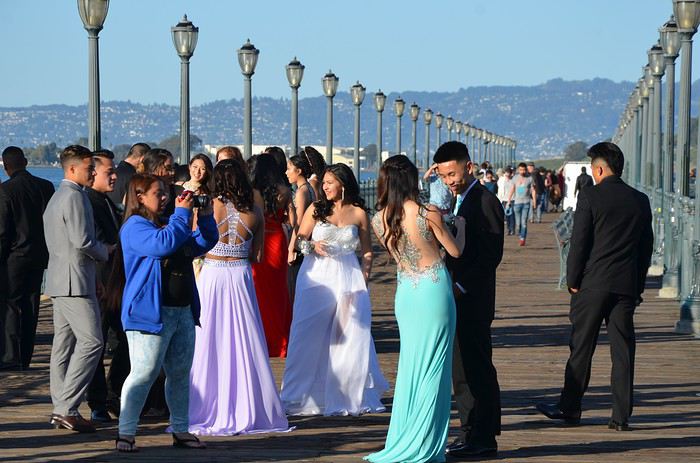
This photo was taken on the long promenade of "The Embarcadero," not far from the Ferry Building. It perfectly captures our state of mind at that moment: the weather is gorgeous, we’ve just dropped off our luggage at the hotel just steps away, and we’re strolling with light hearts, though our eyelids are heavy...
The gleaming vintage trams of the historic line pass by on the boulevard. Soon, the day will fade, and the silhouette of the Bay Bridge spanning the bay will be outlined by thousands of tiny lights... A flavor explosion awaits us nearby at "La Mar Cevicheria," with a delicious local white wine... This trip is off to a great start!
Day 2 - Sunday, May 1, around 3:30 PM, San Francisco Bay
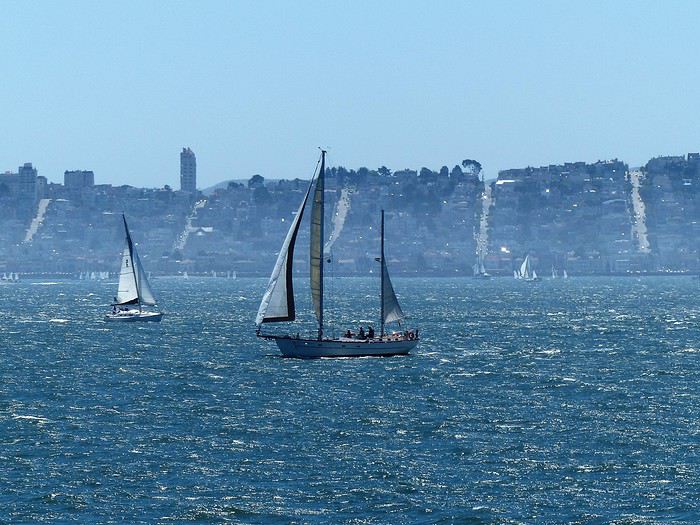
The sun is shining brightly, and we’re on the ferry returning from Sausalito. In this silvery-blue light, everything sparkles, even the steep streets in the background... We’re still amazed to be here.
Day 3 - Monday, May 2, around 4 PM, atop Twin Peaks
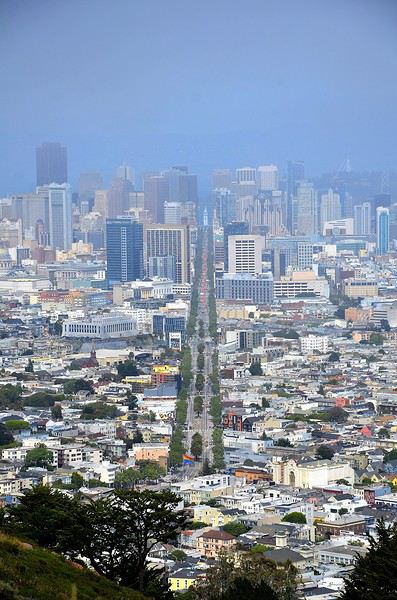
A bus line from Haight Ashbury takes you almost to the top of Twin Peaks, winding through incredibly twisty streets. The day has been beautiful again. But the cold wind that just picked up is bringing clouds from the ocean—quick, we’re heading back down...
Tonight, we’re going to see Keith Jarrett at Davies Symphony Hall...
Day 4 - Tuesday, May 3, around 10 AM, National Historical Park
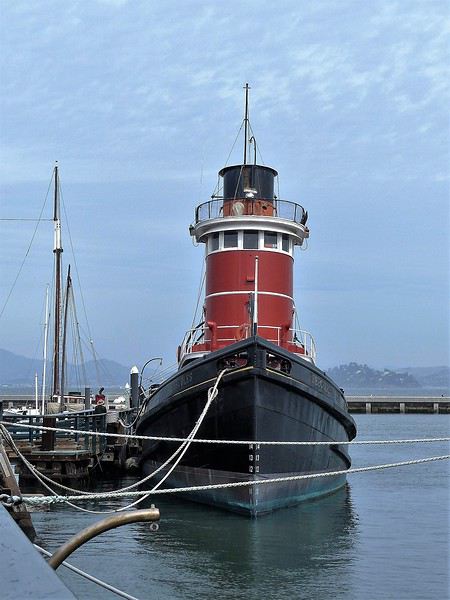
Our first national park! It’s the "Maritime National Historical Park," near Fisherman’s Wharf. Really lovely. Afterward, we’ll grab some delicious fish and chips under the envious gaze of seagulls...
In the afternoon, we pick up our rental car and head to Monterey. Less than 2 hours’ drive.
To be continued!
Since my first travel journal, recently completed, was very chatty and included lots of photos, I made a big decision this time: 1 day = 1 photo with a comment, that's it!
Before I start, here’s a quick overview of our trip: - San Francisco
- The Pacific Coast (Highway One) from Monterey to Cambria - Death Valley - West Grand Canyon - South Grand Canyon - Vermillion Cliffs - Page (Horseshoe Bend, Antelope Canyon) - Monument Valley
- Moab (Arches Park, Canyonlands) - Bryce Canyon (via Capitol Reef) - Zion Park - Las Vegas - Lone Pine / Alabama Hills (passing through Death Valley again) - Mammoth Lakes - Yosemite - Return to San Francisco via Sonoma.
Here we go! Below are the first 4 photos, for the first 4 days in San Francisco.
Day 1 – Saturday, April 30, around 5:30 PM – Embarcadero, San Francisco
This photo was taken on the long promenade of "The Embarcadero," not far from the Ferry Building. It perfectly captures our state of mind at that moment: the weather is gorgeous, we’ve just dropped off our luggage at the hotel just steps away, and we’re strolling with light hearts, though our eyelids are heavy...
The gleaming vintage trams of the historic line pass by on the boulevard. Soon, the day will fade, and the silhouette of the Bay Bridge spanning the bay will be outlined by thousands of tiny lights... A flavor explosion awaits us nearby at "La Mar Cevicheria," with a delicious local white wine... This trip is off to a great start!
Day 2 - Sunday, May 1, around 3:30 PM, San Francisco Bay
The sun is shining brightly, and we’re on the ferry returning from Sausalito. In this silvery-blue light, everything sparkles, even the steep streets in the background... We’re still amazed to be here.
Day 3 - Monday, May 2, around 4 PM, atop Twin Peaks
A bus line from Haight Ashbury takes you almost to the top of Twin Peaks, winding through incredibly twisty streets. The day has been beautiful again. But the cold wind that just picked up is bringing clouds from the ocean—quick, we’re heading back down...
Tonight, we’re going to see Keith Jarrett at Davies Symphony Hall...
Day 4 - Tuesday, May 3, around 10 AM, National Historical Park
Our first national park! It’s the "Maritime National Historical Park," near Fisherman’s Wharf. Really lovely. Afterward, we’ll grab some delicious fish and chips under the envious gaze of seagulls...
In the afternoon, we pick up our rental car and head to Monterey. Less than 2 hours’ drive.
To be continued!
With a 20% increase in visitors every year, Iceland is starting to feel the strain—on top of environmental impacts, inflation, and overcrowded accommodations. As a result, the Icelandic government is now considering ways to better regulate tourism, like introducing taxes or visitor limits.
Read more...
hi, I'm looking for info on possible transport to Ilam and then Phidim from KTM, as well as details about this trek. I found the PDF but no feedback from those who’ve tried it... have a great day, Aichatou
Hello,
We’re planning our trip for October 2017!! (Yes, it’s still far off—but planning it is already like a vacation.) We’re interested in the Ban Gioc Waterfalls, but I can’t quite make up my mind about them. Will there still be water in October? Is this stop worth it? (Even if there’s no water?) Thanks for your replies! Happy travels to everyone, Eric
We’re planning our trip for October 2017!! (Yes, it’s still far off—but planning it is already like a vacation.) We’re interested in the Ban Gioc Waterfalls, but I can’t quite make up my mind about them. Will there still be water in October? Is this stop worth it? (Even if there’s no water?) Thanks for your replies! Happy travels to everyone, Eric
The prime minister has just announced the death of the King of Thailand.
RIP
On my flight from Chiang Rai (CEI) to Krabi (KBV) via Bangkok (DMK), I took two connecting flights: the first with Nok Air and the second with AirAsia, with a layover of about 1 hour and 10 minutes. Just enough time to grab my backpack and check in—basically a quick sprint through the airport...
Everything went smoothly, but at DMK, the AirAsia flight was 30 minutes late...
Once comfortably seated in the departure lounge, I checked my passport and boarding passes and realized Nok Air had weighed my checked backpack at 8 kg, but when it arrived at DMK, AirAsia had weighed it at 10 kg! So, my bag supposedly gained 2 kg after just 1 hour and 10 minutes of flight...??? 😮
Nok Air offers 15 kg of baggage for free, while AirAsia offers nothing—you have to buy 15 kg (300 baht) when purchasing your ticket or pay 900 baht at the counter for the same allowance. Excess baggage costs 400 baht per additional kg.
Low-cost airlines worldwide (and even major carriers) are eyeing baggage weight—having paid for it with Corsair before—but these "extra" 2 kg that magically appeared are still worth pointing out. My bag weighed 7.8 kg when leaving YUL (Air China), and it’s a 35L backpack that also weighed 8 kg on the way back.
So, be careful...
"😎😎"
Hi everyone,
It’s my turn to share my impressions, itineraries, and addresses in Cape Verde. I actually drew a lot of inspiration from travel journals to choose which islands to visit... I set off with a friend for 12 days there.
We chose the islands of Santo Antão for its hikes and São Vicente to enjoy Carnival.
We arrived in São Vicente and spent the first half-day gathering information on ferry schedules to Santo Antão and finding two nights of accommodation for our return to São Vicente during Carnival. We were lucky to find an available room in a guesthouse very close to Laghina Beach, while all the hotels and guesthouses in town were fully booked. Indeed, it’s best to book in advance to secure a room during Carnival.
We also bought a phone card, which turned out to be useful for making a few reservations during our stay. We got some tips from the tourist office located right in the city center.
We left for Santo Antão the same day at 2:30 PM. The ferries from São Vicente to Santo Antão are supposedly the most punctual. And for good reason—they’re very on time, even leaving 5 minutes early. Boarding starts 30 minutes before the scheduled departure to avoid missing it.
On the ferry, we met Vany, who runs a guesthouse near the Paul Valley. He told us his restaurant is very good. He was adorable, and we kept his contact info—we weren’t disappointed!
We arrived in Santo Antão and asked the *colectivo* (shared taxi) to take us to Ponta do Sol for 400 escudos per person. Meanwhile, we bought the 1:500,000 map of Santo Antão (essential for hiking without a guide).
The *colectivo* dropped us off right at the door of a very kind lady who rents rooms on the upper floor of her house (3,000 escudos per night + breakfast for 2 people). We dropped off our things and chatted with a local contact to decide on our itineraries and hikes. We decided on the following route (which sometimes changed day by day):
From Ponta do Sol to Cha d’Igreja (path 212) From Cha d’Igreja via Cabo de Mocho to Ribeira Grande (then return by *colectivo* to Ponta do Sol) (paths 213a, 213, 208a, then the road) The *Rota da Corda* (by taxi) to Cova de Paul, then the Paul Valley (with a guide, likely paths 101 and 102) Cha de Morte to Alta Mira III (starting from Tia Rosa’s place, then paths 302 and 303) Alta Mira III via the Mira Valley to the sea, then back to Alta Mira III (paths 303 and 305a, returning by road)
One thing to remember: the hikes are non-stop uphill and downhill—no flat sections!
From Ponta do Sol to Cha d’Igreja (path 212)
We left our guesthouse around 8:30 AM with a light backpack, water, some snacks for the road, and a few things for our overnight stay in Cha d’Igreja (our host kindly agreed to keep our big backpacks for the night; we’d return the following night).
The path was very easy—impossible to get lost. We were advised to do it in this direction because it’s supposedly prettier and easier than the other way. The scenery includes the coast and villages perched on the lush mountainside. The only downside was the cloud of sand particles that reduced visibility, especially over the sea. We arrived in Cha d’Igreja at 2:30 PM and checked into a guesthouse we’d been recommended (5,600 escudos for 2 people, including dinner, night, and breakfast).
In Cha d’Igreja, there’s a square where people gather in the evenings. That night, kids were dressed up because Carnival was already starting. We also visited an ecolodge run by French people just before the village entrance. The place was really nice—they had bungalows and fully equipped tents. I think it’s worth staying there, but we’d already booked our guesthouse (maybe next time!).
From Cha d’Igreja via Cabo de Mocho to Ribeira Grande
We left around 8:00–8:30 AM for a 3–3.5 hour hike to Boca de Ambas. The scenery was stunning the whole way. We stopped at a *merceria* (small shop) in Boca de Ambas to buy fruit juice and eat some fruit. There, we met an old man who asked, “Are you French? So you don’t speak English?” But then—bluff—we *did* speak English (he was stunned!). We started chatting; he told us he’d traveled a lot, introduced us to his neighbors, and insisted on accompanying us to Zeca’s house (about a 40-minute walk away). We happily accepted his company, but his idea wasn’t to walk—it was to drive us there. So off we went in his 4x4. From there, he showed us the way to Coculi via Cha de Lobhinos. We still asked for directions a few times because we weren’t always sure which path to take. We passed through Ribeirão, Lombo de Negrinho, then hiked with a group on the road to Cha de Saída (about 2.5 hours of walking). The scenery was magnificent again. Then we came across the track to Coculi. It was less pretty, so we decided to hop into the first passing vehicle to take us to Ribeira Grande and then to Synagogue, where we swam in the natural pools.
We returned to Ponta do Sol around 5:00 PM. We had dinner at an excellent restaurant by the sea, right in front of the diver statue (a turtle’s body is on the restaurant’s facade). Lucky for us, there was one table left—the place was packed!
Ponta do Sol is a pretty lively town. We even caught Carnival rehearsals. It was a nice change from the quiet of Cha d’Igreja.
The *Rota da Corda* (by taxi) to Cova de Paul, then the Paul Valley with a guide
The taxi picked us up at 8:30 AM, and we headed to the Cova crater. We left with a small backpack because our *colectivo* driver kindly agreed to drop off our big bags at the guesthouse we’d booked in Paul. We stopped along the way—the scenery was breathtaking. I already regretted not hiking part of this route on foot. We climbed to the top of the crater and descended into the Paul Valley. I expected it to be cloudy, but it was actually very clear and green. The Paul Valley is beautiful. The guide gave us brief explanations about the plants we encountered. There was a lot of downhill walking—it was pretty tough on the feet. I think I would’ve preferred a mix of hiking in the *Rota da Corda* and the Paul Valley.
Guide fee: 4,500 escudos for the day, and 3,000 escudos for the taxi.
We arrived at the guesthouse we’d booked, which is famous for its great food (and for good reason). When we got there, the cook picked out the fish for that evening’s menu from the day’s catch—a lobster... and it was for us! :) The terrace setting of this guesthouse (where the restaurant is) is gorgeous, and the staff is adorable (especially Vany, who runs the place and whom we’d met on the ferry). There’s even a small dedicated space with a stage for live music nights. However, the room was a bit less comfortable (no water at times, quite noisy), but it didn’t matter—the setting and the people made us quickly forget the minor inconveniences. Address: DM me if you want it.
Cha de Morte to Alta Mira III (starting from Tia Rosa’s place, then paths 302 and 303)
We left Paul via Porto Novo, where we took advantage of the *colectivo* change to buy our ferry tickets (for two days later). We decided to head toward Alta Mira III. The owner of the (only?) guesthouse there is also a *colectivo* driver for the route from Porto Novo to the Alta Mira Valley. He dropped us off along the way near Tia Rosa’s house (marked on the map), and we took path 302. The scenery changed dramatically—it was much more arid than the northern and eastern parts of the island. Still, the landscapes and “dykes” in the second part of the route were spectacular. We hiked for about 3.5 hours and arrived at the guesthouse (DM for contact—2,000 escudos per person for the night, including dinner and breakfast). The calm in the village contrasted with the lively atmosphere at Vany’s the night before. The food was excellent—we loved it!
Alta Mira III via the Mira Valley to the sea, then back to Alta Mira III (paths 303 and 305a, returning by road)
Our last hike before returning to São Vicente. We went to the Alta Mira Valley via Alto Mira II to the sea (about 4 hours of walking). The first part, up to Dominguihas, was especially beautiful. After that, I found the scenery a bit monotonous. We returned by road, and luckily, we ran into a car (unexpected on a Sunday in this remote area) near Jorge LUIS’s village, which dropped us off at the Selada viewpoint, 4 km from our guesthouse. Otherwise, it would’ve been a long uphill walk back (not very fun). Second night at our guesthouse (with another amazing dinner).
We left the hiking island to arrive on the party island: São Vicente. A Carnival parade was happening that very evening. We had dinner at a restaurant on Rua Lisboa, which offered a view of the parade from the balcony (packed to the brim). We were lucky to see a magnificent parade in “little Rio” style (with feather costumes, floats, dancing, music, singing, and *batucada*). Once the procession passed, we headed a bit farther (to Praça Nova) to enjoy it longer. Tuesday, February 9: Carnival Day (though the parades had been going on since Friday, including school parades... the city had been celebrating for days). Four groups were set to parade starting at 3:00 PM. We decided to try the same spot as the night before, but this time, all the restaurants had their doors closed—you needed tickets to enjoy the balconies... and tickets were sold out. We really wanted a high vantage point... so we tried the railing of the Alliance Française, like many other Cape Verdeans (the wall was the width of a flip-flop...). It barely held, but we got our spot, which we kept for nearly 5 hours. The vibe was the same as the night before: floats, costumes, dancing with participants aged 7 to 77 (and older...). The evening ended with a big outdoor concert, then... nothing. We looked for other places with music but had no luck. We went back a bit unsatisfied—we would’ve loved to extend the moment. Three days left in São Vicente: a walk on the beach (between Calhau and Praia das Gatas, about 3 hours—go at low tide). The sea brings in a lot of trash, which is a shame because the beach is beautiful (but hard to swim due to strong currents). We hiked to the top of Monte Verde (great view if the weather’s clear, but the wind is very strong at the top—you can also take a taxi). We swam at Mindelo Beach (Laghina), drank coffee at the Pergola (next to the Alliance Française), and enjoyed the sun while it was pouring rain in Paris :)
All in all, it was an amazing trip. I hope you’ll have just as great a time in this little corner of paradise.
Hi there,
I’ve got a huge problem before my trip to Istanbul, and I feel like I’m the only one dealing with this...
I made a reservation for next week through AutoEurope in Istanbul to rent a car for 10 days with a 0 € excess insurance (the final rental company is Budget).
So far, so good...
Except when I read AutoEurope’s terms, I see "debit card not accepted, credit card only"—this applies to the deposit, because even with 0 € excess insurance, there’s still a deposit, for a ridiculous amount (around 100 €, cheaper than the car rental itself). And sure enough, after checking with AutoEurope, Budget, and even other rental companies like Hertz, Avis, Europcar, etc., NONE of them accept debit cards (for the deposit and sometimes even for paying for the car!!).
But in France, 90% of people have a debit card (Visa, Mastercard, etc.) and not a credit card. So I don’t get why I’m the only one in this situation!!!!...
I don’t know what to do... I’ve contacted all the agencies, and none will accept Visa or Mastercard debit cards, so I’m worried my AutoEurope reservation is useless, that Budget will refuse me the car once I’m there, and I won’t get a refund! Worse, I’m afraid I won’t find a car for my trip at all!!...
If you’ve got a solution, please help—I’m totally stressed out by this crazy situation!!
Thanks so much!
Hi everyone,
I’m in the middle of planning a round-the-world 4x4 trip spread over 2 years, covering around 70 countries. Unfortunately, using a vehicle poses some challenges when it comes to moving between continents (e.g., the Bering Strait). After lots of research, consulting books, maps, and making countless phone calls, I still can’t figure out how to get from Russia to Alaska via the Bering Strait (access via the Road of Bones to Magadan and then continuing above Anadyr).
So, I’m open to any recommendations, tips, or contacts to find out if it’s possible by boat or any other means.
You can also reach me on FB: https://www.facebook.com/pages/Road-trip-42/702124999863774?ref=hl
Thanks for your replies!!
Roadtrip42 -> Traveling the world is possible!
Hi everyone, I’m really keen to visit Iran for three weeks in mid-March 2015.
What worries me a bit isn’t so much traveling alone—I’m used to it and know the Middle East well—but rather the current events (Islamic State) that could potentially become dangerous.
Flights are pretty cheap at the moment, and I’d like to book before prices go up.
Any advice from people who know the ground situation and Iranian current affairs better than I do would be much appreciated! :)
Any advice from people who know the ground situation and Iranian current affairs better than I do would be much appreciated! :)
Hi,
We're leaving in 5 months for a 10-month family trip, and I'd love to hear from families who've lived this experience—what tips and lessons you took away. How did the adaptation go? It must feel really strange not having a... structured day, I can't find the right words. Thanks for your feedback! celine
We're leaving in 5 months for a 10-month family trip, and I'd love to hear from families who've lived this experience—what tips and lessons you took away. How did the adaptation go? It must feel really strange not having a... structured day, I can't find the right words. Thanks for your feedback! celine
Hi everyone. Good evening!
I’m back from Sententon. I’ve recovered now. What a beautiful, beautiful island—did it both ways.
The crossing I’d call the "Madman’s Crossing" (a nod to another well-known one) is the one from Tarrafal to Ponta do Sol, which I did in 4.5 hours without speeding like Gonzalez.
Then there’s what I’d call the "Grogue Diagonal"—the north-south route from Ribeira do Paul to the Janela Lighthouse, passing through Cova, Pico da Cruz, and Silva. A day and a half of pure enjoyment, wrapping up my visit to the island in supreme beauty.
In my opinion, here are the island’s 7 must-dos:
- The most stunning *bordeira* – the *bordeira do norte*
- The most fantastic – the climb from João do Bento to Orgueiro
- The most pleasant – the *vereda* Cova/Pico da Cruz/Silva
- The most overrated – the northern coastal path
- The most beautiful paved section – Ribeira de Penede’s lower part
- The most grueling – Figueira de Cima to Chupador
- The toughest – the climb to Salto Preto
And for any hiker, the Norte plateau is a must. Unfortunately, I couldn’t make it to Tope de Coroa—my only rainy day—but it was still good, even with the summit shrouded in clouds all day.
Here are my initial thoughts. I’m happy to share more with anyone planning the same crossings. I’m currently posting the route details on my blog and might share a few here. Though since the forum’s text editor isn’t top-notch without HTML, I’m not sure how it’ll turn out. In the meantime, you can check it out here --> Cape Verde. Should be of interest to hikers. Bye
Hi everyone,
I bought a new apartment in Pattaya that will be finished at the end of 2013, and I’d like to buy more later...
I think it’s a good investment idea, but I’d love to hear from those of you with experience—what do you think? I’d also like to know how to handle rentals... Should I go through agencies, or are they usually rented out directly by the building management companies?
Thanks in advance for your replies! 🙂
Does visiting Albania (combined with Greece) require renting a 4x4?
If you have any tips on beautiful routes, we’d love to hear them.
Thanks in advance.
Thanks in advance.
My question might seem a bit out of place in a "travel" forum, but I’m giving it a shot anyway.
I’m thinking about sponsoring a child in Vietnam.
After some online research, I’ve found a lot of organizations that offer this, but I’m struggling to make a choice.
Could anyone guide me in making my decision?
Thanks in advance and have a great day.
Hi,
I’d like to book a flight ticket with Virgin Australia to go to Tasmania.
At checkout, I enter my bank card details, but they keep telling me my card number "is too short." What should I do? The number is correct.
Thanks for your help
I’d like to book a flight ticket with Virgin Australia to go to Tasmania.
At checkout, I enter my bank card details, but they keep telling me my card number "is too short." What should I do? The number is correct.
Thanks for your help
Hi,
so I’m heading off solo through China and I’d like to stay for a good while (about a year—do you think that’d be enough to pick up a bit of the language???).
I’d love to know if there’s a website, or if someone can help me live, that teaches the basics:
to understand the alphabet and characters.
to understand how a sentence is formed.
just the super simple basics, really.
Thanks for your help! ^o^
PS: My goal is to speak a tiny bit—not to write or anything—but still be able to read a little too...
PS: My goal is to speak a tiny bit—not to write or anything—but still be able to read a little too...
Just back from Georgia and Armenia.
Trip in April 2011 with a small Renault Trafic van.
No particular difficulties... except the GMR.
hi
I’m planning a 10-month trip to South America, and I’m looking into options for shipping a motorcycle to Buenos Aires by air or sea. If anyone has any info, thanks in advance!
christian
In some countries, the price charged to tourists is often higher than the one for locals.
Is it legal for a restaurant, for example, to have a "price for locals" and a "price for foreigners"? Do they have the right to do that? (Because it really annoys me—you can’t imagine how much money I’ve lost to this scam.)
Aren’t there any local organizations that could call out this scam?
At the same time, since this kind of scam happens often in poorer countries, the money I lose ultimately goes to those countries, so it’s like I’m donating to a humanitarian organization. So in the end, it doesn’t bother me *that* much—when I get scammed, I just tell myself I’m doing a generous act to help the poor in that country.
Hi,
Has anyone gone on a language study trip in Europe? If so, which agencies did you use? What can you tell me about it? Thanks a lot! Kelkune
Has anyone gone on a language study trip in Europe? If so, which agencies did you use? What can you tell me about it? Thanks a lot! Kelkune
Hi there!
I’d like to go to South Africa in August and plan my trip myself (so no travel agency). Could anyone recommend a good guidebook, please? (Routard, Lonely Planet, Petit Futé, etc.) Thanks!!
Kaelha
I’d like to go to South Africa in August and plan my trip myself (so no travel agency). Could anyone recommend a good guidebook, please? (Routard, Lonely Planet, Petit Futé, etc.) Thanks!!
Kaelha
Hi, I’m a self-employed physiotherapist in France, and as my wife (a nurse) and I look into working abroad in about two years, I’ve been offered an equivalence to become a respiratory physiotherapist in Switzerland. Actually, I’m currently doing a postgraduate diploma in pediatric respiratory physiotherapy and want to specialize in that area. Anyway, that’s not the main point—could anyone explain the pros and cons of doing this job in Switzerland? Based on the paperwork I’ve received, the equivalence seems purely administrative or almost... What about working conditions, quality of life, salaries, etc.?
Thanks for your replies. PS: Same question for my wife, a nurse, regarding her integration.
Thanks, Nicolas and Bérengère
Thanks for your replies. PS: Same question for my wife, a nurse, regarding her integration.
Thanks, Nicolas and Bérengère
Hi there!
I’d like to plan a week of "sun-soaked" relaxation in March, and based on my budget, I was thinking of Morocco—specifically Essaouira. I’ve got a few questions, just in case I’m getting the wrong idea about my trip: Do you know what the average weather is like at that time of year? Without going as far as swimming, is it still possible to enjoy the sunshine on walks or lounging on a deck chair? Since I’ve never been to Essaouira, is it a nice place to stay for a week (mixing sightseeing and relaxation)? Are the beaches pretty? Would you happen to know any addresses (like guesthouses or lodges) offering half-board or full-board, in a quiet spot? (With a garden to relax in, ocean views, or even a pool—fingers crossed!) At reasonable prices? (I have no idea what the price ranges are in Morocco.)
Thanks in advance for your tips!
Hi everyone,
I’m Pierre, I’m 19, and I’m looking for a baker position in Canada—could you help me out, please?
I’m really passionate about this trade. I’ve been in it for 3 years now, including 1 year as a qualified worker.
I’ve got a huge thirst for knowledge, whether it’s in my job or discovering the world.
If you’ve got any questions, don’t hesitate—I’m not really sure how this works here! :)
Hi everyone!
I’m especially asking those of you who’ve been to South Korea and Taiwan. Which would you pick for a three-week trip in September or October? I need to consider budget, variety of places, and the weather.
Thanks! 🙂
I’m especially asking those of you who’ve been to South Korea and Taiwan. Which would you pick for a three-week trip in September or October? I need to consider budget, variety of places, and the weather.
Thanks! 🙂
Hi! After arriving in Delhi and heading to Rajasthan, I'd like to take a break to acclimate to the climate and vibe around Mandawa...
Do you think that's a good idea?
Is there a better option?
I'm heading toward Bikaner.
Thanks!😇
Thanks!😇
I’m currently looking into and especially thinking about getting married to my sweetheart, who has legally returned to Madagascar. I’d love to hear your thoughts. Should we have the wedding in Madagascar or in France during her legal visa period? Some people told me that if we get married in Madagascar, it takes a very long time to get approval for my wife to come back and live permanently in France with me. If we get married in France during her legal visa period, she can stay here afterward, provided we go to the prefecture for the family life declaration. Are there any folks who can give me precise information about these two options? Thanks in advance!
The title might surprise you, but you’ll understand my point of view.
1/ MEAL STRUCTURE I’m talking about the standard meal, not the one for those who have to budget for financial reasons (generally fewer in northern and central Italy than in France, but more in the south, which makes up 35% of Italy—Eurostat figures), nor for those (mostly women) watching their figure.
The tradition (once the meal of the well-off, widespread among the general population in the 1950s) starts with soup or pasta (or rice, gnocchi, ravioli, lasagna)—this is the *primo piatto*.
Next comes meat or another animal-based product (fish, cured meats, eggs, etc.)—the *secondo piatto*, which can be replaced by cooked vegetables (the only known example in France: eggplant parmesan).
If the meat dish doesn’t already include vegetables, one is served. Salads, whether green or tomato-based, are side dishes, not starters.
The meal ends with dessert—no difference from French habits: cheese, fruit, or sweets.
*Antipasti* (appetizers) are reserved for festive meals or receptions and are served *in addition* to the main courses at the start.
4 practices unknown in France: - If the menu includes pasta and ham, you start with the pasta. - If the menu includes pasta with a meat sauce and fish, you start with the pasta too. - Pasta is never a side dish for meat. - It’s not unusual for Italians to start with pasta in a meat sauce and then have a meat dish—most do this several times a week.
Modern adaptations: - People eat pasta less often (on average 5 times a week, according to recent figures) and soups, which are being replaced by *antipasti*. - The main meal is now mostly dinner, so it’s much heartier, while lunch isn’t usually eaten at home.
2/ THE CUISINE What do we know in France? Pizza, pasta Bolognese, carbonara, arrabbiata, ravioli, and lasagna. Fried scampi, Milanese or Bolognese cutlets, carpaccio, and finally tiramisu.
In short, a few basic dishes, but nothing of the gastronomy—whether regional traditions or high-end restaurants.
2 anecdotes: **Bolognese sauce** In Italy, the most common homemade sauce is a meat-and-tomato-based sauce called *ragù* (pronounced *ragoo*). Every region, even every town and family, as well as every restaurant, has its own recipe. *Ragù alla bolognese* is just one of these countless *ragù*—and no one in France knows the real recipe (I can share it with those interested). The name *bolognese* given abroad to any *ragù* comes from a canned sauce manufacturer who once branded their product that way. Until the early 1960s, it was called *sauce à la viande* (meat sauce).
**Pizza** Before World War II, it was practically unknown north of Rome. Today, Italy is one of the countries where it’s eaten the least (twice as much in France, four times as much in Germany).