A real gem for those who want to connect with their roots or discover an African language. The explanations are simple, and I really appreciated the cultural examples included in the book. Highly recommended. (Fatoumata T)
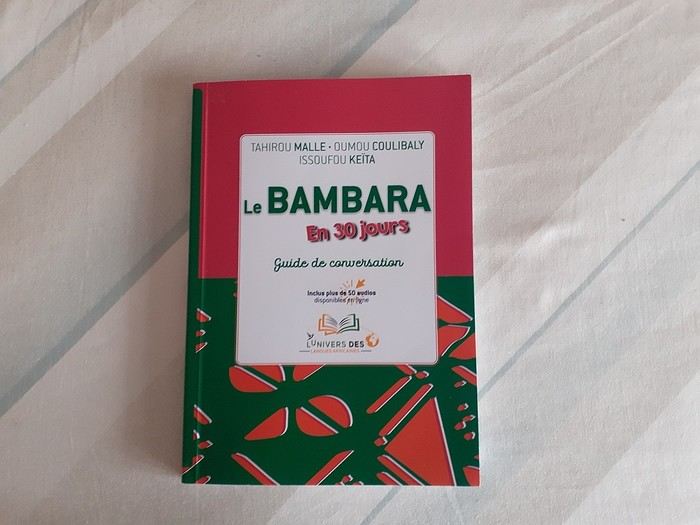
Manual: "Bambara in 30 Days"
Bambara in 30 Days is a manual and conversation guide specifically designed to help learners communicate in many everyday situations. This educational tool is aimed at anyone wanting to learn Bambara (bamanankan), regardless of their level: from beginners to advanced speakers looking to improve.
Several themes are covered: greetings, how to introduce yourself and apologize, family, numbers from 1 to 100, meals, emotions, transportation, currency, shopping, parts of the human body, days of the week, how to ask a question, how to ask for the price or age, how to count money, other types of questions, colors, traveling, blessing formulas for Muslim holidays: e.g., Tabaski (seliba) or Korité (selifiitinin or selidennin), and family events: e.g., birth (bangeli), marriage (furu), death (saya or fatuli)... ultimately, tools needed to communicate in many everyday situations.
The lessons (kalansen) are organized by theme, ranging from the alphabet to common expressions. All lessons include corrections (jaabi) to reinforce learning and correct mistakes. They cover various topics like greetings, numbers, family, etc. (see above) and are designed to be progressive, allowing for skill development. Each lesson is accompanied by practical exercises to apply the knowledge. After every set of 5 lessons, there’s a review (seginkanni) to consolidate what’s been learned.
In summary, the manual consists of...
30 lessons with 6 reviews
Over 50 audio files available online
Over 100 exercises (baarakɛ) with answer keys
A small vocabulary section in each lesson
Blank "notes" page at the end of every lesson
The audio files help facilitate learning. They are accessible via a specific link that should only be used by the manual’s purchaser.
African languages, like Bambara, play a crucial role in the culture and identity of African peoples. Learning them helps preserve traditions and local knowledge. Bambara is the most widely spoken language in Mali and a key lingua franca for communication in West Africa. It’s rich in idiomatic expressions and proverbs, reflecting the wisdom and culture of the Manding peoples. Moreover, it’s taught in schools and used in local media (to learn more, see here). In general, linguistic diversity in Africa is immense, with thousands of languages spoken across the continent.
Malle, Tahirou / Oumou Coulibaly / Issoufou Keïta (authors)
Bambara in 30 Days. Conversation Guide
184 pages
ISBN 978-2-49304713-7
21.90 €
L'Univers des Langues Africaines
38 rue de Bonneuil
77100 MEAUX/France
https://universdeslanguesafricaines.comhgb