Results for "Cameroun+souvenir+artisanat"
About 5,617 results.
More options
Many results are in French, the community’s main language. English translations are added over time.
Search results
Parrainer un enfant
Bonjour,
Depuis quelques temps, je fais des recherches sur Internet pour trouver une association fiable et sérieuse en vue de parrainer un enfant. Petit Orphelinat, grande organisation internationale...???J'aimerai juste que l'argent envoyée à ce petit enfant soit utilisée pour lui et à bon escient avoir des nouvelles régulières de lui, de son évolution, de ses progrets... avoir la possibilité, si cela m'était possible, de lui rendre visite un jourMerci d'avance pour ces renseignements.
Manye
Depuis quelques temps, je fais des recherches sur Internet pour trouver une association fiable et sérieuse en vue de parrainer un enfant. Petit Orphelinat, grande organisation internationale...???J'aimerai juste que l'argent envoyée à ce petit enfant soit utilisée pour lui et à bon escient avoir des nouvelles régulières de lui, de son évolution, de ses progrets... avoir la possibilité, si cela m'était possible, de lui rendre visite un jourMerci d'avance pour ces renseignements.
Manye
Cherche emploi dans le bâtiment à Yaoundé
bonsoir je suis
menuisier d'agencement
peintre tapisier
agent d'entretien du batiment
quel chance aige de touver du boulot a yaoundé et que me consailler vous merci
Achats de souvenirs et de cadeaux à Singapour ou Kuala Lumpur?
Salut tous! Je voudrais savoir quel est le meilleur endroit entre kuala Lumpur et Singapour pour faire les achats de fin de voyage (cadeaux et souvenirs) ?
Nous voulons acheté nos billets d'avion bientôt pour aller en Malaisie, Singapour et Bornéo, mais nous avons le choix d'arriver et/ou de repartir par Kuala Lumpur et/ou Singapour. Donc, laquelle des 2 villes/pays est le mieux indiqué pour les emplettes souvenirs ?
Nous partons le 29 juin pour 1-2 mois.
Merci à l'avance, Geneviève et Pat
Nous voulons acheté nos billets d'avion bientôt pour aller en Malaisie, Singapour et Bornéo, mais nous avons le choix d'arriver et/ou de repartir par Kuala Lumpur et/ou Singapour. Donc, laquelle des 2 villes/pays est le mieux indiqué pour les emplettes souvenirs ?
Nous partons le 29 juin pour 1-2 mois.
Merci à l'avance, Geneviève et Pat
Une véritable tentative en Nouvelle-Calédonie!
Bonjour a tous ;
je m'apelle cedric j'ai 37 ans , marié, deux enfants (5et 8 ans )
Je suis artisan dans les milieux de l'eau (puissatier, pompage, arrosage, bassin...)
Mon affaire marche bien ...mais j'arrive a une periode de ma vie ou je recherche de l'authenticité....et toute cette vie folle et cette course au fric m'indispose de plus en plus....
Bref j'ai decidé de venir voir chez vous comment cela se passait ....
Pas pour repartir a travailler comme un fou a noumea ...non ...mais plutot d'essayer de couper ....d'apprendre des caldoches...leur mode de vie leur culture....etc...
Alors es-ce possible de se faire un minimum integré en faisant de gros effort ?
Je pars debut novembre pour minimum un mois .....seul sans mes enfants ni ma femme ....(sans ma famille ce seras le plus dur !!!!)
Je ne suis jamais sorti de france, je n'ai jamais pris l'avion...
Je pars contre l'avis de ma famille , mes amis qui me traite de fou....
J'ai peur aussi de l'eventuel solitude ...si quelq'un pars sur la meme periode pourquoi pas un rapprochement ....
Si quelqu'un veut m'acceuillir en toute simplicité pour une courte periode afin d'echanger...je suis preneur (je suis courageux, je partage les frais, bref pas profiteur reglo quoi...)
Alors vous qui etes la bas ....suis-je fou ....ou l'aventure vaut le coup d'etre tenté ????
Tips for choosing a long-distance touring bike
Hi there,
I’m currently looking for a bike to do my first bike trip across France, with the ultimate goal of cycling through Latin America. I’ve got a lot of questions and I’d love to hear if you have any answers or advice to share. First off, I’ve been through this before with hiking. I want to get top-quality gear right away. When I started hiking, I ended up buying everything three times—first beginner gear, then intermediate, then expert, etc. For biking, I’d prefer to skip that process and invest right now in a bike that could ideally handle Latin America. I’ve set a total max budget of around 5000 € (roughly 4000–4500 € for the bike and the rest for accessories: panniers, helmet, cycling shorts, etc.).
So, I’ve got quite a few questions:
* I’ve read in several places that some people recommend buying the bike directly in Latin America. Since I need a first bike to train in Europe, would it be better to buy an entry-level bike in France (and sell it before the big departure)? Or is it preferable to start right away with my final bike to get used to it? Is buying it there just to save a bit of money?
* For a long-term trip (around six months) in Latin America, is it better to go for a gravel bike or a mountain bike?
* Should I buy a new bike or a refurbished one? Even more so given that I’m planning a long trip—could a refurbished bike end up causing more breakdowns?
If you have any advice on models, technical features to prioritize, or recommended sellers or resellers, I’d love to hear it. I’m a total beginner—I’ve only just started watching videos and reading up on the subject, and all the technical specs are new to me!
Thanks in advance for your help!
I’m currently looking for a bike to do my first bike trip across France, with the ultimate goal of cycling through Latin America. I’ve got a lot of questions and I’d love to hear if you have any answers or advice to share. First off, I’ve been through this before with hiking. I want to get top-quality gear right away. When I started hiking, I ended up buying everything three times—first beginner gear, then intermediate, then expert, etc. For biking, I’d prefer to skip that process and invest right now in a bike that could ideally handle Latin America. I’ve set a total max budget of around 5000 € (roughly 4000–4500 € for the bike and the rest for accessories: panniers, helmet, cycling shorts, etc.).
So, I’ve got quite a few questions:
* I’ve read in several places that some people recommend buying the bike directly in Latin America. Since I need a first bike to train in Europe, would it be better to buy an entry-level bike in France (and sell it before the big departure)? Or is it preferable to start right away with my final bike to get used to it? Is buying it there just to save a bit of money?
* For a long-term trip (around six months) in Latin America, is it better to go for a gravel bike or a mountain bike?
* Should I buy a new bike or a refurbished one? Even more so given that I’m planning a long trip—could a refurbished bike end up causing more breakdowns?
If you have any advice on models, technical features to prioritize, or recommended sellers or resellers, I’d love to hear it. I’m a total beginner—I’ve only just started watching videos and reading up on the subject, and all the technical specs are new to me!
Thanks in advance for your help!
Explosion de l'économie chinoise
Je poste ce sujet car je suis actuellement en chine, une petite ville méconnue de 700000 habitants Laioyang dans la province du Liaoning, je voyage de temps en temps en chine depuis 5 ans pour le boulot, bien souvent dans des villes méconnues, bien loin de Beijing et Shangai. Et en fait je suis impressionné par le développement Chinois, j'imagine que je n'apprends rien à personne car on se fait rabâcher en permanence sur l'insolente explosion de l'économie chinoise, mais en fait je pense que nous n'avons aucune idée de la puissance de l'économie Chinoise, ce qui me marque c'est comme ce développement s'applique à l'ensemble du pays, en venant à Liaoyang j'ai longé la ligne de train rapide qui va être mise en service en 2011, voie reliant Harbin ( ce nom ne dit peu être pas grand chose à la plupart mais c'est une ville de 10 millions d'habitants) à Dalian, une ligne sortie de nul part au milieu d'une nature peu généreuse. Je pensais également à cette explosion de l'économie en rentrant hier par une magnifique autoroute 4 voies lors de mon retour de Shenyang, en fait à chaque voyage j'ai beau être dans des lieux reculés je retrouve toujours cette volonté de développement, de choses bien pensées avec une vision à long terme. Je passerai les edifices les grattes ciels, les demonstrations d'architecture comme le batiment de la pudong bank a coté de la gare nord de shenyang, si cela était uniquement a Shenyang, mais toutes les villes chinoises sont comme cela, Shangai elle est indescriptible on a l'impression d'être en 2050. Mon travail m'emene souvent dans des pays en voie de devellopement, Bresil, Inde, europe de l'est, ou bien dans des pays avec une economie stable, mais ce que je retrouve ici il n'y a pas un pays qui devellope autant ses infrastructures et qui met autant de piliers en place pour le futur. En fait la chine me donne l'impression d'avoir des infrastructures à l'européenne, une économie à l'américaine, et une vision et façon de penser à long terme à la japonaise, cela avec une population de la taille indienne, je laisse imaginer comment leur niveau sera dans 20 ans, en fait non, je pense que ce n'est même pas possible d'imaginer et que personne n'a une idée........
Africa: A Heartfelt Love for a Continent
“When the Whites came to Africa, we had the land and they had the Bible. They taught us to pray with our eyes closed: when we opened them, the Whites had the land and we had the Bible.” Jomo Kenyatta (p.7)
The Maggi cube, an unchallenged hegemony, and so much more
“The hopeless continent,” headlined The Economist, a British magazine, in July 2000 about Africa. Eleven years later, the same magazine headlined “Africa rising” instead. Images of Africa in the prosperous North constantly oscillate between apocalyptic scenarios and enthusiastic projections. A key issue with such images lies in the generalization they entail. If you look at the continent, considerable contrasts emerge depending on space and time. It’s no surprise that a region of the world encompassing such diverse ecological zones, maintaining such varied ties with other continents, comprising nearly fifty nation-states in sub-Saharan Africa alone, and characterized by a great diversity of languages, belief systems, and historical paths, doesn’t share a single destiny.
And yet, for many people outside Africa, as well as for many Africans, the continent constitutes a single entity, defined by criteria such as skin color, a colonial past, poverty, and the art of survival. Until now, these perspectives were generally accompanied by the idea that Africa had to—or should have—followed a single path together, sometimes called development, sometimes modernization, sometimes liberation, then a market economy. None of these paths delivered on their promises.
The two writers Alain Mabanckou and Abdourahman Waberi—one from Congo, the other raised in Djibouti, both long settled in France and now professors at renowned North American universities (Los Angeles, Washington)—have had enough of pessimistic scenarios: “We are aware that Africa is in the world and the world is in Africa. The same goes for all other continents, as our destinies are inextricably linked for better or worse. We refuse to see Africa as a reservoir of misfortunes or a continent cursed by atavistic misfortune and characterized by ethnic conflicts. [...] It’s this passionate flame we wanted to capture in a book [...] a kind of stroll through African cultures, without any demands, each letter of the alphabet leading us to a notion, a practice, a concept, a moment in history, literature, painting, politics, economics, cuisine, etc.” (p.10-11). Africa, they write, is on the verge of “imposing a signature, a style, a way of being in the world and in relation to the rest of the world.” (p.11) To put words to the continent’s diversity and dynamism, the two authors created a “rambling ABC,” a kind of portrait—or more precisely, a mythography—that lets you see and feel the pulse of a vast continent whose cultural power is unfolding before our eyes. Once marginalized or even mocked, the voice and importance of the Continent in global affairs are now undeniable” (p.11), containing over a hundred entries, mostly concise, written in a relaxed and casual style. The optimistic, even exuberant tone is set from the brief introduction. The duo of authors wants to “sing a love song to the cultures of our continent, to its inhabitants past and present, to its exceptional resources and its spectacular globalization despite a certain pollution that still clouds our skies due to the unmatched duration of dictatorships in some of our regions.” (p.12) In doing so, they don’t want to be too distracted by today’s Afewerki-Biya-Bongo-Déby & Co. ...
Of course, you’ll find tributes to great precursors like Frantz Fanon (“[...] it was a love story and admiration that wasn’t dimmed by the four decades separating his birth from ours. Let’s add that we were born while the native of Fort-de-France had left the world’s stage four years earlier, in the prime of life” p.141), Mongo Beti (“You must read and reread Mongo Beti, a genius who used his fame to support often just causes in Africa, like defending oppressed groups. His place is already in History. His oppressors, like the dictators Ahmadou Ahidjo and Paul Biya, can’t compete in the same category” p.64), the Malian Amadou Hampâté Bâ
(“Posterity remembers him mainly as an tireless defender of African cultures. His plea for the collection and preservation of traditional African knowledge remains a major event for all men and women of good will. One day in 1960, at the UNESCO podium, the native of Bandiagara sounded the alarm: ‘[...] Since we’ve admitted that the humanity of each people is the heritage of all humanity, if African traditions aren’t collected in time and written down, they’ll one day be missing from the universal archives of humanity.’” p.51),
Kwame Nkrumah, “one of the founders of Pan-Africanism, father of Ghana’s independence” (p.239), as well as the historian Cheikh Anta Diop, the writer, poet, and politician Aimé Césaire, and the economist and thinker Samir Amin, but also very warm tributes to certain contemporary African intellectuals like Souleymane Bachir Diagne and Achille Mbembe
(“A few years ago, in dominant economic circles, a rumor often resurfaced, usually disguised as a cold and scientifically proven analysis: Africa is useless. It’s a burden for the rest of the human community. With its 2% share in world trade, it would disappear from stock market radars without anyone noticing. So? Maybe it’ll be pulled up by other continents. Wanting to surpass itself is a crazy bet for Africans, they concluded. Arrogant or clueless, President Nicolas Sarkozy declared before an audience of students and teachers at Cheikh Anta Diop University in Dakar: ‘The African man hasn’t entered history enough [...] He only knows the eternal repetition of time marked by the endless repetition of the same gestures and words.’ That was in 2007. For decades, armed only with reason, an intellectual often steps up to debunk prejudices, lazy readings, and dishonest frameworks used as false fronts by those who, like Nicolas Sarkozy or former journalist Stephen Smith, out of ignorance, contempt, or condescension, distort African reality. This intellectual is none other than the historian and political scientist Achille Mbembe. This heir of Frantz Fanon, Amílcar Cabral, Jean-Marc Ela, and Fabien Eboussi-Boulaga was born in 1957 in Cameroon, in the Bassa region. Marked early by the upheavals of a fratricidal war, Achille Mbembe became the guardian of the memory of martyrs. After brilliant studies in Paris, he went on to teach at the best American universities, but the call of the Continent was stronger than anything else. In Dakar, he once directed CODESRIA (Council for the Development of Social Science Research in Africa) before joining the University of the Witwatersrand in Johannesburg, South Africa. Even though the author of *Critique of Black Reason* (Éditions La Découverte, 2015) spends a few months at Duke University in North Carolina, his observation post remains South Africa. From Johannesburg, Achille Mbembe scrutinizes Africa and the whole world. A lucid observer with an elegant and generous pen, Achille Mbembe knows how to blend big and small history: ‘I was born one day in July, as the month was drawing to a close. It was 1957, in that part of Africa recently named ‘Cameroon,’ a memory of the wonder that seized Portuguese sailors in the 15th century when, sailing up the river near Douala, they couldn’t help but note the presence of a multitude of crustaceans, and named it *Rio dos Camarões*, meaning ‘River of Shrimp.’ I grew up in the shadow of this nameless land, since, in a way, the name it bears is only the product of someone else’s astonishment: a lexical mistake, if you will.’ From this mistake or wound, he made leaven, a springboard to compose a rich work, recognized worldwide. To denounce barriers and barbarians too. But that’s not enough. Among his peers in circles of thought and action, Achille Mbembe passionately and consistently defends human dignity and the beauty of the world. In doing so, he fulfills the mission Frantz Fanon entrusted to him.” (p.227-229),
as well as entries dedicated to lesser-known artists and intellectuals, like the French journalist and activist Rokhaya Diallo, daughter of Senegalese and Gambian parents, or the Ethiopian filmmaker Haile Gerima, who has long lived in the United States. Other names from politics, sports, music, art, and literature: Kofi Annan, p.36; Barack Obama, p.243; Thomas Sankara, p.277; Ousmane Sow, p.285; Yambo Ouologuem, p.250; Léopold Sédar Senghor, p.282; Muhammad Ali, p.30; Nuruddin Farah, p.146; Salif Keita, p.203; Ahmadou Kourouma, p.206; Ngũgĩ wa Thiong’o, p.236; Winnie Mandela, p.224; Kylian Mbappé, p.226 ...
The authors, who resolutely commit to a “mythography” (p.11) of Africa, also pay special attention to local social movements, cultural events, and aspects of daily life. *Y’en a marre*, “which also meant ‘we’re fed up with sitting on our hands’” (p.320-321), emerged about a decade ago in Senegal as a citizen movement of peaceful resistance and symbolizes, the authors emphasize, the fact that African youth are increasingly fed up “with the political circus deployed in Africa since independence, as our parents would say, ‘since the White man left’...” (p.321). A full entry is dedicated to the Maggi bouillon cube, which has flooded African markets for about forty years and enjoys immense popularity (“It’s everywhere in Africa, from Dakar to Djibouti, and from Tangier to Cape Town. It’s in every pot, every stew. Little hands put it in every sauce, every local or adapted dish. An unchallenged hegemony! You’ll find it in diasporas too. The culinary strolls in Paris, in the [...] neighborhood” p.90). Critics blame it not only for impoverishing the aromatic diversity of local dishes but also for being harmful to health. And yet, “he poorest Africans, those who eat only once a day, a few spoonfuls of white beans and a ball of *foufou*, for example, are the most fervent users of the magic cube.” (p.92-93)
For *fonio*, “the new trendy cereal. [...] From the millet family, fonio is probably the oldest cereal cultivated in West Africa, and mainly in its sub-Saharan part, for millennia. [...] Easy to grow, water-efficient, fonio grows everywhere except on clay soils. Long neglected because it was considered the poor man’s crop, fonio is now a source of pride for the farmers who cultivate it and cherish it like the apple of their eye” (p.156-157), the authors immediately offer a detailed recipe, letting the reader know that “e can’t resist sharing this fonio with chicken recipe from Mali with you:
Ingredients: 1 chicken 3 large ripe red tomatoes 4 tbsp tomato paste 4 large onions 1 garlic clove 1/2 cup oil 2 Maggi cubes or salt 2 large carrots 1 turnip 1 large cabbage 2 large potatoes 1 celery stalk 1 packet pre-cooked fonio 4 okra (or okra powder) salt, pepper
Preparation: 1. Prepare the sauce: wash and cut the chicken. Peel the onions, garlic, and vegetables. 2. In a pot, fry the chicken pieces. 3. Dice the onions, tomatoes, carrots, and turnip very small and add them to the pot. 4. Add the tomato paste, salt, and pepper. 5. Simmer for 15 min, then add 2 L of water and the cooked chicken pieces. 6. Simmer for 30 min, then add the crushed garlic and celery, plus the cabbage cut into 4 and the potatoes cut in half. 7. Prepare the fonio: cover it with warm water, let it rest for 15 min, and cook it over low heat. 8. In a small pot, boil the okra and crush them. 9. Mix the crushed okra with the cooked fonio, then salt. Serve hot.” (p.158-159)
The comedy *Black Mic Mac*, released in French theaters in 1986 and addressing France’s increasingly restrictive immigration policy at the time, also gets an entry, as do *Tintin in the Congo*, the popular comic, and *Jip’s Café* (“[...] a little Africa in the heart of Paris, with passersby stopping to admire the ‘ambianceurs’ on the dance floor or attend the cultural events offered by the place” (p.194), an African establishment in Paris that Alain Mabanckou already immortalized in one of his novels.
The duo of authors also tackles thorny subjects like jihadism (p.119), the Rwandan genocide (p.272), the CFA franc (p.82), and dictatorship (p.110). While the two strike the right tone here, many entries leave a slightly bitter taste. Two examples: why doesn’t the text on Barack Obama mention the great disappointment of many people in Africa, who expected more from the African policy of the first U.S. president with African roots than just occasional warm words? Why do the comments on Winnie Mandela gloss over the fact that she was a highly controversial icon of the anti-apartheid movement due to her involvement in kidnappings, acts of torture, and murders of alleged apartheid collaborators? Instead, there’s a compassion that brings tears to the eyes: “She was often reduced to a secondary role, the wife of a great man” or “When victory came, she didn’t taste its fruits. Divorced, isolated. She would never be a ‘first lady’ in an evening gown, posing before a bed of chrysanthemums. They’d keep her far from the circles of power” (p.224-225). At this point, I would’ve liked the authors to take a slightly more critical stance...
That said, these “weaknesses” (if you can call them that) shouldn’t overshadow the book as a whole. It remains an informative, sometimes very entertaining, and often even original work in its own way.
Book information (the original French and the German translation):
Alain Mabanckou/Abdourahman Waberi. Dictionnaire enjoué des cultures africaines. Fayard, 2019. Alain Mabanckou/Abdourahman Waberi. Der Puls Afrikas. Eine Liebeserklärung von A bis Z. Reclam, 2022.
Hery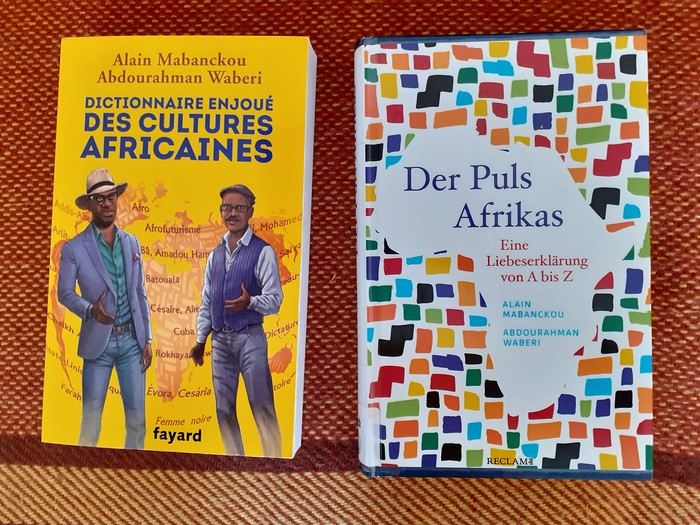
The Maggi cube, an unchallenged hegemony, and so much more
“The hopeless continent,” headlined The Economist, a British magazine, in July 2000 about Africa. Eleven years later, the same magazine headlined “Africa rising” instead. Images of Africa in the prosperous North constantly oscillate between apocalyptic scenarios and enthusiastic projections. A key issue with such images lies in the generalization they entail. If you look at the continent, considerable contrasts emerge depending on space and time. It’s no surprise that a region of the world encompassing such diverse ecological zones, maintaining such varied ties with other continents, comprising nearly fifty nation-states in sub-Saharan Africa alone, and characterized by a great diversity of languages, belief systems, and historical paths, doesn’t share a single destiny.
And yet, for many people outside Africa, as well as for many Africans, the continent constitutes a single entity, defined by criteria such as skin color, a colonial past, poverty, and the art of survival. Until now, these perspectives were generally accompanied by the idea that Africa had to—or should have—followed a single path together, sometimes called development, sometimes modernization, sometimes liberation, then a market economy. None of these paths delivered on their promises.
The two writers Alain Mabanckou and Abdourahman Waberi—one from Congo, the other raised in Djibouti, both long settled in France and now professors at renowned North American universities (Los Angeles, Washington)—have had enough of pessimistic scenarios: “We are aware that Africa is in the world and the world is in Africa. The same goes for all other continents, as our destinies are inextricably linked for better or worse. We refuse to see Africa as a reservoir of misfortunes or a continent cursed by atavistic misfortune and characterized by ethnic conflicts. [...] It’s this passionate flame we wanted to capture in a book [...] a kind of stroll through African cultures, without any demands, each letter of the alphabet leading us to a notion, a practice, a concept, a moment in history, literature, painting, politics, economics, cuisine, etc.” (p.10-11). Africa, they write, is on the verge of “imposing a signature, a style, a way of being in the world and in relation to the rest of the world.” (p.11) To put words to the continent’s diversity and dynamism, the two authors created a “rambling ABC,” a kind of portrait—or more precisely, a mythography—that lets you see and feel the pulse of a vast continent whose cultural power is unfolding before our eyes. Once marginalized or even mocked, the voice and importance of the Continent in global affairs are now undeniable” (p.11), containing over a hundred entries, mostly concise, written in a relaxed and casual style. The optimistic, even exuberant tone is set from the brief introduction. The duo of authors wants to “sing a love song to the cultures of our continent, to its inhabitants past and present, to its exceptional resources and its spectacular globalization despite a certain pollution that still clouds our skies due to the unmatched duration of dictatorships in some of our regions.” (p.12) In doing so, they don’t want to be too distracted by today’s Afewerki-Biya-Bongo-Déby & Co. ...
Of course, you’ll find tributes to great precursors like Frantz Fanon (“[...] it was a love story and admiration that wasn’t dimmed by the four decades separating his birth from ours. Let’s add that we were born while the native of Fort-de-France had left the world’s stage four years earlier, in the prime of life” p.141), Mongo Beti (“You must read and reread Mongo Beti, a genius who used his fame to support often just causes in Africa, like defending oppressed groups. His place is already in History. His oppressors, like the dictators Ahmadou Ahidjo and Paul Biya, can’t compete in the same category” p.64), the Malian Amadou Hampâté Bâ
(“Posterity remembers him mainly as an tireless defender of African cultures. His plea for the collection and preservation of traditional African knowledge remains a major event for all men and women of good will. One day in 1960, at the UNESCO podium, the native of Bandiagara sounded the alarm: ‘[...] Since we’ve admitted that the humanity of each people is the heritage of all humanity, if African traditions aren’t collected in time and written down, they’ll one day be missing from the universal archives of humanity.’” p.51),
Kwame Nkrumah, “one of the founders of Pan-Africanism, father of Ghana’s independence” (p.239), as well as the historian Cheikh Anta Diop, the writer, poet, and politician Aimé Césaire, and the economist and thinker Samir Amin, but also very warm tributes to certain contemporary African intellectuals like Souleymane Bachir Diagne and Achille Mbembe
(“A few years ago, in dominant economic circles, a rumor often resurfaced, usually disguised as a cold and scientifically proven analysis: Africa is useless. It’s a burden for the rest of the human community. With its 2% share in world trade, it would disappear from stock market radars without anyone noticing. So? Maybe it’ll be pulled up by other continents. Wanting to surpass itself is a crazy bet for Africans, they concluded. Arrogant or clueless, President Nicolas Sarkozy declared before an audience of students and teachers at Cheikh Anta Diop University in Dakar: ‘The African man hasn’t entered history enough [...] He only knows the eternal repetition of time marked by the endless repetition of the same gestures and words.’ That was in 2007. For decades, armed only with reason, an intellectual often steps up to debunk prejudices, lazy readings, and dishonest frameworks used as false fronts by those who, like Nicolas Sarkozy or former journalist Stephen Smith, out of ignorance, contempt, or condescension, distort African reality. This intellectual is none other than the historian and political scientist Achille Mbembe. This heir of Frantz Fanon, Amílcar Cabral, Jean-Marc Ela, and Fabien Eboussi-Boulaga was born in 1957 in Cameroon, in the Bassa region. Marked early by the upheavals of a fratricidal war, Achille Mbembe became the guardian of the memory of martyrs. After brilliant studies in Paris, he went on to teach at the best American universities, but the call of the Continent was stronger than anything else. In Dakar, he once directed CODESRIA (Council for the Development of Social Science Research in Africa) before joining the University of the Witwatersrand in Johannesburg, South Africa. Even though the author of *Critique of Black Reason* (Éditions La Découverte, 2015) spends a few months at Duke University in North Carolina, his observation post remains South Africa. From Johannesburg, Achille Mbembe scrutinizes Africa and the whole world. A lucid observer with an elegant and generous pen, Achille Mbembe knows how to blend big and small history: ‘I was born one day in July, as the month was drawing to a close. It was 1957, in that part of Africa recently named ‘Cameroon,’ a memory of the wonder that seized Portuguese sailors in the 15th century when, sailing up the river near Douala, they couldn’t help but note the presence of a multitude of crustaceans, and named it *Rio dos Camarões*, meaning ‘River of Shrimp.’ I grew up in the shadow of this nameless land, since, in a way, the name it bears is only the product of someone else’s astonishment: a lexical mistake, if you will.’ From this mistake or wound, he made leaven, a springboard to compose a rich work, recognized worldwide. To denounce barriers and barbarians too. But that’s not enough. Among his peers in circles of thought and action, Achille Mbembe passionately and consistently defends human dignity and the beauty of the world. In doing so, he fulfills the mission Frantz Fanon entrusted to him.” (p.227-229),
as well as entries dedicated to lesser-known artists and intellectuals, like the French journalist and activist Rokhaya Diallo, daughter of Senegalese and Gambian parents, or the Ethiopian filmmaker Haile Gerima, who has long lived in the United States. Other names from politics, sports, music, art, and literature: Kofi Annan, p.36; Barack Obama, p.243; Thomas Sankara, p.277; Ousmane Sow, p.285; Yambo Ouologuem, p.250; Léopold Sédar Senghor, p.282; Muhammad Ali, p.30; Nuruddin Farah, p.146; Salif Keita, p.203; Ahmadou Kourouma, p.206; Ngũgĩ wa Thiong’o, p.236; Winnie Mandela, p.224; Kylian Mbappé, p.226 ...
The authors, who resolutely commit to a “mythography” (p.11) of Africa, also pay special attention to local social movements, cultural events, and aspects of daily life. *Y’en a marre*, “which also meant ‘we’re fed up with sitting on our hands’” (p.320-321), emerged about a decade ago in Senegal as a citizen movement of peaceful resistance and symbolizes, the authors emphasize, the fact that African youth are increasingly fed up “with the political circus deployed in Africa since independence, as our parents would say, ‘since the White man left’...” (p.321). A full entry is dedicated to the Maggi bouillon cube, which has flooded African markets for about forty years and enjoys immense popularity (“It’s everywhere in Africa, from Dakar to Djibouti, and from Tangier to Cape Town. It’s in every pot, every stew. Little hands put it in every sauce, every local or adapted dish. An unchallenged hegemony! You’ll find it in diasporas too. The culinary strolls in Paris, in the [...] neighborhood” p.90). Critics blame it not only for impoverishing the aromatic diversity of local dishes but also for being harmful to health. And yet, “he poorest Africans, those who eat only once a day, a few spoonfuls of white beans and a ball of *foufou*, for example, are the most fervent users of the magic cube.” (p.92-93)
For *fonio*, “the new trendy cereal. [...] From the millet family, fonio is probably the oldest cereal cultivated in West Africa, and mainly in its sub-Saharan part, for millennia. [...] Easy to grow, water-efficient, fonio grows everywhere except on clay soils. Long neglected because it was considered the poor man’s crop, fonio is now a source of pride for the farmers who cultivate it and cherish it like the apple of their eye” (p.156-157), the authors immediately offer a detailed recipe, letting the reader know that “e can’t resist sharing this fonio with chicken recipe from Mali with you:
Ingredients: 1 chicken 3 large ripe red tomatoes 4 tbsp tomato paste 4 large onions 1 garlic clove 1/2 cup oil 2 Maggi cubes or salt 2 large carrots 1 turnip 1 large cabbage 2 large potatoes 1 celery stalk 1 packet pre-cooked fonio 4 okra (or okra powder) salt, pepper
Preparation: 1. Prepare the sauce: wash and cut the chicken. Peel the onions, garlic, and vegetables. 2. In a pot, fry the chicken pieces. 3. Dice the onions, tomatoes, carrots, and turnip very small and add them to the pot. 4. Add the tomato paste, salt, and pepper. 5. Simmer for 15 min, then add 2 L of water and the cooked chicken pieces. 6. Simmer for 30 min, then add the crushed garlic and celery, plus the cabbage cut into 4 and the potatoes cut in half. 7. Prepare the fonio: cover it with warm water, let it rest for 15 min, and cook it over low heat. 8. In a small pot, boil the okra and crush them. 9. Mix the crushed okra with the cooked fonio, then salt. Serve hot.” (p.158-159)
The comedy *Black Mic Mac*, released in French theaters in 1986 and addressing France’s increasingly restrictive immigration policy at the time, also gets an entry, as do *Tintin in the Congo*, the popular comic, and *Jip’s Café* (“[...] a little Africa in the heart of Paris, with passersby stopping to admire the ‘ambianceurs’ on the dance floor or attend the cultural events offered by the place” (p.194), an African establishment in Paris that Alain Mabanckou already immortalized in one of his novels.
The duo of authors also tackles thorny subjects like jihadism (p.119), the Rwandan genocide (p.272), the CFA franc (p.82), and dictatorship (p.110). While the two strike the right tone here, many entries leave a slightly bitter taste. Two examples: why doesn’t the text on Barack Obama mention the great disappointment of many people in Africa, who expected more from the African policy of the first U.S. president with African roots than just occasional warm words? Why do the comments on Winnie Mandela gloss over the fact that she was a highly controversial icon of the anti-apartheid movement due to her involvement in kidnappings, acts of torture, and murders of alleged apartheid collaborators? Instead, there’s a compassion that brings tears to the eyes: “She was often reduced to a secondary role, the wife of a great man” or “When victory came, she didn’t taste its fruits. Divorced, isolated. She would never be a ‘first lady’ in an evening gown, posing before a bed of chrysanthemums. They’d keep her far from the circles of power” (p.224-225). At this point, I would’ve liked the authors to take a slightly more critical stance...
That said, these “weaknesses” (if you can call them that) shouldn’t overshadow the book as a whole. It remains an informative, sometimes very entertaining, and often even original work in its own way.
Book information (the original French and the German translation):
Alain Mabanckou/Abdourahman Waberi. Dictionnaire enjoué des cultures africaines. Fayard, 2019. Alain Mabanckou/Abdourahman Waberi. Der Puls Afrikas. Eine Liebeserklärung von A bis Z. Reclam, 2022.
Hery
Compte rendu d'un voyage de trois semaines au Cameroun
Salut à tous
Ca y est suis rentré ce matin des 3 semaines au Cameroun; un beau voyage, plein de belles images en tête mais aussi beaucoup un sentiment mitigé. Tout d'abord le côté pratique; mon itinéraire; douala-yaoundé-train jusqu'a Ngaoundéré-parc de la bénoué-retour Yaoundé-kribi-Edéa-Limbé-Buéa et douala; le tout 3 semaines sac à dos
Douala; ville tentaculaire, polluée, assez dangereuse à certains égard; bref j'ai pas accroché; j'ai pris le sky hotel à bonapriso; bel hotel pas donné mais pratique pour l'invitation pour le visa.
Yaoundé; Ville plus agréable, plus aérée et plus verte; hôtel le grand moulin près de la gare; un peu cher au vu des prestations
Ngoundéré; ville assez agréable; bon point de départ pour le parc de la Bénoué ou le parc du faro aussi; j'ai logé à l'hôtel du lac; bien mais un peu cher au vu des prestations. Se méfier des moto taxis dans cette ville surtout de nuit; une grande partie sont drogués et agressifs.
Parc de la Bénoué; à 2h de route de Ngaoundéré; 4X4 obligatoire (non accessible en transports en commun); beau parc géré par des africains; on y voit des antilopes, hypoppotames, girafes, phacochères, diverses espèces de singes dont des baboins, crocodiles (apparemment on peut y voir des lions et éléphants mais je ne les ai pas vu). Logement au campement du buffle noir; très sympas.
Kribi: sympas, belles plages mais sans plus. Les chutes de la lobé n'ont rien d'exceptionnels et les excursions proposées au départ des chutes sont à des tarifs excessifs (nous y avons renoncés); une astuce; prendre un moto taxi jusqu'à tarar plage puis longer les plages à pied jusqu'à la lobé (30 minutes environ). Une bonne adresse; l'hôtel de la paix (chambres à 5000 CFA correctes, bien situées)
Limbé; rien d'exceptionnel à limbé même; hôtels chers au vu des prestations offertes; un bon plan; le SEM beach hotel à 20 mns de Limbé; hôtel un peu cher mais confortable et surtout longeant l'une des plus belles plages de sable noir du coin. Très bon accueil.
Buéa; ville brumeuse, froide sans grand intérêt mais présentant l'avantage d'être au pied du mont cameroun que l'on peut bien voir en fonction des heures de la journée. Hôtel Mermoz; bien et pas cher (6000FCA)
Les transports; le train; très bien et efficace mais pas donné (28000FCA la couchette); train de nuit yaoundé-Ngaoundéré et inverse. Aucun pbms. Très bon réseaux de bus et mini bus; ca fonctionne bien.
Le climat; très chaud et humide à douala et autour; chaud à kribi; nuits fraiches à yaoundé, ngaoundéré et limbé climat assez frais jour et nuit à Buéa.
Visa; 100 euros au consulat à Marseille plus taxe de sortie de 10000CFA à l'aéroport de douala.
Autres détails pratiques; difficulté à faire du change même ds les villes; les banques refusent; aucun bureau de change; reste le change au noir ou les grands hôtels (tx peu intéressant); à la différence d'autres pays d'Afrique, faire du change au Cameroun est peu simple à certains endroits.
Le gros point noir du séjour; un certain racisme surtout chez les jeunes; pas une journée sans se faire insulter de "sale blanc", "le blanc rentre chez toi", "et le white dégage", etc...A cela se rajoute les regards insistants et provocateurs à tous les coins de rue. c dommage car qd on a connu l'accueil exceptionnel des burkinabés, on est décu par l'accueil des étrangers au Cameroun. Autre chose, il est parfois difficile d'obtenir des infos; par exemple l'office du tourisme de ngaoundéré ne connaissait même pas le parc de la bénoué (pourtant le plus proche de cette ville). Pour finir de belles rencontres et un beau pays mais un accueil général assez déplorable et un racisme très présent chez une part non négligeable de la population qui gache l'impression générale du voyage. D'ailleurs ce qui ne trompe pas et se constate sur place; de l'avis même des camerounais et des résidents; le tourisme est en chute libre dans ce pays.
C dommage d'avoir du reporter la rencontre VF (qui s'est finallement annulée apparemment) mais je n'avais pas le choix au vu de l'itinéraire.
Voila je ne regrette pas ce voyage et d'avoir découvert le cameroun mais je n'y remettrai plus les pieds. a++
Ca y est suis rentré ce matin des 3 semaines au Cameroun; un beau voyage, plein de belles images en tête mais aussi beaucoup un sentiment mitigé. Tout d'abord le côté pratique; mon itinéraire; douala-yaoundé-train jusqu'a Ngaoundéré-parc de la bénoué-retour Yaoundé-kribi-Edéa-Limbé-Buéa et douala; le tout 3 semaines sac à dos
Douala; ville tentaculaire, polluée, assez dangereuse à certains égard; bref j'ai pas accroché; j'ai pris le sky hotel à bonapriso; bel hotel pas donné mais pratique pour l'invitation pour le visa.
Yaoundé; Ville plus agréable, plus aérée et plus verte; hôtel le grand moulin près de la gare; un peu cher au vu des prestations
Ngoundéré; ville assez agréable; bon point de départ pour le parc de la Bénoué ou le parc du faro aussi; j'ai logé à l'hôtel du lac; bien mais un peu cher au vu des prestations. Se méfier des moto taxis dans cette ville surtout de nuit; une grande partie sont drogués et agressifs.
Parc de la Bénoué; à 2h de route de Ngaoundéré; 4X4 obligatoire (non accessible en transports en commun); beau parc géré par des africains; on y voit des antilopes, hypoppotames, girafes, phacochères, diverses espèces de singes dont des baboins, crocodiles (apparemment on peut y voir des lions et éléphants mais je ne les ai pas vu). Logement au campement du buffle noir; très sympas.
Kribi: sympas, belles plages mais sans plus. Les chutes de la lobé n'ont rien d'exceptionnels et les excursions proposées au départ des chutes sont à des tarifs excessifs (nous y avons renoncés); une astuce; prendre un moto taxi jusqu'à tarar plage puis longer les plages à pied jusqu'à la lobé (30 minutes environ). Une bonne adresse; l'hôtel de la paix (chambres à 5000 CFA correctes, bien situées)
Limbé; rien d'exceptionnel à limbé même; hôtels chers au vu des prestations offertes; un bon plan; le SEM beach hotel à 20 mns de Limbé; hôtel un peu cher mais confortable et surtout longeant l'une des plus belles plages de sable noir du coin. Très bon accueil.
Buéa; ville brumeuse, froide sans grand intérêt mais présentant l'avantage d'être au pied du mont cameroun que l'on peut bien voir en fonction des heures de la journée. Hôtel Mermoz; bien et pas cher (6000FCA)
Les transports; le train; très bien et efficace mais pas donné (28000FCA la couchette); train de nuit yaoundé-Ngaoundéré et inverse. Aucun pbms. Très bon réseaux de bus et mini bus; ca fonctionne bien.
Le climat; très chaud et humide à douala et autour; chaud à kribi; nuits fraiches à yaoundé, ngaoundéré et limbé climat assez frais jour et nuit à Buéa.
Visa; 100 euros au consulat à Marseille plus taxe de sortie de 10000CFA à l'aéroport de douala.
Autres détails pratiques; difficulté à faire du change même ds les villes; les banques refusent; aucun bureau de change; reste le change au noir ou les grands hôtels (tx peu intéressant); à la différence d'autres pays d'Afrique, faire du change au Cameroun est peu simple à certains endroits.
Le gros point noir du séjour; un certain racisme surtout chez les jeunes; pas une journée sans se faire insulter de "sale blanc", "le blanc rentre chez toi", "et le white dégage", etc...A cela se rajoute les regards insistants et provocateurs à tous les coins de rue. c dommage car qd on a connu l'accueil exceptionnel des burkinabés, on est décu par l'accueil des étrangers au Cameroun. Autre chose, il est parfois difficile d'obtenir des infos; par exemple l'office du tourisme de ngaoundéré ne connaissait même pas le parc de la bénoué (pourtant le plus proche de cette ville). Pour finir de belles rencontres et un beau pays mais un accueil général assez déplorable et un racisme très présent chez une part non négligeable de la population qui gache l'impression générale du voyage. D'ailleurs ce qui ne trompe pas et se constate sur place; de l'avis même des camerounais et des résidents; le tourisme est en chute libre dans ce pays.
C dommage d'avoir du reporter la rencontre VF (qui s'est finallement annulée apparemment) mais je n'avais pas le choix au vu de l'itinéraire.
Voila je ne regrette pas ce voyage et d'avoir découvert le cameroun mais je n'y remettrai plus les pieds. a++
Quels pays pour un tour du monde?
Bonjour amis voyageurs,
nous sommes un jeune couple de 25 ans: Laureline, infirmière, et Romain, charpentier.
Nous avons comme projet de faire le tour du monde durant 1 an (minimum) à partir du mois de mars 2014.
Comme tout novice en la matière, nous aimerions quelques conseils et astuces.
Tout d'abord, nous envisageons de partir de Bordeaux/Paris en direction du Népal. S'en suit le Tibet, l'Inde, le Vietnam et l'Indonésie. C'est là que la première question intervient: Nous hésitons à passer en plus en Birmanie, Cambodge ou Laos. Pouvez-vous nous donner votre avis?
De l'Indonésie, nous nous envolerons direction Madagascar, avant de se lancer dans le périple africain. Ce continent nous attire mais nous savons que les situations politiques changent régulièrement... Comme nous serons à Madagascar, nous envisageons de partir vers le sud de l'Afrique, sans savoir réellement quel pays découvrir? Tanzanie? Mozambique? Namibie? Zimbabwe? Afrique du sud? ...
Nous aimerions également découvrir la région entre le Sénégal (Casamance) et le Bénin. En effet, notre projet initial était de descendre en voiture jusqu'au Sénégal, mais la Mauritanie (inévitablement sur le trajet) est très peu recommandée. Chers amateurs de l'Afrique, pourriez vous nous éclairer sur ce si beau continent?
Nous souhaitons finir notre périple en Amérique du sud. Les pays ne sont pas encore définis, mais le Pérou, le Paraguay, l'Equateur et le Chili nous attirent particulièrement. Si vous avez des idées, nous sommes preneurs 😉
Sachant pour finir que nous sommes partis pour découvrir les pays où la dépense journalière n'excède pas 25E/pers/jours tout compris. Nous avons évalué notre budget pour 1an entre 6000 et 10000/pers. (Le woofing, couchsurfing, auberge de jeunesses, autostop et bateau stop sont envisagés).
Ce voyage n'a pas de véritable date(s) de retour, nous nous laisserons guider par les rencontres et les partages au fil des pays. Ainsi, les opportunités qui s'offrirons à nous (professionnelles ou non), nous feront pourquoi pas rester plus longtemps à un endroit. Pensez vous qu'il est possible de travailler dans ces pays (infirmière/charpentier)?
Nous vous remercions grandement pour vos avis. A bientôt sur les routes, au gré du vent et des rencontres... Amicalement, Rolo!
Ce voyage n'a pas de véritable date(s) de retour, nous nous laisserons guider par les rencontres et les partages au fil des pays. Ainsi, les opportunités qui s'offrirons à nous (professionnelles ou non), nous feront pourquoi pas rester plus longtemps à un endroit. Pensez vous qu'il est possible de travailler dans ces pays (infirmière/charpentier)?
Nous vous remercions grandement pour vos avis. A bientôt sur les routes, au gré du vent et des rencontres... Amicalement, Rolo!
Vivre à Yaoundé
Bonjour à tous,
Mon mari ma fille et moi nous préparons à partir vivre à Yaoundé pour raison professionnelle et nous somme très content de cette nouvelle expatriation car nous avons déjà habité en Roumanie (Bucarest )et nous en gardons un très bon souvenir, se fut une très belle expérience. Nous préparant donc à bientôt partir, j'aurais aimé avoir quelques informations concernant la vie au quotidien, savoir si nous pouvons trouver des supermarchés pour faire des courses(oui j'ai un peu honte de ma question) et acheter quelques aliments comme les yaourts, la viande mais aussi tous un tas d'autres choses car même si j'adore la nature et les voyages et rencontrer d'autres populations j'adore... le shopping...les vêtements comme beaucoup de femmes. D'ailleurs j'aime beaucoup les vêtements traditionnels camerounais.Lol Alors quelqu'un pourrais me renseigner j'aurais aussi d'autres questions si ça ne vous déranges pas .Merci à tous
Mon mari ma fille et moi nous préparons à partir vivre à Yaoundé pour raison professionnelle et nous somme très content de cette nouvelle expatriation car nous avons déjà habité en Roumanie (Bucarest )et nous en gardons un très bon souvenir, se fut une très belle expérience. Nous préparant donc à bientôt partir, j'aurais aimé avoir quelques informations concernant la vie au quotidien, savoir si nous pouvons trouver des supermarchés pour faire des courses(oui j'ai un peu honte de ma question) et acheter quelques aliments comme les yaourts, la viande mais aussi tous un tas d'autres choses car même si j'adore la nature et les voyages et rencontrer d'autres populations j'adore... le shopping...les vêtements comme beaucoup de femmes. D'ailleurs j'aime beaucoup les vêtements traditionnels camerounais.Lol Alors quelqu'un pourrais me renseigner j'aurais aussi d'autres questions si ça ne vous déranges pas .Merci à tous
Recherche d'anciens collègues et amis de Yaoundé
Pendant deux années (années 60), j'ai travaillé au Collège de la Retraite de Yaoundé. Je serais particulièrement heureuse de retrouver tous les amis que j'ai eus là-bas. J'ai du mal à me souvenir de leurs noms de famille. Mais je m'en souviens comme si c'était hier. Nous allions à Kribi et au bord de la Sanaga. J'ai eu de magnifiques moments de bonheur là bas et ils me manquent. Si seulement je retrouvais françoise qui était surveillante au collège et Daniel avec lequel elle devait se marier. Annie qui finalement a travaillé au secrétariat du collège et s'est aussi mariée là-bas. Madeleine, Anne-Marie et tant d'autres dont Jo qui, lui, avait une entreprise de bois.
Qui a vécu là-bas au cours des années 60 ?
Merci de me répondre ! 🙂
Qui a vécu là-bas au cours des années 60 ?
Merci de me répondre ! 🙂
Vivre à Yaoundé (Cameroun)
salut,
dans quelque temps je devrai m'établir à Yaounde pour travail.
j'aimerais comprendre comment est la vie dans la capitale du Cameroun.
J'ai visité dans l'année 2005 Douala seulement pour tourisme (!!! je sais qu'il ya des autres
lieux) mais je n'ai pas un bon souvenir:
je ne considére pas le climat, je parle d'ambiance sociale.
Est-ce que par rapport à sa, Yaoundé est plus vivible?
En plus, si possible, j'aimerais connaitre un peu plus sur la vie
à Yaounde.
Merci pour l'aide.
(Désolé pour mon français qui n'est pas très bon).
Prendre contact avec toute personne ayant vécu à Nkongsamba en 1961 (Cameroun)
J'aimerais prendre contact avec toute personne ayant vécu à N'kongsamba en 1961 . J'étais responsable du magasin Printania du 17 janvier au 20 décembre.
J'ai surtout connu les responsables de banque (BNCI , BCA Mr Fischer ) , et des Stés commerciales (Cie Soudanaise , RWKing, UTCameroun etc.Mrs Morellet, Moutard, Dejeanetc) , les planteurs de café De Coutivron et Gortzounian . J'ai gardé un excellent souvenir de ce séjour malgré le couvre-feu , les problèmes de santé de ma femme etc . J'ai beaucoup apprécié le personnel du magasin N'Joumé Manfred et beaucoup d'autres , ainsi que notre boy N'gatela Zacharie. J 'aurais aimé revoir ce pays mais à 81 ans c'est trop fatigant....
Hubert Tréca - Le Lotus - 5 place Maréchal Foch - 42000 Saint Etienne
hubert.treca@orange.fr
Faire du camping sauvage au Cameroun?
Bonjour,
J'aimerais faire du camping sauvage au Cameroun auriez-vous de bonne adresse pour moi ?
Merci d'avance
J'aimerais faire du camping sauvage au Cameroun auriez-vous de bonne adresse pour moi ?
Merci d'avance
Transports entre Yaoudé et Kribi? (Cameroun)
Bonjour,
Notre voyage prend forme, nous serons accueilli a partir du 10 avril dans la famille à Yaoudé ?et ensuite nous souhaiterions passer quelques jours à Kribi, surement dans les gites "entre mer et jungle" chez Philippe et jeannette (si quelqu'un connait ou si vous avez d'autre sugestions je suis preuneusse de commentaires ....)
Nous serons 5 ou 7 et je voudrais surtout savoir comment joindre ces 2 villes et le prix ? en voiture de location ? en bus ? en train ? en taxi ?
ps: connaissaient vous les tarifs de locations de voiture pour 5 ou 6 jours environ, et les routes ne sont elle pas trop dangeureuses ?
merci de votre participation !!! A bientot
ps: connaissaient vous les tarifs de locations de voiture pour 5 ou 6 jours environ, et les routes ne sont elle pas trop dangeureuses ?
merci de votre participation !!! A bientot
Un peu de nostalgie au Cameroun: Douala en 1977
Bonjour à toutes et tous,
Voici un lien sur un site d'anciens expatriés au Cameroun avec un film datant de 1977 montrant Douala.
http://www.anciens-cameroun.com/
Nul doute que certains camerounais du forum seront amusés de revoir quelques rues du Douala d'il y a 32 ans. Notamment le boulevard de la Liberté qui semblait bien ordonné à l'époque...😏
Je n'ai pas connu Douala en 1977 je n'avais que 4 ans, j'y ai mis les pieds pour la première fois en 1995.
Mais j'ai pris plaisir à regarder ce film malgré tout, alors il en sera peut être de même pour certains d'entre vous.
(Vous remarquerez que les expats de l'époque comme ceux d'aujourd'hui sont des gens malheureux, obligés de vivre à des milliers de kilomètres de chez eux, sous des températures insoutenables...😎).
Et comme dit l'auteur, "je garderais le souvenir d'une vie nonchalante"
Et oui Papa, je sais comment l'atterrissage en France est toujours compliqué...😕
Le Cameroun, on n'en rentre jamais indemne psychologiquement.
Alors à vos commentaires...🙂
Voici un lien sur un site d'anciens expatriés au Cameroun avec un film datant de 1977 montrant Douala.
http://www.anciens-cameroun.com/
Nul doute que certains camerounais du forum seront amusés de revoir quelques rues du Douala d'il y a 32 ans. Notamment le boulevard de la Liberté qui semblait bien ordonné à l'époque...😏
Je n'ai pas connu Douala en 1977 je n'avais que 4 ans, j'y ai mis les pieds pour la première fois en 1995.
Mais j'ai pris plaisir à regarder ce film malgré tout, alors il en sera peut être de même pour certains d'entre vous.
(Vous remarquerez que les expats de l'époque comme ceux d'aujourd'hui sont des gens malheureux, obligés de vivre à des milliers de kilomètres de chez eux, sous des températures insoutenables...😎).
Et comme dit l'auteur, "je garderais le souvenir d'une vie nonchalante"
Et oui Papa, je sais comment l'atterrissage en France est toujours compliqué...😕
Le Cameroun, on n'en rentre jamais indemne psychologiquement.
Alors à vos commentaires...🙂
Trajet Douala-Garoua en 4x4 (Cameroun)
🙂salut je voudrais parcourire la distance Douala-Garoua me donner quelques conseils
Je vous embrasses tous Merci.
Cameroun-France à moto "125 Chinoise"
Vous savez les ptites becannes qui servent de motos-taxis dans les villes africaine...
Tout le monde me dit que ces de la folie. Je me dis qu'en la conduisant tranquille ca doit pouvoir tenir : en utilisation urbaine ce genre de motos depasse facile les 10 000 bornes, et la ville africaine n'est pas tendre. Avis aux specialiste : est-ce que c'est mecaniquement possible ??
merci d'avance pour votre aide !
merci d'avance pour votre aide !
Orthophonie au Cameroun
Bonjour, je suis orthophoniste en région parisienne et j'envisagerais de partir quelques mois, voire plus, travailler à Douala. J'aimerais savoir s'il y a des postes à pourvoir (en libéral ou en salariat), que ce soit dans les hôpitaux ou dans les écoles/lycées, ou dans des cabinets déjà existants. Savez-vous quel organisme contacter pour avoir de plus amples informations sur ce sujet?
Merci à ceux qui auraient quelques éléments de réponse!
A bientôt.
Vos conseils pour le Cameroun
Nous sommes tout un groupe de géographes à partir en Afrique et plus précisément au Cameroun en mai-juin 2004 (si tout se passe bien). Un fidèle de voyageforum aurait il des choses à nous apprendre sur ce pays très attrayant? Est-ce facile de s'adpater lorsqu'on est jamais parti dans un pays au climat tropical et equatorial?
Merci d'avance!
Snounit.🙂
Merci d'avance!
Snounit.🙂