Results for "Airbnb"
4920 results found.
Rome-Pompéi-Herculaneum-Vésuve: hébergement à petits prix? English translation pending
Bonjour,
Je planifie être dans la région de Rome du 7 au 17 mai 2010. Je compte passer 4-5 jours pleins à Rome et 3 jours pleins dans la région des sites Pompéi-Herculaneum-Vésuve. Où me conseillez-vous de loger ?
J'espère trouver un hébergement à petit prix (max. 50 Euros la nuitée). Je voyagerai seule et utiliserai les transports en commun. Alors, je cherche un quartier pas trop loin des gares et toute à la fois sécuritaire.
Pour visiter Pompéi-Herculaneum-Vésuve, comment me conseillez-vous de procéder? Est-ce possible d'acheter un tour en autobus pour visiter ces sites et le reste de la côte? Est-ce préférable de loger à Naples ou dans une autre ville?
Tout vos conseils seront appréciés. Merci
Je planifie être dans la région de Rome du 7 au 17 mai 2010. Je compte passer 4-5 jours pleins à Rome et 3 jours pleins dans la région des sites Pompéi-Herculaneum-Vésuve. Où me conseillez-vous de loger ?
J'espère trouver un hébergement à petit prix (max. 50 Euros la nuitée). Je voyagerai seule et utiliserai les transports en commun. Alors, je cherche un quartier pas trop loin des gares et toute à la fois sécuritaire.
Pour visiter Pompéi-Herculaneum-Vésuve, comment me conseillez-vous de procéder? Est-ce possible d'acheter un tour en autobus pour visiter ces sites et le reste de la côte? Est-ce préférable de loger à Naples ou dans une autre ville?
Tout vos conseils seront appréciés. Merci
Périple Liège-Barcelone à vélo début juillet 2010 English translation pending
Bonjour à tous !
Cela fait maintenant qques temps que je parcours ce super forum ! Mais comme j'ai certaines questions, je viens juste de m'inscrire :)
Je compte relier Liège à Barcelone cet été avec ma copine après nos examens.
Nous sommes tous les deux assez sportifs et avons effectué un test l'année passé en réalisant Liège - Oostende avec une étape à Anvers pour la nuit (nous avons donc pris deux jours). Nous étions complètement crevés à notre arrivée ! Il faut dire que c'était notre premier voyage à tous les deux et que nous n'étions pas particulièrement au point : 160 km le premier jour et 170 km le second le tout en VTC avec bagages ! On avait un peu négligé l'itinéraire, résultat : nombreux détours et surtout bcp de passages dans de l'herbe, de la terre, chemins de 20 centimètres de large, bref la galère ! On est arrivé à 3h du matin à Oostende !!! Enfin nous étions fiers du résultat.
J'ai donc pensé à quelque chose de plus ambitieux cette année : relier Liège à Barcelone en nous fixant une moyenne de 100 kms/jour (ouf!) et en préparant à l'avance scrupuleusement notre itinéraire et ainsi éviter les trop nombreux détours et mauvais chemins/routes. J'ai trouvé sur le net un itinéraire de Hollandais qui descendaient jusqu'au sud de la France en fichier kmz et l'ai adapté pour partir de Liège et arriver à Portel-des-corbières en France, près de Sigean (petite pause chez le parrain de ma copine qui habite là). Il me reste donc la partie d'un peu moins de 200 kms à faire entre Sigean et Barcelone.
Voici le fichier kmz que j'ai fait : http://home.scarlet.be/~pin23929/trajet.kmz Il est directement visible dans google map si vous souhaitez en suivant ce lien : http://maps.google.com/maps?f=q&hl=fr&q=http://home.scarlet.be/~pin23929/trajet.kmz (désctivez les Waypoints pour voir plus clairement)
Ma question : Une fois mon fichier kmz terminé, quel est le plus facile pour faire notre voyage ? Je ne vais quand même pas imprimer 500 pages de cartes détaillées. Je ne compte pas non plus prendre un mini pc disposant d'internet partout avec google earth (lol), que faire ? Mon père a un gps tomtom, j'ai lu qu'il y avait moyen de transformer un kmz pour le rentrer dans un GPS, si oui comment ? Et surtout, problème avec l'énergie pour le GPS non ? (Autonomie + batterie etc... d'autant plus que nous souhaitons faire du camping sauvage)
Nous avons déjà bien pensé notre voyage en terme de matériel : équiment vélo, cuisine, tente, etc... et il nous apparait qu'il faudra bcp plus de place disponible que pour notre mini trip de deux jours ! J'ai pensé qu'une remorque serait une solution idéale (la bob ibex a l'air très bonne) mais ça coûte horriblement cher ! Vous n'auriez pas des tuyaux pr faire diminuer ce prix ? Une autre solution serait de nous en faire construire une par un membre de la famille de ma copine qui est plus qu'expert en mécanique, bricolage etc... Ca revient vmt moins cher de la faire faire ?
Enfin, voilà, vous n'auriez pas d'importants conseils ou choses auxquelles nous n'aurions pas pensé ? C'est la première fois que l'on va faire près de 2000 kms à vélo donc...
Merci d'avance pour vos réponses et vos expériences !
Quentin
Cela fait maintenant qques temps que je parcours ce super forum ! Mais comme j'ai certaines questions, je viens juste de m'inscrire :)
Je compte relier Liège à Barcelone cet été avec ma copine après nos examens.
Nous sommes tous les deux assez sportifs et avons effectué un test l'année passé en réalisant Liège - Oostende avec une étape à Anvers pour la nuit (nous avons donc pris deux jours). Nous étions complètement crevés à notre arrivée ! Il faut dire que c'était notre premier voyage à tous les deux et que nous n'étions pas particulièrement au point : 160 km le premier jour et 170 km le second le tout en VTC avec bagages ! On avait un peu négligé l'itinéraire, résultat : nombreux détours et surtout bcp de passages dans de l'herbe, de la terre, chemins de 20 centimètres de large, bref la galère ! On est arrivé à 3h du matin à Oostende !!! Enfin nous étions fiers du résultat.
J'ai donc pensé à quelque chose de plus ambitieux cette année : relier Liège à Barcelone en nous fixant une moyenne de 100 kms/jour (ouf!) et en préparant à l'avance scrupuleusement notre itinéraire et ainsi éviter les trop nombreux détours et mauvais chemins/routes. J'ai trouvé sur le net un itinéraire de Hollandais qui descendaient jusqu'au sud de la France en fichier kmz et l'ai adapté pour partir de Liège et arriver à Portel-des-corbières en France, près de Sigean (petite pause chez le parrain de ma copine qui habite là). Il me reste donc la partie d'un peu moins de 200 kms à faire entre Sigean et Barcelone.
Voici le fichier kmz que j'ai fait : http://home.scarlet.be/~pin23929/trajet.kmz Il est directement visible dans google map si vous souhaitez en suivant ce lien : http://maps.google.com/maps?f=q&hl=fr&q=http://home.scarlet.be/~pin23929/trajet.kmz (désctivez les Waypoints pour voir plus clairement)
Ma question : Une fois mon fichier kmz terminé, quel est le plus facile pour faire notre voyage ? Je ne vais quand même pas imprimer 500 pages de cartes détaillées. Je ne compte pas non plus prendre un mini pc disposant d'internet partout avec google earth (lol), que faire ? Mon père a un gps tomtom, j'ai lu qu'il y avait moyen de transformer un kmz pour le rentrer dans un GPS, si oui comment ? Et surtout, problème avec l'énergie pour le GPS non ? (Autonomie + batterie etc... d'autant plus que nous souhaitons faire du camping sauvage)
Nous avons déjà bien pensé notre voyage en terme de matériel : équiment vélo, cuisine, tente, etc... et il nous apparait qu'il faudra bcp plus de place disponible que pour notre mini trip de deux jours ! J'ai pensé qu'une remorque serait une solution idéale (la bob ibex a l'air très bonne) mais ça coûte horriblement cher ! Vous n'auriez pas des tuyaux pr faire diminuer ce prix ? Une autre solution serait de nous en faire construire une par un membre de la famille de ma copine qui est plus qu'expert en mécanique, bricolage etc... Ca revient vmt moins cher de la faire faire ?
Enfin, voilà, vous n'auriez pas d'importants conseils ou choses auxquelles nous n'aurions pas pensé ? C'est la première fois que l'on va faire près de 2000 kms à vélo donc...
Merci d'avance pour vos réponses et vos expériences !
Quentin
Voyage dans l'est des Etats-Unis English translation pending
Bonjour,
Nous souhaitons effectuer un voyage dans l'est des Etats Unis l'année prochaine et je me permets de profiter de vos connaissances sur le sujet. Nous sommes deux couples (25 ans d'age) et nous pensons partir 3 semaines sur les mois de juin/juillet 2010.
Nous débutons seulement la préparation du voyage et dans l'idéal nous aimerions découper notre ovyuage comme suit : - arrivée en avion à NY - première semaine à NY - seconde semaine pour visiter le nord-est des Etats-Unis (avec location de voiture) - avion pour descendre en Floride ? ou voiture pour visiter sur le trajet? - dernière semaine découverte de la Floride (avec location voiture) - retour en avion depuis la Floride
Mes questions 😊: Cela vous parait correct dans le but de profiter du voyage en visitant pas mal de chose tout en évitant de faire 500km par jour ? Pensez-vous qu'il est préférable d'organiser le voyage de a à z avec une agence de voyage ou conseillerez-vous de faire le strict minimum avec eux et de gérer tout par nous même? Question budget, à combien estimez-vous ce voyage ? Pour NY, on m'a conseillé de se déplacer uniquement en transport en commun et taxi en prenant le NY City pass, êtes-vous d'accord ? Auriez-vous des hotels à me conseillez à NY qui serait intérréssants niveau coùt et emplacement ? Sur ce voyage, quels sont pour vous les 5 lieux essentiels à ne pas manquer (hors NY) ?
Merci d'avance pour vos réponse !
Emilien
Nous souhaitons effectuer un voyage dans l'est des Etats Unis l'année prochaine et je me permets de profiter de vos connaissances sur le sujet. Nous sommes deux couples (25 ans d'age) et nous pensons partir 3 semaines sur les mois de juin/juillet 2010.
Nous débutons seulement la préparation du voyage et dans l'idéal nous aimerions découper notre ovyuage comme suit : - arrivée en avion à NY - première semaine à NY - seconde semaine pour visiter le nord-est des Etats-Unis (avec location de voiture) - avion pour descendre en Floride ? ou voiture pour visiter sur le trajet? - dernière semaine découverte de la Floride (avec location voiture) - retour en avion depuis la Floride
Mes questions 😊: Cela vous parait correct dans le but de profiter du voyage en visitant pas mal de chose tout en évitant de faire 500km par jour ? Pensez-vous qu'il est préférable d'organiser le voyage de a à z avec une agence de voyage ou conseillerez-vous de faire le strict minimum avec eux et de gérer tout par nous même? Question budget, à combien estimez-vous ce voyage ? Pour NY, on m'a conseillé de se déplacer uniquement en transport en commun et taxi en prenant le NY City pass, êtes-vous d'accord ? Auriez-vous des hotels à me conseillez à NY qui serait intérréssants niveau coùt et emplacement ? Sur ce voyage, quels sont pour vous les 5 lieux essentiels à ne pas manquer (hors NY) ?
Merci d'avance pour vos réponse !
Emilien
Cherche un cours d'anglais intensif pour senior English translation pending
voilà, j'ai 61 ans et suis à la retraite depuis peu. J'ai pas mal voyagé dans presque tous les continents avec mon épouse qui assurait le principal des conversations en anglais. Comme elle travaille encore, maintenant je voyage seul. Mais voilà je suis nul en anglais, débutant de chez débutant! Je cherche donc un cours intensif d'anglais pour sénior (parlé surtout), sur un mois possible mais pas trop cher. J'ai vu qu'au Canada (Toronto) des écoles qui me paraissent pas trop cher mais pour jeunes étudiantes. Auriez-vous quelques adresses dans vos cartons.
Merci de votre aide.
Erhef
Cherche auberge de jeunesse sur New York English translation pending
slt a tous je compte bientot partir a new york
je cherche une auberge de jeunesse assez propre ou dormis je compte partir avec un ami donc nous serons 2 quelles sont les auberges de jeunesse correctes a new york .Y a t il des chambres privées dans les auberges de jeunesse des chambres juste pour 2 personnes car je crains les vols .merci j'attends vos réponses biz
je cherche une auberge de jeunesse assez propre ou dormis je compte partir avec un ami donc nous serons 2 quelles sont les auberges de jeunesse correctes a new york .Y a t il des chambres privées dans les auberges de jeunesse des chambres juste pour 2 personnes car je crains les vols .merci j'attends vos réponses biz
Vers l'Orient dans les années 1970 English translation pending
Beaucoup de gens traversent la vie à un rythme pépère marqué par une succession de petits événements d’une tranquillité relative. D’autres, une minorité peut-être, passent par des étapes bouleversantes qui les marquent à tout jamais. J’appartiens à cette deuxième catégorie. L’une des expériences les plus marquantes de ma vie s’est déroulée dans les années 1970 et quelques, au Pakistan. Si j’ai pensé à plusieurs reprises qu’il vaudrait la peine de la « coucher sur papier », je ne l’ai pas fait jusqu’ici. C’est à peine si j’en ai raconté quelques fragments à mes meilleurs amis. La raison en est que bien des aspects de cette histoire sont très personnels, et aussi que la disponibilité des autres, même proches, est souvent limitée. De plus, une vie très active ne m’a pas laissé beaucoup de temps libre pour me mettre à écrire.
C’est une évidence que le « net », du fait qu’on peut y garder son anonymat, ouvre des portes nouvelles à la communication. Un forum de voyage est le site idéal pour raconter mon aventure: elle a été aussi bien un voyage dans une contrée exotique qu’un voyage psychologique. Je pourrais écrire pour ma propre satisfaction, celle de replonger dans mes souvenirs, et pourquoi aurais-je besoin d’en faire part à d’autres, surtout à des inconnus ? Mais écrire pour un public force à la concentration, et on devient plus exigeant avec soi-même. C’est pour cela donc que je vais maintenant tenter de pêcher dans les eaux profondes de ma mémoire, et offrir mes prises sur les étals de VF.
Quelques amis autour de moi avaient été en Inde, au Népal ou dans d’autres pays de cette région, et en parlaient avec émerveillement. Je brûlais de rejoindre le club de ces voyageurs et de moi aussi partir à la découverte. J’avais fait un premier voyage de France vers l’Inde, ou pour être plus exact dans la direction de l’Inde, que j’avais poussé jusqu’en Afghanistan. C’était pendant les vacances d’été, entre mes études. L’Afghanistan m’avait tellement plu que, de retour en France, je n’avais qu’une idée en tête : repartir et pousser plus loin le plus tôt possible. Ayant économisé au maximum pendant toute une année, sur mes très faibles rentrées d’argent, je pouvais me payer un aller-retour Paris-Kaboul avec Aryana Afghan Airlines, pour reprendre ma route là où j’avais dû l’interrompre l’année d’avant.
Bien que mon aventure se soit déroulée au Pakistan, il faut que je commence par mon premier voyage vers l’est, une mise en scène, disons. Cela intéressera peut-être ceux qui n’ont pas eu la chance d’y aller, et cela rappellera sans aucun doute bien des choses à ceux qui comme moi y ont été.
En Grèce J’avais fait de l’auto-stop à partir de Strasbourg. Allemagne du sud, Autriche, Yougoslavie. J’avais trouvé ce pays plutôt misérable, surtout après avoir passé Belgrade. Des images tirées de Tintin chez les Soviets me revenaient à l’esprit. Je marchais dans les faubourgs de Nis, qui est maintenant je crois la capitale de la Macédoine, où il n’y avait qu’un trafic léger de quelques bagnoles et de carrioles tirées par des chevaux. La nuit tombait et il n’y avait que quelques maigres loupiotes pour éclairer la route. J’avais acheté un pain dans une boulangerie, qui était loin d’avoir le pimpant d’une boulangerie française. Les hommes qui faisaient la queue ne m’avaient pas jeté un coup d’œil, je n’étais probablement qu’un va-nu-pieds comme tant d’autres et ne dépareillais pas trop. Le pain était infâme, dur et avec du gravillon mélangé à la farine. Mais j’avais, pour quelques sous, quelque chose dans le ventre.
Après une semaine de voyage, j’arrivais à la frontière de la Grèce. Il n’y avait qu’une douzaine de véhicules sortant de Yougoslavie pour entrer en Grèce, contre des centaines dans le sens contraire. La guerre entre la Turquie et la Grèce avait été déclarée le jour-même. Peu importe, j’avais été pris par des Français qui tenaient absolument à aller en Grèce, qu’ils connaissaient bien et qu’ils aimaient. Deux jours plus tard, je m’étais retrouvé à Athènes, et je ne me rappelle plus comment mais ayant fait la connaissance d’un Américain qui allait retrouver des amis de famille (pas des grecs), je l’avais accompagné et j’avais passé deux jours dans leur villa aux abords de la ville, à me la couler douce, jouer aux échecs etc. Une fois, j’avais cherché sur le poste radio et trouvé de la musique un peu plus intéressante, on m’avait immédiatement reproché d’avoir mis la radio sur un poste turc ! Je pensais « payer » mon accueil par la bonne compagnie que j’offrais, mais il était clair que je n’étais en fait qu’un pique-assiette et que je n’allais pas rester longtemps le bienvenu. De plus, je commençais à m’ennuyer, je trouvais ces gens trop bourgeois à mon goût. J’étais donc prêt à repartir. La route vers l’est était bien sûr fermée, du coup je m’étais dit que peut-être je pouvais aller dans les îles grecques et de là passer en Turquie quand cette vilaine affaire se serait tassée.
Je m’étais retrouvé à camper sur l’île de Chios, dans la mer Égée, sur le terrain derrière un petit hôtel familial. Les gens étaient d’une très grande gentillesse et avaient le cœur sur la main. Ils m’avaient pris en affection, s’amusaient de mon installation précaire au milieu des cailloux et des buissons, m’offraient le matin un grand bol de lait de chèvre chaud, pouah !, mais au moins j’avais quelque chose dans le ventre et gratis. Plus tard dans la journée, quand je revenais de ballade, il y avait toujours quelques hommes et femmes attablés sur la terrasse devant l’hôtel, et on m’invitait régulièrement à boire un petit ouzo avec eux: « Ouzo ennaki ! », ou était-ce « Enno ouzaki » ?, disaient-ils en rigolant, le verre porté haut en l’air. Un vieil homme qui vivait dans une masure au bord de la plage m’avait aussi invité à boire un coup et j’avais eu beaucoup de mal à le dissuader de tuer un poulet pour me faire à manger. Je ne connaissais pas un mot de Grec, mais j’essayais de baragouiner un peu. Je me rappelle quelques mots seulement : « nero », « krassi », « kannavi », « evkharisto poli », « parakallo ». Je trouvais cette langue tout à fait splendide. J’ai lu, bien plus tard, quelques très bons livres sur les anciens grecs, qui me fascinent et dont on ne dit pas assez à quel point ils ont transmis des éléments fondamentaux de la civilisation occidentale. On dit que le Grec est une langue indo-européenne, mais il est très probable qu’il y a dans cette langue, ancienne aussi bien que moderne, des sous-strates linguistiques qui précèdent la surface indo-européenne. Mais assez dit sur le sujet, que d’autres connaîtront bien mieux que moi. Je serai heureux, bien sûr, d’entamer une discussion sur la Grèce antique. Une chose dont je me souviens, c’est que Chios passe pour être le pays d’origine de Homère.
La nuit, on voyait les lumières de Çesme, en Turquie (prononcer « Tcheshmé »). Ce n’était vraiment pas loin, à quelques kilomètres, mais il était bien sûr impossible d’y aller. Les gens de l’île étaient effrayés par les Turcs si proches. Ils disaient « plus jamais, nous ne parlerons à ces gens ! ». Il n’y avait presque aucun touriste sur l’île, peut-être à cause de son éloignement, au nord, par rapport aux autres îles grecques, ou à cause de la guerre. Au bout de quelques jours, comme il était évident que ma route vers l’est n’allait pas passer par Çesme, j’étais revenu à Athènes. C’est peut-être sur le bateau ou sur le port que j’avais rencontré un Suisse Allemand avec lequel j’allais faire quelques jours de route, et que je vais appeler Peter pour faute de mieux. Si je me rappelle bien, il travaillait pour une organisation internationale, peut-être pour une branche de l’ONU. En tout cas, il connaissait très bien la région et se débrouillait assez bien en Grec, et comme j’avais pu m’en rendre compte par la suite, en Turc également. Il était plein de son expérience récente à Chypres, dont il revenait, où le gros du conflit entre les Grecs et les Turcs avait fait rage. C’est avec lui et peut-être un autre compagnon de fortune que j’avais pris le train pour remonter vers le nord de la Grèce, car on venait d’annoncer un armistice et nous avions eu écho que la frontière avec la Turquie était maintenant ouverte.
Sur des tronçons entiers de l’autoroute qui longeait la voie ferrée, les pylônes avaient été coupés ras, pour paraît-il permettre aux avions d’atterrir. Le soir, nous étions aux abords de la frontière, et nous pouvions entrevoir dans la pénombre des concentrations de troupes dans la campagne. Le train n’avait alors plus que deux fourgons, car il n’y avait que quelques voyageurs, une vingtaine au plus pour continuer vers la Turquie dans ce premier train qui passait la frontière depuis le commencement des combats. Immédiatement après avoir passé la frontière, des soldats turcs bien armés étaient montés et passaient le train au peigne fin. Plus intéressant, deux ou trois Turcs en civil, costume-cravatte, venaient s’asseoir pour bavarder avec les voyageurs. Celui qui s’installa dans mon compartiment nous offrit des cigarettes, passa de l’anglais à l’allemand quand il apprit de Peter qu’il était Suisse Allemand, puis échangea quelques mots en français assez correct avec moi. Il avait l’air très à l’aise, et je n’aurais pas été étonné, si un de nos compagnons avait été Hongrois ou Espagnol, qu’il passât facilement à leurs langues respectives. Il nous demanda si nous avions vu des mouvements de troupes du côté grec. Bien sûr, nous ne dirent pas un mot, allégeant d’avoir dormi à la tombée de la nuit. La conversation était polie et plaisante, mais il était hors de question que nous entrions dans le jeu des services de renseignements turcs.
« Suite au prochain numéro ! »
C’est une évidence que le « net », du fait qu’on peut y garder son anonymat, ouvre des portes nouvelles à la communication. Un forum de voyage est le site idéal pour raconter mon aventure: elle a été aussi bien un voyage dans une contrée exotique qu’un voyage psychologique. Je pourrais écrire pour ma propre satisfaction, celle de replonger dans mes souvenirs, et pourquoi aurais-je besoin d’en faire part à d’autres, surtout à des inconnus ? Mais écrire pour un public force à la concentration, et on devient plus exigeant avec soi-même. C’est pour cela donc que je vais maintenant tenter de pêcher dans les eaux profondes de ma mémoire, et offrir mes prises sur les étals de VF.
Quelques amis autour de moi avaient été en Inde, au Népal ou dans d’autres pays de cette région, et en parlaient avec émerveillement. Je brûlais de rejoindre le club de ces voyageurs et de moi aussi partir à la découverte. J’avais fait un premier voyage de France vers l’Inde, ou pour être plus exact dans la direction de l’Inde, que j’avais poussé jusqu’en Afghanistan. C’était pendant les vacances d’été, entre mes études. L’Afghanistan m’avait tellement plu que, de retour en France, je n’avais qu’une idée en tête : repartir et pousser plus loin le plus tôt possible. Ayant économisé au maximum pendant toute une année, sur mes très faibles rentrées d’argent, je pouvais me payer un aller-retour Paris-Kaboul avec Aryana Afghan Airlines, pour reprendre ma route là où j’avais dû l’interrompre l’année d’avant.
Bien que mon aventure se soit déroulée au Pakistan, il faut que je commence par mon premier voyage vers l’est, une mise en scène, disons. Cela intéressera peut-être ceux qui n’ont pas eu la chance d’y aller, et cela rappellera sans aucun doute bien des choses à ceux qui comme moi y ont été.
En Grèce J’avais fait de l’auto-stop à partir de Strasbourg. Allemagne du sud, Autriche, Yougoslavie. J’avais trouvé ce pays plutôt misérable, surtout après avoir passé Belgrade. Des images tirées de Tintin chez les Soviets me revenaient à l’esprit. Je marchais dans les faubourgs de Nis, qui est maintenant je crois la capitale de la Macédoine, où il n’y avait qu’un trafic léger de quelques bagnoles et de carrioles tirées par des chevaux. La nuit tombait et il n’y avait que quelques maigres loupiotes pour éclairer la route. J’avais acheté un pain dans une boulangerie, qui était loin d’avoir le pimpant d’une boulangerie française. Les hommes qui faisaient la queue ne m’avaient pas jeté un coup d’œil, je n’étais probablement qu’un va-nu-pieds comme tant d’autres et ne dépareillais pas trop. Le pain était infâme, dur et avec du gravillon mélangé à la farine. Mais j’avais, pour quelques sous, quelque chose dans le ventre.
Après une semaine de voyage, j’arrivais à la frontière de la Grèce. Il n’y avait qu’une douzaine de véhicules sortant de Yougoslavie pour entrer en Grèce, contre des centaines dans le sens contraire. La guerre entre la Turquie et la Grèce avait été déclarée le jour-même. Peu importe, j’avais été pris par des Français qui tenaient absolument à aller en Grèce, qu’ils connaissaient bien et qu’ils aimaient. Deux jours plus tard, je m’étais retrouvé à Athènes, et je ne me rappelle plus comment mais ayant fait la connaissance d’un Américain qui allait retrouver des amis de famille (pas des grecs), je l’avais accompagné et j’avais passé deux jours dans leur villa aux abords de la ville, à me la couler douce, jouer aux échecs etc. Une fois, j’avais cherché sur le poste radio et trouvé de la musique un peu plus intéressante, on m’avait immédiatement reproché d’avoir mis la radio sur un poste turc ! Je pensais « payer » mon accueil par la bonne compagnie que j’offrais, mais il était clair que je n’étais en fait qu’un pique-assiette et que je n’allais pas rester longtemps le bienvenu. De plus, je commençais à m’ennuyer, je trouvais ces gens trop bourgeois à mon goût. J’étais donc prêt à repartir. La route vers l’est était bien sûr fermée, du coup je m’étais dit que peut-être je pouvais aller dans les îles grecques et de là passer en Turquie quand cette vilaine affaire se serait tassée.
Je m’étais retrouvé à camper sur l’île de Chios, dans la mer Égée, sur le terrain derrière un petit hôtel familial. Les gens étaient d’une très grande gentillesse et avaient le cœur sur la main. Ils m’avaient pris en affection, s’amusaient de mon installation précaire au milieu des cailloux et des buissons, m’offraient le matin un grand bol de lait de chèvre chaud, pouah !, mais au moins j’avais quelque chose dans le ventre et gratis. Plus tard dans la journée, quand je revenais de ballade, il y avait toujours quelques hommes et femmes attablés sur la terrasse devant l’hôtel, et on m’invitait régulièrement à boire un petit ouzo avec eux: « Ouzo ennaki ! », ou était-ce « Enno ouzaki » ?, disaient-ils en rigolant, le verre porté haut en l’air. Un vieil homme qui vivait dans une masure au bord de la plage m’avait aussi invité à boire un coup et j’avais eu beaucoup de mal à le dissuader de tuer un poulet pour me faire à manger. Je ne connaissais pas un mot de Grec, mais j’essayais de baragouiner un peu. Je me rappelle quelques mots seulement : « nero », « krassi », « kannavi », « evkharisto poli », « parakallo ». Je trouvais cette langue tout à fait splendide. J’ai lu, bien plus tard, quelques très bons livres sur les anciens grecs, qui me fascinent et dont on ne dit pas assez à quel point ils ont transmis des éléments fondamentaux de la civilisation occidentale. On dit que le Grec est une langue indo-européenne, mais il est très probable qu’il y a dans cette langue, ancienne aussi bien que moderne, des sous-strates linguistiques qui précèdent la surface indo-européenne. Mais assez dit sur le sujet, que d’autres connaîtront bien mieux que moi. Je serai heureux, bien sûr, d’entamer une discussion sur la Grèce antique. Une chose dont je me souviens, c’est que Chios passe pour être le pays d’origine de Homère.
La nuit, on voyait les lumières de Çesme, en Turquie (prononcer « Tcheshmé »). Ce n’était vraiment pas loin, à quelques kilomètres, mais il était bien sûr impossible d’y aller. Les gens de l’île étaient effrayés par les Turcs si proches. Ils disaient « plus jamais, nous ne parlerons à ces gens ! ». Il n’y avait presque aucun touriste sur l’île, peut-être à cause de son éloignement, au nord, par rapport aux autres îles grecques, ou à cause de la guerre. Au bout de quelques jours, comme il était évident que ma route vers l’est n’allait pas passer par Çesme, j’étais revenu à Athènes. C’est peut-être sur le bateau ou sur le port que j’avais rencontré un Suisse Allemand avec lequel j’allais faire quelques jours de route, et que je vais appeler Peter pour faute de mieux. Si je me rappelle bien, il travaillait pour une organisation internationale, peut-être pour une branche de l’ONU. En tout cas, il connaissait très bien la région et se débrouillait assez bien en Grec, et comme j’avais pu m’en rendre compte par la suite, en Turc également. Il était plein de son expérience récente à Chypres, dont il revenait, où le gros du conflit entre les Grecs et les Turcs avait fait rage. C’est avec lui et peut-être un autre compagnon de fortune que j’avais pris le train pour remonter vers le nord de la Grèce, car on venait d’annoncer un armistice et nous avions eu écho que la frontière avec la Turquie était maintenant ouverte.
Sur des tronçons entiers de l’autoroute qui longeait la voie ferrée, les pylônes avaient été coupés ras, pour paraît-il permettre aux avions d’atterrir. Le soir, nous étions aux abords de la frontière, et nous pouvions entrevoir dans la pénombre des concentrations de troupes dans la campagne. Le train n’avait alors plus que deux fourgons, car il n’y avait que quelques voyageurs, une vingtaine au plus pour continuer vers la Turquie dans ce premier train qui passait la frontière depuis le commencement des combats. Immédiatement après avoir passé la frontière, des soldats turcs bien armés étaient montés et passaient le train au peigne fin. Plus intéressant, deux ou trois Turcs en civil, costume-cravatte, venaient s’asseoir pour bavarder avec les voyageurs. Celui qui s’installa dans mon compartiment nous offrit des cigarettes, passa de l’anglais à l’allemand quand il apprit de Peter qu’il était Suisse Allemand, puis échangea quelques mots en français assez correct avec moi. Il avait l’air très à l’aise, et je n’aurais pas été étonné, si un de nos compagnons avait été Hongrois ou Espagnol, qu’il passât facilement à leurs langues respectives. Il nous demanda si nous avions vu des mouvements de troupes du côté grec. Bien sûr, nous ne dirent pas un mot, allégeant d’avoir dormi à la tombée de la nuit. La conversation était polie et plaisante, mais il était hors de question que nous entrions dans le jeu des services de renseignements turcs.
« Suite au prochain numéro ! »
Un an aux Etats-Unis: travail et logement? English translation pending
Bonjour à tous,
Je désir partir avec ma copine au EtatsUnis pour un an environ. Je suis actuellement en alternance à bac+4 ( dans une école d'ingénieur commerciale en NTIC) mais je doute que cela fasse quelques choses aux Etats Unis pour trouver un JOB. En effet ne connaissant pas bien la langue comment exercer un job de commerciale? ce diplome la ne me sert à rien enfin je crois....
je recherche boulot ( n'importe lequel du moment ou j'ai un taff) et un logement. Avec combien d'Argent à votre avis peut on se permettre de tenter l'aventure?
j'attend votre avis et conseils si possible.
a +++
Je désir partir avec ma copine au EtatsUnis pour un an environ. Je suis actuellement en alternance à bac+4 ( dans une école d'ingénieur commerciale en NTIC) mais je doute que cela fasse quelques choses aux Etats Unis pour trouver un JOB. En effet ne connaissant pas bien la langue comment exercer un job de commerciale? ce diplome la ne me sert à rien enfin je crois....
je recherche boulot ( n'importe lequel du moment ou j'ai un taff) et un logement. Avec combien d'Argent à votre avis peut on se permettre de tenter l'aventure?
j'attend votre avis et conseils si possible.
a +++
Aller à Paris en août: trop chaud? English translation pending
Bonjour,
J'ai promis à mon fils d'aller à Paris. Je voulais y aller pour la fete Nationale le 14 juillet 2009.Malheureusement, je ne pourrais y aller qu'août.Ma question: est-ce une bonne période pour y aller?est-ce qu'il fera trop chaud? Devrais-je reporter à une date ultérieure?
Merci à l'avance
J'ai promis à mon fils d'aller à Paris. Je voulais y aller pour la fete Nationale le 14 juillet 2009.Malheureusement, je ne pourrais y aller qu'août.Ma question: est-ce une bonne période pour y aller?est-ce qu'il fera trop chaud? Devrais-je reporter à une date ultérieure?
Merci à l'avance
Aller de Johannesburg aux Chutes Victoria en 4x4? English translation pending
Bonjour,
Je pars en Afrique du Sud le 8 Février et je souhaites remonter jusq'aux Chutes Victoria de Johannesburg, avez vous des conseils sur la route à prendre pour y aller, soit par Gaboro et Francistown soit par Pietersburg et Bulawayo ? Botswana ou Zimbabwe ? Quels sont les "escales sympa" à faire en route et trouvera t'on des hôtels sur notre route ? J'ai déjà réalisé le tour du lac Victoria en 1998, en autonomie complète, ce genre de voyage ne m'est pas inconnu. Merci pour les infos Kali
Je pars en Afrique du Sud le 8 Février et je souhaites remonter jusq'aux Chutes Victoria de Johannesburg, avez vous des conseils sur la route à prendre pour y aller, soit par Gaboro et Francistown soit par Pietersburg et Bulawayo ? Botswana ou Zimbabwe ? Quels sont les "escales sympa" à faire en route et trouvera t'on des hôtels sur notre route ? J'ai déjà réalisé le tour du lac Victoria en 1998, en autonomie complète, ce genre de voyage ne m'est pas inconnu. Merci pour les infos Kali
Circuit à Bali pour un voyage de noces? English translation pending
Bonsoir,
Nous partons en voyage de noces a Bali debut octobre pour une quizaine de jours. Pour l instant, nous avons choisis 4 hotels dans 4 villes : Jimbaran, Ubud, Benoa et Seminyak. Nous voudrions passer 2 ou 3 nuits ailleurs mais où ??
Merci de nous donner des idées 😉
NB : j avais vu sur une brochure de voyage Indonésie, une ile ou une ville (je ne sais plus) où il y avait des especes de huttes avec des tois courbés et j avais craqué sur ces maisons mais impossible de retrouver où c'est 😕 alors si ca vous dit qq chose....
Nous partons en voyage de noces a Bali debut octobre pour une quizaine de jours. Pour l instant, nous avons choisis 4 hotels dans 4 villes : Jimbaran, Ubud, Benoa et Seminyak. Nous voudrions passer 2 ou 3 nuits ailleurs mais où ??
Merci de nous donner des idées 😉
NB : j avais vu sur une brochure de voyage Indonésie, une ile ou une ville (je ne sais plus) où il y avait des especes de huttes avec des tois courbés et j avais craqué sur ces maisons mais impossible de retrouver où c'est 😕 alors si ca vous dit qq chose....
Dormir pour pas cher à Marseille? English translation pending
Bonjour,
Ma copine et moi serons à Marseille du 8 au 10 juillet 2008. Nous cherchons un endroit pour dormir pas cher pour les nuits du 8 et du 9 juillet. Est-ce que quelqu'un aurait des endroits à nous conseiller? Nous voulons idéalement être assez près des attractions et des transports.
Merci de votre aide.
Maxime
Ma copine et moi serons à Marseille du 8 au 10 juillet 2008. Nous cherchons un endroit pour dormir pas cher pour les nuits du 8 et du 9 juillet. Est-ce que quelqu'un aurait des endroits à nous conseiller? Nous voulons idéalement être assez près des attractions et des transports.
Merci de votre aide.
Maxime
Train Saint Petersbourg - Tallin? English translation pending
bonjour,
j'organise mes vacances autour des villes baltes : saint petersbourg, tallin, riga et vilnius
je cherche à savoir si il y a un train entre saint pétersbourg et tallin, comment connaitre les horaires et réserver ?je suis allée sur différents sites : way in russia, mais ils ne parlent que d'eurolines. J'ai lu qu'une ligne ferrovière avait été réouverte ( donc elle était fermée ? )
quelqu'un sait - il précisemment ce qu'il en ait?
merci
Organiser son voyage pour Bali English translation pending
Bonjour,
Pour organiser notre voyageen juillet prochain, on souhaite se faire aider pour les tours apérators (faute de temps).
J'ai vu sur différentes pages que l'organisation "bali autrement" était bien.
Si quelqu'un a déjà eu à faire avec eux, merci de me faire part de vos critiques.
A bientôt
Fabien.
Six mois à Santiago en République Dominicaine: visa, logement English translation pending
Bonjour,
Je suis une jeune diplômée de Français Langue Etrangère et on me propose de travailler 6 mois pour l'alliance française de Santiago.
Dans les préparations de mon départ, de nombreuses questions se posent: je dois solliciter un visa tourisme à l'aéroport qui me sera ensuite échangé lors de ma prise de poste. Mais mon billet d'avion est de 6 mois ouvrable: je ne risque pas de me voir refuser le visa tourisme à l'aéroport?Je dois passer une nuit à St Domingue avant de reprendre un bus pour Santiago. Y a-t'il un hotel pas trop cher; quels sont les tarifs des bus...Enfin, je me trouve pour le moment sans logement; mon employeur ayant attendu la confirmation de mon billet d'avion pour m'annoncer que l'appartement figurant dans l'annonce de recrutement a déjà été loué: est-il facil de se loger pour pas trop cher?
Toutes les informations que vous pourraient me donner me seront précieuses! Merci d'avance.
Camping-car en Islande au mois d'août English translation pending
Bonjour, nous projettons de partir l'été prochain en Islande en Camping Car avec nos enfants de 3 et 6 ans... Ce sera pour nous une première, aussi bien pour ce qui concerne l'Islande que le Camping car.
Je me pose quelques questions tres pratiques sur ce futur voyage : les températures (nocturnes notamment) pourront elles nous permettre de voyager confortablement ? (en d'autres termes, le chauffage d'un camping car fonctionne t il la nuit ? de manière suffisante ? d'ailleurs, comment fonctionne t il gazoil vs gaz ?) Quel est le rythme de déplacement à prévoir : est il raisonnable de planifier des trajets journaliers de 100 km / 200 km voire plus ??? Sur une période de 12 / 15 jours, quelle partie de l'islande est elle à privilégier ? Pour une première approche de l'Islande, est il vraiment frustrant de ne pas aller plus à l'intérieur du pays (chose visiblement impossible en Camping car...) ? Vers quels organismes me tourner pour la réservation d'un camping car sur place ?
Merci d'avance de vos commentaires précieux et excusez par avance la naiveté de certaines de ces questions.
Erasmus pour cinq mois à Alicante en Espagne English translation pending
salut, je pars pour Alicante dans le cadre d'erasmus en janvier prochain pour 5 mois et j'aurai aimé avoir des informations sur la ville mais aussi si quelqu'un a deja vécu cette experience ou encore si quelqu'un recherche une colocation sur alicante
merci
Agence Equinoxe pour l'Argentine? English translation pending
Salut à tous,
Je pars en Argentine en Octobre, et je suis en contact avec l'agence equinoxe. Je voudrais savoir si certains d'entre vous connaissent cette agence et si elle digne de confiance ?
Merci de vos réponse.
rikardau
Merci de vos réponse.
rikardau
Vêtements en Egypte English translation pending
Bonjour à tous,
Je partirai prochainement en Egypte (Hurghada) et ce pour la première fois. Je souhaiterais savoir quelle tenue vestimentaire est souhaitable dans ce pays pour ne pas choquer les habitants ? Qui a-t-il comme vêtements à acheter sur place ? Merci pour votre réponse
Je partirai prochainement en Egypte (Hurghada) et ce pour la première fois. Je souhaiterais savoir quelle tenue vestimentaire est souhaitable dans ce pays pour ne pas choquer les habitants ? Qui a-t-il comme vêtements à acheter sur place ? Merci pour votre réponse
Kyrgyzstan: Practical Information 2026
Recent information about this country is scarce, so I’m starting this post in addition to my travel journal to help fill the gap.
- Which airline from Europe?
Turkish Airlines seems like an excellent option. The price is very reasonable (just over 500 €), the layover isn’t too long, the in-flight comfort is decent (great movie selection), and the planes are modern. Plus, the price automatically includes 30 kilos of luggage, which is perfect for campers.
The downside: the outrageous prices at Istanbul Airport.
- Bishkek Airport
The airport is under full reconstruction. It’s chaotic. There are SIM card vendors upon arrival, but no currency exchange or ATMs in the baggage claim area. You’ll find those in the departures section, which means you have to exit and re-enter under the current setup.
Personally, I pre-booked a VTC with my hotel for the transfer to the city. (Prices vary depending on the hotel’s standard—1200 soms for mine.)
There are taxis and a bus available.
- Entry Requirements
No visa is required for French citizens for stays of up to 30 days.
- Currency
The currency is the som, and the conversion is easy—just divide by 100...
You can get soms by exchanging euros (dollars are useless) or by withdrawing from an ATM. Some ATMs charge fees. Those from Mbank and Optimabank are fee-free.
The maximum withdrawal is usually 20,000 soms.
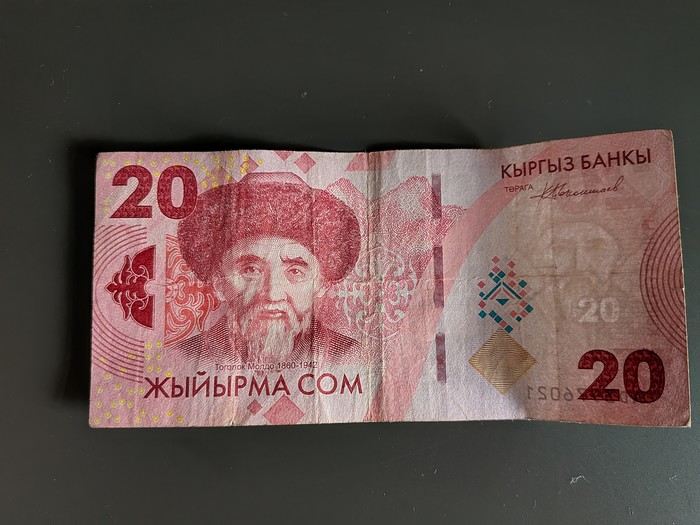
Bills come in 5000, 1000, 500, 200, 100, 50, and 20 soms.
Coins: 10, 5, 3, and 1 som.
- Paying
Card payments are accepted in supermarkets like Globus, some restaurants, gas stations of major chains (Bishkek Petroleum, Partner Neft, Red Petroleum), some hotels, national park entrances, tolls, etc.
But it doesn’t always work.
So always carry cash with you!
If the card works, great—otherwise, it’s back to the old days of wads of bills.
- Cost of Living
It’s really cheap (gas, affordable restaurants even at a decent standard, hotels, souvenirs, fruits, vegetables, water, bread...). For example, a lagman costs only 3.20 €, fixing a flat tire is 3.5 €, a full hour-long wash for a filthy 4x4 is 6 €, washing a big bag of laundry is 3 €, and a liter of 95-octane gas is 0.86 €...
On the pricier side: guesthouses and meals in guesthouses. The value for money is poor. I paid 40 € for a mediocre room with a very basic shared bathroom, while a double with AC, private bathroom, and fridge in a non-touristy hotel cost 20 €... Meals in guesthouses are the worst I’ve eaten and often the most expensive. Plus, they’re very light—don’t expect to fill up after a long day of hiking!
Car rentals are also quite expensive (70 $ per day for a RAV4 in my case).
In short, for two people, excluding accommodation and car rental, we spent an average of 45 € per day (groceries, restaurants, guesthouse dinners, souvenirs, paid activities, gas).
The trip cost us 2200 € per person all-inclusive for 3 weeks on the ground. Roughly 1/4 for the flight, 1/4 for the car, 1/4 for accommodation, and 1/4 for everything else.
- Getting Around
I’ve met cyclists, motorcyclists, people renting cars, those who drove their own vehicles from Europe, and others using public transport and taxis.
Personally, I chose to rent a car.
If you’re not planning long hikes or multi-day horse treks, it’s a great option for exploring the country.
Each car rental company has its own list of forbidden tracks. Make sure your planned route is allowed! Don’t think about ignoring this—vehicles are equipped with GPS trackers...
An international driver’s permit is required.
Police and speed cameras are everywhere, so it’s best to respect the signs (daytime running lights, seatbelts, 40-60 km/h in populated areas, 90 km/h on roads, zero tolerance for alcohol).
Locals have a unique driving style, and it can be dangerous on main roads (they overtake recklessly...). Like in Greece, South Africa, or Malta, a two-lane road is treated as a three-lane one. You pull over to let others pass or to let oncoming traffic overtake.
Without a car (at least a pseudo-4x4), you won’t be able to go everywhere. This country is a nature destination, but nature isn’t always accessible by public transport.
If a spot is near a road, great—the bus will get you almost to the door. Otherwise, you’ll need to hire an agency or take a taxi.
Cyclists will face steep climbs and dust. I’d advise avoiding main roads as much as possible—traffic isn’t on your side...
Motorcyclists will also eat a lot of dust and should research gas stations along their route (this advice also applies to vehicles running on 95-octane).
There’s a 95-octane pump in Kazarman and Gulcha.
Bikes and motorcycles have an advantage over cars, even 4x4s, as they can access some very remote tracks that other vehicles can’t (hikers and horses can obviously take them too!).
Be careful: some areas require a permit (border zones). Research this well in advance—the formalities don’t take an hour or even a day!
Be warned: Google Maps is completely unreliable (it shows roads that don’t exist, routes you through difficult tracks instead of paved roads, etc.). It’s essential to download Maps.me in advance. This app is much more reliable for this country, works offline, and is handy for hiking navigation.
A reminder: horseback riding is like cycling... If you’re not used to it or naturally padded in the right places, your backside will suffer in no time!
Think carefully before embarking on a multi-day trek!
Finally, this country is a kingdom of construction... The Chinese have taken over the market to improve truck circulation and are paving everywhere. (Good news: the Kazarman-Osh section via the tunnel is finally open in summer, even if the road isn’t quite finished.)
- Eating
I had prejudices about Kyrgyz food.
I was both wrong and right.
Supermarkets don’t offer much that’s appealing for picnics. It’s cheap, filling food, full of junk, and not gourmet. If you follow Yuka, I think you’ll be on a diet the whole trip. Bringing some pâté, sausages, or freeze-dried meals for certain nights is a good idea...
Guesthouse dinners consist of the eternal cucumber-tomato salad, a soup, and a light noodle or rice dish where you’ll be searching for the meat... Usually tough and unidentifiable. Beef? The bread is stale, and there’s no dessert or fruit.
Breakfasts always revolve around eggs or porridge... The homemade jam is usually good.
Tea is the number one drink, followed by kompot (a fruit-based drink), Coke, and Fanta.
If you want real coffee, bring your own—it’s very rare.
On the other hand, you eat well in restaurants. Lagman (homemade noodles, vegetables, spices, and usually beef), crispy eggplant, kuurdak (a kind of lamb stew with potatoes), kebabs, plov (pilaf rice with onions, carrots, and meat), and rainbow trout... For dessert? Nada!
And alcohol?
It’s available in all Globus stores: beer, wine, spirits, and you can consume your purchases in some guesthouses (depending on the owner’s religious tolerance). It’s also available in some restaurants (Bishkek, Karakol, Osh...).
The deadly specialty?
White fermented milk balls called kurut. If you think a raw-milk camembert is strong, steer clear! This is more like an old, dry, spicy goat cheese.
- Accommodation
In remote areas, it’s better to check availability on Booking a few days in advance rather than showing up last minute with high hopes.
Booking and Airbnb only offer a small portion of what’s available.
Not necessarily guesthouses, but mostly accommodations aimed at locals (business or leisure travel).
These places are generally more comfortable. There’s even some upscale options.
So it’s necessary to scour Google Maps or Yandex Maps... These accommodations are usually found on Instagram, and WhatsApp is handy for booking!
Prices are a bit of a lottery. So is the comfort. From 20 to 80 € for a double, usually with a private bathroom. (Average around 40 €). These rates are for mid-range options.
Otherwise, this country is a paradise for wild camping. In a camper van, rooftop tent, or ground tent... There are beautiful spots everywhere!
- Climate
I thought it would be quite cool/cold at altitude.
I packed too many warm clothes...
If you’re not doing high-altitude treks or sleeping in a tent, there’s no need to overload yourself with winter gear.
A good fleece, a windproof rain jacket, and technical base layers will be enough.
It only got really cold in the evenings at Song Kul Lake and Tash Rabat, and the yurts are equipped with thick blankets and a stove.
Elsewhere, temperatures ranged from 15 to 30 °C.
In short, I used the AC more than the heater! (It’s hard to drive with the windows open unless you want to be covered in dust in no time...)
- Communication
I bought an eSIM before the trip with a data plan for Kyrgyzstan (Beeline network). Perfect for communicating via WhatsApp right after landing, but this network isn’t the best in Kyrgyzstan.
We then got a physical SIM card with an unlimited one-month plan (less than 4 € including the SIM) at a Mega store downtown. This network is much better, and you get coverage in all cities and most villages. Usually in the mountain passes too.
To make yourself understood, it’s essential to download Google Translate with French, Kyrgyz, Russian, and English options.
Very useful for translating menus, signs, and communicating with locals.
Hosts and other tourism professionals will even pull out their phones to communicate with non-Russian speakers.
The police too...
- Religion
There’s a noticeable difference between the north and the southwest of the country.
In the north, it’s a bit like Albania. People are Muslim by culture but not really by religion.
In the southwest, radical Islam is growing. Mosques are more numerous and imposing. Men are more bearded, women more veiled.
For travelers, religion isn’t an issue except for the near-total absence of pork.
There’s Russian sausage, but reading the ingredient list, it’s more like a one-way ticket to cancer than an Auvergne dry sausage...
You can find the detailed account of the trip here.
- Which airline from Europe?
Turkish Airlines seems like an excellent option. The price is very reasonable (just over 500 €), the layover isn’t too long, the in-flight comfort is decent (great movie selection), and the planes are modern. Plus, the price automatically includes 30 kilos of luggage, which is perfect for campers.
The downside: the outrageous prices at Istanbul Airport.
- Bishkek Airport
The airport is under full reconstruction. It’s chaotic. There are SIM card vendors upon arrival, but no currency exchange or ATMs in the baggage claim area. You’ll find those in the departures section, which means you have to exit and re-enter under the current setup.
Personally, I pre-booked a VTC with my hotel for the transfer to the city. (Prices vary depending on the hotel’s standard—1200 soms for mine.)
There are taxis and a bus available.
- Entry Requirements
No visa is required for French citizens for stays of up to 30 days.
- Currency
The currency is the som, and the conversion is easy—just divide by 100...
You can get soms by exchanging euros (dollars are useless) or by withdrawing from an ATM. Some ATMs charge fees. Those from Mbank and Optimabank are fee-free.
The maximum withdrawal is usually 20,000 soms.
Bills come in 5000, 1000, 500, 200, 100, 50, and 20 soms.
Coins: 10, 5, 3, and 1 som.
- Paying
Card payments are accepted in supermarkets like Globus, some restaurants, gas stations of major chains (Bishkek Petroleum, Partner Neft, Red Petroleum), some hotels, national park entrances, tolls, etc.
But it doesn’t always work.
So always carry cash with you!
If the card works, great—otherwise, it’s back to the old days of wads of bills.
- Cost of Living
It’s really cheap (gas, affordable restaurants even at a decent standard, hotels, souvenirs, fruits, vegetables, water, bread...). For example, a lagman costs only 3.20 €, fixing a flat tire is 3.5 €, a full hour-long wash for a filthy 4x4 is 6 €, washing a big bag of laundry is 3 €, and a liter of 95-octane gas is 0.86 €...
On the pricier side: guesthouses and meals in guesthouses. The value for money is poor. I paid 40 € for a mediocre room with a very basic shared bathroom, while a double with AC, private bathroom, and fridge in a non-touristy hotel cost 20 €... Meals in guesthouses are the worst I’ve eaten and often the most expensive. Plus, they’re very light—don’t expect to fill up after a long day of hiking!
Car rentals are also quite expensive (70 $ per day for a RAV4 in my case).
In short, for two people, excluding accommodation and car rental, we spent an average of 45 € per day (groceries, restaurants, guesthouse dinners, souvenirs, paid activities, gas).
The trip cost us 2200 € per person all-inclusive for 3 weeks on the ground. Roughly 1/4 for the flight, 1/4 for the car, 1/4 for accommodation, and 1/4 for everything else.
- Getting Around
I’ve met cyclists, motorcyclists, people renting cars, those who drove their own vehicles from Europe, and others using public transport and taxis.
Personally, I chose to rent a car.
If you’re not planning long hikes or multi-day horse treks, it’s a great option for exploring the country.
Each car rental company has its own list of forbidden tracks. Make sure your planned route is allowed! Don’t think about ignoring this—vehicles are equipped with GPS trackers...
An international driver’s permit is required.
Police and speed cameras are everywhere, so it’s best to respect the signs (daytime running lights, seatbelts, 40-60 km/h in populated areas, 90 km/h on roads, zero tolerance for alcohol).
Locals have a unique driving style, and it can be dangerous on main roads (they overtake recklessly...). Like in Greece, South Africa, or Malta, a two-lane road is treated as a three-lane one. You pull over to let others pass or to let oncoming traffic overtake.
Without a car (at least a pseudo-4x4), you won’t be able to go everywhere. This country is a nature destination, but nature isn’t always accessible by public transport.
If a spot is near a road, great—the bus will get you almost to the door. Otherwise, you’ll need to hire an agency or take a taxi.
Cyclists will face steep climbs and dust. I’d advise avoiding main roads as much as possible—traffic isn’t on your side...
Motorcyclists will also eat a lot of dust and should research gas stations along their route (this advice also applies to vehicles running on 95-octane).
There’s a 95-octane pump in Kazarman and Gulcha.
Bikes and motorcycles have an advantage over cars, even 4x4s, as they can access some very remote tracks that other vehicles can’t (hikers and horses can obviously take them too!).
Be careful: some areas require a permit (border zones). Research this well in advance—the formalities don’t take an hour or even a day!
Be warned: Google Maps is completely unreliable (it shows roads that don’t exist, routes you through difficult tracks instead of paved roads, etc.). It’s essential to download Maps.me in advance. This app is much more reliable for this country, works offline, and is handy for hiking navigation.
A reminder: horseback riding is like cycling... If you’re not used to it or naturally padded in the right places, your backside will suffer in no time!
Think carefully before embarking on a multi-day trek!
Finally, this country is a kingdom of construction... The Chinese have taken over the market to improve truck circulation and are paving everywhere. (Good news: the Kazarman-Osh section via the tunnel is finally open in summer, even if the road isn’t quite finished.)
- Eating
I had prejudices about Kyrgyz food.
I was both wrong and right.
Supermarkets don’t offer much that’s appealing for picnics. It’s cheap, filling food, full of junk, and not gourmet. If you follow Yuka, I think you’ll be on a diet the whole trip. Bringing some pâté, sausages, or freeze-dried meals for certain nights is a good idea...
Guesthouse dinners consist of the eternal cucumber-tomato salad, a soup, and a light noodle or rice dish where you’ll be searching for the meat... Usually tough and unidentifiable. Beef? The bread is stale, and there’s no dessert or fruit.
Breakfasts always revolve around eggs or porridge... The homemade jam is usually good.
Tea is the number one drink, followed by kompot (a fruit-based drink), Coke, and Fanta.
If you want real coffee, bring your own—it’s very rare.
On the other hand, you eat well in restaurants. Lagman (homemade noodles, vegetables, spices, and usually beef), crispy eggplant, kuurdak (a kind of lamb stew with potatoes), kebabs, plov (pilaf rice with onions, carrots, and meat), and rainbow trout... For dessert? Nada!
And alcohol?
It’s available in all Globus stores: beer, wine, spirits, and you can consume your purchases in some guesthouses (depending on the owner’s religious tolerance). It’s also available in some restaurants (Bishkek, Karakol, Osh...).
The deadly specialty?
White fermented milk balls called kurut. If you think a raw-milk camembert is strong, steer clear! This is more like an old, dry, spicy goat cheese.
- Accommodation
In remote areas, it’s better to check availability on Booking a few days in advance rather than showing up last minute with high hopes.
Booking and Airbnb only offer a small portion of what’s available.
Not necessarily guesthouses, but mostly accommodations aimed at locals (business or leisure travel).
These places are generally more comfortable. There’s even some upscale options.
So it’s necessary to scour Google Maps or Yandex Maps... These accommodations are usually found on Instagram, and WhatsApp is handy for booking!
Prices are a bit of a lottery. So is the comfort. From 20 to 80 € for a double, usually with a private bathroom. (Average around 40 €). These rates are for mid-range options.
Otherwise, this country is a paradise for wild camping. In a camper van, rooftop tent, or ground tent... There are beautiful spots everywhere!
- Climate
I thought it would be quite cool/cold at altitude.
I packed too many warm clothes...
If you’re not doing high-altitude treks or sleeping in a tent, there’s no need to overload yourself with winter gear.
A good fleece, a windproof rain jacket, and technical base layers will be enough.
It only got really cold in the evenings at Song Kul Lake and Tash Rabat, and the yurts are equipped with thick blankets and a stove.
Elsewhere, temperatures ranged from 15 to 30 °C.
In short, I used the AC more than the heater! (It’s hard to drive with the windows open unless you want to be covered in dust in no time...)
- Communication
I bought an eSIM before the trip with a data plan for Kyrgyzstan (Beeline network). Perfect for communicating via WhatsApp right after landing, but this network isn’t the best in Kyrgyzstan.
We then got a physical SIM card with an unlimited one-month plan (less than 4 € including the SIM) at a Mega store downtown. This network is much better, and you get coverage in all cities and most villages. Usually in the mountain passes too.
To make yourself understood, it’s essential to download Google Translate with French, Kyrgyz, Russian, and English options.
Very useful for translating menus, signs, and communicating with locals.
Hosts and other tourism professionals will even pull out their phones to communicate with non-Russian speakers.
The police too...
- Religion
There’s a noticeable difference between the north and the southwest of the country.
In the north, it’s a bit like Albania. People are Muslim by culture but not really by religion.
In the southwest, radical Islam is growing. Mosques are more numerous and imposing. Men are more bearded, women more veiled.
For travelers, religion isn’t an issue except for the near-total absence of pork.
There’s Russian sausage, but reading the ingredient list, it’s more like a one-way ticket to cancer than an Auvergne dry sausage...
You can find the detailed account of the trip here.
Looking for opinions and advice on Sri Lanka itinerary with Mumbai extension
Hi there! 🙂
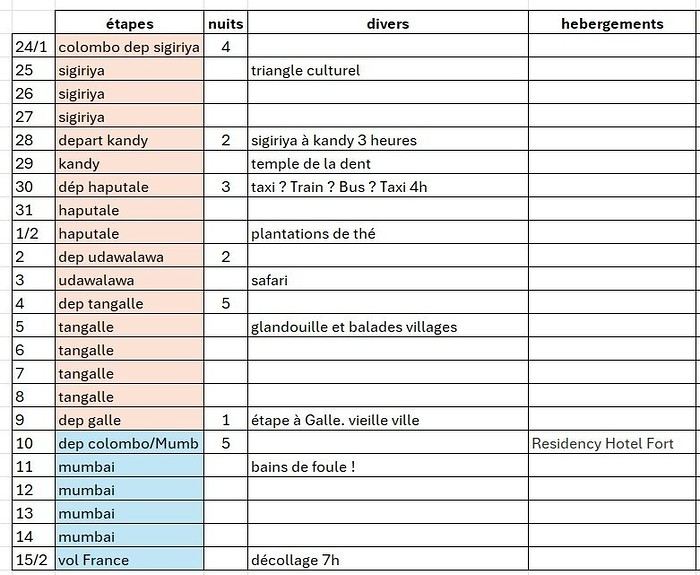
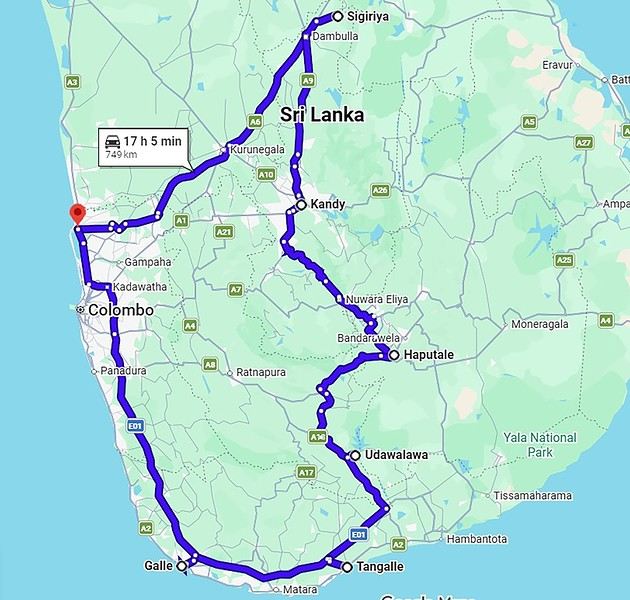
We’re heading to Sri Lanka for 23 days in January 2027—there are four of us—and we’ll wrap up the trip with 5 days in Mumbai. Our itinerary is coming together, but what do you think? (We can’t change the dates since our flights are already booked.)
We still have one night to slot in, and I’ve tentatively planned it in Tangalle, though it was a bit random. Would it make more sense to place it at a different stop? Or is there an intermediate stop I might be missing?
I’ve got accommodations sorted everywhere except Mumbai—it’s a nightmare (either way too expensive or really dodgy). By default, we’ve spotted the Residency Hotel Fort, but 70 € a night (with a discount) for a hotel that doesn’t offer anything special in India?!
Thanks so much for your help!
We’re heading to Sri Lanka for 23 days in January 2027—there are four of us—and we’ll wrap up the trip with 5 days in Mumbai. Our itinerary is coming together, but what do you think? (We can’t change the dates since our flights are already booked.)
We still have one night to slot in, and I’ve tentatively planned it in Tangalle, though it was a bit random. Would it make more sense to place it at a different stop? Or is there an intermediate stop I might be missing?
I’ve got accommodations sorted everywhere except Mumbai—it’s a nightmare (either way too expensive or really dodgy). By default, we’ve spotted the Residency Hotel Fort, but 70 € a night (with a discount) for a hotel that doesn’t offer anything special in India?!
Thanks so much for your help!
Recommended itinerary for an 11-day road trip from Quebec City?
hi everyone,
my flight’s all booked (Sept 19–Oct 4), with 1.5 days in Montreal + 1.5 days in Quebec City...
then I’ve got 11 days starting from Quebec City for a road trip—what route do you recommend?
(I’ve seen these stops come up a lot: Parc Omega, Charlevoix, Tadoussac, Bas-Saint-Laurent, Saguenay, Parc de la Gaspésie, Parc Forillon, Mauricie...)
The idea is no more than 2–3 hours of driving per day on average.
I’m traveling solo :-( (if you’re in the area around the same dates, hit me up!)
45 years old, I love sports (so I’m hoping to do hikes, kayaking, and other activities, see whales...discover beautiful landscapes). I’m not sure if there are any events in the area during those dates, but I’d also like to meet some people...
Thanks in advance for your tips!
Feedback on Cape Town to Johannesburg itinerary (2nd trip) in 3 weeks
Hello everyone!
It's been a year since I've been longing for South Africa. Our first trip in August 2025 amazed us, and—rarely—it was a unanimous hit with our little family! We were touched to the core, and from the moment we got home, we couldn’t stop talking about going back. 😄
I’d like to take this opportunity to thank everyone who gave me advice on the itinerary for that first trip (Johannesburg loop: Blyde, Kruger, Eswatini, St. Lucia, Durban, Drakensberg)! Thanks to you, our trip went like a dream!
Since then, I haven’t stopped reading articles and discussions on VoyageForum to keep my head in South Africa a little longer!
So, we finally caved and just booked our tickets for January 2027 (from the 3rd to the 26th), with a plan to do a road trip from Cape Town to Johannesburg in about 3 weeks.
I’ve got a rough itinerary that seems great based on what I’ve read on various forums, but there are still some uncertain points, and that’s where I could use your advice.
3/01: Arrival in Johannesburg at 11:45 PM 4/01: Flight to Cape Town, pick up rental car. Afternoon sightseeing 5,6,7/01: Cape Town to visit the big classics in the area (any tips for finding accommodation: which neighborhood, a specific place?) 8/01: Overnight stop before Oudtshoorn—but where??? (Is it essential, or is the CT-Oudtshoorn drive manageable? If so, I’d gain a day in Oudtshoorn. Google Maps shows over 5 hours of driving...) 9,10/01: Oudtshoorn (or would 3 nights be better to really enjoy the area?) 11,12/01: Knysna, Plettenberg Bay (to have time for hiking—if you’ve got hiking tips, I’m all ears!) 13,14/01: Tsitsikamma (still to have time for hiking—who knows the must-do hikes in the area? But maybe 4 nights in the Knysna-Tsitsikamma area is too much—I’m not sure) 16,17/01: Addo Elephant (I’m torn between 3 nights at Addo or 3 nights at Mountain Zebra. Based on travel journals, especially Michel’s on MZ, I’ve scheduled 3 nights at MZ 😄...) 18,19,20/01: Mountain Zebra NP 21/01: Camdeboo NP (because it looks so beautiful!) 22/01: Overnight stop (where?) before wrapping up the trip with either 2 or 3 nights at Golden Gate NP or the Lesotho option, which appeals to me, but I don’t know if it’s doable in 3 days to be back in Johannesburg by the afternoon of the 26th.
That’s my trip idea for now... I’m eagerly waiting for your advice, ideas, and comments... Can’t wait to be back there again!
3/01: Arrival in Johannesburg at 11:45 PM 4/01: Flight to Cape Town, pick up rental car. Afternoon sightseeing 5,6,7/01: Cape Town to visit the big classics in the area (any tips for finding accommodation: which neighborhood, a specific place?) 8/01: Overnight stop before Oudtshoorn—but where??? (Is it essential, or is the CT-Oudtshoorn drive manageable? If so, I’d gain a day in Oudtshoorn. Google Maps shows over 5 hours of driving...) 9,10/01: Oudtshoorn (or would 3 nights be better to really enjoy the area?) 11,12/01: Knysna, Plettenberg Bay (to have time for hiking—if you’ve got hiking tips, I’m all ears!) 13,14/01: Tsitsikamma (still to have time for hiking—who knows the must-do hikes in the area? But maybe 4 nights in the Knysna-Tsitsikamma area is too much—I’m not sure) 16,17/01: Addo Elephant (I’m torn between 3 nights at Addo or 3 nights at Mountain Zebra. Based on travel journals, especially Michel’s on MZ, I’ve scheduled 3 nights at MZ 😄...) 18,19,20/01: Mountain Zebra NP 21/01: Camdeboo NP (because it looks so beautiful!) 22/01: Overnight stop (where?) before wrapping up the trip with either 2 or 3 nights at Golden Gate NP or the Lesotho option, which appeals to me, but I don’t know if it’s doable in 3 days to be back in Johannesburg by the afternoon of the 26th.
That’s my trip idea for now... I’m eagerly waiting for your advice, ideas, and comments... Can’t wait to be back there again!
16 days with family in La Gomera (Canary Islands)
Preamble: Why La Gomera?
When we started looking for a summer destination a few months ago, our first criterion was to avoid extreme heat and heatwaves. We had already been to Norway two years ago and are considering going back in the future for other occasions. So, we had some fun asking ChatGPT which destinations enjoyed a mild climate during the summer without going too far. Among the list provided by the AI were the Canary Islands... The idea of a place we wouldn’t have thought of first, both not too far away and exotic enough, appealed to us: “Hmm, why not?”
This destination had never really attracted me, though Magali was a bit more interested. Five years earlier, COVID had caused a short break in my professional activity, and I had planned a trip because the flight price was attractive, and I was looking for a destination different from what usually appeals to me, more than out of deep interest. From a distance and with a social judgment I acknowledge (it’s not great, but it’s not completely wrong), I had the image of a destination for party-goers enjoying the sun without the slightest interest in local culture, with concrete coastlines and denatured landscapes—everything I detest the most. Still, I had done some quick research on the different islands and spotted Lanzarote for its beautiful volcanic landscapes, hiking trails, beaches, and the impression of a good balance between activity and fewer crowds than Tenerife or Gran Canaria. Then I dropped the idea of going, without ever reconsidering traveling to the Canaries...
Until now! Because we started researching the different islands of the archipelago to see which ones might appeal to us the most. It was La Gomera, the third smallest island of the archipelago, more praised for its hiking trails and preserved nature than for its beaches, away from mass tourism (fifty times fewer tourists than Tenerife) but still a bit more developed than its wild neighbor El Hierro, that caught our attention. Contrary to what might be suggested later, I’m not at all addicted to AI, but I use it from time to time to synthesize quick research or simply for experimentation. Since ChatGPT had started anticipating my tastes lately as if it had become my buddy (often successfully, sometimes off the mark), I asked which Canary Island would suit me best for a trip with my family. The tool answered first with... La Gomera. So, I tested it and teased it a bit to see if this suggestion was well-founded, as the method sometimes makes it contradict itself. But no luck: “You’d appreciate the wild nature of El Hierro, but with family, you’ll find little activity for the kids. You won’t like the touristy vibe of the big islands like Tenerife, Gran Canaria, Lanzarote, and Fuerteventura. You could consider La Palma, but it’s really La Gomera that will suit you best, based on your interests and the criteria given.” So, we dug deeper into our research and were convinced without a shadow of a doubt that this island was the one waiting for us.
Without knowing it, we had Canarians in our circle who revealed their origins when they heard about our travel plans. One from Tenerife insisted we’d be better off choosing Tenerife (obviously...) because it also has preserved spots and that La Gomera, “you can explore it in two or three days, you’ll get bored quickly...” The other, a colleague from Gran Canaria who had never visited La Gomera, still recommended it without hesitation because it turned out her parents had just gone there on vacation: they loved it and had encountered few tourists. She also tended to think this destination was usually the subject of short stays, but according to what her parents told her, taking your time there was also a great idea. However, in our research, the idea that La Gomera is an island you can explore in three or four days max kept coming up. So, we considered combining its visit with La Palma or El Hierro, the other two that caught our eye. But hopping between islands by ferry represents a significant budget for non-Canarians, even more so for a family of four. Then, scrutinizing Google Maps, it seemed obvious that two weeks were too short to discover two islands as they deserve, and that there seemed to be plenty to see in La Gomera, given its very unique culture. After all, we read that some people spend several months a year there, others never even leave... Finally, these landscapes and this atmosphere, which seemed to us a mix of Europe, North Africa, and Latin America, tempted us. So, it would be two weeks in La Gomera, deal!
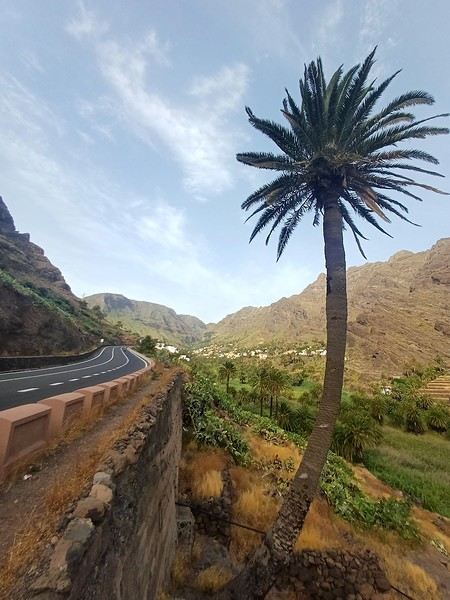
La Gomera is therefore the second... well, the third smallest island of the Canaries since La Graciosa was recently recognized as a fully inhabited island. It has the shape of a rough circle about 20 to 25 kilometers in diameter and has just over 20,000 inhabitants, half of them in its capital, San Sebastián de la Gomera, the only real town. Like its Canarian sisters, La Gomera is a volcanic formation that rose about 10 million years ago. The island is very mountainous and rugged, covered with red and black rocky landscapes. Geological activity has shaped, between the sprawling massifs that end in steep cliffs in the ocean, six coastal valleys with tropical vegetation that have favored human settlement. They divide the island like slices of a cake; from the north clockwise: the agricultural Vallehermoso, the rustic Agulo, the green, humid, and fertile Hermigua, the sunny capital San Sebastián de la Gomera, the southern and isolated Alajeró-Santiago, and the seaside Valle Gran Rey. They constitute the six municipalities (more like cantons to our French understanding) of the territory.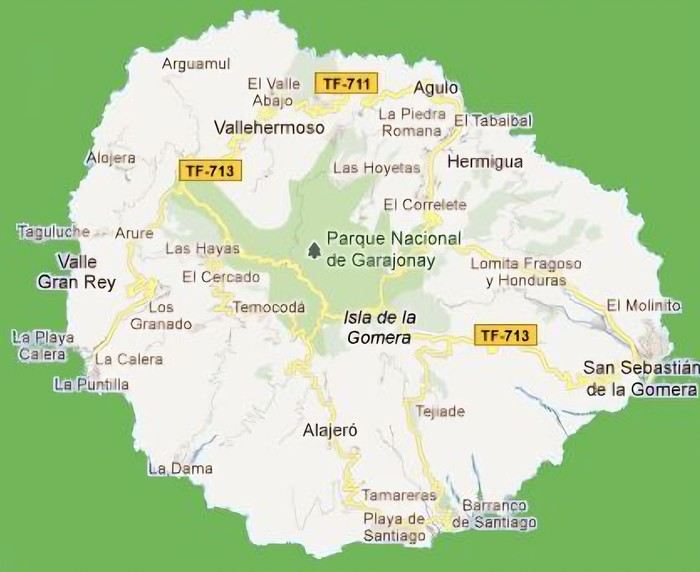 The large solidified magma massifs that shape the heart of the island have created a large depression more protected from the sun at its center, allowing the growth of a vast laurel forest, today grouped within the Garajonay National Park, La Gomera’s green lung, which has earned it the status of a World Biosphere Reserve. Its completely European appearance contrasts sharply with the rocky and tropical landscapes of the rest of the island. Thus, the climate varies greatly from one point to another on the island: in summer, you can quickly go from a dry and sunny valley at 35°C to a humid forest area at altitude at 18°C.
La Gomera was populated late. As with the rest of the Canaries, human presence is thought to have begun about 2,000 years ago. Groups of animist Berbers, probably fleeing persecution, gradually populated the archipelago, especially the western islands and La Gomera, becoming its small aboriginal population: the Guanches (or later Gomeros). The animist and pastoral civilization of the Guanches thrived until the Spanish takeover in the 15th century, which, after a short period of harmony and mixing with the indigenous people, suddenly ended in bloodshed... La Gomera later became the “Columbus Island” after Christopher Columbus’s stopover, increasing the blending of populations. In the 20th century, many Gomeros emigrated to Cuba and other Latin American countries in search of a better life, bringing back a mix of cultures and traits quite palpable in today’s Gomeran culture. It is, however, in La Gomera that the vestiges of Guanche culture seem to have left the most traces, in the language, gastronomy, social practices... Moreover, most Gomeros, especially in remote villages, have a particular identifiable type and proudly claim their ancestral roots, even making La Gomera a bit exotic in the eyes of other Canarians.
Perhaps that’s why it has never really wanted to develop its tourist infrastructure too much. If we set aside the tourists who visit for the day by bus or boat from Tenerife on a marked itinerary (and whom we ultimately rarely encounter), La Gomera has remained a hidden gem, a destination focused on nature discovery that attracts hikers, nature-loving divers, and scientists for its fauna and flora, and to a lesser extent, beachgoers who don’t seek overly developed coastlines. Tourist activity is therefore limited. Roughly speaking, you’ll find a majority of Spaniards, including a substantial number of residents from other Canary Islands, many Germans who have a particular fondness for La Gomera and spend long stays there or own second homes, to the point that the German cultural footprint is clearly noticeable in some places (it’s said to be Angela Merkel’s favorite holiday spot), and still quite a few French. The presence of other nationalities seemed negligible to us. Most travelers come mainly for hiking, but it’s also a prime spot for whale watching. Additionally, the seaside resorts of La Gomera—San Sebastián, Santiago, and especially Valle Gran Rey—are well-known destinations for hippies, especially German ones, ranging from chic boho hippies to old-school hippies who’ve been there for decades, quite similar to those you’d meet in India in Goa, Rishikesh, or Paharganj. Thus, practices like naturism, vegetarianism, and local organic production are quite well established in some areas.
Some practical info: - The round-trip flight from Paris to Tenerife cost us 365 € per person (outbound with Transavia, return with EasyJet), including checked luggage and three seats reserved side by side. - We chose two bases to explore the island: one week in Valle Gran Rey, reputed to be the most pleasant of the three seaside resorts, and one week in Hermigua, more mountainous and close to the natural park. We booked two houses with balconies and views: the first at 120 € per night, the second at 99 €. - The round-trip ferry between Tenerife and La Gomera cost us 270 € with the company Baleària Canarias, including discounts for children aged 4 and 12, but I don’t have the exact details. It was a bit cheaper than with the other company, Fred Olsen. - Finally, we rented a car through the agency Cicar for 360 € for 16 days, which comes to 22.50 € per day. - Apart from that, we didn’t plan anything and decided the day before or even the morning of what we wanted to do. We didn’t invest in any paper guide on the Canaries, as information on La Gomera was scarce, but we used the very comprehensive site La Gomera Travel, a travel guide published by the Canary Islands Tourism Council, a real goldmine of almost exhaustive information on the island.
Alright, off we go for 16 days of adventure discovering La Gomera!
And we start the trip with music!
We start the trip with music!
When we started looking for a summer destination a few months ago, our first criterion was to avoid extreme heat and heatwaves. We had already been to Norway two years ago and are considering going back in the future for other occasions. So, we had some fun asking ChatGPT which destinations enjoyed a mild climate during the summer without going too far. Among the list provided by the AI were the Canary Islands... The idea of a place we wouldn’t have thought of first, both not too far away and exotic enough, appealed to us: “Hmm, why not?”
This destination had never really attracted me, though Magali was a bit more interested. Five years earlier, COVID had caused a short break in my professional activity, and I had planned a trip because the flight price was attractive, and I was looking for a destination different from what usually appeals to me, more than out of deep interest. From a distance and with a social judgment I acknowledge (it’s not great, but it’s not completely wrong), I had the image of a destination for party-goers enjoying the sun without the slightest interest in local culture, with concrete coastlines and denatured landscapes—everything I detest the most. Still, I had done some quick research on the different islands and spotted Lanzarote for its beautiful volcanic landscapes, hiking trails, beaches, and the impression of a good balance between activity and fewer crowds than Tenerife or Gran Canaria. Then I dropped the idea of going, without ever reconsidering traveling to the Canaries...
Until now! Because we started researching the different islands of the archipelago to see which ones might appeal to us the most. It was La Gomera, the third smallest island of the archipelago, more praised for its hiking trails and preserved nature than for its beaches, away from mass tourism (fifty times fewer tourists than Tenerife) but still a bit more developed than its wild neighbor El Hierro, that caught our attention. Contrary to what might be suggested later, I’m not at all addicted to AI, but I use it from time to time to synthesize quick research or simply for experimentation. Since ChatGPT had started anticipating my tastes lately as if it had become my buddy (often successfully, sometimes off the mark), I asked which Canary Island would suit me best for a trip with my family. The tool answered first with... La Gomera. So, I tested it and teased it a bit to see if this suggestion was well-founded, as the method sometimes makes it contradict itself. But no luck: “You’d appreciate the wild nature of El Hierro, but with family, you’ll find little activity for the kids. You won’t like the touristy vibe of the big islands like Tenerife, Gran Canaria, Lanzarote, and Fuerteventura. You could consider La Palma, but it’s really La Gomera that will suit you best, based on your interests and the criteria given.” So, we dug deeper into our research and were convinced without a shadow of a doubt that this island was the one waiting for us.
Without knowing it, we had Canarians in our circle who revealed their origins when they heard about our travel plans. One from Tenerife insisted we’d be better off choosing Tenerife (obviously...) because it also has preserved spots and that La Gomera, “you can explore it in two or three days, you’ll get bored quickly...” The other, a colleague from Gran Canaria who had never visited La Gomera, still recommended it without hesitation because it turned out her parents had just gone there on vacation: they loved it and had encountered few tourists. She also tended to think this destination was usually the subject of short stays, but according to what her parents told her, taking your time there was also a great idea. However, in our research, the idea that La Gomera is an island you can explore in three or four days max kept coming up. So, we considered combining its visit with La Palma or El Hierro, the other two that caught our eye. But hopping between islands by ferry represents a significant budget for non-Canarians, even more so for a family of four. Then, scrutinizing Google Maps, it seemed obvious that two weeks were too short to discover two islands as they deserve, and that there seemed to be plenty to see in La Gomera, given its very unique culture. After all, we read that some people spend several months a year there, others never even leave... Finally, these landscapes and this atmosphere, which seemed to us a mix of Europe, North Africa, and Latin America, tempted us. So, it would be two weeks in La Gomera, deal!
La Gomera is therefore the second... well, the third smallest island of the Canaries since La Graciosa was recently recognized as a fully inhabited island. It has the shape of a rough circle about 20 to 25 kilometers in diameter and has just over 20,000 inhabitants, half of them in its capital, San Sebastián de la Gomera, the only real town. Like its Canarian sisters, La Gomera is a volcanic formation that rose about 10 million years ago. The island is very mountainous and rugged, covered with red and black rocky landscapes. Geological activity has shaped, between the sprawling massifs that end in steep cliffs in the ocean, six coastal valleys with tropical vegetation that have favored human settlement. They divide the island like slices of a cake; from the north clockwise: the agricultural Vallehermoso, the rustic Agulo, the green, humid, and fertile Hermigua, the sunny capital San Sebastián de la Gomera, the southern and isolated Alajeró-Santiago, and the seaside Valle Gran Rey. They constitute the six municipalities (more like cantons to our French understanding) of the territory.
The large solidified magma massifs that shape the heart of the island have created a large depression more protected from the sun at its center, allowing the growth of a vast laurel forest, today grouped within the Garajonay National Park, La Gomera’s green lung, which has earned it the status of a World Biosphere Reserve. Its completely European appearance contrasts sharply with the rocky and tropical landscapes of the rest of the island. Thus, the climate varies greatly from one point to another on the island: in summer, you can quickly go from a dry and sunny valley at 35°C to a humid forest area at altitude at 18°C.La Gomera was populated late. As with the rest of the Canaries, human presence is thought to have begun about 2,000 years ago. Groups of animist Berbers, probably fleeing persecution, gradually populated the archipelago, especially the western islands and La Gomera, becoming its small aboriginal population: the Guanches (or later Gomeros). The animist and pastoral civilization of the Guanches thrived until the Spanish takeover in the 15th century, which, after a short period of harmony and mixing with the indigenous people, suddenly ended in bloodshed... La Gomera later became the “Columbus Island” after Christopher Columbus’s stopover, increasing the blending of populations. In the 20th century, many Gomeros emigrated to Cuba and other Latin American countries in search of a better life, bringing back a mix of cultures and traits quite palpable in today’s Gomeran culture. It is, however, in La Gomera that the vestiges of Guanche culture seem to have left the most traces, in the language, gastronomy, social practices... Moreover, most Gomeros, especially in remote villages, have a particular identifiable type and proudly claim their ancestral roots, even making La Gomera a bit exotic in the eyes of other Canarians.
Perhaps that’s why it has never really wanted to develop its tourist infrastructure too much. If we set aside the tourists who visit for the day by bus or boat from Tenerife on a marked itinerary (and whom we ultimately rarely encounter), La Gomera has remained a hidden gem, a destination focused on nature discovery that attracts hikers, nature-loving divers, and scientists for its fauna and flora, and to a lesser extent, beachgoers who don’t seek overly developed coastlines. Tourist activity is therefore limited. Roughly speaking, you’ll find a majority of Spaniards, including a substantial number of residents from other Canary Islands, many Germans who have a particular fondness for La Gomera and spend long stays there or own second homes, to the point that the German cultural footprint is clearly noticeable in some places (it’s said to be Angela Merkel’s favorite holiday spot), and still quite a few French. The presence of other nationalities seemed negligible to us. Most travelers come mainly for hiking, but it’s also a prime spot for whale watching. Additionally, the seaside resorts of La Gomera—San Sebastián, Santiago, and especially Valle Gran Rey—are well-known destinations for hippies, especially German ones, ranging from chic boho hippies to old-school hippies who’ve been there for decades, quite similar to those you’d meet in India in Goa, Rishikesh, or Paharganj. Thus, practices like naturism, vegetarianism, and local organic production are quite well established in some areas.
Some practical info: - The round-trip flight from Paris to Tenerife cost us 365 € per person (outbound with Transavia, return with EasyJet), including checked luggage and three seats reserved side by side. - We chose two bases to explore the island: one week in Valle Gran Rey, reputed to be the most pleasant of the three seaside resorts, and one week in Hermigua, more mountainous and close to the natural park. We booked two houses with balconies and views: the first at 120 € per night, the second at 99 €. - The round-trip ferry between Tenerife and La Gomera cost us 270 € with the company Baleària Canarias, including discounts for children aged 4 and 12, but I don’t have the exact details. It was a bit cheaper than with the other company, Fred Olsen. - Finally, we rented a car through the agency Cicar for 360 € for 16 days, which comes to 22.50 € per day. - Apart from that, we didn’t plan anything and decided the day before or even the morning of what we wanted to do. We didn’t invest in any paper guide on the Canaries, as information on La Gomera was scarce, but we used the very comprehensive site La Gomera Travel, a travel guide published by the Canary Islands Tourism Council, a real goldmine of almost exhaustive information on the island.
Alright, off we go for 16 days of adventure discovering La Gomera!
And we start the trip with music!
We start the trip with music!
Mexico Trip Report – July 2026
My partner and I traveled from Sunday, July 5, 2026, to Wednesday, July 22, 2026.
We spent a long time debating whether to rent a car or use public transportation. In the end, after reading so many posts about travelers getting scammed by police or rental companies—even those recommended by blogs and reviews—we decided to stick with public transport. It worked out really well. Sure, we had a little less freedom to go where we wanted, but it was way less stressful for us.
Sunday, July 5:
Arrived at Cancun Airport. Withdrew cash from the ATM in the terminal just before exiting. The ADO bus counter (they pronounce it "A-Jee-O") is right behind you when you're facing the ATM. Bus to downtown Cancun cost 145 pesos per person. Stayed at "Rose 5," booked on Booking. The studio was super clean and perfect for one night. The owner’s instructions for accessing the place were very precise, with photos included. Check-in was self-service with a code. The ADO bus terminal isn’t far, and there are shops and restaurants nearby. We really appreciated that the AC was already on when we arrived. By the way, I’d recommend always booking places with AC—it’s *really* hot in Mexico.
Monday, July 6:
Bought a SIM card with data from a TELCEL store. My partner, who’s on Free Mobile, was able to use her regular plan. Just so you know, I found the network pretty unstable. As soon as we left the cities, neither of us—me with TELCEL or her with Free—had any signal. Another thing to watch out for: roaming charges. I had to turn my SIM back on for less than 30 seconds to get a bank SMS code, and my phone apparently connected to the internet—resulting in an 8-euro roaming fee. Left on an ADO bus to Chiquila for 278 pesos per person. During our trip, ADO buses were always on time, comfortable, and clean. The AC is *cranked* though, so bring something to cover up with—it gets cold. Some routes were fully booked even in the low season, so try to reserve 1 or 2 days in advance either via the app (when it works) or at the counter. When we arrived at the ADO terminal in Chiquila, the ferry company counters were right next to it. Ferries leave every 30 minutes, alternating between companies, so no need to book ahead. Just take whichever one is leaving next (330 pesos per person). When we got to Holbox (pronounced "Hol-bosh"), we’d booked a place via Booking called "Casa de Nana." It was a huge studio with a fridge, cooking plate, and utensils. The best part? The *location*. It was 100 meters from the beach and 200 meters from a Chedraui supermarket. They provided bath towels and beach towels, and the AC worked perfectly. There’s a key box so you can leave your keys inside when you go out. The only downside was that no one was there to let us in when we arrived, so we had to wait a while. The Wi-Fi was good, which was lucky because during our 4-day stay in Holbox, the phone network *never* worked. According to locals, that’s pretty common in Holbox, along with water outages. Luckily, I’d had the good idea to download an offline map, which helped us find our way back to the place more easily. You can walk there from the dock.
The restaurant next to our place (La Barracuda) was great if you like seafood—I’d recommend their octopus dishes.
Tuesday, July 7:
We did a kayak tour in Holbox’s mangroves at 6 AM. We were looking for a sunrise kayak tour with a French-speaking guide. That’s exactly what we got with "Kayaking Holbox," where Diego, the owner, speaks English and French. He was joined by Gustavo, another guide. We’d booked for a group tour, but we were the only ones. Diego still went ahead with it instead of canceling due to lack of participants, so we got a private tour at the group rate—really professional of him. They showed us this amazing ecosystem for over 3 hours. We saw all kinds of birds: pink flamingos, pelicans, egrets, frigatebirds... rays, a horseshoe crab, and a little crocodile that was *so* well hidden. Diego and Gustavo have a real eye for spotting animals—I could’ve passed by the crocodile 100 times and never seen it, it blended in so well. Their explanations about the flora and fauna were super interesting. We also got a little break where we tasted mangoes and bananas that taste *nothing* like the ones in France. A real treat—those little Mexican yellow mangoes! I’d definitely recommend Diego and his agency for a French-language kayak tour (1000 pesos per person). In the evening, we walked to Punta Coco to see the bioluminescence. No need for a guided tour—if you really don’t want to walk, you can take a taxi. At Punta Coco, you have to pass the beach bar/restaurant and then go left into a kind of inlet that forms a lagoon. You have to wiggle your feet or move your hands in the water to create movement, which makes the light appear. Just don’t expect the kind of photos you’ve seen online—they’re all edited! It’s fun to see, but you won’t be dazzled by the light...
Wednesday, July 8:
Whale shark tour with "My Holbox Tours." Why recommend this agency over others for swimming with whale sharks? Simply because Valérie surrounds herself with top professionals to make your experience unforgettable. We were with Captain Fernando, who does everything to position the boat perfectly and make your swim easier. In the water, we were with Humberto, who also goes above and beyond to make sure you have an incredible time. He doesn’t just "supervise" like some guides from other companies who leave you on your own. No, Humberto reads the whale shark’s trajectory and guides you—all you have to do is follow him. He really puts in the effort, even holding your hand to guide you through this quick but intense encounter. Humberto also films the moment and will offer to show you the videos and sell them to you. His footage is really high quality. Fernando and Humberto also prepared food for us. Special mention for their guacamole! Valérie is there to make sure everything goes smoothly on the boat and to answer your questions in French, English, or Spanish about these animals. If you choose My Holbox Tours, you can be sure you’ll get a top-notch experience. About the tour itself: before you go, you should know that the sharks can be *really* far away. The day we went, it took 3.5 hours by boat to reach them. The boats are small, and let me tell you—on the way there, when we weren’t going with the waves, it was *rough*. Out of 9 passengers, 4 got seasick. But once you’re face-to-face with the shark, you forget all about that. Even if swimming with a whale shark isn’t exactly a walk in the park—they swim pretty fast, so you need some endurance to keep up. You’ll usually get 2 turns. Our first swim lasted a little over 4 minutes, and the second about 2 minutes because the shark was moving fast and we were still tired from the first swim. It might seem short, but when you’re swimming, it feels *long*. Either way, it’s an experience you *have* to do—but choose your company wisely. On the way back, there’s a stop at Cabo Catoche. Honestly, the snorkeling is pretty disappointing if you’ve done it elsewhere in the world. But the lunch stop at Cabo Catoche is really nice for relaxing (white sand and hammocks).
Thursday, July 9:
Short morning walk to Punta Mosquito at 6 AM. Really nice. Ferry to Chiquila (330 pesos per person) + ADO bus to Valladolid (300 pesos per person).
In Valladolid, we booked "Casa Lucia" via Booking. The hotel is gorgeous, with a colonial style, and very close to the ADO bus terminal and downtown. It’s super quiet and clean. There’s a shared kitchen you can use with a fridge, microwave, and water dispenser, plus a big table by the pool and a nice indoor terrace. Breakfast was simple but included. The only small downsides were the tiny room and bathroom, no mirror in the room, and a noisy fan.
Friday, July 10:
Not far from the ADO bus terminal is the colectivo station for Chichen Itza. They offer a round-trip to Chichen Itza with an option to stop at Ik Kil cenote on the way back and then drop you off in Valladolid for 370 pesos per person (Ik Kil entrance included). For the Chichen Itza visit, we’d booked a tour with a guide often mentioned in groups—his name is Juan Pat. He’s a Maya who lives near the site and speaks excellent French. He reserves spots in advance for you and queues up to be the first on-site. It cost 500 pesos per person + entrance fees. His tour lasts 2 hours and focuses mainly on the main pyramid and the ball court. He’s passionate and fascinating, even if some of his claims, as a Maya, might be a little biased. I think it’s *really* important to have a guide—otherwise, you’ll miss so much. You can contact Juan Pat on WhatsApp at +52 985 121 2381. Afterward, we went to Ik Kil cenote (showers and life jackets mandatory, lockers available). It’s *very* crowded, but still really beautiful with its lush vegetation.
Saturday, July 11:
Since we didn’t have a car but still wanted to visit other cenotes that seemed hard to reach by public transport, we decided to book a taxi for the day. We agreed on 1200 pesos to take us to 3 different cenotes and wait for us at each one. (To find taxis, just look where they park near the ADO bus station.) He picked us up at Zaci cenote, which we’d walked to. We got there at opening time and were the first ones there—had the place to ourselves for a while! 150 pesos per person. A pretty cenote in the city center with lush vegetation. It’s a bit like Ik Kil but without the deep cylindrical effect.
Cenote Xcanahaltun: the most beautiful cenote we visited. Entry 250 pesos per person. It’s a closed cenote with a hole that lets light in—a cave-like setting. You can kayak inside. There are little fish at the edge that nibble dead skin off your feet. Since it’s closed, the water is *freezing*!
Cenote Palomitas: entry 250 pesos per person. Another stunning closed cenote, even more enclosed than Xcanahaltun. The hole in the ceiling is smaller, so it was pretty dark when we arrived—kind of an eerie vibe. But when the staff turned on the lights, it looked like a "Gothic cathedral" full of bright stalactites.
Cenote Sac Aua: entry 290 pesos per person. The ticket includes a guided cave tour (tip-based). This cenote is really unique with its central island and way less crowded than Suytun. Just so you know, the water is *really* cold in cenotes. In these three, in July, we had the place to ourselves for a while and never saw more than 2 families at once—so peaceful!
Sunday, July 12:
ADO bus to Bacalar (536 pesos per person). In Bacalar, we stayed via Airbnb with a host named Luli, who offers several rooms with shared bathroom and kitchen.
The room is nicely decorated in a pleasant setting. It’s ideally located near the lagoon and downtown. The shared kitchen is handy. The mosquito net over the bed is useful because there are *a lot* of mosquitoes in Bacalar. Luli provides a water jug, which is really nice. The only big downside is the lack of water pressure in the shower—we had to rinse off by filling a bucket. Also, there’s no real door separating the room from the bathroom. We never met Luli in person, but she was very responsive via messages. The terrace in the middle of the vegetation is lovely. From the ADO terminal to the place, we took a taxi for 40 pesos. Since this driver was honest about the price (we’d checked beforehand), we decided to use him every time we needed a taxi in Bacalar. Here’s his WhatsApp: +52 983 184 3585.
Monday, July 13:
We did a boat tour on the lagoon with "Bacalar Francophone Activities." Since we were just the two of us, it cost 3500 pesos. If we’d managed to be 4 people, it would’ve been 1000 pesos per person. We had a private 4-hour tour on the lagoon with Steeve and his very comfortable boat. He’s from Quebec, so his French is perfect. During those 4 hours, Steeve showed us the lagoon’s iconic spots *and* places other boats don’t go. He told us about the lagoon’s history and gave great tips on where to go and where to eat. As a little bonus, he gave us a video taken with his drone during our swimming break.
Tuesday, July 14:
We went to Los Rapidos by taxi (400 pesos round trip) and entry was 225 pesos per person. It’s *very* touristy but really beautiful. You can eat there (expensive), relax, and go down the "rapids" as many times as you want. It’s worth it if you spend a few hours there. You can’t bring in food or drinks—you leave them at the entrance and pick them up on the way out.
Wednesday, July 15:
On Wednesdays, navigation is banned on Bacalar Lagoon, so we’d planned another excursion. Visit to Calakmul from Bacalar with ABCtours (WhatsApp +52 983 319 8359). This agency organized a trip from Bacalar to Calakmul with a French-speaking guide. Communication beforehand via WhatsApp was smooth. Mr. Checo, the driver, and Fernando, the guide (who spoke great French), picked us up on the day. Mr. Checo drove very carefully on the long road and always made sure we were comfortable. Fernando is passionate about flora and fauna—he’s a biologist with a degree in ornithology, so he knows *everything* about animals. The slightest sound or song, and he knows what it is. He’s got an eye for spotting them, from the biggest to the smallest. During the trip, we stopped at km 27 for a short forest walk, then went to see the two main pyramids on the site. On the way back, we stopped at the bat cave for the magical spectacle of millions of bats flying out at dusk. In the end, we saw or glimpsed (some briefly) spider monkeys, howler monkeys, a toucan, 2 tapirs, turkeys, 2 deer, and lots of birds. If, like us, you’re more into flora and fauna than archaeology, I’d *highly* recommend this agency and tour with Fernando. It’s not cheap, but the road between Bacalar and the site is *long* (3.5 hours). Price: 3900 pesos per person for 2 (3500 for 3, 3200 for 4).
Thursday, July 16:
ADO bus to Playa del Carmen (614 pesos per person). In Playa del Carmen, we stayed in an Airbnb. The building is on the town hall square, next to the casino. The best thing about this place is the *location*—super close to Fifth Avenue (La Quinta). The kitchen is pretty basic, but the fridge works well. There are supermarkets nearby. The rooftop pool is really nice. The two big downsides, though, are the soundproofing (you can *hear* the neighbor’s alarm and all the events on the square) and the *total* lack of water pressure in the shower. We had to fill a trash can with water to pour over ourselves. When we told the owner, he said it wasn’t normal and someone would come fix it, but we never heard back. Based on previous reviews, this seems to be a known issue that never gets resolved. Playa del Carmen is *very* touristy on Fifth Avenue, but in a fun, musical vibe—we never felt unsafe. There are *tons* of little souvenir shops for tourists on this street. There’s a beautiful monumental sculpture on the beach (the two figures meeting in the air), next to which you can see the Voladores show (men climbing a pole, tying themselves with ropes, and descending headfirst while "flying" around the pole). The show is tip-based and happens several times a day. In our opinion, Calle 38 is prettier than Fifth Avenue—it’s lush, green, and quieter, with the sea at the end. Great for an early evening stroll. We had really good meals at great prices at "El Tio Noy" tacos, just a few meters from Fifth Avenue in a side street. For souvenirs, we’d recommend going to Walmart instead of Fifth Avenue—you’ll find skulls, tequila, mezcal, keychains, mugs, glasses... at good, fixed prices.
Friday, July 17:
We did the excursion to Isla Contoy. Isla Contoy is an uninhabited, highly protected island. Only 200 people are allowed to land per day on a rotating basis, so only a few companies have permission to dock there. Most agencies subcontract the day to a third-party company. We booked through VRM (Viviendo Riviera Maya), but it was Ocean Tours Mexico that handled the tour. Contoy is a little paradise. We were accompanied by multilingual guides, including French speakers, throughout the day. Steffy gave us info about the island during a short walk on the marked trails, and Leño Tlatemoa kept the mood up on the boat rides with music and dancing. Isla Contoy is *truly* stunning, and the lunch was delicious: grilled fish and chicken, guacamole and tortilla chips, rice, fruit, drinks (everything is brought and taken back by the guides). The snorkeling part was pretty disappointing if you’ve done it in Cozumel, though. The stop at Isla Mujeres isn’t very interesting either—it’s too short to explore, and the island is *extremely* touristy. Still, the excursion was very well organized, and we had a great day (2970 pesos per person).
Saturday, July 18:
We wanted to go snorkeling in Cozumel but thought the prices from French-speaking agencies were too high. Plus, for snorkeling, we figured we didn’t *need* a French-speaking guide. So we found a much cheaper solution by taking the ferry from Playa del Carmen ourselves and choosing an agency in Playa. The round-trip ferry cost 663.50 pesos per person. Then we took a taxi to the snorkeling boat (100 pesos). The agency we chose is called Mystic Snorkel—they don’t have a physical office. The tour cost 1400 pesos per person. It was a small boat, but that day we were the only ones, so we got a private tour at the group rate. We stopped at 4 different sites, all very different and beautiful. We saw all kinds of fish, corals, a nurse shark, and turtles. El Cielo, with its huge starfish, is *exceptional*. If you’re going snorkeling in the Yucatan Peninsula, this is *the* tour to do—the other sites are pretty "poor" in comparison.
Sunday, July 19:
Morning dive with Triton Diving. I chose the Cozumel dive option. Great experience. Booking via WhatsApp was easy. On the day of the dive, Selene, who speaks French, was our guide. She’s *very* attentive to the group’s safety. The briefings are clear and precise. In Cozumel, we did 2 very different sites: the first was a drift dive with lots of life—beautiful corals and fish. The second was a wreck, the C53, a 56-meter boat you can enter. Not much marine life, but a beautiful wreck intentionally sunk for divers—still in great condition. An unforgettable moment. Selene even took videos during the dive, which the club sends you for free afterward. I’d *highly* recommend this club.
Just so you know, in Playa del Carmen, the beaches were full of sargassum during our stay, despite barriers and daily cleanup. Locals told us the problem is getting worse and the sargassum is arriving earlier in the season. Tourism has taken a *big* hit this summer, and they’re wondering if tourism can even survive the sargassum season anymore. A lot of tourists are heading to the islands—Isla Mujeres and Cozumel—to enjoy the beaches, as the west side of those islands is sargassum-free.
Monday, July 20:
Colectivo to Puerto Morelos. First, a colectivo toward Cancun that drops you off between Puerto Morelos town and Puerto Morelos beach (40 pesos per person), then another from that junction to the beach (10 pesos per person). In Puerto Morelos, we’d booked a room via Airbnb at "Piedra del Caribe." *Best* place we stayed in Mexico. It’s an aparthotel. Our room was ready before check-in, so they let us in early. The place matched the description—spacious, with a comfortable king-size bed. The shower had *great* pressure, which isn’t a given in Mexico. The staff was super friendly and welcoming. They let us use the pool, restrooms, and rooftop shower after check-out while we waited for our ride to Cancun Airport. They even kept our luggage. I *highly* recommend this place. In Puerto Morelos, there was *way* less sargassum than in Playa del Carmen—it was actually swimmable. We did the snorkeling tour with the fishermen’s cooperative for 450 pesos per person for 2 hours. The reef is close to the beach (you’re not allowed to swim there), so the boat ride is short. It’s not as pretty as Cozumel, but it’s nice and affordable. On Puerto Morelos’s page, you can also access a small, not-very-well-preserved reef. There’s also a cenote in the sea where fresh water mixes with saltwater—the water is murky there. We had a great dinner and excellent cocktails at "La Choza del Puerto."
Tuesday, July 21:
Wandered around Puerto Morelos (check out the church and read everything—it’s entertaining!), relaxed by the hotel pool, and left for Cancun Airport by taxi (400 pesos) booked via InDrive to head back to France.
Our highlights: - Holbox - The whale shark tour - The cenotes - The local flora and fauna (so present!) - Isla Contoy - Cabo Catoche (except for the snorkeling)
What we liked least: - The bioluminescence (barely visible despite good conditions) - The food—we found it not very diverse in taquerias - The constant tipping - The lack of water pressure in showers (fixed, wall-mounted, no hose or showerhead)
Don’t hesitate to ask if you have any questions while it’s still fresh in our minds.
Sunday, July 5:
Arrived at Cancun Airport. Withdrew cash from the ATM in the terminal just before exiting. The ADO bus counter (they pronounce it "A-Jee-O") is right behind you when you're facing the ATM. Bus to downtown Cancun cost 145 pesos per person. Stayed at "Rose 5," booked on Booking. The studio was super clean and perfect for one night. The owner’s instructions for accessing the place were very precise, with photos included. Check-in was self-service with a code. The ADO bus terminal isn’t far, and there are shops and restaurants nearby. We really appreciated that the AC was already on when we arrived. By the way, I’d recommend always booking places with AC—it’s *really* hot in Mexico.
Monday, July 6:
Bought a SIM card with data from a TELCEL store. My partner, who’s on Free Mobile, was able to use her regular plan. Just so you know, I found the network pretty unstable. As soon as we left the cities, neither of us—me with TELCEL or her with Free—had any signal. Another thing to watch out for: roaming charges. I had to turn my SIM back on for less than 30 seconds to get a bank SMS code, and my phone apparently connected to the internet—resulting in an 8-euro roaming fee. Left on an ADO bus to Chiquila for 278 pesos per person. During our trip, ADO buses were always on time, comfortable, and clean. The AC is *cranked* though, so bring something to cover up with—it gets cold. Some routes were fully booked even in the low season, so try to reserve 1 or 2 days in advance either via the app (when it works) or at the counter. When we arrived at the ADO terminal in Chiquila, the ferry company counters were right next to it. Ferries leave every 30 minutes, alternating between companies, so no need to book ahead. Just take whichever one is leaving next (330 pesos per person). When we got to Holbox (pronounced "Hol-bosh"), we’d booked a place via Booking called "Casa de Nana." It was a huge studio with a fridge, cooking plate, and utensils. The best part? The *location*. It was 100 meters from the beach and 200 meters from a Chedraui supermarket. They provided bath towels and beach towels, and the AC worked perfectly. There’s a key box so you can leave your keys inside when you go out. The only downside was that no one was there to let us in when we arrived, so we had to wait a while. The Wi-Fi was good, which was lucky because during our 4-day stay in Holbox, the phone network *never* worked. According to locals, that’s pretty common in Holbox, along with water outages. Luckily, I’d had the good idea to download an offline map, which helped us find our way back to the place more easily. You can walk there from the dock.
The restaurant next to our place (La Barracuda) was great if you like seafood—I’d recommend their octopus dishes.
Tuesday, July 7:
We did a kayak tour in Holbox’s mangroves at 6 AM. We were looking for a sunrise kayak tour with a French-speaking guide. That’s exactly what we got with "Kayaking Holbox," where Diego, the owner, speaks English and French. He was joined by Gustavo, another guide. We’d booked for a group tour, but we were the only ones. Diego still went ahead with it instead of canceling due to lack of participants, so we got a private tour at the group rate—really professional of him. They showed us this amazing ecosystem for over 3 hours. We saw all kinds of birds: pink flamingos, pelicans, egrets, frigatebirds... rays, a horseshoe crab, and a little crocodile that was *so* well hidden. Diego and Gustavo have a real eye for spotting animals—I could’ve passed by the crocodile 100 times and never seen it, it blended in so well. Their explanations about the flora and fauna were super interesting. We also got a little break where we tasted mangoes and bananas that taste *nothing* like the ones in France. A real treat—those little Mexican yellow mangoes! I’d definitely recommend Diego and his agency for a French-language kayak tour (1000 pesos per person). In the evening, we walked to Punta Coco to see the bioluminescence. No need for a guided tour—if you really don’t want to walk, you can take a taxi. At Punta Coco, you have to pass the beach bar/restaurant and then go left into a kind of inlet that forms a lagoon. You have to wiggle your feet or move your hands in the water to create movement, which makes the light appear. Just don’t expect the kind of photos you’ve seen online—they’re all edited! It’s fun to see, but you won’t be dazzled by the light...
Wednesday, July 8:
Whale shark tour with "My Holbox Tours." Why recommend this agency over others for swimming with whale sharks? Simply because Valérie surrounds herself with top professionals to make your experience unforgettable. We were with Captain Fernando, who does everything to position the boat perfectly and make your swim easier. In the water, we were with Humberto, who also goes above and beyond to make sure you have an incredible time. He doesn’t just "supervise" like some guides from other companies who leave you on your own. No, Humberto reads the whale shark’s trajectory and guides you—all you have to do is follow him. He really puts in the effort, even holding your hand to guide you through this quick but intense encounter. Humberto also films the moment and will offer to show you the videos and sell them to you. His footage is really high quality. Fernando and Humberto also prepared food for us. Special mention for their guacamole! Valérie is there to make sure everything goes smoothly on the boat and to answer your questions in French, English, or Spanish about these animals. If you choose My Holbox Tours, you can be sure you’ll get a top-notch experience. About the tour itself: before you go, you should know that the sharks can be *really* far away. The day we went, it took 3.5 hours by boat to reach them. The boats are small, and let me tell you—on the way there, when we weren’t going with the waves, it was *rough*. Out of 9 passengers, 4 got seasick. But once you’re face-to-face with the shark, you forget all about that. Even if swimming with a whale shark isn’t exactly a walk in the park—they swim pretty fast, so you need some endurance to keep up. You’ll usually get 2 turns. Our first swim lasted a little over 4 minutes, and the second about 2 minutes because the shark was moving fast and we were still tired from the first swim. It might seem short, but when you’re swimming, it feels *long*. Either way, it’s an experience you *have* to do—but choose your company wisely. On the way back, there’s a stop at Cabo Catoche. Honestly, the snorkeling is pretty disappointing if you’ve done it elsewhere in the world. But the lunch stop at Cabo Catoche is really nice for relaxing (white sand and hammocks).
Thursday, July 9:
Short morning walk to Punta Mosquito at 6 AM. Really nice. Ferry to Chiquila (330 pesos per person) + ADO bus to Valladolid (300 pesos per person).
In Valladolid, we booked "Casa Lucia" via Booking. The hotel is gorgeous, with a colonial style, and very close to the ADO bus terminal and downtown. It’s super quiet and clean. There’s a shared kitchen you can use with a fridge, microwave, and water dispenser, plus a big table by the pool and a nice indoor terrace. Breakfast was simple but included. The only small downsides were the tiny room and bathroom, no mirror in the room, and a noisy fan.
Friday, July 10:
Not far from the ADO bus terminal is the colectivo station for Chichen Itza. They offer a round-trip to Chichen Itza with an option to stop at Ik Kil cenote on the way back and then drop you off in Valladolid for 370 pesos per person (Ik Kil entrance included). For the Chichen Itza visit, we’d booked a tour with a guide often mentioned in groups—his name is Juan Pat. He’s a Maya who lives near the site and speaks excellent French. He reserves spots in advance for you and queues up to be the first on-site. It cost 500 pesos per person + entrance fees. His tour lasts 2 hours and focuses mainly on the main pyramid and the ball court. He’s passionate and fascinating, even if some of his claims, as a Maya, might be a little biased. I think it’s *really* important to have a guide—otherwise, you’ll miss so much. You can contact Juan Pat on WhatsApp at +52 985 121 2381. Afterward, we went to Ik Kil cenote (showers and life jackets mandatory, lockers available). It’s *very* crowded, but still really beautiful with its lush vegetation.
Saturday, July 11:
Since we didn’t have a car but still wanted to visit other cenotes that seemed hard to reach by public transport, we decided to book a taxi for the day. We agreed on 1200 pesos to take us to 3 different cenotes and wait for us at each one. (To find taxis, just look where they park near the ADO bus station.) He picked us up at Zaci cenote, which we’d walked to. We got there at opening time and were the first ones there—had the place to ourselves for a while! 150 pesos per person. A pretty cenote in the city center with lush vegetation. It’s a bit like Ik Kil but without the deep cylindrical effect.
Cenote Xcanahaltun: the most beautiful cenote we visited. Entry 250 pesos per person. It’s a closed cenote with a hole that lets light in—a cave-like setting. You can kayak inside. There are little fish at the edge that nibble dead skin off your feet. Since it’s closed, the water is *freezing*!
Cenote Palomitas: entry 250 pesos per person. Another stunning closed cenote, even more enclosed than Xcanahaltun. The hole in the ceiling is smaller, so it was pretty dark when we arrived—kind of an eerie vibe. But when the staff turned on the lights, it looked like a "Gothic cathedral" full of bright stalactites.
Cenote Sac Aua: entry 290 pesos per person. The ticket includes a guided cave tour (tip-based). This cenote is really unique with its central island and way less crowded than Suytun. Just so you know, the water is *really* cold in cenotes. In these three, in July, we had the place to ourselves for a while and never saw more than 2 families at once—so peaceful!
Sunday, July 12:
ADO bus to Bacalar (536 pesos per person). In Bacalar, we stayed via Airbnb with a host named Luli, who offers several rooms with shared bathroom and kitchen.
The room is nicely decorated in a pleasant setting. It’s ideally located near the lagoon and downtown. The shared kitchen is handy. The mosquito net over the bed is useful because there are *a lot* of mosquitoes in Bacalar. Luli provides a water jug, which is really nice. The only big downside is the lack of water pressure in the shower—we had to rinse off by filling a bucket. Also, there’s no real door separating the room from the bathroom. We never met Luli in person, but she was very responsive via messages. The terrace in the middle of the vegetation is lovely. From the ADO terminal to the place, we took a taxi for 40 pesos. Since this driver was honest about the price (we’d checked beforehand), we decided to use him every time we needed a taxi in Bacalar. Here’s his WhatsApp: +52 983 184 3585.
Monday, July 13:
We did a boat tour on the lagoon with "Bacalar Francophone Activities." Since we were just the two of us, it cost 3500 pesos. If we’d managed to be 4 people, it would’ve been 1000 pesos per person. We had a private 4-hour tour on the lagoon with Steeve and his very comfortable boat. He’s from Quebec, so his French is perfect. During those 4 hours, Steeve showed us the lagoon’s iconic spots *and* places other boats don’t go. He told us about the lagoon’s history and gave great tips on where to go and where to eat. As a little bonus, he gave us a video taken with his drone during our swimming break.
Tuesday, July 14:
We went to Los Rapidos by taxi (400 pesos round trip) and entry was 225 pesos per person. It’s *very* touristy but really beautiful. You can eat there (expensive), relax, and go down the "rapids" as many times as you want. It’s worth it if you spend a few hours there. You can’t bring in food or drinks—you leave them at the entrance and pick them up on the way out.
Wednesday, July 15:
On Wednesdays, navigation is banned on Bacalar Lagoon, so we’d planned another excursion. Visit to Calakmul from Bacalar with ABCtours (WhatsApp +52 983 319 8359). This agency organized a trip from Bacalar to Calakmul with a French-speaking guide. Communication beforehand via WhatsApp was smooth. Mr. Checo, the driver, and Fernando, the guide (who spoke great French), picked us up on the day. Mr. Checo drove very carefully on the long road and always made sure we were comfortable. Fernando is passionate about flora and fauna—he’s a biologist with a degree in ornithology, so he knows *everything* about animals. The slightest sound or song, and he knows what it is. He’s got an eye for spotting them, from the biggest to the smallest. During the trip, we stopped at km 27 for a short forest walk, then went to see the two main pyramids on the site. On the way back, we stopped at the bat cave for the magical spectacle of millions of bats flying out at dusk. In the end, we saw or glimpsed (some briefly) spider monkeys, howler monkeys, a toucan, 2 tapirs, turkeys, 2 deer, and lots of birds. If, like us, you’re more into flora and fauna than archaeology, I’d *highly* recommend this agency and tour with Fernando. It’s not cheap, but the road between Bacalar and the site is *long* (3.5 hours). Price: 3900 pesos per person for 2 (3500 for 3, 3200 for 4).
Thursday, July 16:
ADO bus to Playa del Carmen (614 pesos per person). In Playa del Carmen, we stayed in an Airbnb. The building is on the town hall square, next to the casino. The best thing about this place is the *location*—super close to Fifth Avenue (La Quinta). The kitchen is pretty basic, but the fridge works well. There are supermarkets nearby. The rooftop pool is really nice. The two big downsides, though, are the soundproofing (you can *hear* the neighbor’s alarm and all the events on the square) and the *total* lack of water pressure in the shower. We had to fill a trash can with water to pour over ourselves. When we told the owner, he said it wasn’t normal and someone would come fix it, but we never heard back. Based on previous reviews, this seems to be a known issue that never gets resolved. Playa del Carmen is *very* touristy on Fifth Avenue, but in a fun, musical vibe—we never felt unsafe. There are *tons* of little souvenir shops for tourists on this street. There’s a beautiful monumental sculpture on the beach (the two figures meeting in the air), next to which you can see the Voladores show (men climbing a pole, tying themselves with ropes, and descending headfirst while "flying" around the pole). The show is tip-based and happens several times a day. In our opinion, Calle 38 is prettier than Fifth Avenue—it’s lush, green, and quieter, with the sea at the end. Great for an early evening stroll. We had really good meals at great prices at "El Tio Noy" tacos, just a few meters from Fifth Avenue in a side street. For souvenirs, we’d recommend going to Walmart instead of Fifth Avenue—you’ll find skulls, tequila, mezcal, keychains, mugs, glasses... at good, fixed prices.
Friday, July 17:
We did the excursion to Isla Contoy. Isla Contoy is an uninhabited, highly protected island. Only 200 people are allowed to land per day on a rotating basis, so only a few companies have permission to dock there. Most agencies subcontract the day to a third-party company. We booked through VRM (Viviendo Riviera Maya), but it was Ocean Tours Mexico that handled the tour. Contoy is a little paradise. We were accompanied by multilingual guides, including French speakers, throughout the day. Steffy gave us info about the island during a short walk on the marked trails, and Leño Tlatemoa kept the mood up on the boat rides with music and dancing. Isla Contoy is *truly* stunning, and the lunch was delicious: grilled fish and chicken, guacamole and tortilla chips, rice, fruit, drinks (everything is brought and taken back by the guides). The snorkeling part was pretty disappointing if you’ve done it in Cozumel, though. The stop at Isla Mujeres isn’t very interesting either—it’s too short to explore, and the island is *extremely* touristy. Still, the excursion was very well organized, and we had a great day (2970 pesos per person).
Saturday, July 18:
We wanted to go snorkeling in Cozumel but thought the prices from French-speaking agencies were too high. Plus, for snorkeling, we figured we didn’t *need* a French-speaking guide. So we found a much cheaper solution by taking the ferry from Playa del Carmen ourselves and choosing an agency in Playa. The round-trip ferry cost 663.50 pesos per person. Then we took a taxi to the snorkeling boat (100 pesos). The agency we chose is called Mystic Snorkel—they don’t have a physical office. The tour cost 1400 pesos per person. It was a small boat, but that day we were the only ones, so we got a private tour at the group rate. We stopped at 4 different sites, all very different and beautiful. We saw all kinds of fish, corals, a nurse shark, and turtles. El Cielo, with its huge starfish, is *exceptional*. If you’re going snorkeling in the Yucatan Peninsula, this is *the* tour to do—the other sites are pretty "poor" in comparison.
Sunday, July 19:
Morning dive with Triton Diving. I chose the Cozumel dive option. Great experience. Booking via WhatsApp was easy. On the day of the dive, Selene, who speaks French, was our guide. She’s *very* attentive to the group’s safety. The briefings are clear and precise. In Cozumel, we did 2 very different sites: the first was a drift dive with lots of life—beautiful corals and fish. The second was a wreck, the C53, a 56-meter boat you can enter. Not much marine life, but a beautiful wreck intentionally sunk for divers—still in great condition. An unforgettable moment. Selene even took videos during the dive, which the club sends you for free afterward. I’d *highly* recommend this club.
Just so you know, in Playa del Carmen, the beaches were full of sargassum during our stay, despite barriers and daily cleanup. Locals told us the problem is getting worse and the sargassum is arriving earlier in the season. Tourism has taken a *big* hit this summer, and they’re wondering if tourism can even survive the sargassum season anymore. A lot of tourists are heading to the islands—Isla Mujeres and Cozumel—to enjoy the beaches, as the west side of those islands is sargassum-free.
Monday, July 20:
Colectivo to Puerto Morelos. First, a colectivo toward Cancun that drops you off between Puerto Morelos town and Puerto Morelos beach (40 pesos per person), then another from that junction to the beach (10 pesos per person). In Puerto Morelos, we’d booked a room via Airbnb at "Piedra del Caribe." *Best* place we stayed in Mexico. It’s an aparthotel. Our room was ready before check-in, so they let us in early. The place matched the description—spacious, with a comfortable king-size bed. The shower had *great* pressure, which isn’t a given in Mexico. The staff was super friendly and welcoming. They let us use the pool, restrooms, and rooftop shower after check-out while we waited for our ride to Cancun Airport. They even kept our luggage. I *highly* recommend this place. In Puerto Morelos, there was *way* less sargassum than in Playa del Carmen—it was actually swimmable. We did the snorkeling tour with the fishermen’s cooperative for 450 pesos per person for 2 hours. The reef is close to the beach (you’re not allowed to swim there), so the boat ride is short. It’s not as pretty as Cozumel, but it’s nice and affordable. On Puerto Morelos’s page, you can also access a small, not-very-well-preserved reef. There’s also a cenote in the sea where fresh water mixes with saltwater—the water is murky there. We had a great dinner and excellent cocktails at "La Choza del Puerto."
Tuesday, July 21:
Wandered around Puerto Morelos (check out the church and read everything—it’s entertaining!), relaxed by the hotel pool, and left for Cancun Airport by taxi (400 pesos) booked via InDrive to head back to France.
Our highlights: - Holbox - The whale shark tour - The cenotes - The local flora and fauna (so present!) - Isla Contoy - Cabo Catoche (except for the snorkeling)
What we liked least: - The bioluminescence (barely visible despite good conditions) - The food—we found it not very diverse in taquerias - The constant tipping - The lack of water pressure in showers (fixed, wall-mounted, no hose or showerhead)
Don’t hesitate to ask if you have any questions while it’s still fresh in our minds.
The Island of Pelops
October 7, 2023, is a sunny day in Milan. Since morning, in this light, I’m WhatsApping with Afrooz in Tehran, and I decide to call her. A lively, joyful conversation—French with that Farsi accent becomes a wonderful language. Suddenly, everything feels possible. Isfahan, Shiraz, Damavand, Yazd, Yazd, Yazd—a delicious word savored endlessly—become within reach. Iran, so longed for, is finally here. Pure joy, absolute enthusiasm. Six months to plan and relish a trip before living it.
Then I open *Le Monde*.
Aaaaaaaaaaaaaaaaaaaaaaaaaaaaaaaaaaaaaaaaaaaaaaaaaaaaaaaaaaaaaaaaaaaaaaaa
Frozen. Empty. No. We decide to wait, not to give up right away, pretending to believe—just a little, just to keep from collapsing—that with this wretched human race, the worst isn’t necessarily certain. It is.
So... meh, Madeira? The Azores? Uzbekistan (a pale substitute)? New Zealand? Greece. Again, always. Nestling into the only European promise we’ve been given. Indulging in illusions, for the pleasure of it.
So, train from Milan to Ancona (9 AM–12 PM), a typically Marchigiano lunch (Italy is paradise for food lovers), a stroll through the city, then at 4 PM boarding the *Olympic Champion*. Arrival in Patras the next afternoon, car rental, and off to Lepanto—Nafpaktos today—to reminisce about glorious victories and pay tribute to Cervantes, who lost a hand there before writing.
That’s the plan, anyway. The train is unusually on time. The ferry, replaced in the meantime by the *Hellenic Spirit* (why not? Even if it’s less suited to the season), is 3 hours late, then 4, no 5, then finally 6—oh wait, 7. And on top of that, it’s pouring rain in Ancona, and the port waiting room closes at 6 PM. Great...
At 11 PM, the ferry’s lights emerge in the pitch-black night. We jostle through the downpour, board, and sleep well in a cozy cabin with the white noise of the engines. Then:
 23 hours of rest. Of forgetting.
Then I open *Le Monde*.
Aaaaaaaaaaaaaaaaaaaaaaaaaaaaaaaaaaaaaaaaaaaaaaaaaaaaaaaaaaaaaaaaaaaaaaaa
Frozen. Empty. No. We decide to wait, not to give up right away, pretending to believe—just a little, just to keep from collapsing—that with this wretched human race, the worst isn’t necessarily certain. It is.
So... meh, Madeira? The Azores? Uzbekistan (a pale substitute)? New Zealand? Greece. Again, always. Nestling into the only European promise we’ve been given. Indulging in illusions, for the pleasure of it.
So, train from Milan to Ancona (9 AM–12 PM), a typically Marchigiano lunch (Italy is paradise for food lovers), a stroll through the city, then at 4 PM boarding the *Olympic Champion*. Arrival in Patras the next afternoon, car rental, and off to Lepanto—Nafpaktos today—to reminisce about glorious victories and pay tribute to Cervantes, who lost a hand there before writing.
That’s the plan, anyway. The train is unusually on time. The ferry, replaced in the meantime by the *Hellenic Spirit* (why not? Even if it’s less suited to the season), is 3 hours late, then 4, no 5, then finally 6—oh wait, 7. And on top of that, it’s pouring rain in Ancona, and the port waiting room closes at 6 PM. Great...
At 11 PM, the ferry’s lights emerge in the pitch-black night. We jostle through the downpour, board, and sleep well in a cozy cabin with the white noise of the engines. Then:
23 hours of rest. Of forgetting.
"No show attestation" et TAP Air Portugal English translation pending
Bonjour à toutes et tous,
Il y a des décennies que je voyage en avion, frequent flyer sur un bon nombre de compagnies. Je viens vers vous car j'ai besoin d'un éclairage particulier concernant une "no show attestation" que me demande mon assurance Visa.
J'ai dû, pour des raisons de santé très sérieuse de mon épouse, annuler un vol Nice Funchal et retour. Elle était dans l'impossibilité totale de voyager.
J'ai envoyé une demande dans le cadre "réclamation" du site de la TAP Air Portugal. Ils ont accusé réception mais il ne semble pas que mon dossier ait été traité encore. J'attends et l'assureur aussi.
Auriez vous une idée du modus operandi de TAP pour obtenir ce précieux document ? J'ajoute que, peut être, TAP attend la date du retour (demain 8/2/18) pour fermer le dossier ?
J'ai comme dit au début beaucoup voyagé dans le monde entier pour raison professionnelle et privée mais n'ai jamais été confronté à ce genre de situation.
Merci.
Il y a des décennies que je voyage en avion, frequent flyer sur un bon nombre de compagnies. Je viens vers vous car j'ai besoin d'un éclairage particulier concernant une "no show attestation" que me demande mon assurance Visa.
J'ai dû, pour des raisons de santé très sérieuse de mon épouse, annuler un vol Nice Funchal et retour. Elle était dans l'impossibilité totale de voyager.
J'ai envoyé une demande dans le cadre "réclamation" du site de la TAP Air Portugal. Ils ont accusé réception mais il ne semble pas que mon dossier ait été traité encore. J'attends et l'assureur aussi.
Auriez vous une idée du modus operandi de TAP pour obtenir ce précieux document ? J'ajoute que, peut être, TAP attend la date du retour (demain 8/2/18) pour fermer le dossier ?
J'ai comme dit au début beaucoup voyagé dans le monde entier pour raison professionnelle et privée mais n'ai jamais été confronté à ce genre de situation.
Merci.
Laverie / pressing aux Trois-Îlets (Martinique) English translation pending
Bonjour
Je prévois de séjourner dans une location airnb à la Pointe du Bout mais nombreux sont ceux qui ne disposent pas de machine à laver du coup je voudrais savoir si il y a bien une laverie/pressing proche de la Pointe du Bout à pieds ?
Merci pour vos réponses
Je prévois de séjourner dans une location airnb à la Pointe du Bout mais nombreux sont ceux qui ne disposent pas de machine à laver du coup je voudrais savoir si il y a bien une laverie/pressing proche de la Pointe du Bout à pieds ?
Merci pour vos réponses
Où loger à Boston English translation pending
Bonjour. J'aimerais savoir dans quels quartier loger à Boston via air bnb pour être bien placé et un peu près à proximité de tout.? Que faire sur place principalement pour un court séjour ? Merci d'avance. Sarah
Transports en commun à Budapest English translation pending
Je vais à Budapest mardi pour 3 jours.
J'ai loué un air bnb dans le 7em arrondissement, rue Erzsébet korut 35, est ce facile de ce déplacer avec les transport en commun, je ne suis pas habituer au bus, métro...
Hôtel à Mykonos et annulation English translation pending
Bonjour , je me tourne vers vous grand voyageur, nous sommes 4 adultes et avions un air bnb a Mykonos dans nos prix , et nous venons de nous faire annuler notre appartement pour le 12 aux 14 juillet et oui un weekend en plus ...Nous aurions aimé payer moins de 200$ (oui je sais que c'est presque impossible) mais je veux connaitre votre avis . Dois-je attendre sur place et trouver ou bien dois-je me résoudre à payer le gros prix via les sites de booking et autre...et peut-être avez-vous un contact sympa pour nous...Merci à l'avance...