Inside South Africa
FR

Translated into English.

Original post
VO
Inside South Africa

The Burst Hose. The passenger is so impatient to arrive that the coachman whips a horse that barely tolerates the mistreatment. I can tell she’s gearing up for a kick, and suddenly, at full gallop, she stops responding. If I press the spur, she cuts out but accepts a half-pressed pedal. She pulled this stunt last year, right in the middle of the Kalahari Desert, and I can guess the trick: she blew a hose! An hour at a slow trot brings us to a Ford garage. A workshop manager, as sullen as he is efficient, has the necessary parts removed to reach the hose, then announces he doesn’t have the spare part and will need a week to get it. I suggest taking advantage of the access to make a temporary repair on the tear, but he refuses, arguing the pressure is so high that the patch would give way immediately—"It’s not a Testarossa, after all!" After reassembly, he refuses to charge us anything and advises us to head to the next town, 200 kilometers away—off we go for another four hours. Semi-trailers overtake us without mercy; I’m reminded of *Duel*. At the Land Rover dealership, we learn the part will take two working days to arrive, and it’s Thursday. I decide to have the hose delivered to the house without wheels—I’ll change it myself. Five hours later, climbing the pass in first gear, we reach the object of her desires. * Hide and Seek In Brittany, my neighbor is a taciturn, touchy fisherman. He’s anchored his old boat in the middle of the estuary that separates two departments and uses it as a storage space. It’s a jumble of nets, buoys, and traps. The old wooden vessel is falling apart, and the hull’s paint is nothing but a distant memory—so much so that the Maritime Affairs Directorate of his department orders him to remove it or repaint it. Asterix also runs a restaurant on the harbor, where he treats customers to his catch. One Sunday afternoon, we see him loading cooks, servers, and dishwashers armed with rollers, brushes, and paint cans into dinghies. Off they go for two hours of slapdash painting and laughter. Once the starboard side is done, everyone returns to prepare for the evening service. The port side will wait until the Maritime Affairs Directorate from the other department reacts. This story came back to me when I got home: the side visible from the road had been repainted, but the other side was left as is. * The Blonde, the Red, the White, and the Black Many workers are paid at the end of each week, but alcohol sales for takeaway are banned on Saturdays and Sundays. So, on Friday nights, the bars are packed, and liquor stores never empty—of people who are already full. Their limited means reduce them to cheap, harsh wines or bland beers. Yet, they still end up wasted.

* Seven In mainland France, you can easily raise seven sheep per hectare. In the Great Karoo, it takes seven hectares of sparse but tasty vegetation to feed just one sheep. Not to mention the energy spent moving around. Add to that the fact that a French sheep produces about one and a half lambs per year, while here, between droughts and jackals, it’s closer to 0.7, and you’ll understand why, with a 7,000-hectare farm—the local basic unit—a South African farmer’s income barely exceeds that of a farm a hundred times smaller in Brittany. This weekend, the annual agricultural show is taking place at the fairgrounds. Some come from far away, so a procession of pickups, trailers, and trucks loaded with sheep makes its way up the main street: we’re definitely in the Karoo. I expected a competition of lean, wiry ascetics, able to pass on traits useful to the environment, but I suspect these bodybuilder show animals don’t just graze on the bush and are doped with alfalfa. Besides, I caught a dealer red-handed with a bag of pellets. * They’re Not Dolls Ken is a professional hunting guide, working independently. When it’s not hunting season, he goes fishing for clients, mainly in the United States. He says Trump’s election—whom he slightly resembles, though younger—would be good for his business, but he doesn’t like Trump, nor, it seems, his clients much. He wanted to be a farmer, but in the post-apartheid context, taking over a farm was a gamble. His wife, who’s more beautiful than Barbie and Melania, silently agrees. * Neighbors That’s the problem with women: their *it girl* side. Within a year of her moving in, we got two new neighbors. One on the other side of the track, the other half an hour away (here, that’s *next door*). One only travels at the controls of his black helicopter, the other aboard his private Boeing 737. The first is a very wealthy farmer from the northeast of the country who’s expanding into the Karoo. He just bought two non-contiguous farms of 6,000 hectares each. I still don’t know what the owner of the farm in between is thinking. The newcomer plans to create a wildlife reserve for breeding purposes; our future neighbors will be giraffes, rhinos, and antelopes, including rare species like the Sable. They say he’s a man in a hurry, determined: when the municipality dragged its feet on his request to refurbish the public track that serves as our border, he just went ahead and did it himself. It was a historic farm, crossed by paths leading to other farms, home to a pond full of birds where water from the mountain ends up after the villagers have taken their share. That’s where the golf course I was about to become the 29th member of was located. Now, it’s all closed off, fenced, and lined with monumental gates. The Wild West in the Western Cape. Is it because his name ends in ‘-ski’ that rumors link him to Slavic mafias and advise against crossing him? The same rumors say he’s involved in the uranium market—well, there’s uranium in the Karoo’s subsoil. The second neighbor is a Saudi prince who just bought a modestly sized farm—3,500 hectares—but don’t think he’s a minor prince. He paid four and a half times the market price to get it! The farm had been in the same family for two centuries, and the owners refused to even consider selling. The prince’s agent—money, in this case, black gold—kept coming back every week despite repeated refusals, finally saying his client wanted this farm at any price. A price they were asked to set. And that’s how you sell your ancestors’ graves. There are plenty of huge farms for sale here, but the prince was looking for a property where he wouldn’t see any roads, tracks, or other houses or farms. He’ll come a few days a year to hunt. However, he’s annoyed: the runway at the nearest airport, two hours away, isn’t long enough for his private jet, so he’ll have to land in Cape Town, like me, and endure nearly two hours by helicopter. That’s how it goes in South Africa. I’d be curious to know what Julius Malema, leader of the EFF (Economic Freedom Fighters), who advocates the Zimbabwean model of land redistribution, thinks about it.

* Biko The autobiography of a journalist and politician of European descent, South African, is published this week. In 1977, this rookie got her editor’s permission to investigate the death in detention of black leader Steve Biko. The apartheid regime’s political police claimed he had died from a hunger strike. The bold young woman discovered that the medical examiners reported a slightly overweight corpse, and later, it was revealed that Biko had died from abuse, if not torture. Under pressure after publishing her investigation, Helen Zille, disillusioned, gave up journalism and turned to politics. She is one of the white South Africans who fought against apartheid, and it’s reassuring that some people have a conscience that transcends class or race. *

You Have the Watches... …we have the time. Anyone who’s worked with Africans knows this response they occasionally throw at us. Willem, the inconsistent gardener, couldn’t stand the observation: running around the place at top speed, even with a pitchfork over his shoulder, wasn’t getting the job done. So Jan replaced him. We share the same first name—no doubt we’ll accomplish great things. He’s known to be reliable, meaning he shows up for work, and he only speaks Afrikaans. We communicate like at the circus: thumbs up, thumbs down. Jan has the build of a bushman but the bone structure and features of a mixed-race person—multiple mixes. He’s a sprite, always moving, sometimes without purpose or destination (the journey is the path). I lose sight of him—it’s not exactly a virgin forest—and he reappears elsewhere, busy. Jan doesn’t understand wasted water—he must think the same of us trying to cultivate the desert. He’s a gardener like I’m a violinist, virtuosos of playback. After a very light lunch, he lies down on the ground in the shadow of the stables and falls asleep. If his arrival time in the morning is variable, it’s never before the agreed hour, but his departure time is unchanging: it’s 3 PM, no matter what. No point trying to fool him; he can count and shows me the fancy watch eating up his thin wrist. * Colours Veldrift, Oyster Catcher, Lobster Red, Namib, Dune, Lion's Den, Kalahari, Bush Fire, Karoo Dawn, Cape Fynbos, Safari Trail, African Pan, Bushveld Plains, African Queen, Karoo Drift. A bestiary? A herbarium? No, the colors offered by the country’s top paint manufacturer. All the shades of the continent from an armchair. * Pets She loves three mastiffs, a meter tall at the withers. Is it for their beauty? Their breed? Their deterrent power, because knowing these beasts exist, no one would dare enter her property without an invitation? A bit of all that, probably. She won’t say. She loves pets but likes other people’s less, especially the poor ones. So, she actively participates in the campaign to sterilize dogs and cats in the neighboring township. Just think, the poor things can’t afford to feed or care for them, meaning they can’t ensure them a decent life. She and others justify the pets section of the local mini-supermarket. Whether your pet is a puppy, adult, or mature, whether it likes fish or prefers beef (no one thought of a dog-based reference from the township?), you’ll find your happiness. While you order, many locals will only have access to the parking lot to beg. * Democracy in Africa

What would Tocqueville say about Democracy in America this fall? After the father, we had the son; after the husband, and by default, we might get the wife. No one else, really? Let’s not talk about France and its current vaudeville. A Ivorian academic believes African peoples aren’t ready for "Western-style" democracy (caricatured as a free T-shirt buying a vote). Does he know the same is true elsewhere, where many voters vote not for a vision, a project, or convictions, but to protect their own interests? Here in South Africa, national elections were held recently, confirming the ANC’s decline in favor of the Democratic Alliance (DA). Historically (since the end of apartheid) seen as the party of whites (who make up less than 10% of the population), it has managed to rally those disillusioned by the clientelism, incompetence, and corruption of Mandela’s unworthy heirs. The DA now governs five of the country’s six largest cities. In the neighboring township, long after the vote ended, ANC and DA T-shirt wearers cross paths courteously. Today, it’s different. The DA’s national leader is holding a rally in a vacant lot. A few hundred people are there, including a good third of children, three-quarters of them ragged. Not an ANC T-shirt in sight amid the smoke of braais and deafening music. Fewer than ten pale faces: the journalist I’m driving, a local official, and activists. A small convoy of limousines arrives—just four, fewer than any of President Zuma’s offspring’s private stables. The crowd stirs, flags wave, and ululations ring out. Mmusi Maimane is a light-skinned mixed-race man, towering over the assembly, which he gently parts, joining in the dances and posing for selfies. He’ll give his speech, half in English, half in Afrikaans, perched on a truck platform—the meeting’s cost must be bearable for taxpayers. A mediocre populist orator, no doubt, but skilled. Two hours later, in the evening, another gathering. This time in a historic town property. A hundred and fifty people, casual chic, all white except for three mixed-race individuals... and the DA President. A Rotary Club vibe: everyone the town has in terms of farmers, shopkeepers, and entrepreneurs has paid their dues to honor Mmusi Maimane’s visit. His admirers see him as a new Mandela or compare him to Obama; his opponents think he’s being manipulated, and his detractors call him a traitor. He’s under forty, intelligent, and his wife is white. The chance he’ll become President of South Africa isn’t zero. * Posh Port Out, Starboard Home. Sonja, who walks the desert at dawn, calls one of her acquaintances posh, meaning snobbish. She’s got a sharp tongue. Wealthy English people (not the ones sent to Australia as convicts one-way) traveling to India would book their cabin on the port side on the way out and starboard on the way back. That way, they had a view of the coast throughout the journey instead of the ocean’s emptiness—whatever Kersauzon says. I didn’t know that by choosing my seat on the plane, depending on the route and time, so the sun lights up the landscape instead of blinding me, I was being posh. * Cosmopolitan Wine Tasting A pale lookalike of Jacob Zuma, a painter teaching his art in Europe; an Antwerp writer in South Africa; a desert gardener with a surfer look; an Irishwoman teaching yoga in the Karoo; an Afrikaner passionate about world history; another, our host, up to his neck in wine; and two French observers—observed observers. Conversations flow, then bottles, just before some hosts leave. Recurring corruption scandals involving President Zuma and his inner circle. A Chenin Blanc. Napoleon, who could have changed the course of South African history. An unwooded Chardonnay. The snake, a puff adder, one found in her garden. A Sauvignon Blanc. The kudu hit by a car at the village exit, which didn’t survive. A Pinotage. The bloody Anglo-Boer War. A Shiraz named Down to Earth. * Little Patagonia A story of pressure or depression, temperature differentials, or perhaps an age-old war between the elements—almost every day at the end of the afternoon, as if tucking in, the wind rushes down the mountain and gives a free haircut. When it falls, you don’t know where, and you hope it hurt itself and won’t get back up. I’m going to build a mast on the house, hoist the sails, trim them, and sail across the desert—it will remember the sea. *

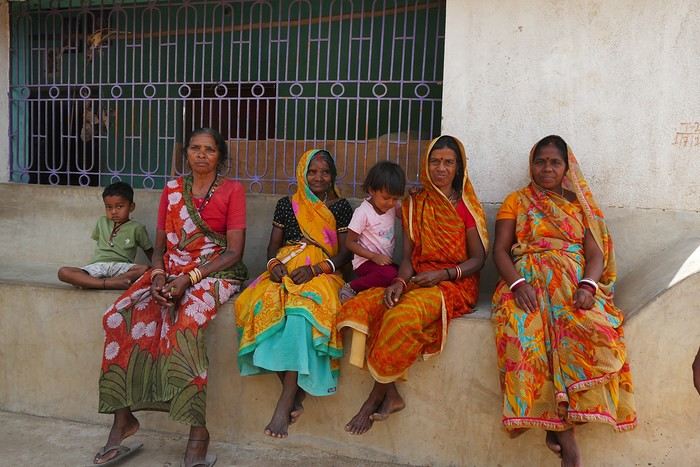
Meeting in the township.


Since a cover is needed (in black and white)...
MI Michel85200 Globetrotter ·
🙂🙂🙂
michel85200
AT Atila Globetrotter ·
That’s the problem with women: their it girl side.

You’re asking for trouble!
MA Magryelle Regular ·
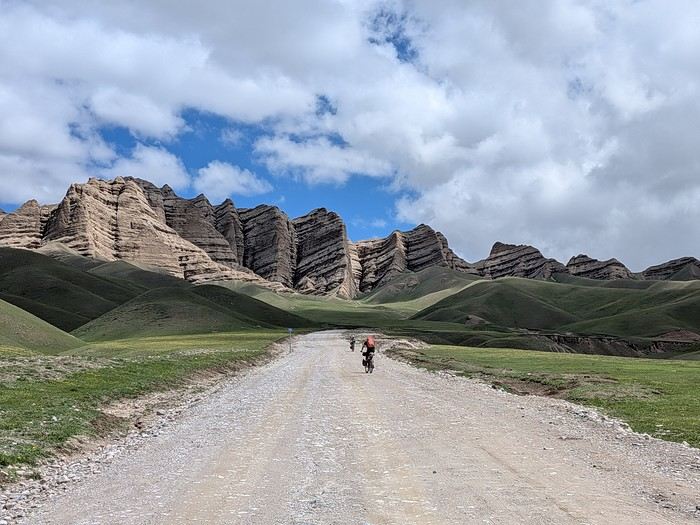
Thanks so much, Voyajou! At times, it feels like Australia... though not always the good sides, mind you... neighbors 200 km away, private jets, farms the size of a French département, etc. Does sedentary life suit you in South Africa? We’ll be in the Karoo in mid-August... and we’ll soak in your landscape and surroundings with delight. 😉
mayrig
XR Xrctn Veteran ·
Well, I just found out I’m posh too! Though here, they’d probably say cultivated instead!!!

https://voyageforum.com/v.f?post=6884794;a=6884794
RJ Rjulie95 Globetrotter ·
Always a pleasure to read you, Jean-Luc, and oh, a miracle—two photos in one post! 🙂

For the paint, were they out of stock, or did they just serve other customers before you since you're far away?

Mmusi Maimane—are you sure he's mixed-race?
"Je suis africain, non pas parce que je suis né en Afrique, mais parce que l'Afrique est née en moi." Kwame Nkrumah.

"J'ai appris que le courage n'est pas l'absence de peur, mais la capacité de la vaincre." Nelson Mandela

https://www.en-voyages.fr
EM Emma78 Veteran ·
Hi Jean-Luc,

So you're back in your second home, and for us, the joy of discovering your words begins.

Down to Earth—a Shiraz that invites you to the essentials. 😉

Having neighbors just half an hour away—I’d dream of that! 😮 Okay, the helicopter traffic’s a bit much, but hey, it *is* an emir—everything’s over the top!

Looking forward to the rest.
Emma

http://www.manuetjc-tribulations.com
VO Voyajou Globetrotter ·
Three 🙂 from Michel, one 😠 from Attila: it feels like we're in the "reviews" section of Télérama. 😇😊😉
VO Voyajou Globetrotter ·
At times, it feels like Australia...

Climate, latitude, geology, and European influence—there are quite a few similarities between the Karoo and Australia’s desert regions. You’ll see. And don’t forget to savor the aroma of Karoo lamb...

does sedentary life suit you in South Africa?

Let’s just say sedentary life is more interesting in South Africa than in France—probably the novelty factor—but I prefer the constant movement from one camp to another and not knowing where I’ll be the next day.
VO Voyajou Globetrotter ·
Hey, another Aussie without borders! 🙂 And one who doesn’t mince words. (Did you know I live on a border here? The one that separates the Klein Karoo from the Great Karoo. Notice they’re not named in the same language.)
MA Magryelle Regular ·
And don’t forget to savor the aroma of a Karoo lamb...

We won’t miss it, believe me!
mayrig
VO Voyajou Globetrotter ·
It's not nice to make fun of bad photographers! 😮

They had enough paint, but despite the watches, our arrival caught them off guard.

Mmusi Maimane are you sure he’s mixed-race?

Absolutely! I knew his mother, Ethel, well—she’s Xhosa, while his father is Tswana. 😇 But unlike his children, he doesn’t have any white ancestry.
RJ Rjulie95 Globetrotter ·
It's not nice to make fun of bad photographers! 😮

I'm not making fun, I'm just pleasantly surprised and I'm saying it 🙂

Absolutely! I knew his mother, Ethel, well—she’s Xhosa, while his father is Tswana. 😇 But unlike his children, he doesn’t have any white ancestry.

True, when you put it like that. To me, "métis" meant Black mixed with another skin color, but I hadn’t thought of it that way before.
"Je suis africain, non pas parce que je suis né en Afrique, mais parce que l'Afrique est née en moi." Kwame Nkrumah.

"J'ai appris que le courage n'est pas l'absence de peur, mais la capacité de la vaincre." Nelson Mandela

https://www.en-voyages.fr
MI Michel85200 Globetrotter ·
I love Africa... We love Africa... We all love Africa...

I’m learning to write but I’ve been describing this country for a long time.

😉
michel85200
VO Voyajou Globetrotter ·
Thanks, Emma. The wines here have appellations that are way more imaginative than those in Bordeaux! As for the emirs, even Kusturica questions them (as our lackluster Minister of Foreign Affairs said about the new U.S. President. It’s clear that not many people are questioning him, though).
VO Voyajou Globetrotter ·
Short circuit The hygrometer is more likely to have been calibrated in tropical China than in the Atacama Desert. This morning at dawn, when succulents—including the Karoo roses—are drunk on dew, it reads 60% humidity in a zone labeled "normal." By midday, it’ll drop to 15% in the "very dry" zone. In the morning, my hair is silky; by noon, I’m styled like a porcupine. And summer’s barely here! Here, even the poorest have running water—or at least walking water. Gray water isn’t mixed with black water. The latter is collected in a tank that a smelly municipal truck empties regularly. The former goes straight back to the garden. Some houses are like little horizontal Beaubourgs, pipes running among the stones to the chosen plants. In this house, the shower waters an olive tree, the bathtub floods an orange tree, and the sink drips onto a grapevine. It’s pretty demanding. Shower gel must be olive oil-based, bubble bath must be orange-scented, and shaving soap must be made from grape-seed essential oil. * Desmond Tutu Despite a name like that—and I’m not even talking about the surname—this man isn’t some operetta archbishop. Small in stature but a moral giant, he was Mandela’s comrade in the struggle. Now elderly and ill, the press is covering what will likely be his final battle: he’s campaigning for the right to die where, when, and how one chooses. Who will take up the mantle? What are his chances of canonization? * Donkeys & Horses (power) (Donkeys and horsepower) Two news stories collided on the same day: 1/ The Karoo Donkey Sanctuary rescues pack donkeys deemed mistreated—work is abuse, long live universal basic income for African donkeys, even if they have to settle for *son* instead of oats. Many are rehomed from Cape Town townships, and if the donkeys are mistreated, their owner-exploiters probably aren’t having a great time either. 2/ A limited-edition Range Rover Sport (hundreds of horsepower) arrives in South Africa. Three million rand, two hundred thousand euros, thirty thousand days of farmworker wages, a century’s worth. * The bowls Under the pretext of our nationality, we’re invited to a game of *boules* in the desert. Everyone brings drinks—it’s a *boule-bar* (the man winces: until now, he only knew the bull bar on the front of a truck). We play among the kopjes on volcanic sand—firm but treacherous. Thirteen to eleven, an honorable loss for a first try on this continent. The sun sets, and the lights of the small town flicker on below—a long, continuous line we overlook. Malcolm, who’s worked in Brazil, England, and several Asian countries before returning to South Africa, sighs, “It’s a beautiful country.” He won the game with bowls twice the standard size but roughly the same weight—ideal targets for a shooter. We talk about the Democratic Alliance meeting, and he insists that within five years, the ANC will lose central power to the DA. Through alliances, like in *boules*. * Safarimmobile Today, I didn’t see rhinos, but I bought a drill and bits. No elephants, but I got an oscillating sprinkler—much more consistent and efficient. No oryx, but I used long, thin screws that remind me of their horns. Didn’t trip over elephant grass, but I planted Rhinoceros grass and sowed Kikuyu grass, known for its resilience. Didn’t gather deadwood, but I changed a bayonet bulb. Didn’t sleep under the stars, but on a memory-foam mattress. Didn’t unfold a map in the sand, but hung framed maps on the wall. Didn’t drink brandy, but I tested a whisky made in South Africa’s highlands. * No title Born during the Popular Front—but in South Africa—he discovered Paris right after May ’68, feeling like he’d jumped a century. Jan is still steeped in the slogans of the era. For a few years, he was a journalist in several European countries, mostly covering agriculture—his parents are horse breeders here. He can still rattle off a dozen regional French cow breeds. A language lover, he keeps his passion alive by listening to the radio, from RFI to Portuguese broadcasts from Mozambique. Jan visits his brother before heading back to where he retired, near the farm where he was born, and he’d love to borrow some French books. He loves Sartre and Claudel, neither of which I have in my travel stash. Who are the Sartres and Claudels of the new century? He leaves with a Houellebecq, a Modiano, a Tesson, and a Gaudé, clutching them like treasure. * Mrs Gay She’s not particularly feminine, but she’s a force of nature—a fragmentation bomb affecting everyone around her. A widow for four years, she runs a farm and a small dairy with her four young sons, half of them adopted—two white, two Black. They make amazing cheeses, like the Queen Vic and the Parma Prince. Their feta and mozzarella make you feel like you’re back in Greece or Italy. She admits struggling with cultures and pH levels. Gay’s Guernsey Dairy is an intriguing name, especially in a small gay-friendly town. Mrs. Gay takes the questions about her name in stride, insisting no, no, it’s really her name. * One hundred twenty days without a drop It’s always the same story. The mountain held back a tight legion of clouds from the ocean, but this time, they slipped through, torn and tattered. In the Karoo’s blue sky, scattered stragglers advance—ghosts the desert will finish off before they burst.
RJ Rjulie95 Globetrotter ·
I checked out Mrs Gay’s site for photos—your little slice of paradise looks really nice!
"Je suis africain, non pas parce que je suis né en Afrique, mais parce que l'Afrique est née en moi." Kwame Nkrumah.

"J'ai appris que le courage n'est pas l'absence de peur, mais la capacité de la vaincre." Nelson Mandela

https://www.en-voyages.fr
MU Muriel18 Globetrotter ·
Reading you, Jean-Luc, I thought of a novel by Deon Meyer (whose title I’ve forgotten) where the main character (whose name I’ve also forgotten) had retreated to a remote corner of South Africa to spend some peaceful days (and of course, I’ve forgotten exactly where it was 😉).

Anyway, even though I don’t remember many (specific) details from the book, I still recall imagining that place just the way you describe it... Muriel
Si tu diffères de moi, mon frère, loin de me léser, tu m'enrichis (Saint Exupéry)
MA Max68 Globetrotter ·
Hello there, man from the West... uh, sorry, from the South... gotta say, it's easy to get mixed up. 🙂

To your friends who play pétanque, suggest a rematch at palet (or galoche)

I still love your writing as much as ever... though the realities of a sedentary life make me dream less than the discoveries of a nomad 😉
https://apprentisvoyageurs.com
AT Atila Globetrotter ·
A smooth-coated stray in the morning doesn’t make you dream?😄
MA Max68 Globetrotter ·
I’d say it’s more like Mrs Gray 😉
https://apprentisvoyageurs.com
VO Voyajou Globetrotter ·
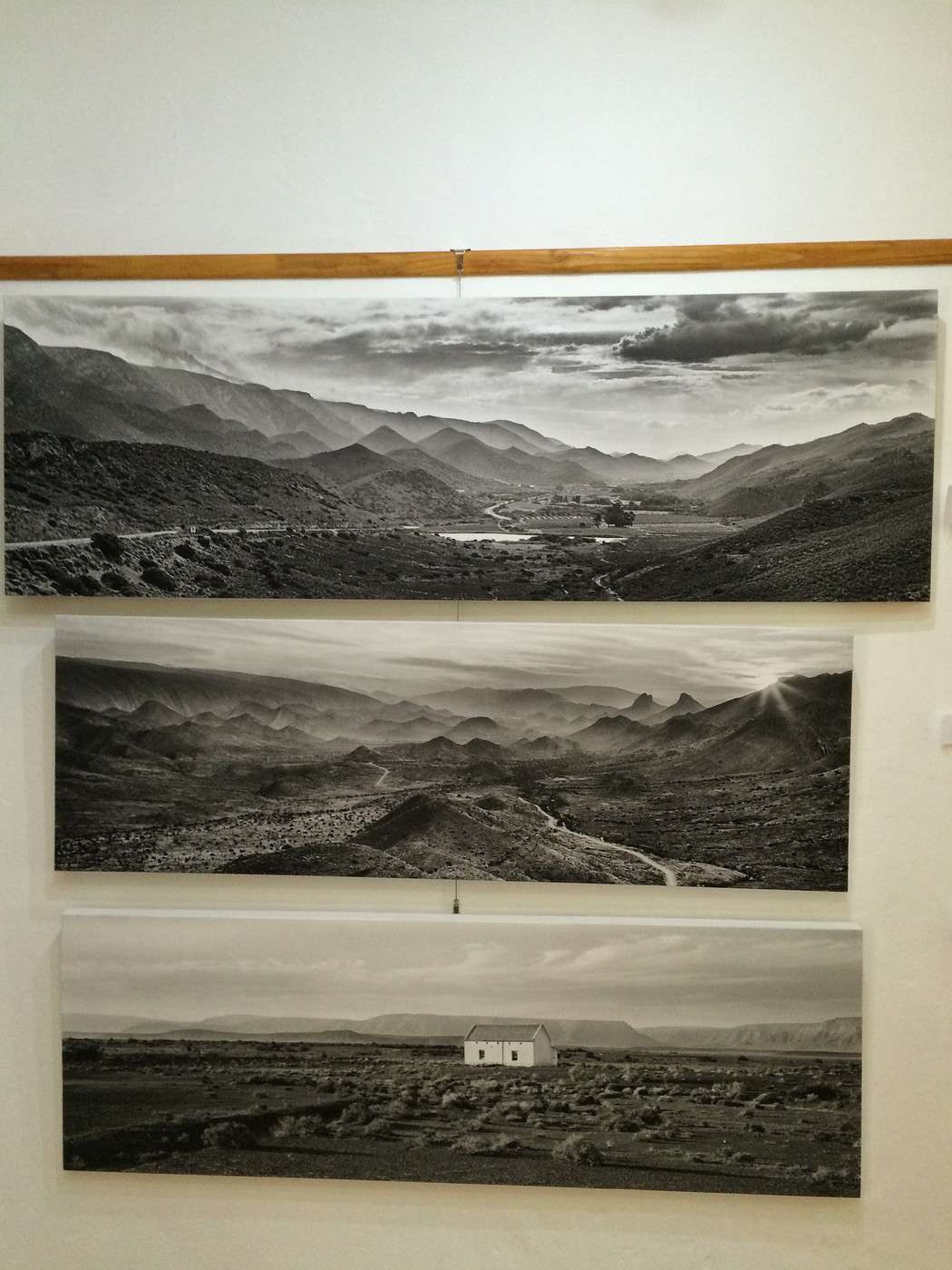
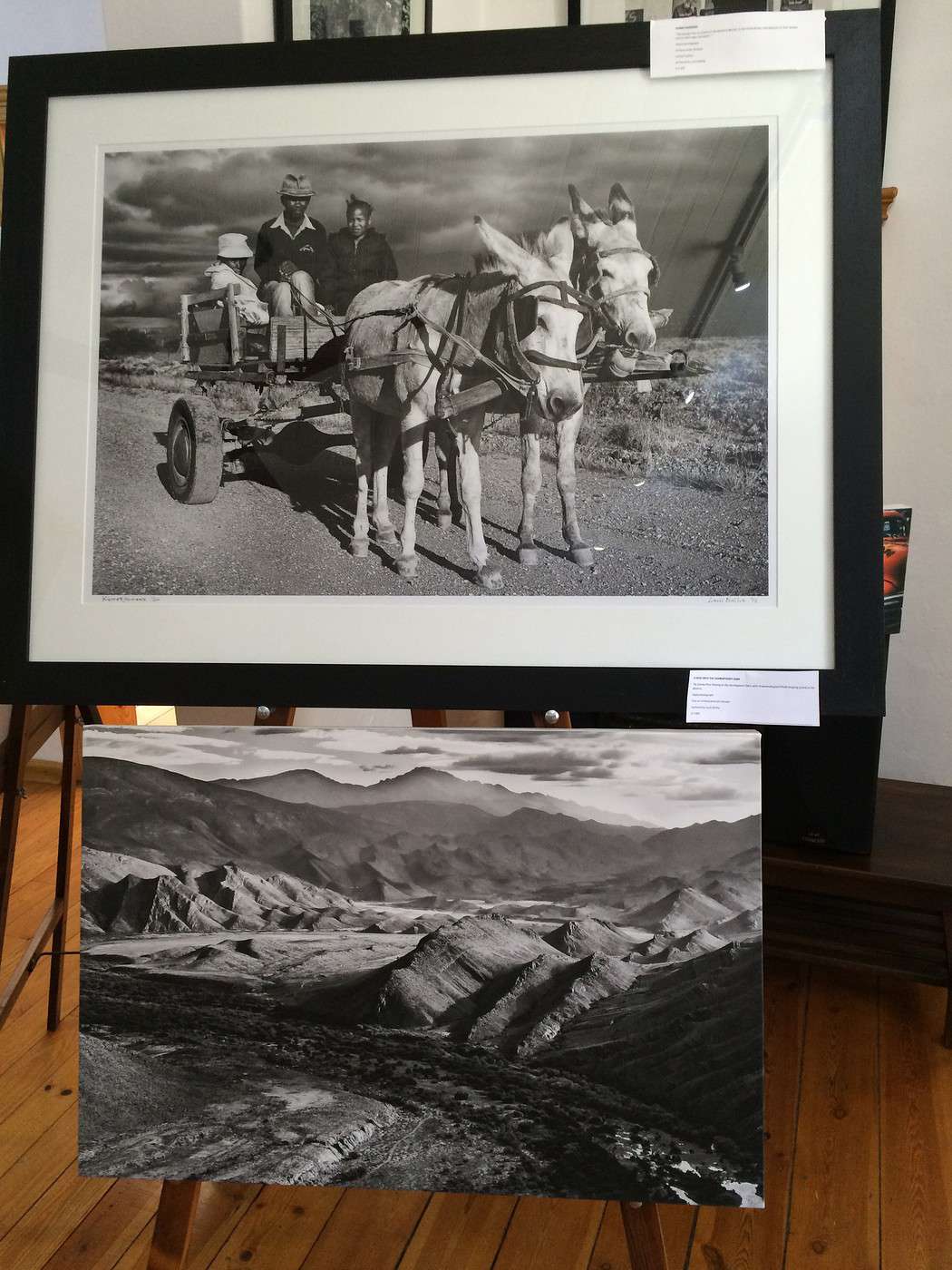
Yes, it's beautiful, and so much more than that. There are a few professional photographers here whose shots really do the place justice, including Louis Botha, who let me pull out my phone to show you some of them.
VO Voyajou Globetrotter ·
Hi Muriel, Going by your scant clues, Captain Benny Griesel is at least sure your book isn’t about his latest case, Kobra, which takes place between Cape Town and Stellenbosch. Deon Meyer is from here and often rides the Karoo trails by bike with a group of buddies.
VO Voyajou Globetrotter ·
even though the constraints of a sedentary life make me dream less than the discoveries of a nomad 😉

Same for me. But don’t get me wrong—sedentary life can be an adventure too. For example, if you love mobile safaris, imagine that in a *safar’immobile* (immobile safari), you discover that the wood screws have a reverse thread and you have to engage the drill in reverse for them to go in. 🤪
MA Max68 Globetrotter ·
wood screws are reversed and you have to engage the drill in reverse for them to go in

Oh yeah! That’s tricky! 😇 😏

I’m currently reading a novel set in your "neck of the woods" 😉 *The Scent of Apples* by Mark Behr...
https://apprentisvoyageurs.com
RJ Rjulie95 Globetrotter ·
Be sure to thank him for me! I just discovered his really beautiful work :)
"Je suis africain, non pas parce que je suis né en Afrique, mais parce que l'Afrique est née en moi." Kwame Nkrumah.

"J'ai appris que le courage n'est pas l'absence de peur, mais la capacité de la vaincre." Nelson Mandela

https://www.en-voyages.fr
VO Voyajou Globetrotter ·
To Die for... Hell Ah... have I already taken you to Die Hel? Inevitably, when you keep haunting the same places, you end up repeating yourself. The road is poorly paved but without any particular intention. This morning, apart from a few other baboons, I’m alone in Hell (where are the others, Jean-Paul?). A voluptuous goddess, descendant of the pioneers who settled here, prepares me a devilish breakfast with products from her garden, including fig, apricot, peach, and even orange jams. An Eden, with snakes but no apple. Despite the persistent drought, the Gamka River flows through the middle, siphoning what’s left of the upstream lake. In the courtyard of the old Snyman house, I startle a herd of kudus that take off in panicked strides. * Foul moon (I’ve already taken you to the Moon, but this time it’s the Moon that insists and repeats itself.) What’s it up to now? It’s boring us—what a thrill! Those from the city head into the desert, to a high spot to get as close as possible to the celestial body. What dizziness! Everyone brings food and drink. It’s the moon bar, and we’re invited. Until the end, I hope for a cancellation: the Moon, tangled in its lunar calendar, might have other plans—a eclipse, a big bang, a storm drawing a heavy curtain of clouds, or a detour to Mars for a change. The alignment of the stars works in my favor: an hour before departure, a bakkie carrying a fiery redhead in its bed—could this be a sacrificial evening?—brings the good news: the Celestial Body is privatized. The rendezvous will take place in the gardens of a yoga school competing with the one attended by the woman who put me in orbit. The prospect of this one-on-one perks me up. It’s her day of glory. Boldly, she rises in broad daylight above an isolated peak, and from my seat, I see a cup-and-ball game. In the distance, on a track in the relief, a car’s headlights wink at her, unless they’re communicating in Morse. The Moon is now also in full beam—hey, we’ve seen you, switch to low beam! Miroslav Vitous jams Universal Syncopations. I whistle a *Down to Earth* and puff on a Havana. …/... The next day, night falls without her. The star will make us wait over an hour before setting the horizon ablaze, appearing all at once in less than a minute, red but off-center from the cup-and-ball—the show is over. She rises behind racing clouds that give her Saturn’s rings. * Love in the meadows I don’t fantasize about Herefords, nor speculate on Merino wool prices, and I’m not planning to buy the latest John Deere either. If I sometimes read the Farmer’s Weekly, it’s simply to understand—or even embrace—the concerns of those who occupy the land. The most amusing serious section is the personal ads. Here are the most common expectations in women’s requests: Christian, in good health, financially independent, non-drinker, non-smoker, and pet lover. Excerpt: « I’m looking for a (white) man, friendly, understanding, generous, loving, creative, and honest. He must love cats and enjoy browsing flea markets and thrift stores. He must be in good health, circumcised, own a car, and be hardworking... » If at this stage you’ve checked all the boxes and are still interested, the list of the applicant’s qualities follows. Signed « Creative Lady », and I sense the widow who’s just finished her third... * Bill the smoker Not the Clinton who just got smoked like a cigar (normal for a guy who doesn’t know how to properly use one—probably collateral damage from the embargo on Cuba). No, Bill the garage inventor who smoked out the entire planet with his oversold software before stepping back from the controls—but not the dividends—and now sets out to improve the world’s fate (a Googlesque habit), with a favorite playground: Africa, and a benevolent target: the underprivileged. In Africa, cigarette packs don’t reach the delirium tremens level of those sold in Europe or Australia, but they do start warning of the danger: smokers are fools that Bill has decided to save. One of the octopus’s tentacles helps African states fight the tobacco industry, as if Philip Morris had helped us fight Microsoft’s abuses (soft, really?). Once deprived of alcohol and cigarettes, what will the poor have left... religion and Microsoft in a burger? We’re not SchTrumpfs! At an evening with a half-resistance, half-conspiracy vibe, Reinie, aka ‘the Princess,’ uses an amber cigarette holder and, laughing bitterly, says we belong to an endangered species, doubly so. (Written with OpenOffice, the free software). * Adventure right at home The track is fast at first but slowed by gates that must be opened and closed, a sign you’re moving from one farm to another. Farms whose inhabitants you won’t see. Then it narrows as it becomes less maintained and tackles the relief. Then, only two tracks remain in the rocky terrain, and when they’re suddenly cut off by erosion, passersby add stones to the work. I plan to approach a reservoir lake from behind to measure its emptiness. From this reservoir, already at its lowest at the start of the year, I only see a puddle in the distance against the dam. The rock that once held the water bears its scars fifteen meters up, and the bottom is covered in shrubby vegetation where baboons bark and ostriches—birds that can neither fly nor swim—stride. Out of reflex, or habit, I collect driftwood that I would have made into a fire and that will become a lamp. To get out of there somewhere other than my entry point, I try unknown tracks. I break my back in ravines that springboks and kudus laugh at, before running into locked gates: I’m a prisoner of the Swartberg Nature Reserve. I’ll have to resign myself to going back the way I came. But for Christmas, I’m ordering a helicopter. *
RJ Rjulie95 Globetrotter ·
Will you share the name of the guest house where you stayed near Hell?

For the moon, you were luckier than me—it stayed hidden in the Parisian gloom. 🏴‍☠️
"Je suis africain, non pas parce que je suis né en Afrique, mais parce que l'Afrique est née en moi." Kwame Nkrumah.

"J'ai appris que le courage n'est pas l'absence de peur, mais la capacité de la vaincre." Nelson Mandela

https://www.en-voyages.fr
VO Voyajou Globetrotter ·
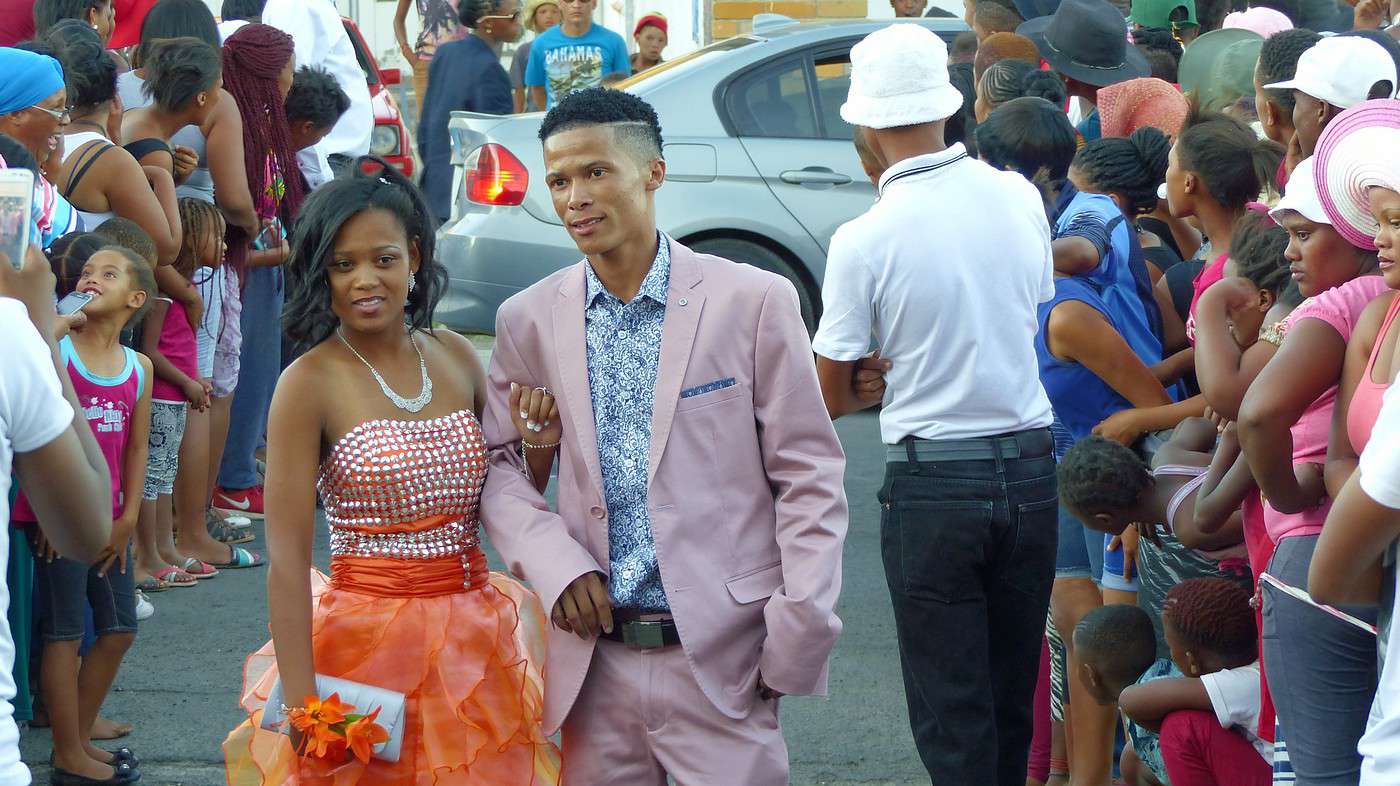
Victoria's Secret I headed north toward the Kalahari through the Northern Cape. This province is both the largest (two-thirds the size of France), the least populated (just over a million inhabitants), and the poorest in South Africa. I arrived in Victoria West in the late afternoon, determined to stop there. Well, that’s done: the main street is blocked by a demonstration. It’s the ceremony honoring, at the end of each school year, the high school students who successfully completed their secondary studies.

Fifty-seven couples will be dropped off by chauffeur-driven cars on a red carpet before climbing the steps of the Town Hall.

The principal and his deputy are getting impatient.


Here they come!


Me too, when I grow up...
MA Magryelle Regular ·
Thanks for these beautiful photos. In our chilly France, I can feel the vibe from here. You must’ve had a really great time!
mayrig
MA Max68 Globetrotter ·
You'd think you were attending weddings 😉
https://apprentisvoyageurs.com
VO Voyajou Globetrotter ·
Two providers for a night in Hell: - the family established in the middle of the valley who runs the restaurant, a campsite, and a few houses - Cape Nature, which offers a campsite at the start of the valley and renovated historic accommodations at the other end. In any case, Cape Nature’s accommodations are more pleasant.
VO Voyajou Globetrotter ·
Haute couture To leave the comfort and safety of the oasis, you’ve got to shake up your body, but you can’t let your mind dry up. And to nourish it, nothing beats the road. So I plant the willing gardener and tear off for a getaway north to the Central Kalahari, if the beast cooperates and if the temperature forecasts above 40°C are revised downward. For the occasion, I’m wearing long shorts over socks and boots: in the high veld, I’ll be incognito.

After a few hours, I reach the Great Escarpment, which leads to the Upper Karoo plateau with a modest elevation gain of seven hundred meters—enough to create two different agricultural regions. In winter, the herds stay at the foot of the escarpment, moving up for summer grazing. Even today, this transhumance is done on foot, and I’ll cross or overtake three columns of over a thousand head each. Unfortunately, no chance to chat about fabrics with the ragged shepherds who only understand Afrikaans.

I’ve set out to take these west-to-east tracks, climbing one, descending the next—one stitch right-side out, one wrong-side out. It’s a disjointed journey. I’m holding the thread, but sometimes I have to go around a needle, other times slip through an eye. What the shepherds cover in three or four days takes me only a few hours, but I’ve been doing this for three years straight. This year, the already-sheared sheep are moving earlier than usual: there’s no water left in the Lower Karoo’s reservoirs and barely anything left to graze on. On the plateau, the natural depressions are dry, but the man-made reservoirs still hold water, and the vegetation is more bronze than brown.


* Seen on TV Jesus Superstar. Several thousand people, all dressed in their Sunday best, are gathered in a hall to listen to the preacher’s sermon. In this case, it’s a preacher—a blunt, Black woman with the voice of Janis Joplin in Summertime and the cadence of Patti Smith in the prelude to Horses. A drummer and two guitarists accompany her, underscoring her words with chords and rolls. Dozens of believers lie on the floor, writhing or frozen, somewhere between an epileptic fit and a hypnotic trance. The sermon’s intensity doesn’t let up, and the collapsed are carried off, or those struggling are dragged away, to pile up those who’ve lost it. (1) Whatever Pascal (Blaise, the inventor of the precautionary principle) might bet, it’s understood these questions appeal more to the spirit than to reason—but not to the point of losing it entirely! I don’t buy it. The sermons are interspersed with ads for the usual church-branded gadgets (stickers, magnets, pens, T-shirts, caps...). At the bottom of the screen, 24/7 prayer lines scroll by. Is this reality TV or infomercial? I was watching Tswane TV, which operates part-time. Faith, the full-time rival channel, is barely less intense. Cioran comes to mind: *‘Without the vigilance of irony, how easy it would be to found a religion! All it would take is letting the onlookers gather around our loquacious trances.’*

(1) Between rival churches, miracles are weapons. Last year, a preacher asked a woman to lie down on the stage—the altar?—and had a 250-pound speaker placed on her, assuring her he’d handle the miracle and she wouldn’t feel a thing. Indeed, she didn’t flinch: her ribcage caved in, and she died at the hospital. The apprentice sorcerer had confused *heavy* with *Lourdes*. * "Crunch crunch crunch" That’s how the tow truck driver describes the noise the Defender is making to his mechanic buddy over the phone. He’s holding the phone with one hand, scratching himself with the other, and steering with his knees—reassuring to feel rescued. The night before, alerted by jerky movements, I barely made it to a roadside campsite. When I tried to maneuver, I couldn’t engage any gear. I tried all 28 possible combinations, but the car just crunched (*crunch crunch crunch*) and didn’t budge an inch.

At the garage of a Land Rover enthusiast and specialist—yes, they exist—the boss confirms the issue in ten seconds (a worn gear between the gearbox and transfer case) and announces with a big smile that he has the part in stock. It’s one of the beast’s Achilles’ heels—which seems to have more than four. * Serves him right! I’m driving over 80 km/h on a gravel track in the Karoo Highlands. With this oversteering donkey I call a ride, that speed already demands full attention. A cloud of dust approaches from behind, too fast to be a dust devil—so it’s a devil of a man. He must be doing 120 km/h, so to let him pass, I ease off the gas and pull as far left as possible. The custom is to slow down during overtaking to avoid stone chips, then thank the other driver by flashing your hazards, to which they respond with a headlight flash. But he does neither, gripping the wheel like his life depends on it. I just catch a glimpse of sheep and their shepherd in the back of a pickup, the former getting their wool ruffled and the latter, clinging to the sides, swallowing dust without complaint. Not sure the sheep are in that much of a hurry! I’ll see them again at the Fraseburg slaughterhouse and have a word with the driver about the rock that chipped my windshield. The dust cloud pulls ahead, leaves me in the dust, then stops. A few minutes later, I catch up. The jack’s already out: all that’s left of the rear right tire is shreds. It must’ve taken nerves of steel and experience to keep the sheep from becoming casualties. I check if he needs help, without mentioning the windshield chip. Each day has enough trouble of its own. * Depending on who you are... Arriving from the heights, you’d think it’s an Italian town: all you see is a forest of yews. But once in Murraysburg, the illusion fades—I’m definitely in an African town. On the sidewalks, cows and donkeys prune the trees, while goats take care of the trash. The yews shade the wealthy’s well-kept cemetery. In the adjacent poor cemetery, a dense forest of stone mounds and wooden crosses rises. No trees, no plants: the goats handle the upkeep. A few newly rich have bled themselves dry for veined marble. * Communalism Communalism to protect oneself from the other was apartheid’s doctrine. Twenty years later, people still largely live among their own, but it’s true elsewhere too—it might even be a growing trend. The Oranians built a town on a 3,000-hectare private property. Two main criteria for admission: being Afrikaner and not employing any workers or domestic help—implied, non-white—meaning you do everything yourself. You’ll see whites pushing lawnmowers or wheelbarrows, wielding hammers and pickaxes, or driving tractors. For barely over a thousand inhabitants, the town has five or six different places of worship, all Protestant. The language used is Afrikaans, exclusively, and the country’s old flag flies over the town. In fact, I didn’t see any mixed-race people, let alone Black ones. Only whites, and not particularly refined ones. Maybe they should consider mixing things up? * My night with the sisters Located in the Great Karoo, the farm is vast enough to contain the Three Sisters—three flat-topped mountains that could just as well be brothers. Nicolette insists that after Table Mountain, the Three Sisters are the country’s most iconic. Yeah, right! The family’s been here since 1830, when the ancestor, en route to the Diamond Rush, was left for dead. Nursed back to health by a passing Hottentot, he continued to Kimberley, where he quickly found two diamonds valuable enough to buy the farm. The current generation running Three Sisters Farm is down to three sisters who find the coincidence amusing. They manage 14,000 contiguous hectares where sheep and goats roam, along with a few horses and five different antelope species. Baboons and elusive leopards are also at home. Precipitation and temperatures have been recorded in large brown notebooks since 1911, and Michelle confirms this is the worst drought in a century. The current farmhouse—abandoned in the late 19th century after the wells dried up—is nestled in a valley where water still flows abundantly. Tortoises and porcupines have come down from the mountain to vacation in the park, waiting for better days.

If I dared, I’d suggest that resting on the past and under their braided crowns won’t secure the future, that the rooms could use an upgrade, and that repairs to the workers’ housing wouldn’t be a luxury. But too many signs point to a lack of means.

At dusk, the sisters’ father settles on the terrace with his daily brandy and invites me to join him. Often, he raises his eyebrows: he’s not entirely convinced by female management.

Later, under a waxing moon and against my better judgment, I witness a marital spat between Michelle and her husband. On one hand, she wears the pants; on the other, they seem unaccustomed to having guests.

As I’m about to retire, a man in his forties approaches me. He’d been dining with the owners, childhood friends. He’s been living in exile in Australia for twelve years, holds a good job in Adelaide, is married to an Australian with two daughters—but every year, he has to come back here, alone. Why? His answer, sad and laconic, like an obvious truth: *‘Because this is my country.’*

At dawn, we learn a beer truck broke into the farm. Coming down from the mountain, it forgot to stop at the intersection, plowed straight through two fence lines, used the raised railway as a ramp, lost half its cargo on landing, and rolled into the veld.

When we arrive, about fifteen pickups have already driven through the breach, and looters are loading their beds with packs and pallets. The locals know they’ll be left with the plastic and shattered glass to clean up to prevent fires. *

…/...

I don’t know if swallows’ brains are divided into two hemispheres, but they’d never think of changing now. Me? I would.
MA Max68 Globetrotter ·
Hello there, African friend 🙂,

Is it just me, or does Jolly Jumper do everything he can to keep you from getting bored during your getaways? 😉

I don’t know if swallows’ brains are divided into two hemispheres, but they’d never think of changing now. Me? I would.

Compared to where you’re from or where you are now? 😛

Thanks for these beautiful images 🙂 🙂 🙂

Still, one day you’ll have to let me discover one or another of your far-flung paradises 😎
https://apprentisvoyageurs.com
VO Voyajou Globetrotter ·
« Welcome to South Africa »

That’s what the banners at Cape Town Airport proclaim. If you head into the city, you won’t see much—or anything at all—but if you take the N2 east, after a few kilometers, a sign warns: “Dangerous area, do not stop.” The highway cuts through one of the country’s largest townships, Khayelitsha. The protective walls—who are they protecting, and from whom?—made of cement, lie in ruins, and you’d have to believe a stalled car would soon resemble a cornfield after a locust swarm. A security van transporting cash, broken down on the first exit ramp after the zone, follows the rule. Six armed men stand guard while waiting for the tow truck. The warning proved justified the following night: two local thugs murdered an entire family in their tin shack for three mobile phones and a few DVDs—hopefully educational ones. They had raped first. Along an axis perpendicular to the highway, planes take off and land, flying low over the township, and the residents don’t seem to have rocket launchers. Crucified like this, maybe they should put up a sign: “Silence, we kill”? For good measure, that same week, a farming family was massacred on their land. At night, they were white. They had been tortured first. For twenty years, it’s been a long litany. Doesn’t an extremist (or is he?) political leader say, “One bullet, one white”? Yet last year, South Africa’s tourism numbers were up by 13%. *

Fire (to)

He’s no warmonger, and he certainly didn’t set the mountain ablaze after months without rain—like him. We had to make the tough call to *fire* Jan, meaning send him back home. It was him or the plants. Without him, they have a chance, and without them, he’ll survive. What comes next is even sadder: Jan won’t be replaced by a colleague but by a machine, an automated irrigation system. A sophisticated setup that will cater to each plant or tree’s needs, delivering just the right amount of water and significantly cutting consumption. That’s the way of the times—balancing social conscience and ecological responsibility. Or the other way around. *

The Cow or the Milk?

At the speed of light, the house is less than a millisecond from the plateau where the continent’s most powerful telescope stands. The chaos of the stars proves there was no plan. Or maybe God is an English gardener. Shooting stars take the shuttle to oblivion. The horizon flashes with silent storms we’ll never see. And no one answers this question: what happened to the cow that started the Milky Way? And the bucket? And the stool? And the farmer? Were they turned into constellations? *

The Tube

From clear dawn till dusk, they dig, an army of moles armed with shovels. The plan is as complex as the subway’s. They toil and mark out stations. Soon, they’ll bury blue tubes and black pipes. Water will flow under electronic control. Fearing a Trafalgar moment or another *Water-gate* in this *pipe* problem, I’m putting it to you. The setup includes 600 meters of piping: 200 meters with an inner diameter of 25mm, 300 meters at 20mm, and the rest at 15mm. The pump delivers 4,000 liters per hour, but due to the drought, the flow steadily declines until it stabilizes at 2,000 liters after an hour of use. The drip system only works when the entire circuit is under pressure. How long will it take to fill the system? And knowing each mini-valve delivers 2.2L/h at 1 bar of pressure, how many can I install at most? *

The Water War

So, despite recent immigration from Brittany, the Karoo is suffering its worst drought in a century. The culprit is a child prodigy, El Niño—an outsider, no less! With aquifers drained, people dig deeper and deeper wells, siphoning their neighbors’ reserves. One day soon, they’ll bring up fire. *

Diversity

Two hundred people tonight at the Bush Pub, the local weekend institution. A resident couple is celebrating their wedding anniversary for two days and two nights. The guests are South African, Namibian, and European—Black, white, and mixed-race; young, overweight, slim, or old. Long, tight dresses, short shorts on baobab thighs, John Deere caps. Among elegant, overexcited forty-somethings bouncing off the walls, a few local Afrikaner faces serve up sour expressions. The guitarist-singer, heavily backed by electronics, plays dated standards in his own image. Buff but soft-hearted, he somberly croons Black is black. I don’t remember the night. At home, a strange stereo reaches me: township percussion in my left ear, white bass in my right. I’ve spotted a 3,000-hectare farm, the nearest neighbor ten kilometers away. For the housewarming, I’ll listen to The Sound of Silence. And if Simon & Garfunkel aren’t available, this local guitarist will do—provided I confiscate his machines and replace them with the neighbors’ percussion. *

This irredeemable, pusillanimous Afrikaner who, since 1994, only grinds white pepper and broods.

* Blood Sausage

South African poultry farming is in crisis—farms are emptying, and slaughterhouses are closing. Tens of thousands of jobs are at stake. The cause? Cheap imports of low-grade cuts (necks, wings, offal) from European farms. Not good enough for us, but plenty good for them—who won’t even get to choose between wing or thigh. So here we have overproduction, and there, destruction. Should we still be surprised that *they* want to come *here*? *

Unsustainable

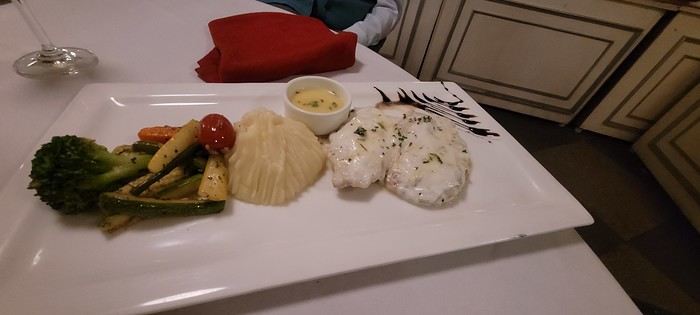
The head chef of this upscale coastal restaurant is still buzzing: he received an award because all the fish he serves comes from a sustainable fishing supply chain. Note that what’s sustainable is, at best, the species—but certainly not the linefish on my plate, resting in its vegetable shroud. A good (or is it bad?) half of the diners are morbidly obese. What would *really* be sustainable is if they swapped their lunch for a fishing trip. But marketing’s harpoons are deadly. *

El Gecko

He’s a mural artist, an indefatigable graffiti creator of ephemeral works, and we’re lucky to have him in residence. He’s settled in the attic, as befits his status. The spotlights barely flick on before he takes the stage. With talcum-powdered suction cups, he clings to the shadow of the exterior light deflectors. When a butterfly flutters by, unaware it’s performing its last dance, our gecko waits for it to land—unwilling to leave his wall. He inches closer in short bursts until he’s within jaw’s reach, then waits some more, confident. When the other realizes and takes off—*snap*. Tonight’s lean pickings: he has to climb up and down for mosquitoes. The energy balance is negative until suddenly, a kind of beetle lands too close. *Crack!* Ugh. The prey’s got a tough hide. The gecko drops it, and it crashes to the ground, motionless. Trick or trauma? The crawler plays cat, but the other plays dead. The stage manager turns off the lights. One day, after feasting on saffron butterflies, the artist snubbed the mosquito menu. He shouldn’t forget why he’s housed here.
VO Voyajou Globetrotter ·
Hey Jeff, The Defender might be giving me a hard time, but I’m keeping it... for now. It’s a bit by default—nothing else on the market really grabs me. Maybe the next Defender?
MA Magryelle Regular ·
Really well written, as usual! You can really feel all the paradoxes of South Africa—the best and the worst—but it’s still a fascinating country with an extraordinary history. Is your Def getting bored? Ours is bursting with excitement for their South African trip in August.
mayrig
MU Muriel18 Globetrotter ·
Hi Jean-Luc,

Another South African interlude—still a pleasure to read, but it leaves a bittersweet impression... Muriel
Si tu diffères de moi, mon frère, loin de me léser, tu m'enrichis (Saint Exupéry)
MA Max68 Globetrotter ·
Ah Ah! It's always a surprise "where's Voyagou?" ... now we know, he's sharpening his pen on the bus ...

Like Muriel, I find you a bit bittersweet ... shouldn't your loyal (well, sort of) companion take you exploring the diagonal? 😉

Following Julie, I had the feeling the sky had finally decided to let loose its buckets of water 😎

Thanks 🙂 🙂
https://apprentisvoyageurs.com
VO Voyajou Globetrotter ·
which leaves a bittersweet impression....

Yes, just like this beautiful, wild, and harsh country. Have you read Troy Blacklaws (a predestined name, perhaps?)? http://www.babelio.com/livres/Blacklaws-A-beautiful-wild-and-harsh-world/494757
MU Muriel18 Globetrotter ·
Have you read Troy Blacklaws

No, but your link makes me want to... I’ll order it—it’ll join my "to-read" pile 😉 Muriel
Si tu diffères de moi, mon frère, loin de me léser, tu m'enrichis (Saint Exupéry)
VO Voyajou Globetrotter ·
Buffelsbaai

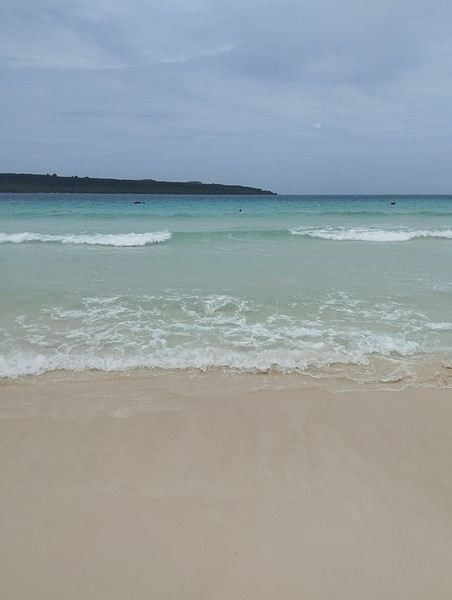
Buffaloes haven’t come to the beach in a long time. Not since tourists took over the place. The village is built on a conical dune, and from the camp set on a coastal rise, only the summit emerges from the morning mist. It has a bit of a Mont Saint-Michel vibe. Kids sled down cardboard boxes they abandon at the bottom of the slopes—sometimes the box slips away, and they end up tumbling down in fits of laughter. Patient surfers wait for those rare perfect moments under the indifferent gaze of families buried in the sand. Bricklayers haul bricks into the last empty lots. The lagoons fill and empty, carving quick streams in the sand. In the nature park, oystercatchers are painted like the shellfish sellers from Lorient’s markets. The waves and reefs never stop their noisy quarrels. Why this shared pull toward the ocean? Some kind of amniotic nostalgia?

*

Wild golf

A farmer-turned-developer had set up a golf course between olive and fruit trees before selling the farm to a wild-game breeder. The new owner let the greens become grazing land for antelopes—though they won’t have to wait long before taking a bullet on a hunting farm. My slice of desert is an acceptable practice range, even if the old sheep fences make for leaky nets. The acacias are great makeshift flags, and the hundred or so vertical pipes sunk into the ground to water the roots make easy holes, despite the lost balls. For a 300-meter drive, the desert is wide open, no fee. Just bring your own tees. J.M. Coetzee, the South African Nobel laureate, bitterly describes what he sees as a step backward: his country was wild before it was domesticated, then cultivated. Now, he observes, food crops are abandoned on farms, cattle and sheep are slaughtered, and antelopes take their place. Meanwhile, farmworkers left jobless swell the shantytowns.

*

Paradise lost

Whether spring seedlings or transplants, the vegetable plants gave up first. Wilted before they could bear anything. Then the patch of lawn that reassured her dried up. After two months, the geraniums and other delicate plants died. And no one reacted. The olive trees wither in the sun, and even the succulents darken. Finally, the majestic pepper tree, perhaps heartbroken by the sight or unable to bear the loneliness, stopped feeding itself and shed its leaves. The surprise comes from the bougainvillea, heavy with flowers as if nothing were wrong—or as if adorning a grave. Madame de Wit left six months ago for another garden she called wonderful, where she was to meet her husband. Since then, the water’s been cut off, the gardener doesn’t come, and neither does the rain.

*

Dead end

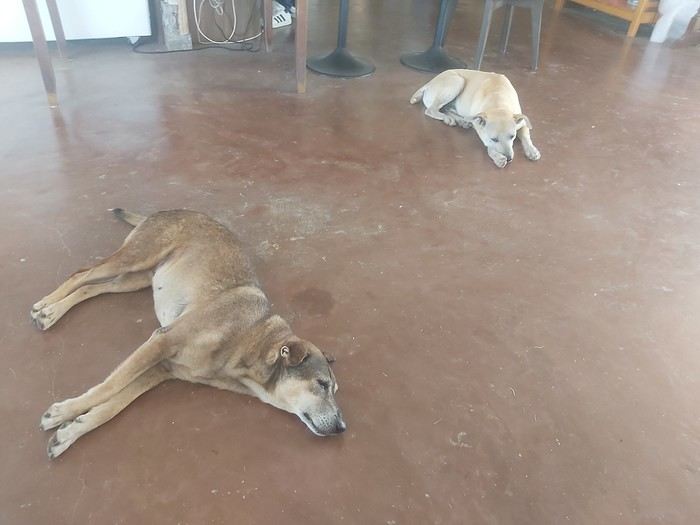
Three houses in 300 meters: five dogs in the first, four cats in the second, and four mastiffs in the last. Only six humans. A sign, disguised as a cat’s face, demands you drive slowly. In North End, the township, there must be two thousand kids for whom the streets are their playground—no signs asking drivers to watch out. A few stray, scrawny dogs and cats wander around.

*

Small5

Sitting on the stones, I accidentally break a spider’s trap, its threads now trailing on the ground. Along comes a busy ant, as they always are, getting its legs tangled in the web. It struggles so much it ends up wrapped like a cocoon—an uncomfortable one. One, then two, then four of its friends trot over to help. It seems they greet and reassure the trapped ant. Each does their part, pulling in all directions until the captive is even more tangled than before. Clearly, they need a team leader. Sometimes a thread snaps, and the would-be rescuer ends up on its back, but you can almost hear the trapped ant’s gasp. Time passes, it’s still wriggling, the rescuers keep at it. Then suddenly, it’s stretched to the breaking point. The others are like tug-of-war teams, but the silk holds strong. Shhfff—the threads and fabric give way, and each team ends up with half the prize, all losers.

*

March 20th, autumn?

Beyond the mountains that separate us from the ocean—like a dam holding back the clouds—the lightning’s glow seems to come from a disoriented lighthouse that’s lost its light. We’re in the desert, so far from the sea. Sometimes a series of high lightning bolts forms arabesques—Allah’s wrath?—but most often, the light seeps out like a distant concert playing records backward. We’re too far from the stage to hear the sound. A drop on the back of my hand, a second on her face, a third on her outstretched leg—and the fourth... No fourth, nothing more. Aborted prelude. Later, from a trailing cloud, light, gray, but nighttime, the rain arrives. If it puts out my cigar, I’ll quit smoking. For tonight. It’ll be a half-hearted laundry and a cat’s bath. My hair stands on end, twenty thousand useless lightning rods. After a long intermission, the downpour resumes—it doesn’t stop. The producer seems to have a central bank’s resources. By morning, the earth—or what passes for it—is damp three centimeters deep. It’ll take more to quench the trees and fill the water tables, but the succulents are feasting.

*

Agenda for the 21st

7:30 AM: Meet at the garage for final adjustments before the Botswanan Kalahari. Last chance for the Defender—next breakdown in the middle of nowhere, and I’m letting it go. 9:00 AM: Meeting at the Municipality to negotiate a parcel revision. 10:00 AM: Visit to a primary school class in the township. 12:00 PM: French conversation class at the high school. 5:00 PM: Meeting of the scammed. A sort of fake surveyor pockets fees for work he doesn’t do (a fake job?)—we might be his latest victims. We’re asked to join a complaint. But to me, the guy’s more incompetent than a crook. Is incompetence a crime? 7:00 PM: Closing time. Feels like we’re traveling—I light a fire and open a bottle of Down to Earth. “So, when do we go nomad again?”

*

Building a fire

A year’s worth of brush and pruning waits for the bonfire, but there’s no question of lighting it in the middle of a drought. In two days and one night, 20 millimeters of rain fell—10% of the average annual rainfall. The surroundings are damp enough not to catch fire at the first stray spark. The only worry is the wind, usually predictable, a night bird blowing from the south—but it sometimes takes a nap, waking up midday. Several dozen cubic meters are carefully lined up parallel to the wind’s axis. You’ve got to light the fire downwind so it’s both fanned and hindered, keeping it from burning too fast.

***

I’m already putting down roots here, but I hesitate to plant a traveler’s tree in the garden.

*

On the terrace, a pair of empty, dirt-camouflaged sneakers. A butterfly, drawn by the scent, starts exploring. The gecko pounces, then, suddenly chameleon-like, waits at the ankle.

*

At night, the sun, via the moon, makes the palm leaves’ glossy surfaces twinkle. The electric wind turns them into blinking garlands.

*

Armed with a long fork with tight tines, they skim the surface in broad strokes. Could be Ré or Guérande. Yet, even though there’s still plenty of salt in the desert—so much that well water is now brackish and reeks of sewage—these workers aren’t harvesting fleur de sel but working on the wastewater treatment plant’s basins.

*
VO Voyajou Globetrotter ·
The Gravity of Water

Today, Anthony put the finishing touches on the automatic irrigation system. It’s a real Rube Goldberg machine that’s more complicated than it needs to be. On top of that, the borehole that was still producing 3,500 liters per hour not long ago now only runs for twenty minutes at half the flow rate. So, we’ll be saving water, which is in such short supply.

Around ten at night, lightning lit up the horizon, drawing closer, thunder rumbled, and finally, the rain came down in a fury. An hour or two at that pace, and the city, which had started tightening its taps, got a reprieve. The desert glistened with puddles, gullies formed. The rains had ravaged the northeast of the country, and even the Kalahari Desert had gotten its share. Surrounded, the Great Karoo was waiting its turn.

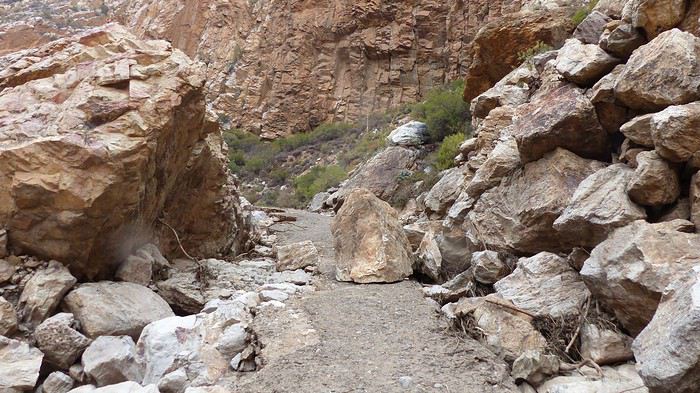
The next morning, I headed into Swartberg Pass. While the valley was sunny, it was still raining there, and the track was starting to deteriorate. The rushing water swelled the river, whose bed the track follows for its last few kilometers. It would’ve been wise to shut the valves up there.

Late in the evening, the wind and its accomplices had moved on, leaving only the passive energy of the moon. I heard an unusual, steady, deep noise. No movement in the trees. No elephants around here for some time. It sounded like the tide rolling pebbles, but the ocean is two hours away. The river, dry for years, was less than a kilometer away, and the rumbling was coming from that direction. When we got there, a few of us saw that the track had been washed away by a flow about thirty meters wide, rolling pumpkin-sized boulders. Such raw power hadn’t been seen here since 1981.

By morning, upstream, the river had swallowed the Swartberg Pass track. Over a few hundred meters of narrows, there was nothing left but the river as it had been until 1880, before humans forced this road upon it. Higher up, only the foundations made of cut blocks weighing close to a ton remained. Such devastation hadn’t been recorded since the road was built 130 years ago.

Desiree, though, weighed only sixty kilos. This young mixed-race woman made beadwork in a sheltered workshop we’d visited the week before. What was she doing at the edge of danger? When her body was found wrapped in a shroud of mud, the river was dry again.


*

Donkey Skin

The Chinese find virtues in donkey skin. Not sure that gives rhinos a break. Soon, the emaciated donkeys that shared the roads of Botswana will be nothing but a fond memory. *

The Black T-Shirts

"What’s serious, you see, is that South Africa is becoming an African country again." He knows what he’s talking about—he works all over the continent. "You should come to the protest to demand Zuma’s resignation; there’ll be a lot of us. Wear a black T-shirt." A human chain is planned in Cape Town—a chain to free ourselves, what a strange idea! Of course, J. Zuma is a president without qualities. Still, democracy being what it is, it can produce what hereditary monarchies sometimes do: a good-for-nothing ends up in charge. *

Adam’s Wood

Shortly after six, another unusual noise (again!) came from the other wing of the house. Flocks of Red-winged starling had invaded the town, but they don’t make those dull sounds. And dawn was barely breaking. Naked, I slipped toward the terrace where two men were crouched in front of the woodpile, stuffing it into sacks. In one motion, I threw open a window and let out a mighty roar—the very one you need when a lioness charges you in the Kalahari. The first guy fell on his butt, the second grabbed a full sack and bolted. By the time I opened the door and grabbed a stick, I started chasing them before realizing I was naked. It’s the time when sporty South African women start their morning jog. Embarrassed, I gave up, though not without hurling my stick at the fleeing thieves, who must’ve been laughing their heads off. Me too, but bitterly. I know one of them. Those who have nothing don’t care about the good intentions of those who (have) something.
RJ Rjulie95 Globetrotter ·
Trying to change the course of a river is a human activity doomed to fail... Even if it takes a long time, sooner or later, it will return to its natural path. Where I live in Ardèche, they keep doing it, and every time there’s a flood, the river goes back to its original course.

Zuma—a president like many in Africa who clings to power and refuses to let go. His wife is tipped to succeed him as head of the ANC, hoping this country doesn’t end up like its imposing neighbor, once the breadbasket of Africa. Hoping that his successor, if there is one, has a vision for the country and not just for a privileged few...

Hoping the rain keeps falling, but more regularly—isn’t the rainy season coming up soon?
"Je suis africain, non pas parce que je suis né en Afrique, mais parce que l'Afrique est née en moi." Kwame Nkrumah.

"J'ai appris que le courage n'est pas l'absence de peur, mais la capacité de la vaincre." Nelson Mandela

https://www.en-voyages.fr
AT Atila Globetrotter ·
Still to come in 6 months? 🙂
MA Max68 Globetrotter ·
Darn, I missed the rest 😮,

Gotta say, all it takes is for me to disappear to the other side of the globe for you to take advantage and write posts and take photos 😉
https://apprentisvoyageurs.com
VO Voyajou Globetrotter ·
Hi Régis,

hoping this country doesn’t end up like its imposing neighbor, once the breadbasket of Africa

You’re not wrong to be worried! Last month, the president fired the finance minister, who had two major flaws: he was competent and opposed the president. His replacement’s main qualification? Being a yes-man. He appointed an economics professor—a sluggish hybrid of Varoufakis and Piketty—as an advisor, who advocates expropriating farmers without compensation and nationalizing the mining sector, banks, and insurance companies. In short, the country’s rapid ruin and worsening conditions for the poorest.
VO Voyajou Globetrotter ·
The sequel in 6 months?🙂

Given the nature of my activities—and my declining success here—I’m wondering if I shouldn’t switch to a gardening or DIY forum.
RJ Rjulie95 Globetrotter ·
All we can do now is hope he gets voted out in the next elections.
"Je suis africain, non pas parce que je suis né en Afrique, mais parce que l'Afrique est née en moi." Kwame Nkrumah.

"J'ai appris que le courage n'est pas l'absence de peur, mais la capacité de la vaincre." Nelson Mandela

https://www.en-voyages.fr
VO Voyajou Globetrotter ·
It’s an impression where Jolly Jumper does everything it can to keep you from getting bored during your getaways 😉

The Defender is for sale at a specialized garage. Since I’m coming back in September, it’s not out of the question that I’ll be carless. Nothing on the market appeals to me, but I’ll avoid ending up with a Japanese tractor. 😏

Similar discussions

You might also like