Results for "Grèce+sécurité"
About 49,064 results.
More options
Many results are in French, the community’s main language. English translations are added over time.
Search results
Des conseils sur la Bosnie à vélo (lieux, routes, etc)
Salut,
Avec ma compagne, on aimerait passer du temps en Bosnie, à vélo, cet été (août et début septembre). On se donnerait environ 4 semaines pour y aller (depuis Grenoble), en profiter et revenir. On ne ferait donc pas tout l'aller à vélo, ni le retour. Je regarde déjà les possibilités, notamment de gagner du temps par le bateau via l'Italie puis Split. Idéalement, on ferait autrement au retour.
Donc, pour commencer, si vous avez des idées et des conseils sur les trains ou bus (qui prennent les vélos non démontés) entre la Bosnie, la Croatie, la Slovénie, l'Italie et la France, je suis preneur. :)
Et question fourre-tout, si vous avez des conseils à partager sur la Bosnie en général, des lieux jolis à visiter, ou qui vous ont marqué d'un point de vue culturel ou historique (notamment l'histoire récente), n'hésitez pas.
Et évidemment, si vous connaissez des routes magnifiques... :)
J'ai regardé dans les archives du forum, y'a pas eu beaucoup de discussion sur la Bosnie à vélo.
Merci beaucoup pour vos infos et retours d'expérience.
Matt
Avec ma compagne, on aimerait passer du temps en Bosnie, à vélo, cet été (août et début septembre). On se donnerait environ 4 semaines pour y aller (depuis Grenoble), en profiter et revenir. On ne ferait donc pas tout l'aller à vélo, ni le retour. Je regarde déjà les possibilités, notamment de gagner du temps par le bateau via l'Italie puis Split. Idéalement, on ferait autrement au retour.
Donc, pour commencer, si vous avez des idées et des conseils sur les trains ou bus (qui prennent les vélos non démontés) entre la Bosnie, la Croatie, la Slovénie, l'Italie et la France, je suis preneur. :)
Et question fourre-tout, si vous avez des conseils à partager sur la Bosnie en général, des lieux jolis à visiter, ou qui vous ont marqué d'un point de vue culturel ou historique (notamment l'histoire récente), n'hésitez pas.
Et évidemment, si vous connaissez des routes magnifiques... :)
J'ai regardé dans les archives du forum, y'a pas eu beaucoup de discussion sur la Bosnie à vélo.
Merci beaucoup pour vos infos et retours d'expérience.
Matt
Organiser mon voyage en Jordanie à Pétra, Wadi Rum et Dana
Bonjour,
Nous partons en Jordanie du 28 janvier au 04 février.
Nous souhaitons aller évidemment à petra, wadi rum et dana.
Que pensez vous de bédouin friends svp ? Pensez vous qu’il est recommandé d’aller à la mer morte à cette période de l'année, c’est à dire malgré qu’on puisse pas se baigner.
Quels sont les incontournables à aqaba svp ?
En vous remerciant par avance
Nous partons en Jordanie du 28 janvier au 04 février.
Nous souhaitons aller évidemment à petra, wadi rum et dana.
Que pensez vous de bédouin friends svp ? Pensez vous qu’il est recommandé d’aller à la mer morte à cette période de l'année, c’est à dire malgré qu’on puisse pas se baigner.
Quels sont les incontournables à aqaba svp ?
En vous remerciant par avance
Où aimerez-vous retourner à tout prix? Pourquoi?
Bonjour !
J'espère de tout cœur que votre semaine début bien quant à moi , tous va pour de mieux.
J'ai une petite question pour vous et j'espère avoir votre réponse
Où aimerez-vous retourner à tout prix ? Pourquoi ?
moi , sans hésitation au Mexique . C'est un pays que j'ai découvert il y a quelques années et j'en suis revenu enchantée. Mexico, Teotehuacan , les villages indiens, les sympathie des mexicains et les site mayas , de grands souvenirs, j'espère pouvoir y retourner un jour pour découvrir un peu plus ce pays qui m'a véritablement fascinée.
J'attends votre réponse
Bonne et excellente début de semaine à vous
Où aimerez-vous retourner à tout prix ? Pourquoi ?
moi , sans hésitation au Mexique . C'est un pays que j'ai découvert il y a quelques années et j'en suis revenu enchantée. Mexico, Teotehuacan , les villages indiens, les sympathie des mexicains et les site mayas , de grands souvenirs, j'espère pouvoir y retourner un jour pour découvrir un peu plus ce pays qui m'a véritablement fascinée.
J'attends votre réponse
Bonne et excellente début de semaine à vous
Petite réflexion sur le "voyager léger" à vélo
Je suis avec attention cette rubrique Voyager à vélo. J'y lis des choses très intéressantes, avec des participants ayant de grandes connaissances techniques dans ce domaine. Je m'enrichis de leurs propos, leur expérience et leur savoir. Une tendance se dégage : le "voyager léger" occupe une très large place dans l'ensemble des discussions. J'adhère très souvent à ce qui se dit. Je suis moi-même dans une optique d'allégement, voire de remise en question de ma façon de voyager à vélo. Il y a cependant une chose qui me gêne, c'est le manque de confrontation des différentes pratiques, différentes conceptions. Les adeptes de l'hyper-léger occupent le terrain, avec des arguments souvent très convaincants. Face à cela, il n'y a rien.... ou presque...Très peu d'intervenants viennent défendre une façon plus classique de voyager à vélo. Et je trouve que cela manque beaucoup au débat de fond et à sa crédibilité. Il est dommage qu'une certaine conception du voyage soit absente ici-même. Je pense notamment à ceux qui partent très loin et très longtemps, des tourdumondistes habitués aux conditions les plus rudes, aux déserts, aux pistes himalayennes, africaines et andines. Ceux qui ne comptent pas les quelques kilos en plus ou en moins, parce que cela finit par être complètement accessoire dans le cadre d'une pratique autonome et jusqu'au-boutiste...
Bref, il manque des personnes tenant un discours inverse à celui que l'on lit tous les jours ici. Un Jaques Sirat, un Claude Marthaler, et bien d'autres encore, pour qui voyage ne rime pas avec légèreté. Ceux-ci ont des arguments tout à fait recevables, fruit d'une très grande expérience et d'une longue pratique, et ces mêmes arguments font cruellement défaut, pour la richesse du débat.
Autumn trip from Puglia to Naples via Basilicata...
Hi everyone!!!
I’m finally getting around to writing about this 20-day trip to southern Italy: we didn’t travel this summer, and luckily, we found beautiful light and dreamy weather there at the end of September.
First, here’s the context of the trip: we’re both "confirmed seniors" but still curious and alert enough to enjoy the itinerary we’d imagined! We wanted a mix of discoveries—culture, cities, and nature—with guaranteed sunshine and the occasional short hike... We’re flying to Naples, round-trip, because the flight times work better for us. We rented a car online, picked it up at the airport (details to come... and it won’t be the highlight of the trip!), and booked our hotels in advance.
A quick overview of the itinerary: leaving Naples on September 15th, early in the morning, we’ll drive straight across the boot of Italy to Bari. After 11 days in Puglia, we’ll head back toward our starting point, taking our time: Matera in Basilicata, Maratea by the sea, and finally Paestum with its incredible temples.
Day 1: Brussels-Naples flight (Brussels Airlines) went smoothly; it landed an hour early, and we were thrilled, thinking we could use that time for a quick visit or two... Everything went well until we left the airport. We took the shuttle to the car rental offices, and at first glance, we realized this wouldn’t be smooth sailing!!! In front of every office (they’re side by side), there were already lines and kids sitting on suitcases—everyone looked exhausted... We resigned ourselves to waiting: nothing moved until tempers flared at the counters, and two people nearly came to blows. Things sped up a little, and after 2 (two...) hours of waiting, we finally got our chariot: a black Fiat Tipo, dirty, with a few dents and scratches that we made sure to note in the contract... but it ran!
Off to Bari, then: no time for sightseeing along the way! From there, we headed straight to our hotel in the countryside near Polignano a Mare.
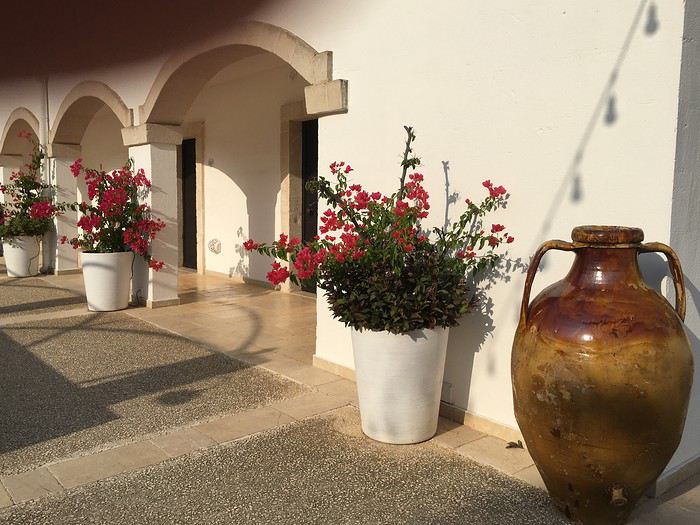
A recurring detail: this happened constantly during our travels. We’d installed our own GPS, fully updated... In recent years, many dirt roads have become drivable, and lots of hotels and hostels have opened in the outskirts of towns. It was extremely rare for our ‘guide’ to recognize the street—let alone the number—we entered. Often, we got by calling the hotel reception: it might seem like a small thing, but it happened so often it became frustrating. In hindsight, it seems like without Google Maps, we’d have been lost!
Anyway, we were beautifully settled, with a terrace overlooking olive groves and the sea in the distance: all was well.
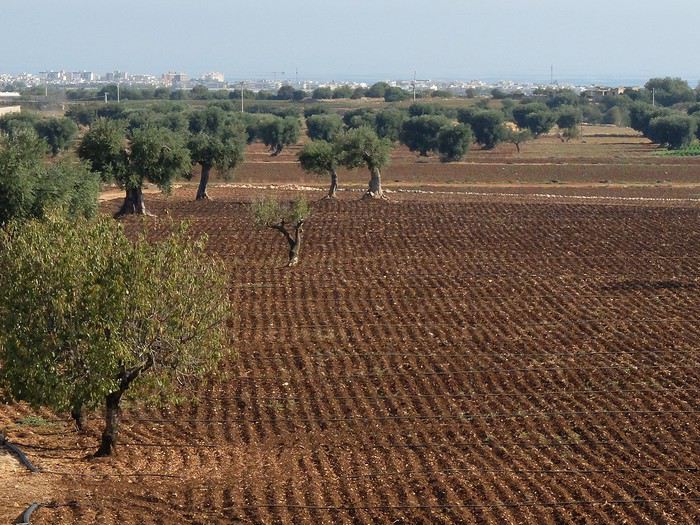
To be continued...
I’m finally getting around to writing about this 20-day trip to southern Italy: we didn’t travel this summer, and luckily, we found beautiful light and dreamy weather there at the end of September.
First, here’s the context of the trip: we’re both "confirmed seniors" but still curious and alert enough to enjoy the itinerary we’d imagined! We wanted a mix of discoveries—culture, cities, and nature—with guaranteed sunshine and the occasional short hike... We’re flying to Naples, round-trip, because the flight times work better for us. We rented a car online, picked it up at the airport (details to come... and it won’t be the highlight of the trip!), and booked our hotels in advance.
A quick overview of the itinerary: leaving Naples on September 15th, early in the morning, we’ll drive straight across the boot of Italy to Bari. After 11 days in Puglia, we’ll head back toward our starting point, taking our time: Matera in Basilicata, Maratea by the sea, and finally Paestum with its incredible temples.
Day 1: Brussels-Naples flight (Brussels Airlines) went smoothly; it landed an hour early, and we were thrilled, thinking we could use that time for a quick visit or two... Everything went well until we left the airport. We took the shuttle to the car rental offices, and at first glance, we realized this wouldn’t be smooth sailing!!! In front of every office (they’re side by side), there were already lines and kids sitting on suitcases—everyone looked exhausted... We resigned ourselves to waiting: nothing moved until tempers flared at the counters, and two people nearly came to blows. Things sped up a little, and after 2 (two...) hours of waiting, we finally got our chariot: a black Fiat Tipo, dirty, with a few dents and scratches that we made sure to note in the contract... but it ran!
Off to Bari, then: no time for sightseeing along the way! From there, we headed straight to our hotel in the countryside near Polignano a Mare.
A recurring detail: this happened constantly during our travels. We’d installed our own GPS, fully updated... In recent years, many dirt roads have become drivable, and lots of hotels and hostels have opened in the outskirts of towns. It was extremely rare for our ‘guide’ to recognize the street—let alone the number—we entered. Often, we got by calling the hotel reception: it might seem like a small thing, but it happened so often it became frustrating. In hindsight, it seems like without Google Maps, we’d have been lost!
Anyway, we were beautifully settled, with a terrace overlooking olive groves and the sea in the distance: all was well.
To be continued...
Currency exchange while traveling: why do some still carry wads of cash?
Hi everyone,
In this age of zero-commission cards and fee-free accounts, I’m curious why some travelers still prefer to set off with a wallet stuffed with bills and exchange money on the spot.
I get it for those whose income comes from undeclared activities, but what about everyone else?
Between the risk of theft, scams at exchange counters, and fees that often end up being higher, I’m really puzzled.
The last time I traveled with a wad of cash was because I had to pay for accommodation in cash only, the local currency was the dollar (easy to exchange at a very low cost), and I was still paying some fees.
I’m still wondering about my next trip to Argentina because the situation there is very specific, but otherwise?
Is it an allergy to modern payment methods?
A budget so tight that an extra 20 € (the fees some local banks charge for withdrawals) on a 2000 € budget would be impossible to manage?
Thanks for shedding some light on this!
In this age of zero-commission cards and fee-free accounts, I’m curious why some travelers still prefer to set off with a wallet stuffed with bills and exchange money on the spot.
I get it for those whose income comes from undeclared activities, but what about everyone else?
Between the risk of theft, scams at exchange counters, and fees that often end up being higher, I’m really puzzled.
The last time I traveled with a wad of cash was because I had to pay for accommodation in cash only, the local currency was the dollar (easy to exchange at a very low cost), and I was still paying some fees.
I’m still wondering about my next trip to Argentina because the situation there is very specific, but otherwise?
Is it an allergy to modern payment methods?
A budget so tight that an extra 20 € (the fees some local banks charge for withdrawals) on a 2000 € budget would be impossible to manage?
Thanks for shedding some light on this!
L'improvisation en voyage, de plus en plus difficile
Avec la multiplication des Expedia/Booking/Agoda etc., la prolifération des téléphones cellulaires et l'explosion du nombre de touristes, je trouve qu'il devient de plus en plus difficile de voyager sans avoir à tout, tout, tout planifier des mois à l'avance.
Quand je partais en voyage, J'avais l'habitude de réserver quelques nuits au lieu d'arrivée pour me remettre du décalage puis y aller au pif par la suite. Mais depuis quelques années, c'est devenu plus compliqué. Une réceptionniste d'hôtel m'a même déjà dit de réserver par Booking pour la nuit même!
Je me demande si nous ne sommes pas en train de perdre notre sens de l'improvisation, le plaisir de découvrir des lieux sans savoir à quoi nous attendre. Est-ce encore possible de partir en voyage sans avoir tout prévu?
Quand je partais en voyage, J'avais l'habitude de réserver quelques nuits au lieu d'arrivée pour me remettre du décalage puis y aller au pif par la suite. Mais depuis quelques années, c'est devenu plus compliqué. Une réceptionniste d'hôtel m'a même déjà dit de réserver par Booking pour la nuit même!
Je me demande si nous ne sommes pas en train de perdre notre sens de l'improvisation, le plaisir de découvrir des lieux sans savoir à quoi nous attendre. Est-ce encore possible de partir en voyage sans avoir tout prévu?
L'Abruzzo, une région qui mérite d'être découverte
Jour1 : dimanche 25 août 2019
Introduction
J'avais pensé appeler ce carnet "l'Abruzzo, une région qui gagne à être connue", mais ce titre est déjà pris par un carnet sur la région voisine "les Marches" (le Marche) rédigé il y a quelques années ; ce sera donc "l'Abruzzo, une région qui mérite d'être découverte".
L'Abruzzo, nous n'en entendons parler que quand un malheur (tremblement de terre) est arrivé. C'est une région d'Italie centrale avec une façade sur l'Adriatique, la région où l'Apennin est le plus haut.
J'y ai voyagé du 25 août 2019 (arrivée dans la région) au 28 septembre 2019 (départ de la région) en caravane.
Pour les personnes tentées par le voyage de septembre en camping, il y a une seule précaution à prendre ; les campings commencent à fermer dès les premiers jours de septembre, peu sont ouverts après le 15 Septembre. Renseignez-vous sur les dates de fermeture de façon à bien savoir ce qui sera ouvert la seconde quinzaine du mois.
Je n'établis pas de programme journalier à l'avance ; je prépare le voyage à l'aide d'internet en constituant une liste de points d'intérêt ; sur place, je vais dans les offices de tourisme (IAT : Informazioni e Accoglienza Turistiche), en général assez bien signalés en Italie, pour me documenter. Je décide le soir le programme du lendemain (forme d'improvisation).
Première demi-journée Je suis la "via adriatica" (SS16) qui longe toute la côte et je vais aller jusqu'à Pineto (20 kms au nord de Pescara) au camping "Pineto beach" (un nom pas très italien). J'arrive juste à temps pour m'installer avant l'heure de la sieste, moment de la journée pendant lequel il est interdit de s'installer sur les emplacements. Ayant beaucoup roulé, ce sera une demi-journée de récupération. Je vais trouver la piscine,

tester la plage.
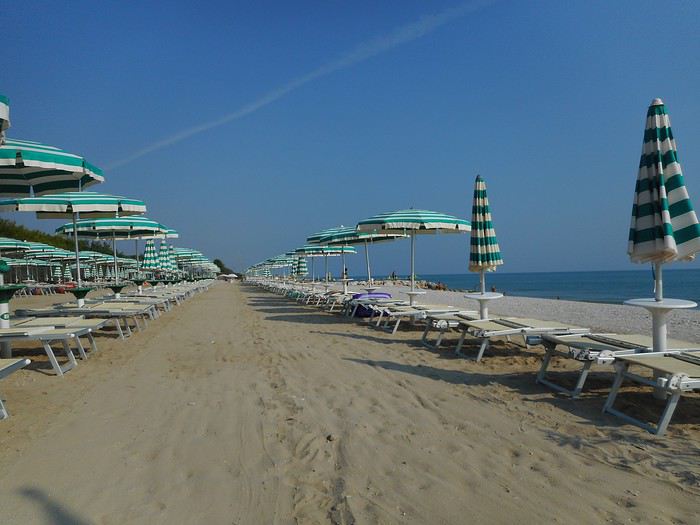
Puis je vais aller en vélo jusqu'au pays (Pineto) pour une promenade (plage : "lidi", "Via D'Annunzio" : la rue commerçante) et des courses ; ce sera tout pour la journée. Je posterai un message par jour de voyage ; j'utiliserai beaucoup la fonction "modifier" pour ne pas perdre, pour compléter et pour corriger ce que j'aurai fait. Les photos seront celles prises le jour du récit ; je tricherai pour quelques unes (endroits où je suis allé plusieurs fois, meilleures conditions). Exemple : les 2 photos ci-dessus prises un matin quelques jours plus tard.
Première demi-journée Je suis la "via adriatica" (SS16) qui longe toute la côte et je vais aller jusqu'à Pineto (20 kms au nord de Pescara) au camping "Pineto beach" (un nom pas très italien). J'arrive juste à temps pour m'installer avant l'heure de la sieste, moment de la journée pendant lequel il est interdit de s'installer sur les emplacements. Ayant beaucoup roulé, ce sera une demi-journée de récupération. Je vais trouver la piscine,
tester la plage.
Puis je vais aller en vélo jusqu'au pays (Pineto) pour une promenade (plage : "lidi", "Via D'Annunzio" : la rue commerçante) et des courses ; ce sera tout pour la journée. Je posterai un message par jour de voyage ; j'utiliserai beaucoup la fonction "modifier" pour ne pas perdre, pour compléter et pour corriger ce que j'aurai fait. Les photos seront celles prises le jour du récit ; je tricherai pour quelques unes (endroits où je suis allé plusieurs fois, meilleures conditions). Exemple : les 2 photos ci-dessus prises un matin quelques jours plus tard.
Un train de nuit Vienne-Bruxelles dès janvier 2020
La société de chemins de fer autrichienne ÖBB prévoit de mettre en service un train de nuit entre Bruxelles et Vienne dès le mois de janvier.
'ÖBB a posté samedi sur Twitter une photo de l'Atomium, sans donner davantage de détails sur la fréquence, l'itinéraire précis et les tarifs de cette nouvelle ligne.
https://www.lalibre.be/economie/entreprises-startup/un-train-de-nuit-entre-bruxelles-et-vienne-des-janvier-5d998c0dd8ad5841fc4f1075
La concurrence sera rude : Lauda Air propose un Vienne-Charleroi en1h50 de vol (de jour) à partir de 9,99 €.
La concurrence sera rude : Lauda Air propose un Vienne-Charleroi en1h50 de vol (de jour) à partir de 9,99 €.
Société et politique en Catalogne et dans le reste de l'état espagnol (discussion / débat)
Bonjour.
Ceci est en quelque sorte "la suite" de ce topic ->
voyageforum.com/...-catalogne-d8240869/
Comme le dernier message du topic antérieur, signé "l'équipe VoyageForum", nous propose de poster un nouveau topic sur le même sujet, je me permets donc d'inaugurer cette nouvelle discussion, une semaine avant des élections tout à fait inédites en Espagne, qui sûrement suciteront commentaires et questions.
Ce nouveau sujet n'est plus exclusivement celui de la Catalogne, mais traitera plus généralement d'aspects politiques et sociaux de l'Espagne actuelle. On pourra parler de crise économique, de mémoire historique et de la polémique autour de la sépulture de Franco, de l'essor de l'extrême-droite, des déboires de Podemos, des mouvements féministes, des nationalismes périphériques, etc...
Il s'agit à la fois d'une discussion et d'un débat, c'est à dire que l'on peut -évidemment- donner son opinion personnelle, mais en veillant à ce que le sujet ne tourne pas à la foire d'empoigne (restons courtois, svp🙂) et en songeant que le but de la manoeuvre est avant tout de mieux faire connaître aux lecteurs de ce sujet la société et la politique espagnole actuelle, ses particularités.
Voilà. Pour inaugurer cette nouvelle discussion, voici une petite video, qui date de cette semaine. Il s'agit d'une fête traditionnelle dans un village de la province de Séville, Coripe. Chaque année ce village organise une procession appelée "la trahison de judas": on promène un mannequin à l'effigie d'un personnage jugé odieux par la majorité, et les habitants du village au cours de la procession lynchent le mannequin, lui tirent dessus à la carabine et finissent par le brûler.
Cette année, les habitants de Coripe ont choisi de lyncher Puigdemont, le président catalan exilé en Belgique.
www.youtube.com/watch?v=sFT_IvB0OAA
Ceci est en quelque sorte "la suite" de ce topic ->
voyageforum.com/...-catalogne-d8240869/
Comme le dernier message du topic antérieur, signé "l'équipe VoyageForum", nous propose de poster un nouveau topic sur le même sujet, je me permets donc d'inaugurer cette nouvelle discussion, une semaine avant des élections tout à fait inédites en Espagne, qui sûrement suciteront commentaires et questions.
Ce nouveau sujet n'est plus exclusivement celui de la Catalogne, mais traitera plus généralement d'aspects politiques et sociaux de l'Espagne actuelle. On pourra parler de crise économique, de mémoire historique et de la polémique autour de la sépulture de Franco, de l'essor de l'extrême-droite, des déboires de Podemos, des mouvements féministes, des nationalismes périphériques, etc...
Il s'agit à la fois d'une discussion et d'un débat, c'est à dire que l'on peut -évidemment- donner son opinion personnelle, mais en veillant à ce que le sujet ne tourne pas à la foire d'empoigne (restons courtois, svp🙂) et en songeant que le but de la manoeuvre est avant tout de mieux faire connaître aux lecteurs de ce sujet la société et la politique espagnole actuelle, ses particularités.
Voilà. Pour inaugurer cette nouvelle discussion, voici une petite video, qui date de cette semaine. Il s'agit d'une fête traditionnelle dans un village de la province de Séville, Coripe. Chaque année ce village organise une procession appelée "la trahison de judas": on promène un mannequin à l'effigie d'un personnage jugé odieux par la majorité, et les habitants du village au cours de la procession lynchent le mannequin, lui tirent dessus à la carabine et finissent par le brûler.
Cette année, les habitants de Coripe ont choisi de lyncher Puigdemont, le président catalan exilé en Belgique.
www.youtube.com/watch?v=sFT_IvB0OAA
Brexit et formalités administratives
La date du Brexit approche à grand pas.
L’industrie du tourisme est primordiale pour la Grande Bretagne.
Malheureusement de grandes questions restent sans réponse.
Visa? Les citoyens européens devront ils demander un visa pour un séjour de courte durée , et ce visa sera t’il payant’,
La Grande Bretagne deviendra un pays tiers , ce qui signifie qu’en matières de TVA, douanes nous entrons dans une ère nouvelle. Verrons nous les files d’attente s’allonger pour embarquer dans le, train pour Londres , devrons nous arriver deux heures plus tôt qu’actuellement dans les ports pour embarquer sur le Ferry-boat.
Le système bancaire ? Pourrons nous prendre de l’argent dans les distributeurs de billets?
Nos cartes de débits, pourrons nous payer nos achats, carburants, vêtements etc...
La profession du tourisme va devoir faire face à des tracasseries administratives énormes.
Le, système d’identification des numeros de tva des entreprises anglaises disparaîtra des écrans le lendemain du Brexit. La récupération des créances va être un casse tête.
La, liste des interrogations est longue. Je veux par ce texte de réflexions inciter les voyageurs à poser des questions aux agences de voyages , aux administrations afin que le lendemain du Brexit ne soit pas The Day After lorsqu’ils seront en Grande Bretagne .
Concours Photo du mois de février 2019: "Souriez-moi!"
De retour en France depuis hier, je poste comme promis, le thème du concours de ce mois : SOURIEZ-MOI !
Je ne pense pas que ce sujet ait déjà été proposé, mais j' avoue ne pas avoir regardé la totalité des dix dernières années.
Par ces temps moroses, je voudrais voir des photos de vrais sourires, pas des sourires posés et contraints, ni des sourires volés. Je voudrais des visages qui expriment un échange sincère avec le photographe, des sourires avec la bouche mais aussi avec les yeux !
Tous les âges sont possibles, tous les pays aussi.
Vos photos ne seront pas nécessairement limitées aux visages, mais les sourires doivent être les points forts qui accrochent le spectateur.
Date limite pour poster vos photos : jeudi 22, Votes du 23 au 26 février. Résultats le 27 février.
Plongez dans vos disques durs, vous avez sûrement des sourires en réserve !
Date limite pour poster vos photos : jeudi 22, Votes du 23 au 26 février. Résultats le 27 février.
Plongez dans vos disques durs, vous avez sûrement des sourires en réserve !
Retour en Russie pour un mois (Moscou, Saint-Pétersbourg, Rostov-le-Grand) et Tallinn - Helsinki
Me voilà revenue d’un voyage d’un mois pile. 24 jours en Russie et une semaine entre Tallinn et Helsinki. Des pays somme toute plutôt différents !
La visite de Tallinn et d’Helsinki n’était pas au programme j’ai donc découvert ces villes dans un contexte un peu particulier ! En effet, comme une idiote je me suis trompée dans la date de mon vol retour ! Les billets retour-simple Air France étant hors de prix (290 € chacun!), nous avons décidé de reprendre un vol nettement moins onéreux depuis Helsinki avec la compagnie Norwegian (70 € !) ; et d’en profiter pour découvrir également Tallinn.
Plutôt que de mettre l’argent dans un simple vol retour, on pouvait visiter deux villes pour à peine plus cher au global, autant en profiter ! Puis rester à Tallinn revenait bien moins cher qu’à Helsinki…
Bien sûr je raconterai tout ça en détail !
Pour en rajouter une couche avec mes boulettes, le jour du retour mon liquide démaquillant s’est renversé dans ma valise cabine (c’est çà d’être coquette, oups!) signant ainsi l’arrêt de mort de mon ordi… Heureusement j'ai pu m'en procurer un autre, je vais donc pouvoir rédiger tranquillement ce carnet 😛
Ce premier post concernera plutôt mes impressions et quelques aspects pratiques et un résumé de ce que nous avons vu. Le reste viendra après...
En attendant, vous pouvez déjà consulter mes précédents articles sur la Russie, sur mon blog, ou bien mon premier carnet de voyage.
www.lasourisglobe-trotteuse.fr/voyage-russie/
voyageforum.com/...ost=8256849;#8256849
Pour ceux intéressés uniquement par Tallinn et Helsinki, ça commence là : voyageforum.com/v.f?post=9243964;a=9243964
AVANT LE DÉPART Ceci étant un second séjour en Russie, à plus ou moins un an d’intervalle de date à date (ce qui m’a valu de confondre justement) nous étions rôdés :- un AR Air France à 213€ chacun pour un tarif sans bagage en soute, soit moins cher que l’an dernier (305), tant mieux !- un voucher obtenu via Russie Autrement (gratuit pour les blogueurs).- attestation d’assurance via nos cartes bancaires, demandées en ligne. - le tout déposé chez Action Visas à Paris.
Je ne vais pas entrer dans les détails j’explique toute la procédure sur mon blog :
www.lasourisglobe-trotteuse.fr/...isa-tourisme-...
LE PARCOURS Estimant ne pas avoir vu tout ce qui nous intéressait à Moscou et Saint-Pétersbourg, nous y avons repassé respectivement 9 et 11 jours (on aime prendre notre temps…), mais étant désireux de découvrir autre chose nous avons passé deux jours à Rostov-le-Grand.Le séjour s’est découpé ainsi :
- Arrivée à Saint-Pétersbourg, 3 jours pleins, puis départ pour Moscou en train rapide Sapsan (4h). 2 jours pleins à Moscou puis 2 jours et demi à Rostov (deux nuits), AR Moscou-Rostov en train express (2h30) .
De nouveau une semaine pleine à Moscou, trajet en Sapsan puis 8 jours à Saint-Pétersbourg, dont une journée en plus du coup… (qui compte pour moitié)
En supplément : train Allegro pour Helsinki et bateau pour Tallinn dans la foulée. 3 jours pleins à Tallinn, bateau pour Helsinki et deux nuits dans la capitale finlandaise (un jour et demi sur place)
HÉBERGEMENTS Comme souvent nous sommes passés par le site Airbnb et n’avons pas été déçus.
- Joli et assez grand deux pièces à Saint-Pétersbourg pour 24€/nuit, au calme sur cour, tout équipé et avec une hôte très sympathique, arrangeante et aidante. Une de mes meilleures expériences à ce jour… situé rue Rubinstein, rue animée avec des bars et des restos, juste après la Fontanka et à deux pas de Nevski donc plutôt pratique, et à deux pas du métro. - T1 «soviétique» à Moscou, un peu resté dans son jus mais confortable, au calme et très bien placé, à côté du métro Paveletskaya sur les lignes 2 et 5 (lignes très pratiques) à 2 km au sud du Kremlin et 1 km de la galerie Tretiakov. 35€/nuit pour les 3 premières nuits puis 25 quand nous y sommes retournés pour une semaine. Hôte arrangeant, pendant notre escapade de deux nuits à Rostov nous avons pu laisser un bagage, et avons pu partir à 15h30 le jour du départ.
- Petit hôtel (Lion hotel) à Rostov, 20€/nuit pour une chambre double correcte et refaite à neuf avec salle d’eau, en plein centre face au Kremlin, petit déjeuner inclus. Bon cela confirme que je préfère louer des apparts mais bon rapport qualité/prix.
- Première nuit réservée à l’arrache à Tallinn dans un hôtel pas cher près du port et pas trop loin de la vieille ville. Pas trop eu le choix… 36€/nuit pour une petite chambre avec deux lits simples et une salle d’eau, mais surtout un petit dej avec buffet à volonté donc ça c’était sympa ! Nous sommes de toute façon arrivés à 1h du mat donc peu nous importait.
- 3 nuits dans un petit studio sympa à 15 mn à pied de la vieille ville pour 33€/nuit je crois. Bon accueil et bon plan de notre hôte d’origine italienne, juste un bémol sur le bruit de la route et les rideaux quasi inutiles. Réservation à l’arrache la veille donc bon…
- Joli petit deux pièces à Helsinki, sur cour, bien placé à deux pas du bord de mer et 10 mn du centre. Hôte très sympa. 116€ pour deux nuits tout compris (frais Airbnb et frais de ménage), le meilleur rapport qualité/prix quand on a cherché et bon prix pour Helsinki où les hébergements sont chers.
TRANSPORTS SUR PLACE - Environ 40€ de Sapsan chacun pour un AR entre Saint-Pétersbourg et Moscou, en classe éco.
- 20€ par personne pour l’AR en train express Moscou-Rostov. Tout fut acheté sur le site officiel des chemins de fer russes environ un mois avant le départ.
- 70€ chacun pour le trajet simple en train Allegro entre Saint-Pétersbourg et Helsinki, mais les billets furent achetés la veille donc forcément plus chers… Ce fut une expérience intéressante et nous comptions la vivre un jour de toute façon ! Contrôle des passeports à bord !
Article détaillé sur le train Allegro ici :
https://www.lasourisglobe-trotteuse.fr/train-allegro-helsinki-a-saint-petersbourg-prix-conseils-photos/
- 70€ chacun pour l’AR en bateau entre Helsinki et Tallinn avec la compagnie Tallink. Traversée en ferry agréable. Billets achetés la veille mais les prix n’ont pas l’air de trop bouger, par contre c’est plus cher le week-end, nous avons pu éviter.
- Pour la fin, 70€ chacun de billets Norwegian Helsinki-Paris, achetés une semaine avant.
BUDGET SUR PLACE Nous avons dépensé environ 1400€ sur place pendant ce mois de vadrouille. Ceci inclut surtout les repas, quasi tous pris à l'extérieur (sauf les déjeuners à Moscou et Helsinki), les transports locaux (métro tous les jours à Moscou, quelques fois le bus à Saint-Pétersbourg) et bien sûr les visites, surtout des musées et des palais. Honnêtement, pas de folies ! Plus quelques bricoles à ramener, des petites choses pas très chères (un sac en toile, un calendrier, des magnets, une boite faussement laquée...)
Globalement nous avons profité du rouble assez faible, avec un taux moyen de 78 roubles pour 1€, contre 68 l'an dernier, donc une petite augmentation du pouvoir d'achat.
NOURRITURE Le plus gros du budget donc ! Nous avons alterné avec quelques cafétérias vraiment pas chères à Saint-Pétersbourg (il y en a partout), la chaine très typique de crêpes Teremok (ils font aussi les soupes, salades et pelmenis) surtout pour le déjeuner, et quelques restos moyen de gamme certains soirs. Surtout des restaurants géorgiens, une des cuisine préférée des Russes ! A Moscou et Saint-Pétersbourg nous avons diné pour environ 20-25€ à deux.
A Rostov ce fut différent, nous avons enfin trouvé des restaurants de cuisine russe et les écarts de prix avec les deux "capitales" sont flagrants ! A titre d'exemple nous avons fait un très bon repas avec deux plats parmi les plus chers, deux boissons, un gros desserts à partager, pour... 8€ à deux ! Le retour à Moscou fut douloureux, hum. Il semble un peu compliqué de trouver des restos de cuisine russe dans les deux principales villes, qui ne soient pas à destination des touristes, hélas.
A Tallinn nous avons été étonnés de voir des prix très proches de ceux de la France (pas le cas du salaire moyen...) voire proches de ceux de Paris dans la vieille ville ! Nous avons tout de même réussi à trouver des bons plans, donc au final pas trop de dépenses (cantine de centre commercial à 5€ le plat, crêpes géantes dans le centre, burgers, nouilles chinoises à 5€)
Évidemment ce fut un peu moins facile à Helsinki mais on s'est débrouillé (buffet à volonté boissons incluses pour 13€ chacun, pizzas 10-12€ le dernier soir)
RÉSUMÉ DES VISITES Ne s’agissant pas d’un premier séjour nous avons pu approfondir nos connaissances des deux villes, donc peu d’ « incontournables » cette fois, du moins à Moscou. Nous nous sommes de nouveau baladés à Saint-Pétersbourg, au soleil (nous n’avions pas vu toute la ville au soleil l’année précédente) et avons complété avec les musées et palais. Séjour très « culturel » donc, alors qu’à Moscou nous avons privilégié les parcs et les monastères (entre autres).
En gros à Saint-Pétersbourg nous avons vu les palais Youssoupov (le plus beau de la ville selon nous), Menchikov (le plus ancien), Stroganov, le palais de marbre et le château des Ingénieurs.
En musées nous avons de nouveau arpenté l'Ermitage ainsi que le bâtiment de l'Etat major en face, où se trouvent les toiles impressionnistes et "avant-gardistes" (Picasso, Gauguin, Matisse...) et avons complété avec le musée Russe, grand musée de peinture, sculpture, et artisanat russe, et avons découvert l'étonnante Kunstkamera, "cabinet des curiosités" de Pierre le Grand.

A Moscou, nous avons donc été voir:
- Le domaine de Kolomenskoye, listé au patrimoine mondial de l'UNESCO et son étonnant palais de bois reconstruit (lieu de naissance de Pierre le Grand) avec ses églises anciennes et bâtiments en bois
- Le domaine royal de Tsaristyno et son palais
- Le parc Gorki, plus central (une partie)
- L'esplanade du VDNKh (prononcé VDNra) et ses pavillons dédiés aux anciennes républiques soviétiques
- Le Kremlin d'Izmaïlovo et son marché de souvenirs, étrange endroit entre Las Vegas/Disney et un marché aux puces, adapté de l'architecture traditionnelle russe; un brin kitsch mais lieu de sortie des Moscovites, à voir selon moi !
- Les deux galeries Tretiakov, deux musées à voir à Moscou quand on aime l'art !
- Les monastères Donskoï et Novospasky, véritables havres de paix.
- De nouvelles balades dans le centre, le vieil Arbat, autour de la galerie Tretiakov...
- Et bien sûr, de nouvelles visites des stations de métro, on est fan !
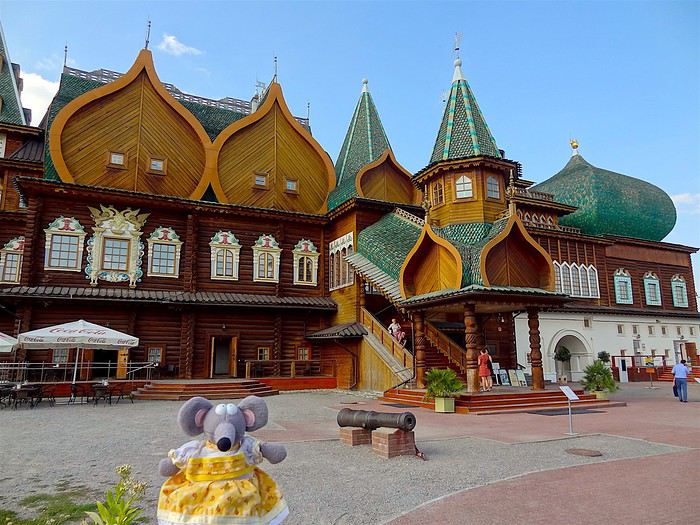
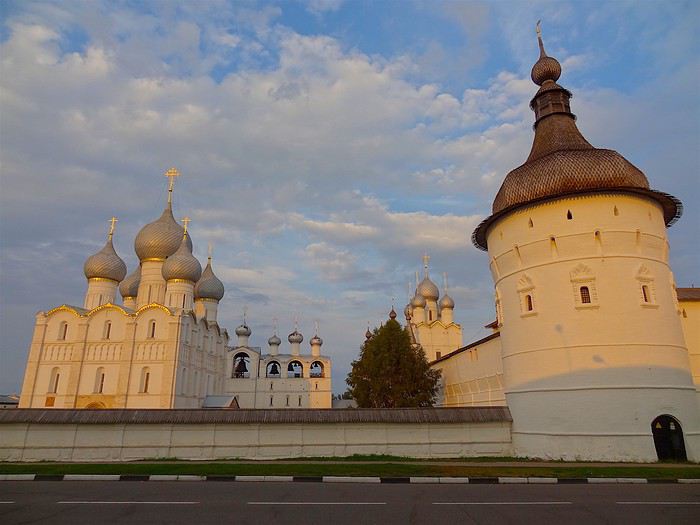
A Rostov nous avons bien sûr visité le très beau Kremlin, principal attraction, ainsi qu'un autre monastère au bord du lac, nous sommes baladés le long du lac et dans différents endroits de la ville, puis avons passé pas mal de temps à tester les spécialités locales 😛 😇
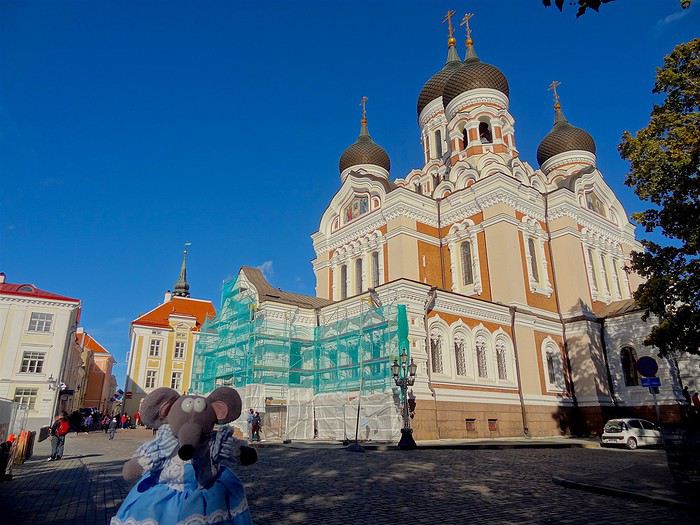
A Tallinn, balades dans la ville close et sa colline, le parc de Kadriorg et ses alentours, le musée d'art estonien KUMU, le bord de mer.
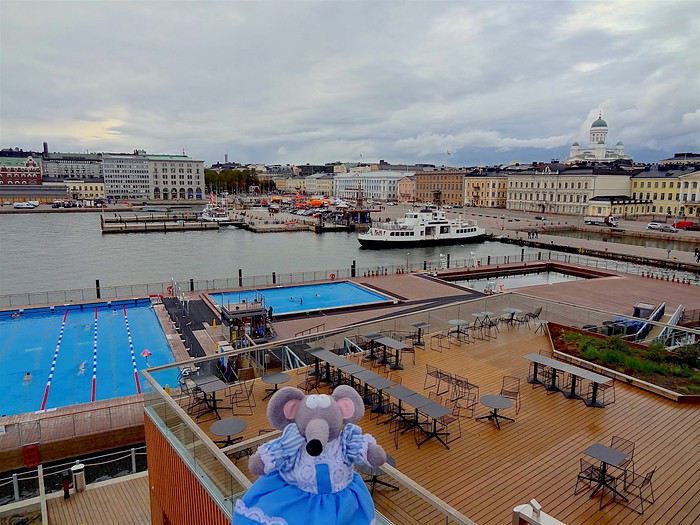
A Helsinki, tour du centre, du port, place du Sénat, balade Art nouveau, bord de mer (en même temps ce fut rapide...)
IMPRESSIONS GLOBALES Bien sur dur de donner une seule impression pour un voyage d'un mois et autant de villes différentes !
Connaissant déjà Moscou et Saint-Pétersbourg pas de grosses surprises, mais alors que l'an dernier j'avais été plutôt mitigée sur Moscou, j'ai beaucoup mieux apprécié mon séjour cette fois-ci ! J'ai mieux aimé ce que j'ai vu, puis nous avons volontairement choisi de privilégier les endroits au calme et au vert, plus supportables que les horribles autoroutes urbaines qui composent la ville.On s'est senti bien dans notre petit appart soviétique, on n'avait pas envie de partir 😛 Toujours le même bémol que l'an dernier : les jolis coins du centre font un peu "Disney" pour nouveaux riches, et l'omniprésence de chaînes de restauration ou salons de thé finit par agacer tant il ne semble y avoir de place pour rien d'autre...
Pour Saint-Pétersbourg, même avis, une très belle ville, pour moi une des plus belles d'Europe, mais au bout d'un moment, envie de m'en évader car TROP TROP polluée... des voitures partout, deux pauvres petites rues piétonnes (oui j'aime les rues piétonnes et je n'aime pas les voitures dans les centres-villes...) mais surtout qui FONCENT et qui PUENT. Essence mal raffinée, normes différentes des nôtres donc les bronches souffrent. On a vu des camionnettes laisser une bonne trainée noire derrière elles 🤪 Mon manteau blanc est vite devenu tout gris (oui je sais c'est idiot d'avoir un manteau blanc en voyage) Je sais que c'est comme ça dans beaucoup de pays, mais je ne connais que l'Europe (et Marrakech) alors au bout d'un moment j'avais juste hâte de me mettre au vert ! Car justement, contrairement à Moscou on ne peut pas dire que ça grouille sous les grands parcs... Oui je parais sévère mais à part ça pas de défauts 😛
Puis la ville est plus "sympa" que Moscou car plus de petits restos, bars, plus d'endroits où aller pour les petits budgets, etc
Nous avons apprécié notre petite escapade à Rostov, LA découverte du séjour ! Petite ville typique russe, très différentes des deux capitales, un peu décrépite, tranquille, on voit la différence de niveau de vie aussi...
Pour la dernière partie du séjour, petite déception pour Tallinn, non pas pour son aspect esthétique mais plutôt pour son aspect trop touristique (et nous étions toute fin septembre), la très jolie vieille ville nous a fait l'effet d'un Disney à touristes... en revanche nous avons bien aimé le KUMU. Bon 3 jours c'est pas énorme, et nous n'y étions pas dans les bonnes circonstances (stressés, fatigués, et... frigorifiés !) En revanche très contents de voir un centre historique piéton ! Après Saint-Pétersbourg ça faisait du bien justement !
Pour finir, on n'attendait pas grand-chose d'Helsinki, au final elle nous a bien plu. Là encore, le calme, les rues piétonnes ou peu fréquentées par les voitures, la verdure, furent les bienvenus ! Cela nous a paru plus authentique que Tallinn et on a trouvé l'accueil BEAUCOUP plus sympathique que dans cette dernière. Car oui à Tallinn ce fut un autre point négatif (pas partout ouf).
Et pour finir sur l’accueil en Russie, nous n'avons pas à nous plaindre à part pour quelques gardiennes de musées, de véritables caricatures 😏
Voilà pour le petit topo avant-carnet, n'hésitez pas si vous avez déjà des questions 😉
Suite très prochainement !
La visite de Tallinn et d’Helsinki n’était pas au programme j’ai donc découvert ces villes dans un contexte un peu particulier ! En effet, comme une idiote je me suis trompée dans la date de mon vol retour ! Les billets retour-simple Air France étant hors de prix (290 € chacun!), nous avons décidé de reprendre un vol nettement moins onéreux depuis Helsinki avec la compagnie Norwegian (70 € !) ; et d’en profiter pour découvrir également Tallinn.
Plutôt que de mettre l’argent dans un simple vol retour, on pouvait visiter deux villes pour à peine plus cher au global, autant en profiter ! Puis rester à Tallinn revenait bien moins cher qu’à Helsinki…
Bien sûr je raconterai tout ça en détail !
Pour en rajouter une couche avec mes boulettes, le jour du retour mon liquide démaquillant s’est renversé dans ma valise cabine (c’est çà d’être coquette, oups!) signant ainsi l’arrêt de mort de mon ordi… Heureusement j'ai pu m'en procurer un autre, je vais donc pouvoir rédiger tranquillement ce carnet 😛
Ce premier post concernera plutôt mes impressions et quelques aspects pratiques et un résumé de ce que nous avons vu. Le reste viendra après...
En attendant, vous pouvez déjà consulter mes précédents articles sur la Russie, sur mon blog, ou bien mon premier carnet de voyage.
www.lasourisglobe-trotteuse.fr/voyage-russie/
voyageforum.com/...ost=8256849;#8256849
Pour ceux intéressés uniquement par Tallinn et Helsinki, ça commence là : voyageforum.com/v.f?post=9243964;a=9243964
AVANT LE DÉPART Ceci étant un second séjour en Russie, à plus ou moins un an d’intervalle de date à date (ce qui m’a valu de confondre justement) nous étions rôdés :- un AR Air France à 213€ chacun pour un tarif sans bagage en soute, soit moins cher que l’an dernier (305), tant mieux !- un voucher obtenu via Russie Autrement (gratuit pour les blogueurs).- attestation d’assurance via nos cartes bancaires, demandées en ligne. - le tout déposé chez Action Visas à Paris.
Je ne vais pas entrer dans les détails j’explique toute la procédure sur mon blog :
www.lasourisglobe-trotteuse.fr/...isa-tourisme-...
LE PARCOURS Estimant ne pas avoir vu tout ce qui nous intéressait à Moscou et Saint-Pétersbourg, nous y avons repassé respectivement 9 et 11 jours (on aime prendre notre temps…), mais étant désireux de découvrir autre chose nous avons passé deux jours à Rostov-le-Grand.Le séjour s’est découpé ainsi :
- Arrivée à Saint-Pétersbourg, 3 jours pleins, puis départ pour Moscou en train rapide Sapsan (4h). 2 jours pleins à Moscou puis 2 jours et demi à Rostov (deux nuits), AR Moscou-Rostov en train express (2h30) .
De nouveau une semaine pleine à Moscou, trajet en Sapsan puis 8 jours à Saint-Pétersbourg, dont une journée en plus du coup… (qui compte pour moitié)
En supplément : train Allegro pour Helsinki et bateau pour Tallinn dans la foulée. 3 jours pleins à Tallinn, bateau pour Helsinki et deux nuits dans la capitale finlandaise (un jour et demi sur place)
HÉBERGEMENTS Comme souvent nous sommes passés par le site Airbnb et n’avons pas été déçus.
- Joli et assez grand deux pièces à Saint-Pétersbourg pour 24€/nuit, au calme sur cour, tout équipé et avec une hôte très sympathique, arrangeante et aidante. Une de mes meilleures expériences à ce jour… situé rue Rubinstein, rue animée avec des bars et des restos, juste après la Fontanka et à deux pas de Nevski donc plutôt pratique, et à deux pas du métro. - T1 «soviétique» à Moscou, un peu resté dans son jus mais confortable, au calme et très bien placé, à côté du métro Paveletskaya sur les lignes 2 et 5 (lignes très pratiques) à 2 km au sud du Kremlin et 1 km de la galerie Tretiakov. 35€/nuit pour les 3 premières nuits puis 25 quand nous y sommes retournés pour une semaine. Hôte arrangeant, pendant notre escapade de deux nuits à Rostov nous avons pu laisser un bagage, et avons pu partir à 15h30 le jour du départ.
- Petit hôtel (Lion hotel) à Rostov, 20€/nuit pour une chambre double correcte et refaite à neuf avec salle d’eau, en plein centre face au Kremlin, petit déjeuner inclus. Bon cela confirme que je préfère louer des apparts mais bon rapport qualité/prix.
- Première nuit réservée à l’arrache à Tallinn dans un hôtel pas cher près du port et pas trop loin de la vieille ville. Pas trop eu le choix… 36€/nuit pour une petite chambre avec deux lits simples et une salle d’eau, mais surtout un petit dej avec buffet à volonté donc ça c’était sympa ! Nous sommes de toute façon arrivés à 1h du mat donc peu nous importait.
- 3 nuits dans un petit studio sympa à 15 mn à pied de la vieille ville pour 33€/nuit je crois. Bon accueil et bon plan de notre hôte d’origine italienne, juste un bémol sur le bruit de la route et les rideaux quasi inutiles. Réservation à l’arrache la veille donc bon…
- Joli petit deux pièces à Helsinki, sur cour, bien placé à deux pas du bord de mer et 10 mn du centre. Hôte très sympa. 116€ pour deux nuits tout compris (frais Airbnb et frais de ménage), le meilleur rapport qualité/prix quand on a cherché et bon prix pour Helsinki où les hébergements sont chers.
TRANSPORTS SUR PLACE - Environ 40€ de Sapsan chacun pour un AR entre Saint-Pétersbourg et Moscou, en classe éco.
- 20€ par personne pour l’AR en train express Moscou-Rostov. Tout fut acheté sur le site officiel des chemins de fer russes environ un mois avant le départ.
- 70€ chacun pour le trajet simple en train Allegro entre Saint-Pétersbourg et Helsinki, mais les billets furent achetés la veille donc forcément plus chers… Ce fut une expérience intéressante et nous comptions la vivre un jour de toute façon ! Contrôle des passeports à bord !
Article détaillé sur le train Allegro ici :
https://www.lasourisglobe-trotteuse.fr/train-allegro-helsinki-a-saint-petersbourg-prix-conseils-photos/
- 70€ chacun pour l’AR en bateau entre Helsinki et Tallinn avec la compagnie Tallink. Traversée en ferry agréable. Billets achetés la veille mais les prix n’ont pas l’air de trop bouger, par contre c’est plus cher le week-end, nous avons pu éviter.
- Pour la fin, 70€ chacun de billets Norwegian Helsinki-Paris, achetés une semaine avant.
BUDGET SUR PLACE Nous avons dépensé environ 1400€ sur place pendant ce mois de vadrouille. Ceci inclut surtout les repas, quasi tous pris à l'extérieur (sauf les déjeuners à Moscou et Helsinki), les transports locaux (métro tous les jours à Moscou, quelques fois le bus à Saint-Pétersbourg) et bien sûr les visites, surtout des musées et des palais. Honnêtement, pas de folies ! Plus quelques bricoles à ramener, des petites choses pas très chères (un sac en toile, un calendrier, des magnets, une boite faussement laquée...)
Globalement nous avons profité du rouble assez faible, avec un taux moyen de 78 roubles pour 1€, contre 68 l'an dernier, donc une petite augmentation du pouvoir d'achat.
NOURRITURE Le plus gros du budget donc ! Nous avons alterné avec quelques cafétérias vraiment pas chères à Saint-Pétersbourg (il y en a partout), la chaine très typique de crêpes Teremok (ils font aussi les soupes, salades et pelmenis) surtout pour le déjeuner, et quelques restos moyen de gamme certains soirs. Surtout des restaurants géorgiens, une des cuisine préférée des Russes ! A Moscou et Saint-Pétersbourg nous avons diné pour environ 20-25€ à deux.
A Rostov ce fut différent, nous avons enfin trouvé des restaurants de cuisine russe et les écarts de prix avec les deux "capitales" sont flagrants ! A titre d'exemple nous avons fait un très bon repas avec deux plats parmi les plus chers, deux boissons, un gros desserts à partager, pour... 8€ à deux ! Le retour à Moscou fut douloureux, hum. Il semble un peu compliqué de trouver des restos de cuisine russe dans les deux principales villes, qui ne soient pas à destination des touristes, hélas.
A Tallinn nous avons été étonnés de voir des prix très proches de ceux de la France (pas le cas du salaire moyen...) voire proches de ceux de Paris dans la vieille ville ! Nous avons tout de même réussi à trouver des bons plans, donc au final pas trop de dépenses (cantine de centre commercial à 5€ le plat, crêpes géantes dans le centre, burgers, nouilles chinoises à 5€)
Évidemment ce fut un peu moins facile à Helsinki mais on s'est débrouillé (buffet à volonté boissons incluses pour 13€ chacun, pizzas 10-12€ le dernier soir)
RÉSUMÉ DES VISITES Ne s’agissant pas d’un premier séjour nous avons pu approfondir nos connaissances des deux villes, donc peu d’ « incontournables » cette fois, du moins à Moscou. Nous nous sommes de nouveau baladés à Saint-Pétersbourg, au soleil (nous n’avions pas vu toute la ville au soleil l’année précédente) et avons complété avec les musées et palais. Séjour très « culturel » donc, alors qu’à Moscou nous avons privilégié les parcs et les monastères (entre autres).
En gros à Saint-Pétersbourg nous avons vu les palais Youssoupov (le plus beau de la ville selon nous), Menchikov (le plus ancien), Stroganov, le palais de marbre et le château des Ingénieurs.
En musées nous avons de nouveau arpenté l'Ermitage ainsi que le bâtiment de l'Etat major en face, où se trouvent les toiles impressionnistes et "avant-gardistes" (Picasso, Gauguin, Matisse...) et avons complété avec le musée Russe, grand musée de peinture, sculpture, et artisanat russe, et avons découvert l'étonnante Kunstkamera, "cabinet des curiosités" de Pierre le Grand.
A Moscou, nous avons donc été voir:
- Le domaine de Kolomenskoye, listé au patrimoine mondial de l'UNESCO et son étonnant palais de bois reconstruit (lieu de naissance de Pierre le Grand) avec ses églises anciennes et bâtiments en bois
- Le domaine royal de Tsaristyno et son palais
- Le parc Gorki, plus central (une partie)
- L'esplanade du VDNKh (prononcé VDNra) et ses pavillons dédiés aux anciennes républiques soviétiques
- Le Kremlin d'Izmaïlovo et son marché de souvenirs, étrange endroit entre Las Vegas/Disney et un marché aux puces, adapté de l'architecture traditionnelle russe; un brin kitsch mais lieu de sortie des Moscovites, à voir selon moi !
- Les deux galeries Tretiakov, deux musées à voir à Moscou quand on aime l'art !
- Les monastères Donskoï et Novospasky, véritables havres de paix.
- De nouvelles balades dans le centre, le vieil Arbat, autour de la galerie Tretiakov...
- Et bien sûr, de nouvelles visites des stations de métro, on est fan !
A Rostov nous avons bien sûr visité le très beau Kremlin, principal attraction, ainsi qu'un autre monastère au bord du lac, nous sommes baladés le long du lac et dans différents endroits de la ville, puis avons passé pas mal de temps à tester les spécialités locales 😛 😇
A Tallinn, balades dans la ville close et sa colline, le parc de Kadriorg et ses alentours, le musée d'art estonien KUMU, le bord de mer.
A Helsinki, tour du centre, du port, place du Sénat, balade Art nouveau, bord de mer (en même temps ce fut rapide...)
IMPRESSIONS GLOBALES Bien sur dur de donner une seule impression pour un voyage d'un mois et autant de villes différentes !
Connaissant déjà Moscou et Saint-Pétersbourg pas de grosses surprises, mais alors que l'an dernier j'avais été plutôt mitigée sur Moscou, j'ai beaucoup mieux apprécié mon séjour cette fois-ci ! J'ai mieux aimé ce que j'ai vu, puis nous avons volontairement choisi de privilégier les endroits au calme et au vert, plus supportables que les horribles autoroutes urbaines qui composent la ville.On s'est senti bien dans notre petit appart soviétique, on n'avait pas envie de partir 😛 Toujours le même bémol que l'an dernier : les jolis coins du centre font un peu "Disney" pour nouveaux riches, et l'omniprésence de chaînes de restauration ou salons de thé finit par agacer tant il ne semble y avoir de place pour rien d'autre...
Pour Saint-Pétersbourg, même avis, une très belle ville, pour moi une des plus belles d'Europe, mais au bout d'un moment, envie de m'en évader car TROP TROP polluée... des voitures partout, deux pauvres petites rues piétonnes (oui j'aime les rues piétonnes et je n'aime pas les voitures dans les centres-villes...) mais surtout qui FONCENT et qui PUENT. Essence mal raffinée, normes différentes des nôtres donc les bronches souffrent. On a vu des camionnettes laisser une bonne trainée noire derrière elles 🤪 Mon manteau blanc est vite devenu tout gris (oui je sais c'est idiot d'avoir un manteau blanc en voyage) Je sais que c'est comme ça dans beaucoup de pays, mais je ne connais que l'Europe (et Marrakech) alors au bout d'un moment j'avais juste hâte de me mettre au vert ! Car justement, contrairement à Moscou on ne peut pas dire que ça grouille sous les grands parcs... Oui je parais sévère mais à part ça pas de défauts 😛
Puis la ville est plus "sympa" que Moscou car plus de petits restos, bars, plus d'endroits où aller pour les petits budgets, etc
Nous avons apprécié notre petite escapade à Rostov, LA découverte du séjour ! Petite ville typique russe, très différentes des deux capitales, un peu décrépite, tranquille, on voit la différence de niveau de vie aussi...
Pour la dernière partie du séjour, petite déception pour Tallinn, non pas pour son aspect esthétique mais plutôt pour son aspect trop touristique (et nous étions toute fin septembre), la très jolie vieille ville nous a fait l'effet d'un Disney à touristes... en revanche nous avons bien aimé le KUMU. Bon 3 jours c'est pas énorme, et nous n'y étions pas dans les bonnes circonstances (stressés, fatigués, et... frigorifiés !) En revanche très contents de voir un centre historique piéton ! Après Saint-Pétersbourg ça faisait du bien justement !
Pour finir, on n'attendait pas grand-chose d'Helsinki, au final elle nous a bien plu. Là encore, le calme, les rues piétonnes ou peu fréquentées par les voitures, la verdure, furent les bienvenus ! Cela nous a paru plus authentique que Tallinn et on a trouvé l'accueil BEAUCOUP plus sympathique que dans cette dernière. Car oui à Tallinn ce fut un autre point négatif (pas partout ouf).
Et pour finir sur l’accueil en Russie, nous n'avons pas à nous plaindre à part pour quelques gardiennes de musées, de véritables caricatures 😏
Voilà pour le petit topo avant-carnet, n'hésitez pas si vous avez déjà des questions 😉
Suite très prochainement !
Kayaking in Greenland - Disko Bay: Circumnavigation of Arve Princess Island
After two rather rainy kayaking experiences in Alaska at the end of summer in recent years, we chose a slightly drier destination for this late August 2018: the west coast of Greenland. The temperature will certainly be a bit colder, especially at this time of year, but we’re betting on a beautiful end to the season. According to temperature charts, it should be around 5 to 10°C with a few night frosts. The tundra will already have its autumn colors, and by the end of the trip, we might be lucky enough to see the northern lights when the nights get darker.
We’re setting off as a group of three in two inflatable double-seater kayaks (Gumotex) brought from France. The plan is to spend two weeks circumnavigating Arve Princess Island, located north of Ilulissat in Disko Bay, with a possible boat drop-off at the southern tip of the island.
This seems like a fairly classic route in the area—we found several descriptions online (thanks to the authors). With their help and Google Earth, we identified all potential campsites and entered their coordinates into a GPS. The western part of the island, facing the bay, seems ideal for whale watching, while the more rugged eastern side offers access to several glacial walls. We’re somewhat familiar with the area from two winter expeditions on skis and pulkas.
Plus, the commitment is limited due to the island’s proximity to several small villages, including Qeqertaq, Oqaatsut, and even Ilulissat. In fact, we saw fishing boats almost every day. The distance suits us well: 200 kilometers in 16 full days on site, which should leave some leeway in case of bad weather or for hiking.
We booked our flights in June with Air Greenland to Ilulissat for the last week of August and the first week of September. On both the outbound and return trips, we stayed overnight in Copenhagen. The France-Copenhagen flight was with Air France.
We were allowed 3 x 20 kg in the hold. Each kayak with its accessories fits into a 20 kg bag; the last hold bag is for shared gear: tent, stoves, dry bags… We only brought 1.5 kg of semolina for food. In the end, we had 61 kg of gear, and no excess baggage was charged.
Individual gear (clothes and sleeping bags…) was distributed in the cabin luggage.
For the boat transfer, we contacted an agency: Blue Jay, which gave us a number to call upon arrival.
Day 0: Wednesday, August 22 Departure day. After work, I drove from Gap to Marseille’s Marignane Airport for the first leg of the trip to Copenhagen. I enjoyed the rather mild local temperatures: 35°C in the shade. After a layover in Paris, I arrived at the Copenhagen hotel, located two train stops from the airport, where my companions were already settled. No issues—everyone was on time with their luggage.
Day 1 The flight to Greenland was at 9 AM. We had a layover in Kangerlussuaq, where we changed planes, then stopped in Aasiaat before reaching Ilulissat Airport at 3 PM under beautiful sunshine.
We called Blue Jay for the boat transfer: they could take us to the island as early as 6 PM; otherwise, we’d have to wait until the next day. That left us 3 hours to prepare our gear and, most importantly, do our shopping for the two-week trip—it seemed tight, but we gave it a shot.
A quick taxi ride took us to Pisiffik, where we easily found everything we needed: bread, butter, cheese, cold cuts, rice, pasta, jam, muesli… There was no C fuel or methylated spirits for the stoves, but this time we knew the trick: at Stark, a bit uphill from the town, we found the precious liquids. Two hours later, we filled our dry bags and containers with our purchases, and by 5:30 PM, we met Klaus, the Blue Jay manager, directly at the port.
The vacation seemed to truly begin as we sped by boat through the icebergs toward Arve Princess Island. Forty-five minutes later, we spotted a beach lined with rocks where Klaus dropped us off quickly (he had another transfer to make right after).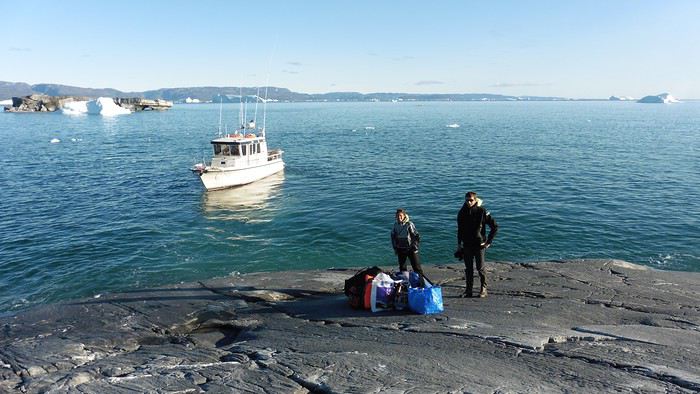
Here we were on the island, in the middle of nowhere, with all our luggage and food to organize, the tent to set up, and the kayaks to inflate—just 10 hours after leaving the Copenhagen hotel. We got to work, bothered by the flies. Despite our head nets, it was barely tolerable—there were so many of them. They swarmed by the dozens into every bag we opened. It was quite mild: 10°C.
Everything was ready by evening, and we were very happy to have completed all these transfers (planes and boat in a single day) as we slipped into our sleeping bags.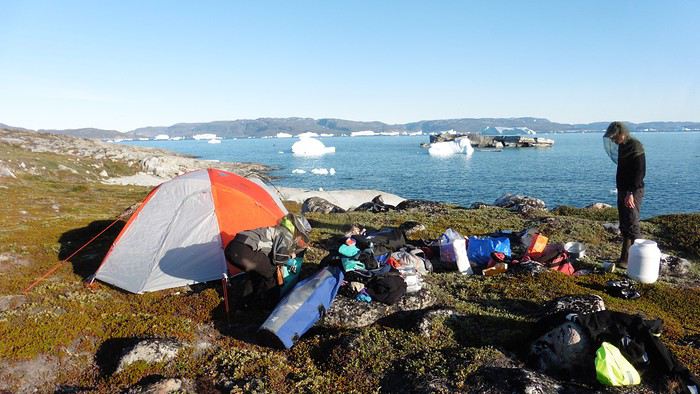
During the night, the wind picked up, and we went out several times to check the tent and kayak anchors. We noticed how bright it was—it was still quite twilight even at 1 AM.
Day 2 5:30 AM wake-up—the south wind was still strong, but since we were heading north, we decided to give it a try anyway.
This was also the moment we loaded the kayaks: since there were only three of us for two double-seater kayaks, we filled the hatch of one kayak, which allowed us to fit all our food. It would have been very difficult if there had been four of us for two kayaks.
Finally, we set off north along the western coast of the island. The conditions were far from ideal—the sea was rough, and the kayaks had a lot of wind resistance. But the main problem was the spray skirt: the gear on deck weighed it down, and the skirt kept coming off… We’d have to deal with it. Barely underway, and whales were already breaking the surface—it was our first time seeing them, and we were very impressed. Too bad the wind didn’t allow for longer contemplation; stopping paddling was impossible with such strong gusts.
We passed a few headlands and even considered stopping due to the conditions. To find some semblance of shelter, we had to hug the coast closely without cutting across the numerous bays, which significantly lengthened the journey. But as the morning went on, the wind died down, and the sea calmed. We spotted several whales and our first seals. It was almost pleasant during the picnic break. By late afternoon, we reached Kangerup Sarqâ Bay, where we had identified a great campsite with a very large beach and a river. But the wind had shifted—it was now coming from the north, making the last hour difficult due to fatigue and headwinds.
The campsite was ideal and beautiful, facing numerous icebergs grounded in the bay.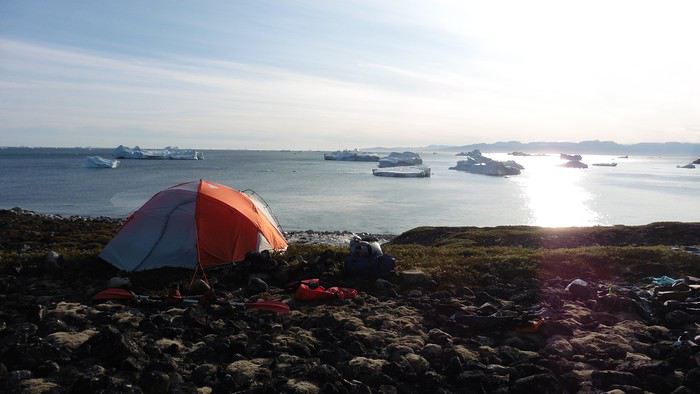
The GPS alerted us to another major drawback of inflatable kayaks: their slowness. It took us 7.5 hours of actual paddling (excluding breaks) to cover 28 km, averaging 3.7 km/h—somewhat disappointing. But we knew this before leaving, and once again, we’d have to make do!
Day 3 Surprise: at 6 AM wake-up, it was raining, foggy, with a south wind, and the sea was choppy even in the bay. It seemed wise to skip paddling, even though stopping on the second day was tough on morale. We went back to sleep, especially since the travel fatigue and the harsh conditions of the previous day had taken their toll.
At 11 AM, the navigation conditions weren’t any better—at the ends of the bay, we saw huge waves crashing onto the rocks, and giving up for the day became obvious. However, the rain had stopped, so we set off for a hike along the large lake bordering the bay. The wind hadn’t let up, and it was quite cold.
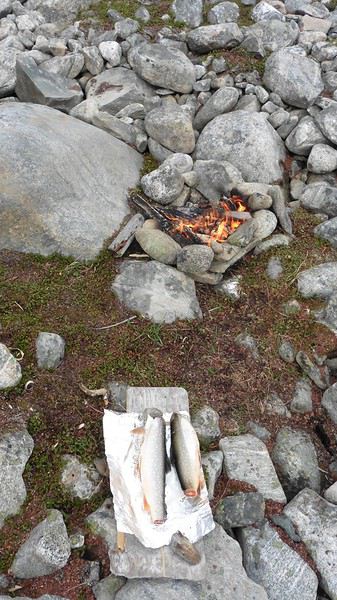
The tundra was starting to take on its autumn colors, and the contrast between the white lichens and the red vegetation was stunning. At the lake, we took out the fishing rods and quickly caught two beautiful Arctic char over 50 cm long.
As the afternoon wore on, the sun seemed closer. Along the beach, we gathered driftwood (mostly old planks) to cook our catch in foil over a fire. Eating our own food in such a beautiful place next to a good fire was comforting after the day’s setback.
In the middle of the night, an Arctic fox entered the tent’s rear awning. It seemed barely intimidated when we shooed it away with loud shouts and then with stones.
Day 4 6:15 AM wake-up—3°C. We were on the water by 8 AM. The wind had dropped significantly, but the sea was shrouded in fog, and it was very cold in these damp conditions.
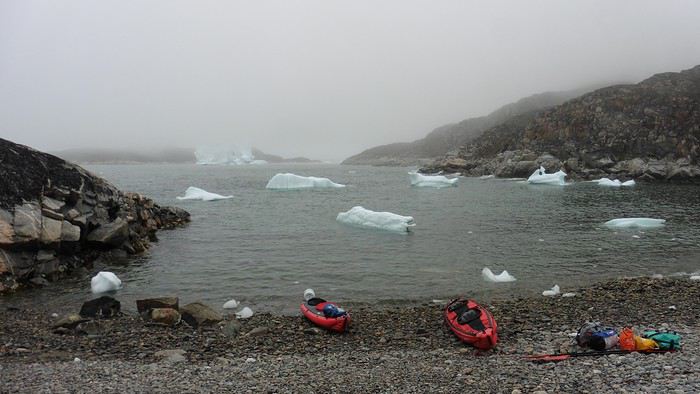
We passed the bay’s headland, Kangea, and headed toward the abandoned village of Agpat. The atmosphere was very austere—we hugged black rocks in fog that limited visibility to 50 meters, revealing large icebergs as we went.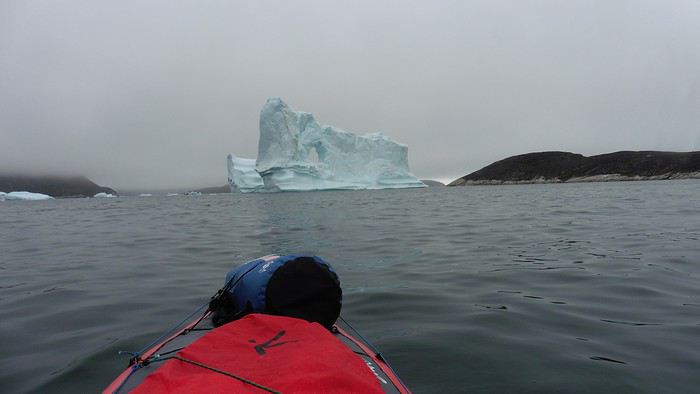
Suddenly, the water’s surface stirred in front of my kayak, and a huge gray back emerged from the sea. The collision was inevitable, but the whale seemed to understand and dove immediately, passing under the kayak and resurfacing a few meters away. I felt the kayak rock in the white foam and quickly paddled to escape the turbulence. What an emotion!
A light wind began to clear the fog, and the sun made beautiful appearances. Despite the cold, we stopped to visit the abandoned village, which left a strange impression. All the houses were still in good condition and wide open—some must have been very spacious in their time. We went back to sea, and in front of the large Kaangerdluk Bay, we hesitated—the headwind was strong, and large waves split the water. The next beach, from the island of Nua where we stopped to think, was over 8 km away. It was barely 2 PM, but caution led us to stop here for the day. We had covered 12 km—exactly the distance needed to stay on schedule. The afternoon was spent hiking on the island’s hills and gathering mussels and wood.
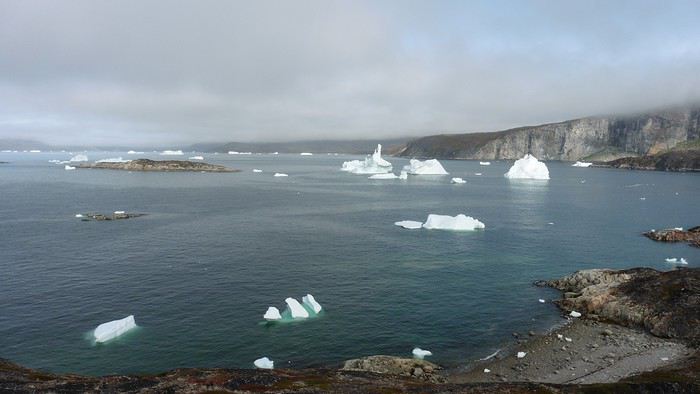
In the evening, we cooked these large Greenlandic mussels over a wood fire and savored them under the beautiful evening light. The weather was now fine, but the thermometer read -5°C in the sun…
Day 5 Bright sunshine, a glassy sea, and -8°C at 6 AM. Everything was green for setting off, even if putting on damp kayaking gear was a bit unpleasant in the cold. It was the first time we’d paddled on a flat sea since the start of the trip, and our average speed increased slightly.
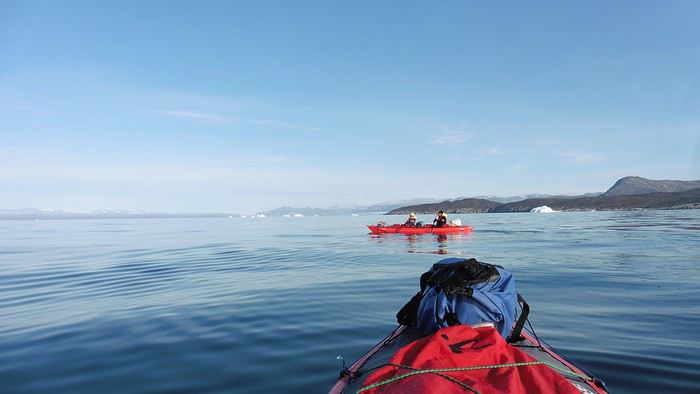
We entered the Smallesund Strait, marking the end of the island’s west coast. We were close to the large Torssukatak Fjord, where two glaciers flow. The access pass to the fjord was very narrow, and numerous ice chunks blocked access to the beaches. The wind had picked up and was now hitting us head-on (again). Just before entering the fjord, we landed on a steep beach made of large pebbles on Oqaitsut Island. It was very cold with the wind, and moving forward became difficult. We decided to stop for the day both because of the conditions and because the next campsite was far away, given how rugged the fjord was.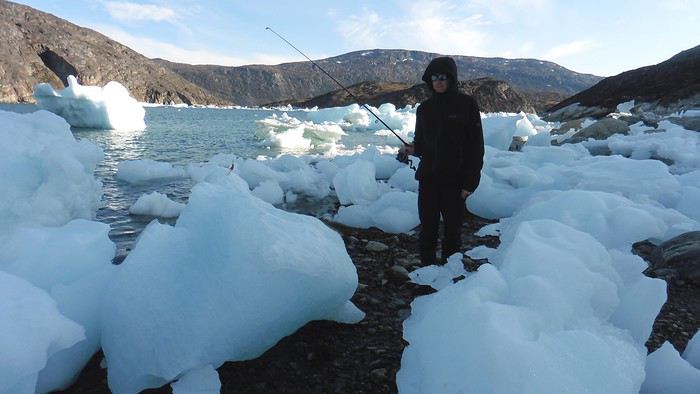
We eventually found a flat spot for the tent despite the steep slope. Even with the wind, the weather was beautiful, and we set off on foot for the northeastern cape of the island, overlooking the fjord. The view was far-reaching and exceptional—up close, the large fjord filled with ice and its steep granite cliffs, and in the distance, the ice cap and glacial walls.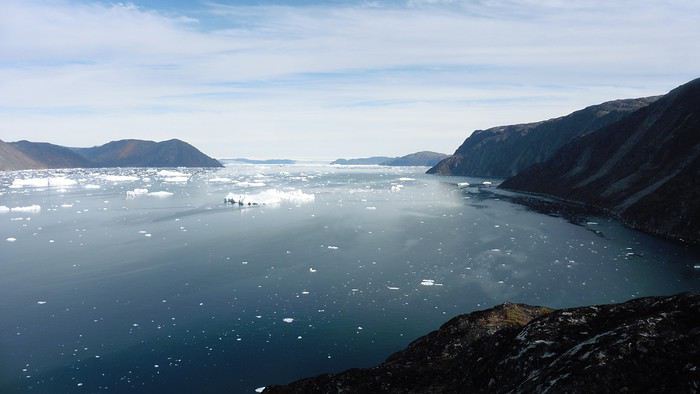
We spotted the village of Qeqertaq, whose network we could pick up, allowing us to check the weather forecast, which was rather good. While securing the kayaks in the evening, I noticed the strange behavior of one kayak at the end of the stage was due to the loss of the skeg—impossible to know where it detached. We’d have to do without it.
Day 6 Still that icy headwind from the northeast. We set off anyway for a long stage to reach the large pass connecting the Torssukatak and Ata Fjords.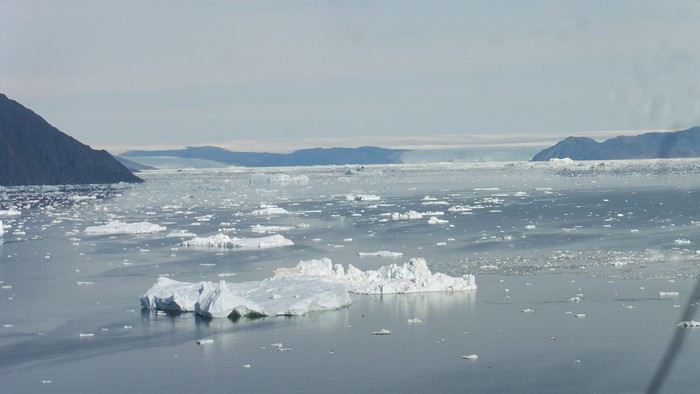
We advanced laboriously along the high cliffs of the fjord’s southern shore. They faced due north and blocked the sun. We felt the cold and dampness of the rock. It was really cold, especially in the extremities. We picnicked on the western cape of Qeqertakavasak Island. The cold didn’t allow us to stop for more than 20 minutes… But the wind dropped, and the sea was now very smooth. It was heavily cluttered with ice between the icebergs and old pack ice. The goal was to reach the large rocky promontory of Anapnuna, wedged between the Kujatdleq and Kangilerngata Glaciers, but the ice made progress difficult. We stopped to gain height on a small island and spot a passage of open water, but all we saw was white—passing seemed impossible. The currents were very complex, and entire sections of ice were being swept in one direction and then another at an impressive speed.
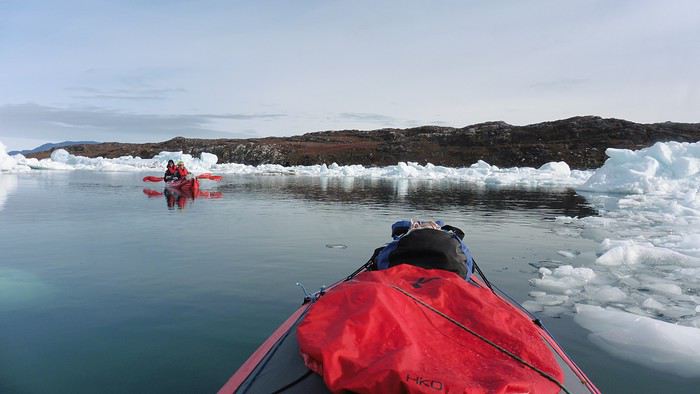
We wandered through this labyrinth until landing on a beach on the small island of Takissut, where we set up camp, exhausted from the 30 km covered and the vigilance required by the abundance of ice. The place was sublime under the evening sun—we were surrounded by ice and mountains, with the Kangilerngata Glacier in the distance. The summer contrasts were striking between the water, icebergs, sky, and flaming tundra—all colors were represented. Absolute calm reigned.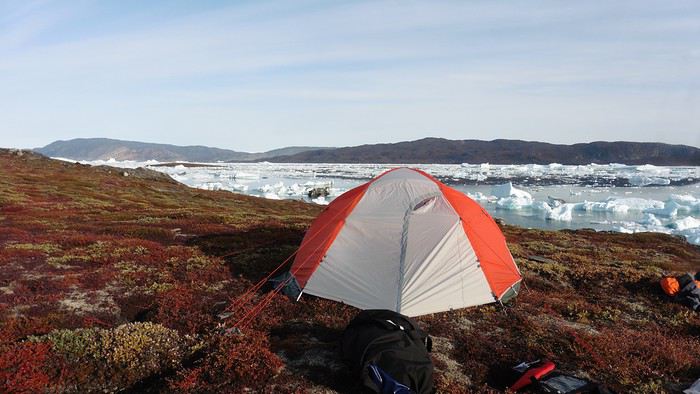
The lack of drinking water at this spot wasn’t too much of a constraint: as soon as we arrived on the beach, we placed containers under the icebergs stranded in the intertidal zone. They were all full by the time we finished setting up.
Day 7 We had to change our plans: we wouldn’t reach the rocky promontory, too well protected by the ice. We set off under the sun for Igdluluarssuit Island. Although we had spotted a passage just before launching, we quickly found ourselves surrounded by ice. It was everywhere, and finding water to paddle became complicated. We tried to force our way in every direction, even retracing our steps. Everything moved at an impressive speed—we were in the middle of a whirlpool of ice.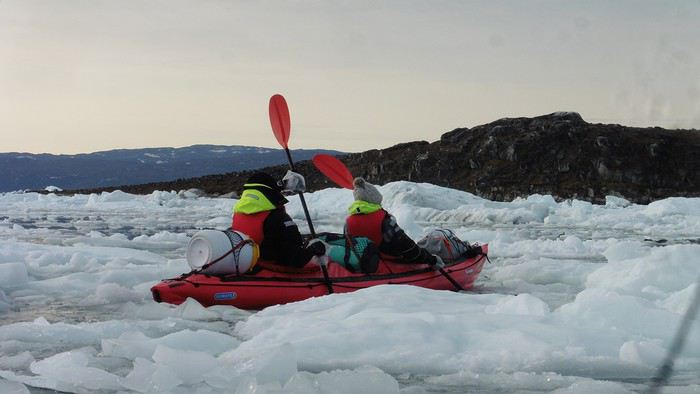
The tension rose, and each boat had its share of big scares. I was trapped against ice floes that dragged me toward an iceberg—the pressure on the kayak was enormous; it was going to capsize or puncture! But with a few strong strokes and paddling against the ice, I managed to free myself from the trap. Barely 10 minutes later, my companions were sandwiched perpendicularly between two icebergs that were closing in. The situation was desperate—the kayak was bending and twisting more and more, but with some strong paddle strokes, it finally freed itself. After these particularly unpleasant moments, we were completely blocked. The drifting ice floes had tightened, and the kayaks were no longer even in the water… The only solution: wait with the kayaks on these floes, which were too thin to walk on (even though we didn’t try). Within minutes, the situation cleared—a waterway opened, and we rushed into it. We paddled with one goal: find a larger pool of water. After going back and forth, our path took shape—we had to force the passage several times, attacking the ice directly with the kayaks, and finally, we escaped the worst of the labyrinth. We reached land on the west side of the island and saw that the rest would be easier. To reach the island, we just had to cross the Arsiviup Ikera Strait, which was lightly cluttered. We reached the eastern cape of the island, ideal for camping, even though we had only paddled for 3 hours. We set up camp and hiked to the island’s summit, which overlooks the entire pass and the glaciers.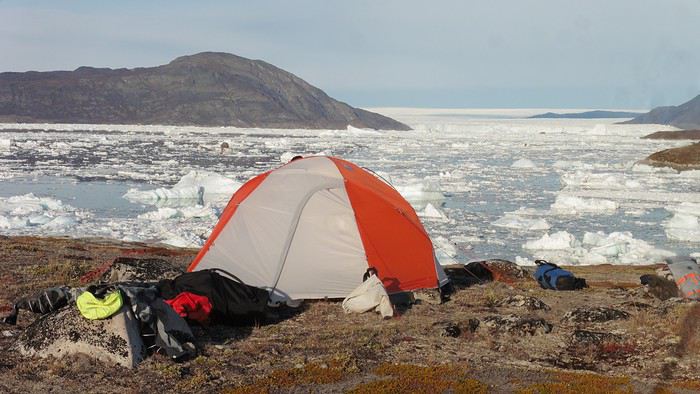
Everything was magnificent, no matter the direction. At 2 PM, we were at the summit—the beauty of the place and the picnic facing the glacier in the sun without wind made us forget the near-disaster from a few hours earlier. It would be impossible to approach the glacier by kayak, but from our summit on foot, it seemed so close, and contemplating it safely on solid ground was a great moment.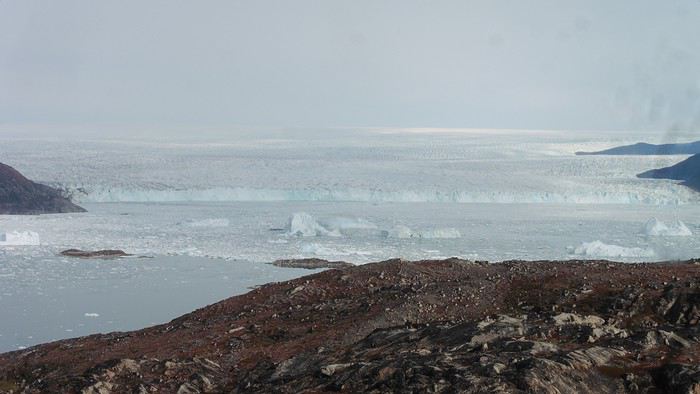
The pass was incredibly complex—everything was in motion, and an impassable passage could become open water within minutes. We were delighted when we returned to camp. A slightly lost whale among the ice accompanied us along the shore. The place was truly beautiful, but the temperature dropped again under the clear sky, preventing us from eating outside.
Day 8 Clear and cold at wake-up: -9°C. The sea had frozen in many places. We hesitated about the rest of the trip—should we start heading back to Ilulissat or linger in the pass, especially to approach the Eqi Glacier? After the incidents of the previous day, we decided to think carefully and paddled to the southern cape of our island to check the ice conditions toward Eqi. The weather had clouded over in the meantime, and the sky was quite gray. At the cape, we spotted the glacier’s wall, still 15 km away.
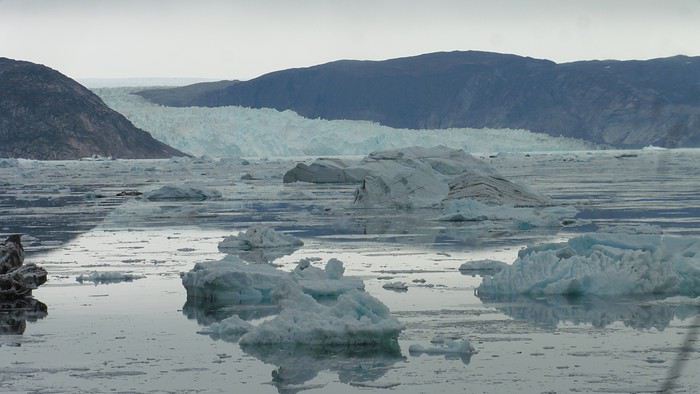
The fjord was quite cluttered, but it seemed passable. However, there was no guarantee the view would be much better 1 km from the glacier than 15 km away, especially since the front was quite active and therefore dangerous. We decided to head south without passing by the glacier. The cold temperatures encountered in the pass also motivated us to move away from the glaciers and the ice cap. We navigated under a threatening sky but without wind. The kayaks cut through the thin layer of ice on the surface with a crinkling paper sound. We reached the Ata campsite in the late afternoon after 5 hours of rowing without a single break…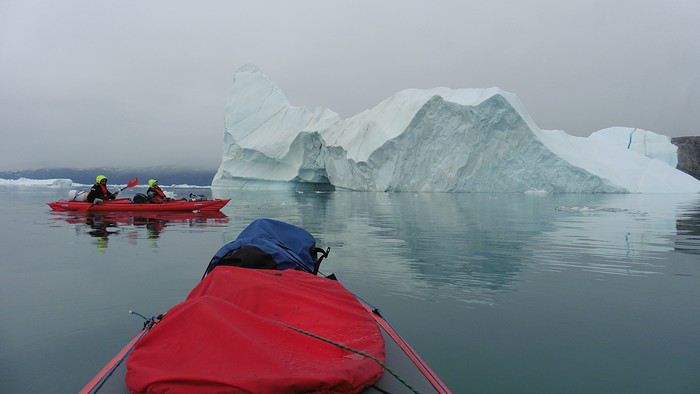
The wind had picked up, and we discovered a nice surprise: a refuge with a table and a comfortable bench lined with mattresses. Facing the worsening weather, we settled in comfortably. The kerosene stove was too complex for our three brains—we couldn’t get it started, too bad, as it was 0°C inside. The rest of the afternoon was spent fishing in the large lake, where we landed a beautiful Arctic char, more than enough for three. A good night’s sleep without the risk of foxes or the sound of a tent shaking in the wind.
Day 9 6 AM wake-up to the sound of rain hitting the cabin. The decision was made looking out the window—wind, rain, and fog obscured the sea: we went back to sleep.
New wake-up, and the rain had stopped—we could go out and stock up on fish. We set off on foot toward the lake, following its western shore. It was very overcast, and the wind encouraged us to keep moving. We made our way to a smaller lake at the end of the large one, where we caught a huge Arctic char. A small clearing brightened the picnic, and we headed back to our cabin.
This 20 km hike kept us busy all day: walking on slippery scree and the micro-relief of the peat bogs took time.
Day 10 The sky was clear, but a light south wind made paddling intense. We set off southeast to reach the opposite shore of the fjord. It was very cold, and it was impossible to stop paddling for even a moment without immediately losing ground due to the wind. We crossed the Kangerluarsuk Fjord. I recognized the cape I had reached on skis in the winter of 2017. We found a nice campsite on the southern shore of the fjord: Uiartag. It wasn’t even noon, but facing this headwind, we preferred to stop here rather than exhaust ourselves for a few extra kilometers. Like the previous ones, this campsite was very comfortable: the ground was covered with a thick layer of lichens and mosses, very pleasant to lie on.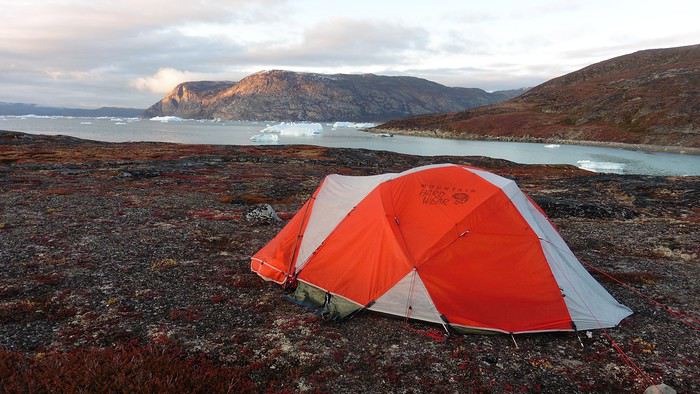
We set off on a hike to the heights of the cape, where the weather alternated between large clearings and snow showers. We noticed the loss of the thermometer, poorly attached to the backpack. On the way back, in the small bay of our beach, a whale swam calmly 10 meters from the shore—a beautiful surprise.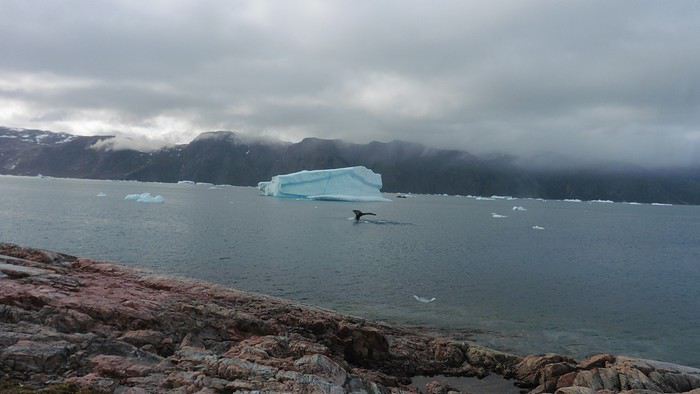
The sky cleared completely, and the temperature dropped as night approached.
We’re setting off as a group of three in two inflatable double-seater kayaks (Gumotex) brought from France. The plan is to spend two weeks circumnavigating Arve Princess Island, located north of Ilulissat in Disko Bay, with a possible boat drop-off at the southern tip of the island.
This seems like a fairly classic route in the area—we found several descriptions online (thanks to the authors). With their help and Google Earth, we identified all potential campsites and entered their coordinates into a GPS. The western part of the island, facing the bay, seems ideal for whale watching, while the more rugged eastern side offers access to several glacial walls. We’re somewhat familiar with the area from two winter expeditions on skis and pulkas.
Plus, the commitment is limited due to the island’s proximity to several small villages, including Qeqertaq, Oqaatsut, and even Ilulissat. In fact, we saw fishing boats almost every day. The distance suits us well: 200 kilometers in 16 full days on site, which should leave some leeway in case of bad weather or for hiking.
We booked our flights in June with Air Greenland to Ilulissat for the last week of August and the first week of September. On both the outbound and return trips, we stayed overnight in Copenhagen. The France-Copenhagen flight was with Air France.
We were allowed 3 x 20 kg in the hold. Each kayak with its accessories fits into a 20 kg bag; the last hold bag is for shared gear: tent, stoves, dry bags… We only brought 1.5 kg of semolina for food. In the end, we had 61 kg of gear, and no excess baggage was charged.
Individual gear (clothes and sleeping bags…) was distributed in the cabin luggage.
For the boat transfer, we contacted an agency: Blue Jay, which gave us a number to call upon arrival.
Day 0: Wednesday, August 22 Departure day. After work, I drove from Gap to Marseille’s Marignane Airport for the first leg of the trip to Copenhagen. I enjoyed the rather mild local temperatures: 35°C in the shade. After a layover in Paris, I arrived at the Copenhagen hotel, located two train stops from the airport, where my companions were already settled. No issues—everyone was on time with their luggage.
Day 1 The flight to Greenland was at 9 AM. We had a layover in Kangerlussuaq, where we changed planes, then stopped in Aasiaat before reaching Ilulissat Airport at 3 PM under beautiful sunshine.
We called Blue Jay for the boat transfer: they could take us to the island as early as 6 PM; otherwise, we’d have to wait until the next day. That left us 3 hours to prepare our gear and, most importantly, do our shopping for the two-week trip—it seemed tight, but we gave it a shot.
A quick taxi ride took us to Pisiffik, where we easily found everything we needed: bread, butter, cheese, cold cuts, rice, pasta, jam, muesli… There was no C fuel or methylated spirits for the stoves, but this time we knew the trick: at Stark, a bit uphill from the town, we found the precious liquids. Two hours later, we filled our dry bags and containers with our purchases, and by 5:30 PM, we met Klaus, the Blue Jay manager, directly at the port.
The vacation seemed to truly begin as we sped by boat through the icebergs toward Arve Princess Island. Forty-five minutes later, we spotted a beach lined with rocks where Klaus dropped us off quickly (he had another transfer to make right after).
Here we were on the island, in the middle of nowhere, with all our luggage and food to organize, the tent to set up, and the kayaks to inflate—just 10 hours after leaving the Copenhagen hotel. We got to work, bothered by the flies. Despite our head nets, it was barely tolerable—there were so many of them. They swarmed by the dozens into every bag we opened. It was quite mild: 10°C.
Everything was ready by evening, and we were very happy to have completed all these transfers (planes and boat in a single day) as we slipped into our sleeping bags.
During the night, the wind picked up, and we went out several times to check the tent and kayak anchors. We noticed how bright it was—it was still quite twilight even at 1 AM.
Day 2 5:30 AM wake-up—the south wind was still strong, but since we were heading north, we decided to give it a try anyway.
This was also the moment we loaded the kayaks: since there were only three of us for two double-seater kayaks, we filled the hatch of one kayak, which allowed us to fit all our food. It would have been very difficult if there had been four of us for two kayaks.
Finally, we set off north along the western coast of the island. The conditions were far from ideal—the sea was rough, and the kayaks had a lot of wind resistance. But the main problem was the spray skirt: the gear on deck weighed it down, and the skirt kept coming off… We’d have to deal with it. Barely underway, and whales were already breaking the surface—it was our first time seeing them, and we were very impressed. Too bad the wind didn’t allow for longer contemplation; stopping paddling was impossible with such strong gusts.
We passed a few headlands and even considered stopping due to the conditions. To find some semblance of shelter, we had to hug the coast closely without cutting across the numerous bays, which significantly lengthened the journey. But as the morning went on, the wind died down, and the sea calmed. We spotted several whales and our first seals. It was almost pleasant during the picnic break. By late afternoon, we reached Kangerup Sarqâ Bay, where we had identified a great campsite with a very large beach and a river. But the wind had shifted—it was now coming from the north, making the last hour difficult due to fatigue and headwinds.
The campsite was ideal and beautiful, facing numerous icebergs grounded in the bay.
The GPS alerted us to another major drawback of inflatable kayaks: their slowness. It took us 7.5 hours of actual paddling (excluding breaks) to cover 28 km, averaging 3.7 km/h—somewhat disappointing. But we knew this before leaving, and once again, we’d have to make do!
Day 3 Surprise: at 6 AM wake-up, it was raining, foggy, with a south wind, and the sea was choppy even in the bay. It seemed wise to skip paddling, even though stopping on the second day was tough on morale. We went back to sleep, especially since the travel fatigue and the harsh conditions of the previous day had taken their toll.
At 11 AM, the navigation conditions weren’t any better—at the ends of the bay, we saw huge waves crashing onto the rocks, and giving up for the day became obvious. However, the rain had stopped, so we set off for a hike along the large lake bordering the bay. The wind hadn’t let up, and it was quite cold.
The tundra was starting to take on its autumn colors, and the contrast between the white lichens and the red vegetation was stunning. At the lake, we took out the fishing rods and quickly caught two beautiful Arctic char over 50 cm long.
As the afternoon wore on, the sun seemed closer. Along the beach, we gathered driftwood (mostly old planks) to cook our catch in foil over a fire. Eating our own food in such a beautiful place next to a good fire was comforting after the day’s setback.
In the middle of the night, an Arctic fox entered the tent’s rear awning. It seemed barely intimidated when we shooed it away with loud shouts and then with stones.
Day 4 6:15 AM wake-up—3°C. We were on the water by 8 AM. The wind had dropped significantly, but the sea was shrouded in fog, and it was very cold in these damp conditions.
We passed the bay’s headland, Kangea, and headed toward the abandoned village of Agpat. The atmosphere was very austere—we hugged black rocks in fog that limited visibility to 50 meters, revealing large icebergs as we went.
Suddenly, the water’s surface stirred in front of my kayak, and a huge gray back emerged from the sea. The collision was inevitable, but the whale seemed to understand and dove immediately, passing under the kayak and resurfacing a few meters away. I felt the kayak rock in the white foam and quickly paddled to escape the turbulence. What an emotion!
A light wind began to clear the fog, and the sun made beautiful appearances. Despite the cold, we stopped to visit the abandoned village, which left a strange impression. All the houses were still in good condition and wide open—some must have been very spacious in their time. We went back to sea, and in front of the large Kaangerdluk Bay, we hesitated—the headwind was strong, and large waves split the water. The next beach, from the island of Nua where we stopped to think, was over 8 km away. It was barely 2 PM, but caution led us to stop here for the day. We had covered 12 km—exactly the distance needed to stay on schedule. The afternoon was spent hiking on the island’s hills and gathering mussels and wood.
In the evening, we cooked these large Greenlandic mussels over a wood fire and savored them under the beautiful evening light. The weather was now fine, but the thermometer read -5°C in the sun…
Day 5 Bright sunshine, a glassy sea, and -8°C at 6 AM. Everything was green for setting off, even if putting on damp kayaking gear was a bit unpleasant in the cold. It was the first time we’d paddled on a flat sea since the start of the trip, and our average speed increased slightly.
We entered the Smallesund Strait, marking the end of the island’s west coast. We were close to the large Torssukatak Fjord, where two glaciers flow. The access pass to the fjord was very narrow, and numerous ice chunks blocked access to the beaches. The wind had picked up and was now hitting us head-on (again). Just before entering the fjord, we landed on a steep beach made of large pebbles on Oqaitsut Island. It was very cold with the wind, and moving forward became difficult. We decided to stop for the day both because of the conditions and because the next campsite was far away, given how rugged the fjord was.
We eventually found a flat spot for the tent despite the steep slope. Even with the wind, the weather was beautiful, and we set off on foot for the northeastern cape of the island, overlooking the fjord. The view was far-reaching and exceptional—up close, the large fjord filled with ice and its steep granite cliffs, and in the distance, the ice cap and glacial walls.
We spotted the village of Qeqertaq, whose network we could pick up, allowing us to check the weather forecast, which was rather good. While securing the kayaks in the evening, I noticed the strange behavior of one kayak at the end of the stage was due to the loss of the skeg—impossible to know where it detached. We’d have to do without it.
Day 6 Still that icy headwind from the northeast. We set off anyway for a long stage to reach the large pass connecting the Torssukatak and Ata Fjords.
We advanced laboriously along the high cliffs of the fjord’s southern shore. They faced due north and blocked the sun. We felt the cold and dampness of the rock. It was really cold, especially in the extremities. We picnicked on the western cape of Qeqertakavasak Island. The cold didn’t allow us to stop for more than 20 minutes… But the wind dropped, and the sea was now very smooth. It was heavily cluttered with ice between the icebergs and old pack ice. The goal was to reach the large rocky promontory of Anapnuna, wedged between the Kujatdleq and Kangilerngata Glaciers, but the ice made progress difficult. We stopped to gain height on a small island and spot a passage of open water, but all we saw was white—passing seemed impossible. The currents were very complex, and entire sections of ice were being swept in one direction and then another at an impressive speed.
We wandered through this labyrinth until landing on a beach on the small island of Takissut, where we set up camp, exhausted from the 30 km covered and the vigilance required by the abundance of ice. The place was sublime under the evening sun—we were surrounded by ice and mountains, with the Kangilerngata Glacier in the distance. The summer contrasts were striking between the water, icebergs, sky, and flaming tundra—all colors were represented. Absolute calm reigned.
The lack of drinking water at this spot wasn’t too much of a constraint: as soon as we arrived on the beach, we placed containers under the icebergs stranded in the intertidal zone. They were all full by the time we finished setting up.
Day 7 We had to change our plans: we wouldn’t reach the rocky promontory, too well protected by the ice. We set off under the sun for Igdluluarssuit Island. Although we had spotted a passage just before launching, we quickly found ourselves surrounded by ice. It was everywhere, and finding water to paddle became complicated. We tried to force our way in every direction, even retracing our steps. Everything moved at an impressive speed—we were in the middle of a whirlpool of ice.
The tension rose, and each boat had its share of big scares. I was trapped against ice floes that dragged me toward an iceberg—the pressure on the kayak was enormous; it was going to capsize or puncture! But with a few strong strokes and paddling against the ice, I managed to free myself from the trap. Barely 10 minutes later, my companions were sandwiched perpendicularly between two icebergs that were closing in. The situation was desperate—the kayak was bending and twisting more and more, but with some strong paddle strokes, it finally freed itself. After these particularly unpleasant moments, we were completely blocked. The drifting ice floes had tightened, and the kayaks were no longer even in the water… The only solution: wait with the kayaks on these floes, which were too thin to walk on (even though we didn’t try). Within minutes, the situation cleared—a waterway opened, and we rushed into it. We paddled with one goal: find a larger pool of water. After going back and forth, our path took shape—we had to force the passage several times, attacking the ice directly with the kayaks, and finally, we escaped the worst of the labyrinth. We reached land on the west side of the island and saw that the rest would be easier. To reach the island, we just had to cross the Arsiviup Ikera Strait, which was lightly cluttered. We reached the eastern cape of the island, ideal for camping, even though we had only paddled for 3 hours. We set up camp and hiked to the island’s summit, which overlooks the entire pass and the glaciers.
Everything was magnificent, no matter the direction. At 2 PM, we were at the summit—the beauty of the place and the picnic facing the glacier in the sun without wind made us forget the near-disaster from a few hours earlier. It would be impossible to approach the glacier by kayak, but from our summit on foot, it seemed so close, and contemplating it safely on solid ground was a great moment.
The pass was incredibly complex—everything was in motion, and an impassable passage could become open water within minutes. We were delighted when we returned to camp. A slightly lost whale among the ice accompanied us along the shore. The place was truly beautiful, but the temperature dropped again under the clear sky, preventing us from eating outside.
Day 8 Clear and cold at wake-up: -9°C. The sea had frozen in many places. We hesitated about the rest of the trip—should we start heading back to Ilulissat or linger in the pass, especially to approach the Eqi Glacier? After the incidents of the previous day, we decided to think carefully and paddled to the southern cape of our island to check the ice conditions toward Eqi. The weather had clouded over in the meantime, and the sky was quite gray. At the cape, we spotted the glacier’s wall, still 15 km away.
The fjord was quite cluttered, but it seemed passable. However, there was no guarantee the view would be much better 1 km from the glacier than 15 km away, especially since the front was quite active and therefore dangerous. We decided to head south without passing by the glacier. The cold temperatures encountered in the pass also motivated us to move away from the glaciers and the ice cap. We navigated under a threatening sky but without wind. The kayaks cut through the thin layer of ice on the surface with a crinkling paper sound. We reached the Ata campsite in the late afternoon after 5 hours of rowing without a single break…
The wind had picked up, and we discovered a nice surprise: a refuge with a table and a comfortable bench lined with mattresses. Facing the worsening weather, we settled in comfortably. The kerosene stove was too complex for our three brains—we couldn’t get it started, too bad, as it was 0°C inside. The rest of the afternoon was spent fishing in the large lake, where we landed a beautiful Arctic char, more than enough for three. A good night’s sleep without the risk of foxes or the sound of a tent shaking in the wind.
Day 9 6 AM wake-up to the sound of rain hitting the cabin. The decision was made looking out the window—wind, rain, and fog obscured the sea: we went back to sleep.
New wake-up, and the rain had stopped—we could go out and stock up on fish. We set off on foot toward the lake, following its western shore. It was very overcast, and the wind encouraged us to keep moving. We made our way to a smaller lake at the end of the large one, where we caught a huge Arctic char. A small clearing brightened the picnic, and we headed back to our cabin.
This 20 km hike kept us busy all day: walking on slippery scree and the micro-relief of the peat bogs took time.
Day 10 The sky was clear, but a light south wind made paddling intense. We set off southeast to reach the opposite shore of the fjord. It was very cold, and it was impossible to stop paddling for even a moment without immediately losing ground due to the wind. We crossed the Kangerluarsuk Fjord. I recognized the cape I had reached on skis in the winter of 2017. We found a nice campsite on the southern shore of the fjord: Uiartag. It wasn’t even noon, but facing this headwind, we preferred to stop here rather than exhaust ourselves for a few extra kilometers. Like the previous ones, this campsite was very comfortable: the ground was covered with a thick layer of lichens and mosses, very pleasant to lie on.
We set off on a hike to the heights of the cape, where the weather alternated between large clearings and snow showers. We noticed the loss of the thermometer, poorly attached to the backpack. On the way back, in the small bay of our beach, a whale swam calmly 10 meters from the shore—a beautiful surprise.
The sky cleared completely, and the temperature dropped as night approached.
Moins de croisiéristes français pour un secteur cependant à la hausse
Bonjour
Pour info, article clair et synthétique.
Cordialement
http://www.quotidiendutourisme.com/croisieres/croisieres-moins-de-passagers-francais-mais-une-vitalite-du-secteur-en-hausse/175468
http://www.quotidiendutourisme.com/croisieres/croisieres-moins-de-passagers-francais-mais-une-vitalite-du-secteur-en-hausse/175468
Traverser les États-Unis à vélo, est - ouest
Bonjour,
Je planche sur une traversée des USA en vélo, cote Est à Ouest, en 2019. Bien sur il y a 1000 questions a ce jour mais j'avance... Je voulais savoir si il y a des personnes qui ont déjà fait ce voyage qui serait susceptible de me renseigner et de m'aider a avancer dans mon projet. Merci et à bientot...
Lorsque le client devient "invivable"
Où le coup de gueule d'une hôtelière face à l'agressivité des clients, leur manque de civilité et leurs avis destructeurs sur Internet. Un peu l'air du temps...
Lire la suite...
No, I Won’t Be Going Back to China
Hello forum,
Did any of you feel the same things we did in China?
We spent a good twenty days there in August. First, we traveled solo around Chengdu, then joined an organized tour for 12 days (Beijing, Pingyao, Xi'an, Guilin, Xingping, Yangshuo, Shanghai, Wuzhen) and extended our stay by 4 extra days to visit Zhangjiajie.
The landscapes were stunning, and we have unforgettable memories... but we were really disappointed by the following points:
- The food: way too spicy. Lacking in flavor, not much taste. I’m speaking "in general" because we did enjoy some good steamed dumplings, smoked pork, and other dumplings... But compared to Thailand, Cambodia, or India, Chinese cuisine didn’t impress us at all.
- The behavior of the Chinese: disrespectful, rushed, agitated. You constantly have to fight—people push, crowd, and overwhelm you... At the entrance to the Terracotta Army (and other sites), it’s a human tidal wave... and I mean that literally. We were carried by the crowd without even touching the ground. It was like a situation where you have one bowl of rice and 20,000 starving people diving for it...
You’re at a ticket counter, and they cut in front of you. You’re in line for boarding, suitcase ready to go on the conveyor belt, and someone shows up out of nowhere to put THEIR suitcase down... even though they have a flight ticket with THEIR seat number and won’t be leaving before you!!!! You’re getting on the bus, and someone shoves past you just so they don’t end up behind you.
It’s like these people only think about themselves. I didn’t see a single person let someone else go first or even ask—it’s as if politeness and respect are completely foreign to them.
It’s honestly exhausting and draining...
- Communication: In every other country we’ve visited, whether in Asia or Europe, we always manage—with English, a few words of Italian, French, or Spanish. In China, I’ll be blunt: if you don’t speak Chinese, you’re screwed. And yet, a pair of kids around ten or twelve years old asked us in English where we were from :)
- Understanding: Here’s the rule. Even if the person you’re talking to speaks a little English and says they understand you... make sure they *really* do, because 9 times out of 10, they don’t. Out of pride or just cluelessness, they’ll give you a big smile and nod, but in reality, they didn’t get what you were saying.
Several times with our group, in the evening at a restaurant, if we hadn’t been helped by someone at another table who spoke a little English, we’d still be there. The classic example: the waiter brings one menu (for 10 people at the table), and we’re all trying to explain that we need 4 or more menus. Five minutes later, he’s still staring at us with that same blank smile...
In 3* or 4* hotels, you go to the front desk for a hot water or AC issue. Three or four staff members just stand there beaming at you. You try to explain with photos or a translator, but in the end, you leave with the problem unresolved.
They don’t speak—they shout... on buses, in hotels...
We were also surprised to find that self-service laundromats were almost nonexistent. We got scammed once at a hotel with an astronomical bill!
As for flights, we flew Air China on the way there and Austrian Airlines on the way back—no comparison. Air China had zero service and food that was "baby food" quality. Austrian Airlines had multiple services, a decent meal, and smiling flight attendants.
I don’t know if any of you had the same experience in this country, but I’m definitely not eager to go back. Whereas if someone offered me India, Thailand, or Vietnam tomorrow, I’d be there in a heartbeat!!!
Did any of you feel the same things we did in China?
We spent a good twenty days there in August. First, we traveled solo around Chengdu, then joined an organized tour for 12 days (Beijing, Pingyao, Xi'an, Guilin, Xingping, Yangshuo, Shanghai, Wuzhen) and extended our stay by 4 extra days to visit Zhangjiajie.
The landscapes were stunning, and we have unforgettable memories... but we were really disappointed by the following points:
- The food: way too spicy. Lacking in flavor, not much taste. I’m speaking "in general" because we did enjoy some good steamed dumplings, smoked pork, and other dumplings... But compared to Thailand, Cambodia, or India, Chinese cuisine didn’t impress us at all.
- The behavior of the Chinese: disrespectful, rushed, agitated. You constantly have to fight—people push, crowd, and overwhelm you... At the entrance to the Terracotta Army (and other sites), it’s a human tidal wave... and I mean that literally. We were carried by the crowd without even touching the ground. It was like a situation where you have one bowl of rice and 20,000 starving people diving for it...
You’re at a ticket counter, and they cut in front of you. You’re in line for boarding, suitcase ready to go on the conveyor belt, and someone shows up out of nowhere to put THEIR suitcase down... even though they have a flight ticket with THEIR seat number and won’t be leaving before you!!!! You’re getting on the bus, and someone shoves past you just so they don’t end up behind you.
It’s like these people only think about themselves. I didn’t see a single person let someone else go first or even ask—it’s as if politeness and respect are completely foreign to them.
It’s honestly exhausting and draining...
- Communication: In every other country we’ve visited, whether in Asia or Europe, we always manage—with English, a few words of Italian, French, or Spanish. In China, I’ll be blunt: if you don’t speak Chinese, you’re screwed. And yet, a pair of kids around ten or twelve years old asked us in English where we were from :)
- Understanding: Here’s the rule. Even if the person you’re talking to speaks a little English and says they understand you... make sure they *really* do, because 9 times out of 10, they don’t. Out of pride or just cluelessness, they’ll give you a big smile and nod, but in reality, they didn’t get what you were saying.
Several times with our group, in the evening at a restaurant, if we hadn’t been helped by someone at another table who spoke a little English, we’d still be there. The classic example: the waiter brings one menu (for 10 people at the table), and we’re all trying to explain that we need 4 or more menus. Five minutes later, he’s still staring at us with that same blank smile...
In 3* or 4* hotels, you go to the front desk for a hot water or AC issue. Three or four staff members just stand there beaming at you. You try to explain with photos or a translator, but in the end, you leave with the problem unresolved.
They don’t speak—they shout... on buses, in hotels...
We were also surprised to find that self-service laundromats were almost nonexistent. We got scammed once at a hotel with an astronomical bill!
As for flights, we flew Air China on the way there and Austrian Airlines on the way back—no comparison. Air China had zero service and food that was "baby food" quality. Austrian Airlines had multiple services, a decent meal, and smiling flight attendants.
I don’t know if any of you had the same experience in this country, but I’m definitely not eager to go back. Whereas if someone offered me India, Thailand, or Vietnam tomorrow, I’d be there in a heartbeat!!!
Ordre des îles et conseils pour 12 jours sur place en Polynésie-Française
bonjour, nous partons à 2 dans 2 mois en polynesie et découvrons que c est une destination qui laisse peu de place à l improvisation sur place ;-) il faut donc tout réserver et nous sommes un peu perdus...
nous aimons randonner, l authenticité et bien sur voir les magnifiques fonds marins donc je pensais à faire maupiti
huahine et tahaa puis moorea.
mais nous n avons que 12 jours sur place... est ce un bon choix, un bon ordre ? merci !!
mais nous n avons que 12 jours sur place... est ce un bon choix, un bon ordre ? merci !!
Régulation des flux touristiques
Bonjour à tous,
Au cœur de cet été bien chaud, du moins chez moi, une réflexion suite à une information:
L’île de Pâques est amenée depuis quelques jours à restreindre certaines durées de séjour sur son territoire. Antérieurement, Venise essaye de prendre des mesures concernant les bateaux de croisière, mais aussi les visiteurs venus par d'autres moyens.
Il y a beaucoup d’endroits de par le monde ou les afflux de touristes amènent les autorités à ce genre de décision. Sans compter les aménagements engendrés par le nombre, type pointe du raz ou Horseshoebend aux Etats Unis. Et j'en passe certainement beaucoup...
D'un côté, préserver la nature ou le patrimoine architectural, de l'autre accepter le nombre pour que vivent ceux qui " en vivent " ?
Je m'interroge, les choses sont elles inéluctables dans un sens comme dans l'autre ?
Certainement le plus difficile, trouver le juste équilibre.
Bonne journée à tous
Au cœur de cet été bien chaud, du moins chez moi, une réflexion suite à une information:
L’île de Pâques est amenée depuis quelques jours à restreindre certaines durées de séjour sur son territoire. Antérieurement, Venise essaye de prendre des mesures concernant les bateaux de croisière, mais aussi les visiteurs venus par d'autres moyens.
Il y a beaucoup d’endroits de par le monde ou les afflux de touristes amènent les autorités à ce genre de décision. Sans compter les aménagements engendrés par le nombre, type pointe du raz ou Horseshoebend aux Etats Unis. Et j'en passe certainement beaucoup...
D'un côté, préserver la nature ou le patrimoine architectural, de l'autre accepter le nombre pour que vivent ceux qui " en vivent " ?
Je m'interroge, les choses sont elles inéluctables dans un sens comme dans l'autre ?
Certainement le plus difficile, trouver le juste équilibre.
Bonne journée à tous