Rencontres avec la Musique du Monde
Depuis longtemps, le journaliste, auteur et producteur de disques
Christoph Wagner recueille des cartes postales historiques montrant des photos de pratiques musicales captées dans le monde entier au début du 20ième siècle, et aussi anciens disques vinyls et 78 tours (
shellac records) de la même époque (1900-1930). Ces "photos musicales" servent au point de départ pour une multitude de textes écrits par une quarantaine de musiciens et compositeurs contemporains, invités par l’auteur à livrer leur vision et leur perception de musiques qui les ont particulièrement marqués. Tous ces textes et cartes postales apportent une collection unique, "coulée" en un précieux ouvrage bilingue (allemand/anglais) de 187 pages. Ledit ouvre la vue sur des mondes musicaux qui n’existent plus...
AUGE & OHR – EAR & EYE
Begegnungen mit Weltmusik
Encounters with World Music
Edition Neue Zeitschrift für Musik
Mainz, 2004
Les auteurs des textes sont : Robert Wyatt, Charlie Mariano, Charlotte Greig, Mauricio Kagel, Thomas Meinecke, Pauline Oliveros, Jah Wobble, Roman Bunka, Terry Riley, Mike Svoboda, Christian Burchard, Gerhard Stäbler, Fritz Hauser, Rüdiger Carl, Arnold Dreyblatt, Toshio Hosokawa, Mike Adcock, Hartmut Geerken, Myra Melford, Clive Bell, Justin Adams, Ben Mandelson, Joe Mogotsi, Malcolm Jones, Lol Coxhill, Amelia Cuni, Franz Koglmann, Frank Wolff, Robyn Schulkowsky, Colin Bass, Christian Zehnder, Sylvia Hallett, Kudsi Erguner, Andreas Koll, Stuart Brotman, Simon Mayor, Adriana Hölszky et Teodoro Anzellotti. Eux tous dévoilent aux lecteurs des facettes souvent inédites de leurs goûts et de leurs centres d’intérêts musicaux.
Dans un texte intitulé "
Bursting the boundaries" (Faire éclater les frontières), Robert Wyatt, un de mes héros musicaux, ex-batteur des formidables Soft Machine, introduit au flamenco, musique qu'il a découverte par l'intermédiaire de sa femme Alfreda Benge, une amatrice d’
Espagne, qui écrit presque tous les textes de chansons de Robert...
My wife introduced me to Flamenco first because she liked to go to
Spain. Although we would only go to the north of
Spain, there is so much internal immigration where people from the poorer rural south have gone to find work in the industrial north. So there is a sizeable Andalusian community around
Barcelona. In some ways immigrants are more passionate about sustaining their culture than people who still live where they come from. So these Southerners now found themselves in the villages around
Barcelona, and when they were not working they had their social occasions called peñas. There was friendly rivalry about which is the real home of the best Flamenco:
Cordoba,
Seville or Granada.
We were caught in a fascinating social world. The first thing I noticed as a refugee from rock music was that at a peña every generation would be represented in a very simple room: there would be the grandfather and grandmothers starring stonily at the young people. They said: they love to sing but they don't know anything talking about the younger generation. At the end of the evening sometimes they would get up and you would get this fantastic sort of high singing. These old people were like good wine: they got better and better. That was accepted by everybody. There were also children who were brilliant, and sexy young women and men - there seemed to be room in this culture for every age.
Nearly all dances seemed to be gypsy dances. What gypsies often seem to do is to preserve a bit of the culture in the country where they live, longer than the natives. They live in a kind of time warp. When we were there the gypsy women were going around in high heeled shoes, tight skirts and fur coats and big hair, while the Spanish women were all feminists in jeans. But these gypsy women were tough cookies and any men who stepped out of line got a real earful.
The music itself is just not anything which I would call European, apart from the fact that it is anchored in guitar chords and the guitar is tuned, as all European instruments are. But for the singing it's clear that the notes are definitely not quite part of that. It is fascinating to hear the singing. The singers are very secure in finding the spaces between the notes which would be considered out of tune, and that's done with such authority that you notice there is no such thing as out of tune. Everybody knows it. But they are just playing music that hasn't been tamed yet. It's anchored but not tamed. It takes enormous discipline. As a musician who used to play music which was quite difficult to learn, I was impressed to find a folk music that was so difficult to follow even rhythmically. If you tried to clap along as a tourist you have to be careful. You have to know where you are clapping and where the beats are.
There are various types of songs, based on dance. Some are very slow - out of tempo. Some are rather Cuban influenced, Mexican influenced.
The sheer power of the singing is in such contrast to modern singing which is based on the assumption that you have a microphone. That has been a big influence on singing, because it means that the old discipline where everybody had to learn to sing extremely loud doesn't often apply. But in Flamenco it definitely does. It's raw soul music.
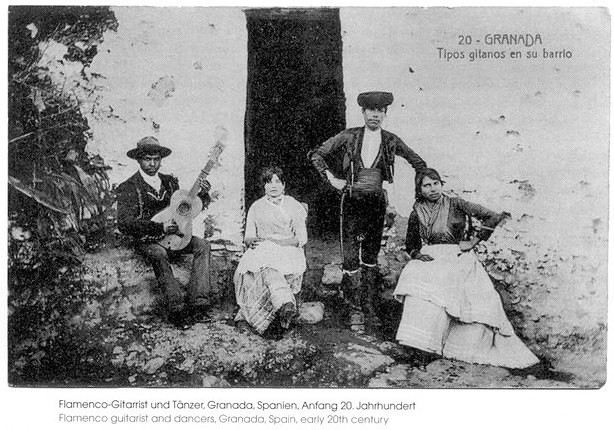
Flamenco is especially Spanish in a strange way. It has definitely absorbed some Spanish folk tradition but there are also a lot of Arabic influences. Because Andalusia was the jewel in the crown of the Islamic empire in its heyday and was Islamic for a very long time, there seems to be a very specific Arabic input of art music of the most refined type. It has filtered through the local dances and that seems to be really where the distinctive Flamenco style derives from. So it's a culture that cannot be identified as specifically European. It bursts the boundaries and the limits set upon it by the harmonic major-minor scales of European music. It is a defined stand from outside. Anybody who is interested in avant garde culture should admire the strength of conviction which stops Flamenco ever quite fitting into an European stereotype. (voir la photo "Granada" en bas)
A mon avis, un texte magnifique et assez représentatif pour cet ouvrage siiii réussi !
Comment ont sonné ces mondes disparus qui sont pris en photos dans cet ouvrage ?! A presque toute carte postale et à tout texte sont ajoutées des illustrations musicales que Christoph a trouvées sur des
shellac records. Pour perfectionner cet ouvrage, un cd joint ramasse ces illustrations...
Christoph Wagner, né en 1956 à Balingen/Bade-Wurttemberg, vit depuis 1993 à Hebden Bridge, West Yorkshire/
Grande Bretagne. Depuis 1984, il travaille pour la
Süddeutsche Zeitung,
NZZ,
taz,
Neue Zeitschrift für Musik,
WoZ,
Jazzpodium et
Jazzthetik, ainsi que pour les stations de radio
SWR et
DRS Radio Schweiz. Depuis les années mi-80, il édite des anthologies sur les musiques traditionnelles aux
Etats-Unis (American Yodeling et American Polka), de plus, il a publié plusieurs cds et livres traitant les sujets "accordéon" et "harmonica" (voir en bas). A côté de son travail comme journaliste, Christoph a composé la
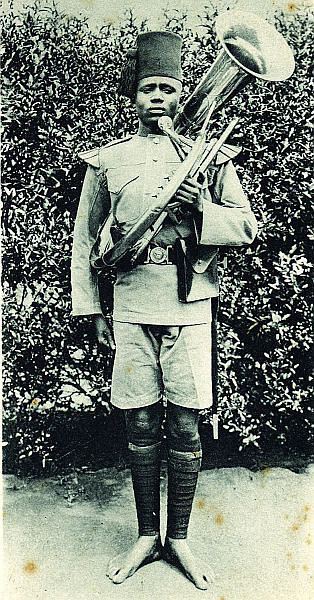
World Music Picture Archive, collection riche et variée de photos historiques montrant des musiciens traditionnels du monde entier (voir la photo "African bondsman in
Nairobi, in 1900" en bas qui fait partie de cette collection)...
Das Akkordeon oder Die Erfindung der populären Musik
Global Accordion – Early Recordings
Echoes of Africa – Early Recordings
VIVE LA MUSIQUE !!!
Bonne lecture, Herbert
Images attachées: