Hi everyone, my partner is Malian and I’d love to be able to say sweet things to him in Bambara, as well as learn some polite phrases. Thanks for your help! 😊
Here are a few examples:
I love you
My love
My heart
My life
You’re the man of my life
I care about you
I want to live with you
Kiss me
I miss you
Thank you
Please
Hello
See you soon
Hats off for this translation! I’m particularly happy to see that you’re really using the standard Bamanankan (Bambara) alphabet characters—that is, you distinguish between the vowels ɛ and e, as well as ɔ and o (in fact, Bambara has seven oral vowels, not five). Plus, you’re also using the palatal and velar nasals, specifically ɲ and ŋ. Excellent!
A few notes and questions:
1. Instead of kɔsɔbe, I’d write kosɛbɛ or even kosɔbɛ.
2. Why haketo as one word? To my knowledge, it’s an abbreviated phrase: from A ye hakɛ to comes Hakɛ to, a polite formula. It’s left with a noun and a verb: fault/sin – to spare/forgive, which ultimately means *Forgive me!* or *Pardon me!*
3. I don’t know or understand the word ɲanafi. But I’d venture to say it’s the noun ɲɛnafin "sight-in-darkness > nostalgia, melancholy, sadness, boredom"?! Literally translated, it means *Your nostalgia is mine*, so figuratively: *I miss you*. That’s it, right?!
4. K’an bɛ: the vowel ɛ is clearly nasalized, so it’s better to write bɛn. Compare it with the auxiliary bɛ!
5. N bɛ sa i nofe: ah, the postposition nɔfɛ "trace-by > behind/after". Is the verb sa here "to die"? *I die after you* = *I want to live with you*. Hmm, possible, yes...
My sincere greetings to Bamako (I’ve always loved this city, especially the traditional neighborhoods like Medina Koura, Bamako Koura, Bozola, Badalabougou, but also Hippodrome, Magnambougou, and Falajé) and
Aw ni tié! j'aurais aimé traduire le texte ci dessous (tiré d'un livre de Paulo Cohelo) pour un ami Malien que l'on appelle "petit guerrier" djembéfola et qui…
Je suis métisse. J'essaie d'apprendre le bambara pour essayer de communiquer avec ma famille au Mali. J'ai quelques difficultés surtout pour la prononciation.…
Je suis très désolé de ne pas avoir répondu à temps à plusieures personnes me demandant de traduire "Joyeux Noël et Bonne Année!" en langue bambara. Entre le…
I’m thinking of doing a short language-stay this summer to practice Russian.
Given the current situation, I’d prefer to stay in Europe if possible (no visa).
And I don’t think Ukraine is really a good idea either—I’d feel weird being a tourist while they have more important concerns right now.
Any ideas where I could go?
Thanks so much!
Hi,
I want to do a trip to practice my Russian this summer.
Since it’s simpler, I’d rather stay in Europe (no visa).
And I’m not sure Ukraine is a good idea—being a tourist there right now doesn’t feel quite right to me.
Do you have any destination ideas?
"I created the African Languages Universe for a proud, playful, and accessible reclaiming of our languages in homes and imaginations, from ages 7 to 77" (Diaddou Cissé, founder of Univers des Langues Africaines)
A bridge between generations, continents, and languages
Since its beginnings, Univers des Langues Africaines, an independent publishing house, has had a simple yet powerful dream: to bring African languages to life in homes, schools, games, and everyday conversations. This dream grows with every word passed on, every language rediscovered, every child who speaks their first words in Soninke, Lingala, Bambara, Wolof, Pulaar...
Today, Univers des Langues Africaines has become:
an educational, accessible, and multilingual publishing house,
a brand committed to intergenerational transmission,
a lively, playful, and reality-connected learning space.
Children of the African diaspora, regardless of their level in Soninke, Wolof, Bambara, Lingala..., all face the same issue: the lack of books in their heritage languages tailored to them. Univers des Langues Africaines was born to fill this gap by offering simple and fun books and supporting them in learning African languages. Whether you're a minor, an adult beginner, a parent wanting to pass on their language to their child, or an African language enthusiast, Univers des Langues Africaines has a program suited to your needs!
At Univers des Langues Africaines, we offer:
conversation manuals or guides (Bambara, Lingala, Soninke, Wolof, Pulaar...); the books consist of lessons accessible to everyone, with exercises, reviews, and audio to easily speak the language.
games for children; tools adapted for kids to gently discover African languages.
online language courses, tailored for adults and children, interactive and immersive; they allow you to master an African language while discovering its cultural richness.
In short: manuals, games, and online courses—everything you need to learn (or relearn) an African language, at any age and at your own pace.
LAfrican languages deserve more than just a memory: they deserve to be lived, spoken, and loved.
A real gem for those who want to connect with their roots or discover an African language. The explanations are simple, and I really appreciated the cultural examples included in the book. Highly recommended. (Fatoumata T)
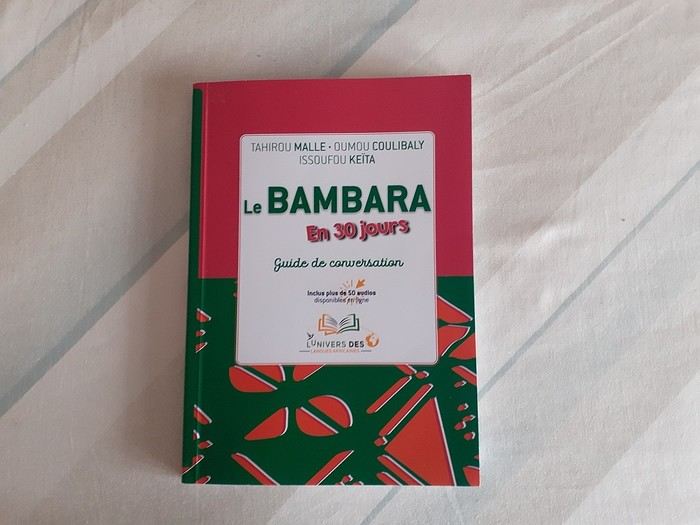
Manual: "Bambara in 30 Days"
Bambara in 30 Days is a manual and conversation guide specifically designed to help learners communicate in many everyday situations. This educational tool is aimed at anyone wanting to learn Bambara (bamanankan), regardless of their level: from beginners to advanced speakers looking to improve.
Several themes are covered: greetings, how to introduce yourself and apologize, family, numbers from 1 to 100, meals, emotions, transportation, currency, shopping, parts of the human body, days of the week, how to ask a question, how to ask for the price or age, how to count money, other types of questions, colors, traveling, blessing formulas for Muslim holidays: e.g., Tabaski (seliba) or Korité (selifiitinin or selidennin), and family events: e.g., birth (bangeli), marriage (furu), death (saya or fatuli)... ultimately, tools needed to communicate in many everyday situations.
The lessons (kalansen) are organized by theme, ranging from the alphabet to common expressions. All lessons include corrections (jaabi) to reinforce learning and correct mistakes. They cover various topics like greetings, numbers, family, etc. (see above) and are designed to be progressive, allowing for skill development. Each lesson is accompanied by practical exercises to apply the knowledge. After every set of 5 lessons, there’s a review (seginkanni) to consolidate what’s been learned.
In summary, the manual consists of...
30 lessons with 6 reviews
Over 50 audio files available online
Over 100 exercises (baarakɛ) with answer keys
A small vocabulary section in each lesson
Blank "notes" page at the end of every lesson
The audio files help facilitate learning. They are accessible via a specific link that should only be used by the manual’s purchaser.
African languages, like Bambara, play a crucial role in the culture and identity of African peoples. Learning them helps preserve traditions and local knowledge. Bambara is the most widely spoken language in Mali and a key lingua franca for communication in West Africa. It’s rich in idiomatic expressions and proverbs, reflecting the wisdom and culture of the Manding peoples. Moreover, it’s taught in schools and used in local media (to learn more, see here). In general, linguistic diversity in Africa is immense, with thousands of languages spoken across the continent.
Hi everyone,
I’m thinking about going on a language trip in the next few months and I’m wondering how to prepare well before leaving.
I feel like going without at least some basics can be frustrating at first, especially for speaking.
So, I have a few questions:
Have any of you prepared for your trip with a specific course or method?
What helped you the most before leaving (classes, online platforms, exchanges, partial immersion, etc.)?
Has anyone used Clic Campus or a similar platform to prepare for a stay abroad? If so, did it help once you were there?
I’m mainly looking for real feedback, not marketing 😊
Thanks in advance for your thoughts and experiences!
Hi,
so I’m heading off solo through China and I’d like to stay for a good while (about a year—do you think that’d be enough to pick up a bit of the language???).
I’d love to know if there’s a website, or if someone can help me live, that teaches the basics:
to understand the alphabet and characters.
to understand how a sentence is formed.
just the super simple basics, really.
Thanks for your help! ^o^
PS: My goal is to speak a tiny bit—not to write or anything—but still be able to read a little too...
Hi everyone!
I’m Tina, and I’ve organized French group trips to China for over 10 years. Over the years, I’ve noticed that the language barrier is the biggest stress for travelers—especially when ordering food, asking for directions, or negotiating in markets!
Today, I want to share 5 essential Chinese phrases I’ve taught my travelers—they’re simple, easy to pronounce, and work in 90% of travel situations:
你好 (Nǐ hǎo) = Hello → Polite and useful with everyone (locals, drivers, vendors).
谢谢 (Xiè xie) = Thank you → Chinese people really appreciate this politeness—it makes communication smoother.
多少钱 (Duō shǎo qián) = How much does it cost → Essential for local markets or small shops (menus in French are rare!).
请问,地铁站在哪? (Qǐng wèn, dì tiě zhàn zài nǎ lǐ?) = Excuse me, where is the subway station? → Swap “subway station” for “hotel” or “restaurant”—it works!
我要这个 (Wǒ yào zhè ge) = I want this → Point at the item and say this phrase—no more misunderstandings!
Bonus tip: Pinyin (the Chinese phonetic alphabet) is super helpful for reading street signs or menus. For example, “Nǐ hǎo” is pronounced “Nee how”—easy to remember!
If you’re planning a trip to China and want more practical phrases or pronunciation tips (to avoid embarrassing mistakes), feel free to send me a private message. I’ve put together a little traveler-friendly guide that I’m happy to share with anyone who wants to prepare stress-free.
Don’t hesitate to ask your questions in the comments either—if you’re unsure about a specific communication situation (e.g., in a temple, at the train station), I’d be happy to help!
Happy planning for your trip to China—it’s going to be amazing!
Hi everyone, and thanks in advance for your help! I know this forum is really great, and I feel a bit awkward posting this request... I speak a little Polish, but not that well, especially when it comes to slang or colloquial speech... Someone said to me the other day: "kurwa ty kurwa". Of course, I know what the word "kurwa" means, but when someone is really angry, I’m not sure how to interpret this phrase. Could you please help me by giving the French equivalent? I’m really sorry for this somewhat unusual request, but it’s very important to me. Thanks!
I’m heading to Georgia for a month in October. I’m currently looking for a Georgian Assimil course, but it seems like it’s no longer published. I’ve scoured the internet but can’t find a used one. So my questions are:
- Do you know where I might find a used one somewhere?
- Do you know of a nice equivalent to Assimil for Georgian?
It’s just to get a few basic phrases, be able to read some signs, etc., because with only English and French, I think I might be a bit stuck sometimes.
Hi there! I’m currently working on a project and came across a text that seems to be in Khmer. Would anyone know how to translate it or at least point out the main themes/info it contains? There are a lot of "garbage" characters in it. Thanks!
Dans une méthode pour apprendre le Hindi, j'ai vu la phrase suivante :
aap dopahar ko khana kitné bajé khati hain ?
Mais je voulais savoir si la phrase suivante était correcte aussi : aap dopahar ko kitné bajé khana khati hain ?
Si la deuxième phrase n'est pas correcte, pouvez-vous m'expliquer pourquoi ?
J'ai un niveau intermédiaire en Birman, voici les ressources que j'utilise.
Premièrement: apprenez l'écriture dès le début. Ce n'est pas comme le Chinois avec un système standardisé en caractères latins (le pinyin). L'alphabet birman n'est vraiment pas si compliqué que cela à apprendre. J'ai trouvé qu'apprendre lettre par lettre n'est pas très motivant, personnellement j'ai préféré apprendre l'écriture et la prononciation de plusieurs mots simples.
Les lieux géographiques peuvent être bien, car on a déjà une idée de la prononciation. Google traduction est truffée de fautes en Birman, donc allez plutôt sur la page Wikipédia au sujet d'un lieu en Birmanie pour trouver sa traduction en Birman. Par exemple:
Yangon Burmese: ရန်ကုန်
Mandalay Burmese: မန္တလေး
Si vous préférez apprendre l'écriture de manière plus académique, cette chaîne Youtube explique caractère par caractère.
https://www.youtube.com/c/MyanmarBurmeseLanguageCherry/videos
Elle est aussi bien pour apprendre les expressions de base (et même assez avancées).
Une fois que vous avez un niveau minimum, cette chaîne est aussi très bien (mais je vous déconseille les vidéos Beginning Burmese, ou le professeur utilise des caractères latins pour écrire les mots birmans.
https://www.youtube.com/user/kennethwongsanfran
J'écris sur ce forum afin de sollisiter l'aide de quelqu'un qui parle l'hindi en effet, j'aimerai me faire tatouer en hindi. J'ai essayer de traduire ma phrase seule mais c'est assez compliqué 😛, il y a beaucoup de traduction différente ! voila la phrase :
--> " Le jour où quelqu'un vous aime, il fait très beau "
J'ai trouvé cette traduction là : जिस दिन कोई आपसे प्यार करता है वह बहुत धूप है
Est-ce exact ?
Nin kèra npogotiginin dò de ye. Cè dò bòra a nò fè furu la. A ma sòn, nka a somògòw bèè sònna. Cè ko ale y'a nyini a fa n'a ba fè, ko a bè taa n'a ye yòrò la min b'a to a bè sò furu ma.
Cè taara dennin nò fè u ka so, ka taa n'a ye kòba dò kònò. U selen kòda la, a y'i kanto dennin ma :
Ee Koyan !
i t'a fò ko Bwatu ?
hmm hmm
n bolo bila hmm
hmm hmm
n bolo bila hmm
A ma sòn ka cènin tògò fò.
A donna n'a ye fo kunberekuru la, a seginna ka dònkili nin da :
Ee Koyan !
i t'a fò ko Bwatu ?
hmm hmm
n bolo bila hmm
hmm hmm
n bolo bila hmm
Dennin ma sòn ka cènin tògò fò.
U donna ji la fo u disi la. A ko dennin ma :
Ee Koyan !
i t'a fò ko Bwatu ?
hmm hmm
n bolo bila hmm
hmm hmm
n bolo bila hmm
O y'a sama o la fo u kan na, a ko a ma ka a fò ko Bwatu :
Ee Koyan !
i t'a fò ko Bwatu ?
ee Bwatu !
n bolo bila Bwatu
ee Bwatu !
n bolo bila Bwatu
O kèlen, a y'a labò ji la. Ka a ta o don na, fo ka a bila bi la, u ma sòn furusa ma.
Koyan et Boitou
C'est l'histoire d'une jeune fille qui s'appelait Koyan. Un gar��on qui s'appelait Boitou voulait l'épouser, mais elle ne voulait pas. Les parents de Koyan voulaient bien du mariage mais elle ne voulait pas. Alors, le garçon se dit : puisque le père et la mère de Koyan sont consentants, je vais me rendre dans un endroit où la jeune fille finira bien par consentir à son tour.
Il alla chercher la petite chez ses parents, et l'emmena jusqu'au bord d'un marigot. Quand ils furent à côté de l'eau, le garçon lui dit :
ah ! Koyan
appelle-moi donc Boitou !
Et la jeune fille répondit :
aïe aïe aïe !
lâche donc ma main !
aïe aïe aïe !
lâche donc ma main !
Elle n'accepta pas de dire son nom. Alors, il entra dans l'eau avec elle, la tenant par la main. Quand ils eurent de l'eau jusqu'au genou, il reprit sa chanson :
ah ! Koyan
appelle-moi donc Boitou !
Et la jeune fille répondit :
aïe aïe aïe !
lâche donc ma main !
aïe aïe aïe !
lâche donc ma main !
La jeune fille n'accepta pas de dire son nom. Il avança dans l'eau avec elle, jusqu'à ce que l'eau leur arrive à la poitrine, et reprit sa chanson :
ah ! Koyan
appelle-moi donc Boitou !
Et la jeune fille répondit :
aïe aïe aïe !
lâche donc ma main !
aïe aïe aïe !
lâche donc ma main !
Alors, il la tira encore jusqu'à ce que l'eau leur arrive au cou, et de nouveau lui demanda de prononcer son nom :
ah ! Koyan
appelle-moi donc Boitou !
Et la jeune fille répondit alors :
ah ! Boitou !
lâche donc ma main, Boitou !
ah ! Boitou !
lâche donc ma main, Boitou !
Alors, il la laissa sortir de l'eau. Et de ce jour à aujourd'hui, ils sont très heureux ensemble.
Nin kèra cènin dò ye. Tuma o tuma n'ale tun bòra, ale ni nyèji de tun bè segin so. Dugu cèmisènninw tun b'a gosi tuma bèè. Ale n'a filan o filan tun mana syèn ta, o tun b'a bin. A laban na, bòli yèrè tun negebòr'a la. Don dò la, a fa y'a wele ka kum'a fè. A y'i kanto a denkè ma : "N'i ni mògò dò bèna syèn ta, n'aw ye nyògòn minè dòrò, i bè nin kilisi fò : 'Du'. I man'o fò dòròn, i b'i kèlènyògòn bin." Denkè ko ko baasi tè. O dugujè, cènin bòra. A ni kamalennin dò ye nyògòn kunbèn. O y'a dakòròbò. U y'u kè nyògòn kan o yòrò bèè la. U ye kèlè daminè dòròn, cènin ko : "du". A y'o kamalennin bin, k'a gosi. Kabi o don, mògò si ma s'a la bilen. Sisan, dugumògò bèè tun bè siran cènin nyè. A yadara ka yada. A tun b'a fò tuma bèè ani yòrò bèè ko fanga b'ale la ka tèmèn dugumògò bèè kan. Don dò la, a y'a nyin'a fa fè k'u ka syèn ta, walasa a ka dò olu mògò fila cè, jònni kelen fanga ka bon ni tò kelen ta ye. Fa yèlètò y'i kanto a denkè ma : "N'i ko ten, n sònna." U ye syènta daminè, cènin ko : "du", a fa ko : "dudadu." O yòrò bèè la, a y'a denkè tòn da dugu ma. O kò, a y'i kanto cènin ma : "N den, n bèna kuma min f'i ye, i k'o to i kònò : dò bè du dòn, nka o tè dudadu dòn."
Cènin maloyalen y'a kun biri, ka yafa nyin'a fa fè. Kab'o don bòr'a la, a m'a ka malobaliya las'a fa ma tugun.
La formule magique "Dou et doudadou"
Il était une fois un garçon. Chaque fois qu'il sortait, il retournait en larmes à la maison. Les jeunes garçons du village le frappaient tout le temps. Chaque fois qu'il luttait avec un garçon de son âge, celui-ci le terrassait. A la fin, il n'avait même plus envie de sortir. Un jour, son père l'appela et lui parla. Il dit à son fils : "Si tu dois lutter avec quelqu'un, prononce, aussitôt que vous vous empoignez, cette formule magique : 'dou' ! Une fois que tu l'auras dit, tu terrasseras ton adversaire." Le fils acquiesça. Le lendemain, le garçon sortit. Il recontra un jeune homme. Celui-ci le provoqua. Ils se jettèrent tout de suite l'un sur l'autre. Dès qu'ils commencèrent à se battre, le garçon exprima : "dou". Il terrassa ce jeune homme et le frappa. Depuis ce jour plus personne ne l'a vaincu. Maintenant, tous les habitants du village avaient peur du garçon. Il devint de plus en plus arrogant. Il disait à tout moment et en tout lieu qu'il était le plus fort du village. Un jour, il demanda à son père de lutter avec lui, afin qu'on sache lequel des deux était le plus fort. Tout en riant, le père s'adressa à son fils : "S'il en est ainsi, je suis d'accord." Ils commencèrent à lutter, le garçon articula : "dou", son père prononça : "doudadou." Et sur le champ, il envoya son fils à terre. Ensuite, il confia au garçon : "Mon fils, retiens bien ce que je vais te dire : quelqu'un peut savoir dou mais pas doudadou."
Gêné, le garçon baissa la tête et présenta ses excuses à son père. Depuis ce jour, il ne fut plus irrespectueux envers son père.
Nsiirin ! N y'a ta k'a da kunatòkè dò de la. Banaba tun y'a bolonkòni n'a sennkòni bèè nyimi fo k'a ban u la. Foyi tun tè cè in bolo, wa a tun tè se ka fosi k'a yèrè ye tugun. Su fara tile kan, a tun b'i makasi a ka dinyènatigè kan. Don dò la, bòn dò tèmèntò ye kunatòkè kasikan mèn. A jiginna, k'i sigi kasibagatò kèrèfè, ka kum'a fè. Kònòba y'a dòn minkè ko kuna juguman de tun bè cè la, o makari donn'a la. A y'a fò cè ye k'a k'i mantò, k'ale bèn'a dèmè. Kunatòkè y'i kanto bòn ma ko n'o sera k'ale dèmè, o bè diya ale ye kosèbè. Bòn ye kilisi dò fò, kunatòkè kènèyara o yòrònin kelen na ten. A kèra iko banaba tun ma deli k'a minè abada. A nisòndiyalen tora k'a bolonkòniw n'a sennkòniw filè. A y'u lajè o k'u lajè. O kò, a ye barika da bòn ye. Kònòba ma dan cè kènèyali dòròn ma, a tilala ka sanu caman d'a ma, k'a kè faamaba ye. Nka, sanni bòn k'i pan, a y'a kiliw kalifa cè la. A ko ko cè k'i jija foyi juguman kan'ale kiliw sòrò. Cè ye layidu ta kònòba ye, k'a b'i janto kili ninnu na konyuman, ko fosi tèna s'u ma. O kò, bòn y'i sara cè la, k'i pan ka taa. Denkè kelen tun bè cè bolo. O cènin tun ye myètònin de ye. Don dò la, ale ye kònòba kiliw ye. Kabini bilakoronin nyè dara bòn kiliw kan, a ka myè wulila. A taara kasi a fa da la, k'o ka kònòba kili kelen d'ale ma. Fa y'i miiri bòn ka kuma na, a ma sòn ka kili di cènin ma. Nka, bilakoronin tun tè sègèn, a tun tè nyinè. A y'a fa tòòrò, k'a tòòrò, fo o kun tun bèna wuli. A laban na, walasa a ka se k'a yèrè sòrò, cè ye kili kelen ta k'o di cènin ma. Nka, a denkè tun ye mògò ye, min tun tè wasa. Don o don sa, a tun bè t'a fa deli, o fana tun bè kili kelen ta k'o d'a ma. U tor'o la fo bòn kili bèè banna. Don dò la, kònòba nan'a kiliw nò fè. Cè y'i kanto bòn ma k'ale denkè ye kili olu bèè dun kaban. Bòn dusu kasilen ko ko cè y'ale ka wale nyuman sara ni juguman ye. A ye kilisi dò fò. Cè seginna kunatòya la, wa a ka nafolo bèè fana tununna.
Kunatòkè ka nin sen faantanya juguyara yèrè ka tèmèn fòlòta kan.
Fitiriwaleya man nyi. N ye nsiirin in ta yòrò min na, n y'a bila yen.
Le lépreux et l'aigle
Conte ! Il était une fois un lépreux. La lèpre avait entièrement rongé tous ses doigts et orteils. Cet homme n'avait rien et ne pouvait plus rien faire pour lui-même. Jour et nuit, il se plaignait de son sort. Un jour, un aigle qui passait entendit les pleurs du lépreux. Il descendit, se posa près de l'homme qui pleurait et lui parla. Lorsque le grand oiseau apprit que l'homme souffrait d'une grave lèpre, il eut pitié de lui. Il pria l'homme de se taire, et lui fit part qu'il allait l'aider. Le lépreux dit à l'aigle qu'il serait très content si ce dernier parvenait à le guérir. L'aigle prononça une formule magique, et le lépreux fut guéri sur le champ. C'etait comme s'il n'avait jamais été atteint de lèpre. Content, il resta en train de regarder ses doigts et ses orteils. Ils les admira pendant très longtemps. Puis, il remercia l'aigle. Le grand oiseau ne se limita pas à guérir l'homme, il lui donna ensuite beaucoup d'or, le rendant très riche. Mais avant que l'aigle ne s'envolât, il confia ses œufs à l'homme. Il demanda à l'homme de veiller à ce qu'il n'arrive rien de mal à ses œufs. L'homme promit au grand oiseau qu'il allait bien s'occuper de ces œufs, et que rien ne leur arriverait. Ensuite, l'aigle prit congé de l'homme et s'envola. L'homme avait un fils. Ce garçon était un petit gourmet. Un jour, il vit les oeufs du grand oiseau. Dès que le regard du petit incirconcis se posa sur les œufs de l'aigle, son envie s'éveilla. Il alla pleurer auprès de son père afin que ce dernier lui donnât un œuf du grand oiseau. Le père pensa aux paroles de l'aigle et refusa de donner l'œuf au garçon. Mais le petit incirconcis était très tenace. Il harcela tellement son père que ce dernier faillit perdre la tête. Finalement, pour retrouver sa quiétude, l'homme prit un œuf et le donna au garçon. Mais son fils était une personne insatiable. Ainsi, il partait chaque jour quémander un œuf à son père, ce dernier aussi en prenait un et le lui donnait. Ils firent ainsi jusqu'à finir tous les œufs de l'aigle. Un jour, le grand oiseau vint réclamer ses œufs. L'homme annonça à l'aigle que son fils avait déjà mangé tous les œufs. L'aigle malheureux affirma que l'homme avait payé sa bonne action par une mauvaise. Il prononça une formule magique. L'homme redevint lépreux, et toutes ses richesses aussi disparurent. Le lépreux était maintenant devenu plus pauvre qu'avant. L'ingratitude n'est pas une bonne chose. Je laisse ce conte là où je l'ai pris.
N y'a da dugumasa la. A tun ye muso furu. Ni ka ka musonin ncinin nyini. Musonin ncinin nalen minkè, musokòròba ko ko o tè kun ale la. O taara ka taa baara kè moriw fè ni ka musonin ncinin nyènyini k'o kè suruku ye. Ni ka taa kungo fè. O mana kè, o ta den ye, ni ka a fò o ye ko fa wulila a ba la. N'a taara kungo fè, ayiwa, ni su kora, ba nin bè na so kòfè, ka n'i jò a den ma :
Arabajèkè bè sunògò wa ?
a b'a fò ayi n tè sunògò
tiga bè bondon na i y'o di i dògònin ma ?
dègè bè baranin na i y'o di i dògònin ma ?
sinè ye n kè suruku ye
sinamuso jugu ye n kè suruku ye
awoyi !
A bè taa kungo fè. Ayiwa, k'o gan, k'o gan.
Musokòrònin, o nana ni ka a sidòn. O taara ni ka taa a fò dugumasa ye:
– Ko dugumasa, ko denmisènninw ba, ko a ma fò ko fa wulilen b'a la, ko fa wulilen t'a la dè, ko sinamuso ye ka baara k'a la, ko ni ka a yèlèma ka kè suruku ye.
– Ko haan ?
– Ko awò.
– Ayiwa, ko baasi tè !
Kabini o kèra, dugumasa yèlènna soba la. Ka marifa sòsò. Ni ka yèlèn soba la ni k'i da. O yèlènna so bala, suruku nana tila, a nana.
Arabajèkè bè sunògò wa ?
a b'a fò ayi n tè sunògò
tiga bè bondon na i y'o di i dògònin ma ?
dègè bè baranin na i y'o di i dògònin ma ?
sinè ye n kè suruku ye
sinamuso jugu ye n kè suruku ye
awoyi !
Ko a bè i kòdon, nin y'i cun ka bò soba bala ni ka a minè. Ni ka taa a jira sinamuso la. A ko :
– E nò tè nin ye wa ? E ka baara tè nin ye wa ?
A ye mugu k'a la kaan ! Ni ka a faga. Kabini o kèra, a y'a faga yòrò min na, kabini o kèra, muso seginna a ka mògòya la, ka bò surukuya la.
N ye nsiirin nin sòrò yòrò min na, n y'o bila yen.
La méchante coépouse
Il était une fois un roi. Il avait une première femme, il vint à en épouser une seconde. Lorsqu'arriva cette deuxième femme, la première ne put le supporter, et s'en alla trouver les marabouts. Ceux-ci par leurs maléfices, finirent par transformer la jeune femme en hyène; et celle-ci partit dans la brousse, et la marâtre dit à l'aînée que sa mère était devenue folle.
Cependant, à la nuit tombée, la mère venait derrière les maisons, et parlait avec sa fille :
Arabadièkè, ma fille, dors-tu ?
non, non, je ne dors pas !
il y a des arachides dans le grenier
en as-tu donné à ton petit frère ?
il y a de la crème dans la petite gourde
en as-tu donné à ton petit frère ?
ma coépouse m'a transformée en hyène
ma méchante coépouse m'a transformé en hyène
oh la la !
Puis elle retournait dans la brousse. Cela dura longtemps, longtemps. Cependant une petite vieille finit par s'apercevoir du manège, et s'en alla trouver le roi :
– Roi, lui dit-elle, on dit que la mère de tes enfants est devenue folle; mais elle n'est pas devenue folle du tout, c'est sa coépouse qui a fait contre elle des maléfices et l'a transformée en hyène.
– Quoi ?
– Parfaitement !
Alors le roi chargea son fusil ; il monta sur le toit d'une grande maison, et attendit. A la nuit tombée, l'hyène arriva :
Arabadièkè, ma fille, dors-tu ?
non, non, je ne dors pas !
il y a des arachides dans le grenier
en as-tu donné à ton petit frère ?
il y a de la crème dans la petite gourde
en as-tu donné à ton petit frère ?
ma coépouse m'a transformée en hyène
ma méchante coépouse m'a transformé en hyène
oh la la !
Quand elle voulut s'en aller, le roi sauta du toit de la maison et l'attrapa. Il s'en alla la montrer à sa première femme.
– N'est-ce pas toi, lui dit-il, qui est responsable de cela ? N'est-ce pas le résultat de tes maléfices ?
Alors, il déchargea sur elle son fusil et la tua. Et au moment même où il tua la marâtre, l'hyène perdit sa forme animale et redevint la jeune femme qu'elle était auparavant.
Là où j'ai pris ce conte, je le remets.
N y'a da kamalen dò la, ani sungurunnin dò. U ye nyògòn kanu kosèbè ! U diyara nyògòn ye, fo ka se Ala y'a kè kamalennin, a ba nana bana. Ba nin, a tè se ka foyi kelen kè a yèrè ye. Ayiwa, sungurunnin, o de bè dumuni tigè ka a d'a ma, tuma bèè. O b'a balo.
Ala y'a kè sungurunnin ye dumuni tigè ka a don ba nin da, a bolo donnen a da, Ala y'a kè ba nin sara ka a nyin fèrèlen to sungurunnin tègè la.
Dòw ko dennin tègè ka kan ka tigè, dòw ko ba nin da ka kan ka fara. Ayiwa, ni min ka kan ka kè o la, a y'o fò !
La main coincée
C'était l'histoire d'un jeune homme et d'une jeune fille. Ils se marièrent, ils s'aimaient beaucoup, ils étaient très bien ensemble. Dieu fit que la mère du garçon tomba malade, et qu'elle devint complètement dépendante des autres. C'est la jeune femme qui lui donnait à manger, chaque jour, c'est elle qui la nourrissait.
Dieu fit qu'un jour où elle lui donnait à manger, et alors que sa main était dans la bouche de sa belle-mère, celle-ci mourut, emprisonnant la main de sa belle-fille entre ses dents.
Alors, certains dirent qu'il fallait couper la main de la vivante, d'autres qu'il fallait déchirer la bouche de la morte.
Et vous, que pensez-vous qu'il faille faire dans une pareille situation ?
N y'a da muso nin na. A n'a cè. Ala ma dòwèrè d'a ma dennin kelen kò. Ayiwa, o dennin kelen, min dira a ma, fa nana sa, o nana sa minkè, ba yèrè nana ka na bana. O banana, ayiwa, o kèlen na, o y'a fò ntugannin ye. A ko :
– Ne bèna sa, a ko n ye n den kalifa i ma, Ala kama, a kira kama, i k'i hakili to n den la. A ko anw bèè satò ye nin ye.
Kabini o kèra, ba yèrè nana sa. A nana sa minkè ni ka a tò to den kelen ye, ayiwa, ntugannin mana taa kungo la, a bè taa nyò sogin ka a ncòki fa, a bè na :
Dennin dennin yo dennin
na ni kunannin ye dennin
n ka nyò dò k'i kun dennin
i fa bè sa don min dennin
i fa y'i kalifa n ma dennin
i ba bè sa don min dennin
i ba y'i kalifa n ma dennin
na ni kunannin ye dennin
n bè nyò dò k'i kun dennin
Kabini o kèra, a bè na ni kunan ye. Den bè nyò tobi k'o dun. Dugumasa, u taara ka taa o fò o ye, u taara ka taa a fò dugumasa ye ko dennin ba sara, a fa sara, ko ntugannin de ye a ba ye. Kabini o kèra, o ko baasi tè. Ntugannin nana :
Dennin dennin yo dennin
na ni kunannin ye dennin
n ka nyò dò k'i kun dennin
i fa bè sa don min dennin
i fa y'i kalifa n ma dennin
i ba bè sa don min dennin
i ba y'i kalifa n ma dennin
na ni kunannin ye dennin
n bè nyò dò k'i kun dennin
Kabini o kèra, u ye mugu ci ntugannin na ni ka ntugannin faga. Kabini o kèra, dugumasa ye den sigi a kun, o kèra dugumasa muso ye.
N ye nsiirin nin sòrò yòrò min, n y'o bila yen.
La tourterelle
Il était une fois une femme et son mari, à qui Dieu n'avait accordé qu'un seul enfant, une petite fille. Le père de la petite vint à mourir, et sa mère tomba gravement malade. Lorsqu'elle fut très mal, la mère s'en alla trouver une tourterelle et lui dit :
– Je vais mourir, je te confie mon enfant, au nom de Dieu et de son prophète, prends bien soin d'elle !
Peu de temps après, la mère mourut, laissant seule cette petite fille. Alors, lorsque la tourterelle s'envolait du village, elle partait picorer du mil dans les champs, en remplissait son jabot et revenait en chantant :
petite fille, ô petite
apporte-moi ton plat, petite
que je te donne du mil, petite
quant ton père mourut, petite
il t'a confiée à moi, petite
quand ta mère mourut, petite
elle t'a confiée à moi, petite
apporte-moi ton plat, petite
que je te donne du mil, petite
Alors, l'enfant venait avec son plat, elle le remplissait, puis elle partait faire cuire ce mil et le mangeait.
Le temps passa. On finit par aller raconter au roi que le père de la jeune fille était mort, que la mère de la jeune fille était morte, et que c'était la tourterelle qui lui serviat de mère. Alors le roi dit :
– C'est bien !
Et quand la tourterelle vint chanter :
petite fille, ô petite
apporte-moi ton plat, petite
que je te donne du mil, petite
quant ton père mourut, petite
il t'a confiée à moi, petite
quand ta mère mourut, petite
elle t'a confiée à moi, petite
apporte-moi ton plat, petite
que je te donne du mil, petite
les gens prirent des fusils, tirèrent sur la tourterelle et la tuèrent. Alors le roi prit la jeune fille chez lui, et en fit son épouse.
Là où j'ai trouvé ce conte, je le remets.
Nin ye terima fila ye. O terima fila, dò ye tigaforo sènè, dò ye sanyòforo sènè. Sanyò nana nyè, ka tiga nyè. Ayiwa don dò, u ko u bè taa bò u ka foro la, wula fè. U taara. U taalen se foro la, tigaforotigi donna a ka tigaforo la, sanyòforotigi taara nyè fè, ale taara i jò a ka forocamancè rò k'i jò :
– Òo ! Tinyè na, ne ka sanyò nyèna nyinan !
Sanyò sinna k'i jò, ko :
– E fòrò basannen, san tòw la, e bè anw dan, anw tè nyè wa ?
A y'i kun biri ka a ka wulu filè. Wulu ko :
– Hmm ! I bè ne filè, ne de y'a fò wa ?
A ye jele bò a kan na k'a bè wulu kun ci, jele ko :
– I kana to i ka n tòn ci dè !
A b'i cè nyòfura fè. Ntugan b'a fò :
– I sen kana da an kan dè ! I sen kana da an kan dè !
Cè tora o panpan na ten dòròn, ka bò foro la, ayiwa ale bèna tèmè tuma min, ale y'a sòrò a terikè bè bokè la. O ko :
– Hè ! Hè ! Hè ! Cè na yan, na yan, na yan !
A bolila ka se o ma, a ko :
– Cè, e dun bolikun ?
– Èe ! n cè, n taara n ka foro la, ne ko ne ka foro nyèna, ne ka foronyò ko ne fòrò basannen, ko san tòw la ne b'u dan ko yali u tè nyè wa ? Ko ne ye n ka wulu filè, wulu ko ne bè ale filè mun na ? K'ale de y'a fò wa ? Ne ko n b'o kun ci o, ne ka jele ko ne kana to n ka ale tòn ci. Ne bè boli la, nyòfura bè ka a fò i kana tu n na dè !
Cè ko :
– Hè ! Hè ! Bataraden, o ye e bolikun bèè ye wa ?
Bo ko :
– K'e bataraden, ni ne y'a fò e ma, i bè sigi wa ? Coyi ! Botigi wulila, botigi ju lankolon taara don o ka so.
N y'a sòrò yòrò min, n taara o bila yen.
Deux amis
Il était une fois deux amis. L'un cultivait un champ d'arachides, l'autre un champ de petit mil. Le petit mil vint à mûrir, l'arachide aussi, les deux amis décidèrent donc d'aller, une après-midi, voir leurs cultures. Celui qui avait fait des arachides entra dans son champ, l'autre partit plus loin voir son petit mil. Arrivé au beau milieu de son champ, ce dernier s'étonna :
– Ah, vaiment, cette année, mon petit mil a bien donné !
Alors du tac au tac le petit mil se dressa et lui répliqua sèchement :
– Espèce de couillon, est-ce que les autres années, lorsque tu nous sèmes, nous ne poussons pas ?
Interloqué, l'homme baissa la tête et ne vit que son chien, celui-ci lui dit alors :
– Ne me regarde pas comme cela, est-ce moi qui t'ai parlé ?
L'homme alors souleva sa hache pour assommer son chien, mais la hache l'apostropha :
– Eh toi, ne va pas me briser la nuque !
Alors, l'homme détala, il se mit à courir, à courir entre les tiges qui lui criaient :
– Mais ne nous bouscule pas, ne nous bouscule pas comme cela !
Il s'écarta des tiges, et ce furent les buttes de terre qui s'exclamèrent :
– Mais ne nous écrase pas comme cela !
L'homme sauta comme un fou et sortit de son champ. Il passa en courant près de son ami accroupi pour un gros besoin.
– Ho ! lui cria ce dernier, qu'est-ce qui t'arrive, pourquoi cours-tu ainsi ?
– Ah ! si tu savais ! dit l'autre. Eh bien, voilà : je soirs juste de mon champ ; comme le petit mil avait bien poussé, je l'ai dit à haute voix, tout simplement, et voilà que le petit mil me traite de couillon, en ajoutant que les autres années, quand je le sème, il pousse aussi bien ! Alors, je regarde mon chien, et voilà qu'il me dit de ne pas le regarder comme cela, qu'en tout cas lui n'a rien dit ! Je m'apprête à l'assommer, voilà que la hache me prévient de ne pas lui briser la nuque ! Je me sauve en courant, les tiges de mil me crient de ne pas les écraser !
L'ami se mit à rire :
– Et c'est pour cela, espèce d'idiot, que tu te sauves ?
Alors, entre ses jambes, son gros besoin lui répliqua du tac au tac :
– Idiot toi-même, si je t'avais dit tout cela, crois-tu donc que tu serais resté sans bouger ?
Aïe ! Aïe ! Aïe ! L'accroupi se leva, et d'un seul bond, le derrière à l'air, détala jusque chez lui.
Là où j'ai pris ce conte, je le remets.
Senkala misènnin, ani bolokala misènnin, ani dafurukuba, ani nyèkiliba, ani shèkilinin, ani dununkala. Olu ko u bè taa nyinè dingè sen. U taara nyinè dingè senni la, bolokala misènnin ye nyinè dingè sen, ka inè dingè sen. Nyinè bòra, o bolo karila. Senkala misènnin y'a gèn, ka a gèn, ka a gèn, ka gèn, o sen karila. Nyèkiliba y'o mafilè, k'o mafilè, k'o mafilè, k'o nyèkili burun. Dafurukuba yèlèla ka yèlè, ka yèlè, ka yèlè, k'o da fara. E shèkilinin, e dimina k'e bèna a fò so, o bolibagatò taara i yèrè ci bògòkuru la k'o ci. Dununkala y'i cèsiri k'i cèsiri, k'ale bèna a fò so, k'o cètigè.
Ko nin jumèn nin ta ka jugu jumèn ta ye ?
Le trou de souris
Une petite jambe de rien du tout, un petit bras de rien du tout, une grosse joue, un gros œil, et puis encore un petit œuf et une guêpe-maçonne. Voilà qu'ils veulent attraper une souris dans un trou. Et de creuser, de creuser, de creuser. C'est le petit bras de rien du tout qui commence, il creuse, il creuse, il creuse, la souris s'échappe et hop ! il se brise en deux. Du coup voilà la petite jambe de rien du tout qui se lance à la poursuite de la souris, qui la poursuit, qui la poursuit, et hop ! qui se brise en deux. Du coup, voilà le gros œil complètement éberlué : il regarde, il regarde, il regarde, et hop ! il tombe de son orbite ! Du coup, voilà la grosse joue qui se met à rire, à rire, à rire à s'en fendre la bouche, et hop ! qui s'en fend la bouche ! Du coup, voilà le petit œuf qui se met en colère et dit qu'il va s'en aller tout raconter chez lui, il se met à courir, à courir, à courir, il trébuche sur une motte de terre et hop ! il se brise sur place ! Du coup, voilà la guêpe-maçonne qui s'envole en rentrant sa taille, en rentrant sa taille, en rentrant sa taille, et hop ! elle se coupe en deux.
Tout cela est très très grave, mais pour qui est-ce le plus grave ?
Nsiirin ! N y'a da npogotigininw na. Furukènyè npogotigininw ko don. Minnu ko k'u tè u cèw fè. Ayiwa, u ye nyògòn lajèrè, u dama min ko u tè u taw fè, u ka sèrè kè kelen ye. O tuma, minnu ko u b'u taw fè, olu yèrèw dama kèra kelen ye. Olu kèra kelen ye minkè, o tuma na, ko minnu tè u cèw fe, u galegale kèra min ye, cèlataa da sera o ma, o sera o ma minkè, o bolila k'i dogo. O y'i dogo minkè, dugu gatigiw ko, u ko u tè se ka to denmisènninw bolo tan. O tuma na bèè ka don i ka so kònò k'i da, o tuma na, an ka mògò nyini, fèn min bè se ka a jatigè ni ka a don dugu kònò. Bèè k'i da tugu, bèè k'i ka konsògòfòlò sòsò. N'a ma don sòrò mògò si ka so, o tuma na, a maminènen bè min ye, a na taa o sègèrè. Ayiwa, musocè yèrè, u y'o wele, k'o nyininka, ko n'o yèrè bè se ka baara kè. O ko ale bè se. O tuma na, o taara fininkolonba dò nyini, k'o kala a yèrè la, ka dò kè banfula ye, ni ka bereba dò ta, ni ka n'i jò. Dennin tògò tun ye ko Jowelen. Ayiwa, mògòw senna mana sagon dòònin, o tuma na, a bè na i da gèlèn kan. A nana i da gèlèn kan minkè, o tuma na, cè nin labènnen nana sa. Welen b'o ju la, a b'a senw na. A nan'i jò :
Jowelen baw ko ne ka na Jowelen ko la !
jo jo ja ! ne nana Jowelen ko la !
Jowelen faw ko ne ka na Jowelen ko la !
jo jo ja ! ne nana Jowelen ko la !
A y'i kun kòròta ni k'o filè a y'a da. O y'i dèmèdèmè k'i dèmèdèmè fo ka taa se a ma. O sera a ma minkè, ko :
Jowelen baw ko ne ka na Jowelen ko la !
jo jo ja ! ne nana Jowelen ko la !
Jowelen faw ko ne ka na Jowelen ko la !
jo jo ja ! ne nana Jowelen ko la !
A fora ka wuli. Dugu da o da, n'a taara ko a bè don min fè yen, a b'a sòrò o ta sòsòlen don. N'a taara k'a bè don min fè yen, a b'a sòrò o ta sòsòlen don. Kabini o kèra, maminècè ka da yèlènnen bè k'o bila. O bè a nò fè nin bèè ye. Kabini o kèra, o taara se o ka da ma. A b'a nò fè :
Jowelen baw ko ne ka na Jowelen ko la !
jo jo ja ! ne nana Jowelen ko la !
Jowelen faw ko ne ka na Jowelen ko la !
jo jo ja ! ne nana Jowelen ko la !
A y'i kari ka don cè ka da fè ka taa i da fo o ka dalan kan. Kabini o kèra, cè y'a ka da tugu a da la, ka taa a ka labènfènw bò k'o bila ka sòrò ka na a sègèrè.
N ye nsiirin nin sòrò yòrò min, n y'a bila yen, o kèra a ka furu dilalen ye.
La fille rebelle
Conte.
C'est l'histoire des jeunes filles qui ne voulaient pas se marier, qui ne voulaient pas des garçons qu'on leur donnait. Un jour, elles se réunirent et décidèrent de former un groupe à part. Les autres jeunes filles, celles qui voulaient bien de leurs promis, formèrent un autre groupe.
Il arriva que ce fut le tour de se marier d'une des filles rebelles, qui s'appelait Diowélé. Quand arriva le temps de la noce, elle s'enfuit, elle alla se cacher. Alors, les chefs de famille se réunirent, et déclarèrent qu'ils ne pouvaient continuer à dépendre ainsi de leurs enfants. Ils demandèrent à chacun de rentrer chez soi, et qu'on trouve quelqu'un, quelque chose capable d'effrayer la rebelle afin qu'elle revienne dans le droit chemin. Une fois chacun chez soi, et les portes de toutes les maisons bien closes, elle ne trouverait nulle part où se réfugier, il faudrait bien qu'elle aille chez son promis. On demanda au fiancé de s'occuper en personne de cette affaire, il accepta. Il s'en alla chercher de vieilles nippes qu'il fit coudre sur lui, s'affubla d'un chapeau grotesque, se fixa aux pieds et sur les fesses des clochettes, prit un gros bâton et attendit.
Quand dans les ruelles le mouvement se fit plus rare, la jeune fille vint se coucher sur la plateforme publique. Alors, son fiancé, avec ses oripeaux, son bâton et ses clochettes, arriva en chantant :
les mères de Diowélé
m'ont dit de venir pour Diowélé
dio, dio, dia, me voilà !
les pères de Diowélé
m'ont dit de venir pour Diowélé
dio, dio, dia, me voilà !
La jeune fille leva la tête, regarda, puis baissa la tête. Son fiancé tout doucement arriva jusqu'à elle en chantant.
les mères de Diowélé
m'ont dit de venir pour Diowélé
dio, dio, dia, me voilà !
les pères de Diowélé
m'ont dit de venir pour Diowélé
dio, dio, dia, me voilà !
Alors, prise de panique, la jeune fille s'enfuit. Toutes les portes qu'elle voulut ouvrir étaient fermées à clef. Toutes les maisons étaient closes, sauf celle de son fiancé, qui l'avait laissée ouverte. Il la poursuivit jusqu'à sa porte en chantant.
les mères de Diowélé
m'ont dit de venir pour Diowélé
dio, dio, dia, me voilà !
les pères de Diowélé
m'ont dit de venir pour Diowélé
dio, dio, dia, me voilà !
La jeune fille se précipita dans la maison de son fiancé et courut se jeter sur son lit. Alors, le finacé referma la porte derrière lui, se défit de ses oripeaux et vint la retrouver. Et voilà comment se fit leur mariage !
Là où j'ai trouvé ce conte, je le remets.
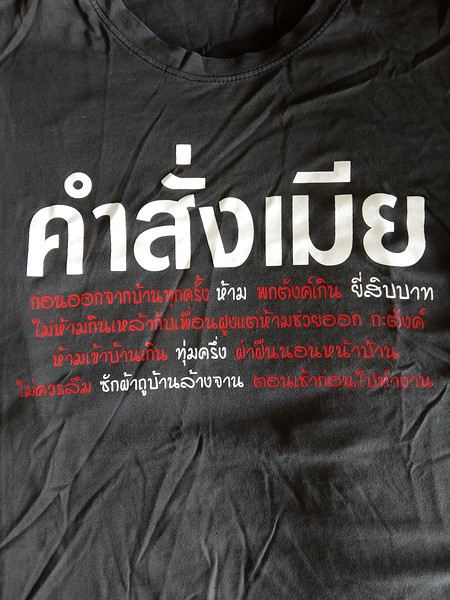
Lors de mon dernier voyage à vélo, jai acheté un t-shirt sur un marché de vêtements d'occasions en Thaïlande.
Le texte du t-shirt a bien fait maré les Thaïs😂. De ce que j'ai compris de leur anglais (mauvais) grâce à mon anglais (mauvais) et après avoir essayé quelques traducteurs : c'est ta femme qui commande, tu fais le ménage, tu fais la vaisselle et si tu sors, ce n'est pas pour boire avec tes amis mais pour faire les courses.
L'essence du message est là je crois, mais si quelqu'un pouvait m'apporter des précisions. Merci pour votre aide 😀
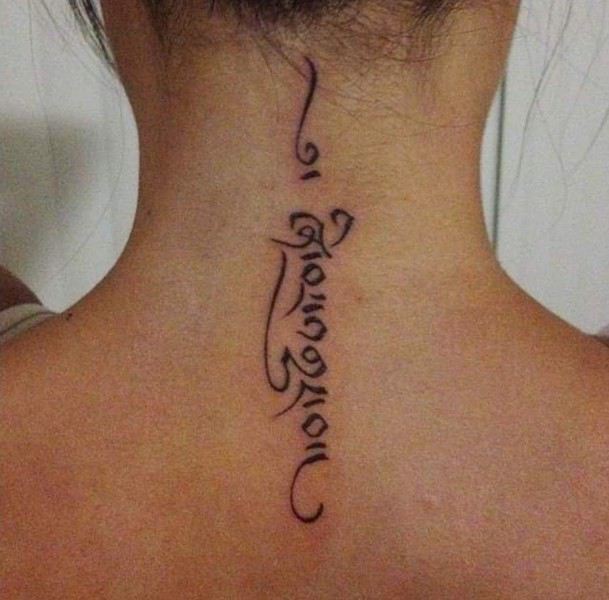
De plus, trouvant les motifs sympas et ne connaissant pas la signification ...
... Je me le suis fait tatouer dans le dos ...😬
Est-ce possible de traduire le mot "Vivre" en hindi s'il vous plait?
J'ai déjà regardé sur de nombreux sites, mais je ne suis pas certaine de la traduction.
लाइव => voilà ce que j'ai trouvé pour "vivre" dans le sens d'exister, d'être en vie.
Bonjour,
Je cherche à savoir quel est le sens d'une expression employée par feue ma grand-mère vietnamienne quand elle était énervée :"Baanotia ! ".Merci pour votre aide.
Bonjour, je souhaiterais connaître la signification de cette écriture que je trouve très belle et me la faire tatouer lors d'un futur voyage en Thaïlande 😊 ( vu le contexte actuel j'ai encore du temps devant moi )
Merci pour votre aide.
Bonjour a Tous,
Pour toute personne voulant traduire des messages de l'arabe académique ou dialect Nord Africain en franacais ou en anglais dans la mésure du possible et vis versa , je suis disponible a vous apportez de l'aide .
Bonne Journée
Salutations


 Bonjour à tous👋,
 Bonjour,
Pour mon prochain tatouage je souhaiterai me faire ça mais je ne connais pas la traduction. Quelqu'un peut-il m aider svp ?😊
Bonjour,
Pour mon prochain tatouage je souhaiterai me faire ça mais je ne connais pas la traduction. Quelqu'un peut-il m aider svp ?😊