last edited Dec 11, 2019
Electrical Systems by Country
Location Map of Destinations
 Destinations
Open the interactive map
Destinations
Open the interactive map
Which Plug for Which Country?
No matter what equipment you have, it’s useful to know what types of electrical outlets you’ll encounter while travelling. The only issue: there’s no truly universal global standard for plug types, voltage, or electrical frequencies.
Voltage and Frequency
Voltage
Voltage refers to the electrical tension an appliance needs to operate. Simply put, there are two main voltage levels around the world: 120 or 230 Volts.
120 Volts (or between 100 and 127 Volts in some places) is found in many countries across the Americas, starting with Canada and the United States, plus a few other destinations like Japan and Taiwan. 230 Volts (or 220 and 240 Volts) is the most widespread and the standard in most places. Note that in about ten countries (including Brazil and Madagascar), you can find both 120 and 230 Volts depending on the region or location.
Generally, electrical appliances in each country are designed to work with the local voltage or a similar range (between 100 and 127 Volts for 120 Volts, and between 220 and 240 Volts for 230 Volts). However, more and more devices now come with built-in transformers that allow them to work across both ranges.
So if your device has an integrated transformer, no worries. Otherwise, you’ll need to invest in a "voltage converter" or, better yet, a "transformer." While a transformer is slightly more expensive than a converter, it has the advantage of being able to operate continuously, unlike converters, which are often limited to two hours of use at a time. Theoretically, when buying such devices, you should also check the wattage they can handle. But since travellers’ equipment is usually limited to small devices, standard models work perfectly fine.
Frequency
Electrical frequency is the other factor that allows an appliance to function properly. Voltage and frequency are generally linked. For example, you’ll find 50 Hertz in countries using 230 Volts, and 60 Hertz in those with 120 Volts.
Unless specified otherwise, some appliances may not work properly and could even risk damage if used with a different frequency than intended. That said, most electronic devices like cameras, computers, and chargers are now dual-frequency (50/60 Hertz, as usually indicated) and pose no issues.
Electrical Outlets
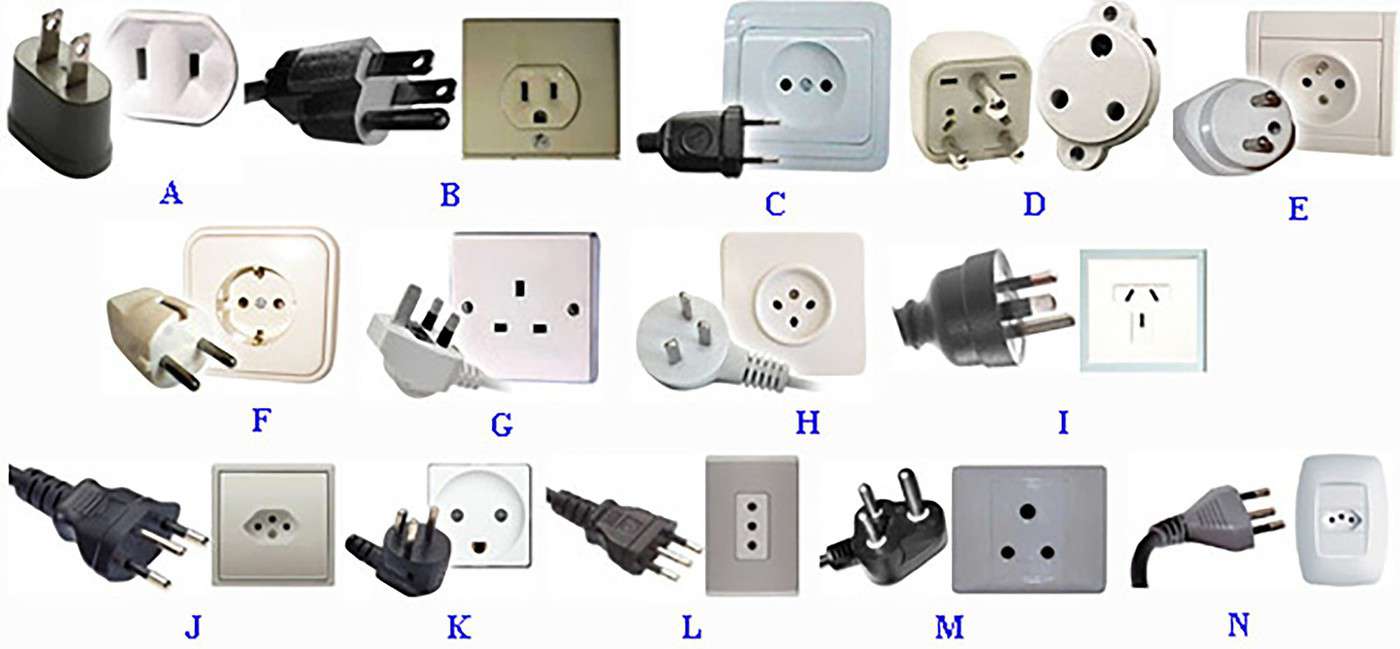
There are officially 14 types of plugs used worldwide, each with its own characteristics and no guaranteed compatibility between models. This is why having the right adapter—or better yet, a universal adapter—can be essential for plugging in your devices anywhere in the world.
Of these, three categories of plugs are the most common and most relevant to travellers. For convenience, we’ll call them "French plugs," "British plugs," and "US plugs," even though each has an official designation corresponding to a letter from A to N.
French Plugs
This is the traditional two-round-pin plug found in France and across Europe (except the UK), Russia, and many former French colonies in Africa. It’s the most widespread type in the world.
The original model (type C) comes in six other variants with two or three pins, officially designated as letters E, F, J, K, L, and N. These variants are found in varying numbers of countries, sometimes even just one, like type J, which is used only in Switzerland.
For now, if you have standard two-round-pin plugs, you can use any of these variants without issue (though the reverse isn’t always true).
British Plugs
These are fairly large plugs with three thick flat prongs (type G). They’re used in Great Britain, Ireland, Malta, Malaysia, Singapore, the Middle East, and, often alongside other plug types, in a few other mostly English-speaking countries. They require an adapter for French or US plugs.
US Plugs
These are plugs with two parallel flat prongs, found across North America and Japan, widely in Central America and the Caribbean, and in some other parts of Asia, South America, and the Pacific, where they’re used alongside other plug types. In all cases, plan on an adapter if you have French or British plugs.
The standard model (type A) has a variant with a third round grounding pin (type B).
Other Categories
There are four other plug categories, often used in few countries and/or alongside other models.
Types D and M are large, distinctive plugs with three thick round pins. They were once the standard in Britain and are now mainly found in India, Sri Lanka, Nepal, South Africa, and Namibia. In all cases, they require an adapter for US or British plugs.
Type I is used in Australia, New Zealand, many Pacific islands, China, and Argentina. These plugs have three flat pins, two of which are positioned in a V shape, and require an adapter.
Finally, type H is a plug used only in Israel but compatible with "French" type C plugs.
USB Outlets
With the rise of mobile devices and phones needing recharging, demand for USB ports has grown. To meet this need, USB wall outlets are now increasingly common in public spaces and especially in hotels.
Africa Summary
The "systems" refer to the different types of plugs used locally. If multiple models exist in a country, it doesn’t mean each will be available everywhere or all the time.
North Africa
| Voltage (frequency) | French system | British system | US system | Other system | |
|---|---|---|---|---|---|
| Algeria | 230 V (50 Hz) | C + F | - | - | - |
| Egypt | 220 V (50 Hz) | C + F | - | - | - |
| Libya | 127/230 V (50 Hz) | F | - | - | D |
| Morocco | 220 V (50 Hz) | C + E | - | - | - |
| Tunisia | 230 V (50 Hz) | C + E | - | - | - |
West and Central Africa
| Voltage (frequency) | French system | British system | US system | Other system | |
|---|---|---|---|---|---|
| Benin | 220 V (50 Hz) | E | - | - | - |
| Burkina Faso | 220 V (50 Hz) | C + E | - | - | - |
| Cameroon | 220 V (50 Hz) | C + E | - | - | - |
| Cape Verde | 230 V (50 Hz) | C + F | - | - | - |
| Central African Republic | 220 V (50 Hz) | C + E | - | - | - |
| Congo | 230 V (50 Hz) | C + E | - | - | - |
| Ivory Coast | 220 V (50 Hz) | C + E | - | - | - |
| Gabon | 220 V (50 Hz) | C | - | - | - |
| Gambia | 230 V (50 Hz) | - | G | - | - |
| Ghana | 230 V (50 Hz) | - | G | - | D |
| Guinea | 220 V (50 Hz) | C + F + K | - | - | - |
| Guinea-Bissau | 220 V (50 Hz) | C | - | - | - |
| Equatorial Guinea | 220 V (50 Hz) | C + E | - | - | - |
| Liberia | 120 V (60 Hz) | - | - | A + B | - |
| Mali | 220 V (50 Hz) | C + E | - | - | - |
| Mauritania | 220 V (50 Hz) | C | - | - | - |
| Niger | 220 V (50 Hz) | C + E + F | - | A + B | D |
| Nigeria | 230 V (50 Hz) | - | G | - | D |
| D.R.C. | 220 V (50 Hz) | C + E | - | - | D |
| São Tomé and Príncipe | 230 V (50 Hz) | C + L | - | - | - |
| Senegal | 230 V (50 Hz) | C + E + K | - | - | D |
| Sierra Leone | 230 V (50 Hz) | - | G | - | D |
| Chad | 220 V (50 Hz) | E + F | - | - | D |
| Togo | 220 V (50 Hz) | C | - | - | - |
East and Southern Africa
| Voltage (frequency) | French system | British system | US system | Other system | |
|---|---|---|---|---|---|
| South Africa | 230 V (50 Hz) | N | - | - | D + M |
| Angola | 220 V (50 Hz) | C | - | - | - |
| Botswana | 230 V (50 Hz) | - | G | - | D |
| Burundi | 220 V (50 Hz) | C + E | - | - | - |
| Djibouti | 220 V (50 Hz) | C + E | - | - | - |
| Eritrea | 230 V (50 Hz) | C + L | - | - | - |
| Ethiopia | 220 V (50 Hz) | C + F | - | - | - |
| Kenya | 240 V (50 Hz) | - | G | - | - |
| Lesotho | 220 V (50 Hz) | - | - | - | M |
| Malawi | 230 V (50 Hz) | - | G | - | - |
| Mozambique | 220 V (50 Hz) | C + F | - | - | M |
| Namibia | 220 V (50 Hz) | - | - | - | D + M |
| Uganda | 240 V (50 Hz) | - | G | - | - |
| Rwanda | 230 V (50 Hz) | C + J | - | - | - |
| Sudan (N & S) | 230 V (50 Hz) | C | - | - | D |
| Eswatini (Swaziland) | 230 V (50 Hz) | - | - | - | M |
| Tanzania | 230 V (50 Hz) | - | G | - | D |
| Zambia | 230 V (50 Hz) | C | G | - | D |
| Zimbabwe | 240 V (50 Hz) | - | G | - | D |
African Indian Ocean
| Voltage (frequency) | French system | British system | US system | Other system | |
|---|---|---|---|---|---|
| Comoros | 220 V (50 Hz) | C + E | - | - | - |
| Madagascar | 127/220 V (50 Hz) | C + E + J + K | - | - | D |
| Mauritius | 230 V (50 Hz) | C | G | - | - |
| Mayotte | 230 V (50 Hz) | E | - | - | - |
| Réunion | 230 V (50 Hz) | E | - | - | - |
| Seychelles | 240 V (50 Hz) | - | G | - | - |
Americas & Pacific Summary
The "systems" refer to the different types of plugs used locally. If multiple models exist in a country, it doesn’t mean each will be available everywhere or all the time.
North America
| Voltage (frequency) | French system | British system | US system | Other system | |
|---|---|---|---|---|---|
| Canada | 120 V (60 Hz) | - | - | A + B | - |
| United States | 120 V (60 Hz) | - | - | A + B | - |
| Greenland | 230 V (50 Hz) | K | - | - | - |
| Quebec | 120 V (60 Hz) | - | - | A + B | - |
| Saint Pierre and Miquelon | 115 V (60 Hz) | - | - | A + B | - |
Central America
| Voltage (frequency) | French system | British system | US system | Other system | |
|---|---|---|---|---|---|
| Belize | 110/220 V (60 Hz) | - | G | B | - |
| Costa Rica | 120 V (60 Hz) | - | - | A + B | - |
| El Salvador | 115 V (60 Hz) | C | G | A + B | I |
| Guatemala | 120 V (60 Hz) | - | G | A + B | I |
| Honduras | 110 V (60 Hz) | - | - | A + B | - |
| Mexico | 127 V (60 Hz) | - | - | A + B | - |
| Nicaragua | 120 V (60 Hz) | - | - | A | - |
| Panama | 120 V (60 Hz) | - | - | A + B | - |
Caribbean
| Voltage (frequency) | French system | British system | US system | Other system | |
|---|---|---|---|---|---|
| Anguilla | 110 V (60 Hz) | - | - | A | - |
| Antigua and Barbuda | 230 V (60 Hz) | - | - | A + B | - |
| Aruba | 120 V (60 Hz) | F | - | A + B | - |
| Bahamas | 120 V (60 Hz) | - | - | A + B | - |
| Barbados | 115 V (50 Hz) | - | - | A + B | - |
| Bermuda | 120 V (60 Hz) | - | - | A + B | - |
| Cayman Islands | 120 V (60 Hz) | - | - | A + B | - |
| Cuba | 110/220 V (60 Hz) | C + L | - | A + B | - |
| Dominica | 230 V (50 Hz) | - | G | - | D |
| Grenada | 230 V (50 Hz) | - | G | - | - |
| Guadeloupe | 230 V (50 Hz) | C + E | - | - | D |
| Haiti | 110 V (60 Hz) | - | - | A + B | - |
| U.S. Virgin Islands | 110 V (60 Hz) | - | - | A + B | - |
| British Virgin Islands | 110 V (60 Hz) | - | - | A + B | - |
| Jamaica | 110 V (50 Hz) | - | - | A + B | - |
| Martinique | 220 V (50 Hz) | C + E | - | - | D |
| Montserrat | 230 V (60 Hz) | - | - | A + B | - |
| Caribbean Netherlands | 127/220 V (50 Hz) | F | - | A + B | - |
| Puerto Rico | 120 V (60 Hz) | - | - | A + B | - |
| Dominican Republic | 120 V (60 Hz) | - | - | A + B | - |
| Saint Barthélemy | 230 V (60 Hz) | C + E | - | - | - |
| Saint Kitts and Nevis | 230 V (60 Hz) | - | G | - | D |
| Saint Martin | 110/220 V (60 Hz) | C | - | A + B | - |
| Saint Vincent and the Grenadines | 230 V (50 Hz) | C + E + K | G | A | I |
| Saint Lucia | 230 V (50 Hz) | - | G | - | - |
| Trinidad and Tobago | 115 V (60 Hz) | - | - | A + B | - |
| Turks and Caicos | 120 V (60 Hz) | - | - | A + B | - |
South America
| Voltage (frequency) | French system | British system | US system | Other system | |
|---|---|---|---|---|---|
| Argentina | 220 V (50 Hz) | C | - | - | I |
| Bolivia | 230 V (50 Hz) | C | - | A | - |
| Brazil | 127/220 V (60 Hz) | N | - | - | - |
| Chile | 220 V (50 Hz) | C + L | - | - | - |
| Colombia | 110 V (60 Hz) | - | - | A + B | - |
| Ecuador | 120 V (60 Hz) | - | - | A + B | - |
| Galapagos | 120 V (60 Hz) | - | - | A + B | - |
| Guyana | 240 V (60 Hz) | - | G | A + B | D |
| French Guiana | 220 V (50 Hz) | C + E | - | - | D |
| Falkland Islands | 240 V (50 Hz) | - | G | - | - |
| Paraguay | 220 V (50 Hz) | C | - | - | - |
| Peru | 220 V (60 Hz) | C | - | A + B | - |
| Suriname | 127 V (60 Hz) | C + F | - | - | - |
| Uruguay | 220 V (50 Hz) | C + F + L | - | - | I |
| Venezuela | 120 V (60 Hz) | - | - | A + B | - |
Pacific
| Voltage (frequency) | French system | British system | US system | Other system | |
|---|---|---|---|---|---|
| Australia | 240 V (50 Hz) | - | - | - | I |
| Cook Islands | 240 V (50 Hz) | - | - | - | I |
| Fiji | 240 V (50 Hz) | - | - | - | I |
| Hawaii | 120 V (60 Hz) | - | - | A + B | - |
| Easter Island | 220 V (50 Hz) | C + L | - | - | - |
| Kiribati | 240 V (50 Hz) | - | - | - | I |
| Micronesia | 120 V (60 Hz) | - | - | A + B | - |
| Nauru | 240 V (50 Hz) | - | - | - | I |
| New Caledonia | 220 V (50 Hz) | F | - | - | - |
| New Zealand | 230 V (50 Hz) | - | - | - | I |
| Palau | 120 V (60 Hz) | - | - | A + B | - |
| Papua New Guinea | 240 V (50 Hz) | - | - | - | I |
| French Polynesia | 220 V (50/60 Hz) | C + E | - | - | - |
| Samoa | 230 V (50 Hz) | - | - | - | I |
| American Samoa | 120 V (60 Hz) | F | - | A + B | I |
| Tonga | 240 V (50 Hz) | - | - | - | I |
| Vanuatu | 230 V (50 Hz) | - | - | - | I |
Asia & Middle East Summary
The "systems" refer to the different types of plugs used locally. If multiple models exist in a country, it doesn’t mean each will be available everywhere or all the time.
Northeast Asia
| Voltage (frequency) | French system | British system | US system | Other system | |
|---|---|---|---|---|---|
| China | 220 V (50 Hz) | C | - | A | I |
| North Korea | 110/220 V (60 Hz) | C | - | A | - |
| South Korea | 110/220 V (60 Hz) | C + F | - | A + B | - |
| Hong Kong | 220 V (50 Hz) | - | G | - | - |
| Japan | 100 V (50/60 Hz) | - | - | A + B | - |
| Macau | 220 V (50 Hz) | - | G | - | D |
| Taiwan | 110 V (60 Hz) | - | - | A + B | - |
| Tibet | 220 V (50 Hz) | C | - | A | I |
Southeast Asia
| Voltage (frequency) | French system | British system | US system | Other system | |
|---|---|---|---|---|---|
| Myanmar | 230 V (50 Hz) | C + F | G | - | D |
| Brunei | 240 V (50 Hz) | - | G | - | - |
| Cambodia | 230 V (50 Hz) | C | G | A | - |
| Indonesia | 230 V (50 Hz) | C + F | - | - | - |
| Laos | 230 V (50 Hz) | C + E + F | - | A + B | - |
| Malaysia | 240 V (50 Hz) | - | G | - | - |
| Philippines | 220 V (60 Hz) | C | - | A + B | - |
| Singapore | 230 V (50 Hz) | - | G | - | - |
| Thailand | 230 V (50 Hz) | C | - | A + B | - |
| East Timor | 220 V (50 Hz) | C + E + F | - | - | I |
| Vietnam | 220 V (50 Hz) | C | G | A | - |
South Asia
| Voltage (frequency) | French system | British system | US system | Other system | |
|---|---|---|---|---|---|
| Bangladesh | 220 V (50 Hz) | C + K | G | - | D |
| Bhutan | 230 V (50 Hz) | F | G | - | D |
| India | 230 V (50 Hz) | C | - | - | D + M |
| Maldives | 230 V (50 Hz) | J + K + L | G | - | D |
| Nepal | 230 V (50 Hz) | C | - | - | D + M |
| Sri Lanka | 230 V (50 Hz) | - | G | - | D + M |
Central Asia
| Voltage (frequency) | French system | British system | US system | Other system | |
|---|---|---|---|---|---|
| Kazakhstan | 220 V (50 Hz) | C + F | - | - | - |
| Kyrgyzstan | 220 V (50 Hz) | C + F | - | - | - |
| Mongolia | 230 V (50 Hz) | C + E | - | - | - |
| Uzbekistan | 220 V (50 Hz) | C + F | - | - | - |
| Pakistan | 230 V (50 Hz) | C | - | - | D |
| Russia | 220 V (50 Hz) | C + F | - | - | - |
| Tajikistan | 220 V (50 Hz) | C + F | - | - | - |
| Turkmenistan | 220 V (50 Hz) | C + F | - | - | - |
Middle East
| Voltage (frequency) | French system | British system | US system | Other system | |
|---|---|---|---|---|---|
| Saudi Arabia | 127/220 V (60 Hz) | C | G | A + B | - |
| Armenia | 230 V (50 Hz) | C + F | - | - | - |
| Azerbaijan | 220 V (50 Hz) | C + F | - | - | - |
| Bahrain | 230 V (50 Hz) | - | G | - | - |
| United Arab Emirates | 240 V (50 Hz) | - | G | - | - |
| Georgia | 220 V (50 Hz) | C + F | - | - | - |
| Iraq | 230 V (50 Hz) | C | G | - | D |
| Iran | 230 V (50 Hz) | C + F | - | - | - |
| Israel | 230 V (50 Hz) | - | - | - | H |
| Jordan | 230 V (50 Hz) | C + F + J | G | - | D |
| Kuwait | 240 V (50 Hz) | C | G | - | - |
| Lebanon | 230 V (50 Hz) | C | G | - | D |
| Oman | 240 V (50 Hz) | C | G | - | - |
| Palestine (West Bank) | 230 V (50 Hz) | - | - | - | H |
| Qatar | 240 V (50 Hz) | - | G | - | D |
| Syria | 220 V (50 Hz) | C + E + L | - | - | - |
| Yemen | 230 V (50 Hz) | - | G | A | D |
Europe Summary
The "systems" refer to the different types of plugs used locally. If multiple models exist in a country, it doesn’t mean each will be available everywhere or all the time.
Western Europe
| Voltage (frequency) | French system | British system | US system | Other system | |
|---|---|---|---|---|---|
| Azores | 230 V (50 Hz) | C + F | - | B | - |
| Germany | 230 V (50 Hz) | F | - | - | - |
| Andorra | 230 V (50 Hz) | F | - | - | - |
| Austria | 230 V (50 Hz) | F | - | - | - |
| Belgium | 230 V (50 Hz) | E | - | - | - |
| Canary Islands | 230 V (50 Hz) | C + E + L | - | - | - |
| Denmark | 230 V (50 Hz) | E + F + K | - | - | - |
| Spain | 230 V (50 Hz) | F | - | - | - |
| Faroe Islands | 230 V (50 Hz) | E + F + K | - | - | - |
| Finland | 230 V (50 Hz) | F | - | - | - |
| France | 230 V (50 Hz) | C + E + F | - | - | - |
| Gibraltar | 230 V (50 Hz) | C | G | - | - |
| Great Britain | 230 V (50 Hz) | - | G | - | - |
| Ireland | 230 V (50 Hz) | - | G | - | - |
| Iceland | 230 V (50 Hz) | F | - | - | - |
| Italy | 230 V (50 Hz) | F + L | - | - | - |
| Liechtenstein | 230 V (50 Hz) | J | - | - | - |
| Luxembourg | 230 V (50 Hz) | F | - | - | - |
| Madeira | 230 V (50 Hz) | F | - | - | - |
| Malta | 230 V (50 Hz) | - | G | - | - |
| Monaco | 230 V (50 Hz) | E + F | - | - | - |
| Norway | 230 V (50 Hz) | F | - | - | - |
| Netherlands | 230 V (50 Hz) | F | - | - | - |
| Portugal | 230 V (50 Hz) | F | - | - | - |
| San Marino | 230 V (50 Hz) | F + L | - | - | - |
| Sweden | 230 V (50 Hz) | F | - | - | - |
| Switzerland | 230 V (50 Hz) | J | - | - | - |
Eastern Europe
| Voltage (frequency) | French system | British system | US system | Other system | |
|---|---|---|---|---|---|
| Albania | 230 V (50 Hz) | C + F | - | - | - |
| Belarus | 220 V (50 Hz) | C + F | - | - | - |
| Bosnia and Herzegovina | 230 V (50 Hz) | F | - | - | - |
| Bulgaria | 230 V (50 Hz) | F | - | - | - |
| Cyprus | 230 V (50 Hz) | - | G | - | - |
| Croatia | 230 V (50 Hz) | F | - | - | - |
| Estonia | 230 V (50 Hz) | F | - | - | - |
| Greece | 230 V (50 Hz) | F | - | - | - |
| Hungary | 230 V (50 Hz) | F | - | - | - |
| Kosovo | 230 V (50 Hz) | F | - | - | - |
| Latvia | 230 V (50 Hz) | C + F | - | - | - |
| Lithuania | 230 V (50 Hz) | F | - | - | - |
| North Macedonia | 230 V (50 Hz) | F | - | - | - |
| Moldova | 230 V (50 Hz) | C + F | - | - | - |
| Montenegro | 230 V (50 Hz) | F | - | - | - |
| Poland | 230 V (50 Hz) | E | - | - | - |
| Czech Republic | 230 V (50 Hz) | E | - | - | - |
| Romania | 230 V (50 Hz) | F | - | - | - |
| Serbia | 230 V (50 Hz) | F | - | - | - |
| Slovakia | 230 V (50 Hz) | E | - | - | - |
| Slovenia | 230 V (50 Hz) | F | - | - | - |
| Turkey | 230 V (50 Hz) | F | - | - | - |
| Ukraine | 230 V (50 Hz) | C + F | - | - | - |